EP1932933A1 - Dead-soft high-carbon hot-rolled steel sheet and process for producing the same - Google Patents
Dead-soft high-carbon hot-rolled steel sheet and process for producing the same Download PDFInfo
- Publication number
- EP1932933A1 EP1932933A1 EP06798276A EP06798276A EP1932933A1 EP 1932933 A1 EP1932933 A1 EP 1932933A1 EP 06798276 A EP06798276 A EP 06798276A EP 06798276 A EP06798276 A EP 06798276A EP 1932933 A1 EP1932933 A1 EP 1932933A1
- Authority
- EP
- European Patent Office
- Prior art keywords
- less
- steel sheet
- cooling
- grain diameter
- temperature
- Prior art date
- Legal status (The legal status is an assumption and is not a legal conclusion. Google has not performed a legal analysis and makes no representation as to the accuracy of the status listed.)
- Withdrawn
Links
Classifications
-
- C—CHEMISTRY; METALLURGY
- C22—METALLURGY; FERROUS OR NON-FERROUS ALLOYS; TREATMENT OF ALLOYS OR NON-FERROUS METALS
- C22C—ALLOYS
- C22C38/00—Ferrous alloys, e.g. steel alloys
- C22C38/06—Ferrous alloys, e.g. steel alloys containing aluminium
-
- C—CHEMISTRY; METALLURGY
- C21—METALLURGY OF IRON
- C21D—MODIFYING THE PHYSICAL STRUCTURE OF FERROUS METALS; GENERAL DEVICES FOR HEAT TREATMENT OF FERROUS OR NON-FERROUS METALS OR ALLOYS; MAKING METAL MALLEABLE, e.g. BY DECARBURISATION OR TEMPERING
- C21D1/00—General methods or devices for heat treatment, e.g. annealing, hardening, quenching or tempering
- C21D1/26—Methods of annealing
- C21D1/32—Soft annealing, e.g. spheroidising
-
- C—CHEMISTRY; METALLURGY
- C21—METALLURGY OF IRON
- C21D—MODIFYING THE PHYSICAL STRUCTURE OF FERROUS METALS; GENERAL DEVICES FOR HEAT TREATMENT OF FERROUS OR NON-FERROUS METALS OR ALLOYS; MAKING METAL MALLEABLE, e.g. BY DECARBURISATION OR TEMPERING
- C21D8/00—Modifying the physical properties of ferrous metals or ferrous alloys by deformation combined with, or followed by, heat treatment
- C21D8/02—Modifying the physical properties of ferrous metals or ferrous alloys by deformation combined with, or followed by, heat treatment during manufacturing of plates or strips
- C21D8/0221—Modifying the physical properties of ferrous metals or ferrous alloys by deformation combined with, or followed by, heat treatment during manufacturing of plates or strips characterised by the working steps
- C21D8/0226—Hot rolling
-
- C—CHEMISTRY; METALLURGY
- C21—METALLURGY OF IRON
- C21D—MODIFYING THE PHYSICAL STRUCTURE OF FERROUS METALS; GENERAL DEVICES FOR HEAT TREATMENT OF FERROUS OR NON-FERROUS METALS OR ALLOYS; MAKING METAL MALLEABLE, e.g. BY DECARBURISATION OR TEMPERING
- C21D8/00—Modifying the physical properties of ferrous metals or ferrous alloys by deformation combined with, or followed by, heat treatment
- C21D8/02—Modifying the physical properties of ferrous metals or ferrous alloys by deformation combined with, or followed by, heat treatment during manufacturing of plates or strips
- C21D8/0247—Modifying the physical properties of ferrous metals or ferrous alloys by deformation combined with, or followed by, heat treatment during manufacturing of plates or strips characterised by the heat treatment
- C21D8/0263—Modifying the physical properties of ferrous metals or ferrous alloys by deformation combined with, or followed by, heat treatment during manufacturing of plates or strips characterised by the heat treatment following hot rolling
-
- C—CHEMISTRY; METALLURGY
- C21—METALLURGY OF IRON
- C21D—MODIFYING THE PHYSICAL STRUCTURE OF FERROUS METALS; GENERAL DEVICES FOR HEAT TREATMENT OF FERROUS OR NON-FERROUS METALS OR ALLOYS; MAKING METAL MALLEABLE, e.g. BY DECARBURISATION OR TEMPERING
- C21D8/00—Modifying the physical properties of ferrous metals or ferrous alloys by deformation combined with, or followed by, heat treatment
- C21D8/02—Modifying the physical properties of ferrous metals or ferrous alloys by deformation combined with, or followed by, heat treatment during manufacturing of plates or strips
- C21D8/0247—Modifying the physical properties of ferrous metals or ferrous alloys by deformation combined with, or followed by, heat treatment during manufacturing of plates or strips characterised by the heat treatment
- C21D8/0273—Final recrystallisation annealing
-
- C—CHEMISTRY; METALLURGY
- C21—METALLURGY OF IRON
- C21D—MODIFYING THE PHYSICAL STRUCTURE OF FERROUS METALS; GENERAL DEVICES FOR HEAT TREATMENT OF FERROUS OR NON-FERROUS METALS OR ALLOYS; MAKING METAL MALLEABLE, e.g. BY DECARBURISATION OR TEMPERING
- C21D9/00—Heat treatment, e.g. annealing, hardening, quenching or tempering, adapted for particular articles; Furnaces therefor
- C21D9/46—Heat treatment, e.g. annealing, hardening, quenching or tempering, adapted for particular articles; Furnaces therefor for sheet metals
-
- C—CHEMISTRY; METALLURGY
- C22—METALLURGY; FERROUS OR NON-FERROUS ALLOYS; TREATMENT OF ALLOYS OR NON-FERROUS METALS
- C22C—ALLOYS
- C22C38/00—Ferrous alloys, e.g. steel alloys
- C22C38/001—Ferrous alloys, e.g. steel alloys containing N
-
- C—CHEMISTRY; METALLURGY
- C22—METALLURGY; FERROUS OR NON-FERROUS ALLOYS; TREATMENT OF ALLOYS OR NON-FERROUS METALS
- C22C—ALLOYS
- C22C38/00—Ferrous alloys, e.g. steel alloys
- C22C38/02—Ferrous alloys, e.g. steel alloys containing silicon
-
- C—CHEMISTRY; METALLURGY
- C22—METALLURGY; FERROUS OR NON-FERROUS ALLOYS; TREATMENT OF ALLOYS OR NON-FERROUS METALS
- C22C—ALLOYS
- C22C38/00—Ferrous alloys, e.g. steel alloys
- C22C38/04—Ferrous alloys, e.g. steel alloys containing manganese
-
- C—CHEMISTRY; METALLURGY
- C22—METALLURGY; FERROUS OR NON-FERROUS ALLOYS; TREATMENT OF ALLOYS OR NON-FERROUS METALS
- C22C—ALLOYS
- C22C38/00—Ferrous alloys, e.g. steel alloys
- C22C38/12—Ferrous alloys, e.g. steel alloys containing tungsten, tantalum, molybdenum, vanadium, or niobium
-
- C—CHEMISTRY; METALLURGY
- C22—METALLURGY; FERROUS OR NON-FERROUS ALLOYS; TREATMENT OF ALLOYS OR NON-FERROUS METALS
- C22C—ALLOYS
- C22C38/00—Ferrous alloys, e.g. steel alloys
- C22C38/14—Ferrous alloys, e.g. steel alloys containing titanium or zirconium
-
- C—CHEMISTRY; METALLURGY
- C22—METALLURGY; FERROUS OR NON-FERROUS ALLOYS; TREATMENT OF ALLOYS OR NON-FERROUS METALS
- C22C—ALLOYS
- C22C38/00—Ferrous alloys, e.g. steel alloys
- C22C38/18—Ferrous alloys, e.g. steel alloys containing chromium
-
- C—CHEMISTRY; METALLURGY
- C22—METALLURGY; FERROUS OR NON-FERROUS ALLOYS; TREATMENT OF ALLOYS OR NON-FERROUS METALS
- C22C—ALLOYS
- C22C38/00—Ferrous alloys, e.g. steel alloys
- C22C38/18—Ferrous alloys, e.g. steel alloys containing chromium
- C22C38/32—Ferrous alloys, e.g. steel alloys containing chromium with boron
-
- C—CHEMISTRY; METALLURGY
- C21—METALLURGY OF IRON
- C21D—MODIFYING THE PHYSICAL STRUCTURE OF FERROUS METALS; GENERAL DEVICES FOR HEAT TREATMENT OF FERROUS OR NON-FERROUS METALS OR ALLOYS; MAKING METAL MALLEABLE, e.g. BY DECARBURISATION OR TEMPERING
- C21D2211/00—Microstructure comprising significant phases
- C21D2211/005—Ferrite
-
- C—CHEMISTRY; METALLURGY
- C21—METALLURGY OF IRON
- C21D—MODIFYING THE PHYSICAL STRUCTURE OF FERROUS METALS; GENERAL DEVICES FOR HEAT TREATMENT OF FERROUS OR NON-FERROUS METALS OR ALLOYS; MAKING METAL MALLEABLE, e.g. BY DECARBURISATION OR TEMPERING
- C21D6/00—Heat treatment of ferrous alloys
- C21D6/008—Heat treatment of ferrous alloys containing Si
Definitions
- the present invention relates to an ultra soft high carbon hot-rolled steel sheet and a manufacturing method thereof.
- High carbon steel sheets used, for example, for tools and automobile parts (gears and transmissions) are processed by heat treatment such as quenching and tempering after punching and/or molding.
- heat treatment such as quenching and tempering after punching and/or molding.
- simplification of fabrication steps has been studied by press molding (including cold forging) of steel sheets.
- a high carbon steel sheet as a raw material has been desired to have good workability so that a complicated shape is formed by a small number of steps and, in particular, has been strongly desired to have soft properties.
- the soft properties are also strongly anticipated.
- Patent Document 1 a method for manufacturing a high carbon steel strip has been proposed in which after hot rolling, a steel strip is heated to a ferrite-austenite two phase region, followed by annealing at a predetermined cooling rate. According to this technique, a high carbon steel strip is annealed at the Ac 1 point or more in the ferrite-austenite two phase region, so that a texture is formed in which rough large spheroidizing cementite is uniformly distributed in a ferrite matrix.
- Al to N of 5 to 10 is processed by hot rolling, pickling, and descaling, annealing is performed at a temperature range of 680°C or more, a heating rate Tv (°C/Hr) in the range of 500x(0.01-N(%) as AlN) to 2,000x(0.1-N(%) as A1N), and a soaking temperature TA (°C) in the range of the Ac 1 point to 222 ⁇ C(%) 2 -411 ⁇ C(%)+912 for a soaking heating time of 1 to 20 hours in a furnace containing not less than 95 percent by volume of hydrogen and nitrogen as the balance, followed by cooling to room temperature at a cooling rate of 100°C/Hr or less.
- Patent Document 2 a manufacturing method has been disclosed in which a hot-rolled steel sheet containing 0.1 to 0.8 mass percent of carbon and 0.01 mass percent or less of sulfur is sequentially processed by a first heating step at a temperature range of Ac 1 -50°C to less than Ac 1 for a hold time of 0.5 hours or more, a second heating step at a temperature range of Ac 1 to Ac 1 +100°C for a hold time of 0.5 to 20 hours, and a third heating step ⁇ at a temperature range of Ar 1 -50°C to Ar 1 for a hold time of 2 to 20 hours, and in which the cooling rate from the hold temperature in the second step to that in the third step is set to 5 to 30°C/Hr.
- Patent Documents 3 and 4 a method has been disclosed in which carbon contained in steel is graphitized so as to obtain softened steel having high ductility.
- Patent Document 5 a method for uniformly forming rough large ferrite grains to obtain ultra soft steel has been disclosed in which steel containing 0.2 to 0.7 mass percent of carbon is hot-rolled to control the texture so as to have more than 70 percent by volume of bainite, followed by annealing.
- finish rolling is performed at a temperature of (the Ar 3 transformation point-20°C) or more
- cooling is performed to a cooling stop temperature of 550°C or less at a cooling rate of more than 120°C/sec
- annealing is performed at a temperature in the range of from 640°C to the Ac 1 transformation point.
- Patent Document 1 Japanese Unexamined Patent Application Publication No.
- Patent Document 2 Japanese Unexamined Patent Application Publication No. 11-80884
- Patent Document 3 Japanese Unexamined Patent Application Publication No. 64-25946
- Patent Document 4 Japanese Unexamined Patent Application Publication No. 8-246051
- Patent Document 5 Japanese Unexamined Patent Application Publication No. 2003-73742
- a high carbon steel strip is annealed in the ferrite-austenite two phase region at a temperature of the Ac 1 point or more so as to form rough large spheroidizing cementite; however, since the rough large cementite described above has a slow dissolution rate, it is apparent that the quenching properties are degraded.
- the hardness Hv of a S35C material after annealing is 132 to 141 (HBR 72 to 75), and this material may not be exactly regarded as a soft material.
- the hardness after the spheroidizing annealing is only evaluated on the sheet surface of the sample by Rockwell B scale hardness (HRB), and since the rough large ferrite grains are not uniformly formed in the thickness direction after the spheroidizing annealing, and the material properties are liable to vary, a stably softened steel sheet cannot be obtained.
- HRB Rockwell B scale hardness
- the present invention was made in consideration of the situations described above, and an object of the present invention is to provide an ultra soft high carbon hot-rolled steel sheet which can be manufactured without performing high temperature annealing in the ferrite-austenite region and without using multi-stage annealing and which is not likely to be cracked in press molding and cold forging.
- the manufacturing method was investigated to control the above texture, and as a result, a method for manufacturing an ultra soft high carbon hot-rolled steel sheet was established.
- the present invention was made based on the above findings, and the aspects thereof are as follows.
- the percents of the components of steel are all mass percents.
- an ultra soft high carbon hot-rolled steel sheet can be obtained.
- the ultra soft high carbon hot-rolled steel sheet of the present invention can be manufactured by controlling the hot-rolled steel sheet texture before annealing, that is, by controlling hot-rolling conditions, and can be manufactured without performing high temperature annealing in the ferrite-austenite region and without using multi-stage annealing.
- the working process can be simplified, and as a result, the cost can be reduced.
- An ultra soft high carbon hot-rolled steel sheet according to the present invention is controlled to have a composition shown below and has a texture in which the average ferrite grain diameter is 20 ⁇ m or more, the volume ratio (hereinafter referred to as a "rough large ferrite ratio (grain diameter of 10 ⁇ m or more") of ferrite grains having a grain diameter of 10 ⁇ m or more is 80% or more, and the average carbide grain diameter is 0.10 to less than 2.0 ⁇ m.
- the average ferrite grain diameter is more than 35 ⁇ m
- the volume ratio (hereinafter referred to as a "rough large ferrite ratio (grain diameter of 20 ⁇ m or more") of ferrite grains having a grain diameter of 20 ⁇ m or more is 80% or more
- the average carbide grain diameter is 0.10 to less than 2.0 ⁇ m.
- the ultra soft high carbon hot-rolled steel sheet described above is manufactured by the steps of performing rough rolling of steel having a composition described below, then performing finish rolling at a reduction ratio of 10% or more and at a finish temperature of (Ar 3 -20°C) or more in a final pass, then performing first cooling within 2 seconds after the finish rolling to a cooling stop temperature of 600°C or less at a cooling rate of more than 120°C/sec, then performing second cooling so that the steel thus processed is held at 600°C or less, then performing coiling at 580°C or less, followed by pickling, and then performing spheroidizing annealing at a temperature in the range of 680°C to the Ac 1 transformation point by a box-annealing process.
- an ultra soft high carbon hot-rolled steel sheet having the preferable texture described above can be manufactured by the steps of performing rough rolling of steel having a composition described below, then performing finish rolling in which final two passes are each performed at a reduction ratio of 10% or more (preferably 13% or more) in a temperature range of (Ar 3 -20°C) to (Ar 3 +150°C), then performing first cooling within 2 seconds after the finish rolling to a cooling stop temperature of 600°C or less at a cooling rate of more than 120°C/sec, then performing second cooling so that the steel thus processed is held at 600°C or less, then performing coiling at 580°C or less, followed by pickling, and then performing spheroidizing annealing at a temperature in the range of 680°C to the Ac 1 transformation point for a soaking time of 20 hours or more by a box-annealing process.
- C is a most basic alloying element of carbon steel. Depending on the C content, a quenched hardness and the amount of carbide in an annealed state are considerably changed. In steel having a C content of less than 0.2%, formation of proeutectoid ferrite apparently occurs in a texture after hot rolling, and a stable rough large ferrite grain texture cannot be obtained after annealing, so that stable softening cannot be achieved. In addition, a sufficient quenched hardness required, for example, for automobile parts cannot be obtained.
- the C content is set to 0.2% to 0.7% and is preferably set to 0.2% to 0.5%.
- Si is an element improving the quenching properties.
- the Si content is less than 0.01%, the hardness in quenching is insufficient.
- the Si content is more than 1.0%, because of solid-solution strengthening, ferrite is hardened, and as a result, the workability is degraded.
- carbide is graphitized, and the quenching properties tend to be degraded.
- the Si content is set to 0.01% to 1.0% and is preferably set to 0.01% to 0.8%.
- Mn is an element improving the quenching properties as a Si element.
- Mn is an important element since S is fixed in the form of MnS, and hot cracking of a slab is prevented.
- the Mn content is less than 0.1%, the above effect cannot be sufficiently obtained, and in addition, the quenching properties are seriously degraded.
- the Mn content is more than 1.0%, because of solid-solution strengthening, ferrite is hardened, and as a result, the workability is degraded.
- the Mn content is set to 0.1% to 1.0% and is preferably set to 0.1% to 0.8%.
- the P content is set to 0.03% or less and is preferably set to 0.02% or less.
- S forms MnS with Mn and degrades the workability and the toughness after quenching; hence, S is an element that should be decreased, and the content thereof is preferably decreased as small as possible. However, since an S content of up to 0.035% is permissible, the S content is set to 0.035% or less and is preferably set to 0.03% or less.
- the Al content is set to 0.08% or less and is preferably set to 0.06% or less.
- N 0.01% or less
- the N content is set to 0.01% or less.
- the steel according to the present invention can obtain target properties; however, besides the above addition elements, at least one of B and Cr may also be added.
- B and Cr may also be added.
- B is an important element which suppresses the formation of proeutectoid ferrite in cooling after hot rolling and which forms uniform rough large ferrite grains after annealing.
- the B content is less than 0.0010%, a sufficient effect may not be obtained in some cases.
- the B content is more than 0.0050%, the effect is saturated, and in addition, the load in hot rolling is increased, so that the operationability may be degraded in some cases.
- the B content is preferably set to 0.0010% to 0.0050%.
- Cr is an important element which suppresses the formation of proeutectoid ferrite in cooling after hot rolling and which forms uniform rough large ferrite grains after annealing.
- the Cr content is less than 0.005%, a sufficient effect may not be obtained in some cases.
- the Cr content is more than 0.30%, the effect of suppressing the formation of proeutectoid ferrite is saturated, and in addition, the cost is increased.
- the Cr content is preferably set to 0.005% to 0.30%. More preferably, the Cr content is set to 0.05% to 0.30%.
- B and Cr be simultaneously added, and in this case, it is more preferable that the B content be set to 0.0010% to 0.0050% and that the Cr content be set to 0.05% to 0.30%.
- At least one of Mo, Ti, and Nb may be added whenever necessary.
- the contents of Mo, Ti, and Nb are each less than 0.005%, the effect of the addition cannot be sufficiently obtained.
- the contents of Mo, Ti, and Nb are more than 0.5%, more than 0.05%, and more than 0.1%, respectively, the effect is saturated, the cost is increased, and the increase in strength is further significant, for example, by solid-solution strengthening and precipitation strengthening, so that the workability is degraded.
- the Mo content, the Ti content, and the Nb content are set to 0.005% to 0.5%, 0.005% to 0.05%, and 0.005% to 0.1%, respectively.
- the balance other than the elements described above includes Fe and incidental impurities.
- the incidental impurities for example, O forms a non-metal interstitial material and has an adverse influence on the quality, and hence the O content is preferably decreased to 0.003% or less.
- trace elements having no adverse influences on the effects of the present invention Cu, Ni, W, V, Zr, Sn, and Sb in an amount of 0.1% or less may be contained.
- the average ferrite grain diameter is an important factor responsible for determining the hardness, and when ferrite grains are made rough and large, the softening can be achieved. That is, when the average ferrite grain diameter is set to 20 ⁇ m or more, ultra softness can be obtained, and superior workability can also be obtained. In addition, when the average ferrite grain diameter is set to more than 35 ⁇ m, the ultra softness can be further improved, and more superior workability can be obtained. Accordingly, the average ferrite grain diameter is set to 20 ⁇ m or more, preferably more than 35 ⁇ m, and more preferably 50 ⁇ m or more.
- the softness is improved as the ferrite grains are made rougher and larger; however, in order to stabilize the softening, it is preferable that the ratio of ferrite grains having a diameter not less than a predetermined value be high.
- the volume ratio of ferrite grains having a grain diameter of 10 ⁇ m or more or a grain diameter of 20 ⁇ m or more is defined as a rough large ferrite ratio, and in the present invention, this rough large ferrite ratio is set to 80% or more.
- the rough large ferrite ratio is set to 80% or more and is preferably set to 85% or more.
- the ferrite grains are preferably rough and large, and hence the rough large ferrite ratio having a grain diameter of 10 ⁇ m or more or preferably having 20 ⁇ m or more is set to 80% or more.
- the rough large ferrite ratio can be obtained, and in this case, the areas described above can be obtained from the cross-section of a steel sheet by metal texture observation (using at least 10 visual fields at a magnification of approximately 200 times).
- a steel sheet having rough large ferrite grains and a rough large ferrite ratio of 80% or more can be obtained when the reduction ratio and the temperature in finish rolling are controlled as described below.
- a steel sheet having an average ferrite grain diameter of 20 ⁇ m or more and a rough large ferrite ratio (grain diameter of 10 ⁇ m or more) of 80% or more can be obtained when finish rolling is performed at a final pass reduction ratio of 10% or more and a temperature of (Ar 3 -20)°C or more.
- the reduction ratio in the final pass is set to 10% or more, a grain-growth driving force is increased, and the ferrite grains are uniformly grown rough and large.
- a steel sheet having an average ferrite grain diameter of more than 35 ⁇ m and a rough large ferrite ratio (grain diameter of 20 ⁇ m or more) of 80% or more can be obtained by finish rolling in which final two passes are each performed at a reduction ratio of 10% or more (preferably in the range of 13% to less than 40%) and a temperature in the range of (Ar 3 -20)°C to (Ar 3 +150)°C (preferably in the range of (Ar 3 -20)°C to (Ar 3 +100)°C).
- the reduction ratios of the final two passes are each set to 10% or less (preferably in the range of 13% to less than 40%), many shear zones are formed in old austenite grains, and the number of nucleation sites of transformation is increased. As a result, lath-shaped ferrite grains forming a bainite texture becomes fine, and by using very high grain boundary energy as a driving force, the ferrite grains are uniformly grown rough and large.
- the average carbide grain diameter is an important factor since it has significant influences on general workability, punching machinability, and quenched strength in annealing after processing. When carbide becomes fine, it is likely to be dissolved at an annealing stage after processing, and as a result, stable quenched hardness can be ensured; however, when the average carbide grain diameter is less than 0.10 ⁇ m, the workability is degraded as the hardness is increased. On the other hand, although the workability is improved as the average carbide grain diameter is increased, when the average carbide grain diameter is 2.0 ⁇ m or more, carbide is not likely to be dissolved, and the quenched strength is decreased. Accordingly, the average carbide grain diameter is set to 0.10 to less than 2.0 ⁇ m. In addition, as described later, the average carbide grain diameter can be controlled by manufacturing conditions, and in particular, by a first cooling stop temperature after hot rolling, a second cooling hold temperature, a coiling temperature, and annealing conditions.
- the ultra soft high carbon hot-rolled steel sheet of the present invention can be obtained by a process comprising the steps of performing rough rolling of steel which is controlled to have the above chemical component composition, then performing finish rolling at a desired reduction ratio and temperature, then performing cooling under desired cooling conditions, followed by coiling and pickling, and then performing desired spheroidizing annealing by a box annealing method.
- the steps mentioned above will be described below in detail.
- the final pass reduction ratio is set to 10% or more, many shear zones are formed in old austenite grains, and the number of nucleation sites of transformation is increased. Hence, lath-shaped ferrite grains forming bainite become fine, and by using high grain boundary energy as a driving force in spheroidizing annealing, a uniform rough large ferrite grain texture is obtained having an average ferrite grain diameter of 20 ⁇ m or more and a rough large ferrite ratio (a grain diameter of 10 ⁇ m or more) of 80% or more.
- the final pass reduction ratio is set to 10% or more, and in consideration of uniform formation of rough large grains, it is preferably set to 13% or more and is more preferably set to 18% or more.
- the final pass reduction ratio is 40% or more, the load in rolling is increased, and hence the upper limit of the final pass reduction ratio is preferably set to less than 40%.
- the finish temperature (rolling temperature in the final pass) in hot rolling of steel is less than (Ar 3 -20)°C, since the ferrite transformation partly proceeds, and the number of proeutectoid ferrite grains is increased, a mixed-grain ferrite texture is formed after spheroidizing annealing, and a ferrite grain texture having an average ferrite grain diameter of 20 ⁇ m or more and a rough large ferrite ratio (a grain diameter of 10 ⁇ m or more) of 80% or more cannot be obtained, so that stable softening cannot be achieved.
- the finish temperature is set to (Ar 3 -20)°C or more. Accordingly, in the final pass, the reduction ratio is set to 10% or more, and the finish temperature is set to (Ar 3 -20)°C or more.
- the reduction ratios of the final two passes are each preferably set to 10% or more, and in order to more uniformly form rough large grains, the reduction ratios of the final two passes are each preferably set to 13% or more and are more preferably set to 18% or more.
- the reduction ratios of the final two passes are 40% or more, the load in rolling is increased, and hence the upper limit of the reduction ratios of the final two passes are each preferably set to less than 40%.
- the strain accumulation effect is maximized, and hence a uniform rough large ferrite grain texture can be obtained in spheroidizing annealing which has an average ferrite grain diameter of more than 35 ⁇ m and a rough large ferrite ratio (a grain diameter of 20 ⁇ m or more) of 80% or more.
- the rolling temperatures of the final two passes exceed (Ar 3 +150)°C, the strain accumulation effect becomes deficient due to strain recovery, and as a result, a ferrite grain texture having an average ferrite grain diameter of more than 35 ⁇ m and a rough large ferrite ratio (a grain diameter of 20 ⁇ m or more) of 80% or more cannot be obtained after annealing, so that more stable softening may not be achieved in some cases.
- the rolling temperature ranges of the final two passes are each preferably set in the range of (Ar 3 -20)°C to (Ar 3 +150)°C and is more preferably set in the range of (Ar 3 -20)°C to (Ar 3 +100)°C.
- the reduction ratios of the final two passes are each preferably set to 10% or more and more preferably set to 13% or more, and the temperature is preferably set in the range of (Ar 3 -20)°C to (Ar 3 +150)°C and more preferably in the range of (Ar 3 -20)°C to (Ar 3 +100)°C.
- Ar 3 910 - 310 ⁇ C - 80 ⁇ Mn - 15 ⁇ Cr - 80 ⁇ Mo
- the cooling rate of the first cooling after hot rolling is set to more than 120°C/sec.
- the cooling rate is preferably set to 200°C/sec or more and is more preferably set to 300°C/sec or more.
- the upper limit of the cooling rate is not particularly limited; however, for example, when the sheet thickness is assumed to be 3.0 mm, in consideration of capacity determined by the present facilities, the upper limit is 700°C/sec.
- the time from the finish rolling to the start of cooling is more than 2 seconds, since austenite grains are recrystallized, the strain accumulation effect cannot be obtained, and the grain growth driving force is deficient. Hence, a stable rough large ferrite grain texture cannot be obtained after annealing, and as a result, softening cannot be achieved. Accordingly, the time from the finish rolling to the start of cooling is set to 2 seconds or less.
- the time from the finish rolling to the start of cooling is preferably set to 1.5 seconds or less and more preferably set to 1.0 second or less.
- the first cooling stop temperature after hot rolling is set to 600°C or less, preferably 580°C or less, and more preferably 550°C or less.
- the lower temperature limit is not particularly limited; however, the sheet shape is deteriorated as the temperature is decreased, the lower temperature limit is preferably set to 300°C or more.
- the steel sheet temperature may be increased in some cases, and even if the first cooling stop temperature is 600°C or less, when the temperature is increased from the end of the first cooling to coiling, proeutectoid ferrite is generated.
- the first cooling stop temperature is 600°C or less, when the temperature is increased from the end of the first cooling to coiling, proeutectoid ferrite is generated.
- carbide is non-uniformly dispersed after annealing, and a stable rough large ferrite grain texture cannot be obtained, so that softening cannot be achieved.
- the temperature from the end of first cooling to coiling be controlled by second cooling, and hence the temperature from the end of first cooling to coiling is held at 600°C or less by the second cooling, more preferably at 580°C or less, and even more preferably at 550°C or less.
- the second cooling may be performed, for example, by laminar cooling.
- the coiling temperature is set to 580°C or less, preferably 550°C or less, and more preferably 530°C or less.
- the lower limit of the coiling temperature is not particularly limited; however, since the shape of steel sheet is deteriorated as the temperature is decreased, the upper limit is preferably set to 200°C or more.
- a hot-rolled steel sheet after coiling is processed by pickling prior to spheroidizing annealing in order to remove scale.
- the pickling may be performed in accordance with a general method.
- Spheroidizing Annealing Box-annealing at a temperature in the range of 680°C to the Ac 1 transformation point
- annealing is preformed in order to form sufficiently rough large ferrite grains and to spheroidize carbide.
- the spheroidizing annealing may be roughly represented by (1) a method in which heating is performed at a temperature just above Ac 1 , followed by slow cooling; (2) a method in which a temperature just below Ac 1 is maintained for a long period of time; and (3) a method in which heating at a temperature just above Ac 1 and cooling just below Ac1 are repeatedly performed.
- the method (2) described above it is intended to simultaneously achieve the growth of ferrite grains and the spheroidization of carbide.
- the annealing temperature of spheroidizing annealing is set in the range of 680°C to the Ac 1 transformation point.
- the annealing time is preferably set to 20 hours or more and is more preferably set to 40 hours or more.
- the ultra soft high carbon hot-rolled steel sheet of the present invention is obtained.
- either a conversion furnace or an electric furnace may be used.
- High carbon steel having the controlled composition as described above is formed into a steel slab used as a raw steel material by ingot making-blooming rolling or continuous casting.
- This steel slab is processed by hot rolling, and in this step, a slab heating temperature is preferably set to 1,300°C or less in order to prevent the degradation in surface conditions caused by scale generation.
- the continuous cast slab may be rolled by hot direct rolling while it is in an as-cast state or it is heated to suppress the decrease in temperature thereof.
- the finish rolling may be performed by omitting the rough rolling.
- a rolled material may be heated by heating means such as a bar heater during hot rolling.
- heating means such as a bar heater during hot rolling.
- hot insulation may be performed for a coiled steel sheet by means such as a slow-cooling cover.
- temper rolling is performed whenever necessary. Since this temper annealing has no influence on the quenching properties, the conditions thereof are not particularly limited.
- the reasons the high carbon hot-rolled steel sheet thus obtained has ultra soft properties and superior workability while the quenching properties are maintained are believed as follows.
- the hardness used as the index of the workability is considerably influenced by the average ferrite grain diameter, and when the ferrite grains have uniform grain diameter and are rough and large, ultra soft properties are obtained, so that the workability is improved.
- the quenching properties are remarkably influenced by the average carbide grain diameter. When carbide is rough and large, non-solid-solution carbide is liable to remain during solution treatment before quenching, and as a result, the quenched hardness is decreased.
- the average ferrite grain diameter, the rough large ferrite ratio, and the average carbide grain diameter of each sample were measured, and in addition, for the performance evaluation, a material hardness thereof was measured.
- the respective measurement methods and conditions are as described below.
- the average grain diameter is defined as the average diameter obtained from at least 3,000 ferrite grains.
- micro-texture observation was performed using an optical microscope, and from the area ratio of ferrite grains having a grain diameter of 10 ⁇ m (or 20 ⁇ m) or more to ferrite grains having a grain diameter of less than 10 ⁇ m (or less than 20 ⁇ m), the rough large ferrite ratio was obtained.
- texture observation was performed using at least 10 viewing fields at a magnification of approximately 200 times, and the average value was employed.
- the average grain diameter is the average value obtained from the grain diameters of at least 500 carbides.
- Hv Vickers hardness
- steel sheet Nos. 1 to 15 are formed by manufacturing methods within the range of the present invention and are examples of the present invention each having a texture in which the average ferrite grain diameter is 20 ⁇ m or more, the rough large ferrite ratio (grain diameter of 10 ⁇ m or more) is 80% or more, and the average ferrite grain diameter is in the range of 0.10 to less than 2.0 ⁇ m. According to the examples of the present invention, it is understood that a high carbon hot-rolled steel sheet is obtained which has a low material hardness and a small difference in material hardness between the surface layer and the central portion in the thickness direction and which is stably softened.
- steel sheet Nos. 16 to 23 are comparative examples formed by manufacturing methods which are outside the range of the present invention
- steel sheet No. 24 is a comparative example in which the steel composition is outside the range of the present invention.
- Steel sheet Nos. 16 to 24 each have an average ferrite grain diameter of less than 20 ⁇ m and a rough large ferrite ratio (grain diameter of 10 ⁇ m or more) of less than 80% and are outside the range of the present invention.
- the difference in material hardness between the surface layer and the central portion in the thickens direction is 15 points or more, the variation in material quality is large, and the workability is degraded.
- steel sheet Nos. 16 to 19 the difference in material hardness between the surface layer and the central portion in the thickens direction is 15 points or more, the variation in material quality is large, and the workability is degraded.
- the 20, 22 and 24 have a very low rough large ferrite ratio (grain diameter of 10 ⁇ m or more), and the average ferrite grain diameter thereof is also outside the range of the present invention, the material hardness is high, and the workability and the mold life are degraded.
- the average ferrite grain diameter, the rough large ferrite ratio, and the average carbide grain diameter of the sample were measured, and in addition, for the performance evaluation, the material hardness was measured.
- the respective measurement methods and conditions are the same as described in Example 1.
- steel sheet Nos. 25 to 34 which are examples of the present invention, it is understood that a high carbon hot-rolled steel sheet is obtained which has a low material hardness and a small difference in material hardness between the surface layer and the central portion in the thickness direction and which is stably softened.
- steel sheet No. 35 is a comparative example in which the steel composition is outside the range of the present invention. In steel sheet No. 35, the difference in material hardness between the surface layer and the central portion in the thickness direction is large, the variation in material quality is large, and the workability is degraded.
- the average ferrite grain diameter, the rough large ferrite ratio, and the average carbide grain diameter of the sample were measured, and in addition, for the performance evaluation, the material hardness was measured.
- the respective measurement methods and conditions are the same as described in Example 1.
- steel sheet Nos. 36 to 50 are formed by manufacturing methods within the range of the present invention and are examples of the present invention which have a texture in which the average ferrite grain diameter is more than 35 ⁇ m, the rough large ferrite ratio (grain diameter of 20 ⁇ m or more) is 80% or more, and the average ferrite grain diameter is in the range of 0.10 to less than 2.0 ⁇ m.
- the examples of the present invention it is understood that a high carbon hot-rolled steel sheet is obtained which has a lower material hardness and a small difference in material hardness between the surface layer and the central portion in the thickness direction and which is stably softened.
- steel sheet Nos. 51 to 58 are comparative examples formed by manufacturing methods which are outside the range of the present invention
- steel sheet No. 59 is a comparative example in which the steel composition is outside the range of the present invention.
- Steel sheet Nos. 51 to 59 each have an average ferrite grain diameter of 35 ⁇ m or less and a rough large ferrite ratio (grain diameter of 20 ⁇ m or more) of less than 80% and are outside the range of the present invention.
- the difference ( ⁇ Hv) in material hardness between the surface layer and the central portion in the thickens direction is 20 points or more, the variation in material quality is large, and the workability is degraded.
- the average ferrite grain diameter, the rough large ferrite ratio, and the average carbide grain diameter of the sample were measured, and in addition, for the performance evaluation, the material hardness was measured.
- the respective measurement methods and conditions are the same as described in Example 1.
- steel sheet Nos. 60 to 73 are formed by manufacturing methods within the range of the present invention and are examples of the present invention which have a texture in which the average ferrite grain diameter is more than 35 ⁇ m, the rough large ferrite ratio (grain diameter of 20 ⁇ m or more) is 80% or more, and the average ferrite grain diameter is in the range of 0.10 to less than 2.0 ⁇ m.
- the examples of the present invention it is understood that a high carbon hot-rolled steel sheet is obtained which has a lower material hardness and a small difference in material hardness between the surface layer and the central portion in the thickness direction and which is stably softened.
- the finish temperature is more than a preferable range of (Ar 3 +100)°C
- the average ferrite grain diameter is smaller than that of the other examples of the present invention, and the difference in material hardness between the surface layer and the central portion in the thickness direction becomes slightly larger.
- steel sheet Nos. 74 to 80 are comparative examples formed by manufacturing methods which are outside the range of the present invention; in steel sheet Nos. 74 to 77, 79 and 80, the average ferrite grain diameter is 35 ⁇ m or less; and in steel sheet Nos. 74 to 80, the rough large ferrite ratios (grain diameter of 20 ⁇ m or more) are all less than 80%. Accordingly, in the comparative examples, since the material hardness is high, or the difference in hardness between the surface layer and the central portion in the thickness direction is 20 points or more, the variation in material quality is large, and the workability is degraded.
Landscapes
- Chemical & Material Sciences (AREA)
- Engineering & Computer Science (AREA)
- Materials Engineering (AREA)
- Mechanical Engineering (AREA)
- Metallurgy (AREA)
- Organic Chemistry (AREA)
- Physics & Mathematics (AREA)
- Thermal Sciences (AREA)
- Crystallography & Structural Chemistry (AREA)
- Heat Treatment Of Sheet Steel (AREA)
- Metal Rolling (AREA)
- Heat Treatment Of Steel (AREA)
Abstract
Description
- The present invention relates to an ultra soft high carbon hot-rolled steel sheet and a manufacturing method thereof.
- High carbon steel sheets used, for example, for tools and automobile parts (gears and transmissions) are processed by heat treatment such as quenching and tempering after punching and/or molding. In recent years, in manufactures of tools and parts, that is, in customers of high carbon steel sheets, in order to reduce the cost, instead of part fabrication by cutting and hot forging of casting materials which has been performed in the past, simplification of fabrication steps has been studied by press molding (including cold forging) of steel sheets. Concomitant with this study, besides excellent quenching performance, a high carbon steel sheet as a raw material has been desired to have good workability so that a complicated shape is formed by a small number of steps and, in particular, has been strongly desired to have soft properties. In addition, in view of load decrease of pressing machines and metal molds, the soft properties are also strongly anticipated.
- In consideration of the current situations, as for softening of a high carbon steel sheet, various techniques have been studied. For example, in Patent Document 1, a method for manufacturing a high carbon steel strip has been proposed in which after hot rolling, a steel strip is heated to a ferrite-austenite two phase region, followed by annealing at a predetermined cooling rate. According to this technique, a high carbon steel strip is annealed at the Ac1 point or more in the ferrite-austenite two phase region, so that a texture is formed in which rough large spheroidizing cementite is uniformly distributed in a ferrite matrix. In particular, after high carbon steel containing 0.2% to 0.8% of C, 0.03% to 0.30% of Si, 0.20% to 1.50% of Mn, 0.01% to 0.10% of sol. Al, and 0.0020% to 0.0100% of N, and having a ratio of the sol. Al to N of 5 to 10, is processed by hot rolling, pickling, and descaling, annealing is performed at a temperature range of 680°C or more, a heating rate Tv (°C/Hr) in the range of 500x(0.01-N(%) as AlN) to 2,000x(0.1-N(%) as A1N), and a soaking temperature TA (°C) in the range of the Ac1 point to 222×C(%)2-411×C(%)+912 for a soaking heating time of 1 to 20 hours in a furnace containing not less than 95 percent by volume of hydrogen and nitrogen as the balance, followed by cooling to room temperature at a cooling rate of 100°C/Hr or less.
- For example, in Patent Document 2, a manufacturing method has been disclosed in which a hot-rolled steel sheet containing 0.1 to 0.8 mass percent of carbon and 0.01 mass percent or less of sulfur is sequentially processed by a first heating step at a temperature range of Ac1-50°C to less than Ac1 for a hold time of 0.5 hours or more, a second heating step at a temperature range of Ac1 to Ac1+100°C for a hold time of 0.5 to 20 hours, and a third heating step·at a temperature range of Ar1-50°C to Ar1 for a hold time of 2 to 20 hours, and in which the cooling rate from the hold temperature in the second step to that in the third step is set to 5 to 30°C/Hr. By performing the three-stage annealing as described above, it is attempted to obtain a high carbon steel sheet having an average ferrite grain diameter of 20 µm or more.
- In addition, in Patent Documents 3 and 4, a method has been disclosed in which carbon contained in steel is graphitized so as to obtain softened steel having high ductility.
- Furthermore, in Patent Document 5, a method for uniformly forming rough large ferrite grains to obtain ultra soft steel has been disclosed in which steel containing 0.2 to 0.7 mass percent of carbon is hot-rolled to control the texture so as to have more than 70 percent by volume of bainite, followed by annealing. According to this technique, after finish rolling is performed at a temperature of (the Ar3 transformation point-20°C) or more, cooling is performed to a cooling stop temperature of 550°C or less at a cooling rate of more than 120°C/sec, and after coiling at a temperature of 500°C or less and pickling are performed, annealing is performed at a temperature in the range of from 640°C to the Ac1 transformation point.
Patent Document 1: Japanese Unexamined Patent Application Publication No.9-157758
Patent Document 2: Japanese Unexamined Patent Application Publication No.11-80884
Patent Document 3: Japanese Unexamined Patent Application Publication No.64-25946
Patent Document 4: Japanese Unexamined Patent Application Publication No.8-246051
Patent Document 5: Japanese Unexamined Patent Application Publication No.2003-73742 - However, the above techniques have the following problems.
- According to the technique disclosed in Patent Document 1, a high carbon steel strip is annealed in the ferrite-austenite two phase region at a temperature of the Ac1 point or more so as to form rough large spheroidizing cementite; however, since the rough large cementite described above has a slow dissolution rate, it is apparent that the quenching properties are degraded. In addition, the hardness Hv of a S35C material after annealing is 132 to 141 (HBR 72 to 75), and this material may not be exactly regarded as a soft material.
- As for the technique disclosed in Patent Document 2, since the annealing step is complicated, when the operation is actually performed, the productivity is degraded, and as a result, the cost is increased.
- According to the techniques disclosed in Patent Documents 3 and 4, the carbon in steel is graphitized, and since the dissolution rate of graphite is slow, the quenching properties are disadvantageously degraded.
- Furthermore, according to the technique disclosed in Patent Document 5, since rough large ferrite grains are formed by spheroidizing annealing of a hot-rolled steel sheet having more than 70 percent by volume of bainite, an ultra soft steel sheet can be obtained; however, since after hot rolling is performed at a finish temperature of (the Ar3 transformation point-20°C) or more, since rapid cooling is performed at a cooling rate of more than 120°C/sec, the temperature is increased by transformation heat generation after cooling, and as a result, the stability of the hot-rolled steel sheet texture is disadvantageously degraded. In addition, the hardness after the spheroidizing annealing is only evaluated on the sheet surface of the sample by Rockwell B scale hardness (HRB), and since the rough large ferrite grains are not uniformly formed in the thickness direction after the spheroidizing annealing, and the material properties are liable to vary, a stably softened steel sheet cannot be obtained.
- The present invention was made in consideration of the situations described above, and an object of the present invention is to provide an ultra soft high carbon hot-rolled steel sheet which can be manufactured without performing high temperature annealing in the ferrite-austenite region and without using multi-stage annealing and which is not likely to be cracked in press molding and cold forging.
- Intensive research was carried out by the inventors of the present invention about the composition, micro-texture, and manufacturing conditions which influence on the hardness of a high carbon steel sheet while the quenching properties are maintained. As a result, it was found that as the factors having significant influences on the hardness of a steel sheet, besides the composition of steel and the shape and volume of carbide, there are mentioned an average carbide grain diameter, an average ferrite grain diameter, and a rough large ferrite ratio (the volume ratio of ferrite grains having a grain diameter not less than a predetermined value). In addition, it was also found that when the average carbide grain diameter, the average ferrite grain diameter, and the rough large ferrite ratio are each controlled in an appropriate range, the hardness of a high carbon steel sheet is remarkably decreased while the quenching properties thereof are maintained.
- Furthermore, in the present invention, based on the above findings, the manufacturing method was investigated to control the above texture, and as a result, a method for manufacturing an ultra soft high carbon hot-rolled steel sheet was established.
- The present invention was made based on the above findings, and the aspects thereof are as follows.
- [1] An ultra soft high carbon hot-rolled steel sheet is provided which comprises on a mass percent basis: 0.2% to 0.7% of C, 0.01% to 1.0% of Si, 0.1% to 1.0% of Mn, 0.03% or less of P, 0.035% or less of S, 0.08% or less of Al, 0.01% or less of N, and the balance being Fe and incidental impurities, wherein in the texture of the hot-rolled steel sheet, an average ferrite grain diameter is 20 µm or more, a volume ratio of ferrite grains having a grain diameter of 10 µm or more is 80% or more, and an average carbide grain diameter is in the range of 0.10 to less than 2.0 µm.
- [2] An ultra soft high carbon hot-rolled steel sheet is provided which comprises on a mass percent basis: 0.2% to 0.7% of C, 0.01% to 1.0% of Si, 0.1% to 1.0% of Mn, 0.03% or less of P, 0.035% or less of S, 0.08% or less of Al, 0.01% or less of N, and the balance being Fe and incidental impurities, wherein in the texture of the hot-rolled steel sheet, an average ferrite grain diameter is more than 35 µm, a volume ratio of ferrite grains having a grain diameter of 20 µm or more is 80% or more, and an average carbide grain diameter is in the range of 0.10 to less than 2.0 µm.
- [3] In the above [1] or [2], the ultra soft high carbon hot-rolled steel sheet may further comprise at least one of 0.0010% to 0.0050% of B and 0.005% to 0.30% of Cr on a mass percent basis.
- [4] In the above [1] and [2], the ultra soft high carbon hot-rolled steel sheet may further comprise 0.0010% to 0.0050% of B and 0.05% to 0.30% of Cr on a mass percent basis.
- [5] In one of the above [1] to [4], the ultra soft high carbon hot-rolled steel sheet may further comprise at least one of 0.005% to 0.5% of Mo, 0.005% to 0.05% of Ti, and 0.005% to 0.1% of Nb on a mass percent basis.
- [6] A method for manufacturing an ultra soft high carbon hot-rolled steel sheet is provided which comprises the steps of: performing rough rolling of steel having the composition according to one of the above [1], [3], [4], and [5], then performing finish rolling at a reduction ratio of 10% or more and at a finish temperature of (Ar3-20)°C or more in a final pass, then performing first cooling within 2 seconds after the finish rolling to a cooling stop temperature of 600°C or less at a cooling rate of more than 120°C/sec, then performing second cooling so that the steel thus processed is held at 600°C or less, then performing coiling at 580°C or less, followed by pickling, and then performing spheroidizing annealing at a temperature in the range of 680°C to the Ac1 transformation point by a box-annealing process.
- [7] A method for manufacturing an ultra soft high carbon hot-rolled steel sheet is provided which comprises the steps of: performing rough rolling of steel having the composition according to one of the above [1], [3], [4], and [5], then performing finish rolling at a reduction ratio of 10% or more and at a finish temperature of (Ar3-20)°C or more in a final pass, then performing first cooling within 2 seconds after the finish rolling to a cooling stop temperature of 550°C or less at a cooling rate of more than 120°C/sec, then performing second cooling so that the steel thus processed is held at 550°C or less, then performing coiling at 530°C or less, followed by pickling, and then performing spheroidizing annealing at a temperature in the range of 680°C to the Ac1 transformation point by a box-annealing process.
- [8] A method for manufacturing an ultra soft high carbon hot-rolled steel sheet is provided which comprises the steps of: performing rough rolling of steel having the composition according to one of the above [2] to [5], then performing finish rolling in which final two passes are each performed at a reduction ratio of 10% or more in a temperature range of (Ar3-20)°C to (Ar3+150)°C, then performing first cooling within 2 seconds after the finish rolling to a cooling stop temperature of 600°C or less at a cooling rate of more than 120°C/sec, then performing second cooling so that the steel is held at 600°C or less, then performing coiling at 580°C or less, followed by pickling, and then performing spheroidizing annealing at a temperature in the range of 680°C to the Ac1 transformation point for a soaking time of 20 hours or more by a box-annealing process.
- [9] A method for manufacturing an ultra soft high carbon hot-rolled steel sheet is provided which comprises the steps of: performing rough rolling of steel having the composition according to one of the above [2] to [5], then performing finish rolling in which final two passes are each performed at a reduction ratio of 10% or more in a temperature range of (Ar3-20)°C to (Ar3+100)°C, then performing first cooling within 2 seconds after the finish rolling to a cooling stop temperature of 550°C or less at a cooling rate of more than 120°C/sec, then performing second cooling so that the steel is held at 550°C or less, then performing coiling at 530°C or less, followed by pickling, and then performing spheroidizing annealing at a temperature in the range of 680°C to the Ac1 transformation point for a soaking time of 20 hours or more by a box-annealing process.
- In this specification, the percents of the components of steel are all mass percents.
- According to the present invention, while the quenching properties are maintained, an ultra soft high carbon hot-rolled steel sheet can be obtained.
- In addition, besides the spheroidizing annealing conditions after hot rolling, the ultra soft high carbon hot-rolled steel sheet of the present invention can be manufactured by controlling the hot-rolled steel sheet texture before annealing, that is, by controlling hot-rolling conditions, and can be manufactured without performing high temperature annealing in the ferrite-austenite region and without using multi-stage annealing. As a result, since an ultra soft high carbon hot-rolled steel sheet having superior workability is used, the working process can be simplified, and as a result, the cost can be reduced.
- An ultra soft high carbon hot-rolled steel sheet according to the present invention is controlled to have a composition shown below and has a texture in which the average ferrite grain diameter is 20 µm or more, the volume ratio (hereinafter referred to as a "rough large ferrite ratio (grain diameter of 10 µm or more") of ferrite grains having a grain diameter of 10 µm or more is 80% or more, and the average carbide grain diameter is 0.10 to less than 2.0 µm. In more preferable, the average ferrite grain diameter is more than 35 µm, the volume ratio (hereinafter referred to as a "rough large ferrite ratio (grain diameter of 20 µm or more") of ferrite grains having a grain diameter of 20 µm or more is 80% or more, and the average carbide grain diameter is 0.10 to less than 2.0 µm. Those described above are most important in the present invention. When the composition, the metal texture (average ferrite grain diameter and the rough large ferrite ratio), and the carbide shape (average carbide grain diameter) are defined as described above and are all satisfied, an ultra soft high carbon hot-rolled steel sheet can be obtained while the quenching properties are maintained.
- In addition, the ultra soft high carbon hot-rolled steel sheet described above is manufactured by the steps of performing rough rolling of steel having a composition described below, then performing finish rolling at a reduction ratio of 10% or more and at a finish temperature of (Ar3-20°C) or more in a final pass, then performing first cooling within 2 seconds after the finish rolling to a cooling stop temperature of 600°C or less at a cooling rate of more than 120°C/sec, then performing second cooling so that the steel thus processed is held at 600°C or less, then performing coiling at 580°C or less, followed by pickling, and then performing spheroidizing annealing at a temperature in the range of 680°C to the Ac1 transformation point by a box-annealing process.
- Furthermore, an ultra soft high carbon hot-rolled steel sheet having the preferable texture described above can be manufactured by the steps of performing rough rolling of steel having a composition described below, then performing finish rolling in which final two passes are each performed at a reduction ratio of 10% or more (preferably 13% or more) in a temperature range of (Ar3-20°C) to (Ar3+150°C), then performing first cooling within 2 seconds after the finish rolling to a cooling stop temperature of 600°C or less at a cooling rate of more than 120°C/sec, then performing second cooling so that the steel thus processed is held at 600°C or less, then performing coiling at 580°C or less, followed by pickling, and then performing spheroidizing annealing at a temperature in the range of 680°C to the Ac1 transformation point for a soaking time of 20 hours or more by a box-annealing process.
- When the manufacturing conditions including the hot finish rolling, first cooling, second cooling, coiling, and annealing are totally controlled as described above, an object of the present invention can be achieved.
- Heretofore, the present invention will be described in detail.
- First, the reasons chemical components of steel of the present invention are determined will be described.
- C is a most basic alloying element of carbon steel. Depending on the C content, a quenched hardness and the amount of carbide in an annealed state are considerably changed. In steel having a C content of less than 0.2%, formation of proeutectoid ferrite apparently occurs in a texture after hot rolling, and a stable rough large ferrite grain texture cannot be obtained after annealing, so that stable softening cannot be achieved. In addition, a sufficient quenched hardness required, for example, for automobile parts cannot be obtained. On the other hand, when the C content is more than 0.7%, the toughness after hot rolling is degraded besides degradation in productionability and handling properties of steel strips, and this type of steel is difficult to be used for a part that requires a material to have a high degree of workability. Hence, in order to provide a steel sheet having both adequate quenched hardness and workability, the C content is set to 0.2% to 0.7% and is preferably set to 0.2% to 0.5%.
- Si is an element improving the quenching properties. When the Si content is less than 0.01%, the hardness in quenching is insufficient. On the other hand, when the Si content is more than 1.0%, because of solid-solution strengthening, ferrite is hardened, and as a result, the workability is degraded. Furthermore, carbide is graphitized, and the quenching properties tend to be degraded. Hence, in order to provide a steel sheet having both adequate quenched hardness and workability, the Si content is set to 0.01% to 1.0% and is preferably set to 0.01% to 0.8%.
- Mn is an element improving the quenching properties as a Si element. In addition, Mn is an important element since S is fixed in the form of MnS, and hot cracking of a slab is prevented. When the Mn content is less than 0.1%, the above effect cannot be sufficiently obtained, and in addition, the quenching properties are seriously degraded. On the other hand, when the Mn content is more than 1.0%, because of solid-solution strengthening, ferrite is hardened, and as a result, the workability is degraded. Hence, in order to provide a steel sheet having both adequate quenched hardness and workability, the Mn content is set to 0.1% to 1.0% and is preferably set to 0.1% to 0.8%.
- Since P segregates in grain boundaries, and the ductility and the toughness are degraded, the P content is set to 0.03% or less and is preferably set to 0.02% or less.
- S forms MnS with Mn and degrades the workability and the toughness after quenching; hence, S is an element that should be decreased, and the content thereof is preferably decreased as small as possible. However, since an S content of up to 0.035% is permissible, the S content is set to 0.035% or less and is preferably set to 0.03% or less.
- When Al is excessively added, a large amount of AlN is precipitated, and as a result, the quenching properties are degraded; hence, the Al content is set to 0.08% or less and is preferably set to 0.06% or less.
- When N is excessively contained, the ductility is degraded; hence, the N content is set to 0.01% or less.
- By the above addition elements, the steel according to the present invention can obtain target properties; however, besides the above addition elements, at least one of B and Cr may also be added. When the above elements are added, preferable contents thereof are shown below, and although one of B and Cr may be added, two elements, B and Cr, are preferably added.
- B is an important element which suppresses the formation of proeutectoid ferrite in cooling after hot rolling and which forms uniform rough large ferrite grains after annealing. However, when the B content is less than 0.0010%, a sufficient effect may not be obtained in some cases. On the other hand, when the B content is more than 0.0050%, the effect is saturated, and in addition, the load in hot rolling is increased, so that the operationability may be degraded in some cases. Accordingly, when B is added, the B content is preferably set to 0.0010% to 0.0050%.
- Cr is an important element which suppresses the formation of proeutectoid ferrite in cooling after hot rolling and which forms uniform rough large ferrite grains after annealing. However, when the Cr content is less than 0.005%, a sufficient effect may not be obtained in some cases. On the other hand, when the Cr content is more than 0.30%, the effect of suppressing the formation of proeutectoid ferrite is saturated, and in addition, the cost is increased. Accordingly, when Cr is added, the Cr content is preferably set to 0.005% to 0.30%. More preferably, the Cr content is set to 0.05% to 0.30%.
- In addition, in order to more efficiently obtain the effect of suppressing the formation of proeutectoid ferrite, it is preferable that B and Cr be simultaneously added, and in this case, it is more preferable that the B content be set to 0.0010% to 0.0050% and that the Cr content be set to 0.05% to 0.30%.
- In addition, in order to further efficiently suppress the formation of proeutectoid ferrite and improve the quenching properties, at least one of Mo, Ti, and Nb may be added whenever necessary. In this case, when the contents of Mo, Ti, and Nb are each less than 0.005%, the effect of the addition cannot be sufficiently obtained. On the other hand, when the contents of Mo, Ti, and Nb are more than 0.5%, more than 0.05%, and more than 0.1%, respectively, the effect is saturated, the cost is increased, and the increase in strength is further significant, for example, by solid-solution strengthening and precipitation strengthening, so that the workability is degraded. Accordingly, when at least one of Mo, Ti, and Nb is added, the Mo content, the Ti content, and the Nb content are set to 0.005% to 0.5%, 0.005% to 0.05%, and 0.005% to 0.1%, respectively.
- The balance other than the elements described above includes Fe and incidental impurities. As the incidental impurities, for example, O forms a non-metal interstitial material and has an adverse influence on the quality, and hence the O content is preferably decreased to 0.003% or less. In addition, as trace elements having no adverse influences on the effects of the present invention, Cu, Ni, W, V, Zr, Sn, and Sb in an amount of 0.1% or less may be contained.
- Next, the texture of the ultra soft high carbon hot-rolled steel sheet of the present invention will be described.
- The average ferrite grain diameter is an important factor responsible for determining the hardness, and when ferrite grains are made rough and large, the softening can be achieved. That is, when the average ferrite grain diameter is set to 20 µm or more, ultra softness can be obtained, and superior workability can also be obtained. In addition, when the average ferrite grain diameter is set to more than 35 µm, the ultra softness can be further improved, and more superior workability can be obtained. Accordingly, the average ferrite grain diameter is set to 20 µm or more, preferably more than 35 µm, and more preferably 50 µm or more.
- The softness is improved as the ferrite grains are made rougher and larger; however, in order to stabilize the softening, it is preferable that the ratio of ferrite grains having a diameter not less than a predetermined value be high. Hence, the volume ratio of ferrite grains having a grain diameter of 10 µm or more or a grain diameter of 20 µm or more is defined as a rough large ferrite ratio, and in the present invention, this rough large ferrite ratio is set to 80% or more.
- When the rough large ferrite ratio is less than 80%, since a mixed grain texture is formed, stable softening cannot be performed. Hence, in order to achieve stable softening, the rough large ferrite ratio is set to 80% or more and is preferably set to 85% or more. In addition, in terms of softening, the ferrite grains are preferably rough and large, and hence the rough large ferrite ratio having a grain diameter of 10 µm or more or preferably having 20 µm or more is set to 80% or more.
- In addition, when the ratio of an area of rough large ferrite grains having a grain diameter not less than a predetermined value to an area of ferrite grains having a grain diameter less than the predetermined value is obtained and is then regarded as the volume ratio, the rough large ferrite ratio can be obtained, and in this case, the areas described above can be obtained from the cross-section of a steel sheet by metal texture observation (using at least 10 visual fields at a magnification of approximately 200 times).
- In addition, as described later, a steel sheet having rough large ferrite grains and a rough large ferrite ratio of 80% or more can be obtained when the reduction ratio and the temperature in finish rolling are controlled as described below. In particular, a steel sheet having an average ferrite grain diameter of 20 µm or more and a rough large ferrite ratio (grain diameter of 10 µm or more) of 80% or more can be obtained when finish rolling is performed at a final pass reduction ratio of 10% or more and a temperature of (Ar3-20)°C or more. When the reduction ratio in the final pass is set to 10% or more, a grain-growth driving force is increased, and the ferrite grains are uniformly grown rough and large. In addition, a steel sheet having an average ferrite grain diameter of more than 35 µm and a rough large ferrite ratio (grain diameter of 20 µm or more) of 80% or more can be obtained by finish rolling in which final two passes are each performed at a reduction ratio of 10% or more (preferably in the range of 13% to less than 40%) and a temperature in the range of (Ar3-20)°C to (Ar3+150)°C (preferably in the range of (Ar3-20)°C to (Ar3+100)°C). When the reduction ratios of the final two passes are each set to 10% or less (preferably in the range of 13% to less than 40%), many shear zones are formed in old austenite grains, and the number of nucleation sites of transformation is increased. As a result, lath-shaped ferrite grains forming a bainite texture becomes fine, and by using very high grain boundary energy as a driving force, the ferrite grains are uniformly grown rough and large.
- The average carbide grain diameter is an important factor since it has significant influences on general workability, punching machinability, and quenched strength in annealing after processing. When carbide becomes fine, it is likely to be dissolved at an annealing stage after processing, and as a result, stable quenched hardness can be ensured; however, when the average carbide grain diameter is less than 0.10 µm, the workability is degraded as the hardness is increased. On the other hand, although the workability is improved as the average carbide grain diameter is increased, when the average carbide grain diameter is 2.0 µm or more, carbide is not likely to be dissolved, and the quenched strength is decreased. Accordingly, the average carbide grain diameter is set to 0.10 to less than 2.0 µm. In addition, as described later, the average carbide grain diameter can be controlled by manufacturing conditions, and in particular, by a first cooling stop temperature after hot rolling, a second cooling hold temperature, a coiling temperature, and annealing conditions.
- Next, a method for manufacturing the ultra soft high carbon hot-rolled steel sheet of the present invention will be described.
- The ultra soft high carbon hot-rolled steel sheet of the present invention can be obtained by a process comprising the steps of performing rough rolling of steel which is controlled to have the above chemical component composition, then performing finish rolling at a desired reduction ratio and temperature, then performing cooling under desired cooling conditions, followed by coiling and pickling, and then performing desired spheroidizing annealing by a box annealing method. The steps mentioned above will be described below in detail.
- When the final pass reduction ratio is set to 10% or more, many shear zones are formed in old austenite grains, and the number of nucleation sites of transformation is increased. Hence, lath-shaped ferrite grains forming bainite become fine, and by using high grain boundary energy as a driving force in spheroidizing annealing, a uniform rough large ferrite grain texture is obtained having an average ferrite grain diameter of 20 µm or more and a rough large ferrite ratio (a grain diameter of 10 µm or more) of 80% or more. On the other hand, when the final pass reduction ratio is less than 10%, since the lath-shaped ferrite grains become rough and large, the grain growth driving force is deficient, and a ferrite grain texture having an average ferrite grain diameter of 20 µm or more and a rough large ferrite ratio (a grain diameter of 10 µm or more) of 80% or more cannot be obtained after annealing, so that stable softening cannot be achieved. By the reasons described above, the final pass reduction ratio is set to 10% or more, and in consideration of uniform formation of rough large grains, it is preferably set to 13% or more and is more preferably set to 18% or more. On the other hand, when the final pass reduction ratio is 40% or more, the load in rolling is increased, and hence the upper limit of the final pass reduction ratio is preferably set to less than 40%.
- When the finish temperature (rolling temperature in the final pass) in hot rolling of steel is less than (Ar3-20)°C, since the ferrite transformation partly proceeds, and the number of proeutectoid ferrite grains is increased, a mixed-grain ferrite texture is formed after spheroidizing annealing, and a ferrite grain texture having an average ferrite grain diameter of 20 µm or more and a rough large ferrite ratio (a grain diameter of 10 µm or more) of 80% or more cannot be obtained, so that stable softening cannot be achieved. Hence, the finish temperature is set to (Ar3-20)°C or more. Accordingly, in the final pass, the reduction ratio is set to 10% or more, and the finish temperature is set to (Ar3-20)°C or more.
- Furthermore, in addition to the reduction ratio in the final pass, when the reduction ratio in a pass prior to the final pass is set to 10% or more, because of a strain accumulation effect, many shear zones are formed in old austenite grains, and the number of nucleation sites of transformation is increased. Hence, lath-shaped ferrite grains forming bainite become fine, and by using high grain boundary energy as a driving force in spheroidizing annealing, a uniform rough large ferrite grain texture is obtained having an average ferrite grain diameter of more than 35 µm and a rough large ferrite ratio (a grain diameter of 20 µm or more) of 80% or more. On the other hand, when the reduction ratio of the final pass and that of the pass prior thereto are less than 10%, since the lath-shaped ferrite grains become rough and large, the grain growth driving force is deficient, and a ferrite grain texture having an average ferrite grain diameter of more than 35 µm and a rough large ferrite ratio (a grain diameter of 20 µm or more) of 80% or more cannot be obtained after annealing, so that stable softening cannot be achieved. By the reasons described above, the reduction ratios of the final two passes are each preferably set to 10% or more, and in order to more uniformly form rough large grains, the reduction ratios of the final two passes are each preferably set to 13% or more and are more preferably set to 18% or more. On the other hand, when the reduction ratios of the final two passes are 40% or more, the load in rolling is increased, and hence the upper limit of the reduction ratios of the final two passes are each preferably set to less than 40%.
- In addition, when the finish temperatures of the final two passes are each performed in a temperature range of (Ar3-20)°C to (Ar3+150)°C, the strain accumulation effect is maximized, and hence a uniform rough large ferrite grain texture can be obtained in spheroidizing annealing which has an average ferrite grain diameter of more than 35 µm and a rough large ferrite ratio (a grain diameter of 20 µm or more) of 80% or more. When the finish temperatures of the final two passes are less than (Ar3-20)°C, since the ferrite transformation partly proceeds, and the number of proeutectoid ferrite grains is increased, a mixed-grain ferrite texture is formed after spheroidizing annealing, and as a result, a ferrite grain texture having an average ferrite grain diameter of more than 35 µm and a rough large ferrite ratio (a grain diameter of 20 µm or more) of 80% or more cannot be obtained after annealing, so that more stable softening cannot be achieved. On the other hand, when the rolling temperatures of the final two passes exceed (Ar3+150)°C, the strain accumulation effect becomes deficient due to strain recovery, and as a result, a ferrite grain texture having an average ferrite grain diameter of more than 35 µm and a rough large ferrite ratio (a grain diameter of 20 µm or more) of 80% or more cannot be obtained after annealing, so that more stable softening may not be achieved in some cases. By the reasons described above, the rolling temperature ranges of the final two passes are each preferably set in the range of (Ar3-20)°C to (Ar3+150)°C and is more preferably set in the range of (Ar3-20)°C to (Ar3+100)°C.
- Accordingly, in finish rolling, the reduction ratios of the final two passes are each preferably set to 10% or more and more preferably set to 13% or more, and the temperature is preferably set in the range of (Ar3-20)°C to (Ar3+150)°C and more preferably in the range of (Ar3-20)°C to (Ar3+100)°C.
- Incidentally, the Ar3 transformation point (°C) can be calculated by the following equation (1).

- In this equation, the chemical symbols each indicate the content (mass percent) thereof.
- When the first cooling method after hot rolling is slow cooling, the degree of undercooling of austenite is small, and many proeutectoid ferrite grains are generated. When the cooling rate is 120°C/sec or less, the formation of proeutectoid ferrite apparently occurs, carbide is non-uniformly dispersed after annealing, and a stable rough large ferrite grain texture cannot be obtained, so that softening cannot be achieved. Hence, the cooling rate of the first cooling after hot rolling is set to more than 120°C/sec. The cooling rate is preferably set to 200°C/sec or more and is more preferably set to 300°C/sec or more. The upper limit of the cooling rate is not particularly limited; however, for example, when the sheet thickness is assumed to be 3.0 mm, in consideration of capacity determined by the present facilities, the upper limit is 700°C/sec. In addition, when the time from the finish rolling to the start of cooling is more than 2 seconds, since austenite grains are recrystallized, the strain accumulation effect cannot be obtained, and the grain growth driving force is deficient. Hence, a stable rough large ferrite grain texture cannot be obtained after annealing, and as a result, softening cannot be achieved. Accordingly, the time from the finish rolling to the start of cooling is set to 2 seconds or less. In addition, in order to suppress recrystallization of austenite grains and to stably ensure the strain accumulation effect and a high grain growth driving force in annealing, the time from the finish rolling to the start of cooling is preferably set to 1.5 seconds or less and more preferably set to 1.0 second or less.
- When the first cooling stop temperature after hot rolling is more than 600°C, many proeutectoid ferrite grains are generated. Hence, carbide is non-uniformly dispersed after annealing, and a stable rough large ferrite grain texture cannot be obtained, so that softening cannot be achieved. Accordingly, in order to stably obtain a bainite texture after hot rolling, the first cooling stop temperature after hot rolling is set to 600°C or less, preferably 580°C or less, and more preferably 550°C or less. The lower temperature limit is not particularly limited; however, the sheet shape is deteriorated as the temperature is decreased, the lower temperature limit is preferably set to 300°C or more.
- In the case of a high carbon steel sheet, after first cooling, concomitant with proeutectoid ferrite transformation, pearlite transformation, and bainite transformation, the steel sheet temperature may be increased in some cases, and even if the first cooling stop temperature is 600°C or less, when the temperature is increased from the end of the first cooling to coiling, proeutectoid ferrite is generated. Hence, carbide is non-uniformly dispersed after annealing, and a stable rough large ferrite grain texture cannot be obtained, so that softening cannot be achieved. Accordingly, it is important that the temperature from the end of first cooling to coiling be controlled by second cooling, and hence the temperature from the end of first cooling to coiling is held at 600°C or less by the second cooling, more preferably at 580°C or less, and even more preferably at 550°C or less. In this case, the second cooling may be performed, for example, by laminar cooling.
- When coiling after cooling is performed at more than 580°C, lath-shaped ferrite grains forming bainite become slightly rough and large, the grain growth driving force in annealing becomes deficient, and a stable rough large ferrite grain texture cannot be obtained, so that softening cannot be achieved. On the other hand, when coiling after cooling is performed at 580°C or less, lath-shaped ferrite grains become fine, and by using high grain boundary energy as a driving force in annealing, a stable rough large ferrite grain texture can be obtained. Accordingly, the coiling temperature is set to 580°C or less, preferably 550°C or less, and more preferably 530°C or less. The lower limit of the coiling temperature is not particularly limited; however, since the shape of steel sheet is deteriorated as the temperature is decreased, the upper limit is preferably set to 200°C or more.
- A hot-rolled steel sheet after coiling is processed by pickling prior to spheroidizing annealing in order to remove scale. The pickling may be performed in accordance with a general method.
- After a hot-rolled steel sheet is processed by pickling, annealing is preformed in order to form sufficiently rough large ferrite grains and to spheroidize carbide. The spheroidizing annealing may be roughly represented by (1) a method in which heating is performed at a temperature just above Ac1, followed by slow cooling; (2) a method in which a temperature just below Ac1 is maintained for a long period of time; and (3) a method in which heating at a temperature just above Ac1 and cooling just below Ac1 are repeatedly performed. Among those described above, according to the present invention, by the method (2) described above, it is intended to simultaneously achieve the growth of ferrite grains and the spheroidization of carbide. Hence, since the spheroidizing annealing takes a long period of time, a box-annealing is employed. When the annealing temperature is less than 680°C, the formation of rough large ferrite grains and the spheroidization of carbide cannot be sufficiently performed, and since softening is not satisfactorily achieved, the workability is degraded. On the other hand, when the annealing temperature is more than the Ac1 transformation temperature, an austenite texture is partly formed, and pearlite is again generated during cooling, so that also in this case, the workability is degraded. Accordingly, the annealing temperature of spheroidizing annealing is set in the range of 680°C to the Ac1 transformation point. In order to stably obtain a ferrite grain texture having an average ferrite grain diameter of more than 35 µm and a rough large ferrite ratio (grain diameter of 20 µm or more) of 80% or more, the annealing time is preferably set to 20 hours or more and is more preferably set to 40 hours or more. In addition, the Ac1 transformation point (°C) can be calculated by the following equation (2).

- In the above equation, the chemical symbols each indicate the content (mass percent) thereof.
- Accordingly, the ultra soft high carbon hot-rolled steel sheet of the present invention is obtained. Incidentally, for the component control of the high carbon steel according to the present invention, either a conversion furnace or an electric furnace may be used. High carbon steel having the controlled composition as described above is formed into a steel slab used as a raw steel material by ingot making-blooming rolling or continuous casting. This steel slab is processed by hot rolling, and in this step, a slab heating temperature is preferably set to 1,300°C or less in order to prevent the degradation in surface conditions caused by scale generation. Alternatively, the continuous cast slab may be rolled by hot direct rolling while it is in an as-cast state or it is heated to suppress the decrease in temperature thereof. Furthermore, in hot rolling, the finish rolling may be performed by omitting the rough rolling. In order to maintain the finish temperature, a rolled material may be heated by heating means such as a bar heater during hot rolling. In addition, in order to facilitate the spheroidization or to decrease the hardness, after coiling, hot insulation may be performed for a coiled steel sheet by means such as a slow-cooling cover.
- After annealing, temper rolling is performed whenever necessary. Since this temper annealing has no influence on the quenching properties, the conditions thereof are not particularly limited.
- The reasons the high carbon hot-rolled steel sheet thus obtained has ultra soft properties and superior workability while the quenching properties are maintained are believed as follows. The hardness used as the index of the workability is considerably influenced by the average ferrite grain diameter, and when the ferrite grains have uniform grain diameter and are rough and large, ultra soft properties are obtained, so that the workability is improved. In addition, the quenching properties are remarkably influenced by the average carbide grain diameter. When carbide is rough and large, non-solid-solution carbide is liable to remain during solution treatment before quenching, and as a result, the quenched hardness is decreased. From the points described above, when the composition, the metal texture (the average ferrite grain diameter and the rough large ferrite ratio), and the carbide shape (average carbide grain diameter) are defined as described above and are all satisfied, a high carbon hot-rolled steel sheet having significantly superior softness can be obtained while the quenching properties are maintained.
- Steel having the chemical components shown in Table 1 was processed by continuous casting, and slabs obtained thereby were each heated to 1,250°C, followed by hot rolling and annealing, in accordance with the conditions shown in Table 2, so that hot-rolled steel sheets each having a thickness of 3.0 mm were formed.
- Next, after samples were obtained from the hot-rolled steel sheets obtained as described above, the average ferrite grain diameter, the rough large ferrite ratio, and the average carbide grain diameter of each sample were measured, and in addition, for the performance evaluation, a material hardness thereof was measured. The respective measurement methods and conditions are as described below.
- The measurement was performed using an optical microscopic texture of the cross-section of the sample by a section method described in JIS G 0552. In this measurement, the average grain diameter is defined as the average diameter obtained from at least 3,000 ferrite grains.
- After the cross-section of the sample in the thickness direction was polished and corroded, micro-texture observation was performed using an optical microscope, and from the area ratio of ferrite grains having a grain diameter of 10 µm (or 20 µm) or more to ferrite grains having a grain diameter of less than 10 µm (or less than 20 µm), the rough large ferrite ratio was obtained. However, as the rough large ferrite ratio, texture observation was performed using at least 10 viewing fields at a magnification of approximately 200 times, and the average value was employed.
- After the cross-section of the sample in the thickness direction was polished and corroded, photographs of the micro-texture were taken by a scanning electron microscope, so that the measurement of the carbide grain diameters was performed. The average grain diameter is the average value obtained from the grain diameters of at least 500 carbides.
- After the cross-section of the sample was processed by buff finish, Vickers hardness (Hv) was measured at 5 points of the surface layer and the central position in the thickness direction by applying a load of 500 gf, and the average hardness was obtained.
- The results obtained by the above measurements are shown in Table 3.
- In table 3, steel sheet Nos. 1 to 15 are formed by manufacturing methods within the range of the present invention and are examples of the present invention each having a texture in which the average ferrite grain diameter is 20 µm or more, the rough large ferrite ratio (grain diameter of 10 µm or more) is 80% or more, and the average ferrite grain diameter is in the range of 0.10 to less than 2.0 µm. According to the examples of the present invention, it is understood that a high carbon hot-rolled steel sheet is obtained which has a low material hardness and a small difference in material hardness between the surface layer and the central portion in the thickness direction and which is stably softened.
- On the other hand, steel sheet Nos. 16 to 23 are comparative examples formed by manufacturing methods which are outside the range of the present invention, and steel sheet No. 24 is a comparative example in which the steel composition is outside the range of the present invention. Steel sheet Nos. 16 to 24 each have an average ferrite grain diameter of less than 20 µm and a rough large ferrite ratio (grain diameter of 10 µm or more) of less than 80% and are outside the range of the present invention. As a result, in steel sheet Nos. 16 to 19, 21 and 23, the difference in material hardness between the surface layer and the central portion in the thickens direction is 15 points or more, the variation in material quality is large, and the workability is degraded. In addition, it is understood that since steel sheet Nos. 20, 22 and 24 have a very low rough large ferrite ratio (grain diameter of 10 µm or more), and the average ferrite grain diameter thereof is also outside the range of the present invention, the material hardness is high, and the workability and the mold life are degraded.
- Steel having the chemical components shown in Table 4 was processed by continuous casting, and slabs obtained thereby were each heated to 1,250°C, followed by hot rolling and annealing, in accordance with the conditions shown in Table 5, so that hot-rolled steel sheets each having a thickness of 3.0 mm were formed.
- Next, after a sample was obtained from the hot-rolled steel sheet obtained as described above, the average ferrite grain diameter, the rough large ferrite ratio, and the average carbide grain diameter of the sample were measured, and in addition, for the performance evaluation, the material hardness was measured. The respective measurement methods and conditions are the same as described in Example 1.
- The results obtained by the above measurements are shown in Table 6.
- In Table 6, according to steel sheet Nos. 25 to 34 which are examples of the present invention, it is understood that a high carbon hot-rolled steel sheet is obtained which has a low material hardness and a small difference in material hardness between the surface layer and the central portion in the thickness direction and which is stably softened. On the other hand, steel sheet No. 35 is a comparative example in which the steel composition is outside the range of the present invention. In steel sheet No. 35, the difference in material hardness between the surface layer and the central portion in the thickness direction is large, the variation in material quality is large, and the workability is degraded.
- Steel having the chemical components shown in Table 1 was processed by continuous casting, and slabs obtained thereby were each heated to 1,250°C, followed by hot rolling and annealing, in accordance with the conditions shown in Table 7, so that hot-rolled steel sheets each having a thickness of 3.0 mm were formed. In this example, the rolling temperature in a pass prior to the final pass was always set to a temperature in the range of +20°C to +30°C higher than the rolling temperature in the final pass.
- Next, after a sample was obtained from the hot-rolled steel sheet obtained as described above, the average ferrite grain diameter, the rough large ferrite ratio, and the average carbide grain diameter of the sample were measured, and in addition, for the performance evaluation, the material hardness was measured. The respective measurement methods and conditions are the same as described in Example 1.
- The results obtained by the above measurements are shown in Table 8.
- In table 8, steel sheet Nos. 36 to 50 are formed by manufacturing methods within the range of the present invention and are examples of the present invention which have a texture in which the average ferrite grain diameter is more than 35 µm, the rough large ferrite ratio (grain diameter of 20 µm or more) is 80% or more, and the average ferrite grain diameter is in the range of 0.10 to less than 2.0 µm. According to the examples of the present invention, it is understood that a high carbon hot-rolled steel sheet is obtained which has a lower material hardness and a small difference in material hardness between the surface layer and the central portion in the thickness direction and which is stably softened.
- On the other hand, steel sheet Nos. 51 to 58 are comparative examples formed by manufacturing methods which are outside the range of the present invention, and steel sheet No. 59 is a comparative example in which the steel composition is outside the range of the present invention. Steel sheet Nos. 51 to 59 each have an average ferrite grain diameter of 35 µm or less and a rough large ferrite ratio (grain diameter of 20 µm or more) of less than 80% and are outside the range of the present invention. As a result, in steel sheet Nos. 51 to 54, 56 and 58, the difference (ΔHv) in material hardness between the surface layer and the central portion in the thickens direction is 20 points or more, the variation in material quality is large, and the workability is degraded. In addition, it is understood that in steel sheet Nos. 55, 57 and 59, since the rough large ferrite ratio is very low, and the average ferrite grain diameter is outside the range of the present invention, the material hardness is high, the workability and the mold life are degraded.
- Steel having the chemical components shown in steel Nos. I to M of Table 4 was processed by continuous casting, and slabs obtained thereby were each heated to 1,250°C, followed by hot rolling and annealing, in accordance with the conditions shown in Table 9, so that hot-rolled steel sheets each having a thickness of 3.0 mm were formed. In this example, the rolling temperature in a pass prior to the final pass was always set to a temperature range of +20°C to +30°C higher than the rolling temperature in the final pass.
- Next, after a sample was obtained from the hot-rolled steel sheet obtained as described above, the average ferrite grain diameter, the rough large ferrite ratio, and the average carbide grain diameter of the sample were measured, and in addition, for the performance evaluation, the material hardness was measured. The respective measurement methods and conditions are the same as described in Example 1.
- The results obtained by the above measurements are shown in Table 10.
- In table 10, steel sheet Nos. 60 to 73 are formed by manufacturing methods within the range of the present invention and are examples of the present invention which have a texture in which the average ferrite grain diameter is more than 35 µm, the rough large ferrite ratio (grain diameter of 20 µm or more) is 80% or more, and the average ferrite grain diameter is in the range of 0.10 to less than 2.0 µm. According to the examples of the present invention, it is understood that a high carbon hot-rolled steel sheet is obtained which has a lower material hardness and a small difference in material hardness between the surface layer and the central portion in the thickness direction and which is stably softened. However, since in steel sheet No. 65, the finish temperature is more than a preferable range of (Ar3+100)°C, the average ferrite grain diameter is smaller than that of the other examples of the present invention, and the difference in material hardness between the surface layer and the central portion in the thickness direction becomes slightly larger.
- On the other hand, steel sheet Nos. 74 to 80 are comparative examples formed by manufacturing methods which are outside the range of the present invention; in steel sheet Nos. 74 to 77, 79 and 80, the average ferrite grain diameter is 35 µm or less; and in steel sheet Nos. 74 to 80, the rough large ferrite ratios (grain diameter of 20 µm or more) are all less than 80%. Accordingly, in the comparative examples, since the material hardness is high, or the difference in hardness between the surface layer and the central portion in the thickness direction is 20 points or more, the variation in material quality is large, and the workability is degraded.
- By using the ultra soft high carbon hot-rolled steel sheet according to the present invention, parts having a complicated shape, such as gears, can be easily formed by machining while a low load is applied, and hence the above hot-rolled steel sheet can be widely used in various applications such as tools and automobile parts.
TABLE 1 (MASS%) STEEL No. C Si Mn P S sol.Al N OTHERS Ar3 Ac1 A 0.22 0.19 0.71 0.011 0.008 0.031 0.0038 tr 816 743 B 0.33 0.20 0.68 0.009 0.008 0.029 0.0033 tr 769 740 C 0.35 0.21 0.74 0.011 0.008 0.031 0.0038 Mo:0.01 742 735 D 0.44 0.02 0.38 0.011 0.003 0.022 0.0051 B:0.002 732 732 E 0.48 0.32 0.82 0.015 0.006 0.038 0.0043 Cr:0.21 694 736 F 0.45 0.03 0.41 0.008 0.005 0.028 0.0040 Ti:0.02
Nb:0.03738 734 G 0.66 0.22 0.72 0.009 0.011 0.028 0.0031 tr 648 722 H 0.81 0.22 0.71 0.015 0.014 0.033 0.0041 tr 625 726 
TABLE 3 STEEL SHEET No. STEEL No. AVERAGE FERRITE GRAIN DIAMETER (µm) ROUGH LARGE FERRITE RATIO (GRAIN DIAMETER OF 10 µm OR MORE) (%) AVERAGE CARBIDE GRAIN DIAMETER (µm) MATERIAL HARDNESS (Hv) REMARKS SURFACE LAYER CENTER IN THICKNESS DIRECTION ΔHv 1 A 60 89 0.9 103 105 2 EXAMPLE 2 A 68 95 0.9 103 103 0 EXAMPLE 3 A 69 96 1.0 101 100 1 EXAMPLE 4 B 45 88 1.1 109 111 2 EXAMPLE 5 B 36 92 1.2 114 115 1 EXAMPLE 6 B 38 94 1.1 111 110 1 EXAMPLE 7 C 38 88 1.1 112 114 2 EXAMPLE 8 C 48 90 1.0 108 109 1 EXAMPLE 9 C 47 90 1.1 110 110 0 EXAMPLE 10 D 34 90 1.0 120 122 2 EXAMPLE 11 E 29 86 0.9 125 123 2 EXAMPLE 12 F 33 92 1.2 125 122 3 EXAMPLE 13 G 21 85 1.3 133 136 3 EXAMPLE 14 G 23 87 1.5 133 134 1 EXAMPLE 15 G 25 93 1.5 130 129 1 EXAMPLE 16 A 17 70 0.8 124 143 19 COMPARATIVE EXAMPLE 17 A 16 63 0.9 140 119 21 COMPARATIVE EXAMPLE 18 B 9 38 1.2 128 143 15 COMPARATIVE EXAMPLE 19 B 11 50 1.1 141 125 16 COMPARATIVE EXAMPLE 20 C 7 7 0.4 151 151 0 COMPARATIVE EXAMPLE 21 C 17 66 0.9 138 121 17 COMPARATIVE EXAMPLE 22 G 7 6 1.4 160 162 2 COMPARATIVE EXAMPLE 23 G 10 58 1.3 155 137 18 COMPARATIVE EXAMPLE 24 H 5 4 1.7 173 174 1 COMPARATIVE EXAMPLE TABLE 4 (MASS %) STEEL No. C Si Mn P S sol.Al N B Cr OTHERS Ar3 Ac1 REMARKS I 0.28 0.04 0.48 0.008 0.002 0.04 0.0041 0.0022 0.21 tr 782 742 EXAMPLE J 0.22 0.21 0.80 0.022 0.007 0.02 0.0037 0.0031 0.25 Ti:0.03
Nb:0.02774 743 EXAMPLE K 0.36 0.02 0.45 0.014 0.001 0.03 0.0043 0.0026 0.18 tr 760 739 EXAMPLE L 0.51 0.18 0.74 0.009 0.005 0.04 0.0038 0.0028 0.22 Mo:0.01 689 733 EXAMPLE M 0.66 0.24 0.68 0.017 0.003 0.03 0.0035 0.0019 0.15 tr 649 730 EXAMPLE N 0.14 0.23 0.74 0.013 0.006 0.02 0.0038 0.0023 0.21 tr 804 746 COMPARATIVE EXAMPLE 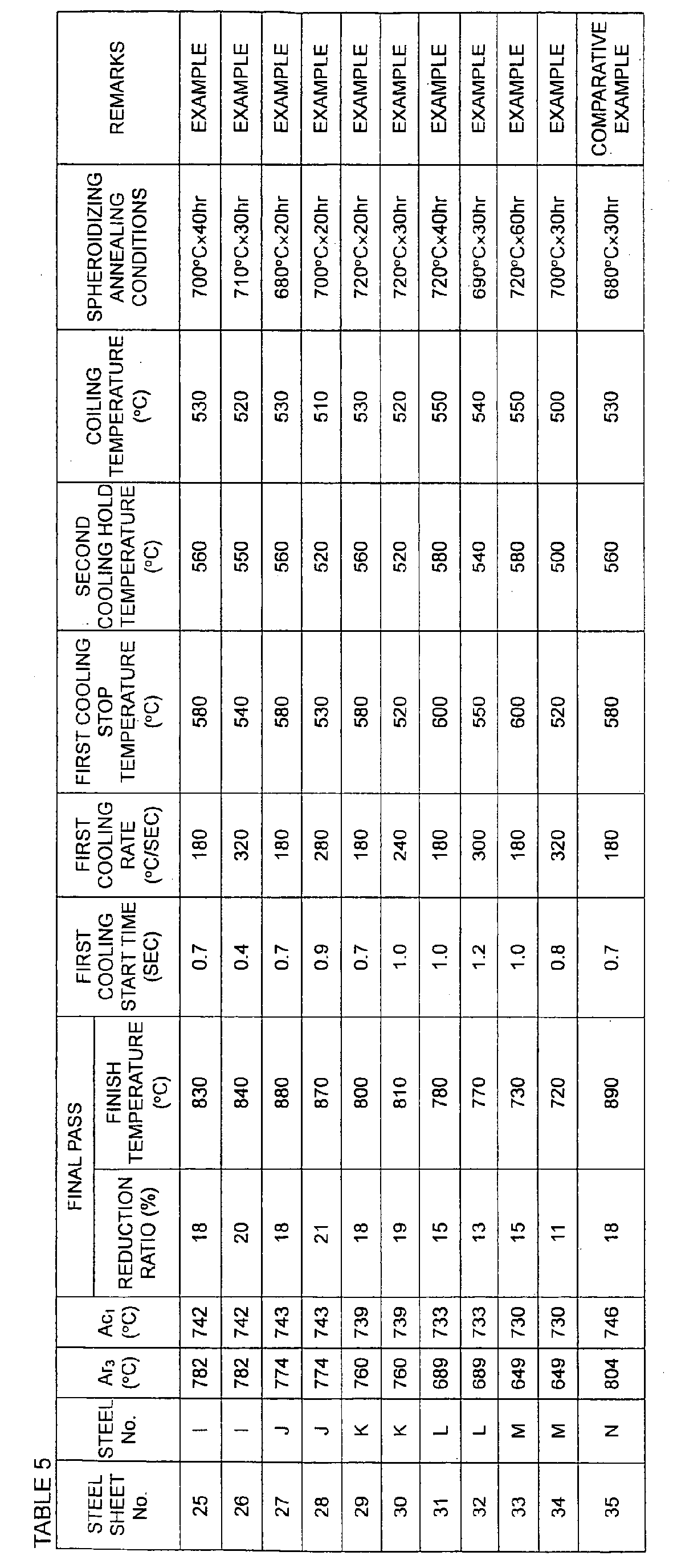
TABLE 6 STEEL SHEET No. STEEL No. AVERAGE FERRITE GRAIN DIAMETER (µm) ROUGH LARGE FERRITE RATIO (GRAIN DIAMETER OF 10 µm OR MORE) (%) AVERAGE CARBIDE GRAIN DIAMETER (µm) MATERIAL HARDNESS (Hv) REMARKS SURFACE LAYER CENTER IN THICKNESS DIRECTION ΔHv 25 I 72 93 0.9 93 98 5 EXAMPLE 26 I 74 95 0.9 94 95 1 EXAMPLE 27 J 86 89 1.5 91 94 3 EXAMPLE 28 J 90 94 1.7 90 91 1 EXAMPLE 29 K 52 85 1.1 104 108 4 EXAMPLE 30 K 53 88 1.1 103 106 3 EXAMPLE 31 L 45 89 1.3 114 115 1 EXAMPLE 32 L 42 86 1.2 117 117 0 EXAMPLE 33 M 41 91 1.0 121 127 6 EXAMPLE 34 M 38 88 0.9 125 128 3 EXAMPLE 35 N 61 66 0.9 91 121 30 COMPARATIVE EXAMPLE 
TABLE 8 STEEL SHEET No. STEEL No. AVERAGE FERRITE GRAIN DIAMETER (µm) ROUGH LARGE FERRITE RATIO (GRAIN DIAMETER OF 20 µm OR MORE) (%) AVERAGE CARBIDE GRAIN DIAMETER (µm) MATERIAL HARDNESS (Hv) REMARKS SURFACE LAYER CENTER IN THICKNESS DIRECTION ΔHv 36 A 80 89 0.9 100 104 4 EXAMPLE 37 A 85 96 0.9 98 99 1 EXAMPLE 38 A 88 97 1.0 96 98 2 EXAMPLE 39 B 59 88 1.2 103 106 3 EXAMPLE 40 B 65 96 1.3 102 102 0 EXAMPLE 41 B 66 96 1.3 101 101 0 EXAMPLE 42 C 55 86 1.2 109 113 4 EXAMPLE 43 C 61 95 1.1 105 105 0 EXAMPLE 44 C 62 96 1.1 103 104 1 EXAMPLE 45 D 48 95 1.3 114 112 2 EXAMPLE 46 E 47 95 1.4 111 112 1 EXAMPLE 47 F 48 96 1.4 110 111 1 EXAMPLE 48 G 41 86 1.5 121 124 3 EXAMPLE 49 G 46 92 1.7 119 120 1 EXAMPLE 50 G 48 95 1.7 118 118 0 EXAMPLE 51 A 16 68 1.0 115 140 25 COMPARATIVE EXAMPLE 52 A 18 63 1.1 136 111 25 COMPARATIVE EXAMPLE 53 B 16 50 1.3 116 137 21 COMPARATIVE EXAMPLE 54 B 13 51 1.1 143 120 23 COMPARATIVE EXAMPLE 55 C 7 7 0.5 148 151 3 COMPARATIVE EXAMPLE 56 C 14 58 0.9 141 118 23 COMPARATIVE EXAMPLE 57 G 6 6 1.3 160 159 1 COMPARATIVE EXAMPLE 58 G 14 58 1.4 152 128 24 COMPARATIVE EXAMPLE 59 H 4 4 1.6 172 173 1 COMPARATIVE EXAMPLE 
TABLE 10 STEEL SHEET No. STEEL No. AVERAGE FERRITE GRAIN DIAMETER (µm) ROUGH LARGE FERRITE RATIO (GRAIN DIAMETER OF 20 µm OR MORE) (%) AVERAGE CARBIDE GRAIN DIAMETER (µm) MATERIAL HARDNESS (Hv) REMARKS SURFACE LAYER CENTER IN THICKNESS DIRECTION ΔHv 60 I 68 93 0.9 98 103 5 EXAMPLE 61 I 57 88 0.7 104 108 4 EXAMPLE 62 I 72 90 1.2 95 99 4 EXAMPLE 63 I 83 96 1.0 92 94 2 EXAMPLE 64 I 85 96 1.2 90 92 2 EXAMPLE 65 I 28 81 0.8 112 119 7 EXAMPLE 66 J 92 97 1.7 88 88 0 EXAMPLE 67 K 42 85 1.1 111 114 3 EXAMPLE 68 K 56 89 0.8 108 113 5 EXAMPLE 69 K 51 83 1.0 113 116 3 EXAMPLE 70 K 63 95 1.3 112 114 2 EXAMPLE 71 K 68 96 1.3 102 106 4 EXAMPLE 72 L 55 93 1.4 110 112 2 EXAMPLE 73 M 51 95 1.4 120 124 4 EXAMPLE 74 I 5 3 1.1 154 162 8 COMPARATIVE EXAMPLE 75 I 18 46 1.7 122 148 26 COMPARATIVE EXAMPLE 76 I 16 25 1.6 136 159 23 COMPARATIVE EXAMPLE 77 K 6 2 1.0 166 164 2 COMPARATIVE EXAMPLE 78 K 38 31 1.3 130 151 21 COMPARATIVE EXAMPLE 79 K 3 0 0.7 170 171 1 COMPARATIVE EXAMPLE 80 K NOT MEASURABLE NOT MEASURABLE NOT MEASURABLE 142. 164 22 COMPARATIVE EXAMPLE
Claims (9)
- An ultra soft high carbon hot-rolled steel sheet comprising on a mass percent basis: 0.2% to 0.7% of C, 0.01% to 1.0% of Si, 0.1% to 1.0% of Mn, 0.03% or less of P, 0.035% or less of S, 0.08% or less of Al, 0.01% or less of N, and the balance being Fe and incidental impurities,
wherein in the texture of the hot-rolled steel sheet, an average ferrite grain diameter is 20 µm or more,
a volume ratio of ferrite grains having a grain diameter of 10 µm or more is 80% or more, and
an average carbide grain diameter is in the range of 0.10 to less than 2.0 µm. - An ultra soft high carbon hot-rolled steel sheet comprising on a mass percent basis: 0.2% to 0.7% of C, 0.01% to 1.0% of Si, 0.1% to 1.0% of Mn, 0.03% or less of P, 0.035% or less of S, 0.08% or less of Al, 0.01% or less of N, and the balance being Fe and incidental impurities,
wherein in the texture of the hot-rolled steel sheet, an average ferrite grain diameter is more than 35 µm,
a volume ratio of ferrite grains having a grain diameter of 20 µm or more is 80% or more, and
an average carbide grain diameter is in the range of 0.10 to less than 2.0 µm. - The ultra soft high carbon hot-rolled steel sheet, according to Claim 1 or 2, further comprising at least one of 0.0010% to 0.0050% of B and 0.005% to 0.30% of Cr on a mass percent basis.
- The ultra soft high carbon hot-rolled steel sheet, according to Claim 1 or 2, further comprising 0.0010% to 0.0050% of B and 0.05% to 0.30% of Cr on a mass percent basis.
- The ultra soft high carbon hot-rolled steel sheet, according to one of Claims 1 to 4, further comprising at least one of 0.005% to 0.5% of Mo, 0.005% to 0.05% of Ti, and 0.005% to 0.1% of Nb on a mass percent basis.
- A method for manufacturing an ultra soft high carbon hot-rolled steel sheet, comprising the steps of: performing rough rolling of steel having the composition according to one of Claims 1, 3, 4, and 5, then performing finish rolling at a reduction ratio of 10% or more and at a finish temperature of (Ar3-20)°C or more in a final pass, then performing first cooling within 2 seconds after the finish rolling to a cooling stop temperature of 600°C or less at a cooling rate of more than 120°C/sec, then performing second cooling so that the steel is held at 600°C or less, then performing coiling at 580°C or less, followed by pickling, and then performing spheroidizing annealing at a temperature in the range of 680°C to the Ac1 transformation point by a box-annealing process.
- A method for manufacturing an ultra soft high carbon hot-rolled steel sheet, comprising the steps of: performing rough rolling of steel having the composition according to one of Claims 1, 3, 4, and 5, then performing finish rolling at a reduction ratio of 10% or more and at a finish temperature of (Ar3-20)°C or more in a final pass, then performing first cooling within 2 seconds after the finish rolling to a cooling stop temperature of 550°C or less at a cooling rate of more than 120°C/sec, then performing second cooling so that the steel is held at 550°C or less, then performing coiling at 530°C or less, followed by pickling, and then performing spheroidizing annealing at a temperature in the range of 680°C to the Ac1 transformation point by a box-annealing process.
- A method for manufacturing an ultra soft high carbon hot-rolled steel sheet, comprising the steps of: performing rough rolling of steel having the composition according to one of Claims 2 to 5, then performing finish rolling in which final two passes are each performed at a reduction ratio of 10% or more in a temperature range of (Ar3-20)°C to (Ar3+150)°C, then performing first cooling within 2 seconds after the finish rolling to a cooling stop temperature of 600°C or less at a cooling rate of more than 120°C/sec, then performing second cooling so that the steel is held at 600°C or less, then performing coiling at 580°C or less, followed by pickling, and then performing spheroidizing annealing at a temperature in the range of 680°C to the Ac1 transformation point for a soaking time of 20 hours or more by a box-annealing process.
- A method for manufacturing an ultra soft high carbon hot-rolled steel sheet, comprising the steps of: performing rough rolling of steel having the composition according to one of Claims 2 to 5, then performing finish rolling in which final two passes are each performed at a reduction ratio of 10% or more in a temperature range of (Ar3-20)°C to (Ar3+100)°C, then performing first cooling within 2 seconds after the finish rolling to a cooling stop temperature of 550°C or less at a cooling rate of more than 120°C/sec, then performing second cooling so that the steel is held at 550°C or less, then performing coiling at 530°C or less, followed by pickling, and then performing spheroidizing annealing at a temperature in the range of 680°C to the Ac1 transformation point for a soaking time of 20 hours or more by a box-annealing process.
Applications Claiming Priority (4)
| Application Number | Priority Date | Filing Date | Title |
|---|---|---|---|
| JP2005292185 | 2005-10-05 | ||
| JP2006067547 | 2006-03-13 | ||
| JP2006204083A JP5050433B2 (en) | 2005-10-05 | 2006-07-27 | Method for producing extremely soft high carbon hot-rolled steel sheet |
| PCT/JP2006/318893 WO2007043318A1 (en) | 2005-10-05 | 2006-09-19 | Dead-soft high-carbon hot-rolled steel sheet and process for producing the same |
Publications (2)
| Publication Number | Publication Date |
|---|---|
| EP1932933A1 true EP1932933A1 (en) | 2008-06-18 |
| EP1932933A4 EP1932933A4 (en) | 2009-09-02 |
Family
ID=37942569
Family Applications (1)
| Application Number | Title | Priority Date | Filing Date |
|---|---|---|---|
| EP06798276A Withdrawn EP1932933A4 (en) | 2005-10-05 | 2006-09-19 | Dead-soft high-carbon hot-rolled steel sheet and process for producing the same |
Country Status (7)
| Country | Link |
|---|---|
| US (1) | US7909950B2 (en) |
| EP (1) | EP1932933A4 (en) |
| JP (1) | JP5050433B2 (en) |
| KR (2) | KR20100046070A (en) |
| CN (1) | CN101213317B (en) |
| TW (1) | TWI315743B (en) |
| WO (1) | WO2007043318A1 (en) |
Cited By (6)
| Publication number | Priority date | Publication date | Assignee | Title |
|---|---|---|---|---|
| EP2000552A4 (en) * | 2006-03-28 | 2009-11-11 | Jfe Steel Corp | Hot-rolled ultrasoft high-carbon steel plate and process for production thereof |
| EP3020839A4 (en) * | 2013-07-09 | 2016-06-29 | Jfe Steel Corp | HOT ROLLED STEEL SHEET WITH HIGH CARBON CONTENT AND PROCESS FOR PRODUCING THE SAME |
| RU2620232C1 (en) * | 2016-02-25 | 2017-05-23 | Открытое акционерное общество "Новолипецкий металлургический комбинат" | Steel |
| US9840750B2 (en) | 2011-09-22 | 2017-12-12 | Nippon Steel & Sumitomo Metal Corporation | Medium carbon steel sheet for cold working and method for manufacturing the same |
| WO2019123104A1 (en) * | 2017-12-19 | 2019-06-27 | Arcelormittal | A coated steel substrate |
| WO2019123105A1 (en) * | 2017-12-19 | 2019-06-27 | Arcelormittal | A coated steel substrate |
Families Citing this family (21)
| Publication number | Priority date | Publication date | Assignee | Title |
|---|---|---|---|---|
| JP4952236B2 (en) * | 2006-12-25 | 2012-06-13 | Jfeスチール株式会社 | High carbon hot rolled steel sheet and manufacturing method thereof |
| JP5358914B2 (en) * | 2007-09-14 | 2013-12-04 | Jfeスチール株式会社 | Super soft high carbon hot rolled steel sheet |
| JP5222711B2 (en) * | 2008-12-22 | 2013-06-26 | 新日鐵住金株式会社 | Medium and high carbon steel sheet and manufacturing method thereof |
| JP5601861B2 (en) * | 2010-03-26 | 2014-10-08 | 日新製鋼株式会社 | Manufacturing method of boron steel rolled annealed steel sheet |
| US9486189B2 (en) | 2010-12-02 | 2016-11-08 | Hitachi Aloka Medical, Ltd. | Assembly for use with surgery system |
| JP5549640B2 (en) * | 2011-05-18 | 2014-07-16 | Jfeスチール株式会社 | High carbon steel sheet and method for producing the same |
| JP2013112890A (en) * | 2011-11-30 | 2013-06-10 | Nisshin Steel Co Ltd | Press working annealed steel sheet, manufacturing method therefor, and machine component excellent in wear resistance |
| KR101372730B1 (en) | 2011-12-15 | 2014-03-10 | 주식회사 포스코 | High carbon rolled steel sheet for electric resistance welded tubes having excellent uniformity and method for production thereof |
| KR101372707B1 (en) * | 2011-12-15 | 2014-03-10 | 주식회사 포스코 | High strength high carbon steel sheet having excellent uniformity and mehtod for production thereof |
| KR101372700B1 (en) | 2011-12-15 | 2014-03-10 | 주식회사 포스코 | High carbon rolled steel sheet having excellent uniformity and mehtod for production thereof |
| US10077491B2 (en) * | 2012-01-05 | 2018-09-18 | Jfe Steel Corporation | High carbon hot rolled steel sheet and method for manufacturing the same |
| IN2014KN01298A (en) * | 2012-01-06 | 2015-10-16 | Jfe Steel Corp | |
| JP5768781B2 (en) * | 2012-08-09 | 2015-08-26 | 新日鐵住金株式会社 | High carbon steel sheet |
| CN103194675A (en) * | 2013-04-08 | 2013-07-10 | 北京科技大学 | Low-carbon hot-rolled full-ferrite based steel with ultrahigh strength and ultrahigh reaming ratio and preparation method thereof |
| JP5884781B2 (en) * | 2013-07-09 | 2016-03-15 | Jfeスチール株式会社 | High carbon hot rolled steel sheet excellent in hardenability and workability and method for producing the same |
| CN106133169B (en) * | 2014-03-28 | 2018-01-05 | 杰富意钢铁株式会社 | High-carbon hot-rolled steel sheet and its manufacture method |
| CN104278201B (en) * | 2014-10-11 | 2016-08-24 | 武汉钢铁(集团)公司 | There is the preparation method of good cold formability high-carbon steel |
| CN108193027B (en) * | 2016-08-29 | 2019-08-23 | 梧州三条钢带制品有限公司 | A kind of method of high efficiency working hot-rolled strip |
| KR101830551B1 (en) * | 2016-12-14 | 2018-02-20 | 주식회사 포스코 | High-carbon hot-rolled steel sheet having excellent surface quality and method for manufacturing same |
| KR102289519B1 (en) * | 2019-11-22 | 2021-08-12 | 현대제철 주식회사 | Hot-rolled steel and method of manufacturing the same |
| JP7832584B2 (en) * | 2024-02-16 | 2026-03-18 | 日本製鉄株式会社 | steel plate |
Family Cites Families (10)
| Publication number | Priority date | Publication date | Assignee | Title |
|---|---|---|---|---|
| JPH0830241B2 (en) | 1987-07-20 | 1996-03-27 | 川崎製鉄株式会社 | Steel sheet having excellent workability and toughness and good hardenability, and a method for producing the same |
| JPH08246051A (en) | 1995-03-07 | 1996-09-24 | Sumitomo Metal Ind Ltd | Method for producing medium carbon steel sheet with excellent workability |
| JP3125978B2 (en) | 1995-12-05 | 2001-01-22 | 住友金属工業株式会社 | Method for producing high carbon steel strip with excellent workability |
| JP3848444B2 (en) * | 1997-09-08 | 2006-11-22 | 日新製鋼株式会社 | Medium and high carbon steel plates with excellent local ductility and hardenability |
| JP4377973B2 (en) * | 1998-03-12 | 2009-12-02 | 日新製鋼株式会社 | Steel sheet with excellent local ductility and heat treatment |
| JP3460659B2 (en) * | 2000-02-03 | 2003-10-27 | 住友金属工業株式会社 | Soft high carbon steel strip with small heat treatment distortion and method for producing the same |
| CN1482648A (en) * | 2000-03-02 | 2004-03-17 | 住友金属工业株式会社 | Shadow mask frame and frame member for color picture tube |
| JP3879459B2 (en) * | 2001-08-31 | 2007-02-14 | Jfeスチール株式会社 | Manufacturing method of high hardenability high carbon hot rolled steel sheet |
| US20050199322A1 (en) * | 2004-03-10 | 2005-09-15 | Jfe Steel Corporation | High carbon hot-rolled steel sheet and method for manufacturing the same |
| JP5292698B2 (en) * | 2006-03-28 | 2013-09-18 | Jfeスチール株式会社 | Extremely soft high carbon hot-rolled steel sheet and method for producing the same |
-
2006
- 2006-07-27 JP JP2006204083A patent/JP5050433B2/en not_active Expired - Fee Related
- 2006-09-19 WO PCT/JP2006/318893 patent/WO2007043318A1/en not_active Ceased
- 2006-09-19 US US11/919,964 patent/US7909950B2/en not_active Expired - Fee Related
- 2006-09-19 KR KR1020107008481A patent/KR20100046070A/en not_active Ceased
- 2006-09-19 EP EP06798276A patent/EP1932933A4/en not_active Withdrawn
- 2006-09-19 CN CN2006800212070A patent/CN101213317B/en not_active Expired - Fee Related
- 2006-09-19 KR KR1020077026706A patent/KR100974737B1/en not_active Expired - Fee Related
- 2006-10-02 TW TW095136528A patent/TWI315743B/en not_active IP Right Cessation
Cited By (15)
| Publication number | Priority date | Publication date | Assignee | Title |
|---|---|---|---|---|
| US8048237B2 (en) | 2006-03-28 | 2011-11-01 | Jfe Steel Corporation | Ultra soft high carbon hot rolled steel sheet and method for manufacturing same |
| EP2000552A4 (en) * | 2006-03-28 | 2009-11-11 | Jfe Steel Corp | Hot-rolled ultrasoft high-carbon steel plate and process for production thereof |
| US9840750B2 (en) | 2011-09-22 | 2017-12-12 | Nippon Steel & Sumitomo Metal Corporation | Medium carbon steel sheet for cold working and method for manufacturing the same |
| US10400298B2 (en) | 2013-07-09 | 2019-09-03 | Jfe Steel Corporation | High-carbon hot-rolled steel sheet and method for producing the same |
| EP3020839A4 (en) * | 2013-07-09 | 2016-06-29 | Jfe Steel Corp | HOT ROLLED STEEL SHEET WITH HIGH CARBON CONTENT AND PROCESS FOR PRODUCING THE SAME |
| EP3190202A1 (en) * | 2013-07-09 | 2017-07-12 | JFE Steel Corporation | High-carbon hot-rolled steel sheet and method for producing the same |
| CN108315637A (en) * | 2013-07-09 | 2018-07-24 | 杰富意钢铁株式会社 | High-carbon hot-rolled steel sheet and its manufacturing method |
| CN108315637B (en) * | 2013-07-09 | 2021-01-15 | 杰富意钢铁株式会社 | High carbon hot-rolled steel sheet and method for producing same |
| RU2620232C1 (en) * | 2016-02-25 | 2017-05-23 | Открытое акционерное общество "Новолипецкий металлургический комбинат" | Steel |
| WO2019122957A1 (en) * | 2017-12-19 | 2019-06-27 | Arcelormittal | A coated steel substrate |
| WO2019122958A1 (en) * | 2017-12-19 | 2019-06-27 | Arcelormittal | A coated steel substrate |
| WO2019123105A1 (en) * | 2017-12-19 | 2019-06-27 | Arcelormittal | A coated steel substrate |
| WO2019123104A1 (en) * | 2017-12-19 | 2019-06-27 | Arcelormittal | A coated steel substrate |
| AU2018392861B2 (en) * | 2017-12-19 | 2021-09-16 | Arcelormittal | A coated steel substrate |
| US12473609B2 (en) | 2017-12-19 | 2025-11-18 | Arcelormittal | Coated steel substrate |
Also Published As
| Publication number | Publication date |
|---|---|
| TWI315743B (en) | 2009-10-11 |
| WO2007043318A1 (en) | 2007-04-19 |
| US20090065106A1 (en) | 2009-03-12 |
| JP5050433B2 (en) | 2012-10-17 |
| KR20100046070A (en) | 2010-05-04 |
| TW200720444A (en) | 2007-06-01 |
| JP2007277696A (en) | 2007-10-25 |
| KR20080009719A (en) | 2008-01-29 |
| CN101213317A (en) | 2008-07-02 |
| KR100974737B1 (en) | 2010-08-06 |
| CN101213317B (en) | 2010-12-29 |
| US7909950B2 (en) | 2011-03-22 |
| EP1932933A4 (en) | 2009-09-02 |
| WO2007043318A9 (en) | 2007-06-07 |
Similar Documents
| Publication | Publication Date | Title |
|---|---|---|
| US7909950B2 (en) | Method for manufacturing an ultra soft high carbon hot-rolled steel sheet | |
| EP3287539B1 (en) | Plated steel sheet | |
| EP2103697B1 (en) | High carbon hot-rolled steel sheet | |
| KR101050698B1 (en) | Ultra-thin high carbon hot rolled steel sheet and manufacturing method thereof | |
| CN101861406B (en) | High-strength cold-rolled steel sheet | |
| US20090260729A1 (en) | High-carbon hot-rolled steel sheet and method for producing the same | |
| EP1905851B1 (en) | High-carbon hot-rolled steel sheet and process for producing the same | |
| KR950013187B1 (en) | Process for the production of a strip of a chromium staimless steel of a duplex structure having high strength and elong tion as wellas reduced plane anisotropy | |
| EP3020843B1 (en) | High-carbon hot-rolled steel sheet and production method for same | |
| EP3719155B1 (en) | High-strength cold-rolled steel sheet and method for manufacturing same | |
| EP2053139A1 (en) | Hot-rolled steel sheets excellent both in workability and in strength and toughness after heat treatment and process for production thereof | |
| KR20190060805A (en) | Carbon steel sheet for carburizing and method of manufacturing steel sheet for carburizing | |
| EP1870483A1 (en) | Hot-rolled steel sheet, method for production thereof and molded article formed from hot-rolled steel sheet | |
| KR20190062474A (en) | Carbon steel sheet for carburizing and method of manufacturing steel sheet for carburizing | |
| EP4324952A1 (en) | Cold-rolled steel sheet, steel components, method for producing cold-rolled steel sheet, and method for producing steel components | |
| JP3460659B2 (en) | Soft high carbon steel strip with small heat treatment distortion and method for producing the same | |
| EP4123041A1 (en) | High-strength steel sheet and method for manufacturing same | |
| EP3741879A1 (en) | High-carbon cold-rolled steel sheet and production method therefor | |
| JP2022122483A (en) | Hot rolled steel sheet and method for producing the same | |
| CN111655893B (en) | High carbon hot-rolled steel sheet and method for producing same | |
| JP3879446B2 (en) | Method for producing high carbon hot-rolled steel sheet with excellent stretch flangeability | |
| EP2868764B1 (en) | Steel sheet for soft nitriding and method for manufacturing the same | |
| EP2868762A1 (en) | Steel sheet for soft nitriding and process for producing same | |
| EP1905850B1 (en) | Process for manufacture of cold-rolled high-carbon steel plate | |
| JP3468172B2 (en) | High carbon steel strip excellent in cold workability and hardenability and method for producing the same |
Legal Events
| Date | Code | Title | Description |
|---|---|---|---|
| PUAI | Public reference made under article 153(3) epc to a published international application that has entered the european phase |
Free format text: ORIGINAL CODE: 0009012 |
|
| 17P | Request for examination filed |
Effective date: 20071129 |
|
| AK | Designated contracting states |
Kind code of ref document: A1 Designated state(s): DE FR GB |
|
| RBV | Designated contracting states (corrected) |
Designated state(s): DE FR GB |
|
| A4 | Supplementary search report drawn up and despatched |
Effective date: 20090803 |
|
| RIC1 | Information provided on ipc code assigned before grant |
Ipc: C21D 9/46 20060101ALI20090728BHEP Ipc: C22C 38/18 20060101ALI20090728BHEP Ipc: C22C 38/04 20060101ALI20090728BHEP Ipc: C22C 38/02 20060101ALI20090728BHEP Ipc: C21D 8/02 20060101ALI20090728BHEP Ipc: C22C 38/14 20060101ALI20090728BHEP Ipc: C22C 38/06 20060101ALI20090728BHEP Ipc: B21B 3/00 20060101ALI20090728BHEP Ipc: B21B 1/26 20060101ALI20090728BHEP Ipc: C22C 38/00 20060101AFI20070613BHEP Ipc: C22C 38/12 20060101ALI20090728BHEP Ipc: C22C 38/32 20060101ALI20090728BHEP Ipc: C21D 1/32 20060101ALI20090728BHEP |
|
| 17Q | First examination report despatched |
Effective date: 20100211 |
|
| DAX | Request for extension of the european patent (deleted) | ||
| STAA | Information on the status of an ep patent application or granted ep patent |
Free format text: STATUS: THE APPLICATION IS DEEMED TO BE WITHDRAWN |
|
| 18D | Application deemed to be withdrawn |
Effective date: 20150401 |