EP1931998B1 - Verfahren zur quantifizierung von allergenen - Google Patents
Verfahren zur quantifizierung von allergenen Download PDFInfo
- Publication number
- EP1931998B1 EP1931998B1 EP06775965A EP06775965A EP1931998B1 EP 1931998 B1 EP1931998 B1 EP 1931998B1 EP 06775965 A EP06775965 A EP 06775965A EP 06775965 A EP06775965 A EP 06775965A EP 1931998 B1 EP1931998 B1 EP 1931998B1
- Authority
- EP
- European Patent Office
- Prior art keywords
- allergen
- der
- peptide
- peptides
- sample
- Prior art date
- Legal status (The legal status is an assumption and is not a legal conclusion. Google has not performed a legal analysis and makes no representation as to the accuracy of the status listed.)
- Revoked
Links
Images




Classifications
-
- G—PHYSICS
- G01—MEASURING; TESTING
- G01N—INVESTIGATING OR ANALYSING MATERIALS BY DETERMINING THEIR CHEMICAL OR PHYSICAL PROPERTIES
- G01N33/00—Investigating or analysing materials by specific methods not covered by groups G01N1/00 - G01N31/00
- G01N33/48—Biological material, e.g. blood, urine; Haemocytometers
- G01N33/50—Chemical analysis of biological material, e.g. blood, urine; Testing involving biospecific ligand binding methods; Immunological testing
- G01N33/68—Chemical analysis of biological material, e.g. blood, urine; Testing involving biospecific ligand binding methods; Immunological testing involving proteins, peptides or amino acids
-
- C—CHEMISTRY; METALLURGY
- C12—BIOCHEMISTRY; BEER; SPIRITS; WINE; VINEGAR; MICROBIOLOGY; ENZYMOLOGY; MUTATION OR GENETIC ENGINEERING
- C12Q—MEASURING OR TESTING PROCESSES INVOLVING ENZYMES, NUCLEIC ACIDS OR MICROORGANISMS; COMPOSITIONS OR TEST PAPERS THEREFOR; PROCESSES OF PREPARING SUCH COMPOSITIONS; CONDITION-RESPONSIVE CONTROL IN MICROBIOLOGICAL OR ENZYMOLOGICAL PROCESSES
- C12Q1/00—Measuring or testing processes involving enzymes, nucleic acids or microorganisms; Compositions therefor; Processes of preparing such compositions
- C12Q1/34—Measuring or testing processes involving enzymes, nucleic acids or microorganisms; Compositions therefor; Processes of preparing such compositions involving hydrolase
- C12Q1/37—Measuring or testing processes involving enzymes, nucleic acids or microorganisms; Compositions therefor; Processes of preparing such compositions involving hydrolase involving peptidase or proteinase
-
- G—PHYSICS
- G01—MEASURING; TESTING
- G01N—INVESTIGATING OR ANALYSING MATERIALS BY DETERMINING THEIR CHEMICAL OR PHYSICAL PROPERTIES
- G01N33/00—Investigating or analysing materials by specific methods not covered by groups G01N1/00 - G01N31/00
- G01N33/48—Biological material, e.g. blood, urine; Haemocytometers
- G01N33/50—Chemical analysis of biological material, e.g. blood, urine; Testing involving biospecific ligand binding methods; Immunological testing
- G01N33/68—Chemical analysis of biological material, e.g. blood, urine; Testing involving biospecific ligand binding methods; Immunological testing involving proteins, peptides or amino acids
- G01N33/6803—General methods of protein analysis not limited to specific proteins or families of proteins
- G01N33/6848—Methods of protein analysis involving mass spectrometry
-
- G—PHYSICS
- G01—MEASURING; TESTING
- G01N—INVESTIGATING OR ANALYSING MATERIALS BY DETERMINING THEIR CHEMICAL OR PHYSICAL PROPERTIES
- G01N2458/00—Labels used in chemical analysis of biological material
- G01N2458/15—Non-radioactive isotope labels, e.g. for detection by mass spectrometry
-
- G—PHYSICS
- G01—MEASURING; TESTING
- G01N—INVESTIGATING OR ANALYSING MATERIALS BY DETERMINING THEIR CHEMICAL OR PHYSICAL PROPERTIES
- G01N2800/00—Detection or diagnosis of diseases
- G01N2800/24—Immunology or allergic disorders
Definitions
- This invention relates to the field of quantification of allergens.
- Allergens are antigenic molecules Inducing allergic responses and production of IgE antibodies in humans. They are used both for diagnosis and for treatment of allergy i.e. allergen immunotherapy, the latter in the form of allergen vaccines. Allergenic source materials to which humans are exposed, such as foods, pollens or mite faecal particles occur naturally as complex mixture(s) of major and minor allergens.
- Major allergens are allergens to which a majority of patients, who are allergic to the source, react. It appears, however, that any protein is a potential allergen, since still more and more minor allergens are identified as knowledge Increases.
- allergens Due to the complexity of the allergen sources, the amino acid sequences of several allergens were first deduced from cDNA-derived nucleotide sequences. Cloning of genes encoding allergens revealed that most allergens are heterogeneous and that they occur as mixtures of isoallergens and variants. Amino acid sequence alignment of homologous allergens and isoallergens demonstrated that they can be identified by and/or divided into constant and variable region sequences. Constant region amino acid sequences are unique to the species however variable region amino acid sequences are unique to each of the isoallergens.
- allergen specific immunotherapy and diagnosis are currently performed by use of standardized natural allergen extracts which are further formulated to allergen vaccines.
- aqueous vaccines are based on allergenic natural source materials, such as tree and grass pollen, dust mite cultures and animal hair and dander particles.
- the composition of these natural source materials are known to vary considerably depending on time and place of collection of the allergenic source materials.
- Commercial allergen vaccines can furthermore be formulated to mixtures of allergens using various species.
- composition of the extracts and the content of essential allergens is a prerequisite for reproducibility, safety and efficacy of the final product.
- a major challenge in the manufacture of allergen vaccines is standardisation, i.e. securing a constant potency from batch to batch. Since the raw material is of natural origin, variation is considerable and needs to be controlled by scientifically based measures.
- the composition of the extract should Ideally reflect the composition of the water soluble components of the allergenic source material as it is extracted on the mucosal surface of the airways and presented to the human immune system. All extracts, however, contain several allergens contributing to the total IgE-binding In different combinations for Individual patients. Ideally, therefore, all components need to be controlled both qualitatively and quantitatively, but with the current technology this is not practically possible.
- Standardisation Is currently performed in many different ways, since each manufacturer has company specific standardisation procedures. Standardisation is performed by techniques such as SDS-PAGE, isoelectric focusing in addition to a variety of immunoelectrophoretic (QIE) and ELISA techniques using mono- and/or polyclonal antibodies and radio allergosorbent (RAST) or related techniques.
- An optimal batch-to-batch standardisation such as the SQ-standardisation procedure, is essentially a three step procedure: 1) securing optimal composition and constant ratios between all components by semi-quantitative Immuno-electrophoretic techniques, 2) determining major allergen components by quantitative immunoelectrophoresis, and 3) adjusting the overall IgE-binding potency as determined in Magic Lite® assays.
- Absolute quantification of specific vaccine components In complex mixtures of allergen is not straightforward and has yet not been established as a sensitive, routine high-through-put technique.
- Nuts may be found as a hidden part of a food because of accidental cross-contamination during manufacturing. Companies producing similar foods with and without e.g. nuts may have difficulty In cleaning production equipment in between making the different types of foods. Traces of previously produced foods such as nuts can remain on the equipment. The first batches of foods made without nuts that go through the same equipment will likely contain traces of nuts. Foods that may cause allergic reaction due to cross-contamination of nuts or peanuts are e.g. chocolate, candies, cookies, desserts, sweets, donuts, cereal, milkshakes, granola bars, muesli, pies, muffins, ice cream, barbecue sauce.
- Cows' milk may cause an allergic reaction to small amounts of milk protein from dairy products, from cows' milk, formula based on cows' milk or baby foods containing protein from milk.
- a detection and quantification method for milk allergens is therefore needed.
- Reliable detection and quantification methods for food allergens are necessary in order to ensure compliance with food labelling and to improve consumer protection.
- Physicochemical methods e.g. mass spectrometry, as well as Immunological methods have been described .
- the usual criteria of sensitivity, specificity, reproducibility, precision and accuracy have to be fulfilled.
- MS Biological mass spectrometry
- WO 2004/070352 discloses a method for quantification of peptides relative to an Internal standard using isobaric labelling reagents or sets of Isobaric labelling reagents.
- US 6,872,575 discloses a method for identification of one or more proteins in complex sample mixtures without purifying the protein or obtaining its composite peptide signature.
- US 6,864,089 discloses a method for quantification using differential isotopic labelling of peptide or protein samples.
- ICPL Immunotope Coded Protein Labelling
- Mass spectrometry was first Introduced to the field of allergy research to characterize natural allergens Including post translational modifications such as glycosylation patterns. It was further employed to characterize recombinant isoallergens and/or variants many of which have been expressed in various expression systems such as Esherica Coll, Pichia Pastoris and Baculovirus expression systems.
- a method using MS techniques and the species specific and allergen specific amino acid sequences provides a very sensitive method by which the content of groups of allergens (isoallergens or homologous allergens) may be quantified.
- the method according to the invention is useful e.g. in a release assay in order to ensure a safe and accurate amount of allergen during production of a vaccine, In the final product, and also during the various stages of storage of active ingredients and/or products.
- the method would also be beneficial in development of second generation allergen vaccines e.g. using recombinant allergens as active ingredients. Such a method would make it possible to optimize active ingredients in second generation allergen vaccines based on the knowledge and/or composition of the current vaccines.
- a method for absolute quantification of allergens from a plurality of sources is provided.
- the invention provides a method for quantification of the absolute amount of allergen in an allergen sample where the allergen consists of more than one lsoallergen(s) or homologous allergen(s) comprising the following steps:
- the allergen to be quantified consists of more than one isoallergen, e.g. members of an allergen group from the same species with more than > 67 % amino acid sequence identity.
- the allergen to be quantified consists of more than one homologous allergens.
- the use of a sequence of amino acids which is identical with a sequence to be found in the isoallergens or homologous allergen(s) to be quantified is provided as an allergen calibration standard peptide for absolute quantification of the allergen(s), and optionally identification.
- the degradation in step b) results In a mixture of peptides where one of the peptides comprises the same amino acid sequence as the allergen calibration standard peptide.
- an allergen calibration standard peptide for use in quantification of isoallergens or homologous allergens wherein the allergen calibration standard peptide is obtained by:
- allergen refers to any naturally occurring protein, a modified protein, a recombinant protein, a recombinant mutant protein, or any protein fragment thereof or mixtures of proteins that have been reported to induce allergic, i.e. IgE mediated reactions upon their repeated exposure to an individual.
- allergens examples include pollen allergens (tree, weed, herb and grass pollen allergens), mite allergens (from e.g. house dust mites and storage mites), insect allergens (inhalant, saliva- and venom origin allergens), animal allergens from e.g. saliva, hair and dander from e.g. dog, cat, horse, rat, mouse, etc., fungi allergens and food allergens.
- pollen allergens tree, weed, herb and grass pollen allergens
- mite allergens from e.g. house dust mites and storage mites
- insect allergens inhalant, saliva- and venom origin allergens
- animal allergens from e.g. saliva, hair and dander from e.g. dog, cat, horse, rat, mouse, etc.
- fungi allergens and food allergens examples include pollen allergens (tree, weed, herb and grass pollen aller
- Important pollen allergens from trees, grasses and herbs are such originating from the taxonomic orders of Fagales, Oleales, Pinales and platanaceae including i.a. birch (Betula), alder (Alnus), hazel (Corylus), hornbeam (Carpinus), olive (Olea), cedar (Cryptomeria and Juniperus), Plane tree (Platanus), the order of Poales including i.a. grasses of the genera Lolium, Phleum, Poa, Cynodon, Dactylis, Holcus, Phalaris, Secale, and Sorghum and the orders of Asterales and Urticales including i.a.
- venom allergens including such originating from stinging or biting insects such as those from the taxonomic order of Hymenoptera Including bees (superfamily Apidae), wasps (superfamily Vespidea), and ants (superfamily Formicoldae).
- Important inhalation allergens from fungi are i.a. such originating from the genera Alternaria, Cladosporium, Aspergillus and Penicillium.
- allergens examples include allergens from wheat (e.g. Tri a 18-19), crustacean food including shrimp (e.g. Met e 1, Pen a 1, Pen I 1, Pen m 1 and Pen m 2), prawn, crab and lobster, fish (e.g. Gad c 1 and Sal s 1), hen's eggs (e.g. Gal d 1, Gal d 2), peanut (e.g. Ara h 1-8), soy (Gly m 1-4), cows' milk (Bos d 4-8), nuts such as almond (Pru du 4), brazil nut (Ber e 1, Ber e 2), cashew nut (Ana o 1-3), hazelnut (e.g.
- wheat e.g. Tri a 18-19
- crustacean food including shrimp (e.g. Met e 1, Pen a 1, Pen I 1, Pen m 1 and Pen m 2), prawn, crab and lobster, fish (e.g. Gad c 1 and Sal s
- Cor a 1.04, Cor a 2, Cor a 8) and walnut e.g. Jug n 1-2, Jug r 1-3
- celery Api g 1, Api g 4, Api g 5
- mustard Sin a 1 and Bra j 1
- sesame seed sets i 1-6
- allergens from wheat (e.g. Tri a 18-19), hen's eggs (e.g. Gal d 1, Gal d 2), peanut (e.g. Ara h 1-8), soy (Gly m 1-4), cows' milk (Bos d 4-8).
- recombinant allergens include but are not limited to proteins/peptides from plant pollens, grass pollens, tree pollens, weed pollens, insect venom, dust and storage mite proteins, animal dander, saliva, fungal spores and food allergens (i.e., peanut, milk, gluten and egg) prepared using recombinant techniques.
- Recombinant allergens can be obtained e.g. on a large scale by using microbial expression systems that may be grown on fermenters, produced by recombinant DNA techniques, or chemical precursors or other chemicals when synthesized chemically.
- the allergen is rBet v 1, rAin g 1, rCor a 1, rCar b 1, rCry j 1, rCry j 2 , rOle e 1 , rAmb a 1, rArt v 1, rCyn d 1, rDac g 1, rLol p 1, rLol p 5, rPhl p 1, rPhl p 5, rPoa p 1, rPoa p 5, rSor h 1, rDer f 1 , rDer f 2, rDer p 1, rDer p 2, rEur m 1, rEur m 2, rGly d 1, rLep d 2, rBla g 1, rBla g 2, rFel d 1, rCan f 1, rCan f 2 , rBos d 2, rEqu c 1, r
- a recombinant mutant allergen differs from the wild type in that the genes for the allergens have been modified by genetic manipulation methods such that the polypeptides which they encode exhibit substitutions, deletions and/or additions of Individual or several amino acids as compared with the wild type.
- Examples of a recombinant mutant allergen include allergen substitution variants, addition variants, oligomers, fragments, deletion variants, hybrid molecules and other variants.
- modified allergens which In naturally occurring form are associated with allergic disease conditions In sensitive subjects, wherein said modified recombinant allergen is altered compared to the naturally occurring allergen. Included are allergen variants containing a few amino acid exchanges, allergen mutants, oligomers, fragments, deletion variants, hybrid molecules, myristylated, glycosylated, palmitoylated and phosphorylated allergens and other variants.
- the modified allergen can be produced by any method suitable such as a site-directed mutagenesis method, a PCR method, chemical synthesis and a mixture of these methods.
- the allergen to be quantified is selected from one or more of the group of Bet v 1, Aln g 1, Cor a 1 and Car b 1, Que a 1, Cry j 1, Cry j 2 , Cup a 1, Cup s 1, Jun a 1, Jun a 2, Jun a 3, Ole e 1, Lig v 1, Syr v 1, Pla I 1, Pla a 1, Pla a 2, Amb a 1, Amb a 2, Amb t 5, Art v 1, Art v 2, Art v 3, Par j 1 , Par j 2, Par j 3, Sal k 1, Ave e 1, Cyn d 1, Cyn d 7, Dac g 1, Fes p 1, Hol I 1, Lol p 1 and 5, Pha a 1, Pas n 1, Phl p 1, Phl p 2, Phl p 3, Phl p 4, Phl p 5, Phl p 6, Poa p 1, Poa p 5, Sec c 1, Sec c 5, Sor h 1, Der f 1, Der f 2, Der b 1, Que a 1,
- the allergen to be quantified is one or more isoallergens selected from the group of grass pollen allergens such as Phl p 1, Phl p 5, Phl p 6, Poa p 1, Poa p 5, Dac g 1, Fes p 1, Lol p 1 and Lol p 5, dust mite allergens such as Der f 1 , Der f 2, Der p 1 and Der p 2, venom allergens such as Api m 1, Apl m 2 , Ves v 1, Ves v 2, Ves v 5, Dol m 1, Dol m 2, Dol m 5, Dol a 5, Pol a 1, Pol a 2, and Pol a 5, weed allergens such as Amb a 1, Amb a 2, Par j 1, Par o 1 and Par m 1, birch allergens such as Bet v 1, Japanese cedar allergens such as Cry j 1 and Cry j i 2, cockroach allergens such as Per a 1
- the allergen to be quantified is one or more isoallergens selected from the group of grass pollen allergens such as Phl p 1, Phl p 5 and Phl p 6, olive pollen allergens such as Ole e 1, dust mite allergens such as Der f 1 , Der f 2, Der p 1 and Der p 2 , venom allergens such as Ves v 1, Ves v 2 and Ves v 5, weed allergens such as Amb a 1, Amb a 2, Par j 1, Par o 1 and Par m 1 and tree allergens such as Bet v 1, Cry j 1 and Cry j 2.
- grass pollen allergens such as Phl p 1, Phl p 5 and Phl p 6, olive pollen allergens such as Ole e 1, dust mite allergens such as Der f 1 , Der f 2, Der p 1 and Der p 2 , venom allergens such as Ves v 1, Ves v 2 and Ves v
- the allergen to be quantified is one or more isoallergens selected from the group consisting of Der f 1 , Der p 1, Der f 2 and Der p 2.
- the allergen to be quantified is one or more isoallergens selected from the group consisting of Phl p 1, Phl p 5, Phl p 6, Poa p 1, Poa p 5, Dac g 1, Fes p 1, Lol p 1, Lol p 5.
- the allergen to be quantified is one or more isoallergens selected from the group consisting of Amb a 1 and Amb a 2.
- An allergen from a single species may consist of several closely similar molecules. These similar molecules are designated as isoallergens when they share the following common biochemical properties: a. similar molecular size; b. identical biological function, if known, e.g. enzymatic action; and c. > 67% identity of amino acid sequences.
- the members of an allergen group which have > 67% amino acid sequence identity and are from the same species are designated as isoallergens.
- Each isoallergen may have multiple forms of closely similar sequences with only a few amino acids differing; these are designated as variants, and falls under the term "isoallergen" In the present context.
- homologous allergens refers to allergens from different species, which are thought to share similar three-dimensional structures, molecular size, Identical biological function, if known, e.g. enzymatic action and they may share structural epitopes for IgE antibodies.
- the homologous allergens has > 20% identity of amino acid sequences and share a commomn constant sequence of amino acids, preferably a sequence of at least 2-20 amino acids, more preferred 4-15 and most preferred 6-10.
- homologous allergens can be mentioned e.g. Amp m 2 and Ves v 2, and Der f 2 and Der p 2.
- allergen extract refers to any extract obtained by extraction of a biological allergen source material as generally described in “Allergenic extracts", H. Ipsen et al, chapter 20 In Allergy, principle and practice (Ed. S. Manning) 1993; Mosby-Year Book, St. Louis.
- Such extract may be obtained by aqueous extraction of water soluble material followed by purification steps like filtration to obtain the solution i.e. the extract.
- the extract may then be subjected to further purification and/or processing like freeze-drying removing substantially all the water.
- an allergen extract comprises a mixture of proteins and other molecules.
- Allergen proteins are often classified as a major allergen or, an intermediate allergen, a minor allergen or no classification.
- An allergen extract generally comprises both major and minor allergens.
- Major allergens will generally constitute approximately 5-15% of an average allergen extract, more often about 10%. Classification of an allergen is based on an assessment of the clinical importance of the particular allergen and is given below. Examples of Important major allergens found In an extract include grass croup 1 and 5 and 6 allergens (e.g. Phl p 1, 5, and 6), dust mite group 1 and 2 allergens (e.g. Der p 1 , Der p 2), tree pollen allergen 1 (Bet v 1), cedar pollen allergen 1 and 2 (e.g. Cry j 1, Cry j 2), ragweed pollen 1 and 2 (Amb a 1, Amb a 2), cat allergen 1 (i.e. Fel d1).
- grass croup 1 and 5 and 6 allergens e.g. Phl
- biological allergen source material refers to any biological material comprising one or more allergens.
- examples of such materials are acarids PMB (Pure Mite Body) or WMC (Whole Mite Culture), defatted or non-defatted pollens from e.g. grasses, herbs, weeds and trees, animal hair and dander, pelt, fungi mycelia and spores, Insect bodies, venom or saliva and foods.
- Biological allergen source materials may comprise contaminating materials, such as foreign pollen and plant and flower debris from an allergens pollen source material.
- contaminating materials such as foreign pollen and plant and flower debris from an allergens pollen source material.
- the maximum level of accepted contamination with pollen from other species is 1%. It should also be devoid of flower and plant debris, with a limit of 5% by weight.
- allergen vaccine comprises at least one allergen either originating from the same allergic source or originating from different allergenic sources e.g. grass group 1 and grass group 5 allergens or mite group 1 and group 2 allergens from different mite and grass species respectively, weed antigens like short and giant ragweed allergens, different fungi's allergens like alternaria and cladosporium, tree allergens like birch, hazel, hornbeam, oak and alder allergens, food allergens like peanut, soybean and milk allergens.
- grass group 1 and grass group 5 allergens or mite group 1 and group 2 allergens from different mite and grass species respectively weed antigens like short and giant ragweed allergens, different fungi's allergens like alternaria and cladosporium, tree allergens like birch, hazel, hornbeam, oak and alder allergens, food allergens like peanut, soybean and milk allergens.
- Vaccines are typically prepared as injectables either as liquid solutions or suspensions. Such vaccine may also be emulsified or formulated so as to enable nasal administration as well as oral, including buccal and sublingual, administration.
- the immunogenic component in question may suitably be mixed with excipients which are pharmaceutically acceptable and further compatible with the active ingredient. Examples of suitable excipients are water, saline, dextrose, glycerol and the like as well as combinations thereof.
- the vaccine may additionally contain other substances such as wetting agents, emulsifying agents, buffering agents or adjuvants enhancing the effectiveness of the vaccine.
- a method for quantification of the absolute amount of allergen in an allergen sample where the allergen consists of more than one lsoallergen(s) or homologous allergen(s) comprising the following steps:
- both the calibration standard peptide(s) and peptides of the degraded sample are labelled but with different labelling agents.
- the calibration standard peptide(s) are labelled and peptides of the degraded sample are not labelled.
- one allergen calibration standard peptide Is provided In step a).
- one allergen calibration standard peptide is used for each allergen sample.
- the degraded sample in step b) is, when labelled, labelled with only one labelling agent.
- step a) only one allergen calibration standard peptide is provided in step a) and if labelled, the degraded sample in step b) is only labelled with one labelling agent.
- the calibration standard peptide is preferably labelled with only one labelling agent.
- the mass analysis e.g. the MS as such, may be carried out on mixtures of several pairs of an allergen sample and an allergen calibration standard peptide provided according to the invention, for that particular allergen sample.
- allergen calibration standard peptide(s) having a sequence of amino acids which sequence is identical with a sequence to be found In the allergen(s) to be quantified refers to an amino acid sequence region which is constant i.e. identical in the group of isoallergens of the allergen or in the homologous allergens to be quantified.
- the allergen calibration standard peptide(s) is selected so that the degradation in step b) of the allergen (isoallergens or homolologous allergens) to be quantified results in a mixture of peptides where one of the peptides In the mixture comprises the same amino acid sequence as the allergen calibration standard peptide.
- the mass analysis e.g. the MS as such, may be carried out on mixtures of several pairs of an allergen sample and an allergen calibration standard peptide provided according to the invention, for that particular allergen sample.
- the number of amino acids In the allergen calibration standard peptide is preferably in the range of 2-20 amino acids, more preferred In the range of 4-15 and most preferred In the range of 6-15. The number is dependent on the optimal enzymatic cleavage site found to match to the amino acid sequence within the sample i.e the constant or the variable region sequence when the sample Is cleaved by an enzyme. Furthermore, the allergen calibration standard to be used according to the invention depends on the label and the quantification method to be used In order to give a detectable signal and fragmentation when analysed in a MS instrument.
- allergen sample refers to a sample comprising one or more allergen(s).
- the allergen sample comprises an allergen extract, a naturally occurring purified allergen, a modified allergen, a recombinant allergen, a recombinant mutant allergen, any allergen fragment, a mixture of isoallergens, or mixtures of homologous allergens, or a combination thereof, and an allergen extract comprising artificial spiking with purified natural or recombinant allergens.
- the allergen sample can be In the form of a final product such as an allergen vaccine In the form of a tablet or a solution, or a product/intermediate taken out during production such as after an extraction of a biological allergen source material or a raw material.
- the allergen sample is in the form of an allergen extract, a final product in the form of a tablet or an intermediate product.
- an allergen extract is provided which allergen extract is comprised of natural allergen and recombinant allergen and is obtained by quantifying the amount of allergen in a natural extract and adding recombinant allergen or natural purified allergen to the extract in order to obtain the required amount of allergen in the final extract such as a natural extract which has been artificial spiked with purified natural or recombinant allergens.
- the method according to the invention makes is possible to quantify allergen(s) present as isoallergens or homologous allergens and having a constant sequence of amino acids In common, from one or more species in an allergen sample simultaneously, or in one operation.
- the sample contains substances such as thiols e.g. DTT or mercaptoethanol, high concentrations of detergent and/or denaturants such as SDS, octyl B-D-glucopyranoside and Triton ® X-100 and/or active proteases or primary amines (other than the allergen of Interests), which may Interfere with the method according to the invention
- the sample preparation can Involve various treatments e.g. precipitation with acetone.
- Recommended buffers and alternative detergents and/or denaturants and substances which may Interfere with the method according to the invention are listed in e.g. Applied Biosystems iTRAQTM Reagents Amine-Modifying Labeling Reagents for Multiplexed Relative and Absolute Protein Quantification Protocol from Applied Biosystems, Foster City, CA, USA.
- the sample may also need to be separated/eluted from its formulation and/or any adjuvant e.g. aluminium hydroxide or calcium phosphate.
- the sample can be fractionated by use of various chromatography techniques such as hydrophobic interaction, ion exchange and/or Immunoaffinity chromatography.
- the allergen sample is a fraction resulting from pre-fractionation e.g. an allergen extract fraction comprising one or more isoallergens.
- the allergen sample is a fraction from a pre-fractionation step where the sample has been fractionated according to size, solubility, electric charge and/or ligand specificity.
- the pre-fractionation is performed by chromatography, such as by hydrophobic interaction chromatography, reversed-phase chromatography, ion- exchange chromatography, size exclusion chromatography or affinity chromatography e.g. by hydrophobic interaction chromatography.
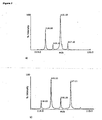
- Fig 4 An example of pre-fractionation of an intermediate product containing HDM group 1 and 2 allergens by use of hydrophobic interaction chromatography is shown in Fig 4 .
- the fractions containing respectively HDM group 1 and 2 allergens are separated by their physico-chemical properties and identified by immunopreciptiation. Both fractions can then be subjected to quantification studies.
- the allergen sample is desalted after chromatography.
- the allergen sample is reduced and any cysteine residue is blocked before degradation such as e.g. by alkylation.
- the sample is degraded by treatment with one or more enzymes in order to obtain a mixture of peptides.
- the enzyme can be chosen to have a very predictable degradation pattern enabling that peptides are obtained that may be Identified and quantified by comparison with the allergen calibration standard peptide.
- the enzyme can be one or more protease(s) such as e.g. two proteases or one or more other enzyme(s). Examples of proteolytic enzymes include trypsin, papain, pepsin, ArgC, LysC, V8 protease, AspN, pronase, chymotrypsin and carboxypeptidease C.
- the proteolytic enzyme trypsin is a serine protease that cleaves peptide bonds between lysine or arginine and an unspecific amino acid to thereby produce peptides that comprise an amine terminus (N-terminus) and lysine or arginine carboxyl terminal amino acid (C- terminus).
- N-terminus amine terminus
- C- terminus lysine or arginine carboxyl terminal amino acid
- the peptides from the cleavage of the protein are predictable and their presence and/or quantity, in a sample from a trypsin digest, is indicative of the presence and/or quantity of the protein of their origin.
- the free amine termini of a peptide can be a good nucleophile that facilitates its labelling.
- the sequence of peptides that are produced from degradation of a protein of a known sequence can be predicted. With this information, "theoretical" peptide information can be generated. A determination of the "theoretical" peptide fragments in e.g. computer assisted analysis of daughter fragment ions from mass spectrometry analysis of an actual sample can therefore be used to identify one or more peptides.
- the allergen sample is degraded before labelling by digestion of the sample with at least one proteolytic enzyme to partially, or fully degrade the sample.
- the proteolytic enzyme is selected from the group consisting of trypsin, papain, pepsin, ArgC, LysC, V8 protease, AspN, pronase, chymotrypsin or carboxypeptidase C or a combination thereof, such as selected from the group of ArgC, LysC and trypsin or a combination thereof.
- the enzyme is trypsin.
- the digested sample can be prepared before labelling by any of several methods if necessary.
- Labelling can e.g. be performed as described in WO 2004/070352 , US 6,864,089 , Stemmann O et al. Cell 2001; 107(6):715-26 , and Gerber SA et al. Proc Natl Acad Sci U S A 2003;100(12):6940-5 .
- the labelling is with ITRAQ TM chemistry (Applied Biosystems, Foster City, CA, USA).
- the labelling of the degraded allergen sample and/or the calibration standard peptides is performed by set of isomeric or Isobaric labelling reagents such as iTRAQTM Reagents (Applied Biosystems, Foster City, CA, USA).
- Each of these reagents contains a reactive group (RG) that reacts with the analyte and a unique reporter group (RP) that produces a unique "signature ion" in MS/MS analysis.
- RG reactive group
- RP reporter group
- LK linker moiety
- the analysis of the analyte is performed by adjusting a mass spectrometer so that both X and Y bond fragment. Fragmentation of bond X releases the reporter from the analyte and the reporter can then be determined Independently from the analyte. Fragmentation of Y bond releases RP-LK combination from the analyte. Hence, based on the fragmentation the presence and / or the amount of the reporter can be correlated with the presence and / or the amount of the analyte in the sample.
- Labelling with e.g. 4 iTRAQTM reagents allows absolute quantification of different allergen samples simultaneously (the allergen samples are degraded and each peptide mixture is labelled different iTRAQTM reagents.
- the possibility of simultaneous analysis of different allergen samples enables the comparison of the labelled peptides, the sample(s), with the known amount of calibration standard peptide(s) and thereby makes quantification and identification by use of MS/MS in one step possible.
- Labelling of the samples when using the ITRAQTM and/or other labelling reagents can be performed according to manufacturer's procedure as shown In Fig. 5 .
- Another method for labelling in connection with quantification of proteins using MS techniques are e.g. the AQUA technique using internal calibration peptides synthesized with incorporated stable isotopes ( 13 C, 15 N) to mimic native peptides formed by enzymatic digestion using e.g.,trypsln ( Stemmann O et al. Cell 2001;107(6):715-26 , Gerber SA et al. Proc Natl Acad Sci U S A 2003;100(12):6940-5 ).
- ICPL Immunotope Coded Protein Labelling
- the differently labelled peptide(s) and allergen calibration standard peptide(s) are labelled separately and mixed after labelling before quantification.
- an appropriate way of identification may be selected.
- the allergen is further positively identified by comparing the labelled allergen peptide(s) and allergen calibration standard peptide(s) by peptide identification analysis.
- Cation-exchange chromatography can also be used for separation of the peptides, In combination with reversed-phase chromatography as two-dimensional chromatography and for reducing the amount, if necessary, of any salts and organic compounds before MS analysis.
- the quantification is performed using mass spectrometry.
- the identification of the allergen and/or isoallergens can be performed using tandem mass spectrometers and other mass spectrometers that are capable of selecting and fragmenting molecular ions. This is especially suitable when iTRAQTM reagents are used for labelling.
- Tandem mass spectrometers (and to a lesser degree single-stage mass spectrometers) have the ability to select and fragment molecular ions according to their mass-to-charge (m/z) ratio, and then record the resulting fragment (daughter) ion spectra. More specifically, daughter fragment ion spectra can be generated by subjecting selected ions to dissociative energy levels (e.g. collision-results in dissociation (CID)). For example, ions corresponding to labelled peptides of a particular m/z ratio can be selected from a first mass analysis, fragmented and reanalyzed in a second mass analysis.
- dissociative energy levels e.g. collision-results in dissociation (CID)
- Representative instruments that can perform such tandem mass analysis include, but are not limited to, magnetic four-sector, tandem time-of flight, triple, quadrupole, ion-trap, and hybrid quadrupole time-of-flight (Q-TOF) mass spectrometers.
- mass spectrometers may be used in conjunction with a variety of ionization sources, including, but not limited to, electrospray ionization (ESI) and matrix assisted laser desorption ionization (MALDI).
- Ionization sources can be used to generate charged species for the first mass analysis where the analyses do not already possess a fixed charge.
- Additional mass spectrometry instruments and fragmentation methods include post source decay in MALDI-MS instruments and high-energy CID using MALDI-TOF (time of flight)-TOF MS.
- MALDI-TOF time of flight
- the allergen calibration standard peptide(s) (variable or constant sequence(s)) are chosen dependent on whether the quantification to be made is of an allergen or homologues allergens or specific allergens or isoallergens.
- absolute quantification of an allergen (absolute amount of isoallergens of the allergen) can be made.
- the chosen allergen calibration standard peptide(s) is labelled with an isomeric or isobaric label of the set of labels, e.g. iTRAQ-114, iTRAQ-115, iTRAQ-116 or iTRAQ-117, used to label the allergen peptides.
- the labelling is with ITRAQ-114, ITRAQ-115, ITRAQ-116 and/or ITRAQ-117.
- the relative amount of reporter for the calibration standard peptide, or standard peptides is determined with relation to the relative amounts of the reporter for the differentially labelled peptides, it is possible to calculate the absolute amount (often expressed in concentration and/or quantity) of all of the differentially labelled peptides in the sample mixture and thereby calculate the amount of allergen (e.g. absolute amount of isoallergen(s) from a species when the sample is an extract).
- the acquisition of MS and MS/MS from the ITRAQ TM labelled samples can be performed e.g. using 4700 Explorer TM software.
- the GPS Explorer software can be used to perform the database searches which would result in the definitive identification of the peptides from MS/MS.
- the obtained data can then be used for quantification based on the known amount of allergen calibration standard peptide i.e. ratio between the sample and the calibration standard peptide.
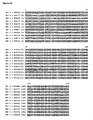
- the allergen to be quantified is Der f 2 and the allergen standard calibration peptide comprises amino adds 32-48 of Der f 2, or (ii) the allergen to be quantified is Der p 2 and the allergen standard calibration peptide comprises amino acids 32-48 of Der p 2.
- the method according to the invention is useful e.g. in a release assay in order to ensure a safe and predictable amount of allergen during production of a vaccine, and in the final product, and also during the various stages of storage of ingredients and/or products, and raw extracts.
- the method according to the invention is useful in development of second generation allergen vaccines e.g. using recombinant allergen as active ingredients by optimizing active ingredients in second generation allergen vaccines based on the knowledge and/or composition of the current vaccines.
- Current vaccines are often formulated using allergens from a number of allergen species, and the method would also be beneficial in determination of the composition of species specific allergens from these allergen mixtures.
- the method according to the invention can be used in cleaning validation, where trace amounts of allergen(s) are measured, release assays and analyses of intermediate and final products.
- Peptides which can be used as calibration standard peptides can be made by using protein and/or nucleotide databases and cleavage analyses program(s) and/or perform in vitro mass fingerprinting experiment(s).
- allergen calibration standard peptide refers to an allergen calibration standard with an amino acid sequence identical with a constant sequence in a group of isoallergens or homologous allergens.
- the allergen calibration peptide is preferably prepared by peptide synthesis.
- the sequence of the allergen of interest is already known.
- An official list of allergens can e.g. be found on the website (www.allergen.org) which is maintained by I.U.I.S Allergen Nomenclature Sub-committee.
- the known allergen sequences can be obtained from protein and nucleotide databases e.g. Uniprot Knowlegdebase.
- the protein and/or nucleotide sequences can be searched using e.g. Sequence Retrieval System (SRS), or by using keywords e.g. submitting entry name (ID), description (DE), gene name (GN), species (OS) and/or organelle (OG). Further analysis of the protein/allergen of interest is performed by using e.g.
- SRS Sequence Retrieval System
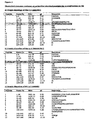
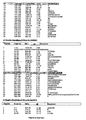
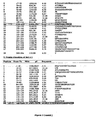
- the cleavage analysis for allergen of interest can be simulated using cleavage (degradation) analyses program(s). Allergen sequences can be subjected to e.g. GPMAW program (Ughthouse data, Odense, Denmark) which is created to support MS analyses. Cleavage (degradation) analysis of an allergen sequence can be deduced for several known proteases such as trypsin, Asp-N and Lys-C and/or a combination of two or more of them. The resulting theoretical peptides ( Fig. 2 ) are then used to verify the optimal degradation enzyme(s) and further to design the synthetic peptides which can be used as calibration standard peptides,
- the calibration standard peptides can be deduced from in vitro mass fingerprinting experiment(s), where allergens are cleaved by enzyme and mixed.
- the species specific peptides can be detected by mass fingerprinting analyses and identified by database searches e.g. using Mascot Search engine, as described below:.
- n Der f 2 and nDer p 2 and recombinant
- r Der f 2 and nDer p 2 and recombinant
- r Der f 2
- A61501 and Der p 2
- An aliquot of recombinant molecules (rDer f 2 and rDer p 2) and natural (nDer f 2 and nDer p 2) molecules can be mixed (e.g. 1:1) or digested as individual allergens by trypsin and mixed after that. The digestions of mixed and/or individual allergens are desalted and evaluated by mass fingerprinting.
- the peptides that are species specific can be identified by mass fingerprinting analyses from the mixture of these two species.
- the digested individual HDM 2 allergens can be mixed after digestion with trypsin and the same species specific constant sequences can be demonstrated. Based on the species specific constant sequences synthetic peptides can be designed.
- the quantification and the verification of the peptide sequences can be performed by labelling the individual allergens and the calibration standard peptides e.g. with ITRAQTM reagents and analysed by tandem mass spectrometry (MS/MS).
- Natural allergen extracts e.g. intermediate product of two HDM species Dermatophagoides farinae and Dermatophagoides pteronyssinus (ALK-Abelló, H ⁇ rsholm, Denmark) (1.0 mg/ml dry weight) are dissolved.
- the samples can be precipitated with acetone.
- the precipitate containing proteins can then be resolved into the chosen buffer.
- the sample(s) and the chosen synthetic peptides from the two species used as calibration standard peptide can be labelled with e.g. ITRAQTM reagents and analysed using MS/MS.
- the final product e.g. house dust mite allergen tablet Is dissolved into 20 mM Na-phosphate buffer pH 7.0.
- the sample may need to be pre-fractionated and/or precipitated with acetone.
- the dissolved tablet and the chosen calibration standard peptides are labelled e.g. with ITRAQTM reagents and analysed using tandem MS/MS.
- the final product e.g. 5 grass mixture(s), including 5 grass species coupled with aluminiumhydroxide is dissolved into a chosen buffer which can elute bound allergens from the aluminium hydroxide.
- the unbound allergens can be further separated and / or desalted into a chosen digestion buffer and the chosen calibration standard peptides can be labelled e.g. with ITRAQTM reagents and the quantification can be assessed using MS/MS.
- Phl p 5 Bet v 1 and mixed Der f 2 and Der p 2 were performed to demonstrate the occurrence of the species specific peptides. All the in vitro digested samples and mixture(s) were identified by use of the Mascot search engine (Matrix Science Inc., Boston, MA, USA).
- Synthetic peptides corresponding to the amino acid sequence of 32 - 48 In Der f 2 and Der p 2 were be obtained from Sigma GENOSYS, Texas, US. The concentration of the peptides was determined by the amino acid analyses (Sigma GENOSYS, Texas, US).
- Stable isotope labelled synthetic peptides (Protein- AQUATM peptides) corresponding to the amino acid sequence of 149-158 in Phl p 1 (Arg 13 C 15 N), 123-135 in Phl p 5a (Arg 13 C 15 N), 115-127 in Phl p 5b a (Arg 13 C 15 N) and 151 - 164 in Bet v 1 (Val 13 C 15 N) were obtained from Sigma GENOSYS, Texas, US (Table 1).
- Natural Der f 2 and Der p 2 were purified from 100 mg of Dermatophagoides farinae and Dermatophagoides pteronyssinus extracts (ALK-Abelló,Horsholm, Denmark). Natural Phl p 1 and 5 were purified from 50 mg of Phleum prantense extract (ALK-Abelló) and natural Bet v 1 from 50 mg of Betula verrucosa extract (ALK-Abelló). The purification of the molecules was performed as described in the literature ( Johannessen BR et al. FEBS Lett 2005;579:1208-12 , Aasmul-Olsen S. et al.
- the concentration of the purified allergens were measured using the extinction coefficient of one of the isoallergens at A 280 and by use of Lambda 800 UV/VIS Spectrometer (Perkin Elmer Instruments, CA, USA).
- Hydrophobic interaction chromatography was used to pre-fractionate the Dermatophagoides farinae (Der f) and Dermatophagoides pteronyssinus (Der p) extracts.
- the fractionation of the mite extracts was performed with a 1.0 ml HITrap Phenyl column (GE-Healthcare, Uppsala,Sweden).
- the column was equilibrated with 50 mM Na-phosphate buffer (Merck, Darmstadt, Germany), pH 7.0, 1.0 M ammonium sulphate (Fluka, Buchs, Switzerland) and the bound sample was eluted with 50 mM Na-phosphate buffer (Merck), pH 7.0 in 5 column volumes using a decreasing linear gradient.
- the chromatography was performed separately for each of the HDM extracts, Der f and Der p.
- the fractions were analysed by SDS-PAGE (Invitrogen, Carlsbad, CA, USA) and based on this analyses the HDM proteins were divided into two major protein pools ( Fig 4 ).
- the Der f and Der p pools containing HDM 2 allergens were subjected to a dialysis step against 10 mM ammonium bicarbonate (BDH, Poole, England).
- the dialysed Der f and Der p pools were freeze dried, aliquated in ⁇ 5 mg (dry weight) vials and stored frozen at -20°C.
- the Der f and Der p aliquots containing HDM 2 allergens were further subjected to the absolute quantification studies.
- iTRAQTM labelling was employed from three samples sets:
- the synthetic standard peptides 15 ⁇ g Peptide 1 (Der p 2) and 15 ⁇ g Peptide 2 (Der f 2) were dissolved into a 100 mM Triethyl ammonium bicarbonate (TEAB) pH 8.5 and labelled to be used as internal calibration standards for each of the experiment sets as described below.
- TEAB Triethyl ammonium bicarbonate
- the iTRAQTM labelling of the trypsin digested samples and internal calibration standard peptides, Peptides 1 and 2 were performed at room temperature. Each iTRAQ labelling reagent from 114 to 117 was dissolved into 70 ⁇ l of 70% ethanol which was then applied on the sample(s). The final volumes of the reagent mixtures were 100 ⁇ l / sample. The labelled samples were stored at -20°C.
- the trypsin digested peptides of natural Der p 2, recombinant Der p 2 and Der p extract were labelled with iTRAQ-114.
- the trypsin digested peptides of natural Der f 2, recombinant Der f 2 and Der f extract were labelled with iTRAQ-115.
- the synthetic peptides Peptide 1 (Der p 2) and Peptide 2 (Der f 2) were labelled with iTRAQ-116 (Der p 2) and iTRAQ-117 (Der f 2) ( Fig 5 ).
- Each of the labelled samples were analysed by Voyager STR and/or 4700 Proteomic Analyser (Applied Biosystems) to demonstrate the labelling of the peptides.
- the MS/MS fragment analyses were performed with 4700 Proteomic Analyser (Applied Biosystems).
- the labelled samples were diluted 1:10 and 1.0 ⁇ l of the sample(s) was desalted by C18 Micro columns (ZipTips, Millipore) and/or handmade C18 micro columns (Poros R2, Applied Blosystems).
- the sample was eluted on the target by 1.0 ⁇ l 70% acetonitrile (ACN), 0.1% Trifluoro acetic acid (TFA) and 1.0 ⁇ l of alpha-cyano-4-hydroxy-cinnamic acid (CHCA) (Agilent Technologies, Böblingen, Germany) matrix was added on top of the sample.
- ACN 70% acetonitrile
- TSA Trifluoro acetic acid
- CHCA alpha-cyano-4-hydroxy-cinnamic acid
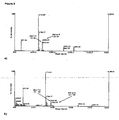
- the MS analyses of the iTRAQTM labelled internal calibration standards revealed masses corresponding to Peptide 1 at the m/z 2353.44 and Peptide 2 at the m/z 2326.35 ( Fig. 6a and 6b ). The results showed that the modification in the Der p 2 specific Peptide 1 and Der f 2 specific Peptide 2 corresponded to the modification by the iTRAQTM reagent when bound to the in the amino-terminus and the C-terminal Lysine.
- the MS analyses of the iTRAQTM labelled natural and recombinant Der p 2 peptides revealed iTRAQTM modified massed at m/z 2353.29.
- the absolute quantification of the isoallergens of Dermatophagoides farinae and Dermatophagoides pteronyssinus species was first employed from the direct mixture of the purified natural allergens.
- the iTRAQTM labelled natural tryptic Der p 2, Der f 2 and Peptides 1 and 2 were mixed In ration of 1:1:1:1, diluted 1:5 and 1:10 and desalted by handmade C18 micro columns (Poros R2, Applied Biosystems).
- the sample was eluted on the target by using 1.0 ⁇ l of 5 ⁇ g/ ⁇ l of CHCA (Sigma) in 70% ACN (Sigma), 0.1% TFA (Fluka).
- the MS/MS fragment analyses was performed by 4700 Proteomic Analyser (Applied Blosystems).
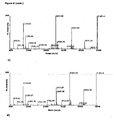
- the fragment analyses of m/z 2353.29 revealed signals at m/z 114 and m/z at 116 corresponding to the reporter ions for natural Der p 2 and Peptide 1.
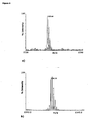
- the amount of natural Der p 2 isoallergens in the sample was calculated as the ratio of the signal area of m/z 114 to area of m/z 116, the internal calibration standard ( Fig 7a ).
- the MS/MS fragment analyses of m/z 2326.29 revealed the signals at m/z 115 and m/z at 117 corresponding to the reporter ions for natural Der f 2 and Peptide 2.
- the amount of natural Der f 2 isoallergens in the sample was calculated as the ratio of the signal area of m/z 115 to m/z of 117, the internal calibration standard ( Fig 7b ).
- the fragment ion peak lists of m/z 2353.29 and m/z 2326.29 were submitted for database analyses by Mascot search engine (Matrix Science). The database analyses resulted identification of the peptides as 32-48 of Dermatophagoides farinae and Dermatophagoides pteronyssinus HDM allergens 2.
- the sample mixtures were diluted 1:10 into 5% ACN (Sigma) 0.05% Formic acid (Merck) and subjected to SCX.
- the SCX was performed in 0.8x50 mm Zorbax BIO-SCX (3.5 ⁇ m) column (Agilent Technologies) in a SMARTTM system (GE-HealthCare, Uppsala, Sweden).
- the column was equilibrated with 5% ACN (Sigma) 0.05% Formic acid (Merck) and the chromatography was performed with a increasing linear gradient from 0 to 100 % of 5% ACN (Sigma) 0.05% Formic acid (Merck) 0.5 M NaCl (Merck) In 30 min.
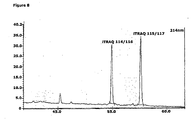
- the flow rate was 50 ⁇ l/min and the chromatography was monitored at 214 nm.
- the 50 ⁇ l fractions were collected and 1.0 ⁇ l of each fraction was analysed by Voyager-STR MS (Applied Biosystems) and/or 4700 Proteomic Analyser (Applied Biosystems) instruments. Peptides at m/z 2353.29 and m/z 2326.29 were identified eluting in the end of the gradient together with some other HDM peptides.
- the Der f and Der p mixture fractions (the extracts) containing the peptides at m/z 2353.29 and m/z 2326.29 were chosen to be further separated by reversed-phase chromatography, see below. However, the quantification of the mixture of rDer f 2 and rDer p 2 (recombinant) and the internal calibration standards was performed directly after SCX from the target plate.
- the MS/MS fragment analyses of m/z 2353.29 revealed signals at m/z 114 and m/z at 116 corresponding to the reporter ions for Der p 2 and Peptide 1.
- the amount of Der p 2 clone the rDer p 2/rDer f 2 mixture was calculated as the ratio of the signal area of m/z 114 to area of m/z 116, the internal calibration standard.
- the MS/MS fragment analyses of m/z 2326.29 revealed the signals at m/z 115 and m/z at 117 corresponding to the reporter ions for Der f 2 and Peptide 2.
- the amount of Der f 2 clone in the In the rDer p 2/rDer f 2 mixture was calculated as the ratio of the signal area of m/z 115 to m/z of 117, the internal calibration standard.
- the fragment ion peak lists of m/z 2353.29 and m/z 2326.29 were submitted for database analyses by Mascot search engine (Matrix Science). The database analyses resulted identification of the peptides as 32-48 of Dermatophagoides farinae and Dermatophagoides pteronyssinus HDM allergens 2.
- the fractions were collected by spotting them directly on a MALDI-TOF target plate.
- the spotting was performed with the Probot (LC Packings, Dionex) instrument which was connected on-line to the Ultimate3000 instrument.
- the spotting was performed every 30 s mixing the HCCA matrix (Agilent Technologies) to the sample In a ratio of 1:1.
- the spotted samples were analysed by MS and MS/MS using 4700 Proteomic Analyser (Applied Biosystems). Peptides at m/z 2353.29 and m/z 2326.29 were identified from the spots on target and they were shown to correspond to the signals at 214 nm in the chromatography ( Fig.8 ).
- the MS/MS fragment analyses of m/z 2353.29 revealed signals at m/z 114 and m/z at 116 corresponding to the reporter ions for Der p 2 and Peptide 1.
- the amount of Der p 2 isoallergens in the Der p / f extract mixture was calculated as the ratio of the signal area of m/z 114 to area of m/z 116 , the internal calibration standard.
- the MS/MS fragment analyses of m/z 2326.29 revealed the signals at m/z 115 and m/z at 117 corresponding to the reporter ions for Der f 2 and Peptide 2.
- the amount of Der f 2 isoallergens in the in the Der p / f extract mixture was calculated as the ratio of the signal area of m/z 115 to m/z of 117, the internal calibration standard.
- the fragment ion peak lists of m/z 2353.29 and m/z 2326.29 were submitted for database analyses by Mascot search engine (Matrix Science). The database analyses resulted identification of the peptides as 32-48 of Dermatophagoides farinae and Dermatophagoides pteronyssinus HDM allergens 2.
- the abundance of a specific fragment ion from both the native sample peptide and the synthesized internal calibration standard can be measured as a function of reverse-phase chromatography retention time.
- the absolute quantification is determined by comparing the abundance of the known internal standard with the native sample peptide.
- Natural Phl p 1, Phl p 5 and Bet v 1 were re-dissolved into a 25 mM Tris-Cl (Sigma), 1.0 M Urea (Fluka) pH 7.8 in a concentration of 2.5 pmol/ ⁇ l. Internal calibration standards were mixed into the samples in a ratio of 1:1. The digestion was performed by 10% (w/w) Seq. grade Trypsin (Promega) in 37°C for 18 hours. The samples were stored in -20°C.
- Phl p 5 and Bet v 1 were analysed by MS and MS/MS using the Voyager STR and/or 4700 Proteomic Analyser (Applied Biosystems). The all samples were diluted 1:10 In 0.1% TFA (Fluka) and 1.0 ⁇ l of each sample was desalted by hand made C18 micro columns (Poros R2 Applied Blosystems).
- the samples can be subjected to analysis by e.g., by LC coupled-MS/MS instruments such as LCQ DecaXP (ThermoFinnigan), QSTAR® Hybrid LC/MS/MS system, and 4000 Q TRAP LC/MS/MS system (Applied Blosystems).
- LC coupled-MS/MS instruments such as LCQ DecaXP (ThermoFinnigan), QSTAR® Hybrid LC/MS/MS system, and 4000 Q TRAP LC/MS/MS system (Applied Blosystems).
Landscapes
- Life Sciences & Earth Sciences (AREA)
- Health & Medical Sciences (AREA)
- Engineering & Computer Science (AREA)
- Molecular Biology (AREA)
- Chemical & Material Sciences (AREA)
- Physics & Mathematics (AREA)
- Immunology (AREA)
- Urology & Nephrology (AREA)
- Hematology (AREA)
- Biomedical Technology (AREA)
- Proteomics, Peptides & Aminoacids (AREA)
- Bioinformatics & Cheminformatics (AREA)
- Analytical Chemistry (AREA)
- Biochemistry (AREA)
- Microbiology (AREA)
- General Health & Medical Sciences (AREA)
- Biotechnology (AREA)
- Bioinformatics & Computational Biology (AREA)
- Organic Chemistry (AREA)
- Biophysics (AREA)
- Medicinal Chemistry (AREA)
- General Physics & Mathematics (AREA)
- Pathology (AREA)
- Cell Biology (AREA)
- Food Science & Technology (AREA)
- Zoology (AREA)
- Wood Science & Technology (AREA)
- Spectroscopy & Molecular Physics (AREA)
- General Engineering & Computer Science (AREA)
- Genetics & Genomics (AREA)
- Peptides Or Proteins (AREA)
- Medicines Containing Antibodies Or Antigens For Use As Internal Diagnostic Agents (AREA)
- Measuring Or Testing Involving Enzymes Or Micro-Organisms (AREA)
- Other Investigation Or Analysis Of Materials By Electrical Means (AREA)
- Medicines Containing Plant Substances (AREA)
Claims (18)
- Verfahren zur Quantifizierung der absoluten Allergenmenge in einer Allergenprobe, wobei das Allergen aus mehr als einem lsoallergen(en) oder homologen Allergen(en) besteht, umfassend die folgenden Schritte :a) Bereitstellen einer bekannten Menge eines oder mehrerer Allergen-Kalibrierungsstandardpeptide, die eine Aminosäuresequenz aufweisen, welche identisch ist mit einer Sequenz, die innerhalb des Allergens vorkommt, welches quantifiziert wird durch Identifizieren einer konstanten Aminosäuresequenz innerhalb des zu quantifizierenden Allergens, durch den Vergleich der Aminosäuresequenzen der Isoallergene oder der homologen Allergene und Herstellen eines synthetischen Allergen-Kalibrierungsstandardpeptids, welches diese konstante Sequenz aufweist und Markieren der Allergen-Kalibrierungsstandardpeptide durch Einbringen von Funktionalitäten, welche die Masse modifizieren,b) Abbau der Allergenprobe um ein Peptidgemisch zu erhalten, und gegebenenfalls Markieren der Peptide mit einem oder mehreren Markierungsagenzien durch Einbringen von Funktionalitäten, weiche die Masse modifizieren, wobei, wenn sowohl die Peptide in der abgebauten Allergenprobe als auch die Allergen-Kalibrierungsstandardpeptide markiert werden, sind die Markierungsagenzien, welche zur Markierung der Allergen-Kalibrierungsstandardpeptide verwendet werden, unterschiedlich zu den Markierungsagenzien, die zur Markierung der Peptide der abgebauten Allergenprobe verwendet werden,c) Quantifizieren der absoluten Allergenmenge durch Korrelieren der Menge an Allergen-Kalibrierungsstandardpeptiden mit der Menge der entsprechenden Peptide der abgebauten Allergenprobe mittels Massenspektrometrie.
- Verfahren nach Anspruch 1, wobei die Allergenprobe abgebaut wird um ein Peptidgemisch zu erhalten, und Markieren der erhaltenen Peptide mit einem oder mehreren Markierungsagenzien durch Einbringen von Funktionalitäten, welche die Masse modifizieren, und
die absolute Allergenmenge wird durch Korrelieren der Menge an markierten Allergen-Kalibrierungsstandardpeptiden mit der Menge der entsprechend markierten Peptide der abgebauten Allergenprobe mittels Massenspektrometrie quantifiziert. - Verfahren nach Anspruch 1, wobei die Allergenprobe abgebaut wird um ein Peptidgemisch zu erhalten, und
die absolute Allergenmenge wird durch Korrelieren der Menge an markierten Allergen-Kalibrierungsstandardpeptiden mit der Menge der entsprechend markierten Peptide der abgebauten Allergenprobe durch Massenspektrometrie quantifiziert. - Verfahren nach einem der Ansprüche 1-3, wobei die Allergen-Kalibrierungsstandardpeptide eine Aminosäuresequenz aufweisen, die identisch ist mit einer Aminosäuresequenz in einem Peptid, das durch Abbau nach Schritt b) erhalten wird.
- Verfahren nach den Ansprüchen 1-4, wobei das zu quantifizierende Allergen aus mehr ais einem Isoallergen besteht.
- Verfahren nach den Ansprüchen 1-4, wobei das zu quantifizierende Allergen aus mehr als einem homologen Allergen besteht.
- Verfahren nach einem der obigen Ansprüche 1-6, wobei das zu quantifizierende Allergen ein oder mehrere Isoallergene sind, welche ausgewählt werden aus der Gruppe bestehend aus Phl p 1, Phl p 5, Phl p 6, Poa p 1, Poa p 5, Dac g 1, Fes p 1, Lol p 1, Lol p 5, Der f1, Der f 2, Der p 1, Der p 2, Api m 1, Api m 2, Ves v 1, Ves v 2, Ves v 5, Dol m 1, Dol m 2, Dol m 5, Dol a 5, Pol a 1, Pol a 2, Pol a 5, Amb a 1, Amb a 2, Par j 1, Par o 1, Par m 1, Bet v1, Cry j 1, Cry j 2, Per a 1, Ole e 1, Fel d 1, Can f 1, Can f 2, Equ c 1, Equ c 2, Art v 1, Art v 2, Art v 3, Alt a 1, Alt a 3, Alt a 4, Alt a 5, Alt a 6, Cla h 1, Cla h 2, Cla h 6, Sol i 2, Sol i 3 und Sol i 4.
- Verfahren nach Anspruch 7, wobei das zu quantifizierende Allergen ein oder mehrere Isoallergene sind, die ausgewählt werden aus der Gruppe bestehend aus Phl p 1, Phl p 5, Phl p 6, Ole e 1, Der f1, Der f 2, Der p 1, Der p 2, Ves v 1, Ves v 2, Ves v 5, Amb a 1, Amb a 2, Par j 1, Par o 1, Par m 1, Bet v 1, Cry j 1 und Cry j 2.
- Verfahren nach Anspruch 8, wobei das zu quantifizierende Allergen ein oder mehrere Isoallergene sind, die ausgewählt werden aus der Gruppe bestehend aus Der f 1, Der p 1, Der f 2 and Der p 2.
- Verfahren nach Anspruch 7, wobei das zu quantifizierende Allergen ein oder mehrere Isoallergene sind, die ausgewählt werden aus der Gruppe bestehend aus Phl p 1, Phl p 5, Phl p 6, Poa p 1, Poa p 5, Dac g 1, Fes p 1, Lol p 1, und Lol p 5.
- Verfahren nach Anspruch 7, wobei das zu quantifizierende Allergen ein oder mehrere Isoallergene sind, die ausgewählt werden aus der Gruppe bestehend aus Amb a 1, und Amb a 2.
- Verfahren nach einem der obigen Ansprüche, wobei die Markierung mit ITRAQ™-Chemie erfolgt.
- Verfahren nach Anspruch 12, wobei die Markierung mit ITRAQ-114, ITRAQ 115, ITRAQ 116 und/oder ITRAQ 117 erfolgt.
- Verfahren nach einem der obigen Ansprüche, wobei (I) das zu quantifizierende Allergen Der f 2 ist und das Allergen-Kalibrierungsstandardpeptid die Aminosäuren 32-48 von Der f 2 umfasst, oder (II) das zu quantifizierende Allergen Der p 2 ist und das Allergen-Kalibrierungsstandardpeptid die Aminosäuren 32-48 von Der p 2 umfasst.
- Verfahren nach einem der obigen Ansprüche, wobei das Allergen eindeutig identifiziert wird durch Vergleich des Allergen-Peptidgemisches mit den Allergen-Kalibrierungsstandardpeptiden mittels Peptididentifizierungsanalyse.
- Verfahren nach einem der obigen Ansprüche, wobei die Allergenprobe durch Verdau mit mindestens einem proteolytischen Enzym abgebaut wird um die Probe partiell, oder vollständig abzubauen.
- Verfahren nach Anspruch 16, wobei das proteolytische Enzym ausgewählt wird aus der Gruppe bestehend aus Trypsin, Papain, Pepsin, Arg-C, Lys-C, V8 Protease, AspN, Pronase, Chymotrypsin und Carboxypeptidase C, oder eine Kombination davon.
- Verfahren nach Anspruch 17, wobei das Enzym Trypsin ist.
Priority Applications (3)
| Application Number | Priority Date | Filing Date | Title |
|---|---|---|---|
| EP10165214.7A EP2228656B1 (de) | 2005-09-15 | 2006-09-01 | Quantifizierung von Allergenen |
| DK10165214.7T DK2228656T3 (da) | 2005-09-15 | 2006-09-01 | Kvantificering af allergener |
| PL06775965T PL1931998T3 (pl) | 2005-09-15 | 2006-09-01 | Sposób ilościowego oznaczania alergenów |
Applications Claiming Priority (3)
| Application Number | Priority Date | Filing Date | Title |
|---|---|---|---|
| DKPA200501293 | 2005-09-15 | ||
| US71794205P | 2005-09-16 | 2005-09-16 | |
| PCT/DK2006/000480 WO2007031080A1 (en) | 2005-09-15 | 2006-09-01 | A method for quantification of allergens |
Publications (2)
| Publication Number | Publication Date |
|---|---|
| EP1931998A1 EP1931998A1 (de) | 2008-06-18 |
| EP1931998B1 true EP1931998B1 (de) | 2010-06-09 |
Family
ID=37309723
Family Applications (2)
| Application Number | Title | Priority Date | Filing Date |
|---|---|---|---|
| EP10165214.7A Revoked EP2228656B1 (de) | 2005-09-15 | 2006-09-01 | Quantifizierung von Allergenen |
| EP06775965A Revoked EP1931998B1 (de) | 2005-09-15 | 2006-09-01 | Verfahren zur quantifizierung von allergenen |
Family Applications Before (1)
| Application Number | Title | Priority Date | Filing Date |
|---|---|---|---|
| EP10165214.7A Revoked EP2228656B1 (de) | 2005-09-15 | 2006-09-01 | Quantifizierung von Allergenen |
Country Status (11)
| Country | Link |
|---|---|
| US (2) | US8703903B2 (de) |
| EP (2) | EP2228656B1 (de) |
| JP (1) | JP2009508118A (de) |
| KR (1) | KR101455375B1 (de) |
| AT (1) | ATE470864T1 (de) |
| AU (1) | AU2006291835B2 (de) |
| CA (1) | CA2621067C (de) |
| DE (1) | DE602006014846D1 (de) |
| MX (1) | MX2008003434A (de) |
| PL (1) | PL1931998T3 (de) |
| WO (1) | WO2007031080A1 (de) |
Families Citing this family (34)
| Publication number | Priority date | Publication date | Assignee | Title |
|---|---|---|---|---|
| JP2007309689A (ja) * | 2006-05-16 | 2007-11-29 | Hitachi High-Technologies Corp | タンパク質結合部位同定技術 |
| AT503690A1 (de) * | 2006-06-09 | 2007-12-15 | Biomay Ag | Hypoallergene moleküle |
| EP3231442B1 (de) * | 2006-06-23 | 2019-12-25 | ADC Therapeutics SA | An krebs beteiligte polynukleotide und polypeptidsequenzen |
| WO2008146100A1 (en) | 2007-06-01 | 2008-12-04 | INSERM (Institut National de la Santé et de la Recherche Médicale) | Method for absolute quantification of polypeptides |
| EP2017622A1 (de) * | 2007-07-19 | 2009-01-21 | DKFZ Deutsches Krebsforschungszentrum, Stiftung des Öffentlichen Rechts | Verfahren zur Bestimmung der Konzentration eines Moleküls |
| CN103272227B (zh) | 2007-08-15 | 2014-12-10 | 切尔卡西亚有限公司 | 针对过敏原去敏化的肽 |
| US7976639B2 (en) | 2007-08-17 | 2011-07-12 | S.C. Johnson & Son, Inc. | Method for determining the percentage of allergens picked up from a surface |
| WO2010060186A1 (en) | 2008-11-03 | 2010-06-03 | Alethia Biotherapeutics Inc. | Antibodies that specifically block the biological activity of a tumor antigen |
| EP2249162A1 (de) * | 2009-04-30 | 2010-11-10 | Stallergenes Sa | Verfahren zur Identifizierung von Grasspezies |
| EP2388268A1 (de) * | 2010-05-18 | 2011-11-23 | Stallergenes S.A. | Rekombinantes, in Pichia pastoris als natürliches Allergen exprimiertes Der-p-2 zur Immuntherapie und für Diagnosezwecke |
| AU2011260233C1 (en) | 2010-06-03 | 2015-04-16 | Alk-Abello A/S | Pharmaceutical product comprising mite allergen extract(s) and a method for the manufacture thereof |
| US9297808B2 (en) | 2010-07-07 | 2016-03-29 | Thermo Fisher Scientific Gmbh | Analyte mass spectrometry quantitation using a universal reporter |
| GB201017705D0 (en) * | 2010-10-20 | 2010-12-01 | Moredun Res Inst | Mite detection |
| PL3173427T3 (pl) | 2011-03-31 | 2019-11-29 | Adc Therapeutics Sa | Przeciwciała przeciwko antygenowi związanemu z nerkami 1 i ich fragmenty wiążące antygen |
| GB201110371D0 (en) * | 2011-06-17 | 2011-08-03 | Proteome Sciences R & D Gmbh & Co Kg | Materials and methods for determining sensitivity potential of compounds |
| CN103930787B (zh) * | 2011-09-02 | 2016-12-21 | Dh科技发展私人贸易有限公司 | 检测过敏原的系统和方法 |
| AU2013209234B2 (en) | 2012-01-09 | 2017-11-09 | Adc Therapeutics Sa | Method for treating breast cancer |
| EP2692732A1 (de) | 2012-08-03 | 2014-02-05 | Stallergenes S.A. | Neues Allergen aus Kreuzkrautpollen und Verwendung davon |
| US9252003B2 (en) | 2013-06-07 | 2016-02-02 | Pierce Biotechnology, Inc. | Absolute quantitation of proteins and protein modifications by mass spectrometry with multiplexed internal standards |
| EP3180607A4 (de) * | 2014-08-11 | 2018-01-03 | Dow AgroSciences LLC | Systeme und verfahren zur selektiven quantifizierung und den nachweis von allergenen |
| WO2016025516A1 (en) * | 2014-08-11 | 2016-02-18 | Dow Agrosciences Llc | Methods and systems for selective quantitation and detection of allergens |
| SI3271729T1 (sl) * | 2015-03-18 | 2021-04-30 | Janssen Vaccines & Prevention B.V. | Testi za rekombinantne ekspresijske sisteme |
| US11013781B2 (en) | 2015-07-01 | 2021-05-25 | Alk-Abelló As | Peptide combinations and uses thereof for treating grass allergy |
| GB201602850D0 (en) * | 2016-02-18 | 2016-04-06 | Bial Ind Farmaceutica S A | Fusion proteins |
| WO2017203057A1 (en) | 2016-05-27 | 2017-11-30 | Alk-Abelló A/S | Immunogenic proteins and fragments thereof from allergenic mites |
| AU2018230952B2 (en) | 2017-03-07 | 2024-05-30 | Commonwealth Scientific And Industrial Research Organisation | LC-MS/MS-based methods for characterizing proteins |
| US20200370090A1 (en) * | 2017-07-31 | 2020-11-26 | Kimberly-Clark Worldwide, Inc. | Compositions and methods for detecting allergens |
| US11408895B1 (en) | 2018-04-09 | 2022-08-09 | Hob Biotech Group Corp., Ltd. | Allergen characterization, potent allergen product formulation, comprehensive allergen reagent, and allergy assay |
| CN115997119B (zh) * | 2020-08-24 | 2024-10-15 | 株式会社岛津制作所 | 质谱分析装置、方法及控制装置、计算机可读介质 |
| JP7582312B2 (ja) * | 2020-08-24 | 2024-11-13 | 株式会社島津製作所 | 質量分析で得られたデータの解析装置、質量分析装置、質量分析で得られたデータの解析方法および解析プログラム |
| JP7555788B2 (ja) * | 2020-10-30 | 2024-09-25 | アサヒグループホールディングス株式会社 | タンパク質の起源種判別方法 |
| CN112881496B (zh) * | 2021-01-19 | 2023-06-23 | 天津中医药大学 | 一种化学振荡指纹图谱技术鉴定山银花与金银花的方法 |
| JP7715992B2 (ja) * | 2021-11-24 | 2025-07-31 | 一般財団法人雑賀技術研究所 | 食物性アレルゲン組成標準物質 |
| WO2024253153A1 (ja) * | 2023-06-07 | 2024-12-12 | 日清食品ホールディングス株式会社 | 質量分析装置を用いたアーモンドの検出方法 |
Family Cites Families (13)
| Publication number | Priority date | Publication date | Assignee | Title |
|---|---|---|---|---|
| WO1995002412A1 (en) * | 1993-07-16 | 1995-01-26 | Meiji Milk Products Co., Ltd. | Antiallergic agent |
| US6319476B1 (en) | 1999-03-02 | 2001-11-20 | Perseptive Biosystems, Inc. | Microfluidic connector |
| EP1269186A2 (de) * | 2000-02-15 | 2003-01-02 | Finnish Immunotechnology Ltd. | Immunochemische nachweisverfahren oder das gebrauchmachen von mindestens zwei gummi-latex-allergenen |
| ATE344456T1 (de) | 2000-05-05 | 2006-11-15 | Purdue Research Foundation | Durch affinität ausgewählte unterschriftspeptide zur identifizierung und quantifizierung von proteinen |
| EP1290450A2 (de) | 2000-06-09 | 2003-03-12 | MDS Proteomics, Inc. | Markierung von proteomischeproben bei proteolyse zur quantifikation und multiplexverfahren |
| AU2002323139A1 (en) | 2001-08-14 | 2003-03-03 | President And Fellows Of Harvard College | Absolute quantification of proteins and modified forms thereof by multistage mass spectrometry |
| AU2003259029A1 (en) | 2002-06-04 | 2003-12-19 | The Institute For Systems Biology | Methods for high throughput and quantitative proteome analysis |
| JP4164576B2 (ja) * | 2002-08-13 | 2008-10-15 | 独立行政法人農業・食品産業技術総合研究機構 | アレルゲン蛋白質の検出方法 |
| US7501286B2 (en) | 2002-08-14 | 2009-03-10 | President And Fellows Of Harvard College | Absolute quantification of proteins and modified forms thereof by multistage mass spectrometry |
| US7632686B2 (en) | 2002-10-03 | 2009-12-15 | Anderson Forschung Group | High sensitivity quantitation of peptides by mass spectrometry |
| AU2003287017B2 (en) | 2002-10-03 | 2011-10-06 | Norman Leigh Anderson | High sensitivity quantitation of peptides by mass spectrometry |
| AU2004209401A1 (en) | 2003-01-30 | 2004-08-19 | Applied Biosystems, Llc. | Methods, mixtures, kits and compositions pertaining to analyte determination |
| PL1649287T3 (pl) | 2003-08-05 | 2009-04-30 | Alk Abello As | Ocena szczepionek zawierających adjuwanty |
-
2006
- 2006-09-01 DE DE602006014846T patent/DE602006014846D1/de active Active
- 2006-09-01 AT AT06775965T patent/ATE470864T1/de active
- 2006-09-01 JP JP2008530328A patent/JP2009508118A/ja active Pending
- 2006-09-01 US US12/066,908 patent/US8703903B2/en active Active
- 2006-09-01 PL PL06775965T patent/PL1931998T3/pl unknown
- 2006-09-01 MX MX2008003434A patent/MX2008003434A/es active IP Right Grant
- 2006-09-01 EP EP10165214.7A patent/EP2228656B1/de not_active Revoked
- 2006-09-01 EP EP06775965A patent/EP1931998B1/de not_active Revoked
- 2006-09-01 AU AU2006291835A patent/AU2006291835B2/en not_active Ceased
- 2006-09-01 WO PCT/DK2006/000480 patent/WO2007031080A1/en not_active Ceased
- 2006-09-01 CA CA2621067A patent/CA2621067C/en not_active Expired - Fee Related
- 2006-09-01 KR KR1020087009038A patent/KR101455375B1/ko not_active Expired - Fee Related
-
2014
- 2014-03-05 US US14/198,112 patent/US10023900B2/en active Active
Also Published As
| Publication number | Publication date |
|---|---|
| WO2007031080A1 (en) | 2007-03-22 |
| JP2009508118A (ja) | 2009-02-26 |
| CA2621067C (en) | 2014-04-29 |
| EP2228656A3 (de) | 2011-03-02 |
| KR20080063311A (ko) | 2008-07-03 |
| US20090197345A1 (en) | 2009-08-06 |
| ATE470864T1 (de) | 2010-06-15 |
| DE602006014846D1 (de) | 2010-07-22 |
| HK1120303A1 (en) | 2009-03-27 |
| AU2006291835A1 (en) | 2007-03-22 |
| CA2621067A1 (en) | 2007-03-22 |
| KR101455375B1 (ko) | 2014-10-27 |
| EP2228656B1 (de) | 2013-10-23 |
| US8703903B2 (en) | 2014-04-22 |
| AU2006291835B2 (en) | 2012-04-05 |
| PL1931998T3 (pl) | 2010-11-30 |
| MX2008003434A (es) | 2008-03-27 |
| HK1148583A1 (en) | 2011-09-09 |
| US10023900B2 (en) | 2018-07-17 |
| EP1931998A1 (de) | 2008-06-18 |
| EP2228656A2 (de) | 2010-09-15 |
| US20140206027A1 (en) | 2014-07-24 |
Similar Documents
| Publication | Publication Date | Title |
|---|---|---|
| US10023900B2 (en) | Method for quantification of allergens | |
| US7445907B2 (en) | Methods for mass spectrometry detection and quantification of specific target proteins in complex biological samples | |
| CN101600959B (zh) | 肽和蛋白的定量方法 | |
| US8859210B2 (en) | Method for identifying allergenic proteins and peptides | |
| CN101287991B (zh) | 对变应原进行定量的方法 | |
| González-Buitrago et al. | Proteomic approaches for identifying new allergens and diagnosing allergic diseases | |
| US6969757B2 (en) | Differential labeling for quantitative analysis of complex protein mixtures | |
| Napoli et al. | Vegetable proteomics: the detection of Ole e 1 isoallergens by peptide matching of MALDI MS/MS spectra of underivatized and dansylated glycopeptides | |
| EP2425258B2 (de) | Verfahren zur identifizierung von grasspezies | |
| HK1120303B (en) | A method for quantification of allergens | |
| HK1148583B (en) | Quantification of allergens | |
| Blume et al. | Microheterogeneity of the major grass group 6 allergen Phl p 6: Analysis by mass spectrometry | |
| Roepstorff et al. | A general strategy for the use of mass spectrometric molecular weight information in protein purification and sequence determination |
Legal Events
| Date | Code | Title | Description |
|---|---|---|---|
| PUAI | Public reference made under article 153(3) epc to a published international application that has entered the european phase |
Free format text: ORIGINAL CODE: 0009012 |
|
| 17P | Request for examination filed |
Effective date: 20080328 |
|
| AK | Designated contracting states |
Kind code of ref document: A1 Designated state(s): AT BE BG CH CY CZ DE DK EE ES FI FR GB GR HU IE IS IT LI LT LU LV MC NL PL PT RO SE SI SK TR |
|
| 17Q | First examination report despatched |
Effective date: 20080902 |
|
| REG | Reference to a national code |
Ref country code: HK Ref legal event code: DE Ref document number: 1120303 Country of ref document: HK |
|
| GRAP | Despatch of communication of intention to grant a patent |
Free format text: ORIGINAL CODE: EPIDOSNIGR1 |
|
| GRAS | Grant fee paid |
Free format text: ORIGINAL CODE: EPIDOSNIGR3 |
|
| GRAA | (expected) grant |
Free format text: ORIGINAL CODE: 0009210 |
|
| AK | Designated contracting states |
Kind code of ref document: B1 Designated state(s): AT BE BG CH CY CZ DE DK EE ES FI FR GB GR HU IE IS IT LI LT LU LV MC NL PL PT RO SE SI SK TR |
|
| REG | Reference to a national code |
Ref country code: CH Ref legal event code: EP |
|
| REG | Reference to a national code |
Ref country code: IE Ref legal event code: FG4D |
|
| REF | Corresponds to: |
Ref document number: 602006014846 Country of ref document: DE Date of ref document: 20100722 Kind code of ref document: P |
|
| REG | Reference to a national code |
Ref country code: CH Ref legal event code: NV Representative=s name: MICHELI & CIE SA |
|
| REG | Reference to a national code |
Ref country code: NL Ref legal event code: T3 |
|
| REG | Reference to a national code |
Ref country code: PT Ref legal event code: SC4A Free format text: AVAILABILITY OF NATIONAL TRANSLATION Effective date: 20100906 |
|
| REG | Reference to a national code |
Ref country code: SE Ref legal event code: TRGR |
|
| REG | Reference to a national code |
Ref country code: DK Ref legal event code: T3 |
|
| REG | Reference to a national code |
Ref country code: ES Ref legal event code: FG2A Ref document number: 2347277 Country of ref document: ES Kind code of ref document: T3 |
|
| PG25 | Lapsed in a contracting state [announced via postgrant information from national office to epo] |
Ref country code: LT Free format text: LAPSE BECAUSE OF FAILURE TO SUBMIT A TRANSLATION OF THE DESCRIPTION OR TO PAY THE FEE WITHIN THE PRESCRIBED TIME-LIMIT Effective date: 20100609 |
|
| REG | Reference to a national code |
Ref country code: HK Ref legal event code: GR Ref document number: 1120303 Country of ref document: HK |
|
| LTIE | Lt: invalidation of european patent or patent extension |
Effective date: 20100609 |
|
| PG25 | Lapsed in a contracting state [announced via postgrant information from national office to epo] |
Ref country code: LV Free format text: LAPSE BECAUSE OF FAILURE TO SUBMIT A TRANSLATION OF THE DESCRIPTION OR TO PAY THE FEE WITHIN THE PRESCRIBED TIME-LIMIT Effective date: 20100609 Ref country code: FI Free format text: LAPSE BECAUSE OF FAILURE TO SUBMIT A TRANSLATION OF THE DESCRIPTION OR TO PAY THE FEE WITHIN THE PRESCRIBED TIME-LIMIT Effective date: 20100609 Ref country code: SI Free format text: LAPSE BECAUSE OF FAILURE TO SUBMIT A TRANSLATION OF THE DESCRIPTION OR TO PAY THE FEE WITHIN THE PRESCRIBED TIME-LIMIT Effective date: 20100609 |
|
| REG | Reference to a national code |
Ref country code: PL Ref legal event code: T3 |
|
| PG25 | Lapsed in a contracting state [announced via postgrant information from national office to epo] |
Ref country code: GR Free format text: LAPSE BECAUSE OF FAILURE TO SUBMIT A TRANSLATION OF THE DESCRIPTION OR TO PAY THE FEE WITHIN THE PRESCRIBED TIME-LIMIT Effective date: 20100910 Ref country code: CY Free format text: LAPSE BECAUSE OF FAILURE TO SUBMIT A TRANSLATION OF THE DESCRIPTION OR TO PAY THE FEE WITHIN THE PRESCRIBED TIME-LIMIT Effective date: 20100609 |
|
| PG25 | Lapsed in a contracting state [announced via postgrant information from national office to epo] |
Ref country code: EE Free format text: LAPSE BECAUSE OF FAILURE TO SUBMIT A TRANSLATION OF THE DESCRIPTION OR TO PAY THE FEE WITHIN THE PRESCRIBED TIME-LIMIT Effective date: 20100609 |
|
| PG25 | Lapsed in a contracting state [announced via postgrant information from national office to epo] |
Ref country code: CZ Free format text: LAPSE BECAUSE OF FAILURE TO SUBMIT A TRANSLATION OF THE DESCRIPTION OR TO PAY THE FEE WITHIN THE PRESCRIBED TIME-LIMIT Effective date: 20100609 Ref country code: IS Free format text: LAPSE BECAUSE OF FAILURE TO SUBMIT A TRANSLATION OF THE DESCRIPTION OR TO PAY THE FEE WITHIN THE PRESCRIBED TIME-LIMIT Effective date: 20101009 Ref country code: SK Free format text: LAPSE BECAUSE OF FAILURE TO SUBMIT A TRANSLATION OF THE DESCRIPTION OR TO PAY THE FEE WITHIN THE PRESCRIBED TIME-LIMIT Effective date: 20100609 Ref country code: RO Free format text: LAPSE BECAUSE OF FAILURE TO SUBMIT A TRANSLATION OF THE DESCRIPTION OR TO PAY THE FEE WITHIN THE PRESCRIBED TIME-LIMIT Effective date: 20100609 |
|
| PLBI | Opposition filed |
Free format text: ORIGINAL CODE: 0009260 |
|
| PLAX | Notice of opposition and request to file observation + time limit sent |
Free format text: ORIGINAL CODE: EPIDOSNOBS2 |
|
| 26 | Opposition filed |
Opponent name: STALLERGENES SA Effective date: 20110309 |
|
| PG25 | Lapsed in a contracting state [announced via postgrant information from national office to epo] |
Ref country code: MC Free format text: LAPSE BECAUSE OF NON-PAYMENT OF DUE FEES Effective date: 20100930 |
|
| REG | Reference to a national code |
Ref country code: DE Ref legal event code: R026 Ref document number: 602006014846 Country of ref document: DE Effective date: 20110309 |
|
| PLBB | Reply of patent proprietor to notice(s) of opposition received |
Free format text: ORIGINAL CODE: EPIDOSNOBS3 |
|
| PLCK | Communication despatched that opposition was rejected |
Free format text: ORIGINAL CODE: EPIDOSNREJ1 |
|
| APBM | Appeal reference recorded |
Free format text: ORIGINAL CODE: EPIDOSNREFNO |
|
| APBP | Date of receipt of notice of appeal recorded |
Free format text: ORIGINAL CODE: EPIDOSNNOA2O |
|
| PG25 | Lapsed in a contracting state [announced via postgrant information from national office to epo] |
Ref country code: BG Free format text: LAPSE BECAUSE OF FAILURE TO SUBMIT A TRANSLATION OF THE DESCRIPTION OR TO PAY THE FEE WITHIN THE PRESCRIBED TIME-LIMIT Effective date: 20100609 Ref country code: LU Free format text: LAPSE BECAUSE OF NON-PAYMENT OF DUE FEES Effective date: 20100901 Ref country code: HU Free format text: LAPSE BECAUSE OF FAILURE TO SUBMIT A TRANSLATION OF THE DESCRIPTION OR TO PAY THE FEE WITHIN THE PRESCRIBED TIME-LIMIT Effective date: 20101210 |
|
| APAH | Appeal reference modified |
Free format text: ORIGINAL CODE: EPIDOSCREFNO |
|
| PG25 | Lapsed in a contracting state [announced via postgrant information from national office to epo] |
Ref country code: TR Free format text: LAPSE BECAUSE OF FAILURE TO SUBMIT A TRANSLATION OF THE DESCRIPTION OR TO PAY THE FEE WITHIN THE PRESCRIBED TIME-LIMIT Effective date: 20100609 |
|
| PLAB | Opposition data, opponent's data or that of the opponent's representative modified |
Free format text: ORIGINAL CODE: 0009299OPPO |
|
| R26 | Opposition filed (corrected) |
Opponent name: STALLERGENES SA Effective date: 20110309 |
|
| APAH | Appeal reference modified |
Free format text: ORIGINAL CODE: EPIDOSCREFNO |
|
| APBU | Appeal procedure closed |
Free format text: ORIGINAL CODE: EPIDOSNNOA9O |
|
| PG25 | Lapsed in a contracting state [announced via postgrant information from national office to epo] |
Ref country code: BG Free format text: LAPSE BECAUSE OF FAILURE TO SUBMIT A TRANSLATION OF THE DESCRIPTION OR TO PAY THE FEE WITHIN THE PRESCRIBED TIME-LIMIT Effective date: 20100909 |
|
| APBC | Information on closure of appeal procedure deleted |
Free format text: ORIGINAL CODE: EPIDOSDNOA9O |
|
| APBQ | Date of receipt of statement of grounds of appeal recorded |
Free format text: ORIGINAL CODE: EPIDOSNNOA3O |
|
| APBC | Information on closure of appeal procedure deleted |
Free format text: ORIGINAL CODE: EPIDOSDNOA9O |
|
| APBU | Appeal procedure closed |
Free format text: ORIGINAL CODE: EPIDOSNNOA9O |
|
| REG | Reference to a national code |
Ref country code: FR Ref legal event code: PLFP Year of fee payment: 10 |
|
| REG | Reference to a national code |
Ref country code: FR Ref legal event code: PLFP Year of fee payment: 11 |
|
| PGFP | Annual fee paid to national office [announced via postgrant information from national office to epo] |
Ref country code: CH Payment date: 20160914 Year of fee payment: 11 Ref country code: GB Payment date: 20160831 Year of fee payment: 11 Ref country code: IE Payment date: 20160909 Year of fee payment: 11 Ref country code: NL Payment date: 20160913 Year of fee payment: 11 Ref country code: DK Payment date: 20160912 Year of fee payment: 11 |
|
| PGFP | Annual fee paid to national office [announced via postgrant information from national office to epo] |
Ref country code: AT Payment date: 20160826 Year of fee payment: 11 Ref country code: PT Payment date: 20160901 Year of fee payment: 11 Ref country code: PL Payment date: 20160812 Year of fee payment: 11 Ref country code: SE Payment date: 20160914 Year of fee payment: 11 |
|
| PGFP | Annual fee paid to national office [announced via postgrant information from national office to epo] |
Ref country code: BE Payment date: 20160815 Year of fee payment: 11 |
|
| PLAB | Opposition data, opponent's data or that of the opponent's representative modified |
Free format text: ORIGINAL CODE: 0009299OPPO |
|
| R26 | Opposition filed (corrected) |
Opponent name: STALLERGENES SA Effective date: 20110309 |
|
| APAH | Appeal reference modified |
Free format text: ORIGINAL CODE: EPIDOSCREFNO |
|
| REG | Reference to a national code |
Ref country code: FR Ref legal event code: PLFP Year of fee payment: 12 |
|
| PGFP | Annual fee paid to national office [announced via postgrant information from national office to epo] |
Ref country code: DE Payment date: 20170830 Year of fee payment: 12 Ref country code: IT Payment date: 20170925 Year of fee payment: 12 Ref country code: FR Payment date: 20170824 Year of fee payment: 12 |
|
| PGFP | Annual fee paid to national office [announced via postgrant information from national office to epo] |
Ref country code: ES Payment date: 20171002 Year of fee payment: 12 |
|
| REG | Reference to a national code |
Ref country code: DE Ref legal event code: R064 Ref document number: 602006014846 Country of ref document: DE Ref country code: DE Ref legal event code: R103 Ref document number: 602006014846 Country of ref document: DE |
|
| APBU | Appeal procedure closed |
Free format text: ORIGINAL CODE: EPIDOSNNOA9O |
|
| PLAB | Opposition data, opponent's data or that of the opponent's representative modified |
Free format text: ORIGINAL CODE: 0009299OPPO |
|
| REG | Reference to a national code |
Ref country code: DK Ref legal event code: EBP Effective date: 20170930 |
|
| R26 | Opposition filed (corrected) |
Opponent name: STALLERGENES Effective date: 20110309 |
|
| REG | Reference to a national code |
Ref country code: CH Ref legal event code: PL |
|
| REG | Reference to a national code |
Ref country code: SE Ref legal event code: EUG |
|
| REG | Reference to a national code |
Ref country code: NL Ref legal event code: MM Effective date: 20171001 |
|
| REG | Reference to a national code |
Ref country code: AT Ref legal event code: MM01 Ref document number: 470864 Country of ref document: AT Kind code of ref document: T Effective date: 20170901 |
|
| GBPC | Gb: european patent ceased through non-payment of renewal fee |
Effective date: 20170901 |
|
| PG25 | Lapsed in a contracting state [announced via postgrant information from national office to epo] |
Ref country code: PT Free format text: LAPSE BECAUSE OF NON-PAYMENT OF DUE FEES Effective date: 20180301 |
|
| REG | Reference to a national code |
Ref country code: IE Ref legal event code: MM4A |
|
| REG | Reference to a national code |
Ref country code: BE Ref legal event code: MM Effective date: 20170930 |
|
| PG25 | Lapsed in a contracting state [announced via postgrant information from national office to epo] |
Ref country code: NL Free format text: LAPSE BECAUSE OF NON-PAYMENT OF DUE FEES Effective date: 20171001 |
|
| RDAF | Communication despatched that patent is revoked |
Free format text: ORIGINAL CODE: EPIDOSNREV1 |
|
| STAA | Information on the status of an ep patent application or granted ep patent |
Free format text: STATUS: PATENT REVOKED |
|
| RDAG | Patent revoked |
Free format text: ORIGINAL CODE: 0009271 |
|
| PG25 | Lapsed in a contracting state [announced via postgrant information from national office to epo] |
Ref country code: CH Free format text: LAPSE BECAUSE OF NON-PAYMENT OF DUE FEES Effective date: 20170930 Ref country code: LI Free format text: LAPSE BECAUSE OF NON-PAYMENT OF DUE FEES Effective date: 20170930 Ref country code: IE Free format text: LAPSE BECAUSE OF NON-PAYMENT OF DUE FEES Effective date: 20170901 Ref country code: GB Free format text: LAPSE BECAUSE OF NON-PAYMENT OF DUE FEES Effective date: 20170901 |
|
| 27W | Patent revoked |
Effective date: 20180320 |
|
| PG25 | Lapsed in a contracting state [announced via postgrant information from national office to epo] |
Ref country code: AT Free format text: LAPSE BECAUSE OF NON-PAYMENT OF DUE FEES Effective date: 20170901 Ref country code: BE Free format text: LAPSE BECAUSE OF NON-PAYMENT OF DUE FEES Effective date: 20170930 |
|
| PG25 | Lapsed in a contracting state [announced via postgrant information from national office to epo] |
Ref country code: DK Free format text: LAPSE BECAUSE OF NON-PAYMENT OF DUE FEES Effective date: 20170930 |
|
| REG | Reference to a national code |
Ref country code: SE Ref legal event code: ECNC |