EP1931367B1 - Bioactive water fraction from gomphostemma niveum - Google Patents
Bioactive water fraction from gomphostemma niveum Download PDFInfo
- Publication number
- EP1931367B1 EP1931367B1 EP06796196A EP06796196A EP1931367B1 EP 1931367 B1 EP1931367 B1 EP 1931367B1 EP 06796196 A EP06796196 A EP 06796196A EP 06796196 A EP06796196 A EP 06796196A EP 1931367 B1 EP1931367 B1 EP 1931367B1
- Authority
- EP
- European Patent Office
- Prior art keywords
- extraction
- bioactive
- water
- fraction
- extract
- Prior art date
- Legal status (The legal status is an assumption and is not a legal conclusion. Google has not performed a legal analysis and makes no representation as to the accuracy of the status listed.)
- Active
Links
Images

Classifications
-
- A—HUMAN NECESSITIES
- A61—MEDICAL OR VETERINARY SCIENCE; HYGIENE
- A61K—PREPARATIONS FOR MEDICAL, DENTAL OR TOILETRY PURPOSES
- A61K36/00—Medicinal preparations of undetermined constitution containing material from algae, lichens, fungi or plants, or derivatives thereof, e.g. traditional herbal medicines
- A61K36/18—Magnoliophyta (angiosperms)
- A61K36/185—Magnoliopsida (dicotyledons)
- A61K36/53—Lamiaceae or Labiatae (Mint family), e.g. thyme, rosemary or lavender
-
- A—HUMAN NECESSITIES
- A61—MEDICAL OR VETERINARY SCIENCE; HYGIENE
- A61P—SPECIFIC THERAPEUTIC ACTIVITY OF CHEMICAL COMPOUNDS OR MEDICINAL PREPARATIONS
- A61P33/00—Antiparasitic agents
- A61P33/02—Antiprotozoals, e.g. for leishmaniasis, trichomoniasis, toxoplasmosis
- A61P33/06—Antimalarials
-
- Y—GENERAL TAGGING OF NEW TECHNOLOGICAL DEVELOPMENTS; GENERAL TAGGING OF CROSS-SECTIONAL TECHNOLOGIES SPANNING OVER SEVERAL SECTIONS OF THE IPC; TECHNICAL SUBJECTS COVERED BY FORMER USPC CROSS-REFERENCE ART COLLECTIONS [XRACs] AND DIGESTS
- Y02—TECHNOLOGIES OR APPLICATIONS FOR MITIGATION OR ADAPTATION AGAINST CLIMATE CHANGE
- Y02A—TECHNOLOGIES FOR ADAPTATION TO CLIMATE CHANGE
- Y02A50/00—TECHNOLOGIES FOR ADAPTATION TO CLIMATE CHANGE in human health protection, e.g. against extreme weather
- Y02A50/30—Against vector-borne diseases, e.g. mosquito-borne, fly-borne, tick-borne or waterborne diseases whose impact is exacerbated by climate change
Definitions
- the present invention relates to a novel bioactive water fraction obtained from the leaves of an herb name Gomphostemma niveum commonly found in North Eastern part of India, and which is useful for inhibiting the growth of malarial parasite Plasmodium falciparum.
- the present invention also relates to a method for the extraction of said bioactive fraction.
- the present invention also provides methods for the use of such bioactive water fractions for the manufacture of a medicament for the treatment of malaria.
- Malaria is the most prevalent among the insect borne disease accounting for more than two million deaths out of 400 million cases reported each year ( Greenwood et. al., Nature 9415), 670(2002 )) caused by Plasmodium falciparum. ( Depote et al. Trends in parasitology (20), 4, 165-198, (2004 )). More than half of the world's population lives in areas where they remain at risk of malarial infection ( Sachs et al Nature, (415), 686 (2002 ). The derivation of important anti-malarial compound started with the discovery of cinchona bark powder (quinine) (Brooking, GB 106430, (1917 )) in 1820.
- quinine cinchona bark powder
- Malaria is caused by protozoa of the genus Plasmodium. Because of its prevalence, virulence and drug resistance, it is the most serious and widespread parasitic disease encountered by centuries. The inadequate armory of drugs in widespread use for the treatment of malaria and lack of affordable new drugs are the limiting factors in the fight against malaria, which underscores the continuing need of research for development of new drugs.
- the main objective of the invention is to develop a novel anti-malarial agent inhibiting the growth of chloroquine resistant and chloroquine sensitive malarial parasite from the natural source.
- Another objective of the invention is to investigate the anti-malarial properties of Indian medicinal plant from the North Eastern region of India for the treatment of malaria (selection of the plant is based on chemotaxonomic data).
- More particular objective is to develop a simple and efficient method for the extraction, isolation and identification of the active components from the Indian medicinal plants.
- Yet another objective is to perform in vitro bioassay of crude extracts against the growth of malarial parasite.
- Further objective of the invention is to develop a reproducible fingerprinting HPLC method for the routine monitoring of the crude extract.
- Still another objective of the invention is to provide a suitable technique for the identification, evaluation and monitoring of in vitro anti-malarial activity.
- Another objective of the invention is to perform the temperature stability studies for the different crude extract, this will be helpful for the storage of bioactive fraction.
- Yet another objective is to evaluate the various routes of administration and to establish their stability in body fluids, toxicity and capacity to reach infected tissue in an adequate concentration during in vivo analysis.
- the present invention therefore provides a novel bioactive water fraction obtained from the leaves of Gomphostemma niveum.
- the present invention also provides a method for the preparation of a novel bioactive fraction from Gomphostemma niveum comprising air drying leaves of the plant, powdering the air dried leaves and subjecting the powder to extraction with water filtering the extract and concentrating to dryness under reduced fraction to obtain the bioactive water extract.
- water extraction is carried out three times.
- extraction is carried out by Soxhlet extraction method at reflux temperature for eight hours.
- extraction is carried out using triple distilled water.
- the filtered extract is concentrated to dryness under reduced pressure of about 86 psi at a temperature of about 46°C using a rotary evaporator.
- the water extract obtained is further fractionated by liquid-liquid extraction using solvents selected from the group consisting of hexane, diethyl ether, chloroform and ethanol on the basis of increasing polarity, the extracts then being concentrated to dryness under reduced pressure of about 150 psi and at a temperature of about 30°C.
- the present invention also provides a pharmaceutical composition for the treatment of malaria comprising a bioactive water extract of Gomphostemma niveum and one or more pharmaceutically acceptable additives.
- the pharmaceutically acceptable additives are selected from the group consisting of carriers diluents, stabilizing agents, solvents flavoring agents and the like.
- Plasmodium falciparum to currently available drug such as choloroquine, present a challenge in the treatment of malaria, which still remains one of the treatment for malaria, which still remains one of the leading causes of death in the world. Consequently new agents are urgently needed to treat the organism.
- the present invention provides a bioactive water fraction named as GN-W obtained from the leaves of plant Gomphostemma niveum having inhibitory activity against chloroquine resistant and chloroquine sensitive malarial parasite. According to another embodiment of the present invention it provides the simple and efficient method of extraction, isolation and identification for the bioactive compound from the sun/air dried leaves of Gomphostemma niveum is provided.
- HPLC high performance liquid chromatographic
- the synergistic effect has also been investigated in case of in vitro and in vivo anti-malarial bioassay of the crude extract. Also described are solubility and temperature related stability studies for the bioactive fraction. Evaluation of various routes of administration their stability in body fluid, toxicity, capacity to reach infected tissue in an adequate concentration during in vitro bioassay is also described.
- the present invention provides a pharmaceutical formulation named as GN-W which exhibit excellent anti-malarial activity.
- the water extract GN-W (25gm) is further fractionated by liquid - liquid extraction using different solvents like hexane (200ml), diethyl ether (200ml), chloroform (200ml) and ethanol (200ml) on the basis of their increasing polarity. All the extracts are pooled together separately and concentrated to dryness under reduced pressure (150 psi and 30°C) and named as GN-E (10gms), GN-C (2gm) and GN-ET (6gm). All these fractions are tested against inhibition studies of malarial parasite. The result indicates that the ether/chloroform fraction exhibits maximum bioactivity against the malarial parasite. The percentage inhibition for ether/chloroform fraction is 86-90%.
- silica gel column chromatography To purify the active principle from the ether/chloroform extract silica gel column chromatography is performed. Any person who is skilled in the art of related subjects can perform technique. About 10g of ether fraction is packed on to a silica gel (100gm), 200-400 mesh) column fractions are subsequently analyzed for their in vitro inhibitory activity against the P. falciparum. Result indicates that the column fractions elutes using 50-60% hexane in ethyl acetate is able to inhibit the malarial parasite and therefore process the ability to cure malaria.
- Amount of solvents use for the elution of different components from the ether fraction are as follows:- Hexane 100-500 ml (1-8 fractions), 10-20% ethyl acetate in hexane 25-50 ml (1-2 lit), 40-50% ethyl acetate in hexane 25-50 ml (1-2 lit) 50-60% ethyl acetate in hexane 25-50ml) (1.5-2.5 lit).
- Parallel extraction is also carry out by taking 50-60 gm of leaves using hexane (100- 200 ml), diethyl ether/chloroform (100-200ml), chloroform (100-200 ml) and ethyl alcohol (100-200 ml) at reflux temperature and also at room temperature for 8-10 hours.
- the extracts are then filtered, pooled together and concentrated to dryness under reduced pressure (at 150-200 psi and 30°C) using the rotatory evaporator. Concentrated fractions are compared with respect to their HPLC profile and also evaluate in vitro.
- Two strains of chloroquine sensitive strain and one strain of P. falciparum isolate from patients from Jagadalpur region of the country is adapted to and maintained in vitro.
- the cultures are maintained as per the standard culture procedures described earlier.
- the parasites are grown in O +ve human RBCs with the addition of RPMI 1640 culure media with 10% Himan serum as supplement.
- the cells are incubated at 37°C at 5% CO 2 atmosphere and the parasitemia are checked after 24 hrs and media changed. When parasitemia exceeded 10% parasitized cells the cultured with the addition of fresh RBC.
- the parasite growth synchronizes by the sorbitol lysis method and synchronized ring stage parasites are used for testing.
- the in vitro testing is done in 100 ⁇ l complete media per well with the addition of 10 ⁇ l of erythrocytes with 2% of ring stages of parasites. All the tests are run in duplicates with in 96 well flat bottomed tissue culture plate and double dilutions are made for each of the test compound with individual control wells only with the RPMI 1640 and human serum supplement. The growth of the parasites in the presence of each of the test compound, Chloroquine and control wells are monitored by the examination of the giemsa stained blood smears made after 24hrs of incubation.
- the counting is done for the presence of mature schizonts among 200 asexual parasites and the average schizont maturation inhibition is calculated by the formula (1-N t /N c )x 100 where in N t and N c represent the number of schizont present in the test and control respectively.
- the IC 50, IC 90 and IC 99 values are calculated by using the commercial statistical package Sigmastat.
Landscapes
- Health & Medical Sciences (AREA)
- Natural Medicines & Medicinal Plants (AREA)
- Life Sciences & Earth Sciences (AREA)
- Veterinary Medicine (AREA)
- General Health & Medical Sciences (AREA)
- Animal Behavior & Ethology (AREA)
- Medicinal Chemistry (AREA)
- Public Health (AREA)
- Chemical & Material Sciences (AREA)
- Pharmacology & Pharmacy (AREA)
- Microbiology (AREA)
- Medical Informatics (AREA)
- Epidemiology (AREA)
- Mycology (AREA)
- Botany (AREA)
- Engineering & Computer Science (AREA)
- Alternative & Traditional Medicine (AREA)
- Biotechnology (AREA)
- Tropical Medicine & Parasitology (AREA)
- Chemical Kinetics & Catalysis (AREA)
- General Chemical & Material Sciences (AREA)
- Nuclear Medicine, Radiotherapy & Molecular Imaging (AREA)
- Organic Chemistry (AREA)
- Pharmaceuticals Containing Other Organic And Inorganic Compounds (AREA)
- Medicines Containing Plant Substances (AREA)
- Compounds Of Unknown Constitution (AREA)
- Heterocyclic Carbon Compounds Containing A Hetero Ring Having Oxygen Or Sulfur (AREA)
Abstract
Description
- The present invention relates to a novel bioactive water fraction obtained from the leaves of an herb name Gomphostemma niveum commonly found in North Eastern part of India, and which is useful for inhibiting the growth of malarial parasite Plasmodium falciparum. The present invention also relates to a method for the extraction of said bioactive fraction. The present invention also provides methods for the use of such bioactive water fractions for the manufacture of a medicament for the treatment of malaria.
- Malaria is the most prevalent among the insect borne disease accounting for more than two million deaths out of 400 million cases reported each year (Greenwood et. al., Nature 9415), 670(2002)) caused by Plasmodium falciparum. (Depote et al. Trends in parasitology (20), 4, 165-198, (2004)). More than half of the world's population lives in areas where they remain at risk of malarial infection (Sachs et al Nature, (415), 686 (2002). The derivation of important anti-malarial compound started with the discovery of cinchona bark powder (quinine) (Brooking,
GB 106430, (1917 US6, 710, 074 (2004 ) is too complex for commercial production (Schmid et al J. Am. Chem. Soc. (105), 624-625, (1983). It is currently prepared by large scale extraction from Artenzisia annua (sweet warwood) and derivative such as artemether, artesunate, arteether and dihydroartemisinin are prepared semi synthetically from the purified extract. Moreover, difficulties have also been encountered in the production of high quality material (Haynes et al. Curr. Opin. Infect. Dis., (14), 719-726, (2001)). - Thus, the widespread resistance of malarial parasite to the majority of drugs, necessitates the development of new drug (Wiesner et al. Angew. Chem. Int. Ed. (42), 5274-5293, (2003)) which should be structurally different from classical compounds with novel mechanism of action to overcome the resistance problem. Recently Ihara et. al disclosed about compounds having anti-malarial activity (
US6, 710, 074 (2002 )) from synthesis. In recent past different classes of compound are also reported having anti-malarial activity like substituted 1,2,4 trioxane (US 6,737,438(2002 )), flavonoids (WO2004000306 (2003 )), naphthylisoquinoline (US6,627,641(2003 )), indoloquinazoles (US6,531,487(2003 )), trioxolanes (US6,486,199(2002 )), betacarboline alkaloids (US6,143,756(2000 )), vocamine (WO 9948501(1999 DE3220426(1983 )) and so on. Recently many patents likeUS6,710,074 ,WO2004000319 ,US5,264,726 ,US2003212098 ,WO2004000306 ,EP1076057 ,WO9948501 US5,290,553 ,US6,143,756 andUS6,627,641 disclosed compounds having anti Plasmodium falciparum activity from natural origin mainly plants. Hence the ethnopharmacologial approach for the search of new anti-malarial has proved to be more predictive. - As a part of ongoing research programmes on bioresources, we have screened large number of plants from the north eastern region for the anti-malarial inhibition studies. Plant selection was mainly based on various criteria such as chemotaxonomic data, field observation and random collection.
- Malaria is caused by protozoa of the genus Plasmodium. Because of its prevalence, virulence and drug resistance, it is the most serious and widespread parasitic disease encountered by mankind. The inadequate armory of drugs in widespread use for the treatment of malaria and lack of affordable new drugs are the limiting factors in the fight against malaria, which underscores the continuing need of research for development of new drugs.
- There is therefore a need to develop new active compounds as an alternative to chloroquine and especially from artemisinin, a plant based anti-malarial drug isolated from the Chinese plant Artemisia annua. The urgent need is to investigate the natural source with new ethanophramacological approach for the search of new anti-malarial especially from the North Eastern part of India, which has not been screened so far. Another need is to develop suitable method for the extraction, isolation and identification of bioactive principles form the plant extract having the anti-malarial properties. The recently developed new isolation and characterization techniques together with development of new pharmacological testing have led to interest in plants as a source of new drugs. However, a promising approach is needed to use these agents as templates for designing new derivatives with improve properties.
- The main objective of the invention is to develop a novel anti-malarial agent inhibiting the growth of chloroquine resistant and chloroquine sensitive malarial parasite from the natural source.
- Another objective of the invention is to investigate the anti-malarial properties of Indian medicinal plant from the North Eastern region of India for the treatment of malaria (selection of the plant is based on chemotaxonomic data).
- More particular objective is to develop a simple and efficient method for the extraction, isolation and identification of the active components from the Indian medicinal plants.
- Yet another objective is to perform in vitro bioassay of crude extracts against the growth of malarial parasite.
- Further objective of the invention is to develop a reproducible fingerprinting HPLC method for the routine monitoring of the crude extract.
- Still another objective of the invention is to provide a suitable technique for the identification, evaluation and monitoring of in vitro anti-malarial activity.
- Another objective of the invention is to perform the temperature stability studies for the different crude extract, this will be helpful for the storage of bioactive fraction.
- Yet another objective is to evaluate the various routes of administration and to establish their stability in body fluids, toxicity and capacity to reach infected tissue in an adequate concentration during in vivo analysis.
- The present invention therefore provides a novel bioactive water fraction obtained from the leaves of Gomphostemma niveum.
- The present invention also provides a method for the preparation of a novel bioactive fraction from Gomphostemma niveum comprising air drying leaves of the plant, powdering the air dried leaves and subjecting the powder to extraction with water filtering the extract and concentrating to dryness under reduced fraction to obtain the bioactive water extract.
- In one embodiment of the invention, water extraction is carried out three times. In another embodiment of the invention, extraction is carried out by Soxhlet extraction method at reflux temperature for eight hours.
- In yet another embodiment of the invention, extraction is carried out using triple distilled water.
- In yet another embodiment of the invention, the filtered extract is concentrated to dryness under reduced pressure of about 86 psi at a temperature of about 46°C using a rotary evaporator.
- In another embodiment of the invention, the water extract obtained is further fractionated by liquid-liquid extraction using solvents selected from the group consisting of hexane, diethyl ether, chloroform and ethanol on the basis of increasing polarity, the extracts then being concentrated to dryness under reduced pressure of about 150 psi and at a temperature of about 30°C.
- The present invention also provides a pharmaceutical composition for the treatment of malaria comprising a bioactive water extract of Gomphostemma niveum and one or more pharmaceutically acceptable additives.
- In one embodiment of the invention, the pharmaceutically acceptable additives are selected from the group consisting of carriers diluents, stabilizing agents, solvents flavoring agents and the like.
-
-
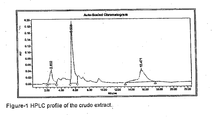
Fig. 1 is the HPLC profile of the crude extract of the invention. -
Fig. 2 is the total ion chromatogram of the crude extract after further fractionation. - The increasing resistance of Plasmodium falciparum to currently available drug such as choloroquine, present a challenge in the treatment of malaria, which still remains one of the treatment for malaria, which still remains one of the leading causes of death in the world. Consequently new agents are urgently needed to treat the organism.
- The present invention provides a bioactive water fraction named as GN-W obtained from the leaves of plant Gomphostemma niveum having inhibitory activity against chloroquine resistant and chloroquine sensitive malarial parasite. According to another embodiment of the present invention it provides the simple and efficient method of extraction, isolation and identification for the bioactive compound from the sun/air dried leaves of Gomphostemma niveum is provided.
- Also described is the development of fingerprinting high performance liquid chromatographic (HPLC) method for the routine monitoring of the crude extract. This provides a suitable technique for in vitro and in vivo bio-evaluation of crude extract.
- The synergistic effect has also been investigated in case of in vitro and in vivo anti-malarial bioassay of the crude extract. Also described are solubility and temperature related stability studies for the bioactive fraction. Evaluation of various routes of administration their stability in body fluid, toxicity, capacity to reach infected tissue in an adequate concentration during in vitro bioassay is also described. Hence the present invention provides a pharmaceutical formulation named as GN-W which exhibit excellent anti-malarial activity.
- The detailed description of the invention which provides a bioactive water fraction named as GN-W obtained from the plant Gomphostemma niveum having inhibitory activity against chloroquine resistant and chloroquine sensitive malarial parasite.
- The process of the bioactive water fraction is now shown with an example, which is illustrative of the present invention.
The process comprised of the following steps: - In our efforts to isolate and identify more potent naturally occurring compounds which are active against chloroquine resistant malarial parasite, we carry out a systematic bio-guided fractionation of the water extract prepared from the leaves of Indian medicinal plant Gomphostemma niveum. Plant material (leaves) is collected in the month of June and September from Dhemaji Assam located in the North Eastern part of India with the help of Defence Research Laboratory, Texpur. Leaves are dried in shade for forty eight hours and ground to fine powder.
- Extract the 100 gm of dry leaves with 500 ml of triple distilled water using soxhlet extraction method at reflux temperature (100°C) for eight hours. Three repeated extractions are carried out by using 500 ml of triple distilled water respectively. The extracts are then filtered, pooled together and concentrated to dryness under reduced pressure (at 86 psi and 46°C) using the rotary evaporator. Concentrated fraction named as GN-W (25gm).
- The water extract GN-W (25gm) is further fractionated by liquid - liquid extraction using different solvents like hexane (200ml), diethyl ether (200ml), chloroform (200ml) and ethanol (200ml) on the basis of their increasing polarity. All the extracts are pooled together separately and concentrated to dryness under reduced pressure (150 psi and 30°C) and named as GN-E (10gms), GN-C (2gm) and GN-ET (6gm). All these fractions are tested against inhibition studies of malarial parasite. The result indicates that the ether/chloroform fraction exhibits maximum bioactivity against the malarial parasite. The percentage inhibition for ether/chloroform fraction is 86-90%. An interesting feature can be observed that the ethanolic fraction does not inhibit the growth of malarial parasite. Hence we hypothesize that the ether extract might contain some active principles which are able to inhibit the growth of malarial parasite. Therefore, to isolate the biologically active principle column chromatography is carried out for the ether/chloroform fraction (GN-E). The list of extracts prepared and the laboratory course are shown in table 1.
Table-1. Plant Name and part Solvent Code Gomphostemma niveum Leaves Water GN-W Hexane GN-H Diethyl ether GN-E Chloroform GN-C Ethanol GN-ET - To purify the active principle from the ether/chloroform extract silica gel column chromatography is performed. Any person who is skilled in the art of related subjects can perform technique. About 10g of ether fraction is packed on to a silica gel (100gm), 200-400 mesh) column fractions are subsequently analyzed for their in vitro inhibitory activity against the P. falciparum. Result indicates that the column fractions elutes using 50-60% hexane in ethyl acetate is able to inhibit the malarial parasite and therefore process the ability to cure malaria. Amount of solvents use for the elution of different components from the ether fraction are as follows:- Hexane 100-500 ml (1-8 fractions), 10-20% ethyl acetate in hexane 25-50 ml (1-2 lit), 40-50% ethyl acetate in hexane 25-50 ml (1-2 lit) 50-60% ethyl acetate in hexane 25-50ml) (1.5-2.5 lit).
- Parallel extraction is also carry out by taking 50-60 gm of leaves using hexane (100- 200 ml), diethyl ether/chloroform (100-200ml), chloroform (100-200 ml) and ethyl alcohol (100-200 ml) at reflux temperature and also at room temperature for 8-10 hours. The extracts are then filtered, pooled together and concentrated to dryness under reduced pressure (at 150-200 psi and 30°C) using the rotatory evaporator. Concentrated fractions are compared with respect to their HPLC profile and also evaluate in vitro.
- The separation of the constituents present in the extracts was carried out on Waters HPLC instrument with UV detector. A finger printing method was also developed for the routine monitoring of the crude extract. The HPLC conditions are as follows:
Column: NOVAPAK C-18, Pump: water's LC-600 150X3.9MM, 5 MICRON UV Detector: Water's 486 Mobile phase: Reversed Phase Isocratic system Acetonitrile: Water (60:40) Flow rate: 1 MI/Min Detector λ: 254 NM - An aliquot of the sample is accurately weighed for dilution to a final analytical concentration of 100µg/ml. In some cases however the entire content of unspecified quantity has to be reconstituted in 1 ml of appropriate solvent as specified in the sample submission details and diluted 100:1 1 for analysis.
-
- Column: Waters Symmetry C18 2.1x 100mm
- Mobile Phase: A = Water B = Acetonitrile
- Gradient: Isocratic 60/40 A:B
- Flowrate: 400µI min split 4:1 into source
- Injection Volume: 20µI
- U. V. Detector: Diode Array 220-300nm (254nm extracted)
-
Column: Waters Symmetry C18 2.1x 100mm
Mobile Phase: A = Water +0.1 % Formic Acid B = Acetonitrile +0.1 % Formic Acid
Gradient: 5% to 95%B in 15mins, hold to 20mins then re-equilibrate to 5%B at 30mins
Flow rate: 400µI min split 4:1 into source Injection Volume: 20µI
U. V. Detector: Diode Array 220-300nm (254nm extracted) -
- Ion Mode: Electrospray +ve
- Acquisition: 80-800Da at Ispectrum/sec, manual pusher at 35usec Real-time centroid exact mass mode.
- Lockspray: Reference Mass (Sulfadimethoxine 311.0814Da)
- Resolution: 6, OOOFWHM Sampling Cone: 40V
- Collision Gas: Argon
- Collision Energy: MS Survey = 5eV (no fragmentation)
-
- Ion Mode: Electrospray +ve
- Acquisition: 80-800Da at Ispectrum/sec, manual pusher at 35µsec Real-time centroid exact mass mode.
- Lockspray: Reference Mass (Sulfadimthoxine 311.0814Da)
- Resolution: 6, OOO FWHM Sampling Cone: 40V Collision Gas:
- Collision Energy: 10eV to 40eV (optimized for individual components)
- Two strains of chloroquine sensitive strain and one strain of P. falciparum isolate from patients from Jagadalpur region of the country is adapted to and maintained in vitro. The cultures are maintained as per the standard culture procedures described earlier. The parasites are grown in O +ve human RBCs with the addition of RPMI 1640 culure media with 10% Himan serum as supplement. The cells are incubated at 37°C at 5% CO2 atmosphere and the parasitemia are checked after 24 hrs and media changed. When parasitemia exceeded 10% parasitized cells the cultured with the addition of fresh RBC. The parasite growth synchronizes by the sorbitol lysis method and synchronized ring stage parasites are used for testing. The in vitro testing is done in 100µl complete media per well with the addition of 10µl of erythrocytes with 2% of ring stages of parasites. All the tests are run in duplicates with in 96 well flat bottomed tissue culture plate and double dilutions are made for each of the test compound with individual control wells only with the RPMI 1640 and human serum supplement. The growth of the parasites in the presence of each of the test compound, Chloroquine and control wells are monitored by the examination of the giemsa stained blood smears made after 24hrs of incubation. The counting is done for the presence of mature schizonts among 200 asexual parasites and the average schizont maturation inhibition is calculated by the formula (1-Nt/Nc)x 100 where in Nt and Nc represent the number of schizont present in the test and control respectively. The IC 50, IC 90 and IC 99 values are calculated by using the commercial statistical package Sigmastat.
-
Compound IC 50 IC 90 GN-W 153.23 µg/ml 752.29 µg/ml GN-E 103.53 µg/ml 388.24 µg/ml Chloroquine 0.025 µM 0.046 µM
Claims (11)
- A bioactive water fraction obtainable from the leaves of Gomphostemma niveum.
- A method for the preparation of a novel bioactive fraction from Gomphostemma niveum comprising air drying leaves of the plant, powdering the air dried leaves and subjecting the powder to extraction with water filtering the extract and concentrating to dryness under reduced fraction to obtain the bioactive water extract.
- A method as claimed in Claim 2 wherein the water extraction is carried out three times.
- A method as claimed in Claim 2 or 3 wherein the each extraction is carried out by Soxhlet extraction method at reflux temperature for eight hours.
- A method as claimed in Claim 2 to 3 wherein each extraction is carried out using triple distilled water.
- A method as claimed in Claim 2 to 5 wherein the filtered extract is concentrated to dryness under reduced pressure of about 86 psi at a temperature of about 46°C using a rotary evaporator.
- A method as claimed in Claim 6 wherein the water extract is further fractionated by liquid - liquid extraction using solvents selected from the group consisting of hexane, diethyl ether, chloroform and ethanol on the basis of increasing polarity, the extracts then being concentrated to dryness under reduced pressure of about 150 psi and at a temperature of about 30°C.
- A pharmaceutical composition for the treatment of malaria comprising a bioactive water extract of Gomphostemma niveum and one or more pharmaceutically acceptable additives.
- A composition as claimed in Claim 8 wherein the pharmaceutically acceptable additives are selected from the group consisting of carriers, diluents, stabilizing agents, solvents, flavoring agents, binders, lubricants and the like.
- A pharmaceutical composition as claimed in Claim 8 and 9 wherein the composition is compounded with honey by dispersing the constituents in honey.
- Use of a pharmaceutical composition as defined in Claim 8 for the preparation of a medicament for the treatment of malaria.
Applications Claiming Priority (2)
| Application Number | Priority Date | Filing Date | Title |
|---|---|---|---|
| IN2073DE2005 | 2005-10-04 | ||
| PCT/IN2006/000318 WO2007039916A2 (en) | 2005-10-04 | 2006-08-30 | Bioactive water fraction from gomphostema niveum |
Publications (2)
| Publication Number | Publication Date |
|---|---|
| EP1931367A2 EP1931367A2 (en) | 2008-06-18 |
| EP1931367B1 true EP1931367B1 (en) | 2010-05-12 |
Family
ID=39399083
Family Applications (1)
| Application Number | Title | Priority Date | Filing Date |
|---|---|---|---|
| EP06796196A Active EP1931367B1 (en) | 2005-10-04 | 2006-08-30 | Bioactive water fraction from gomphostemma niveum |
Country Status (8)
| Country | Link |
|---|---|
| US (2) | US8282968B2 (en) |
| EP (1) | EP1931367B1 (en) |
| CN (1) | CN101277711B (en) |
| AT (1) | ATE467419T1 (en) |
| CA (1) | CA2624654C (en) |
| DE (1) | DE602006014284D1 (en) |
| ES (1) | ES2362216T3 (en) |
| WO (1) | WO2007039916A2 (en) |
Families Citing this family (7)
| Publication number | Priority date | Publication date | Assignee | Title |
|---|---|---|---|---|
| WO2013027621A1 (en) * | 2011-08-22 | 2013-02-28 | 日機装株式会社 | Fluid flow path pressure detection device |
| JP5587958B2 (en) | 2012-10-19 | 2014-09-10 | 日機装株式会社 | Ironing type pump |
| JP5469728B1 (en) | 2012-10-19 | 2014-04-16 | 日機装株式会社 | Liquid channel pressure detector |
| JP5863871B2 (en) | 2014-04-15 | 2016-02-17 | 日機装株式会社 | Mounting member and ironing pump |
| JP6813484B2 (en) | 2015-06-24 | 2021-01-13 | 日機装株式会社 | Blood purification device |
| JP6462077B1 (en) | 2017-09-07 | 2019-01-30 | 日機装株式会社 | Blood purification apparatus and method for discharging bubbles |
| JP6464238B1 (en) | 2017-09-07 | 2019-02-06 | 日機装株式会社 | Blood purification apparatus and method for discharging bubbles |
Family Cites Families (1)
| Publication number | Priority date | Publication date | Assignee | Title |
|---|---|---|---|---|
| CN1276216A (en) * | 2000-05-25 | 2000-12-13 | 赵国林 | Process for preparing non-decoction Chinese medicine |
-
2006
- 2006-08-30 AT AT06796196T patent/ATE467419T1/en not_active IP Right Cessation
- 2006-08-30 EP EP06796196A patent/EP1931367B1/en active Active
- 2006-08-30 CA CA2624654A patent/CA2624654C/en active Active
- 2006-08-30 WO PCT/IN2006/000318 patent/WO2007039916A2/en not_active Ceased
- 2006-08-30 US US11/992,927 patent/US8282968B2/en active Active
- 2006-08-30 DE DE602006014284T patent/DE602006014284D1/en active Active
- 2006-08-30 CN CN2006800368924A patent/CN101277711B/en active Active
- 2006-08-30 ES ES06796196T patent/ES2362216T3/en active Active
-
2012
- 2012-02-21 US US13/400,921 patent/US8951581B2/en active Active
Non-Patent Citations (1)
| Title |
|---|
| HOOKER J.D.: "Gomphostemma niveum", FL. BRIT. INDIA, vol. 4, 1885, pages 697 * |
Also Published As
| Publication number | Publication date |
|---|---|
| CN101277711B (en) | 2011-04-13 |
| ATE467419T1 (en) | 2010-05-15 |
| CA2624654C (en) | 2012-03-20 |
| US20130052287A1 (en) | 2013-02-28 |
| WO2007039916A3 (en) | 2007-06-07 |
| ES2362216T3 (en) | 2011-06-29 |
| US20100203179A1 (en) | 2010-08-12 |
| CN101277711A (en) | 2008-10-01 |
| US8282968B2 (en) | 2012-10-09 |
| US8951581B2 (en) | 2015-02-10 |
| EP1931367A2 (en) | 2008-06-18 |
| DE602006014284D1 (en) | 2010-06-24 |
| CA2624654A1 (en) | 2007-04-12 |
| WO2007039916A2 (en) | 2007-04-12 |
Similar Documents
| Publication | Publication Date | Title |
|---|---|---|
| Bilia et al. | Simultaneous analysis of artemisinin and flavonoids of several extracts of Artemisia annua L. obtained from a commercial sample and a selected cultivar | |
| US8951581B2 (en) | Bioactive water fraction from Gomphostema niveum | |
| CN115368329B (en) | Dimeric sesquiterpenoids, preparation method and application thereof | |
| Ifeoma et al. | Isolation, fractionation and evaluation of the antiplasmodial properties of Phyllanthus niruri resident in its chloroform fraction | |
| Nutmakul et al. | Antiplasmodial activities of a Thai traditional antipyretic formulation, Bencha-Loga-Wichian: A comparative study between the roots and their substitutes, the stems | |
| CN107868068A (en) | A kind of onoseriolide Dimerized sesquiterpenoids, preparation method and the usage | |
| US20100168221A1 (en) | Pharmaceutical composition for treating hepatitis b virus and health food product having hepatitis b virus inhibiting effects | |
| Mutiah et al. | Activity of antimalarial compounds from ethyl acetate fraction of sunflower leaves (Helianthus annuus L.) against plasmodium falciparum parasites 3D7 Strain | |
| US20110086872A1 (en) | Berberine as a selective lung cancer agent and other compositions and methods | |
| CN107243005A (en) | A kind of anti-cancer composition extracted from eupatorium lindleynun var. trifoliolatum and its preparation method and application | |
| Kongkum et al. | Antioxidant and antimicrobial alkaloids isolated from twigs of Uvaria grandiflora Roxb. | |
| EP1934194B1 (en) | Anti-malarial compound isolated from gomphostemma niveum | |
| Uzuegbu et al. | The Antiplasmodial Selectivity Index of the Alkaloid fractions of Phyllanthus Amarus, Nuclea Latifolia and Polyalthia Longifolia | |
| US20130123204A1 (en) | Method for treating hepatitis b | |
| Ganamé et al. | Phytochemical characterization and evaluation of antiplasmodial activity of extracts of Acanthospermum hispidum harvested in Burkina Faso | |
| CN119118971B (en) | Butylphthalide dimer and its preparation method and application | |
| Onwudiwe et al. | BIOASSAY-GUIDED ISOLATION AND GC-MS ANALYSIS OF ANTIPLASMODIAL PRINCIPLE (S) OF METHANOL EXTRACT OF PIPER GUINEENSE LEAF | |
| Cai et al. | Simultaneous determination of ten active components in 12 Chinese Piper species by HPLC | |
| Tchamgoue et al. | Natural Resources for Human Health | |
| Phungula | Studies towards the development of African phytomedicines from Combretum apiculatum and Galenia africana | |
| Komlaga | Search for antiplasmodial compounds from Ghanaian medicinal plants | |
| Dofuor et al. | Research Article In Vitro Mechanism of Action of Acanthospermum hispidum in Trypanosoma brucei | |
| Owolodun et al. | Immunoregulatory properties of N-hexane extract of Osmundastrum cinnamomeum in treatment of Plasmodium berghei infection in mice. | |
| Bawn | Studies on antitrypanosomal activity of medicinal plants | |
| CN104817575A (en) | Compound, its extraction method, pharmaceutical composition containing the same and application thereof |
Legal Events
| Date | Code | Title | Description |
|---|---|---|---|
| PUAI | Public reference made under article 153(3) epc to a published international application that has entered the european phase |
Free format text: ORIGINAL CODE: 0009012 |
|
| 17P | Request for examination filed |
Effective date: 20080331 |
|
| AK | Designated contracting states |
Kind code of ref document: A2 Designated state(s): AT BE BG CH CY CZ DE DK EE ES FI FR GB GR HU IE IS IT LI LT LU LV MC NL PL PT RO SE SI SK TR |
|
| AX | Request for extension of the european patent |
Extension state: AL BA HR MK RS |
|
| 17Q | First examination report despatched |
Effective date: 20080711 |
|
| GRAP | Despatch of communication of intention to grant a patent |
Free format text: ORIGINAL CODE: EPIDOSNIGR1 |
|
| RTI1 | Title (correction) |
Free format text: BIOACTIVE WATER FRACTION FROM GOMPHOSTEMMA NIVEUM |
|
| GRAS | Grant fee paid |
Free format text: ORIGINAL CODE: EPIDOSNIGR3 |
|
| GRAA | (expected) grant |
Free format text: ORIGINAL CODE: 0009210 |
|
| RAP1 | Party data changed (applicant data changed or rights of an application transferred) |
Owner name: THE DIRECTOR GENERAL, DEFENCE RESEARCH & DEVELOPME |
|
| AK | Designated contracting states |
Kind code of ref document: B1 Designated state(s): AT BE BG CH CY CZ DE DK EE ES FI FR GB GR HU IE IS IT LI LT LU LV MC NL PL PT RO SE SI SK TR |
|
| AX | Request for extension of the european patent |
Extension state: AL BA HR MK RS |
|
| REG | Reference to a national code |
Ref country code: GB Ref legal event code: FG4D |
|
| REG | Reference to a national code |
Ref country code: CH Ref legal event code: EP |
|
| REG | Reference to a national code |
Ref country code: IE Ref legal event code: FG4D |
|
| REF | Corresponds to: |
Ref document number: 602006014284 Country of ref document: DE Date of ref document: 20100624 Kind code of ref document: P |
|
| REG | Reference to a national code |
Ref country code: NL Ref legal event code: VDEP Effective date: 20100512 |
|
| LTIE | Lt: invalidation of european patent or patent extension |
Effective date: 20100512 |
|
| PG25 | Lapsed in a contracting state [announced via postgrant information from national office to epo] |
Ref country code: NL Free format text: LAPSE BECAUSE OF FAILURE TO SUBMIT A TRANSLATION OF THE DESCRIPTION OR TO PAY THE FEE WITHIN THE PRESCRIBED TIME-LIMIT Effective date: 20100512 Ref country code: SE Free format text: LAPSE BECAUSE OF FAILURE TO SUBMIT A TRANSLATION OF THE DESCRIPTION OR TO PAY THE FEE WITHIN THE PRESCRIBED TIME-LIMIT Effective date: 20100512 Ref country code: LT Free format text: LAPSE BECAUSE OF FAILURE TO SUBMIT A TRANSLATION OF THE DESCRIPTION OR TO PAY THE FEE WITHIN THE PRESCRIBED TIME-LIMIT Effective date: 20100512 |
|
| PG25 | Lapsed in a contracting state [announced via postgrant information from national office to epo] |
Ref country code: SI Free format text: LAPSE BECAUSE OF FAILURE TO SUBMIT A TRANSLATION OF THE DESCRIPTION OR TO PAY THE FEE WITHIN THE PRESCRIBED TIME-LIMIT Effective date: 20100512 Ref country code: LV Free format text: LAPSE BECAUSE OF FAILURE TO SUBMIT A TRANSLATION OF THE DESCRIPTION OR TO PAY THE FEE WITHIN THE PRESCRIBED TIME-LIMIT Effective date: 20100512 Ref country code: IS Free format text: LAPSE BECAUSE OF FAILURE TO SUBMIT A TRANSLATION OF THE DESCRIPTION OR TO PAY THE FEE WITHIN THE PRESCRIBED TIME-LIMIT Effective date: 20100912 Ref country code: FI Free format text: LAPSE BECAUSE OF FAILURE TO SUBMIT A TRANSLATION OF THE DESCRIPTION OR TO PAY THE FEE WITHIN THE PRESCRIBED TIME-LIMIT Effective date: 20100512 Ref country code: AT Free format text: LAPSE BECAUSE OF FAILURE TO SUBMIT A TRANSLATION OF THE DESCRIPTION OR TO PAY THE FEE WITHIN THE PRESCRIBED TIME-LIMIT Effective date: 20100512 |
|
| PG25 | Lapsed in a contracting state [announced via postgrant information from national office to epo] |
Ref country code: PL Free format text: LAPSE BECAUSE OF FAILURE TO SUBMIT A TRANSLATION OF THE DESCRIPTION OR TO PAY THE FEE WITHIN THE PRESCRIBED TIME-LIMIT Effective date: 20100512 Ref country code: GR Free format text: LAPSE BECAUSE OF FAILURE TO SUBMIT A TRANSLATION OF THE DESCRIPTION OR TO PAY THE FEE WITHIN THE PRESCRIBED TIME-LIMIT Effective date: 20100813 Ref country code: CY Free format text: LAPSE BECAUSE OF FAILURE TO SUBMIT A TRANSLATION OF THE DESCRIPTION OR TO PAY THE FEE WITHIN THE PRESCRIBED TIME-LIMIT Effective date: 20100526 |
|
| PG25 | Lapsed in a contracting state [announced via postgrant information from national office to epo] |
Ref country code: DK Free format text: LAPSE BECAUSE OF FAILURE TO SUBMIT A TRANSLATION OF THE DESCRIPTION OR TO PAY THE FEE WITHIN THE PRESCRIBED TIME-LIMIT Effective date: 20100512 Ref country code: EE Free format text: LAPSE BECAUSE OF FAILURE TO SUBMIT A TRANSLATION OF THE DESCRIPTION OR TO PAY THE FEE WITHIN THE PRESCRIBED TIME-LIMIT Effective date: 20100512 Ref country code: PT Free format text: LAPSE BECAUSE OF FAILURE TO SUBMIT A TRANSLATION OF THE DESCRIPTION OR TO PAY THE FEE WITHIN THE PRESCRIBED TIME-LIMIT Effective date: 20100913 |
|
| PG25 | Lapsed in a contracting state [announced via postgrant information from national office to epo] |
Ref country code: SK Free format text: LAPSE BECAUSE OF FAILURE TO SUBMIT A TRANSLATION OF THE DESCRIPTION OR TO PAY THE FEE WITHIN THE PRESCRIBED TIME-LIMIT Effective date: 20100512 Ref country code: RO Free format text: LAPSE BECAUSE OF FAILURE TO SUBMIT A TRANSLATION OF THE DESCRIPTION OR TO PAY THE FEE WITHIN THE PRESCRIBED TIME-LIMIT Effective date: 20100512 Ref country code: CZ Free format text: LAPSE BECAUSE OF FAILURE TO SUBMIT A TRANSLATION OF THE DESCRIPTION OR TO PAY THE FEE WITHIN THE PRESCRIBED TIME-LIMIT Effective date: 20100512 Ref country code: BE Free format text: LAPSE BECAUSE OF FAILURE TO SUBMIT A TRANSLATION OF THE DESCRIPTION OR TO PAY THE FEE WITHIN THE PRESCRIBED TIME-LIMIT Effective date: 20100512 |
|
| PLBE | No opposition filed within time limit |
Free format text: ORIGINAL CODE: 0009261 |
|
| STAA | Information on the status of an ep patent application or granted ep patent |
Free format text: STATUS: NO OPPOSITION FILED WITHIN TIME LIMIT |
|
| PG25 | Lapsed in a contracting state [announced via postgrant information from national office to epo] |
Ref country code: MC Free format text: LAPSE BECAUSE OF NON-PAYMENT OF DUE FEES Effective date: 20100831 Ref country code: IT Free format text: LAPSE BECAUSE OF FAILURE TO SUBMIT A TRANSLATION OF THE DESCRIPTION OR TO PAY THE FEE WITHIN THE PRESCRIBED TIME-LIMIT Effective date: 20100512 |
|
| REG | Reference to a national code |
Ref country code: CH Ref legal event code: PL |
|
| 26N | No opposition filed |
Effective date: 20110215 |
|
| PG25 | Lapsed in a contracting state [announced via postgrant information from national office to epo] |
Ref country code: CH Free format text: LAPSE BECAUSE OF NON-PAYMENT OF DUE FEES Effective date: 20100831 Ref country code: LI Free format text: LAPSE BECAUSE OF NON-PAYMENT OF DUE FEES Effective date: 20100831 |
|
| REG | Reference to a national code |
Ref country code: DE Ref legal event code: R097 Ref document number: 602006014284 Country of ref document: DE Effective date: 20110214 |
|
| REG | Reference to a national code |
Ref country code: ES Ref legal event code: FG2A Ref document number: 2362216 Country of ref document: ES Kind code of ref document: T3 Effective date: 20110629 |
|
| PG25 | Lapsed in a contracting state [announced via postgrant information from national office to epo] |
Ref country code: IE Free format text: LAPSE BECAUSE OF NON-PAYMENT OF DUE FEES Effective date: 20100830 |
|
| PG25 | Lapsed in a contracting state [announced via postgrant information from national office to epo] |
Ref country code: LU Free format text: LAPSE BECAUSE OF NON-PAYMENT OF DUE FEES Effective date: 20100830 Ref country code: HU Free format text: LAPSE BECAUSE OF FAILURE TO SUBMIT A TRANSLATION OF THE DESCRIPTION OR TO PAY THE FEE WITHIN THE PRESCRIBED TIME-LIMIT Effective date: 20101113 Ref country code: BG Free format text: LAPSE BECAUSE OF FAILURE TO SUBMIT A TRANSLATION OF THE DESCRIPTION OR TO PAY THE FEE WITHIN THE PRESCRIBED TIME-LIMIT Effective date: 20100512 |
|
| PG25 | Lapsed in a contracting state [announced via postgrant information from national office to epo] |
Ref country code: TR Free format text: LAPSE BECAUSE OF FAILURE TO SUBMIT A TRANSLATION OF THE DESCRIPTION OR TO PAY THE FEE WITHIN THE PRESCRIBED TIME-LIMIT Effective date: 20100512 |
|
| PG25 | Lapsed in a contracting state [announced via postgrant information from national office to epo] |
Ref country code: BG Free format text: LAPSE BECAUSE OF FAILURE TO SUBMIT A TRANSLATION OF THE DESCRIPTION OR TO PAY THE FEE WITHIN THE PRESCRIBED TIME-LIMIT Effective date: 20100812 |
|
| REG | Reference to a national code |
Ref country code: FR Ref legal event code: PLFP Year of fee payment: 11 |
|
| REG | Reference to a national code |
Ref country code: FR Ref legal event code: PLFP Year of fee payment: 12 |
|
| REG | Reference to a national code |
Ref country code: FR Ref legal event code: PLFP Year of fee payment: 13 |
|
| REG | Reference to a national code |
Ref country code: DE Ref legal event code: R082 Ref document number: 602006014284 Country of ref document: DE Representative=s name: FLACH BAUER & PARTNER PATENTANWAELTE MBB, DE Ref country code: DE Ref legal event code: R082 Ref document number: 602006014284 Country of ref document: DE Representative=s name: FLACH BAUER STAHL PATENTANWAELTE PARTNERSCHAFT, DE |
|
| P01 | Opt-out of the competence of the unified patent court (upc) registered |
Effective date: 20230526 |
|
| PGFP | Annual fee paid to national office [announced via postgrant information from national office to epo] |
Ref country code: DE Payment date: 20240702 Year of fee payment: 19 |
|
| PGFP | Annual fee paid to national office [announced via postgrant information from national office to epo] |
Ref country code: GB Payment date: 20240701 Year of fee payment: 19 |
|
| PGFP | Annual fee paid to national office [announced via postgrant information from national office to epo] |
Ref country code: FR Payment date: 20240702 Year of fee payment: 19 |
|
| PGFP | Annual fee paid to national office [announced via postgrant information from national office to epo] |
Ref country code: ES Payment date: 20240909 Year of fee payment: 19 |
|
| REG | Reference to a national code |
Ref country code: DE Ref legal event code: R119 Ref document number: 602006014284 Country of ref document: DE |
|
| GBPC | Gb: european patent ceased through non-payment of renewal fee |
Effective date: 20250830 |