EP1930197A1 - Heat exchanger mounting. - Google Patents
Heat exchanger mounting. Download PDFInfo
- Publication number
- EP1930197A1 EP1930197A1 EP07121507A EP07121507A EP1930197A1 EP 1930197 A1 EP1930197 A1 EP 1930197A1 EP 07121507 A EP07121507 A EP 07121507A EP 07121507 A EP07121507 A EP 07121507A EP 1930197 A1 EP1930197 A1 EP 1930197A1
- Authority
- EP
- European Patent Office
- Prior art keywords
- cooler
- radiator
- cooler assembly
- assembly
- groove
- Prior art date
- Legal status (The legal status is an assumption and is not a legal conclusion. Google has not performed a legal analysis and makes no representation as to the accuracy of the status listed.)
- Granted
Links
- 239000003570 air Substances 0.000 description 4
- 230000005540 biological transmission Effects 0.000 description 3
- 238000004140 cleaning Methods 0.000 description 3
- 238000003915 air pollution Methods 0.000 description 1
- 239000012080 ambient air Substances 0.000 description 1
- 238000010276 construction Methods 0.000 description 1
- 239000002826 coolant Substances 0.000 description 1
- 238000001816 cooling Methods 0.000 description 1
- 239000000498 cooling water Substances 0.000 description 1
- 230000005484 gravity Effects 0.000 description 1
- 230000003993 interaction Effects 0.000 description 1
- 230000000717 retained effect Effects 0.000 description 1
- 238000005096 rolling process Methods 0.000 description 1
- 238000000926 separation method Methods 0.000 description 1
Images


Classifications
-
- B—PERFORMING OPERATIONS; TRANSPORTING
- B60—VEHICLES IN GENERAL
- B60K—ARRANGEMENT OR MOUNTING OF PROPULSION UNITS OR OF TRANSMISSIONS IN VEHICLES; ARRANGEMENT OR MOUNTING OF PLURAL DIVERSE PRIME-MOVERS IN VEHICLES; AUXILIARY DRIVES FOR VEHICLES; INSTRUMENTATION OR DASHBOARDS FOR VEHICLES; ARRANGEMENTS IN CONNECTION WITH COOLING, AIR INTAKE, GAS EXHAUST OR FUEL SUPPLY OF PROPULSION UNITS IN VEHICLES
- B60K11/00—Arrangement in connection with cooling of propulsion units
- B60K11/02—Arrangement in connection with cooling of propulsion units with liquid cooling
- B60K11/04—Arrangement or mounting of radiators, radiator shutters, or radiator blinds
-
- F—MECHANICAL ENGINEERING; LIGHTING; HEATING; WEAPONS; BLASTING
- F01—MACHINES OR ENGINES IN GENERAL; ENGINE PLANTS IN GENERAL; STEAM ENGINES
- F01P—COOLING OF MACHINES OR ENGINES IN GENERAL; COOLING OF INTERNAL-COMBUSTION ENGINES
- F01P3/00—Liquid cooling
- F01P3/18—Arrangements or mounting of liquid-to-air heat-exchangers
-
- F—MECHANICAL ENGINEERING; LIGHTING; HEATING; WEAPONS; BLASTING
- F02—COMBUSTION ENGINES; HOT-GAS OR COMBUSTION-PRODUCT ENGINE PLANTS
- F02B—INTERNAL-COMBUSTION PISTON ENGINES; COMBUSTION ENGINES IN GENERAL
- F02B29/00—Engines characterised by provision for charging or scavenging not provided for in groups F02B25/00, F02B27/00 or F02B33/00 - F02B39/00; Details thereof
- F02B29/04—Cooling of air intake supply
- F02B29/0406—Layout of the intake air cooling or coolant circuit
- F02B29/0412—Multiple heat exchangers arranged in parallel or in series
-
- F—MECHANICAL ENGINEERING; LIGHTING; HEATING; WEAPONS; BLASTING
- F02—COMBUSTION ENGINES; HOT-GAS OR COMBUSTION-PRODUCT ENGINE PLANTS
- F02B—INTERNAL-COMBUSTION PISTON ENGINES; COMBUSTION ENGINES IN GENERAL
- F02B29/00—Engines characterised by provision for charging or scavenging not provided for in groups F02B25/00, F02B27/00 or F02B33/00 - F02B39/00; Details thereof
- F02B29/04—Cooling of air intake supply
- F02B29/045—Constructional details of the heat exchangers, e.g. pipes, plates, ribs, insulation, materials, or manufacturing and assembly
- F02B29/0456—Air cooled heat exchangers
-
- F—MECHANICAL ENGINEERING; LIGHTING; HEATING; WEAPONS; BLASTING
- F28—HEAT EXCHANGE IN GENERAL
- F28D—HEAT-EXCHANGE APPARATUS, NOT PROVIDED FOR IN ANOTHER SUBCLASS, IN WHICH THE HEAT-EXCHANGE MEDIA DO NOT COME INTO DIRECT CONTACT
- F28D1/00—Heat-exchange apparatus having stationary conduit assemblies for one heat-exchange medium only, the media being in contact with different sides of the conduit wall, in which the other heat-exchange medium is a large body of fluid, e.g. domestic or motor car radiators
- F28D1/02—Heat-exchange apparatus having stationary conduit assemblies for one heat-exchange medium only, the media being in contact with different sides of the conduit wall, in which the other heat-exchange medium is a large body of fluid, e.g. domestic or motor car radiators with heat-exchange conduits immersed in the body of fluid
- F28D1/04—Heat-exchange apparatus having stationary conduit assemblies for one heat-exchange medium only, the media being in contact with different sides of the conduit wall, in which the other heat-exchange medium is a large body of fluid, e.g. domestic or motor car radiators with heat-exchange conduits immersed in the body of fluid with tubular conduits
- F28D1/0408—Multi-circuit heat exchangers, e.g. integrating different heat exchange sections in the same unit or heat exchangers for more than two fluids
-
- B—PERFORMING OPERATIONS; TRANSPORTING
- B60—VEHICLES IN GENERAL
- B60Y—INDEXING SCHEME RELATING TO ASPECTS CROSS-CUTTING VEHICLE TECHNOLOGY
- B60Y2200/00—Type of vehicle
- B60Y2200/20—Off-Road Vehicles
- B60Y2200/22—Agricultural vehicles
- B60Y2200/221—Tractors
Definitions
- the present invention relates to the mounting of heat exchangers in agricultural vehicles, in particular to a cooler block for use in tractors.
- Tractors have several heat exchangers which form part of different cooling systems.
- a heat exchanger normally termed a radiator
- a second heat exchanger is used to cool oil circulating in the transmission system and a further heat exchanger is used to cool the engine charge air.
- the latter two heat exchangers are commonly referred to as coolers. All three of these heat exchangers, form a cooler block located at the front of the tractor so that a single electric or engine driven radiator fan can suck ambient air through all of them.
- the cooler block contains at least a front cooler, a central cooler, and a rear cooler.
- the rear cooler is attached at a fixed position on the frame of the agricultural tractor and the central cooler can be moved away from the rear cooler while the front cooler can also be moved away from the central cooler.
- the front cooler is suspended so that it can move sufficiently upwards and, if necessary, also forwards, that the central cooler can be swung away from the rear cooler unhindered to the side at about a right angle.
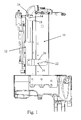
- FIG. 1 of the accompanying drawings shows a known cooler block in which the transmission oil cooler and the air charge cooler together form a cooler assembly 12 that is mounted for pivotal movement relative to a radiator 10, to allow the two to be separated for cleaning.
- the cooler assembly 12 On each side of the radiator 10, the cooler assembly 12 is supported by means of a spigot 14 that rests in a groove 16 in a top bracket 18 mounted on the radiator 10.
- a lower bracket 20 is firmly secured to the cooler assembly 12 and it is formed with a groove 22 in the form of a circular arc centred on the spigot 14 which receives a pin 24 projecting from the side of the radiator 10. This mounting allows the cooler assembly to pivot about the spigot 14 through an angle determined by the length of the groove 22 but not to be lifted off the bracket 18.
- This mounting has certain disadvantages, one being that the cooler assembly at its upper end can only pivot about the spigot 14, which does not create much separation between the cooler assembly 12 and the radiator 10 for cleaning purposes. Furthermore, when the lower end of the cooler assembly 12 is pivoted away from the radiator, stays or gas struts are needed to maintain it in the separated position. These gas struts may assist in the movement of the cooler assembly in one direction but they interfere with movement in the opposite direction. Furthermore, they can hinder access to the space created between the cooler assembly and the radiator for cleaning purposes.
- the present invention seeks therefore to improve the mounting of a cooler assembly on a radiator in a cooler block so that the cooler assembly can be retained in a separated position without the use of stays.
- a cooler block for an agricultural tractor comprising a cooler assembly mounted on a radiator and coupled to the radiator by means of upper and lower linkages to allow the cooler assembly to be moved between a first position in which the cooler assembly lies parallel to the radiator and a second position in which the cooler assembly is inclined relative to the radiator, characterised in that the cooler assembly is pivotable about a pivot in the upper linkage that is itself movable relative to the radiator, and the lower linkage is such that the entire cooler assembly rises and the pivot of the upper linkage moves away from the radiator as the cooler assembly is pivoted from the first to the second position.
- the upper linkage comprises a bracket rigidly secured to the radiator and having a groove for receiving a spigot which projects from the cooler assembly and serves as the pivot, and wherein the lower linkage is such that the spigot slides along the groove to raise the upper end of the cooler assembly and to move it away from the radiator as the cooler assembly pivots about the spigot.
- the detent for retaining the cooler assembly in the second position may suitably be formed by a depression in the groove of the upper linkage.
- the spigot of the upper linkage is advantageously fitted with an anti-friction bearing, i.e. a bearing with rolling bearing elements such as balls, needles or rollers.
- the lower linkage comprises a bracket rigidly secured to the cooler assembly and having a groove receiving a pin projecting from the radiator, the groove being inclined in such a manner as to move the lower end of cooler assembly away from the radiator as the cooler assembly is pivoted about the pivot of the upper linkage.
- the pin engaging in the groove of the bracket of the lower linkage may be fitted with an anti-friction bearing to ease movement of the cooler assembly.
- a depression may be formed in the groove of the bracket secured to the cooler assembly to serve as a detent for retaining the cooler assembly in the second position.
- a catch is provided to retain the cooler assembly in the first position relative to the radiator.
- brackets 18' and 20' are different from the corresponding bracket 18 and 20 used in the prior art, in particular the shape of the grooves 16' and 22' has been significantly modified.
- the shape of the groove 16 is unimportant because after it has dropped into it, the spigot 14 never moves from the bottom of the groove 16. Furthermore, as the groove 22 is substantially an arc centred on the spigot 14, the bracket 20 serves only to limit the angle through which it is possible to swing the cooler assembly 12 and it does not support any part of the weight of the cooler assembly nor does it hold the cooler assembly 12 stationary in any position.
- the groove 22' in the embodiment of the invention shown in Figures 2 and 3 is not equidistant from the spigot 14' at all points along its length.
- the cooler assembly does not only pivot about the spigot 14' but it also rises and the spigot 14' is forced to move along the groove 16'.
- the shape of the groove 14' is not a straight line but is an upwardly convex curve which is additionally formed at its end with a depression 30.
- first position of the cooler assembly 12 shown in Figure 2 most of its weight is supported by the spigot 14' abutting the end of the groove 16'.
- second position shown in Figure 3
- substantially all its weight is initially taken up by the pin 24' which rides in the grooves 22'.
- the spigot 14' reaches the horizontal section of the groove 16', it again supports the weight of the cooler assembly 12.
- the weight of the cooler assembly 12 acts to maintain the spigot 14' in the depression 30 and the latter therefore acts as a detent preventing the cooler assembly from returning under the force of gravity to its first position.
- the interaction between the pin 24' and the groove 22' ensures that the cooler assembly remains pivoted away from the radiator 10 as shown in Figure 3 .
- a depression can be formed in the groove 22' to act in a similar manner as a detent, in addition to or instead of the depression in the groove 16'.
- the spigot 14 did not move along the groove 16 and friction between them did pose a problem.
- the pin 24 did not support the weight of the cooler assembly 12 and friction between it and the groove 22 did not pose a problem. Neither of these conditions holds true in the present invention and friction at either of the grooves 16' and 22' would make it more difficult to move the cooler assembly 12.
- the spigot 14' and the pin 24' are modified by being fitted with a roller bearing to reduce the friction between them and the grooves in which they slide.
Landscapes
- Engineering & Computer Science (AREA)
- Mechanical Engineering (AREA)
- Chemical & Material Sciences (AREA)
- Combustion & Propulsion (AREA)
- General Engineering & Computer Science (AREA)
- Physics & Mathematics (AREA)
- Thermal Sciences (AREA)
- Transportation (AREA)
- Cooling, Air Intake And Gas Exhaust, And Fuel Tank Arrangements In Propulsion Units (AREA)
- Compression-Type Refrigeration Machines With Reversible Cycles (AREA)
- Filling Or Discharging Of Gas Storage Vessels (AREA)
Abstract
Description
- The present invention relates to the mounting of heat exchangers in agricultural vehicles, in particular to a cooler block for use in tractors.
- Tractors have several heat exchangers which form part of different cooling systems. For example, a heat exchanger, normally termed a radiator, is required for cooling water circulating in the engine. A second heat exchanger is used to cool oil circulating in the transmission system and a further heat exchanger is used to cool the engine charge air. The latter two heat exchangers are commonly referred to as coolers. All three of these heat exchangers, form a cooler block located at the front of the tractor so that a single electric or engine driven radiator fan can suck ambient air through all of them.
- Since agricultural vehicles are usually operated in an environment with considerable air pollution, its coolers need to be cleaned from time to time. To do this, the coolers must be separated from each other so that they are accessible from the rear. This, however, is not easy to put into practice in the case of agricultural vehicles, as the space available for the cooler block is severely restricted by the wheels and the frame as well as the front lifting gear and possibly necessary ballast weights.
- This problem is addressed in
US 2003/0168269 in which the cooler block contains at least a front cooler, a central cooler, and a rear cooler. The rear cooler is attached at a fixed position on the frame of the agricultural tractor and the central cooler can be moved away from the rear cooler while the front cooler can also be moved away from the central cooler. The front cooler is suspended so that it can move sufficiently upwards and, if necessary, also forwards, that the central cooler can be swung away from the rear cooler unhindered to the side at about a right angle. - This arrangement is somewhat complicated owing to the fact that three coolers are arranged in series, one behind the other. However, as the area of the radiator for the engine coolant is normally larger than the area of the coolers for the transmission oil and the charge air, it is possible to simplify the construction of the cooler block by positioning the latter two coolers in the same plane as one another in front of the radiator so that air need only be sucked through two coolers arranged in series, not three.
-
Figure 1 of the accompanying drawings shows a known cooler block in which the transmission oil cooler and the air charge cooler together form acooler assembly 12 that is mounted for pivotal movement relative to aradiator 10, to allow the two to be separated for cleaning. On each side of theradiator 10, thecooler assembly 12 is supported by means of aspigot 14 that rests in agroove 16 in atop bracket 18 mounted on theradiator 10. To prevent thecooler assembly 12 from separating completely from theradiator 10, alower bracket 20 is firmly secured to thecooler assembly 12 and it is formed with agroove 22 in the form of a circular arc centred on thespigot 14 which receives apin 24 projecting from the side of theradiator 10. This mounting allows the cooler assembly to pivot about thespigot 14 through an angle determined by the length of thegroove 22 but not to be lifted off thebracket 18. - This mounting has certain disadvantages, one being that the cooler assembly at its upper end can only pivot about the
spigot 14, which does not create much separation between thecooler assembly 12 and theradiator 10 for cleaning purposes. Furthermore, when the lower end of thecooler assembly 12 is pivoted away from the radiator, stays or gas struts are needed to maintain it in the separated position. These gas struts may assist in the movement of the cooler assembly in one direction but they interfere with movement in the opposite direction. Furthermore, they can hinder access to the space created between the cooler assembly and the radiator for cleaning purposes. - The present invention seeks therefore to improve the mounting of a cooler assembly on a radiator in a cooler block so that the cooler assembly can be retained in a separated position without the use of stays.
- In accordance with the present invention, there is provided a cooler block for an agricultural tractor comprising a cooler assembly mounted on a radiator and coupled to the radiator by means of upper and lower linkages to allow the cooler assembly to be moved between a first position in which the cooler assembly lies parallel to the radiator and a second position in which the cooler assembly is inclined relative to the radiator, characterised in that the cooler assembly is pivotable about a pivot in the upper linkage that is itself movable relative to the radiator, and the lower linkage is such that the entire cooler assembly rises and the pivot of the upper linkage moves away from the radiator as the cooler assembly is pivoted from the first to the second position.
- Preferably, the upper linkage comprises a bracket rigidly secured to the radiator and having a groove for receiving a spigot which projects from the cooler assembly and serves as the pivot, and wherein the lower linkage is such that the spigot slides along the groove to raise the upper end of the cooler assembly and to move it away from the radiator as the cooler assembly pivots about the spigot.
- It is also preferred to have a detent incorporated into one of the two linkages to retain the cooler assembly in the second position. The detent for retaining the cooler assembly in the second position may suitably be formed by a depression in the groove of the upper linkage.
- To ease the movement of the cooler assembly, the spigot of the upper linkage is advantageously fitted with an anti-friction bearing, i.e. a bearing with rolling bearing elements such as balls, needles or rollers.
- In the preferred embodiment of the invention, the lower linkage comprises a bracket rigidly secured to the cooler assembly and having a groove receiving a pin projecting from the radiator, the groove being inclined in such a manner as to move the lower end of cooler assembly away from the radiator as the cooler assembly is pivoted about the pivot of the upper linkage.
- Once again, the pin engaging in the groove of the bracket of the lower linkage may be fitted with an anti-friction bearing to ease movement of the cooler assembly.
- As an alternative or an addition to the depression in the groove of the upper linkage, a depression may be formed in the groove of the bracket secured to the cooler assembly to serve as a detent for retaining the cooler assembly in the second position.
- Advantageously, a catch is provided to retain the cooler assembly in the first position relative to the radiator.
- The invention will now be described further, by way of example, with reference to the accompanying drawings, in which:
-
Figure 1 is a side view of a known cooler block as described above, -
Figure 2 is a similar side view of a cooler block of the present invention, and -
Figure 3 shows the cooler block ofFigure 2 with the cooler assembly separated from the radiator. - The embodiment of the invention shown in
Figures 2 and3 bears many similarities to the prior art embodiment previously described by reference toFigure 1 . To avoid repetition like components have been allocated the same reference numerals while a prime has been added to the reference numeral of any component that has been modified. - From a brief comparison of
Figures 1 and2 , it will be seen that the brackets 18' and 20' are different from thecorresponding bracket - In the prior art, the shape of the
groove 16 is unimportant because after it has dropped into it, thespigot 14 never moves from the bottom of thegroove 16. Furthermore, as thegroove 22 is substantially an arc centred on thespigot 14, thebracket 20 serves only to limit the angle through which it is possible to swing thecooler assembly 12 and it does not support any part of the weight of the cooler assembly nor does it hold thecooler assembly 12 stationary in any position. - The groove 22' in the embodiment of the invention shown in
Figures 2 and3 , on the other hand, is not equidistant from the spigot 14' at all points along its length. As a result, as shown by comparingFigures 2 and3 , as the lower end of thecooler assembly 12 is pulled away from theradiator 10, the cooler assembly does not only pivot about the spigot 14' but it also rises and the spigot 14' is forced to move along the groove 16'. - The shape of the groove 14' is not a straight line but is an upwardly convex curve which is additionally formed at its end with a
depression 30. In the first position of thecooler assembly 12 shown inFigure 2 , most of its weight is supported by the spigot 14' abutting the end of the groove 16'. As the cooler assembly is pivoted towards its second position, shown inFigure 3 , substantially all its weight is initially taken up by the pin 24' which rides in the grooves 22'. When the spigot 14' reaches the horizontal section of the groove 16', it again supports the weight of thecooler assembly 12. Thus when the spigot 14' eventually drops into thedepression 30 and thecooler assembly 12 reaches its second position, the weight of thecooler assembly 12 acts to maintain the spigot 14' in thedepression 30 and the latter therefore acts as a detent preventing the cooler assembly from returning under the force of gravity to its first position. At the same time, the interaction between the pin 24' and the groove 22' ensures that the cooler assembly remains pivoted away from theradiator 10 as shown inFigure 3 . If desired, a depression can be formed in the groove 22' to act in a similar manner as a detent, in addition to or instead of the depression in the groove 16'. - To return from the second position to the first, it is necessary to lift the
cooler assembly 12 and tilt it at the same time in order to move the spigot 14' out of thedepression 30. Once the spigot 14' has cleared thedepression 30, it is only necessary to pivot thecooler assembly 12 back towards its upright first position as its weight will assist in returning it to its first position. - In the prior art, the
spigot 14 did not move along thegroove 16 and friction between them did pose a problem. Likewise, thepin 24 did not support the weight of thecooler assembly 12 and friction between it and thegroove 22 did not pose a problem. Neither of these conditions holds true in the present invention and friction at either of the grooves 16' and 22' would make it more difficult to move thecooler assembly 12. - For this reason, in the preferred embodiment of the invention the spigot 14' and the pin 24' are modified by being fitted with a roller bearing to reduce the friction between them and the grooves in which they slide.
- The last difference between the embodiment of the invention in
Figures 2 and3 and the prior art resides in the addition of areleasable catch cooler assembly 12 in its first position. If thecooler assembly 12 were to rely only on its weight to maintain it in its first position during normal operation of the vehicle, then it could be jogged up and down and at the same time pivoted towards and away from theradiator 10 when the vehicle is driven over uneven ground. Thecatch
Claims (9)
- A cooler block for an agricultural tractor comprising a cooler assembly mounted on a radiator and coupled to the radiator by means of upper and lower linkages to allow the cooler assembly to be moved between a first position in which the cooler assembly lies parallel to the radiator and a second position in which the cooler assembly is inclined relative to the radiator, characterised in that the cooler assembly is pivotable about a pivot in the upper linkage that is itself movable relative to the radiator, and the lower linkage is such that the entire cooler assembly rises and the pivot of the upper linkage moves away from the radiator as the cooler assembly is pivoted from the first to the second position.
- A cooler block as claimed in claim 1, wherein the upper linkage comprises a bracket rigidly secured to the radiator and having a groove for receiving a spigot which projects from the cooler assembly and serves as the pivot, and wherein the lower linkage is such that the spigot slides along the groove to raise the upper end of the cooler assembly and to move it away from the radiator as the cooler assembly pivots about the spigot.
- A cooler block as claimed in claim 2, wherein the spigot of the upper linkage is fitted with an anti-friction bearing.
- A cooler block as claimed in any preceding claim, wherein the lower linkage comprises a bracket rigidly secured to the cooler assembly and having a groove receiving a pin projecting from the radiator, the groove being inclined in such a manner as to move the lower end of cooler assembly away from the radiator as the cooler assembly is pivoted about the pivot of the upper linkage.
- A cooler block as claimed in claim 4, wherein the pin engaging in the groove of the bracket of the lower linkage is fitted with an anti-friction bearing.
- A cooler block as claimed in claim 4 or 5, wherein a depression is formed in the groove of the bracket secured to the cooler assembly to serve as a detent for retaining the cooler assembly in the second position.
- A cooler block as claimed in any preceding claim, wherein a catch is provided to retain the cooler assembly in the first position relative to the radiator.
- A cooler block as claimed in any of the preceding claims, wherein a detent is incorporated into at least one of the two linkages to retain the cooler assembly in the second position
- A cooler block as claimed in claim 8, wherein the detent for retaining the cooler assembly in the second position comprises a depression in the groove of the upper linkage.
Applications Claiming Priority (1)
| Application Number | Priority Date | Filing Date | Title |
|---|---|---|---|
| GB0624198A GB2444505A (en) | 2006-12-04 | 2006-12-04 | Heat exchanger mounting |
Publications (2)
| Publication Number | Publication Date |
|---|---|
| EP1930197A1 true EP1930197A1 (en) | 2008-06-11 |
| EP1930197B1 EP1930197B1 (en) | 2010-11-17 |
Family
ID=37671828
Family Applications (1)
| Application Number | Title | Priority Date | Filing Date |
|---|---|---|---|
| EP07121507A Active EP1930197B1 (en) | 2006-12-04 | 2007-11-26 | Heat exchanger mounting |
Country Status (5)
| Country | Link |
|---|---|
| US (1) | US8096347B2 (en) |
| EP (1) | EP1930197B1 (en) |
| AT (1) | ATE488395T1 (en) |
| DE (1) | DE602007010573D1 (en) |
| GB (1) | GB2444505A (en) |
Cited By (3)
| Publication number | Priority date | Publication date | Assignee | Title |
|---|---|---|---|---|
| DE102008040908A1 (en) * | 2008-07-31 | 2010-02-11 | Deere & Company, Moline | Radiator arrangement for a vehicle cooling system |
| JP2010209613A (en) * | 2009-03-11 | 2010-09-24 | Kubota Corp | Work machine |
| CN104949214A (en) * | 2014-03-31 | 2015-09-30 | Lg电子株式会社 | dehumidifier |
Families Citing this family (15)
| Publication number | Priority date | Publication date | Assignee | Title |
|---|---|---|---|---|
| GB0526621D0 (en) * | 2005-12-30 | 2006-02-08 | Agco Sa | Cooler installation |
| FR2914618B1 (en) * | 2007-04-03 | 2009-09-18 | Renault Sas | METHOD FOR MOUNTING A CROSS-SECTIONAL ELEMENT AND A TECHNICAL FRONT PANEL |
| FR2922823B1 (en) * | 2007-10-25 | 2009-12-18 | Renault Sas | ARRANGEMENT FOR THE MOUNTING OF A HEAT EXCHANGER ON A VERTICAL STRUCTURE ELEMENT FORMING A TECHNICAL FRONT OF A MOTOR VEHICLE. |
| FR2930224B1 (en) * | 2008-04-22 | 2010-08-13 | Renault Sas | AIR GUIDING DEVICE OF FRONT FACE STRUCTURE OF VEHICLE. |
| US8440913B2 (en) * | 2009-04-24 | 2013-05-14 | Abb Technology Ag | Breaker with improved shipping configuration |
| US20120103712A1 (en) * | 2010-11-03 | 2012-05-03 | Caterpillar Inc. | Skid steer machine having pivotably mounted cooling system and non-metallic vibration isolator |
| WO2012086519A1 (en) * | 2010-12-24 | 2012-06-28 | 株式会社小松製作所 | Construction vehicle |
| DE102011053500B4 (en) * | 2011-09-12 | 2022-02-03 | Dr. Ing. H.C. F. Porsche Aktiengesellschaft | Cooling device for a motor vehicle with an extendable rear spoiler and an intercooler |
| US20140125070A1 (en) * | 2012-11-08 | 2014-05-08 | Caterpillar Sarl | Cooling package latch mechanism |
| KR102200379B1 (en) * | 2013-12-10 | 2021-01-08 | 엘지전자 주식회사 | Dehumidifier |
| JP6415890B2 (en) * | 2014-08-04 | 2018-10-31 | 株式会社クボタ | Work vehicle |
| JP6383234B2 (en) * | 2014-09-30 | 2018-08-29 | 株式会社クボタ | Working machine |
| US9752302B2 (en) | 2014-09-30 | 2017-09-05 | Kubota Corporation | Working machine |
| JP6286338B2 (en) * | 2014-09-30 | 2018-02-28 | 株式会社クボタ | Working machine |
| US10400423B1 (en) * | 2018-10-04 | 2019-09-03 | Caterpillar Inc. | Radiator guard and method of making |
Citations (2)
| Publication number | Priority date | Publication date | Assignee | Title |
|---|---|---|---|---|
| JP2000212995A (en) | 1999-01-26 | 2000-08-02 | Furukawa Co Ltd | Oil cooler open and close mechanism for construction vehicle |
| EP1707420A2 (en) * | 2005-03-31 | 2006-10-04 | Deere & Company | Cooler arrangement |
Family Cites Families (7)
| Publication number | Priority date | Publication date | Assignee | Title |
|---|---|---|---|---|
| US2626066A (en) * | 1947-09-29 | 1953-01-20 | Rasmussen Robert | Alternate tipping valve |
| US4696361A (en) * | 1984-03-23 | 1987-09-29 | Owatonna Manufacturing Company | Swing-up radiator and oil cooler assembly |
| JP3236764B2 (en) * | 1995-09-21 | 2001-12-10 | 新キャタピラー三菱株式会社 | Heat exchange equipment |
| EP0947780B1 (en) * | 1998-04-01 | 2004-01-07 | KERMI GmbH | Device for easy rotating cooling- or heating radiators |
| EP1098073B1 (en) * | 1999-11-05 | 2006-12-13 | CNH Österreich GmbH | Motor vehicle having an oil cooler |
| JP3903136B2 (en) * | 2001-11-05 | 2007-04-11 | 株式会社小松製作所 | Construction machine cooling system |
| DE10206551B4 (en) * | 2002-02-16 | 2008-09-25 | CNH Österreich GmbH | Radiator arrangement for tractors |
-
2006
- 2006-12-04 GB GB0624198A patent/GB2444505A/en not_active Withdrawn
-
2007
- 2007-11-26 EP EP07121507A patent/EP1930197B1/en active Active
- 2007-11-26 DE DE602007010573T patent/DE602007010573D1/en active Active
- 2007-11-26 AT AT07121507T patent/ATE488395T1/en not_active IP Right Cessation
- 2007-11-30 US US11/947,925 patent/US8096347B2/en active Active
Patent Citations (2)
| Publication number | Priority date | Publication date | Assignee | Title |
|---|---|---|---|---|
| JP2000212995A (en) | 1999-01-26 | 2000-08-02 | Furukawa Co Ltd | Oil cooler open and close mechanism for construction vehicle |
| EP1707420A2 (en) * | 2005-03-31 | 2006-10-04 | Deere & Company | Cooler arrangement |
Cited By (7)
| Publication number | Priority date | Publication date | Assignee | Title |
|---|---|---|---|---|
| DE102008040908A1 (en) * | 2008-07-31 | 2010-02-11 | Deere & Company, Moline | Radiator arrangement for a vehicle cooling system |
| US8616265B2 (en) | 2008-07-31 | 2013-12-31 | Deere & Company | Cooler assembly for a vehicle cooling system |
| EP2151561A3 (en) * | 2008-07-31 | 2015-04-15 | Deere & Company | Cooler assembly for a vehicle cooling system |
| JP2010209613A (en) * | 2009-03-11 | 2010-09-24 | Kubota Corp | Work machine |
| CN104949214A (en) * | 2014-03-31 | 2015-09-30 | Lg电子株式会社 | dehumidifier |
| CN104949214B (en) * | 2014-03-31 | 2018-01-05 | Lg电子株式会社 | Dehumidifier |
| US10082302B2 (en) | 2014-03-31 | 2018-09-25 | Lg Electronics Inc. | Dehumidifier |
Also Published As
| Publication number | Publication date |
|---|---|
| US8096347B2 (en) | 2012-01-17 |
| EP1930197B1 (en) | 2010-11-17 |
| DE602007010573D1 (en) | 2010-12-30 |
| ATE488395T1 (en) | 2010-12-15 |
| GB0624198D0 (en) | 2007-01-10 |
| GB2444505A (en) | 2008-06-11 |
| US20080283214A1 (en) | 2008-11-20 |
Similar Documents
| Publication | Publication Date | Title |
|---|---|---|
| EP1930197B1 (en) | Heat exchanger mounting | |
| US12098063B2 (en) | Compact tool carrier and mainframes for a self-propelled machine | |
| AU2004203582B2 (en) | Mast construction for a lift truck | |
| KR20140011284A (en) | Air-guiding apparatus | |
| CN105501128A (en) | Apparatus for gaining access to lift vehicles | |
| US8070170B2 (en) | Tilt device for a material handling machine | |
| US6866466B2 (en) | Folding lift arm assembly for skid steer loader | |
| CN106927392B (en) | Self-balancing structural steel conveyor for building | |
| US20080152471A1 (en) | Method and Assembly For Shifting the Fork Cradle of a Forklift Truck Laterally and For Tilting it Longitudinally | |
| EP2990536A2 (en) | Combination cab mounting bracket and lift arm stop for skid steer machine | |
| US9915396B2 (en) | Column-levelling system | |
| WO2017089693A1 (en) | Handling vehicle | |
| US6698114B2 (en) | Lift arm support and storage construction for small loader | |
| GB2485918A (en) | Post driver with slidable positioning means | |
| EP2399789A1 (en) | Working trim stabilizer and load distribution device for agricultural and plant-nursery machines, and work vehicle, particularly for plant nursery work, provided with such a stabilizer device | |
| JP6286338B2 (en) | Working machine | |
| JP6383234B2 (en) | Working machine | |
| JPH0616399A (en) | Freight jacking carriage | |
| EP2295366A1 (en) | Forklift mast | |
| JP2017210140A (en) | Traveling device of working vehicle | |
| JP7246088B2 (en) | work machine | |
| US20230373770A1 (en) | Front scanner level for a material handling vehicle | |
| KR102746067B1 (en) | Paddy field working machine | |
| SE535510C2 (en) | Mobile load carrier for transporting pieces of wood provided with a rotatable load space and method of loading wood pieces on a load carrier | |
| JPH0591815A (en) | Working vehicle cabin |
Legal Events
| Date | Code | Title | Description |
|---|---|---|---|
| PUAI | Public reference made under article 153(3) epc to a published international application that has entered the european phase |
Free format text: ORIGINAL CODE: 0009012 |
|
| AK | Designated contracting states |
Kind code of ref document: A1 Designated state(s): AT BE BG CH CY CZ DE DK EE ES FI FR GB GR HU IE IS IT LI LT LU LV MC MT NL PL PT RO SE SI SK TR |
|
| AX | Request for extension of the european patent |
Extension state: AL BA HR MK RS |
|
| 17P | Request for examination filed |
Effective date: 20081211 |
|
| AKX | Designation fees paid |
Designated state(s): AT BE BG CH CY CZ DE DK EE ES FI FR GB GR HU IE IS IT LI LT LU LV MC MT NL PL PT RO SE SI SK TR |
|
| 17Q | First examination report despatched |
Effective date: 20090123 |
|
| GRAP | Despatch of communication of intention to grant a patent |
Free format text: ORIGINAL CODE: EPIDOSNIGR1 |
|
| RTI1 | Title (correction) |
Free format text: HEAT EXCHANGER MOUNTING |
|
| GRAS | Grant fee paid |
Free format text: ORIGINAL CODE: EPIDOSNIGR3 |
|
| GRAA | (expected) grant |
Free format text: ORIGINAL CODE: 0009210 |
|
| AK | Designated contracting states |
Kind code of ref document: B1 Designated state(s): AT BE BG CH CY CZ DE DK EE ES FI FR GB GR HU IE IS IT LI LT LU LV MC MT NL PL PT RO SE SI SK TR |
|
| REG | Reference to a national code |
Ref country code: GB Ref legal event code: FG4D |
|
| REG | Reference to a national code |
Ref country code: CH Ref legal event code: EP |
|
| REG | Reference to a national code |
Ref country code: IE Ref legal event code: FG4D |
|
| REF | Corresponds to: |
Ref document number: 602007010573 Country of ref document: DE Date of ref document: 20101230 Kind code of ref document: P |
|
| REG | Reference to a national code |
Ref country code: NL Ref legal event code: VDEP Effective date: 20101117 |
|
| LTIE | Lt: invalidation of european patent or patent extension |
Effective date: 20101117 |
|
| PG25 | Lapsed in a contracting state [announced via postgrant information from national office to epo] |
Ref country code: LT Free format text: LAPSE BECAUSE OF FAILURE TO SUBMIT A TRANSLATION OF THE DESCRIPTION OR TO PAY THE FEE WITHIN THE PRESCRIBED TIME-LIMIT Effective date: 20101117 |
|
| PG25 | Lapsed in a contracting state [announced via postgrant information from national office to epo] |
Ref country code: LV Free format text: LAPSE BECAUSE OF FAILURE TO SUBMIT A TRANSLATION OF THE DESCRIPTION OR TO PAY THE FEE WITHIN THE PRESCRIBED TIME-LIMIT Effective date: 20101117 Ref country code: CY Free format text: LAPSE BECAUSE OF FAILURE TO SUBMIT A TRANSLATION OF THE DESCRIPTION OR TO PAY THE FEE WITHIN THE PRESCRIBED TIME-LIMIT Effective date: 20101117 Ref country code: BG Free format text: LAPSE BECAUSE OF FAILURE TO SUBMIT A TRANSLATION OF THE DESCRIPTION OR TO PAY THE FEE WITHIN THE PRESCRIBED TIME-LIMIT Effective date: 20110217 Ref country code: AT Free format text: LAPSE BECAUSE OF FAILURE TO SUBMIT A TRANSLATION OF THE DESCRIPTION OR TO PAY THE FEE WITHIN THE PRESCRIBED TIME-LIMIT Effective date: 20101117 Ref country code: SI Free format text: LAPSE BECAUSE OF FAILURE TO SUBMIT A TRANSLATION OF THE DESCRIPTION OR TO PAY THE FEE WITHIN THE PRESCRIBED TIME-LIMIT Effective date: 20101117 Ref country code: IS Free format text: LAPSE BECAUSE OF FAILURE TO SUBMIT A TRANSLATION OF THE DESCRIPTION OR TO PAY THE FEE WITHIN THE PRESCRIBED TIME-LIMIT Effective date: 20110317 Ref country code: FI Free format text: LAPSE BECAUSE OF FAILURE TO SUBMIT A TRANSLATION OF THE DESCRIPTION OR TO PAY THE FEE WITHIN THE PRESCRIBED TIME-LIMIT Effective date: 20101117 Ref country code: NL Free format text: LAPSE BECAUSE OF FAILURE TO SUBMIT A TRANSLATION OF THE DESCRIPTION OR TO PAY THE FEE WITHIN THE PRESCRIBED TIME-LIMIT Effective date: 20101117 Ref country code: SE Free format text: LAPSE BECAUSE OF FAILURE TO SUBMIT A TRANSLATION OF THE DESCRIPTION OR TO PAY THE FEE WITHIN THE PRESCRIBED TIME-LIMIT Effective date: 20101117 Ref country code: PT Free format text: LAPSE BECAUSE OF FAILURE TO SUBMIT A TRANSLATION OF THE DESCRIPTION OR TO PAY THE FEE WITHIN THE PRESCRIBED TIME-LIMIT Effective date: 20110317 |
|
| PG25 | Lapsed in a contracting state [announced via postgrant information from national office to epo] |
Ref country code: GR Free format text: LAPSE BECAUSE OF FAILURE TO SUBMIT A TRANSLATION OF THE DESCRIPTION OR TO PAY THE FEE WITHIN THE PRESCRIBED TIME-LIMIT Effective date: 20110218 Ref country code: MC Free format text: LAPSE BECAUSE OF NON-PAYMENT OF DUE FEES Effective date: 20101130 |
|
| PG25 | Lapsed in a contracting state [announced via postgrant information from national office to epo] |
Ref country code: ES Free format text: LAPSE BECAUSE OF FAILURE TO SUBMIT A TRANSLATION OF THE DESCRIPTION OR TO PAY THE FEE WITHIN THE PRESCRIBED TIME-LIMIT Effective date: 20110228 Ref country code: CZ Free format text: LAPSE BECAUSE OF FAILURE TO SUBMIT A TRANSLATION OF THE DESCRIPTION OR TO PAY THE FEE WITHIN THE PRESCRIBED TIME-LIMIT Effective date: 20101117 Ref country code: BE Free format text: LAPSE BECAUSE OF FAILURE TO SUBMIT A TRANSLATION OF THE DESCRIPTION OR TO PAY THE FEE WITHIN THE PRESCRIBED TIME-LIMIT Effective date: 20101117 Ref country code: EE Free format text: LAPSE BECAUSE OF FAILURE TO SUBMIT A TRANSLATION OF THE DESCRIPTION OR TO PAY THE FEE WITHIN THE PRESCRIBED TIME-LIMIT Effective date: 20101117 |
|
| PG25 | Lapsed in a contracting state [announced via postgrant information from national office to epo] |
Ref country code: SK Free format text: LAPSE BECAUSE OF FAILURE TO SUBMIT A TRANSLATION OF THE DESCRIPTION OR TO PAY THE FEE WITHIN THE PRESCRIBED TIME-LIMIT Effective date: 20101117 Ref country code: RO Free format text: LAPSE BECAUSE OF FAILURE TO SUBMIT A TRANSLATION OF THE DESCRIPTION OR TO PAY THE FEE WITHIN THE PRESCRIBED TIME-LIMIT Effective date: 20101117 Ref country code: PL Free format text: LAPSE BECAUSE OF FAILURE TO SUBMIT A TRANSLATION OF THE DESCRIPTION OR TO PAY THE FEE WITHIN THE PRESCRIBED TIME-LIMIT Effective date: 20101117 Ref country code: DK Free format text: LAPSE BECAUSE OF FAILURE TO SUBMIT A TRANSLATION OF THE DESCRIPTION OR TO PAY THE FEE WITHIN THE PRESCRIBED TIME-LIMIT Effective date: 20101117 |
|
| PLBE | No opposition filed within time limit |
Free format text: ORIGINAL CODE: 0009261 |
|
| STAA | Information on the status of an ep patent application or granted ep patent |
Free format text: STATUS: NO OPPOSITION FILED WITHIN TIME LIMIT |
|
| 26N | No opposition filed |
Effective date: 20110818 |
|
| PG25 | Lapsed in a contracting state [announced via postgrant information from national office to epo] |
Ref country code: IE Free format text: LAPSE BECAUSE OF NON-PAYMENT OF DUE FEES Effective date: 20101126 |
|
| REG | Reference to a national code |
Ref country code: DE Ref legal event code: R097 Ref document number: 602007010573 Country of ref document: DE Effective date: 20110818 |
|
| PG25 | Lapsed in a contracting state [announced via postgrant information from national office to epo] |
Ref country code: MT Free format text: LAPSE BECAUSE OF FAILURE TO SUBMIT A TRANSLATION OF THE DESCRIPTION OR TO PAY THE FEE WITHIN THE PRESCRIBED TIME-LIMIT Effective date: 20101117 Ref country code: IT Free format text: LAPSE BECAUSE OF NON-PAYMENT OF DUE FEES Effective date: 20101126 |
|
| REG | Reference to a national code |
Ref country code: CH Ref legal event code: PL |
|
| PG25 | Lapsed in a contracting state [announced via postgrant information from national office to epo] |
Ref country code: CH Free format text: LAPSE BECAUSE OF NON-PAYMENT OF DUE FEES Effective date: 20111130 Ref country code: LI Free format text: LAPSE BECAUSE OF NON-PAYMENT OF DUE FEES Effective date: 20111130 |
|
| PG25 | Lapsed in a contracting state [announced via postgrant information from national office to epo] |
Ref country code: HU Free format text: LAPSE BECAUSE OF FAILURE TO SUBMIT A TRANSLATION OF THE DESCRIPTION OR TO PAY THE FEE WITHIN THE PRESCRIBED TIME-LIMIT Effective date: 20110518 Ref country code: LU Free format text: LAPSE BECAUSE OF NON-PAYMENT OF DUE FEES Effective date: 20101126 |
|
| PG25 | Lapsed in a contracting state [announced via postgrant information from national office to epo] |
Ref country code: TR Free format text: LAPSE BECAUSE OF FAILURE TO SUBMIT A TRANSLATION OF THE DESCRIPTION OR TO PAY THE FEE WITHIN THE PRESCRIBED TIME-LIMIT Effective date: 20101117 |
|
| REG | Reference to a national code |
Ref country code: FR Ref legal event code: PLFP Year of fee payment: 9 |
|
| REG | Reference to a national code |
Ref country code: FR Ref legal event code: PLFP Year of fee payment: 10 |
|
| REG | Reference to a national code |
Ref country code: FR Ref legal event code: PLFP Year of fee payment: 11 |
|
| REG | Reference to a national code |
Ref country code: FR Ref legal event code: PLFP Year of fee payment: 12 |
|
| REG | Reference to a national code |
Ref country code: DE Ref legal event code: R084 Ref document number: 602007010573 Country of ref document: DE |
|
| REG | Reference to a national code |
Ref country code: DE Ref legal event code: R082 Ref document number: 602007010573 Country of ref document: DE Representative=s name: MEISSNER BOLTE PATENTANWAELTE RECHTSANWAELTE P, DE |
|
| GBPC | Gb: european patent ceased through non-payment of renewal fee |
Effective date: 20201126 |
|
| PG25 | Lapsed in a contracting state [announced via postgrant information from national office to epo] |
Ref country code: GB Free format text: LAPSE BECAUSE OF NON-PAYMENT OF DUE FEES Effective date: 20201126 |
|
| REG | Reference to a national code |
Ref country code: GB Ref legal event code: S28 Free format text: APPLICATION FILED |
|
| REG | Reference to a national code |
Ref country code: GB Ref legal event code: S28 Free format text: RESTORATION ALLOWED Effective date: 20220224 |
|
| PGFP | Annual fee paid to national office [announced via postgrant information from national office to epo] |
Ref country code: DE Payment date: 20241128 Year of fee payment: 18 |
|
| PGFP | Annual fee paid to national office [announced via postgrant information from national office to epo] |
Ref country code: GB Payment date: 20241126 Year of fee payment: 18 |
|
| PGFP | Annual fee paid to national office [announced via postgrant information from national office to epo] |
Ref country code: FR Payment date: 20241126 Year of fee payment: 18 |
|
| PGFP | Annual fee paid to national office [announced via postgrant information from national office to epo] |
Ref country code: IT Payment date: 20241125 Year of fee payment: 18 |