EP1928240B1 - Fungizide mischungen auf der basis von triazolen - Google Patents
Fungizide mischungen auf der basis von triazolen Download PDFInfo
- Publication number
- EP1928240B1 EP1928240B1 EP06793096A EP06793096A EP1928240B1 EP 1928240 B1 EP1928240 B1 EP 1928240B1 EP 06793096 A EP06793096 A EP 06793096A EP 06793096 A EP06793096 A EP 06793096A EP 1928240 B1 EP1928240 B1 EP 1928240B1
- Authority
- EP
- European Patent Office
- Prior art keywords
- formula
- und
- mixtures
- weight
- compound
- Prior art date
- Legal status (The legal status is an assumption and is not a legal conclusion. Google has not performed a legal analysis and makes no representation as to the accuracy of the status listed.)
- Revoked
Links
- 0 C*C(CCc(cc1)ccc1Cl)(C[n]1ncnc1)O Chemical compound C*C(CCc(cc1)ccc1Cl)(C[n]1ncnc1)O 0.000 description 1
Classifications
-
- A—HUMAN NECESSITIES
- A01—AGRICULTURE; FORESTRY; ANIMAL HUSBANDRY; HUNTING; TRAPPING; FISHING
- A01N—PRESERVATION OF BODIES OF HUMANS OR ANIMALS OR PLANTS OR PARTS THEREOF; BIOCIDES, e.g. AS DISINFECTANTS, AS PESTICIDES OR AS HERBICIDES; PEST REPELLANTS OR ATTRACTANTS; PLANT GROWTH REGULATORS
- A01N43/00—Biocides, pest repellants or attractants, or plant growth regulators containing heterocyclic compounds
- A01N43/64—Biocides, pest repellants or attractants, or plant growth regulators containing heterocyclic compounds having rings with three nitrogen atoms as the only ring hetero atoms
- A01N43/647—Triazoles; Hydrogenated triazoles
- A01N43/653—1,2,4-Triazoles; Hydrogenated 1,2,4-triazoles
Definitions
- the invention relates to a method for controlling harmful fungi with mixtures of the compound I with the compound II and the use of the compound I with the compound II for the preparation of such mixtures and compositions containing these mixtures.
- Epoxiconazole of the formula I and its use as a plant protection agent is in the EP-B 0 196 038 described.
- the tebuconazole of formula II is in the EP-A 0 040 345 described.
- the present inventions were mixtures as an object that show an improved action against harmful fungi, especially for certain indications with reduced total amount of applied drugs.
- the epoxiconazole of the formula I is from the EP-B 0 196 038 known.
- the tebuconazole of formula II is in EP-A 0 040 345 described.
- the compounds I and II are able to form salts or adducts with inorganic or organic acids or with metal ions because of the basic character of the nitrogen atoms contained in them.
- inorganic acids examples include hydrohalic acids such as hydrogen fluoride, hydrogen chloride, hydrogen bromide and hydrogen iodide, sulfuric acid, phosphoric acid and nitric acid.
- suitable organic acids are formic acid, carbonic acid and alkanoic acids, such as acetic acid, trifluoroacetic acid, trichloroacetic acid and propionic acid, and also glycolic acid, thiocyanic acid, lactic acid, succinic acid, citric acid, benzoic acid, cinnamic acid, oxalic acid, alkylsulfonic acids (sulfonic acids having straight-chain or branched alkyl radicals having 1 to 20 carbon atoms), Arylsulfonic acids or - disulfonic acids (aromatic radicals such as phenyl and naphthyl which carry one or two sulfonic acid groups), alkylphosphonic acids (phosphonic acids with straight-chain or branched alkyl radicals having 1 to 20 carbon atoms), arylphosphonic acids or diphosphonic acids (aromatic radicals such as phenyl and naphthyl which have one or two phosphoric acid radicals carry), wherein the alky
- the metal ions are in particular the ions of the elements of the second main group, in particular calcium and magnesium, the third and fourth main group, in particular aluminum, tin and lead, and the first to eighth subgroup, in particular chromium, manganese, iron, cobalt, nickel, Copper, zinc and others. Particularly preferred are the metal ions of the elements of the subgroups of the fourth period.
- the metals can be present in the various valences that belong to them.
- the mixtures of the compound I and of an active compound II, or the simultaneous joint or separate use of the compound I and an active compound II are distinguished by an outstanding activity against a broad spectrum of phytopathogenic fungi, in particular from the class of the Ascomycetes, Deuteromycetes, Peronosporomycetes (syn. Oomyceten) and Basidiomyceten. They are partially systemically effective and can be used in crop protection as pickling, foliar and soil fungicides.
- the mixtures of the compounds I and of an active compound II are particularly suitable for controlling harmful fungi from the class of the Peronosporomycetes (syn. Oomycetes), such as Peronospora species, Phytophthora species, Plasmopara viticola and Pseudoperonospora species, in particular those corresponding to those mentioned above.
- Peronosporomycetes such as Peronospora species, Phytophthora species, Plasmopara viticola and Pseudoperonospora species, in particular those corresponding to those mentioned above.
- the mixtures of compounds I and II are also suitable for controlling harmful fungi in the protection of materials (for example wood, paper, paint dispersions, fibers or fabrics) and in the protection of stored products.
- harmful fungi Ascomycetes such as Ophiostoma spp., Ceratocystis spp., Aureobasidium pullulans, Sclerophoma spp., Chaetomium spp., Humicola spp., Petriella spp., Trichurus spp .; Basidiomycetes such as Coniophora spp., Coriolus spp., Gloeophyllum spp., Lentinus spp., Pleurotus spp., Poria spp., Serpula spp.
- Tyromyces spp. Deuteromycetes such as Aspergillus spp., Cladosporium spp., Penicillium spp., Trichoderma spp., Alternaria spp., Paecilomyces spp. and Zygomycetes such as Mucor spp., moreover, in the protection of the following yeasts: Candida spp. and Saccharomyces cerevisae.
- the compounds I are used by treating the fungi or the plants, seeds, materials or the soil to be protected against fungal attack with a fungicidally effective amount of the active ingredients.
- the application can be done both before and after the infection of the materials, plants or seeds by the fungi.
- the compounds I and active compounds II can be applied simultaneously together or separately or in succession, the sequence in the case of separate application generally having no effect on the control result.
- the pure active ingredients I and II are preferably used, to which other active substances can be added against harmful fungi or against other pests such as insects, spider animals or nematodes or else herbicidal or growth-regulating active substances or fertilizers.
- the compound I and the active ingredient II are usually used in a weight ratio of 100: 1 to 1: 100, preferably 20: 1 to 1:20, especially 10: 1 to 1:10 applied.
- the further active components are added to the compound I in a ratio of from 20: 1 to 1:20.
- the application rates of the mixtures according to the invention, especially in agricultural crops, depending on the nature of the compound and the desired effect at 5 g / ha to 2000 g / ha, preferably 20 to 900 g / ha, in particular 50 to 750 g / ha.
- the application rates for the compound I are accordingly generally 1 to 1000 g / ha, preferably 10 to 900 g / ha, in particular 20 to 750 g / ha.
- the application rates for the active ingredient II are correspondingly generally 1 to 2000 g / ha, preferably 10 to 1500 g / ha, in particular 40 to 1000 g / ha.
- application rates of mixture of 1 to 1000 g / 100 kg of seed preferably 1 to 750 g / 100 kg, in particular 5 to 500 g / 100 kg, are generally used.
- the method of controlling harmful fungi is by the separate or combined application of compound I and drug II or a mixture of compound I and drug II by spraying or dusting the seeds, plants or soils before or after sowing the plants or before or after the emergence of the plants.
- the mixtures according to the invention, or the compound I and the active ingredient II can be converted into the customary formulations, e.g. Solutions, emulsions, suspensions, dusts, powders, pastes and granules.
- the application form depends on the respective purpose; It should in any case ensure a fine and uniform distribution of the compound according to the invention.
- the surface-active substances used are alkali metal, alkaline earth metal, ammonium salts of ligninsulfonic acid, naphthalenesulfonic acid, phenolsulfonic acid, dibutylnaphthalenesulfonic acid, alkylarylsulfonates, alkyl sulfates, alkylsulfonates, fatty alcohol sulfates, fatty acids and sulfated fatty alcohol glycol ethers, furthermore condensation products of sulfonated naphthalene and naphthalene derivatives with formaldehyde, condensation products of naphthalene or naphthalenesulfonic acids with phenol and formaldehyde, polyoxyethylene octylphenol ethers, ethoxylated isooctylphenol, octylphenol, nonylphenol, alkylphenol, tributylphenyl, Tristerylphenylpolyglykolether
- mineral oil fractions of medium to high boiling point such as kerosene or diesel oil, coal tar oils and oils of vegetable or animal origin, aliphatic, cyclic and aromatic hydrocarbons, e.g. Toluene, xylene, paraffin, tetrahydronaphthalene, alkylated naphthalenes or their derivatives, methanol, ethanol, propanol, butanol, cyclohexanol, cyclohexanone, isophorone, strong polar solvents, e.g. Dimethylsulfoxide, N-methylpyrrolidone or water into consideration.
- mineral oil fractions of medium to high boiling point such as kerosene or diesel oil, coal tar oils and oils of vegetable or animal origin, aliphatic, cyclic and aromatic hydrocarbons, e.g. Toluene, xylene, paraffin, tetrahydronaphthalene, alkylated naphthalenes or
- Powders, dispersants and dusts may be prepared by mixing or co-grinding the active substances with a solid carrier.
- Granules for example: coated, impregnated and homogeneous granules, can be prepared by binding the active compounds to solid carriers.
- Solid carriers are e.g. Mineral earths, such as silica gels, silicates, talc, kaolin, attaclay, limestone, lime, chalk, bolus, loess, clay, dolomite, diatomaceous earth, calcium and magnesium sulphate, magnesium oxide, ground plastics, fertilizers, e.g. Ammonium sulfate, ammonium phosphate, ammonium nitrate, ureas and vegetable products such as cereal flour, tree bark, wood and nutshell meal, cellulose powder and other solid carriers.
- Mineral earths such as silica gels, silicates, talc, kaolin, attaclay, limestone, lime, chalk, bolus, loess, clay, dolomite, diatomaceous earth, calcium and magnesium sulphate, magnesium oxide, ground plastics, fertiliz
- the formulations generally contain between 0.01 and 95 wt .-%, preferably between 0.1 and 90 wt .-% of the active ingredients.
- the active ingredients are used in a purity of 90% to 100%, preferably 95% to 100% (according to NMR spectrum).
- formulations are: 1. Products for dilution in water
- a compound according to the invention 10 parts by weight of a compound according to the invention are dissolved with 90 parts by weight of water or a water-soluble solvent. Alternatively, wetting agents or added other aids. When diluted in water, the active ingredient dissolves. This gives a formulation with an active substance content of 10% by weight.
- a compound according to the invention 20 parts by weight of a compound according to the invention are dissolved in 70 parts by weight of cyclohexanone with the addition of 10 parts by weight of a dispersant, e.g. Polyvinylpyrrolidone dissolved. Dilution in water gives a dispersion.
- a dispersant e.g. Polyvinylpyrrolidone dissolved. Dilution in water gives a dispersion.
- the active ingredient content is 20% by weight
- a compound according to the invention 15 parts by weight of a compound according to the invention are dissolved in 75 parts by weight of xylene with addition of calcium dodecylbenzenesulfonate and castor oil ethoxylate (in each case 5 parts by weight). Dilution in water results in an emulsion.
- the formulation has an active ingredient content of 15% by weight.
- a compound according to the invention 25 parts by weight of a compound according to the invention are dissolved in 35 parts by weight of xylene with addition of calcium dodecylbenzenesulfonate and castor oil ethoxylate (in each case 5 parts by weight).
- This mixture is added to water by means of an emulsifying machine (e.g., Ultraturax) in 30 parts by weight and made into a homogeneous emulsion. Dilution in water results in an emulsion.
- the formulation has an active ingredient content of 25% by weight.
- a compound according to the invention 20 parts by weight of a compound according to the invention are comminuted with the addition of 10 parts by weight of dispersants and wetting agents and 70 parts by weight of water or an organic solvent in a stirred ball mill to a fine active substance suspension. Dilution in water results in a stable suspension of the active ingredient.
- the active ingredient content in the formulation is 20% by weight.
- 50 parts by weight of a compound according to the invention are finely ground with the addition of 50 parts by weight of dispersants and wetting agents and prepared by means of industrial equipment (for example extrusion, spray tower, fluidized bed) as water-dispersible or water-soluble granules. Dilution in water results in a stable dispersion or solution of the active ingredient.
- the formulation has an active ingredient content of 50% by weight.
- a compound of the invention 75 parts by weight of a compound of the invention with the addition of 25 parts by weight of dispersants and wetting agents and silica gel in a rotor-Strator Grind mill. Dilution in water results in a stable dispersion or solution of the active ingredient.
- the active ingredient content of the formulation is 75% by weight.
- 0.5 parts by weight of a compound according to the invention are finely ground and combined with 99.5 parts by weight of carriers. Common processes are extrusion, spray drying or fluidized bed. This gives a granulate for direct application with an active ingredient content of 0.5 wt .-%.
- the active compounds may be used as such, in the form of their formulations or the forms of use prepared therefrom, e.g. in the form of directly sprayable solutions, powders, suspensions or dispersions, emulsions, oil dispersions, pastes, dusts, scattering agents, granules by spraying, misting, dusting, scattering or pouring.
- the forms of application depend entirely on the intended use; In any case, they should ensure the finest possible distribution of the active compounds according to the invention.
- Aqueous application forms can be prepared from emulsion concentrates, pastes or wettable powders (wettable powders, oil dispersions) by adding water.
- the substances as such or dissolved in an oil or solvent, can be homogenized in water by means of wetter, tackifier, dispersant or emulsifier. But it can also be made of effective substance wetting, adhesion, dispersing or emulsifying and possibly solvent or oil concentrates, which are suitable for dilution with water.
- the active compound concentrations in the ready-to-use preparations can be varied within wide ranges. In general, they are between 0.0001 and 10%, preferably between 0.01 and 1%.
- the active ingredients can also be used with great success in the ultra-low-volume (ULV) process, it being possible to apply formulations containing more than 95% by weight of active ingredient or even the active ingredient without additives.
- UUV ultra-low-volume
- oils of various types can be added to the active ingredients.
- wetting agents can be added to the compositions according to the invention in a weight ratio of 1: 100 to 100: 1, preferably 1:10 to 10: 1.
- the compounds I and II, or the mixtures or the corresponding formulations are applied by mixing the harmful fungi, the plants, seeds, soils, areas, materials or spaces to be kept free of them with a fungicidally effective amount of the mixture or of the compounds I and II in the case of separate application.
- the application can be made before or after the attack by the harmful fungi.
- the active compounds were prepared separately or together as a stock solution with 25 mg of active ingredient, which with a mixture of acetone and / or dimethyl sulfoxide and the emulsifier Uniperol ® EL (wetting agent with emulsifying and dispersing action based on ethoxylated alkylphenols) in the volume ratio solvent- Emulsifier from 99 to 1 ad 10 ml was filled. It was then made up to 100 ml with water. This stock solution was diluted with the described solvent-emulsifier-water mixture to the drug concentration given below.
- Uniperol ® EL wetting agent with emulsifying and dispersing action based on ethoxylated alkylphenols
- the infestation of the treated plants corresponds to that of the untreated control plants; at an efficiency of 100, the treated plants have no infestation.
- the active ingredients were formulated separately as stock solution with a concentration of 10,000 ppm in DMSO.
- the active ingredient epoxiconazole was used as a commercial formulation.
- the stock solution is pipetted into a microtiter plate (MTP) and diluted with an aqueous malt-based mushroom nutrient medium to the stated active substance concentration. This was followed by the addition of an aqueous spore suspension of Pyricularia oryzae.
- MTP microtiter plate
- the plates were placed in a water vapor-saturated chamber at temperatures of 18 C. With an absorbance photometer, the MTPs were measured at 405 nm on the 7th day after inoculation.
Landscapes
- Life Sciences & Earth Sciences (AREA)
- Agronomy & Crop Science (AREA)
- Pest Control & Pesticides (AREA)
- Plant Pathology (AREA)
- Health & Medical Sciences (AREA)
- Engineering & Computer Science (AREA)
- Dentistry (AREA)
- General Health & Medical Sciences (AREA)
- Wood Science & Technology (AREA)
- Zoology (AREA)
- Environmental Sciences (AREA)
- Agricultural Chemicals And Associated Chemicals (AREA)
- Plural Heterocyclic Compounds (AREA)
Abstract
Description
- Die vorliegende Erfindung betrifft fungizide Mischungen, enthaltend
- (1) Epoxiconazol der Formel I
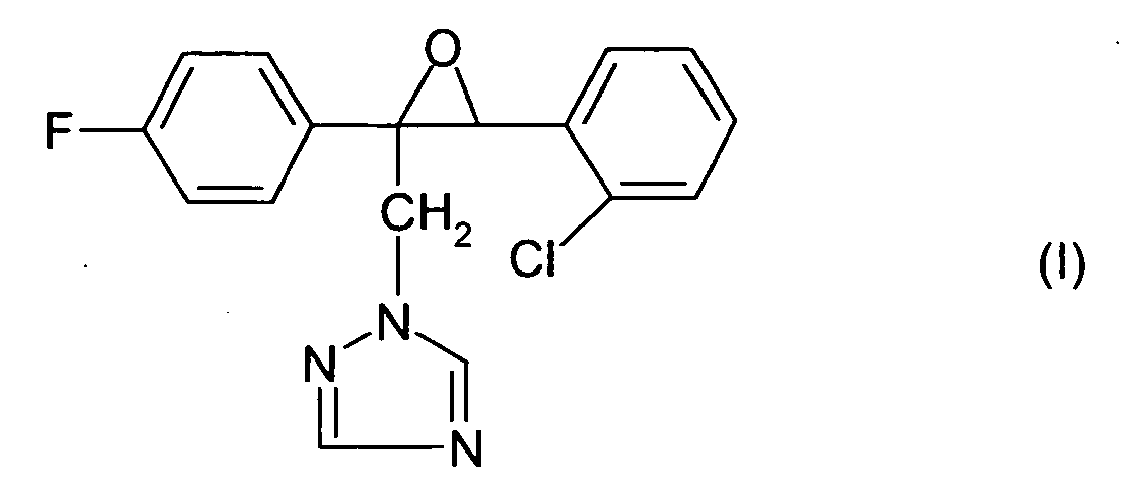
und - (2) Tebuconazol der Formel II
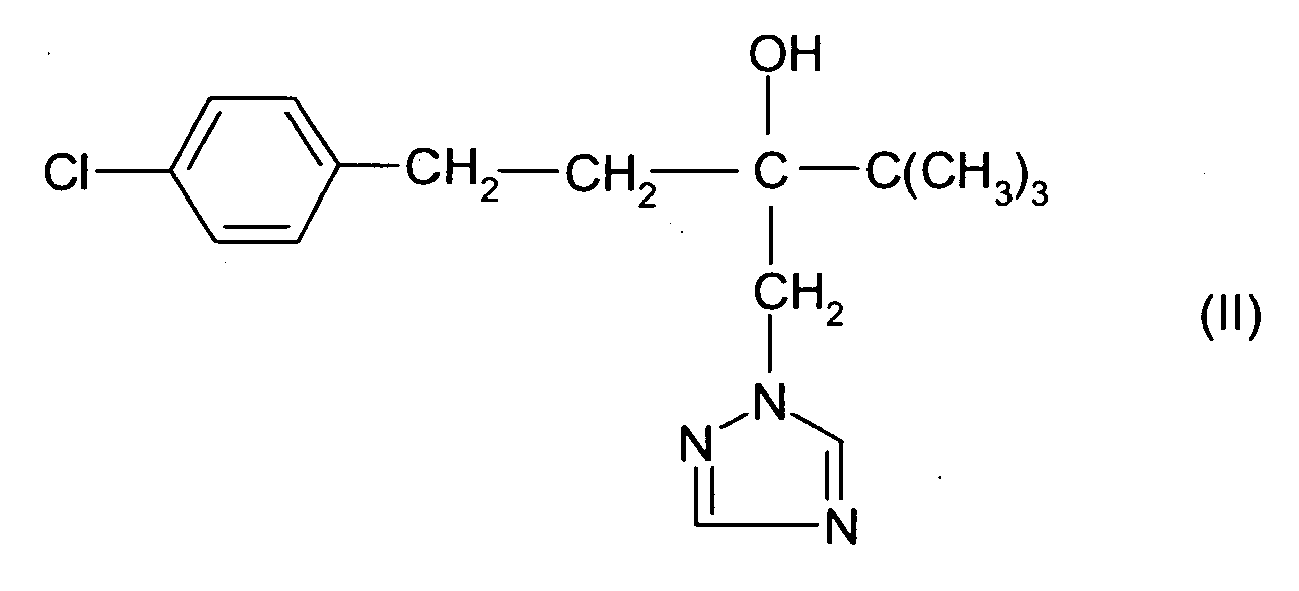
in einer synergistisch wirksamen Menge. - Außerdem betrifft die Erfindung ein Verfahren zur Bekämpfung von Schadpilzen mit Mischungen der Verbindung I mit der Verbindung II und die Verwendung der Verbindung I mit der Verbindung II zur Herstellung derartiger Mischungen sowie Mittel, die diese Mischungen enthalten.
- Aus der
WO 03/073851 - Epoxiconazol der Formel I und seine Verwendung als Pflanzenschutzmittel ist in der
EP-B 0 196 038 beschrieben. - Das Tebuconazol der Formel II ist in der
EP-A 0 040 345 beschrieben. - Im Hinblick auf eine Senkung der Aufwandmengen und eine Verbreiterung des Wirkungsspektrums der bekannten Verbindungen lagen der vorliegenden Erfindungen Mischungen als Aufgabe zugrunde, die bei verringerter Gesamtmenge an ausgebrachten Wirkstoffen eine verbesserte Wirkung gegen Schadpilze, insbesondere für bestimmte Indikationen, zeigen.
- Demgemäss wurden die eingangs definierten Mischungen gefunden. Es wurde außerdem gefunden, dass sich bei gleichzeitiger gemeinsamer oder getrennter Anwendung der Verbindungen I und eines Wirkstoffs II oder bei Anwendung der Verbindungen I und eines Wirkstoffs II nacheinander Schadpilze besser bekämpfen lassen als mit den Einzelverbindungen (synergistische Mischungen). Die Verbindungen I lassen sich als Synergist für eine Vielzahl verschiedener Wirkstoffe verwenden. Durch gleichzeitige gemeinsame oder getrennte Anwendung der Verbindung I mit einem Wirkstoff II wird die fungizide Wirksamkeit in überadditivem Maße erhöht.
- Das Epoxiconazol der Formel I

EP-B 0 196 038 bekannt. - Das Tebuconazol der Formel II

EP-A 0 040 345 beschrieben. - Die Verbindungen I und II sind wegen des basischen Charakters der in ihnen enthaltenen Stickstoffatome in der Lage, mit anorganischen oder organischen Säuren oder mit Metallionen Salze oder Addukte zu bilden.
- Beispiele für anorganische Säuren sind Halogenwasserstoffsäuren wie Fluorwasserstoff, Chlorwasserstoff, Bromwasserstoff und Jodwasserstoff, Schwefelsäure, Phosphorsäure und Salpetersäure.
- Als organischen Säuren kommen beispielsweise Ameisensäure, Kohlensäure und Alkansäuren wie Essigsäure, Trifluoressigsäure, Trichloressigsäure und Propionsäure sowie Glycolsäure, Thiocyansäure, Milchsäure, Bernsteinsäure, Zitronensäure, Benzoesäure, Zimtsäure, Oxalsäure, Alkylsulfonsäuren (Sulfonsäuren mit geradkettigen oder verzweigten Alkylresten mit 1 bis 20 Kohlenstoffatomen), Arylsulfonsäuren oder - disulfonsäuren (aromatische Reste wie Phenyl und Naphthyl welche eine oder zwei Sulfonsäuregruppen tragen), Alkylphosphonsäuren (Phosphonsäuren mit geradkettigen oder verzweigten Alkylresten mit 1 bis 20 Kohlenstoffatomen), Arylphosphonsäuren oder -diphosphonsäuren (aromatische Reste wie Phenyl und Naphthyl welche eine oder zwei Phosphorsäurereste tragen), wobei die Alkyl- bzw. Arylreste weitere Substituenten tragen können, z.B. p-Toluolsulfonsäure, Salizylsäure, p-Aminosalizylsäure, 2-Phenoxybenzoesäure, 2-Acetoxybenzoesäure etc.
- Als Metallionen kommen insbesondere die Ionen der Elemente der zweiten Haupt-gruppe, insbesondere Calzium und Magnesium, der dritten und vierten Hauptgruppe, insbesondere Aluminium, Zinn und Blei, sowie der ersten bis achten Nebengruppe, insbesondere Chrom, Mangan, Eisen, Kobalt, Nickel, Kupfer, Zink und andere in Betracht. Besonders bevorzugt sind die Metallionen der Elemente der Nebengruppen der vierten Periode. Die Metalle können dabei in den verschiedenen ihnen zukommenden Wertigkeiten vorliegen.
- Die Mischungen der Verbindung I und eines Wirkstoffs II, bzw. die gleichzeitige gemeinsame oder getrennte Verwendung der Verbindung I und eines Wirkstoffs II zeichnen sich aus durch eine hervorragende Wirksamkeit gegen ein breites Spektrum von pflanzenpathogenen Pilzen, insbesondere aus der Klasse der Ascomyceten, Deuteromyceten, Peronosporomyceten (syn. Oomyceten) und Basidiomyceten. Sie sind zum Teil systemisch wirksam und können im Pflanzenschutz als Beiz, Blatt- und Bodenfungizide eingesetzt werden.
- Besondere Bedeutung haben sie für die Bekämpfung einer Vielzahl von Pilzen an verschiedenen Kulturpflanzen wie Bananen, Baumwolle, Gemüsepflanzen (z.B. Gurken, Bohnen und Kürbisse), Gerste, Gras, Hafer, Kaffee, Kartoffeln, Mais, Obstpflanzen, Reis, Roggen, Soja, Tomaten, Wein, Weizen, Zierpflanzen, Zuckerrohr und einer Vielzahl von Samen.
- Speziell eignen sie sich zur Bekämpfung folgender Pflanzenkrankheiten:
- Alternaria Arten an Gemüse, Raps, Zuckerrüben und Obst und Reis , wie z.B. A.solani oder A. alternata an Kartoffeln und Tomaten
- Aphanomyces Arten an Zuckerrüben und Gemüse
- Ascochyta-Arten an Getreide and Gemüse
- Bipolaris- und Drechslera Arten an Mais, Getreide, Reis und Rasen, wie z.B. D.maydis an Mais
- Blumeria graminis (Echter Mehltau) an Getreide,
- Botrytis cinerea (Grauschimmel) an Erdbeeren, Gemüse, Blumen und Weinreben,
- Bremia lactucae an Salat
- Cercospora Arten an Mais, Sojabohnen, Reis und Zuckerrüben
- Cochliobolus Arten an Mais , Getreide, Reis, wie z.B. Cochliobolus sativus an Getreide, Cochliobolus miyabeanus an Reis
- Colletotricum Arten an Sojabohnen und Baumwolle
- Drechslera Arten, Pyrenophora Arten an Mais, Getreide, Reis und Rasen, wie z.B. D.teres an Gerste oder D. tritici-repentis an Weizen
- Esca an Weinrebe, verursacht durch Phaeoacremonium chlamydosporium, Ph. Aleophilum, und Formitipora punctata (syn. Phellinus punctatus)
- Elsinoe ampelina an Weinrebe ,
- Exserohilum Arten an Mais
- Erysiphe cichoracearum und Sphaerotheca fuliginea an Gurkengewächsen,
- Fusarium und Verticillium Arten an verschiedenen Pflanzen wie z.B. F. graminearum oder F. culmorum an Getreide oder F. oxysporum an einer Vielzahl von Pflanzen wie z.B. Tomaten
- Gaeumanomyces graminis an Getreide
- Gibberella arten an Getreide und Reis (z.B.. Gibberella fujikuroi an Reis)
- Glomerella cingulata an Weinrebe und anderen Pflanzen
- Grainstaining complex an Reis
- Guignardia budwelli an Weinrebe
- Helminthosporium Arten an Mais und Reis
- Isariopsis clavispora an Weinrebe,
- Michrodochium nivale an Getreide
- Mycosphaerella Arten an Getreide, Bananen und Erdnüssen, wie z.B. M. graminicola an Weizen oder M.fijiensis an Bananen
- Peronospora-Arten an Kohl und Zwiebelgewächsen, wie z.B. P. brassicae an Kohl oder P. destructor an Zwiebel
- Phakopsara pachyrhizi und Phakopsara meibomiae an Sojabohnen
- Phomopsis Arten an Sojabohnen und Sonnenblumen, P. viticola an Weinrebe
- Phytophthora infestans an Kartoffeln und Tomaten,
- Phytophthora Arten an verschiedenen Pflanzen wie z.B. P.capsici an Paprika,
- Plasmopara viticola an Weinreben,
- Podosphaera leucotricha an Apfel,
- Pseudocercosporella herpotrichoides an Getreide,
- Pseudoperonospora an verschiedenen Pflanzen wie z.B. P. cubensis an Gurke oder P. humili an Hopfen
- Pseudopezicula tracheiphilai an Weinrebe,
- Puccinia Arten an verschiedenen Pflanzen wie z.B. P. triticina, P. striformins, P. hordei oder P.graminis an Getreide, oder P. asparagi an Spargel
- Pyricularia oryzae , Corticium sasakii , Sarocladium oryzae, S.attenuatum, Entyloma oryzae, an Reis,
- Pyricularia grisea an Rasen und Getreide
- Pythium spp. an Rasen, Reis, Mais, Baumwolle, Raps, Sonnenblumen, Zuckerrüben, Gemüse und anderen Pflanzen wie z.B. P.ultiumum an verschiedenen Pflanzen, P. aphanidermatum an Rasen
- Rhizoctonia-Arten an Baumwolle, Reis, Kartoffeln, Rasen, Mais, Raps, Kartoffeln, Zuckerrüben, Gemüse und an verschiedenen Pflanzen wie z.B. R.solani an Rüben und verschiedenen Pflanzen,
- Rhynchosporium secalis an Gerste, Roggen und Triticale
- Sclerotinia Arten an Raps und Sonnenblumen
- Septoria tritici und Stagonospora nodorum an Weizen,
- Erysiphe (syn. Uncinula) necator an Weinrebe
- Setospaeria Arten an Mais und Rasen
- Sphacelotheca reilinia an Mais
- Thievaliopsis Arten an Sojabohnen und Baumwolle
- Tilletia Arten an Getreide
- Ustilago-Arten an Getreide, Mais und Zuckerrohr, wie z.B. U. maydis an Mais
- Venturia-Arten (scharf) an Äpfeln und Birnen wie. z.B. V. inaequalis an Apfel.
- Die Mischungen der Verbindungen I und eines Wirkstoffs II eignen sich besonders zur Bekämpfung von Schadpilzen aus der Klasse der Peronosporomycetes (syn. Oomyceten), wie Peronospora-Arten, Phytophthora-Arten, Plasmopara viticola und Pseudoperonospora-Arten, insbesondere der entsprechenden voranstehend genannten.
- Die Mischungen der Verbindungen I und II eignen sich außerdem zur Bekämpfung von Schadpilzen im Materialschutz (z.B. Holz, Papier, Dispersionen für den Anstrich, Fasern bzw. Gewebe) und im Vorratsschutz. Im Holzschutz finden insbesondere folgende Schadpilze Beachtung: Ascomyceten wie Ophiostoma spp., Ceratocystis spp., Aureobasidium pullulans, Sclerophoma spp., Chaetomium spp., Humicola spp., Petriella spp., Trichurus spp.; Basidiomyceten wie Coniophora spp., Coriolus spp., Gloeophyllum spp., Lentinus spp., Pleurotus spp., Poria spp., Serpula spp. und Tyromyces spp., Deuteromyceten wie Aspergillus spp., Cladosporium spp., Penicillium spp., Trichoderma spp., Alternaria spp., Paecilomyces spp. und Zygomyceten wie Mucor spp., darüber hinaus im Materialschutz folgende Hefepilze: Candida spp. und Saccharomyces cerevisae.
- Die Verbindungen I werden angewendet, indem man die Pilze oder die vor Pilzbefall zu schützenden Pflanzen, Saatgüter, Materialien oder den Erdboden mit einer fungizid wirksamen Menge der Wirkstoffe behandelt. Die Anwendung kann sowohl vor als auch nach der Infektion der Materialien, Pflanzen oder Samen durch die Pilze erfolgen.
- Die Verbindungen I und Wirkstoffe II können gleichzeitig gemeinsam oder getrennt oder nacheinander aufgebracht werden, wobei die Reihenfolge bei getrennter Applikation im allgemeinen keine Auswirkung auf den Bekämpfungserfolg hat.
- Bevorzugt setzt man bei der Bereitstellung der Mischungen die reinen Wirkstoffe I und II ein, denen man weitere Wirkstoffe gegen Schadpilze oder gegen andere Schädlinge wie Insekten, Spinntiere oder Nematoden oder auch herbizide oder wachstumsregulierende Wirkstoffe oder Düngemittel beimischen kann.
- Üblicherweise kommen Mischungen aus Verbindung I und dem Wirkstoff II zur Anwendung. Unter Umständen können jedoch auch Mischungen der Verbindung I mit zwei oder ggf. mehreren Aktivkomponenten vorteilhaft sein.
- Die Verbindung I und der Wirkstoff II werden üblicherweise in einem Gewichtsverhältnis von 100:1 bis 1:100, vorzugsweise 20:1 bis 1:20, insbesondere 10:1 bis 1:10 angewandt.
- Die weiteren Aktivkomponenten werden gewünschtenfalls im Verhältnis von 20:1 bis 1:20 zu der Verbindung I zugemischt.
- Die Aufwandmengen der erfindungsgemäßen Mischungen liegen, vor allem bei landwirtschaftlichen Kulturflächen, je nach Art der Verbindung und des gewünschten Effekts bei 5 g/ha bis 2000 g/ha, vorzugsweise 20 bis 900 g/ha, insbesondere 50 bis 750 g/ha.
- Die Aufwandmengen für die Verbindung I liegen entsprechend in der Regel bei 1 bis 1000 g/ha, vorzugsweise 10 bis 900 g/ha, insbesondere 20 bis 750 g/ha.
- Die Aufwandmengen für den Wirkstoff II liegen entsprechend in der Regel bei 1 bis 2000 g/ha, vorzugsweise 10 bis 1500 g/ha, insbesondere 40 bis 1000 g/ha.
- Bei der Saatgutbehandlung werden im allgemeinen Aufwandmengen an Mischung von 1 bis 1000 g/100 kg Saatgut, vorzugsweise 1 bis 750 g/100 kg, insbesondere 5 bis 500 g/100 kg verwendet.
- Das Verfahren zur Bekämpfung von Schadpilzen erfolgt durch die getrennte oder gemeinsame Applikation von Verbindung I und Wirkstoffs II oder einer Mischung aus Verbindung I und Wirkstoffs II durch Besprühen oder Bestäuben der Samen, der Pflanzen oder der Böden vor oder nach der Aussaat der Pflanzen oder vor oder nach dem Auflaufen der Pflanzen.
- Die erfindungsgemäßen Mischungen, bzw. die Verbindung I und der Wirkstoff II können in die üblichen Formulierungen überführt werden, z.B. Lösungen, Emulsionen, Suspensionen, Stäube, Pulver, Pasten und Granulate. Die Anwendungsform richtet sich nach dem jeweiligen Verwendungszweck; sie soll in jedem Fall eine feine und gleichmäßige Verteilung der erfindungsgemäßen Verbindung gewährleisten.
- Die Formulierungen werden in bekannter Weise hergestellt, z.B. durch Verstrecken des Wirkstoffs mit Lösungsmitteln und/oder Trägerstoffen, gewünschtenfalls unter Verwendung von Emulgiermitteln und Dispergiermitteln. Als Lösungsmittel / Hilfsstoffe kommen dafür im wesentlichen in Betracht:
- Wasser, aromatische Lösungsmittel (z.B. Solvesso Produkte, Xylol), Paraffine (z.B. Erdölfraktionen), Alkohole (z.B. Methanol, Butanol, Pentanol, Benzylalkohol), Ketone (z.B. Cyclohexanon, gamma-Butryolacton), Pyrrolidone (NMP, NOP), Acetate (Glykoldiacetat), Glykole, Dimethylfettsäureamide, Fettsäuren und Fettsäureester. Grundsätzlich können auch Lösungsmittelgemische verwendet werden,
- Trägerstoffe wie natürliche Gesteinsmehle (z.B. Kaoline, Tonerden, Talkum, Kreide) und synthetische Gesteinsmehle (z.B. hochdisperse Kieselsäure, Silikate); Emulgiermittel wie nichtionogene und anionische Emulgatoren (z.B. Polyoxyethylen-Fettalkohol-Ether, Alkylsulfonate und Arylsulfonate) und Dispergiermittel wie Lignin-Sulfitablaugen und Methylcellulose.
- Als oberflächenaktive Stoffe kommen Alkali-, Erdalkali-, Ammoniumsalze von Ligninsulfonsäure, Naphthalinsulfonsäure, Phenolsulfonsäure, Dibutylnaphthalinsulfonsäure, Alkylarylsulfonate, Alkylsulfate, Alkylsulfonate, Fettalkoholsulfate, Fettsäuren und sulfatierte Fettalkoholglykolether zum Einsatz, ferner Kondensationsprodukte von sulfoniertem Naphthalin und Naphthalinderivaten mit Formaldehyd, Kondensationsprodukte des Naphthalins bzw. der Naphtalinsulfonsäure mit Phenol und Formaldehyd, Polyoxyethylenoctylphenolether, ethoxyliertes Isooctylphenol, Octylphenol, Nonylphenol, Alkylphenolpolyglykolether, Tributylphenylpolyglykolether, Tristerylphenylpolyglykolether, Alkylarylpolyetheralkohole, Alkohol- und Fettalkoholethylenoxid-Kondensate, ethoxyliertes Rizinusöl, Polyoxyethylenalkylether, ethoxyliertes Polyoxypropylen, Laurylalkoholpolyglykoletheracetal, Sorbitester, Ligninsulfitablaugen und Methylcellulose in Betracht.
- Zur Herstellung von direkt versprühbaren Lösungen, Emulsionen, Pasten oder Öldispersionen kommen Mineralölfraktionen von mittlerem bis hohem Siedepunkt, wie Kerosin oder Dieselöl, ferner Kohlenteeröle sowie Öle pflanzlichen oder tierischen Ursprung, aliphatische, cyclische und aromatische Kohlenwasserstoffe, z.B. Toluol, Xylol, Paraffin, Tetrahydronaphthalin, alkylierte Naphthaline oder deren Derivate, Methanol, Ethanol, Propanol, Butanol, Cyclohexanol, Cyclohexanon, Isophoron, stark polare Lösungsmittel, z.B. Dimethylsulfoxid, N-Methylpyrrolidon oder Wasser in Betracht.
- Pulver-, Streu- und Stäubmittel können durch Mischen oder gemeinsames Vermahlen der wirksamen Substanzen mit einem festen Trägerstoff hergestellt werden.
- Granulate, z.B: Umhüllungs-, Imprägnierungs- und Homogengranulate, können durch Bindung der Wirkstoffe an feste Trägerstoffe hergestellt werden. Feste Trägerstoffe sind z.B. Mineralerden, wie Kieselgele, Silikate, Talkum, Kaolin, Attaclay, Kalkstein, Kalk, Kreide, Bolus, Löß, Ton, Dolomit, Diatomeenerde, Calcium- und Magnesiumsulfat, Magnesiumoxid, gemahlene Kunststoffe, Düngemittel, wie z.B. Ammoniumsulfat, Ammoniumphosphat, Ammoniumnitrat, Harnstoffe und pflanzliche Produkte, wie Getreidemehl, Baumrinden-, Holz- und Nussschalenmehl, Cellulosepulver und andere feste Trägerstoffe.
- Die Formulierungen enthalten im allgemeinen zwischen 0,01 und 95 Gew.-%, vorzugsweise zwischen 0,1 und 90 Gew.-% der Wirkstoffe. Die Wirkstoffe werden dabei in einer Reinheit von 90% bis 100%, vorzugsweise 95% bis 100% (nach NMR-Spektrum) eingesetzt.
- 10 Gew.-Teile einer erfindungsgemäßen Verbindung werden mit 90 Gew.-Teilen Wasser oder einem wasserlöslichen Lösungsmittel gelöst. Alternativ werden Netzmittel oder andere Hilfsmittel zugefügt. Bei der Verdünnung in Wasser löst sich der Wirkstoff. Man erhält auf diese Weise eine Formulierung mit einem Wirkstoffgehalt von 10 Gew.-%.
- 20 Gew.-Teile einer erfindungsgemäßen Verbindung werden in 70 Gew.-Teilen Cyclohexanon unter Zusatz von 10 Gew.-Teilen eines Dispergiermittels z.B. Polyvinylpyrrolidon gelöst. Bei Verdünnung in Wasser ergibt sich eine Dispersion. Der Wirkstoffgehalt beträgt 20 Gew.-%
- 15 Gew.-Teile einer erfindungsgemäßen Verbindung werden in 75 Gew.-Teilen Xylol unter Zusatz von Ca-Dodecylbenzolsulfonat und Ricinusölethoxylat (jeweils 5 Gew.-Teile) gelöst. Bei der Verdünnung in Wasser ergibt sich eine Emulsion. Die Formulierung hat einen Wirkstoffgehalt von 15 Gew.-%.
- 25 Gew.-Teile einer erfindungsgemäßen Verbindung werden in 35 Gew.-Teilen Xylol unter Zusatz von Ca-Dodecylbenzolsulfonat und Ricinusölethoxylat (jeweils 5 Gew.-Teile) gelöst. Diese Mischung wird mittels einer Emulgiermaschine (z.B. Ultraturax) in 30 Gew.Teile Wasser gegeben und zu einer homogenen Emulsion gebracht. Bei der Verdünnung in Wasser ergibt sich eine Emulsion. Die Formulierung hat einen Wirkstoffgehalt von 25 Gew.-%.
- 20 Gew.-Teile einer erfindungsgemäßen Verbindung werden unter Zusatz von 10 Gew.-Teilen Dispergier- und Netzmitteln und 70 Gew.-Teilen Wasser oder einem organischen Lösungsmittel in einer Rührwerkskugelmühle zu einer feinen Wirkstoffsuspension zerkleinert. Bei der Verdünnung in Wasser ergibt sich eine stabile Suspension des Wirkstoffs. Der Wirkstoffgehalt in der Formulierung beträgt 20 Gew.-%.
- 50 Gew.-Teile einer erfindungsgemäßen Verbindung werden unter Zusatz von 50 Gew-Teilen Dispergier- und Netzmitteln fein gemahlen und mittels technischer Geräte (z.B. Extrusion, Sprühturm, Wirbelschicht) als wasserdispergierbare oder wasserlösliche Granulate hergestellt. Bei der Verdünnung in Wasser ergibt sich eine stabile Dispersion oder Lösung des Wirkstoffs. Die Formulierung hat einen Wirkstoffgehalt von 50 Gew.-%.
- 75 Gew.-Teile einer erfindungsgemäßen Verbindung werden unter Zusatz von 25 Gew.-Teilen Dispergier- und Netzmitteln sowie Kieselsäuregel in einer Rotor-Strator Mühle vermahlen. Bei der Verdünnung in Wasser ergibt sich eine stabile Dispersion oder Lösung des Wirkstoffs. Der Wirkstoffgehalt der Formulierung beträgt 75 Gew.-%.
- 5 Gew.-Teile einer erfindungsgemäßen Verbindung werden fein gemahlen und mit 95 Gew.-Teilen feinteiligem Kaolin innig vermischt. Man erhält dadurch ein Stäubemittel mit einem Wirkstoffgehalt von 5 Gew.-%.
- 0,5 Gew-Teile einer erfindungsgemäßen Verbindung werden fein gemahlen und mit 99,5 Gew.-Teilen Trägerstoffe verbunden. Gängige Verfahren sind dabei die Extrusion, die Sprühtrocknung oder die Wirbelschicht. Man erhält dadurch ein Granulat für die Direktapplikation mit einem Wirkstoffgehalt von 0,5 Gew.-%.
- 10 Gew.-Teile einer erfindungsgemäßen Verbindung werden in 90 Gew.-Teilen eines organischen Lösungsmittel z.B. Xylol gelöst. Dadurch erhält man ein Produkt für die Direktapplikation mit einem Wirkstoffgehalt von 10 Gew.-%.
- Die Wirkstoffe können als solche, in Form ihrer Formulierungen oder den daraus bereiteten Anwendungsformen, z.B. in Form von direkt versprühbaren Lösungen, Pulvern, Suspensionen oder Dispersionen, Emulsionen, Öldispersionen, Pasten, Stäubmitteln, Streumitteln, Granulaten durch Versprühen, Vernebeln, Verstäuben, Verstreuen oder Gießen angewendet werden. Die Anwendungsformen richten sich ganz nach den Verwendungszwecken; sie sollten in jedem Fall möglichst die feinste Verteilung der erfindungsgemäßen Wirkstoffe gewährleisten.
- Wässrige Anwendungsformen können aus Emulsionskonzentraten, Pasten oder netzbaren Pulvern (Spritzpulver, Öldispersionen) durch Zusatz von Wasser bereitet werden. Zur Herstellung von Emulsionen, Pasten oder Öldispersionen können die Substanzen als solche oder in einem Öl oder Lösungsmittel gelöst, mittels Netz-, Haft-, Dispergier- oder Emulgiermitttel in Wasser homogenisiert werden. Es können aber auch aus wirksamer Substanz Netz-, Haft-, Dispergier- oder Emulgiermittel und eventuell Lösungsmittel oder Öl bestehende Konzentrate hergestellt werden, die zur Verdünnung mit Wasser geeignet sind.
- Die Wirkstoffkonzentrationen in den anwendungsfertigen Zubereitungen können in größeren Bereichen variiert werden. Im allgemeinen liegen sie zwischen 0,0001 und 10%, vorzugsweise zwischen 0,01 und 1%.
- Die Wirkstoffe können auch mit gutem Erfolg im Ultra-Low-Volume-Verfahren (ULV) verwendet werden, wobei es möglich ist, Formulierungen mit mehr als 95 Gew.-% Wirkstoff oder sogar den Wirkstoff ohne Zusätze auszubringen.
- Zu den Wirkstoffen können Öle verschiedenen Typs, Netzmittel, Adjuvants, gegebenenfalls auch erst unmittelbar vor der Anwendung (Tankmix), zugesetzt werden. Diese Mittel werden üblicherweise zu den erfindungsgemäßen Mitteln im Gewichtsverhältnis 1:100 bis 100:1, bevorzugt 1:10 bis 10:1, zugemischt.
- Die Verbindungen I und II, bzw. die Mischungen oder die entsprechenden Formulierungen werden angewendet, indem man die Schadpilze, die von ihnen freizuhaltenden Pflanzen, Samen, Böden, Flächen, Materialien oder Räume mit einer fungizid wirksamen Menge der Mischung, bzw. der Verbindungen I und II bei getrennter Ausbringung, behandelt. Die Anwendung kann vor oder nach dem Befall durch die Schadpilze erfolgen.
- Die fungizide Wirkung der Einzelverbindungen und der erfindungsgemäßen Mischungen ließ sich durch die folgenden Versuche zeigen.
- Die Wirkstoffe wurden getrennt oder gemeinsam als eine Stammlösung aufbereitet mit 25 mg Wirkstoff, welcher mit einem Gemisch aus Aceton und/oder Dimethylsulfoxid und dem Emulgator Uniperol® EL (Netzmittel mit Emulgier- und Dispergierwirkung auf der Basis ethoxylierter Alkylphenole) im Volumen-Verhältnis Lösungsmittel-Emulgator von 99 zu 1 ad 10 ml aufgefüllt wurde. Anschließend wurde ad 100 ml mit Wasser aufgefüllt. Diese Stammlösung wurde mit dem beschriebenen Lösungsmittel-Emulgator-Wasser Gemisch zu der unten angegeben Wirkstoffkonzentration verdünnt.
- Die visuell ermittelten Werte für den Prozentanteil befallener Blattflächen wurden in Wirkungsgrade als % der unbehandelten Kontrolle umgerechnet:
- Der Wirkungsgrad (W) wird nach der Formel von Abbot wie folgt berechnet:

- α
- entspricht dem Pilzbefall der behandelten Pflanzen in % und
- β
- entspricht dem Pilzbefall der unbehandelten (Kontroll-) Pflanzen in %
- Bei einem Wirkungsgrad von 0 entspricht der Befall der behandelten Pflanzen demjenigen der unbehandelten Kontrollpflanzen; bei einem Wirkungsgrad von 100 weisen die behandelten Pflanzen keinen Befall auf.
- Die zu erwartenden Wirkungsgrade für Wirkstoffkombinationen wurden nach der Colby-Formel (Colby, S. R. (Calculating synergistic and antagonistic responses of herbicide Combinations", Weeds, 15, S. 20 - 22,1967) ermittelt und mit den beobachteten Wirkungsgraden verglichen.
- Colby Formel:

- E
- zu erwartender Wirkungsgrad, ausgedrückt in % der unbehandelten Kontrolle, beim Einsatz der Mischung aus den Wirkstoffen A und B in den Konzentrationen a und b
- x
- der Wirkungsgrad, ausgedrückt in % der unbehandelten Kontrolle, beim Einsatz des Wirkstoffs A in der Konzentration a
- y
- der Wirkungsgrad, ausgedrückt in % der unbehandelten Kontrolle, beim Einsatz des Wirkstoffs B in der Konzentration b
- Die Wirkstoffe wurden getrennt als Stammlösung formuliert mit einer Konzentration von 10000 ppm in DMSO.
- Der Wirkstoff Epoxiconazol wurde als handelsübliche Formulierung verwendet.
- Anwendungsbeispiel Nr. 1 - Aktivität gegen den Verursacher des Reisbrandes Pyricularia oryzae im Mikrotitter-Test (Pyrior)
- Die Stammlösung wird in eine Mikrotitterplatte (MTP) pipettiert und mit einem wässrigen Pilznährmedium auf Malzbasis auf die angegebene Wirkstoffkonzentration verdünnt. Anschließend erfolgte die Zugabe einer wässrigen Sporensuspension von Pyricularia oryzae. Die Platten wurden in einer wasserdampf-gesättigten Kammer bei Temperaturen von 18 C aufgestellt. Mit einem Absorbtionsphotometer wurden die MTPs am 7. Tag nach der Inokulation bei 405nm gemessen.
- Die gemessenen Parameter wurden mit dem Wachstum der wirkstofffreien Kontrollvariante (=100%)und dem pilz- und wirkstofffreien Leerwert verrechnet, um das relative Wachstum in % der Pathogene in den einzelnen Wirkstoffen zu ermitteln.
- Die visuell ermittelten Werte für den Prozentanteil befallener Blattfläche wurde zunächst gemittelt, dann in Wirkungsgrade als % der unbehandelten Kontrolle umgerechnet. Wirkungsgrad 0 ist gleicher Befall wie in der unbehandelten Kontrolle, Wirkungsgrad 100 ist 0 % Befall. Die zu erwartenden Wirkungsgrade für Wirkstoffkombinationen wurden nach der Colby-Formel (Colby, S. R. (Calculating synergistic and antagonistic responses of herbicide Combinations", Weeds, 15, S. 20 - 22, 1967) ermittelt und mit den beobachteten Wirkungsgraden verglichen.
Wirkstoff/-Wirkstoffkombinaton Konz. (ppm) Verhältnis Beobachtete Wirkung (%) Berechnete Wirkung nach Colby (%) Synergismus Höhe des Synergismus (%) Epoxiconazol 1 0 Tebuconazol 1 2 Epoxiconazol + Tebuconazol 1 + 4 1:4 55 2 Ja 53
Claims (9)
- Fungizide Mischung, enthaltend(1) Epoxiconazole der Formel I

und(2) Tebuconazol der Formel IIoder dessen Salze oder Addukte
in einer synergistisch wirksamen Menge. - Fungizide Mischung nach Anspruch 1, dadurch gekennzeichnet, dass das Gewichtsverhältnis von Epoxiconazol der Formel I zu Tebuconazol der Formel II 100 : 1 bis 1 : 100 beträgt.
- Verfahren zur Bekämpfung von pflanzenpathogenen Schadpilzen, dadurch gekennzeichnet, dass man die Schadpilze, deren Lebensraum oder die vor ihnen zu schützenden Pflanzen, den Boden oder Saatgüter mit der fungiziden Mischung gemäß Anspruch 1 behandelt.
- Verfahren nach Anspruch 3, dadurch gekennzeichnet, dass man Epoxiconazol der Formel I gemäß Anspruch 1 und Tebuconazol der Formel II gemäß Anspruch 1 gleichzeitig, und zwar gemeinsam oder getrennt, oder nacheinander ausbringt.
- Verfahren nach Anspruch 3 oder 4, dadurch gekennzeichnet, dass man die fungizide Mischung oder Epoxiconazol der Formel I mit Tebuconazol der Formel II gemäß Anspruch 1 in einer Menge von 5 g/ha bis 2000 g/ha aufwendet.
- Verfahren nach Anspruch 3 oder 4, dadurch gekennzeichnet, dass man die Verbindungen I und II gemäß Anspruch 1 oder die Mischung gemäß Anspruch 1 in einer Menge von 1 g bis 1000 g pro 100 kg Saatgut anwendet.
- Saatgut, enthaltend die Mischung gemäß Anspruch 1 in einer Menge von 1 g bis 1000 g pro 100 kg.
- Verwendung der Verbindungen I und II gemäß Anspruch 1 zur Herstellung eines zur Bekämpfung von Schadpilzen geeigneten Mittels.
- Fungizide Mittel, enthaltend die fungizide Mischung gemäß Anspruch 1 sowie einen festen oder flüssigen Träger.
Priority Applications (3)
| Application Number | Priority Date | Filing Date | Title |
|---|---|---|---|
| SI200630487T SI1928240T1 (sl) | 2005-09-09 | 2006-08-31 | Fungicidne meĺ anice na osnovi triazola |
| PL06793096T PL1928240T3 (pl) | 2005-09-09 | 2006-08-31 | Mieszaniny grzybobójcze na bazie triazoli |
| CY20101100035T CY1110686T1 (el) | 2005-09-09 | 2010-01-12 | Μυκητοκτονα μειγματα στη βαση τριαζολων |
Applications Claiming Priority (2)
| Application Number | Priority Date | Filing Date | Title |
|---|---|---|---|
| DE102005043166 | 2005-09-09 | ||
| PCT/EP2006/065854 WO2007028754A1 (de) | 2005-09-09 | 2006-08-31 | Fungizide mischungen auf der basis von triazolen |
Publications (2)
| Publication Number | Publication Date |
|---|---|
| EP1928240A1 EP1928240A1 (de) | 2008-06-11 |
| EP1928240B1 true EP1928240B1 (de) | 2009-10-21 |
Family
ID=37199109
Family Applications (1)
| Application Number | Title | Priority Date | Filing Date |
|---|---|---|---|
| EP06793096A Revoked EP1928240B1 (de) | 2005-09-09 | 2006-08-31 | Fungizide mischungen auf der basis von triazolen |
Country Status (20)
| Country | Link |
|---|---|
| US (1) | US20090042963A1 (de) |
| EP (1) | EP1928240B1 (de) |
| JP (1) | JP2009507804A (de) |
| CN (1) | CN101262765B (de) |
| AR (1) | AR055421A1 (de) |
| AT (1) | ATE446012T1 (de) |
| AU (1) | AU2006289118A1 (de) |
| BR (1) | BRPI0615855A2 (de) |
| CA (1) | CA2620189A1 (de) |
| CY (1) | CY1110686T1 (de) |
| DE (2) | DE502006005209D1 (de) |
| DK (1) | DK1928240T3 (de) |
| EA (1) | EA013545B1 (de) |
| ES (1) | ES2333257T3 (de) |
| PL (1) | PL1928240T3 (de) |
| PT (1) | PT1928240E (de) |
| PY (1) | PY0626548A (de) |
| SI (1) | SI1928240T1 (de) |
| UA (1) | UA90340C2 (de) |
| WO (1) | WO2007028754A1 (de) |
Families Citing this family (3)
| Publication number | Priority date | Publication date | Assignee | Title |
|---|---|---|---|---|
| EP2094088A1 (de) * | 2006-11-24 | 2009-09-02 | Bayer CropScience AG | Fungizide wirkstoffkombinationen |
| WO2008061656A2 (de) * | 2006-11-24 | 2008-05-29 | Bayer Cropscience Aktiengesellschaft | Ternäre fungizide wirkstoffkombinationen |
| CN105941420A (zh) * | 2016-06-12 | 2016-09-21 | 创新美兰(合肥)股份有限公司 | 一种氟环唑和戊唑醇复配悬浮剂及其制备方法 |
Family Cites Families (8)
| Publication number | Priority date | Publication date | Assignee | Title |
|---|---|---|---|---|
| AU542623B2 (en) * | 1980-05-16 | 1985-02-28 | Bayer Aktiengesellschaft | 1-hydroxyethyl-azole derivatives |
| DE3333411A1 (de) * | 1983-09-16 | 1985-04-04 | Bayer Ag, 5090 Leverkusen | Fungizide mittel |
| IL78175A (en) * | 1985-03-29 | 1989-10-31 | Basf Ag | Azolylmethyloxiranes,their preparation and their use as fungicide crop protection agents |
| TW286264B (de) * | 1994-05-20 | 1996-09-21 | Ciba Geigy Ag | |
| FR2751173B1 (fr) * | 1996-07-16 | 1998-08-28 | Rhone Poulenc Agrochimie | Composition fongicide a base de 2 composes de type triazole |
| PL209423B1 (pl) * | 2002-03-07 | 2011-08-31 | Basf Ag | Mieszanina grzybobójcza, sposób zwalczania szkodliwych grzybów i środek grzybobójczy |
| DE50302901D1 (de) * | 2002-07-10 | 2006-05-18 | Basf Ag | Fungizide mischungen auf basis von dithianon |
| EP1606999A1 (de) * | 2004-06-18 | 2005-12-21 | Bayer CropScience AG | Saatgutbehandlungsmittel für Soja |
-
2006
- 2006-08-31 EP EP06793096A patent/EP1928240B1/de not_active Revoked
- 2006-08-31 AU AU2006289118A patent/AU2006289118A1/en not_active Abandoned
- 2006-08-31 AT AT06793096T patent/ATE446012T1/de active
- 2006-08-31 DK DK06793096.6T patent/DK1928240T3/da active
- 2006-08-31 PT PT06793096T patent/PT1928240E/pt unknown
- 2006-08-31 UA UAA200804225A patent/UA90340C2/ru unknown
- 2006-08-31 JP JP2008529605A patent/JP2009507804A/ja active Pending
- 2006-08-31 CA CA002620189A patent/CA2620189A1/en not_active Abandoned
- 2006-08-31 ES ES06793096T patent/ES2333257T3/es active Active
- 2006-08-31 DE DE502006005209T patent/DE502006005209D1/de active Active
- 2006-08-31 EA EA200800679A patent/EA013545B1/ru not_active IP Right Cessation
- 2006-08-31 DE DE202006021232U patent/DE202006021232U1/de not_active Expired - Lifetime
- 2006-08-31 WO PCT/EP2006/065854 patent/WO2007028754A1/de not_active Ceased
- 2006-08-31 SI SI200630487T patent/SI1928240T1/sl unknown
- 2006-08-31 CN CN2006800330452A patent/CN101262765B/zh active Active
- 2006-08-31 US US11/991,536 patent/US20090042963A1/en not_active Abandoned
- 2006-08-31 PL PL06793096T patent/PL1928240T3/pl unknown
- 2006-08-31 BR BRPI0615855-2A patent/BRPI0615855A2/pt not_active Application Discontinuation
- 2006-09-08 PY PY200600626548A patent/PY0626548A/es unknown
- 2006-09-08 AR ARP060103929A patent/AR055421A1/es unknown
-
2010
- 2010-01-12 CY CY20101100035T patent/CY1110686T1/el unknown
Also Published As
| Publication number | Publication date |
|---|---|
| ES2333257T3 (es) | 2010-02-18 |
| EA013545B1 (ru) | 2010-06-30 |
| CA2620189A1 (en) | 2007-03-15 |
| PY0626548A (es) | 2011-01-03 |
| PT1928240E (pt) | 2009-11-06 |
| DK1928240T3 (da) | 2010-02-15 |
| PL1928240T3 (pl) | 2010-03-31 |
| AR055421A1 (es) | 2007-08-22 |
| DE502006005209D1 (de) | 2009-12-03 |
| EA200800679A1 (ru) | 2008-10-30 |
| AU2006289118A1 (en) | 2007-03-15 |
| JP2009507804A (ja) | 2009-02-26 |
| US20090042963A1 (en) | 2009-02-12 |
| CY1110686T1 (el) | 2015-06-10 |
| UA90340C2 (ru) | 2010-04-26 |
| DE202006021232U1 (de) | 2013-12-16 |
| WO2007028754A1 (de) | 2007-03-15 |
| CN101262765A (zh) | 2008-09-10 |
| ATE446012T1 (de) | 2009-11-15 |
| BRPI0615855A2 (pt) | 2012-12-18 |
| SI1928240T1 (sl) | 2010-01-29 |
| CN101262765B (zh) | 2012-01-18 |
| EP1928240A1 (de) | 2008-06-11 |
Similar Documents
| Publication | Publication Date | Title |
|---|---|---|
| EP1912503B1 (de) | Fungizide mischungen enthaltend substituierte 1-methyl-pyrazol-4-ylcarbonsäureanilide | |
| EP1947941B1 (de) | Fungizide mischungen enthaltend boscalid und pyrimethanil | |
| EP1937070B1 (de) | Fungizide und bioregulatorische mischungen | |
| EP1928241A1 (de) | Fungizide mischungen auf der basis von triazolen | |
| WO2007065843A2 (de) | Verwendung von gibberellin als safener für azole zur bekämpfung von schadpilzen | |
| WO2007028753A2 (de) | Fungizide mischungen auf der basis von triazolen | |
| EP1933623B1 (de) | Fungizide und bioregulatorische mischungen | |
| WO2007028754A1 (de) | Fungizide mischungen auf der basis von triazolen | |
| EP1926376A1 (de) | Fungizide mischungen auf der basis von triazolen | |
| WO2007088116A2 (de) | Fungizide mischungen enthaltend epoxiconazol und metiram | |
| WO2007031487A2 (de) | Fungizide mischungen auf der basis von triazolen | |
| EP1562428A1 (de) | Fungizide mischungen auf der basis eines triazolopyrimidin-derivates und azolen | |
| EP1926375A1 (de) | Fungizide mischungen auf der basis von triazolen | |
| DE102007001541A1 (de) | Fungizide Mischungen enthaltend Pyrimethanil und Metrafenone | |
| WO2007028757A1 (de) | Fungizide mischungen auf der basis von triazolen |
Legal Events
| Date | Code | Title | Description |
|---|---|---|---|
| PUAI | Public reference made under article 153(3) epc to a published international application that has entered the european phase |
Free format text: ORIGINAL CODE: 0009012 |
|
| 17P | Request for examination filed |
Effective date: 20080409 |
|
| AK | Designated contracting states |
Kind code of ref document: A1 Designated state(s): AT BE BG CH CY CZ DE DK EE ES FI FR GB GR HU IE IS IT LI LT LU LV MC NL PL PT RO SE SI SK TR |
|
| GRAP | Despatch of communication of intention to grant a patent |
Free format text: ORIGINAL CODE: EPIDOSNIGR1 |
|
| GRAS | Grant fee paid |
Free format text: ORIGINAL CODE: EPIDOSNIGR3 |
|
| GRAA | (expected) grant |
Free format text: ORIGINAL CODE: 0009210 |
|
| AK | Designated contracting states |
Kind code of ref document: B1 Designated state(s): AT BE BG CH CY CZ DE DK EE ES FI FR GB GR HU IE IS IT LI LT LU LV MC NL PL PT RO SE SI SK TR |
|
| REG | Reference to a national code |
Ref country code: GB Ref legal event code: FG4D Free format text: NOT ENGLISH |
|
| REG | Reference to a national code |
Ref country code: CH Ref legal event code: EP |
|
| REG | Reference to a national code |
Ref country code: PT Ref legal event code: SC4A Free format text: AVAILABILITY OF NATIONAL TRANSLATION Effective date: 20091030 |
|
| REG | Reference to a national code |
Ref country code: IE Ref legal event code: FG4D |
|
| REF | Corresponds to: |
Ref document number: 502006005209 Country of ref document: DE Date of ref document: 20091203 Kind code of ref document: P |
|
| REG | Reference to a national code |
Ref country code: RO Ref legal event code: EPE |
|
| REG | Reference to a national code |
Ref country code: GR Ref legal event code: EP Ref document number: 20090403048 Country of ref document: GR |
|
| REG | Reference to a national code |
Ref country code: DK Ref legal event code: T3 |
|
| REG | Reference to a national code |
Ref country code: SE Ref legal event code: TRGR |
|
| REG | Reference to a national code |
Ref country code: ES Ref legal event code: FG2A Ref document number: 2333257 Country of ref document: ES Kind code of ref document: T3 |
|
| REG | Reference to a national code |
Ref country code: PL Ref legal event code: T3 |
|
| REG | Reference to a national code |
Ref country code: SK Ref legal event code: T3 Ref document number: E 6484 Country of ref document: SK |
|
| REG | Reference to a national code |
Ref country code: EE Ref legal event code: FG4A Ref document number: E003904 Country of ref document: EE Effective date: 20100119 |
|
| PG25 | Lapsed in a contracting state [announced via postgrant information from national office to epo] |
Ref country code: IS Free format text: LAPSE BECAUSE OF FAILURE TO SUBMIT A TRANSLATION OF THE DESCRIPTION OR TO PAY THE FEE WITHIN THE PRESCRIBED TIME-LIMIT Effective date: 20100221 |
|
| PLBI | Opposition filed |
Free format text: ORIGINAL CODE: 0009260 |
|
| PLAX | Notice of opposition and request to file observation + time limit sent |
Free format text: ORIGINAL CODE: EPIDOSNOBS2 |
|
| 26 | Opposition filed |
Opponent name: IRVITA PLANT PROTECTION N.V. Effective date: 20100720 |
|
| REG | Reference to a national code |
Ref country code: HU Ref legal event code: AG4A Ref document number: E007405 Country of ref document: HU |
|
| PLAF | Information modified related to communication of a notice of opposition and request to file observations + time limit |
Free format text: ORIGINAL CODE: EPIDOSCOBS2 |
|
| PLAB | Opposition data, opponent's data or that of the opponent's representative modified |
Free format text: ORIGINAL CODE: 0009299OPPO |
|
| PLAF | Information modified related to communication of a notice of opposition and request to file observations + time limit |
Free format text: ORIGINAL CODE: EPIDOSCOBS2 |
|
| R26 | Opposition filed (corrected) |
Opponent name: IRVITA PLANT PROTECTION N.V. Effective date: 20100720 |
|
| PG25 | Lapsed in a contracting state [announced via postgrant information from national office to epo] |
Ref country code: MC Free format text: LAPSE BECAUSE OF NON-PAYMENT OF DUE FEES Effective date: 20100831 |
|
| PLBB | Reply of patent proprietor to notice(s) of opposition received |
Free format text: ORIGINAL CODE: EPIDOSNOBS3 |
|
| PGFP | Annual fee paid to national office [announced via postgrant information from national office to epo] |
Ref country code: CH Payment date: 20110829 Year of fee payment: 6 |
|
| PGFP | Annual fee paid to national office [announced via postgrant information from national office to epo] |
Ref country code: LU Payment date: 20120828 Year of fee payment: 7 |
|
| PGFP | Annual fee paid to national office [announced via postgrant information from national office to epo] |
Ref country code: EE Payment date: 20120814 Year of fee payment: 7 Ref country code: RO Payment date: 20120813 Year of fee payment: 7 Ref country code: IE Payment date: 20120829 Year of fee payment: 7 Ref country code: FI Payment date: 20120827 Year of fee payment: 7 Ref country code: LT Payment date: 20120828 Year of fee payment: 7 Ref country code: SE Payment date: 20120828 Year of fee payment: 7 |
|
| PGFP | Annual fee paid to national office [announced via postgrant information from national office to epo] |
Ref country code: SI Payment date: 20120821 Year of fee payment: 7 Ref country code: TR Payment date: 20120816 Year of fee payment: 7 Ref country code: LV Payment date: 20120829 Year of fee payment: 7 Ref country code: BG Payment date: 20120808 Year of fee payment: 7 Ref country code: GR Payment date: 20120828 Year of fee payment: 7 |
|
| PGFP | Annual fee paid to national office [announced via postgrant information from national office to epo] |
Ref country code: IT Payment date: 20120828 Year of fee payment: 7 |
|
| PGFP | Annual fee paid to national office [announced via postgrant information from national office to epo] |
Ref country code: PT Payment date: 20120229 Year of fee payment: 7 Ref country code: CY Payment date: 20120823 Year of fee payment: 7 |
|
| PGFP | Annual fee paid to national office [announced via postgrant information from national office to epo] |
Ref country code: ES Payment date: 20120928 Year of fee payment: 7 |
|
| RDAF | Communication despatched that patent is revoked |
Free format text: ORIGINAL CODE: EPIDOSNREV1 |
|
| APBM | Appeal reference recorded |
Free format text: ORIGINAL CODE: EPIDOSNREFNO |
|
| APBP | Date of receipt of notice of appeal recorded |
Free format text: ORIGINAL CODE: EPIDOSNNOA2O |
|
| APAH | Appeal reference modified |
Free format text: ORIGINAL CODE: EPIDOSCREFNO |
|
| APBQ | Date of receipt of statement of grounds of appeal recorded |
Free format text: ORIGINAL CODE: EPIDOSNNOA3O |
|
| PGFP | Annual fee paid to national office [announced via postgrant information from national office to epo] |
Ref country code: HU Payment date: 20131112 Year of fee payment: 8 |
|
| REG | Reference to a national code |
Ref country code: PT Ref legal event code: MM4A Free format text: LAPSE DUE TO NON-PAYMENT OF FEES Effective date: 20140228 |
|
| REG | Reference to a national code |
Ref country code: CH Ref legal event code: PL |
|
| REG | Reference to a national code |
Ref country code: EE Ref legal event code: MM4A Ref document number: E003904 Country of ref document: EE Effective date: 20130831 |
|
| REG | Reference to a national code |
Ref country code: GR Ref legal event code: ML Ref document number: 20090403048 Country of ref document: GR Effective date: 20140305 |
|
| REG | Reference to a national code |
Ref country code: LT Ref legal event code: MM4D Effective date: 20130831 |
|
| REG | Reference to a national code |
Ref country code: SE Ref legal event code: EUG |
|
| PG25 | Lapsed in a contracting state [announced via postgrant information from national office to epo] |
Ref country code: RO Free format text: LAPSE BECAUSE OF NON-PAYMENT OF DUE FEES Effective date: 20130831 Ref country code: SE Free format text: LAPSE BECAUSE OF NON-PAYMENT OF DUE FEES Effective date: 20130901 Ref country code: LT Free format text: LAPSE BECAUSE OF NON-PAYMENT OF DUE FEES Effective date: 20130831 Ref country code: CH Free format text: LAPSE BECAUSE OF NON-PAYMENT OF DUE FEES Effective date: 20130831 Ref country code: EE Free format text: LAPSE BECAUSE OF NON-PAYMENT OF DUE FEES Effective date: 20130831 Ref country code: FI Free format text: LAPSE BECAUSE OF NON-PAYMENT OF DUE FEES Effective date: 20130831 Ref country code: LI Free format text: LAPSE BECAUSE OF NON-PAYMENT OF DUE FEES Effective date: 20130831 |
|
| REG | Reference to a national code |
Ref country code: IE Ref legal event code: MM4A |
|
| PG25 | Lapsed in a contracting state [announced via postgrant information from national office to epo] |
Ref country code: GR Free format text: LAPSE BECAUSE OF NON-PAYMENT OF DUE FEES Effective date: 20140305 Ref country code: IT Free format text: LAPSE BECAUSE OF NON-PAYMENT OF DUE FEES Effective date: 20130831 Ref country code: CY Free format text: LAPSE BECAUSE OF NON-PAYMENT OF DUE FEES Effective date: 20130831 Ref country code: LV Free format text: LAPSE BECAUSE OF NON-PAYMENT OF DUE FEES Effective date: 20130831 |
|
| REG | Reference to a national code |
Ref country code: SI Ref legal event code: KO00 Effective date: 20140429 |
|
| PG25 | Lapsed in a contracting state [announced via postgrant information from national office to epo] |
Ref country code: PT Free format text: LAPSE BECAUSE OF NON-PAYMENT OF DUE FEES Effective date: 20140228 |
|
| PG25 | Lapsed in a contracting state [announced via postgrant information from national office to epo] |
Ref country code: IE Free format text: LAPSE BECAUSE OF NON-PAYMENT OF DUE FEES Effective date: 20130831 |
|
| PG25 | Lapsed in a contracting state [announced via postgrant information from national office to epo] |
Ref country code: SI Free format text: LAPSE BECAUSE OF NON-PAYMENT OF DUE FEES Effective date: 20130901 |
|
| REG | Reference to a national code |
Ref country code: ES Ref legal event code: FD2A Effective date: 20140909 |
|
| PGFP | Annual fee paid to national office [announced via postgrant information from national office to epo] |
Ref country code: NL Payment date: 20140822 Year of fee payment: 9 Ref country code: DK Payment date: 20140826 Year of fee payment: 9 |
|
| PG25 | Lapsed in a contracting state [announced via postgrant information from national office to epo] |
Ref country code: ES Free format text: LAPSE BECAUSE OF NON-PAYMENT OF DUE FEES Effective date: 20130901 |
|
| PGFP | Annual fee paid to national office [announced via postgrant information from national office to epo] |
Ref country code: SK Payment date: 20140828 Year of fee payment: 9 Ref country code: AT Payment date: 20140827 Year of fee payment: 9 |
|
| PG25 | Lapsed in a contracting state [announced via postgrant information from national office to epo] |
Ref country code: HU Free format text: LAPSE BECAUSE OF NON-PAYMENT OF DUE FEES Effective date: 20140901 |
|
| PGFP | Annual fee paid to national office [announced via postgrant information from national office to epo] |
Ref country code: BE Payment date: 20140929 Year of fee payment: 9 |
|
| PG25 | Lapsed in a contracting state [announced via postgrant information from national office to epo] |
Ref country code: BG Free format text: LAPSE BECAUSE OF NON-PAYMENT OF DUE FEES Effective date: 20130831 Ref country code: LU Free format text: LAPSE BECAUSE OF NON-PAYMENT OF DUE FEES Effective date: 20130831 |
|
| REG | Reference to a national code |
Ref country code: FR Ref legal event code: PLFP Year of fee payment: 10 |
|
| PG25 | Lapsed in a contracting state [announced via postgrant information from national office to epo] |
Ref country code: TR Free format text: LAPSE BECAUSE OF NON-PAYMENT OF DUE FEES Effective date: 20130831 |
|
| PLAB | Opposition data, opponent's data or that of the opponent's representative modified |
Free format text: ORIGINAL CODE: 0009299OPPO |
|
| PLAB | Opposition data, opponent's data or that of the opponent's representative modified |
Free format text: ORIGINAL CODE: 0009299OPPO |
|
| R26 | Opposition filed (corrected) |
Opponent name: IRVITA PLANT PROTECTION N.V. Effective date: 20100720 |
|
| R26 | Opposition filed (corrected) |
Opponent name: IRVITA PLANT PROTECTION N.V. Effective date: 20100720 |
|
| REG | Reference to a national code |
Ref country code: DK Ref legal event code: EBP Effective date: 20150831 |
|
| REG | Reference to a national code |
Ref country code: AT Ref legal event code: MM01 Ref document number: 446012 Country of ref document: AT Kind code of ref document: T Effective date: 20150831 |
|
| PG25 | Lapsed in a contracting state [announced via postgrant information from national office to epo] |
Ref country code: SK Free format text: LAPSE BECAUSE OF NON-PAYMENT OF DUE FEES Effective date: 20150831 |
|
| REG | Reference to a national code |
Ref country code: SK Ref legal event code: MM4A Ref document number: E 6484 Country of ref document: SK Effective date: 20150831 |
|
| REG | Reference to a national code |
Ref country code: NL Ref legal event code: MM Effective date: 20150901 |
|
| PG25 | Lapsed in a contracting state [announced via postgrant information from national office to epo] |
Ref country code: AT Free format text: LAPSE BECAUSE OF NON-PAYMENT OF DUE FEES Effective date: 20150831 |
|
| PG25 | Lapsed in a contracting state [announced via postgrant information from national office to epo] |
Ref country code: NL Free format text: LAPSE BECAUSE OF NON-PAYMENT OF DUE FEES Effective date: 20150901 |
|
| REG | Reference to a national code |
Ref country code: FR Ref legal event code: PLFP Year of fee payment: 11 |
|
| PG25 | Lapsed in a contracting state [announced via postgrant information from national office to epo] |
Ref country code: DK Free format text: LAPSE BECAUSE OF NON-PAYMENT OF DUE FEES Effective date: 20150831 |
|
| PG25 | Lapsed in a contracting state [announced via postgrant information from national office to epo] |
Ref country code: BE Free format text: LAPSE BECAUSE OF NON-PAYMENT OF DUE FEES Effective date: 20150831 |
|
| REG | Reference to a national code |
Ref country code: FR Ref legal event code: PLFP Year of fee payment: 12 |
|
| APAH | Appeal reference modified |
Free format text: ORIGINAL CODE: EPIDOSCREFNO |
|
| REG | Reference to a national code |
Ref country code: FR Ref legal event code: PLFP Year of fee payment: 13 |
|
| PG25 | Lapsed in a contracting state [announced via postgrant information from national office to epo] |
Ref country code: BG Free format text: LAPSE BECAUSE OF NON-PAYMENT OF DUE FEES Effective date: 20170808 |
|
| PGFP | Annual fee paid to national office [announced via postgrant information from national office to epo] |
Ref country code: DE Payment date: 20181031 Year of fee payment: 13 |
|
| REG | Reference to a national code |
Ref country code: DE Ref legal event code: R064 Ref document number: 502006005209 Country of ref document: DE Ref country code: DE Ref legal event code: R103 Ref document number: 502006005209 Country of ref document: DE |
|
| APBU | Appeal procedure closed |
Free format text: ORIGINAL CODE: EPIDOSNNOA9O |
|
| RDAG | Patent revoked |
Free format text: ORIGINAL CODE: 0009271 |
|
| STAA | Information on the status of an ep patent application or granted ep patent |
Free format text: STATUS: PATENT REVOKED |
|
| 27W | Patent revoked |
Effective date: 20190909 |
|
| GBPR | Gb: patent revoked under art. 102 of the ep convention designating the uk as contracting state |
Effective date: 20190909 |
|
| PGFP | Annual fee paid to national office [announced via postgrant information from national office to epo] |
Ref country code: FR Payment date: 20190829 Year of fee payment: 14 Ref country code: CZ Payment date: 20190830 Year of fee payment: 14 |
|
| PGFP | Annual fee paid to national office [announced via postgrant information from national office to epo] |
Ref country code: PL Payment date: 20190814 Year of fee payment: 14 |
|
| REG | Reference to a national code |
Ref country code: SK Ref legal event code: MC4A Ref document number: E 6484 Country of ref document: SK Effective date: 20190909 |
|
| REG | Reference to a national code |
Ref country code: EE Ref legal event code: MF4A Ref document number: E003904 Country of ref document: EE Effective date: 20191022 |
|
| PGFP | Annual fee paid to national office [announced via postgrant information from national office to epo] |
Ref country code: GB Payment date: 20190829 Year of fee payment: 14 |
|
| REG | Reference to a national code |
Ref country code: AT Ref legal event code: MA03 Ref document number: 446012 Country of ref document: AT Kind code of ref document: T Effective date: 20190909 |