EP1927622B1 - Nanocomposite particle and molecular wrapping method - Google Patents
Nanocomposite particle and molecular wrapping method Download PDFInfo
- Publication number
- EP1927622B1 EP1927622B1 EP07022032A EP07022032A EP1927622B1 EP 1927622 B1 EP1927622 B1 EP 1927622B1 EP 07022032 A EP07022032 A EP 07022032A EP 07022032 A EP07022032 A EP 07022032A EP 1927622 B1 EP1927622 B1 EP 1927622B1
- Authority
- EP
- European Patent Office
- Prior art keywords
- organic
- series
- molecule
- mixed solution
- wrapping
- Prior art date
- Legal status (The legal status is an assumption and is not a legal conclusion. Google has not performed a legal analysis and makes no representation as to the accuracy of the status listed.)
- Expired - Fee Related
Links
- 239000002245 particle Substances 0.000 title claims description 73
- 239000002114 nanocomposite Substances 0.000 title claims description 70
- 238000000034 method Methods 0.000 title claims description 34
- 239000011259 mixed solution Substances 0.000 claims description 81
- 229910052719 titanium Inorganic materials 0.000 claims description 74
- -1 titanium alkoxide Chemical class 0.000 claims description 72
- 239000010936 titanium Substances 0.000 claims description 69
- XLYOFNOQVPJJNP-UHFFFAOYSA-N water Substances O XLYOFNOQVPJJNP-UHFFFAOYSA-N 0.000 claims description 59
- 239000002904 solvent Substances 0.000 claims description 39
- XUIMIQQOPSSXEZ-UHFFFAOYSA-N Silicon Chemical compound [Si] XUIMIQQOPSSXEZ-UHFFFAOYSA-N 0.000 claims description 35
- 229910052710 silicon Inorganic materials 0.000 claims description 35
- 125000000962 organic group Chemical group 0.000 claims description 33
- RTAQQCXQSZGOHL-UHFFFAOYSA-N Titanium Chemical group [Ti] RTAQQCXQSZGOHL-UHFFFAOYSA-N 0.000 claims description 30
- 239000000049 pigment Substances 0.000 claims description 28
- 239000007771 core particle Substances 0.000 claims description 16
- 125000003545 alkoxy group Chemical group 0.000 claims description 15
- 239000010703 silicon Substances 0.000 claims description 12
- 230000007062 hydrolysis Effects 0.000 claims description 11
- 238000006460 hydrolysis reaction Methods 0.000 claims description 11
- 239000003960 organic solvent Substances 0.000 claims description 11
- 238000009833 condensation Methods 0.000 claims description 10
- 230000000694 effects Effects 0.000 claims description 10
- 238000004040 coloring Methods 0.000 claims description 9
- 125000004430 oxygen atom Chemical group O* 0.000 claims description 7
- 229910013504 M-O-M Inorganic materials 0.000 claims description 6
- 238000006243 chemical reaction Methods 0.000 claims description 6
- RZVHIXYEVGDQDX-UHFFFAOYSA-N 9,10-anthraquinone Chemical class C1=CC=C2C(=O)C3=CC=CC=C3C(=O)C2=C1 RZVHIXYEVGDQDX-UHFFFAOYSA-N 0.000 claims description 4
- NRCMAYZCPIVABH-UHFFFAOYSA-N Quinacridone Chemical class N1C2=CC=CC=C2C(=O)C2=C1C=C1C(=O)C3=CC=CC=C3NC1=C2 NRCMAYZCPIVABH-UHFFFAOYSA-N 0.000 claims description 4
- 125000000751 azo group Chemical group [*]N=N[*] 0.000 claims description 4
- 150000001558 benzoic acid derivatives Chemical class 0.000 claims description 4
- 150000008366 benzophenones Chemical class 0.000 claims description 4
- 150000001565 benzotriazoles Chemical class 0.000 claims description 4
- UHOKSCJSTAHBSO-UHFFFAOYSA-N indanthrone blue Chemical class C1=CC=C2C(=O)C3=CC=C4NC5=C6C(=O)C7=CC=CC=C7C(=O)C6=CC=C5NC4=C3C(=O)C2=C1 UHOKSCJSTAHBSO-UHFFFAOYSA-N 0.000 claims description 4
- PXZQEOJJUGGUIB-UHFFFAOYSA-N isoindolin-1-one Chemical class C1=CC=C2C(=O)NCC2=C1 PXZQEOJJUGGUIB-UHFFFAOYSA-N 0.000 claims description 4
- 125000002080 perylenyl group Chemical group C1(=CC=C2C=CC=C3C4=CC=CC5=CC=CC(C1=C23)=C45)* 0.000 claims description 4
- IEQIEDJGQAUEQZ-UHFFFAOYSA-N phthalocyanine Chemical class N1C(N=C2C3=CC=CC=C3C(N=C3C4=CC=CC=C4C(=N4)N3)=N2)=C(C=CC=C2)C2=C1N=C1C2=CC=CC=C2C4=N1 IEQIEDJGQAUEQZ-UHFFFAOYSA-N 0.000 claims description 4
- 150000003918 triazines Chemical class 0.000 claims description 4
- 150000008641 benzimidazolones Chemical class 0.000 claims description 3
- 150000005125 dioxazines Chemical class 0.000 claims description 3
- 150000005041 phenanthrolines Chemical class 0.000 claims description 3
- 239000006097 ultraviolet radiation absorber Substances 0.000 description 88
- 238000000576 coating method Methods 0.000 description 50
- 239000011248 coating agent Substances 0.000 description 49
- 125000005641 methacryl group Chemical group 0.000 description 39
- NIXOWILDQLNWCW-UHFFFAOYSA-M Acrylate Chemical compound [O-]C(=O)C=C NIXOWILDQLNWCW-UHFFFAOYSA-M 0.000 description 34
- 239000010410 layer Substances 0.000 description 32
- 239000008199 coating composition Substances 0.000 description 31
- VXUYXOFXAQZZMF-UHFFFAOYSA-N titanium(IV) isopropoxide Chemical compound CC(C)O[Ti](OC(C)C)(OC(C)C)OC(C)C VXUYXOFXAQZZMF-UHFFFAOYSA-N 0.000 description 31
- KFZMGEQAYNKOFK-UHFFFAOYSA-N Isopropanol Chemical compound CC(C)O KFZMGEQAYNKOFK-UHFFFAOYSA-N 0.000 description 24
- 125000004429 atom Chemical group 0.000 description 17
- 239000000243 solution Substances 0.000 description 16
- GWEVSGVZZGPLCZ-UHFFFAOYSA-N Titan oxide Chemical compound O=[Ti]=O GWEVSGVZZGPLCZ-UHFFFAOYSA-N 0.000 description 14
- 230000015572 biosynthetic process Effects 0.000 description 13
- 239000002131 composite material Substances 0.000 description 13
- 238000000465 moulding Methods 0.000 description 13
- 239000000758 substrate Substances 0.000 description 13
- 238000002835 absorbance Methods 0.000 description 12
- 229920005989 resin Polymers 0.000 description 12
- 239000011347 resin Substances 0.000 description 12
- 238000000655 nuclear magnetic resonance spectrum Methods 0.000 description 11
- 239000000126 substance Substances 0.000 description 11
- 238000003786 synthesis reaction Methods 0.000 description 11
- 239000000203 mixture Substances 0.000 description 10
- 239000002994 raw material Substances 0.000 description 9
- 238000012360 testing method Methods 0.000 description 9
- XDLMVUHYZWKMMD-UHFFFAOYSA-N 3-trimethoxysilylpropyl 2-methylprop-2-enoate Chemical compound CO[Si](OC)(OC)CCCOC(=O)C(C)=C XDLMVUHYZWKMMD-UHFFFAOYSA-N 0.000 description 8
- LYCAIKOWRPUZTN-UHFFFAOYSA-N Ethylene glycol Chemical compound OCCO LYCAIKOWRPUZTN-UHFFFAOYSA-N 0.000 description 8
- WYURNTSHIVDZCO-UHFFFAOYSA-N Tetrahydrofuran Chemical compound C1CCOC1 WYURNTSHIVDZCO-UHFFFAOYSA-N 0.000 description 8
- 239000000178 monomer Substances 0.000 description 8
- 239000000523 sample Substances 0.000 description 8
- 238000009281 ultraviolet germicidal irradiation Methods 0.000 description 8
- 230000015556 catabolic process Effects 0.000 description 7
- 239000011247 coating layer Substances 0.000 description 7
- 238000006731 degradation reaction Methods 0.000 description 7
- 229920000620 organic polymer Polymers 0.000 description 7
- IJGRMHOSHXDMSA-UHFFFAOYSA-N Atomic nitrogen Chemical compound N#N IJGRMHOSHXDMSA-UHFFFAOYSA-N 0.000 description 6
- YLQBMQCUIZJEEH-UHFFFAOYSA-N Furan Chemical compound C=1C=COC=1 YLQBMQCUIZJEEH-UHFFFAOYSA-N 0.000 description 6
- ZMXDDKWLCZADIW-UHFFFAOYSA-N N,N-Dimethylformamide Chemical compound CN(C)C=O ZMXDDKWLCZADIW-UHFFFAOYSA-N 0.000 description 6
- 238000003917 TEM image Methods 0.000 description 6
- 239000011159 matrix material Substances 0.000 description 6
- 239000003094 microcapsule Substances 0.000 description 6
- RTZKZFJDLAIYFH-UHFFFAOYSA-N Diethyl ether Chemical compound CCOCC RTZKZFJDLAIYFH-UHFFFAOYSA-N 0.000 description 5
- 238000005481 NMR spectroscopy Methods 0.000 description 5
- HVVWZTWDBSEWIH-UHFFFAOYSA-N [2-(hydroxymethyl)-3-prop-2-enoyloxy-2-(prop-2-enoyloxymethyl)propyl] prop-2-enoate Chemical compound C=CC(=O)OCC(CO)(COC(=O)C=C)COC(=O)C=C HVVWZTWDBSEWIH-UHFFFAOYSA-N 0.000 description 5
- 238000004458 analytical method Methods 0.000 description 5
- 238000010438 heat treatment Methods 0.000 description 5
- JLZIIHMTTRXXIN-UHFFFAOYSA-N 2-(2-hydroxy-4-methoxybenzoyl)benzoic acid Chemical compound OC1=CC(OC)=CC=C1C(=O)C1=CC=CC=C1C(O)=O JLZIIHMTTRXXIN-UHFFFAOYSA-N 0.000 description 4
- NIXOWILDQLNWCW-UHFFFAOYSA-N 2-Propenoic acid Natural products OC(=O)C=C NIXOWILDQLNWCW-UHFFFAOYSA-N 0.000 description 4
- ATUOYWHBWRKTHZ-UHFFFAOYSA-N Propane Chemical compound CCC ATUOYWHBWRKTHZ-UHFFFAOYSA-N 0.000 description 4
- 230000002776 aggregation Effects 0.000 description 4
- 238000004220 aggregation Methods 0.000 description 4
- 150000008064 anhydrides Chemical class 0.000 description 4
- LFYJSSARVMHQJB-QIXNEVBVSA-N bakuchiol Chemical compound CC(C)=CCC[C@@](C)(C=C)\C=C\C1=CC=C(O)C=C1 LFYJSSARVMHQJB-QIXNEVBVSA-N 0.000 description 4
- 239000004567 concrete Substances 0.000 description 4
- 239000012954 diazonium Substances 0.000 description 4
- 150000001989 diazonium salts Chemical class 0.000 description 4
- 239000003999 initiator Substances 0.000 description 4
- 229910052751 metal Inorganic materials 0.000 description 4
- 239000002184 metal Substances 0.000 description 4
- 239000011368 organic material Substances 0.000 description 4
- 239000002243 precursor Substances 0.000 description 4
- LFQCEHFDDXELDD-UHFFFAOYSA-N tetramethyl orthosilicate Chemical compound CO[Si](OC)(OC)OC LFQCEHFDDXELDD-UHFFFAOYSA-N 0.000 description 4
- 238000009777 vacuum freeze-drying Methods 0.000 description 4
- ARXJGSRGQADJSQ-UHFFFAOYSA-N 1-methoxypropan-2-ol Chemical compound COCC(C)O ARXJGSRGQADJSQ-UHFFFAOYSA-N 0.000 description 3
- SMZOUWXMTYCWNB-UHFFFAOYSA-N 2-(2-methoxy-5-methylphenyl)ethanamine Chemical compound COC1=CC=C(C)C=C1CCN SMZOUWXMTYCWNB-UHFFFAOYSA-N 0.000 description 3
- IYAZLDLPUNDVAG-UHFFFAOYSA-N 2-(benzotriazol-2-yl)-4-(2,4,4-trimethylpentan-2-yl)phenol Chemical compound CC(C)(C)CC(C)(C)C1=CC=C(O)C(N2N=C3C=CC=CC3=N2)=C1 IYAZLDLPUNDVAG-UHFFFAOYSA-N 0.000 description 3
- ZWEHNKRNPOVVGH-UHFFFAOYSA-N 2-Butanone Chemical compound CCC(C)=O ZWEHNKRNPOVVGH-UHFFFAOYSA-N 0.000 description 3
- TXBCBTDQIULDIA-UHFFFAOYSA-N 2-[[3-hydroxy-2,2-bis(hydroxymethyl)propoxy]methyl]-2-(hydroxymethyl)propane-1,3-diol Chemical compound OCC(CO)(CO)COCC(CO)(CO)CO TXBCBTDQIULDIA-UHFFFAOYSA-N 0.000 description 3
- 125000000954 2-hydroxyethyl group Chemical group [H]C([*])([H])C([H])([H])O[H] 0.000 description 3
- CSCPPACGZOOCGX-UHFFFAOYSA-N Acetone Chemical compound CC(C)=O CSCPPACGZOOCGX-UHFFFAOYSA-N 0.000 description 3
- WEVYAHXRMPXWCK-UHFFFAOYSA-N Acetonitrile Chemical compound CC#N WEVYAHXRMPXWCK-UHFFFAOYSA-N 0.000 description 3
- UHOVQNZJYSORNB-UHFFFAOYSA-N Benzene Chemical compound C1=CC=CC=C1 UHOVQNZJYSORNB-UHFFFAOYSA-N 0.000 description 3
- 239000004593 Epoxy Substances 0.000 description 3
- LFQSCWFLJHTTHZ-UHFFFAOYSA-N Ethanol Chemical compound CCO LFQSCWFLJHTTHZ-UHFFFAOYSA-N 0.000 description 3
- XEKOWRVHYACXOJ-UHFFFAOYSA-N Ethyl acetate Chemical compound CCOC(C)=O XEKOWRVHYACXOJ-UHFFFAOYSA-N 0.000 description 3
- OKKJLVBELUTLKV-UHFFFAOYSA-N Methanol Chemical compound OC OKKJLVBELUTLKV-UHFFFAOYSA-N 0.000 description 3
- YXFVVABEGXRONW-UHFFFAOYSA-N Toluene Chemical compound CC1=CC=CC=C1 YXFVVABEGXRONW-UHFFFAOYSA-N 0.000 description 3
- 150000001252 acrylic acid derivatives Chemical class 0.000 description 3
- JFDZBHWFFUWGJE-UHFFFAOYSA-N benzonitrile Chemical compound N#CC1=CC=CC=C1 JFDZBHWFFUWGJE-UHFFFAOYSA-N 0.000 description 3
- BTANRVKWQNVYAZ-UHFFFAOYSA-N butan-2-ol Chemical compound CCC(C)O BTANRVKWQNVYAZ-UHFFFAOYSA-N 0.000 description 3
- 238000001035 drying Methods 0.000 description 3
- 229910052736 halogen Inorganic materials 0.000 description 3
- RAXXELZNTBOGNW-UHFFFAOYSA-N imidazole Natural products C1=CNC=N1 RAXXELZNTBOGNW-UHFFFAOYSA-N 0.000 description 3
- 238000007373 indentation Methods 0.000 description 3
- 238000004519 manufacturing process Methods 0.000 description 3
- 238000002156 mixing Methods 0.000 description 3
- 125000000449 nitro group Chemical group [O-][N+](*)=O 0.000 description 3
- 229910052757 nitrogen Inorganic materials 0.000 description 3
- QUAMTGJKVDWJEQ-UHFFFAOYSA-N octabenzone Chemical compound OC1=CC(OCCCCCCCC)=CC=C1C(=O)C1=CC=CC=C1 QUAMTGJKVDWJEQ-UHFFFAOYSA-N 0.000 description 3
- 229920000642 polymer Polymers 0.000 description 3
- 239000000843 powder Substances 0.000 description 3
- BDERNNFJNOPAEC-UHFFFAOYSA-N propan-1-ol Chemical compound CCCO BDERNNFJNOPAEC-UHFFFAOYSA-N 0.000 description 3
- 125000001436 propyl group Chemical group [H]C([*])([H])C([H])([H])C([H])([H])[H] 0.000 description 3
- KDYFGRWQOYBRFD-UHFFFAOYSA-N succinic acid Chemical compound OC(=O)CCC(O)=O KDYFGRWQOYBRFD-UHFFFAOYSA-N 0.000 description 3
- NMEPHPOFYLLFTK-UHFFFAOYSA-N trimethoxy(octyl)silane Chemical compound CCCCCCCC[Si](OC)(OC)OC NMEPHPOFYLLFTK-UHFFFAOYSA-N 0.000 description 3
- HQYALQRYBUJWDH-UHFFFAOYSA-N trimethoxy(propyl)silane Chemical compound CCC[Si](OC)(OC)OC HQYALQRYBUJWDH-UHFFFAOYSA-N 0.000 description 3
- 239000002966 varnish Substances 0.000 description 3
- QPFMBZIOSGYJDE-UHFFFAOYSA-N 1,1,2,2-tetrachloroethane Chemical compound ClC(Cl)C(Cl)Cl QPFMBZIOSGYJDE-UHFFFAOYSA-N 0.000 description 2
- MEZZCSHVIGVWFI-UHFFFAOYSA-N 2,2'-Dihydroxy-4-methoxybenzophenone Chemical compound OC1=CC(OC)=CC=C1C(=O)C1=CC=CC=C1O MEZZCSHVIGVWFI-UHFFFAOYSA-N 0.000 description 2
- ZMWRRFHBXARRRT-UHFFFAOYSA-N 2-(benzotriazol-2-yl)-4,6-bis(2-methylbutan-2-yl)phenol Chemical compound CCC(C)(C)C1=CC(C(C)(C)CC)=CC(N2N=C3C=CC=CC3=N2)=C1O ZMWRRFHBXARRRT-UHFFFAOYSA-N 0.000 description 2
- LHPPDQUVECZQSW-UHFFFAOYSA-N 2-(benzotriazol-2-yl)-4,6-ditert-butylphenol Chemical compound CC(C)(C)C1=CC(C(C)(C)C)=CC(N2N=C3C=CC=CC3=N2)=C1O LHPPDQUVECZQSW-UHFFFAOYSA-N 0.000 description 2
- ZSSVCEUEVMALRD-UHFFFAOYSA-N 2-[4,6-bis(2,4-dimethylphenyl)-1,3,5-triazin-2-yl]-5-(octyloxy)phenol Chemical compound OC1=CC(OCCCCCCCC)=CC=C1C1=NC(C=2C(=CC(C)=CC=2)C)=NC(C=2C(=CC(C)=CC=2)C)=N1 ZSSVCEUEVMALRD-UHFFFAOYSA-N 0.000 description 2
- KBQVDAIIQCXKPI-UHFFFAOYSA-N 3-trimethoxysilylpropyl prop-2-enoate Chemical compound CO[Si](OC)(OC)CCCOC(=O)C=C KBQVDAIIQCXKPI-UHFFFAOYSA-N 0.000 description 2
- 229920000178 Acrylic resin Polymers 0.000 description 2
- 239000004925 Acrylic resin Substances 0.000 description 2
- LCGLNKUTAGEVQW-UHFFFAOYSA-N Dimethyl ether Chemical compound COC LCGLNKUTAGEVQW-UHFFFAOYSA-N 0.000 description 2
- JOYRKODLDBILNP-UHFFFAOYSA-N Ethyl urethane Chemical compound CCOC(N)=O JOYRKODLDBILNP-UHFFFAOYSA-N 0.000 description 2
- YNQLUTRBYVCPMQ-UHFFFAOYSA-N Ethylbenzene Chemical compound CCC1=CC=CC=C1 YNQLUTRBYVCPMQ-UHFFFAOYSA-N 0.000 description 2
- FXHOOIRPVKKKFG-UHFFFAOYSA-N N,N-Dimethylacetamide Chemical compound CN(C)C(C)=O FXHOOIRPVKKKFG-UHFFFAOYSA-N 0.000 description 2
- LRHPLDYGYMQRHN-UHFFFAOYSA-N N-Butanol Chemical compound CCCCO LRHPLDYGYMQRHN-UHFFFAOYSA-N 0.000 description 2
- ATHHXGZTWNVVOU-UHFFFAOYSA-N N-methylformamide Chemical compound CNC=O ATHHXGZTWNVVOU-UHFFFAOYSA-N 0.000 description 2
- CTQNGGLPUBDAKN-UHFFFAOYSA-N O-Xylene Chemical group CC1=CC=CC=C1C CTQNGGLPUBDAKN-UHFFFAOYSA-N 0.000 description 2
- URLKBWYHVLBVBO-UHFFFAOYSA-N Para-Xylene Chemical group CC1=CC=C(C)C=C1 URLKBWYHVLBVBO-UHFFFAOYSA-N 0.000 description 2
- NQRYJNQNLNOLGT-UHFFFAOYSA-N Piperidine Chemical compound C1CCNCC1 NQRYJNQNLNOLGT-UHFFFAOYSA-N 0.000 description 2
- 239000002202 Polyethylene glycol Substances 0.000 description 2
- JUJWROOIHBZHMG-UHFFFAOYSA-N Pyridine Chemical compound C1=CC=NC=C1 JUJWROOIHBZHMG-UHFFFAOYSA-N 0.000 description 2
- KAESVJOAVNADME-UHFFFAOYSA-N Pyrrole Chemical compound C=1C=CNC=1 KAESVJOAVNADME-UHFFFAOYSA-N 0.000 description 2
- SMWDFEZZVXVKRB-UHFFFAOYSA-N Quinoline Chemical compound N1=CC=CC2=CC=CC=C21 SMWDFEZZVXVKRB-UHFFFAOYSA-N 0.000 description 2
- 229910018557 Si O Inorganic materials 0.000 description 2
- 229910008051 Si-OH Inorganic materials 0.000 description 2
- 229910006358 Si—OH Inorganic materials 0.000 description 2
- NINIDFKCEFEMDL-UHFFFAOYSA-N Sulfur Chemical compound [S] NINIDFKCEFEMDL-UHFFFAOYSA-N 0.000 description 2
- BOTDANWDWHJENH-UHFFFAOYSA-N Tetraethyl orthosilicate Chemical compound CCO[Si](OCC)(OCC)OCC BOTDANWDWHJENH-UHFFFAOYSA-N 0.000 description 2
- 229910003089 Ti–OH Inorganic materials 0.000 description 2
- ZJCCRDAZUWHFQH-UHFFFAOYSA-N Trimethylolpropane Chemical compound CCC(CO)(CO)CO ZJCCRDAZUWHFQH-UHFFFAOYSA-N 0.000 description 2
- 239000006096 absorbing agent Substances 0.000 description 2
- 125000003172 aldehyde group Chemical group 0.000 description 2
- 150000001343 alkyl silanes Chemical class 0.000 description 2
- 150000001412 amines Chemical class 0.000 description 2
- 230000004888 barrier function Effects 0.000 description 2
- IISBACLAFKSPIT-UHFFFAOYSA-N bisphenol A Chemical compound C=1C=C(O)C=CC=1C(C)(C)C1=CC=C(O)C=C1 IISBACLAFKSPIT-UHFFFAOYSA-N 0.000 description 2
- OCWYEMOEOGEQAN-UHFFFAOYSA-N bumetrizole Chemical compound CC(C)(C)C1=CC(C)=CC(N2N=C3C=C(Cl)C=CC3=N2)=C1O OCWYEMOEOGEQAN-UHFFFAOYSA-N 0.000 description 2
- YHWCPXVTRSHPNY-UHFFFAOYSA-N butan-1-olate;titanium(4+) Chemical compound [Ti+4].CCCC[O-].CCCC[O-].CCCC[O-].CCCC[O-] YHWCPXVTRSHPNY-UHFFFAOYSA-N 0.000 description 2
- WERYXYBDKMZEQL-UHFFFAOYSA-N butane-1,4-diol Chemical compound OCCCCO WERYXYBDKMZEQL-UHFFFAOYSA-N 0.000 description 2
- 229910052799 carbon Inorganic materials 0.000 description 2
- 125000004093 cyano group Chemical group *C#N 0.000 description 2
- JHIVVAPYMSGYDF-UHFFFAOYSA-N cyclohexanone Chemical compound O=C1CCCCC1 JHIVVAPYMSGYDF-UHFFFAOYSA-N 0.000 description 2
- TXCDCPKCNAJMEE-UHFFFAOYSA-N dibenzofuran Chemical compound C1=CC=C2C3=CC=CC=C3OC2=C1 TXCDCPKCNAJMEE-UHFFFAOYSA-N 0.000 description 2
- 239000006185 dispersion Substances 0.000 description 2
- YGUFXEJWPRRAEK-UHFFFAOYSA-N dodecyl(triethoxy)silane Chemical compound CCCCCCCCCCCC[Si](OCC)(OCC)OCC YGUFXEJWPRRAEK-UHFFFAOYSA-N 0.000 description 2
- MCPKSFINULVDNX-UHFFFAOYSA-N drometrizole Chemical compound CC1=CC=C(O)C(N2N=C3C=CC=CC3=N2)=C1 MCPKSFINULVDNX-UHFFFAOYSA-N 0.000 description 2
- 238000011156 evaluation Methods 0.000 description 2
- 239000007789 gas Substances 0.000 description 2
- 239000011521 glass Substances 0.000 description 2
- 125000000623 heterocyclic group Chemical group 0.000 description 2
- 125000002887 hydroxy group Chemical group [H]O* 0.000 description 2
- 229910010272 inorganic material Inorganic materials 0.000 description 2
- 239000011147 inorganic material Substances 0.000 description 2
- 150000002500 ions Chemical class 0.000 description 2
- MLFHJEHSLIIPHL-UHFFFAOYSA-N isoamyl acetate Chemical compound CC(C)CCOC(C)=O MLFHJEHSLIIPHL-UHFFFAOYSA-N 0.000 description 2
- IQPQWNKOIGAROB-UHFFFAOYSA-N isocyanate group Chemical group [N-]=C=O IQPQWNKOIGAROB-UHFFFAOYSA-N 0.000 description 2
- 125000000468 ketone group Chemical group 0.000 description 2
- IVSZLXZYQVIEFR-UHFFFAOYSA-N m-xylene Chemical group CC1=CC=CC(C)=C1 IVSZLXZYQVIEFR-UHFFFAOYSA-N 0.000 description 2
- 230000004048 modification Effects 0.000 description 2
- 238000012986 modification Methods 0.000 description 2
- DXGLGDHPHMLXJC-UHFFFAOYSA-N oxybenzone Chemical compound OC1=CC(OC)=CC=C1C(=O)C1=CC=CC=C1 DXGLGDHPHMLXJC-UHFFFAOYSA-N 0.000 description 2
- WXZMFSXDPGVJKK-UHFFFAOYSA-N pentaerythritol Chemical compound OCC(CO)(CO)CO WXZMFSXDPGVJKK-UHFFFAOYSA-N 0.000 description 2
- FDPIMTJIUBPUKL-UHFFFAOYSA-N pentan-3-one Chemical compound CCC(=O)CC FDPIMTJIUBPUKL-UHFFFAOYSA-N 0.000 description 2
- PGMYKACGEOXYJE-UHFFFAOYSA-N pentyl acetate Chemical compound CCCCCOC(C)=O PGMYKACGEOXYJE-UHFFFAOYSA-N 0.000 description 2
- 229920000728 polyester Polymers 0.000 description 2
- 229920001223 polyethylene glycol Polymers 0.000 description 2
- 239000004814 polyurethane Substances 0.000 description 2
- 229920002635 polyurethane Polymers 0.000 description 2
- 238000002360 preparation method Methods 0.000 description 2
- 239000001294 propane Substances 0.000 description 2
- 230000005855 radiation Effects 0.000 description 2
- 150000004756 silanes Chemical class 0.000 description 2
- LIVNPJMFVYWSIS-UHFFFAOYSA-N silicon monoxide Inorganic materials [Si-]#[O+] LIVNPJMFVYWSIS-UHFFFAOYSA-N 0.000 description 2
- IYMSIPPWHNIMGE-UHFFFAOYSA-N silylurea Chemical class NC(=O)N[SiH3] IYMSIPPWHNIMGE-UHFFFAOYSA-N 0.000 description 2
- 238000001228 spectrum Methods 0.000 description 2
- 238000010183 spectrum analysis Methods 0.000 description 2
- TXDNPSYEJHXKMK-UHFFFAOYSA-N sulfanylsilane Chemical class S[SiH3] TXDNPSYEJHXKMK-UHFFFAOYSA-N 0.000 description 2
- 125000000472 sulfonyl group Chemical group *S(*)(=O)=O 0.000 description 2
- 229910052717 sulfur Inorganic materials 0.000 description 2
- 239000011593 sulfur Substances 0.000 description 2
- VZGDMQKNWNREIO-UHFFFAOYSA-N tetrachloromethane Chemical compound ClC(Cl)(Cl)Cl VZGDMQKNWNREIO-UHFFFAOYSA-N 0.000 description 2
- UMGDCJDMYOKAJW-UHFFFAOYSA-N thiourea Chemical class NC(N)=S UMGDCJDMYOKAJW-UHFFFAOYSA-N 0.000 description 2
- UKRDPEFKFJNXQM-UHFFFAOYSA-N vinylsilane Chemical class [SiH3]C=C UKRDPEFKFJNXQM-UHFFFAOYSA-N 0.000 description 2
- KJYSXRBJOSZLEL-UHFFFAOYSA-N (2,4-ditert-butylphenyl) 3,5-ditert-butyl-4-hydroxybenzoate Chemical compound CC(C)(C)C1=CC(C(C)(C)C)=CC=C1OC(=O)C1=CC(C(C)(C)C)=C(O)C(C(C)(C)C)=C1 KJYSXRBJOSZLEL-UHFFFAOYSA-N 0.000 description 1
- VVUWYXJTOLSMFV-UHFFFAOYSA-N (2-hydroxy-4-octylphenyl)-phenylmethanone Chemical compound OC1=CC(CCCCCCCC)=CC=C1C(=O)C1=CC=CC=C1 VVUWYXJTOLSMFV-UHFFFAOYSA-N 0.000 description 1
- SXJSETSRWNDWPP-UHFFFAOYSA-N (2-hydroxy-4-phenylmethoxyphenyl)-phenylmethanone Chemical compound C=1C=C(C(=O)C=2C=CC=CC=2)C(O)=CC=1OCC1=CC=CC=C1 SXJSETSRWNDWPP-UHFFFAOYSA-N 0.000 description 1
- WYTZZXDRDKSJID-UHFFFAOYSA-N (3-aminopropyl)triethoxysilane Chemical compound CCO[Si](OCC)(OCC)CCCN WYTZZXDRDKSJID-UHFFFAOYSA-N 0.000 description 1
- ARVUDIQYNJVQIW-UHFFFAOYSA-N (4-dodecoxy-2-hydroxyphenyl)-phenylmethanone Chemical compound OC1=CC(OCCCCCCCCCCCC)=CC=C1C(=O)C1=CC=CC=C1 ARVUDIQYNJVQIW-UHFFFAOYSA-N 0.000 description 1
- LTQBNYCMVZQRSD-UHFFFAOYSA-N (4-ethenylphenyl)-trimethoxysilane Chemical compound CO[Si](OC)(OC)C1=CC=C(C=C)C=C1 LTQBNYCMVZQRSD-UHFFFAOYSA-N 0.000 description 1
- UKDOTCFNLHHKOF-FGRDZWBJSA-N (z)-1-chloroprop-1-ene;(z)-1,2-dichloroethene Chemical group C\C=C/Cl.Cl\C=C/Cl UKDOTCFNLHHKOF-FGRDZWBJSA-N 0.000 description 1
- JYEUMXHLPRZUAT-UHFFFAOYSA-N 1,2,3-triazine Chemical group C1=CN=NN=C1 JYEUMXHLPRZUAT-UHFFFAOYSA-N 0.000 description 1
- WSLDOOZREJYCGB-UHFFFAOYSA-N 1,2-Dichloroethane Chemical compound ClCCCl WSLDOOZREJYCGB-UHFFFAOYSA-N 0.000 description 1
- RYHBNJHYFVUHQT-UHFFFAOYSA-N 1,4-Dioxane Chemical compound C1COCCO1 RYHBNJHYFVUHQT-UHFFFAOYSA-N 0.000 description 1
- ALVZNPYWJMLXKV-UHFFFAOYSA-N 1,9-Nonanediol Chemical compound OCCCCCCCCCO ALVZNPYWJMLXKV-UHFFFAOYSA-N 0.000 description 1
- JEBKVIMEQBQNPT-UHFFFAOYSA-N 1-(5-bromo-2-methoxyphenyl)sulfonylpiperidine Chemical compound COC1=CC=C(Br)C=C1S(=O)(=O)N1CCCCC1 JEBKVIMEQBQNPT-UHFFFAOYSA-N 0.000 description 1
- UHSNVWLUYSMRNV-UHFFFAOYSA-N 1-[2-(1,1-dioxothiolan-2-yl)oxyethoxy]propan-2-yl-triethoxysilane Chemical compound CCO[Si](OCC)(OCC)C(C)COCCOC1CCCS1(=O)=O UHSNVWLUYSMRNV-UHFFFAOYSA-N 0.000 description 1
- WSOBJOKPIUCQHQ-UHFFFAOYSA-N 1-ethoxysilyl-n,n-dimethylmethanamine Chemical compound CCO[SiH2]CN(C)C WSOBJOKPIUCQHQ-UHFFFAOYSA-N 0.000 description 1
- UUSKQCWRSHRGNU-UHFFFAOYSA-N 1-triethoxysilylpropan-2-yl 2-methylprop-2-enoate Chemical compound CCO[Si](OCC)(OCC)CC(C)OC(=O)C(C)=C UUSKQCWRSHRGNU-UHFFFAOYSA-N 0.000 description 1
- SZMDWWICIPJEHQ-UHFFFAOYSA-N 1-triethoxysilylpropan-2-yl prop-2-enoate Chemical compound CCO[Si](OCC)(OCC)CC(C)OC(=O)C=C SZMDWWICIPJEHQ-UHFFFAOYSA-N 0.000 description 1
- XTVNGRMJOGNDOG-UHFFFAOYSA-N 1-trimethoxysilylpropan-2-yl 2-methylprop-2-enoate Chemical compound CO[Si](OC)(OC)CC(C)OC(=O)C(C)=C XTVNGRMJOGNDOG-UHFFFAOYSA-N 0.000 description 1
- OFTWZAMAJGNSKD-UHFFFAOYSA-N 1-trimethoxysilylpropan-2-yl prop-2-enoate Chemical compound CO[Si](OC)(OC)CC(C)OC(=O)C=C OFTWZAMAJGNSKD-UHFFFAOYSA-N 0.000 description 1
- DNGMPYRLKXUQKY-UHFFFAOYSA-N 10-(1,3-dioxolan-2-yl)decyl-triethoxysilane Chemical compound CCO[Si](OCC)(OCC)CCCCCCCCCCC1OCCO1 DNGMPYRLKXUQKY-UHFFFAOYSA-N 0.000 description 1
- LPWZCJFZJCOBHO-UHFFFAOYSA-N 11-triethoxysilylundecan-1-amine Chemical compound CCO[Si](OCC)(OCC)CCCCCCCCCCCN LPWZCJFZJCOBHO-UHFFFAOYSA-N 0.000 description 1
- SJJMMZVIBLQHLI-UHFFFAOYSA-N 11-triethoxysilylundecanal Chemical compound CCO[Si](OCC)(OCC)CCCCCCCCCCC=O SJJMMZVIBLQHLI-UHFFFAOYSA-N 0.000 description 1
- 238000004482 13C cross polarization magic angle spinning Methods 0.000 description 1
- ZXDDPOHVAMWLBH-UHFFFAOYSA-N 2,4-Dihydroxybenzophenone Chemical compound OC1=CC(O)=CC=C1C(=O)C1=CC=CC=C1 ZXDDPOHVAMWLBH-UHFFFAOYSA-N 0.000 description 1
- PKFHRDQMVBGXGO-UHFFFAOYSA-N 2,4-dinitro-n-(3-triethoxysilylpropyl)aniline Chemical compound CCO[Si](OCC)(OCC)CCCNC1=CC=C([N+]([O-])=O)C=C1[N+]([O-])=O PKFHRDQMVBGXGO-UHFFFAOYSA-N 0.000 description 1
- HVHUPWGZKSHWMT-UHFFFAOYSA-N 2,5-bis(5-tert-butyl-1,3-benzoxazol-2-yl)benzenethiol Chemical compound CC(C)(C)c1ccc2oc(nc2c1)-c1ccc(-c2nc3cc(ccc3o2)C(C)(C)C)c(S)c1 HVHUPWGZKSHWMT-UHFFFAOYSA-N 0.000 description 1
- OLFNXLXEGXRUOI-UHFFFAOYSA-N 2-(benzotriazol-2-yl)-4,6-bis(2-phenylpropan-2-yl)phenol Chemical compound C=1C(N2N=C3C=CC=CC3=N2)=C(O)C(C(C)(C)C=2C=CC=CC=2)=CC=1C(C)(C)C1=CC=CC=C1 OLFNXLXEGXRUOI-UHFFFAOYSA-N 0.000 description 1
- WXHVQMGINBSVAY-UHFFFAOYSA-N 2-(benzotriazol-2-yl)-4-tert-butylphenol Chemical compound CC(C)(C)C1=CC=C(O)C(N2N=C3C=CC=CC3=N2)=C1 WXHVQMGINBSVAY-UHFFFAOYSA-N 0.000 description 1
- ITLDHFORLZTRJI-UHFFFAOYSA-N 2-(benzotriazol-2-yl)-5-octoxyphenol Chemical compound OC1=CC(OCCCCCCCC)=CC=C1N1N=C2C=CC=CC2=N1 ITLDHFORLZTRJI-UHFFFAOYSA-N 0.000 description 1
- UZUNCLSDTUBVCN-UHFFFAOYSA-N 2-(benzotriazol-2-yl)-6-(2-phenylpropan-2-yl)-4-(2,4,4-trimethylpentan-2-yl)phenol Chemical compound C=1C(C(C)(C)CC(C)(C)C)=CC(N2N=C3C=CC=CC3=N2)=C(O)C=1C(C)(C)C1=CC=CC=C1 UZUNCLSDTUBVCN-UHFFFAOYSA-N 0.000 description 1
- RTNVDKBRTXEWQE-UHFFFAOYSA-N 2-(benzotriazol-2-yl)-6-butan-2-yl-4-tert-butylphenol Chemical compound CCC(C)C1=CC(C(C)(C)C)=CC(N2N=C3C=CC=CC3=N2)=C1O RTNVDKBRTXEWQE-UHFFFAOYSA-N 0.000 description 1
- XNWFRZJHXBZDAG-UHFFFAOYSA-N 2-METHOXYETHANOL Chemical compound COCCO XNWFRZJHXBZDAG-UHFFFAOYSA-N 0.000 description 1
- QQZOPKMRPOGIEB-UHFFFAOYSA-N 2-Oxohexane Chemical compound CCCCC(C)=O QQZOPKMRPOGIEB-UHFFFAOYSA-N 0.000 description 1
- PSMYELRXRQIDAX-UHFFFAOYSA-N 2-[4,6-bis(2,4-dimethylphenyl)-1,3,5-triazin-2-yl]-5-(2-hydroxy-3-tridecoxypropoxy)phenol Chemical compound OC1=CC(OCC(O)COCCCCCCCCCCCCC)=CC=C1C1=NC(C=2C(=CC(C)=CC=2)C)=NC(C=2C(=CC(C)=CC=2)C)=N1 PSMYELRXRQIDAX-UHFFFAOYSA-N 0.000 description 1
- SITYOOWCYAYOKL-UHFFFAOYSA-N 2-[4,6-bis(2,4-dimethylphenyl)-1,3,5-triazin-2-yl]-5-(3-dodecoxy-2-hydroxypropoxy)phenol Chemical compound OC1=CC(OCC(O)COCCCCCCCCCCCC)=CC=C1C1=NC(C=2C(=CC(C)=CC=2)C)=NC(C=2C(=CC(C)=CC=2)C)=N1 SITYOOWCYAYOKL-UHFFFAOYSA-N 0.000 description 1
- UZOYICMDDCNJJG-UHFFFAOYSA-N 2-[[3-(benzotriazol-2-yl)-2-hydroxy-5-methylphenyl]methyl]-4,5,6,7-tetrahydroisoindole-1,3-dione Chemical compound N1=C2C=CC=CC2=NN1C1=CC(C)=CC(CN2C(C3=C(CCCC3)C2=O)=O)=C1O UZOYICMDDCNJJG-UHFFFAOYSA-N 0.000 description 1
- JSAWNNBNKSBJCB-UHFFFAOYSA-N 2-[ethoxy(dimethyl)silyl]propan-1-amine Chemical compound CCO[Si](C)(C)C(C)CN JSAWNNBNKSBJCB-UHFFFAOYSA-N 0.000 description 1
- QMOCHTLIIWRLQV-UHFFFAOYSA-N 2-[methyl(3-trimethoxysilylpropyl)amino]ethanol Chemical compound CO[Si](OC)(OC)CCCN(C)CCO QMOCHTLIIWRLQV-UHFFFAOYSA-N 0.000 description 1
- POAOYUHQDCAZBD-UHFFFAOYSA-N 2-butoxyethanol Chemical compound CCCCOCCO POAOYUHQDCAZBD-UHFFFAOYSA-N 0.000 description 1
- ZNQVEEAIQZEUHB-UHFFFAOYSA-N 2-ethoxyethanol Chemical compound CCOCCO ZNQVEEAIQZEUHB-UHFFFAOYSA-N 0.000 description 1
- SVONRAPFKPVNKG-UHFFFAOYSA-N 2-ethoxyethyl acetate Chemical compound CCOCCOC(C)=O SVONRAPFKPVNKG-UHFFFAOYSA-N 0.000 description 1
- QTWJRLJHJPIABL-UHFFFAOYSA-N 2-methylphenol;3-methylphenol;4-methylphenol Chemical compound CC1=CC=C(O)C=C1.CC1=CC=CC(O)=C1.CC1=CC=CC=C1O QTWJRLJHJPIABL-UHFFFAOYSA-N 0.000 description 1
- GRWPYGBKJYICOO-UHFFFAOYSA-N 2-methylpropan-2-olate;titanium(4+) Chemical compound [Ti+4].CC(C)(C)[O-].CC(C)(C)[O-].CC(C)(C)[O-].CC(C)(C)[O-] GRWPYGBKJYICOO-UHFFFAOYSA-N 0.000 description 1
- FGSFVBRPCKXYDI-UHFFFAOYSA-N 2-triethoxysilylethyl 2-methylprop-2-enoate Chemical compound CCO[Si](OCC)(OCC)CCOC(=O)C(C)=C FGSFVBRPCKXYDI-UHFFFAOYSA-N 0.000 description 1
- PSLRXNFNXYNXEK-UHFFFAOYSA-N 2-triethoxysilylethyl prop-2-enoate Chemical compound CCO[Si](OCC)(OCC)CCOC(=O)C=C PSLRXNFNXYNXEK-UHFFFAOYSA-N 0.000 description 1
- RDCTZTAAYLXPDJ-UHFFFAOYSA-N 2-trimethoxysilylethyl 2-methylprop-2-enoate Chemical compound CO[Si](OC)(OC)CCOC(=O)C(C)=C RDCTZTAAYLXPDJ-UHFFFAOYSA-N 0.000 description 1
- BUJVPKZRXOTBGA-UHFFFAOYSA-N 2-trimethoxysilylethyl prop-2-enoate Chemical compound CO[Si](OC)(OC)CCOC(=O)C=C BUJVPKZRXOTBGA-UHFFFAOYSA-N 0.000 description 1
- HUPGCAGBHBJUJC-UHFFFAOYSA-N 3-(3-trimethoxysilylpropoxy)aniline Chemical compound CO[Si](OC)(OC)CCCOC1=CC=CC(N)=C1 HUPGCAGBHBJUJC-UHFFFAOYSA-N 0.000 description 1
- WBUSESIMOZDSHU-UHFFFAOYSA-N 3-(4,5-dihydroimidazol-1-yl)propyl-triethoxysilane Chemical compound CCO[Si](OCC)(OCC)CCCN1CCN=C1 WBUSESIMOZDSHU-UHFFFAOYSA-N 0.000 description 1
- PMJIKKNFJBDSHO-UHFFFAOYSA-N 3-[3-aminopropyl(diethoxy)silyl]oxy-3-methylpentane-1,5-diol Chemical compound NCCC[Si](OCC)(OCC)OC(C)(CCO)CCO PMJIKKNFJBDSHO-UHFFFAOYSA-N 0.000 description 1
- HXLAEGYMDGUSBD-UHFFFAOYSA-N 3-[diethoxy(methyl)silyl]propan-1-amine Chemical compound CCO[Si](C)(OCC)CCCN HXLAEGYMDGUSBD-UHFFFAOYSA-N 0.000 description 1
- DOYKFSOCSXVQAN-UHFFFAOYSA-N 3-[diethoxy(methyl)silyl]propyl 2-methylprop-2-enoate Chemical compound CCO[Si](C)(OCC)CCCOC(=O)C(C)=C DOYKFSOCSXVQAN-UHFFFAOYSA-N 0.000 description 1
- GGZBCIDSFGUWRA-UHFFFAOYSA-N 3-[dimethoxy(methyl)silyl]-n-methylpropan-1-amine Chemical compound CNCCC[Si](C)(OC)OC GGZBCIDSFGUWRA-UHFFFAOYSA-N 0.000 description 1
- IKYAJDOSWUATPI-UHFFFAOYSA-N 3-[dimethoxy(methyl)silyl]propane-1-thiol Chemical compound CO[Si](C)(OC)CCCS IKYAJDOSWUATPI-UHFFFAOYSA-N 0.000 description 1
- GLISOBUNKGBQCL-UHFFFAOYSA-N 3-[ethoxy(dimethyl)silyl]propan-1-amine Chemical compound CCO[Si](C)(C)CCCN GLISOBUNKGBQCL-UHFFFAOYSA-N 0.000 description 1
- FSMHYZUFHYGNHS-UHFFFAOYSA-N 3-[ethoxy-di(propan-2-yl)silyl]propan-1-amine Chemical compound CCO[Si](C(C)C)(C(C)C)CCCN FSMHYZUFHYGNHS-UHFFFAOYSA-N 0.000 description 1
- OXYZDRAJMHGSMW-UHFFFAOYSA-N 3-chloropropyl(trimethoxy)silane Chemical compound CO[Si](OC)(OC)CCCCl OXYZDRAJMHGSMW-UHFFFAOYSA-N 0.000 description 1
- BIGOJJYDFLNSGB-UHFFFAOYSA-N 3-isocyanopropyl(trimethoxy)silane Chemical group CO[Si](OC)(OC)CCC[N+]#[C-] BIGOJJYDFLNSGB-UHFFFAOYSA-N 0.000 description 1
- DCQBZYNUSLHVJC-UHFFFAOYSA-N 3-triethoxysilylpropane-1-thiol Chemical compound CCO[Si](OCC)(OCC)CCCS DCQBZYNUSLHVJC-UHFFFAOYSA-N 0.000 description 1
- LVNLBBGBASVLLI-UHFFFAOYSA-N 3-triethoxysilylpropylurea Chemical compound CCO[Si](OCC)(OCC)CCCNC(N)=O LVNLBBGBASVLLI-UHFFFAOYSA-N 0.000 description 1
- YMTRNELCZAZKRB-UHFFFAOYSA-N 3-trimethoxysilylaniline Chemical compound CO[Si](OC)(OC)C1=CC=CC(N)=C1 YMTRNELCZAZKRB-UHFFFAOYSA-N 0.000 description 1
- SJECZPVISLOESU-UHFFFAOYSA-N 3-trimethoxysilylpropan-1-amine Chemical compound CO[Si](OC)(OC)CCCN SJECZPVISLOESU-UHFFFAOYSA-N 0.000 description 1
- UUEWCQRISZBELL-UHFFFAOYSA-N 3-trimethoxysilylpropane-1-thiol Chemical compound CO[Si](OC)(OC)CCCS UUEWCQRISZBELL-UHFFFAOYSA-N 0.000 description 1
- KTFLAZUEXFFCFI-UHFFFAOYSA-N 4-(3-triethoxysilylpropylamino)butan-1-ol Chemical compound CCO[Si](OCC)(OCC)CCCNCCCCO KTFLAZUEXFFCFI-UHFFFAOYSA-N 0.000 description 1
- DYLNEUKFYBCJNO-UHFFFAOYSA-N 4-[dimethoxy(phenyl)silyl]butanenitrile Chemical compound N#CCCC[Si](OC)(OC)C1=CC=CC=C1 DYLNEUKFYBCJNO-UHFFFAOYSA-N 0.000 description 1
- VGVHNLRUAMRIEW-UHFFFAOYSA-N 4-methylcyclohexan-1-one Chemical compound CC1CCC(=O)CC1 VGVHNLRUAMRIEW-UHFFFAOYSA-N 0.000 description 1
- NMWDYCNYWCIATE-UHFFFAOYSA-N 4-nitro-n-(3-triethoxysilylpropyl)benzamide Chemical compound CCO[Si](OCC)(OCC)CCCNC(=O)C1=CC=C([N+]([O-])=O)C=C1 NMWDYCNYWCIATE-UHFFFAOYSA-N 0.000 description 1
- SWDDLRSGGCWDPH-UHFFFAOYSA-N 4-triethoxysilylbutan-1-amine Chemical compound CCO[Si](OCC)(OCC)CCCCN SWDDLRSGGCWDPH-UHFFFAOYSA-N 0.000 description 1
- VGIURMCNTDVGJM-UHFFFAOYSA-N 4-triethoxysilylbutanenitrile Chemical compound CCO[Si](OCC)(OCC)CCCC#N VGIURMCNTDVGJM-UHFFFAOYSA-N 0.000 description 1
- CNODSORTHKVDEM-UHFFFAOYSA-N 4-trimethoxysilylaniline Chemical compound CO[Si](OC)(OC)C1=CC=C(N)C=C1 CNODSORTHKVDEM-UHFFFAOYSA-N 0.000 description 1
- FPJPAIQDDFIEKJ-UHFFFAOYSA-N 4-trimethoxysilylbutanenitrile Chemical compound CO[Si](OC)(OC)CCCC#N FPJPAIQDDFIEKJ-UHFFFAOYSA-N 0.000 description 1
- UWSMKYBKUPAEJQ-UHFFFAOYSA-N 5-Chloro-2-(3,5-di-tert-butyl-2-hydroxyphenyl)-2H-benzotriazole Chemical compound CC(C)(C)C1=CC(C(C)(C)C)=CC(N2N=C3C=C(Cl)C=CC3=N2)=C1O UWSMKYBKUPAEJQ-UHFFFAOYSA-N 0.000 description 1
- DRXGKQPTFWTTJW-UHFFFAOYSA-N 5-butoxy-2-[4-(4-butoxy-2-hydroxyphenyl)-6-(2,4-dibutoxyphenyl)-1,3,5-triazin-2-yl]phenol Chemical compound OC1=CC(OCCCC)=CC=C1C1=NC(C=2C(=CC(OCCCC)=CC=2)O)=NC(C=2C(=CC(OCCCC)=CC=2)OCCCC)=N1 DRXGKQPTFWTTJW-UHFFFAOYSA-N 0.000 description 1
- SHVCSCWHWMSGTE-UHFFFAOYSA-N 6-methyluracil Chemical group CC1=CC(=O)NC(=O)N1 SHVCSCWHWMSGTE-UHFFFAOYSA-N 0.000 description 1
- NOWKCMXCCJGMRR-UHFFFAOYSA-N Aziridine Chemical compound C1CN1 NOWKCMXCCJGMRR-UHFFFAOYSA-N 0.000 description 1
- DKPFZGUDAPQIHT-UHFFFAOYSA-N Butyl acetate Natural products CCCCOC(C)=O DKPFZGUDAPQIHT-UHFFFAOYSA-N 0.000 description 1
- KXDHJXZQYSOELW-UHFFFAOYSA-N Carbamic acid Chemical group NC(O)=O KXDHJXZQYSOELW-UHFFFAOYSA-N 0.000 description 1
- OKTJSMMVPCPJKN-UHFFFAOYSA-N Carbon Chemical compound [C] OKTJSMMVPCPJKN-UHFFFAOYSA-N 0.000 description 1
- HEDRZPFGACZZDS-UHFFFAOYSA-N Chloroform Chemical compound ClC(Cl)Cl HEDRZPFGACZZDS-UHFFFAOYSA-N 0.000 description 1
- 102000004190 Enzymes Human genes 0.000 description 1
- 108090000790 Enzymes Proteins 0.000 description 1
- 239000005058 Isophorone diisocyanate Substances 0.000 description 1
- 229920000877 Melamine resin Polymers 0.000 description 1
- XOBKSJJDNFUZPF-UHFFFAOYSA-N Methoxyethane Chemical compound CCOC XOBKSJJDNFUZPF-UHFFFAOYSA-N 0.000 description 1
- NTIZESTWPVYFNL-UHFFFAOYSA-N Methyl isobutyl ketone Chemical compound CC(C)CC(C)=O NTIZESTWPVYFNL-UHFFFAOYSA-N 0.000 description 1
- UIHCLUNTQKBZGK-UHFFFAOYSA-N Methyl isobutyl ketone Natural products CCC(C)C(C)=O UIHCLUNTQKBZGK-UHFFFAOYSA-N 0.000 description 1
- SECXISVLQFMRJM-UHFFFAOYSA-N N-Methylpyrrolidone Chemical compound CN1CCCC1=O SECXISVLQFMRJM-UHFFFAOYSA-N 0.000 description 1
- SHCDQIXFHKSLJQ-UHFFFAOYSA-N N-[3-[dimethoxy-[2-(oxiran-2-yl)ethoxy]silyl]propyl]acetamide Chemical compound C(C)(=O)NCCC[Si](OCCC1CO1)(OC)OC SHCDQIXFHKSLJQ-UHFFFAOYSA-N 0.000 description 1
- LGRFSURHDFAFJT-UHFFFAOYSA-N Phthalic anhydride Natural products C1=CC=C2C(=O)OC(=O)C2=C1 LGRFSURHDFAFJT-UHFFFAOYSA-N 0.000 description 1
- XBDQKXXYIPTUBI-UHFFFAOYSA-M Propionate Chemical compound CCC([O-])=O XBDQKXXYIPTUBI-UHFFFAOYSA-M 0.000 description 1
- CZPWVGJYEJSRLH-UHFFFAOYSA-N Pyrimidine Chemical compound C1=CN=CN=C1 CZPWVGJYEJSRLH-UHFFFAOYSA-N 0.000 description 1
- 229910002808 Si–O–Si Inorganic materials 0.000 description 1
- DHXVGJBLRPWPCS-UHFFFAOYSA-N Tetrahydropyran Chemical compound C1CCOCC1 DHXVGJBLRPWPCS-UHFFFAOYSA-N 0.000 description 1
- 229910003088 Ti−O−Ti Inorganic materials 0.000 description 1
- XSTXAVWGXDQKEL-UHFFFAOYSA-N Trichloroethylene Chemical group ClC=C(Cl)Cl XSTXAVWGXDQKEL-UHFFFAOYSA-N 0.000 description 1
- 239000007983 Tris buffer Substances 0.000 description 1
- XSQUKJJJFZCRTK-UHFFFAOYSA-N Urea Chemical compound NC(N)=O XSQUKJJJFZCRTK-UHFFFAOYSA-N 0.000 description 1
- DGEZNRSVGBDHLK-UHFFFAOYSA-N [1,10]phenanthroline Chemical compound C1=CN=C2C3=NC=CC=C3C=CC2=C1 DGEZNRSVGBDHLK-UHFFFAOYSA-N 0.000 description 1
- TUOBEAZXHLTYLF-UHFFFAOYSA-N [2-(hydroxymethyl)-2-(prop-2-enoyloxymethyl)butyl] prop-2-enoate Chemical compound C=CC(=O)OCC(CO)(CC)COC(=O)C=C TUOBEAZXHLTYLF-UHFFFAOYSA-N 0.000 description 1
- XTXAZHSPVHPNSL-UHFFFAOYSA-N [4-[4-(4-benzoyl-3-hydroxyphenoxy)butoxy]-2-hydroxyphenyl]-phenylmethanone Chemical compound C=1C=C(C(=O)C=2C=CC=CC=2)C(O)=CC=1OCCCCOC(C=C1O)=CC=C1C(=O)C1=CC=CC=C1 XTXAZHSPVHPNSL-UHFFFAOYSA-N 0.000 description 1
- BCZMKSMVRLGRFS-UHFFFAOYSA-N [amino(3-trimethoxysilylpropylsulfanyl)methylidene]azanium;chloride Chemical compound Cl.CO[Si](OC)(OC)CCCSC(N)=N BCZMKSMVRLGRFS-UHFFFAOYSA-N 0.000 description 1
- GUCYFKSBFREPBC-UHFFFAOYSA-N [phenyl-(2,4,6-trimethylbenzoyl)phosphoryl]-(2,4,6-trimethylphenyl)methanone Chemical compound CC1=CC(C)=CC(C)=C1C(=O)P(=O)(C=1C=CC=CC=1)C(=O)C1=C(C)C=C(C)C=C1C GUCYFKSBFREPBC-UHFFFAOYSA-N 0.000 description 1
- 238000005299 abrasion Methods 0.000 description 1
- KXKVLQRXCPHEJC-UHFFFAOYSA-N acetic acid trimethyl ester Natural products COC(C)=O KXKVLQRXCPHEJC-UHFFFAOYSA-N 0.000 description 1
- 230000004931 aggregating effect Effects 0.000 description 1
- 150000001298 alcohols Chemical class 0.000 description 1
- 150000004703 alkoxides Chemical class 0.000 description 1
- 125000005370 alkoxysilyl group Chemical group 0.000 description 1
- 125000000217 alkyl group Chemical group 0.000 description 1
- 150000001408 amides Chemical class 0.000 description 1
- 239000007864 aqueous solution Substances 0.000 description 1
- 150000001491 aromatic compounds Chemical class 0.000 description 1
- 230000000712 assembly Effects 0.000 description 1
- 238000000429 assembly Methods 0.000 description 1
- MYONAGGJKCJOBT-UHFFFAOYSA-N benzimidazol-2-one Chemical compound C1=CC=CC2=NC(=O)N=C21 MYONAGGJKCJOBT-UHFFFAOYSA-N 0.000 description 1
- RWCCWEUUXYIKHB-UHFFFAOYSA-N benzophenone Chemical compound C=1C=CC=CC=1C(=O)C1=CC=CC=C1 RWCCWEUUXYIKHB-UHFFFAOYSA-N 0.000 description 1
- QRUDEWIWKLJBPS-UHFFFAOYSA-N benzotriazole Chemical compound C1=CC=C2N[N][N]C2=C1 QRUDEWIWKLJBPS-UHFFFAOYSA-N 0.000 description 1
- 239000012964 benzotriazole Substances 0.000 description 1
- 125000001797 benzyl group Chemical group [H]C1=C([H])C([H])=C(C([H])=C1[H])C([H])([H])* 0.000 description 1
- 230000005540 biological transmission Effects 0.000 description 1
- WXNRYSGJLQFHBR-UHFFFAOYSA-N bis(2,4-dihydroxyphenyl)methanone Chemical compound OC1=CC(O)=CC=C1C(=O)C1=CC=C(O)C=C1O WXNRYSGJLQFHBR-UHFFFAOYSA-N 0.000 description 1
- SODJJEXAWOSSON-UHFFFAOYSA-N bis(2-hydroxy-4-methoxyphenyl)methanone Chemical compound OC1=CC(OC)=CC=C1C(=O)C1=CC=C(OC)C=C1O SODJJEXAWOSSON-UHFFFAOYSA-N 0.000 description 1
- MQDJYUACMFCOFT-UHFFFAOYSA-N bis[2-(1-hydroxycyclohexyl)phenyl]methanone Chemical compound C=1C=CC=C(C(=O)C=2C(=CC=CC=2)C2(O)CCCCC2)C=1C1(O)CCCCC1 MQDJYUACMFCOFT-UHFFFAOYSA-N 0.000 description 1
- FQUNFJULCYSSOP-UHFFFAOYSA-N bisoctrizole Chemical compound N1=C2C=CC=CC2=NN1C1=CC(C(C)(C)CC(C)(C)C)=CC(CC=2C(=C(C=C(C=2)C(C)(C)CC(C)(C)C)N2N=C3C=CC=CC3=N2)O)=C1O FQUNFJULCYSSOP-UHFFFAOYSA-N 0.000 description 1
- 229940106691 bisphenol a Drugs 0.000 description 1
- KDYFGRWQOYBRFD-NUQCWPJISA-N butanedioic acid Chemical compound O[14C](=O)CC[14C](O)=O KDYFGRWQOYBRFD-NUQCWPJISA-N 0.000 description 1
- JHIWVOJDXOSYLW-UHFFFAOYSA-N butyl 2,2-difluorocyclopropane-1-carboxylate Chemical compound CCCCOC(=O)C1CC1(F)F JHIWVOJDXOSYLW-UHFFFAOYSA-N 0.000 description 1
- 229940043232 butyl acetate Drugs 0.000 description 1
- 125000000484 butyl group Chemical group [H]C([*])([H])C([H])([H])C([H])([H])C([H])([H])[H] 0.000 description 1
- 239000004202 carbamide Substances 0.000 description 1
- 150000001721 carbon Chemical group 0.000 description 1
- 238000001875 carbon-13 cross-polarisation magic angle spinning nuclear magnetic resonance spectrum Methods 0.000 description 1
- 239000003054 catalyst Substances 0.000 description 1
- 239000007795 chemical reaction product Substances 0.000 description 1
- 229960001701 chloroform Drugs 0.000 description 1
- 229930002875 chlorophyll Natural products 0.000 description 1
- 235000019804 chlorophyll Nutrition 0.000 description 1
- ATNHDLDRLWWWCB-AENOIHSZSA-M chlorophyll a Chemical compound C1([C@@H](C(=O)OC)C(=O)C2=C3C)=C2N2C3=CC(C(CC)=C3C)=[N+]4C3=CC3=C(C=C)C(C)=C5N3[Mg-2]42[N+]2=C1[C@@H](CCC(=O)OC\C=C(/C)CCC[C@H](C)CCC[C@H](C)CCCC(C)C)[C@H](C)C2=C5 ATNHDLDRLWWWCB-AENOIHSZSA-M 0.000 description 1
- 230000000052 comparative effect Effects 0.000 description 1
- 229910052802 copper Inorganic materials 0.000 description 1
- 230000008878 coupling Effects 0.000 description 1
- 238000010168 coupling process Methods 0.000 description 1
- 238000005859 coupling reaction Methods 0.000 description 1
- 229930003836 cresol Natural products 0.000 description 1
- 238000005384 cross polarization magic-angle spinning Methods 0.000 description 1
- 150000004292 cyclic ethers Chemical class 0.000 description 1
- 125000000113 cyclohexyl group Chemical group [H]C1([H])C([H])([H])C([H])([H])C([H])(*)C([H])([H])C1([H])[H] 0.000 description 1
- 230000003247 decreasing effect Effects 0.000 description 1
- BAAAEEDPKUHLID-UHFFFAOYSA-N decyl(triethoxy)silane Chemical compound CCCCCCCCCC[Si](OCC)(OCC)OCC BAAAEEDPKUHLID-UHFFFAOYSA-N 0.000 description 1
- KQAHMVLQCSALSX-UHFFFAOYSA-N decyl(trimethoxy)silane Chemical compound CCCCCCCCCC[Si](OC)(OC)OC KQAHMVLQCSALSX-UHFFFAOYSA-N 0.000 description 1
- 230000000593 degrading effect Effects 0.000 description 1
- OTARVPUIYXHRRB-UHFFFAOYSA-N diethoxy-methyl-[3-(oxiran-2-ylmethoxy)propyl]silane Chemical compound CCO[Si](C)(OCC)CCCOCC1CO1 OTARVPUIYXHRRB-UHFFFAOYSA-N 0.000 description 1
- 125000005442 diisocyanate group Chemical group 0.000 description 1
- PPSZHCXTGRHULJ-UHFFFAOYSA-N dioxazine Chemical compound O1ON=CC=C1 PPSZHCXTGRHULJ-UHFFFAOYSA-N 0.000 description 1
- 238000004090 dissolution Methods 0.000 description 1
- SCPWMSBAGXEGPW-UHFFFAOYSA-N dodecyl(trimethoxy)silane Chemical compound CCCCCCCCCCCC[Si](OC)(OC)OC SCPWMSBAGXEGPW-UHFFFAOYSA-N 0.000 description 1
- 239000003822 epoxy resin Substances 0.000 description 1
- 150000002148 esters Chemical class 0.000 description 1
- FWDBOZPQNFPOLF-UHFFFAOYSA-N ethenyl(triethoxy)silane Chemical compound CCO[Si](OCC)(OCC)C=C FWDBOZPQNFPOLF-UHFFFAOYSA-N 0.000 description 1
- NKSJNEHGWDZZQF-UHFFFAOYSA-N ethenyl(trimethoxy)silane Chemical compound CO[Si](OC)(OC)C=C NKSJNEHGWDZZQF-UHFFFAOYSA-N 0.000 description 1
- 150000002170 ethers Chemical class 0.000 description 1
- 229940093499 ethyl acetate Drugs 0.000 description 1
- 125000001495 ethyl group Chemical group [H]C([H])([H])C([H])([H])* 0.000 description 1
- SBRXLTRZCJVAPH-UHFFFAOYSA-N ethyl(trimethoxy)silane Chemical compound CC[Si](OC)(OC)OC SBRXLTRZCJVAPH-UHFFFAOYSA-N 0.000 description 1
- 230000001747 exhibiting effect Effects 0.000 description 1
- 238000001914 filtration Methods 0.000 description 1
- 239000012530 fluid Substances 0.000 description 1
- 125000000524 functional group Chemical group 0.000 description 1
- 150000002367 halogens Chemical class 0.000 description 1
- LNEPOXFFQSENCJ-UHFFFAOYSA-N haloperidol Chemical compound C1CC(O)(C=2C=CC(Cl)=CC=2)CCN1CCCC(=O)C1=CC=C(F)C=C1 LNEPOXFFQSENCJ-UHFFFAOYSA-N 0.000 description 1
- 238000007542 hardness measurement Methods 0.000 description 1
- RSKGMYDENCAJEN-UHFFFAOYSA-N hexadecyl(trimethoxy)silane Chemical compound CCCCCCCCCCCCCCCC[Si](OC)(OC)OC RSKGMYDENCAJEN-UHFFFAOYSA-N 0.000 description 1
- XXMIOPMDWAUFGU-UHFFFAOYSA-N hexane-1,6-diol Chemical compound OCCCCCCO XXMIOPMDWAUFGU-UHFFFAOYSA-N 0.000 description 1
- FUZZWVXGSFPDMH-UHFFFAOYSA-N hexanoic acid Chemical compound CCCCCC(O)=O FUZZWVXGSFPDMH-UHFFFAOYSA-N 0.000 description 1
- 125000004051 hexyl group Chemical group [H]C([H])([H])C([H])([H])C([H])([H])C([H])([H])C([H])([H])C([H])([H])* 0.000 description 1
- CZWLNMOIEMTDJY-UHFFFAOYSA-N hexyl(trimethoxy)silane Chemical compound CCCCCC[Si](OC)(OC)OC CZWLNMOIEMTDJY-UHFFFAOYSA-N 0.000 description 1
- 230000002209 hydrophobic effect Effects 0.000 description 1
- WGCNASOHLSPBMP-UHFFFAOYSA-N hydroxyacetaldehyde Natural products OCC=O WGCNASOHLSPBMP-UHFFFAOYSA-N 0.000 description 1
- MTNDZQHUAFNZQY-UHFFFAOYSA-N imidazoline Chemical compound C1CN=CN1 MTNDZQHUAFNZQY-UHFFFAOYSA-N 0.000 description 1
- 238000010348 incorporation Methods 0.000 description 1
- 235000019239 indanthrene blue RS Nutrition 0.000 description 1
- 239000011261 inert gas Substances 0.000 description 1
- ZFSLODLOARCGLH-UHFFFAOYSA-N isocyanuric acid Chemical compound OC1=NC(O)=NC(O)=N1 ZFSLODLOARCGLH-UHFFFAOYSA-N 0.000 description 1
- NIMLQBUJDJZYEJ-UHFFFAOYSA-N isophorone diisocyanate Chemical compound CC1(C)CC(N=C=O)CC(C)(CN=C=O)C1 NIMLQBUJDJZYEJ-UHFFFAOYSA-N 0.000 description 1
- JMMWKPVZQRWMSS-UHFFFAOYSA-N isopropanol acetate Natural products CC(C)OC(C)=O JMMWKPVZQRWMSS-UHFFFAOYSA-N 0.000 description 1
- 229940011051 isopropyl acetate Drugs 0.000 description 1
- GWYFCOCPABKNJV-UHFFFAOYSA-N isovaleric acid Chemical compound CC(C)CC(O)=O GWYFCOCPABKNJV-UHFFFAOYSA-N 0.000 description 1
- 150000002576 ketones Chemical class 0.000 description 1
- 229910052748 manganese Inorganic materials 0.000 description 1
- 239000000463 material Substances 0.000 description 1
- 238000005259 measurement Methods 0.000 description 1
- 230000007246 mechanism Effects 0.000 description 1
- QSHDDOUJBYECFT-UHFFFAOYSA-N mercury Chemical compound [Hg] QSHDDOUJBYECFT-UHFFFAOYSA-N 0.000 description 1
- 229910052753 mercury Inorganic materials 0.000 description 1
- ITNVWQNWHXEMNS-UHFFFAOYSA-N methanolate;titanium(4+) Chemical compound [Ti+4].[O-]C.[O-]C.[O-]C.[O-]C ITNVWQNWHXEMNS-UHFFFAOYSA-N 0.000 description 1
- 125000001160 methoxycarbonyl group Chemical group [H]C([H])([H])OC(*)=O 0.000 description 1
- BDUJZVMOZLQWNL-UHFFFAOYSA-N methyl 1-(3-triethoxysilylpropyl)aziridine-2-carboxylate Chemical compound CCO[Si](OCC)(OCC)CCCN1CC1C(=O)OC BDUJZVMOZLQWNL-UHFFFAOYSA-N 0.000 description 1
- XJLTZAGUXSAJCZ-UHFFFAOYSA-N methyl 3-trimethoxysilylpropanoate Chemical compound COC(=O)CC[Si](OC)(OC)OC XJLTZAGUXSAJCZ-UHFFFAOYSA-N 0.000 description 1
- 125000002496 methyl group Chemical group [H]C([H])([H])* 0.000 description 1
- JNYPJGYAIJVBLF-UHFFFAOYSA-N methylsulfinylmethane;propanamide Chemical compound CS(C)=O.CCC(N)=O JNYPJGYAIJVBLF-UHFFFAOYSA-N 0.000 description 1
- BFXIKLCIZHOAAZ-UHFFFAOYSA-N methyltrimethoxysilane Chemical compound CO[Si](C)(OC)OC BFXIKLCIZHOAAZ-UHFFFAOYSA-N 0.000 description 1
- 239000012046 mixed solvent Substances 0.000 description 1
- MNEXIOKPOFUXLA-UHFFFAOYSA-N n'-(11-trimethoxysilylundecyl)ethane-1,2-diamine Chemical compound CO[Si](OC)(OC)CCCCCCCCCCCNCCN MNEXIOKPOFUXLA-UHFFFAOYSA-N 0.000 description 1
- INJVFBCDVXYHGQ-UHFFFAOYSA-N n'-(3-triethoxysilylpropyl)ethane-1,2-diamine Chemical compound CCO[Si](OCC)(OCC)CCCNCCN INJVFBCDVXYHGQ-UHFFFAOYSA-N 0.000 description 1
- PHQOGHDTIVQXHL-UHFFFAOYSA-N n'-(3-trimethoxysilylpropyl)ethane-1,2-diamine Chemical compound CO[Si](OC)(OC)CCCNCCN PHQOGHDTIVQXHL-UHFFFAOYSA-N 0.000 description 1
- AMVXVPUHCLLJRE-UHFFFAOYSA-N n'-(3-trimethoxysilylpropyl)hexane-1,6-diamine Chemical compound CO[Si](OC)(OC)CCCNCCCCCCN AMVXVPUHCLLJRE-UHFFFAOYSA-N 0.000 description 1
- RRQTYXHHYIJDFB-UHFFFAOYSA-N n'-(triethoxysilylmethyl)hexane-1,6-diamine Chemical compound CCO[Si](OCC)(OCC)CNCCCCCCN RRQTYXHHYIJDFB-UHFFFAOYSA-N 0.000 description 1
- IXQIQBXABDUOAW-UHFFFAOYSA-N n'-(trimethoxysilylmethyl)hexane-1,6-diamine Chemical compound CO[Si](OC)(OC)CNCCCCCCN IXQIQBXABDUOAW-UHFFFAOYSA-N 0.000 description 1
- NHBRUUFBSBSTHM-UHFFFAOYSA-N n'-[2-(3-trimethoxysilylpropylamino)ethyl]ethane-1,2-diamine Chemical compound CO[Si](OC)(OC)CCCNCCNCCN NHBRUUFBSBSTHM-UHFFFAOYSA-N 0.000 description 1
- HXDMXWXYZHDHLS-UHFFFAOYSA-N n'-[3-[dimethoxy(methyl)silyl]-2-methylpropyl]ethane-1,2-diamine Chemical compound CO[Si](C)(OC)CC(C)CNCCN HXDMXWXYZHDHLS-UHFFFAOYSA-N 0.000 description 1
- MQWFLKHKWJMCEN-UHFFFAOYSA-N n'-[3-[dimethoxy(methyl)silyl]propyl]ethane-1,2-diamine Chemical compound CO[Si](C)(OC)CCCNCCN MQWFLKHKWJMCEN-UHFFFAOYSA-N 0.000 description 1
- HBELKEREKFGFNM-UHFFFAOYSA-N n'-[[4-(2-trimethoxysilylethyl)phenyl]methyl]ethane-1,2-diamine Chemical compound CO[Si](OC)(OC)CCC1=CC=C(CNCCN)C=C1 HBELKEREKFGFNM-UHFFFAOYSA-N 0.000 description 1
- QIOYHIUHPGORLS-UHFFFAOYSA-N n,n-dimethyl-3-trimethoxysilylpropan-1-amine Chemical compound CO[Si](OC)(OC)CCCN(C)C QIOYHIUHPGORLS-UHFFFAOYSA-N 0.000 description 1
- YKYONYBAUNKHLG-UHFFFAOYSA-N n-Propyl acetate Natural products CCCOC(C)=O YKYONYBAUNKHLG-UHFFFAOYSA-N 0.000 description 1
- DVYVMJLSUSGYMH-UHFFFAOYSA-N n-methyl-3-trimethoxysilylpropan-1-amine Chemical compound CNCCC[Si](OC)(OC)OC DVYVMJLSUSGYMH-UHFFFAOYSA-N 0.000 description 1
- SLCVBVWXLSEKPL-UHFFFAOYSA-N neopentyl glycol Chemical compound OCC(C)(C)CO SLCVBVWXLSEKPL-UHFFFAOYSA-N 0.000 description 1
- 229910052759 nickel Inorganic materials 0.000 description 1
- 150000002825 nitriles Chemical class 0.000 description 1
- 125000004433 nitrogen atom Chemical group N* 0.000 description 1
- SLYCYWCVSGPDFR-UHFFFAOYSA-N octadecyltrimethoxysilane Chemical compound CCCCCCCCCCCCCCCCCC[Si](OC)(OC)OC SLYCYWCVSGPDFR-UHFFFAOYSA-N 0.000 description 1
- TWCBCCIODCKPGX-UHFFFAOYSA-N octyl 2-[4-[4,6-bis(4-phenylphenyl)-1,3,5-triazin-2-yl]-3-hydroxyphenoxy]propanoate Chemical compound OC1=CC(OC(C)C(=O)OCCCCCCCC)=CC=C1C1=NC(C=2C=CC(=CC=2)C=2C=CC=CC=2)=NC(C=2C=CC(=CC=2)C=2C=CC=CC=2)=N1 TWCBCCIODCKPGX-UHFFFAOYSA-N 0.000 description 1
- MSRJTTSHWYDFIU-UHFFFAOYSA-N octyltriethoxysilane Chemical compound CCCCCCCC[Si](OCC)(OCC)OCC MSRJTTSHWYDFIU-UHFFFAOYSA-N 0.000 description 1
- 229960003493 octyltriethoxysilane Drugs 0.000 description 1
- 239000011146 organic particle Substances 0.000 description 1
- 125000002524 organometallic group Chemical group 0.000 description 1
- CSHWQDPOILHKBI-UHFFFAOYSA-N peryrene Natural products C1=CC(C2=CC=CC=3C2=C2C=CC=3)=C3C2=CC=CC3=C1 CSHWQDPOILHKBI-UHFFFAOYSA-N 0.000 description 1
- 239000005011 phenolic resin Substances 0.000 description 1
- 125000001997 phenyl group Chemical group [H]C1=C([H])C([H])=C(*)C([H])=C1[H] 0.000 description 1
- 229960005235 piperonyl butoxide Drugs 0.000 description 1
- 239000002798 polar solvent Substances 0.000 description 1
- 229920001748 polybutylene Polymers 0.000 description 1
- 125000003367 polycyclic group Chemical group 0.000 description 1
- 229920000647 polyepoxide Polymers 0.000 description 1
- 239000004645 polyester resin Substances 0.000 description 1
- 229920001225 polyester resin Polymers 0.000 description 1
- 239000003505 polymerization initiator Substances 0.000 description 1
- 238000006116 polymerization reaction Methods 0.000 description 1
- 229920001451 polypropylene glycol Polymers 0.000 description 1
- 239000002244 precipitate Substances 0.000 description 1
- 238000001556 precipitation Methods 0.000 description 1
- 230000001737 promoting effect Effects 0.000 description 1
- HKJYVRJHDIPMQB-UHFFFAOYSA-N propan-1-olate;titanium(4+) Chemical compound CCCO[Ti](OCCC)(OCCC)OCCC HKJYVRJHDIPMQB-UHFFFAOYSA-N 0.000 description 1
- FVSKHRXBFJPNKK-UHFFFAOYSA-N propionitrile Chemical compound CCC#N FVSKHRXBFJPNKK-UHFFFAOYSA-N 0.000 description 1
- 229940090181 propyl acetate Drugs 0.000 description 1
- UMJSCPRVCHMLSP-UHFFFAOYSA-N pyridine Natural products COC1=CC=CN=C1 UMJSCPRVCHMLSP-UHFFFAOYSA-N 0.000 description 1
- 150000003839 salts Chemical class 0.000 description 1
- FZHAPNGMFPVSLP-UHFFFAOYSA-N silanamine Chemical class [SiH3]N FZHAPNGMFPVSLP-UHFFFAOYSA-N 0.000 description 1
- 125000005372 silanol group Chemical group 0.000 description 1
- 229920002050 silicone resin Polymers 0.000 description 1
- 239000007787 solid Substances 0.000 description 1
- 238000000371 solid-state nuclear magnetic resonance spectroscopy Methods 0.000 description 1
- 238000003756 stirring Methods 0.000 description 1
- 239000001384 succinic acid Substances 0.000 description 1
- 230000002194 synthesizing effect Effects 0.000 description 1
- OQTSOKXAWXRIAC-UHFFFAOYSA-N tetrabutan-2-yl silicate Chemical compound CCC(C)O[Si](OC(C)CC)(OC(C)CC)OC(C)CC OQTSOKXAWXRIAC-UHFFFAOYSA-N 0.000 description 1
- UQMOLLPKNHFRAC-UHFFFAOYSA-N tetrabutyl silicate Chemical compound CCCCO[Si](OCCCC)(OCCCC)OCCCC UQMOLLPKNHFRAC-UHFFFAOYSA-N 0.000 description 1
- ZUEKXCXHTXJYAR-UHFFFAOYSA-N tetrapropan-2-yl silicate Chemical compound CC(C)O[Si](OC(C)C)(OC(C)C)OC(C)C ZUEKXCXHTXJYAR-UHFFFAOYSA-N 0.000 description 1
- ZQZCOBSUOFHDEE-UHFFFAOYSA-N tetrapropyl silicate Chemical compound CCCO[Si](OCCC)(OCCC)OCCC ZQZCOBSUOFHDEE-UHFFFAOYSA-N 0.000 description 1
- BCLLLHFGVQKVKL-UHFFFAOYSA-N tetratert-butyl silicate Chemical compound CC(C)(C)O[Si](OC(C)(C)C)(OC(C)(C)C)OC(C)(C)C BCLLLHFGVQKVKL-UHFFFAOYSA-N 0.000 description 1
- 229920001187 thermosetting polymer Polymers 0.000 description 1
- JMXKSZRRTHPKDL-UHFFFAOYSA-N titanium ethoxide Chemical compound [Ti+4].CC[O-].CC[O-].CC[O-].CC[O-] JMXKSZRRTHPKDL-UHFFFAOYSA-N 0.000 description 1
- 150000003852 triazoles Chemical class 0.000 description 1
- UBOXGVDOUJQMTN-UHFFFAOYSA-N trichloroethylene Natural products ClCC(Cl)Cl UBOXGVDOUJQMTN-UHFFFAOYSA-N 0.000 description 1
- DENFJSAFJTVPJR-UHFFFAOYSA-N triethoxy(ethyl)silane Chemical compound CCO[Si](CC)(OCC)OCC DENFJSAFJTVPJR-UHFFFAOYSA-N 0.000 description 1
- OYGYKEULCAINCL-UHFFFAOYSA-N triethoxy(hexadecyl)silane Chemical compound CCCCCCCCCCCCCCCC[Si](OCC)(OCC)OCC OYGYKEULCAINCL-UHFFFAOYSA-N 0.000 description 1
- WUMSTCDLAYQDNO-UHFFFAOYSA-N triethoxy(hexyl)silane Chemical compound CCCCCC[Si](OCC)(OCC)OCC WUMSTCDLAYQDNO-UHFFFAOYSA-N 0.000 description 1
- CPUDPFPXCZDNGI-UHFFFAOYSA-N triethoxy(methyl)silane Chemical compound CCO[Si](C)(OCC)OCC CPUDPFPXCZDNGI-UHFFFAOYSA-N 0.000 description 1
- FZMJEGJVKFTGMU-UHFFFAOYSA-N triethoxy(octadecyl)silane Chemical compound CCCCCCCCCCCCCCCCCC[Si](OCC)(OCC)OCC FZMJEGJVKFTGMU-UHFFFAOYSA-N 0.000 description 1
- JCVQKRGIASEUKR-UHFFFAOYSA-N triethoxy(phenyl)silane Chemical compound CCO[Si](OCC)(OCC)C1=CC=CC=C1 JCVQKRGIASEUKR-UHFFFAOYSA-N 0.000 description 1
- NBXZNTLFQLUFES-UHFFFAOYSA-N triethoxy(propyl)silane Chemical compound CCC[Si](OCC)(OCC)OCC NBXZNTLFQLUFES-UHFFFAOYSA-N 0.000 description 1
- JXUKBNICSRJFAP-UHFFFAOYSA-N triethoxy-[3-(oxiran-2-ylmethoxy)propyl]silane Chemical compound CCO[Si](OCC)(OCC)CCCOCC1CO1 JXUKBNICSRJFAP-UHFFFAOYSA-N 0.000 description 1
- HPEPIADELDNCED-UHFFFAOYSA-N triethoxysilylmethanol Chemical compound CCO[Si](CO)(OCC)OCC HPEPIADELDNCED-UHFFFAOYSA-N 0.000 description 1
- XVZMLSWFBPLMEA-UHFFFAOYSA-N trimethoxy(2-pyridin-2-ylethyl)silane Chemical compound CO[Si](OC)(OC)CCC1=CC=CC=N1 XVZMLSWFBPLMEA-UHFFFAOYSA-N 0.000 description 1
- FTDRQHXSYGDMNJ-UHFFFAOYSA-N trimethoxy(3-pyrrol-1-ylpropyl)silane Chemical compound CO[Si](OC)(OC)CCCN1C=CC=C1 FTDRQHXSYGDMNJ-UHFFFAOYSA-N 0.000 description 1
- IEALAANSRUPKOC-UHFFFAOYSA-N trimethoxy(3-thiophen-2-ylsulfanylpropyl)silane Chemical compound CO[Si](OC)(OC)CCCSC1=CC=CS1 IEALAANSRUPKOC-UHFFFAOYSA-N 0.000 description 1
- ZNOCGWVLWPVKAO-UHFFFAOYSA-N trimethoxy(phenyl)silane Chemical compound CO[Si](OC)(OC)C1=CC=CC=C1 ZNOCGWVLWPVKAO-UHFFFAOYSA-N 0.000 description 1
- QSYYSIXGDAAPNN-UHFFFAOYSA-N trimethoxy(tridecyl)silane Chemical compound CCCCCCCCCCCCC[Si](OC)(OC)OC QSYYSIXGDAAPNN-UHFFFAOYSA-N 0.000 description 1
- DQZNLOXENNXVAD-UHFFFAOYSA-N trimethoxy-[2-(7-oxabicyclo[4.1.0]heptan-4-yl)ethyl]silane Chemical compound C1C(CC[Si](OC)(OC)OC)CCC2OC21 DQZNLOXENNXVAD-UHFFFAOYSA-N 0.000 description 1
- BPSIOYPQMFLKFR-UHFFFAOYSA-N trimethoxy-[3-(oxiran-2-ylmethoxy)propyl]silane Chemical compound CO[Si](OC)(OC)CCCOCC1CO1 BPSIOYPQMFLKFR-UHFFFAOYSA-N 0.000 description 1
- QXJQHYBHAIHNGG-UHFFFAOYSA-N trimethylolethane Chemical compound OCC(C)(CO)CO QXJQHYBHAIHNGG-UHFFFAOYSA-N 0.000 description 1
- NQPDZGIKBAWPEJ-UHFFFAOYSA-N valeric acid Chemical compound CCCCC(O)=O NQPDZGIKBAWPEJ-UHFFFAOYSA-N 0.000 description 1
- 229910052720 vanadium Inorganic materials 0.000 description 1
- 229910052726 zirconium Inorganic materials 0.000 description 1
Images



Classifications
-
- C—CHEMISTRY; METALLURGY
- C09—DYES; PAINTS; POLISHES; NATURAL RESINS; ADHESIVES; COMPOSITIONS NOT OTHERWISE PROVIDED FOR; APPLICATIONS OF MATERIALS NOT OTHERWISE PROVIDED FOR
- C09B—ORGANIC DYES OR CLOSELY-RELATED COMPOUNDS FOR PRODUCING DYES, e.g. PIGMENTS; MORDANTS; LAKES
- C09B67/00—Influencing the physical, e.g. the dyeing or printing properties of dyestuffs without chemical reactions, e.g. by treating with solvents grinding or grinding assistants, coating of pigments or dyes; Process features in the making of dyestuff preparations; Dyestuff preparations of a special physical nature, e.g. tablets, films
- C09B67/0001—Post-treatment of organic pigments or dyes
- C09B67/0004—Coated particulate pigments or dyes
- C09B67/0005—Coated particulate pigments or dyes the pigments being nanoparticles
-
- B—PERFORMING OPERATIONS; TRANSPORTING
- B82—NANOTECHNOLOGY
- B82Y—SPECIFIC USES OR APPLICATIONS OF NANOSTRUCTURES; MEASUREMENT OR ANALYSIS OF NANOSTRUCTURES; MANUFACTURE OR TREATMENT OF NANOSTRUCTURES
- B82Y30/00—Nanotechnology for materials or surface science, e.g. nanocomposites
-
- C—CHEMISTRY; METALLURGY
- C09—DYES; PAINTS; POLISHES; NATURAL RESINS; ADHESIVES; COMPOSITIONS NOT OTHERWISE PROVIDED FOR; APPLICATIONS OF MATERIALS NOT OTHERWISE PROVIDED FOR
- C09B—ORGANIC DYES OR CLOSELY-RELATED COMPOUNDS FOR PRODUCING DYES, e.g. PIGMENTS; MORDANTS; LAKES
- C09B67/00—Influencing the physical, e.g. the dyeing or printing properties of dyestuffs without chemical reactions, e.g. by treating with solvents grinding or grinding assistants, coating of pigments or dyes; Process features in the making of dyestuff preparations; Dyestuff preparations of a special physical nature, e.g. tablets, films
- C09B67/0001—Post-treatment of organic pigments or dyes
- C09B67/0004—Coated particulate pigments or dyes
- C09B67/0008—Coated particulate pigments or dyes with organic coatings
-
- C—CHEMISTRY; METALLURGY
- C09—DYES; PAINTS; POLISHES; NATURAL RESINS; ADHESIVES; COMPOSITIONS NOT OTHERWISE PROVIDED FOR; APPLICATIONS OF MATERIALS NOT OTHERWISE PROVIDED FOR
- C09B—ORGANIC DYES OR CLOSELY-RELATED COMPOUNDS FOR PRODUCING DYES, e.g. PIGMENTS; MORDANTS; LAKES
- C09B67/00—Influencing the physical, e.g. the dyeing or printing properties of dyestuffs without chemical reactions, e.g. by treating with solvents grinding or grinding assistants, coating of pigments or dyes; Process features in the making of dyestuff preparations; Dyestuff preparations of a special physical nature, e.g. tablets, films
- C09B67/0097—Dye preparations of special physical nature; Tablets, films, extrusion, microcapsules, sheets, pads, bags with dyes
-
- C—CHEMISTRY; METALLURGY
- C09—DYES; PAINTS; POLISHES; NATURAL RESINS; ADHESIVES; COMPOSITIONS NOT OTHERWISE PROVIDED FOR; APPLICATIONS OF MATERIALS NOT OTHERWISE PROVIDED FOR
- C09D—COATING COMPOSITIONS, e.g. PAINTS, VARNISHES OR LACQUERS; FILLING PASTES; CHEMICAL PAINT OR INK REMOVERS; INKS; CORRECTING FLUIDS; WOODSTAINS; PASTES OR SOLIDS FOR COLOURING OR PRINTING; USE OF MATERIALS THEREFOR
- C09D7/00—Features of coating compositions, not provided for in group C09D5/00; Processes for incorporating ingredients in coating compositions
- C09D7/40—Additives
- C09D7/41—Organic pigments; Organic dyes
-
- C—CHEMISTRY; METALLURGY
- C09—DYES; PAINTS; POLISHES; NATURAL RESINS; ADHESIVES; COMPOSITIONS NOT OTHERWISE PROVIDED FOR; APPLICATIONS OF MATERIALS NOT OTHERWISE PROVIDED FOR
- C09D—COATING COMPOSITIONS, e.g. PAINTS, VARNISHES OR LACQUERS; FILLING PASTES; CHEMICAL PAINT OR INK REMOVERS; INKS; CORRECTING FLUIDS; WOODSTAINS; PASTES OR SOLIDS FOR COLOURING OR PRINTING; USE OF MATERIALS THEREFOR
- C09D7/00—Features of coating compositions, not provided for in group C09D5/00; Processes for incorporating ingredients in coating compositions
- C09D7/40—Additives
- C09D7/48—Stabilisers against degradation by oxygen, light or heat
-
- C—CHEMISTRY; METALLURGY
- C09—DYES; PAINTS; POLISHES; NATURAL RESINS; ADHESIVES; COMPOSITIONS NOT OTHERWISE PROVIDED FOR; APPLICATIONS OF MATERIALS NOT OTHERWISE PROVIDED FOR
- C09D—COATING COMPOSITIONS, e.g. PAINTS, VARNISHES OR LACQUERS; FILLING PASTES; CHEMICAL PAINT OR INK REMOVERS; INKS; CORRECTING FLUIDS; WOODSTAINS; PASTES OR SOLIDS FOR COLOURING OR PRINTING; USE OF MATERIALS THEREFOR
- C09D7/00—Features of coating compositions, not provided for in group C09D5/00; Processes for incorporating ingredients in coating compositions
- C09D7/40—Additives
- C09D7/60—Additives non-macromolecular
- C09D7/63—Additives non-macromolecular organic
-
- C—CHEMISTRY; METALLURGY
- C08—ORGANIC MACROMOLECULAR COMPOUNDS; THEIR PREPARATION OR CHEMICAL WORKING-UP; COMPOSITIONS BASED THEREON
- C08K—Use of inorganic or non-macromolecular organic substances as compounding ingredients
- C08K2201/00—Specific properties of additives
- C08K2201/011—Nanostructured additives
-
- C—CHEMISTRY; METALLURGY
- C08—ORGANIC MACROMOLECULAR COMPOUNDS; THEIR PREPARATION OR CHEMICAL WORKING-UP; COMPOSITIONS BASED THEREON
- C08K—Use of inorganic or non-macromolecular organic substances as compounding ingredients
- C08K5/00—Use of organic ingredients
- C08K5/0008—Organic ingredients according to more than one of the "one dot" groups of C08K5/01 - C08K5/59
- C08K5/0041—Optical brightening agents, organic pigments
-
- C—CHEMISTRY; METALLURGY
- C08—ORGANIC MACROMOLECULAR COMPOUNDS; THEIR PREPARATION OR CHEMICAL WORKING-UP; COMPOSITIONS BASED THEREON
- C08K—Use of inorganic or non-macromolecular organic substances as compounding ingredients
- C08K5/00—Use of organic ingredients
- C08K5/04—Oxygen-containing compounds
- C08K5/07—Aldehydes; Ketones
-
- C—CHEMISTRY; METALLURGY
- C08—ORGANIC MACROMOLECULAR COMPOUNDS; THEIR PREPARATION OR CHEMICAL WORKING-UP; COMPOSITIONS BASED THEREON
- C08K—Use of inorganic or non-macromolecular organic substances as compounding ingredients
- C08K5/00—Use of organic ingredients
- C08K5/04—Oxygen-containing compounds
- C08K5/10—Esters; Ether-esters
-
- C—CHEMISTRY; METALLURGY
- C08—ORGANIC MACROMOLECULAR COMPOUNDS; THEIR PREPARATION OR CHEMICAL WORKING-UP; COMPOSITIONS BASED THEREON
- C08K—Use of inorganic or non-macromolecular organic substances as compounding ingredients
- C08K5/00—Use of organic ingredients
- C08K5/16—Nitrogen-containing compounds
- C08K5/34—Heterocyclic compounds having nitrogen in the ring
- C08K5/3467—Heterocyclic compounds having nitrogen in the ring having more than two nitrogen atoms in the ring
- C08K5/3472—Five-membered rings
- C08K5/3475—Five-membered rings condensed with carbocyclic rings
-
- C—CHEMISTRY; METALLURGY
- C08—ORGANIC MACROMOLECULAR COMPOUNDS; THEIR PREPARATION OR CHEMICAL WORKING-UP; COMPOSITIONS BASED THEREON
- C08K—Use of inorganic or non-macromolecular organic substances as compounding ingredients
- C08K5/00—Use of organic ingredients
- C08K5/16—Nitrogen-containing compounds
- C08K5/34—Heterocyclic compounds having nitrogen in the ring
- C08K5/3467—Heterocyclic compounds having nitrogen in the ring having more than two nitrogen atoms in the ring
- C08K5/3477—Six-membered rings
- C08K5/3492—Triazines
-
- C—CHEMISTRY; METALLURGY
- C08—ORGANIC MACROMOLECULAR COMPOUNDS; THEIR PREPARATION OR CHEMICAL WORKING-UP; COMPOSITIONS BASED THEREON
- C08K—Use of inorganic or non-macromolecular organic substances as compounding ingredients
- C08K9/00—Use of pretreated ingredients
- C08K9/04—Ingredients treated with organic substances
Definitions
- the present invention relates to a nanocomposite particle comprising a core particle and a shell layer enclosing the core particle, and a molecular wrapping method applicable to production of the same.
- Resin moldings and coating films produced by using resin molding raw materials or coating compositions containing materials having specific properties, such as ultraviolet absorbers and pigments, are used in a variety of fields.
- a coating composition prepared by mixing an ultraviolet absorber in resin varnish suitable for hard coatings is coated on a surface of a substrate and hardened, thereby forming a hard coating layer.
- the substrate having the hard coating layer thereon is improved in scratch and abrasion resistance.
- the substrate is formed of resin, since the intensity of ultraviolet rays reaching the surface of the substrate is reduced, the substrate is more protected from UV degradation, and if the substrate is transparent, the substrate is provided with ultraviolet absorbing ability.
- the substrate having the hard coating layer thereon When used for a long time, however, the substrate having the hard coating layer thereon has a problem of ultraviolet absorbing ability degradation because the ultraviolet absorber is released from the hard coating layer or modified under influence of an organic material, such as resin and a polymerization initiator, contained in the hard coating layer, water or the like. Moreover, depending on the kind of ultraviolet absorber, the substrate having the hard coating layer thereon also has a problem of inability to exhibit a desired ultraviolet absorbing effect because the ultraviolet absorber added to the coating composition is not uniformly dispersed in a solvent and aggregates within the hard coating layer.
- Patent Document 1 proposes a microcapsule having a polyurethane and/or urea wall and containing a triazine ring in the chemical structure of the wall.
- This microcapsule shows excellent coloring property upon enclosing a diazonium salt or an electron-donating dye precursor.
- the microcapsule is an organic material in itself, for example, the organic material, especially a remaining group contained in the chemical structure of the wall or a carbamate group contained in polyurethane sometimes reacts with the diazonium salt or the electron-donating dye precursor, thereby modifying the diazonium salt or the electron-donating dye precursor and impairing its coloring property.
- Patent Document 1 since the microcapsule recited in Patent Document 1 has no functional group which can be covalently bound to another organic group around the wall, even when the microcapsule is held in the resin matrix, the diazonium salt or the electron-donating dye precursor is expected to be released from the matrix together with the microcapsule, depending on service conditions.
- Patent Document 2 discloses ultraviolet absorbing group-containing alkoxysilane and ultraviolet absorbing group-containing polyorganosiloxane possessing an alkoxysilyl group.
- a coating film is formed of a coating composition containing ultraviolet absorbing group-containing alkoxysilane or ultraviolet absorbing group-containing polyorganosiloxane, since the ultraviolet absorbing group is bonded to a silicon atom, the ultraviolet absorbing group is prevented from being released from the coating film.
- the coating film contains a substance which reacts with the ultraviolet absorbing group so as to modify the ultraviolet absorbing group, there is no measure to suppress the modification.
- ultraviolet absorbing group-containing alkoxysilane or ultraviolet absorbing group-containing polyorganosiloxane cannot be used in the form of being held in an organic matrix.
- Non-Patent Document 1 discloses that water is further added to a solution prepared by dissolving a fluorescent molecule in an organic solvent and adding titanium propoxide, thereby bonding the fluorescent molecule with titania gel and forming a pigment-titania composite in which the fluorescent molecule is wrapped with titania gel.
- the obtained pigment-titania composite exists as associates in the solution, and octyltrimethoxysilane is added to stabilize the aggregates. Namely, the pigment-titania composite tends to form associates in a solvent. Therefore, even if a coating composition is prepared, for example, by adding the pigment-titania composite in resin varnish, the composite is poorly dispersed in the coating composition.
- Patent Document 1 Japanese Unexamined Patent Publication No.2005-305,872
- Patent Document 2 Japanese Unexamined Patent Publication No.2006-182,688
- Non-Patent Document 1 I. Ichinose, T. Kunitake "New Nanocomposite Synthesis by Molecular Wrapping" Polymer Preprints, Japan, August 28, 2001, Vo1.50, No.11, pp.2714-2715
- the present invention has been conceived in view of the above problems. It is an object of the present invention to provide a nanocomposite particle comprising an organic molecule or an assembly of organic molecules and a novel shell layer enclosing the organic molecule, which can maintain and fully exhibit the properties of the organic molecule. It is also an object of the present invention to provide a molecular wrapping method applicable to production of the nanocomposite particle of the present invention.
- the nanocomposite particle of the present invention characteristically comprises a core particle being one organic molecule or an assembly of organic molecules, and a shell layer enclosing the core particle and comprising organic titanosilicate which comprises an Si and Ti oxide containing a bond expressed by M-O-M, where M is a silicon or titanium atom and O is an oxygen atom, and has an organic group bonded to at least part of silicon atoms.
- a molecular wrapping method of the present invention is a molecular wrapping method for wrapping one organic molecule or an assembly of organic molecules with organic titanosilicate, comprising:
- the state in which solutes such as titanium alkoxide, organoalkoxysilane and the organic molecule are dissolved in a dehydrated solvent includes the states that in the mixed solution after the dissolution, at least part of solutes are dissociated into ions, are dispersed in the form of molecules without being dissociated into ions, and exist in the form of associates of molecules.
- the nanocomposite particle of the present invention comprises a core particle being one organic molecule or an assembly of organic molecules, and a shell layer enclosing the core particle and comprising organic titanosilicate. Because of being enclosed by the shell layer, the organic molecule is shielded from substances causing degradation of the organic molecule and becomes stable. Therefore, when at least part of the organic molecule contains an ultraviolet absorbing molecule having an ultraviolet absorbing effect or a pigment molecule having a coloring property, the ultraviolet absorbing effect or the coloring property is maintained for a long time.
- the shell layer comprising organic titanosilicate which comprises an Si and Ti oxide containing a bond expressed by M-O-M, where M is a silicon atom or a titanium atom and O is an oxygen atom, and has an organic group bonded to at least part of silicon atoms.
- M is a silicon atom or a titanium atom and O is an oxygen atom
- the above Non-Patent Document 1 discloses a pigment-titania composite in which a fluorescent molecule is wrapped with titania gel, but the pigment-titania composite forms associates with each other. Therefore, even if the associates of the pigment-titania composite are stabilized by octyltrimethoxysilane, a layer containing an Si and Ti oxide is formed only around each associates.
- the shell layer of the nanocomposite particle comprises organic titanosilicate and has an organic group
- the nanocomposite particle is excellent in dispersibility in a solvent. Namely, the nanocomposite particle is excellent in dispersibility even in a coating composition containing resin varnish, and so allows formation of a coating film in which the nanocomposite particles are uniformly dispersed in a resin matrix.
- the organic group constituting the shell layer has, at a terminal end thereof, a reaction group which can react and form a bond with an organic group constituting another shell layer, it is possible to form a molding or a coating film formed mainly of a reaction product of the nanocomposite particle.
- a nanocomposite particle-organic polymer composite material formed by using a mixture of the nanocomposite particles and an organic monomer as a raw material is excellent in strength, hardness, gas barrier property and so on.
- the molecular wrapping method of the present invention is a molecular wrapping method for wrapping one organic molecule or an assembly of organic molecules with organic titanosilicate.
- titanium alkoxide and organoalkoxysilane are mixed with an organic molecule in a dehydrated solvent in the mixed solution preparing step, which will be mentioned in detail later, an alkoxy group of organoalkoxysilane is coordinated with a titanium atom of titanium alkoxide.
- titanium alkoxide and organoalkoxysilane associate around the organic molecule.
- water is added to the mixed solution in the next wrapping step, titanium alkoxide and organoalkoxysilane undergo hydrolysis and dehydration-condensation around the organic molecule, the organic molecule can be easily enclosed by organic titanosilicate.
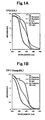
- Figure 1A and Figure 1B are graphs showing UV intensity absorbed by samples (UV absorbance of samples) having a coating film containing layered methacryl titanosilicate or UVA wrapping methacryl titanosilicate.
- Figure 1A shows UV absorbance of a test piece (TP2) having a coating film containing UVA wrapping methacryl titanosilicate
- Figure 1B shows UV absorbance of a test piece (TP1) having a coating film containing layered methacryl titanosilicate.
- Figure 2 shows a 47,49 Ti NMR spectrum of titanium isopropoxide (the upper side) and a 47,49 Ti NMR spectrum of a mixture of titanium isopropoxide and 3-methacryloxypropyltrimethoxysilane (the lower side).
- Figure 3 shows a 13 C CP-MAS NMR spectrum of UVA wrapping methacryl titanosilicate.
- Figure 4 shows a 29 Si HD-MAS NMR spectrum of UVA wrapping methacryl titanosilicate.
- Figure 5 shows a TEM image of UVA wrapping methacryl titanosilicate synthesized as an example.
- Figure 6 shows a TEM image of UVA wrapping methacryl titanosilicate obtained by dispersing the UVA wrapping methacryl titanosilicate synthesized as an example in a solvent and drying it.
- nanocomposite particle of the present invention and the molecular wrapping method of the present invention are not limited to the following embodiments.
- the nanocomposite particle and the molecular wrapping method of the present invention may be practiced or embodied in other forms to which a variety of changes and modifications are made by those skilled in the art without departing the spirit and scope of the present invention.
- the nanocomposite particle of the present invention comprises a core particle and a shell layer enclosing the core particle.
- the core particle is one organic particle or an assembly of organic molecules.
- the assembly of organic molecules is preferably constituted by an assembly of 2 to 20 molecules and more preferably an assembly of 2 to 8 molecules.
- the kind of the organic molecule enclosed by the shell layer is not particularly limited, but it is preferable that at least part of the organic molecule contains an ultraviolet absorbing molecule having an ultraviolet absorbing effect or a pigment molecule having a coloring property.
- the ultraviolet absorbing effect or the coloring property is maintained for a long time by enclosing the core particle by the shell layer.
- the organic molecule can be not only an ultraviolet absorbing molecule or a pigment molecule but also an organic polymer, a biomolecule, an infrared absorbing molecule, an enzyme, an organometallic complex or the like, and two or more kinds of these can form an assembly.
- a shell layer is easily formed around the organic molecule in producing the nanocomposite particle.
- the ultraviolet absorbing molecule is preferably at least one selected from benzophenone series, benzotriazole series, benzoate series and triazine series.
- the pigment molecule is preferably at least one selected from azo series, and polycyclic series such as phthalocyanine series, quinacridone series, isoindolinone series, dioxazine series, benzimidazolone series, anthraquinon series, indanthrone series, perylene series and phenanthroline series.
- the following molecules constituting an ultraviolet absorber (UVA) or a pigment can be suitably used as the abovementioned ultraviolet absorbing molecules or the pigment molecules.
- benzophenone series ultraviolet absorber examples include 2-hydroxy-4-n-octoxybenzophenone (SUMISORB(R) 130) 2,4-dihydroxybenzophenone (SEESORB 100), 2-hydroxy-4-methoxybenzophenone (SEESORB 101, CYASORB(R) UV-9), 2-hydroxy-4-methoxybenzophenone-5-sulfonic acid trihydrate (SEESORB 101S), 2-hydroxy-4-octyloxybenzophenone (SEESORB 102), 4-dodecyloxy-2-hydroxybenzophenone (SEESORB 103), 4-benzyloxy-2-hydroxybenzophenone (SEESORB 105), 2,2',4,4'-tetrahydroxybenzophenone (SEESORB 106), 2,2'-dihydroxy-4,4'-dimethoxybenzophenone (SEESORB 107), 1,4-bis(4-benzoyl-3-hydroxyphenoxy)-butane (SEESORB 151
- benzotriazole series ultraviolet absorber examples include 2-(2-hydroxy-5-methylphenyl) benzotriazole (SUMISORB(R) 200), 2-[2-hydroxy-3-(3, 4, 5, 6-tetrahydrophthalimide-methyl)-5-methylphenyl] benzotriazole (SUMISORB(R) 250), 2-(3-tert-butyl-2-hydroxy-5-methylphenyl)-5-chlorobenzotriazole (SUMISORB(R) 300), 2-(2-hydroxy-5-tert-octylphenyl)benzotriazole (SUMISORB(R) 340), 2-(2-hydroxy-3,5-di-tert-pentylphenyl)benzotriazole (SUMISORB(R) 350), 2-(2-hydroxy-5-methylphenyl)-2H-benzotriazole (SEESORB 701), 2-(3-tert-butyl-2-hydroxy-5-methylphenyl)-5-chloro-2H-benzotriazole (SE
- benzoate series ultraviolet absorber examples include 2,4-di-tert-butylphenyl-3,5-di-tert-butyl-4-hydroxybenzoate (SUMISORB(R) 400).
- triazine series ultraviolet absorber examples include 2-[4,6-bis(2,4-dimethylphenyl)-1,3,5-triazine-2-yl]-5-(octyloxy)phenol (CYASORB(R) UV-1164), 2-[4-[(2-hydroxy-3-dodecyloxypropyl)oxy]-2-hydroxyphenyl]-4,6-bis(2,4-dimethylphenyl)-1,3,5-triazine (TINUVIN(R) 400), 2-[4-[(2-hydroxy-3-tridecyloxypropyl)oxy]-2-hydroxyphenyl]-4,6-bis(2,4-dimethylphenyl)-1,3,5-triazine (TINUVIN(R) 400), 2-[4-[(2-hydroxy-3-(2'-ethyl)hexyl)oxy]-2-hydroxyphenyl]-4,6-bis(2,4-dimethylphenyl)-1,3,5-triazine (TINUV
- SUMISORB(R) is produced by Sumitomo Chemical Co., Ltd.
- SEESORB is produced by Shipro Kasei Kaisha, Ltd.
- CYASORB(R) is produced by Cytec Industries Inc.
- TINUVIN(R) and UVITEX (R) are produced by Chiba Specialty Chemicals Co. , Ltd.
- EVERSORB is produced by Everlight Chemical Industrial Corporation, Taiwan Region.
- examples of the pigment molecule include azo pigments having from yellow through orange to red hues, phthalocyanine pigments having from blue to green hues, quinacridone pigments having from red to magenta hues, isoindolinone pigments having yellow hues, dioxazine pigments having violet hues, benzimidazolone pigments having from yellow through orange to red hues, anthraquinon pigments having red hues, indanthrone pigments having blue hues, perylene pigments having from maroon to red hues, and phenanthroline pigments having red hues.
- the nanocomposite particle of the present invention comprising the core particle and the shell layer can be easily formed as mentioned in detail later.
- the shell layer enclosing the core particle comprises organic titanosilicate.
- the organic titanosilicate comprises an Si and Ti oxide containing a bond expressed by M-O-M and has an organic group bonded to at least part of silicon atoms. Note that M is a silicon or titanium atom and O is an oxygen atom.
- the organic titanosilicate is formed by subjecting titanium alkoxide and organoalkoxysilane to hydrolysis and dehydration-condensation.
- the organoalkoxysilane has one or more alkoxy groups and possesses a silicon atom covalently bound to an organic group.
- the mechanism of forming organic titanosilicate is that titanium alkoxide and organoalkoxysilane undergo hydrolysis and dehydration-condensation, thereby forming a bond, for example, expressed by R-Si-O-Ti, where R represents an organic group.
- part of silicon atoms or titanium atoms constituting organic titanosilicate can be replaced with an atom of another metal.
- Examples of another metal include Ge, Mg, Al, Ni, Co, Cu, Mn, Fe, Li, V and Zr.
- silicon atoms of organoalkoxysilane have one or more alkoxy groups, each silicon atom may be bonded to 1 to 3 organic groups, but part of silicon atoms constituting the organic titanosilicate can be a silicon atom which is not bonded to any organic group.
- titanium alkoxide examples include titanium tetramethoxide, titanium tetraethoxide, titanium tetraisopropoxide, titanium tetra-n-propoxide, titanium tetra-n-butoxide, titanium tetra-s-butoxide, and titanium tetra-t-butoxide. It is preferable to use titanium tetraisopropoxide or titanium tetra-n-butoxide or the like.
- Organoalkoxysilane is not particularly limited as long as it is expressed by R x Si (OR' ) 4-x , where X is 1, 2 or 3, R represents an organic group other than an alkoxy group, and OR' is an alkoxy group.
- R represents an organic group other than an alkoxy group
- OR' is an alkoxy group.
- acrylic silanes include beta-acryloxyethyltrimethoxysilane, beta-acryloxypropyltrimethoxysilane, gamma-acryloxyethyltrimethoxysilane, gamma-acryloxypropyltrimethoxysilane, beta-acryloxyethyltriethoxysilane, beta-acryloxypropyltriethoxysilane, gamma-acryloxyethyltriethoxysilane, gamma-acryloxypropyltriethoxysilane, beta-methacryloxyethyltrimethoxysilane, beta-methacryloxypropyltrimethoxysilane, gamma-methacryloxyethyltrimethoxysilane, gamma-methacryloxypropyltrimethoxysilane, beta-methacryloxyethyltriethoxysilane, beta-methacryloxypropyltriethoxysilane, beta-
- Examples of vinylsilanes include vinyltrimethoxysilane, vinyltriethoxysilane, and p-styryltrimethoxysilane.
- alkylsilanes include methyltrimethoxysilane, methyltriethoxysilane, ethyltrimethoxysilane, ethyltriethoxysilane, propyltrimethoxysilane, propyltriethoxysilane, hexyltrimethoxysilane, hexyltriethoxysilane, octyltrimethoxysilane, octyltriethoxysilane, decyltrimethoxysilane, decyltriethoxysilane, dodecyltrimethoxysilane, dodecyltriethoxysilane, tridecyltrimethoxysilane, dodecyltriethoxysilane, hexa
- aromatic silanes include phenyltrimethoxysilane and phenyltriethoxysilane.
- epoxy silanes include 3-glycidoxypropyltrimethoxysilane, 3-glycidoxypropylmethyldiethoxysilane, 3-glycidoxypropyltriethoxysilane, and 2-(3,4-epoxycyclohexyl) ethyltrimethoxysilane.
- amonosilanes and amines include 3-aminopropyltriethoxysilane, 3-aminopropyltrimethoxysilane, 3-aminopropyldimethylethoxysilane, 3-aminopropylmethyldiethoxysilane, 4-aminobutyltriethoxysilane, 3-aminopropyldiisopropylethoxysilane, 1-amino-2-(dimethylethoxysilyl)propane, (aminoethylamino)-3-isobutyldimethylmethoxysilane, N-(2-aminoethyl)-3-aminoisobutylmethyldimethoxysilane, (aminoethylaminomethyl)phenethyltrimethoxysilane, N-(2-aminoethyl)-3-aminopropylmethyldimethoxysilane, N-(2-aminoethyl)
- Examples of ureido silanes include 3-ureidopropyltriethoxysilane.
- halogen silanes include 3-chloropropyltrimethoxysilane.
- Examples of mercaptosilanes include 3-mercaptopropylmethyldimethoxysilane, 3-mercaptopropyltrimethoxysilane, and 3-mercaptopropyltriethoxysilane.
- isothiouronium salts include N-(trimethoxysilylpropyl)isothiouronium chloride.
- Examples of asid anhydrides include 3-(triethoxysilyl)propylsuccinic asid anhydride, and 3-(trimethoxysilyl)propylsuccinic asid anhydride.
- organoalkoxysilane having a nitrogen-containing heterocycle examples include N-(3-triethoxysilylpropyl)-4,5-dihydroimidazole, 2-(trimethoxysilylethyl)pyridine, N-(3-trimethoxysilylpropyl)pyrrole, and N-[3-(triethoxysilyl)propyl]-2-carbomethoxyaziridine.
- organoalkoxysilane having nitro group include 3-(2,4-dinitrophenylamino)propyltriethoxysilane and 3-(triethoxysilylpropyl)-p-nitrobenzamide.
- organoalkoxysilane having carbomethoxy group examples include 2-(carbomethoxy)ethyltrimethoxysilane.
- organoalkoxysilane having aldehyde group examples include triethoxysilylbutylaldehyde.
- organoalkoxysilane having ketone group examples include 2-hydroxy-4-(3-methyldiethoxysilylpropoxy)diphenylketone.
- organoalkoxysilane having hydroxyl group examples include hydroxymethyltriethoxysilane, N-(hydroxyethyl)-N-methylaminopropyltrimethoxysilane, bis(2-hydroxyethyl)-3-aminopropyltriethoxysilane, N-(3-triethoxysilylpropyl)-4-hydroxybutylamide, 11-(triethoxysilyl)undecanal, triethoxysilylundecanal, ethylene glycol acetal, and N-(3-ethoxysilylpropyl)gluconamido.
- organoalkoxysilane having sulfonyl group examples include (2-triethoxysilylpropoxy)ethoxysulfolane.
- organoalkoxysilane having a sulfur-containing heterocycle examples include 2-(3-trimethoxysilylpropylthio)thiophene.
- organoalkoxysilane having cyano group examples include 3-cyanopropylphenyldimethoxysilane, 11-cyanodecyltrimethoxysilane, 3-cyanopropyltrimethoxysilane, and 3-cyanopropyltriethoxysilane.
- organoalkoxysilane having isocyanate group examples include 3-isocyanatepropyltrimethoxysilane.
- Silicon alkoxide having no organic group can also be used in combination with organoalkoxysilane, if necessary.
- Examples of silicon alkoxide having no organic group include tetramethoxysilane (TMOS), tetraethoxysilane (TEOS), tetra-n-propoxysilane, tetraisopropoxysilane, tetra-n-butoxysilane, tetra-sec-butoxysilane, and tetra-tert-butoxysilane.
- the shell layer contains more titanium atoms on the side of the core particle (on an inside thereof) than on an outside thereof. If there are many silicon atoms on the outside of the shell layer, an organic group bonded to a silicon atom can exist on a surface portion of the nanocomposite particle. Having the organic group on the surface,portion of the nanocomposite particle, aggregation of the nanocomposite particles can be effectively restrained in an organic solvent. As a result, even when the nanocomposite particles are added to a coating composition, the nanocomposite particles can be satisfactorily dispersed in the coating composition.
- an organic group constituting the shell layer has, at a terminal end thereof, a reaction group which can react and form a bond with an organic group constituting another shell layer
- a molding or a coating film can be formed by reacting the organic group with that of another shell layer to bond a plurality of nanocomposite particles to each other.
- the nanocomposite particle of the present invention When the nanocomposite particle of the present invention has a reaction group at a terminal end of an organic group, the nanocomposite particle can be used as a main component of a molding raw material or a coating composition as mentioned before.
- a molding or a coating film obtained from the molding raw material or the coating composition using the nanocomposite particle as a main component can satisfactorily exhibit the functions of the organic molecule enclosed by the shell layer.
- the shell layer contains a bond expressed by M-O-M
- the molding or the coating film can be provided with the properties of inorganic materials such as high hardness and excellent heat resistance and, depending on the amount of organic groups bonded to the silicon atoms, the properties of organic materials such as flexibility and high-speed film formability.
- the organic molecule exists in the state of being enclosed by the shell layer in the molding or the coating film, the organic molecule is prevented from being released from the molding or the coating film.
- the nanocomposite particle of the present invention when added into a conventional coating composition and coated to form a coating film, the functions of each organic molecule can be exhibited satisfactorily.
- the conventional coating composition include organic coating compositions, for instance, resin vanish containing a resin used for a hard coating, such as acrylic resins, silicone resins, melamine resins, epoxy resins, phenol resins and polyester resins.
- the core particle the organic molecule
- the nanocomposite particle can maintain the functions of the organic molecule.
- Examples of the substances causing degradation of the organic molecule include an organic substance contained in a solvent of a coating composition or a coating film, water, and light rays such as ultraviolet rays. Besides, since the organic molecule exists in a coating film in the form of being enclosed by the shell layer, the organic molecule is prevented from being released from the coating film. Moreover, since the coating film is provided with the properties of inorganic materials which the nanocomposite particle has, the coating film is improved in hardness, wear resistance, scratch resistance and so on.
- a nanocomposite particle-organic polymer composite material can be obtained by hardening a raw material including a mixture of the nanocomposite particle of the present invention and an organic monomer. Owing to incorporation of the nanocomposite particle into the network structure of resin, the nanocomposite particle-organic polymer composite material attains excellent strength, hardness and gas barrier property and can satisfactorily exhibit the properties of the organic molecule enclosed by the shell layer.
- the nanocomposite particle can be not only in the form of being held in an organic polymer matrix but also bound to an organic monomer to constitute part of an organic polymer, depending on the kind of an organic group of the nanocomposite particle or the kind of the organic monomer.
- the organic monomer which can be used with the nanocomposite particle is not particularly limited.
- acrylic resins used as the organic monomer include mono(metha)acrylate compounds such as methyl (metha)acrylate, ethyl (metha)acrylate, butyl (metha)acrylate, 2-hydroxyethyl (metha)acrylate, 2-hydroxypropyl (metha)acrylate, polyethylene glycol mono(metha)acrylate, cyclohexyl (metha) acrylate, tetrahydrofurfuryl (metha)acrylate, dicyclopentanyl (metha)acrylate, dicyclopentenyl (metha)acrylate, benzyl (metha)acrylate, phenoxyethyl (metha)acrylate, and an adduct of phthalic anhydride and 2-hydroxyethyl (metha)acrylate; di(metha)acrylate compounds such as 1,4-butanediol di(metha)acrylate, 1,6-hexanediol di(metha)acrylate, 1,9-nonane
- the molecular wrapping method of the present invention is a molecular wrapping method for wrapping one organic molecule or an assembly of organic molecules with organic titanosilicate, and mainly comprises a mixed solution preparing step and a wrapping step.
- the mixed solution preparing step is a step of preparing a mixed solution by dissolving at least titanium alkoxide, organoalkoxysilane having one or more alkoxy groups and possessing a silicon atom covalently bound to an organic group, and an organic molecule in a dehydrated solvent.
- silicon alkoxide or the like can be dissolved in the dehydrated solvent, if necessary, in addition to titanium alkoxide, organoalkoxysilane and the organic molecule to prepare a mixed solution.
- titanium alkoxide and organoalkoxysilane have been given in the section of [Nanocomposite Particle].
- Silicon alkoxide can be used in combination with organoalkoxysilane, if necessary, in order to control the amount of the organic group to be contained in the organic titanosilicate. Silicon alkoxide is not particularly limited as long as it has one or more alkoxy groups and possesses no silicon atom bonded to an organic group.
- a salt or an alkoxide containing the metal atom can be used in combination.
- the optimum concentration of raw materials to be used titanium alkoxide, organoalkoxysilane, an organic molecule and, if necessary, silicon alkoxide or the like
- the total weight of the raw materials is desirably 50% by weight or less and more desirably 30% by weight or less, based on the total weight of the mixed solution taken as 100% by weight.
- the mixed solution preparing step can be carried out in an inert gas atmosphere.
- the dehydrated solvent is not particularly limited as long as it can dissolve titanium alkoxide, organoalkoxysilane and the organic molecule, but it is desirable to use an organic polar solvent.
- water is soluble in the dehydrated solvent.
- water solubility in 100 ml of the dehydrated solvent at 25°C is desirably not less than 1 g/100ml and more desirably not less than 5 g/100ml.
- water-added mixed solution is introduced into water in the wrapping step, which will be mentioned in detail later, it is desirable to use a solvent which can be infinitely diluted with water.
- Examples of the desirable dehydrated solvent include alcohols such as methanol, ethanol, 1-propanol, 2-propanol, n-butanol, and 2-butanol; ketones such as acetone, methyl ethyl ketone, diethyl ketone, methyl butyl ketone, methyl isobutyl ketone, cyclohexanone and methyl cyclohexanone; ethers such as ethyl ether, ethylene glycol monoethyl ether, ethylene glycol monoethyl ether acetate, ethylene glycol monobutyl ether, dimethyl ether, ethyl methyl ether, diethyl ether and ethylene glycol monomethyl ether; cyclic ethers such as furan, dibenzofuran, tetrahydrofuran, tetrahydropyran and dioxane; esters such as methyl acetate, ethyl acetate, is
- the dehydrated solvent it is possible to use only one of these solvents or a mixture of two or more of these solvents. If the step of introducing the water-added mixed solution into water, which will be mentioned in detail later, is omitted in the wrapping step, it is possible to use a mixed solvent of one or more of the listed solvents and one or more solvents selected from halogens such as trichloromethane, carbon tetrachloride, 1,2-dichloroethane, 1,2-dichloroethylene, 1,1,2,2-tetrachloroethane and trichloroethylene; and aromatic compounds such as benzene, toluene, ortho-xylene, meta-xylene, para-xylene, ethylbenzene and cresol.
- halogens such as trichloromethane, carbon tetrachloride, 1,2-dichloroethane, 1,2-dichloroethylene, 1,1,2,2-tetrachloroethane and t
- an alkoxy group of organoalkoxysilane is coordinated with a titanium atom of titanium alkoxide.
- titanium alkoxide coordinated with organoalkoxysilane associates around the organic molecule to form an associate.
- part of the organic molecule contains a polar molecule, a polar part of the organic molecule tends to form a coordinate bond with the titanium atom.
- the 47,49 Ti NMR spectrum (the lower spectrum in Figure 2 ) of the mixture of titanium isopropoxide and 3-methacryloxypropyltrimethoxysilane shows that the peaks have disappeared and suggests that the state surrounding a titanium atom has been changed by mixing alone without adding water. Namely, it is believed that the structure in which six oxygen atoms are located around a titanium atom is also stable. Also in the molecular wrapping method of the present invention, it is predicted that a titanium atom of titanium alkoxide forms coordinate bonds with organoalkoxysilane and the organic molecule, thereby forming an associate.
- the organic molecule since an associate in which titanium alkoxide and organoalkoxysilane associate around the organic molecule is formed in the mixed solution, the organic molecule tends to be wrapped with organic titanosilicate in the next wrapping step. At this time, since the organic molecule is dissolved in the mixed solution, the organic molecule may exist as one molecule or as an assembly of molecules, or at least part of the organic molecule may be dissociated electrolytically.
- the formed organic titanosilicate tends to contain more titanium atoms on the side of the organic molecule (on an inside thereof) than on an outside thereof.
- the mixed solution preparing step it is desirable to prepare the mixed solution so that the molar ratio of titanium atoms to silicon atoms (Ti: Si) falls in the range of from 1: 0.5 to 1: 2.
- Ti: Si titanium atoms
- a titanium atom tends to more easily form a coordinate bond with an alkoxy group of organoalkoxysilane than the organic molecule, although depending on the level of polarity of the organic molecule.
- a titanium atom is four to six-coordinate, it is desirable that the number of silicon atoms is two or less, because the organic molecule can easily form a coordinate bond with a titanium atom in the mixed solution.
- the number of silicon atoms is more desirably less than 2 and much more desirably 1.5 or less.
- organic titanosilicate having a layered structure which possesses a R-Si-O-Ti bond, where R represents an organic group, and comprises an inner layer containing a titanium atom and possessing a Ti-O-Ti bond, and an outer layer containing a silicon atom and possessing an Si-O-Si bond.
- titanium alkoxide and organoalkoxysilane in amounts determined by the amount used, property, size and shape of the organic molecule.
- an organic molecule having an organic straight chain structure is used, fairly large amounts of titanium alkoxysilane and organoalkoxysilane are necessary to completely wrap the whole organic molecule.
- an alkyl chain or the like contained in a pigment molecule or an ultraviolet absorbing molecule has been added in order to improve compatibility with a solvent or the like and has no relation with a coloring property or an ultraviolet absorbing effect.
- the number of titanium alkoxide molecules to be used is desirably five times or more of the number of organic molecules to be wrapped, and more desirably 8 to 100 times. Furthermore, if the amount of organoalkoxysilane to be used is determined with respect to titanium alkoxide so that the molar ratio of Ti: Si falls in the above desired range, the organic molecule is satisfactorily wrapped.
- the wrapping step is a step of wrapping an organic molecule or an assembly of organic molecules with organic titanosilicate by adding water to the mixed solution prepared in the mixed solution preparing step to subject titanium alkoxide and organoalkoxysilane to hydrolysis and dehydration-condensation.
- titanium alkoxide and organoalkoxysilane undergo hydrolysis and dehydration-condensation. Titanium alkoxide having a higher reaction rate is hydrolyzed before organoalkoxysilane and yields -Ti-OH. The -Ti-OH promotes hydrolysis of organoalkoxysilane and is further bonded. At this time, as described before, titanium alkoxide and organoalkoxysilane associate around the organic molecule to form an associate in the mixed solution.
- organic titanosilicate which comprises an Si and Ti oxide containing a bond expressed by M-O-M, where M is a silicon or titanium atom and O is an oxygen atom, and has an organic group bonded to at least part of silicon atoms.
- M is a silicon or titanium atom and O is an oxygen atom
- the organic molecule may react and form a bond with at least part of organic titanosilicate, or may be coordinated with organic titanosilicate.
- the amount of water to be added in the wrapping step can be twice or more of the number of moles of titanium alkoxide in the mixed solution, if the water-added mixed solution is introduced into water as mentioned in detail later. It is desirable that when the amount of water to be added is n times of ⁇ (the number of moles of titanium alkoxide x 4) + (the number of moles of organoalkoxysilane x the number of alkoxy groups ⁇ /2, n is 1 or more, and more desirably 1 ⁇ n ⁇ 8. Especially when the step of introducing the water-added mixed solution into water is omitted, n is desirably 2 or more.
- a solution of water diluted with an organic solvent a mixed solution of water and an organic solvent
- water is diluted with an organic solvent so that the water concentration is 20 % by weight or less and more desirably 12 % by weight or less, and preferably at least 1% by weight, based on the total weight of the diluted water solution taken as 100% by weight.
- the drop rate of the water diluted with the organic solvent into the mixed solution is desirably such that a predetermined amount of diluted water finishes dropping at a constant speed in 10 minutes or more, and more desirably in 30 minutes to two hours, although depending on the scale of the entire synthesis.
- a catalyst promoting hydrolysis or dehydration-condensation can be added to the mixed solution before water is added or at the time when water is added or directly to water to be added.
- the nanocomposite particle of the present invention is dispersed in the mixed solution after the wrapping step completes.
- the nanocomposite particle of the present invention can be obtained by removing, by filtering or drying, the solvent from the mixed solution after the wrapping step. It should be noted that the mixed solution after the wrapping step can be used as it is as a coating composition.
- the wrapping step can be a step of introducing the water-added mixed solution into water.
- an alkoxy group of organoalkoxysilane completely reacts and completes organic titanosilicate synthesis.
- the volume of water to which the mixed solution is introduced is preferably 0.5 to 10 times of the volume of the dehydrated solvent used in the preparing step.
- the wrapping step introduction of the mixed solution into water is not always necessary.
- a molding or a coating film is formed by thermosetting a molding raw material or a coating composition containing the nanocomposite particle, since heating completes organic titanosilicate synthesis, the step of introducing the mixed solution into water can be omitted.
- Organic titanosilicate synthesis can be completed by heating at 120°C or more.
- a molding or a coating film produced by using the nanocomposite particle will show higher transparency and higher hardness.
- Nanocomposite particles were produced by wrapping a molecule having an ultraviolet absorbing effect with organic titanosilicate based on the abovementioned embodiments. Coating films were also formed on glass substrates by using the produced nanocomposite particles. A method for synthesizing nanocomposite particles and a method for producing coating films will be described below.
- UVA ultraviolet absorber
- TINUVIN(R) 479 produced by Chiba Specialty Chemicals Co., Ltd.
- a dehydrated solvent tetrahydrofuran
- 250 ml of 2-propanol, 14.2 g (50 mmol) of titanium tetraisopropoxide and 12.4g (50 mmol) of 3-methacryloxypropyltrimethoxysilane were added to the UVA-added dehydrated solvent and stirred vigorously, thereby preparing a mixed solution.
- UVA wrapping acryl titanosilicate 20.2 g of nanocomposite particles (UVA wrapping acryl titanosilicate) were obtained by a similar procedure to the above, except for using a mixed solution prepared by dissolving 1.69 g (2.5 mmol) of the ultraviolet absorber (TINUVIN(R) 479) into 250 ml of the dehydrated solvent (tetrahydrofuran) and then dissolving 14.2 g (50 mmol) of titanium tetraisopropoxide and 11.7 g (50 mmol) of 3-acryloxypropyltrimethoxysilane into the UVA-added dehydrated solvent.
- nanocomposite particles (UVA wrapping propyl titanosilicate) were obtained by a similar procedure to the above, except for using a mixed solution prepared by dissolving 1. 69 g (2.5 mmol) of the ultraviolet absorber (TINUVIN(R) 479) into 250 ml of the dehydrated solvent (tetrahydrofuran) and then dissolving 14.2 g (50 mmol) of titanium tetraisopropoxide, 3.80 g (25 mmol) of tetramethoxysilane (produced by Tokyo Chemical Industry Co., Ltd.) and 4.1 g (25 mmol) of propyltrimethoxysilane (produced by Shin-Etsu Chemical Co., Ltd.) into the UVA-added dehydrated solvent.
- 0.33 g (0.5 mmol) of the ultraviolet absorber (TINUVIN(R) 479) was dissolved into 50 ml of a dehydrated solvent (propylene glycol monomethyl ether (PGM) produced by Wako Pure Chemical Industries, Ltd.) in a glove box under a nitrogen stream.
- a dehydrated solvent propylene glycol monomethyl ether (PGM) produced by Wako Pure Chemical Industries, Ltd.
- PGM propylene glycol monomethyl ether
- 2.84 g (10 mmol) of titanium tetraisopropoxide, 0.76 g (0.5 mmol) of tetramethoxysilane, and 0.82 g (0.5 mmol) of propyltrimethoxysilane were added to the UVA-added dehydrated solvent and stirred vigorously, thereby preparing a mixed solution.
- the obtained layered methacryl titanosilicate has a layered structure in which an octahedral sheet having titanium as a central atom and tetrahedral sheets formed on both the sides of the octahedral sheet and having silicon as a central atom are laminated.
- Coating composition No.1 to No.5 were prepared by using the organic titanosilicate obtained by the above procedures.
- the coating compositions were prepared by adding the respective components in the amounts shown in Table 1 to 8 g of a solvent (PGM). Note that Coating Composition No. 3 was mainly composed of an organic monomer and did not contain organic titanosilicate.
- layered means layered methacryl titanosilicate and “particle” means UVA wrapping methacryl titanosilicate and both of them were synthesized by the above procedures.
- PETA means pentaerythritol triacrylate.
- UVA is TINUVIN(R) N479, and the amount of the UVA does not include the wrapped UVA.
- IRGACURE(R) 184 (1-hydroxycyclohexylphenylketone) produced by Chiba Specialty Chemicals Co., Ltd.
- Initiator 2 is IRGACURE(R) 819 (bis(2,4,6-trimethylbenzoyl)-phenylphosphine oxide) produced by Chiba Specialty Chemicals Co., Ltd.
- Coating Composition No. 1 to No.5 thus prepared was coated on a surface of a slide glass substrate by flow coating and dried at room temperature for 20 minutes. Then Coating Composition No. 1 to No.3 were hardened by ultraviolet radiation and Coating Composition No.4 and No.5 were hardened by heating. Note that hardening by ultraviolet radiation was conducted by radiating ultraviolet rays from a 100W high-pressure mercury lamp (HLR-100T produced by Sen Lights Corporation, Japan) for 15 minutes. Hardening by heating was conducted by heating the compositions at 150°C for 2 hours and then at 200°C for 6 hours by an inert oven (DN6101 produced by Yamato Scientific Co., Ltd., Japan). When any of the coating compositions was used, a highly transparent coating film having a film thickness of about 5 ⁇ m was obtained on the substrate.
- HLR-100T high-pressure mercury lamp
- Test pieces in which a coating film was formed on the substrate by using Coating Composition Nos.1, 2, 3, 4 and 5 will be respectively referred hereinafter to as TP1, TP2, TP3, TP4 and TP5.
- the intensity of ultraviolet rays absorbed by TP1 and TP2 was measured.
- the stability of the UVA was evaluated by measuring UV absorbance of samples prepared by degrading the test pieces by UV irradiation. Namely, three kinds of samples were prepared for each test piece: samples which had not been subjected to UV irradiation (the test pieces as they were), samples which had been subjected to UV irradiation for 5 minutes, and samples which had been subjected to UV irradiation for 30 minutes, and their UV absorbance was measured.
- UV irradiation to the samples was conducted by using a 250W UV lamp (PanaCure ANUP5251 produced by Matsushita Electric Works, Ltd.). UV absorbance was measured by a multi-purpose spectrophotometer (MPS2400 produced by Shimadzu Corporation, Japan) in the wavelength range of from 200 to 500 nm.
- MPS2400 multi-purpose spectrophotometer
- the results of TP2 are shown in Figure 1A and the results of TP1 are shown in Figure 1B . Note that Figures 1A and 1B show UV absorbance only in the wavelength range of from 250 to 450nm excerpted from the obtained test results.
- Elastic modulus and surface hardness of the coating films were measured by nanoindentation technique.
- the surface hardness was examined by coupling a nanoindenter for measuring nanohardness and elastic modulus (TriboScope(R) produced by Hysitron Incorporated, the USA) to a scanning probe microscope (SPM9500J3 produced by Shimadzu Corporation, Japan). The measurement was carried out under the maximum load of 1000 ⁇ N at an indentation rate of 100 ⁇ m/sec.
- the surface hardness and the elastic modulus are shown in Table 2.
- the coating film of TP3 did not contain layered methacryl titanosilicate or UVA wrapping methacryl titanosilicate and had an elastic modulus (a reduced elastic modulus "Er” calculated from indentation contact) of 7.00 GPa and a surface hardness (indentation hardness HIT) of 0.34 GPa.
- the coating films of TP1 and TP2 contained layered methacryl titanosilicate or UVA wrapping methacryl titanosilicate in addition to PETA and had higher elasticity and hardness than the coating film of TP3.
- Especially the coating film of TP2 containing UVA wrapping methacryl titanosilicate showed higher elastic modulus and surface hardness than those of TP1.
- UVA wrapping methacryl titanosilicate was uniformly dispersed in Coating Composition No.2 without aggregating and was composited by being incorporated into the network structure and as a result a uniform coating film satisfactorily exhibiting the effect of adding UVA wrapping methacryl titanosilicate was obtained.
- the coating film of TP5 comprised UVA wrapping methacryl titanosilicate alone and had an extremely high elastic modulus of 15.10 GPa and an extremely high surface hardness of 1.13 GPa, which were higher than those of the coating film of TP4 comprising layered methacryl titanosilicate and the UVA.
- the use of the UVA wrapping methacryl titanosilicate in which the UVA was wrapped with methacryl titanosilicate allows more uniform dispersion of UVA and methacryl titanosilicate in the coating film when compared with when the UVA and layered methacryl titanosilicate coexisted in the coating film.
- the UVA wrapping methacryl titanosilicate synthesized by the above procedure was subjected to solid-state nuclear magnetic resonance (NMR) spectral analysis.
- 13 C cross polarization-magic angle spinning (CP-MAS) NMR spectroscopic analysis (Analysis 1) and 29 Si high-power decoupling MAS (HD-MAS) NMR spectroscopic analysis (Analysis 2) were carried out by using an NMR spectrometer (AVANCE (R) 400 produced by Bruker BioSpin Corporation).
- 'T 2 ' is a signal from an Si atom having one Si-OH (silanol group), and having two Si-O involved in an Si-O-M bond with their neighboring Si or Ti atom.
- 'T 3 ' is a signal from an Si atom having no Si-OH, and having three Si-O involved in the bond with their neighboring Si or Ti atom. It was confirmed from Figure 4 that as Si atoms in the UVA wrapping methacryl titanosilicate, mainly T 3 existed and T 2 existed in a small amount and that the sol-gel reaction completed sufficiently.
- the UVA wrapping methacryl titanosilicate synthesized by the above procedure was observed by using a high-resolution transmission electron microscope (TEM).
- TEM observation was conducted by using JEM2000EX/THGZ produced by JEOL Ltd., Japan under an accelerating voltage of 200 kV.
- Two kinds of samples were prepared: Sample A was prepared by placing UVA wrapping methacryl titanosilicate obtained after vacuum freeze drying on a microgrid as it was, and Sample B was prepared by dispersing the vaccum freezed dried powder in PGM, dropping the dispersion fluid (solid content: 20 % by weight) on a microgrid and drying it.
- a TEM image of Sample A is shown in Figure 5 and a TEM image of Sample B is shown in Figure 6 .
- the mixed solution is introduced into ion-exchanged water in the final stage of the synthesis of UVA wrapping methacryl titanosilicate, the mixed solution is emulsified. It was confirmed from the TEM image of Sample A in Figure 5 that powder obtained by vacuum freeze drying the emulsified solution comprised assemblies of particles of about 30 to 60 nm in diameter formed by aggregation of nanocomposite particles in water. At this time, the UVA is considered to be uniformly distributed in the powder.
- the elemental composition of the UVA wrapping methacryl titanosilicate and UVA wrapping acryl titanosilicate was analyzed by an X-ray photoelectron spectrometer (XPS).
- XPS X-ray photoelectron spectrometer
- the XPS used was Quantera SXM produced by Ulvac-Phi with a monochromatic Al K ⁇ X-ray source and an analytical spot size of about 100 ⁇ m in diameter.
- the analytical results are shown in Table 3. [TABLE 3] ELEMENTAL COMPOSITION [atomic %] C O N Si Ti UVA WRAPPING ACRYL TITANOSILICATE 58 30 1.1 6.6 4.4 UVA WRAPPING METHACRYL TITANOSILICATE 56 32 0.9 6.7 4.8
- UVA wrapping methacryl titanosilicate and UVA wrapping acryl titanosilicate were respectively synthesized by using 2.5 mmol of the UVA, 50 mmol of titanium alkoxide and 50 mmol of organoalkoxysilane. Namely, the number of Si atoms was equal to the number of Ti atoms and the number of UVA molecules was one-twentieth of the number of Si atoms or the number of Ti atoms.
Landscapes
- Chemical & Material Sciences (AREA)
- Engineering & Computer Science (AREA)
- Organic Chemistry (AREA)
- Materials Engineering (AREA)
- Life Sciences & Earth Sciences (AREA)
- Wood Science & Technology (AREA)
- Nanotechnology (AREA)
- Chemical Kinetics & Catalysis (AREA)
- Physics & Mathematics (AREA)
- Composite Materials (AREA)
- Condensed Matter Physics & Semiconductors (AREA)
- General Physics & Mathematics (AREA)
- Crystallography & Structural Chemistry (AREA)
- Manufacturing Of Micro-Capsules (AREA)
- Paints Or Removers (AREA)
- Compositions Of Macromolecular Compounds (AREA)
Description
- The present invention relates to a nanocomposite particle comprising a core particle and a shell layer enclosing the core particle, and a molecular wrapping method applicable to production of the same.
- Resin moldings and coating films produced by using resin molding raw materials or coating compositions containing materials having specific properties, such as ultraviolet absorbers and pigments, are used in a variety of fields. For example, a coating composition prepared by mixing an ultraviolet absorber in resin varnish suitable for hard coatings is coated on a surface of a substrate and hardened, thereby forming a hard coating layer. The substrate having the hard coating layer thereon is improved in scratch and abrasion resistance. In addition, if the substrate is formed of resin, since the intensity of ultraviolet rays reaching the surface of the substrate is reduced, the substrate is more protected from UV degradation, and if the substrate is transparent, the substrate is provided with ultraviolet absorbing ability. When used for a long time, however, the substrate having the hard coating layer thereon has a problem of ultraviolet absorbing ability degradation because the ultraviolet absorber is released from the hard coating layer or modified under influence of an organic material, such as resin and a polymerization initiator, contained in the hard coating layer, water or the like. Moreover, depending on the kind of ultraviolet absorber, the substrate having the hard coating layer thereon also has a problem of inability to exhibit a desired ultraviolet absorbing effect because the ultraviolet absorber added to the coating composition is not uniformly dispersed in a solvent and aggregates within the hard coating layer.
- In this connection,
Patent Document 1 proposes a microcapsule having a polyurethane and/or urea wall and containing a triazine ring in the chemical structure of the wall. This microcapsule shows excellent coloring property upon enclosing a diazonium salt or an electron-donating dye precursor. However, since the microcapsule is an organic material in itself, for example, the organic material, especially a remaining group contained in the chemical structure of the wall or a carbamate group contained in polyurethane sometimes reacts with the diazonium salt or the electron-donating dye precursor, thereby modifying the diazonium salt or the electron-donating dye precursor and impairing its coloring property. Moreover, since the microcapsule recited inPatent Document 1 has no functional group which can be covalently bound to another organic group around the wall, even when the microcapsule is held in the resin matrix, the diazonium salt or the electron-donating dye precursor is expected to be released from the matrix together with the microcapsule, depending on service conditions. -
Patent Document 2 discloses ultraviolet absorbing group-containing alkoxysilane and ultraviolet absorbing group-containing polyorganosiloxane possessing an alkoxysilyl group. When a coating film is formed of a coating composition containing ultraviolet absorbing group-containing alkoxysilane or ultraviolet absorbing group-containing polyorganosiloxane, since the ultraviolet absorbing group is bonded to a silicon atom, the ultraviolet absorbing group is prevented from being released from the coating film. However, when the coating film contains a substance which reacts with the ultraviolet absorbing group so as to modify the ultraviolet absorbing group, there is no measure to suppress the modification. Moreover, ultraviolet absorbing group-containing alkoxysilane or ultraviolet absorbing group-containing polyorganosiloxane cannot be used in the form of being held in an organic matrix. - Furthermore, Non-Patent
Document 1 discloses that water is further added to a solution prepared by dissolving a fluorescent molecule in an organic solvent and adding titanium propoxide, thereby bonding the fluorescent molecule with titania gel and forming a pigment-titania composite in which the fluorescent molecule is wrapped with titania gel. The obtained pigment-titania composite exists as associates in the solution, and octyltrimethoxysilane is added to stabilize the aggregates. Namely, the pigment-titania composite tends to form associates in a solvent. Therefore, even if a coating composition is prepared, for example, by adding the pigment-titania composite in resin varnish, the composite is poorly dispersed in the coating composition. Even if a coating film is formed by using such a coating composition, since the pigment-titania composite exists as aggregates in the coating film, the property of each fluorescent molecule cannot be exhibited satisfactorily.
[Patent Document 1]Japanese Unexamined Patent Publication No.2005-305,872
[Patent Document 2]Japanese Unexamined Patent Publication No.2006-182,688
[Non-Patent Document 1] I. Ichinose, T. Kunitake "New Nanocomposite Synthesis by Molecular Wrapping" Polymer Preprints, Japan, August 28, 2001, Vo1.50, No.11, pp.2714-2715 - The present invention has been conceived in view of the above problems. It is an object of the present invention to provide a nanocomposite particle comprising an organic molecule or an assembly of organic molecules and a novel shell layer enclosing the organic molecule, which can maintain and fully exhibit the properties of the organic molecule. It is also an object of the present invention to provide a molecular wrapping method applicable to production of the nanocomposite particle of the present invention.
- The nanocomposite particle of the present invention characteristically comprises a core particle being one organic molecule or an assembly of organic molecules, and a shell layer enclosing the core particle and comprising organic titanosilicate which comprises an Si and Ti oxide containing a bond expressed by M-O-M, where M is a silicon or titanium atom and O is an oxygen atom, and has an organic group bonded to at least part of silicon atoms.
- A molecular wrapping method of the present invention is a molecular wrapping method for wrapping one organic molecule or an assembly of organic molecules with organic titanosilicate, comprising:
- a mixed solution preparing step of preparing a mixed solution by dissolving at least titanium alkoxide, organoalkoxysilane having one or more alkoxy groups and possessing a silicon atom covalently bound to an organic group, and an organic molecule in a dehydrated solvent; and
- a wrapping step of wrapping the organic molecule with organic titanosilicate by adding water to the mixed solution to subject titanium alkoxide and organoalkoxysilane to hydrolysis and dehydration-condensation with titanium alkoxide and organoalkoxysilane associating around the organic molecule.
- Note that in the mixed solution preparing step, the state in which solutes such as titanium alkoxide, organoalkoxysilane and the organic molecule are dissolved in a dehydrated solvent includes the states that in the mixed solution after the dissolution, at least part of solutes are dissociated into ions, are dispersed in the form of molecules without being dissociated into ions, and exist in the form of associates of molecules.
- Advantages of the nanocomposite particle and the wrapping method of the present invention will be described below.
- The nanocomposite particle of the present invention comprises a core particle being one organic molecule or an assembly of organic molecules, and a shell layer enclosing the core particle and comprising organic titanosilicate. Because of being enclosed by the shell layer, the organic molecule is shielded from substances causing degradation of the organic molecule and becomes stable. Therefore, when at least part of the organic molecule contains an ultraviolet absorbing molecule having an ultraviolet absorbing effect or a pigment molecule having a coloring property, the ultraviolet absorbing effect or the coloring property is maintained for a long time.
- Note that in the nanocomposite particle of the present invention, one organic molecule or an assembly of organic molecules is enclosed by the shell layer comprising organic titanosilicate which comprises an Si and Ti oxide containing a bond expressed by M-O-M, where M is a silicon atom or a titanium atom and O is an oxygen atom, and has an organic group bonded to at least part of silicon atoms. On the other hand, the above
Non-Patent Document 1 discloses a pigment-titania composite in which a fluorescent molecule is wrapped with titania gel, but the pigment-titania composite forms associates with each other. Therefore, even if the associates of the pigment-titania composite are stabilized by octyltrimethoxysilane, a layer containing an Si and Ti oxide is formed only around each associates. - Since the shell layer of the nanocomposite particle comprises organic titanosilicate and has an organic group, the nanocomposite particle is excellent in dispersibility in a solvent. Namely, the nanocomposite particle is excellent in dispersibility even in a coating composition containing resin varnish, and so allows formation of a coating film in which the nanocomposite particles are uniformly dispersed in a resin matrix.
- When the organic group constituting the shell layer has, at a terminal end thereof, a reaction group which can react and form a bond with an organic group constituting another shell layer, it is possible to form a molding or a coating film formed mainly of a reaction product of the nanocomposite particle. Moreover, a nanocomposite particle-organic polymer composite material formed by using a mixture of the nanocomposite particles and an organic monomer as a raw material is excellent in strength, hardness, gas barrier property and so on.
- Furthermore, the molecular wrapping method of the present invention is a molecular wrapping method for wrapping one organic molecule or an assembly of organic molecules with organic titanosilicate. When titanium alkoxide and organoalkoxysilane are mixed with an organic molecule in a dehydrated solvent in the mixed solution preparing step, which will be mentioned in detail later, an alkoxy group of organoalkoxysilane is coordinated with a titanium atom of titanium alkoxide. In addition, since the organic molecule also tends to be coordinated with the titanium atom, titanium alkoxide and organoalkoxysilane associate around the organic molecule. When water is added to the mixed solution in the next wrapping step, titanium alkoxide and organoalkoxysilane undergo hydrolysis and dehydration-condensation around the organic molecule, the organic molecule can be easily enclosed by organic titanosilicate.
- In the molecular wrapping method of the present invention, since titanium alkoxide and organoalkoxysilane are dissolved together in a dehydrated solvent in order to wrap the organic molecule, the organic molecule enclosed by organic titanosilicate hardly forms aggregates with each other.
-
Figure 1A and Figure 1B are graphs showing UV intensity absorbed by samples (UV absorbance of samples) having a coating film containing layered methacryl titanosilicate or UVA wrapping methacryl titanosilicate.Figure 1A shows UV absorbance of a test piece (TP2) having a coating film containing UVA wrapping methacryl titanosilicate, andFigure 1B shows UV absorbance of a test piece (TP1) having a coating film containing layered methacryl titanosilicate. -
Figure 2 shows a 47,49Ti NMR spectrum of titanium isopropoxide (the upper side) and a 47,49Ti NMR spectrum of a mixture of titanium isopropoxide and 3-methacryloxypropyltrimethoxysilane (the lower side). -
Figure 3 shows a 13C CP-MAS NMR spectrum of UVA wrapping methacryl titanosilicate. -
Figure 4 shows a 29Si HD-MAS NMR spectrum of UVA wrapping methacryl titanosilicate. -
Figure 5 shows a TEM image of UVA wrapping methacryl titanosilicate synthesized as an example. -
Figure 6 shows a TEM image of UVA wrapping methacryl titanosilicate obtained by dispersing the UVA wrapping methacryl titanosilicate synthesized as an example in a solvent and drying it. - A best mode for carrying out the nanocomposite particle of the present invention and the molecular wrapping method of the present invention will be described below.
- It should be appreciated that the nanocomposite particle of the present invention and the molecular wrapping method of the present invention are not limited to the following embodiments. The nanocomposite particle and the molecular wrapping method of the present invention may be practiced or embodied in other forms to which a variety of changes and modifications are made by those skilled in the art without departing the spirit and scope of the present invention.
- The nanocomposite particle of the present invention comprises a core particle and a shell layer enclosing the core particle.
- The core particle is one organic particle or an assembly of organic molecules. The assembly of organic molecules is preferably constituted by an assembly of 2 to 20 molecules and more preferably an assembly of 2 to 8 molecules. The kind of the organic molecule enclosed by the shell layer is not particularly limited, but it is preferable that at least part of the organic molecule contains an ultraviolet absorbing molecule having an ultraviolet absorbing effect or a pigment molecule having a coloring property. When at least part of the organic molecule is an ultraviolet absorbing molecule or a pigment molecule, the ultraviolet absorbing effect or the coloring property is maintained for a long time by enclosing the core particle by the shell layer. The organic molecule can be not only an ultraviolet absorbing molecule or a pigment molecule but also an organic polymer, a biomolecule, an infrared absorbing molecule, an enzyme, an organometallic complex or the like, and two or more kinds of these can form an assembly. Especially when at least part of the organic molecule contains a polar molecule, a shell layer is easily formed around the organic molecule in producing the nanocomposite particle. When at least part of the organic molecule contains an ultraviolet absorbing molecule, the ultraviolet absorbing molecule is preferably at least one selected from benzophenone series, benzotriazole series, benzoate series and triazine series. When at least part of the organic molecule contains a pigment molecule, the pigment molecule is preferably at least one selected from azo series, and polycyclic series such as phthalocyanine series, quinacridone series, isoindolinone series, dioxazine series, benzimidazolone series, anthraquinon series, indanthrone series, perylene series and phenanthroline series. The following molecules constituting an ultraviolet absorber (UVA) or a pigment can be suitably used as the abovementioned ultraviolet absorbing molecules or the pigment molecules.
- Concrete examples of the benzophenone series ultraviolet absorber include 2-hydroxy-4-n-octoxybenzophenone (SUMISORB(R) 130) 2,4-dihydroxybenzophenone (SEESORB 100), 2-hydroxy-4-methoxybenzophenone (SEESORB 101, CYASORB(R) UV-9), 2-hydroxy-4-methoxybenzophenone-5-sulfonic acid trihydrate (SEESORB 101S), 2-hydroxy-4-octyloxybenzophenone (SEESORB 102), 4-dodecyloxy-2-hydroxybenzophenone (SEESORB 103), 4-benzyloxy-2-hydroxybenzophenone (SEESORB 105), 2,2',4,4'-tetrahydroxybenzophenone (SEESORB 106), 2,2'-dihydroxy-4,4'-dimethoxybenzophenone (SEESORB 107), 1,4-bis(4-benzoyl-3-hydroxyphenoxy)-butane (SEESORB 151), and 2,2'-dihydroxy-4-methoxybenzophenone (CYASORB(R) UV-24).
- Concrete examples of the benzotriazole series ultraviolet absorber include 2-(2-hydroxy-5-methylphenyl) benzotriazole (SUMISORB(R) 200), 2-[2-hydroxy-3-(3, 4, 5, 6-tetrahydrophthalimide-methyl)-5-methylphenyl] benzotriazole (SUMISORB(R) 250), 2-(3-tert-butyl-2-hydroxy-5-methylphenyl)-5-chlorobenzotriazole (SUMISORB(R) 300), 2-(2-hydroxy-5-tert-octylphenyl)benzotriazole (SUMISORB(R) 340), 2-(2-hydroxy-3,5-di-tert-pentylphenyl)benzotriazole (SUMISORB(R) 350), 2-(2-hydroxy-5-methylphenyl)-2H-benzotriazole (SEESORB 701), 2-(3-tert-butyl-2-hydroxy-5-methylphenyl)-5-chloro-2H-benzotriazole (SEESORB 703), 2-(3,5-di-tert-pentyl-2-hydroxyphenyl)-2H-benzotriazole (SEESORB 704), 2-(2H-benzotriazole-2-yl)-4-methyl-6-(3,4,5,6-tetrahydrophthalimidylmethyl)phenol (SEESORB 706), 2-(2-hydroxy-4-octyloxyphenyl)-2H-benzotriazole (SEESORB 707), 2-(2-hydroxy- 5-tert-octylphenyl) -2H-benzotriazole (SEESORB 709), 2-(2-hydroxy-5-tert-butylphenyl)-2H-benzotriazole (TINUVIN(R) PS), 2-(2H-benzotriazol-2-yl)-4,6-bis(1-methyl-1-phenylethyl) phenol (TINUVIN(R) 900), 2-(2H-benzotriazol-2-yl)-6-(1-methyl-1-phenylethyl)-4-(1,1,3,3-tetramethylbutyl)phenol (TINUVIN(R) 928), 2,5-bis(5'-tert-butyl-2'-benzoxazolyl) thiophene (UVITEX(R) OB), 2-(2'-hydroxy-3',5'-di-tert-butylphenyl)-5-chlorobenzotriazole (TINUVIN(R) 327, SEESORB 702), 2-[2'-hydroxy-3',5'-bis( α , α -dimethylbenzyl)phenyl]-2H-benzotriazole (TINUVIN(R) 234), 2-(2'-hydroxy-3',5'-di-tert-butylphenyl)benzotriazole (TINUVIN(R) 320, EVERSORB 77), 2,2'-methylenbis[6-(2H-benzotriazol-2-yl)-4-(1,1,3,3-tetramethylbutyl)phenol] (TINUVIN(R) 360, EVERSORB 78), and 2-(2'-hydroxy-3'-sec-butyl-5'-tert-butylphenyl) benzotriazole (EVERSORB 79).
- Concrete examples of the benzoate series ultraviolet absorber include 2,4-di-tert-butylphenyl-3,5-di-tert-butyl-4-hydroxybenzoate (SUMISORB(R) 400).
- Concrete examples of the triazine series ultraviolet absorber include 2-[4,6-bis(2,4-dimethylphenyl)-1,3,5-triazine-2-yl]-5-(octyloxy)phenol (CYASORB(R) UV-1164), 2-[4-[(2-hydroxy-3-dodecyloxypropyl)oxy]-2-hydroxyphenyl]-4,6-bis(2,4-dimethylphenyl)-1,3,5-triazine (TINUVIN(R) 400), 2-[4-[(2-hydroxy-3-tridecyloxypropyl)oxy]-2-hydroxyphenyl]-4,6-bis(2,4-dimethylphenyl)-1,3,5-triazine (TINUVIN(R) 400), 2-[4-[(2-hydroxy-3-(2'-ethyl)hexyl)oxy]-2-hydroxyphenyl]-4,6-bis(2,4-dimethylphenyl)-1,3,5-triazine (TINUVIN(R) 405), 2,4-bis(2-hydroxy-4-butyloxyphenyl)-6-(2,4-bis-butyloxyphenyl)-1,3,5-triazine (TINUVIN(R) 460), and 2-(2-hydroxy-4-[1-octyloxycarbonylethoxy]phenyl)-4,6-bis(4-phenylphenyl)-1,3,5-triazine (TINUVIN(R) 479).
- It should be noted that SUMISORB(R) is produced by Sumitomo Chemical Co., Ltd., SEESORB is produced by Shipro Kasei Kaisha, Ltd., CYASORB(R) is produced by Cytec Industries Inc., TINUVIN(R) and UVITEX (R) are produced by Chiba Specialty Chemicals Co. , Ltd. , and EVERSORB is produced by Everlight Chemical Industrial Corporation, Taiwan Region.
- Furthermore, examples of the pigment molecule include azo pigments having from yellow through orange to red hues, phthalocyanine pigments having from blue to green hues, quinacridone pigments having from red to magenta hues, isoindolinone pigments having yellow hues, dioxazine pigments having violet hues, benzimidazolone pigments having from yellow through orange to red hues, anthraquinon pigments having red hues, indanthrone pigments having blue hues, perylene pigments having from maroon to red hues, and phenanthroline pigments having red hues.
- Since these ultraviolet absorbers and pigments have a polar part, the nanocomposite particle of the present invention comprising the core particle and the shell layer can be easily formed as mentioned in detail later.
- The shell layer enclosing the core particle comprises organic titanosilicate. The organic titanosilicate comprises an Si and Ti oxide containing a bond expressed by M-O-M and has an organic group bonded to at least part of silicon atoms. Note that M is a silicon or titanium atom and O is an oxygen atom.
- The organic titanosilicate is formed by subjecting titanium alkoxide and organoalkoxysilane to hydrolysis and dehydration-condensation. The organoalkoxysilane has one or more alkoxy groups and possesses a silicon atom covalently bound to an organic group. As mentioned in detail later, the mechanism of forming organic titanosilicate is that titanium alkoxide and organoalkoxysilane undergo hydrolysis and dehydration-condensation, thereby forming a bond, for example, expressed by R-Si-O-Ti, where R represents an organic group. At this time, part of silicon atoms or titanium atoms constituting organic titanosilicate can be replaced with an atom of another metal. Examples of another metal include Ge, Mg, Al, Ni, Co, Cu, Mn, Fe, Li, V and Zr. When silicon atoms of organoalkoxysilane have one or more alkoxy groups, each silicon atom may be bonded to 1 to 3 organic groups, but part of silicon atoms constituting the organic titanosilicate can be a silicon atom which is not bonded to any organic group.
- Examples of titanium alkoxide include titanium tetramethoxide, titanium tetraethoxide, titanium tetraisopropoxide, titanium tetra-n-propoxide, titanium tetra-n-butoxide, titanium tetra-s-butoxide, and titanium tetra-t-butoxide. It is preferable to use titanium tetraisopropoxide or titanium tetra-n-butoxide or the like.
- Organoalkoxysilane is not particularly limited as long as it is expressed by RxSi (OR' ) 4-x, where X is 1, 2 or 3, R represents an organic group other than an alkoxy group, and OR' is an alkoxy group. Concretely, it is desirable to use acrylic silanes, vinylsilanes, alkylsilanes, aromatic silanes, epoxy silanes, aminosilanes and amines having -NH2, -NHCH3, or -N(CH3)2, ureido silanes, halogen silanes, mercaptosilanes, isothiouronium salts, and asid anhydrides. It is also desirable to use organoalkoxysilane possessing a nitrogen-containing heterocycle such as imidazole, imidazoline, pyridine, pyrrole, aziridine and triazole, nitro group (-NO2), carbomethoxy group (-COOCH3), aldehyde group (-CH=O), ketone group (-(C=O)-R), hydroxyl group (-OH), sulfonyl group (-S(=O)2-), a sulfur-containing heterocycle, cyano group (-NC), isocyanate group (-N=C=O) or the like.
- Examples of acrylic silanes include beta-acryloxyethyltrimethoxysilane, beta-acryloxypropyltrimethoxysilane, gamma-acryloxyethyltrimethoxysilane, gamma-acryloxypropyltrimethoxysilane, beta-acryloxyethyltriethoxysilane, beta-acryloxypropyltriethoxysilane, gamma-acryloxyethyltriethoxysilane, gamma-acryloxypropyltriethoxysilane, beta-methacryloxyethyltrimethoxysilane, beta-methacryloxypropyltrimethoxysilane, gamma-methacryloxyethyltrimethoxysilane, gamma-methacryloxypropyltrimethoxysilane, beta-methacryloxyethyltriethoxysilane, beta-methacryloxypropyltriethoxysilane, gamma-methacryloxyethyltriethoxysilane, gamma-methacryloxypropyltriethoxysilane, and 3-methacryloxypropylmethyldiethoxysilane. Examples of vinylsilanes include vinyltrimethoxysilane, vinyltriethoxysilane, and p-styryltrimethoxysilane. Examples of alkylsilanes include methyltrimethoxysilane, methyltriethoxysilane, ethyltrimethoxysilane, ethyltriethoxysilane, propyltrimethoxysilane, propyltriethoxysilane, hexyltrimethoxysilane, hexyltriethoxysilane, octyltrimethoxysilane, octyltriethoxysilane, decyltrimethoxysilane, decyltriethoxysilane, dodecyltrimethoxysilane, dodecyltriethoxysilane, tridecyltrimethoxysilane, dodecyltriethoxysilane, hexadecyltrimethoxysilane, hexadecyltriethoxysilane, octadecyltrimethoxysilane, and octadecyltriethoxysilane. Examples of aromatic silanes include phenyltrimethoxysilane and phenyltriethoxysilane. Examples of epoxy silanes include 3-glycidoxypropyltrimethoxysilane, 3-glycidoxypropylmethyldiethoxysilane, 3-glycidoxypropyltriethoxysilane, and 2-(3,4-epoxycyclohexyl) ethyltrimethoxysilane. Examples of amonosilanes and amines include 3-aminopropyltriethoxysilane, 3-aminopropyltrimethoxysilane, 3-aminopropyldimethylethoxysilane, 3-aminopropylmethyldiethoxysilane, 4-aminobutyltriethoxysilane, 3-aminopropyldiisopropylethoxysilane, 1-amino-2-(dimethylethoxysilyl)propane, (aminoethylamino)-3-isobutyldimethylmethoxysilane, N-(2-aminoethyl)-3-aminoisobutylmethyldimethoxysilane, (aminoethylaminomethyl)phenethyltrimethoxysilane, N-(2-aminoethyl)-3-aminopropylmethyldimethoxysilane, N-(2-aminoethyl)-3-aminopropyltrimethoxysilane, N-(2-aminoethyl)-3-aminopropyltriethoxysilane, N-(6-aminohexyl)aminomethyltrimethoxysilane, N-(6-aminohexyl)aminomethyltriethoxysilane, N-(6-aminohexyl)aminopropyltrimethoxysilane, N-(2-aminoethyl)-11-aminoundecyltrimethoxysilane, 11-aminoundecyltriethoxysilane, 3-(m-aminophenoxy)propyltrimethoxysilane, m-aminophenyltrimethoxysilane, p-aminophenyltrimethoxysilane, (3-trimethoxysilylpropyl)diethylenetriamine, N-methylaminopropylmethyldimethoxysilane, N-methylaminopropyltrimethoxysilane, dimethylaminomethylethoxysilane, (N,N-dimethylaminopropyl)trimethoxysilane, and (N-acetylglycidyl)-3-aminopropyltrimethoxysilane. Examples of ureido silanes include 3-ureidopropyltriethoxysilane. Examples of halogen silanes include 3-chloropropyltrimethoxysilane. Examples of mercaptosilanes include 3-mercaptopropylmethyldimethoxysilane, 3-mercaptopropyltrimethoxysilane, and 3-mercaptopropyltriethoxysilane. Examples of isothiouronium salts include N-(trimethoxysilylpropyl)isothiouronium chloride. Examples of asid anhydrides include 3-(triethoxysilyl)propylsuccinic asid anhydride, and 3-(trimethoxysilyl)propylsuccinic asid anhydride.
- Furthermore, examples of organoalkoxysilane having a nitrogen-containing heterocycle include N-(3-triethoxysilylpropyl)-4,5-dihydroimidazole, 2-(trimethoxysilylethyl)pyridine, N-(3-trimethoxysilylpropyl)pyrrole, and N-[3-(triethoxysilyl)propyl]-2-carbomethoxyaziridine. Examples of organoalkoxysilane having nitro group include 3-(2,4-dinitrophenylamino)propyltriethoxysilane and 3-(triethoxysilylpropyl)-p-nitrobenzamide. Examples of organoalkoxysilane having carbomethoxy group include 2-(carbomethoxy)ethyltrimethoxysilane. Examples of organoalkoxysilane having aldehyde group include triethoxysilylbutylaldehyde. Examples of organoalkoxysilane having ketone group include 2-hydroxy-4-(3-methyldiethoxysilylpropoxy)diphenylketone. Examples of organoalkoxysilane having hydroxyl group include hydroxymethyltriethoxysilane, N-(hydroxyethyl)-N-methylaminopropyltrimethoxysilane, bis(2-hydroxyethyl)-3-aminopropyltriethoxysilane, N-(3-triethoxysilylpropyl)-4-hydroxybutylamide, 11-(triethoxysilyl)undecanal, triethoxysilylundecanal, ethylene glycol acetal, and N-(3-ethoxysilylpropyl)gluconamido. Examples of organoalkoxysilane having sulfonyl group include (2-triethoxysilylpropoxy)ethoxysulfolane. Examples of organoalkoxysilane having a sulfur-containing heterocycle include 2-(3-trimethoxysilylpropylthio)thiophene. Examples of organoalkoxysilane having cyano group include 3-cyanopropylphenyldimethoxysilane, 11-cyanodecyltrimethoxysilane, 3-cyanopropyltrimethoxysilane, and 3-cyanopropyltriethoxysilane. Examples of organoalkoxysilane having isocyanate group include 3-isocyanatepropyltrimethoxysilane.
- Silicon alkoxide having no organic group can also be used in combination with organoalkoxysilane, if necessary. Examples of silicon alkoxide having no organic group include tetramethoxysilane (TMOS), tetraethoxysilane (TEOS), tetra-n-propoxysilane, tetraisopropoxysilane, tetra-n-butoxysilane, tetra-sec-butoxysilane, and tetra-tert-butoxysilane.
- Preferably the shell layer contains more titanium atoms on the side of the core particle (on an inside thereof) than on an outside thereof. If there are many silicon atoms on the outside of the shell layer, an organic group bonded to a silicon atom can exist on a surface portion of the nanocomposite particle. Having the organic group on the surface,portion of the nanocomposite particle, aggregation of the nanocomposite particles can be effectively restrained in an organic solvent. As a result, even when the nanocomposite particles are added to a coating composition, the nanocomposite particles can be satisfactorily dispersed in the coating composition. Moreover, when an organic group constituting the shell layer has, at a terminal end thereof, a reaction group which can react and form a bond with an organic group constituting another shell layer, a molding or a coating film can be formed by reacting the organic group with that of another shell layer to bond a plurality of nanocomposite particles to each other.
- The molar ratio of titanium atoms to silicon atoms (Ti:Si) constituting the shell layer is not particularly limited, but preferably falls in the range of from 1:0.5 to 1:2. The reason why Ti:Si = 1:0.5 to 1:2 is preferable will be mentioned later.
- When the nanocomposite particle of the present invention has a reaction group at a terminal end of an organic group, the nanocomposite particle can be used as a main component of a molding raw material or a coating composition as mentioned before. A molding or a coating film obtained from the molding raw material or the coating composition using the nanocomposite particle as a main component can satisfactorily exhibit the functions of the organic molecule enclosed by the shell layer. At the same time, since the shell layer contains a bond expressed by M-O-M, the molding or the coating film can be provided with the properties of inorganic materials such as high hardness and excellent heat resistance and, depending on the amount of organic groups bonded to the silicon atoms, the properties of organic materials such as flexibility and high-speed film formability. Furthermore, since the organic molecule exists in the state of being enclosed by the shell layer in the molding or the coating film, the organic molecule is prevented from being released from the molding or the coating film.
- Moreover, owing to high dispersibility in a solvent, when the nanocomposite particle of the present invention is added into a conventional coating composition and coated to form a coating film, the functions of each organic molecule can be exhibited satisfactorily. Examples of the conventional coating composition include organic coating compositions, for instance, resin vanish containing a resin used for a hard coating, such as acrylic resins, silicone resins, melamine resins, epoxy resins, phenol resins and polyester resins. In addition, since the core particle (the organic molecule) is shielded from substances causing degradation of the organic molecule by being enclosed by the shell layer, the nanocomposite particle can maintain the functions of the organic molecule. Examples of the substances causing degradation of the organic molecule include an organic substance contained in a solvent of a coating composition or a coating film, water, and light rays such as ultraviolet rays. Besides, since the organic molecule exists in a coating film in the form of being enclosed by the shell layer, the organic molecule is prevented from being released from the coating film. Moreover, since the coating film is provided with the properties of inorganic materials which the nanocomposite particle has, the coating film is improved in hardness, wear resistance, scratch resistance and so on.
- Furthermore, a nanocomposite particle-organic polymer composite material can be obtained by hardening a raw material including a mixture of the nanocomposite particle of the present invention and an organic monomer. Owing to incorporation of the nanocomposite particle into the network structure of resin, the nanocomposite particle-organic polymer composite material attains excellent strength, hardness and gas barrier property and can satisfactorily exhibit the properties of the organic molecule enclosed by the shell layer. It should be noted that in the nanocomposite particle-organic polymer composite material, the nanocomposite particle can be not only in the form of being held in an organic polymer matrix but also bound to an organic monomer to constitute part of an organic polymer, depending on the kind of an organic group of the nanocomposite particle or the kind of the organic monomer. The organic monomer which can be used with the nanocomposite particle is not particularly limited. Examples of preferred acrylic resins used as the organic monomer include mono(metha)acrylate compounds such as methyl (metha)acrylate, ethyl (metha)acrylate, butyl (metha)acrylate, 2-hydroxyethyl (metha)acrylate, 2-hydroxypropyl (metha)acrylate, polyethylene glycol mono(metha)acrylate, cyclohexyl (metha) acrylate, tetrahydrofurfuryl (metha)acrylate, dicyclopentanyl (metha)acrylate, dicyclopentenyl (metha)acrylate, benzyl (metha)acrylate, phenoxyethyl (metha)acrylate, and an adduct of phthalic anhydride and 2-hydroxyethyl (metha)acrylate; di(metha)acrylate compounds such as 1,4-butanediol di(metha)acrylate, 1,6-hexanediol di(metha)acrylate, 1,9-nonanediol di(metha)acrylate, neopentyl glycol di(metha)acrylate, ethylene glycol di(metha)acrylate, polyethylene glycol (polymerization degree n = 2 to 15) di(metha)acrylate, polypropylene glycol (n = 2 to 15) di(metha)acrylate, polybutylene glycol (n = 2 to 15) di(metha)acrylate, 2,2-bis(4-(metha)acryloxyethoxyphenyl) propane, 2,2-bis(4-(metha)acryloxydiethoxyphenyl)propane, trimethylolpropane diacrylate, and bis(2-(metha)acryloxyethyl)-hydroxyethyl-isocyanurate; polyfunctional(metha)acrylate compounds such as trimethylolpropane tri(metha)acrylate, tris(2-(metha)acryloxyethyl)isocyanurate, pentaerythritol tri(metha)acrylate, pentaerythritol tetra(metha)acrylate, dipentaerythritol tetra(metha)acrylate, dipentaerythritol penta(metha)acrylate, and dipentaerythritol hexa(metha)acrylate; epoxy di(metha)acrylate obtained by reacting bisphenol-A diepoxy and (metha)acrylic acid, urethane di(metha)acrylate obtained by reacting isophorone diisocyanate and 2-hydroxypropyl (metha)acrylate, urethane di(metha)acrylate obtained by reacting dicyclomethane diisocyanate and 2-hydroxyethyl (metha)acrylate, polyester (metha)acrylate obtained by reacting trimethylolethane, succinic acid and (metha)acrylic acid, and polyester (metha)acrylate obtained by reacting trimethylolpropane, succinic acid, ethylene glycol and (metha)acrylic acid. Low polymers (oligomers) can also be used. These organic monomers and polymers can be used alone or in combination thereof.
- The molecular wrapping method of the present invention is a molecular wrapping method for wrapping one organic molecule or an assembly of organic molecules with organic titanosilicate, and mainly comprises a mixed solution preparing step and a wrapping step.
- The mixed solution preparing step is a step of preparing a mixed solution by dissolving at least titanium alkoxide, organoalkoxysilane having one or more alkoxy groups and possessing a silicon atom covalently bound to an organic group, and an organic molecule in a dehydrated solvent.
- In the mixed solution preparing step, silicon alkoxide or the like can be dissolved in the dehydrated solvent, if necessary, in addition to titanium alkoxide, organoalkoxysilane and the organic molecule to prepare a mixed solution. A detailed description of titanium alkoxide and organoalkoxysilane has been given in the section of [Nanocomposite Particle]. Silicon alkoxide can be used in combination with organoalkoxysilane, if necessary, in order to control the amount of the organic group to be contained in the organic titanosilicate. Silicon alkoxide is not particularly limited as long as it has one or more alkoxy groups and possesses no silicon atom bonded to an organic group. In addition, when part of silicon atoms or titanium atoms are replaced with an atom of another metal, a salt or an alkoxide containing the metal atom can be used in combination. Although the optimum concentration of raw materials to be used (titanium alkoxide, organoalkoxysilane, an organic molecule and, if necessary, silicon alkoxide or the like) in a mixed solution differs depending on the molecular weight of the raw materials to be used, but in general the total weight of the raw materials is desirably 50% by weight or less and more desirably 30% by weight or less, based on the total weight of the mixed solution taken as 100% by weight.
- If water exists in the mixed solution, titanium alkoxide and organoalkoxysilane will react immediately in the mixed solution preparing step. Therefore, as a solvent of the mixed solution, a dehydrated solvent is used which has been dehydrated (not more than 0.5 % by weight of water is permissible based on the total weight of the dehydrated solvent taken as 100% by weight) in order not to react with titanium alkoxide or organoalkoxysilane during the preparation of the mixed solution. Furthermore, the mixed solution preparing step can be carried out in an inert gas atmosphere.
- The dehydrated solvent is not particularly limited as long as it can dissolve titanium alkoxide, organoalkoxysilane and the organic molecule, but it is desirable to use an organic polar solvent. Note that considering adding water to the mixed solution in the following wrapping step, it is preferable that water is soluble in the dehydrated solvent. For example, water solubility in 100 ml of the dehydrated solvent at 25°C is desirably not less than 1 g/100ml and more desirably not less than 5 g/100ml. Furthermore, if the water-added mixed solution is introduced into water in the wrapping step, which will be mentioned in detail later, it is desirable to use a solvent which can be infinitely diluted with water. Examples of the desirable dehydrated solvent include alcohols such as methanol, ethanol, 1-propanol, 2-propanol, n-butanol, and 2-butanol; ketones such as acetone, methyl ethyl ketone, diethyl ketone, methyl butyl ketone, methyl isobutyl ketone, cyclohexanone and methyl cyclohexanone; ethers such as ethyl ether, ethylene glycol monoethyl ether, ethylene glycol monoethyl ether acetate, ethylene glycol monobutyl ether, dimethyl ether, ethyl methyl ether, diethyl ether and ethylene glycol monomethyl ether; cyclic ethers such as furan, dibenzofuran, tetrahydrofuran, tetrahydropyran and dioxane; esters such as methyl acetate, ethyl acetate, isopropyl acetate, propyl acetate, butyl acetate, isopentyl acetate and pentyl acetate; amides such as N,N-dimethylformamide, dimethylacetamide, dimethyl sulfoxide methylacetamide, methylformamide, dimethylacetamide, dimethylformamide and N-methyl-2-pyrolidone; cyclic amines such as piperidine, pyrimidine and quinoline; and nitriles such as acetonitrile, propionitrile and benzonitrile. As the dehydrated solvent, it is possible to use only one of these solvents or a mixture of two or more of these solvents. If the step of introducing the water-added mixed solution into water, which will be mentioned in detail later, is omitted in the wrapping step, it is possible to use a mixed solvent of one or more of the listed solvents and one or more solvents selected from halogens such as trichloromethane, carbon tetrachloride, 1,2-dichloroethane, 1,2-dichloroethylene, 1,1,2,2-tetrachloroethane and trichloroethylene; and aromatic compounds such as benzene, toluene, ortho-xylene, meta-xylene, para-xylene, ethylbenzene and cresol.
- When the mixed solution prepared in the mixed solution preparing step is left stand for a while (desirably 10 to 180 minutes) after stirring, an alkoxy group of organoalkoxysilane is coordinated with a titanium atom of titanium alkoxide. In addition, since the organic molecule also tends to be coordinated with the titanium atom, titanium alkoxide coordinated with organoalkoxysilane associates around the organic molecule to form an associate. Especially when part of the organic molecule contains a polar molecule, a polar part of the organic molecule tends to form a coordinate bond with the titanium atom. At this time, since titanium alkoxide together with organoalkoxysilane associates with the organic molecule to form an associate, aggregation of associates is restrained.
- It is apparent from a 47,49Ti NMR spectrum of titanium isopropoxide and a 47,49Ti NMR spectrum of a mixture of titanium isopropoxide and 3-methacryloxypropyltrimethoxysilane at the ratio of 1: 2 that an alkoxy group of organoalkoxysilane and the organic molecule are coordinated with a titanium atom of titanium alkoxide. The 47,49Ti NMR spectra are shown in
Figure 2 . The 47,49Ti NMR spectrum of titanium isopropoxide (the upper spectrum inFigure 2 ) shows two peaks and suggests that titanium isopropoxide has a stable four-coordinate geometry in which four oxygen atoms bonded to a titanium atom are located in tetrahedral positions. On the other hand, the 47,49Ti NMR spectrum (the lower spectrum inFigure 2 ) of the mixture of titanium isopropoxide and 3-methacryloxypropyltrimethoxysilane shows that the peaks have disappeared and suggests that the state surrounding a titanium atom has been changed by mixing alone without adding water. Namely, it is believed that the structure in which six oxygen atoms are located around a titanium atom is also stable. Also in the molecular wrapping method of the present invention, it is predicted that a titanium atom of titanium alkoxide forms coordinate bonds with organoalkoxysilane and the organic molecule, thereby forming an associate. - Namely, since an associate in which titanium alkoxide and organoalkoxysilane associate around the organic molecule is formed in the mixed solution, the organic molecule tends to be wrapped with organic titanosilicate in the next wrapping step. At this time, since the organic molecule is dissolved in the mixed solution, the organic molecule may exist as one molecule or as an assembly of molecules, or at least part of the organic molecule may be dissociated electrolytically. Although depending on the mixing ratio of titanium alkoxide, organoalkoxysilane and the organic molecule, because titanium alkoxide forming a coordinate bond with organoalkoxysilane coordinates with the organic molecule to form an associate, the formed organic titanosilicate tends to contain more titanium atoms on the side of the organic molecule (on an inside thereof) than on an outside thereof.
- In the mixed solution preparing step, it is desirable to prepare the mixed solution so that the molar ratio of titanium atoms to silicon atoms (Ti: Si) falls in the range of from 1: 0.5 to 1: 2. When the silicon atoms are contained at the molar ratio of Ti: Si = 1: 0.5 or more, the particle containing the organic molecule wrapped in the mixed solution after the wrapping step is satisfactorily dispersed and aggregation of the particles is restrained. More desirably the silicon atoms are contained at the molar ratio of Ti: Si = 1: 0.8 or more. Furthermore, a titanium atom tends to more easily form a coordinate bond with an alkoxy group of organoalkoxysilane than the organic molecule, although depending on the level of polarity of the organic molecule. Considering that a titanium atom is four to six-coordinate, it is desirable that the number of silicon atoms is two or less, because the organic molecule can easily form a coordinate bond with a titanium atom in the mixed solution. The number of silicon atoms is more desirably less than 2 and much more desirably 1.5 or less.
- Especially when the mixed solution is prepared approximately at the molar ratio of Ti:Si = 1:1, titanium alkoxide and organoalkoxysilane associate at the ratio of 1:1 and at the same time the organic molecule easily coordinates with titanium alkoxide in the mixed solution. As a result, in the later wrapping step, it is easy to form organic titanosilicate having a layered structure which possesses a R-Si-O-Ti bond, where R represents an organic group, and comprises an inner layer containing a titanium atom and possessing a Ti-O-Ti bond, and an outer layer containing a silicon atom and possessing an Si-O-Si bond.
- Furthermore, in order to fully wrap the organic molecule dissolved in the mixed solution with organic titanosilicate, it is necessary to use titanium alkoxide and organoalkoxysilane in amounts determined by the amount used, property, size and shape of the organic molecule. For example, if an organic molecule having an organic straight chain structure is used, fairly large amounts of titanium alkoxysilane and organoalkoxysilane are necessary to completely wrap the whole organic molecule. On the other hand, an alkyl chain or the like contained in a pigment molecule or an ultraviolet absorbing molecule has been added in order to improve compatibility with a solvent or the like and has no relation with a coloring property or an ultraviolet absorbing effect. Therefore, it is not necessary to completely wrap the whole pigment molecule or an ultraviolet absorbing molecule. Moreover, since in general pigment molecules or ultraviolet absorbing molecules can exhibit their properties better when dispersedly held in an organic matrix, it is desirable to individually wrap each of the molecules. Moreover, in order to shield the organic molecule from substances causing degradation of the organic molecule, it is effective to individually wrap each of the molecules. However, it is not always necessary to individually wrap each of the organic molecules because even when the organic molecules are wrapped as an assembly, the same level of advantages can be expected as when each of the molecules is individually wrapped, and because there are some organic molecules, such as chlorophyll, which are more stable when they exist as an assembly. In consideration of the above, the number of titanium alkoxide molecules to be used is desirably five times or more of the number of organic molecules to be wrapped, and more desirably 8 to 100 times. Furthermore, if the amount of organoalkoxysilane to be used is determined with respect to titanium alkoxide so that the molar ratio of Ti: Si falls in the above desired range, the organic molecule is satisfactorily wrapped.
- The wrapping step is a step of wrapping an organic molecule or an assembly of organic molecules with organic titanosilicate by adding water to the mixed solution prepared in the mixed solution preparing step to subject titanium alkoxide and organoalkoxysilane to hydrolysis and dehydration-condensation.
- When water is added to the mixed solution prepared in the mixed solution preparing step, titanium alkoxide and organoalkoxysilane undergo hydrolysis and dehydration-condensation. Titanium alkoxide having a higher reaction rate is hydrolyzed before organoalkoxysilane and yields -Ti-OH. The -Ti-OH promotes hydrolysis of organoalkoxysilane and is further bonded. At this time, as described before, titanium alkoxide and organoalkoxysilane associate around the organic molecule to form an associate in the mixed solution. Since titanium alkoxide and organoalkoxysilane undergo hydrolysis and dehydration-condensation in such association state, the organic molecule is wrapped with organic titanosilicate which comprises an Si and Ti oxide containing a bond expressed by M-O-M, where M is a silicon or titanium atom and O is an oxygen atom, and has an organic group bonded to at least part of silicon atoms. At this time, the organic molecule may react and form a bond with at least part of organic titanosilicate, or may be coordinated with organic titanosilicate.
- The amount of water to be added in the wrapping step can be twice or more of the number of moles of titanium alkoxide in the mixed solution, if the water-added mixed solution is introduced into water as mentioned in detail later. It is desirable that when the amount of water to be added is n times of {(the number of moles of titanium alkoxide x 4) + (the number of moles of organoalkoxysilane x the number of alkoxy groups} /2, n is 1 or more, and more desirably 1 ≦ n ≦ 8. Especially when the step of introducing the water-added mixed solution into water is omitted, n is desirably 2 or more. In adding water into the mixed solution, it is more desirable to add dropwise a solution of water diluted with an organic solvent (a mixed solution of water and an organic solvent) than to add water alone. Desirably water is diluted with an organic solvent so that the water concentration is 20 % by weight or less and more desirably 12 % by weight or less, and preferably at least 1% by weight, based on the total weight of the diluted water solution taken as 100% by weight. The drop rate of the water diluted with the organic solvent into the mixed solution is desirably such that a predetermined amount of diluted water finishes dropping at a constant speed in 10 minutes or more, and more desirably in 30 minutes to two hours, although depending on the scale of the entire synthesis. Moreover, a catalyst promoting hydrolysis or dehydration-condensation can be added to the mixed solution before water is added or at the time when water is added or directly to water to be added.
- The nanocomposite particle of the present invention is dispersed in the mixed solution after the wrapping step completes. The nanocomposite particle of the present invention can be obtained by removing, by filtering or drying, the solvent from the mixed solution after the wrapping step. It should be noted that the mixed solution after the wrapping step can be used as it is as a coating composition.
- Moreover, the wrapping step can be a step of introducing the water-added mixed solution into water. Upon introducing the water-added mixed solution into water, an alkoxy group of organoalkoxysilane completely reacts and completes organic titanosilicate synthesis. The volume of water to which the mixed solution is introduced is preferably 0.5 to 10 times of the volume of the dehydrated solvent used in the preparing step.
- In the wrapping step, introduction of the mixed solution into water is not always necessary. When a molding or a coating film is formed by thermosetting a molding raw material or a coating composition containing the nanocomposite particle, since heating completes organic titanosilicate synthesis, the step of introducing the mixed solution into water can be omitted. Organic titanosilicate synthesis can be completed by heating at 120°C or more. However, in the case of the nanocomposite particle having a shell layer comprising acrylic organic titanosilicate, if the mixed solution is introduced into water in the wrapping step, a molding or a coating film produced by using the nanocomposite particle will show higher transparency and higher hardness.
- Nanocomposite particles were produced by wrapping a molecule having an ultraviolet absorbing effect with organic titanosilicate based on the abovementioned embodiments. Coating films were also formed on glass substrates by using the produced nanocomposite particles. A method for synthesizing nanocomposite particles and a method for producing coating films will be described below.
- 1.69 g (2.5 mmol) of an ultraviolet absorber (UVA) (TINUVIN(R) 479 produced by Chiba Specialty Chemicals Co., Ltd.) was dissolved into 125 ml of a dehydrated solvent (tetrahydrofuran) in a glove box under a nitrogen stream. 250 ml of 2-propanol, 14.2 g (50 mmol) of titanium tetraisopropoxide and 12.4g (50 mmol) of 3-methacryloxypropyltrimethoxysilane were added to the UVA-added dehydrated solvent and stirred vigorously, thereby preparing a mixed solution.
- While the obtained mixed solution was kept stirred, 250 ml of water diluted with an organic solvent, which was prepared by adding 2-propanol to 50 g of ion-exchanged water to bring the total volume to 1 liter, was dropped at the rate of 6.25 ml/min into the mixed solution. Subsequently, while kept stirred vigorously, this solution was introduced into 1 liter of ion-exchanged water. After left stand at room temperature for two days, the solution was subjected to vacuum freeze-drying, thereby obtaining 15.2 g of nanocomposite particles (UVA wrapping methacryl titanosilicate).
- Note that when the mixed solution prepared by the above procedure is introduced into ion-exchanged water, if part of UVA remains unwrapped in the mixed solution, the part of UVA is expected to be precipitated and deposited because of its insolubility to water. However, UVA precipitation was not confirmed in the solution after the mixed solution was introduced into ion-exchanged water and left stand, because the hydrophobic nanocomposite particles aggregated in water and were emulsified. Therefore, it is believed that most of the UVA was wrapped with shell layers formed by reacting titanium tetraisopropoxide and 3-methacryloxypropyltrimethoxysilane.
- Moreover, when propylene glycol monomethyl ether (PGM: 1-methoxy-2-propanaol) was added to the obtained nanocomposite particles and left stand for two days, a yellow transparent solution was obtained.
- 20.2 g of nanocomposite particles (UVA wrapping acryl titanosilicate) were obtained by a similar procedure to the above, except for using a mixed solution prepared by dissolving 1.69 g (2.5 mmol) of the ultraviolet absorber (TINUVIN(R) 479) into 250 ml of the dehydrated solvent (tetrahydrofuran) and then dissolving 14.2 g (50 mmol) of titanium tetraisopropoxide and 11.7 g (50 mmol) of 3-acryloxypropyltrimethoxysilane into the UVA-added dehydrated solvent.
- 9.8 g of nanocomposite particles (UVA wrapping propyl titanosilicate) were obtained by a similar procedure to the above, except for using a mixed solution prepared by dissolving 1. 69 g (2.5 mmol) of the ultraviolet absorber (TINUVIN(R) 479) into 250 ml of the dehydrated solvent (tetrahydrofuran) and then dissolving 14.2 g (50 mmol) of titanium tetraisopropoxide, 3.80 g (25 mmol) of tetramethoxysilane (produced by Tokyo Chemical Industry Co., Ltd.) and 4.1 g (25 mmol) of propyltrimethoxysilane (produced by Shin-Etsu Chemical Co., Ltd.) into the UVA-added dehydrated solvent.
- 0.33 g (0.5 mmol) of the ultraviolet absorber (TINUVIN(R) 479) was dissolved into 50 ml of a dehydrated solvent (propylene glycol monomethyl ether (PGM) produced by Wako Pure Chemical Industries, Ltd.) in a glove box under a nitrogen stream. 2.84 g (10 mmol) of titanium tetraisopropoxide, 0.76 g (0.5 mmol) of tetramethoxysilane, and 0.82 g (0.5 mmol) of propyltrimethoxysilane were added to the UVA-added dehydrated solvent and stirred vigorously, thereby preparing a mixed solution.
- While the obtained mixed solution was kept stirred, 7.2 ml of water diluted with an organic solvent, which was prepared by adding 2-propanol to 50 g of ion-exchanged water to bring the total volume to 1 liter, was dropped at the rate of 0.5 ml/min to the mixed solution. After this mixed solution was left stand for 10 minutes, 6.3 ml of water diluted with an organic solvent, which was prepared by adding 2-propanol to 50 g of ion-exchanged water to bring the total volume to 1 liter, was further dropped at the rate of 0.2 ml/min to the mixed solution. Subsequently, while kept stirred vigorously, this solution was introduced into 1 liter of ion-exchanged water.
- Even after the obtained solution was left stand overnight at room temperature, no precipitates were observed and the solution was confirmed to be a yellow transparent solution.
- 14.2 g (50 mmol) of titanium tetraisopropoxide and 24.8 g (100 mmol) of 3-methacryloxypropyltrimethoxysilane were added to 500 ml of 2-propanol and stirred vigorously in a glove box under a nitrogen stream, thereby preparing a mixed solution. While the obtained mixed solution was kept stirred, 250 ml of water diluted with an organic solvent, which was prepared by adding 2-propanol to 50 g of ion-exchanged water to bring the total volume to 1 liter, was dropped at the rate of 6.25 ml/min to the mixed solution. Subsequently, while kept stirred vigorously, this solution was introduced into 1 liter of ion-exchanged water. After this solution was left stand at room temperature for two days, the solution was subjected to vacuum freeze-drying, thereby obtaining 20.2 g of layered methacryl titanosilicate. The obtained layered methacryl titanosilicate has a layered structure in which an octahedral sheet having titanium as a central atom and tetrahedral sheets formed on both the sides of the octahedral sheet and having silicon as a central atom are laminated.
- Coating composition No.1 to No.5 were prepared by using the organic titanosilicate obtained by the above procedures. The coating compositions were prepared by adding the respective components in the amounts shown in Table 1 to 8 g of a solvent (PGM). Note that Coating Composition No. 3 was mainly composed of an organic monomer and did not contain organic titanosilicate.
[TABLE 1] COATING COMPOSITION COMPONENT 1 COMPONENT 2UVA INITIATOR 1 INITIATOR 2 (g) (g) (g) (g) (g) No.1 layered 1.4 PETA 0.6 0.2 0.06 0.04 No.2 particle 1.4 PETA 0.6 - 0.06 0.04 No.3 - - PETA 2.0 0.2 0.06 0.04 No.4 layered 2 - - 0.2 0 0 No.5 particle 2 - - - 0 0 - In Table 1, "layered" means layered methacryl titanosilicate and "particle" means UVA wrapping methacryl titanosilicate and both of them were synthesized by the above procedures. "PETA" means pentaerythritol triacrylate. "UVA" is TINUVIN(R) N479, and the amount of the UVA does not include the wrapped UVA. "
Initiator 1" is IRGACURE(R) 184 (1-hydroxycyclohexylphenylketone) produced by Chiba Specialty Chemicals Co., Ltd. and "Initiator 2" is IRGACURE(R) 819 (bis(2,4,6-trimethylbenzoyl)-phenylphosphine oxide) produced by Chiba Specialty Chemicals Co., Ltd. - Each of Coating Composition No. 1 to No.5 thus prepared was coated on a surface of a slide glass substrate by flow coating and dried at room temperature for 20 minutes. Then Coating Composition No. 1 to No.3 were hardened by ultraviolet radiation and Coating Composition No.4 and No.5 were hardened by heating. Note that hardening by ultraviolet radiation was conducted by radiating ultraviolet rays from a 100W high-pressure mercury lamp (HLR-100T produced by Sen Lights Corporation, Japan) for 15 minutes. Hardening by heating was conducted by heating the compositions at 150°C for 2 hours and then at 200°C for 6 hours by an inert oven (DN6101 produced by Yamato Scientific Co., Ltd., Japan). When any of the coating compositions was used, a highly transparent coating film having a film thickness of about 5 µm was obtained on the substrate.
- Test pieces in which a coating film was formed on the substrate by using Coating Composition Nos.1, 2, 3, 4 and 5 will be respectively referred hereinafter to as TP1, TP2, TP3, TP4 and TP5.
- In order to evaluate stability of the UVA in the coating films formed by using Coating Composition Nos. 1 and 2, the intensity of ultraviolet rays absorbed by TP1 and TP2 (UV absorbance of TP1 and TP2) was measured. The stability of the UVA was evaluated by measuring UV absorbance of samples prepared by degrading the test pieces by UV irradiation. Namely, three kinds of samples were prepared for each test piece: samples which had not been subjected to UV irradiation (the test pieces as they were), samples which had been subjected to UV irradiation for 5 minutes, and samples which had been subjected to UV irradiation for 30 minutes, and their UV absorbance was measured. UV irradiation to the samples was conducted by using a 250W UV lamp (PanaCure ANUP5251 produced by Matsushita Electric Works, Ltd.). UV absorbance was measured by a multi-purpose spectrophotometer (MPS2400 produced by Shimadzu Corporation, Japan) in the wavelength range of from 200 to 500 nm. The results of TP2 are shown in
Figure 1A and the results of TP1 are shown inFigure 1B . Note thatFigures 1A and 1B show UV absorbance only in the wavelength range of from 250 to 450nm excerpted from the obtained test results. - In respect of the samples without UV irradiation, there was no big difference between the absorbance of TP1 and that of TP2. In respect of the samples after UV irradiation, the absorbance of TP1, in which the UVA existed in the coating film without being wrapped, was greatly decreased when compared to the absorbance of TP2, in which the UVA existed in the coating film in the state of being wrapped with methacyl titanosilicate. In the case of TP2, about 80% of the properties of the UVA were held at a wavelength of 350 nm even if it was the sample which had been subjected to UV irradiation for 5 minutes.
- From the values of Table 1, it is calculated that 9.1 % by weight of UVA was contained in the coating film of TP1 (The UVA content was calculated as UVA [g] / (
Component 1 +Component 2 + UVA) [g] = 0.2/2.2=0.091). On the other hand, it is estimated from the amount of UVA prescribed and the yield after the synthesis that UVA wrapping methacryl titanosilicate contained 11 % by weight of UVA at the maximum (The UVA ratio was calculated as 1.69 / 15.2 = 0.11). Namely, it is believed that 7.7 % by weight of UVA was contained at the maximum in the coating film of TP2 (The UVA ratio was calculated as (Component 1 [g] ] x 0.11 / (Component 1 + Component 2) [g] = 0.077) . Therefore, the UVA content of the coating film of TP2 was smaller than that of TP1. However, according to the above test results, the decrease of absorbance of TP2 was smaller than that of TP1. This suggests that the UVA attained a longer operating life in the coating film of TP2 produced by using Coating Composition No.2. - Namely, it became apparent that wrapping the UVA with methacryl titanosilicate suppresses release or degradation of the UVA.
- Elastic modulus and surface hardness of the coating films were measured by nanoindentation technique. The surface hardness was examined by coupling a nanoindenter for measuring nanohardness and elastic modulus (TriboScope(R) produced by Hysitron Incorporated, the USA) to a scanning probe microscope (SPM9500J3 produced by Shimadzu Corporation, Japan). The measurement was carried out under the maximum load of 1000 µN at an indentation rate of 100 µm/sec. The surface hardness and the elastic modulus are shown in Table 2.
[TABLE 2] TEST PIECE COATING COMPOSITION ELASTIC MODULUS HARDNESS [GPa] [GPa] TP1 No.1 9.07 0.51 TP2 No.2 9.60 0.59 TP3 No.3 7.00 0.34 TP4 No.4 14.60 1.05 TP5 No.5 15.10 1.13 - The coating film of TP3 did not contain layered methacryl titanosilicate or UVA wrapping methacryl titanosilicate and had an elastic modulus (a reduced elastic modulus "Er" calculated from indentation contact) of 7.00 GPa and a surface hardness (indentation hardness HIT) of 0.34 GPa. On the other hand, the coating films of TP1 and TP2 contained layered methacryl titanosilicate or UVA wrapping methacryl titanosilicate in addition to PETA and had higher elasticity and hardness than the coating film of TP3. Especially the coating film of TP2 containing UVA wrapping methacryl titanosilicate showed higher elastic modulus and surface hardness than those of TP1. This is because UVA wrapping methacryl titanosilicate was uniformly dispersed in Coating Composition No.2 without aggregating and was composited by being incorporated into the network structure and as a result a uniform coating film satisfactorily exhibiting the effect of adding UVA wrapping methacryl titanosilicate was obtained.
- On the other hand, the coating film of TP5 comprised UVA wrapping methacryl titanosilicate alone and had an extremely high elastic modulus of 15.10 GPa and an extremely high surface hardness of 1.13 GPa, which were higher than those of the coating film of TP4 comprising layered methacryl titanosilicate and the UVA. This is because the use of the UVA wrapping methacryl titanosilicate in which the UVA was wrapped with methacryl titanosilicate allows more uniform dispersion of UVA and methacryl titanosilicate in the coating film when compared with when the UVA and layered methacryl titanosilicate coexisted in the coating film.
- The UVA wrapping methacryl titanosilicate synthesized by the above procedure was subjected to solid-state nuclear magnetic resonance (NMR) spectral analysis. 13C cross polarization-magic angle spinning (CP-MAS) NMR spectroscopic analysis (Analysis 1) and 29Si high-power decoupling MAS (HD-MAS) NMR spectroscopic analysis (Analysis 2) were carried out by using an NMR spectrometer (AVANCE (R) 400 produced by Bruker BioSpin Corporation).
- An NMR spectrum obtained by
Analysis 1 is shown inFigure 3 . In this figure, 'M's are signals from carbon in the methacryloxypropyl structure bound to a Si atom and 'T's are signals from a carbon atom in the UVA (TINUVIN(R) 479). These signals were observed at the same positions as those of respective NMR spectra of the UVA and 3-methacryloxypropyltrimethoxysilane before the synthesis. Namely, it was confirmed that both of the organic structures existed as they were in the UVA wrapping methacryl titanosilicate. - An NMR spectrum obtained by
Analysis 2 is shown inFigure 4 . In this figure, 'T2' is a signal from an Si atom having one Si-OH (silanol group), and having two Si-O involved in an Si-O-M bond with their neighboring Si or Ti atom. 'T3' is a signal from an Si atom having no Si-OH, and having three Si-O involved in the bond with their neighboring Si or Ti atom. It was confirmed fromFigure 4 that as Si atoms in the UVA wrapping methacryl titanosilicate, mainly T3 existed and T2 existed in a small amount and that the sol-gel reaction completed sufficiently. - The UVA wrapping methacryl titanosilicate synthesized by the above procedure was observed by using a high-resolution transmission electron microscope (TEM). TEM observation was conducted by using JEM2000EX/THGZ produced by JEOL Ltd., Japan under an accelerating voltage of 200 kV. Two kinds of samples were prepared: Sample A was prepared by placing UVA wrapping methacryl titanosilicate obtained after vacuum freeze drying on a microgrid as it was, and Sample B was prepared by dispersing the vaccum freezed dried powder in PGM, dropping the dispersion fluid (solid content: 20 % by weight) on a microgrid and drying it. A TEM image of Sample A is shown in
Figure 5 and a TEM image of Sample B is shown inFigure 6 . - As mentioned before, when the mixed solution is introduced into ion-exchanged water in the final stage of the synthesis of UVA wrapping methacryl titanosilicate, the mixed solution is emulsified. It was confirmed from the TEM image of Sample A in
Figure 5 that powder obtained by vacuum freeze drying the emulsified solution comprised assemblies of particles of about 30 to 60 nm in diameter formed by aggregation of nanocomposite particles in water. At this time, the UVA is considered to be uniformly distributed in the powder. - On the other hand, it was confirmed from the TEM image of Sample B in
Figure 6 that there were smaller particles of several nanometers. Considering the molecular weight of the UVA is 677.9, it is believed that one particle of several nanometers is one nanocomposite particle. - The elemental composition of the UVA wrapping methacryl titanosilicate and UVA wrapping acryl titanosilicate was analyzed by an X-ray photoelectron spectrometer (XPS). The XPS used was Quantera SXM produced by Ulvac-Phi with a monochromatic Al Kα X-ray source and an analytical spot size of about 100 µm in diameter. The analytical results are shown in Table 3.
[TABLE 3] ELEMENTAL COMPOSITION [atomic %] C O N Si Ti UVA WRAPPING ACRYL TITANOSILICATE 58 30 1.1 6.6 4.4 UVA WRAPPING METHACRYL TITANOSILICATE 56 32 0.9 6.7 4.8 - As mentioned before, UVA wrapping methacryl titanosilicate and UVA wrapping acryl titanosilicate were respectively synthesized by using 2.5 mmol of the UVA, 50 mmol of titanium alkoxide and 50 mmol of organoalkoxysilane. Namely, the number of Si atoms was equal to the number of Ti atoms and the number of UVA molecules was one-twentieth of the number of Si atoms or the number of Ti atoms.
- According to the analytical results shown in Table 3, in both the synthesized nanocomposite particles, Si [atomic %] / Ti [atomic %] was about 1 and the number of UVA molecules was about one-twentieth of the number of Si atoms (or the number of Ti atoms) and therefore it was confirmed that the nanocomposite particles were synthesized approximately as prescribed. Note that since TINUVIN (R) 479 used for the synthesis contains 3 nitrogen atoms per molecule, the number of molecules can be calculated as N [atomic %] / 3.
Claims (17)
- A nanocomposite particle comprising:a core particle being one organic molecule or an assembly of organic molecules; anda shell layer enclosing the core particle and comprising organic titanosilicate which comprises an Si and Ti oxide containing a bond expressed by M-O-M, where M is a silicon or titanium atom and O is an oxygen atom, and has an organic group bonded to at least part of silicon atoms.
- The nanocomposite particle according to claim 1, wherein at least part of the organic molecule contains a polar molecule.
- The nanocomposite particle according to claim 1, wherein at least part of the organic molecule contains an ultraviolet absorbing molecule having an ultraviolet absorbing effect or a pigment molecule having a coloring property.
- The nanocomposite particle according to claim 3, wherein the ultraviolet absorbing molecule is at least one selected from the group consisting of benzophenone series, benzotriazole series, benzoate series and triazine series.
- The nanocomposite particle according to claim 3, wherein the pigment molecule is at least one selected from the group consisting of azo series, phthalocyanine series, quinacridone series, isoindolinone series, dioxazine series, benzimidazolone series, anthraquinon series, indanthrone series, perylene series and phenanthroline series.
- The nanocomposite particle according to any one of claims 1 to 5, wherein the shell layer contains more titanium atoms on an inside thereof than on an outside thereof.
- The nanocomposite particle according to any one of claims 1 to 6, wherein the organic group constituting the shell layer has, at a terminal end thereof, a reaction group which can react and form a bond with an organic group constituting another shell layer.
- The nanocomposite particle according to any one of claims 1 to 7, wherein the organic titanosilicate is formed by subjecting at least titanium alkoxide, and organoalkoxysilane having one or more alkoxy groups and possessing a silicon atom covalently bound to the organic group to hydrolysis and dehydration-condensation.
- A molecular wrapping method for wrapping one organic molecule or an assembly of organic molecules with organic titanosilicate, comprising:a mixed solution preparing step of preparing a mixed solution by dissolving at least titanium alkoxide, organoalkoxysilane having one or more alkoxy groups and possessing a silicon atom covalently bound to an organic group, and an organic molecule in a dehydrated solvent; anda wrapping step of wrapping the organic molecule with organic titanosilicate by adding water to the mixed solution to subject titanium alkoxide and organoalkoxysilane to hydrolysis and dehydration-condensation with titanium alkoxide and organoalkoxysilane associating around the organic molecule.
- The molecular wrapping method according to claim 9, wherein the wrapping step is a step of introducing the water-added mixed solution into water.
- The molecular wrapping method according to claim 9 or 10, wherein at least part of the organic molecule contains a polar molecule.
- The molecular wrapping method according to claim 9 or 10, wherein at least part of the organic molecule contains an ultraviolet absorbing molecule having an ultraviolet absorbing effect or a pigment molecule having a coloring property.
- The molecular wrapping method according to claim 12, wherein the ultraviolet absorbing molecule is at least one selected from the group consisting of benzophenone series, benzotriazole series, benzoate series and triazine series.
- The molecular wrapping method according to claim 12, wherein the pigment molecule is at least one selected from the group consisting of azo series, phthalocyanine series, quinacridone series, isoindolinone series, dioxazine series, benzimidazolone series, anthraquinon series, indanthrone series, perylene series and phenanthroline series.
- The molecular wrapping method according to any one of claims 9 to 14, wherein the mixed solution preparing step is a step of further dissolving silicon alkoxide in the dehydrated solvent.
- The molecular wrapping method according to claims 9 to 14, wherein the mixed solution preparing step is a step of preparing the mixed solution so that the molar ratio of titanium atoms to silicon atoms (Ti:Si) falls in the range of from 1:0.5 to 1:2.
- The molecular wrapping method according to claim 9, wherein the wrapping step is a step of adding water to the mixed solution by dropping water diluted with an organic solvent into the mixed solution.
Applications Claiming Priority (1)
| Application Number | Priority Date | Filing Date | Title |
|---|---|---|---|
| JP2006318725A JP4493044B2 (en) | 2006-11-27 | 2006-11-27 | Nanocomposite particles and molecular wrapping method |
Publications (2)
| Publication Number | Publication Date |
|---|---|
| EP1927622A1 EP1927622A1 (en) | 2008-06-04 |
| EP1927622B1 true EP1927622B1 (en) | 2009-09-02 |
Family
ID=39032097
Family Applications (1)
| Application Number | Title | Priority Date | Filing Date |
|---|---|---|---|
| EP07022032A Expired - Fee Related EP1927622B1 (en) | 2006-11-27 | 2007-11-13 | Nanocomposite particle and molecular wrapping method |
Country Status (3)
| Country | Link |
|---|---|
| EP (1) | EP1927622B1 (en) |
| JP (1) | JP4493044B2 (en) |
| DE (1) | DE602007002253D1 (en) |
Families Citing this family (5)
| Publication number | Priority date | Publication date | Assignee | Title |
|---|---|---|---|---|
| JP5669720B2 (en) * | 2008-03-25 | 2015-02-12 | ゼロックス コーポレイションXerox Corporation | Silica-encapsulated organic nanopigment and its production method |
| EP3351597A4 (en) * | 2015-09-18 | 2019-06-26 | M. Technique Co., Ltd. | PROCESS FOR PRODUCING MICROPARTICLES OF ORGANIC PIGMENTS |
| JP6725702B2 (en) * | 2016-06-06 | 2020-07-22 | ダウ グローバル テクノロジーズ エルエルシー | Light emitting device and electronic device including the same |
| US20220002496A1 (en) * | 2018-11-15 | 2022-01-06 | Dalian Institute Of Chemical Physics, Chinese Academy Of Sciences | Macromolecular ultraviolet absorbent, preparation method therefor and application thereof |
| CN118727506B (en) * | 2024-07-11 | 2025-04-25 | 江苏金大包装材料科技有限公司 | Preparation process of antifouling wear-resistant protective coating and application of antifouling wear-resistant protective coating in thermosensitive paper |
Family Cites Families (19)
| Publication number | Priority date | Publication date | Assignee | Title |
|---|---|---|---|---|
| JPS5767681A (en) * | 1980-10-14 | 1982-04-24 | Ishihara Sangyo Kaisha Ltd | Ultraviolet absorber |
| GB9117766D0 (en) * | 1991-08-16 | 1991-10-02 | Ciba Geigy Ag | Process for improving storage stability |
| JPH0648777A (en) * | 1992-07-29 | 1994-02-22 | Asahi Glass Co Ltd | Ultraviolet absorbing film and manufacturing method thereof |
| JP3899546B2 (en) * | 1996-03-11 | 2007-03-28 | 株式会社豊田中央研究所 | Layered organic titanosilicate and molded body of layered organic titanosilicate |
| JP2000264971A (en) * | 1999-01-11 | 2000-09-26 | Jsr Corp | Composite particle, dispersion thereof, method for producing dispersion, and coating material |
| JP2001049233A (en) * | 1999-08-05 | 2001-02-20 | Seiwa Kasei:Kk | UV absorbing composition |
| DE19955816A1 (en) * | 1999-11-19 | 2001-05-23 | Cognis Deutschland Gmbh | use |
| JP2001200129A (en) * | 2000-01-18 | 2001-07-24 | Jsr Corp | Composite particle, dispersion thereof, method for producing dispersion, and coating material |
| US6447692B1 (en) * | 2000-08-04 | 2002-09-10 | Hrl Laboratories, Llc | Nanometer sized phase change materials for enhanced heat transfer fluid performance |
| EP1195417B1 (en) * | 2000-10-05 | 2009-10-14 | Evonik Degussa GmbH | Silicone-organic nanocapsules |
| JP4069999B2 (en) * | 2001-03-13 | 2008-04-02 | 独立行政法人理化学研究所 | Nano-coated molecular material |
| DE50210398D1 (en) * | 2001-03-30 | 2007-08-16 | Degussa | Silicon organic nano-microhybrid systems or micro hybrid systems containing composition for scratch and abrasion resistant coatings |
| JP3938528B2 (en) * | 2002-08-05 | 2007-06-27 | 株式会社豊田中央研究所 | Coating composition, method for producing abrasion-resistant coating film using coating composition, and abrasion-resistant coating film comprising coating composition |
| MXPA05009074A (en) * | 2003-02-25 | 2006-05-19 | Kuehnle Manfred R | NANOPARTICULES ENCAPSULATED FOR THE ELECTROMAGNETIC ENERGY ABSORPTION IN ULTRAVIOLET INDEX. |
| JP3922584B2 (en) * | 2004-03-12 | 2007-05-30 | 株式会社豊田中央研究所 | Layered organic titanosilicate |
| JP2005305872A (en) | 2004-04-22 | 2005-11-04 | Fuji Photo Film Co Ltd | New microcapsule and its manufacturing method, recording material, and thermal recording material |
| US8071132B2 (en) * | 2004-06-01 | 2011-12-06 | The Penn State Research Foundation | Unagglomerated core/shell nanocomposite particles |
| JP4462421B2 (en) | 2004-12-27 | 2010-05-12 | 信越化学工業株式会社 | UV-absorbing group-containing organosilicon compound, method for producing the same, coating composition, and coated article |
| AU2006274541B2 (en) * | 2005-08-02 | 2012-12-13 | Sol-Gel Technologies Ltd. | Metal oxide coating of water insoluble ingredients |
-
2006
- 2006-11-27 JP JP2006318725A patent/JP4493044B2/en not_active Expired - Fee Related
-
2007
- 2007-11-13 EP EP07022032A patent/EP1927622B1/en not_active Expired - Fee Related
- 2007-11-13 DE DE602007002253T patent/DE602007002253D1/en active Active
Also Published As
| Publication number | Publication date |
|---|---|
| JP4493044B2 (en) | 2010-06-30 |
| JP2008133319A (en) | 2008-06-12 |
| DE602007002253D1 (en) | 2009-10-15 |
| EP1927622A1 (en) | 2008-06-04 |
Similar Documents
| Publication | Publication Date | Title |
|---|---|---|
| US12286562B2 (en) | Metal oxide particles containing titanium oxide coated with silicon dioxide-stannic oxide complex oxide | |
| EP2708513B1 (en) | Core/shell type tetragonal titanium oxide particle water dispersion, making method, uv-shielding silicone coating composition and coated article | |
| KR100809758B1 (en) | Fine particles of tin-modified rutile-type titanium dioxide | |
| US9725355B2 (en) | Liquid composition and its production process, and glass article | |
| CN101090866B (en) | Black titanium oxynitride | |
| JP3203142B2 (en) | Coating solution for forming film and lens made of synthetic resin | |
| US8333831B2 (en) | Dispersion of nanoparticles in organic solvents | |
| KR101965175B1 (en) | Photosensitive composition, grey cured film using same, grey pixel, and solid state imaging element | |
| EP1783185B1 (en) | Coating composition and resin multilayer body | |
| EP1988138A1 (en) | Coating composition, hardened film and resin laminate | |
| KR101497409B1 (en) | Resin composition | |
| EP1927622A1 (en) | Nanocomposite particle and molecular wrapping method | |
| CN105017841B (en) | Organic solvent dispersion of titanium oxide solid solution particles, method of preparation and coating composition | |
| EP3505580A1 (en) | Coating composition and coated article | |
| KR101094836B1 (en) | Coating composition, its coating film, antireflection film, and image display device | |
| KR102077797B1 (en) | Photocurable coating composition for forming low refractive layer | |
| JPWO2010073772A1 (en) | COATING COMPOSITION CONTAINING HIGH REFRACTIVE OPTICAL METAL OXIDE PARTICLES AND CURABLE COATING OBTAINED BY COATING THE COATING COMPOSITION ON A SUBSTRATE | |
| JP5074053B2 (en) | Resin laminate and method for producing the same | |
| JP2012047948A (en) | Infrared-transmissive black film, and filmed substrate and image forming apparatus using infrared-transmissive black film | |
| JP2016069645A (en) | Infrared shield forming composition and method for producing the same | |
| US20190264032A1 (en) | Inorganic particle/siloxane composite, method for producing same, and inorganic-particle-containing silicone composition | |
| JP2021062984A (en) | Surface-treated silica particle and dispersion thereof, and manufacturing method of surface-treated silica particle powder | |
| JP2022116998A (en) | Housing material | |
| WO2009099106A1 (en) | Coating liquid, cured film and resin laminate | |
| MX2007004121A (en) | Coating compositions and process for production thereof. |
Legal Events
| Date | Code | Title | Description |
|---|---|---|---|
| PUAI | Public reference made under article 153(3) epc to a published international application that has entered the european phase |
Free format text: ORIGINAL CODE: 0009012 |
|
| 17P | Request for examination filed |
Effective date: 20071113 |
|
| AK | Designated contracting states |
Kind code of ref document: A1 Designated state(s): AT BE BG CH CY CZ DE DK EE ES FI FR GB GR HU IE IS IT LI LT LU LV MC MT NL PL PT RO SE SI SK TR |
|
| AX | Request for extension of the european patent |
Extension state: AL BA HR MK RS |
|
| RIN1 | Information on inventor provided before grant (corrected) |
Inventor name: KONDO, TOSHIRO Inventor name: ISOBE, YASUMITSU Inventor name: FUKUSHIMA, YOSHIAKI Inventor name: NIIMI, TOMOHIRO Inventor name: SHIMO, TOSHIHISA Inventor name: HIRAMATSU, HIROYASU Inventor name: MURAMATSU, HISASHI Inventor name: TANI, MASAAKI |
|
| AKX | Designation fees paid |
Designated state(s): DE |
|
| GRAP | Despatch of communication of intention to grant a patent |
Free format text: ORIGINAL CODE: EPIDOSNIGR1 |
|
| GRAS | Grant fee paid |
Free format text: ORIGINAL CODE: EPIDOSNIGR3 |
|
| GRAA | (expected) grant |
Free format text: ORIGINAL CODE: 0009210 |
|
| RIN1 | Information on inventor provided before grant (corrected) |
Inventor name: KONDO, TOSHIRO Inventor name: NIIMI, TOMOHIRO Inventor name: FUKUSHIMA, YOSHIAKI Inventor name: SHIMO, TOSHIHISA Inventor name: TANI, MASAAKI Inventor name: HIRAMATSU, HIROYASU Inventor name: MURAMATSU, HISASHI Inventor name: ISOBE, YASUMITSU |
|
| RAP1 | Party data changed (applicant data changed or rights of an application transferred) |
Owner name: KABUSHIKI KAISHA TOYOTA CHUO KENKYUSHO Owner name: TOYOTA JIDOSHA KABUSHIKI KAISHA Owner name: KABUSHIKI KAISHA TOYOTA JIDOSHOKKI |
|
| AK | Designated contracting states |
Kind code of ref document: B1 Designated state(s): DE |
|
| REF | Corresponds to: |
Ref document number: 602007002253 Country of ref document: DE Date of ref document: 20091015 Kind code of ref document: P |
|
| PLBE | No opposition filed within time limit |
Free format text: ORIGINAL CODE: 0009261 |
|
| STAA | Information on the status of an ep patent application or granted ep patent |
Free format text: STATUS: NO OPPOSITION FILED WITHIN TIME LIMIT |
|
| 26N | No opposition filed |
Effective date: 20100603 |
|
| PGFP | Annual fee paid to national office [announced via postgrant information from national office to epo] |
Ref country code: DE Payment date: 20101110 Year of fee payment: 4 |
|
| REG | Reference to a national code |
Ref country code: DE Ref legal event code: R119 Ref document number: 602007002253 Country of ref document: DE Effective date: 20130601 |
|
| PG25 | Lapsed in a contracting state [announced via postgrant information from national office to epo] |
Ref country code: DE Free format text: LAPSE BECAUSE OF NON-PAYMENT OF DUE FEES Effective date: 20130601 |