EP1920980A1 - Rain sensor - Google Patents
Rain sensor Download PDFInfo
- Publication number
- EP1920980A1 EP1920980A1 EP07021899A EP07021899A EP1920980A1 EP 1920980 A1 EP1920980 A1 EP 1920980A1 EP 07021899 A EP07021899 A EP 07021899A EP 07021899 A EP07021899 A EP 07021899A EP 1920980 A1 EP1920980 A1 EP 1920980A1
- Authority
- EP
- European Patent Office
- Prior art keywords
- housing part
- bracket
- windscreen
- mounting frame
- engagement
- Prior art date
- Legal status (The legal status is an assumption and is not a legal conclusion. Google has not performed a legal analysis and makes no representation as to the accuracy of the status listed.)
- Granted
Links
- 229910000639 Spring steel Inorganic materials 0.000 claims description 2
- 239000000463 material Substances 0.000 claims description 2
- 230000004308 accommodation Effects 0.000 claims 3
- 230000004913 activation Effects 0.000 description 1
- 239000012790 adhesive layer Substances 0.000 description 1
- 230000001419 dependent effect Effects 0.000 description 1
- 230000003287 optical effect Effects 0.000 description 1
- 239000012858 resilient material Substances 0.000 description 1
Images



Classifications
-
- B—PERFORMING OPERATIONS; TRANSPORTING
- B60—VEHICLES IN GENERAL
- B60S—SERVICING, CLEANING, REPAIRING, SUPPORTING, LIFTING, OR MANOEUVRING OF VEHICLES, NOT OTHERWISE PROVIDED FOR
- B60S1/00—Cleaning of vehicles
- B60S1/02—Cleaning windscreens, windows or optical devices
- B60S1/04—Wipers or the like, e.g. scrapers
- B60S1/06—Wipers or the like, e.g. scrapers characterised by the drive
- B60S1/08—Wipers or the like, e.g. scrapers characterised by the drive electrically driven
-
- B—PERFORMING OPERATIONS; TRANSPORTING
- B60—VEHICLES IN GENERAL
- B60S—SERVICING, CLEANING, REPAIRING, SUPPORTING, LIFTING, OR MANOEUVRING OF VEHICLES, NOT OTHERWISE PROVIDED FOR
- B60S1/00—Cleaning of vehicles
- B60S1/02—Cleaning windscreens, windows or optical devices
- B60S1/04—Wipers or the like, e.g. scrapers
- B60S1/06—Wipers or the like, e.g. scrapers characterised by the drive
- B60S1/08—Wipers or the like, e.g. scrapers characterised by the drive electrically driven
- B60S1/0818—Wipers or the like, e.g. scrapers characterised by the drive electrically driven including control systems responsive to external conditions, e.g. by detection of moisture, dirt or the like
- B60S1/0822—Wipers or the like, e.g. scrapers characterised by the drive electrically driven including control systems responsive to external conditions, e.g. by detection of moisture, dirt or the like characterized by the arrangement or type of detection means
-
- B—PERFORMING OPERATIONS; TRANSPORTING
- B60—VEHICLES IN GENERAL
- B60S—SERVICING, CLEANING, REPAIRING, SUPPORTING, LIFTING, OR MANOEUVRING OF VEHICLES, NOT OTHERWISE PROVIDED FOR
- B60S1/00—Cleaning of vehicles
- B60S1/02—Cleaning windscreens, windows or optical devices
- B60S1/04—Wipers or the like, e.g. scrapers
- B60S1/06—Wipers or the like, e.g. scrapers characterised by the drive
- B60S1/08—Wipers or the like, e.g. scrapers characterised by the drive electrically driven
- B60S1/0818—Wipers or the like, e.g. scrapers characterised by the drive electrically driven including control systems responsive to external conditions, e.g. by detection of moisture, dirt or the like
- B60S1/0822—Wipers or the like, e.g. scrapers characterised by the drive electrically driven including control systems responsive to external conditions, e.g. by detection of moisture, dirt or the like characterized by the arrangement or type of detection means
- B60S1/0874—Wipers or the like, e.g. scrapers characterised by the drive electrically driven including control systems responsive to external conditions, e.g. by detection of moisture, dirt or the like characterized by the arrangement or type of detection means characterized by the position of the sensor on the windshield
- B60S1/0881—Wipers or the like, e.g. scrapers characterised by the drive electrically driven including control systems responsive to external conditions, e.g. by detection of moisture, dirt or the like characterized by the arrangement or type of detection means characterized by the position of the sensor on the windshield characterized by the attachment means on the windshield
-
- G—PHYSICS
- G01—MEASURING; TESTING
- G01V—GEOPHYSICS; GRAVITATIONAL MEASUREMENTS; DETECTING MASSES OR OBJECTS; TAGS
- G01V8/00—Prospecting or detecting by optical means
- G01V8/10—Detecting, e.g. by using light barriers
- G01V8/12—Detecting, e.g. by using light barriers using one transmitter and one receiver
-
- G—PHYSICS
- G01—MEASURING; TESTING
- G01W—METEOROLOGY
- G01W1/00—Meteorology
- G01W1/14—Rainfall or precipitation gauges
Definitions
- the invention relates to a rain sensor for fastening on an inner side of a windscreen of a motor vehicle with a holding frame for fastening on the inner side of the windscreen, a sensor element, a housing part in which the sensor element is arranged, and a holding device.
- Rain sensors are known which detect the presence of raindrops on the windscreen of a motor vehicle and therefore make possible an automatic activation of the windscreen wipers. Mounting on the windscreen constitutes a problem here, because no reflections must occur between the sensor element and the windscreen. A gap, and equally an adhesive layer, are therefore to be avoided on the optical path.
- the holding device is constructed for example as a spring which engages over the housing part and has to be pressed under grooves. It is known in addition to push two laterally mounted springs under projecting pins. The springs must provide the engagement and apply the tension at the same time.
- the rain sensor according to the invention has a holding device in which the components can be optimized separately for the functions of engaging and bracing. A secure mounting is thereby achieved with low production costs.
- the present invention provides a rain sensor according to Claims 1, 4 and 7, which comprises a holding device for achieving this, in which the mounting takes place in two steps and therefore firstly the holding device, fastened to the housing part, is brought into engagement with the holding frame without force, and in a second final mounting step the housing part is pressed with the sensor element onto the windscreen. Additional advantageous aspects of the invention will be apparent from the dependent claims.
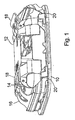
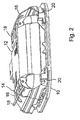
- FIGS 1 to 3 show a rain sensor for mounting on a windscreen (shown schematically in all of the figures as line 21) of a motor vehicle, for example.
- the rain sensor which can be fastened on the inner side of the windscreen 21 has a generally parallelepiped shaped housing part 12, which is adapted to house a sensor element such that the sensor element is arranged in the housing part 12.
- a generally flat rectangular mounting frame 10 is provided for attachment to the inner side of the windscreen 21 and defines a recess for accommodating the housing part 12.
- Two fastening devices are attached to the housing part 12 on each of its short sides so that the fastening devices generally oppose each other on the housing part 12.
- Each fastening device is provided with a lever 18, which is pivotally mounted about an axis extending along a short side of the housing part 12 and a resilient bracket 16, which has one of its ends pivotally connected to the lever 18 at an eccentric portion 14 of the lever 18 so that it is eccentric to the axis about which the lever 18 is pivotally mounted.
- the other end of the bracket 16 is formed as an engagement member, which has two projecting portions.
- the bracket 16 may be formed of any suitable resilient sheet material, for example spring steel.
- Two engagement portions 20 are provided on the mounting frame 10 and define recesses arranged generally at the corners of each of the short sides of the mounting frame 10.
- the engagement portions 20 on the mounting frame 10 correspond to the engagement members formed by the bracket 16 of each fastening device so that the engagement members of the fastening devices are adapted to cooperate with the engagement portions 20 of the mounting frame 10.
- Figure 1 shows on the left the final mounted state of the holding device and, for the holding device on the right-hand side, the pre-mounted state
- Figure 2 shows on the right the final mounted state and, for the holding device on the lefthand side, the pre-mounted state.
- the lever 18 is in a first pivotal position so that it is held away from the top surface of the housing part 12 (on the right hand side of Figure 1 and the left hand side of Figures 2 and 3 the lever 18 is shown as sticking up at an angle from the surface of the housing part 12 in the pre-mounted state).
- the final mounting of the sensor onto the windscreen 21 takes place by a simple pivotal movement of each lever 18 about its mounting axis defined in the housing part 12 so that each bracket 16 undergoes an eccentric movement about this axis and each lever 18 then lies flat against the top surface of the housing part 12 in a second pivotal position.
- each bracket 16 (the end that is pivotally connected to the lever 18) to move away from the windscreen 21 and each bracket to be tensioned, which urges the housing part 12 towards the windscreen 21.
- the engagement members of each fastening device provided at the other end of each bracket 16 are then brought into tension with the engagement portions 20 of the mounting frame 10. This means that the housing part 12 of the sensor is urged into cooperation with the holding frame 10, and thus towards the windscreen 21.
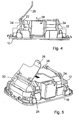
- FIGS 4 to 6 show a rain sensor in a second embodiment with a fastening device attached to each of the short sides of a generally parallelepiped shaped housing part.
- the housing part 12 is adapted to house a sensor element such that the sensor element is arranged in the housing part 12.
- a generally flat rectangular mounting frame 10 is provided for attachment to the inner side of a windscreen 21 and defines a recess for accommodating the housing part 12.
- Each fastening device provided on the housing part 12 is adapted to fasten the housing part 12 to the mounting frame 10 and comprises a rigid bracket 24 defining engagement arms at each end and having a generally straight, elongate centre portion intermediate the engagement arms defining an axis about which a lever 26 is pivotally mounted.
- each lever 26 is hinged at one end about the centre portion of one bracket 24.
- Each lever 26 has a generally flat, rectangular shape, but at the end of each lever 26 that is not hinged, there is a projecting portion that curves up slightly away from the housing part 12 to form a flange.
- both levers 26 are flat on the top surface of the housing part 12, when the sensor is in its mounted position, the levers 26 cover almost all of the top surface of the housing part and the projecting portions of each lever 26 are accommodated by a recess formed by the part of the other lever 26 that does not project.
- the flanges make it easier for a user to grip the levers 26 during mounting and removal of the sensor from the windscreen.
- a resilient eccentric cam 22 is attached to each lever 26 at the hinged end and is configured to exert a mounting force substantially parallel to the windscreen 21 when the sensor is mounted onto the windscreen.
- the end of each engagement arm of the brackets 24 is adapted to be accommodated in a recess defined by corresponding engagement portions of the mounting frame 10.
- the levers 26 are pushed downwards so that they are pivoted towards the top surface of the housing part 12 and lie flat on top of the housing part 12 in a second pivotal position. This pushes the engagement arms of the brackets 24 into the engagement portions of the mounting frame 10 so that there is a tension between the engagement arms and the engagement portions.
- the eccentric cams 22 are then pushed onto the top surface of the housing part 12 so that they abut the housing part and exert a force substantially parallel to the windscreen 21, which urges the housing part 12 towards the windscreen 21 and into cooperation with the mounting frame 10 so that the sensor is mounted on the windscreen 21.
- FIGS 7 to 9 show a rain sensor according to a third embodiment of the invention for fastening to the inner side of a motor vehicle windscreen 21.
- a sensor element is housed in a generally parallelepiped shaped housing part 12 so that the sensor element is arranged within the housing part 12.
- a generally flat rectangular mounting frame 10 is adapted to be attached to an inner side of the windscreen 21 and defines a recess for accommodating the housing part 12.
- the housing part 12 is provided with a fastening device that is adapted to fasten the housing part 12 onto the mounting frame 10.
- the fastening device has a resilient bracket 28, which is pre-assembled with the housing part 12 before the housing part 12 is brought into cooperation with the mounting frame 10.
- the bracket 28 has a flat main body adapted to contact a flat top wall of the housing part 12 (the side of the housing part 12 adapted to be furthest away from the windscreen 21 when the sensor is in its final mounted position on the windscreen 21) and side wings, which are each provided with an elongate slot 30 formed as a cutout in each of the side wings. Pins are provided on the long side faces of the housing part 12 such that each pin is adapted to loosely engage with a corresponding elongate slot when the housing part 12 and the bracket are pre-assembled. This allows the housing part 12 and the bracket 28 to be held together in their pre-assembled position.
- the bracket 28 also has engagement arms projecting downwardly of its flat top surface so that one engagement arm is arranged generally at each corner of the housing part 12 on its bottom surface opposite the top wall when the bracket 28 and the housing part 12 are pre-assembled.
- the mounting frame 10 has engagement portions arranged generally at each corner, which define recesses for receiving a corresponding engagement arm of the bracket 28.
- the housing part 12 which has been pre-assembled with the bracket 28, is seated on the mounting frame 10 in the recess provided for accommodating the mounting frame 10.
- the bracket 28 is urged against the housing part 12 by exerting a downward force (perpendicular to the surface of the windscreen 21) on the flat main body of the bracket 28 and the engagement arms of the bracket 28 are then inserted to the corresponding engagement portions of the mounting frame 10, so that the engagement arms cooperate with the engagement portions.
- This in turn causes the housing part to be urged towards the mounting frame 10, and thus towards the windscreen 21.
- the force on the bracket 28 is released. Since the bracket 28 is made of a resilient material, it is left resiliently deformed when the force on it is released. This resilient deformation of the bracket 28 leaves the housing part 12 urged towards the windscreen 21, which fastens the rain sensor in place on the windscreen 21.
Landscapes
- Engineering & Computer Science (AREA)
- Mechanical Engineering (AREA)
- Automation & Control Theory (AREA)
- Life Sciences & Earth Sciences (AREA)
- Environmental & Geological Engineering (AREA)
- Ecology (AREA)
- Atmospheric Sciences (AREA)
- Biodiversity & Conservation Biology (AREA)
- Hydrology & Water Resources (AREA)
- Environmental Sciences (AREA)
- Physics & Mathematics (AREA)
- General Life Sciences & Earth Sciences (AREA)
- General Physics & Mathematics (AREA)
- Geophysics (AREA)
- Investigating Or Analysing Materials By Optical Means (AREA)
- Clamps And Clips (AREA)
- Geophysics And Detection Of Objects (AREA)
Abstract
Description
- The invention relates to a rain sensor for fastening on an inner side of a windscreen of a motor vehicle with a holding frame for fastening on the inner side of the windscreen, a sensor element, a housing part in which the sensor element is arranged, and a holding device.
- Rain sensors are known which detect the presence of raindrops on the windscreen of a motor vehicle and therefore make possible an automatic activation of the windscreen wipers. Mounting on the windscreen constitutes a problem here, because no reflections must occur between the sensor element and the windscreen. A gap, and equally an adhesive layer, are therefore to be avoided on the optical path.
- It is known to stick a holding frame to the windscreen and to fasten the sensor element, which is incorporated into a housing part, to the holding frame by means of a holding device so that the housing part is pressed with the sensor element onto the windscreen. The holding device is constructed for example as a spring which engages over the housing part and has to be pressed under grooves. It is known in addition to push two laterally mounted springs under projecting pins. The springs must provide the engagement and apply the tension at the same time.
- The rain sensor according to the invention has a holding device in which the components can be optimized separately for the functions of engaging and bracing. A secure mounting is thereby achieved with low production costs.
- The present invention provides a rain sensor according to Claims 1, 4 and 7, which comprises a holding device for achieving this, in which the mounting takes place in two steps and therefore firstly the holding device, fastened to the housing part, is brought into engagement with the holding frame without force, and in a second final mounting step the housing part is pressed with the sensor element onto the windscreen. Additional advantageous aspects of the invention will be apparent from the dependent claims.
- Further advantages and characteristics of the invention ensue from the description below of the preferred embodiments, with reference to the accompanying drawings, in which:
- Figures 1 to 3 show a rain sensor according to a first embodiment of the invention;
- Figures 4 to 6 show a rain sensor according to a second embodiment of the invention; and
- Figures 7 to 9 show a rain sensor according to a third embodiment of the invention.
- Figures 1 to 3 show a rain sensor for mounting on a windscreen (shown schematically in all of the figures as line 21) of a motor vehicle, for example. The rain sensor, which can be fastened on the inner side of the
windscreen 21 has a generally parallelepipedshaped housing part 12, which is adapted to house a sensor element such that the sensor element is arranged in thehousing part 12. A generally flatrectangular mounting frame 10 is provided for attachment to the inner side of thewindscreen 21 and defines a recess for accommodating thehousing part 12. Two fastening devices are attached to thehousing part 12 on each of its short sides so that the fastening devices generally oppose each other on thehousing part 12. Each fastening device is provided with alever 18, which is pivotally mounted about an axis extending along a short side of thehousing part 12 and aresilient bracket 16, which has one of its ends pivotally connected to thelever 18 at aneccentric portion 14 of thelever 18 so that it is eccentric to the axis about which thelever 18 is pivotally mounted. The other end of thebracket 16 is formed as an engagement member, which has two projecting portions. Thebracket 16 may be formed of any suitable resilient sheet material, for example spring steel. Twoengagement portions 20 are provided on the mountingframe 10 and define recesses arranged generally at the corners of each of the short sides of themounting frame 10. Theengagement portions 20 on themounting frame 10 correspond to the engagement members formed by thebracket 16 of each fastening device so that the engagement members of the fastening devices are adapted to cooperate with theengagement portions 20 of themounting frame 10. - Figure 1 shows on the left the final mounted state of the holding device and, for the holding device on the right-hand side, the pre-mounted state, whilst Figure 2 shows on the right the final mounted state and, for the holding device on the lefthand side, the pre-mounted state. During pre-mounting, no tension occurs between the engagement members of the bracket 16 (fastening device) and the
engagement portions 20 of theholding frame 10 so that the engagement members of thebracket 16 and theengagement portions 20 of the holding frame are only loosely engaged with each other. Thelever 18 is in a first pivotal position so that it is held away from the top surface of the housing part 12 (on the right hand side of Figure 1 and the left hand side of Figures 2 and 3 thelever 18 is shown as sticking up at an angle from the surface of thehousing part 12 in the pre-mounted state). The final mounting of the sensor onto thewindscreen 21 takes place by a simple pivotal movement of eachlever 18 about its mounting axis defined in thehousing part 12 so that eachbracket 16 undergoes an eccentric movement about this axis and eachlever 18 then lies flat against the top surface of thehousing part 12 in a second pivotal position. This causes the first end of each bracket 16 (the end that is pivotally connected to the lever 18) to move away from thewindscreen 21 and each bracket to be tensioned, which urges thehousing part 12 towards thewindscreen 21. The engagement members of each fastening device provided at the other end of eachbracket 16 are then brought into tension with theengagement portions 20 of themounting frame 10. This means that thehousing part 12 of the sensor is urged into cooperation with theholding frame 10, and thus towards thewindscreen 21. - Figures 4 to 6 show a rain sensor in a second embodiment with a fastening device attached to each of the short sides of a generally parallelepiped shaped housing part. The
housing part 12 is adapted to house a sensor element such that the sensor element is arranged in thehousing part 12. A generally flatrectangular mounting frame 10 is provided for attachment to the inner side of awindscreen 21 and defines a recess for accommodating thehousing part 12. Each fastening device provided on thehousing part 12 is adapted to fasten thehousing part 12 to themounting frame 10 and comprises arigid bracket 24 defining engagement arms at each end and having a generally straight, elongate centre portion intermediate the engagement arms defining an axis about which alever 26 is pivotally mounted. In this embodiment, eachlever 26 is hinged at one end about the centre portion of onebracket 24. Eachlever 26 has a generally flat, rectangular shape, but at the end of eachlever 26 that is not hinged, there is a projecting portion that curves up slightly away from thehousing part 12 to form a flange. When bothlevers 26 are flat on the top surface of thehousing part 12, when the sensor is in its mounted position, thelevers 26 cover almost all of the top surface of the housing part and the projecting portions of eachlever 26 are accommodated by a recess formed by the part of theother lever 26 that does not project. The flanges make it easier for a user to grip thelevers 26 during mounting and removal of the sensor from the windscreen. A resilienteccentric cam 22 is attached to eachlever 26 at the hinged end and is configured to exert a mounting force substantially parallel to thewindscreen 21 when the sensor is mounted onto the windscreen. The end of each engagement arm of thebrackets 24 is adapted to be accommodated in a recess defined by corresponding engagement portions of themounting frame 10. - In Figures 4 and 5, the pre-mounted state is shown on the left and respectively the final mounted state is shown on the right. Here, also, the final mounting takes place by a simple pivotal movement of the
levers 26 about the brackets, in a similar way as described in the previous embodiment, with a force being exerted primarily parallel to the windscreen. In the pre-mounted state, the planes of thelevers 26 are arranged at an angle to the top surface of thehousing part 12, in a first pivotal position and the engagement arms at the ends of eachbracket 24 are only loosely accommodated in the corresponding engagement portions of themounting frame 10. To mount the sensor on thewindscreen 21 so that the sensor is in its mounted configuration shown in Figure 6, thelevers 26 are pushed downwards so that they are pivoted towards the top surface of thehousing part 12 and lie flat on top of thehousing part 12 in a second pivotal position. This pushes the engagement arms of thebrackets 24 into the engagement portions of the mountingframe 10 so that there is a tension between the engagement arms and the engagement portions. Theeccentric cams 22 are then pushed onto the top surface of thehousing part 12 so that they abut the housing part and exert a force substantially parallel to thewindscreen 21, which urges thehousing part 12 towards thewindscreen 21 and into cooperation with themounting frame 10 so that the sensor is mounted on thewindscreen 21. - Figures 7 to 9 show a rain sensor according to a third embodiment of the invention for fastening to the inner side of a
motor vehicle windscreen 21. A sensor element is housed in a generally parallelepipedshaped housing part 12 so that the sensor element is arranged within thehousing part 12. A generally flatrectangular mounting frame 10 is adapted to be attached to an inner side of thewindscreen 21 and defines a recess for accommodating thehousing part 12. Thehousing part 12 is provided with a fastening device that is adapted to fasten thehousing part 12 onto themounting frame 10. The fastening device has aresilient bracket 28, which is pre-assembled with thehousing part 12 before thehousing part 12 is brought into cooperation with themounting frame 10. Thebracket 28 has a flat main body adapted to contact a flat top wall of the housing part 12 (the side of thehousing part 12 adapted to be furthest away from thewindscreen 21 when the sensor is in its final mounted position on the windscreen 21) and side wings, which are each provided with anelongate slot 30 formed as a cutout in each of the side wings. Pins are provided on the long side faces of thehousing part 12 such that each pin is adapted to loosely engage with a corresponding elongate slot when thehousing part 12 and the bracket are pre-assembled. This allows thehousing part 12 and thebracket 28 to be held together in their pre-assembled position. Thebracket 28 also has engagement arms projecting downwardly of its flat top surface so that one engagement arm is arranged generally at each corner of thehousing part 12 on its bottom surface opposite the top wall when thebracket 28 and thehousing part 12 are pre-assembled. The mountingframe 10 has engagement portions arranged generally at each corner, which define recesses for receiving a corresponding engagement arm of thebracket 28. - For mounting the rain sensor to the
windscreen 21, thehousing part 12, which has been pre-assembled with thebracket 28, is seated on themounting frame 10 in the recess provided for accommodating themounting frame 10. Thebracket 28 is urged against thehousing part 12 by exerting a downward force (perpendicular to the surface of the windscreen 21) on the flat main body of thebracket 28 and the engagement arms of thebracket 28 are then inserted to the corresponding engagement portions of themounting frame 10, so that the engagement arms cooperate with the engagement portions. This in turn causes the housing part to be urged towards themounting frame 10, and thus towards thewindscreen 21. Then the force on thebracket 28 is released. Since thebracket 28 is made of a resilient material, it is left resiliently deformed when the force on it is released. This resilient deformation of thebracket 28 leaves thehousing part 12 urged towards thewindscreen 21, which fastens the rain sensor in place on thewindscreen 21.
Claims (8)
- A rain sensor for fastening on an inner side of a windscreen (21) of a motor vehicle, comprising:- a sensor;- a housing part (12) for housing the sensor such that the sensor element is arranged in the housing part (12);- a mounting frame (10) for attachment to the inner side of the windscreen (21) and having an accommodation for said housing part (12);- at least one fastening device for fastening the housing part (12) on said mounting frame (10);said fastening device comprising:a lever (18) pivotally mounted about an axis on the housing part (12),and a bracket (16) that has a first end pivotally connected to said lever (18) in eccentric relation to said axis and a second end formed as an engagement member for engagement with cooperating engagement members on said mounting frame (10); wherein:in a pre-mounted state the engagement members of the bracket (16) and of the mounting frame (10) are loosely engaged with each other while the lever (18) is in a first pivotal position and, and in a final mounted state, the lever (18) is in a second pivotal position thereby moving away the first end of the bracket (16) from the windscreen (21) and tensioning said bracket (16) so as to urge the housing part (12) towards the windscreen (21).
- The rain sensor according to Claim 1, wherein the bracket (16) is made from a resilient sheet material such as spring steel.
- The rain sensor according to Claim 1 or claim 2, wherein the housing part (12) is generally of a parallelepiped shape and has a fastening device on each of its short sides.
- A rain sensor for fastening on an inner side of a windscreen (21) of a motor vehicle, comprising:- a sensor;- a housing part (12) for housing the sensor such that the sensor element is arranged in the housing part (12);- a mounting frame (10) for attachment to the inner side of the windscreen (21) and having an accommodation for said housing part (12);- at least one fastening device for fastening the housing part (12) on said mounting frame (10);said fastening device comprising:a bracket (24) with a pair of engagement arms for engagement with cooperating engagement members on the mounting frame (10);a lever (26) pivotally mounted on said bracket (24) intermediate the engagement arms;and an eccentric cam (22) attached to said lever; wherein:in a pre-mounted state the engagement arms of the bracket (24) are loosely engaged with the engagement members of the mounting frame (10) while the lever is in a first pivotal position and, and in a final mounted state, the lever (26) is in a second pivotal position thereby in which the eccentric cam (22) abuts the housing part (12) so as to urge the housing part (12) towards the windscreen (21).
- The rain sensor according to Claim 4, wherein the bracket (24) is rigid and the cam (22) is resilient.
- The rain sensor according to Claim 4 or claim 5, wherein the housing part (12) is generally of a parallelepiped shape and has a fastening device on each of its short sides.
- A rain sensor for fastening on an inner side of a windscreen (21) of a motor vehicle, comprising:- a sensor;- a housing part (12) for housing the sensor such that the sensor element is arranged in the housing part (12);- a mounting frame (10) for attachment to the inner side of the windscreen (21) and having an accommodation for said housing part (12);- a fastening device for fastening the housing part (12) on said mounting frame (10);said fastening device comprising:a resilient bracket (28) with a flat main body and a plurality of engagement arms for engagement with cooperating engagement members on the mounting frame (10); wherein:in a first mounting step the bracket (28) is pre-assembled with the housing part (12) so that the main body of the bracket (28) contacts a flat top wall of the housing part, in a second mounting step the housing part (12) is seated on the mounting frame (10) and in third mounting step the engagement arms are engaged with the cooperating engagement members of the mounting frame (10) while the bracket (28) is urged against the housing part (12) and in a final mounting step the bracket (28) is released thereby leaving the housing part (12) urged towards the windscreen (21) by resilient deformation of the bracket (28).
- The rain sensor according to Claim 7, wherein the bracket (28) has side wings each with an elongate slot (30) in which a pin (32) on a side wall of the housing part (12) engages loosely in the preassembled condition of the housing part (12) and the bracket (28).
Applications Claiming Priority (1)
| Application Number | Priority Date | Filing Date | Title |
|---|---|---|---|
| DE202006017362U DE202006017362U1 (en) | 2006-11-13 | 2006-11-13 | rain sensor |
Publications (2)
| Publication Number | Publication Date |
|---|---|
| EP1920980A1 true EP1920980A1 (en) | 2008-05-14 |
| EP1920980B1 EP1920980B1 (en) | 2010-05-26 |
Family
ID=39052745
Family Applications (1)
| Application Number | Title | Priority Date | Filing Date |
|---|---|---|---|
| EP07021899A Not-in-force EP1920980B1 (en) | 2006-11-13 | 2007-11-12 | Rain sensor |
Country Status (8)
| Country | Link |
|---|---|
| US (1) | US7911356B2 (en) |
| EP (1) | EP1920980B1 (en) |
| JP (1) | JP4574662B2 (en) |
| KR (1) | KR100915930B1 (en) |
| CN (1) | CN101221054B (en) |
| BR (1) | BRPI0704402B1 (en) |
| DE (2) | DE202006017362U1 (en) |
| MX (1) | MX2007014210A (en) |
Families Citing this family (32)
| Publication number | Priority date | Publication date | Assignee | Title |
|---|---|---|---|---|
| US6326613B1 (en) | 1998-01-07 | 2001-12-04 | Donnelly Corporation | Vehicle interior mirror assembly adapted for containing a rain sensor |
| US6124886A (en) | 1997-08-25 | 2000-09-26 | Donnelly Corporation | Modular rearview mirror assembly |
| US6278377B1 (en) | 1999-08-25 | 2001-08-21 | Donnelly Corporation | Indicator for vehicle accessory |
| US6445287B1 (en) | 2000-02-28 | 2002-09-03 | Donnelly Corporation | Tire inflation assistance monitoring system |
| US8288711B2 (en) | 1998-01-07 | 2012-10-16 | Donnelly Corporation | Interior rearview mirror system with forwardly-viewing camera and a control |
| US6420975B1 (en) | 1999-08-25 | 2002-07-16 | Donnelly Corporation | Interior rearview mirror sound processing system |
| WO2001064481A2 (en) | 2000-03-02 | 2001-09-07 | Donnelly Corporation | Video mirror systems incorporating an accessory module |
| US7480149B2 (en) | 2004-08-18 | 2009-01-20 | Donnelly Corporation | Accessory module for vehicle |
| US6396408B2 (en) | 2000-03-31 | 2002-05-28 | Donnelly Corporation | Digital electrochromic circuit with a vehicle network |
| WO2003065084A1 (en) | 2002-01-31 | 2003-08-07 | Donnelly Corporation | Vehicle accessory module |
| US6901072B1 (en) * | 2003-05-15 | 2005-05-31 | Foundry Networks, Inc. | System and method for high speed packet transmission implementing dual transmit and receive pipelines |
| US8256821B2 (en) | 2004-12-15 | 2012-09-04 | Magna Donnelly Engineering Gmbh | Accessory module system for a vehicle window |
| DE102007042694A1 (en) * | 2007-09-07 | 2009-03-12 | Magna Electronics Europe Gmbh & Co.Kg | sensor module |
| DE202008003168U1 (en) * | 2008-03-06 | 2008-06-26 | Trw Automotive Electronics & Components Gmbh | Sensor with holder |
| DE102008028979A1 (en) * | 2008-06-18 | 2009-12-24 | Leopold Kostal Gmbh & Co. Kg | Sensor arrangement for vehicle, has holding frame fastened on vehicle windowpane, sensor housing attached on holding frame, and clamping yoke, which has base area and detent bracket angled from clamping yoke |
| DE102008028978B4 (en) * | 2008-06-18 | 2019-11-14 | Leopold Kostal Gmbh & Co. Kg | Sensor arrangement for a motor vehicle |
| DE102008044840A1 (en) * | 2008-08-28 | 2010-03-04 | Leopold Kostal Gmbh & Co. Kg | Sensor arrangement for a motor vehicle |
| DE102008044839A1 (en) | 2008-08-28 | 2010-03-04 | Leopold Kostal Gmbh & Co. Kg | Sensor arrangement for a motor vehicle |
| US8570374B2 (en) | 2008-11-13 | 2013-10-29 | Magna Electronics Inc. | Camera for vehicle |
| DE102009011613A1 (en) * | 2009-03-04 | 2010-09-09 | Leopold Kostal Gmbh & Co. Kg | Sensor assembly, at a motor vehicle windscreen, has an eccentric between the housing and flat spring to tense it for installation of the housing |
| DE102010010571A1 (en) * | 2010-03-05 | 2011-09-08 | Conti Temic Microelectronic Gmbh | Fastening device for sensor housing in a motor vehicle interior |
| US8339453B2 (en) | 2010-07-14 | 2012-12-25 | Trw Automotive U.S. Llc | Apparatus for use in association with a vehicle |
| CN101941415B (en) * | 2010-08-12 | 2012-03-07 | 上海英恒电子有限公司 | Rainfall sensor and control method |
| DE102011107353B4 (en) | 2011-07-14 | 2022-03-24 | HELLA GmbH & Co. KGaA | Holding device for a disk sensor |
| DE102011108594A1 (en) * | 2011-07-26 | 2013-01-31 | Daimler Ag | Fastening arrangement of a sensor element on a fastening element of a motor vehicle |
| SE536227C2 (en) * | 2011-11-09 | 2013-07-09 | Scania Cv Ab | Detector mounting device |
| KR101298231B1 (en) * | 2012-05-22 | 2013-08-22 | 주식회사 원진일렉트로닉스 | Coupling structure of defog sensor and case for cars |
| JP2015152489A (en) * | 2014-02-17 | 2015-08-24 | 株式会社デンソー | Glass surface mounting sensor device |
| JP6172174B2 (en) * | 2015-02-06 | 2017-08-02 | トヨタ自動車株式会社 | Vehicle front information acquisition device |
| KR101745203B1 (en) * | 2015-12-11 | 2017-06-08 | 현대자동차주식회사 | mount structure for sensor device on the glass |
| WO2017218376A1 (en) | 2016-06-15 | 2017-12-21 | Laitram, L.L.C. | Wet case detector in a conveyor belt |
| EP3279043B1 (en) * | 2016-08-05 | 2018-12-05 | MEAS France | Sensor mounting system |
Citations (2)
| Publication number | Priority date | Publication date | Assignee | Title |
|---|---|---|---|---|
| EP1486388A2 (en) * | 2003-06-14 | 2004-12-15 | Hella KGaA Hueck & Co. | Optoelectronic sensor device |
| DE29924838U1 (en) | 1999-07-17 | 2006-01-12 | Robert Bosch Gmbh | Sensor for optically detecting foreign bodies especially raindrops on a window |
Family Cites Families (22)
| Publication number | Priority date | Publication date | Assignee | Title |
|---|---|---|---|---|
| US3900795A (en) * | 1973-08-15 | 1975-08-19 | Honeywell Inc | Installation and test tool for ionization smoke detector |
| US4871917A (en) * | 1988-04-19 | 1989-10-03 | Donnelly Corporation | Vehicular moisture sensor and mounting apparatus therefor |
| JPH0524071Y2 (en) * | 1988-08-11 | 1993-06-18 | ||
| DE4329608C1 (en) * | 1993-09-02 | 1995-01-19 | Kostal Leopold Gmbh & Co Kg | Optoelectronic sensor device |
| DE4410217C2 (en) | 1994-03-24 | 2003-12-11 | Bosch Gmbh Robert | Attachment and coupling of an opto-electronic sensor to a pane and construction of the sensor |
| US5894619A (en) * | 1997-04-25 | 1999-04-20 | Hougland; D. Wayne | Apparatus for cleaning dentures |
| DE19804165A1 (en) * | 1997-08-19 | 1999-02-25 | Itt Mfg Enterprises Inc | Coupling of sensor to wall e.g. rainwater sensor to windscreen |
| EP1027204B1 (en) | 1997-08-19 | 2003-09-24 | Valeo Wischersysteme GmbH | Sensor joined to a glass pane with a silicon gel |
| EP0986494B1 (en) * | 1998-03-17 | 2005-06-01 | Robert Bosch Gmbh | Optical sensor |
| JPH11326185A (en) * | 1998-05-12 | 1999-11-26 | Nippon Sheet Glass Co Ltd | Liquid drop detection apparatus |
| DE19933641A1 (en) * | 1999-07-17 | 2001-03-08 | Bosch Gmbh Robert | Sensor device for detecting wetting on a pane |
| JP3536738B2 (en) * | 1999-08-27 | 2004-06-14 | 株式会社デンソー | Raindrop sensor |
| JP4103273B2 (en) * | 1999-11-16 | 2008-06-18 | 株式会社デンソー | Raindrop detector |
| DE10129038A1 (en) * | 2001-06-15 | 2002-12-19 | Bosch Gmbh Robert | Rain sensor for cars, has electrostatic protective screen |
| GB2379122B (en) * | 2001-08-29 | 2003-07-16 | Pama & Co Ltd | Improvements in and relating to mobile phone support apparatus |
| DE10224692B4 (en) * | 2002-06-04 | 2008-06-26 | Leopold Kostal Gmbh & Co. Kg | Optoelectronic sensor device |
| JP2007537910A (en) * | 2004-03-26 | 2007-12-27 | プレー・ゲゼルシャフト・ミト・ベシュレンクテル・ハフツング | Holding frame for sensor support |
| JP4241561B2 (en) | 2004-09-28 | 2009-03-18 | 株式会社デンソー | Raindrop detector |
| US20060113397A1 (en) * | 2004-11-18 | 2006-06-01 | Checkpoint Systems, Inc. | Pallet tag/label carrier |
| DE102005015973B4 (en) * | 2005-04-07 | 2023-09-14 | Kostal Automobil Elektrik Gmbh & Co. Kg | Fastening device for at least one sensor on a vehicle window |
| DE102005018379A1 (en) * | 2005-04-21 | 2006-10-26 | Leopold Kostal Gmbh & Co. Kg | Optoelectronic sensor device, for detecting wetting of transparent motor vehicle panel, has construction element between coupling element and circuit board with holding elements for holding and positioning second circuit board near screen |
| JP4645909B2 (en) * | 2006-03-23 | 2011-03-09 | 株式会社デンソー | Raindrop detector |
-
2006
- 2006-11-13 DE DE202006017362U patent/DE202006017362U1/en not_active Expired - Lifetime
-
2007
- 2007-11-12 EP EP07021899A patent/EP1920980B1/en not_active Not-in-force
- 2007-11-12 DE DE602007006739T patent/DE602007006739D1/en active Active
- 2007-11-12 KR KR1020070115002A patent/KR100915930B1/en not_active Expired - Fee Related
- 2007-11-13 BR BRPI0704402-0A patent/BRPI0704402B1/en not_active IP Right Cessation
- 2007-11-13 MX MX2007014210A patent/MX2007014210A/en active IP Right Grant
- 2007-11-13 JP JP2007293995A patent/JP4574662B2/en not_active Expired - Fee Related
- 2007-11-13 CN CN2007101646783A patent/CN101221054B/en not_active Expired - Fee Related
- 2007-11-13 US US11/985,004 patent/US7911356B2/en not_active Expired - Fee Related
Patent Citations (2)
| Publication number | Priority date | Publication date | Assignee | Title |
|---|---|---|---|---|
| DE29924838U1 (en) | 1999-07-17 | 2006-01-12 | Robert Bosch Gmbh | Sensor for optically detecting foreign bodies especially raindrops on a window |
| EP1486388A2 (en) * | 2003-06-14 | 2004-12-15 | Hella KGaA Hueck & Co. | Optoelectronic sensor device |
Also Published As
| Publication number | Publication date |
|---|---|
| EP1920980B1 (en) | 2010-05-26 |
| US20080117074A1 (en) | 2008-05-22 |
| KR20080043252A (en) | 2008-05-16 |
| CN101221054A (en) | 2008-07-16 |
| BRPI0704402B1 (en) | 2019-04-16 |
| CN101221054B (en) | 2010-11-17 |
| US7911356B2 (en) | 2011-03-22 |
| JP2008151769A (en) | 2008-07-03 |
| BRPI0704402A (en) | 2008-07-01 |
| DE202006017362U1 (en) | 2008-03-20 |
| DE602007006739D1 (en) | 2010-07-08 |
| MX2007014210A (en) | 2009-02-17 |
| JP4574662B2 (en) | 2010-11-04 |
| KR100915930B1 (en) | 2009-09-07 |
Similar Documents
| Publication | Publication Date | Title |
|---|---|---|
| EP1920980B1 (en) | Rain sensor | |
| US8448914B2 (en) | Sensor arrangement for a vehicle window | |
| US8192095B2 (en) | Sensor assembly for a vehicle windshield | |
| US8959701B2 (en) | Multi-adapter for a vehicle wiper | |
| US8763970B2 (en) | Holding clip for a rain sensor | |
| CN101500860B (en) | Device for snap-fastening an airbag unit in an assembly of a motor vehicle, especially in a steering wheel | |
| WO2013141000A1 (en) | On-board camera | |
| JP4903235B2 (en) | Assembly with mount and sensor | |
| US10077024B2 (en) | Wiper blade device | |
| JP2013525173A (en) | Windshield wiper device | |
| US8907235B2 (en) | Horn contact arrangement in cooperation with an airbag module | |
| KR101290401B1 (en) | Adjustable steering column for a motor vehicle | |
| JP6171961B2 (en) | Electronic equipment | |
| US12573569B2 (en) | Vehicle door switch actuating apparatus with a large actuating surface | |
| EP3953198B1 (en) | Sensor unit for vehicles | |
| CN110450729B (en) | Holder for fixing a housing comprising a camera | |
| US11702041B2 (en) | Wiper blade, in particular for a motor vehicle | |
| KR101654022B1 (en) | A actuator for vechicle comprising a cover and a fixing structure of the cover | |
| JP4450642B2 (en) | Wiper arm | |
| EP1979718A2 (en) | Detection device and seat comprising such a device | |
| CN112128369B (en) | Parking mechanism | |
| JP5363279B2 (en) | Wiper arm and manufacturing method thereof | |
| CN113784862B (en) | Fastening device for fastening a module to a vehicle component of a motor vehicle | |
| KR200149250Y1 (en) | Wiper for a car | |
| CN120039218A (en) | Wiper arm |
Legal Events
| Date | Code | Title | Description |
|---|---|---|---|
| PUAI | Public reference made under article 153(3) epc to a published international application that has entered the european phase |
Free format text: ORIGINAL CODE: 0009012 |
|
| AK | Designated contracting states |
Kind code of ref document: A1 Designated state(s): AT BE BG CH CY CZ DE DK EE ES FI FR GB GR HU IE IS IT LI LT LU LV MC MT NL PL PT RO SE SI SK TR |
|
| AX | Request for extension of the european patent |
Extension state: AL BA HR MK RS |
|
| 17P | Request for examination filed |
Effective date: 20080915 |
|
| 17Q | First examination report despatched |
Effective date: 20081023 |
|
| AKX | Designation fees paid |
Designated state(s): CZ DE FR GB IT |
|
| GRAP | Despatch of communication of intention to grant a patent |
Free format text: ORIGINAL CODE: EPIDOSNIGR1 |
|
| GRAS | Grant fee paid |
Free format text: ORIGINAL CODE: EPIDOSNIGR3 |
|
| GRAA | (expected) grant |
Free format text: ORIGINAL CODE: 0009210 |
|
| AK | Designated contracting states |
Kind code of ref document: B1 Designated state(s): CZ DE FR GB IT |
|
| REG | Reference to a national code |
Ref country code: GB Ref legal event code: FG4D |
|
| REF | Corresponds to: |
Ref document number: 602007006739 Country of ref document: DE Date of ref document: 20100708 Kind code of ref document: P |
|
| PGFP | Annual fee paid to national office [announced via postgrant information from national office to epo] |
Ref country code: CZ Payment date: 20101027 Year of fee payment: 4 |
|
| PLBE | No opposition filed within time limit |
Free format text: ORIGINAL CODE: 0009261 |
|
| STAA | Information on the status of an ep patent application or granted ep patent |
Free format text: STATUS: NO OPPOSITION FILED WITHIN TIME LIMIT |
|
| 26N | No opposition filed |
Effective date: 20110301 |
|
| REG | Reference to a national code |
Ref country code: DE Ref legal event code: R097 Ref document number: 602007006739 Country of ref document: DE Effective date: 20110228 |
|
| REG | Reference to a national code |
Ref country code: FR Ref legal event code: ST Effective date: 20110801 |
|
| PG25 | Lapsed in a contracting state [announced via postgrant information from national office to epo] |
Ref country code: FR Free format text: LAPSE BECAUSE OF NON-PAYMENT OF DUE FEES Effective date: 20101130 |
|
| PG25 | Lapsed in a contracting state [announced via postgrant information from national office to epo] |
Ref country code: IT Free format text: LAPSE BECAUSE OF NON-PAYMENT OF DUE FEES Effective date: 20101112 |
|
| PGFP | Annual fee paid to national office [announced via postgrant information from national office to epo] |
Ref country code: IT Payment date: 20101130 Year of fee payment: 4 |
|
| GBPC | Gb: european patent ceased through non-payment of renewal fee |
Effective date: 20111112 |
|
| PG25 | Lapsed in a contracting state [announced via postgrant information from national office to epo] |
Ref country code: CZ Free format text: LAPSE BECAUSE OF NON-PAYMENT OF DUE FEES Effective date: 20111112 |
|
| PG25 | Lapsed in a contracting state [announced via postgrant information from national office to epo] |
Ref country code: IT Free format text: LAPSE BECAUSE OF NON-PAYMENT OF DUE FEES Effective date: 20111112 |
|
| PG25 | Lapsed in a contracting state [announced via postgrant information from national office to epo] |
Ref country code: GB Free format text: LAPSE BECAUSE OF NON-PAYMENT OF DUE FEES Effective date: 20111112 |
|
| REG | Reference to a national code |
Ref country code: DE Ref legal event code: R082 Ref document number: 602007006739 Country of ref document: DE Representative=s name: PRINZ & PARTNER MBB PATENTANWAELTE RECHTSANWAE, DE Ref country code: DE Ref legal event code: R081 Ref document number: 602007006739 Country of ref document: DE Owner name: BCS AUTOMOTIVE INTERFACE SOLUTIONS GMBH, DE Free format text: FORMER OWNER: TRW AUTOMOTIVE ELECTRONICS & COMPONENTS GMBH, 78315 RADOLFZELL, DE |
|
| PGFP | Annual fee paid to national office [announced via postgrant information from national office to epo] |
Ref country code: DE Payment date: 20191126 Year of fee payment: 13 |
|
| REG | Reference to a national code |
Ref country code: DE Ref legal event code: R119 Ref document number: 602007006739 Country of ref document: DE |
|
| PG25 | Lapsed in a contracting state [announced via postgrant information from national office to epo] |
Ref country code: DE Free format text: LAPSE BECAUSE OF NON-PAYMENT OF DUE FEES Effective date: 20210601 |