EP1920385B1 - Videoerfassung und bildsequenz-stitching - Google Patents
Videoerfassung und bildsequenz-stitching Download PDFInfo
- Publication number
- EP1920385B1 EP1920385B1 EP06800843.2A EP06800843A EP1920385B1 EP 1920385 B1 EP1920385 B1 EP 1920385B1 EP 06800843 A EP06800843 A EP 06800843A EP 1920385 B1 EP1920385 B1 EP 1920385B1
- Authority
- EP
- European Patent Office
- Prior art keywords
- image
- keyframe
- images
- mosaic
- frames
- Prior art date
- Legal status (The legal status is an assumption and is not a legal conclusion. Google has not performed a legal analysis and makes no representation as to the accuracy of the status listed.)
- Expired - Lifetime
Links
Images




Classifications
-
- G—PHYSICS
- G06—COMPUTING OR CALCULATING; COUNTING
- G06T—IMAGE DATA PROCESSING OR GENERATION, IN GENERAL
- G06T3/00—Geometric image transformations in the plane of the image
- G06T3/40—Scaling of whole images or parts thereof, e.g. expanding or contracting
- G06T3/4038—Image mosaicing, e.g. composing plane images from plane sub-images
-
- G—PHYSICS
- G06—COMPUTING OR CALCULATING; COUNTING
- G06F—ELECTRIC DIGITAL DATA PROCESSING
- G06F16/00—Information retrieval; Database structures therefor; File system structures therefor
- G06F16/70—Information retrieval; Database structures therefor; File system structures therefor of video data
- G06F16/73—Querying
- G06F16/738—Presentation of query results
- G06F16/739—Presentation of query results in form of a video summary, e.g. the video summary being a video sequence, a composite still image or having synthesized frames
-
- G—PHYSICS
- G06—COMPUTING OR CALCULATING; COUNTING
- G06V—IMAGE OR VIDEO RECOGNITION OR UNDERSTANDING
- G06V10/00—Arrangements for image or video recognition or understanding
- G06V10/20—Image preprocessing
- G06V10/24—Aligning, centring, orientation detection or correction of the image
-
- H—ELECTRICITY
- H04—ELECTRIC COMMUNICATION TECHNIQUE
- H04N—PICTORIAL COMMUNICATION, e.g. TELEVISION
- H04N23/00—Cameras or camera modules comprising electronic image sensors; Control thereof
- H04N23/60—Control of cameras or camera modules
- H04N23/698—Control of cameras or camera modules for achieving an enlarged field of view, e.g. panoramic image capture
-
- G—PHYSICS
- G06—COMPUTING OR CALCULATING; COUNTING
- G06V—IMAGE OR VIDEO RECOGNITION OR UNDERSTANDING
- G06V10/00—Arrangements for image or video recognition or understanding
- G06V10/10—Image acquisition
- G06V10/16—Image acquisition using multiple overlapping images; Image stitching
Definitions
- the invention is related to construction of mosaiced panoramic images, and in particular, to a technique for building a "match" structure of image correspondences which is optimized to align the images for "registering" large numbers of images into an underlying panoramic representation having static and/or dynamic components.
- a mosaic panoramic image is an image that has been expanded in one or more dimensions by combining multiple overlapping image frames to generate the panorama.
- the panoramic image is typically larger than the size that a conventional image capture device (such as a digital still or video camera) is capable of capturing in a single image frame.
- panoramic images A number of conventional techniques have been developed to generate such panoramic images. For example, the basic approach is to simply take a plurality of regular photographic or video images in order to cover the entirety of the desired viewing space. These images are then aligned and composited into complete panoramic images using any of a number of conventional image "mosaicing” or “stitching” algorithms.
- one conventional mosaicing scheme has demonstrated how panoramas contained in a set of unordered images can be automatically identified and stitched.
- These techniques allow a user to take a number of images with a still camera, identify clusters of images which came from the same panorama, and then stitch each cluster into a panorama. For example, one such scheme first compares "point features" within pairs of images to generate a mesh of matches. A connected component approach is used to identify separate panoramas. Images in each cluster are then aligned by minimizing measurement errors. Lastly, images in each cluster are warped onto a compositing surface and blended to generate the output panorama.
- one conventional scheme for generating mosaic images from video sequences uses an affine motion model for an image resolution enhancement application as a function of received video frames.
- Another conventional video mosaicing scheme uses an eight parameter perspective transformation model.
- Yet another conventional video mosaicing scheme uses a "manifold projection" approach in combination with a simple translation only camera motion model. This approach results in a fast algorithm for video stitching in which narrow strips of pixels from the underlying scene are used to form a composite panoramic image.
- the use of a translation only camera model avoids the necessity of computing more complex 3D camera motions as do a number of conventional mosaicing schemes.
- a similar interleaved matching strategy was employed by another conventional mosaicing scheme which generates image structure from motion analysis.
- a strategy for frame "decimation” is presented for the extraction of structure and motion from hand held video sequences. This strategy identifies "unnecessary" frames for removal from subsequent computation by using a sharpness measure to order frames for consideration for removal as a function of a global motion model. A threshold based on a motion correlation coefficient is then employed.
- This strategy is employed as a preprocessing step within a larger system for structure from motion in which a tree of trifocal tensors is used.
- one problem with such schemes is that data is lost whenever "unnecessary" image frames are discarded.
- Another conventional video mosaicing scheme generally operates by interleaving image matching and orientation estimation steps by making the assumption that temporally adjacent images are spatially adjacent. This scheme also makes the assumption that any loops in the camera path are small enough that accumulated error, or drift, can be ignored. However, such assumptions can be considered overly restrictive in that they constrain the ability of users to capture video recordings. Further, this scheme does not directly handle breaks in the matching, as would occur with multiple videos of the same panorama. In addition, such interleaving of the matching and alignment requires that the images be aligned in the same order as the video.
- At least one conventional video mosaicing scheme partially addresses some of these issues.
- one conventional scheme referred to as "VideoBrushTM”
- VideoBrushTM provides a near-real-time preview of a panoramic image constructed from images captured by a video camera.
- the VideoBrushTM system provides techniques for 1D and 2D video mosaicing using parametric alignment which includes videos captured with an approximately fixed camera location, or an arbitrarily moving camera capturing an approximately planar scene.
- users are constrained in how they capture videos for use by this conventional technique.
- Another problem with many conventional mosaicing schemes is that they operate using post-hoc processing of recorded images after the entire set of images has been captured. As a result, one problem is that the user never really knows for sure that sufficient coverage of the scene has been achieved to ensure that the desired panorama can be constructed from the set of captured image frames until the panorama has actually been generated at some later time. As a consequence it can be hard for users to see "the big picture.”
- the U.S. patent 6,459,821 B1 discloses a method and apparatus for aligning more than two overlapping image fragments to an image.
- a list of overlapping image fragment pairs is constructed.
- the alignment of each pair of fragments is refined in turn. While individual pairs of fragments are being aligned, a total alignment error for all the pairs is monitored. New pair wise alignments that would increase total error are rejected. When the total alignment error ceases to improve, the refinement process of the respective pair of fragments terminates, thus ensuring that improvements in the alignment of one pair of image fragments do not come to the expense of the alignment of another pair of fragments.
- a "Keyframe Stitcher” provides an efficient technique for building mosaic panoramic images by registering or aligning sequences of image frames into an underlying panoramic representation.
- the techniques provided by the Keyframe Stitcher are scalable such that large panoramas may be easily constructed by registering large numbers of sequential image frames, such as image sequences captured by still or video cameras, or other image sources.
- the Keyframe Stitcher is sufficiently optimized to allow for real-time, or near-real-time, stitching of images. Consequently, users are able to "brush" a scene with a camera to create mosaic images of the scene In real-time as the images are being captured. Consequently, users are also able to correct errors or gaps in the resulting panorama by simply brushing over any areas of the mosaic exhibiting problems.
- the Keyframe Stitcher operates by extracting "features" or "interest points” from every new image frame, with a first image frame being identified as a "keyframe.” Each subsequent frame is then matched (via the features) to the previous frame and to the preceding keyframe. New keyframes are then identified from the incoming image frames whenever an estimated frame overlap drops below a minimum overlap threshold. Alternately, if a predetermined maximum number of frames has been exceeded without identifying a new keyframe as a function of image frame overlap, then the current frame is identified as a new keyframe.
- each frame is also matched to the next or "forward" keyframe. Every keyframe is then matched to all other keyframes to construct a keyframe "mesh.” All of the match measurements between images frames, image frames and keyframes, and between keyframes are then used to construct an image "match structure.” This match structure is then used to estimate optimal image orientations for the image frames, with the image orientations then being used to construct the image mosaic from the sequence of image frames.
- the Keyframe Stitcher allows a very large number of image frames to be aligned in real-time or near-real-time by building a "match structure" of image correspondences which is then optimized to align the images.
- optimization of image correspondences is accomplished using bundle adjustment techniques.
- "real-time" construction of mosaic images is provided while images are being captured by performing incremental optimization of "blocks" of images corresponding to keyframe pairs.
- the Keyframe Stitcher described herein provides an efficient technique for building static mosaic panoramic images.
- the Keyframe Stitcher is also capable of outputting intermediate "warped” video frames which are mapped as “overlays” to the static panorama. Consequently, the Keyframe Stitcher is capable of constructing "animated panoramas" for action sequences occurring within a scene. In this scenario the user can construct a "background panorama” by panning across a scene.
- any action occurring within a particular part of the overall mosaic scene can be filmed and the resulting warped images can be inserted as overlays into the static panorama, producing an "animated panorama."
- One advantage of this option is that it allows for large compression of video images by creating a static portion of a video sequence, and only animating the relatively smaller portions wherein action is occurring.
- FIG. 1 , FIG. 2 , and FIG. 3 illustrate various examples of suitable computing environments on which various embodiments and of a "Keyframe Stitcher,” as described herein, may be implemented.
- FIG. 1 illustrates an example of a general computing system environment 100.
- the computing system environment 100 is only one example of a suitable computing environment and is not intended to suggest any limitation as to the scope of use or functionality of the invention. Neither should the computing environment 100 be interpreted as having any dependency or requirement relating to any one or combination of components illustrated in the exemplary operating environment 100.
- the invention is operational with numerous other general purpose or special purpose computing system environments or configurations.
- Examples of well known computing systems, environments, and/or configurations that may be suitable for use with the invention include, but are not limited to, personal computers, server computers, hand-held, laptop or mobile computer or communications devices such as cell phones and PDA's, multiprocessor systems, microprocessor-based systems, set top boxes, programmable consumer electronics, network PCs, minicomputers, mainframe computers, distributed computing environments that include any of the above systems or devices, and the like.
- the invention may be described in the general context of computer-executable instructions, such as program modules, being executed by a computer in combination with hardware modules, including components of a microphone array 198.
- program modules include routines, programs, objects, components, data structures, etc., that perform particular tasks or implement particular abstract data types.
- the invention may also be practiced in distributed computing environments where tasks are performed by remote processing devices that are linked through a communications network.
- program modules may be located in both local and remote computer storage media including memory storage devices.
- an exemplary system for implementing the invention includes a general-purpose computing device in the form of a computer 110.
- Components of computer 110 may include, but are not limited to, a processing unit 120, a system memory 130, and a system bus 121 that couples various system components including the system memory to the processing unit 120.
- the system bus 121 may be any of several types of bus structures including a memory bus or memory controller, a peripheral bus, and a local bus using any of a variety of bus architectures.
- bus architectures include Industry Standard Architecture (ISA) bus, Micro Channel Architecture (MCA) bus, Enhanced ISA (EISA) bus, Video Electronics Standards Association (VESA) local bus, and Peripheral Component Interconnect (PCI) bus also known as Mezzanine bus.
- Computer 110 typically includes a variety of computer readable media.
- Computer readable media can be any available media that can be accessed by computer 110 and includes both volatile and nonvolatile media, removable and non-removable media.
- Computer readable media may comprise computer storage media and communication media.
- Computer storage media includes volatile and nonvolatile removable and non-removable media implemented in any method or technology for storage of information such as computer readable instructions, data structures, program modules, or other data.
- Computer storage media includes, but is not limited to, RAM, ROM, PROM, EPROM, EEPROM, flash memory, or other memory technology; CD-ROM, digital versatile disks (DVD), or other optical disk storage; magnetic cassettes, magnetic tape, magnetic disk storage, or other magnetic storage devices; or any other medium which can be used to store the desired information and which can be accessed by computer 110.
- Communication media typically embodies computer readable instructions, data structures, program modules or other data in a modulated data signal such as a carrier wave or other transport mechanism and includes any information delivery media.
- modulated data signal means a signal that has one or more of its characteristics set or changed in such a manner as to encode information in the signal.
- communication media includes wired media such as a wired network or direct-wired connection, and wireless media such as acoustic, RF, infrared, and other wireless media. Combinations of any of the above should also be included within the scope of computer readable media.
- the system memory 130 includes computer storage media in the form of volatile and/or nonvolatile memory such as read only memory (ROM) 131 and random access memory (RAM) 132.
- ROM read only memory
- RAM random access memory
- BIOS basic input/output system
- RAM 132 typically contains data and/or program modules that are immediately accessible to and/or presently being operated on by processing unit 120.
- Figure 1 illustrates operating system 134, application programs 135, other program modules 136, and program data 137.
- the computer 110 may also include other removable/non-removable, volatile/nonvolatile computer storage media.
- Figure 1 illustrates a hard disk drive 141 that reads from or writes to non-removable, nonvolatile magnetic media, a magnetic disk drive 151 that reads from or writes to a removable, nonvolatile magnetic disk 152, and an optical disk drive 155 that reads from or writes to a removable, nonvolatile optical disk 156 such as a CD ROM or other optical media.
- removable/non-removable, volatile/nonvolatile computer storage media that can be used in the exemplary operating environment include, but are not limited to, magnetic tape cassettes, flash memory cards, digital versatile disks, digital video tape, solid state RAM, solid state ROM, and the like.
- the hard disk drive 141 is typically connected to the system bus 121 through a non-removable memory interface such as interface 140, and magnetic disk drive 151 and optical disk drive 155 are typically connected to the system bus 121 by a removable memory interface, such as interface 150.
- hard disk drive 141 is illustrated as storing operating system 144, application programs 145, other program modules 146, and program data 147. Note that these components can either be the same as or different from operating system 134, application programs 135, other program modules 136, and program data 137. Operating system 144, application programs 145, other program modules 146, and program data 147 are given different numbers here to illustrate that, at a minimum, they are different copies.
- a user may enter commands and information into the computer 110 through input devices such as a keyboard 162 and pointing device 161, commonly referred to as a mouse, trackball, or touch pad.
- Other input devices may include a joystick, game pad, satellite dish, scanner, radio receiver, and a television or broadcast video receiver, or the like. These and other input devices are often connected to the processing unit 120 through a wired or wireless user input interface 160 that is coupled to the system bus 121, but may be connected by other conventional interface and bus structures, such as, for example, a parallel port, a game port, a universal serial bus (USB), an IEEE 1394 interface, a BluetoothTM wireless interface, an IEEE 802.11 wireless interface, etc.
- the computer 110 may also include a speech or audio input device, such as a microphone or a microphone array 198, as well as a loudspeaker 197 or other sound output device connected via an audio interface 199, again including conventional wired or wireless interfaces, such as, for example, parallel, serial, USB, IEEE 1394, BluetoothTM, etc.
- a speech or audio input device such as a microphone or a microphone array 198
- a loudspeaker 197 or other sound output device connected via an audio interface 199, again including conventional wired or wireless interfaces, such as, for example, parallel, serial, USB, IEEE 1394, BluetoothTM, etc.
- a monitor 191 or other type of display device is also connected to the system bus 121 via an interface, such as a video interface 190.
- computers may also include other peripheral output devices such as a printer 196, which may be connected through an output peripheral interface 195.
- the computer 110 may also include, as an input device, a camera 192 (such as a digital/electronic still or video camera, or film/photographic scanner) capable of capturing a sequence of images 193.
- a camera 192 such as a digital/electronic still or video camera, or film/photographic scanner
- multiple cameras of various types may be included as input devices to the computer 110.
- the use of multiple cameras provides the capability to capture multiple views of an image simultaneously or sequentially, to capture three-dimensional or depth images, or to capture panoramic images of a scene.
- the images 193 from the one or more cameras 192 are input into the computer 110 via an appropriate camera interface 194 using conventional wired or wireless interfaces, including, for example, USB, IEEE 1394, BluetoothTM, IEEE 802.11, etc.
- This interface is connected to the system bus 121, thereby allowing the images 193 to be routed to and stored in the RAM 132, or any of the other aforementioned data storage devices associated with the computer 110.
- previously stored image data can be input into the computer 110 from any of the aforementioned computer-readable media as well, without directly requiring the use of a camera 192.
- the computer 110 may operate in a networked environment using logical connections to one or more remote computers, such as a remote computer 180.
- the remote computer 180 may be a personal computer, a server, a router, a network PC, a peer device, or other common network node, and typically includes many or all of the elements described above relative to the computer 110, although only a memory storage device 181 has been illustrated in Figure 1 .
- the logical connections depicted in Figure 1 include a local area network (LAN) 171 and a wide area network (WAN) 173, but may also include other networks.
- LAN local area network
- WAN wide area network
- Such networking environments are commonplace in offices, enterprise-wide computer networks, intranets, and the Internet.
- the computer 110 When used in a LAN networking environment, the computer 110 is connected to the LAN 171 through a network interface or adapter 170. When used in a WAN networking environment, the computer 110 typically includes a modem 172 or other means for establishing communications over the WAN 173, such as the Internet.
- the modem 172 which may be internal or external, may be connected to the system bus 121 via the user input interface 160, or other appropriate mechanism.
- program modules depicted relative to the computer 110, or portions thereof may be stored in the remote memory storage device.
- Figure 1 illustrates remote application programs 185 as residing on memory device 181. It will be appreciated that the network connections shown are exemplary and other means of establishing a communications link between the computers may be used.
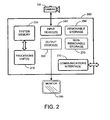
- this figure shows a general system diagram showing a simplified computing device coupled to a digital still or video camera.
- Such computing devices can typically be found in devices having at least some minimum computational capability in combination with a communications interface.
- Examples of well known simplified computing systems, environments, and/or configurations that may be suitable for use with the invention include, but are not limited to, hand-held, laptop or mobile computers, communications devices such as cell phones and PDA's, etc.
- the computing device 200 must have some minimum computational capability and a wired or wireless interface 240 for connecting a digital camera 290 or other image input source.
- processing unit(s) 210 the computational capability of the computing device 200 is generally illustrated by processing unit(s) 210 (roughly analogous to processing units 120 described above with respect to FIG.1 ), and system memory 220.
- processing unit(s) 120 of the general computing device of FIG. 1 the processing unit(s) 210 illustrated in FIG. 2 may be specialized (and inexpensive) microprocessors, such as a DSP, a VLIW processor, or other micro-controller rather than the general-purpose processor unit of a PC-type computer or the like, as described above.
- the simplified computing device 200 of FIG. 2 may also include other components, such as, for example connections for one or more input devices 240 (analogous to the input devices described with respect to FIG. 1 .
- the simplified computing device of FIG. 2 may also include other optional components, such as, for example one or more output devices 250 (analogous to the output devices described with respect to FIG. 1 ), such as an external display device 280.
- the simplified computing device of FIG. 2 may also include removable and/or non-removable storage, 260 and 270, respectively (analogous to the storage devices described with respect to FIG. 1 ).
- this figure is a general system diagram depicting a digital camera 300 having integrated computing 340 and I/O capabilities 345, and a display device 310, such as an LCD screen, for implementing a Keyframe Stitcher, as described herein.
- conventional digital cameras include components such as those described above (e.g., I/O, computing, and display), in addition to camera memory 320 that is either removable 325 or non-removable 330. Such cameras also include a lens 305 and a set of one or more controls 315.
- the computing capability. 340 of the digital camera can be implemented using low cost specialized processors, such as a DSP, a VLIW processor, or other micro-controller rather than the general-purpose processor unit of a PC-type computer or the like, as described above with respect to FIG. 1 . As described in further detail below, these components are used in combination to enable the real-time functionality of the Keyframe Stitcher in a standalone digital camera.
- a “Keyframe Stitcher” provides an efficient technique for building mosaic panoramic images by registering or aligning sequences of image frames into an underlying panoramic representation.
- the techniques provided by the Keyframe Stitcher are scalable such that large panoramas may be easily constructed by registering large numbers of sequential image frames, such as image sequences captured by still or video cameras, or other image sources.
- the Keyframe Stitcher is sufficiently optimized to allow for real-time, or near-real-time, stitching of images. Consequently, users are able to "brush" a scene with a camera to create mosaic images of the scene in real-time as the images are being captured.
- the Keyframe Stitcher may be implemented within a standalone video camera or the like having integral displays for rendering the mosaic panoramic images as they are created.
- the Keyframe Stitcher may also be implemented on an external display device, either coupled directly to the digital camera, or coupled to the digital camera via a separate computing device.
- the Keyframe Stitcher described herein operates in essentially the same way.
- Keyframe Stitcher will be generally described herein as being implemented within a computing device, such as, for example, a PC-type computer performing post-processing of image sequences after those sequences have been captured, it should be understood the detailed description of the Keyframe Stitcher provided herein applies equally to the additional embodiments involving external display devices and/or external computing devices, or cameras within which the Keyframe Stitcher is implemented directly, so as to provide for real-time generation of mosaic panoramas.
- the Keyframe Stitcher described herein provides an efficient image mosaicing technique which allows for either real-time or offline stitching of a sequence of images from a set of images of a scene to generate mosaic panoramas, and for generation of animated mosaic panoramas.
- the Keyframe Stitcher performs the following steps for registering and aligning images for generating mosaics:
- the Keyframe Stitcher is used to generate "animated mosaics" wherein a static mosaic background is generated, and action shots occurring within sequences of additional frames corresponding to sub-regions of the overall mosaic are warped and mapped to the overall mosaic to generate an "animated panorama" having both static and dynamic components blended into an overall mosaic panorama.
- the camera is generally panned over the scene to build a "background” mosaic followed by one or more "action shots” from within subsections of the overall mosaic.
- processing of the additional frames for the action shots differs somewhat from the general approach summarized above for construction of the static mosaic panorama.
- the static background of animated mosaic panorama is constructed in exactly the same manner as described above.
- sequence of "live” frames i.e., "action shots”
- action shots are then added as a dynamic overlay to the static mosaic to create an animated mosaic by registering each action shot to only the "keyframe mesh" of the mosaic panorama rather than to the entire "match structure.”
- registration to the keyframe mesh is used rather than registration to the entire match structure is that because of the "action” occurring within the sequence of frames representing the action shot it is likely that the frames of the action shot will not match the intermediate frames between keyframes very well.
- the Keyframe Stitcher is used to provide for real-time or near-real-time image stitching so as to generate mosaic panoramas while a user moves a camera over a scene.
- optimal image orientations are estimated for "blocks" of images corresponding to neighboring keyframe pairs to provide for near-real-time incremental construction of mosaic images.
- This embodiment allows for a near-real-time display of the mosaic panorama to be displayed to the user as the images are being captured. For example, as the user pans a video or still camera over a scene, and captures images of that scene, the corresponding mosaic panorama can be displayed in real-time on the LCD-type display screen or viewfinder window of that digital still or video camera.
- this real-time embodiment may also be implemented on an external display device coupled to the camera, either directly, or via an external computing device to which the camera is itself coupled.
- each of these embodiments of the Keyframe Stitcher operate in an identical manner, with respect to generation of mosaic panoramas, and differ only in the hardware and hardware connections used for that purpose. Consequently, for purposes explanation, the following discussion of the Keyframe Stitcher will assume that the Keyframe Stitcher is implemented in a PC-type computer having a video stream input source from either a live or recorded camera input. However, it should be understood that the Keyframe Stitcher described herein is intended to encompass each of the aforementioned embodiments and implementations.
- FIG. 4 illustrates the interrelationships between program modules for implementing the Keyframe Stitcher, as described herein.
- any boxes and interconnections between boxes that are represented by broken or dashed lines in FIG. 4 represent alternate embodiments of the Keyframe Stitcher described herein, and that any or all of these alternate embodiments, as described below, may be used in combination with other alternate embodiments that are described throughout this document.
- the Keyframe Stitcher illustrated in FIG. 5 shows a camera or image source 400 as being external to the overall system of the Keyframe Stitcher.
- some or all of the components and program modules illustrated in FIG. 4 may be integral to the camera 400.
- the Keyframe Stitcher generally begins operation by providing images either directly from a still or video camera 400 or other image input source to an image frame input module 405 which saves the image files 410 for use by the Keyframe Stitcher.
- the Keyframe Stitcher can operate on a set of prerecorded images files 410, such as a video recording or other image sequence.
- a feature point extraction module 415 analyses each image frame and extracts a set of image features from each image frame. These extracted features are then provided to a match structure construction module 420 which acts to identify keyframes in the images 410 and build a "match structure" 425 which generally represents: 1) correspondences between keyframes (i.e., a "keyframe mesh”), 2) correspondences between intermediate frames between the neighboring keyframes, and 3) correspondences between the intermediate frames and their neighboring keyframes on either side of those intermediate frames.
- the aforementioned feature point extraction module 415 will typically extract several hundred features from each image, resulting in hundreds of matches between matched image pairs with large overlaps (and therefore a substantially larger "match structure"). If the matched features are well distributed across the image, this strongly constrains the relative orientations of the images. However, the large number of measurements is a computational bottleneck for many image sequences. Consequently, in one embodiment, as described in further detail in Section 3.5, the match structure construction module acts to replace the measurements between pairs of images with a much smaller number of "representative measurements” so as to reduce the computational overhead required for generation of image mosaics.
- match structure 425 Once the match structure 425 has been completed, it is provided to an orientation optimization module 430 which analyzes the match structure to determine optimal "orientations" 433 for each image.
- optimal orientations 433 represent estimates of "camera orientations,” such as, for example, focal lengths, camera rotations, etc.
- orientations 433 are then translated back to the images for use by a mosaic construction module 435 which uses the orientations 433 for "registration" of the images 410 by rotating, scaling, and warping the images, as necessary to fit the mosaic.
- the mosaic construction module 435 operates to build a mosaic panorama 440 from the image frames 410 as a function of the optimized image orientations.
- construction of the mosaic 440 by the mosaic construction module further includes the use of conventional image blending techniques, including, for example, feathering, contrast and brightness adjustments, de-ghosting operations, etc.
- the mosaic 440 is simply stored for later use, displayed on a conventional display device 445, or provided back to the display of the digital still or video camera 400 used to capture the images for use in real-time previews of the mosaic.
- the Keyframe Stitcher acts to provide for mosaic panorama generation in real-time so that users can see on the display device coupled to, or integrated with, their camera exactly what the completed panorama will look like.
- construction of the mosaic proceeds as described above.
- the image frames are processed as they are received (such as from the real-time camera 400 input) by processing "blocks" of intermediate image frames bounded by two immediately neighboring keyframes. Consequently, the maximum delay for generation of the real-time mosaic images is on the order of about the time period from one keyframe to the next.
- the Keyframe Stitcher acts to build animated panoramas having both static and dynamic components.
- additional sequential image frames representing an "action shot” are registered with the keyframe mesh portion of the match structure 425 by a frame warping / mapping module 450.
- optimal orientations 433 of the image frames 410 representing the action shot are computed by the orientation optimization module 430.
- these action shot orientations 433 are computed only with respect to the keyframe mesh portion of the match structure 425, rather than the entire match structure.
- These action shot orientations 433 are then used by the frame warping / mapping module 450 to register the images 410 representing the action shot by rotating, scaling, and warping the images, as necessary to fit onto the mosaic.
- an animated mosaic generation module 455 uses conventional image stitching techniques to overly the registered image frames of the action shot onto underlying mosaic by applying conventional blending, feathering, contrast and brightness adjustments, de-ghosting operations, etc. on a frame by frame basis.
- the resulting animated mosaic is then stored 440 for later use as desired, or provided for playback via the display device 445.
- the animated mosaic generated by the animated mosaic module 455 will generate an animation that shows each frame of the action shot in order, as a sequential mapping of frames.
- the animated mosaic sequentially shows each frame of the action shot on the underlying mosaic, while removing each frame of the action shot from the underlying mosaic prior to showing the next sequential frame of the action shot on the underlying mosaic.
- this same technique for generating animated mosaics can be used to provide compression of video sequences by constructing a single static mosaic of unmoving or static portions of the video sequence, and then extracting and mapping the moving or dynamic portions of the video sequence to the underlying static mosaic in the same manner as described above.
- redundant information in the frames used to construct the underlying mosaic is simply discarded, and only the dynamic elements representing the extracted action shots are kept along with the underlying mosaic.
- the resulting animated mosaic can provide significant compression ratios relative to the original video sequence, depending upon the content of the original video sequence.
- identification and extraction of dynamic regions of a video sequence is a concept that is well known to those skilled in the art, and will not be described in detail herein.
- this Keyframe Stitcher provides an efficient image mosaicing technique which allows for real-time stitching of a sequence of images from a set of images of a scene to generate mosaic panoramas, and for generation of animated mosaic panoramas.
- the following sections provide a detailed discussion of the operation of the Keyframe Stitcher, and of exemplary methods for implementing the program modules described in Section 2.
- the following sections present an automatic and efficient method to register and stitch potentially many thousands of video frames into a large panoramic mosaic.
- the techniques provided by the Keyframe Stitcher preserves the robustness and accuracy of image stitchers that match all pairs of images while utilizing the ordering information inherent in video recordings.
- the computational cost of searching for matches between video frames is reduced by adaptively identifying key frames based on the amount of image-to-image overlap. Keyframes are matched to all other key frames, but intermediate video frames between keyframes are only matched to temporally neighboring key frames and other neighboring intermediate frames. Image orientations are then estimated from this sparse set of matches.
- the matches between pairs of images are compressed by replacing measurements within small windows in the image with a single representative measurement thereby substantially reducing the time required to estimate the image orientations with minimal loss of accuracy.
- the Keyframe Stitcher is embodied within a digital still or video camera which has sufficient integrated computing power to generate real-time mosaic previews.
- the Panoramic Viewfinder within a digital still or video camera
- any of a number of conventional camera types or video feeds may be used in combination with the Panoramic Viewfinder.
- any digital camera or video stream feed which is capable of being interfaced with an external computing device, and by extension to the Keyframe Stitcher, may be used.
- many newer still or video cameras can be connected directly to a computer's existing ports (USB interfaces, IEEE 1394 interfaces, BluetoothTM wireless interfaces, IEEE 802.11 wireless interfaces, etc). Any such camera can be used by the Keyframe Stitcher.
- the Keyframe Stitcher can be instantiated on any computing device having sufficient computing power in the same manner as if the Keyframe Stitcher were implemented within a digital camera for real-time generation of mosaic panoramas.
- a user can use a conventional "web cam" or the like (having no integral computational capabilities), connected to a desktop, notebook, or handheld computing device, to generate mosaic panoramic images in basically the same manner as if captured by a dedicated digital camera having integrated Keyframe Stitcher capabilities.
- the Keyframe Stitcher will be generally described herein as being implemented within a conventional computing device for processing image sequences for generation of mosaic images.
- the detailed description of the Keyframe Stitcher provided herein applies equally to the additional embodiments involving integration into digital cameras, and external computing devices coupled to cameras which may or may not include integral display devices or computing capabilities.
- the Keyframe Stitcher does not eliminate frames from computational consideration. Rather, the Keyframe Stitcher matches intermediate frames to adaptively selected key frames. Further, in contrast conventional video mosaicing techniques that require limited or constrained camera motions, the Keyframe Stitcher provides an efficient mosaicing method which is generally applicable to a large number of camera motion models, such as, for example, 2D similarities, 3D rotations, affine warps and full homographies, to name only a few such motion models. Consequently, the mosaicing approach provided by the Keyframe Stitcher can be used to obtain a robust, globally consistent alignment of many thousands of frames from a video sequence.
- the Keyframe Stitcher is not mosaicing an infinite plane, but rather, it is mosaicing a rotational panorama or a limited extent plane). This means that the entire panorama can be covered by a finite number of keyframes.
- new keyframes are only created when a current frame doesn't overlap the immediately previous keyframe by some minimum threshold amount.
- new keyframes are created only when the current frame doesn't overlap any prior keyframe by some threshold (instead of just the preceding keyframe).
- the number of keyframes may be unbounded.
- the number of keyframes needs to be bounded by a constant (since the computational cost is cubic in the number of keyframes, as described in further detail in Section 3.7).
- a finite number of keyframes can cover the entire compositing surface for any chosen overlap threshold. Therefore, the number of keyframes can be bounded by only creating new keyframes when they don't overlap any other keyframe by some threshold (instead of just the immediately preceding keyframe).
- One simple way to make this determination is to simply check the number of feature point matches between the current frame and all keyframes.
- the Keyframe Stitcher can be made more robust by determining whether matches between feature points are geometrically plausible. This can be done by re-estimating the keyframe orientations each time a new keyframe is added. This also enables the production of a real-time panoramic preview. For instance, the keyframes could be warped to the compositing surface, blended and displayed.
- MOPS Multiscale Oriented Patches
- MOPS provide a type of invariant feature located at Harris corners in discrete scale-space and oriented using a blurred local gradient.
- MOPS are extracted from images by defining a rotationally invariant frame in which a feature descriptor consisting of an 8x8 patch of bias/gain normalized intensity values is sampled.
- the density of features in the image is controlled using an adaptive non-maximal suppression algorithm.
- MOPS-based matching of images matching is achieved using a fast nearest neighbor algorithm that indexes features based on their low frequency Haar wavelet coefficients.
- an outlier rejection procedure is used to verify pairwise feature matches based on a background distribution of incorrect feature matches. Feature matches are then refined using RANSAC.
- the number of frames in a video sequence can rapidly increase to thousands of image frames in a very short period of time. Therefore, in order to avoid matching all pairs of frames, some assumption about the correlation between temporal and spatial adjacency must be made. However, any such correlations assumptions should be limited so as to avoid overly constraining the users' capture of image sequences. Further, one advantage of the Keyframe Stitcher is that the mosaicing framework described herein defers aligning the images until after the matching is done, thereby allowing the Keyframe Stitcher to align images with more matches before images with fewer matches, thereby improving the overall quality of the resulting mosaic.
- the basic assumption made by the Keyframe Stitcher is that most temporally adjacent frames are also spatially adjacent.
- the Keyframe Stitcher therefore first looks for matches between all pairs of temporally adjacent images. Local matches between such pairs are then used to select keyframes based on the amount of overlap (or in one embodiment whenever a total number of frames exceeds a predetermined threshold without identifying a new keyframe). To do this, the Keyframe Stitcher starts by defining the first and last frame to be keyframes. The Keyframe Stitcher then steps though the video (or other image sequence) labeling frames as key frames if they do not overlap the most recently labeled key frame by some threshold (on the order of about 50% in a tested embodiment). Intermediate frames not labeled as key frames are matched to their temporally neighboring key frames and intermediate frames. A "keyframe mesh" is then created by matching all pairs of key frames.
- matching of images is used to construct a "match structure" which includes a "keyframe mesh.”
- the first step in constructing this mesh is to identify the keyframes in a sequence of image frames. In identifying these keyframes, the first and last frames of the sequence are set as keyframes. The entire image sequence is then evaluated to identify the remaining keyframes (either as a function of frame overlap or number of intervening frames) between the first and last frame. Once the keyframes have been identified, the entire image sequence is evaluated, as described in further detail below, to construct the match structure relative to the identified keyframes.
- each image frame (including keyframes) is then matched to the immediately preceding keyframe. Further, as illustrated by the curved connecting lines on the lower portion of FIG. 5A each image frame is also matched to its immediately neighboring image frames. As noted above, matching is performed as a function of the "interest points" or "features" extracted from every image frame.
- the Keyframe Stitcher continues the matching process by performing "forward matching" of the image frames.
- each image frame including keyframes
- the immediately preceding keyframe indicated as "KEY” in FIG. 5B .
- the Keyframe Stitcher generates a "keyframe mesh" by matching all of the keyframes to every other keyframe. For example, as illustrated by the curved connecting lines on the lower portion of FIG. 5C , during the construction of the keyframe mesh, each keyframe (indicated as "KEY” in FIG. 5C ) is matched to every other keyframe in the image sequence. Note that some keyframe-to-keyframe matching is already performed as a function of the first two matching steps described above with respect to FIG. 5A and FIG. 5B . It is not necessary to repeat matches that have already been computed. However, any keyframe matches that were computed prior to the explicit keyframe-to-keyframe matching step are still included in the separate keyframe mesh which is used for several purposes, including mapping of action shots for animated panoramas.
- FIG. 6 provides an exemplary operational flow of one embodiment of a Keyframe Stitcher, as described herein. It should be noted that any boxes that are represented by broken or dashed lines in FIG. 6 represent alternate embodiments of the Keyframe Stitcher, and that any or all of these alternate embodiments, as described below, may be used in combination with other alternate embodiments that are described throughout this document.
- the Keyframe Stitcher described herein begins operation by retrieving a set of images frames 605 that are either pre-recorded, or provided as live input from a video camera 600 or other image input source.
- the Keyframe Stitcher begins be getting a next image frame 610 from the camera 600 or prerecorded image frames 605.
- the current image frame of the image sequence 605 is a first image frame 615, it is identified 620 as a keyframe 625. If the current frame is not a keyframe 625, then it is matched 630 to the prior image frame 605 (which may or may not also be a keyframe). This match information is then stored as a part of the overall match structure 635. Next, the current image frame is matched 640 to the immediately prior keyframe 625. Again, this match information is then stored as a part of the overall match structure 635.
- this matching process (630 and 640) and keyframe identification process (645, 650, and 655) then continues until the entire image sequence has been processed, and there are no more image frames 660 (with the last frame also being identified as a keyframe 650).
- this frame is provisionally treated as a "last frame" 660, and processing of the image sequence continues for completing the overall match structure 635.
- connection to match structure 635 from box 665 is illustrated by the symbol (A) so as to provide a more legible figure.
- connections to the images frames 605 and keyframes 625 are illustrated by the symbols (B) and (C), respectively so as to provide a more legible figure.
- this match consists of matching the current keyframe pair to each other, and to prior keyframes or keyframe pairs, if any.
- This match information 670 is then stored as a part of the overall match structure 635.
- this particular match information 670 also represents the aforementioned "keyframe mesh" which is used in generating animated mosaics, as described in further detail below. Note that connection to match structure 635 from box 670 is also illustrated by the symbol (A) so as to provide a more legible figure.
- the overall match structure 635 is compressed 675 (as described in further detail in Section 3.6) to provide for a reduction in computational overhead when estimating 680 optimal image orientations from the match structure 635.
- image 605 registration and alignment is performed (via scalings, warpings, rotations, etc.), along with optional conventional blending, feathering, contrast and brightness adjustments, de-ghosting operations, etc., for constructing 685 the mosaic 690 which is then stored for later use. Further, in the case of real-time mosaic generation, the mosaic 690 is provided back to the camera 600 display in near-real-time for viewing by the user while the user is capturing images.
- FIG. 7 through FIG. 13 Examples of various animated and static panoramas are provided in FIG. 7 through FIG. 13 , as described below:
- FIG. 7 illustrates a static mosaic panorama 700 generated using the Keyframe Stitcher, with an overlay of dynamic video frames 710 warped and mapped to static mosaic panorama to create a dynamic mosaic panorama.
- the overlay of dynamic video frames 710 has been enlarged and offset with a large white arrow pointing to the location where it is to be mapped into the overall static mosaic.
- this enlargement and offsetting is not how the animated mosaic is constructed.
- this enlargement and offsetting is provided as an example of where action shots are mapped since otherwise it would not be possible to clearly differentiate frames which are warped and mapped as an overlay to the overall static mosaic in a single image such as FIG. 7 .
- FIG. 8 and FIG. 9 illustrate examples of un-cropped mosaic panoramas that were generated from continuous video sequences having on the order of about 1000 frames or so at a resolution of about 720 x 1280 pixel resolution.
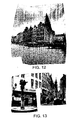
- FIG. 12 and 13 illustrates examples of panoramas that were generated from video sequences captured in a multiple separate swaths (three in each case). In each case, more than a 1000 images were combined to generate each of the mosaics. It should be noted that in the case of multiple swaths, better results were observed by setting the overlap threshold for keyframe detection to a lower level than in the case of continuous swaths where temporal and spatial overlap is naturally more consistent.
- Each feature match defines a measurement error that depends on the relative orientations of the pair of images.
- the relative camera orientations are estimated by minimizing the measurement error in a (robustified) least-squares framework.
- Conventional interest point detectors will typically extract several hundred features from each image, resulting in hundreds of matches between matched image pairs with large overlaps. If the matched features are well distributed across the image, this strongly constrains the relative orientations of the images. However, the large number of measurements is a computational bottleneck for many image sequences.
- the Keyframe Stitcher addresses this computational bottleneck by automatically replacing the measurements between a pair of images with a much smaller number of "representative measurements.”
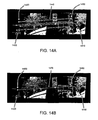
- a pair of images 1400 and 1410 may have a set of matching feature points 1420 and 1430, respectively across small windows in each image. Note that the correspondence between particular feature points in image 1400 and image 1410 is illustrated via the use of solid connecting lines 1440 from the feature points 1420 in the first image to the matching feature points 1430 in the second image.
- FIG. 14B in accordance with the preceding discussion, the group of feature points 1420 in image 1400 are analyzed to create a single representative measurement 1450.
- the group of feature points 143 in image 1410 are analyzed to create a single representative measurement 1460.
- This pair of representative measurements, 1450 and 1460 is then used to replace the corresponding sets of feature points, 1420 and 1430, respectively, thereby compressing the total number of feature points.
- the dashed line 1470 illustrates the correspondence between the representative feature points, 1450 and 1460, in images 1400 and 1410.
- both the original and new measurements are represented by pairs of image points and 2 ⁇ 2 covariance matrices.
- the new measurement is set to the centroid of the original points and the covariance is adjusted by summing the inverse covariance matrices.
- the Keyframe Stitcher changes the shape of the error surface while significantly reducing computational overhead.
- an accuracy penalty exists for the reduced computational cost.
- measurements which span only small portions of the image are merged. Measurements that span a small angular window poorly constrain the parameters of a homography other than the translational component. Representing a group of points by their centroid discards the constraints they provide on the non-translational components of the warp required to align images. Therefore, only allowing points to merge if they have a small extent (i.e., by using the small angular window) reduces the amount of information that is being discarded, and therefore minimizes the error resulting from discarding that data.
- measurements to be merged are selected by placing a predetermined bound on the window size they span in either image.
- the Keyframe Stitcher recursively splits along the largest axis-aligned dimension (in either image) until the bound is met in both images for all groups.
- a single measurement is then created in each image positioned at the centroid of the group.
- More sophisticated techniques e.g., k-means clustering
- the procedure described above performs well and generally requires a relatively insignificant amount of computational overhead to compute.
- a window size on the order of about 20% seems to be a good number to start with.
- the window size may need to be smaller for warps such as homographies where the minimum number of required matches is larger.
- each matched pair of images can be aligned and a linear approximation to the error can then be used to create a single, linear measurement connecting the two images.
- the representative measurements there are benefits to using several representative 2D points (i.e., the representative measurements" described above).
- e ij is the 2D measurement error due to match j in pair i
- ⁇ ij 1 is a 2 ⁇ 2 measurement covariance.
- e ij depends on measurement ij and the relative orientations of the images in pair i.
- the gradient and Hessian of the objective function, g and H respectively are calculated and used to solve for an update step.
- the computational cost of calculating g and H is linear in the number of measurements since each measurement term in Equation 1 only depends on single pair of images.
- Equation 6 For panoramas in which there are measurements between all pairs of images, solving Equation 6 is cubic in N. However, when there are only connections between a small subset of all image pairs, the sparsity pattern of H is represented by a sparse matrix having a pattern similar to the graph illustrated in FIG. 15 . As is well known to those skilled in the art, conventional "bundle adjustment" techniques can be used to take advantage of the sparsity of H to reduce the computational complexity of solving Equation 6, by using an LU decomposition, to only cubic or less in the number of keyframes and linear in the number of intermediate frames. By permuting the parameters of the keyframes to the end, the number of non-zero entries, or fill-ins, can be limited when factoring H. An example of the sparsity pattern of the factored Hessian from the image sequence used to construct the mosaic of FIG. 8 is shown in FIG. 16 .
- FIG. 15 shows matched frames from the image sequence used to generate the mosaic of FIG. 8 , and, equivalently, the sparsity pattern of the Hessian.
- Point (i, j) is filled in if matches were found between image i and j.
- Temporal neighbor matches show up as a line down the diagonal.
- the forward and backward matching to keyframes show up as boxes on the diagonal, with longer camera pauses generating larger boxes (i.e., more feature point matches, assuming that the camera is recording image frames at a constant rate).
- the key frame to key frame matches show up as sparse off-diagonal points.
- the graph illustrated in FIG. 16 shows the sparsity pattern of the factored Hessian after permuting the keyframes to the end.
- the key frames cause fill-ins in the bottom right corner and up the right side.
- the number of matching image pairs is at most quadratic in the number of key frames (if they all overlap each other), but more typically linear; it is also linear in the number of intermediate frames.
- the number of feature matches per image pair is a scalar multiplier on this portion of the computational cost. In many cases, the cost of summing the contributions of the measurements dominates the computational cost of solving the sparse linear system in the motion parameters. Reducing the number of per-image measurements in such cases using feature match compression has been observed to provide substantial computational savings at little cost in accuracy.
Landscapes
- Engineering & Computer Science (AREA)
- Theoretical Computer Science (AREA)
- Multimedia (AREA)
- Physics & Mathematics (AREA)
- General Physics & Mathematics (AREA)
- Computational Linguistics (AREA)
- Signal Processing (AREA)
- Data Mining & Analysis (AREA)
- Databases & Information Systems (AREA)
- General Engineering & Computer Science (AREA)
- Studio Devices (AREA)
- Image Processing (AREA)
- Image Analysis (AREA)
- Studio Circuits (AREA)
- Processing Or Creating Images (AREA)
Claims (14)
- Eine Vorrichtung zum Erzeugen von Mosaikbildern (440, 700) von mindestens einem Satz sequentieller Bilder einer Szene umfassend Verwenden einer Computervorrichtung (200) zum Ausführen der Schritte:Empfangen mindestens eines Satzes sequentieller Bildrahmen (410, 605) einer Szene,Identifizieren des ersten und letzten Bildrahmens (410, 605) von jedem Satz sequentieller Bildrahmen (410, 605) als einen Schlüsselrahmen (615, 625),Extrahieren eines Satzes von Merkmalspunkten (1420, 1430) von jedem Bild (1400, 1410),gekennzeichnet durchfür jeden Bildrahmen (410, 605), Identifizieren von Merkmalspunktübereinstimmungen zu einem unmittelbar vorangehenden Bild,für jeden Bildrahmen (410, 605), Identifizieren von Merkmalspunktübereinstimmungen zu einem unmittelbar vorangehenden Schlüsselrahmen (615, 625),für jeden Bildrahmen (410, 605), Abschätzen einer Überlappmenge mit dem unmittelbar vorangehenden Schlüsselrahmen (615, 625) und Festlegen des Rahmens als einen neuen Schlüsselrahmen (615, 625), wenn die abgeschätzte Überlappmenge unterhalb einer vorbestimmten Grenze ist,für jeden Rahmen, Identifizieren von Merkmalspunktübereinstimmungen zu einem unmittelbar nachfolgenden Schlüsselrahmen (615, 625),für jeden Schlüsselrahmen (615, 625), Identifizieren von Merkmalspunktübereinstimmungen zu jedem anderen Schlüsselrahmen (615, 625),Erzeugen einer Übereinstimmungsstruktur (425, 635) von allen Merkmalspunktübereinstimmungen,Abschätzen optimaler Bildregistrationen von der Übereinstimmungsstruktur (425, 635) undKonstruieren eines statischen Mosaikbilds von den abgeschätzten optimalen Bildregistrationen.
- Die Vorrichtung nach Anspruch 1 weiter umfassend Schritte zum Komprimieren der Merkmalspunktübereinstimmungen der Übereinstimmungsstruktur (425, 635) durch automatisches selektives Ersetzen eines oder mehrerer Sätze von Merkmalspunktübereinstimmungen (1420, 1430) zwischen einem oder mehreren Bildpaaren (1400, 1410) mit einer repräsentativen Messung (1450, 1460) entsprechend dem ersetzten Satz von Merkmalspunktübereinstimmungen (1420, 1430), wobei die Merkmalspunktübereinstimmungen der Übereinstimmungsstruktur (425, 635) und der repräsentativen Messung (1450, 1460) durch Paare von Bildpunkten und 2 x 2 Kovarianzmatrizen dargestellt werden, wobei die repräsentative Messung als ein Schwerpunkt der Merkmalspunktübereinstimmungen festgelegt und Kovarianz durch Summieren eines Inversen der Kovarianzmatrizen angepasst wird.
- Die Vorrichtung nach Anspruch 1 wobei die Merkmalspunktübereinstimmungen zwischen jedem der Schlüsselrahmen (615, 625) ein "Schlüsselrahmen-Netz" umfassen.
- Die Vorrichtung nach Anspruch 3 weiter umfassend Schritte zum Erzeugen eines animierten Mosaikbildes umfassend die Schritte:Registrieren einer Teilfolge von Bildrahmen (410, 605) zu dem statischen Mosaik als eine Funktion des Schlüsselrahmen-Netzes undAbbilden der registrierten Teilfolge von Bildern als eine dynamische Überlagerung zu dem statischen Mosaik.
- Die Vorrichtung nach Anspruch 1 weiter umfassend Schritte zum Erzeugen des statischen Mosaiks in Echtzeit durch sequentielles Durchführen der Schritte der Vorrichtung von Anspruch 1 für jeden der Vielzahl von Sätzen von Bildrahmen (410, 605), die durch unmittelbar benachbarte Schlüsselrahmen (615, 625) begrenzt werden.
- Die Vorrichtung nach Anspruch 1 weiter umfassend Schritte zum Festlegen eines Bildrahmens (410, 605) als einen neuen Schlüsselrahmen (615, 625), wenn eine vorbestimmte Maximalzahl von Bildrahmen (410, 605) übertroffen wurde, ohne einen neuen Schlüsselrahmen (615, 625) als eine Funktion der abgeschätzten Überlappmenge zu identifizieren.
- Die Vorrichtung nach Anspruch 5, wobei die Schritte nach Anspruch 11 in einer eigenständigen Videokamera durchgeführt werden, die eine eingebaute Darstellungsvorrichtung zum Darstellen des statischen Mosaiks in Echtzeit umfasst.
- Ein computerlesbares Medium mit computerausführbaren Instruktionen zum Ausführen der Schritte der Vorrichtung nach Anspruch 1.
- Ein Verfahren zum automatischen Erzeugen eines Mosaikbilds (440, 700) von einem sequentiellen Satz von Bildern einer Szene umfassend:Empfangen eines Satzes von Bildern einer Szene,Evaluieren jedes Bildes (1400, 1410), wenn es empfangen wird, um einen Satz von Merkmalspunkten (1420, 1430) für jedes Bild (1400, 1410) zu identifizieren,Bilden einer Übereinstimmungsstruktur (425, 635) von Bildentsprechungen als eine Funktion der Merkmalspunkte (1420, 1430), die für jedes Bild (1400, 1410) identifiziert wurden,gekennzeichnet durchbesagte Übereinstimmungsstruktur (425, 635) umfassend Übereinstimmungen zwischen Bildrahmen (410, 605), die als Schlüsselrahmen (615, 625) identifiziert wurden, Übereinstimmungen zwischen Gruppen von benachbarten Nicht-Schlüsselrahmen-Bildrahmen und Übereinstimmungen zwischen Nicht-Schlüsselrahmen-Bildrahmen und dem Schlüsselrahmen (615, 625), der unmittelbar jedem Nicht-Schlüsselrahmen-Bildrahmen vorangeht und nachfolgt,Abschätzen optimaler Bildregistrationen von der Übereinstimmungsstruktur (425, 635) undKonstruieren eines statischen Mosaikbilds von dem Satz von Bildern als eine Funktion der abgeschätzten optimalen Bildregistrationen.
- Das Verfahren nach Anspruch 9 weiter umfassend Komprimieren der Übereinstimmungsstruktur (425, 635) vor dem Abschätzen der optimalen Bildregistrationen durch automatisches selektives Ersetzen eines oder mehrerer Sätze von Merkmalspunktübereinstimmungen (1420, 1430) zwischen einem oder mehreren Bildpaaren (1400, 1410) mit einer repräsentativen Messung (1450, 1460) entsprechend dem ersetzten Satz von Merkmalspunktübereinstimmungen (1420, 1430), wobei die Merkmalspunktübereinstimmungen der Übereinstimmungsstruktur (425, 635) und der repräsentativen Messung (1450, 1460) durch Paare von Bildpunkten und 2 × 2 Kovarianzmatrizen dargestellt werden, wobei die repräsentative Messung als ein Schwerpunkt der Merkmalspunktübereinstimmungen festgelegt und Kovarianz durch Summieren eines Inversen der Kovarianzmatrizen angepasst wird.
- Das Verfahren nach Anspruch 9 wobei die Übereinstimmungen zwischen Bildrahmen (410, 605), die als Schlüsselrahmen (615, 625) identifiziert wurden, ein "Schlüsselrahmen-Netz" umfassen und wobei ein animiertes Mosaikbild konstruiert wird durch:Registrieren einer Teilfolge von Bildrahmen (410, 605) zu dem statischen Mosaik als eine Funktion des Schlüsselrahmen-Netzes undsequentielles Abbilden der registrierten Teilfolge von Bildern als eine sequentielle dynamische Überlagerung zu dem statischen Mosaikbild während Wedergabe des animierten Mosaikbildes.
- Das Verfahren nach Anspruch 9 wobei Identifizieren von Bildrahmen (410, 605) als Schlüsselrahmen (615, 625) zumindest eines umfasst von:Identifizieren eines ersten und letzten Rahmens des sequentiellen Satzes von Bildern der Szene als einen Schlüsselrahmen (615, 625),für jeden Bildrahmen (410, 605), Abschätzen einer Überlappmenge mit dem unmittelbar vorangehenden Schlüsselrahmen (615, 625) und Festlegen dieses Bildrahmens (410, 605) als einen neuen Schlüsselrahmen (615, 625), wenn die abgeschätzte Überlappmenge mit dem unmittelbar vorangehenden Schlüsselrahmen (615, 625) unterhalb einer vorbestimmten Grenze ist,für jeden Bildrahmen (410, 605), Abschätzen einer Überlappmenge mit allen vorangehenden Schlüsselrahmen (615, 625) und Festlegen dieses Bildrahmens (410, 605) als einen neuen Schlüsselrahmen (615, 625), wenn die abgeschätzte Überlappmenge mit allen Schlüsselrahmen (615, 625) unterhalb einer vorbestimmten Grenze ist undFestlegen eines Bildrahmens (410, 605) als einen neuen Schlüsselrahmen (615, 625), wenn eine vorbestimmte Maximalzahl von sequentiellen Bildrahmen (410, 605) überschritten wurde, ohne einen neuen Schlüsselrahmen (615, 625) zu identifizieren.
- Das Verfahren nach Anspruch 9 weiter umfassend Konstruieren einer Vorschau des statischen Mosaikbilds in Echtzeit, wenn jedes Bild in dem Satz von Bildern durch eine Videokamera aufgenommen wird und Darstellen der Vorschau des statischen Mosaikbilds in Echtzeit auf einer Darstellungsvorrichtung, die in der Videokamera eingebaut ist.
- Das Verfahren nach Anspruch 9 [weiter] wobei Konstruieren des statischen Mosaikbilds von dem Satz von Bildern weiter Optimieren des statischen Mosaikbilds umfasst durch Anwenden mindestens eines von:Weichzeichnen überlappender Bildrahmen (410, 605),Kontrastanpassungen von Bildrahmen (410, 605)Helligkeitsanpassungen von Bildrahmen (410, 605) undEntfernen von Geistbildern überlappender Bildrahmen (410, 605).
Applications Claiming Priority (2)
| Application Number | Priority Date | Filing Date | Title |
|---|---|---|---|
| US11/197,813 US7460730B2 (en) | 2005-08-04 | 2005-08-04 | Video registration and image sequence stitching |
| PCT/US2006/030647 WO2007019409A2 (en) | 2005-08-04 | 2006-08-03 | Video registration and image sequence stitching |
Publications (3)
| Publication Number | Publication Date |
|---|---|
| EP1920385A2 EP1920385A2 (de) | 2008-05-14 |
| EP1920385A4 EP1920385A4 (de) | 2011-01-12 |
| EP1920385B1 true EP1920385B1 (de) | 2014-05-21 |
Family
ID=37717656
Family Applications (1)
| Application Number | Title | Priority Date | Filing Date |
|---|---|---|---|
| EP06800843.2A Expired - Lifetime EP1920385B1 (de) | 2005-08-04 | 2006-08-03 | Videoerfassung und bildsequenz-stitching |
Country Status (4)
| Country | Link |
|---|---|
| US (1) | US7460730B2 (de) |
| EP (1) | EP1920385B1 (de) |
| CN (1) | CN101379513B (de) |
| WO (1) | WO2007019409A2 (de) |
Families Citing this family (195)
| Publication number | Priority date | Publication date | Assignee | Title |
|---|---|---|---|---|
| US7373017B2 (en) * | 2005-10-04 | 2008-05-13 | Sony Corporation | System and method for capturing adjacent images by utilizing a panorama mode |
| US8063295B2 (en) * | 2002-10-03 | 2011-11-22 | Polyphonic Human Media Interface, S.L. | Method and system for video and film recommendation |
| EP1684506A4 (de) * | 2003-11-11 | 2008-06-04 | Seiko Epson Corp | Bildverarbeitungseinrichtung, bildverarbeitungsverfahren, programm dafür und aufzeichnungsmedium |
| US20070031063A1 (en) * | 2005-08-05 | 2007-02-08 | Hui Zhou | Method and apparatus for generating a composite image from a set of images |
| US7689064B2 (en) * | 2005-09-29 | 2010-03-30 | Cozi Group Inc. | Media display collages |
| US8509563B2 (en) | 2006-02-02 | 2013-08-13 | Microsoft Corporation | Generation of documents from images |
| JP5517397B2 (ja) * | 2006-08-11 | 2014-06-11 | キヤノン株式会社 | 画像処理方法、画像処理装置 |
| US8103125B2 (en) * | 2007-03-13 | 2012-01-24 | International Business Machines Corporation | Generating an amalgamated image including a static image and a dynamic image |
| US8098956B2 (en) * | 2007-03-23 | 2012-01-17 | Vantana Medical Systems, Inc. | Digital microscope slide scanning system and methods |
| US8073259B1 (en) * | 2007-08-22 | 2011-12-06 | Adobe Systems Incorporated | Method and apparatus for image feature matching in automatic image stitching |
| JP2009077362A (ja) * | 2007-08-24 | 2009-04-09 | Sony Corp | 画像処理装置、動画再生装置、これらにおける処理方法およびプログラム |
| WO2009039288A1 (en) * | 2007-09-19 | 2009-03-26 | Panasonic Corporation | System and method for identifying objects in an image using positional information |
| RU2460187C2 (ru) * | 2008-02-01 | 2012-08-27 | Рокстек Аб | Переходная рама с встроенным прижимным устройством |
| US20090220165A1 (en) * | 2008-02-29 | 2009-09-03 | Microsoft Corporation | Efficient image displaying |
| US20090232415A1 (en) * | 2008-03-13 | 2009-09-17 | Microsoft Corporation | Platform for the production of seamless orthographic imagery |
| KR101473215B1 (ko) * | 2008-04-18 | 2014-12-17 | 삼성전자주식회사 | 파노라마 이미지 생성장치 및 그 방법 |
| US8824801B2 (en) * | 2008-05-16 | 2014-09-02 | Microsoft Corporation | Video processing |
| US11119396B1 (en) | 2008-05-19 | 2021-09-14 | Spatial Cam Llc | Camera system with a plurality of image sensors |
| US10896327B1 (en) | 2013-03-15 | 2021-01-19 | Spatial Cam Llc | Device with a camera for locating hidden object |
| US10585344B1 (en) | 2008-05-19 | 2020-03-10 | Spatial Cam Llc | Camera system with a plurality of image sensors |
| US10354407B2 (en) | 2013-03-15 | 2019-07-16 | Spatial Cam Llc | Camera for locating hidden objects |
| US20110098083A1 (en) * | 2008-05-19 | 2011-04-28 | Peter Lablans | Large, Ultra-Thin And Ultra-Light Connectable Display For A Computing Device |
| US12140855B2 (en) | 2008-05-19 | 2024-11-12 | Peter Lablans | Camera system with a plurality of image sensors |
| US20100097444A1 (en) * | 2008-10-16 | 2010-04-22 | Peter Lablans | Camera System for Creating an Image From a Plurality of Images |
| US9171221B2 (en) | 2010-07-18 | 2015-10-27 | Spatial Cam Llc | Camera to track an object |
| US9736368B2 (en) | 2013-03-15 | 2017-08-15 | Spatial Cam Llc | Camera in a headframe for object tracking |
| US8164655B2 (en) * | 2008-05-19 | 2012-04-24 | Spatial Cam Llc | Systems and methods for concurrently playing multiple images from a storage medium |
| US8355042B2 (en) * | 2008-10-16 | 2013-01-15 | Spatial Cam Llc | Controller in a camera for creating a panoramic image |
| CN101593350B (zh) * | 2008-05-30 | 2013-01-09 | 日电(中国)有限公司 | 深度自适应视频拼接的方法、装置和系统 |
| US20110110649A1 (en) * | 2008-06-19 | 2011-05-12 | Thomson Licensing | Adaptive video key frame selection |
| US8180167B2 (en) * | 2008-07-16 | 2012-05-15 | Seiko Epson Corporation | Model-based error resilience in data communication |
| US8300964B2 (en) * | 2008-08-07 | 2012-10-30 | Apteryx Inc. | System and method for preparing spatially related medical digital image data sets for image compression and storage prior to image reconstruction |
| US9307165B2 (en) * | 2008-08-08 | 2016-04-05 | Qualcomm Technologies, Inc. | In-camera panorama image stitching assistance |
| US8554014B2 (en) * | 2008-08-28 | 2013-10-08 | Csr Technology Inc. | Robust fast panorama stitching in mobile phones or cameras |
| US8842190B2 (en) | 2008-08-29 | 2014-09-23 | Adobe Systems Incorporated | Method and apparatus for determining sensor format factors from image metadata |
| US8368773B1 (en) | 2008-08-29 | 2013-02-05 | Adobe Systems Incorporated | Metadata-driven method and apparatus for automatically aligning distorted images |
| US8391640B1 (en) * | 2008-08-29 | 2013-03-05 | Adobe Systems Incorporated | Method and apparatus for aligning and unwarping distorted images |
| US8340453B1 (en) | 2008-08-29 | 2012-12-25 | Adobe Systems Incorporated | Metadata-driven method and apparatus for constraining solution space in image processing techniques |
| US8724007B2 (en) | 2008-08-29 | 2014-05-13 | Adobe Systems Incorporated | Metadata-driven method and apparatus for multi-image processing |
| JP4735693B2 (ja) * | 2008-09-22 | 2011-07-27 | ソニー株式会社 | 画像処理装置、撮像装置、画像処理方法およびプログラム |
| US8416282B2 (en) * | 2008-10-16 | 2013-04-09 | Spatial Cam Llc | Camera for creating a panoramic image |
| KR100982192B1 (ko) * | 2008-12-09 | 2010-09-14 | 한국과학기술연구원 | 사진의 촬영 위치 및 방향 정보 태깅 방법과 그 장치 |
| US20100265313A1 (en) * | 2009-04-17 | 2010-10-21 | Sony Corporation | In-camera generation of high quality composite panoramic images |
| US8582182B2 (en) * | 2009-05-20 | 2013-11-12 | Dacuda Ag | Automatic sizing of images acquired by a handheld scanner |
| US9300834B2 (en) | 2009-05-20 | 2016-03-29 | Dacuda Ag | Image processing for handheld scanner |
| US8605783B2 (en) * | 2009-05-22 | 2013-12-10 | Microsoft Corporation | Composite video generation |
| US9111582B2 (en) * | 2009-08-03 | 2015-08-18 | Adobe Systems Incorporated | Methods and systems for previewing content with a dynamic tag cloud |
| US8947502B2 (en) | 2011-04-06 | 2015-02-03 | Qualcomm Technologies, Inc. | In camera implementation of selecting and stitching frames for panoramic imagery |
| KR101643607B1 (ko) * | 2009-12-30 | 2016-08-10 | 삼성전자주식회사 | 영상 데이터 생성 방법 및 장치 |
| EP2526699A1 (de) | 2010-01-22 | 2012-11-28 | Thomson Licensing | Daten-pruning zur videokomprimierung unter verwendung einer beispielbasierten superauflösung |
| US9600760B2 (en) * | 2010-03-30 | 2017-03-21 | Disney Enterprises, Inc. | System and method for utilizing motion fields to predict evolution in dynamic scenes |
| KR101645465B1 (ko) * | 2010-07-23 | 2016-08-04 | 삼성전자주식회사 | 휴대용 단말기에서 입체 영상 데이터를 생성하기 위한 장치 및 방법 |
| JP5615088B2 (ja) * | 2010-08-18 | 2014-10-29 | キヤノン株式会社 | 画像処理装置及びその方法、プログラム、並びに撮像装置 |
| KR101906614B1 (ko) * | 2010-09-10 | 2018-10-10 | 톰슨 라이센싱 | 모션 보상 예제 기반 초해상도를 사용하는 비디오 디코딩 |
| JP5406813B2 (ja) * | 2010-10-05 | 2014-02-05 | 株式会社ソニー・コンピュータエンタテインメント | パノラマ画像表示装置およびパノラマ画像表示方法 |
| US9325804B2 (en) | 2010-11-08 | 2016-04-26 | Microsoft Technology Licensing, Llc | Dynamic image result stitching |
| US8548269B2 (en) | 2010-12-17 | 2013-10-01 | Microsoft Corporation | Seamless left/right views for 360-degree stereoscopic video |
| WO2012089116A1 (zh) * | 2010-12-27 | 2012-07-05 | 汉王科技股份有限公司 | 扫描识别装置和方法 |
| CN102201115B (zh) * | 2011-04-07 | 2013-12-11 | 湖南天幕智能科技有限公司 | 无人机航拍视频实时全景图拼接方法 |
| US8957944B2 (en) | 2011-05-17 | 2015-02-17 | Apple Inc. | Positional sensor-assisted motion filtering for panoramic photography |
| US9088714B2 (en) | 2011-05-17 | 2015-07-21 | Apple Inc. | Intelligent image blending for panoramic photography |
| US9762794B2 (en) | 2011-05-17 | 2017-09-12 | Apple Inc. | Positional sensor-assisted perspective correction for panoramic photography |
| US8600194B2 (en) * | 2011-05-17 | 2013-12-03 | Apple Inc. | Positional sensor-assisted image registration for panoramic photography |
| US8970665B2 (en) * | 2011-05-25 | 2015-03-03 | Microsoft Corporation | Orientation-based generation of panoramic fields |
| US9247133B2 (en) | 2011-06-01 | 2016-01-26 | Apple Inc. | Image registration using sliding registration windows |
| US20130002715A1 (en) * | 2011-06-28 | 2013-01-03 | Tidman James M | Image Sequence Reconstruction based on Overlapping Measurement Subsets |
| EP2740104B1 (de) * | 2011-08-02 | 2016-12-28 | ViewsIQ Inc. | Vorrichtung und verfahren für digitale mikroskopische bildgebung |
| US9047692B1 (en) * | 2011-12-20 | 2015-06-02 | Google Inc. | Scene scan |
| US8818101B1 (en) | 2012-01-03 | 2014-08-26 | Google Inc. | Apparatus and method for feature matching in distorted images |
| US9159364B1 (en) | 2012-01-30 | 2015-10-13 | Google Inc. | Aggregation of related media content |
| US9143742B1 (en) | 2012-01-30 | 2015-09-22 | Google Inc. | Automated aggregation of related media content |
| US8645485B1 (en) | 2012-01-30 | 2014-02-04 | Google Inc. | Social based aggregation of related media content |
| CN102663733B (zh) * | 2012-03-05 | 2014-08-13 | 河南理工大学 | 基于特征组对的特征点匹配方法 |
| WO2013144437A2 (en) * | 2012-03-28 | 2013-10-03 | Nokia Corporation | Method, apparatus and computer program product for generating panorama images |
| US20130300750A1 (en) * | 2012-05-10 | 2013-11-14 | Nokia Corporation | Method, apparatus and computer program product for generating animated images |
| US9589342B2 (en) * | 2012-05-29 | 2017-03-07 | Afl Telecommunications Llc | Method of inspecting images of connectors of optical cables by using live, still or stored images |
| US8902335B2 (en) | 2012-06-06 | 2014-12-02 | Apple Inc. | Image blending operations |
| US10306140B2 (en) | 2012-06-06 | 2019-05-28 | Apple Inc. | Motion adaptive image slice selection |
| US9098922B2 (en) | 2012-06-06 | 2015-08-04 | Apple Inc. | Adaptive image blending operations |
| US8890894B2 (en) | 2012-06-28 | 2014-11-18 | The University Of Utah Research Foundation | Seam processing for panorama weaving |
| US9275485B2 (en) | 2012-06-28 | 2016-03-01 | The University Of Utah Research Foundation | Seam network processing for panorama weaving |
| US8731329B2 (en) * | 2012-07-16 | 2014-05-20 | Adobe Systems Incorporated | Systems and methods for rolling shutter artifact repair |
| WO2014035642A1 (en) * | 2012-08-28 | 2014-03-06 | Mri Lightpainting Llc | Light painting live view |
| CN102857778B (zh) * | 2012-09-10 | 2015-01-21 | 海信集团有限公司 | 3d视频转换系统和方法及其选择关键帧的方法和装置 |
| US9256788B2 (en) * | 2012-11-02 | 2016-02-09 | Qualcomm Incorporated | Method for initializing and solving the local geometry or surface normals of surfels using images in a parallelizable architecture |
| WO2014075022A1 (en) | 2012-11-12 | 2014-05-15 | Behavioral Recognition Systems, Inc. | Image stabilization techniques for video surveillance systems |
| CN103916582B (zh) * | 2013-01-07 | 2017-09-29 | 华为技术有限公司 | 一种图像处理方法及装置 |
| US9063802B2 (en) * | 2013-01-31 | 2015-06-23 | Hewlett-Packard Development Company, L.P. | Event determination |
| US8854361B1 (en) * | 2013-03-13 | 2014-10-07 | Cambridgesoft Corporation | Visually augmenting a graphical rendering of a chemical structure representation or biological sequence representation with multi-dimensional information |
| US20140300686A1 (en) * | 2013-03-15 | 2014-10-09 | Tourwrist, Inc. | Systems and methods for tracking camera orientation and mapping frames onto a panoramic canvas |
| RU2683857C2 (ru) * | 2013-03-25 | 2019-04-02 | Аймакс Корпорейшн | Улучшение киноизображений с использованием точной информации о движении |
| US9232183B2 (en) | 2013-04-19 | 2016-01-05 | At&T Intellectual Property I, Lp | System and method for providing separate communication zones in a large format videoconference |
| EP2994025B1 (de) | 2013-05-05 | 2023-09-20 | Trax Technology Solutions Pte Ltd. | System und verfahren zur überwachung von verkaufseinheiten |
| WO2014193670A2 (en) * | 2013-05-29 | 2014-12-04 | Capso Vision, Inc. | Reconstruction of images from an in vivo multi-camera capsule |
| US9832378B2 (en) | 2013-06-06 | 2017-11-28 | Apple Inc. | Exposure mapping and dynamic thresholding for blending of multiple images using floating exposure |
| EP3039617B1 (de) | 2013-08-31 | 2020-05-20 | ML Netherlands C.V. | Benutzerfeedback zur echtzeitüberwachung und verbesserung der qualität eines abgetasteten bildes |
| CN103501415B (zh) * | 2013-10-01 | 2017-01-04 | 中国人民解放军国防科学技术大学 | 一种基于重叠部分结构变形的视频实时拼接方法 |
| US9407678B2 (en) * | 2013-10-21 | 2016-08-02 | Cisco Technology, Inc. | System and method for locating a boundary point within adaptive bitrate conditioned content |
| CN103581562A (zh) * | 2013-11-19 | 2014-02-12 | 宇龙计算机通信科技(深圳)有限公司 | 全景拍摄的方法和装置 |
| KR20150058871A (ko) * | 2013-11-21 | 2015-05-29 | 한국전자통신연구원 | 촬상 장치 및 촬상 이미지 스티칭 방법 |
| EP3072103B1 (de) | 2013-12-03 | 2019-05-08 | ML Netherlands C.V. | Benutzerfeedback zur echtzeitüberwachung und verbesserung der qualität eines abgetasteten bildes |
| EP3748953B1 (de) | 2014-01-07 | 2024-04-17 | ML Netherlands C.V. | Adaptive kamerasteuerung zur verminderung der bewegungsunschärfe während der bildaufnahme in echtzeit |
| EP3092603B1 (de) | 2014-01-07 | 2022-05-11 | ML Netherlands C.V. | Dynamische aktualisierung von zusammengesetzten bildern |
| US20150193909A1 (en) * | 2014-01-09 | 2015-07-09 | Trax Technology Solutions Pte Ltd. | Method and device for panoramic image processing |
| CN104794701A (zh) * | 2014-01-21 | 2015-07-22 | 富士通株式会社 | 图像拼接装置、方法以及图像处理设备 |
| US10387996B2 (en) | 2014-02-02 | 2019-08-20 | Trax Technology Solutions Pte Ltd. | System and method for panoramic image processing |
| JP6197749B2 (ja) * | 2014-03-31 | 2017-09-20 | 株式会社Jvcケンウッド | 画像処理装置、画像処理方法、プログラム及びカメラ |
| US9639742B2 (en) * | 2014-04-28 | 2017-05-02 | Microsoft Technology Licensing, Llc | Creation of representative content based on facial analysis |
| US9773156B2 (en) | 2014-04-29 | 2017-09-26 | Microsoft Technology Licensing, Llc | Grouping and ranking images based on facial recognition data |
| WO2015173173A1 (en) | 2014-05-12 | 2015-11-19 | Dacuda Ag | Method and apparatus for scanning and printing a 3d object |
| CN105100688B (zh) * | 2014-05-12 | 2019-08-20 | 索尼公司 | 图像处理方法、图像处理装置和监视系统 |
| US11120547B2 (en) * | 2014-06-01 | 2021-09-14 | CapsoVision, Inc. | Reconstruction of images from an in vivo multi-camera capsule with two-stage confidence matching |
| US10402777B2 (en) | 2014-06-18 | 2019-09-03 | Trax Technology Solutions Pte Ltd. | Method and a system for object recognition |
| CN104134225B (zh) * | 2014-08-06 | 2016-03-02 | 深圳市中兴移动通信有限公司 | 图片的合成方法及装置 |
| CN104166580A (zh) * | 2014-08-18 | 2014-11-26 | 西北工业大学 | 基于参考帧变换及拼接尺寸自适应的同步在线拼接方法 |
| US11205305B2 (en) | 2014-09-22 | 2021-12-21 | Samsung Electronics Company, Ltd. | Presentation of three-dimensional video |
| US10547825B2 (en) * | 2014-09-22 | 2020-01-28 | Samsung Electronics Company, Ltd. | Transmission of three-dimensional video |
| JP2016066842A (ja) * | 2014-09-24 | 2016-04-28 | ソニー株式会社 | 信号処理回路および撮像装置 |
| US9363449B1 (en) * | 2014-11-13 | 2016-06-07 | Futurewei Technologies, Inc. | Parallax tolerant video stitching with spatial-temporal localized warping and seam finding |
| CN109987226B (zh) * | 2014-12-23 | 2021-01-22 | 深圳市大疆灵眸科技有限公司 | Uav全景成像 |
| US9626589B1 (en) * | 2015-01-19 | 2017-04-18 | Ricoh Co., Ltd. | Preview image acquisition user interface for linear panoramic image stitching |
| US9594980B1 (en) * | 2015-01-19 | 2017-03-14 | Ricoh Co., Ltd. | Image acquisition user interface for linear panoramic image stitching |
| US10521472B2 (en) * | 2015-02-27 | 2019-12-31 | Realnetworks, Inc. | Composing media stories method and system |
| US10268886B2 (en) | 2015-03-11 | 2019-04-23 | Microsoft Technology Licensing, Llc | Context-awareness through biased on-device image classifiers |
| US10055672B2 (en) | 2015-03-11 | 2018-08-21 | Microsoft Technology Licensing, Llc | Methods and systems for low-energy image classification |
| CN104837031B (zh) * | 2015-04-08 | 2018-01-30 | 中国科学院信息工程研究所 | 一种高速自适应提取视频关键帧的方法 |
| US9852348B2 (en) * | 2015-04-17 | 2017-12-26 | Google Llc | Document scanner |
| US9569874B2 (en) * | 2015-06-05 | 2017-02-14 | International Business Machines Corporation | System and method for perspective preserving stitching and summarizing views |
| US9547884B1 (en) * | 2015-12-01 | 2017-01-17 | Information Systems Laboratories, Inc. | Image registration using a modified log polar transformation |
| US20170332096A1 (en) * | 2016-05-11 | 2017-11-16 | Advanced Micro Devices, Inc. | System and method for dynamically stitching video streams |
| WO2017196582A1 (en) * | 2016-05-11 | 2017-11-16 | Advanced Micro Devices, Inc. | System and method for dynamically stitching video streams |
| US10257417B2 (en) | 2016-05-24 | 2019-04-09 | Microsoft Technology Licensing, Llc | Method and apparatus for generating panoramic images |
| US10009536B2 (en) | 2016-06-12 | 2018-06-26 | Apple Inc. | Applying a simulated optical effect based on data received from multiple camera sensors |
| KR102296267B1 (ko) * | 2016-06-30 | 2021-08-30 | 매직 립, 인코포레이티드 | 3d 공간에서의 포즈 추정 |
| US10425582B2 (en) * | 2016-08-25 | 2019-09-24 | Facebook, Inc. | Video stabilization system for 360-degree video data |
| US10127632B1 (en) * | 2016-09-05 | 2018-11-13 | Google Llc | Display and update of panoramic image montages |
| CN106776831A (zh) * | 2016-11-24 | 2017-05-31 | 维沃移动通信有限公司 | 一种多媒体组合数据的编辑方法及移动终端 |
| TWI632812B (zh) | 2016-12-16 | 2018-08-11 | 財團法人工業技術研究院 | 視訊串流之接合與傳輸方法、視訊串流閘道裝置及視訊串流觀看裝置 |
| US10861359B2 (en) * | 2017-05-16 | 2020-12-08 | Texas Instruments Incorporated | Surround-view with seamless transition to 3D view system and method |
| DK180859B1 (en) | 2017-06-04 | 2022-05-23 | Apple Inc | USER INTERFACE CAMERA EFFECTS |
| JP6807459B2 (ja) * | 2017-07-25 | 2021-01-06 | 富士フイルム株式会社 | 損傷図作成方法、損傷図作成装置、損傷図作成システム、及び記録媒体 |
| US11049218B2 (en) | 2017-08-11 | 2021-06-29 | Samsung Electronics Company, Ltd. | Seamless image stitching |
| US11112964B2 (en) | 2018-02-09 | 2021-09-07 | Apple Inc. | Media capture lock affordance for graphical user interface |
| WO2019205069A1 (en) * | 2018-04-27 | 2019-10-31 | Beijing Didi Infinity Technology And Development Co., Ltd. | Systems and methods for updating 3d model of building |
| US11722764B2 (en) | 2018-05-07 | 2023-08-08 | Apple Inc. | Creative camera |
| US10375313B1 (en) | 2018-05-07 | 2019-08-06 | Apple Inc. | Creative camera |
| DK201870623A1 (en) | 2018-09-11 | 2020-04-15 | Apple Inc. | User interfaces for simulated depth effects |
| US11321857B2 (en) | 2018-09-28 | 2022-05-03 | Apple Inc. | Displaying and editing images with depth information |
| US11128792B2 (en) | 2018-09-28 | 2021-09-21 | Apple Inc. | Capturing and displaying images with multiple focal planes |
| CN110136058B (zh) * | 2018-10-25 | 2024-01-02 | 北京初速度科技有限公司 | 一种基于俯视拼接图的建图方法及车载终端 |
| CN109815851A (zh) * | 2019-01-03 | 2019-05-28 | 深圳壹账通智能科技有限公司 | 厨房卫生检测方法、装置、计算机设备和存储介质 |
| CN109993718B (zh) * | 2019-03-05 | 2021-04-13 | 北京当红齐天国际文化科技发展集团有限公司 | 一种多通道投影图像融合方法及装置 |
| US11706521B2 (en) | 2019-05-06 | 2023-07-18 | Apple Inc. | User interfaces for capturing and managing visual media |
| US11770601B2 (en) | 2019-05-06 | 2023-09-26 | Apple Inc. | User interfaces for capturing and managing visual media |
| US10645294B1 (en) | 2019-05-06 | 2020-05-05 | Apple Inc. | User interfaces for capturing and managing visual media |
| CN110276722B (zh) * | 2019-06-20 | 2021-03-30 | 深圳市洛丁光电有限公司 | 一种视频图像拼接方法 |
| US11120273B2 (en) * | 2019-06-21 | 2021-09-14 | Gfycat, Inc. | Adaptive content classification of a video content item |
| CN112184544B (zh) * | 2019-07-04 | 2023-08-04 | 杭州海康威视数字技术股份有限公司 | 图像拼接的方法和装置 |
| US11270121B2 (en) | 2019-08-20 | 2022-03-08 | Microsoft Technology Licensing, Llc | Semi supervised animated character recognition in video |
| US11366989B2 (en) * | 2019-08-20 | 2022-06-21 | Microsoft Technology Licensing, Llc | Negative sampling algorithm for enhanced image classification |
| CN110841287B (zh) * | 2019-11-22 | 2023-09-26 | 腾讯科技(深圳)有限公司 | 视频处理方法、装置、计算机可读存储介质和计算机设备 |
| US11030718B1 (en) * | 2019-12-05 | 2021-06-08 | Vivotek Inc. | Image stitching method and related monitoring camera apparatus |
| CN111161154A (zh) * | 2019-12-31 | 2020-05-15 | 航天图景(北京)科技有限公司 | 一种无人机视频实时快速正射拼接系统及其拼接方法 |
| CN111298433B (zh) * | 2020-02-10 | 2022-07-29 | 腾讯科技(深圳)有限公司 | 一种动画视频处理方法、装置、电子设备及存储介质 |
| JP7752134B2 (ja) | 2020-05-11 | 2025-10-09 | マジック リープ, インコーポレイテッド | 3d環境の合成表現を算出するための算出上効率的方法 |
| WO2021242809A1 (en) * | 2020-05-26 | 2021-12-02 | Hover Inc. | Systems and methods for image capture |
| US12477229B2 (en) | 2020-05-26 | 2025-11-18 | Hover Inc. | Systems and methods for image capture |
| US11039074B1 (en) | 2020-06-01 | 2021-06-15 | Apple Inc. | User interfaces for managing media |
| CN111860225B (zh) * | 2020-06-30 | 2023-12-12 | 阿波罗智能技术(北京)有限公司 | 一种图像处理的方法、装置、电子设备及存储介质 |
| US11212449B1 (en) * | 2020-09-25 | 2021-12-28 | Apple Inc. | User interfaces for media capture and management |
| CN112437344B (zh) * | 2020-10-30 | 2023-02-28 | 福建星网视易信息系统有限公司 | 一种视频匹配方法及终端 |
| CN112734290B (zh) * | 2021-01-25 | 2022-02-11 | 腾讯科技(深圳)有限公司 | 交通工具运动状态评估方法、装置、设备以及介质 |
| US11450107B1 (en) | 2021-03-10 | 2022-09-20 | Microsoft Technology Licensing, Llc | Dynamic detection and recognition of media subjects |
| US11842321B1 (en) * | 2021-03-17 | 2023-12-12 | Amazon Technologies, Inc. | Image-based detection of planogram product spaces |
| CN113298720B (zh) * | 2021-04-21 | 2022-08-19 | 重庆邮电大学 | 一种自适应的重叠图像旋转方法 |
| US11778339B2 (en) | 2021-04-30 | 2023-10-03 | Apple Inc. | User interfaces for altering visual media |
| US11539876B2 (en) | 2021-04-30 | 2022-12-27 | Apple Inc. | User interfaces for altering visual media |
| US12439163B2 (en) * | 2021-05-19 | 2025-10-07 | Google Llc | Mobile device support for capture and synthesis of extreme low-light video |
| US12112024B2 (en) | 2021-06-01 | 2024-10-08 | Apple Inc. | User interfaces for managing media styles |
| CN113688701B (zh) * | 2021-08-10 | 2022-04-22 | 江苏仁和医疗器械有限公司 | 一种基于计算机视觉的面瘫检测方法及系统 |
| US12506953B2 (en) | 2021-12-03 | 2025-12-23 | Apple Inc. | Device, methods, and graphical user interfaces for capturing and displaying media |
| US12238422B2 (en) | 2022-01-14 | 2025-02-25 | Samsung Electronics Co., Ltd. | Method of constructing front panorama of shelving from arbitrary series of frames based on shelving 3D model |
| US12374045B2 (en) * | 2022-03-10 | 2025-07-29 | Streem, Llc | Efficient texture mapping of a 3-D mesh |
| CN115409751B (zh) * | 2022-08-26 | 2025-12-12 | 国网宁夏电力有限公司超高压公司 | 一种基于三维全景视频融合的监控管理方法及系统 |
| US12646145B2 (en) * | 2023-01-24 | 2026-06-02 | Generations Studio, LLC | Methods for forming composite face images |
| CN116309054A (zh) * | 2023-03-08 | 2023-06-23 | 中电海康集团有限公司 | 一种图像处理方法、装置、电子设备及存储介质 |
| US12495204B2 (en) | 2023-05-05 | 2025-12-09 | Apple Inc. | User interfaces for controlling media capture settings |
| CN116452426B (zh) * | 2023-06-16 | 2023-09-05 | 广汽埃安新能源汽车股份有限公司 | 一种全景图拼接方法及装置 |
| US12671891B2 (en) | 2023-09-29 | 2026-06-30 | Apple Inc. | User interfaces integrating hardware buttons |
| US12602154B2 (en) | 2024-01-18 | 2026-04-14 | Apple Inc. | User interfaces integrating hardware buttons |
| CN118154417B (zh) * | 2024-01-19 | 2024-09-03 | 中国矿业大学 | 基于sift与深度学习联合优化的铁塔天线全景图像拼接方法 |
| CN118196357A (zh) * | 2024-03-07 | 2024-06-14 | 西安电子科技大学 | 基于特征点检测的在线海底全景图像拼接方法 |
| CN118521922B (zh) * | 2024-05-11 | 2025-09-26 | 四创科技有限公司 | 无人机水域岸线巡查方法及计算机可读存储介质 |
| US12620129B2 (en) * | 2024-05-21 | 2026-05-05 | Snap Inc | Pose quantization-based keyframe pruning for simultaneous localization and mapping |
| CN118799537B (zh) * | 2024-09-10 | 2024-12-17 | 安徽博诺思信息科技有限公司 | 基于实时视频全景拼接技术的塔机操控系统 |
Family Cites Families (26)
| Publication number | Priority date | Publication date | Assignee | Title |
|---|---|---|---|---|
| WO1993012501A1 (en) * | 1991-12-10 | 1993-06-24 | Logitech, Inc. | Apparatus and methods for automerging images |
| US5649032A (en) * | 1994-11-14 | 1997-07-15 | David Sarnoff Research Center, Inc. | System for automatically aligning images to form a mosaic image |
| US5594676A (en) | 1994-12-22 | 1997-01-14 | Genesis Microchip Inc. | Digital image warping system |
| US6038349A (en) * | 1995-09-13 | 2000-03-14 | Ricoh Company, Ltd. | Simultaneous registration of multiple image fragments |
| US6061477A (en) | 1996-04-18 | 2000-05-09 | Sarnoff Corporation | Quality image warper |
| DE69816185T2 (de) * | 1997-06-12 | 2004-04-15 | Hewlett-Packard Co. (N.D.Ges.D.Staates Delaware), Palo Alto | Bildverarbeitungsverfahren und -vorrichtung |
| AUPO793897A0 (en) | 1997-07-15 | 1997-08-07 | Silverbrook Research Pty Ltd | Image processing method and apparatus (ART25) |
| US6097854A (en) * | 1997-08-01 | 2000-08-01 | Microsoft Corporation | Image mosaic construction system and apparatus with patch-based alignment, global block adjustment and pair-wise motion-based local warping |
| US6157747A (en) * | 1997-08-01 | 2000-12-05 | Microsoft Corporation | 3-dimensional image rotation method and apparatus for producing image mosaics |
| US6011558A (en) | 1997-09-23 | 2000-01-04 | Industrial Technology Research Institute | Intelligent stitcher for panoramic image-based virtual worlds |
| US6393054B1 (en) | 1998-04-20 | 2002-05-21 | Hewlett-Packard Company | System and method for automatically detecting shot boundary and key frame from a compressed video data |
| US6246413B1 (en) | 1998-08-17 | 2001-06-12 | Mgi Software Corporation | Method and system for creating panoramas |
| US6643387B1 (en) * | 1999-01-28 | 2003-11-04 | Sarnoff Corporation | Apparatus and method for context-based indexing and retrieval of image sequences |
| US6559845B1 (en) * | 1999-06-11 | 2003-05-06 | Pulse Entertainment | Three dimensional animation system and method |
| US6597801B1 (en) * | 1999-09-16 | 2003-07-22 | Hewlett-Packard Development Company L.P. | Method for object registration via selection of models with dynamically ordered features |
| US6677981B1 (en) | 1999-12-31 | 2004-01-13 | Stmicroelectronics, Inc. | Motion play-back of still pictures comprising a panoramic view for simulating perspective |
| US7064783B2 (en) | 1999-12-31 | 2006-06-20 | Stmicroelectronics, Inc. | Still picture format for subsequent picture stitching for forming a panoramic image |
| AU2001250802A1 (en) * | 2000-03-07 | 2001-09-17 | Sarnoff Corporation | Camera pose estimation |
| US6813391B1 (en) | 2000-07-07 | 2004-11-02 | Microsoft Corp. | System and method for exposure compensation |
| US6701030B1 (en) | 2000-07-07 | 2004-03-02 | Microsoft Corporation | Deghosting panoramic video |
| US6788333B1 (en) | 2000-07-07 | 2004-09-07 | Microsoft Corporation | Panoramic video |
| US6559846B1 (en) | 2000-07-07 | 2003-05-06 | Microsoft Corporation | System and process for viewing panoramic video |
| US6633317B2 (en) | 2001-01-02 | 2003-10-14 | Microsoft Corporation | Image-based walkthrough system and process employing spatial video streaming |
| US7277580B2 (en) | 2001-12-12 | 2007-10-02 | Sony Corporation | Multiple thresholding for video frame segmentation |
| US7006706B2 (en) * | 2002-04-12 | 2006-02-28 | Hewlett-Packard Development Company, L.P. | Imaging apparatuses, mosaic image compositing methods, video stitching methods and edgemap generation methods |
| US7594177B2 (en) * | 2004-12-08 | 2009-09-22 | Microsoft Corporation | System and method for video browsing using a cluster index |
-
2005
- 2005-08-04 US US11/197,813 patent/US7460730B2/en not_active Expired - Lifetime
-
2006
- 2006-08-03 CN CN2006800286445A patent/CN101379513B/zh not_active Expired - Fee Related
- 2006-08-03 WO PCT/US2006/030647 patent/WO2007019409A2/en not_active Ceased
- 2006-08-03 EP EP06800843.2A patent/EP1920385B1/de not_active Expired - Lifetime
Non-Patent Citations (1)
| Title |
|---|
| LIN, G. ET AL.: "Predictive Scheduling Algorithms for Real-Time Feature Extraction and Spatial Referencing: Application to Retinal Image Sequences", IEEE TRANSACTIONS ON BIOMEDICAL ENGINEERING, IEEE SERVICE CENTER, PISCATAWAY, NJ, USA, vol. 51, no. 1, 1 January 2004 (2004-01-01), pages 115 - 125, XP011104176, ISSN: 0018-9294, DOI: 10.1109/TBME.2003.820332 * |
Also Published As
| Publication number | Publication date |
|---|---|
| EP1920385A4 (de) | 2011-01-12 |
| WO2007019409A3 (en) | 2008-10-09 |
| CN101379513A (zh) | 2009-03-04 |
| EP1920385A2 (de) | 2008-05-14 |
| US7460730B2 (en) | 2008-12-02 |
| CN101379513B (zh) | 2011-08-03 |
| WO2007019409A2 (en) | 2007-02-15 |
| US20070031062A1 (en) | 2007-02-08 |
| WO2007019409A9 (en) | 2008-12-31 |
Similar Documents
| Publication | Publication Date | Title |
|---|---|---|
| US7460730B2 (en) | Video registration and image sequence stitching | |
| Steedly et al. | Efficiently registering video into panoramic mosaics | |
| Katsaggelos et al. | Super resolution of images and video | |
| Ebdelli et al. | Video inpainting with short-term windows: application to object removal and error concealment | |
| Hu et al. | Video stabilization using scale-invariant features | |
| US6711278B1 (en) | Tracking semantic objects in vector image sequences | |
| US20060072852A1 (en) | Deghosting mosaics using multiperspective plane sweep | |
| US20040091171A1 (en) | Mosaic construction from a video sequence | |
| US9824486B2 (en) | High resolution free-view interpolation of planar structure | |
| EP2555156B1 (de) | Bildmosaikbildung | |
| US20050063608A1 (en) | System and method for creating a panorama image from a plurality of source images | |
| CN100542303C (zh) | 一种多视点视频颜色校正方法 | |
| WO2009150882A1 (ja) | 画像位置合わせ処理装置、領域拡張処理装置及び画質改善処理装置 | |
| Sato et al. | High-resolution video mosaicing for documents and photos by estimating camera motion | |
| US20130163676A1 (en) | Methods and apparatus for decoding video signals using motion compensated example-based super-resolution for video compression | |
| CA2505622A1 (en) | Method and system for estimating global motion in video sequences | |
| US6580837B1 (en) | Up-sampling decimated color plane data | |
| Liu et al. | Discovering panoramas in web videos | |
| Zhao | Flexible image blending for image mosaicing with reduced artifacts | |
| Barhoumi et al. | An online approach for multi-sprite generation based on camera parameters estimation | |
| Su et al. | A practical and adaptive framework for super-resolution | |
| Glantz et al. | Automatic MPEG-4 sprite coding—Comparison of integrated object segmentation algorithms | |
| Pazzi et al. | A novel image mosaicking technique for enlarging the field of view of images transmitted over wireless image sensor networks | |
| Krutz et al. | Automatic object segmentation algorithms for sprite coding using MPEG-4 | |
| Boutellier et al. | Panoramas from partially blurred video |
Legal Events
| Date | Code | Title | Description |
|---|---|---|---|
| PUAI | Public reference made under article 153(3) epc to a published international application that has entered the european phase |
Free format text: ORIGINAL CODE: 0009012 |
|
| 17P | Request for examination filed |
Effective date: 20080128 |
|
| AK | Designated contracting states |
Kind code of ref document: A2 Designated state(s): AT BE BG CH CY CZ DE DK EE ES FI FR GB GR HU IE IS IT LI LT LU LV MC NL PL PT RO SE SI SK TR |
|
| AX | Request for extension of the european patent |
Extension state: AL BA HR MK RS |
|
| RIN1 | Information on inventor provided before grant (corrected) |
Inventor name: SZELISKI, RICHARD Inventor name: PAL, CHRISMICROSOFT CORPORATION Inventor name: STEEDLY, DREW |
|
| R17D | Deferred search report published (corrected) |
Effective date: 20081009 |
|
| RIC1 | Information provided on ipc code assigned before grant |
Ipc: G06K 9/36 20060101AFI20081022BHEP |
|
| A4 | Supplementary search report drawn up and despatched |
Effective date: 20101214 |
|
| 17Q | First examination report despatched |
Effective date: 20110418 |
|
| DAX | Request for extension of the european patent (deleted) | ||
| GRAP | Despatch of communication of intention to grant a patent |
Free format text: ORIGINAL CODE: EPIDOSNIGR1 |
|
| INTG | Intention to grant announced |
Effective date: 20131202 |
|
| GRAS | Grant fee paid |
Free format text: ORIGINAL CODE: EPIDOSNIGR3 |
|
| GRAA | (expected) grant |
Free format text: ORIGINAL CODE: 0009210 |
|
| AK | Designated contracting states |
Kind code of ref document: B1 Designated state(s): AT BE BG CH CY CZ DE DK EE ES FI FR GB GR HU IE IS IT LI LT LU LV MC NL PL PT RO SE SI SK TR |
|
| REG | Reference to a national code |
Ref country code: GB Ref legal event code: FG4D |
|
| REG | Reference to a national code |
Ref country code: CH Ref legal event code: EP |
|
| REG | Reference to a national code |
Ref country code: AT Ref legal event code: REF Ref document number: 669925 Country of ref document: AT Kind code of ref document: T Effective date: 20140615 |
|
| REG | Reference to a national code |
Ref country code: IE Ref legal event code: FG4D |
|
| REG | Reference to a national code |
Ref country code: DE Ref legal event code: R096 Ref document number: 602006041690 Country of ref document: DE Effective date: 20140626 |
|
| REG | Reference to a national code |
Ref country code: NL Ref legal event code: T3 |
|
| REG | Reference to a national code |
Ref country code: AT Ref legal event code: MK05 Ref document number: 669925 Country of ref document: AT Kind code of ref document: T Effective date: 20140521 |
|
| REG | Reference to a national code |
Ref country code: LT Ref legal event code: MG4D |
|
| PG25 | Lapsed in a contracting state [announced via postgrant information from national office to epo] |
Ref country code: GR Free format text: LAPSE BECAUSE OF FAILURE TO SUBMIT A TRANSLATION OF THE DESCRIPTION OR TO PAY THE FEE WITHIN THE PRESCRIBED TIME-LIMIT Effective date: 20140822 Ref country code: FI Free format text: LAPSE BECAUSE OF FAILURE TO SUBMIT A TRANSLATION OF THE DESCRIPTION OR TO PAY THE FEE WITHIN THE PRESCRIBED TIME-LIMIT Effective date: 20140521 Ref country code: LT Free format text: LAPSE BECAUSE OF FAILURE TO SUBMIT A TRANSLATION OF THE DESCRIPTION OR TO PAY THE FEE WITHIN THE PRESCRIBED TIME-LIMIT Effective date: 20140521 Ref country code: IS Free format text: LAPSE BECAUSE OF FAILURE TO SUBMIT A TRANSLATION OF THE DESCRIPTION OR TO PAY THE FEE WITHIN THE PRESCRIBED TIME-LIMIT Effective date: 20140921 |
|
| PG25 | Lapsed in a contracting state [announced via postgrant information from national office to epo] |
Ref country code: ES Free format text: LAPSE BECAUSE OF FAILURE TO SUBMIT A TRANSLATION OF THE DESCRIPTION OR TO PAY THE FEE WITHIN THE PRESCRIBED TIME-LIMIT Effective date: 20140521 Ref country code: SE Free format text: LAPSE BECAUSE OF FAILURE TO SUBMIT A TRANSLATION OF THE DESCRIPTION OR TO PAY THE FEE WITHIN THE PRESCRIBED TIME-LIMIT Effective date: 20140521 Ref country code: PL Free format text: LAPSE BECAUSE OF FAILURE TO SUBMIT A TRANSLATION OF THE DESCRIPTION OR TO PAY THE FEE WITHIN THE PRESCRIBED TIME-LIMIT Effective date: 20140521 Ref country code: LV Free format text: LAPSE BECAUSE OF FAILURE TO SUBMIT A TRANSLATION OF THE DESCRIPTION OR TO PAY THE FEE WITHIN THE PRESCRIBED TIME-LIMIT Effective date: 20140521 Ref country code: AT Free format text: LAPSE BECAUSE OF FAILURE TO SUBMIT A TRANSLATION OF THE DESCRIPTION OR TO PAY THE FEE WITHIN THE PRESCRIBED TIME-LIMIT Effective date: 20140521 |
|
| PG25 | Lapsed in a contracting state [announced via postgrant information from national office to epo] |
Ref country code: PT Free format text: LAPSE BECAUSE OF FAILURE TO SUBMIT A TRANSLATION OF THE DESCRIPTION OR TO PAY THE FEE WITHIN THE PRESCRIBED TIME-LIMIT Effective date: 20140922 |
|
| REG | Reference to a national code |
Ref country code: DE Ref legal event code: R082 Ref document number: 602006041690 Country of ref document: DE Representative=s name: GRUENECKER, KINKELDEY, STOCKMAIR & SCHWANHAEUS, DE |
|
| PG25 | Lapsed in a contracting state [announced via postgrant information from national office to epo] |
Ref country code: RO Free format text: LAPSE BECAUSE OF FAILURE TO SUBMIT A TRANSLATION OF THE DESCRIPTION OR TO PAY THE FEE WITHIN THE PRESCRIBED TIME-LIMIT Effective date: 20140521 Ref country code: DK Free format text: LAPSE BECAUSE OF FAILURE TO SUBMIT A TRANSLATION OF THE DESCRIPTION OR TO PAY THE FEE WITHIN THE PRESCRIBED TIME-LIMIT Effective date: 20140521 Ref country code: CZ Free format text: LAPSE BECAUSE OF FAILURE TO SUBMIT A TRANSLATION OF THE DESCRIPTION OR TO PAY THE FEE WITHIN THE PRESCRIBED TIME-LIMIT Effective date: 20140521 Ref country code: BE Free format text: LAPSE BECAUSE OF FAILURE TO SUBMIT A TRANSLATION OF THE DESCRIPTION OR TO PAY THE FEE WITHIN THE PRESCRIBED TIME-LIMIT Effective date: 20140521 Ref country code: SK Free format text: LAPSE BECAUSE OF FAILURE TO SUBMIT A TRANSLATION OF THE DESCRIPTION OR TO PAY THE FEE WITHIN THE PRESCRIBED TIME-LIMIT Effective date: 20140521 Ref country code: EE Free format text: LAPSE BECAUSE OF FAILURE TO SUBMIT A TRANSLATION OF THE DESCRIPTION OR TO PAY THE FEE WITHIN THE PRESCRIBED TIME-LIMIT Effective date: 20140521 |
|
| REG | Reference to a national code |
Ref country code: GB Ref legal event code: 732E Free format text: REGISTERED BETWEEN 20150115 AND 20150121 |
|
| REG | Reference to a national code |
Ref country code: DE Ref legal event code: R097 Ref document number: 602006041690 Country of ref document: DE |
|
| REG | Reference to a national code |
Ref country code: DE Ref legal event code: R082 Ref document number: 602006041690 Country of ref document: DE Representative=s name: GRUENECKER PATENT- UND RECHTSANWAELTE PARTG MB, DE Effective date: 20150126 Ref country code: DE Ref legal event code: R081 Ref document number: 602006041690 Country of ref document: DE Owner name: MICROSOFT TECHNOLOGY LICENSING, LLC, REDMOND, US Free format text: FORMER OWNER: MICROSOFT CORP., REDMOND, WASH., US Effective date: 20150126 |
|
| PLBE | No opposition filed within time limit |
Free format text: ORIGINAL CODE: 0009261 |
|
| STAA | Information on the status of an ep patent application or granted ep patent |
Free format text: STATUS: NO OPPOSITION FILED WITHIN TIME LIMIT |
|
| PG25 | Lapsed in a contracting state [announced via postgrant information from national office to epo] |
Ref country code: MC Free format text: LAPSE BECAUSE OF FAILURE TO SUBMIT A TRANSLATION OF THE DESCRIPTION OR TO PAY THE FEE WITHIN THE PRESCRIBED TIME-LIMIT Effective date: 20140521 Ref country code: LU Free format text: LAPSE BECAUSE OF FAILURE TO SUBMIT A TRANSLATION OF THE DESCRIPTION OR TO PAY THE FEE WITHIN THE PRESCRIBED TIME-LIMIT Effective date: 20140803 |
|
| REG | Reference to a national code |
Ref country code: CH Ref legal event code: PL |
|
| RAP2 | Party data changed (patent owner data changed or rights of a patent transferred) |
Owner name: MICROSOFT TECHNOLOGY LICENSING, LLC |
|
| 26N | No opposition filed |
Effective date: 20150224 |
|
| PG25 | Lapsed in a contracting state [announced via postgrant information from national office to epo] |
Ref country code: IT Free format text: LAPSE BECAUSE OF FAILURE TO SUBMIT A TRANSLATION OF THE DESCRIPTION OR TO PAY THE FEE WITHIN THE PRESCRIBED TIME-LIMIT Effective date: 20140521 Ref country code: BE Free format text: LAPSE BECAUSE OF FAILURE TO SUBMIT A TRANSLATION OF THE DESCRIPTION OR TO PAY THE FEE WITHIN THE PRESCRIBED TIME-LIMIT Effective date: 20140831 Ref country code: CH Free format text: LAPSE BECAUSE OF NON-PAYMENT OF DUE FEES Effective date: 20140831 Ref country code: LI Free format text: LAPSE BECAUSE OF NON-PAYMENT OF DUE FEES Effective date: 20140831 |
|
| REG | Reference to a national code |
Ref country code: IE Ref legal event code: MM4A |
|
| REG | Reference to a national code |
Ref country code: FR Ref legal event code: TP Owner name: MICROSOFT TECHNOLOGY LICENSING, LLC, US Effective date: 20150429 |
|
| REG | Reference to a national code |
Ref country code: DE Ref legal event code: R097 Ref document number: 602006041690 Country of ref document: DE Effective date: 20150224 |
|
| REG | Reference to a national code |
Ref country code: NL Ref legal event code: SD Effective date: 20150706 |
|
| PG25 | Lapsed in a contracting state [announced via postgrant information from national office to epo] |
Ref country code: SI Free format text: LAPSE BECAUSE OF FAILURE TO SUBMIT A TRANSLATION OF THE DESCRIPTION OR TO PAY THE FEE WITHIN THE PRESCRIBED TIME-LIMIT Effective date: 20140521 |
|
| PG25 | Lapsed in a contracting state [announced via postgrant information from national office to epo] |
Ref country code: IE Free format text: LAPSE BECAUSE OF NON-PAYMENT OF DUE FEES Effective date: 20140803 |
|
| PG25 | Lapsed in a contracting state [announced via postgrant information from national office to epo] |
Ref country code: BG Free format text: LAPSE BECAUSE OF FAILURE TO SUBMIT A TRANSLATION OF THE DESCRIPTION OR TO PAY THE FEE WITHIN THE PRESCRIBED TIME-LIMIT Effective date: 20140521 |
|
| PG25 | Lapsed in a contracting state [announced via postgrant information from national office to epo] |
Ref country code: CY Free format text: LAPSE BECAUSE OF FAILURE TO SUBMIT A TRANSLATION OF THE DESCRIPTION OR TO PAY THE FEE WITHIN THE PRESCRIBED TIME-LIMIT Effective date: 20140521 |
|
| REG | Reference to a national code |
Ref country code: FR Ref legal event code: PLFP Year of fee payment: 11 |
|
| PG25 | Lapsed in a contracting state [announced via postgrant information from national office to epo] |
Ref country code: HU Free format text: LAPSE BECAUSE OF FAILURE TO SUBMIT A TRANSLATION OF THE DESCRIPTION OR TO PAY THE FEE WITHIN THE PRESCRIBED TIME-LIMIT; INVALID AB INITIO Effective date: 20060803 Ref country code: TR Free format text: LAPSE BECAUSE OF FAILURE TO SUBMIT A TRANSLATION OF THE DESCRIPTION OR TO PAY THE FEE WITHIN THE PRESCRIBED TIME-LIMIT Effective date: 20140521 |
|
| REG | Reference to a national code |
Ref country code: FR Ref legal event code: PLFP Year of fee payment: 12 |
|
| REG | Reference to a national code |
Ref country code: FR Ref legal event code: PLFP Year of fee payment: 13 |
|
| REG | Reference to a national code |
Ref country code: DE Ref legal event code: R079 Ref document number: 602006041690 Country of ref document: DE Free format text: PREVIOUS MAIN CLASS: G06K0009360000 Ipc: G06V0030160000 |
|
| P01 | Opt-out of the competence of the unified patent court (upc) registered |
Effective date: 20230523 |
|
| PGFP | Annual fee paid to national office [announced via postgrant information from national office to epo] |
Ref country code: NL Payment date: 20230721 Year of fee payment: 18 |
|
| PGFP | Annual fee paid to national office [announced via postgrant information from national office to epo] |
Ref country code: GB Payment date: 20230720 Year of fee payment: 18 |
|
| PGFP | Annual fee paid to national office [announced via postgrant information from national office to epo] |
Ref country code: FR Payment date: 20230720 Year of fee payment: 18 Ref country code: DE Payment date: 20230720 Year of fee payment: 18 |
|
| REG | Reference to a national code |
Ref country code: DE Ref legal event code: R119 Ref document number: 602006041690 Country of ref document: DE |
|
| REG | Reference to a national code |
Ref country code: NL Ref legal event code: MM Effective date: 20240901 |
|
| GBPC | Gb: european patent ceased through non-payment of renewal fee |
Effective date: 20240803 |
|
| PG25 | Lapsed in a contracting state [announced via postgrant information from national office to epo] |
Ref country code: NL Free format text: LAPSE BECAUSE OF NON-PAYMENT OF DUE FEES Effective date: 20240901 |
|
| PG25 | Lapsed in a contracting state [announced via postgrant information from national office to epo] |
Ref country code: DE Free format text: LAPSE BECAUSE OF NON-PAYMENT OF DUE FEES Effective date: 20250301 |
|
| PG25 | Lapsed in a contracting state [announced via postgrant information from national office to epo] |
Ref country code: GB Free format text: LAPSE BECAUSE OF NON-PAYMENT OF DUE FEES Effective date: 20240803 |
|
| PG25 | Lapsed in a contracting state [announced via postgrant information from national office to epo] |
Ref country code: FR Free format text: LAPSE BECAUSE OF NON-PAYMENT OF DUE FEES Effective date: 20240831 |