EP1918358A1 - Process for the partial hydrogenation of fatty acid esters - Google Patents
Process for the partial hydrogenation of fatty acid esters Download PDFInfo
- Publication number
- EP1918358A1 EP1918358A1 EP06021297A EP06021297A EP1918358A1 EP 1918358 A1 EP1918358 A1 EP 1918358A1 EP 06021297 A EP06021297 A EP 06021297A EP 06021297 A EP06021297 A EP 06021297A EP 1918358 A1 EP1918358 A1 EP 1918358A1
- Authority
- EP
- European Patent Office
- Prior art keywords
- hydrogenation
- process according
- tppts
- fatty acid
- aqueous
- Prior art date
- Legal status (The legal status is an assumption and is not a legal conclusion. Google has not performed a legal analysis and makes no representation as to the accuracy of the status listed.)
- Granted
Links
- 0 *C(C(*)C(C(CO)*1)O)C1OC(C(*)C1O)OC(CO)C1O Chemical compound *C(C(*)C(C(CO)*1)O)C1OC(C(*)C1O)OC(CO)C1O 0.000 description 1
- BSROHEBRUDWEBY-UHFFFAOYSA-N CC(CCC1CO)P1c1ccccc1CP1C(CO)CCC1CO Chemical compound CC(CCC1CO)P1c1ccccc1CP1C(CO)CCC1CO BSROHEBRUDWEBY-UHFFFAOYSA-N 0.000 description 1
Images


Classifications
-
- C—CHEMISTRY; METALLURGY
- C11—ANIMAL OR VEGETABLE OILS, FATS, FATTY SUBSTANCES OR WAXES; FATTY ACIDS THEREFROM; DETERGENTS; CANDLES
- C11C—FATTY ACIDS FROM FATS, OILS OR WAXES; CANDLES; FATS, OILS OR FATTY ACIDS BY CHEMICAL MODIFICATION OF FATS, OILS, OR FATTY ACIDS OBTAINED THEREFROM
- C11C3/00—Fats, oils, or fatty acids by chemical modification of fats, oils, or fatty acids obtained therefrom
- C11C3/12—Fats, oils, or fatty acids by chemical modification of fats, oils, or fatty acids obtained therefrom by hydrogenation
- C11C3/126—Fats, oils, or fatty acids by chemical modification of fats, oils, or fatty acids obtained therefrom by hydrogenation using catalysts based principally on other metals or derivates
-
- C—CHEMISTRY; METALLURGY
- C10—PETROLEUM, GAS OR COKE INDUSTRIES; TECHNICAL GASES CONTAINING CARBON MONOXIDE; FUELS; LUBRICANTS; PEAT
- C10L—FUELS NOT OTHERWISE PROVIDED FOR; NATURAL GAS; SYNTHETIC NATURAL GAS OBTAINED BY PROCESSES NOT COVERED BY SUBCLASSES C10G OR C10K; LIQUIFIED PETROLEUM GAS; USE OF ADDITIVES TO FUELS OR FIRES; FIRE-LIGHTERS
- C10L1/00—Liquid carbonaceous fuels
- C10L1/02—Liquid carbonaceous fuels essentially based on components consisting of carbon, hydrogen, and oxygen only
- C10L1/026—Liquid carbonaceous fuels essentially based on components consisting of carbon, hydrogen, and oxygen only for compression ignition
-
- C—CHEMISTRY; METALLURGY
- C11—ANIMAL OR VEGETABLE OILS, FATS, FATTY SUBSTANCES OR WAXES; FATTY ACIDS THEREFROM; DETERGENTS; CANDLES
- C11C—FATTY ACIDS FROM FATS, OILS OR WAXES; CANDLES; FATS, OILS OR FATTY ACIDS BY CHEMICAL MODIFICATION OF FATS, OILS, OR FATTY ACIDS OBTAINED THEREFROM
- C11C3/00—Fats, oils, or fatty acids by chemical modification of fats, oils, or fatty acids obtained therefrom
- C11C3/003—Fats, oils, or fatty acids by chemical modification of fats, oils, or fatty acids obtained therefrom by esterification of fatty acids with alcohols
-
- Y—GENERAL TAGGING OF NEW TECHNOLOGICAL DEVELOPMENTS; GENERAL TAGGING OF CROSS-SECTIONAL TECHNOLOGIES SPANNING OVER SEVERAL SECTIONS OF THE IPC; TECHNICAL SUBJECTS COVERED BY FORMER USPC CROSS-REFERENCE ART COLLECTIONS [XRACs] AND DIGESTS
- Y02—TECHNOLOGIES OR APPLICATIONS FOR MITIGATION OR ADAPTATION AGAINST CLIMATE CHANGE
- Y02E—REDUCTION OF GREENHOUSE GAS [GHG] EMISSIONS, RELATED TO ENERGY GENERATION, TRANSMISSION OR DISTRIBUTION
- Y02E50/00—Technologies for the production of fuel of non-fossil origin
- Y02E50/10—Biofuels, e.g. bio-diesel
Definitions
- the present invention relates to the area of oleochemicals and is more particularly related to an improved process for the biphasic selective hydrogenation of unsaturated fatty acid esters, the esters thus obtained and their use in the area of biofuels.
- renewable resources are considered to be the new challenge in the development of Sustainable/Green chemistry.
- Interest in the application of biomass has increased considerably during the last decade because biomass-based resources are renewable and CO 2 neutral.
- the projected long-term limitations on the exploitation of fossil feedstock the recent increases in crude oil prices and environmental concerns regarding the local air pollution, the global warming problems caused by CO 2 , the biodegradability and biocompatibility of many petrochemical based products have also played a role in this respect.
- Today the world production of renewable biomass is about 200 ⁇ 10 9 t/a of which 130 ⁇ 10 6 t/a are fats and oils and only 7% of the total biomass production capacity are used for food, feed and non-food applications.
- biofuels shall be 5.75 % of the transportation fuels and according to the US roadmap for biomass technologies - 2020 vision goals, biofuels will meet 10 % of the fuels, and biomass-based chemicals 18 % of the chemicals in the US market.
- Vegetable oils and their derivatives are important feedstocks for the industry with a broad spectrum of applications such as in foodstuff chemistry, pharmacy, cosmetics, plastics, detergents, biolubricants and in the energy field with the production of biodiesel mainly by transesterification reactions with methanol or ethanol to obtain fatty acid methyl (FAME) or ethyl esters (FAEE).
- FAME fatty acid methyl
- FEE ethyl esters
- Catalytic hydrogenation of renewable vegetable oils and their derivatives constitutes a major unit operation in the chemical industry.
- Selective hydrogenation processes of alkyl esters of vegetable oils to transform multiple unsaturated fatty esters into a single unsaturated ester without increasing the saturated part are of greatest interest in the fields of biolubricants and biodiesel.
- the first aim of these processes is to improve oxidative stability because the relative rates of oxidation are 98 for methyl linolenate (MLN), 41 for methyl linoleate (ML) and 1 for methyl oleate (MO) [ Knothe, Fuel Process. Technol. 86, p1059f (2005 ); Frankel, Lipid Oxidation, The Oily Press, Dundee, Scotland, 1998 ].
- the second one aim is to avoid deterioration in low-temperature behaviour such as on the pour point.
- the third aim of the partial hydrogenation of polyunsaturated FAMEs is to increase the performance i.e. the cetane numbers of biodiesel. Knothe reported for ethyl linolenate a cetane number of 22.7, for ML: 38.2, for MO: 59.3 and for methyl stearate a cetane number of 86.9.
- trans- and saturated fatty acids contained in margarine are strongly correlated with a higher concentration of plasma LDL-cholesterol.
- the decisions in Europe to limit or in USA to declare the trans -isomers contained in fatty foodstuffs caused a demand for hardstocks with lower trans -isomers content. Therefore, there is increasing interest in the development of new industrial hydrogenation processes producing lower amounts of trans- and saturated fats.
- One development involves the use of selective homogeneous transition metal complexes as catalysts to obtain mainly cis -C18:1 fats and these homogeneous catalysts should be easily and quantitatively recovered and recycled. Ideal homogeneous catalysts for such conversions would be water soluble transition metal complexes to act in aqueous/organic two phase systems.
- the other development involves the use of shape-selective zeolites that allow the rather straight trans -isomer to enter the pores while keeping the more curved cis- isomer outside.
- the hydrogenation of polyunsaturated fatty acids and their derivatives can be conducted using Na 2 PdCl 4 catalysts precursors in propylene carbonate and aqueous sodium carbonate solutions; the catalytic reaction was performed in a homogeneous system. After the reaction, n-hexane was added to the reaction mixture and a two-phase system was formed, allowing the catalyst recovery by a phase separation of the lower propylene carbonate phase.
- propylene carbonate could also be used a nitrogenous aprotic solvent as activator such as dimethyl formamide.
- the complex object of the present invention has therefore been to provide a process for the production of unsaturated fatty acid alkyl esters having a total content of C18:1 of about 30 to about 80 Mol-% and more particularly more than 50 Mol-% by partial hydrogenation of unsaturated fatty acid esters having a total content of (C18:2+C18:3) of at least 65 Mol-% and more particular more than 75 Mol-% which avoids the disadvantages of the state of the art cited above.
- such process should allow to transfer highly unsaturated fatty acid alkyl esters or glycerides based e.g.
- Another object of the invention has been to conduct the hydrogenation process under mild and environmental-friendly conditions, particularly under biphasic conditions in an aqueous medium and by using catalysts which exhibit a high turnover frequency (TOF) and high selectivity towards the cis -C18:1 compounds and are easy to separate from the reaction mixture and to be returned into the process without reduction of activity.
- TOF turnover frequency
- the present invention is directed to a process for the manufacture of unsaturated fatty acid alkyl esters or glycerides having a total content of C18:1 of about 30 to about 80 Mol-% by partial hydrogenation of unsaturated fatty acid esters having a total content of (C 18:2+C 18:3) of at least 65 Mol% - calculated on the total amount of C 18 moieties in the ester - which is characterised in that the hydrogenation is conducted in an aqueous/organic two phase system in the presence of a water soluble catalyst consisting of a Group VIII metal and a hydrophilic ligand.
- homogenous catalysts consisting of Group VIII metals and hydrophilic ligands allow the selective hydrogenation of polyunsaturated fatty acid alkyl esters or glycerides in an aqueous/organic two phase system with extremely high turnover frequency (TOF).
- TOF extremely high turnover frequency
- the hydrogenation provides fatty acid alkyl esters or glycerides showing low contents of fully saturated acyl moieties, this means that a selective hydrogenation of linolenic and linoleic acid moieties to oleic (up to about 90%) with low content in elaidinic moieties (down to about 10% calculated on the total amount of C18:1) takes place.
- this another advantage of the catalysts is seen in that they can be recycled from the reaction mixture by simple phase separation and transferred back into the hydrogenation without loss of activity.
- fatty acid methyl or ethyl esters are used which are derived from natural sources like e.g. sunflower, rapeseed, soybeans, linseed, tobacco seed, sufflowers, cottonseed, crambles, palm, palm kernels, coconuts, olives, olive kernels, peanut kernels, hazelnut kernels, walnut kernels, almond kernels, sesame seed, castor beans, corn seed, wheat grain, fish, tall, tallow and lard.
- these esters exhibit a content of (C18:2+C18:3) acyl groups of more than 65, and preferably more than 75 Mol-%.
- the transformation of the glycerides, which are obtained as crude or refined oils directly from the plants, into the methyl or ethyl esters takes place by transesterification in known manners. Respective processes are very well known from the state of the art. For certain applications it is also possible to use the cited tri- or partialglycerides without any prior chemical transformation into the esters.
- suitable starting materials for the partial hydrogenation are those alkyl esters which are following general formula (I), R 1 CO-OR 2 (I) in which R 1 CO represents an acyl radical having 6 to 22, and more particularly 12 to 18 carbon atoms and 0, 1, 2 or 3 double bonds while R 2 stands for an alkyl group having 1 to 4 carbon atoms.
- the acyl radical comprises at least 60, preferably at least 70 Mol-% C18 residues. Calculated on the amount of C18 residues the content of (C18:2+C18:3) - which is considered to be the "polyunsaturated part" is more than 65 and about 70 to about 80 Mol-%.
- methyl or ethyl esters of line seed or sunflower fatty acid are used.
- the water soluble metal complexes are compounds whose central atom is a Group VIII metal, in particular rhodium, ruthenium, palladium, cobalt, platinum, nickel, iridium, iron, and preferably rhodium, ruthenium and palladium.
- the water soluble metal complex preferably contains hydrophilic ligands, especially hydrophilic phosphines, amines and oxygen containing ligands, preferably sulfonated mono-phosphines and sulfonated chelating phosphines.
- hydrophilic ligands are given in the following:
- rhodium and/or ruthenium and/or palladium complexes have shown the highest activity and selectivity when combined with ligands of the trisulfonated triphenylphosphine (TPPTS) type.
- the catalyst is obtainable for example by simply mixing a watersoluble metal salt with the ligand, e.g. by preparing an aqueous solution of Rhodiumchloride or Rutheniumchloride or Palladiumchloride with TPPTS.
- the catalysts according to the present invention exhibit turnover frequencies in the range of about 120,000 h -1 .
- the catalytic behavior of the water soluble Wilkinson's catalyst, RhCl(TPPTS) 3 prepared separately, is comparable with the catalytic activity obtained by Rh/TPPTS complexes formed in situ from RhCl 3 ⁇ 3H 2 O with TPPTS and H 2 in the hydrogenation of FAMEs under the same conditions in aqueous/organic two phase systems.
- RhCl(TPPTS) 3 water soluble Wilkinson's catalyst
- RhCl(TPPTS) 3 in hydrogenation reactions in aqueous media the RhCl(TPPTS) 3 catalyst exhibited similar behavior with Rh/TPPTS complexes generated in situ from RhCl 3 ⁇ 3H 2 O with TPPTS and H 2 under the reaction conditions.
- Larpent et al. [Inorg. Chem. 26, p2922f (1987 )] have reported the formation of RhCl(TPPTS) 3 from RhCl 3 ⁇ 3H 2 O with TPPTS in the absence of H 2 , where TPPTS acts both as a ligand and reducing agent to rhodium(III) chloride to afford RhCl(TPPTS) 3 .
- Co-catalysts cationic zwitterionic (amphoteric), nonionic and anionic surfactants, ionic liquids and phase transfer catalysts
- cationic, zwitterionic (amphoteric), nonionic and anionic surfactants, ionic liquids (IL) and/or phase transfer catalysts (PTC) improves activity and selectivity of the catalyst and facilitates the separation of the complexes after the hydrogenation has taken place.
- suitable cationic surfactants are the so-called tetraalkylammonium salts, which preferably follow general formula (II): in which R 3 , R 4 , R 5 and R 6 independently from each other represent linear or branched, saturated or unsaturated aliphatic or hydroxyaliphatic radicals having 1 to 22 carbon atoms and X stands for chloride or bromide.
- At least two of these aliphatic radicals represent methyl groups, while at least one radical is a longer alkyl group having 8 to 18 carbon atoms.
- Typical examples are octyltrimethylammonium chloride (OTAC), dodecyltrimethylammonium chloride (DTAC), tetradecyltrimethylammonium chloride, cetyltrimethylammonium chloride (CTAC), cetylpyridinium chloride, octadecyltrimethylammonium chloride, distearyldimethylammonium chloride (DSDMAC).
- Other cationic surfactants of tetraalkylammonium salts include: tetrapentylammonium chloride, tetrahexylammonium chloride, tetradecylammonium chloride.
- cationic surfactants of the so-called esterquat type are useful, which can be derived from diethanol methylamine (DMA) and especially triethanol amine (TMA).
- DMA diethanol methylamine
- TMA triethanol amine
- R 7 CO represents an acyl radical having 6 to 22, preferably 12 to 18 carbon atoms
- R 2 and R 3 independently stand for hydrogen or R 7 CO
- R 10 means an alkyl radical having 1 to 4 carbon atoms or a (CH 2 CH 2 O) q H-group
- m, n and p represent in total 0 or an integer of 1 to 12
- q represents numbers from 1 to 12
- X means halogenide, alkylsulfate or alkylphosphate.
- Typical and preferred examples are dicocoylmethylethoxymonium chloride and distearylmethylethoxymonium chloride which are sold under the trademark Dehyquart ® L80 or AU56 respectively.
- Surrounding the core is the Stem layer where the charged head groups NMe 3 + of DTAC interacted with the SO 3 - groups of Rh/TPPTS catalyst are located together with the polar group of the hydrophilic ester moiety of FAME, along with the counter ions (Cl - and Na + , depicted as X) of the ionic micelle.
- the rhodium atom of the Rh/TPPTS catalyst is probably located on the polarity gradient between the Stem layer and the micelle core.
- the position of the rhodium in the micelle should be dependent on the HLB value of FAME itself and of the added surfactant. This dependence is in critical relationship between the length of the unsaturated hydrocarbon chain of FAME and the length and nature of the added conventional surfactant for obtaining maximum reactivity. It is well known [ J. Mol. Catal. A: Chem. 231, p93f (2005 ); ibid. 101, p179f (1995 ); ibid.
- L- ⁇ -lecithin L- ⁇ -phosphatidylcholine
- p181f (2004 ) a typical example for a suitable zwitterionic surfactant is L- ⁇ -lecithin (L- ⁇ -phosphatidylcholine) which is present in vegetable oils [ J. Sep. Sci. 27, p181f (2004 )]:
- micellar catalysis takes place without addition of any surfactants even with high catalytic activities because the surfactant lecithin is inherent in the FAMEs starting material mixture.
- amphoteric surfactants among others are: 3-(N,N-dodecyldimethylammonium) propanesulfonate, 3-(N,N-tetradecyldimethylammonium) propanesulfonate, 3-(N,N-cetyl-dimethylammonium) propanesulfonate, 3-(N,N-octadecyldimethylammonium) propanesulfonate, N,N-dimethy-loctylamino-N-oxide and N,N-dimethyl-decylamino-N-oxide.
- Suitable nonionic surfactants of Brij-type are among others the following systems: and of Triton X - type such as: as well as Triton X-114, Triton X-305 and Triton X-405.
- Anionic surfactants suitable as cocatalysts in this biphasic catalytic hydrogenation reaction are among others: sodium dodecylsulfate (SDS): dodecylbenzonesulfonate (DBS), sodium 1-heptanesulfonate, sodium 1-octanesulfonate, sodium 1-nonanesulfonate, sodium 1-decanesulfonate and salts of linear alkylbenzenesulfonate (LABS).
- SDS sodium dodecylsulfate
- DBS dodecylbenzonesulfonate
- LAS linear alkylbenzenesulfonate
- phase transfer catalysts also useful as co-catalysts according to the present invention are summarised in J.Am.Chem.Soc., 93, p195f, (1971 ) and GB 1,227,144 A1 . Both documents are therefore incorporated by reference. Typical examples are tetraalkylammonium salts with short alkyl groups, benzyltrialkylammonium salts, tetraalkylphosphonium salts, benzyltrialkylphosphonium salts and their mixtures.
- tetra-n-butylammonium, tri-n-butylmethylammonium, benzyltriethylammonium, tetra-n-butylphosphonium, tri-n-butylmethylphosphonium, benzyltriethylphosphonium in form of their chlorides, bromides or hydrogensulfates are used.
- the molar ratio between the co-catalyst and the ligand is typically about 1:2 to about 1:20 and preferably about 1:3 to about 1:10.
- the catalyst is prepared, for example by simply dissolving the Group VIII metal salt (e.g. RhCl 3 ⁇ 3H 2 O) and the hydrophilic ligand (e.g. the sodium salt of TPPTS) in demineralised and deaerated water.
- the aqueous catalyst system is mixed with the polyunsaturated fatty acid alkyl ester or glyceride to result in a two-phase system formed by the aqueous catalyst solution and the polyunsaturated fatty acid alkyl ester or glyceride.
- the pH value is adjusted to be about 7 by adding a buffer.
- the ratio between the volume of the aqueous and the organic phase is typically about 5:1 to about 1:5 and preferably about 1:1.
- an inert organic solvent for example diethyl ether, pentane, hexane or toluene typically in amounts equivalent to the volume of the ester.
- the mixture comprising the ester or glyceride, the catalyst and optionally the organic solvent is transferred into a stirred autoclave purged with argon and after a number of pressurising-depressurising cycles with hydrogen in order to remove all traces of oxygen.
- the reactor is heated up to 50 to 120, preferably 70 to 80 °C at kept there for a reaction time of 5 to 240, preferably 10 to 30 minutes. During this time the pressure rises up to 5 to 100 bar.
- the mixtures is cooled to room temperature and depressurised.
- the upper organic layer comprising the hydrogenation product is separated from the lower aqueous layer and subjected to purification, e.g. drying and/or distillation.
- the aqueous layer containing the catalyst is recycled.
- Another object of the present invention is directed to unsaturated fatty acid alkyl esters or glycerides having a total content of C 18:1 of about 30 to about 80 Mol-% which are obtainable by partial hydrogenation of unsaturated fatty acid esters having a total content of (C18:2+C18:3) of at least 65 Mol-% - calculated on the total amount of C18 moieties in the ester - obtainable according to the process of Claim 1.
- the cis- C18:1 components rise up to 90% while keeping down to about 10% the trans -C18:1 isomers.
- the present invention is extremely useful to provide fatty acid alkyl esters or glycerides with a single double bond and even in higher amounts the desired cis -C18:1 isomers by selective hydrogenation of the respective polyunsaturated starting materials.
- Another object of the present invention is therefore the use of catalysts consisting of a Group VIII metal and hydrophilic ligand for the homogenous hydrogenation of polyunsaturated fatty acid alkyl esters or glycerides.
- a last object of the present invention is directed to the use of the hydrogenated fatty acid alkyl esters or glycerides as a biofuel, as biolubricants, as fatty foodstuffs with a low trans -isomers content, as a cosmetic or pharmaceutical ingredient or as a plasticizer for PVC or non-chlorine polymers.
- MELO Methyl esters composition of linseed oil was determined by gas chromatography; the details are exhibited in Table A1: Table A1 Composition of the starting product (MELO) * Compound Content [Mol%] Methyl ⁇ -linolenate ( ⁇ -MLN), C18:3 (9c, 12c, 15c) 65.8 Methyl linoleate (ML), C 18:2 (9c, 12c) 13.3 Methyl oleate (MO), C 18:1 (9c) 18.5 Methyl stearate (MS), C18:0 2.4 * The starting product MELO contained 4.8% of methyl palmitate (MP) which was ignored in the experiments.
- MP Methyl ⁇ -linolenate
- Table A2 Composition of the hydrogenation product (H-MELO) * Compound Content [Mol%] C 18:3 mixture 0.7 C 18:2 mixture 24.5 C18:1 mixture 64.0 cis -C18:1 (total) 46.3 trans -C 18:1 (total) 17.7 C18:0 10.8 *
- the starting product MELO contained 4.8% of methyl palmitate (MP) which was ignored in the experiments
- TOF turnover frequency
- Methyl esters composition of sunflower oil was determined by gas chromatography.
- Table B1 Composition of the starting product (MESO) * Compound Content [Mol%] Methyl linoleate (ML), C18:2 (9c, 12c) 68.8 Methyl oleate (MO), C18:1 (9c) 28.4 Methyl stearate (MS), C18:0 2.8 *
- the starting product MESO contained 5.5 % of methyl palmitate (MP) which was igored in the experiments
- Table B2 Composition of the hydrogenation product (H-MESO) * Compound Content [Mol%] C 18:2 isomer mixture 6.0 C18:1 isomer mixture 68.3 cis- C18:1 (total) 35.8 trans -C18:1 (total) 32.5 C18:0 25.7 *
- the hydrogenation product H-MESO (15.24 g) contained: 0.86 g of C18:2, 9.87 g of C18:1 (5.172 g of cis- C18:1 and 4.698 g of trans -C18:1) 3.74 g of MS and 0.77 g of MP
- TOF turnover frequency
- Table 2 Micellar biphasic hydrogenation of fatty esters catalyzed by Rh/TPPTS complexes in the presence of various organic solvents Entry Ester Catalyst Precursor Solvent T °C C18:3 (total) mol% C18:2 (total) mol% C18:1 (total) mol% cis- C18:1 (total) mol% trans- C18:1 (total) mol% MS mol% TOF b h -1 - FAME - - - 83.0 c 17.0 d - - - - - 2/1 e FAME RhCl 3 ⁇ 3H 2 O/ TPPTS Pentane 80 2.6 25.8 56.5 40.5 16.0 15.1 804 2/2 e FAME RhCl 3 ⁇ 3H 2 O/ TPPTS Hexane 80 3.9 30.5 51.2 37.5 13.7 14.4 791 2/3 e FAME RhCl
Landscapes
- Chemical & Material Sciences (AREA)
- Oil, Petroleum & Natural Gas (AREA)
- General Chemical & Material Sciences (AREA)
- Engineering & Computer Science (AREA)
- Chemical Kinetics & Catalysis (AREA)
- Organic Chemistry (AREA)
- Life Sciences & Earth Sciences (AREA)
- Wood Science & Technology (AREA)
- Organic Low-Molecular-Weight Compounds And Preparation Thereof (AREA)
- Fats And Perfumes (AREA)
- Low-Molecular Organic Synthesis Reactions Using Catalysts (AREA)
Abstract
Description
- The present invention relates to the area of oleochemicals and is more particularly related to an improved process for the biphasic selective hydrogenation of unsaturated fatty acid esters, the esters thus obtained and their use in the area of biofuels.
- Nowadays, renewable resources are considered to be the new challenge in the development of Sustainable/Green chemistry. Interest in the application of biomass has increased considerably during the last decade because biomass-based resources are renewable and CO2 neutral. In addition, the projected long-term limitations on the exploitation of fossil feedstock, the recent increases in crude oil prices and environmental concerns regarding the local air pollution, the global warming problems caused by CO2, the biodegradability and biocompatibility of many petrochemical based products have also played a role in this respect. Today the world production of renewable biomass is about 200 ·109 t/a of which 130 ·106 t/a are fats and oils and only 7% of the total biomass production capacity are used for food, feed and non-food applications. These figures compared to the world capacity of extracted fossil fuels which is only 7 ·109 t/a show the huge potential of renewable biomass for energy, chemicals and material production. According to the Directive 2003/30/EC of the European Parliament and of the Council by 31 December 2010 biofuels shall be 5.75 % of the transportation fuels and according to the US roadmap for biomass technologies - 2020 vision goals, biofuels will meet 10 % of the fuels, and biomass-based chemicals 18 % of the chemicals in the US market.
- Vegetable oils and their derivatives are important feedstocks for the industry with a broad spectrum of applications such as in foodstuff chemistry, pharmacy, cosmetics, plastics, detergents, biolubricants and in the energy field with the production of biodiesel mainly by transesterification reactions with methanol or ethanol to obtain fatty acid methyl (FAME) or ethyl esters (FAEE).
- Catalytic hydrogenation of renewable vegetable oils and their derivatives constitutes a major unit operation in the chemical industry. Selective hydrogenation processes of alkyl esters of vegetable oils to transform multiple unsaturated fatty esters into a single unsaturated ester without increasing the saturated part are of greatest interest in the fields of biolubricants and biodiesel. The first aim of these processes is to improve oxidative stability because the relative rates of oxidation are 98 for methyl linolenate (MLN), 41 for methyl linoleate (ML) and 1 for methyl oleate (MO) [Knothe, Fuel Process. Technol. 86, p1059f (2005 ); Frankel, Lipid Oxidation, The Oily Press, Dundee, Scotland, 1998 ]. Nohair et al. [J. Mol. Catal. A : Chem. 229, p117f (2005 )] and Ucciani [Stud. Surf. Sci. Catal. 41, p26f (1988 )] have reported that the oxygen absorption rate in linolenic acid (C18:3; 9c, 12c, 15c), linoleic acid (C18:2; 9c, 12c) and oleic acid (C18:1, 9c) is 800/100/1, respectively. The bis-allylic positions in common polyunsaturated FAMEs such as MLN (two bis-allylic positions at C-11 and C-14) and ML (one bis-allylic position at C-11) are even more prone to autoxidation than allylic positions. Therefore, partial hydrogenation of polyunsaturated FAMEs to C18:1 substantially increases their oxidation stabilities and greatly improve the ageing/storage properties of biolubricants and biodiesel which makes the addition of synthetic antioxidants superfluous. Falk et al. [Eur. J. Lipid Sci. Technol. 106, p837f (2004 )] partially hydrogenated polyunsaturated FAMEs and could increase the oxidation stability at a low pour point of the biodiesel product. The second one aim is to avoid deterioration in low-temperature behaviour such as on the pour point. To preserve fluidity it is mandatory not to increase the melting point of the mixture that depends on both the amount of saturated methyl stearate (MS), C 18:0, (melting point of MS = + 39.1°C) and the extend of cis/trans and positional isomerization (e.g. the melting point of MO, (C18:1, 9c), is - 19.9 °C and of methyl elaidate (ME), (C18:1, 9t), is + 10.0°C. The third aim of the partial hydrogenation of polyunsaturated FAMEs is to increase the performance i.e. the cetane numbers of biodiesel. Knothe reported for ethyl linolenate a cetane number of 22.7, for ML: 38.2, for MO: 59.3 and for methyl stearate a cetane number of 86.9.
- In hydrogenation processes of C=C units in unsaturated fatty acids of vegetable oils are commonly used heterogeneous catalytic systems based on nickel, palladium, copper, copper-chromite, platinum etc. However, for edible oil hydrogenation heterogeneous catalysts based on nickel has been the choice of industry. The aims of traditional selective hydrogenation of edible oils are to increase their melting temperature and thus increasing the consistency for use as margarine and to improve the oxidative stability while an important amount of the C=C units in the fatty acid chain is cis/trans-isomerized. In recent years the negative health effects of trans-fats received increasing attention and are considered to be even more detrimental than saturated fats. Both trans- and saturated fatty acids contained in margarine are strongly correlated with a higher concentration of plasma LDL-cholesterol. The decisions in Europe to limit or in USA to declare the trans-isomers contained in fatty foodstuffs caused a demand for hardstocks with lower trans-isomers content. Therefore, there is increasing interest in the development of new industrial hydrogenation processes producing lower amounts of trans- and saturated fats. One development involves the use of selective homogeneous transition metal complexes as catalysts to obtain mainly cis-C18:1 fats and these homogeneous catalysts should be easily and quantitatively recovered and recycled. Ideal homogeneous catalysts for such conversions would be water soluble transition metal complexes to act in aqueous/organic two phase systems. The other development involves the use of shape-selective zeolites that allow the rather straight trans-isomer to enter the pores while keeping the more curved cis-isomer outside.
- According to
DE 4109246 A1 the hydrogenation of polyunsaturated fatty acids and their derivatives can be conducted using Na2PdCl4 catalysts precursors in propylene carbonate and aqueous sodium carbonate solutions; the catalytic reaction was performed in a homogeneous system. After the reaction, n-hexane was added to the reaction mixture and a two-phase system was formed, allowing the catalyst recovery by a phase separation of the lower propylene carbonate phase. Instead of propylene carbonate could also be used a nitrogenous aprotic solvent as activator such as dimethyl formamide. Fell et al. [Fat Sci. Technol. 92, p264f (1990 ); ibid. 93, p329f (1991 )] also homogeneously hydrogenated ML using Ziegler-Sloan-Lapporte catalysts based on Ni(acac)2 or Pd(acac)2 and Al(C2H5)3 with a high selectivity (> 90%) to C18:1 products. However, a shortcoming of this reaction is the cumbersome separation of the catalyst from reaction products and its quantitative recovery in active form as well as the large quantities of triethyl aluminium required i.e a molar ratio of Ni(acac)2/Al(C2H5)3 = 1/10. - The complex object of the present invention has therefore been to provide a process for the production of unsaturated fatty acid alkyl esters having a total content of C18:1 of about 30 to about 80 Mol-% and more particularly more than 50 Mol-% by partial hydrogenation of unsaturated fatty acid esters having a total content of (C18:2+C18:3) of at least 65 Mol-% and more particular more than 75 Mol-% which avoids the disadvantages of the state of the art cited above. In particular, such process should allow to transfer highly unsaturated fatty acid alkyl esters or glycerides based e.g. on linseed or sunflower oil into a high-oleic fatty acid alkyl ester or glyceride, exhibiting low contents of higher unsaturated and fully saturated acyl moieties in order to improve the quality of said esters or glycerides, particularly with respect of their oxidative stability and cetane number at a low pour point for the application as so-called "biodiesel", higher oxidative stability and low pour point for the application as "biolubricants" and improved oxidative stability and low contents of trans-fats and fully saturated compounds for the application of "edible oils hydrogenation". Another object of the invention has been to conduct the hydrogenation process under mild and environmental-friendly conditions, particularly under biphasic conditions in an aqueous medium and by using catalysts which exhibit a high turnover frequency (TOF) and high selectivity towards the cis-C18:1 compounds and are easy to separate from the reaction mixture and to be returned into the process without reduction of activity.
- The present invention is directed to a process for the manufacture of unsaturated fatty acid alkyl esters or glycerides having a total content of C18:1 of about 30 to about 80 Mol-% by partial hydrogenation of unsaturated fatty acid esters having a total content of (C 18:2+C 18:3) of at least 65 Mol% - calculated on the total amount of C 18 moieties in the ester - which is characterised in that the hydrogenation is conducted in an aqueous/organic two phase system in the presence of a water soluble catalyst consisting of a Group VIII metal and a hydrophilic ligand.
- Surprisingly it has been found that homogenous catalysts consisting of Group VIII metals and hydrophilic ligands allow the selective hydrogenation of polyunsaturated fatty acid alkyl esters or glycerides in an aqueous/organic two phase system with extremely high turnover frequency (TOF). The hydrogenation provides fatty acid alkyl esters or glycerides showing low contents of fully saturated acyl moieties, this means that a selective hydrogenation of linolenic and linoleic acid moieties to oleic (up to about 90%) with low content in elaidinic moieties (down to about 10% calculated on the total amount of C18:1) takes place. Beside this another advantage of the catalysts is seen in that they can be recycled from the reaction mixture by simple phase separation and transferred back into the hydrogenation without loss of activity.
- The nature of the polyunsaturated starting material is only of little importance for the technical teaching of the present invention, but depends on the desired application. Typically fatty acid methyl or ethyl esters are used which are derived from natural sources like e.g. sunflower, rapeseed, soybeans, linseed, tobacco seed, sufflowers, cottonseed, crambles, palm, palm kernels, coconuts, olives, olive kernels, peanut kernels, hazelnut kernels, walnut kernels, almond kernels, sesame seed, castor beans, corn seed, wheat grain, fish, tall, tallow and lard. Typically, these esters exhibit a content of (C18:2+C18:3) acyl groups of more than 65, and preferably more than 75 Mol-%. The transformation of the glycerides, which are obtained as crude or refined oils directly from the plants, into the methyl or ethyl esters takes place by transesterification in known manners. Respective processes are very well known from the state of the art. For certain applications it is also possible to use the cited tri- or partialglycerides without any prior chemical transformation into the esters.
- More particularly, suitable starting materials for the partial hydrogenation are those alkyl esters which are following general formula (I),
R1CO-OR2 (I)
in which R1CO represents an acyl radical having 6 to 22, and more particularly 12 to 18 carbon atoms and 0, 1, 2 or 3 double bonds while R2 stands for an alkyl group having 1 to 4 carbon atoms. In particular, the acyl radical comprises at least 60, preferably at least 70 Mol-% C18 residues. Calculated on the amount of C18 residues the content of (C18:2+C18:3) - which is considered to be the "polyunsaturated part" is more than 65 and about 70 to about 80 Mol-%. In a preferred embodiment of the present invention methyl or ethyl esters of line seed or sunflower fatty acid are used. - Currently there is growing interest in catalysis in aqueous media using water soluble transition metal complexes because of its broad range of potential applications. Water soluble catalysts in an aqueous/organic two phase system combine the advantages of homogeneous and heterogeneous catalysis:
- (i) high activities and selectivities under mild reaction conditions by tailoring of the coordination sphere of the transition metal;
- (ii) easy and quantitative recovery of the catalyst in active form from organic reaction products by simple phase separation.
- Interest in aqueous systems has been further stimulated by increasing environmental constrains. Thus, aqueous/organic systems are environmentally attractive for the following reasons:
- (i) numerous steps for the catalyst recovery in classical homogeneous catalytic processes are rendered superfluous and process engineering is enormously simplified, resulting in substantial energy savings and lower emissions;
- (ii) they obviate the need for toxic organic solvents and water is a non-toxic, non-inflammable, safe, inexpensive, widely available and environmentally friendly, "green", solvent.
- Presently, there are four industrial processes employing water soluble transition metal complexes as catalysts:
- (i) the Ruhrchemie/Rhône-Poulenc process for the hydroformylation of lower olefins such as propene and butenes catalysed by Rh/TPPTS complexes in aqueous/organic two phase systems with a capacity of 800000 t/a;
- (ii) the Rhône-Poulenc process for the synthesis of vitamin E and A intermediates using rhodium catalysts modified with TPPTS in a two phase system;
- (iii) the Kuraray process for the synthesis of 1.9-nonanediol and n-octanol using palladium and rhodium catalysts with the sodium salt of monosulfonated triphenylphosphine (TPPMS) in a two phase system; and finally
- (iv) the Union Carbide pilot plant process for the hydroformylation of higher olefins in a one-phase system with biphasic separation of the Rh/TPPMS catalyst.
- In conjunction with the catalyst, it has been proven advantageous if the water soluble metal complexes are compounds whose central atom is a Group VIII metal, in particular rhodium, ruthenium, palladium, cobalt, platinum, nickel, iridium, iron, and preferably rhodium, ruthenium and palladium.
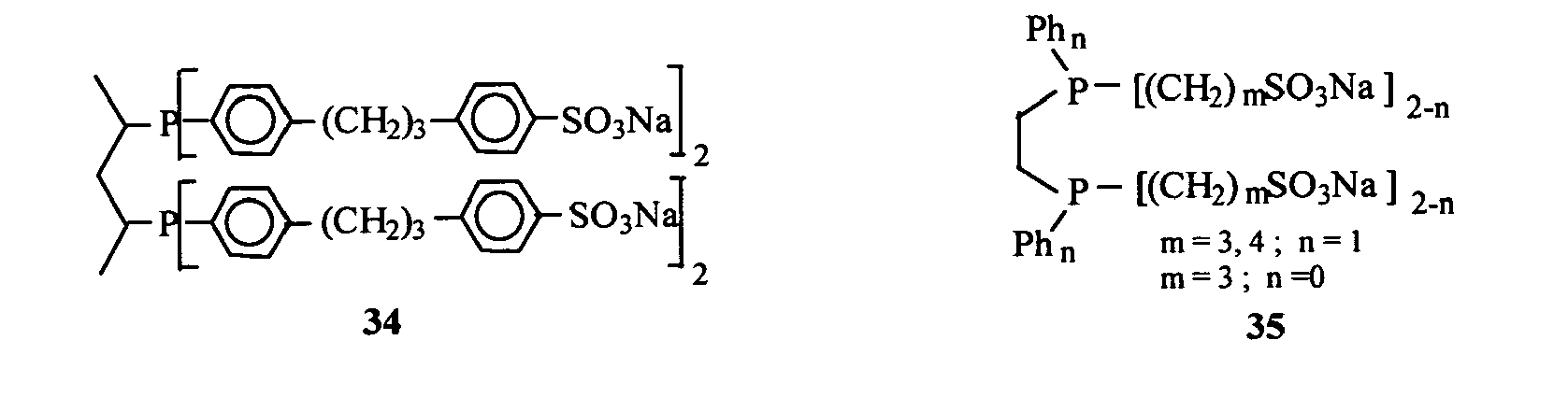
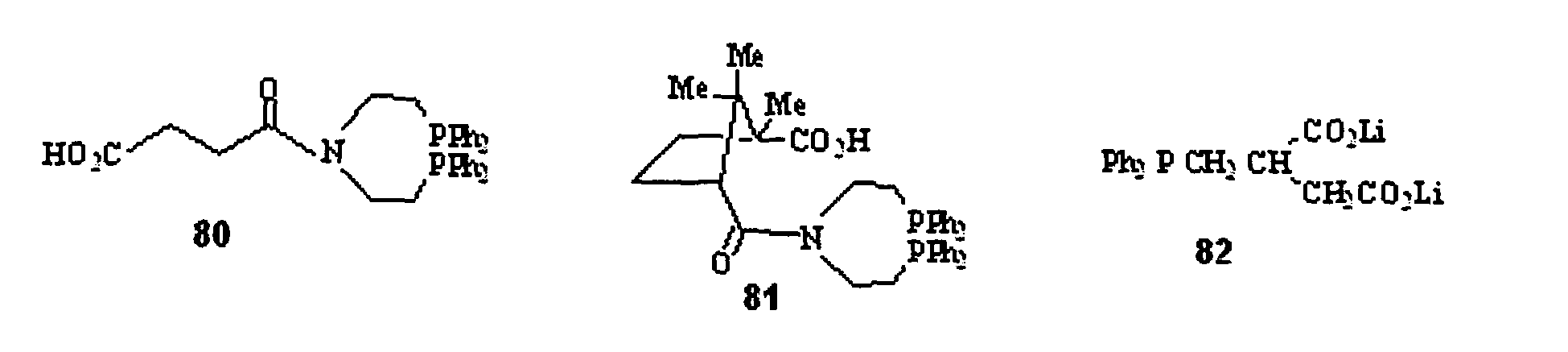
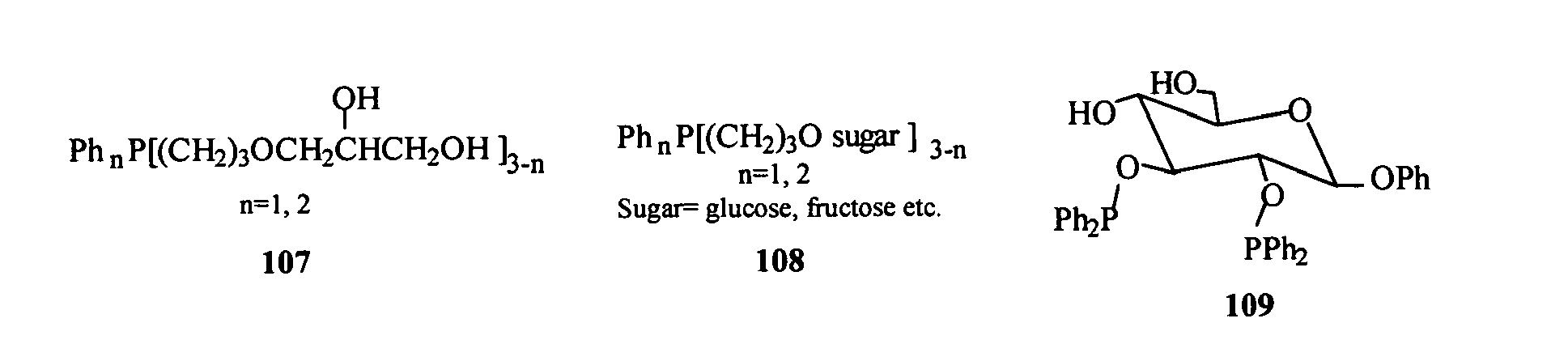
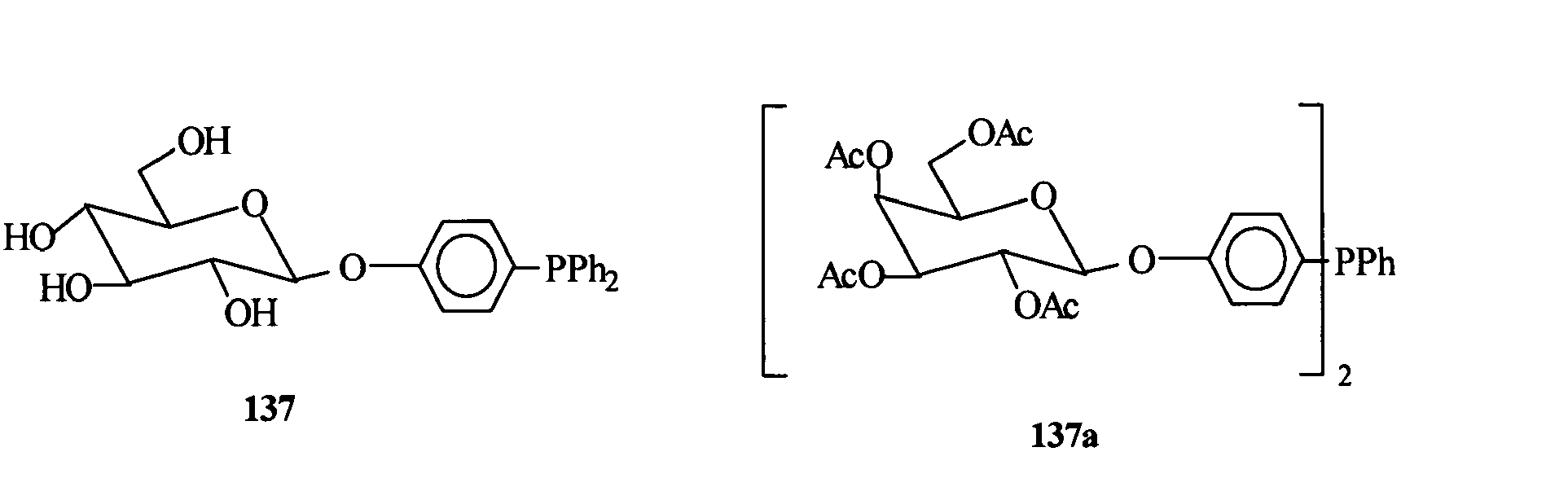
- The water soluble metal complex preferably contains hydrophilic ligands, especially hydrophilic phosphines, amines and oxygen containing ligands, preferably sulfonated mono-phosphines and sulfonated chelating phosphines. Suitable hydrophilic ligands (numbered 1 - 224) are given in the following:










- In a preferred embodiment of the present invention rhodium and/or ruthenium and/or palladium complexes have shown the highest activity and selectivity when combined with ligands of the trisulfonated triphenylphosphine (TPPTS) type. The catalyst is obtainable for example by simply mixing a watersoluble metal salt with the ligand, e.g. by preparing an aqueous solution of Rhodiumchloride or Rutheniumchloride or Palladiumchloride with TPPTS. In the following further details and preferred embodiments concerning the catalyst are given:
- (i) molar ratio between Group VIII metal and hydrophilic ligand: about 1:1 to about 1:6, preferably about 1:2 to about 1:4;
- (ii) content of Group VIII metal in the hydrogenation mixture: about 10 to about 50, preferably about 15 to about 35 ppm;
- (iii) molar ratio C=C/Group VIII metal: about 500 to about 25,000, preferably about 100 to about 20,000 and more preferably about 5,000 to about 15,000.
- The catalysts according to the present invention exhibit turnover frequencies in the range of about 120,000 h-1. The catalytic behavior of the water soluble Wilkinson's catalyst, RhCl(TPPTS)3, prepared separately, is comparable with the catalytic activity obtained by Rh/TPPTS complexes formed in situ from RhCl3·3H2O with TPPTS and H2 in the hydrogenation of FAMEs under the same conditions in aqueous/organic two phase systems. Recently one of us [J. Mol. Catal. A: Chem. 231, p93f (2005 )] provided further experimental evidence that in hydrogenation reactions in aqueous media the RhCl(TPPTS)3 catalyst exhibited similar behavior with Rh/TPPTS complexes generated in situ from RhCl3·3H2O with TPPTS and H2 under the reaction conditions. Larpent et al. [Inorg. Chem. 26, p2922f (1987 )] have reported the formation of RhCl(TPPTS)3 from RhCl3·3H2O with TPPTS in the absence of H2, where TPPTS acts both as a ligand and reducing agent to rhodium(III) chloride to afford RhCl(TPPTS)3.
- It has been found that the presence of cationic, zwitterionic (amphoteric), nonionic and anionic surfactants, ionic liquids (IL) and/or phase transfer catalysts (PTC) improves activity and selectivity of the catalyst and facilitates the separation of the complexes after the hydrogenation has taken place. Typical examples for suitable cationic surfactants are the so-called tetraalkylammonium salts, which preferably follow general formula (II):

- In the alternative, also cationic surfactants of the so-called esterquat type are useful, which can be derived from diethanol methylamine (DMA) and especially triethanol amine (TMA). The latter are preferably following general formula (III)

total 0 or an integer of 1 to 12, q represents numbers from 1 to 12 and X means halogenide, alkylsulfate or alkylphosphate. Typical and preferred examples are dicocoylmethylethoxymonium chloride and distearylmethylethoxymonium chloride which are sold under the trademark Dehyquart® L80 or AU56 respectively. In order to explain that the catalytic activity in the hydrogenation of FAMEs, catalyzed by Rh/TPPTS in the aqueous phase goes through a maximum using cationic surfactants a simplified model of a Hartley ionic spherical micelle was proposed as shown in the following figure:
- The micelle core is composed of the hydrophobic chain of the cationic surfactant where the hydrophobic tail of FAME with the C=C unsaturation units are located. Surrounding the core is the Stem layer where the charged head groups NMe3 + of DTAC interacted with the SO3 - groups of Rh/TPPTS catalyst are located together with the polar group of the hydrophilic ester moiety of FAME, along with the counter ions (Cl- and Na+, depicted as X) of the ionic micelle. The rhodium atom of the Rh/TPPTS catalyst is probably located on the polarity gradient between the Stem layer and the micelle core. Therefore, the position of the rhodium in the micelle should be dependent on the HLB value of FAME itself and of the added surfactant. This dependence is in critical relationship between the length of the unsaturated hydrocarbon chain of FAME and the length and nature of the added conventional surfactant for obtaining maximum reactivity. It is well known [ J. Mol. Catal. A: Chem. 231, p93f (2005 ); ibid. 101, p179f (1995 ); ibid. 189, p195f (2002 )] that the addition of cationic surfactants to Rh/TPPTS catalytic systems accelerates the rates of catalytic reactions due to the attraction between the negatively charged Rh/TPPTS complex ions with the positively charged cationic end of the surfactant, therefore increasing the catalyst concentration in the micelle.
- A typical example for a suitable zwitterionic surfactant is L-α-lecithin (L-α-phosphatidylcholine) which is present in vegetable oils [ J. Sep. Sci. 27, p181f (2004 )]:

- Therefore, in the hydrogenation of alkyl esters of vegetable oils catalyzed by Rh/TPPTS in aqueous/organic two phase systems the micellar catalysis takes place without addition of any surfactants even with high catalytic activities because the surfactant lecithin is inherent in the FAMEs starting material mixture. Other suitable amphoteric surfactants among others are: 3-(N,N-dodecyldimethylammonium) propanesulfonate, 3-(N,N-tetradecyldimethylammonium) propanesulfonate, 3-(N,N-cetyl-dimethylammonium) propanesulfonate, 3-(N,N-octadecyldimethylammonium) propanesulfonate, N,N-dimethy-loctylamino-N-oxide and N,N-dimethyl-decylamino-N-oxide.
- Typical examples for suitable nonionic surfactants of Brij-type are among others the following systems:


- Anionic surfactants suitable as cocatalysts in this biphasic catalytic hydrogenation reaction are among others: sodium dodecylsulfate (SDS):

- Suitable phase transfer catalysts also useful as co-catalysts according to the present invention are summarised in J.Am.Chem.Soc., 93, p195f, (1971 ) and
GB 1,227,144 A1 - The molar ratio between the co-catalyst and the ligand is typically about 1:2 to about 1:20 and preferably about 1:3 to about 1:10.
- The process according to the present invention follows the scheme which is shown below:

- In the first step the catalyst is prepared, for example by simply dissolving the Group VIII metal salt (e.g. RhCl3 · 3H2O) and the hydrophilic ligand (e.g. the sodium salt of TPPTS) in demineralised and deaerated water. The aqueous catalyst system is mixed with the polyunsaturated fatty acid alkyl ester or glyceride to result in a two-phase system formed by the aqueous catalyst solution and the polyunsaturated fatty acid alkyl ester or glyceride. Usually, the pH value is adjusted to be about 7 by adding a buffer. The ratio between the volume of the aqueous and the organic phase is typically about 5:1 to about 1:5 and preferably about 1:1. It has been found advantageous to support the phase separation by adding an inert organic solvent, for example diethyl ether, pentane, hexane or toluene typically in amounts equivalent to the volume of the ester. The mixture comprising the ester or glyceride, the catalyst and optionally the organic solvent is transferred into a stirred autoclave purged with argon and after a number of pressurising-depressurising cycles with hydrogen in order to remove all traces of oxygen. Then the reactor is heated up to 50 to 120, preferably 70 to 80 °C at kept there for a reaction time of 5 to 240, preferably 10 to 30 minutes. During this time the pressure rises up to 5 to 100 bar. Once the reaction has been completed the mixtures is cooled to room temperature and depressurised. The upper organic layer comprising the hydrogenation product is separated from the lower aqueous layer and subjected to purification, e.g. drying and/or distillation. The aqueous layer containing the catalyst is recycled.
- Another object of the present invention is directed to unsaturated fatty acid alkyl esters or glycerides having a total content of C 18:1 of about 30 to about 80 Mol-% which are obtainable by partial hydrogenation of unsaturated fatty acid esters having a total content of (C18:2+C18:3) of at least 65 Mol-% - calculated on the total amount of C18 moieties in the ester - obtainable according to the process of
Claim 1. In the total content of C18:1 the cis-C18:1 components rise up to 90% while keeping down to about 10% the trans-C18:1 isomers. - As explained above, the present invention is extremely useful to provide fatty acid alkyl esters or glycerides with a single double bond and even in higher amounts the desired cis-C18:1 isomers by selective hydrogenation of the respective polyunsaturated starting materials. Another object of the present invention is therefore the use of catalysts consisting of a Group VIII metal and hydrophilic ligand for the homogenous hydrogenation of polyunsaturated fatty acid alkyl esters or glycerides. A last object of the present invention is directed to the use of the hydrogenated fatty acid alkyl esters or glycerides as a biofuel, as biolubricants, as fatty foodstuffs with a low trans-isomers content, as a cosmetic or pharmaceutical ingredient or as a plasticizer for PVC or non-chlorine polymers.
- A 1000-ml, three-necked, round-bottom flask, equipped with a mechanical stirrer, a thermometer and a condenser was charged with 279.0 g of linseed oil and a solution of 182.8 g methanol containing 2.79 g of NaOH. The mixture was stirred at 55 °C for 100 min. The course of the reaction was followed by thin layer chromatography. The reaction mixture was then cooled and further stirred for 8 h at room temperature. After phase separation resulted in the isolation of the methyl esters of linseed oil (MELO) and the glycerol. The glycerol phase (bottom layer) was removed and kept in a separate container. The MELO phase (top layer) was washed with distilled water several times (pH= 7.0), dried over Na2SO4 to obtain 210 g of MELO mixture which was used as starting material in the hydrogenation reaction without any purification by distillation. Methyl esters composition of linseed oil was determined by gas chromatography; the details are exhibited in Table A1:
Table A1 Composition of the starting product (MELO) * Compound Content [Mol%] Methyl α-linolenate (α-MLN), C18:3 (9c, 12c, 15c) 65.8 Methyl linoleate (ML), C 18:2 (9c, 12c) 13.3 Methyl oleate (MO), C 18:1 (9c) 18.5 Methyl stearate (MS), C18:0 2.4 *The starting product MELO contained 4.8% of methyl palmitate (MP) which was ignored in the experiments. - 2.63mg (0.01 mmol) RhCl3·3H2O, 24.63mg (0.04 mmol) TPPTS, (TPPTS/Rh molar ratio = 4), 21.11mg (0.08 mmol) DTAC (DTAC/TPPTS molar ratio = 2) and 163.3 mg (1.2 mmol) KH2PO4 were dissolved in 30 ml deaerated distilled demineralized water and within 1 min of stirring the pH value of the solution was adjusted to 7.0 using 5% aqueous NaOH. This aqueous catalyst solution, having a rhodium concentration of only 34 ppm, with an organic solution of 15.03g (100.0 mmol of C=C units) of MELO mixture dissolved in 18.8 ml ether, which results a two-phase system with a volume ratio of aqueous/organic phase = 3/3.5, were charged into an Autoclave Engineers autoclave (100ml) which was previously evacuated and filled with argon. In the reaction mixture the molar ratio of C=C units / Rh was 10000. After a number of pressurising-depressurising cycles with hydrogen to remove the last traces of argon /air oxygen, the autoclave was pressured and contents were heated with stirring (stirring rate = 850 rpm). At the reaction temperature of 80°C the hydrogen partial pressure was 10 MPa (100 bar) and the
reaction time 10 min. After the reaction the autoclave was cooled to room temperature, vented of hydrogen and the reaction mixture removed. The upper organic layer was separated from the lower aqueous layer and was dried over sodium sulphate. The aqueous layer containing the catalyst was recycled. The organic layer containing the products was analyzed by gas chromatography. The details are shown in Table A2:Table A2 Composition of the hydrogenation product (H-MELO)* Compound Content [Mol%] C 18:3 mixture 0.7 C 18:2 mixture 24.5 C18:1 mixture 64.0 cis-C18:1 (total) 46.3 trans-C 18:1 (total) 17.7 C18:0 10.8 *The starting product MELO contained 4.8% of methyl palmitate (MP) which was ignored in the experiments - The turnover frequency (TOF) in this hydrogenation reaction was 39056 h-1. TOF is defined as mole of hydrogenated C=C units of C18:3, C18:2 and C18:1 isomers in the mixture of MELO per mole of rhodium per hour.
- A 1000-ml, three-necked, round-bottom flask, equipped with a mechanical stirrer, a thermometer and a condenser was charged with 322.0 g of sunflower oil and a solution of 203.0 g methanol containing 3.22 g of NaOH. The mixture was stirred at 55 °C for 70 min. The course of the reaction was followed by thin layer chromatography. The reaction mixture was then cooled and further stirred for 4.5 h at room temperature. After phase separation resulted in the isolation of the methyl esters of sunflower oil (MESO) and the glycerol. The glycerol phase (bottom layer) was removed and kept in a separate container. The MESO phase (top layer) was washed with distilled water several times (pH= 7.0), dried over Na2SO4 to obtain 230 g of MESO mixture which was used as starting material in the hydrogenation reaction without any purification by distillation. Methyl esters composition of sunflower oil was determined by gas chromatography. The details are shown in Table B1:
Table B1 Composition of the starting product (MESO)* Compound Content [Mol%] Methyl linoleate (ML), C18:2 (9c, 12c) 68.8 Methyl oleate (MO), C18:1 (9c) 28.4 Methyl stearate (MS), C18:0 2.8 * The starting product MESO contained 5.5 % of methyl palmitate (MP) which was igored in the experiments - 1.32 mg (0.005 mmol) RhCl3·3H2O and 9.24 mg (0.015 mmol) TPPTS, (TPPTS/Rh molar ratio = 3) were dissolved in 15 ml deaerated distilled demineralized water within 1 min of stirring. This aqueous catalyst solution, having a rhodium concentration of only 34 ppm, with 15.15 g (75.0 mmol of C=C units) of MESO mixture [9.87 g of ML, 4.09 g of MO, 0.42 g of MS, 0.77 g of methyl palmitate(MP)] which results a two-phase system with a volume ratio of aqueous/organic phase = 1.5/1.6, were charged into an Autoclave Engineers autoclave (100ml) which was previously evacuated and filled with argon. In the reaction mixture the molar ratio of C=C units / Rh was 15000. After a number of pressurising-depressurising cycles with hydrogen to remove the last traces of argon / air oxygen, the autoclave was pressured and contents were heated with stirring (stirring rate = 850 rpm). At the reaction temperature of 120°C the hydrogen partial pressure was 5 MPa (50 bar) and the
reaction time 5 min. After the reaction the autoclave was cooled to room temperature, vented of hydrogen and the reaction mixture removed. The upper organic layer was separated from the lower aqueous layer and was dried over sodium sulphate. The aqueous layer containing the catalyst was recycled. The organic layer containing the products was analyzed by gas chromatography. The details are shown in Table B2:Table B2 Composition of the hydrogenation product (H-MESO)* Compound Content [Mol%] C 18:2 isomer mixture 6.0 C18:1 isomer mixture 68.3 cis- C18:1 (total) 35.8 trans-C18:1 (total) 32.5 C18:0 25.7 *The hydrogenation product H-MESO (15.24 g) contained: 0.86 g of C18:2, 9.87 g of C18:1 (5.172 g of cis-C18:1 and 4.698 g of trans-C18:1) 3.74 g of MS and 0.77 g of MP - The turnover frequency (TOF) in this hydrogenation reaction was 117286 h-1. TOF is defined as mole of hydrogenated C=C units of C 18:2 and C18:1 isomers in the mixture of MESO per mole of rhodium per hour.
- The following hydrogenation examples were conducted according to the general instructions as provided in Examples 1b and 2b, however, at changing pH values. The reaction conditions were the following:
- T=70 °C
- PH2=10bar
- t = 2h
- 2.63 mg (0.01 mmol) RhCl3·3H2O, 18.47mg (0.03 mmol) TPPTS (TPPTS/Rh molar ratio = 3), 15.83mg (0.06 mmol) DTAC (DTAC/TPPTS molar ratio = 2)
- 802.7 mg (5.0 mmol of C=C) of MELO mixture 1 (C=C/Rh molar ratio = 500)
- 30 ml deaerated distilled demineralized water
- [Rh]=34ppm.
- Addition of a solution of
MELO mixture 1 dissolved in 10 ml n-hexane results a two-phase system with a volume ratio of aqueous/organic phase = 3/1.1. Stirring rate = 770 rpm. The details are exhibited in Table 1:Table 1 Micellar biphasic hydrogenation of MELO catalyzed by Rh/TPPTS complexes under various pH values Entry Ester Catalyst Precursor pH C18:3 (total) mol% C18:2 (total) mol% C18:1 (total) mol% cis-C18:1 (total) mol% trans-C18:1 (total) mol% MS mol% TOFb h-1 - MELO 1c - - 56.8d 16.7e 22.5f 22.5 - 4.0 - 1/1 MELO 1cRhCl3·3H2O/ TPPTS 4.1g 2.5 28.8 57.7 46.6 11.1 11.0 136 1/2 MELO 1cRhCl3·3H2O/ TPPTS 7.0h 0.9 12.8 73.5 42.5 31.0 12.8 151 1/3 MELO 1cRhCl3·3H2O/ TPPTS 10.5i 5.1 34.3 53.4 43.8 9.6 7.2 130 b Defined as mole of hydrogenated C=C units of C18:3, C18:2 and C18:1 isomers in the mixture of MELO per mole of rhodium per hour.
c The starting material of MELO mixture 1(α-MLN, ML, MO, MS) contained 4.8% of methyl palmitate (MP) which was ignored in the experiments.
d Methyl α-linolenate (α-MLN), C18:3 (9c, 12c, 15c); e Methyl linoleate (ML), C18:2 (9c, 12c)
f Methyl oleate (MO), C18:1 (9c).
g No buffer.
h 163.3 mg (1.2 mmol) KH2PO4, pH adjusted with 5% aqueous NaOH.
i pH adjusted with 5% aqueous NaOH, no KH2PO4. - The following hydrogenation examples were conducted according to the general instructions as provided in Examples 1b and 2b, however, using different solvents. The reaction conditions were the following:
- T = 70-80 °C
- PH2=10 bar
- 2.63 mg (0.01 mmol) RhCl3·3H2O
- 30 ml deaerated distilled demineralized water
- [Rh] = 34 ppm.
- C=C /Rh molar ratio = 500 - 1000
- Addition of a solution of FAME or
MELO 1 dissolved in 10 ml organic solvent results a two-phase system with a volume ratio of aqueous/organic phase = 3/1. Stirring rate = 770 rpm; except inentries 2/4 and 2/5 a rate of 850 rpm. The details are exhibited in Table 2:Table 2 Micellar biphasic hydrogenation of fatty esters catalyzed by Rh/TPPTS complexes in the presence of various organic solvents Entry Ester Catalyst Precursor Solvent T °C C18:3 (total) mol% C18:2 (total) mol% C18:1 (total) mol% cis-C18:1 (total) mol% trans-C18:1 (total) mol% MS mol% TOFb h-1 - FAME - - - 83.0c 17.0d - - - - - 2/1e FAME RhCl3·3H2O/ TPPTS Pentane 80 2.6 25.8 56.5 40.5 16.0 15.1 804 2/2e FAME RhCl3·3H2O/ TPPTS Hexane 80 3.9 30.5 51.2 37.5 13.7 14.4 791 2/3e FAME RhCl3·3H2O/ TPPTS Toluene 80 14,5 47.9 29.8 23.2 6.6 7.8 685 - MELO 1f - - - 56.8c 16.7d 22.5g 22.5g - 4.0 - 2/4h MELO 1RhCl3·3H2O/ TPPTS Pentane 70 41.2 21.3 33.2 31.4 1.8 4.3 932 2/5h MELO 1RhCl3·3H2O/ TPPTS Ether 70 1.2 22.0 67.2 54.2 13.0 9.6 3336 b Defined as mole of hydrogenated C=C units of C18:3, C 18:2 and C18:1 isomers in the mixture of FAME or MELO per mole of rhodium per hour.
c Methyl α-linolenate (α-MLN), C18:3 (9c, 12c, 15c).
d Methyl linoleate (ML), C18:2 (9c, 12c).
e TPPTS/Rh molar ratio =3; DTAC/TPPTS molar ratio =3; t=30 min. No buffer (pH= 4.5 - 5.1)
f The starting material of MELO mixture (α-MLN, ML, MO, MS) contained 4.8% of methyl palmitate (MP)
which was ignored in the experiments.
g Methyl oleate (MO), C18:1 (9c).
h TPPTS/Rh molar ratio =4; DTAC/TPPTS molar ratio =2; t=10 min. 163.3 mg (1.2 mmol) KH2PO4, pH=7.0 adjusted with 5% aqueous NaOH. - The following hydrogenation examples were conducted according to the general instructions as provided in Examples 1b and 2b, however, using different C=C/Rh molar ratios. The reaction conditions were the following:
- T = 70 °C
- PH2=10bar
- t=2h
- 2.63mg (0.01 mmol) RhCl3·3H2O, 18.47 mg (0.03 mmol) TPPTS (P/Rh molar ratio = 3), 15.83mg (0.06 mmol) DTAC (DTAC/TPPTS molar ratio = 2)
- 30 ml deaerated distilled demineralized water
- [Rh] = 34 ppm
- 163.3 mg (1.2 mmol) KH2PO4
- pH = 7.0 adjusted with 5% aqueous NaOH
- Addition of a solution of MELO mixture dissolved in 10 ml hexane results a two-phase system with a volume ratio of aqueous/organic phase = 3/1 - 3/1.2. Stirring rate = 770 rpm. The details are shown in Table 3:
Table 3 Micellar biphasic hydrogenation of MELO catalyzed by Rh/TPPTS complexes at low C=C/Rh molar ratios Entry Ester Catalyst Precursor C=C Rh C18:3 total mol% C18:2 (total) mol% C18:1 (total) mol% cis-C18:1 (total) mol% trans-C18:1 (total) mol% MS mol% TOFb h-1 - MELO 1c - - 56.8d 16.7e 22.5f 22.5f - 4.0 - 3/1 MELO 1RhCl3·3H2O/ TPPTS 50 2.9 8.0 52.2 33.1 19.1 36.9 16 3/2 MELO 1RhCl3·3H2O/ TPPTS 100 0.2 3.8 58.9 30.2 28.7 37.1 35 3/3 MELO 1RhCl3·3H2O/TPPTS 300 0.5 8.3 73.7 40.9 32.8 17.5 98 3/4 MELO 1RhCl3·3H2O/TPPTS 500 0.9 12.8 73.5 42.5 31.0 12.8 150 3/5 MELO 1RhCl3·3H2O/TPPTS 700 2.2 27.7 62.2 53.9 8.3 7.9 189 3/6 MELO 1RhCl3·3H2O/TPPTS 1000 5.3 35.7 53.2 43.9 9.3 5.8 254 3/7 MELO 1RhCl3·3H2O/TPPTS 1500 28.1 30.4 36.7 33.4 3.3 4.8 205 b Defined as mole of hydrogenated C=C units of C18:3, C18:2 and C18:1 isomers in the mixture of MELO per mole of rhodium per hour.
c The starting material ofMELO 1 mixture (α-MLN, ML, MO, MS) contained 4.8% of methyl palmitate (MP) which was ignored in the experiments.
d Methyl α-linolenate (α-MLN), C18:3 (9c, 12c, 15c).
e Methyl linoleate (ML), C18:2 (9c, 12c).
f Methyl oleate (MO), C18:1 (9c). - The following hydrogenation examples were conducted according to the general instructions as provided in Examples 1b and 2b, however using different C=C/Rh molar ratios, pressures and temperatures. The reaction conditions were the following:
- t =10 min
- 2.63mg (0.01 mmol) RhCl3·3H2O, 24.63mg (0.04 mmol) TPPTS (TPPTS/Rh molar ratio = 4), 21.11 mg (0.08 mmol) DTAC (DTAC/TPPTS molar ratio = 2)
- 30 ml deaerated distilled demineralized water
- [Rh] = 34 ppm. 163.3 mg (1.2 mmol) KH2PO4
- pH = 7.0 adjusted with 5% aqueous NaOH
- Addition of a solution of MELO mixture dissolved in 10 ml ether results a two-phase system with a volume ratio of aqueous/organic phase = 3/1.1 - 3/2.6; except
entry 4/13, a two-phase system consisting of 30 ml of aqueous solvent with a solution of 15.03 g (100.0 mmol of C=C) of MELO dissolved in 18.8 ml of ether (aqueous/organic phase = 3/3.5). Stirring rate = 850 rpm. The details are shown in Table 4:Table 4 Micellar biphasic hydrogenation of MELO catalyzed by Rh/TPPTS complexes at different partial H2 pressures, temperatures and higher C=C/Rh molar ratios Entry Ester Catalyst Precursor C=C Rh T °C p H2bar C18:3 (total) mol% C18:2 (total) mol% C18:1 (total) mol% cis-C18:1 (total) mol% trans-C18:1 (total) mol% MS mol% TOFb h-1 - MELO 1c - - - - 56.8d 16.7e 22.5f 22.5f - 4.0 - 4/1 MELO 1RhCl3·3H2O /TPPTS 1000 70 10 1.2 22.0 67.2 54.2 13.0 9.6 3336 4/2 MELO 1RhCl3·3H2O /TPPTS 1000 70 50 0.5 6.8 65.2 43.1 22.1 27.5 3976 4/3 MELO 1RhCl3·3H2O /TPPTS 1000 70 70 0.3 5.0 58.9 39.3 19.6 35.8 4097 4/4 MELO 1RhCl3·3H2O /TPPTS 2000 70 70 0.6 5.9 65.0 42.9 22.1 28.5 8054 4/5 MELO 1RhCl3·3H2O /TPPTS 3000 70 70 1.9 9.9 65.3 47.8 17.5 22.9 11125 - MELO 2c - - - - 63.9d 16.5e 17.4f 17.4f - 2.2 - 4/6 MELO 2RhCl3·3H2O /TPPTS 3000 70 70 37.0 22.4 32.3 29.1 3.2 8.3 4863 4/7g MELO 2RhCl3·3H2O /TPPTS 3000 70 70 40.4 17.0 31.9 28.3 3.6 10.7 4256 - MELO 3c - - - - 65.8d 13.3e 18.5f 18.5f - 2.4 - 4/8 MELO 3RhCl3·3H2O /TPPTS 3000 70 10 39.2 24.3 32.3 29.8 2.5 4.2 4783 4/9 MELO 3RhCl3·3H2O /TPPTS 3000 70 40 2.0 26.5 62.2 47.3 14.9 9.3 11495 4/10 MELO 3RhCl3·3H2O /TPPTS 3000 70 70 0.8 10.1 67.0 39.8 27.2 22.1 12274 4/11 MELO 3RhCl3·3H2O /TPPTS 3000 70 100 0.6 10.6 63.9 35.9 28.0 24.9 12214 4/12 MELO 3RhCl3·3H2O /TPPTS 10000 70 100 20.4 32.0 42.0 36.7 5.3 5.6 27234 4/13 MELO 3RhCl3·3H2O /TPPTS 10000 80 100 0.7 24.5 64.0 46.3 17.7 10.8 39056 b Defined as mole of hydrogenated C=C units of C18:3, C18:2 and C18:1 isomers in the mixture of MELO per mole of rhodium per hour.
c The starting material of MELO mixture (α-MLN, ML, MO, MS) contained 3.4 - 4.8% of methyl palmitate (MP) which was ignored in the experiments.
d Methyl α-linolenate (α-MLN), C18:3 (9c, 12c, 15c).
e Methyl linoleate (ML), C18:2 (9c, 12c).
f Methyl oleate (MO), C18:1 (9c).
g No buffer (pH=4.5). - The following hydrogenation examples were conducted according to the general instructions as provided in Examples 1b and 2b, however in the absence of organic solvents and cationic surfactants. The reaction conditions were the following:
- 1.32mg (0.005 mmol) RhCl3·3H2O; except
entries 5/1-5/4, 5/9, 2.63mg (0.01 mmol) RhCl3·3H2O; 9.24 mg (0.015 mmol) TPPTS (TPPTS/Rh molar ratio = 3); exceptentries 5/1, 5/3, 5/4, 24.63 mg (0.04 mmol) TPPTS (TPPTS/Rh molar ratio = 4); exceptentry 5/2, 30.79 mg (0.05 mmol) TPPTS (TPPTS/Rh molar ratio = 5); - 15 ml deaerated distilled demineralized water,
- pH= 4.3; except
entries 5/1-5/4, 5/8, 5/9, 30 ml water, pH=4.5; - [Rh] = 34 ppm; except
entry 5/8, [Rh] = 17 ppm. - These extremely high catalytic activities (TOF ≈ 120000 h-1) achieved by Rh/TPPTS catalysts in aqueous/organic two phase systems without any addition of external surfactant could be rationalized if one considers that in the crude fatty alkyl ester renewable starting material mixture, lecithin is present which acts as an inherent surfactant and micellar catalysis is operative.
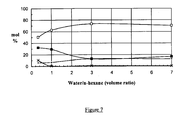
- (x) % C18:3 (total); (■) % C18:2 (total); (□) % C18:1 (total); (◆) % C18:0. Reaction conditions: T = 50 °C; PH2 = 10 bar; 2.63mg (0.01 mmol) RhCl3·3H2O, 24.63mg (0.04 mmol) TPPTS (TPPTS/Rh molar ratio = 4), 31.66 mg (0.12 mmol) DTAC (DTAC/TPPTS molar ratio = 3), 802.7mg (5.0 mmol of C=C) of
MELO mixture 1 consisting of 56.8 % α-MLN, 16.7 % ML, 22.5% MO, 4.0 % MS (C=C/Rh molar ratio =500);MELO 1 contained furthermore 4.8 % of methyl palmitate (MP) which was ignored; 30 ml deaerated distilled demineralized water, [Rh] = 34 ppm. 163.3 mg (1.2 mmol) KH2PO4, pH=7.0 adjusted with 5% aqueous NaOH. Addition of a solution of MELO mixture dissolved in 10 ml of n-hexane results a two-phase system with a volume ratio of aqueous/organic phase = 3/1.1; stirring rate = 770 rpm. - This figure shows that at reaction times longer than 100 minutes the reverse β-hydride elimination reaction occurs leading to isomerization of the olefinic starting material and not any more to hydrogenation reaction.
- (x) % C18:3 (total); (■) % C18:2 (total); (□) % C18:1 (total); (◆) % C18:0. Reaction conditions: see Figure 1, t= 2 h.
- This figure shows that at T > 100°C the reverse β-hydride elimination reaction occurs leading to isomerization of the olefinic starting material and not any more to hydrogenation reaction.
- (x) % C18:3 (total); (■) % C18:2 (total); (□) % C18:1 (total); (◆) % C18:0. Reaction conditions: T = 70 °C; P = 10 bar; t = 2 h; 2.63 mg (0.01 mmol) RhCl3·3H2O, DTAC/TPPTS molar ratio =3 , 802.7 mg (5.0 mmol of C=C) of MELO mixture 1 (C=C/Rh molar ratio = 500); 30 ml deaerated distilled demineralised water, [Rh] = 34 ppm. 163.3 mg (1.2 mmol) KH2PO4, pH=7.0 adjusted with 5% aqueous NaOH. Addition of a solution of
MELO mixture 1 dissolved in 10 ml of n-hexane results a two-phase system with a volume ratio of aqueous/organic phase = 3/1.1; stirring rate = 770 rpm. - (x) % C18:3 (total); (■) % C18:2 (total); (□) % C18:1 (total); (◆) % C18:0. Reaction conditions: T = 70 °C; P = 10 bar; t = 2 h; 2.63 mg (0.01 mmol) RhCl3·3H2O, 18.47 mg (0.03 mmol) TPPTS (TPPTS/Rh molar ratio =3), (0.09 mmol) surfactant (surfactant/TPPTS molar ratio =3), 802.7 mg (5.0 mmol of C=C) of MELO mixture 1 ( C=C/Rh molar ratio = 500); 30 ml deaerated distilled demineralised water, [Rh] = 34 ppm. 163.3 mg (1.2 mmol) KH2PO4, pH=7.0 adjusted with 5% aqueous NaOH. Addition of a solution of
MELO mixture 1 dissolved in 10 ml of n-hexane results a two-phase system with a volume ratio of aqueous/organic phase = 3/1.1; stirring rate = 770 rpm. - (x) % C18:3 (total); (■) % C18:2 (total); (□) % C18:1 (total); (◆) % C18:0. Reaction conditions: T = 70 °C; P = 10 bar; t = 2 h; 2.63 mg (0.01 mmol) RhCl3·3H2O, 18.47 mg (0.03 mmol) TPPTS (TPPTS/Rh molar ratio =3), 802.7 mg (5.0 mmol of C=C) of MELO mixture 1 (C=C/Rh molar ratio = 500); 30 ml deaerated distilled demineralised water, [Rh] = 34 ppm. 163.3 mg (1.2 mmol) KH2PO4, pH=7.0 adjusted with 5% aqueous NaOH. Addition of a solution of
MELO mixture 1 dissolved in 10 ml of n-hexane results a two-phase system with a volume ratio of aqueous/organic phase = 3/1.1; stirring rate = 770 rpm. - (x) % C18:3 (total); (■) % C18:2 (total); (□) % C18:1 (total); (◆) % C18:0. Reaction conditions: T = 70 °C; P = 10 bar; t = 2 h; 2.63 mg (0.01 mmol) RhCl3·3H2O, 18.47 mg (0.03 mmol) TPPTS (TPPTS/Rh molar ratio =3), 15.83 mg (0.06 mmol) DTAC (DTAC/TPPTS molar ratio = 2), 0.006 mmol of non-ionic and anionic surfactants (molar ratio of DTAC/non-ionic and anionic surfactants = 10), 802.7 mg (5.0 mmol of C=C) of MELO mixture 1 ( C=C/Rh molar ratio = 500); 30 ml deaerated distilled demineralised water, [Rh] = 34 ppm. 163.3 mg (1.2 mmol) KH2PO4, pH=7.0 adjusted with 5% aqueous NaOH. Addition of a solution of
MELO mixture 1 dissolved in 10 ml of n-hexane results a two-phase system with a volume ratio of aqueous/organic phase = 3/1.1; stirring rate = 770 rpm. - (x) % C18:3 (total); (■) % C18:2 (total); (□) % C18:1 (total); (◆) % C18:0. Reaction conditions: T = 70 °C; P = 10 bar; t = 2 h; 2.63 mg (0.01 mmol) RhCl3·3H2O, 18.47 mg (0.03 mmol) TPPTS (TPPTS/Rh molar ratio =3),15.83 mg (0.06mmol) DTAC (DTAC/TPPTS molar ratio = 2), 163.3 mg (1.2 mmol) KH2PO4, pH=7.0 adjusted with 5% aqueous NaOH. 802.7 mg (5.0 mmol of C=C) of MELO mixture 1 (C=C/Rh molar ratio = 500). Addition of a solution of
MELO mixture 1 dissolved in n-hexane results a two-phase system. H2O and n-hexane: 40 ml total. Stirring rate = 770 rpm.
| Biphasic hydrogenation of MESO catalyzed by Rh/TPPTS complexes in the absence of organic solvents and cationic surfactants | ||||||||||||
| Entry | Ester | Catalyst Precursor | C=C Rh | T °C | p H2 bar | t min | C18:2 (total) mol% | C18:1 (total) mol% | cis-C18:1 (total) mol% | trans-C18:1 (total) mol% | MS mol% | TOFb h-1 |
| - | MESO 1c | - | - | - | - | - | 69.2d | 27.8e | 27.8e | - | 3.0 | - |
| 5/1f,g | | RhCl3·3H2O /TPPTS | 1000 | 70 | 70 | 10 | 43.2 | 39.3 | 35.4 | 3.9 | 17.5 | 1558 |
| 5/2f,g | | RhCl3·3H2O /TPPTS | 1000 | 100 | 70 | 10 | 40.4 | 44.6 | 38.0 | 6.6 | 15.0 | 1727 |
| 5/3g | | RhCl3·3H2O /TPPTS | 1000 | 110 | 50 | 10 | 11.6 | 65.1 | 45.2 | 19.9 | 23.3 | 3456 |
| 5/4g | | RhCl3·3H2O /TPPTS | 10000 | 110 | 50 | 10 | 56.8 | 36.7 | 33.5 | 3.2 | 6.5 | 7435 |
| 5/5 | | RhCl3·3H2O /TPPTS | 10000 | 120 | 50 | 10 | 9.6 | 63.9 | 31.7 | 32.2 | 26.5 | 35733 |
| 5/6 | | RhCl3·3H2O /TPPTS | 20000 | 120 | 50 | 10 | 46.6 | 44.9 | 34.0 | 10.9 | 8.5 | 13531 |
| 5/7 | | RhCl3·3H2O /TPPTS | 10000 | 120 | 50 | 10 | 10.8 | 67.0 | 35.9 | 31.1 | 22.2 | 35040 |
| 5/8 | | RhCl3·3H2O /TPPTS | 20000 | 120 | 50 | 10 | 44.0 | 49.3 | 37.1 | 12.2 | 6.7 | 30216 |
| 5/9 | | RhCl3·3H2O /TPPTS | 20000 | 130 | 50 | 10 | 59.4 | 36.2 | 30.0 | 6.2 | 4.4 | 11681 |
| 5/10 | | RhCl3·3H2O /TPPTS | 15000 | 120 | 50 | 10 | 16.3 | 64.5 | 35.8 | 28.7 | 19.2 | 47609 |
| 5/11 | | RhCl3·3H2O /TPPTS | 20000 | 120 | 50 | 10 | 25.2 | 61.9 | 34.8 | 27.1 | 12.9 | 52845 |
| 5/12 | | RhCl3·3H2O /TPPTS | 20000 | 120 | 50 | 5 | 38.6 | 52.1 | 36.0 | 16.1 | 9.3 | 73303 |
| 5/13 | | RhCl3·3H2O /TPPTS | 17500 | 120 | 50 | 5 | 33.8 | 54.9 | 36.0 | 18.9 | 11.3 | 74280 |
| - | MESO 2c | - | - | - | - | - | 68.8d | 28.4e | 28.4e | - | 2.8 | - |
| 5/14 | | RhCl3·3H2O /TPPTS | 5000 | 120 | 50 | 5 | 0.2 | 34.1 | 15.4 | 18.7 | 65.7 | 42518 |
| 5/15 | | RhCl3·3H2O /TPPTS | 12000 | 120 | 50 | 5 | 3.1 | 58.0 | 26.1 | 31.9 | 38.9 | 97995 |
| 5/16g | | RhCl3·3H2O /TPPTS | 12000 | 120 | 50 | 5 | 14.7 | 62.7 | 35.2 | 27.5 | 22.6 | 81243 |
| 5/17h | | RhCl3·3H2O /TPPTS | 12000 | 120 | 50 | 5 | 23.6 | 58.4 | 34.2 | 24.2 | 18.0 | 68396 |
| 5/18 | | RhCl3·3H2O /TPPTS | 12000 | 110 | 50 | 5 | 15.3 | 62.3 | 31.5 | 30.8 | 22.4 | 80463 |
| 5/19 | | RhCl3·3H2O /TPPTS | 12000 | 130 | 50 | 5 | 11.0 | 60.2 | 26.3 | 33.9 | 28.8 | 86540 |
| 5/20 | | RhCl3·3H2O /TPPTS | 17500 | 120 | 50 | 5 | 20.0 | 64.7 | 40.0 | 24.7 | 15.3 | 107174 |
| 5/21 | | RhCl3·3H2O /TPPTS | 15000 | 120 | 50 | 5 | 6.0 | 68.3 | 35.8 | 32.5 | 25.7 | 117286 |
| b Defined as mole of hydrogenated C=C units of C18:2 and C18:1 isomers in the mixture of MESO per mole of rhodium per hour. c The starting material of MESO mixture contained 4.6-5.5% of methyl palmitate which was ignored in the experiments d Methyl linoleate (ML), C18:2 (9c, 12c). e Methyl oleate (MO), C18:1 (9c). f DTAC/TPPTS molar ratio =2. g 163.3 mg (1.2 mmol) KH2PO4, pH=7.0 adjusted with 5% aqueous NaOH; except mmol) KH2PO4, pH=7.0 adjusted with 5% aqueous NaOH. h pH = 10.4 adjusted with a solution of 5% aqueous NaOH, no KH2PO4. |
Claims (26)
- Process for the manufacture of unsaturated fatty acid alkyl esters or glycerides having a total content of C 18:1 of about 30 to about 80 Mol-% by partial hydrogenation of unsaturated fatty acid esters having a total content of (C18:2+C18:3) of at least 65 Mol-% - calculated on the total amount of C 18 moieties in the ester - characterised in that the hydrogenation is conducted in an aqueous/organic two phase system in the presence of a water soluble catalyst consisting of a Group VIII metal and a hydrophilic ligand.
- Process according to Claim 1, characterised in that said unsaturated fatty acid alkyl esters used as the starting material for the hydrogenation follow general formula (I),
R1CO-OR2 (I)
in which R1CO represents an acyl radical having 6 to 22 carbon atoms and 0, 1, 2 or 3 double bonds while R2 stands for an alkyl group having 1 to 4 carbon atoms. - Process according to Claims 1 and/or 2, characterised in that said unsaturated fatty acid alkyl esters used as the starting material for the hydrogenation comprise at least 60 Mol-% C 18 residues.
- Process according to any of the Claims 1 to 3, characterised in that methyl or ethyl esters of linseed, soybean or sunflower fatty acid are subjected to hydrogenation.
- Process according to any of the Claims 1 to 4, characterised in that said Group VIII metal of said homogenous catalyst is selected from the group consisting of rhodium, ruthenium, palladium, cobalt, platinum, nickel, iridium, iron and their mixtures.
- Process according to any of the Claims 1 to 5, characterised in that said hydrophilic ligand of said homogenous catalyst is selected from the group consisting of hydrophilic phosphines, amines and oxygen containing ligands.
- Process according to any of the Claims 1 to 6, characterised in that said homogenous catalyst is a complex of rhodium or ruthenium or palladium and trisulfonated triphenylphosphine (TPPTS).
- Process according to any of the Claims 1 to 7, characterised in that the molar ratio between the Group VIII metal and the hydrophilic ligand is about 1:1 to about 1:6.
- Process according to any of the Claims 1 to 8, characterised in that the content of the Group VIII metal in the reaction mixture is about 10 to about 50 ppm.
- Process according to any of the Claims 1 to 9, characterised in that the molar ratio of C=C/Group VIII metal is about 500 to about 25,000.
- Process according to any of the Claims 1 to 10, characterised in that the hydrogenation takes place in the presence of a co-catalyst, selected from the group consisting of cationic, zwitterionic, nonionic and anionic surfactants, ionic liquids or a phase transfer catalysts.
- Process according to Claim 11, characterised in that said co-catalyst is a tetraalkylammonium salt or an esterquat or lecithin which is inherent in the crude unsaturated fatty acid esters and glyceride renewable starting material mixture.
- Process according to Claim 11, characterised in that said cationic surfactant is octyltrimethylammonium chloride (OTAC), dodecyltrimethylammonium chloride (DTAC), tetradecyltrimethylammonium chloride, cetyltrimethylammonium chloride (CTAC), cetylpyridinium chloride, octadecyltrimethylammonium chloride, distearyldimethylammonium chloride, dicocoylmethylethoxymonium methosulfate or distearoyl-methylethoxymonium methosulfate.
- Process according to any of Claims 11 to 13, characterised in that the molar ratio between co-catalyst and ligand is about 1:2 to 1:20.
- Process according to any of the Claims 1 to 14, characterised in that the hydrogenation takes place in an aqueous/organic two-phase system, formed by the aqueous catalyst solution and the polyunsaturated fatty acid alkyl ester or glyceride.
- Process according to Claim 15, characterised in that the ratio between the volume of the aqueous and the organic phase is about 7:1 to about 1:5.
- Process according to Claims 15 and/or 16, characterised in that the pH value of the aqueous phase is adjusted to about 7.
- Process according to any of the Claims 15 to 17, characterised in that an organic solvent is added to the organic phase.
- Process according to Claim 18, characterised in that said solvent is selected from the group consisting of diethyl ether, pentane, hexane, toluene and their mixtures.
- Process according to any of the Claims 1 to 19, characterised in that the hydrogenation is conducted at a temperature of 50 to 120 °C.
- Process according to any of the Claims 1 to 20, characterised in that the hydrogenation is conducted under a pressure of 5 to 100 bar.
- Process according to any of the Claims 1 to 21, characterised in that the hydrogenation is conducted over a reaction time of 5 to 240 minutes.
- Process according to any of the Claims 1 to 22, characterised in that once the hydrogenation has been finished the phases are separated, the organic phase comprising the hydrogenation product is purified and the aqueous phase comprising the catalyst is recycled.
- Unsaturated fatty acid alkyl esters or glycerides having a total content of C18:1 of about 30 to about 80 Mol-% obtainable by partial hydrogenation of unsaturated fatty acid esters having a total content of (C18:2+C18:3) of at least 65 Mol-% - calculated on the total amount of C 18 moieties in the ester - obtainable according to the process of Claim 1.
- Use of catalysts consisting of a Group VIII metal and a hydrophilic ligand for the homogenous hydrogenation of polyunsaturated fatty acid alkyl esters or glycerides.
- Use of an unsaturated fatty acid alkyl ester or glycerides according to Claim 24 or according to the process of Claim 1 as a biofuel, as biolubricant, as edible margarine with low trans-fats content, as a cosmetic or pharmaceutical ingredient or as a plasticizer for PVC or non-chlorine polymers.
Priority Applications (5)
| Application Number | Priority Date | Filing Date | Title |
|---|---|---|---|
| ES06021297T ES2391466T3 (en) | 2006-10-11 | 2006-10-11 | Procedure for partial hydrogenation of fatty acid esters |
| EP06021297A EP1918358B1 (en) | 2006-10-11 | 2006-10-11 | Process for the partial hydrogenation of fatty acid esters |
| CA002672680A CA2672680A1 (en) | 2006-10-11 | 2007-10-02 | Process for the partial hydrogenation of fatty acid esters |
| US12/444,989 US8263794B2 (en) | 2006-10-11 | 2007-10-02 | Process for the partial hydrogenation of fatty acid esters |
| PCT/EP2007/008547 WO2008043454A1 (en) | 2006-10-11 | 2007-10-02 | Process for the partial hydrogenation of fatty acid esters |
Applications Claiming Priority (1)
| Application Number | Priority Date | Filing Date | Title |
|---|---|---|---|
| EP06021297A EP1918358B1 (en) | 2006-10-11 | 2006-10-11 | Process for the partial hydrogenation of fatty acid esters |
Publications (2)
| Publication Number | Publication Date |
|---|---|
| EP1918358A1 true EP1918358A1 (en) | 2008-05-07 |
| EP1918358B1 EP1918358B1 (en) | 2012-08-01 |
Family
ID=37863995
Family Applications (1)
| Application Number | Title | Priority Date | Filing Date |
|---|---|---|---|
| EP06021297A Not-in-force EP1918358B1 (en) | 2006-10-11 | 2006-10-11 | Process for the partial hydrogenation of fatty acid esters |
Country Status (5)
| Country | Link |
|---|---|
| US (1) | US8263794B2 (en) |
| EP (1) | EP1918358B1 (en) |
| CA (1) | CA2672680A1 (en) |
| ES (1) | ES2391466T3 (en) |
| WO (1) | WO2008043454A1 (en) |
Cited By (2)
| Publication number | Priority date | Publication date | Assignee | Title |
|---|---|---|---|---|
| WO2009000435A1 (en) * | 2007-06-23 | 2008-12-31 | Cognis Ip Management Gmbh | Process for the manufacture of saturated fatty acid esters in the presence of a homogeneous complex of a group viii metal and a sulfonated phosphite |
| WO2012016849A1 (en) * | 2010-08-02 | 2012-02-09 | Cognis Ip Management Gmbh | Process for the homogeneous hydrogenation of (poly)unsaturated hydrocarbons |
Families Citing this family (9)
| Publication number | Priority date | Publication date | Assignee | Title |
|---|---|---|---|---|
| JP5756972B2 (en) | 2010-02-24 | 2015-07-29 | 国立研究開発法人産業技術総合研究所 | Biodiesel fuel production method and biodiesel fuel composition |
| US8748641B2 (en) | 2010-05-05 | 2014-06-10 | The United States Of America, As Represented By The Secretary Of Agriculture | Process for preparing saturated branched chain fatty acids |
| US9115076B2 (en) | 2010-04-26 | 2015-08-25 | The United States Of America, As Represented By The Secretary Of Agriculture | Process for preparing saturated branched chain fatty acids |
| WO2011136903A1 (en) * | 2010-04-26 | 2011-11-03 | The United States Of America As Represented By The Secretary Of Agriculture | Process for preparing saturated branched chain fatty acids |
| US8588884B2 (en) * | 2010-05-28 | 2013-11-19 | Emkinetics, Inc. | Microneedle electrode |
| EP2522711B1 (en) * | 2011-05-13 | 2018-12-05 | Cognis IP Management GmbH | Process for obtaining oleochemicals with reduced content of by-products |
| DE102014209412A1 (en) * | 2014-05-19 | 2015-11-19 | Evonik Degussa Gmbh | Phase transfer reagent for the epoxidation of fatty acid alkyl esters |
| WO2015176872A1 (en) * | 2014-05-20 | 2015-11-26 | Unilever N.V. | Process for the manufacture of edible water-in-oil emulsion |
| WO2026060277A1 (en) | 2024-09-13 | 2026-03-19 | Virent, Inc. | Renewable diesel production with reduced hydrogen consumption and glycerol release |
Citations (5)
| Publication number | Priority date | Publication date | Assignee | Title |
|---|---|---|---|---|
| GB1227144A (en) | 1967-04-05 | 1971-04-07 | ||
| GB1594603A (en) | 1977-10-18 | 1981-08-05 | Chapman D | Hydrogenation of lipids |
| DE4012873A1 (en) * | 1990-04-23 | 1991-10-24 | Henkel Kgaa | Prepn. of singly unsatd. fatty acid or deriv. - by hydrogenating poly-unsatd. fatty acid or deriv. on catalyst contg. palladium salt and nitrogenous aprotic solvent as activator |
| DE4109246A1 (en) | 1991-03-21 | 1992-09-24 | Henkel Kgaa | METHOD FOR THE PRODUCTION OF SIMPLY UNSATURATED FATTY ACIDS OR THEIR DERIVATIVES |
| WO2005007602A1 (en) * | 2003-07-03 | 2005-01-27 | Union Carbide Chemicals & Plastics Technology Corporation | Minimization of ligand degradation products, of reversion of same to useful phosphine ligands |
-
2006
- 2006-10-11 ES ES06021297T patent/ES2391466T3/en active Active
- 2006-10-11 EP EP06021297A patent/EP1918358B1/en not_active Not-in-force
-
2007
- 2007-10-02 WO PCT/EP2007/008547 patent/WO2008043454A1/en not_active Ceased
- 2007-10-02 CA CA002672680A patent/CA2672680A1/en not_active Abandoned
- 2007-10-02 US US12/444,989 patent/US8263794B2/en not_active Expired - Fee Related
Patent Citations (5)
| Publication number | Priority date | Publication date | Assignee | Title |
|---|---|---|---|---|
| GB1227144A (en) | 1967-04-05 | 1971-04-07 | ||
| GB1594603A (en) | 1977-10-18 | 1981-08-05 | Chapman D | Hydrogenation of lipids |
| DE4012873A1 (en) * | 1990-04-23 | 1991-10-24 | Henkel Kgaa | Prepn. of singly unsatd. fatty acid or deriv. - by hydrogenating poly-unsatd. fatty acid or deriv. on catalyst contg. palladium salt and nitrogenous aprotic solvent as activator |
| DE4109246A1 (en) | 1991-03-21 | 1992-09-24 | Henkel Kgaa | METHOD FOR THE PRODUCTION OF SIMPLY UNSATURATED FATTY ACIDS OR THEIR DERIVATIVES |
| WO2005007602A1 (en) * | 2003-07-03 | 2005-01-27 | Union Carbide Chemicals & Plastics Technology Corporation | Minimization of ligand degradation products, of reversion of same to useful phosphine ligands |
Non-Patent Citations (16)
| Title |
|---|
| ANDERSSON, C. AND LARSSON, R.: "Catalytic hydrogenation of soybean oil with Rh(I) Dihydride complexes as catalysts", JOURNAL OF THE AMERICAN OIL CHEMISTS' SOCIETY., vol. 58, no. 1, 1981, USAMERICAN OIL CHEMISTS' SOCIETY. CHAMPAIGN., pages 54 - 58, XP002426321 * |
| FALK ET AL., EUR. J. LIPID SCI. TECHNOL., vol. 106, 2004, pages 837 |
| FAT SCI. TECHNOL., vol. 93, 1991, pages 329F |
| FELL ET AL., FAT SCI. TECHNOL., vol. 92, 1990, pages 264F |
| FRANKEL: "Lipid Oxidation", 1998, THE OILY PRESS |
| J. MOL. CATAL. A: CHEM., vol. 101, 1995, pages 179F |
| J. MOL. CATAL. A: CHEM., vol. 189, 2002, pages 195F |
| J. MOL. CATAL. A: CHEM., vol. 231, 2005, pages 93F |
| J. SEP. SCI., vol. 27, 2004, pages 181F |
| J.AM.CHEM.SOC., vol. 93, 1971, pages 195F |
| KNOTHE, FUEL PROCESS. TECHNOL., vol. 86, 2005, pages 1059F |
| LARPENT ET AL., INORG. CHEM., vol. 26, 1987, pages 2922F |
| LERPENT, C., DABARD, R., AND PATIN, H.: "catalytic hydrogenation of olefins in biphasic water-liquid system", TETRAHEDRON LETTERS, vol. 28, no. 22, 1987, NLELSEVIER, AMSTERDAM, pages 2507 - 2510, XP002426320 * |
| NOHAIR ET AL., J. MOL. CATAL. A : CHEM., vol. 229, 2005, pages 117 |
| TETRAHEDRON LETTERS, vol. 28, no. 22, 1987, pages 2507 - 2510 |
| UCCIANI, STUD. SURF. SCI. CATAL., vol. 41, 1988, pages 26F |
Cited By (4)
| Publication number | Priority date | Publication date | Assignee | Title |
|---|---|---|---|---|
| WO2009000435A1 (en) * | 2007-06-23 | 2008-12-31 | Cognis Ip Management Gmbh | Process for the manufacture of saturated fatty acid esters in the presence of a homogeneous complex of a group viii metal and a sulfonated phosphite |
| US8334396B2 (en) | 2007-06-23 | 2012-12-18 | Cognis Ip Management Gmbh | Process for the manufacture of saturated fatty acid esters |
| WO2012016849A1 (en) * | 2010-08-02 | 2012-02-09 | Cognis Ip Management Gmbh | Process for the homogeneous hydrogenation of (poly)unsaturated hydrocarbons |
| EP2426191A1 (en) * | 2010-08-02 | 2012-03-07 | Cognis IP Management GmbH | Process for the homogenous hydrogenation of (poly)unsaturated hydrocarbons |
Also Published As
| Publication number | Publication date |
|---|---|
| ES2391466T3 (en) | 2012-11-27 |
| US8263794B2 (en) | 2012-09-11 |
| CA2672680A1 (en) | 2008-04-17 |
| WO2008043454A1 (en) | 2008-04-17 |
| EP1918358B1 (en) | 2012-08-01 |
| US20100022664A1 (en) | 2010-01-28 |
Similar Documents
| Publication | Publication Date | Title |
|---|---|---|
| US8263794B2 (en) | Process for the partial hydrogenation of fatty acid esters | |
| US8334396B2 (en) | Process for the manufacture of saturated fatty acid esters | |
| EP2074079B1 (en) | Metathesis methods involving hydrogenation and compositions relating to same | |
| Bouriazos et al. | Catalytic conversions in green aqueous media: Part 4. Selective hydrogenation of polyunsaturated methyl esters of vegetable oils for upgrading biodiesel | |
| AU2013277107B2 (en) | Natural oil metathesis compositions | |
| KR101654955B1 (en) | Methods of producing jet fuel from natural oil feedstocks through metathesis reactions | |
| Fraile et al. | Synthetic transformations for the valorization of fatty acid derivatives | |
| US9611554B2 (en) | Production of hydrocarbons from plant oil and animal fat | |
| KR20150064738A (en) | Methods of refining and producing dibasic esters and acids from natureal oil feedstocks | |
| EP1934312B1 (en) | A process for the preparation of hydrocarbon fuel | |
| Vasiliou et al. | Production of hydrogenated methyl esters of palm kernel and sunflower oils by employing rhodium and ruthenium catalytic complexes of hydrolysis stable monodentate sulfonated triphenylphosphite ligands | |
| Nikolaou et al. | Partial hydrogenation of methyl esters of sunflower oil catalyzed by highly active rhodium sulfonated triphenylphosphite complexes | |
| Ivchenko et al. | The chemistry of oleates and related compounds in the 2020s | |
| KR20160005904A (en) | Estolide compound and method for preparing the same | |
| Quaranta et al. | Partial hydrogenation of FAMEs with high content of C18: 2 dienes. Selective hydrogenation of tobacco seed oil-derived biodiesel | |
| JP5073170B2 (en) | Method for producing alcohol | |
| WO2013140145A1 (en) | Metathesis process | |
| KR20110115793A (en) | Method for producing recycled fuel from waste cooking oil using supercritical fluid | |
| EP2970169A1 (en) | Glycitan esters of unsaturated fatty acids and their preparation | |
| JP4037393B2 (en) | Method for producing alcohol | |
| Shah et al. | Synthetic Methodologies of Ester-Based Eco-Friendly, Biodegradable Lubricant Base Stocks for Industrial Applications | |
| CN105778976A (en) | A kind of method for preparing biodiesel by catalytic deoxidation of grease | |
| EP2970819A2 (en) | Diene-selective hydrogenation of metathesis-derived olefins and unsaturated esters | |
| JP2012193187A (en) | Manufacturing method of alcohol | |
| Recchia et al. | Environmental friendly lubricants through selective hydrogenation of rapeseed oil over supported copper catalysts |
Legal Events
| Date | Code | Title | Description |
|---|---|---|---|
| PUAI | Public reference made under article 153(3) epc to a published international application that has entered the european phase |
Free format text: ORIGINAL CODE: 0009012 |
|
| 17P | Request for examination filed |
Effective date: 20061011 |
|
| AK | Designated contracting states |
Kind code of ref document: A1 Designated state(s): AT BE BG CH CY CZ DE DK EE ES FI FR GB GR HU IE IS IT LI LT LU LV MC NL PL PT RO SE SI SK TR |
|
| AX | Request for extension of the european patent |
Extension state: AL BA HR MK RS |
|
| AKX | Designation fees paid |
Designated state(s): AT BE BG CH CY CZ DE DK EE ES FI FR GB GR HU IE IS IT LI LT LU LV MC NL PL PT RO SE SI SK TR |
|
| 17Q | First examination report despatched |
Effective date: 20090708 |
|
| GRAP | Despatch of communication of intention to grant a patent |
Free format text: ORIGINAL CODE: EPIDOSNIGR1 |
|
| GRAS | Grant fee paid |
Free format text: ORIGINAL CODE: EPIDOSNIGR3 |
|
| GRAA | (expected) grant |
Free format text: ORIGINAL CODE: 0009210 |
|
| AK | Designated contracting states |
Kind code of ref document: B1 Designated state(s): AT BE BG CH CY CZ DE DK EE ES FI FR GB GR HU IE IS IT LI LT LU LV MC NL PL PT RO SE SI SK TR |
|
| REG | Reference to a national code |
Ref country code: GB Ref legal event code: FG4D |
|
| REG | Reference to a national code |
Ref country code: CH Ref legal event code: EP Ref country code: AT Ref legal event code: REF Ref document number: 568724 Country of ref document: AT Kind code of ref document: T Effective date: 20120815 |
|
| REG | Reference to a national code |
Ref country code: IE Ref legal event code: FG4D |
|
| REG | Reference to a national code |
Ref country code: DE Ref legal event code: R096 Ref document number: 602006031035 Country of ref document: DE Effective date: 20120927 |
|
| REG | Reference to a national code |
Ref country code: ES Ref legal event code: FG2A Ref document number: 2391466 Country of ref document: ES Kind code of ref document: T3 Effective date: 20121127 |
|
| REG | Reference to a national code |
Ref country code: NL Ref legal event code: VDEP Effective date: 20120801 |
|
| REG | Reference to a national code |
Ref country code: AT Ref legal event code: MK05 Ref document number: 568724 Country of ref document: AT Kind code of ref document: T Effective date: 20120801 |
|
| REG | Reference to a national code |
Ref country code: LT Ref legal event code: MG4D Effective date: 20120801 |
|
| PG25 | Lapsed in a contracting state [announced via postgrant information from national office to epo] |
Ref country code: AT Free format text: LAPSE BECAUSE OF FAILURE TO SUBMIT A TRANSLATION OF THE DESCRIPTION OR TO PAY THE FEE WITHIN THE PRESCRIBED TIME-LIMIT Effective date: 20120801 Ref country code: IS Free format text: LAPSE BECAUSE OF FAILURE TO SUBMIT A TRANSLATION OF THE DESCRIPTION OR TO PAY THE FEE WITHIN THE PRESCRIBED TIME-LIMIT Effective date: 20121201 Ref country code: LT Free format text: LAPSE BECAUSE OF FAILURE TO SUBMIT A TRANSLATION OF THE DESCRIPTION OR TO PAY THE FEE WITHIN THE PRESCRIBED TIME-LIMIT Effective date: 20120801 Ref country code: FI Free format text: LAPSE BECAUSE OF FAILURE TO SUBMIT A TRANSLATION OF THE DESCRIPTION OR TO PAY THE FEE WITHIN THE PRESCRIBED TIME-LIMIT Effective date: 20120801 Ref country code: CY Free format text: LAPSE BECAUSE OF FAILURE TO SUBMIT A TRANSLATION OF THE DESCRIPTION OR TO PAY THE FEE WITHIN THE PRESCRIBED TIME-LIMIT Effective date: 20120801 |
|
| PGFP | Annual fee paid to national office [announced via postgrant information from national office to epo] |
Ref country code: FR Payment date: 20121203 Year of fee payment: 7 |
|
| PG25 | Lapsed in a contracting state [announced via postgrant information from national office to epo] |
Ref country code: SI Free format text: LAPSE BECAUSE OF FAILURE TO SUBMIT A TRANSLATION OF THE DESCRIPTION OR TO PAY THE FEE WITHIN THE PRESCRIBED TIME-LIMIT Effective date: 20120801 Ref country code: LV Free format text: LAPSE BECAUSE OF FAILURE TO SUBMIT A TRANSLATION OF THE DESCRIPTION OR TO PAY THE FEE WITHIN THE PRESCRIBED TIME-LIMIT Effective date: 20120801 Ref country code: PT Free format text: LAPSE BECAUSE OF FAILURE TO SUBMIT A TRANSLATION OF THE DESCRIPTION OR TO PAY THE FEE WITHIN THE PRESCRIBED TIME-LIMIT Effective date: 20121203 Ref country code: SE Free format text: LAPSE BECAUSE OF FAILURE TO SUBMIT A TRANSLATION OF THE DESCRIPTION OR TO PAY THE FEE WITHIN THE PRESCRIBED TIME-LIMIT Effective date: 20120801 Ref country code: PL Free format text: LAPSE BECAUSE OF FAILURE TO SUBMIT A TRANSLATION OF THE DESCRIPTION OR TO PAY THE FEE WITHIN THE PRESCRIBED TIME-LIMIT Effective date: 20120801 Ref country code: GR Free format text: LAPSE BECAUSE OF FAILURE TO SUBMIT A TRANSLATION OF THE DESCRIPTION OR TO PAY THE FEE WITHIN THE PRESCRIBED TIME-LIMIT Effective date: 20121102 Ref country code: BE Free format text: LAPSE BECAUSE OF FAILURE TO SUBMIT A TRANSLATION OF THE DESCRIPTION OR TO PAY THE FEE WITHIN THE PRESCRIBED TIME-LIMIT Effective date: 20120801 |
|
| PGFP | Annual fee paid to national office [announced via postgrant information from national office to epo] |
Ref country code: ES Payment date: 20121127 Year of fee payment: 7 Ref country code: GB Payment date: 20121031 Year of fee payment: 7 Ref country code: IT Payment date: 20121030 Year of fee payment: 7 |
|
| PG25 | Lapsed in a contracting state [announced via postgrant information from national office to epo] |
Ref country code: NL Free format text: LAPSE BECAUSE OF FAILURE TO SUBMIT A TRANSLATION OF THE DESCRIPTION OR TO PAY THE FEE WITHIN THE PRESCRIBED TIME-LIMIT Effective date: 20120801 |
|
| PG25 | Lapsed in a contracting state [announced via postgrant information from national office to epo] |
Ref country code: DK Free format text: LAPSE BECAUSE OF FAILURE TO SUBMIT A TRANSLATION OF THE DESCRIPTION OR TO PAY THE FEE WITHIN THE PRESCRIBED TIME-LIMIT Effective date: 20120801 Ref country code: EE Free format text: LAPSE BECAUSE OF FAILURE TO SUBMIT A TRANSLATION OF THE DESCRIPTION OR TO PAY THE FEE WITHIN THE PRESCRIBED TIME-LIMIT Effective date: 20120801 Ref country code: CZ Free format text: LAPSE BECAUSE OF FAILURE TO SUBMIT A TRANSLATION OF THE DESCRIPTION OR TO PAY THE FEE WITHIN THE PRESCRIBED TIME-LIMIT Effective date: 20120801 Ref country code: RO Free format text: LAPSE BECAUSE OF FAILURE TO SUBMIT A TRANSLATION OF THE DESCRIPTION OR TO PAY THE FEE WITHIN THE PRESCRIBED TIME-LIMIT Effective date: 20120801 |
|
| PGFP | Annual fee paid to national office [announced via postgrant information from national office to epo] |
Ref country code: DE Payment date: 20121228 Year of fee payment: 7 |
|
| PG25 | Lapsed in a contracting state [announced via postgrant information from national office to epo] |
Ref country code: MC Free format text: LAPSE BECAUSE OF NON-PAYMENT OF DUE FEES Effective date: 20121031 Ref country code: SK Free format text: LAPSE BECAUSE OF FAILURE TO SUBMIT A TRANSLATION OF THE DESCRIPTION OR TO PAY THE FEE WITHIN THE PRESCRIBED TIME-LIMIT Effective date: 20120801 |
|
| REG | Reference to a national code |
Ref country code: CH Ref legal event code: PL |
|
| PLBE | No opposition filed within time limit |
Free format text: ORIGINAL CODE: 0009261 |
|
| STAA | Information on the status of an ep patent application or granted ep patent |
Free format text: STATUS: NO OPPOSITION FILED WITHIN TIME LIMIT |
|
| 26N | No opposition filed |
Effective date: 20130503 |
|
| REG | Reference to a national code |
Ref country code: IE Ref legal event code: MM4A |
|
| PG25 | Lapsed in a contracting state [announced via postgrant information from national office to epo] |
Ref country code: CH Free format text: LAPSE BECAUSE OF NON-PAYMENT OF DUE FEES Effective date: 20121031 Ref country code: BG Free format text: LAPSE BECAUSE OF FAILURE TO SUBMIT A TRANSLATION OF THE DESCRIPTION OR TO PAY THE FEE WITHIN THE PRESCRIBED TIME-LIMIT Effective date: 20121101 Ref country code: IE Free format text: LAPSE BECAUSE OF NON-PAYMENT OF DUE FEES Effective date: 20121011 Ref country code: LI Free format text: LAPSE BECAUSE OF NON-PAYMENT OF DUE FEES Effective date: 20121031 |
|
| REG | Reference to a national code |
Ref country code: DE Ref legal event code: R097 Ref document number: 602006031035 Country of ref document: DE Effective date: 20130503 |
|
| PG25 | Lapsed in a contracting state [announced via postgrant information from national office to epo] |
Ref country code: TR Free format text: LAPSE BECAUSE OF FAILURE TO SUBMIT A TRANSLATION OF THE DESCRIPTION OR TO PAY THE FEE WITHIN THE PRESCRIBED TIME-LIMIT Effective date: 20120801 |
|
| PG25 | Lapsed in a contracting state [announced via postgrant information from national office to epo] |
Ref country code: LU Free format text: LAPSE BECAUSE OF NON-PAYMENT OF DUE FEES Effective date: 20121011 |
|
| GBPC | Gb: european patent ceased through non-payment of renewal fee |
Effective date: 20131011 |
|
| PG25 | Lapsed in a contracting state [announced via postgrant information from national office to epo] |
Ref country code: GB Free format text: LAPSE BECAUSE OF NON-PAYMENT OF DUE FEES Effective date: 20131011 Ref country code: HU Free format text: LAPSE BECAUSE OF FAILURE TO SUBMIT A TRANSLATION OF THE DESCRIPTION OR TO PAY THE FEE WITHIN THE PRESCRIBED TIME-LIMIT Effective date: 20061011 |
|
| REG | Reference to a national code |
Ref country code: DE Ref legal event code: R119 Ref document number: 602006031035 Country of ref document: DE Effective date: 20140501 |
|
| REG | Reference to a national code |
Ref country code: FR Ref legal event code: ST Effective date: 20140630 |
|
| PG25 | Lapsed in a contracting state [announced via postgrant information from national office to epo] |
Ref country code: DE Free format text: LAPSE BECAUSE OF NON-PAYMENT OF DUE FEES Effective date: 20140501 Ref country code: IT Free format text: LAPSE BECAUSE OF NON-PAYMENT OF DUE FEES Effective date: 20131011 Ref country code: FR Free format text: LAPSE BECAUSE OF NON-PAYMENT OF DUE FEES Effective date: 20131031 |
|
| REG | Reference to a national code |
Ref country code: ES Ref legal event code: FD2A Effective date: 20141107 |
|
| PG25 | Lapsed in a contracting state [announced via postgrant information from national office to epo] |
Ref country code: ES Free format text: LAPSE BECAUSE OF NON-PAYMENT OF DUE FEES Effective date: 20131012 |