EP1913402B1 - Surveillance des peptides natriuretiques cardiaques durant le diagnostic, la gestion et le traitement des maladies cardiaques - Google Patents
Surveillance des peptides natriuretiques cardiaques durant le diagnostic, la gestion et le traitement des maladies cardiaques Download PDFInfo
- Publication number
- EP1913402B1 EP1913402B1 EP06780226.4A EP06780226A EP1913402B1 EP 1913402 B1 EP1913402 B1 EP 1913402B1 EP 06780226 A EP06780226 A EP 06780226A EP 1913402 B1 EP1913402 B1 EP 1913402B1
- Authority
- EP
- European Patent Office
- Prior art keywords
- cardiac
- natriuretic peptide
- assay
- therapeutic agent
- bnp
- Prior art date
- Legal status (The legal status is an assumption and is not a legal conclusion. Google has not performed a legal analysis and makes no representation as to the accuracy of the status listed.)
- Expired - Lifetime
Links
Images
Classifications
-
- G—PHYSICS
- G01—MEASURING; TESTING
- G01N—INVESTIGATING OR ANALYSING MATERIALS BY DETERMINING THEIR CHEMICAL OR PHYSICAL PROPERTIES
- G01N33/00—Investigating or analysing materials by specific methods not covered by groups G01N1/00 - G01N31/00
- G01N33/48—Biological material, e.g. blood, urine; Haemocytometers
- G01N33/50—Chemical analysis of biological material, e.g. blood, urine; Testing involving biospecific ligand binding methods; Immunological testing
- G01N33/68—Chemical analysis of biological material, e.g. blood, urine; Testing involving biospecific ligand binding methods; Immunological testing involving proteins, peptides or amino acids
- G01N33/6887—Chemical analysis of biological material, e.g. blood, urine; Testing involving biospecific ligand binding methods; Immunological testing involving proteins, peptides or amino acids from muscle, cartilage or connective tissue
-
- A—HUMAN NECESSITIES
- A61—MEDICAL OR VETERINARY SCIENCE; HYGIENE
- A61P—SPECIFIC THERAPEUTIC ACTIVITY OF CHEMICAL COMPOUNDS OR MEDICINAL PREPARATIONS
- A61P9/00—Drugs for disorders of the cardiovascular system
-
- G—PHYSICS
- G01—MEASURING; TESTING
- G01N—INVESTIGATING OR ANALYSING MATERIALS BY DETERMINING THEIR CHEMICAL OR PHYSICAL PROPERTIES
- G01N33/00—Investigating or analysing materials by specific methods not covered by groups G01N1/00 - G01N31/00
- G01N33/48—Biological material, e.g. blood, urine; Haemocytometers
- G01N33/50—Chemical analysis of biological material, e.g. blood, urine; Testing involving biospecific ligand binding methods; Immunological testing
- G01N33/74—Chemical analysis of biological material, e.g. blood, urine; Testing involving biospecific ligand binding methods; Immunological testing involving hormones or other non-cytokine intercellular protein regulatory factors such as growth factors, including receptors to hormones and growth factors
Definitions
- the following relates to the medical diagnosis and treatment arts. It finds particular application in monitoring the diagnosis, management, and treatment of cardiac diseases based on levels of natriuretic peptides, and will be described with particular reference thereto. However, it also finds application in monitoring of cardiac diseases based on levels of various other cardiac markers.
- the diagnosis for cardiac diseases is based on the presence of at least 2 of the following criteria: An electrocardiogram (ECG), patient history and serum cardiac markers.
- the 4 classical serum markers are: Total-CK (Creatine Kinase), CK-MB (Creatine Kinase MB isoenzyme), Myoglobin and cardiac Troponins.
- the natriuretic peptides have gained more and more interest as serum cardiac markers.
- a significant advance in the diagnosis and monitoring of cardiac diseases has been the development of blood automated and semi-automated assay tests that measure the level of a cardiac marker in a blood sample drawn from a patient known or suspected to be suffering from a cardiac disease.
- cardiac markers of interest include: atrial natriuretic peptide (ANP); N-terminal proANP (NT-proANP); brain natriuretic peptide (BNP); N-terminal pro-BNP (NT-proBNP); C-type natriuretic peptide (CNP); and so forth.
- ACP atrial natriuretic peptide
- NT-proANP N-terminal proANP
- BNP brain natriuretic peptide
- NT-proBNP N-terminal pro-BNP
- CNP C-type natriuretic peptide
- nesiritide a recombinant form of human B-type natriuretic peptide (hBNP), which was approved by the Food and Drug Administration (FDA) in 2001 for the intravenous treatment of patients with certain types of acute heart failure.
- FDA Food and Drug Administration
- Synthetic therapeutic agents, such as nesiritide which correspond to cardiac markers have shown substantial promise and demonstrated clinical success. In patients hospitalized with congestive heart failure, nesiritide reduces pulmonary capillary wedge pressure, pulmonary arterial pressure, right atrial pressure and systemic vascular resistance, all resulting in clinical improvement.
- Nesiritide has certain advantages over parental vasodilators (e.g. nitroprusside and nitroglycerin) and inotropic agents (e.g. dobutamine and milrinone) currently used in treating decompensated heart failure, being more effective and better tolerated, allowing patients to continue their usual medications while in the hospital, and not automatically requiring invasive monitoring.
- parental vasodilators e.g. nitroprusside and nitroglycerin
- inotropic agents e.g. dobutamine and milrinone
- a therapeutic agent which is a synthetic form of a cardiac marker or is otherwise mimetic of a cardiac marker typically interferes with the blood assay of the natural cardiac marker.
- nesiritide is typically detected by the same blood assay techniques used to monitor the level of natural BNP.
- the BNP cardiac marker assay cannot separately monitor both the progression of heart failure (diagnostic aspect) and the efficiency of therapy using a synthetic form of the cardiac marker (kinetic aspect). It is desirable to monitoring both the kinetics of the administered therapeutic agent, and the progression of the underlying heart disease, in order to assess the effectiveness of the treatment.
- a cardiac monitoring method is disclosed. At least an inactive natriuretic peptide and an active natriuretic peptide are assayed in a biological sample taken from a patient. Both the inactive and active natriuretic peptides are produced in the patient responsive to cardiac stress.
- a therapeutic agent is administered to the patient. The administered therapeutic agent substantially interferes with the active natriuretic peptide assay but does not substantially interfere with the inactive natriuretic peptide assay.
- Kinetics of the administered therapeutic agent is determined based on at least the active natriuretic peptide assay.
- Cardiac diagnostic information is determined based on at least the inactive natriuretic peptide assay.
- the assay is performed both before and after administering the therapeutic; determination of the kinetics includes: determining a difference between (i) the active natriuretic peptide assay performed after the administering and (ii) the active natriuretic peptide assay performed before the administering to determine uptake of the administered therapeutic agent.
- the therapeutic agent includes a synthetic BNP, the active natriuretic peptide includes natural BNP, and the inactive natriuretic peptide includes NT-proBNP.
- a cardiac monitoring method is disclosed.
- a therapeutic agent is administered to a patient.
- a first cardiac marker assay is performed that is substantially affected by the therapeutic agent.
- a second cardiac marker assay is performed that is substantially not affected by the therapeutic agent.
- Kinetics of the administered therapeutic agent is determined based on at least the first cardiac marker assay.
- Cardiac diagnostic information is assessed based on at least the second cardiac marker assay.
- the first cardiac marker assay is repeated at least once to assess uptake of the therapeutic agent; the kinetics of the administered therapeutic agent is determined based on a change in the first cardiac marker between the repeated first cardiac marker assays; wherein the first cardiac marker includes a natural BNP, the second cardiac marker includes a natural NT-proBNP, and the therapeutic agent includes nesiritide.
- a cardiac monitoring apparatus is disclosed.
- a blood extraction device is adapted to extract a plurality of blood samples from a patient undergoing treatment including administration of a synthetic or mimetic form of an active natriuretic peptide.
- An assay device is adapted to perform a blood assay yielding at least (i) an active natriuretic peptide level of a naturally produced natriuretic peptide and the synthetic or mimetic peptide and (ii) an inactive natriuretic peptide level for each blood sample.
- An interpretation device outputs at least one of (i) kinetics of the administered synthetic or mimetic natriuretic peptide based on at least the first cardiac marker assay, and (ii) cardiac diagnosis information based on at least the second cardiac marker assay.
- the active natriuretic peptide includes BNP
- the inactive natriuretic peptide includes NT-proBNP
- the administered synthetic or mimetic natriuretic peptide includes a synthetic BNP.
- One advantage resides in providing both kinetic and diagnostic information during treatment of a cardiac disease using a therapeutic agent that interferes with cardiac marker monitoring.
- Another advantage resides in facilitating treatment of cardiac disease using nesiritide or other natriuretic peptide therapeutic agents.
- Another advantage resides in extracting both uptake of a therapeutic agent and cardiac diagnostic information from a common blood assay.
- the invention may take form in various components and arrangements of components, and in various process operations and arrangements of process operations.
- the drawings are only for the purpose of illustrating preferred embodiments and are not to be construed as limiting the invention.
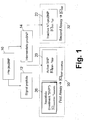
- FIGURE 1 illustrates what is believed to be a typical series of biochemical reactions resulting in the release or secretion of active BNP from myocardial cells.
- a precursor pre-proBNP protein 10 typically having 134 amino acids is cleaved into a signal peptide 12 typically having 26 amino acids, and an intermediate proBNP protein 14 typically having 108 amino acids.
- the intermediate proBNP 14 may in turn be cleaved into a physiologically active form of BNP 20, and a physiologically inactive form of NT-proBNP 22.
- the level of active BNP 20 in the blood is denoted herein as [C] BNP .
- the level of inactive NT-proBNP 22 in the blood is denoted herein as [C] NT .
- the levels of BNP 20 and NT-proBNP 22 are typically related. It is believed that this relationship is due to the production of BNP 20 and NT-proBNP 22 from a common biochemical pathway such that they are produced in equimolar amounts; however, the relationship between the levels of BNP 20 and NT-proBNP 22 may be due to other factors such as secretion responsive to a common cardiac stressor.
- the physiologically inactive NT-proBNP 22 is relatively more stable and stays resident longer in the blood compared with the physiologically active BNP 20.
- the terminal half-life of BNP 20 in the bloodstream is denoted herein as ⁇ BNP , and is believed to be typically of order of a few minutes to a few hours.
- the terminal half-life of NT-proBNP 22 in the bloodstream denoted herein as ⁇ NT , is typically substantially longer, and is believed to be about a month or longer.
- the BNP 20 and NT-proBNP 22 cardiac markers are an example pair of related cardiac markers. It is expected that other pairs of cardiac markers may be similarly produced by related biochemical reactions or otherwise have related concentrations. Typically, if a common biochemical pathway or precursor molecule produces both an active natriuretic peptide or other cardiac marker and an inactive natriuretic peptide or other cardiac marker, then the terminal half-life of the inactive cardiac marker in the bloodstream will generally be substantially longer than the terminal half-life of the active cardiac marker in the bloodstream. It is expected that the inactive cardiac marker will typically have a terminal half-life at least ten times longer than the half-life of the active cardiac marker in the bloodstream, although the half-life difference may be less.
- ANP and NT-proANP are another related pair of active and inactive cardiac markers, respectively, derived from a common precursor molecule and hence generated in equimolar amounts.
- the terminal half-life of ANP in the bloodstream is believed to be substantially longer than the terminal half-life of NT-proANP in the bloodstream.
- a physiologically active cardiac marker (BNP 20 in example FIGURE 1 , or ANP as another example) is a candidate for use as a treatment.
- nesiritide available from Scios, Inc. under the trade name Natrecor ®
- Natrecor ® is a synthetic form of BNP that has been approved by the FDA for treatment of certain types of cardiac disease.
- Treatment agents that are synthetic ANP or mimetic of ANP are also of interest for treating arterial hypertension, congestive heart failure, and so forth.
- Nesiritide 26 is used as a treatment agent in the example of FIGURE 1 .
- Other treatment agents that are mimetic of active BNP 20 may also be used.
- a first blood assay 30 is performed to assay the level of BNP 20.
- the first assay 30 actually produces a level [C] BNP +nesiritide which is indicative of a combination of the level [C] BNP of natural BNP 20 in the blood serum and a level [C] nesiritide of synthetic nesiritide 26 in the blood serum. Accordingly, the first assay 30 cannot provide, by itself, information on either the kinetics of the administered nesiritide 26 or the progression of the underlying heart disease indicated by the concentration [C] BNP of natural BNP 20.
- a second blood serum assay 32 is performed to assay the level of NT-proBNP 22.
- the second assay 32 is not substantially affected by the administered nesiritide 26; accordingly, the second assay 32 can be used to determine cardiac diagnostic information.
- the first assay 30 can then be used to determine kinetics of the administered nesiritide 26.
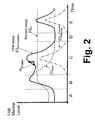
- FIGURE 2 the monitoring provided by the first and second assays 30, 32 is illustrated in the case of a cardiac event such as a heart attack.
- a cardiac event such as a heart attack.
- Various regions of FIGURE 2 are denoted by letters “A”, “B”, “C”, “D”, and “E”.
- the region “A” preceding the cardiac event exhibits persistent levels of BNP and NT-proBNP due to an underlying cardiac disease.
- the cardiac event occurs, causing cardiac stress.
- the level [C] BNP of BNP and the level [C] NT of NT-proBNP both rise; however, by the end of region “B” the level of BNP begins to decrease due to its short terminal half-life in the bloodstream, and by the middle of the region “C” the level of BNP has returned to its persistent level indicative of the underlying cardiac disease, where it remains in regions "D” and "E". In contrast, the level of NT-proBNP remains elevated throughout regions "C", "D", and "E” due to its substantially longer half-life in the bloodstream. At the transition from region “B” to region “C” a dose of nesiritide administered, producing a transient level [C] nesiritide of nesiritide in the blood.
- the first assay 30 outputs a level [C] BNP+nesiritide indicative of the combination of the level of nesiritide and the level of natural BNP.
- the second assay 32 outputs a level [C] NT indicative of only the level of NT-proBNP in the blood.
- the second assay is suitably used to determine cardiac diagnostic information, such as to estimate the severity of the cardiac event.
- the first assay 30 is suitably used to provide kinetics on the nesiritide treatment. For example, a difference or slope m kinetics between two repetitions of the first assay 30 can be used to determine uptake of the nesiritide into the patient's bloodstream.
- the nesiritide dose has dissipated from the bloodstream, and the patient has returned to the persistent levels of BNP and NT-proBNP existing prior to the cardiac event.
- a follow-up dose of nesiritide is administered.
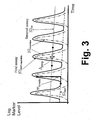
- the monitoring provided by the first and second assays 30, 32 is illustrated in the case of the nesiritide being administered a plurality of times (e.g., daily, every third day, or so forth) over a treatment period (e.g., one-week, one-month, indefinitely).
- a treatment period e.g., one-week, one-month, indefinitely.
- Each administration of nesiritide produces a transient level [C] nesiritide in the bloodstream.
- the first assay 30 can be used to assess uptake of the nesiritide by, for example, taking a first repetition of the first assay 30 just before administering the nesiritide, and a second repetition of the first assay 30 a fixed time interval after administering the nesiritide.
- the difference in [C] BNP+nesiritide level measured by the first and second repetitions is a measure of the uptake of the nesiritide.
- the terminal half-life of nesiritide in the bloodstream is typically about 20 minutes, while the onset of therapeutic action is about 15 minutes, and the therapeutic action is sustained over about 24 hours in typical cardiac patients.
- the first and second repetitions can be separated by, for example, about 2-10 minutes.
- the second assay 32 provides diagnostic information about the progression of the cardiac disease.
- a difference ⁇ prog between the level assayed using the second assay 32 on successive treatment dates shows, in the example FIGURE 3 , that the persistent level of NT-proBNP is decreasing, presumably responsive to the nesiritide therapy, indicating improvement in symptoms of the underlying cardiac disease condition.
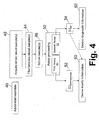
- a suitable method for cardiac monitoring is described.
- nesiritide or another cardiac marker-mimetic therapeutic agent is administered.
- One or more blood samples are drawn in an operation 42.
- the blood samples can be drawn just prior to administering the nesiritide and/or just after administering the nesiritide.
- at least two blood samples are drawn to provide kinetic information about the nesiritide treatment.
- the white and red blood cells are substantially removed from the blood sample to produce a blood serum sample 46.
- Assay processing 50 is performed to implement the first and second assays 30, 32. It is to be appreciated that typically both the first and second assays 30, 32 can be performed using a single blood serum sample 46.
- the first assay 30 provides the level [C] BNP+nesiritide 52, while the second assay 32 provides the level [C] NT 54.
- the level [C] BNP+nesiritide 52 from two or more blood samples is used to determine kinetic information 60 about the administration 40 of nesiritide.
- the level [C] NT 54 is used to determine diagnostic information 62 about the progression of the underlying cardiac disease.
- the kinetic information 60 is derived as a simple difference between the level [C] BNP +nesiritide 52 measured from two successive blood samples.
- a more elaborate derivation of kinetic information 60 may be performed.
- the level [C] BNP may be estimated from the level [C] NT assayed using the second assay 32.
- the level [C] BNP +nesiritide 52 assayed using the first assay 30 may be corrected to remove the estimated level [C] BNP , yielding the level [C] nesiritide .
- the level [C] nesiritide of nesiritide may be assayable using only a single blood sample.
- FIGURE 4 the contemplated use of the level [C] NT in determining or refining the kinetic information is indicated by a connection arrow drawn in phantom connecting the level [C] NT 54 with the kinetic information determination 60.
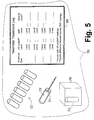
- a cardiac monitoring apparatus 70 is readily constructed, including a plurality of blood sample vials 72, cartridges, or so forth, and a blood extraction device 74 (such as a hypodermic needle) adapted to sequentially extract blood samples into the blood sample vials 72.
- An assay device 76 sequentially receives each filled blood sample vial 72 and performs standard BNP and NT-proBNP assays.
- the standard BNP assay corresponds to the first assay 30, and actually yields a level [C] BNP+nesiritide indicative of a combination of the active natural BNP 20 and synthetic nesiritide 26 levels.
- the standard NT-proBNP assay corresponds to the second assay 32 and yields the NT-proBNP level [C] NT .
- An interpretation device 80 outputs the kinetics information and the diagnostic information.
- the interpretation device 80 includes a "Nesiritide Treatment Log” card or display, on which for each date two sequential blood sample assays are recorded for each nesiritide treatment date over a treatment period.
- the two blood samples can be drawn before and a predetermined time after the nesiritide is administered, or can be drawn at two different predetermined times after the nesiritide is administered.
- the progression of the underlying cardiac disease can be ascertained. For example, if the recorded [C] NT levels decrease over the course of the treatment period, this is an indication that the underlying cardiac disease is becoming less symptomatic.
- the "Nesiritide Treatment Log” card 80 can be an electronic spreadsheet that includes a processor that automatically performs the difference computation to determine the nesiritide level.
- the "Nesiritide Treatment Log” card 80 can be an electronic spreadsheet that includes a processor that automatically performs the difference computation to determine the nesiritide level.
- such an electronic spreadsheet optionally includes a more complex kinetic information derivation, for example taking into account the NT-proBNP level [C] NT assayed using the second assay 32.
- the processor analyzes the assay results over time to provide alarms or warnings, proposed diagnoses, proposed nesiritide dosage adjustments, or so forth.
- the disclosed cardiac monitoring apparatus can be embodied as a near-patient monitoring device in a hospital, for example in an emergency room.
- the disclosed cardiac monitoring apparatus can be embodied as a test station or apparatus located in a physician's office or laboratory. It is also contemplated to employ the disclosed cardiac monitoring apparatus as an in-home testing device for self-testing performed by the patient.
- the patient can have the vials 72 and blood-drawing device 74 at home, and can draw blood samples at appropriate times.
- the blood samples are then sent to a laboratory which has the assay device 76 and interpretation device 80.
- assay body fluids other than blood which may contain BNP, NT-proBNP, or other cardiac markers.
- the first assay may monitor ANP, while the second assay may monitor NT-proANP.
- the first assay may monitor CNP, while the second assay may monitor NT-proCNP.
- the first assay may monitor DNP, while the second assay may monitor NT-proDNP.
- BNP monitoring provides kinetic information on nesiritide uptake
- NT-proANP monitoring provides diagnostic information.
- BNP and NT-proANP are believed to be derived from separate biochemical pathways (and hence are not expected to be produced in equimolar amounts)
- both BNP and NT-proANP are believed to be produced in the patient predominantly due to cardiac stress; accordingly, monitoring both BNP and NT-proANP is expected to provide both kinetic and diagnostic information.
- Other assay combinations are also contemplated.
Landscapes
- Health & Medical Sciences (AREA)
- Life Sciences & Earth Sciences (AREA)
- Engineering & Computer Science (AREA)
- Biomedical Technology (AREA)
- Molecular Biology (AREA)
- Chemical & Material Sciences (AREA)
- Urology & Nephrology (AREA)
- Hematology (AREA)
- Immunology (AREA)
- General Health & Medical Sciences (AREA)
- Medicinal Chemistry (AREA)
- Analytical Chemistry (AREA)
- Microbiology (AREA)
- Food Science & Technology (AREA)
- Cell Biology (AREA)
- Physics & Mathematics (AREA)
- Biotechnology (AREA)
- Biochemistry (AREA)
- General Physics & Mathematics (AREA)
- Pathology (AREA)
- Proteomics, Peptides & Aminoacids (AREA)
- Endocrinology (AREA)
- Cardiology (AREA)
- Heart & Thoracic Surgery (AREA)
- Chemical Kinetics & Catalysis (AREA)
- General Chemical & Material Sciences (AREA)
- Nuclear Medicine, Radiotherapy & Molecular Imaging (AREA)
- Organic Chemistry (AREA)
- Pharmacology & Pharmacy (AREA)
- Animal Behavior & Ethology (AREA)
- Public Health (AREA)
- Veterinary Medicine (AREA)
- Bioinformatics & Cheminformatics (AREA)
- Investigating Or Analysing Biological Materials (AREA)
- Peptides Or Proteins (AREA)
Claims (11)
- Procédé de surveillance cardiaque comprenant :le test d'au moins un peptide natriurétique inactif (22) et d'un peptide natriurétique actif (20) dans un échantillon biologique prélevé sur un patient, les peptides natriurétiques inactif et actif étant tous deux produits par le patient en réponse à un stress cardiaque ;dans lequel un agent thérapeutique (26) a été administré au patient, l'agent thérapeutique administré interférant sensiblement avec le test de peptide natriurétique actif mais n'interférant pas sensiblement avec le test de peptide natriurétique inactif ;la détermination dans l'échantillon biologique prélevé sur le patient de la cinétique de l'agent thérapeutique administré sur la base au moins du test de peptide natriurétique actif ; etla détermination dans l'échantillon biologique prélevé sur le patient d'informations de diagnostic cardiaque basées sur au moins le test de peptide natriurétique inactif ;dans lequel le test est réalisé à la fois avant et après l'administration et la détermination de la cinétique comprend :la détermination d'une différence entre (i) le test de peptide natriurétique actif réalisé après l'administration et (ii) le test de peptide natriurétique actif réalisé avant l'administration pour déterminer la prise de l'agent thérapeutique administré ; et dans lequel l'agent thérapeutique comprend un BNP synthétique, le peptide natriurétique actif comprend un BNP naturel et le peptide natriurétique inactif comprend un NT-proBNP.
- Procédé de surveillance cardiaque selon la revendication 1, dans lequel le test est réalisé plusieurs fois, et la détermination de la cinétique comprend :la détermination d'une différence dans le test de peptide natriurétique actif réalisé plusieurs fois, pour déterminer la prise de l'agent thérapeutique administré.
- Procédé de surveillance cardiaque selon la revendication 1, dans lequel l'agent thérapeutique administré comprend du nésiritide.
- Procédé de surveillance cardiaque selon la revendication 1, dans lequel une demi-vie du peptide natriurétique inactif dans le flux sanguin est sensiblement plus longue qu'une demi-vie du peptide natriurétique actif dans le flux sanguin.
- Procédé de surveillance cardiaque selon la revendication 1, dans lequel une demi-vie du peptide natriurétique inactif dans le flux sanguin est au moins dix fois plus longue qu'une demi-vie du peptide natriurétique actif dans le flux sanguin.
- Procédé de surveillance cardiaque selon la revendication 1, dans lequel le peptide natriurétique actif et le peptide natriurétique inactif sont produits par un chemin biochimique commun ou une molécule précurseur commune.
- Procédé de surveillance cardiaque comprenant :la réalisation sur un échantillon biologique prélevé sur un patient d'un premier test de marqueur cardiaque qui est sensiblement affecté par un agent thérapeutique qui a été administré au patient ;la réalisation sur un échantillon biologique prélevé sur le patient d'un second test de marqueur cardiaque qui est sensiblement non affecté par l'agent thérapeutique ;la détermination de la cinétique de l'agent thérapeutique administré sur la base d'au moins le premier test de marqueur cardiaque ; etl'évaluation des informations de diagnostic cardiaque sur la base d'au moins le second test de marqueur cardiaque ; etla répétition de la réalisation du premier test de marqueur cardiaque au moins une fois pour évaluer la prise de l'agent thérapeutique, la cinétique de l'agent thérapeutique administré étant déterminée sur la base d'un changement du premier marqueur cardiaque entre les premiers tests de marqueur cardiaque répétés ;dans lequel le premier marqueur cardiaque comprend un BNP naturel, le second marqueur cardiaque comprend un NT-proBNP naturel et l'agent thérapeutique comprend du nésiritide.
- Procédé de surveillance cardiaque selon la revendication 7, dans lequel le premier marqueur cardiaque et le second marqueur cardiaque sont produits par un chemin biochimique commun ou une molécule précurseur commune.
- Procédé de surveillance cardiaque selon la revendication 7, dans lequel l'administration de l'agent thérapeutique est réalisée plusieurs fois sur une période de traitement, et la réalisation du second test de marqueur cardiaque comprend :la répétition de la réalisation du second test de marqueur cardiaque plusieurs fois sur la période de traitement, les informations de diagnostic cardiaque étant basées sur une augmentation ou une diminution du second marqueur cardiaque testé sur la période de traitement.
- Appareil de surveillance cardiaque (70) comprenant :un dispositif de prise de sang (74) adapté pour extraire une pluralité de prélèvements sanguins d'un patient subissant un traitement comprenant l'administration d'une forme synthétique ou mimétique d'un peptide natriurétique actif ;un dispositif de test (76) adapté pour réaliser un test sanguin donnant au moins (i) un niveau de peptide natriurétique actif d'un peptide natriurétique produit naturellement et le peptide natriurétique synthétique ou mimétique dans un premier essai de marqueur cardiaque et (ii) un niveau de peptide natriurétique inactif dans un second test de marqueur cardiaque pour chaque prélèvement sanguin ; etun dispositif d'interprétation (80) adapté pour émettre (i) la cinétique du peptide natriurétique synthétique ou mimétique administré sur la base d'au moins le premier test de marqueur cardiaque et (ii) des informations de diagnostic cardiaque basées sur au moins le second test de marqueur cardiaque ;dans lequel le peptide natriurétique actif comprend un BNP, le peptide natriurétique inactif comprend un NT-proBNP, et le peptide natriurétique synthétique ou mimétique administré comprend un BNP synthétique.
- Appareil de surveillance cardiaque selon la revendication 10, dans lequel le dispositif d'interprétation (80) comprend un élément parmi :une carte sur laquelle sont enregistrées (i) des valeurs de niveau des tests sanguins et (ii) au moins une valeur calculée à partir d'une ou plusieurs des valeurs de niveau d'un ou plusieurs de tests sanguins, etun tableur électronique dans lequel sont enregistrées des valeurs de niveau des tests sanguins, le tableur électronique calculant au moins une valeur calculée à partir d'une ou plusieurs des valeurs de niveau d'un ou plusieurs de tests sanguins.
Applications Claiming Priority (2)
| Application Number | Priority Date | Filing Date | Title |
|---|---|---|---|
| US70392805P | 2005-07-29 | 2005-07-29 | |
| PCT/IB2006/052578 WO2007013041A2 (fr) | 2005-07-29 | 2006-07-27 | Surveillance des peptides natriuretiques cardiaques durant le diagnostic, la gestion et le traitement des maladies cardiaques |
Publications (2)
| Publication Number | Publication Date |
|---|---|
| EP1913402A2 EP1913402A2 (fr) | 2008-04-23 |
| EP1913402B1 true EP1913402B1 (fr) | 2017-10-25 |
Family
ID=37683727
Family Applications (1)
| Application Number | Title | Priority Date | Filing Date |
|---|---|---|---|
| EP06780226.4A Expired - Lifetime EP1913402B1 (fr) | 2005-07-29 | 2006-07-27 | Surveillance des peptides natriuretiques cardiaques durant le diagnostic, la gestion et le traitement des maladies cardiaques |
Country Status (6)
| Country | Link |
|---|---|
| US (1) | US20080221033A1 (fr) |
| EP (1) | EP1913402B1 (fr) |
| JP (1) | JP5090348B2 (fr) |
| CN (1) | CN101233411A (fr) |
| ES (1) | ES2657087T3 (fr) |
| WO (1) | WO2007013041A2 (fr) |
Families Citing this family (4)
| Publication number | Priority date | Publication date | Assignee | Title |
|---|---|---|---|---|
| US7524635B2 (en) * | 2003-04-17 | 2009-04-28 | Biosite Incorporated | Methods and compositions for measuring natriuretic peptides and uses thereof |
| EP1731910A1 (fr) * | 2005-06-07 | 2006-12-13 | F. Hoffmann-La Roche Ag | Utilisation de NT-proANP et NT-proBNP pour le diagnostic de maladies cardiaques |
| DE102007021443A1 (de) * | 2007-05-08 | 2008-11-13 | Brahms Aktiengesellschaft | Diagnose und Risikostratifizierung mittels NT-proET-1 |
| EP2467719A4 (fr) * | 2009-08-19 | 2013-01-09 | Détection par marqueur pour caractériser le risque de maladie cardiovasculaire ou de complications associées |
Citations (2)
| Publication number | Priority date | Publication date | Assignee | Title |
|---|---|---|---|---|
| WO2005019819A1 (fr) * | 2003-08-20 | 2005-03-03 | Biosite, Inc. | Methodes et compositions permettant de mesurer les peptides natriuretiques et d'ameliorer leur potentiel therapeutique |
| US20050137481A1 (en) * | 2003-12-18 | 2005-06-23 | Paul Sheard | Monitoring method and apparatus |
Family Cites Families (7)
| Publication number | Priority date | Publication date | Assignee | Title |
|---|---|---|---|---|
| DE4415896A1 (de) * | 1994-05-05 | 1995-11-09 | Boehringer Mannheim Gmbh | Analysesystem zur Überwachung der Konzentration eines Analyten im Blut eines Patienten |
| US7632647B2 (en) * | 2001-04-13 | 2009-12-15 | Biosite Incorporated | Use of B-type natriuretic peptide as a prognostic indicator in acute coronary syndromes |
| CN1185493C (zh) * | 2001-11-16 | 2005-01-19 | 清华大学 | 微损血糖测量方法及其装置 |
| WO2003079979A2 (fr) * | 2002-03-18 | 2003-10-02 | Scios Inc. | Procede de traitement d'insuffisance cardiaque globale |
| WO2004046729A2 (fr) * | 2002-11-21 | 2004-06-03 | The University Of Leicester | Marqueurs a base de fluide corporel pour l'hypoxie tissulaire |
| US7632234B2 (en) * | 2003-08-29 | 2009-12-15 | Medtronic, Inc. | Implantable biosensor devices for monitoring cardiac marker molecules |
| JP2007534363A (ja) * | 2003-12-18 | 2007-11-29 | インバーネス メディカル スウィッツァーランド ゲーエムベーハー | モニタリング方法およびモニタリング装置 |
-
2006
- 2006-07-27 CN CNA2006800279193A patent/CN101233411A/zh active Pending
- 2006-07-27 ES ES06780226.4T patent/ES2657087T3/es not_active Expired - Lifetime
- 2006-07-27 WO PCT/IB2006/052578 patent/WO2007013041A2/fr not_active Ceased
- 2006-07-27 JP JP2008523521A patent/JP5090348B2/ja not_active Expired - Fee Related
- 2006-07-27 EP EP06780226.4A patent/EP1913402B1/fr not_active Expired - Lifetime
- 2006-07-27 US US11/996,810 patent/US20080221033A1/en not_active Abandoned
Patent Citations (2)
| Publication number | Priority date | Publication date | Assignee | Title |
|---|---|---|---|---|
| WO2005019819A1 (fr) * | 2003-08-20 | 2005-03-03 | Biosite, Inc. | Methodes et compositions permettant de mesurer les peptides natriuretiques et d'ameliorer leur potentiel therapeutique |
| US20050137481A1 (en) * | 2003-12-18 | 2005-06-23 | Paul Sheard | Monitoring method and apparatus |
Also Published As
| Publication number | Publication date |
|---|---|
| JP2009503490A (ja) | 2009-01-29 |
| WO2007013041A2 (fr) | 2007-02-01 |
| WO2007013041A3 (fr) | 2007-10-11 |
| EP1913402A2 (fr) | 2008-04-23 |
| ES2657087T3 (es) | 2018-03-01 |
| JP5090348B2 (ja) | 2012-12-05 |
| CN101233411A (zh) | 2008-07-30 |
| US20080221033A1 (en) | 2008-09-11 |
Similar Documents
| Publication | Publication Date | Title |
|---|---|---|
| Lorgis et al. | Prognostic value of N-terminal pro-brain natriuretic peptide in elderly people with acute myocardial infarction: prospective observational study | |
| RU2613885C2 (ru) | Биомаркеры для диагностики, прогноза, оценки и стратификации терапии обмороков | |
| Bettencourt | Clinical usefulness of B-type natriuretic peptide measurement: present and future perspectives | |
| Howie-Esquivel et al. | Biomarkers in acute cardiovascular disease | |
| EP2356450A1 (fr) | Pronostic et évaluation des risques chez les patients frappés par une crise cardiaque par détermination du niveau de peptides marqueurs | |
| Truong et al. | Multi-marker strategy of natriuretic peptide with either conventional or high-sensitivity troponin-T for acute coronary syndrome diagnosis in emergency department patients with chest pain: from the “Rule Out Myocardial Infarction using Computer Assisted Tomography”(ROMICAT) trial | |
| Weisz et al. | Cardiac biomarkers and haemodynamically significant patent ductus arteriosus in preterm infants | |
| KR102003309B1 (ko) | 대사체 및 임상지표를 활용한 관상동맥 심장질환 진단용 키트 및 기초 정보 제공 방법 | |
| Michielsen et al. | The diagnostic value of serum and urinary NT-proBNP for heart failure | |
| Rutten et al. | B-type natriuretic peptide assays for detecting heart failure in the elderly: Same value as those in the younger? | |
| EP2737320B1 (fr) | FRAGMENT CENTRAL DU PRO-PEPTIDE NATRIURÉTIQUE DE TYPE A (MR-proANP) POUR L'IDENTIFICATION DE PATIENTS AYANT UNE FIBRILLATION ATRIALE DEPUIS MOINS DE 48 HEURS | |
| US20080221033A1 (en) | Monitoring of Cardiac Natriuretic Peptides During Diagnosis, Management, and Treatment of Cardiac Diseases | |
| Şimşek et al. | NT-proBNP level in stage 3-4 chronic kidney disease and mortality in long-term follow-up: HAPPY study subgroup analysis. | |
| Tausendfreund et al. | Estimation of the biological variation of IGF-I in multimorbid geriatric patients and its clinical implications | |
| Mair et al. | B-type natriuretic peptide (BNP) is more sensitive to rapid hemodynamic changes in acute heart failure than N-terminal proBNP | |
| Maisel | B-type natriuretic peptide levels: diagnostic and therapeutic potential | |
| Miyamoto et al. | Relationship between atrial fibrillation and a liver fibrogenesis marker in patients with acute heart failure | |
| Burger et al. | Blunted sympathetic response in diabetic patients with decompensated congestive heart failure | |
| Ro et al. | Comparison of the diagnostic characteristics of two B-type natriuretic peptide point-of-care devices | |
| Saul et al. | B-type natriuretic peptide testing for detection of heart failure | |
| Casagranda et al. | Diagnostic and prognostic significance of high sensitive troponin in chest pain. | |
| Grittani et al. | Evaluating the Rates of Mortality and Cardiac Catheterization Using High-Sensitivity Troponin and Conventional Troponin Assays | |
| Khaled et al. | Effect of exposure to second-hand smoke on serum levels of N-terminal pro-brain natriuretic peptide | |
| Maisel | B-type natriuretic peptide levels | |
| Hoyne | Heart failure and B-type natriuretic protein |
Legal Events
| Date | Code | Title | Description |
|---|---|---|---|
| PUAI | Public reference made under article 153(3) epc to a published international application that has entered the european phase |
Free format text: ORIGINAL CODE: 0009012 |
|
| AK | Designated contracting states |
Kind code of ref document: A2 Designated state(s): AT BE BG CH CY CZ DE DK EE ES FI FR GB GR HU IE IS IT LI LT LU LV MC NL PL PT RO SE SI SK TR |
|
| AX | Request for extension of the european patent |
Extension state: AL BA HR MK RS |
|
| 17P | Request for examination filed |
Effective date: 20080411 |
|
| RBV | Designated contracting states (corrected) |
Designated state(s): AT BE BG CH CY CZ DE DK EE ES FI FR GB GR HU IE IS IT LI LT LU LV MC NL PL PT RO SE SI SK TR |
|
| DAX | Request for extension of the european patent (deleted) | ||
| 17Q | First examination report despatched |
Effective date: 20121107 |
|
| RAP1 | Party data changed (applicant data changed or rights of an application transferred) |
Owner name: KONINKLIJKE PHILIPS N.V. |
|
| GRAP | Despatch of communication of intention to grant a patent |
Free format text: ORIGINAL CODE: EPIDOSNIGR1 |
|
| INTG | Intention to grant announced |
Effective date: 20170515 |
|
| GRAS | Grant fee paid |
Free format text: ORIGINAL CODE: EPIDOSNIGR3 |
|
| GRAA | (expected) grant |
Free format text: ORIGINAL CODE: 0009210 |
|
| AK | Designated contracting states |
Kind code of ref document: B1 Designated state(s): AT BE BG CH CY CZ DE DK EE ES FI FR GB GR HU IE IS IT LI LT LU LV MC NL PL PT RO SE SI SK TR |
|
| REG | Reference to a national code |
Ref country code: GB Ref legal event code: FG4D |
|
| REG | Reference to a national code |
Ref country code: CH Ref legal event code: EP |
|
| REG | Reference to a national code |
Ref country code: AT Ref legal event code: REF Ref document number: 940403 Country of ref document: AT Kind code of ref document: T Effective date: 20171115 |
|
| REG | Reference to a national code |
Ref country code: IE Ref legal event code: FG4D |
|
| REG | Reference to a national code |
Ref country code: DE Ref legal event code: R096 Ref document number: 602006053947 Country of ref document: DE |
|
| REG | Reference to a national code |
Ref country code: CH Ref legal event code: NV Representative=s name: FELBER UND PARTNER AG, CH |
|
| REG | Reference to a national code |
Ref country code: NL Ref legal event code: MP Effective date: 20171025 |
|
| REG | Reference to a national code |
Ref country code: ES Ref legal event code: FG2A Ref document number: 2657087 Country of ref document: ES Kind code of ref document: T3 Effective date: 20180301 |
|
| REG | Reference to a national code |
Ref country code: LT Ref legal event code: MG4D |
|
| REG | Reference to a national code |
Ref country code: AT Ref legal event code: MK05 Ref document number: 940403 Country of ref document: AT Kind code of ref document: T Effective date: 20171025 |
|
| PG25 | Lapsed in a contracting state [announced via postgrant information from national office to epo] |
Ref country code: NL Free format text: LAPSE BECAUSE OF FAILURE TO SUBMIT A TRANSLATION OF THE DESCRIPTION OR TO PAY THE FEE WITHIN THE PRESCRIBED TIME-LIMIT Effective date: 20171025 |
|
| PG25 | Lapsed in a contracting state [announced via postgrant information from national office to epo] |
Ref country code: LT Free format text: LAPSE BECAUSE OF FAILURE TO SUBMIT A TRANSLATION OF THE DESCRIPTION OR TO PAY THE FEE WITHIN THE PRESCRIBED TIME-LIMIT Effective date: 20171025 Ref country code: FI Free format text: LAPSE BECAUSE OF FAILURE TO SUBMIT A TRANSLATION OF THE DESCRIPTION OR TO PAY THE FEE WITHIN THE PRESCRIBED TIME-LIMIT Effective date: 20171025 Ref country code: SE Free format text: LAPSE BECAUSE OF FAILURE TO SUBMIT A TRANSLATION OF THE DESCRIPTION OR TO PAY THE FEE WITHIN THE PRESCRIBED TIME-LIMIT Effective date: 20171025 |
|
| PG25 | Lapsed in a contracting state [announced via postgrant information from national office to epo] |
Ref country code: BG Free format text: LAPSE BECAUSE OF FAILURE TO SUBMIT A TRANSLATION OF THE DESCRIPTION OR TO PAY THE FEE WITHIN THE PRESCRIBED TIME-LIMIT Effective date: 20180125 Ref country code: GR Free format text: LAPSE BECAUSE OF FAILURE TO SUBMIT A TRANSLATION OF THE DESCRIPTION OR TO PAY THE FEE WITHIN THE PRESCRIBED TIME-LIMIT Effective date: 20180126 Ref country code: LV Free format text: LAPSE BECAUSE OF FAILURE TO SUBMIT A TRANSLATION OF THE DESCRIPTION OR TO PAY THE FEE WITHIN THE PRESCRIBED TIME-LIMIT Effective date: 20171025 Ref country code: IS Free format text: LAPSE BECAUSE OF FAILURE TO SUBMIT A TRANSLATION OF THE DESCRIPTION OR TO PAY THE FEE WITHIN THE PRESCRIBED TIME-LIMIT Effective date: 20180225 Ref country code: AT Free format text: LAPSE BECAUSE OF FAILURE TO SUBMIT A TRANSLATION OF THE DESCRIPTION OR TO PAY THE FEE WITHIN THE PRESCRIBED TIME-LIMIT Effective date: 20171025 |
|
| REG | Reference to a national code |
Ref country code: FR Ref legal event code: PLFP Year of fee payment: 13 Ref country code: DE Ref legal event code: R097 Ref document number: 602006053947 Country of ref document: DE |
|
| PG25 | Lapsed in a contracting state [announced via postgrant information from national office to epo] |
Ref country code: EE Free format text: LAPSE BECAUSE OF FAILURE TO SUBMIT A TRANSLATION OF THE DESCRIPTION OR TO PAY THE FEE WITHIN THE PRESCRIBED TIME-LIMIT Effective date: 20171025 Ref country code: SK Free format text: LAPSE BECAUSE OF FAILURE TO SUBMIT A TRANSLATION OF THE DESCRIPTION OR TO PAY THE FEE WITHIN THE PRESCRIBED TIME-LIMIT Effective date: 20171025 Ref country code: CY Free format text: LAPSE BECAUSE OF FAILURE TO SUBMIT A TRANSLATION OF THE DESCRIPTION OR TO PAY THE FEE WITHIN THE PRESCRIBED TIME-LIMIT Effective date: 20171025 Ref country code: CZ Free format text: LAPSE BECAUSE OF FAILURE TO SUBMIT A TRANSLATION OF THE DESCRIPTION OR TO PAY THE FEE WITHIN THE PRESCRIBED TIME-LIMIT Effective date: 20171025 Ref country code: DK Free format text: LAPSE BECAUSE OF FAILURE TO SUBMIT A TRANSLATION OF THE DESCRIPTION OR TO PAY THE FEE WITHIN THE PRESCRIBED TIME-LIMIT Effective date: 20171025 |
|
| PG25 | Lapsed in a contracting state [announced via postgrant information from national office to epo] |
Ref country code: PL Free format text: LAPSE BECAUSE OF FAILURE TO SUBMIT A TRANSLATION OF THE DESCRIPTION OR TO PAY THE FEE WITHIN THE PRESCRIBED TIME-LIMIT Effective date: 20171025 Ref country code: RO Free format text: LAPSE BECAUSE OF FAILURE TO SUBMIT A TRANSLATION OF THE DESCRIPTION OR TO PAY THE FEE WITHIN THE PRESCRIBED TIME-LIMIT Effective date: 20171025 |
|
| PLBE | No opposition filed within time limit |
Free format text: ORIGINAL CODE: 0009261 |
|
| STAA | Information on the status of an ep patent application or granted ep patent |
Free format text: STATUS: NO OPPOSITION FILED WITHIN TIME LIMIT |
|
| 26N | No opposition filed |
Effective date: 20180726 |
|
| PG25 | Lapsed in a contracting state [announced via postgrant information from national office to epo] |
Ref country code: SI Free format text: LAPSE BECAUSE OF FAILURE TO SUBMIT A TRANSLATION OF THE DESCRIPTION OR TO PAY THE FEE WITHIN THE PRESCRIBED TIME-LIMIT Effective date: 20171025 |
|
| PG25 | Lapsed in a contracting state [announced via postgrant information from national office to epo] |
Ref country code: LU Free format text: LAPSE BECAUSE OF NON-PAYMENT OF DUE FEES Effective date: 20180727 Ref country code: MC Free format text: LAPSE BECAUSE OF FAILURE TO SUBMIT A TRANSLATION OF THE DESCRIPTION OR TO PAY THE FEE WITHIN THE PRESCRIBED TIME-LIMIT Effective date: 20171025 |
|
| REG | Reference to a national code |
Ref country code: BE Ref legal event code: MM Effective date: 20180731 |
|
| REG | Reference to a national code |
Ref country code: IE Ref legal event code: MM4A |
|
| PG25 | Lapsed in a contracting state [announced via postgrant information from national office to epo] |
Ref country code: BE Free format text: LAPSE BECAUSE OF NON-PAYMENT OF DUE FEES Effective date: 20180731 |
|
| PG25 | Lapsed in a contracting state [announced via postgrant information from national office to epo] |
Ref country code: IE Free format text: LAPSE BECAUSE OF NON-PAYMENT OF DUE FEES Effective date: 20180727 |
|
| PG25 | Lapsed in a contracting state [announced via postgrant information from national office to epo] |
Ref country code: TR Free format text: LAPSE BECAUSE OF FAILURE TO SUBMIT A TRANSLATION OF THE DESCRIPTION OR TO PAY THE FEE WITHIN THE PRESCRIBED TIME-LIMIT Effective date: 20171025 |
|
| PG25 | Lapsed in a contracting state [announced via postgrant information from national office to epo] |
Ref country code: HU Free format text: LAPSE BECAUSE OF FAILURE TO SUBMIT A TRANSLATION OF THE DESCRIPTION OR TO PAY THE FEE WITHIN THE PRESCRIBED TIME-LIMIT; INVALID AB INITIO Effective date: 20060727 Ref country code: PT Free format text: LAPSE BECAUSE OF FAILURE TO SUBMIT A TRANSLATION OF THE DESCRIPTION OR TO PAY THE FEE WITHIN THE PRESCRIBED TIME-LIMIT Effective date: 20171025 |
|
| PGFP | Annual fee paid to national office [announced via postgrant information from national office to epo] |
Ref country code: FR Payment date: 20210726 Year of fee payment: 16 Ref country code: IT Payment date: 20210722 Year of fee payment: 16 |
|
| PGFP | Annual fee paid to national office [announced via postgrant information from national office to epo] |
Ref country code: CH Payment date: 20210722 Year of fee payment: 16 Ref country code: DE Payment date: 20210729 Year of fee payment: 16 Ref country code: GB Payment date: 20210726 Year of fee payment: 16 Ref country code: ES Payment date: 20210810 Year of fee payment: 16 |
|
| REG | Reference to a national code |
Ref country code: DE Ref legal event code: R119 Ref document number: 602006053947 Country of ref document: DE |
|
| REG | Reference to a national code |
Ref country code: CH Ref legal event code: PL |
|
| GBPC | Gb: european patent ceased through non-payment of renewal fee |
Effective date: 20220727 |
|
| PG25 | Lapsed in a contracting state [announced via postgrant information from national office to epo] |
Ref country code: LI Free format text: LAPSE BECAUSE OF NON-PAYMENT OF DUE FEES Effective date: 20220731 Ref country code: FR Free format text: LAPSE BECAUSE OF NON-PAYMENT OF DUE FEES Effective date: 20220731 Ref country code: CH Free format text: LAPSE BECAUSE OF NON-PAYMENT OF DUE FEES Effective date: 20220731 |
|
| PG25 | Lapsed in a contracting state [announced via postgrant information from national office to epo] |
Ref country code: GB Free format text: LAPSE BECAUSE OF NON-PAYMENT OF DUE FEES Effective date: 20220727 Ref country code: DE Free format text: LAPSE BECAUSE OF NON-PAYMENT OF DUE FEES Effective date: 20230201 |
|
| PG25 | Lapsed in a contracting state [announced via postgrant information from national office to epo] |
Ref country code: IT Free format text: LAPSE BECAUSE OF NON-PAYMENT OF DUE FEES Effective date: 20220727 |
|
| REG | Reference to a national code |
Ref country code: ES Ref legal event code: FD2A Effective date: 20230830 |
|
| PG25 | Lapsed in a contracting state [announced via postgrant information from national office to epo] |
Ref country code: ES Free format text: LAPSE BECAUSE OF NON-PAYMENT OF DUE FEES Effective date: 20220728 |