EP1908241B1 - Method for transmitting/receiving signal having spread training symbol in mobile communication system - Google Patents
Method for transmitting/receiving signal having spread training symbol in mobile communication system Download PDFInfo
- Publication number
- EP1908241B1 EP1908241B1 EP06769265.7A EP06769265A EP1908241B1 EP 1908241 B1 EP1908241 B1 EP 1908241B1 EP 06769265 A EP06769265 A EP 06769265A EP 1908241 B1 EP1908241 B1 EP 1908241B1
- Authority
- EP
- European Patent Office
- Prior art keywords
- signals
- data
- signal
- pilot
- auxiliary
- Prior art date
- Legal status (The legal status is an assumption and is not a legal conclusion. Google has not performed a legal analysis and makes no representation as to the accuracy of the status listed.)
- Not-in-force
Links
- 238000000034 method Methods 0.000 title claims description 184
- 238000010295 mobile communication Methods 0.000 title claims description 17
- 238000012549 training Methods 0.000 title description 23
- 238000012545 processing Methods 0.000 claims description 3
- 230000003247 decreasing effect Effects 0.000 claims 1
- 230000005540 biological transmission Effects 0.000 description 78
- 230000008569 process Effects 0.000 description 45
- 238000010586 diagram Methods 0.000 description 37
- 238000004891 communication Methods 0.000 description 19
- 238000005516 engineering process Methods 0.000 description 10
- 238000011084 recovery Methods 0.000 description 7
- 238000004364 calculation method Methods 0.000 description 5
- 125000004122 cyclic group Chemical group 0.000 description 5
- 230000000694 effects Effects 0.000 description 4
- 239000011159 matrix material Substances 0.000 description 4
- 230000008054 signal transmission Effects 0.000 description 3
- 238000007796 conventional method Methods 0.000 description 2
- 238000005562 fading Methods 0.000 description 2
- 238000012986 modification Methods 0.000 description 2
- 230000004048 modification Effects 0.000 description 2
- 230000000737 periodic effect Effects 0.000 description 2
- 230000009467 reduction Effects 0.000 description 2
- 238000012935 Averaging Methods 0.000 description 1
- 230000009471 action Effects 0.000 description 1
- 239000000654 additive Substances 0.000 description 1
- 230000000996 additive effect Effects 0.000 description 1
- 238000012217 deletion Methods 0.000 description 1
- 230000037430 deletion Effects 0.000 description 1
- 230000006866 deterioration Effects 0.000 description 1
- 238000003780 insertion Methods 0.000 description 1
- 230000037431 insertion Effects 0.000 description 1
- 238000013507 mapping Methods 0.000 description 1
- 230000011664 signaling Effects 0.000 description 1
- 230000007480 spreading Effects 0.000 description 1
- 239000013589 supplement Substances 0.000 description 1
- 238000012546 transfer Methods 0.000 description 1
- 239000002699 waste material Substances 0.000 description 1
Images








Classifications
-
- H—ELECTRICITY
- H04—ELECTRIC COMMUNICATION TECHNIQUE
- H04L—TRANSMISSION OF DIGITAL INFORMATION, e.g. TELEGRAPHIC COMMUNICATION
- H04L25/00—Baseband systems
- H04L25/02—Details ; arrangements for supplying electrical power along data transmission lines
- H04L25/0202—Channel estimation
- H04L25/0204—Channel estimation of multiple channels
-
- H—ELECTRICITY
- H04—ELECTRIC COMMUNICATION TECHNIQUE
- H04L—TRANSMISSION OF DIGITAL INFORMATION, e.g. TELEGRAPHIC COMMUNICATION
- H04L5/00—Arrangements affording multiple use of the transmission path
- H04L5/003—Arrangements for allocating sub-channels of the transmission path
- H04L5/0048—Allocation of pilot signals, i.e. of signals known to the receiver
-
- H—ELECTRICITY
- H04—ELECTRIC COMMUNICATION TECHNIQUE
- H04B—TRANSMISSION
- H04B2201/00—Indexing scheme relating to details of transmission systems not covered by a single group of H04B3/00 - H04B13/00
- H04B2201/69—Orthogonal indexing scheme relating to spread spectrum techniques in general
- H04B2201/707—Orthogonal indexing scheme relating to spread spectrum techniques in general relating to direct sequence modulation
- H04B2201/70701—Orthogonal indexing scheme relating to spread spectrum techniques in general relating to direct sequence modulation featuring pilot assisted reception
-
- H—ELECTRICITY
- H04—ELECTRIC COMMUNICATION TECHNIQUE
- H04L—TRANSMISSION OF DIGITAL INFORMATION, e.g. TELEGRAPHIC COMMUNICATION
- H04L25/00—Baseband systems
- H04L25/02—Details ; arrangements for supplying electrical power along data transmission lines
- H04L25/0202—Channel estimation
- H04L25/024—Channel estimation channel estimation algorithms
- H04L25/0242—Channel estimation channel estimation algorithms using matrix methods
- H04L25/0244—Channel estimation channel estimation algorithms using matrix methods with inversion
-
- H—ELECTRICITY
- H04—ELECTRIC COMMUNICATION TECHNIQUE
- H04L—TRANSMISSION OF DIGITAL INFORMATION, e.g. TELEGRAPHIC COMMUNICATION
- H04L5/00—Arrangements affording multiple use of the transmission path
- H04L5/0001—Arrangements for dividing the transmission path
- H04L5/0003—Two-dimensional division
- H04L5/0005—Time-frequency
- H04L5/0007—Time-frequency the frequencies being orthogonal, e.g. OFDM(A) or DMT
Definitions
- the present invention relates to a method for transmitting/receiving signals in a wireless (or radio) mobile communication system, and more particularly to a pilot configuration of a wireless mobile communication system for efficient use of radio resources in the wireless mobile communication system, and a channel estimation and reception method based on the same.
- F. Mazzenga "Channel Estimation and Equalization for M-QAM Transmission with a Hidden Pilot Sequence", IEEE TRANSACTIONS ON BROADCASTING, 20000601 IEEE SERVICE CENTER, PISCATAWAY, NJ, US - ISSN 0018-9316, vol. 46, no. 2, XP011006121 , addresses channel estimation and equalization with hidden pilot sequences.
- the hidden pilot sequences are superimposed onto the symbols to be transmitted before for modulation. Three methods to superimpose a marking sequence over an information sequence are described.
- the marking sequence is a periodic pilot sequence.
- channel estimation A process of estimating and compensating for a signal distortion which may occur due to multipath fading, etc. is called "channel estimation".
- This channel estimation is roughly classified into a pilot signal-based scheme and a data-based scheme according to the format of data used for the channel estimation.
- the pilot signal-based scheme is adapted to allocate a part of a time or frequency domain to a specific signal for the channel estimation.
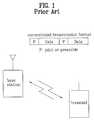
- FIG. 1 illustrates a conventional method for configuring a pilot signal in a communication system (for example, an OFDM/OFDMA, FDM/FDMA, TDM/TDMA or CDM/CDMA communication system).
- a communication system for example, an OFDM/OFDMA, FDM/FDMA, TDM/TDMA or CDM/CDMA communication system.
- data is allocated to a specific subcarrier, specific frequency band, specific time slot or specific code.
- a pilot is also allocated to a frequency-time resource other than the allocated subcarrier, frequency band, time slot or code.
- the pilot means a pilot signal.
- the OFDM/OFDMA, FDM/FDMA, TDM/TDMA and CDM/CDMA communication systems multiplex the data and pilots using the subcarriers, frequency bands, time slots and codes, respectively.
- sample The data or pilot multiplexed using the subcarrier, frequency band, time slot or code is referred to as a "sample.”
- the sample in the OFDM/OFDMA system represents a data signal or pilot signal transmitted at a specific subcarrier
- the sample in the FDM/FDMA system represents a data signal or pilot signal transmitted at a specific frequency band
- the sample in the TDM/TDMA system represents a data signal or pilot signal transmitted for a specific time slot
- sample in the CDM/CDMA system represents a data signal or pilot signal transmitted through a specific code.
- These respective samples are transmitted through specific frequency-time resources (for example, a specific subcarrier, specific frequency band, specific time slot and specific code).
- index "m” will hereinafter be used for distinction of the frequency-time resources based on indexes.
- the index "m" for a specific sample in the OFDM/OFDMA system is a data symbol index for distinction of a subcarrier on which the specific sample is transmitted.
- the index "m" for a specific sample in the FDM/FDMA system is a frequency index for distinction of a frequency band at which the specific sample is transmitted.
- the index "m" for a specific sample in the TDM/TDMA system is a time index for distinction of a time slot for which the specific sample is transmitted.
- the index "m" for a specific sample in the CDM/CDMA system is a code index for distinction of a code applied to the specific sample.
- data transmitted from a transmitting stage can be accurately restored by, through the following procedures, estimating a channel using a pilot and compensating for the value of the estimated channel.
- x h ⁇ d + v
- pilot-based channel estimation value is to a time or frequency axis
- the allocation of a large number of pilots means that a large amount of resources to be allocated to the data are consumed, such that it is very important to properly arrange the above-mentioned pilots.
- the OFDM technology converts input data into parallel data units equal to the number of used subcarriers, loads the parallel data units in each subcarrier, and transmits the subcarriers including the parallel data units, such that it is considered to be a MultiCarrier Transmission/Modulation (MCM) scheme employing a variety of subcarriers.
- MCM MultiCarrier Transmission/Modulation
- the OFDMA scheme allocates a different number of subcarriers according to a transfer rate requested by each user, such that it can effectively distribute resources. Similar to the OFDMA-TDMA scheme, the OFDMA scheme need not execute the initialization using a preamble before each user receives data, resulting in increased transmission efficiency.
- the OFDMA scheme is suitable for a specific case where a large number of subcarriers are used, such that it can be effectively used for the wireless communication system equipped with a broad-area cell having a relatively-high Time Delay Spread (TDS).
- TDS Time Delay Spread
- a frequency-hopping OFDMA scheme solves the problems generated when a subcarrier-interference caused by other users or a deep-fading subcarrier occurs in a radio or wireless channel, such that it increases a frequency-diversity effect and acquires an interference-averaging effect.
- FIG. 2 is a conceptual diagram illustrating a pilot allocation scheme for use in an OFDM-based wireless communication system.
- the IEEE 802.16 system performs the pilot allocation using the pilot allocation scheme shown in FIG. 2 .
- a pilot allocation scheme for the OFDM-based wireless communication system will hereinafter be described with reference to FIG. 2 .
- the IEEE 802.16 system may have 128 subcarriers, 512 subcarriers, 1024 subcarriers, or 2048 subcarriers. Some parts of both sides of a total of subcarriers are used as a protection band. In the case of the remaining parts other than the above-mentioned parts, a single subcarrier from among 9 subcarriers is allocated to the pilot, and the remaining 8 subcarriers other than the single subcarrier may be allocated to data.
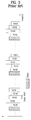
- FIG. 3 is a conceptual diagram illustrating a conventional pilot allocation scheme for a TDM/TDMA-based wireless communication system.
- a data signal is assigned to each time slot according to the TDM/TDMA scheme.
- the data signal is contained in a first timeslot, and the pilot signal is contained in a second timeslot, such that the first and second timeslots including the data and pilot signals are transmitted to a destination.
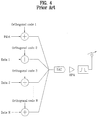
- FIG. 4 is a conceptual diagram illustrating a pilot allocation scheme for a CDM/CDMA-based wireless communication system.
- Individual data signals are distinguished from each other by different codes according to the CDM/CDMA scheme.
- the above-mentioned different codes may be orthogonal codes to allow a reception end to detect the data units while being classified.
- each data signal and each pilot signal are distinguished from each other by different codes, such that they are transmitted to a radio channel.
- individual data signals are classified according to a frequency band for transmission of the above-mentioned signals.
- a predetermined protection area may be formed between the above-mentioned frequency bands to reduce interference between several data signals.
- the above-mentioned data signal and the pilot signal are distinguished from each other according to different frequency bands, such that they are transmitted to the radio channel.
- the OFDM/OFDMA-based wireless communication system allocates a single subcarrier from among 9 subcarriers to the pilot, this means that radio resources for data transmission are reduced by the ratio of 1/9.
- radio resources for data transmission are reduced by the ratio of 1/3.
- the present invention is directed to a method for transmitting/receiving a signal including a spread training symbol in a mobile communication terminal that substantially obviates one or more problems due to limitations and disadvantages of the related art.
- An object of the present invention devised to solve the problem lies on a pilot configuration method for effectively employing radio resources, a channel estimation method, and a signal receiving method.
- a method for transmitting a signal equipped with a disjointed pilot signal in a mobile communication system can be applied to a mobile communication system based on OFDM/OFDMA, TDM/TDMA, FDM/FDMA, and CDM/CDMA technologies.
- disjointed pilot signals are arranged to subcarriers, timeslots, or codes, such that a large amount of transmission data can be transmitted to limited frequency-time resources.
- the object of the present invention can be achieved by providing a method for transmitting a signal equipped with a training symbol in a mobile communication system which includes a transmission end capable of transmitting an output signal equipped with a training symbol for channel estimation of a reception end, the method comprising the steps of: a) calculating an auxiliary signal added to data symbols transmitted via individual subcarriers so as to allow the sum of the data symbols (i.e., data signals) to be zero; b) adding training symbols having the same amplitude and the calculated auxiliary signal to the data symbols, and calculating the output signal on the basis of the added result; c) transmitting information of the calculated auxiliary signal to the reception end; and d) transmitting the calculated output signal via the subcarriers.
- a method for transmitting a signal equipped with a training symbol in a mobile communication system which includes a transmission end capable of transmitting an output signal equipped with a training symbol for channel estimation of a reception end using orthogonal subcarriers, the method comprising the steps of: a) calculating an auxiliary signal added to each data signal transmitted via a predetermined number of subcarriers so as to allow the sum of the data signals to be zero; b) coding the data signals using the data signals transmitted via predetermined subcarriers (i.e., a predetermined number of subcarriers), and the calculated auxiliary signal, a predetermined value for a coding operation; c) adding training symbols having the same amplitude and the calculated auxiliary signal to the coded data signals, and calculating the output signal on the basis of the added result; d) transmitting information of the calculated auxiliary signal associated with the predetermined subcarriers to the reception end; and e) transmitting the calculated output signal via the subcarriers
- a method for transmitting a signal equipped with a training symbol in a mobile communication system which includes a transmission end capable of transmitting data via a plurality of transmission antennas, the method comprising the steps of: a) adding training symbols having the same amplitude to data symbols, and calculating the sum of the training symbols configured in the form of disjointed data associated with the transmission antennas; b) adding an auxiliary signal to the data symbols including the training symbols, calculating the sum of the same auxiliary signals associated with a specific transmission antenna, and calculating an output signal; and c) transmitting the calculated output signal via the subcarriers, whereby the auxiliary signal is added to the data symbols so as to allow the sum of predetermined data signals (i.e., a predetermined number of data symbols) to be zero.
- predetermined data signals i.e., a predetermined number of data symbols
- a method for transmitting a signal equipped with a training symbol in a mobile communication system which includes a reception end capable of performing channel estimation using training symbols transmitted via orthogonal subcarriers, and recovering a data signal using the channel-estimated value
- the method comprising the steps of: a) performing channel estimation of predetermined subcarriers (i.e., a predetermined number of subcarriers) using reception signals transmitted via individual subcarriers and predetermined-sized training symbols; b) receiving information of an auxiliary signal added to each data signal transmitted via the predetermined subcarriers so as to allow the sum of the predetermined data signals to be zero; and c) recovering the data signals using the received signal, the predetermined-sized training symbols, the channel-estimated value, and the auxiliary signal.
- predetermined subcarriers i.e., a predetermined number of subcarriers
- a method for transmitting a signal equipped with a training symbol in a mobile communication system which includes a reception end capable of performing channel estimation using training symbols transmitted via orthogonal subcarriers, and recovering a data signal using the channel-estimated value
- the method comprising the steps of: a) receiving an auxiliary signal, which is added to data signals assigned to predetermined subcarriers (i.e., a predetermined number of subcarriers) to allow the sum of the predetermined data signals to be zero, and reception signals for transmitting individual data signals coded by a predetermined coding value via the subcarriers; b) performing channel estimation on the predetermined subcarriers using the reception signals contained in the subcarriers and predetermined-sized training symbols; and c) recovering the data signals using the received signal, the predetermined-sized training symbols, the channel-estimated value, and the predetermined coding value.
- predetermined subcarriers i.e., a predetermined number of subcarriers
- the present invention provides a method for loading many more transmission data units to the subcarriers using the conventional pilot signals.
- the present invention provides a transmission method for spreading the pilot signals to a data area.
- the present invention provides a method for including a pilot signal and a data signal in a specific subcarrier, and transmitting the pilot and data signals using the subcarrier.
- FIG. 5 is a conceptual diagram illustrating a method for configuring a pilot signal according to the present invention.
- the conventional art has been designed to include only the pilot signal or the data signal in a single sample.
- the present invention provides a method for transmitting the pilot and data signals in a single sample.
- a first preferred embodiment of the present invention provides a method for transmitting/receiving a sample equipped with data and pilot signals. It is characterized in that the pilot signals contained in the sample have the same size. Preferably, the size of each pilot signal may be determined according to the pilot-signal size of the conventional art.
- FIG. 6 is a conceptual diagram illustrating a method for configuring a pilot signal implemented in the OFDM/OFDMA system according to a first preferred embodiment of the present invention.
- each sample includes data and pilot signals.
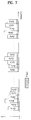
- FIG. 7 is a conceptual diagram illustrating a method for configuring a pilot signal implemented in the TDM/TDMA system according to a first preferred embodiment of the present invention.
- each sample includes a predetermined-sized pilot signal (i.e., a signal transmitted to a specific timeslot).
- FIG. 8 is a conceptual diagram illustrating a method for configuring a pilot signal implemented in the CDM/CDMA system according to a first preferred embodiment of the present invention.
- each sample includes a predetermined-sized pilot signal (i.e., a signal transmitted by a specific code).
- a method for configuring a pilot signal using the FDM/FDMA system is the same as the above-mentioned methods.
- Each sample includes a predetermined-sized pilot signal (i.e., a signal transmitted by a specific frequency band).
- the sizes of pilot signals contained in individual samples may be equal to each other.
- the size of each pilot signal may be determined by uniform division of the conventional-art pilot signal size.
- the conventional OFDM/OFDMA system has a pilot signal allocated to a single subcarrier from among N subcarriers, however, the inventive OFDM/OFDMA system according to the present invention can allocate a pilot signal, the size of which is equal to 1/N of that of the conventional pilot signal, to N subcarriers.
- the conventional TDM/TDMA system has a pilot signal allocated to a single timeslot from among N timeslots, however, the inventive TDM/TDMA system according to the present invention can apply a pilot signal, the size of which is equal to 1/N of that of the conventional pilot signal, to N timeslots.
- the conventional FDM/FDMA system has allocated a pilot signal to a single frequency band from among N frequency bands, however, the inventive FDM/FDMA system according to the present invention can apply a pilot signal, the size of which is equal to 1/N of that of the conventional pilot signal, to N frequency bands.
- the conventional CDM/CDMA system has allocated a pilot signal to a single code from among N codes, however, the inventive CDM/CDMA system according to the present invention can apply a pilot signal, the size of which is equal to 1/N of that of the conventional pilot signal, to N codes.
- Equation 1c is a channel value estimated by the pilot and data signals configured by the aforementioned method. As described above, if the pilot signals having the same size are contained in all samples and are then transmitted according to the first preferred embodiment, the channel value ⁇ can be estimated by the above-mentioned Equation 1c.
- Equation 1d If an inventive transmission signal is recovered by the estimated channel value as denoted by Equation 1d, a pilot signal having a predetermined size (p m ) is added to each data symbol, such that the data recovery can be implemented by another channel estimation value reduced by the predetermined size (p m ).
- a second preferred embodiment of the present invention provides a method for transmitting a sample equipped with data and pilot signals.
- the second preferred embodiment provides a method for transmitting the sample including not only the data and pilot signals but also a predetermined auxiliary signal.
- an average value of constellation-mapped data symbols is close to the value of 0.
- N samples i.e., N transmission samples
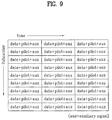
- FIG. 9 is a conceptual diagram illustrating an OFDM/OFDMA-based transmission method for inserting an auxiliary signal capable of allowing symbol values of overall samples to converge at zero "0" according to a second preferred embodiment of the present invention.
- a predetermined-sized pilot signal and an auxiliary signal are contained in each sample (i.e., a signal transmitted via a specific subcarrier).
- the above-mentioned pilot signal may have the same value in association with each sample.
- the auxiliary signal is determined by the data signal contained in all the transmitted samples.
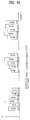
- FIG. 10 is a conceptual diagram illustrating a TDM/TDMA-based transmission method for inserting an auxiliary signal capable of allowing symbol values of overall samples to converge at zero "0" according to a second preferred embodiment of the present invention.
- a predetermined-sized pilot signal and an auxiliary signal are contained in each sample (i.e., a signal transmitted via a specific timeslot).
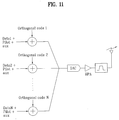
- FIG. 11 is a conceptual diagram illustrating a CDM /CDMA-based transmission method for inserting an auxiliary signal capable of allowing symbol values of overall samples to converge at zero "0" according to a second preferred embodiment of the present invention.
- a predetermined-sized pilot signal and an auxiliary signal are contained in each sample (i.e., a signal transmitted via a specific code).
- a method for configuring the pilot signal implemented by the FDM/FDMA system is the same as in the above-mentioned method.
- a predetermined-sized pilot signal and an auxiliary signal are contained in each sample (i.e., a signal transmitted via a specific frequency band).
- Equation 2d not only the data signal but also the pilot signal (p m ) and the auxiliary signal (a) are added to each sample, such that the value of a received data symbol is determined by the deletion of the signals (p m ) and (a).
- the reception end recognizes the value of (a)
- the reception signal can be more accurately restored. Therefore, it is desirable that the value of the auxiliary signal (a) associated with N specific samples is transmitted from a transmission end to a reception end.
- the reception end can correctly recover the data value using the value of the received auxiliary signal (a).
- the reception signal according to the second preferred embodiment of the present invention is channel-estimated by the following inverse matrix denoted by the following Equation 2e, resulting in the data recovery.
- MMSE Minimum Mean Squared Error
- a third preferred embodiment of the present invention provides a method for transmitting a sample simultaneously including the data, pilot, and auxiliary signals.
- the third preferred embodiment of the present invention provides a transmission/reception method for preventing the occurrence of transmission power waste caused by the auxiliary signal.
- a transmission end must additionally employ as much power as the value of a specific constant (a) to supplement the auxiliary signal value.
- the amplitude of all transmission power is limited, such that the amplitude of the data signal may be unavoidably reduced due to the limited power amplitude. In other words, the amplitude of the data signal may be unavoidably reduced due to the addition of the auxiliary signal.
- the above-mentioned third preferred embodiment of the present invention provides a method for coding the value of the data signal using a predetermined data value and a predetermined auxiliary signal value.
- the auxiliary signal value (a) associated with N samples should be transmitted to the reception end. Also, the reception end recognizes the above-mentioned predetermined data value ⁇ used for the coding.
- a transmitter calculates the auxiliary signal associated with N samples transmitted to the reception end, performs modulo-calculation considering the difference between the data and auxiliary signals contained in the aforementioned sample, performs the coding of reducing transmission power using the modulo-calculation, and transmits the coded value instead of the real data signal value.
- Equation 3a "d m " is the value of a real data signal, d m is a coded signal transmitted from a transmission end to a reception end, mod is indicative of the modulo-calculation, "p m " is a pilot signal, “a” is an auxiliary signal, and "m” is index information for the distinction of samples.
- the value of a real data signal (d m ) is coded to a smaller-sized signal d m , such that it can solve the problem of increasing the transmission signal power by the sum of the auxiliary signal and the pilot signal.
- FIG. 12 is a conceptual diagram illustrating a method for configuring a pilot signal using the OFDM/OFDMA system according to a third preferred embodiment of the present invention.
- a method for constructing the pilot signal in the OFDM/OFDMA system according to the third preferred embodiment of the present invention will hereinafter be described with reference to FIG. 12 .
- a data signal and a pilot signal are simultaneously contained in each sample (i.e., a signal transmitted via a specific subcarrier).
- the coding method for reducing the transmission signal power is applied to the above-mentioned data signal as denoted by the above Equation 3a.
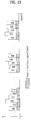
- FIG. 13 is a conceptual diagram illustrating a method for constructing a pilot signal using the TDM/TDMA system according to a third preferred embodiment of the present invention.
- a predetermined-sized pilot signal and an auxiliary signal are contained in each sample (i.e., a signal transmitted via a specific timeslot).
- the coding method for reducing the transmission signal power is applied to the above-mentioned data signal as denoted by the above Equation 3a.
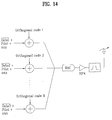
- FIG. 14 is a conceptual diagram illustrating a method for configuring a pilot signal using the CDM/CDMA system according to a third preferred embodiment of the present invention.
- a predetermined-sized pilot signal and an auxiliary signal are contained in each sample (i.e., a signal transmitted via a specific code).
- the coding method for reducing the transmission signal power is applied to the above-mentioned data signal as denoted by the above Equation 3a.
- a method for constructing the pilot signal implemented by the FDM/FDMA system is the same as in the above-mentioned method.
- a predetermined-sized pilot signal and an auxiliary signal are contained in each sample (i.e., a signal transmitted via a specific frequency band).
- the coding method for reducing the transmission signal power is applied to the above-mentioned data signal as denoted by the above Equation 3a.
- a fourth preferred embodiment of the present invention provides a method for adding a predetermined pilot signal to a sample transmitted to a reception end, and controlling a phase of the added pilot signal.
- the phase of the pilot signal is rotated by a predetermined angle 0°, such that the pilot signal remains in a positive(+) value. Otherwise, if the phase of the pilot signal is rotated by 180°, the pilot signal is shifted from the positive(+) value to a negative(-) value.
- the pilot signals having different signs or phases are added to the sample, such that it can transmit the above-mentioned transmission signal via a plurality of antennas.
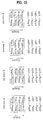
- FIG. 15 shows samples transmitted via four antennas according to a preferred embodiment of the present invention.
- each sample simultaneously includes a data signal and a pilot signal.
- predetermined pilot signals are contained in a sample transmitted to a reception end, and the phases of the pilot signals are determined by Hadamard codes.
- predetermined pilot signals are added to each sample transmitted via each antenna.
- the example of FIG. 15 shows a method for transmitting a total of four samples via four antennas, respectively.
- each of the four samples associated with the above-mentioned antenna A includes a data signal and a pilot signal.
- the samples received via the antenna A include only the positive(+) pilot signals.
- Each of four samples transmitted via each of antennas B, C, and D alternately includes the positive(+) pilot signal and the negative(-) pilot signal.
- the above-mentioned four samples may be transmitted via 4 different subcarriers at the same time, may be transmitted via 2 different subcarriers two times, or may also be transmitted via a single subcarrier four times, in such a way that the above-mentioned four samples can be transmitted in various ways.
- each column is indicative of a specific antenna
- each row is indicative of a pilot signal added to a specific sample (e.g., an i-th sample) transmitted via all antennas.
- a first column is indicative of a pilot signal added to the antenna A
- a first row is indicative of a pilot signal added to a first sample transmitted via the antennas A, B, C, and D.
- pilot signals transmitted via individual antennas are orthogonal to each other.
- reception end receives a signal via a single antenna, there are four reception paths. In this case, all the pilot signals of the samples transmitted via four paths are orthogonal to each other, such that the reception end can normally perform the channel estimation.
- the above-mentioned fourth preferred embodiment of the present invention has disclosed the signal transmission via four antennas, it should be noted that the number of the above-mentioned antennas is not limited to the exemplary value "4", and can be applied to other examples as necessary.
- the above-mentioned fourth preferred embodiment of the present invention has disclosed the data transmission/reception method capable of transmitting four samples, it should be noted that the number of the above-mentioned samples is not limited to the value "4", and can be applied to other examples as necessary.
- Equation 4b + 1 + 1 + 1 ⁇ 1 + 1 + 1 + 1 ⁇ 1
- each column is indicative of a specific antenna
- each row is indicative of a pilot signal added to a specific sample (e.g., an i-th sample) transmitted via all antennas.
- Equation 4c + 1 + 1 + 1 + 1 + 1 + 1 + 1 ⁇ 1 + 1 + 1 ⁇ 1 ⁇ 1 + 1 + 1 + 1 + 1 + 1 + 1 + 1 + 1 + 1 + 1 + 1 + 1 + 1 + 1 + 1 + 1 + 1 + 1 + 1 + 1 + 1 + 1 + 1 + 1 + 1 + 1 ⁇ 1 + 1 + 1 ⁇ 1 + 1 + 1 ⁇ 1 ⁇ 1 + 1 ⁇ 1 ⁇ 1 + 1 + 1 ⁇ 1 ⁇ 1 + 1 + 1 ⁇ 1 ⁇ 1 + 1 + 1 + 1 + 1 + 1 ⁇ 1 + 1 + 1 + 1 + 1 + 1 + 1 + 1 + 1 + 1 + 1 + 1 + 1 + 1 + 1 + 1 + 1 + 1 + 1 + 1 + 1 + 1 + 1 + 1 + 1 + 1 + 1 + 1 + 1 + 1 + 1 + 1 + 1 + 1 + 1 + 1 + 1 + 1 + 1 + 1 + 1 + 1 + 1 + 1 + 1 + 1 + 1 + 1 + 1 + 1 + 1 + 1 + 1 + 1 + 1
- each column is indicative of a specific antenna
- each row is indicative of a pilot signal added to a specific sample (e.g., an i-th sample) transmitted via all antennas.
- FIG. 16 shows samples transmitted via four antennas according to another preferred embodiment of the present invention.
- the preferred embodiment shown in FIG. 16 provides a method for modifying an added pilot signal using a QPSK orthogonal code in order to apply the above-mentioned first preferred embodiment to a multi-antenna system.
- a predetermined pilot signal is added to each data transmitted via individual antennas.
- the pilot signal is contained in each of four samples, and is then transmitted.
- FIG. 16 shows an exemplary case in which the pilot signal is contained in each of four samples, such that the four samples including the pilot signals are transmitted to a destination.
- the four samples are transmitted via the antenna A, and each of the four samples includes the value of P 0 .
- each column is indicative of a specific antenna
- each row is indicative of a pilot signal added to a specific sample (e.g., an i-th sample) transmitted via all antennas.
- a first column is indicative of a pilot signal contained in each sample transmitted via the antenna A
- a first row is indicative of a pilot signal contained in each sample transmitted via the antennas A, B, C, and D.
- signals transmitted via individual antennas are orthogonal to each other.
- reception end receives signals via a single antenna, there are four reception paths. In this case, all the pilot signals of the samples transmitted via four paths are orthogonal to each other, such that the reception end can normally perform the channel estimation.
- the above-mentioned preferred embodiment of the present invention has disclosed the signal transmission via four antennas, it should be noted that the number of the above-mentioned antennas is not limited to the exemplary value "4", and can be applied to other examples as necessary.
- Equation 4e P 0 P 0 P 0 P 2 P 0 P 0 P 0 P 2
- each column is indicative of a specific antenna
- each row is indicative of a pilot signal added to a specific sample (e.g., an i-th sample) transmitted via all antennas.
- Equation 4f P 0 P 0 P 0 P 1 P 0 P 2 P 1 P 0 P 0 P 0 P 2 P 3 P 0 P 2 P 3 P 2 P 0 P 0 P 0 P 1 P 0 P 2 P 1 P 0 P 0 P 0 P 2 P 3 P 0 P 2 P 3 P 2
- each column is indicative of a specific antenna
- each row is indicative of a pilot signal added to a specific sample (e.g., an i-th sample) transmitted via all antennas.
- a fifth preferred embodiment of the present invention additionally includes an auxiliary signal (aux) in the pilot signal of the above-mentioned fourth preferred embodiment of the present invention.
- aux auxiliary signal
- FIG. 17 shows samples transmitted via four antennas by the sum of orthogonal pilot signals according to the present invention.
- FIG. 17 shows an exemplary method for transmitting an OFDM symbol equipped with four data symbols via four antennas
- the aforementioned data transmission method of FIG. 17 can transmit data via a variety of antennas other than the four antennas as previously stated in the above-mentioned fourth preferred embodiment, and can transmit a variety of samples via individual antennas.
- the fifth preferred embodiment of FIG. 17 provides a method for modifying/arranging pilot symbols using Hadamard code in order to apply the above-mentioned second preferred embodiment to the multi-antenna system.
- the fifth preferred embodiment of FIG. 17 provides a method for additionally including the auxiliary signal (aux) capable of allowing the sum of data symbols of a specific OFDM symbol to converge at zero.
- a method for calculating the auxiliary signal (aux) according to the number of transmission antenna N t is as follows.
- Equations 5a-5b are equal to the above-mentioned Equations 2a-2b.
- the auxiliary signal can be calculated by the following method.
- auxiliary signals for satisfying the above-mentioned conditions are added to each other, and the sum of the auxiliary signals is transmitted via two transmission antennas, accurate channel estimation can be performed to recover the values h A and h B .
- auxiliary signal values a Am , a Bm , a Cm and a Dm for adding N data signals and N auxiliary signals (where N means the number of all transmission samples) to acquire the sum of zero can be calculated by the following processes 1b ⁇ 4b.
- auxiliary signals for satisfying the above-mentioned conditions are added to each other, and the sum of the auxiliary signals is transmitted via four transmission antennas, accurate channel estimation can be performed to recover the values h A , h B , h C and h D .
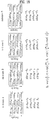
- FIG. 18 is a conceptual diagram illustrating a method for modifying/arranging a pilot symbol using a QPSK orthogonal code so as to apply the second preferred embodiment to a multi-antenna system according to the present invention.
- FIG. 15 in the above-mentioned fourth preferred embodiment is the same as the pilot symbol mapping based on a BPSK modulation scheme. Therefore, if data is transmitted from other cells according to the QPSK scheme, BPSK pilot symbols produce interference with data symbols transmitted from other cells.
- the preferred embodiment of FIG. 18 provides a method for modifying/arranging the pilot symbols according to the QPSK scheme instead of the BPSK modulation scheme.
- the preferred embodiment of FIG. 18 modifies the pilot symbols using QPSK orthogonal codes, and arranges the modified pilot symbols.
- FIG. 18 provides a method for additionally including the auxiliary signal (aux) capable of allowing the sum of data signals contained in N samples to converge at zero.
- a method for calculating the auxiliary signal (aux) according to the number of transmission antenna N t is as follows.
- Equations 5m ⁇ 5n are equal to the above-mentioned Equations 2a ⁇ 2b.
- the auxiliary signal can be calculated by the following method.
- pilot signals of signals transmitted via the antenna A are added to be zero. Otherwise, pilot signals of signals transmitted via the antenna B are added to be the value of N.
- auxiliary signals for satisfying the above-mentioned conditions are added to each other, and the sum of the auxiliary signals is transmitted via two transmission antennas, accurate channel estimation can be performed to recover the values h A and h B .
- auxiliary signal values a Am , a Bm , a Cm and a Dm for adding N data signals and N auxiliary signals (where N means the number of all samples to be transmitted) to acquire the sum of zero can be calculated by the following processes 1d ⁇ 4d.
- pilot signals of signals transmitted via the antenna A, C, and D are added to be zero. Otherwise, pilot signals of signals transmitted via the antenna B are added to be the value of N.
- pilot signals of signals transmitted via the antenna A, B, and D are added to be zero. Otherwise, pilot signals of signals transmitted via the antenna C are added to be the value of N.
- pilot signals of signals transmitted via the antenna A, B, and C are added to be zero. Otherwise, pilot signals of signals transmitted via the antenna D are added to be the value of N.
- auxiliary signals for satisfying the above-mentioned conditions are added to each other, and the sum of the auxiliary signals is transmitted via four transmission antennas, accurate channel estimation can be performed to recover the values h A , h B , h C and h D .
- a sixth preferred embodiment of the present invention provides a method for applying a disjointed pilot signal to each antenna without containing the pilot signal in all samples.
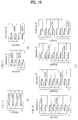
- FIG. 19 is a conceptual diagram illustrating a method for creating a disjointed pilot signal according to a sixth preferred embodiment of the present invention.
- the above-mentioned disjointed pilot signal is a pilot signal applied to only one of several samples transmitted to the plurality of antennas using the same frequency-time resources.
- the disjointed pilot signal may be applied to the sample transmitted to the specific antenna after all the pilot signals have been applied to samples transmitted to the remaining antennas.
- the disjointed pilot signal will hereinafter be described with reference to FIG. 19 .
- FIG. 19(a) is a method for creating the disjointed pilot signal via a single antenna.
- An example of FIG. 19(a) is the same as the above-mentioned first preferred embodiment.
- FIG. 19(b) is a method for creating the disjointed pilot signal via two antennas (Antennas A and B).
- data A0 is transmitted via the antenna A
- data B0 is transmitted via the antenna B
- data A0 and data B0 are transmitted via the same frequency-time resources.
- the OFDM/OFDMA system transmits the above-mentioned data (data A0 and data B0 ) using the same frequency resource.
- the TDM/TDMA system transmits the above-mentioned data (data A0 and data B0 ) via the same timeslot.
- the CDM/CDMA system transmits the above-mentioned data (data A0 and data B0 ) via the same code.
- the FDM/FDMA system transmits the above-mentioned data (data A0 and data B0 ) via the same frequency band.
- the above-mentioned data receives the same frequency-time resources, such that the pilot signal is applied to any one of the above-mentioned data (data A0 and data B0 ).
- the above-mentioned data (data A1 and data B1 ) is transmitted via the same frequency-time resources, and the pilot signal is applied to any one of the above-mentioned data (data A1 and data B1 ).
- the pilot signal has previously been transmitted to the sample data A0 transmitted via the antenna A, such that the pilot signal is applied to the sample data B1 transmitted via the antenna B
- the pilot signal can be applied to only one (i.e., data B1 ) of the above-mentioned data (data A1 and data B1 ).
- FIG. 19(c) is a method for creating the disjointed pilot signal via four antennas (Antennas A, B, C, and D).
- data A0 is transmitted via the antenna A
- data B0 is transmitted via the antenna B
- data C0 is transmitted via the antenna C
- data D0 is transmitted via the antenna D
- data A0 , data B0 , data C0 , and data D0 are transmitted via the same frequency-time resources.
- the OFDM/OFDMA system transmits the above-mentioned data (data A0 , data B0 , data C0 , and data D0 ) via the same subcarrier.
- the TDM/TDMA system transmits the above-mentioned data (data A0 , data B0 , data C0 , and data D0 ) via the same timeslot.
- the CDM/CDMA system transmits the above-mentioned data (data A0 , data B0 , data C0 , and data D0 ) via the same code.
- the FDM/FDMA system transmits the above-mentioned data (data A0 , data B0 , data C0 , and data D0 ) via the same frequency band.
- the above-mentioned data receives the same frequency-time resources, such that the pilot signal is applied to any one of the above-mentioned data (data A0 , data B0 , data C0 , and data D0 ).
- the above-mentioned data (data A1 , data B1 , data C1 and data D1 ) is transmitted via the same frequency-time resources, and the pilot signal is applied to any one of the above-mentioned data (data A1 , data B1 , data C1 , and data D1 ).
- the pilot signal has previously been transmitted to the sample data A0 transmitted via the antenna A, such that the pilot signal is applied to the sample transmitted via the antenna A after having been transmitted to the other sample transmitted via the antennas B, C, and D.
- the pilot signal may be applied to the sample data B1 transmitted via the antenna B from among the antennas B, C, and D.
- the pilot signal is applied to the sample data B1 , the pilot signal has already been transmitted to the samples data A0 and data B1 transmitted via the antennas A and B, such that the pilot signal is applied to other samples transmitted via the antennas C and D.
- the pilot signal may be applied to the sample data C2 transmitted via the antenna C from among the antennas C and D.
- the pilot signal is applied to the sample data C1 , the pilot signal has already been transmitted to the samples data A0 , data B1 , and data C2 transmitted via the antennas A, B, and C, such that the pilot signal is applied to the sample data D3 transmitted via the antenna D.
- FIG. 19(c) shows the disjointed pilot signals transmitted in the order of the antennas A, B, C, and D
- the above-mentioned disjointed pilot signal may be applied in various orders as necessary.
- the above-mentioned sixth preferred embodiment of the present invention need not include the pilot signal in all the samples transmitted via all the antennas.
- the above-mentioned sixth preferred embodiment of the present invention provides the disjointed pilot signal unequipped with the pilot signal to all the samples, such that pilot signals of individual antennas do not overlap with each other.
- the pilot signals in order to allow the above-mentioned sixth preferred embodiment to have the same effect as the above-mentioned first preferred embodiment where the pilot signal is contained in all the samples transmitted via all the antennas, the pilot signals must be boosted according to the number of the antennas.
- the signals are boosted by two times. If the disjointed pilot signal is applied via four antennas, the signals are boosted by four times.
- the channel estimation is calculated by the sum of samples (e.g., data A0 +pilot, data B0 , data C0 , and data D0 ) transmitted via several antennas (i.e., the same frequency-time resources).
- a seventh preferred embodiment of the present invention provides a method for applying a disjointed pilot signal to each antenna without including the pilot signal in all samples, and additionally including an auxiliary signal in the pilot signal.
- FIG. 20 is a conceptual diagram illustrating a method for inserting an auxiliary signal in a disjointed pilot signal to configure necessary samples according to a seventh preferred embodiment of the present invention.
- the above-mentioned disjointed pilot signal is a pilot signal applied to only one of several samples transmitted to the plurality of antennas using the same frequency-time resources.
- the disjointed pilot signal may be applied to the sample transmitted to the specific antenna after all the pilot signals have been applied to samples transmitted to the remaining antennas.
- the added auxiliary signal is contained in data signals transmitted via a specific antenna, such that it can set the sum of the data signals to zero.
- the above-mentioned seventh preferred embodiment provides a method for including the auxiliary signal in the sample equipped with the disjointed pilot signal of the sixth preferred embodiment without including the pilot and auxiliary signals in all the samples
- the second preferred embodiment of the present invention provides a method for including the pilot and auxiliary signals in all the samples.
- information indicating the auxiliary signal may be separately transmitted from the transmission end.
- this situation may unavoidably increase system overhead, such that the information indicating the auxiliary signal may not be separately transmitted.
- the reception end does not recognize information of the auxiliary signal, such that the above-mentioned auxiliary signal may act as noise.
- the auxiliary signal is contained in all the samples transmitted via the transmission antennas, the auxiliary signal contained in the sample transmitted via a specific antenna may create interference upon the sample transmitted via the remaining antennas.
- the seventh preferred embodiment of the present invention applies the auxiliary signal to only a specific sample without applying the auxiliary signal to all the samples, such that it prevents the auxiliary signals associated with individual antennas from overlapping with each other, resulting in reduction of interference between antennas.
- FIG. 20(a) is a method for creating the disjointed pilot signal via a single antenna.
- An example of FIG. 20(a) is the same as the above-mentioned second preferred embodiment.
- auxiliary signal (aux) is implemented as denoted by Equation 6a, the sum of the data and auxiliary signals contained in N samples transmitted via specific data is to be zero.
- the sum of data and auxiliary signals is to be zero, such that the reception end can perform correct modulation.
- FIG. 20(b) exemplary shows a method for applying the disjointed auxiliary signal to two antennas (Antennas A and B).
- the pilot signal in the case of samples transmitted to the antenna A, the pilot signal is applied to samples data A0 and data A2 from among all the samples transmitted to the antenna A.
- the pilot signal is applied to samples data B1 and data B3 from among all the samples transmitted to the antenna B. Therefore, the auxiliary signal aux A for the samples transmitted via the antenna A is applied to the above-mentioned samples data A0 and data A2 , and the auxiliary signal aux B for the samples transmitted via the antenna B is applied to the above-mentioned samples data B1 and data B3 .
- the auxiliary signal aux A for the samples transmitted via the antenna A is an auxiliary signal for allowing the sum of data and auxiliary signals transmitted to the antenna A to be zero.
- the auxiliary signal aux B for the samples transmitted via the antenna B is an auxiliary signal for allowing the sum of data and auxiliary signals transmitted to the antenna B to be zero.
- FIG. 20(c) exemplary shows a method for applying the disjointed auxiliary signal to four antennas (Antennas A, B, C, and D).
- the pilot signal in the case of samples transmitted via the antenna A, the pilot signal is applied to samples data A0 and data A4 from among all the samples transmitted via the antenna A.
- the pilot signal is applied to samples data B1 and data B5 from among all the samples transmitted via the antenna B.
- the pilot signal is applied to samples data C2 and data C6 from among all the samples transmitted via the antenna C.
- the pilot signal is applied to samples data D3 and data A7 from among all the samples transmitted via the antenna D.
- the auxiliary signal aux A for the samples transmitted via the antenna A is applied to the above-mentioned samples data A0 and data A4
- the auxiliary signal aux B for the samples transmitted via the antenna B is applied to the above-mentioned samples data B1 and data B5
- the auxiliary signal aux C for the samples transmitted to via the antenna C is applied to the above-mentioned samples data C2 and data C6
- the auxiliary signal aux D for the samples transmitted via the antenna D is applied to the above-mentioned samples data D3 and data D7 .
- the auxiliary signal aux A for the samples transmitted via the antenna A is indicative of an auxiliary signal for allowing the sum of data and auxiliary signals transmitted via the antenna A to be zero.
- the auxiliary signal aux B for the samples transmitted via the antenna B is indicative of an auxiliary signal for allowing the sum of data and auxiliary signals transmitted to the antenna B to be zero.
- the auxiliary signal aux C for the samples transmitted via the antenna C is an auxiliary signal for allowing the sum of data and auxiliary signals transmitted via the antenna C to be zero.
- the auxiliary signal aux D for the samples transmitted via the antenna D is an auxiliary signal for allowing the sum of data and auxiliary signals transmitted via the antenna D to be zero.
- the above-mentioned seventh preferred embodiment of the present invention need not include the pilot signal in all the samples transmitted via all the antennas.
- the above-mentioned seventh preferred embodiment of the present invention provides the disjointed pilot signal, such that pilot signals of individual antennas do not overlap with each other.
- the channel estimation is executed by four specific samples (e.g., data A0 +pilot+aux A , data B0 , data C0 , and data D0 ), such that the data recovery is implemented.
- data A0 +pilot+aux A e.g., data B0 +pilot+aux A , data B0 , data C0 , and data D0
- only a single auxiliary signal is contained in four samples, such that the data recovery is implemented without generating interference between antennas.
- the pilot signals In order to allow the above-mentioned seventh preferred embodiment to acquire the same effect the second preferred embodiment where the pilot signals are contained in all the samples transmitted via all antennas, the pilot signals must be boosted according to the number of the antennas.
- the signals are boosted by two times. If the disjointed pilot signal is applied via four antennas, the signals can be boosted by four times.
- the channel estimation is calculated by the sum of samples (e.g., data A0 +pilot+aux, data B0 , data C0 , and data D0 ) transmitted via several antennas (i.e., the same frequency-time resources).
- An eighth preferred embodiment of the present invention provides a method for allowing the reception end to effectively receive signals on the condition that the transmission end transmits the pilot signal equipped with the auxiliary signal (aux). If the reception end does not recognize information of the auxiliary signal, the auxiliary signal may act as the interference signal. Therefore, preferably, if the auxiliary signal is additionally transmitted, the reception end may remove the above-mentioned auxiliary signal.
- FIG. 21 is a block diagram illustrating a reception end for removing an auxiliary signal according to an eighth preferred embodiment of the present invention.
- the transmission end performs the channel coding for the created data at step 2002.
- the modulation is executed in association with the channel-coding result at step 2003.
- data (d m ), the auxiliary signal (a), and the pilot signal (p m ) are contained in each sample, such that the resultant sample is transmitted at step 2003.
- the above-mentioned modulation result is transmitted by an IFFT module 2004 via a plurality of subcarriers.
- a cyclic prefix is inserted in the above-mentioned modulation result by a cyclic prefix insertion module 2005, such that the modulation result including the cyclic prefix is transmitted.
- the above-mentioned modulation result is configured in the form of an OFDM burst symbol according to a communication protocol, such that it is transmitted to the reception end at steps 2006 and 2007.
- the reception end receives the OFDM symbol according to the communication protocol, removes the cyclic prefix from the received OFDM symbol, and executes an FFT calculation at steps 2017, 2018, and 2019.
- the pilot value can be recognized by the FFT calculation, such that the channel estimation unit 2016 performs the channel estimation, and the equalization 2015 is executed by the estimated channel value.
- the equalized result value is demodulated by the demodulation unit 2014, the channel decoding 2012 is executed on the demodulated result, and the channel-decoded result is applied to the interference remover 2013 according to the eighth preferred embodiment of the present invention.
- the interference remover 2013 calculates the value of the auxiliary signals used for the transmission end, such that it removes the value of the auxiliary signals.
- the interference remover 2013 can calculate the auxiliary signal using the data (d m ) contained in each sample.
- the input signal of the interference remover 2013 is indicative of a channel-estimated signal under the condition that the above-mentioned auxiliary is not removed, such that the input signal may also have the estimated value. Therefore, the data received in the interference remover 2013 is denoted by d m .
- the above-mentioned interference remover 2013 can estimate the auxiliary signal (a') using data (d m ') to which the removal of interference is not applied.
- the reception end recognizes the estimated auxiliary signal a', the auxiliary signal is removed, such that the equalization can be correctly executed.
- the reception signal is denoted by x m
- the interference remover 2013 can estimate the auxiliary signal.
- Equation 7b Equation 7b
- the interference remover 2013 executes the operation of Equation 7b to remove the auxiliary signal. Therefore, the reception end can demodulate the signal having no auxiliary signal.
- a ninth preferred embodiment of the present invention provides a method for minimizing the amplitude of the auxiliary signal if the transmission end transmits the pilot signal equipped with the auxiliary signal (aux).
- the data is transmitted using a high-density transmission scheme (e.g., 16QAM or 64QAM scheme), the probability of increasing the amplitude of the auxiliary signal is relatively increased. In this case, performance deterioration may occur in the reception end due to the auxiliary signal.
- a high-density transmission scheme e.g., 16QAM or 64QAM scheme
- the interference remover for removing the auxiliary signal is used as shown in the above-mentioned eighth preferred embodiment, the interference remover has difficulty in correctly removing the auxiliary signal due to the occurrence of a high-value auxiliary signal. Therefore, preferably, the auxiliary signal may be minimized in the case of employing the high-density transmission scheme of the 16QAM or more.
- the two-stage coding method may be executed.
- the above-mentioned coding may be a coding method based on orthogonal codes.
- the above-mentioned two-stage coding method selects orthogonal codes for minimizing the amplitude of the auxiliary signal, executes a first-stage coding on the selected orthogonal codes, and then executes a second-stage coding process for informing the reception end of the selected orthogonal codes.
- FIG. 22 is a block diagram illustrating transmission and reception ends for the coding operation capable of reducing the size of an auxiliary signal according to the present invention.
- the transmission and reception ends of FIG. 22 have the same operations as the transmission end of FIG. 21 , but they execute two-stage coding/decoding processes differently from the transmission end of FIG. 21 .
- Table 1 is the Hadamard code having the length of 24. According to the above-mentioned ninth preferred embodiment, the coding process is executed by orthogonal codes.
- orthogonal codes there is no limitation in categories of the above-mentioned orthogonal codes.
- a CAZAC (constant-amplitude, zero autocorrelation) sequence or other sequences based on specific-row or column- components of the FFT matrix may be used for the above-mentioned coding process.
- the orthogonal code of Table 1 has the length of 24, such that it may be multiplied by 24 samples shown in the above-mentioned Table 1.
- the Hadamard code of Table 1 is composed of 9 codes (i.e., 0-th to 8-th codes), such that an example of the 0-th to 2nd codes from among the 9 codes will be described.
- the 0-th code, the first code, and the second code are sequentially multiplied by 24 samples (i.e., d 0 ⁇ d 23 ).
- the lowest value from among the resultant values inner-scrambled by the 0-th code, the first code, and the second code is selected.
- the lowest value from among the values of the auxiliary signals "a", which are acquired by the sum of the multiplied values equal to the multiplied values of the 24 samples and each of the 0th code, the first code, and the second code is selected.
- a specific code for minimizing the sum of the sample signals from among the above-mentioned 0-th to second codes is selected.
- the above-mentioned sample is configured in the form of a complex number, such that the amplitude of each sample is determined by the amplitude of a real part of the complex number and the amplitude of an imaginary part of the complex number.
- the orthogonal code for minimizing the amplitude of the real part of each of the 24 samples is selected, and the other orthogonal code for minimizing the amplitude of the imaginary part of each of the 24 samples is selected.
- the above-mentioned outer-scrambling is also executed by the orthogonal codes shown in Table 1.
- the reception end recognizes outer-scrambling codes, such that the above-mentioned inner-scrambling code can be distinguished from each other.
- Inner codes applied to real part Inner codes applied to imaginary part Outer codes defined by inner codes 0 0 0 0 0 1 1 0 2 2 1 0 3 1 1 4 1 2 5 2 0 6 2 1 7 2 2 8
- a code for minimizing the value of the real part of each of the 24 samples is the first code
- a code for minimizing the value of the imaginary part of each of the 24 samples is the second code
- the above-mentioned outer codes are determined by the fifth code shown in Table 1.
- the above-mentioned outer scrambling is executed by the above-mentioned outer codes, such that the above-mentioned fifth code is multiplied by the 24 samples to which the inner scrambling has been executed.
- the transmission end performs the two-stage coding process.
- the first-stage coding is executed by the inner scrambling, and the second-stage coding is executed by the outer scrambling.
- the above-mentioned inner scrambling selects two inner codes capable of minimizing a predetermined number of samples, and applies the two selected inner codes to the predetermined number of scrambles, resulting in the implementation of the inner scrambling.
- the above-mentioned outer scrambling selects a specific outer code indicating the above-mentioned two inner codes, and applies the two selected outer codes to the predetermined number of samples, resulting in the implementation of the outer scrambling.
- FIG. 23 is a flow chart illustrating a method for executing a specific coding composed of two stages according to the present invention.
- index is a variable indicating the inner codes.
- the value of "index” is compared with a specific value "# of Hadamard code” at step S2303.
- the value of "# of Hadamard code” indicates the number of inner codes to be multiplied.
- the 0-th to second codes of Table 1 are used for the above-mentioned example.
- the value of "# of Hadamard code” is to be "3".
- the variable initialization is executed by the operation of S2304.
- the value of "data_index” is a variable for indicating the number of samples.
- the value of "data_index” is compared with the other value ""# of data_index” at step S2305.
- the value of "# of data_index” indicates the number of samples to which the inner or outer codes are applied.
- Step S2306 indicates the inner-scrambling process, such that a specific orthogonal code is multiplied by each data sample.
- the variable value is adjusted for the multiplications corresponding to a desired number of times at steps S2307 and S2308.
- the above-mentioned inner scrambling may be executed by the inner scrambling module 3003 of FIG. 22
- the above-mentioned outer scrambling may be executed by the outer scrambling module 3004 of FIG. 22 .
- the reception end includes information denoted by Table 1 and other information denoted by Table 3, such that it can recognize the outer codes using the above-mentioned Table 1.
- the reception end can recognize the outer codes using correlation values between the orthogonal code of Table 1 and the reception signal. If the outer code is defined, the reception end can recognize which one of inner codes has been used by referring to Table 3. By the above-mentioned operations, the reception end can recover samples acquired before receiving the inner codes.
- Equation 8a shows reception signals received in the reception end.
- d m and "a" contained in the sample have different data values according to the inner scrambling of the transmission end.
- d m ' and a' are an inner-scrambled data-symbol value and an inner-scrambled auxiliary-signal value, respectively.
- the inner scrambling of the value d m ' or a' is performed by the above-mentioned inner codes.
- v m AWGN
- C outer,m the outer codes associated with an m-th sample
- h a channel value.
- the reception end receives the signal to which the inner and outer codes are applied.
- ⁇ m 0 N ⁇ 1 C outer
- m ⁇ h C outer m d ⁇ m + p m + a ⁇ +
- ⁇ ⁇ m 0 N ⁇ 1 h d ⁇ m + a ⁇ + v ⁇ m ⁇ 0
- an outer descrambling module 3015 of the reception end detects the value "C outer,m " using the correlation value between the orthogonal code of Table 1 and the reception signal. If a correct outer code is determined, the value N ⁇ h ⁇ p is received as denoted by Equation 8b.
- Power ⁇ m 0 N ⁇ 1 C outer wrong , m ⁇ C outer , m ⁇ h d ⁇ m + a ⁇
- the reception end can recognize information of the inner codes by referring to Table 3. If the above-mentioned inner codes are recognized, the inner descrambling module 3014 of the reception end recovers original data acquired prior to the inner scrambling.
- the orthogonal codes of Table 1 may be configured to have a variety of lengths.
- the number of the orthogonal codes may be freely set to any number.
- a method for transmitting/receiving a signal equipped with a disjointed pilot signal in a mobile communication system can reduce an amount of frequency-time resources used for a training symbol (i.e., a pilot signal), such that it can effectively use radio resources.
Landscapes
- Engineering & Computer Science (AREA)
- Signal Processing (AREA)
- Computer Networks & Wireless Communication (AREA)
- Power Engineering (AREA)
- Mobile Radio Communication Systems (AREA)
- Cable Transmission Systems, Equalization Of Radio And Reduction Of Echo (AREA)
Description
- The present invention relates to a method for transmitting/receiving signals in a wireless (or radio) mobile communication system, and more particularly to a pilot configuration of a wireless mobile communication system for efficient use of radio resources in the wireless mobile communication system, and a channel estimation and reception method based on the same.
- Tong Zhou G et al: CONFERENCE RECORD OF THE 35TH. ASILOMAR CONFERENCE ON SIGNALS, SYSTEMS, & COMPUTERS. PACIFIC GROOVE, CA, NOV. 4 - 7, 2001; [ASILOMAR CONFERENCE ON SIGNALS, SYSTEMS AND COMPUTERS], 20011104 NEW YORK, NY : IEEE, US - ISBN 978-0-7803-7147-7 ; ISBN 0-7803-7147-X, pages 653-657, vol. 1, XP032139784, is concerned with superimposing periodic pilots for blind channel estimation, and describes a method for transmitting signals, in which the signals to be transmitted are superimposed with pilot symbols.
- Tugnait J K; Weilin Luo: On channel estimation using superimposed training and first-order statistics, IEEE COMMUNICATIONS LETTERS, 20030901 IEEE SERVICE CENTER, PISCATAWAY, NJ, US - ISSN 1089-7798, vol. 7, no. 9, pages 413-415, XP011100928 addresses channel estimation using superimposed training and first order statistics. The paper addresses the problem of recovering a signal s(n) given noisy x(n), and follows a superimposed training based approach for time-invariant systems. According to this approach the signal to be recovered is computed from the data symbols over which periodic training (pilot) sequences are superimposed.
- F. Mazzenga: "Channel Estimation and Equalization for M-QAM Transmission with a Hidden Pilot Sequence", IEEE TRANSACTIONS ON BROADCASTING, 20000601 IEEE SERVICE CENTER, PISCATAWAY, NJ, US - ISSN 0018-9316, vol. 46, no. 2, XP011006121, addresses channel estimation and equalization with hidden pilot sequences. The hidden pilot sequences are superimposed onto the symbols to be transmitted before for modulation. Three methods to superimpose a marking sequence over an information sequence are described. The marking sequence is a periodic pilot sequence.
- Hoehe P; Tufvesso; F: "Channel estimation with superimposed pilot sequence", Proc. IEEE Global Telecommunications Conference, 19991201 Rio de Janeiro, Brazil, Page(s):2162 - 2166, XP055086127 applies superimposed pilot sequence techniques for the purpose of channel estimation.
- Ning Chen; Zhou G T: "A superimposed periodic pilot scheme for semi-blind channel estimation of OFDM systems", Digital Signal Processing Workshop, 2002 and the 2nd Signal Processing Education Workshop. Proceedings of 2002 IEEE 10th 13-16 Oct. 2002, 20021013; 20021013 - 20021016 Piscataway, NJ, USA,IEEE - ISBN 978-0-7803-8116-2 ; ISBN 0-7803-8116-5, Page(s):362 - 365, XP010657827 proposes a superimposed periodic pilot scheme for OFDM channel identification. A pilot sequence is added to each block of data symbols to generate a data sequence which is then transmitted.
- Ohno S; Giannakis G B: "Optimal training and redundant precoding for block transmissions with application to wireless OFDM", 2001 IEEE INTERNATIONAL CONFERENCE ON ACOUSTICS, SPEECH, AND SIGNAL PROCESSING. PROCEEDINGS. (ICASSP). SALT LAKE CITY, UT, MAY 7 - 11, 2001; [IEEE INTERNATIONAL CONFERENCE ON ACOUSTICS, SPEECH, AND SIGNAL PROCESSING (ICASSP)], 20010507; 20010507 - 20010511 NEW YORK, NY : IEEE, US - ISBN 978-0-7803-7041-8; ISBN 0-7803-7041-4 is concerned with designing redundant precoders with cyclic prefix (CP) and superimposed training sequences for channel estimation.
A conventional channel estimation technology will hereinafter be described in detail. - A process of estimating and compensating for a signal distortion which may occur due to multipath fading, etc. is called "channel estimation". This channel estimation is roughly classified into a pilot signal-based scheme and a data-based scheme according to the format of data used for the channel estimation. The pilot signal-based scheme is adapted to allocate a part of a time or frequency domain to a specific signal for the channel estimation.
-
FIG. 1 illustrates a conventional method for configuring a pilot signal in a communication system (for example, an OFDM/OFDMA, FDM/FDMA, TDM/TDMA or CDM/CDMA communication system). - In a conventional wireless communication system, data is allocated to a specific subcarrier, specific frequency band, specific time slot or specific code. A pilot is also allocated to a frequency-time resource other than the allocated subcarrier, frequency band, time slot or code.
- The pilot means a pilot signal. As mentioned above, the OFDM/OFDMA, FDM/FDMA, TDM/TDMA and CDM/CDMA communication systems multiplex the data and pilots using the subcarriers, frequency bands, time slots and codes, respectively.
- The data or pilot multiplexed using the subcarrier, frequency band, time slot or code is referred to as a "sample." For example, the sample in the OFDM/OFDMA system represents a data signal or pilot signal transmitted at a specific subcarrier, the sample in the FDM/FDMA system represents a data signal or pilot signal transmitted at a specific frequency band, the sample in the TDM/TDMA system represents a data signal or pilot signal transmitted for a specific time slot, and the sample in the CDM/CDMA system represents a data signal or pilot signal transmitted through a specific code. These respective samples are transmitted through specific frequency-time resources (for example, a specific subcarrier, specific frequency band, specific time slot and specific code).
- An index "m" will hereinafter be used for distinction of the frequency-time resources based on indexes. For example, the index "m" for a specific sample in the OFDM/OFDMA system is a data symbol index for distinction of a subcarrier on which the specific sample is transmitted.
- Also, the index "m" for a specific sample in the FDM/FDMA system is a frequency index for distinction of a frequency band at which the specific sample is transmitted.
- Also, the index "m" for a specific sample in the TDM/TDMA system is a time index for distinction of a time slot for which the specific sample is transmitted.
- Also, the index "m" for a specific sample in the CDM/CDMA system is a code index for distinction of a code applied to the specific sample.
- A description will hereinafter be given of a process of performing channel estimation using a pilot signal and decoding data according to the channel estimation.
- At a receiving stage, data transmitted from a transmitting stage can be accurately restored by, through the following procedures, estimating a channel using a pilot and compensating for the value of the estimated channel.
- Assuming that a transmitted signal is "d", a channel is "h", an additive white Gaussian noise (AWGN) is "v", and a received signal is "x", the received signal "x" can be expressed as in an equation x = h·d + v, and, at the receiving side, a channel ĥ can be estimated through this equation because a pilot value is known in advance.

- Substituting the value of the estimated channel into the above equation 1a, the data d can be finally restored.
- In the aforementioned channel estimation method, accuracy of the channel estimation value ĥ using the pilot is important. The channel of the pilot is not accurately equal to that of the data.
- However, the closer the pilot-based channel estimation value is to a time or frequency axis, the higher the similarity between the pilot channel environment and the data channel environment, such that the above-mentioned pilot-based channel estimation information is used for the data recovery.
- In other words, the closer the pilot is to the data, the higher the channel estimation throughput (or performance). The higher the number of pilots, the higher the channel estimation throughput, such that the data recovery is implemented. However, the allocation of a large number of pilots means that a large amount of resources to be allocated to the data are consumed, such that it is very important to properly arrange the above-mentioned pilots.
- The OFDMA technology will hereinafter be described in detail.
- Firstly, an OFDM (Orthogonal Frequency Division Multiplexing) technology will be described for the convenience of description. The OFDM technology converts input data into parallel data units equal to the number of used subcarriers, loads the parallel data units in each subcarrier, and transmits the subcarriers including the parallel data units, such that it is considered to be a MultiCarrier Transmission/Modulation (MCM) scheme employing a variety of subcarriers.
- Secondly, the OFDMA (Orthogonal Frequency Division Multiple Access) technology will be described in detail. The OFDMA scheme allocates a different number of subcarriers according to a transfer rate requested by each user, such that it can effectively distribute resources. Similar to the OFDMA-TDMA scheme, the OFDMA scheme need not execute the initialization using a preamble before each user receives data, resulting in increased transmission efficiency.
- Specifically, the OFDMA scheme is suitable for a specific case where a large number of subcarriers are used, such that it can be effectively used for the wireless communication system equipped with a broad-area cell having a relatively-high Time Delay Spread (TDS).
- Also, a frequency-hopping OFDMA scheme solves the problems generated when a subcarrier-interference caused by other users or a deep-fading subcarrier occurs in a radio or wireless channel, such that it increases a frequency-diversity effect and acquires an interference-averaging effect.
-
FIG. 2 is a conceptual diagram illustrating a pilot allocation scheme for use in an OFDM-based wireless communication system. - The IEEE 802.16 system performs the pilot allocation using the pilot allocation scheme shown in
FIG. 2 . A pilot allocation scheme for the OFDM-based wireless communication system will hereinafter be described with reference toFIG. 2 . The IEEE 802.16 system may have 128 subcarriers, 512 subcarriers, 1024 subcarriers, or 2048 subcarriers. Some parts of both sides of a total of subcarriers are used as a protection band. In the case of the remaining parts other than the above-mentioned parts, a single subcarrier from among 9 subcarriers is allocated to the pilot, and the remaining 8 subcarriers other than the single subcarrier may be allocated to data. - Conventional TDM/TDMA, FDM/FDMA, and CDM/CDMA technologies will hereinafter be described.
-
FIG. 3 is a conceptual diagram illustrating a conventional pilot allocation scheme for a TDM/TDMA-based wireless communication system. - Referring to
FIG. 3 , a data signal is assigned to each time slot according to the TDM/TDMA scheme. The data signal is contained in a first timeslot, and the pilot signal is contained in a second timeslot, such that the first and second timeslots including the data and pilot signals are transmitted to a destination. -
FIG. 4 is a conceptual diagram illustrating a pilot allocation scheme for a CDM/CDMA-based wireless communication system. - Individual data signals are distinguished from each other by different codes according to the CDM/CDMA scheme. Preferably, in the case of multiplexing individual data units, the above-mentioned different codes may be orthogonal codes to allow a reception end to detect the data units while being classified.
- As shown in
FIG. 4 , each data signal and each pilot signal are distinguished from each other by different codes, such that they are transmitted to a radio channel. - In the case of the pilot allocation based on the FDM/FDMA technology, individual data signals are classified according to a frequency band for transmission of the above-mentioned signals. Preferably, a predetermined protection area may be formed between the above-mentioned frequency bands to reduce interference between several data signals. In the case of the FDM/FDMA technology, the above-mentioned data signal and the pilot signal are distinguished from each other according to different frequency bands, such that they are transmitted to the radio channel.
- It is assumed that the wireless communication system based on OFDM/OFDMA, FDM/FDMA, TDM/TDMA, or CDM/CDMA technology uses the aforementioned conventional pilot-signal usage method. Under this situation, the higher the number of the pilot signals, the higher the channel estimation throughput. However, the action of increasing pilot signals within limited frequency/time resources unavoidably encounters the reduction of data transmission resources.
- For example, if the OFDM/OFDMA-based wireless communication system allocates a single subcarrier from among 9 subcarriers to the pilot, this means that radio resources for data transmission are reduced by the ratio of 1/9. Provided that a single subcarrier from among 3 subcarriers is allocated to the pilot to perform the channel estimation of a higher throughput, radio resources for data transmission are reduced by the ratio of 1/3.
- Accordingly, the present invention is directed to a method for transmitting/receiving a signal including a spread training symbol in a mobile communication terminal that substantially obviates one or more problems due to limitations and disadvantages of the related art.
- The objects are solved by the features of the independent claims.
- An object of the present invention devised to solve the problem lies on a pilot configuration method for effectively employing radio resources, a channel estimation method, and a signal receiving method.
- A method for transmitting a signal equipped with a disjointed pilot signal in a mobile communication system can be applied to a mobile communication system based on OFDM/OFDMA, TDM/TDMA, FDM/FDMA, and CDM/CDMA technologies.
- According to the present invention, disjointed pilot signals are arranged to subcarriers, timeslots, or codes, such that a large amount of transmission data can be transmitted to limited frequency-time resources.
- The object of the present invention can be achieved by providing a method for transmitting a signal equipped with a training symbol in a mobile communication system which includes a transmission end capable of transmitting an output signal equipped with a training symbol for channel estimation of a reception end, the method comprising the steps of: a) calculating an auxiliary signal added to data symbols transmitted via individual subcarriers so as to allow the sum of the data symbols (i.e., data signals) to be zero; b) adding training symbols having the same amplitude and the calculated auxiliary signal to the data symbols, and calculating the output signal on the basis of the added result; c) transmitting information of the calculated auxiliary signal to the reception end; and d) transmitting the calculated output signal via the subcarriers.
- In a further aspect of the present invention, there is provided a method for transmitting a signal equipped with a training symbol in a mobile communication system which includes a transmission end capable of transmitting an output signal equipped with a training symbol for channel estimation of a reception end using orthogonal subcarriers, the method comprising the steps of: a) calculating an auxiliary signal added to each data signal transmitted via a predetermined number of subcarriers so as to allow the sum of the data signals to be zero; b) coding the data signals using the data signals transmitted via predetermined subcarriers (i.e., a predetermined number of subcarriers), and the calculated auxiliary signal, a predetermined value for a coding operation; c) adding training symbols having the same amplitude and the calculated auxiliary signal to the coded data signals, and calculating the output signal on the basis of the added result; d) transmitting information of the calculated auxiliary signal associated with the predetermined subcarriers to the reception end; and e) transmitting the calculated output signal via the subcarriers.
- In a further aspect of the present invention, there is provided a method for transmitting a signal equipped with a training symbol in a mobile communication system which includes a transmission end capable of transmitting data via a plurality of transmission antennas, the method comprising the steps of: a) adding training symbols having the same amplitude to data symbols, and calculating the sum of the training symbols configured in the form of disjointed data associated with the transmission antennas; b) adding an auxiliary signal to the data symbols including the training symbols, calculating the sum of the same auxiliary signals associated with a specific transmission antenna, and calculating an output signal; and c) transmitting the calculated output signal via the subcarriers, whereby the auxiliary signal is added to the data symbols so as to allow the sum of predetermined data signals (i.e., a predetermined number of data symbols) to be zero.
- In a further aspect of the present invention, there is provided a method for transmitting a signal equipped with a training symbol in a mobile communication system which includes a reception end capable of performing channel estimation using training symbols transmitted via orthogonal subcarriers, and recovering a data signal using the channel-estimated value, the method comprising the steps of: a) performing channel estimation of predetermined subcarriers (i.e., a predetermined number of subcarriers) using reception signals transmitted via individual subcarriers and predetermined-sized training symbols; b) receiving information of an auxiliary signal added to each data signal transmitted via the predetermined subcarriers so as to allow the sum of the predetermined data signals to be zero; and c) recovering the data signals using the received signal, the predetermined-sized training symbols, the channel-estimated value, and the auxiliary signal.
- In a further aspect of the present invention, there is provided a method for transmitting a signal equipped with a training symbol in a mobile communication system which includes a reception end capable of performing channel estimation using training symbols transmitted via orthogonal subcarriers, and recovering a data signal using the channel-estimated value, the method comprising the steps of: a) receiving an auxiliary signal, which is added to data signals assigned to predetermined subcarriers (i.e., a predetermined number of subcarriers) to allow the sum of the predetermined data signals to be zero, and reception signals for transmitting individual data signals coded by a predetermined coding value via the subcarriers; b) performing channel estimation on the predetermined subcarriers using the reception signals contained in the subcarriers and predetermined-sized training symbols; and c) recovering the data signals using the received signal, the predetermined-sized training symbols, the channel-estimated value, and the predetermined coding value.
- The accompanying drawings, which are included to provide a further understanding of the invention, illustrate embodiments of the invention and together with the description serve to explain the principle of the invention.
- In the drawings:
-
FIG. 1 is a conceptual diagram illustrating a conventional method for configuring a pilot signal in a communication system (e.g., an OFDM/OFDMA, FDM/FDMA, TDM/TDMA, or CDM/CDMA communication system); -
FIG. 2 is a conceptual diagram illustrating a conventional pilot allocation scheme for use in an OFDM-based wireless communication system; -
FIG. 3 is a conceptual diagram illustrating a conventional pilot allocation scheme for use in a TDM/TDMA-based wireless communication system; -
FIG. 4 is a conceptual diagram illustrating a conventional pilot allocation scheme for use in a CDM/CDMA-based wireless communication system; -
FIG. 5 is a conceptual diagram illustrating a method for configuring a pilot signal according to the present invention; -
FIG. 6 is a conceptual diagram illustrating a method for configuring a pilot signal implemented in the OFDM/OFDMA system according to a first preferred embodiment of the present invention; -
FIG. 7 is a conceptual diagram illustrating a method for configuring a pilot signal implemented in the TDM/TDMA system according to a first preferred embodiment of the present invention; -
FIG. 8 is a conceptual diagram illustrating a method for configuring a pilot signal implemented in the CDM/CDMA system according to a first preferred embodiment of the present invention; -
FIG. 9 is a conceptual diagram illustrating an OFDM/OFDMA-based transmission method for inserting an auxiliary signal capable of allowing symbol values of overall samples to converge at zero "0" according to a second preferred embodiment of the present invention; -
FIG. 10 is a conceptual diagram illustrating a TDM/TDMA-based transmission method for inserting an auxiliary signal capable of allowing symbol values of overall samples to converge at zero "0" according to a second preferred embodiment of the present invention; -
FIG. 11 is a conceptual diagram illustrating a CDM /CDMA-based transmission method for inserting an auxiliary signal capable of allowing symbol values of overall samples to converge at zero "0" according to a second preferred embodiment of the present invention; -
FIG. 12 is a conceptual diagram illustrating a method for configuring a pilot signal using the OFDM/OFDMA system according to a third preferred embodiment of the present invention; -
FIG. 13 is a conceptual diagram illustrating a method for configuring a pilot signal using the TDM/TDMA system according to a third preferred embodiment of the present invention; -
FIG. 14 is a conceptual diagram illustrating a method for configuring a pilot signal using the CDM/CDMA system according to a third preferred embodiment of the present invention; -
FIG. 15 shows samples transmitted via four antennas according to a preferred embodiment of the present invention; -
FIG. 16 shows samples transmitted via four antennas according to another preferred embodiment of the present invention; -
FIG. 17 shows samples transmitted via four antennas by the sum of orthogonal pilot signals according to the present invention; -
FIG. 18 is a conceptual diagram illustrating a method for modifying/arranging a pilot symbol using a QPSK orthogonal code so as to apply the second preferred embodiment to a multi-antenna system according to the present invention; -
FIG. 19 is a conceptual diagram illustrating a method for creating a disjointed pilot signal according to a sixth preferred embodiment of the present invention; -
FIG. 20 is a conceptual diagram illustrating a method for inserting an auxiliary signal in a disjointed pilot signal to configure necessary samples according to a seventh preferred embodiment of the present invention; -
FIG. 21 is a block diagram illustrating a reception end for removing an auxiliary signal according to an eighth preferred embodiment of the present invention; -
FIG. 22 is a block diagram illustrating transmission and reception ends for the coding operation capable of reducing the size of an auxiliary signal according to the present invention; and -
FIG. 23 is a flow chart illustrating a method for executing a specific coding composed of two stages according to the present invention. - Reference will now be made in detail to the preferred embodiments of the present invention, examples of which are illustrated in the accompanying drawings. Wherever possible, the same reference numbers will be used throughout the drawings to refer to the same or like parts.
- In order to solve the problems of the above-mentioned conventional art, a variety of channel estimation methods for allocating pilot signals to a small number of subcarriers, and performing the channel estimation using only the small number of pilot signals are proposed. However, the present invention provides a method for loading many more transmission data units to the subcarriers using the conventional pilot signals.
- The present invention provides a transmission method for spreading the pilot signals to a data area. In order words, the present invention provides a method for including a pilot signal and a data signal in a specific subcarrier, and transmitting the pilot and data signals using the subcarrier.
-
FIG. 5 is a conceptual diagram illustrating a method for configuring a pilot signal according to the present invention. - As previously described above, the conventional art has been designed to include only the pilot signal or the data signal in a single sample. However, the present invention provides a method for transmitting the pilot and data signals in a single sample.
- A first preferred embodiment of the present invention provides a method for transmitting/receiving a sample equipped with data and pilot signals. It is characterized in that the pilot signals contained in the sample have the same size. Preferably, the size of each pilot signal may be determined according to the pilot-signal size of the conventional art.
- The above-mentioned first preferred embodiment will hereinafter be described with reference to
FIGS. 6 to 8 . -
FIG. 6 is a conceptual diagram illustrating a method for configuring a pilot signal implemented in the OFDM/OFDMA system according to a first preferred embodiment of the present invention. - A method for configuring a pilot signal according to the first preferred embodiment of the present invention will hereinafter be described with reference to
FIG. 6 . As can be seen fromFIG. 6 , each sample includes data and pilot signals. -
FIG. 7 is a conceptual diagram illustrating a method for configuring a pilot signal implemented in the TDM/TDMA system according to a first preferred embodiment of the present invention. As can be seen fromFIG. 7 , each sample includes a predetermined-sized pilot signal (i.e., a signal transmitted to a specific timeslot). -
FIG. 8 is a conceptual diagram illustrating a method for configuring a pilot signal implemented in the CDM/CDMA system according to a first preferred embodiment of the present invention. As can be seen fromFIG. 8 , each sample includes a predetermined-sized pilot signal (i.e., a signal transmitted by a specific code). - A method for configuring a pilot signal using the FDM/FDMA system is the same as the above-mentioned methods. Each sample includes a predetermined-sized pilot signal (i.e., a signal transmitted by a specific frequency band).
- Preferably, the sizes of pilot signals contained in individual samples may be equal to each other. Preferably, the size of each pilot signal may be determined by uniform division of the conventional-art pilot signal size.
- The conventional OFDM/OFDMA system has a pilot signal allocated to a single subcarrier from among N subcarriers, however, the inventive OFDM/OFDMA system according to the present invention can allocate a pilot signal, the size of which is equal to 1/N of that of the conventional pilot signal, to N subcarriers.
- The conventional TDM/TDMA system has a pilot signal allocated to a single timeslot from among N timeslots, however, the inventive TDM/TDMA system according to the present invention can apply a pilot signal, the size of which is equal to 1/N of that of the conventional pilot signal, to N timeslots.
- The conventional FDM/FDMA system has allocated a pilot signal to a single frequency band from among N frequency bands, however, the inventive FDM/FDMA system according to the present invention can apply a pilot signal, the size of which is equal to 1/N of that of the conventional pilot signal, to N frequency bands.
- The conventional CDM/CDMA system has allocated a pilot signal to a single code from among N codes, however, the inventive CDM/CDMA system according to the present invention can apply a pilot signal, the size of which is equal to 1/N of that of the conventional pilot signal, to N codes.
- In the case of transmitting N samples in the above-mentioned first preferred embodiment, assuming that a data signal contained in an m-th sample is dm, a pilot signal contained in the m-th sample is pm, a channel corresponding to the sample is h, noise corresponding to the m-th sample is vm, a received signal xm is represented by the following Equation 1b:
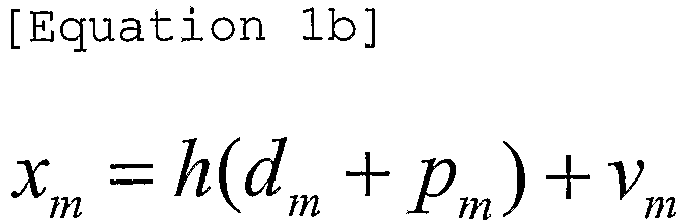
- In this case, since a receiver has already recognized the value of the pilot signal, it can perform the channel estimation denoted by the following Equation 1c.
- For reference, the value of "h" shown in the above-mentioned
Equation 1 is a value independent of the value of "m." In other words, it is assumed that the value of h is constant during the transmission of the N samples. Also, the above-mentioned equations are expressed without considering the above-mentioned noise vm.
- A In Equation 1c, ĥ is a channel value estimated by the pilot and data signals configured by the aforementioned method. As described above, if the pilot signals having the same size are contained in all samples and are then transmitted according to the first preferred embodiment, the channel value ĥ can be estimated by the above-mentioned Equation 1c.
- Also, the estimated channel value can be recovered using the following Equation 1d:

- If an inventive transmission signal is recovered by the estimated channel value as denoted by Equation 1d, a pilot signal having a predetermined size (pm) is added to each data symbol, such that the data recovery can be implemented by another channel estimation value reduced by the predetermined size (pm).
- A second preferred embodiment of the present invention provides a method for transmitting a sample equipped with data and pilot signals. In more detail, the second preferred embodiment provides a method for transmitting the sample including not only the data and pilot signals but also a predetermined auxiliary signal.
- As can be seen from Equation 1c of the above-mentioned first preferred embodiment, the value of

- Generally, an average value of constellation-mapped data symbols is close to the value of 0. The higher the number of N samples (i.e., N transmission samples), the closer the value of
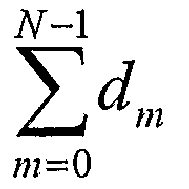
- However, under the above situation, it is difficult to maintain the independency of the "h" value to the "m" value.
- Therefore, the second preferred embodiment of the present invention provides a method for increasing the number (N) of samples to be transmitted, inserting the auxiliary signal to acquire of the value of

- The above-mentioned second preferred embodiment of the present invention will hereinafter be described with reference to
FIGS. 9 to 11 . -
FIG. 9 is a conceptual diagram illustrating an OFDM/OFDMA-based transmission method for inserting an auxiliary signal capable of allowing symbol values of overall samples to converge at zero "0" according to a second preferred embodiment of the present invention. - Referring to
FIG. 9 , a predetermined-sized pilot signal and an auxiliary signal are contained in each sample (i.e., a signal transmitted via a specific subcarrier). - Preferably, the above-mentioned pilot signal may have the same value in association with each sample. The auxiliary signal is determined by the data signal contained in all the transmitted samples.
-
FIG. 10 is a conceptual diagram illustrating a TDM/TDMA-based transmission method for inserting an auxiliary signal capable of allowing symbol values of overall samples to converge at zero "0" according to a second preferred embodiment of the present invention. - Referring to
FIG. 10 , a predetermined-sized pilot signal and an auxiliary signal are contained in each sample (i.e., a signal transmitted via a specific timeslot). -
FIG. 11 is a conceptual diagram illustrating a CDM /CDMA-based transmission method for inserting an auxiliary signal capable of allowing symbol values of overall samples to converge at zero "0" according to a second preferred embodiment of the present invention. - Referring to
FIG. 11 , a predetermined-sized pilot signal and an auxiliary signal are contained in each sample (i.e., a signal transmitted via a specific code). - A method for configuring the pilot signal implemented by the FDM/FDMA system is the same as in the above-mentioned method. In other words, a predetermined-sized pilot signal and an auxiliary signal are contained in each sample (i.e., a signal transmitted via a specific frequency band).
- The method for creating the above-mentioned auxiliary signal in the above-mentioned communication system is represented by the following Equation 2a:

- In this case, the value of "a" included in data contained in N samples to acquire the sum (i.e., zero) of the data signal and the auxiliary signal is calculated by the following Equation 2b:

- The channel estimation denoted by the following Equation 2c is performed on the reception signal (xm) additionally including the value of "a":
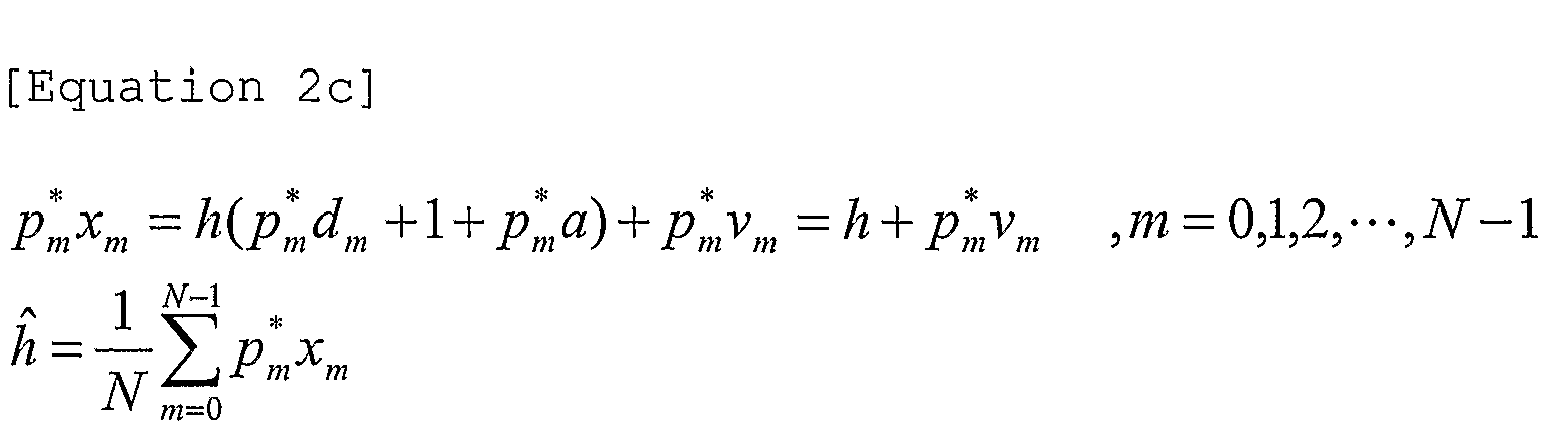
- Also, the data signal of the reception signal (xm) can be restored by the above-mentioned estimated channel value ĥ as denoted by the following Equation 2d:

- As can be seen from Equation 2d, not only the data signal but also the pilot signal (pm) and the auxiliary signal (a) are added to each sample, such that the value of a received data symbol is determined by the deletion of the signals (pm) and (a).
- If the reception end recognizes the value of (a), the reception signal can be more accurately restored. Therefore, it is desirable that the value of the auxiliary signal (a) associated with N specific samples is transmitted from a transmission end to a reception end.
- There is no limitation in the method for transmitting the auxiliary signal to the reception end. If the value of the auxiliary signal (a) is transmitted to the reception end using messages or signaling processes of physical and upper layers, the reception end can correctly recover the data value using the value of the received auxiliary signal (a).
- The reception signal according to the second preferred embodiment of the present invention is channel-estimated by the following inverse matrix denoted by the following Equation 2e, resulting in the data recovery.

- In the recovered data symbol, a Signal-to-Noise Ratio (SNR) is reflected in Minimum Mean Squared Error (MMSE) technique, differently from the ZF (Zero Forcing) technique.
- A third preferred embodiment of the present invention provides a method for transmitting a sample simultaneously including the data, pilot, and auxiliary signals. In more detail, the third preferred embodiment of the present invention provides a transmission/reception method for preventing the occurrence of transmission power waste caused by the auxiliary signal.
- If the pilot signal is constructed according to the above-mentioned second preferred embodiment, a transmission end must additionally employ as much power as the value of a specific constant (a) to supplement the auxiliary signal value.
- However, under the above-mentioned situation, it may be impossible to increase the power of the transmission end. In this case, the amplitude of all transmission power is limited, such that the amplitude of the data signal may be unavoidably reduced due to the limited power amplitude. In other words, the amplitude of the data signal may be unavoidably reduced due to the addition of the auxiliary signal.
- Therefore, the above-mentioned third preferred embodiment of the present invention provides a method for coding the value of the data signal using a predetermined data value and a predetermined auxiliary signal value.
- As a representative example of a variety of coding methods for limiting the sum of the data signal and the auxiliary signal to a specific range, a method for modulo-calculating a difference between the data signal value and the auxiliary signal value with respect to a predetermined data value Δ will hereinafter be described in detail.
- As described above, the auxiliary signal value (a) associated with N samples should be transmitted to the reception end. Also, the reception end recognizes the above-mentioned predetermined data value Δ used for the coding.
- A transmitter according to the third preferred embodiment of the present invention calculates the auxiliary signal associated with N samples transmitted to the reception end, performs modulo-calculation considering the difference between the data and auxiliary signals contained in the aforementioned sample, performs the coding of reducing transmission power using the modulo-calculation, and transmits the coded value instead of the real data signal value.

- In Equation 3a, "dm" is the value of a real data signal,
d m is a coded signal transmitted from a transmission end to a reception end, mod is indicative of the modulo-calculation, "pm" is a pilot signal, "a" is an auxiliary signal, and "m" is index information for the distinction of samples. - In this case, upon receiving the signal
d m , the pilot signal (pm), and the auxiliary signal (a), the reception end can perform the channel estimation using the following Equation 3b:
- The data recovery is executed by the above-mentioned estimated channel value ĥ as denoted by the following Equation 3c:

- In accordance with the above-mentioned third preferred embodiment, the value of a real data signal (dm) is coded to a smaller-sized signal
d m , such that it can solve the problem of increasing the transmission signal power by the sum of the auxiliary signal and the pilot signal. - The above-mentioned third preferred embodiment of the present invention will hereinafter be described with reference to
FIGS. 12 to 14 . -
FIG. 12 is a conceptual diagram illustrating a method for configuring a pilot signal using the OFDM/OFDMA system according to a third preferred embodiment of the present invention. - A method for constructing the pilot signal in the OFDM/OFDMA system according to the third preferred embodiment of the present invention will hereinafter be described with reference to
FIG. 12 . - Referring to
FIG. 12 , a data signal and a pilot signal are simultaneously contained in each sample (i.e., a signal transmitted via a specific subcarrier). However, it should be noted that the coding method for reducing the transmission signal power is applied to the above-mentioned data signal as denoted by the above Equation 3a. -
FIG. 13 is a conceptual diagram illustrating a method for constructing a pilot signal using the TDM/TDMA system according to a third preferred embodiment of the present invention. - Referring to
FIG. 13 , a predetermined-sized pilot signal and an auxiliary signal are contained in each sample (i.e., a signal transmitted via a specific timeslot). However, it should be noted that the coding method for reducing the transmission signal power is applied to the above-mentioned data signal as denoted by the above Equation 3a. -
FIG. 14 is a conceptual diagram illustrating a method for configuring a pilot signal using the CDM/CDMA system according to a third preferred embodiment of the present invention. - Referring to
FIG. 14 , a predetermined-sized pilot signal and an auxiliary signal are contained in each sample (i.e., a signal transmitted via a specific code). However, it should be noted that the coding method for reducing the transmission signal power is applied to the above-mentioned data signal as denoted by the above Equation 3a. - A method for constructing the pilot signal implemented by the FDM/FDMA system is the same as in the above-mentioned method. In other words, a predetermined-sized pilot signal and an auxiliary signal are contained in each sample (i.e., a signal transmitted via a specific frequency band). However, it should be noted that the coding method for reducing the transmission signal power is applied to the above-mentioned data signal as denoted by the above Equation 3a.
- A fourth preferred embodiment of the present invention provides a method for adding a predetermined pilot signal to a sample transmitted to a reception end, and controlling a phase of the added pilot signal.
- In the case of controlling the phase of the added pilot signal, the phase of the pilot signal is rotated by a
predetermined angle 0°, such that the pilot signal remains in a positive(+) value. Otherwise, if the phase of the pilot signal is rotated by 180°, the pilot signal is shifted from the positive(+) value to a negative(-) value. - In this way, the pilot signals having different signs or phases are added to the sample, such that it can transmit the above-mentioned transmission signal via a plurality of antennas.
-
FIG. 15 shows samples transmitted via four antennas according to a preferred embodiment of the present invention. - Referring to
FIG. 15 , each sample simultaneously includes a data signal and a pilot signal. According to the fourth preferred embodiment of the present invention, predetermined pilot signals are contained in a sample transmitted to a reception end, and the phases of the pilot signals are determined by Hadamard codes. - As can be seen from
FIG. 15 , predetermined pilot signals are added to each sample transmitted via each antenna. The example ofFIG. 15 shows a method for transmitting a total of four samples via four antennas, respectively. - For example, individual samples transmitted via the four antennas are depicted in
FIG. 15 . In more detail, four samples are transmitted via an antenna A. In this case, each of the four samples associated with the above-mentioned antenna A includes a data signal and a pilot signal. The samples received via the antenna A include only the positive(+) pilot signals. Each of four samples transmitted via each of antennas B, C, and D alternately includes the positive(+) pilot signal and the negative(-) pilot signal. - If the concept of
FIG. 15 is applied to the OFDM/OFDMA system, four samples are transmitted via four antennas. In this case, the above-mentioned four samples may be transmitted via 4 different subcarriers at the same time, may be transmitted via 2 different subcarriers two times, or may also be transmitted via a single subcarrier four times, in such a way that the above-mentioned four samples can be transmitted in various ways. - If the concept of
FIG. 15 is applied to the TDM/TDMA system, four samples (i.e., signals transmitted via four timeslots) may include pilotx0, pilotx1, pilotx2, and pilotx3 (where x = A,B,C,D), respectively, and may then be transmitted. - Also, if the concept of
FIG. 15 is applied to the FDM/FDMA system, four samples (i.e., signals transmitted via four codes) may include pilotx0 pilotx1, pilotx2, and pilotx3 (where x = A,B,C,D), respectively, and may then be transmitted. - For the convenience of description and better understanding of the present invention, assuming that the amplitude of the pilot signal shown in
FIG. 15 is "1", the arrangement of pilot signals added to the above-mentioned four antennas can be represented by the following Equation 4a:
- In Equation 4a, each column is indicative of a specific antenna, and each row is indicative of a pilot signal added to a specific sample (e.g., an i-th sample) transmitted via all antennas. In other words, a first column is indicative of a pilot signal added to the antenna A, and a first row is indicative of a pilot signal added to a first sample transmitted via the antennas A, B, C, and D.
- As can be seen from
FIG. 15 and the above-mentioned Equation 4a, pilot signals transmitted via individual antennas are orthogonal to each other. - If the reception end receives a signal via a single antenna, there are four reception paths. In this case, all the pilot signals of the samples transmitted via four paths are orthogonal to each other, such that the reception end can normally perform the channel estimation.
- As described above, although the above-mentioned fourth preferred embodiment of the present invention has disclosed the signal transmission via four antennas, it should be noted that the number of the above-mentioned antennas is not limited to the exemplary value "4", and can be applied to other examples as necessary.
- Also, although the above-mentioned fourth preferred embodiment of the present invention has disclosed the data transmission/reception method capable of transmitting four samples, it should be noted that the number of the above-mentioned samples is not limited to the value "4", and can be applied to other examples as necessary.
- If an OFDM symbol including 4 data symbols is transmitted via two antennas, the arrangement of pilot signals can be represented by the following Equation 4b:

- In Equation 4b, each column is indicative of a specific antenna, and each row is indicative of a pilot signal added to a specific sample (e.g., an i-th sample) transmitted via all antennas.
- Also, although the above-mentioned fourth preferred embodiment of the present invention has disclosed the data transmission/reception method for transmitting four samples, it should be noted that there is no limitation in the number of the samples.
- If eight samples are transmitted via four antennas, the arrangement of pilot signals can be represented by the following Equation 4c:
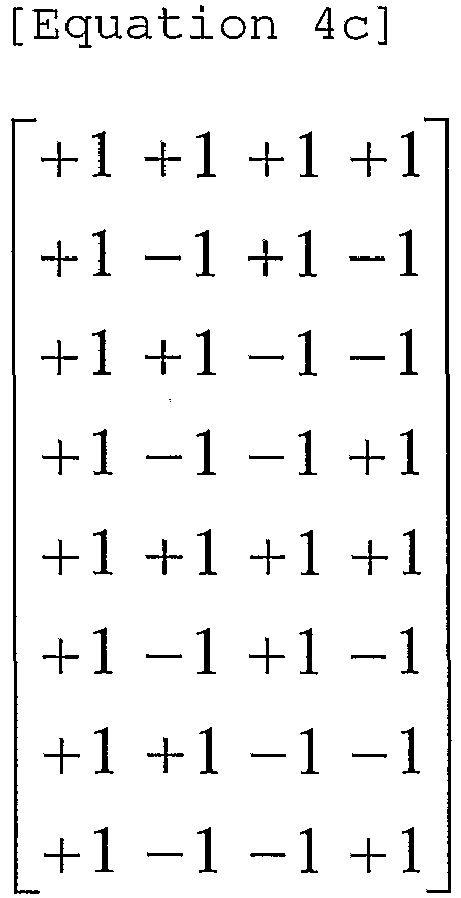
- In Equation 4c, each column is indicative of a specific antenna, and each row is indicative of a pilot signal added to a specific sample (e.g., an i-th sample) transmitted via all antennas.
-
FIG. 16 shows samples transmitted via four antennas according to another preferred embodiment of the present invention. - The preferred embodiment shown in
FIG. 16 provides a method for modifying an added pilot signal using a QPSK orthogonal code in order to apply the above-mentioned first preferred embodiment to a multi-antenna system. - Referring to
FIG. 16 , a predetermined pilot signal is added to each data transmitted via individual antennas. As can be seen fromFIG. 16 , the pilot signal is contained in each of four samples, and is then transmitted. - Also, the preferred embodiment of
FIG. 16 shows an exemplary case in which the pilot signal is contained in each of four samples, such that the four samples including the pilot signals are transmitted to a destination. As can be seen fromFIG. 16 , four samples are transmitted via the antenna A, and each of the four samples includes the value of P0. - In the meantime, four samples transmitted via the antenna B, C, or D selectively includes

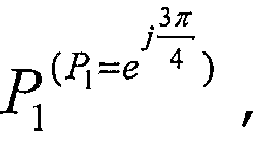

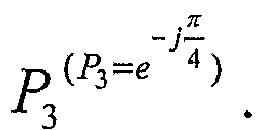
- For the convenience of description and better understanding of the present invention, assuming that individual added pilot signals of
FIG. 16 are P0, P1, P2, and P3, the arrangement of pilot signals added to the four antennas can be represented by the following Equation 4d:
- In Equation 4d, each column is indicative of a specific antenna, and each row is indicative of a pilot signal added to a specific sample (e.g., an i-th sample) transmitted via all antennas. In other words, a first column is indicative of a pilot signal contained in each sample transmitted via the antenna A, and a first row is indicative of a pilot signal contained in each sample transmitted via the antennas A, B, C, and D. As can be seen from
FIG. 16 and the above-mentioned Equation 4d, signals transmitted via individual antennas are orthogonal to each other. - If the reception end receives signals via a single antenna, there are four reception paths. In this case, all the pilot signals of the samples transmitted via four paths are orthogonal to each other, such that the reception end can normally perform the channel estimation.
- As described above, although the above-mentioned preferred embodiment of the present invention has disclosed the signal transmission via four antennas, it should be noted that the number of the above-mentioned antennas is not limited to the exemplary value "4", and can be applied to other examples as necessary.
- If 4 data samples are transmitted via two antennas, the arrangement of pilot signals can be represented by the following Equation 4e:

- In Equation 4e, each column is indicative of a specific antenna, and each row is indicative of a pilot signal added to a specific sample (e.g., an i-th sample) transmitted via all antennas.
- Also, although the above-mentioned preferred embodiment of the present invention has disclosed the data transmission/reception method for transmitting four samples, it should be noted that there is no limitation in the number of the samples.
- If eight samples are transmitted via four antennas, the arrangement of pilot signals can be represented by the following Equation 4f:

- In Equation 4f, each column is indicative of a specific antenna, and each row is indicative of a pilot signal added to a specific sample (e.g., an i-th sample) transmitted via all antennas.
- A fifth preferred embodiment of the present invention additionally includes an auxiliary signal (aux) in the pilot signal of the above-mentioned fourth preferred embodiment of the present invention. By the addition of the auxiliary signal (aux), the sum of data signals contained in all transmission samples can converge at zero.
-
FIG. 17 shows samples transmitted via four antennas by the sum of orthogonal pilot signals according to the present invention. - Although
FIG. 17 shows an exemplary method for transmitting an OFDM symbol equipped with four data symbols via four antennas, it should be noted that the aforementioned data transmission method ofFIG. 17 can transmit data via a variety of antennas other than the four antennas as previously stated in the above-mentioned fourth preferred embodiment, and can transmit a variety of samples via individual antennas. - The fifth preferred embodiment of
FIG. 17 provides a method for modifying/arranging pilot symbols using Hadamard code in order to apply the above-mentioned second preferred embodiment to the multi-antenna system. - Also, the fifth preferred embodiment of
FIG. 17 provides a method for additionally including the auxiliary signal (aux) capable of allowing the sum of data symbols of a specific OFDM symbol to converge at zero. - The above-mentioned pilot arrangement has previously been disclosed in the preferred embodiment of
FIG. 15 , such that a method for calculating the auxiliary signal (aux) will hereinafter be described in detail. - If the number of transmission antennas is Nt, a method for calculating the auxiliary signal (aux) according to the number of transmission antenna Nt is as follows.
- The exemplary case of Nt=1 is the same as the above-mentioned second preferred embodiment.
- Provided that the auxiliary signal is a specific constant "a", a reception signal of a receiver can be represented by the following Equation 5a:

- In this case, the value "a" for allowing the sum of the data and auxiliary signals contained in N samples to be zero can be calculated by the following Equation 5b:

- The Equations 5a-5b are equal to the above-mentioned Equations 2a-2b.
- Under the situation of Nt=2, the auxiliary signal can be calculated by the following method.
- Under the situation of two transmission antennas (i.e., antennas A and B), a reception signal of the receiver can be represented by the following Equation 5c:

- In this case, auxiliary signal values am and aBm for adding N data symbols and N auxiliary signals (where N = the number of transmission samples) to acquire the sum of zero can be calculated by the following processes 1a and 2a.
- If the value of hA is estimated by N samples of a reception signal (assuming that hA is constant for each sample), the data signal, the auxiliary signal, and the pilot signal contained in the N samples can be represented by the following Equation 5d:

- As can be seen from Equation 5d, pilot signals of signals transmitted via the antenna A are added to be


- In conclusion, in order to calculate the value "hA" using the above-mentioned process 1a, the values of individual auxiliary signals aAm and aBm are required to satisfy
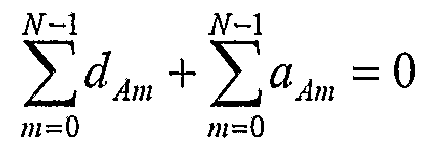

- If the value of hB is estimated by the data signals, pilot signals and auxiliary signals transmitted via N samples of a reception signal (assuming that hB is constant for each sample), the sum of signals received through the N samples can be represented by the following Equation 5e:

- As can be seen from Equation 5e, pilot signals of signals transmitted via the antenna A are added to be zero. Otherwise, pilot signals of signals transmitted via the antenna B are added to be the value of Np (assuming that noise is ignored in Equation 5e so that

- In conclusion, in order to calculate the value "hB" using the above-mentioned process 2a, the values of individual auxiliary signals aAm and aBm are required to satisfy specific conditions denoted by


- A method for calculating the values of the auxiliary signals aAm and aBm using the above-mentioned processes 1a and 2a can be generally represented by the following Equation 5f:

- If the auxiliary signals for satisfying the above-mentioned conditions are added to each other, and the sum of the auxiliary signals is transmitted via two transmission antennas, accurate channel estimation can be performed to recover the values hA and hB.
- An exemplary case of Nt=4 calculates the auxiliary signals using the following method.
- If four transmission antennas (i.e., antennas A, B, C, and D) are used, signals received in the receiver can be represented by the following Equation 5g:

- In this case, auxiliary signal values aAm, aBm, aCm and aDm for adding N data signals and N auxiliary signals (where N means the number of all transmission samples) to acquire the sum of zero can be calculated by the following processes 1b~4b.
- If the value of hA is estimated by pilot and auxiliary signals contained in N samples of a reception signal (assuming that hA is constant for each subcarrier), the data signal, signals received via the N samples are added as denoted by the following Equation 5h:

- As can be seen from Equation 5h, pilot signals of signals transmitted via the antenna A are added to be


- In conclusion, in order to calculate the value "hA" using the above-mentioned process 1b, the values of individual auxiliary signals aAm and aBm are required to satisfy


- If the value of hB is estimated by the data signals, pilot signals, and auxiliary signals transmitted via N samples of a reception signal (assuming that hB is constant for each sample), the sum of signals received through the N samples can be represented by the following Equation 5i:

- As can be seen from Equation 5i, pilot signals of signals transmitted via the antenna A, C, and D are added to be zero. Otherwise, pilot signals of signals transmitted via the antenna B are added to be the value of Np (assuming that noise is ignored in Equation 5i so that

- In conclusion, in order to calculate the value "hB" using the above-mentioned process 2b, the values of individual auxiliary signals aAm, aBm, aCm, and aDm are required to satisfy specific conditions denoted by


- If the value of hC is estimated by the data signals, pilot signals, and auxiliary signals transmitted via N samples of a reception signal (assuming that hC is constant for each sample), the sum of signals received through the N samples can be represented by the following Equation 5j:

- As can be seen from Equation 5j, pilot signals of signals transmitted via the antenna A, B, and D are added to be zero. Otherwise, pilot signals of signals transmitted via the antenna C are added to be the value of Np (assuming that noise is ignored in Equation 5j so that

- In conclusion, the values of individual auxiliary signals aAm, aBm, aCm, and aDm are required to satisfy specific conditions denoted by the following conditions:


- If the value of hD is estimated by the data signals, pilot signals, and auxiliary signals transmitted via N samples of a reception signal (assuming that hD is constant for each sample), the sum of signals received through the N samples can be represented by the following Equation 5k:

- As can be seen from Equation 5k, pilot signals of signals transmitted via the antenna A, B, and C are added to be zero. Otherwise, pilot signals of signals transmitted via the antenna D are added to be the value of Np (assuming that noise is ignored in Equation 5k so that

- In conclusion, the values of individual auxiliary signals aAm, aBm, aCm, and aDm are required to satisfy specific conditions denoted by the following conditions:


- A method for calculating the values of the auxiliary signals aAm, aBm, aCm, and aDm using the above-mentioned processes 1b, 2b, 3b, and 4b can be generally represented by the following Equation 51:
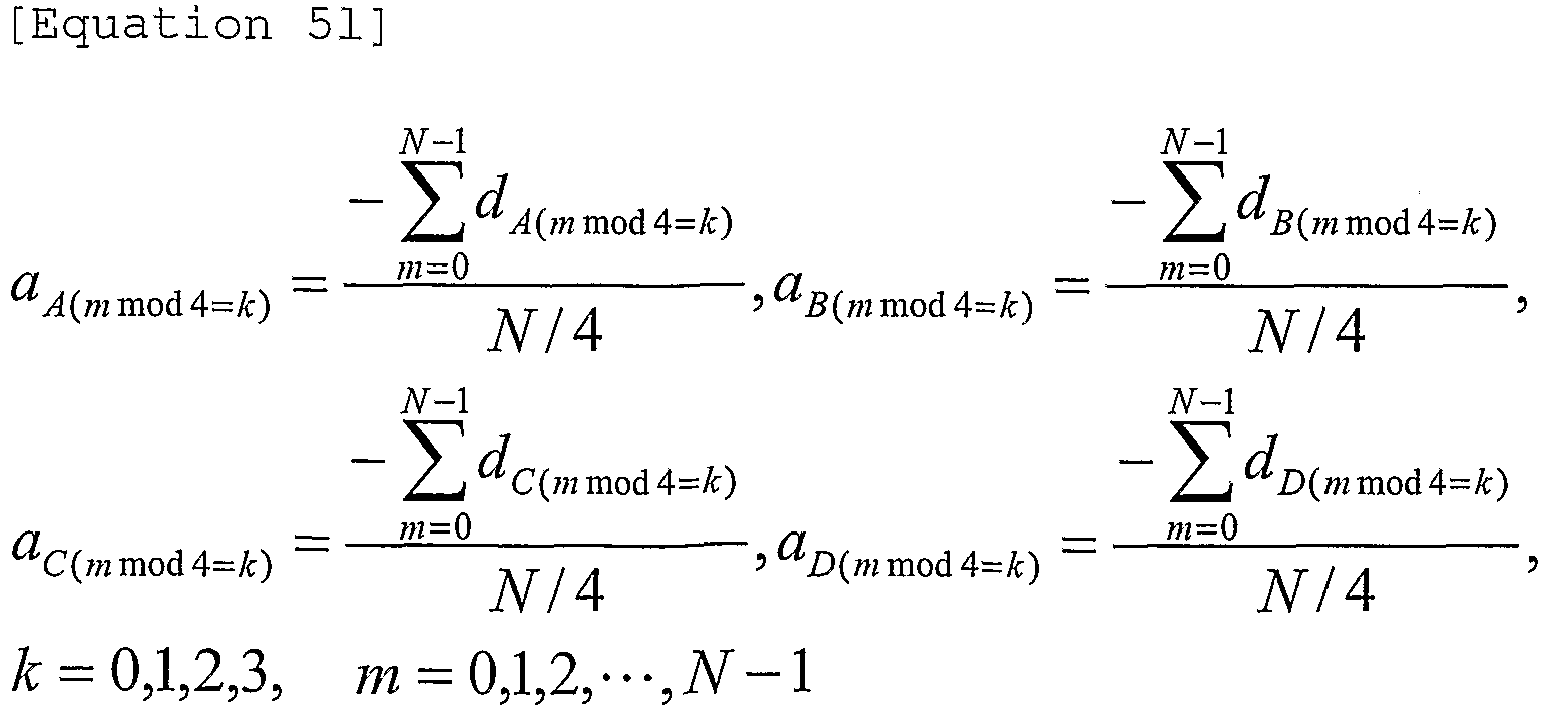
- If the auxiliary signals for satisfying the above-mentioned conditions are added to each other, and the sum of the auxiliary signals is transmitted via four transmission antennas, accurate channel estimation can be performed to recover the values hA, hB, hC and hD.
-
FIG. 18 is a conceptual diagram illustrating a method for modifying/arranging a pilot symbol using a QPSK orthogonal code so as to apply the second preferred embodiment to a multi-antenna system according to the present invention. - The example of
FIG. 15 in the above-mentioned fourth preferred embodiment is the same as the pilot symbol mapping based on a BPSK modulation scheme. Therefore, if data is transmitted from other cells according to the QPSK scheme, BPSK pilot symbols produce interference with data symbols transmitted from other cells. - In order to solve the above-mentioned interference problem, the preferred embodiment of
FIG. 18 provides a method for modifying/arranging the pilot symbols according to the QPSK scheme instead of the BPSK modulation scheme. - As mentioned above, the preferred embodiment of
FIG. 18 modifies the pilot symbols using QPSK orthogonal codes, and arranges the modified pilot symbols. - The preferred embodiment of
FIG. 18 provides a method for additionally including the auxiliary signal (aux) capable of allowing the sum of data signals contained in N samples to converge at zero. - The above-mentioned pilot arrangement has previously been disclosed in the above-mentioned fourth preferred embodiment of
FIG. 16 , such that a method for calculating the auxiliary signal (aux) will hereinafter be described in detail. - If the number of transmission antennas is Nt, a method for calculating the auxiliary signal (aux) according to the number of transmission antenna Nt is as follows.
- The exemplary case of Nt=1 is the same as the above-mentioned second preferred embodiment.
- Provided that the auxiliary signal is a specific constant "a", a reception signal of a receiver can be represented by the following Equation 5m:

- In this case, the value "a" for allowing the sum of the data and auxiliary signals contained in N samples to be zero can be calculated by the following Equation 5n:

- The Equations 5m∼5n are equal to the above-mentioned Equations 2a∼2b.
- Under the situation of Nt=2, the auxiliary signal can be calculated by the following method.
- Under the situation of two transmission antennas (i.e., antennas A and B), a reception signal of the receiver can be represented by the following Equation 5o:

- In this case, auxiliary signal values aAm and aBm for adding N data symbols and N auxiliary signals (where N = the number of all samples to be transmitted) to acquire the sum of zero can be calculated by the following processes 1c and 2c.
- If the value of hA is estimated by the data signals, auxiliary signals, and pilot signals transmitted via N samples of a reception signal (assuming that hA is constant for each subcarrier), the sum of signals received via N subcarriers can be represented by the following Equation 5p:

- As can be seen from Equation 5p, pilot signals of signals transmitted via the antenna A are added to be


- In conclusion, in order to calculate the value "hA" using the above-mentioned process 1c, the values of individual auxiliary signals aAm, and aBm are required to satisfy


- If the value of hB is estimated by data symbols transmitted via N subcarriers of a reception signal (assuming that hB is constant for each subcarrier), the sum of signals received through the N samples can be represented by the following Equation 5q:

- As can be seen from Equation 5q, pilot signals of signals transmitted via the antenna A are added to be zero. Otherwise, pilot signals of signals transmitted via the antenna B are added to be the value of N.
- In conclusion, in order to calculate the value "hB" using the above-mentioned process 2c, the values of individual auxiliary signals aAm and aBm are required to satisfy specific conditions denoted by

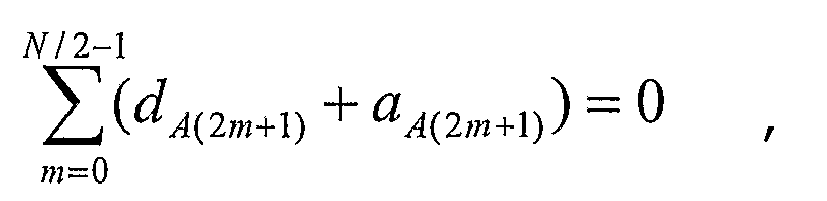
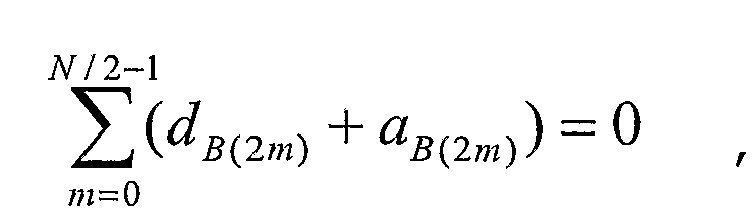

- A method for calculating the values of the auxiliary signals aAm and aBm using the above-mentioned processes 1c and 2c can be generally represented by the following Equation 5r:

- If the auxiliary signals for satisfying the above-mentioned conditions are added to each other, and the sum of the auxiliary signals is transmitted via two transmission antennas, accurate channel estimation can be performed to recover the values hA and hB.
- An exemplary case of Nt=4 calculates the auxiliary signals using the following method.
- If four transmission antennas (i.e., antennas A, B, C, and D) are used, signals received in the receiver can be represented by the following Equation 5s:

- In this case, auxiliary signal values aAm, aBm, aCm and aDm for adding N data signals and N auxiliary signals (where N means the number of all samples to be transmitted) to acquire the sum of zero can be calculated by the following processes 1d∼4d.
- If the value of hA is estimated by pilot and auxiliary signals contained in N samples of a reception signal (assuming that hA is constant for each subcarrier), the data signal, signals received via the N samples are added as denoted by the following Equation 5t:
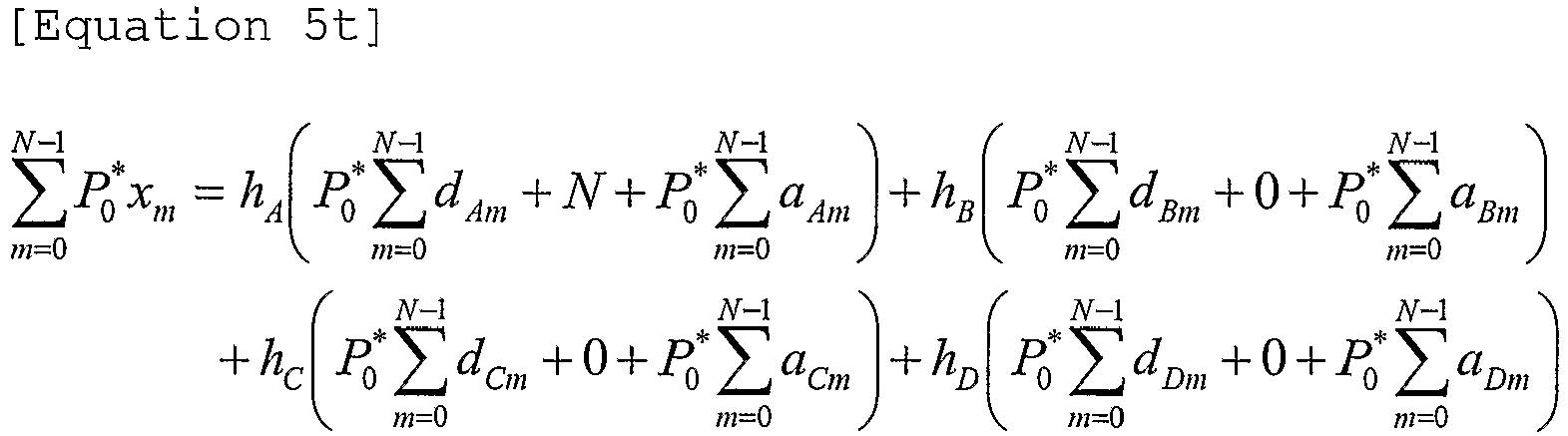
- As can be seen from Equation 5t, pilot signals of signals transmitted via the antenna A are added to be


- In conclusion, in order to calculate the value "hA" using the above-mentioned process 1d, the values of individual auxiliary signals aAm and aBm are required to satisfy

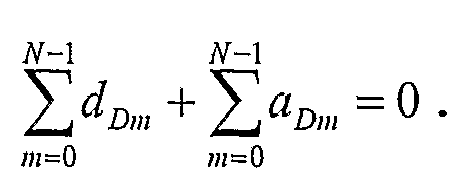
- If the value of hB is estimated by data symbols transmitted via N samples of a reception signal (assuming that hB is constant for each subcarrier), the sum of signals received via the N samples can be represented by the following Equation 5u:

- As can be seen from Equation 5u, pilot signals of signals transmitted via the antenna A, C, and D are added to be zero. Otherwise, pilot signals of signals transmitted via the antenna B are added to be the value of N.
- In conclusion, in order to calculate the value "hB" using the above-mentioned process 2d, the values of individual auxiliary signals aAm, aBm, aCm, and aDm are required to satisfy specific conditions denoted by


- If the value of hC is estimated by the data-, pilot-, and auxiliary- signals transmitted via N samples of a reception signal (assuming that hC is constant for each sample), the sum of signals received through the N samples can be represented by the following Equation 5v:

- As can be seen from Equation 5v, pilot signals of signals transmitted via the antenna A, B, and D are added to be zero. Otherwise, pilot signals of signals transmitted via the antenna C are added to be the value of N.
- In conclusion, the values of individual auxiliary signals aAm, aBm, aCm, and aDm are required to satisfy specific conditions denoted by the following conditions


- If the value of hD is estimated by the data-, pilot-, and auxiliary- signals transmitted via N samples of a reception signal (assuming that hD is constant for each sample), the sum of signals received through the N samples can be represented by the following Equation 5w:

- As can be seen from Equation 5w, pilot signals of signals transmitted via the antenna A, B, and C are added to be zero. Otherwise, pilot signals of signals transmitted via the antenna D are added to be the value of N.
- In conclusion, the values of individual auxiliary signals aAm, aBm, aCm, and aDm are required to satisfy specific conditions denoted by the following conditions,



- A method for calculating the values of the auxiliary signals aAm, aBm, aCm, and aDm using the above-mentioned processes 1d, 2d, 3d, and 4d can be generally represented by the following Equation 5x:
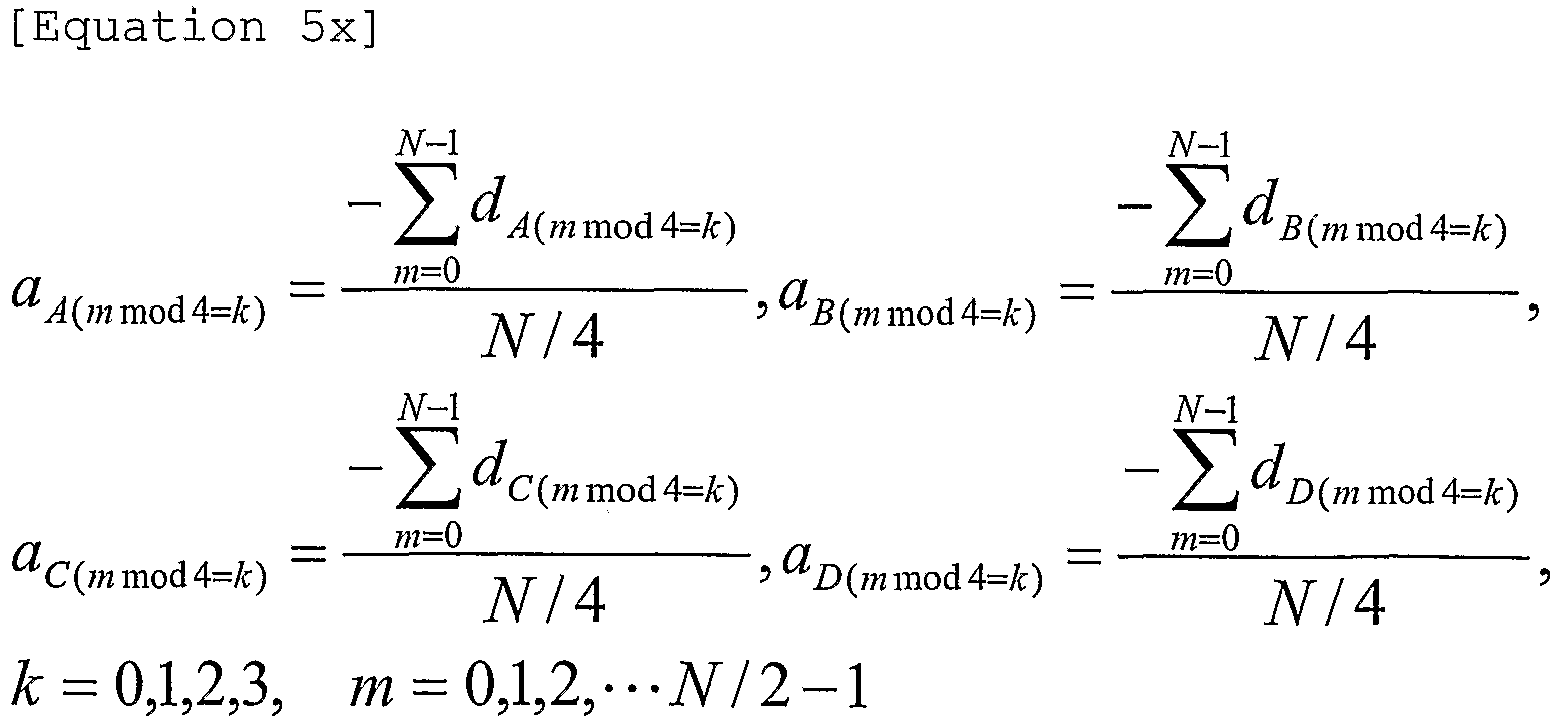
- If the auxiliary signals for satisfying the above-mentioned conditions are added to each other, and the sum of the auxiliary signals is transmitted via four transmission antennas, accurate channel estimation can be performed to recover the values hA, hB, hC and hD.
- A sixth preferred embodiment of the present invention provides a method for applying a disjointed pilot signal to each antenna without containing the pilot signal in all samples.
-
FIG. 19 is a conceptual diagram illustrating a method for creating a disjointed pilot signal according to a sixth preferred embodiment of the present invention. - The above-mentioned disjointed pilot signal is a pilot signal applied to only one of several samples transmitted to the plurality of antennas using the same frequency-time resources.
- Also, if a pilot signal is applied to a sample transmitted to a specific antenna, the disjointed pilot signal may be applied to the sample transmitted to the specific antenna after all the pilot signals have been applied to samples transmitted to the remaining antennas.
- The disjointed pilot signal will hereinafter be described with reference to
FIG. 19 . -
FIG. 19(a) is a method for creating the disjointed pilot signal via a single antenna. An example ofFIG. 19(a) is the same as the above-mentioned first preferred embodiment. -
FIG. 19(b) is a method for creating the disjointed pilot signal via two antennas (Antennas A and B). - Referring to
FIG. 19(b) , dataA0 is transmitted via the antenna A, dataB0 is transmitted via the antenna B, and dataA0 and dataB0 are transmitted via the same frequency-time resources. - For example, the OFDM/OFDMA system transmits the above-mentioned data (dataA0 and dataB0) using the same frequency resource. The TDM/TDMA system transmits the above-mentioned data (dataA0 and dataB0) via the same timeslot. The CDM/CDMA system transmits the above-mentioned data (dataA0 and dataB0) via the same code. The FDM/FDMA system transmits the above-mentioned data (dataA0 and dataB0) via the same frequency band.
- In conclusion, the above-mentioned data (dataA0 and dataB0) receives the same frequency-time resources, such that the pilot signal is applied to any one of the above-mentioned data (dataA0 and dataB0).
- In addition, the above-mentioned data (dataA1 and dataB1) is transmitted via the same frequency-time resources, and the pilot signal is applied to any one of the above-mentioned data (dataA1 and dataB1).
- However, the pilot signal has previously been transmitted to the sample dataA0 transmitted via the antenna A, such that the pilot signal is applied to the sample dataB1 transmitted via the antenna B
- Therefore, the pilot signal can be applied to only one (i.e., dataB1) of the above-mentioned data (dataA1 and dataB1).
-
FIG. 19(c) is a method for creating the disjointed pilot signal via four antennas (Antennas A, B, C, and D). - Referring to
FIG. 19(c) , dataA0 is transmitted via the antenna A, dataB0 is transmitted via the antenna B, dataC0 is transmitted via the antenna C, dataD0 is transmitted via the antenna D, and dataA0, dataB0, dataC0, and dataD0 are transmitted via the same frequency-time resources. - For example, the OFDM/OFDMA system transmits the above-mentioned data (dataA0, dataB0, dataC0, and dataD0) via the same subcarrier. The TDM/TDMA system transmits the above-mentioned data (dataA0, dataB0, dataC0, and dataD0) via the same timeslot. The CDM/CDMA system transmits the above-mentioned data (dataA0, dataB0, dataC0, and dataD0) via the same code. The FDM/FDMA system transmits the above-mentioned data (dataA0, dataB0, dataC0, and dataD0) via the same frequency band.
- In conclusion, the above-mentioned data (dataA0, dataB0, dataC0, and dataD0) receives the same frequency-time resources, such that the pilot signal is applied to any one of the above-mentioned data (dataA0, dataB0, dataC0, and dataD0).
- In addition, the above-mentioned data (dataA1, dataB1, dataC1 and dataD1) is transmitted via the same frequency-time resources, and the pilot signal is applied to any one of the above-mentioned data (dataA1, dataB1, dataC1, and dataD1).
- However, the pilot signal has previously been transmitted to the sample dataA0 transmitted via the antenna A, such that the pilot signal is applied to the sample transmitted via the antenna A after having been transmitted to the other sample transmitted via the antennas B, C, and D.
- Therefore, the pilot signal may be applied to the sample dataB1 transmitted via the antenna B from among the antennas B, C, and D.
- If the pilot signal is applied to the sample dataB1, the pilot signal has already been transmitted to the samples dataA0 and dataB1 transmitted via the antennas A and B, such that the pilot signal is applied to other samples transmitted via the antennas C and D.
- Therefore, the pilot signal may be applied to the sample dataC2 transmitted via the antenna C from among the antennas C and D.
- If the pilot signal is applied to the sample dataC1, the pilot signal has already been transmitted to the samples dataA0, dataB1, and dataC2 transmitted via the antennas A, B, and C, such that the pilot signal is applied to the sample dataD3 transmitted via the antenna D.
- Although the example of
FIG. 19(c) shows the disjointed pilot signals transmitted in the order of the antennas A, B, C, and D, it should be noted that there is no limitation in the order of the pilot signal transmission, such that the above-mentioned disjointed pilot signal may be applied in various orders as necessary. - Differently from the first to fifth preferred embodiments, the above-mentioned sixth preferred embodiment of the present invention need not include the pilot signal in all the samples transmitted via all the antennas.
- In other words, the above-mentioned sixth preferred embodiment of the present invention provides the disjointed pilot signal unequipped with the pilot signal to all the samples, such that pilot signals of individual antennas do not overlap with each other.
- Preferably, in order to allow the above-mentioned sixth preferred embodiment to have the same effect as the above-mentioned first preferred embodiment where the pilot signal is contained in all the samples transmitted via all the antennas, the pilot signals must be boosted according to the number of the antennas.
- If the disjointed pilot signal is applied via two antennas, the signals are boosted by two times. If the disjointed pilot signal is applied via four antennas, the signals are boosted by four times.
- If signals are transmitted in the above-mentioned sixth preferred embodiment, the channel estimation is calculated by the sum of samples (e.g., dataA0+pilot, dataB0, dataC0, and dataD0) transmitted via several antennas (i.e., the same frequency-time resources).
- A seventh preferred embodiment of the present invention provides a method for applying a disjointed pilot signal to each antenna without including the pilot signal in all samples, and additionally including an auxiliary signal in the pilot signal.
-
FIG. 20 is a conceptual diagram illustrating a method for inserting an auxiliary signal in a disjointed pilot signal to configure necessary samples according to a seventh preferred embodiment of the present invention. - As described above, the above-mentioned disjointed pilot signal is a pilot signal applied to only one of several samples transmitted to the plurality of antennas using the same frequency-time resources.
- Also, if a pilot signal is applied to a sample transmitted to a specific antenna, the disjointed pilot signal may be applied to the sample transmitted to the specific antenna after all the pilot signals have been applied to samples transmitted to the remaining antennas.
- According to the seventh preferred embodiment, the added auxiliary signal is contained in data signals transmitted via a specific antenna, such that it can set the sum of the data signals to zero.
- The above-mentioned seventh preferred embodiment provides a method for including the auxiliary signal in the sample equipped with the disjointed pilot signal of the sixth preferred embodiment without including the pilot and auxiliary signals in all the samples, whereas the second preferred embodiment of the present invention provides a method for including the pilot and auxiliary signals in all the samples.
- As previously stated in the second preferred embodiment, information indicating the auxiliary signal may be separately transmitted from the transmission end. However, this situation may unavoidably increase system overhead, such that the information indicating the auxiliary signal may not be separately transmitted.
- In this case, the reception end does not recognize information of the auxiliary signal, such that the above-mentioned auxiliary signal may act as noise.
- If the auxiliary signal is contained in all the samples transmitted via the transmission antennas, the auxiliary signal contained in the sample transmitted via a specific antenna may create interference upon the sample transmitted via the remaining antennas.
- The seventh preferred embodiment of the present invention applies the auxiliary signal to only a specific sample without applying the auxiliary signal to all the samples, such that it prevents the auxiliary signals associated with individual antennas from overlapping with each other, resulting in reduction of interference between antennas.
- The above-mentioned auxiliary signal contained in the disjointed pilot signal will hereinafter be described with reference to
FIG. 20 . -
FIG. 20(a) is a method for creating the disjointed pilot signal via a single antenna. An example ofFIG. 20(a) is the same as the above-mentioned second preferred embodiment. - The auxiliary signal (aux) shown in
FIG. 20(a) can be represented by the following Equation 6a:
- Where "m" is indicative of index information for the distinction of individual samples. If the auxiliary signal (aux) is implemented as denoted by Equation 6a, the sum of the data and auxiliary signals contained in N samples transmitted via specific data is to be zero.
- Also, as previously stated in the above-mentioned second preferred embodiment, the sum of data and auxiliary signals is to be zero, such that the reception end can perform correct modulation.
-
FIG. 20(b) exemplary shows a method for applying the disjointed auxiliary signal to two antennas (Antennas A and B). - According to the method for creating the disjointed pilot signal shown in the sixth preferred embodiment, in the case of samples transmitted to the antenna A, the pilot signal is applied to samples dataA0 and dataA2 from among all the samples transmitted to the antenna A. In the case of samples transmitted to the antenna B, the pilot signal is applied to samples dataB1 and dataB3 from among all the samples transmitted to the antenna B. Therefore, the auxiliary signal auxA for the samples transmitted via the antenna A is applied to the above-mentioned samples dataA0 and dataA2, and the auxiliary signal auxB for the samples transmitted via the antenna B is applied to the above-mentioned samples dataB1 and dataB3.
- The auxiliary signal auxA for the samples transmitted via the antenna A is an auxiliary signal for allowing the sum of data and auxiliary signals transmitted to the antenna A to be zero. The auxiliary signal auxB for the samples transmitted via the antenna B is an auxiliary signal for allowing the sum of data and auxiliary signals transmitted to the antenna B to be zero.
- The above-mentioned auxiliary signals auxA and auxB can be represented by the following Equation 6b:

-
FIG. 20(c) exemplary shows a method for applying the disjointed auxiliary signal to four antennas (Antennas A, B, C, and D). - According to the method for creating the disjointed pilot signal shown in the sixth preferred embodiment, in the case of samples transmitted via the antenna A, the pilot signal is applied to samples dataA0 and dataA4 from among all the samples transmitted via the antenna A. In the case of samples transmitted via the antenna B, the pilot signal is applied to samples dataB1 and dataB5 from among all the samples transmitted via the antenna B. In the case of samples transmitted to the antenna C, the pilot signal is applied to samples dataC2 and dataC6 from among all the samples transmitted via the antenna C. In the case of samples transmitted via the antenna B, the pilot signal is applied to samples dataD3 and dataA7 from among all the samples transmitted via the antenna D.
- Therefore, the auxiliary signal auxA for the samples transmitted via the antenna A is applied to the above-mentioned samples dataA0 and dataA4, and the auxiliary signal auxB for the samples transmitted via the antenna B is applied to the above-mentioned samples dataB1 and dataB5. The auxiliary signal auxC for the samples transmitted to via the antenna C is applied to the above-mentioned samples dataC2 and dataC6, and the auxiliary signal auxD for the samples transmitted via the antenna D is applied to the above-mentioned samples dataD3 and dataD7.
- The auxiliary signal auxA for the samples transmitted via the antenna A is indicative of an auxiliary signal for allowing the sum of data and auxiliary signals transmitted via the antenna A to be zero. The auxiliary signal auxB for the samples transmitted via the antenna B is indicative of an auxiliary signal for allowing the sum of data and auxiliary signals transmitted to the antenna B to be zero.
- The auxiliary signal auxC for the samples transmitted via the antenna C is an auxiliary signal for allowing the sum of data and auxiliary signals transmitted via the antenna C to be zero. The auxiliary signal auxD for the samples transmitted via the antenna D is an auxiliary signal for allowing the sum of data and auxiliary signals transmitted via the antenna D to be zero.
- The above-mentioned auxiliary signals auxA, auxB, auxC, and auxD can be represented by the following Equation 6c:

- Differently from the first to fifth preferred embodiments, the above-mentioned seventh preferred embodiment of the present invention need not include the pilot signal in all the samples transmitted via all the antennas.
- In other words, the above-mentioned seventh preferred embodiment of the present invention provides the disjointed pilot signal, such that pilot signals of individual antennas do not overlap with each other.
- If the reception end receives signals from four transmission antennas on the condition that the transmission end does not separately transmit information for the auxiliary signal, the channel estimation is executed by four specific samples (e.g., dataA0+pilot+auxA, dataB0, dataC0, and dataD0), such that the data recovery is implemented. In more detail, only a single auxiliary signal is contained in four samples, such that the data recovery is implemented without generating interference between antennas.
- In order to allow the above-mentioned seventh preferred embodiment to acquire the same effect the second preferred embodiment where the pilot signals are contained in all the samples transmitted via all antennas, the pilot signals must be boosted according to the number of the antennas.
- If the disjointed pilot signal is applied via two antennas, the signals are boosted by two times. If the disjointed pilot signal is applied via four antennas, the signals can be boosted by four times.
- If signals are transmitted in the above-mentioned seventh preferred embodiment, the channel estimation is calculated by the sum of samples (e.g., dataA0+pilot+aux, dataB0, dataC0, and dataD0) transmitted via several antennas (i.e., the same frequency-time resources).
- An eighth preferred embodiment of the present invention provides a method for allowing the reception end to effectively receive signals on the condition that the transmission end transmits the pilot signal equipped with the auxiliary signal (aux). If the reception end does not recognize information of the auxiliary signal, the auxiliary signal may act as the interference signal. Therefore, preferably, if the auxiliary signal is additionally transmitted, the reception end may remove the above-mentioned auxiliary signal.
-
FIG. 21 is a block diagram illustrating a reception end for removing an auxiliary signal according to an eighth preferred embodiment of the present invention. - Referring to
FIG. 21 , if data is created atstep 2001, the transmission end performs the channel coding for the created data atstep 2002. - The modulation is executed in association with the channel-coding result at
step 2003. In this case, data (dm), the auxiliary signal (a), and the pilot signal (pm) are contained in each sample, such that the resultant sample is transmitted atstep 2003. - The above-mentioned modulation result is transmitted by an
IFFT module 2004 via a plurality of subcarriers. In this case, a cyclic prefix is inserted in the above-mentioned modulation result by a cyclicprefix insertion module 2005, such that the modulation result including the cyclic prefix is transmitted. In other words, the above-mentioned modulation result is configured in the form of an OFDM burst symbol according to a communication protocol, such that it is transmitted to the reception end atsteps - The reception end receives the OFDM symbol according to the communication protocol, removes the cyclic prefix from the received OFDM symbol, and executes an FFT calculation at
steps channel estimation unit 2016 performs the channel estimation, and theequalization 2015 is executed by the estimated channel value. - The equalized result value is demodulated by the
demodulation unit 2014, thechannel decoding 2012 is executed on the demodulated result, and the channel-decoded result is applied to the interference remover 2013 according to the eighth preferred embodiment of the present invention. The interference remover 2013 calculates the value of the auxiliary signals used for the transmission end, such that it removes the value of the auxiliary signals. - The above-mentioned method for calculating/removing the auxiliary-signal value will hereinafter be described in detail.
- The interference remover 2013 can calculate the auxiliary signal using the data (dm) contained in each sample.
- The input signal of the
interference remover 2013 is indicative of a channel-estimated signal under the condition that the above-mentioned auxiliary is not removed, such that the input signal may also have the estimated value. Therefore, the data received in theinterference remover 2013 is denoted by dm. - As previously stated in Equation 2b, the transmission end calculates the auxiliary signal using the following equation denoted by

- Therefore, the interference remover 2013 estimates the auxiliary signal "a" using the following equation denoted by

- In brief, the above-mentioned interference remover 2013 can estimate the auxiliary signal (a') using data (dm') to which the removal of interference is not applied.
- If the reception end recognizes the estimated auxiliary signal a', the auxiliary signal is removed, such that the equalization can be correctly executed. Provided that the reception signal is denoted by xm, the reception signal xm from which the auxiliary signal is not removed can be represented by the following Equation 7a:
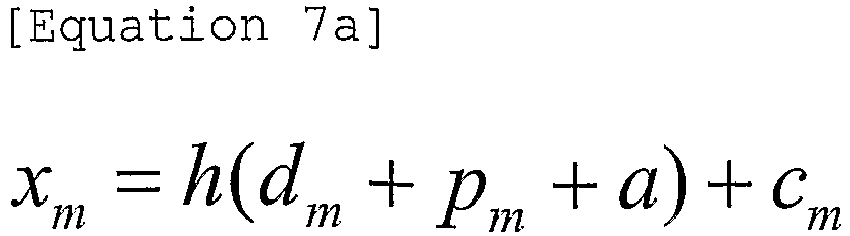
- The interference remover 2013 can estimate the auxiliary signal. In more detail, provided that the channel value estimated by the
channel estimator 2016 is denoted by h', the interference can be removed as represented by the following Equation 7b: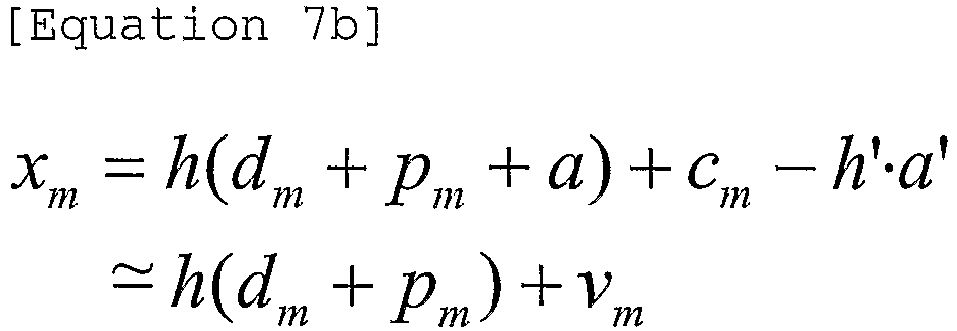
- Although the value of h' may be different from the channel value of h, the value h' is very close to the value of h, such that the negative influence caused by the auxiliary signal (a) may be minimized if the operation of Equation 7b is executed.
- The interference remover 2013 executes the operation of Equation 7b to remove the auxiliary signal. Therefore, the reception end can demodulate the signal having no auxiliary signal.
- A ninth preferred embodiment of the present invention provides a method for minimizing the amplitude of the auxiliary signal if the transmission end transmits the pilot signal equipped with the auxiliary signal (aux).
- In the case of transmitting data using the modulation scheme, the data is transmitted using a high-density transmission scheme (e.g., 16QAM or 64QAM scheme), the probability of increasing the amplitude of the auxiliary signal is relatively increased. In this case, performance deterioration may occur in the reception end due to the auxiliary signal.
- Although the interference remover for removing the auxiliary signal is used as shown in the above-mentioned eighth preferred embodiment, the interference remover has difficulty in correctly removing the auxiliary signal due to the occurrence of a high-value auxiliary signal. Therefore, preferably, the auxiliary signal may be minimized in the case of employing the high-density transmission scheme of the 16QAM or more.
- In order to minimize the amplitude of the above-mentioned auxiliary signal, the two-stage coding method may be executed. Also, the above-mentioned coding may be a coding method based on orthogonal codes.
- The above-mentioned two-stage coding method selects orthogonal codes for minimizing the amplitude of the auxiliary signal, executes a first-stage coding on the selected orthogonal codes, and then executes a second-stage coding process for informing the reception end of the selected orthogonal codes.
-
FIG. 22 is a block diagram illustrating transmission and reception ends for the coding operation capable of reducing the size of an auxiliary signal according to the present invention. The transmission and reception ends ofFIG. 22 have the same operations as the transmission end ofFIG. 21 , but they execute two-stage coding/decoding processes differently from the transmission end ofFIG. 21 . - Firstly, the coding method for use in the transmission end will hereinafter be described. The transmission end according to the ninth preferred embodiment performs the two-stage coding process using the orthogonal codes shown in the following Table 1:
[Table 1] [Hadamard code, Length=24] 0 1 1 1 1 1 1 1 1 1 1 1 1 1 1 1 1 1 1 1 1 1 1 1 1 1 1 -1 1 -1 1 1 1 -1 -1 -1 1 -1 1 -1 1 -1 1 1 1 -1 -1 -1 1 -1 2 1 -1 -1 1 -1 1 1 1 -1 -1 -1 1 1 -1 -1 1 -1 1 1 1 -1 -1 -1 1 3 1 1 -1 -1 1 -1 1 1 1 -1 -1 -1 1 1 -1 -1 1 -1 1 1 1 -1 -1 -1 4 1 -1 1 -1 -1 1 -1 1 1 1 -1 -1 1 -1 1 -1 -1 1 -1 1 1 1 -1 -1 5 1 -1 -1 1 -1 -1 1 -1 1 1 1 -1 1 -1 -1 1 -1 -1 1 -1 1 1 1 -1 6 1 -1 -1 -1 1 -1 -1 1 -1 1 1 1 1 -1 -1 -1 1 -1 -1 1 -1 1 1 1 7 1 1 -1 -1 -1 1 -1 -1 1 -1 1 1 1 1 -1 -1 -1 1 -1 -1 1 -1 1 1 8 1 1 1 -1 -1 -1 1 -1 -1 1 -1 1 1 1 1 -1 -1 -1 1 -1 -1 1 -1 1 - The above-mentioned Table 1 is the Hadamard code having the length of 24. According to the above-mentioned ninth preferred embodiment, the coding process is executed by orthogonal codes.
- However, it should be noted that there is no limitation in categories of the above-mentioned orthogonal codes. For example, a CAZAC (constant-amplitude, zero autocorrelation) sequence or other sequences based on specific-row or column- components of the FFT matrix may be used for the above-mentioned coding process.
- Firstly, a first-stage coding process (for the convenience of description, hereinafter referred to as an inner scramble or scrambling) will hereinafter be described. The orthogonal code of Table 1 has the length of 24, such that it may be multiplied by 24 samples shown in the above-mentioned Table 1.
[Table 2] d0+a D8+a d16+a d1+a D9+a d17+a d2+a d10+a d18+a d3+a d11+a d19+a d4+a d12+a d20+a d5+a d13+a d21+a d6+a d14+a d22+a d7+a d15+a d23+a - The samples of the above-mentioned Table 2 perform the inner scrambling using the Hadamard code of Table 1.
- The Hadamard code of Table 1 is composed of 9 codes (i.e., 0-th to 8-th codes), such that an example of the 0-th to 2nd codes from among the 9 codes will be described.
- The 0-th code, the first code, and the second code are sequentially multiplied by 24 samples (i.e., d0 ∼ d23).
- The lowest value from among the resultant values inner-scrambled by the 0-th code, the first code, and the second code is selected. In more detail, the lowest value from among the values of the auxiliary signals "a", which are acquired by the sum of the multiplied values equal to the multiplied values of the 24 samples and each of the 0th code, the first code, and the second code, is selected. In other words, a specific code for minimizing the sum of the sample signals from among the above-mentioned 0-th to second codes is selected.
- The above-mentioned sample is configured in the form of a complex number, such that the amplitude of each sample is determined by the amplitude of a real part of the complex number and the amplitude of an imaginary part of the complex number. In other words, the orthogonal code for minimizing the amplitude of the real part of each of the 24 samples is selected, and the other orthogonal code for minimizing the amplitude of the imaginary part of each of the 24 samples is selected.
- In conclusion, two orthogonal codes for minimizing the amplitude of specific samples are selected. Also, the second-stage coding process is executed by the above-mentioned two orthogonal codes. In other words, the outer-scrambling is performed by the above-mentioned inner-scrambling codes.
- The above-mentioned outer-scrambling is also executed by the orthogonal codes shown in Table 1. The reception end recognizes outer-scrambling codes, such that the above-mentioned inner-scrambling code can be distinguished from each other.
- The relationship between the inner-scrambling codes (i.e., inner codes) and the outer-scrambing codes (i.e., outer codes) can be represented by the following Table 3:
[Table 3] Inner codes applied to real part Inner codes applied to imaginary part Outer codes defined by inner codes 0 0 0 0 1 1 0 2 2 1 0 3 1 1 4 1 2 5 2 0 6 2 1 7 2 2 8 - For example, provided that a code for minimizing the value of the real part of each of the 24 samples is the first code, and a code for minimizing the value of the imaginary part of each of the 24 samples is the second code, the above-mentioned outer codes are determined by the fifth code shown in Table 1.
- The above-mentioned outer scrambling is executed by the above-mentioned outer codes, such that the above-mentioned fifth code is multiplied by the 24 samples to which the inner scrambling has been executed.
- In brief, the transmission end according to the above-mentioned preferred embodiment of the present invention performs the two-stage coding process. The first-stage coding is executed by the inner scrambling, and the second-stage coding is executed by the outer scrambling.
- The above-mentioned inner scrambling selects two inner codes capable of minimizing a predetermined number of samples, and applies the two selected inner codes to the predetermined number of scrambles, resulting in the implementation of the inner scrambling.
- The above-mentioned outer scrambling selects a specific outer code indicating the above-mentioned two inner codes, and applies the two selected outer codes to the predetermined number of samples, resulting in the implementation of the outer scrambling.
- If the method for performing the above-mentioned two-stage coding process is expressed by a specific algorithm based on computer programming languages, the result is as shown in
FIG. 23 . -
FIG. 23 is a flow chart illustrating a method for executing a specific coding composed of two stages according to the present invention. - Referring to
FIG. 23 , the initialization process is executed at steps S2301 and S2302. InFIG. 23 , "index" is a variable indicating the inner codes. - The value of "index" is compared with a specific value "# of Hadamard code" at step S2303. In this case, the value of "# of Hadamard code" indicates the number of inner codes to be multiplied.
- The 0-th to second codes of Table 1 are used for the above-mentioned example. The value of "# of Hadamard code" is to be "3". The variable initialization is executed by the operation of S2304. The value of "data_index" is a variable for indicating the number of samples.
- The value of "data_index" is compared with the other value ""# of data_index" at step S2305. In this case, the value of "# of data_index" indicates the number of samples to which the inner or outer codes are applied.
- Step S2306 indicates the inner-scrambling process, such that a specific orthogonal code is multiplied by each data sample. The variable value is adjusted for the multiplications corresponding to a desired number of times at steps S2307 and S2308.
- If the multiplication is executed a predetermined number of times corresponding to the value "# of Hadamard code", two inner codes for minimizing the sample value are defined at
step 2309, and the outer codes are selected according to Table 3. - If the above-mentioned outer codes are selected, they are applied to all the samples at step S2310. The above-mentioned inner scrambling may be executed by the
inner scrambling module 3003 ofFIG. 22 , and the above-mentioned outer scrambling may be executed by theouter scrambling module 3004 ofFIG. 22 . - Operations of the reception end are as follows.
- The reception end includes information denoted by Table 1 and other information denoted by Table 3, such that it can recognize the outer codes using the above-mentioned Table 1.
- In other words, the reception end can recognize the outer codes using correlation values between the orthogonal code of Table 1 and the reception signal. If the outer code is defined, the reception end can recognize which one of inner codes has been used by referring to Table 3. By the above-mentioned operations, the reception end can recover samples acquired before receiving the inner codes.
- The operations of the above-mentioned reception end can be mathematically represented by the following Equation 8a:
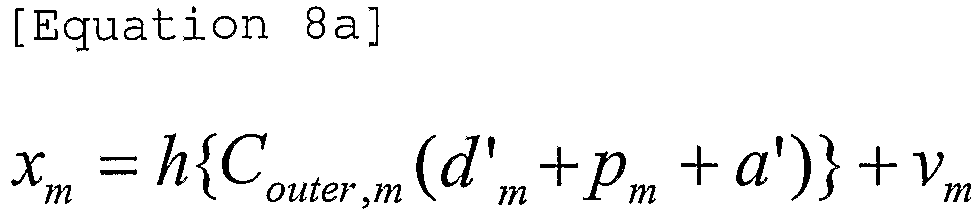
- Equation 8a shows reception signals received in the reception end. As denoted by Equation 8a, dm and "a" contained in the sample have different data values according to the inner scrambling of the transmission end. dm' and a' are an inner-scrambled data-symbol value and an inner-scrambled auxiliary-signal value, respectively. In this case, the inner scrambling of the value dm' or a' is performed by the above-mentioned inner codes.
- In more detail, the value of a' has specific characteristics denoted by
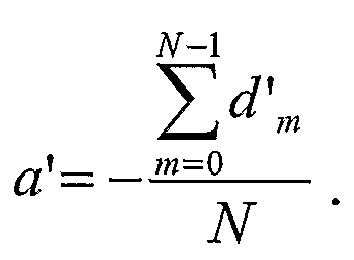
- In Equation 8a, vm is AWGN, Couter,m is the outer codes associated with an m-th sample, and h is a channel value. In more detail, the reception end receives the signal to which the inner and outer codes are applied.

- As described above, an
outer descrambling module 3015 of the reception end detects the value "Couter,m" using the correlation value between the orthogonal code of Table 1 and the reception signal. If a correct outer code is determined, the value N·h·p is received as denoted by Equation 8b.
- If an incorrect outer code is determined,


- As can be seen from Equation 8d, the power value N·h·p is higher than the value

- If the above-mentioned outer codes are correctly detected, the reception end can recognize information of the inner codes by referring to Table 3. If the above-mentioned inner codes are recognized, the
inner descrambling module 3014 of the reception end recovers original data acquired prior to the inner scrambling. - The orthogonal codes of Table 1 may be configured to have a variety of lengths. The number of the orthogonal codes may be freely set to any number.
- Also, the combination of the inner codes and the outer codes in Table 3 can be implemented in various ways. The above-mentioned Tables 1, 2, and 3 have been disclosed for only the illustrative purposes, so that the scope of the present invention is not limited to the exemplary numbers depicted in the above-mentioned Tables or Equations, and can be applied to other examples as necessary.
- It will be apparent to those skilled in the art that various modifications and variations can be made in the present invention without departing from the scope of the invention. Thus, it is intended that the present invention covers the modifications and variations of this invention provided they come within the scope of the appended claims.
- A method for transmitting/receiving a signal equipped with a disjointed pilot signal in a mobile communication system according to the present invention can reduce an amount of frequency-time resources used for a training symbol (i.e., a pilot signal), such that it can effectively use radio resources.
Claims (16)
- A method for transmitting signals having data and pilot symbols in a mobile communication system, the method comprising:configuring output signals by adding the pilot symbols and auxiliary signals to all data symbols, wherein the auxiliary signals are calculated to make a sum of the data symbols and the auxiliary signals to be zero; andtransmitting the output signals to a receiving end,wherein the pilot symbols have the same amplitude.
- The method of claim 1, wherein the output signals are transmitted via a plurality of subcarriers.
- The method of claim 1, wherein the auxiliary signals have the same amplitude.
- The method of claim 1, wherein the step of configuring output signals further comprises:coding the data symbols using a modulo function, a predetermined coding value, and differences between values of the data symbols and values of predetermined auxiliary signals.
- The method of claim 4, wherein amplitudes of the coded data symbols are decreased.
- The method of any one of the preceding claims, further comprising:performing an inner scrambling of the output signals according to a first code of orthogonal codes; andperforming an outer scrambling of the inner scrambled signals according to a second code of the orthogonal codes,wherein the orthogonal codes are Hadamard codes, and
the second code of the orthogonal codes is determined by the first code of the orthogonal codes. - The method of claim 6, wherein the step of performing an inner scrambling comprises:selecting a first scrambling code of the orthogonal codes to minimize an amplitude of the real part of the output signals;selecting a second scrambling code of the orthogonal codes to minimize an amplitude of the imaginary part of the output signals; andmultiplying the first and the second scrambling codes to the real part and the imaginary part of the output signals.
- The method of claim 6, wherein the step of performing an outer scrambling comprises:multiplying the second code of the orthogonal codes to the inner scrambled signals.
- An apparatus for transmitting signals having data and pilot symbols in a mobile communication system, the apparatus comprising:a signal processing module for configuring output signals by adding the pilot symbols and auxiliary signals to all data symbols, wherein the auxiliary signals are calculated to make a sum of the data symbol and the auxiliary signals to be zero; anda radio frequency module for transmitting the configured output signals,wherein the pilot symbols have the same amplitude.
- The apparatus of claim 9, further comprising:a data scrambler for performing an inner scrambling of the output signals and an outer scrambling of the inner scrambled signals according to orthogonal codes.
- A method for receiving signals having data and pilot symbols in a mobile communication system, the method comprising:receiving said signals having the pilot symbols, and auxiliary signals added to all data symbols, wherein a sum of the data symbol and the auxiliary signals is zero; performing a channel estimation using the received signal and using the pilot and auxiliary symbols added to all of the data symbols;decoding the channel estimated signals;estimating the auxiliary signals using the decoded signals; andremoving the estimated auxiliary signals from the received signals.
- The method of claim 11, further comprising:performing an outer descrambling of the received signals according to a first code of orthogonal codes;performing an inner descrambling of the outer descrambled signals according to a second code of the orthogonal codes,wherein the orthogonal codes are Hadamard codes, andwherein the second code of the orthogonal codes is indicated by the first code of orthogonal codes.
- The method of claim 12, wherein the step of performing an outer descrambling of the received signals comprises:detecting a first descrambling code using the received signals and the orthogonal codes; andacquiring descrambled signal by multiplying the first descrambling code to the received signals.
- An apparatus for receiving signals having data and pilot symbols for a mobile communication system, the apparatus comprising:a radio frequency module for receiving said signals having the pilot symbols, and auxiliary symbols added to all data symbols, wherein a sum of the data symbol and the auxiliary signals is zero;a channel estimator for performing a channel estimation using the received signals and using the pilot and auxiliary symbols added to all of the data symbols; anda decoder for decoding the channel estimated signals,wherein the pilot symbols have the same amplitude.
- The apparatus of claim 14, further comprising:a estimator for estimating the auxiliary signals using the decoded signals; anda module for removing the estimated auxiliary signals from the received signals.
- The apparatus of claim 14, further comprising:a descrambler for performing an outer descrambling and an inner descrambling of received signals according to orthogonal codes.
Applications Claiming Priority (5)
| Application Number | Priority Date | Filing Date | Title |
|---|---|---|---|
| KR20050063228 | 2005-07-13 | ||
| KR20050107272 | 2005-11-10 | ||
| KR20050129646 | 2005-12-26 | ||
| KR1020060029045A KR101137345B1 (en) | 2005-07-03 | 2006-03-30 | method for transmitting and receiving signal having spread training symbol in mobile communication system |
| PCT/KR2006/002741 WO2007008036A2 (en) | 2005-07-13 | 2006-07-12 | Method for transmitting/receiving signal having spread training symbol in mobile communication system |
Publications (3)
| Publication Number | Publication Date |
|---|---|
| EP1908241A2 EP1908241A2 (en) | 2008-04-09 |
| EP1908241A4 EP1908241A4 (en) | 2013-12-11 |
| EP1908241B1 true EP1908241B1 (en) | 2016-11-09 |
Family
ID=37637606
Family Applications (1)
| Application Number | Title | Priority Date | Filing Date |
|---|---|---|---|
| EP06769265.7A Not-in-force EP1908241B1 (en) | 2005-07-13 | 2006-07-12 | Method for transmitting/receiving signal having spread training symbol in mobile communication system |
Country Status (2)
| Country | Link |
|---|---|
| EP (1) | EP1908241B1 (en) |
| WO (1) | WO2007008036A2 (en) |
Families Citing this family (8)
| Publication number | Priority date | Publication date | Assignee | Title |
|---|---|---|---|---|
| CN101409583B (en) * | 2007-10-11 | 2013-02-13 | 电信科学技术研究院 | Method and device for transmitting signal |
| US20100098042A1 (en) * | 2008-10-21 | 2010-04-22 | Paul Wilkinson Dent | Using the same multiplexed radio resource for pilot and information signals |
| GB2474795B (en) | 2008-11-27 | 2011-06-22 | Ipwireless Inc | Communication system, communication units, and method for employing a pilot transmission scheme |
| US20130336193A1 (en) | 2012-06-19 | 2013-12-19 | Qualcomm Incorporated | Network information for assisting user equipment |
| US9264097B2 (en) | 2009-06-04 | 2016-02-16 | Qualcomm Incorporated | Interference mitigation for downlink in a wireless communication system |
| US12074733B2 (en) | 2019-07-29 | 2024-08-27 | Telefonaktiebolaget Lm Ericsson (Publ) | Method and apparatus for phase-aided adaptive modulation |
| CN117439714A (en) * | 2022-07-15 | 2024-01-23 | 中兴通讯股份有限公司 | Signal detection method and equipment, storage medium |
| CN116232547B (en) * | 2023-04-06 | 2026-04-10 | 华侨大学 | A communication system based on forward error correction coding modulation |
-
2006
- 2006-07-12 EP EP06769265.7A patent/EP1908241B1/en not_active Not-in-force
- 2006-07-12 WO PCT/KR2006/002741 patent/WO2007008036A2/en not_active Ceased
Also Published As
| Publication number | Publication date |
|---|---|
| WO2007008036A3 (en) | 2007-03-22 |
| WO2007008036A2 (en) | 2007-01-18 |
| EP1908241A2 (en) | 2008-04-09 |
| EP1908241A4 (en) | 2013-12-11 |
Similar Documents
| Publication | Publication Date | Title |
|---|---|---|
| JP5474301B2 (en) | Data transmission / reception apparatus and method for high-speed data communication | |
| EP1922830B1 (en) | Code division multiplexing in a single-carrier frequency division multiple access system | |
| US7613245B2 (en) | Method and apparatus for multiplexing data and control information in wireless communication systems based on frequency division multiple access | |
| US8098751B2 (en) | Software adaptable high performance multicarrier transmission protocol | |
| US8116392B2 (en) | Method for transmitting/receiving signal having spread training symbol in mobile communication system | |
| EP2347538B1 (en) | Method and apparatus for generating a preamble for use in cable transmission systems | |
| US20080225689A1 (en) | Orthogonal frequency division multiplexing having tones with overlaid data and pilot symbols | |
| WO2005022815A1 (en) | Ofdm channel estimation and tracking for multiple transmit antenna | |
| EP2916506B1 (en) | Walsh-Hadamard transformed GFDM radio transmission | |
| WO2012099511A1 (en) | Receiving node and method for determining channel estimate | |
| KR20040110904A (en) | Apparatus for assinging subcarrier of pilot channel for distinguishing base stations in communication systems using orthogonal frequency division multiplexing scheme and method thereof | |
| EP1737176A1 (en) | Signalling for allocation of a communication link in a MIMO system | |
| JP2012510224A (en) | Communication system, communication apparatus and method using pilot transmission mechanism | |
| WO2007148936A1 (en) | Method for transmitting signal and method for receiving signal | |
| EP2957082B1 (en) | Tetra-based mobile communications system | |
| EP1908241A2 (en) | Method for transmitting/receiving signal having spread training symbol in mobile communication system | |
| US8355464B2 (en) | Method for generating and transmitting downlink frame | |
| US20110090987A1 (en) | Apparatus for transmission and reception with transmit diversity using cyclic subcarrier shift | |
| JP4463852B2 (en) | Apparatus and method for iteratively estimating channel transfer function | |
| KR20060072096A (en) | Method and apparatus for calculating ELL in orthogonal frequency division multiplexing communication system using linear equalizer |
Legal Events
| Date | Code | Title | Description |
|---|---|---|---|
| PUAI | Public reference made under article 153(3) epc to a published international application that has entered the european phase |
Free format text: ORIGINAL CODE: 0009012 |
|
| 17P | Request for examination filed |
Effective date: 20080122 |
|
| AK | Designated contracting states |
Kind code of ref document: A2 Designated state(s): AT BE BG CH CY CZ DE DK EE ES FI FR GB GR HU IE IS IT LI LT LU LV MC NL PL PT RO SE SI SK TR |
|
| DAX | Request for extension of the european patent (deleted) | ||
| A4 | Supplementary search report drawn up and despatched |
Effective date: 20131112 |
|
| RIC1 | Information provided on ipc code assigned before grant |
Ipc: H04L 25/02 20060101ALI20131106BHEP Ipc: H04L 1/06 20060101ALI20131106BHEP Ipc: H04L 27/32 20060101ALI20131106BHEP Ipc: H04L 27/26 20060101AFI20131106BHEP Ipc: H04L 5/00 20060101ALI20131106BHEP Ipc: H04L 27/34 20060101ALI20131106BHEP |
|
| GRAP | Despatch of communication of intention to grant a patent |
Free format text: ORIGINAL CODE: EPIDOSNIGR1 |
|
| RIC1 | Information provided on ipc code assigned before grant |
Ipc: H04L 5/00 20060101ALI20160502BHEP Ipc: H04L 25/02 20060101ALI20160502BHEP Ipc: H04L 27/34 20060101ALI20160502BHEP Ipc: H04L 27/32 20060101ALI20160502BHEP Ipc: H04L 27/26 20060101AFI20160502BHEP Ipc: H04L 1/06 20060101ALI20160502BHEP |
|
| INTG | Intention to grant announced |
Effective date: 20160525 |
|
| RAP1 | Party data changed (applicant data changed or rights of an application transferred) |
Owner name: LG ELECTRONICS INC. |
|
| GRAS | Grant fee paid |
Free format text: ORIGINAL CODE: EPIDOSNIGR3 |
|
| GRAA | (expected) grant |
Free format text: ORIGINAL CODE: 0009210 |
|
| AK | Designated contracting states |
Kind code of ref document: B1 Designated state(s): AT BE BG CH CY CZ DE DK EE ES FI FR GB GR HU IE IS IT LI LT LU LV MC NL PL PT RO SE SI SK TR |
|
| REG | Reference to a national code |
Ref country code: GB Ref legal event code: FG4D |
|
| REG | Reference to a national code |
Ref country code: AT Ref legal event code: REF Ref document number: 844821 Country of ref document: AT Kind code of ref document: T Effective date: 20161115 Ref country code: CH Ref legal event code: EP |
|
| REG | Reference to a national code |
Ref country code: IE Ref legal event code: FG4D Ref country code: NL Ref legal event code: FP |
|
| REG | Reference to a national code |
Ref country code: DE Ref legal event code: R096 Ref document number: 602006050849 Country of ref document: DE |
|
| PG25 | Lapsed in a contracting state [announced via postgrant information from national office to epo] |
Ref country code: LV Free format text: LAPSE BECAUSE OF FAILURE TO SUBMIT A TRANSLATION OF THE DESCRIPTION OR TO PAY THE FEE WITHIN THE PRESCRIBED TIME-LIMIT Effective date: 20161109 |
|
| REG | Reference to a national code |
Ref country code: LT Ref legal event code: MG4D |
|
| REG | Reference to a national code |
Ref country code: AT Ref legal event code: MK05 Ref document number: 844821 Country of ref document: AT Kind code of ref document: T Effective date: 20161109 |
|
| PG25 | Lapsed in a contracting state [announced via postgrant information from national office to epo] |
Ref country code: SE Free format text: LAPSE BECAUSE OF FAILURE TO SUBMIT A TRANSLATION OF THE DESCRIPTION OR TO PAY THE FEE WITHIN THE PRESCRIBED TIME-LIMIT Effective date: 20161109 Ref country code: LT Free format text: LAPSE BECAUSE OF FAILURE TO SUBMIT A TRANSLATION OF THE DESCRIPTION OR TO PAY THE FEE WITHIN THE PRESCRIBED TIME-LIMIT Effective date: 20161109 Ref country code: GR Free format text: LAPSE BECAUSE OF FAILURE TO SUBMIT A TRANSLATION OF THE DESCRIPTION OR TO PAY THE FEE WITHIN THE PRESCRIBED TIME-LIMIT Effective date: 20170210 |
|
| PG25 | Lapsed in a contracting state [announced via postgrant information from national office to epo] |
Ref country code: PL Free format text: LAPSE BECAUSE OF FAILURE TO SUBMIT A TRANSLATION OF THE DESCRIPTION OR TO PAY THE FEE WITHIN THE PRESCRIBED TIME-LIMIT Effective date: 20161109 Ref country code: IS Free format text: LAPSE BECAUSE OF FAILURE TO SUBMIT A TRANSLATION OF THE DESCRIPTION OR TO PAY THE FEE WITHIN THE PRESCRIBED TIME-LIMIT Effective date: 20170309 Ref country code: FI Free format text: LAPSE BECAUSE OF FAILURE TO SUBMIT A TRANSLATION OF THE DESCRIPTION OR TO PAY THE FEE WITHIN THE PRESCRIBED TIME-LIMIT Effective date: 20161109 Ref country code: ES Free format text: LAPSE BECAUSE OF FAILURE TO SUBMIT A TRANSLATION OF THE DESCRIPTION OR TO PAY THE FEE WITHIN THE PRESCRIBED TIME-LIMIT Effective date: 20161109 Ref country code: PT Free format text: LAPSE BECAUSE OF FAILURE TO SUBMIT A TRANSLATION OF THE DESCRIPTION OR TO PAY THE FEE WITHIN THE PRESCRIBED TIME-LIMIT Effective date: 20170309 Ref country code: AT Free format text: LAPSE BECAUSE OF FAILURE TO SUBMIT A TRANSLATION OF THE DESCRIPTION OR TO PAY THE FEE WITHIN THE PRESCRIBED TIME-LIMIT Effective date: 20161109 |
|
| REG | Reference to a national code |
Ref country code: FR Ref legal event code: PLFP Year of fee payment: 12 |
|
| PG25 | Lapsed in a contracting state [announced via postgrant information from national office to epo] |
Ref country code: CZ Free format text: LAPSE BECAUSE OF FAILURE TO SUBMIT A TRANSLATION OF THE DESCRIPTION OR TO PAY THE FEE WITHIN THE PRESCRIBED TIME-LIMIT Effective date: 20161109 Ref country code: EE Free format text: LAPSE BECAUSE OF FAILURE TO SUBMIT A TRANSLATION OF THE DESCRIPTION OR TO PAY THE FEE WITHIN THE PRESCRIBED TIME-LIMIT Effective date: 20161109 Ref country code: DK Free format text: LAPSE BECAUSE OF FAILURE TO SUBMIT A TRANSLATION OF THE DESCRIPTION OR TO PAY THE FEE WITHIN THE PRESCRIBED TIME-LIMIT Effective date: 20161109 Ref country code: RO Free format text: LAPSE BECAUSE OF FAILURE TO SUBMIT A TRANSLATION OF THE DESCRIPTION OR TO PAY THE FEE WITHIN THE PRESCRIBED TIME-LIMIT Effective date: 20161109 Ref country code: SK Free format text: LAPSE BECAUSE OF FAILURE TO SUBMIT A TRANSLATION OF THE DESCRIPTION OR TO PAY THE FEE WITHIN THE PRESCRIBED TIME-LIMIT Effective date: 20161109 |
|
| PGFP | Annual fee paid to national office [announced via postgrant information from national office to epo] |
Ref country code: GB Payment date: 20170608 Year of fee payment: 12 Ref country code: FR Payment date: 20170608 Year of fee payment: 12 |
|
| REG | Reference to a national code |
Ref country code: DE Ref legal event code: R097 Ref document number: 602006050849 Country of ref document: DE |
|
| PG25 | Lapsed in a contracting state [announced via postgrant information from national office to epo] |
Ref country code: BE Free format text: LAPSE BECAUSE OF FAILURE TO SUBMIT A TRANSLATION OF THE DESCRIPTION OR TO PAY THE FEE WITHIN THE PRESCRIBED TIME-LIMIT Effective date: 20161109 Ref country code: BG Free format text: LAPSE BECAUSE OF FAILURE TO SUBMIT A TRANSLATION OF THE DESCRIPTION OR TO PAY THE FEE WITHIN THE PRESCRIBED TIME-LIMIT Effective date: 20170209 Ref country code: IT Free format text: LAPSE BECAUSE OF FAILURE TO SUBMIT A TRANSLATION OF THE DESCRIPTION OR TO PAY THE FEE WITHIN THE PRESCRIBED TIME-LIMIT Effective date: 20161109 |
|
| PGFP | Annual fee paid to national office [announced via postgrant information from national office to epo] |
Ref country code: NL Payment date: 20170607 Year of fee payment: 12 |
|
| PLBE | No opposition filed within time limit |
Free format text: ORIGINAL CODE: 0009261 |
|
| STAA | Information on the status of an ep patent application or granted ep patent |
Free format text: STATUS: NO OPPOSITION FILED WITHIN TIME LIMIT |
|
| 26N | No opposition filed |
Effective date: 20170810 |
|
| PGFP | Annual fee paid to national office [announced via postgrant information from national office to epo] |
Ref country code: DE Payment date: 20170606 Year of fee payment: 12 |
|
| PG25 | Lapsed in a contracting state [announced via postgrant information from national office to epo] |
Ref country code: SI Free format text: LAPSE BECAUSE OF FAILURE TO SUBMIT A TRANSLATION OF THE DESCRIPTION OR TO PAY THE FEE WITHIN THE PRESCRIBED TIME-LIMIT Effective date: 20161109 |
|
| REG | Reference to a national code |
Ref country code: CH Ref legal event code: PL |
|
| REG | Reference to a national code |
Ref country code: IE Ref legal event code: MM4A |
|
| PG25 | Lapsed in a contracting state [announced via postgrant information from national office to epo] |
Ref country code: IE Free format text: LAPSE BECAUSE OF NON-PAYMENT OF DUE FEES Effective date: 20170712 Ref country code: LI Free format text: LAPSE BECAUSE OF NON-PAYMENT OF DUE FEES Effective date: 20170731 Ref country code: CH Free format text: LAPSE BECAUSE OF NON-PAYMENT OF DUE FEES Effective date: 20170731 |
|
| PG25 | Lapsed in a contracting state [announced via postgrant information from national office to epo] |
Ref country code: LU Free format text: LAPSE BECAUSE OF NON-PAYMENT OF DUE FEES Effective date: 20170712 |
|
| REG | Reference to a national code |
Ref country code: DE Ref legal event code: R119 Ref document number: 602006050849 Country of ref document: DE |
|
| REG | Reference to a national code |
Ref country code: NL Ref legal event code: MM Effective date: 20180801 |
|
| GBPC | Gb: european patent ceased through non-payment of renewal fee |
Effective date: 20180712 |
|
| PG25 | Lapsed in a contracting state [announced via postgrant information from national office to epo] |
Ref country code: FR Free format text: LAPSE BECAUSE OF NON-PAYMENT OF DUE FEES Effective date: 20180731 Ref country code: DE Free format text: LAPSE BECAUSE OF NON-PAYMENT OF DUE FEES Effective date: 20190201 Ref country code: GB Free format text: LAPSE BECAUSE OF NON-PAYMENT OF DUE FEES Effective date: 20180712 |
|
| PG25 | Lapsed in a contracting state [announced via postgrant information from national office to epo] |
Ref country code: NL Free format text: LAPSE BECAUSE OF NON-PAYMENT OF DUE FEES Effective date: 20180801 |
|
| PG25 | Lapsed in a contracting state [announced via postgrant information from national office to epo] |
Ref country code: HU Free format text: LAPSE BECAUSE OF FAILURE TO SUBMIT A TRANSLATION OF THE DESCRIPTION OR TO PAY THE FEE WITHIN THE PRESCRIBED TIME-LIMIT; INVALID AB INITIO Effective date: 20060712 Ref country code: MC Free format text: LAPSE BECAUSE OF FAILURE TO SUBMIT A TRANSLATION OF THE DESCRIPTION OR TO PAY THE FEE WITHIN THE PRESCRIBED TIME-LIMIT Effective date: 20161109 |
|
| PG25 | Lapsed in a contracting state [announced via postgrant information from national office to epo] |
Ref country code: CY Free format text: LAPSE BECAUSE OF NON-PAYMENT OF DUE FEES Effective date: 20161109 |
|
| PG25 | Lapsed in a contracting state [announced via postgrant information from national office to epo] |
Ref country code: TR Free format text: LAPSE BECAUSE OF FAILURE TO SUBMIT A TRANSLATION OF THE DESCRIPTION OR TO PAY THE FEE WITHIN THE PRESCRIBED TIME-LIMIT Effective date: 20161109 |