EP1908010B1 - Système et méthode de détection passive de fil - Google Patents
Système et méthode de détection passive de fil Download PDFInfo
- Publication number
- EP1908010B1 EP1908010B1 EP06770712.5A EP06770712A EP1908010B1 EP 1908010 B1 EP1908010 B1 EP 1908010B1 EP 06770712 A EP06770712 A EP 06770712A EP 1908010 B1 EP1908010 B1 EP 1908010B1
- Authority
- EP
- European Patent Office
- Prior art keywords
- module
- wire
- pixels
- digital image
- processing
- Prior art date
- Legal status (The legal status is an assumption and is not a legal conclusion. Google has not performed a legal analysis and makes no representation as to the accuracy of the status listed.)
- Expired - Lifetime
Links
Images


Classifications
-
- G—PHYSICS
- G06—COMPUTING OR CALCULATING; COUNTING
- G06T—IMAGE DATA PROCESSING OR GENERATION, IN GENERAL
- G06T7/00—Image analysis
- G06T7/10—Segmentation; Edge detection
- G06T7/155—Segmentation; Edge detection involving morphological operators
-
- G—PHYSICS
- G06—COMPUTING OR CALCULATING; COUNTING
- G06T—IMAGE DATA PROCESSING OR GENERATION, IN GENERAL
- G06T5/00—Image enhancement or restoration
- G06T5/20—Image enhancement or restoration using local operators
-
- G—PHYSICS
- G06—COMPUTING OR CALCULATING; COUNTING
- G06T—IMAGE DATA PROCESSING OR GENERATION, IN GENERAL
- G06T5/00—Image enhancement or restoration
- G06T5/70—Denoising; Smoothing
-
- G—PHYSICS
- G06—COMPUTING OR CALCULATING; COUNTING
- G06T—IMAGE DATA PROCESSING OR GENERATION, IN GENERAL
- G06T7/00—Image analysis
- G06T7/10—Segmentation; Edge detection
- G06T7/12—Edge-based segmentation
-
- G—PHYSICS
- G06—COMPUTING OR CALCULATING; COUNTING
- G06T—IMAGE DATA PROCESSING OR GENERATION, IN GENERAL
- G06T2207/00—Indexing scheme for image analysis or image enhancement
- G06T2207/10—Image acquisition modality
- G06T2207/10016—Video; Image sequence
-
- G—PHYSICS
- G06—COMPUTING OR CALCULATING; COUNTING
- G06T—IMAGE DATA PROCESSING OR GENERATION, IN GENERAL
- G06T2207/00—Indexing scheme for image analysis or image enhancement
- G06T2207/30—Subject of image; Context of image processing
- G06T2207/30248—Vehicle exterior or interior
- G06T2207/30252—Vehicle exterior; Vicinity of vehicle
- G06T2207/30261—Obstacle
Definitions
- the present invention relates to transport systems, and more particularly, to passive wire detection techniques.
- Figure 1A illustrates helicopter 10 flying towards wires 20 (power lines). If the pilot does not detect the power lines on time, then helicopter 10 can crash resulting in fatalities and loss of property.
- An active sensor is a detection device that requires input energy from a source other than the target, which is being sensed.
- An example of an active sensor is a measuring instrument that generates a signal, transmits it to a target, and receives a reflected signal from the target. Information concerning the target is obtained by comparison of the received signal with the transmitted signal.
- Active sensors cannot be used in cases where stealth/secrecy is required, for example, military operations, and hence this is not a desirable solution for these applications.
- Passive sensor devices detect without emitting any energy signals that can cause them to be detected. The detection occurs as a result of radiation from the target or reflection of ambient energy on the target.
- a method for passively detecting wires from a mobile transportation system includes pre-processing a digital image taken from a digital camera of the transportation system, wherein the pre-processing is performed by a pre-processing module to reduce non-wire like clutter from the digital image; identifying pixels that can be classified as wire like by using a segment finder module on the digital image that has been pre-processed by the pre-processing module; and linking the identified pixels to determine if a wire like structure is present, wherein a linker module links the pixels that can be classified as wire like, to generate a wire overlay.
- a system for passively detecting wires from a mobile transportation system includes a pre-processing module for pre-processing a digital image taken from a digital camera of the transport system, wherein the pre-processing module reduces non-wire like clutter from the digital image; a segment finder module for identifying pixels that can be classified as wire like; and a linker module for linking the identified pixels to determine if a wire like structure is present, wherein the linker module links pixels that can be classified as wire like, to generate a wire overlay.
- Figure 1A shows how a helicopter can face wire structures while the helicopter is in flight
- Figure 1B is a block diagram of a computing system used for passive wire detection, according to one aspect of the present invention.
- Figure 1C shows a block diagram of a helicopter using a digital camera, according to one aspect of the present invention
- Figure 2A shows a block diagram of the overall system architecture for passive wire detection, according to one aspect of the present invention
- Figure 2B shows an example of using a ring median filter, according to one aspect of the present invention
- Figure 2C shows an example of wires with background clutter, according to one aspect of the present invention
- Figure 3 illustrates an image output after a gradient phase operator is applied
- Figure 4 shows example of image outputs after a vector kernel operator is applied
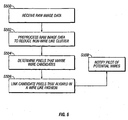
- Figure 5 is a process flow diagram for passive wire detection, according to one aspect of the present invention.
- FIG. 1B is a block diagram showing the internal functional architecture of computing system 100 that is used on a helicopter/aircraft or any other transport system that needs to detect stationery objects to avoid collisions/damage.
- Computing system 100 includes a processing unit 101 for executing computer-executable process steps and interfaces with a computer bus 106.
- a digital camera interface 108 is provided that allows system 100 to receive raw image data from a digital camera 100A ( Figure 1C ) or various digital cameras that are placed on a helicopter. Interface 108 receives the image data from the digital cameras and sends the raw data to processor 101.
- Component 102 is intended to represent plural input devices, such as a mouse and keyboard that allow a user to interact with system 100.
- output devices 109 represents one or more output devices, for example, a monitor, a printing device, a device that can generate an audible alarm to alert the pilot of the helicopter are included in output devices 109.
- Storage device 107 stores applications, executable code according to one aspect of the present. Some of these files are stored using an installation program. For example, processor 101 executes computer-executable process steps of an installation program so that it can properly execute the application program.
- Communication interface 105 allows system 100 to interface with other computing systems, networks and communication systems (not shown).
- Random access memory (“RAM”) 103 also interfaces to computer bus 106 to provide processor 101 with access to memory storage. When executing stored computer-executable process steps from storage device 107, processor 101 stores and executes the process steps out of RAM 103.
- ROM 104 Read only memory (“ROM”) 104 is provided to store invariant instruction sequences such as start-up instruction sequences or basic input/output operating system (BIOS).
- BIOS basic input/output operating system
- the Figure 1B architecture is intended to provide an example of an architecture that can be used to implement the executable process steps according to one aspect of the present invention. This architecture should not be viewed as a limitation. Other systems and architectures may be used to implement the executable code, described below. For example, a specialized application specific integrated circuit ("basic”) or a field programmable gate array (“FPGA”) may be used to implement the adaptive aspects of the present invention.
- basic application specific integrated circuit
- FPGA field programmable gate array
- Figure 1C shows a digital camera 100A that is placed in a helicopter to take images while the helicopter is flying. The images are sent to computing system 100 for processing and for detecting wires, in real time, as described below in detail. It is noteworthy that although one digital camera is shown in Figure 1C , it is only intended to illustrate the adaptive aspects of the present invention. The adaptive aspects of the present invention are not limited to any particular number/type of cameras.
- FIG. 2A shows a block diagram of a system according to one aspect of the present invention that passively detects wires.
- Input image 200 i.e. raw digital image data
- the pre-processor segment 201 removes non-wire like clutter from image data 200.
- Pre-processor 201 includes a ring median filter 202 and a wavelet de-noise module 203 that are used to initially filter the image. Ring median filter 202 and wavelet de-noise module 203 are described below in detail.
- Output 200B from pre-processor 201 is sent to a segment finder module 204 that determines the degree to which each pixel's surroundings are wire like.
- Segment finder 204 includes a gradient phase module 205, a vector kernel 207 and a threshold module 208 that are described below in detail.
- a linker module 209 receives output 200E from segment finder 204.
- the linker module 209 links various segments to build a wire like structure and based on that output 214, a wireless overlay is generated.
- Linker module 209 includes a radon-like morphological operator 210, a segment linker accumulator 211, threshold module 212 and spatial and temporal filter module 213 that are described below in detail.
- Preprocessor Module 201 The ring median filter 202 eliminates clutter but saves the wires for further analysis.
- Figure 2B shows an example of how a ring median filter 202 is applied.
- the pixel value for a pixel 202B is replaced by the median value of the dark pixels in image area 202A along the ring (shown as 202C). This eliminates objects with a scale size (length or width) less than % ring (202C) diameter. Subtracting this median image from the original image would leave objects with a scale size that is less than 1 ⁇ 2 of the ring diameter.
- Wires in an image may have low contrast or high contrast compared to the background clutter.
- the two examples are shown in Figure 2C with high/low background clutter.
- Ring median filter 202 is made large enough so that multiple closely spaced wires (as shown in Figure 2C ) are not eliminated.
- the ring median filtered image 200A is then processed by wavelet de-noise module 203.
- Wavelet de-noise module 203 eliminates 2-D wavelet coefficients that are uncorrelated across multiple length scales. Subtracting this filtered image from the original image 200, as shown in Figure 2A , leaves small-scale features of all contrasts (for example, single wires) and large-scale features with low contrast (for example, multiple wires) intact.
- a similar filter for example, the Susan Filter may be used to produce output 200B that retains single/multiple wires based on contrast and scale selection.
- Segment finder 204 is a prediction tool that identifies potential "wire candidates" based on output 200B.
- Output 200B is received by a gradient phase module 205.
- the gradient phase module 205 computes a vector along the local intensity gradient at all pixels in the image scene. For pixels on or very near a wire, this vector will be orthogonal to the wire. Each vector is normalized and, thus, is a unit phasor. This is shown in Figure 3 with the local intensity gradient of image 200B shown as 300.
- Output 200C from the gradient phase module 205 is sent to a vector kernel 207.
- Vector kernel 207 provides a kernel operator to segregate and identify wire candidates.
- Vector kernel 207 provides a kernel that is oriented over each pixel perpendicular to the gradient vector at that pixel. For pixels in the near vicinity of a wire, the kernel will lie along the length of the wire.
- the normalized two-dimensional vectors, or unit phasors, calculated by the gradient phase module 205 are weighted via the kernel and then summed.
- the kernel multipliers are positive on one side of the (hypothetical) wire and negative on the other side. If there is a wire, then it will orient the phasors on opposite sides in the same direction and hence the sum will be coherent.
- Figure 4 shows image samples after vector kernel 207 is applied to output 200C.
- Random white noise is shown as 401 and is not a wire candidate.
- 402 shows a uniform unidirectional intensity gradient, which is an edge and hence is not considered to be a wire candidate.
- 403 shows an example of a wire candidate where the 2-D vectors are oriented in opposite directions. 403 is considered to be a wire candidate because it is the only case where the vector kernel produces a strong output coherent with the phase of the central pixel.
- Output 200D from vector kernel 207 is sent to a threshold module 208.
- Threshold module 208 assigns a "1" to pixels with vector kernel outputs satisfying plural conditions, for example, if the magnitude exceeds a programmable threshold, and the absolute value of the phase difference (relative to the gradient phase of the central pixel) is below a programmable threshold. A "0" is assigned to all other pixels.
- the final output 200E of segment finder module 204 is a binary image.
- Output (binary image) 200E from segment finder module 204 is sent to linker module 209.
- Linker module 209 receives binary image (200E) and uses a radon-like morphological operator 210 to identify "1" pixels from the input image that are strongly aligned into wire like filaments.
- Operator 210 uses multiple linear morphological operators, and the structure elements of these operators have different orientations. Each of these morphological operators is centered over each of the "1" pixels in the segment finder output, and the number of segment finder "1" pixels within its structure element are summed. If the sum exceeds a programmable threshold, the identification number of that morphological operator is stored in a memory location associated with the central pixel.
- the final output 200F of morphological operator 210 is an array of morphological operator identification numbers, indexed by pixel.
- Output 200F from operator 210 is sent to a segment linker accumulator (or buffer) 211 that links various pixels into large-scale lines.
- Module 211 accumulates data in an empty linker accumulation image buffer. This image buffer is at least the same size as the segment finder binary image output 200E, so their pixels are in one-to-one correspondence.
- Module 211 centers each of the morphological operators in output 200F associated with this index over a corresponding pixel in the linker accumulation buffer (211). The value "1" is then added to each of the pixels in the linker accumulation buffer 211 that is overlaid by the structure element of the morphological operator.
- the final output 200G of the segment linker accumulator 211 is an image with large values along linear and curvilinear features, such as wires, but low (or zero) elsewhere.
- a threshold module 212 then applies preprogrammed thresholds to Output 200G from module 211. Every pixel in output 200G of the segment linker accumulator 211 with a value above the threshold is set equal to "1.” All other pixels are set equal to "0.” Thus, the output 200H of threshold module 212 is a binary image similar to that of segment finder module 204, except with non-wire like features removed and with gaps between aligned wire like features (partially) filled in.
- Output 200H from threshold module 212 is then filtered by using spatial and temporal filters 213.
- the spatial filter eliminates features in output 200H of threshold module 212 that do not have length/width ratios consistent with wires, and the temporal filter eliminates pixels that do not satisfy a minimum threshold for frame-to-frame persistence.
- the filtered output 214 is a binary wire overlay 214.
- the wire overlay 214 is used to determine whether wires have been detected, and the pilot is notified if they have. This notification may be performed by overlaying the wire overlay on the video display output, sounding an audible alarm, or any other means that calls the pilot's attention to the wires. This will allow the pilot to change course and avoid potential catastrophic accidents.
- Figure 5 shows a process flow diagram for passively detecting wires from a transport system (for example, a helicopter), according to one aspect of the present invention. This is based on real-time image processing.
- a raw digital image 200 is received from a digital camera(s) that is mounted on a helicopter (as shown in Figure 1C ).
- the image is received by a processing system, an example of which is shown in Figure 2A .
- step S502 the raw image is pre-processed so that non-wire like clutter (if present) in the input image 200 is reduced.
- Pre-processing module 201 is used to reduce the non-wire like clutter. As described above, pre-processing module 201 uses a ring median filter 202 and wavelet de-noise module 203 to reduce the non-wire like clutter.
- step S504 system 215 using segment finder 204 determines "wire-like" candidates. Segment finder 204 applies a gradient phase module 205 and a vector kernel 207 to determine the wire like candidates. A threshold module 208 is used to filter out non-wire like pixels from the output 200D from vector kernel 207.
- linker module 209 links the "wire like" pixel candidates to determine if a wire is actually present.
- Linker 209 uses radon-like morphological operator 210 and segment linker accumulator 211.
- Threshold module 212 applies programmable thresholds to the output 200G from segment linker accumulator 211 to filter out non wire like pixel structures.
- Output 200H is then filtered by using spatial and temporal filters 213 to produce a wire overlay 214.
- step S508 if a wire is detected (based on output 214), the pilot is notified. The pilot can then steer the helicopter away from the wires and avoid catastrophic accidents. It is noteworthy that the output 214 may be sent to a central computing system of the helicopter and can be used to automatically steer away the helicopter.
- wires can be detected real-time without using active sensors and hence, accidents can be avoided without comprising security.
Landscapes
- Engineering & Computer Science (AREA)
- Physics & Mathematics (AREA)
- General Physics & Mathematics (AREA)
- Theoretical Computer Science (AREA)
- Computer Vision & Pattern Recognition (AREA)
- Image Processing (AREA)
- Image Analysis (AREA)
Claims (14)
- Procédé permettant de détecter des fils de manière passive à partir d'un système de transport mobile, comprenant :le prétraitement d'une image numérique prise par une caméra numérique du système de transport, dans lequel le prétraitement est effectué par un module de prétraitement (201) pour réduire les parasites autres que de type fil provenant de l'image numérique ;l'identification des pixels qui peuvent être classés comme étant de type fil par utilisation d'un module de recherche de segment (204) sur l'image numérique qui a été prétraitée par le module de prétraitement ; etla liaison des pixels qui peuvent être classés comme étant de type fil pour déterminer si une structure de type fil est présente, dans laquelle un module de liaison (209) lie les pixels qui peuvent être classés comme étant de type fil, pour produire une superposition de fil, le module de liaison comprenant des filtres spatial et temporel, le filtre spatial éliminant les caractéristiques qui sont incompatibles avec des fils et le filtre temporel éliminant les pixels qui ne satisfont pas une persistance minimum de trame en trame.
- Procédé selon la revendication 1, comprenant en outre l'avertissement d'un pilote du système de transport en cas de détection d'un ou de plusieurs fils.
- Procédé selon les revendications 1 ou 2, dans lequel le module de prétraitement (201) applique un filtre médian annulaire (202) pour éliminer les parasites et retenir des parties de l'image numérique pour un traitement ultérieur.
- Procédé selon la revendication 3, dans lequel le module de prétraitement (201) comprend un module de débruitage par ondelettes (203) qui reçoit une sortie du filtre médian annulaire (202) et l'image numérique est ensuite soustraite de la sortie du module de débruitage par ondelettes.
- Procédé selon l'une quelconque des revendications précédentes, dans lequel le module de recherche de segment (204) comprend un module de phase de gradient (207) qui calcule un vecteur le long d'un gradient d'intensité local pour plusieurs pixels d'image de l'image numérique.
- Procédé selon l'une quelconque des revendications précédentes, dans lequel le module de recherche de segment comprend un opérateur de noyau vectoriel qui utilise un noyau orienté sur chaque pixel perpendiculaire à une phase d'un gradient d'intensité local, de sorte que s'il y a un fil le noyau est placé le long du fil.
- Système permettant de détecter des fils de manière passive à partir d'un système de transport mobile, comprenant :un module de prétraitement (201) destiné à prétraiter une image numérique prise par une caméra numérique du système de transport, dans lequel le module de prétraitement réduit les parasites autres que de type fil provenant de l'image numérique ;un module de recherche de segment (204) destiné à identifier les pixels qui peuvent être classés comme étant de type fil sur l'image numérique qui a été prétraitée par le module de prétraitement ; etun module de liaison (209) destiné à lier les pixels qui peuvent être classés comme étant de type fil pour déterminer si une structure de type fil est présente, dans lequel le module de liaison lie les pixels qui peuvent être classés comme étant de type fil, pour produire une superposition de fil, le module de liaison comprenant des filtres spatial et temporel, le filtre spatial éliminant les caractéristiques qui sont incompatibles avec des fils et le filtre temporel éliminant les pixels qui ne satisfont pas une persistance minimum de trame en trame.
- Système selon la revendication 7, dans lequel le module de prétraitement (201) applique un filtre médian annulaire (202) pour éliminer les parasites et retenir des parties de l'image numérique pour un traitement ultérieur.
- Système selon la revendication 8, dans lequel le module de prétraitement (201) comprend un module de débruitage par ondelettes (203) qui reçoit une sortie du filtre médian annulaire (202) et l'image numérique est ensuite soustraite de la sortie du module de débruitage par ondelettes.
- Système selon l'une quelconque des revendications 7 à 9, dans lequel le module de recherche de segment (204) comprend un module de phase de gradient (205) qui calcule un vecteur le long d'un gradient d'intensité local pour plusieurs pixels d'image de l'image numérique.
- Système selon l'une quelconque des revendications 7 à 10, dans lequel le module de recherche de segment (204) comprend un opérateur de noyau vectoriel qui utilise un noyau orienté sur chaque pixel perpendiculaire à une phase d'un gradient d'intensité local, de sorte que s'il y a un fil le noyau est placé le long du fil.
- Système selon l'une quelconque des revendications 7 à 11, dans lequel le système de transport est un hélicoptère.
- Système selon l'une quelconque des revendications 7 à 12, dans lequel le système de transport est un avion.
- Système selon l'une quelconque des revendications 7 à 13, comprenant en outre un circuit intégré à application spécifique (« ASIC ») spécialisé ou une matrice prédiffusée programmable (« FPGA »).
Applications Claiming Priority (2)
| Application Number | Priority Date | Filing Date | Title |
|---|---|---|---|
| US11/184,472 US7512258B2 (en) | 2005-07-19 | 2005-07-19 | System and method for passive wire detection |
| PCT/US2006/019542 WO2007011450A1 (fr) | 2005-07-19 | 2006-05-22 | Systeme et methode de detection passive de fil |
Publications (2)
| Publication Number | Publication Date |
|---|---|
| EP1908010A1 EP1908010A1 (fr) | 2008-04-09 |
| EP1908010B1 true EP1908010B1 (fr) | 2013-12-25 |
Family
ID=37133492
Family Applications (1)
| Application Number | Title | Priority Date | Filing Date |
|---|---|---|---|
| EP06770712.5A Expired - Lifetime EP1908010B1 (fr) | 2005-07-19 | 2006-05-22 | Système et méthode de détection passive de fil |
Country Status (8)
| Country | Link |
|---|---|
| US (1) | US7512258B2 (fr) |
| EP (1) | EP1908010B1 (fr) |
| JP (1) | JP4960357B2 (fr) |
| KR (1) | KR101257528B1 (fr) |
| AU (1) | AU2006270506A1 (fr) |
| CA (1) | CA2605977C (fr) |
| IL (1) | IL187313A (fr) |
| WO (1) | WO2007011450A1 (fr) |
Cited By (1)
| Publication number | Priority date | Publication date | Assignee | Title |
|---|---|---|---|---|
| NO340705B1 (no) * | 2014-12-22 | 2017-06-06 | Kleon Prosjekt As | Fremgangsmåte og innretning for å detektere et luftspenn fra et luftfartøy |
Families Citing this family (8)
| Publication number | Priority date | Publication date | Assignee | Title |
|---|---|---|---|---|
| US8160382B2 (en) | 2007-10-15 | 2012-04-17 | Lockheed Martin Corporation | Method of object recognition in image data using combined edge magnitude and edge direction analysis techniques |
| US20090208053A1 (en) * | 2008-02-19 | 2009-08-20 | Benjamin Kent | Automatic identification and removal of objects in an image, such as wires in a frame of video |
| US20120250010A1 (en) * | 2011-03-31 | 2012-10-04 | Richard Charles Hannay | Aerial Inspection System(s) and Method(s) |
| US9183516B2 (en) | 2013-07-25 | 2015-11-10 | The Boeing Company | Systems and methods for locating and prioritizing cargo |
| US9964658B2 (en) * | 2015-10-06 | 2018-05-08 | The United States Of America As Represented By The Secretary Of The Army | Method of autonomous power line detection, avoidance, navigation, and inspection using aerial crafts |
| CN105825619B (zh) * | 2016-03-25 | 2018-09-18 | 南京第五十五所技术开发有限公司 | 一种基于图像处理的高压线漂浮物报警方法 |
| US10402646B2 (en) * | 2017-09-21 | 2019-09-03 | Amazon Technologies, Inc. | Object detection and avoidance for aerial vehicles |
| NO347027B1 (en) | 2021-06-02 | 2023-04-24 | Kleon Solutions As | Method and system for detecting a line above ground from a helicopter |
Family Cites Families (9)
| Publication number | Priority date | Publication date | Assignee | Title |
|---|---|---|---|---|
| US4970701A (en) * | 1971-03-22 | 1990-11-13 | The United States Of America As Represented By The Secretary Of The Navy | Wire detector |
| US5245588A (en) * | 1972-01-07 | 1993-09-14 | The United States Of America As Represented By The Secretary Of The Navy | Regenerative radio-frequency wire detector |
| US4685143A (en) * | 1985-03-21 | 1987-08-04 | Texas Instruments Incorporated | Method and apparatus for detecting edge spectral features |
| US4736439A (en) * | 1985-05-24 | 1988-04-05 | The United States Of America As Represented By The Secretary Of The Navy | Image preprocessing by modified median filter |
| US4742557A (en) * | 1985-11-08 | 1988-05-03 | Ncr Corporation | Adaptive character extraction method and system |
| JP2001344597A (ja) * | 2000-05-30 | 2001-12-14 | Fuji Heavy Ind Ltd | 融合視界装置 |
| US6940994B2 (en) | 2001-03-09 | 2005-09-06 | The Boeing Company | Passive power line detection system for aircraft |
| US7286912B2 (en) * | 2001-12-10 | 2007-10-23 | Bae Systems Information And Electronic Systems Integration Inc. | Method and apparatus for avoidance of power lines or trip wires by fixed and rotary winged aircraft |
| US7466243B2 (en) * | 2005-10-13 | 2008-12-16 | The Boeing Company | System and method for passive wire detection |
-
2005
- 2005-07-19 US US11/184,472 patent/US7512258B2/en not_active Expired - Fee Related
-
2006
- 2006-05-22 KR KR1020077027404A patent/KR101257528B1/ko not_active Expired - Fee Related
- 2006-05-22 AU AU2006270506A patent/AU2006270506A1/en not_active Abandoned
- 2006-05-22 CA CA2605977A patent/CA2605977C/fr not_active Expired - Fee Related
- 2006-05-22 EP EP06770712.5A patent/EP1908010B1/fr not_active Expired - Lifetime
- 2006-05-22 JP JP2008522774A patent/JP4960357B2/ja not_active Expired - Lifetime
- 2006-05-22 WO PCT/US2006/019542 patent/WO2007011450A1/fr not_active Ceased
-
2007
- 2007-11-12 IL IL187313A patent/IL187313A/en not_active IP Right Cessation
Cited By (2)
| Publication number | Priority date | Publication date | Assignee | Title |
|---|---|---|---|---|
| NO340705B1 (no) * | 2014-12-22 | 2017-06-06 | Kleon Prosjekt As | Fremgangsmåte og innretning for å detektere et luftspenn fra et luftfartøy |
| US10372986B2 (en) | 2014-12-22 | 2019-08-06 | Kleon Prosjekt As | Method and device for detecting an overhead cable from an aerial vessel |
Also Published As
| Publication number | Publication date |
|---|---|
| CA2605977A1 (fr) | 2007-01-25 |
| US7512258B2 (en) | 2009-03-31 |
| IL187313A0 (en) | 2008-04-13 |
| KR20080026536A (ko) | 2008-03-25 |
| AU2006270506A1 (en) | 2007-01-25 |
| EP1908010A1 (fr) | 2008-04-09 |
| KR101257528B1 (ko) | 2013-04-23 |
| JP2009501677A (ja) | 2009-01-22 |
| IL187313A (en) | 2011-08-31 |
| JP4960357B2 (ja) | 2012-06-27 |
| US20070019838A1 (en) | 2007-01-25 |
| CA2605977C (fr) | 2015-08-11 |
| WO2007011450A1 (fr) | 2007-01-25 |
Similar Documents
| Publication | Publication Date | Title |
|---|---|---|
| IL187313A (en) | System and method for passive wire detection | |
| AU2004269298B2 (en) | Target detection improvements using temporal integrations and spatial fusion | |
| US9031285B2 (en) | Detection of floating objects in maritime video using a mobile camera | |
| EP3559904A1 (fr) | Procédé de détection de débris d'objets étrangers | |
| EP4363877B1 (fr) | Procédés et systèmes de détection de navires | |
| Marques et al. | An algorithm for the detection of vessels in aerial images | |
| US11209517B2 (en) | Mobile body detection device, mobile body detection method, and mobile body detection program | |
| US12403936B2 (en) | Method for controlling a driver assistance system during operation of a vehicle | |
| KR102456190B1 (ko) | 연근해 어선용 블랙박스 시스템 | |
| Luesutthiviboon et al. | Bio-inspired enhancement for optical detection of drones using convolutional neural networks | |
| Havens et al. | Improved detection and false alarm rejection using FLGPR and color imagery in a forward-looking system | |
| AU2012216436B2 (en) | System and method for passive wire detection | |
| US20230022429A1 (en) | Systems and methods for efficently sensing collison threats | |
| Havens et al. | Sensor-fused detection of explosive hazards | |
| Petković et al. | Target detection for visual collision avoidance system | |
| Havens et al. | Narrow-band processing and fusion approach for explosive hazard detection in FLGPR | |
| US7466243B2 (en) | System and method for passive wire detection | |
| Priyadharshini et al. | Lightweight Edge AI Model for Real-Time Vessel Detection in Maritime Surveillance Using Multi-Modal Data | |
| Benelli et al. | Complete processing system that uses fuzzy logic for ship detection in SAR images | |
| Ieracitano et al. | Towards an explainable artificial intelligence approach for ships detection from satellite imagery | |
| Allard et al. | Ship detection and characterization using polarimetric SAR data | |
| Zabidi et al. | Embedded vision systems for ship recognition | |
| JP2012225868A (ja) | 指示支援装置 | |
| Syed et al. | AI Blinks, Chaos Winks: Adversarial Vulnerability of Object Detection in High-Density Urban Mobility Scenarios | |
| Guo et al. | An adaptive weighted fusion network based on multi-dimensional multi-head attention mechanism for urban aerial targets detection |
Legal Events
| Date | Code | Title | Description |
|---|---|---|---|
| PUAI | Public reference made under article 153(3) epc to a published international application that has entered the european phase |
Free format text: ORIGINAL CODE: 0009012 |
|
| 17P | Request for examination filed |
Effective date: 20080206 |
|
| AK | Designated contracting states |
Kind code of ref document: A1 Designated state(s): AT BE BG CH CY CZ DE DK EE ES FI FR GB GR HU IE IS IT LI LT LU LV MC NL PL PT RO SE SI SK TR |
|
| 17Q | First examination report despatched |
Effective date: 20111121 |
|
| DAX | Request for extension of the european patent (deleted) | ||
| REG | Reference to a national code |
Ref country code: DE Ref legal event code: R079 Ref document number: 602006039794 Country of ref document: DE Free format text: PREVIOUS MAIN CLASS: G06T0005000000 Ipc: G06T0007000000 |
|
| GRAP | Despatch of communication of intention to grant a patent |
Free format text: ORIGINAL CODE: EPIDOSNIGR1 |
|
| RIC1 | Information provided on ipc code assigned before grant |
Ipc: G06T 7/00 20060101AFI20130206BHEP |
|
| GRAP | Despatch of communication of intention to grant a patent |
Free format text: ORIGINAL CODE: EPIDOSNIGR1 |
|
| INTG | Intention to grant announced |
Effective date: 20130712 |
|
| GRAS | Grant fee paid |
Free format text: ORIGINAL CODE: EPIDOSNIGR3 |
|
| GRAA | (expected) grant |
Free format text: ORIGINAL CODE: 0009210 |
|
| AK | Designated contracting states |
Kind code of ref document: B1 Designated state(s): AT BE BG CH CY CZ DE DK EE ES FI FR GB GR HU IE IS IT LI LT LU LV MC NL PL PT RO SE SI SK TR |
|
| REG | Reference to a national code |
Ref country code: GB Ref legal event code: FG4D |
|
| REG | Reference to a national code |
Ref country code: CH Ref legal event code: EP |
|
| REG | Reference to a national code |
Ref country code: AT Ref legal event code: REF Ref document number: 646948 Country of ref document: AT Kind code of ref document: T Effective date: 20140115 |
|
| REG | Reference to a national code |
Ref country code: IE Ref legal event code: FG4D |
|
| REG | Reference to a national code |
Ref country code: DE Ref legal event code: R096 Ref document number: 602006039794 Country of ref document: DE Effective date: 20140213 |
|
| PG25 | Lapsed in a contracting state [announced via postgrant information from national office to epo] |
Ref country code: FI Free format text: LAPSE BECAUSE OF FAILURE TO SUBMIT A TRANSLATION OF THE DESCRIPTION OR TO PAY THE FEE WITHIN THE PRESCRIBED TIME-LIMIT Effective date: 20131225 Ref country code: SE Free format text: LAPSE BECAUSE OF FAILURE TO SUBMIT A TRANSLATION OF THE DESCRIPTION OR TO PAY THE FEE WITHIN THE PRESCRIBED TIME-LIMIT Effective date: 20131225 Ref country code: LT Free format text: LAPSE BECAUSE OF FAILURE TO SUBMIT A TRANSLATION OF THE DESCRIPTION OR TO PAY THE FEE WITHIN THE PRESCRIBED TIME-LIMIT Effective date: 20131225 |
|
| REG | Reference to a national code |
Ref country code: NL Ref legal event code: VDEP Effective date: 20131225 |
|
| REG | Reference to a national code |
Ref country code: AT Ref legal event code: MK05 Ref document number: 646948 Country of ref document: AT Kind code of ref document: T Effective date: 20131225 |
|
| REG | Reference to a national code |
Ref country code: LT Ref legal event code: MG4D |
|
| PG25 | Lapsed in a contracting state [announced via postgrant information from national office to epo] |
Ref country code: LV Free format text: LAPSE BECAUSE OF FAILURE TO SUBMIT A TRANSLATION OF THE DESCRIPTION OR TO PAY THE FEE WITHIN THE PRESCRIBED TIME-LIMIT Effective date: 20131225 |
|
| PG25 | Lapsed in a contracting state [announced via postgrant information from national office to epo] |
Ref country code: EE Free format text: LAPSE BECAUSE OF FAILURE TO SUBMIT A TRANSLATION OF THE DESCRIPTION OR TO PAY THE FEE WITHIN THE PRESCRIBED TIME-LIMIT Effective date: 20131225 Ref country code: BE Free format text: LAPSE BECAUSE OF FAILURE TO SUBMIT A TRANSLATION OF THE DESCRIPTION OR TO PAY THE FEE WITHIN THE PRESCRIBED TIME-LIMIT Effective date: 20131225 Ref country code: IS Free format text: LAPSE BECAUSE OF FAILURE TO SUBMIT A TRANSLATION OF THE DESCRIPTION OR TO PAY THE FEE WITHIN THE PRESCRIBED TIME-LIMIT Effective date: 20140425 |
|
| PG25 | Lapsed in a contracting state [announced via postgrant information from national office to epo] |
Ref country code: NL Free format text: LAPSE BECAUSE OF FAILURE TO SUBMIT A TRANSLATION OF THE DESCRIPTION OR TO PAY THE FEE WITHIN THE PRESCRIBED TIME-LIMIT Effective date: 20131225 Ref country code: RO Free format text: LAPSE BECAUSE OF FAILURE TO SUBMIT A TRANSLATION OF THE DESCRIPTION OR TO PAY THE FEE WITHIN THE PRESCRIBED TIME-LIMIT Effective date: 20131225 Ref country code: PT Free format text: LAPSE BECAUSE OF FAILURE TO SUBMIT A TRANSLATION OF THE DESCRIPTION OR TO PAY THE FEE WITHIN THE PRESCRIBED TIME-LIMIT Effective date: 20140428 Ref country code: ES Free format text: LAPSE BECAUSE OF FAILURE TO SUBMIT A TRANSLATION OF THE DESCRIPTION OR TO PAY THE FEE WITHIN THE PRESCRIBED TIME-LIMIT Effective date: 20131225 Ref country code: AT Free format text: LAPSE BECAUSE OF FAILURE TO SUBMIT A TRANSLATION OF THE DESCRIPTION OR TO PAY THE FEE WITHIN THE PRESCRIBED TIME-LIMIT Effective date: 20131225 Ref country code: CZ Free format text: LAPSE BECAUSE OF FAILURE TO SUBMIT A TRANSLATION OF THE DESCRIPTION OR TO PAY THE FEE WITHIN THE PRESCRIBED TIME-LIMIT Effective date: 20131225 Ref country code: PL Free format text: LAPSE BECAUSE OF FAILURE TO SUBMIT A TRANSLATION OF THE DESCRIPTION OR TO PAY THE FEE WITHIN THE PRESCRIBED TIME-LIMIT Effective date: 20131225 Ref country code: SK Free format text: LAPSE BECAUSE OF FAILURE TO SUBMIT A TRANSLATION OF THE DESCRIPTION OR TO PAY THE FEE WITHIN THE PRESCRIBED TIME-LIMIT Effective date: 20131225 Ref country code: CY Free format text: LAPSE BECAUSE OF FAILURE TO SUBMIT A TRANSLATION OF THE DESCRIPTION OR TO PAY THE FEE WITHIN THE PRESCRIBED TIME-LIMIT Effective date: 20131225 |
|
| REG | Reference to a national code |
Ref country code: DE Ref legal event code: R097 Ref document number: 602006039794 Country of ref document: DE |
|
| PG25 | Lapsed in a contracting state [announced via postgrant information from national office to epo] |
Ref country code: DK Free format text: LAPSE BECAUSE OF FAILURE TO SUBMIT A TRANSLATION OF THE DESCRIPTION OR TO PAY THE FEE WITHIN THE PRESCRIBED TIME-LIMIT Effective date: 20131225 |
|
| PLBE | No opposition filed within time limit |
Free format text: ORIGINAL CODE: 0009261 |
|
| STAA | Information on the status of an ep patent application or granted ep patent |
Free format text: STATUS: NO OPPOSITION FILED WITHIN TIME LIMIT |
|
| 26N | No opposition filed |
Effective date: 20140926 |
|
| PG25 | Lapsed in a contracting state [announced via postgrant information from national office to epo] |
Ref country code: LU Free format text: LAPSE BECAUSE OF FAILURE TO SUBMIT A TRANSLATION OF THE DESCRIPTION OR TO PAY THE FEE WITHIN THE PRESCRIBED TIME-LIMIT Effective date: 20140522 |
|
| REG | Reference to a national code |
Ref country code: CH Ref legal event code: PL |
|
| REG | Reference to a national code |
Ref country code: DE Ref legal event code: R097 Ref document number: 602006039794 Country of ref document: DE Effective date: 20140926 |
|
| PG25 | Lapsed in a contracting state [announced via postgrant information from national office to epo] |
Ref country code: CH Free format text: LAPSE BECAUSE OF NON-PAYMENT OF DUE FEES Effective date: 20140531 Ref country code: MC Free format text: LAPSE BECAUSE OF FAILURE TO SUBMIT A TRANSLATION OF THE DESCRIPTION OR TO PAY THE FEE WITHIN THE PRESCRIBED TIME-LIMIT Effective date: 20131225 Ref country code: LI Free format text: LAPSE BECAUSE OF NON-PAYMENT OF DUE FEES Effective date: 20140531 |
|
| REG | Reference to a national code |
Ref country code: IE Ref legal event code: MM4A |
|
| PG25 | Lapsed in a contracting state [announced via postgrant information from national office to epo] |
Ref country code: IE Free format text: LAPSE BECAUSE OF NON-PAYMENT OF DUE FEES Effective date: 20140522 |
|
| PG25 | Lapsed in a contracting state [announced via postgrant information from national office to epo] |
Ref country code: SI Free format text: LAPSE BECAUSE OF FAILURE TO SUBMIT A TRANSLATION OF THE DESCRIPTION OR TO PAY THE FEE WITHIN THE PRESCRIBED TIME-LIMIT Effective date: 20131225 |
|
| REG | Reference to a national code |
Ref country code: FR Ref legal event code: PLFP Year of fee payment: 11 |
|
| PG25 | Lapsed in a contracting state [announced via postgrant information from national office to epo] |
Ref country code: BG Free format text: LAPSE BECAUSE OF FAILURE TO SUBMIT A TRANSLATION OF THE DESCRIPTION OR TO PAY THE FEE WITHIN THE PRESCRIBED TIME-LIMIT Effective date: 20131225 |
|
| PG25 | Lapsed in a contracting state [announced via postgrant information from national office to epo] |
Ref country code: IT Free format text: LAPSE BECAUSE OF FAILURE TO SUBMIT A TRANSLATION OF THE DESCRIPTION OR TO PAY THE FEE WITHIN THE PRESCRIBED TIME-LIMIT Effective date: 20131225 Ref country code: GR Free format text: LAPSE BECAUSE OF FAILURE TO SUBMIT A TRANSLATION OF THE DESCRIPTION OR TO PAY THE FEE WITHIN THE PRESCRIBED TIME-LIMIT Effective date: 20140326 |
|
| PG25 | Lapsed in a contracting state [announced via postgrant information from national office to epo] |
Ref country code: TR Free format text: LAPSE BECAUSE OF FAILURE TO SUBMIT A TRANSLATION OF THE DESCRIPTION OR TO PAY THE FEE WITHIN THE PRESCRIBED TIME-LIMIT Effective date: 20131225 Ref country code: HU Free format text: LAPSE BECAUSE OF FAILURE TO SUBMIT A TRANSLATION OF THE DESCRIPTION OR TO PAY THE FEE WITHIN THE PRESCRIBED TIME-LIMIT; INVALID AB INITIO Effective date: 20060522 |
|
| REG | Reference to a national code |
Ref country code: FR Ref legal event code: PLFP Year of fee payment: 12 |
|
| REG | Reference to a national code |
Ref country code: FR Ref legal event code: PLFP Year of fee payment: 13 |
|
| PGFP | Annual fee paid to national office [announced via postgrant information from national office to epo] |
Ref country code: DE Payment date: 20190530 Year of fee payment: 14 |
|
| PGFP | Annual fee paid to national office [announced via postgrant information from national office to epo] |
Ref country code: FR Payment date: 20190527 Year of fee payment: 14 |
|
| PGFP | Annual fee paid to national office [announced via postgrant information from national office to epo] |
Ref country code: GB Payment date: 20190528 Year of fee payment: 14 |
|
| REG | Reference to a national code |
Ref country code: DE Ref legal event code: R119 Ref document number: 602006039794 Country of ref document: DE |
|
| GBPC | Gb: european patent ceased through non-payment of renewal fee |
Effective date: 20200522 |
|
| PG25 | Lapsed in a contracting state [announced via postgrant information from national office to epo] |
Ref country code: GB Free format text: LAPSE BECAUSE OF NON-PAYMENT OF DUE FEES Effective date: 20200522 Ref country code: FR Free format text: LAPSE BECAUSE OF NON-PAYMENT OF DUE FEES Effective date: 20200531 |
|
| PG25 | Lapsed in a contracting state [announced via postgrant information from national office to epo] |
Ref country code: DE Free format text: LAPSE BECAUSE OF NON-PAYMENT OF DUE FEES Effective date: 20201201 |