EP1905641A1 - Configurable vehicle seat - Google Patents
Configurable vehicle seat Download PDFInfo
- Publication number
- EP1905641A1 EP1905641A1 EP06425661A EP06425661A EP1905641A1 EP 1905641 A1 EP1905641 A1 EP 1905641A1 EP 06425661 A EP06425661 A EP 06425661A EP 06425661 A EP06425661 A EP 06425661A EP 1905641 A1 EP1905641 A1 EP 1905641A1
- Authority
- EP
- European Patent Office
- Prior art keywords
- seat
- seat portion
- backrest
- configuration
- horizontal axis
- Prior art date
- Legal status (The legal status is an assumption and is not a legal conclusion. Google has not performed a legal analysis and makes no representation as to the accuracy of the status listed.)
- Granted
Links
- 238000006073 displacement reaction Methods 0.000 claims abstract description 4
- 230000000284 resting effect Effects 0.000 claims description 14
- 230000008878 coupling Effects 0.000 claims description 9
- 238000010168 coupling process Methods 0.000 claims description 9
- 238000005859 coupling reaction Methods 0.000 claims description 9
- 230000001419 dependent effect Effects 0.000 claims description 2
- 230000033001 locomotion Effects 0.000 claims description 2
- 230000009471 action Effects 0.000 description 1
- 230000000712 assembly Effects 0.000 description 1
- 238000000429 assembly Methods 0.000 description 1
- 230000008859 change Effects 0.000 description 1
- 230000014759 maintenance of location Effects 0.000 description 1
- 230000007246 mechanism Effects 0.000 description 1
- 230000004048 modification Effects 0.000 description 1
- 238000012986 modification Methods 0.000 description 1
Images



Classifications
-
- B—PERFORMING OPERATIONS; TRANSPORTING
- B60—VEHICLES IN GENERAL
- B60N—SEATS SPECIALLY ADAPTED FOR VEHICLES; VEHICLE PASSENGER ACCOMMODATION NOT OTHERWISE PROVIDED FOR
- B60N2/00—Seats specially adapted for vehicles; Arrangement or mounting of seats in vehicles
- B60N2/24—Seats specially adapted for vehicles; Arrangement or mounting of seats in vehicles for particular purposes or particular vehicles
- B60N2/30—Non-dismountable or dismountable seats storable in a non-use position, e.g. foldable spare seats
- B60N2/3002—Non-dismountable or dismountable seats storable in a non-use position, e.g. foldable spare seats back-rest movements
- B60N2/3029—Non-dismountable or dismountable seats storable in a non-use position, e.g. foldable spare seats back-rest movements by composed movement
- B60N2/3031—Non-dismountable or dismountable seats storable in a non-use position, e.g. foldable spare seats back-rest movements by composed movement in a longitudinal-vertical plane
-
- B—PERFORMING OPERATIONS; TRANSPORTING
- B60—VEHICLES IN GENERAL
- B60N—SEATS SPECIALLY ADAPTED FOR VEHICLES; VEHICLE PASSENGER ACCOMMODATION NOT OTHERWISE PROVIDED FOR
- B60N2/00—Seats specially adapted for vehicles; Arrangement or mounting of seats in vehicles
- B60N2/24—Seats specially adapted for vehicles; Arrangement or mounting of seats in vehicles for particular purposes or particular vehicles
- B60N2/30—Non-dismountable or dismountable seats storable in a non-use position, e.g. foldable spare seats
- B60N2/3038—Cushion movements
- B60N2/3063—Cushion movements by composed movement
- B60N2/3065—Cushion movements by composed movement in a longitudinal-vertical plane
Definitions
- the present invention relates to a configurable vehicle seat, in particular to a rear seat forming part, in a passenger compartment, of the last row of seats.
- Rear seats which comprise a fixed seat portion and a backrest that can be knocked down, which is hinged about a fixed axis and can be rotated forwards and downwards so as to be set resting against the seat portion.
- the rear surface of the backrest comes to define a substantially horizontal resting surface, which, in some known vehicles, extends as prolongation of the loading surface of the boot.
- the need is felt to have, in the knocked-down configuration of the seat, a relatively wide and low resting surface and relatively contained overall dimensions.
- the need is felt of varying the configuration of the seat in a fast way and of having a simple seat but one with a relatively stable resting surface.
- the aim of the present invention is to provide a configurable vehicle seat which will enable the requirements set forth above to be met in a simple and inexpensive way.
- a configurable vehicle seat comprising:
- the reference number 1 designates, as a whole, a vehicle (partially and schematically illustrated) comprising a passenger compartment 2, which houses three rows of seats, only the last two of which are illustrated and are designated by the reference numbers 3 and 4.
- the row 4 is adjacent to a rear boot 5 defined, at the bottom, by a loading surface 6 and is formed by two seats 7, which are set alongside one another transverse to a longitudinal direction 8 of advance of the vehicle 1.
- the seats 7 are the same as one another, so that the ensuing description will make reference only to one of the two.
- the seat 7 comprises a seat portion 9 having a soft surface 10 defined by a cushion body 11, which is a resting surface for at least one passenger, and a rear surface 12, which is opposite to the soft surface 10 and is defined by a portion 13 that is substantially rigid forming part of an end wall 14 that supports, in a fixed position, the cushion body 11.
- the end wall 14 comprises two sides 15, which are fixed with respect to the portion 13, are preferably made of a single piece with the portion 13 of a rigid plastic material, and are arranged on opposite sides of the cushion body 11.
- the end wall 14 is coupled to a fixed structure of the vehicle 1, in particular to the floor 18 that defines at the bottom the passenger compartment 2, via a connection assembly 19.
- the assembly 19 enables rotation of the seat portion 9 through approximately 180° between a sitting configuration, in which the soft surface 10 faces upwards, and a loading configuration or knocked-down configuration, in which the rear surface 12 faces upwards.
- the seat portion 9 is able to rotate about an axis 21, which is movable to enable rotation of the seat portion 9 in a convenient way in the space available and, in particular, to render, in the loading configuration, the rear surface 12 lower than the height assumed by the soft surface 10 in the sitting configuration.
- the assembly 19 comprises two levers 22, which are set on opposite sides of the seat portion 9 and comprise respective portions 23 hinged to the sides 15, and respective portions 24 hinged to respective brackets 25 about a fixed axis 26 parallel to the axis 21.
- the brackets 25 are fixed to the floor 18 in a conventional way (not illustrated).
- the assembly 19 comprises at least one support 28 set in a fixed position and longitudinally at a distance from the brackets 25 and, hence, the levers 22 in the direction 8 so as to perform a supporting function for the portion 13 when the seat portion 9 is in its sitting configuration.
- two supports 28 are envisaged, which are carried by the floor 18 in positions transversely set at a distance from one another and each behind a corresponding bracket 25.
- a releasable locking device 30 is provided for locking the seat portion 9 to at least one between the levers 22 about the axis 21.
- the device 30 is carried by the sides 15 and locks the seat portion 9 in both the sitting configuration and the loading configuration.
- the device 30 comprises two pins 31, which are coaxial and opposed to one another and each of which selectively engages a corresponding pair of seats 32, 33.
- the seats 32, 33 are provided on both of the levers 22 and are set at an angular distance apart about the axis 21.
- the pins 31 can be retracted with respect to the sides 15 within respective seats (not illustrated) against the elastic action of respective springs (not illustrated either) for disengaging the seats 32, 33 and freeing rotation of the seat portion 9 about the axis 21.
- respective springs not illustrated either
- the levers 22 rotate about the axis 26 between a raised position, corresponding to the sitting configuration, and a lowered position, corresponding to the loading configuration.
- the levers 22 rotate in an opposite direction with respect to the direction of rotation which is to provide the seat portion 9 about the axis 21 during the displacements between the sitting configuration and the loading configuration.
- brackets 25 comprise respective tabs 34, which project towards the sides 15 and define an end-of-travel contrast surface for the front edges 35 of the levers 22 so as to stop rotation forwards when the levers 22 are set in a raised position.
- the seat portion 9 When the seat portion 9 is in the loading configuration, it is aligned with the supports 28 in the direction 8. At the same time, the surface 10 is in contact with the floor 18, whilst the pins 31 engage the seats 33.
- one end 36 of the seat portion 9 is set backwards and so that it rests against the supports 28 when it is in the sitting configuration, and is set forwards when it is in the loading configuration.
- resting or forcing of the end 36 against the floor 18 and engagement of the pins 31 in the seats 33 prevent the levers 22 from rotating forwards and upwards about the axis 26 so that the entire seat portion 9 remains stationary, even in the event of possible impact.
- the seat 7 also comprises a backrest 37 coupled to the floor 18 and to the sides 38 of the vehicle via a connection assembly 39.
- the backrest 37 and the assembly 39 are similar to the seat portion 9 and to the assembly 19 so that the components of the backrest 37 and of the assembly 39 are designated by the same reference numbers used for the seat portion 9 and the assembly 19 followed by the reference letter "a".
- the assembly 39 differs from the assembly 19 in that: the levers 22a are defined by elongated rectilinear arms, which are aligned to the backrest 37 both in the sitting configuration and in the loading configuration, and which, in the sitting configuration, define between them a space 41 that houses the end 36 (Figure 3); and the support 28a is carried by the sides 38, instead of by the floor 18, and supports the backrest 37 in a substantially vertical position.
- the seat portion 9 and the backrest 37 are bodies identical to one another defined by modules the sides of which can be hinged, in the same point, indifferently to the levers 22 or else to the arms 22a.
- the backrest 37 has the cushion body 11a set resting against the loading surface 6, whilst the supports 28 are set between the backrest 37 and the seat portion 9.
- the rear surfaces 12, 12a are substantially coplanar to one another.
- the levers 22a and 22 are connected to one another by two connecting rods 42 (only one of which is partially illustrated in Figure 3), which render the motions of rotation of the levers 22, 22a about the axes 26, 26a dependent upon one another.
- the ends of the connecting rods 42 are hinged to the portions 24, 24a in eccentric positions with respect to the axes 26, 26a.
- the set of the levers 22, 22a and of the connecting rods 42 defines an articulated quadrilateral 43, which is rotated backwards for displacing the seat into the loading configuration after the pins 31, 31a have been released from the respective seats 32, 32a.
- the pins 31 are released from the seats 32.
- the seat portion 9 is made to rotate about the axis 21 forwards, first upwards, by raising the end 36 from the supports 28, and then downwards until the end 36 is made to rest against the floor 18.
- the levers 22 remain in the raised position in so far as they are connected via the connecting rods 42 to the levers 22a that are still fixed.
- the pins 31a are released from the seats 32a.
- the backrest 37 is moved away from the support 28a and made to rotate forwards and downwards about the axis 21a, until an intermediate position is reached in which it is substantially horizontal, whilst the levers 22a are still in the raised position ( Figure 4).
- a system of springs (not illustrated) keeps the levers 22a and the backrest 37 in equilibrium in said intermediate position, until a user starts to push the backrest 37 downwards by acting manually on the portion 13a.
- Said system comprises springs set in a position corresponding to the pins for hinging the levers 22, 22a to the brackets 25, 25a, to the seat portion 9, and to the backrest 37.
- said thrust causes rotation of the backrest 37 further forwards with respect to the levers 22a about the axis 21a and, at the same time, causes rotation of the levers 22a backwards and downwards about the axis 26a.
- the levers 22a draw the levers 22 about the axis 26 in rotation backwards and downwards by means of the connecting rods 42. Rotation continues until the cushion body 11a comes to rest against the loading surface 6, the pins 31 come to engage in the seats 33, and the pins 31a come to engage in the seats 33a.
- the modality for bringing the seat 7 back into the sitting configuration entails operations having a reverse sequence with respect to the one just described, so that it is not described in detail.
- the seat 7 enables a large resting surface to be made available when it is set in the loading configuration in so far as it uses also the seat portion 9 as resting surface, and how the space occupied by the seat portion 9 itself is relatively small thanks to the particular system of coupling and rotation of the levers 22.
- the overall dimensions are also contained thanks to the alignment of the seat portion 9 and of the backrest 37 with the supports 28 in the loading configuration.
- the assemblies 19 and 39 are then extremely simple, render the change of configuration extremely fast, and enable the seat 7 to remain compact in the loading configuration.
- the seat 7 is relatively inexpensive in so far as it exploits components, i.e., the seat portion 9 and the backrest 37, which are modular or interchangeable.
- levers 22, 22a and/or the brackets 25, 25a could be directly connected to the sides 38 instead of to the floor 18.
- a releasable retention device could be provided, for example, of the snap-action type, for withholding the portions 13, 13a so that they are coupled to the supports 28,28a.
- levers 22,22a could be replaced with other lever mechanisms that enable rotations equivalent to the ones described and claimed above for configuring the seat portion 9 and/or the backrest 37.
- brackets 25,25a could be replaced by a supporting base coupled to the floor 18 in an adjustable way.
Landscapes
- Engineering & Computer Science (AREA)
- Aviation & Aerospace Engineering (AREA)
- Transportation (AREA)
- Mechanical Engineering (AREA)
- Seats For Vehicles (AREA)
- Air-Conditioning For Vehicles (AREA)
Abstract
Description
- The present invention relates to a configurable vehicle seat, in particular to a rear seat forming part, in a passenger compartment, of the last row of seats.
- As is known, users of vehicles have the conflicting requirements, according to the situations, of carrying the largest number of passengers and of having available a relatively capacious boot. It is hence necessary to exploit at best the space available in the rear area of the vehicle and to give the possibility to the user of configuring the vehicle itself according to the specific needs.
- Rear seats are known which comprise a fixed seat portion and a backrest that can be knocked down, which is hinged about a fixed axis and can be rotated forwards and downwards so as to be set resting against the seat portion. In this way, the rear surface of the backrest comes to define a substantially horizontal resting surface, which, in some known vehicles, extends as prolongation of the loading surface of the boot.
- In order to limit the height of the resting surface defined by the rear surface of the backrest when the backrest is knocked down, solutions are known in which the front end of the seat portion is hinged to a fixed structure to enable tilting forwards and upwards of the seat portion through approximately 90°, in a substantially vertical position resting against a front seat, to enable then the backrest to be knocked down on the underlying fixed structure.
- The need is felt to have, in the knocked-down configuration of the seat, a relatively wide and low resting surface and relatively contained overall dimensions. In particular, the need is felt of varying the configuration of the seat in a fast way and of having a simple seat but one with a relatively stable resting surface.
- The aim of the present invention is to provide a configurable vehicle seat which will enable the requirements set forth above to be met in a simple and inexpensive way.
- According to the present invention, a configurable vehicle seat is provided, the seat comprising:
- a seat portion having:
- a) a soft surface defining a resting surface for at least one passenger; and
- b) a rear surface opposite to said soft surface; and
- coupling means for coupling said seat portion to a structure carried by the vehicle;
- For a better understanding of the present invention a preferred embodiment is now described, purely by way of nonlimiting example, with reference to the attached plate of drawings, wherein:
- Figure 1 is a schematic side view with parts in cross section of a preferred embodiment of the configurable vehicle seat according to the present invention;
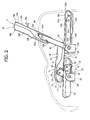
- Figure 2 shows at an enlarged scale the seat of Figure 1;
- Figure 3 is a perspective view with parts removed for clarity of the seat of Figure 1; and
- Figure 4 is a schematic side view that shows the seat in an intermediate position when it is being configured.
- In Figure 1, the
reference number 1 designates, as a whole, a vehicle (partially and schematically illustrated) comprising apassenger compartment 2, which houses three rows of seats, only the last two of which are illustrated and are designated by thereference numbers 3 and 4. - The row 4 is adjacent to a
rear boot 5 defined, at the bottom, by aloading surface 6 and is formed by twoseats 7, which are set alongside one another transverse to alongitudinal direction 8 of advance of thevehicle 1. Theseats 7 are the same as one another, so that the ensuing description will make reference only to one of the two. - With reference to the attached figures, the
seat 7 comprises aseat portion 9 having asoft surface 10 defined by acushion body 11, which is a resting surface for at least one passenger, and arear surface 12, which is opposite to thesoft surface 10 and is defined by aportion 13 that is substantially rigid forming part of anend wall 14 that supports, in a fixed position, thecushion body 11. - The
end wall 14 comprises twosides 15, which are fixed with respect to theportion 13, are preferably made of a single piece with theportion 13 of a rigid plastic material, and are arranged on opposite sides of thecushion body 11. Theend wall 14 is coupled to a fixed structure of thevehicle 1, in particular to thefloor 18 that defines at the bottom thepassenger compartment 2, via aconnection assembly 19. Theassembly 19 enables rotation of theseat portion 9 through approximately 180° between a sitting configuration, in which thesoft surface 10 faces upwards, and a loading configuration or knocked-down configuration, in which therear surface 12 faces upwards. - The
seat portion 9 is able to rotate about anaxis 21, which is movable to enable rotation of theseat portion 9 in a convenient way in the space available and, in particular, to render, in the loading configuration, therear surface 12 lower than the height assumed by thesoft surface 10 in the sitting configuration. In particular, theassembly 19 comprises twolevers 22, which are set on opposite sides of theseat portion 9 and compriserespective portions 23 hinged to thesides 15, andrespective portions 24 hinged torespective brackets 25 about afixed axis 26 parallel to theaxis 21. Thebrackets 25 are fixed to thefloor 18 in a conventional way (not illustrated). - The
assembly 19 comprises at least onesupport 28 set in a fixed position and longitudinally at a distance from thebrackets 25 and, hence, thelevers 22 in thedirection 8 so as to perform a supporting function for theportion 13 when theseat portion 9 is in its sitting configuration. In particular, twosupports 28 are envisaged, which are carried by thefloor 18 in positions transversely set at a distance from one another and each behind acorresponding bracket 25. - With reference to Figure 2, a
releasable locking device 30 is provided for locking theseat portion 9 to at least one between thelevers 22 about theaxis 21. In particular, thedevice 30 is carried by thesides 15 and locks theseat portion 9 in both the sitting configuration and the loading configuration. Thedevice 30 comprises twopins 31, which are coaxial and opposed to one another and each of which selectively engages a corresponding pair ofseats seats levers 22 and are set at an angular distance apart about theaxis 21. - The
pins 31 can be retracted with respect to thesides 15 within respective seats (not illustrated) against the elastic action of respective springs (not illustrated either) for disengaging theseats seat portion 9 about theaxis 21. When theseat 1 is in the sitting configuration, thepins 31 engage theseats 32. - The
levers 22 rotate about theaxis 26 between a raised position, corresponding to the sitting configuration, and a lowered position, corresponding to the loading configuration. In particular, thelevers 22 rotate in an opposite direction with respect to the direction of rotation which is to provide theseat portion 9 about theaxis 21 during the displacements between the sitting configuration and the loading configuration. - With reference to Figure 3, the
brackets 25 compriserespective tabs 34, which project towards thesides 15 and define an end-of-travel contrast surface for thefront edges 35 of thelevers 22 so as to stop rotation forwards when thelevers 22 are set in a raised position. - When the
seat portion 9 is in the loading configuration, it is aligned with thesupports 28 in thedirection 8. At the same time, thesurface 10 is in contact with thefloor 18, whilst thepins 31 engage theseats 33. - Once again with reference to Figure 2, one
end 36 of theseat portion 9 is set backwards and so that it rests against thesupports 28 when it is in the sitting configuration, and is set forwards when it is in the loading configuration. In the loading configuration, resting or forcing of theend 36 against thefloor 18 and engagement of thepins 31 in theseats 33 prevent thelevers 22 from rotating forwards and upwards about theaxis 26 so that theentire seat portion 9 remains stationary, even in the event of possible impact. - With reference to the attached figures, the
seat 7 also comprises abackrest 37 coupled to thefloor 18 and to thesides 38 of the vehicle via aconnection assembly 39. - The
backrest 37 and theassembly 39 are similar to theseat portion 9 and to theassembly 19 so that the components of thebackrest 37 and of theassembly 39 are designated by the same reference numbers used for theseat portion 9 and theassembly 19 followed by the reference letter "a". - The
assembly 39 differs from theassembly 19 in that: thelevers 22a are defined by elongated rectilinear arms, which are aligned to thebackrest 37 both in the sitting configuration and in the loading configuration, and which, in the sitting configuration, define between them aspace 41 that houses the end 36 (Figure 3); and thesupport 28a is carried by thesides 38, instead of by thefloor 18, and supports thebackrest 37 in a substantially vertical position. - Preferably, the
seat portion 9 and thebackrest 37 are bodies identical to one another defined by modules the sides of which can be hinged, in the same point, indifferently to thelevers 22 or else to thearms 22a. - In the loading configuration, the
backrest 37 has thecushion body 11a set resting against theloading surface 6, whilst thesupports 28 are set between thebackrest 37 and theseat portion 9. In addition, therear surfaces - The
levers levers axes rods 42 are hinged to theportions axes levers rods 42 defines an articulated quadrilateral 43, which is rotated backwards for displacing the seat into the loading configuration after thepins respective seats - In particular, in order to displace the
seat 7 from the sitting configuration to the loading configuration, first thepins 31 are released from theseats 32. Next, theseat portion 9 is made to rotate about theaxis 21 forwards, first upwards, by raising theend 36 from thesupports 28, and then downwards until theend 36 is made to rest against thefloor 18. At this point, thelevers 22 remain in the raised position in so far as they are connected via the connectingrods 42 to thelevers 22a that are still fixed. - Next, the
pins 31a are released from theseats 32a. Then, thebackrest 37 is moved away from thesupport 28a and made to rotate forwards and downwards about theaxis 21a, until an intermediate position is reached in which it is substantially horizontal, whilst thelevers 22a are still in the raised position (Figure 4). A system of springs (not illustrated) keeps thelevers 22a and thebackrest 37 in equilibrium in said intermediate position, until a user starts to push thebackrest 37 downwards by acting manually on the portion 13a. Said system comprises springs set in a position corresponding to the pins for hinging thelevers brackets seat portion 9, and to thebackrest 37. - If the
backrest 37 is kept always in a substantially horizontal position, said thrust causes rotation of thebackrest 37 further forwards with respect to thelevers 22a about theaxis 21a and, at the same time, causes rotation of thelevers 22a backwards and downwards about theaxis 26a. - The
levers 22a draw thelevers 22 about theaxis 26 in rotation backwards and downwards by means of the connectingrods 42. Rotation continues until thecushion body 11a comes to rest against theloading surface 6, thepins 31 come to engage in theseats 33, and thepins 31a come to engage in theseats 33a. - Resting of the
cushion body 11a against theloading surface 6 and, above all, coupling via the connectingrods 42 of thelevers 22a to thelevers 22, which are fixed in the loading configuration, prevents thelevers 22a and, hence, thebackrest 37 from rotating forwards and upwards about theaxis 26a, even in the event of possible impact. - Between the sitting configuration and the loading configuration, consequently, the angle of relative rotation of the
backrest 37 about theaxis 21a with respect to thearms 22a and the angle of rotation of theseat portion 9 with respect to thefloor 18 are 180°. - The modality for bringing the
seat 7 back into the sitting configuration entails operations having a reverse sequence with respect to the one just described, so that it is not described in detail. - From the foregoing description, it is evident how the
seat 7 enables a large resting surface to be made available when it is set in the loading configuration in so far as it uses also theseat portion 9 as resting surface, and how the space occupied by theseat portion 9 itself is relatively small thanks to the particular system of coupling and rotation of thelevers 22. - The overall dimensions are also contained thanks to the alignment of the
seat portion 9 and of thebackrest 37 with thesupports 28 in the loading configuration. - The
assemblies seat 7 to remain compact in the loading configuration. - In addition, the
seat 7 is relatively inexpensive in so far as it exploits components, i.e., theseat portion 9 and thebackrest 37, which are modular or interchangeable. - Finally, it is clear that modifications and variations may be made to the
seat 7 described and illustrated herein, without thereby departing from the sphere of protection of the present invention, as defined in the annexed claims. - The
levers brackets sides 38 instead of to thefloor 18. - A releasable retention device could be provided, for example, of the snap-action type, for withholding the
portions supports - Furthermore, the
levers seat portion 9 and/or thebackrest 37. - In addition, the
brackets floor 18 in an adjustable way.
Claims (11)
- A configurable seat (7) for a vehicle (1); the seat comprising:- a seat portion (9) having:a) a soft surface (10) defining a resting surface for at least one passenger; andb) a rear surface (12) opposite to said soft surface (10) ;
and- coupling means (19) for coupling said seat portion (9) to a structure (25) carried by the vehicle;and being characterized in that said coupling means (19) comprise lever means (22) so as to rotate said seat portion (9) through approximately 180° with respect to said structure (25) between a sitting configuration, in which said soft surface (10) faces upwards, and a loading configuration, in which said rear surface (12) faces upwards and is lower than the height assumed by said soft surface (10) in said sitting configuration; said lever means (22) comprising a first portion (23) hinged to said seat portion (9) about a first horizontal axis (21), orthogonal to a longitudinal direction (8) of advance of said vehicle, and a second portion (24) that is able to rotate with respect to said structure (25) about a second horizontal axis (26) parallel to said first horizontal axis (21); during displacement between said loading configuration and said sitting configuration, said lever means (22) being rotated about said second horizontal axis (26) between two end-of-travel angular positions in an opposite direction with respect to the direction of rotation of said seat portion (9) about said first horizontal axis (21). - The seat according to Claim 1, characterized in that it comprises releasable locking means (30) for angularly locking said seat portion (9) to said lever means (22) about said first horizontal axis (21) at least in said sitting configuration.
- The seat according to Claim 1 or Claim 2, characterized in that said first rear surface (12) is defined by a first portion of wall (13) that is substantially rigid.
- The seat according to Claim 3, characterized in that said portion of wall (13) forms part of an end wall (14) carrying a cushion body (11) and comprising two sides (15) set on opposite sides of said cushion body (11).
- The seat according to Claim 4, characterized in that said lever means (22) comprise two levers (22), which are set on opposite sides of said seat portion (9) and comprise respective first portions (23), each hinged to a corresponding said side (15).
- The seat according to any one of the preceding claims, characterized in that it comprises a backrest (37) that can be knocked down, and in that said lever means (22) form part of an articulated quadrilateral (43) that renders the motion of rotation of said seat portion (9) dependent upon knocking-down of said backrest (37).
- The seat according to Claim 6, characterized in that said backrest (37) has a rear surface (12a) of its own; the rear surfaces (12, 12a) of the seat portion (9) and of the backrest (37) being defined by respective rigid and flat portions of wall (13, 13a) and being, in the loading or knocked-down configuration, substantially coplanar.
- The seat according to Claim 6 or Claim 7, characterized in that said articulated quadrilateral (43) comprises at least one connecting rod (42) hinged at its own ends to said second portion (24) in an eccentric position with respect to said second horizontal axis (26) and to a lever (22a) for supporting and hinging said backrest (37).
- The seat according to any one of the preceding claims, characterized in that it comprises a backrest (37) that can be knocked down, and in that said backrest (37) and said seat portion (9) are defined by bodies that are the same as one another.
- The seat according to any one of the preceding claims, characterized in that said coupling means (19) comprise supporting means (28), which are set at a distance from said lever means (22) in said longitudinal direction (8) and define a rest for said rear surface (12) when said seat portion (9) is set in its sitting configuration.
- The seat according to Claim 10, characterized in that said lever means (22) are set in front of said supporting means (28), and in that, in said loading configuration, said supporting means (28) are aligned horizontally with said seat portion (9) in said longitudinal direction (8).
Priority Applications (3)
| Application Number | Priority Date | Filing Date | Title |
|---|---|---|---|
| EP06425661A EP1905641B1 (en) | 2006-09-27 | 2006-09-27 | Configurable vehicle seat |
| DE602006016289T DE602006016289D1 (en) | 2006-09-27 | 2006-09-27 | Configurable vehicle seat |
| AT06425661T ATE477959T1 (en) | 2006-09-27 | 2006-09-27 | CONFIGURABLE VEHICLE SEAT |
Applications Claiming Priority (1)
| Application Number | Priority Date | Filing Date | Title |
|---|---|---|---|
| EP06425661A EP1905641B1 (en) | 2006-09-27 | 2006-09-27 | Configurable vehicle seat |
Publications (2)
| Publication Number | Publication Date |
|---|---|
| EP1905641A1 true EP1905641A1 (en) | 2008-04-02 |
| EP1905641B1 EP1905641B1 (en) | 2010-08-18 |
Family
ID=37726917
Family Applications (1)
| Application Number | Title | Priority Date | Filing Date |
|---|---|---|---|
| EP06425661A Not-in-force EP1905641B1 (en) | 2006-09-27 | 2006-09-27 | Configurable vehicle seat |
Country Status (3)
| Country | Link |
|---|---|
| EP (1) | EP1905641B1 (en) |
| AT (1) | ATE477959T1 (en) |
| DE (1) | DE602006016289D1 (en) |
Cited By (2)
| Publication number | Priority date | Publication date | Assignee | Title |
|---|---|---|---|---|
| DE102011014441A1 (en) | 2011-03-18 | 2011-11-10 | Daimler Ag | Vehicle seat for passenger car, has seat part that is pivoted over lever arrangement of seat between seat position and loading position, and lever arrangement designed in shape of four-knuckle |
| JP2024086415A (en) * | 2022-12-16 | 2024-06-27 | トヨタ紡織株式会社 | Sheet |
Citations (5)
| Publication number | Priority date | Publication date | Assignee | Title |
|---|---|---|---|---|
| JPH06219198A (en) * | 1993-01-29 | 1994-08-09 | Mazda Motor Corp | Car seat equipment |
| DE10237612B3 (en) * | 2002-08-16 | 2004-01-22 | Faurecia Autositze Gmbh & Co. Kg | Automotive seat |
| EP1396379A1 (en) * | 2002-09-05 | 2004-03-10 | Renault s.a.s. | Folding seat having support stops for the use position of the seat |
| DE102004024225B3 (en) * | 2004-05-15 | 2005-05-25 | Faurecia Autositze Gmbh & Co. Kg | Seat for motor vehicle has released a lever for control part on backrest and a backrest pre-tensioning spring |
| EP1604862A1 (en) * | 2004-06-09 | 2005-12-14 | Heuliez | Convertible motor vehicle seat |
-
2006
- 2006-09-27 AT AT06425661T patent/ATE477959T1/en not_active IP Right Cessation
- 2006-09-27 DE DE602006016289T patent/DE602006016289D1/en active Active
- 2006-09-27 EP EP06425661A patent/EP1905641B1/en not_active Not-in-force
Patent Citations (5)
| Publication number | Priority date | Publication date | Assignee | Title |
|---|---|---|---|---|
| JPH06219198A (en) * | 1993-01-29 | 1994-08-09 | Mazda Motor Corp | Car seat equipment |
| DE10237612B3 (en) * | 2002-08-16 | 2004-01-22 | Faurecia Autositze Gmbh & Co. Kg | Automotive seat |
| EP1396379A1 (en) * | 2002-09-05 | 2004-03-10 | Renault s.a.s. | Folding seat having support stops for the use position of the seat |
| DE102004024225B3 (en) * | 2004-05-15 | 2005-05-25 | Faurecia Autositze Gmbh & Co. Kg | Seat for motor vehicle has released a lever for control part on backrest and a backrest pre-tensioning spring |
| EP1604862A1 (en) * | 2004-06-09 | 2005-12-14 | Heuliez | Convertible motor vehicle seat |
Cited By (2)
| Publication number | Priority date | Publication date | Assignee | Title |
|---|---|---|---|---|
| DE102011014441A1 (en) | 2011-03-18 | 2011-11-10 | Daimler Ag | Vehicle seat for passenger car, has seat part that is pivoted over lever arrangement of seat between seat position and loading position, and lever arrangement designed in shape of four-knuckle |
| JP2024086415A (en) * | 2022-12-16 | 2024-06-27 | トヨタ紡織株式会社 | Sheet |
Also Published As
| Publication number | Publication date |
|---|---|
| ATE477959T1 (en) | 2010-09-15 |
| EP1905641B1 (en) | 2010-08-18 |
| DE602006016289D1 (en) | 2010-09-30 |
Similar Documents
| Publication | Publication Date | Title |
|---|---|---|
| US7651166B2 (en) | Vehicle seat, in particular motor vehicle seat | |
| JP4193520B2 (en) | Retractable seat | |
| RU150262U1 (en) | VEHICLE LANDING ASSEMBLY (OPTIONS) | |
| WO2007075461A3 (en) | Seatback entertainment display system | |
| JP5696256B2 (en) | Vehicle seat | |
| CN202764735U (en) | Sitting and lying combined automobile seat | |
| JP6450934B2 (en) | Vehicle seat | |
| US20090230747A1 (en) | Automobile seat having a four-link backrest pivoting mechanism and a two-link seat portion pivoting mechanism | |
| CN110920475B (en) | Car seat for commercial vehicle carriage | |
| CN109624805A (en) | Partition and vehicle seat component including it | |
| EP2105352B1 (en) | Moveable cargo tray for the trunk of a motor vehicle | |
| EP1905641A1 (en) | Configurable vehicle seat | |
| CN113401227A (en) | Loading floor device for motor vehicle | |
| CN113085677A (en) | Foldable automobile seat | |
| CN101808847B (en) | Vehicle seat having a table structure that can be erected when in use | |
| CN1647971A (en) | Vehicle chair | |
| KR200487109Y1 (en) | Functional reading desk | |
| JP2008173332A (en) | Seat structure | |
| CN110949211A (en) | Seat device of automobile and automobile | |
| CN208593325U (en) | Vehicles and Ottomans | |
| EP1571035A1 (en) | Adjustable vehicle seat, and vehicle equipped with such an adjustable seat | |
| JP6432446B2 (en) | Vehicle seat | |
| KR102501861B1 (en) | Camping device | |
| CN220518084U (en) | Multifunctional in-car sleeping headrest | |
| JP2009285193A (en) | Seat for vehicle |
Legal Events
| Date | Code | Title | Description |
|---|---|---|---|
| PUAI | Public reference made under article 153(3) epc to a published international application that has entered the european phase |
Free format text: ORIGINAL CODE: 0009012 |
|
| 17P | Request for examination filed |
Effective date: 20070629 |
|
| AK | Designated contracting states |
Kind code of ref document: A1 Designated state(s): AT BE BG CH CY CZ DE DK EE ES FI FR GB GR HU IE IS IT LI LT LU LV MC NL PL PT RO SE SI SK TR |
|
| AX | Request for extension of the european patent |
Extension state: AL BA HR MK YU |
|
| AKX | Designation fees paid |
Designated state(s): AT BE BG CH CY CZ DE DK EE ES FI FR GB GR HU IE IS IT LI LT LU LV MC NL PL PT RO SE SI SK TR |
|
| GRAP | Despatch of communication of intention to grant a patent |
Free format text: ORIGINAL CODE: EPIDOSNIGR1 |
|
| GRAS | Grant fee paid |
Free format text: ORIGINAL CODE: EPIDOSNIGR3 |
|
| GRAA | (expected) grant |
Free format text: ORIGINAL CODE: 0009210 |
|
| AK | Designated contracting states |
Kind code of ref document: B1 Designated state(s): AT BE BG CH CY CZ DE DK EE ES FI FR GB GR HU IE IS IT LI LT LU LV MC NL PL PT RO SE SI SK TR |
|
| REG | Reference to a national code |
Ref country code: GB Ref legal event code: FG4D |
|
| REG | Reference to a national code |
Ref country code: CH Ref legal event code: EP |
|
| REG | Reference to a national code |
Ref country code: IE Ref legal event code: FG4D |
|
| REF | Corresponds to: |
Ref document number: 602006016289 Country of ref document: DE Date of ref document: 20100930 Kind code of ref document: P |
|
| REG | Reference to a national code |
Ref country code: NL Ref legal event code: VDEP Effective date: 20100818 |
|
| LTIE | Lt: invalidation of european patent or patent extension |
Effective date: 20100818 |
|
| PG25 | Lapsed in a contracting state [announced via postgrant information from national office to epo] |
Ref country code: AT Free format text: LAPSE BECAUSE OF FAILURE TO SUBMIT A TRANSLATION OF THE DESCRIPTION OR TO PAY THE FEE WITHIN THE PRESCRIBED TIME-LIMIT Effective date: 20100818 Ref country code: LT Free format text: LAPSE BECAUSE OF FAILURE TO SUBMIT A TRANSLATION OF THE DESCRIPTION OR TO PAY THE FEE WITHIN THE PRESCRIBED TIME-LIMIT Effective date: 20100818 Ref country code: FI Free format text: LAPSE BECAUSE OF FAILURE TO SUBMIT A TRANSLATION OF THE DESCRIPTION OR TO PAY THE FEE WITHIN THE PRESCRIBED TIME-LIMIT Effective date: 20100818 |
|
| PG25 | Lapsed in a contracting state [announced via postgrant information from national office to epo] |
Ref country code: PT Free format text: LAPSE BECAUSE OF FAILURE TO SUBMIT A TRANSLATION OF THE DESCRIPTION OR TO PAY THE FEE WITHIN THE PRESCRIBED TIME-LIMIT Effective date: 20101220 Ref country code: BG Free format text: LAPSE BECAUSE OF FAILURE TO SUBMIT A TRANSLATION OF THE DESCRIPTION OR TO PAY THE FEE WITHIN THE PRESCRIBED TIME-LIMIT Effective date: 20101118 Ref country code: CY Free format text: LAPSE BECAUSE OF FAILURE TO SUBMIT A TRANSLATION OF THE DESCRIPTION OR TO PAY THE FEE WITHIN THE PRESCRIBED TIME-LIMIT Effective date: 20100818 Ref country code: SI Free format text: LAPSE BECAUSE OF FAILURE TO SUBMIT A TRANSLATION OF THE DESCRIPTION OR TO PAY THE FEE WITHIN THE PRESCRIBED TIME-LIMIT Effective date: 20100818 Ref country code: IS Free format text: LAPSE BECAUSE OF FAILURE TO SUBMIT A TRANSLATION OF THE DESCRIPTION OR TO PAY THE FEE WITHIN THE PRESCRIBED TIME-LIMIT Effective date: 20101218 Ref country code: PL Free format text: LAPSE BECAUSE OF FAILURE TO SUBMIT A TRANSLATION OF THE DESCRIPTION OR TO PAY THE FEE WITHIN THE PRESCRIBED TIME-LIMIT Effective date: 20100818 |
|
| PG25 | Lapsed in a contracting state [announced via postgrant information from national office to epo] |
Ref country code: GR Free format text: LAPSE BECAUSE OF FAILURE TO SUBMIT A TRANSLATION OF THE DESCRIPTION OR TO PAY THE FEE WITHIN THE PRESCRIBED TIME-LIMIT Effective date: 20101119 Ref country code: SE Free format text: LAPSE BECAUSE OF FAILURE TO SUBMIT A TRANSLATION OF THE DESCRIPTION OR TO PAY THE FEE WITHIN THE PRESCRIBED TIME-LIMIT Effective date: 20100818 Ref country code: NL Free format text: LAPSE BECAUSE OF FAILURE TO SUBMIT A TRANSLATION OF THE DESCRIPTION OR TO PAY THE FEE WITHIN THE PRESCRIBED TIME-LIMIT Effective date: 20100818 Ref country code: LV Free format text: LAPSE BECAUSE OF FAILURE TO SUBMIT A TRANSLATION OF THE DESCRIPTION OR TO PAY THE FEE WITHIN THE PRESCRIBED TIME-LIMIT Effective date: 20100818 Ref country code: BE Free format text: LAPSE BECAUSE OF FAILURE TO SUBMIT A TRANSLATION OF THE DESCRIPTION OR TO PAY THE FEE WITHIN THE PRESCRIBED TIME-LIMIT Effective date: 20100818 |
|
| PG25 | Lapsed in a contracting state [announced via postgrant information from national office to epo] |
Ref country code: DK Free format text: LAPSE BECAUSE OF FAILURE TO SUBMIT A TRANSLATION OF THE DESCRIPTION OR TO PAY THE FEE WITHIN THE PRESCRIBED TIME-LIMIT Effective date: 20100818 Ref country code: MC Free format text: LAPSE BECAUSE OF NON-PAYMENT OF DUE FEES Effective date: 20100930 |
|
| REG | Reference to a national code |
Ref country code: CH Ref legal event code: PL |
|
| PG25 | Lapsed in a contracting state [announced via postgrant information from national office to epo] |
Ref country code: EE Free format text: LAPSE BECAUSE OF FAILURE TO SUBMIT A TRANSLATION OF THE DESCRIPTION OR TO PAY THE FEE WITHIN THE PRESCRIBED TIME-LIMIT Effective date: 20100818 Ref country code: SK Free format text: LAPSE BECAUSE OF FAILURE TO SUBMIT A TRANSLATION OF THE DESCRIPTION OR TO PAY THE FEE WITHIN THE PRESCRIBED TIME-LIMIT Effective date: 20100818 Ref country code: IT Free format text: LAPSE BECAUSE OF NON-PAYMENT OF DUE FEES Effective date: 20100927 Ref country code: CZ Free format text: LAPSE BECAUSE OF FAILURE TO SUBMIT A TRANSLATION OF THE DESCRIPTION OR TO PAY THE FEE WITHIN THE PRESCRIBED TIME-LIMIT Effective date: 20100818 Ref country code: RO Free format text: LAPSE BECAUSE OF FAILURE TO SUBMIT A TRANSLATION OF THE DESCRIPTION OR TO PAY THE FEE WITHIN THE PRESCRIBED TIME-LIMIT Effective date: 20100818 |
|
| PLBE | No opposition filed within time limit |
Free format text: ORIGINAL CODE: 0009261 |
|
| STAA | Information on the status of an ep patent application or granted ep patent |
Free format text: STATUS: NO OPPOSITION FILED WITHIN TIME LIMIT |
|
| PG25 | Lapsed in a contracting state [announced via postgrant information from national office to epo] |
Ref country code: ES Free format text: LAPSE BECAUSE OF FAILURE TO SUBMIT A TRANSLATION OF THE DESCRIPTION OR TO PAY THE FEE WITHIN THE PRESCRIBED TIME-LIMIT Effective date: 20101129 |
|
| 26N | No opposition filed |
Effective date: 20110519 |
|
| GBPC | Gb: european patent ceased through non-payment of renewal fee |
Effective date: 20101118 |
|
| PG25 | Lapsed in a contracting state [announced via postgrant information from national office to epo] |
Ref country code: LI Free format text: LAPSE BECAUSE OF NON-PAYMENT OF DUE FEES Effective date: 20100930 Ref country code: CH Free format text: LAPSE BECAUSE OF NON-PAYMENT OF DUE FEES Effective date: 20100930 Ref country code: IE Free format text: LAPSE BECAUSE OF NON-PAYMENT OF DUE FEES Effective date: 20100927 |
|
| PGRI | Patent reinstated in contracting state [announced from national office to epo] |
Ref country code: IT Effective date: 20110616 |
|
| REG | Reference to a national code |
Ref country code: DE Ref legal event code: R097 Ref document number: 602006016289 Country of ref document: DE Effective date: 20110519 |
|
| PG25 | Lapsed in a contracting state [announced via postgrant information from national office to epo] |
Ref country code: GB Free format text: LAPSE BECAUSE OF NON-PAYMENT OF DUE FEES Effective date: 20101118 |
|
| PG25 | Lapsed in a contracting state [announced via postgrant information from national office to epo] |
Ref country code: LU Free format text: LAPSE BECAUSE OF NON-PAYMENT OF DUE FEES Effective date: 20100927 Ref country code: HU Free format text: LAPSE BECAUSE OF FAILURE TO SUBMIT A TRANSLATION OF THE DESCRIPTION OR TO PAY THE FEE WITHIN THE PRESCRIBED TIME-LIMIT Effective date: 20110219 |
|
| PG25 | Lapsed in a contracting state [announced via postgrant information from national office to epo] |
Ref country code: TR Free format text: LAPSE BECAUSE OF FAILURE TO SUBMIT A TRANSLATION OF THE DESCRIPTION OR TO PAY THE FEE WITHIN THE PRESCRIBED TIME-LIMIT Effective date: 20100818 |
|
| PGFP | Annual fee paid to national office [announced via postgrant information from national office to epo] |
Ref country code: DE Payment date: 20140923 Year of fee payment: 9 |
|
| PGFP | Annual fee paid to national office [announced via postgrant information from national office to epo] |
Ref country code: FR Payment date: 20140906 Year of fee payment: 9 |
|
| PGFP | Annual fee paid to national office [announced via postgrant information from national office to epo] |
Ref country code: IT Payment date: 20140926 Year of fee payment: 9 |
|
| REG | Reference to a national code |
Ref country code: DE Ref legal event code: R119 Ref document number: 602006016289 Country of ref document: DE |
|
| PG25 | Lapsed in a contracting state [announced via postgrant information from national office to epo] |
Ref country code: IT Free format text: LAPSE BECAUSE OF NON-PAYMENT OF DUE FEES Effective date: 20150927 |
|
| REG | Reference to a national code |
Ref country code: FR Ref legal event code: ST Effective date: 20160531 |
|
| PG25 | Lapsed in a contracting state [announced via postgrant information from national office to epo] |
Ref country code: DE Free format text: LAPSE BECAUSE OF NON-PAYMENT OF DUE FEES Effective date: 20160401 |
|
| PG25 | Lapsed in a contracting state [announced via postgrant information from national office to epo] |
Ref country code: FR Free format text: LAPSE BECAUSE OF NON-PAYMENT OF DUE FEES Effective date: 20150930 |