EP1902370B1 - Verfahren und vorrichtung zur verwaltung von cache-speicherzugriffen - Google Patents
Verfahren und vorrichtung zur verwaltung von cache-speicherzugriffen Download PDFInfo
- Publication number
- EP1902370B1 EP1902370B1 EP06771913A EP06771913A EP1902370B1 EP 1902370 B1 EP1902370 B1 EP 1902370B1 EP 06771913 A EP06771913 A EP 06771913A EP 06771913 A EP06771913 A EP 06771913A EP 1902370 B1 EP1902370 B1 EP 1902370B1
- Authority
- EP
- European Patent Office
- Prior art keywords
- cache
- data
- type
- shared
- banks
- Prior art date
- Legal status (The legal status is an assumption and is not a legal conclusion. Google has not performed a legal analysis and makes no representation as to the accuracy of the status listed.)
- Not-in-force
Links
Images

Classifications
-
- G—PHYSICS
- G06—COMPUTING OR CALCULATING; COUNTING
- G06F—ELECTRIC DIGITAL DATA PROCESSING
- G06F12/00—Accessing, addressing or allocating within memory systems or architectures
- G06F12/02—Addressing or allocation; Relocation
- G06F12/08—Addressing or allocation; Relocation in hierarchically structured memory systems, e.g. virtual memory systems
- G06F12/0802—Addressing of a memory level in which the access to the desired data or data block requires associative addressing means, e.g. caches
- G06F12/0844—Multiple simultaneous or quasi-simultaneous cache accessing
- G06F12/0846—Cache with multiple tag or data arrays being simultaneously accessible
- G06F12/0848—Partitioned cache, e.g. separate instruction and operand caches
-
- G—PHYSICS
- G06—COMPUTING OR CALCULATING; COUNTING
- G06F—ELECTRIC DIGITAL DATA PROCESSING
- G06F13/00—Interconnection of, or transfer of information or other signals between, memories, input/output devices or central processing units
- G06F13/14—Handling requests for interconnection or transfer
- G06F13/16—Handling requests for interconnection or transfer for access to memory bus
-
- G—PHYSICS
- G06—COMPUTING OR CALCULATING; COUNTING
- G06F—ELECTRIC DIGITAL DATA PROCESSING
- G06F12/00—Accessing, addressing or allocating within memory systems or architectures
- G06F12/02—Addressing or allocation; Relocation
- G06F12/08—Addressing or allocation; Relocation in hierarchically structured memory systems, e.g. virtual memory systems
-
- G—PHYSICS
- G06—COMPUTING OR CALCULATING; COUNTING
- G06F—ELECTRIC DIGITAL DATA PROCESSING
- G06F12/00—Accessing, addressing or allocating within memory systems or architectures
- G06F12/02—Addressing or allocation; Relocation
- G06F12/08—Addressing or allocation; Relocation in hierarchically structured memory systems, e.g. virtual memory systems
- G06F12/0802—Addressing of a memory level in which the access to the desired data or data block requires associative addressing means, e.g. caches
- G06F12/0806—Multiuser, multiprocessor or multiprocessing cache systems
- G06F12/0815—Cache consistency protocols
- G06F12/0837—Cache consistency protocols with software control, e.g. non-cacheable data
-
- G—PHYSICS
- G06—COMPUTING OR CALCULATING; COUNTING
- G06F—ELECTRIC DIGITAL DATA PROCESSING
- G06F13/00—Interconnection of, or transfer of information or other signals between, memories, input/output devices or central processing units
-
- G—PHYSICS
- G06—COMPUTING OR CALCULATING; COUNTING
- G06F—ELECTRIC DIGITAL DATA PROCESSING
- G06F12/00—Accessing, addressing or allocating within memory systems or architectures
- G06F12/02—Addressing or allocation; Relocation
- G06F12/08—Addressing or allocation; Relocation in hierarchically structured memory systems, e.g. virtual memory systems
- G06F12/0802—Addressing of a memory level in which the access to the desired data or data block requires associative addressing means, e.g. caches
- G06F12/0806—Multiuser, multiprocessor or multiprocessing cache systems
- G06F12/0815—Cache consistency protocols
- G06F12/0831—Cache consistency protocols using a bus scheme, e.g. with bus monitoring or watching means
-
- Y—GENERAL TAGGING OF NEW TECHNOLOGICAL DEVELOPMENTS; GENERAL TAGGING OF CROSS-SECTIONAL TECHNOLOGIES SPANNING OVER SEVERAL SECTIONS OF THE IPC; TECHNICAL SUBJECTS COVERED BY FORMER USPC CROSS-REFERENCE ART COLLECTIONS [XRACs] AND DIGESTS
- Y02—TECHNOLOGIES OR APPLICATIONS FOR MITIGATION OR ADAPTATION AGAINST CLIMATE CHANGE
- Y02D—CLIMATE CHANGE MITIGATION TECHNOLOGIES IN INFORMATION AND COMMUNICATION TECHNOLOGIES [ICT], I.E. INFORMATION AND COMMUNICATION TECHNOLOGIES AIMING AT THE REDUCTION OF THEIR OWN ENERGY USE
- Y02D10/00—Energy efficient computing, e.g. low power processors, power management or thermal management
Definitions
- the present invention generally relates to microprocessors, and particularly relates to managing microprocessor caches. Relevant Background
- Level 1 (L1) caches generally reside on-chip and represent the smallest, fastest cache available to the microprocessor.
- Level 2 (L2) caches reside on-chip or off-chip, and provide somewhat slower but typically larger amounts of cache memory than an L1 cache for the microprocessor. There may be additional levels of progressively slower (and larger) cache memories between the microprocessor and the main memory.
- cache memory operates as a buffer between the microprocessor and the (comparatively) slow main memory, and is used to hold copies of the instructions and/or data that are most likely needed by the microprocessor. If a copy of a needed instruction or data item resides in the cache, the microprocessor reads / writes that copy instead of accessing the main memory and thereby avoids the potentially much longer access delays associated with the main memory access.
- Document US 2002/0073280 A1 discloses a conventional memory management scheme for a system comprising a processor and a networking interface. To speed up data transfer through the networking interface, both processor and interface use a shared cache. Caching operations become more complicated in multiprocessor environments, where two or more microprocessors share memory space.
- two or more microprocessors may cache the same data from main memory. That is, multiple microprocessors each may cache a copy of the same data item from main memory. To ensure that each microprocessor accesses the most recently updated value of a given data item, some method of synchronizing the caches among the microprocessors must be used. Cache synchronization maintains cache "coherency" by providing some mechanism to prevent the individual microprocessors from using a data item whose value has become outdated through the operations of the other microprocessors. Cache synchronization can be managed either by hardware-enforced coherency or by software through cache management instructions.
- Broadcast based approaches to cache synchronization generally rely on each microprocessor transmitting messages related to data memory operations. In turn, the individual microprocessors, or their cache controllers, monitor (“snoop") those messages to determine whether the actions of another microprocessor have invalidated any data items held in their associated caches.
- snoopy buses thus represents a relatively straightforward and effective method of maintaining cache coherency in multiprocessor systems.
- snoopy buses can reduce the effective access bandwidth of cache memory, because the snoop traffic accesses to a given cache typically are supported on the same "port" or access bus that is used for locally generated cache accesses by the microprocessor(s).
- the amount of snoop traffic increases significantly as the microprocessor count increases and, eventually, the amount of snoop traffic can significantly limit overall system performance.
- the present invention provides a method of reducing interferences between shared data cache accesses related to cache snoop traffic in a multiprocessor system and nonshared data cache accesses related to local access by an accessing processor according to claim 1 and a respective banked cache according to claim 13.
- interference between shared data cache accesses e.g., cache accesses associated with snoop traffic
- non-shared data cache accesses can be reduced by reducing or eliminating the mixing of shared data and non-shared data in at least one cache bank of the banked cache. Reducing or eliminating such mixing may comprise designating one or more banks of the banked cache for holding shared data, and directing cache accesses for shared data to the designated one or more cache banks. Additionally, or alternatively, such mixing can be reduced or eliminated by designating one or more banks of the banked cache for holding non-shared data, and directing cache accesses for non-shared data to the designated one or more cache banks.
- bank selection function For example, given cache accesses (read or write) are directed to particular cache locations in particular cache banks according to a "bank selection function," which may be driven at least in part by one or more cache access address signals.
- bank selection function encompasses a variety of different methods and algorithms used to select a particular bank for a particular cache access address. For example, the term can cover address and/or other signal hashing functions or represent straightforward address decoding.
- an access type indicator modifies the bank selection function, such that cache accesses for shared data and/or for non-shared data are directed (steered) to one or more designated banks in a banked cache.
- the bank selection function may direct shared accesses to a shared access bank or to a mixed (shared and non-shared) access bank. Such action "focuses" cache access activity for shared data in the bank(s) designated for holding shared data.
- the access type indicator may be used to modify the bank selection function to direct non-shared accesses to a non-shared access bank or to a mixed access bank, to focus cache access activity for non-shared data in the bank(s) designated for holding non-shared data. In both cases, the interference between shared data accesses and non-shared data accesses is reduced or eliminated, for at least one bank in the banked cache.
- a broad method of reducing interference between shared data cache accesses and non-shared data cache accesses for at least one bank in a banked cache comprises designating one or more first banks of the banked cache for holding a first type of data, the first type of data being one of shared data and non-shared data, and directing cache accesses for the first type of data to the one or more first banks.
- the method may further comprise designating one or more second banks of the banked cache for holding a second type of data, said second type of data being the other one of shared and non-shared data, and directing cache access for the second type of data to the one or more second banks. Any or all such designations may be exclusive or non-exclusive (mixed).
- One embodiment of a banked cache embodying the above method, or variations of the above method comprises an access control circuit configured to reduce interference between shared data cache accesses and non-shared data cache accesses based on directing cache accesses for a first type of data to one or more first cache banks of the banked cache that are designated for holding the first type of data, the first type of data being one of shared data and non-shared data.
- the access control circuit further may direct cache accesses for a second type of data to one or more second cache banks of the banked cache, wherein the second type of data is the other one of shared and non-shared data.
- the access control circuit may be directly or indirectly responsive to the access type indicator, which may be a shared access signal provided to the banked cache in association with cache accesses.
- the logic state or value, or some other characteristic of the shared access indicator signal indicates whether a given cache access is for shared (or non-shared) data, and the access control circuit's bank selection function is modified accordingly, to direct the cache access to the appropriate cache bank.
- the bank selection function also may be modified according to a bank configuration signal. That is, the configuration of the banked cache may be changed as needed or desired, such that the designation of one or more banks as being for shared data, non-shared data, or mixed data, can be changed. Such changes may be controlled at the computer operating system level and/or controlled by individual programs running on the processor(s) associated with the banked cache.
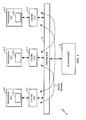
- Fig. 1 is a block diagram illustrating a multiprocessor circuit that includes banked caches.
- Fig. 2 is a block diagram illustrating a given one of the processors and banked caches in the multiprocessor circuit of Fig. 1 .
- Fig. 3 is a logic flow diagram illustrating one embodiment of controlling banked cache accesses as a function of non-shared/shared data access types.
- Fig. 4 is a block diagram illustrating one embodiment of an access control circuit for controlling banked cache accesses.
- Fig. 5 is a block diagram illustrating a banked cache having an arrangement of non-shared and shared banks.
- Fig. 6 is a block diagram illustrating another embodiment of an access control circuit for controlling banked cache accesses.
- Fig. 7 is a block diagram illustrating a banked cache having another arrangement of non-shared and shared banks.
- Fig. 1 at least partially illustrates a multiprocessor circuit 8, including a plurality of microprocessors 10 and associated memory caches 12 that are coupled through a system bus 14 to a main memory 16.
- the processors 10 may be implemented together, such as in one integrated circuit device, a system-on-a-chip circuit (multi-chip module), or may be implemented separately.
- the cache memories 12 may be integrated in whole or in part into the processors 10, or may be implemented separately.
- the cache 12-1 may include Level 1 (L1) cache that is included within processor 10-1 and Level 2 (L2) cache that is implemented internally or externally.
- the illustrated embodiment of the processor 10-1 includes a cache controller 18-1, which may include a number of memory management features. Similar configurations may be used for the processors 10-2 and 10-3, and for their corresponding caches 12-2 and 12-3.
- processors 10 and the caches 12 generally are not germane to the cache access control methods and apparatus discussed herein, and those skilled in the art will recognize the opportunity for various circuit implementation variations. For example, a greater or lesser number of processors 10 and corresponding caches 12 than are illustrated may be used as needed or desired.
- the multiprocessor circuit 8 may operate as a Symmetric Multi-Processing (SMP) circuit, wherein the processors 10 cooperatively execute one or more computer programs, program threads, etc.
- the processors 10 each may comprise a Reduced Instruction Set Computer (RISC) processor, including a core unit having one or more instruction execution pipelines, and further including pre-fetch units for predictive caching of instructions and data, translation look-aside buffers to track memory mappings and permissions, etc.
- RISC Reduced Instruction Set Computer
- each one of the processors 10 may further include a cache controller 18, which may comprise part of a larger memory management unit that interfaces the processor to a respective one of the caches 12, to the system bus 14, and to the main memory 16.
- each of the processors 10 may further comprise functional elements not illustrated, such as debug circuits, etc.
- the main memory 16 may be configured with one or more ranges of "shared” memory used for holding data that may be operated on by any one or more of the processors 10, and one or more ranges of "non-shared” memory for use by particular ones of the processors 10.
- each one of the processors 10 may cache a mix of non-shared and shared data in a corresponding one of the caches 12.
- at least one of the caches 12 is configured as a banked cache, comprising two or more cache banks.
- the different banks provide independent accessibility, such that accesses to one bank do not interfere with accesses to another bank.
- the multiprocessing circuit 8 employs one or more forms of "broadcast” based data coherency protocols, also referred to as “snoopy” protocols. With snooping, operations by one of the processors 10 on cached copies of shared data are recognized by the remaining processors 10, so that appropriate cache flushing and/or main memory updates can be made to ensure that each one of the processors 10 operates on valid, current copies of that shared data.
- the multiprocessing circuit's snooping protocol may be based on write broadcasting, wherein each one of the processors 10 and/or caches 12 send all writes onto the system bus 14 so that other processors/caches can update their respective cached data as needed.
- write invalidation protocols can be used, wherein writing to a given cache line in one of the caches 12, causes the same cache line present in any of the other caches 12 to be invalidated.
- a "cache line” generally comprises a given data block cached from a particular address range in main memory.
- MSI Modified-Shared-Invalid
- MESI Modified-Exclusive-Shared-Invalid
- MOESI Modified-Owner-Exclusive-Shared-Invalid
- accesses to the caches 12 may include a significant amount of snoop traffic associated with maintaining shared data coherency across the caches 12.
- each one of the processors 10 makes local accesses to both shared data and non-shared data held in its associated cache 12 to fulfill the requirements of the code executing on it.
- accesses to cache 12-1 comprise a mix of snoop-related shared data accesses for maintaining data coherency, and local accesses by processor 10-1 carried out in association with its ongoing execution of program instructions.
- Fig. 2 illustrates one embodiment of processor 10-1 (also referred to as "P1") and its associated cache 12-1.
- the banked cache 12-1 comprises an access control circuit 20, and four cache banks 22-1 through 22-4. A greater or lesser number of cache banks 22 may be implemented as needed or desired.
- the banked cache 12-1 comprises off-chip L2 cache
- implementation of the access control circuit 20 as part of the banked cache 12-1 may be advantageous.
- the access control circuit 20 is implemented on-board, as part of the processor 10-1. In such embodiments, the access control circuit 20 may be implemented as part of the cache controller 18-1.
- the access control circuit 20 recognizes cache accesses as being related to non-shared data or shared data, and correspondingly directs those accesses according to non-shared/shared designations associated with the banks 22. In one or more embodiments, such recognition is based on the processor 10-1 providing a shared access indication signal and/or a bank configuration signal to the access control circuit. The same or similar configurations may be adopted for any one or more of processors 10-2 and 10-3 (i.e., P2, P3) and for their corresponding caches 12-2 and 12-3.
- each of the banks 22 within a given one of the banked caches 12 preferably is independently accessible, such that accesses to one of the banks 22 do not interfere with accesses to the remaining banks 22.
- one or more of the banks 22 can be designated for holding non-shared data, shared data, or a mix thereof.
- particular ones of the banks 22 are designated exclusively for holding non-shared data, then no snoop-related accesses associated with maintaining shared data coherency will interfere with local non-shared data accesses to those particular ones of the banks 22.
- particular ones of the bank 22 may be designated exclusively for holding shared data, or for holding a mix of shared and non-shared data.
- different ones of the banks 22 can be designated for non-shared use, shared use, or mixed use, and a method of preserving local processor access bandwidth for at least one of the banks 22 comprises excluding shared data from that at least one bank. Directing shared and non-shared data accesses in this manner depends on the differing designations associated with particular ones of the banks 22.
- an embodiment of the access control circuit 20 can be configured to implement a method of reducing interference between shared data cache accesses and non-shared data cache accesses for at least one bank in a banked cache.
- the access control circuit 20 may reduce such interference by designating one or more first banks 22 of the banked cache 12 for holding a first type of data, the first type of data being one of shared data and non-shared data, and directing cache accesses for the first type of data to the one or more first banks. Accesses may be recognized as targeting the first type of data based on the access type indicator provided to the access control circuit 12 in association with cache accesses.
- the access control circuit 20 further may be configured to designate one or more second banks 22 of the banked cache 12 for holding a second type of data, the second type of data being the other one of shared and non-shared data, and directing cache access for the second type of data to the one or more second banks 22.
- designating one or more first banks 22 of the banked cache 12 for holding the first type of data may comprise designating a first cache bank 22 for holding shared data.
- designating one or more second cache banks 22 for holding a second type of data may comprise designating a second cache bank 22 for holding non-shared data.
- cache accesses for the first type of data are directed to that first one of the cache banks 22, and cache accesses for non-shared data are directed to that second one of the cache banks 22.
- one or both such designations can be exclusive, such that all shared and/or non-shared accesses are exclusively directed to one or more designated banks 22 in the banked cache 12.
- the designations also can be non-exclusive, such that both shared and non-shared accesses are directed to the same bank, at least for a given range of cache addresses.
- the amount or percent of that bank used for shared or non-shared data can be controlled, e.g., it can be primarily used for shared or non-shared data, such that access interference in that bank for the non-primary type of data is minimal.
- the access type indicator may be a signal or other type of value that is set under software control.
- the access type indicator may comprise a bit in a page table within a microprocessor 10 that is written by software, such that the hardware (e.g., processor 10) has access to the indicator after performing a page table lookup based on a given memory address.
- the access type indicator may comprise the results of an address decode/comparison against some software-written configuration register(s) within the processor 10. For example, software can configure two registers to indicate a shared region start and end, and a processor 10 can set the access type indicator signal to the appropriate state by comparing all or a portion of an access address against those registers to determine if a given access is shared or not.
- a software programmed register within the processor 10 is used to indicate whether a certain type of access is shared or not, and the state or value of that register thus serves as the access type indicator signal.
- the shared/non-shared determination can be based on the software's knowledge of what types of accesses are able to access which regions of memory. Such an arrangement may be useful for accesses associated with cache management operations, translation-lookaside-buffer (TLB) management operations, and other specialized functions, such as data streaming, etc.
- TLB translation-lookaside-buffer
- Fig. 3 illustrates processing logic that can be implemented in support of directing shared and non-shared accesses, and begins with designating particular ones of the banks 22 in any one or more of the caches 12 as being shared or non-shared (Step 100).
- This step may be an implicit step, such as where the banked caches 12 are configured with predefined shared and non-shared bank designations, or may be an explicit step in embodiments where the bank designations are configurable.
- processing continues by making a cache access (Step 102), and determining the access type as shared or non-shared (Step 104). If the access is for shared data (yes at Step 106), it is directed to one of the banks 22 designated as holding shared data. Conversely, if the access is for non-shared data (no at Step 106), it is directed to one of the banks 22 designated for holding non-shared data.
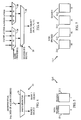
- Fig. 4 illustrates one embodiment of the access control circuit 20, comprising a bank selector circuit 24 that is configured to direct cache accesses to non-shared or shared banks 22 based on "hashing" one or more address bits generated for the cache accesses. For example, with two banks 22, one or more address lines can be used to generate a "BANK 0" select signal or a "BANK 1" select signal, corresponding to shared or non-shared accesses, respectively.
- Fig. 5 illustrates two such selectively accessed banks 22.
- Figs. 6 and 7 respectively illustrate another embodiment of the access control circuit 20, and a corresponding example of shared and non-shared bank designations. More particularly, the embodiment of the access control circuit 20 illustrated in Fig. 6 directs non-shared and shared data cache accesses as a function of hashing one or more address lines and a shared access indication signal and, optionally, a bank configuration signal.
- the shared access indicator signal may comprise one or more bits, and can be asserted according to positive or negative logic, to indicate that a given cache access is for a cache line that maps to a shared or a non-shared region of main memory. Such a shared indication can be readily generated as a function of memory page information stored for the processor's use.
- the bank configuration signal can be one or more bits, and can be processor-generated.
- the cache controller 18-1 can be configured to generate the shared indicator signal and/or the bank configuration signal to support operation of the access control circuit 20.
- the cache controller 18-1 can be configured to update the bank configuration signal dynamically, responsive to remapping of the main memory 16, for example, or responsive to different operating system or program modes.
- the cache controller 18-1 can be configured to flush or otherwise invalidate or clear the banked cache 12-1 as part of reconfiguring the shared/non-shared bank designations.
- similar configurations may exist in any one or more of the processors 10-2 and 10-3, the cache controllers 18-2 and 18-3, and the banked caches 12-2, and 12-3.
Landscapes
- Engineering & Computer Science (AREA)
- Theoretical Computer Science (AREA)
- Physics & Mathematics (AREA)
- General Engineering & Computer Science (AREA)
- General Physics & Mathematics (AREA)
- Memory System Of A Hierarchy Structure (AREA)
Claims (19)
- Verfahren zur Reduzierung von Störungen zwischen Zugriffen auf gemeinsam genutzten Datencache, welche mit Datencache-Snoop-Verkehr in einem Multiprozessorsystem (8) in Zusammenhang stehen, und Zugriffen für nicht gemeinsam genutzten Datencache, welche mit lokalem Zugriff durch einen zugreifenden Prozessor (10-1 bis 10-3) für wenigstens eine Bank (22-1 bis 22-4) in einem in Bänken vorliegenden Cache (12-1 bis 12-3) in Verbindung stehen, wobei das Verfahren aufweist:Bestimmen (100) einer oder mehrerer erster Bänke (22-1 bis 22-4) des in Bänken vorliegenden Caches (12-1 bis 12-3) zum Halten eines ersten Typs von Daten, wobei der erste Typ entweder durch gemeinsam genutzte Daten oder nicht gemeinsam genutzte Daten gebildet ist; undLeiten (106) von Cachezugriffen für den ersten Typ von Daten zu der einen oder den mehreren ersten Bänken (22-1 bis 22-4).
- Verfahren nach Anspruch 1, weiter umfassend Bestimmen (100) einer oder mehrerer zweiter Bänke (22-1 bis 22-4) des in Bänken angeordneten Caches (12-1 bis 12-3) zum Halten eines zweiten Typs von Daten, wobei der zweite Typ von Daten entweder durch gemeinsam genutzte Daten oder nicht gemeinsam genutzte Daten gebildet ist, und Leiten (106) von Cachezugriffen für den zweiten Typ von Daten zu der einen oder den mehreren zweiten Bänken (22-1 bis 22-4).
- Verfahren nach Anspruch 2, wobei Bestimmen (100) der einen oder der mehreren ersten Bänke (22-1 bis 22-4) des in Bänken angeordneten Caches (12-1 bis 12-3) zum Halten eines ersten Typs von Daten das Bestimmen (100) einer ersten Cachebank (22-1 bis 22-4) des in Bänken angeordneten Caches (12-1 bis 12-3) zum Halten der gemeinsam genutzten Daten umfasst, und wobei Bestimmen (100) einer oder mehrerer zweiter Cachebänke (22-1 bis 22-4) zum Halten eines zweiten Typs von Daten die Bestimmung (100) einer zweiten Cachebank (22-1 bis 22-4) des in Bänken angeordneten Caches (12-1 bis 12-3) zum Halten der nicht gemeinsam genutzten Daten umfasst.
- Verfahren nach Anspruch 3, wobei Leiten (106) von Cachezugriffen für den ersten Typ von Daten zu der einen oder den mehreren ersten Bänken (22-1 bis 22-4) das Leiten (106) von Cachezugriffen für gemeinsam genutzte Daten zu der ersten Cachebank (22-1 bis 22-4) umfasst, und weiter umfassend Leiten (106) von Cachezugriffen für nicht gemeinsam genutzte Daten zu der zweiten Cachebank (22-1 bis 22-4).
- Verfahren nach Anspruch 1, weiter umfassend Bestimmen (100) einer oder mehrerer zweiter Bänke (22-1 bis 22-4) des in Bänken angeordneten Caches (12-1 bis 12-3) zum Halten eines zweiten Typs von Daten, wobei der zweite Typ von Daten entweder durch gemeinsam genutzte Daten oder nicht gemeinsam genutzte Daten gebildet ist, und Leiten (106) von Cachezugriffen für den zweiten Typ von Daten zu der einen oder den mehreren zweiten Bänken (22-1 bis 22-4).
- Verfahren nach Anspruch 1, wobei Bestimmen (100) einer oder mehrerer erster Bänke (22-1 bis 22-4) des in Bänken angeordneten Caches (12-1 bis 12-3) zum Halten eines ersten Typs von Daten das Bestimmen (100) wenigstens einer Bank (22-1 bis 22-4) des in Bänken angeordneten Caches (12-1 bis 12-3) ausschließlich zum Halten des ersten Typs von Daten umfasst.
- Verfahren nach Anspruch 1, wobei Bestimmen (100) einer oder mehrerer erster Bänke (22-1 bis 22-4) des in Bänken angeordneten Caches (12-1 bis 12-3) zum Halten eines ersten Typs von Daten das Bestimmen (100) wenigstens einer Bank (22-1 bis 22-4) des in Bänken angeordneten Caches (12-1 bis 12-3) zum Halten einer Mischung des ersten Typs von Daten und des zweiten Typs von Daten umfasst, wobei der zweiten Typ von Daten der jeweils andere Typ von gemeinsam genutzten Daten oder nicht gemeinsam genutzten Daten ist.
- Verfahren nach Anspruch 1, wobei Leiten (106) von Cachezugriffen für den ersten Typ von Daten zu der einen oder den mehreren ersten Bänken (22-1 bis 22-4) das Konfigurieren einer Bankauswahlfunktion umfasst, um ansprechbar zu sein für ein Zugrifftypindikatorsignal, welches anzeigt, ob ein Cachezugriff für den ersten Typ von Daten vorliegt.
- Verfahren nach Anspruch 8, wobei das Konfigurieren einer Bankauswahlfunktion um ansprechbar für einen Zugrifftypindikator zu sein, welcher anzeigt, ob ein Cachezugriff für den ersten Typ von Daten vorliegt, das Konfigurieren der Bankauswahlfunktion zum Leiten eines gegebenen Cachezugriffes zu einem Ort oder Orten in einer bestimmten Bank (22-1 bis 22-4) des in Bänken angeordneten Caches (12-1 bis 12-3) als eine Funktion eines oder mehrerer Cachezugriffadresssignale und des Zugrifftypindikatorsignals umfasst.
- Verfahren nach Anspruch 1, wobei Bestimmen (100) einer oder mehrerer erster Bänke (22-1 bis 22-4) des in Bänken angeordneten Caches (12-1 bis 12-3) zum Halten eines ersten Typs von Daten das Konfigurieren einer Bankauswahlfunktion umfasst, welche dazu verwendet wird, Cachezugriffe zu einer bestimmten Bank (22-1 bis 22-4) in dem in Bänken angeordneten Caches (12-1 bis 12-3) zu leiten, um ansprechbar für ein Zugriffstypindikatorsignal zu sein, welches anzeigt, ob ein individueller Cachezugriff den ersten Typ von Daten betrifft.
- Verfahren nach Anspruch 10, weiter umfassend Re-Konfigurieren der Bankauswahlfunktion bei Bedarf, um die Auswahl der einen oder mehreren ersten Bänke (22-1 bis 22-4) des in Bänken angeordneten Caches (12-1 bis 12-3) zu verändern.
- Verfahren nach Anspruch 11, weiter umfassend Löschen gegenwärtig zwischengespeicherter Daten von der einen oder den mehreren ersten Bänken (22-1 bis 22-4) des in Bänken angeordneten Caches (12-1 bis 12-3) reagierend auf das Wechseln der Bestimmungen.
- In Bänken angeordneter Cache (12-1 bis 12-3), umfassend eine Zugriffssteuerungsschaltung (20), welche dazu konfiguriert ist, Störungen zwischen Datenzugriffen auf gemeinsam genutzten Cache, welche mit Cache-Snoop-Verkehr in einem Multiprozessorsystem (8) in Verbindung stehen, und Zugriffen auf nicht gemeinsam genutzten Datencache, welche mit lokalen Zugriffen durch einen zugreifenden Prozessor (10-1 bis 10-3) in Verbindung stehen, zu reduzieren durch Leiten (106) von Cachezugriffen für einen ersten Typ von Daten zu einer oder mehreren Cachebänken (22-1 bis 22-4) des in Bänken angeordneten Caches (12-1 bis 12-3), die bestimmt sind zum Halten des ersten Typs von Daten, wobei der erste Typ von Daten entweder durch gemeinsam genutzte Daten oder nicht gemeinsam genutzte Daten gebildet ist.
- In Bänken angeordneter Cache (12-1 bis 12-3) nach Anspruch 13, wobei die Zugriffssteuerungsschaltung (20) dazu eingerichtet ist, Cachezugriffe für einen zweiten Typ von Daten zu einer oder mehreren zweiten Cachebänken (22-1 bis 22-4) des in Bänken angeordneten Caches (12-1 bis 12-3) zu leiten, wobei der zweite Typ von Daten der jeweils andere von gemeinsam genutzte Daten oder nicht gemeinsam genutzte Daten ist.
- In Bänken angeordneter Cache (12-1 bis 12-3) nach Anspruch 14, wobei die Zugriffssteuerungsschaltung (20) dazu eingerichtet ist zu bestimmen, ob ein gegebener Cachezugriff die ersten oder zweiten Typen von Daten betrifft, basierend auf einem Zugriffstypindikatorsignal, das dem in Bänken angeordneten Cache (12-1 bis 12-3) in Verknüpfung mit dem gegebenen Cachezugriff bereitgestellt wird.
- In Bänken angeordneter Cache (12-1 bis 12-3) nach Anspruch 13, wobei die Zugriffssteuerungsschaltung (20) dazu eingerichtet ist, eine Bankauswahlfunktion zu implementieren, basierend auf dem Empfang eines Zugriffstypindikatorsignals in Verknüpfung mit Cachezugriffen, und wobei die Zugriffssteuerungsschaltung (20) dazu eingerichtet ist, einen gegebenen Cachezugriff zu der einen oder den mehreren ersten Cachebänken (22-1 bis 22-4) zu leiten, falls das Zugriffstypindikatorsignal anzeigt, dass der gegebene Cachezugriff den ersten Typ von Daten betrifft.
- In Bänken angeordneter Cache (12-1 bis 12-3) nach Anspruch 13, wobei wenigstens eine von der ersten oder den mehreren ersten Cachebänken (22-1 bis 22-4) ausschließlich zum Halten von Daten des ersten Typs bestimmt ist.
- In Bänken angeordneter Cache (12-1 bis 12-3) nach Anspruch 13, wobei wenigstens eine der einen oder der mehreren ersten Cachebänke (22-1 bis 22-4) nicht ausschließlich zum Halten von Daten des ersten Typs bestimmt ist.
- In Bänken angeordneter Cache (12-1 bis 12-3) nach Anspruch 13, wobei die Zugriffssteuerungsschaltung (20) dazu einrichtbar ist, eine Veränderung der Bestimmung der einen oder der mehreren ersten Cachebänke (22-1 bis 22-4) zu erlauben.
Applications Claiming Priority (2)
| Application Number | Priority Date | Filing Date | Title |
|---|---|---|---|
| US11/144,207 US7353319B2 (en) | 2005-06-02 | 2005-06-02 | Method and apparatus for segregating shared and non-shared data in cache memory banks |
| PCT/US2006/021401 WO2006130809A2 (en) | 2005-06-02 | 2006-06-02 | Method and apparatus for managing cache memory accesses |
Publications (2)
| Publication Number | Publication Date |
|---|---|
| EP1902370A2 EP1902370A2 (de) | 2008-03-26 |
| EP1902370B1 true EP1902370B1 (de) | 2010-03-03 |
Family
ID=37027583
Family Applications (1)
| Application Number | Title | Priority Date | Filing Date |
|---|---|---|---|
| EP06771913A Not-in-force EP1902370B1 (de) | 2005-06-02 | 2006-06-02 | Verfahren und vorrichtung zur verwaltung von cache-speicherzugriffen |
Country Status (10)
| Country | Link |
|---|---|
| US (1) | US7353319B2 (de) |
| EP (1) | EP1902370B1 (de) |
| JP (1) | JP4477688B2 (de) |
| KR (1) | KR100953854B1 (de) |
| CN (1) | CN101228512B (de) |
| AT (1) | ATE459920T1 (de) |
| DE (1) | DE602006012678D1 (de) |
| IL (1) | IL187807A0 (de) |
| MX (1) | MX2007015246A (de) |
| WO (1) | WO2006130809A2 (de) |
Families Citing this family (15)
| Publication number | Priority date | Publication date | Assignee | Title |
|---|---|---|---|---|
| US7925815B1 (en) * | 2006-06-29 | 2011-04-12 | David Dunn | Modifications to increase computer system security |
| US8661265B1 (en) | 2006-06-29 | 2014-02-25 | David Dunn | Processor modifications to increase computer system security |
| US8041854B2 (en) * | 2007-09-28 | 2011-10-18 | Intel Corporation | Steering data units to a consumer |
| US7809875B2 (en) * | 2008-06-30 | 2010-10-05 | Wind River Systems, Inc. | Method and system for secure communication between processor partitions |
| US20100017569A1 (en) * | 2008-07-16 | 2010-01-21 | Agere Systems Inc. | Pcb including multiple chips sharing an off-chip memory, a method of accessing off-chip memory and a mcm utilizing fewer off-chip memories than chips |
| US8112585B2 (en) * | 2009-04-30 | 2012-02-07 | Netapp, Inc. | Method and apparatus for dynamically switching cache policies |
| JP5121896B2 (ja) * | 2010-08-11 | 2013-01-16 | 株式会社東芝 | マルチコアプロセッサシステムおよびマルチコアプロセッサ |
| US20130159630A1 (en) * | 2011-12-20 | 2013-06-20 | Ati Technologies Ulc | Selective cache for inter-operations in a processor-based environment |
| US9195658B2 (en) | 2012-12-12 | 2015-11-24 | Lenovo Enterprise Solutions (Singapore) Pte. Ltd. | Managing direct attached cache and remote shared cache |
| CN103268321B (zh) * | 2013-04-19 | 2016-04-27 | 中国建设银行股份有限公司 | 高并发交易数据处理方法和装置 |
| US20150370707A1 (en) * | 2014-06-24 | 2015-12-24 | Qualcomm Incorporated | Disunited shared-information and private-information caches |
| JP6558009B2 (ja) * | 2015-03-23 | 2019-08-14 | 富士ゼロックス株式会社 | 転送装置、転送システムおよびプログラム |
| KR102411920B1 (ko) | 2017-11-08 | 2022-06-22 | 삼성전자주식회사 | 전자 장치 및 그 제어 방법 |
| CN110688331B (zh) * | 2018-07-05 | 2021-08-17 | 珠海全志科技股份有限公司 | 一种SoC芯片及读取数据的方法 |
| GB2584440B (en) * | 2019-06-03 | 2021-12-08 | Advanced Risc Mach Ltd | Cache arrangement for graphics processing systems |
Family Cites Families (7)
| Publication number | Priority date | Publication date | Assignee | Title |
|---|---|---|---|---|
| DE69429777T2 (de) * | 1993-09-30 | 2002-10-17 | Apple Computer, Inc. | System zur dezentralen massenspeichersteuerung eines rechners mit virtuellem speicher |
| US5854638A (en) * | 1996-02-02 | 1998-12-29 | Opti Inc. | Unified memory architecture with parallel access by host and video controller |
| GB9701960D0 (en) | 1997-01-30 | 1997-03-19 | Sgs Thomson Microelectronics | A cache system |
| US5943686A (en) | 1997-04-14 | 1999-08-24 | International Business Machines Corporation | Multiple cache directories for non-arbitration concurrent accessing of a cache memory |
| US6029237A (en) * | 1997-10-08 | 2000-02-22 | Dell Usa, L.P. | Method for simulating the presence of a diskette drive in a NetPC computer that contains only a hard disk drive |
| US6751704B2 (en) | 2000-12-07 | 2004-06-15 | International Business Machines Corporation | Dual-L2 processor subsystem architecture for networking system |
| EP1267272B1 (de) * | 2001-06-11 | 2011-08-17 | Zoran Microelectronics Ltd. | Ein Spezialspeichergerät |
-
2005
- 2005-06-02 US US11/144,207 patent/US7353319B2/en active Active
-
2006
- 2006-06-02 CN CN2006800271420A patent/CN101228512B/zh active Active
- 2006-06-02 DE DE602006012678T patent/DE602006012678D1/de active Active
- 2006-06-02 WO PCT/US2006/021401 patent/WO2006130809A2/en not_active Ceased
- 2006-06-02 KR KR1020077030698A patent/KR100953854B1/ko not_active Expired - Fee Related
- 2006-06-02 JP JP2008514886A patent/JP4477688B2/ja not_active Expired - Fee Related
- 2006-06-02 AT AT06771913T patent/ATE459920T1/de not_active IP Right Cessation
- 2006-06-02 EP EP06771913A patent/EP1902370B1/de not_active Not-in-force
- 2006-06-02 MX MX2007015246A patent/MX2007015246A/es active IP Right Grant
-
2007
- 2007-12-02 IL IL187807A patent/IL187807A0/en unknown
Also Published As
| Publication number | Publication date |
|---|---|
| WO2006130809A2 (en) | 2006-12-07 |
| US20060277356A1 (en) | 2006-12-07 |
| US7353319B2 (en) | 2008-04-01 |
| ATE459920T1 (de) | 2010-03-15 |
| CN101228512B (zh) | 2011-05-11 |
| MX2007015246A (es) | 2008-02-21 |
| JP2008542923A (ja) | 2008-11-27 |
| DE602006012678D1 (de) | 2010-04-15 |
| KR20080014899A (ko) | 2008-02-14 |
| CN101228512A (zh) | 2008-07-23 |
| EP1902370A2 (de) | 2008-03-26 |
| JP4477688B2 (ja) | 2010-06-09 |
| IL187807A0 (en) | 2008-08-07 |
| WO2006130809A3 (en) | 2007-02-08 |
| KR100953854B1 (ko) | 2010-04-20 |
Similar Documents
| Publication | Publication Date | Title |
|---|---|---|
| KR101569160B1 (ko) | 캐시에서의 웨이 할당 및 웨이 로킹 방법 | |
| US7032074B2 (en) | Method and mechanism to use a cache to translate from a virtual bus to a physical bus | |
| US7620776B2 (en) | Method, apparatus, and computer program product for a cache coherency protocol state that predicts locations of modified memory blocks | |
| US8185695B2 (en) | Snoop filtering mechanism | |
| EP1902370B1 (de) | Verfahren und vorrichtung zur verwaltung von cache-speicherzugriffen | |
| US7389402B2 (en) | Microprocessor including a configurable translation lookaside buffer | |
| US20020053004A1 (en) | Asynchronous cache coherence architecture in a shared memory multiprocessor with point-to-point links | |
| US20090006756A1 (en) | Cache memory having configurable associativity | |
| US11816032B2 (en) | Cache size change | |
| US20110173393A1 (en) | Cache memory, memory system, and control method therefor | |
| EP2430551A2 (de) | Zwischenspeicherkohärente unterstützung für flash in einer speicherhierarchie | |
| ZA200205198B (en) | A cache line flush instruction and method, apparatus, and system for implementing the same. | |
| US20200104259A1 (en) | System, method, and apparatus for snapshot prefetching to improve performance of snapshot operations | |
| KR19980079433A (ko) | 비포함 캐쉬 메모리 계층 구조에서 사용하기 위한 캐쉬 일관성 메카니즘 구현 방법 및 시스템 | |
| US20030115402A1 (en) | Multiprocessor system | |
| WO2014052383A1 (en) | System cache with data pending state | |
| US8332592B2 (en) | Graphics processor with snoop filter | |
| GB2401227A (en) | Cache line flush instruction and method |
Legal Events
| Date | Code | Title | Description |
|---|---|---|---|
| PUAI | Public reference made under article 153(3) epc to a published international application that has entered the european phase |
Free format text: ORIGINAL CODE: 0009012 |
|
| 17P | Request for examination filed |
Effective date: 20080102 |
|
| AK | Designated contracting states |
Kind code of ref document: A2 Designated state(s): AT BE BG CH CY CZ DE DK EE ES FI FR GB GR HU IE IS IT LI LT LU LV MC NL PL PT RO SE SI SK TR |
|
| 17Q | First examination report despatched |
Effective date: 20080418 |
|
| DAX | Request for extension of the european patent (deleted) | ||
| GRAP | Despatch of communication of intention to grant a patent |
Free format text: ORIGINAL CODE: EPIDOSNIGR1 |
|
| GRAS | Grant fee paid |
Free format text: ORIGINAL CODE: EPIDOSNIGR3 |
|
| GRAA | (expected) grant |
Free format text: ORIGINAL CODE: 0009210 |
|
| AK | Designated contracting states |
Kind code of ref document: B1 Designated state(s): AT BE BG CH CY CZ DE DK EE ES FI FR GB GR HU IE IS IT LI LT LU LV MC NL PL PT RO SE SI SK TR |
|
| REG | Reference to a national code |
Ref country code: GB Ref legal event code: FG4D |
|
| REG | Reference to a national code |
Ref country code: CH Ref legal event code: EP |
|
| REG | Reference to a national code |
Ref country code: IE Ref legal event code: FG4D |
|
| REF | Corresponds to: |
Ref document number: 602006012678 Country of ref document: DE Date of ref document: 20100415 Kind code of ref document: P |
|
| PGFP | Annual fee paid to national office [announced via postgrant information from national office to epo] |
Ref country code: FR Payment date: 20100330 Year of fee payment: 5 |
|
| REG | Reference to a national code |
Ref country code: NL Ref legal event code: VDEP Effective date: 20100303 |
|
| PG25 | Lapsed in a contracting state [announced via postgrant information from national office to epo] |
Ref country code: LT Free format text: LAPSE BECAUSE OF FAILURE TO SUBMIT A TRANSLATION OF THE DESCRIPTION OR TO PAY THE FEE WITHIN THE PRESCRIBED TIME-LIMIT Effective date: 20100303 |
|
| LTIE | Lt: invalidation of european patent or patent extension |
Effective date: 20100303 |
|
| PG25 | Lapsed in a contracting state [announced via postgrant information from national office to epo] |
Ref country code: LV Free format text: LAPSE BECAUSE OF FAILURE TO SUBMIT A TRANSLATION OF THE DESCRIPTION OR TO PAY THE FEE WITHIN THE PRESCRIBED TIME-LIMIT Effective date: 20100303 Ref country code: FI Free format text: LAPSE BECAUSE OF FAILURE TO SUBMIT A TRANSLATION OF THE DESCRIPTION OR TO PAY THE FEE WITHIN THE PRESCRIBED TIME-LIMIT Effective date: 20100303 Ref country code: AT Free format text: LAPSE BECAUSE OF FAILURE TO SUBMIT A TRANSLATION OF THE DESCRIPTION OR TO PAY THE FEE WITHIN THE PRESCRIBED TIME-LIMIT Effective date: 20100303 Ref country code: SI Free format text: LAPSE BECAUSE OF FAILURE TO SUBMIT A TRANSLATION OF THE DESCRIPTION OR TO PAY THE FEE WITHIN THE PRESCRIBED TIME-LIMIT Effective date: 20100303 Ref country code: PL Free format text: LAPSE BECAUSE OF FAILURE TO SUBMIT A TRANSLATION OF THE DESCRIPTION OR TO PAY THE FEE WITHIN THE PRESCRIBED TIME-LIMIT Effective date: 20100303 |
|
| PG25 | Lapsed in a contracting state [announced via postgrant information from national office to epo] |
Ref country code: EE Free format text: LAPSE BECAUSE OF FAILURE TO SUBMIT A TRANSLATION OF THE DESCRIPTION OR TO PAY THE FEE WITHIN THE PRESCRIBED TIME-LIMIT Effective date: 20100303 Ref country code: ES Free format text: LAPSE BECAUSE OF FAILURE TO SUBMIT A TRANSLATION OF THE DESCRIPTION OR TO PAY THE FEE WITHIN THE PRESCRIBED TIME-LIMIT Effective date: 20100614 Ref country code: GR Free format text: LAPSE BECAUSE OF FAILURE TO SUBMIT A TRANSLATION OF THE DESCRIPTION OR TO PAY THE FEE WITHIN THE PRESCRIBED TIME-LIMIT Effective date: 20100604 Ref country code: NL Free format text: LAPSE BECAUSE OF FAILURE TO SUBMIT A TRANSLATION OF THE DESCRIPTION OR TO PAY THE FEE WITHIN THE PRESCRIBED TIME-LIMIT Effective date: 20100303 Ref country code: SE Free format text: LAPSE BECAUSE OF FAILURE TO SUBMIT A TRANSLATION OF THE DESCRIPTION OR TO PAY THE FEE WITHIN THE PRESCRIBED TIME-LIMIT Effective date: 20100303 Ref country code: RO Free format text: LAPSE BECAUSE OF FAILURE TO SUBMIT A TRANSLATION OF THE DESCRIPTION OR TO PAY THE FEE WITHIN THE PRESCRIBED TIME-LIMIT Effective date: 20100303 Ref country code: BE Free format text: LAPSE BECAUSE OF FAILURE TO SUBMIT A TRANSLATION OF THE DESCRIPTION OR TO PAY THE FEE WITHIN THE PRESCRIBED TIME-LIMIT Effective date: 20100303 Ref country code: CY Free format text: LAPSE BECAUSE OF FAILURE TO SUBMIT A TRANSLATION OF THE DESCRIPTION OR TO PAY THE FEE WITHIN THE PRESCRIBED TIME-LIMIT Effective date: 20100303 |
|
| PG25 | Lapsed in a contracting state [announced via postgrant information from national office to epo] |
Ref country code: CZ Free format text: LAPSE BECAUSE OF FAILURE TO SUBMIT A TRANSLATION OF THE DESCRIPTION OR TO PAY THE FEE WITHIN THE PRESCRIBED TIME-LIMIT Effective date: 20100303 Ref country code: BG Free format text: LAPSE BECAUSE OF FAILURE TO SUBMIT A TRANSLATION OF THE DESCRIPTION OR TO PAY THE FEE WITHIN THE PRESCRIBED TIME-LIMIT Effective date: 20100603 Ref country code: IS Free format text: LAPSE BECAUSE OF FAILURE TO SUBMIT A TRANSLATION OF THE DESCRIPTION OR TO PAY THE FEE WITHIN THE PRESCRIBED TIME-LIMIT Effective date: 20100703 Ref country code: SK Free format text: LAPSE BECAUSE OF FAILURE TO SUBMIT A TRANSLATION OF THE DESCRIPTION OR TO PAY THE FEE WITHIN THE PRESCRIBED TIME-LIMIT Effective date: 20100303 |
|
| PLBE | No opposition filed within time limit |
Free format text: ORIGINAL CODE: 0009261 |
|
| STAA | Information on the status of an ep patent application or granted ep patent |
Free format text: STATUS: NO OPPOSITION FILED WITHIN TIME LIMIT |
|
| PG25 | Lapsed in a contracting state [announced via postgrant information from national office to epo] |
Ref country code: DK Free format text: LAPSE BECAUSE OF FAILURE TO SUBMIT A TRANSLATION OF THE DESCRIPTION OR TO PAY THE FEE WITHIN THE PRESCRIBED TIME-LIMIT Effective date: 20100303 Ref country code: PT Free format text: LAPSE BECAUSE OF FAILURE TO SUBMIT A TRANSLATION OF THE DESCRIPTION OR TO PAY THE FEE WITHIN THE PRESCRIBED TIME-LIMIT Effective date: 20100705 Ref country code: MC Free format text: LAPSE BECAUSE OF NON-PAYMENT OF DUE FEES Effective date: 20100630 |
|
| REG | Reference to a national code |
Ref country code: CH Ref legal event code: PL |
|
| 26N | No opposition filed |
Effective date: 20101206 |
|
| PG25 | Lapsed in a contracting state [announced via postgrant information from national office to epo] |
Ref country code: IT Free format text: LAPSE BECAUSE OF FAILURE TO SUBMIT A TRANSLATION OF THE DESCRIPTION OR TO PAY THE FEE WITHIN THE PRESCRIBED TIME-LIMIT Effective date: 20100303 |
|
| PG25 | Lapsed in a contracting state [announced via postgrant information from national office to epo] |
Ref country code: LI Free format text: LAPSE BECAUSE OF NON-PAYMENT OF DUE FEES Effective date: 20100630 Ref country code: IE Free format text: LAPSE BECAUSE OF NON-PAYMENT OF DUE FEES Effective date: 20100602 Ref country code: CH Free format text: LAPSE BECAUSE OF NON-PAYMENT OF DUE FEES Effective date: 20100630 |
|
| REG | Reference to a national code |
Ref country code: FR Ref legal event code: ST Effective date: 20120229 |
|
| PG25 | Lapsed in a contracting state [announced via postgrant information from national office to epo] |
Ref country code: FR Free format text: LAPSE BECAUSE OF NON-PAYMENT OF DUE FEES Effective date: 20110630 |
|
| PG25 | Lapsed in a contracting state [announced via postgrant information from national office to epo] |
Ref country code: LU Free format text: LAPSE BECAUSE OF NON-PAYMENT OF DUE FEES Effective date: 20100602 Ref country code: HU Free format text: LAPSE BECAUSE OF FAILURE TO SUBMIT A TRANSLATION OF THE DESCRIPTION OR TO PAY THE FEE WITHIN THE PRESCRIBED TIME-LIMIT Effective date: 20100904 |
|
| PG25 | Lapsed in a contracting state [announced via postgrant information from national office to epo] |
Ref country code: TR Free format text: LAPSE BECAUSE OF FAILURE TO SUBMIT A TRANSLATION OF THE DESCRIPTION OR TO PAY THE FEE WITHIN THE PRESCRIBED TIME-LIMIT Effective date: 20100303 |
|
| REG | Reference to a national code |
Ref country code: DE Ref legal event code: R082 Ref document number: 602006012678 Country of ref document: DE Representative=s name: BARDEHLE PAGENBERG PARTNERSCHAFT MBB PATENTANW, DE Ref country code: DE Ref legal event code: R081 Ref document number: 602006012678 Country of ref document: DE Owner name: QUALCOMM INCORPORATED, SAN DIEGO, US Free format text: FORMER OWNER: QUALCOMM INC., SAN DIEGO, CALIF., US |
|
| PGFP | Annual fee paid to national office [announced via postgrant information from national office to epo] |
Ref country code: DE Payment date: 20200518 Year of fee payment: 15 |
|
| PGFP | Annual fee paid to national office [announced via postgrant information from national office to epo] |
Ref country code: GB Payment date: 20200529 Year of fee payment: 15 |
|
| REG | Reference to a national code |
Ref country code: DE Ref legal event code: R119 Ref document number: 602006012678 Country of ref document: DE |
|
| GBPC | Gb: european patent ceased through non-payment of renewal fee |
Effective date: 20210602 |
|
| PG25 | Lapsed in a contracting state [announced via postgrant information from national office to epo] |
Ref country code: GB Free format text: LAPSE BECAUSE OF NON-PAYMENT OF DUE FEES Effective date: 20210602 Ref country code: DE Free format text: LAPSE BECAUSE OF NON-PAYMENT OF DUE FEES Effective date: 20220101 |