EP1901436A2 - Bit-Mapping-Schema für ein LDPC-kodiertes 16APSK-System - Google Patents
Bit-Mapping-Schema für ein LDPC-kodiertes 16APSK-System Download PDFInfo
- Publication number
- EP1901436A2 EP1901436A2 EP07016675A EP07016675A EP1901436A2 EP 1901436 A2 EP1901436 A2 EP 1901436A2 EP 07016675 A EP07016675 A EP 07016675A EP 07016675 A EP07016675 A EP 07016675A EP 1901436 A2 EP1901436 A2 EP 1901436A2
- Authority
- EP
- European Patent Office
- Prior art keywords
- cos
- sin
- 16apsk
- digital signal
- bit
- Prior art date
- Legal status (The legal status is an assumption and is not a legal conclusion. Google has not performed a legal analysis and makes no representation as to the accuracy of the status listed.)
- Withdrawn
Links
- 238000013507 mapping Methods 0.000 title claims abstract description 30
- 238000004891 communication Methods 0.000 claims abstract description 27
- 230000001788 irregular Effects 0.000 claims description 15
- 238000000034 method Methods 0.000 claims description 11
- 238000004590 computer program Methods 0.000 claims 1
- 239000011159 matrix material Substances 0.000 description 9
- 238000004422 calculation algorithm Methods 0.000 description 6
- 238000012545 processing Methods 0.000 description 5
- 238000009826 distribution Methods 0.000 description 3
- 238000013459 approach Methods 0.000 description 2
- 238000009795 derivation Methods 0.000 description 2
- 238000013461 design Methods 0.000 description 2
- 230000010363 phase shift Effects 0.000 description 2
- 101150012579 ADSL gene Proteins 0.000 description 1
- 102100020775 Adenylosuccinate lyase Human genes 0.000 description 1
- 108700040193 Adenylosuccinate lyases Proteins 0.000 description 1
- 238000007476 Maximum Likelihood Methods 0.000 description 1
- 125000002015 acyclic group Chemical group 0.000 description 1
- 230000006978 adaptation Effects 0.000 description 1
- 230000003044 adaptive effect Effects 0.000 description 1
- 230000005540 biological transmission Effects 0.000 description 1
- 238000004364 calculation method Methods 0.000 description 1
- 125000004122 cyclic group Chemical group 0.000 description 1
- 238000010586 diagram Methods 0.000 description 1
- 230000000644 propagated effect Effects 0.000 description 1
- 238000011160 research Methods 0.000 description 1
Images


Classifications
-
- H—ELECTRICITY
- H03—ELECTRONIC CIRCUITRY
- H03M—CODING; DECODING; CODE CONVERSION IN GENERAL
- H03M13/00—Coding, decoding or code conversion, for error detection or error correction; Coding theory basic assumptions; Coding bounds; Error probability evaluation methods; Channel models; Simulation or testing of codes
- H03M13/03—Error detection or forward error correction by redundancy in data representation, i.e. code words containing more digits than the source words
- H03M13/05—Error detection or forward error correction by redundancy in data representation, i.e. code words containing more digits than the source words using block codes, i.e. a predetermined number of check bits joined to a predetermined number of information bits
- H03M13/11—Error detection or forward error correction by redundancy in data representation, i.e. code words containing more digits than the source words using block codes, i.e. a predetermined number of check bits joined to a predetermined number of information bits using multiple parity bits
-
- H—ELECTRICITY
- H03—ELECTRONIC CIRCUITRY
- H03M—CODING; DECODING; CODE CONVERSION IN GENERAL
- H03M13/00—Coding, decoding or code conversion, for error detection or error correction; Coding theory basic assumptions; Coding bounds; Error probability evaluation methods; Channel models; Simulation or testing of codes
- H03M13/25—Error detection or forward error correction by signal space coding, i.e. adding redundancy in the signal constellation, e.g. Trellis Coded Modulation [TCM]
- H03M13/255—Error detection or forward error correction by signal space coding, i.e. adding redundancy in the signal constellation, e.g. Trellis Coded Modulation [TCM] with Low Density Parity Check [LDPC] codes
-
- H—ELECTRICITY
- H04—ELECTRIC COMMUNICATION TECHNIQUE
- H04L—TRANSMISSION OF DIGITAL INFORMATION, e.g. TELEGRAPHIC COMMUNICATION
- H04L27/00—Modulated-carrier systems
- H04L27/32—Carrier systems characterised by combinations of two or more of the types covered by groups H04L27/02, H04L27/10, H04L27/18 or H04L27/26
- H04L27/34—Amplitude- and phase-modulated carrier systems, e.g. quadrature-amplitude modulated carrier systems
-
- H—ELECTRICITY
- H03—ELECTRONIC CIRCUITRY
- H03M—CODING; DECODING; CODE CONVERSION IN GENERAL
- H03M13/00—Coding, decoding or code conversion, for error detection or error correction; Coding theory basic assumptions; Coding bounds; Error probability evaluation methods; Channel models; Simulation or testing of codes
- H03M13/03—Error detection or forward error correction by redundancy in data representation, i.e. code words containing more digits than the source words
- H03M13/05—Error detection or forward error correction by redundancy in data representation, i.e. code words containing more digits than the source words using block codes, i.e. a predetermined number of check bits joined to a predetermined number of information bits
- H03M13/11—Error detection or forward error correction by redundancy in data representation, i.e. code words containing more digits than the source words using block codes, i.e. a predetermined number of check bits joined to a predetermined number of information bits using multiple parity bits
- H03M13/1102—Codes on graphs and decoding on graphs, e.g. low-density parity check [LDPC] codes
- H03M13/1105—Decoding
- H03M13/1111—Soft-decision decoding, e.g. by means of message passing or belief propagation algorithms
-
- H—ELECTRICITY
- H03—ELECTRONIC CIRCUITRY
- H03M—CODING; DECODING; CODE CONVERSION IN GENERAL
- H03M13/00—Coding, decoding or code conversion, for error detection or error correction; Coding theory basic assumptions; Coding bounds; Error probability evaluation methods; Channel models; Simulation or testing of codes
- H03M13/35—Unequal or adaptive error protection, e.g. by providing a different level of protection according to significance of source information or by adapting the coding according to the change of transmission channel characteristics
- H03M13/356—Unequal error protection [UEP]
Definitions
- the invention relates to digital communications and in particular to a bit mapping scheme for a low-density parity-check (LDPC) coded 16APSK (adaptive phase-shift keying) system.
- LDPC low-density parity-check
- FEC Forward Error Control
- SNR signal-to-noise ratio
- Various embodiments of the invention are directed to a bit mapping scheme in a 16APSK modulation system.
- the techniques of these embodiments are particularly well suited for use with LDPC codes.
- LDPC codes were first described by Gallager in the 1960s. LDPC codes perform remarkably close to the Shannon limit.
- a binary ( N, K ) LDPC code with a code length N and dimension K , is defined by a parity check matrix H of ( N-K ) rows and N columns. Most entries of the matrix H are zeros and only a small number the entries are ones, hence the matrix H is sparse.
- Each row of the matrix H represents a check sum, and each column represents a variable, e. g. a bit or symbol.
- the LDPC codes described by Gallager are regular, i. e. the parity check matrix H has constant-weight rows and columns.
- Regular LDPC codes can be extended to form irregular LDPC codes, in which the weight of rows and columns vary.
- An irregular LDPC code is specified by degree distribution polynomials v ( x ) and c ( x ), which define the variable and check node degree distributions, respectively.
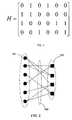
- FIG. 1 illustrates a parity check matrix representation of an exemplary irregular LDPC code of codeword length six.
- LDPC codes can also be represented by bipartite graphs, or Tanner graphs.
- Tanner graph one set of nodes called variable nodes (or bit nodes) corresponds to the bits of the codeword and the other set of nodes called constraints nodes (or check nodes) corresponds the set of parity check constrains which define the LDPC code.
- Bit nodes and check nodes are connected by edges, and a bit node and a check node are said to be neighbors or adjacent if they are connected by an edge. Generally, it is assumed that a pair of nodes is connected by at most one edge.
- FIG. 2 illustrates a bipartite graph representation of the irregular LDPC code illustrated in FIG. 1.
- LDPC codes can be decoded in various ways such as majority-logic decoding and iterative decoding. Because of the structures of their parity check matrices, LDPC codes are majority-logic decodable. Although majority-logic decoding requires the least complexity and achieves reasonably good error performance for decoding some types of LDPC codes with relatively high column weights in their parity check matrices (e. g. Euclidean geometry LDPC and projective geometry LDPC codes), iterative decoding methods have received more attention due to their better performance versus complexity tradeoffs. Unlike majority-logic decoding, iterative decoding processes the received symbols recursively to improve the reliability of each symbol based on constraints that specify the code. In a first iteration, an iterative decoder only uses a channel output as input, and generates reliability output for each symbol.
- iterative decoding algorithms can be further divided into hard decision, soft decision and hybrid decision algorithms.
- the corresponding popular algorithms are iterative bit-flipping (BF), belief propagation (BP), and weighted bit-flipping (WBF) decoding, respectively. Since BP algorithms have been proven to provide maximum likelihood decoding when the underlying Tanner graph is acyclic, they have become the most popular decoding methods.
- BP for LDPC codes is a type of message passing decoding. Messages transmitted along the edges of a graph are log-likelihood ratio (LLR) log ⁇ p 0 p 1 associated with variable nodes corresponding to codeword bits. In this expression p 0 and p 1 denote the probability that the associated bit value becomes either a 0 or a 1, respectively.
- BP decoding generally includes two steps, a horizontal step and a vertical step. In the horizontal step, each check node c m sends to each adjacent bit b n a check-to-bit message which is calculated based on all bit-to-check messages incoming to the check c m except one from bit b n .
- each bit node b n sends to each adjacent check node c m a bit-to-check message which is calculated based on all check-to-bit messages incoming to the bit b n except one from check node c m , These two steps are repeated until a valid codeword is found or the maximum number of iterations is reached.
- irregular LDPC codes are among the best for many applications.
- Various irregular LDPC codes have been accepted or being considered for various communication and storage standards, such as DVB-S2/DAB, wireline ADSL, IEEE 802.1 In, and IEEE 802.16.
- the threshold of an LDPC code is defined as the smallest SNR value at which, as the codeword length tends to infinity, the bit error probability can be made arbitrarily small.
- the value of threshold of an LDPC code can be determined by analytical tool called density evolution.
- Gallager derived formulas to calculate the output bit error rate (BER) for each iteration as a function of the input BER at the beginning of the iteration, and then iteratively calculated the BER at a given iteration. For a continuous alphabet, the calculation is more complex.
- the probability density functions (pdf) of the belief messages exchanged between bit and check nodes need to be calculated from one iteration to the next, and the average BER for each iteration can be derived based on these pdf.
- each outgoing belief message is a function of incoming belief messages.
- the incoming messages to bit and check nodes are independent, and thus the derivation for the pdf of the outgoing messages can be considerably simplified.
- the corresponding Tanner graph contains cycles.
- the minimum length of a cycle (or girth) in a Tanner graph of an LDPC code is equal to 4 ⁇ l , then the independence assumption does not hold after the l- th decoding iteration with the standard BP decoding.
- the independence condition is satisfied for an increasing iteration number. Therefore, the density evolution predicts the asymptotic performance of an ensemble of LDPC codes and the "asymptotic" nature is in the sense of code length.
- the bit mapping schemes provide good threshold of LDPC codes. Furthermore, the bit mapping schemes can facilitate the design of an interleaving arrangement in a 16APSK modulation system.
- the disclosed bit mapping offers good performance of LDPC coded 16APSK system and simplifies an interleaving arrangement in 16APSK systems.
- a method of bit mapping in a 16APSK system comprises: transmitting a digital signal from a transmitter; and receiving the digital signal at a receiver; wherein the digital signal utilizes a 16APSK system with FEC coding, and the signal is bit-mapped prior to the transmitting according to a formula embodied by FIG. 4.
- the FEC code is regular LDPC code.
- the FEC code is irregular LDPC code.
- the FEC code is regular repeat-accumulate code.
- the FEC code is irregular repeat-accumulate code.
- a digital communication system comprises: a transmitter to transmit a digital signal; and a receiver to receive the digital signal; wherein the digital signal utilizes a 16APSK system with FEC coding, and the signal is bit-mapped prior to the transmitting according to a formula embodied by FIG. 4.
- a digital communication system comprises: a transmitter to transmit a digital signal; and a receiver to receive the digital signal; wherein the digital signal utilizes a 16APSK system with FEC coding, and the signal is bit-mapped using gray mapping, and bits of the digital signal are ordered based on the values of a log likelihood ratio from a communications channel.
- FIG. 1 is a parity check matrix representation of an exemplary irregular LDPC code of codeword length six.
- FIG. 2 illustrates a bipartite graph representation of the irregular LDPC code illustrated in FIG. 1.
- FIG. 3 illustrates the bit mapping block in 16APSK modulation, according to various embodiments of the invention.
- FIG. 4 illustrates a bit map for 16APSK symbol, according to various embodiments of the invention.
- FIG. 5 depicts an example of a communications system which employs LDPC codes and 16APSK modulation, according to various embodiments of the invention.
- FIG. 6 depicts an example of a transmitter employing 16APSK modulation in FIG. 5, according to various embodiments of the invention.
- FIG. 7 depicts an example of a receiver employing 16APSK demodulation in FIG. 5, according to various embodiments of the invention.
- bit mapping approach can be utilized with other codes. Furthermore, it is recognized that this approach can be implemented with uncoded systems.
- FIG. 5 is an exemplary diagram of a communications system employing LDPC codes with 16APSK modulation, according to various embodiments of the invention.
- the exemplary communications system includes a transmitter 501 which generates signal waveforms across a communication channel 502 to a receiver 503.
- the transmitter 501 contains a message source for producing a discrete set of possible messages. Each of these messages corresponds to a signal waveform.
- the waveforms enter the channel 502 and are corrupted by noise.
- LDPC codes are employed to reduce the disturbances introduced by the channel 502, and a 16APSK modulation scheme is employed to transform LDPC encoded bits to signal waveforms.
- FIG. 6 depicts an exemplary transmitter 501; 600 in the communications system of FIG. 5 which employs LDPC codes and 16APSK modulation.
- the LDPC encoder 602 encodes information bits from source 601 into LDPC codewords. The mapping from each information block to each LDPC codeword is specified by the parity check matrix (or equivalently the generator matrix) of the LDPC code.
- the LDPC codeword is interleaved and modulated to signal waveforms by the interleaver/modulator 603 based on a 16APSK bit mapping scheme. These signal waveforms are sent to a transmit antenna 604 and propagated to a receiver 700 shown in FIG. 7.
- FIG. 7 depicts an exemplary receiver 503; 700 in FIG. 5 which employs LDPC codes and 16APSK demodulator.
- Signal waveforms are received by the receiving antenna 701 and distributed to demodulator/deinterleavor 702.
- Signal waveforms are demodulated by demodulator and deinterleaved by deinterleavor and then distributed to a LDPC decoder 703 which iteratively decodes the received messages and output estimations of the transmitted codeword.
- the 16APSK demodulation rule employed by the demodulator/deinterleaver 702 should match with the 16APSK modulation rule employed by the interleaver/modulator 603.
- the bit mapping logic is shown in FIG. 4.
- the bit mapping scheme of FIG. 4 uses gray mapping, meaning the binary representations of adjacent symbols differ by only one bit. Density evolution analysis shows that given an LDPC coded 16APSK system, the exemplary gray mapping scheme can provide the best threshold.
- the bit mapping scheme of FIG. 4 also arranges bits in an order based on the values of a log likelihood ratio from the communications channel. This arrangement simplifies the design of interleaving scheme for 16APSK system.
Landscapes
- Engineering & Computer Science (AREA)
- Physics & Mathematics (AREA)
- Probability & Statistics with Applications (AREA)
- Theoretical Computer Science (AREA)
- Computer Networks & Wireless Communication (AREA)
- Signal Processing (AREA)
- Error Detection And Correction (AREA)
- Digital Transmission Methods That Use Modulated Carrier Waves (AREA)
- Detection And Prevention Of Errors In Transmission (AREA)
Applications Claiming Priority (1)
| Application Number | Priority Date | Filing Date | Title |
|---|---|---|---|
| PCT/CN2006/002423 WO2008034288A1 (en) | 2006-09-18 | 2006-09-18 | Bit mapping scheme for an ldpc coded 16apsk system |
Publications (2)
| Publication Number | Publication Date |
|---|---|
| EP1901436A2 true EP1901436A2 (de) | 2008-03-19 |
| EP1901436A3 EP1901436A3 (de) | 2008-04-23 |
Family
ID=38657780
Family Applications (1)
| Application Number | Title | Priority Date | Filing Date |
|---|---|---|---|
| EP07016675A Withdrawn EP1901436A3 (de) | 2006-09-18 | 2007-08-24 | Bit-Mapping-Schema für ein LDPC-kodiertes 16APSK-System |
Country Status (3)
| Country | Link |
|---|---|
| EP (1) | EP1901436A3 (de) |
| TW (1) | TW200816650A (de) |
| WO (1) | WO2008034288A1 (de) |
Cited By (1)
| Publication number | Priority date | Publication date | Assignee | Title |
|---|---|---|---|---|
| EP2985966A4 (de) * | 2013-04-12 | 2016-03-30 | Panasonic Ip Corp America | Übertragungsverfahren |
Families Citing this family (1)
| Publication number | Priority date | Publication date | Assignee | Title |
|---|---|---|---|---|
| JP4898858B2 (ja) * | 2009-03-02 | 2012-03-21 | パナソニック株式会社 | 符号化器、復号化器及び符号化方法 |
Family Cites Families (2)
| Publication number | Priority date | Publication date | Assignee | Title |
|---|---|---|---|---|
| US7123663B2 (en) * | 2002-06-04 | 2006-10-17 | Agence Spatiale Europeenne | Coded digital modulation method for communication system |
| US7577207B2 (en) * | 2002-07-03 | 2009-08-18 | Dtvg Licensing, Inc. | Bit labeling for amplitude phase shift constellation used with low density parity check (LDPC) codes |
-
2006
- 2006-09-18 WO PCT/CN2006/002423 patent/WO2008034288A1/en not_active Ceased
-
2007
- 2007-03-07 TW TW096107912A patent/TW200816650A/zh unknown
- 2007-08-24 EP EP07016675A patent/EP1901436A3/de not_active Withdrawn
Non-Patent Citations (2)
| Title |
|---|
| RICCARDO DE GAUDENZI ET AL.: "Performance Analysis of Turbo-Coded APSK Modulations over Nonlinear Satellite Channels", IEEE TRANSACTIONS ON WIRELESS COMMUNICATION, vol. 5, no. 9, September 2006 (2006-09-01), pages 2396 - 2407, XP002457811, DOI: doi:10.1109/TWC.2006.1687763 |
| YAN LI; WILLIAM RYAN: "Bit-Reliability Mapping in LDPC-Codes Modulation systems", IEEE COMMUNICATIONS LETTERS, vol. 9, no. 1, January 2005 (2005-01-01) |
Cited By (6)
| Publication number | Priority date | Publication date | Assignee | Title |
|---|---|---|---|---|
| EP2985966A4 (de) * | 2013-04-12 | 2016-03-30 | Panasonic Ip Corp America | Übertragungsverfahren |
| US9491026B2 (en) | 2013-04-12 | 2016-11-08 | Sun Patent Trust | Transmission method |
| US9942067B2 (en) | 2013-04-12 | 2018-04-10 | Sun Patent Trust | Transmission method |
| US10177948B2 (en) | 2013-04-12 | 2019-01-08 | Sun Patent Trust | Transmission method |
| US10476713B1 (en) | 2013-04-12 | 2019-11-12 | Sun Patent Trust | Transmission method |
| US10742459B2 (en) | 2013-04-12 | 2020-08-11 | Sun Patent Trust | Transmission method |
Also Published As
| Publication number | Publication date |
|---|---|
| EP1901436A3 (de) | 2008-04-23 |
| WO2008034288A1 (en) | 2008-03-27 |
| TW200816650A (en) | 2008-04-01 |
Similar Documents
| Publication | Publication Date | Title |
|---|---|---|
| US8369448B2 (en) | Bit mapping scheme for an LDPC coded 32APSK system | |
| US7222284B2 (en) | Low-density parity-check codes for multiple code rates | |
| US11791845B2 (en) | Method and apparatus for channel encoding and decoding in communication or broadcasting system | |
| US8386880B2 (en) | Method for transmitting non-binary codes and decoding the same | |
| EP1901433A1 (de) | Familie von LDPC-Codes für Videorundfunkanwendungen | |
| EP1901434A1 (de) | Verschachtelungsschema für ein LDPC kodiertes 16 APSK system | |
| US8230299B2 (en) | Interleaving scheme for an LDPC coded QPSK/8PSK system | |
| KR100987692B1 (ko) | 통신 시스템에서 신호 송수신 장치 및 방법 | |
| US9735921B2 (en) | Ultra-high speed optical transport employing LDPC-coded modulation with non-uniform signaling | |
| US8301960B2 (en) | Interleaving scheme for an LDPC coded 32 APSK system | |
| CN108650029B (zh) | 一种适用于量子安全直接通信的纠错编译码方法 | |
| Ma et al. | Delayed bit interleaved coded modulation | |
| EP1901436A2 (de) | Bit-Mapping-Schema für ein LDPC-kodiertes 16APSK-System | |
| US20110173509A1 (en) | Bit mapping scheme for an ldpc coded 16apsk system | |
| US7559010B2 (en) | Short length LDPC (Low Density Parity Check) code and modulation adapted for high speed Ethernet applications | |
| CN101150551B (zh) | 低密度奇偶校验编码的qpsk/8psk系统的交织方案 | |
| CN101150377A (zh) | 用于低密度奇偶校验编码的32apsk系统的比特映射方案 | |
| CN101150378B (zh) | 低密度奇偶校验编码的32apsk系统的交织方案 | |
| EP1901438A2 (de) | Verschachteltes Schema für ein LDPC-kodiertes QPSK-/8PSK-System | |
| CN101150550B (zh) | 交织低密度奇偶校验编码比特的方法、发射器和接收器 | |
| Ozates et al. | Channel coding for energy harvesting communications using run length limited codes | |
| HK1118987A (en) | Bit mapping scheme for an ldpc coded 32apsk system | |
| HK1118988A (en) | Bit mapping scheme for an ldpc coded 16apsk system | |
| CN101150552A (zh) | 用于低密度奇偶校验编码的16apsk系统的比特映射方案 | |
| Hekim et al. | Performance of low density parity check coded continuous phase frequency shift keying (LDPCC‐CPFSK) over fading channels |
Legal Events
| Date | Code | Title | Description |
|---|---|---|---|
| PUAI | Public reference made under article 153(3) epc to a published international application that has entered the european phase |
Free format text: ORIGINAL CODE: 0009012 |
|
| AK | Designated contracting states |
Kind code of ref document: A2 Designated state(s): AT BE BG CH CY CZ DE DK EE ES FI FR GB GR HU IE IS IT LI LT LU LV MC MT NL PL PT RO SE SI SK TR |
|
| AX | Request for extension of the european patent |
Extension state: AL BA HR MK YU |
|
| PUAL | Search report despatched |
Free format text: ORIGINAL CODE: 0009013 |
|
| AK | Designated contracting states |
Kind code of ref document: A3 Designated state(s): AT BE BG CH CY CZ DE DK EE ES FI FR GB GR HU IE IS IT LI LT LU LV MC MT NL PL PT RO SE SI SK TR |
|
| AX | Request for extension of the european patent |
Extension state: AL BA HR MK RS |
|
| 17P | Request for examination filed |
Effective date: 20080918 |
|
| 17Q | First examination report despatched |
Effective date: 20081021 |
|
| AKX | Designation fees paid |
Designated state(s): AT BE BG CH CY CZ DE DK EE ES FI FR GB GR HU IE IS IT LI LT LU LV MC MT NL PL PT RO SE SI SK TR |
|
| APBK | Appeal reference recorded |
Free format text: ORIGINAL CODE: EPIDOSNREFNE |
|
| APBN | Date of receipt of notice of appeal recorded |
Free format text: ORIGINAL CODE: EPIDOSNNOA2E |
|
| APBR | Date of receipt of statement of grounds of appeal recorded |
Free format text: ORIGINAL CODE: EPIDOSNNOA3E |
|
| APAF | Appeal reference modified |
Free format text: ORIGINAL CODE: EPIDOSCREFNE |
|
| APBT | Appeal procedure closed |
Free format text: ORIGINAL CODE: EPIDOSNNOA9E |
|
| STAA | Information on the status of an ep patent application or granted ep patent |
Free format text: STATUS: THE APPLICATION IS DEEMED TO BE WITHDRAWN |
|
| 18D | Application deemed to be withdrawn |
Effective date: 20130301 |