EP1894907A1 - Method for producing porous silica ceramic - Google Patents
Method for producing porous silica ceramic Download PDFInfo
- Publication number
- EP1894907A1 EP1894907A1 EP06767266A EP06767266A EP1894907A1 EP 1894907 A1 EP1894907 A1 EP 1894907A1 EP 06767266 A EP06767266 A EP 06767266A EP 06767266 A EP06767266 A EP 06767266A EP 1894907 A1 EP1894907 A1 EP 1894907A1
- Authority
- EP
- European Patent Office
- Prior art keywords
- green
- porous silica
- sintering aid
- ceramic material
- silica ceramic
- Prior art date
- Legal status (The legal status is an assumption and is not a legal conclusion. Google has not performed a legal analysis and makes no representation as to the accuracy of the status listed.)
- Withdrawn
Links
- VYPSYNLAJGMNEJ-UHFFFAOYSA-N Silicium dioxide Chemical compound O=[Si]=O VYPSYNLAJGMNEJ-UHFFFAOYSA-N 0.000 title claims abstract description 124
- 239000000377 silicon dioxide Substances 0.000 title claims abstract description 54
- 238000004519 manufacturing process Methods 0.000 title claims abstract description 24
- 239000000919 ceramic Substances 0.000 title description 8
- 238000005245 sintering Methods 0.000 claims abstract description 56
- 229910010293 ceramic material Inorganic materials 0.000 claims abstract description 44
- 238000010304 firing Methods 0.000 claims abstract description 40
- 239000004014 plasticizer Substances 0.000 claims abstract description 24
- 238000000034 method Methods 0.000 claims abstract description 22
- 239000000203 mixture Substances 0.000 claims abstract description 18
- 239000011230 binding agent Substances 0.000 claims abstract description 7
- 150000001875 compounds Chemical class 0.000 claims description 35
- NTHWMYGWWRZVTN-UHFFFAOYSA-N sodium silicate Chemical compound [Na+].[Na+].[O-][Si]([O-])=O NTHWMYGWWRZVTN-UHFFFAOYSA-N 0.000 claims description 23
- 235000019353 potassium silicate Nutrition 0.000 claims description 22
- 239000007788 liquid Substances 0.000 claims description 11
- 229910052783 alkali metal Inorganic materials 0.000 claims description 8
- 150000001340 alkali metals Chemical class 0.000 claims description 8
- KGBXLFKZBHKPEV-UHFFFAOYSA-N boric acid Chemical compound OB(O)O KGBXLFKZBHKPEV-UHFFFAOYSA-N 0.000 claims description 8
- 239000004327 boric acid Substances 0.000 claims description 8
- ZOXJGFHDIHLPTG-UHFFFAOYSA-N Boron Chemical compound [B] ZOXJGFHDIHLPTG-UHFFFAOYSA-N 0.000 claims description 6
- 229910052784 alkaline earth metal Inorganic materials 0.000 claims description 6
- 150000001342 alkaline earth metals Chemical class 0.000 claims description 6
- 229910052796 boron Inorganic materials 0.000 claims description 6
- OAICVXFJPJFONN-UHFFFAOYSA-N Phosphorus Chemical compound [P] OAICVXFJPJFONN-UHFFFAOYSA-N 0.000 claims description 5
- 239000011574 phosphorus Substances 0.000 claims description 5
- 229910052698 phosphorus Inorganic materials 0.000 claims description 5
- VEXZGXHMUGYJMC-UHFFFAOYSA-M Chloride anion Chemical compound [Cl-] VEXZGXHMUGYJMC-UHFFFAOYSA-M 0.000 claims description 4
- NBIIXXVUZAFLBC-UHFFFAOYSA-N Phosphoric acid Chemical compound OP(O)(O)=O NBIIXXVUZAFLBC-UHFFFAOYSA-N 0.000 claims description 4
- 159000000021 acetate salts Chemical class 0.000 claims description 4
- 150000005323 carbonate salts Chemical class 0.000 claims description 4
- XLYOFNOQVPJJNP-UHFFFAOYSA-M hydroxide Chemical compound [OH-] XLYOFNOQVPJJNP-UHFFFAOYSA-M 0.000 claims description 4
- 150000002823 nitrates Chemical class 0.000 claims description 4
- 150000003467 sulfuric acid derivatives Chemical class 0.000 claims description 4
- 150000003013 phosphoric acid derivatives Chemical class 0.000 claims description 3
- 229910000147 aluminium phosphate Inorganic materials 0.000 claims description 2
- 229910021538 borax Inorganic materials 0.000 claims description 2
- 150000003016 phosphoric acids Chemical class 0.000 claims description 2
- 239000004328 sodium tetraborate Substances 0.000 claims description 2
- 235000010339 sodium tetraborate Nutrition 0.000 claims description 2
- 239000011148 porous material Substances 0.000 description 29
- HEMHJVSKTPXQMS-UHFFFAOYSA-M Sodium hydroxide Chemical compound [OH-].[Na+] HEMHJVSKTPXQMS-UHFFFAOYSA-M 0.000 description 15
- WCUXLLCKKVVCTQ-UHFFFAOYSA-M Potassium chloride Chemical compound [Cl-].[K+] WCUXLLCKKVVCTQ-UHFFFAOYSA-M 0.000 description 10
- FAPWRFPIFSIZLT-UHFFFAOYSA-M Sodium chloride Chemical compound [Na+].[Cl-] FAPWRFPIFSIZLT-UHFFFAOYSA-M 0.000 description 10
- 235000002639 sodium chloride Nutrition 0.000 description 9
- 239000000843 powder Substances 0.000 description 8
- 238000010790 dilution Methods 0.000 description 7
- 239000012895 dilution Substances 0.000 description 7
- 239000000243 solution Substances 0.000 description 7
- XLYOFNOQVPJJNP-UHFFFAOYSA-N water Substances O XLYOFNOQVPJJNP-UHFFFAOYSA-N 0.000 description 7
- 239000000463 material Substances 0.000 description 6
- 239000005373 porous glass Substances 0.000 description 6
- 239000011734 sodium Substances 0.000 description 6
- 239000007864 aqueous solution Substances 0.000 description 5
- 230000000052 comparative effect Effects 0.000 description 5
- 239000011521 glass Substances 0.000 description 5
- 239000003960 organic solvent Substances 0.000 description 5
- 239000001103 potassium chloride Substances 0.000 description 5
- 235000011164 potassium chloride Nutrition 0.000 description 5
- 229920005989 resin Polymers 0.000 description 5
- 239000011347 resin Substances 0.000 description 5
- 239000011780 sodium chloride Substances 0.000 description 5
- 235000011121 sodium hydroxide Nutrition 0.000 description 5
- 239000002253 acid Substances 0.000 description 4
- 238000005470 impregnation Methods 0.000 description 4
- 238000002844 melting Methods 0.000 description 4
- 230000008018 melting Effects 0.000 description 4
- 238000005191 phase separation Methods 0.000 description 4
- -1 polyethylene Polymers 0.000 description 4
- 150000003839 salts Chemical class 0.000 description 4
- LWIHDJKSTIGBAC-UHFFFAOYSA-K tripotassium phosphate Chemical compound [K+].[K+].[K+].[O-]P([O-])([O-])=O LWIHDJKSTIGBAC-UHFFFAOYSA-K 0.000 description 4
- ZWEHNKRNPOVVGH-UHFFFAOYSA-N 2-Butanone Chemical compound CCC(C)=O ZWEHNKRNPOVVGH-UHFFFAOYSA-N 0.000 description 3
- UXVMQQNJUSDDNG-UHFFFAOYSA-L Calcium chloride Chemical compound [Cl-].[Cl-].[Ca+2] UXVMQQNJUSDDNG-UHFFFAOYSA-L 0.000 description 3
- WMFOQBRAJBCJND-UHFFFAOYSA-M Lithium hydroxide Chemical compound [Li+].[OH-] WMFOQBRAJBCJND-UHFFFAOYSA-M 0.000 description 3
- KWYUFKZDYYNOTN-UHFFFAOYSA-M Potassium hydroxide Chemical compound [OH-].[K+] KWYUFKZDYYNOTN-UHFFFAOYSA-M 0.000 description 3
- 239000001110 calcium chloride Substances 0.000 description 3
- 229910001628 calcium chloride Inorganic materials 0.000 description 3
- 239000003795 chemical substances by application Substances 0.000 description 3
- 239000000314 lubricant Substances 0.000 description 3
- 239000002480 mineral oil Substances 0.000 description 3
- 235000010446 mineral oil Nutrition 0.000 description 3
- 239000002245 particle Substances 0.000 description 3
- 229920000098 polyolefin Polymers 0.000 description 3
- CXWXQJXEFPUFDZ-UHFFFAOYSA-N tetralin Chemical compound C1=CC=C2CCCCC2=C1 CXWXQJXEFPUFDZ-UHFFFAOYSA-N 0.000 description 3
- VTYYLEPIZMXCLO-UHFFFAOYSA-L Calcium carbonate Chemical compound [Ca+2].[O-]C([O-])=O VTYYLEPIZMXCLO-UHFFFAOYSA-L 0.000 description 2
- LFQSCWFLJHTTHZ-UHFFFAOYSA-N Ethanol Chemical compound CCO LFQSCWFLJHTTHZ-UHFFFAOYSA-N 0.000 description 2
- TWRXJAOTZQYOKJ-UHFFFAOYSA-L Magnesium chloride Chemical compound [Mg+2].[Cl-].[Cl-] TWRXJAOTZQYOKJ-UHFFFAOYSA-L 0.000 description 2
- CSNNHWWHGAXBCP-UHFFFAOYSA-L Magnesium sulfate Chemical compound [Mg+2].[O-][S+2]([O-])([O-])[O-] CSNNHWWHGAXBCP-UHFFFAOYSA-L 0.000 description 2
- CDBYLPFSWZWCQE-UHFFFAOYSA-L Sodium Carbonate Chemical compound [Na+].[Na+].[O-]C([O-])=O CDBYLPFSWZWCQE-UHFFFAOYSA-L 0.000 description 2
- 239000004115 Sodium Silicate Substances 0.000 description 2
- UIIMBOGNXHQVGW-UHFFFAOYSA-M Sodium bicarbonate Chemical compound [Na+].OC([O-])=O UIIMBOGNXHQVGW-UHFFFAOYSA-M 0.000 description 2
- 239000003463 adsorbent Substances 0.000 description 2
- IWOUKMZUPDVPGQ-UHFFFAOYSA-N barium nitrate Chemical compound [Ba+2].[O-][N+]([O-])=O.[O-][N+]([O-])=O IWOUKMZUPDVPGQ-UHFFFAOYSA-N 0.000 description 2
- TZCXTZWJZNENPQ-UHFFFAOYSA-L barium sulfate Chemical compound [Ba+2].[O-]S([O-])(=O)=O TZCXTZWJZNENPQ-UHFFFAOYSA-L 0.000 description 2
- WAKZZMMCDILMEF-UHFFFAOYSA-H barium(2+);diphosphate Chemical compound [Ba+2].[Ba+2].[Ba+2].[O-]P([O-])([O-])=O.[O-]P([O-])([O-])=O WAKZZMMCDILMEF-UHFFFAOYSA-H 0.000 description 2
- ZCCIPPOKBCJFDN-UHFFFAOYSA-N calcium nitrate Chemical compound [Ca+2].[O-][N+]([O-])=O.[O-][N+]([O-])=O ZCCIPPOKBCJFDN-UHFFFAOYSA-N 0.000 description 2
- 239000001506 calcium phosphate Substances 0.000 description 2
- 229910000389 calcium phosphate Inorganic materials 0.000 description 2
- 235000011010 calcium phosphates Nutrition 0.000 description 2
- OSGAYBCDTDRGGQ-UHFFFAOYSA-L calcium sulfate Chemical compound [Ca+2].[O-]S([O-])(=O)=O OSGAYBCDTDRGGQ-UHFFFAOYSA-L 0.000 description 2
- 239000007809 chemical reaction catalyst Substances 0.000 description 2
- 239000003153 chemical reaction reagent Substances 0.000 description 2
- 229910052681 coesite Inorganic materials 0.000 description 2
- 229910052906 cristobalite Inorganic materials 0.000 description 2
- DIOQZVSQGTUSAI-UHFFFAOYSA-N decane Chemical compound CCCCCCCCCC DIOQZVSQGTUSAI-UHFFFAOYSA-N 0.000 description 2
- 238000007865 diluting Methods 0.000 description 2
- 238000009826 distribution Methods 0.000 description 2
- 238000010438 heat treatment Methods 0.000 description 2
- 229920001903 high density polyethylene Polymers 0.000 description 2
- 239000004700 high-density polyethylene Substances 0.000 description 2
- 238000002372 labelling Methods 0.000 description 2
- KWGKDLIKAYFUFQ-UHFFFAOYSA-M lithium chloride Chemical compound [Li+].[Cl-] KWGKDLIKAYFUFQ-UHFFFAOYSA-M 0.000 description 2
- IIPYXGDZVMZOAP-UHFFFAOYSA-N lithium nitrate Chemical compound [Li+].[O-][N+]([O-])=O IIPYXGDZVMZOAP-UHFFFAOYSA-N 0.000 description 2
- 229910001386 lithium phosphate Inorganic materials 0.000 description 2
- YIXJRHPUWRPCBB-UHFFFAOYSA-N magnesium nitrate Chemical compound [Mg+2].[O-][N+]([O-])=O.[O-][N+]([O-])=O YIXJRHPUWRPCBB-UHFFFAOYSA-N 0.000 description 2
- GVALZJMUIHGIMD-UHFFFAOYSA-H magnesium phosphate Chemical compound [Mg+2].[Mg+2].[Mg+2].[O-]P([O-])([O-])=O.[O-]P([O-])([O-])=O GVALZJMUIHGIMD-UHFFFAOYSA-H 0.000 description 2
- 239000004137 magnesium phosphate Substances 0.000 description 2
- 229910000157 magnesium phosphate Inorganic materials 0.000 description 2
- 229960002261 magnesium phosphate Drugs 0.000 description 2
- 235000010994 magnesium phosphates Nutrition 0.000 description 2
- 238000002156 mixing Methods 0.000 description 2
- VLKZOEOYAKHREP-UHFFFAOYSA-N n-Hexane Chemical compound CCCCCC VLKZOEOYAKHREP-UHFFFAOYSA-N 0.000 description 2
- SCVFZCLFOSHCOH-UHFFFAOYSA-M potassium acetate Chemical compound [K+].CC([O-])=O SCVFZCLFOSHCOH-UHFFFAOYSA-M 0.000 description 2
- BWHMMNNQKKPAPP-UHFFFAOYSA-L potassium carbonate Chemical compound [K+].[K+].[O-]C([O-])=O BWHMMNNQKKPAPP-UHFFFAOYSA-L 0.000 description 2
- FGIUAXJPYTZDNR-UHFFFAOYSA-N potassium nitrate Chemical compound [K+].[O-][N+]([O-])=O FGIUAXJPYTZDNR-UHFFFAOYSA-N 0.000 description 2
- 229910000160 potassium phosphate Inorganic materials 0.000 description 2
- 235000011009 potassium phosphates Nutrition 0.000 description 2
- 150000004760 silicates Chemical class 0.000 description 2
- VWDWKYIASSYTQR-UHFFFAOYSA-N sodium nitrate Chemical compound [Na+].[O-][N+]([O-])=O VWDWKYIASSYTQR-UHFFFAOYSA-N 0.000 description 2
- 239000001488 sodium phosphate Substances 0.000 description 2
- 229910000162 sodium phosphate Inorganic materials 0.000 description 2
- 229910052911 sodium silicate Inorganic materials 0.000 description 2
- 239000002904 solvent Substances 0.000 description 2
- 229910052682 stishovite Inorganic materials 0.000 description 2
- DHEQXMRUPNDRPG-UHFFFAOYSA-N strontium nitrate Chemical compound [Sr+2].[O-][N+]([O-])=O.[O-][N+]([O-])=O DHEQXMRUPNDRPG-UHFFFAOYSA-N 0.000 description 2
- UBXAKNTVXQMEAG-UHFFFAOYSA-L strontium sulfate Chemical compound [Sr+2].[O-]S([O-])(=O)=O UBXAKNTVXQMEAG-UHFFFAOYSA-L 0.000 description 2
- QORWJWZARLRLPR-UHFFFAOYSA-H tricalcium bis(phosphate) Chemical compound [Ca+2].[Ca+2].[Ca+2].[O-]P([O-])([O-])=O.[O-]P([O-])([O-])=O QORWJWZARLRLPR-UHFFFAOYSA-H 0.000 description 2
- 229910052905 tridymite Inorganic materials 0.000 description 2
- TWQULNDIKKJZPH-UHFFFAOYSA-K trilithium;phosphate Chemical compound [Li+].[Li+].[Li+].[O-]P([O-])([O-])=O TWQULNDIKKJZPH-UHFFFAOYSA-K 0.000 description 2
- RYFMWSXOAZQYPI-UHFFFAOYSA-K trisodium phosphate Chemical compound [Na+].[Na+].[Na+].[O-]P([O-])([O-])=O RYFMWSXOAZQYPI-UHFFFAOYSA-K 0.000 description 2
- JOPDZQBPOWAEHC-UHFFFAOYSA-H tristrontium;diphosphate Chemical compound [Sr+2].[Sr+2].[Sr+2].[O-]P([O-])([O-])=O.[O-]P([O-])([O-])=O JOPDZQBPOWAEHC-UHFFFAOYSA-H 0.000 description 2
- ZXPCCXXSNUIVNK-UHFFFAOYSA-N 1,1,1,2,3-pentachloropropane Chemical compound ClCC(Cl)C(Cl)(Cl)Cl ZXPCCXXSNUIVNK-UHFFFAOYSA-N 0.000 description 1
- UOCLXMDMGBRAIB-UHFFFAOYSA-N 1,1,1-trichloroethane Chemical compound CC(Cl)(Cl)Cl UOCLXMDMGBRAIB-UHFFFAOYSA-N 0.000 description 1
- 229920000178 Acrylic resin Polymers 0.000 description 1
- 239000004925 Acrylic resin Substances 0.000 description 1
- 239000004254 Ammonium phosphate Substances 0.000 description 1
- 239000004215 Carbon black (E152) Substances 0.000 description 1
- 235000019738 Limestone Nutrition 0.000 description 1
- KKCBUQHMOMHUOY-UHFFFAOYSA-N Na2O Inorganic materials [O-2].[Na+].[Na+] KKCBUQHMOMHUOY-UHFFFAOYSA-N 0.000 description 1
- UFWIBTONFRDIAS-UHFFFAOYSA-N Naphthalene Chemical compound C1=CC=CC2=CC=CC=C21 UFWIBTONFRDIAS-UHFFFAOYSA-N 0.000 description 1
- 229920003171 Poly (ethylene oxide) Polymers 0.000 description 1
- 239000004698 Polyethylene Substances 0.000 description 1
- 239000004743 Polypropylene Substances 0.000 description 1
- PMZURENOXWZQFD-UHFFFAOYSA-L Sodium Sulfate Chemical compound [Na+].[Na+].[O-]S([O-])(=O)=O PMZURENOXWZQFD-UHFFFAOYSA-L 0.000 description 1
- VMHLLURERBWHNL-UHFFFAOYSA-M Sodium acetate Chemical compound [Na+].CC([O-])=O VMHLLURERBWHNL-UHFFFAOYSA-M 0.000 description 1
- 239000002250 absorbent Substances 0.000 description 1
- 230000002745 absorbent Effects 0.000 description 1
- 150000005215 alkyl ethers Chemical class 0.000 description 1
- 229910000148 ammonium phosphate Inorganic materials 0.000 description 1
- 235000019289 ammonium phosphates Nutrition 0.000 description 1
- 125000000129 anionic group Chemical group 0.000 description 1
- 239000012298 atmosphere Substances 0.000 description 1
- 229910052788 barium Inorganic materials 0.000 description 1
- ITHZDDVSAWDQPZ-UHFFFAOYSA-L barium acetate Chemical compound [Ba+2].CC([O-])=O.CC([O-])=O ITHZDDVSAWDQPZ-UHFFFAOYSA-L 0.000 description 1
- WDIHJSXYQDMJHN-UHFFFAOYSA-L barium chloride Chemical compound [Cl-].[Cl-].[Ba+2] WDIHJSXYQDMJHN-UHFFFAOYSA-L 0.000 description 1
- 229910001626 barium chloride Inorganic materials 0.000 description 1
- RQPZNWPYLFFXCP-UHFFFAOYSA-L barium dihydroxide Chemical compound [OH-].[OH-].[Ba+2] RQPZNWPYLFFXCP-UHFFFAOYSA-L 0.000 description 1
- 229910001863 barium hydroxide Inorganic materials 0.000 description 1
- AYJRCSIUFZENHW-DEQYMQKBSA-L barium(2+);oxomethanediolate Chemical compound [Ba+2].[O-][14C]([O-])=O AYJRCSIUFZENHW-DEQYMQKBSA-L 0.000 description 1
- 229910052791 calcium Inorganic materials 0.000 description 1
- 239000011575 calcium Substances 0.000 description 1
- VSGNNIFQASZAOI-UHFFFAOYSA-L calcium acetate Chemical compound [Ca+2].CC([O-])=O.CC([O-])=O VSGNNIFQASZAOI-UHFFFAOYSA-L 0.000 description 1
- 239000001639 calcium acetate Substances 0.000 description 1
- 235000011092 calcium acetate Nutrition 0.000 description 1
- 229960005147 calcium acetate Drugs 0.000 description 1
- 229910000019 calcium carbonate Inorganic materials 0.000 description 1
- AXCZMVOFGPJBDE-UHFFFAOYSA-L calcium dihydroxide Chemical compound [OH-].[OH-].[Ca+2] AXCZMVOFGPJBDE-UHFFFAOYSA-L 0.000 description 1
- 239000000920 calcium hydroxide Substances 0.000 description 1
- 229910001861 calcium hydroxide Inorganic materials 0.000 description 1
- QXIKMJLSPJFYOI-UHFFFAOYSA-L calcium;dichlorite Chemical compound [Ca+2].[O-]Cl=O.[O-]Cl=O QXIKMJLSPJFYOI-UHFFFAOYSA-L 0.000 description 1
- 239000003990 capacitor Substances 0.000 description 1
- 239000011248 coating agent Substances 0.000 description 1
- 238000000576 coating method Methods 0.000 description 1
- 230000003247 decreasing effect Effects 0.000 description 1
- MNNHAPBLZZVQHP-UHFFFAOYSA-N diammonium hydrogen phosphate Chemical compound [NH4+].[NH4+].OP([O-])([O-])=O MNNHAPBLZZVQHP-UHFFFAOYSA-N 0.000 description 1
- 238000007606 doctor blade method Methods 0.000 description 1
- 238000001035 drying Methods 0.000 description 1
- 230000000694 effects Effects 0.000 description 1
- 239000000945 filler Substances 0.000 description 1
- 230000004907 flux Effects 0.000 description 1
- NVVZQXQBYZPMLJ-UHFFFAOYSA-N formaldehyde;naphthalene-1-sulfonic acid Chemical compound O=C.C1=CC=C2C(S(=O)(=O)O)=CC=CC2=C1 NVVZQXQBYZPMLJ-UHFFFAOYSA-N 0.000 description 1
- 235000021384 green leafy vegetables Nutrition 0.000 description 1
- 150000004820 halides Chemical class 0.000 description 1
- 229930195733 hydrocarbon Natural products 0.000 description 1
- 150000002430 hydrocarbons Chemical class 0.000 description 1
- BDAGIHXWWSANSR-NJFSPNSNSA-N hydroxyformaldehyde Chemical compound O[14CH]=O BDAGIHXWWSANSR-NJFSPNSNSA-N 0.000 description 1
- 239000003350 kerosene Substances 0.000 description 1
- 238000002386 leaching Methods 0.000 description 1
- 239000006028 limestone Substances 0.000 description 1
- 229910052744 lithium Inorganic materials 0.000 description 1
- XIXADJRWDQXREU-UHFFFAOYSA-M lithium acetate Chemical compound [Li+].CC([O-])=O XIXADJRWDQXREU-UHFFFAOYSA-M 0.000 description 1
- XGZVUEUWXADBQD-UHFFFAOYSA-L lithium carbonate Chemical compound [Li+].[Li+].[O-]C([O-])=O XGZVUEUWXADBQD-UHFFFAOYSA-L 0.000 description 1
- 229910052808 lithium carbonate Inorganic materials 0.000 description 1
- INHCSSUBVCNVSK-UHFFFAOYSA-L lithium sulfate Inorganic materials [Li+].[Li+].[O-]S([O-])(=O)=O INHCSSUBVCNVSK-UHFFFAOYSA-L 0.000 description 1
- 229910052749 magnesium Inorganic materials 0.000 description 1
- 239000011777 magnesium Substances 0.000 description 1
- UEGPKNKPLBYCNK-UHFFFAOYSA-L magnesium acetate Chemical compound [Mg+2].CC([O-])=O.CC([O-])=O UEGPKNKPLBYCNK-UHFFFAOYSA-L 0.000 description 1
- 239000011654 magnesium acetate Substances 0.000 description 1
- 235000011285 magnesium acetate Nutrition 0.000 description 1
- 229940069446 magnesium acetate Drugs 0.000 description 1
- ZLNQQNXFFQJAID-UHFFFAOYSA-L magnesium carbonate Chemical compound [Mg+2].[O-]C([O-])=O ZLNQQNXFFQJAID-UHFFFAOYSA-L 0.000 description 1
- 239000001095 magnesium carbonate Substances 0.000 description 1
- 229910000021 magnesium carbonate Inorganic materials 0.000 description 1
- 229910001629 magnesium chloride Inorganic materials 0.000 description 1
- VTHJTEIRLNZDEV-UHFFFAOYSA-L magnesium dihydroxide Chemical compound [OH-].[OH-].[Mg+2] VTHJTEIRLNZDEV-UHFFFAOYSA-L 0.000 description 1
- 239000000347 magnesium hydroxide Substances 0.000 description 1
- 229910001862 magnesium hydroxide Inorganic materials 0.000 description 1
- 229910052943 magnesium sulfate Inorganic materials 0.000 description 1
- 235000019341 magnesium sulphate Nutrition 0.000 description 1
- 239000003921 oil Substances 0.000 description 1
- 230000001590 oxidative effect Effects 0.000 description 1
- 239000012188 paraffin wax Substances 0.000 description 1
- 235000011007 phosphoric acid Nutrition 0.000 description 1
- QVLTXCYWHPZMCA-UHFFFAOYSA-N po4-po4 Chemical compound OP(O)(O)=O.OP(O)(O)=O QVLTXCYWHPZMCA-UHFFFAOYSA-N 0.000 description 1
- 229920000573 polyethylene Polymers 0.000 description 1
- 229920005672 polyolefin resin Polymers 0.000 description 1
- 229920001155 polypropylene Polymers 0.000 description 1
- 229910052700 potassium Inorganic materials 0.000 description 1
- 235000011056 potassium acetate Nutrition 0.000 description 1
- 229910000027 potassium carbonate Inorganic materials 0.000 description 1
- 235000011181 potassium carbonates Nutrition 0.000 description 1
- 235000011118 potassium hydroxide Nutrition 0.000 description 1
- 239000004323 potassium nitrate Substances 0.000 description 1
- 235000010333 potassium nitrate Nutrition 0.000 description 1
- OTYBMLCTZGSZBG-UHFFFAOYSA-L potassium sulfate Chemical compound [K+].[K+].[O-]S([O-])(=O)=O OTYBMLCTZGSZBG-UHFFFAOYSA-L 0.000 description 1
- 229910052939 potassium sulfate Inorganic materials 0.000 description 1
- 235000011151 potassium sulphates Nutrition 0.000 description 1
- 238000003825 pressing Methods 0.000 description 1
- 239000002994 raw material Substances 0.000 description 1
- 239000005368 silicate glass Substances 0.000 description 1
- 229910052710 silicon Inorganic materials 0.000 description 1
- 239000010703 silicon Substances 0.000 description 1
- 229910052708 sodium Inorganic materials 0.000 description 1
- 239000001632 sodium acetate Substances 0.000 description 1
- 235000017281 sodium acetate Nutrition 0.000 description 1
- 235000017557 sodium bicarbonate Nutrition 0.000 description 1
- 229910000030 sodium bicarbonate Inorganic materials 0.000 description 1
- 229910000029 sodium carbonate Inorganic materials 0.000 description 1
- 235000017550 sodium carbonate Nutrition 0.000 description 1
- 239000004317 sodium nitrate Substances 0.000 description 1
- 235000010344 sodium nitrate Nutrition 0.000 description 1
- 229910052938 sodium sulfate Inorganic materials 0.000 description 1
- 235000011152 sodium sulphate Nutrition 0.000 description 1
- 238000003980 solgel method Methods 0.000 description 1
- 238000005507 spraying Methods 0.000 description 1
- 229910052712 strontium Inorganic materials 0.000 description 1
- 229910000018 strontium carbonate Inorganic materials 0.000 description 1
- 229910001631 strontium chloride Inorganic materials 0.000 description 1
- AHBGXTDRMVNFER-UHFFFAOYSA-L strontium dichloride Chemical compound [Cl-].[Cl-].[Sr+2] AHBGXTDRMVNFER-UHFFFAOYSA-L 0.000 description 1
- UUCCCPNEFXQJEL-UHFFFAOYSA-L strontium dihydroxide Chemical compound [OH-].[OH-].[Sr+2] UUCCCPNEFXQJEL-UHFFFAOYSA-L 0.000 description 1
- 229910001866 strontium hydroxide Inorganic materials 0.000 description 1
- RXSHXLOMRZJCLB-UHFFFAOYSA-L strontium;diacetate Chemical compound [Sr+2].CC([O-])=O.CC([O-])=O RXSHXLOMRZJCLB-UHFFFAOYSA-L 0.000 description 1
- 239000004094 surface-active agent Substances 0.000 description 1
- RBTVSNLYYIMMKS-UHFFFAOYSA-N tert-butyl 3-aminoazetidine-1-carboxylate;hydrochloride Chemical compound Cl.CC(C)(C)OC(=O)N1CC(N)C1 RBTVSNLYYIMMKS-UHFFFAOYSA-N 0.000 description 1
- 229920005992 thermoplastic resin Polymers 0.000 description 1
Images



Classifications
-
- C—CHEMISTRY; METALLURGY
- C04—CEMENTS; CONCRETE; ARTIFICIAL STONE; CERAMICS; REFRACTORIES
- C04B—LIME, MAGNESIA; SLAG; CEMENTS; COMPOSITIONS THEREOF, e.g. MORTARS, CONCRETE OR LIKE BUILDING MATERIALS; ARTIFICIAL STONE; CERAMICS; REFRACTORIES; TREATMENT OF NATURAL STONE
- C04B38/00—Porous mortars, concrete, artificial stone or ceramic ware; Preparation thereof
- C04B38/04—Porous mortars, concrete, artificial stone or ceramic ware; Preparation thereof by dissolving-out added substances
-
- B—PERFORMING OPERATIONS; TRANSPORTING
- B28—WORKING CEMENT, CLAY, OR STONE
- B28B—SHAPING CLAY OR OTHER CERAMIC COMPOSITIONS; SHAPING SLAG; SHAPING MIXTURES CONTAINING CEMENTITIOUS MATERIAL, e.g. PLASTER
- B28B11/00—Apparatus or processes for treating or working the shaped or preshaped articles
-
- C—CHEMISTRY; METALLURGY
- C04—CEMENTS; CONCRETE; ARTIFICIAL STONE; CERAMICS; REFRACTORIES
- C04B—LIME, MAGNESIA; SLAG; CEMENTS; COMPOSITIONS THEREOF, e.g. MORTARS, CONCRETE OR LIKE BUILDING MATERIALS; ARTIFICIAL STONE; CERAMICS; REFRACTORIES; TREATMENT OF NATURAL STONE
- C04B35/00—Shaped ceramic products characterised by their composition; Ceramics compositions; Processing powders of inorganic compounds preparatory to the manufacturing of ceramic products
- C04B35/01—Shaped ceramic products characterised by their composition; Ceramics compositions; Processing powders of inorganic compounds preparatory to the manufacturing of ceramic products based on oxide ceramics
- C04B35/14—Shaped ceramic products characterised by their composition; Ceramics compositions; Processing powders of inorganic compounds preparatory to the manufacturing of ceramic products based on oxide ceramics based on silica
-
- C—CHEMISTRY; METALLURGY
- C04—CEMENTS; CONCRETE; ARTIFICIAL STONE; CERAMICS; REFRACTORIES
- C04B—LIME, MAGNESIA; SLAG; CEMENTS; COMPOSITIONS THEREOF, e.g. MORTARS, CONCRETE OR LIKE BUILDING MATERIALS; ARTIFICIAL STONE; CERAMICS; REFRACTORIES; TREATMENT OF NATURAL STONE
- C04B35/00—Shaped ceramic products characterised by their composition; Ceramics compositions; Processing powders of inorganic compounds preparatory to the manufacturing of ceramic products
- C04B35/622—Forming processes; Processing powders of inorganic compounds preparatory to the manufacturing of ceramic products
- C04B35/626—Preparing or treating the powders individually or as batches ; preparing or treating macroscopic reinforcing agents for ceramic products, e.g. fibres; mechanical aspects section B
- C04B35/63—Preparing or treating the powders individually or as batches ; preparing or treating macroscopic reinforcing agents for ceramic products, e.g. fibres; mechanical aspects section B using additives specially adapted for forming the products, e.g.. binder binders
- C04B35/632—Organic additives
-
- C—CHEMISTRY; METALLURGY
- C04—CEMENTS; CONCRETE; ARTIFICIAL STONE; CERAMICS; REFRACTORIES
- C04B—LIME, MAGNESIA; SLAG; CEMENTS; COMPOSITIONS THEREOF, e.g. MORTARS, CONCRETE OR LIKE BUILDING MATERIALS; ARTIFICIAL STONE; CERAMICS; REFRACTORIES; TREATMENT OF NATURAL STONE
- C04B35/00—Shaped ceramic products characterised by their composition; Ceramics compositions; Processing powders of inorganic compounds preparatory to the manufacturing of ceramic products
- C04B35/622—Forming processes; Processing powders of inorganic compounds preparatory to the manufacturing of ceramic products
- C04B35/626—Preparing or treating the powders individually or as batches ; preparing or treating macroscopic reinforcing agents for ceramic products, e.g. fibres; mechanical aspects section B
- C04B35/63—Preparing or treating the powders individually or as batches ; preparing or treating macroscopic reinforcing agents for ceramic products, e.g. fibres; mechanical aspects section B using additives specially adapted for forming the products, e.g.. binder binders
- C04B35/632—Organic additives
- C04B35/634—Polymers
- C04B35/63404—Polymers obtained by reactions only involving carbon-to-carbon unsaturated bonds
- C04B35/63408—Polyalkenes
-
- C—CHEMISTRY; METALLURGY
- C04—CEMENTS; CONCRETE; ARTIFICIAL STONE; CERAMICS; REFRACTORIES
- C04B—LIME, MAGNESIA; SLAG; CEMENTS; COMPOSITIONS THEREOF, e.g. MORTARS, CONCRETE OR LIKE BUILDING MATERIALS; ARTIFICIAL STONE; CERAMICS; REFRACTORIES; TREATMENT OF NATURAL STONE
- C04B2235/00—Aspects relating to ceramic starting mixtures or sintered ceramic products
- C04B2235/02—Composition of constituents of the starting material or of secondary phases of the final product
- C04B2235/30—Constituents and secondary phases not being of a fibrous nature
- C04B2235/32—Metal oxides, mixed metal oxides, or oxide-forming salts thereof, e.g. carbonates, nitrates, (oxy)hydroxides, chlorides
- C04B2235/3201—Alkali metal oxides or oxide-forming salts thereof
-
- C—CHEMISTRY; METALLURGY
- C04—CEMENTS; CONCRETE; ARTIFICIAL STONE; CERAMICS; REFRACTORIES
- C04B—LIME, MAGNESIA; SLAG; CEMENTS; COMPOSITIONS THEREOF, e.g. MORTARS, CONCRETE OR LIKE BUILDING MATERIALS; ARTIFICIAL STONE; CERAMICS; REFRACTORIES; TREATMENT OF NATURAL STONE
- C04B2235/00—Aspects relating to ceramic starting mixtures or sintered ceramic products
- C04B2235/02—Composition of constituents of the starting material or of secondary phases of the final product
- C04B2235/30—Constituents and secondary phases not being of a fibrous nature
- C04B2235/32—Metal oxides, mixed metal oxides, or oxide-forming salts thereof, e.g. carbonates, nitrates, (oxy)hydroxides, chlorides
- C04B2235/3205—Alkaline earth oxides or oxide forming salts thereof, e.g. beryllium oxide
- C04B2235/3208—Calcium oxide or oxide-forming salts thereof, e.g. lime
-
- C—CHEMISTRY; METALLURGY
- C04—CEMENTS; CONCRETE; ARTIFICIAL STONE; CERAMICS; REFRACTORIES
- C04B—LIME, MAGNESIA; SLAG; CEMENTS; COMPOSITIONS THEREOF, e.g. MORTARS, CONCRETE OR LIKE BUILDING MATERIALS; ARTIFICIAL STONE; CERAMICS; REFRACTORIES; TREATMENT OF NATURAL STONE
- C04B2235/00—Aspects relating to ceramic starting mixtures or sintered ceramic products
- C04B2235/02—Composition of constituents of the starting material or of secondary phases of the final product
- C04B2235/30—Constituents and secondary phases not being of a fibrous nature
- C04B2235/34—Non-metal oxides, non-metal mixed oxides, or salts thereof that form the non-metal oxides upon heating, e.g. carbonates, nitrates, (oxy)hydroxides, chlorides
- C04B2235/3409—Boron oxide, borates, boric acids, or oxide forming salts thereof, e.g. borax
-
- C—CHEMISTRY; METALLURGY
- C04—CEMENTS; CONCRETE; ARTIFICIAL STONE; CERAMICS; REFRACTORIES
- C04B—LIME, MAGNESIA; SLAG; CEMENTS; COMPOSITIONS THEREOF, e.g. MORTARS, CONCRETE OR LIKE BUILDING MATERIALS; ARTIFICIAL STONE; CERAMICS; REFRACTORIES; TREATMENT OF NATURAL STONE
- C04B2235/00—Aspects relating to ceramic starting mixtures or sintered ceramic products
- C04B2235/02—Composition of constituents of the starting material or of secondary phases of the final product
- C04B2235/30—Constituents and secondary phases not being of a fibrous nature
- C04B2235/34—Non-metal oxides, non-metal mixed oxides, or salts thereof that form the non-metal oxides upon heating, e.g. carbonates, nitrates, (oxy)hydroxides, chlorides
- C04B2235/3427—Silicates other than clay, e.g. water glass
-
- C—CHEMISTRY; METALLURGY
- C04—CEMENTS; CONCRETE; ARTIFICIAL STONE; CERAMICS; REFRACTORIES
- C04B—LIME, MAGNESIA; SLAG; CEMENTS; COMPOSITIONS THEREOF, e.g. MORTARS, CONCRETE OR LIKE BUILDING MATERIALS; ARTIFICIAL STONE; CERAMICS; REFRACTORIES; TREATMENT OF NATURAL STONE
- C04B2235/00—Aspects relating to ceramic starting mixtures or sintered ceramic products
- C04B2235/02—Composition of constituents of the starting material or of secondary phases of the final product
- C04B2235/30—Constituents and secondary phases not being of a fibrous nature
- C04B2235/44—Metal salt constituents or additives chosen for the nature of the anions, e.g. hydrides or acetylacetonate
-
- C—CHEMISTRY; METALLURGY
- C04—CEMENTS; CONCRETE; ARTIFICIAL STONE; CERAMICS; REFRACTORIES
- C04B—LIME, MAGNESIA; SLAG; CEMENTS; COMPOSITIONS THEREOF, e.g. MORTARS, CONCRETE OR LIKE BUILDING MATERIALS; ARTIFICIAL STONE; CERAMICS; REFRACTORIES; TREATMENT OF NATURAL STONE
- C04B2235/00—Aspects relating to ceramic starting mixtures or sintered ceramic products
- C04B2235/02—Composition of constituents of the starting material or of secondary phases of the final product
- C04B2235/30—Constituents and secondary phases not being of a fibrous nature
- C04B2235/44—Metal salt constituents or additives chosen for the nature of the anions, e.g. hydrides or acetylacetonate
- C04B2235/444—Halide containing anions, e.g. bromide, iodate, chlorite
-
- C—CHEMISTRY; METALLURGY
- C04—CEMENTS; CONCRETE; ARTIFICIAL STONE; CERAMICS; REFRACTORIES
- C04B—LIME, MAGNESIA; SLAG; CEMENTS; COMPOSITIONS THEREOF, e.g. MORTARS, CONCRETE OR LIKE BUILDING MATERIALS; ARTIFICIAL STONE; CERAMICS; REFRACTORIES; TREATMENT OF NATURAL STONE
- C04B2235/00—Aspects relating to ceramic starting mixtures or sintered ceramic products
- C04B2235/02—Composition of constituents of the starting material or of secondary phases of the final product
- C04B2235/50—Constituents or additives of the starting mixture chosen for their shape or used because of their shape or their physical appearance
- C04B2235/54—Particle size related information
- C04B2235/5409—Particle size related information expressed by specific surface values
-
- C—CHEMISTRY; METALLURGY
- C04—CEMENTS; CONCRETE; ARTIFICIAL STONE; CERAMICS; REFRACTORIES
- C04B—LIME, MAGNESIA; SLAG; CEMENTS; COMPOSITIONS THEREOF, e.g. MORTARS, CONCRETE OR LIKE BUILDING MATERIALS; ARTIFICIAL STONE; CERAMICS; REFRACTORIES; TREATMENT OF NATURAL STONE
- C04B2235/00—Aspects relating to ceramic starting mixtures or sintered ceramic products
- C04B2235/60—Aspects relating to the preparation, properties or mechanical treatment of green bodies or pre-forms
- C04B2235/602—Making the green bodies or pre-forms by moulding
- C04B2235/6021—Extrusion moulding
-
- C—CHEMISTRY; METALLURGY
- C04—CEMENTS; CONCRETE; ARTIFICIAL STONE; CERAMICS; REFRACTORIES
- C04B—LIME, MAGNESIA; SLAG; CEMENTS; COMPOSITIONS THEREOF, e.g. MORTARS, CONCRETE OR LIKE BUILDING MATERIALS; ARTIFICIAL STONE; CERAMICS; REFRACTORIES; TREATMENT OF NATURAL STONE
- C04B2235/00—Aspects relating to ceramic starting mixtures or sintered ceramic products
- C04B2235/65—Aspects relating to heat treatments of ceramic bodies such as green ceramics or pre-sintered ceramics, e.g. burning, sintering or melting processes
- C04B2235/656—Aspects relating to heat treatments of ceramic bodies such as green ceramics or pre-sintered ceramics, e.g. burning, sintering or melting processes characterised by specific heating conditions during heat treatment
Definitions
- the present invention relates to a method for producing a porous silica ceramic material, and particularly to a method whereby a porous silica ceramic material having a network structure can be obtained.
- JP54(1979)-41613B US 3,926,851
- This method includes forming a composition consisting of a polyolefin, a ceramic filler and a plasticizer into a shaped body, extracting the plasticizer from the obtained shaped body, removing the polyolefin by heating the shaped body to obtain a porous ceramic structure, and firing the structure.
- JP11(1999)-71188A a method for producing a porous material is disclosed that includes mixing a ceramic powder, an inorganic binder and a super absorbent acrylic resin, extrusion-forming an obtained mixture to obtain a shaped body, and then firing the shaped body.
- a separator for an electric double layer capacitor is disclosed that is obtained by extrusion-forming a raw material composition that is a mixture of a polyolefin-based resin, an inorganic powder, a plasticizer and a surfactant into a sheet-like shape and then removing the plasticizer from the shaped product.
- an unfired shaped body that includes silica particles is referred to as a green, according to the convention in the art. Further, a green which has been formed into a sheet-like shape is referred to as a green sheet.
- porous silica ceramic material As an application of the porous silica ceramic material, an adsorbent, a reaction catalyst, a culture support, a diaphragm, and a carrier of various labeling reagents are mentioned. In any of these applications, a uniform network structure often is required. In addition, an optimum pore size differs depending on the application.
- a phase separation method is a mainstream of its production method.
- the pore size of this porous glass material is generally determined by a temperature and time of the heat treatment.
- the control of the pore size is only based on the following formula, which is determined empirically, and this does not reach a sufficient technical level.
- ln r A + B ⁇ ln t - C / T r: pore radius of porous glass
- T phase separation temperature (K)
- t phase separation time
- A, C constants determined depending on glass composition
- B 1/2 in early stage of phase separation, 1/3 in general.
- the present invention provides a method for producing a porous silica ceramic material which enables to obtain a porous silica ceramic material having a network structure and a uniform pore size easily even if a relatively low firing temperature is employed.
- the present invention also provides a method for producing a porous silica ceramic material that enables easy control of a pore size.
- a porous silica ceramic material having a network structure and a uniform pore size can be obtained by impregnating a green with a sintering aid after a plasticizer is extracted from the green, and then by firing the green.
- the present invention provides a method for producing a porous silica ceramic material, wherein the method includes a step of forming a mixture including silica particles, a binder and a plasticizer, a step of imparting porosity to a green obtained by the forming of the mixture, by extracting the plasticizer from the green, a step of impregnating the green to which the porosity has been imparted with a sintering aid, and a step of firing the green impregnated with the sintering aid.
- a porous silica ceramic material having a network structure and a uniform pore size can be obtained by carrying out the step of impregnating the green with the sintering aid after the plasticizer is extracted from the green.
- the method for producing a porous silica ceramic material according to the present invention enables to control the pore size easily merely by adjusting an impregnation amount of the sintering aid or by changing a firing condition (temperature, time) even if a green with the same composition is used.
- a combustible resin powder that is removable by firing is suitable.
- a kind of the resins is not particularly limited and, for example, polyolefin-based thermoplastic resins such as polyethylene and polypropylene can be used.
- the plasticizer to be mixed with the silica particles along with the binder one that can be extracted by an organic solvent easily and can impart porosity to green is desirable.
- a mineral oil industrial lubricant such as paraffin-based lubricant or naphthene-based lubricant
- the step of extracting the plasticizer using an organic solvent includes, for example, an operation of immersing a green into the organic solvent.
- the organic solvent that can be used in the operation is, for example, trichloroethylene, methylene chloride, trichloroethane, and n-bromopropane as a halide, n-hexane, n-decane, tetralin, kerosene, and methyl ethyl ketone as a hydrocarbon based material.
- the sintering aid used in the present invention at least one selected from the group consisting of a compound containing an alkali metal, a compound containing an alkaline earth metal, a compound containing boron, and a compound containing phosphorus can be used.
- the group of the above-mentioned compounds is preferable since the compounds have a function of decreasing the melting point of the silica particles.
- two or more kinds of the compounds containing a alkali metal may be used in combination, for example, a compound containing Na and a compound containing K are used in combination. Regarding this, the same applies to the compound containing an alkaline earth metal, the compound containing boron, and the compound containing phosphorus.
- the compound containing an alkali metal acts as a network modifying oxide for a network structure of silica and serves to decrease the viscosity of the silica and facilitate melting.
- the alkali metal Na, K, and Li can be mentioned.
- water-soluble compounds such as chloride, hydroxide, acetate salt, sulfate salt, carbonate salt, nitrate salt, and phosphate salt are preferable.
- sodium chloride, sodium hydroxide, sodium acetate, sodium sulfate, sodium carbonate, sodium hydrogencarbonate, sodium nitrate, potassium chloride, potassium hydroxide, potassium acetate, potassium sulfate, potassium carbonate, potassium nitrate, lithium chloride, lithium hydroxide, lithium acetate, lithium sulfate, lithium carbonate, lithium nitrate, sodium phosphate, potassium phosphate, and lithium phosphate are mentioned.
- a silicate salt such as sodium silicate (water glass) is preferable since the silicate salt shows a good solubility in water and is easy to handle.
- the compound containing an alkaline earth metal acts as a network modifying oxide for a network structure of silica and serves to decrease the high temperature viscosity of the silica and facilitate melting.
- the alkaline earth metal Mg, Ca, Sr, and Ba can be mentioned.
- water-soluble compounds such as chloride, hydroxide, acetate salt, sulfate salt, carbonate salt, and nitrate salt are preferable.
- the compound containing boron serves to decrease the viscosity of the glass and facilitate melting.
- Boric acid and borax are specifically exemplified.
- phosphoric acid and a phosphoric acid salt are exemplified. Specifically, sodium phosphate, potassium phosphate, lithium phosphate, magnesium phosphate, calcium phosphate, strontium phosphate, barium phosphate, phosphoric acid (orthophosphoric acid), ammonium phosphate and the like are exemplified.
- the step of forming the mixture of the above-described materials may be determined depending on an application of the porous silica ceramic material to be obtained.
- known forming methods such as an extrusion-forming method, an injection-forming method, a printing method, and a doctor blade method can be employed.
- the step of impregnating the sintering aid into the green from which the plasticizer has been extracted can be carried out by bringing the green into contact with a liquid containing the sintering aid.
- a method of immersing the green into the liquid containing the sintering aid, a method of spraying the liquid containing the sintering aid to the green, and a method of applying the liquid containing the sintering aid to the green can be employed. It is desirable that the liquid containing the sintering aid is a solution of the sintering aid.
- the production method of the present invention it is possible to produce a porous silica ceramic material having a network structure and a uniform pore size. It is possible to control the thickness of the network skeleton and the pore size by a condition concerning the sintering aid with which the green is to be impregnated and/or a condition of firing the green.
- the condition concerning the sintering aid specifically means a composition of the sintering aid, and an amount (mass) of the sintering aid to be attached per unit volume of the green.
- the amount of the sintering aid to be attached per unit volume of the green can be controlled, for example, by changing a concentration of the solution containing the sintering aid.
- the condition of firing specifically means a temperature of firing the green, and time of firing the green. It is possible to control the thickness of the network skeleton and the pore size, that is to say the specific surface area of the porous silica ceramic material, by changing (adjusting) these conditions. In some cases, it is possible to control the thickness of the network skeleton and the pore size by changing a firing atmosphere (oxidizing, reducing, or inert).
- Voids are present in the green from which the plasticizer has been extracted.
- the sintering aid is impregnated in these voids.
- the firing temperature in the firing step may be lower than the temperature at which the silica particles generally are sintered. In particular, it is possible to sinter at or below the temperature of 1000°C, in some cases at about 700°C.
- a hydrophilic property to the green by making the green contain a hydrophilicity-imparting agent such as alkylsulfosuccinic acid salt when the silica particles, the binder and the plasticizer are mixed and formed.
- a hydrophilicity-imparting agent such as alkylsulfosuccinic acid salt
- an anionic hydrophilicity-imparting agent such as a naphthalene sulfonate formaldehyde condensate
- a nonionic hydrophilicity imparting agent such as polyoxyethylene alkyl ether as well as an alkylsulfosuccinic acid salt can be used alone or as a mixture thereof.
- a distribution of the pore size can be formed merely by altering the amount of the sintering aid impregnated from part to part in the green. This distribution of the pore size may be stepwise or vary progressively.
- the method of altering the amount of the sintering aid impregnated a method of impregnating each part of the green with a water glass having a different diluting ratio is exemplified.
- the one part of the green that is a shaped body is contacted with a solution having a low concentration of the sintering aid so that the amount of the sintering aid impregnated is small.
- the other part of the green is contacted with a solution having a high concentration of the sintering aid so that the amount of the sintering aid impregnated is large. Consequently, regions in which the thicknesses of the network skeleton and pore sizes differ can be formed in one green.
- the green used in the production method according to the present invention has a plasticity and is easy to be processed into various shapes such as a sheet-like shape, a fiber-like shape, and a bead-like shape.
- the green when the green is formed into a sheet-like shape, the green can be shaped freely by folding the green or piling the greens in a similar manner for ceramic papers used in the ceramic art or the like.
- the green also can be processed into an embossed sheet and a three-dimensionally formed sheet as well as a sheet having a wave pattern, by pressing the green sheet.
- green sheets to be used in the following Examples were produced as follows.
- a silica powder with a specific surface area of 200 m 2 /g was prepared as the silica particles.
- a powder of a high-density polyethylene resin having average molecular weight of 2,000,000 was prepared as the A oil was prepared as the plasticizer.
- the plasticizer (mineral oil) in the green sheet was removed by extracting with an organic solvent and the green sheet was heated and dried so that the green sheet with the thickness of 100 ⁇ m from which the plasticizer had been extracted was prepared. In this green sheet, voids were formed at the place where the extracted plasticizer had been present. In the following Example, this green sheet was used.
- water glasses which are sodium silicate (Na 2 O-nSiO 2 ), were used as the sintering aid.
- As the water glass No. 1, No. 2 and No. 3, which are prescribed in Japanese Industrial Standards (JIS K 1408), were used, and each of them was diluted 50-fold with water.
- the prepared green sheet was impregnated with the diluted water glass.
- the difference among No. 1, No. 2 and No. 3 was in the molar ratio of Na 2 O and SiO 2 , and the ratio of SiO 2 became greater in the order of No.1 ⁇ No. 2 ⁇ No. 3.
- the surfaces of the porous silica ceramic materials obtained were observed appropriately with the following two kinds of scanning electron microscopes (SEM). The presence or absence of the skeleton was judged from the results of the SEM observations.
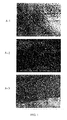
- the SEM observation results of the porous silica ceramic materials of the group of Examples A are shown in Fig. 1 .
- the presence of the skeleton was confirmed from the observation results in each case.
- the tendency for the skeleton thickness to differ depending on the water glass used was observed. To be more precise, it has found that the skeleton becomes thin when the JIS No. 3 water glass, which contains Na in a small amount, is used, and that the skeleton becomes thick when the JIS No. 1 water glass, which contains Na in a large amount, is used. It should be noted that the content of the Na in the water glass becomes larger in the order of JIS No. 3 ⁇ JIS No. 2 ⁇ JIS No. 1.
- the JIS No. 3 water glass was used as the sintering aid and its dilution ratio was changed from 10-fold to 100-fold.
- the firing temperature was set to be 900°C and the firing time was set to be 1.5 hours.
- the conditions of firing and the like are shown in Table 2.
- Table 2 Example Dilution ratio Firing temperature (°C) Firing time (hr) Presence of skeleton B-1 10-fold 900 1.5 Present B-2 30-fold 900 1.5 Present B-3 50-fold 900 1.5 Present B-4 75-fold 900 1.5 Present B-5 100-fold 900 1.5 Present
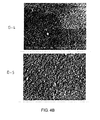
- the SEM observation results of the porous silica ceramic materials of the group of Examples B are shown in Fig. 2A and Fig. 2B .
- the presence of the skeleton was confirmed from the observation results in each case.
- the dilution ratio is small, that is to say the content of the water glass is large (dilution ratio: 10-fold)
- the sintering proceeded excessively and a part of the voids was collapsed.
- the skeleton of the porous silica ceramic material becomes thinner as the dilution ratio becomes larger, that is to say the content of the water glass becomes smaller.
- JIS No. 3 water glass was used as the sintering aid. Its dilution ratio was fixed to 50-fold and the firing temperature was fixed to 900°C. The firing time was changed from 2 min to 30 min. The conditions of firing and the like are shown in Table 3.
- Table 3 Example Dilution ratio Firing temperature (°C) Firing time (hr) Presence of skeleton C-1 50-fold 900 2 Present* C-2 50-fold 900 5 Present* C-3 50-fold 900 10 Present* C-4 50-fold 900 15 Present* C-5 50-fold 900 30 Present *: judged from observation result at photographing magnification of 50000x.
- the SEM observation results of the porous silica ceramic materials of the group of Examples C are shown in Fig. 3A and Fig. 3B .
- the sintering times were 2 min to 15 min (C-1 to C-4)
- the presence of the skeleton was confirmed from the result of the observation at the photographing magnification of 50000x.
- the pore having a structure of a continuous hole from the one surface of the porous silica ceramic sheet to the other also was confirmed.
- the firing time was 30 min (C-5)
- the presence of the skeleton was confirmed from the result of the observation at the photographing magnification of 5000x. It has found that the longer the firing time is, the thicker the skeleton becomes.
- a sintering aid other than a water glass was used.
- boric acid a 5 mass% aqueous solution was used.
- NaCl a 5 mass% aqueous solution was used.
- NaOH a 0.01N aqueous solution was used.
- KCl a 3.7 mass% aqueous solution was used.
- CaCl 2 a 5.6 mass% aqueous solution was used.
- the conditions of firing are as shown in Table 4.
- the SEM observation results of the porous silica ceramic materials of the group of Examples D are shown in Fig. 4A and Fig. 4B .
- the presence of the skeleton was confirmed from the observation result in each case where boric acid, NaCl, NaOH, KCl, or CaCl 2 was used as the sintering aid. It should be noted that the presence of the skeleton was confirmed from the observation results at the photographing magnification of 50000x for boric acid and NaCl, and the observation results at the photographing magnification of 5000x for NaOH, KCl, and CaCl 2 . It was also confirmed that the skeleton thickness differs depending on the kinds of the sintering aid.
- the sintering aid used in the present invention as long as a compound contains a component that can be a network modifying oxide in the glass or a component which has a lower function of forming a network than that of the silica particles, such as boron for silicon, and as long as the compound is soluble in a solvent, such as water or an alcohol, at a room temperature so as to give a solution to be used for the impregnation of the green sheet, any form of the compound can be used.
- the component that can be a network modifying oxide means a component that can convert into a network forming oxide in the sintering process.
- Example E is an example in which the mixture of a water glass and boric acid was used.
- a solution containing a sintering aid was prepared by diluting No. 3 water glass 2-fold with water and adding boric acid at the concentration of 2.5 mass%.
- the firing temperature was set to be 650°C and the firing time was set to be 1.5 hours. From the result of the SEM observation of the porous silica ceramic material obtained (see Fig. 5 ), the presence of the skeleton was confirmed.
- Comparative Example 1 the same green sheet as that used in the above-described examples was used without being impregnated with the diluted liquid of the water glass.
- the green sheet was fired at 900°C for 1.5 hours so that the porous silica ceramic material was obtained.
- the observation result of its surface is shown in Fig. 6 .
- the photographic condition was similar to that of Example 1.
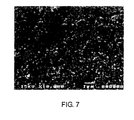
- the observation result of the green sheet is shown in Fig. 7 for comparison.
- the photographic condition was similar to that of Example 1.
- a compound can be a network modifying oxide in the glass and can be dissolved in a solvent, such as water or an alcohol, at a room temperature for the impregnation of the green sheet, the compound can be used as the sintering aid. Further, a plurality of sintering aids can be used in combination.
- the porous silica ceramic material according to the present invention is a porous material having a network skeleton and even a continuous hole, and therefore a gas or a liquid is easy to spread in every pore.
- the porous silica ceramic material can be used as, for example, an adsorbent, a reaction catalyst, a culture support, a diaphragm, and a carrier for various labeling reagents.
Landscapes
- Chemical & Material Sciences (AREA)
- Engineering & Computer Science (AREA)
- Ceramic Engineering (AREA)
- Structural Engineering (AREA)
- Manufacturing & Machinery (AREA)
- Materials Engineering (AREA)
- Organic Chemistry (AREA)
- Inorganic Chemistry (AREA)
- Chemical Kinetics & Catalysis (AREA)
- Mechanical Engineering (AREA)
- Compositions Of Oxide Ceramics (AREA)
- Catalysts (AREA)
Abstract
Description
- The present invention relates to a method for producing a porous silica ceramic material, and particularly to a method whereby a porous silica ceramic material having a network structure can be obtained.
- As methods for producing a porous ceramic material having a network structure, for example, a method disclosed in
JP54(1979)-41613B US 3,926,851 ) is mentioned. This method includes forming a composition consisting of a polyolefin, a ceramic filler and a plasticizer into a shaped body, extracting the plasticizer from the obtained shaped body, removing the polyolefin by heating the shaped body to obtain a porous ceramic structure, and firing the structure. - Further, in
JP11(1999)-71188A - Furthermore, in
JP2002-260961A - It should be noted that, in this description, an unfired shaped body that includes silica particles is referred to as a green, according to the convention in the art. Further, a green which has been formed into a sheet-like shape is referred to as a green sheet.
- As an application of the porous silica ceramic material, an adsorbent, a reaction catalyst, a culture support, a diaphragm, and a carrier of various labeling reagents are mentioned. In any of these applications, a uniform network structure often is required. In addition, an optimum pore size differs depending on the application.
- Nevertheless, it is difficult to obtain a porous ceramic material having a uniform network structure or to control its pore size, by the methods described in the aforementioned references.
- For example, with respect to a porous glass material, which is one of porous ceramic materials, a phase separation method is a mainstream of its production method. The pore size of this porous glass material is generally determined by a temperature and time of the heat treatment. However, the control of the pore size is only based on the following formula, which is determined empirically, and this does not reach a sufficient technical level.

r: pore radius of porous glass, T: phase separation temperature (K),
t: phase separation time, A, C: constants determined depending on glass composition, B: 1/2 in early stage of phase separation, 1/3 in general. - In addition, with respect to a porous glass material produced by a sol-gel method, it is considered that controlling a pore size is highly difficult. Further, in the production of a porous glass material wherein a glass powder whose particle size has been adjusted is sintered, it is difficult to obtain a porous glass having a uniform pore size.
- Therefore, the present invention provides a method for producing a porous silica ceramic material which enables to obtain a porous silica ceramic material having a network structure and a uniform pore size easily even if a relatively low firing temperature is employed. The present invention also provides a method for producing a porous silica ceramic material that enables easy control of a pore size.
- The present inventors have found that a porous silica ceramic material having a network structure and a uniform pore size can be obtained by impregnating a green with a sintering aid after a plasticizer is extracted from the green, and then by firing the green.
- Namely, the present invention provides a method for producing a porous silica ceramic material, wherein the method includes
a step of forming a mixture including silica particles, a binder and a plasticizer,
a step of imparting porosity to a green obtained by the forming of the mixture, by extracting the plasticizer from the green,
a step of impregnating the green to which the porosity has been imparted with a sintering aid, and
a step of firing the green impregnated with the sintering aid. - According to the above-described method, a porous silica ceramic material having a network structure and a uniform pore size can be obtained by carrying out the step of impregnating the green with the sintering aid after the plasticizer is extracted from the green.
- The method for producing a porous silica ceramic material according to the present invention enables to control the pore size easily merely by adjusting an impregnation amount of the sintering aid or by changing a firing condition (temperature, time) even if a green with the same composition is used.
-
-
Fig. 1 shows SEM observation results of surfaces of a group of Examples A. -
Fig. 2A shows SEM observation results of surfaces of a group of Examples B. -
Fig. 2B shows SEM observation results of surfaces of a group of Examples B. -
Fig. 3A shows SEM observation results of surfaces of a group of Examples C. -
Fig. 3B shows SEM observation results of surfaces of a group of Examples C. -
Fig. 4A shows SEM observation results of surfaces of a group of Examples D. -
Fig. 4B shows SEM observation results of surfaces of a group of Examples D. -
Fig. 5 shows an SEM observation result of a surface of Example E. -
Fig. 6 shows an SEM observation result of a surface of Comparative Example 1. -
Fig. 7 shows an SEM observation result of a surface of a green sheet, from which a plasticizer has been extracted. - The method of producing a porous silica ceramic material according to the present invention is explained ore in detail.
- As the binder to be with the silica particles, a combustible resin powder that is removable by firing is suitable. A kind of the resins is not particularly limited and, for example, polyolefin-based thermoplastic resins such as polyethylene and polypropylene can be used. As the plasticizer to be mixed with the silica particles along with the binder, one that can be extracted by an organic solvent easily and can impart porosity to green is desirable. For example, a mineral oil (industrial lubricant such as paraffin-based lubricant or naphthene-based lubricant) is preferably used. The step of extracting the plasticizer using an organic solvent includes, for example, an operation of immersing a green into the organic solvent. The organic solvent that can be used in the operation is, for example, trichloroethylene, methylene chloride, trichloroethane, and n-bromopropane as a halide, n-hexane, n-decane, tetralin, kerosene, and methyl ethyl ketone as a hydrocarbon based material.
- As the sintering aid used in the present invention, at least one selected from the group consisting of a compound containing an alkali metal, a compound containing an alkaline earth metal, a compound containing boron, and a compound containing phosphorus can be used. Particularly, the group of the above-mentioned compounds is preferable since the compounds have a function of decreasing the melting point of the silica particles. Further, two or more kinds of the compounds containing a alkali metal may be used in combination, for example, a compound containing Na and a compound containing K are used in combination. Regarding this, the same applies to the compound containing an alkaline earth metal, the compound containing boron, and the compound containing phosphorus.
- First, the compound containing an alkali metal acts as a network modifying oxide for a network structure of silica and serves to decrease the viscosity of the silica and facilitate melting. As the alkali metal, Na, K, and Li can be mentioned. As these compounds, water-soluble compounds such as chloride, hydroxide, acetate salt, sulfate salt, carbonate salt, nitrate salt, and phosphate salt are preferable. As specific examples thereof, sodium chloride, sodium hydroxide, sodium acetate, sodium sulfate, sodium carbonate, sodium hydrogencarbonate, sodium nitrate, potassium chloride, potassium hydroxide, potassium acetate, potassium sulfate, potassium carbonate, potassium nitrate, lithium chloride, lithium hydroxide, lithium acetate, lithium sulfate, lithium carbonate, lithium nitrate, sodium phosphate, potassium phosphate, and lithium phosphate are mentioned.
- In addition, as the compound containing an alkali metal, a silicate salt such as sodium silicate (water glass) is preferable since the silicate salt shows a good solubility in water and is easy to handle.
- Next, the compound containing an alkaline earth metal acts as a network modifying oxide for a network structure of silica and serves to decrease the high temperature viscosity of the silica and facilitate melting. As the alkaline earth metal, Mg, Ca, Sr, and Ba can be mentioned. As these compounds, water-soluble compounds such as chloride, hydroxide, acetate salt, sulfate salt, carbonate salt, and nitrate salt are preferable. As specific examples thereof, magnesium chloride, magnesium hydroxide, magnesium acetate, magnesium sulfate, magnesium carbonate, magnesium nitrate, calcium chlorite, calcium hydroxide, calcium acetate, calcium sulfate, calcium carbonate (limestone), calcium nitrate, strontium chloride, strontium hydroxide, strontium acetate, strontium sulfate, strontium carbonate, strontium nitrate, barium chloride, barium hydroxide, barium acetate, barium sulfate, barium carbonate, barium nitrate, magnesium phosphate, calcium phosphate, strontium phosphate, and barium phosphate are mentioned.
- Further, in the silicate glass, the compound containing boron serves to decrease the viscosity of the glass and facilitate melting. Boric acid and borax are specifically exemplified.
- As the compound containing phosphorus, phosphoric acid and a phosphoric acid salt are exemplified. Specifically, sodium phosphate, potassium phosphate, lithium phosphate, magnesium phosphate, calcium phosphate, strontium phosphate, barium phosphate, phosphoric acid (orthophosphoric acid), ammonium phosphate and the like are exemplified.
- The step of forming the mixture of the above-described materials may be determined depending on an application of the porous silica ceramic material to be obtained. For example, known forming methods such as an extrusion-forming method, an injection-forming method, a printing method, and a doctor blade method can be employed.
- The step of impregnating the sintering aid into the green from which the plasticizer has been extracted can be carried out by bringing the green into contact with a liquid containing the sintering aid. Specifically, a method of immersing the green into the liquid containing the sintering aid, a method of spraying the liquid containing the sintering aid to the green, and a method of applying the liquid containing the sintering aid to the green can be employed. It is desirable that the liquid containing the sintering aid is a solution of the sintering aid.
- According to the production method of the present invention, it is possible to produce a porous silica ceramic material having a network structure and a uniform pore size. It is possible to control the thickness of the network skeleton and the pore size by a condition concerning the sintering aid with which the green is to be impregnated and/or a condition of firing the green. The condition concerning the sintering aid specifically means a composition of the sintering aid, and an amount (mass) of the sintering aid to be attached per unit volume of the green. The amount of the sintering aid to be attached per unit volume of the green can be controlled, for example, by changing a concentration of the solution containing the sintering aid. The condition of firing specifically means a temperature of firing the green, and time of firing the green. It is possible to control the thickness of the network skeleton and the pore size, that is to say the specific surface area of the porous silica ceramic material, by changing (adjusting) these conditions. In some cases, it is possible to control the thickness of the network skeleton and the pore size by changing a firing atmosphere (oxidizing, reducing, or inert).
- Voids are present in the green from which the plasticizer has been extracted. The sintering aid is impregnated in these voids. When this green is fired, the silica particles contact with the sintering aid in the firing process and the sintering aid acts as a flux of the silica particles. Therefore, the firing temperature in the firing step may be lower than the temperature at which the silica particles generally are sintered. In particular, it is possible to sinter at or below the temperature of 1000°C, in some cases at about 700°C.
- In addition, it is recommended to impart a hydrophilic property to the green by making the green contain a hydrophilicity-imparting agent such as alkylsulfosuccinic acid salt when the silica particles, the binder and the plasticizer are mixed and formed. This serves to facilitate immersing of the sintering aid. As specific examples, an anionic hydrophilicity-imparting agent such as a naphthalene sulfonate formaldehyde condensate, and a nonionic hydrophilicity imparting agent such as polyoxyethylene alkyl ether as well as an alkylsulfosuccinic acid salt can be used alone or as a mixture thereof.
- Further, in order to obtain a similar effect, coating the above-mentioned alkylsulfosuccinic acid salt and the like on the surface of green from which the plasticizer has been extracted may be performed.
- Furthermore, in the method for producing a porous silica ceramic material according to the present invention, a distribution of the pore size can be formed merely by altering the amount of the sintering aid impregnated from part to part in the green. This distribution of the pore size may be stepwise or vary progressively.
- As the method of altering the amount of the sintering aid impregnated, a method of impregnating each part of the green with a water glass having a different diluting ratio is exemplified. In specific, the one part of the green that is a shaped body is contacted with a solution having a low concentration of the sintering aid so that the amount of the sintering aid impregnated is small. In contrast, the other part of the green is contacted with a solution having a high concentration of the sintering aid so that the amount of the sintering aid impregnated is large. Consequently, regions in which the thicknesses of the network skeleton and pore sizes differ can be formed in one green.
- It should be noted that the green used in the production method according to the present invention has a plasticity and is easy to be processed into various shapes such as a sheet-like shape, a fiber-like shape, and a bead-like shape. For example, when the green is formed into a sheet-like shape, the green can be shaped freely by folding the green or piling the greens in a similar manner for ceramic papers used in the ceramic art or the like. The green also can be processed into an embossed sheet and a three-dimensionally formed sheet as well as a sheet having a wave pattern, by pressing the green sheet.
- First, green sheets to be used in the following Examples were produced as follows. A silica powder with a specific surface area of 200 m2/g was prepared as the silica particles. A powder of a high-density polyethylene resin having average molecular weight of 2,000,000 was prepared as the A oil was prepared as the plasticizer.
- 70 parts by mass of the silica powder, 30 parts by mass of the high-density polyethylene resin powder, 100 parts by mass of the mineral oil, and 5 parts by mass of an alkylsulfosuccinic acid salt were mixed using an extruder. The mixture extruded from the extruder was pressure-formed using forming rolls so that a green sheet with a thickness of 100 µm was obtained.
- Next, the plasticizer (mineral oil) in the green sheet was removed by extracting with an organic solvent and the green sheet was heated and dried so that the green sheet with the thickness of 100 µm from which the plasticizer had been extracted was prepared. In this green sheet, voids were formed at the place where the extracted plasticizer had been present. In the following Example, this green sheet was used.
- First, with respect to a group of Examples A, water glasses, which are sodium silicate (Na2O-nSiO2), were used as the sintering aid. As the water glass, No. 1, No. 2 and No. 3, which are prescribed in Japanese Industrial Standards (JIS K 1408), were used, and each of them was diluted 50-fold with water. The prepared green sheet was impregnated with the diluted water glass. The difference among No. 1, No. 2 and No. 3 was in the molar ratio of Na2O and SiO2, and the ratio of SiO2 became greater in the order of No.1<No. 2<No. 3.
- The impregnation of the green sheet with the liquid containing the water glass was carried out by dropping the liquid evenly on the surface of the green sheet. The excess liquid on the surface was removed, and the green sheet was dried at the drying temperature of 50°C. Then, the green sheet was fired at 900°C for 1 hour so that the porous silica ceramic material was obtained. The conditions of firing and the like are shown in Table 1.
Table 1 Example Sintering aid Firing temperature (°C) Firing time (hr) Presence of skeleton A-1 No. 1 water glass 900 1.0 Present A-2 No. 2 water glass 900 1.0 Present A-3 No.3 water glass 900 1.0 Present - The surfaces of the porous silica ceramic materials obtained were observed appropriately with the following two kinds of scanning electron microscopes (SEM). The presence or absence of the skeleton was judged from the results of the SEM observations.
- Scanning electron microscope, manufactured by JEOL Ltd. Model: JSM-T330A
Photographic condition: accelerating voltage, 15kV; photographing magnification, 50000x - Scanning electron microscope, manufactured by KEYENCE CORPORATION
Model: VE-7800
Photographic condition: accelerating voltage, 5kV; photographing magnification, 5000x - The SEM observation results of the porous silica ceramic materials of the group of Examples A are shown in
Fig. 1 . The presence of the skeleton was confirmed from the observation results in each case. In addition, the tendency for the skeleton thickness to differ depending on the water glass used was observed. To be more precise, it has found that the skeleton becomes thin when the JIS No. 3 water glass, which contains Na in a small amount, is used, and that the skeleton becomes thick when the JIS No. 1 water glass, which contains Na in a large amount, is used. It should be noted that the content of the Na in the water glass becomes larger in the order of JIS No. 3<JIS No. 2<JIS No. 1. - Next, with respect to the group of Examples B, the JIS No. 3 water glass was used as the sintering aid and its dilution ratio was changed from 10-fold to 100-fold. The firing temperature was set to be 900°C and the firing time was set to be 1.5 hours. The conditions of firing and the like are shown in Table 2.
Table 2 Example Dilution ratio Firing temperature (°C) Firing time (hr) Presence of skeleton B-1 10-fold 900 1.5 Present B-2 30-fold 900 1.5 Present B-3 50-fold 900 1.5 Present B-4 75-fold 900 1.5 Present B-5 100-fold 900 1.5 Present - The SEM observation results of the porous silica ceramic materials of the group of Examples B are shown in
Fig. 2A andFig. 2B . The presence of the skeleton was confirmed from the observation results in each case. In the case where the dilution ratio is small, that is to say the content of the water glass is large (dilution ratio: 10-fold), the sintering proceeded excessively and a part of the voids was collapsed. It has found that the skeleton of the porous silica ceramic material becomes thinner as the dilution ratio becomes larger, that is to say the content of the water glass becomes smaller. - Next, with respect to the group of Examples C, JIS No. 3 water glass was used as the sintering aid. Its dilution ratio was fixed to 50-fold and the firing temperature was fixed to 900°C. The firing time was changed from 2 min to 30 min. The conditions of firing and the like are shown in Table 3.
Table 3 Example Dilution ratio Firing temperature (°C) Firing time (hr) Presence of skeleton C-1 50-fold 900 2 Present* C-2 50-fold 900 5 Present* C-3 50-fold 900 10 Present* C-4 50-fold 900 15 Present* C-5 50-fold 900 30 Present *: judged from observation result at photographing magnification of 50000x. - The SEM observation results of the porous silica ceramic materials of the group of Examples C are shown in
Fig. 3A andFig. 3B . In the cases where the sintering times were 2 min to 15 min (C-1 to C-4), the presence of the skeleton was confirmed from the result of the observation at the photographing magnification of 50000x. In addition, the pore having a structure of a continuous hole from the one surface of the porous silica ceramic sheet to the other also was confirmed. In the case where the firing time was 30 min (C-5), the presence of the skeleton was confirmed from the result of the observation at the photographing magnification of 5000x. It has found that the longer the firing time is, the thicker the skeleton becomes. It should be noted that the presence or absence of the continuous hole was judged from the result of the test in which water is dropped onto the one surface of the porous silica ceramic sheet and then leaching of the water from the other surface is checked, and from the result of the SEM observation. - With respect to the group of Examples D, a sintering aid other than a water glass was used. Regarding boric acid, a 5 mass% aqueous solution was used. Regarding NaCl, a 5 mass% aqueous solution was used. Regarding NaOH, a 0.01N aqueous solution was used. Regarding KCl, a 3.7 mass% aqueous solution was used. Regarding CaCl2, a 5.6 mass% aqueous solution was used. The conditions of firing are as shown in Table 4.
Table 4 Example Sintering aid Firing temperature (°C) Firing time (hr) Presence of skeleton D-1 Boric acid 700 1.0 Present D-2 NaCl 700 1.0 Present D-3 NaOH 900 1.0 Present D-4 KCl 850 1.0 Present D-5 CaClz 850 1.0 Present - The SEM observation results of the porous silica ceramic materials of the group of Examples D are shown in
Fig. 4A andFig. 4B . The presence of the skeleton was confirmed from the observation result in each case where boric acid, NaCl, NaOH, KCl, or CaCl2 was used as the sintering aid. It should be noted that the presence of the skeleton was confirmed from the observation results at the photographing magnification of 50000x for boric acid and NaCl, and the observation results at the photographing magnification of 5000x for NaOH, KCl, and CaCl2. It was also confirmed that the skeleton thickness differs depending on the kinds of the sintering aid. - Hence, with respect to the sintering aid used in the present invention, as long as a compound contains a component that can be a network modifying oxide in the glass or a component which has a lower function of forming a network than that of the silica particles, such as boron for silicon, and as long as the compound is soluble in a solvent, such as water or an alcohol, at a room temperature so as to give a solution to be used for the impregnation of the green sheet, any form of the compound can be used. It should be noted that the component that can be a network modifying oxide means a component that can convert into a network forming oxide in the sintering process.
- Example E is an example in which the mixture of a water glass and boric acid was used. A solution containing a sintering aid was prepared by diluting No. 3 water glass 2-fold with water and adding boric acid at the concentration of 2.5 mass%. The firing temperature was set to be 650°C and the firing time was set to be 1.5 hours. From the result of the SEM observation of the porous silica ceramic material obtained (see
Fig. 5 ), the presence of the skeleton was confirmed. - In Comparative Example 1, the same green sheet as that used in the above-described examples was used without being impregnated with the diluted liquid of the water glass. The green sheet was fired at 900°C for 1.5 hours so that the porous silica ceramic material was obtained. The observation result of its surface is shown in
Fig. 6 . The photographic condition was similar to that of Example 1. The observation result of the green sheet is shown inFig. 7 for comparison. The photographic condition was similar to that of Example 1. - First, with respect to the green sheet (
Fig. 7 ), it is observed that the resin was integrated with the silica particles being combined, and the pores of around 200 nm were thus formed. - Next, with respect to Comparative Example 1 (
Fig. 6 ), since the green sheet was only fired without a sintering aid, the silica particles were aggregated on the whole, but in some parts, the silica particle is not present. It is considered that the parts where the silica particle is not present are derived from the pores of around 200 nm that were originally present in the green sheet. Therefore, it is considered that the state of pores in the green sheet determines the state of pores in the porous silica ceramic material after firing. Hence, it is considered that the final state of pores in the porous silica ceramic material is determined by the state of the green, especially the mixing ratio of the plasticizer. - On the other hand, with respect to the present invention (the group of Examples A to Example E) in which the porous green sheet as impregnated with the sintering aid, the silica particles bonded to each other, and the network skeleton was formed in each examples.
- When the results of the groups of Examples B and C were considered collectively, it has found that the skeleton thickness changes as the firing condition, temperature and time, changes. Further, from the results of the group of Examples A, it is recognized that the skeleton thickness changes also depending on the content of the sintering aid. Therefore, even if the same green sheet is used, porous silica ceramic materials having various skeleton configurations can be obtained merely by changing the condition concerning the sintering aid (composition of the solution) or the firing condition. Consequently, according to the production method of the present invention, it is possible to control the pore size of the porous silica ceramic material.
- In addition, as long as a compound can be a network modifying oxide in the glass and can be dissolved in a solvent, such as water or an alcohol, at a room temperature for the impregnation of the green sheet, the compound can be used as the sintering aid. Further, a plurality of sintering aids can be used in combination.
- As explained above, the porous silica ceramic material according to the present invention is a porous material having a network skeleton and even a continuous hole, and therefore a gas or a liquid is easy to spread in every pore. Hence, the porous silica ceramic material can be used as, for example, an adsorbent, a reaction catalyst, a culture support, a diaphragm, and a carrier for various labeling reagents.
Claims (9)
- A method for producing porous silica ceramic material, wherein the method comprises:a step of forming a mixture including silica particles, a binder and a plasticizer,a step of imparting porosity to a green obtained by the forming of the mixture, by extracting the plasticizer from the green,a step of impregnating the green to which the porosity has been imparted with a sintering aid, anda step of firing the green impregnated with the sintering aid.
- The method for producing a porous silica ceramic material according to claim 1, wherein the step of impregnating the green with the sintering aid is carried out by bringing a liquid containing the sintering aid into contact with the green.
- The method for producing a porous silica ceramic material according to claim 1, wherein the sintering aid is at least one selected from the group consisting of a compound containing an alkali metal, a compound containing an alkaline earth metal, a compound containing boron, and a compound containing phosphorus.
- The method for producing a porous silica ceramic material according to claim 3, wherein the compound containing an alkali metal is a water glass.
- The method for producing a porous silica ceramic material according to claim 3, wherein the compound containing an alkali metal is at least one selected from the group consisting of chloride, hydroxide, carbonate salt, acetate salt, sulfate salt, nitrate salt, and phosphate salt.
- The method for producing a porous silica ceramic material according to claim 3, wherein the compound containing an alkaline earth metal is at least one selected from the group consisting of chloride, hydroxide, carbonate salt, acetate salt, sulfate salt, nitrate salt, and phosphate salt.
- The method for producing a porous silica ceramic material according to claim 3, wherein the compound containing boron is boric acid or borax.
- The method for producing a porous silica ceramic material according to claim 3, wherein the compound containing phosphorus is phosphoric acid or a phosphoric acid salt.
- The method for producing a porous silica ceramic material according to claim 1, wherein the green impregnated with the sintering aid is fired at or below the temperature of 1000°C.
Applications Claiming Priority (3)
| Application Number | Priority Date | Filing Date | Title |
|---|---|---|---|
| JP2005184496 | 2005-06-24 | ||
| JP2006117845 | 2006-04-21 | ||
| PCT/JP2006/312649 WO2006137539A1 (en) | 2005-06-24 | 2006-06-23 | Method for producing porous silica ceramic |
Publications (1)
| Publication Number | Publication Date |
|---|---|
| EP1894907A1 true EP1894907A1 (en) | 2008-03-05 |
Family
ID=37570556
Family Applications (1)
| Application Number | Title | Priority Date | Filing Date |
|---|---|---|---|
| EP06767266A Withdrawn EP1894907A1 (en) | 2005-06-24 | 2006-06-23 | Method for producing porous silica ceramic |
Country Status (4)
| Country | Link |
|---|---|
| EP (1) | EP1894907A1 (en) |
| JP (1) | JP4965442B2 (en) |
| KR (1) | KR20080031289A (en) |
| WO (1) | WO2006137539A1 (en) |
Families Citing this family (6)
| Publication number | Priority date | Publication date | Assignee | Title |
|---|---|---|---|---|
| JP2008156181A (en) * | 2006-12-26 | 2008-07-10 | Nippon Sheet Glass Co Ltd | Method for producing silica ceramic |
| WO2008078779A1 (en) * | 2006-12-26 | 2008-07-03 | Nippon Sheet Glass Company, Limited | Method for producing porous ceramic article |
| JP4980864B2 (en) * | 2007-12-05 | 2012-07-18 | 日本板硝子株式会社 | Method for producing porous ceramics |
| JP6020961B2 (en) * | 2012-09-27 | 2016-11-02 | 日立金属株式会社 | Composition for injection molding and method for producing sintered body using the same |
| KR101528191B1 (en) * | 2013-10-22 | 2015-06-12 | 영남대학교 산학협력단 | Fabrication method of Porous Calcium Phosphate Ceramics Comprising Water Glass |
| KR101601759B1 (en) * | 2013-12-30 | 2016-03-09 | 주식회사 한별 | Photocatalyst liquid coating containing a silica binder and its application sidewalk |
Family Cites Families (7)
| Publication number | Priority date | Publication date | Assignee | Title |
|---|---|---|---|---|
| US3926851A (en) | 1970-10-22 | 1975-12-16 | Grace W R & Co | Porous ceramics-exhaust oxidation catalyst |
| JPS5441613B1 (en) | 1970-10-22 | 1979-12-10 | ||
| US4900698A (en) * | 1987-05-26 | 1990-02-13 | W. R. Grace & Co.-Conn. | Ceramic product and process |
| JPH07265625A (en) * | 1994-04-01 | 1995-10-17 | Kurosaki Refract Co Ltd | Ceramic filter |
| JPH1171188A (en) | 1997-08-26 | 1999-03-16 | Noritake Co Ltd | Production of porous article |
| JP4842445B2 (en) | 2001-03-01 | 2011-12-21 | 日本板硝子株式会社 | Electric double layer capacitor separator |
| JP2007503304A (en) * | 2003-08-22 | 2007-02-22 | ユニオン・カーバイド・ケミカルズ・アンド・プラスティックス・テクノロジー・コーポレイション | Modified alumina support and silver-based catalyst for alkylene oxide production |
-
2006
- 2006-06-23 KR KR1020087001384A patent/KR20080031289A/en not_active Withdrawn
- 2006-06-23 WO PCT/JP2006/312649 patent/WO2006137539A1/en not_active Ceased
- 2006-06-23 JP JP2007522388A patent/JP4965442B2/en not_active Expired - Fee Related
- 2006-06-23 EP EP06767266A patent/EP1894907A1/en not_active Withdrawn
Non-Patent Citations (1)
| Title |
|---|
| See references of WO2006137539A1 * |
Also Published As
| Publication number | Publication date |
|---|---|
| KR20080031289A (en) | 2008-04-08 |
| WO2006137539A1 (en) | 2006-12-28 |
| JPWO2006137539A1 (en) | 2009-01-22 |
| JP4965442B2 (en) | 2012-07-04 |
Similar Documents
| Publication | Publication Date | Title |
|---|---|---|
| Arita et al. | Synthesis and processing of hydroxyapatite ceramic tapes with controlled porosity | |
| US5846664A (en) | Porous metal structures and processes for their production | |
| EP1537060B1 (en) | Ceramic hollow fibers made from nanoscale powder particles | |
| Zhu et al. | The control of slurry rheology in the processing of reticulated porous ceramics | |
| DE60123878T2 (en) | Synthetic quartz powder, method of manufacture and synthetic quartz crucible | |
| US20110171099A1 (en) | Process for manufacturing a porous sic material | |
| Boudaira et al. | Preparation and characterization of microfi ltration membranes and their supports using kaolin (DD2) and CaCO3 | |
| US20090206525A1 (en) | Method for Producing Porous Silica Ceramic Material | |
| EP3650146A1 (en) | Method for preparing metal foam | |
| JPWO2008078779A1 (en) | Method for producing porous ceramic article | |
| JP7287766B2 (en) | Method for producing glass-ceramic articles by slurry casting and use thereof | |
| JP4965442B2 (en) | Method for producing porous silica ceramics | |
| EP1070534B1 (en) | Method for manufacturing filter having ceramic porous film as separating film | |
| CN104761274B (en) | Silicon carbide porous ceramic and preparation technique thereof | |
| CN117320800A (en) | Porous ceramic supports, membranes, methods and uses thereof | |
| DE10114496B4 (en) | Process for the preparation of ceramic masses and ceramic hollow fibers, ceramic compositions, their use and ceramic hollow fibers | |
| JP2009137790A (en) | Porous ceramics, and method for producing the same | |
| US20070232740A1 (en) | Ceramic green sheet and process for production thereof | |
| Ozel et al. | Production of cordierite ceramic by aqueous tape casting process | |
| US20070228622A1 (en) | Production process of sheet-like dense cordierite sintered body | |
| JP2004356347A (en) | Resin sheet and method for manufacturing ceramic multilayer wiring board using the same | |
| EP0593278A1 (en) | Filter for metal hot melt and process for production thereof | |
| JP2008156181A (en) | Method for producing silica ceramic | |
| KR102378971B1 (en) | Manufacturing method for metal foam | |
| JP3707866B2 (en) | Method for producing aluminum nitride green body |
Legal Events
| Date | Code | Title | Description |
|---|---|---|---|
| PUAI | Public reference made under article 153(3) epc to a published international application that has entered the european phase |
Free format text: ORIGINAL CODE: 0009012 |
|
| 17P | Request for examination filed |
Effective date: 20080109 |
|
| AK | Designated contracting states |
Kind code of ref document: A1 Designated state(s): DE FR GB |
|
| DAX | Request for extension of the european patent (deleted) | ||
| RAP1 | Party data changed (applicant data changed or rights of an application transferred) |
Owner name: NIPPON SHEET GLASS COMPANY LIMITED |
|
| RIN1 | Information on inventor provided before grant (corrected) |
Inventor name: KAWAZU, MITSUHIRO,NIPPON SHEET GLASS COMPANY, LTD Inventor name: EMORI, IKUKO,NIPPON SHEET GLASS COMPANY, LIMITED Inventor name: TAKADA, KEIGO,NIPPON SHEET GLASS COMPANY, LTD. Inventor name: INOMOTO, SHUNJI,NIPPON SHEET GLASS COMPANY, LTD. Inventor name: SATO, NORIAKI,NIPPON SHEET GLASS COMPANY, LIMITED |
|
| RIN1 | Information on inventor provided before grant (corrected) |
Inventor name: TAKADA, KEIGO,NIPPON SHEET GLASS COMPANY, LTD. Inventor name: INOMOTO, SHUNJI,NIPPON SHEET GLASS COMPANY, LTD. Inventor name: KAWAZU, MITSUHIRO,NIPPON SHEET GLASS COMPANY, LTD Inventor name: EMORI, IKUKO,NIPPON SHEET GLASS COMPANY, LIMITED Inventor name: SATO, NORIAKI,NIPPON SHEET GLASS COMPANY, LIMITED |
|
| DAX | Request for extension of the european patent (deleted) | ||
| RBV | Designated contracting states (corrected) |
Designated state(s): DE FR GB |
|
| RBV | Designated contracting states (corrected) |
Designated state(s): DE FR GB |
|
| STAA | Information on the status of an ep patent application or granted ep patent |
Free format text: STATUS: THE APPLICATION HAS BEEN WITHDRAWN |
|
| 18W | Application withdrawn |
Effective date: 20090424 |