EP1892234A1 - Novel aryl compound - Google Patents
Novel aryl compound Download PDFInfo
- Publication number
- EP1892234A1 EP1892234A1 EP06766522A EP06766522A EP1892234A1 EP 1892234 A1 EP1892234 A1 EP 1892234A1 EP 06766522 A EP06766522 A EP 06766522A EP 06766522 A EP06766522 A EP 06766522A EP 1892234 A1 EP1892234 A1 EP 1892234A1
- Authority
- EP
- European Patent Office
- Prior art keywords
- group
- atom
- compound
- denotes
- different
- Prior art date
- Legal status (The legal status is an assumption and is not a legal conclusion. Google has not performed a legal analysis and makes no representation as to the accuracy of the status listed.)
- Withdrawn
Links
- 0 CCC[C@@](C1)C2[C@]1CC*2 Chemical compound CCC[C@@](C1)C2[C@]1CC*2 0.000 description 4
- KQVWFBVPBAQTES-UHFFFAOYSA-N CB1OCCCO1 Chemical compound CB1OCCCO1 KQVWFBVPBAQTES-UHFFFAOYSA-N 0.000 description 1
- USMRYMUZKSMTRL-UHFFFAOYSA-N CB1OCCO1 Chemical compound CB1OCCO1 USMRYMUZKSMTRL-UHFFFAOYSA-N 0.000 description 1
Classifications
-
- C—CHEMISTRY; METALLURGY
- C07—ORGANIC CHEMISTRY
- C07F—ACYCLIC, CARBOCYCLIC OR HETEROCYCLIC COMPOUNDS CONTAINING ELEMENTS OTHER THAN CARBON, HYDROGEN, HALOGEN, OXYGEN, NITROGEN, SULFUR, SELENIUM OR TELLURIUM
- C07F5/00—Compounds containing elements of Groups 3 or 13 of the Periodic Table
- C07F5/02—Boron compounds
- C07F5/025—Boronic and borinic acid compounds
-
- C—CHEMISTRY; METALLURGY
- C07—ORGANIC CHEMISTRY
- C07C—ACYCLIC OR CARBOCYCLIC COMPOUNDS
- C07C211/00—Compounds containing amino groups bound to a carbon skeleton
- C07C211/43—Compounds containing amino groups bound to a carbon skeleton having amino groups bound to carbon atoms of six-membered aromatic rings of the carbon skeleton
- C07C211/54—Compounds containing amino groups bound to a carbon skeleton having amino groups bound to carbon atoms of six-membered aromatic rings of the carbon skeleton having amino groups bound to two or three six-membered aromatic rings
- C07C211/56—Compounds containing amino groups bound to a carbon skeleton having amino groups bound to carbon atoms of six-membered aromatic rings of the carbon skeleton having amino groups bound to two or three six-membered aromatic rings the carbon skeleton being further substituted by halogen atoms or by nitro or nitroso groups
Definitions
- the present invention relates to a novel aryl compound having two characteristic groups different from each other, and its manufacturing method.
- Aryl compounds are known to be useful as raw materials for functional materials, such as organic EL materials and conductive polymer materials, ligands in catalytic reaction and the like due to their electronic characteristics and steric characteristics (see Patent Documents 1 to 3).
- the above-mentioned aryl compounds have had a problem of constituting the terminal structure or side chain structure of the resulting polymer compounds since they have only one characteristic group introduced.
- the aryl compound may have two or more characteristic groups introduced and may be able to be introduced as a main chain structure into a polymer compound. Even so, the characteristic groups are the same, and thus a significant difference in reactivity between them cannot be provided. Consequently, such aryl compounds have had a problem that advanced structural features such as their direction, positions, unit number introduced and sequence length in the resulting polymer compound are difficult to sufficiently control.
- the compound of the present can be easily derivatized into a polymeric or low molecular compound with a highly controlled structure by utilizing a difference in reactivity between the two different characteristic groups in various chemical reactions.
- the present invention provides a novel aryl compound represented by the following general formula (1) and having mutually different characteristic groups denoted by X 1 and X 2 .
- X 1 and X 2 each independently denotes one characteristic group selected from the group consisting of a chlorine atom, a bromine atom, an iodine atom, -OSO 2 Q 1 , -B(OQ 2 ) 2 , -Si(OQ 3 ) 3 , -Sn(Q 4 ) 3 , Z 1 (Z 2 )m, a metal acetylide group and a terminal acetylene group;
- Q 1 is a hydrocarbon group which may have a substituent
- Q 2 is a hydrogen atom or a hydrocarbon group which may have a substituent, two Q 2 s may be the same or different, and may bond with each other to form a ring
- Q 3 is a hydrocarbon group which may have a substituent, and three Q 3 s may be the same or different
- Q 4 is a hydrocarbon group which may have a substituent, three Q 4 s may be the same or different
- Z 1 is a metal atom
- novel aryl compound having two mutually different characteristic groups is useful as functional materials such as organic EL materials and conductive polymer materials, whose structures are highly controlled, and raw materials of catalytic reaction ligands and the like.
- the novel aryl compound having two mutually different characteristic groups according to the present invention has a structure represented by the above general formula (1).
- Hydrocarbon groups in the groups denoted by Q 1 , Q 2 , Q 3 and Q 4 in the characteristic groups denoted by X 1 and X 2 in the above-mentioned general formula include, for example, alkyl groups having about 1 to 50 carbon atoms such as a methyl group, ethyl group, propyl group, isopropyl group, butyl group, isobutyl group, t-butyl group, pentyl group, hexyl group, a nonyl group, dodecyl group, pentadecyl group, octadecyl group and a docosyl group; cyclic saturated hydrocarbon groups having about 3 to 50 carbon atoms such as a cyclopropyl group, cyclobutyl group, cyclopentyl group, cyclohexyl group, cyclononyl group, cyclododecyl group, norbornyl group and adamantyl group; al
- Q 1 in -OSO 2 Q 1 is a hydrocarbon group which may have a substituent; the hydrocarbon group includes the above-mentioned hydrocarbon groups; and the substituent includes, for example, a fluorine atom and a nitro group.
- Groups denoted by -OSO 2 Q 1 are exemplified by an alkylsulfonate group, arylsulfonate group and arylalkylsulfonate group; the alkylsulfonate group is exemplified by a methanesulfonate group, ethanesulfonate group and trifluoromethanesulfonate group; the arylsulfonate group is exemplified by a benzenesulfonate group, p-toluenesulfonate group, p-nitrobenzenesulfonate group and o-nitrobenzenesulfonate group; and the arylalkyls
- the groups denoted by -OSO 2 Q 1 preferably include a trifluoromethanesulfonate group, benzenesulfonate group, p-toluenesulfonate group and p-nitrobenzenesulfonate group, and more preferably a trifluoromethanesulfonate group.
- Q 2 in -B(OQ 2 ) 2 is a hydrogen atom or a hydrocarbon group which may have a substituent; two Q 2 s may be the same or different, and may bond with each other to form a ring.
- the hydrocarbon group includes the above-mentioned hydrocarbon groups, preferably an alkyl group, more preferably a methyl group, ethyl group, propyl group, isopropyl group, butyl group, isobutyl group, pentyl group, hexyl group and nonyl group, still more preferably a methyl group, ethyl group, propyl group, butyl group, pentyl group and hexyl group.
- bifunctional hydrocarbon groups composed of two Q 2 s are preferably a 1,2-ethylene group, 1,1,2,2-tetramethyl-1,2-ethylene group, 1,3-propylene group, 2,2-dimethyl-1,3-propylene group and 1,2-phenylene group.
- the substituent includes, for example, an amino group.
- Groups denoted by -B(OQ 2 ) 2 are exemplified by groups represented by the following chemical formulae.
- Q 3 in -Si(OQ 3 ) 3 is a hydrocarbon group which may have a substituent; and three Q 3 s may be the same or different.
- the hydrocarbon groups include the above-mentioned hydrocarbon groups, preferably an alkyl group, more preferably a methyl group, ethyl group, propyl group, isopropyl group, butyl group, isobutyl group, pentyl group, hexyl group and nonyl group, still more preferably a methyl group, ethyl group, propyl group, butyl group, pentyl group and hexyl group.
- the substituent includes, for example, an amino group and alkoxy group.
- Groups denoted by -Si(OQ 3 ) 3 include, for example, a trimethoxysilyl group, tri(n-butyloxy)silyl group and tri(methoxymethyloxy)silyl group.
- Q 4 in -Sn(OQ 4 ) 3 is a hydrocarbon group which may have a substituent; and three Q 4 s may be the same or different.
- the hydrocarbon groups include the above-mentioned hydrocarbon groups, preferably an alkyl group, more preferably a methyl group, ethyl group, propyl group, isopropyl group, butyl group, isobutyl group, pentyl group, hexyl group and nonyl group, still more preferably a methyl group, ethyl group, propyl group, butyl group, pentyl group and hexyl group.
- the substituent includes, for example, an amino group and alkoxy group.
- Groups denoted by -Sn(Q 4 ) 3 include, for example, a tri(n-butyl)tin group and triphenyltin group.
- Z 1 in Z 1 (Z 2 )m is a metal atom or a metal ion; Z 2 is a counter ion thereof; and m is an integer of not less than 0.
- Z 1 include atoms or ions such as Li, Na, K, Rb, Cs, Be, Mg, Ca, Sr, Ba, Al, Ga, In, Tl, Pb, Sc, Ti, V, Cr, Mn, Fe, Co, Ni, Cu, Zn, Y, Zr, Nb, Mo, Tc, Ru, Rh, Ag, Cd, La, Ce, Sm, Eu, Hf, Ta, W, Re, Os, Ir, Pt, Au and Hg.
- They preferably include Li, Na, K, Rb, Cs, Be, Mg, Ca, Sr, Ba, Al, Ga, In, Tl, Pb, Sc, Ti, Cu, Zn, Y, Zr, Ag and Hg, more preferably Li, Na, K, Rb, Cs, Be, Mg, Ca, In, Tl, Pb, Cu, Zn, Zr, Ag and Hg, still more preferably Li, Na, K, Mg, Ca, Cu and Zn.
- a conjugate base of a Broensted acid is usually used.
- Specific examples include a fluoride ion, chloride ion, bromide ion, iodide ion, sulfate ion, nitrate ion, carbonate ion, perchlorate ion, tetrafluoroborate ion, hexafluorophosphate ion, methanesulfonate ion, trifluoromethanesulfonate ion, toluenesulfonate ion, acetate ion, trifluoroacetate ion, propionate ion, benzoate ion, hydroxide ion, oxide ion, methoxide ion and ethoxide ion.
- the specific examples are preferably a chloride ion, bromide ion, iodide ion, sulfate ion, nitrate ion, carbonate ion, methanesulfonate ion, trifluoromethanesulfonate ion, toluenesulfonate ion, acetate ion, trifluoroacetate ion, propionate ion and benzoate ion, more preferably a chloride ion, bromide ion, iodide ion, methanesulfonate ion, trifluoromethanesulfonate ion, toluenesulfonate ion, acetate ion, trifluoroacetate ion, propionate ion and benzoate ion, still more preferably a chloride ion, bromide ion, iodide ion, methan
- m is determined so that an aromatic compound represented by the above-mentioned general formula (1) has the electric neutrality.
- X1 or X2 being Z 1 (Z 2 )m
- Z 1 (Z 2 )m that is, in the case where an aromatic compound represented by the general formula (1) is represented by the general formula (1-1) or (1-2) below:
- the Z 1 (Z 2 )m moiety as having a valence number of +1
- the Z 1 (Z 2 )m moiety and the remainder moiety are more preferably regarded as being ionically bonded.
- Atomic groups denoted by Z 1 (Z 2 ) m are exemplified by a zinc halide group, an alkaline metal atom and an alkaline earth metal halide group.
- Zinc halide groups are exemplified by a zinc chloride group, zinc bromide group and zinc iodide group, and preferably include a zinc chloride group and zinc bromide group.
- Alkaline metal atoms are exemplified by lithium, sodium and potassium, and preferably include lithium and sodium.
- Alkaline earth metal halide groups are exemplified by a magnesium chloride group, magnesium bromide group, magnesium iodide group, calcium chloride group, calcium bromide group and calcium iodide group, and preferably include a magnesium chloride group, magnesium bromide group and magnesium iodide group.
- Metal acetylide groups are exemplified by a copper acetylide group, zinc acetylide group, magnesium chloride acetylide group, magnesium bromide acetylide group, magnesium iodide acetylide group and tri-n-butyltin acetylide group.
- Characteristic groups denoted by X 1 in the above-mentioned general formulae preferably include a chlorine atom, bromine atom, iodine atom, -OSO 2 Q 1 , -B(OQ 2 ) 2 , -Si(OQ 3 ) 3 , -Sn(Q 4 ) 3 and Z 1 (Z 2 )m; more preferably a halogen atom and -OSO 2 Q 1 , still more preferably a chlorine atom, bromine atom, iodine atom, trifluoromethanesulfonate group, benzenesulfonate group, p-toluenesulfonate group and p-nitrobenzenesulfonate group; even still more preferably a chlorine atom, bromine atom, iodine atom and trifluoromethanesulfonate group; even still more preferably a chlorine atom, bromine atom and trifluoromethanesul
- Characteristic groups denoted by X 2 in the above-mentioned general formulae preferably include a chlorine atom, bromine atom, iodine atom, -OSO 2 Q 1 , -B(OQ 2 ) 2 , -Si(OQ 3 ) 3 , -Sn(Q 4 ) 3 and Z 1 (Z 2 )m, metal acetylide group and terminal acetylene group; more preferably a chlorine atom, bromine atom, iodine atom, -OSO 2 Q 1 , -B(OQ 2 ) 2 , trimethoxysilyl group, tri(n-butyloxy)silyl group, tri(n-butyl)tin group, triphenyltin group and Z 1 (Z 2 )m; still more preferably a chlorine atom, bromine atom, iodine atom, trifluoromethanesulfonate group, benzenesulfonate
- Combinations of the above-mentioned characteristic groups denoted by X 1 and X 2 preferably include a chlorine atom and a bromine atom, chlorine atom and iodine atom, chlorine atom and -OSO 2 Q 1 , chlorine atom and -B(OQ 2 ) 2 , chlorine atom and -Si(OQ 3 ) 3 , chlorine atom and -Sn(Q 4 ) 3 , chlorine atom and Z 1 (Z 2 )m, chlorine atom and metal acetylide group, chlorine atom and terminal acetylene group, bromine atom and iodine atom, bromine atom and -OSO 2 Q 1 , bromine atom and -B(OQ 2 ) 2 , bromine atom and -Si(OQ 3 ) 3 , bromine atom and -Sn(Q 4 ) 3 , bromine atom and Z 1 (Z 2 )m, bromine atom and metal acety
- Combinations of the above-mentioned characteristic groups denoted by X 1 and X 2 are preferably those in which X 1 and X 1 , X 2 and X 2 , or X 1 and X 2 react with each other to produce a bond, more preferably those in which X 1 and X 2 react with each other to form a bond.
- Arylene groups denoted by Ar 1 , Ar 2 and J are atomic groups produced by removing two hydrogen atoms from an aromatic hydrocarbon, and also include those which have a condensed ring and those in which two or more independent benzene rings or condensed rings are directly bonded.
- the arylene groups may have a substituent.
- the substituents include an alkyl group, alkoxy group, alkylthio group, aryl group, aryloxy group, arylthio group, arylalkyl group, arylalkoxy group, arylalkylthio group, arylalkenyl group, arylalkynyl group, amino group, substituted amino group, silyl group, substituted silyl group, fluorine atom, acyl group, acyloxy group, imine residue, amide group, acid imide group, monovalent heterocyclic group, carboxyl group, substituted carboxyl group, nitro group and cyano group, and include an alkyl group, alkoxy group, alkylthio group, aryl group, aryloxy group, arylthio group, arylalkyl group, arylalkoxy group, arylalkylthio group, substituted amino group, fluorine atom, nitro group and cyano group, more preferably an alky
- the substituents in arylene groups may bond with each other substituent to form a ring.
- the number of carbon atoms in a moiety except substituents of an arylene group is usually about 6 to 60, preferably 6 to 20.
- the total number of carbon atoms in an arylene group including substituents is usually about 6 to 100.
- the arylene groups are exemplified by a phenylene group (for example, the below chemical formulae 1 to 3), a naphthalenediyl group (the below chemical formulae 4 to 13), an anthracenediyl group (the below chemical formulae 14 to 19), a biphenyldiyl group (the below chemical formulae 20 to 25), a fluorenediyl group (the below chemical formulae 36 to 38), a terphenyldiyl group (the below chemical formulae 26 to 28), and a condensed-ring compound group (the below chemical formulae 29 to 35).
- a phenylene group for example, the below chemical formulae 1 to 3
- a naphthalenediyl group the below chemical formulae 4 to 13
- an anthracenediyl group the below chemical formulae 14 to 19
- a biphenyldiyl group the below chemical formulae 20 to 25
- a fluorenediyl group the below chemical formulae 36 to 38
- R denotes a hydrogen atom or a substituent which the above-mentioned arylene groups may have; and Rs present in plural numbers may be the same or mutually different, and may bond with each other to form a ring.
- Arylene groups denoted by Ar 1 and Ar 2 are preferably a phenylene group (chemical formulae 1 to 3), a naphthalenediyl group (chemical formulae 4 to 13), a biphenylene group (chemical formulae 20 to 25), a terphenylene group (chemical formulae 26 to 28) and a fluorenediyl group (chemical formulae 36 to 38), more preferably a phenylene group (chemical formulae 1 to 3), a naphthalenediyl group (chemical formulae 4 to 13) and a biphenylene group (chemical formulae 20 to 25), still more preferably a phenylene group (chemical formulae 1 to 3) and most preferably a 1,4-phenylene group (chemical formula 1).
- An arylene group denoted by J is preferably a phenylene group (chemical formulae 1 to 3), a naphthalenediyl group (chemical formulae 4-13), a biphenylene group (chemical formulae 20 to 25), a terphenylene group (chemical formulae 26 to 28) and a fluorenediyl group (chemical formulae 36 to 38), more preferably a phenylene group (chemical formulae 1 to 3), a naphthalenediyl group (chemical formulae 4 to 13) and a biphenylene group (chemical formulae 20 to 25), still more preferably a phenylene group (chemical formulae 1 to 3) and a biphenylene group (chemical formulae 20 to 25) and most preferably 1,4-phenylene group (chemical formula 1) and 1,4-biphenylene group (chemical formula 20).
- An aryl group denoted by Ar 3 is an atomic group produced by removing one hydrogen atom from an aromatic hydrocarbon, and also includes that which has a condensed ring and that in which two or more independent benzene rings or condensed rings are bonded directly or through a vinylene group and the like.
- the aryl group may have a substituent.
- the substituent includes an alkyl group, alkoxy group, alkylthio group, aryl group, aryloxy group, arylthio group, arylalkyl group, arylalkoxy group, arylalkylthio group, arylalkenyl group, arylalkynyl group, amino group, substituted amino group, silyl group, substituted silyl group, fluorine atom, acyl group, acyloxy group, imine residue, amide group, acid imide group, monovalent heterocyclic group, carboxyl group, substituted carboxyl group, nitro group and cyano group, preferably an alkyl group, alkoxy group, alkylthio group, aryl group, aryloxy group, arylthio group, arylalkyl group, arylalkoxy group, arylalkylthio group, substituted amino group, fluorine atom, nitro group and cyano group, more preferably an alkyl
- the aryl groups are exemplified by those produced by bonding arylene groups denoted by the above-mentioned Ar 1 , Ar 2 and J with one hydrogen atom.
- the number of carbon atoms in a moiety except substituents of an aryl group is usually about 6 to 60, preferably 6 to 20.
- An aryl group denoted by Ar 3 is preferably a phenyl group, naphthyl group and fluorenyl group, more preferably a phenyl group and naphthyl group, most preferably a phenyl group.
- Ar 1 , Ar 2 and Ar 3 may be bonded with each other through a substituent or directly.
- a trivalent atomic group denoted by Y in which a hydrogen atom or a hydrocarbon group is optionally added to a nitrogen atom, carbon atom, boron atom or silicon atom, is exemplified by N, CH, CQ 5 , B, SiH and SiQ 6 (wherein, Q 5 denotes a hydrocarbon group which may have a substituent; and Q 6 denotes a hydrocarbon group which may have a substituent).
- the trivalent atomic group preferably includes N, B, CH and SiH, more preferably N, B and CH, still more preferably N.
- Q 5 is a hydrocarbon group which may have a substituent and the hydrocarbon group includes the above-mentioned hydrocarbon groups.
- the substituent includes an alkoxyl group, alkylthio group, aryloxy group, arylthio group, arylalkoxy group, arylalkylthio group, amino group, substituted amino group, silyl group, substituted silyl group, fluorine atom, acyl group, acyloxy group, imine residue, amide group, acid imide group, monovalent heterocyclic group, carboxyl group, nitro group and cyano group.
- Q 6 is a hydrocarbon group which may have a substituent and the hydrocarbon group includes the above-mentioned hydrocarbon groups.
- the substituent includes an alkoxyl group, alkylthio group, aryloxy group, arylthio group, arylalkoxy group, arylalkylthio group, amino group, substituted amino group, silyl group, substituted silyl group, fluorine atom, acyl group, acyloxy group, imine residue, amide group, acid imide group, monovalent heterocyclic group, carboxyl group, nitro group and cyano group.
- n denotes an integer of not less than 0, and its upper limit is not especially limited, including the case where the compound according to the present invention is a polymer or an oligomer.
- the upper limit of the integer denoted by n since it is preferable that the compound according to the present invention dissolves in an organic solvent in consideration of using the compound in various reactions, n is preferably an integer of not more than 10,000, more preferably an integer of not more than 1,000, still more preferably an integer of not more than 100, especially preferably an integer of not more than 10.
- n is most preferably 0 or 1 in view of easiness of the synthesis.
- the compound according to the present invention is preferably used in a state of being diluted with an organic solvent for various reactions.
- the organic solvents are not especially limited as long as the solvent can dissolve not less than 0.1 wt.% of the compound according to the present invention, and are preferably exemplified by chlorine-based solvents such as chloroform, methylene chloride, 1,2-dichloroethane, 1,1,2-trichloroethane, chlorobenzene and o-dichlorobenzene; ether solvents such as tetrahydrofuran, dioxane and anisole; aromatic hydrocarbon solvents such as toluene and xylene: aliphatic hydrocarbon solvents such as cyclohexane, methylcyclohexane, n-pentane, n-hexane, n-heptane, n-octane,
- chloroform methylene chloride, 1,2-dichloroethane, tetrahydrofuran, dioxane, anisole, toluene, xylene, cyclohexane, n-hexane, acetone, methyl ethyl ketone, ethyl acetate, ethylene glycol, ethylene glycol monoethyl ether, ethylene glycol monomethyl ether, dimethoxyethane, propylene glycol, diethoxymethane, methanol, ethanol, propanol, isopropanol, cyclohexanol, dimethyl sulfoxide, N-methyl-2-pyrrolidone and N,N-dimethylformamide are more preferable.
- Chloroform methylene chloride, 1,2-dichloroethane, tetrahydrofuran, dioxane, toluene, dimethoxyethane, dimethyl sulfoxide and N,N-dimethylformamide are further preferable. These organic solvents may be used singly or in a combination of two or more.
- the purity of the compound according to the present invention represented by the above-mentioned general formula (1) depends on purities required for each type of reaction using as a raw material the compound according to the present invention.
- each content of compounds represented by the following general formulae (2) and (3) : (wherein, X 1 , X 2 , Ar 1 , Ar 2 , Ar 3 , Y, J and n denote the same meanings as the above-mentioned), in each of which formulae characteristic groups involved in the reaction denoted by X 1 or X 2 are the same, which compounds will decrease the purity of each compound obtained as a result of the reaction, is preferably not more than 40 mol% to the compound according to the present invention, more preferably not more than 20 mol%, still more preferably not more than 10 mol%, even still more preferably not more than 5 mol%, and even still more preferably, above all, not more than 1 mol%.
- the compound according to the present invention represented by the above-mentioned general formula (1) can be synthesized; for example, by synthesizing a compound represented by the following general formula (4): by a well-known method and then synthesizing the target compound by the following methods, (Method A) to (Method F), or by a combination method thereof.
- Method A The compound represented by the general formula (4) is monohalogenated with bromine, N-bromosuccinimide, N-iodosuccinimide, iodine monochloride or the like and optionally using an acid catalyst; then another halogen atom is introduced by the similar reaction, whereby a compound whose combination of characteristic groups becomes halogen-halogen is synthesized.
- Method B The compound represented by the general formula (4) is dihalogenated with bromine, N-bromosuccinimide, N-iodosuccinimide, iodine monochloride or the like and optionally using an acid catalyst, and then is mono-metalated by an alkaline metal by using n-BuLi, metallic sodium or the like, whereby a compound whose combination of characteristic groups becomes halogen-alkaline metal is synthesized.
- Method C The compound represented by the general formula (4) is dihalogenated with bromine, N-bromosuccinimide, N-iodosuccinimide, iodine monochloride or the like and optionally using an acid catalyst, and then is mono-metalated by a halogenated alkaline earth metal salt by using Mg, MgBr 2 , ZnCl 2 or the like, whereby a compound whose combination of characteristic groups becomes halogen-halogenated alkaline earth metal is synthesized.
- Method D Water, hydrochloric acid or the like is acted on the compound whose combination of characteristic groups has become halogen-alkaline metal or halogen-halogenated alkaline earth metal to obtain a monohalogenated compound; then another halogen atom is introduced to the monohalogenated compound with bromine, N-bromosuccinimide, N-iodosuccinimide, iodine monochloride or the like and optionally using an acid catalyst, whereby a compound whose combination of characteristic groups becomes halogen-halogen is synthesized.
- the compound according to the present invention represented by the general formula (1) by utilizing a difference between characteristic groups denoted by X 1 and X 2 , can be derivatized into compounds, polymers whose structures are highly controlled.
- a combination of X 1 and X 2 in the general formula (1) by employing a combination of a halogen atom, selected from a chlorine atom, bromine atom and iodine atom, and -B(OQ 2 ) 2 , halogen atom and -Si(OQ 3 ) 3 , halogen atom and -Sn(Q 4 ) 3 , halogen atom and Z 1 (Z 2 )m, halogen atom and metal acetylide group, halogen atom and terminal acetylene group, -OSO 2 Q 1 and -B(OQ 2 ) 2 , -OSO 2 Q 1 and -Si(OQ 3 ) 3 , -OSO 2 Q 1 and -Sn(Q 4 ) 3 , -OSO 2 Q 1 and Z 1 (Z 2 )m, -OSO 2 Q 1 and metal acetylide group, or -OSO 2 Q 1 and
- halogen atom and -OSO 2 Q 1 By employing a combination of a halogen atom and a halogen atom, halogen atom and -OSO 2 Q 1 , halogen atom and -B(OQ 2 ) 2 , halogen atom and -Si(OQ 3 ) 3 , halogen atom and -Sn(Q 4 ) 3 , halogen atom and Z 1 (Z 2 )m, halogen atom and metal acetylide group, halogen atom and terminal acetylene group, -OSO 2 Q 1 and -OSO 2 Q 1 , -OSO 2 Q 1 and -B(OQ 2 ) 2 , -OSO 2 Q 1 and -Si(OQ 3 ) 3 , or -OSO 2 Q 1 and -Sn(Q 4 ) 3 , -OSO 2 Q 1 and Z 1 (Z 2 )m, -OSO 2 Q 1 and
- An obtained oil layer was rinsed with distilled water (200 ml), and then dried and concentrated with magnesium sulfate anhydride to obtain an oily substance (20.3 g).
- the reaction mass was added to a mixed solution of distilled water (145 ml) and a saturated sodium sulfite aqueous solution (29 ml) which had separately been prepared.
- the resultant was extracted with toluene (370 g), rinsed with distilled water (145 ml ⁇ twice), and dried and concentrated with magnesium sulfate anhydride to obtain a cream-colored solid (19.9 g).
- the oil layers obtained after the separation three times were combined, and after addition of sodium sulfate anhydride, the oil was stirred. Sodium sulfate anhydride was filtered out; the obtained filtrate was concentrated under reduced pressure to obtain 113.54 g of a white solid.
- the white solid was purified by silica gel chromatography using toluene and n-hexane as a developing liquid, concentrated, and dried and solidified to obtain 45.5 g of a yellowish white solid.
- novel aryl compound according to the present invention which has two characteristic groups different from each other, is useful as raw material for functional materials such as organic EL materials and conductive polymer materials, whose structures are highly controlled, ligands in catalytic reaction and the like.
Landscapes
- Chemical & Material Sciences (AREA)
- Organic Chemistry (AREA)
- Organic Low-Molecular-Weight Compounds And Preparation Thereof (AREA)
- Electroluminescent Light Sources (AREA)
Abstract
A novel aryl compound represented by the formula (1) in which the characteristic groups represented by X1 and X2 are different from each other:
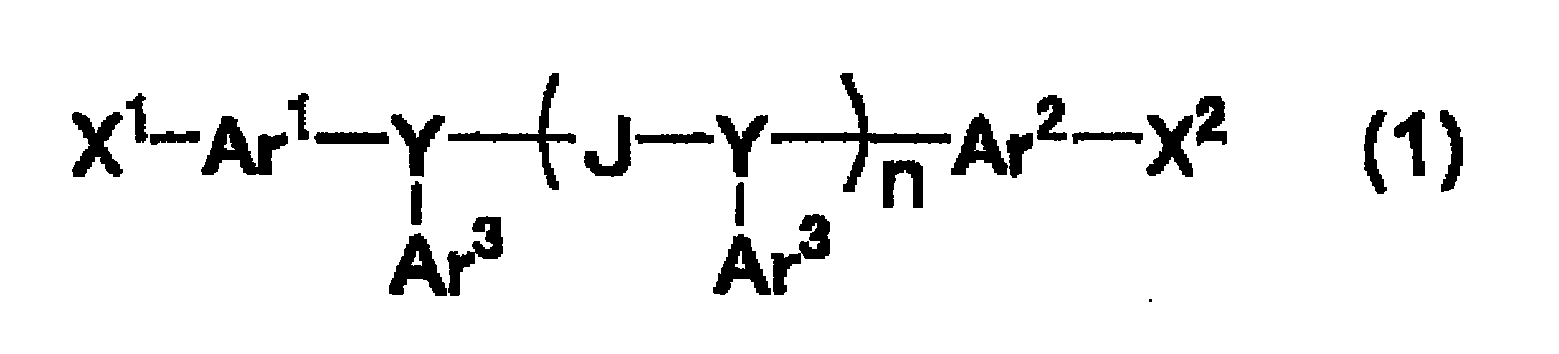
wherein X1 and X2 are characteristic groups which are different from each other and each of which is selected from the group consisting of a chlorine, bromine or iodine atom, -OSO2Q1, -B(OQ2)2, -Si(OQ3)3, -Sn(Q4)3, Z1(Z2)m, a metal acetylide group and a terminal acetylene group (where Q represents a hydrocarbon group; Q2 represetns a hydrogen atom or a hydrocarbon gruop; two Q2's may be the same as or different from each other or may together form a ring; Q3 represents a hydrocarbon group and three Q3's may be the same as or different from one another; Q4 represetns a hydrocarbon group and three Q4's may be the same as different from one another; Z1 represents a metal atom or a metal ion; Z2 represents a counter anion; and m is an integer of 0 or higher); Ar1 and Ar2 independently represent an arylene group and Ar3 represetns an aryl group, provided that any two of Ar1, Ar2 and Ar3 may be bound to each other via a substituent or directly; Y represents a trivalent atomic group having a nitrogen, carbon, boron or silicon atom to which a hydrogen atom or a hydrocarbon group may be added if required; J represents an arylene group; and n is an integer of 0 or higher; provided that, when each of J, Y and Ar3 is present in the molecule in plural number, they may be the same as or different from each other or one another.
Description
- The present invention relates to a novel aryl compound having two characteristic groups different from each other, and its manufacturing method.
- Aryl compounds are known to be useful as raw materials for functional materials, such as organic EL materials and conductive polymer materials, ligands in catalytic reaction and the like due to their electronic characteristics and steric characteristics (see Patent Documents 1 to 3).
- Recently, in the development of polymeric luminescent materials and the like, incorporation of an aryl compound into a polymer compound has been carried out by introducing a characteristic group into the aryl compound and making it react (see Non-Patent Document 1).
-
- Patent Document 1:
JP-A-2004-292782 US 2004-262574A1 ) - Patent Document 2:
JP-A-2003-147347 US 2003-51633A1 ) - Patent Document 3:
JP-A-2003-155476 US 2003-64247A1 ) - Non-Patent Document 1: Organic Electronics 2003, 4, 49-59
- However, the above-mentioned aryl compounds have had a problem of constituting the terminal structure or side chain structure of the resulting polymer compounds since they have only one characteristic group introduced. Or, the aryl compound may have two or more characteristic groups introduced and may be able to be introduced as a main chain structure into a polymer compound. Even so, the characteristic groups are the same, and thus a significant difference in reactivity between them cannot be provided. Consequently, such aryl compounds have had a problem that advanced structural features such as their direction, positions, unit number introduced and sequence length in the resulting polymer compound are difficult to sufficiently control.
- It is an object of the present invention to provide a novel aryl compound having two characteristic groups different from each other which is useful as raw material for functional materials such as organic EL materials and conductive polymer materials, whose structures are highly controlled, polymer-supported catalysts or the like.
- The compound of the present can be easily derivatized into a polymeric or low molecular compound with a highly controlled structure by utilizing a difference in reactivity between the two different characteristic groups in various chemical reactions.
- As a result of exhaustive studies to solve the above-mentioned problems, the present inventors have found a novel aryl compound having two characteristic groups different from each other, and have completed the present invention.
- Specifically, the present invention provides a novel aryl compound represented by the following general formula (1) and having mutually different characteristic groups denoted by X1 and X2.
-

- (wherein, X1 and X2 each independently denotes one characteristic group selected from the group consisting of a chlorine atom, a bromine atom, an iodine atom, -OSO2Q1, -B(OQ2)2, -Si(OQ3)3, -Sn(Q4)3, Z1(Z2)m, a metal acetylide group and a terminal acetylene group; (herein, Q1 is a hydrocarbon group which may have a substituent; Q2 is a hydrogen atom or a hydrocarbon group which may have a substituent, two Q2s may be the same or different, and may bond with each other to form a ring; Q3 is a hydrocarbon group which may have a substituent, and three Q3s may be the same or different; Q4 is a hydrocarbon group which may have a substituent, three Q4s may be the same or different; Z1 is a metal atom or a metal ion, Z2 is a counter anion thereof; and m denotes an integer of not less than 0); Ar1 and Ar2 each independently denotes an arylene group, and Ar3 denotes an aryl group; Ar1, Ar2 and Ar3 may be bonded with one another directly or through a substituent; Y denotes a trivalent atom group in which a hydrogen atom or a hydrocarbon group is optionally added to a nitrogen atom, carbon atom, boron atom or silicon atom; J denotes an arylene group; n denotes an integer of not less than 0; and in the case where J, Y and Ar3 are each present in plural numbers, they may be each the same or different from one another.)
- The novel aryl compound having two mutually different characteristic groups according to the present invention is useful as functional materials such as organic EL materials and conductive polymer materials, whose structures are highly controlled, and raw materials of catalytic reaction ligands and the like.
- The novel aryl compound having two mutually different characteristic groups according to the present invention has a structure represented by the above general formula (1).
- Hydrocarbon groups in the groups denoted by Q1, Q2, Q3 and Q4 in the characteristic groups denoted by X1 and X2 in the above-mentioned general formula include, for example, alkyl groups having about 1 to 50 carbon atoms such as a methyl group, ethyl group, propyl group, isopropyl group, butyl group, isobutyl group, t-butyl group, pentyl group, hexyl group, a nonyl group, dodecyl group, pentadecyl group, octadecyl group and a docosyl group; cyclic saturated hydrocarbon groups having about 3 to 50 carbon atoms such as a cyclopropyl group, cyclobutyl group, cyclopentyl group, cyclohexyl group, cyclononyl group, cyclododecyl group, norbornyl group and adamantyl group; alkenyl groups having about 2 to 50 carbon atoms such as an ethenyl group, propenyl group, 3-butenyl group, 2-butenyl group, 2-pentenyl group, 2-hexenyl group, 2-nonenyl group and 2-dodecenyl group; aryl groups having about 6 to 50 carbon atoms such as a phenyl group, 1-naphthyl group, 2-naphthyl group, 2-methylphenyl group, 3-methylphenyl group, 4-methylphenyl group, 4-ethylphenyl group, 4-propylphenyl group, 4-isopropylphenyl group, 4-butylphenyl group, 4-t-butylphenyl group, 4-hexylphenyl group, 4-cyclohexylphenyl group, 4-adamantylphenyl group and 4-phenylphenyl group; and aralkyl groups having about 7 to 50 carbon atoms such as a phenylmethyl group, 1-phenyleneethyl group, 2-phenylethyl group, 1-phenyl-1-propyl group, 1-phenyl-2-propyl group, 2-phenyl-2-propyl group, 1-phenyl-3-propyl group, 1-phenyl-4-butyl group, 1-phenyl-5-pentyl group and 1-phenyl-6-hexyl group. The hydrocarbon groups are preferably hydrocarbon groups having 1 to 20 carbon atoms, more preferably hydrocarbon groups having 1 to 12 carbon atoms, still more preferably hydrocarbon groups having 1 to 8 carbon atoms.
- Q1 in -OSO2Q1 is a hydrocarbon group which may have a substituent; the hydrocarbon group includes the above-mentioned hydrocarbon groups; and the substituent includes, for example, a fluorine atom and a nitro group.
Groups denoted by -OSO2Q1 are exemplified by an alkylsulfonate group, arylsulfonate group and arylalkylsulfonate group; the alkylsulfonate group is exemplified by a methanesulfonate group, ethanesulfonate group and trifluoromethanesulfonate group; the arylsulfonate group is exemplified by a benzenesulfonate group, p-toluenesulfonate group, p-nitrobenzenesulfonate group and o-nitrobenzenesulfonate group; and the arylalkylsulfonate group is exemplified by a benzylsulfonate group. The groups denoted by -OSO2Q1 preferably include a trifluoromethanesulfonate group, benzenesulfonate group, p-toluenesulfonate group and p-nitrobenzenesulfonate group, and more preferably a trifluoromethanesulfonate group. - Q2 in -B(OQ2)2 is a hydrogen atom or a hydrocarbon group which may have a substituent; two Q2s may be the same or different, and may bond with each other to form a ring. The hydrocarbon group includes the above-mentioned hydrocarbon groups, preferably an alkyl group, more preferably a methyl group, ethyl group, propyl group, isopropyl group, butyl group, isobutyl group, pentyl group, hexyl group and nonyl group, still more preferably a methyl group, ethyl group, propyl group, butyl group, pentyl group and hexyl group. In the case of forming a ring, bifunctional hydrocarbon groups composed of two Q2s are preferably a 1,2-ethylene group, 1,1,2,2-tetramethyl-1,2-ethylene group, 1,3-propylene group, 2,2-dimethyl-1,3-propylene group and 1,2-phenylene group. The substituent includes, for example, an amino group.
Groups denoted by -B(OQ2)2 are exemplified by groups represented by the following chemical formulae.

- Q3 in -Si(OQ3)3 is a hydrocarbon group which may have a substituent; and three Q3s may be the same or different. The hydrocarbon groups include the above-mentioned hydrocarbon groups, preferably an alkyl group, more preferably a methyl group, ethyl group, propyl group, isopropyl group, butyl group, isobutyl group, pentyl group, hexyl group and nonyl group, still more preferably a methyl group, ethyl group, propyl group, butyl group, pentyl group and hexyl group. The substituent includes, for example, an amino group and alkoxy group.
Groups denoted by -Si(OQ3)3 include, for example, a trimethoxysilyl group, tri(n-butyloxy)silyl group and tri(methoxymethyloxy)silyl group. - Q4 in -Sn(OQ4)3 is a hydrocarbon group which may have a substituent; and three Q4s may be the same or different. The hydrocarbon groups include the above-mentioned hydrocarbon groups, preferably an alkyl group, more preferably a methyl group, ethyl group, propyl group, isopropyl group, butyl group, isobutyl group, pentyl group, hexyl group and nonyl group, still more preferably a methyl group, ethyl group, propyl group, butyl group, pentyl group and hexyl group. The substituent includes, for example, an amino group and alkoxy group.
Groups denoted by -Sn(Q4)3 include, for example, a tri(n-butyl)tin group and triphenyltin group. - Z1 in Z1(Z2)m is a metal atom or a metal ion; Z2 is a counter ion thereof; and m is an integer of not less than 0. Specific examples of Z1 include atoms or ions such as Li, Na, K, Rb, Cs, Be, Mg, Ca, Sr, Ba, Al, Ga, In, Tl, Pb, Sc, Ti, V, Cr, Mn, Fe, Co, Ni, Cu, Zn, Y, Zr, Nb, Mo, Tc, Ru, Rh, Ag, Cd, La, Ce, Sm, Eu, Hf, Ta, W, Re, Os, Ir, Pt, Au and Hg. They preferably include Li, Na, K, Rb, Cs, Be, Mg, Ca, Sr, Ba, Al, Ga, In, Tl, Pb, Sc, Ti, Cu, Zn, Y, Zr, Ag and Hg, more preferably Li, Na, K, Rb, Cs, Be, Mg, Ca, In, Tl, Pb, Cu, Zn, Zr, Ag and Hg, still more preferably Li, Na, K, Mg, Ca, Cu and Zn.
- As Z2, a conjugate base of a Broensted acid is usually used. Specific examples include a fluoride ion, chloride ion, bromide ion, iodide ion, sulfate ion, nitrate ion, carbonate ion, perchlorate ion, tetrafluoroborate ion, hexafluorophosphate ion, methanesulfonate ion, trifluoromethanesulfonate ion, toluenesulfonate ion, acetate ion, trifluoroacetate ion, propionate ion, benzoate ion, hydroxide ion, oxide ion, methoxide ion and ethoxide ion. The specific examples are preferably a chloride ion, bromide ion, iodide ion, sulfate ion, nitrate ion, carbonate ion, methanesulfonate ion, trifluoromethanesulfonate ion, toluenesulfonate ion, acetate ion, trifluoroacetate ion, propionate ion and benzoate ion, more preferably a chloride ion, bromide ion, iodide ion, methanesulfonate ion, trifluoromethanesulfonate ion, toluenesulfonate ion, acetate ion, trifluoroacetate ion, propionate ion and benzoate ion, still more preferably a chloride ion, bromide ion, iodide ion, methanesulfonate ion, trifluoromethanesulfonate ion, acetate ion and trifluoroacetate ion.
- m is determined so that an aromatic compound represented by the above-mentioned general formula (1) has the electric neutrality. In the case of X1 or X2 being Z1(Z2)m, that is, in the case where an aromatic compound represented by the general formula (1) is represented by the general formula (1-1) or (1-2) below:


Atomic groups denoted by Z1(Z2) m are exemplified by a zinc halide group, an alkaline metal atom and an alkaline earth metal halide group. Zinc halide groups are exemplified by a zinc chloride group, zinc bromide group and zinc iodide group, and preferably include a zinc chloride group and zinc bromide group. Alkaline metal atoms are exemplified by lithium, sodium and potassium, and preferably include lithium and sodium. Alkaline earth metal halide groups are exemplified by a magnesium chloride group, magnesium bromide group, magnesium iodide group, calcium chloride group, calcium bromide group and calcium iodide group, and preferably include a magnesium chloride group, magnesium bromide group and magnesium iodide group. - Metal acetylide groups are exemplified by a copper acetylide group, zinc acetylide group, magnesium chloride acetylide group, magnesium bromide acetylide group, magnesium iodide acetylide group and tri-n-butyltin acetylide group.
- Characteristic groups denoted by X1 in the above-mentioned general formulae preferably include a chlorine atom, bromine atom, iodine atom, -OSO2Q1, -B(OQ2)2, -Si(OQ3)3, -Sn(Q4)3 and Z1(Z2)m; more preferably a halogen atom and -OSO2Q1, still more preferably a chlorine atom, bromine atom, iodine atom, trifluoromethanesulfonate group, benzenesulfonate group, p-toluenesulfonate group and p-nitrobenzenesulfonate group; even still more preferably a chlorine atom, bromine atom, iodine atom and trifluoromethanesulfonate group; even still more preferably a chlorine atom, bromine atom and trifluoromethanesulfonate group.
- Characteristic groups denoted by X2 in the above-mentioned general formulae preferably include a chlorine atom, bromine atom, iodine atom, -OSO2Q1, -B(OQ2)2, -Si(OQ3)3, -Sn(Q4)3 and Z1 (Z2)m, metal acetylide group and terminal acetylene group; more preferably a chlorine atom, bromine atom, iodine atom, -OSO2Q1, -B(OQ2)2, trimethoxysilyl group, tri(n-butyloxy)silyl group, tri(n-butyl)tin group, triphenyltin group and Z1(Z2)m; still more preferably a chlorine atom, bromine atom, iodine atom, trifluoromethanesulfonate group, benzenesulfonate group, p-toluenesulfonate group, p-nitrobenzenesulfonate group, -B(OQ2)2, trimethoxysilyl group, tri(n-butyloxy)silyl group, tri(n-butyl)tin group, triphenyltin group and Z1(Z2)m; even still more preferably a chlorine atom, bromine atom, iodine atom, trifluoromethanesulfonate group, benzenesulfonate group, p-toluenesulfonate group, p-nitrobenzenesulfonate group, -B(OQ2)2, trimethoxysilyl group, tri(n-butyloxy)silyl group, tri(n-butyl)tin group, triphenyltin group, zinc halide group, alkali metal atom and alkaline earth metal halide group; even still more preferably above all, a chlorine atom, bromine atom, iodine atom, trifluoromethanesulfonate group, benzenesulfonate group, p-toluenesulfonate group, p-nitrobenzenesulfonate group, -B(OQ2)2, trimethoxysilyl group, tri(n-butyloxy)silyl group, tri(n-butyl)tin group, triphenyltin group, zinc halide group and alkaline earth metal halide group.
- Combinations of the above-mentioned characteristic groups denoted by X1 and X2 preferably include a chlorine atom and a bromine atom, chlorine atom and iodine atom, chlorine atom and -OSO2Q1, chlorine atom and -B(OQ2)2, chlorine atom and -Si(OQ3)3, chlorine atom and -Sn(Q4)3, chlorine atom and Z1(Z2)m, chlorine atom and metal acetylide group, chlorine atom and terminal acetylene group, bromine atom and iodine atom, bromine atom and -OSO2Q1, bromine atom and -B(OQ2)2, bromine atom and -Si(OQ3)3, bromine atom and -Sn(Q4)3, bromine atom and Z1(Z2)m, bromine atom and metal acetylide group, bromine atom and terminal acetylene group, iodine atom and -OSO2Q1, iodine atom and -B (OQ2)2, iodine atom and -Si (OQ3)3, iodine atom and -Sn(Q4)3, iodine atom and Z1(Z2)m, iodine atom and metal acetylide group, iodine atom and terminal acetylene group, -OSO2Q1 and -B(OQ2)2, -OSO2Q1 and -Si(OQ3)3, -OSO2Q1 and -Sn(Q4)3, -OSO2Q1 and Z1(Z2)m, -OSO2Q1 and metal acetylide group, and -OSO2Q1 and terminal acetylene group; more preferably a chlorine atom and a bromine atom, chlorine atom and iodine atom, chlorine atom and -OSO2Q1, chlorine atom and -B(OQ2)2, chlorine atom and -Si(OQ3)3, chlorine atom and -Sn(Q4)3, chlorine atom and Z1(Z2)m, bromine atom and iodine atom, bromine atom and -OSO2Q1, bromine atom and -B(OQ2)2, bromine atom and -Si(OQ3)3, bromine atom and -Sn(Q4)3, bromine atom and Z1(Z2)m, iodine atom and -OSO2Q1, iodine atom and -B(OQ2)2, iodine atom and -Si(OQ3)3, iodine atom and -Sn(Q4)3, iodine atom and Z1(Z2)m, -OSO2Q1 and -B(OQ2)2, -OSO2Q1 and -Si(OQ3)3, -OSO2Q1 and -Sn(Q4)3, and -OSO2Q1 and Z1(Z2)m; still more preferably a chlorine atom and a bromine atom, chlorine atom and iodine atom, chlorine atom and -OSO2Q1, chlorine atom and -B(OQ2)2, chlorine atom and Z1(Z2)m, bromine atom and iodine atom, bromine atom and -OSO2Q1, bromine atom and -B(OQ2)2, bromine atom and Z1(Z2)m, iodine atom and -OSO2Q1, iodine atom and -B(OQ2)2, iodine atom and Z1(Z2) m, -OSO2Q1 and -B (OQ2)2, -OSO2Q1 and Z1(Z2)m; even still more preferably a chlorine atom and a bromine atom, chlorine atom and iodine atom, chlorine atom and -OSO2Q1, chlorine atom and -B(OQ2)2, bromine atom and iodine atom, bromine atom and -OSO2Q1, bromine atom and -B(OQ2)2, iodine atom and -OSO2Q1, iodine atom and -B(OQ2)2, and -OSO2Q1 and -B(OQ2)2; most preferably a chlorine atom and -B(OQ2)2, chlorine atom and bromine atom, bromine atom and iodine atom, bromine atom and -OSO2Q1, bromine atom and -B(OQ2)2, iodine atom and -B(OQ2)2, and -OSO2Q1 and -B(OQ2)2.
- Combinations of the above-mentioned characteristic groups denoted by X1 and X2 are preferably those in which X1 and X1, X2 and X2, or X1 and X2 react with each other to produce a bond, more preferably those in which X1 and X2 react with each other to form a bond.
- Among the combinations in which X1 and X2 react with each other to form a bond, combinations in which X1 and X1, and X2 and X2 do not react with each other not to produce a bond are further preferable.
- Arylene groups denoted by Ar1, Ar2 and J are atomic groups produced by removing two hydrogen atoms from an aromatic hydrocarbon, and also include those which have a condensed ring and those in which two or more independent benzene rings or condensed rings are directly bonded. The arylene groups may have a substituent.
The substituents include an alkyl group, alkoxy group, alkylthio group, aryl group, aryloxy group, arylthio group, arylalkyl group, arylalkoxy group, arylalkylthio group, arylalkenyl group, arylalkynyl group, amino group, substituted amino group, silyl group, substituted silyl group, fluorine atom, acyl group, acyloxy group, imine residue, amide group, acid imide group, monovalent heterocyclic group, carboxyl group, substituted carboxyl group, nitro group and cyano group, and include an alkyl group, alkoxy group, alkylthio group, aryl group, aryloxy group, arylthio group, arylalkyl group, arylalkoxy group, arylalkylthio group, substituted amino group, fluorine atom, nitro group and cyano group, more preferably an alkyl group, aryl group and arylalkyl group.
The substituents in arylene groups may bond with each other substituent to form a ring.
The number of carbon atoms in a moiety except substituents of an arylene group is usually about 6 to 60, preferably 6 to 20. The total number of carbon atoms in an arylene group including substituents is usually about 6 to 100.
The arylene groups are exemplified by a phenylene group (for example, the below chemical formulae 1 to 3), a naphthalenediyl group (the below chemical formulae 4 to 13), an anthracenediyl group (the below chemical formulae 14 to 19), a biphenyldiyl group (the below chemical formulae 20 to 25), a fluorenediyl group (the below chemical formulae 36 to 38), a terphenyldiyl group (the below chemical formulae 26 to 28), and a condensed-ring compound group (the below chemical formulae 29 to 35). -


-


-


-

-


- Arylene groups denoted by Ar1 and Ar2 are preferably a phenylene group (chemical formulae 1 to 3), a naphthalenediyl group (chemical formulae 4 to 13), a biphenylene group (chemical formulae 20 to 25), a terphenylene group (chemical formulae 26 to 28) and a fluorenediyl group (chemical formulae 36 to 38), more preferably a phenylene group (chemical formulae 1 to 3), a naphthalenediyl group (chemical formulae 4 to 13) and a biphenylene group (chemical formulae 20 to 25), still more preferably a phenylene group (chemical formulae 1 to 3) and most preferably a 1,4-phenylene group (chemical formula 1).
- An arylene group denoted by J is preferably a phenylene group (chemical formulae 1 to 3), a naphthalenediyl group (chemical formulae 4-13), a biphenylene group (chemical formulae 20 to 25), a terphenylene group (chemical formulae 26 to 28) and a fluorenediyl group (chemical formulae 36 to 38), more preferably a phenylene group (chemical formulae 1 to 3), a naphthalenediyl group (chemical formulae 4 to 13) and a biphenylene group (chemical formulae 20 to 25), still more preferably a phenylene group (chemical formulae 1 to 3) and a biphenylene group (chemical formulae 20 to 25) and most preferably 1,4-phenylene group (chemical formula 1) and 1,4-biphenylene group (chemical formula 20).
- An aryl group denoted by Ar3 is an atomic group produced by removing one hydrogen atom from an aromatic hydrocarbon, and also includes that which has a condensed ring and that in which two or more independent benzene rings or condensed rings are bonded directly or through a vinylene group and the like. The aryl group may have a substituent.
The substituent includes an alkyl group, alkoxy group, alkylthio group, aryl group, aryloxy group, arylthio group, arylalkyl group, arylalkoxy group, arylalkylthio group, arylalkenyl group, arylalkynyl group, amino group, substituted amino group, silyl group, substituted silyl group, fluorine atom, acyl group, acyloxy group, imine residue, amide group, acid imide group, monovalent heterocyclic group, carboxyl group, substituted carboxyl group, nitro group and cyano group, preferably an alkyl group, alkoxy group, alkylthio group, aryl group, aryloxy group, arylthio group, arylalkyl group, arylalkoxy group, arylalkylthio group, substituted amino group, fluorine atom, nitro group and cyano group, more preferably an alkyl group, aryl group and arylalkyl group.
The aryl groups are exemplified by those produced by bonding arylene groups denoted by the above-mentioned Ar1, Ar2 and J with one hydrogen atom. The number of carbon atoms in a moiety except substituents of an aryl group is usually about 6 to 60, preferably 6 to 20. An aryl group denoted by Ar3 is preferably a phenyl group, naphthyl group and fluorenyl group, more preferably a phenyl group and naphthyl group, most preferably a phenyl group. - Ar1, Ar2 and Ar3 may be bonded with each other through a substituent or directly.
- A trivalent atomic group denoted by Y, in which a hydrogen atom or a hydrocarbon group is optionally added to a nitrogen atom, carbon atom, boron atom or silicon atom, is exemplified by N, CH, CQ5, B, SiH and SiQ6 (wherein, Q5 denotes a hydrocarbon group which may have a substituent; and Q6 denotes a hydrocarbon group which may have a substituent). The trivalent atomic group preferably includes N, B, CH and SiH, more preferably N, B and CH, still more preferably N.
- Q5 is a hydrocarbon group which may have a substituent and the hydrocarbon group includes the above-mentioned hydrocarbon groups. The substituent includes an alkoxyl group, alkylthio group, aryloxy group, arylthio group, arylalkoxy group, arylalkylthio group, amino group, substituted amino group, silyl group, substituted silyl group, fluorine atom, acyl group, acyloxy group, imine residue, amide group, acid imide group, monovalent heterocyclic group, carboxyl group, nitro group and cyano group.
- Q6 is a hydrocarbon group which may have a substituent and the hydrocarbon group includes the above-mentioned hydrocarbon groups. The substituent includes an alkoxyl group, alkylthio group, aryloxy group, arylthio group, arylalkoxy group, arylalkylthio group, amino group, substituted amino group, silyl group, substituted silyl group, fluorine atom, acyl group, acyloxy group, imine residue, amide group, acid imide group, monovalent heterocyclic group, carboxyl group, nitro group and cyano group.
- In the general formulae (1), (1-1), (1-2), (1-1b) and (1-2b), n denotes an integer of not less than 0, and its upper limit is not especially limited, including the case where the compound according to the present invention is a polymer or an oligomer. The upper limit of the integer denoted by n, since it is preferable that the compound according to the present invention dissolves in an organic solvent in consideration of using the compound in various reactions, n is preferably an integer of not more than 10,000, more preferably an integer of not more than 1,000, still more preferably an integer of not more than 100, especially preferably an integer of not more than 10. n is most preferably 0 or 1 in view of easiness of the synthesis.
- Compounds represented by the general formula (1) are preferably exemplified by compounds represented by the following chemical formulae (2), (3) and (4):


- When the compound according to the present invention represented by the above-mentioned general formula (1) is used for various reactions, the compound according to the present invention is preferably used in a state of being diluted with an organic solvent for various reactions. The organic solvents are not especially limited as long as the solvent can dissolve not less than 0.1 wt.% of the compound according to the present invention, and are preferably exemplified by chlorine-based solvents such as chloroform, methylene chloride, 1,2-dichloroethane, 1,1,2-trichloroethane, chlorobenzene and o-dichlorobenzene; ether solvents such as tetrahydrofuran, dioxane and anisole; aromatic hydrocarbon solvents such as toluene and xylene: aliphatic hydrocarbon solvents such as cyclohexane, methylcyclohexane, n-pentane, n-hexane, n-heptane, n-octane, n-nonane, and n-decane; ketone solvents such as acetone, methyl ethyl ketone, cyclohexanone, benzophenone and acetophenone; ester solvents such as ethyl acetate, butyl acetate, ethyl cellosolve acetate, methyl benzoate and phenyl acetate; polyhydric alcohols and their derivatives such as ethylene glycol, ethylene glycol monobutyl ether, ethylene glycol monoethyl ether, ethylene glycol monomethyl ether, dimethoxyethane, propylene glycol, diethoxymethane, triethylene glycol monoethyl ether, glycerol and 1,2-hexanediol; alcohol solvents such as methanol, ethanol, propanol, isopropanol and cyclohexanol; sulfoxide solvents such as dimethyl sulfoxide; and amide solvents such as N-methyl-2-pyrrolidone and N,N-dimethylformamide. Among them, chloroform, methylene chloride, 1,2-dichloroethane, tetrahydrofuran, dioxane, anisole, toluene, xylene, cyclohexane, n-hexane, acetone, methyl ethyl ketone, ethyl acetate, ethylene glycol, ethylene glycol monoethyl ether, ethylene glycol monomethyl ether, dimethoxyethane, propylene glycol, diethoxymethane, methanol, ethanol, propanol, isopropanol, cyclohexanol, dimethyl sulfoxide, N-methyl-2-pyrrolidone and N,N-dimethylformamide are more preferable. Chloroform, methylene chloride, 1,2-dichloroethane, tetrahydrofuran, dioxane, toluene, dimethoxyethane, dimethyl sulfoxide and N,N-dimethylformamide are further preferable. These organic solvents may be used singly or in a combination of two or more.
- The purity of the compound according to the present invention represented by the above-mentioned general formula (1) depends on purities required for each type of reaction using as a raw material the compound according to the present invention. When the compound according to the present invention is used for each type of reaction, each content of compounds represented by the following general formulae (2) and (3) :


- The compound according to the present invention represented by the above-mentioned general formula (1) can be synthesized; for example, by synthesizing a compound represented by the following general formula (4):

- (Method A) The compound represented by the general formula (4) is monohalogenated with bromine, N-bromosuccinimide, N-iodosuccinimide, iodine monochloride or the like and optionally using an acid catalyst; then another halogen atom is introduced by the similar reaction, whereby a compound whose combination of characteristic groups becomes halogen-halogen is synthesized.
- (Method B) The compound represented by the general formula (4) is dihalogenated with bromine, N-bromosuccinimide, N-iodosuccinimide, iodine monochloride or the like and optionally using an acid catalyst, and then is mono-metalated by an alkaline metal by using n-BuLi, metallic sodium or the like, whereby a compound whose combination of characteristic groups becomes halogen-alkaline metal is synthesized.
- (Method C) The compound represented by the general formula (4) is dihalogenated with bromine, N-bromosuccinimide, N-iodosuccinimide, iodine monochloride or the like and optionally using an acid catalyst, and then is mono-metalated by a halogenated alkaline earth metal salt by using Mg, MgBr2, ZnCl2 or the like, whereby a compound whose combination of characteristic groups becomes halogen-halogenated alkaline earth metal is synthesized.
- (Method D) Water, hydrochloric acid or the like is acted on the compound whose combination of characteristic groups has become halogen-alkaline metal or halogen-halogenated alkaline earth metal to obtain a monohalogenated compound; then another halogen atom is introduced to the monohalogenated compound with bromine, N-bromosuccinimide, N-iodosuccinimide, iodine monochloride or the like and optionally using an acid catalyst, whereby a compound whose combination of characteristic groups becomes halogen-halogen is synthesized.
- (Method E) Trimethyl borate or the like is acted on the compound whose combination of characteristic groups has become halogen-alkaline metal or halogen-halogenated alkaline earth metal; then the resultant is hydrolyzed to form a boric acid salt, whereby a compound whose combination of characteristic groups becomes halogen-boric acid is synthesized.
- (Method F) 2-isopropoxy-4,4,5,5-tetramethyl-1,3,2-dioxabororan or the like is acted on the compound whose combination of characteristic groups has become halogen-alkaline metal or halogen-halogenated alkaline earth metal to esterify to form a boric ester, whereby a compound whose combination of characteristic groups becomes halogen-boric ester is synthesized.
- The compound according to the present invention represented by the general formula (1), by utilizing a difference between characteristic groups denoted by X1 and X2, can be derivatized into compounds, polymers whose structures are highly controlled.
- For example, as a combination of X1 and X2 in the general formula (1), by employing a combination of a halogen atom, selected from a chlorine atom, bromine atom and iodine atom, and -B(OQ2)2, halogen atom and -Si(OQ3)3, halogen atom and -Sn(Q4)3, halogen atom and Z1(Z2)m, halogen atom and metal acetylide group, halogen atom and terminal acetylene group, -OSO2Q1 and -B(OQ2)2, -OSO2Q1 and -Si(OQ3)3, -OSO2Q1 and -Sn(Q4)3, -OSO2Q1 and Z1(Z2)m, -OSO2Q1 and metal acetylide group, or -OSO2Q1 and terminal acetylene group, a polymer in which X1 and X2 are reacted with and bonded with each other can be produced by a well-known method.
- By employing a combination of a halogen atom and a halogen atom, halogen atom and -OSO2Q1, halogen atom and -B(OQ2)2, halogen atom and -Si(OQ3)3, halogen atom and -Sn(Q4)3, halogen atom and Z1(Z2)m, halogen atom and metal acetylide group, halogen atom and terminal acetylene group, -OSO2Q1 and -OSO2Q1, -OSO2Q1 and -B(OQ2)2, -OSO2Q1 and -Si(OQ3)3, or -OSO2Q1 and -Sn(Q4)3, -OSO2Q1 and Z1(Z2)m, -OSO2Q1 and metal acetylide group, or -OSO2Q1 and terminal acetylene group, and further by reacting with a compound which has a reactivity with only either one of the characteristic groups by suitably selecting the reaction condition, a compound in which X1 and X2 are each converted to a different group can be obtained.
- Hereinafter, examples will be shown to describe the present invention further in detail, but the scope of the present invention is not limited thereto.
- (LC analysis)
Measurement apparatus: Shimadzu LC-10AVp
Measurement conditions: Kaseisorp LC-ODS 2000-3, φ4.6 µm×100 mm;
Solution A: distilled water, Solution B: acetonitrile Gradient
Solution B: 60% → (10 min) → 100% → (10 min) → 100% Sample concentration: 1.0 mg/mL (THF solution) Injection amount: 1 µL
Detection wavelength: 254 nm
Column temperature: 40°C
(NMR measurement)
NMR measurement was carried out by making a solution of a compound in a deuterated chloroform or a deuterated tetrahydrofuran and using an INOVA300 nuclear magnetic resonance spectrometer, made by Varian, Inc. at room temperature. -

The reaction solution was added to 500 ml of water, and the deposited precipitate was filtered. The precipitate was rinsed twice with 250 ml of water to obtain 34.2 g of a white solid.
1H-NMR(300MHz/CDCl3):
δ(ppm)=1.3[s,9H], 2.4[s,6H], 7.1[s,2H]
MS(FD+)M+ 241 -

The reaction solution was poured in a saturated brine and extracted with 100 ml of toluene. The toluene layer was rinsed with a dilute hydrochloric acid and a saturated brine, and then the solvent was distilled out to obtain a black solid. The black solid was purified by silica gel column chromatography (hexane/chloroform 9/1) to obtain 30.1 g of a white solid.
1H-NMR (300MHz/CDCl3) :δ (ppm)=1.3 [s, 9H], 2.0 [s, 6H], 6.8~7.3 [m, 10H] -

The reaction solution was concentrated to 200 ml under reduced pressure and added to 1,000 ml of water, and the deposited precipitate was filtered. Further, the obtained crystals were recrystallized twice from DMF/ethanol to obtain 23.4 g of a white solid.
1H-NMR(300MHz/CDCl3) :
δ (ppm) = 1.3[s, 9H], 2.0[s,6H], 6.8[d,2H], 7.1[s,2H], 7.3[d,2H],
MS(APCI(+)):M+ 488 -

1H-NMR(300MHz,CDCl3):δ1.32(s,9H), 2.00(s,6H), 6.81-6.98(m,5H), 7.09(s,2H), 7.16-7.27(m,4H)
LC/MS(APPI(+)):M+ 407 -

1H-NMR(300MHz,CDCl3):δ1.32(s,9H), 1.99 (s, 6H), 6.72(d,2H), 6.84(d,2H), 7.09(s,2H), 7.28(d,2H), 7.45 (d,2H)
LC/MS(APPI(+)):M+ 533.0 -

- 91.89 g (188.58 mmol) of bis-(4-bromophenyl)-(4-tert-butyl-2,6-dimethyl-phenyl) amine was charged in a dried four-neck flask in an argon atmosphere, and added with 2,750 ml of dehydrated tetrahydrofuran and homogeneously mixed. The reaction solution was cooled to -70°C; 98 ml (150.9 mmol) of a n-hexane solution of 1.54-M n-butyllithium was dropwise charged thereto in 78 min, and the resulting mixture was stirred for 65 min as it was. Then, 35.1 g (188.65 mmol) of 2-isopropoxy-4, 4, 5, 5-tetramethyl-[1,3,2]dioxaborolane was dropwise charged in 60 min at -70°C, and the resulting mixture was stirred for 1 h as it was; thereafter, the solution was raised in temperature to 15 to 20°C, and stirred for 2 h. 1 L of water was charged at room temperature and the resulting mixture was stirred for 1 h, and then tetrahydrofuran was distilled out by reduced-pressure concentration. 2 L of toluene was added to the concentrated suspension and stirred; then, the oil layer and the aqueous layer were separated. The oil layers obtained after the separation three times were combined, and after addition of sodium sulfate anhydride, the oil was stirred. Sodium sulfate anhydride was filtered out; the obtained filtrate was concentrated under reduced pressure to obtain 113.54 g of a white solid. The white solid was purified by silica gel chromatography using toluene and n-hexane as a developing liquid, concentrated, and dried and solidified to obtain 45.5 g of a yellowish white solid. The following operation was seven times repeated: the yellowish white solid was dissolved in 800 ml of tetrahydrofuran; 800 ml of distilled water was dropwise charged at 25°C in 3 h to deposit crystals, and the mixture was filtered after it was stirred for 1 h. The obtained crystals were dried under reduced pressure to obtain the target compound (4-Bromo-phenyl)-(4-tert-butyl-2,6-dimethyl-phenyl)-[4-(4,4,5,5-tetramethyl-[1,3,2]dioxaborolan-2-yl)-phenyl]amine as a white solid (yield amount: 40.2 g, yield rate: 37.8%, LC area percentage: 98.0%). 1H-NMR:1.32(s,9H), 1.32(s,12H), 1.98(s,6H), 6.87(d,2H), 6.90(d,2H), 7.09(s,2H), 7.28(d,2H), 7.63(d,2H) LC-MS:535.1(M+H)
- The novel aryl compound according to the present invention, which has two characteristic groups different from each other, is useful as raw material for functional materials such as organic EL materials and conductive polymer materials, whose structures are highly controlled, ligands in catalytic reaction and the like.
Claims (7)
- A novel aryl compound, characterized in that the aryl compound is represented by the following formula (1):

- A composition, characterized in that the composition comprises the aryl compound according to claim 1 and at least one organic solvent.
- The composition according to claim 2, wherein the total content of a compound represented by the following formula (2) or (3):


- The compound or the composition according to any one of claims 1 to 3, wherein Y denotes a nitrogen atom.
- The compound or the composition according to any one of claims 1 to 4, wherein n denotes 0 or 1.
- The compound or the composition according to any one of claims 1 to 5, wherein Ar1 and Ar2 each denotes a phenylene group which may have a substituent; J denotes a phenylene group which may have a substituent or a biphenylene group which may have a substituent; and Ar3 denotes a phenyl group which may have a substituent.
- The compound or the composition according to any one of claims 1 to 6, wherein the compound or the composition is represented by the following formula (2), (3) or (4) :


Applications Claiming Priority (2)
| Application Number | Priority Date | Filing Date | Title |
|---|---|---|---|
| JP2005171069A JP4902839B2 (en) | 2005-06-10 | 2005-06-10 | Novel aryl compounds |
| PCT/JP2006/311610 WO2006132357A1 (en) | 2005-06-10 | 2006-06-09 | Novel aryl compound |
Publications (2)
| Publication Number | Publication Date |
|---|---|
| EP1892234A1 true EP1892234A1 (en) | 2008-02-27 |
| EP1892234A4 EP1892234A4 (en) | 2011-05-25 |
Family
ID=37498551
Family Applications (1)
| Application Number | Title | Priority Date | Filing Date |
|---|---|---|---|
| EP06766522A Withdrawn EP1892234A4 (en) | 2005-06-10 | 2006-06-09 | NEW ARYL COMPOUND |
Country Status (5)
| Country | Link |
|---|---|
| US (1) | US20090099391A1 (en) |
| EP (1) | EP1892234A4 (en) |
| JP (1) | JP4902839B2 (en) |
| TW (1) | TW200708497A (en) |
| WO (1) | WO2006132357A1 (en) |
Family Cites Families (13)
| Publication number | Priority date | Publication date | Assignee | Title |
|---|---|---|---|---|
| AU717137B2 (en) * | 1995-11-24 | 2000-03-16 | Ciba Specialty Chemicals Holding Inc. | Borate coinitiators for photopolymerization |
| JP3596261B2 (en) * | 1996-12-05 | 2004-12-02 | 凸版印刷株式会社 | Phenazacillin compound and organic thin film EL device using the same |
| GB9726810D0 (en) * | 1997-12-19 | 1998-02-18 | Zeneca Ltd | Compounds composition & use |
| GB0006367D0 (en) * | 2000-03-16 | 2000-05-03 | Avecia Ltd | Charge transport material |
| DE60103442T3 (en) * | 2000-03-31 | 2014-05-15 | Sumitomo Chemical Co. Ltd. | Polymeric fluorescent material, process for its preparation, and luminescent polymer device in which it is used |
| JP4045883B2 (en) * | 2001-07-19 | 2008-02-13 | 住友化学株式会社 | Polymer phosphor and polymer light emitting device using the same |
| SG94878A1 (en) * | 2001-07-30 | 2003-03-18 | Sumitomo Chemical Co | Polymeric fluorescent substance and polymer light-emitting device using the same |
| US6706102B2 (en) | 2001-08-01 | 2004-03-16 | Eastman Kodak Company | Dye mixture for ink jet ink |
| GB0125620D0 (en) * | 2001-10-25 | 2001-12-19 | Cambridge Display Tech Ltd | Monomers and low band gap polymers formed therefrom |
| WO2004014985A1 (en) | 2002-08-09 | 2004-02-19 | Tosoh Corporation | Novel triarylamine polymer, process for producing the same, and use thereof |
| US7056329B2 (en) * | 2002-10-23 | 2006-06-06 | Intellimed Surgical Solutions, Llc | Laparoscopic direct vision dissecting port |
| JP4032180B2 (en) * | 2003-02-06 | 2008-01-16 | 東ソー株式会社 | Novel triarylamine polymer, production method thereof and use thereof |
| US20080274303A1 (en) * | 2004-02-26 | 2008-11-06 | Katsumi Agata | Polymer Compound and Polymer Light Emitting Device Using the Same |
-
2005
- 2005-06-10 JP JP2005171069A patent/JP4902839B2/en not_active Expired - Fee Related
-
2006
- 2006-06-09 EP EP06766522A patent/EP1892234A4/en not_active Withdrawn
- 2006-06-09 WO PCT/JP2006/311610 patent/WO2006132357A1/en not_active Ceased
- 2006-06-09 TW TW095120544A patent/TW200708497A/en unknown
- 2006-06-09 US US11/921,796 patent/US20090099391A1/en not_active Abandoned
Non-Patent Citations (5)
| Title |
|---|
| EBERSON, LENNART; LARSSON, BERIT: "Electron Transfer Reactions in Organic Chemistry. XII. Reactions of 4-Substituted Triarylaminium Radical Cations with Nucleophiles; Polar vs. Electron Transfer Pathways.", ACTA CHEMICA SCANDINAVICA, vol. 41B, 1987, pages 367-378, XP002628914, DOI: 10.3891/acta.chem.scand.41b-0367 * |
| FREDERICK G MANN ET AL: "Tetra-aryl-phosphonium, -arsonium, and -stibonium salts. Part III. The synthesis and properties of tetra-aryl-arsonium salts having four dissimilar aryl groups", JOURNAL OF THE CHEMICAL SOCIETY, CHEMICAL SOCIETY, LETCHWORTH; GB, 1 January 1947 (1947-01-01), pages 505-513, XP008122010, ISSN: 0368-1769, DOI: DOI:10.1039/JR9470000505 * |
| LAMBERT CHRISTOPH ET AL: "Tuning of intervalence charge transfer energies by substituents in one-dimensional bis(triarylamine) systems", JOURNAL OF THE CHEMICAL SOCIETY, PERKIN TRANSACTIONS 2, CHEMICAL SOCIETY. LETCHWORTH, GB, no. 12, 1 January 2002 (2002-01-01), pages 2039-2043, XP009115845, ISSN: 1472-779X, DOI: DOI:10.1039/B207736A * |
| MONIR TABATABAI, WALTER VOGT, VOLKER BÖHMER: "Calix[4]arenes with resorcinol units incorporated in 2,6-position", TETRAHEDRON LETT., vol. 31, no. 23, 1990, pages 3295-3298, XP002628915, * |
| See also references of WO2006132357A1 * |
Also Published As
| Publication number | Publication date |
|---|---|
| TW200708497A (en) | 2007-03-01 |
| US20090099391A1 (en) | 2009-04-16 |
| EP1892234A4 (en) | 2011-05-25 |
| WO2006132357A1 (en) | 2006-12-14 |
| JP4902839B2 (en) | 2012-03-21 |
| JP2006342132A (en) | 2006-12-21 |
Similar Documents
| Publication | Publication Date | Title |
|---|---|---|
| WO2004024670A1 (en) | Process for producing arylamine | |
| US20250066400A1 (en) | Late first row transition metal aryl diimine catalysts for hydrofunctionalization and dehydrocoupling | |
| JP5546142B2 (en) | Heterocyclic fused oligothiophene, method for producing the same, and polymer | |
| JP2008223015A (en) | Process for producing block copolymer | |
| JP5338121B2 (en) | Heterocyclic polymer compounds | |
| Pan et al. | Synthesis of light-harvesting dendrimers focally anchored with crown ethers or terpyridine ligands | |
| US9109081B2 (en) | Method for producing aromatic polymer | |
| JP5073212B2 (en) | Process for producing aromatic polymer | |
| US8940856B2 (en) | Heterocyclic compound and heterocyclic polymers | |
| US20090099391A1 (en) | Novel Aryl Compound | |
| EP1854833B1 (en) | Method for producing aromatic polymer | |
| WO2005066243A1 (en) | Water-soluble polythiophene polymers | |
| KR102045595B1 (en) | Method for producing aromatic compound | |
| JP5340547B2 (en) | Process for producing aromatic polymer | |
| Wong et al. | Synthesis and Chemistry of Dithiadiazole Free Radicals [4‐(4′‐C5H4N) CN2S2] and [4‐(3′‐C5H4N) CN2S2]; X‐ray Crystal Structures of [Pd3 {μ‐SNC (Ar′) NS–S, S′} 2 (PPh3) 4](Ar′= 4′‐C5H4N, 4′‐C5H4NBEt3 and 3′‐C5H4NBEt3) | |
| JP2004256468A (en) | Novel 9-oxo-9-phosphafluorene derivative, process for producing the same and use thereof | |
| JP5085042B2 (en) | Method for producing branched polymer | |
| JP5650959B2 (en) | Luminescent material having phthalocyanine in side chain and method for producing the same | |
| US7999058B2 (en) | Method for producing aromatic polymer | |
| JP4135205B2 (en) | Multimers of silacyclopentadiene derivatives | |
| JP2008143857A (en) | Process for producing benzofluorene derivative and intermediate thereof | |
| JP2007016229A (en) | Process for producing reactive aromatic polymer compound | |
| JPH08295695A (en) | Novel organic halosilane compound | |
| JP2004256469A (en) | Novel polymer containing 9-oxo-9-phosphafluorene-2,7-diyl group in the main chain, method for producing the same and use thereof | |
| Zhang et al. | Syntheses, structures and reactivities of diindenyl-coordinated diiron bridging carbene complexes |
Legal Events
| Date | Code | Title | Description |
|---|---|---|---|
| PUAI | Public reference made under article 153(3) epc to a published international application that has entered the european phase |
Free format text: ORIGINAL CODE: 0009012 |
|
| 17P | Request for examination filed |
Effective date: 20080103 |
|
| AK | Designated contracting states |
Kind code of ref document: A1 Designated state(s): DE GB |
|
| DAX | Request for extension of the european patent (deleted) | ||
| RBV | Designated contracting states (corrected) |
Designated state(s): DE GB |
|
| DAX | Request for extension of the european patent (deleted) | ||
| A4 | Supplementary search report drawn up and despatched |
Effective date: 20110427 |
|
| 17Q | First examination report despatched |
Effective date: 20111222 |
|
| STAA | Information on the status of an ep patent application or granted ep patent |
Free format text: STATUS: THE APPLICATION IS DEEMED TO BE WITHDRAWN |
|
| 18D | Application deemed to be withdrawn |
Effective date: 20121019 |