EP1891976A1 - Use of light sensitive genes - Google Patents
Use of light sensitive genes Download PDFInfo
- Publication number
- EP1891976A1 EP1891976A1 EP06119420A EP06119420A EP1891976A1 EP 1891976 A1 EP1891976 A1 EP 1891976A1 EP 06119420 A EP06119420 A EP 06119420A EP 06119420 A EP06119420 A EP 06119420A EP 1891976 A1 EP1891976 A1 EP 1891976A1
- Authority
- EP
- European Patent Office
- Prior art keywords
- light
- ion channel
- cells
- gated ion
- gene
- Prior art date
- Legal status (The legal status is an assumption and is not a legal conclusion. Google has not performed a legal analysis and makes no representation as to the accuracy of the status listed.)
- Ceased
Links
- 108090000623 proteins and genes Proteins 0.000 title description 11
- 210000004027 cell Anatomy 0.000 claims abstract description 35
- 201000004569 Blindness Diseases 0.000 claims abstract description 20
- 208000003098 Ganglion Cysts Diseases 0.000 claims abstract description 9
- 208000005400 Synovial Cyst Diseases 0.000 claims abstract description 9
- 239000003814 drug Substances 0.000 claims abstract description 9
- 210000001743 on-bipolar cell Anatomy 0.000 claims abstract description 8
- 238000004519 manufacturing process Methods 0.000 claims abstract description 5
- 210000000411 amacrine cell Anatomy 0.000 claims abstract description 4
- 108090000862 Ion Channels Proteins 0.000 claims description 25
- 239000012634 fragment Substances 0.000 claims description 14
- 230000014509 gene expression Effects 0.000 claims description 10
- 108091006146 Channels Proteins 0.000 claims description 9
- 108010038450 metabotropic glutamate receptor 6 Proteins 0.000 claims description 8
- 102100038300 Metabotropic glutamate receptor 6 Human genes 0.000 claims description 7
- 108090000820 Rhodopsin Proteins 0.000 claims description 7
- 108010035848 Channelrhodopsins Proteins 0.000 claims description 3
- 102000004310 Ion Channels Human genes 0.000 abstract description 11
- 238000000034 method Methods 0.000 abstract description 8
- 210000001525 retina Anatomy 0.000 description 16
- 230000002207 retinal effect Effects 0.000 description 10
- 241000699670 Mus sp. Species 0.000 description 8
- 108091008695 photoreceptors Proteins 0.000 description 8
- 239000013598 vector Substances 0.000 description 7
- 230000007850 degeneration Effects 0.000 description 5
- 239000013612 plasmid Substances 0.000 description 5
- 102000004169 proteins and genes Human genes 0.000 description 5
- 108020004414 DNA Proteins 0.000 description 4
- 208000007014 Retinitis pigmentosa Diseases 0.000 description 4
- 230000000694 effects Effects 0.000 description 4
- 210000000608 photoreceptor cell Anatomy 0.000 description 4
- 230000004044 response Effects 0.000 description 4
- NCYCYZXNIZJOKI-IOUUIBBYSA-N 11-cis-retinal Chemical compound O=C/C=C(\C)/C=C\C=C(/C)\C=C\C1=C(C)CCCC1(C)C NCYCYZXNIZJOKI-IOUUIBBYSA-N 0.000 description 3
- 241000702421 Dependoparvovirus Species 0.000 description 3
- 102000004330 Rhodopsin Human genes 0.000 description 3
- 230000004393 visual impairment Effects 0.000 description 3
- 241000195597 Chlamydomonas reinhardtii Species 0.000 description 2
- 208000010412 Glaucoma Diseases 0.000 description 2
- 241000699666 Mus <mouse, genus> Species 0.000 description 2
- 206010034972 Photosensitivity reaction Diseases 0.000 description 2
- ZLMJMSJWJFRBEC-UHFFFAOYSA-N Potassium Chemical compound [K] ZLMJMSJWJFRBEC-UHFFFAOYSA-N 0.000 description 2
- 241000700605 Viruses Species 0.000 description 2
- 238000013459 approach Methods 0.000 description 2
- 201000010099 disease Diseases 0.000 description 2
- 208000037265 diseases, disorders, signs and symptoms Diseases 0.000 description 2
- 238000001415 gene therapy Methods 0.000 description 2
- 230000001771 impaired effect Effects 0.000 description 2
- 239000002502 liposome Substances 0.000 description 2
- 230000036211 photosensitivity Effects 0.000 description 2
- 229910052700 potassium Inorganic materials 0.000 description 2
- 239000011591 potassium Substances 0.000 description 2
- 230000000069 prophylactic effect Effects 0.000 description 2
- 230000001105 regulatory effect Effects 0.000 description 2
- 238000012421 spiking Methods 0.000 description 2
- 239000013603 viral vector Substances 0.000 description 2
- 230000003612 virological effect Effects 0.000 description 2
- 230000000007 visual effect Effects 0.000 description 2
- 108091005462 Cation channels Proteins 0.000 description 1
- 108700039691 Genetic Promoter Regions Proteins 0.000 description 1
- 241001465754 Metazoa Species 0.000 description 1
- 108091061960 Naked DNA Proteins 0.000 description 1
- 102000043276 Oncogene Human genes 0.000 description 1
- 108700020796 Oncogene Proteins 0.000 description 1
- 206010034960 Photophobia Diseases 0.000 description 1
- 108010081996 Photosystem I Protein Complex Proteins 0.000 description 1
- 102000004257 Potassium Channel Human genes 0.000 description 1
- 201000007737 Retinal degeneration Diseases 0.000 description 1
- 208000017442 Retinal disease Diseases 0.000 description 1
- 241000219315 Spinacia Species 0.000 description 1
- 235000009337 Spinacia oleracea Nutrition 0.000 description 1
- 230000003044 adaptive effect Effects 0.000 description 1
- 238000004458 analytical method Methods 0.000 description 1
- 150000001450 anions Chemical class 0.000 description 1
- 210000004556 brain Anatomy 0.000 description 1
- 210000004958 brain cell Anatomy 0.000 description 1
- 150000001768 cations Chemical class 0.000 description 1
- 210000000170 cell membrane Anatomy 0.000 description 1
- 230000008859 change Effects 0.000 description 1
- 229930002875 chlorophyll Natural products 0.000 description 1
- 235000019804 chlorophyll Nutrition 0.000 description 1
- ATNHDLDRLWWWCB-AENOIHSZSA-M chlorophyll a Chemical compound C1([C@@H](C(=O)OC)C(=O)C2=C3C)=C2N2C3=CC(C(CC)=C3C)=[N+]4C3=CC3=C(C=C)C(C)=C5N3[Mg-2]42[N+]2=C1[C@@H](CCC(=O)OC\C=C(/C)CCC[C@H](C)CCC[C@H](C)CCCC(C)C)[C@H](C)C2=C5 ATNHDLDRLWWWCB-AENOIHSZSA-M 0.000 description 1
- 239000003937 drug carrier Substances 0.000 description 1
- 238000004520 electroporation Methods 0.000 description 1
- 238000005516 engineering process Methods 0.000 description 1
- 239000003623 enhancer Substances 0.000 description 1
- 230000000763 evoking effect Effects 0.000 description 1
- 239000013613 expression plasmid Substances 0.000 description 1
- 102000034287 fluorescent proteins Human genes 0.000 description 1
- 108091006047 fluorescent proteins Proteins 0.000 description 1
- 230000002068 genetic effect Effects 0.000 description 1
- 230000005802 health problem Effects 0.000 description 1
- 210000002287 horizontal cell Anatomy 0.000 description 1
- 238000003780 insertion Methods 0.000 description 1
- 230000037431 insertion Effects 0.000 description 1
- 230000037427 ion transport Effects 0.000 description 1
- 150000002500 ions Chemical class 0.000 description 1
- 230000023886 lateral inhibition Effects 0.000 description 1
- 230000004298 light response Effects 0.000 description 1
- 208000013469 light sensitivity Diseases 0.000 description 1
- 208000018769 loss of vision Diseases 0.000 description 1
- 231100000864 loss of vision Toxicity 0.000 description 1
- 208000002780 macular degeneration Diseases 0.000 description 1
- 210000004962 mammalian cell Anatomy 0.000 description 1
- 230000007246 mechanism Effects 0.000 description 1
- 230000001404 mediated effect Effects 0.000 description 1
- 244000005700 microbiome Species 0.000 description 1
- 230000035772 mutation Effects 0.000 description 1
- 208000015122 neurodegenerative disease Diseases 0.000 description 1
- 210000002569 neuron Anatomy 0.000 description 1
- 239000002674 ointment Substances 0.000 description 1
- 239000002245 particle Substances 0.000 description 1
- 238000013492 plasmid preparation Methods 0.000 description 1
- 229920001184 polypeptide Polymers 0.000 description 1
- 108020001213 potassium channel Proteins 0.000 description 1
- 102000004196 processed proteins & peptides Human genes 0.000 description 1
- 108090000765 processed proteins & peptides Proteins 0.000 description 1
- 238000012545 processing Methods 0.000 description 1
- 238000009877 rendering Methods 0.000 description 1
- 238000011160 research Methods 0.000 description 1
- 230000004043 responsiveness Effects 0.000 description 1
- 210000000964 retinal cone photoreceptor cell Anatomy 0.000 description 1
- 230000004258 retinal degeneration Effects 0.000 description 1
- 210000000880 retinal rod photoreceptor cell Anatomy 0.000 description 1
- 238000012552 review Methods 0.000 description 1
- 241000894007 species Species 0.000 description 1
- 230000000638 stimulation Effects 0.000 description 1
- 239000000126 substance Substances 0.000 description 1
- 238000002560 therapeutic procedure Methods 0.000 description 1
- 230000002103 transcriptional effect Effects 0.000 description 1
- 230000014616 translation Effects 0.000 description 1
- 230000032258 transport Effects 0.000 description 1
- 241000701161 unidentified adenovirus Species 0.000 description 1
- 241001529453 unidentified herpesvirus Species 0.000 description 1
- 241001430294 unidentified retrovirus Species 0.000 description 1
- 238000012800 visualization Methods 0.000 description 1
Images

Classifications
-
- A—HUMAN NECESSITIES
- A61—MEDICAL OR VETERINARY SCIENCE; HYGIENE
- A61K—PREPARATIONS FOR MEDICAL, DENTAL OR TOILETRY PURPOSES
- A61K48/00—Medicinal preparations containing genetic material which is inserted into cells of the living body to treat genetic diseases; Gene therapy
- A61K48/0075—Medicinal preparations containing genetic material which is inserted into cells of the living body to treat genetic diseases; Gene therapy characterised by an aspect of the delivery route, e.g. oral, subcutaneous
-
- A—HUMAN NECESSITIES
- A61—MEDICAL OR VETERINARY SCIENCE; HYGIENE
- A61K—PREPARATIONS FOR MEDICAL, DENTAL OR TOILETRY PURPOSES
- A61K38/00—Medicinal preparations containing peptides
- A61K38/16—Peptides having more than 20 amino acids; Gastrins; Somatostatins; Melanotropins; Derivatives thereof
-
- A—HUMAN NECESSITIES
- A61—MEDICAL OR VETERINARY SCIENCE; HYGIENE
- A61K—PREPARATIONS FOR MEDICAL, DENTAL OR TOILETRY PURPOSES
- A61K38/00—Medicinal preparations containing peptides
- A61K38/16—Peptides having more than 20 amino acids; Gastrins; Somatostatins; Melanotropins; Derivatives thereof
- A61K38/17—Peptides having more than 20 amino acids; Gastrins; Somatostatins; Melanotropins; Derivatives thereof from animals; from humans
- A61K38/1703—Peptides having more than 20 amino acids; Gastrins; Somatostatins; Melanotropins; Derivatives thereof from animals; from humans from vertebrates
- A61K38/1709—Peptides having more than 20 amino acids; Gastrins; Somatostatins; Melanotropins; Derivatives thereof from animals; from humans from vertebrates from mammals
-
- A—HUMAN NECESSITIES
- A61—MEDICAL OR VETERINARY SCIENCE; HYGIENE
- A61K—PREPARATIONS FOR MEDICAL, DENTAL OR TOILETRY PURPOSES
- A61K48/00—Medicinal preparations containing genetic material which is inserted into cells of the living body to treat genetic diseases; Gene therapy
- A61K48/005—Medicinal preparations containing genetic material which is inserted into cells of the living body to treat genetic diseases; Gene therapy characterised by an aspect of the 'active' part of the composition delivered, i.e. the nucleic acid delivered
- A61K48/0058—Nucleic acids adapted for tissue specific expression, e.g. having tissue specific promoters as part of a contruct
-
- A—HUMAN NECESSITIES
- A61—MEDICAL OR VETERINARY SCIENCE; HYGIENE
- A61P—SPECIFIC THERAPEUTIC ACTIVITY OF CHEMICAL COMPOUNDS OR MEDICINAL PREPARATIONS
- A61P27/00—Drugs for disorders of the senses
- A61P27/02—Ophthalmic agents
-
- C—CHEMISTRY; METALLURGY
- C07—ORGANIC CHEMISTRY
- C07K—PEPTIDES
- C07K14/00—Peptides having more than 20 amino acids; Gastrins; Somatostatins; Melanotropins; Derivatives thereof
- C07K14/405—Peptides having more than 20 amino acids; Gastrins; Somatostatins; Melanotropins; Derivatives thereof from algae
-
- C—CHEMISTRY; METALLURGY
- C12—BIOCHEMISTRY; BEER; SPIRITS; WINE; VINEGAR; MICROBIOLOGY; ENZYMOLOGY; MUTATION OR GENETIC ENGINEERING
- C12N—MICROORGANISMS OR ENZYMES; COMPOSITIONS THEREOF; PROPAGATING, PRESERVING, OR MAINTAINING MICROORGANISMS; MUTATION OR GENETIC ENGINEERING; CULTURE MEDIA
- C12N15/00—Mutation or genetic engineering; DNA or RNA concerning genetic engineering, vectors, e.g. plasmids, or their isolation, preparation or purification; Use of hosts therefor
- C12N15/09—Recombinant DNA-technology
- C12N15/63—Introduction of foreign genetic material using vectors; Vectors; Use of hosts therefor; Regulation of expression
- C12N15/79—Vectors or expression systems specially adapted for eukaryotic hosts
- C12N15/85—Vectors or expression systems specially adapted for eukaryotic hosts for animal cells
-
- A—HUMAN NECESSITIES
- A61—MEDICAL OR VETERINARY SCIENCE; HYGIENE
- A61K—PREPARATIONS FOR MEDICAL, DENTAL OR TOILETRY PURPOSES
- A61K38/00—Medicinal preparations containing peptides
-
- C—CHEMISTRY; METALLURGY
- C12—BIOCHEMISTRY; BEER; SPIRITS; WINE; VINEGAR; MICROBIOLOGY; ENZYMOLOGY; MUTATION OR GENETIC ENGINEERING
- C12N—MICROORGANISMS OR ENZYMES; COMPOSITIONS THEREOF; PROPAGATING, PRESERVING, OR MAINTAINING MICROORGANISMS; MUTATION OR GENETIC ENGINEERING; CULTURE MEDIA
- C12N2830/00—Vector systems having a special element relevant for transcription
- C12N2830/008—Vector systems having a special element relevant for transcription cell type or tissue specific enhancer/promoter combination
Definitions
- the present invention relates to a method of treating blindness.
- the present invention also relates to constructs for use in treating blindness, as well as their use in the manufacture of a medicament for treating blindness.
- RP retinitis pigmentosa
- MD macular deneneration
- G glaucoma
- Bi et al. (Neuron, 50, 2006, p23-33 ) discloses the use of microbial-type rhodopsin to restore visual responses in mice with photoreceptor degeneration.
- the expression of the rhodopsin gene is likely to have occurred in a variety of types of cell in the eye which is potentially undesirable and/or problematic. It also appears that the threshold light intensity required for producing responses is much higher than for normal rod and cone photoreceptors, but there is no teaching of how this may be addressed in, for example, low light environments.
- a light-gated ion channel gene or active fragment thereof for the manufacture of a medicament for use in treating or ameliorating blindness.
- the medicament is generally used therapeutically, but it may be used in a prophylactic sense, when a subject has been identified as being likely to suffer from blindness, but actual vision loss has not yet occurred or has only minimally occurred.
- blindness is meant total or partial loss of vision.
- the medicament may be used to treat blindness associated with macular degeneration, glaucoma and/or retinitis pigmentosa.
- any disease or condition which leads to degeneration or non-functioning of photoreceptors in the eye may be treated using the medicament.
- An active fragment of the light- gated ion channel is a fragment which when expressed generates a polypeptide which is still capable of functioning as a light capturing molecule which causes a subsequent flow of ions into or out of the cell in which the channel is located and a consequent change in voltage.
- the present invention also extends to methods of treating prophylactically or therapeutically blindness by administering to a patient suffering or predisposed to developing blindness, a DNA construct comprising a light-gated ion channel gene sequence or active fragment thereof, which gene sequence or fragment thereof is capable of expressing one or more copies of the light- gated ion channel protein in a retinal cell, whereby expression of said one or more copies of the light- gated ion channel protein render the cell photosensitive so as to enable treatment or amelioration of blindness.
- the light-gated ion channel gene sequence or fragment thereof may be administered to a subject in the form of a recombinant molecule comprising said light-gated ion channel gene sequence or active fragment under appropriate transcriptional/translational controls to allow expression of said light- gated ion channel protein when administered to retinal cells of a subject.
- the light- gated ion channel sequence or fragment may be under control of a suitable promoter, such as a constitutive and/or controllable promoter.
- the present invention also therefore provides a recombinant molecule comprising an light- gated ion channel gene sequence or active fragment thereof for use in therapy.
- the recombinant molecule may be in the form of a plasmid, phagemid or viral vector.
- recombinantly expressed, or chemically synthesised light-gated ion channel protein, or functionally important fragments thereof may be produced and applied to the eye via a suitable ointment or other pharmaceutical vehicle, as a treatment or prophylactic measure for treating said aforementioned diseases.
- adenovirus vectors many different viral and non-viral vectors and methods of their delivery, for use in gene therapy, are known, such as adenovirus vectors, adeno-associated virus vectors, retrovirus vectors, lentiviral vectors, herpes virus vectors, liposomes, naked DNA administration and the like.
- adenovirus vectors adeno-associated virus vectors
- retrovirus vectors retrovirus vectors
- lentiviral vectors lentiviral vectors
- herpes virus vectors herpes virus vectors
- liposomes naked DNA administration and the like.
- the light-gated ion channel gene is a rhodopsin gene, such as a rhodopsin from a microorganism, such as a unicellular alga, typically from the species Chlamydononas, especially Chlamydomonas reinhardtii.
- a preferred rhodopsin is Channelrhodopsin - 2 (ChR2) which is a light gated cation channel from C. reinhardtii, see for example, Boyden et al 2005 (Nature Neuroscience, 8, 9; 1263-1268 ), incorporated herein by reference.
- the cells to which the medicament or vector are to be administered, and in which the gene is to be expressed are ON-bipolar cells, ON-ganglion, or AII amacrine cells.
- the photoreceptor cells themselves which have lost photosensitivity, but which are not "dead” could be used to express the light- gated ion channel gene, though the polarity of the response would be the opposite than under normal conditions.
- expression of the light-gated ion channel gene in photoreceptors may serve to prevent or show down degeneration.
- a cell specific promoter may be used to ensure that the light- gated ion channel gene is only expressed in a specific cell type.
- the mGluR6 promoter Ueda et al, J Neurosci. 1997 May 1;17(9):3014-23 )may be employed to control expression in ON-bipolar cells.
- the light- gated ion channel protein inserts within the plasma membrane of the cell, rendering the cell photosensitive and able to cause ion transport, cation or anion, in response to light.
- the retina is sensitive to very wide ranges of light intensities due to the adaptive nature of photoreceptors
- light-gated ion channels may not be able to adapt and may therefore respond only to a narrow range of light intensities. If this is the case, such a limitation may be mitigated by use of image intensifiers and/or image converters known in the art.
- a patient who has been treated by the above described method may wear, image intensifiers/enhancers mounted, for example, on spectacles or the like.
- an image intensifying device such as those provided by Telesensory (http://www.telesensory.com) may be combined with a retinal scanning device (RSD) as developed by Microvision (http://www.microvision.com/milprod.html), to provide a head-worn apparatus capable of delivering a bright, intensified image directly to the retina of a patient with impaired vision (http://www.telesensory.com/home8.html).
- RSD retinal scanning device
- Microvision http://www.microvision.com/milprod.html
- a RSD projects images onto the retina such that an individual can view a large, full-motion image without the need for additional screens or monitors.
- an intensified image directly to the retina of an individual with impaired vision it may be possible to improve vision in those considered to be blind.
- the light- gated ion channel is expressed in photoreceptors as mentioned before the polarity of light response in photoreceptors inverses. That can be corrected with inverting the polarity of the projected image: dark pixels becoming light and light pixels becoming dark.
- the metabotropic glutamate receptor 6 (mGluR6) gene is specifically expressed in certain types of bipolar cells, called ON bipolar cells, within the inner retina. These cells mediate responsiveness to a light signal that is relayed by the photoreceptor cells.
- the regulatory sequences of the mGluR6 gene are responsible for its cell specific expression. These regulatory sequences or functional fragments or derivatives thereof can be used to direct the production of another gene to make the ON bipolar cells sensitive to light in the absence of functioning photoreceptor cells. Promoter analysis can be used to identify promoter functional fragments and derivatives ( McGowen at al. Mol. Vision 1998, 4:2 ; Bookstein et al. PNAS 1990, 87 (19); 7762-66 )
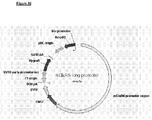
- the expression plasmids consist of a mGluR6 promoter sequence (Ueda et al) linked to the channelrhodopsin-2 protein-coding sequence, which in turn is fused to a sequence encoding a fluorescent protein.
- This fluorescent "tag" enables the visualization of which cells are producing the channelrhodopsin-2 protein. All of these sequences are combined with additional DNA elements that comprise a vector for transport to and protein production within mammalian cells. Examples of suitable constructs are shown in Figures 1a and 1b.
- the plasmids can be delivered to the retinas of mice by a technique called electroporation.
- electroporation a technique called electroporation.
- a pure preparation of the plasmid can be injected into the subretinal space of the mouse eye.
- an electrical current can be applied to the eye to cause the DNA to enter the retina.
- the DNA remains there and can be expressed for several weeks.
- Another method of delivery of the channelrhodopsin-2 protein into the bipolar cells is to use a viral-based mechanism.
- Recombinant adeno-associated viruses can be produced that encode the channelrhodopsin-2 protein linked to the mGluR6 promoter region.
- the viruses can be injected into the intravitreal space of the mouse eye. The virus particles would infect cells of the retina, and gene expression would be tested several weeks later.
- the plasmids and recombinant adeno-associated viruses can be delivered to the retinas of mice that are blind as a result of a genetic mutation that causes retinal degeneration ( Bowes et al., Nature, 1990; 347;667-680 ).
- the photoreceptor cells of these mice are lost within a few weeks after birth.
- These mice are a frequently used experimental model system for studying retinal degenerative diseases that affect humans. By introducing channelrhodopsin-2 into the bipolar cells of these animals, the aim is to restore light sensitivity to the otherwise photo-insensitive retinas. Therefore these studies may serve as the basis for gene therapy approaches for human cases of retinal disease.
- ganglion cells may be recorded, the output cells of the retina which provide information about the visual scene to the rest of the brain.
- An array of electrodes or a single electrode can be used to record activity from ganglion cells.
- ganglion cells produce electric "spikes" when stimulated by light.
- the retina can be prepared to express the light sensitive channelrhodopsin-2 channel in ON bipolar cells, from the eye of the blind mice and stimulated with light. During light stimulation the spiking activity from ganglion cells can be recorded. If spiking activity evoked by light can be measured, it can be concluded that the blind mice can "see".
Landscapes
- Health & Medical Sciences (AREA)
- Life Sciences & Earth Sciences (AREA)
- Chemical & Material Sciences (AREA)
- Engineering & Computer Science (AREA)
- Genetics & Genomics (AREA)
- General Health & Medical Sciences (AREA)
- Biotechnology (AREA)
- Organic Chemistry (AREA)
- Medicinal Chemistry (AREA)
- Bioinformatics & Cheminformatics (AREA)
- Molecular Biology (AREA)
- Pharmacology & Pharmacy (AREA)
- Animal Behavior & Ethology (AREA)
- Public Health (AREA)
- Veterinary Medicine (AREA)
- Epidemiology (AREA)
- Biochemistry (AREA)
- Zoology (AREA)
- Biomedical Technology (AREA)
- Gastroenterology & Hepatology (AREA)
- Proteomics, Peptides & Aminoacids (AREA)
- Biophysics (AREA)
- Wood Science & Technology (AREA)
- General Engineering & Computer Science (AREA)
- Immunology (AREA)
- Microbiology (AREA)
- Plant Pathology (AREA)
- Physics & Mathematics (AREA)
- Marine Sciences & Fisheries (AREA)
- Ophthalmology & Optometry (AREA)
- Chemical Kinetics & Catalysis (AREA)
- General Chemical & Material Sciences (AREA)
- Nuclear Medicine, Radiotherapy & Molecular Imaging (AREA)
- Medicines That Contain Protein Lipid Enzymes And Other Medicines (AREA)
- Medicines Containing Material From Animals Or Micro-Organisms (AREA)
Priority Applications (12)
| Application Number | Priority Date | Filing Date | Title |
|---|---|---|---|
| EP06119420A EP1891976A1 (en) | 2006-08-23 | 2006-08-23 | Use of light sensitive genes |
| AU2007287820A AU2007287820B2 (en) | 2006-08-23 | 2007-08-21 | Use of light sensitive genes |
| JP2009524955A JP2010501501A (ja) | 2006-08-23 | 2007-08-21 | 光感受性遺伝子の使用 |
| US12/160,277 US20090088399A1 (en) | 2006-08-23 | 2007-08-21 | Use of Light Sensitive Genes |
| EP07801794A EP2059263A1 (en) | 2006-08-23 | 2007-08-21 | Use of light sensitive genes |
| PCT/EP2007/007361 WO2008022772A1 (en) | 2006-08-23 | 2007-08-21 | Use of light sensitive genes |
| CA002660696A CA2660696A1 (en) | 2006-08-23 | 2007-08-21 | Use of light sensitive genes |
| US13/613,945 US20130005795A1 (en) | 2006-08-23 | 2012-09-13 | Use of Light Sensitive Genes |
| JP2013146570A JP2013253085A (ja) | 2006-08-23 | 2013-07-12 | 光感受性遺伝子の使用 |
| US14/100,236 US20140094506A1 (en) | 2006-08-23 | 2013-12-09 | Use of light sensitive genes |
| JP2015015495A JP2015110621A (ja) | 2006-08-23 | 2015-01-29 | 光感受性遺伝子の使用 |
| US14/612,577 US20150246094A1 (en) | 2006-08-23 | 2015-02-03 | Use of light sensitive genes |
Applications Claiming Priority (1)
| Application Number | Priority Date | Filing Date | Title |
|---|---|---|---|
| EP06119420A EP1891976A1 (en) | 2006-08-23 | 2006-08-23 | Use of light sensitive genes |
Publications (1)
| Publication Number | Publication Date |
|---|---|
| EP1891976A1 true EP1891976A1 (en) | 2008-02-27 |
Family
ID=37198788
Family Applications (2)
| Application Number | Title | Priority Date | Filing Date |
|---|---|---|---|
| EP06119420A Ceased EP1891976A1 (en) | 2006-08-23 | 2006-08-23 | Use of light sensitive genes |
| EP07801794A Withdrawn EP2059263A1 (en) | 2006-08-23 | 2007-08-21 | Use of light sensitive genes |
Family Applications After (1)
| Application Number | Title | Priority Date | Filing Date |
|---|---|---|---|
| EP07801794A Withdrawn EP2059263A1 (en) | 2006-08-23 | 2007-08-21 | Use of light sensitive genes |
Country Status (6)
| Country | Link |
|---|---|
| US (4) | US20090088399A1 (enExample) |
| EP (2) | EP1891976A1 (enExample) |
| JP (3) | JP2010501501A (enExample) |
| AU (1) | AU2007287820B2 (enExample) |
| CA (1) | CA2660696A1 (enExample) |
| WO (1) | WO2008022772A1 (enExample) |
Cited By (8)
| Publication number | Priority date | Publication date | Assignee | Title |
|---|---|---|---|---|
| WO2012174674A1 (en) * | 2011-06-24 | 2012-12-27 | Haag-Streit Medtech Ag | Light-sensitive chimeric gpcr protein |
| GB2472964B (en) * | 2008-05-20 | 2013-04-24 | Eos Neuroscience Inc | Vectors for delivery of light-sensitive proteins and methods of use |
| US9180309B2 (en) | 2010-02-26 | 2015-11-10 | Cornell University | Retina prosthesis |
| US9220634B2 (en) | 2010-02-26 | 2015-12-29 | Cornell University | Retina prosthesis |
| US9302103B1 (en) | 2010-09-10 | 2016-04-05 | Cornell University | Neurological prosthesis |
| US9547804B2 (en) | 2011-08-25 | 2017-01-17 | Cornell University | Retinal encoder for machine vision |
| US11430263B2 (en) | 2015-04-20 | 2022-08-30 | Cornell University | Machine vision with dimensional data reduction |
| US12097268B2 (en) | 2010-10-15 | 2024-09-24 | Eos Neuroscience, Inc. | Modulation of neural pathways |
Families Citing this family (27)
| Publication number | Priority date | Publication date | Assignee | Title |
|---|---|---|---|---|
| AU2003249318A1 (en) | 2002-07-18 | 2004-02-09 | The General Hospital Corp. | Method for augmenting vision in persons suffering from photoreceptor cell degeneration |
| CN101970013B (zh) * | 2008-04-18 | 2014-11-05 | 诺瓦提斯研究基金会弗里德里克·米谢尔生物医学研究所 | 治疗失明的新型治疗工具和方法 |
| US20120196281A1 (en) * | 2009-09-29 | 2012-08-02 | Volker Busskamp | Functionalized organotypic systems |
| WO2011127088A2 (en) | 2010-04-05 | 2011-10-13 | Eos Neuroscience, Inc. | Methods and compositions for decreasing chronic pain |
| WO2014033095A1 (en) | 2012-08-27 | 2014-03-06 | Friedrich Miescher Institute For Biomedical Research | Retinal off circuit-specific promoter |
| US9265458B2 (en) | 2012-12-04 | 2016-02-23 | Sync-Think, Inc. | Application of smooth pursuit cognitive testing paradigms to clinical drug development |
| US9380976B2 (en) | 2013-03-11 | 2016-07-05 | Sync-Think, Inc. | Optical neuroinformatics |
| AU2015229464B2 (en) | 2014-03-11 | 2021-07-22 | Wayne State University | A modified mGluR6 promoter and methods of use |
| US10941417B2 (en) | 2015-04-30 | 2021-03-09 | Friedrich Miescher Institute For Biomedical Research | Promoter for the specific expression of genes in Müller cells |
| US10857241B2 (en) | 2015-09-15 | 2020-12-08 | Friedrich Miescher Institute For Biomedical Research | Therapeutical tools and methods for treating blindness by targeting photoreceptors |
| ES2881782T3 (es) | 2015-10-14 | 2021-11-30 | Friedrich Miescher Institute For Biomedical Res | Promotor para la expresión específica de genes en células endoteliales retinianas. |
| ES2909444T3 (es) | 2015-12-03 | 2022-05-06 | Friedrich Miescher Institute For Biomedical Res | Synp159, un promotor para la expresión específica de genes en los fotorreceptores de los bastones |
| WO2017093934A1 (en) | 2015-12-03 | 2017-06-08 | Friedrich Miescher Institute For Biomedical Research | Synp160, a promoter for the specific expression of genes in rod photoreceptors |
| US11059871B2 (en) | 2015-12-03 | 2021-07-13 | Friedrich Miescher Institute For Biomedical Research | SYNP162, a promoter for the specific expression of genes in rod photoreceptors |
| ES2761328T3 (es) | 2015-12-03 | 2020-05-19 | Friedrich Miescher Institute For Biomedical Res | SynP161, un promotor para la expresión específica de genes en fotorreceptores de bastón |
| US20190269755A1 (en) | 2016-04-29 | 2019-09-05 | Gensight Biologics Sa | Optogenetic visual restoration using chrimson |
| US20190209708A1 (en) | 2016-05-17 | 2019-07-11 | Friedrich Miescher Institute For Biomedical Research | Novel therapeutic tools and methods for treating blindness |
| CA3042197A1 (en) | 2016-11-02 | 2018-05-11 | Friedrich Miescher Institute For Biomedical Research | Synp198, a promoter for the specific expression of genes in direction selective retinal ganglion cells |
| CN110392582A (zh) | 2017-02-08 | 2019-10-29 | 弗里德里克·米谢尔生物医学研究所 | 用于使基因在视网膜神经节细胞中特异性表达的启动子SynP88 |
| EP3422065A1 (en) | 2017-06-28 | 2019-01-02 | Gensight Biologics | Objective, camera and system adapted for optogenetics comprising such objective |
| MX2020005033A (es) | 2017-11-15 | 2020-10-28 | Friedrich Miescher Institute For Biomedical Res | Promotor especifico de las celulas del epitelio pigmentario retinal en primates. |
| RU2020121408A (ru) | 2017-11-30 | 2021-12-30 | Фридрих Мишер Инститьют Фор Байомедикал Рисерч | ПРОМОТОР SynPIII ДЛЯ СПЕЦИФИЧЕСКОЙ ЭКСПРЕССИИ ГЕНОВ В ПИГМЕНТНОМ ЭПИТЕЛИИ СЕТЧАТКИ |
| ES2954941T3 (es) | 2018-01-11 | 2023-11-27 | Gensight Biologics | Procedimiento y dispositivo para el procesamiento de señales asíncronas generadas por un sensor de luz basado en eventos |
| EP3693060A1 (en) | 2019-02-05 | 2020-08-12 | Gensight Biologics | Method for controlling an optogenetic device using a command law for the radiant power of a light source and associated devices |
| EP3693061A1 (en) | 2019-02-05 | 2020-08-12 | Gensight Biologics | Method for controlling an optogenetic device using filtering and associated devices |
| EP3733139A1 (en) | 2019-05-02 | 2020-11-04 | Gensight Biologics | Viewing apparatus and method for projecting a light signal |
| WO2021165876A1 (en) | 2020-02-19 | 2021-08-26 | Friedrich Miescher Institute For Biomedical Research | Novel therapeutical tools and methods using temperature-senstive receptors for treating blindness |
Citations (3)
| Publication number | Priority date | Publication date | Assignee | Title |
|---|---|---|---|---|
| WO2003047525A2 (en) * | 2001-12-03 | 2003-06-12 | The Regents Of The University Of California | Expression of glial-derived neurotrophic factor for treatment of diseases of the eye |
| WO2004009022A2 (en) * | 2002-07-18 | 2004-01-29 | The General Hospital Corp. | Method for augmenting vision in persons suffering from photoreceptor cell degeneration |
| WO2004084951A2 (en) * | 2003-03-28 | 2004-10-07 | Universite De Nantes | A method and vectors for selectively transducing retinal pigment epithelium cells |
Family Cites Families (2)
| Publication number | Priority date | Publication date | Assignee | Title |
|---|---|---|---|---|
| DE10216005A1 (de) * | 2002-04-11 | 2003-10-30 | Max Planck Gesellschaft | Verwendung von biologischen Photorezeptoren als direkt lichtgesteuerte Ionenkanäle |
| WO2007024391A2 (en) * | 2005-07-22 | 2007-03-01 | The Board Of Trustees Of The Leland Stanford Junior University | Light-activated cation channel and uses thereof |
-
2006
- 2006-08-23 EP EP06119420A patent/EP1891976A1/en not_active Ceased
-
2007
- 2007-08-21 US US12/160,277 patent/US20090088399A1/en not_active Abandoned
- 2007-08-21 AU AU2007287820A patent/AU2007287820B2/en not_active Ceased
- 2007-08-21 WO PCT/EP2007/007361 patent/WO2008022772A1/en not_active Ceased
- 2007-08-21 CA CA002660696A patent/CA2660696A1/en not_active Abandoned
- 2007-08-21 JP JP2009524955A patent/JP2010501501A/ja active Pending
- 2007-08-21 EP EP07801794A patent/EP2059263A1/en not_active Withdrawn
-
2012
- 2012-09-13 US US13/613,945 patent/US20130005795A1/en not_active Abandoned
-
2013
- 2013-07-12 JP JP2013146570A patent/JP2013253085A/ja active Pending
- 2013-12-09 US US14/100,236 patent/US20140094506A1/en not_active Abandoned
-
2015
- 2015-01-29 JP JP2015015495A patent/JP2015110621A/ja active Pending
- 2015-02-03 US US14/612,577 patent/US20150246094A1/en not_active Abandoned
Patent Citations (3)
| Publication number | Priority date | Publication date | Assignee | Title |
|---|---|---|---|---|
| WO2003047525A2 (en) * | 2001-12-03 | 2003-06-12 | The Regents Of The University Of California | Expression of glial-derived neurotrophic factor for treatment of diseases of the eye |
| WO2004009022A2 (en) * | 2002-07-18 | 2004-01-29 | The General Hospital Corp. | Method for augmenting vision in persons suffering from photoreceptor cell degeneration |
| WO2004084951A2 (en) * | 2003-03-28 | 2004-10-07 | Universite De Nantes | A method and vectors for selectively transducing retinal pigment epithelium cells |
Non-Patent Citations (6)
| Title |
|---|
| BI ANDING ET AL: "Ectopic expression of a microbial-type rhodopsin restores visual responses in mice with photoreceptor degeneration.", NEURON. 6 APR 2006, vol. 50, no. 1, 6 April 2006 (2006-04-06), pages 23 - 33, XP002406402, ISSN: 0896-6273 * |
| FLANNERY JOHN G ET AL: "Looking within for vision.", NEURON. 6 APR 2006, vol. 50, no. 1, 6 April 2006 (2006-04-06), pages 1 - 3, XP002406403, ISSN: 0896-6273 * |
| MASLAND R H: "The many roles of starburst amacrine cells", TRENDS IN NEUROSCIENCE, ELSEVIER, AMSTERDAM, NL, vol. 28, no. 8, August 2005 (2005-08-01), pages 395 - 396, XP004984223, ISSN: 0166-2236 * |
| NAGEL GEORG ET AL: "Channelrhodopsin-2, a directly light-gated cation-selective membrane channel.", PROCEEDINGS OF THE NATIONAL ACADEMY OF SCIENCES OF THE UNITED STATES OF AMERICA. 25 NOV 2003, vol. 100, no. 24, 25 November 2003 (2003-11-25), pages 13940 - 13945, XP002406405, ISSN: 0027-8424 * |
| TAYLOR W R ET AL: "New directions in retinal research", TRENDS IN NEUROSCIENCE, ELSEVIER, AMSTERDAM, NL, vol. 26, no. 7, July 2003 (2003-07-01), pages 379 - 385, XP004436548, ISSN: 0166-2236 * |
| UEDA Y ET AL: "The mGluR6 5' upstream transgene sequence directs a cell-specific and developmentally regulated expression in retinal rod and ON-type cone bipolar cells.", THE JOURNAL OF NEUROSCIENCE : THE OFFICIAL JOURNAL OF THE SOCIETY FOR NEUROSCIENCE. 1 MAY 1997, vol. 17, no. 9, 1 May 1997 (1997-05-01), pages 3014 - 3023, XP002406404, ISSN: 0270-6474 * |
Cited By (19)
| Publication number | Priority date | Publication date | Assignee | Title |
|---|---|---|---|---|
| GB2472964B (en) * | 2008-05-20 | 2013-04-24 | Eos Neuroscience Inc | Vectors for delivery of light-sensitive proteins and methods of use |
| US10426844B2 (en) | 2008-05-20 | 2019-10-01 | University Of Florida Research Foundation, Incorporated | Capsid-mutated rAAV vectors and methods of use |
| US9180309B2 (en) | 2010-02-26 | 2015-11-10 | Cornell University | Retina prosthesis |
| US9220634B2 (en) | 2010-02-26 | 2015-12-29 | Cornell University | Retina prosthesis |
| US10561841B2 (en) | 2010-02-26 | 2020-02-18 | Cornell University | Retina prosthesis |
| US10039921B2 (en) | 2010-02-26 | 2018-08-07 | Cornell University | Retina prosthesis |
| US9925373B2 (en) | 2010-09-10 | 2018-03-27 | Cornell University | Neurological prosthesis |
| US9302103B1 (en) | 2010-09-10 | 2016-04-05 | Cornell University | Neurological prosthesis |
| US12097268B2 (en) | 2010-10-15 | 2024-09-24 | Eos Neuroscience, Inc. | Modulation of neural pathways |
| CN107383184A (zh) * | 2011-06-24 | 2017-11-24 | 哈格-斯特莱特医疗科技股份公司 | 感光嵌合gpcr蛋白 |
| WO2012174674A1 (en) * | 2011-06-24 | 2012-12-27 | Haag-Streit Medtech Ag | Light-sensitive chimeric gpcr protein |
| US10112984B2 (en) | 2011-06-24 | 2018-10-30 | Haagstreit Medtech Ag | Light-sensitive chimeric GPCR protein |
| EP3029063A1 (en) * | 2011-06-24 | 2016-06-08 | Haag-Streit Medtech AG | Light-sensitive chimeric gpcr protein |
| CN103814045A (zh) * | 2011-06-24 | 2014-05-21 | 哈格-斯特莱特医疗科技股份公司 | 感光嵌合gpcr蛋白 |
| US10303970B2 (en) | 2011-08-25 | 2019-05-28 | Cornell University | Retinal encoder for machine vision |
| US9547804B2 (en) | 2011-08-25 | 2017-01-17 | Cornell University | Retinal encoder for machine vision |
| US10769483B2 (en) | 2011-08-25 | 2020-09-08 | Cornell University | Retinal encoder for machine vision |
| US11640681B2 (en) | 2011-08-25 | 2023-05-02 | Cornell University | Retinal encoder for machine vision |
| US11430263B2 (en) | 2015-04-20 | 2022-08-30 | Cornell University | Machine vision with dimensional data reduction |
Also Published As
| Publication number | Publication date |
|---|---|
| AU2007287820A1 (en) | 2008-02-28 |
| JP2010501501A (ja) | 2010-01-21 |
| JP2013253085A (ja) | 2013-12-19 |
| US20130005795A1 (en) | 2013-01-03 |
| AU2007287820B2 (en) | 2011-05-12 |
| US20140094506A1 (en) | 2014-04-03 |
| WO2008022772A1 (en) | 2008-02-28 |
| EP2059263A1 (en) | 2009-05-20 |
| US20090088399A1 (en) | 2009-04-02 |
| CA2660696A1 (en) | 2008-02-28 |
| JP2015110621A (ja) | 2015-06-18 |
| US20150246094A1 (en) | 2015-09-03 |
Similar Documents
| Publication | Publication Date | Title |
|---|---|---|
| AU2007287820B2 (en) | Use of light sensitive genes | |
| US11931427B2 (en) | Therapeutical tools and methods for treating blindness by targeting photoreceptors | |
| Macé et al. | Targeting channelrhodopsin-2 to ON-bipolar cells with vitreally administered AAV restores ON and OFF visual responses in blind mice | |
| US20220040326A1 (en) | Aav-mediated subcellular targeting of heterologous rhodopsins in retinal ganglion cells | |
| KR102008538B1 (ko) | 감광성 키메라 gpcr 단백질 | |
| KR102137717B1 (ko) | 채널로돕신-2 (chop2) 돌연변이의 확인 및 사용 방법 | |
| US20160250282A1 (en) | Novel therapeutical tools and methods for treating blindness | |
| US20160045599A1 (en) | Devices, systems and methods for optogenetic modulation of action potentials in target cells | |
| BR112016019432B1 (pt) | Composição terapêutica, kit e seus usos na terapia gênica contra degeneração da retina | |
| JP2018531004A6 (ja) | 光受容器のターゲッティングにより失明を治療するための新規な治療用ツールおよび方法 | |
| CN110267673A (zh) | 利用chrimson来进行光遗传视觉恢复 | |
| CN110267972A (zh) | 由多特征视蛋白进行的用于视力恢复的光学调制以及其其他应用 | |
| KR20230160967A (ko) | 프로테오좀 억제제를 사용하여 눈에서 바이러스 매개 유전자 전달을 향상시키는 방법 | |
| Rotov et al. | Virus Vectors for Optogenetic Prosthetization of the Retina | |
| Rucli et al. | Ectopic expression of two cone opsins in mouse RGCs results in opposite responses to light stimulation, likely due to differential G protein activation | |
| Tomita et al. | 26 Strategies for Restoring Vision by Transducing a Channelrhodopsin Gene into Retinal Ganglion Cells | |
| EA043449B1 (ru) | ИДЕНТИФИКАЦИЯ МУТАЦИЙ КАНАЛ-ОПСИНА-2 (Chop2) И СПОСОБЫ ПРИМЕНЕНИЯ |
Legal Events
| Date | Code | Title | Description |
|---|---|---|---|
| PUAI | Public reference made under article 153(3) epc to a published international application that has entered the european phase |
Free format text: ORIGINAL CODE: 0009012 |
|
| AK | Designated contracting states |
Kind code of ref document: A1 Designated state(s): AT BE BG CH CY CZ DE DK EE ES FI FR GB GR HU IE IS IT LI LT LU LV MC NL PL PT RO SE SI SK TR |
|
| AX | Request for extension of the european patent |
Extension state: AL BA HR MK YU |
|
| STAA | Information on the status of an ep patent application or granted ep patent |
Free format text: STATUS: THE APPLICATION HAS BEEN REFUSED |
|
| 18R | Application refused |
Effective date: 20080315 |