EP1891855A1 - Neue Mikroemulsionskonzentrate - Google Patents
Neue Mikroemulsionskonzentrate Download PDFInfo
- Publication number
- EP1891855A1 EP1891855A1 EP06016396A EP06016396A EP1891855A1 EP 1891855 A1 EP1891855 A1 EP 1891855A1 EP 06016396 A EP06016396 A EP 06016396A EP 06016396 A EP06016396 A EP 06016396A EP 1891855 A1 EP1891855 A1 EP 1891855A1
- Authority
- EP
- European Patent Office
- Prior art keywords
- alkyl
- methyl
- oder
- ethyl
- und
- Prior art date
- Legal status (The legal status is an assumption and is not a legal conclusion. Google has not performed a legal analysis and makes no representation as to the accuracy of the status listed.)
- Withdrawn
Links
- 239000004530 micro-emulsion Substances 0.000 title claims abstract description 63
- 239000012141 concentrate Substances 0.000 title claims abstract description 38
- -1 safener Substances 0.000 claims abstract description 211
- 230000002363 herbicidal effect Effects 0.000 claims abstract description 51
- 239000004009 herbicide Substances 0.000 claims abstract description 47
- 239000002904 solvent Substances 0.000 claims abstract description 25
- XLYOFNOQVPJJNP-UHFFFAOYSA-N water Substances O XLYOFNOQVPJJNP-UHFFFAOYSA-N 0.000 claims abstract description 17
- 238000000034 method Methods 0.000 claims abstract description 15
- 239000007921 spray Substances 0.000 claims abstract description 11
- 239000003945 anionic surfactant Substances 0.000 claims abstract description 8
- 239000002736 nonionic surfactant Substances 0.000 claims abstract description 7
- 230000008635 plant growth Effects 0.000 claims abstract description 5
- 239000000203 mixture Substances 0.000 claims description 88
- 229930195733 hydrocarbon Natural products 0.000 claims description 33
- 125000000217 alkyl group Chemical group 0.000 claims description 27
- WVDDGKGOMKODPV-UHFFFAOYSA-N Benzyl alcohol Chemical compound OCC1=CC=CC=C1 WVDDGKGOMKODPV-UHFFFAOYSA-N 0.000 claims description 22
- UHOVQNZJYSORNB-UHFFFAOYSA-N Benzene Chemical compound C1=CC=CC=C1 UHOVQNZJYSORNB-UHFFFAOYSA-N 0.000 claims description 20
- 239000004215 Carbon black (E152) Substances 0.000 claims description 20
- 239000000654 additive Substances 0.000 claims description 13
- 125000002947 alkylene group Chemical group 0.000 claims description 13
- 229910019142 PO4 Inorganic materials 0.000 claims description 12
- 150000001298 alcohols Chemical class 0.000 claims description 12
- 150000002430 hydrocarbons Chemical class 0.000 claims description 12
- 235000021317 phosphate Nutrition 0.000 claims description 11
- 239000003921 oil Substances 0.000 claims description 10
- 230000008569 process Effects 0.000 claims description 8
- 235000019445 benzyl alcohol Nutrition 0.000 claims description 7
- 238000002360 preparation method Methods 0.000 claims description 7
- 150000001412 amines Chemical class 0.000 claims description 6
- 150000003013 phosphoric acid derivatives Chemical class 0.000 claims description 6
- 239000010695 polyglycol Substances 0.000 claims description 6
- 229920000151 polyglycol Polymers 0.000 claims description 6
- 125000002877 alkyl aryl group Chemical group 0.000 claims description 5
- 229920001400 block copolymer Polymers 0.000 claims description 5
- ABLZXFCXXLZCGV-UHFFFAOYSA-N Phosphorous acid Chemical class OP(O)=O ABLZXFCXXLZCGV-UHFFFAOYSA-N 0.000 claims description 4
- RTZKZFJDLAIYFH-UHFFFAOYSA-N ether Substances CCOCC RTZKZFJDLAIYFH-UHFFFAOYSA-N 0.000 claims description 4
- 150000003871 sulfonates Chemical class 0.000 claims description 4
- ULUAUXLGCMPNKK-UHFFFAOYSA-N Sulfobutanedioic acid Chemical class OC(=O)CC(C(O)=O)S(O)(=O)=O ULUAUXLGCMPNKK-UHFFFAOYSA-N 0.000 claims description 3
- 150000003467 sulfuric acid derivatives Chemical class 0.000 claims description 3
- 150000008055 alkyl aryl sulfonates Chemical class 0.000 claims description 2
- 150000008051 alkyl sulfates Chemical class 0.000 claims description 2
- 229940045714 alkyl sulfonate alkylating agent Drugs 0.000 claims description 2
- 150000008052 alkyl sulfonates Chemical class 0.000 claims description 2
- 238000007865 diluting Methods 0.000 claims description 2
- 229920000233 poly(alkylene oxides) Polymers 0.000 claims description 2
- 239000003112 inhibitor Substances 0.000 abstract description 16
- 108010000700 Acetolactate synthase Proteins 0.000 abstract description 13
- 230000000694 effects Effects 0.000 abstract description 11
- 230000010534 mechanism of action Effects 0.000 abstract 1
- OAWUUPVZMNKZRY-UHFFFAOYSA-N cyprosulfamide Chemical compound COC1=CC=CC=C1C(=O)NS(=O)(=O)C1=CC=C(C(=O)NC2CC2)C=C1 OAWUUPVZMNKZRY-UHFFFAOYSA-N 0.000 description 82
- 125000004178 (C1-C4) alkyl group Chemical group 0.000 description 74
- 150000003254 radicals Chemical class 0.000 description 69
- 241000196324 Embryophyta Species 0.000 description 68
- 229910052736 halogen Inorganic materials 0.000 description 68
- 150000002367 halogens Chemical class 0.000 description 67
- 150000001875 compounds Chemical class 0.000 description 53
- 125000001997 phenyl group Chemical group [H]C1=C([H])C([H])=C(*)C([H])=C1[H] 0.000 description 45
- UFHFLCQGNIYNRP-UHFFFAOYSA-N Hydrogen Chemical compound [H][H] UFHFLCQGNIYNRP-UHFFFAOYSA-N 0.000 description 41
- 125000004432 carbon atom Chemical group C* 0.000 description 36
- 229910052739 hydrogen Inorganic materials 0.000 description 31
- 239000001257 hydrogen Substances 0.000 description 27
- 239000000194 fatty acid Substances 0.000 description 25
- 238000009472 formulation Methods 0.000 description 25
- 150000003839 salts Chemical class 0.000 description 24
- 229910052760 oxygen Inorganic materials 0.000 description 23
- 125000003118 aryl group Chemical group 0.000 description 22
- 150000002148 esters Chemical class 0.000 description 22
- 125000000229 (C1-C4)alkoxy group Chemical group 0.000 description 21
- 235000014113 dietary fatty acids Nutrition 0.000 description 21
- 229930195729 fatty acid Natural products 0.000 description 21
- 125000000623 heterocyclic group Chemical group 0.000 description 21
- 125000004765 (C1-C4) haloalkyl group Chemical group 0.000 description 20
- 239000004480 active ingredient Substances 0.000 description 20
- 125000003342 alkenyl group Chemical group 0.000 description 20
- PEDCQBHIVMGVHV-UHFFFAOYSA-N Glycerol Natural products OCC(O)CO PEDCQBHIVMGVHV-UHFFFAOYSA-N 0.000 description 19
- OPGCOAPTHCZZIW-UHFFFAOYSA-N diethyl 1-(2,4-dichlorophenyl)-5-methyl-4h-pyrazole-3,5-dicarboxylate Chemical group CCOC(=O)C1(C)CC(C(=O)OCC)=NN1C1=CC=C(Cl)C=C1Cl OPGCOAPTHCZZIW-UHFFFAOYSA-N 0.000 description 19
- PQKBPHSEKWERTG-LLVKDONJSA-N ethyl (2r)-2-[4-[(6-chloro-1,3-benzoxazol-2-yl)oxy]phenoxy]propanoate Chemical group C1=CC(O[C@H](C)C(=O)OCC)=CC=C1OC1=NC2=CC=C(Cl)C=C2O1 PQKBPHSEKWERTG-LLVKDONJSA-N 0.000 description 19
- 125000000449 nitro group Chemical group [O-][N+](*)=O 0.000 description 19
- 239000002253 acid Substances 0.000 description 17
- 239000000460 chlorine Substances 0.000 description 17
- 125000001495 ethyl group Chemical group [H]C([H])([H])C([H])([H])* 0.000 description 17
- 125000002496 methyl group Chemical group [H]C([H])([H])* 0.000 description 17
- IAYPIBMASNFSPL-UHFFFAOYSA-N Ethylene oxide Chemical compound C1CO1 IAYPIBMASNFSPL-UHFFFAOYSA-N 0.000 description 16
- GOOHAUXETOMSMM-UHFFFAOYSA-N Propylene oxide Chemical compound CC1CO1 GOOHAUXETOMSMM-UHFFFAOYSA-N 0.000 description 16
- 125000000956 methoxy group Chemical group [H]C([H])([H])O* 0.000 description 16
- 229910052717 sulfur Inorganic materials 0.000 description 16
- 125000000484 butyl group Chemical group [H]C([*])([H])C([H])([H])C([H])([H])C([H])([H])[H] 0.000 description 15
- 125000005842 heteroatom Chemical group 0.000 description 15
- MWKVXOJATACCCH-UHFFFAOYSA-N isoxadifen-ethyl Chemical group C1C(C(=O)OCC)=NOC1(C=1C=CC=CC=1)C1=CC=CC=C1 MWKVXOJATACCCH-UHFFFAOYSA-N 0.000 description 15
- BACHBFVBHLGWSL-UHFFFAOYSA-N methyl 2-[4-(2,4-dichlorophenoxy)phenoxy]propanoate Chemical group C1=CC(OC(C)C(=O)OC)=CC=C1OC1=CC=C(Cl)C=C1Cl BACHBFVBHLGWSL-UHFFFAOYSA-N 0.000 description 15
- BACHBFVBHLGWSL-JTQLQIEISA-N rac-diclofop methyl Natural products C1=CC(O[C@@H](C)C(=O)OC)=CC=C1OC1=CC=C(Cl)C=C1Cl BACHBFVBHLGWSL-JTQLQIEISA-N 0.000 description 15
- SNOOUWRIMMFWNE-UHFFFAOYSA-M sodium;6-[(3,4,5-trimethoxybenzoyl)amino]hexanoate Chemical compound [Na+].COC1=CC(C(=O)NCCCCCC([O-])=O)=CC(OC)=C1OC SNOOUWRIMMFWNE-UHFFFAOYSA-M 0.000 description 15
- XSQUKJJJFZCRTK-UHFFFAOYSA-N Urea Chemical compound NC(N)=O XSQUKJJJFZCRTK-UHFFFAOYSA-N 0.000 description 14
- 229910052731 fluorine Inorganic materials 0.000 description 14
- 125000001424 substituent group Chemical group 0.000 description 14
- WYURNTSHIVDZCO-UHFFFAOYSA-N Tetrahydrofuran Chemical compound C1CCOC1 WYURNTSHIVDZCO-UHFFFAOYSA-N 0.000 description 13
- 125000000304 alkynyl group Chemical group 0.000 description 13
- 229910052801 chlorine Inorganic materials 0.000 description 13
- 125000002485 formyl group Chemical group [H]C(*)=O 0.000 description 13
- 239000000126 substance Substances 0.000 description 13
- 229910052799 carbon Inorganic materials 0.000 description 12
- ICJSJAJWTWPSBD-UHFFFAOYSA-N cloquintocet Chemical compound C1=CN=C2C(OCC(=O)O)=CC=C(Cl)C2=C1 ICJSJAJWTWPSBD-UHFFFAOYSA-N 0.000 description 12
- ZUOUZKKEUPVFJK-UHFFFAOYSA-N diphenyl Chemical compound C1=CC=CC=C1C1=CC=CC=C1 ZUOUZKKEUPVFJK-UHFFFAOYSA-N 0.000 description 12
- 125000001188 haloalkyl group Chemical group 0.000 description 12
- 150000002431 hydrogen Chemical class 0.000 description 12
- 229920006395 saturated elastomer Polymers 0.000 description 12
- 159000000000 sodium salts Chemical class 0.000 description 12
- 125000002023 trifluoromethyl group Chemical group FC(F)(F)* 0.000 description 12
- 125000001559 cyclopropyl group Chemical group [H]C1([H])C([H])([H])C1([H])* 0.000 description 11
- PXDNXJSDGQBLKS-UHFFFAOYSA-N foramsulfuron Chemical compound COC1=CC(OC)=NC(NC(=O)NS(=O)(=O)C=2C(=CC=C(NC=O)C=2)C(=O)N(C)C)=N1 PXDNXJSDGQBLKS-UHFFFAOYSA-N 0.000 description 11
- 125000004767 (C1-C4) haloalkoxy group Chemical group 0.000 description 10
- QWWHRELOCZEQNZ-UHFFFAOYSA-N 2,2-dichloro-1-(1-oxa-4-azaspiro[4.5]decan-4-yl)ethanone Chemical compound ClC(Cl)C(=O)N1CCOC11CCCCC1 QWWHRELOCZEQNZ-UHFFFAOYSA-N 0.000 description 10
- ZAMOUSCENKQFHK-UHFFFAOYSA-N Chlorine atom Chemical compound [Cl] ZAMOUSCENKQFHK-UHFFFAOYSA-N 0.000 description 10
- LFQSCWFLJHTTHZ-UHFFFAOYSA-N Ethanol Chemical compound CCO LFQSCWFLJHTTHZ-UHFFFAOYSA-N 0.000 description 10
- UWVKRNOCDUPIDM-UHFFFAOYSA-N Ethoxysulfuron Chemical compound CCOC1=CC=CC=C1OS(=O)(=O)NC(=O)NC1=NC(OC)=CC(OC)=N1 UWVKRNOCDUPIDM-UHFFFAOYSA-N 0.000 description 10
- 150000004945 aromatic hydrocarbons Chemical class 0.000 description 10
- 125000004093 cyano group Chemical group *C#N 0.000 description 10
- 125000001436 propyl group Chemical group [H]C([*])([H])C([H])([H])C([H])([H])[H] 0.000 description 10
- MCNOFYBITGAAGM-UHFFFAOYSA-N 2,2-dichloro-1-[5-(furan-2-yl)-2,2-dimethyl-1,3-oxazolidin-3-yl]ethanone Chemical compound C1N(C(=O)C(Cl)Cl)C(C)(C)OC1C1=CC=CO1 MCNOFYBITGAAGM-UHFFFAOYSA-N 0.000 description 9
- CTTHWASMBLQOFR-UHFFFAOYSA-N Amidosulfuron Chemical compound COC1=CC(OC)=NC(NC(=O)NS(=O)(=O)N(C)S(C)(=O)=O)=N1 CTTHWASMBLQOFR-UHFFFAOYSA-N 0.000 description 9
- GMBRUAIJEFRHFQ-UHFFFAOYSA-N Fenchlorazole-ethyl Chemical group N1=C(C(=O)OCC)N=C(C(Cl)(Cl)Cl)N1C1=CC=C(Cl)C=C1Cl GMBRUAIJEFRHFQ-UHFFFAOYSA-N 0.000 description 9
- 239000005560 Foramsulfuron Substances 0.000 description 9
- OKKJLVBELUTLKV-UHFFFAOYSA-N Methanol Chemical compound OC OKKJLVBELUTLKV-UHFFFAOYSA-N 0.000 description 9
- 150000007513 acids Chemical class 0.000 description 9
- 239000013543 active substance Substances 0.000 description 9
- 125000003545 alkoxy group Chemical group 0.000 description 9
- 150000001408 amides Chemical class 0.000 description 9
- 125000003917 carbamoyl group Chemical group [H]N([H])C(*)=O 0.000 description 9
- 229910052757 nitrogen Inorganic materials 0.000 description 9
- 125000006413 ring segment Chemical group 0.000 description 9
- 125000004169 (C1-C6) alkyl group Chemical group 0.000 description 8
- 125000004209 (C1-C8) alkyl group Chemical group 0.000 description 8
- 125000005913 (C3-C6) cycloalkyl group Chemical group 0.000 description 8
- PFJJMJDEVDLPNE-UHFFFAOYSA-N Benoxacor Chemical compound C1=CC=C2N(C(=O)C(Cl)Cl)C(C)COC2=C1 PFJJMJDEVDLPNE-UHFFFAOYSA-N 0.000 description 8
- NRFQZTCQAYEXEE-UHFFFAOYSA-N Fenclorim Chemical compound ClC1=CC(Cl)=NC(C=2C=CC=CC=2)=N1 NRFQZTCQAYEXEE-UHFFFAOYSA-N 0.000 description 8
- PXGOKWXKJXAPGV-UHFFFAOYSA-N Fluorine Chemical compound FF PXGOKWXKJXAPGV-UHFFFAOYSA-N 0.000 description 8
- YXFVVABEGXRONW-UHFFFAOYSA-N Toluene Chemical compound CC1=CC=CC=C1 YXFVVABEGXRONW-UHFFFAOYSA-N 0.000 description 8
- MAHPNPYYQAIOJN-UHFFFAOYSA-N azimsulfuron Chemical compound COC1=CC(OC)=NC(NC(=O)NS(=O)(=O)C=2N(N=CC=2C2=NN(C)N=N2)C)=N1 MAHPNPYYQAIOJN-UHFFFAOYSA-N 0.000 description 8
- VJYIFXVZLXQVHO-UHFFFAOYSA-N chlorsulfuron Chemical compound COC1=NC(C)=NC(NC(=O)NS(=O)(=O)C=2C(=CC=CC=2)Cl)=N1 VJYIFXVZLXQVHO-UHFFFAOYSA-N 0.000 description 8
- JHIVVAPYMSGYDF-UHFFFAOYSA-N cyclohexanone Chemical compound O=C1CCCCC1 JHIVVAPYMSGYDF-UHFFFAOYSA-N 0.000 description 8
- IWEDIXLBFLAXBO-UHFFFAOYSA-N dicamba Chemical compound COC1=C(Cl)C=CC(Cl)=C1C(O)=O IWEDIXLBFLAXBO-UHFFFAOYSA-N 0.000 description 8
- 239000011737 fluorine Substances 0.000 description 8
- 125000004438 haloalkoxy group Chemical group 0.000 description 8
- COYBRKAVBMYYSF-UHFFFAOYSA-N heptan-2-yl [(5-chloroquinolin-8-yl)oxy]acetate Chemical group C1=CN=C2C(OCC(=O)OC(C)CCCCC)=CC=C(Cl)C2=C1 COYBRKAVBMYYSF-UHFFFAOYSA-N 0.000 description 8
- 125000001624 naphthyl group Chemical group 0.000 description 8
- 235000019198 oils Nutrition 0.000 description 8
- PQTBTIFWAXVEPB-UHFFFAOYSA-N sulcotrione Chemical compound ClC1=CC(S(=O)(=O)C)=CC=C1C(=O)C1C(=O)CCCC1=O PQTBTIFWAXVEPB-UHFFFAOYSA-N 0.000 description 8
- 239000004094 surface-active agent Substances 0.000 description 8
- XOPFESVZMSQIKC-UHFFFAOYSA-N triasulfuron Chemical compound COC1=NC(C)=NC(NC(=O)NS(=O)(=O)C=2C(=CC=CC=2)OCCCl)=N1 XOPFESVZMSQIKC-UHFFFAOYSA-N 0.000 description 8
- ZAWPDPLWGKAAHU-UHFFFAOYSA-N 2,2-dichloro-n-[2-oxo-2-(prop-2-enylamino)ethyl]-n-prop-2-enylacetamide Chemical compound ClC(Cl)C(=O)N(CC=C)CC(=O)NCC=C ZAWPDPLWGKAAHU-UHFFFAOYSA-N 0.000 description 7
- OHXLAOJLJWLEIP-UHFFFAOYSA-N 2-(dichloromethyl)-2-methyl-1,3-dioxolane Chemical compound ClC(Cl)C1(C)OCCO1 OHXLAOJLJWLEIP-UHFFFAOYSA-N 0.000 description 7
- 239000003666 Amidosulfuron Substances 0.000 description 7
- YRMLFORXOOIJDR-UHFFFAOYSA-N Dichlormid Chemical compound ClC(Cl)C(=O)N(CC=C)CC=C YRMLFORXOOIJDR-UHFFFAOYSA-N 0.000 description 7
- UKSLKNUCVPZQCQ-UHFFFAOYSA-N Fluxofenim Chemical compound C=1C=C(Cl)C=CC=1C(C(F)(F)F)=NOCC1OCCO1 UKSLKNUCVPZQCQ-UHFFFAOYSA-N 0.000 description 7
- YNAVUWVOSKDBBP-UHFFFAOYSA-N Morpholine Chemical compound C1COCCN1 YNAVUWVOSKDBBP-UHFFFAOYSA-N 0.000 description 7
- CSPPKDPQLUUTND-NBVRZTHBSA-N Sethoxydim Chemical compound CCO\N=C(/CCC)C1=C(O)CC(CC(C)SCC)CC1=O CSPPKDPQLUUTND-NBVRZTHBSA-N 0.000 description 7
- 239000003905 agrochemical Substances 0.000 description 7
- 125000001931 aliphatic group Chemical group 0.000 description 7
- 125000003282 alkyl amino group Chemical group 0.000 description 7
- 125000004390 alkyl sulfonyl group Chemical group 0.000 description 7
- MKQSWTQPLLCSOB-UHFFFAOYSA-N benzyl 2-chloro-4-(trifluoromethyl)-1,3-thiazole-5-carboxylate Chemical compound N1=C(Cl)SC(C(=O)OCC=2C=CC=CC=2)=C1C(F)(F)F MKQSWTQPLLCSOB-UHFFFAOYSA-N 0.000 description 7
- 150000001732 carboxylic acid derivatives Chemical class 0.000 description 7
- 235000011187 glycerol Nutrition 0.000 description 7
- 125000001449 isopropyl group Chemical group [H]C([H])([H])C([H])(*)C([H])([H])[H] 0.000 description 7
- 150000002576 ketones Chemical class 0.000 description 7
- ZTYVMAQSHCZXLF-UHFFFAOYSA-N methyl 2-[[4,6-bis(difluoromethoxy)pyrimidin-2-yl]carbamoylsulfamoyl]benzoate Chemical compound COC(=O)C1=CC=CC=C1S(=O)(=O)NC(=O)NC1=NC(OC(F)F)=CC(OC(F)F)=N1 ZTYVMAQSHCZXLF-UHFFFAOYSA-N 0.000 description 7
- 125000004433 nitrogen atom Chemical group N* 0.000 description 7
- 125000004430 oxygen atom Chemical group O* 0.000 description 7
- 125000002924 primary amino group Chemical group [H]N([H])* 0.000 description 7
- YLQBMQCUIZJEEH-UHFFFAOYSA-N tetrahydrofuran Natural products C=1C=COC=1 YLQBMQCUIZJEEH-UHFFFAOYSA-N 0.000 description 7
- 230000009261 transgenic effect Effects 0.000 description 7
- IMEVJVISCHQJRM-UHFFFAOYSA-N triflusulfuron-methyl Chemical compound COC(=O)C1=CC=CC(C)=C1S(=O)(=O)NC(=O)NC1=NC(OCC(F)(F)F)=NC(N(C)C)=N1 IMEVJVISCHQJRM-UHFFFAOYSA-N 0.000 description 7
- 125000004768 (C1-C4) alkylsulfinyl group Chemical group 0.000 description 6
- 125000004769 (C1-C4) alkylsulfonyl group Chemical group 0.000 description 6
- 125000004191 (C1-C6) alkoxy group Chemical group 0.000 description 6
- MHULQDZDXMHODA-UHFFFAOYSA-N 1-(2,2-dichloroacetyl)-3,3,8a-trimethyl-2,4,7,8-tetrahydropyrrolo[1,2-a]pyrimidin-6-one Chemical compound C1C(C)(C)CN(C(=O)C(Cl)Cl)C2(C)N1C(=O)CC2 MHULQDZDXMHODA-UHFFFAOYSA-N 0.000 description 6
- RBSXHDIPCIWOMG-UHFFFAOYSA-N 1-(4,6-dimethoxypyrimidin-2-yl)-3-(2-ethylsulfonylimidazo[1,2-a]pyridin-3-yl)sulfonylurea Chemical compound CCS(=O)(=O)C=1N=C2C=CC=CN2C=1S(=O)(=O)NC(=O)NC1=NC(OC)=CC(OC)=N1 RBSXHDIPCIWOMG-UHFFFAOYSA-N 0.000 description 6
- KBPLFHHGFOOTCA-UHFFFAOYSA-N 1-Octanol Chemical compound CCCCCCCCO KBPLFHHGFOOTCA-UHFFFAOYSA-N 0.000 description 6
- OVSKIKFHRZPJSS-UHFFFAOYSA-N 2,4-D Chemical compound OC(=O)COC1=CC=C(Cl)C=C1Cl OVSKIKFHRZPJSS-UHFFFAOYSA-N 0.000 description 6
- CLQMBPJKHLGMQK-UHFFFAOYSA-N 2-(4-isopropyl-4-methyl-5-oxo-4,5-dihydro-1H-imidazol-2-yl)nicotinic acid Chemical compound N1C(=O)C(C(C)C)(C)N=C1C1=NC=CC=C1C(O)=O CLQMBPJKHLGMQK-UHFFFAOYSA-N 0.000 description 6
- ZWEHNKRNPOVVGH-UHFFFAOYSA-N 2-Butanone Chemical compound CCC(C)=O ZWEHNKRNPOVVGH-UHFFFAOYSA-N 0.000 description 6
- CABMTIJINOIHOD-UHFFFAOYSA-N 2-[4-methyl-5-oxo-4-(propan-2-yl)-4,5-dihydro-1H-imidazol-2-yl]quinoline-3-carboxylic acid Chemical compound N1C(=O)C(C(C)C)(C)N=C1C1=NC2=CC=CC=C2C=C1C(O)=O CABMTIJINOIHOD-UHFFFAOYSA-N 0.000 description 6
- 239000005469 Azimsulfuron Substances 0.000 description 6
- 125000000882 C2-C6 alkenyl group Chemical group 0.000 description 6
- OKTJSMMVPCPJKN-UHFFFAOYSA-N Carbon Chemical group [C] OKTJSMMVPCPJKN-UHFFFAOYSA-N 0.000 description 6
- 239000005504 Dicamba Substances 0.000 description 6
- IAZDPXIOMUYVGZ-UHFFFAOYSA-N Dimethylsulphoxide Chemical compound CS(C)=O IAZDPXIOMUYVGZ-UHFFFAOYSA-N 0.000 description 6
- SNRUBQQJIBEYMU-UHFFFAOYSA-N Dodecane Natural products CCCCCCCCCCCC SNRUBQQJIBEYMU-UHFFFAOYSA-N 0.000 description 6
- PQKBPHSEKWERTG-UHFFFAOYSA-N Fenoxaprop ethyl Chemical group C1=CC(OC(C)C(=O)OCC)=CC=C1OC1=NC2=CC=C(Cl)C=C2O1 PQKBPHSEKWERTG-UHFFFAOYSA-N 0.000 description 6
- XVOKUMIPKHGGTN-UHFFFAOYSA-N Imazethapyr Chemical compound OC(=O)C1=CC(CC)=CN=C1C1=NC(C)(C(C)C)C(=O)N1 XVOKUMIPKHGGTN-UHFFFAOYSA-N 0.000 description 6
- JUJFQMPKBJPSFZ-UHFFFAOYSA-M Iodosulfuron-methyl-sodium Chemical compound [Na+].COC(=O)C1=CC=C(I)C=C1S(=O)(=O)[N-]C(=O)NC1=NC(C)=NC(OC)=N1 JUJFQMPKBJPSFZ-UHFFFAOYSA-M 0.000 description 6
- 239000005578 Mesotrione Substances 0.000 description 6
- ZMXDDKWLCZADIW-UHFFFAOYSA-N N,N-Dimethylformamide Chemical compound CN(C)C=O ZMXDDKWLCZADIW-UHFFFAOYSA-N 0.000 description 6
- 239000005586 Nicosulfuron Substances 0.000 description 6
- 239000005594 Phenmedipham Substances 0.000 description 6
- NBIIXXVUZAFLBC-UHFFFAOYSA-N Phosphoric acid Chemical compound OP(O)(O)=O NBIIXXVUZAFLBC-UHFFFAOYSA-N 0.000 description 6
- 235000019484 Rapeseed oil Nutrition 0.000 description 6
- 239000005616 Rimsulfuron Substances 0.000 description 6
- 229940100389 Sulfonylurea Drugs 0.000 description 6
- 239000005619 Sulfosulfuron Substances 0.000 description 6
- 125000004397 aminosulfonyl group Chemical group NS(=O)(=O)* 0.000 description 6
- 239000004305 biphenyl Substances 0.000 description 6
- 235000010290 biphenyl Nutrition 0.000 description 6
- RYVIXQCRCQLFCM-UHFFFAOYSA-N bispyribac Chemical compound COC1=CC(OC)=NC(OC=2C(=C(OC=3N=C(OC)C=C(OC)N=3)C=CC=2)C(O)=O)=N1 RYVIXQCRCQLFCM-UHFFFAOYSA-N 0.000 description 6
- 125000003438 dodecyl group Chemical group [H]C([H])([H])C([H])([H])C([H])([H])C([H])([H])C([H])([H])C([H])([H])C([H])([H])C([H])([H])C([H])([H])C([H])([H])C([H])([H])C([H])([H])* 0.000 description 6
- 150000004665 fatty acids Chemical class 0.000 description 6
- 125000004356 hydroxy functional group Chemical group O* 0.000 description 6
- KPUREKXXPHOJQT-UHFFFAOYSA-N mesotrione Chemical compound [O-][N+](=O)C1=CC(S(=O)(=O)C)=CC=C1C(=O)C1C(=O)CCCC1=O KPUREKXXPHOJQT-UHFFFAOYSA-N 0.000 description 6
- NIFKBBMCXCMCAO-UHFFFAOYSA-N methyl 2-[(4,6-dimethoxypyrimidin-2-yl)carbamoylsulfamoyl]-4-(methanesulfonamidomethyl)benzoate Chemical group COC(=O)C1=CC=C(CNS(C)(=O)=O)C=C1S(=O)(=O)NC(=O)NC1=NC(OC)=CC(OC)=N1 NIFKBBMCXCMCAO-UHFFFAOYSA-N 0.000 description 6
- VWGAYSCWLXQJBQ-UHFFFAOYSA-N methyl 4-iodo-2-[(4-methoxy-6-methyl-1,3,5-triazin-2-yl)carbamoylsulfamoyl]benzoate Chemical group COC(=O)C1=CC=C(I)C=C1S(=O)(=O)NC(=O)NC1=NC(C)=NC(OC)=N1 VWGAYSCWLXQJBQ-UHFFFAOYSA-N 0.000 description 6
- RTCOGUMHFFWOJV-UHFFFAOYSA-N nicosulfuron Chemical compound COC1=CC(OC)=NC(NC(=O)NS(=O)(=O)C=2C(=CC=CN=2)C(=O)N(C)C)=N1 RTCOGUMHFFWOJV-UHFFFAOYSA-N 0.000 description 6
- 239000001301 oxygen Substances 0.000 description 6
- IDOWTHOLJBTAFI-UHFFFAOYSA-N phenmedipham Chemical compound COC(=O)NC1=CC=CC(OC(=O)NC=2C=C(C)C=CC=2)=C1 IDOWTHOLJBTAFI-UHFFFAOYSA-N 0.000 description 6
- 125000000951 phenoxy group Chemical group [H]C1=C([H])C([H])=C(O*)C([H])=C1[H] 0.000 description 6
- MEFOUWRMVYJCQC-UHFFFAOYSA-N rimsulfuron Chemical compound CCS(=O)(=O)C1=CC=CN=C1S(=O)(=O)NC(=O)NC1=NC(OC)=CC(OC)=N1 MEFOUWRMVYJCQC-UHFFFAOYSA-N 0.000 description 6
- CXWXQJXEFPUFDZ-UHFFFAOYSA-N tetralin Chemical compound C1=CC=C2CCCCC2=C1 CXWXQJXEFPUFDZ-UHFFFAOYSA-N 0.000 description 6
- DQKWXTIYGWPGOO-UHFFFAOYSA-N (2,6-dibromo-4-cyanophenyl) octanoate Chemical compound CCCCCCCC(=O)OC1=C(Br)C=C(C#N)C=C1Br DQKWXTIYGWPGOO-UHFFFAOYSA-N 0.000 description 5
- 239000005631 2,4-Dichlorophenoxyacetic acid Substances 0.000 description 5
- HCNBYBFTNHEQQJ-UHFFFAOYSA-N 2-[(4,6-dimethoxypyrimidin-2-yl)carbamoylsulfamoyl]-6-(trifluoromethyl)pyridine-3-carboxylic acid Chemical compound COC1=CC(OC)=NC(NC(=O)NS(=O)(=O)C=2C(=CC=C(N=2)C(F)(F)F)C(O)=O)=N1 HCNBYBFTNHEQQJ-UHFFFAOYSA-N 0.000 description 5
- IRCMYGHHKLLGHV-UHFFFAOYSA-N 2-ethoxy-3,3-dimethyl-2,3-dihydro-1-benzofuran-5-yl methanesulfonate Chemical compound C1=C(OS(C)(=O)=O)C=C2C(C)(C)C(OCC)OC2=C1 IRCMYGHHKLLGHV-UHFFFAOYSA-N 0.000 description 5
- UPMXNNIRAGDFEH-UHFFFAOYSA-N 3,5-dibromo-4-hydroxybenzonitrile Chemical compound OC1=C(Br)C=C(C#N)C=C1Br UPMXNNIRAGDFEH-UHFFFAOYSA-N 0.000 description 5
- YEJRWHAVMIAJKC-UHFFFAOYSA-N 4-Butyrolactone Chemical compound O=C1CCCO1 YEJRWHAVMIAJKC-UHFFFAOYSA-N 0.000 description 5
- QGZKDVFQNNGYKY-UHFFFAOYSA-O Ammonium Chemical compound [NH4+] QGZKDVFQNNGYKY-UHFFFAOYSA-O 0.000 description 5
- IJGRMHOSHXDMSA-UHFFFAOYSA-N Atomic nitrogen Chemical compound N#N IJGRMHOSHXDMSA-UHFFFAOYSA-N 0.000 description 5
- 244000075850 Avena orientalis Species 0.000 description 5
- 239000005489 Bromoxynil Substances 0.000 description 5
- 125000004399 C1-C4 alkenyl group Chemical group 0.000 description 5
- 239000005497 Clethodim Substances 0.000 description 5
- 239000005503 Desmedipham Substances 0.000 description 5
- 239000005512 Ethofumesate Substances 0.000 description 5
- RXCPQSJAVKGONC-UHFFFAOYSA-N Flumetsulam Chemical compound N1=C2N=C(C)C=CN2N=C1S(=O)(=O)NC1=C(F)C=CC=C1F RXCPQSJAVKGONC-UHFFFAOYSA-N 0.000 description 5
- 239000005981 Imazaquin Substances 0.000 description 5
- 239000005574 MCPA Substances 0.000 description 5
- 239000005579 Metamitron Substances 0.000 description 5
- 239000005584 Metsulfuron-methyl Substances 0.000 description 5
- 240000007594 Oryza sativa Species 0.000 description 5
- 235000007164 Oryza sativa Nutrition 0.000 description 5
- WFVUIONFJOAYPK-KAMYIIQDSA-N Oxabetrinil Chemical compound C=1C=CC=CC=1C(/C#N)=N\OCC1OCCO1 WFVUIONFJOAYPK-KAMYIIQDSA-N 0.000 description 5
- 239000005600 Propaquizafop Substances 0.000 description 5
- YNQSILKYZQZHFJ-UHFFFAOYSA-N R-29148 Chemical compound CC1CN(C(=O)C(Cl)Cl)C(C)(C)O1 YNQSILKYZQZHFJ-UHFFFAOYSA-N 0.000 description 5
- 229910006074 SO2NH2 Inorganic materials 0.000 description 5
- 244000062793 Sorghum vulgare Species 0.000 description 5
- 239000005624 Tralkoxydim Substances 0.000 description 5
- WHKUVVPPKQRRBV-UHFFFAOYSA-N Trasan Chemical compound CC1=CC(Cl)=CC=C1OCC(O)=O WHKUVVPPKQRRBV-UHFFFAOYSA-N 0.000 description 5
- 150000001338 aliphatic hydrocarbons Chemical class 0.000 description 5
- 125000004453 alkoxycarbonyl group Chemical group 0.000 description 5
- 125000004448 alkyl carbonyl group Chemical group 0.000 description 5
- 125000004414 alkyl thio group Chemical group 0.000 description 5
- XMQFTWRPUQYINF-UHFFFAOYSA-N bensulfuron-methyl Chemical compound COC(=O)C1=CC=CC=C1CS(=O)(=O)NC(=O)NC1=NC(OC)=CC(OC)=N1 XMQFTWRPUQYINF-UHFFFAOYSA-N 0.000 description 5
- 229910052794 bromium Inorganic materials 0.000 description 5
- VAIZTNZGPYBOGF-UHFFFAOYSA-N butyl 2-(4-{[5-(trifluoromethyl)pyridin-2-yl]oxy}phenoxy)propanoate Chemical group C1=CC(OC(C)C(=O)OCCCC)=CC=C1OC1=CC=C(C(F)(F)F)C=N1 VAIZTNZGPYBOGF-UHFFFAOYSA-N 0.000 description 5
- 125000006297 carbonyl amino group Chemical group [H]N([*:2])C([*:1])=O 0.000 description 5
- 150000001735 carboxylic acids Chemical class 0.000 description 5
- 150000001768 cations Chemical class 0.000 description 5
- 239000003795 chemical substances by application Substances 0.000 description 5
- NSWAMPCUPHPTTC-UHFFFAOYSA-N chlorimuron-ethyl Chemical compound CCOC(=O)C1=CC=CC=C1S(=O)(=O)NC(=O)NC1=NC(Cl)=CC(OC)=N1 NSWAMPCUPHPTTC-UHFFFAOYSA-N 0.000 description 5
- SILSDTWXNBZOGF-JWGBMQLESA-N clethodim Chemical compound CCSC(C)CC1CC(O)=C(C(CC)=NOC\C=C\Cl)C(=O)C1 SILSDTWXNBZOGF-JWGBMQLESA-N 0.000 description 5
- 244000038559 crop plants Species 0.000 description 5
- 125000000753 cycloalkyl group Chemical group 0.000 description 5
- WZJZMXBKUWKXTQ-UHFFFAOYSA-N desmedipham Chemical compound CCOC(=O)NC1=CC=CC(OC(=O)NC=2C=CC=CC=2)=C1 WZJZMXBKUWKXTQ-UHFFFAOYSA-N 0.000 description 5
- 150000002170 ethers Chemical class 0.000 description 5
- 125000000262 haloalkenyl group Chemical group 0.000 description 5
- 125000001072 heteroaryl group Chemical group 0.000 description 5
- ITGSCCPVERXFGN-UHFFFAOYSA-N isoxadifen Chemical compound C1C(C(=O)O)=NOC1(C=1C=CC=CC=1)C1=CC=CC=C1 ITGSCCPVERXFGN-UHFFFAOYSA-N 0.000 description 5
- VHCNQEUWZYOAEV-UHFFFAOYSA-N metamitron Chemical compound O=C1N(N)C(C)=NN=C1C1=CC=CC=C1 VHCNQEUWZYOAEV-UHFFFAOYSA-N 0.000 description 5
- RSMUVYRMZCOLBH-UHFFFAOYSA-N metsulfuron methyl Chemical group COC(=O)C1=CC=CC=C1S(=O)(=O)NC(=O)NC1=NC(C)=NC(OC)=N1 RSMUVYRMZCOLBH-UHFFFAOYSA-N 0.000 description 5
- 150000007524 organic acids Chemical class 0.000 description 5
- 229910052698 phosphorus Inorganic materials 0.000 description 5
- FROBCXTULYFHEJ-OAHLLOKOSA-N propaquizafop Chemical compound C1=CC(O[C@H](C)C(=O)OCCON=C(C)C)=CC=C1OC1=CN=C(C=C(Cl)C=C2)C2=N1 FROBCXTULYFHEJ-OAHLLOKOSA-N 0.000 description 5
- 235000009566 rice Nutrition 0.000 description 5
- DQFPEYARZIQXRM-LTGZKZEYSA-N tralkoxydim Chemical compound C1C(=O)C(C(/CC)=N/OCC)=C(O)CC1C1=C(C)C=C(C)C=C1C DQFPEYARZIQXRM-LTGZKZEYSA-N 0.000 description 5
- 235000015112 vegetable and seed oil Nutrition 0.000 description 5
- 239000008158 vegetable oil Substances 0.000 description 5
- 125000006648 (C1-C8) haloalkyl group Chemical group 0.000 description 4
- 125000006652 (C3-C12) cycloalkyl group Chemical group 0.000 description 4
- LPVPNRSVMLNXGQ-UHFFFAOYSA-N 1-(azepan-1-yl)-2,2-dichloroethanone Chemical compound ClC(Cl)C(=O)N1CCCCCC1 LPVPNRSVMLNXGQ-UHFFFAOYSA-N 0.000 description 4
- YIVXMZJTEQBPQO-UHFFFAOYSA-N 2,4-DB Chemical compound OC(=O)CCCOC1=CC=C(Cl)C=C1Cl YIVXMZJTEQBPQO-UHFFFAOYSA-N 0.000 description 4
- KFEFNHNXZQYTEW-UHFFFAOYSA-N 2-(4-isopropyl-4-methyl-5-oxo-4,5-dihydro-1H-imidazol-2-yl)-4-methylbenzoic acid Chemical compound N1C(=O)C(C(C)C)(C)N=C1C1=CC(C)=CC=C1C(O)=O KFEFNHNXZQYTEW-UHFFFAOYSA-N 0.000 description 4
- MAYMYMXYWIVVOK-UHFFFAOYSA-N 2-[(4,6-dimethoxypyrimidin-2-yl)carbamoylsulfamoyl]-4-(methanesulfonamidomethyl)benzoic acid Chemical compound COC1=CC(OC)=NC(NC(=O)NS(=O)(=O)C=2C(=CC=C(CNS(C)(=O)=O)C=2)C(O)=O)=N1 MAYMYMXYWIVVOK-UHFFFAOYSA-N 0.000 description 4
- IAJOBQBIJHVGMQ-UHFFFAOYSA-N 2-amino-4-[hydroxy(methyl)phosphoryl]butanoic acid Chemical compound CP(O)(=O)CCC(N)C(O)=O IAJOBQBIJHVGMQ-UHFFFAOYSA-N 0.000 description 4
- MIJLZGZLQLAQCM-UHFFFAOYSA-N 2-ethoxyethyl 2-(4-{[3-chloro-5-(trifluoromethyl)pyridin-2-yl]oxy}phenoxy)propanoate Chemical group C1=CC(OC(C)C(=O)OCCOCC)=CC=C1OC1=NC=C(C(F)(F)F)C=C1Cl MIJLZGZLQLAQCM-UHFFFAOYSA-N 0.000 description 4
- YIWUKEYIRIRTPP-UHFFFAOYSA-N 2-ethylhexan-1-ol Chemical compound CCCCC(CC)CO YIWUKEYIRIRTPP-UHFFFAOYSA-N 0.000 description 4
- LLWADFLAOKUBDR-UHFFFAOYSA-N 2-methyl-4-chlorophenoxybutyric acid Chemical compound CC1=CC(Cl)=CC=C1OCCCC(O)=O LLWADFLAOKUBDR-UHFFFAOYSA-N 0.000 description 4
- ZAYKVYVNMLEAMI-UHFFFAOYSA-N 4-(carboxymethyl)-2,3-dihydrochromene-4-carboxylic acid Chemical compound C1=CC=C2C(CC(=O)O)(C(O)=O)CCOC2=C1 ZAYKVYVNMLEAMI-UHFFFAOYSA-N 0.000 description 4
- MBFHUWCOCCICOK-UHFFFAOYSA-N 4-iodo-2-[(4-methoxy-6-methyl-1,3,5-triazin-2-yl)carbamoylsulfamoyl]benzoic acid Chemical compound COC1=NC(C)=NC(NC(=O)NS(=O)(=O)C=2C(=CC=C(I)C=2)C(O)=O)=N1 MBFHUWCOCCICOK-UHFFFAOYSA-N 0.000 description 4
- PVSGXWMWNRGTKE-UHFFFAOYSA-N 5-methyl-2-[4-methyl-5-oxo-4-(propan-2-yl)-4,5-dihydro-1H-imidazol-2-yl]pyridine-3-carboxylic acid Chemical compound N1C(=O)C(C(C)C)(C)N=C1C1=NC=C(C)C=C1C(O)=O PVSGXWMWNRGTKE-UHFFFAOYSA-N 0.000 description 4
- KWOLFJPFCHCOCG-UHFFFAOYSA-N Acetophenone Chemical compound CC(=O)C1=CC=CC=C1 KWOLFJPFCHCOCG-UHFFFAOYSA-N 0.000 description 4
- 235000007319 Avena orientalis Nutrition 0.000 description 4
- 241000219310 Beta vulgaris subsp. vulgaris Species 0.000 description 4
- WKBOTKDWSSQWDR-UHFFFAOYSA-N Bromine atom Chemical compound [Br] WKBOTKDWSSQWDR-UHFFFAOYSA-N 0.000 description 4
- VYNOULHXXDFBLU-UHFFFAOYSA-N Cumyluron Chemical compound C=1C=CC=CC=1C(C)(C)NC(=O)NCC1=CC=CC=C1Cl VYNOULHXXDFBLU-UHFFFAOYSA-N 0.000 description 4
- OFSLKOLYLQSJPB-UHFFFAOYSA-N Cyclosulfamuron Chemical compound COC1=CC(OC)=NC(NC(=O)NS(=O)(=O)NC=2C(=CC=CC=2)C(=O)C2CC2)=N1 OFSLKOLYLQSJPB-UHFFFAOYSA-N 0.000 description 4
- 239000005501 Cycloxydim Substances 0.000 description 4
- HWATZEJQIXKWQS-UHFFFAOYSA-N Flazasulfuron Chemical compound COC1=CC(OC)=NC(NC(=O)NS(=O)(=O)C=2C(=CC=CN=2)C(F)(F)F)=N1 HWATZEJQIXKWQS-UHFFFAOYSA-N 0.000 description 4
- 239000005514 Flazasulfuron Substances 0.000 description 4
- 239000005561 Glufosinate Substances 0.000 description 4
- 235000010469 Glycine max Nutrition 0.000 description 4
- 239000005562 Glyphosate Substances 0.000 description 4
- 240000005979 Hordeum vulgare Species 0.000 description 4
- 235000007340 Hordeum vulgare Nutrition 0.000 description 4
- 239000005568 Iodosulfuron Substances 0.000 description 4
- 239000005575 MCPB Substances 0.000 description 4
- 239000005577 Mesosulfuron Substances 0.000 description 4
- LRHPLDYGYMQRHN-UHFFFAOYSA-N N-Butanol Chemical compound CCCCO LRHPLDYGYMQRHN-UHFFFAOYSA-N 0.000 description 4
- SECXISVLQFMRJM-UHFFFAOYSA-N N-Methylpyrrolidone Chemical compound CN1CCCC1=O SECXISVLQFMRJM-UHFFFAOYSA-N 0.000 description 4
- WPPOGHDFAVQKLN-UHFFFAOYSA-N N-Octyl-2-pyrrolidone Chemical compound CCCCCCCCN1CCCC1=O WPPOGHDFAVQKLN-UHFFFAOYSA-N 0.000 description 4
- CTQNGGLPUBDAKN-UHFFFAOYSA-N O-Xylene Chemical compound CC1=CC=CC=C1C CTQNGGLPUBDAKN-UHFFFAOYSA-N 0.000 description 4
- OFBQJSOFQDEBGM-UHFFFAOYSA-N Pentane Chemical compound CCCCC OFBQJSOFQDEBGM-UHFFFAOYSA-N 0.000 description 4
- ISWSIDIOOBJBQZ-UHFFFAOYSA-N Phenol Chemical compound OC1=CC=CC=C1 ISWSIDIOOBJBQZ-UHFFFAOYSA-N 0.000 description 4
- OAICVXFJPJFONN-UHFFFAOYSA-N Phosphorus Chemical compound [P] OAICVXFJPJFONN-UHFFFAOYSA-N 0.000 description 4
- LTUNNEGNEKBSEH-UHFFFAOYSA-N Prosulfuron Chemical compound COC1=NC(C)=NC(NC(=O)NS(=O)(=O)C=2C(=CC=CC=2)CCC(F)(F)F)=N1 LTUNNEGNEKBSEH-UHFFFAOYSA-N 0.000 description 4
- 239000005604 Prosulfuron Substances 0.000 description 4
- WTKZEGDFNFYCGP-UHFFFAOYSA-N Pyrazole Chemical compound C=1C=NNC=1 WTKZEGDFNFYCGP-UHFFFAOYSA-N 0.000 description 4
- JUJWROOIHBZHMG-UHFFFAOYSA-N Pyridine Chemical compound C1=CC=NC=C1 JUJWROOIHBZHMG-UHFFFAOYSA-N 0.000 description 4
- 235000007238 Secale cereale Nutrition 0.000 description 4
- 244000082988 Secale cereale Species 0.000 description 4
- FAPWRFPIFSIZLT-UHFFFAOYSA-M Sodium chloride Chemical compound [Na+].[Cl-] FAPWRFPIFSIZLT-UHFFFAOYSA-M 0.000 description 4
- 235000021536 Sugar beet Nutrition 0.000 description 4
- 239000005618 Sulcotrione Substances 0.000 description 4
- YTPLMLYBLZKORZ-UHFFFAOYSA-N Thiophene Chemical compound C=1C=CSC=1 YTPLMLYBLZKORZ-UHFFFAOYSA-N 0.000 description 4
- 241000209140 Triticum Species 0.000 description 4
- 235000021307 Triticum Nutrition 0.000 description 4
- 240000008042 Zea mays Species 0.000 description 4
- 235000002017 Zea mays subsp mays Nutrition 0.000 description 4
- 125000002252 acyl group Chemical group 0.000 description 4
- 125000004442 acylamino group Chemical group 0.000 description 4
- WNLRTRBMVRJNCN-UHFFFAOYSA-N adipic acid Chemical compound OC(=O)CCCCC(O)=O WNLRTRBMVRJNCN-UHFFFAOYSA-N 0.000 description 4
- XCSGPAVHZFQHGE-UHFFFAOYSA-N alachlor Chemical compound CCC1=CC=CC(CC)=C1N(COC)C(=O)CCl XCSGPAVHZFQHGE-UHFFFAOYSA-N 0.000 description 4
- 125000003302 alkenyloxy group Chemical group 0.000 description 4
- 125000004644 alkyl sulfinyl group Chemical group 0.000 description 4
- ORFLOUYIJLPLPL-WOJGMQOQSA-N alloxydim Chemical compound CCC\C(=N/OCC=C)C1=C(O)CC(C)(C)C(C(=O)OC)C1=O ORFLOUYIJLPLPL-WOJGMQOQSA-N 0.000 description 4
- 150000005840 aryl radicals Chemical class 0.000 description 4
- MXWJVTOOROXGIU-UHFFFAOYSA-N atrazine Chemical compound CCNC1=NC(Cl)=NC(NC(C)C)=N1 MXWJVTOOROXGIU-UHFFFAOYSA-N 0.000 description 4
- ZOMSMJKLGFBRBS-UHFFFAOYSA-N bentazone Chemical compound C1=CC=C2NS(=O)(=O)N(C(C)C)C(=O)C2=C1 ZOMSMJKLGFBRBS-UHFFFAOYSA-N 0.000 description 4
- 230000004071 biological effect Effects 0.000 description 4
- GDTBXPJZTBHREO-UHFFFAOYSA-N bromine Substances BrBr GDTBXPJZTBHREO-UHFFFAOYSA-N 0.000 description 4
- 239000011575 calcium Substances 0.000 description 4
- 229910002091 carbon monoxide Inorganic materials 0.000 description 4
- GGWHBJGBERXSLL-NBVRZTHBSA-N chembl113137 Chemical compound C1C(=O)C(C(=N/OCC)/CCC)=C(O)CC1C1CSCCC1 GGWHBJGBERXSLL-NBVRZTHBSA-N 0.000 description 4
- JBDHZKLJNAIJNC-LLVKDONJSA-N clodinafop-propargyl Chemical group C1=CC(O[C@H](C)C(=O)OCC#C)=CC=C1OC1=NC=C(Cl)C=C1F JBDHZKLJNAIJNC-LLVKDONJSA-N 0.000 description 4
- 125000004663 dialkyl amino group Chemical group 0.000 description 4
- 125000004494 ethyl ester group Chemical group 0.000 description 4
- 239000003337 fertilizer Substances 0.000 description 4
- 239000000417 fungicide Substances 0.000 description 4
- XDDAORKBJWWYJS-UHFFFAOYSA-N glyphosate Chemical compound OC(=O)CNCP(O)(O)=O XDDAORKBJWWYJS-UHFFFAOYSA-N 0.000 description 4
- 229940097068 glyphosate Drugs 0.000 description 4
- 230000012010 growth Effects 0.000 description 4
- 239000003630 growth substance Substances 0.000 description 4
- ZSIAUFGUXNUGDI-UHFFFAOYSA-N hexan-1-ol Chemical compound CCCCCCO ZSIAUFGUXNUGDI-UHFFFAOYSA-N 0.000 description 4
- PQNFLJBBNBOBRQ-UHFFFAOYSA-N indane Chemical compound C1=CC=C2CCCC2=C1 PQNFLJBBNBOBRQ-UHFFFAOYSA-N 0.000 description 4
- 239000002917 insecticide Substances 0.000 description 4
- NRXQIUSYPAHGNM-UHFFFAOYSA-N ioxynil Chemical compound OC1=C(I)C=C(C#N)C=C1I NRXQIUSYPAHGNM-UHFFFAOYSA-N 0.000 description 4
- HJOVHMDZYOCNQW-UHFFFAOYSA-N isophorone Chemical compound CC1=CC(=O)CC(C)(C)C1 HJOVHMDZYOCNQW-UHFFFAOYSA-N 0.000 description 4
- 229910052751 metal Inorganic materials 0.000 description 4
- 239000002184 metal Substances 0.000 description 4
- 150000004702 methyl esters Chemical class 0.000 description 4
- 235000019713 millet Nutrition 0.000 description 4
- VLKZOEOYAKHREP-UHFFFAOYSA-N n-Hexane Chemical compound CCCCCC VLKZOEOYAKHREP-UHFFFAOYSA-N 0.000 description 4
- 125000004123 n-propyl group Chemical group [H]C([H])([H])C([H])([H])C([H])([H])* 0.000 description 4
- TVMXDCGIABBOFY-UHFFFAOYSA-N octane Chemical compound CCCCCCCC TVMXDCGIABBOFY-UHFFFAOYSA-N 0.000 description 4
- 239000000575 pesticide Substances 0.000 description 4
- 239000011574 phosphorus Substances 0.000 description 4
- 239000002798 polar solvent Substances 0.000 description 4
- 125000002914 sec-butyl group Chemical group [H]C([H])([H])C([H])([H])C([H])(*)C([H])([H])[H] 0.000 description 4
- 238000001228 spectrum Methods 0.000 description 4
- 238000005809 transesterification reaction Methods 0.000 description 4
- 239000008096 xylene Substances 0.000 description 4
- BHZWBQPHPLFZSV-UHFFFAOYSA-N (2,6-dibromo-4-cyanophenyl) heptanoate Chemical compound CCCCCCC(=O)OC1=C(Br)C=C(C#N)C=C1Br BHZWBQPHPLFZSV-UHFFFAOYSA-N 0.000 description 3
- WMMQJAQJAPXWDO-UHFFFAOYSA-N (4-chlorophenyl) n-methylcarbamate Chemical compound CNC(=O)OC1=CC=C(Cl)C=C1 WMMQJAQJAPXWDO-UHFFFAOYSA-N 0.000 description 3
- WVQBLGZPHOPPFO-LBPRGKRZSA-N (S)-metolachlor Chemical compound CCC1=CC=CC(C)=C1N([C@@H](C)COC)C(=O)CCl WVQBLGZPHOPPFO-LBPRGKRZSA-N 0.000 description 3
- PYKLUAIDKVVEOS-RAXLEYEMSA-N (e)-n-(cyanomethoxy)benzenecarboximidoyl cyanide Chemical compound N#CCO\N=C(\C#N)C1=CC=CC=C1 PYKLUAIDKVVEOS-RAXLEYEMSA-N 0.000 description 3
- XEJNEDVTJPXRSM-UHFFFAOYSA-N 1-(2,4-dichlorophenyl)-5-methyl-4,5-dihydro-1H-pyrazole-3,5-dicarboxylic acid Chemical compound OC(=O)C1(C)CC(C(O)=O)=NN1C1=CC=C(Cl)C=C1Cl XEJNEDVTJPXRSM-UHFFFAOYSA-N 0.000 description 3
- QPUYECUOLPXSFR-UHFFFAOYSA-N 1-methylnaphthalene Chemical compound C1=CC=C2C(C)=CC=CC2=C1 QPUYECUOLPXSFR-UHFFFAOYSA-N 0.000 description 3
- WNTGYJSOUMFZEP-UHFFFAOYSA-N 2-(4-chloro-2-methylphenoxy)propanoic acid Chemical compound OC(=O)C(C)OC1=CC=C(Cl)C=C1C WNTGYJSOUMFZEP-UHFFFAOYSA-N 0.000 description 3
- NUPJIGQFXCQJBK-UHFFFAOYSA-N 2-(4-isopropyl-4-methyl-5-oxo-4,5-dihydro-1H-imidazol-2-yl)-5-(methoxymethyl)nicotinic acid Chemical compound OC(=O)C1=CC(COC)=CN=C1C1=NC(C)(C(C)C)C(=O)N1 NUPJIGQFXCQJBK-UHFFFAOYSA-N 0.000 description 3
- JAXUXISKXAOIDD-UHFFFAOYSA-N 2-(5-chloroquinolin-8-yl)oxypropanedioic acid Chemical compound C1=CN=C2C(OC(C(=O)O)C(O)=O)=CC=C(Cl)C2=C1 JAXUXISKXAOIDD-UHFFFAOYSA-N 0.000 description 3
- GQQIAHNFBAFBCS-UHFFFAOYSA-N 2-[2-chloro-5-(1,3-dioxo-4,5,6,7-tetrahydroisoindol-2-yl)-4-fluorophenoxy]acetic acid Chemical compound C1=C(Cl)C(OCC(=O)O)=CC(N2C(C3=C(CCCC3)C2=O)=O)=C1F GQQIAHNFBAFBCS-UHFFFAOYSA-N 0.000 description 3
- IOYNQIMAUDJVEI-ZFNPBRLTSA-N 2-[N-[(E)-3-chloroprop-2-enoxy]-C-ethylcarbonimidoyl]-3-hydroxy-5-(oxan-4-yl)cyclohex-2-en-1-one Chemical compound C1C(=O)C(C(=NOC\C=C\Cl)CC)=C(O)CC1C1CCOCC1 IOYNQIMAUDJVEI-ZFNPBRLTSA-N 0.000 description 3
- QIMMUPPBPVKWKM-UHFFFAOYSA-N 2-methylnaphthalene Chemical compound C1=CC=CC2=CC(C)=CC=C21 QIMMUPPBPVKWKM-UHFFFAOYSA-N 0.000 description 3
- CAAMSDWKXXPUJR-UHFFFAOYSA-N 3,5-dihydro-4H-imidazol-4-one Chemical class O=C1CNC=N1 CAAMSDWKXXPUJR-UHFFFAOYSA-N 0.000 description 3
- VRODIKIAQUNGJI-UHFFFAOYSA-N 5-phenyl-4,5-dihydro-1,2-oxazole-3-carboxylic acid Chemical compound C1C(C(=O)O)=NOC1C1=CC=CC=C1 VRODIKIAQUNGJI-UHFFFAOYSA-N 0.000 description 3
- VTNQPKFIQCLBDU-UHFFFAOYSA-N Acetochlor Chemical compound CCOCN(C(=O)CCl)C1=C(C)C=CC=C1CC VTNQPKFIQCLBDU-UHFFFAOYSA-N 0.000 description 3
- WEVYAHXRMPXWCK-UHFFFAOYSA-N Acetonitrile Chemical compound CC#N WEVYAHXRMPXWCK-UHFFFAOYSA-N 0.000 description 3
- 239000005472 Bensulfuron methyl Substances 0.000 description 3
- 239000005476 Bentazone Substances 0.000 description 3
- 239000005488 Bispyribac Substances 0.000 description 3
- BMTAFVWTTFSTOG-UHFFFAOYSA-N Butylate Chemical compound CCSC(=O)N(CC(C)C)CC(C)C BMTAFVWTTFSTOG-UHFFFAOYSA-N 0.000 description 3
- 239000005496 Chlorsulfuron Substances 0.000 description 3
- WMLPCIHUFDKWJU-UHFFFAOYSA-N Cinosulfuron Chemical compound COCCOC1=CC=CC=C1S(=O)(=O)NC(=O)NC1=NC(OC)=NC(OC)=N1 WMLPCIHUFDKWJU-UHFFFAOYSA-N 0.000 description 3
- 239000005499 Clomazone Substances 0.000 description 3
- 239000005500 Clopyralid Substances 0.000 description 3
- 229920000742 Cotton Polymers 0.000 description 3
- XDTMQSROBMDMFD-UHFFFAOYSA-N Cyclohexane Chemical compound C1CCCCC1 XDTMQSROBMDMFD-UHFFFAOYSA-N 0.000 description 3
- TYIYMOAHACZAMQ-CQSZACIVSA-N Cyhalofop-butyl Chemical group C1=CC(O[C@H](C)C(=O)OCCCC)=CC=C1OC1=CC=C(C#N)C=C1F TYIYMOAHACZAMQ-CQSZACIVSA-N 0.000 description 3
- 239000005502 Cyhalofop-butyl Substances 0.000 description 3
- PYKLUAIDKVVEOS-UHFFFAOYSA-N Cyometrinil Chemical compound N#CCON=C(C#N)C1=CC=CC=C1 PYKLUAIDKVVEOS-UHFFFAOYSA-N 0.000 description 3
- NNYRZQHKCHEXSD-UHFFFAOYSA-N Daimuron Chemical compound C1=CC(C)=CC=C1NC(=O)NC(C)(C)C1=CC=CC=C1 NNYRZQHKCHEXSD-UHFFFAOYSA-N 0.000 description 3
- 239000005507 Diflufenican Substances 0.000 description 3
- MYMOFIZGZYHOMD-UHFFFAOYSA-N Dioxygen Chemical compound O=O MYMOFIZGZYHOMD-UHFFFAOYSA-N 0.000 description 3
- YNQLUTRBYVCPMQ-UHFFFAOYSA-N Ethylbenzene Chemical compound CCC1=CC=CC=C1 YNQLUTRBYVCPMQ-UHFFFAOYSA-N 0.000 description 3
- LYCAIKOWRPUZTN-UHFFFAOYSA-N Ethylene glycol Chemical compound OCCO LYCAIKOWRPUZTN-UHFFFAOYSA-N 0.000 description 3
- QZXATCCPQKOEIH-UHFFFAOYSA-N Florasulam Chemical compound N=1N2C(OC)=NC=C(F)C2=NC=1S(=O)(=O)NC1=C(F)C=CC=C1F QZXATCCPQKOEIH-UHFFFAOYSA-N 0.000 description 3
- 239000005529 Florasulam Substances 0.000 description 3
- 239000005558 Fluroxypyr Substances 0.000 description 3
- 244000068988 Glycine max Species 0.000 description 3
- 244000299507 Gossypium hirsutum Species 0.000 description 3
- LXKOADMMGWXPJQ-UHFFFAOYSA-N Halosulfuron Chemical compound COC1=CC(OC)=NC(NC(=O)NS(=O)(=O)C=2N(N=C(Cl)C=2C(O)=O)C)=N1 LXKOADMMGWXPJQ-UHFFFAOYSA-N 0.000 description 3
- FMGZEUWROYGLAY-UHFFFAOYSA-N Halosulfuron-methyl Chemical compound ClC1=NN(C)C(S(=O)(=O)NC(=O)NC=2N=C(OC)C=C(OC)N=2)=C1C(=O)OC FMGZEUWROYGLAY-UHFFFAOYSA-N 0.000 description 3
- 239000005566 Imazamox Substances 0.000 description 3
- NAGRVUXEKKZNHT-UHFFFAOYSA-N Imazosulfuron Chemical compound COC1=CC(OC)=NC(NC(=O)NS(=O)(=O)C=2N3C=CC=CC3=NC=2Cl)=N1 NAGRVUXEKKZNHT-UHFFFAOYSA-N 0.000 description 3
- 239000005567 Imazosulfuron Substances 0.000 description 3
- 239000005571 Isoxaflutole Substances 0.000 description 3
- 101150039283 MCPB gene Proteins 0.000 description 3
- VGHPMIFEKOFHHQ-UHFFFAOYSA-N Metosulam Chemical compound N1=C2N=C(OC)C=C(OC)N2N=C1S(=O)(=O)NC1=C(Cl)C=CC(C)=C1Cl VGHPMIFEKOFHHQ-UHFFFAOYSA-N 0.000 description 3
- 239000005582 Metosulam Substances 0.000 description 3
- 239000005583 Metribuzin Substances 0.000 description 3
- UFWIBTONFRDIAS-UHFFFAOYSA-N Naphthalene Chemical compound C1=CC=CC2=CC=CC=C21 UFWIBTONFRDIAS-UHFFFAOYSA-N 0.000 description 3
- GRSMWKLPSNHDHA-UHFFFAOYSA-N Naphthalic anhydride Chemical compound C1=CC(C(=O)OC2=O)=C3C2=CC=CC3=C1 GRSMWKLPSNHDHA-UHFFFAOYSA-N 0.000 description 3
- 239000005591 Pendimethalin Substances 0.000 description 3
- 239000005595 Picloram Substances 0.000 description 3
- NQRYJNQNLNOLGT-UHFFFAOYSA-N Piperidine Chemical compound C1CCNCC1 NQRYJNQNLNOLGT-UHFFFAOYSA-N 0.000 description 3
- 239000005601 Propoxycarbazone Substances 0.000 description 3
- DNIAPMSPPWPWGF-UHFFFAOYSA-N Propylene glycol Chemical compound CC(O)CO DNIAPMSPPWPWGF-UHFFFAOYSA-N 0.000 description 3
- BGNQYGRXEXDAIQ-UHFFFAOYSA-N Pyrazosulfuron-ethyl Chemical compound C1=NN(C)C(S(=O)(=O)NC(=O)NC=2N=C(OC)C=C(OC)N=2)=C1C(=O)OCC BGNQYGRXEXDAIQ-UHFFFAOYSA-N 0.000 description 3
- 239000005614 Quizalofop-P-ethyl Substances 0.000 description 3
- 239000005615 Quizalofop-P-tefuryl Substances 0.000 description 3
- NINIDFKCEFEMDL-UHFFFAOYSA-N Sulfur Chemical compound [S] NINIDFKCEFEMDL-UHFFFAOYSA-N 0.000 description 3
- 239000005623 Thifensulfuron-methyl Substances 0.000 description 3
- 239000005626 Tribenuron Substances 0.000 description 3
- 239000005627 Triclopyr Substances 0.000 description 3
- 239000005629 Tritosulfuron Substances 0.000 description 3
- 239000012868 active agrochemical ingredient Substances 0.000 description 3
- 229910052784 alkaline earth metal Inorganic materials 0.000 description 3
- 125000005133 alkynyloxy group Chemical group 0.000 description 3
- 229940077464 ammonium ion Drugs 0.000 description 3
- 125000003710 aryl alkyl group Chemical group 0.000 description 3
- QVGXLLKOCUKJST-UHFFFAOYSA-N atomic oxygen Chemical group [O] QVGXLLKOCUKJST-UHFFFAOYSA-N 0.000 description 3
- PPWBRCCBKOWDNB-UHFFFAOYSA-N bensulfuron Chemical compound COC1=CC(OC)=NC(NC(=O)NS(=O)(=O)CC=2C(=CC=CC=2)C(O)=O)=N1 PPWBRCCBKOWDNB-UHFFFAOYSA-N 0.000 description 3
- CNBGNNVCVSKAQZ-UHFFFAOYSA-N benzidamine Natural products C12=CC=CC=C2C(OCCCN(C)C)=NN1CC1=CC=CC=C1 CNBGNNVCVSKAQZ-UHFFFAOYSA-N 0.000 description 3
- 239000004202 carbamide Substances 0.000 description 3
- 125000002915 carbonyl group Chemical group [*:2]C([*:1])=O 0.000 description 3
- RIUXZHMCCFLRBI-UHFFFAOYSA-N chlorimuron Chemical compound COC1=CC(Cl)=NC(NC(=O)NS(=O)(=O)C=2C(=CC=CC=2)C(O)=O)=N1 RIUXZHMCCFLRBI-UHFFFAOYSA-N 0.000 description 3
- KIEDNEWSYUYDSN-UHFFFAOYSA-N clomazone Chemical compound O=C1C(C)(C)CON1CC1=CC=CC=C1Cl KIEDNEWSYUYDSN-UHFFFAOYSA-N 0.000 description 3
- HUBANNPOLNYSAD-UHFFFAOYSA-N clopyralid Chemical compound OC(=O)C1=NC(Cl)=CC=C1Cl HUBANNPOLNYSAD-UHFFFAOYSA-N 0.000 description 3
- 238000007796 conventional method Methods 0.000 description 3
- 125000000392 cycloalkenyl group Chemical group 0.000 description 3
- 125000004473 dialkylaminocarbonyl group Chemical group 0.000 description 3
- WCGGWVOVFQNRRS-UHFFFAOYSA-N dichloroacetamide Chemical compound NC(=O)C(Cl)Cl WCGGWVOVFQNRRS-UHFFFAOYSA-N 0.000 description 3
- WYEHFWKAOXOVJD-UHFFFAOYSA-N diflufenican Chemical compound FC1=CC(F)=CC=C1NC(=O)C1=CC=CN=C1OC1=CC=CC(C(F)(F)F)=C1 WYEHFWKAOXOVJD-UHFFFAOYSA-N 0.000 description 3
- 239000000839 emulsion Substances 0.000 description 3
- VAIZTNZGPYBOGF-CYBMUJFWSA-N fluazifop-P-butyl Chemical group C1=CC(O[C@H](C)C(=O)OCCCC)=CC=C1OC1=CC=C(C(F)(F)F)C=N1 VAIZTNZGPYBOGF-CYBMUJFWSA-N 0.000 description 3
- GINFBXXYGUODAT-UHFFFAOYSA-N flucarbazone Chemical compound O=C1N(C)C(OC)=NN1C(=O)NS(=O)(=O)C1=CC=CC=C1OC(F)(F)F GINFBXXYGUODAT-UHFFFAOYSA-N 0.000 description 3
- FOUWCSDKDDHKQP-UHFFFAOYSA-N flumioxazin Chemical compound FC1=CC=2OCC(=O)N(CC#C)C=2C=C1N(C1=O)C(=O)C2=C1CCCC2 FOUWCSDKDDHKQP-UHFFFAOYSA-N 0.000 description 3
- MEFQWPUMEMWTJP-UHFFFAOYSA-N fluroxypyr Chemical compound NC1=C(Cl)C(F)=NC(OCC(O)=O)=C1Cl MEFQWPUMEMWTJP-UHFFFAOYSA-N 0.000 description 3
- BGZZWXTVIYUUEY-UHFFFAOYSA-N fomesafen Chemical compound C1=C([N+]([O-])=O)C(C(=O)NS(=O)(=O)C)=CC(OC=2C(=CC(=CC=2)C(F)(F)F)Cl)=C1 BGZZWXTVIYUUEY-UHFFFAOYSA-N 0.000 description 3
- ZZUFCTLCJUWOSV-UHFFFAOYSA-N furosemide Chemical compound C1=C(Cl)C(S(=O)(=O)N)=CC(C(O)=O)=C1NCC1=CC=CO1 ZZUFCTLCJUWOSV-UHFFFAOYSA-N 0.000 description 3
- 125000002541 furyl group Chemical group 0.000 description 3
- MFSWTRQUCLNFOM-SECBINFHSA-N haloxyfop-P-methyl Chemical group C1=CC(O[C@H](C)C(=O)OC)=CC=C1OC1=NC=C(C(F)(F)F)C=C1Cl MFSWTRQUCLNFOM-SECBINFHSA-N 0.000 description 3
- 125000004051 hexyl group Chemical group [H]C([H])([H])C([H])([H])C([H])([H])C([H])([H])C([H])([H])C([H])([H])* 0.000 description 3
- 125000000959 isobutyl group Chemical group [H]C([H])([H])C([H])(C([H])([H])[H])C([H])([H])* 0.000 description 3
- QWTDNUCVQCZILF-UHFFFAOYSA-N isopentane Chemical compound CCC(C)C QWTDNUCVQCZILF-UHFFFAOYSA-N 0.000 description 3
- PUIYMUZLKQOUOZ-UHFFFAOYSA-N isoproturon Chemical compound CC(C)C1=CC=C(NC(=O)N(C)C)C=C1 PUIYMUZLKQOUOZ-UHFFFAOYSA-N 0.000 description 3
- OYIKARCXOQLFHF-UHFFFAOYSA-N isoxaflutole Chemical compound CS(=O)(=O)C1=CC(C(F)(F)F)=CC=C1C(=O)C1=C(C2CC2)ON=C1 OYIKARCXOQLFHF-UHFFFAOYSA-N 0.000 description 3
- 229940088649 isoxaflutole Drugs 0.000 description 3
- 239000007788 liquid Substances 0.000 description 3
- JCHMGYRXQDASJE-UHFFFAOYSA-N metcamifen Chemical compound C1=CC(NC(=O)NC)=CC=C1S(=O)(=O)NC(=O)C1=CC=CC=C1OC JCHMGYRXQDASJE-UHFFFAOYSA-N 0.000 description 3
- JTHMVYBOQLDDIY-UHFFFAOYSA-N methyl 2-[(4-methyl-5-oxo-3-propoxy-1,2,4-triazole-1-carbonyl)sulfamoyl]benzoate Chemical compound O=C1N(C)C(OCCC)=NN1C(=O)NS(=O)(=O)C1=CC=CC=C1C(=O)OC JTHMVYBOQLDDIY-UHFFFAOYSA-N 0.000 description 3
- YGHJGQYNECSZDY-UHFFFAOYSA-N methyl 2-[4-(6-chloroquinoxalin-2-yl)oxyphenoxy]propanoate Chemical group C1=CC(OC(C)C(=O)OC)=CC=C1OC1=CN=C(C=C(Cl)C=C2)C2=N1 YGHJGQYNECSZDY-UHFFFAOYSA-N 0.000 description 3
- GDOPTJXRTPNYNR-UHFFFAOYSA-N methylcyclopentane Chemical compound CC1CCCC1 GDOPTJXRTPNYNR-UHFFFAOYSA-N 0.000 description 3
- FOXFZRUHNHCZPX-UHFFFAOYSA-N metribuzin Chemical compound CSC1=NN=C(C(C)(C)C)C(=O)N1N FOXFZRUHNHCZPX-UHFFFAOYSA-N 0.000 description 3
- WFVUIONFJOAYPK-UHFFFAOYSA-N n-(1,3-dioxolan-2-ylmethoxy)benzenecarboximidoyl cyanide Chemical compound C=1C=CC=CC=1C(C#N)=NOCC1OCCO1 WFVUIONFJOAYPK-UHFFFAOYSA-N 0.000 description 3
- AIMMSOZBPYFASU-UHFFFAOYSA-N n-(4,6-dimethoxypyrimidin-2-yl)-n'-[3-(2,2,2-trifluoroethoxy)pyridin-1-ium-2-yl]sulfonylcarbamimidate Chemical compound COC1=CC(OC)=NC(NC(=O)NS(=O)(=O)C=2C(=CC=CN=2)OCC(F)(F)F)=N1 AIMMSOZBPYFASU-UHFFFAOYSA-N 0.000 description 3
- 125000004108 n-butyl group Chemical group [H]C([H])([H])C([H])([H])C([H])([H])C([H])([H])* 0.000 description 3
- ZBJVLWIYKOAYQH-UHFFFAOYSA-N naphthalen-2-yl 2-hydroxybenzoate Chemical compound OC1=CC=CC=C1C(=O)OC1=CC=C(C=CC=C2)C2=C1 ZBJVLWIYKOAYQH-UHFFFAOYSA-N 0.000 description 3
- IOXAXYHXMLCCJJ-UHFFFAOYSA-N oxetan-3-yl 2-[(4,6-dimethylpyrimidin-2-yl)carbamoylsulfamoyl]benzoate Chemical compound CC1=CC(C)=NC(NC(=O)NS(=O)(=O)C=2C(=CC=CC=2)C(=O)OC2COC2)=N1 IOXAXYHXMLCCJJ-UHFFFAOYSA-N 0.000 description 3
- CHIFOSRWCNZCFN-UHFFFAOYSA-N pendimethalin Chemical compound CCC(CC)NC1=C([N+]([O-])=O)C=C(C)C(C)=C1[N+]([O-])=O CHIFOSRWCNZCFN-UHFFFAOYSA-N 0.000 description 3
- 125000001147 pentyl group Chemical group C(CCCC)* 0.000 description 3
- 235000011007 phosphoric acid Nutrition 0.000 description 3
- NQQVFXUMIDALNH-UHFFFAOYSA-N picloram Chemical compound NC1=C(Cl)C(Cl)=NC(C(O)=O)=C1Cl NQQVFXUMIDALNH-UHFFFAOYSA-N 0.000 description 3
- 125000005936 piperidyl group Chemical group 0.000 description 3
- 229910052700 potassium Inorganic materials 0.000 description 3
- BWHMMNNQKKPAPP-UHFFFAOYSA-L potassium carbonate Chemical compound [K+].[K+].[O-]C([O-])=O BWHMMNNQKKPAPP-UHFFFAOYSA-L 0.000 description 3
- BDERNNFJNOPAEC-UHFFFAOYSA-N propan-1-ol Chemical compound CCCO BDERNNFJNOPAEC-UHFFFAOYSA-N 0.000 description 3
- LFULEKSKNZEWOE-UHFFFAOYSA-N propanil Chemical compound CCC(=O)NC1=CC=C(Cl)C(Cl)=C1 LFULEKSKNZEWOE-UHFFFAOYSA-N 0.000 description 3
- OSUHJPCHFDQAIT-GFCCVEGCSA-N quizalofop-P-ethyl Chemical group C1=CC(O[C@H](C)C(=O)OCC)=CC=C1OC1=CN=C(C=C(Cl)C=C2)C2=N1 OSUHJPCHFDQAIT-GFCCVEGCSA-N 0.000 description 3
- BBKDWPHJZANJGB-IKJXHCRLSA-N quizalofop-P-tefuryl Chemical group O=C([C@H](OC=1C=CC(OC=2N=C3C=CC(Cl)=CC3=NC=2)=CC=1)C)OCC1CCCO1 BBKDWPHJZANJGB-IKJXHCRLSA-N 0.000 description 3
- 230000009467 reduction Effects 0.000 description 3
- 229930195734 saturated hydrocarbon Natural products 0.000 description 3
- 239000007858 starting material Substances 0.000 description 3
- 238000003860 storage Methods 0.000 description 3
- 125000000547 substituted alkyl group Chemical group 0.000 description 3
- OORLZFUTLGXMEF-UHFFFAOYSA-N sulfentrazone Chemical compound O=C1N(C(F)F)C(C)=NN1C1=CC(NS(C)(=O)=O)=C(Cl)C=C1Cl OORLZFUTLGXMEF-UHFFFAOYSA-N 0.000 description 3
- FZMKKCQHDROFNI-UHFFFAOYSA-N sulfometuron Chemical compound CC1=CC(C)=NC(NC(=O)NS(=O)(=O)C=2C(=CC=CC=2)C(O)=O)=N1 FZMKKCQHDROFNI-UHFFFAOYSA-N 0.000 description 3
- ZDXMLEQEMNLCQG-UHFFFAOYSA-N sulfometuron methyl Chemical compound COC(=O)C1=CC=CC=C1S(=O)(=O)NC(=O)NC1=NC(C)=CC(C)=N1 ZDXMLEQEMNLCQG-UHFFFAOYSA-N 0.000 description 3
- 229940124530 sulfonamide Drugs 0.000 description 3
- 150000003456 sulfonamides Chemical class 0.000 description 3
- FZXISNSWEXTPMF-UHFFFAOYSA-N terbutylazine Chemical compound CCNC1=NC(Cl)=NC(NC(C)(C)C)=N1 FZXISNSWEXTPMF-UHFFFAOYSA-N 0.000 description 3
- 125000000999 tert-butyl group Chemical group [H]C([H])([H])C(*)(C([H])([H])[H])C([H])([H])[H] 0.000 description 3
- 125000000335 thiazolyl group Chemical group 0.000 description 3
- 125000001544 thienyl group Chemical group 0.000 description 3
- LOQQVLXUKHKNIA-UHFFFAOYSA-N thifensulfuron Chemical compound COC1=NC(C)=NC(NC(=O)NS(=O)(=O)C2=C(SC=C2)C(O)=O)=N1 LOQQVLXUKHKNIA-UHFFFAOYSA-N 0.000 description 3
- AHTPATJNIAFOLR-UHFFFAOYSA-N thifensulfuron-methyl Chemical group S1C=CC(S(=O)(=O)NC(=O)NC=2N=C(OC)N=C(C)N=2)=C1C(=O)OC AHTPATJNIAFOLR-UHFFFAOYSA-N 0.000 description 3
- 150000003558 thiocarbamic acid derivatives Chemical class 0.000 description 3
- BQZXUHDXIARLEO-UHFFFAOYSA-N tribenuron Chemical compound COC1=NC(C)=NC(N(C)C(=O)NS(=O)(=O)C=2C(=CC=CC=2)C(O)=O)=N1 BQZXUHDXIARLEO-UHFFFAOYSA-N 0.000 description 3
- YMXOXAPKZDWXLY-QWRGUYRKSA-N tribenuron methyl Chemical group COC(=O)[C@H]1CCCC[C@@H]1S(=O)(=O)NC(=O)N(C)C1=NC(C)=NC(OC)=N1 YMXOXAPKZDWXLY-QWRGUYRKSA-N 0.000 description 3
- REEQLXCGVXDJSQ-UHFFFAOYSA-N trichlopyr Chemical compound OC(=O)COC1=NC(Cl)=C(Cl)C=C1Cl REEQLXCGVXDJSQ-UHFFFAOYSA-N 0.000 description 3
- 150000005691 triesters Chemical class 0.000 description 3
- DQWPFSLDHJDLRL-UHFFFAOYSA-N triethyl phosphate Chemical compound CCOP(=O)(OCC)OCC DQWPFSLDHJDLRL-UHFFFAOYSA-N 0.000 description 3
- GPRLSGONYQIRFK-MNYXATJNSA-N triton Chemical compound [3H+] GPRLSGONYQIRFK-MNYXATJNSA-N 0.000 description 3
- KVEQCVKVIFQSGC-UHFFFAOYSA-N tritosulfuron Chemical compound FC(F)(F)C1=NC(OC)=NC(NC(=O)NS(=O)(=O)C=2C(=CC=CC=2)C(F)(F)F)=N1 KVEQCVKVIFQSGC-UHFFFAOYSA-N 0.000 description 3
- FMPJHEINDXIEHS-UHFFFAOYSA-N (2-phenoxyphenyl) hydrogen carbonate Chemical class OC(=O)OC1=CC=CC=C1OC1=CC=CC=C1 FMPJHEINDXIEHS-UHFFFAOYSA-N 0.000 description 2
- MPPOHAUSNPTFAJ-SECBINFHSA-N (2r)-2-[4-[(6-chloro-1,3-benzoxazol-2-yl)oxy]phenoxy]propanoic acid Chemical compound C1=CC(O[C@H](C)C(O)=O)=CC=C1OC1=NC2=CC=C(Cl)C=C2O1 MPPOHAUSNPTFAJ-SECBINFHSA-N 0.000 description 2
- LNGRZPZKVUBWQV-UHFFFAOYSA-N (4-chloro-2-methylsulfonylphenyl)-(5-cyclopropyl-1,2-oxazol-4-yl)methanone Chemical compound CS(=O)(=O)C1=CC(Cl)=CC=C1C(=O)C1=C(C2CC2)ON=C1 LNGRZPZKVUBWQV-UHFFFAOYSA-N 0.000 description 2
- SODPIMGUZLOIPE-UHFFFAOYSA-N (4-chlorophenoxy)acetic acid Chemical compound OC(=O)COC1=CC=C(Cl)C=C1 SODPIMGUZLOIPE-UHFFFAOYSA-N 0.000 description 2
- 125000006274 (C1-C3)alkoxy group Chemical group 0.000 description 2
- 125000004737 (C1-C6) haloalkoxy group Chemical group 0.000 description 2
- 125000006650 (C2-C4) alkynyl group Chemical group 0.000 description 2
- 125000006552 (C3-C8) cycloalkyl group Chemical group 0.000 description 2
- ADDQHLREJDZPMT-AWEZNQCLSA-N (S)-metamifop Chemical compound O=C([C@@H](OC=1C=CC(OC=2OC3=CC(Cl)=CC=C3N=2)=CC=1)C)N(C)C1=CC=CC=C1F ADDQHLREJDZPMT-AWEZNQCLSA-N 0.000 description 2
- QNLZIZAQLLYXTC-UHFFFAOYSA-N 1,2-dimethylnaphthalene Chemical compound C1=CC=CC2=C(C)C(C)=CC=C21 QNLZIZAQLLYXTC-UHFFFAOYSA-N 0.000 description 2
- AUHZEENZYGFFBQ-UHFFFAOYSA-N 1,3,5-trimethylbenzene Chemical compound CC1=CC(C)=CC(C)=C1 AUHZEENZYGFFBQ-UHFFFAOYSA-N 0.000 description 2
- RYHBNJHYFVUHQT-UHFFFAOYSA-N 1,4-Dioxane Chemical compound C1COCCO1 RYHBNJHYFVUHQT-UHFFFAOYSA-N 0.000 description 2
- ONBWNNUYXGJKKD-UHFFFAOYSA-N 1,4-bis(2-ethylhexoxy)-1,4-dioxobutane-2-sulfonic acid;sodium Chemical compound [Na].CCCCC(CC)COC(=O)CC(S(O)(=O)=O)C(=O)OCC(CC)CCCC ONBWNNUYXGJKKD-UHFFFAOYSA-N 0.000 description 2
- VFKQCVXKFOOOQP-UHFFFAOYSA-N 1-(4-ethyl-6-methoxy-1,3,5-triazin-2-yl)-3-[(2-methyl-1,1-dioxo-2,3-dihydro-1-benzothiophen-7-yl)sulfonyl]urea Chemical compound COC1=NC(CC)=NC(NC(=O)NS(=O)(=O)C=2C=3S(=O)(=O)C(C)CC=3C=CC=2)=N1 VFKQCVXKFOOOQP-UHFFFAOYSA-N 0.000 description 2
- CYEPHQRHXVAJJG-UHFFFAOYSA-N 1-(4-methoxy-6-methyl-1,3,5-triazin-2-yl)-3-(2-methoxyphenyl)sulfonylurea Chemical compound COC1=NC(C)=NC(NC(=O)NS(=O)(=O)C=2C(=CC=CC=2)OC)=N1 CYEPHQRHXVAJJG-UHFFFAOYSA-N 0.000 description 2
- BNXZHVUCNYMNOS-UHFFFAOYSA-N 1-butylpyrrolidin-2-one Chemical compound CCCCN1CCCC1=O BNXZHVUCNYMNOS-UHFFFAOYSA-N 0.000 description 2
- NJPQAIBZIHNJDO-UHFFFAOYSA-N 1-dodecylpyrrolidin-2-one Chemical compound CCCCCCCCCCCCN1CCCC1=O NJPQAIBZIHNJDO-UHFFFAOYSA-N 0.000 description 2
- BBMCTIGTTCKYKF-UHFFFAOYSA-N 1-heptanol Chemical compound CCCCCCCO BBMCTIGTTCKYKF-UHFFFAOYSA-N 0.000 description 2
- XUJLWPFSUCHPQL-UHFFFAOYSA-N 11-methyldodecan-1-ol Chemical compound CC(C)CCCCCCCCCCO XUJLWPFSUCHPQL-UHFFFAOYSA-N 0.000 description 2
- YBYIRNPNPLQARY-UHFFFAOYSA-N 1H-indene Natural products C1=CC=C2CC=CC2=C1 YBYIRNPNPLQARY-UHFFFAOYSA-N 0.000 description 2
- FOMHMPJALXOZGZ-UHFFFAOYSA-N 2,2-dichloro-1-(2,2-dimethyl-1,3-oxazolidin-3-yl)ethanone Chemical compound CC1(C)OCCN1C(=O)C(Cl)Cl FOMHMPJALXOZGZ-UHFFFAOYSA-N 0.000 description 2
- SXSNYZPSATVORJ-UHFFFAOYSA-N 2,2-dichloro-1-(2,2-dimethyl-5-phenyl-1,3-oxazolidin-3-yl)ethanone Chemical compound C1N(C(=O)C(Cl)Cl)C(C)(C)OC1C1=CC=CC=C1 SXSNYZPSATVORJ-UHFFFAOYSA-N 0.000 description 2
- BIXDGFXKRPNCKF-UHFFFAOYSA-N 2,2-dichloro-1-(2,2-dimethyl-5-thiophen-2-yl-1,3-oxazolidin-3-yl)ethanone Chemical compound C1N(C(=O)C(Cl)Cl)C(C)(C)OC1C1=CC=CS1 BIXDGFXKRPNCKF-UHFFFAOYSA-N 0.000 description 2
- TXPYHRFTMYVSLD-UHFFFAOYSA-N 2,3,4-tris(2-methylpropyl)phenol Chemical compound CC(C)CC1=CC=C(O)C(CC(C)C)=C1CC(C)C TXPYHRFTMYVSLD-UHFFFAOYSA-N 0.000 description 2
- TVFWYUWNQVRQRG-UHFFFAOYSA-N 2,3,4-tris(2-phenylethenyl)phenol Chemical compound C=1C=CC=CC=1C=CC1=C(C=CC=2C=CC=CC=2)C(O)=CC=C1C=CC1=CC=CC=C1 TVFWYUWNQVRQRG-UHFFFAOYSA-N 0.000 description 2
- 239000002794 2,4-DB Substances 0.000 description 2
- JECYNCQXXKQDJN-UHFFFAOYSA-N 2-(2-methylhexan-2-yloxymethyl)oxirane Chemical compound CCCCC(C)(C)OCC1CO1 JECYNCQXXKQDJN-UHFFFAOYSA-N 0.000 description 2
- GOCUAJYOYBLQRH-UHFFFAOYSA-N 2-(4-{[3-chloro-5-(trifluoromethyl)pyridin-2-yl]oxy}phenoxy)propanoic acid Chemical compound C1=CC(OC(C)C(O)=O)=CC=C1OC1=NC=C(C(F)(F)F)C=C1Cl GOCUAJYOYBLQRH-UHFFFAOYSA-N 0.000 description 2
- YUVKUEAFAVKILW-UHFFFAOYSA-N 2-(4-{[5-(trifluoromethyl)pyridin-2-yl]oxy}phenoxy)propanoic acid Chemical compound C1=CC(OC(C)C(O)=O)=CC=C1OC1=CC=C(C(F)(F)F)C=N1 YUVKUEAFAVKILW-UHFFFAOYSA-N 0.000 description 2
- AXHCGXRBOHBEQA-UHFFFAOYSA-N 2-(5-chloro-2-methylphenoxy)acetic acid Chemical compound CC1=CC=C(Cl)C=C1OCC(O)=O AXHCGXRBOHBEQA-UHFFFAOYSA-N 0.000 description 2
- DWDIDIITNMWCKN-UHFFFAOYSA-N 2-(N-ethoxy-C-propylcarbonimidoyl)-3-hydroxy-5-(2-phenylsulfanylpropyl)cyclohex-2-en-1-one Chemical compound C1C(=O)C(C(=NOCC)CCC)=C(O)CC1CC(C)SC1=CC=CC=C1 DWDIDIITNMWCKN-UHFFFAOYSA-N 0.000 description 2
- KRQUFUKTQHISJB-YYADALCUSA-N 2-[(E)-N-[2-(4-chlorophenoxy)propoxy]-C-propylcarbonimidoyl]-3-hydroxy-5-(thian-3-yl)cyclohex-2-en-1-one Chemical compound CCC\C(=N/OCC(C)OC1=CC=C(Cl)C=C1)C1=C(O)CC(CC1=O)C1CCCSC1 KRQUFUKTQHISJB-YYADALCUSA-N 0.000 description 2
- MPPOHAUSNPTFAJ-UHFFFAOYSA-N 2-[4-[(6-chloro-1,3-benzoxazol-2-yl)oxy]phenoxy]propanoic acid Chemical compound C1=CC(OC(C)C(O)=O)=CC=C1OC1=NC2=CC=C(Cl)C=C2O1 MPPOHAUSNPTFAJ-UHFFFAOYSA-N 0.000 description 2
- 125000004974 2-butenyl group Chemical group C(C=CC)* 0.000 description 2
- 125000000069 2-butynyl group Chemical group [H]C([H])([H])C#CC([H])([H])* 0.000 description 2
- WVQBLGZPHOPPFO-UHFFFAOYSA-N 2-chloro-N-(2-ethyl-6-methylphenyl)-N-(1-methoxypropan-2-yl)acetamide Chemical compound CCC1=CC=CC(C)=C1N(C(C)COC)C(=O)CCl WVQBLGZPHOPPFO-UHFFFAOYSA-N 0.000 description 2
- VONWPEXRCLHKRJ-UHFFFAOYSA-N 2-chloro-n-phenylacetamide Chemical compound ClCC(=O)NC1=CC=CC=C1 VONWPEXRCLHKRJ-UHFFFAOYSA-N 0.000 description 2
- 125000004182 2-chlorophenyl group Chemical group [H]C1=C([H])C(Cl)=C(*)C([H])=C1[H] 0.000 description 2
- IEGRLEZDTRNPRH-UHFFFAOYSA-N 2-hydroxyiminocyclohexan-1-one Chemical compound ON=C1CCCCC1=O IEGRLEZDTRNPRH-UHFFFAOYSA-N 0.000 description 2
- 125000003903 2-propenyl group Chemical group [H]C([*])([H])C([H])=C([H])[H] 0.000 description 2
- 125000001494 2-propynyl group Chemical group [H]C#CC([H])([H])* 0.000 description 2
- PNKYIZBUGAZUHQ-UHFFFAOYSA-N 2-quinolin-8-yloxyacetic acid Chemical compound C1=CN=C2C(OCC(=O)O)=CC=CC2=C1 PNKYIZBUGAZUHQ-UHFFFAOYSA-N 0.000 description 2
- NGBMMSDIZNGAOK-UHFFFAOYSA-N 2h-triazolo[4,5-d]pyrimidine-5-sulfonamide Chemical class NS(=O)(=O)C1=NC=C2NN=NC2=N1 NGBMMSDIZNGAOK-UHFFFAOYSA-N 0.000 description 2
- XKLPBDMZJSWRBL-UHFFFAOYSA-N 3-benzoylcyclohexane-1,2-dione Chemical compound C=1C=CC=CC=1C(=O)C1CCCC(=O)C1=O XKLPBDMZJSWRBL-UHFFFAOYSA-N 0.000 description 2
- 125000000474 3-butynyl group Chemical group [H]C#CC([H])([H])C([H])([H])* 0.000 description 2
- 125000004179 3-chlorophenyl group Chemical group [H]C1=C([H])C(*)=C([H])C(Cl)=C1[H] 0.000 description 2
- AWRKZJMELLVWDI-UHFFFAOYSA-N 3-pyrimidin-2-yloxypyridine-2-carboxylic acid Chemical class OC(=O)C1=NC=CC=C1OC1=NC=CC=N1 AWRKZJMELLVWDI-UHFFFAOYSA-N 0.000 description 2
- GBCCAVJIOHCZPZ-UHFFFAOYSA-N 4,4-dimethyl-2-(2-nitrobenzoyl)cyclohexane-1,3-dione Chemical compound O=C1C(C)(C)CCC(=O)C1C(=O)C1=CC=CC=C1[N+]([O-])=O GBCCAVJIOHCZPZ-UHFFFAOYSA-N 0.000 description 2
- IWLCLWRHQGUHCH-UHFFFAOYSA-N 4,4-dimethyl-2-(4-methylsulfonyl-2-nitrobenzoyl)cyclohexane-1,3-dione Chemical compound O=C1C(C)(C)CCC(=O)C1C(=O)C1=CC=C(S(C)(=O)=O)C=C1[N+]([O-])=O IWLCLWRHQGUHCH-UHFFFAOYSA-N 0.000 description 2
- SIYAHZSHQIPQLY-UHFFFAOYSA-N 4-(4-chlorophenoxy)butanoic acid Chemical compound OC(=O)CCCOC1=CC=C(Cl)C=C1 SIYAHZSHQIPQLY-UHFFFAOYSA-N 0.000 description 2
- 125000004172 4-methoxyphenyl group Chemical group [H]C1=C([H])C(OC([H])([H])[H])=C([H])C([H])=C1* 0.000 description 2
- FBXGQDUVJBKEAJ-UHFFFAOYSA-N 4h-oxazin-3-one Chemical compound O=C1CC=CON1 FBXGQDUVJBKEAJ-UHFFFAOYSA-N 0.000 description 2
- ZOGDSYNXUXQGHF-UHFFFAOYSA-N 5-(3-butanoyl-2,4,6-trimethylphenyl)-2-[(Z)-N-ethoxy-C-ethylcarbonimidoyl]-3-hydroxycyclohex-2-en-1-one Chemical compound C(C)ON=C(CC)/C=1C(CC(CC1O)C1=C(C(=C(C=C1C)C)C(CCC)=O)C)=O ZOGDSYNXUXQGHF-UHFFFAOYSA-N 0.000 description 2
- DVOODWOZJVJKQR-UHFFFAOYSA-N 5-tert-butyl-3-(2,4-dichloro-5-prop-2-ynoxyphenyl)-1,3,4-oxadiazol-2-one Chemical group O=C1OC(C(C)(C)C)=NN1C1=CC(OCC#C)=C(Cl)C=C1Cl DVOODWOZJVJKQR-UHFFFAOYSA-N 0.000 description 2
- WFIVJAIMJXDDHK-UHFFFAOYSA-N 7-chloro-n-(2,6-dichloro-3-methylphenyl)-5-methoxy-[1,2,4]triazolo[1,5-c]pyrimidine-2-sulfonamide Chemical compound N=1N2C(OC)=NC(Cl)=CC2=NC=1S(=O)(=O)NC1=C(Cl)C=CC(C)=C1Cl WFIVJAIMJXDDHK-UHFFFAOYSA-N 0.000 description 2
- ZCYVEMRRCGMTRW-UHFFFAOYSA-N 7553-56-2 Chemical compound [I] ZCYVEMRRCGMTRW-UHFFFAOYSA-N 0.000 description 2
- HBAQYPYDRFILMT-UHFFFAOYSA-N 8-[3-(1-cyclopropylpyrazol-4-yl)-1H-pyrazolo[4,3-d]pyrimidin-5-yl]-3-methyl-3,8-diazabicyclo[3.2.1]octan-2-one Chemical class C1(CC1)N1N=CC(=C1)C1=NNC2=C1N=C(N=C2)N1C2C(N(CC1CC2)C)=O HBAQYPYDRFILMT-UHFFFAOYSA-N 0.000 description 2
- 239000002890 Aclonifen Substances 0.000 description 2
- PAYRUJLWNCNPSJ-UHFFFAOYSA-N Aniline Chemical compound NC1=CC=CC=C1 PAYRUJLWNCNPSJ-UHFFFAOYSA-N 0.000 description 2
- NXQDBZGWYSEGFL-UHFFFAOYSA-N Anilofos Chemical compound COP(=S)(OC)SCC(=O)N(C(C)C)C1=CC=C(Cl)C=C1 NXQDBZGWYSEGFL-UHFFFAOYSA-N 0.000 description 2
- JDWQITFHZOBBFE-UHFFFAOYSA-N Benzofenap Chemical compound C=1C=C(Cl)C(C)=C(Cl)C=1C(=O)C=1C(C)=NN(C)C=1OCC(=O)C1=CC=C(C)C=C1 JDWQITFHZOBBFE-UHFFFAOYSA-N 0.000 description 2
- 240000002791 Brassica napus Species 0.000 description 2
- 125000006577 C1-C6 hydroxyalkyl group Chemical group 0.000 description 2
- 125000003601 C2-C6 alkynyl group Chemical group 0.000 description 2
- RDOFJDLLWVCMRU-UHFFFAOYSA-N Diisobutyl adipate Chemical compound CC(C)COC(=O)CCCCC(=O)OCC(C)C RDOFJDLLWVCMRU-UHFFFAOYSA-N 0.000 description 2
- 102000016680 Dioxygenases Human genes 0.000 description 2
- 108010028143 Dioxygenases Proteins 0.000 description 2
- GUVLYNGULCJVDO-UHFFFAOYSA-N EPTC Chemical compound CCCN(CCC)C(=O)SCC GUVLYNGULCJVDO-UHFFFAOYSA-N 0.000 description 2
- 241000192043 Echinochloa Species 0.000 description 2
- 239000005513 Fenoxaprop-P Substances 0.000 description 2
- 239000005531 Flufenacet Substances 0.000 description 2
- 239000005534 Flupyrsulfuron-methyl Substances 0.000 description 2
- 239000005565 Haloxyfop-P Substances 0.000 description 2
- QBEXFUOWUYCXNI-UHFFFAOYSA-N Ioxynil octanoate Chemical compound CCCCCCCC(=O)OC1=C(I)C=C(C#N)C=C1I QBEXFUOWUYCXNI-UHFFFAOYSA-N 0.000 description 2
- NHTMVDHEPJAVLT-UHFFFAOYSA-N Isooctane Chemical compound CC(C)CC(C)(C)C NHTMVDHEPJAVLT-UHFFFAOYSA-N 0.000 description 2
- KFZMGEQAYNKOFK-UHFFFAOYSA-N Isopropanol Chemical compound CC(C)O KFZMGEQAYNKOFK-UHFFFAOYSA-N 0.000 description 2
- ANFHKXSOSRDDRQ-UHFFFAOYSA-N Isoxapyrifop Chemical compound C1CCON1C(=O)C(C)OC(C=C1)=CC=C1OC1=NC=C(Cl)C=C1Cl ANFHKXSOSRDDRQ-UHFFFAOYSA-N 0.000 description 2
- TWRXJAOTZQYOKJ-UHFFFAOYSA-L Magnesium chloride Chemical compound [Mg+2].[Cl-].[Cl-] TWRXJAOTZQYOKJ-UHFFFAOYSA-L 0.000 description 2
- 239000005580 Metazachlor Substances 0.000 description 2
- BZLVMXJERCGZMT-UHFFFAOYSA-N Methyl tert-butyl ether Chemical compound COC(C)(C)C BZLVMXJERCGZMT-UHFFFAOYSA-N 0.000 description 2
- IGFHQQFPSIBGKE-UHFFFAOYSA-N Nonylphenol Natural products CCCCCCCCCC1=CC=C(O)C=C1 IGFHQQFPSIBGKE-UHFFFAOYSA-N 0.000 description 2
- 239000005588 Oxadiazon Substances 0.000 description 2
- CHNUNORXWHYHNE-UHFFFAOYSA-N Oxadiazon Chemical compound C1=C(Cl)C(OC(C)C)=CC(N2C(OC(=N2)C(C)(C)C)=O)=C1Cl CHNUNORXWHYHNE-UHFFFAOYSA-N 0.000 description 2
- WYNCHZVNFNFDNH-UHFFFAOYSA-N Oxazolidine Chemical compound C1COCN1 WYNCHZVNFNFDNH-UHFFFAOYSA-N 0.000 description 2
- 239000005590 Oxyfluorfen Substances 0.000 description 2
- OQMBBFQZGJFLBU-UHFFFAOYSA-N Oxyfluorfen Chemical compound C1=C([N+]([O-])=O)C(OCC)=CC(OC=2C(=CC(=CC=2)C(F)(F)F)Cl)=C1 OQMBBFQZGJFLBU-UHFFFAOYSA-N 0.000 description 2
- 229910018830 PO3H Inorganic materials 0.000 description 2
- 239000005597 Pinoxaden Substances 0.000 description 2
- GLUUGHFHXGJENI-UHFFFAOYSA-N Piperazine Chemical compound C1CNCCN1 GLUUGHFHXGJENI-UHFFFAOYSA-N 0.000 description 2
- 239000004743 Polypropylene Substances 0.000 description 2
- ZLMJMSJWJFRBEC-UHFFFAOYSA-N Potassium Chemical compound [K] ZLMJMSJWJFRBEC-UHFFFAOYSA-N 0.000 description 2
- 239000005599 Profoxydim Substances 0.000 description 2
- KYQCOXFCLRTKLS-UHFFFAOYSA-N Pyrazine Chemical compound C1=CN=CC=N1 KYQCOXFCLRTKLS-UHFFFAOYSA-N 0.000 description 2
- VXMNDQDDWDDKOQ-UHFFFAOYSA-N Pyrazosulfuron Chemical compound COC1=CC(OC)=NC(NC(=O)NS(=O)(=O)C=2N(N=CC=2C(O)=O)C)=N1 VXMNDQDDWDDKOQ-UHFFFAOYSA-N 0.000 description 2
- CZPWVGJYEJSRLH-UHFFFAOYSA-N Pyrimidine Chemical compound C1=CN=CN=C1 CZPWVGJYEJSRLH-UHFFFAOYSA-N 0.000 description 2
- 229920002472 Starch Polymers 0.000 description 2
- 239000005621 Terbuthylazine Substances 0.000 description 2
- FZWLAAWBMGSTSO-UHFFFAOYSA-N Thiazole Chemical compound C1=CSC=N1 FZWLAAWBMGSTSO-UHFFFAOYSA-N 0.000 description 2
- 235000005824 Zea mays ssp. parviglumis Nutrition 0.000 description 2
- 235000016383 Zea mays subsp huehuetenangensis Nutrition 0.000 description 2
- DDBMQDADIHOWIC-UHFFFAOYSA-N aclonifen Chemical compound C1=C([N+]([O-])=O)C(N)=C(Cl)C(OC=2C=CC=CC=2)=C1 DDBMQDADIHOWIC-UHFFFAOYSA-N 0.000 description 2
- 239000001361 adipic acid Substances 0.000 description 2
- 235000011037 adipic acid Nutrition 0.000 description 2
- 150000001335 aliphatic alkanes Chemical class 0.000 description 2
- 150000001337 aliphatic alkines Chemical class 0.000 description 2
- 239000003513 alkali Substances 0.000 description 2
- 229910052783 alkali metal Inorganic materials 0.000 description 2
- 229910001413 alkali metal ion Inorganic materials 0.000 description 2
- 229910001420 alkaline earth metal ion Inorganic materials 0.000 description 2
- 150000001336 alkenes Chemical class 0.000 description 2
- BFNBIHQBYMNNAN-UHFFFAOYSA-N ammonium sulfate Chemical compound N.N.OS(O)(=O)=O BFNBIHQBYMNNAN-UHFFFAOYSA-N 0.000 description 2
- 229910052921 ammonium sulfate Inorganic materials 0.000 description 2
- 235000011130 ammonium sulphate Nutrition 0.000 description 2
- RDOXTESZEPMUJZ-UHFFFAOYSA-N anisole Chemical compound COC1=CC=CC=C1 RDOXTESZEPMUJZ-UHFFFAOYSA-N 0.000 description 2
- 239000007864 aqueous solution Substances 0.000 description 2
- 125000000852 azido group Chemical group *N=[N+]=[N-] 0.000 description 2
- 230000008901 benefit Effects 0.000 description 2
- SRSXLGNVWSONIS-UHFFFAOYSA-M benzenesulfonate Chemical compound [O-]S(=O)(=O)C1=CC=CC=C1 SRSXLGNVWSONIS-UHFFFAOYSA-M 0.000 description 2
- SRSXLGNVWSONIS-UHFFFAOYSA-N benzenesulfonic acid Chemical compound OS(=O)(=O)C1=CC=CC=C1 SRSXLGNVWSONIS-UHFFFAOYSA-N 0.000 description 2
- 125000003236 benzoyl group Chemical group [H]C1=C([H])C([H])=C(C([H])=C1[H])C(*)=O 0.000 description 2
- 125000001797 benzyl group Chemical group [H]C1=C([H])C([H])=C(C([H])=C1[H])C([H])([H])* 0.000 description 2
- 125000001584 benzyloxycarbonyl group Chemical group C(=O)(OCC1=CC=CC=C1)* 0.000 description 2
- HKPHPIREJKHECO-UHFFFAOYSA-N butachlor Chemical compound CCCCOCN(C(=O)CCl)C1=C(CC)C=CC=C1CC HKPHPIREJKHECO-UHFFFAOYSA-N 0.000 description 2
- 150000004657 carbamic acid derivatives Chemical class 0.000 description 2
- 150000001727 carbonic acid monoesters Chemical class 0.000 description 2
- JJWKPURADFRFRB-UHFFFAOYSA-N carbonyl sulfide Chemical compound O=C=S JJWKPURADFRFRB-UHFFFAOYSA-N 0.000 description 2
- 150000001733 carboxylic acid esters Chemical class 0.000 description 2
- 239000004359 castor oil Substances 0.000 description 2
- 235000019438 castor oil Nutrition 0.000 description 2
- 235000013339 cereals Nutrition 0.000 description 2
- 229910052798 chalcogen Inorganic materials 0.000 description 2
- 150000001787 chalcogens Chemical class 0.000 description 2
- DQFPEYARZIQXRM-UHFFFAOYSA-N chembl2355904 Chemical compound C1C(=O)C(C(CC)=NOCC)=C(O)CC1C1=C(C)C=C(C)C=C1C DQFPEYARZIQXRM-UHFFFAOYSA-N 0.000 description 2
- CSPPKDPQLUUTND-UHFFFAOYSA-N chembl3186232 Chemical compound CCON=C(CCC)C1=C(O)CC(CC(C)SCC)CC1=O CSPPKDPQLUUTND-UHFFFAOYSA-N 0.000 description 2
- 238000006243 chemical reaction Methods 0.000 description 2
- 239000002131 composite material Substances 0.000 description 2
- 235000005822 corn Nutrition 0.000 description 2
- MZZBPDKVEFVLFF-UHFFFAOYSA-N cyanazine Chemical compound CCNC1=NC(Cl)=NC(NC(C)(C)C#N)=N1 MZZBPDKVEFVLFF-UHFFFAOYSA-N 0.000 description 2
- 125000004122 cyclic group Chemical group 0.000 description 2
- 150000001924 cycloalkanes Chemical class 0.000 description 2
- 150000001925 cycloalkenes Chemical class 0.000 description 2
- GGWHBJGBERXSLL-UHFFFAOYSA-N cycloxydim Chemical compound C1C(=O)C(C(=NOCC)CCC)=C(O)CC1C1CSCCC1 GGWHBJGBERXSLL-UHFFFAOYSA-N 0.000 description 2
- NNBZCPXTIHJBJL-UHFFFAOYSA-N decalin Chemical compound C1CCCC2CCCCC21 NNBZCPXTIHJBJL-UHFFFAOYSA-N 0.000 description 2
- XXWNKVBJDWSYBN-UHFFFAOYSA-N diethoxy-phenoxy-sulfanylidene-$l^{5}-phosphane Chemical compound CCOP(=S)(OCC)OC1=CC=CC=C1 XXWNKVBJDWSYBN-UHFFFAOYSA-N 0.000 description 2
- HPNMFZURTQLUMO-UHFFFAOYSA-N diethylamine Chemical compound CCNCC HPNMFZURTQLUMO-UHFFFAOYSA-N 0.000 description 2
- 229940031769 diisobutyl adipate Drugs 0.000 description 2
- 125000002147 dimethylamino group Chemical group [H]C([H])([H])N(*)C([H])([H])[H] 0.000 description 2
- 201000010099 disease Diseases 0.000 description 2
- 208000037265 diseases, disorders, signs and symptoms Diseases 0.000 description 2
- POULHZVOKOAJMA-UHFFFAOYSA-N dodecanoic acid Chemical compound CCCCCCCCCCCC(O)=O POULHZVOKOAJMA-UHFFFAOYSA-N 0.000 description 2
- 125000001301 ethoxy group Chemical group [H]C([H])([H])C([H])([H])O* 0.000 description 2
- XORSBWXSVBDCCX-UHFFFAOYSA-N ethyl 1-(2,4-dichlorophenyl)-5-phenylpyrazole-3-carboxylate Chemical compound C=1C=C(Cl)C=C(Cl)C=1N1N=C(C(=O)OCC)C=C1C1=CC=CC=C1 XORSBWXSVBDCCX-UHFFFAOYSA-N 0.000 description 2
- OSUHJPCHFDQAIT-UHFFFAOYSA-N ethyl 2-{4-[(6-chloroquinoxalin-2-yl)oxy]phenoxy}propanoate Chemical group C1=CC(OC(C)C(=O)OCC)=CC=C1OC1=CN=C(C=C(Cl)C=C2)C2=N1 OSUHJPCHFDQAIT-UHFFFAOYSA-N 0.000 description 2
- ZKDUJUNNBWZZCO-UHFFFAOYSA-N ethyl 5-[(2,4-dichlorophenyl)methyl]-4,5-dihydro-1,2-oxazole-3-carboxylate Chemical compound C1C(C(=O)OCC)=NOC1CC1=CC=C(Cl)C=C1Cl ZKDUJUNNBWZZCO-UHFFFAOYSA-N 0.000 description 2
- 238000002474 experimental method Methods 0.000 description 2
- IANUJLZYFUDJIH-UHFFFAOYSA-N flufenacet Chemical compound C=1C=C(F)C=CC=1N(C(C)C)C(=O)COC1=NN=C(C(F)(F)F)S1 IANUJLZYFUDJIH-UHFFFAOYSA-N 0.000 description 2
- 125000003983 fluorenyl group Chemical group C1(=CC=CC=2C3=CC=CC=C3CC12)* 0.000 description 2
- ZEMPKEQAKRGZGQ-XOQCFJPHSA-N glycerol triricinoleate Natural products CCCCCC[C@@H](O)CC=CCCCCCCCC(=O)OC[C@@H](COC(=O)CCCCCCCC=CC[C@@H](O)CCCCCC)OC(=O)CCCCCCCC=CC[C@H](O)CCCCCC ZEMPKEQAKRGZGQ-XOQCFJPHSA-N 0.000 description 2
- 150000002334 glycols Chemical class 0.000 description 2
- 125000004440 haloalkylsulfinyl group Chemical group 0.000 description 2
- 125000004441 haloalkylsulfonyl group Chemical group 0.000 description 2
- GOCUAJYOYBLQRH-MRVPVSSYSA-N haloxyfop-P Chemical compound C1=CC(O[C@H](C)C(O)=O)=CC=C1OC1=NC=C(C(F)(F)F)C=C1Cl GOCUAJYOYBLQRH-MRVPVSSYSA-N 0.000 description 2
- IPCSVZSSVZVIGE-UHFFFAOYSA-N hexadecanoic acid Chemical compound CCCCCCCCCCCCCCCC(O)=O IPCSVZSSVZVIGE-UHFFFAOYSA-N 0.000 description 2
- MTNDZQHUAFNZQY-UHFFFAOYSA-N imidazoline Chemical compound C1CN=CN1 MTNDZQHUAFNZQY-UHFFFAOYSA-N 0.000 description 2
- 239000012535 impurity Substances 0.000 description 2
- 125000003392 indanyl group Chemical group C1(CCC2=CC=CC=C12)* 0.000 description 2
- 125000003454 indenyl group Chemical group C1(C=CC2=CC=CC=C12)* 0.000 description 2
- 230000005764 inhibitory process Effects 0.000 description 2
- 229910052740 iodine Inorganic materials 0.000 description 2
- 239000011630 iodine Substances 0.000 description 2
- CONWAEURSVPLRM-UHFFFAOYSA-N lactofen Chemical compound C1=C([N+]([O-])=O)C(C(=O)OC(C)C(=O)OCC)=CC(OC=2C(=CC(=CC=2)C(F)(F)F)Cl)=C1 CONWAEURSVPLRM-UHFFFAOYSA-N 0.000 description 2
- 150000002596 lactones Chemical class 0.000 description 2
- 125000000040 m-tolyl group Chemical group [H]C1=C([H])C(*)=C([H])C(=C1[H])C([H])([H])[H] 0.000 description 2
- 235000009973 maize Nutrition 0.000 description 2
- 238000004519 manufacturing process Methods 0.000 description 2
- STEPQTYSZVCJPV-UHFFFAOYSA-N metazachlor Chemical compound CC1=CC=CC(C)=C1N(C(=O)CCl)CN1N=CC=C1 STEPQTYSZVCJPV-UHFFFAOYSA-N 0.000 description 2
- MFSWTRQUCLNFOM-UHFFFAOYSA-N methyl 2-(4-{[3-chloro-5-(trifluoromethyl)pyridin-2-yl]oxy}phenoxy)propanoate Chemical compound C1=CC(OC(C)C(=O)OC)=CC=C1OC1=NC=C(C(F)(F)F)C=C1Cl MFSWTRQUCLNFOM-UHFFFAOYSA-N 0.000 description 2
- LQPRNRFJJUSONA-UHFFFAOYSA-N methyl 2-benzhydryloxyacetate Chemical compound C=1C=CC=CC=1C(OCC(=O)OC)C1=CC=CC=C1 LQPRNRFJJUSONA-UHFFFAOYSA-N 0.000 description 2
- OESAUMRCEWQSAA-UHFFFAOYSA-N methyl 3-[(4-methoxy-6-methyl-1,3,5-triazin-2-yl)carbamoylamino]thiophene-2-carboxylate Chemical compound S1C=CC(NC(=O)NC=2N=C(OC)N=C(C)N=2)=C1C(=O)OC OESAUMRCEWQSAA-UHFFFAOYSA-N 0.000 description 2
- KABSXJFKDZOTFH-UHFFFAOYSA-N methyl 5-[(4,6-dimethylpyrimidin-2-yl)carbamoylsulfamoyl]-1-pyridin-2-ylpyrazole-4-carboxylate Chemical compound COC(=O)C=1C=NN(C=2N=CC=CC=2)C=1S(=O)(=O)NC(=O)NC1=NC(C)=CC(C)=N1 KABSXJFKDZOTFH-UHFFFAOYSA-N 0.000 description 2
- 150000002763 monocarboxylic acids Chemical class 0.000 description 2
- 125000002950 monocyclic group Chemical group 0.000 description 2
- YCAVTTFYAOQYCZ-UHFFFAOYSA-N n-(2,6-dichloro-3-methylphenyl)-5,7-dimethoxy-[1,2,4]triazolo[1,5-c]pyrimidine-2-sulfonamide Chemical compound N=1N2C(OC)=NC(OC)=CC2=NC=1S(=O)(=O)NC1=C(Cl)C=CC(C)=C1Cl YCAVTTFYAOQYCZ-UHFFFAOYSA-N 0.000 description 2
- MKEMUHFGDFMPNS-UHFFFAOYSA-N n-(2,6-difluorophenyl)-7-fluoro-5-methoxy-[1,2,4]triazolo[1,5-c]pyrimidine-2-sulfonamide Chemical compound N=1N2C(OC)=NC(F)=CC2=NC=1S(=O)(=O)NC1=C(F)C=CC=C1F MKEMUHFGDFMPNS-UHFFFAOYSA-N 0.000 description 2
- XKJHVXRGZZRHBW-UHFFFAOYSA-N n-(2,6-difluorophenyl)-7-methyl-[1,2,4]triazolo[1,5-c]pyrimidine-2-sulfonamide Chemical compound N=1N2C=NC(C)=CC2=NC=1S(=O)(=O)NC1=C(F)C=CC=C1F XKJHVXRGZZRHBW-UHFFFAOYSA-N 0.000 description 2
- QTGVGIVRLSGTJJ-UHFFFAOYSA-N n-(acetamidomethyl)-2-chloro-n-(2,6-diethylphenyl)acetamide Chemical compound CCC1=CC=CC(CC)=C1N(CNC(C)=O)C(=O)CCl QTGVGIVRLSGTJJ-UHFFFAOYSA-N 0.000 description 2
- NYDKNJDNBUFWRJ-UHFFFAOYSA-N n-[4-(dimethylcarbamoylamino)phenyl]sulfonyl-2-methoxybenzamide Chemical compound COC1=CC=CC=C1C(=O)NS(=O)(=O)C1=CC=C(NC(=O)N(C)C)C=C1 NYDKNJDNBUFWRJ-UHFFFAOYSA-N 0.000 description 2
- ZYAOTFVRVOXVSD-UHFFFAOYSA-N n-[4-(dimethylcarbamoylamino)phenyl]sulfonylnaphthalene-1-carboxamide Chemical compound C1=CC(NC(=O)N(C)C)=CC=C1S(=O)(=O)NC(=O)C1=CC=CC2=CC=CC=C12 ZYAOTFVRVOXVSD-UHFFFAOYSA-N 0.000 description 2
- PZYDAVFRVJXFHS-UHFFFAOYSA-N n-cyclohexyl-2-pyrrolidone Chemical compound O=C1CCCN1C1CCCCC1 PZYDAVFRVJXFHS-UHFFFAOYSA-N 0.000 description 2
- KPSSIOMAKSHJJG-UHFFFAOYSA-N neopentyl alcohol Chemical compound CC(C)(C)CO KPSSIOMAKSHJJG-UHFFFAOYSA-N 0.000 description 2
- SNQQPOLDUKLAAF-UHFFFAOYSA-N nonylphenol Chemical compound CCCCCCCCCC1=CC=CC=C1O SNQQPOLDUKLAAF-UHFFFAOYSA-N 0.000 description 2
- 125000003261 o-tolyl group Chemical group [H]C1=C([H])C(*)=C(C([H])=C1[H])C([H])([H])[H] 0.000 description 2
- 125000004043 oxo group Chemical group O=* 0.000 description 2
- 125000003854 p-chlorophenyl group Chemical group [H]C1=C([H])C(*)=C([H])C([H])=C1Cl 0.000 description 2
- 125000001037 p-tolyl group Chemical group [H]C1=C([H])C(=C([H])C([H])=C1*)C([H])([H])[H] 0.000 description 2
- 125000000913 palmityl group Chemical group [H]C([*])([H])C([H])([H])C([H])([H])C([H])([H])C([H])([H])C([H])([H])C([H])([H])C([H])([H])C([H])([H])C([H])([H])C([H])([H])C([H])([H])C([H])([H])C([H])([H])C([H])([H])C([H])([H])[H] 0.000 description 2
- 239000012188 paraffin wax Substances 0.000 description 2
- FDPIMTJIUBPUKL-UHFFFAOYSA-N pentan-3-one Chemical compound CCC(=O)CC FDPIMTJIUBPUKL-UHFFFAOYSA-N 0.000 description 2
- UYWQUFXKFGHYNT-UHFFFAOYSA-N phenylmethyl ester of formic acid Natural products O=COCC1=CC=CC=C1 UYWQUFXKFGHYNT-UHFFFAOYSA-N 0.000 description 2
- 239000010452 phosphate Substances 0.000 description 2
- 150000003009 phosphonic acids Chemical class 0.000 description 2
- 150000003014 phosphoric acid esters Chemical class 0.000 description 2
- 230000000885 phytotoxic effect Effects 0.000 description 2
- MGOHCFMYLBAPRN-UHFFFAOYSA-N pinoxaden Chemical compound CCC1=CC(C)=CC(CC)=C1C(C1=O)=C(OC(=O)C(C)(C)C)N2N1CCOCC2 MGOHCFMYLBAPRN-UHFFFAOYSA-N 0.000 description 2
- 229920005862 polyol Polymers 0.000 description 2
- 150000003077 polyols Chemical class 0.000 description 2
- 229920000036 polyvinylpyrrolidone Polymers 0.000 description 2
- 239000011591 potassium Substances 0.000 description 2
- ASRAWSBMDXVNLX-UHFFFAOYSA-N pyrazolynate Chemical compound C=1C=C(Cl)C=C(Cl)C=1C(=O)C=1C(C)=NN(C)C=1OS(=O)(=O)C1=CC=C(C)C=C1 ASRAWSBMDXVNLX-UHFFFAOYSA-N 0.000 description 2
- FKERUJTUOYLBKB-UHFFFAOYSA-N pyrazoxyfen Chemical compound C=1C=C(Cl)C=C(Cl)C=1C(=O)C=1C(C)=NN(C)C=1OCC(=O)C1=CC=CC=C1 FKERUJTUOYLBKB-UHFFFAOYSA-N 0.000 description 2
- UMJSCPRVCHMLSP-UHFFFAOYSA-N pyridine Natural products COC1=CC=CN=C1 UMJSCPRVCHMLSP-UHFFFAOYSA-N 0.000 description 2
- 125000005554 pyridyloxy group Chemical group 0.000 description 2
- 125000000714 pyrimidinyl group Chemical group 0.000 description 2
- 239000011734 sodium Substances 0.000 description 2
- 239000011780 sodium chloride Substances 0.000 description 2
- 239000003549 soybean oil Substances 0.000 description 2
- 235000012424 soybean oil Nutrition 0.000 description 2
- 241000894007 species Species 0.000 description 2
- 239000003381 stabilizer Substances 0.000 description 2
- 235000019698 starch Nutrition 0.000 description 2
- 239000008107 starch Substances 0.000 description 2
- 230000000707 stereoselective effect Effects 0.000 description 2
- 150000003455 sulfinic acids Chemical class 0.000 description 2
- 150000003460 sulfonic acids Chemical class 0.000 description 2
- 150000003462 sulfoxides Chemical class 0.000 description 2
- 239000011593 sulfur Chemical group 0.000 description 2
- 230000002195 synergetic effect Effects 0.000 description 2
- 125000001712 tetrahydronaphthyl group Chemical group C1(CCCC2=CC=CC=C12)* 0.000 description 2
- 150000003566 thiocarboxylic acids Chemical class 0.000 description 2
- 229930192474 thiophene Natural products 0.000 description 2
- IYMLUHWAJFXAQP-UHFFFAOYSA-N topramezone Chemical compound CC1=C(C(=O)C2=C(N(C)N=C2)O)C=CC(S(C)(=O)=O)=C1C1=NOCC1 IYMLUHWAJFXAQP-UHFFFAOYSA-N 0.000 description 2
- 150000003852 triazoles Chemical class 0.000 description 2
- VLCQZHSMCYCDJL-UHFFFAOYSA-N tribenuron methyl Chemical compound COC(=O)C1=CC=CC=C1S(=O)(=O)NC(=O)N(C)C1=NC(C)=NC(OC)=N1 VLCQZHSMCYCDJL-UHFFFAOYSA-N 0.000 description 2
- ZSDSQXJSNMTJDA-UHFFFAOYSA-N trifluralin Chemical compound CCCN(CCC)C1=C([N+]([O-])=O)C=C(C(F)(F)F)C=C1[N+]([O-])=O ZSDSQXJSNMTJDA-UHFFFAOYSA-N 0.000 description 2
- BGNTUSKZDOUZCZ-UHFFFAOYSA-N tris(1-butoxyethyl) phosphate Chemical compound CCCCOC(C)OP(=O)(OC(C)OCCCC)OC(C)OCCCC BGNTUSKZDOUZCZ-UHFFFAOYSA-N 0.000 description 2
- 230000009105 vegetative growth Effects 0.000 description 2
- 150000003739 xylenols Chemical class 0.000 description 2
- SJWOCKTZFQIKHZ-UHFFFAOYSA-N (1-ethoxy-1-oxopropan-2-yl) 3,6-dichloro-2-methoxybenzoate Chemical compound CCOC(=O)C(C)OC(=O)C1=C(Cl)C=CC(Cl)=C1OC SJWOCKTZFQIKHZ-UHFFFAOYSA-N 0.000 description 1
- VIXCLRUCUMWJFF-KGLIPLIRSA-N (1R,5S)-benzobicyclon Chemical compound CS(=O)(=O)c1ccc(C(=O)C2=C(Sc3ccccc3)[C@H]3CC[C@H](C3)C2=O)c(Cl)c1 VIXCLRUCUMWJFF-KGLIPLIRSA-N 0.000 description 1
- FDPDDXKMRXBSLH-UHFFFAOYSA-N (2-phenylmethoxyphenyl) hydrogen carbonate Chemical class OC(=O)OC1=CC=CC=C1OCC1=CC=CC=C1 FDPDDXKMRXBSLH-UHFFFAOYSA-N 0.000 description 1
- AVNCAFPAKWCXJP-UHFFFAOYSA-N (4-chlorophenyl)-methylcarbamic acid Chemical compound OC(=O)N(C)C1=CC=C(Cl)C=C1 AVNCAFPAKWCXJP-UHFFFAOYSA-N 0.000 description 1
- 125000000027 (C1-C10) alkoxy group Chemical group 0.000 description 1
- 125000003837 (C1-C20) alkyl group Chemical group 0.000 description 1
- 125000002861 (C1-C4) alkanoyl group Chemical group 0.000 description 1
- 125000006656 (C2-C4) alkenyl group Chemical group 0.000 description 1
- 125000006272 (C3-C7) cycloalkyl group Chemical group 0.000 description 1
- WRIDQFICGBMAFQ-UHFFFAOYSA-N (E)-8-Octadecenoic acid Natural products CCCCCCCCCC=CCCCCCCC(O)=O WRIDQFICGBMAFQ-UHFFFAOYSA-N 0.000 description 1
- JYEUMXHLPRZUAT-UHFFFAOYSA-N 1,2,3-triazine Chemical group C1=CN=NN=C1 JYEUMXHLPRZUAT-UHFFFAOYSA-N 0.000 description 1
- DKYBVKMIZODYKL-UHFFFAOYSA-N 1,3-diazinane Chemical compound C1CNCNC1 DKYBVKMIZODYKL-UHFFFAOYSA-N 0.000 description 1
- WNXJIVFYUVYPPR-UHFFFAOYSA-N 1,3-dioxolane Chemical compound C1COCO1 WNXJIVFYUVYPPR-UHFFFAOYSA-N 0.000 description 1
- HAIJMMLLLZQTHT-UHFFFAOYSA-N 1,3-oxazolidine 1,3-thiazolidine Chemical compound C1COCN1.C1CSCN1 HAIJMMLLLZQTHT-UHFFFAOYSA-N 0.000 description 1
- OGYGFUAIIOPWQD-UHFFFAOYSA-N 1,3-thiazolidine Chemical compound C1CSCN1 OGYGFUAIIOPWQD-UHFFFAOYSA-N 0.000 description 1
- HKELWJONQIFBPO-UHFFFAOYSA-N 1-(2,4-dichlorophenyl)-5-(trichloromethyl)-1,2,4-triazole-3-carboxylic acid Chemical compound N1=C(C(=O)O)N=C(C(Cl)(Cl)Cl)N1C1=CC=C(Cl)C=C1Cl HKELWJONQIFBPO-UHFFFAOYSA-N 0.000 description 1
- DURPTKYDGMDSBL-UHFFFAOYSA-N 1-butoxybutane Chemical compound CCCCOCCCC DURPTKYDGMDSBL-UHFFFAOYSA-N 0.000 description 1
- QCYFOZWGXKXDJA-UHFFFAOYSA-N 1-butoxyhexane Chemical compound CCCCCCOCCCC QCYFOZWGXKXDJA-UHFFFAOYSA-N 0.000 description 1
- BMVXCPBXGZKUPN-UHFFFAOYSA-N 1-hexanamine Chemical compound CCCCCCN BMVXCPBXGZKUPN-UHFFFAOYSA-N 0.000 description 1
- VCSWZXSTJNUEPD-UHFFFAOYSA-N 1-o-ethyl 3-o-methyl 2-(5-chloroquinolin-8-yl)oxypropanedioate Chemical compound C1=CN=C2C(OC(C(=O)OCC)C(=O)OC)=CC=C(Cl)C2=C1 VCSWZXSTJNUEPD-UHFFFAOYSA-N 0.000 description 1
- AOPDRZXCEAKHHW-UHFFFAOYSA-N 1-pentoxypentane Chemical compound CCCCCOCCCCC AOPDRZXCEAKHHW-UHFFFAOYSA-N 0.000 description 1
- RWAYWQJSMMEBHO-UHFFFAOYSA-N 2,2-dichloro-2-(4-phenyl-1H-pyrazol-5-yl)acetic acid Chemical compound ClC(C(=O)O)(C1=NNC=C1C1=CC=CC=C1)Cl RWAYWQJSMMEBHO-UHFFFAOYSA-N 0.000 description 1
- OISQRMLHYOLTJL-UHFFFAOYSA-N 2,2-dichloro-n-(1,3-dioxolan-2-ylmethyl)-n-prop-2-enylacetamide Chemical compound ClC(Cl)C(=O)N(CC=C)CC1OCCO1 OISQRMLHYOLTJL-UHFFFAOYSA-N 0.000 description 1
- YZYJOTQEZIQUHE-UHFFFAOYSA-N 2-(3,3-dichloro-2-phenyl-1H-pyrazol-5-yl)acetic acid Chemical compound ClC1(C=C(NN1C1=CC=CC=C1)CC(=O)O)Cl YZYJOTQEZIQUHE-UHFFFAOYSA-N 0.000 description 1
- PAWQVTBBRAZDMG-UHFFFAOYSA-N 2-(3-bromo-2-fluorophenyl)acetic acid Chemical compound OC(=O)CC1=CC=CC(Br)=C1F PAWQVTBBRAZDMG-UHFFFAOYSA-N 0.000 description 1
- FROBCXTULYFHEJ-UHFFFAOYSA-N 2-(propan-2-ylideneamino)oxyethyl 2-[4-(6-chloroquinoxalin-2-yl)oxyphenoxy]propanoate Chemical compound C1=CC(OC(C)C(=O)OCCON=C(C)C)=CC=C1OC1=CN=C(C=C(Cl)C=C2)C2=N1 FROBCXTULYFHEJ-UHFFFAOYSA-N 0.000 description 1
- UWHURBUBIHUHSU-UHFFFAOYSA-N 2-[(4-methoxy-6-methyl-1,3,5-triazin-2-yl)carbamoylsulfamoyl]benzoic acid Chemical compound COC1=NC(C)=NC(NC(=O)NS(=O)(=O)C=2C(=CC=CC=2)C(O)=O)=N1 UWHURBUBIHUHSU-UHFFFAOYSA-N 0.000 description 1
- YXBDMGSFNUJTBR-NFSGWXFISA-N 2-[(E)-N-[(E)-3-chloroprop-2-enoxy]-C-propylcarbonimidoyl]-5-(2-ethylsulfanylpropyl)-3-hydroxycyclohex-2-en-1-one Chemical compound Cl/C=C/CO\N=C(/CCC)C1=C(O)CC(CC(C)SCC)CC1=O YXBDMGSFNUJTBR-NFSGWXFISA-N 0.000 description 1
- WZSUBJOAZZHMOO-UHFFFAOYSA-N 2-[2-(4-methyl-5-oxo-4-propan-2-yl-1h-imidazol-2-yl)pyridin-3-yl]acetic acid Chemical compound O=C1C(C(C)C)(C)NC(C=2C(=CC=CN=2)CC(O)=O)=N1 WZSUBJOAZZHMOO-UHFFFAOYSA-N 0.000 description 1
- GVQXFVDVAWRIBB-UHFFFAOYSA-N 2-chloro-n-(2,6-dimethylphenyl)-n-(1h-pyrazol-5-ylmethyl)acetamide Chemical compound CC1=CC=CC(C)=C1N(C(=O)CCl)CC1=NNC=C1 GVQXFVDVAWRIBB-UHFFFAOYSA-N 0.000 description 1
- ZTTKDUXKVPEXCG-UHFFFAOYSA-N 2-cyano-3-cyclopropyl-1-(2-mesyl-4-trifluoromethylphenyl)propan-1,3-dione Chemical compound CS(=O)(=O)C1=CC(C(F)(F)F)=CC=C1C(=O)C(C#N)C(=O)C1CC1 ZTTKDUXKVPEXCG-UHFFFAOYSA-N 0.000 description 1
- BUNHNNQIXNPQAZ-UHFFFAOYSA-N 2-methoxy-n-[4-(propan-2-ylcarbamoyl)phenyl]sulfonylbenzamide Chemical compound COC1=CC=CC=C1C(=O)NS(=O)(=O)C1=CC=C(C(=O)NC(C)C)C=C1 BUNHNNQIXNPQAZ-UHFFFAOYSA-N 0.000 description 1
- QTWJRLJHJPIABL-UHFFFAOYSA-N 2-methylphenol;3-methylphenol;4-methylphenol Chemical compound CC1=CC=C(O)C=C1.CC1=CC=CC(O)=C1.CC1=CC=CC=C1O QTWJRLJHJPIABL-UHFFFAOYSA-N 0.000 description 1
- BCIHMWNOJJYBSJ-UHFFFAOYSA-N 2-pyrimidin-2-yloxybenzoic acid Chemical class OC(=O)C1=CC=CC=C1OC1=NC=CC=N1 BCIHMWNOJJYBSJ-UHFFFAOYSA-N 0.000 description 1
- LQJBNNIYVWPHFW-UHFFFAOYSA-N 20:1omega9c fatty acid Natural products CCCCCCCCCCC=CCCCCCCCC(O)=O LQJBNNIYVWPHFW-UHFFFAOYSA-N 0.000 description 1
- CMLFRMDBDNHMRA-UHFFFAOYSA-N 2h-1,2-benzoxazine Chemical group C1=CC=C2C=CNOC2=C1 CMLFRMDBDNHMRA-UHFFFAOYSA-N 0.000 description 1
- GTODOEDLCNTSLG-UHFFFAOYSA-N 2h-triazole-4-carboxylic acid Chemical compound OC(=O)C1=CNN=N1 GTODOEDLCNTSLG-UHFFFAOYSA-N 0.000 description 1
- XMTQQYYKAHVGBJ-UHFFFAOYSA-N 3-(3,4-DICHLOROPHENYL)-1,1-DIMETHYLUREA Chemical compound CN(C)C(=O)NC1=CC=C(Cl)C(Cl)=C1 XMTQQYYKAHVGBJ-UHFFFAOYSA-N 0.000 description 1
- WEQPBCSPRXFQQS-UHFFFAOYSA-N 4,5-dihydro-1,2-oxazole Chemical compound C1CC=NO1 WEQPBCSPRXFQQS-UHFFFAOYSA-N 0.000 description 1
- WVQFVFHYUXCSBD-UHFFFAOYSA-N 4-(2,3-dichlorophenyl)-1h-pyrazole-5-carboxylic acid Chemical class N1N=CC(C=2C(=C(Cl)C=CC=2)Cl)=C1C(=O)O WVQFVFHYUXCSBD-UHFFFAOYSA-N 0.000 description 1
- ZKNJNQMWDDAXCN-UHFFFAOYSA-N 4-(5-chloro-2-methylphenoxy)butanoic acid Chemical compound CC1=CC=C(Cl)C=C1OCCCC(O)=O ZKNJNQMWDDAXCN-UHFFFAOYSA-N 0.000 description 1
- HBTAOSGHCXUEKI-UHFFFAOYSA-N 4-chloro-n,n-dimethyl-3-nitrobenzenesulfonamide Chemical compound CN(C)S(=O)(=O)C1=CC=C(Cl)C([N+]([O-])=O)=C1 HBTAOSGHCXUEKI-UHFFFAOYSA-N 0.000 description 1
- QMNWXSUXINMZIM-UHFFFAOYSA-N 4-methylpentan-2-yl 2-(5-chloroquinolin-8-yl)oxyacetate Chemical compound C1=CN=C2C(OCC(=O)OC(C)CC(C)C)=CC=C(Cl)C2=C1 QMNWXSUXINMZIM-UHFFFAOYSA-N 0.000 description 1
- BWDBEAQIHAEVLV-UHFFFAOYSA-N 6-methylheptan-1-ol Chemical compound CC(C)CCCCCO BWDBEAQIHAEVLV-UHFFFAOYSA-N 0.000 description 1
- QSBYPNXLFMSGKH-UHFFFAOYSA-N 9-Heptadecensaeure Natural products CCCCCCCC=CCCCCCCCC(O)=O QSBYPNXLFMSGKH-UHFFFAOYSA-N 0.000 description 1
- 241000219144 Abutilon Species 0.000 description 1
- 241000209136 Agropyron Species 0.000 description 1
- XKJMBINCVNINCA-UHFFFAOYSA-N Alfalone Chemical compound CON(C)C(=O)NC1=CC=C(Cl)C(Cl)=C1 XKJMBINCVNINCA-UHFFFAOYSA-N 0.000 description 1
- 241000748223 Alisma Species 0.000 description 1
- 241000743985 Alopecurus Species 0.000 description 1
- 241000219318 Amaranthus Species 0.000 description 1
- 241001666377 Apera Species 0.000 description 1
- 235000003826 Artemisia Nutrition 0.000 description 1
- 235000003261 Artemisia vulgaris Nutrition 0.000 description 1
- 235000005781 Avena Nutrition 0.000 description 1
- 241000894006 Bacteria Species 0.000 description 1
- 241000134942 Botrychium lineare Species 0.000 description 1
- 241000611157 Brachiaria Species 0.000 description 1
- 241000339490 Brachyachne Species 0.000 description 1
- 235000006008 Brassica napus var napus Nutrition 0.000 description 1
- 235000004977 Brassica sinapistrum Nutrition 0.000 description 1
- DPUOLQHDNGRHBS-UHFFFAOYSA-N Brassidinsaeure Natural products CCCCCCCCC=CCCCCCCCCCCCC(O)=O DPUOLQHDNGRHBS-UHFFFAOYSA-N 0.000 description 1
- 241000209200 Bromus Species 0.000 description 1
- 240000005430 Bromus catharticus Species 0.000 description 1
- 241001148733 Bromus erectus Species 0.000 description 1
- 241000544785 Bromus japonicus Species 0.000 description 1
- 241000209202 Bromus secalinus Species 0.000 description 1
- 241001148727 Bromus tectorum Species 0.000 description 1
- WTLFGINDVSRWFN-UHFFFAOYSA-N C(C)OC(=O)C1=NN(C(C1CC)(C)C(=O)OCC)C1=C(C=C(C=C1)Cl)Cl Chemical compound C(C)OC(=O)C1=NN(C(C1CC)(C)C(=O)OCC)C1=C(C=C(C=C1)Cl)Cl WTLFGINDVSRWFN-UHFFFAOYSA-N 0.000 description 1
- PKJSEBVMSBMITK-UHFFFAOYSA-N C1(=CC=CC=C1)C1(CC(=NO1)CC(=O)O)C1=CC=CC=C1 Chemical compound C1(=CC=CC=C1)C1(CC(=NO1)CC(=O)O)C1=CC=CC=C1 PKJSEBVMSBMITK-UHFFFAOYSA-N 0.000 description 1
- ZAXVUXLAQDPRJZ-UHFFFAOYSA-N CC(C(C1(O)O)(O)O)(N(C(C(C)(C)C2)(O)O)C1=O)N2C(C(Cl)Cl)=O Chemical compound CC(C(C1(O)O)(O)O)(N(C(C(C)(C)C2)(O)O)C1=O)N2C(C(Cl)Cl)=O ZAXVUXLAQDPRJZ-UHFFFAOYSA-N 0.000 description 1
- UYISBQRLYUMVPG-UHFFFAOYSA-N CCCONNC(=O)N=N Chemical class CCCONNC(=O)N=N UYISBQRLYUMVPG-UHFFFAOYSA-N 0.000 description 1
- BVKZGUZCCUSVTD-UHFFFAOYSA-L Carbonate Chemical compound [O-]C([O-])=O BVKZGUZCCUSVTD-UHFFFAOYSA-L 0.000 description 1
- 241000219312 Chenopodium Species 0.000 description 1
- 235000007516 Chrysanthemum Nutrition 0.000 description 1
- 240000005250 Chrysanthemum indicum Species 0.000 description 1
- 244000192528 Chrysanthemum parthenium Species 0.000 description 1
- 241000132536 Cirsium Species 0.000 description 1
- LWOLGHMOQLJMIH-UHFFFAOYSA-N ClC1(C=C(NN1C1=CC=CC=C1)C(=O)O)Cl Chemical compound ClC1(C=C(NN1C1=CC=CC=C1)C(=O)O)Cl LWOLGHMOQLJMIH-UHFFFAOYSA-N 0.000 description 1
- 239000005498 Clodinafop Substances 0.000 description 1
- 241000207892 Convolvulus Species 0.000 description 1
- 241000234653 Cyperus Species 0.000 description 1
- 235000017896 Digitaria Nutrition 0.000 description 1
- 241001303487 Digitaria <clam> Species 0.000 description 1
- UDSFAEKRVUSQDD-UHFFFAOYSA-N Dimethyl adipate Chemical compound COC(=O)CCCCC(=O)OC UDSFAEKRVUSQDD-UHFFFAOYSA-N 0.000 description 1
- 239000005510 Diuron Substances 0.000 description 1
- 229920005682 EO-PO block copolymer Polymers 0.000 description 1
- 244000058871 Echinochloa crus-galli Species 0.000 description 1
- 241000202829 Eleocharis Species 0.000 description 1
- URXZXNYJPAJJOQ-UHFFFAOYSA-N Erucic acid Natural products CCCCCCC=CCCCCCCCCCCCC(O)=O URXZXNYJPAJJOQ-UHFFFAOYSA-N 0.000 description 1
- 239000005532 Flumioxazine Substances 0.000 description 1
- DHAHEVIQIYRFRG-UHFFFAOYSA-N Fluoroglycofen Chemical compound C1=C([N+]([O-])=O)C(C(=O)OCC(=O)O)=CC(OC=2C(=CC(=CC=2)C(F)(F)F)Cl)=C1 DHAHEVIQIYRFRG-UHFFFAOYSA-N 0.000 description 1
- 241000233866 Fungi Species 0.000 description 1
- 241001101998 Galium Species 0.000 description 1
- 240000005702 Galium aparine Species 0.000 description 1
- 235000014820 Galium aparine Nutrition 0.000 description 1
- 239000005564 Halosulfuron methyl Substances 0.000 description 1
- 241000238631 Hexapoda Species 0.000 description 1
- DGAQECJNVWCQMB-PUAWFVPOSA-M Ilexoside XXIX Chemical compound C[C@@H]1CC[C@@]2(CC[C@@]3(C(=CC[C@H]4[C@]3(CC[C@@H]5[C@@]4(CC[C@@H](C5(C)C)OS(=O)(=O)[O-])C)C)[C@@H]2[C@]1(C)O)C)C(=O)O[C@H]6[C@@H]([C@H]([C@@H]([C@H](O6)CO)O)O)O.[Na+] DGAQECJNVWCQMB-PUAWFVPOSA-M 0.000 description 1
- 240000007171 Imperata cylindrica Species 0.000 description 1
- 241000110847 Kochia Species 0.000 description 1
- 241000520028 Lamium Species 0.000 description 1
- 239000005639 Lauric acid Substances 0.000 description 1
- 241000320639 Leptochloa Species 0.000 description 1
- OYHQOLUKZRVURQ-HZJYTTRNSA-N Linoleic acid Chemical compound CCCCC\C=C/C\C=C/CCCCCCCC(O)=O OYHQOLUKZRVURQ-HZJYTTRNSA-N 0.000 description 1
- 241000209082 Lolium Species 0.000 description 1
- 235000007688 Lycopersicon esculentum Nutrition 0.000 description 1
- 235000017945 Matricaria Nutrition 0.000 description 1
- 235000007232 Matricaria chamomilla Nutrition 0.000 description 1
- FXHOOIRPVKKKFG-UHFFFAOYSA-N N,N-Dimethylacetamide Chemical compound CN(C)C(C)=O FXHOOIRPVKKKFG-UHFFFAOYSA-N 0.000 description 1
- 239000007832 Na2SO4 Substances 0.000 description 1
- REYJJPSVUYRZGE-UHFFFAOYSA-N Octadecylamine Chemical compound CCCCCCCCCCCCCCCCCCN REYJJPSVUYRZGE-UHFFFAOYSA-N 0.000 description 1
- 239000005642 Oleic acid Substances 0.000 description 1
- ZQPPMHVWECSIRJ-UHFFFAOYSA-N Oleic acid Natural products CCCCCCCCC=CCCCCCCCC(O)=O ZQPPMHVWECSIRJ-UHFFFAOYSA-N 0.000 description 1
- 239000005589 Oxasulfuron Substances 0.000 description 1
- ZCQWOFVYLHDMMC-UHFFFAOYSA-N Oxazole Chemical compound C1=COC=N1 ZCQWOFVYLHDMMC-UHFFFAOYSA-N 0.000 description 1
- 235000019482 Palm oil Nutrition 0.000 description 1
- 235000021314 Palmitic acid Nutrition 0.000 description 1
- 241000209117 Panicum Species 0.000 description 1
- 235000011999 Panicum crusgalli Nutrition 0.000 description 1
- 235000006443 Panicum miliaceum subsp. miliaceum Nutrition 0.000 description 1
- 235000009037 Panicum miliaceum subsp. ruderale Nutrition 0.000 description 1
- 235000019483 Peanut oil Nutrition 0.000 description 1
- 241000745991 Phalaris Species 0.000 description 1
- PCNDJXKNXGMECE-UHFFFAOYSA-N Phenazine Natural products C1=CC=CC2=NC3=CC=CC=C3N=C21 PCNDJXKNXGMECE-UHFFFAOYSA-N 0.000 description 1
- 240000004713 Pisum sativum Species 0.000 description 1
- 235000010582 Pisum sativum Nutrition 0.000 description 1
- 241000209048 Poa Species 0.000 description 1
- 241000205407 Polygonum Species 0.000 description 1
- GPGLBXMQFQQXDV-UHFFFAOYSA-N Primisulfuron Chemical compound OC(=O)C1=CC=CC=C1S(=O)(=O)NC(=O)NC1=NC(OC(F)F)=CC(OC(F)F)=N1 GPGLBXMQFQQXDV-UHFFFAOYSA-N 0.000 description 1
- XBDQKXXYIPTUBI-UHFFFAOYSA-M Propionate Chemical compound CCC([O-])=O XBDQKXXYIPTUBI-UHFFFAOYSA-M 0.000 description 1
- 241000219053 Rumex Species 0.000 description 1
- 239000005617 S-Metolachlor Substances 0.000 description 1
- 240000000111 Saccharum officinarum Species 0.000 description 1
- 235000007201 Saccharum officinarum Nutrition 0.000 description 1
- 240000009132 Sagittaria sagittifolia Species 0.000 description 1
- 241000202758 Scirpus Species 0.000 description 1
- 235000005775 Setaria Nutrition 0.000 description 1
- 241000232088 Setaria <nematode> Species 0.000 description 1
- 241000220261 Sinapis Species 0.000 description 1
- PMZURENOXWZQFD-UHFFFAOYSA-L Sodium Sulfate Chemical compound [Na+].[Na+].[O-]S([O-])(=O)=O PMZURENOXWZQFD-UHFFFAOYSA-L 0.000 description 1
- 229920002125 Sokalan® Polymers 0.000 description 1
- 241000207763 Solanum Species 0.000 description 1
- 235000002634 Solanum Nutrition 0.000 description 1
- 240000003768 Solanum lycopersicum Species 0.000 description 1
- 244000061456 Solanum tuberosum Species 0.000 description 1
- 235000002595 Solanum tuberosum Nutrition 0.000 description 1
- 235000011684 Sorghum saccharatum Nutrition 0.000 description 1
- 235000021355 Stearic acid Nutrition 0.000 description 1
- 240000006694 Stellaria media Species 0.000 description 1
- 235000019486 Sunflower oil Nutrition 0.000 description 1
- FMKCDSXOYLTWBR-UHFFFAOYSA-N Tetrahydrofurfuryl propionate Chemical compound CCC(=O)OCC1CCCO1 FMKCDSXOYLTWBR-UHFFFAOYSA-N 0.000 description 1
- GNVMUORYQLCPJZ-UHFFFAOYSA-M Thiocarbamate Chemical compound NC([S-])=O GNVMUORYQLCPJZ-UHFFFAOYSA-M 0.000 description 1
- GSEJCLTVZPLZKY-UHFFFAOYSA-N Triethanolamine Chemical compound OCCN(CCO)CCO GSEJCLTVZPLZKY-UHFFFAOYSA-N 0.000 description 1
- 235000019714 Triticale Nutrition 0.000 description 1
- 244000098338 Triticum aestivum Species 0.000 description 1
- 239000012963 UV stabilizer Substances 0.000 description 1
- 240000005592 Veronica officinalis Species 0.000 description 1
- 241000405217 Viola <butterfly> Species 0.000 description 1
- 241001464837 Viridiplantae Species 0.000 description 1
- 241000700605 Viruses Species 0.000 description 1
- 235000019498 Walnut oil Nutrition 0.000 description 1
- 241001506766 Xanthium Species 0.000 description 1
- 125000002015 acyclic group Chemical group 0.000 description 1
- 150000001278 adipic acid derivatives Chemical class 0.000 description 1
- 239000002671 adjuvant Substances 0.000 description 1
- 125000002723 alicyclic group Chemical group 0.000 description 1
- 150000001447 alkali salts Chemical class 0.000 description 1
- 125000006193 alkinyl group Chemical group 0.000 description 1
- 125000004183 alkoxy alkyl group Chemical group 0.000 description 1
- 125000004694 alkoxyaminocarbonyl group Chemical group 0.000 description 1
- 125000004457 alkyl amino carbonyl group Chemical group 0.000 description 1
- 125000005907 alkyl ester group Chemical group 0.000 description 1
- 125000005037 alkyl phenyl group Chemical group 0.000 description 1
- 125000005103 alkyl silyl group Chemical group 0.000 description 1
- 125000005154 alkyl sulfonyl amino alkyl group Chemical group 0.000 description 1
- DTOSIQBPPRVQHS-PDBXOOCHSA-N alpha-linolenic acid Chemical compound CC\C=C/C\C=C/C\C=C/CCCCCCCC(O)=O DTOSIQBPPRVQHS-PDBXOOCHSA-N 0.000 description 1
- 235000020661 alpha-linolenic acid Nutrition 0.000 description 1
- 229910000147 aluminium phosphate Inorganic materials 0.000 description 1
- 150000003863 ammonium salts Chemical class 0.000 description 1
- 150000008064 anhydrides Chemical class 0.000 description 1
- 239000010775 animal oil Substances 0.000 description 1
- 239000000729 antidote Substances 0.000 description 1
- 229940075522 antidotes Drugs 0.000 description 1
- 239000007900 aqueous suspension Substances 0.000 description 1
- 239000003849 aromatic solvent Substances 0.000 description 1
- 244000030166 artemisia Species 0.000 description 1
- 235000009052 artemisia Nutrition 0.000 description 1
- 125000001769 aryl amino group Chemical group 0.000 description 1
- 125000004429 atom Chemical group 0.000 description 1
- 150000001555 benzenes Chemical class 0.000 description 1
- 150000001558 benzoic acid derivatives Chemical class 0.000 description 1
- RWCCWEUUXYIKHB-UHFFFAOYSA-N benzophenone Chemical compound C=1C=CC=CC=1C(=O)C1=CC=CC=C1 RWCCWEUUXYIKHB-UHFFFAOYSA-N 0.000 description 1
- 239000012965 benzophenone Substances 0.000 description 1
- MSCZSYCMTIOUHJ-UHFFFAOYSA-N benzyl 3-(4,6-dimethoxypyrimidin-2-yl)oxypyridine-2-carboxylate Chemical compound COC1=CC(OC)=NC(OC=2C(=NC=CC=2)C(=O)OCC=2C=CC=CC=2)=N1 MSCZSYCMTIOUHJ-UHFFFAOYSA-N 0.000 description 1
- 239000011230 binding agent Substances 0.000 description 1
- 239000003139 biocide Substances 0.000 description 1
- 230000015572 biosynthetic process Effects 0.000 description 1
- 238000009835 boiling Methods 0.000 description 1
- OOCMUZJPDXYRFD-UHFFFAOYSA-L calcium;2-dodecylbenzenesulfonate Chemical compound [Ca+2].CCCCCCCCCCCCC1=CC=CC=C1S([O-])(=O)=O.CCCCCCCCCCCCC1=CC=CC=C1S([O-])(=O)=O OOCMUZJPDXYRFD-UHFFFAOYSA-L 0.000 description 1
- HCWYXKWQOMTBKY-UHFFFAOYSA-N calcium;dodecyl benzenesulfonate Chemical class [Ca].CCCCCCCCCCCCOS(=O)(=O)C1=CC=CC=C1 HCWYXKWQOMTBKY-UHFFFAOYSA-N 0.000 description 1
- 150000001721 carbon Chemical group 0.000 description 1
- 125000005521 carbonamide group Chemical group 0.000 description 1
- 150000004649 carbonic acid derivatives Chemical class 0.000 description 1
- 125000003178 carboxy group Chemical group [H]OC(*)=O 0.000 description 1
- 125000002091 cationic group Chemical group 0.000 description 1
- JXCGFZXSOMJFOA-UHFFFAOYSA-N chlorotoluron Chemical compound CN(C)C(=O)NC1=CC=C(C)C(Cl)=C1 JXCGFZXSOMJFOA-UHFFFAOYSA-N 0.000 description 1
- 238000003776 cleavage reaction Methods 0.000 description 1
- YUIKUTLBPMDDNQ-MRVPVSSYSA-N clodinafop Chemical compound C1=CC(O[C@H](C)C(O)=O)=CC=C1OC1=NC=C(Cl)C=C1F YUIKUTLBPMDDNQ-MRVPVSSYSA-N 0.000 description 1
- BIKACRYIQSLICJ-UHFFFAOYSA-N cloransulam-methyl Chemical group N=1N2C(OCC)=NC(F)=CC2=NC=1S(=O)(=O)NC1=C(Cl)C=CC=C1C(=O)OC BIKACRYIQSLICJ-UHFFFAOYSA-N 0.000 description 1
- 239000003240 coconut oil Substances 0.000 description 1
- 235000019864 coconut oil Nutrition 0.000 description 1
- 230000000052 comparative effect Effects 0.000 description 1
- 239000000470 constituent Substances 0.000 description 1
- 238000011109 contamination Methods 0.000 description 1
- 235000005687 corn oil Nutrition 0.000 description 1
- 239000002285 corn oil Substances 0.000 description 1
- 235000012343 cottonseed oil Nutrition 0.000 description 1
- 239000002385 cottonseed oil Substances 0.000 description 1
- 229930003836 cresol Natural products 0.000 description 1
- 238000002425 crystallisation Methods 0.000 description 1
- 230000008025 crystallization Effects 0.000 description 1
- 150000001926 cycloalkines Chemical class 0.000 description 1
- 125000001995 cyclobutyl group Chemical group [H]C1([H])C([H])([H])C([H])(*)C1([H])[H] 0.000 description 1
- 125000000113 cyclohexyl group Chemical group [H]C1([H])C([H])([H])C([H])([H])C([H])(*)C([H])([H])C1([H])[H] 0.000 description 1
- 125000001511 cyclopentyl group Chemical group [H]C1([H])C([H])([H])C([H])([H])C([H])(*)C1([H])[H] 0.000 description 1
- 125000002704 decyl group Chemical group [H]C([H])([H])C([H])([H])C([H])([H])C([H])([H])C([H])([H])C([H])([H])C([H])([H])C([H])([H])C([H])([H])C([H])([H])* 0.000 description 1
- 230000001419 dependent effect Effects 0.000 description 1
- 239000003599 detergent Substances 0.000 description 1
- 150000001991 dicarboxylic acids Chemical class 0.000 description 1
- 125000004772 dichloromethyl group Chemical group [H]C(Cl)(Cl)* 0.000 description 1
- LPVVTHQFIVXMEZ-UHFFFAOYSA-N diethyl 2-(5-chloroquinolin-8-yl)oxypropanedioate Chemical compound C1=CN=C2C(OC(C(=O)OCC)C(=O)OCC)=CC=C(Cl)C2=C1 LPVVTHQFIVXMEZ-UHFFFAOYSA-N 0.000 description 1
- 229940031578 diisopropyl adipate Drugs 0.000 description 1
- 150000002009 diols Chemical class 0.000 description 1
- 125000005879 dioxolanyl group Chemical group 0.000 description 1
- 239000002270 dispersing agent Substances 0.000 description 1
- DOFZAZXDOSGAJZ-UHFFFAOYSA-N disulfoton Chemical compound CCOP(=S)(OCC)SCCSCC DOFZAZXDOSGAJZ-UHFFFAOYSA-N 0.000 description 1
- YRIUSKIDOIARQF-UHFFFAOYSA-N dodecyl benzenesulfonate Chemical class CCCCCCCCCCCCOS(=O)(=O)C1=CC=CC=C1 YRIUSKIDOIARQF-UHFFFAOYSA-N 0.000 description 1
- 239000000890 drug combination Substances 0.000 description 1
- 239000013583 drug formulation Substances 0.000 description 1
- 239000003995 emulsifying agent Substances 0.000 description 1
- 230000001804 emulsifying effect Effects 0.000 description 1
- DPUOLQHDNGRHBS-KTKRTIGZSA-N erucic acid Chemical compound CCCCCCCC\C=C/CCCCCCCCCCCC(O)=O DPUOLQHDNGRHBS-KTKRTIGZSA-N 0.000 description 1
- ZINJLDJMHCUBIP-UHFFFAOYSA-N ethametsulfuron-methyl Chemical group CCOC1=NC(NC)=NC(NC(=O)NS(=O)(=O)C=2C(=CC=CC=2)C(=O)OC)=N1 ZINJLDJMHCUBIP-UHFFFAOYSA-N 0.000 description 1
- 150000002168 ethanoic acid esters Chemical class 0.000 description 1
- IVEMKPKJNOWXSK-UHFFFAOYSA-N ethyl 1-(2,4-dichlorophenyl)-5-methylpyrazole-3-carboxylate Chemical compound N1=C(C(=O)OCC)C=C(C)N1C1=CC=C(Cl)C=C1Cl IVEMKPKJNOWXSK-UHFFFAOYSA-N 0.000 description 1
- XQTFGOSTLPHBRA-UHFFFAOYSA-N ethyl 1-(2,4-dichlorophenyl)-5-propan-2-ylpyrazole-3-carboxylate Chemical compound N1=C(C(=O)OCC)C=C(C(C)C)N1C1=CC=C(Cl)C=C1Cl XQTFGOSTLPHBRA-UHFFFAOYSA-N 0.000 description 1
- JEMXUSHXYOXNFL-UHFFFAOYSA-N ethyl 2-(5-chloroquinolin-8-yl)oxyacetate Chemical compound C1=CN=C2C(OCC(=O)OCC)=CC=C(Cl)C2=C1 JEMXUSHXYOXNFL-UHFFFAOYSA-N 0.000 description 1
- HVCNNTAUBZIYCG-UHFFFAOYSA-N ethyl 2-[4-[(6-chloro-1,3-benzothiazol-2-yl)oxy]phenoxy]propanoate Chemical compound C1=CC(OC(C)C(=O)OCC)=CC=C1OC1=NC2=CC=C(Cl)C=C2S1 HVCNNTAUBZIYCG-UHFFFAOYSA-N 0.000 description 1
- SQFPMCDRPGJOQH-UHFFFAOYSA-N ethyl 5-(4-fluorophenyl)-5-phenyl-4h-1,2-oxazole-3-carboxylate Chemical compound C1C(C(=O)OCC)=NOC1(C=1C=CC(F)=CC=1)C1=CC=CC=C1 SQFPMCDRPGJOQH-UHFFFAOYSA-N 0.000 description 1
- WWHBBYNEFXJGME-UHFFFAOYSA-N ethyl 5-tert-butyl-1-(2,4-dichlorophenyl)pyrazole-3-carboxylate Chemical compound N1=C(C(=O)OCC)C=C(C(C)(C)C)N1C1=CC=C(Cl)C=C1Cl WWHBBYNEFXJGME-UHFFFAOYSA-N 0.000 description 1
- 238000011156 evaluation Methods 0.000 description 1
- 230000002349 favourable effect Effects 0.000 description 1
- 230000000855 fungicidal effect Effects 0.000 description 1
- 230000035784 germination Effects 0.000 description 1
- 239000003673 groundwater Substances 0.000 description 1
- 208000037824 growth disorder Diseases 0.000 description 1
- 125000004692 haloalkylcarbonyl group Chemical group 0.000 description 1
- 125000000232 haloalkynyl group Chemical group 0.000 description 1
- 238000003306 harvesting Methods 0.000 description 1
- VJYWBLDDQZIGJI-UHFFFAOYSA-N heptan-2-yl acetate Chemical compound CCCCCC(C)OC(C)=O VJYWBLDDQZIGJI-UHFFFAOYSA-N 0.000 description 1
- NGAZZOYFWWSOGK-UHFFFAOYSA-N heptan-3-one Chemical compound CCCCC(=O)CC NGAZZOYFWWSOGK-UHFFFAOYSA-N 0.000 description 1
- 125000003187 heptyl group Chemical group [H]C([*])([H])C([H])([H])C([H])([H])C([H])([H])C([H])([H])C([H])([H])C([H])([H])[H] 0.000 description 1
- 239000003906 humectant Substances 0.000 description 1
- 125000000717 hydrazino group Chemical group [H]N([*])N([H])[H] 0.000 description 1
- 125000002887 hydroxy group Chemical group [H]O* 0.000 description 1
- 125000002883 imidazolyl group Chemical group 0.000 description 1
- 239000004615 ingredient Substances 0.000 description 1
- 238000002347 injection Methods 0.000 description 1
- 239000007924 injection Substances 0.000 description 1
- QXJSBBXBKPUZAA-UHFFFAOYSA-N isooleic acid Natural products CCCCCCCC=CCCCCCCCCC(O)=O QXJSBBXBKPUZAA-UHFFFAOYSA-N 0.000 description 1
- CTAPFRYPJLPFDF-UHFFFAOYSA-N isoxazole Chemical compound C=1C=NOC=1 CTAPFRYPJLPFDF-UHFFFAOYSA-N 0.000 description 1
- 239000003350 kerosene Substances 0.000 description 1
- 150000003951 lactams Chemical class 0.000 description 1
- 230000002045 lasting effect Effects 0.000 description 1
- 235000020778 linoleic acid Nutrition 0.000 description 1
- OYHQOLUKZRVURQ-IXWMQOLASA-N linoleic acid Natural products CCCCC\C=C/C\C=C\CCCCCCCC(O)=O OYHQOLUKZRVURQ-IXWMQOLASA-N 0.000 description 1
- 229960004488 linolenic acid Drugs 0.000 description 1
- KQQKGWQCNNTQJW-UHFFFAOYSA-N linolenic acid Natural products CC=CCCC=CCC=CCCCCCCCC(O)=O KQQKGWQCNNTQJW-UHFFFAOYSA-N 0.000 description 1
- 239000000944 linseed oil Substances 0.000 description 1
- 235000021388 linseed oil Nutrition 0.000 description 1
- 239000012669 liquid formulation Substances 0.000 description 1
- 230000005923 long-lasting effect Effects 0.000 description 1
- 229910001629 magnesium chloride Inorganic materials 0.000 description 1
- 239000000463 material Substances 0.000 description 1
- 125000001827 mesitylenyl group Chemical group [H]C1=C(C(*)=C(C([H])=C1C([H])([H])[H])C([H])([H])[H])C([H])([H])[H] 0.000 description 1
- 230000004060 metabolic process Effects 0.000 description 1
- UZKWTJUDCOPSNM-UHFFFAOYSA-N methoxybenzene Substances CCCCOC=C UZKWTJUDCOPSNM-UHFFFAOYSA-N 0.000 description 1
- DLCGDGOEOISSHF-UHFFFAOYSA-N methyl 1-(2-chlorophenyl)-5-phenylpyrazole-3-carboxylate Chemical compound C=1C=CC=C(Cl)C=1N1N=C(C(=O)OC)C=C1C1=CC=CC=C1 DLCGDGOEOISSHF-UHFFFAOYSA-N 0.000 description 1
- TYIHVCIQMMTVHE-UHFFFAOYSA-N methyl 2-(4-isopropyl-4-methyl-5-oxo-4,5-dihydro-1H-imidazol-2-yl)-5-methylbenzoate Chemical compound COC(=O)C1=CC(C)=CC=C1C1=NC(C)(C(C)C)C(=O)N1 TYIHVCIQMMTVHE-UHFFFAOYSA-N 0.000 description 1
- NDQZMBNEHYSVPL-UHFFFAOYSA-N methyl 2-(5-chloroquinolin-8-yl)oxyacetate Chemical compound C1=CN=C2C(OCC(=O)OC)=CC=C(Cl)C2=C1 NDQZMBNEHYSVPL-UHFFFAOYSA-N 0.000 description 1
- DTVOKYWXACGVGO-UHFFFAOYSA-N methyl 2-[(4,6-dimethoxypyrimidin-2-yl)carbamoylsulfamoyl]-6-(trifluoromethyl)pyridine-3-carboxylate Chemical compound COC(=O)C1=CC=C(C(F)(F)F)N=C1S(=O)(=O)NC(=O)NC1=NC(OC)=CC(OC)=N1 DTVOKYWXACGVGO-UHFFFAOYSA-N 0.000 description 1
- WVWKXYWWQHOXRW-UHFFFAOYSA-N methyl 2-[4-(4-bromo-2-chlorophenoxy)phenoxy]propanoate Chemical compound C1=CC(OC(C)C(=O)OC)=CC=C1OC1=CC=C(Br)C=C1Cl WVWKXYWWQHOXRW-UHFFFAOYSA-N 0.000 description 1
- YWDFLVXKSADHHE-UHFFFAOYSA-N methyl 2-[4-(6-fluoroquinoxalin-2-yl)oxyphenoxy]propanoate Chemical compound C1=CC(OC(C)C(=O)OC)=CC=C1OC1=CN=C(C=C(F)C=C2)C2=N1 YWDFLVXKSADHHE-UHFFFAOYSA-N 0.000 description 1
- QIWVGZJFXBPJAR-UHFFFAOYSA-N methyl 2-[4-[(2,4-dichlorophenyl)methyl]phenoxy]propanoate Chemical compound C1=CC(OC(C)C(=O)OC)=CC=C1CC1=CC=C(Cl)C=C1Cl QIWVGZJFXBPJAR-UHFFFAOYSA-N 0.000 description 1
- MYUXNKKGOFZPPL-UHFFFAOYSA-N methyl 2-[4-[2-chloro-4-(trifluoromethyl)phenoxy]phenoxy]propanoate Chemical compound C1=CC(OC(C)C(=O)OC)=CC=C1OC1=CC=C(C(F)(F)F)C=C1Cl MYUXNKKGOFZPPL-UHFFFAOYSA-N 0.000 description 1
- ZJRMHBXXQVADAC-UHFFFAOYSA-N methyl 2-[4-[2-fluoro-4-(trifluoromethyl)phenoxy]phenoxy]propanoate Chemical compound C1=CC(OC(C)C(=O)OC)=CC=C1OC1=CC=C(C(F)(F)F)C=C1F ZJRMHBXXQVADAC-UHFFFAOYSA-N 0.000 description 1
- MDXGYOOITGBCBW-UHFFFAOYSA-N methyl 2-[4-[4-(trifluoromethyl)phenoxy]phenoxy]propanoate Chemical compound C1=CC(OC(C)C(=O)OC)=CC=C1OC1=CC=C(C(F)(F)F)C=C1 MDXGYOOITGBCBW-UHFFFAOYSA-N 0.000 description 1
- ZVQSMXOVGFSOBT-UHFFFAOYSA-N methyl 3-(4,6-dimethoxypyrimidin-2-yl)oxypyridine-2-carboxylate Chemical compound COC(=O)C1=NC=CC=C1OC1=NC(OC)=CC(OC)=N1 ZVQSMXOVGFSOBT-UHFFFAOYSA-N 0.000 description 1
- BDJAEZRIGNCQBZ-UHFFFAOYSA-N methyl-cyclobutane Natural products CC1CCC1 BDJAEZRIGNCQBZ-UHFFFAOYSA-N 0.000 description 1
- 244000005700 microbiome Species 0.000 description 1
- 150000007522 mineralic acids Chemical class 0.000 description 1
- 238000002156 mixing Methods 0.000 description 1
- 230000004048 modification Effects 0.000 description 1
- 238000012986 modification Methods 0.000 description 1
- 125000002757 morpholinyl group Chemical group 0.000 description 1
- 230000035772 mutation Effects 0.000 description 1
- 125000001421 myristyl group Chemical group [H]C([*])([H])C([H])([H])C([H])([H])C([H])([H])C([H])([H])C([H])([H])C([H])([H])C([H])([H])C([H])([H])C([H])([H])C([H])([H])C([H])([H])C([H])([H])C([H])([H])[H] 0.000 description 1
- WQEPLUUGTLDZJY-UHFFFAOYSA-N n-Pentadecanoic acid Natural products CCCCCCCCCCCCCCC(O)=O WQEPLUUGTLDZJY-UHFFFAOYSA-N 0.000 description 1
- 125000003136 n-heptyl group Chemical group [H]C([H])([H])C([H])([H])C([H])([H])C([H])([H])C([H])([H])C([H])([H])C([H])([H])* 0.000 description 1
- 125000001280 n-hexyl group Chemical group C(CCCCC)* 0.000 description 1
- BYVCTYDTPSKPRM-UHFFFAOYSA-N naphthalene-1-carbonyl naphthalene-1-carboxylate Chemical compound C1=CC=C2C(C(OC(=O)C=3C4=CC=CC=C4C=CC=3)=O)=CC=CC2=C1 BYVCTYDTPSKPRM-UHFFFAOYSA-N 0.000 description 1
- 150000002790 naphthalenes Chemical class 0.000 description 1
- 229920005615 natural polymer Polymers 0.000 description 1
- 150000002825 nitriles Chemical class 0.000 description 1
- QJGQUHMNIGDVPM-UHFFFAOYSA-N nitrogen group Chemical group [N] QJGQUHMNIGDVPM-UHFFFAOYSA-N 0.000 description 1
- 239000012454 non-polar solvent Substances 0.000 description 1
- WSGCRAOTEDLMFQ-UHFFFAOYSA-N nonan-5-one Chemical compound CCCCC(=O)CCCC WSGCRAOTEDLMFQ-UHFFFAOYSA-N 0.000 description 1
- BDJRBEYXGGNYIS-UHFFFAOYSA-N nonanedioic acid Chemical compound OC(=O)CCCCCCCC(O)=O BDJRBEYXGGNYIS-UHFFFAOYSA-N 0.000 description 1
- QIQXTHQIDYTFRH-UHFFFAOYSA-N octadecanoic acid Chemical compound CCCCCCCCCCCCCCCCCC(O)=O QIQXTHQIDYTFRH-UHFFFAOYSA-N 0.000 description 1
- OQCDKBAXFALNLD-UHFFFAOYSA-N octadecanoic acid Natural products CCCCCCCC(C)CCCCCCCCC(O)=O OQCDKBAXFALNLD-UHFFFAOYSA-N 0.000 description 1
- ZQPPMHVWECSIRJ-KTKRTIGZSA-N oleic acid Chemical compound CCCCCCCC\C=C/CCCCCCCC(O)=O ZQPPMHVWECSIRJ-KTKRTIGZSA-N 0.000 description 1
- 235000021313 oleic acid Nutrition 0.000 description 1
- 239000004006 olive oil Substances 0.000 description 1
- 235000008390 olive oil Nutrition 0.000 description 1
- 210000000056 organ Anatomy 0.000 description 1
- 235000005985 organic acids Nutrition 0.000 description 1
- WCPAKWJPBJAGKN-UHFFFAOYSA-N oxadiazole Chemical compound C1=CON=N1 WCPAKWJPBJAGKN-UHFFFAOYSA-N 0.000 description 1
- 125000002971 oxazolyl group Chemical group 0.000 description 1
- 125000003566 oxetanyl group Chemical group 0.000 description 1
- 230000003647 oxidation Effects 0.000 description 1
- 238000007254 oxidation reaction Methods 0.000 description 1
- 125000000466 oxiranyl group Chemical group 0.000 description 1
- 239000002540 palm oil Substances 0.000 description 1
- 244000052769 pathogen Species 0.000 description 1
- 239000000312 peanut oil Substances 0.000 description 1
- HVAMZGADVCBITI-UHFFFAOYSA-M pent-4-enoate Chemical compound [O-]C(=O)CCC=C HVAMZGADVCBITI-UHFFFAOYSA-M 0.000 description 1
- 239000003090 pesticide formulation Substances 0.000 description 1
- WVDDGKGOMKODPV-ZQBYOMGUSA-N phenyl(114C)methanol Chemical compound O[14CH2]C1=CC=CC=C1 WVDDGKGOMKODPV-ZQBYOMGUSA-N 0.000 description 1
- WLJVXDMOQOGPHL-UHFFFAOYSA-N phenylacetic acid Chemical class OC(=O)CC1=CC=CC=C1 WLJVXDMOQOGPHL-UHFFFAOYSA-N 0.000 description 1
- NBIIXXVUZAFLBC-UHFFFAOYSA-K phosphate Chemical compound [O-]P([O-])([O-])=O NBIIXXVUZAFLBC-UHFFFAOYSA-K 0.000 description 1
- LFGREXWGYUGZLY-UHFFFAOYSA-N phosphoryl Chemical group [P]=O LFGREXWGYUGZLY-UHFFFAOYSA-N 0.000 description 1
- 125000004193 piperazinyl group Chemical group 0.000 description 1
- 229920001983 poloxamer Polymers 0.000 description 1
- 229920001308 poly(aminoacid) Polymers 0.000 description 1
- 239000004584 polyacrylic acid Substances 0.000 description 1
- 229920001748 polybutylene Polymers 0.000 description 1
- 229920001444 polymaleic acid Polymers 0.000 description 1
- 229920001451 polypropylene glycol Polymers 0.000 description 1
- 229920002451 polyvinyl alcohol Polymers 0.000 description 1
- 235000019422 polyvinyl alcohol Nutrition 0.000 description 1
- 239000001267 polyvinylpyrrolidone Substances 0.000 description 1
- 235000013855 polyvinylpyrrolidone Nutrition 0.000 description 1
- 229910000027 potassium carbonate Inorganic materials 0.000 description 1
- 159000000001 potassium salts Chemical class 0.000 description 1
- JBDHZKLJNAIJNC-UHFFFAOYSA-N prop-2-ynyl 2-[4-(5-chloro-3-fluoropyridin-2-yl)oxyphenoxy]propanoate Chemical compound C1=CC(OC(C)C(=O)OCC#C)=CC=C1OC1=NC=C(Cl)C=C1F JBDHZKLJNAIJNC-UHFFFAOYSA-N 0.000 description 1
- BGRYSGVIVVUJHH-UHFFFAOYSA-N prop-2-ynyl propanoate Chemical compound CCC(=O)OCC#C BGRYSGVIVVUJHH-UHFFFAOYSA-N 0.000 description 1
- 150000003151 propanoic acid esters Chemical class 0.000 description 1
- 239000003586 protic polar solvent Substances 0.000 description 1
- 125000003373 pyrazinyl group Chemical group 0.000 description 1
- DNXIASIHZYFFRO-UHFFFAOYSA-N pyrazoline Chemical compound C1CN=NC1 DNXIASIHZYFFRO-UHFFFAOYSA-N 0.000 description 1
- 125000003226 pyrazolyl group Chemical group 0.000 description 1
- PBMFSQRYOILNGV-UHFFFAOYSA-N pyridazine Chemical compound C1=CC=NN=C1 PBMFSQRYOILNGV-UHFFFAOYSA-N 0.000 description 1
- 125000002098 pyridazinyl group Chemical group 0.000 description 1
- 125000004076 pyridyl group Chemical group 0.000 description 1
- HNJBEVLQSNELDL-UHFFFAOYSA-N pyrrolidin-2-one Chemical compound O=C1CCCN1 HNJBEVLQSNELDL-UHFFFAOYSA-N 0.000 description 1
- 150000004040 pyrrolidinones Chemical class 0.000 description 1
- 125000000168 pyrrolyl group Chemical group 0.000 description 1
- 230000007017 scission Effects 0.000 description 1
- 229910052708 sodium Inorganic materials 0.000 description 1
- 229910052938 sodium sulfate Inorganic materials 0.000 description 1
- JKPSVOHVUGMYGH-UHFFFAOYSA-M sodium;(4,6-dimethoxypyrimidin-2-yl)-[[3-methoxycarbonyl-6-(trifluoromethyl)pyridin-2-yl]sulfonylcarbamoyl]azanide Chemical compound [Na+].COC(=O)C1=CC=C(C(F)(F)F)N=C1S(=O)(=O)NC(=O)[N-]C1=NC(OC)=CC(OC)=N1 JKPSVOHVUGMYGH-UHFFFAOYSA-M 0.000 description 1
- 239000002689 soil Substances 0.000 description 1
- 239000007787 solid Substances 0.000 description 1
- 238000009331 sowing Methods 0.000 description 1
- 125000006850 spacer group Chemical group 0.000 description 1
- 238000001694 spray drying Methods 0.000 description 1
- 239000008117 stearic acid Substances 0.000 description 1
- 125000004079 stearyl group Chemical group [H]C([*])([H])C([H])([H])C([H])([H])C([H])([H])C([H])([H])C([H])([H])C([H])([H])C([H])([H])C([H])([H])C([H])([H])C([H])([H])C([H])([H])C([H])([H])C([H])([H])C([H])([H])C([H])([H])C([H])([H])C([H])([H])[H] 0.000 description 1
- 238000003756 stirring Methods 0.000 description 1
- 230000036435 stunted growth Effects 0.000 description 1
- 125000003107 substituted aryl group Chemical group 0.000 description 1
- NVBFHJWHLNUMCV-UHFFFAOYSA-N sulfamide Chemical class NS(N)(=O)=O NVBFHJWHLNUMCV-UHFFFAOYSA-N 0.000 description 1
- 125000001174 sulfone group Chemical group 0.000 description 1
- 125000000472 sulfonyl group Chemical group *S(*)(=O)=O 0.000 description 1
- YROXIXLRRCOBKF-UHFFFAOYSA-N sulfonylurea Chemical class OC(=N)N=S(=O)=O YROXIXLRRCOBKF-UHFFFAOYSA-N 0.000 description 1
- 239000002600 sunflower oil Substances 0.000 description 1
- 239000000725 suspension Substances 0.000 description 1
- 229920001059 synthetic polymer Polymers 0.000 description 1
- 238000012360 testing method Methods 0.000 description 1
- 125000003718 tetrahydrofuranyl group Chemical group 0.000 description 1
- 229960000278 theophylline Drugs 0.000 description 1
- ZFXYFBGIUFBOJW-UHFFFAOYSA-N theophylline Chemical compound O=C1N(C)C(=O)N(C)C2=C1NC=N2 ZFXYFBGIUFBOJW-UHFFFAOYSA-N 0.000 description 1
- VLLMWSRANPNYQX-UHFFFAOYSA-N thiadiazole Chemical compound C1=CSN=N1.C1=CSN=N1 VLLMWSRANPNYQX-UHFFFAOYSA-N 0.000 description 1
- 239000010496 thistle oil Substances 0.000 description 1
- 239000011573 trace mineral Substances 0.000 description 1
- 235000013619 trace mineral Nutrition 0.000 description 1
- 125000005270 trialkylamine group Chemical group 0.000 description 1
- 125000004306 triazinyl group Chemical group 0.000 description 1
- STCOOQWBFONSKY-UHFFFAOYSA-N tributyl phosphate Chemical compound CCCCOP(=O)(OCCCC)OCCCC STCOOQWBFONSKY-UHFFFAOYSA-N 0.000 description 1
- WTLBZVNBAKMVDP-UHFFFAOYSA-N tris(2-butoxyethyl) phosphate Chemical compound CCCCOCCOP(=O)(OCCOCCCC)OCCOCCCC WTLBZVNBAKMVDP-UHFFFAOYSA-N 0.000 description 1
- 229930195735 unsaturated hydrocarbon Natural products 0.000 description 1
- 235000013311 vegetables Nutrition 0.000 description 1
- PXXNTAGJWPJAGM-UHFFFAOYSA-N vertaline Natural products C1C2C=3C=C(OC)C(OC)=CC=3OC(C=C3)=CC=C3CCC(=O)OC1CC1N2CCCC1 PXXNTAGJWPJAGM-UHFFFAOYSA-N 0.000 description 1
- 239000008170 walnut oil Substances 0.000 description 1
- 239000000080 wetting agent Substances 0.000 description 1
- 239000002023 wood Substances 0.000 description 1
- 241000228158 x Triticosecale Species 0.000 description 1
- 150000003738 xylenes Chemical class 0.000 description 1
Classifications
-
- A—HUMAN NECESSITIES
- A01—AGRICULTURE; FORESTRY; ANIMAL HUSBANDRY; HUNTING; TRAPPING; FISHING
- A01N—PRESERVATION OF BODIES OF HUMANS OR ANIMALS OR PLANTS OR PARTS THEREOF; BIOCIDES, e.g. AS DISINFECTANTS, AS PESTICIDES OR AS HERBICIDES; PEST REPELLANTS OR ATTRACTANTS; PLANT GROWTH REGULATORS
- A01N25/00—Biocides, pest repellants or attractants, or plant growth regulators, characterised by their forms, or by their non-active ingredients or by their methods of application, e.g. seed treatment or sequential application; Substances for reducing the noxious effect of the active ingredients to organisms other than pests
- A01N25/02—Biocides, pest repellants or attractants, or plant growth regulators, characterised by their forms, or by their non-active ingredients or by their methods of application, e.g. seed treatment or sequential application; Substances for reducing the noxious effect of the active ingredients to organisms other than pests containing liquids as carriers, diluents or solvents
- A01N25/04—Dispersions, emulsions, suspoemulsions, suspension concentrates or gels
Definitions
- the present invention relates to the field of crop protection formulations.
- the invention relates to liquid agrochemical formulations in the form of microemulsion concentrates and microemulsions.
- Active ingredients for crop protection are generally not used in their pure form. Depending on the field of application and the type of application, as well as on physical, chemical and biological parameters, the active ingredient is used in admixture with customary auxiliaries and additives as a solid or liquid active substance formulation. But the drug formulation of combinations (mixtures) with other agents to extend the spectrum of activity and / or protection of crops, such as safeners (antidotes), is an important field of formulation technology, since here are active substances with sometimes quite different physical, chemical and biological parameters must be adequately formulated together.
- formulations of combinations of several active ingredients for plant protection should generally have a high chemical and physical stability, good applicability and user-friendliness and a broad biological activity with high selectivity with regard to the active ingredients used, in addition to a technically good formability in the manufacturing process.
- WO 04/054360 and WO 98/16102
- EP 0 648 414 A1 the applicability of microemulsion concentrates (MC) and microemulsions (ME) for fungicidal drug combinations is described.
- Herbicides formulated as MC or ME are in EP 0 257 286 A1 but only as individual substances and not in combinations, in particular not in combinations of herbicides and safeners.
- the object of the present invention was to provide an improved crop protection formulation for active ingredient combinations with better biological activity in combination with high selectivity with regard to the active ingredients used.
- microemulsion concentrate according to the invention may optionally also contain as further components (f) solvent (s) other than component (c) and / or (g) customary auxiliaries and additives.
- microemulsion concentrate is understood as meaning a composition which, when diluted with water, forms microemulsions (ME), for example oil-in-water microemulsions or water-in-oil microemulsions.
- ME microemulsions
- a microemulsion is meant an emulsion which is thermodynamically stable and has a small droplet size of the emulsified phase, which is generally in the range of 10 - 400 nm, preferably 20 - 350 nm.
- microemulsion concentrates i.a. in that no water is used as a formulation adjuvant. Nevertheless, impurities in water can be introduced via the individual components. However, this water content up to a maximum of ⁇ 2% by weight, generally from 0 to ⁇ 1% by weight, is insignificant for the quality of the microemulsion concentrate.
- Suitable active ingredients in the microemulsion concentrate according to the invention are all herbicides (a) and safener (b) which can be used in the agrochemical field.
- Preferred herbicides are leaf-active herbicides such as ALS inhibitors (eg sulfonamides such as flucarbazones, propoxycarbazones or amicarbazones or sulfonylureas such as mesosulfuron, iodosulfuron, amidosulfuron, foramsulfuron), diflufenican, bromoxynil-containing or ioxynil-containing products, herbicides from the class of the aryloxyphenoxypropionates such as fenoxaprop-p-ethyl, diclofop-methyl, clodinafop, sugar beet herbicides such as Desmedipham, Phenmedipham, Ethofumesate or Metamitron, or also active substances from the class of HPPD inhibitors (eg isoxaflutole, sulcotrione, mesotrione).
- ALS inhibitors eg sulfonamides such as fluc
- Herbicides contained in the microemulsion concentrates of the invention are e.g. ALS inhibitors (acetolactate synthetase inhibitors) or herbicides other than ALS inhibitors, such as herbicides from the group of carbamates, thiocarbamates, haloacetanilides, substituted phenoxy, naphthoxy and phenoxyphenoxycarboxylic acid derivatives and heteroaryloxy-phenoxyalkanecarboxylic acid derivatives, such as quinolyloxy- , Quinoxalyl-oxy, pyridyloxy, Benzoxazolyloxy- and Benzthiazolyloxyphenoxyalkan-carboxylic acid esters, Cyclohexandionabkömmlinge, phosphorus-containing herbicides, eg glufosinate type or glyphosate type, and S- (N-aryl-N-alkylcarbamoylmethyl) -dithiophosphoric acid ester.
- the ALS inhibitors are in particular imidazolinones, pyrimidinyloxypyridinecarboxylic acid derivatives, pyrimidyloxybenzoic acid derivatives, triazolo-pyrimidine-sulfonamide derivatives and sulfonamides, preferably from the group of sulfonylureas.
- the active compounds from the group of ALS inhibitors such as sulfonylureas, which are contained as component in the microemulsion concentrates according to the invention are always to be understood as meaning their salts with inorganic and / or organic counterions.
- sulfonylureas can form, for example, salts in which the hydrogen of the -SO 2 -NH group is protected by a cation suitable for agriculture is replaced.
- These salts are, for example, metal salts, in particular alkali metal salts or alkaline earth metal salts, in particular sodium and potassium salts, or else ammonium salts or salts with organic amines.
- salt formation can take place by addition of an acid to basic groups, such as, for example, amino and alkylamino.
- Suitable acids for this purpose are strong inorganic and organic acids, for example HCl, HBr, H 2 SO 4 or HNO 3 .
- Typical representatives of these active substances are, inter alia, the following compounds and their salts, such as the sodium salts: amidosulfuron, azimsulfuron, bensulfuron-methyl, chlorimuron-ethyl, chlorosulfuron, cinosulfuron, cyclosulfamuron, ethametsulfuron-methyl, ethoxysulfuron, flazasulfuron, flupyrsulfuron-methyl-sodium, Halosulfuron-methyl, imazosulfuron, metsulfuron-methyl, nicosulfuron, oxasulfuron, primisulfuron-methyl, prosulfuron, Pyrazosulfuron-ethyl, rimsulfuron, sulfometuron-methyl, sulfosulfuron, thifensulfuron-methyl, triasulfuron, tribenuron-methyl, trifloxysulfuron and its sodium
- the active ingredients listed above are known, for example, from “ The Pesticide Manual”, 12th Edition (2000 ) and 13th edition (2003), The British Crop Protection Council or the literature references listed after the individual active ingredients.
- the herbicidal active ingredients other than ALS inhibitors contained in the microemulsion concentrates according to the invention are e.g. to herbicides from the group of the carbamates, thiocarbamates, haloacetanilides, substituted phenoxy, naphthoxy and phenoxyphenoxycarboxylic acid derivatives and heteroaryloxy-phenoxyalkanecarboxylic acid derivatives, such as quinolyloxy, quinoxalyl-oxy, pyridyloxy, benzoxazolyloxy and Benzthiazolyloxyphenoxyalkan-carboxylic acid ester, Cyclohexandionabkömmlinge, Phosphorus-containing herbicides, eg glufosinate-type or glyphosate-type, and S- (N-aryl-N-alkylcarbamoylmethyl) -dithiophosphoric acid esters, phenylureas such as Afalon, Diuron, Arelon
- radicals alkyl, alkoxy, haloalkyl, haloalkoxy, alkylamino and alkylthio and the corresponding unsaturated and / or substituted radicals can each be straight-chain or branched in the carbon skeleton.
- Alkyl radicals, even in the composite meanings such as alkoxy, haloalkyl, etc., preferably have 1 to 4 carbon atoms and, for example, methyl, ethyl, n- or i-propyl, n-, i-, t- or 2-butyl.
- Alkenyl and alkynyl radicals have the meaning of the possible unsaturated radicals corresponding to the alkyl radicals;
- Alkenyl means, for example, allyl, 1-methylprop-2-en-1-yl, 2-methyl-prop-2-en-1-yl, but-2-en-1-yl, but-3-en-1-yl , 1-methyl-but-3-en-1-yl and 1-methyl-but-2-en-1-yl.
- Alkynyl means, for example, propargyl, but-2-yn-1-yl, but-3-yn-1-yl, 1-methylbut-3-yn-1-yl.
- (C 1 -C 4 ) -alkyl is the abbreviation for alkyl having 1 to 4 carbon atoms; the same applies to other general remainder definitions with bracketed ranges for the possible number of C atoms.
- Cycloalkyl is preferably a cyclic alkyl radical having 3 to 8, preferably 3 to 7, particularly preferably 3 to 6, C atoms, for example cyclopropyl, cyclobutyl, cyclopentyl and cyclohexyl.
- Cycloalkenyl and cycloalkynyl refer to corresponding unsaturated compounds.
- Halogen is fluorine, chlorine, bromine or iodine.
- Haloalkyl, haloalkenyl and haloalkynyl by halogen preferably by fluorine, chlorine and / or bromine, in particular by fluorine or chlorine, partially or completely substituted alkyl, alkenyl or alkynyl, for example CF 3 , CHF 2 , CH 2 F, CF 2 CF 3 , CH 2 CHFCl, CCl 3 , CHCl 2 , CH 2 CH 2 Cl.
- Haloalkoxy is eg OCF 3 , OCHF 2 , OCH 2 F, OCF 2 CF 3 , OCH 2 CF 3 and OCH 2 CH 2 Cl. The same applies to other halogen-substituted radicals.
- a hydrocarbon radical can be an aromatic or an aliphatic hydrocarbon radical, where an aliphatic hydrocarbon radical is generally a straight-chain or branched saturated or unsaturated hydrocarbon radical, preferably having 1 to 18, particularly preferably 1 to 12, carbon atoms, for example alkyl, alkenyl or alkynyl.
- an aliphatic hydrocarbon radical alkyl, alkenyl or alkynyl having up to 12 carbon atoms; the same applies to an aliphatic hydrocarbon radical in a Kohlenwasserstoffoxyrest.
- Aryl is generally a mono-, bi- or polycyclic aromatic system with preferably 6-20 C-atoms, preferably 6 to 14 C-atoms, more preferably 6 to 10 C-atoms, eg phenyl, naphthyl, tetrahydronaphthyl, indenyl, indanyl, pentalenyl and fluorenyl, more preferably phenyl.
- Heterocyclic ring, heterocyclic radical or heterocyclyl means a mono-, bi- or polycyclic ring system which is saturated, unsaturated and / or aromatic and contains one or more, preferably 1 to 4, heteroatoms, preferably from the group N, S and O.
- saturated heterocycles having 3 to 7 ring atoms and one or two heteroatoms from the group N, O and S, wherein the chalcogens are not adjacent.
- Particularly preferred are monocyclic rings having 3 to 7 ring atoms and a heteroatom from the group N, O and S, and morpholine, dioxolane, piperazine, imidazoline and oxazolidine.
- Very particularly preferred saturated heterocycles are oxirane, pyrrolidone, morpholine and tetrahydrofuran.
- partially unsaturated heterocycles having 5 to 7 ring atoms and one or two heteroatoms from the group N, O and S.
- partially unsaturated heterocycles having 5 to 6 ring atoms and one heteroatom from the group N, O and S.
- Very particular preferred partially unsaturated heterocycles are pyrazoline, imidazoline and isoxazoline.
- heteroaryl for example mono- or bicyclic aromatic heterocycles having 5 to 6 ring atoms containing one to four heteroatoms from the group N, O, S, wherein the chalcogens are not adjacent.
- monocyclic aromatic heterocycles having 5 to 6 ring atoms which contain a heteroatom from the group, N, O and S, and pyrimidine, pyrazine, pyridazine, oxazole, thiazole, thiadiazole, oxadiazole, pyrazole, triazole and isoxazole.
- pyrazole, thiazole, triazole and furan are particularly preferred.
- Substituted radicals such as substituted hydrocarbon radicals, for example substituted alkyl, alkenyl, alkynyl, aryl, such as phenyl and arylalkyl, such as benzyl, or substituted heterocyclyl, represent a substituted radical derived from the unsubstituted radical, where the substituents are preferably one or more, preferably 1, 2 or 3 , in the case of Cl and F also up to the maximum possible number, substituents from the group halogen, alkoxy, haloalkoxy, alkylthio, hydroxy, amino, nitro, carboxy, cyano, azido, alkoxycarbonyl, alkylcarbonyl, Formyl, carbamoyl, mono- and dialkylaminocarbonyl, substituted amino such as acylamino, mono- and dialkylamino and alkylsulfinyl, haloalkylsulfinyl, alkylsulfony
- radicals with C atoms those having 1 to 4 C atoms, in particular 1 or 2 C atoms, are preferred.
- substituents from the group halogen for example fluorine or chlorine, (C 1 -C 4 ) alkyl, preferably methyl or ethyl, (C 1 -C 4 ) haloalkyl, preferably trifluoromethyl, (C 1 -C 4 ) alkoxy , preferably methoxy or ethoxy, (C 1 -C 4 ) haloalkoxy, nitro and cyano.
- substituents methyl, methoxy and chlorine are particularly preferred.
- Mono- or disubstituted amino means a chemically stable radical from the group of substituted amino radicals which are N-substituted by, for example, one or two identical or different radicals from the group consisting of alkyl, alkoxy, acyl and aryl; preferably monoalkylamino, dialkylamino, acylamino, arylamino, N-alkyl-N-arylamino and N-heterocycles.
- alkyl radicals having 1 to 4 carbon atoms are preferred.
- Aryl is preferably phenyl.
- Substituted aryl is preferably substituted phenyl.
- acyl preferably (C 1 -C 4 ) alkanoyl.
- substituted hydroxylamino or hydrazino is preferably (C 1 -C 4 ) alkanoyl.
- halogens such as Cl and F also up to five times, by identical or different radicals from the group halogen, (C 1 -C 4 ) -alkyl, (C 1 -C 4 ) alkoxy, (C 1 -C 4 ) haloalkyl, (C 1 -C 4 ) haloalkoxy and nitro, for example o-, m- and p-tolyl, dimethylphenols, 2-, 3- and 4-chlorophenyl, 2-, 3- and 4-trifluoro and trichlorophenyl, 2,4-, 3,5-, 2,5- and 2,3-dichlorophenyl
- An acyl radical means the radical of an organic acid having preferably up to 6 C atoms, for example the radical of a carboxylic acid and radicals derived therefrom, such as the thiocarboxylic acid, optionally N-substituted iminocarboxylic acids, or the radical of carbonic acid monoesters, optionally N-substituted Carbamic acids, sulfonic acids, sulfinic acids, phosphonic acids, phosphinic acids.
- Acyl is, for example, formyl, alkylcarbonyl, such as (C 1 -C 4 alkyl) carbonyl, phenylcarbonyl, where the phenyl ring may be substituted, for example as indicated above for phenyl, or alkyloxycarbonyl, phenyloxycarbonyl, benzyloxycarbonyl, alkylsulfonyl, alkylsulfinyl or N-alkyl -1-iminoalkyl. Also encompassed by the formulas (S-II) to (S-VIII) are all stereoisomers having the same topological linkage of the atoms and mixtures thereof.
- Such compounds contain one or more asymmetric C atoms or double bonds, which are not specified separately in the general formulas.
- the possible defined by their specific spatial form possible stereoisomers, such as enantiomers, diastereomers, Z and E isomers can be obtained by conventional methods from mixtures of stereoisomers or prepared by stereoselective reactions in combination with the use of stereochemically pure starting materials.
- the compounds of the formula (S-II) are, for example, from EP-A-0333131 ( ZA-89/1960 ) EP-A-0269806 ( US 4,891,057 ) EP-A-0346620 ( AU-A-89/34951 ) EP-A-0174562 .
- EP-A-0346620 ( WO-A-91/08202 ) WO-A-91/07874 or WO-A-95/07897 ( ZA 94/7120 ) and the literature cited therein, or can be prepared by or analogously to the processes described therein.
- the compounds of formula (S-III) are made EP-A-0086750 .
- EP-A-094 349 US 4,902,340
- EP-A-0191736 US 4,881,966
- EP-A-0492366 and literature cited therein or can be prepared by or analogously to the processes described therein.
- Some compounds are also in EP-A-0582198 and WO-A-02/34048 described.
- the compounds of formula (S-IV) are known from numerous patent applications, for example US 4,021,224 and US 4,021,229 , Compounds of subgroup b) are still off CN-A-87/102789 .
- EP-A-365484 as well as The Pesticide Manual, 11th to 13th Edition, British Crop Protection Council and the Royal Society of Chemistry (1997 ), known.
- the compounds of subgroup c) are in the WO 97/45016 subgroup d) in the WO-A-99/16744 (especially in EP-A-365484 ).
- the cited documents contain detailed information on preparation processes and starting materials and name preferred Links. These documents are expressly referred to, they are by quotation as part of this description.
- the safeners of the above groups a) to e) reduce or prevent the phytotoxic effects which can occur when using the herbicidal compositions according to the invention in crops without impairing the effectiveness of the herbicides against harmful plants.
- the field of application of the herbicides can be considerably extended and, in particular, the use of safeners makes it possible to use herbicides which hitherto could only be used with limited or insufficient success, i. of combinations that resulted in insufficient control of the harmful plants without safener in low dosages with little effect.
- safener (b) in the formulations according to the invention, inter alia: 4-dichloroacetyl-1-oxa-4-aza-spiro [4.5] -decane (AD-67), 1-dichloroacetyl-hexahydro-3,3, 8a-trimethylpyrrolo [1,2-a] pyrimidine-6 (2H) -one (dicyclonone, BAS-145138), 4-dichloroacetyl-3,4-dihydro-3-methyl-2H-1,4-benzoxazine (Benoxacor ), Cloquintocet, 5-chloro-quinoline-8-oxy-acetic acid (1-methyl-hexyl ester) (cloquintocet-mexyl), ⁇ - (cyanomethoxyimino) -phenylacetonitrile (cyometrinil), 2,2-dichloro-N- (2 oxo-2- (2-propenylamino) ethyl)
- the weight ratio safener (b): herbicide (a) can vary within wide limits and is preferably in the range from 1: 100 to 100: 1, in particular from 1: 100 to 50: 1, very particularly preferably from 1:10 to 10: 1
- the optimum amounts of herbicide (s) and safener (s) are usually dependent on the type of herbicide (a) and / or the safener used (b) and on the type of crop to be treated.
- herbicides (a) are combined together, e.g. Fenoxaprop-p-ethyl + ioxyniloctanoate, diclofopmethyl + bromoxyniloctanoate, CMPP + bromoxyniloctanoate, MCPA + ioxyniloctanoate, bromoxyniloctanoate + bromoxynil heptanoate, bromoxyniloctanoate + bromoxynil heptanoate + MCPA, bromoxynil octanoate + bromoxynil heptanoate + 2,4-D, phenmedipham + desmedipham, phenmedipham + desmedipham + ethofumesate, metamitron + ethofumesate, phenmedipham + ethofumesate + metamitron, fenoxaprop-p-ethyl + ioniloctanoate,
- alkylene oxide units are in particular units of C 2 -C 10 -alkylene oxides, such as ethylene oxide, propylene oxide or butylene oxide understood, wherein the units within the surfactant may be the same or different and thereby randomly mixed or arranged in blocks.
- R is a C 1 -C 20 alkyl radical (eg, methyl, ethyl, propyl, butyl) or a C 6 -C 24 aryl radical (eg, phenyl, biphenyl, naphthyl) optionally containing one or more radicals, such as C 1 -C 20- hydrocarbon radicals can bear, for example from the group C 1 -C 20 alkyl (eg linear or branched C 1 -C 20 alkyl such as sec-butyl or dodecyl), which one or more radicals such as C 6 -C 20 aryl radicals (eg phenyl, biphenyl, naphthyl), and C 6 -C 20 -aryl (eg phenyl, biphenyl or naphthyl), which may optionally carry one or more radicals, such as C 1 -C 10 -alkyl (eg methyl, ethyl, Propyl, butyl),
- Butyl or dodecyl which one or more radicals such as C 1 -C 20 Hydrocarbon radicals such as C 6 -C 20 -aryl radicals (for example phenyl, biphenyl, naphthyl), and C 6 -C 20 -aryl (for example phenyl, biphenyl, naphthyl), which may optionally carry one or more radicals such as C 1 - C 10 alkyl (eg, methyl, ethyl, propyl, butyl), or R 2 is - O - SO 3 M, - SO 3 M, - O - PO 3 HM, H or PO 3 HM, preferably PO 3 HM, wherein M is H or a cation, in particular a metal cation such as an alkali metal ion or alkaline earth metal ion, or an ammonium ion.
- C 1 -C 20 Hydrocarbon radicals such as C 6 -C 20 -aryl radicals (for example
- Particularly preferred anionic surfactants (d) are dialkyl sulfosuccinates such as
- Di (2-ethylhexyl) sulfosuccinate sodium e.g., Triton® GR 7 ME from Union Carbide
- alkylaryl sulfonates such as dodecyl benzene sulfonates, e.g.
- Erdalkalidodecylbenzolsulfonate such as calcium dodecylbenzenesulfonates (eg Phenylsulfonat® Ca 100, synonymous Calsogen® AR 100 ND, Phenylsulfonat® Ca 70 from Clariant), Alkylarylpolyglykolethersulfate and sulfonates, in particular Arylalkylarylpolyglykolethersulfate as Tristyrylphenolpolyglykolethersulfate, especially the alkali or ammonium or triethanolamine (eg Soprophor® Rhodia series), alkyl ether sulfates and their salts (eg, such as Genapol® LRO from Clariant), alkyl sulfates and alkyl sulfonates (eg, like Clariant's Hostapur® series), alkyl polyglycol ether phosphates, especially the alkali salts (eg Rhodafac
- Suitable nonionic surfactants are, for example, alkoxylates, for example ethoxylates, propoxylates or butoxylates and combinations thereof.
- alkoxylates is understood to mean compounds which contain alkylene oxide units, in particular units of C 2 -C 10 -alkylene oxides, such as ethylene oxide, propylene oxide or butylene oxide, wherein the units within the surfactant may be the same or different and may be randomly mixed or blockwise arranged.
- alkoxylates as component (e) are compounds of the following formula (III): R 1 - (AO) w -R 2 (III), wherein R 1 is selected from the group consisting of H, HO, C 1 -C 30 -alkyl which may be linear or branched (eg methyl, ethyl, propyl, butyl, pentyl, hexyl), C 1 -C 30 -alkoxy, preferably C 1 -C 10 alkoxy, which may be linear or branched (eg methoxy, ethoxy, propoxy, butoxy, pentoxy, hexoxy), C 6 -C 24 -aryl (eg phenyl), which may optionally carry one or more radicals such as C 1 -C 30 arylalkyl (eg styrylphenyl) or C 1 -C 30 alkyl, wherein the alkyl groups are linear or branched (eg butyl or dodecyl),
- nonionic surfactants are alkylaryl polyalkoxylates, for example the ethoxylates, propoxylates and / or butoxylates, arylalkylarylpolyalkoxylates such as tristyrylphenyl polyalkoxylates (eg Soprophor® series from Rhodia) and alkylphenyl polyalkoxylates such as tributylphenyl polyalkoxlates (eg Sapogenat® series from Clariant), alkylene oxide block copolymers such as ethylene oxide ( EO) propylene oxide (PO) block copolymers (eg Emulsogen® 3510, Emulsogen® V 1816, Genapol® PF 10, Genapol® PF 20, Genapol® PF 40 from Clariant, Berol® 992 from Akzo Nobel) or ethylene oxide (EO) - Butylene oxide (BO) block copolymers (eg Pluronic® series from BASF), polyalkylaryl polyalk
- Suitable solvents (component f) other than component (c) are, for example, hydrocarbons or polar solvents such as carboxylic acid derivatives, phosphoric acid esters, ethers, ketones or sulfoxides such as dimethyl sulfoxide, water being at most impurity of an inert in contents of not more than 2% by weight, in particular ⁇ 1 wt .-%, may occur.
- hydrocarbons are preferably those which are liquid under normal conditions.
- the hydrocarbons may be acyclic (aliphatic) hydrocarbons, or cyclic hydrocarbons, eg aromatic, alicyclic (cycloaliphatic) or heterocyclic hydrocarbons.
- mixtures of one or more aromatic hydrocarbons and / or one or more cycloaliphatic hydrocarbons and / or one or more aliphatic hydrocarbons are present.
- examples are mixtures of several aliphatic hydrocarbons, e.g. commercially available Exxsol® D series, Isopar® series or Bayol® series solvents e.g. Bayol® 85 (Exxon Mobil Chemicals) or Isane® IP series or Hydroseal® G series (Total Fina Elf), or mixtures of aromatic and aliphatic hydrocarbons, e.g. commercially available solvents of the Solvesso® series, e.g.
- Solvesso® 100, Solvesso® 150, Solvesso® 200 or Solvesso® 200 ND Exxon Mobil Chemicals
- the Solvarex® / Solvaro® range Total Fina Elf
- the Caromax® series e.g. Caromax® 28 (Petrochem Carless).
- polar solvents are aprotic, polar solvents such as carboxylic acid derivatives, for example the full ethers and full esters of C 1 -C 9 -alkanoic acids, which may be mono-, di- or polyfunctional, for example the ethers and esters with C 1 -C 20 - Alkyl alcohols, such as ketones, phosphoric esters, such as tri (butoxyethyl) phosphate, triethyl phosphate, amides, nitriles or sulphones, for example diisobutyl adipate, Rhodiasolv® RPDE (Rhodia), cyclohexanone, Jeffsol® PC (Huntsman), ⁇ -butyrolactone, N-methylpyrrolidone, N- Octylpyrrolidone, sulfoxides such as dimethyl sulfoxide, acetonitrile, tributyl phosphate or Hostarex® PO series (Clariant), or
- the alcohols, amines or carboxylic acids preferably have 1 to 18 C atoms and can be linear, branched or cyclic, saturated or unsaturated, optionally contain heteroatoms and be mono- or polyfunctionalized.
- Examples of alcohols are monofunctional C 1 -C 10 -alcohols such as methanol, ethanol, propanol, isopropanol, heptanol, octanol or Isooctanol, or polyols such as glycerol or polyglycols, commercially available, for example, as Exxal® series (Exxon Mobil), Agrisynth® PA (ISP), Arcosolv® series (Lyondell Chemical) or Nacol® 6-98 (DEA).
- Exxal® series Exxon Mobil
- ISP Agrisynth® PA
- Arcosolv® series Liondell Chemical
- Nacol® 6-98 DEA
- Examples of amines are diethylamine, hexylamine or aniline.
- Examples of carboxylic acids are monocarboxylic acids or partially esterified di- or polycarboxylic acids, for example adipic acid and adipic acid monoesters.
- carboxylic acid derivatives are e.g. the fullest or amides of carboxylic acids.
- carboxylic acid derivatives are e.g. the esters and amides of monocarboxylic acids, dicarboxylic acids or polycarboxylic acids such as tri-, tetra- or even higher-functional carboxylic acids, preferably having 2-26 C atoms in question.
- carboxylic acid esters are the esters with C 1 -C 20 -alcohols (for example methanol, ethanol, propanol or butanol), in particular in the case of fatty acid esters, the glycerol and glycol esters are also preferred.
- carboxylic acid esters internal esters such as lactones are also suitable.
- monocarboxylic esters are the esters of aliphatic and aromatic monocarboxylic acids, for example aliphatic C 1 -C 9 -monocarboxylic acid esters such as formic esters, acetic acid esters and propionic acid esters, or aliphatic fatty acid esters such as C 10 -C 22 -fatty acid esters, for example of natural origin as contained in natural oils or vegetable oils , or of synthetic origin, or aromatic C 7 -C 22 monocarboxylic esters such as benzoic acid esters or phenylacetic acid esters.
- aliphatic C 1 -C 9 -monocarboxylic acid esters such as formic esters, acetic acid esters and propionic acid esters
- aliphatic fatty acid esters such as C 10 -C 22 -fatty acid esters, for example of natural origin as contained in natural oils or vegetable oils , or of synthetic origin, or aromatic C 7 -C 22 monocarboxylic esters such as be
- fatty acid esters are, for example, those of natural origin, for example natural oils such as animal oils or vegetable oils, or of synthetic origin, eg Edenor® MESU or Agnique® ME series (Cognis), the Salim® ME series (Salim), the Stepan® C-series (Stepan) or the Witconol® 23-series (Witco).
- Preferred fatty acid esters are esters of C 10 -C 22 -, preferably C 12 -C 20 -fatty acids.
- the C 10 -C 22 fatty acid esters are, for example, esters of unsaturated or saturated C 10 -C 22 -fatty acids, in particular having an even number of carbon atoms, eg erucic acid, Lauric acid, palmitic acid and especially C 18 fatty acids such as stearic acid, oleic acid, linoleic acid or linolenic acid.
- fatty acid esters such as C 10 -C 22 fatty acid esters are glycerol and glycol esters of fatty acids such as C 10 -C 22 fatty acids or their transesterification products, for example alkyl fatty acid esters such as C 1 -C 20 -alkyl-C 10 -C 22 Fatty acid esters, as can be obtained, for example, by transesterification of the abovementioned glycerol or glycolic fatty acid esters, such as C 10 -C 22 -fatty acid esters with C 1 -C 20 -alcohols (for example methanol, ethanol, propanol or butanol).
- the transesterification can be carried out by known methods, as described, for example, in US Pat Römpp Chemie Lexikon, 9th edition, volume 2, page 1343, Thieme Verlag Stuttgart ,
- Preferred fatty acid esters are e.g. Oils from oil-producing plant species such as soybean oil, rapeseed oil, corn oil, sunflower oil, cottonseed oil, linseed oil, coconut oil, palm oil, thistle oil, walnut oil, peanut oil, olive oil or castor oil, in particular rapeseed oil, the vegetable oils also being understood as meaning their transesterification products, e.g. Alkyl esters such as rapeseed oil methyl ester or rapeseed oil ethyl ester.
- dicarboxylic esters and polycarboxylic esters are the full esters of oxalic, malonic, succinic, glutaric, adipic, pimelic, sebacic, azelaic, suberic, maleic, phthalic, terephthalic, mellitic, trimellitic and polymaleic acid, in particular the C 1 -C 10 -alkyl esters such as the methyl esters, ethyl esters, propyl esters such as n-propyl or isopropyl, butyl esters such as n-butyl, isobutyl, sec-butyl or tert-butyl.
- C 1 -C 26 -carboxylic acid N, N-di (C 1 -C 20 -alkyl) amides for example C 1 -C 26 -carboxylic acid N, N-dimethylamides, such as N, N-dimethylformamide or N, also come as carboxylic acid amides.
- N-dimethylacetamide in question or internal amides such as lactams
- pyrrolidones such as N-substituted C 1 -C 12 -alkyl-pyrrolidones such as N-methyl-pyrrolidone, N-butyl-pyrrolidone, N-octyl-pyrrolidone, N-dodecyl pyrrolidone and N-cyclohexyl-pyrrolidone.
- Preferred phosphoric esters are triesters of orthophosphoric acid, in particular alkoxylated triesters of orthophosphoric acid, such as tri (butyoxyethyl) phosphate.
- Suitable ketones are, for example, aromatic, cycloaliphatic or aliphatic ketones, such as acetophenone, benzophenone, isophorone, cyclohexanone and methyl ethyl ketone, ethyl butyl ketone, diethyl ketone, dibutyl ketone.
- Suitable ethers are aromatic, cycloaliphatic or aliphatic ethers, such as anisole, tetrahydrofuron, oxirane, dibutyl ether, dipentyl ether, butylhexyl ether, methyl tert-butyl ether.
- Preferred solvents (f) other than component (c) are aromatic hydrocarbons, such as, C 1 -C 6 -alkyl-benzenes, for example toluene or xylene, C 1 -C 6 -alkylnaphthalenes and aromatic mixtures, such as the Solvesso® series from Exxon, ketones, such as Acetophenone, isophorone, cyclohexanone and methyl ethyl ketone, N-substituted C 1 -C 12 alkylpyrrolidones such as N-methylpyrrolidone, N-butylpyrrolidone, N-octylpyrrolidone, N-dodecylpyrrolidone and N-cyclohexylpyrrolidone , cyclic aliphatic hydrocarbons such as decalin and cyclohexane, acid amides such as Dimethylformamide, dimethyl sulfoxide, lactones
- radicals such as alkyl, alkoxy, haloalkyl, haloalkoxy, alkylamino and alkylthio, and the corresponding unsaturated and / or substituted radicals, they may each be straight-chain or branched in the carbon skeleton. Unless specifically stated, these radicals generally have from 1 to 30 carbon atoms, with the lower carbon skeletons, e.g. with 1 to 6 C atoms or with unsaturated groups having 2 to 6 C atoms, are preferred.
- Alkyl radicals also in the composite meanings such as alkoxy, haloalkyl, etc., mean e.g.
- Alkynyl means e.g. Propargyl, but-2-yn-1-yl, but-3-yn-1-yl, 1-methyl-but-3-yn-1-yl.
- a hydrocarbon radical means a straight-chain, branched or cyclic and saturated or unsaturated aliphatic or aromatic hydrocarbon radical, for example alkyl, alkenyl, alkynyl, cycloalkyl, cycloalkenyl or aryl.
- a hydrocarbon radical preferably has 1 to 40 C atoms, preferably 1 to 30 C atoms on; particularly preferably a hydrocarbon radical is alkyl, alkenyl or alkynyl having up to 12 C atoms or cycloalkyl having 3, 4, 5, 6 or 7 ring atoms or phenyl.
- Aryl means a mono-, bi- or polycyclic aromatic system, for example phenyl, naphthyl, tetrahydronaphthyl, indenyl, indanyl, pentalenyl, fluorenyl and the like, preferably phenyl.
- a heterocyclic radical or ring may be saturated, unsaturated or heteroaromatic and unsubstituted or substituted; it preferably contains one or more heteroatoms in the ring, preferably from the group N, O and S; it is preferably an aliphatic heterocyclyl radical having 3 to 7 ring atoms or a heteroaromatic radical having 5 or 6 ring atoms and contains 1, 2 or 3 heteroatoms.
- the heterocyclic radical may be e.g. a heteroaromatic radical or ring (heteroaryl), e.g.
- a mono-, bi- or polycyclic aromatic system in which at least 1 ring contains one or more heteroatoms for example pyridyl, pyrimidinyl, pyridazinyl, pyrazinyl, triazinyl, thienyl, thiazolyl, oxazolyl, furyl, pyrrolyl, pyrazolyl and imidazolyl, or is partially or fully hydrogenated radical such as oxiranyl, oxetanyl, pyrrolidyl, piperidyl, piperazinyl, dioxolanyl, morpholinyl, tetrahydrofuryl.
- heteroatoms for example pyridyl, pyrimidinyl, pyridazinyl, pyrazinyl, triazinyl, thienyl, thiazolyl, oxazolyl, furyl, pyrrolyl, pyrazolyl and imidazolyl,
- Suitable substituents for a substituted heterocyclic radical are the substituents mentioned below in question, in addition also oxo.
- the oxo group may also be attached to the hetero ring atoms, which may exist in different oxidation states, e.g. at N and S, occur.
- Halogen is, for example, fluorine, chlorine, bromine or iodine.
- Haloalkyl, -alkenyl and -alkynyl by halogen preferably by fluorine, chlorine and / or bromine, in particular by fluorine or chlorine, partially or completely substituted alkyl, alkenyl or alkynyl, for example CF 3 , CHF 2 , CH 2 F, CF 3 CF 2 , CH 2 FCHCl, CCl 3 , CHCl 2 , CH 2 CH 2 Cl;
- Haloalkoxy is, for example, OCF 3 , OCHF 2 , OCH 2 F, CF 3 CF 2 O, OCH 2 CF 3 and OCH 2 CH 2 Cl; the same applies to haloalkenyl and other halogen-substituted radicals.
- Hydrocarbon radicals for example alkyl, alkenyl, alkynyl, aryl, phenyl and benzyl, or heterocyclyl or heteroaryl, may be substituted, where the substituents are, for example, one or more, preferably 1, 2 or 3, radicals from the group halogen, alkoxy, haloalkoxy, alkylthio, Hydroxy, amino, nitro, carboxy, cyano, azido, alkoxycarbonyl, alkylcarbonyl, formyl, carbamoyl, mono- and dialkylaminocarbonyl, substituted amino, such as acylamino, mono- and dialkylamino, and alkylsulfinyl, haloalkylsulfinyl, alkylsulfonyl, haloalkylsulfonyl and, in the case of cyclic radicals , Alkyl and haloalkyl and said saturated hydrocarbon-containing radicals corresponding unsatur
- radicals with C atoms those having 1 to 4 C atoms, in particular 1 or 2 C atoms, are preferred.
- substituents from the group halogen for example fluorine and chlorine, (C 1 -C 4 ) alkyl, preferably methyl or ethyl, (C 1 -C 4 ) haloalkyl, preferably trifluoromethyl, (C 1 -C 4 ) alkoxy , preferably methoxy or ethoxy, (C 1 -C 4 ) haloalkoxy, nitro and cyano.
- substituents methyl, methoxy and chlorine are particularly preferred.
- Optionally substituted phenyl is preferably phenyl which is unsubstituted or mono- or polysubstituted, preferably up to three times by identical or different radicals from the group halogen, (C 1 -C 4 ) alkyl, (C 1 -C 4 ) alkoxy, (C 1 C 4 ) haloalkyl, (C 1 -C 4 ) haloalkoxy and nitro, for example o-, m- and p-tolyl, dimethylphenols, 2-, 3- and 4-chlorophenyl, 2-, 3- and 4- Trifluoro- and trichlorophenyl, 2,4-, 3,5-, 2,5- and 2,3-dichlorophenyl, o-, m- and p-methoxyphenyl.
- An acyl radical means the radical of an organic acid which is formally formed by cleavage of an OH group from the organic acid, e.g. the radical of a carboxylic acid and radicals derived therefrom, such as the thiocarboxylic acid, optionally N-substituted iminocarboxylic acids or the radicals of carbonic acid monoesters, optionally N-substituted carbamic acids, sulfonic acids, sulfinic acids, phosphonic acids, phosphinic acids.
- An acyl radical is preferably formyl or aliphatic acyl from the group CO-R x , CS-R x , CO-OR x , CS-OR x , CS-SR x , SOR Y or SO 2 R Y , wherein R x and R Y each represents a C 1 -C 30 hydrocarbon radical which is unsubstituted or substituted , or aminocarbonyl or aminosulfonyl, where the latter two radicals are unsubstituted, N-monosubstituted or N, N-disubstituted.
- Acyl is, for example, formyl, haloalkylcarbonyl, alkylcarbonyl, such as (C 1 -C 4 ) -alkylcarbonyl, phenylcarbonyl, where the phenyl ring may be substituted, for example as indicated above for phenyl, or alkyloxycarbonyl, phenyloxycarbonyl, benzyloxycarbonyl, alkylsulfonyl, alkylsulfinyl, N-alkyl-1 -iminoalkyl and other organic acid residues.
- Formula (I), (II), (III) and the other compounds mentioned in this description also include all stereoisomers and mixtures thereof.
- the possible defined by their specific spatial form possible stereoisomers, such as enantiomers, diastereomers, Z and E isomers are all encompassed by the respective formulas and can be obtained by conventional methods from mixtures of stereoisomers or by stereoselective reactions in combination with the use of stereochemically pure Starting materials are produced.
- the preparation of the microemulsion concentrates according to the invention can be carried out by conventional methods, e.g. Mixing by dissolving or emulsifying the individual components, preferably at room temperature. If further auxiliaries and additives are contained, they are likewise preferably introduced at room temperature.
- the order of addition of the individual components is generally arbitrary.
- agrochemical active substances other than components (a) and (b), such as fungicides, insecticides and / or growth regulators, e.g. in the form of a ready-to-use formulation or as a tank mix.
- microemulsion concentrates according to the invention can be diluted with water to microemulsions, which are likewise the subject of the present invention.
- the weight ratio of microemulsion concentrate: water may be, for example, 1: 0.00001 to 0.1: 1000, preferably 1: 0.0001 to 0.1: 100, resulting in concentrated microemulsions which are storage stable as such.
- these can be further diluted with water to spray liquors, which are generally in the form of emulsions such as microemulsions, aqueous solutions, suspensions or suspoemulsions.
- microemulsion concentrates and microemulsions according to the invention may be present together in a ready-to-use formulation which is then in the usual way , eg can be applied in the form of a spray mixture.
- microemulsion concentrates and microemulsions according to the invention can, in addition to components (a), (b), (c), (d) and (e), also be used as component (c ) various solvents (f) contain, for example, polar solvents or nonpolar solvents, such as saturated or unsaturated aliphatic solvents, which may be branched or unbranched, or aromatic solvents, such as Solvesso® 100, Solvesso® 150, Solvesso® 200 or Solvesso® 200 ND or xylene, or customary auxiliaries and additives (component g), for example formulation auxiliaries such as anti-drift agents, substances for influencing the moisture (Humectants), fertilizers such as ammonium sulfate, urea or multi-component fertilizer such as phosphorus, potassium and nitrogen, such as P, K, N fertilizer, or commercial components
- polar solvents or nonpolar solvents such as saturated or unsaturated aliphatic solvents, which may be branched
- the microemulsion concentrates and microemulsions according to the invention preferably contain a mixture of solvents component (c) and component (f).
- Particularly preferred are mixtures of benzyl alcohol as component (c) with Solvents (f) such as aromatic hydrocarbons (eg Solvesso® 200, - 200 ND, - 150, - 150 ND from Exxon), phosphates (eg TBEP, triethyl phosphate), fatty acid esters (eg rapeseed methyl ester RME), ketones (eg cyclohexanone) and fatty acid diacylamides ( eg Halcomide); but also mixtures of solvents (f), such as fatty acid diacylamides and aromatic hydrocarbons, ketones and aromatic hydrocarbons, ketones and fatty acid esters, fatty acid esters and aromatic hydrocarbons, aromatic hydrocarbons and phosphates, which can then be mixed with benzyl alcohol as component (c), such as a Mixture of
- the use of the herbicidal compositions according to the invention can e.g. done by application to the harmful plants or the places where they occur, e.g. by injection.
- the herbicidal compositions according to the invention are generally applied in the form of a spray mixture which contains the components (a), (b), (c), (d) and (e) in effective amounts and optionally further solvents (f) and customary auxiliaries. and additives (g), eg for the formulation or application.
- the spray mixture is generally prepared on the basis of water, using solvent (f) or customary auxiliaries and additives (g), e.g. Oils, such as vegetable oils or high-boiling hydrocarbons such as kerosene or paraffin can be added.
- the concentration of active ingredient (components (a) and (b)) is generally from 10 -6 to 10 wt .-%, preferably at 10 -5 to 4 wt .-% in the applied agent, for example the spray mixture at an application rate of 1 to 5000 l / ha, preferably 50 to 1000 l / ha.
- concentrated formulations present in commercially available form are optionally diluted in the customary manner, for example by means of water. It It may be advantageous to add to the spray mixtures further amounts of components (c), (d) and (e) and / or other conventional solvents (f) and auxiliaries and additives (g), in particular self-emulsifying oils or paraffin oils. Also, additional components (a) and (b) may be added or other components (a) and (b) different agrochemicals from other fields (eg, insecticides, fungicides, growth regulators).
- the required application rate of the active ingredients may vary. It can vary within wide limits, e.g. between 0.001 and 10 kg / ha or more of active substance, preferably between 0.005 and 5 kg / ha.
- the herbicidal compositions according to the invention have excellent herbicidal activity against a broad spectrum of economically important monocotyledonous and dicotyledonous harmful plants. Even hard-to-control perennial weeds that sprout from rhizomes, rhizomes or other permanent organs are well recorded.
- the means may e.g. be applied in pre-sowing, pre-emergence or post-emergence.
- some representatives of the monocotyledonous and dicotyledonous weed flora can be mentioned, which can be controlled by the herbicidal compositions according to the invention, without the intention of being restricted to certain species.
- Abutilon spp. Amaranthus spp., Chenopodium spp., Chrysanthemum spp., Galium spp. Galium aparine, Iomoea spp., Kochia spp., Lamium spp., Matricaria spp., Pharitis spp., Polygonum spp., Sida spp., Sinapis spp., Solanum spp., Stellaria spp., Veronica spp. and Viola spp., Xanthium spp., on the annual side, as well as Convolvulus, Cirsium, Rumex, and Artemisia in perennial weeds.
- Echinochloa, Sagittaria, Alisma, Eleocharis, Scirpus and Cyperus are also excellently controlled by the agents according to the invention.
- herbicidal compositions according to the invention are applied to the surface of the earth before germination, either the emergence of the weed seedlings is completely prevented or the weeds grow up to the cotyledon stage, but then cease their growth and finally die completely after three to four weeks.
- the herbicidal compositions according to the invention are distinguished by a rapidly onset and long-lasting herbicidal action.
- the rainfastness of the active ingredients in the combinations according to the invention is generally favorable.
- a particular advantage is the fact that the effective and used in the herbicidal compositions dosages of herbicidal compounds can be set so low that their soil effect is optimally low. Thus, their use is not only possible in sensitive cultures, but groundwater contamination is virtually avoided.
- the inventive combination of active ingredients is a significant reduction of the necessary Application rate of the active ingredients allows.
- the herbicidal compositions of the present invention have excellent herbicidal activity against mono- and dicotyledonous weeds, crops of economically important crops, e.g. dicotyledonous crops such as soybean, cotton, oilseed rape, sugarbeet, or graminaceous crops such as wheat, barley, rye, oats, millet, rice or maize, only marginally or not at all damaged.
- dicotyledonous crops such as soybean, cotton, oilseed rape, sugarbeet, or graminaceous crops
- wheat, barley, rye, oats, millet, rice or maize only marginally or not at all damaged.
- the present compounds are very well suited for the selective control of undesired plant growth in agricultural crops or in ornamental plantings.
- the herbicidal compositions according to the invention have excellent growth-regulatory properties in crop plants. They regulate the plant's metabolism and can thus be used to specifically influence plant constituents and facilitate harvesting, such as be used by triggering desiccation and stunted growth. Furthermore, they are also suitable for the general control and inhibition of unwanted vegetative growth, without killing the plants. Inhibition of vegetative growth plays an important role in many monocotyledonous and dicotyledonous cultures, as storage can be reduced or completely prevented.
- the herbicidal compositions according to the invention can also be used for controlling harmful plants in crops of known or yet to be developed genetically modified plants.
- the transgenic plants are usually characterized by particular advantageous Properties, for example, by resistance to certain pesticides, especially certain herbicides, resistance to plant diseases or pathogens of plant diseases such as certain insects or microorganisms such as fungi, bacteria or viruses.
- Other special properties relate to z. B. the crop in terms of quantity, quality, shelf life, composition and special ingredients.
- transgenic plants with increased starch content or altered quality of the starch or those with other fatty acid composition of the crop are known.
- the application of the herbicidal compositions according to the invention can also be carried out in economically important transgenic crops of useful and ornamental plants, for.
- B. Graminaceous crops such as wheat, barley, rye, oats, millet, rice and corn or even cultures of sugar beet, cotton, soybeans, rape, potato, tomato, pea and other vegetables.
- the agents according to the invention can be used as herbicides in crops which are resistant to the phytotoxic effects of the herbicides or have been made genetically resistant.
- the present invention further provides a method for controlling undesired plant growth, preferably in crops such as cereals (eg wheat, barley, rye, oats, rice, corn, millet), sugar beet, sugar cane, rape, cotton and soybeans, more preferably in monokotylen Cultures such as cereals, for example wheat, barley, rye, oats, crossings thereof such as triticale, rice, maize and millet, wherein the herbicidal composition according to the invention to the harmful plants, plant parts, plant seeds or the area on which the plants grow, for example applied the acreage , eg in pre-emergence, post-emergence or pre-emergence and post-emergence, preferably in pre-emergence.
- crops such as cereals (eg wheat, barley, rye, oats, rice, corn, millet), sugar beet, sugar cane, rape, cotton and soybeans, more preferably in monokotylen Cultures such as cereals, for example wheat
- the plant cultures may also be genetically engineered or obtained by mutation selection and are preferably tolerant to acetolactate synthase (ALS) inhibitors.
- ALS acetolactate synthase
- the invention also provides the use of the herbicidal compositions according to the invention for controlling harmful plants, preferably in plant crops.
- a preferred use relates to the use of herbicidal compositions containing synergistic amounts of components (a), (b), (c), (d), (e) and optionally (f) and / or (g).
- herbicidal compositions of the invention may also be used non-selectively to control undesired plant growth, e.g. in plantation crops, on roadsides, squares, industrial plants or railway facilities.
- the herbicidal compositions according to the invention may optionally be present as mixed formulations with other agrochemical active compounds (for example further herbicides and safeners, insecticides, fungicides, growth regulators), solvents (f) and customary auxiliaries and additives (g), which are then diluted with water in the customary manner Be made use of, or prepared as so-called tank mixes by co-diluting the separately formulated or partially separately formulated components with water.
- agrochemical active compounds for example further herbicides and safeners, insecticides, fungicides, growth regulators
- solvents (f) and customary auxiliaries and additives g
- the invention therefore also provides a process for the selective control of harmful plants in plant crops, which comprises using a herbicidally effective amount of herbicides (a) and safeners (b) in combination with components (c), (d) and (e ), optionally in combination with components (f) and / or (g), eg pre-emergence, post-emergence or pre-emergence, preferably pre-emergence, of the plants, plant parts, plant seeds or the place or area on which the plants grow, e.g. the acreage.
- a herbicidally effective amount of herbicides (a) and safeners (b) in combination with components (c), (d) and (e ), optionally in combination with components (f) and / or (g), eg pre-emergence, post-emergence or pre-emergence, preferably pre-emergence, of the plants, plant parts, plant seeds or the place or area on which the plants grow, e.g. the acreage.
- the required application rates of the safeners (b) in the field may vary within wide limits depending on the indication and the herbicide used and are generally in the range of 0.001 to 1 kg, preferably 0.005 to 0.2 kg of active substance / ha.
- herbicidal compositions with the active compound combinations according to the invention are therefore used for the selective control of undesired plants.
- the application of the herbicidal compositions according to the invention can be carried out in a customary manner, for example with water as carrier in Spritzbrühmengen of about 5 to 4000 liters / ha.
- Low-volume and ultra-low-volume method (ULV) is also possible.
- herbicidal compositions of the invention to round off the properties, usually in minor amounts, additionally one, two or more of components (a) and (b) different agrochemical active ingredients from other areas (eg insecticides, fungicides, growth regulators) may be included.
- agrochemical active ingredients eg insecticides, fungicides, growth regulators
- microemulsion concentrates and microemulsions according to the invention exhibit improved chemical and physical stability as well as advantageous physical application behavior.
- the active ingredients of components (a) and (b), and optionally further added agrochemical active ingredients remain evenly distributed during application in the spray tank, whereby a uniform application to the crop or acreage is made possible.
- Also formed in the spray tank mixtures (tank mixtures) such as aqueous solutions, suspensions, emulsions or suspoemulsions are stable.
- the herbicidal compositions according to the invention have an excellent biological activity and are preferably synergistic. These effects allow, inter alia, a reduction of the application rate, the control of a broader spectrum of harmful plants, the closure of gaps, a faster and safer effect, a longer lasting effect, a complete control of the harmful plants with only one or a few applications, and an extension of the period of application ,
- the solvents were initially charged and the agrochemical active substances and then the surfactants and customary auxiliaries and additives were added with stirring.
- the microemulsion concentrates so obtained were allowed to u.a. over a period of 3 months. stored at -10, 0, 25, 40 and 50 degrees Celsius and were chemically and physically stable throughout the period.
- microemulsion concentrates according to the invention listed in Table I have the desired properties.
- Table II shows the effect of the microemulsion concentrates according to the invention on weeds as well as on crop plants in comparison to a standard formulation at the same application concentration.
- Table II Effect of different formulation types Use of the herbicide Fenoxaprop-P-ethyl dosage Echinochloa crus-galli / ECHCG Triticum aestivum / TRZAS when: [g of active substance / ha] [% Weed control] [% Crop damage] Standard formulation *) (State of the art) 58.5 86 7 Microemulsion concentrate (According to the invention, Example 4 from Table I) 58.5 97 3 *) Composition of "Puma Super EC 15" (manufacturer Bayer CropScience, commercially available).
- microemulsion concentrates according to the invention produce a markedly improved biological effect and a markedly improved crop plant compatibility with the same application dosage as the standard formulation of the prior art.
Landscapes
- Life Sciences & Earth Sciences (AREA)
- General Health & Medical Sciences (AREA)
- Health & Medical Sciences (AREA)
- Toxicology (AREA)
- Pest Control & Pesticides (AREA)
- Plant Pathology (AREA)
- Agronomy & Crop Science (AREA)
- Engineering & Computer Science (AREA)
- Dentistry (AREA)
- Wood Science & Technology (AREA)
- Zoology (AREA)
- Environmental Sciences (AREA)
- Chemical & Material Sciences (AREA)
- Dispersion Chemistry (AREA)
- Agricultural Chemicals And Associated Chemicals (AREA)
Abstract
Die vorliegende Erfindung betrifft ein Mikroemulsionskonzentrat, enthaltend
a) ein oder mehrere Herbizide,
b) ein oder mehrere Safener,
c) ein oder mehrere Lösungsmittel aus der Gruppe der aromatischen Alkohole,
d) ein oder mehrere anionische Tenside, und
e) ein oder mehrere nichtionische Tenside. Das Mikroemulsionskonzentrat eignet sich im Bereich des Pflanzenschutzes.
Description
- Die vorliegende Erfindung betrifft das Gebiet der Pflanzenschutzmittelformulierungen. Insbesondere betrifft die Erfindung flüssige agrochemische Formulierungen in Form von Mikroemulsionskonzentraten und Mikroemulsionen.
- Wirkstoffe für den Pflanzenschutz werden im allgemeinen nicht in ihrer reinen Form eingesetzt. In Abhängigkeit von dem Anwendungsgebiet und der Anwendungsart, sowie von physikalischen, chemischen und biologischen Parametern wird der Wirkstoff in Mischung mit üblichen Hilfs- und Zusatzstoffen als feste oder flüssige Wirkstoffformulierung eingesetzt. Aber auch die Wirkstoffformulierung von Kombinationen (Mischungen) mit weiteren Wirkstoffen zur Erweiterung des Wirkungsspektrums und/oder zum Schutz der Kulturpflanzen, wie mit Safenern (Antidote), ist ein wichtiges Arbeitsgebiet der Formulierungstechnologie, da hier Wirkstoffe mit zum Teil recht unterschiedlichen physikalischen, chemischen und biologischen Parametern adäquat gemeinsam formuliert werden müssen.
- So sollten Formulierungen von Kombinationen mehrerer Wirkstoffe, für den Pflanzenschutz im allgemeinen eine hohe chemische und physikalische Stabilität, eine gute Applizierbarkeit und Anwenderfreundlichkeit und eine breite biologische Wirkung mit hoher Selektivität im Hinblick auf die verwendeten Wirkstoffe aufweisen, neben einer technisch guten Formulierbarkeit im Herstellungsprozess.
- Flüssige Formulierungen sind z.B. beschrieben in
EP 0 261 492 ,EP 0 394 847 ,WO 95/17822 WO 98/31223 WO 89/03176 EP 0 357 149 ,WO 02/45507 GB 2 267 825 A WO 94/23578 EP 0 330 904 ,EP 0 533 057 ,EP 0 533 057 ,DE 36 24 910 ,WO 01/74785 EP 0 400 585 ,EP 0 118 579 ,XP 002 177 928 US 5 300 529 ,US 0 533 057 ,EP 0 330 904 A1 ,EP 0 257 286 A1 ,DE 2 328 192 A1 ,EP 0 432 062 A1 ,DE 81 162 B1 ,EP 0 244 754 A1 ,WO 99/45780 WO 99/40784 WO 87/04047 DE 3 618 535 A1 ,WO 04/054360 WO 98/16102 - In
EP 0 648 414 A1 wird die Anwendbarkeit von Mikroemulsionskonzentrate (MC) und Mikroemulsionen (ME) für fungizide Wirkstoff- Kombinationen beschrieben. Herbizide Wirkstoffe formuliert als MC bzw. ME werden inEP 0 257 286 A1 beschreiben, jedoch nur als Einzelstoffe und nicht in Kombinationen, insbesondere nicht in Kombinationen von Herbiziden und Safenern. - Die Aufgabe der vorliegenden Erfindung bestand darin, eine verbesserte Pflanzenschutzmittelformulierung für Wirkstoff-Kombinationen mit besserer biologischer Wirkung in Kombination mit hoher Selektivität im Hinblick auf die verwendeten Wirkstoffe zur Verfügung zu stellen.
- Überraschenderweise wurde nun gefunden, dass diese Aufgabe durch das spezielle Mikroemulsionskonzentrat (MC) der vorliegenden Erfindung gelöst wird.
- Die vorliegende Erfindung betrifft somit ein Mikroemulsionskonzentrat, enthaltend
- (a) ein oder mehrere Herbizide,
- (b) ein oder mehrere Safener,
- (c) ein oder mehrere Lösungsmittel aus der Gruppe der aromatischen Alkohole,
- (d) ein oder mehrere anionische Tenside, und
- (e) ein oder mehrere nichtionische Tenside.
- Darüber hinaus kann das erfindungsgemäße Mikroemulsionskonzentrat als weitere Komponenten gegebenenfalls noch enthalten (f) von Komponente (c) verschiedene Lösungsmittel und/oder (g) übliche Hilfs- und Zusatzstoffe.
- Unter dem Begriff Mikroemulsionskonzentrat (MC) wird eine Komposition verstanden, die bei Verdünnung mit Wasser Mikroemulsionen (ME) bildet, z.B. Öl-in-Wasser-Mikroemulsionen oder Wasser-in-Öl-Mikroemulsionen. Unter einer Mikroemulsion wird eine Emulsion verstanden, die thermodynamisch stabil ist und eine geringe Tröpfchengröße der emulgierten Phase aufweist, die im allgemeinen im Bereich von 10 - 400 nm, vorzugsweise 20 - 350 nm liegt.
- Somit zeichnen sich Mikroemulsionskonzentrate u.a. dadurch aus, dass kein Wasser als Formulierungshilfsstoff benutzt wird. Dennoch können Verunreinigungen an Wasser über die einzelnen Komponenten eingeschleust werden. Dieser Wassergehalt bis maximal ≤ 2 Gew.-%, in der Regel 0 bis ≤ 1 Gew.-%, ist für die Qualität des Mikroemulsionskonzentrates jedoch unerheblich.
- Die erfindungsgemäßen Mikroemulsionskonzentrate enthalten im allgemeinen folgende Mengen an Komponenten (a), (b), (c), (d), (e), (f) und (g), dabei bezieht sich die Angabe "Gew.-%" hier und in der gesamten Beschreibung, wenn nicht anders definiert, auf das relative Gewicht der jeweiligen Komponente bezogen auf das Gesamtgewicht der Formulierung:
- Komponente (a): 0,001 - 50 Gew.-%, bevorzugt 0,1 - 40 Gew.-%, besonders bevorzugt 2 - 35 Gew.-%.
- Komponente (b): 0,1 - 50 Gew.-%, bevorzugt 0,5 - 25 Gew.-%, besonders bevorzugt 1 - 15 Gew.-%.
- Komponente (c): 5 - 90 Gew.-%, bevorzugt 10 - 85 Gew.-%, besonders bevorzugt 18 - 80 Gew.-%.
- Komponente (d): 0,1 - 25 Gew.-%, bevorzugt 1 - 20 Gew.-%, besonders bevorzugt 2 - 15 Gew.-%.
- Komponente (e): 0,1 - 60 Gew.-%, bevorzugt 1,5 - 55 Gew.-%, besonders bevorzugt 2 - 50 Gew.-%.
- Komponente (f): 0 - 90 Gew.-%, bevorzugt 0 - 80 Gew.-%, besonders bevorzugt 0 - 70 Gew.-%.
- Komponente (g): 0 - 40 Gew.-%, bevorzugt 0 - 35 Gew.-%, besonders bevorzugt 0 - 30 Gew.-%.
- Als Wirkstoffe im erfindungsgemäßen Mikroemulsionskonzentrat kommen sämtliche im agrochemischen Bereich einsetzbare Herbizide (a) und Safener (b) in Betracht.
- Bevorzugt sind für Herbizide (Komponente a) blattaktive Herbizide wie ALS-Inhibitoren (z.B. Sulfonamide wie Flucarbazone, Propoxycarbazone oder Amicarbazone oder Sulfonylharnstoffe wie Mesosulfuron, Iodosulfuron, Amidosulfuron, Foramsulfuron), Diflufenican, Bromoxynilhaltige oder Ioxynilhaltige Produkte, Herbizide aus der Klasse der Aryloxy-Phenoxypropionate wie Fenoxaprop-p-ethyl, Diclofop-methyl, Clodinafop, Zuckerrübenherbizide wie Desmedipham, Phenmedipham, Ethofumesate oder Metamitron, oder auch Wirkstoffe aus der Klasse der HPPD-Inhibitoren (z.B. Isoxaflutole, Sulcotrione, Mesotrione).
- In den erfindungsgemäßen Mikroemulsionskonzentraten enthaltene Herbizide sind z.B. ALS-Inhibitoren (Acetolactat-Synthetase-Inhibitoren) oder von ALS-Inhibitoren verschiedene Herbizide, wie Herbizide aus der Gruppe der Carbamate, Thiocarbamate, Halogenacetanilide, substituierte Phenoxy-, Naphthoxy- und Phenoxyphenoxycarbonsäure-Derivate sowie Heteroaryloxy-phenoxyalkancarbonsäure-Derivate, wie Chinolyloxy-, Chinoxalyl-oxy-, Pyridyloxy-, Benzoxazolyloxy- und Benzthiazolyloxyphenoxyalkan-carbonsäureester, Cyclohexandionabkömmlinge, Phosphor-haltige Herbizide, z.B. vom Glufosinate-Typ oder vom Glyphosate-Typ, sowie S-(N-Aryl-N-alkylcarbamoylmethyl)-dithiophosphorsäureester.
- Bei den ALS-Inhibitoren handelt es sich insbesondere um Imidazolinone, Pyrimidinyloxy-pyridincarbonsäure-Derivate, Pyrimidyloxy-benzoesäure-Derivate, Triazolo-pyrimidin-sulfonamid-Derivate und um Sulfonamide, vorzugsweise aus der Gruppe der Sulfonylharnstoffe.
- Unter den in den erfindungsgemäßen Mikroemulsionskonzentraten als Komponente enthaltenen Wirkstoffen aus der Gruppe der ALS-Inhibitoren wie Sulfonylharnstoffe sind im Sinne der vorliegenden Erfindung neben den neutralen Verbindungen stets auch deren Salze mit anorganischen und/oder organischen Gegenionen zu verstehen. So können z.B. Sulfonylharnstoffe z.B. Salze bilden, bei denen der Wasserstoff der -SO2-NH-Gruppe durch ein für die Landwirtschaft geeignetes Kation ersetzt ist. Diese Salze sind beispielsweise Metallsalze, insbesondere Alkalimetallsalze oder Erdalkalimetallsalze, insbesondere Natrium- und Kaliumsalze, oder auch Ammoniumsalze oder Salze mit organischen Aminen. Ebenso kann Salzbildung durch Anlagerung einer Säure an basischen Gruppen, wie z.B. Amino und Alkylamino, erfolgen. Geeignete Säuren hierfür sind starke anorganische und organische Säuren, beispielsweise HCl, HBr, H2SO4 oder HNO3.
- Bevorzugte ALS-Inhibitoren entstammen aus der Reihe der Sulfonylharnstoffe, z.B. Pyrimidin- oder Triazinylaminocarbonyl-[benzol-, pyridin-, pyrazol-, thiophen- und (alkylsulfonyl)-alkylamino-]-sulfamide. Bevorzugt als Substituenten am Pyrimidinring oder Triazinring sind Alkoxy, Alkyl, Haloalkoxy, Haloalkyl, Halogen oder Dimethylamino, wobei alle Substituenten unabhängig voneinander kombinierbar sind. Bevorzugte Substituenten im Benzol-, Pyridin-, Pyrazol-, Thiophen- oder (Alkylsulfonyl)-alkylamino-Teil sind Alkyl, Alkoxy, Halogen wie F, Cl, Br oder J, Amino, Alkylamino, Dialkylamino, Acylamino wie Formylamino, Nitro, Alkoxycarbonyl, Aminocarbonyl, Alkylaminocarbonyl, Dialkylaminocarbonyl, Alkoxyaminocarbonyl, Halogenalkoxy, Halogenalkyl, Alkylcarbonyl, Alkoxyalkyl, Alkylsulfonylaminoalkyl, (Alkansulfonyl)alkylamino. Solche geeigneten Sulfonylharnstoffe sind beispielsweise
- A1) Phenyl- und Benzylsulfonylharnstoffe und verwandte Verbindungen, z.B.
1-(2-Chlorphenylsulfonyl)-3-(4-methoxy-6-methyl-1,3,5-triazin-2-yl)harnstoff (Chlorsulfuron),
1-(2-Ethoxycarbonylphenylsulfonyl)-3-(4-chlor-6-methoxypyrimidin-2-yl)harnstoff (Chlorimuron-ethyl),
1-(2-Methoxyphenylsulfonyl)-3-(4-methoxy-6-methyl-1,3,5-triazin-2-yl)harnstoff (Metsulfuron-methyl),
1-(2-Chlorethoxyphenylsulfonyl)-3-(4-methoxy-6-methyl-1,3,5-triazin-2-yl)harnstoff (Triasulfuron),
1-(2-Methoxycarbonylphenylsulfonyl)-3-(4,6-dimethylpyrimidin-2-yl)harnstoff (Sulfumeturon-methyl),
1-(2-Methoxycarbonylphenylsulfonyl)-3-(4-methoxy-6-methyl-1,3,5-triazin-2-yl)-3-methylharnstoff (Tribenuron-methyl),
1-(2-Methoxycarbonylbenzylsulfonyl)-3-(4,6-dimethoxypyrimidin-2-yl)harnstoff (Bensulfuron-methyl),
1-(2-Methoxycarbonylphenylsulfonyl)-3-(4,6-bis-(difluormethoxy)pyrimidin-2-yl)-harnstoff, (Primisulfuron-methyl),
3-(4-Ethyl-6-methoxy-1,3,5-triazin-2-yl)-1-(2,3-dihydro-1,1-dioxo-2-methylbenzo-[b]thiophen-7-sulfonyl)harnstoff (EP-A 0 796 83
3-(4-Ethoxy-6-ethyl-1,3,5-triazin-2-yl)-1-(2,3-d ihydro-1,1-dioxo-2-methylbenzo[b]-thiophen-7-sulfonyl)harnstoff (EP-A 0 079 683 ),
3-(4-Methoxy-6-methyl-1,3,5-triazin-2-yl)-1-(2-methoxycarbonyl-5-jod-phenylsulfonyl)-harnstoff (Iodosulfuron-methyl und dessen Salze wie das Natriumsalz,WO 92/13845
DPX-66037, Triflusulfuron-methyl (s. Brighton Crop Prot. Conf. - Weeds - 1995, S. 853),
CGA-277476, (s. Brighton Crop Prot. Conf. - Weeds - 1995, S. 79),
Methyl-2-[3-(4,6-dimethoxypyrimidin-2-yl)ureidosulfonyl]-4-methansulfon-amido-methyl-benzoat (Mesosulfuron-methyl und dessen Salze wie das Natriumsalz,WO 95/10507
N,N-Dimethyl-2-[3-(4,6-dimethoxypyrimidin-2-yl)ureidosulfonyl]-4-formylamino-benzamid (Foramsulfuron und dessen Salze wie das Natriumsalz,WO 95/01344 - A2) Thienylsulfonylharnstoffe, z.B.
1-(2-Methoxycarbonylthiophen-3-yl)-3-(4-methoxy-6-methyl-1,3,5-triazin-2-yl)harnstoff (Thifensulfuron-methyl); - A3) Pyrazolylsulfonylharnstoffe, z.B.
1-(4-Ethoxycarbonyl-1-methylpyrazol-5-yl-sulfonyl)-3-(4,6-dimethoxypyrimidin-2-yl)harnstoff (Pyrazosulfuron-methyl);
Methyl-3-chlor-5-(4,6-dimethoxypyrimidin-2-ylcarbamoylsulfamoyl)-1-methyl-pyrazol-4-carboxylat (EP-A 0 282 613 );
5-(4,6-Dimethylpyrimid in-2-yl-carbamoylsulfamoyl)-1-(2-pyridyl)-pyrazol-4-carbonsäuremethylester (NC-330, s. Brighton Crop Prot. Conference 'Weeds' 1991, Vol. 1, S. 45 ff.),
DPX-A8947, Azimsulfuron, (s. Brighton Crop Prot. Conf. 'Weeds' 1995, S. 65); - A4) Sulfondiamid-Derivate, z.B.
3-(4,6-Dimethoxypyrimidin-2-yl)-1-(N-methyl-N-methylsulfonylaminosulfonyl)-harnstoff (Amidosulfuron) und dessen Strukturanaloge (EP-A 0 131 258 und Z. Pfl. Krankh. Pfl. Schutz, Sonderheft XII, 489-497 (1990)); - A5) Pyridylsulfonylharnstoffe, z.B.
1-(3-N,N-Dimethylaminocarbonylpyridin-2-ylsulfonyl)-3-(4,6-dimethoxypyrimidin-2-yl)harnstoff (Nicosulfuron),
1-(3-Ethylsulfonylpyridin-2-ylsulfonyl)-3-(-(4,6-dimethoxypyrimidin-2-yl)harnstoff (Rimsulfuron),
2-[3-(4,6-Dimethoxypyrimidin-2-yl)ureidosulfonyl]-6-trifluormethyl-3-pyridin-carbonsäuremethylester, Natriumsalz (DPX-KE 459, Flupyrsulfuron, s. Brighton Crop Prot. Conf. Weeds, 1995, S. 49), Trifloxysulfuron und dessen Natriumsalz; - A6) Alkoxyphenoxysulfonylharnstoffe, wie sie z.B. in
EP-A 0 342 569 beschrieben sind, vorzugsweise 3-(4,6-Dimethoxypyrimidin-2-yl)-1-(2-ethoxyphenoxy)-sulfonylharnstoff (Ethoxysulfuron) oder dessen Salze wie das Natriumsalz; - A7) Imidazolylsulfonylharnstoffe, z.B.
MON 37500, Sulfosulfuron (s. Brighton Crop Prot. Conf. 'Weeds', 1995, S: 57), und andere verwandte Sulfonylharnstoff-Derivate und Mischungen daraus. - Typische Vertreter dieser Wirkstoffe sind unter anderem die nachfolgend aufgeführten Verbindungen und deren Salze wie die Natriumsalze: Amidosulfuron, Azimsulfuron, Bensulfuron-methyl, Chlorimuron-Ethyl, Chlorsulfuron, Cinosulfuron, Cyclosulfamuron, Ethametsulfuron-methyl, Ethoxysulfuron, Flazasulfuron, Flupyrsulfuron-Methyl-Natrium, Halosulfuron-Methyl, Imazosulfuron, Metsulfuron-Methyl, Nicosulfuron, Oxasulfuron, Primisulfuron-Methyl, Prosulfuron, Pyrazosulfuron-Ethyl, Rimsulfuron, Sulfometuron-Methyl, Sulfosulfuron, Thifensulfuron-Methyl, Triasulfuron, Tribenuron-Methyl, Trifloxysulfuron und dessen Natriumsalz, Triflusulfuron-Methyl, Iodosulfuron-Methyl und dessen Natriumsalz (
WO 92/13845 - Die vorstehend aufgeführten Wirkstoffe sind z.B. bekannt aus "The Pesticide Manual", 12. Auflage (2000) und 13. Auflage (2003), The British Crop Protection Council oder den nach den einzelnen Wirkstoffen aufgeführten Literaturstellen.
- Weitere geeignete ALS-Inhibitoren sind z.B.
- B) Imidazolinone, z.B.
2-(4-Isopropyl-4-methyl-5-oxo-2-imidazolin-2-yl)-5-methylbenzoesäure-methylester und 2-(4-Isopropyl-4-methyl-5-oxo-2-imidazolin-2-yl)-4-methylbenzoesäure (Imazamethabenz),
5-Ethyl-2-(4-isopropyl-4-methyl-5-oxo-2-imidazolin-2-yl)-pyridin-3-carbonsäure (Imazethapyr),
2-(4-Isopropyl-4-methyl-5-oxo-2-imidazolin-2-yl)-chinolin-3-carbonsäure (Imazaquin),
2-(4-Isopropyl-4-methyl-5-oxo-2-imidazolin-2-yl)-pyridin-3-carbonsäure (Imazapyr),
5-Methyl-2-(4-isopropyl-4-methyl-5-oxo-2-imidazolin-2-yl)-pyridin-3-carbonsäure (Imazethamethapyr); - C) Triazolopyrimidinsulfonamid-Derivate, z.B.
N-(2,6-Difluorphenyl)-7-methyl-1,2,4-triazolo[1,5-c]pyrimidin-2-sulfonamid (Flumetsulam),
N-(2,6-Dichlor-3-methylphenyl)-5,7-dimethoxy-1,2,4-triazolo[1,5-c]pyrimidin-2-sulfonamid,
N-(2,6-Difluorphenyl)-7-fluor-5-methoxy-1,2,4-triazolo[1,5-c]pyrimidin-2-sulfonamid,
N-(2,6-Dichlor-3-methylphenyl)-7-chlor-5-methoxy-1,2,4-triazolo[1,5-c]pyrimidin-2-sulfonamid,
N-(2-Chlor-6-methoxycarbonyl)-5,7-dimethyl-1,2,4-triazolo[1,5-c]pyrimidin-2-sulfonamid (EP-A 0 343 752 ,US-A 4,988,812 ); - D) Pyrimidinyloxy-pyridincarbonsäure- bzw. Pyrimidinyloxybenzoesäure-Derivate, z.B.
3-(4,6-Dimethoxypyrimidin-2-yl)-oxy-pyridin-2-carbonsäurebenzyl-ester (EP-A 0 249 707 ),
3-(4,6-Dimethoxypyrimidin-2-yl)-oxy-pyridin-2-carbonsäuremethylester (EP-A 0 249 707 ),
2,6-Bis[(4,6-dimethoxypyrimidin-2-yl)-oxy]-benzoesäure (EP-A 0 321 846 ),
2,6-Bis[(4,6-dimethoxypyrimidin-2-yl)-oxy]-benzoesäure-1-(ethoxycarbonyl-oxyethyl)-ester (EP-A 0 472 113 ). - Bei den in den erfindungsgemäßen Mikroemulsionskonzentraten enthaltenen von ALS-Inhibitoren verschiedenen herbiziden Wirkstoffen handelt es sich z.B. um Herbizide aus der Gruppe der Carbamate, Thiocarbamate, Halogenacetanilide, substituierte Phenoxy-, Naphthoxy- und Phenoxyphenoxycarbonsäure-Derivate sowie Heteroaryloxy-phenoxyalkancarbonsäure-Derivate, wie Chinolyloxy-, Chinoxalyl-oxy-, Pyridyloxy-, Benzoxazolyloxy- und Benzthiazolyloxyphenoxyalkan-carbonsäureester, Cyclohexandionabkömmlinge, Phosphor-haltige Herbizide, z.B. vom Glufosinate-Typ oder vom Glyphosate-Typ, sowie S-(N-Aryl-N-alkylcarbamoylmethyl)-dithiophosphorsäureester, Phenylharnstoffe wie Afalon, Diuron, Arelon, Chlortoluron. Bevorzugt sind Phenoxyphenoxy- und Heteroaryloxyphenoxycarbonsäureester und -salze sowie Herbizide wie Bentazon, Cyanazin, Atrazin, Dicamba oder Hydroxybenzonitrile wie Bromoxynil und Ioxynil und deren Salze und Ester und andere Blattherbizide.
- Geeignete von ALS-Inhibitoren verschiedene herbizide Wirkstoffe, die in den erfindungsgemäßen Mikroemulsionskonzentraten als Komponente enthalten sein können, sind beispielsweise:
- E) Herbizide vom Typ der Phenoxyphenoxy- und
Heteroaryloxyphenoxycarbonsäure-Derivate, wie - E1) Phenoxyphenoxy- und Benzyloxyphenoxy-carbonsäure-Derivate, z.B. 2-(4-(2,4-Dichlorphenoxy)-phenoxy)-propionsäuremethylester (Diclofop-methyl),
2-(4-(4-Brom-2-chlorphenoxy)phenoxy)propionsäuremethylester (DE-A 26 01 548 ),
2-(4-(4-Brom-2-fluorphenoxy)phenoxy)propionsäuremethylester (US-A 4,808,750 ),
2-(4-(2-Chlor-4-trifluormethylphenoxy)phenoxy)propionsäuremethylester (DE-A 24 33 067 ),
2-(4-(2-Fluor-4-trifluormethylphenoxy)phenoxy)propionsäuremethylester (US-A 4,808,750 ),
2-(4-(2,4-Dichlorbenzyl)phenoxy)propionsäuremethylester (DE-A 24 17 487 ),
4-(4-(4-Trifluormethylphenoxy)phenoxy)pent-2-en-säureethylester,
2-(4-(4-Trifluormethylphenoxy)phenoxy)propionsäuremethylester (DE-A 24 33 067 ); - E2) "Einkernige" Heteroaryloxyphenoxy-alkancarbonsäure-Derivate, z.B.
2-(4-(3,5-Dichlorpyridyl-2-oxy)phenoxy)propionsäureethylester (EP-A 0 002 925 ),
2-(4-(3,5-Dichlorpyridyl-2-oxy)phenoxy)propionsäurepropargylester (EP-A 0 003 114 ),
2-(4-(3-Chlor-5-trifluormethyl-2-pyridyloxy)phenoxy)propionsäure-methylester (EP-A 0 003 890 ),
2-(4-(3-Chlor-5-trifluormethyl-2-pyridyloxy)phenoxy)propionsäureethylester (EP-A 0 003 890 ),
2-(4-(5-Chlor-3-fluor-2-pyridyloxy)phenoxy)propionsäurepropargylester (EP-A 0 191 736 ),
2-(4-(5-Trifluormethyl-2-pyridyloxy)phenoxy)propionsäurebutylester (Fluazifop-butyl); - E3) "Zweikernige" Heteroaryloxyphenoxy-alkancarbonsäure-Derivate, z.B.
2-(4-(6-Chlor-2-chinoxalyloxy)phenoxy)propionsäuremethylester und -ethylester (Quizalofopmethyl und Quizalofopethyl),
2-(4-(6-Fluor-2-chinoxalyloxy)phenoxy)propionsäuremethylester (s. J. Pest. Sci. Vol. 10, 61 (1985)),
2-(4-(6-Chlor-2-chinoxalyloxy)phenoxy)propionsäure-2-isopropylidenaminooxyethylester (Propaquizafop),
2-(4-(6-Chlorbenzoxazol-2-yl-oxy)phenoxy)propionsäureethylester (Fenoxaprop-ethyl), dessen D(+) Isomer (Fenoxaprop-P-ethyl) und 2-(4-(6-Chlorbenzthiazol-2-yloxy)phenoxy)propionsäureethylester (DE-A 26 40 730 ),
2-(4-(6-Chlorchinoxalyloxy)phenoxy)propionsäure-tetrahydro-2-furylmethylester (EP-A 0 323 727 ); - F) Chloracetanilide, z.B.
N-Methoxymethyl-2,6-diethyl-chloracetanilid (Alachlor),
N-(3-Methoxyprop-2-yl)-2-methyl-6-ethyl-chloracetanilid (Metolachlor),
N-(3-Methyl-1,2,4-oxadiazol-5-yl-methyl)-chloressigsäure-2,6-dimethylanilid,
N-(2,6-Dimethylphenyl)-N-(1-pyrazolylmethyl)-chloressigsäureamid (Metazachlor); - G) Thiocarbamate, z.B.
S-Ethyl-N,N-dipropylthiocarbamat (EPTC),
S-Ethyl-N,N-düsobutylthiocarbamat (Butylate); - H) Cyclohexandionoxime, z.B.
3-(1-Allyloxyiminobutyl)-4-hydroxy-6,6-dimethyl-2-oxocyclohex-3-encarbonsäuremethylester, (Alloxydim),
2-(1-Ethoxyiminobutyl)-5-(2-ethylthiopropyl)-3-hydroxy-cyclohex-2-en-1-on (Sethoxydim),
2-(1-Ethoxyiminobutyl)-5-(2-phenylthiopropyl)-3-hydroxy-cyclohex-2-en-1-on (Cloproxydim),
2-(1-(3-Chlorallyloxy)iminobutyl)-5-(2-ethylthiopropyl)-3-hydroxy-cyclohex-2-en-1-on,
2-(1-(3-Chlorallyloxy)iminopropyl)-5-(2-ethylthiopropyl)-3-hyd roxy-cyclohex-2-en-1-on (Clethodim),
2-(1-Ethoxyiminobutyl)-3-hydroxy-5-(thian-3-yl)-cyclohex-2-enon (Cycloxydim),
2-(1-Ethoxyiminopropyl)-5-(2,4,6-trimethylphenyl)-3-hydroxy-cyclohex-2-en-1-on (Tralkoxydim); - I) Benzoylcyclohexandione, z.B.
2-(2-Chlor-4-methylsulfonylbenzoyl)-cyclohexan-1,3-dion (SC-0051,EP-A 0 137 963 ), 2-(2-Nitrobenzoyl)-4,4-dimethyl-cyclohexan-1,3-dion (EP-A 0 274 634 ),
2-(2-Nitro-4-methylsulfonylbenzoyl)-4,4-dimethylcyclohexan-1,3-dion (WO 91/13548 - J) S-(N-Aryl-N-alkyl-carbamoylmethyl)-dithiophosphonsäureester, wie S-[N-(4-Chlorphenyl)-N-isopropyl-carbamoylmethyl]-O,O-dimethyl-dithiophosphat (Anilophos).
- K) Alkylazine, z.B. wie beschrieben in
WO-A 97/08156 WO-A-97/31904 DE-A-19826670 ,WO-A-98/15536 WO-A-8/15537 WO-A-98/15538 WO-A-98/15539 DE-A-19828519 ,WO-A-98/34925 WO-A-98/42684 WO-A-99/18100 WO-A-99/19309 WO-A-99/37627 WO-A-99/65882 
- RX
- (C1-C4)-Alkyl oder (C1-C4)-Haloalkyl;
- RY
- (C1-C4)-Alkyl, (C3-C6)-Cycloalkyl oder (C3-C6)-Cycloalkyl-(C1-C4)-Alkyl und
- A
- -CH2-, -CH2-CH2-, -CH2-CH2-CH2-, -O-, -CH2-CH2-O-, -CH2-CH2-CH2-O-
- Die Herbizide der Gruppen B bis K sind beispielsweise aus den oben jeweils genannten Schriften und aus "The Pesticide Manual", 12. Auflage (2000) und 13. Auflage (2003), The British Crop Protection Council, "Agricultural Chemicals Book II - Herbicides -", by W.T. Thompson, Thompson Publications, Fresno CA, USA 1990 und "Farm Chemicals Handbook '90", Meister Publishing Company, Willoughby OH, USA,1990, bekannt.
- Um die Verträglichkeit und/oder Selektivität der Herbizide (a) noch zu steigern werden diese gemeinsam mit Safenern (b) angewendet.
- Bevorzugt als Safener (Komponente b) oder Gruppen von Verbindungen, die sich als Safener für die oben beschriebenen Herbizide eignen, sind unter anderem:
- a) Verbindungen der Formeln (S-II) bis (S-IV),

- n'
- ist eine natürliche Zahl von 0 bis 5, vorzugsweise 0 bis 3;
- T
- ist eine (C1 oder C2)-Alkandiylkette, die unsubstituiert oder mit einem oder zwei (C1-C4)Alkylresten oder mit [(C1-C3)-Alkoxy]-carbonyl substituiert ist;
- W
- ist ein unsubstituierter oder substituierter divalenter heterocyclischer Rest aus der Gruppe der teilungesättigten oder aromatischen Fünfring-Heterocyclen mit 1 bis 3 Heteroringatomen des Typs N oder O, wobei mindestens ein N-Atom und höchstens ein O-Atom im Ring enthalten ist, vorzugsweise ein Rest aus der Gruppe (W1) bis (W4),
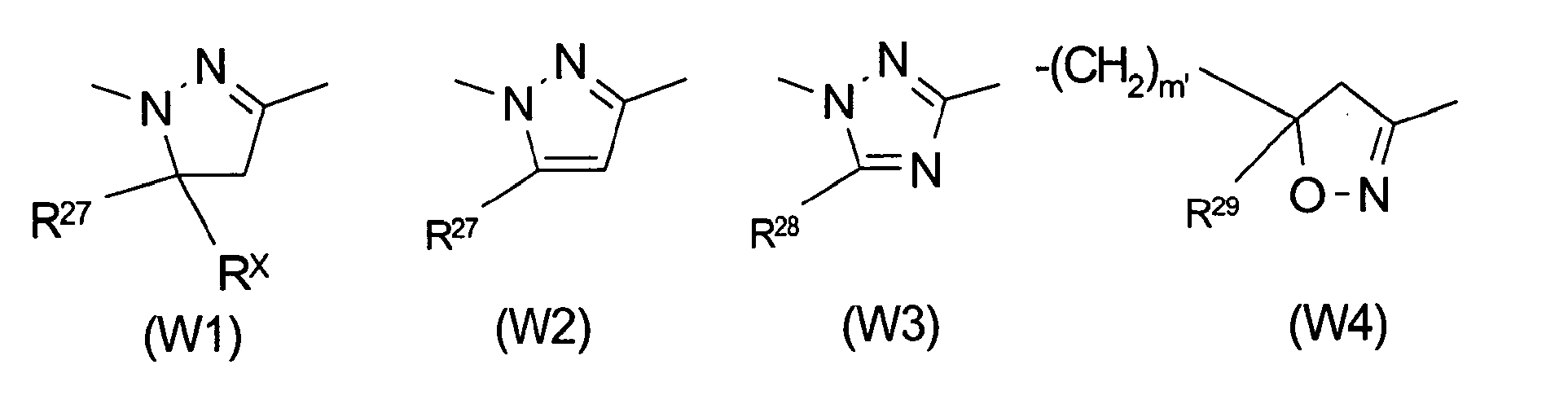
- m'
- ist 0 oder 1;
- R17, R19
- sind gleich oder verschieden Halogen,
(C1-C4)Alkyl, (C1-C4)Alkoxy, Nitro oder (C1-C4)Haloalkyl; - R18, R20
- sind gleich oder verschieden OR24, SR24 oder NR24R25 oder ein gesättigter oder ungesättigter 3- bis 7-gliedriger Heterocyclus mit mindestens einem N-Atom und bis zu 3 Heteroatomen, vorzugsweise aus der Gruppe O und S, der über das N-Atom mit der Carbonylgruppe in (S-II) bzw. (S-III) verbunden ist und unsubstituiert oder durch Reste aus der Gruppe (C1-C4)Alkyl, (C1-C4)Alkoxy oder gegebenenfalls substituiertes Phenyl substituiert ist, vorzugsweise ein Rest der Formel OR24, NHR25 oder N(CH3)2, insbesondere der Formel OR24;
- R24
- ist Wasserstoff oder ein unsubstituierter oder substituierter aliphatischer Kohlenwasserstoffrest, vorzugsweise mit insgesamt 1 bis 18 C-Atomen;
- R25
- ist Wasserstoff, (C1-C6)Alkyl, (C1-C6)Alkoxy oder substituiertes oder unsubstituiertes Phenyl;
- RX
- ist H, (C1-C8)Alkyl, C1-C8(Haloalkyl), (C1-C4)Alkoxy(C1-C8)Alkyl, Cyano oder COOR26, worin R26 Wasserstoff, (C1-C8)Alkyl, (C1-C8)Haloalkyl, (C1-C4)Alkoxy-(C1-C4)alkyl, (C1-C6)Hydroxyalkyl, (C3-C12)Cycloalkyl oder Tri-(C1-C4)-alkylsilyl ist;
- R27, R28, R29
- sind gleich oder verschieden Wasserstoff, (C1-C8)Alkyl, (C1-C8)Haloalkyl, (C3-C12)Cycloalkyl oder substituiertes oder unsubstituiertes Phenyl;
- R21
- ist (C1-C4)Alkyl, (C1-C4)Haloalkyl, (C2-C4)Alkenyl, (C2-C4)Haloalkenyl, (C3-C7)Cycloalkyl, vorzugsweise Dichlormethyl;
- R22, R23
- ist gleich oder verschieden Wasserstoff, (C1-C4)Alkyl, (C2-C4)Alkenyl, (C2-C4)Alkinyl, (C1-C4)Haloalkyl, (C2-C4)Haloalkenyl, (C1-C4)Alkylcarbamoyl-(C1-C4)alkyl, (C2-C4)Alkenylcarbamoyl-(C1-C4)alkyl, (C1-C4)Alkoxy-(C1-C4)alkyl, Dioxolanyl-(C1-C4)alkyl, Thiazolyl, Furyl, Furylalkyl, Thienyl, Piperidyl, substituiertes oder unsubstituiertes Phenyl, oder R22 und R23 bilden zusammen einen substituierten oder unsubstituierten heterocyclischen Ring, vorzugsweise einen Oxazolidin-, Thiazolidin-, Piperidin-, Morpholin-, Hexahydropyrimidin- oder Benzoxazinring;
- Verbindungen vom Typ der Dichlorphenylpyrazolin-3-carbonsäure (d.h. der Formel (S-II), worin W = (W1) und (R17)n' = 2,4-Cl2), vorzugsweise Verbindungen wie 1-(2,4-Dichlorphenyl)-5-(ethoxycarbonyl)-5-methyl-2-pyrazolin-3-carbonsäureethylester (II-1, Mefenpyr-diethyl), Mefenpyr-dimethyl und Mefenpyr (II-0), und verwandte Verbindungen, wie sie in der
WO-A-91/07874 - Derivate der Dichlorphenylpyrazolcarbonsäure (d.h. der Formel (S-II), worin W = (W2) und (R17)n' = 2,4-Cl2 ist), vorzugsweise Verbindungen wie 1-(2,4-Dichlorphenyl)-5-methyl-pyrazol-3-carbonsäureethylester (II-2), 1-(2,4-Dichlorphenyl)-5-isopropyl-pyrazol-3-carbonsäureethylester (II-3), 1-(2,4-Dichlorphenyl)-5-(1,1-dimethyl-ethyl)pyrazol-3-carbonsäureethylester (11-4), 1-(2,4-Dichlorphenyl)-5-phenyl-pyrazol-3-carbonsäureethylester (II-5) und verwandte Verbindungen, wie sie in
EP-A-0333131 undEP-A-0269806 beschrieben sind; - Verbindungen vom Typ der Triazolcarbonsäuren (d.h. der Formel (S-II), worin W = (W3) und (R17)n' = 2,4-Cl2 ist), vorzugsweise Verbindungen wie Fenchlorazol-ethyl, d.h. 1-(2,4-Dichlorphenyl)-5-trichlormethyl-(1 H)-1,2,4-triazol-3-carbonsäureethylester (II-6), und verwandte Verbindungen (siehe
EP-A-0174562 undEP-A-0346620 ); - Verbindungen vom Typ der 5-Benzyl- oder 5-Phenyl-2-isoxazolin-3-carbonsäure oder der 5,5-Diphenyl-2-isoxazolin-3-carbonsäure wie Isoxadifen (II-12), (worin W = (W4) ist), vorzugsweise Verbindungen wie 5-(2,4-Dichlorbenzyl)-2-isoxazolin-3-carbonsäureethylester (II-7) oder 5-Phenyl-2-isoxazolin-3-carbonsäureethylester (II-8) und verwandte Verbindungen, wie sie in
WO-A- 91/08202 WO-A-95/07897 - Verbindungen vom Typ der 8-Chinolinoxyessigsäure, z.B. solche der Formel (S-III), worin (R19)n' = 5-Cl, R20 = OR24 und T = CH2 ist, vorzugsweise die Verbindungen (5-Chlor-8-chinolinoxy)essigsäure-(1-methylhexyl)-ester (III-1, Cloquintocet-mexyl), (5-Chlor-8-chinolinoxy)essigsäure-(1,3-dimethyl-but-1-yl)-ester (III-2), (5-Chlor-8-chinolinoxy)essigsäure-4-allyl-oxy-butylester (III-3), (5-Chlor-8-chinolinoxy)essigsäure-1-allyloxy-prop-2-ylester (III-4), (5-Chlor-8-chinolinoxy)essigsäureethylester (III-5), (5-Chlor-8-chinolinoxy)essigsäuremethylester (III-6), (5-Chlor-8-chinolinoxy)essigsäureallylester (III-7), (5-Chlor-8-chinolinoxy)essigsäure-2-(2-propyliden-iminoxy)-1-ethylester (III-8), (5-Chlor-8-chinolinoxy)essigsäure-2-oxo-prop-1-ylester (III-9), (5-Chlor-8-chinolinoxy)essigsäure (III-10) und dessen Salze wie sie z.B. in der
WO-A-02/34048 EP-A-0860750 ,EP-A-0094349 undEP-A-0191736 oderEP-A-0492366 beschrieben sind. - Verbindungen vom Typ der (5-Chlor-8-chinolinoxy)-malonsäure, d.h. der Formel (S-III), worin (R19)n' = 5-Cl, R20= OR24, T = -CH(COO-Alkyl)- ist, vorzugsweise die Verbindungen (5-Chlor-8-chinolinoxy)-malonsäure-diethylester (III-11), (5-Chlor-8-chinolinoxy)-malonsäurediallylester, (5-Chlor-8-chinolinoxy)-malonsäure-methyl-ethylester und verwandte Verbindungen, wie sie in
EP-A-0582198 beschrieben sind. - Verbindungen vom Typ der Dichloracetamide, d.h. der Formel (S-IV), vorzugsweise: N,N-Diallyl-2,2-dichloracetamid (Dichlormid (IV-1), aus
US 4,137,070 ), 4-Dichloracetyl-3,4-dihydro-3-methyl-2H-1,4-benzoxazin (IV-2, Benoxacor, ausEP 0149974 ), N1,N2-Diallyl-N2-dichloracetylglycinamid (DKA-24 (IV-3), ausHU 2143821
- b) eine oder mehreren Verbindungen aus Gruppe:
1,8-Naphthalsäureanhydrid, Methyl-diphenylmethoxyacetat, 1-(2-Chlorbenzyl)-3-(1-methyl-1-phenylethyl)harnstoff (Cumyluron), O,O-Diethyl S-2-ethylthioethyl phosphordithioat (Disulfoton), 4-Chlorphenyl-methylcarbamat (Mephenate), O,O-Diethyl-O-phenylphosphorotioat (Dietholate), 4-Carboxy-3,4-dihydro-2H-1-benzopyran-4-essigsäure (CL-304415, CAS-Regno: 31541-57-8), Cyanomethoxyimino(phenyl)acetonitril (Cyometrinil), 1,3-Dioxolan-2-ylmethoxyimino(phenyl)acetonitril (Oxabetrinil), 4'-Chlor-2,2,2-trifluoracetophenon-O-1,3-dioxolan-2-ylmethyloxim (Fluxofenim), 4,6-Dichlor-2-phenylpyrimidin (Fenclorim), Benzyl-2-chlor-4-trifluormethyl-1,3-thiazol-5-carboxylat (Flurazole), 2-Dichlormethyl-2-methyl-1,3-dioxolan (MG-191), N-(4-Methylphenyl)-N'-(1-methyl-1-phenylethyl)harnstoff (Dymron), (2,4-Dichlorphenoxy)essigsäure (2,4-D), (4-Chlorphenoxy)essigsäure, (R,S)-2-(4-Chlor-o-tolyloxy)propionsäure (Mecoprop), 4-(2,4-Dichlorphenoxy)buttersäure (2,4-DB), (4-Chlor-o-tolyloxy)essigsäure (MCPA), 4-(4-Chlor-o-tolyloxy)buttersäure, 4-(4-Chlorphenoxy)buttersäure, 3,6-Dichlor-2-methoxybenzoesäure (Dicamba), 1-(Ethoxycarbonyl)ethyl 3,6-dichlor-2-methoxybenzoat (Lactidichlor) sowie deren Salze und Ester, vorzugsweise (C1-C8); - c) N-Acylsulfonamide der Formel (S-V) und ihre Salze,

- R30
- Wasserstoff, einen Kohlenwasserstoffrest, einen Kohlenwasserstoffoxyrest, einen Kohlenwasserstoffthiorest oder einen Heterocyclylrest, der vorzugsweise über ein C-Atom gebunden ist, wobei jeder der letztgenannten 4 Reste unsubstituiert oder durch einen oder mehrere gleiche oder verschiedene Reste aus der Gruppe Halogen, Cyano, Nitro, Amino, Hydroxy, Carboxy, Formyl, Carbonamid, Sulfonamid und Reste der Formel -Za-Ra substituiert ist,
wobei jeder Kohlenwasserstoffteil vorzugsweise 1 bis 20 C-Atome aufweist und ein C-haltiger Rest R30 inklusive Substituenten vorzugsweise 1 bis 30 C-Atome aufweist; - R31
- Wasserstoff oder (C1-C4)-Alkyl, vorzugsweise Wasserstoff, oder
- R30 und R31
- zusammen mit der Gruppe der Formel -CO-N- den Rest eines 3- bis 8-gliedrigen gesättigten oder ungesättigten Rings;
- R32
- gleich oder verschieden Halogen, Cyano, Nitro, Amino, Hydroxy, Carboxy, Formyl, CONH2, SO2NH2 oder einen Rest der Formel -Zb-Rb ;
- R33
- Wasserstoff oder (C1-C4)-Alkyl, vorzugsweise H;
- R34
- gleich oder verschieden Halogen, Cyano, Nitro, Amino, Hydroxy, Carboxy, CHO, CONH2, SO2NH2 oder einen Rest der Formel -Zc-Rc ;
- Ra
- einen Kohlenwasserstoffrest oder einen Heterocyclylrest, wobei jeder der beiden letztgenannten Reste unsubstituiert oder durch einen oder mehrere gleiche oder verschiedene Reste aus der Gruppe Halogen, Cyano, Nitro, Amino, Hydroxy, Mono- und Di-[(C1-C4)-alkyl]-amino substituiert ist, oder einen Alkylrest, in dem mehrere, vorzugsweise 2 oder 3, nicht benachbarte CH2-Gruppen jeweils durch ein Sauerstoffatom ersetzt sind;
- Rb,Rc
- gleich oder verschieden einen Kohlenwasserstoffrest oder einen Heterocyclylrest, wobei jeder der beiden letztgenannten Reste unsubstituiert oder durch einen oder mehrere gleiche oder verschiedene Reste aus der Gruppe Halogen, Cyano, Nitro, Amino, Hydroxy, Phosphoryl, Halogen-(C1-C4)-alkoxy, Mono- und Di-[(C1-C4)-alkyl]-amino substituiert ist, oder einen Alkylrest, in dem mehrere, vorzugsweise 2 oder 3, nicht benachbarte CH2-Gruppen jeweils durch ein Sauerstoffatom ersetzt sind;
- Za
- eine divalente Gruppe der Formel -O-, -S-, -CO-, -CS-, -CO-O-, -CO-S-, -O-CO-, -S-CO-, -SO-, -SO2-, -NR*-, -CO-NR*-, -NR*-CO-, -SO2-NR*- oder -NR*-SO2-, wobei die rechts angegebene Bindung der jeweiligen divalenten Gruppe die Bindung zum Rest Ra ist und wobei die R* in den letztgenannten 5 Resten unabhängig voneinander jeweils H, (C1-C4)-Alkyl oder Halo-(C1-C4)-alkyl bedeuten;
- Zb, Zc
- unabhängig voneinander eine direkte Bindung oder eine divalente Gruppe der Formel -O-, -S-, -CO-, -CS-, -CO-O-, -CO-S-, -O-CO-, -S-CO-, -SO-, -SO2-, -NR*-, -SO2-NR*-, -NR*-SO2-, -CO-NR*- oder -NR*-CO-, wobei die rechts angegebene Bindung der jeweiligen divalenten Gruppe die Bindung zum Rest Rb bzw. Rc ist und wobei die R* in den letztgenannten 5 Resten unabhängig voneinander jeweils H, (C1-C4)-Alkyl oder Halo-(C1-C4)-alkyl bedeuten;
- n
- eine ganze Zahl von 0 bis 4, vorzugsweise 0, 1 oder 2, insbesondere 0 oder 1, und
- m
- eine ganze Zahl von 0 bis 5, vorzugsweise 0, 1, 2 oder 3, insbesondere 0, 1 oder 2; bedeuten;
- R30 = H3C-O-CH2-, R31 = R33 = H, R34 = 2-OMe ist (V-1),
- R30 = H3C-O-CH2-, R31 = R33 = H, R34 = 2-OMe-5-Cl ist (V-2),
- R30 = Cyclopropyl, R31 = R33 = H, R34 = 2-OMe ist (V-3),
- R30 = Cyclopropyl, R31 = R33 = H, R34 = 2-OMe-5-Cl ist (V-4),
- R30 = Cyclopropyl, R31 = R33 = H, R34 = 2-Me ist (V-5),
- R30 = tert. Butyl, R31 = R33 = H, R34 = 2-OMe ist (V-6).
- d) Acylsulfamoylbenzoesäureamide der allgemeinen Formel (S-VI), gegebenenfalls auch in Salzform,
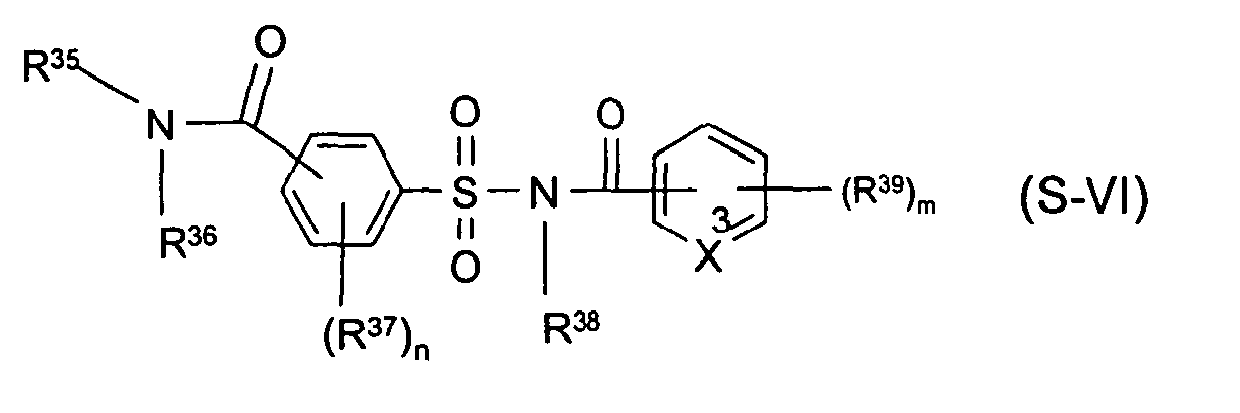
- X3
- CH oder N;
- R35
- Wasserstoff, Heterocyclyl oder einen Kohlenwasserstoffrest, wobei die beiden letztgenannten Reste gegebenenfalls durch einen oder mehrere, gleiche oder verschiedene Reste aus der Gruppe Halogen, Cyano, Nitro, Amino, Hydroxy, Carboxy, CHO, CONH2, SO2NH2 und Za-Ra substituiert sind;
- R36
- Wasserstoff, Hydroxy, (C1-C6)-Alkyl, (C2-C6)-Alkenyl, (C2-C6)-Alkinyl, (C1-C6)-Alkoxy, (C2-C6)-Alkenyloxy, wobei die fünf letztgenannten Reste gegebenenfalls durch einen oder mehrere, gleiche oder verschiedene Reste aus der Gruppe Halogen, Hydroxy, (C1-C4)-Alkyl, (C1-C4)-Alkoxy und (C1-C4)-Alkylthio substituiert sind, oder
- R35 und R36
- zusammen mit dem sie tragenden Stickstoffatom einen 3- bis 8-gliedrigen gesättigten oder ungesättigten Ring;
- R37
- Halogen, Cyano, Nitro, Amino, Hydroxy, Carboxy, CHO, CONH2, SO2NH2 oder Zb-Rb;
- R38
- Wasserstoff, (C1-C4)-Alkyl, (C2-C4)-Alkenyl oder (C2-C4)-Alkinyl;
- R39
- Halogen, Cyano, Nitro, Amino, Hydroxy, Carboxy, Phosphoryl, CHO, CONH2, SO2NH2 oder Zc-Rc;
- Ra
- einen (C2-C20)-Alkylrest, dessen Kohlenstoffkette ein- oder mehrfach durch Sauerstoffatome unterbrochen ist, Heterocyclyl oder einen Kohlenwasserstoffrest, wobei die zwei letztgenannten Reste gegebenenfalls durch einen oder mehrere, gleiche oder verschiedene Reste aus der Gruppe Halogen, Cyano, Nitro, Amino, Hydroxy, Mono- und Di-[(C1-C4)-alkyl]-amino substituiert sind;
- Rb, Rc
- gleich oder verschieden einen (C2-C20)-Alkylrest, dessen Kohlenstoffkette ein- oder mehrfach durch Sauerstoffatome unterbrochen ist, Heterocyclyl oder einen Kohlenwasserstoffrest, wobei die zwei letztgenannten Reste gegebenenfalls durch einen oder mehrere, gleiche oder verschiedene Reste aus der Gruppe Halogen, Cyano, Nitro, Amino, Hydroxy, Phosphoryl, (C1-C4)-Haloalkoxy, Mono- und Di-[(C1-C4)-alkyl]-amino substituiert sind;
- Za
- eine divalente Einheit aus der Gruppe O, S, CO, CS, C(O)O, C(O)S, SO, SO2, NRd, C(O)NRd oder SO2NRd;
- Zb, Zc
- gleich oder verschieden eine direkte Bindung oder eine divalente Einheit aus der Gruppe O, S, CO, CS, C(O)O, C(O)S, SO, SO2, NRd, SO2NRd oder C(O)NRd;
- Rd
- Wasserstoff, (C1-C4)-Alkyl oder (C1-C4)-Haloalkyl;
- n
- eine ganze Zahl von 0 bis 4, und
- m
- für den Fall, dass X für CH steht, eine ganze Zahl von 0 bis 5, und für den Fall, dass X für N steht, eine ganze Zahl von 0 bis 4 bedeuten;
- X3
- CH;
- R35
- Wasserstoff, (C1-C6)-Alkyl, (C3-C6)-Cycloalkyl, (C2-C6)-Alkenyl, (C5-C6)-Cycloalkenyl, Phenyl oder 3- bis 6-gliedriges Heterocyclyl mit bis zu drei Heteroatomen aus der Gruppe Stickstoff, Sauerstoff und Schwefel, wobei die sechs letztgenannten Reste gegebenenfalls durch einen oder mehrere, gleiche oder verschiedene Substituenten aus der Gruppe Halogen, (C1-C6)-Alkoxy, (C1-C6)-Haloalkoxy, (C1-C2)-Alkylsulfinyl, (C1-C2)-Alkylsulfonyl, (C3-C6)-Cycloalkyl, (C1-C4)-Alkoxycarbonyl, (C1-C4)-Alkylcarbonyl und Phenyl und im Falle cyclischer Reste auch (C1-C4)-Alkyl und (C1-C4)-Haloalkyl substituiert sind;
- R36
- Wasserstoff, (C1-C6)-Alkyl, (C2-C6)-Alkenyl, (C2-C6)-Alkinyl, wobei die drei letztgenannten Reste gegebenenfalls durch einen oder mehrere, gleiche oder verschiedene Substituenten aus der Gruppe Halogen, Hydroxy, (C1-C4)-Alkyl, (C1-C4)-Alkoxy und (C1-C4)-Alkylthio substituiert sind;
- R37
- Halogen, (C1-C4)-Haloalkyl, (C1-C4)-Haloalkoxy, Nitro, (C1-C4)-Alkyl, (C1-C4)-Alkoxy, (C1-C4)-Alkylsulfonyl, (C1-C4)-Alkoxycarbonyl oder (C1-C4)-Alkylcarbonyl;
- R38
- Wasserstoff;
- R39
- Halogen, Nitro, (C1-C4)-Alkyl, (C1-C4)-Haloalkyl, (C1-C4)-Haloalkoxy, (C3-C6)-Cycloalkyl, Phenyl, (C1-C4)-Alkoxy, Cyano, (C1-C4)-Alkylthio, (C1-C4)-Alkylsulfinyl, (C1-C4)-Alkylsulfonyl, (C1-C4)-Alkoxycarbonyl oder (C1-C4)-Alkylcarbonyl;
- n
- 0, 1 oder 2 und
- m
- 1 oder 2 bedeuten.
WO-A-99/16744 
- R21 =
- Cyclo-Propyl und R22 = H ist (S3-1 = 4-Cyclopropylaminocarbonyl-N-(2-methoxybenzoyl)benzolsulfonamid; Cyprosulfamide);
- R21 =
- Cyclo-Propyl und R22 = 5-Cl ist (S3-2),
- R21 =
- Ethyl und R22 = H ist (S3-3),
- R21 =
- iso-Propyl und R22 = 5-Cl ist (S3-4) und
- R21 =
- iso-Propyl und R22 = H ist (S3-5 = 4-iso-propylaminocarbonyl-N-(2-methoxybenzoyl)benzolsulfonamid);
- e) Verbindungen vom Typ der N-Acylsulfamoylphenylharnstoffe der Formel (S-VIII), die z.B. bekannt sind aus der
EP-A-365484 
- A
- für einen Rest aus der Gruppe


- Rα und Rβ
- unabhängig voneinander für Wasserstoff, C1-C8-Alkyl, C3-C8-Cycloalkyl, C3-C6-Alkenyl, C3-C6-Alkinyl,


- Rα und Rβ
- gemeinsam für eine C4-C6-Alkylenbrücke oder eine durch Sauerstoff, Schwefel, SO, SO2, NH oder -N(C1-C4-Alkyl)- unterbrochene C4-C6-Alkylenbrücke,
- Rγ für
- Wasserstoff oder C1-C4-Alkyl,
- Ra und Rb
- unabhängig voneinander für Wasserstoff, Halogen, Cyan, Nitro, Trifluormethyl, C1-C4-Alkyl, C1-C4-Alkoxy, C1-C4-Alkylthio, C1-C4-Alkylsulfinyl, C1-C4-Alkylsulfonyl, -COORj, -CONRkRm, -CORn, -SO2NRkRm oder -OSO2-C1-C4-Alkyl, oder Ra und Rb gemeinsam für eine C3-C4-Alkylenbrücke, die durch Halogen oder C1-C4-Alkyl substituiert sein kann, oder eine C3-C4-Alkenylenbrücke, die durch Halogen oder C1-C4-Alkyl substituiert sein kann, oder eine C4-Alkadienylenbrücke, die durch Halogen oder C1-C4-Alkyl substituiert sein kann, und
- Rg und Rh
- unabhängig voneinander für Wasserstoff, Halogen, C1-C4-Alkyl, Trifluormethyl, Methoxy, Methylthio oder -COORj stehen, wobei
- Rc
- Wasserstoff, Halogen, C1-C4-Alkyl oder Methoxy,
- Rd
- Wasserstoff, Halogen, Nitro, C1-C4-Alkyl, C1-C4-Alkoxy, C1-C4-Alkylthio, C1-C4-Alkylsulfinyl, C1-C4-Alkyisulfonyl, -COORj oder -CONRkRm,
- Re
- Wasserstoff, Halogen, C1-C4-Alkyl, -COORj, Trifluormethyl oder Methoxy, oder Rd und Re gemeinsam für eine C3-C4-Alkylenbrücke,
- Rf
- Wasserstoff, Halogen oder C1-C4-Alkyl,
- RX und RY
- unabhängig voneinander Wasserstoff, Halogen, C1-C4-Alkyl, C1-C4-Alkoxy, C1-C4-Alkylthio, -COOR4, Trifluormethyl, Nitro oder Cyan,
- Rj, Rk und Rm
- unabhängig voneinander Wasserstoff oder C1-C4-Alkyl,
- Rk und Rm
- gemeinsam eine C4-C6-Alkylenbrücke oder eine durch Sauerstoff, NH oder -N(C1-C4-Alkyl)- unterbrochene C4-C6-Alkylenbrücke, und
- Rn
- C1-C4-Alkyl, Phenyl oder durch Halogen, C1-C4-Alkyl, Methoxy, Nitro oder Trifluormethyl substituiertes Phenyl bedeuten;
1-[4-(N-2-Methoxybenzoylsulfamoyl)phenyl]-3-methylharnstoff,
1-[4-(N-2-Methoxybenzoylsulfamoyl)phenyl]-3,3-dimethylharnstoff,
1-[4-(N-4,5-Dimethylbenzoylsulfamoyl)phenyl]-3-methylharnstoff,
1-[4-(N-Naphthoylsulfamoyl)phenyl]-3,3-dimethylharnstoff, - Sofern es im Einzelnen nicht anders definiert wird, gelten für die Reste in den Formeln zu (S-II) bis (S-VIII) im Allgemeinen die folgenden Definitionen.
- Die Reste Alkyl, Alkoxy, Haloalkyl, Haloalkoxy, Alkylamino und Alkylthio sowie die entsprechenden ungesättigten und/oder substituierten Reste können im Kohlenstoffgerüst jeweils geradkettig oder verzweigt sein.
Alkylreste, auch in den zusammengesetzten Bedeutungen wie Alkoxy, Haloalkyl usw. haben vorzugsweise 1 bis 4 C-Atome und, bedeuten z.B. Methyl, Ethyl, n- oder i-Propyl, n-, i-, t- oder 2-Butyl. Alkenyl- und Alkinylreste haben die Bedeutung der den Alkylresten entsprechenden möglichen ungesättigten Reste; Alkenyl bedeutet z.B. Allyl, 1-Methylprop-2-en-1-yl, 2-Methyl-prop-2-en-1-yl, But-2-en-1-yl, But-3-en-1-yl, 1-Methyl-but-3-en-1-yl und 1-Methyl-but-2-en-1-yl. Alkinyl bedeutet z.B. Propargyl, But-2-in-1-yl, But-3-in-1-yl, 1-Methyl-but-3-in-1-yl. "(C1-C4)-Alkyl" ist die Kurzschreibweise für Alkyl mit 1 bis 4 C-Atomen; entsprechendes gilt für andere allgemeine Restedefinitionen mit in Klammern angegebenen Bereichen für die mögliche Anzahl von C-Atomen.
Cycloalkyl bedeutet bevorzugt einen cyclischen Alkylrest mit 3 bis 8, vorzugsweise 3 bis 7, besonders bevorzugt 3 bis 6 C-Atomen, beispielsweise Cyclopropyl, Cyclobutyl, Cyclopentyl und Cyclohexyl. Cycloalkenyl und Cycloalkinyl bezeichnen entsprechende ungesättigte Verbindungen.
Halogen bedeutet Fluor, Chlor, Brom oder Iod. Haloalkyl, Haloalkenyl und Haloalkinyl bedeuten durch Halogen, vorzugsweise durch Fluor, Chlor und/oder Brom, insbesondere durch Fluor oder Chlor, teilweise oder vollständig substituiertes Alkyl, Alkenyl oder Alkinyl, z.B. CF3, CHF2, CH2F, CF2CF3, CH2CHFCl, CCl3, CHCl2, CH2CH2Cl. Haloalkoxy ist z.B. OCF3, OCHF2, OCH2F, OCF2CF3, OCH2CF3 und OCH2CH2Cl. Entsprechendes gilt für sonstige Halogen substituierte Reste.
Ein Kohlenwasserstoffrest kann ein aromatischer oder ein aliphatischer Kohlenwasserstoffrest sein, wobei ein aliphatischer Kohlenwasserstoffrest im allgemeinen ein geradkettiger oder verzweigter gesättigter oder ungesättigter Kohlenwasserstoffrest ist, vorzugsweise mit 1 bis 18, besonders bevorzugt 1 bis 12 C-Atomen, z.B. Alkyl, Alkenyl oder Alkinyl.
Vorzugsweise bedeutet aliphatischer Kohlenwasserstoffrest Alkyl, Alkenyl oder Alkinyl mit bis zu 12 C-Atomen; entsprechendes gilt für einen aliphatischen Kohlenwasserstoffrest in einem Kohlenwasserstoffoxyrest.
Aryl ist im allgemeinen ein mono-, bi- oder polycyclisches aromatisches System mit vorzugsweise 6-20 C-Atomen, bevorzugt 6 bis 14 C-Atomen, besonders bevorzugt 6 bis 10 C-Atomen, z.B. Phenyl, Naphthyl, Tetrahydronaphthyl, Indenyl, Indanyl, Pentalenyl und Fluorenyl, besonders bevorzugt Phenyl.
Heterocyclischer Ring, heterocyclischer Rest oder Heterocyclyl bedeutet ein mono-, bi- oder polycyclisches Ringsystem, das gesättigt, ungesättigt und/oder aromatisch ist und eine oder mehrere, vorzugsweise 1 bis 4, Heteroatome, vorzugsweise aus der Gruppe N, S und O, enthält.
Bevorzugt sind gesättigte Heterocyclen mit 3 bis 7 Ringatomen und einem oder zwei Heteroatomen aus der Gruppe N, O und S, wobei die Chalcogene nicht benachbart sind. Besonders bevorzugt sind monocyclische Ringe mit 3 bis 7 Ringatomen und einem Heteroatom aus der Gruppe N, O und S, sowie Morpholin, Dioxolan, Piperazin, Imidazolin und Oxazolidin. Ganz besonders bevorzugte gesättigte Heterocyclen sind Oxiran, Pyrrolidon, Morpholin und Tetrahydrofuran.
Bevorzugt sind auch teilweise ungesättigte Heterocyclen mit 5 bis 7 Ringatomen und einem oder zwei Heteroatomen aus der Gruppe N, O und S. Besonders bevorzugt sind teilweise ungesättigte Heterocyclen mit 5 bis 6 Ringatomen und einem Heteroatom aus der Gruppe N, O und S. Ganz besonders bevorzugte teilweise ungesättigte Heterocyclen sind Pyrazolin, Imidazolin und Isoxazolin.
Ebenso bevorzugt ist Heteroaryl, z.B. mono- oder bicyclische aromatische Heterocyclen mit 5 bis 6 Ringatomen, die ein bis vier Heteroatome aus der Gruppe N, O, S enthalten, wobei die Chalcogene nicht benachbart sind. Besonders bevorzugt sind monocyclische aromatische Heterocyclen mit 5 bis 6 Ringatomen, die ein Heteroatom aus der Gruppe, N, O und S enthalten, sowie Pyrimidin, Pyrazin, Pyridazin, Oxazol, Thiazol, Thiadiazol, Oxadiazol, Pyrazol, Triazol und Isoxazol. Ganz besonders bevorzugt sind Pyrazol, Thiazol, Triazol und Furan.
Substituierte Reste, wie substituierte Kohlenwasserstoffreste, z.B. substituiertes Alkyl, Alkenyl, Alkinyl, Aryl wie Phenyl und Arylalkyl wie Benzyl, oder substituiertes Heterocyclyl, bedeuten einen vom unsubstituierten Grundkörper abgeleiteten substituierten Rest, wobei die Substituenten vorzugsweise einen oder mehrere, vorzugsweise 1, 2 oder 3, im Falle von Cl und F auch bis zur maximal möglichen Anzahl, Substituenten aus der Gruppe Halogen, Alkoxy, Haloalkoxy, Alkylthio, Hydroxy, Amino, Nitro, Carboxy, Cyano, Azido, Alkoxycarbonyl, Alkylcarbonyl, Formyl, Carbamoyl, Mono- und Dialkylaminocarbonyl, substituiertes Amino wie Acylamino, Mono- und Dialkylamino und Alkylsulfinyl, Haloalkylsulfinyl, Alkylsulfonyl, Haloalkylsulfonyl und, im Falle cyclischer Reste, auch Alkyl und Haloalkyl sowie den genannten gesättigten kohlenwasserstoffhaltigen Substituenten entsprechende ungesättigte aliphatische Substituenten, vorzugsweise Alkenyl, Alkinyl, Alkenyloxy, Alkinyloxy, bedeuten. Bei Resten mit C-Atomen sind solche mit 1 bis 4 C-Atomen, insbesondere 1 oder 2 C-Atomen, bevorzugt. Bevorzugt sind in der Regel Substituenten aus der Gruppe Halogen, z.B. Fluor oder Chlor, (C1-C4)Alkyl, vorzugsweise Methyl oder Ethyl, (C1-C4)Haloalkyl, vorzugsweise Trifluormethyl, (C1-C4)Alkoxy, vorzugsweise Methoxy oder Ethoxy, (C1-C4)Haloalkoxy, Nitro und Cyano. Besonders bevorzugt sind dabei die Substituenten Methyl, Methoxy und Chlor.
Mono- oder disubstituiertes Amino bedeutet einen chemisch stabilen Rest aus der Gruppe der substituierten Aminoreste, welche beispielsweise durch einen oder zwei gleiche oder verschiedene Reste aus der Gruppe Alkyl, Alkoxy, Acyl und Aryl N-substituiert sind; vorzugsweise Monoalkylamino, Dialkylamino, Acylamino, Arylamino, N-Alkyl-N-Arylamino sowie N-Heterocyclen. Dabei sind Alkylreste mit 1 bis 4 C-Atomen bevorzugt. Aryl ist dabei vorzugsweise Phenyl. Substituiertes Aryl ist dabei vorzugsweise substituiertes Phenyl. Für Acyl gilt dabei die weiter unten genannte Definition, vorzugsweise (C1-C4)Alkanoyl. Entsprechendes gilt für substituiertes Hydroxylamino oder Hydrazino.
Gegebenenfalls substituiertes Phenyl ist vorzugsweise Phenyl, das unsubstituiert oder ein- oder mehrfach, vorzugsweise bis zu dreifach, bei Halogen wie Cl und F auch bis zu fünffach, durch gleiche oder verschiedene Reste aus der Gruppe Halogen, (C1-C4)Alkyl, (C1-C4)Alkoxy, (C1-C4)Haloalkyl, (C1-C4)Haloalkoxy und Nitro substituiert ist, z.B. o-, m- und p-Tolyl, Dimethylphenyle, 2-, 3- und 4-Chlorphenyl, 2-, 3- und 4-Trifluor- und -Trichlorphenyl, 2,4-, 3,5-, 2,5- und 2,3-Dichlorphenyl, o-, mund p-Methoxyphenyl.
Ein Acylrest bedeutet den Rest einer organischen Säure mit vorzugsweise bis zu 6 C-Atomen, z.B. den Rest einer Carbonsäure und Reste davon abgeleiteter Säuren wie der Thiocarbonsäure, gegebenenfalls N-substituierter Iminocarbonsäuren, oder der Rest von Kohlensäuremonoestern, gegebenenfalls N-substituierter Carbaminsäuren, Sulfonsäuren, Sulfinsäuren, Phosphonsäuren, Phosphinsäuren. Acyl bedeutet beispielsweise Formyl, Alkylcarbonyl, wie (C1-C4-Alkyl)-carbonyl, Phenylcarbonyl, wobei der Phenylring substituiert sein kann, z.B. wie oben für Phenyl angegeben, oder Alkyloxycarbonyl, Phenyloxycarbonyl, Benzyloxycarbonyl, Alkylsulfonyl, Alkylsulfinyl oder N-Alkyl-1-iminoalkyl.
Von den Formeln (S-II) bis (S-VIII) umfasst sind auch alle Stereoisomeren, welche die gleiche topologische Verknüpfung der Atome aufweisen, und deren Gemische. Solche Verbindungen enthalten ein oder mehrere asymmetrische C-Atome oder auch Doppelbindungen, die in den allgemeinen Formeln nicht gesondert angegeben sind. Die durch ihre spezifische Raumform definierten möglichen Stereoisomeren, wie Enantiomere, Diastereomere, Z- und E-Isomere, können nach üblichen Methoden aus Gemischen der Stereoisomeren erhalten oder auch durch stereoselektive Reaktionen in Kombination mit dem Einsatz von stereochemisch reinen Ausgangsstoffen hergestellt werden. - Die Verbindungen der Formel (S-II) sind z.B. aus
EP-A-0333131 (ZA-89/1960 EP-A-0269806 (US 4,891,057 ),EP-A-0346620 (AU-A-89/34951 EP-A-0174562 ,EP-A-0346620 (WO-A-91/08202 WO-A-91/07874 WO-A-95/07897 ZA 94/7120 EP-A-0086750 ,EP-A-094349 US 4,902,340 ),EP-A-0191736 (US 4,881,966 ) undEP-A-0492366 und dort zitierter Literatur bekannt oder können nach oder analog den dort beschriebenen Verfahren hergestellt werden. Einige Verbindungen sind ferner inEP-A-0582198 undWO-A-02/34048 US 4,021,224 undUS 4,021,229 . Verbindungen der Untergruppe b) sind weiterhin ausCN-A-87/102789 ,EP-A-365484 WO-A-97/45016 WO-A-99/16744 EP-A-365484 - Die Safener der vorstehenden Gruppen a) bis e) reduzieren oder unterbinden phytotoxische Effekte, die beim Einsatz der herbiziden Mittel gemäß der Erfindung in Nutzpflanzenkulturen auftreten können, ohne die Wirksamkeit der Herbizide gegen Schadpflanzen zu beeinträchtigen. Hierdurch kann das Einsatzgebiet der Herbizide erheblich erweitert werden und insbesondere ist durch die Verwendung von Safenern der Einsatz von Herbiziden, die bislang nur beschränkt oder mit nicht ausreichendem Erfolg eingesetzt werden konnten, d.h. von Kombinationen, die ohne Safener in niedrigen Dosierungen mit wenig Breitenwirkung zu nicht ausreichender Kontrolle der Schadpflanzen führten.
- Besonders bevorzugt kommen sind als Safener (b) in den erfindungsgemäßen Formulierungen unter anderem: 4-Dichloracetyl-1-oxa-4-aza-spiro[4.5]-decan (AD-67), 1-Dichloracetyl-hexahydro-3,3,8a-trimethylpyrrolo[1,2-a]-pyrimidin-6(2H)-on (Dicyclonon, BAS-145138), 4-Dichloracetyl-3,4-dihydro-3-methyl-2H-1,4-benzoxazin (Benoxacor), Cloquintocet, 5-Chlor-chinolin-8-oxy-essigsäure-(1-methyl-hexylester) (Cloquintocet-mexyl), α-(Cyanomethoxyimino)-phenylacetonitril (Cyometrinil), 2,2-Dichlor-N-(2-oxo-2-(2-propenylamino)-ethyl)-N-(2-propenyl)-acetamid (DKA-24), 2,2-Dichlor-N,N-di-2-propenyl-acetamid (Dichlormid), N-(4-Methyl-phenyl)-N'-(1-methyl-1-phenyl-ethyl)-harnstoff (Dymron), 4,6-Dichlor-2-phenyl-pyrimidin (Fenclorim), 1-(2,4-Dichlor-phenyl)-5-trichlormethyl-1 H-1,2,4-triazol-3-carbonsäure-ethylester (Fenchlorazol-ethyl), 2-Chlor-4-trifluormethyl-thiazol-5-carbonsäure-phenylmethylester (Flurazole), 4-Chlor-N-(1,3-dioxolan-2-yl-methoxy)-α-trifluor-acetophenonoxim (Fluxofenim), 3-Dichloracetyl-5-(2-furanyl)-2,2-dimethyl-oxazolidin (Furilazole, MON-13900), Ethyl-4,5-dihydro-5,5-diphenyl-3-isoxazolcarboxylat (Isoxadifen-ethyl), Diethyl-1-(2,4-dichlorphenyl)-4,5-dihydro-5-methyl-1H-pyrazol-3,5-dicarboxylat (Mefenpyr-diethyl), 2-Dichlormethyl-2-methyl-1,3-dioxolan (MG-191), 1,8-Naphthalsäureanhydrid, α-(1,3-Dioxolan-2-yl-methoximino)-phenylacetonitril (Oxabetrinil), 2,2-Dichlor-N-(1,3-dioxolan-2-yl-methyl)-N-(2-propenyl)-acetamid (PPG-1292), 3-Dichloracetyl-2,2-dimethyl-oxazolidin (R-28725), 3-Dichloracetyl-2,2,5-trimethyl-oxazolidin (R-29148), 1-(2-Chlor-phenyl)-5-phenyl-1 H-pyrazol-3-carbonsäure-methylester, 4-Cyclopropylaminocarbonyl-N-(2-methoxybenzoyl)benzolsulfonamid (Cyprosulfamide), 4-iso-propylaminocarbonyl-N-(2-methoxybenzoyl)benzolsulfonamid und N-(2-Methoxy-benzoyl)-4-[(methylaminocarbonyl)-amino]-benzolsulfonamid.
- Bei den in den erfindungsgemäßen Mikroemulsionskonzentraten enthaltenen Safenern (b) sind ganz besonders bevorzugt Mefenpyr-diethyl, Cloquintocet-mexyl, Isoxadifen-ethyl, 4-Cyclopropylaminocarbonyl-N-(2-methoxybenzoyl)benzolsulfonamid (Cyprosulfamide), 4-iso-propylaminocarbonyl-N-(2-methoxybenzoyl)benzolsulfonamid oder Fenchlorazol-ethyl; insbesondere ganz besonders bevorzugt sind Mefenpyr-diethyl, Cloquintocet-mexyl oder Isoxadifen-ethyl.
- Das Gewichtsverhältnis Safener (b) : Herbizid (a) kann innerhalb weiter Grenzen variieren und liegt vorzugsweise im Bereich von 1 : 100 bis 100 : 1, insbesondere von 1 : 100 bis 50 : 1, ganz besonders bevorzugt 1 : 10 bis 10 : 1. Die jeweils optimalen Mengen an Herbizid(en) und Safener(n) sind üblicherweise vom Typ des Herbizids (a) und/oder vom verwendeten Safener (b) sowie von der Art des zu behandelnden Pflanzenbestandes abhängig.
- Bei den in den erfindungsgemäßen Mikroemulsionskonzentraten enthaltenen Herbiziden (a) und Safenern (b) sind bevorzugt Kombinationen der folgenden Verbindungen miteinander:
- a) Verbindungen, die als ACCase-Inhibitoren wirksam sind, wie Alloxydim, Butroxydim, Clethodim, Clodinafop-propargyl, Cycloxydim, Cyhalofop-butyl, Diclofop-methyl, Fenoxaprop, Fenoxaprop-ethyl, Fenoxaprop-P, Fenoxaprop-P-ethyl, Fluazifop, Fluazifop-P-butyl, Fluazifop-butyl, Haloxyfop, Haloxyfop-P, Haloxyfop-etotyl, Haloxyfop-P-methyl, Metamifop, Profoxydim, Propaquizafop, Quizalofop-P-tefuryl, Quizalofop-P-ethyl, Sethoxydim, Tepraloxydim, Tralkoxydim und Isoxapyrifop,
- b) Verbindungen, die als p-Hydroxyphenyl pyruvate dioxygenase (HPPD)-Inhibitoren wirksam sind, wie Benzobicyclon, Benzofenap, Isoxaflutole und dessen Diketonitrile, Mesotrione, Pyrazolynate, Pyrazoxyfen, Sulcotrione und Isoxachlortole,
- c) Verbindungen verschiedener Wirkstoffgruppen, wie Atrazin, Acetochlor, Aclonifen, Alachlor, Amidochlor, Amidosulfuron, Azimsulfuron, Bentazon, Bensulfuron(-methyl), Bromoxynil(-octanoat/-heptanoat), Butachlor, Bispyribac, Chlorsulfuron, Chlorimuron, Clomazone, Clopyralid, Cinosulfuron, Cyclosulfamuron, 2,4-D-Ester, 2,4-DB-Ester, 2,4-DP-Ester, CMPP-Ester, MCPA-Ester, MCPB, EPTC, Desmedipham, Diflufenican, Dicamba, Ethoxysulfuron, Ethofumesat, Flazasulfuron, Florasulam, Flucarbazone, Flumetsulam, Flufenacet, Fluoroglykofen, Fluroxypyr, Flupyrsulfuron, Foramsulfuron, Flumioxazin, Flumiclorac, Fomesafen, Glufosinate, Glyphosate, Imazapyr, Imazosulfuron, Iodosulfuron, Iodosulfuron-methyl, Ioxynil(-octanoat), Lactofen, Halosulfuron, Imazamox, Imazapic, Imazethapyr, Imazaquin, Metosulam, Mesosulfuron(-methyl), (S-)Metolachlor, Metsulfuron-methyl, Nicosulfuron, Oxyfluorfen, Pendimethalin, Phenmedipham, Picloram, Pinoxaden, Primisulfuron-methyl, Prosulfuron, Propanil, Propoxycarbazone, Pyrazosulfuron(-methyl), Rimsulfuron, Sulfentrazone, Sulfosulfuron, Sulfometuron, Terbuthylazin, Thifensulfuron, Triasulfuron, Tribenuron, Triclopyr, Triflusulfuron-methyl, Trifluralin, Tritosulfuron, Topramezone, Oxazinon, Oxadiargyl, Oxadiazon, Metamitron, Metribuzin, und deren Salze, z.B. die Natriumsalze.
- d) Verbindungen, die als Safener wirksam sind, wie AD 67 (4-(dichloroacetyl)-1-oxa-4-azaspiro[4.5]decane), Benoxacor, CL 304,415 (4-carboxymethylchroman-4-carboxylic acid), Cloquintocet, Cloquintocet-mexyl, Cyprosulfamide, Dichlormid, Dicyclonon, DKA-24 (N1,N2-diallyl-N2-dichloroacetylglycinamide), Fenchlorazole, Fenchlorazole-ethyl, Fenclorim, Flurazole, Fluxofenim, Furilazole, Isoxadifen-ethyl, Mefenpyr-diethyl, MG 191 (2-dichloromethyl-2-methyl-1,3-dioxolane), Naphthalsäureanhydrid (naphthalene-1,8-dicarboxylic anhydride), Oxabetrinil and TI-35 (1-dichloroacetylazepane).
- In einer Ausführungsform können z.B. verschiedene Herbizide (a) miteinander kombiniert werden, z.B. Fenoxaprop-p-ethyl + Ioxynil-octanoat, Diclofop-methyl + Bromoxynil-octanoat, CMPP + Bromoxynil-octanoat, MCPA + Ioxynil-octanoat, Bromoxynil-octanoat + Bromoxynil-heptanoat, Bromoxynil-octanoat + Bromoxynil-heptanoat + MCPA, Bromoxynil-octanoat + Bromoxynil-heptanoat+ 2,4-D, Phenmedipham + Desmedipham, Phenmedipham + Desmedipham + Ethofumesate, Metamitron + Ethofumesate, Phenmedipham + Ethofumesate + Metamitron, Fenoxaprop-p-ethyl + Iodosulfuron-methyl-natrium, Fenoxaprop-p-ethyl + Diclofop-methyl, Fenoxaprop-p-ethyl + Iodosulfuron-methyl-natrium + Diclofop-methyl.
- Als besonders bevorzugt sind die Kombinationen aus: Foramsulfuron + Iodosulfuron-methyl-sodium + Isoxadifen-ethyl, Iodosulfuron-methyl-sodium + Isoxadifen-ethyl, Foramsulfuron + Isoxadifen-ethyl, Fenoxaprop-P-ethyl + Ethoxysulfuron + Isoxadifen-ethyl, Ethoxysulfuron + Isoxadifen-ethyl, Fenoxaprop-P-ethyl + Isoxadifen-ethyl, Iodosulfuron-methyl-sodium + Mesosulfuron-methyl + Mefenpyr-diethyl, Mesosulfuron-methyl + Mefenpyr-diethyl, Iodosulfuron-methyl-sodium + Mefenpyr-diethyl, Fenoxaprop-P-ethyl + Mefenpyr-diethyl, Fenoxaprop-P-ethyl + Diclofop-methyl + Mefenpyr-diethyl, Diclofop-methyl + Mefenpyr-diethyl, Diclofop-methyl + Sethoxydim + Mefenpyr-diethyl, Sethoxydim + Mefenpyr-diethyl, Fenoxaprop-P-ethyl + Isoproturon + Mefenpyr-diethyl, Isoproturon + Mefenpyr-diethyl, Clodinafop-propargyl + Cloquintocet-mexyl, Fenoxaprop-ethyl + Fenchlorazole-ethyl, Fenoxaprop-P-ethyl + Fenchlorazole-ethyl, Flucarbazone + Cyprosulfamide, Foramsulfuron + Cyprosulfamide, Iodosulfuron(-methyl) + Cyprosulfamide, Metosulam + Cyprosulfamide, Metsulfuron(-methyl) + Cyprosulfamide, Nicosulfuron + Cyprosulfamide, Primisulfuron(.methyl) + Cyprosulfamide, Prosulfuron + Cyprosulfamide + Cyprosulfamide, Thifensulfuron + Cyprosulfamide, Tribenuron + Cyprosulfamide, Cloransulam-methyl + Cyprosulfamide, Chlorimuron + Cyprosulfamide, Ethoxysulfuron + Cyprosulfamide, Flazasulfuron + Cyprosulfamide, Florasulam + Cyprosulfamide, Flumetsulam + Cyprosulfamide, Halosulfuron + Cyprosulfamide, Imazamox + Cyprosulfamide, Imazapic + Cyprosulfamide, Imazapyr + Cyprosulfamide, Imazethapyr + Cyprosulfamide, Mesosulfuron + Cyprosulfamide, Propoxycarbazone + Cyprosulfamide, Sulfosulfuron + Cyprosulfamide, Amidosulfuron + Cyprosulfamide, Chlorsulfuron + Cyprosulfamide, Imazaquin + Cyprosulfamide, Triasulfuron + Cyprosulfamide, Sulfometuron + Cyprosulfamide, Cyclosulfamuron + Cyprosulfamide, Flupyrsulfuron + Cyprosulfamide, Pyrazosulfuron + Cyprosulfamide, Azimsulfuron + Cyprosulfamide, Bensulfuron + Cyprosulfamide, Bispyribac + Cyprosulfamide, Rimsulfuron + Cyprosulfamide, Tritosulfuron + Cyprosulfamide, Sulcotrione + Cyprosulfamide, Clomazone + Cyprosulfamide, Mesotrione + Cyprosulfamide, Topramezone + Cyprosulfamide, Metribuzin + Cyprosulfamide, Bentazon + Cyprosulfamide, Bromoxynil + Cyprosulfamide, Propanil + Cyprosulfamide, Atrazin + Cyprosulfamide, Terbuthylazin + Cyprosulfamide, EPTC + Cyprosulfamide, Tepraloxydim + Cyprosulfamide, Clethodim + Cyprosulfamide, Alloyxdim + Cyprosulfamide, Sethoxydim + Cyprosulfamide, Tralkoxydim + Cyprosulfamide, Clodinafop-propargyl + Cyprosulfamide, Cyhalofop-butyl + Cyprosulfamide, Diclofop-methyl + Cyprosulfamide, Fenoxaprop-P-ethyl + Cyprosulfamide, Fluazifop-P-butyl + Cyprosulfamide, Haloxyfop-methyl + Cyprosulfamide, Haloxyfop-etotyl + Cyprosulfamide, Haloxyfop-R-methyl + Cyprosulfamide, Haloxyfop-ethoxyethyl + Cyprosulfamide, Propaquizafop + Cyprosulfamide, Quizalofop-P-tefuryl + Cyprosulfamide, Quizalofop-P-ethyl + Cyprosulfamide, Acetochlor + Cyprosulfamide, S-Metolachlor + Cyprosulfamide, Flumioxazin + Cyprosulfamide, Flumiclorac + Cyprosulfamide, Fomesafen + Cyprosulfamide, Sulfentrazone + Cyprosulfamide, Dicamba + Cyprosulfamide, MCPA + Cyprosulfamide, MCPB + Cyprosulfamide, 2,4-D + Cyprosulfamide, Clopyralid + Cyprosulfamide, Fluroxypyr + Cyprosulfamide, Picloram + Cyprosulfamide, Triclopyr + Cyprosulfamide, Glufosinate + Cyprosulfamide, Glyphosate + Cyprosulfamide und Pendimethalin + Cyprosulfamide.
- Als Lösungsmittel aus der Gruppe der aromatischen Alkohole (Komponente c) eignen sich Alkohole mit aromatischem bzw. heteroaromatischem Grundkörper bestehend aus einem oder mehreren (hetero-) aromatischen Ringsystem, die getrennt sein können, z.B. über einen "Spacer", der aus einer nicht aromatischen Molekülgruppe, z.B. einem oder mehreren C- und/oder Hetero-Atomen, bestehen kann, oder über eine Einfachbindung verknüpft oder annelliert sind. Insbesondere eignen sich Alkohole, die vom Benzol abgeleitet sind, bevorzugt monofunktionelle vom Benzol abgeleitete Alkohole, z.B. solche der allgemeinen Formel (I)

- R
- ein C1-C10-Alkylrest, z.B. Methyl, Ethyl, Propyl oder Butyl ist,
- n
- eine ganze Zahl von 0 bis 5, vorzugsweise 0, 1 oder 2, besonders bevorzugt 0 ist,
- m
- eine ganze Zahl von 1 bis 10, vorzugsweise von 1 bis 5 bedeutet.
- Besonders bevorzugt als Komponente (c) sind Verbindungen der Formel (I), worin n = 0 und m eine ganze Zahl von 1 bis 5 ist, ganz besonders bevorzugt ist Benzylalkohol.
- Als anionische Tenside (Komponente d) eignen sich beispielsweise Sulfate, Sulfonate, Sulfosuccinate, Phosphate und Phosphonate von Kohlenwasserstoffen, die optional Alkylenoxideinheiten enthalten können. Die Sulfate, Sulfonate, Phosphate und Phosphonate können in Form der Säuren oder als Salze vorliegen. Bevorzugt sind anionische Tenside (d) der nachfolgenden Formel (II):
R-Q (II)
worin - Q
- - O - SO3 M, - SO3 M, - O - PO3H M oder PO3H M ist,
worin M gleich H oder ein Kation ist, insbesondere ein Metallkation wie ein Alkalimetallion oder Erdalkalimetallion, oder ein Ammoniumion, - R
- ein unsubstituierter oder substituierter C1-C30-Kohlenwasserstoffrest wie ein C1-C20-Alkylrest oder C6-C24-Arylrest ist, der optional über Alkylenoxideinheiten gebunden sein kann, oder R ist eine Alkylenoxideinheit.
- Unter dem Begriff Alkylenoxideinheiten werden insbesondere Einheiten von C2-C10-Alkylenoxiden, wie Ethylenoxid, Propylenoxid oder Butylenoxid verstanden, wobei die Einheiten innerhalb des Tensids gleich oder voneinander verschieden und dabei statistisch gemischt oder blockweise angeordnet sein können.
- Bevorzugt ist R ein C1-C20-Alkylrest (z.B. Methyl, Ethyl, Propyl, Butyl) oder ein C6-C24-Arylrest (z.B. Phenyl, Biphenyl, Naphthyl), der optional einen oder mehrere Reste wie C1-C20-Kohlenwasserstoffreste tragen kann, z.B. aus der Gruppe C1-C20-Alkyl (z.B. lineares oder verzweigtes C1-C20-Alkyl wie sec. Butyl oder Dodecyl), welches einen oder mehrere Reste wie C6-C20-Arylreste (z.B. Phenyl, Biphenyl, Naphthyl) tragen kann, und C6-C20-Aryl (z.B. Phenyl, Biphenyl oder Naphthyl), welches optional einen oder mehrere Reste tragen kann wie C1-C10-Alkyl (z.B. Methyl, Ethyl, Propyl, Butyl), oder
R ist ein Rest R2O-(AO)w, worin w eine ganze Zahl von 1 bis 100, vorzugsweise 2 bis 30, insbesondere 2 bis 10, ist, und AO eine Alkylenoxideinheit ist, z.B. (EO)X(PO)Y(BO)Z, worin EO eine Ethylenoxideinheit, PO eine Propylenoxideinheit, BO eine Butylenoxideinheit, x eine ganze Zahl von 0 - 100, y eine ganze Zahl von 0 - 100, z eine ganze Zahl von 0 bis 100 und die Summe x + y + z mindestens 1 ist, und die Alkylenoxideinheit, z.B. (EO)X(PO)Y(BO)Z, statistisch gemischt oder blockweise aufgebaut sein kann, und
R2 ist H, ein C1-C20-Alkylrest (z.B. Methyl, Ethyl, Propyl, Butyl) oder ein C6-C24-Arylrest (z.B. Phenyl, Biphenyl, Naphthyl), der optional einen oder mehrere Reste wie C1-C20-Kohlenwasserstoffreste tragen kann, z.B. aus der Gruppe C1-C20-Alkyl (z.B. lineares oder verzweigtes C1-C20-Alkyl wie sec. Butyl oder Dodecyl), welches einen oder mehrere Reste wie C1-C20-Kohlenwasserstoffreste wie C6-C20-Arylreste (z.B. Phenyl, Biphenyl, Naphthyl) tragen kann, und C6-C20-Aryl (z.B. Phenyl, Biphenyl, Naphthyl), welches optional einen oder mehrere Reste tragen kann wie C1-C10-Alkyl (z.B. Methyl, Ethyl, Propyl, Butyl), oder R2 ist - O - SO3M, - SO3M, - O - PO3H M, H oder PO3H M, vorzugsweise PO3H M, worin M gleich H oder ein Kation, insbesondere ein Metallkation wie ein Alkalimetallion oder Erdalkalimetallion, oder ein Ammoniumion ist. - Besonders bevorzugte anionische Tenside (d) sind Dialkyl-Sulfosuccinate wie z.B.
- Di-(2-Ethylhexyl)Sulfosuccinat-Natrium (z.B. Triton® GR 7 ME von Union Carbide), Alkylarylsulfonate wie Dodecylbenzolsulfonate, z.B. Erdalkalidodecylbenzolsulfonate wie Calcium-dodecylbenzolsulfonate (z.B. Phenylsulfonat® Ca 100, synonym Calsogen® AR 100 ND, Phenylsulfonat® Ca 70 von Clariant), Alkylarylpolyglykolethersulfate und -sulfonate, insbesondere Arylalkylarylpolyglykolethersulfate wie Tristyrylphenolpolyglykolethersulfate, insbesondere die Alkali- oder Ammonium- oder Triethanolaminsalze (z.B. Soprophor®-Reihe von Rhodia), Alkylethersulfate und deren Salze (z.B. wie Genapol® LRO von Clariant), Alkylsulfate und Alkylsulfonate (z.B. wie die Hostapur® Reihe von Clariant), Alkylpolyglykoletherphosphate, insbesondere die Alkalisalze (z.B. die Rhodafac®-Reihe Rhodia), Alkylarylpolyglykoletherphosphate und - phosphonate, insbesondere in Form der Alkalimetallsalze. Die Salze sind im allgemeinen bevorzugt Metallsalze wie Alkali- oder Erdalkalimetallsalze oder Ammonium- oder Trialkylaminsalze.
- Als nichtionische Tenside (Komponente e) eignen sich beispielsweise Alkoxylate, z.B. Ethoxylate, Propoxylate oder Butoxylate und deren Kombinationen. Unter dem Begriff Alkoxylate werden Verbindungen verstanden, die Alkylenoxideinheiten enthalten, insbesondere Einheiten von C2-C10-Alkylenoxiden, wie Ethylenoxid, Propylenoxid oder Butylenoxid, wobei die Einheiten innerhalb des Tensids gleich oder voneinander verschieden und dabei statistisch gemischt oder blockweise angeordnet sein können. Beispiele für Alkoxylate als Komponente (e) sind Verbindungen der nachfolgenden Formel (III):
R1-(AO)w-R2 (III),
worin
R1 ausgewählt ist aus der Gruppe H, HO, C1-C30-Alkyl, welches linear oder verzweigt sein kann, (z.B. Methyl, Ethyl, Propyl, Butyl, Pentyl, Hexyl), C1-C30-Alkoxy, vorzugsweise C1-C10-Alkoxy, welches linear oder verzweigt sein kann (z.B. Methoxy, Ethoxy, Propoxy, Butoxy, Pentoxy, Hexoxy), C6-C24-Aryl (z.B. Phenyl), welches optional einen oder mehrere Reste tragen kann wie C1-C30-Arylalkyl (z.B. Styrylphenyl) oder C1-C30-Alkyl, worin die Alkylgruppen linear oder verzweigt sein können (z.B. Butyl oder Dodecyl), C6-C24-Aryloxy (z.B. Phenoxy), welches optional einen oder mehrere Reste tragen kann wie C1-C30-Arylalkyl (z.B. Styrylphenyl), oder C1-C30-Alkyl, worin die Alkylgruppen linear oder verzweigt sein können (z.B. Butyl oder Dodecyl), oder
R1 ist ein Sorbitanesterrest, ein Glycerinesterrest, oder C1-C30-Alkyl-NR4, vorzugsweise C10-C20-Alkyl-NR4, worin die C1-C20-Alkylgruppe linear oder verzweigt sein kann (z.B. Dodecyl, Hexadecyl, Octadecyl) und worin R4 gleich H oder C1-C10-Alkyl ist (z.B. Methyl, Ethyl, Propyl, Butyl),
R2 gleich H oder C1-C6-Alkyl, welches linear oder verzweigt sein kann (z.B. Methyl, Ethyl, Propyl, Butyl, Pentyl oder Hexyl) ist, und
w ist eine ganze Zahl von 1 bis 100, vorzugsweise 4 bis 50, insbesondere 4 bis 30, AO ist eine Alkylenoxideinheit, z.B. (EO)X(PO)Y(BO)Z, worin EO eine Ethylenoxideinheit, PO eine Propylenoxideinheit, BO eine Butylenoxideinheit, x eine ganze Zahl von 0 - 100, y eine ganze Zahl von 0 - 100, z eine ganze Zahl von 0 bis 100 und die Summe x + y + z mindestens 1 ist, und die Alkylenoxideinheit, z.B. (EO)X(PO)Y(BO)Z, statistisch gemischt oder blockweise aufgebaut ist. - Besonders bevorzugte nichtionische Tenside (e) sind Alkylarylpolyalkoxylate, z.B. die Ethoxylate, Propoxylate und/oder Butoxylate, Arylalkylarylpolyalkoxylate wie Tristyrylphenylpolyalkoxylate (z.B. Soprophor® Reihe von Rhodia) und Alkylphenylpolyalkoxylate wie Tributylphenylpolyalkoxlate (z.B. Sapogenat® Reihe von Clariant), Alkylenoxid-Blockcopolymere wie Ethylenoxid(EO)-Propylenoxid(PO)-Blockcopolymere (z.B. Emulsogen® 3510, Emulsogen® V 1816, Genapol® PF 10, Genapol® PF 20, Genapol® PF 40 von Clariant, Berol® 992 von Akzo Nobel) oder Ethylenoxid(EO)-Butylenoxid(BO)-Blockcopolymere (z.B. Pluronic® Reihe von BASF), Polyalkylenoxide wie Polyethyenoxide, Polypropylenoxide oder Polybutylenoxide, die an einem der beiden endständigen Sauerstoffatome mit C1-C22-Kohlenwasserstoffresten, vorzugsweise C10-C22-Kohlenwasserstoffresten wie geradkettigen oder verzweigten C10-C22-Alkylresten (z.B. Decyl, Dodecyl, Tetradecyl, Hexadecyl) substituiert sein können, z.B. Polyglykolether, die isotridecylsubstituiert sein können (z.B. Genapol® X-060, Genapol® X-080, Genapol® X-150 und andere aus den Genapol®-Reihen von Clariant), alkoxylierte wie ethoxylierte Öle wie Pflanzenöle, z.B. alkoxyliertes wie ethoxyliertes Rhizinusöl (Emulsogen® Reihe Clariant), epoxidiertes Sojabohnenöl (z.B. Edenol® D-81, synonym Agnique® ESO 81 G von Cognis), alkoxylierte wie ethoxylierte (C10-C22)-Fettamine (z.B. Genamin®Reihe von Clariant).
- Als von Komponente (c) verschiedene Lösungsmittel (Komponente f) eignen sich beispielsweise Kohlenwasserstoffe oder polare Lösungsmittel wie Carbonsäurederivate, Phosphorsäureester, Ether, Ketone oder Sulfoxide wie Dimethylsulfoxid, wobei Wasser höchstens als Verunreinigung eines Inerts in Gehalten von maximal ≤ 2 Gew.-%, insbesondere ≤ 1 Gew.-%, auftreten kann.
- Beispiele für Kohlenwasserstoffe (siehe z.B. Römpp Lexikon Chemie, 10. Auflage, Band 3, Seite 2202 (1997), Georg Thieme Verlag Stuttgart / New York) sind bevorzugt solche, die bei Normalbedingungen flüssig sind. Die Kohlenwasserstoffe können acyclische (aliphatische) Kohlenwasserstoffe sein, oder cyclische Kohlenwasserstoffe, z.B. aromatische, alicyclische (cycloaliphatische) oder heterocyclische Kohlenwasserstoffe.
- Beispiele für Kohlenwasserstoffe als Komponente (f) sind:
- 1) aromatische Kohlenwasserstoffe, z.B.
- ein- oder mehrfach alkyl-substituierte (z.B. ein-, zwei- oder dreifach (C1-C10)alkyl-substituierte) Aromaten, z.B. Benzole wie Toluol, Xylole, Mesitylen, Ethylbenzol, oder
- Kohlenwasserstoffe mit kondensierten aromatischen Ringsystemen wie Naphthaline, z.B. 1-Methylnaphthalin, 2-Methylnaphthalin oder Dimethylnaphtalin, oder andere kondensierte aromatische Kohlenwasserstoffe wie Indan oder Tetralin,
- 2) cycloaliphatische Kohlenwasserstoffe, z.B.
gesättigte oder ungesättigte, gegebenenfalls ein oder mehrfach alkyl-substituierte (z.B. ein-, zwei- oder dreifach (C1-C10)alkyl-substituierte) Cycloaliphaten wie Cycloalkane, Cycloalkene oder Cycloalkine, z.B. Cyclohexan oder Methylcyclopentan, - 3) heterocyclische Kohlenwasserstoffe, z.B. Dioxan, Furan,
- 4) aliphatische Kohlenwasserstoffe, z.B.
lineare oder verzweigte, gesättigte oder ungesättigte Aliphaten, bevorzugt C5-C16-Aliphaten, z.B. Alkane, Alkene oder Alkine, wie Pentan, Hexan, Octan, 2-Methylbutan oder 2,2,4-Trimethylpentan. - Es können auch Gemische eines oder mehrerer aromatischer Kohlenwasserstoffe und/oder eines oder mehrerer cycloaliphatischer Kohlenwasserstoffe und/oder eines oder mehrerer aliphatischer Kohlenwasserstoffe enthalten sein. Beispiele sind Gemische mehrerer aliphatischer Kohlenwasserstoffe, z.B. kommerziell erhältliche Lösungsmittel der Exxsol® D-Reihe, Isopar®-Reihe oder Bayol®-Reihe z.B. Bayol® 85 (Exxon Mobil Chemicals) oder der Isane® IP-Reihe oder Hydroseal® G-Reihe (Total Fina Elf), oder Gemische von aromatischen und aliphatischen Kohlenwasserstoffen, z.B. kommerziell erhältliche Lösungsmittel der Solvesso®-Reihe z.B. Solvesso® 100, Solvesso® 150, Solvesso® 200 oder Solvesso® 200 ND (Exxon Mobil Chemicals), der Solvarex®/Solvaro®-Reihe (Total Fina Elf) oder der Caromax®-Reihe z.B. Caromax® 28 (Petrochem Carless).
- Beispiele für polare Lösungsmittel, sind aprotische, polare Lösungsmittel wie Carbonsäurederivate, z.B. die Vollether und Vollester von C1-C9-Alkansäuren, die mono-, di- oder polyfunktional sein können, z.B. die Ether und Ester mit C1-C20-Alkylalkoholen, wie Ketone, Phophorsäureester wie Tri(butoxyethyl)phosphat, Triethylphosphat, Amide, Nitrile oder Sulfone, z.B. Diisobutyladipat, Rhodiasolv® RPDE (Rhodia), Cyclohexanon, Jeffsol® PC (Huntsman), γ-Butyrolacton, N-Methylpyrrolidon, N-Octylpyrrolidon, Sulfoxide wie Dimethylsulfoxid, Acetonitril, Tributylphosphat oder Hostarex® PO-Reihe (Clariant), oder protische polare Lösungsmittel wie aliphatische und cycloaliphatische Alkohole, Amine oder Carbonsäuren. Die Alkohole, Amine oder Carbonsäuren, weisen bevorzugt 1 bis 18 C-Atome auf und können linear, verzweigt oder cyclisch, gesättigt oder ungesättigt sein, gegebenenfalls Heteroatome enthalten und ein- oder mehrfach funktionalisiert sein. Beispiele für Alkohole sind monofunktionelle C1-C10-Alkohole wie Methanol, Ethanol, Propanol, Isopropanol, Heptanol, Octanol oder Isooctanol, oder Polyole wie Glycerin oder Polygykole, kommerziell z.B. erhältlich als Exxal®-Reihe (Exxon Mobil), Agrisynth® PA (ISP), Arcosolv®-Reihe (Lyondell Chemical) oder Nacol® 6-98 (DEA). Beispiele für Amine sind Diethylamin, Hexylamin oder Anilin. Beispiele für Carbonsäuren sind Monocarbonsäuren oder teilveresterte Di- oder Polycarbonsäuren, z.B. Adipinsäure und Adipinsäuremonoester.
- Beispiele für Carbonsäurederivate sind z.B. die Vollester oder Amide von Carbonsäuren. Als Carbonsäurederivate kommen z.B. die Ester und Amide von Monocarbonsäuren, Dicarbonsäuren oder Polycarbonsäuren wie Tri-, Tetra- oder auch höherfunktionellen Carbonsäuren, vorzugsweise mit 2-26 C-Atomen in Frage.
- Bevorzugte Carbonsäureester sind die Ester mit C1-C20-Alkoholen (z.B. Methanol, Ethanol, Propanol oder Butanol), insbesondere bei Fettsäureestern sind auch die Glycerin- und Glykolester bevorzugt. Als Carbonsäureester kommen auch innere Ester wie Lactone in Frage.
- Beispiele für Monocarbonsäureester sind die Ester aliphatischer und aromatischer Monocarbonsäuren z.B. aliphatische C1-C9-Monocarbonsäureester wie Ameisensäureester, Essigsäureester und Propionsäureester, oder aliphatische Fettsäureester wie C10-C22-Fettsäureester, z.B. natürlichen Ursprungs wie sie in natürlichen Ölen oder Pflanzenölen enthalten sind, oder synthetischen Ursprungs, oder aromatische C7-C22-Monocarbonsäureester wie Benzoesäureester oder Phenylessigsäureester.
- Beispiele für Fettsäureester sind, z.B. solche natürlichen Ursprungs, z.B. natürliche Öle wie tierische Öle oder Pflanzenöle, oder synthetischen Ursprungs, z.B. Edenor® MESU oder Agnique® ME-Reihe (Cognis), der Salim® ME-Reihe (Salim), der Stepan® C-Reihe (Stepan) oder der Witconol® 23-Reihe (Witco). Als Fettsäureester sind bevorzugt Ester von C10-C22-, vorzugsweise C12-C20-Fettsäuren. Die C10-C22-Fettsäureester sind beispielsweise Ester ungesättigter oder gesättigter C10-C22-Fettsäuren, insbesondere mit gerader Kohlenstoffatomzahl, z.B. Erucasäure, Laurinsäure, Palmitinsäure und insbesondere C18-Fettsäuren wie Stearinsäure, Ölsäure, Linolsäure oder Linolensäure.
- Beispiele für Fettsäureester wie C10-C22-Fettsäure-Ester sind Glycerin- und Glykolester von Fettsäuren wie C10-C22-Fettsäuren oder deren Umesterungsprodukte, z.B. Alkyl-Fettsäureester wie C1-C20-Alkyl-C10-C22-FettsäureEster, wie sie z.B. durch Umesterung der vorgenannten Glycerin- oder Glykol-Fettsäureester wie C10-C22-Fettsäure-Ester mit C1-C20-Alkoholen (z.B. Methanol, Ethanol, Propanol oder Butanol) erhalten werden können. Die Umesterung kann nach bekannten Methoden erfolgen, wie sie z.B. beschrieben sind im Römpp Chemie Lexikon, 9. Auflage, Band 2, Seite 1343, Thieme Verlag Stuttgart.
- Bevorzugte Fettsäureester sind z.B. Öle aus ölliefernden Pflanzenarten wie Sojaöl, Rapsöl, Maiskeimöl, Sonnenblumenöl, Baumwollsaatöl, Leinöl, Kokosöl, Palmöl, Distelöl, Walnussöl, Erdnussöl, Olivenöl oder Rhizinusöl, insbesondere Rapsöl, wobei unter den Pflanzenölen auch deren Umesterungsprodukte verstanden werden, z.B. Alkylester wie Rapsölmethylester oder Rapsölethylester.
- Beispiele für Dicarbonsäureester und Polycarbonsäureester sind die Vollester von Oxal-, Malon-, Bernstein-, Glutar-, Adipin-, Pimelin-, Sebacin-, Azelain-, Suberin-, Malein-, Phthal-, Terephthal-, Mellit-, Trimellit- und Polymaleinsäure, insbesondere die C1-C10-Alkylester wie die Methylester, Ethylester, Propylester wie n-Propylester oder iso-Propylester, Butylester wie n-Butylester, iso-Butylester, sec-Butylester oder tert-Butylester.
- Als Carbonsäureamide kommen auch C1-C26-Carbonsäure-N,N-di(C1-C20-alkyl)amide z.B. C1-C26-Carbonsäure-N,N-dimethylamide wie N,N-Dimethylformamid oder N,N-Dimethylacetamid in Frage, oder innere Amide wie Lactame, z.B. Pyrrolidone wie N-substituierte C1-C12-Alkyl-pyrrolidone wie N-methyl-pyrrolidon, N-butyl-pyrrolidon, N-octyl-pyrrolidon, N-dodecyl-pyrrolidon und N-cyclohexyl-pyrrolidon.
- Als Phosphorsäureester kommen beispielsweise Triester der Phosphorsäure mit Alkoholen in Frage, wobei die Alkohole bevorzugt ausgewählt sind aus der Gruppe bestehend aus,
- 1) einwertige Alkanole mit 1 bis 22 C-Atomen, z.B. n-, i- oder neo-Pentanol, n-Hexanol, n-Octanol, 2-Ethylhexanol,
- 2) Diole oder Polyole, wie Ethylenglykol, Propylenglykol oder Glycerin,
- 3) Aryl-, Alkylaryl-, Poly(alkyl)aryl- und Poly(arylalkyl)arylalkohole, beispielsweise Phenol und/oder Kresol, Octylphenol, Nonylphenol, Triisobutylphenol, Tristyrylphenol,
- 4) alkoxylierte Alkohole, die durch Umsetzung der vorstehend unter 1), 2) oder 3) genannten Alkohole mit Alkylenoxiden, vorzugsweise (C1-C4)Alkylenoxiden erhalten werden.
- Bevorzugte Phosphorsäureester sind Triester der ortho-Phosphorsäure, insbesondere alkoxylierte Triester der ortho-Phosphorsäure wie Tri(butyoxyethyl)phosphat.
- Als Ketone kommen beispielsweise aromatische, cycloaliphatische oder aliphatische Ketone in Frage wie Acetophenon, Benzophenon, Isophoron, Cyclohexanon und Methylethylketon, Ethylbutylketon, Diethylketon, Dibutylketon.
- Als Ether kommen beispielsweise aromatische, cycloaliphatische oder aliphatische Ether in Frage wie Anisol, Tetrahydrofuron, Oxiran, Dibutylether, Dipentylether, Butylhexylether, Methyl-tert.Butylether.
- Bevorzugte von Komponente (c) verschiedene Lösungsmittel (f) sind aromatische Kohlenwasserstoffe wie, C1-C6-Alkyl-benzole z.B. Toluol oder Xylol, C1-C6-Alkylnaphthaline und Aromatengemische wie die Solvesso®-Reihe von Exxon, Ketone wie Acetophenon, Isophoron, Cyclohexanon und Methylethylketon, N-substituierte C1-C12-Alkyl-pyrrolidone wie N-methyl-pyrrolidon, N-butyl-pyrrolidon, N-octyl-pyrrolidon, N-dodecyl-pyrrolidon und N-cyclohexyl-pyrrolidon, cyclische aliphatische Kohlenwasserstoffe wie Decalin und Cyclohexan, Säureamide wie Dimethylformamid, Dimethylsulfoxid, Lactone wie Gamma-Butyrolacton, Di- oder Polycarbonsäureester wie C1-C12-Alkyl-Phthalsäureester, Adipinsäureester z.B. Diisopropyladipat, Dimethyladipat und Diisobutyladipat, Phosphorsäureester wie Tri(butoxyethyl)phosphat sowie Fettsäureester.
- Soweit in dieser Beschreibung kohlenstoffhaltige Reste genannt werden wie Alkyl, Alkoxy, Haloalkyl, Haloalkoxy, Alkylamino und Alkylthio sowie die entsprechenden ungesättigten und/oder substituierten Reste, können diese im Kohlenstoffgerüst jeweils geradkettig oder verzweigt sein. Wenn nicht speziell angegeben, weisen diese Reste im allgemeinen 1 bis 30 C-Atome auf, wobei die niederen Kohlenstoffgerüste, z.B. mit 1 bis 6 C-Atomen bzw. bei ungesättigten Gruppen mit 2 bis 6 C-Atomen, bevorzugt sind. Alkylreste, auch in den zusammengesetzten Bedeutungen wie Alkoxy, Haloalkyl usw., bedeuten z.B. Methyl, Ethyl, n- oder i-Propyl, n-, i-, t- oder sec-Butyl, Pentyle, Hexyle, wie n-Hexyl, i-Hexyl und 1,3-Dimethylbutyl, Heptyle, wie n-Heptyl, 1-Methylhexyl und 1,4-Dimethylpentyl; Alkenyl- und Alkinylreste haben die Bedeutung der den Alkylresten entsprechenden möglichen ungesättigten Reste; Alkenyl bedeutet z.B. Allyl, 1-Methylprop-2-en-1-yl, 2-Methyl-prop-2-en-1-yl, But-2-en-1-yl, But-3-en-1-yl, 1-Methyl-but-3-en-1-yl und 1-Methyl-but-2-en-1-yl; Alkinyl bedeutet z.B. Propargyl, But-2-in-1-yl, But-3-in-1-yl, 1-Methyl-but-3-in-1-yl.
- Alkenyl in der Form (C3-C4)Alkenyl, (C3-C5)Alkenyl, (C3-C6)Alkenyl, (C3-C8)Alkenyl oder (C3-C12)-Alkenyl bedeutet vorzugsweise einen Alkenylrest mit 3 bis 4, 3 bis 5, 3 bis 6, 3 bis 8 bzw. 3 bis 12 C-Atomen, bei dem die Doppelbindung nicht an dem C-Atom liegt, das mit dem übrigen Molekülteil der Verbindung verbunden ist ("yl"-Position). Entsprechendes gilt für (C3-C4)Alkinyl etc., (C3-C4)Alkenyloxy etc. und (C3-C4)Alkinyloxy etc.
- Ein Kohlenwasserstoffrest bedeutet ein geradkettiger, verzweigter oder cyclischer und gesättigter oder ungesättigter aliphatischer oder aromatischer Kohlenwasserstoffrest, z.B. Alkyl, Alkenyl, Alkinyl, Cycloalkyl, Cycloalkenyl oder Aryl. Ein Kohlenwasserstoffrest weist bevorzugt 1 bis 40 C-Atome, vorzugsweise 1 bis 30 C-Atome auf; besonders bevorzugt bedeutet ein Kohlenwasserstoffrest Alkyl, Alkenyl oder Alkinyl mit bis zu 12 C-Atomen oder Cycloalkyl mit 3, 4, 5, 6 oder 7 Ringatomen oder Phenyl.
- Aryl bedeutet ein mono-, bi- oder polycyclisches aromatisches System, beispielsweise Phenyl, Naphthyl, Tetrahydronaphthyl, Indenyl, Indanyl, Pentalenyl, Fluorenyl und ähnliches, vorzugsweise Phenyl.
- Ein heterocyclischer Rest oder Ring (Heterocyclyl) kann gesättigt, ungesättigt oder heteroaromatisch und unsubstituiert oder substituiert sein; er enthält vorzugsweise ein oder mehrere Heteroatome im Ring, vorzugsweise aus der Gruppe N, O und S; vorzugsweise ist er ein aliphatischer Heterocyclylrest mit 3 bis 7 Ringatomen oder ein heteroaromatischer Rest mit 5 oder 6 Ringatomen und enthält 1, 2 oder 3 Heteroatome. Der heterocyclische Rest kann z.B. ein heteroaromatischer Rest oder Ring (Heteroaryl) sein, wie z.B. ein mono-, bi- oder polycyclisches aromatisches System, in dem mindestens 1 Ring ein oder mehrere Heteroatome enthält, beispielsweise Pyridyl, Pyrimidinyl, Pyridazinyl, Pyrazinyl, Triazinyl, Thienyl, Thiazolyl, Oxazolyl, Furyl, Pyrrolyl, Pyrazolyl und Imidazolyl, oder ist ein partiell oder vollständig hydrierter Rest wie Oxiranyl, Oxetanyl, Pyrrolidyl, Piperidyl, Piperazinyl, Dioxolanyl, Morpholinyl, Tetrahydrofuryl. Als Substituenten für einen substituierten heterocyclischen Rest kommen die weiter unten genannten Substituenten in Frage, zusätzlich auch Oxo. Die Oxogruppe kann auch an den Heteroringatomen, die in verschiedenen Oxidationsstufen existieren können, z.B. bei N und S, auftreten.
- Halogen bedeutet beispielsweise Fluor, Chlor, Brom oder Iod. Haloalkyl, -alkenyl und -alkinyl bedeuten durch Halogen, vorzugsweise durch Fluor, Chlor und/oder Brom, insbesondere durch Fluor oder Chlor, teilweise oder vollständig substituiertes Alkyl, Alkenyl bzw. Alkinyl, z.B. CF3, CHF2, CH2F, CF3CF2, CH2FCHCl, CCl3, CHCl2, CH2CH2Cl; Haloalkoxy ist z.B. OCF3, OCHF2, OCH2F, CF3CF2O, OCH2CF3 und OCH2CH2Cl; entsprechendes gilt für Haloalkenyl und andere durch Halogen substituierte Reste.
- Kohlenwasserstoffreste, z.B. Alkyl, Alkenyl, Alkinyl, Aryl, Phenyl und Benzyl, oder Heterocyclyl oder Heteroaryl, können substituiert sein, wobei die Substituenten beispielsweise einen oder mehrere, vorzugsweise 1, 2 oder 3 Reste aus der Gruppe Halogen, Alkoxy, Haloalkoxy, Alkylthio, Hydroxy, Amino, Nitro, Carboxy, Cyano, Azido, Alkoxycarbonyl, Alkylcarbonyl, Formyl, Carbamoyl, Mono- und Dialkylaminocarbonyl, substituiertes Amino, wie Acylamino, Mono- und Dialkylamino, und Alkylsulfinyl, Haloalkylsulfinyl, Alkylsulfonyl, Haloalkylsulfonyl und, im Falle cyclischer Reste, auch Alkyl und Haloalkyl sowie den genannten gesättigten kohlenwasserstoffhaltigen Resten entsprechende ungesättigte aliphatische Reste, wie Alkenyl, Alkinyl, Alkenyloxy, Alkinyloxy etc. bedeuten. Bei Resten mit C-Atomen sind solche mit 1 bis 4 C-Atomen, insbesondere 1 oder 2 C-Atomen, bevorzugt. Bevorzugt sind in der Regel Substituenten aus der Gruppe Halogen, z.B. Fluor und Chlor, (C1-C4)Alkyl, vorzugsweise Methyl oder Ethyl, (C1-C4)Haloalkyl, vorzugsweise Trifluormethyl, (C1-C4)Alkoxy, vorzugsweise Methoxy oder Ethoxy, (C1-C4)Haloalkoxy, Nitro und Cyano. Besonders bevorzugt sind dabei die Substituenten Methyl, Methoxy und Chlor.
- Gegebenenfalls substituiertes Phenyl ist vorzugsweise Phenyl, das unsubstituiert oder ein- oder mehrfach, vorzugsweise bis zu dreifach durch gleiche oder verschiedene Reste aus der Gruppe Halogen, (C1-C4)Alkyl, (C1-C4)Alkoxy, (C1-C4)Halogenalkyl, (C1-C4)Halogenalkoxy und Nitro substituiert ist, z.B. o-, m- und p-Tolyl, Dimethylphenyle, 2-, 3- und 4-Chlorphenyl, 2-, 3- und 4-Trifluor- und -Trichlorphenyl, 2,4-, 3,5-, 2,5- und 2,3-Dichlorphenyl, o-, m- und p-Methoxyphenyl.
- Ein Acylrest bedeutet den Rest einer organischen Säure, der formal durch Abspaltung einer OH-Gruppe aus der organischen Säure entsteht, z.B. der Rest einer Carbonsäure und Reste davon abgeleiteter Säuren wie der Thiocarbonsäure, gegebenenfalls N-substituierten Iminocarbonsäuren oder die Reste von Kohlensäuremonoestern, gegebenenfalls N-substituierter Carbaminsäuren, Sulfonsäuren, Sulfinsäuren, Phosphonsäuren, Phosphinsäuren.
- Ein Acylrest ist bevorzugt Formyl oder aliphatisches Acyl aus der Gruppe CO-Rx, CS-Rx, CO-ORx, CS-ORx, CS-SRx, SORY oder SO2RY, wobei Rx und RY jeweils einen C1-C30-Kohlenwasserstoffrest bedeutet, der unsubstituiert oder substituiert ist, oder Aminocarbonyl oder Aminosulfonyl, wobei die beiden letztgenannten Reste unsubstituiert, N-monosubstituiert oder N,N-disubstituiert sind.
Acyl bedeutet beispielsweise Formyl, Halogenalkylcarbonyl, Alkylcarbonyl wie (C1-C4)Alkylcarbonyl, Phenylcarbonyl, wobei der Phenylring substituiert sein kann, z.B. wie oben für Phenyl angegeben, oder Alkyloxycarbonyl, Phenyloxycarbonyl, Benzyloxycarbonyl, Alkylsulfonyl, Alkylsulfinyl, N-Alkyl-1-iminoalkyl und andere Reste von organischen Säuren. - Von Formel (I), (II), (III) und den anderen in dieser Beschreibung genannten Verbindungen sind auch alle Stereoisomeren und deren Gemische umfasst. Solche Verbindungen der enthalten ein oder mehrere asymmetrische C-Atome oder auch Doppelbindungen, die in der allgemeinen Formel nicht gesondert angegeben sind. Die durch ihre spezifische Raumform definierten möglichen Stereoisomeren, wie Enantiomere, Diastereomere, Z- und E-Isomere sind alle von den jeweiligen Formeln umfaßt und können nach üblichen Methoden aus Gemischen der Stereoisomeren erhalten oder auch durch stereoselektive Reaktionen in Kombination mit dem Einsatz von stereochemisch reinen Ausgangsstoffen hergestellt werden.
- Die Herstellung der erfindungsgemäßen Mikroemulsionskonzentrate kann durch übliche Verfahren erfolgen, z.B. Mischen durch Lösen oder Emulgieren der Einzelkomponenten, bevorzugt bei Raumtemperatur. Sofern weitere Hilfs- und Zusatzstoffe enthalten sind, werden diese ebenfalls bevorzugt bei Raumtemperatur eingetragen. Die Zugabereihenfolge der Einzelkomponenten ist dabei im allgemeinen beliebig.
- Die Herstellprozesse sind im Prinzip bekannt und beispielsweise beschrieben in Winnacker-Küchler, "Chemische Technologie", Band 7, C. Hanser Verlag München, 4. Aufl. 1986, Wade van Valkenburg, "Pesticide Formulations", Marcel Dekker, N.Y., 1973; K. Martens, "Spray Drying" Handbook, 3rd Ed. 1979, G. Goodwin Ltd. London; H. Mollet, A. Grubenmann, "Formulierungstechnik", Wiley-VCH, Weinheim 2000.
- Die Formulierungshilfsstoffe wie Inertmaterialien und weitere Zusatzstoffe sind ebenfalls bekannt und werden beispielsweise beschrieben in: "Solvents Guide"; 2nd Ed., Interscience, N.Y. 1963; McCutcheon's "Detergents and Emulsifiers Annual", MC Publ. Corp., Ridgewood N.J.; Sisley and Wood, "Encyclopedia of Surface Active Agents", Chem. Publ. Co. Inc., N.Y. 1964; Schönfeldt, "Grenzflächenaktive Äthylenoxidaddukte", Wiss. Verlagsgesell., Stuttgart 1976; Winnacker-Küchler, "Chemische Technologie", Band 7, C. Hanser Verlag München, 4. Aufl. 1986.
- Auf der Basis dieser Formulierungen lassen sich auch Kombinationen mit von Komponenten (a) und (b) verschiedenen agrochemischen Wirkstoffen, wie Fungiziden, Insektiziden und/oder Wachstumsregulatoren herstellen, z.B. in Form einer Fertigformulierung oder als Tankmischung.
- Die erfindungsgemäßen Mikroemulsionskonzentrate lassen sich mit Wasser zu Mikroemulsionen verdünnen, die ebenfalls Gegenstand der vorliegenden Erfindung sind. Dabei kann das Gewichtsverhältnis Mikroemulsionskonzentrat : Wasser beispielsweise 1:0,00001 bis 0,1:1000, vorzugsweise 1:0,0001 bis 0,1:100 betragen, was zu konzentrierten Mikroemulsionen führt, die als solche lagerstabil sind. Diese können für Applikationszwecke mit Wasser weiter zu Spritzbrühen verdünnt werden, die im allgemeinen in Form von Emulsionen wie Mikroemulsionen, wässrigen Lösungen, Suspensionen oder Suspoemulsionen vorliegen.
- Die Komponenten (a), (b), (c), (d), (e) und optional (f) und/oder (g) der erfindungsgemäßen Mikroemulsionskonzentrate und Mikroemulsionen können zusammen in einer Fertigformulierung enthalten sein, die dann in üblicher Weise, z.B. in Form einer Spritzbrühe appliziert werden kann.
- Die erfindungsgemäßen Mikroemulsionskonzentrate und Mikroemulsionen einschließlich der daraus erhältlichen Spritzbrühen (nachstehend gemeinsam als erfindungsgemäße herbizide Mittel bezeichnet) können neben den Komponenten (a), (b), (c), (d) und (e) als weitere Komponente noch von Komponente (c) verschiedene Lösungsmittel (f) enthalten z.B. polare Lösungsmittel oder unpolare Lösemittel wie gesättigte oder ungesättigte aliphatische Lösemittel, die verzweigt oder unverzweigt sein können, oder aromatische Lösemittel, wie Solvesso® 100, Solvesso® 150, Solvesso® 200 oder Solvesso® 200 ND oder Xylol, oder übliche Hilfs- und Zusatzstoffe (Komponente g), z.B. Formulierungshilfsstoffe wie Anti-Driftagentien, Stoffe zur Beeinflussung der Feuchtigkeit (Humectants), Dünger wie Ammoniumsulfat, Harnstoff oder Mehrkomponenten-Dünger z.B. auf Phosphor-, Kalium- und Stickstoffbasis wie P,K,N-Dünger, oder handelsübliche von Komponenten (d) und (e) verschiedene Tenside wie betainische oder polymere Tenside, Stabilisatoren wie pH-Stabilisatoren, Biocide, UV-Stabilisatoren, Entschäumer, synthetische oder natürliche Polymere. Diese herbiziden Mittel sowie deren Herstellung und Anwendung sind ebenfalls neu und Gegenstand dieser Erfindung.
- Bevorzugte Beispiele für übliche Hilfs- und Zusatzstoffe (g) sind
- Netzmittel wie Genapol® LRO (0-35 Gew.-%), Dispergiermittel wie Tamol® (0-15 Gew.-%) oder weitere Tenside (z.B. kationische oder polymere Tenside) (0-30 Gew.-%);
- Anorganische Salze wie NaCl, Na2SO4, MgCl2 (0-50 Gew.-%), (oligo-; poly-)-Phosphate; Carbonate wie Kaliumcarbonat;
- Dünger wie Ammoniumsulfat, Ammoniumnitrat, Harnstoff, Phosphor- und Kaliumhaltige Komponenten, gegebenenfalls weitere Spurenelemente (0-60 Gew.-%);
- Entschäumer wie Fluowet® PP (0-2 Gew.-%) oder aus der Rhodorsil®-Reihe (z.B. Rhodorsil® 481);
- Bindemittel wie geeignete natürliche oder synthetische Stoffe wie Polyaminosäuren, Polyvinylalkohole, Polyvinylpyrrolidon, Polyacrylsäure-Derivate (0-15 Gew.-%);
- Kristallisationsinhibitoren (0-8 Gew.-%).
- Bevorzugt enthalten die erfindungsgemäßen Mikroemulsionskonzentrate und Mikroemulsionen ein Gemisch von Lösungsmitteln Komponente (c) und Komponente (f). Besonders bevorzugt sind Gemische von Benzylalkohol als Komponente (c) mit Lösungsmitteln (f) wie aromatische Kohlenwasserstoffe (z.B. Solvesso® 200, - 200 ND, - 150, - 150 ND von Exxon), Phosphate (z.B. TBEP, Triethylphosphat), Fettsäureester (z.B. Rapsmethylester RME), Ketone (z.B. Cyclohexanon) und Fettsäurediakylamide (z.B. Halcomide); aber auch Gemische aus Lösungsmitteln (f), wie Fettsäurediakylamide und aromatische Kohlenwasserstoffe, Ketone und aromatische Kohlenwasserstoffe, Ketone und Fettsäureester, Fettsäureester und aromatische Kohlenwasserstoffe, aromatische Kohlenwasserstoffe und Phosphate, die dann mit Benzylalkohol als Komponente (c) gemischt werden können, wie z.B. eine Mischung aus Benzylalkohol, Solvesso®, wie Solvesso® 100, Solvesso® 150, Solvesso® 200 oder Solvesso® 200 ND, Xylol, Triethylphosphat, Rapsölmethylester (z.B. Edenor® MESU oder Agnique® ME-Reihe) oder Rapsölethylester, N-Octylpyrrolidon sowie N-Methylpyrrolidon.
- Der Einsatz der erfindungsgemäßen herbiziden Mittel kann z.B. geschehen durch Applikation auf die Schadpflanzen oder die Orte, an denen sie auftreten, z.B. durch Spritzung. Die erfindungsgemäßen herbiziden Mittel werden in der Regel in Form einer Spritzbrühe ausgebracht, welche die Komponenten (a), (b), (c), (d) und (e) in wirksamen Mengen und gegebenenfalls weitere Lösungsmittel (f) sowie übliche Hilfs- und Zusatzstoffe (g), z.B. für die Formulierung oder Anwendung enthält. Die Spritzbrühe wird im allgemeinen auf Basis von Wasser hergestellt, wobei Lösungsmittel (f) oder übliche Hilfs- und Zusatzstoffe (g), z.B. Öle, wie Pflanzenöle oder hochsiedende Kohlenwasserstoffe wie Kerosin oder Paraffin zugesetzt werden können.
- Bei der Applikation liegt die Konzentration an Wirkstoff (Komponenten (a) und (b)) im allgemeinen bei 10-6 bis 10 Gew.-%, vorzugsweise bei 10-5 bis 4 Gew.-% in dem applizierten Mittel, z.B. der Spritzbrühe, bei einer Aufwandmenge von 1 bis 5000 I/ha, vorzugsweise 50 bis 1000 I/ha.
- Zur Anwendung werden in handelsüblicher Form vorliegende konzentrierte Formulierungen gegebenenfalls in üblicher Weise verdünnt, z.B. mittels Wasser. Es kann vorteilhaft sein, den Spritzbrühen weitere Mengen an Komponenten (c), (d) und (e) und/oder andere zur Anwendung übliche Lösungsmittel (f) und Hilfs- und Zusatzstoffe (g), insbesondere selbstemulgierende Öle oder Paraffinöle zuzugeben. Auch können zusätzliche Komponenten (a) und (b) zugegeben werden oder andere von Komponenten (a) und (b) verschiedene agrochemische Wirkstoffe aus anderen Bereichen (z.B. Insektizide, Fungizide, Wachstumsregulatoren).
- Mit den äußeren Bedingungen wie Temperatur, Feuchtigkeit, Art des verwendeten Herbizids, kann die erforderliche Aufwandmenge der Wirkstoffe (Komponenten (a) und (b)) variieren. Sie kann innerhalb weiter Grenzen schwanken, z.B. zwischen 0,001 und 10 kg/ha oder mehr Aktivsubstanz, vorzugsweise liegt sie zwischen 0,005 und 5 kg/ha.
- Die erfindungsgemäßen herbiziden Mittel weisen eine ausgezeichnete herbizide Wirksamkeit gegen ein breites Spektrum wirtschaftlich wichtiger mono- und dikotyler Schadpflanzen auf. Auch schwer bekämpfbare perennierende Unkräuter, die aus Rhizomen, Wurzelstöcken oder anderen Dauerorganen austreiben, werden gut erfasst. Dabei können die Mittel z.B. im Vorsaat-, Vorauflauf- oder Nachauflaufverfahren ausgebracht werden. Im einzelnen seien beispielhaft einige Vertreter der mono- und dikotylen Unkrautflora genannt, die durch die erfindungsgemäßen herbiziden Mittel kontrolliert werden können, ohne dass durch die Nennung eine Beschränkung auf bestimmte Arten erfolgen soll.
- Auf der Seite der monokotylen Unkrautarten werden z.B. Apera spica venti, Avena spp., Alopecurus spp., Brachiaria spp., Digitaria spp., Leptochloa spp., Lolium spp., Echinochloa spp., Panicum spp., Phalaris spp., Poa spp., Setaria spp. sowie Bromus spp. wie Bromus catharticus, Bromus secalinus, Bromus erectus, Bromus tectorum und Bromus japonicus und Cyperusarten aus der annuellen Gruppe und auf seiten der perennierenden Spezies Agropyron, Cynodon, Imperata sowie Sorghum und auch ausdauernde Cyperusarten gut erfaßt.
- Bei dikotylen Unkrautarten erstreckt sich das Wirkungsspektrum auf Arten wie z.B.
- Abutilon spp., Amaranthus spp., Chenopodium spp., Chrysanthemum spp., Galium spp. wie Galium aparine, Iomoea spp., Kochia spp., Lamium spp., Matricaria spp., Pharbitis spp., Polygonum spp.,Sida spp., Sinapis spp., Solanum spp., Stellaria spp., Veronica spp. und Viola spp., Xanthium spp., auf der annuellen Seite sowie Convolvulus, Cirsium, Rumex und Artemisia bei den perennierenden Unkräutern.
- Unter den spezifischen Kulturbedingungen im Reis vorkommende Schadpflanzen wie z.B. Echinochloa, Sagittaria, Alisma, Eleocharis, Scirpus und Cyperus werden von den erfindungsgemäßen Mitteln ebenfalls hervorragend bekämpft.
- Werden die erfindungsgemäßen herbiziden Mittel vor dem Keimen auf die Erdoberfläche appliziert, so wird entweder das Auflaufen der Unkrautkeimlinge vollständig verhindert oder die Unkräuter wachsen bis zum Keimblattstadium heran, stellen jedoch dann ihr Wachstum ein und sterben schließlich nach Ablauf von drei bis vier Wochen vollkommen ab.
- Bei Applikation der erfindungsgemäßen herbiziden Mittel auf die grünen Pflanzenteile im Nachauflaufverfahren tritt ebenfalls sehr rasch nach der Behandlung ein drastischer Wachstumsstop ein und die Unkrautpflanzen bleiben in dem zum Applikationszeitpunkt vorhandenen Wachstumsstadium stehen oder sterben nach einer gewissen Zeit ganz ab, so dass auf diese Weise eine für die Kulturpflanzen schädliche Unkrautkonkurrenz sehr früh und nachhaltig beseitigt wird.
- Die erfindungsgemäßen herbiziden Mittel zeichnen sich durch eine schnell einsetzende und lang andauernde herbizide Wirkung aus. Die Regenfestigkeit der Wirkstoffe in den erfindungsgemäßen Kombinationen ist in der Regel günstig. Als besonderer Vorteil fällt ins Gewicht, dass die in den herbizide Mitteln verwendeten und wirksamen Dosierungen von herbiziden Verbindungen so gering eingestellt werden können, dass ihre Bodenwirkung optimal niedrig ist. Somit wird deren Einsatz nicht nur in empfindlichen Kulturen erst möglich, sondern Grundwasser-Kontaminationen werden praktisch vermieden. Durch die erfindungsgemäße Kombination von Wirkstoffen wird eine erhebliche Reduzierung der nötigen Aufwandmenge der Wirkstoffe ermöglicht.
- Die genannten Eigenschaften und Vorteile sind in der praktischen Unkrautbekämpfung von Nutzen, um landwirtschaftliche Kulturen von unerwünschten Konkurrenzpflanzen freizuhalten und damit die Erträge qualitativ und quantitativ zu sichern und/oder zu erhöhen. Der technische Standard wird durch diese neuen Mittel hinsichtlich der beschriebenen Eigenschaften deutlich übertroffen.
- Obgleich die erfindungsgemäßen herbiziden Mittel eine ausgezeichnete herbizide Aktivität gegenüber mono- und dikotylen Unkräutern aufweisen, werden Kulturpflanzen wirtschaftlich bedeutender Kulturen z.B. zweikeimblättriger Kulturen wie Soja, Baumwolle, Raps, Zuckerrüben, oder Gramineen-Kulturen wie Weizen, Gerste, Roggen, Hafer, Hirse, Reis oder Mais, nur unwesentlich oder gar nicht geschädigt. Die vorliegenden Verbindungen eignen sich aus diesen Gründen sehr gut zur selektiven Bekämpfung von unerwünschtem Pflanzenwuchs in landwirtschaftlichen Nutzpflanzungen oder in Zierpflanzungen.
- Darüber hinaus weisen die erfindungsgemäßen herbiziden Mittel hervorragende wachstumsregulatorische Eigenschaften bei Kulturpflanzen auf. Sie greifen regulierend in den pflanzeneigenen Stoffwechsel ein und können damit zur gezielten Beeinflussung von Pflanzeninhaltsstoffen und zur Ernteerleichterung wie z.B. durch Auslösen von Desikkation und Wuchsstauchung eingesetzt werden. Desweiteren eignen sie sich auch zur generellen Steuerung und Hemmung von unerwünschtem vegetativem Wachstum, ohne dabei die Pflanzen abzutöten. Eine Hemmung des vegetativen Wachstums spielt bei vielen mono- und dikotylen Kulturen eine große Rolle, da das Lagern hierdurch verringert oder völlig verhindert werden kann.
- Aufgrund ihrer herbiziden und zum Teil pflanzenwachstumsregulatorischen Eigenschaften können die erfindungsgemäßen herbiziden Mittel auch zur Bekämpfung von Schadpflanzen in Kulturen von bekannten oder noch zu entwickelnden gentechnisch veränderten Pflanzen eingesetzt werden. Die transgenen Pflanzen zeichnen sich in der Regel durch besondere vorteilhafte Eigenschaften aus, beispielsweise durch Resistenzen gegenüber bestimmten Pestiziden, vor allem bestimmten Herbiziden, Resistenzen gegenüber Pflanzenkrankheiten oder Erregern von Pflanzenkrankheiten wie bestimmten Insekten oder Mikroorganismen wie Pilzen, Bakterien oder Viren. Andere besondere Eigenschaften betreffen z. B. das Erntegut hinsichtlich Menge, Qualität, Lagerfähigkeit, Zusammensetzung und spezieller Inhaltsstoffe. So sind transgene Pflanzen mit erhöhtem Stärkegehalt oder veränderter Qualität der Stärke oder solche mit anderer Fettsäurezusammensetzung des Ernteguts bekannt.
- Die Anwendung der erfindungsgemäßen herbiziden Mittel kann auch in wirtschaftlich bedeutenden transgenen Kulturen von Nutz- und Zierpflanzen erfolgen, z. B. von Gramineen-Kulturen wie Weizen, Gerste, Roggen, Hafer, Hirse, Reis und Mais oder auch Kulturen von Zuckerrübe, Baumwolle, Soja, Raps, Kartoffel, Tomate, Erbse und anderen Gemüsesorten. Vorzugsweise können die erfindungsgemäßen Mittel als Herbizide in Nutzpflanzenkulturen eingesetzt werden, welche gegenüber den phytotoxischen Wirkungen der Herbizide resistent sind bzw. gentechnisch resistent gemacht worden sind.
- Bei der Anwendung der erfindungsgemäßen herbiziden Mittel in transgenen Kulturen treten neben den in anderen Kulturen zu beobachtenden Wirkungen gegenüber Schadpflanzen oftmals Wirkungen auf, die für die Applikation in der jeweiligen transgenen Kultur spezifisch sind, beispielsweise ein verändertes oder speziell erweitertes Unkrautspektrum, das bekämpft werden kann, veränderte Aufwandmengen, die für die Applikation eingesetzt werden können, vorzugsweise gute Kombinierbarkeit mit den Herbiziden, gegenüber denen die transgene Kultur resistent ist, sowie Beeinflussung von Wuchs und Ertrag der transgenen Kulturpflanzen.
- Gegenstand der vorliegenden Erfindung ist weiterhin auch ein Verfahren zur Bekämpfung von unerwünschtem Pflanzenwuchs, vorzugsweise in Pflanzenkulturen wie Getreide (z.B. Weizen, Gerste, Roggen, Hafer, Reis, Mais, Hirse), Zuckerrübe, Zuckerrohr, Raps, Baumwolle und Soja, besonders bevorzugt in monokotylen Kulturen wie Getreide, z.B. Weizen, Gerste, Roggen, Hafer, Kreuzungen davon wie Triticale, Reis, Mais und Hirse, wobei man das erfindungsgemäße herbizide Mittel auf die Schadpflanzen, Pflanzenteile, Pflanzensamen oder die Fläche auf der die Pflanzen wachsen, z.B. die Anbaufläche appliziert, z.B. im Vorauflauf, Nachauflauf oder im Vor- und Nachauflauf, vorzugsweise im Vorauflauf.
- Die Pflanzenkulturen können auch gentechnisch verändert oder durch Mutationsselektion erhalten sein und sind bevorzugt tolerant gegenüber Acetolactatsynthase (ALS)-Inhibitoren.
- Gegenstand der Erfindung ist auch die Verwendung der erfindungsgemäßen herbiziden Mittel zur Bekämpfung von Schadpflanzen, vorzugsweise in Pflanzenkulturen. Eine bevorzugte Verwendung betrifft den Einsatz von herbiziden Mitteln, die synergistische Mengen an Komponenten (a), (b), (c), (d), (e) und gegebenenfalls (f) und/oder (g) enthalten.
- Die erfindungsgemäßen herbiziden Mittel können auch nicht-selektiv zur Bekämpfung unerwünschten Pflanzenwuchses eingesetzt werden, z.B. in Plantagenkulturen, an Wegrändern, Plätzen, Industrieanlagen oder Eisenbahnanlagen.
- Die erfindungsgemäßen herbiziden Mittel können gegebenenfalls als Mischformulierungen mit weiteren agrochemischen Wirkstoffen (z.B. weitere Herbizide und Safener, Insektizide, Fungizide, Wachstumsregulatoren), Lösungsmitteln (f) und üblichen Hilfs- und Zusatzstoffen (g) vorliegen, die dann in üblicher Weise mit Wasser verdünnt zur Anwendung gebracht werden, oder als so genannte Tankmischungen durch gemeinsame Verdünnung der getrennt formulierten oder partiell getrennt formulierten Komponenten mit Wasser hergestellt werden.
- Aufgrund der relativ geringen Aufwandmenge der erfindungsgemäßen herbiziden Mittel ist deren Verträglichkeit im allgemeinen sehr gut. Insbesondere wird durch die erfindungsgemäßen Kombinationen eine Senkung der absoluten Aufwandmenge erreicht, verglichen mit der Einzelanwendung eines herbiziden Wirkstoffs.
- Gegenstand der Erfindung ist deshalb auch ein Verfahren zur selektiven Bekämpfung von Schadpflanzen in Pflanzenkulturen, dadurch gekennzeichnet, dass man eine herbizid wirksame Menge an Herbiziden (a) und Safenern (b) in Kombination mit den Komponenten (c), (d) und (e) appliziert, gegebenenfalls in Kombination mit Komponenten (f) und/oder (g), z.B. im Vorauflauf, Nachauflauf oder im Vor- und Nachauflauf, vorzugsweise im Vorauflauf, auf die Pflanzen, Pflanzenteile, Pflanzensamen oder den Ort bzw. die Fläche auf der die Pflanzen wachsen, z.B. die Anbaufläche.
- In bevorzugter Verfahrensvariante werden die Herbizide (a) in Feld-Aufwandmengen von 0,1 bis 2000 g Aktivsubstanz/ha, bevorzugt von 0,5 bis 1000 g Aktivsubstanz/ha, ausgebracht. Die benötigten Aufwandmengen der Safener (b) im Feld können je nach Indikation und verwendetem Herbizid innerhalb weiter Grenzen schwanken und liegen in der Regel im Bereich von 0,001 bis 1 kg, vorzugsweise 0,005 bis 0,2 kg Aktivsubstanz/ha.
- Da die Kulturpflanzenverträglichkeit der erfindungsgemäßen Kombinationen bei gleichzeitig sehr hoher Kontrolle der Schadpflanzen ausgesprochen gut ist, können diese als selektiv angesehen werden. In bevorzugter Verfahrensabwandlung werden herbizide Mittel mit den erfindungsgemäßen Wirkstoffkombinationen daher zur selektiven Bekämpfung unerwünschter Pflanzen eingesetzt.
- Die Ausbringung der erfindungsgemäßen herbiziden Mittel kann in üblicher Weise erfolgen, zum Beispiel mit Wasser als Träger in Spritzbrühmengen von etwa 5 bis 4000 Liter/ha. Eine Anwendung der Mittel im sog. Low-Volume- und Ultra-Low-Volume-Verfahren (ULV) ist ebenso möglich.
- Daneben können in den herbiziden Mitteln der Erfindung zur Abrundung der Eigenschaften, meist in untergeordneten Mengen, zusätzlich ein, zwei oder mehrere von Komponenten (a) und (b) verschiedene agrochemische Wirkstoffe aus anderen Bereichen (z.B. Insektizide, Fungizide, Wachstumsregulatoren) enthalten sein.
- Damit ergeben sich zahlreiche Möglichkeiten mehrere agrochemische Wirkstoffe miteinander zu kombinieren und gemeinsam zur Bekämpfung von Schadorganismen und Schadpflanzen in Pflanzenkulturen einzusetzen, ohne vom Gedanken der Erfindung abzuweichen.
- Die erfindungsgemäßen Mikroemulsionskonzentrate und Mikroemulsionen zeigen eine verbesserte chemische und physikalische Stabilität sowie ein vorteilhaftes physikalisches Applikationsverhalten. Die Wirkstoffe der Komponenten (a) und (b), sowie gegebenenfalls weitere zugesetzte agrochemische Wirkstoffe, bleiben während der Applikation gleichmäßig im Spritztank verteilt, wodurch eine gleichmäßige Ausbringung auf die Kultur bzw. Anbaufläche ermöglicht wird. Auch im Spritztank gebildete Mischungen (Tank-Mischungen) wie wässrige Lösungen, Suspensionen, Emulsionen oder Suspoemulsionen sind stabil.
- Die erfindungsgemäßen herbiziden Mittel weisen eine ausgezeichnete biologische Wirkung auf und sind bevorzugt synergistisch. Diese Effekte erlauben unter anderem eine Reduzierung der Aufwandmenge, die Bekämpfung eines breiteren Spektrums von Schadpflanzen, die Schließung von Wirkungslücken, eine schnellere und sicherere Wirkung, eine längere Dauerwirkung, eine komplette Kontrolle der Schadpflanzen mit nur einer oder wenigen Applikationen, und eine Ausweitung des Anwendungszeitraumes.
- Die nachfolgenden Ausführungsbeispiele erläutern die Erfindung und haben keinerlei limitierenden Charakter.
- Es wurden die Lösungsmittel vorgelegt und unter Rühren zunächst die agrochemischen Wirkstoffe und dann die Tenside und üblichen Hilfs- und Zusatzstoffe zugegeben. Die so erhaltenen Mikroemulsionskonzentrate wurden über einen Zeitraum von 3 Monaten u.a. bei -10, 0, 25, 40 und 50 Grad Celsius gelagert und waren während der gesamten Zeitdauer chemisch und physikalisch stabil.
- Die Mengen der zusammengegebenen Komponenten der einzelnen Formulierungen sind in der nachfolgenden Tabelle I in Gew.-% angegeben.
Tabelle I - Formulierungsbeispiele Nr. 1 - 5 Komponente / Beispiele 1 2 3 4 5 (a) Fenoxaprop-p-ethyl 5,50 9,50 5,00 5,30 9,30 (a) Diclofop-methyl 25,00 (b) Mefenpyr-diethyl 1,50 4,60 5,00 1,40 4,60 (c) Benzylalkohol 15,00 10,00 10,00 20,00 10,00 (d) Triton® GR7 ME 7,00 6,00 7,00 (d) Phenylsulfonat® Ca 70 7,00 7,00 (e) Emulsogen® V 1816 10,00 12,00 12,00 4,00 12,00 (e) Genamin® S 080 0,50 (e) Genapol® PF 40 6,00 4,00 2,00 4,00 (e) Genapol® X-080 20,00 20,00 19,00 19,50 (e) Genapol® X-150 19,10 (e) Berol® 992 8,00 (e) Edenol® D-81 2,00 2,00 1,00 2,00 2,00 (f) Solvesso® 200 33,00 15,90 33,20 (f) Solvesso® 200 ND 16,60 (f) Edenor® MESU 15,00 14,50 15,00 Gesamtmenge: 100 100 100 100 100 Alle Angaben in Gew.-% - Die verwendeten Handelsprodukte sind nachfolgend erläutert:
Fenoxaprop-p-ethyl (Bayer CropScience): Herbizid Diclofop-methyl (Bayer CropScience): Herbizid Mefenpyr-diethyl (Bayer CropScience): Safener Benzylalkohol (Merck): Aromatischer Alkohol Berol® 992 (Akzo Nobel): Alkohol-ethoxylat-propoxylat Edenol® D 81 (synonym Agnique® ESO 81 G; Cognis): Epoxidiertes Sojabohnenöl Edenor® MESU (Cognis): Rapsölmethylester Emulsogen® V 1816 (Clariant): EO-PO-Blockcopolymer Genamin® S 080 (Clariant): Stearylamine ethoxylat Genapol® X-080 (Clariant): Isotridecylalkohol mit 8 Ethylenoxideinheiten Genapol® X-150 (Clariant): Isotridecylalkohol mit 15 Ethylenoxideinheiten Genapol® PF 40 (Clariant): EO-PO-EO-Blockcopolymer Phenylsulfonat® Ca 100 (synonym Calsogen® AR 100 ND, Clariant): Calciumdodecylbenzolsulfonat Solvesso® 200 (Exxon): Aromatengemisch Solvesso® 200 ND (Exxon) : Aromatengemisch (Naphthalingehalt < 1 Gew.-%) Triton® GR 7 ME (Union Carbide): Di-(2-Ethylhexyl)Sulfosuccinat-Natrium - Die in Tabelle I aufgelisteten erfindungsgemäßen Mikroemulsionskonzentrate weisen die gewünschten Eigenschaften auf. In Tabelle II ist die Wirkung der erfindungsgemäßen Mikroemulsionskonzentrate auf Unkraut wie auch Kulturpflanze im Vergleich zu einer Standardformulierung bei gleicher Anwendungskonzentration dargestellt.
- Durchführung als Feldversuch in Nordamerika. Unkräuter und Kulturpflanzen wurden in Parzellen nebeneinander ausgesät und nach Auflauf gleichmäßig im Querstreifenverfahren mit den Versuchsgliedern behandelt. Bonitur erfolgte 4 Wochen nach Behandlung mit den Boniturwerten: 0 (keine Unkrautkontrolle) - 100 (vollständige Unkrautkontrolle) bzw. Schädigung der Kulturpflanzen: 0 (keine) - 100 (vollständig).
-
Tabelle II - Wirkung unterschiedlicher Formulierungstypen Einsatz des Herbizids
Fenoxaprop-P-ethylDosierung Echinochloa crus-galli / ECHCG Triticum aestivum / TRZAS als: [g Aktivsubstanz / ha] [% Unkrautkontrolle] [% Kulturpflanzenschädigung] Standardformulierung *)
(Stand der Technik)58,5 86 7 Mikroemulsionskonzentrat
(Erfindungsgemäß, Beispiel 4 aus Tabelle I)58,5 97 3 *) Zusammensetzung von "Puma Super EC 15" (Hersteller Bayer CropScience, im Handel erhältlich). - Wie aus Tabelle II deutlich hervorgeht, bewirken die erfindungsgemäßen Mikroemulsionskonzentrate eine deutlich verbesserte biologische Wirkung und eine deutlich verbesserte Kulturpflanzenverträglichkeit bei gleicher Anwendungsdosierung als die Standardformulierung des Standes der Technik.


Claims (15)
- Mikroemulsionskonzentrat, enthaltenda) ein oder mehrere Herbizide,b) ein oder mehrere Safener,c) ein oder mehrere Lösungsmittel aus der Gruppe der aromatischen Alkohole,d) ein oder mehrere anionische Tenside, unde) ein oder mehrere nichtionische Tenside.
- Mikroemulsionskonzentrat gemäß Anspruch 1, worin als Komponente (c) enthalten sind, ein oder mehrere Lösungsmittel aus der Gruppe der von Benzol abgeleiteten Alkohole, z.B. Benzylalkohol.
- Mikroemulsionskonzentrat gemäß Anspruch 1 oder 2, worin als Komponente (d) enthalten sind, ein oder mehrere anionische Tenside aus der Gruppe Sulfate, Sulfonate, Phosphate und Phosphonate von Kohlenwasserstoffen, die optional alkoxyliert sein können, vorzugsweise Dialkyl-Sulfosuccinate, Alkylarylsulfonate, Alkylethersulfate, Alkylsulfate, Alkylsulfonate, Alkylpolyglykoletherphosphate, Alkylarylpolyglykoletherphosphate und -phosphonate.
- Mikroemulsionskonzentrat gemäß einem oder mehreren der Ansprüche 1 bis 3, worin als Komponente (e) enthalten sind, ein oder mehrere nichtionische Tenside aus der Gruppe Alkoxylate, vorzugsweise Alkylarylpolyalkoxylate, Alkylenoxid-Blockcopolymere, Polyalkylenoxide, die mit C10-C22-Kohlenwasserstoffresten substituiert sein können, alkoxylierte Öle, alkoxylierte C10-C22-Fettamine.
- Mikroemulsionskonzentrat gemäß einem oder mehreren der Ansprüche 1 bis 4, zusätzlich enthaltend (f) von Komponente (c) verschiedene Lösungsmittel und/oder (g) übliche Hilfs- und Zusatzstoffe.
- Verfahren zur Herstellung eines Mikroemulsionskonzentrats gemäß einem oder mehreren der Ansprüche 1 bis 5, worin die Komponenten gemischt werden.
- Verwendung eines Mikroemulsionskonzentrats gemäß einem oder mehreren der Ansprüche 1 bis 5, zur Herstellung einer Mikroemulsion.
- Herbizides Mittel in Form einer Mikroemulsion oder der daraus erhältlichen Spritzbrühe, enthaltenda) ein oder mehrere Herbizide,b) ein oder mehrere Safener,c) ein oder mehrere Lösungsmittel aus der Gruppe der aromatischen Alkohole,d) ein oder mehrere anionische Tenside,e) ein oder mehrere nichtionische Tenside, undWasser.
- Herbizides Mittel gemäß Anspruch 8, zusätzlich enthaltend (f) von Komponente (c) verschiedene Lösungsmittel und/oder (g) übliche Hilfs- und Zusatzstoffe.
- Herbizides Mittel gemäß Anspruch 8 oder 9, enthaltend als Komponente (c) ein oder mehrere Lösungsmittel aus der Gruppe der von Benzol abgeleiteten Alkohole, z.B. Benzylalkohol.
- Herbizides Mittel, erhältlich durch Verdünnen eines Mikroemulsionskonzentrats gemäß einem oder mehreren der Ansprüche 1 bis 5, mit Wasser.
- Verfahren zur Herstellung eines herbiziden Mittels gemäß einem oder mehreren der Ansprüche 8 - 11, worin die Komponenten gemischt werden.
- Verfahren zur Bekämpfung von Schadpflanzen, worin eine wirksame Menge eines herbiziden Mittels gemäß einem oder mehreren der Ansprüche 1 bis 5 oder 8 bis 11 auf die Schadpflanzen oder die Orte an denen sie auftreten appliziert wird.
- Verfahren zur Bekämpfung von unerwünschtem Pflanzenwuchs, worin eine wirksame Menge eines herbiziden Mittels gemäß einem oder mehreren der Ansprüche 1 bis 5 oder 8 bis 11 auf die Schadpflanzen, Teile der Pflanzen, Pflanzensamen, die Fläche auf der Pflanzen wachsen appliziert wird.
- Verwendung eines herbiziden Mittels gemäß einem oder mehreren der Ansprüche 1 bis 5 oder 8 bis 11, zur Bekämpfung von Schadpflanzen.
Priority Applications (2)
| Application Number | Priority Date | Filing Date | Title |
|---|---|---|---|
| EP06016396A EP1891855A1 (de) | 2006-08-05 | 2006-08-05 | Neue Mikroemulsionskonzentrate |
| PCT/EP2007/006521 WO2008017377A2 (de) | 2006-08-05 | 2007-07-23 | Neue mikroemulsionskonzentrate |
Applications Claiming Priority (1)
| Application Number | Priority Date | Filing Date | Title |
|---|---|---|---|
| EP06016396A EP1891855A1 (de) | 2006-08-05 | 2006-08-05 | Neue Mikroemulsionskonzentrate |
Publications (1)
| Publication Number | Publication Date |
|---|---|
| EP1891855A1 true EP1891855A1 (de) | 2008-02-27 |
Family
ID=37684053
Family Applications (1)
| Application Number | Title | Priority Date | Filing Date |
|---|---|---|---|
| EP06016396A Withdrawn EP1891855A1 (de) | 2006-08-05 | 2006-08-05 | Neue Mikroemulsionskonzentrate |
Country Status (2)
| Country | Link |
|---|---|
| EP (1) | EP1891855A1 (de) |
| WO (1) | WO2008017377A2 (de) |
Cited By (1)
| Publication number | Priority date | Publication date | Assignee | Title |
|---|---|---|---|---|
| WO2023012468A1 (en) * | 2021-08-03 | 2023-02-09 | UPL Corporation Limited | Combinations of triazolinone herbicides with safeners |
Families Citing this family (2)
| Publication number | Priority date | Publication date | Assignee | Title |
|---|---|---|---|---|
| UY37323A (es) | 2016-07-12 | 2018-02-28 | Monsanto Technology Llc | Microemulsiones plaguicidas |
| CN108552182B (zh) * | 2018-03-22 | 2020-12-15 | 河北省农林科学院植物保护研究所 | 吡唑解草酯种子处理微乳剂及其应用 |
Citations (6)
| Publication number | Priority date | Publication date | Assignee | Title |
|---|---|---|---|---|
| EP0107009A2 (de) * | 1982-09-25 | 1984-05-02 | Bayer Ag | Mikroemulsionen |
| EP0206987A1 (de) * | 1985-06-07 | 1986-12-30 | Ciba-Geigy Ag | Herbizide Zusammensetzungen |
| EP0257286A2 (de) * | 1986-07-23 | 1988-03-02 | Hoechst Aktiengesellschaft | Konzentrierte wässrige Mikroemulsionen |
| EP0648414A2 (de) * | 1993-10-01 | 1995-04-19 | Rohm And Haas Company | Völlig wasser-verdünnbare Mikroemulsionen |
| WO2001052650A2 (en) * | 2000-01-21 | 2001-07-26 | Ishihara Sangyo Kaisha, Ltd. | Herbicidal microemulsion |
| WO2004054360A2 (de) * | 2002-12-17 | 2004-07-01 | Bayer Cropscience Gmbh | Mikroemulsionskonzentrate |
Family Cites Families (1)
| Publication number | Priority date | Publication date | Assignee | Title |
|---|---|---|---|---|
| SA06270491B1 (ar) * | 2005-12-27 | 2010-10-20 | سينجنتا بارتيسبيشنز ايه جي | تركيبة مبيدة للأعشاب تشتمل على حمض 2، 2- ثنائي ميثيل بروبيونيك 8- (2، 6- ثنائي إيثيل –4- ميثيل – فينيل) –9- أوكسو –1، 2، 4، 5- تتراهيدرو –9h- بيرازولو[2.1-دي][ 5.4.1] أوكسادايازيبين –7- يل إستر وكحول |
-
2006
- 2006-08-05 EP EP06016396A patent/EP1891855A1/de not_active Withdrawn
-
2007
- 2007-07-23 WO PCT/EP2007/006521 patent/WO2008017377A2/de not_active Ceased
Patent Citations (6)
| Publication number | Priority date | Publication date | Assignee | Title |
|---|---|---|---|---|
| EP0107009A2 (de) * | 1982-09-25 | 1984-05-02 | Bayer Ag | Mikroemulsionen |
| EP0206987A1 (de) * | 1985-06-07 | 1986-12-30 | Ciba-Geigy Ag | Herbizide Zusammensetzungen |
| EP0257286A2 (de) * | 1986-07-23 | 1988-03-02 | Hoechst Aktiengesellschaft | Konzentrierte wässrige Mikroemulsionen |
| EP0648414A2 (de) * | 1993-10-01 | 1995-04-19 | Rohm And Haas Company | Völlig wasser-verdünnbare Mikroemulsionen |
| WO2001052650A2 (en) * | 2000-01-21 | 2001-07-26 | Ishihara Sangyo Kaisha, Ltd. | Herbicidal microemulsion |
| WO2004054360A2 (de) * | 2002-12-17 | 2004-07-01 | Bayer Cropscience Gmbh | Mikroemulsionskonzentrate |
Cited By (1)
| Publication number | Priority date | Publication date | Assignee | Title |
|---|---|---|---|---|
| WO2023012468A1 (en) * | 2021-08-03 | 2023-02-09 | UPL Corporation Limited | Combinations of triazolinone herbicides with safeners |
Also Published As
| Publication number | Publication date |
|---|---|
| WO2008017377A2 (de) | 2008-02-14 |
| WO2008017377A3 (de) | 2008-04-03 |
Similar Documents
| Publication | Publication Date | Title |
|---|---|---|
| RU2279221C9 (ru) | Неводные или маловодные концентраты суспензии смесей активных веществ для защиты растений | |
| EP0946100B1 (de) | Herbizide mittel mit n-[(4,6-dimethoxypyrimidin-2-yl)aminocarbonyl]-5-methylsulfonamidomethyl-2-alkoxycarbonylbenzolsulfonamiden | |
| DE10258867A1 (de) | Mikroemulsionskonzentrate | |
| EP1651044B1 (de) | Flüssige formulierung | |
| EP1309241B1 (de) | Verwendung herbizider Mittel | |
| JP2010516720A (ja) | マイクロカプセル化された農薬有効成分を含む油懸濁製剤 | |
| EP1345492B1 (de) | Herbizide mittel | |
| EP2048945A2 (de) | Neue mikroemulgierbare konzentrate | |
| EP1947946A2 (de) | Neue sulfonamid-haltige feste formulierungen | |
| AU2004285269B2 (en) | Herbicidally active agent | |
| EP1651039B1 (de) | Diflufenican enthaltendes ölsuspensionskonzentrat | |
| EP1303188B8 (de) | Herbizide mittel | |
| EP1523235A1 (de) | Fluessige adjuvantien | |
| EP2117317A2 (de) | Penetrationsförderer für herbizide und safener | |
| EP1926378A1 (de) | Lagerstabile formulierungen von sulfonamiden | |
| WO2008017377A2 (de) | Neue mikroemulsionskonzentrate | |
| DE10231615A1 (de) | Feste Adjuvantien | |
| DE10258856A1 (de) | Flüssige Adjuvantien | |
| WO2011076731A1 (de) | Flüssige formulierung von 2-iodo-n-[(4-methoxy-6-methyl-1,3,5-triazin-2-yl)carbamoyl] benzolsulfonamid | |
| EP1836894A1 (de) | Neue Sulfonamid-haltige feste Formulungen |
Legal Events
| Date | Code | Title | Description |
|---|---|---|---|
| PUAI | Public reference made under article 153(3) epc to a published international application that has entered the european phase |
Free format text: ORIGINAL CODE: 0009012 |
|
| AK | Designated contracting states |
Kind code of ref document: A1 Designated state(s): AT BE BG CH CY CZ DE DK EE ES FI FR GB GR HU IE IS IT LI LT LU LV MC NL PL PT RO SE SI SK TR |
|
| AX | Request for extension of the european patent |
Extension state: AL BA HR MK YU |
|
| STAA | Information on the status of an ep patent application or granted ep patent |
Free format text: STATUS: THE APPLICATION IS DEEMED TO BE WITHDRAWN |
|
| 18D | Application deemed to be withdrawn |
Effective date: 20071206 |