EP1887842A1 - Case for housing electronic unit - Google Patents
Case for housing electronic unit Download PDFInfo
- Publication number
- EP1887842A1 EP1887842A1 EP06025707A EP06025707A EP1887842A1 EP 1887842 A1 EP1887842 A1 EP 1887842A1 EP 06025707 A EP06025707 A EP 06025707A EP 06025707 A EP06025707 A EP 06025707A EP 1887842 A1 EP1887842 A1 EP 1887842A1
- Authority
- EP
- European Patent Office
- Prior art keywords
- mounting portion
- base member
- case according
- circuit substrate
- connection portion
- Prior art date
- Legal status (The legal status is an assumption and is not a legal conclusion. Google has not performed a legal analysis and makes no representation as to the accuracy of the status listed.)
- Granted
Links
- 239000000758 substrate Substances 0.000 claims abstract description 62
- 238000007789 sealing Methods 0.000 claims description 38
- 229910052782 aluminium Inorganic materials 0.000 claims description 24
- XAGFODPZIPBFFR-UHFFFAOYSA-N aluminium Chemical compound [Al] XAGFODPZIPBFFR-UHFFFAOYSA-N 0.000 claims description 24
- 239000004020 conductor Substances 0.000 claims description 24
- 239000000463 material Substances 0.000 claims description 10
- 229910052751 metal Inorganic materials 0.000 claims description 3
- 239000002184 metal Substances 0.000 claims description 3
- 238000005728 strengthening Methods 0.000 claims description 3
- 230000000994 depressogenic effect Effects 0.000 claims 1
- 238000010438 heat treatment Methods 0.000 description 18
- 230000005855 radiation Effects 0.000 description 16
- 238000003825 pressing Methods 0.000 description 12
- 238000010276 construction Methods 0.000 description 5
- 230000004048 modification Effects 0.000 description 5
- 238000012986 modification Methods 0.000 description 5
- XEEYBQQBJWHFJM-UHFFFAOYSA-N Iron Chemical compound [Fe] XEEYBQQBJWHFJM-UHFFFAOYSA-N 0.000 description 4
- 229910000831 Steel Inorganic materials 0.000 description 3
- 238000004519 manufacturing process Methods 0.000 description 3
- 239000010959 steel Substances 0.000 description 3
- RYGMFSIKBFXOCR-UHFFFAOYSA-N Copper Chemical compound [Cu] RYGMFSIKBFXOCR-UHFFFAOYSA-N 0.000 description 2
- XUIMIQQOPSSXEZ-UHFFFAOYSA-N Silicon Chemical compound [Si] XUIMIQQOPSSXEZ-UHFFFAOYSA-N 0.000 description 2
- 239000000853 adhesive Substances 0.000 description 2
- 230000001070 adhesive effect Effects 0.000 description 2
- 238000005452 bending Methods 0.000 description 2
- 229910052802 copper Inorganic materials 0.000 description 2
- 239000010949 copper Substances 0.000 description 2
- 229910052742 iron Inorganic materials 0.000 description 2
- 238000000034 method Methods 0.000 description 2
- 239000004033 plastic Substances 0.000 description 2
- 229920005989 resin Polymers 0.000 description 2
- 239000011347 resin Substances 0.000 description 2
- 229910052710 silicon Inorganic materials 0.000 description 2
- 239000010703 silicon Substances 0.000 description 2
- 239000003990 capacitor Substances 0.000 description 1
- 238000005266 casting Methods 0.000 description 1
- 239000000919 ceramic Substances 0.000 description 1
- 239000003795 chemical substances by application Substances 0.000 description 1
- 239000011365 complex material Substances 0.000 description 1
- 238000001816 cooling Methods 0.000 description 1
- 238000004512 die casting Methods 0.000 description 1
- 230000003028 elevating effect Effects 0.000 description 1
- 230000008030 elimination Effects 0.000 description 1
- 238000003379 elimination reaction Methods 0.000 description 1
- 239000003822 epoxy resin Substances 0.000 description 1
- 239000004744 fabric Substances 0.000 description 1
- 239000011521 glass Substances 0.000 description 1
- 238000001746 injection moulding Methods 0.000 description 1
- 238000013008 moisture curing Methods 0.000 description 1
- 229920003217 poly(methylsilsesquioxane) Polymers 0.000 description 1
- 229920000647 polyepoxide Polymers 0.000 description 1
- 230000008569 process Effects 0.000 description 1
- 229920005992 thermoplastic resin Polymers 0.000 description 1
- 229920001187 thermosetting polymer Polymers 0.000 description 1
- 230000009466 transformation Effects 0.000 description 1
- 238000003466 welding Methods 0.000 description 1
Images


Classifications
-
- B—PERFORMING OPERATIONS; TRANSPORTING
- B60—VEHICLES IN GENERAL
- B60R—VEHICLES, VEHICLE FITTINGS, OR VEHICLE PARTS, NOT OTHERWISE PROVIDED FOR
- B60R16/00—Electric or fluid circuits specially adapted for vehicles and not otherwise provided for; Arrangement of elements of electric or fluid circuits specially adapted for vehicles and not otherwise provided for
- B60R16/02—Electric or fluid circuits specially adapted for vehicles and not otherwise provided for; Arrangement of elements of electric or fluid circuits specially adapted for vehicles and not otherwise provided for electric constitutive elements
- B60R16/023—Electric or fluid circuits specially adapted for vehicles and not otherwise provided for; Arrangement of elements of electric or fluid circuits specially adapted for vehicles and not otherwise provided for electric constitutive elements for transmission of signals between vehicle parts or subsystems
- B60R16/0239—Electronic boxes
-
- H—ELECTRICITY
- H05—ELECTRIC TECHNIQUES NOT OTHERWISE PROVIDED FOR
- H05K—PRINTED CIRCUITS; CASINGS OR CONSTRUCTIONAL DETAILS OF ELECTRIC APPARATUS; MANUFACTURE OF ASSEMBLAGES OF ELECTRICAL COMPONENTS
- H05K5/00—Casings, cabinets or drawers for electric apparatus
- H05K5/0026—Casings, cabinets or drawers for electric apparatus provided with connectors and printed circuit boards [PCB], e.g. automotive electronic control units
- H05K5/0047—Casings, cabinets or drawers for electric apparatus provided with connectors and printed circuit boards [PCB], e.g. automotive electronic control units having a two-part housing enclosing a PCB
- H05K5/006—Casings, cabinets or drawers for electric apparatus provided with connectors and printed circuit boards [PCB], e.g. automotive electronic control units having a two-part housing enclosing a PCB characterized by features for holding the PCB within the housing
-
- H—ELECTRICITY
- H05—ELECTRIC TECHNIQUES NOT OTHERWISE PROVIDED FOR
- H05K—PRINTED CIRCUITS; CASINGS OR CONSTRUCTIONAL DETAILS OF ELECTRIC APPARATUS; MANUFACTURE OF ASSEMBLAGES OF ELECTRICAL COMPONENTS
- H05K5/00—Casings, cabinets or drawers for electric apparatus
- H05K5/06—Hermetically-sealed casings
- H05K5/062—Hermetically-sealed casings sealed by a material injected between a non-removable cover and a body, e.g. hardening in situ
-
- H—ELECTRICITY
- H05—ELECTRIC TECHNIQUES NOT OTHERWISE PROVIDED FOR
- H05K—PRINTED CIRCUITS; CASINGS OR CONSTRUCTIONAL DETAILS OF ELECTRIC APPARATUS; MANUFACTURE OF ASSEMBLAGES OF ELECTRICAL COMPONENTS
- H05K7/00—Constructional details common to different types of electric apparatus
- H05K7/14—Mounting supporting structure in casing or on frame or rack
- H05K7/1417—Mounting supporting structure in casing or on frame or rack having securing means for mounting boards, plates or wiring boards
-
- H—ELECTRICITY
- H05—ELECTRIC TECHNIQUES NOT OTHERWISE PROVIDED FOR
- H05K—PRINTED CIRCUITS; CASINGS OR CONSTRUCTIONAL DETAILS OF ELECTRIC APPARATUS; MANUFACTURE OF ASSEMBLAGES OF ELECTRICAL COMPONENTS
- H05K1/00—Printed circuits
- H05K1/02—Details
- H05K1/0201—Thermal arrangements, e.g. for cooling, heating or preventing overheating
- H05K1/0203—Cooling of mounted components
- H05K1/0204—Cooling of mounted components using means for thermal conduction connection in the thickness direction of the substrate
- H05K1/0206—Cooling of mounted components using means for thermal conduction connection in the thickness direction of the substrate by printed thermal vias
Definitions
- the present invention relates to a case for housing an electronic unit.
- JP-A-2002-246762 discloses a case for housing electronic components, and the case includes a cover member and a base member.
- the cover member has an aperture on its base part, and the aperture is closed with the base member.
- the base member has an approximately flat shape.
- a circuit substrate integrated with a connector is inserted between the cover member and the base member. The cover member, the base member and the circuit substrate are assembled with screws in the inserted state.
- a pair of mounting portions is integrally formed with the base member.
- the mounting portion is protruded to outside from the cover member, and is fitted to an object, e.g., vehicle.
- the mounting portion has a mounting hole, and a bracket is fitted to the mounting portion by using the mounting hole.
- the case constructed with the cover member and the base member is mounted to the object through the bracket fitted to the mounting portion.
- the mounting portion may be used as the bracket. In this case, the case is directly mounted to the object by using the mounting hole.
- the mounting portion When the mounting portion is fitted to the object having a distortion, a stress may be generated in the mounting portion. Further, the stress may be transmitted to the circuit substrate, because the base member has a predetermined strength in order to reduce damages to the circuit substrate by an external force.
- a stress generated outside of the case can be restricted from being transmitted to a circuit substrate of the electronic unit in the case.
- a case for housing an electronic unit including a circuit substrate and electronic components disposed on the circuit substrate includes a base member and a cover member, between which the circuit substrate is disposed.
- the base member includes a fixing portion, a base mounting portion and a connection portion.
- the circuit substrate is fixed on the fixing portion.
- the mounting portion is fitted to an object.
- the connection portion between the fixing portion and the mounting portion, connects the fixing portion and the mounting portion. At least one of the mounting portion and the connection portion has a stress-absorbing portion for absorbing a stress generated by the object.
- the stress can be restricted from being transmitted to the circuit substrate in the case, on which the electronic components are mounted.
- a case for housing an electronic unit including electronic components in a first embodiment has a waterproof structure, and is disposed outside of a vehicle compartment.
- the case can be suitably used for housing an electric control unit (ECU) for an engine disposed in an engine compartment.
- ECU electric control unit
- an electronic device 100 includes a circuit substrate 10, a cover member 20, a base member 30, a sealing portion (agent) 40 and a heat conductor 50.
- the case is constructed with the cover member 20 and the base member 30.
- An inner space formed between the cover member 20 and the base member 30 accommodates the circuit substrate 10, and the inner space is waterproofed due to the sealing portion 40.
- the heat conductor 50 promotes a heat radiation from the circuit substrate 10.
- the circuit substrate 10 is constructed with a printed circuit board 11 and electronic components 12, e.g., microcomputers, resistors and capacitors, mounted to the printed circuit board 11.
- the electronic components 12 are omitted in FIGS. 2A and 2B.
- Wiring patterns (not shown) and via holes (not shown) for connecting the wiring patterns are formed on the printed circuit board 11.
- the printed circuit board 11 can be made of any material, e.g., thermoplastic resin, thermosetting resin, ceramic or glass-resin complex material.
- the printed circuit board 11 is formed of a multi-layered substrate, in which multi-layered wiring patterns are disposed on an epoxy resin including glass cloth.
- a heating element 12a e.g., power transistor, of the electronic components 12 excessively generates heat by its operation. As shown in FIGS. 1 and 3, the heating element 12a is positioned in periphery of the printed circuit board 11 in order to shorten a heat radiation path.
- a connector 13 is mounted to the printed circuit board 11 as an outside connection terminal, and includes terminals 122 shown in FIGS. 2A and 2B. The terminals 122 are electrically connected to the wiring patterns on the printed circuit board 11. A part of the connector 13 is exposed to an outside of the case, when the electronic device 100 is assembled. As shown in FIG. 1, a concave portion 14 is provided at a corner of the printed circuit board 11 in order to perform a positioning relative to the cover member 20.
- a thermal via hole 11a shown in FIG. 3 is formed in the printed circuit board 11 in order to promote a heat radiation from the heating element 12a to the base member 30.
- the cover member 20 is formed into a deep box having an open end by pressing a copper board, for example.
- the cover member 20 has a fixing portion 21 facing the base member 30, and the fixing portion 21 is in contact with the sealing portion 40, as shown in FIG. 3.
- a convex portion 22 corresponding to the concave portion 14 is disposed on the fixing portion 21 in order to perform a positioning.
- a space-forming portion 23 is formed by bending relative to the fixing portion 21, and forms therein an inner space.
- the base member 30 is formed into a shallow box by pressing an aluminum board, for example, and closes the open end of the cover member 20.
- the aluminum board may have a thermal conductivity in a range between 150W/m ⁇ K and 230W/m ⁇ K.
- the base member 30 includes a stress-absorbing portion, i.e., a mounting portion 33 and/or a connection portion 36.
- the stress-absorbing portion absorbs a stress generated from a distortion (e.g., bump) of an object 200 (e.g., a side wall of the engine compartment) to be mounted.
- the base member 30 can easily absorb the stress, because the base member 30 is made of the aluminum board having the thermal conductivity equal to or larger than 150W/m.K. Therefore, the stress generated by the object 200 is difficult to be transmitted to the circuit substrate 10.
- the base member 30 radiates heat generated from the heating element 12a on the circuit substrate 10.
- a heat-transporting amount (W) of a material is equal to the product of the thermal conductivity (W/m ⁇ K) of the material, a temperature difference (K) and a conducting cross-section area (m 2 ) divided by a distance (m). Therefore, the base member 30 can more easily radiate heat generated from the circuit substrate 10 to the object 200, because the base member 30 is made of the aluminum board having the large thermal conductivity.
- an aluminum die-cast material has a thermal conductivity of 90W/m ⁇ K
- steel has a thermal conductivity of 51W/m ⁇ K, which are generally used for forming the base member 30.
- heat radiation performance can be about double, compared with a case in which the aluminum die-cast material or steel is used.
- the base member 30 becomes relatively soft. Then, the base member 30 can more easily absorb the stress generated from the distortion of the object 200, and the base member 30 can more easily radiate heat generated from the heating element 12a on the circuit substrate 10.
- a predetermined heat radiation performance and a predetermined vibration-withstanding performance may be required.
- a predetermined vibration-withstanding performance resistance to vibration
- the vibration-withstanding performance and the heat radiation performance can be improved.
- the heat radiation performance and the vibration-withstanding performance can be balanced.
- the base member 30 includes a fixing portion 31, which is approximately in parallel to the fixing portion 21 of the cover member 20.
- the sealing portion 40 is disposed on at least a part of the fixing portion 31.
- the fixing portion 31 is constructed with a narrow part 31a, a wide part 31b and a connection part 31c.
- the narrow part 31a a clearance between the fixing portion 21 of the cover member 20 and the fixing portion 31 of the base member 30 is narrow, or does not exist. That is, the sealing portion 40 may not be disposed in the clearance.
- the connection part 31c is bent, and connects the narrow part 31a and the wide part 31b.
- a space-forming portion 32 of the base member 30 is formed by bending relative to the fixing portion 31, and forms an inner space.
- an elevated area 32a is provided in a part of the space-forming portion 32, corresponding to an area for the heating element 12a.
- a clearance between the elevated area 32a and the printed circuit board 11 is narrower than a clearance between the other part of the space-forming portion 32 and the printed circuit board 11.
- the clearance between the elevated area 32a and the printed circuit board 11 is wider than a clearance between the wide part 31b and the printed circuit board 11, as shown in FIG. 3.
- the heat conductor 50 is disposed on the elevated area 32a.
- the heat radiation performance can be improved.
- the base member 30 includes a mounting portion 33, which is fixed to the object 200.
- the mounting portion 33 has a through hole 34 for screwing.
- a connection portion 36 is bent in approximately perpendicular to the fixing portion 31 toward a direction opposite to the cover member 20.
- the mounting portion 33 is bent in approximately perpendicular to the connection portion 36 toward a direction opposite to the space-forming portion 32, that is, an outside direction from the base member 30.
- the mounting portion 33 is a bracket to be fitted to the object 200, and formed through the connection portion 36 having a leg shape. As shown in FIG. 3, a heat radiation path is formed such that heat generated in the circuit substrate 10 is transmitted to the object 200 through the heat conductor 50 and the base member 30.
- the heating element 12a is positioned in periphery of the printed circuit board 11, the heat radiation path can be shortened and the heat radiation performance can be improved. Further, the connection portion 36 having the leg shape can absorb the stress from the object 200. Thus, the stress transmitted from the object 200 to the circuit substrate 10 can be effectively reduced.
- connection portion 36 constructs the stress-absorbing portion, and is formed by pressing the aluminum board at the forming time of the base member 30.
- a hardness of the connection portion 36 is sufficiently lower than that of the circuit substrate 10, i.e., the printed circuit board 11.
- a stress generated in the object 200 is easily transmitted to the circuit substrate 10 through the mounting portion 33 and the connection portion 36, if the base member 30 is made of an aluminum die-cast material or steel, which has a larger hardness than aluminum. Because the hardness of the connection portion 36 is sufficiently low, a crack in a connection part of the electronic components 12, the connector 13 and the printed circuit board 11 can be reduced.
- a slit 302 is formed in the connection portion 36 in a direction connecting the fixing portion 31 and the mounting portion 33. Even if the connection portion 36 is distorted by a stress, the stress can be absorbed by the slit 302, thereby preventing a crack in the connection portion 36.
- connection portion 36 is sufficiently low. Even if a stress is generated in the connection portion 36 by the distortion of the object 200, the stress can be absorbed by a deformation of the connection portion 36. Therefore, the stress can be restricted from being transmitted to the circuit substrate 10.
- connection portion 36 When the case is vibrated, the connection portion 36 may be damaged by a resonance due to a weight of the circuit substrate 10 and the cover member 20, because the connection portion 36 is made of the aluminum board. Therefore, as shown in FIG. 1, strengthening ribs 300 are formed in the connection portion 36 in a direction connecting the fixing portion 31 and the mounting portion 33. Thus, the damage of the connection portion 36 can be restricted, because the vibration-withstanding performance can be improved.
- the strengthening ribs 300 may be integrally formed with the base member 30 at the pressing time of the base member 30, or may be additionally fitted to the connection portion 36. In the first embodiment, three ribs 300 are provided in the connection portion 36. However, the number of the ribs 300 is not limited to this, as long as the connection portion 36 can absorb the stress and reduce the damage.
- the mounting portion 33 constructs the stress-absorbing portion, and is formed by pressing the aluminum board at the forming time of the base member 30.
- a hardness of the mounting portion 33 is sufficiently lower than that of the circuit substrate 10, i.e., printed circuit board 11. Even if a stress is generated in the mounting portion 33 by the distortion of the object 200, the stress can be absorbed by a deformation of the mounting portion 33. That is, as shown in FIG. 4, even if the mounting portion 33 is fixed to the object 200 having the distortion by using screws 400, because the mounting portion 33 itself can be plastically deformed to conform to the distortion, the mounting portion 33 is not spaced from the object 200. Therefore, the stress can be restricted from being transmitted to the circuit substrate 10.
- the mounting portion 33 can have a larger contact area with the object 200 by the plastic transformation. Thus, heat generated from the heating element 12a on the circuit substrate 10 can be easily transmitted to the object 200.
- the aluminum board used for forming the base member 30, i.e., mounting portion 33 has yield strength at 0.2 % (proof stress at 0.2%) equal to or lower than 100N/mm 2 .
- the yield strength at 0.2% is a stress generating a plastic deformation of 0.2% of an unstressed length.
- the stress-absorbing portion i.e., the mounting portion 33 and/or the connection portion 36
- the stress generated by the object 200 can be easily absorbed by the stress-absorbing portion.
- the stress is difficult to be transmitted to the circuit substrate 10.
- the mounting portion 33 When the mounting portion 33 is made of a plastically deformable material, the mounting portion 33 can absorb the distortion of the object 200. Thus, the stress is difficult to be transmitted to the circuit substrate 10.
- connection portion 36 and the mounting portion 33 absorbs the stress generated by the distortion of the object 200, the stress is difficult to be transmitted to the circuit substrate 10.
- the base member 30 includes a protruding portion 35 between the heat conductor 50 and the sealing portion 40, i.e., fixing portion 31.
- the protruding portion 35 protrudes inside of the base member 30, and is integrally formed with the base member 30 by pressing. Due to the protruding portion 35, the sealing portion 40 before hardened is restricted from flowing and contacting with the heat conductor 50, and the heat conductor 50 is restricted from moving and contacting with the sealing portion 40 by vibrations. Thus, the protruding portion 35 functions as a dam between the sealing portion 40 and the heat conductor 50.
- a height of the protruding portion 35 is shorter than a dimension between the elevating area 32a and the printed circuit board 11 such that the protruding portion 35 is not in contact with the printed circuit board 11. Therefore, even if the base member 30 is made of a conductive material, the base member 30 and the printed circuit board 11 can be prevented from becoming a short circuit. Furthermore, the protruding portion 35 is disposed only in a close position between the heat conductor 50 and the fixing portion 30. Thus, a distortion can be restricted from being generated around the protruding portion 35, when the base member 30 is pressed. That is, a load due to the pressing can be reduced.
- the sealing portion 40 has a repulsion force and an adhesive force, and is disposed between the cover member 20 and the base member 30. A space formed between the cover member 20 and the base member 30 can be waterproofed due to the sealing portion 40.
- moisture-curing type silicon adhesive having viscosity of 150-200 Pa ⁇ s before hardening is used as the sealing portion 40.
- a material described in JP-A-2005-93602 may be used as the sealing portion 40.
- the heat conductor 50 is disposed between the base member 30 and the heating element 12a, or between the base member 30 and a back face of the printed circuit board 11, on which the heating element 12a is mounted.
- a heat conductor described in JP-A-2003-289191 is soft and pliable, that is, has a relatively low viscoelasticity. When this soft heat conductor is used as the heat conductor 50, adhesion performance can be improved. It is understood that heat radiation performance can be improved.
- a clearance between the base member 30 and the printed circuit board 11, or a clearance between the base member 30 and the heating element 12a is not uniform, stress concentration on the heating element 12a can be reduced, because the heat conductor 50 is soft and pliable. Thus, damage of the heating element 12a can be restricted.
- a silicon gel having viscosity of 600-1000 Pa ⁇ s is used for the heat conductor 50, and the heat conductor 50 is disposed between the elevated area 32a of the base member 30 and a back face of the printed circuit board 11, on which the heating element 12a is mounted.
- the circuit substrate 10, the cover member 20 and the base member 30 are prepared.
- the case, for housing the electronic unit including the circuit substrate 10 and the electronic components 12 on the substrate 10, is constructed with the cover member 20 and the base member 30.
- the heat conductor 50 is disposed on the elevated area 32a, and the sealing portion 40 is coated on the fixing portion 31 of the base member 30.
- the circuit substrate 10 is disposed on the base member 30 through the sealing portion 40. More specifically, the circuit substrate 10 is disposed on the wide part 31b of the fixing portion 31.
- the sealing portion 40 is also coated on the connector 13 to be connected to the cover member 20.
- the printed circuit board 11 and the cover member 20 are assembled such that the convex portion 22 of the cover member 20 is inserted into the concave portion 14 of the printed circuit board 11. Then, the cover member 20 is thrust on the base member 30 through the sealing portion 40.
- the sealing portion 40 may flow toward the elevated area 32a through a clearance between the wide part 31b and the printed circuit board 11.
- the sealing portion 40 and the heat conductor 50 are not in contact with each other due to the protruding portion 35, and the sealing portion 40 is hardened in this state.
- Each connection between the cover member 20 and the connector 13, the connector 13 and the base member 30, the base member 30 and the cover member 20, and the circuit substrate 10 and the base member 30 can be performed by the sealing portion 40. That is, a space formed by the connector 13, the cover member 20 and the base member 30 is made to a waterproof structure by the sealing portion 40, and accommodates the circuit substrate 10.
- the circuit substrate 10 and the base member 30 may be relatively strongly connected by fixing with a screw (not shown), after the circuit substrate 10 and the base member 30 are connected by the sealing portion 40.
- the heat conductor 50 is in close contact with the circuit substrate 10 and the base member 30. Because the heat conductor 50 functions as the heat radiation path, as described above, the heat radiation performance can be improved in the electronic device 100.
- the case is constructed with the cover member 20 and the base member 30, which are respectively formed by pressing. Therefore, compared with a case in which the case is formed by metal mold casting, e.g., die-casting or resin injection molding, cost for manufacturing the case and weight of the case can be reduced. Even if only the base member 30 is formed by pressing, the manufacturing cost can be reduced.
- the stress generated by the object 200 is not transmitted to the circuit substrate 10, because the mounting portion 33 and/or the connection portion 36 absorb the stress.
- the cover member 20, the base member 30 and the connector 13 can be connected to each other through the sealing portion 40 without rigidly tightening screws. Thus, costs for parts and processes can be reduced by the elimination of the screws.
- connection part 31c of the base member 30 are sealed by the sealing portion 40.
- sealing portion 40 is disposed between the printed circuit board 11 and the wide part 31b of the fixing portion 31, the reliability for connection can be more improved.
- the sealing portion 40 extends in the wide part 31b, the sealing portion 40 can be made to have a long distance to the protruding portion 35. That is, when the cover member 20 is disposed on the base member 30, the sealing portion 40 extends along a space, i.e., passage, between the wide part 31b and the printed circuit board 11, because the sealing portion 40 is mobile and viscous. Therefore, the sealing performance, i.e., waterproof performance, can be improved, and the sealing portion 40 and the heat conductor 50 can be effectively restricted from contacting with each other.
- the elevated area 32a is provided in a part of the space-forming portion 32.
- the elevated area 32a corresponds to an area for the heating element 12a.
- a clearance between the elevated area 32a and the printed circuit board 11 is narrower than a clearance between the other space-forming portion 32 and the printed circuit board 11, as shown in FIG. 1.
- the heat conductor 50 is disposed on the elevated area 32a.
- the elevated area 32a may be eliminated.
- elements other than the electronic components 12 may be disposed on the printed circuit board 11.
- the heating element 12a may be positioned in periphery of the printed circuit board 11.
- the mounting portion 33 is fixed to the object 200 with the screws 400.
- the mounting portion 33 may be fixed to the object 200 by riveting or welding.
- a mount part slit 301 is provided in the mounting portion 33.
- the other parts may be made similar to the first embodiment.
- the base member 30 has the slit 301 in the mounting portion 33.
- the slit 301 extends from the connection portion 36 to an outer edge of the mounting portion 33. That is, the slit 301 is approximately perpendicular to the connection portion 36.
- the slit 301 may be formed in any direction connecting an outer edge of the mounting portion 33 and the connection portion 36.
- two of the slits 301 are formed in the mounting portion 33.
- the number of the slits 301 is not limited to this.
- the slits 301 are provided to be continuously extended from the slits 302 formed in the connection portion 36, respectively.
- the slits 301 can be formed at different positions from the slits 302 to be partitioned from the slits 302 in the connection portion 36.
- a slit 302a is provided at an end of the connection portion 36 in a longitudinal direction of the connection portion 36.
- the other parts may be made similar to the above embodiments.
- the base member 30 has the slit 302a at the end of the connection portion 36, extending in a direction perpendicular to the longitudinal direction of the connection portion 36. That is, the slit 302a is approximately perpendicular to the fixing portion 31 and the mounting portion 33, and is formed therebetween.
- connection portion 36 stress twisting the connection portion 36 by the object 200 can be easily absorbed by the slit 302a at the end of the connection portion 36. Therefore, the stress generated by the object 200 becomes more difficult to be transmitted to the circuit substrate 10.
- Cracks may be generated in the connection portion 36, when the connection portion 36 is distorted by the stress. Especially, the stress may be concentrated on the both ends of the connection portion 36. However, by arranging the slits 302a at the both ends of the connection portion 36, the stress can be more effectively absorbed. Therefore, the cracks can be reduced.
- the cover member 20 is fixed to the object 200 by screws.
- the other parts may be made similar to the above embodiments.
- the cover member 20 includes a mounting portion 21a having a screw hole 21a1 into which the screw is screwed, and the hole 21a1 is provided at a position corresponding to the hole 34 in the mounting portion 33 of the base member 30.
- the mounting portion 21a has a first part engaged with the connection portion 36 and a second part engaged with the mounting portion 33 of the base member 30.
- the first part of the mounting portion 21a is a connection portion, which is bent approximately perpendicular to the fixing portion 21 toward the base member 30.
- the second part of the mounting portion 21a is further bent approximately perpendicular to the connection portion toward an outside of the cover member 20.
- the cover member 20 and the base member 30 are together fixed to the object 200 with the screw.
- the base member 30 is formed by pressing the aluminum board, the base member 30 is relatively weak to a tightening torque of the screw.
- the cover member 20 and the base member 30 are together fixed to the object 200 with the screw, a tightening strength of the base member 30 can be improved against the tightening torque of the screw.
- the cover member 20 may have a hardness, which is equal to that of a copper board or an aluminum die-cast board.
- the hole 34 has a collar 34a shown in FIGS. 8A and 8B.
- the other parts may be made similar to the above embodiments.
- the base member 30 is formed by pressing the aluminum board, the base member 30 is relatively weak to the tightening torque of the screw 400 (see FIG. 4).
- the collar 34a is pressed into the hole 34 of the mounting portion 33.
- the collar 34a may be made of metal such as iron or aluminum die-cast product, e.g., ADC12. The collar 34a is pressed into the hole 34 at the pressing time of the base member 30.
- the tightening strength of the base member 30 can be improved against the tightening torque of the screw 400.
- the manufacturing cost can be reduced.
- linear expansion coefficient of the collar 34a is equal to that of the mounting portion 33, because the mounting portion 33 is made of aluminum. Therefore, stress caused by repeating cooling and heating can be reduced.
- the collar 34a may be pressed into the mounting portion 33 in a depression state.
- the collar 34a can be strongly fixed to the hole 34.
- the collar 34a can be restricted from protruding from the mounting portion 33. Therefore, heat generated from the circuit substrate 10 can be more easily transmitted to the object 200, because a contact area between the mounting portion 33 and the object 200 is increased.
- the collar 34a may be pressed into the mounting portion 33 such that an end face of the collar 34a is positioned on a face of the mounting portion 33.
- the face of the mounting portion 33 is to be in contact with the object 200. Even in this case, the collar 34a does not protrude from the mounting portion 33.
- heat generated from the circuit substrate 10 can be more easily transmitted to the object 200, because a contact area between the mounting portion 33 and the object 200 is increased.
- the slits 301, 302, 302a are provided for forming a stress-absorbing portion.
- the other shaped slits and holes may be provided instead of the slits 301, 302, 302a, and the shapes of the slits 301, 302, 302a may be suitably changed.
Landscapes
- Engineering & Computer Science (AREA)
- Microelectronics & Electronic Packaging (AREA)
- Mechanical Engineering (AREA)
- Cooling Or The Like Of Electrical Apparatus (AREA)
- Casings For Electric Apparatus (AREA)
- Connection Or Junction Boxes (AREA)
Abstract
Description
- The present invention relates to a case for housing an electronic unit.
-
JP-A-2002-246762 - A pair of mounting portions is integrally formed with the base member. The mounting portion is protruded to outside from the cover member, and is fitted to an object, e.g., vehicle. The mounting portion has a mounting hole, and a bracket is fitted to the mounting portion by using the mounting hole. The case constructed with the cover member and the base member is mounted to the object through the bracket fitted to the mounting portion. Alternatively, the mounting portion may be used as the bracket. In this case, the case is directly mounted to the object by using the mounting hole.
- When the mounting portion is fitted to the object having a distortion, a stress may be generated in the mounting portion. Further, the stress may be transmitted to the circuit substrate, because the base member has a predetermined strength in order to reduce damages to the circuit substrate by an external force.
- In view of the foregoing and other problems, it is an object of the present invention to provide a case for housing an electronic unit. A stress generated outside of the case can be restricted from being transmitted to a circuit substrate of the electronic unit in the case.
- According to an example of the present invention, a case for housing an electronic unit including a circuit substrate and electronic components disposed on the circuit substrate includes a base member and a cover member, between which the circuit substrate is disposed. The base member includes a fixing portion, a base mounting portion and a connection portion. The circuit substrate is fixed on the fixing portion. The mounting portion is fitted to an object. The connection portion, between the fixing portion and the mounting portion, connects the fixing portion and the mounting portion. At least one of the mounting portion and the connection portion has a stress-absorbing portion for absorbing a stress generated by the object.
- Accordingly, the stress can be restricted from being transmitted to the circuit substrate in the case, on which the electronic components are mounted.
- The above and other objects, features and advantages of the present invention will become more apparent from the following detailed description made with reference to the accompanying drawings. In the drawings:
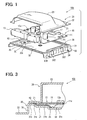
- FIG. 1 is a disassembled perspective view showing a schematic construction of a case for housing an electronic unit having electronic components according to a first embodiment;
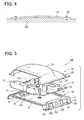
- FIG. 2A is a plan view showing a circuit substrate mounted to a base member of the case, and FIG. 2B is a side view of FIG. 2A;
- FIG. 3 is a cross-sectional view showing a part of the case;
- FIG. 4 is a cross-sectional view showing a mounting portion of the base member;
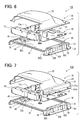
- FIG. 5 is a disassembled perspective view showing a schematic construction of a case for housing an electronic unit having electronic components according to a second embodiment;
- FIG. 6 is a disassembled perspective view showing a schematic construction of a case for housing an electronic unit having electronic components according to a third embodiment;
- FIG. 7 is a disassembled perspective view showing a schematic construction of a case for housing an electronic unit having electronic components according to a fourth embodiment;
- FIG. 8A is a disassembled perspective view showing a schematic construction of a case for housing an electronic unit having electronic components according to a fifth embodiment, and FIG. 8B is an enlarged plan view showing a hole in a mounting portion;
- FIG. 9 is an enlarged cross-sectional view showing a hole in a mounting portion according to a first modification of the fifth embodiment; and
- FIG. 10 is an enlarged cross-sectional view showing a hole in a mounting portion according to a second modification of the fifth embodiment.
- A case for housing an electronic unit including electronic components in a first embodiment has a waterproof structure, and is disposed outside of a vehicle compartment. For example, the case can be suitably used for housing an electric control unit (ECU) for an engine disposed in an engine compartment.
- As shown in FIG. 1, an
electronic device 100 includes acircuit substrate 10, acover member 20, abase member 30, a sealing portion (agent) 40 and aheat conductor 50. The case is constructed with thecover member 20 and thebase member 30. An inner space formed between thecover member 20 and thebase member 30 accommodates thecircuit substrate 10, and the inner space is waterproofed due to the sealingportion 40. Theheat conductor 50 promotes a heat radiation from thecircuit substrate 10. - The
circuit substrate 10 is constructed with a printedcircuit board 11 andelectronic components 12, e.g., microcomputers, resistors and capacitors, mounted to the printedcircuit board 11. Theelectronic components 12 are omitted in FIGS. 2A and 2B. Wiring patterns (not shown) and via holes (not shown) for connecting the wiring patterns are formed on the printedcircuit board 11. The printedcircuit board 11 can be made of any material, e.g., thermoplastic resin, thermosetting resin, ceramic or glass-resin complex material. In the first embodiment, the printedcircuit board 11 is formed of a multi-layered substrate, in which multi-layered wiring patterns are disposed on an epoxy resin including glass cloth. - A
heating element 12a, e.g., power transistor, of theelectronic components 12 excessively generates heat by its operation. As shown in FIGS. 1 and 3, theheating element 12a is positioned in periphery of the printedcircuit board 11 in order to shorten a heat radiation path. Aconnector 13 is mounted to the printedcircuit board 11 as an outside connection terminal, and includesterminals 122 shown in FIGS. 2A and 2B. Theterminals 122 are electrically connected to the wiring patterns on the printedcircuit board 11. A part of theconnector 13 is exposed to an outside of the case, when theelectronic device 100 is assembled. As shown in FIG. 1, aconcave portion 14 is provided at a corner of the printedcircuit board 11 in order to perform a positioning relative to thecover member 20. Athermal via hole 11a shown in FIG. 3 is formed in the printedcircuit board 11 in order to promote a heat radiation from theheating element 12a to thebase member 30. - The
cover member 20 is formed into a deep box having an open end by pressing a copper board, for example. Thecover member 20 has afixing portion 21 facing thebase member 30, and thefixing portion 21 is in contact with thesealing portion 40, as shown in FIG. 3. As shown in FIG. 1, aconvex portion 22 corresponding to theconcave portion 14 is disposed on thefixing portion 21 in order to perform a positioning. A space-formingportion 23 is formed by bending relative to thefixing portion 21, and forms therein an inner space. - The
base member 30 is formed into a shallow box by pressing an aluminum board, for example, and closes the open end of thecover member 20. The aluminum board may have a thermal conductivity in a range between 150W/m·K and 230W/m·K. As described below, thebase member 30 includes a stress-absorbing portion, i.e., a mountingportion 33 and/or aconnection portion 36. The stress-absorbing portion absorbs a stress generated from a distortion (e.g., bump) of an object 200 (e.g., a side wall of the engine compartment) to be mounted. Thebase member 30 can easily absorb the stress, because thebase member 30 is made of the aluminum board having the thermal conductivity equal to or larger than 150W/m.K. Therefore, the stress generated by theobject 200 is difficult to be transmitted to thecircuit substrate 10. - Further, the
base member 30 radiates heat generated from theheating element 12a on thecircuit substrate 10. A heat-transporting amount (W) of a material is equal to the product of the thermal conductivity (W/m·K) of the material, a temperature difference (K) and a conducting cross-section area (m2) divided by a distance (m). Therefore, thebase member 30 can more easily radiate heat generated from thecircuit substrate 10 to theobject 200, because thebase member 30 is made of the aluminum board having the large thermal conductivity. - For example, an aluminum die-cast material has a thermal conductivity of 90W/m·K, and steel has a thermal conductivity of 51W/m·K, which are generally used for forming the
base member 30. However, by using aluminum having the thermal conductivity equal to or larger than 150W/m·K, heat radiation performance can be about double, compared with a case in which the aluminum die-cast material or steel is used. - Furthermore, when a pure aluminum having a thermal conductivity of 220-230W/m·K is used for forming the
base member 30, thebase member 30 becomes relatively soft. Then, thebase member 30 can more easily absorb the stress generated from the distortion of theobject 200, and thebase member 30 can more easily radiate heat generated from theheating element 12a on thecircuit substrate 10. - When the
electronic device 100 is mounted to a vehicle, a predetermined heat radiation performance and a predetermined vibration-withstanding performance (resistance to vibration) may be required. In this case, by using an aluminum board having a thermal conductivity of 200W/m·K, the vibration-withstanding performance and the heat radiation performance can be improved. Thus, the heat radiation performance and the vibration-withstanding performance can be balanced. - The
base member 30 includes a fixingportion 31, which is approximately in parallel to the fixingportion 21 of thecover member 20. The sealingportion 40 is disposed on at least a part of the fixingportion 31. As shown in FIG. 3, the fixingportion 31 is constructed with anarrow part 31a, awide part 31b and aconnection part 31c. In thenarrow part 31a, a clearance between the fixingportion 21 of thecover member 20 and the fixingportion 31 of thebase member 30 is narrow, or does not exist. That is, the sealingportion 40 may not be disposed in the clearance. In thewide part 31b, the clearance is wide, and the sealingportion 40 and the printedcircuit board 11 are disposed in the clearance. Theconnection part 31c is bent, and connects thenarrow part 31a and thewide part 31b. - A space-forming
portion 32 of thebase member 30 is formed by bending relative to the fixingportion 31, and forms an inner space. As shown in FIG. 3, anelevated area 32a is provided in a part of the space-formingportion 32, corresponding to an area for theheating element 12a. When theelectronic device 100 is assembled, as shown in FIG. 1, a clearance between theelevated area 32a and the printedcircuit board 11 is narrower than a clearance between the other part of the space-formingportion 32 and the printedcircuit board 11. In contrast, the clearance between theelevated area 32a and the printedcircuit board 11 is wider than a clearance between thewide part 31b and the printedcircuit board 11, as shown in FIG. 3. Theheat conductor 50 is disposed on theelevated area 32a. Thus, the heat radiation performance can be improved. - The
base member 30 includes a mountingportion 33, which is fixed to theobject 200. The mountingportion 33 has a throughhole 34 for screwing. Aconnection portion 36 is bent in approximately perpendicular to the fixingportion 31 toward a direction opposite to thecover member 20. The mountingportion 33 is bent in approximately perpendicular to theconnection portion 36 toward a direction opposite to the space-formingportion 32, that is, an outside direction from thebase member 30. The mountingportion 33 is a bracket to be fitted to theobject 200, and formed through theconnection portion 36 having a leg shape. As shown in FIG. 3, a heat radiation path is formed such that heat generated in thecircuit substrate 10 is transmitted to theobject 200 through theheat conductor 50 and thebase member 30. Thus, because theheating element 12a is positioned in periphery of the printedcircuit board 11, the heat radiation path can be shortened and the heat radiation performance can be improved. Further, theconnection portion 36 having the leg shape can absorb the stress from theobject 200. Thus, the stress transmitted from theobject 200 to thecircuit substrate 10 can be effectively reduced. - The
connection portion 36 constructs the stress-absorbing portion, and is formed by pressing the aluminum board at the forming time of thebase member 30. A hardness of theconnection portion 36 is sufficiently lower than that of thecircuit substrate 10, i.e., the printedcircuit board 11. A stress generated in theobject 200 is easily transmitted to thecircuit substrate 10 through the mountingportion 33 and theconnection portion 36, if thebase member 30 is made of an aluminum die-cast material or steel, which has a larger hardness than aluminum. Because the hardness of theconnection portion 36 is sufficiently low, a crack in a connection part of theelectronic components 12, theconnector 13 and the printedcircuit board 11 can be reduced. - Further, as shown in FIG. 1, a
slit 302 is formed in theconnection portion 36 in a direction connecting the fixingportion 31 and the mountingportion 33. Even if theconnection portion 36 is distorted by a stress, the stress can be absorbed by theslit 302, thereby preventing a crack in theconnection portion 36. - In addition, the hardness of the
connection portion 36 is sufficiently low. Even if a stress is generated in theconnection portion 36 by the distortion of theobject 200, the stress can be absorbed by a deformation of theconnection portion 36. Therefore, the stress can be restricted from being transmitted to thecircuit substrate 10. - When the case is vibrated, the
connection portion 36 may be damaged by a resonance due to a weight of thecircuit substrate 10 and thecover member 20, because theconnection portion 36 is made of the aluminum board. Therefore, as shown in FIG. 1, strengtheningribs 300 are formed in theconnection portion 36 in a direction connecting the fixingportion 31 and the mountingportion 33. Thus, the damage of theconnection portion 36 can be restricted, because the vibration-withstanding performance can be improved. The strengtheningribs 300 may be integrally formed with thebase member 30 at the pressing time of thebase member 30, or may be additionally fitted to theconnection portion 36. In the first embodiment, threeribs 300 are provided in theconnection portion 36. However, the number of theribs 300 is not limited to this, as long as theconnection portion 36 can absorb the stress and reduce the damage. - The mounting
portion 33 constructs the stress-absorbing portion, and is formed by pressing the aluminum board at the forming time of thebase member 30. A hardness of the mountingportion 33 is sufficiently lower than that of thecircuit substrate 10, i.e., printedcircuit board 11. Even if a stress is generated in the mountingportion 33 by the distortion of theobject 200, the stress can be absorbed by a deformation of the mountingportion 33. That is, as shown in FIG. 4, even if the mountingportion 33 is fixed to theobject 200 having the distortion by usingscrews 400, because the mountingportion 33 itself can be plastically deformed to conform to the distortion, the mountingportion 33 is not spaced from theobject 200. Therefore, the stress can be restricted from being transmitted to thecircuit substrate 10. Further, the mountingportion 33 can have a larger contact area with theobject 200 by the plastic transformation. Thus, heat generated from theheating element 12a on thecircuit substrate 10 can be easily transmitted to theobject 200. In addition, in order to plastically deform the mountingportion 33 at the screwing time, the aluminum board used for forming thebase member 30, i.e., mountingportion 33, has yield strength at 0.2 % (proof stress at 0.2%) equal to or lower than 100N/mm2. The yield strength at 0.2% is a stress generating a plastic deformation of 0.2% of an unstressed length. - When the stress-absorbing portion, i.e., the mounting
portion 33 and/or theconnection portion 36, is made of a material whose hardness is lower than that of thecircuit substrate 10, the stress generated by theobject 200 can be easily absorbed by the stress-absorbing portion. Thus, the stress is difficult to be transmitted to thecircuit substrate 10. - When the mounting
portion 33 is made of a plastically deformable material, the mountingportion 33 can absorb the distortion of theobject 200. Thus, the stress is difficult to be transmitted to thecircuit substrate 10. - When at least one of the
connection portion 36 and the mountingportion 33 absorbs the stress generated by the distortion of theobject 200, the stress is difficult to be transmitted to thecircuit substrate 10. - The
base member 30 includes a protrudingportion 35 between theheat conductor 50 and the sealingportion 40, i.e., fixingportion 31. The protrudingportion 35 protrudes inside of thebase member 30, and is integrally formed with thebase member 30 by pressing. Due to the protrudingportion 35, the sealingportion 40 before hardened is restricted from flowing and contacting with theheat conductor 50, and theheat conductor 50 is restricted from moving and contacting with the sealingportion 40 by vibrations. Thus, the protrudingportion 35 functions as a dam between the sealingportion 40 and theheat conductor 50. - Further, as shown in FIG. 3, a height of the protruding
portion 35 is shorter than a dimension between the elevatingarea 32a and the printedcircuit board 11 such that the protrudingportion 35 is not in contact with the printedcircuit board 11. Therefore, even if thebase member 30 is made of a conductive material, thebase member 30 and the printedcircuit board 11 can be prevented from becoming a short circuit. Furthermore, the protrudingportion 35 is disposed only in a close position between theheat conductor 50 and the fixingportion 30. Thus, a distortion can be restricted from being generated around the protrudingportion 35, when thebase member 30 is pressed. That is, a load due to the pressing can be reduced. - The sealing
portion 40 has a repulsion force and an adhesive force, and is disposed between thecover member 20 and thebase member 30. A space formed between thecover member 20 and thebase member 30 can be waterproofed due to the sealingportion 40. In the first embodiment, moisture-curing type silicon adhesive having viscosity of 150-200 Pa·s before hardening is used as the sealingportion 40. Alternatively, a material described inJP-A-2005-93602 portion 40. - In order to transmit heat generated by the
heating element 12a to outside through thebase member 30, theheat conductor 50 is disposed between thebase member 30 and theheating element 12a, or between thebase member 30 and a back face of the printedcircuit board 11, on which theheating element 12a is mounted. A heat conductor described inJP-A-2003-289191 heat conductor 50, adhesion performance can be improved. It is understood that heat radiation performance can be improved. Further, even if a clearance between thebase member 30 and the printedcircuit board 11, or a clearance between thebase member 30 and theheating element 12a is not uniform, stress concentration on theheating element 12a can be reduced, because theheat conductor 50 is soft and pliable. Thus, damage of theheating element 12a can be restricted. In the first embodiment, a silicon gel having viscosity of 600-1000 Pa·s is used for theheat conductor 50, and theheat conductor 50 is disposed between theelevated area 32a of thebase member 30 and a back face of the printedcircuit board 11, on which theheating element 12a is mounted. - Next, an example method for assembling the
electronic device 100 will be described. Thecircuit substrate 10, thecover member 20 and thebase member 30 are prepared. The case, for housing the electronic unit including thecircuit substrate 10 and theelectronic components 12 on thesubstrate 10, is constructed with thecover member 20 and thebase member 30. As shown in FIG. 1, theheat conductor 50 is disposed on theelevated area 32a, and the sealingportion 40 is coated on the fixingportion 31 of thebase member 30. Then, as shown in FIG. 3, thecircuit substrate 10 is disposed on thebase member 30 through the sealingportion 40. More specifically, thecircuit substrate 10 is disposed on thewide part 31b of the fixingportion 31. Thereafter, as shown in FIG. 2B, the sealingportion 40 is also coated on theconnector 13 to be connected to thecover member 20. Then, the printedcircuit board 11 and thecover member 20 are assembled such that theconvex portion 22 of thecover member 20 is inserted into theconcave portion 14 of the printedcircuit board 11. Then, thecover member 20 is thrust on thebase member 30 through the sealingportion 40. - At that time, as shown in FIG. 3, clearances formed among an edge of the printed
circuit board 11, the fixingportion 21 of thecover member 20 and the fixingportion 31, i.e.,connection part 31c, of thebase member 30 are sealed by the sealingportion 40. Thus, sealing performance and reliability for connection can be secured. Because thecircuit substrate 11 and thecover member 20 press the sealingportion 40, the sealingportion 40 may flow toward theelevated area 32a through a clearance between thewide part 31b and the printedcircuit board 11. However, the sealingportion 40 and theheat conductor 50 are not in contact with each other due to the protrudingportion 35, and the sealingportion 40 is hardened in this state. Each connection between thecover member 20 and theconnector 13, theconnector 13 and thebase member 30, thebase member 30 and thecover member 20, and thecircuit substrate 10 and thebase member 30 can be performed by the sealingportion 40. That is, a space formed by theconnector 13, thecover member 20 and thebase member 30 is made to a waterproof structure by the sealingportion 40, and accommodates thecircuit substrate 10. - Further, the
circuit substrate 10 and thebase member 30 may be relatively strongly connected by fixing with a screw (not shown), after thecircuit substrate 10 and thebase member 30 are connected by the sealingportion 40. In this case, because thecircuit substrate 10 is pressed to thebase member 30, theheat conductor 50 is in close contact with thecircuit substrate 10 and thebase member 30. Because theheat conductor 50 functions as the heat radiation path, as described above, the heat radiation performance can be improved in theelectronic device 100. - According to the
electronic device 100 in the first embodiment, the case is constructed with thecover member 20 and thebase member 30, which are respectively formed by pressing. Therefore, compared with a case in which the case is formed by metal mold casting, e.g., die-casting or resin injection molding, cost for manufacturing the case and weight of the case can be reduced. Even if only thebase member 30 is formed by pressing, the manufacturing cost can be reduced. - Further, the stress generated by the
object 200 is not transmitted to thecircuit substrate 10, because the mountingportion 33 and/or theconnection portion 36 absorb the stress. Thecover member 20, thebase member 30 and theconnector 13 can be connected to each other through the sealingportion 40 without rigidly tightening screws. Thus, costs for parts and processes can be reduced by the elimination of the screws. - Further, clearances formed among an edge of the printed
circuit board 11, the fixingportion 21 of thecover member 20 and the fixingportion 31, i.e.,connection part 31c, of thebase member 30 are sealed by the sealingportion 40. Thus, sealing performance and reliability for connection are secured, while theelectronic device 100 is simply constructed. Because the sealingportion 40 is disposed between the printedcircuit board 11 and thewide part 31b of the fixingportion 31, the reliability for connection can be more improved. - Further, because the sealing
portion 40 extends in thewide part 31b, the sealingportion 40 can be made to have a long distance to the protrudingportion 35. That is, when thecover member 20 is disposed on thebase member 30, the sealingportion 40 extends along a space, i.e., passage, between thewide part 31b and the printedcircuit board 11, because the sealingportion 40 is mobile and viscous. Therefore, the sealing performance, i.e., waterproof performance, can be improved, and the sealingportion 40 and theheat conductor 50 can be effectively restricted from contacting with each other. - Further, in order to shorten the heat radiation path, the
elevated area 32a is provided in a part of the space-formingportion 32. Theelevated area 32a corresponds to an area for theheating element 12a. When theelectronic device 100 is assembled, a clearance between theelevated area 32a and the printedcircuit board 11 is narrower than a clearance between the other space-formingportion 32 and the printedcircuit board 11, as shown in FIG. 1. Theheat conductor 50 is disposed on theelevated area 32a. However, theelevated area 32a may be eliminated. - Further, elements other than the
electronic components 12 may be disposed on the printedcircuit board 11. However, in order to promote the heat radiation, theheating element 12a may be positioned in periphery of the printedcircuit board 11. - Further, the mounting
portion 33 is fixed to theobject 200 with thescrews 400. Alternatively, the mountingportion 33 may be fixed to theobject 200 by riveting or welding. - In a second embodiment, a mount part slit 301 is provided in the mounting
portion 33. The other parts may be made similar to the first embodiment. - As shown in FIG. 5, the
base member 30 has theslit 301 in the mountingportion 33. Theslit 301 extends from theconnection portion 36 to an outer edge of the mountingportion 33. That is, theslit 301 is approximately perpendicular to theconnection portion 36. Alternatively, theslit 301 may be formed in any direction connecting an outer edge of the mountingportion 33 and theconnection portion 36. - Thus, a stress generated by the
object 200 is difficult to be transmitted through theslit 301. Therefore, the stress becomes more difficult to be transmitted to thecircuit substrate 10. - In the second embodiment, two of the
slits 301 are formed in the mountingportion 33. However, the number of theslits 301 is not limited to this. - Furthermore, in the second embodiment, the
slits 301 are provided to be continuously extended from theslits 302 formed in theconnection portion 36, respectively. However, theslits 301 can be formed at different positions from theslits 302 to be partitioned from theslits 302 in theconnection portion 36. - In a third embodiment, a
slit 302a is provided at an end of theconnection portion 36 in a longitudinal direction of theconnection portion 36. The other parts may be made similar to the above embodiments. - As shown in FIG. 6, the
base member 30 has theslit 302a at the end of theconnection portion 36, extending in a direction perpendicular to the longitudinal direction of theconnection portion 36. That is, theslit 302a is approximately perpendicular to the fixingportion 31 and the mountingportion 33, and is formed therebetween. - Thus, stress twisting the
connection portion 36 by theobject 200 can be easily absorbed by theslit 302a at the end of theconnection portion 36. Therefore, the stress generated by theobject 200 becomes more difficult to be transmitted to thecircuit substrate 10. - Cracks may be generated in the
connection portion 36, when theconnection portion 36 is distorted by the stress. Especially, the stress may be concentrated on the both ends of theconnection portion 36. However, by arranging theslits 302a at the both ends of theconnection portion 36, the stress can be more effectively absorbed. Therefore, the cracks can be reduced. - In a fourth embodiment, the
cover member 20 is fixed to theobject 200 by screws. The other parts may be made similar to the above embodiments. - As shown in FIG. 7, the
cover member 20 includes a mountingportion 21a having a screw hole 21a1 into which the screw is screwed, and the hole 21a1 is provided at a position corresponding to thehole 34 in the mountingportion 33 of thebase member 30. The mountingportion 21a has a first part engaged with theconnection portion 36 and a second part engaged with the mountingportion 33 of thebase member 30. The first part of the mountingportion 21a is a connection portion, which is bent approximately perpendicular to the fixingportion 21 toward thebase member 30. The second part of the mountingportion 21a is further bent approximately perpendicular to the connection portion toward an outside of thecover member 20. Thecover member 20 and thebase member 30 are together fixed to theobject 200 with the screw. - Because the
base member 30 is formed by pressing the aluminum board, thebase member 30 is relatively weak to a tightening torque of the screw. However, because thecover member 20 and thebase member 30 are together fixed to theobject 200 with the screw, a tightening strength of thebase member 30 can be improved against the tightening torque of the screw. In addition, in order to improve the tightening strength of thebase member 30 against the tightening torque of the screw, thecover member 20 may have a hardness, which is equal to that of a copper board or an aluminum die-cast board. - In a fifth embodiment, the
hole 34 has acollar 34a shown in FIGS. 8A and 8B. The other parts may be made similar to the above embodiments. - Because the
base member 30 is formed by pressing the aluminum board, thebase member 30 is relatively weak to the tightening torque of the screw 400 (see FIG. 4). As shown in FIGS. 8A and 8B, thecollar 34a is pressed into thehole 34 of the mountingportion 33. Thecollar 34a may be made of metal such as iron or aluminum die-cast product, e.g., ADC12. Thecollar 34a is pressed into thehole 34 at the pressing time of thebase member 30. - Thus, the tightening strength of the
base member 30 can be improved against the tightening torque of thescrew 400. Further, when thecollar 34a is made of iron, the manufacturing cost can be reduced. In contrast, when thecollar 34a is made of the aluminum die-cast product, linear expansion coefficient of thecollar 34a is equal to that of the mountingportion 33, because the mountingportion 33 is made of aluminum. Therefore, stress caused by repeating cooling and heating can be reduced. - As a first modification of the fifth embodiment, as shown in FIG. 9, the
collar 34a may be pressed into the mountingportion 33 in a depression state. Thus, thecollar 34a can be strongly fixed to thehole 34. Further, thecollar 34a can be restricted from protruding from the mountingportion 33. Therefore, heat generated from thecircuit substrate 10 can be more easily transmitted to theobject 200, because a contact area between the mountingportion 33 and theobject 200 is increased. - As a second modification of the fifth embodiment, as shown in FIG. 10, the
collar 34a may be pressed into the mountingportion 33 such that an end face of thecollar 34a is positioned on a face of the mountingportion 33. The face of the mountingportion 33 is to be in contact with theobject 200. Even in this case, thecollar 34a does not protrude from the mountingportion 33. Thus, heat generated from thecircuit substrate 10 can be more easily transmitted to theobject 200, because a contact area between the mountingportion 33 and theobject 200 is increased. - In the above-described embodiments, the
slits slits slits - Such changes and modifications are to be understood as being within the scope of the present invention as defined by the appended claims.
Claims (19)
- A case for housing an electronic unit including a circuit substrate (10) and electronic components (12) disposed on the circuit substrate (10), the case comprising
a base member (30) and a cover member (20), between which the circuit substrate (10) is disposed, wherein
the base member (30) includes:a fixing portion (31), on which the circuit substrate (10) is fixed;a base mounting portion (33) to be fitted to an object (200); anda connection portion (36), between the fixing portion (31) and the mounting portion (33), for connecting the fixing portion (31) and the mounting portion (33), andat least one of the mounting portion (33) and the connection portion (36) has a stress-absorbing portion for absorbing a stress generated by the object (200). - The case according to claim 1, wherein:the connection portion (36) is bent from the fixing portion (31) in approximately perpendicular to the fixing portion (31); andthe mounting portion (33) is bent from the connection portion (36) in approximately perpendicular to the connection portion (36).
- The case according to claim 1 or 2, wherein:the stress-absorbing portion has a hardness, which is lower than that of the circuit substrate (10).
- The case according to any one of claims 1-3, further comprising:a strengthening rib (300) disposed on the connection portion (36) and extending in a direction connecting the fixing portion (31) and the mounting portion (33).
- The case according to any one of claims 1-4, wherein:the mounting portion (33) has a first slit (301) extending in a direction connecting an edge of the mounting portion (33) and the connection portion (36).
- The case according to any one of claims 1-5, wherein:the connection portion (36) has a second slit (302, 302a) extending in a direction connecting the fixing portion (31) and the mounting portion (33).
- The case according to claim 6, wherein:the second slit (302a) is provided at least at an end of the connection portion (36) in a longitudinal direction of the connection portion (36).
- The case according to any one of claims 1-7, wherein:the mounting portion (33) is made of a material, which is plastically deformable when the mounting portion (33) is fixed to the object (200) by a screw (400).
- The case according to any one of claims 1-8, wherein:the base member (30) is made of aluminum having a yield strength at 0.2% equal to or lower than 100N/mm2.
- The case according to any one of claims 1-9, wherein:the base member (30) is made of a pressed aluminum board having a thermal conductivity equal to or larger than 150W/m·K.
- The case according to any one of claims 1-10, wherein:the mounting portion (33) has a base through hole (34) with a press-fitted collar (34a) into which a screw (400) is screwed.
- The case according to claim 11, wherein:the collar (34a) is made of metal.
- The case according to claim 11 or 12, wherein:the collar (34a) is made of an aluminum die-cast product.
- The case according to any one of claims 11-13, wherein:the collar (34a) is provided to be depressed from the mounting portion (33).
- The case according to any one of claims 11-13, wherein:the collar (34a) has at least one end face, which is positioned approximately on the same face as that of the mounting portion (33); andthe faces of the collar (34a) and the mounting portion (33) contact a face of the object (200).
- The case according to any one of claims 11-15, wherein:the cover member (20) includes a cover mounting portion (21a) having a cover through hole (21a1) into which the screw (400) is screwed;the cover through hole (21a1) of the cover mounting portion (21a) are provided at a position corresponding to the base through hole (34) in the base mounting portion (33); andthe cover member (20) and the base member (30) are together fixed to the object (200) by the screw (400) through the cover through hole (21a1) and the base through hole (34).
- The case according to any one of claims 1-16, further comprising:a sealing portion (40) disposed between the base member (30) and the circuit substrate (10).
- The case according to any one of claims 1-17, further comprising:a heat conductor (50) disposed between the base member (30) and the circuit substrate (10) so as to transmit heat generated in the circuit substrate (10) to outside through the base member (30).
- The case according to claim 6, wherein:the first slit (301) is provided to be continuously extended from the second slit (302) formed in the connection portion (36).
Applications Claiming Priority (1)
| Application Number | Priority Date | Filing Date | Title |
|---|---|---|---|
| JP2006210286A JP4692432B2 (en) | 2006-08-01 | 2006-08-01 | Enclosure for electronic devices |
Publications (2)
| Publication Number | Publication Date |
|---|---|
| EP1887842A1 true EP1887842A1 (en) | 2008-02-13 |
| EP1887842B1 EP1887842B1 (en) | 2009-11-11 |
Family
ID=38657421
Family Applications (1)
| Application Number | Title | Priority Date | Filing Date |
|---|---|---|---|
| EP20060025707 Not-in-force EP1887842B1 (en) | 2006-08-01 | 2006-12-12 | Case for housing electronic unit |
Country Status (3)
| Country | Link |
|---|---|
| EP (1) | EP1887842B1 (en) |
| JP (1) | JP4692432B2 (en) |
| DE (1) | DE602006010369D1 (en) |
Cited By (9)
| Publication number | Priority date | Publication date | Assignee | Title |
|---|---|---|---|---|
| DE102010000112A1 (en) | 2009-01-20 | 2010-09-23 | Denso Corporation, Kariya-City | Housing for an on-board electronic control unit |
| CN102537305A (en) * | 2010-11-25 | 2012-07-04 | 罗伯特·博世有限公司 | Fixed electronic transmission control module |
| US8830686B2 (en) | 2010-07-27 | 2014-09-09 | Denso Corporation | In-vehicle electronic control unit housing |
| CN104185587A (en) * | 2012-03-27 | 2014-12-03 | 川崎重工业株式会社 | Double-structure storage box for railway vehicle and railway vehicle equipped with the storage box |
| US9825381B2 (en) | 2015-01-09 | 2017-11-21 | Denso Corporation | Mounting and connector structure for electronic apparatus |
| CN107645876A (en) * | 2017-09-14 | 2018-01-30 | 广东欧珀移动通信有限公司 | Waterproof structure and electronics |
| JP2018198335A (en) * | 2018-09-11 | 2018-12-13 | 日立オートモティブシステムズ株式会社 | Electronic control equipment |
| US10426048B2 (en) | 2014-08-29 | 2019-09-24 | Denso Corporation | Electronic device accommodating housing and method of attaching the same |
| CN115523434A (en) * | 2021-06-25 | 2022-12-27 | 余姚煜昌电器有限公司 | Electronic component and electronic device |
Families Citing this family (7)
| Publication number | Priority date | Publication date | Assignee | Title |
|---|---|---|---|---|
| KR200465362Y1 (en) | 2008-09-18 | 2013-02-15 | 현대중공업 주식회사 | Switching board case |
| JP5425555B2 (en) * | 2009-07-31 | 2014-02-26 | 日立オートモティブシステムズ株式会社 | Controller unit |
| JP5550322B2 (en) * | 2009-12-14 | 2014-07-16 | 矢崎総業株式会社 | Holding member |
| JP2013243337A (en) | 2012-04-25 | 2013-12-05 | Jtekt Corp | Controller and motor unit including the same |
| JP6007579B2 (en) | 2012-05-10 | 2016-10-12 | 株式会社ジェイテクト | Control device and motor unit including the same |
| DE102019207498B4 (en) | 2018-05-28 | 2025-02-13 | Denso Corporation | mounting structure and semiconductor device using the structure |
| JP7180624B2 (en) | 2020-02-03 | 2022-11-30 | 株式会社デンソー | power converter |
Citations (5)
| Publication number | Priority date | Publication date | Assignee | Title |
|---|---|---|---|---|
| US5872332A (en) * | 1997-06-27 | 1999-02-16 | Delco Electronics Corp. | Molded housing with EMI shield |
| JP2002246762A (en) | 2001-02-21 | 2002-08-30 | Denso Corp | Electronic control equipment and its transport system |
| EP1250034A2 (en) * | 2001-04-12 | 2002-10-16 | Fujitsu Ten Limited | Electronic device for vehicle |
| US6552911B1 (en) * | 1999-05-12 | 2003-04-22 | Robert Bosch Gmbh | Electrical device |
| EP1806960A1 (en) | 2006-01-06 | 2007-07-11 | Denso Corporation | Electronic device |
Family Cites Families (2)
| Publication number | Priority date | Publication date | Assignee | Title |
|---|---|---|---|---|
| JP3700591B2 (en) * | 2001-02-21 | 2005-09-28 | 株式会社デンソー | Electronic control equipment |
| JP2005117887A (en) * | 2003-09-19 | 2005-04-28 | Auto Network Gijutsu Kenkyusho:Kk | In-vehicle circuit unit mounting structure and in-vehicle circuit unit |
-
2006
- 2006-08-01 JP JP2006210286A patent/JP4692432B2/en not_active Expired - Fee Related
- 2006-12-12 EP EP20060025707 patent/EP1887842B1/en not_active Not-in-force
- 2006-12-12 DE DE200660010369 patent/DE602006010369D1/en active Active
Patent Citations (5)
| Publication number | Priority date | Publication date | Assignee | Title |
|---|---|---|---|---|
| US5872332A (en) * | 1997-06-27 | 1999-02-16 | Delco Electronics Corp. | Molded housing with EMI shield |
| US6552911B1 (en) * | 1999-05-12 | 2003-04-22 | Robert Bosch Gmbh | Electrical device |
| JP2002246762A (en) | 2001-02-21 | 2002-08-30 | Denso Corp | Electronic control equipment and its transport system |
| EP1250034A2 (en) * | 2001-04-12 | 2002-10-16 | Fujitsu Ten Limited | Electronic device for vehicle |
| EP1806960A1 (en) | 2006-01-06 | 2007-07-11 | Denso Corporation | Electronic device |
Cited By (12)
| Publication number | Priority date | Publication date | Assignee | Title |
|---|---|---|---|---|
| DE102010000112A1 (en) | 2009-01-20 | 2010-09-23 | Denso Corporation, Kariya-City | Housing for an on-board electronic control unit |
| US8144476B2 (en) | 2009-01-20 | 2012-03-27 | Denso Corporation | Housing for in-vehicle electronic control unit |
| US8830686B2 (en) | 2010-07-27 | 2014-09-09 | Denso Corporation | In-vehicle electronic control unit housing |
| CN102537305A (en) * | 2010-11-25 | 2012-07-04 | 罗伯特·博世有限公司 | Fixed electronic transmission control module |
| CN102537305B (en) * | 2010-11-25 | 2016-05-18 | 罗伯特·博世有限公司 | Fixing electronic transmission control module |
| CN104185587A (en) * | 2012-03-27 | 2014-12-03 | 川崎重工业株式会社 | Double-structure storage box for railway vehicle and railway vehicle equipped with the storage box |
| CN104185587B (en) * | 2012-03-27 | 2017-03-29 | 川崎重工业株式会社 | The dual structure type containing box of rail truck and possesses the rail truck of the containing box |
| US10426048B2 (en) | 2014-08-29 | 2019-09-24 | Denso Corporation | Electronic device accommodating housing and method of attaching the same |
| US9825381B2 (en) | 2015-01-09 | 2017-11-21 | Denso Corporation | Mounting and connector structure for electronic apparatus |
| CN107645876A (en) * | 2017-09-14 | 2018-01-30 | 广东欧珀移动通信有限公司 | Waterproof structure and electronics |
| JP2018198335A (en) * | 2018-09-11 | 2018-12-13 | 日立オートモティブシステムズ株式会社 | Electronic control equipment |
| CN115523434A (en) * | 2021-06-25 | 2022-12-27 | 余姚煜昌电器有限公司 | Electronic component and electronic device |
Also Published As
| Publication number | Publication date |
|---|---|
| JP4692432B2 (en) | 2011-06-01 |
| EP1887842B1 (en) | 2009-11-11 |
| DE602006010369D1 (en) | 2009-12-24 |
| JP2008041718A (en) | 2008-02-21 |
Similar Documents
| Publication | Publication Date | Title |
|---|---|---|
| EP1887842B1 (en) | Case for housing electronic unit | |
| US11370372B2 (en) | Electronic control device | |
| US7495183B2 (en) | Electronic circuit apparatus | |
| US7359212B2 (en) | Control device and method of manufacturing thereof | |
| JP3748253B2 (en) | In-vehicle electronic device housing structure | |
| JP2014093414A (en) | Electronic control device | |
| JP6561129B2 (en) | Electronic control device or manufacturing method thereof | |
| JP6582052B2 (en) | Manufacturing method of electronic control device or in-vehicle electronic control device | |
| JP5803856B2 (en) | Electronic control unit | |
| WO2016114222A1 (en) | Electronic control device | |
| JP2003124662A (en) | Automotive electronics | |
| WO2017056727A1 (en) | Electronic control device | |
| CN102463938A (en) | Automotive control unit | |
| JP3762738B2 (en) | In-vehicle electronic device housing structure | |
| US10880989B2 (en) | Electrical junction box | |
| JP4407067B2 (en) | Electronic equipment | |
| JP6277061B2 (en) | Electronic control unit | |
| JP2015185755A (en) | Electronic device | |
| JP2008098559A (en) | Semiconductor mounting structure and mounting method thereof | |
| JP2015216061A (en) | Electronic control unit | |
| JP2004259948A (en) | Electronic control unit | |
| JP2015002323A (en) | Electronic device | |
| JP2012253141A (en) | Electronic apparatus | |
| JP2771746B2 (en) | Semiconductor device | |
| JP2009049109A (en) | Modular equipment |
Legal Events
| Date | Code | Title | Description |
|---|---|---|---|
| PUAI | Public reference made under article 153(3) epc to a published international application that has entered the european phase |
Free format text: ORIGINAL CODE: 0009012 |
|
| AK | Designated contracting states |
Kind code of ref document: A1 Designated state(s): AT BE BG CH CY CZ DE DK EE ES FI FR GB GR HU IE IS IT LI LT LU LV MC NL PL PT RO SE SI SK TR |
|
| AX | Request for extension of the european patent |
Extension state: AL BA HR MK YU |
|
| 17P | Request for examination filed |
Effective date: 20080221 |
|
| AKX | Designation fees paid |
Designated state(s): DE FR IT |
|
| GRAP | Despatch of communication of intention to grant a patent |
Free format text: ORIGINAL CODE: EPIDOSNIGR1 |
|
| GRAS | Grant fee paid |
Free format text: ORIGINAL CODE: EPIDOSNIGR3 |
|
| GRAA | (expected) grant |
Free format text: ORIGINAL CODE: 0009210 |
|
| AK | Designated contracting states |
Kind code of ref document: B1 Designated state(s): DE FR IT |
|
| REF | Corresponds to: |
Ref document number: 602006010369 Country of ref document: DE Date of ref document: 20091224 Kind code of ref document: P |
|
| PLBE | No opposition filed within time limit |
Free format text: ORIGINAL CODE: 0009261 |
|
| STAA | Information on the status of an ep patent application or granted ep patent |
Free format text: STATUS: NO OPPOSITION FILED WITHIN TIME LIMIT |
|
| 26N | No opposition filed |
Effective date: 20100812 |
|
| PGFP | Annual fee paid to national office [announced via postgrant information from national office to epo] |
Ref country code: IT Payment date: 20121214 Year of fee payment: 7 |
|
| PGFP | Annual fee paid to national office [announced via postgrant information from national office to epo] |
Ref country code: FR Payment date: 20130107 Year of fee payment: 7 |
|
| REG | Reference to a national code |
Ref country code: FR Ref legal event code: ST Effective date: 20140829 |
|
| PG25 | Lapsed in a contracting state [announced via postgrant information from national office to epo] |
Ref country code: FR Free format text: LAPSE BECAUSE OF NON-PAYMENT OF DUE FEES Effective date: 20131231 |
|
| PG25 | Lapsed in a contracting state [announced via postgrant information from national office to epo] |
Ref country code: IT Free format text: LAPSE BECAUSE OF NON-PAYMENT OF DUE FEES Effective date: 20131231 |
|
| PG25 | Lapsed in a contracting state [announced via postgrant information from national office to epo] |
Ref country code: IT Free format text: LAPSE BECAUSE OF NON-PAYMENT OF DUE FEES Effective date: 20131212 |
|
| PGFP | Annual fee paid to national office [announced via postgrant information from national office to epo] |
Ref country code: DE Payment date: 20221213 Year of fee payment: 17 |
|
| REG | Reference to a national code |
Ref country code: DE Ref legal event code: R119 Ref document number: 602006010369 Country of ref document: DE |
|
| PG25 | Lapsed in a contracting state [announced via postgrant information from national office to epo] |
Ref country code: DE Free format text: LAPSE BECAUSE OF NON-PAYMENT OF DUE FEES Effective date: 20240702 |
|
| PG25 | Lapsed in a contracting state [announced via postgrant information from national office to epo] |
Ref country code: DE Free format text: LAPSE BECAUSE OF NON-PAYMENT OF DUE FEES Effective date: 20240702 |