EP1887010A1 - Method for producing isocyanate group-containing siloxane compound - Google Patents
Method for producing isocyanate group-containing siloxane compound Download PDFInfo
- Publication number
- EP1887010A1 EP1887010A1 EP07253013A EP07253013A EP1887010A1 EP 1887010 A1 EP1887010 A1 EP 1887010A1 EP 07253013 A EP07253013 A EP 07253013A EP 07253013 A EP07253013 A EP 07253013A EP 1887010 A1 EP1887010 A1 EP 1887010A1
- Authority
- EP
- European Patent Office
- Prior art keywords
- siloxane compound
- general formula
- isocyanate group
- following general
- group
- Prior art date
- Legal status (The legal status is an assumption and is not a legal conclusion. Google has not performed a legal analysis and makes no representation as to the accuracy of the status listed.)
- Granted
Links
- -1 siloxane compound Chemical class 0.000 title claims abstract description 43
- IQPQWNKOIGAROB-UHFFFAOYSA-N isocyanate group Chemical group [N-]=C=O IQPQWNKOIGAROB-UHFFFAOYSA-N 0.000 title claims abstract description 24
- 238000004519 manufacturing process Methods 0.000 title claims abstract description 15
- 150000001913 cyanates Chemical class 0.000 claims abstract description 14
- 125000004432 carbon atom Chemical group C* 0.000 claims abstract description 11
- 125000001183 hydrocarbyl group Chemical group 0.000 claims abstract description 11
- 125000005843 halogen group Chemical group 0.000 claims abstract description 7
- 229910052783 alkali metal Inorganic materials 0.000 claims abstract description 4
- 150000001340 alkali metals Chemical class 0.000 claims abstract description 4
- 229910052784 alkaline earth metal Inorganic materials 0.000 claims abstract description 4
- 150000001342 alkaline earth metals Chemical class 0.000 claims abstract description 4
- 125000004435 hydrogen atom Chemical group [H]* 0.000 claims abstract description 4
- 125000004469 siloxy group Chemical group [SiH3]O* 0.000 claims abstract description 4
- 238000006243 chemical reaction Methods 0.000 claims description 27
- NLKNQRATVPKPDG-UHFFFAOYSA-M potassium iodide Chemical compound [K+].[I-] NLKNQRATVPKPDG-UHFFFAOYSA-M 0.000 claims description 27
- 229910052757 nitrogen Inorganic materials 0.000 claims description 14
- GKKCIDNWFBPDBW-UHFFFAOYSA-M potassium cyanate Chemical compound [K]OC#N GKKCIDNWFBPDBW-UHFFFAOYSA-M 0.000 claims description 11
- 150000003839 salts Chemical class 0.000 claims description 9
- FVAUCKIRQBBSSJ-UHFFFAOYSA-M sodium iodide Chemical group [Na+].[I-] FVAUCKIRQBBSSJ-UHFFFAOYSA-M 0.000 claims description 9
- 239000003054 catalyst Substances 0.000 claims description 4
- 229910001511 metal iodide Inorganic materials 0.000 claims description 4
- 125000002496 methyl group Chemical group [H]C([H])([H])* 0.000 claims description 4
- 239000003444 phase transfer catalyst Substances 0.000 claims description 4
- 239000002798 polar solvent Substances 0.000 claims description 4
- ZVCDLGYNFYZZOK-UHFFFAOYSA-M sodium cyanate Chemical group [Na]OC#N ZVCDLGYNFYZZOK-UHFFFAOYSA-M 0.000 claims description 3
- 235000009518 sodium iodide Nutrition 0.000 claims description 3
- XMBWDFGMSWQBCA-UHFFFAOYSA-M iodide Chemical compound [I-] XMBWDFGMSWQBCA-UHFFFAOYSA-M 0.000 claims description 2
- 150000004694 iodide salts Chemical class 0.000 claims description 2
- 125000004433 nitrogen atom Chemical group N* 0.000 claims description 2
- 125000004437 phosphorous atom Chemical group 0.000 claims description 2
- 229910052698 phosphorus Inorganic materials 0.000 claims description 2
- 238000000034 method Methods 0.000 abstract description 6
- ZMXDDKWLCZADIW-UHFFFAOYSA-N N,N-Dimethylformamide Chemical compound CN(C)C=O ZMXDDKWLCZADIW-UHFFFAOYSA-N 0.000 description 36
- IJGRMHOSHXDMSA-UHFFFAOYSA-N Atomic nitrogen Chemical compound N#N IJGRMHOSHXDMSA-UHFFFAOYSA-N 0.000 description 24
- 239000011541 reaction mixture Substances 0.000 description 18
- 238000004817 gas chromatography Methods 0.000 description 8
- 238000010438 heat treatment Methods 0.000 description 8
- 239000000047 product Substances 0.000 description 8
- 238000010992 reflux Methods 0.000 description 8
- 238000003756 stirring Methods 0.000 description 8
- YXFVVABEGXRONW-UHFFFAOYSA-N Toluene Chemical compound CC1=CC=CC=C1 YXFVVABEGXRONW-UHFFFAOYSA-N 0.000 description 6
- 238000004821 distillation Methods 0.000 description 6
- MMWCHSBIWFYBBL-UHFFFAOYSA-N 3-chloropropyl-tris(trimethylsilyloxy)silane Chemical compound C[Si](C)(C)O[Si](O[Si](C)(C)C)(O[Si](C)(C)C)CCCCl MMWCHSBIWFYBBL-UHFFFAOYSA-N 0.000 description 5
- SVTUWEUXLNHYPF-UHFFFAOYSA-N trimethyl-[propyl-bis(trimethylsilyloxy)silyl]oxysilane Chemical compound CCC[Si](O[Si](C)(C)C)(O[Si](C)(C)C)O[Si](C)(C)C SVTUWEUXLNHYPF-UHFFFAOYSA-N 0.000 description 5
- 125000003277 amino group Chemical group 0.000 description 4
- 239000007858 starting material Substances 0.000 description 4
- WEVYAHXRMPXWCK-UHFFFAOYSA-N Acetonitrile Chemical compound CC#N WEVYAHXRMPXWCK-UHFFFAOYSA-N 0.000 description 3
- YGYAWVDWMABLBF-UHFFFAOYSA-N Phosgene Chemical compound ClC(Cl)=O YGYAWVDWMABLBF-UHFFFAOYSA-N 0.000 description 3
- CRHBFSSHXLHHRO-UHFFFAOYSA-N 2-(3-chloropropyl)-2,4,4,6,6,8,8-heptamethyl-1,3,5,7,2,4,6,8-tetraoxatetrasilocane Chemical compound C[Si]1(C)O[Si](C)(C)O[Si](C)(CCCCl)O[Si](C)(C)O1 CRHBFSSHXLHHRO-UHFFFAOYSA-N 0.000 description 2
- KDACIXJUXOJZLX-UHFFFAOYSA-N 2-(chloromethyl)-2,4,4,6,6,8,8-heptamethyl-1,3,5,7,2,4,6,8-tetraoxatetrasilocane Chemical compound C[Si]1(C)O[Si](C)(C)O[Si](C)(CCl)O[Si](C)(C)O1 KDACIXJUXOJZLX-UHFFFAOYSA-N 0.000 description 2
- ZAMOUSCENKQFHK-UHFFFAOYSA-N Chlorine atom Chemical compound [Cl] ZAMOUSCENKQFHK-UHFFFAOYSA-N 0.000 description 2
- IAZDPXIOMUYVGZ-UHFFFAOYSA-N Dimethylsulphoxide Chemical compound CS(C)=O IAZDPXIOMUYVGZ-UHFFFAOYSA-N 0.000 description 2
- UFHFLCQGNIYNRP-UHFFFAOYSA-N Hydrogen Chemical compound [H][H] UFHFLCQGNIYNRP-UHFFFAOYSA-N 0.000 description 2
- SECXISVLQFMRJM-UHFFFAOYSA-N N-Methylpyrrolidone Chemical compound CN1CCCC1=O SECXISVLQFMRJM-UHFFFAOYSA-N 0.000 description 2
- 125000003342 alkenyl group Chemical group 0.000 description 2
- HTZCNXWZYVXIMZ-UHFFFAOYSA-M benzyl(triethyl)azanium;chloride Chemical compound [Cl-].CC[N+](CC)(CC)CC1=CC=CC=C1 HTZCNXWZYVXIMZ-UHFFFAOYSA-M 0.000 description 2
- WOWHHFRSBJGXCM-UHFFFAOYSA-M cetyltrimethylammonium chloride Chemical compound [Cl-].CCCCCCCCCCCCCCCC[N+](C)(C)C WOWHHFRSBJGXCM-UHFFFAOYSA-M 0.000 description 2
- 239000000460 chlorine Substances 0.000 description 2
- 229910052801 chlorine Inorganic materials 0.000 description 2
- GMDPIHSENOONRD-UHFFFAOYSA-N chloromethyl-tris(trimethylsilyloxy)silane Chemical compound C[Si](C)(C)O[Si](CCl)(O[Si](C)(C)C)O[Si](C)(C)C GMDPIHSENOONRD-UHFFFAOYSA-N 0.000 description 2
- KPUWHANPEXNPJT-UHFFFAOYSA-N disiloxane Chemical class [SiH3]O[SiH3] KPUWHANPEXNPJT-UHFFFAOYSA-N 0.000 description 2
- 239000000706 filtrate Substances 0.000 description 2
- 238000001914 filtration Methods 0.000 description 2
- 239000001257 hydrogen Substances 0.000 description 2
- 229910052739 hydrogen Inorganic materials 0.000 description 2
- HSZCZNFXUDYRKD-UHFFFAOYSA-M lithium iodide Chemical compound [Li+].[I-] HSZCZNFXUDYRKD-UHFFFAOYSA-M 0.000 description 2
- 239000012074 organic phase Substances 0.000 description 2
- 229920001296 polysiloxane Chemical group 0.000 description 2
- 230000036632 reaction speed Effects 0.000 description 2
- 230000035484 reaction time Effects 0.000 description 2
- WFUBYPSJBBQSOU-UHFFFAOYSA-M rubidium iodide Chemical compound [Rb+].[I-] WFUBYPSJBBQSOU-UHFFFAOYSA-M 0.000 description 2
- 239000002904 solvent Substances 0.000 description 2
- NHGXDBSUJJNIRV-UHFFFAOYSA-M tetrabutylammonium chloride Chemical compound [Cl-].CCCC[N+](CCCC)(CCCC)CCCC NHGXDBSUJJNIRV-UHFFFAOYSA-M 0.000 description 2
- RKHXQBLJXBGEKF-UHFFFAOYSA-M tetrabutylphosphanium;bromide Chemical compound [Br-].CCCC[P+](CCCC)(CCCC)CCCC RKHXQBLJXBGEKF-UHFFFAOYSA-M 0.000 description 2
- CCIYPTIBRAUPLQ-UHFFFAOYSA-M tetrabutylphosphanium;iodide Chemical compound [I-].CCCC[P+](CCCC)(CCCC)CCCC CCIYPTIBRAUPLQ-UHFFFAOYSA-M 0.000 description 2
- 238000005979 thermal decomposition reaction Methods 0.000 description 2
- 125000003903 2-propenyl group Chemical group [H]C([*])([H])C([H])=C([H])[H] 0.000 description 1
- CPELXLSAUQHCOX-UHFFFAOYSA-M Bromide Chemical compound [Br-] CPELXLSAUQHCOX-UHFFFAOYSA-M 0.000 description 1
- WKBOTKDWSSQWDR-UHFFFAOYSA-N Bromine atom Chemical compound [Br] WKBOTKDWSSQWDR-UHFFFAOYSA-N 0.000 description 1
- BVKZGUZCCUSVTD-UHFFFAOYSA-L Carbonate Chemical compound [O-]C([O-])=O BVKZGUZCCUSVTD-UHFFFAOYSA-L 0.000 description 1
- OKIZCWYLBDKLSU-UHFFFAOYSA-M N,N,N-Trimethylmethanaminium chloride Chemical compound [Cl-].C[N+](C)(C)C OKIZCWYLBDKLSU-UHFFFAOYSA-M 0.000 description 1
- 125000000217 alkyl group Chemical group 0.000 description 1
- 125000003118 aryl group Chemical group 0.000 description 1
- JBNAGKTUVSTOHZ-UHFFFAOYSA-L barium(2+);dicyanate Chemical compound [Ba+2].[O-]C#N.[O-]C#N JBNAGKTUVSTOHZ-UHFFFAOYSA-L 0.000 description 1
- 125000001797 benzyl group Chemical group [H]C1=C([H])C([H])=C(C([H])=C1[H])C([H])([H])* 0.000 description 1
- VJGNLOIQCWLBJR-UHFFFAOYSA-M benzyl(tributyl)azanium;chloride Chemical compound [Cl-].CCCC[N+](CCCC)(CCCC)CC1=CC=CC=C1 VJGNLOIQCWLBJR-UHFFFAOYSA-M 0.000 description 1
- UUZYBYIOAZTMGC-UHFFFAOYSA-M benzyl(trimethyl)azanium;bromide Chemical compound [Br-].C[N+](C)(C)CC1=CC=CC=C1 UUZYBYIOAZTMGC-UHFFFAOYSA-M 0.000 description 1
- KXHPPCXNWTUNSB-UHFFFAOYSA-M benzyl(trimethyl)azanium;chloride Chemical compound [Cl-].C[N+](C)(C)CC1=CC=CC=C1 KXHPPCXNWTUNSB-UHFFFAOYSA-M 0.000 description 1
- USFRYJRPHFMVBZ-UHFFFAOYSA-M benzyl(triphenyl)phosphanium;chloride Chemical compound [Cl-].C=1C=CC=CC=1[P+](C=1C=CC=CC=1)(C=1C=CC=CC=1)CC1=CC=CC=C1 USFRYJRPHFMVBZ-UHFFFAOYSA-M 0.000 description 1
- 238000009835 boiling Methods 0.000 description 1
- GDTBXPJZTBHREO-UHFFFAOYSA-N bromine Substances BrBr GDTBXPJZTBHREO-UHFFFAOYSA-N 0.000 description 1
- 229910052794 bromium Inorganic materials 0.000 description 1
- 125000000484 butyl group Chemical group [H]C([*])([H])C([H])([H])C([H])([H])C([H])([H])[H] 0.000 description 1
- XQPRBTXUXXVTKB-UHFFFAOYSA-M caesium iodide Chemical compound [I-].[Cs+] XQPRBTXUXXVTKB-UHFFFAOYSA-M 0.000 description 1
- JLCRXCPXQLBSEM-UHFFFAOYSA-N calcium diisocyanate Chemical compound [Ca++].[N-]=C=O.[N-]=C=O JLCRXCPXQLBSEM-UHFFFAOYSA-N 0.000 description 1
- 239000004202 carbamide Substances 0.000 description 1
- IGZGOSZOYWXTLI-UHFFFAOYSA-M cesium;cyanate Chemical compound [Cs+].[O-]C#N IGZGOSZOYWXTLI-UHFFFAOYSA-M 0.000 description 1
- 229940115457 cetyldimethylethylammonium bromide Drugs 0.000 description 1
- 239000003795 chemical substances by application Substances 0.000 description 1
- 238000011109 contamination Methods 0.000 description 1
- 150000003983 crown ethers Chemical class 0.000 description 1
- 125000000753 cycloalkyl group Chemical group 0.000 description 1
- 125000000113 cyclohexyl group Chemical group [H]C1([H])C([H])([H])C([H])([H])C([H])(*)C([H])([H])C1([H])[H] 0.000 description 1
- 125000001511 cyclopentyl group Chemical group [H]C1([H])C([H])([H])C([H])([H])C([H])(*)C1([H])[H] 0.000 description 1
- 230000018044 dehydration Effects 0.000 description 1
- 238000006297 dehydration reaction Methods 0.000 description 1
- XRWMGCFJVKDVMD-UHFFFAOYSA-M didodecyl(dimethyl)azanium;bromide Chemical compound [Br-].CCCCCCCCCCCC[N+](C)(C)CCCCCCCCCCCC XRWMGCFJVKDVMD-UHFFFAOYSA-M 0.000 description 1
- SBZXBUIDTXKZTM-UHFFFAOYSA-N diglyme Chemical compound COCCOCCOC SBZXBUIDTXKZTM-UHFFFAOYSA-N 0.000 description 1
- PSLWZOIUBRXAQW-UHFFFAOYSA-M dimethyl(dioctadecyl)azanium;bromide Chemical compound [Br-].CCCCCCCCCCCCCCCCCC[N+](C)(C)CCCCCCCCCCCCCCCCCC PSLWZOIUBRXAQW-UHFFFAOYSA-M 0.000 description 1
- DDXLVDQZPFLQMZ-UHFFFAOYSA-M dodecyl(trimethyl)azanium;chloride Chemical compound [Cl-].CCCCCCCCCCCC[N+](C)(C)C DDXLVDQZPFLQMZ-UHFFFAOYSA-M 0.000 description 1
- 230000000694 effects Effects 0.000 description 1
- 125000001495 ethyl group Chemical group [H]C([H])([H])C([H])([H])* 0.000 description 1
- XRVHNUHQKKQFBS-UHFFFAOYSA-M ethyl(triphenyl)azanium;iodide Chemical compound [I-].C=1C=CC=CC=1[N+](C=1C=CC=CC=1)(CC)C1=CC=CC=C1 XRVHNUHQKKQFBS-UHFFFAOYSA-M 0.000 description 1
- VUFOSBDICLTFMS-UHFFFAOYSA-M ethyl-hexadecyl-dimethylazanium;bromide Chemical compound [Br-].CCCCCCCCCCCCCCCC[N+](C)(C)CC VUFOSBDICLTFMS-UHFFFAOYSA-M 0.000 description 1
- 125000000524 functional group Chemical group 0.000 description 1
- GNOIPBMMFNIUFM-UHFFFAOYSA-N hexamethylphosphoric triamide Chemical compound CN(C)P(=O)(N(C)C)N(C)C GNOIPBMMFNIUFM-UHFFFAOYSA-N 0.000 description 1
- 239000011261 inert gas Substances 0.000 description 1
- PNDPGZBMCMUPRI-UHFFFAOYSA-N iodine Chemical compound II PNDPGZBMCMUPRI-UHFFFAOYSA-N 0.000 description 1
- POMZBEGASDKMRR-UHFFFAOYSA-M lithium;cyanate Chemical compound [Li+].[O-]C#N POMZBEGASDKMRR-UHFFFAOYSA-M 0.000 description 1
- BPOZGEPCZMRDON-UHFFFAOYSA-L magnesium;dicyanate Chemical compound [Mg+2].[O-]C#N.[O-]C#N BPOZGEPCZMRDON-UHFFFAOYSA-L 0.000 description 1
- GGSHUYPVVIISTD-UHFFFAOYSA-M methyl(triphenyl)azanium;iodide Chemical compound [I-].C=1C=CC=CC=1[N+](C=1C=CC=CC=1)(C)C1=CC=CC=C1 GGSHUYPVVIISTD-UHFFFAOYSA-M 0.000 description 1
- 239000000203 mixture Substances 0.000 description 1
- 150000002894 organic compounds Chemical class 0.000 description 1
- 125000001997 phenyl group Chemical group [H]C1=C([H])C([H])=C(*)C([H])=C1[H] 0.000 description 1
- 238000002203 pretreatment Methods 0.000 description 1
- 125000001436 propyl group Chemical group [H]C([*])([H])C([H])([H])C([H])([H])[H] 0.000 description 1
- 238000000746 purification Methods 0.000 description 1
- 238000011084 recovery Methods 0.000 description 1
- KIQZCTMKIBQATI-UHFFFAOYSA-M rubidium(1+);cyanate Chemical compound [Rb+].[O-]C#N KIQZCTMKIBQATI-UHFFFAOYSA-M 0.000 description 1
- ZJXATYQRQGNBGM-UHFFFAOYSA-L strontium;dicyanate Chemical compound [Sr+2].[O-]C#N.[O-]C#N ZJXATYQRQGNBGM-UHFFFAOYSA-L 0.000 description 1
- 239000000725 suspension Substances 0.000 description 1
- JRMUNVKIHCOMHV-UHFFFAOYSA-M tetrabutylammonium bromide Chemical compound [Br-].CCCC[N+](CCCC)(CCCC)CCCC JRMUNVKIHCOMHV-UHFFFAOYSA-M 0.000 description 1
- DPKBAXPHAYBPRL-UHFFFAOYSA-M tetrabutylazanium;iodide Chemical compound [I-].CCCC[N+](CCCC)(CCCC)CCCC DPKBAXPHAYBPRL-UHFFFAOYSA-M 0.000 description 1
- IBWGNZVCJVLSHB-UHFFFAOYSA-M tetrabutylphosphanium;chloride Chemical compound [Cl-].CCCC[P+](CCCC)(CCCC)CCCC IBWGNZVCJVLSHB-UHFFFAOYSA-M 0.000 description 1
- HWCKGOZZJDHMNC-UHFFFAOYSA-M tetraethylammonium bromide Chemical compound [Br-].CC[N+](CC)(CC)CC HWCKGOZZJDHMNC-UHFFFAOYSA-M 0.000 description 1
- UQFSVBXCNGCBBW-UHFFFAOYSA-M tetraethylammonium iodide Chemical compound [I-].CC[N+](CC)(CC)CC UQFSVBXCNGCBBW-UHFFFAOYSA-M 0.000 description 1
- VMJQVRWCDVLJSI-UHFFFAOYSA-M tetraheptylazanium;chloride Chemical compound [Cl-].CCCCCCC[N+](CCCCCCC)(CCCCCCC)CCCCCCC VMJQVRWCDVLJSI-UHFFFAOYSA-M 0.000 description 1
- ODTSDWCGLRVBHJ-UHFFFAOYSA-M tetrahexylazanium;chloride Chemical compound [Cl-].CCCCCC[N+](CCCCCC)(CCCCCC)CCCCCC ODTSDWCGLRVBHJ-UHFFFAOYSA-M 0.000 description 1
- QBVXKDJEZKEASM-UHFFFAOYSA-M tetraoctylammonium bromide Chemical compound [Br-].CCCCCCCC[N+](CCCCCCCC)(CCCCCCCC)CCCCCCCC QBVXKDJEZKEASM-UHFFFAOYSA-M 0.000 description 1
- SXAWRMKQZKPHNJ-UHFFFAOYSA-M tetrapentylazanium;chloride Chemical compound [Cl-].CCCCC[N+](CCCCC)(CCCCC)CCCCC SXAWRMKQZKPHNJ-UHFFFAOYSA-M 0.000 description 1
- AEFPPQGZJFTXDR-UHFFFAOYSA-M tetraphenylphosphanium;iodide Chemical compound [I-].C1=CC=CC=C1[P+](C=1C=CC=CC=1)(C=1C=CC=CC=1)C1=CC=CC=C1 AEFPPQGZJFTXDR-UHFFFAOYSA-M 0.000 description 1
- WAGFXJQAIZNSEQ-UHFFFAOYSA-M tetraphenylphosphonium chloride Chemical compound [Cl-].C1=CC=CC=C1[P+](C=1C=CC=CC=1)(C=1C=CC=CC=1)C1=CC=CC=C1 WAGFXJQAIZNSEQ-UHFFFAOYSA-M 0.000 description 1
- BGQMOFGZRJUORO-UHFFFAOYSA-M tetrapropylammonium bromide Chemical compound [Br-].CCC[N+](CCC)(CCC)CCC BGQMOFGZRJUORO-UHFFFAOYSA-M 0.000 description 1
- FBEVECUEMUUFKM-UHFFFAOYSA-M tetrapropylazanium;chloride Chemical compound [Cl-].CCC[N+](CCC)(CCC)CCC FBEVECUEMUUFKM-UHFFFAOYSA-M 0.000 description 1
- 231100000331 toxic Toxicity 0.000 description 1
- 230000002588 toxic effect Effects 0.000 description 1
- RYVBINGWVJJDPU-UHFFFAOYSA-M tributyl(hexadecyl)phosphanium;bromide Chemical compound [Br-].CCCCCCCCCCCCCCCC[P+](CCCC)(CCCC)CCCC RYVBINGWVJJDPU-UHFFFAOYSA-M 0.000 description 1
- GNMJFQWRASXXMS-UHFFFAOYSA-M trimethyl(phenyl)azanium;bromide Chemical compound [Br-].C[N+](C)(C)C1=CC=CC=C1 GNMJFQWRASXXMS-UHFFFAOYSA-M 0.000 description 1
- MQAYPFVXSPHGJM-UHFFFAOYSA-M trimethyl(phenyl)azanium;chloride Chemical compound [Cl-].C[N+](C)(C)C1=CC=CC=C1 MQAYPFVXSPHGJM-UHFFFAOYSA-M 0.000 description 1
- WFEXFNMTEBFLMM-UHFFFAOYSA-M trioctyl(propyl)azanium;chloride Chemical compound [Cl-].CCCCCCCC[N+](CCC)(CCCCCCCC)CCCCCCCC WFEXFNMTEBFLMM-UHFFFAOYSA-M 0.000 description 1
- 125000000391 vinyl group Chemical group [H]C([*])=C([H])[H] 0.000 description 1
- XLYOFNOQVPJJNP-UHFFFAOYSA-N water Substances O XLYOFNOQVPJJNP-UHFFFAOYSA-N 0.000 description 1
Classifications
-
- C—CHEMISTRY; METALLURGY
- C07—ORGANIC CHEMISTRY
- C07F—ACYCLIC, CARBOCYCLIC OR HETEROCYCLIC COMPOUNDS CONTAINING ELEMENTS OTHER THAN CARBON, HYDROGEN, HALOGEN, OXYGEN, NITROGEN, SULFUR, SELENIUM OR TELLURIUM
- C07F7/00—Compounds containing elements of Groups 4 or 14 of the Periodic Table
- C07F7/02—Silicon compounds
- C07F7/08—Compounds having one or more C—Si linkages
- C07F7/0834—Compounds having one or more O-Si linkage
- C07F7/0838—Compounds with one or more Si-O-Si sequences
- C07F7/0872—Preparation and treatment thereof
- C07F7/0889—Reactions not involving the Si atom of the Si-O-Si sequence
Definitions
- This invention relates to a method for producing an isocyanate group-containing siloxane compound.
- the isocyanate group-containing siloxane compound contains both isocyanate group and silicone group in the molecule. Since the isocyanate group readily reacts with a functional group having active hydrogen to form urethane bond and urea bond, the isocyanate group-containing siloxane compound is useful as a silicone modifying agent for an organic compound having active hydrogen.
- the isocyanate group-containing siloxane compound has been produced, for example, by reacting an amino group-containing siloxane compound with a dialkyl carbonate to produce an alkyl carbamate, and thermally decomposing the alkyl carbamate (see, for example, Patent Document 1: JP-A 10-1486 and Patent Document 2: JP-A 2001-26593 ), or by reacting an amino group-containing siloxane compound with phosgene (see, for example, Patent Document 3: USP 3584024 ).
- the method using the thermal decomposition of an alkyl carbamate is associated with the problems such as high price of the amino group-containing siloxane used for the starting material, incapability of producing the isocyanate group-containing siloxane compound at a low cost, and contamination of the product with the alkyl carbamate which failed to undergo thermal decomposition.
- the method using the phosgene also suffers from various problems such as the high price of the amino group-containing siloxane used for the starting material, incapability of producing the isocyanate group-containing siloxane compound at a low cost, and inadequateness of using the toxic and corrosive phosgene in commercial production.
- an object of the present invention is to provide a high purity isocyanate group-containing siloxane compound at a low cost.
- the inventors of the present invention made an intensive study and found a method of reacting a halogenated siloxane compound with a cyanate salt.
- the present invention has been completed on the basis of such finding.
- the present invention provides a method for producing an isocyanate group-containing siloxane compound.
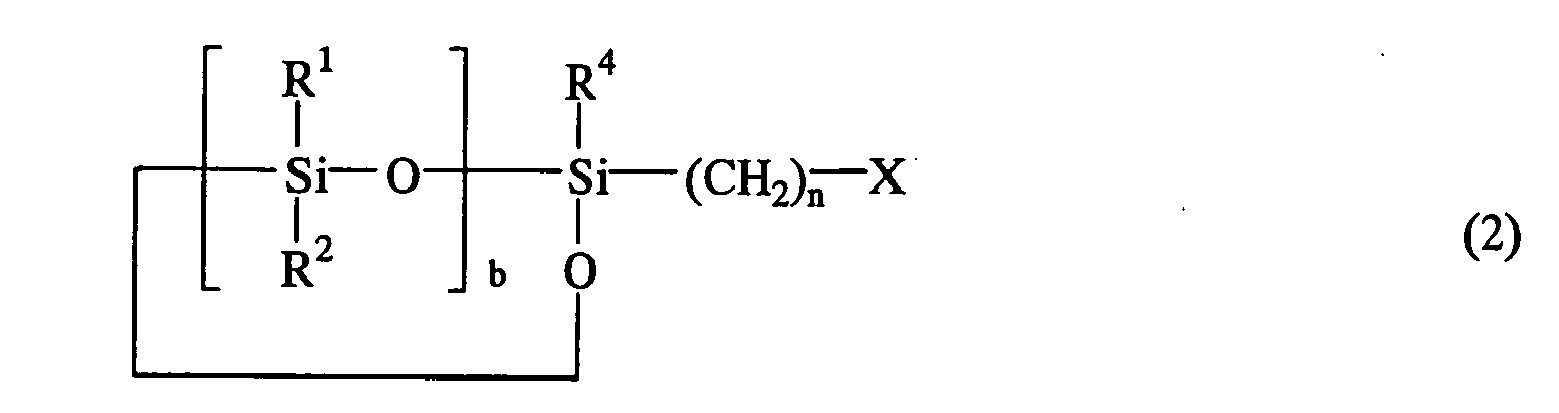
- the method comprises reacting a halogenated siloxane compound represented by the following general formula (1): or the following general formula (2) wherein R 1 , R 2 , R 3 , and R 4 are independently hydrogen atom, a monovalent hydrocarbon group containing 1 to 8 carbon atoms, or a siloxy group represented by OSiR 5 R 6 R 7 wherein R 5 , R 6 , and R 7 are a monovalent hydrocarbon group containing 1 to 8 carbon atoms, X is a halogen atom, n is an integer of 1 to 10, a is 0, 1, or 2, and b is an integer of 2 to 9; with a cyanate salt represented by the following general formula (3): M m+ (OCN) m (3) wherein M represents an alkali metal or an alkaline earth metal, and m is 1 or 2.
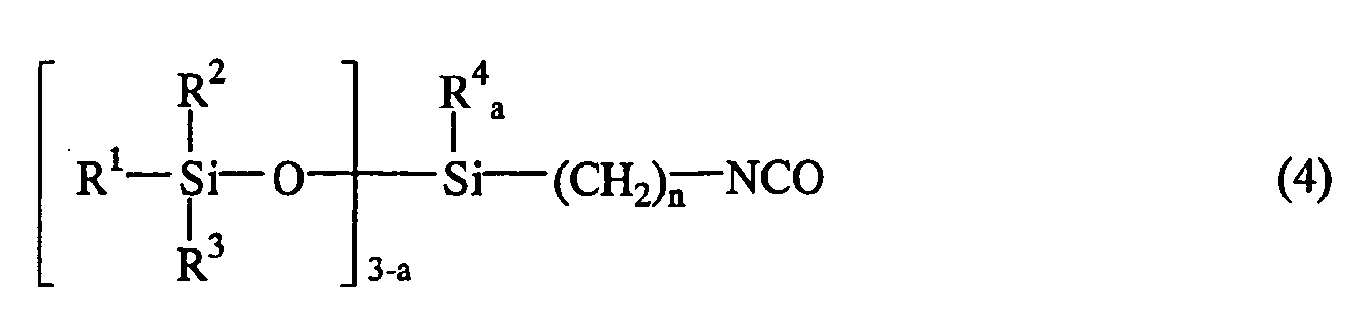
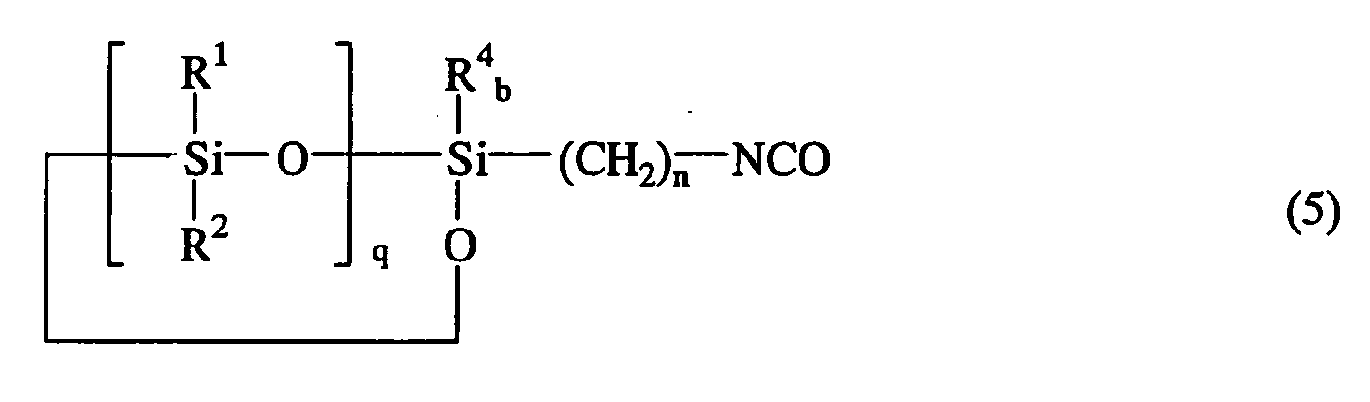
- the product is the isocyanate group-containing siloxane compound represented by the following general formula (4): or the following general formula (5): wherein R 1 , R 2 , R 3 , R 4 , n, q, and a are as defined above.
- the production method of the present invention is capable of producing an isocyanate group-containing siloxane compound at a low cost by using an inexpensive starting materials, namely, a halogenated siloxane compound and a cyanate salt, and therefore, the method of the present invention has great industrial benefits.
- the halogenated siloxane compound used for the starting material in the present invention is represented by the following general formula (1): or the general formula (2): wherein R 1 , R 2 , R 3 , and R 4 are independently hydrogen atom, a monovalent hydrocarbon group containing 1 to 8 carbon atoms, or a siloxy group represented by OSiR 5 R 6 R 7 wherein R 5 , R 6 , and R 7 are a monovalent hydrocarbon group containing 1 to 8 carbon atoms, X is a halogen atom, n is an integer of 1 to 10, a is 0, 1, or 2, and b is an integer of 2 to 9.
- Exemplary monovalent hydrocarbon groups containing 1 to 8 carbon atoms represented by the R 1 R 2 , R 3 , R 4 , R 5 , R 6 , and R 7 include alkyl groups such as methyl group, ethyl group, propyl group, and butyl group, cycloalkyl groups such as cyclopentyl group and cyclohexyl group, aryl groups such as phenyl group, alkenyl groups such as benzyl group, and alkenyl groups such as vinyl group and allyl group.
- the R 1 , R 2 , R 3 , R 4 , R 5 R 6 , and R 7 may be either the same or different, and preferably, these groups are methyl group.
- Exemplary halogen atoms represented by X include chlorine, bromine, and iodine, and the preferred is chlorine.
- n is an integer of 1 to 10, and in particular, 1 to 6; a is 0, 1, or 2; and b is an integer of 2 to 9, and in particular, 2 to 4.
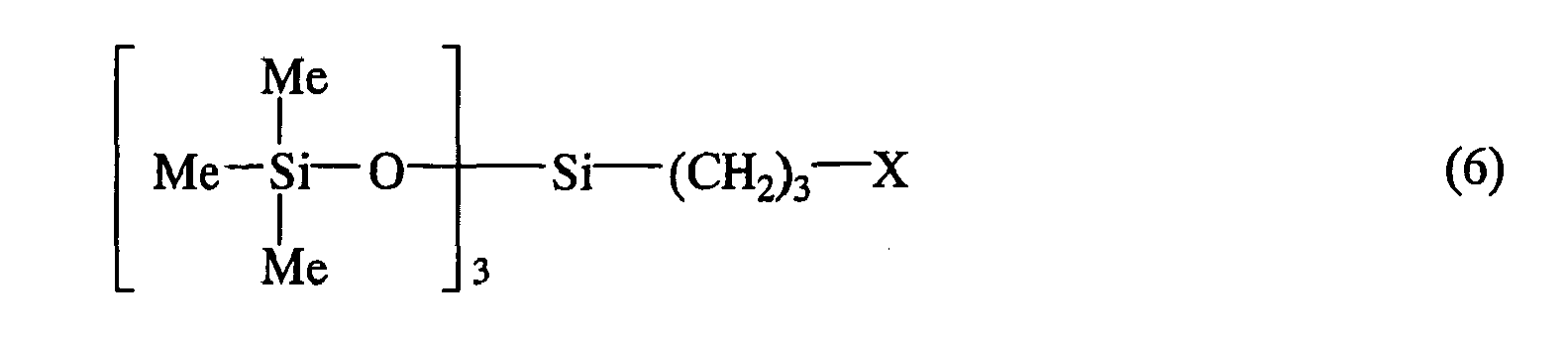
- halogenated siloxane compounds represented by the general formula (6): wherein X is as defined above, and Me represents methyl group.
- the cyanate salt is represented by the general formula (3): M m+ (OCN) m (3) wherein M represents an alkali metal or an alkaline earth metal, and m is 1 or 2, and exemplary cyanate salts include lithium cyanate, sodium cyanate, potassium cyanate, rubidium cyanate, cesium cyanate, magnesium cyanate, calcium cyanate, strontium cyanate, and barium cyanate which may be used alone or in combination of two or more. More particularly, the cyanate salt is preferably sodium cyanate or potassium cyanate.
- the cyanate salt is preferably used at 1 to 10 molar amount, and more preferably at 1 to 2 molar amount in relation to the halogenated siloxane compound. When used at an amount less than 1 molar amount, a certain proportion of the halogenated siloxane compound will remain unreacted, and use of the cyanate salt in excess of 10 molar amount may be uneconomical.
- aprotic polar solvent is preferably used for improving compatibility of the halogenated siloxane compound and the cyanate salt.
- exemplary aprotic polar solvents include acetonitrile, dimethylformamide, N-methyl-2-pyrrolidinone, dimethyl sulfoxide, hexamethylphosphoramide, and diethylene glycol dimethyl ether, which may be used alone or in combination of two or more. More specifically, the preferred is use of dimethylformamide.
- the aprotic polar solvent is preferably used at an amount of 10 to 200 % by weight in relation to the halogenated siloxane compound.
- the aprotic polar solvent is preferably used at an amount of 10 to 200 % by weight in relation to the halogenated siloxane compound.
- complicated processing may be required in the post-treatment resulting in a reduced volumetric yield.
- reaction speed may become reduced to an industrially disadvantageous level.
- the reaction is preferably carried out in the presence of at least one catalyst selected from phase transfer catalysts and metal iodide salts.
- phase transfer catalysts include a quaternary onium salt, a crown ether, a cryptate, and the preferred are quaternary onium salts.
- the quaternary onium salt is represented by the following general formula (7): (R 4 Z ) + X - (7) wherein R is a monovalent hydrocarbon group containing at least 1 to 40 carbon atoms, Z is phosphorus atom or nitrogen atom, and X is a halogen atom.
- Exemplary quaternary onium salts include cetyltrimethylammonium chloride, tetrabutylammonium chloride, tetrapropylammonium chloride, tetrahexylammonium chloride, tetraheptylammonium chloride, tetrapentylammonium chloride, tetramethylammonium chloride, trioctylpropylammonium chloride, dodecyltrimethylammonium chloride, phenyltrimethylammonium chloride, hexadecyltrimethylammonium chloride, benzyltriethylammonium chloride, benzyltributylammonium chloride, benzyltrimethylammonium chloride, didodecyl dimethylammonium bromide, dimethyldioctadecylammonium bromide, cetyldimethylethylammonium bromide, tetraethy
- metal iodide salt examples include lithium iodide, sodium iodide, potassium iodide, rubidium iodide, and cesium iodide, which may be used alone or in combination of two or more as a mixture. More specifically, the preferred is use of sodium iodide or potassium iodide.
- Such catalyst is preferably used at an amount of 0.1 to 20% by mole, and more preferably at 1 to 10% by mole in relation to the halogenated siloxane compound.
- reaction speed will be reduced to an industrially disadvantageous level, whereas the use in excess of 20% by mole may be uneconomical.
- the reaction is preferably conducted by suspending the cyanate salt and the catalyst in a solvent, and adding the halogenated siloxane compound dropwise to the suspension.
- the reaction is preferably conducted in a non-oxidating atmosphere such as an inert gas atmosphere of nitrogen.
- the reaction temperature of this reaction differs by the solvent selected.
- the reaction may be carried out at a temperature in the range of from 0° C to the boiling point of the reaction mixture generated by the reaction. More specifically, the reaction is preferably conducted at a temperature in the range of 30 to 150°C.
- the reaction time is not particularly limited, the reaction time is typically in the range of 1 to 30 hours.
- the production method of the present invention may further comprise other known steps such as pre-treatment steps such as dehydration step, intermediate steps, and post-treatment steps such as purification step and recovery step.
- a 500 ml flask equipped with a reflux condenser, a thermometer, and a dropping funnel was purged with nitrogen, and 26.0 g of potassium cyanate, 2.40 g of potassium iodide, and 100 g of dimethylformamide were placed in the flask. While stirring, 98.0 g of 3-chloropropyltris(trimethylsiloxy)silane was added dropwise at room temperature. After completing the addition, the reaction mixture was heated to 130°C by heating the flask in an oil bath, and the reaction was allowed to proceed for 4 hours. After the completion of the reaction, the reaction mixture was cooled to room temperature, and 30 g of toluene and 150 g of water was added to dissolve the generated salt. The reaction mixture was then allowed to stand for 50 minutes, and the organic phase was collected.
Landscapes
- Chemical & Material Sciences (AREA)
- Organic Chemistry (AREA)
- Chemical Kinetics & Catalysis (AREA)
Abstract


Mm+(OCN)m (3)
wherein M represents an alkali metal or an alkaline earth metal, and m is 1 or 2. The isocyanate group-containing siloxane compound produced is represented by the following general formula (4):
Description
- This invention relates to a method for producing an isocyanate group-containing siloxane compound.
- The isocyanate group-containing siloxane compound contains both isocyanate group and silicone group in the molecule. Since the isocyanate group readily reacts with a functional group having active hydrogen to form urethane bond and urea bond, the isocyanate group-containing siloxane compound is useful as a silicone modifying agent for an organic compound having active hydrogen.
- The isocyanate group-containing siloxane compound has been produced, for example, by reacting an amino group-containing siloxane compound with a dialkyl carbonate to produce an alkyl carbamate, and thermally decomposing the alkyl carbamate (see, for example, Patent Document 1:
JP-A 10-1486 JP-A 2001-26593 USP 3584024 ). - However, the method using the thermal decomposition of an alkyl carbamate is associated with the problems such as high price of the amino group-containing siloxane used for the starting material, incapability of producing the isocyanate group-containing siloxane compound at a low cost, and contamination of the product with the alkyl carbamate which failed to undergo thermal decomposition. The method using the phosgene also suffers from various problems such as the high price of the amino group-containing siloxane used for the starting material, incapability of producing the isocyanate group-containing siloxane compound at a low cost, and inadequateness of using the toxic and corrosive phosgene in commercial production.
- In view of the situation as described above, an object of the present invention is to provide a high purity isocyanate group-containing siloxane compound at a low cost.
- In order to obviate the situation as described above, the inventors of the present invention made an intensive study and found a method of reacting a halogenated siloxane compound with a cyanate salt. The present invention has been completed on the basis of such finding.
- Accordingly, the present invention provides a method for producing an isocyanate group-containing siloxane compound. The method comprises reacting a halogenated siloxane compound represented by the following general formula (1):


Mm+ (OCN)m (3)
wherein M represents an alkali metal or an alkaline earth metal, and m is 1 or 2. The product is the isocyanate group-containing siloxane compound represented by the following general formula (4):

- The production method of the present invention is capable of producing an isocyanate group-containing siloxane compound at a low cost by using an inexpensive starting materials, namely, a halogenated siloxane compound and a cyanate salt, and therefore, the method of the present invention has great industrial benefits.
- The halogenated siloxane compound used for the starting material in the present invention is represented by the following general formula (1):


- Exemplary monovalent hydrocarbon groups containing 1 to 8 carbon atoms represented by the R1 R2, R3, R4, R5, R6, and R7 include alkyl groups such as methyl group, ethyl group, propyl group, and butyl group, cycloalkyl groups such as cyclopentyl group and cyclohexyl group, aryl groups such as phenyl group, alkenyl groups such as benzyl group, and alkenyl groups such as vinyl group and allyl group. The R1, R2, R3, R4, R5 R6, and R7 may be either the same or different, and preferably, these groups are methyl group. Exemplary halogen atoms represented by X include chlorine, bromine, and iodine, and the preferred is chlorine. n is an integer of 1 to 10, and in particular, 1 to 6; a is 0, 1, or 2; and b is an integer of 2 to 9, and in particular, 2 to 4.
- Among these, the preferred are the halogenated siloxane compounds represented by the general formula (6):

- The cyanate salt is represented by the general formula (3):
Mm+(OCN)m (3)
wherein M represents an alkali metal or an alkaline earth metal, and m is 1 or 2, and exemplary cyanate salts include lithium cyanate, sodium cyanate, potassium cyanate, rubidium cyanate, cesium cyanate, magnesium cyanate, calcium cyanate, strontium cyanate, and barium cyanate which may be used alone or in combination of two or more. More particularly, the cyanate salt is preferably sodium cyanate or potassium cyanate. - The cyanate salt is preferably used at 1 to 10 molar amount, and more preferably at 1 to 2 molar amount in relation to the halogenated siloxane compound. When used at an amount less than 1 molar amount, a certain proportion of the halogenated siloxane compound will remain unreacted, and use of the cyanate salt in excess of 10 molar amount may be uneconomical.
- As described above, the halogenated siloxane compound and the cyanate salt are reacted in the method for producing the isocyanate group-containing siloxane compound of the present invention, and in such reaction, an aprotic polar solvent is preferably used for improving compatibility of the halogenated siloxane compound and the cyanate salt. Exemplary aprotic polar solvents include acetonitrile, dimethylformamide, N-methyl-2-pyrrolidinone, dimethyl sulfoxide, hexamethylphosphoramide, and diethylene glycol dimethyl ether, which may be used alone or in combination of two or more. More specifically, the preferred is use of dimethylformamide.
- The aprotic polar solvent is preferably used at an amount of 10 to 200 % by weight in relation to the halogenated siloxane compound. When used at an amount in excess of 200 % by weight, complicated processing may be required in the post-treatment resulting in a reduced volumetric yield. When used at less than 10 % by weight, reaction speed may become reduced to an industrially disadvantageous level.
- In the present invention, the reaction is preferably carried out in the presence of at least one catalyst selected from phase transfer catalysts and metal iodide salts. Exemplary phase transfer catalysts include a quaternary onium salt, a crown ether, a cryptate, and the preferred are quaternary onium salts. The quaternary onium salt is represented by the following general formula (7):
(R4Z )+X- (7)
wherein R is a monovalent hydrocarbon group containing at least 1 to 40 carbon atoms, Z is phosphorus atom or nitrogen atom, and X is a halogen atom. - Exemplary quaternary onium salts include cetyltrimethylammonium chloride, tetrabutylammonium chloride, tetrapropylammonium chloride, tetrahexylammonium chloride, tetraheptylammonium chloride, tetrapentylammonium chloride, tetramethylammonium chloride,
trioctylpropylammonium chloride,
dodecyltrimethylammonium chloride,
phenyltrimethylammonium chloride,
hexadecyltrimethylammonium chloride,
benzyltriethylammonium chloride,
benzyltributylammonium chloride,
benzyltrimethylammonium chloride,
didodecyl dimethylammonium bromide,
dimethyldioctadecylammonium bromide,
cetyldimethylethylammonium bromide,
tetraethylammonium bromide, tetraoctylammonium bromide,
tetrabutylammonium bromide, tetrapropylammonium bromide,
phenyltrimethylammonium bromide,
benzyltrimethylammonium bromide, tetraethylammonium iodide,
tetrabutylammonium iodide, ethyltriphenylammonium iodide,
methyltriphenylammonium iodide,
tetrabutylphosphonium chloride,
triphenylbenzylphosphonium chloride,
tetraphenylphosphonium chloride,
hexadecyltributylphosphonium bromide,
tetrabutylphosphonium bromide,
trioctylethylphosphonium bromide,
tetrabutylphosphonium iodide, and
tetraphenylphosphonium iodide. These quaternary onium salts may be used either alone or in combination of two or more. - Examples of the metal iodide salt include lithium iodide, sodium iodide, potassium iodide, rubidium iodide, and cesium iodide, which may be used alone or in combination of two or more as a mixture. More specifically, the preferred is use of sodium iodide or potassium iodide.
- Such catalyst is preferably used at an amount of 0.1 to 20% by mole, and more preferably at 1 to 10% by mole in relation to the halogenated siloxane compound. When used at an amount less than 0.1% by mole, reaction speed will be reduced to an industrially disadvantageous level, whereas the use in excess of 20% by mole may be uneconomical.
- The reaction is preferably conducted by suspending the cyanate salt and the catalyst in a solvent, and adding the halogenated siloxane compound dropwise to the suspension. The reaction is preferably conducted in a non-oxidating atmosphere such as an inert gas atmosphere of nitrogen.
- The reaction temperature of this reaction differs by the solvent selected. The reaction, however, may be carried out at a temperature in the range of from 0° C to the boiling point of the reaction mixture generated by the reaction. More specifically, the reaction is preferably conducted at a temperature in the range of 30 to 150°C. Although the reaction time is not particularly limited, the reaction time is typically in the range of 1 to 30 hours.
- If necessary, the production method of the present invention may further comprise other known steps such as pre-treatment steps such as dehydration step, intermediate steps, and post-treatment steps such as purification step and recovery step.
- Next, the present invention is described in further detail by referring to the Examples which by no means limit the scope of the present invention.
- A 500 ml flask equipped with a reflux condenser, a thermometer, and a dropping funnel was purged with nitrogen, and 26.0 g of potassium cyanate, 2.40 g of potassium iodide, and 100 g of dimethylformamide were placed in the flask. While stirring, 98.0 g of 3-chloropropyltris(trimethylsiloxy)silane was added dropwise at room temperature. After completing the addition, the reaction mixture was heated to 130°C by heating the flask in an oil bath, and the reaction was allowed to proceed for 4 hours. After the completion of the reaction, the reaction mixture was cooled to room temperature, and the salt generated was separated by filtration.
- A 300 ml distillation still equipped with a capillary, a thermometer, a vigrew column, and a condenser was purged with nitrogen, and the filtrate obtained as described above was placed in the flask. After reducing the pressure of the flask to 1.3 kPa and recovering the dimethylformamide, the pressure was reduced to 0.4 kPa, and the resulting product was collected by distillation. When the product was measured by gas chromatography, the resulting propyltris(trimethylsiloxy)silane 3-isocianate had a purity of 98.0% and the yield was 64.3%.
- A 500 ml flask equipped with a reflux condenser, a thermometer, and a dropping funnel was purged with nitrogen, and 26.0 g of potassium cyanate, 2.40 g of potassium iodide, and 100 g of dimethylformamide were placed in the flask. While stirring, 98.0 g of 3-chloropropyltris(trimethylsiloxy)silane was added dropwise at room temperature. After completing the addition, the reaction mixture was heated to 130°C by heating the flask in an oil bath, and the reaction was allowed to proceed for 4 hours. After the completion of the reaction, the reaction mixture was cooled to room temperature, and 30 g of toluene and 150 g of water was added to dissolve the generated salt. The reaction mixture was then allowed to stand for 50 minutes, and the organic phase was collected.
- A 300 ml distillation still equipped with a capillary, a thermometer, a vigrew column, and a condenser was purged with nitrogen, and the organic phase obtained as described above was placed in the flask. After reducing the pressure of the flask to 20 kPa and recovering the toluene, the pressure was reduced to 0.4 kPa, and the resulting product was collected by distillation. When the product was measured by gas chromatography, the resulting propyltris(trimethylsiloxy)silane 3-isocianate had a purity of 96.9% and the yield was 63.4%.
- A 500 ml flask equipped with a reflux condenser, a thermometer, and a dropping funnel was purged with nitrogen, and 42.7 g of potassium cyanate, 10.2 g of tetrabutylphosphonium iodide, and 200 g of dimethylformamide were placed in the flask. While stirring, 98.0 g of 3-chloropropyltris(trimethylsiloxy)silane was added dropwise at room temperature. After completing the addition, the reaction mixture was heated to 130°C by heating the flask in an oil bath, and the reaction was allowed to proceed for 1 hour. After the completion of the reaction, the reaction mixture was cooled to room temperature, and the salt generated was separated by filtration.
- A 300 ml distillation still equipped with a capillary, a thermometer, a vigrew column, and a condenser was purged with nitrogen, and the filtrate obtained as described above was placed in the flask. After reducing the pressure of the flask to 1.3 kPa and recovering the dimethylformamide, the pressure was reduced to 0.4 kPa, and the resulting product was collected by distillation. When the product was measured by gas chromatography, the resulting propyltris(trimethylsiloxy)silane 3-isocianate had a purity of 98.1% and the yield was 53.7%.
- A 100 ml flask equipped with a reflux condenser, a thermometer, and a dropping funnel was purged with nitrogen, and 2.6 g of potassium cyanate, 0.22 g of potassium iodide, and 10 g of dimethylformamide were placed in the flask. While stirring, 9.8 g of 3-chloropropyltris(trimethylsiloxy)silane was added dropwise at room temperature. After completing the addition, the reaction mixture was heated to 130°C by heating the flask in an oil bath, and the reaction was allowed to proceed for 7 hours. When the reaction mixture was measured by gas chromatography, reaction rate of the propyltris(trimethylsiloxy)silane 3-isocianate was 99%.
- A 100 ml flask equipped with a reflux condenser, a thermometer, and a dropping funnel was purged with nitrogen, and 2.1 g of potassium cyanate, 0.45 g of tetrabutylphosphonium bromide, and 10 g of dimethylformamide were placed in the flask. While stirring, 4.9 g of 3-chloropropyltris(trimethylsiloxy)silane was added dropwise at room temperature. After completing the addition, the reaction mixture was heated to 130°C by heating the flask in an oil bath, and the reaction was allowed to proceed for 1.5 hours. When the reaction mixture was measured by gas chromatography, reaction rate of the propyltris(trimethylsiloxy)silane 3-isocianate was 94%.
- A 100 ml flask equipped with a reflux condenser, a thermometer, and a dropping funnel was purged with nitrogen, and 2.4 g of potassium cyanate, 0.24 g of potassium iodide, and 16.2 g of dimethylformamide were placed in the flask. While stirring, 9.8 g of chloromethyltris(trimethylsiloxy)-silane was added dropwise at room temperature. After completing the addition, the reaction mixture was heated to 130°C by heating the flask in an oil bath, and the reaction was allowed to proceed for 6 hours. When the reaction mixture was measured by gas chromatography, reaction rate of the chloromethyltris(trimethylsiloxy)silane was 94%.
- A 100 ml flask equipped with a reflux condenser, a thermometer, and a dropping funnel was purged with nitrogen, and 2.5 g of potassium cyanate, 0.25 g of potassium iodide, and 16.9 g of dimethylformamide were placed in the flask. While stirring, 9.8 g of chloromethylheptamethylcyclotetrasiloxane was added dropwise at room temperature. After completing the addition, the reaction mixture was heated to 130°C by heating the flask in an oil bath, and the reaction was allowed to proceed for 3 hours. When the reaction mixture was measured by gas chromatography, reaction rate of the chloromethylheptamethylcyclotetrasiloxane was 99%.
- A 100 ml flask equipped with a reflux condenser, a thermometer, and a dropping funnel was purged with nitrogen, and 2.3 g of potassium cyanate, 0.23 g of potassium iodide, and 15.6 g of dimethylformamide were placed in the flask. While stirring, 9.8 g of 3-chloropropylheptamethylcyclotetrasiloxane was added dropwise at room temperature. After completing the addition, the reaction mixture was heated to 130°C by heating the flask in an oil bath, and the reaction was allowed to proceed for 2.5 hours. When the reaction mixture was measured by gas chromatography, reaction rate of the 3-chloropropylheptamethylcyclotetrasiloxane was 100%.
Claims (7)
- A method for producing an isocyanate group-containing siloxane compound comprising the step of reacting a halogenated siloxane compound represented by the following general formula (1):

Mm+(OCN)m (3)
wherein M represents an alkali metal or an alkaline earth metal, and m is 1 or 2 to produce the isocyanate group-containing siloxane compound represented by the following general formula (4):

- The method for producing an isocyanate group-containing siloxane compound according to claim 1 wherein the halogenated siloxane compound is the one represented by the general formula (6):
- The method for producing an isocyanate group-containing siloxane compound according to claim 1 or 2 wherein the cyanate salt is sodium cyanate or potassium cyanate.
- The method for producing an isocyanate group-containing siloxane compound according to claim 1, 2, or 3 wherein the reaction is conducted in an aprotic polar solvent.
- The method for producing an isocyanate group-containing siloxane compound according to any one of claims 1 to 4 wherein the reaction is conducted in the presence of at least one catalyst selected from the group consisting of phase transfer catalysts and metal iodide salts.
- The method for producing an isocyanate group-containing siloxane compound according to claim 5 wherein the phase transfer catalyst is a quaternary onium salt represented by the following general formula (7)
(R4Z)+X- (7)
wherein R is a monovalent hydrocarbon group containing 1 to 40 carbon atoms, Z is phosphorus atom or nitrogen atom, and X is a halogen atom. - The method for producing an isocyanate group-containing siloxane compound according to claim 5 wherein the metal iodide salt is sodium iodide or potassium iodide.
Applications Claiming Priority (1)
| Application Number | Priority Date | Filing Date | Title |
|---|---|---|---|
| JP2006209549A JP2007326841A (en) | 2006-05-10 | 2006-08-01 | Method for producing isocyanate group-containing siloxane compound |
Publications (2)
| Publication Number | Publication Date |
|---|---|
| EP1887010A1 true EP1887010A1 (en) | 2008-02-13 |
| EP1887010B1 EP1887010B1 (en) | 2009-07-22 |
Family
ID=38610781
Family Applications (1)
| Application Number | Title | Priority Date | Filing Date |
|---|---|---|---|
| EP07253013A Ceased EP1887010B1 (en) | 2006-08-01 | 2007-07-31 | Method for producing isocyanate group-containing siloxane compound |
Country Status (3)
| Country | Link |
|---|---|
| US (1) | US7576231B2 (en) |
| EP (1) | EP1887010B1 (en) |
| DE (1) | DE602007001646D1 (en) |
Cited By (2)
| Publication number | Priority date | Publication date | Assignee | Title |
|---|---|---|---|---|
| FR2925497A1 (en) * | 2007-12-21 | 2009-06-26 | Rhodia Operations Sas | PROCESS FOR THE PREPARATION OF ISOCYANATOSILANES BY NUCLEOPHILIC SUBSTITUTION REACTION ON HALOGENOSILANES |
| CN102659830A (en) * | 2012-04-23 | 2012-09-12 | 张家港市华盛化学有限公司 | Preparation method for 3- isocyanate propyl (trimethylsilanolate) silane |
Families Citing this family (5)
| Publication number | Priority date | Publication date | Assignee | Title |
|---|---|---|---|---|
| RU2462468C1 (en) * | 2011-06-03 | 2012-09-27 | Федеральное государственное бюджетное образовательное учреждение высшего профессионального образования "Московский государственный университет тонких химических технологий имени М.В. Ломосонова" (МИТХТ им.М.В.Ломоносова) | Method of producing o-silylurethanes containing diazole fragments |
| US10125759B2 (en) | 2015-04-23 | 2018-11-13 | Baker Highes, A Ge Company, Llc | Flexible hose for bellows pressure equalizer of electrical submersible well pump |
| JP7335188B2 (en) | 2020-03-09 | 2023-08-29 | 信越化学工業株式会社 | Organosilicon compound containing isocyanate group and method for producing organosilicon compound containing isocyanate group |
| CN113292591A (en) * | 2021-06-23 | 2021-08-24 | 唐山三孚新材料有限公司 | Synthesis method and application of 1, 3-bis (isocyanatoalkyl) -1,1,3, 3-tetramethyldisiloxane |
| CN118894880A (en) * | 2024-07-11 | 2024-11-05 | 上海彤程电子材料有限公司 | A method for preparing siloxane containing chromophore |
Citations (3)
| Publication number | Priority date | Publication date | Assignee | Title |
|---|---|---|---|---|
| US4749806A (en) * | 1984-12-28 | 1988-06-07 | Societe Nationale Des Poudres Et Explosifs | Process for the synthesis of isocyanates and of isocyanate derivatives |
| JP2001026593A (en) * | 1999-07-12 | 2001-01-30 | Takeda Chem Ind Ltd | Production of isocyanate group-containing siloxane compound, and aryl carbamate group-containing siloxane compound and isocyanate group-containing siloxane compound |
| DE10240388A1 (en) * | 2002-09-02 | 2003-03-06 | Wacker Chemie Gmbh | Production of N-(triorganylsilylorganyl) carbamate esters comprises adding a solution of a silane in an alcohol to a preheated mixture of a cyanate salt and a polar solvent |
Family Cites Families (2)
| Publication number | Priority date | Publication date | Assignee | Title |
|---|---|---|---|---|
| JP3198827B2 (en) * | 1994-10-06 | 2001-08-13 | 信越化学工業株式会社 | Isocyanate group-containing silicon compound and method for producing the same |
| JP4171530B2 (en) | 1996-04-15 | 2008-10-22 | 三井化学ポリウレタン株式会社 | Method for producing silicon-containing isocyanate compound |
-
2007
- 2007-07-31 DE DE602007001646T patent/DE602007001646D1/en active Active
- 2007-07-31 EP EP07253013A patent/EP1887010B1/en not_active Ceased
- 2007-08-01 US US11/882,335 patent/US7576231B2/en not_active Expired - Fee Related
Patent Citations (3)
| Publication number | Priority date | Publication date | Assignee | Title |
|---|---|---|---|---|
| US4749806A (en) * | 1984-12-28 | 1988-06-07 | Societe Nationale Des Poudres Et Explosifs | Process for the synthesis of isocyanates and of isocyanate derivatives |
| JP2001026593A (en) * | 1999-07-12 | 2001-01-30 | Takeda Chem Ind Ltd | Production of isocyanate group-containing siloxane compound, and aryl carbamate group-containing siloxane compound and isocyanate group-containing siloxane compound |
| DE10240388A1 (en) * | 2002-09-02 | 2003-03-06 | Wacker Chemie Gmbh | Production of N-(triorganylsilylorganyl) carbamate esters comprises adding a solution of a silane in an alcohol to a preheated mixture of a cyanate salt and a polar solvent |
Non-Patent Citations (1)
| Title |
|---|
| DATABASE WPI Week 200136, Derwent World Patents Index; AN 2001-337802, XP002457180 * |
Cited By (3)
| Publication number | Priority date | Publication date | Assignee | Title |
|---|---|---|---|---|
| FR2925497A1 (en) * | 2007-12-21 | 2009-06-26 | Rhodia Operations Sas | PROCESS FOR THE PREPARATION OF ISOCYANATOSILANES BY NUCLEOPHILIC SUBSTITUTION REACTION ON HALOGENOSILANES |
| WO2009083503A3 (en) * | 2007-12-21 | 2009-09-11 | Rhodia Operations | Method for preparing isocyanatosilanes by nucleophilic substitution reaction on halogenosilanes |
| CN102659830A (en) * | 2012-04-23 | 2012-09-12 | 张家港市华盛化学有限公司 | Preparation method for 3- isocyanate propyl (trimethylsilanolate) silane |
Also Published As
| Publication number | Publication date |
|---|---|
| DE602007001646D1 (en) | 2009-09-03 |
| EP1887010B1 (en) | 2009-07-22 |
| US20080183001A1 (en) | 2008-07-31 |
| US7576231B2 (en) | 2009-08-18 |
Similar Documents
| Publication | Publication Date | Title |
|---|---|---|
| EP1887010B1 (en) | Method for producing isocyanate group-containing siloxane compound | |
| JP4171530B2 (en) | Method for producing silicon-containing isocyanate compound | |
| EP3186262B1 (en) | Fluorosilicon nitrile compounds | |
| US20080255354A1 (en) | Method for Producing Alkoxysilyl Methyl Isocyanurates | |
| US10329313B2 (en) | Organosilicon compounds having (meth)acrylate groups and a process for preparation thereof | |
| JPS5941990B2 (en) | Trialkylamine/Sulfur Dioxide Catalyzed Sulfenylation of Carbamates | |
| US10590150B2 (en) | Preparation of fluorosilicon compounds | |
| JP4378664B2 (en) | Method for producing isocyanate group-containing siloxane compound | |
| US6596892B2 (en) | Preparation of low molecular weight branched siloxanes | |
| JP4803381B2 (en) | Method for producing aminoalkylsilane compound | |
| JPS6218484B2 (en) | ||
| JP2008074804A (en) | Method for producing isocyanate group-containing silane compound | |
| JPWO2003027126A1 (en) | Method for producing thiocyanato group-containing organoalkoxysilane | |
| JP2007326841A (en) | Method for producing isocyanate group-containing siloxane compound | |
| EP1644386B1 (en) | Process for the production of bis(trimethylsiloxy)silylalkylglycerol methacrylates | |
| US20250092071A1 (en) | Process for preparing isocyanatoorganosilanes | |
| JPH06228161A (en) | Method for producing isocyanate group-containing organopolysiloxane | |
| EP1705180A1 (en) | (Organothiomethyl)chlorosilanes and their preparation methods | |
| JPH0977762A (en) | Method for producing 2-allyloxymethyl-1,4-dioxane | |
| EP1638982B1 (en) | Process for the production of bis(trimethylsilyloxy)silylalkylglycerol methacrylates | |
| JP4055397B2 (en) | Fluorine-containing organosilicon compound | |
| US9073952B1 (en) | Synthesis method for carbosilanes | |
| JP2618713B2 (en) | Method for producing β-hydroxyamino compound | |
| WO2010058838A1 (en) | Method for producing alkenyl mercaptan | |
| JP2006143600A (en) | Method for producing phosphazene derivative containing chlorine atom |
Legal Events
| Date | Code | Title | Description |
|---|---|---|---|
| PUAI | Public reference made under article 153(3) epc to a published international application that has entered the european phase |
Free format text: ORIGINAL CODE: 0009012 |
|
| AK | Designated contracting states |
Kind code of ref document: A1 Designated state(s): AT BE BG CH CY CZ DE DK EE ES FI FR GB GR HU IE IS IT LI LT LU LV MC MT NL PL PT RO SE SI SK TR |
|
| AX | Request for extension of the european patent |
Extension state: AL BA HR MK YU |
|
| 17P | Request for examination filed |
Effective date: 20080313 |
|
| GRAP | Despatch of communication of intention to grant a patent |
Free format text: ORIGINAL CODE: EPIDOSNIGR1 |
|
| AKX | Designation fees paid |
Designated state(s): DE FR GB |
|
| GRAS | Grant fee paid |
Free format text: ORIGINAL CODE: EPIDOSNIGR3 |
|
| GRAA | (expected) grant |
Free format text: ORIGINAL CODE: 0009210 |
|
| AK | Designated contracting states |
Kind code of ref document: B1 Designated state(s): DE FR GB |
|
| REG | Reference to a national code |
Ref country code: GB Ref legal event code: FG4D |
|
| REF | Corresponds to: |
Ref document number: 602007001646 Country of ref document: DE Date of ref document: 20090903 Kind code of ref document: P |
|
| PLBE | No opposition filed within time limit |
Free format text: ORIGINAL CODE: 0009261 |
|
| STAA | Information on the status of an ep patent application or granted ep patent |
Free format text: STATUS: NO OPPOSITION FILED WITHIN TIME LIMIT |
|
| 26N | No opposition filed |
Effective date: 20100423 |
|
| REG | Reference to a national code |
Ref country code: FR Ref legal event code: PLFP Year of fee payment: 10 |
|
| REG | Reference to a national code |
Ref country code: FR Ref legal event code: PLFP Year of fee payment: 11 |
|
| PGFP | Annual fee paid to national office [announced via postgrant information from national office to epo] |
Ref country code: FR Payment date: 20170613 Year of fee payment: 11 |
|
| PGFP | Annual fee paid to national office [announced via postgrant information from national office to epo] |
Ref country code: DE Payment date: 20170725 Year of fee payment: 11 Ref country code: GB Payment date: 20170726 Year of fee payment: 11 |
|
| REG | Reference to a national code |
Ref country code: DE Ref legal event code: R119 Ref document number: 602007001646 Country of ref document: DE |
|
| GBPC | Gb: european patent ceased through non-payment of renewal fee |
Effective date: 20180731 |
|
| PG25 | Lapsed in a contracting state [announced via postgrant information from national office to epo] |
Ref country code: DE Free format text: LAPSE BECAUSE OF NON-PAYMENT OF DUE FEES Effective date: 20190201 Ref country code: GB Free format text: LAPSE BECAUSE OF NON-PAYMENT OF DUE FEES Effective date: 20180731 Ref country code: FR Free format text: LAPSE BECAUSE OF NON-PAYMENT OF DUE FEES Effective date: 20180731 |