EP1886809A1 - Coated film and vapor-deposited film - Google Patents
Coated film and vapor-deposited film Download PDFInfo
- Publication number
- EP1886809A1 EP1886809A1 EP06746058A EP06746058A EP1886809A1 EP 1886809 A1 EP1886809 A1 EP 1886809A1 EP 06746058 A EP06746058 A EP 06746058A EP 06746058 A EP06746058 A EP 06746058A EP 1886809 A1 EP1886809 A1 EP 1886809A1
- Authority
- EP
- European Patent Office
- Prior art keywords
- film
- vapor
- barrier property
- poly
- gas barrier
- Prior art date
- Legal status (The legal status is an assumption and is not a legal conclusion. Google has not performed a legal analysis and makes no representation as to the accuracy of the status listed.)
- Withdrawn
Links
- 239000010408 film Substances 0.000 claims abstract description 146
- -1 melamine series compound Chemical class 0.000 claims abstract description 112
- 229920002451 polyvinyl alcohol Polymers 0.000 claims abstract description 69
- 239000011247 coating layer Substances 0.000 claims abstract description 65
- 229920000642 polymer Polymers 0.000 claims abstract description 60
- WSFSSNUMVMOOMR-UHFFFAOYSA-N Formaldehyde Chemical compound O=C WSFSSNUMVMOOMR-UHFFFAOYSA-N 0.000 claims abstract description 59
- LFQSCWFLJHTTHZ-UHFFFAOYSA-N Ethanol Chemical compound CCO LFQSCWFLJHTTHZ-UHFFFAOYSA-N 0.000 claims abstract description 32
- 239000000758 substrate Substances 0.000 claims abstract description 25
- 239000010410 layer Substances 0.000 claims abstract description 24
- 239000010409 thin film Substances 0.000 claims abstract description 23
- QVGXLLKOCUKJST-UHFFFAOYSA-N atomic oxygen Chemical compound [O] QVGXLLKOCUKJST-UHFFFAOYSA-N 0.000 claims abstract description 22
- 239000001301 oxygen Substances 0.000 claims abstract description 22
- 229910052760 oxygen Inorganic materials 0.000 claims abstract description 22
- 239000000203 mixture Substances 0.000 claims abstract description 19
- 239000002952 polymeric resin Substances 0.000 claims abstract description 7
- 229920003002 synthetic resin Polymers 0.000 claims abstract description 7
- 230000035699 permeability Effects 0.000 claims description 31
- 238000012360 testing method Methods 0.000 claims description 26
- 230000004888 barrier function Effects 0.000 abstract description 87
- 239000007789 gas Substances 0.000 abstract description 72
- 238000007740 vapor deposition Methods 0.000 abstract description 71
- 238000005452 bending Methods 0.000 abstract description 9
- 230000007423 decrease Effects 0.000 abstract description 8
- 238000000576 coating method Methods 0.000 description 72
- 239000011248 coating agent Substances 0.000 description 70
- 239000000243 solution Substances 0.000 description 50
- VYPSYNLAJGMNEJ-UHFFFAOYSA-N Silicium dioxide Chemical compound O=[Si]=O VYPSYNLAJGMNEJ-UHFFFAOYSA-N 0.000 description 48
- 238000000034 method Methods 0.000 description 40
- NBIIXXVUZAFLBC-UHFFFAOYSA-N Phosphoric acid Chemical compound OP(O)(O)=O NBIIXXVUZAFLBC-UHFFFAOYSA-N 0.000 description 32
- TWNQGVIAIRXVLR-UHFFFAOYSA-N oxo(oxoalumanyloxy)alumane Chemical compound O=[Al]O[Al]=O TWNQGVIAIRXVLR-UHFFFAOYSA-N 0.000 description 30
- 229910052814 silicon oxide Inorganic materials 0.000 description 28
- VGGSQFUCUMXWEO-UHFFFAOYSA-N Ethene Chemical compound C=C VGGSQFUCUMXWEO-UHFFFAOYSA-N 0.000 description 27
- 239000003054 catalyst Substances 0.000 description 27
- 239000002131 composite material Substances 0.000 description 27
- 238000001035 drying Methods 0.000 description 27
- 235000019441 ethanol Nutrition 0.000 description 27
- 239000005977 Ethylene Substances 0.000 description 26
- KFZMGEQAYNKOFK-UHFFFAOYSA-N Isopropanol Chemical compound CC(C)O KFZMGEQAYNKOFK-UHFFFAOYSA-N 0.000 description 18
- XLYOFNOQVPJJNP-UHFFFAOYSA-N water Substances O XLYOFNOQVPJJNP-UHFFFAOYSA-N 0.000 description 18
- 238000004519 manufacturing process Methods 0.000 description 17
- 150000003016 phosphoric acids Chemical class 0.000 description 17
- 229910000147 aluminium phosphate Inorganic materials 0.000 description 16
- 230000009257 reactivity Effects 0.000 description 14
- OKKJLVBELUTLKV-UHFFFAOYSA-N Methanol Chemical compound OC OKKJLVBELUTLKV-UHFFFAOYSA-N 0.000 description 12
- 239000000463 material Substances 0.000 description 12
- 230000001419 dependent effect Effects 0.000 description 11
- 238000010438 heat treatment Methods 0.000 description 11
- 229910052751 metal Inorganic materials 0.000 description 10
- 239000002184 metal Substances 0.000 description 10
- 239000000377 silicon dioxide Substances 0.000 description 10
- 239000007787 solid Substances 0.000 description 10
- 229920001515 polyalkylene glycol Polymers 0.000 description 9
- 229920005989 resin Polymers 0.000 description 9
- 239000011347 resin Substances 0.000 description 9
- 229920000877 Melamine resin Polymers 0.000 description 8
- PNEYBMLMFCGWSK-UHFFFAOYSA-N aluminium oxide Inorganic materials [O-2].[O-2].[O-2].[Al+3].[Al+3] PNEYBMLMFCGWSK-UHFFFAOYSA-N 0.000 description 8
- 238000001816 cooling Methods 0.000 description 8
- 230000000694 effects Effects 0.000 description 8
- 238000011156 evaluation Methods 0.000 description 8
- BDERNNFJNOPAEC-UHFFFAOYSA-N n-propyl alcohol Natural products CCCO BDERNNFJNOPAEC-UHFFFAOYSA-N 0.000 description 8
- 238000006116 polymerization reaction Methods 0.000 description 8
- 238000007127 saponification reaction Methods 0.000 description 8
- 239000004094 surface-active agent Substances 0.000 description 8
- 229910052782 aluminium Inorganic materials 0.000 description 7
- 150000003863 ammonium salts Chemical class 0.000 description 7
- 239000007864 aqueous solution Substances 0.000 description 7
- 239000005001 laminate film Substances 0.000 description 7
- JDSHMPZPIAZGSV-UHFFFAOYSA-N melamine Chemical compound NC1=NC(N)=NC(N)=N1 JDSHMPZPIAZGSV-UHFFFAOYSA-N 0.000 description 7
- 239000002904 solvent Substances 0.000 description 7
- LRHPLDYGYMQRHN-UHFFFAOYSA-N Butanol Natural products CCCCO LRHPLDYGYMQRHN-UHFFFAOYSA-N 0.000 description 6
- LYCAIKOWRPUZTN-UHFFFAOYSA-N Ethylene glycol Chemical compound OCCO LYCAIKOWRPUZTN-UHFFFAOYSA-N 0.000 description 6
- TWRXJAOTZQYOKJ-UHFFFAOYSA-L Magnesium chloride Chemical compound [Mg+2].[Cl-].[Cl-] TWRXJAOTZQYOKJ-UHFFFAOYSA-L 0.000 description 6
- 239000002253 acid Substances 0.000 description 6
- XAGFODPZIPBFFR-UHFFFAOYSA-N aluminium Chemical compound [Al] XAGFODPZIPBFFR-UHFFFAOYSA-N 0.000 description 6
- 150000001412 amines Chemical class 0.000 description 6
- 238000006243 chemical reaction Methods 0.000 description 6
- 229910052681 coesite Inorganic materials 0.000 description 6
- 150000001875 compounds Chemical class 0.000 description 6
- 229910052906 cristobalite Inorganic materials 0.000 description 6
- 238000010894 electron beam technology Methods 0.000 description 6
- 229960004592 isopropanol Drugs 0.000 description 6
- 239000005022 packaging material Substances 0.000 description 6
- 229910052682 stishovite Inorganic materials 0.000 description 6
- 229910052905 tridymite Inorganic materials 0.000 description 6
- HZAXFHJVJLSVMW-UHFFFAOYSA-N 2-Aminoethan-1-ol Chemical compound NCCO HZAXFHJVJLSVMW-UHFFFAOYSA-N 0.000 description 5
- CERQOIWHTDAKMF-UHFFFAOYSA-N Methacrylic acid Chemical compound CC(=C)C(O)=O CERQOIWHTDAKMF-UHFFFAOYSA-N 0.000 description 5
- 239000004743 Polypropylene Substances 0.000 description 5
- 230000008569 process Effects 0.000 description 5
- 229910052710 silicon Inorganic materials 0.000 description 5
- HORQAOAYAYGIBM-UHFFFAOYSA-N 2,4-dinitrophenylhydrazine Chemical compound NNC1=CC=C([N+]([O-])=O)C=C1[N+]([O-])=O HORQAOAYAYGIBM-UHFFFAOYSA-N 0.000 description 4
- LCGLNKUTAGEVQW-UHFFFAOYSA-N Dimethyl ether Chemical compound COC LCGLNKUTAGEVQW-UHFFFAOYSA-N 0.000 description 4
- VEXZGXHMUGYJMC-UHFFFAOYSA-N Hydrochloric acid Chemical compound Cl VEXZGXHMUGYJMC-UHFFFAOYSA-N 0.000 description 4
- CPLXHLVBOLITMK-UHFFFAOYSA-N Magnesium oxide Chemical compound [Mg]=O CPLXHLVBOLITMK-UHFFFAOYSA-N 0.000 description 4
- 229920001328 Polyvinylidene chloride Polymers 0.000 description 4
- GWEVSGVZZGPLCZ-UHFFFAOYSA-N Titan oxide Chemical compound O=[Ti]=O GWEVSGVZZGPLCZ-UHFFFAOYSA-N 0.000 description 4
- MCMNRKCIXSYSNV-UHFFFAOYSA-N Zirconium dioxide Chemical compound O=[Zr]=O MCMNRKCIXSYSNV-UHFFFAOYSA-N 0.000 description 4
- 230000002411 adverse Effects 0.000 description 4
- 230000000052 comparative effect Effects 0.000 description 4
- 229910052593 corundum Inorganic materials 0.000 description 4
- 150000002169 ethanolamines Chemical class 0.000 description 4
- 238000002156 mixing Methods 0.000 description 4
- 229920001155 polypropylene Polymers 0.000 description 4
- 239000005033 polyvinylidene chloride Substances 0.000 description 4
- 239000010703 silicon Substances 0.000 description 4
- 238000003756 stirring Methods 0.000 description 4
- 229910001845 yogo sapphire Inorganic materials 0.000 description 4
- QTBSBXVTEAMEQO-UHFFFAOYSA-N Acetic acid Chemical compound CC(O)=O QTBSBXVTEAMEQO-UHFFFAOYSA-N 0.000 description 3
- 229920003270 Cymel® Polymers 0.000 description 3
- MYMOFIZGZYHOMD-UHFFFAOYSA-N Dioxygen Chemical compound O=O MYMOFIZGZYHOMD-UHFFFAOYSA-N 0.000 description 3
- 229920000219 Ethylene vinyl alcohol Polymers 0.000 description 3
- 229920000663 Hydroxyethyl cellulose Polymers 0.000 description 3
- 239000004354 Hydroxyethyl cellulose Substances 0.000 description 3
- 229920002845 Poly(methacrylic acid) Polymers 0.000 description 3
- DKGAVHZHDRPRBM-UHFFFAOYSA-N Tert-Butanol Chemical compound CC(C)(C)O DKGAVHZHDRPRBM-UHFFFAOYSA-N 0.000 description 3
- 238000002835 absorbance Methods 0.000 description 3
- 239000000654 additive Substances 0.000 description 3
- 230000005540 biological transmission Effects 0.000 description 3
- 230000015556 catabolic process Effects 0.000 description 3
- KRKNYBCHXYNGOX-UHFFFAOYSA-N citric acid Chemical compound OC(=O)CC(O)(C(O)=O)CC(O)=O KRKNYBCHXYNGOX-UHFFFAOYSA-N 0.000 description 3
- 238000006482 condensation reaction Methods 0.000 description 3
- 230000007547 defect Effects 0.000 description 3
- 238000006731 degradation reaction Methods 0.000 description 3
- 229910001882 dioxygen Inorganic materials 0.000 description 3
- 235000019447 hydroxyethyl cellulose Nutrition 0.000 description 3
- 238000003475 lamination Methods 0.000 description 3
- 229920001684 low density polyethylene Polymers 0.000 description 3
- 239000004702 low-density polyethylene Substances 0.000 description 3
- 229910052749 magnesium Inorganic materials 0.000 description 3
- 239000011777 magnesium Substances 0.000 description 3
- 229910001629 magnesium chloride Inorganic materials 0.000 description 3
- 238000005259 measurement Methods 0.000 description 3
- 150000007974 melamines Chemical class 0.000 description 3
- 150000002739 metals Chemical class 0.000 description 3
- 239000000825 pharmaceutical preparation Substances 0.000 description 3
- 229940127557 pharmaceutical product Drugs 0.000 description 3
- 239000000565 sealant Substances 0.000 description 3
- 239000000126 substance Substances 0.000 description 3
- 229910052725 zinc Inorganic materials 0.000 description 3
- 239000011701 zinc Substances 0.000 description 3
- QPFMBZIOSGYJDE-UHFFFAOYSA-N 1,1,2,2-tetrachloroethane Chemical compound ClC(Cl)C(Cl)Cl QPFMBZIOSGYJDE-UHFFFAOYSA-N 0.000 description 2
- HGUFODBRKLSHSI-UHFFFAOYSA-N 2,3,7,8-tetrachloro-dibenzo-p-dioxin Chemical compound O1C2=CC(Cl)=C(Cl)C=C2OC2=C1C=C(Cl)C(Cl)=C2 HGUFODBRKLSHSI-UHFFFAOYSA-N 0.000 description 2
- WBIQQQGBSDOWNP-UHFFFAOYSA-N 2-dodecylbenzenesulfonic acid Chemical compound CCCCCCCCCCCCC1=CC=CC=C1S(O)(=O)=O WBIQQQGBSDOWNP-UHFFFAOYSA-N 0.000 description 2
- XKRFYHLGVUSROY-UHFFFAOYSA-N Argon Chemical compound [Ar] XKRFYHLGVUSROY-UHFFFAOYSA-N 0.000 description 2
- IJGRMHOSHXDMSA-UHFFFAOYSA-N Atomic nitrogen Chemical compound N#N IJGRMHOSHXDMSA-UHFFFAOYSA-N 0.000 description 2
- OKTJSMMVPCPJKN-UHFFFAOYSA-N Carbon Chemical compound [C] OKTJSMMVPCPJKN-UHFFFAOYSA-N 0.000 description 2
- IMROMDMJAWUWLK-UHFFFAOYSA-N Ethenol Chemical compound OC=C IMROMDMJAWUWLK-UHFFFAOYSA-N 0.000 description 2
- AEMRFAOFKBGASW-UHFFFAOYSA-N Glycolic acid Chemical compound OCC(O)=O AEMRFAOFKBGASW-UHFFFAOYSA-N 0.000 description 2
- FYYHWMGAXLPEAU-UHFFFAOYSA-N Magnesium Chemical compound [Mg] FYYHWMGAXLPEAU-UHFFFAOYSA-N 0.000 description 2
- ISWSIDIOOBJBQZ-UHFFFAOYSA-N Phenol Chemical compound OC1=CC=CC=C1 ISWSIDIOOBJBQZ-UHFFFAOYSA-N 0.000 description 2
- 229920002472 Starch Polymers 0.000 description 2
- QAOWNCQODCNURD-UHFFFAOYSA-N Sulfuric acid Chemical compound OS(O)(=O)=O QAOWNCQODCNURD-UHFFFAOYSA-N 0.000 description 2
- XTXRWKRVRITETP-UHFFFAOYSA-N Vinyl acetate Chemical compound CC(=O)OC=C XTXRWKRVRITETP-UHFFFAOYSA-N 0.000 description 2
- HCHKCACWOHOZIP-UHFFFAOYSA-N Zinc Chemical compound [Zn] HCHKCACWOHOZIP-UHFFFAOYSA-N 0.000 description 2
- 239000005083 Zinc sulfide Substances 0.000 description 2
- USDJGQLNFPZEON-UHFFFAOYSA-N [[4,6-bis(hydroxymethylamino)-1,3,5-triazin-2-yl]amino]methanol Chemical compound OCNC1=NC(NCO)=NC(NCO)=N1 USDJGQLNFPZEON-UHFFFAOYSA-N 0.000 description 2
- SYDYRFPJJJPJFE-UHFFFAOYSA-N [[4,6-bis[bis(hydroxymethyl)amino]-1,3,5-triazin-2-yl]amino]methanol Chemical compound OCNC1=NC(N(CO)CO)=NC(N(CO)CO)=N1 SYDYRFPJJJPJFE-UHFFFAOYSA-N 0.000 description 2
- 230000002378 acidificating effect Effects 0.000 description 2
- 230000000996 additive effect Effects 0.000 description 2
- 239000000853 adhesive Substances 0.000 description 2
- 230000001070 adhesive effect Effects 0.000 description 2
- VSCWAEJMTAWNJL-UHFFFAOYSA-K aluminium trichloride Chemical compound Cl[Al](Cl)Cl VSCWAEJMTAWNJL-UHFFFAOYSA-K 0.000 description 2
- SRSXLGNVWSONIS-UHFFFAOYSA-N benzenesulfonic acid Chemical compound OS(=O)(=O)C1=CC=CC=C1 SRSXLGNVWSONIS-UHFFFAOYSA-N 0.000 description 2
- 229940092714 benzenesulfonic acid Drugs 0.000 description 2
- 230000015572 biosynthetic process Effects 0.000 description 2
- 229910052799 carbon Inorganic materials 0.000 description 2
- 125000004432 carbon atom Chemical group C* 0.000 description 2
- 239000003795 chemical substances by application Substances 0.000 description 2
- 238000005229 chemical vapour deposition Methods 0.000 description 2
- 229920001577 copolymer Polymers 0.000 description 2
- 238000000354 decomposition reaction Methods 0.000 description 2
- 230000003247 decreasing effect Effects 0.000 description 2
- MNNHAPBLZZVQHP-UHFFFAOYSA-N diammonium hydrogen phosphate Chemical compound [NH4+].[NH4+].OP([O-])([O-])=O MNNHAPBLZZVQHP-UHFFFAOYSA-N 0.000 description 2
- 235000014113 dietary fatty acids Nutrition 0.000 description 2
- 208000028659 discharge Diseases 0.000 description 2
- 229940060296 dodecylbenzenesulfonic acid Drugs 0.000 description 2
- 239000004715 ethylene vinyl alcohol Substances 0.000 description 2
- 239000003925 fat Substances 0.000 description 2
- 239000000194 fatty acid Substances 0.000 description 2
- 229930195729 fatty acid Natural products 0.000 description 2
- 235000013305 food Nutrition 0.000 description 2
- 238000004817 gas chromatography Methods 0.000 description 2
- 239000011521 glass Substances 0.000 description 2
- 238000004128 high performance liquid chromatography Methods 0.000 description 2
- 125000004435 hydrogen atom Chemical group [H]* 0.000 description 2
- IXCSERBJSXMMFS-UHFFFAOYSA-N hydrogen chloride Substances Cl.Cl IXCSERBJSXMMFS-UHFFFAOYSA-N 0.000 description 2
- 229910000041 hydrogen chloride Inorganic materials 0.000 description 2
- 229910052809 inorganic oxide Inorganic materials 0.000 description 2
- 238000005342 ion exchange Methods 0.000 description 2
- ZXEKIIBDNHEJCQ-UHFFFAOYSA-N iso-butyl alcohol Natural products CC(C)CO ZXEKIIBDNHEJCQ-UHFFFAOYSA-N 0.000 description 2
- JVTAAEKCZFNVCJ-UHFFFAOYSA-N lactic acid Chemical compound CC(O)C(O)=O JVTAAEKCZFNVCJ-UHFFFAOYSA-N 0.000 description 2
- 239000000395 magnesium oxide Substances 0.000 description 2
- 239000000178 monomer Substances 0.000 description 2
- PSZYNBSKGUBXEH-UHFFFAOYSA-N naphthalene-1-sulfonic acid Chemical compound C1=CC=C2C(S(=O)(=O)O)=CC=CC2=C1 PSZYNBSKGUBXEH-UHFFFAOYSA-N 0.000 description 2
- 229920000620 organic polymer Polymers 0.000 description 2
- 238000005191 phase separation Methods 0.000 description 2
- 229920000728 polyester Polymers 0.000 description 2
- 229920000139 polyethylene terephthalate Polymers 0.000 description 2
- 239000005020 polyethylene terephthalate Substances 0.000 description 2
- 229920002635 polyurethane Polymers 0.000 description 2
- 239000004814 polyurethane Substances 0.000 description 2
- 239000002994 raw material Substances 0.000 description 2
- 239000012495 reaction gas Substances 0.000 description 2
- 150000003839 salts Chemical class 0.000 description 2
- 238000004544 sputter deposition Methods 0.000 description 2
- 235000019698 starch Nutrition 0.000 description 2
- 229910052719 titanium Inorganic materials 0.000 description 2
- 239000010936 titanium Substances 0.000 description 2
- JOXIMZWYDAKGHI-UHFFFAOYSA-N toluene-4-sulfonic acid Chemical compound CC1=CC=C(S(O)(=O)=O)C=C1 JOXIMZWYDAKGHI-UHFFFAOYSA-N 0.000 description 2
- JIAARYAFYJHUJI-UHFFFAOYSA-L zinc dichloride Chemical compound [Cl-].[Cl-].[Zn+2] JIAARYAFYJHUJI-UHFFFAOYSA-L 0.000 description 2
- ONDPHDOFVYQSGI-UHFFFAOYSA-N zinc nitrate Chemical compound [Zn+2].[O-][N+]([O-])=O.[O-][N+]([O-])=O ONDPHDOFVYQSGI-UHFFFAOYSA-N 0.000 description 2
- 229910052984 zinc sulfide Inorganic materials 0.000 description 2
- DRDVZXDWVBGGMH-UHFFFAOYSA-N zinc;sulfide Chemical compound [S-2].[Zn+2] DRDVZXDWVBGGMH-UHFFFAOYSA-N 0.000 description 2
- 229910052726 zirconium Inorganic materials 0.000 description 2
- BNGXYYYYKUGPPF-UHFFFAOYSA-M (3-methylphenyl)methyl-triphenylphosphanium;chloride Chemical compound [Cl-].CC1=CC=CC(C[P+](C=2C=CC=CC=2)(C=2C=CC=CC=2)C=2C=CC=CC=2)=C1 BNGXYYYYKUGPPF-UHFFFAOYSA-M 0.000 description 1
- JYEUMXHLPRZUAT-UHFFFAOYSA-N 1,2,3-triazine Chemical group C1=CN=NN=C1 JYEUMXHLPRZUAT-UHFFFAOYSA-N 0.000 description 1
- ZYVYEJXMYBUCMN-UHFFFAOYSA-N 1-methoxy-2-methylpropane Chemical compound COCC(C)C ZYVYEJXMYBUCMN-UHFFFAOYSA-N 0.000 description 1
- BNCADMBVWNPPIZ-UHFFFAOYSA-N 2-n,2-n,4-n,4-n,6-n,6-n-hexakis(methoxymethyl)-1,3,5-triazine-2,4,6-triamine Chemical compound COCN(COC)C1=NC(N(COC)COC)=NC(N(COC)COC)=N1 BNCADMBVWNPPIZ-UHFFFAOYSA-N 0.000 description 1
- YZTJKOLMWJNVFH-UHFFFAOYSA-N 2-sulfobenzene-1,3-dicarboxylic acid Chemical compound OC(=O)C1=CC=CC(C(O)=O)=C1S(O)(=O)=O YZTJKOLMWJNVFH-UHFFFAOYSA-N 0.000 description 1
- QGZKDVFQNNGYKY-UHFFFAOYSA-O Ammonium Chemical compound [NH4+] QGZKDVFQNNGYKY-UHFFFAOYSA-O 0.000 description 1
- 229920002134 Carboxymethyl cellulose Polymers 0.000 description 1
- 229910052684 Cerium Inorganic materials 0.000 description 1
- ZAMOUSCENKQFHK-UHFFFAOYSA-N Chlorine atom Chemical compound [Cl] ZAMOUSCENKQFHK-UHFFFAOYSA-N 0.000 description 1
- 229920001353 Dextrin Polymers 0.000 description 1
- 239000004375 Dextrin Substances 0.000 description 1
- FEWJPZIEWOKRBE-JCYAYHJZSA-N Dextrotartaric acid Chemical compound OC(=O)[C@H](O)[C@@H](O)C(O)=O FEWJPZIEWOKRBE-JCYAYHJZSA-N 0.000 description 1
- KRHYYFGTRYWZRS-UHFFFAOYSA-M Fluoride anion Chemical compound [F-] KRHYYFGTRYWZRS-UHFFFAOYSA-M 0.000 description 1
- 101000705921 Homo sapiens Proline-rich protein 3 Proteins 0.000 description 1
- JHWNWJKBPDFINM-UHFFFAOYSA-N Laurolactam Chemical compound O=C1CCCCCCCCCCCN1 JHWNWJKBPDFINM-UHFFFAOYSA-N 0.000 description 1
- 229920000299 Nylon 12 Polymers 0.000 description 1
- 229920003189 Nylon 4,6 Polymers 0.000 description 1
- 229920002292 Nylon 6 Polymers 0.000 description 1
- 229920002302 Nylon 6,6 Polymers 0.000 description 1
- CBENFWSGALASAD-UHFFFAOYSA-N Ozone Chemical compound [O-][O+]=O CBENFWSGALASAD-UHFFFAOYSA-N 0.000 description 1
- 239000004952 Polyamide Substances 0.000 description 1
- 239000004962 Polyamide-imide Substances 0.000 description 1
- 239000004697 Polyetherimide Substances 0.000 description 1
- 239000004698 Polyethylene Substances 0.000 description 1
- 239000004642 Polyimide Substances 0.000 description 1
- 239000004793 Polystyrene Substances 0.000 description 1
- 102100031053 Proline-rich protein 3 Human genes 0.000 description 1
- XUIMIQQOPSSXEZ-UHFFFAOYSA-N Silicon Chemical compound [Si] XUIMIQQOPSSXEZ-UHFFFAOYSA-N 0.000 description 1
- UCKMPCXJQFINFW-UHFFFAOYSA-N Sulphide Chemical compound [S-2] UCKMPCXJQFINFW-UHFFFAOYSA-N 0.000 description 1
- FEWJPZIEWOKRBE-UHFFFAOYSA-N Tartaric acid Natural products [H+].[H+].[O-]C(=O)C(O)C(O)C([O-])=O FEWJPZIEWOKRBE-UHFFFAOYSA-N 0.000 description 1
- RTAQQCXQSZGOHL-UHFFFAOYSA-N Titanium Chemical compound [Ti] RTAQQCXQSZGOHL-UHFFFAOYSA-N 0.000 description 1
- QCWXUUIWCKQGHC-UHFFFAOYSA-N Zirconium Chemical compound [Zr] QCWXUUIWCKQGHC-UHFFFAOYSA-N 0.000 description 1
- FOGVNFMUZXDMTR-UHFFFAOYSA-N [Mg].Cl Chemical compound [Mg].Cl FOGVNFMUZXDMTR-UHFFFAOYSA-N 0.000 description 1
- YGCOKJWKWLYHTG-UHFFFAOYSA-N [[4,6-bis[bis(hydroxymethyl)amino]-1,3,5-triazin-2-yl]-(hydroxymethyl)amino]methanol Chemical compound OCN(CO)C1=NC(N(CO)CO)=NC(N(CO)CO)=N1 YGCOKJWKWLYHTG-UHFFFAOYSA-N 0.000 description 1
- JQALNNOQTGZTJZ-UHFFFAOYSA-N [[4,6-bis[bis(methoxymethyl)amino]-1,3,5-triazin-2-yl]-(methoxymethyl)amino]methanol Chemical compound COCN(CO)C1=NC(N(COC)COC)=NC(N(COC)COC)=N1 JQALNNOQTGZTJZ-UHFFFAOYSA-N 0.000 description 1
- WEAJVJTWVRAPED-UHFFFAOYSA-N [[4-amino-6-[bis(hydroxymethyl)amino]-1,3,5-triazin-2-yl]-(hydroxymethyl)amino]methanol Chemical compound NC1=NC(N(CO)CO)=NC(N(CO)CO)=N1 WEAJVJTWVRAPED-UHFFFAOYSA-N 0.000 description 1
- 238000010521 absorption reaction Methods 0.000 description 1
- 230000001133 acceleration Effects 0.000 description 1
- 235000011054 acetic acid Nutrition 0.000 description 1
- 230000003213 activating effect Effects 0.000 description 1
- 239000012790 adhesive layer Substances 0.000 description 1
- 238000013019 agitation Methods 0.000 description 1
- 230000001476 alcoholic effect Effects 0.000 description 1
- 125000001931 aliphatic group Chemical group 0.000 description 1
- 150000004703 alkoxides Chemical class 0.000 description 1
- 125000000217 alkyl group Chemical group 0.000 description 1
- DIZPMCHEQGEION-UHFFFAOYSA-H aluminium sulfate (anhydrous) Chemical compound [Al+3].[Al+3].[O-]S([O-])(=O)=O.[O-]S([O-])(=O)=O.[O-]S([O-])(=O)=O DIZPMCHEQGEION-UHFFFAOYSA-H 0.000 description 1
- 125000003277 amino group Chemical group 0.000 description 1
- LFVGISIMTYGQHF-UHFFFAOYSA-N ammonium dihydrogen phosphate Chemical compound [NH4+].OP(O)([O-])=O LFVGISIMTYGQHF-UHFFFAOYSA-N 0.000 description 1
- 229910000387 ammonium dihydrogen phosphate Inorganic materials 0.000 description 1
- 238000004873 anchoring Methods 0.000 description 1
- 239000002216 antistatic agent Substances 0.000 description 1
- 239000003125 aqueous solvent Substances 0.000 description 1
- 239000004760 aramid Substances 0.000 description 1
- 229910052786 argon Inorganic materials 0.000 description 1
- 229920003235 aromatic polyamide Polymers 0.000 description 1
- ZLWPAELISNYYGM-UHFFFAOYSA-N azanium;2-dodecylbenzenesulfonate Chemical compound [NH4+].CCCCCCCCCCCCC1=CC=CC=C1S([O-])(=O)=O ZLWPAELISNYYGM-UHFFFAOYSA-N 0.000 description 1
- 238000007611 bar coating method Methods 0.000 description 1
- 239000002585 base Substances 0.000 description 1
- 238000009835 boiling Methods 0.000 description 1
- 239000002775 capsule Substances 0.000 description 1
- 125000003178 carboxy group Chemical group [H]OC(*)=O 0.000 description 1
- 239000001768 carboxy methyl cellulose Substances 0.000 description 1
- 235000010948 carboxy methyl cellulose Nutrition 0.000 description 1
- 239000008112 carboxymethyl-cellulose Substances 0.000 description 1
- 239000001913 cellulose Substances 0.000 description 1
- 229920002678 cellulose Polymers 0.000 description 1
- ZMIGMASIKSOYAM-UHFFFAOYSA-N cerium Chemical compound [Ce][Ce][Ce][Ce][Ce][Ce][Ce][Ce][Ce][Ce][Ce][Ce][Ce][Ce][Ce][Ce][Ce][Ce][Ce][Ce][Ce][Ce][Ce][Ce][Ce][Ce][Ce][Ce][Ce][Ce][Ce][Ce][Ce][Ce][Ce][Ce][Ce][Ce] ZMIGMASIKSOYAM-UHFFFAOYSA-N 0.000 description 1
- 229910000420 cerium oxide Inorganic materials 0.000 description 1
- 230000008859 change Effects 0.000 description 1
- 239000000460 chlorine Substances 0.000 description 1
- 229910052801 chlorine Inorganic materials 0.000 description 1
- 235000015165 citric acid Nutrition 0.000 description 1
- 239000007859 condensation product Substances 0.000 description 1
- 229910052802 copper Inorganic materials 0.000 description 1
- 238000003851 corona treatment Methods 0.000 description 1
- 238000007872 degassing Methods 0.000 description 1
- 235000019425 dextrin Nutrition 0.000 description 1
- 229910000388 diammonium phosphate Inorganic materials 0.000 description 1
- 235000019838 diammonium phosphate Nutrition 0.000 description 1
- 238000007607 die coating method Methods 0.000 description 1
- 239000000539 dimer Substances 0.000 description 1
- WDNQRCVBPNOTNV-UHFFFAOYSA-N dinonylnaphthylsulfonic acid Chemical compound C1=CC=C2C(S(O)(=O)=O)=C(CCCCCCCCC)C(CCCCCCCCC)=CC2=C1 WDNQRCVBPNOTNV-UHFFFAOYSA-N 0.000 description 1
- 238000009820 dry lamination Methods 0.000 description 1
- 230000007613 environmental effect Effects 0.000 description 1
- 239000003822 epoxy resin Substances 0.000 description 1
- YFTIOFHTBMRALM-UHFFFAOYSA-N ethene;formaldehyde Chemical group C=C.O=C YFTIOFHTBMRALM-UHFFFAOYSA-N 0.000 description 1
- CJMZLCRLBNZJQR-UHFFFAOYSA-N ethyl 2-amino-4-(4-fluorophenyl)thiophene-3-carboxylate Chemical compound CCOC(=O)C1=C(N)SC=C1C1=CC=C(F)C=C1 CJMZLCRLBNZJQR-UHFFFAOYSA-N 0.000 description 1
- 125000001495 ethyl group Chemical group [H]C([H])([H])C([H])([H])* 0.000 description 1
- 239000005038 ethylene vinyl acetate Substances 0.000 description 1
- 238000001125 extrusion Methods 0.000 description 1
- 150000004665 fatty acids Chemical class 0.000 description 1
- 229920001903 high density polyethylene Polymers 0.000 description 1
- 239000004700 high-density polyethylene Substances 0.000 description 1
- 239000001257 hydrogen Substances 0.000 description 1
- 229910052739 hydrogen Inorganic materials 0.000 description 1
- 229920003063 hydroxymethyl cellulose Polymers 0.000 description 1
- 229940031574 hydroxymethyl cellulose Drugs 0.000 description 1
- 230000006698 induction Effects 0.000 description 1
- 238000009776 industrial production Methods 0.000 description 1
- 229910010272 inorganic material Inorganic materials 0.000 description 1
- 239000011147 inorganic material Substances 0.000 description 1
- 238000007733 ion plating Methods 0.000 description 1
- 238000000869 ion-assisted deposition Methods 0.000 description 1
- 229920000554 ionomer Polymers 0.000 description 1
- 229910052742 iron Inorganic materials 0.000 description 1
- 125000001449 isopropyl group Chemical group [H]C([H])([H])C([H])(*)C([H])([H])[H] 0.000 description 1
- 239000004310 lactic acid Substances 0.000 description 1
- 235000014655 lactic acid Nutrition 0.000 description 1
- 238000010030 laminating Methods 0.000 description 1
- 229920000092 linear low density polyethylene Polymers 0.000 description 1
- 239000004707 linear low-density polyethylene Substances 0.000 description 1
- 239000007791 liquid phase Substances 0.000 description 1
- 229910044991 metal oxide Inorganic materials 0.000 description 1
- 150000004706 metal oxides Chemical class 0.000 description 1
- WSFSSNUMVMOOMR-NJFSPNSNSA-N methanone Chemical compound O=[14CH2] WSFSSNUMVMOOMR-NJFSPNSNSA-N 0.000 description 1
- 125000002496 methyl group Chemical group [H]C([H])([H])* 0.000 description 1
- 150000007522 mineralic acids Chemical class 0.000 description 1
- 239000012046 mixed solvent Substances 0.000 description 1
- 235000019837 monoammonium phosphate Nutrition 0.000 description 1
- 125000004108 n-butyl group Chemical group [H]C([H])([H])C([H])([H])C([H])([H])C([H])([H])* 0.000 description 1
- 125000004123 n-propyl group Chemical group [H]C([H])([H])C([H])([H])C([H])([H])* 0.000 description 1
- 150000004767 nitrides Chemical class 0.000 description 1
- 229910052757 nitrogen Inorganic materials 0.000 description 1
- 239000003921 oil Substances 0.000 description 1
- 150000007524 organic acids Chemical class 0.000 description 1
- 235000005985 organic acids Nutrition 0.000 description 1
- 230000003647 oxidation Effects 0.000 description 1
- 238000007254 oxidation reaction Methods 0.000 description 1
- 239000001254 oxidized starch Substances 0.000 description 1
- 235000013808 oxidized starch Nutrition 0.000 description 1
- BMMGVYCKOGBVEV-UHFFFAOYSA-N oxo(oxoceriooxy)cerium Chemical compound [Ce]=O.O=[Ce]=O BMMGVYCKOGBVEV-UHFFFAOYSA-N 0.000 description 1
- 238000004806 packaging method and process Methods 0.000 description 1
- 235000011007 phosphoric acid Nutrition 0.000 description 1
- 238000005240 physical vapour deposition Methods 0.000 description 1
- 238000000623 plasma-assisted chemical vapour deposition Methods 0.000 description 1
- 239000004014 plasticizer Substances 0.000 description 1
- 229920001200 poly(ethylene-vinyl acetate) Polymers 0.000 description 1
- 229920000747 poly(lactic acid) Polymers 0.000 description 1
- 229920002492 poly(sulfone) Polymers 0.000 description 1
- 229920002647 polyamide Polymers 0.000 description 1
- 229920002312 polyamide-imide Polymers 0.000 description 1
- 229920001083 polybutene Polymers 0.000 description 1
- 229920001707 polybutylene terephthalate Polymers 0.000 description 1
- 229920000647 polyepoxide Polymers 0.000 description 1
- 229920006267 polyester film Polymers 0.000 description 1
- 229920001601 polyetherimide Polymers 0.000 description 1
- 229920000573 polyethylene Polymers 0.000 description 1
- 229920001223 polyethylene glycol Polymers 0.000 description 1
- 229920013716 polyethylene resin Polymers 0.000 description 1
- 229920001721 polyimide Polymers 0.000 description 1
- 229920001470 polyketone Polymers 0.000 description 1
- 229920000098 polyolefin Polymers 0.000 description 1
- 229920002223 polystyrene Polymers 0.000 description 1
- 229920000915 polyvinyl chloride Polymers 0.000 description 1
- 239000004800 polyvinyl chloride Substances 0.000 description 1
- 229920000036 polyvinylpyrrolidone Polymers 0.000 description 1
- 239000001267 polyvinylpyrrolidone Substances 0.000 description 1
- 235000013855 polyvinylpyrrolidone Nutrition 0.000 description 1
- 239000011148 porous material Substances 0.000 description 1
- 238000002360 preparation method Methods 0.000 description 1
- 238000007639 printing Methods 0.000 description 1
- 238000012545 processing Methods 0.000 description 1
- 239000000047 product Substances 0.000 description 1
- 102000004169 proteins and genes Human genes 0.000 description 1
- 108090000623 proteins and genes Proteins 0.000 description 1
- 229920005604 random copolymer Polymers 0.000 description 1
- 238000004064 recycling Methods 0.000 description 1
- 238000009877 rendering Methods 0.000 description 1
- 238000007763 reverse roll coating Methods 0.000 description 1
- 229910001927 ruthenium tetroxide Inorganic materials 0.000 description 1
- 238000007790 scraping Methods 0.000 description 1
- 125000005372 silanol group Chemical group 0.000 description 1
- 235000012239 silicon dioxide Nutrition 0.000 description 1
- 239000002356 single layer Substances 0.000 description 1
- 239000012748 slip agent Substances 0.000 description 1
- 238000007711 solidification Methods 0.000 description 1
- 230000008023 solidification Effects 0.000 description 1
- 239000008107 starch Substances 0.000 description 1
- 150000005846 sugar alcohols Polymers 0.000 description 1
- 125000000542 sulfonic acid group Chemical group 0.000 description 1
- 230000002195 synergetic effect Effects 0.000 description 1
- 239000011975 tartaric acid Substances 0.000 description 1
- 235000002906 tartaric acid Nutrition 0.000 description 1
- 125000000999 tert-butyl group Chemical group [H]C([H])([H])C(*)(C([H])([H])[H])C([H])([H])[H] 0.000 description 1
- 229920001169 thermoplastic Polymers 0.000 description 1
- 229910052718 tin Inorganic materials 0.000 description 1
- 239000002699 waste material Substances 0.000 description 1
- 239000011592 zinc chloride Substances 0.000 description 1
- 235000005074 zinc chloride Nutrition 0.000 description 1
- 239000004711 α-olefin Substances 0.000 description 1
Classifications
-
- C—CHEMISTRY; METALLURGY
- C08—ORGANIC MACROMOLECULAR COMPOUNDS; THEIR PREPARATION OR CHEMICAL WORKING-UP; COMPOSITIONS BASED THEREON
- C08J—WORKING-UP; GENERAL PROCESSES OF COMPOUNDING; AFTER-TREATMENT NOT COVERED BY SUBCLASSES C08B, C08C, C08F, C08G or C08H
- C08J7/00—Chemical treatment or coating of shaped articles made of macromolecular substances
- C08J7/04—Coating
- C08J7/048—Forming gas barrier coatings
-
- B—PERFORMING OPERATIONS; TRANSPORTING
- B32—LAYERED PRODUCTS
- B32B—LAYERED PRODUCTS, i.e. PRODUCTS BUILT-UP OF STRATA OF FLAT OR NON-FLAT, e.g. CELLULAR OR HONEYCOMB, FORM
- B32B27/00—Layered products comprising a layer of synthetic resin
- B32B27/30—Layered products comprising a layer of synthetic resin comprising vinyl (co)polymers; comprising acrylic (co)polymers
-
- C—CHEMISTRY; METALLURGY
- C08—ORGANIC MACROMOLECULAR COMPOUNDS; THEIR PREPARATION OR CHEMICAL WORKING-UP; COMPOSITIONS BASED THEREON
- C08J—WORKING-UP; GENERAL PROCESSES OF COMPOUNDING; AFTER-TREATMENT NOT COVERED BY SUBCLASSES C08B, C08C, C08F, C08G or C08H
- C08J7/00—Chemical treatment or coating of shaped articles made of macromolecular substances
- C08J7/04—Coating
- C08J7/043—Improving the adhesiveness of the coatings per se, e.g. forming primers
-
- C—CHEMISTRY; METALLURGY
- C08—ORGANIC MACROMOLECULAR COMPOUNDS; THEIR PREPARATION OR CHEMICAL WORKING-UP; COMPOSITIONS BASED THEREON
- C08J—WORKING-UP; GENERAL PROCESSES OF COMPOUNDING; AFTER-TREATMENT NOT COVERED BY SUBCLASSES C08B, C08C, C08F, C08G or C08H
- C08J7/00—Chemical treatment or coating of shaped articles made of macromolecular substances
- C08J7/04—Coating
- C08J7/056—Forming hydrophilic coatings
-
- C—CHEMISTRY; METALLURGY
- C08—ORGANIC MACROMOLECULAR COMPOUNDS; THEIR PREPARATION OR CHEMICAL WORKING-UP; COMPOSITIONS BASED THEREON
- C08J—WORKING-UP; GENERAL PROCESSES OF COMPOUNDING; AFTER-TREATMENT NOT COVERED BY SUBCLASSES C08B, C08C, C08F, C08G or C08H
- C08J2367/00—Characterised by the use of polyesters obtained by reactions forming a carboxylic ester link in the main chain; Derivatives of such polymers
- C08J2367/02—Polyesters derived from dicarboxylic acids and dihydroxy compounds
-
- Y—GENERAL TAGGING OF NEW TECHNOLOGICAL DEVELOPMENTS; GENERAL TAGGING OF CROSS-SECTIONAL TECHNOLOGIES SPANNING OVER SEVERAL SECTIONS OF THE IPC; TECHNICAL SUBJECTS COVERED BY FORMER USPC CROSS-REFERENCE ART COLLECTIONS [XRACs] AND DIGESTS
- Y10—TECHNICAL SUBJECTS COVERED BY FORMER USPC
- Y10T—TECHNICAL SUBJECTS COVERED BY FORMER US CLASSIFICATION
- Y10T428/00—Stock material or miscellaneous articles
- Y10T428/26—Web or sheet containing structurally defined element or component, the element or component having a specified physical dimension
- Y10T428/263—Coating layer not in excess of 5 mils thick or equivalent
- Y10T428/264—Up to 3 mils
Definitions
- the present invention relates to a coated film or vapor-deposited film with gas barrier property used in the field of packaging for food, pharmaceutical product and the like.
- Packaging materials used for a food, a pharmaceutical product and the like are required to have property to block a gas such as oxygen, moisture vapor and the like so as to 1) suppress oxidation of protein, and fats and oils, 2) retain taste and freshness, and 3) maintain efficacy of pharmaceutical products, namely, gas barrier property.
- a gas such as oxygen, moisture vapor and the like
- a film wherein a polymer resin composition generally said to have comparatively high gas barrier property such as poly(vinyl alcohol) (hereinafter PVA), ethylene-vinyl alcohol copolymer (EVOH), polyvinylidene chloride resin (hereinafter PVDC) and the like is laminated has been conventionally used as a packaging material.
- a film made of a suitable polymer resin composition (even a resin without high gas barrier property by itself) which is vapor-deposited with a metal such as Al and the like, or vapor-deposited with inorganic oxide such as alumina, silica and the like has gradually been used in general as a packaging material.
- a laminate film with gas barrier property which is made of the aforementioned PVA-based, or EVOH-based polymer resin composition
- has high temperature dependency and high humidity dependency it shows lower gas barrier property at a high temperature or under high humidity.
- a boiling treatment or retort treatment markedly degrades the gas barrier property.
- a laminate film with gas barrier property which is made of a PVDC-based polymer resin composition
- has low humidity dependency of the gas barrier property it is difficult to realize high gas barrier property as shown by the oxygen barrier property of not more than 10 ml/m 2 ⁇ day ⁇ MPa.
- the coated film contains a large amount of chlorine, problems occur with regard to the waste treatment such as incineration disposal, recycling and the like.
- the aforementioned film vapor-deposited with a metal or vapor-deposited with inorganic oxide such as alumina, silica and the like lacks flexibility of the thin film of an inorganic material which is used for a gas barrier layer and fragile to crumpling and bending because the vapor-deposited material and the resin film are considerably different in the properties such as mechanical property, chemical property, thermal property and the like. Due to poor adhesion to the substrate, careful handling is required and particularly, problems occur in that crack is developed and the gas barrier property is markedly degraded during subsequent processing of the packaging material such as printing, laminating, bag-making and the like.
- the apparatus since a vacuum process is used for the formation, sometimes the apparatus may be expensive, a substrate may be damaged due to a local high temperature in the formation step, and a defect, pinhole and the like may be developed in the vapor-deposited layer due to decomposition of a low molecular weight portion or additive such as plasticizer and the like, degassing and the like. That is, the conventional vapor-deposited films have problems in that they fail to achieve high gas barrier property and require high costs.
- patent reference 1 JP-A-62-295931
- the present invention aims at providing a vapor-deposited film with gas barrier property, which is superior in the gas barrier property of oxygen and moisture vapor and has gas barrier property that does not decrease even during bending.
- the present invention aims at providing a coated film as a substrate of a vapor deposition, which expresses gas barrier property and has a coating layer having uniform property.
- the constitution of the first invention is a coated film having a thickness of 5 - 50 ⁇ m, wherein a coating layer comprising a melamine series compound and a poly(vinyl alcohol)-based polymer as essential components is laminated on a substrate made of a polymer resin composition, and the weight of formaldehyde and the weight of alcohol developed from the coated film when heated at 130°C is each not more than 50 ppm of the weight of a sample of the coated film.
- the constitution of the second invention is a vapor-deposited film wherein an inorganic thin film layer is vapor-deposited on the coating layer of the coated film of the first invention.
- the constitution of the third invention is a vapor-deposited film of the second invention which shows, when the vapor-deposited film is subjected to a gelbo test, the oxygen permeability and moisture vapor permeability before and after the gelbo test satisfy the following formula 1): formula 1) (permeability after gelbo test - permeability before gelbo test)/permeability before gelbo test ⁇ 0.2.
- a film superior in the oxygen barrier property, moisture vapor barrier property, and uniformity of these barrier properties which shows less degradation of barrier property against an external force such as bending and the like, is free of dioxin and hydrogen chloride gas in an incineration exhaust gas, and is effective for conservation of the environment can be provided economically.
- the substrate layer to be used in the present invention is a film obtained, for example, by melt-extruding an organic polymer and, where necessary, stretching in the longitudinal direction and/or the transverse direction, cooling and heat fixing, wherein examples of the organic polymer include polyamide represented by nylon 4,6, nylon 6, nylon 6,6, nylon 12 and the like, polyester represented by poly(ethylene terephthalate), poly(butylene terephthalate), polyethylene-2,6-naphthalate and the like, polyolefin represented by polyethylene, polypropylene, polybutene and the like, as well as poly(vinyl chloride), polyvinylidene chloride, poly(vinyl alcohol), totally aromatic polyamide, polyamideimide, polyimide, polyetherimide, polysulfone, polystyrene, poly(lactic acid) and the like.
- the substrate layer in the present invention may be a laminate film. When a laminate film is to be produced, the kind of laminate, number of lamination, lamination method and the like are not particularly limited,
- a particular coating layer is laminated on at least one surface of such substrate layer.
- the coating layer comprises a melamine series compound and a poly(vinyl alcohol)-based polymer as essential components.
- the melamine series compound to be used in the present invention at least a part of hydrogen atoms of the three amino groups bonded to the triazine ring is substituted by a methylol group, wherein the number of the methylol group is generally 3 - 6, and a part or the entirety of the methylol group is alkyletherified.
- the alkyl moiety of the alkyletherified melamine series compound is a linear or branched chain having 1 to 6, preferably 1 - 3, carbon atoms.
- the melamine series compound to be used in the present invention include hexamethylolmelamine hexamethylether, hexamethylolmelamine pentamethylether, hexamethylolmelamine tetramethylether, pentamethylolmelamine pentamethylether, pentamethylolmelamine tetramethylether, pentamethylolmelamine trimethylether, tetramethylolmelamine tetramethylether, tetramethylolmelamine trimethylether, trimethylolmelamine trimethylether, trimethylolmelamine dimethylether and the like, with preference given to trimethylolmelamine trimethylether and trimethylolmelamine dimethylether from the aspect of compatibility with poly(vinyl alcohol)-based polymer.
- the melamine series compound may partly contain a condensation
- the degree of polymerization and the degree of saponification as to poly(vinyl alcohol)-based polymer are determined based on the object gas barrier property, viscosity of a coating aqueous solution and the like.
- the degree of polymerization becomes high, the aqueous solution viscosity becomes high, rendering coating difficult.
- the degree of polymerization is preferably not more than 2600 in view of the coating workability.
- the degree of saponification when it is less than 90%, sufficient oxygen gas barrier property cannot be obtained under high humidity and when it exceeds 99.7%, the aqueous solution cannot be easily controlled and is frequently gelled, which is unsuitable for industrial production.
- the degree of saponification is preferably 90 - 99.7%, more preferably 93 - 99%.
- Other various copolymerized or denatured poly(vinyl alcohol)-based polymers such as silanol group-containing poly(vinyl alcohol)-based polymer and the like can be freely used in combination as long as they do not inhibit the object transparency and gas barrier property.
- the weight ratio of melamine series compound/poly(vinyl alcohol)-based polymer can be freely selected. It is preferably 25/75 - 90/10, more preferably 30/70 - 90/10, particularly preferably 50/50 - 80/20, from the aspect of gas barrier property. When the ratio is smaller than 25/70 or greater than 90/10, the object oxygen barrier property and moisture vapor barrier property cannot be sufficiently expressed.
- the coating layer in the present invention preferably contains a polyalkylene glycol-based surfactant in a proportion of 0.01 - 5 wt% relative to the poly(vinyl alcohol)-based polymer.
- a polyalkylene glycol-based surfactant By mixing a polyalkylene glycol-based surfactant, a film with less coating defect can be obtained and the gas barrier property is also improved.
- the mixing amount of the polyalkylene glycol-based surfactant is less than 0.01 wt%, the wettability to the substrate film becomes insufficient, and the film comes to have many coating defects.
- the mixing amount of the polyalkylene glycol-based surfactant exceeds 5 wt%, adverse effects are produced in that the hydrophilicity of the coating layer becomes high and the oxygen barrier property under high humidity is degraded.
- polyalkylene glycol-based surfactant examples include higher alcohol-ethylene oxide adduct, alkylphenol-ethylene oxide adduct, fatty acid-ethylene oxide adduct, polyvalent alcohol fatty acid ester-ethylene oxide adduct, higher alkylamine-ethylene oxide adduct, fatty acid amide-ethylene oxide adduct, fats and oils-ethylene oxide adduct, polypropylene glycol-ethylene oxide adduct and the like.
- higher alcohol-ethylene oxide adduct, alkylphenol-ethylene oxide adduct and polypropylene glycol-ethylene oxide adduct are preferable since they do not degrade the oxygen gas barrier property.
- HLB Hydrophilicity
- HLB Hydrophilicity
- the water contact angle of a coating layer comprising the melamine series compound and poly(vinyl alcohol)-based polymer as an essential component is preferable not less than 30 degrees from the aspect of the expression of moisture vapor barrier property after inorganic thin film layer vapor-deposition.
- the water contact angle of the poly(vinyl alcohol)-based polymer is less than 30 degrees, sufficient moisture vapor barrier property cannot be achieved.
- increasing the reaction temperature of the melamine series compound and the poly(vinyl alcohol)-based polymer is effective.
- a coating layer comprising a melamine series compound wherein a part or the entirety of the methylol group is alkyletherified and a poly(vinyl alcohol)-based polymer as an essential component to be used in the present invention can be generally formed by coating using a solvent.
- a solvent 100% water or a mixed solvent of water/lower alcohol is preferably used in view of solubility.
- the lower alcohol is an alcoholic compound having a straight chain or branched chain aliphatic group having 1 to 3 carbon atoms. Specific examples thereof include methyl alcohol, ethyl alcohol, ethylene glycol, and n- or iso-propyl alcohol. Particularly, iso-propyl alcohol is preferable.
- the total solid content concentration of the coating solution of the present invention is 2 - 35 wt%, generally preferably 5 - 30 wt%.
- the order of addition of the coating solution materials is not particularly limited, from the aspect of miscibility of the raw materials, a method including addition and agitation in the order of the above-mentioned solvent, poly(vinyl alcohol)-based polymer, melamine series compound and additive (e.g., catalyst and the like) is preferable.
- the poly(vinyl alcohol)-based polymer and melamine series compound are preferably used in the form of a solution obtained by dissolving them in the above-mentioned solvents.
- addition of known inorganic or organic various additives e.g., antistatic agent, slip agent, antiblocking agent and the like
- addition of known inorganic or organic various additives e.g., antistatic agent, slip agent, antiblocking agent and the like
- additives e.g., antistatic agent, slip agent, antiblocking agent and the like
- a coating layer comprising a melamine series compound and a poly(vinyl alcohol)-based polymer as essential components can be formed on the substrate.
- a method for forming a coating layer on a substrate a method including coating the substrate with an aqueous solution is generally employed as mentioned above. While the coating method is not limited, it is determined in view of the coating amount and viscosity of the coating solution to be used. It can be selected from fountain bar coating method, fountain reverse roll coating method, die coating method and the like.
- the thickness of the coating layer in the present invention is preferably 0.05 - 0.50 ⁇ m, particularly preferably 0.10 - 0.30 ⁇ m, in view of the gas barrier property and economical aspects.
- the thickness of the coating layer is less than 0.05 ⁇ m, the oxygen barrier property and moisture vapor barrier property are not sufficiently expressed.
- the thickness of the coating layer exceeds 0.50 ⁇ m, the formaldehyde and lower alcohol components in the film increase. As a result, not only the gas barrier property is degraded but also the production cost increases, thus leading to poor economic aspect.
- the substrate film may be subjected to a corona discharge treatment, or other surface activating treatment or anchor treatment using a known anchoring agent.
- An inorganic thin film layer is vapor-deposited on the above-mentioned coating layer.
- the inorganic thin film layer improves the gas barrier property.
- the inorganic thin film layer may a single layer or a laminate of two or more layers.
- the film thickness of the above-mentioned inorganic thin film layer is preferably 10 - 5000 ⁇ , more preferably 50 - 2000 ⁇ .
- the film thickness is less than 10 ⁇ , unpreferably, sufficient gas barrier property may not be afforded.
- vapor deposition method of the above-mentioned inorganic thin film layer a known method, for example, physical vapor deposition methods such as vacuum vapor deposition method, sputtering method, ion plating method and the like, chemical vapor deposition methods such as PECVD and the like, and the like is employed.
- the heating method resistance heating, induction heating, electron beam heating and the like are employed.
- oxygen, nitrogen, hydrogen, argon, carbon gas, moisture vapor and the like may be introduced, or a reactive vapor deposition method using the means of ozone addition, ion assisted deposition and the like may be employed.
- a method such as application of bias on the substrate, heating, cooling and the like may be employed.
- the above-mentioned materials for vapor deposition, reaction gas, bias application and heating and cooling can also be employed in the sputtering method and the CVD method.
- the thickness of the coated film and vapor-deposited film of the present invention needs to be 5 - 50 ⁇ m because it is generally used as a packaging material. Desirably, the thickness of the coated film and vapor-deposited film is 10 - 30 ⁇ m.
- the amounts of formaldehyde and alcohol developed when such coated film and vapor-deposited film are heated at 130°C are each not more than 50 ppm of the weight of the sample film.
- alcohol developed during heating include lower alcohol such as methyl alcohol, ethyl alcohol, ethylene glycol, n- or iso-propyl alcohol, n-, iso- or tert-butyl alcohol and the like.
- the amount of formaldehyde developed is preferably not more than 40 ppm of the weight of the sample film, particularly preferably not more than 30 ppm.
- the amount of alcohol developed is preferably not more than 30 ppm, particularly preferably not more than 20 ppm, of the weight of the sample film.
- the amount of formaldehyde developed is not more than 200 ppm and the total amount of alcohol developed is not more than 200 ppm when such a coated film or vapor-deposited film is heated at 200°C.
- the amount of formaldehyde or alcohol exceeds 200 ppm, a dense vapor deposition coat cannot be obtained and sufficient gas barrier property cannot be achieved.
- a film with gas barrier property thus produced is highly superior in the oxygen barrier property and moisture vapor barrier property.
- the oxygen permeability is not more than 10 ml/m 2 ⁇ day ⁇ MPa
- the moisture vapor permeability is not more than 2 g/m 2 ⁇ day.
- One major characteristic of the film with gas barrier property of the present invention is smaller degradation of the barrier property upon application of an external force such as bending and the like, which is achieved by the presence of a particular coating layer laminated between an inorganic thin film layer and a substrate layer.
- An example thereof is, in a conventional gelbo treatment test, a small change in the gas permeability after the gelbo test and the permeability increase rate of less than 20% for both oxygen and moisture vapor.
- the oxygen permeability and moisture vapor permeability thereof before and after the gelbo test preferably satisfy the following formula 1): permeability after gelbo test - permeability before gelbo test / permeability before gelbo test ⁇ 0.2
- a film satisfying the relationship of the formula 1) is superior in the bending resistance and is useful.
- the ratio shown by (permeability after gelbo test - permeability before gelbo test)/permeability before gelbo test is preferably not more than 0.15, particularly preferably not more than 0.10.
- a polyurethane-based adhesive is first applied in about 3 ⁇ m onto a vapor-deposited surface of a vapor-deposited film, heat treated at 80°C, and a low density polyethylene film is dry laminated at a nip pressure of 490 kPa on a metal roll heated to 80°C to give a laminate film to be a gelbo test sample.
- the gelbo test sample is subjected to a 50-time twisting treatment using a gelbo flex tester under the conditions of 20°C, 65% RH, and 50 times twisting/l min.
- the thus-produced sample after gelbo test and the sample (laminate film) before gelbo test are measured for the oxygen permeability and moisture vapor permeability.
- the present inventors have considered the gas barrier property and uniformity thereof, which are the main objects of the present invention, and found that the coating layer is primarily important, and the properties are greatly influenced by the uniformity, coating property and the amount of volatile components thereof. That is, they have found that a film having high gas barrier property and superior uniformity can be obtained by employing the following means.
- a coating layer made of a melamine series compound/poly(vinyl alcohol)-based polymer easily takes a phase separation structure, and the coating layer tends to be nonuniform.
- the gas barrier property partially decreases after inorganic thin film vapor deposition, and the gas barrier property varies greatly.
- the coating layer takes a phase separation structure the amount of an unreacted alkyletherified melamine series compound increases. As a result, the components of formaldehyde and lower alcohol tend to remain easily, and the gas barrier property after inorganic thin film vapor deposition is degraded.
- the present invention uses a compatible polymer.
- the compatible polymer means a polymer having a function to enhance the compatibility between a melamine series compound and a poly(vinyl alcohol)-based polymer to be used. Containing a compatible polymer, the compatibility of the coating layer is enhanced, which not only improves the transparency of the coating film, but also confers stretchability to the coating film when it is to be stretched. Consequently, the uniformity of the coating film is ensured, and uniform barrier property can be achieved while maintaining the high barrier property of the present invention. Furthermore, containing a compatible polymer, the reactivity of the coating solution decreases and the viscosity stability of the coating solution is improved.
- the compatible polymer examples include poly(vinyl alcohol)-based polymer containing an ethylene component; cellulose derivatives such as carboxymethylcellulose, hydroxyethylcellulose and the like; starches such as oxidized starch, etherified starch, dextrin and the like; polyalcohol obtained by reducing polyketone made of carbon monoxide-ethylene-based copolymer; polyvinylpyrrolidone; polyalkylene glycol such as poly(ethylene glycol) and the like; (meth)acrylic acid-based polymers such as poly(meth)acrylic acid, poly(meth)acrylic acid ester, poly(meth)acrylic acid salt, or a copolymer comprising (meth)acrylic acid, (meth)acrylic acid ester, (meth)acrylic acid salt and the like as monomer components, and the like; copolymerized polyester containing a polar group such as sulfoisophthalic acid, etc. and the like. Of these, preferred are poly(vin
- the poly(vinyl alcohol) polymer containing ethylene component is a polymer wherein ethylene and vinyl alcohol are copolymerized in the chemical structural formula. In fact, monomer units such as ethylene component, vinyl alcohol component, vinyl acetate component and the like are contained in the polymer since the polymer is produced from ethylene and vinyl acetate.
- the amount of the ethylene component in the polymer is preferably 1 - 50 mol%, and further preferably 2 - 10 mol%. When the amount of ethylene component is less than 1 mol%, the compatibility of the aforementioned coating layer becomes poor and the coating layer becomes opaque. When the amount exceeds 50 mol%, solubility in a coating solvent becomes poor and processability is degraded.
- the amount of the compatible polymer to be used in the present invention is, when the total amount of poly(vinyl alcohol)-based polymer and compatible polymer is 100 wt%, preferably not less than 1 wt% and not more than 95 wt%, more preferably not less than 3 wt% and not more than 70 wt%, particularly preferably not less than 3 wt% and not more than 50 wt%, further particularly preferably not less than 3 wt% and not more than 35 wt%, most preferably not less than 3 wt% and not more than 20 wt%.
- the amount of the compatible polymer to be used is less than 1 wt%, transparency becomes low due to the poor compatibility of the components of the coating film.
- the coating film is easily broken.
- the amount of unreacted melamine series compound increases, and the components of formaldehyde and lower alcohol tend to easily remain.
- the gas barrier property which is the object of the present invention, tends to show phenomena of degradation and nonuniformity.
- the amount of the compatible polymer to be used exceeds 95 wt%, the film forming property of the compatible polymer itself is adversely influenced, and the transparency is degraded.
- the amount of the compatible polymer to be used is not less than 1 wt% and not more than 90 wt%, more preferably not less than 1 wt% and not more than 50 wt%, when the total amount of poly(vinyl alcohol)-based polymer and poly(vinyl alcohol) polymer containing ethylene component is 100 wt%.
- the reason for the limited range of amounts to be used is similar to the above-mentioned.
- the poly(vinyl alcohol) polymer containing ethylene component is considered to be included in the poly(vinyl alcohol)-based polymer.
- the total amount of poly(vinyl alcohol) polymer containing ethylene component and poly(vinyl alcohol)-based polymer is considered to be the base amount.
- a condensation reaction proceeds both in a coating solution to form a coating layer of melamine series compound and poly(vinyl alcohol)-based polymer, and a drying zone.
- the coating solution becomes clouded, and the viscosity becomes high.
- the viscosity becomes high.
- the reaction proceeds poorly in the drying zone, moisture vapor barrier property, which is one of the object gas barrier properties, cannot be expressed because the hydrophilicity of the coating film is high. That is, a simple control of the reaction is difficult to afford sufficient and uniform gas barrier property.
- the temperature-dependent catalyst is not limited as to the kind thereof as long as it shows low catalyst activity at the temperature at which a coating solution is handled, and remarkable catalyst activity at the temperature of the drying zone.
- Specific examples include acid/volatile amine catalyst; inorganic metal salts such as aluminum chloride, aluminum nitrate, aluminum sulfate, zinc chloride, zinc nitrate, zinc borofluoride, magnesium chloride, magnesium borofluoride and the like; inorganic acids such as hydrochloric acid, sulfuric acid, phosphoric acid and the like; organic acids such as benzenesulfonic acid, naphthalenesulfonic acid, acetic acid, lactic acid, tartaric acid, citric acid, glycolic acid, etc. and the like. Of these, acid/volatile amine catalyst and magnesium chloride are preferable.
- the acid/volatile amine catalyst a potential one that becomes acidic by dissociating amine or ammonium, such as amine salt and ammonium salt of a compound containing an acidic group such as carboxyl group, sulfonic acid group and the like, and the like can be used.
- amine salt and ammonium salt of benzenesulfonic acid amine salt and ammonium salt of naphthalenesulfonic acid derivative, amine salt and ammonium salt of phosphoric acid and the like.
- Specific examples thereof include amine salt and ammonium salt of dodecylbenzenesulfonic acid, amine salt and ammonium salt of dinonylnaphthalenesulfonic acid, amine salt and ammonium salt of p-toluenesulfonic acid, amine salt of phosphoric acid, ammonium dihydrogenphosphate, ammonium monohydrogenphosphate, Catalyst 500 (manufactured by Mitsui Cyanamide Co.), Catalyst 600 (same), Catalyst 4040 (same) and the like. While the ratio of acid and volatile amine varies depending on the kind of the catalyst, 0.1 - 2.0 equivalents of volatile amine is generally added to an acid.
- the amount of the temperature-dependent catalyst to be added varies depending on the kind of the catalyst, it is generally added in 0.1 - 10 wt% relative to the total solid content of melamine series compound and poly(vinyl alcohol)-based polymer.
- a coated film having a uniform thickness and uniform superior gas barrier property is obtained only by a synergistic effect provided by a combined use of the temperature-dependent catalyst and the compatible polymer of the above-mentioned 1)-a).
- the reason therefor is assumed to be as follows. Addition of the temperature-dependent catalyst can increase the difference between the reactivity of a coating solution and the reactivity of a coating layer. When the amount of the temperature-dependent catalyst added increases, the reactivity of the coating solution tends to increase and the viscosity stability of the coating solution tends to decrease.
- a compatible polymer decreases the reactivity of a coating solution (improves the viscosity stability of the coating solution), and further, increases the compatibility of the coating layer, and consequently improves the reactivity of the coating layer. Therefore, it is considered that, using a compatible polymer with a temperature-dependent catalyst in combination, the amount of the temperature-dependent catalyst to be added can be suppressed, and the balance between the reactivity of the coating solution and the reactivity of the coating layer can be controlled appropriately.
- emission rate and temperature of the drying zone are important for the expression and uniformity of the gas barrier property.
- a volatile component in the coating film decreases and the gas barrier property is expressed. That is, when the emission rate of the drying zone is low, more volatile components such as formaldehyde, lower alcohol and the like due to unreacted melamine remain in the coating film and the inorganic thin film to be vapor-deposited thereon does not become dense. As a result, sufficient gas barrier property cannot be provided.
- gas barrier property can be expressed and uniformity thereof can be realized by setting the emission rate and temperature of the drying zone to the following and performing an accurate control.
- moisture content of a coating layer before stretching is important from the aspect of spreadability of the coating layer.
- a coating layer capable of achieving sufficient and uniform gas barrier property can be formed.
- an aqueous solvent is used as mentioned above, and the moisture of the solvent evaporates in the drying zone. Thereafter, the coating layer formed thereby is stretched with a substrate.
- too low a moisture content immediately before stretching results in too high a temperature of the coating layer, which excessively promotes the reaction of melamine series compound and poly(vinyl alcohol)-based polymer. As a result, the spreadability of the coating layer becomes poor, and a uniform coating layer cannot be obtained.
- a method for forming the coating layer of the coated film of the present invention a method including scraping off a coating solution with a bar to control the coat thickness is often used since it can be performed with economical facility.
- the method was examined and it has been clarified that a bar is appropriately rotated and the rotational direction thereof is extremely important for the uniformity of the coat. That is, for uniform coating, it has been found that the same coating performance as that of roll coating capable of uniform coating can be realized by rotating the bar in the same direction as the traveling direction of the film (rotation in the same direction at the coating part, i.e., positive rotation).
- the rotational speed is preferably 1/500 - 1/50 of the running speed of the film. When it is less than 1/500 of the running speed, coating streak tends to show. When it exceeds 1/50, variation in the coat thickness increases, and the gas barrier property after inorganic thin film vapor deposition becomes nonuniform.
- any particular one of the above-mentioned means 1)-a)b), 2)-a)b)c) effectively contributes to the expression and uniformity of the gas barrier property of the film, but rather, a combined use of these methods can realize sufficient and uniform gas barrier property very efficiently.
- the production conditions other than those mentioned above may be optimal conditions appropriately selected from the conventional production conditions of coated films.
- a coated film obtained by the aforementioned production method is vapor-deposited according to the aforementioned vapor deposition method.
- a heat-sealable resin layer called sealant is mostly formed on an inorganic thin film layer.
- the heat-sealable resin layer is generally formed according to the extrusion lamination method or dry lamination method.
- a thermoplastic polymer forming a heat-sealable resin layer may be any as long as the sealant adhesiveness can be sufficiently expressed, and polyethylene resins such as HDPE, LDPE, LLDPE and the like, PP resin, ethylene-vinyl acetate copolymer, ethylene- ⁇ -olefin random copolymer, ionomer resin and the like can be used.
- the developed gas was derivatized using a DNPH (2,4-dinitrophenylhydrazine) cartridge under the air (1 L/min) and collected.
- the collected formaldehyde derivative was quantified by high performance liquid chromatography and the value was converted to a formaldehyde content.
- the collected formaldehyde derivative was quantified by high performance liquid chromatography and the value was converted to a formaldehyde content.
- the coat thickness was measured by observation under a transmission electron microscope.
- a film sample was embedded in epoxy resin and an ultrathin section was produced at room temperature. This was stood for 3 min in RuO 4 vapor, and carbon was vapor-deposited thereon to give a sample for observation.
- the sample was observed and photographed with a transmission electron microscope (manufactured by JEOL Ltd., JEM2010) at an acceleration voltage (200 KV) and direct 50000-magnification.
- coat thickness ( ⁇ m) A1540 cm -1 (absorbance of melamine)/A1340 cm -1 ⁇ 0.15
- the oxygen permeability of the produced film was measured with an oxygen permeability measurement apparatus (manufactured by Modern Control Co., OX-TRAN100) after temperature and humidity adjustment under the conditions of 23°C, and 85% RH for 3 hr.
- the moisture vapor permeability of the produced film was measured with a measuring apparatus (PARMATRAN-W) manufactured by MOCON Inc., USA, after temperature and humidity adjustment under the conditions of 40°C, and 90% RH for 3 hr.
- aqueous poly(vinyl alcohol) polymer solution 45 kg
- melamine series compound Cymel 327 manufactured by Mitsui Cytec Co., 77% solution, 16.4 kg
- water 31.6 kg
- isopropyl alcohol 7.0 kg
- 20% aqueous phosphoric acid solution 1.8 kg
- 20% aqueous monoethanolamine solution (1.12 kg)
- phosphoric acid was 2% relative to total solid content of poly(vinyl alcohol) polymer and melamine series compound, and monoethanolamine was 1/3 equivalent of phosphoric acid
- polyalkylene glycol-based surfactant NOIGEN EA110, 0.018 kg, manufactured by DAI-ICHI KOGYO SEIYAKU CO., LTD., HLB11, 0.1% relative to coating layer
- the obtained sheet was stretched 4.0-fold in the longitudinal direction at 100°C between the heating roll and the cooling roll.
- the above-mentioned melamine series compound/poly(vinyl alcohol)-based polymer solution (solid content concentration 18 wt%) was fed into a temperature controlling tank connected with a fountain to discharge the solution to the film surface, and controlled to 25°C with stirring.
- the coating rate (film forming speed) was 150 m/min.
- the rotational speed of the bar which relates to the coating performance, was 60 rpm (2.6 m/min in circumference speed) in the same direction as the traveling direction of the film.
- the film was led to a drying zone (tenter), and the solvent was evaporated and dried at a preheating temperature of 100°C, whereby the moisture content of the coating layer after drying was adjusted to 1.0 wt%.
- the film was transversely stretched 4.0-fold at 120°C and fixed by a heat treatment at 225°C while being relaxed 6% in the transverse direction.
- the treatment time at each temperature was 3 sec at a preheating temperature of 100°C, 5 sec at a stretching temperature of 120°C, and 8 sec at a heat fixation treatment temperature of 225°C.
- the wind speed of the heated air blown against the film at this time was 15 m/sec for each process of preheating, stretching and heat fixation. Variation in the wind speed was controlled to fall within ⁇ 0.5 m/sec by attaching an inverter to wind speed facility.
- particulate aluminum (about 8 - 10 mm, purity 99.9%) as a vapor deposition source
- an aluminum thin film was formed on the coated surface of the film roll obtained as mentioned above by electron beam vapor deposition method.
- An electron beam gun (hereinafter to be referred to as EB gun) was used as a heat source and the emission current was set to 0.5 A.
- the film feed rate was set to 130 m/min and a 50 nm thick film was formed.
- the pressure during vapor deposition was adjusted to 1x10 -2 Pa.
- the temperature of the roll for cooling the film during vapor deposition was adjusted to -10°C.
- particulate Al 2 O 3 (about 3 - 5 mm, purity 99.9%) as a vapor deposition source
- an aluminum oxide thin film was formed on the coated surface of the film roll obtained as mentioned above by electron beam vapor deposition method.
- An EB gun was used as a heat source and the emission current was set to 1.3 A.
- the film feed rate was set to 130 m/min and a 20 nm thick film was formed.
- the pressure during vapor deposition was adjusted to 1x10 -2 Pa.
- the temperature of the roll for cooling the film during vapor deposition was adjusted to -10°C.
- a silicon oxide thin film was formed on the coated surface of the film roll obtained as mentioned above by electron beam vapor deposition method.
- the materials for vapor deposition were not mixed but fed in two portions.
- An EB gun was used as a heat source and each of Si and SiO 2 was heated in a time-sharing manner.
- the emission current of the EB gun at that time was set to 0.8 A, and each material was heated in such a manner that the composition ratio of Si and SiO 2 would be 1:9.
- the film feed rate was set to 130 m/min and a 20 nm thick film was formed.
- the pressure during vapor deposition was adjusted to 1x10 -2 Pa.
- the temperature of the roll for cooling the film during vapor deposition was adjusted to -10°C.
- a composite thin film of aluminum oxide and silicon dioxide was formed on the coated surface of the film roll obtained as mentioned above by electron beam vapor deposition method.
- the materials for vapor deposition were not mixed but fed in two portions.
- An EB gun was used as a heat source and each of Al 2 O 3 and SiO 2 was heated in a time-sharing manner. The emission current of the EB gun at that time was set to 1.2 A, and each material was heated in such a manner that the composition ratio of Al 2 O 3 and SiO 2 would be 45:55.
- the film feed rate was set to 130 m/min and a 20 nm thick film was formed.
- the pressure during vapor deposition was adjusted to 1x10 -2 Pa.
- the temperature of the roll for cooling the film during vapor deposition was adjusted to -10°C.
- a gelbo treatment was applied for evaluation.
- a polyurethane-based adhesive manufactured by Toyo-Morton, Ltd., TM590/CAT56
- TM590/CAT56 a polyurethane-based adhesive
- TM590/CAT56 a polyurethane-based adhesive
- TM590/CAT56 a polyurethane-based adhesive
- a low density polyethylene film manufactured by Toyobo Co., Ltd., L6102, thickness 40 ⁇ m
- the gelbo treatment was evaluated using a gelbo flex tester (manufactured by RIGAKU KOGYO, CO., LTD.). A 50-time twisting treatment was performed under the conditions of 20°C, 65% RH, and 50 times twisting/l min. The thus-produced samples after gelbo treatment and before gelbo treatment were measured for the oxygen permeability and moisture vapor permeability. The evaluation results are shown in Table 2.
- the samples were prepared and evaluated by the steps similar to those of Examples 1 - 4 except that the composition (content of poly(vinyl alcohol) containing ethylene) of the poly(vinyl alcohol)-based polymer in the coating solution and the catalyst were changed as shown in Table 1. The evaluation results are shown in Table 2.
- the samples were prepared and evaluated by the steps similar to those of Example 1-d except that the emission rate/temperature of the drying zone, bar rotational direction, and moisture content of coating layer before stretching were changed as shown in Table 1. The evaluation results are shown in Table 2.
- Example 1 The samples were prepared and evaluated by the steps similar to those of Example 1 except that the coating solution having a solid content concentration of 18 wt% was produced as shown below. The evaluation results are shown in Table 1.
- aqueous poly(vinyl alcohol) polymer solution 45 kg
- melamine series compound Cymel 327 manufactured by Mitsui Cytec Co., 77% solution, 16.4 kg
- water 31.6 kg
- isopropyl alcohol 7.0 kg
- 20% aqueous phosphoric acid solution 1.8 kg
- 20% aqueous monoethanolamine solution (1.12 kg)
- phosphoric acid was 2% relative to total solid content of poly(vinyl alcohol) polymer and melamine series compound, and monoethanolamine was 1/3 equivalent of phosphoric acid
- polyalkylene glycol-based surfactant NOIGEN EA110, 0.018 kg, manufactured by DAI-ICHI KOGYO SEIYAKU CO., LTD., HLB11, 0.1% relative to coating layer
- Example 1 The samples were prepared and evaluated by the steps similar to those of Example 1 except that the coating solution having a solid content concentration of 18 wt% was produced as shown below. The evaluation results are shown in Table 1.
- aqueous poly(vinyl alcohol) polymer solution 45 kg
- melamine series compound Cymel 327 manufactured by Mitsui Cytec Co., 77% solution, 16.4 kg
- water 31.6 kg
- isopropyl alcohol 7.0 kg
- 20% aqueous magnesium chloride solution 1.8 kg
- polyalkylene glycol-based surfactant NOIGEN EA110, 0.018 kg, manufactured by DAI-ICHI KOGYO SEIYAKU CO., LTD., HLB11, 0.1% relative to coating layer
- a film extremely superior in the oxygen barrier property and moisture vapor barrier property, superior in the uniformity of the barrier properties and bending resistance, free of dioxin, and hydrogen chloride gas in the incineration exhaust gas, and effective for environmental conservation can be provided economically.
Landscapes
- Chemical & Material Sciences (AREA)
- Health & Medical Sciences (AREA)
- Chemical Kinetics & Catalysis (AREA)
- Medicinal Chemistry (AREA)
- Polymers & Plastics (AREA)
- Organic Chemistry (AREA)
- Laminated Bodies (AREA)
- Coating Of Shaped Articles Made Of Macromolecular Substances (AREA)
- Physical Vapour Deposition (AREA)
- Paints Or Removers (AREA)
Abstract
The present invention provides a coated film having a thickness of 5 - 50 µm, wherein a coating layer containing a melamine series compound and a poly(vinyl alcohol)-based polymer as essential components is laminated on a substrate made of a polymer resin composition, and the weight of formaldehyde and the weight of alcohol developed from the coated film when heated at 130°C is each not more than 50 ppm of the weight of a sample of the coated film, and a vapor-deposited film wherein an inorganic thin film layer is vapor-deposited on the coating layer of the coated film. The present invention also provides a vapor-deposited film with gas barrier property, which is superior in the gas barrier property of oxygen and moisture vapor and has gas barrier property that does not decrease even during bending and a coated film as a substrate of a vapor deposition, which expresses gas barrier property and has a coating layer having uniform property.
Description
- The present invention relates to a coated film or vapor-deposited film with gas barrier property used in the field of packaging for food, pharmaceutical product and the like.
- Packaging materials used for a food, a pharmaceutical product and the like are required to have property to block a gas such as oxygen, moisture vapor and the like so as to 1) suppress oxidation of protein, and fats and oils, 2) retain taste and freshness, and 3) maintain efficacy of pharmaceutical products, namely, gas barrier property.
- For this end, a film wherein a polymer resin composition generally said to have comparatively high gas barrier property such as poly(vinyl alcohol) (hereinafter PVA), ethylene-vinyl alcohol copolymer (EVOH), polyvinylidene chloride resin (hereinafter PVDC) and the like is laminated has been conventionally used as a packaging material. In addition, a film made of a suitable polymer resin composition (even a resin without high gas barrier property by itself) which is vapor-deposited with a metal such as Al and the like, or vapor-deposited with inorganic oxide such as alumina, silica and the like has gradually been used in general as a packaging material.
- However, since a laminate film with gas barrier property, which is made of the aforementioned PVA-based, or EVOH-based polymer resin composition, has high temperature dependency and high humidity dependency, it shows lower gas barrier property at a high temperature or under high humidity. In other words, a boiling treatment or retort treatment markedly degrades the gas barrier property. In addition, while a laminate film with gas barrier property, which is made of a PVDC-based polymer resin composition, has low humidity dependency of the gas barrier property, it is difficult to realize high gas barrier property as shown by the oxygen barrier property of not more than 10 ml/m2·day·MPa. Moreover, since the coated film contains a large amount of chlorine, problems occur with regard to the waste treatment such as incineration disposal, recycling and the like.
- Furthermore, the aforementioned film vapor-deposited with a metal or vapor-deposited with inorganic oxide such as alumina, silica and the like lacks flexibility of the thin film of an inorganic material which is used for a gas barrier layer and fragile to crumpling and bending because the vapor-deposited material and the resin film are considerably different in the properties such as mechanical property, chemical property, thermal property and the like. Due to poor adhesion to the substrate, careful handling is required and particularly, problems occur in that crack is developed and the gas barrier property is markedly degraded during subsequent processing of the packaging material such as printing, laminating, bag-making and the like. Furthermore, since a vacuum process is used for the formation, sometimes the apparatus may be expensive, a substrate may be damaged due to a local high temperature in the formation step, and a defect, pinhole and the like may be developed in the vapor-deposited layer due to decomposition of a low molecular weight portion or additive such as plasticizer and the like, degassing and the like. That is, the conventional vapor-deposited films have problems in that they fail to achieve high gas barrier property and require high costs.
- In patent reference 1, a gas barrier material having a substrate and a metal alkoxide coating formed thereon has been proposed to solve the above-mentioned problem. Since this gas barrier material has a certain degree of flexibility and permits production by a liquid phase coating method, it renders the cost economical. In practice, however, the above-mentioned gas barrier material shows gas barrier property somewhat improved as compared to a single substrate but is still insufficient, and high gas barrier property has not been realized.
patent reference 1:JP-A-62-295931 - The present invention aims at providing a vapor-deposited film with gas barrier property, which is superior in the gas barrier property of oxygen and moisture vapor and has gas barrier property that does not decrease even during bending. In addition, the present invention aims at providing a coated film as a substrate of a vapor deposition, which expresses gas barrier property and has a coating layer having uniform property.
- Of the present invention, the constitution of the first invention is a coated film having a thickness of 5 - 50 µm, wherein a coating layer comprising a melamine series compound and a poly(vinyl alcohol)-based polymer as essential components is laminated on a substrate made of a polymer resin composition, and the weight of formaldehyde and the weight of alcohol developed from the coated film when heated at 130°C is each not more than 50 ppm of the weight of a sample of the coated film.
- The constitution of the second invention is a vapor-deposited film wherein an inorganic thin film layer is vapor-deposited on the coating layer of the coated film of the first invention.
- The constitution of the third invention is a vapor-deposited film of the second invention which shows, when the vapor-deposited film is subjected to a gelbo test, the oxygen permeability and moisture vapor permeability before and after the gelbo test satisfy the following formula 1): formula 1) (permeability after gelbo test - permeability before gelbo test)/permeability before gelbo test≤0.2.
- According to the present invention, a film superior in the oxygen barrier property, moisture vapor barrier property, and uniformity of these barrier properties, which shows less degradation of barrier property against an external force such as bending and the like, is free of dioxin and hydrogen chloride gas in an incineration exhaust gas, and is effective for conservation of the environment can be provided economically.
- The embodiment of the coated film and vapor-deposited film of the present invention is explained in the following.
- The substrate layer to be used in the present invention is a film obtained, for example, by melt-extruding an organic polymer and, where necessary, stretching in the longitudinal direction and/or the transverse direction, cooling and heat fixing, wherein examples of the organic polymer include polyamide represented by nylon 4,6, nylon 6, nylon 6,6, nylon 12 and the like, polyester represented by poly(ethylene terephthalate), poly(butylene terephthalate), polyethylene-2,6-naphthalate and the like, polyolefin represented by polyethylene, polypropylene, polybutene and the like, as well as poly(vinyl chloride), polyvinylidene chloride, poly(vinyl alcohol), totally aromatic polyamide, polyamideimide, polyimide, polyetherimide, polysulfone, polystyrene, poly(lactic acid) and the like.
The substrate layer in the present invention may be a laminate film. When a laminate film is to be produced, the kind of laminate, number of lamination, lamination method and the like are not particularly limited, and can be optionally selected from known methods according to the object. - A particular coating layer is laminated on at least one surface of such substrate layer. The coating layer comprises a melamine series compound and a poly(vinyl alcohol)-based polymer as essential components.
In the melamine series compound to be used in the present invention, at least a part of hydrogen atoms of the three amino groups bonded to the triazine ring is substituted by a methylol group, wherein the number of the methylol group is generally 3 - 6, and a part or the entirety of the methylol group is alkyletherified. The alkyl moiety of the alkyletherified melamine series compound is a linear or branched chain having 1 to 6, preferably 1 - 3, carbon atoms. For example, it is methyl, ethyl, n- or iso-propyl, n-, iso-or tert-butyl and the like. Specific examples of the melamine series compound to be used in the present invention include hexamethylolmelamine hexamethylether, hexamethylolmelamine pentamethylether, hexamethylolmelamine tetramethylether, pentamethylolmelamine pentamethylether, pentamethylolmelamine tetramethylether, pentamethylolmelamine trimethylether, tetramethylolmelamine tetramethylether, tetramethylolmelamine trimethylether, trimethylolmelamine trimethylether, trimethylolmelamine dimethylether and the like, with preference given to trimethylolmelamine trimethylether and trimethylolmelamine dimethylether from the aspect of compatibility with poly(vinyl alcohol)-based polymer. The melamine series compound may partly contain a condensation product such as dimer and the like. - On the other hand, the degree of polymerization and the degree of saponification as to poly(vinyl alcohol)-based polymer are determined based on the object gas barrier property, viscosity of a coating aqueous solution and the like. When the degree of polymerization becomes high, the aqueous solution viscosity becomes high, rendering coating difficult. Thus, the degree of polymerization is preferably not more than 2600 in view of the coating workability. As to the degree of saponification, when it is less than 90%, sufficient oxygen gas barrier property cannot be obtained under high humidity and when it exceeds 99.7%, the aqueous solution cannot be easily controlled and is frequently gelled, which is unsuitable for industrial production. Accordingly, the degree of saponification is preferably 90 - 99.7%, more preferably 93 - 99%. Other various copolymerized or denatured poly(vinyl alcohol)-based polymers such as silanol group-containing poly(vinyl alcohol)-based polymer and the like can be freely used in combination as long as they do not inhibit the object transparency and gas barrier property.
- In the present invention, the weight ratio of melamine series compound/poly(vinyl alcohol)-based polymer can be freely selected. It is preferably 25/75 - 90/10, more preferably 30/70 - 90/10, particularly preferably 50/50 - 80/20, from the aspect of gas barrier property. When the ratio is smaller than 25/70 or greater than 90/10, the object oxygen barrier property and moisture vapor barrier property cannot be sufficiently expressed.
- The coating layer in the present invention preferably contains a polyalkylene glycol-based surfactant in a proportion of 0.01 - 5 wt% relative to the poly(vinyl alcohol)-based polymer. By mixing a polyalkylene glycol-based surfactant, a film with less coating defect can be obtained and the gas barrier property is also improved. When the mixing amount of the polyalkylene glycol-based surfactant is less than 0.01 wt%, the wettability to the substrate film becomes insufficient, and the film comes to have many coating defects. On the other hand, when the mixing amount of the polyalkylene glycol-based surfactant exceeds 5 wt%, adverse effects are produced in that the hydrophilicity of the coating layer becomes high and the oxygen barrier property under high humidity is degraded.
- Examples of such polyalkylene glycol-based surfactant include higher alcohol-ethylene oxide adduct, alkylphenol-ethylene oxide adduct, fatty acid-ethylene oxide adduct, polyvalent alcohol fatty acid ester-ethylene oxide adduct, higher alkylamine-ethylene oxide adduct, fatty acid amide-ethylene oxide adduct, fats and oils-ethylene oxide adduct, polypropylene glycol-ethylene oxide adduct and the like. Of these, higher alcohol-ethylene oxide adduct, alkylphenol-ethylene oxide adduct and polypropylene glycol-ethylene oxide adduct are preferable since they do not degrade the oxygen gas barrier property. While HLB (Hydrophile-Lipophile Balance) is often used as an index showing hydrophilicity thereof, HLB is preferably 10 - 17 from the aspects of compatibility with poly(vinyl alcohol)-based resin and film forming property.
- The water contact angle of a coating layer comprising the melamine series compound and poly(vinyl alcohol)-based polymer as an essential component is preferable not less than 30 degrees from the aspect of the expression of moisture vapor barrier property after inorganic thin film layer vapor-deposition. When the water contact angle of the poly(vinyl alcohol)-based polymer is less than 30 degrees, sufficient moisture vapor barrier property cannot be achieved. As a method for increasing the water contact angle, increasing the reaction temperature of the melamine series compound and the poly(vinyl alcohol)-based polymer is effective.
- A coating layer comprising a melamine series compound wherein a part or the entirety of the methylol group is alkyletherified and a poly(vinyl alcohol)-based polymer as an essential component to be used in the present invention can be generally formed by coating using a solvent. As the solvent in the coating solution, 100% water or a mixed solvent of water/lower alcohol is preferably used in view of solubility. The lower alcohol is an alcoholic compound having a straight chain or branched chain aliphatic group having 1 to 3 carbon atoms. Specific examples thereof include methyl alcohol, ethyl alcohol, ethylene glycol, and n- or iso-propyl alcohol. Particularly, iso-propyl alcohol is preferable. The total solid content concentration of the coating solution of the present invention is 2 - 35 wt%, generally preferably 5 - 30 wt%.
- While the order of addition of the coating solution materials is not particularly limited, from the aspect of miscibility of the raw materials, a method including addition and agitation in the order of the above-mentioned solvent, poly(vinyl alcohol)-based polymer, melamine series compound and additive (e.g., catalyst and the like) is preferable. For mixing raw materials for the above coating solution, the poly(vinyl alcohol)-based polymer and melamine series compound are preferably used in the form of a solution obtained by dissolving them in the above-mentioned solvents.
- Where further necessary, addition of known inorganic or organic various additives (e.g., antistatic agent, slip agent, antiblocking agent and the like) to the coating layer is optional as long as it does not inhibit the object of the present invention.
- In this way, a coating layer comprising a melamine series compound and a poly(vinyl alcohol)-based polymer as essential components can be formed on the substrate. As a method for forming a coating layer on a substrate, a method including coating the substrate with an aqueous solution is generally employed as mentioned above. While the coating method is not limited, it is determined in view of the coating amount and viscosity of the coating solution to be used. It can be selected from fountain bar coating method, fountain reverse roll coating method, die coating method and the like.
- The thickness of the coating layer in the present invention is preferably 0.05 - 0.50 µm, particularly preferably 0.10 - 0.30 µm, in view of the gas barrier property and economical aspects. When the thickness of the coating layer is less than 0.05 µm, the oxygen barrier property and moisture vapor barrier property are not sufficiently expressed. On the other hand, when the thickness of the coating layer exceeds 0.50 µm, the formaldehyde and lower alcohol components in the film increase. As a result, not only the gas barrier property is degraded but also the production cost increases, thus leading to poor economic aspect.
- While the conditions of drying and heat treatment during coating vary depending on the coat thickness and conditions of the apparatus, it is preferable to feed the film to the stretching process in the perpendicular direction immediately after the coating and drying the film in the preheating zone of the stretching process or in the stretching zone. In this case, the process is generally performed at about 50 - 250°C. Where necessary, before forming an oxygen gas barrier layer, the substrate film may be subjected to a corona discharge treatment, or other surface activating treatment or anchor treatment using a known anchoring agent.
- An inorganic thin film layer is vapor-deposited on the above-mentioned coating layer. The inorganic thin film layer improves the gas barrier property. Examples of the material of the inorganic thin film include metals such as Al, Si, Ti, Zn, Zr, Mg, Sn, Cu, Fe and the like, oxide, nitride, fluoride, sulfide and the like of these metals, and specifically include SiOx (x=1.0 - 2.0), alumina, magnesia, zinc sulfide, titania, zirconia, cerium oxide and a mixture thereof. The inorganic thin film layer may a single layer or a laminate of two or more layers.
- The film thickness of the above-mentioned inorganic thin film layer is preferably 10 - 5000Å, more preferably 50 - 2000Å. When the film thickness is less than 10Å, unpreferably, sufficient gas barrier property may not be afforded. Conversely, when it exceeds 5000Å, unpreferably, an effect corresponding thereto is not provided, the bending resistance decreases and the production cost becomes disadvantageous.
- As the vapor deposition method of the above-mentioned inorganic thin film layer, a known method, for example, physical vapor deposition methods such as vacuum vapor deposition method, sputtering method, ion plating method and the like, chemical vapor deposition methods such as PECVD and the like, and the like is employed.
- In the vacuum vapor deposition method, as a material for vapor deposition, a metal such as aluminum, silicon, titanium, magnesium, zirconium, cerium, zinc and the like, a compound such as SiOx(x=1.0 - 2.0), alumina, magnesia, zinc sulfide, titania, zirconia and the like, and a mixture thereof are used. As the heating method, resistance heating, induction heating, electron beam heating and the like are employed. As a reaction gas, oxygen, nitrogen, hydrogen, argon, carbon gas, moisture vapor and the like may be introduced, or a reactive vapor deposition method using the means of ozone addition, ion assisted deposition and the like may be employed. Furthermore, a method such as application of bias on the substrate, heating, cooling and the like may be employed. The above-mentioned materials for vapor deposition, reaction gas, bias application and heating and cooling can also be employed in the sputtering method and the CVD method.
- The thickness of the coated film and vapor-deposited film of the present invention needs to be 5 - 50 µm because it is generally used as a packaging material. Desirably, the thickness of the coated film and vapor-deposited film is 10 - 30 µm.
- The amounts of formaldehyde and alcohol developed when such coated film and vapor-deposited film are heated at 130°C are each not more than 50 ppm of the weight of the sample film. Examples of alcohol developed during heating include lower alcohol such as methyl alcohol, ethyl alcohol, ethylene glycol, n- or iso-propyl alcohol, n-, iso- or tert-butyl alcohol and the like. When the amount of formaldehyde or alcohol exceeds 50 ppm, a dense vapor deposition coat cannot be obtained, and sufficient gas barrier property cannot be afforded. The amount of formaldehyde developed is preferably not more than 40 ppm of the weight of the sample film, particularly preferably not more than 30 ppm. The amount of alcohol developed is preferably not more than 30 ppm, particularly preferably not more than 20 ppm, of the weight of the sample film.
- In addition, the amount of formaldehyde developed is not more than 200 ppm and the total amount of alcohol developed is not more than 200 ppm when such a coated film or vapor-deposited film is heated at 200°C. When the amount of formaldehyde or alcohol exceeds 200 ppm, a dense vapor deposition coat cannot be obtained and sufficient gas barrier property cannot be achieved.
- Since such formaldehyde or alcohol is developed due to decomposition or self-condensation reaction of melamine compound, or condensation reaction of melamine compound and poly(vinyl alcohol)-based polymer, a temperature increase causes a striking increase in the amount developed. Accordingly, even when a retort treatment is performed at the highest (around 130°C) of the temperature generally employed, the total formaldehyde or alcohol amount becomes still less; in practical embodiment of use, since an adhesive layer, sealant and the like are laminated on a coated film, the product developed during heating becomes formaldehyde-free and alcohol-free.
- A film with gas barrier property thus produced is highly superior in the oxygen barrier property and moisture vapor barrier property. The oxygen permeability is not more than 10 ml/m2·day·MPa, and the moisture vapor permeability is not more than 2 g/m2·day. One major characteristic of the film with gas barrier property of the present invention is smaller degradation of the barrier property upon application of an external force such as bending and the like, which is achieved by the presence of a particular coating layer laminated between an inorganic thin film layer and a substrate layer. An example thereof is, in a conventional gelbo treatment test, a small change in the gas permeability after the gelbo test and the permeability increase rate of less than 20% for both oxygen and moisture vapor.
- In addition, as for a vapor-deposited film, when subjected to a gelbo test, the oxygen permeability and moisture vapor permeability thereof before and after the gelbo test preferably satisfy the following formula 1):

- A film satisfying the relationship of the formula 1) is superior in the bending resistance and is useful. In addition, the ratio shown by (permeability after gelbo test - permeability before gelbo test)/permeability before gelbo test is preferably not more than 0.15, particularly preferably not more than 0.10.
- In the gelbo test, a polyurethane-based adhesive is first applied in about 3 µm onto a vapor-deposited surface of a vapor-deposited film, heat treated at 80°C, and a low density polyethylene film is dry laminated at a nip pressure of 490 kPa on a metal roll heated to 80°C to give a laminate film to be a gelbo test sample. The gelbo test sample is subjected to a 50-time twisting treatment using a gelbo flex tester under the conditions of 20°C, 65% RH, and 50 times twisting/l min. The thus-produced sample after gelbo test and the sample (laminate film) before gelbo test are measured for the oxygen permeability and moisture vapor permeability.
- A preferable production method for obtaining the coated film of the present invention is now explained. The present inventors have considered the gas barrier property and uniformity thereof, which are the main objects of the present invention, and found that the coating layer is primarily important, and the properties are greatly influenced by the uniformity, coating property and the amount of volatile components thereof. That is, they have found that a film having high gas barrier property and superior uniformity can be obtained by employing the following means.
- 1) Composition of coating solution to form coating layer
- a) addition of compatible polymer
- b) use of temperature-dependent catalyst system
- 2) Coating and drying process
- a) emission rate and temperature of drying zone (tenter)
- b) moisture content of coating layer before stretching
- c) rotation direction of bar controlling coating thickness
- In the production of the coated film of the present invention, a coating layer made of a melamine series compound/poly(vinyl alcohol)-based polymer easily takes a phase separation structure, and the coating layer tends to be nonuniform. As a result, the gas barrier property partially decreases after inorganic thin film vapor deposition, and the gas barrier property varies greatly. Moreover, when the coating layer takes a phase separation structure, the amount of an unreacted alkyletherified melamine series compound increases. As a result, the components of formaldehyde and lower alcohol tend to remain easily, and the gas barrier property after inorganic thin film vapor deposition is degraded.
- As a method of solving these problems, it is important to increase the compatibility of the coating layer. Accordingly, the present invention uses a compatible polymer. Here, the compatible polymer means a polymer having a function to enhance the compatibility between a melamine series compound and a poly(vinyl alcohol)-based polymer to be used. Containing a compatible polymer, the compatibility of the coating layer is enhanced, which not only improves the transparency of the coating film, but also confers stretchability to the coating film when it is to be stretched. Consequently, the uniformity of the coating film is ensured, and uniform barrier property can be achieved while maintaining the high barrier property of the present invention. Furthermore, containing a compatible polymer, the reactivity of the coating solution decreases and the viscosity stability of the coating solution is improved.
- Examples of the compatible polymer include poly(vinyl alcohol)-based polymer containing an ethylene component; cellulose derivatives such as carboxymethylcellulose, hydroxyethylcellulose and the like; starches such as oxidized starch, etherified starch, dextrin and the like; polyalcohol obtained by reducing polyketone made of carbon monoxide-ethylene-based copolymer; polyvinylpyrrolidone; polyalkylene glycol such as poly(ethylene glycol) and the like; (meth)acrylic acid-based polymers such as poly(meth)acrylic acid, poly(meth)acrylic acid ester, poly(meth)acrylic acid salt, or a copolymer comprising (meth)acrylic acid, (meth)acrylic acid ester, (meth)acrylic acid salt and the like as monomer components, and the like; copolymerized polyester containing a polar group such as sulfoisophthalic acid, etc. and the like. Of these, preferred are poly(vinyl alcohol)-based polymer containing an ethylene component and hydroxyethylcellulose.
- The poly(vinyl alcohol) polymer containing ethylene component is a polymer wherein ethylene and vinyl alcohol are copolymerized in the chemical structural formula. In fact, monomer units such as ethylene component, vinyl alcohol component, vinyl acetate component and the like are contained in the polymer since the polymer is produced from ethylene and vinyl acetate. The amount of the ethylene component in the polymer is preferably 1 - 50 mol%, and further preferably 2 - 10 mol%. When the amount of ethylene component is less than 1 mol%, the compatibility of the aforementioned coating layer becomes poor and the coating layer becomes opaque. When the amount exceeds 50 mol%, solubility in a coating solvent becomes poor and processability is degraded.
- The amount of the compatible polymer to be used in the present invention is, when the total amount of poly(vinyl alcohol)-based polymer and compatible polymer is 100 wt%, preferably not less than 1 wt% and not more than 95 wt%, more preferably not less than 3 wt% and not more than 70 wt%, particularly preferably not less than 3 wt% and not more than 50 wt%, further particularly preferably not less than 3 wt% and not more than 35 wt%, most preferably not less than 3 wt% and not more than 20 wt%. When the amount of the compatible polymer to be used is less than 1 wt%, transparency becomes low due to the poor compatibility of the components of the coating film. In the case of coating during film forming and stretching, the coating film is easily broken. In addition, the amount of unreacted melamine series compound increases, and the components of formaldehyde and lower alcohol tend to easily remain. As a result, the gas barrier property, which is the object of the present invention, tends to show phenomena of degradation and nonuniformity. When the amount of the compatible polymer to be used exceeds 95 wt%, the film forming property of the compatible polymer itself is adversely influenced, and the transparency is degraded.
- However, when poly(vinyl alcohol) polymer containing ethylene component is used as a compatible polymer, the amount of the compatible polymer to be used is not less than 1 wt% and not more than 90 wt%, more preferably not less than 1 wt% and not more than 50 wt%, when the total amount of poly(vinyl alcohol)-based polymer and poly(vinyl alcohol) polymer containing ethylene component is 100 wt%. The reason for the limited range of amounts to be used is similar to the above-mentioned.
In addition, when poly(vinyl alcohol) polymer containing ethylene component is used as the compatible polymer, the poly(vinyl alcohol) polymer containing ethylene component is considered to be included in the poly(vinyl alcohol)-based polymer. To be specific, for example, for calculation of the amounts of the melamine compound, temperature-dependent catalyst to be used and the like, the total amount of poly(vinyl alcohol) polymer containing ethylene component and poly(vinyl alcohol)-based polymer is considered to be the base amount. - In the production of the coated film of the present invention, a condensation reaction proceeds both in a coating solution to form a coating layer of melamine series compound and poly(vinyl alcohol)-based polymer, and a drying zone. When the reaction proceeds too much in the coating solution, the coating solution becomes clouded, and the viscosity becomes high. As a result, not only the transparency of the obtained coating film becomes low, but also the coat thickness varies, giving rise to a phenomenon of insufficient and nonuniform gas barrier property after inorganic thin film vapor deposition. On the other hand, when the reaction proceeds poorly in the drying zone, moisture vapor barrier property, which is one of the object gas barrier properties, cannot be expressed because the hydrophilicity of the coating film is high. That is, a simple control of the reaction is difficult to afford sufficient and uniform gas barrier property.
- Accordingly, to solve this antinomic problem, it is considered necessary to lower the reactivity of the coating solution and enhance the reactivity of the coating layer (dry coating film). As a result of the intensive study of the means therefor, it has been found that the use of a catalyst showing high temperature dependency of the catalyst activity (in the present invention, this is to be referred to as temperature-dependent catalyst) is effective. That is, using such catalyst, the difference between the reactivity of the coating solution and the reactivity of the coating layer increases, thereby realizing low reactivity in the coating solution and high reactivity in the drying zone, which can afford sufficient and uniform gas barrier property.
- The temperature-dependent catalyst is not limited as to the kind thereof as long as it shows low catalyst activity at the temperature at which a coating solution is handled, and remarkable catalyst activity at the temperature of the drying zone. Specific examples include acid/volatile amine catalyst; inorganic metal salts such as aluminum chloride, aluminum nitrate, aluminum sulfate, zinc chloride, zinc nitrate, zinc borofluoride, magnesium chloride, magnesium borofluoride and the like; inorganic acids such as hydrochloric acid, sulfuric acid, phosphoric acid and the like; organic acids such as benzenesulfonic acid, naphthalenesulfonic acid, acetic acid, lactic acid, tartaric acid, citric acid, glycolic acid, etc. and the like. Of these, acid/volatile amine catalyst and magnesium chloride are preferable.
- As the acid/volatile amine catalyst, a potential one that becomes acidic by dissociating amine or ammonium, such as amine salt and ammonium salt of a compound containing an acidic group such as carboxyl group, sulfonic acid group and the like, and the like can be used. Examples thereof include amine salt and ammonium salt of benzenesulfonic acid, amine salt and ammonium salt of naphthalenesulfonic acid derivative, amine salt and ammonium salt of phosphoric acid and the like. Specific examples thereof include amine salt and ammonium salt of dodecylbenzenesulfonic acid, amine salt and ammonium salt of dinonylnaphthalenesulfonic acid, amine salt and ammonium salt of p-toluenesulfonic acid, amine salt of phosphoric acid, ammonium dihydrogenphosphate, ammonium monohydrogenphosphate, Catalyst 500 (manufactured by Mitsui Cyanamide Co.), Catalyst 600 (same), Catalyst 4040 (same) and the like. While the ratio of acid and volatile amine varies depending on the kind of the catalyst, 0.1 - 2.0 equivalents of volatile amine is generally added to an acid.
- While the amount of the temperature-dependent catalyst to be added varies depending on the kind of the catalyst, it is generally added in 0.1 - 10 wt% relative to the total solid content of melamine series compound and poly(vinyl alcohol)-based polymer.
- In the present invention, a coated film having a uniform thickness and uniform superior gas barrier property is obtained only by a synergistic effect provided by a combined use of the temperature-dependent catalyst and the compatible polymer of the above-mentioned 1)-a). The reason therefor is assumed to be as follows.
Addition of the temperature-dependent catalyst can increase the difference between the reactivity of a coating solution and the reactivity of a coating layer. When the amount of the temperature-dependent catalyst added increases, the reactivity of the coating solution tends to increase and the viscosity stability of the coating solution tends to decrease. On the other hand, a compatible polymer decreases the reactivity of a coating solution (improves the viscosity stability of the coating solution), and further, increases the compatibility of the coating layer, and consequently improves the reactivity of the coating layer. Therefore, it is considered that, using a compatible polymer with a temperature-dependent catalyst in combination, the amount of the temperature-dependent catalyst to be added can be suppressed, and the balance between the reactivity of the coating solution and the reactivity of the coating layer can be controlled appropriately. - In the production of the coated film of the present invention, emission rate and temperature of the drying zone are important for the expression and uniformity of the gas barrier property. Increasing the emission rate of the drying zone, a volatile component in the coating film decreases and the gas barrier property is expressed. That is, when the emission rate of the drying zone is low, more volatile components such as formaldehyde, lower alcohol and the like due to unreacted melamine remain in the coating film and the inorganic thin film to be vapor-deposited thereon does not become dense. As a result, sufficient gas barrier property cannot be provided. On the other hand, when the emission rate of the drying zone is high, uneven reaction of melamine series compound/poly(vinyl alcohol)-based polymer tends to occur due to inconsistent temperatures in the drying zone, and the gas barrier property tends to be nonuniform.
- Thus, as a result of the study of a means of solving these problems, it has been found that sufficient and uniform gas barrier property can be obtained by a combined use of a means to raise the temperature of the drying zone. However, when the temperature is too high, adverse effects occur such as great temperature variation in the film flow direction, decreased strength of the substrate and the like. Therefore, appropriate temperature setting is important.
- That is, it has been found that such adverse effects can be avoided, gas barrier property can be expressed and uniformity thereof can be realized by setting the emission rate and temperature of the drying zone to the following and performing an accurate control.
- 1) emission rate of drying zone (m3/min)=thickness of coating layer (µm)×melamine amount (%) in the coating layer×coefficient a (a: 40 - 70)
- 2) maximum temperature of drying zone (heat fixation temperature): 220 - 235°C
- In addition, as a method of decreasing the temperature variation, use of air speed variation suppressive facility equipped with an inverter, or facility capable of suppressing temperature variation of the hot air blown against the film, using a low pressure vapor of 500 KPa or less as a heat source, and the like, is also effective. Using such method, particularly using these methods in combination, the level and uniformity of the gas barrier property can be further increased.
- For a system for coating during film forming, moisture content of a coating layer before stretching is important from the aspect of spreadability of the coating layer. By controlling to appropriate moisture content, a coating layer capable of achieving sufficient and uniform gas barrier property can be formed. As a solution to be coated, an aqueous solvent is used as mentioned above, and the moisture of the solvent evaporates in the drying zone. Thereafter, the coating layer formed thereby is stretched with a substrate. Here, too low a moisture content immediately before stretching results in too high a temperature of the coating layer, which excessively promotes the reaction of melamine series compound and poly(vinyl alcohol)-based polymer. As a result, the spreadability of the coating layer becomes poor, and a uniform coating layer cannot be obtained. On the other hand, too high a moisture content immediately before stretching results in too low a temperature of the substrate, which renders stable stretching of the substrate unattainable. An appropriate moisture content in coating layer affording uniform coating layer and stable stretching of substrate is 0.5 - 2.0 wt%. While control of the moisture content varies depending on the coat thickness, it is generally possible by setting the temperature of preheating zone in the drying zone, wind speed, passage time, zone length and temperature, and a setting pattern of wind speed in the flow direction. To afford a uniform coating layer, gradual drying is important, where gradual increase of both the temperature and wind speed in the flow direction after coating is effective.
- As a method for forming the coating layer of the coated film of the present invention, a method including scraping off a coating solution with a bar to control the coat thickness is often used since it can be performed with economical facility. The method was examined and it has been clarified that a bar is appropriately rotated and the rotational direction thereof is extremely important for the uniformity of the coat. That is, for uniform coating, it has been found that the same coating performance as that of roll coating capable of uniform coating can be realized by rotating the bar in the same direction as the traveling direction of the film (rotation in the same direction at the coating part, i.e., positive rotation). The rotational speed is preferably 1/500 - 1/50 of the running speed of the film. When it is less than 1/500 of the running speed, coating streak tends to show. When it exceeds 1/50, variation in the coat thickness increases, and the gas barrier property after inorganic thin film vapor deposition becomes nonuniform.
- It is not that any particular one of the above-mentioned means 1)-a)b), 2)-a)b)c) effectively contributes to the expression and uniformity of the gas barrier property of the film, but rather, a combined use of these methods can realize sufficient and uniform gas barrier property very efficiently.
- In the production of the coated film of the present invention, the production conditions other than those mentioned above may be optimal conditions appropriately selected from the conventional production conditions of coated films.
- As for the production method of the vapor-deposited film of the present invention, a coated film obtained by the aforementioned production method is vapor-deposited according to the aforementioned vapor deposition method.
- Since the coated film and vapor-deposited film of the present invention are generally used as packaging materials, a heat-sealable resin layer called sealant is mostly formed on an inorganic thin film layer. The heat-sealable resin layer is generally formed according to the extrusion lamination method or dry lamination method. A thermoplastic polymer forming a heat-sealable resin layer may be any as long as the sealant adhesiveness can be sufficiently expressed, and polyethylene resins such as HDPE, LDPE, LLDPE and the like, PP resin, ethylene-vinyl acetate copolymer, ethylene-α-olefin random copolymer, ionomer resin and the like can be used.
- The present invention is explained in detail in the following by referring to Examples. The properties of the film obtained in each Example were measured and evaluated according to the following methods.
- A film sample (1 g) stood for 3 hr under the conditions of 25°C, and 65% RH was heated at 200°C for 15 min. The developed gas was derivatized using a DNPH (2,4-dinitrophenylhydrazine) cartridge under the air (1 L/min) and collected. The collected formaldehyde derivative was quantified by high performance liquid chromatography and the value was converted to a formaldehyde content.
In addition, a film sample (1 g) stood for 3 hr under the conditions of 25°C, and 65% RH was heated at 130°C for 3 min, and the developed gas was collected using a DNPH (2,4-dinitrophenylhydrazine) cartridge under the air (1 L/min). The collected formaldehyde derivative was quantified by high performance liquid chromatography and the value was converted to a formaldehyde content. - A film sample (about 10 mg) stood for 3 hr under the conditions of 25°C, and 65% RH was measured by a glass insert method gas chromatography (manufactured by SHIMADZU CORPORATION, GC-9A). The developed gas collected at an inlet temperature of 200°C for 5 min was quantified for C1-4 lower alcohol (methyl alcohol, ethyl alcohol, propyl alcohol, and butyl alcohol).
In addition, a film sample (about 10 mg) stood for 3 hr under the conditions of 25°C, and 65% RH was measured by a glass insert method gas chromatography (manufactured by SHIMADZU CORPORATION, GC-9A). The developed gas collected at an inlet temperature of 130°C for 3 min was quantified for lower alcohol (methyl alcohol, ethyl alcohol, propyl alcohol, and butyl alcohol). - The coat thickness was measured by observation under a transmission electron microscope. A film sample was embedded in epoxy resin and an ultrathin section was produced at room temperature. This was stood for 3 min in RuO4 vapor, and carbon was vapor-deposited thereon to give a sample for observation. The sample was observed and photographed with a transmission electron microscope (manufactured by JEOL Ltd., JEM2010) at an acceleration voltage (200 KV) and direct 50000-magnification. As for each sample cut out from each section, a coat thickness was measured at five points equally dividing the length along the film width direction (i.e., when the film width of the sample is 0.4 m, the thickness at 0.08 m, 0.16 m, 0.24 m, 0.32 m and 0.4 m in the transverse direction was measured), and the average value thereof was taken as the coat thickness of each sample. From the coat thickness of each sample, an average coat thickness of the coated film was determined.
When a methylolmelamine compound was used as the melamine series compound, the coat thickness can be measured utilizing the C=N absorption band of IR of the melamine compound. The IR absorbance ratio was measured, the coat thickness was determined using the following calculation formula obtained from the correlation between ATR-IR absorbance ratio and thickness by the transmission electron microscope, and it was confirmed that the coat thickness was the same as the above. coat thickness (µm)=A1540 cm-1 (absorbance of melamine)/A1340 cm-1 × 0.15 - The coated surface of the film stood for 3 hr under the conditions of 25°C, and 65% RH was measured using a contact angle meter (DropMaster 500, manufactured by Kyowa Interface Science Co., Ltd.) As the water, ion-exchange water was used. The value at 10 min after dropping the water drop of ion-exchange water was measured.
- The oxygen permeability of the produced film was measured with an oxygen permeability measurement apparatus (manufactured by Modern Control Co., OX-TRAN100) after temperature and humidity adjustment under the conditions of 23°C, and 85% RH for 3 hr.
- The moisture vapor permeability of the produced film was measured with a measuring apparatus (PARMATRAN-W) manufactured by MOCON Inc., USA, after temperature and humidity adjustment under the conditions of 40°C, and 90% RH for 3 hr.
- While stirring water (39.6 kg), non-denatured poly(vinyl alcohol) polymer (degree of saponification 98.5 mol%, degree of polymerization 500, 4.86 kg), and poly(vinyl alcohol) polymer containing ethylene component EXCEVAL (registered trade mark) RS-4105 (manufactured by KURARAY CO., LTD., ethylene content 5 mol%, degree of saponification 98.5 mol%, degree of polymerization 500, 0.54 kg) were gradually added. The mixture was heated to 90°C, and poly(vinyl alcohol) polymer was completely dissolved. Thereafter, the mixture was cooled to 25°C, and 12% aqueous solution of poly(vinyl alcohol) polymer was prepared. The aqueous poly(vinyl alcohol) polymer solution (45 kg), melamine series compound Cymel 327 (manufactured by Mitsui Cytec Co., 77% solution, 16.4 kg), water (31.6 kg), isopropyl alcohol (7.0 kg), 20% aqueous phosphoric acid solution (1.8 kg), 20% aqueous monoethanolamine solution (1.12 kg) (phosphoric acid was 2% relative to total solid content of poly(vinyl alcohol) polymer and melamine series compound, and monoethanolamine was 1/3 equivalent of phosphoric acid), and polyalkylene glycol-based surfactant (NOIGEN EA110, 0.018 kg, manufactured by DAI-ICHI KOGYO SEIYAKU CO., LTD., HLB11, 0.1% relative to coating layer) were mixed in this order to give a coating solution having a solid content concentration of 18 wt%. (melamine series compound/poly(vinyl alcohol) polymer was 60/40 weight ratio)
- PET having an intrinsic viscosity of 0.62 (30°C, phenol/tetrachloroethane=60/40) and silica (700 ppm) was precrystallized, dried regularly, extruded at 280°C using an extruder having a T-die and rapidly cooled for solidification on a drum (surface temperature 40°C) to give an amorphous sheet. The obtained sheet was stretched 4.0-fold in the longitudinal direction at 100°C between the heating roll and the cooling roll. On the other hand, the above-mentioned melamine series compound/poly(vinyl alcohol)-based polymer solution (solid content concentration 18 wt%) was fed into a temperature controlling tank connected with a fountain to discharge the solution to the film surface, and controlled to 25°C with stirring. A clean solution, from which foreign substance had been filtered off with a polypropylene capsule filter (30 µ pore), was coated on one side of the obtained uniaxially oriented film by placing a fountain on the surface under the condition of discharge rate of 0.028 m3/min. Thereafter, a flat and smooth bar with a diameter of 14 mm was placed on the surface of the solution, the coating solution was scraped off, and the solution was coated in such a manner that the coat thickness after stretching would be 0.15 µm. The coating rate (film forming speed) was 150 m/min. The rotational speed of the bar, which relates to the coating performance, was 60 rpm (2.6 m/min in circumference speed) in the same direction as the traveling direction of the film. Then, the film was led to a drying zone (tenter), and the solvent was evaporated and dried at a preheating temperature of 100°C, whereby the moisture content of the coating layer after drying was adjusted to 1.0 wt%. The film was transversely stretched 4.0-fold at 120°C and fixed by a heat treatment at 225°C while being relaxed 6% in the transverse direction. The treatment time at each temperature was 3 sec at a preheating temperature of 100°C, 5 sec at a stretching temperature of 120°C, and 8 sec at a heat fixation treatment temperature of 225°C. In addition, the wind speed of the heated air blown against the film at this time was 15 m/sec for each process of preheating, stretching and heat fixation. Variation in the wind speed was controlled to fall within ±0.5 m/sec by attaching an inverter to wind speed facility.
To achieve expression and uniformity of the gas barrier property, the emission rate in the drying zone was set to 480 m3/min based on the following formula.
Then, the film was cooled, and the both ends were cut and removed, thereby continuously forming a biaxially-oriented polyester film having a thickness of 12 µm for 1000 m or longer to give a mill roll. The obtained mill roll was slit in width 400 mm, and length 1000 m, and wound around a 3 inch paper tube to give a film roll having a coating layer of the present invention. - Using the film roll, various metals or metal oxides were vapor-deposited on the coated surface of the film.
- Using particulate aluminum (about 8 - 10 mm, purity 99.9%) as a vapor deposition source, an aluminum thin film was formed on the coated surface of the film roll obtained as mentioned above by electron beam vapor deposition method. An electron beam gun (hereinafter to be referred to as EB gun) was used as a heat source and the emission current was set to 0.5 A. The film feed rate was set to 130 m/min and a 50 nm thick film was formed. In addition, the pressure during vapor deposition was adjusted to 1x10⁻² Pa. Furthermore, the temperature of the roll for cooling the film during vapor deposition was adjusted to -10°C.
- Using particulate Al2O3 (about 3 - 5 mm, purity 99.9%) as a vapor deposition source, an aluminum oxide thin film was formed on the coated surface of the film roll obtained as mentioned above by electron beam vapor deposition method. An EB gun was used as a heat source and the emission current was set to 1.3 A. The film feed rate was set to 130 m/min and a 20 nm thick film was formed. In addition, the pressure during vapor deposition was adjusted to 1x10⁻² Pa. Furthermore, the temperature of the roll for cooling the film during vapor deposition was adjusted to -10°C.
- Using particulate Si (about 3 - 5 mm, purity 99.99%) and SiO2 (purity 99.9%) as a vapor deposition source, a silicon oxide thin film was formed on the coated surface of the film roll obtained as mentioned above by electron beam vapor deposition method. The materials for vapor deposition were not mixed but fed in two portions. An EB gun was used as a heat source and each of Si and SiO2 was heated in a time-sharing manner. The emission current of the EB gun at that time was set to 0.8 A, and each material was heated in such a manner that the composition ratio of Si and SiO2 would be 1:9. The film feed rate was set to 130 m/min and a 20 nm thick film was formed. In addition, the pressure during vapor deposition was adjusted to 1x10⁻² Pa. Furthermore, the temperature of the roll for cooling the film during vapor deposition was adjusted to -10°C.
- Using particulate SiO2 (about 3 - 5 mm, purity 99.99%) and Al2O3 (purity 99.9%) as a vapor deposition source, a composite thin film of aluminum oxide and silicon dioxide was formed on the coated surface of the film roll obtained as mentioned above by electron beam vapor deposition method. The materials for vapor deposition were not mixed but fed in two portions. An EB gun was used as a heat source and each of Al2O3 and SiO2 was heated in a time-sharing manner. The emission current of the EB gun at that time was set to 1.2 A, and each material was heated in such a manner that the composition ratio of Al2O3 and SiO2 would be 45:55. The film feed rate was set to 130 m/min and a 20 nm thick film was formed. In addition, the pressure during vapor deposition was adjusted to 1x10⁻² Pa. Furthermore, the temperature of the roll for cooling the film during vapor deposition was adjusted to -10°C.
- These were subjected to the measurement of formaldehyde amount and total amount of lower alcohol in the coated film and vapor-deposited film, coat thickness of coated film, water contact angle, and oxygen permeability and moisture vapor permeability of vapor-deposited film, according to the method and conditions shown at the beginning of the Examples. The production conditions of the samples are shown in Table 1 and the evaluation results are shown in Table 2.
- For evaluation of the bending resistance, a gelbo treatment was applied for evaluation. As the sample, a polyurethane-based adhesive (manufactured by Toyo-Morton, Ltd., TM590/CAT56) was applied in about 3 µm to a vapor-deposited surface of a vapor-deposited film, and heat treated at 80°C, and a low density polyethylene film (manufactured by Toyobo Co., Ltd., L6102, thickness 40 µm) was dry laminated at a nip pressure of 490 kPa on a metal roll heated to 80°C to give a laminate film. The gelbo treatment was evaluated using a gelbo flex tester (manufactured by RIGAKU KOGYO, CO., LTD.). A 50-time twisting treatment was performed under the conditions of 20°C, 65% RH, and 50 times twisting/l min. The thus-produced samples after gelbo treatment and before gelbo treatment were measured for the oxygen permeability and moisture vapor permeability. The evaluation results are shown in Table 2.
- The samples were prepared and evaluated by the steps similar to those of Examples 1 - 4 except that the composition (content of poly(vinyl alcohol) containing ethylene) of the poly(vinyl alcohol)-based polymer in the coating solution and the catalyst were changed as shown in Table 1. The evaluation results are shown in Table 2.
- The samples were prepared and evaluated by the steps similar to those of Example 1-d except that the emission rate/temperature of the drying zone, bar rotational direction, and moisture content of coating layer before stretching were changed as shown in Table 1. The evaluation results are shown in Table 2.
- The samples were prepared and evaluated by the steps similar to those of Example 1 except that the coating solution having a solid content concentration of 18 wt% was produced as shown below. The evaluation results are shown in Table 1.
- While stirring water (39.6 kg), non-denatured poly(vinyl alcohol) polymer (degree of saponification 98.5 mol%, degree of polymerization 500, 4.86 kg), and hydroxyethylcellulose (0.54 kg) were gradually added. The mixture was heated to 90°C, and poly(vinyl alcohol) polymer was completely dissolved. Thereafter, the mixture was cooled to 25°C, and 12% aqueous solution of poly(vinyl alcohol) polymer was prepared. The aqueous poly(vinyl alcohol) polymer solution (45 kg), melamine series compound Cymel 327 (manufactured by Mitsui Cytec Co., 77% solution, 16.4 kg), water (31.6 kg), isopropyl alcohol (7.0 kg), 20% aqueous phosphoric acid solution (1.8 kg), 20% aqueous monoethanolamine solution (1.12 kg) (phosphoric acid was 2% relative to total solid content of poly(vinyl alcohol) polymer and melamine series compound, and monoethanolamine was 1/3 equivalent of phosphoric acid), and polyalkylene glycol-based surfactant (NOIGEN EA110, 0.018 kg, manufactured by DAI-ICHI KOGYO SEIYAKU CO., LTD., HLB11, 0.1% relative to coating layer) were mixed in this order to give a coating solution having a solid content concentration of 18 wt%. (melamine series compound/poly(vinyl alcohol) polymer was 60/40 weight ratio)
- The samples were prepared and evaluated by the steps similar to those of Example 1 except that the coating solution having a solid content concentration of 18 wt% was produced as shown below. The evaluation results are shown in Table 1.
- While stirring water (39.6 kg), non-denatured poly(vinyl alcohol) polymer (degree of saponification 98.5 mol%, degree of polymerization 500, 4.86 kg), and poly(vinyl alcohol) polymer containing ethylene component (ethylene content 5 mol%, degree of saponification 98.5 mol%, degree of polymerization 500, 0.54 kg) were gradually added. The mixture was heated to 90°C, and poly(vinyl alcohol) polymer was completely dissolved. Thereafter, the mixture was cooled to 25°C, and 12% aqueous solution of poly(vinyl alcohol) polymer was prepared. The aqueous poly(vinyl alcohol) polymer solution (45 kg), melamine series compound Cymel 327 (manufactured by Mitsui Cytec Co., 77% solution, 16.4 kg), water (31.6 kg), isopropyl alcohol (7.0 kg), 20% aqueous magnesium chloride solution (1.8 kg), and polyalkylene glycol-based surfactant (NOIGEN EA110, 0.018 kg, manufactured by DAI-ICHI KOGYO SEIYAKU CO., LTD., HLB11, 0.1% relative to coating layer) were mixed in this order to give a coating solution having a solid content concentration of 18 wt%.
(melamine series compound/poly(vinyl alcohol) polymer was 60/40 weight ratio) -
[Table 1-1] polymer component catalyst bar rotational direction (relative to film traveling direction) drying zone (tenter) conditions and related properties vapor deposition conditions non-denatured poly(vinyl alcohol) compatible polymer preheating ture (°C) moisture content (%) of coating layer before stretching strech temperature (°C) heat fixation temperature (°C) emission rate (m3/min) emission rate coefficient a (wt%) kind* (wt%) Ex. 1 a 90 A 10 phosphoric acid/mono-ethanolamine salt same direction 100 0.5 120 225 480 40 aluminum vapor deposition b 90 A 10 phosphoric acid/mono-ethanolamine salt same direction 100 0.5 120 225 480 40 aluminum oxide vapor deposition c 90 A 10 phosphoric acid/mono-ethanolamine salt same direction 100 0.5 120 225 480 40 silicon oxide vapor deposition d 90 A 10 phosphoric acid/mono-ethanolamine salt same direction 100 0.5 120 225 480 40 aluminum oxide/silicon oxide composite vapor deposition 2 50 A 50 phosphoric acid/mono-ethanolamine salt same direction 100 0.5 120 225 480 40 aluminum oxide/silicon oxide composite vapor deposition 3 99 A 1 phosphoric acid/monoethanol amine salt amine salt same direction 100 0.5 120 225 480 40 aluminum oxide/silicon oxide composite vapor deposition 4 10 A 90 phosphoric acid/monoethanol amine salt amine salt same direction 100 0.5 120 225 480 40 aluminum oxide/silicon oxide composite vapor deposition 5 90 B 10 phosphoric acid/monoethanol amine salt same direction 100 0.5 120 225 480 40 aluminum oxide/silicon oxide composite vapor deposition 6 90 A 10 ammonium monohydrogen-phosphate salt same direction 100 0.5 120 225 480 40 aluminum oxide/silicon oxide composite vapor deposition 7 90 A 10 dodecylbenzene-sulfonic acid ammonium salt same direction 100 0.5 120 225 480 40 aluminum oxide/silicon composite vapor deposition 8 90 A 10 phosphoric acid/monoethanol amine salt same direction 100 0.5 120 225 840 70 aluminum oxide/silicon oxide composite vapor deposition 9 90 A 10 phosphoric acid/mono-ethanolamine salt same direction 100 0.5 120 220 480 40 aluminum oxide/silicon composite vapor deposition 10 90 A 10 phosphoric acid/mono ethanolamine salt same direction 100 0.5 120 235 480 40 aluminum oxide/silicon oxide composite vapor deposition 11 90 A 10 phosphoric acid/mono-ethanolamine salt same direction 90 2.0 120 225 480 40 aluminum oxide/silicon oxide composite vapor deposition 12 90 C 10 phosphoric acid/mono-ethanolamine salt same direction 100 0.5 120 225 480 40 aluminum oxide/silicon composite vapor deposition 13 90 A 10 hydrochloric acid magnesium same direction 100 0.5 120 225 480 40 aluminum oxide/silicon oxide composite vapor deposition * A: poly(vinyl alcohol) polymer containing ethylene component wherein the ethylene component content is 5 mol%
B: poly(vinyl alcohol) polymer containing ethylene component wherein the ethylene component content is 15 mol%
C: hydroxymethylcellulose -
[Table 1-2] polymer component catalyst bar rotational direction (relative to film traveling direction) direction drying zone (tenter) conditions and related properties non-denatured poly(vinyl alcohol) compatible polymer preheatting temperature (°C) moisture content (%) of coating of coating layer before stretching stretch temperature (°C) heat fixation temperature (°C) emission rate (m3/min) emission vapor rate coefficient a vapor deposition conditions (wt%) kind * (wt%) Reference Example 1 90 B 10 phosphoric acid Same direction 100 0.5 120 225 480 40 aluminum oxide/silicon oxide composite vapor deposition 2 90 B 10 dodecyl-benzene-sulfonic acid same direction same direction 100 0.5 120 225 480 40 aluminum oxide/silicon oxide composite vapor deposition 3 90 A 10 phosphoric acid/mono-ethanolamine direction salt opposite 100 0.5 120 225 480 40 aluminum oxide/silicon oxide composite vapor deposition 4 90 A 10 phosphoric acid/mono-ethanolamine salt same direction 110 0.3 120 225 480 40 aluminum oxide/silicon oxide composite vapor deposition 5 90 A 10 phosphoric acid/mono-ethanolamine salt same direction 100 0.5 120 218 480 40 aluminum oxide/silicon oxide composite vapor deposition 6 90 A 10 phosphoric acid/mono-ethanolamine salt same direction 100 0.5 120 237 480 40 aluminum oxide/silicon oxide composite vapor deposition 7 90 A 10 phosphoric acid/mono-ethanolamine salt same direction 100 0.5 120 225 420 35 aluminum oxide/silicon oxide composite vapor deposition 8 90 A 10 phosphoric acid/mono-ethanolamine salt same direction 100 0.5 120 225 900 75 aluminum oxide/silicon oxide composite vapor deposition Comparative Example 1 a 99.2 A 0.8 phosphoric acid/mono-ethanolamine salt same direction 100 0.5 120 225 480 40 aluminum vapor deposition b 99.2 A 0.8 phosphoric acid/mono-ethanolamine salt same direction 100 0.5 120 225 480 40 aluminum oxide vapor deposition c 99.2 A 0.8 phosphoric acid/mono-ethanolamine salt same direction 100 0.5 120 225 480 40 silicon oxide vapor deposition d 99.2 A 0.8 phosphoric acid/mono- same direction ethanolamine salt 100 0.5 120 225 480 40 aluminum oxide/silicon oxide composite vapor deposition 2 100 - - phosphoric acid/mono-ethanolamine salt same direction 100 0.5 120 225 480 40 aluminum oxide/silicon oxide composite vapor deposition 3 90 B 10 none same direction 100 0.5 120 225 480 40 aluminum oxide/silicon oxide composite vapor deposition 4 90 A 10 phosphoric acid/mono-ethanolamine salt same direction 85 2.2 120 225 480 40 aluminum oxide/silicon oxide composite vapor deposition * A: poly(vinyl alcohol) polymer containing ethylene component wherein the ethylene component content is 5 mol%
* B: poly(vinyl alcohol) polymer containing ethylene component wherein the ethylene component content is 15 mol% -
[Table 2-1] appearance of coating layer property of coated film volatile component amount (ppm vs film) coat thickness water contact angle 130°C 200°C averager (µ) average (°) formaldehyde alcohol formaldehyde alcohol Example 1 a good 40 25 90 90 0.15 35 b good 40 30 90 90 0.15 35 c good 35 30 80 90 0.15 35 d good 30 20 90 90 0.15 35 2 good 30 15 90 90 0.15 36 3 good 40 25 80 75 0.16 35 4 good 30 20 85 80 0.14 36 5 good 25 15 80 80 0.16 35 6 good 30 20 85 80 0.15 35 7 good 30 20 80 80 0.14 36 8 good 30 15 80 75 0.17 35 9 good 30 20 80 80 0.15 35 10 good 30 15 80 75 0.14 35 11 good 35 20 85 80 0.15 35 12 good 30 20 90 90 0.15 35 13 good 35 20 95 90 0.15 35 Reference Example 1 partial aggregate 40 25 90 90 0.16 33 2 partial aggregate 40 25 90 90 0.15 34 3 streak due to coating 30 15 80 75 0.16 35 4 crack due to stretching 30 20 80 80 0.16 35 5 good 40 25 90 80 0.15 34 6 good 30 20 80 80 0.15 35 7 good 35 20 85 80 0.16 36 8 good 40 20 85 85 0.15 35 Comparative Example 1 a crack due to stretching 70 80 170 170 0.15 35 b crack due to stretching 80 80 185 180 0.15 35 c crack due to stretching 80 80 190 185 0.15 35 d crack due to stretching 70 80 180 180 0.15 35 2 crack due to stretching 200 150 390 320 0.16 35 3 crack due to stretching 150 170 340 330 0.15 36 4 good 100 110 200 195 0.15 31 -

-
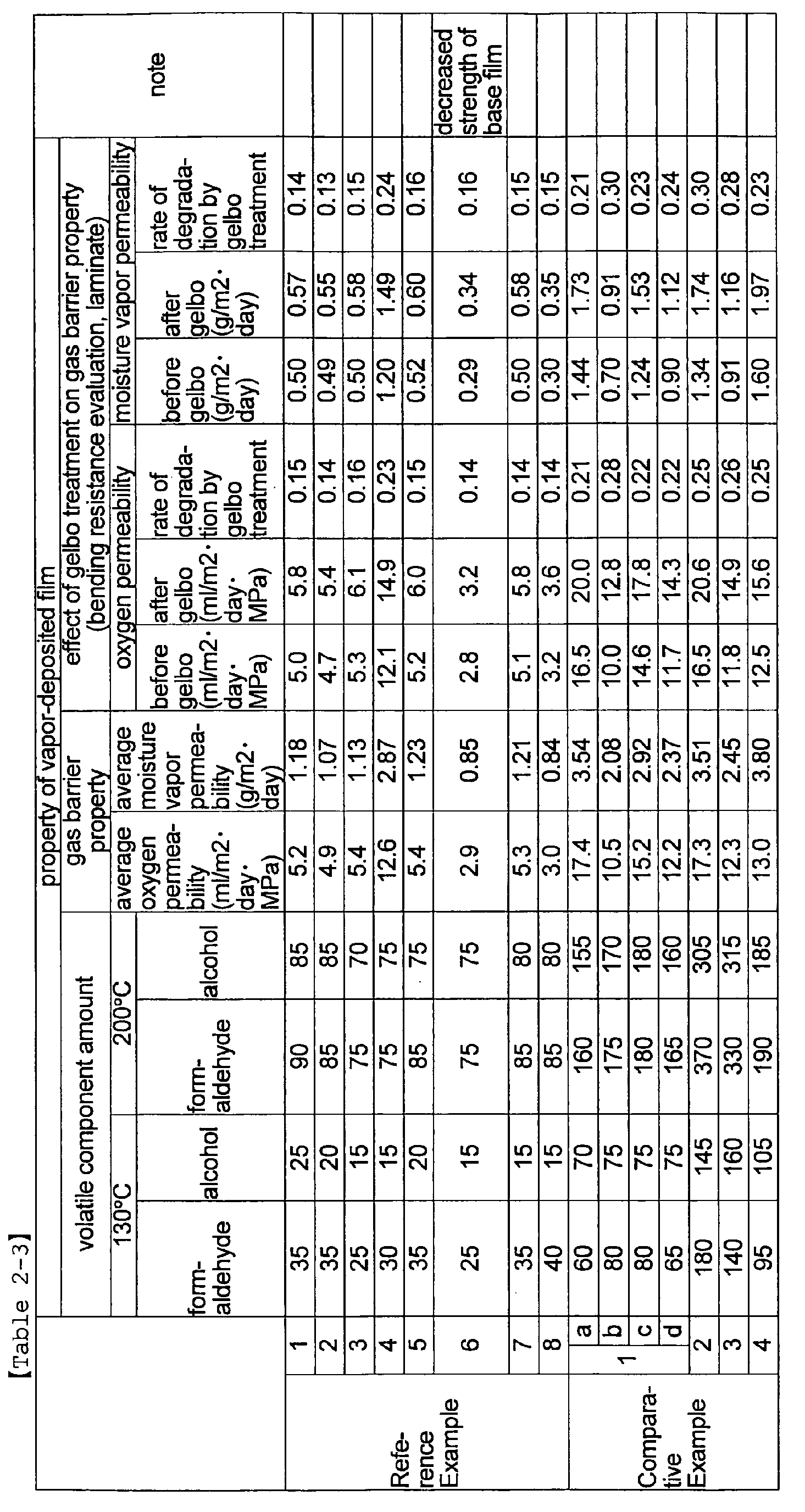
- According to the present invention, a film extremely superior in the oxygen barrier property and moisture vapor barrier property, superior in the uniformity of the barrier properties and bending resistance, free of dioxin, and hydrogen chloride gas in the incineration exhaust gas, and effective for environmental conservation can be provided economically.
Claims (3)
- A coated film having a thickness of 5 - 50 µm, wherein a coating layer comprising a melamine series compound and a poly(vinyl alcohol)-based polymer as essential components is laminated on a substrate made of a polymer resin composition, and the weight of formaldehyde and the weight of alcohol developed from the coated film when heated at 130°C is each not more than 50 ppm of the weight of a sample of the coated film.
- A vapor-deposited film wherein an inorganic thin film layer is vapor-deposited on the coating layer of the coated film of claim 1.
- The vapor-deposited film of claim 2, which shows, when the vapor-deposited film is subjected to a gelbo test, the oxygen permeability and moisture vapor permeability before and after the gelbo test satisfy the following formula 1):

Applications Claiming Priority (4)
| Application Number | Priority Date | Filing Date | Title |
|---|---|---|---|
| JP2005138860 | 2005-05-11 | ||
| JP2005152969 | 2005-05-25 | ||
| JP2005302239A JP3992055B2 (en) | 2005-05-11 | 2005-10-17 | Vapor deposition film |
| PCT/JP2006/309226 WO2006120989A1 (en) | 2005-05-11 | 2006-05-08 | Coated film and vapor-deposited film |
Publications (1)
| Publication Number | Publication Date |
|---|---|
| EP1886809A1 true EP1886809A1 (en) | 2008-02-13 |
Family
ID=37396497
Family Applications (1)
| Application Number | Title | Priority Date | Filing Date |
|---|---|---|---|
| EP06746058A Withdrawn EP1886809A1 (en) | 2005-05-11 | 2006-05-08 | Coated film and vapor-deposited film |
Country Status (5)
| Country | Link |
|---|---|
| US (1) | US20080206556A1 (en) |
| EP (1) | EP1886809A1 (en) |
| JP (1) | JP3992055B2 (en) |
| KR (1) | KR20080012291A (en) |
| WO (1) | WO2006120989A1 (en) |
Families Citing this family (9)
| Publication number | Priority date | Publication date | Assignee | Title |
|---|---|---|---|---|
| US20100221560A1 (en) * | 2006-08-14 | 2010-09-02 | Frito-Lay North America, Inc. | Bio-Based In-Line High Barrier Metalized Film and Process for its Production |
| RU2496912C1 (en) * | 2012-02-17 | 2013-10-27 | Федеральное государственное унитарное предприятие "Всероссийский научно-исследовательский институт автоматики им. Н.Л. Духова" (ФГУП "ВНИИА") | Method of coating application by electron beam evaporation in vacuum |
| JP6331652B2 (en) * | 2014-04-25 | 2018-05-30 | 凸版印刷株式会社 | Gas barrier film and gas barrier laminate |
| JP6749079B2 (en) * | 2014-07-11 | 2020-09-02 | 株式会社クラレ | Vapor-deposited film, packaging material and vacuum insulation |
| US12612472B2 (en) | 2014-07-11 | 2026-04-28 | Kuraray Co., Ltd. | Ethylene-vinyl alcohol copolymer and resin composition, and molded product obtained using the same |
| CN104290422A (en) * | 2014-09-19 | 2015-01-21 | 安徽国风塑业股份有限公司 | Polyester composite film applied to extrusion coating type packaging bags and preparation method of polyester composite film |
| JP6024791B2 (en) * | 2015-06-29 | 2016-11-16 | 東洋紡株式会社 | Process for producing inorganic thin film forming substrate polyester film for solar cell |
| WO2018055989A1 (en) * | 2016-09-23 | 2018-03-29 | 東洋製罐株式会社 | Packaging bag for microwave-oven heating |
| WO2019037785A1 (en) * | 2017-08-25 | 2019-02-28 | 北京师范大学 | Composite porous membrane and preparation method therefor and use thereof |
Family Cites Families (4)
| Publication number | Priority date | Publication date | Assignee | Title |
|---|---|---|---|---|
| JPS55124652A (en) * | 1979-03-19 | 1980-09-25 | Toyo Boseki | Laminate |
| JPS56163A (en) * | 1979-06-18 | 1981-01-06 | Toyo Boseki | Laminated body |
| AU652220B2 (en) * | 1991-02-15 | 1994-08-18 | Toray Industries, Inc. | Plastic optical articles |
| JP2002166489A (en) * | 2000-12-01 | 2002-06-11 | Toyobo Co Ltd | Laminated gas barrier film roll |
-
2005
- 2005-10-17 JP JP2005302239A patent/JP3992055B2/en not_active Expired - Fee Related
-
2006
- 2006-05-08 KR KR1020077026060A patent/KR20080012291A/en not_active Withdrawn
- 2006-05-08 WO PCT/JP2006/309226 patent/WO2006120989A1/en not_active Ceased
- 2006-05-08 EP EP06746058A patent/EP1886809A1/en not_active Withdrawn
- 2006-05-08 US US11/914,372 patent/US20080206556A1/en not_active Abandoned
Non-Patent Citations (1)
| Title |
|---|
| See references of WO2006120989A1 * |
Also Published As
| Publication number | Publication date |
|---|---|
| JP3992055B2 (en) | 2007-10-17 |
| WO2006120989A1 (en) | 2006-11-16 |
| JP2007001283A (en) | 2007-01-11 |
| US20080206556A1 (en) | 2008-08-28 |
| KR20080012291A (en) | 2008-02-11 |
Similar Documents
| Publication | Publication Date | Title |
|---|---|---|
| EP1927465B1 (en) | Laminated film having gas barrier characteristics | |
| EP3406421B1 (en) | Biaxially-stretched polyester film, laminate and packaging bag | |
| EP0805177A2 (en) | A gas barrier film | |
| US20080206556A1 (en) | Coated Film and Vapor-Deposited Film | |
| JP2002309023A (en) | Method for producing gas barrier film | |
| JP7750228B2 (en) | Laminated Film | |
| US7141307B2 (en) | Extrusion-coatable polyester film comprising poly(m-xyleneadipamide) | |
| JP2008307757A (en) | Coated film and vapor deposition film | |
| JP5142421B2 (en) | Biaxially oriented polyethylene terephthalate film for transparent deposition | |
| EP4023430A1 (en) | Gas barrier polyamide film | |
| JP4983594B2 (en) | Vapor deposition film | |
| JP7463961B2 (en) | Gas barrier polyamide film | |
| JP2009274381A (en) | Laminated film | |
| JP3992056B2 (en) | Coating film roll, vapor deposition film roll, and method for producing coating film roll | |
| JP2001232739A (en) | Film for vapor deposition and vapor deposited film using the same | |
| JP7073882B2 (en) | Laminated film | |
| JP2008307758A (en) | Coated film roll, vapor deposition film roll and manufacturing method of coated film roll | |
| CN101128318A (en) | Coating film and vapor deposition film | |
| JP2006321194A (en) | Gas barrier laminated film | |
| JP2006326865A (en) | Gas barrier laminated film | |
| JP2005138534A (en) | Laminated film | |
| JP2006321198A (en) | Gas barrier laminated film | |
| JP2006321192A (en) | Gas barrier laminated film | |
| JP2005138536A (en) | Laminated film | |
| JP2006321196A (en) | Gas barrier laminated film |
Legal Events
| Date | Code | Title | Description |
|---|---|---|---|
| PUAI | Public reference made under article 153(3) epc to a published international application that has entered the european phase |
Free format text: ORIGINAL CODE: 0009012 |
|
| 17P | Request for examination filed |
Effective date: 20071204 |
|
| AK | Designated contracting states |
Kind code of ref document: A1 Designated state(s): AT BE BG CH CY CZ DE DK EE ES FI FR GB GR HU IE IS IT LI LT LU LV MC NL PL PT RO SE SI SK TR |
|
| DAX | Request for extension of the european patent (deleted) | ||
| STAA | Information on the status of an ep patent application or granted ep patent |
Free format text: STATUS: THE APPLICATION HAS BEEN WITHDRAWN |
|
| 18W | Application withdrawn |
Effective date: 20090512 |