EP1883086B1 - Electrolyte solution, electrochemical device using same, and electronic device - Google Patents
Electrolyte solution, electrochemical device using same, and electronic device Download PDFInfo
- Publication number
- EP1883086B1 EP1883086B1 EP06746508A EP06746508A EP1883086B1 EP 1883086 B1 EP1883086 B1 EP 1883086B1 EP 06746508 A EP06746508 A EP 06746508A EP 06746508 A EP06746508 A EP 06746508A EP 1883086 B1 EP1883086 B1 EP 1883086B1
- Authority
- EP
- European Patent Office
- Prior art keywords
- electrolyte solution
- chemical formula
- fluoro
- carbon atoms
- solution according
- Prior art date
- Legal status (The legal status is an assumption and is not a legal conclusion. Google has not performed a legal analysis and makes no representation as to the accuracy of the status listed.)
- Ceased
Links
Images

Classifications
-
- H—ELECTRICITY
- H01—ELECTRIC ELEMENTS
- H01M—PROCESSES OR MEANS, e.g. BATTERIES, FOR THE DIRECT CONVERSION OF CHEMICAL ENERGY INTO ELECTRICAL ENERGY
- H01M10/00—Secondary cells; Manufacture thereof
- H01M10/05—Accumulators with non-aqueous electrolyte
- H01M10/056—Accumulators with non-aqueous electrolyte characterised by the materials used as electrolytes, e.g. mixed inorganic/organic electrolytes
- H01M10/0564—Accumulators with non-aqueous electrolyte characterised by the materials used as electrolytes, e.g. mixed inorganic/organic electrolytes the electrolyte being constituted of organic materials only
- H01M10/0566—Liquid materials
- H01M10/0567—Liquid materials characterised by the additives
-
- H—ELECTRICITY
- H01—ELECTRIC ELEMENTS
- H01G—CAPACITORS; CAPACITORS, RECTIFIERS, DETECTORS, SWITCHING DEVICES, LIGHT-SENSITIVE OR TEMPERATURE-SENSITIVE DEVICES OF THE ELECTROLYTIC TYPE
- H01G11/00—Hybrid capacitors, i.e. capacitors having different positive and negative electrodes; Electric double-layer [EDL] capacitors; Processes for the manufacture thereof or of parts thereof
- H01G11/54—Electrolytes
- H01G11/58—Liquid electrolytes
- H01G11/60—Liquid electrolytes characterised by the solvent
-
- H—ELECTRICITY
- H01—ELECTRIC ELEMENTS
- H01G—CAPACITORS; CAPACITORS, RECTIFIERS, DETECTORS, SWITCHING DEVICES, LIGHT-SENSITIVE OR TEMPERATURE-SENSITIVE DEVICES OF THE ELECTROLYTIC TYPE
- H01G11/00—Hybrid capacitors, i.e. capacitors having different positive and negative electrodes; Electric double-layer [EDL] capacitors; Processes for the manufacture thereof or of parts thereof
- H01G11/54—Electrolytes
- H01G11/58—Liquid electrolytes
- H01G11/62—Liquid electrolytes characterised by the solute, e.g. salts, anions or cations therein
-
- H—ELECTRICITY
- H01—ELECTRIC ELEMENTS
- H01M—PROCESSES OR MEANS, e.g. BATTERIES, FOR THE DIRECT CONVERSION OF CHEMICAL ENERGY INTO ELECTRICAL ENERGY
- H01M10/00—Secondary cells; Manufacture thereof
- H01M10/42—Methods or arrangements for servicing or maintenance of secondary cells or secondary half-cells
- H01M10/4235—Safety or regulating additives or arrangements in electrodes, separators or electrolyte
-
- H—ELECTRICITY
- H01—ELECTRIC ELEMENTS
- H01M—PROCESSES OR MEANS, e.g. BATTERIES, FOR THE DIRECT CONVERSION OF CHEMICAL ENERGY INTO ELECTRICAL ENERGY
- H01M6/00—Primary cells; Manufacture thereof
- H01M6/14—Cells with non-aqueous electrolyte
- H01M6/16—Cells with non-aqueous electrolyte with organic electrolyte
- H01M6/162—Cells with non-aqueous electrolyte with organic electrolyte characterised by the electrolyte
- H01M6/168—Cells with non-aqueous electrolyte with organic electrolyte characterised by the electrolyte by additives
-
- H—ELECTRICITY
- H01—ELECTRIC ELEMENTS
- H01G—CAPACITORS; CAPACITORS, RECTIFIERS, DETECTORS, SWITCHING DEVICES, LIGHT-SENSITIVE OR TEMPERATURE-SENSITIVE DEVICES OF THE ELECTROLYTIC TYPE
- H01G9/00—Electrolytic capacitors, rectifiers, detectors, switching devices, light-sensitive or temperature-sensitive devices; Processes of their manufacture
- H01G9/004—Details
- H01G9/022—Electrolytes; Absorbents
- H01G9/035—Liquid electrolytes, e.g. impregnating materials
-
- H—ELECTRICITY
- H01—ELECTRIC ELEMENTS
- H01G—CAPACITORS; CAPACITORS, RECTIFIERS, DETECTORS, SWITCHING DEVICES, LIGHT-SENSITIVE OR TEMPERATURE-SENSITIVE DEVICES OF THE ELECTROLYTIC TYPE
- H01G9/00—Electrolytic capacitors, rectifiers, detectors, switching devices, light-sensitive or temperature-sensitive devices; Processes of their manufacture
- H01G9/145—Liquid electrolytic capacitors
-
- Y—GENERAL TAGGING OF NEW TECHNOLOGICAL DEVELOPMENTS; GENERAL TAGGING OF CROSS-SECTIONAL TECHNOLOGIES SPANNING OVER SEVERAL SECTIONS OF THE IPC; TECHNICAL SUBJECTS COVERED BY FORMER USPC CROSS-REFERENCE ART COLLECTIONS [XRACs] AND DIGESTS
- Y02—TECHNOLOGIES OR APPLICATIONS FOR MITIGATION OR ADAPTATION AGAINST CLIMATE CHANGE
- Y02E—REDUCTION OF GREENHOUSE GAS [GHG] EMISSIONS, RELATED TO ENERGY GENERATION, TRANSMISSION OR DISTRIBUTION
- Y02E60/00—Enabling technologies; Technologies with a potential or indirect contribution to GHG emissions mitigation
- Y02E60/10—Energy storage using batteries
-
- Y—GENERAL TAGGING OF NEW TECHNOLOGICAL DEVELOPMENTS; GENERAL TAGGING OF CROSS-SECTIONAL TECHNOLOGIES SPANNING OVER SEVERAL SECTIONS OF THE IPC; TECHNICAL SUBJECTS COVERED BY FORMER USPC CROSS-REFERENCE ART COLLECTIONS [XRACs] AND DIGESTS
- Y02—TECHNOLOGIES OR APPLICATIONS FOR MITIGATION OR ADAPTATION AGAINST CLIMATE CHANGE
- Y02E—REDUCTION OF GREENHOUSE GAS [GHG] EMISSIONS, RELATED TO ENERGY GENERATION, TRANSMISSION OR DISTRIBUTION
- Y02E60/00—Enabling technologies; Technologies with a potential or indirect contribution to GHG emissions mitigation
- Y02E60/13—Energy storage using capacitors
Definitions
- the present invention relates to an electrolyte solution mainly used in an electric double layer capacitor, an electrochemical device using the same, and an electronic device using the electrochemical device.
- electrochemical devices typically represented by electric double layer capacitors improvement has been demanded for the performance such as higher with standing voltage, longer life, and higher heat resistance. Therefore, it is required that the electrolyte solution used therefor is electrochemically stabler.
- electrolyte solutions using cyclic carbonates or cyclic lactones with high electrochemical stability have been used mainly.
- Such electrolyte solutions are disclosed, for example, in Japanese Patent Unexamined Publication No. H07-283083 .
- As a typical cyclic carbonate propylene carbonate has been used generally.
- propylene carbonate is not sufficient.
- Propylene carbonate has a structural portion in which two or more oxygen atoms are bonded directly to one carbon atom. Accordingly, a gas mainly of carbon dioxide (CO 2 ) is generated in a great amount along with decomposition, and this causes deterioration of the characteristics of the electrochemical device.
- CO 2 carbon dioxide
- an electrolyte solution constituted with a solvent of higher electrochemical stability than that of propylene carbonate is required.
- the higher electrochemical stability means herein that an electrochemical device using the same can be utilized at a higher voltage for a longer period of time while suppressing the change of characteristics thereof such as capacitance and internal resistance within a predetermined range.
- US 2002/0192564 describes an electrolyte solution containing an electrolyte and a borate ester dissolved in an organic carbonate solvent.
- the present invention is defined by the features of claim 1 and provides, instead of propylene carbonate, an electrolyte solution containing a compound which is electrochemically stabler and does not contain a structural portion where two or more oxygen atoms are directly coupled to one carbon atom, which causes evolution of CO 2 . Further, the invention provides an electrochemical device suppressing the degradation of the characteristics by using the electrolyte solution. Furthermore, the invention provides an electronic device improved in the working life by the use of the electrochemical device.
- the electrolyte solution of the present invention contains at least one kind of fluoro-containing compound represented by the general formula (1) :
- R1, R2 each represent a hydrogen atom, a fluorine atom, or an alkyl group of 1 to 10 carbon atoms, in which R1 and R2 may be identical or different with each other. Further, a cyclic structure may be formed by providing bonding between the carbon atoms contained in R1 and R2.
- the electrolyte solution according to the present invention includes a fluoro-containing compound which is electrochemically stable and does not contain a structural portion where two or more oxygen atoms are directly coupled to one carbon atom to cause generation of gaseous CO 2 . With such a constitution, deterioration of the performance of the electrochemical device using the electrolyte solution can be suppressed. Further, the electronic device using the electrochemical device can be operated stably for a long time.
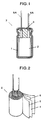
- Fig. 1 is a cross sectional view showing a constitution of an electric double layer capacitor as an electrochemical device according to an embodiment of the present invention
- Fig. 2 is a developed perspective view showing a constitution of a capacitor element used for the electric double layer capacitor.
- Electric double layer capacitor (hereinafter referred to as a capacitor) 7 has casing 1, capacitor element 2 and sealing rubber 3.
- capacitor element 2 is composed belt-shaped separator 4, belt-shaped first electrode (hereinafter referred to as electrode) 5, and belt-shaped second electrode (hereinafter referred to as electrode) 6.
- Electrodes 5, 6 are applied with a treatment to make the surface area larger by etching or the like, and a polarizing electrode layer (not illustrated) using carbon is formed further on the surface thereof. This further increases the surface area of electrodes, 5, 6. Electrodes 5, 6 are wound via separator 4 therebetween. Electrodes, 5, 6 are connected with first terminal 5A and second terminal 6A, respectively. An electrolyte solution (not illustrated) filled in casing 1 is present between electrodes 5, and 6. Sealing rubber 3 seals an opening of casing 1 in a manner that first terminal 5A and second terminal 6A are partially exposed.
- Casing 1 may be formed of stainless steel or nickel-plated iron, in consideration of the strength.
- the collectors for electrodes 5, 6 may also be formed of nickel or the like.
- Sealing rubber 3 is formed of a material such as ethylene propylene rubber which is not corroded by the electrolyte solution.
- separator 4 is formed of a non-woven fabric or finely porous film such as of cellulose, polyethylene, and polypropylene. In a structure where electrodes 5, 6 are not to be short-circuited, separator 4 may be eliminated.
- the electrolyte solution present between electrodes 5 and 6 contains at least one kind of fluoro-containing compound represented by the general formula (1). Further, the electrolyte solution includes an electrolyte (supporting salt) which is dissolved in the fluoro-containing compound, ionized to form anions and cations and is stable within a range of the operation voltage of capacitor 7.
- R1 andR2 each represent a hydrogen atom, a fluorine atom or an alkyl group of 1 to 10 carbon atoms and R1 and R2 may be identical or different with each other. Further, a cyclic structure may be formed by bonding between the carbon atoms contained in R1 and R2.
- the fluoro-containing compound represented by the general formula (1) includes those compounds represented by the following chemical formula (2), chemical formula (3), chemical formula (4), chemical formula (5), and chemical formula (6).
- the electrolyte solution according to the present embodiment contains, for example, at least one of them.
- the electrochemical stability of these compounds can be evaluated by actually assembling electric double layer capacitors 7, applying a voltage thereto and measuring the change of the capacitance and the internal resistance thereof over time. It takes much time and labor to prepare such electrolyte solutions, to assemble electric double layer capacitors 7 and to conduct a voltage loading test.
- the electrochemical stability of the compound is evaluated by estimating the reduction energy and the oxidation energy of the compound by using the First Principle Molecular Orbital Method, as another way.
- the physical property values of the electrolyte solution can be evaluated extremely efficiently in a short time.
- the reduction energy is determined by calculating the difference of the total energy (sum of the kinetic energy of electrons and potential energies between electrons, between electron and atom nuclei, and between atom nuclei) in each of the stable structures of a neutral molecule and a reductant thereof based on the neutral molecule as a reference.
- the oxidation energy is determined by calculating the difference of the total energy in each of the stable structures of the neutral molecule and an oxidant thereof.
- Table 1 shows the results of butylene carbonate, propylene carbonate, and ethylene carbonate as the cyclic carbonate, and dimethyl carbonate and ethylmethyl carbonate as the chained carbonate for comparison.
- Such carbonates whose carbon-oxygen double bond is replaced with a boron-fluorine single bond unit, correspond to the fluoro-containing compounds shown by chemical formula (2), chemical formula (3), chemical formula (4), chemical formula (5), and chemical formula (6), respectively.
- the electric dipole moment ( ⁇ [Debye]) determined by the First Principle Molecular Orbital Calculation has a quantitative correlationship with the specific permittivity ( ⁇ r) and the viscosity ( ⁇ [cp]) of respective solvents.
- ⁇ 7.0641
- ⁇ r 89.6
- v 1.92 in ethylene carbonates
- ⁇ r 69.0
- v 1.38 in propylene carbonate
- ⁇ 0.0081
- ⁇ r 3.1 and ⁇ is 0.6 in dimethyl carbonate
- ⁇ 0.3281
- ⁇ r 2.9 and ⁇ is 0.7 in ethymethyl carbonate.
- a solvent of a higher permittivity tends to dissolve more amount of salt
- a solvent of a lower viscosity tends to improve the ion conductivity of the electrolyte solution. Therefore, by mixing two or more kinds of solvents of different permittivity or viscosity, it is possible to prepare a new solvent with different permittivity or viscosity and control the electrolyte solution characteristics.
- the specific permittivity ( ⁇ r) and the viscosity ( ⁇ [cp]) are higher in the compounds of chemical formula (2), chemical formula (3), and chemical formula (4) and lower in the compounds of chemical formula (5) and chemical formula (6). Accordingly, by mixing at least two kinds of fluoro-containing compounds selected from the two groups respectively, it is possible to prepare new solvents of different permittivity and viscosity and control the characteristics of the electrolyte solution.
- the electrolyte solution containing the fluoro-containing compounds shown in the general formula (1), and chemical formula (2) to chemical formula (6) may also contain other compounds different from the fluoro-compounds described above.
- at least one compound selected from propylene carbonate, dimethyl carbonate, and ethylmethyl carbonate may be contained.
- BF 4 - , PF 6 - , Cl - , CF 3 SO 3 - , NO 3 - , N(CF 2 SO 3 ) 2 - , ClO 4 - , Br - , I - , etc. may be selected and dissolved as anions.
- any anion other than those described above may be used so long as it is soluble as the electrolyte solution and stable within a range of the working voltage of capacitor 7. Further, two or more kinds of anions may also be contained.
- a compound represented by the general formula (7) may be selected and dissolved as a cation.
- R1, R2, R3, R4, and R5 each represent a hydrogen atom, a fluorine atom or an alkyl group of 1 to 10 carbon atoms and R1 to R5 may include those identical with each other. Further, a cyclic structure may also be formed by providing bonding between the carbon atoms contained in R1 to R5.
- 1-ethyl-3-methylimidazolium, 1,3-dimethylimidazolium, 1,2,3-trimethylimidazolium, 1-ethyl-2,3-dimethylimidazolium, and 1,2,3,4-tetramethylimidazolium, etc. can be selected.
- the compound represented by the general formula (7) is preferred since it is stable in a relatively wide temperature range and has high ion conductivity.
- any other cation than those described above, for example, quaternary ammonium salts such as tetraethyl ammonium may be used so long it can be dissolved as the electrolyte solution and is stable in a range of the working voltage of capacitor 7. Further, two or more kinds of cations may also be incorporated.
- capacitor 7 capable of maintaining stable operation for a long time can be obtained.
- Fig. 3 is a conceptional view of electronic device 10 using capacitor 7.
- Electronic device 10 has electronic circuit 9 to be constituted with circuit board 8 on which capacitor 7 is mounted. That is, capacitor 7 is connected to electronic circuit 9.
- electronic device 10 includes capacitor 7. Since capacitor 7 can maintain stable operation for a long time, the life of electronic device 10 can be extended.
- Electronic circuit 9 may also be constituted without containing circuit board 8.
- the electrolyte solution according to the present invention is electrochemically stable. Accordingly, deterioration of the performance of the electrochemical device can be suppressed by using the electrolyte solution. Further, use of the electrochemical device can allow the electronic device to operate stably for a long time.
- the electrolyte solution according to the invention is useful mainly for electric double layer capacitors.
Landscapes
- Chemical & Material Sciences (AREA)
- Chemical Kinetics & Catalysis (AREA)
- Electrochemistry (AREA)
- Engineering & Computer Science (AREA)
- Power Engineering (AREA)
- Manufacturing & Machinery (AREA)
- General Chemical & Material Sciences (AREA)
- Microelectronics & Electronic Packaging (AREA)
- Physics & Mathematics (AREA)
- Condensed Matter Physics & Semiconductors (AREA)
- General Physics & Mathematics (AREA)
- Inorganic Chemistry (AREA)
- Electric Double-Layer Capacitors Or The Like (AREA)
- Secondary Cells (AREA)
Abstract
Description
- The present invention relates to an electrolyte solution mainly used in an electric double layer capacitor, an electrochemical device using the same, and an electronic device using the electrochemical device.
- As to electrochemical devices typically represented by electric double layer capacitors, improvement has been demanded for the performance such as higher with standing voltage, longer life, and higher heat resistance. Therefore, it is required that the electrolyte solution used therefor is electrochemically stabler. As a conventional electrolyte solution for electric double layer capacitors, electrolyte solutions using cyclic carbonates or cyclic lactones with high electrochemical stability have been used mainly. Such electrolyte solutions are disclosed, for example, in Japanese Patent Unexamined Publication No.
H07-283083 - However, for making the electric double layer capacitor have higher withstanding voltage, longer life, and higher heat resistance, propylene carbonate is not sufficient. Propylene carbonate has a structural portion in which two or more oxygen atoms are bonded directly to one carbon atom. Accordingly, a gas mainly of carbon dioxide (CO2) is generated in a great amount along with decomposition, and this causes deterioration of the characteristics of the electrochemical device.
- That is, an electrolyte solution constituted with a solvent of higher electrochemical stability than that of propylene carbonate is required. The higher electrochemical stability means herein that an electrochemical device using the same can be utilized at a higher voltage for a longer period of time while suppressing the change of characteristics thereof such as capacitance and internal resistance within a predetermined range.
-
US 2002/0192564 describes an electrolyte solution containing an electrolyte and a borate ester dissolved in an organic carbonate solvent. - The present invention is defined by the features of
claim 1 and provides, instead of propylene carbonate, an electrolyte solution containing a compound which is electrochemically stabler and does not contain a structural portion where two or more oxygen atoms are directly coupled to one carbon atom, which causes evolution of CO2. Further, the invention provides an electrochemical device suppressing the degradation of the characteristics by using the electrolyte solution. Furthermore, the invention provides an electronic device improved in the working life by the use of the electrochemical device. The electrolyte solution of the present invention contains at least one kind of fluoro-containing compound represented by the general formula (1) :
- In the formula, R1, R2 each represent a hydrogen atom, a fluorine atom, or an alkyl group of 1 to 10 carbon atoms, in which R1 and R2 may be identical or different with each other. Further, a cyclic structure may be formed by providing bonding between the carbon atoms contained in R1 and R2. The electrolyte solution according to the present invention includes a fluoro-containing compound which is electrochemically stable and does not contain a structural portion where two or more oxygen atoms are directly coupled to one carbon atom to cause generation of gaseous CO2. With such a constitution, deterioration of the performance of the electrochemical device using the electrolyte solution can be suppressed. Further, the electronic device using the electrochemical device can be operated stably for a long time.
-
-
Fig. 1 is a cross sectional view showing a constitution of an electric double layer capacitor according to an embodiment of the present invention. -
Fig. 2 is a developed perspective view showing a constitution of a capacitor element used for the electric double layer capacitor shown inFig. 1 . -
Fig. 3 is a conceptional view of an electronic device using the electric double layer capacitor shown inFig. 1 . -
- 1
- casing
- 2
- capacitor element
- 3
- sealing rubber
- 4
- separator
- 5
- first electrode
- 5A
- first terminal
- 6
- second electrode
- 6A
- second terminal
- 7
- electric double layer capacitor (electrochemical device)
- 8
- circuit board
- 9
- electronic circuit
- 10
- electronic device
-
Fig. 1 is a cross sectional view showing a constitution of an electric double layer capacitor as an electrochemical device according to an embodiment of the present invention, andFig. 2 is a developed perspective view showing a constitution of a capacitor element used for the electric double layer capacitor. Electric double layer capacitor (hereinafter referred to as a capacitor) 7 hascasing 1,capacitor element 2 and sealingrubber 3. As shown inFig. 2 ,capacitor element 2 is composed belt-shaped separator 4, belt-shaped first electrode (hereinafter referred to as electrode) 5, and belt-shaped second electrode (hereinafter referred to as electrode) 6. Each surface ofelectrodes Electrodes separator 4 therebetween. Electrodes, 5, 6 are connected withfirst terminal 5A andsecond terminal 6A, respectively. An electrolyte solution (not illustrated) filled incasing 1 is present betweenelectrodes rubber 3 seals an opening ofcasing 1 in a manner thatfirst terminal 5A andsecond terminal 6A are partially exposed. - For
casing 1 and collectors ofelectrodes Casing 1 may be formed of stainless steel or nickel-plated iron, in consideration of the strength. The collectors forelectrodes rubber 3 is formed of a material such as ethylene propylene rubber which is not corroded by the electrolyte solution. Further,separator 4 is formed of a non-woven fabric or finely porous film such as of cellulose, polyethylene, and polypropylene. In a structure whereelectrodes separator 4 may be eliminated. - Then, the electrolyte solution present between
electrodes capacitor 7.
- In the formula, R1 andR2 each represent a hydrogen atom, a fluorine atom or an alkyl group of 1 to 10 carbon atoms and R1 and R2 may be identical or different with each other. Further, a cyclic structure may be formed by bonding between the carbon atoms contained in R1 and R2.
- The fluoro-containing compound represented by the general formula (1) includes those compounds represented by the following chemical formula (2), chemical formula (3), chemical formula (4), chemical formula (5), and chemical formula (6). The electrolyte solution according to the present embodiment contains, for example, at least one of them.


- The electrochemical stability of these compounds can be evaluated by actually assembling electric
double layer capacitors 7, applying a voltage thereto and measuring the change of the capacitance and the internal resistance thereof over time. It takes much time and labor to prepare such electrolyte solutions, to assemble electricdouble layer capacitors 7 and to conduct a voltage loading test. - In the present embodiment, the electrochemical stability of the compound is evaluated by estimating the reduction energy and the oxidation energy of the compound by using the First Principle Molecular Orbital Method, as another way. By conducting the evaluation by the First Principle Molecular Orbital Method, the physical property values of the electrolyte solution can be evaluated extremely efficiently in a short time.
- Results for reduction energy (Ered), oxidation energy (Eox) and electric dipole moment (µ) calculated by 6-31 + G(d) basis function by Hartree-Fock approximation are shown in Table 1.
Table 1 Compound Reduction energy Ered (Hartree) Oxidation energy Eox (Hartree) Ered + Eox (Hartree) Electric dipole moment (Debye) Butylene carbonate 0.0733 0.3158 0.3891 6.3726 Chemical formula (2) 0.0592 0.3800 0.4392 3.9055 Propylene carbonate 0.0498 0.3449 0.3947 6.2898 Chemical formula (3) 0.0542 0.3858 0.4400 3.8433 Ethylene carbonate 0.0540 0.4228 0.4768 6.1894 Chemical formula (4) 0.0544 0.3912 0.4456 3.7665 Dimethyl carbonate 0.0753 0.3231 0.3984 0.4540 Chemical formula (5) 0.0596 0.3762 0.4358 1.1432 Ethylmethyl carbonate 0.0750 0.3178 0.3928 0.6173 Chemical Formula (6) 0.0566 0.3433 0.3999 1.0336 - The reduction energy is determined by calculating the difference of the total energy (sum of the kinetic energy of electrons and potential energies between electrons, between electron and atom nuclei, and between atom nuclei) in each of the stable structures of a neutral molecule and a reductant thereof based on the neutral molecule as a reference. In the same manner, the oxidation energy is determined by calculating the difference of the total energy in each of the stable structures of the neutral molecule and an oxidant thereof.
- Table 1 shows the results of butylene carbonate, propylene carbonate, and ethylene carbonate as the cyclic carbonate, and dimethyl carbonate and ethylmethyl carbonate as the chained carbonate for comparison. Such carbonates, whose carbon-oxygen double bond is replaced with a boron-fluorine single bond unit, correspond to the fluoro-containing compounds shown by chemical formula (2), chemical formula (3), chemical formula (4), chemical formula (5), and chemical formula (6), respectively.
- In view of Table 1, the electrochemical stability of each of the compounds of chemical formula (2), chemical formula (3), chemical formula (4), and chemical formula (5) is improved compared to that of propylene carbonate. While the oxidation energy of the compound of chemical formula (6) is slightly lower than the oxidation energy of propylene carbonate, they can be regarded identical. That is, also by utilizing the compound of chemical formula (6) instead of propylene carbonate, the generation amount of CO2 can be suppressed without deteriorating the electrochemical stability of the electrolyte solution.
- Further, the electric dipole moment (µ[Debye]) determined by the First Principle Molecular Orbital Calculation has a quantitative correlationship with the specific permittivity (εr) and the viscosity (ν[cp]) of respective solvents. For example, µ is 7.0641, εr is 89.6 and v is 1.92 in ethylene carbonates is 7.1579, εr is 69.0 and v is 1.38 in propylene carbonate, µ is 0.0081, εr is 3.1 and ν is 0.6 in dimethyl carbonate, and µ is 0.3281, εr is 2.9 and ν is 0.7 in ethymethyl carbonate. Generally, a solvent of a higher permittivity tends to dissolve more amount of salt, and a solvent of a lower viscosity tends to improve the ion conductivity of the electrolyte solution. Therefore, by mixing two or more kinds of solvents of different permittivity or viscosity, it is possible to prepare a new solvent with different permittivity or viscosity and control the electrolyte solution characteristics.
- The electric dipole moment (µ[Debye]) of each of the fluoro-containing compounds shown in Table 1 is as below.
Chemical formula (2): µ = 3.9055
Chemical formula (3): µ = 3.8433
Chemical formula (4) : µ = 3.7665
Chemical formula (5): µ = 1.1432
Chemical formula (6): µ = 1.0336
- Then, the specific permittivity (εr) and the viscosity (ν[cp]) are higher in the compounds of chemical formula (2), chemical formula (3), and chemical formula (4) and lower in the compounds of chemical formula (5) and chemical formula (6). Accordingly, by mixing at least two kinds of fluoro-containing compounds selected from the two groups respectively, it is possible to prepare new solvents of different permittivity and viscosity and control the characteristics of the electrolyte solution.
- Further, the electrolyte solution containing the fluoro-containing compounds shown in the general formula (1), and chemical formula (2) to chemical formula (6) may also contain other compounds different from the fluoro-compounds described above. For example, in order to control the characteristics of the electrolyte solution, at least one compound selected from propylene carbonate, dimethyl carbonate, and ethylmethyl carbonate may be contained. However, in order to decrease the evolution amount of CO2, it is advantageous to make the ratio of propylene carbonate or the like as low as possible.
- For the electrolyte solution containing the fluoro-containing compound in the present embodiment, BF4 -, PF6 -, Cl-, CF3SO3 -, NO3 -, N(CF2SO3)2 -, ClO4 -, Br-, I-, etc. may be selected and dissolved as anions. However, any anion other than those described above may be used so long as it is soluble as the electrolyte solution and stable within a range of the working voltage of
capacitor 7. Further, two or more kinds of anions may also be contained. - Further, a compound represented by the general formula (7) may be selected and dissolved as a cation.

- In the formula, R1, R2, R3, R4, and R5 each represent a hydrogen atom, a fluorine atom or an alkyl group of 1 to 10 carbon atoms and R1 to R5 may include those identical with each other. Further, a cyclic structure may also be formed by providing bonding between the carbon atoms contained in R1 to R5.
- Specifically, 1-ethyl-3-methylimidazolium, 1,3-dimethylimidazolium, 1,2,3-trimethylimidazolium, 1-ethyl-2,3-dimethylimidazolium, and 1,2,3,4-tetramethylimidazolium, etc. can be selected. The compound represented by the general formula (7) is preferred since it is stable in a relatively wide temperature range and has high ion conductivity. However, any other cation than those described above, for example, quaternary ammonium salts such as tetraethyl ammonium may be used so long it can be dissolved as the electrolyte solution and is stable in a range of the working voltage of
capacitor 7. Further, two or more kinds of cations may also be incorporated. - By adopting the constitution of impregnating
capacitor element 2 ofcapacitor 7 constituted as described above with the electrolyte solution described above, change in the characteristics such as the capacitance and the internal resistance or swelling ofcasing 1 caused by gas evolution can be suppressed. That is,capacitor 7 capable of maintaining stable operation for a long time can be obtained. - Then,
electronic device 10 usingcapacitor 7 is described with reference toFig. 3. Fig. 3 is a conceptional view ofelectronic device 10 usingcapacitor 7.Electronic device 10 haselectronic circuit 9 to be constituted withcircuit board 8 on whichcapacitor 7 is mounted. That is,capacitor 7 is connected toelectronic circuit 9. As described above,electronic device 10 includescapacitor 7. Sincecapacitor 7 can maintain stable operation for a long time, the life ofelectronic device 10 can be extended.Electronic circuit 9 may also be constituted without containingcircuit board 8. - The electrolyte solution according to the present invention is electrochemically stable. Accordingly, deterioration of the performance of the electrochemical device can be suppressed by using the electrolyte solution. Further, use of the electrochemical device can allow the electronic device to operate stably for a long time. The electrolyte solution according to the invention is useful mainly for electric double layer capacitors.
Claims (10)
- An electrolyte solution containing;
an electrolyte dissolved in at least one of fluoro-containing compounds represented by general formula (1):
- The electrolyte solution according to claim 1, wherein the fluoro-containing compound is a compound represented by chemical formula (2):

- The electrolyte solution according to claim 1, wherein the fluoro-containing compound is a compound represented by chemical formula (3):

- The electrolyte solution according to claim 1, wherein the fluoro-containing compound is a compound represented by chemical formula (4):

- The electrolyte solution according to claim 1, wherein the fluoro-containing compound is a compound represented by chemical formula (5):


- The electrolyte solution according to claim 1, wherein the fluoro-containing compound is a compound represented by chemical formula (6):

- The electrolyte solution according to claim 1, wherein the fluoro-containing compound is at least two kinds of compounds selected from the compounds represented by the chemical formula (2), chemical formula (3), chemical (4), chemical formula (5), and chemical formula (6).
- The electrolyte solution according to claim 1, wherein the electrolyte contains:a cation represented by general formula (7), andat least one of anions of BF4 -, PF6 -, Cl-, CF3SO3 -, NO3 -, N(CF2SO3)2 -, ClO4 -, Br-, and I-,
 wherein, R1, R2, R3, R4, and R5 each represent one of a hydrogen atom, a fluorine atom, an alkyl group of 1 to 10 carbon atoms, and an alkyl group of 1 to 10 carbon atoms which form a ring bonded between the carbon atoms contained in another alkyl group of 1 to 10 carbon atoms.
 - An electrochemical device comprising;
a first electrode and a second electrode,
the electrolyte solution according to claim 1, and
a casing containing the first electrode, the second electrode, and the electrolyte solution. - An electronic device comprising;
the electrochemical device according to claim 9, and
an electric circuit connected with the electrochemical device.
Applications Claiming Priority (2)
| Application Number | Priority Date | Filing Date | Title |
|---|---|---|---|
| JP2005146241 | 2005-05-19 | ||
| PCT/JP2006/309805 WO2006123681A1 (en) | 2005-05-19 | 2006-05-17 | Electrolyte solution, electrochemical device using same, and electronic device |
Publications (3)
| Publication Number | Publication Date |
|---|---|
| EP1883086A1 EP1883086A1 (en) | 2008-01-30 |
| EP1883086A4 EP1883086A4 (en) | 2011-07-20 |
| EP1883086B1 true EP1883086B1 (en) | 2012-07-11 |
Family
ID=37431254
Family Applications (1)
| Application Number | Title | Priority Date | Filing Date |
|---|---|---|---|
| EP06746508A Ceased EP1883086B1 (en) | 2005-05-19 | 2006-05-17 | Electrolyte solution, electrochemical device using same, and electronic device |
Country Status (5)
| Country | Link |
|---|---|
| US (1) | US7875201B2 (en) |
| EP (1) | EP1883086B1 (en) |
| JP (2) | JP4466736B2 (en) |
| CN (1) | CN101180694B (en) |
| WO (1) | WO2006123681A1 (en) |
Families Citing this family (2)
| Publication number | Priority date | Publication date | Assignee | Title |
|---|---|---|---|---|
| JP2013098057A (en) * | 2011-11-01 | 2013-05-20 | Asahi Kasei Corp | Additive for electrolyte and electrolyte containing the same, lithium ion secondary battery |
| JP2016162553A (en) * | 2015-02-27 | 2016-09-05 | ソニー株式会社 | Electrolyte, battery, battery pack, electronic apparatus, electric vehicle, power storage device and power system |
Family Cites Families (11)
| Publication number | Priority date | Publication date | Assignee | Title |
|---|---|---|---|---|
| DE1146480B (en) * | 1961-07-07 | 1963-04-04 | Bayer Ag | Process for the production of diborane |
| JP2920159B2 (en) * | 1989-09-30 | 1999-07-19 | 東燃株式会社 | Composition for coating |
| JP3355776B2 (en) | 1994-04-14 | 2002-12-09 | 松下電器産業株式会社 | Electrolyte for driving electrochemical element and electrochemical element using the same |
| US5849432A (en) * | 1995-11-03 | 1998-12-15 | Arizona Board Of Regents | Wide electrochemical window solvents for use in electrochemical devices and electrolyte solutions incorporating such solvents |
| US5709610A (en) * | 1996-11-29 | 1998-01-20 | Ognjanovic; Zivota | Golf club/ball impact detection system |
| CN1244173C (en) * | 1999-09-16 | 2006-03-01 | 松下电器产业株式会社 | electrochemical capacitor |
| US6516551B2 (en) * | 2000-12-27 | 2003-02-11 | American Technologies Network Corporation | Optical sight with switchable reticle |
| JP4236390B2 (en) * | 2001-04-19 | 2009-03-11 | 三洋電機株式会社 | Lithium secondary battery |
| JP2004265786A (en) * | 2003-03-03 | 2004-09-24 | Nippon Shokubai Co Ltd | Ion electrolyte material |
| JP4271971B2 (en) | 2003-03-26 | 2009-06-03 | 株式会社日本触媒 | Ionic compounds |
| WO2006101779A2 (en) * | 2005-03-15 | 2006-09-28 | The University Of Chicago | Non-aqueous electrolytes for lithium ion batteries |
-
2006
- 2006-05-17 JP JP2007516311A patent/JP4466736B2/en not_active Expired - Fee Related
- 2006-05-17 EP EP06746508A patent/EP1883086B1/en not_active Ceased
- 2006-05-17 US US11/887,242 patent/US7875201B2/en not_active Expired - Fee Related
- 2006-05-17 WO PCT/JP2006/309805 patent/WO2006123681A1/en not_active Ceased
- 2006-05-17 CN CN2006800173786A patent/CN101180694B/en not_active Expired - Fee Related
-
2009
- 2009-11-30 JP JP2009271389A patent/JP5012882B2/en not_active Expired - Fee Related
Also Published As
| Publication number | Publication date |
|---|---|
| EP1883086A4 (en) | 2011-07-20 |
| US20090231780A1 (en) | 2009-09-17 |
| CN101180694A (en) | 2008-05-14 |
| JP4466736B2 (en) | 2010-05-26 |
| WO2006123681A1 (en) | 2006-11-23 |
| JP5012882B2 (en) | 2012-08-29 |
| CN101180694B (en) | 2010-11-03 |
| US7875201B2 (en) | 2011-01-25 |
| EP1883086A1 (en) | 2008-01-30 |
| JP2010080973A (en) | 2010-04-08 |
| JPWO2006123681A1 (en) | 2008-12-25 |
Similar Documents
| Publication | Publication Date | Title |
|---|---|---|
| Hagiwara et al. | Ionic liquids for electrochemical devices | |
| EP2037468B1 (en) | Additive for electrolyte solution and electrolyte solution | |
| EP2141712A1 (en) | Electrolyte, and electrolyte solution or electrochemical element comprising the same | |
| US20040218347A1 (en) | Flame-retardant electrolyte solution for electrochemical double-layer capacitors | |
| US20100118469A1 (en) | Electrolyte solution for electric double layer capacitor | |
| US6491841B1 (en) | Electrolytes for electrochemical double layer capacitors | |
| US20160099115A1 (en) | Electrolytes for high temperature edlc | |
| US6980415B2 (en) | Electrolyte for electrical double layer capacitor and electrical double layer capacitor using the electrolyte | |
| JP2945890B2 (en) | Electric double layer capacitor | |
| EP1883086B1 (en) | Electrolyte solution, electrochemical device using same, and electronic device | |
| EP0591810B1 (en) | Electrolyte for use in an electrolytic capacitor and the electrolytic capacitor | |
| JP3872182B2 (en) | Electric double layer capacitor | |
| JP3860303B2 (en) | Electrolytic solution for electric double layer capacitor and electric double layer capacitor using the same | |
| KR102714946B1 (en) | Electrolyte solution for electric double layer capacitor | |
| JPH1154377A (en) | Electric double layer capacitor | |
| KR102695249B1 (en) | Electrolyte for supercapacitor and supercapacitor containing thereof | |
| JP4419431B2 (en) | Non-aqueous electrolyte for electric double layer capacitors | |
| JP2006032809A (en) | Electrolyte for electrochemistry capacitor and electrochemistry capacitor | |
| KR102180586B1 (en) | Nonaqueous electrolyte solution for electric double layer capacitors | |
| JP2003197480A (en) | Non-aqueous electrolyte composition for electric double layer capacitor | |
| KR101583525B1 (en) | electrolytic solution for supercapacitor and supercapacitor use the same | |
| JP2011155093A (en) | Electrolyte and electrochemical element using the same | |
| JP2007194311A (en) | Electric double layer capacitor | |
| JP2011100777A (en) | Electrolyte and electrochemical element using the same | |
| JP2006173302A (en) | Electric double layer capacitor |
Legal Events
| Date | Code | Title | Description |
|---|---|---|---|
| PUAI | Public reference made under article 153(3) epc to a published international application that has entered the european phase |
Free format text: ORIGINAL CODE: 0009012 |
|
| 17P | Request for examination filed |
Effective date: 20070831 |
|
| AK | Designated contracting states |
Kind code of ref document: A1 Designated state(s): DE |
|
| RBV | Designated contracting states (corrected) |
Designated state(s): DE |
|
| DAX | Request for extension of the european patent (deleted) | ||
| RAP1 | Party data changed (applicant data changed or rights of an application transferred) |
Owner name: PANASONIC CORPORATION |
|
| A4 | Supplementary search report drawn up and despatched |
Effective date: 20110622 |
|
| GRAP | Despatch of communication of intention to grant a patent |
Free format text: ORIGINAL CODE: EPIDOSNIGR1 |
|
| RIN1 | Information on inventor provided before grant (corrected) |
Inventor name: MAESHIMA, HIROYUKIC/O MATSUSHITA ELECT. IND. CO., |
|
| RIC1 | Information provided on ipc code assigned before grant |
Ipc: H01M 10/0569 20100101ALI20120220BHEP Ipc: H01G 9/038 20060101AFI20120220BHEP Ipc: H01G 9/035 20060101ALI20120220BHEP Ipc: H01M 6/16 20060101ALI20120220BHEP |
|
| GRAS | Grant fee paid |
Free format text: ORIGINAL CODE: EPIDOSNIGR3 |
|
| GRAA | (expected) grant |
Free format text: ORIGINAL CODE: 0009210 |
|
| AK | Designated contracting states |
Kind code of ref document: B1 Designated state(s): DE |
|
| REG | Reference to a national code |
Ref country code: DE Ref legal event code: R096 Ref document number: 602006030704 Country of ref document: DE Effective date: 20120906 |
|
| PLBE | No opposition filed within time limit |
Free format text: ORIGINAL CODE: 0009261 |
|
| STAA | Information on the status of an ep patent application or granted ep patent |
Free format text: STATUS: NO OPPOSITION FILED WITHIN TIME LIMIT |
|
| 26N | No opposition filed |
Effective date: 20130412 |
|
| REG | Reference to a national code |
Ref country code: DE Ref legal event code: R097 Ref document number: 602006030704 Country of ref document: DE Effective date: 20130412 |
|
| PGFP | Annual fee paid to national office [announced via postgrant information from national office to epo] |
Ref country code: DE Payment date: 20140521 Year of fee payment: 9 |
|
| REG | Reference to a national code |
Ref country code: DE Ref legal event code: R119 Ref document number: 602006030704 Country of ref document: DE |
|
| PG25 | Lapsed in a contracting state [announced via postgrant information from national office to epo] |
Ref country code: DE Free format text: LAPSE BECAUSE OF NON-PAYMENT OF DUE FEES Effective date: 20151201 |