EP1882884A2 - Chemise de chambre de combustion avec refroidissement par film - Google Patents
Chemise de chambre de combustion avec refroidissement par film Download PDFInfo
- Publication number
- EP1882884A2 EP1882884A2 EP07112897A EP07112897A EP1882884A2 EP 1882884 A2 EP1882884 A2 EP 1882884A2 EP 07112897 A EP07112897 A EP 07112897A EP 07112897 A EP07112897 A EP 07112897A EP 1882884 A2 EP1882884 A2 EP 1882884A2
- Authority
- EP
- European Patent Office
- Prior art keywords
- holes
- liner
- longitudinal axis
- row
- combustor
- Prior art date
- Legal status (The legal status is an assumption and is not a legal conclusion. Google has not performed a legal analysis and makes no representation as to the accuracy of the status listed.)
- Withdrawn
Links
- 238000001816 cooling Methods 0.000 title claims abstract description 89
- 238000011144 upstream manufacturing Methods 0.000 claims abstract description 13
- 238000010790 dilution Methods 0.000 claims description 27
- 239000012895 dilution Substances 0.000 claims description 27
- 230000003247 decreasing effect Effects 0.000 claims description 11
- 238000004891 communication Methods 0.000 claims description 2
- 238000002485 combustion reaction Methods 0.000 description 10
- 239000007789 gas Substances 0.000 description 7
- 238000004519 manufacturing process Methods 0.000 description 6
- 239000000446 fuel Substances 0.000 description 5
- 239000000567 combustion gas Substances 0.000 description 4
- 238000009499 grossing Methods 0.000 description 4
- 238000013461 design Methods 0.000 description 3
- 238000013459 approach Methods 0.000 description 2
- 230000000712 assembly Effects 0.000 description 2
- 238000000429 assembly Methods 0.000 description 2
- 238000012938 design process Methods 0.000 description 2
- 239000000463 material Substances 0.000 description 2
- 238000000034 method Methods 0.000 description 2
- 239000012720 thermal barrier coating Substances 0.000 description 2
- 238000005260 corrosion Methods 0.000 description 1
- 230000007797 corrosion Effects 0.000 description 1
- 230000009429 distress Effects 0.000 description 1
- 239000012530 fluid Substances 0.000 description 1
- 238000002347 injection Methods 0.000 description 1
- 239000007924 injection Substances 0.000 description 1
- 238000012886 linear function Methods 0.000 description 1
- 239000002184 metal Substances 0.000 description 1
- 239000000203 mixture Substances 0.000 description 1
- 238000012986 modification Methods 0.000 description 1
- 230000004048 modification Effects 0.000 description 1
- 230000003647 oxidation Effects 0.000 description 1
- 238000007254 oxidation reaction Methods 0.000 description 1
Images


Classifications
-
- F—MECHANICAL ENGINEERING; LIGHTING; HEATING; WEAPONS; BLASTING
- F23—COMBUSTION APPARATUS; COMBUSTION PROCESSES
- F23R—GENERATING COMBUSTION PRODUCTS OF HIGH PRESSURE OR HIGH VELOCITY, e.g. GAS-TURBINE COMBUSTION CHAMBERS
- F23R3/00—Continuous combustion chambers using liquid or gaseous fuel
- F23R3/02—Continuous combustion chambers using liquid or gaseous fuel characterised by the air-flow or gas-flow configuration
- F23R3/04—Air inlet arrangements
- F23R3/06—Arrangement of apertures along the flame tube
-
- F—MECHANICAL ENGINEERING; LIGHTING; HEATING; WEAPONS; BLASTING
- F23—COMBUSTION APPARATUS; COMBUSTION PROCESSES
- F23R—GENERATING COMBUSTION PRODUCTS OF HIGH PRESSURE OR HIGH VELOCITY, e.g. GAS-TURBINE COMBUSTION CHAMBERS
- F23R2900/00—Special features of, or arrangements for continuous combustion chambers; Combustion processes therefor
- F23R2900/03042—Film cooled combustion chamber walls or domes
-
- Y—GENERAL TAGGING OF NEW TECHNOLOGICAL DEVELOPMENTS; GENERAL TAGGING OF CROSS-SECTIONAL TECHNOLOGIES SPANNING OVER SEVERAL SECTIONS OF THE IPC; TECHNICAL SUBJECTS COVERED BY FORMER USPC CROSS-REFERENCE ART COLLECTIONS [XRACs] AND DIGESTS
- Y02—TECHNOLOGIES OR APPLICATIONS FOR MITIGATION OR ADAPTATION AGAINST CLIMATE CHANGE
- Y02T—CLIMATE CHANGE MITIGATION TECHNOLOGIES RELATED TO TRANSPORTATION
- Y02T50/00—Aeronautics or air transport
- Y02T50/60—Efficient propulsion technologies, e.g. for aircraft
-
- Y—GENERAL TAGGING OF NEW TECHNOLOGICAL DEVELOPMENTS; GENERAL TAGGING OF CROSS-SECTIONAL TECHNOLOGIES SPANNING OVER SEVERAL SECTIONS OF THE IPC; TECHNICAL SUBJECTS COVERED BY FORMER USPC CROSS-REFERENCE ART COLLECTIONS [XRACs] AND DIGESTS
- Y10—TECHNICAL SUBJECTS COVERED BY FORMER USPC
- Y10T—TECHNICAL SUBJECTS COVERED BY FORMER US CLASSIFICATION
- Y10T29/00—Metal working
- Y10T29/49—Method of mechanical manufacture
- Y10T29/49316—Impeller making
- Y10T29/4932—Turbomachine making
Definitions
- This invention relates generally to film cooled combustor liners for use in gas turbine engines, and more particularly, to such combustor liners having regions with closely spaced cooling holes.
- Combustors used in aircraft engines typically include inner and outer combustor liners to protect the combustor and surrounding engine components from the intense heat generated by the combustion process.
- a variety of approaches have been proposed to cool combustor liners so as to allow the liners to withstand greater combustion temperatures.
- One such approach is multi-hole film cooling wherein a thin layer of cooling air is provided along the combustion side of the liners by an array of very small cooling holes formed through the liners.
- Multi-hole film cooling reduces the overall thermal load on the liners because the mass flow through the cooling holes dilutes the hot combustion gas next to the liner surfaces, and the flow through the holes provides convective cooling of the liner walls.
- multi-hole film cooling is more difficult to design compared to pure nugget cooling due to the many restrictions associated with it, such as, the limitations on the spacing between holes, the number of holes in each row of multi-holes, the limitations on hole sizes, and difficulty of doing preferential cooling, for example.
- the holes should be spaced an adequate distance from each other to facilitate applying the thermal-barrier coating (TBC) to the combustor, and should also be spaced sufficiently close to each other to establish good film and convective cooling.
- TBC thermal-barrier coating
- At least one known combustor includes cooling holes that are spaced equidistantly in an axial direction and no attempt is made to control the circumferential spacing.
- the circumferential spacing may vary uncontrollably, resulting in liners having areas that are overcooled and other areas that are undercooled.
- circumferential preferential multihole cooling is difficult to fabricate because it requires variable circumferential spacing, which may cause interference among multihole rows.
- varying hole sizes is a possibility for circumferential preferential cooling, but it is relatively difficult to maintain the axial and circumferential distances between holes within the design limitations and also introduces additional cost.
- a combustor liner in one aspect, includes an upstream end and a downstream end having a longitudinal axis extending therethrough, and a plurality of cooling holes formed in the liner, the cooling holes arranged along the longitudinal axis into a plurality of circumferentially extending rows that are variably spaced apart along the longitudinal axis.
- a gas turbine engine assembly in another aspect, includes a compressor, and a combustor coupled in flow communication with said compressor, said combustor comprising at least one combustor liner having an upstream end and a downstream end having a longitudinal axis extending therethrough, and a plurality of cooling holes formed in said liner, said cooling holes arranged along the longitudinal axis into a plurality of circumferentially extending rows that are variably spaced apart along the longitudinal axis.
- a method of fabricating a gas turbine engine combustor liner includes providing a liner having an upstream end and a downstream end and having a longitudinal axis extending therethrough, and forming a plurality of cooling holes in the liner such that the plurality of holes are arranged along the longitudinal axis into a plurality of circumferentially extending rows that are variably spaced apart along the longitudinal axis.
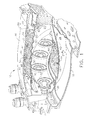
- FIG. 1 illustrates a combustor 10 of the type suitable for use in a gas turbine engine.
- Combustor 10 includes an outer liner 12 and an inner liner 14 disposed between an outer combustor casing 16 and an inner combustor casing 18.
- Outer and inner liners 12 and 14 are radially spaced from each other to define a combustion chamber 20.
- Outer liner 12 and outer casing 16 form an outer passage 22 therebetween, and inner liner 14 and inner casing 18 form an inner passage 24 therebetween.
- a cowl assembly 26 is mounted to the upstream ends of outer and inner liners 12 and 14.
- An annular opening 28 is formed in cowl assembly 26 for the introduction of compressed air into combustor 10.
- the compressed air is supplied from a compressor (not shown) in a direction generally indicated by arrow A of Figure 1.
- the compressed air passes principally through annular opening 28 to support combustion and partially into outer and inner passages 22 and 24 where it is used to cool the liners 12 and 14.
- annular dome plate 30 Disposed between and interconnecting the outer and inner liners 12 and 14 near their upstream ends is an annular dome plate 30.
- a plurality of circumferentially spaced swirler assemblies 32 are mounted in dome plate 30.
- Each swirler assembly 32 receives compressed air from annular opening 28 and fuel from a corresponding fuel nozzle 34. The fuel and air are swirled and mixed by swirler assemblies 32, and the resulting fuel/air mixture is discharged into combustion chamber 20.
- the combustor has an upstream end 60 and a downstream end 62 which define a longitudinal axis extending therethrough (not shown in Figure 1), which in the case of an annular combustor is coincident with the longitudinal axis of the engine.
- Figure 1 illustrates one preferred embodiment of a single annular combustor
- the present invention is equally applicable to any type of combustor, including double annular combustors, which uses multi-hole film cooling or can-annular combustors.
- Outer and inner liners 12 and 14 each comprise a single wall, metal shell having a generally annular and axially extending configuration.
- Outer liner 12 has a hot side 36 facing the hot combustion gases in combustion chamber 20 and a cold side 38 in contact with the relatively cool air in outer passage 22.
- inner liner 14 has a hot side 40 facing the hot combustion gases in combustion chamber 20 and a cold side 42 in contact with the relatively cool air in inner passage 24.
- Both liners 12 and 14 include a large number of closely spaced cooling holes 44 formed therein.
- Dilution air is introduced into combustor chamber 20 through a plurality of circumferentially spaced dilution holes 48 that are disposed in each of outer and inner liners 12 and 14.
- Dilution holes 48 are generally far smaller in number than the cooling holes 44, and each dilution hole 48 has a cross-sectional area that is substantially greater than the cross-sectional area of one of the cooling holes 44.
- Dilution holes 48 serve to admit dilution air into combustor chamber 20.
- the dilution holes are arranged in circumferentially extending bands or rows 50 around the periphery of the liners 12 and 14.
- the forward-most band of dilution holes 48 are referred to as primary dilution holes.
- certain ones of the primary dilution holes 48 are aligned with the injection points defined by the circumferential location of the center of the fuel nozzles 34 and swirlers 32.
- the flow of combustion gases past these circumferential locations may create "hot streaks" of locally increased material temperatures.
- These streaks are not strictly longitudinal; because of the swirl of the flow in the combustor caused by the swirlers 32, the streaks are curved in the circumferential direction when viewed along the length of the combustor.
- the prior art cooling provisions provide adequate cooling for the other portions of the combustor liners 12 and 14, the portions of the combustor liners 12 and 14 subject to hot streaks can exhibit oxidation, corrosion and low cycle fatigue (LCF) failures from field use.
- LCF low cycle fatigue
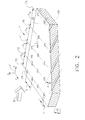
- FIG 2 depicts cooling holes in outer liner 12, it should be understood that the configuration of cooling holes of inner liner 14 is substantially identical to that of outer liner 12. As such, the following description will also apply to inner liner 14.
- Figure 2 includes a frame of reference having axes labeled X, Y and Z, wherein X is the downstream axial distance along the longitudinal axis 11 (also indicated by arrow B) of combustor 10, Y is the circumferential direction, and Z is a radial direction.
- Cooling holes 44 are axially slanted from cold side 38, to hot side 36 at a downstream angle A, which is preferably in the range of approximately 15 degrees to approximately 20 degrees. Cooling holes 44 are arranged in a series of circumferentially extending rows, 46, wherein adjacent holes 44 in each row have a circumferential hole spacing S, between their respective centerlines. Specifically, and in the exemplary embodiment, each respective cooling hole 44 has a diameter (d) and is separated in the circumferential direction (Y) by the distance (S) from adjacent cooling holes 44. As such, the exemplary combustor described herein includes cooling holes 44 that are all spaced apart approximately equidistantly in the circumferential direction, i.e. S is constant in the Y direction and have approximately the same diameter (d).
- the rows 46 of cooling holes 44 are variably spaced in the axial direction (X). More specifically, the cooling holes 44 are generally arranged into a plurality of rows 46 that include, for example, a first row 70, a second row 72, a third row 74, a fourth row 76, and an nth row 78 that are variably spaced axially through outer liner 12. As shown in Figure 2, first row 70 is formed a distance X 1 from second row 72, second row 72 is formed a distance X 2 from third row 74, third row 74 is formed a distance X 3 from fourth row 76, and fourth row 76 is formed a distance X N from nth row 78.
- the rows 46 of cooling holes 44 are axially spaced at various distances such as, for example, X 1 ⁇ X 2 ⁇ X 3 ⁇ X N to allow an increased flow of cooling air to be directed to an area of the combustor where increased cooling air is desired.
- Figure 3 illustrates the combustor liner 12 wherein the rows 46 of cooling holes 44 that are variably spaced apart to either increase or decrease the cooling airflow to selected portions of the combustor liner 12.
- Figure 4 is a graphical illustration of hole spacing along the longitudinal axis 11 that is discussed in conjunction with Figure 3 to illustrate the cooling hole spacing shown in Figure 3.
- a first group 80 of rows 46 are variably spaced such that the spacing X G1 between adjacent rows 46 is gradually decreasing in the axial direction (X) from the upstream end 60 of the combustor liner 12 at least partially rearwardly toward the downstream end 62 of the combustor liner 12.
- the row spacing X/d of the first group 80 is gradually decreasing, i.e. the rows are gradually spaced closer together, such that the cooling airflow supplied through the rows 46 of cooling holes in the first group 80 is gradually increasing to facilitate providing an increased flow of cooling air to potential hot spots that may occur upstream from the first row of dilution holes 48.
- a second group 82 of rows 46 are variably spaced such that the spacing X G2 between adjacent rows 46 is gradually increasing in the axial direction (X) from the first group of rows 80 formed through the combustor liner 12 at least partially rearwardly toward the downstream end 62 of the combustor liner 12.
- the row spacing X/d of the second group 82 is gradually increasing, i.e. the rows are gradually spaced further apart together, such that the cooling airflow supplied through the rows 46 of cooling holes in the second group 82 is gradually decreasing to facilitate providing a decreased flow of cooling air to areas of the combustion liner 12 which do not include potential hot spots.
- the third group 84 of rows 46 are variably spaced such that the spacing X G3 between adjacent rows 46 is gradually decreasing in the axial direction (X) from the second group 82 of cooling holes formed through the combustor liner 12 at least partially rearwardly toward the downstream end 62 of the combustor liner 12.
- the row spacing X/d of the third group 84 is gradually decreasing, i.e. the rows are gradually spaced closer together, between the rows of dilution holes 46 such that the cooling airflow supplied through the rows 46 of cooling holes in the third group 82 is gradually increasing to facilitate providing an increased flow of cooling air to potential hot spots that may occur between the rows of dilution holes 46.
- a fourth group 86 of rows 46 are variably spaced such that the spacing X G4 between adjacent rows 46 is gradually decreasing in the axial direction (X) from the third group 84 of cooling holes formed through the combustor liner 12 at least partially rearwardly toward the downstream end 62 of the combustor liner 12.
- the row spacing X/d of the fourth group 84 is gradually increasing, i.e. the rows are gradually spaced further apart, downstream from the dilution holes 46 such that the cooling airflow supplied through the rows 46 of cooling holes in the fourth group 82 is gradually decreasing in response to the decreased requirement for airflow cooling downstream from the dilution holes 46.
- a fifth group 88 of rows 46 are variably spaced such that the spacing X G5 between adjacent rows 46 is further increasing in the axial direction (X) downstream from the fourth group of holes 86 illustrating the further decrease in cooling requirements toward the downstream end 62 of combustor liner 12.
- a combustor liner that includes a plurality of rows of cooling holes that are variably spaced in the axial direction. More specifically, to facilitate increasing the multihole cooling at the axial stations that need more cooling, the axial spacing between at least some of rows 46 is varied. This is achieved by distributing the axial hole spacing (X/d) smoothly along the combustion liner in the axial direction (X), as shown in Figure 4, utilizing a smoothing function, such as a sine or linear function, for example. As such, the smoothing function facilitates minimizing any abrupt spacing changes between adjacent rows 46 of cooling holes 44.
- one smoothing function that may be utilized is Asin(Bx-C) where A, B, and C are chosen to taylor the hole spacing based on the location of the hot spots of the liner, although it should be realized that other smoothing functions may also be utilized.
- the number of multihole rows 46 and the number of holes 44 in each row 46 are chosen, along with the variable X/d functions, to control S/d, which is fixed for each row.
- a combination of complete X/d control and limited S/d control allows the designer to distribute the cooling air per unit area axially in any desired fashion.
- the design process also ensures that no interference occurs between adjacent holes 44 by calculating and constraining the aspect ratio of the hole spacing (S/x) to be preferably close to a value of one.
- S/x hole spacing
- only a single hole size is needed, which is a manufacturing convenience.
- the method of fabricating the liners described herein allows a limited controllable preferential cooling and eliminates the risk of the multihole interference.
- the method of fabricating the combustor liner includes providing a liner having an upstream end and a downstream end having a longitudinal axis extending therethrough, and forming a plurality of cooling holes in the liner such that the plurality of holes are arranged along the longitudinal axis into a plurality of circumferentially extending rows that are variably spaced apart along the longitudinal axis.
- the liner described herein enables using one multihole size for preferential cooling which is a design and manufacturing convenience.
- the liner described herein may be utilized with other means of preferential cooling, for example, multiple hole sizes.
Landscapes
- Engineering & Computer Science (AREA)
- Chemical & Material Sciences (AREA)
- Combustion & Propulsion (AREA)
- Mechanical Engineering (AREA)
- General Engineering & Computer Science (AREA)
- Turbine Rotor Nozzle Sealing (AREA)
- Gas Burners (AREA)
- Cylinder Crankcases Of Internal Combustion Engines (AREA)
- Spray-Type Burners (AREA)
Applications Claiming Priority (1)
| Application Number | Priority Date | Filing Date | Title |
|---|---|---|---|
| US11/460,114 US7669422B2 (en) | 2006-07-26 | 2006-07-26 | Combustor liner and method of fabricating same |
Publications (2)
| Publication Number | Publication Date |
|---|---|
| EP1882884A2 true EP1882884A2 (fr) | 2008-01-30 |
| EP1882884A3 EP1882884A3 (fr) | 2015-08-05 |
Family
ID=38582275
Family Applications (1)
| Application Number | Title | Priority Date | Filing Date |
|---|---|---|---|
| EP07112897.9A Withdrawn EP1882884A3 (fr) | 2006-07-26 | 2007-07-20 | Chemise de chambre de combustion avec refroidissement par film |
Country Status (4)
| Country | Link |
|---|---|
| US (1) | US7669422B2 (fr) |
| EP (1) | EP1882884A3 (fr) |
| JP (2) | JP5224742B2 (fr) |
| CN (1) | CN101113820B (fr) |
Families Citing this family (31)
| Publication number | Priority date | Publication date | Assignee | Title |
|---|---|---|---|---|
| US8171634B2 (en) | 2007-07-09 | 2012-05-08 | Pratt & Whitney Canada Corp. | Method of producing effusion holes |
| US7905094B2 (en) * | 2007-09-28 | 2011-03-15 | Honeywell International Inc. | Combustor systems with liners having improved cooling hole patterns |
| EP2230455B1 (fr) * | 2009-03-16 | 2012-04-18 | Alstom Technology Ltd | Brûleur pour une turbine à gaz et procédé de refroidissement local d'un flux de gaz chauds passant par un brûleur |
| FR2953907B1 (fr) * | 2009-12-11 | 2012-11-02 | Snecma | Chambre de combustion pour turbomachine |
| FR2982008B1 (fr) * | 2011-10-26 | 2013-12-13 | Snecma | Paroi annulaire de chambre de combustion a refroidissement ameliore au niveau des trous primaires et de dilution |
| US9011079B2 (en) | 2012-01-09 | 2015-04-21 | General Electric Company | Turbine nozzle compartmentalized cooling system |
| US8864445B2 (en) | 2012-01-09 | 2014-10-21 | General Electric Company | Turbine nozzle assembly methods |
| US9039350B2 (en) | 2012-01-09 | 2015-05-26 | General Electric Company | Impingement cooling system for use with contoured surfaces |
| US9133724B2 (en) | 2012-01-09 | 2015-09-15 | General Electric Company | Turbomachine component including a cover plate |
| US9011078B2 (en) | 2012-01-09 | 2015-04-21 | General Electric Company | Turbine vane seal carrier with slots for cooling and assembly |
| US8944751B2 (en) | 2012-01-09 | 2015-02-03 | General Electric Company | Turbine nozzle cooling assembly |
| US20130318991A1 (en) * | 2012-05-31 | 2013-12-05 | General Electric Company | Combustor With Multiple Combustion Zones With Injector Placement for Component Durability |
| EP3039346B1 (fr) | 2013-08-30 | 2022-09-14 | Raytheon Technologies Corporation | Passages de dilution profilés pour chambre à combustion de turbine à gaz |
| US10317080B2 (en) | 2013-12-06 | 2019-06-11 | United Technologies Corporation | Co-swirl orientation of combustor effusion passages for gas turbine engine combustor |
| US10934853B2 (en) | 2014-07-03 | 2021-03-02 | Rolls-Royce Corporation | Damage tolerant cooling of high temperature mechanical system component including a coating |
| DE102014214981B3 (de) * | 2014-07-30 | 2015-12-24 | Siemens Aktiengesellschaft | Seitenbeschichtetes Hitzeschildelement mit Prallkühlung an Freiflächen |
| CN106687745A (zh) * | 2014-09-11 | 2017-05-17 | 西门子能源公司 | 用于燃气涡轮发动机的合成气燃烧器系统 |
| CN104791848A (zh) * | 2014-11-25 | 2015-07-22 | 西北工业大学 | 一种采用叶栅通道多斜孔冷却方式的燃烧室火焰筒壁面 |
| CN104863750B (zh) * | 2015-05-07 | 2017-05-17 | 南京航空航天大学 | 一种用于喷管壁面的变孔排距冲击气膜冷却结构 |
| US10670267B2 (en) * | 2015-08-14 | 2020-06-02 | Raytheon Technologies Corporation | Combustor hole arrangement for gas turbine engine |
| US10041677B2 (en) * | 2015-12-17 | 2018-08-07 | General Electric Company | Combustion liner for use in a combustor assembly and method of manufacturing |
| DE102016201452A1 (de) * | 2016-02-01 | 2017-08-03 | Rolls-Royce Deutschland Ltd & Co Kg | Gasturbinenbrennkammer mit Wandkonturierung |
| JP6787005B2 (ja) * | 2016-09-28 | 2020-11-18 | 株式会社Ihi | 燃焼装置用ライナ |
| US20180266687A1 (en) | 2017-03-16 | 2018-09-20 | General Electric Company | Reducing film scrubbing in a combustor |
| KR101906051B1 (ko) * | 2017-05-08 | 2018-10-08 | 두산중공업 주식회사 | 연소기 및 이를 포함하는 가스 터빈 및 연소기의 압축공기 분배방법 |
| US11029027B2 (en) * | 2018-10-03 | 2021-06-08 | Raytheon Technologies Corporation | Dilution/effusion hole pattern for thick combustor panels |
| CN109668173B (zh) * | 2019-01-14 | 2019-11-26 | 西安增材制造国家研究院有限公司 | 一种蒸发管式紧凑型燃烧室 |
| DE102019105442A1 (de) * | 2019-03-04 | 2020-09-10 | Rolls-Royce Deutschland Ltd & Co Kg | Verfahren zur Herstellung eines Triebwerksbauteils mit einer Kühlkanalanordnung und Triebwerksbauteil |
| US12247738B2 (en) * | 2020-01-17 | 2025-03-11 | Rtx Corporation | Convection cooling at low effusion density region of combustor panel |
| CN116202106B (zh) * | 2023-03-08 | 2024-05-03 | 中国科学院工程热物理研究所 | 一种气膜孔与掺混孔耦合设计的发动机燃烧室火焰筒结构 |
| CN119844797A (zh) * | 2025-03-03 | 2025-04-18 | 上海交通大学 | 冷却孔局部加密的燃烧室壁面及旋流燃烧室 |
Citations (1)
| Publication number | Priority date | Publication date | Assignee | Title |
|---|---|---|---|---|
| US6205789B1 (en) * | 1998-11-13 | 2001-03-27 | General Electric Company | Multi-hole film cooled combuster liner |
Family Cites Families (17)
| Publication number | Priority date | Publication date | Assignee | Title |
|---|---|---|---|---|
| US3623711A (en) | 1970-07-13 | 1971-11-30 | Avco Corp | Combustor liner cooling arrangement |
| JPH0752014B2 (ja) | 1986-03-20 | 1995-06-05 | 株式会社日立製作所 | ガスタ−ビン燃焼器 |
| US5233828A (en) | 1990-11-15 | 1993-08-10 | General Electric Company | Combustor liner with circumferentially angled film cooling holes |
| CA2056592A1 (fr) * | 1990-12-21 | 1992-06-22 | Phillip D. Napoli | Chemise de chambre de combustion a refroidissement par gaine d'air a trous multiples avec demarreur a gaine d'air rainuree |
| GB9127505D0 (en) * | 1991-03-11 | 2013-12-25 | Gen Electric | Multi-hole film cooled afterburner combustor liner |
| US5241827A (en) * | 1991-05-03 | 1993-09-07 | General Electric Company | Multi-hole film cooled combuster linear with differential cooling |
| FR2714154B1 (fr) | 1993-12-22 | 1996-01-19 | Snecma | Chambre de combustion comportant une paroi munie d'une multiperforation. |
| US5850732A (en) | 1997-05-13 | 1998-12-22 | Capstone Turbine Corporation | Low emissions combustion system for a gas turbine engine |
| US6192689B1 (en) * | 1998-03-18 | 2001-02-27 | General Electric Company | Reduced emissions gas turbine combustor |
| US6145319A (en) | 1998-07-16 | 2000-11-14 | General Electric Company | Transitional multihole combustion liner |
| US6408629B1 (en) | 2000-10-03 | 2002-06-25 | General Electric Company | Combustor liner having preferentially angled cooling holes |
| US6513331B1 (en) | 2001-08-21 | 2003-02-04 | General Electric Company | Preferential multihole combustor liner |
| US7086232B2 (en) * | 2002-04-29 | 2006-08-08 | General Electric Company | Multihole patch for combustor liner of a gas turbine engine |
| US7093439B2 (en) * | 2002-05-16 | 2006-08-22 | United Technologies Corporation | Heat shield panels for use in a combustor for a gas turbine engine |
| US7036316B2 (en) * | 2003-10-17 | 2006-05-02 | General Electric Company | Methods and apparatus for cooling turbine engine combustor exit temperatures |
| US7010921B2 (en) * | 2004-06-01 | 2006-03-14 | General Electric Company | Method and apparatus for cooling combustor liner and transition piece of a gas turbine |
| US7614235B2 (en) * | 2005-03-01 | 2009-11-10 | United Technologies Corporation | Combustor cooling hole pattern |
-
2006
- 2006-07-26 US US11/460,114 patent/US7669422B2/en active Active
-
2007
- 2007-07-20 JP JP2007188925A patent/JP5224742B2/ja not_active Expired - Fee Related
- 2007-07-20 EP EP07112897.9A patent/EP1882884A3/fr not_active Withdrawn
- 2007-07-26 CN CN2007101369988A patent/CN101113820B/zh active Active
-
2013
- 2013-03-13 JP JP2013050194A patent/JP5475901B2/ja not_active Expired - Fee Related
Patent Citations (1)
| Publication number | Priority date | Publication date | Assignee | Title |
|---|---|---|---|---|
| US6205789B1 (en) * | 1998-11-13 | 2001-03-27 | General Electric Company | Multi-hole film cooled combuster liner |
Also Published As
| Publication number | Publication date |
|---|---|
| JP2008032386A (ja) | 2008-02-14 |
| US20100011773A1 (en) | 2010-01-21 |
| US7669422B2 (en) | 2010-03-02 |
| JP2013108751A (ja) | 2013-06-06 |
| CN101113820A (zh) | 2008-01-30 |
| EP1882884A3 (fr) | 2015-08-05 |
| JP5224742B2 (ja) | 2013-07-03 |
| CN101113820B (zh) | 2011-12-28 |
| JP5475901B2 (ja) | 2014-04-16 |
Similar Documents
| Publication | Publication Date | Title |
|---|---|---|
| US7669422B2 (en) | Combustor liner and method of fabricating same | |
| US6513331B1 (en) | Preferential multihole combustor liner | |
| US6205789B1 (en) | Multi-hole film cooled combuster liner | |
| US8544277B2 (en) | Turbulated aft-end liner assembly and cooling method | |
| EP0512670B1 (fr) | Patrons de refroidissement préférentiels pour parois de chambres de combustion, percées de trous permettant le refroidissement par injection d'air | |
| JP4677086B2 (ja) | フィルム冷却燃焼器ライナ及びその製造方法 | |
| US8955330B2 (en) | Turbine combustion system liner | |
| EP2864707B1 (fr) | Paroi de chambre de combustion de moteur à turbine avec distribution non uniforme d'ouvertures d'effusion | |
| US20100186415A1 (en) | Turbulated aft-end liner assembly and related cooling method | |
| US20080271457A1 (en) | Cooling Holes For Gas Turbine Combustor Having A Non-Uniform Diameter Therethrough | |
| US20090120093A1 (en) | Turbulated aft-end liner assembly and cooling method | |
| US20100107645A1 (en) | Combustor liner cooling flow disseminator and related method | |
| EP2375160A2 (fr) | Système de refroidissement de joint en biais | |
| US7000400B2 (en) | Temperature variance reduction using variable penetration dilution jets |
Legal Events
| Date | Code | Title | Description |
|---|---|---|---|
| PUAI | Public reference made under article 153(3) epc to a published international application that has entered the european phase |
Free format text: ORIGINAL CODE: 0009012 |
|
| AK | Designated contracting states |
Kind code of ref document: A2 Designated state(s): AT BE BG CH CY CZ DE DK EE ES FI FR GB GR HU IE IS IT LI LT LU LV MC MT NL PL PT RO SE SI SK TR |
|
| AX | Request for extension of the european patent |
Extension state: AL BA HR MK YU |
|
| RIN1 | Information on inventor provided before grant (corrected) |
Inventor name: SULEIMAN, BAHA Inventor name: VISE, STEVEN CLAYTON Inventor name: BROWN, DANIEL DALE |
|
| PUAL | Search report despatched |
Free format text: ORIGINAL CODE: 0009013 |
|
| AK | Designated contracting states |
Kind code of ref document: A3 Designated state(s): AT BE BG CH CY CZ DE DK EE ES FI FR GB GR HU IE IS IT LI LT LU LV MC MT NL PL PT RO SE SI SK TR |
|
| AX | Request for extension of the european patent |
Extension state: AL BA HR MK RS |
|
| RIC1 | Information provided on ipc code assigned before grant |
Ipc: F23R 3/06 20060101AFI20150702BHEP |
|
| 17P | Request for examination filed |
Effective date: 20160205 |
|
| RBV | Designated contracting states (corrected) |
Designated state(s): AT BE BG CH CY CZ DE DK EE ES FI FR GB GR HU IE IS IT LI LT LU LV MC MT NL PL PT RO SE SI SK TR |
|
| AKX | Designation fees paid |
Designated state(s): DE FR GB |
|
| AXX | Extension fees paid |
Extension state: RS Extension state: AL Extension state: HR Extension state: BA Extension state: MK |
|
| 17Q | First examination report despatched |
Effective date: 20170913 |
|
| STAA | Information on the status of an ep patent application or granted ep patent |
Free format text: STATUS: THE APPLICATION IS DEEMED TO BE WITHDRAWN |
|
| 18D | Application deemed to be withdrawn |
Effective date: 20180124 |