EP1882471A2 - Kosmetische Zubereitung umfassend Folsäure und Parfümbestandteile - Google Patents
Kosmetische Zubereitung umfassend Folsäure und Parfümbestandteile Download PDFInfo
- Publication number
- EP1882471A2 EP1882471A2 EP20070110723 EP07110723A EP1882471A2 EP 1882471 A2 EP1882471 A2 EP 1882471A2 EP 20070110723 EP20070110723 EP 20070110723 EP 07110723 A EP07110723 A EP 07110723A EP 1882471 A2 EP1882471 A2 EP 1882471A2
- Authority
- EP
- European Patent Office
- Prior art keywords
- oil
- cosmetic
- methyl
- benzyl
- alpha
- Prior art date
- Legal status (The legal status is an assumption and is not a legal conclusion. Google has not performed a legal analysis and makes no representation as to the accuracy of the status listed.)
- Ceased
Links
Classifications
-
- A—HUMAN NECESSITIES
- A61—MEDICAL OR VETERINARY SCIENCE; HYGIENE
- A61K—PREPARATIONS FOR MEDICAL, DENTAL OR TOILETRY PURPOSES
- A61K8/00—Cosmetics or similar toiletry preparations
- A61K8/18—Cosmetics or similar toiletry preparations characterised by the composition
- A61K8/30—Cosmetics or similar toiletry preparations characterised by the composition containing organic compounds
- A61K8/67—Vitamins
-
- A—HUMAN NECESSITIES
- A61—MEDICAL OR VETERINARY SCIENCE; HYGIENE
- A61K—PREPARATIONS FOR MEDICAL, DENTAL OR TOILETRY PURPOSES
- A61K8/00—Cosmetics or similar toiletry preparations
- A61K8/18—Cosmetics or similar toiletry preparations characterised by the composition
- A61K8/30—Cosmetics or similar toiletry preparations characterised by the composition containing organic compounds
- A61K8/33—Cosmetics or similar toiletry preparations characterised by the composition containing organic compounds containing oxygen
-
- A—HUMAN NECESSITIES
- A61—MEDICAL OR VETERINARY SCIENCE; HYGIENE
- A61K—PREPARATIONS FOR MEDICAL, DENTAL OR TOILETRY PURPOSES
- A61K8/00—Cosmetics or similar toiletry preparations
- A61K8/18—Cosmetics or similar toiletry preparations characterised by the composition
- A61K8/30—Cosmetics or similar toiletry preparations characterised by the composition containing organic compounds
- A61K8/33—Cosmetics or similar toiletry preparations characterised by the composition containing organic compounds containing oxygen
- A61K8/34—Alcohols
- A61K8/342—Alcohols having more than seven atoms in an unbroken chain
-
- A—HUMAN NECESSITIES
- A61—MEDICAL OR VETERINARY SCIENCE; HYGIENE
- A61K—PREPARATIONS FOR MEDICAL, DENTAL OR TOILETRY PURPOSES
- A61K8/00—Cosmetics or similar toiletry preparations
- A61K8/18—Cosmetics or similar toiletry preparations characterised by the composition
- A61K8/30—Cosmetics or similar toiletry preparations characterised by the composition containing organic compounds
- A61K8/33—Cosmetics or similar toiletry preparations characterised by the composition containing organic compounds containing oxygen
- A61K8/34—Alcohols
- A61K8/347—Phenols
-
- A—HUMAN NECESSITIES
- A61—MEDICAL OR VETERINARY SCIENCE; HYGIENE
- A61K—PREPARATIONS FOR MEDICAL, DENTAL OR TOILETRY PURPOSES
- A61K8/00—Cosmetics or similar toiletry preparations
- A61K8/18—Cosmetics or similar toiletry preparations characterised by the composition
- A61K8/30—Cosmetics or similar toiletry preparations characterised by the composition containing organic compounds
- A61K8/33—Cosmetics or similar toiletry preparations characterised by the composition containing organic compounds containing oxygen
- A61K8/35—Ketones, e.g. benzophenone
-
- A—HUMAN NECESSITIES
- A61—MEDICAL OR VETERINARY SCIENCE; HYGIENE
- A61K—PREPARATIONS FOR MEDICAL, DENTAL OR TOILETRY PURPOSES
- A61K8/00—Cosmetics or similar toiletry preparations
- A61K8/18—Cosmetics or similar toiletry preparations characterised by the composition
- A61K8/30—Cosmetics or similar toiletry preparations characterised by the composition containing organic compounds
- A61K8/33—Cosmetics or similar toiletry preparations characterised by the composition containing organic compounds containing oxygen
- A61K8/37—Esters of carboxylic acids
-
- A—HUMAN NECESSITIES
- A61—MEDICAL OR VETERINARY SCIENCE; HYGIENE
- A61K—PREPARATIONS FOR MEDICAL, DENTAL OR TOILETRY PURPOSES
- A61K8/00—Cosmetics or similar toiletry preparations
- A61K8/18—Cosmetics or similar toiletry preparations characterised by the composition
- A61K8/92—Oils, fats or waxes; Derivatives thereof, e.g. hydrogenation products thereof
- A61K8/922—Oils, fats or waxes; Derivatives thereof, e.g. hydrogenation products thereof of vegetable origin
-
- A—HUMAN NECESSITIES
- A61—MEDICAL OR VETERINARY SCIENCE; HYGIENE
- A61K—PREPARATIONS FOR MEDICAL, DENTAL OR TOILETRY PURPOSES
- A61K8/00—Cosmetics or similar toiletry preparations
- A61K8/18—Cosmetics or similar toiletry preparations characterised by the composition
- A61K8/96—Cosmetics or similar toiletry preparations characterised by the composition containing materials, or derivatives thereof of undetermined constitution
- A61K8/97—Cosmetics or similar toiletry preparations characterised by the composition containing materials, or derivatives thereof of undetermined constitution from algae, fungi, lichens or plants; from derivatives thereof
- A61K8/9706—Algae
- A61K8/9717—Rhodophycota or Rhodophyta [red algae], e.g. Porphyra
-
- A—HUMAN NECESSITIES
- A61—MEDICAL OR VETERINARY SCIENCE; HYGIENE
- A61K—PREPARATIONS FOR MEDICAL, DENTAL OR TOILETRY PURPOSES
- A61K8/00—Cosmetics or similar toiletry preparations
- A61K8/18—Cosmetics or similar toiletry preparations characterised by the composition
- A61K8/96—Cosmetics or similar toiletry preparations characterised by the composition containing materials, or derivatives thereof of undetermined constitution
- A61K8/97—Cosmetics or similar toiletry preparations characterised by the composition containing materials, or derivatives thereof of undetermined constitution from algae, fungi, lichens or plants; from derivatives thereof
- A61K8/9733—Lichens
-
- A—HUMAN NECESSITIES
- A61—MEDICAL OR VETERINARY SCIENCE; HYGIENE
- A61K—PREPARATIONS FOR MEDICAL, DENTAL OR TOILETRY PURPOSES
- A61K8/00—Cosmetics or similar toiletry preparations
- A61K8/18—Cosmetics or similar toiletry preparations characterised by the composition
- A61K8/96—Cosmetics or similar toiletry preparations characterised by the composition containing materials, or derivatives thereof of undetermined constitution
- A61K8/97—Cosmetics or similar toiletry preparations characterised by the composition containing materials, or derivatives thereof of undetermined constitution from algae, fungi, lichens or plants; from derivatives thereof
- A61K8/9771—Ginkgophyta, e.g. Ginkgoaceae [Ginkgo family]
-
- A—HUMAN NECESSITIES
- A61—MEDICAL OR VETERINARY SCIENCE; HYGIENE
- A61K—PREPARATIONS FOR MEDICAL, DENTAL OR TOILETRY PURPOSES
- A61K8/00—Cosmetics or similar toiletry preparations
- A61K8/18—Cosmetics or similar toiletry preparations characterised by the composition
- A61K8/96—Cosmetics or similar toiletry preparations characterised by the composition containing materials, or derivatives thereof of undetermined constitution
- A61K8/97—Cosmetics or similar toiletry preparations characterised by the composition containing materials, or derivatives thereof of undetermined constitution from algae, fungi, lichens or plants; from derivatives thereof
- A61K8/9783—Angiosperms [Magnoliophyta]
- A61K8/9789—Magnoliopsida [dicotyledons]
-
- A—HUMAN NECESSITIES
- A61—MEDICAL OR VETERINARY SCIENCE; HYGIENE
- A61K—PREPARATIONS FOR MEDICAL, DENTAL OR TOILETRY PURPOSES
- A61K8/00—Cosmetics or similar toiletry preparations
- A61K8/18—Cosmetics or similar toiletry preparations characterised by the composition
- A61K8/96—Cosmetics or similar toiletry preparations characterised by the composition containing materials, or derivatives thereof of undetermined constitution
- A61K8/97—Cosmetics or similar toiletry preparations characterised by the composition containing materials, or derivatives thereof of undetermined constitution from algae, fungi, lichens or plants; from derivatives thereof
- A61K8/9783—Angiosperms [Magnoliophyta]
- A61K8/9794—Liliopsida [monocotyledons]
-
- A—HUMAN NECESSITIES
- A61—MEDICAL OR VETERINARY SCIENCE; HYGIENE
- A61P—SPECIFIC THERAPEUTIC ACTIVITY OF CHEMICAL COMPOUNDS OR MEDICINAL PREPARATIONS
- A61P17/00—Drugs for dermatological disorders
-
- A—HUMAN NECESSITIES
- A61—MEDICAL OR VETERINARY SCIENCE; HYGIENE
- A61Q—SPECIFIC USE OF COSMETICS OR SIMILAR TOILETRY PREPARATIONS
- A61Q19/00—Preparations for care of the skin
-
- A—HUMAN NECESSITIES
- A61—MEDICAL OR VETERINARY SCIENCE; HYGIENE
- A61Q—SPECIFIC USE OF COSMETICS OR SIMILAR TOILETRY PREPARATIONS
- A61Q19/00—Preparations for care of the skin
- A61Q19/005—Preparations for sensitive skin
-
- A—HUMAN NECESSITIES
- A61—MEDICAL OR VETERINARY SCIENCE; HYGIENE
- A61Q—SPECIFIC USE OF COSMETICS OR SIMILAR TOILETRY PREPARATIONS
- A61Q19/00—Preparations for care of the skin
- A61Q19/06—Preparations for care of the skin for countering cellulitis
-
- A—HUMAN NECESSITIES
- A61—MEDICAL OR VETERINARY SCIENCE; HYGIENE
- A61Q—SPECIFIC USE OF COSMETICS OR SIMILAR TOILETRY PREPARATIONS
- A61Q5/00—Preparations for care of the hair
-
- A—HUMAN NECESSITIES
- A61—MEDICAL OR VETERINARY SCIENCE; HYGIENE
- A61Q—SPECIFIC USE OF COSMETICS OR SIMILAR TOILETRY PREPARATIONS
- A61Q17/00—Barrier preparations; Preparations brought into direct contact with the skin for affording protection against external influences, e.g. sunlight, X-rays or other harmful rays, corrosive materials, bacteria or insect stings
- A61Q17/04—Topical preparations for affording protection against sunlight or other radiation; Topical sun tanning preparations
Definitions
- the present invention relates to cosmetic compositions based on folic acid comprising perfume ingredients.
- the present invention relates, in preferred embodiments, to cosmetic or dermatological preparations containing active ingredients for the care and protection of the skin, in particular the sensitive skin as well as especially in the foreground, the skin aged or aging by intrinsic and / or extrinsic factors and the use of such Active ingredients and combinations of such active ingredients in the field of cosmetic and dermatological skin care.
- Human skin as the largest human organ, performs many vital functions. With an average surface area of about 2 m 2 in adults, it plays a prominent role as a protective and sensory organ. The task of this organ is to mediate and ward off mechanical, thermal, actinic, chemical and biological stimuli. In addition, it plays an important role as regulatory and target organ in human metabolism.
- Cosmetic skincare is primarily understood to strengthen or restore the natural function of the skin as a barrier against environmental influences (eg dirt, chemicals, microorganisms) and against the loss of endogenous substances (eg water, natural fats, electrolytes) and their horny layer to assist in the event of damage occurring in their natural regeneration capacity.
- environmental influences eg dirt, chemicals, microorganisms
- endogenous substances eg water, natural fats, electrolytes
- the aim of skin care is also to compensate for the daily loss of fat and water loss of the skin. This is especially important when the natural regenerative ability not enough.
- skin care products to protect against environmental influences, especially from the sun and wind, and delay the aging of the skin.
- the cosmetic and dermatological use of folic acid is known per se. That's how it describes DE 100 62 401 the use of folic acid and / or derivatives thereof for the preparation of cosmetic or dermatological preparations for the prophylaxis of damage to the skin's own DNA and / or for the repair of already occurred damage to the skin's own DNA.
- Folic acid has the following structure:
- Folic acid occurs in liver, kidney, yeast, fungi, cereals and green leaves, predominantly as a conjugate with poly-L-glutamic acid (pteroyl polyglutamic acids). It has been discovered as a growth substance for various microorganisms and has a vitamin character for the human organism. Adult human needs are about 200 ⁇ g per day of bioavailable folate.
- H 2 folate 7,8-dihydrofolic acid
- FH 2 7,8-dihydrofolic acid
- H 2 folate is produced in plants and some microorganisms via several intermediates from guanosine 5'-triphosphate (guanosine phosphates) and converts to (6S) -5,6,7,8-tetrahydrofolic acid with the aid of dihydrofolate reductase Physiologically active form of folic acid.
- 7,8-Dihydrofolic acid has the following chemical structure:
- the term derivatives of folic acid is to be understood as meaning, in particular, the abovementioned dihydrofolic acid and the tetrahydrofolic acid.
- a disadvantage so far is that folic acid and its derivatives and in particular folic acid-containing skin care products form a side odor, which is perceived as unpleasant for the user.
- perfume ingredients may be methyl benzoate, limonene, citral, linalool, alpha-isomethylionone, geraniol, methyl-2-octynoate, citronelol, isoeugenol, benzyl benzoate, benzyl alcohol and / or benzyl salicylate.
- Methylbenzoate, citral, limonene, benzyl benzoate, isoeugenol and / or citronelol are preferably to be selected as perfume constituents.
- a two-membered combination for example methyl benzoate and citral, isoeugenol and citronelol or isoeugenol and benzyl benzoate, is to be chosen with preference.
- a triple combination such as citral, alpha-isomethylionone and benzyl salicylate is an advantageous choice.
- folic acid-containing preparations of the prior art which comprise no or other than the perfume constituents selected according to the invention
- the unpleasant offensive odor sometimes sets in only after a few days or weeks.
- the production of folic acid-containing cosmetics is problematic, because if necessary, the disadvantage of the unpleasant odor made bermekbar only when applied to the customer.
- the perfume component or the combination of ingredients and combination with the corresponding active ingredient must be selected very carefully.
- the preparations according to the invention also have a pleasant odor in a crash test at 40 ° C. for 6 months.
- the stored samples at + 25 ° C and + 40 ° C and light patterns are examined by a perfumer at intervals of 2, 4 and 6 months compared to a sample stored at + 6 ° C.
- the proportion of one or more perfume ingredients is advantageously at least 0.00001 wt .-%, preferably at least 0.001 wt .-%, based on the total mass of the preparation. At most, a proportion of 1% by weight, preferably at most 0.4% by weight, based on the total mass of the preparation, is advantageous.
- They preferably contain 0.001 wt .-% to 0.5 wt .-%, more preferably 0.005 wt .-% to 0.2 wt .-%, in particular 0.01 to 0.1 wt .-%, based on the total weight the preparations, folic acid and / or their derivatives.
- the cosmetic or dermatological preparations may be put together as usual and used for the treatment, care and cleansing of the skin and / or the hair and as a make-up product in decorative cosmetics.
- the preparations according to the invention can furthermore preferably comprise polyols. This in particular if the preparations should have a certain pH independence.
- polyols are: erythritol, arabitol, adonite, sorbitol, dulcitol, 1,2-butanediol, 1,3-butanediol, 1,4-butanediol, 2,3-butanediol, 1,5-pentanediol, 2,4- Pentanediol, 2-methyl-1,3-propanediol, 2-methyl-2,4-pentanediol, 1,6-hexanediol, 2,3-dimethyl-2,3-butanediol, 2,2-diethyl-1,3- propanediol, 2-ethyl-1,3-hexanediol, 2,2,4-trimethyl-1,3-pentanediol, 2-ethyl-2-butyl-1,3-propanediol, 1,2,4-butanetriol, 1, 2,6-hex
- the ratio of folic acid to polyol should be 1:10 to 1: 1000.
- the cosmetic or dermatological preparations furthermore preferably contain from 0.001% by weight to 30% by weight, preferably from 0.05% by weight to 10% by weight, in particular from 0.1-2.0% by weight, based on the total weight of the preparations, on one or more polyols.
- a cosmetic preparation comprising folic acid and / or derivatives thereof, at least one perfume constituent selected from the group consisting of 2-isobutyl-4-hydroxy-4-methyltetrahydropyran, 2-tert-pentylcyclohexyl acetate, 3-methyl-5-phenyl-1-pentanol, 7 Acetyl-1,1,3,4,4,6-hexamethyltetralin, adipic diester, alpha-amylcinnamaldehyde, alpha-isomethylionone, alpha-methylionone, amyl C butylphenylmethylpropionalcinnamal, amylsalicylate, amylcinnamylalcohol, anisalcohol, benzoin, benzylalcohol, benzylbenzoate, benzylcinnamate, benzylsalicylate, Bergamot oil, bitter orange oil, butylphenylmethylpropioal, cardamom oil, ce
- the preparations according to the invention may furthermore preferably comprise fillers and thickeners.
- Folic acid-containing skin care products according to the invention should be used in addition to the positive effect on the skin as pleasant.
- Powder raw materials give a pleasant silky velvet skin feeling.
- both folic acid (electrolyte) and powder raw materials destabilize an emulsion, so that the combination in an emulsion is often not storage and heat stable.
- fillers and / or thickeners are preferred to add to the formulations.
- Fillers in the context of the present invention are particulate substances which as a rule do not produce any color effect in the cosmetic formulation in which they are used. Furthermore, fillers according to the invention usually have a low refractive index and, as a result, no or very little opacity.
- fillers which z. B. serve as support materials in the formulation of powders or as viscosity and sensor modulators in emulsions or anhydrous formulations. Such fillers are also often used to obtain matting effects on the skin or to absorb sebum.
- fillers generally also influences the spreadability of conventional formulations on the skin and the uniformity of a possible color effect.
- the fillers in the context of the present invention are advantageously selected from the group of inorganic fillers, for example from the group of silicates.
- Silicates are salts and esters (silicic acid esters) of orthosilicic acid [Si (OH) 4 ] and their condensation products.
- the silicates are not only the most species-rich class of minerals, but also extremely important geologically and technically. Over 80% of the earth's crust is made up of silicates.
- Layer silicates are (ideally) silicate structures with two-dimensionally infinite layers of [SiO 4 ] 4 tetrahedra, each tetrahedron being connected via 3 bridging oxygens to neighboring tetrahedra.
- Chemical formulas can only be approximated for phyllosilicates because they have a large ion exchange capacity and silicon can be exchanged for aluminum and this in turn against magnesium, Fe 2+ , Fe 3+ , Zn and the like.
- the resulting possibly negative charge of the layers is usually compensated by cations, in particular by Na + and Ca 2+ in interlayer positions.
- Phyllosilicates can be obtained by reversible storage of water (in the 2- to 7-fold amount) and other substances such. As alcohols, glycols and the like swell. Their use as thickeners in cosmetic products is accordingly known per se. However, the prior art could not point the way to the present invention.
- Advantageous phyllosilicates which can be used in the context of the present invention are, for example, those whose largest expansion direction in the unmodified and unswollen state has an average length of less than 10 ⁇ m.
- the mean extents of the modified layered silicate particles used may be 1000 nm ⁇ 100 nm ⁇ 1 nm and less.
- the effective size of the modified layered silicate particles in a cosmetic or dermatological formulation of course depends on the amount of stored substances.
- silicon oxides SiO 2
- Aerosils fumed silica
- Aerosils which are highly disperse silicas with frequently irregular shape, whose specific surface area is generally very large (200-400 m 2 / g) and which can be controlled by means of the production process, are preferred according to the invention. Aerosils are also referred to as: Amorphous Silica Amorphous Silicon Oxide Hydrate Silica, Amorphous Silicic Anhydride Silicon Dioxide Silicon Dioxide.
- Aerosil 130 (Degussa Huls), Aerosil 200 (Degussa Huls), Aerosil 255 (Degussa Huls), Aerosil 300 (Degussa Huls), Aerosil 380 (Degussa Huls), B-6C (Suzuki Yushi) , CAB-O-SIL Fumed Silica (Cabot), CAB-O-SIL EH-5 (Cabot), CAB-O-SIL HS-5 (Cabot), CAB-O-SIL LM-130 (Cabot), CAB- O-SIL MS-55 (Cabot), CAB-O-SIL M-5 (Cabot), E-6C (Suzuki Yushi), Fossil Flour MBK (MBK), MSS-500 (Kobo), Neosil CT 11 (Crosfield Co ), Ronasphere (Rona / EM Industries), Silica, Anhydrous 31
- Silicon oxides can also be produced in a spherical form, in which case the specific surface area is smaller than in the aerosils, since the particles are larger and round.
- An example of this is the Ronaspheren (average particle diameter ⁇ 3) from. Merck (see Figure 1).
- fillers preferred according to the invention are silicas whose free OH groups on the particle surface are (completely or partially) organically modified.
- the dimethyl dimethyl silylates obtainable by the addition of dimethylsilyl groups such as Aerosil R972 (Degussa Huls), Aerosil R974 (Degussa Huls), CAB-O-SIL TS-610 (Cabot), CAB-O-SIL TS-720 (Cabot), Wacker HDK H15 (Wacker chemistry), Wacker HDK H18 (Wacker chemistry) and / or Wacker HDK H20 (Wacker chemistry).
- dimethylsilyl groups such as Aerosil R972 (Degussa Huls), Aerosil R974 (Degussa Huls), CAB-O-SIL TS-610 (Cabot), CAB-O-SIL TS-720 (Cabot), Wacker HDK H15 (Wacker chemistry), Wacker HDK H18 (Wacker chemistry) and / or Wacker HDK H20 (Wacker chemistry).
- silicates obtainable by addition of trimethylsilyl groups (eg Aerosil R 812 (Degussa Hüls), CAB-O-SIL TS-530 (Cabot), Sipernat D 17 (Degussa Hüls), Wacker HDK H2000 (Wacker) Chemistry)).
- trimethylsilyl groups eg Aerosil R 812 (Degussa Hüls), CAB-O-SIL TS-530 (Cabot), Sipernat D 17 (Degussa Hüls), Wacker HDK H2000 (Wacker) Chemistry
- polymethylsilsesquioxanes obtainable by hydrolysis and condensation reactions of methyltrimethoxysilanes, which likewise have a round shape and whose particle size distribution can be controlled by the preparation.
- Preferred polymethylsilsesquioxanes are available, for example, under the trade names Tospearl 2000 B from GE Bayer Silikones, Tospearl 145A from Toshiba, AEC Silicone Resin Spheres from A & E Connock and Wacker-Belsil PMS MK from Wacker-Chemie.
- Boron nitride is isoelectronic with carbon (i.e., graphite and diamond shapes are possible). Boron nitride is characterized by its chemical inertness.
- the boron nitrides listed below are advantageous: trade name Available at: Boron Nitride Powder Advanced Ceramics Boron Nitride Powder Sintec ceramics Ceram Blanche Kawasaki HCST Boron Nitride strongly Tres BN® Carborundum Wacker boron nitride BNP Wacker-Chemie
- fillers in the context of the present invention are carbonates, such as. As magnesium carbonate (MgCO 3 ) and calcium carbonate (CaCO 3 ). It is particularly advantageous for the purposes of the present invention to use the carbonates as fillers in dry powders.
- MgCO 3 magnesium carbonate
- CaCO 3 calcium carbonate
- the fillers in the context of the present invention are also advantageously selected from the group of organic fillers.
- advantageous organic fillers are, for.
- natural polymers such as silk powder, microcrystalline cellulose and / or zinc stearates.
- Organic fillers preferred according to the invention are also synthetic polymers, ie polymer particles which are present in the preparation in the form of solids, such as polycarbonates, polyethers, polyethylene, polypropylene, polyvinyl chloride, polystyrene, polyamides, polyurethanes, polyacrylates and the like. Particularly advantageous is z.
- nylon polyamide 6 and polyamide 12
- polyamide 6 for example microfine polyamide particles, in particular those available under the trade name SP-500 from TORAY.
- polyamide 6 also: nylon 6
- polyamide 12 also: nylon 12
- Polyamide 6 is the polyamide [poly ( ⁇ -caprolactam)] composed of ⁇ -aminocaproic acid (6-aminohexanoic acid), or ⁇ -caprolactam
- polyamide 12 is a poly ( ⁇ -laurolactam) of ⁇ -laurolactam.
- Advantageous for the purposes of the present invention are, for example Orgasol ® 1002 (polyamide 6), and Orgasol ® 2002 (polyamide 12) from ELF ATOCHEM.
- silicone elastomers can be selected from the group of vinyl dimethicone crosspolymers, such as. Dow Corning 9506 Cosmetic Powder from Dow Coming (INCI: Dimethicone / Vinyl Dimethicone Crosspolymer).
- silicone resins such as, for example, KSP-100, KSP-200 or KSP-300 from Shin Etsu, which is also known under the INCI name dimethicone / vinyl, can also be used with advantage Dimethicone crosspolymer or SR 1000 from GE Bayer Silicones, which bears the INCI name Trimethylsiloxy Silicate
- lauroyl lysine sold under the name Amihope LL by Ajinomoto.
- the total amount of at least one filler in the finished cosmetic or dermatological preparations is advantageously selected from the range of 0.05-20.0% by weight, preferably 0.5-10.0% by weight, based on the total weight of the preparations.
- Fillers preferred according to the invention come from the group of inorganic or organic silicon compounds.
- the layer silicates are particularly preferred. Of these, kaolin, talc and mica are particularly preferred.
- the preferred inorganic silicon compounds include the surface of the organically modified spherical particles.
- Aerosil R 972 particularly preferred are the polymethylsilsesquioxanes and hydrophobically modified aerosils, e.g. Aerosil R 972.
- Organic silicon compounds include the siloxane elastomers and siloxane resins. Of these, particularly preferred are the KSP types of Shin Etsu, as well as the trimethylsiloxysilicate.
- fillers come from the group of spherical particles. Particularly preferably, the average particle diameter is less than 20 m. Furthermore, preference is given to choosing spherical particles of organic origin. Particularly preferred is the BPD-500 marketed by Kobo.
- spherical particles having an average particle diameter of less than 10 m are preferred.
- nylon-12 which is sold for example as SP-501 or SP-500 from Kobo.
- polymethyl methacrylates which is sold for example under the trade name Covabead LH 85 by LCW.
- the preparations are characterized in that they contain 0.001% by weight to 10% by weight, preferably 0.05% by weight to 5% by weight, in particular 0.1-2, 0 wt .-%, based on the total weight of the preparations, on one or more fillers.
- thickeners are preferably selected from the group of hydrocolloids.
- Hydrocolloid is the technological abbreviation for the more correct term “hydrophilic colloid”.
- Hydrocolloids are macromolecules that have a largely linear shape and intermolecular interaction forces, which allow side and major valence bonds between the individual molecules and thus the formation of a net-like structure. They are partially water-soluble natural or synthetic polymers which form gels or viscous solutions in aqueous systems. They increase the viscosity of the water either by binding water molecules (hydration) or by absorbing and enveloping the water in their intertwined macromolecules, while at the same time restricting the mobility of the water.
- Such water-soluble polymers represent a large group of chemically very different natural and synthetic polymers whose common feature is their solubility in water or aqueous media. The prerequisite for this is that these polymers have a sufficient number of hydrophilic groups for water solubility and are not too strongly crosslinked.
- the hydrophilic groups may be nonionic, anionic or cationic in nature, for example as follows:
- Hydrocolloids which are preferred according to the invention are, for example, methylcelluloses, which are referred to as the methyl ethers of cellulose. They are characterized by the following structural formula
- R can represent a hydrogen or a methyl group.
- methylcelluloses cellulose mixed ethers in addition to a dominating content of methyl additionally 2-hydroxyethyl, 2-hydroxypropyl or 2-hydroxybutyl groups.
- Particular preference is given to (hydroxypropyl) methylcelluloses, for example those sold under the trade name Methocel E4M by Dow Chemical Comp. available.
- sodium carboxymethylcellulose the sodium salt of the glycolic acid ether of cellulose, for which R in structural formula I can be a hydrogen and / or CH 2 -COONa.
- Particularly preferred is sodium carboxymethylcellulose, also known as cellulose gum, available under the tradename Natrosol Plus 330 CS from Aqualon.
- xanthan also called xanthan gum, which is an anionic heteropolysaccharide, which is generally formed by fermentation from corn sugar and isolated as the potassium salt. It is produced by Xanthomonas campestris and some other species under aerobic conditions with a molecular weight of 2 ⁇ 10 6 to 24 ⁇ 10 6 .
- Xanthan is formed from a chain of ⁇ -1,4-linked glucose (cellulose) with side chains. The structure of the subgroups consists of glucose, mannose, glucuronic acid, acetate and pyruvate.
- Xanthan is the name given to the first microbial anionic heteropolysaccharide.
- Xanthan is formed from a chain of ⁇ -1,4-linked glucose (cellulose) with side chains.
- the structure of the subgroups consists of glucose, mannose, glucuronic acid, acetate and pyruvate.
- the number of pyruvate units determines the viscosity of xanthan.
- Xanthan is produced in two-day batch cultures with a yield of 70-90%, based on carbohydrate used. Yields of 25-30 g / l are achieved.
- the workup is carried out after killing the culture by precipitation with z.
- Advantageous gelling agent for the purposes of the present invention is also carrageenan, a gel-forming and similar to agar based extract of North Atlantic, to the Florideen counting red algae (Chondrus crispus and Gigartina stellata).
- carrageenan is used for the dried algae product and carrageenan for the extract thereof.
- the carrageenan precipitated from the hot-water extract of the algae is a colorless to sand-colored powder with a molecular weight range of 100,000-800,000 and a sulphate content of about 25%.
- Carrageenan which is very slightly soluble in warm water; Upon cooling, a thixotropic gel forms, even if the water content is 95-98%. The strength of the gel is effected by the double helix structure of the carrageenan.
- Carrageenan has three main components:
- the gel-forming ⁇ fraction consists of D-galactose-4-sulfate and 3,6-anhydro- ⁇ -D-galactose, which are alternately glycosidically linked in the 1,3- and 1,4-positions (Agar, in contrast, contains 3,6-anhydro- ⁇ -L-galactose).
- the non-gelling ⁇ -fraction is composed of 1,3-glycosidically linked D-galactose-2-sulfate and 1,4-linked D-galactose-2,6-disulfate residues u. easily soluble in cold water.
- Carrageenan is both water-soluble and gel-forming.
- Other carrageenan types are also denoted by Greek letters: ⁇ , ⁇ , ⁇ , ⁇ , ⁇ , ⁇ , ⁇ , ⁇ , ⁇ , ⁇ .
- the type of cations present (K + , NH 4 + , Na + , Mg 2+ , Ca 2+ ) also influences the solubility of the carrageenans.
- Chitosan is a partially deacylated chitin. This biopolymer has film-forming properties and a silky feel on the skin.
- a disadvantage, however, is its strong stickiness on the skin, which occurs in particular - temporarily - during use. Corresponding preparations may then not be marketable in individual cases, as they are not accepted by the consumer or assessed negatively.
- Chitosan is known to be used for example in hair care. It is better than the underlying chitin, as a thickener or stabilizer and improves the adhesion and water resistance of polymeric films.
- arthropods eg insects, crabs, spiders
- chitosan In the range of about pH ⁇ 6 chitosan is positively charged and there also soluble in aqueous systems. It is not compatible with anionic raw materials. Therefore, the use of nonionic emulsifiers is suitable for the preparation of chitosan-containing oil-in-water emulsions. These are known per se, for example from the EP-A 776 657 ,
- Preference according to the invention is given to chitosans having a degree of deacetylation of> 25%, in particular> 55 to 99% [determined by means of 1 H-NMR]).
- chitosans with molecular weights between 10,000 and 1,000,000, especially those with molecular weights between 100,000 and 1,000,000. [determined by gel permeation chromatography].
- Polyacrylates are also advantageously gelators to be used in the context of the present invention.
- Polyacrylates which are advantageous according to the invention are acrylate-alkyl acrylate copolymers, in particular those selected from the group of the so-called carbomers or carbopols (Carbopol® is actually a registered trademark of the BF Goodrich Company).
- the acrylate-alkyl acrylate copolymers which are advantageous according to the invention have the following structure:
- R ' represents a long-chain alkyl radical and x and y represent numbers which symbolize the respective stoichiometric proportion of the respective comonomers.
- acrylate copolymers and / or acrylate-alkyl acrylate copolymers which are available under the trade names Carbopol® 1382, Carbopol® 981 and Carbopol® 5984 from the B.F. Goodrich Company.
- Advantageous compounds are those bearing the INCI name "Acrylates / C 10-30 Alkyl Acrylate Crosspolymer". Particularly advantageous are those available under the trade names Pemulen TR1 and Pemulen TR2 from the BF Goodrich Company.
- the total amount of one or more thickeners in the finished cosmetic or dermatological preparations is advantageously less than 1.5% by weight, preferably between 0.1 and 1.0% by weight, based on the total weight of the preparations.
- the preparations according to the invention are provided in combination with nonvolatile and volatile silicone oils (preferably dimethicones and cyclomethicones) in an emulsion.
- nonvolatile and volatile silicone oils preferably dimethicones and cyclomethicones
- the preferred embodiment contains more volatile silicone oil (cyclomethicone) than non-volatile silicone oil (dimethicone).
- compositions which are advantageous according to the invention are those in which the weight ratios of folic acid and / or derivatives thereof to nonvolatile silicone oils are chosen to give volatile silicone oils (A: B: C) such as a: b: c, where a, b and c independently of one another are rational numbers from 1 to 5, preferably from 1 to 3 represent.
- compositions which are particularly advantageous according to the invention are those in which the weight ratios of A: B: C are chosen to be between 1:10:100 and 1: 100: 200, preferably about 1: 50: 150.
- Non-volatile is a silicone oil that stays on the skin or lips for several hours. It has a vapor pressure at room temperature of less than 0.02 mm Hg (2.66 Pa). A volatile silicone oil evaporates from the skin or lips within an hour. It has a vapor pressure at room temperature which is between 0.02 mmHg and 300 mm Hg (13 Pa-12000 Pa), preferably between 0.1 mmHg and 90 mm Hg (2.66 Pa-40,000 Pa).
- preparations are advantageous according to the invention, characterized in that at least one silicone oil with a vapor pressure at room temperature less than 0.02 mm Hg (2.66 Pa) and at least one silicone oil with a vapor pressure at room temperature between 0.02 mmHg and 300 mm Hg ( 13 Pa - 12000 Pa).
- silicones of the preparations according to the invention from the group of cyclic and / or linear silicones, which are also referred to as "silicone oils" in the context of the present disclosure.
- silicones or silicone oils may be present as monomers, which are typically characterized by structural elements, as follows:
- linear silicones having several siloxy units which are advantageously used according to the invention, they are generally characterized by structural elements as follows: wherein the silicon atoms can be substituted with identical or different alkyl radicals and / or aryl radicals, which are here generalized by the radicals R 1 - R 4 (to say that the number of different radicals is not necessarily limited to 4).
- m can assume values of 2 - 200,000.
- Cyclic silicones which are advantageously used in accordance with the invention are generally characterized by structural elements as follows wherein the silicon atoms can be substituted with identical or different alkyl radicals and / or aryl radicals, which are here generalized by the radicals R 1 - R 4 (to say that the number of different radicals is not necessarily limited to 4).
- n can assume values of 3/2 to 20. Broken values for n take into account that odd numbers of siloxyl groups may be present in the cycle.
- phenyltrimethicone is chosen as the silicone oil.
- Other silicone oils for example dimethicone, phenyldimethicone, cyclomethicone (octamethylcyclotetrasiloxane), for example hexamethylcyclotrisiloxane, polydimethylsiloxane, poly (methylphenylsiloxane), cetyldimethicone, behenoxydimethicone, are to be used advantageously in the context of the present invention.
- the cosmetic or dermatological preparations may be composed as usual and used for the treatment, care and cleansing of the skin and / or the hair and as a make-up product in decorative cosmetics.
- the cosmetic and dermatological preparations are applied according to the invention in the usual manner for cosmetics on the skin and / or hair in sufficient quantity.
- Cosmetic and dermatological preparations according to the invention can be present in various forms.
- they may contain a solution, an anhydrous preparation, an emulsion or microemulsion of the water-in-oil (W / O) type or of the oil-in-water (O / W) type, a multiple emulsion, for example water-type. in oil-in-water (W / O / W), a gel, a solid stick, an ointment or even an aerosol.
- folic acid and / or its derivatives in encapsulated form, for example in collagen matrices and other customary encapsulating materials, for example as cellulose encapsulates, in gelatin, wax matrices or liposomally encapsulated.
- cellulose encapsulates for example as cellulose encapsulates, in gelatin, wax matrices or liposomally encapsulated.
- wax matrices like those in the DE-OS 43 08 282 have been described, have turned out to be favorable.
- folic acid and / or derivatives thereof are also possible and advantageous for the purposes of the present invention to incorporate folic acid and / or derivatives thereof into aqueous systems or surfactant preparations for cleaning the skin and hair.
- the preferred application of the preparations according to the invention comprises folic acid and / or derivatives thereof and at least one perfume constituent, in particular selected from the group of methyl benzoate, limonene, citral, linalool, alpha-isomethylionone, geraniol, methyl-2-octynoate, citronelol, isoeugenol, benzyl benzoate, benzyl alcohol and / or benzyl salicylate, preferably methyl benzoate, citral, limonene, benzyl benzoate, isoeugenol and / or citronelol, preferably as a two or three combination of these substances, is the use as day cream, night cream, eye care cream, hand cream, foot cream, hair care product or bodyserum.
- at least one perfume constituent in particular selected from the group of methyl benzoate, limonene, citral, linalool, alpha-isomethylion
- cellulite, atopic dermatitis and / or itchy skin conditions can advantageously be treated with the preparations according to the invention.
- the cosmetic and dermatological preparations according to the invention may comprise cosmetic adjuvants such as are conventionally used in such preparations, e.g. Preservatives, bactericides, foaming inhibitors, dyes, pigments having a coloring effect, thickeners, surface-active substances, emulsifiers, softening, moisturizing and / or moisturizing substances, fats, oils, waxes or other conventional ingredients of a cosmetic or dermatological formulation such as alcohols, polyols, polymers, foam stabilizers, fillers, electrolytes, organic solvents or silicone derivatives.
- cosmetic adjuvants such as are conventionally used in such preparations, e.g. Preservatives, bactericides, foaming inhibitors, dyes, pigments having a coloring effect, thickeners, surface-active substances, emulsifiers, softening, moisturizing and / or moisturizing substances, fats, oils, waxes or other conventional ingredients of a cosmetic or dermatological formulation such as alcohols, polyol
- the cosmetic and dermatological preparations according to the invention may advantageously contain further complexing agents.
- the further complexing agent (s) can advantageously be selected from the group of the customary compounds, preference being given to at least one substance selected from the group consisting of tartaric acid and its anions, citric acid and its anions, aminopolycarboxylic acids and their anions, phytic acid, sodium hexamethaphosphate, ethylenediamine disuccinate, nitrilotriacetic acid (NTA ) and their anions, polyphenols from the group of flavonoids.
- the further complexing agent (s) according to the invention are advantageously present in cosmetic or dermatological preparations preferably at 0.01% by weight to 10% by weight, preferably at 0.05% by weight to 5% by weight, particularly preferably at 0, 1 - 2.0 wt .-%, based on the total weight of the preparations.
- the preparation according to the invention comprises UV filter substances, in this case preferably 0.1% by weight to 3.5% by weight, particularly preferably 0.5% by weight to 3% by weight, in particular 1% to 2% by weight, based on the total weight the preparations, to UVA filters from the group of triazines, in particular 2,4-bis - [[4- (2-ethylhexyloxy) -2-hydroxy] -phenyl ⁇ -6- (4-methoxyphenyl) -1, 3,5-triazine (Tinosorb® S) or 2,4-bis [5-1 (dimethylpropyl) benzoxazol-2-yl- (4-phenyl) -imino] -6- (2-ethylhexyl) -imino-1 , 3,5-triazine (CAS No. 288254-16-0).
- UV filter substances in this case preferably 0.1% by weight to 3.5% by weight, particularly preferably 0.5% by weight to 3% by weight, in particular 1% to 2% by weight
- An advantageous broadband filter for the purposes of the present invention is also the 2,2'-methylenebis (6- (2H-benzotriazol-2-yl) -4- (1,1,3,3-tetramethylbutyl) phenol), which is available under the trade name Tinosorb® M from CIBA-Chemikalien GmbH.
- Advantageous broadband filter according to the present invention is further the 2- (2H-benzotriazol-2-yl) -4-methyl-6- [2-methyl-3- [1,3,3,3-tetramethyl-1 - [( trimethylsilyl) oxy] disiloxanyl] propyl] phenol (CAS No .: 155633-54-8) with the INCI name Drometrizole Trisiloxane.
- antioxidants which are suitable or customary for cosmetic and / or dermatological applications can be used as favorable antioxidants.
- the amount of antioxidants (one or more compounds) in the preparations is preferably from 0.001 to 30% by weight, particularly preferably from 0.05 to 20% by weight, in particular from 1 to 10% by weight, based on the total weight of the preparation ,
- mixtures of the abovementioned solvents are used.
- alcoholic solvents water can be another ingredient.
- Suitable propellants for sprayable from aerosol containers cosmetic and / or dermatological preparations in the context of the present invention the usual known volatile, liquefied propellants, such as hydrocarbons (propane, butane, isobutane) are suitable, which can be used alone or in mixture with each other. Also, compressed air is advantageous to use.
- hydrocarbons propane, butane, isobutane
- Preparations according to the invention which are present as emulsions comprise one or more emulsifiers.
- emulsifiers can advantageously be selected from the group of nonionic, anionic, cationic or amphoteric emulsifiers. Examples are u.a. PEG-40 stearate, sorbitan stearate, glyceryl stearate citrate, stearic acid, or sugar esters such as polyglyceryl-3 methyl glucose distearate :, cetearyl glucosides.
- fillers such as e.g. Silica, lauroyl lysine, polyethylene, mica, nylon or starch derivatives, e.g. Tapioca starch, aluminum Starch octenylsuccinate, distarch phosphate can be used.
- antioxidants and active substances such as, for example, vitamin A and derivatives (vitamin A palmitate), vitamin C and derivatives (ascorbylalmitate, Mg ascorbyl phosphate), vitamin E and derivatives, unsaturated fatty acids and derivatives (linoleic acid, linolenic acid, oleic acid), alpha-glucosylrutin, ubiquinone (Q10), urea, plant extracts, ginko, soy, aloe vera, licorice, witch hazel, bisabolol, ginseng, cucumber, biotin, carotenoids, taurine, isoflavonoids, licochalcone, dydydroxyacetone, amino acids, zinc oxide, panthenol, dioic acid to be included.
- vitamin A palmitate vitamin C and derivatives
- vitamin E and derivatives unsaturated fatty acids and derivatives
- unsaturated fatty acids and derivatives linoleic acid, linolenic
- moisturizers such as e.g. Glycerol, butylene glycol, propylene glycol, methylpropanediol, ethylhexylglycerol, sorbitol or urea are added.
- Preparations according to the present invention may also contain preservatives and preservatives, e.g. Phenoxyethanol, parabens, benzyl alcohol, hexamidine diisethionate, iodopropyl butylcarbamate, diazolidinyl urea, hydantoin, sorbic acid and its salts, benzoic acid or methyldibromoglutaronitrile.
- preservatives and preservatives e.g. Phenoxyethanol, parabens, benzyl alcohol, hexamidine diisethionate, iodopropyl butylcarbamate, diazolidinyl urea, hydantoin, sorbic acid and its salts, benzoic acid or methyldibromoglutaronitrile.
- Example recipe 1 Wt .-% glyceryl stearate 2.6 stearyl 2 PEG-40 Stearate 0.8 White Vaseline 3 cetyl alcohol 4 shea butter 3 Titanium dioxide 0.5 butylmethoxydibenzoylmethane 2 Linear silicone oil (Dimethicone) 0.5 tapioca starch 1 methylparaben 0.2 tocopherol 0.5 Phenylbenzimidazole sulfonic acid sodium salt 1.5 Ethlyhexylmethoxycinnamat 7 phenoxyethanol 0.4 C 12-15 alkyl benzoate 3 Propylparaben 0.1 Ethylparaben 0.1 creatine 0.2 creatinine 0.05 folic acid 0.03 glycerin 8.7 Polyacrylic acid, Na salt 0.1 carrageenan 0.2 Ethylhexylglycerin 0.5 Na 3 EDTA 0.2 limonene 0.0025 Caprylic / capric 1 Methylpropanediol 4 Water
- Example recipe 6 Wt .-% glyceryl stearate 2.5 PEG-40 Stearate 1 cetyl alcohol 2.5 C 12-15 alkyl benzoate 2 Hydrogenated coconut fat glycerides 2 octyldodecanol 2 Cyclic silicone oil (cyclomethicone) 2 beeswax 1 ethylhexylmethoxycinnamate 6 phenylbenzimidazolesulfonic 2 sodium ascorbyl 0.1 methyl propanediol 2 diazolidinyl 0.1 carrageenan 0.1 Polyacrylic acid, Na salt 0.1 Isoeugenol + benzyl benzoate 0.2 glycerin 7 folic acid 0.03 Na 3 EDTA 0.2 2,4-bis - ⁇ [4- (2-ethyl-hexyloxy) -2-hydroxy] -phenyl ⁇ -6- (4-methoxyphenyl) -1,3,5-triazine (Tinosorb® S
Landscapes
- Life Sciences & Earth Sciences (AREA)
- Health & Medical Sciences (AREA)
- Veterinary Medicine (AREA)
- Public Health (AREA)
- General Health & Medical Sciences (AREA)
- Animal Behavior & Ethology (AREA)
- Epidemiology (AREA)
- Birds (AREA)
- Engineering & Computer Science (AREA)
- Biotechnology (AREA)
- Mycology (AREA)
- Microbiology (AREA)
- Botany (AREA)
- Emergency Medicine (AREA)
- Dermatology (AREA)
- Natural Medicines & Medicinal Plants (AREA)
- Chemical & Material Sciences (AREA)
- Chemical Kinetics & Catalysis (AREA)
- Pharmacology & Pharmacy (AREA)
- General Chemical & Material Sciences (AREA)
- Medicinal Chemistry (AREA)
- Bioinformatics & Cheminformatics (AREA)
- Nuclear Medicine, Radiotherapy & Molecular Imaging (AREA)
- Organic Chemistry (AREA)
- Oil, Petroleum & Natural Gas (AREA)
- Cosmetics (AREA)
Abstract
Description
- Die vorliegende Erfindung betrifft kosmetische Zubereitungen auf der Grundlage von Folsäure umfassend Parfumbestandteile.
- Die vorliegende Erfindung betrifft in bevorzugten Ausführungsformen kosmetische bzw. dermatologische Zubereitungen, enthaltend Wirkstoffe zur Pflege und zum Schutze der Haut, insbesondere der empfindlichen Haut wie auch ganz besonders im Vordergrunde stehend der durch intrinsische und/oder extrinsische Faktoren gealterten oder alternden Haut sowie die Verwendung solcher Wirkstoffe und Kombinationen solcher Wirkstoffe auf dem Gebiete der kosmetischen und dermatologischen Hautpflege.
- Die menschliche Haut übt als größtes Organ des Menschen zahlreiche lebenswichtige Funktionen aus. Mit durchschnittlich etwa 2 m2 Oberfläche beim Erwachsenen kommt ihr eine herausragende Rolle als Schutz- und Sinnesorgan zu. Aufgabe dieses Organs ist es, mechanische, thermische, aktinische, chemische und biologische Reize zu vermitteln und abzuwehren. Au-ßerdem kommt ihr eine bedeutende Rolle als Regulations- und Zielorgan im menschlichen Stoffwechsel zu.
- Unter kosmetischer Hautpflege ist in erster Linie zu verstehen, die natürliche Funktion der Haut als Barriere gegen Umwelteinflüsse (z.B. Schmutz, Chemikalien, Mikroorganismen) und gegen den Verlust von körpereigenen Stoffen (z.B. Wasser, natürliche Fette, Elektrolyte) zu stärken oder wiederherzustellen sowie ihre Hornschicht bei aufgetretenen Schäden in ihrem natürlichen Regenerationsvermögen zu unterstützen.
- Werden die Barriereeigenschaften der Haut gestört, kann es zu verstärkter Resorption toxischer oder allergener Stoffe oder zum Befall von Mikroorganismen und als Folge zu toxischen oder allergischen Hautreaktionen kommen.
- Ziel der Hautpflege ist es ferner, den durch tägliches Waschen verursachten Fett- und Wasserverlust der Haut auszugleichen. Dies ist gerade dann wichtig, wenn das natürliche Regenerationsvermögen nicht ausreicht. Außerdem sollen Hautpflegeprodukte vor Umwelteinflüssen, insbesondere vor Sonne und Wind, schützen und die Hautalterung verzögern.
- Die kosmetische und dermatologische Verwendung von Folsäure ist an sich bekannt. So beschreibt die
DE 100 62 401 die Verwendung von Folsäure und/oder deren Derivaten zur Herstellung kosmetischer oder dermatologischer Zubereitungen zur Prophylaxe von Schäden an der hauteigenen DNA und/oder zur Reparatur bereits eingetretener Schäden an der hauteigenen DNA. - Folsäure weist folgende Struktur auf:

- Folsäure kommt in Leber, Niere, Hefe, Pilzen, Getreide und grünen Blättern, vorwiegend als Konjugat mit Poly- -L-glutaminsäure (Pteroylpolyglutaminsäuren) vor. Sie wurde als Wuchsstoff für verschiedene Mikroorganismen entdeckt und hat für den menschlichen Organismus Vitamincharakter. Der Bedarf des erwachsenen Menschen beträgt etwa 200 µg je Tag an bioverfügbarem Folat.
- Folsäure steht im Organismus im Gleichgewicht mit 7,8-Dihydrofolsäure (H2Folat; alte Abkürzung: FH2) unter Beteiligung von Nicotinamid-Adenin-Dinucleotid-Phosphat und des Enzyms Dihydrofolat-Reduktase. H2Folat wiederum entsteht in Pflanzen und einigen Mikroorganismen über mehrere Zwischenstufen aus Guanosin-5'-triphosphat (Guanosinphosphate) und setzt sich mit Hilfe der Dihydrofolat-Reduktase zu (6S)-5,6,7,8-Tetrahydrofolsäure um, der eigentlichen physiologisch wirksamen Form der Folsäure.
- 7,8-Dihydrofolsäure hat folgende chemische Struktur:

- (6S)-5, 6,7,8-Tetrahydrofolsäure hat folgende chemische Struktur:

- Unter dem Begriff der Derivate der Folsäure sind erfindungsgemäß insbesondere die vorgenannte Dihydrofolsäure und die Tetrahydrofolsäure zu verstehen.
- Nachteilig ist bislang, dass Folsäure und ihre Derivate und insbesondere Folsäure-haltige Hautpflegeprodukte einen Nebengeruch ausbilden, der für den Anwender als unangenehm empfunden wird.
- Diesen Nebengeruch durch Parfum oder sonstige leichtflüchtige Stoffe mit einem markanten Eigengeruch zu überdecken ist aufgrund der fehlenden Langzeitstabilität der Überdeckung bislang fehlgeschlagen.
- Darüber hinaus stellt die Destabilisierung von Wirkstoffen durch Parfumbestandteile ein Problem bei Entwicklung kosmetischer Zubereitungen dar.
- Diesem Nachteil des Standes der Technik galt es also abzuhelfen.
- Überraschenderweise zeichnen sich kosmetische Zubereitungen mit einem Gehalt an Folsäure und/oder deren Derivaten sowie mindestens einem Parfumbestandteil gewählt aus der Gruppe
- 2-Isobutyl-4-hydroxy-4-methyltetrahydropyran

- 2-tert-Pentylcyclohexylacetat

- 3-Methyl-5-phenyl-1-pentanol

- 7-Acetyl-1,1,3,4,4,6-hexamethyltetralin

- Adipinsäurediester

- alpha-Amylcinnamaldehyd

- alpha-Isomethylionon

- Alpha-Methylionon

- Amyl C Butylphenyl,ethylpropionalcinnamal

- Amylsalicylat

- Amylcinnamylalkohol

- Anisalkohol

- Benzoin

- Benzylalkohol

- Benzylbenzoat

- Benzylcinnamat

- Benzylsalicylat

- Bergamotöl

- bitteres Orangenöl

- Butylphenylmethylpropioal

- Cardamomöl

- Cedrol

- Cinnamal

- Cinnamylalkohol

- Citral

- Citronelol

- Citronellylmethylcrotonat

- Citronenöl

- Coumarin

- Diethylsuccinat

- d-Limonene

- Ethyllinalool

- Eugenol

- Evernia Furfuracea Extract

- Evernia Prunastri Extract

- Farnesol

- Geraniol

- Guajakholzöl

- Hexylcinnamal

- Hexylsalicylat

- Hydroxycitronellal

- Hydroxyisohexyl 3-Cyclohexencarboxaldehyde

- Isoeugenol

- Lavendelöl

- Lemonenöl

- Limonen

- Linalool

- Linaylacetat

- Mandarinenöl

- Menthyl PCA

- Methyl 2-Octynoat

- Methylbenzoat

- Methylheptenon

- Muskatnussöl

- Rosmarinöl

- süßes Orangenöl

- Terpineol

- Tonkabohnenöl

- Triethylcitrat und/oder

- Vanillin

- Als besonders bevorzugte Parfumbestandteile können Methylbenzoat, Limonen, Citral, Linalool, alpha-Isomethylionone, Geraniol, Methyl-2 Octynoat, Citronelol, Isoeugenol, Benzylbenzoat, Benzylalkohol und/oder Benzylsalicylat gewählt werden.
- Bevorzugt sind als Parfumbestandteile Methylbenzoat, Citral, Limonen, Benzylbenzoat, Isoeugenol und/oder Citronelol auszuwählen.
- Vorteilhaft hat sich gezeigt, dass insbesondere die Kombination von zwei, drei, vier oder fünf der bestimmten Parfumbestandteile zu einer verbesserten olfaktorischen Wirkung der Folsäurehaltigen Zubereitung führt.
- So ist eine Zweier-Kombination, beispielsweise Methylbenzoat und Citral, Isoeugenol und Citronelol oder Isoeugenol und Benzylbenzoat, bevorzugt zu wählen.
- Auch eine Dreier-Kombination, wie beispielsweise Citral, alpha-Isomethylionone und Benzylsalicylat ist eine vorteilhafte Wahl.
- Bei manchen Folsäurehaltigen Zubereitungen des Standes der Technik, die keine oder andere als die erfindungsgemäß ausgewählten Parfumbestandteile umfassen, stellt sich der unangenehme Nebengeruch manchmal erst nach einigen Tagen oder Wochen ein. Damit ist die Herstellung Folsäurehaltiger Kosmetika problematisch, da sich ggf. erst bei Anwendung beim Kunden der Nachteil des unangenehmen Geruchses bermekbar macht.
- Deshalb muss der Parfumbestandteil bzw. die Kombination der Bestandteile und Kombination mit dem entsprechenden Wirkstoff sehr sorgfältig ausgewählt werden.
- Die erfindungsgemäßen Zubereitungen weisen überraschenderweise auch in einem Crashtest bei 40 °C über 6 Monate einen angenehmen Geruch auf.
- In der Parfumprüfung werden dazu im Zeitabstand von 2, 4 und 6 Monaten die gelagerten Proben bei +25°C und +40°C und Lichtmuster im Vergleich zu einem bei +6°C gelagertem Muster von einen Parfumeur begutachtet.
-
Rezeptur Beispiel 1 ohne Parfumbestandteil Beispiel 1 mit Parfumbestandteil Beispiel 2 ohne Parfumbestandteil Beispiel 2 mit Parfumbestandteil +6°C-Muster Typischer Rohstoffgeruch In Ordnung Typischer Rohstoffgeruch In Ordnung +25°C-Muster Technisch, sauer In Ordnung Technisch, stechend, leicht süßlich In Ordnung +40°C-Muster Technisch, muffig Nur leichter Frischeverlust Technisch, stechend, sauer In Ordnung Licht-Muster Stechend-sauer Nur leichter Frischeverlust Stechend-sauer Nur leichter Frischeverlust - Der Anteil an einem oder mehreren Parfumbestandteilen beträgt vorteilhaft mindestens 0,00001 Gew.-%, bevorzugt mindestens 0,001 Gew.-%, bezogen auf die Gesamtmasse der Zubereitung. Maximal ist ein Anteil von 1 Gew.-%, bevorzugt maximal 0,4 Gew.-%, bezogen auf die Gesamtmasse der Zubereitung, vorteilhaft.
- Es ist vorteilhaft, die Gesamtmenge an Parfumbestandteilen, eine oder mehrere der genannten Verbindungen, zu einem Anteil von 0,00001 bis 1 Gew.-%, bevorzugt von 0,001 bis 0,4 Gew.-%, bezogen auf die Gesamtmasse der Zubereitung, zu wählen.
- Überraschend hat sich auch gezeigt, das die genannten Parfumbestandteile allein sowie bevorzugt in bestimmten Mischungen (zweier-, Dreier-, Vierer oder Fünfer-Mischungen), die Folsäure stabilisieren können.
- Sie enthalten bevorzugt 0,001 Gew.-% bis 0,5 Gew.-%, besonders bevorzugt 0,005 Gew.-% bis 0,2 Gew.-%, insbesondere 0,01 bis 0,1 Gew.-%, bezogen auf das Gesamtgewicht der Zubereitungen, an Folsäure und/oder deren Derivaten.
- Die kosmetischen oder dermatologischen Zubereitungen können erfindungsgemäß wie üblich zusammen gesetzt sein und zur Behandlung, der Pflege und der Reinigung der Haut und/oder der Haare und als Schminkprodukt in der dekorativen Kosmetik dienen.
- Die erfindungsgemäßen Zubereitungen können weiterhin bevorzugt Polyole umfassen. Dies insbesondere, wenn die Zubereitungen eine gewisse pH-Wert Unabhängigkeit aufweisen sollen.
- Vorteilhafte Beispiele für Poylyole sind: Erythrit, Arabit, Adonit, Sorbit, Dulcit, 1,2-Butandiol, 1,3-Butandiol, 1,4-Butandiol, 2,3-Butandiol, 1,5-Pentandiol, 2,4-Pentandiol, 2-Methyl-1,3-Propandiol, 2-Methyl-2,4-pentandiol, 1,6-Hexandiol, 2,3-Dimethyl-2,3-butandiol, 2,2-Diethyl-1,3-propandiol, 2-Ethyl-1,3-hexandiol, 2,2,4-Trimethyl-1,3-pentandiol, 2-Ethyl-2-butyl-1,3-propandiol, 1,2,4-Butantriol, 1,2,6-Hexantriol, 2,2-Dihydroxymethyl-1-butanol, 1,2-Octandiol,Tetramethylolmethan, dem -Mono-methylether von Glycerin, dem -Mono-n-butylether von Glycerin, 2-O- -D-Glucopyranosyl-L-ascorbinsäure, 3-(2-Ethylhexyloxy)-1,2-propandiol, 1,2-Hexandiol.
- Bevorzugt sind Polyole, die 2 bis 3 Sauerstoffatome enthalten und mindestens 4 Kohlenstoffatome.
- Das Verhältnis von Folsäure zu Polyol (bzw. der Gesamtmenge an Polyolen) sollte 1:10 bis 1:1000 betragen.
- Die kosmetischen oder dermatologischen Zubereitungen enthalten ferner bevorzugt 0,001 Gew.-% bis 30 Gew.-%, bevorzugt 0,05 Gew.-% bis 10 Gew.-%, insbesondere 0,1 - 2,0 Gew.-%, bezogen auf das Gesamtgewicht der Zubereitungen, an einem oder mehreren Polyolen.
- Eine kosmetische Zubereitung umfassend Folsäure und/oder deren Derivaten, mindestens ein Parfumbestandteil gewählt aus der Gruppe 2-Isobutyl-4-hydroxy-4-methyltetrahydropyran, 2-tert-Pentylcyclohexylacetat, 3-Methyl-5-phenyl-1-pentanol, 7-Acetyl-1,1,3,4,4,6-hexamethyltetralin, Adipinsäurediester, alpha-Amylcinnamaldehyd, alpha-Isomethylionon, Alpha-Methylionon, Amyl C Butylphenylmethylpropionalcinnamal, Amylsalicylat, Amylcinnamylalkohol, Anisalkohol, Benzoin, Benzylalkohol, Benzylbenzoat, Benzylcinnamat, Benzylsalicylat, Bergamotöl, bitteres Orangenöl, Butylphenylmethylpropioal, Cardamomöl, Cedrol, Cinnamal, Cinnamylalkohol, Citral, Citronellol, Citronellylmethylcrotonat, Citronenöl, Coumarin, Diethylsuccinat, d-Limonene, Ethyllinalool, Eugenol, Evernia Furfuracea Extract, Evernia Prunastri Extract, Farnesol, Geraniol, Guajakholzöl, Hexylcinnamal, Hexylsalicylat, Hydroxycitronellal, Hydroxyisohexyl 3-Cyclohexencarboxaldehyde, Isoeugenol, Lavendelöl, Lemonenöl, Limonen, Linalool, Linaylacetat, Mandarinenöl, Menthyl PCA, Methyl 2-Octynoat, Methylbenzoat, Methylheptenon, Muskatnussöl, Rosmarinöl, süßes Orangenöl, Terpineol, Tonkabohnenöl, Triethylcitrat und/oder Vanillin,
sowie insbesondere Methylbenzoat, Limonene, Citral, Linalool, alpha-Isomethylionone, Geraniol, Methyl-2 Octynoat, Citronellol, Isoeugenol, Benzylbenzoat, Benzylalkohol und/oder Benzylsalicylat und insbesondere 0,1 - 2,0 Gew.-%, bezogen auf das Gesamtgewicht der Zubereitungen, an einem oder mehreren Polyolen, bildet eine bevorzugte kosmetische Zubereitung. - Die erfindungsgemäßen Zubereitungen können weiterhin bevorzugt Füllstoffe und Verdicker umfassen.
- Erfindungsgemäße Folsäurehaltige Hautpflegeprodukte sollten neben dem positiven Effekt auf die Haut auch als angenehm anzuwenden sein. Puderrohstoffe geben ein angenehmes seidig samtes Hautgefühl. Allerdings destabilisieren sowohl Folsäure (Elektrolyt) als auch Puderrohstoffe eine Emulsion, so dass die Kombination in einer Emulsion häufig nicht lager- und wärmestabil ist.
- Aus diesem Grund ist es bevorzugt den Zubereitungen Füllstoffe und/oder Verdicker zuzusetzen.
- Füllstoffe im Sinne der vorliegenden Erfindung sind partikuläre Substanzen, die in der Regel keinen Farbeffekt in der kosmetischen Formulierung erzeugen, in der sie eingesetzt werden. Ferner haben erfindungsgemäße Füllstoffe üblicherweise einen niedrigen Brechungsindex und daraus resultierend keine oder eine nur sehr geringe Deckkraft.
- Der Stand der Technik kennt eine Reihe von Füllstoffen, welche z. B. als Trägermaterialien bei der Formulierung von Pudern oder als Viskositäts- und Sensorik-Modulatoren in Emulsionen oder wasserfreien Formulierungen dienen. Derartige Füllstoffe werden häufig auch eingesetzt, um mattierende Effekte auf der Haut zu erlangen oder um Sebum zu absorbieren.
- Darüber hinaus beeinflusst der Einsatz von Füllstoffen im Allgemeinen auch die Verteilbarkeit üblicher Formulierungen auf der Haut sowie die Gleichmäßigkeit eines möglichen Farbeffektes.
- Die Füllstoffe im Sinne der vorliegenden Erfindung werden vorteilhaft aus der Gruppe der anorganische Füllstoffe gewählt, beispielsweise aus der Gruppe der Silikate.
- Silikate sind Salze und Ester (Kieselsäureester) der Orthokieselsäure [Si(OH)4] und deren Kondensationsprodukte. Die Silikate sind nicht nur die artenreichste Klasse der Mineralien, sondern auch geologisch und technisch außerordentlich wichtig. Über 80 % der Erdkruste bestehen aus Silikaten.
- Vorteilhaft im Sinne der vorliegenden Erfindung sind beispielsweise Schichtsilikate. Schichtsilikate (Phyllosilikate, Blattsilikate) sind (idealerweise) Silikat-Strukturen mit zweidimensional unendlichen Schichten aus [SiO4]4--Tetraedern, wobei jedes Tetraeder über 3 Brücken-Sauerstoffe mit Nachbar-Tetraedern verbunden ist.
- Chemische Formeln lassen sich für Schichtsilikate nur angenähert aufstellen, da sie ein großes lonenaustausch-Vermögen besitzen und Silicium gegen Aluminium und dieses wiederum gegen Magnesium, Fe2+, Fe3+, Zn und dergleichen ausgetauscht werden kann. Die daraus möglicherweise resultierende negative Ladung der Schichten wird in der Regel durch Kationen, insbesondere durch Na+ und Ca2+ in Zwischenschicht-Positionen ausgeglichen.
- Schichtsilikate können durch reversible Einlagerung von Wasser (in der 2- bis 7-fachen Menge) und anderen Substanzen wie z. B. Alkoholen, Glykolen und dergleichen mehr aufquellen. Ihre Verwendung als Verdickungsmittel in kosmetischen Mitteln ist dementsprechend an sich bekannt. Allerdings konnte der Stand der Technik nicht den Weg zur vorliegenden Erfindung weisen.
- Vorteilhafte Schichtsilikate, welche im Sinne der vorliegenden Erfindung eingesetzt werden können, sind beispielsweise solche, deren größte Ausdehnungsrichtung im unmodifizierten und ungequollenen Zustand im Mittel eine Länge von weniger als 10 µm hat. Beispielsweise können die mittleren Ausdehnungen der verwendeten modifizierten Schichtsilikatpartikel bei 1000 nm x 100 nm x 1 nm und darunter liegen. Die effektive Größe der modifizierten Schichtsilikatpartikel in einer kosmetischen oder dermatologischen Formulierung hängt selbstverständlich von der Menge an eingelagerten Substanzen ab.
- Erfindungsgemäß vorteilhafte (Schicht-) Silikate sind insbesondere:
- Talkum: Mg3 [Si4O10] (OH)2,

- Kaolin: Al2[Si2O5] (OH)4

- Montmorillonit: M+ Al [Si2O5](OH), auch Smektite genannt. Darunter fallen:

- Bentonite = Montmorillonite mit Ca (Fuller Erden) oder Na (Wyoming Bentonite)

- Hektorite: M+ 0,3(Mg2,7Li0,3)[Si4O10(OH)2], worin M+ meist Na+ darstellt,

- Glimmer (Mica), ein Alumosilikat, das leicht spaltbar ist und in tafeligen Kristallen vorliegt. Glimmer ist transparent bis durchscheinend und weist Perlglanz auf. Die wichtigste Form ist Muskovit: K Al2 [AlSi3O10] (OH, F)2. Sericite ist eine Sonderform des Glimmers, die kleinere Plättchen als Muskovit aufweist.

- Magnesiumsilikat Mg2 [Si4O10]

- Auch Siliciumoxide (SiO2) sind vorteilhaft im Sinne der vorliegenden Erfindung zu verwenden. Erfindungsgemäß bevorzugt sind beispielsweise Aerosile (fumed Silica), welche hochdisperse Kieselsäuren mit häufig irregulärer Form sind, deren spezifische Oberfläche in der Regel sehr groß ist (200 - 400 m2/ g) und mit Hilfe des Herstellverfahrens gesteuert werden kann. Aerosile werden auch bezeichnet als: Amorphous Silica Amorphous Silicon Oxide Hydrate Silica, Amorphous Silicic Anhydride Silicon Dioxide Silicon Dioxide.
- Erfindungsgemäß vorteilhafte Aerosile sind z. B. unter den folgenden Handelsnamen erhältlich: Aerosil 130 (Degussa Hüls), Aerosil 200 (Degussa Hüls), Aerosil 255 (Degussa Hüls), Aerosil 300 (Degussa Hüls), Aerosil 380 (Degussa Hüls), B-6C (Suzuki Yushi), CAB-O-SIL Fumed Silica (Cabot), CAB-O-SIL EH-5 (Cabot), CAB-O-SIL HS-5 (Cabot), CAB-O-SIL LM-130 (Cabot), CAB-O-SIL MS-55 (Cabot), CAB-O-SIL M-5 (Cabot), E-6C (Suzuki Yushi), Fossil Flour MBK (MBK), MSS-500 (Kobo), Neosil CT 11 (Crosfield Co.), Ronasphere (Rona/EM Industries), Silica, Anhydrous 31 (Whittaker, Clark & Daniels), Silica, Crystalline 216 (Whittaker, Clark & Daniels), Silotrat-1 (Vevy), Sorbosil AC33 (Crosfield Co.), Sorbosil AC 35 (Crosfield Co.), Sorbosil AC 37 (Crosfield Co.), Sorbosil AC 39 (Crosfield Co.), Sorbosil AC77 (Crosfield Co.), Sorbosil TC 15 (Crosfield Co.), Spherica (lkeda), Spheriglass (Potters-Ballotini), Spheron L-1500 (Presperse), Spheron N-2000 (Presperse), Spheron P-1500 (Presperse), Wacker HDK H 30 (Wacker-Chemie), Wacker HDK N 20 (Wacker-Chemie), Wacker HDK P 100 H (Wacker Silicones), Wacker HDK N 20P (Wacker-Chemie), Wacker HDK N 25P (Wacker-Chemie), Wacker HDK S 13 (Wacker-Chemie), Wacker HDK T 30 (Wacker-Chemie), Wacker HDK V 15 (Wacker-Chemie), Wacker HDK V 15 P (Wacker-Chemie), Zelec Sil (DuPont).
- Siliciumoxide lassen sich auch in sphärischer Form herstellen, wobei hier die spezifische Oberfläche kleiner ist als bei den Aerosilen, da die Teilchen größer und rund sind. Ein Beispiel hierfür sind die Ronaspheren (mittlerer Teilchendurchmesser < 3) der Fa. Merck (siehe Fig 1).
- Weitere erfindungsgemäß bevorzugte Füllstoffe sind Siliciumdioxide, deren freien OH-Gruppen an der Teilchenoberfläche (ganz oder teilweise) organisch modifiziert sind.
- Vorteilhaft sind z. B. die durch Addition von Dimethylsilyl-Gruppen erhältlichen Silica Dimethyl Silylate, wie beispielsweise Aerosil R972 (Degussa Hüls), Aerosil R974 (Degussa Hüls), CAB-O-SIL TS-610 (Cabot), CAB-O-SIL TS-720 (Cabot), Wacker HDK H15 (Wacker-Chemie), Wacker HDK H18 (Wacker-Chemie) und/oder Wacker HDK H20 (Wacker-Chemie).
- Ferner vorteilhaft sind die durch Addition von Trimethylsilylgruppen erhältlichen Silica Silylate (z. B. Aerosil R 812 (Degussa Hüls), CAB-O-SIL TS-530 (Cabot), Sipernat D 17 (Degussa Hüls), Wacker HDK H2000 (Wacker-Chemie)).
- Ferner vorteilhaft im Sinne der vorliegenden Erfindung sind die durch Hydrolyse- und Kondensationsreaktionen von Methyltrimethoxysilane erhältlichen Polymethylsilsesquioxane, die ebenfalls eine runde Form besitzen und deren Teilchengrößenverteilung durch die Herstellung gesteuert werden kann.
- Bevorzugte Polymethylsilsesquioxane werden beispielsweise unter den Handelsnamen Tospearl 2000 B von GE Bayer Silikones, Tospearl 145A von Toshiba, AEC Silicone Resin Spheres von A & E Connock sowie Wacker - Belsil PMS MK von der Wacker-Chemie angeboten.
- Weiterer vorteilhafter Füllstoff im Sinne der vorliegenden Erfindung ist Bornitrid. Bornitrid ist isoelektronisch mit Kohlenstoff (d. h. es sind Graphit- und Diamantform möglich). Bornitrid zeichnet sich durch seine chemische Inertheit aus.
- Vorteilhaft im Sinne der vorliegenden Erfindung sind beispielsweise die im folgenden aufgelisteten Bornitride:
Handelsname erhältlich bei: Boron Nitride Powder Advanced Ceramics Boron Nitride Powder Sintec Keramik Ceram Blanche Kawasaki HCST Boron Nitride Stark Tres BN® Carborundum Wacker-Bornitrid BNP Wacker-Chemie - Weitere vorteilhafte Füllstoffe im Sinne der vorliegenden Erfindung sind Carbonate, wie z. B. Magnesiumcarbonat (MgCO3) und Calciumcarbonat (CaCO3). Es ist insbesondere vorteilhaft im Sinne der vorliegenden Erfindung, die Carbonate als Füllstoffe in trockenen Pudern zu verwenden.
- Die Füllstoffe im Sinne der vorliegenden Erfindung werden darüber hinaus vorteilhaft aus der Gruppe der organische Füllstoffe gewählt.
- Erfindungsgemäß vorteilhafte organische Füllstoffe sind z. B. natürliche Polymere, wie Seidenpuder, mikrokristalline Cellulose und/oder Zinkstearate.
- Vorteilhafte organische Füllstoffe sind ferner Stärke und Stärkederivate, wie:
- Maisstärke Zea Mays (Amidon De Mais MST (Wackherr), Argo Brand Corn Starch (Corn Products), Pure-Dent (Grain Processing), Purity 21C (National Starch)),

- Reisstärke (D.S.A. 7 (Agrana Stärke), Oryzapearl (Ichimaru Pharcos)),

- Distarch Phosphate (Corn PO4 (Agrana Stärke), Corn PO4 (Tri-K)),

- Sodium Corn Starch Octenylsuccinate (C* EmCap - Instant 12639 (Cerestar USA)),

- Aluminium Starch Octenylsuccinate (Covafluid AMD (Wackherr), Dry Flo-PC (National Starch), Dry Flo Pure (National Starch), Fluidamid DF 12 (Roquette)),

- Erfindungsgemäß bevorzugte organische Füllstoffe sind auch synthetische Polymere, d. h. Polymerpartikel, welche in der Zubereitung in Form von Feststoffen vorliegen, wie beispielsweise Polycarbonate, Polyether, Polyethylen, Polypropylen, Polyvinylchlorid, Polystyrol, Polyamide, Polyurethane, Polyacrylate und dergleichen mehr. Besonders vorteilhaft ist z. B. die Substanz mit der INCI-Bezeichnung HDI/Trimethylol Hexyllactone Crosspolymer, welche unter der Bezeichnung BPD-500/Plastic Powder D von der Firma Kobo erhältlich ist.
- Ferner vorteilhaft im Sinne der vorliegenden Erfindung ist Nylon (Polyamid 6 und Polyamid 12), wie beispielsweise mikrofeine Polyamid-Partikel, insbesondere die unter der Handelsbezeichnung SP-500 bei der Firma TORAY erhältlichen. Ferner vorteilhaft sind Polyamid 6- (auch: Nylon 6), bzw. Polyamid 12- (auch: Nylon 12), Partikel. Polyamid 6 ist das aus ε-Aminocapronsäure (6-Aminohexansäure), oder ε-Caprolactam aufgebaute Polyamid [Poly(ε-caprolactam)], und Polyamid 12 ist ein Poly(ε-laurinlactam), aus ε-Laurinlactam. Vorteilhaft im Sinne der vorliegenden Erfindung sind beispielsweise Orgasol® 1002 (Polyamid 6), und Orgasol® 2002 (Polyamid 12), von der Firma ELF ATOCHEM.
- Weitere vorteilhafte organische Füllstoffe sind:
- PMMA: Polymethylmethacrylate

- Polyethylene Spheres

- Polyurethane

- Silikon Resins: Trimethylsiloxysilicate (z. B. SR 1000 GE Bayer Silicones)

- Silikonelastomere

- So kann es z. B. von erheblichem Vorteil sein, solche Silikonelastomeren in Zubereitungen gemäß der vorliegenden Erfindung zu verwenden, wie sie beispielsweise in den
US-Patenten US 4980167 oderUS 4742142 beschrieben werden. Vorteilhafte Silikonelastomere sind ferner z. B. solche, welche unter den Namen KSG6 von Shin Etsu, Tefil E-505C oder Trefil E-506C von Dow Corning, Gransil von Grant Industries (SR-CYC, SR-DMF10, SR-DC556), vertrieben werden sowie solche, die in Form von vorgefertigten Gelen verkauft werden (wie z. B. KSG15, KSG17, KSG16, KSG18 von Shin Etsu, Gransil SP 5CYC Gel, Gransil SR DMF 10 Gel, Gransil SR DC 556 Gel, Gransil GCM, Gransil PM Gel, Gransil DMG-5, SF 1204 und JK 113 von Gereral Electric). Weitere vorteilhafte Silikonelastomere können gewählt werden aus der Gruppe der Vinyl Dimethicone Crosspolymere, wie z. B. das Dow Corning 9506 Cosmetic Powder von Dow Corning (INCI: Dimethicone / Vinyl Dimethicone Crosspolymer). - Weiterhin vorteilhaft eingesetzt werden können sogenannte Silikonharze, wie z.B. KSP-100, KSP-200 oder KSP-300 von Shin Etsu, die ebenfalls unter der INCI bezeichnung Dimethicone /Vinyl Dimethicone Crosspolymer geführt werden oder SR 1000 von GE Bayer Silicones, das die INCI Bezeichnung Trimethylsiloxy Silicate trägt
- Weiterhin bevorzugt ist auch Lauroyl Lysine, das unter der Bezeichnung Amihope LL von Ajinomoto vertrieben wird.
- Die Gesamtmenge an mindestens einem Füllstoff in den fertigen kosmetischen oder dermatologischen Zubereitungen wird vorteilhaft aus dem Bereich von 0,05 - 20,0 Gew.-%, bevorzugt 0,5 - 10,0 Gew.-% gewählt, bezogen auf das Gesamtgewicht der Zubereitungen.
- Erfindungsgemäß bevorzugte Füllstoffe kommen aus der Gruppe der anorganischen oder organischen Siliziumverbindungen.
- Von den anorganischen Siliziumverbindungen sind besonders bevorzugt die Schichtsilikate. Davon besonders bevorzugt sind Kaolin, Talkum und Mica.
- Weiterhin gehören zu den bevorzugten anorganischen Siliziumverbindungen die and der Oberfläche organisch modifizierten sphärischen Partikel.
- Von diesen sind besonders bevorzugt die Polymethylsilsesquioxane und hydrophob modifizierte Aerosile, wie z.B. Aerosil R 972.
- Zu den organischen Siliziumverbindungen gehören die Siloxan Elastomere und Siloxan Harze. Von denen sind besonders bevorzugt die KSP-Typen von Shin Etsu, sowie das Trimethylsiloxysilicate.
- Weitere erfindungsgemäß bevorzugte Füllstoffe kommen aus der Gruppe der sphäreischen Partikel. Besonders bevorzugt ist der mittlere Teilchendurchmesser kleiner als 20 m. Weiterhin werden bevorzugt spärische Partikel organischen Ursprungs gewählt. Besonders bevorzugt ist davon das BPD-500, das von der Firma Kobo vertrieben wird.
- Desweiteren sind bevorzugt sphärische Partikel mit einem mittlerern Teilchendurchmesser kleiner als 10 m. Davon besonders bevorzugt sind Nylon-12, das z.B. als SP-501 oder SP-500 von der Firma Kobo vertrieben wird. Weiterhin bevorzugt sind Polymethylmethacrylate, die z.B. unter dem Handelsnamen Covabead LH 85 von LCW vertrieben wird.
- Weiterhin bevorzugt eingesetzt werden könnenWismut Oxychlorid oder Bornitrid.
- Es ist erfindungsgemäß von Vorteil, wenn die Zubereitungen, dadurch gekennzeichnet sind, dass sie 0,001 Gew.-% bis 10 Gew.-%, bevorzugt 0,05 Gew.-% bis 5 Gew.-%, insbesondere 0,1 - 2,0 Gew.-%, bezogen auf das Gesamtgewicht der Zubereitungen, an einem oder mehreren Füllstoffen enthalten.
- Verdicker werden erfindungsgemäß vorzugsweise gewählt aus der Gruppe der Hydrokolloide. "Hydrokolloid" ist die technologische Kurzbezeichnung für die an sich richtigere Bezeichnung "hydrophiles Kolloid". Hydrokolloide sind Makromoleküle, die eine weitgehend lineare Gestalt haben und über intermolekulare Wechselwirkungskräfte verfügen, die Neben- und Hauptvalenzbindungen zwischen den einzelnen Molekülen und damit die Ausbildung eines netzartigen Gebildes ermöglichen. Sie sind teilweise wasserlösliche natürliche oder synthetische Polymere, die in wässrigen Systemen Gele oder viskose Lösungen bilden. Sie erhöhen die Viskosität des Wassers, indem sie entweder Wassermoleküle binden (Hydratation) oder aber das Wasser in ihre unter sich verflochtenen Makromoleküle aufnehmen und einhüllen, wobei sie gleichzeitig die Beweglichkeit des Wassers einschränken. Solche wasserlöslichen Polymere stellen eine große Gruppe chemisch sehr unterschiedlicher natürlicher und synthetischer Polymere dar, deren gemeinsames Merkmal ihre Löslichkeit in Wasser bzw. wässrigen Medien ist. Voraussetzung dafür ist, dass diese Polymere über eine für die Wasserlöslichkeit ausreichende Anzahl an hydrophilen Gruppen besitzen und nicht zu stark vernetzt sind. Die hydrophilen Gruppen können nichtionischer, anionischer oder kationischer Natur sein, beispielsweise wie folgt:

- Die Gruppe der kosmetisch und dermatologisch relevanten Hydrokolloide lässt sich wie folgt einteilen in:
- organische, natürliche Verbindungen, wie beispielsweise Agar-Agar, Carrageen, Tragant, Gummi arabicum, Alginate, Pektine, Polyosen, Guar-Mehl, Johannisbrotbaumkernmehl, Stärke, Dextrine, Gelatine, Casein,

- organische, abgewandelte Naturstoffe, wie z. B. Carboxymethylcellulose und andere Celluloseether, Hydroxyethyl- und -propylcellulose und dergleichen,

- organische, vollsynthetische Verbindungen, wie z. B. Polyacryl- und Polymethacryl-Verbindungen, Vinylpolymere, Polycarbonsäuren, Polyether, Polyimine, Polyamide,

- anorganische Verbindungen, wie z. B. Polykieselsäuren, Tonmineralien wie Montmorillonite, Zeolithe, Kieselsäuren.

- Erfindungsgemäß bevorzugte Hydrokolloide sind beispielsweise Methylcellulosen, als welche die Methylether der Cellulose bezeichnet werden. Sie zeichnen sich durch die folgende Strukturformel aus
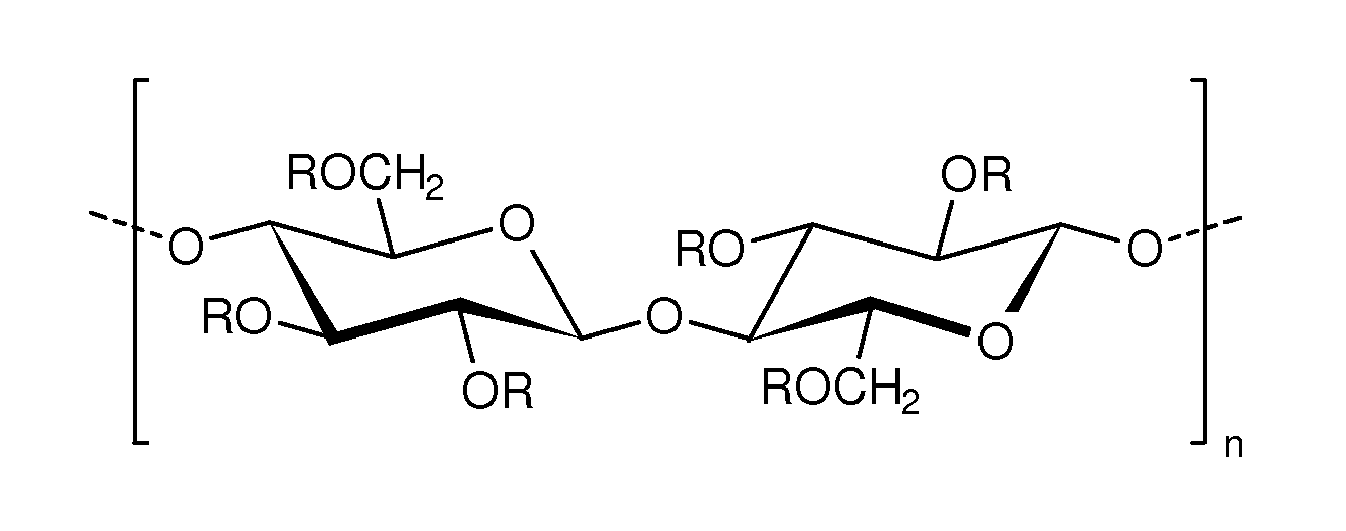
- in der R ein Wasserstoff oder eine Methylgruppe darstellen kann.
- Insbesondere vorteilhaft im Sinne der vorliegenden Erfindung sind die im allgemeinen ebenfalls als Methylcellulosen bezeichneten Cellulosemischether, die neben einem dominierenden Gehalt an Methyl- zusätzlich 2-Hydroxyethyl-, 2-Hydroxypropyl- oder 2-Hydroxybutyl-Gruppen enthalten. Besonders bevorzugt sind (Hydroxypropyl)methylcellulosen, beispielsweise die unter der Handelsbezeichnung Methocel E4M bei der Dow Chemical Comp. erhältlichen.
- Erfindungsgemäß ferner vorteilhaft ist Natriumcarboxymethylcellulose, das Natrium-Salz des Glykolsäureethers der Cellulose, für welches R in Strukturformel I ein Wasserstoff und/oder CH2-COONa darstellen kann. Besonders bevorzugt ist die unter der Handelsbezeichnung Natrosol Plus 330 CS bei Aqualon erhältliche, auch als Cellulose Gum bezeichnete Natriumcarboxymethylcellulose.
- Bevorzugt im Sinne der vorliegenden Erfindung ist ferner Xanthan (CAS-Nr. 11138-66-2), auch Xanthan Gummi genannt, welches ein anionisches Heteropolysaccharid ist, das in der Regel durch Fermentation aus Maiszucker gebildet und als Kaliumsalz isoliert wird. Es wird von Xanthomonas campestris und einigen anderen Species unter aeroben Bedingungen mit einem Molekulargewicht von 2×10⁶ bis 24×106 produziert. Xanthan wird aus einer Kette mit β-1,4-gebundener Glucose (Cellulose) mit Seitenketten gebildet. Die Struktur der Untergruppen besteht aus Glucose, Mannose, Glucuronsäure, Acetat und Pyruvat. Xanthan ist die Bezeichnung für das erste mikrobielle anionische Heteropolysaccharid. Es wird von Xanthomonas campestris und einigen anderen Species unter aeroben Bedingungen mit einem Molekulargewicht von 2-15 106 produziert. Xanthan wird aus einer Kette mit β-1,4-gebundener Glucose (Cellulose) mit Seitenketten gebildet. Die Struktur der Untergruppen besteht aus Glucose, Mannose, Glucuronsäure, Acetat und Pyruvat. Die Anzahl der Pyruvat-Einheiten bestimmt die Viskosität des Xanthans. Xanthan wird in zweitägigen Batch-Kulturen mit einer Ausbeute von 70-90 %, bezogen auf eingesetztes Kohlenhydrat, produziert. Dabei werden Ausbeuten von 25-30 g/l erreicht.
- Die Aufarbeitung erfolgt nach Abtöten der Kultur durch Fällung mit z. B. 2-Propanol. Xanthan wird anschließend getrocknet und gemahlen.
- Vorteilhafter Gelbildner im Sinne der vorliegenden Erfindung ist ferner Carrageen, ein gelbildender und ähnlich wie Agar aufgebauter Extrakt aus nordatlantischen, zu den Florideen zählenden Rotalgen (Chondrus crispus und Gigartina stellata).
- Häufig wird die Bezeichnung Carrageen für das getrocknete Algenprodukt und Carrageenan für den Extrakt aus diesem verwendet. Das aus dem Heißwasserextrakt der Algen ausgefällte Carrageen ist ein farbloses bis sandfarbenes Pulver mit einem Molekulargewichtsbereich von 100 000-800 000 und einem Sulfat-Gehalt von ca. 25 %. Carrageen, das in warmem Wasser sehr leicht löslich ist; beim Abkühlen bildet sich ein thixotropes Gel, selbst wenn der Wassergehalt 95-98 % beträgt. Die Festigkeit des Gels wird durch die Doppelhelix-Struktur des Carrageens bewirkt . Beim Carrageenan unterscheidet man drei Hauptbestandteile: Die gelbildende κ-Fraktion besteht aus D-Galactose-4-sulfat und 3,6-Anhydro-α-D-galactose, die abwechselnd in 1,3- und 1,4-Stellung glykosidisch verbunden sind (Agar enthält demgegenüber 3,6-Anhydro-α-L-galactose). Die nicht gelierende λ-Fraktion ist aus 1,3-glykosidisch verknüpften D-Galactose-2-sulfat und 1,4-verbundenen D-Galactose-2,6-disulfat-Resten zusammengesetzt u. in kaltem Wasser leicht löslich. Das aus D-Galactose-4-sulfat in 1,3-Bindung und 3,6-Anhydro-α-D-galactose-2-sulfat in 1,4-Bindung aufgebaute-Carrageenan ist sowohl wasserlöslich als auch gelbildend. Weitere Carrageen-Typen werden ebenfalls mit griechischen Buchstaben bezeichnet: α, β, γ, µ, ν, ξ, π, ω, χ. Auch die Art vorhandener Kationen (K+, NH4 +, Na+, Mg2+, Ca2+) beeinflusst die Löslichkeit der Carrageene.

- Die Verwendung von Chitosan in kosmetischen Zubereitungen ist per se bekannt. Chitosan stellt ein partiell deacyliertes Chitin dar. Dieses Biopolymer hat u.a. filmbildende Eigenschaften und zeichnet sich durch ein seidiges Hautgefühl aus. Von Nachteil ist jedoch seine starke Klebrigkeit auf der Haut, die insbesondere - vorübergehend - während der Anwendung auftritt. Entsprechende Zubereitungen können dann im Einzelfalle nicht vermarktungsfähig sein, da sie vom Verbraucher nicht akzeptiert bzw. negativ beurteilt werden. Chitosan wird bekanntermaßen beispielsweise in der Haarpflege eingesetzt. Es eignet sich, besser als das ihm zugrunde liegende Chitin, als Verdicker oder Stabilisator und verbessert die Adhäsion und Wasserresistenz von polymeren Filmen. Stellvertretend für eine Vielzahl von Fundstellen des Standes der Technik: H.P.Fiedler, "Lexikon der Hilfsstoffe für Pharmazie, Kosmetik und angrenzende Gebiete", dritte Auflage 1989, Editio Cantor, Aulendorf, S. 293, Stichwort "Chitosan".
- Chitosan ist gekennzeichnet durch folgende Strukturformel:

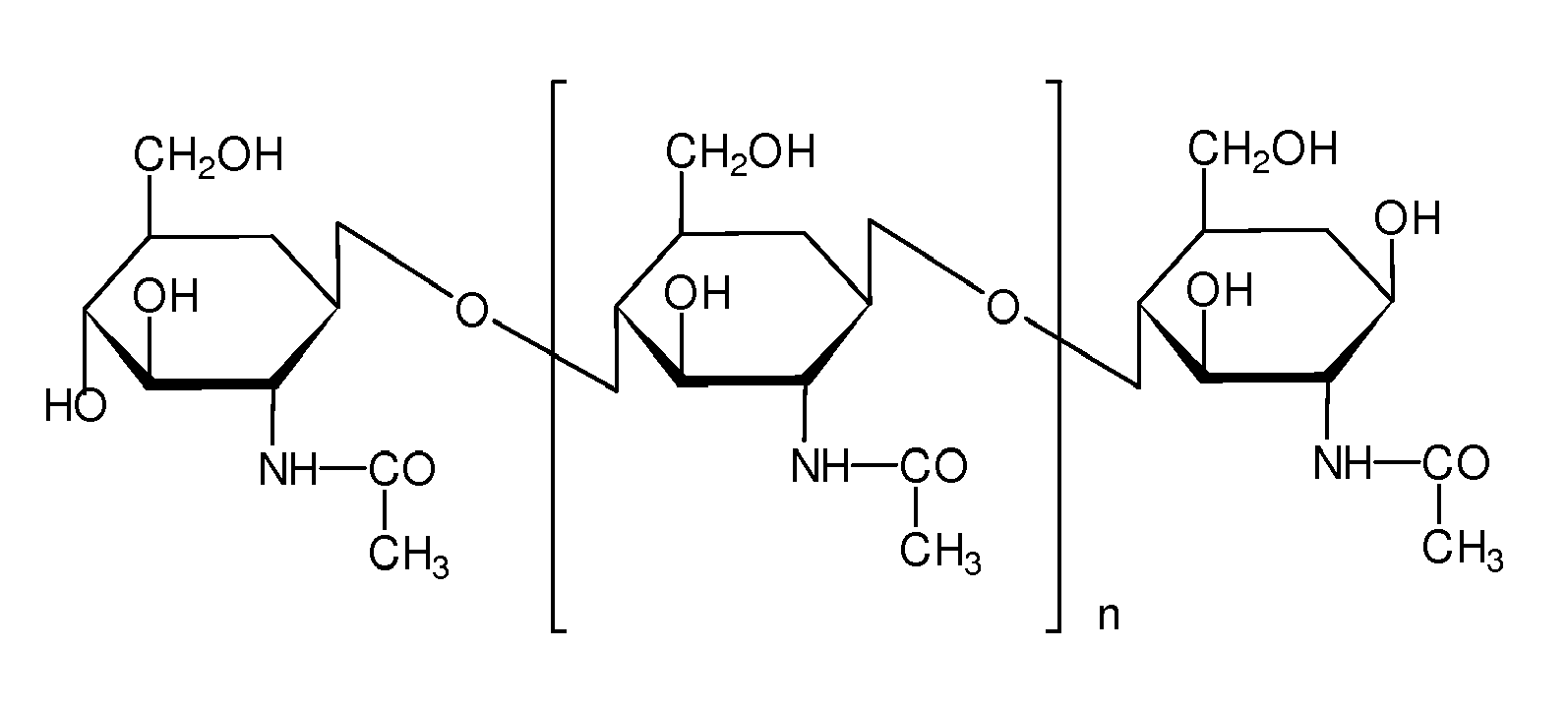 των = grch.: der Panzerrock] der Gliederfüßer (z.B. Insekten, Krebse, Spinnen) und wird auch in Stützgeweben anderer Organismen (z.B. Weichtiere, Algen, Pilze) gefunden.
- Im Bereich von etwa pH <6 ist Chitosan positiv geladen und dort auch in wässrigen Systemen löslich. Es ist nicht kompatibel mit anionischen Rohstoffen. Daher bietet sich zur Herstellung chitosanhaltiger Öl-in-Wasser-Emulsionen der Einsatz nichtionischer Emulgatoren an. Diese sind an sich bekannt, beispielsweise aus der
EP-A 776 657 - Erfindungsgemäß bevorzugt sind Chitosane mit einem Deacetylierungsgrad > 25 % , insbesondere > 55 bis 99 % [bestimmt mittels 1H-NMR]).
- Es ist von Vorteil, Chitosane mit Molekulargewichten zwischen 10.000 und 1.000.000 zu wählen, insbesondere solches mit Molekulargewichten zwischen 100.000 und 1.000.000. [bestimmt mittels Gelpermetionschromatographie].
- Polyacrylate sind ebenfalls vorteilhaft im sinne der vorliegenden Erfindung zu verwendende Gelatoren. Erfindungsgemäß vorteilhafte Polyacrylate sind Acrylat-Alkylacrylat-Copolymere, insbesondere solche, die aus der Gruppe der so genannten Carbomere oder Carbopole (Carbopol® ist eigentlich eine eingetragene Marke der B. F. Goodrich Company) gewählt werden. Insbesondere zeichnen sich das oder die erfindungsgemäß vorteilhaften Acrylat-Alkylacrylat-Copolymere durch die folgende Struktur aus:

- Darin stellen R' einen langkettigen Alkylrest und x und y Zahlen dar, welche den jeweiligen stöchiometrischen Anteil der jeweiligen Comonomere symbolisieren.
- Erfindungsgemäß besonders bevorzugt sind Acrylat-Copolymere und/oder Acrylat-Alkylacrylat-Copolymere, welche unter den Handelbezeichnungen Carbopol® 1382, Carbopol® 981 und Carbopol® 5984 von der B. F.Goodrich Company erhältlich sind.
- Ferner vorteilhaft sind Copolymere aus C10-30-Alkylacrylaten und einem oder mehreren Monomeren der Acrylsäure, der Methacrylsäure oder deren Ester, die kreuzvernetzt sind mit einem Allylether der Saccharose oder einem Allylether des Pentaerythrit.
- Vorteilhaft sind Verbindungen, die die INCI-Bezeichnung "Acrylates/C 10-30 Alkyl Acrylate Crosspolymer" tragen. Insbesondere vorteilhaft sind die unter den Handelsbezeichnungen Pemulen TR1 und Pemulen TR2 bei der B. F. Goodrich Company erhältlichen.
- Die Gesamtmenge an einem oder mehreren Verdicker wird in den fertigen kosmetischen oder dermatologischen Zubereitungen vorteilhaft kleiner als 1,5 Gew.-%, bevorzugt zwischen 0,1 und 1,0 Gew.-%, bezogen auf das Gesamtgewicht der Zubereitungen, gewählt.
- Vorteilhaft sind die erfindungsgemäßen Zubereitungen in Kombination mit nichtflüchtigen und flüchtigen Siliconölen (bevorzugt Dimethicone und Cyclomethicone) in einer Emulsion versehen. Dies hat den Vorteil, dass, dass die Folsäure länger auf der Haut verbleibt, die kosmetische Zubereitung sehr gut verteilbar ist und ein leichtes, angenehmes Hautgefühl aufweist.
- Die Bevorzugte Ausführungsform enthält mehr flüchtiges Siliconöl (Cyclomethicone) als nichtflüchtiges Siliconöl (Dimethicone).
- Erfindungsgemäß vorteilhaft sind Zubereitungen, dadurch gekennzeichnet, dass die Gewichtsverhältnisse von Folsäure und/oder deren Derivaten zu nichtflüchtigen Siliconölen zu flüchtigen Siliconölen (A : B : C) wie a : b : c gewählt wird, wobei a, b und c unabhängig voneinander rationale Zahlen von 1 bis 5, bevorzugt von 1 bis 3 darstellen.
- Erfindungsgemäß besonders vorteilhaft sind Zubereitungen, dadurch gekennzeichnet, dass die Gewichtsverhältnisse von A : B : C zwischen 1:10:100 und 1:100:200, bevorzugt von etwa 1:50:150 gewählt werden.
- Als nicht-flüchtig bezeichnet man ein Silikonöl, wenn es für mehrere Stunden auf der Haut oder den Lippen bleibt. Es hat einen Dampfdruck bei Raumtemperatur von kleiner als 0,02 mm Hg (2,66 Pa). Ein flüchtiges Silikonöl verdampft innerhalb von einer Stunde von der Haut oder den Lippen. Es hat einen Dampfdruck bei Raumtemperatur, der zwischen 0,02 mmHg und 300 mm Hg (13 Pa - 12000 Pa), bevorzugt zwischen 0,1 mmHg und 90 mm Hg (2,66 Pa - 40000 Pa) liegt.
- Demgemäß sind erfindungsgemäß vorteilhaft Zubereitungen, dadurch gekennzeichnet, dass wenigstens ein Siliconöl mit einem Dampfdruck bei Raumtemperatur kleiner als 0,02 mm Hg (2,66 Pa) sowie mindestens ein Siliconöl mit einem Dampfdruck bei Raumtemperatur zwischen 0,02 mmHg und 300 mm Hg (13 Pa - 12000 Pa), gewählt werden.
- Es wird bevorzugt, die Silicone der erfindungsgemäßen Zubereitungen aus der Gruppe der cyclischen und/oder linearen Silicone zu wählen, welche im Rahmen der vorliegenden Offenbarung auch als "Siliconöle" bezeichnet werden. Solche Silicone oder Siliconöle können als Monomere vorliegen, welche in der Regel durch Strukturelemente charakterisiert sind, wie folgt:

- Als erfindungsgemäß vorteilhaft einzusetzenden linearen Silicone mit mehreren Siloxyleinheiten werden im allgemeinen durch Strukturelemente charakterisiert wie folgt:

- Erfindungsgemäß vorteilhaft einzusetzende cyclische Silicone werden im allgemeinen durch Strukturelemente charakterisiert, wie folgt

- Vorteilhaft wird Phenyltrimethicon als Siliconöl gewählt. Auch andere Siliconöle, beispielsweise Dimethicon, Phenyldimethicon, Cyclomethicon (Octamethylcyclotetrasiloxan) beispielsweise Hexamethylcyclotrisiloxan, Polydimethylsiloxan, Poly(methylphenylsiloxan), Cetyldimethicon, Behenoxydimethicon sind vorteilhaft im Sinne der vorliegenden Erfindung zu verwenden.
- Vorteilhaft sind ferner Mischungen aus Cyclomethicon und Isotridecylisononanoat, sowie solche aus Cyclomethicon und 2-Ethylhexylisostearat.
- Die kosmetischen oder dermatologischen Zubereitungen können erfindungsgemäß wie üblich zusammengesetzt sein und zur Behandlung, der Pflege und der Reinigung der Haut und/oder der Haare und als Schminkprodukt in der dekorativen Kosmetik dienen.
- Zur Anwendung werden die kosmetischen und dermatologischen Zubereitungen erfindungsgemäß in der für Kosmetika üblichen Weise auf die Haut und/oder die Haare in ausreichender Menge aufgebracht.
- Erfindungsgemäße kosmetische und dermatologische Zubereitungen können in verschiedenen Formen vorliegen. So können sie z.B. eine Lösung, eine wasserfreie Zubereitung, eine Emulsion oder Mikroemulsion vom Typ Wasser-in-Öl (W/O) oder vom Typ Öl-in-Wasser (O/W), eine multiple Emulsionen, beispielsweise vom Typ Wasser-in-Öl-in-Wasser (W/O/W), ein Gel, einen festen Stift, eine Salbe oder auch ein Aerosol darstellen. Es ist auch erfindungsgemäß vorteilhaft, Folsäure und/oder deren Derivate in verkapselter Form darzureichen, z.B. in Kollagenmatrices und anderen üblichen Verkapselungsmaterialien, z.B. als Celluloseverkapselungen, in Gelatine, Wachsmatrices oder liposomal verkapselt. Insbesondere Wachsmatrices wie sie in der
DE-OS 43 08 282 beschrieben werden, haben sich als günstig herausgestellt. - Es ist auch möglich und vorteilhaft im Sinne der vorliegenden Erfindung, Folsäure und/oder deren Derivate in wässrige Systeme bzw. Tensidzubereitungen zur Reinigung der Haut und der Haare einzufügen.
- Die bevorzugte Anwendung der erfindungsgemäßen Zubereitungen umfassend Folsäure und/oder deren Derivate sowie mindestens ein Parfumbestandteil, insbesondere gewählt aus der Gruppe Methylbenzoat, Limonen, Citral, Linalool, alpha-Isomethylionone, Geraniol, Methyl-2 Octynoat, Citronelol, Isoeugenol, Benzylbenzoat, Benzylalkohol und/oder Benzylsalicylat, bevorzugt Methylbenzoat, Citral, Limonen, Benzylbenzoat, Isoeugenol und/oder Citronelol, bevorzugt als eine Zweier- oder Dreierkombination dieser Stoffe, ist die Verwendung als Tagescreme, Nachtcreme, Augenpflegecreme, Handcreme, Fußcreme, Haarpflegeprodukt oder Bodyserum.
- Als Kosmetikum, also keine therapeutische Verwendung, kann mit den erfindungsgemäßen Zubereitungen vorteilhaft Cellulite, Neurodermitis und/oder juckenden Hautzuständen behandelt werden.
- Die erfindungsgemäßen kosmetischen und dermatologischen Zubereitungen können kosmetische Hilfsstoffe enthalten, wie sie üblicherweise in solchen Zubereitungen verwendet werden, z.B. Konservierungsmittel, Bakterizide, Substanzen zum Verhindern des Schäumens, Farbstoffe, Pigmente, die eine färbende Wirkung haben, Verdickungsmittel, oberflächenaktive Substanzen, Emulgatoren, weichmachende, anfeuchtende und/oder feuchhaltende Substanzen, Fette, Öle, Wachse oder andere übliche Bestandteile einer kosmetischen oder dermatologischen Formulierung wie Alkohole, Polyole, Polymere, Schaumstabilisatoren, Füllstoffe, Elektrolyte, organische Lösemittel oder Silikonderivate.
- Die erfindungsgemäßen kosmetischen und dermatologischen Zubereitungen können vorteilhaft weitere Komplexbildner enthalten. Der oder die weiteren Komplexbildner können vorteilhaft aus der Gruppe der üblichen Verbindungen gewählt werden, wobei bevorzugt mindestens eine Substanz aus der Gruppe bestehend aus Weinsäure und deren Anionen, Citronensäure und deren Anionen, Aminopolycarbonsäuren und deren Anionen, Phytinsäure, Natriumhexamethaphosphat, Ethylendiamindisuccinat, Nitrilotriessigsäure (NTA) und deren Anionen, Polyphenole aus der Gruppe der Flavonoide.
- Der oder die weiteren Komplexbildner sind erfindungsgemäß vorteilhaft in kosmetischen oder dermatologischen Zubereitungen bevorzugt zu 0,01 Gew.-% bis 10 Gew.-%, bevorzugt zu 0,05 Gew.-% bis 5 Gew.-%, insbesondere bevorzugt zu 0,1 - 2,0 Gew.-%, bezogen auf das Gesamtgewicht der Zubereitungen, enthalten.
- Vorteilhaft umfasst die erfindungsgemäße Zubereitung UV-Filtersubstanzen, hierbei bevorzugt 0.1 Gew.-% bis 3.5 Gew.-%, besonders bevorzugt 0.5 Gew.-% bis 3 Gew.-%, insbesondere 1- 2 Gew.-%, bezogen auf das Gesamtgewicht der Zubereitungen, an UVA-Filtern aus der Gruppe der Triazine, insbesondere 2,4-Bis-([4-(2-ethyl-hexyloxy)-2-hydroxy]-phenyl}-6-(4-methoxyphenyl)-1,3,5-triazin (Tinosorb® S) oder 2,4-bis-[5-1 (dimethylpropyl)benzoxazol-2-yl-(4-phenyl)-imino]-6-(2-ethylhexyl)-imino-1,3,5-triazin (CAS Nr. 288254-16-0).
- Ferner bevorzugt ist der Zusatz von 0.01 Gew.-% bis 0.4 Gew.-%, besonders bevorzugt 0.1 Gew.-% bis 0.4 Gew.-%, insbesondere 0.2 bis 0.3 Gew.-%, bezogen auf das Gesamtgewicht der Zubereitungen, an Ethylendiamintetraacetat.
- Vorteilhafte weitere UV-Filtersubstanzen im Sinne der vorliegenden Erfindung sind sulfonierte, wasserlösliche UV-Filter, wie z. B.:
- Phenylen-1,4-bis-(2-benzimidazyl)-3,3'-5,5'-tetrasulfonsäure und ihre Salze, besonders die entsprechenden Natrium-, Kalium- oder Triethanolammonium-Salze, insbesondere das Phenylen-1,4-bis-(2-benzimidazyl)-3,3'-5,5'-tetrasulfonsäure-bis-natriumsalz mit der INCI-Bezeichnung Disodium Phenyl Dibenzimidazol Tetrasulfonat (CAS-Nr.: 180898-37-7), welches beispielsweise unter der Handelsbezeichnung Neo Heliopan AP bei Haarmann & Reimer erhältlich ist;
- Salze der 2-Phenylbenzimidazol-5-sulfonsäure, wie ihr Natrium-, Kalium- oder ihr Triethanolammonium-Salz sowie die Sulfonsäure selbst mit der INCI Bezeichnung Phenylbenzimidazole Sulfonsäure (CAS.-Nr. 27503-81-7), welches beispielsweise unter der Handelsbezeichnung Eusolex 232 bei Merck oder unter Neo Heliopan Hydro bei Haarmann & Reimer erhältlich ist;
- 1,4-di(2-oxo-10-Sulfo-3-bornylidenmethyl)-Benzol (auch: 3,3'-(1,4-Phenylendimethylene)-bis-(7,7-dimethyl-2-oxo-bicyclo-[2.2.1]hept-1-ylmethan Sulfonsäure) und dessen Salze (besonders die entprechenden 10-Sulfato-verbindungen, insbesondere das entsprechende Natrium-, Kalium- oder Triethanolammonium-Salz), das auch als Benzol-1,4-di(2-oxo-3-bornylidenmethyl-10-sulfonsäure) bezeichnet wird. Benzol-1,4-di(2-oxo-3-bornylidenmethyl-10-sulfonsäure) hat die INCI-Bezeichnung Terephtalidene Dicampher Sulfonsäure (CAS.-Nr.: 90457-82-2) und ist beispielsweise unter dem Handelsnamen Mexoryl SX von der Fa. Chimex erhältlich;
- Sulfonsäure-Derivate des 3-Benzylidencamphers, wie z. B. 4-(2-Oxo-3-bornylidenmethyl)-benzolsulfonsäure, 2-Methyl-5-(2-oxo-3-bornylidenmethyl)sulfonsäure und deren Salze. Vorteilhafte UV-Filtersubstanzen im Sinne der vorliegenden Erfindung sind ferner so genannte Breitbandfilter, d.h. Filtersubstanzen, die sowohl UV-A- als auch UV-B-Strahlung absorbieren.
- Vorteilhafte Breitbandfilter oder UV-B-Filtersubstanzen sind beispielsweise Triazinderivate, wie z. B.
- Dioctylbutylamidotriazon (INCI: Dioctylbutamidotriazone), welches unter der Handelsbezeichnung UVASORB HEB bei Sigma 3V erhältlich ist;
- 4,4',4"-(1,3,5-Triazin-2,4,6-triyltriimino)-tris-benzoesäure-tris(2-ethylhexylester), auch: 2,4,6-Tris-[anilino-(p-carbo-2'-ethyl-1'-hexyloxy)]-1,3,5-triazin (INCI: Octyl Triazone), welches von der BASF Aktiengesellschaft unter der Warenbezeichnung UVINUL® T 150 vertrieben wird;
- 2-[4,6-Bis(2,4-dimethylphenyl)-1,3,5-triazin-2-yl]-5-(octyloxy)phenol (CAS Nr.: 2725-22-6).
- Ein vorteilhafter Breitbandfilter im Sinne der vorliegenden Erfindung ist auch das 2,2'-Methylen-bis-(6-(2H-benzotriazol-2-yl)-4-(1,1,3,3-tetramethylbutyl)-phenol), welches unter der Handelsbezeichnung Tinosorb® M bei der CIBA-Chemikalien GmbH erhältlich ist.
- Vorteilhafter Breitbandfilter im Sinne der vorliegenden Erfindung ist ferner das 2-(2H-benzotriazol-2-yl)-4-methyl-6-[2-methyl-3-[1,3,3,3-tetramethyl-1-[(trimethylsilyl)oxy]disiloxanyl]propyl]-phenol (CAS-Nr.: 155633-54-8) mit der INCI-Bezeichnung Drometrizole Trisiloxane.
- Die weiteren UV-Filtersubstanzen können öllöslich oder wasserlöslich sein. Vorteilhafte öllösliche Filtersubstanzen sind z. B.:
- 3-Benzylidencampher-Derivate, vorzugsweise 3-(4-Methylbenzyliden)campher, 3-Benzylidencampher;
- 4-Aminobenzoesäure-Derivate, vorzugsweise 4-(Dimethylamino)-benzoesäure(2-ethylhexyl)ester, 4-(Dimethylamino)benzoesäureamylester;
- 2,4,6-Trianilino-(p-carbo-2'-ethyl-1'-hexyloxy)-1,3,5-triazin;
- Ester der Benzalmalonsäure, vorzugsweise 4-Methoxybenzalmalonsäuredi(2-ethylhexyl)-ester;
- Ester der Zimtsäure, vorzugsweise 4-Methoxyzimtsäure(2-ethylhexyl)ester, 4-Methoxyzimtsäureisopentylester;
- Derivate des Benzophenons, vorzugsweise 2-Hydroxy-4-methoxybenzophenon, 2-Hydroxy-4-methoxy-4'-methylbenzophenon, 2,2'-Dihydroxy-4-methoxybenzophenon sowie
- an Polymere gebundene UV-Filter.
- Es ist ebenfalls vorteilhaft, den Zubereitungen im Sinne der vorliegenden Erfindung übliche Antioxidantien zuzufügen. Erfindungsgemäß können als günstige Antioxidantien alle für kosmetische und/oder dermatologische Anwendungen geeigneten oder gebräuchlichen Antioxidantien verwendet werden.
- Die Menge der Antioxidantien (eine oder mehrere Verbindungen) in den Zubereitungen beträgt vorzugsweise 0,001 bis 30 Gew.-%, besonders bevorzugt 0,05 - 20 Gew.-%, insbesondere 1 - 10 Gew.-%, bezogen auf das Gesamtgewicht der Zubereitung.
- Sofern die kosmetische oder dermatologische Zubereitung im Sinne der vorliegenden Erfindung eine Lösung oder Emulsion oder Dispersion darstellt, können als Lösungsmittel verwendet werden:
- Wasser oder wässrige Lösungen
- Öle, wie Triglyceride oder pflanzliche Öle, z.B. Caprylsäure/ Caprinsäuretriglyceride, Triisostearin, Avocadoöl, Kokosfettsäureglyceride, Macadamiaöl, Mandelöl, Jojobaöl, Rizinulsöl, Nachtkerzenöl oder Traubenkernöl
- Fette, Wachse und andere natürliche und synthetische Fettkörper, vorzugsweise Ester von Fettsäuren mit Alkoholen niedriger C-Zahl, z.B. mit Isopropanol, Propylenglykol oder Glycerin, oder Ester von Fettalkoholen mit Alkansäuren niedriger C-Zahl oder mit Fettsäuren; z.B. Mineralöl, Dibutyladipat, Pentaerythrityltetraisostearat, Isopropylmyristat, Isopropylpalmitat, Isopropylstearat, Dicaprylylcarbonat, Caprylylether, Alkylbenzoat, Cetearylisononanoat, Alkyltartrat, Alkyllaktat, Polydecen, Isohexadecan, Octyldeceylmyristat, Squalan, Octylcocoat, Octyldodecanol, Butylenglykolcaprylat/caprat, Dicaprylylcarbonat
- Silikonöle, wie z.B. Cyclomethicon, Dimethicon, Phenyltrimeticon
- Alkohole, Diole oder Polyole niedriger C-Zahl, sowie deren Ether, vorzugsweise Ethanol, Isopropanol, Propylenglykol, Glycerin, Ethylenglykol, Ethylenglykolmonoethyl- oder - monobutylether, Propylenglykolmonomethyl, -monoethyl- oder -monobutylether, Diethylenglykolmonomethyl- oder -monoethylether und analoge Produkte.
- Insbesondere werden Gemische der vorstehend genannten Lösungsmittel verwendet. Bei alkoholischen Lösungsmitteln kann Wasser ein weiterer Bestandteil sein.
- Als Treibmittel für aus Aerosolbehältern versprühbare kosmetische und/oder dermatologische Zubereitungen im Sinne der vorliegenden Erfindung sind die üblichen bekannten leichtflüchtigen, verflüssigten Treibmittel, beispielsweise Kohlenwasserstoffe (Propan, Butan, Isobutan) geeignet, die allein oder in Mischung miteinander eingesetzt werden können. Auch Druckluft ist vorteilhaft zu verwenden.
- Natürlich weiß der Fachmann, dass es an sich nichttoxische Treibgase gibt, die grundsätzlich für die Verwirklichung der vorliegenden Erfindung in Form von Aerosolpräparaten geeignet wären, auf die aber dennoch wegen bedenklicher Wirkung auf die Umwelt oder sonstiger Begleitumstände verzichtet werden sollte, insbesondere Fluorkohlenwasserstoffe und Fluorchlorkohlenwasserstoffe (FCKW).
- Erfindungsgemäße als Emulsionen vorliegende Zubereitungen enthalten einen oder mehrere Emulgatoren. Diese Emulgatoren können vorteilhaft ausgewählt werden aus der Gruppe der nichtionischen, anionischen, kationischen oder amphoteren Emulgatoren. Beispiele sind u.a. PEG-40-Stearat , Sorbitanstearat, Glycerylstearatcitrat, Stearinsäure, oder Zuckerester, wie Polyglyceryl-3 Methylglucosedistearat:, Cetearylglucoside.
- Weiterhin können zur Verbesserung des Hautgefühls Füllstoffe, wie z.B. Silica, Lauroyllysin, Polyethylen, Mica, Nylon oder Stärkederivate, wie z.B. Tapiokastärke, Aluminium Starch Octenylsuccinate, Distarchphosphat eingesetzt werden.
- Erfindungsgemäß können weitere Antioxidantien und Wirkstoffe, wie z.B. Vitamin A und Derivate (Vitamin-A-Palmitat), Vitamin C und Derivate (Ascorbylalmitat, Mg-Ascorbylphosphat), Vitamin E und Derivate, ungesättigte Fettsäuren und Derivate (Linolsäure, Linolensäure, Ölsäure), alpha-Glucosylrutin, Ubiquinon (Q10), Harnstoff, Pflanzenextrakte, Ginko, Soja, Aloe Vera, Süßholz, Hamamelis, Bisabolol, Ginseng, Gurke, Biotin, Carotinoide, Taurin, Isoflavonoide, Licochalkon, Dydydroxyaceton, Aminosäuren, Zinkoxid, Panthenol, Dioic acid, enthalten sein.
- Weiterhin können zur Verbesserung der Hautpflegeeigenschaften Moisturizer wie z.B. Glycerin, Butylenglykol, Propylen Glykol, Methylpropandiol, Ethylhexylglycerin, Sorbitol oder Harnstoff zugesetzt werden.
- Zuberereitungen gemäß der vorliegenden Erfindung können auch Konservierungsmittel und Konservierungshelfer, wie z.B. Phenoxyethanol, Parabene, Benzylalkohol, Hexamidin Diisethionat, Jodopropyl Butylcarbamat, Diazolidinyl Urea, Hydantoin, Sorbinsäure und ihre Salze, Benzoesäure oder Methyldibromoglutaronitril enthalten.
- Es folgen vorteilhafte Ausführungsbeispiele der vorliegenden Erfindung.
-
Beispielrezeptur 1 Gew.-% Glycerylstearat 2,6 Stearylalkohol 2 PEG-40-Stearat 0,8 Weiße Vaseline 3 Cetylalkohol 4 Sheabutter 3 Titandioxid 0,5 Butylmethoxydibenzoylmethan 2 Lineares Silikonöl (Dimethicon) 0,5 Tapiokastärke 1 Methylparaben 0,2 Tocopherolacetat 0,5 Phenylbenzimidazolsulfonsäure Natrium-Salz 1,5 Ethlyhexylmethoxycinnamat 7 Phenoxyethanol 0,4 C12-15 Alkylbenzoat 3 Propylparaben 0,1 Ethylparaben 0,1 Kreatin 0,2 Kreatinin 0,05 Folsäure 0,03 Glycerin 8,7 Polyacrylsäure, Na-Salz 0,1 Carrageenan 0,2 Ethylhexylglycerin 0,5 Na3EDTA 0,2 Limonen 0,0025 Caprylic/Caprictriglycerid 1 Methylpropanediol 4 Wasser 100% ad 100 -
Beispielrezeptur 2 Gew.-% Tapiokastärke 2 Cetylalkohol 2 Glycerylstearatcitrat 2 Sheabutter 4 Hydrierte Kokosglyceride 3 Ethlyhexylmethoxycinnamat 5 Phenoxyethanol 0,4 Kreatinin 0,05 Lineares Silikonöl (Dimethicon) 1,5 Zyklisches Silikonöl (Cyclomethicon) 5 Caprylylcarbonat 5 Nylon-12 1,5 Tocopherylacetat 1 Squalan 2 Avocadoöl 1 Carrageenan 0,1 Polyacrylsäure, Na-Salz 0,1 Methylpropanediol 4 Kreatin 0,2 Methylparaben 0,15 Folsäure 0,03 Glycerin 8,7 Na3EDTA 0,2 Methylbenzoat + Citral 0,0004 Butylenglykol + lodopropynylbutylcarbamat 0,09 C12-15 Alkylbenzoat 3 Acrylates/C10-30 Alkyl Acrylate Crosspolymer 0,1 1,2-Hexanediol 0,5 Wasser ad 100 -
Beispielrezeptur 3 Gew.-% Glycerylstearat 2,6 Hydriertes Pflanzenöl 1,5 PEG-40-Stearat 0,8 Weiße Vaseline 1,5 Cetylstearylalkohol 1,5 Sheabutter 3 Titandioxid 5 Lineares Silikonöl (Dimethicon) 2,5 Tapiokastärke 1,5 Methylparaben 0,21 Tocopherolacetat 0,5 Nylon-12 1,5 Phenoxyethanol 0,4 C12-15 Alkylbenzoat 2 Zyklisches Silikonöl (Cyclomethicon) 4 Propylparaben 0,05 Ethylparaben 0,11 Methylpropanediol 2 Kreatin 0,2 Kreatinin 0,05 Octyldodecanol 2 Folsäure 0,03 Glycerin 6,5 Polyacrylsäure, Na-Salz 0,1 Caprylylglycol 0,25 Na3EDTA 0,2 Benzyl Benzoat 0,0025 Caprylic/Caprictriglycerid 2 Wasser 100% ad 100 -
Beispielrezeptur 4 Gew.-% Glycerylstearat 2 Squalan 1,5 PEG-40-Stearat 1 Medizinisches Weißöle (Gemisch verschiedener Viskositäten) 15,1 Stearylalkohol 3,5 Hydrierte Kokosglyceride 3 Lineares Silikonöl (Dimethicon) 0,5 Myristylmyristat 1,5 Methylparaben 0,3 Tocopherolacetat 0,5 Nylon-12 1,5 Phenoxyethanol 0,5 C12-15 Alkylbenzoat 2 Zyklisches Silikonöl (Cyclomethicon) 4 Propylparaben 0,1 Ethylparaben 0,11 Methylpropanediol 2 Kreatin 0,5 Kreatinin 0,01 Octyldodecanol 2 Butylmethoxydibenzoylmethan 0,5 Octocrylene 6 Folsäure 0,003 Glycerin 10 Polyacrylsäure, Na-Salz 0,02 Caprylylglycol 0,25 Na3EDTA 0,2 Isoeugenol + Citronelol 0,0035 Caprylic/Caprictriglycerid 2 Wasser 100% ad 100 -
Beispielrezeptur 5 Gew.-% Caprylsäure/Caprinsäuretriglyceride 3 Sorbitanstearat 1 Stearylalkohol 1 Polyglyceryl-3 Methylglucosedistearat: 3 2,4-bis-[5-1 (dimethylpropyl)benzoxazol-2-yl-(4-phenyl)-imino]-6-(2-ethylhexyl)-imino-1,3,5-triazin (CAS Nr. 288254-16-0) 1 Butyl Methoxydibenzoylmethane 1 Ethlyhexylmethoxycinnamat 3 Ethylhexyltriazon 1 Lineares Silikonöl (Dimethicon) 2 Zyklisches Silikonöl (Cyclomethicon) 4 C12-15 Alkylbenzoat 2 Dicaprylylether 2 Carrageenan 0,1 Vernetztes Alkylacrylat (Alkylacrylate Crosspolymer) 0,1 Kreatin 0,4 Folsäure 0,05 Glycerin 8 Methyl-2 Octynoat 0,001 Na3EDTA 0,2 Licochalkon A 0,02 Ethylhexylglycerin 0,4 Citronensäure, Natriumsalz (pH 6.5) q.s. Wasser ad 100 -
Beispielrezeptur 6 Gew.-% Glycerylstearat 2,5 PEG-40-Stearat 1 Cetylalkohol 2,5 C12-15 Alkylbenzoat 2 Hydrierte Kokosfettglyceride 2 Octyldodecanol 2 Zyklisches Silikonöl (Cyclomethicon) 2 Bienenwachs 1 Ethylhexylmethoxycinnamat 6 Phenylbenzimidazolsulfonsäure 2 Natriumascorbylphosphat 0,1 Methylpropandiol 2 Diazolidinylharnstoff 0,1 Carrageenan 0,1 Polyacrylsäure, Na-Salz 0,1 Isoeugenol + Benzylbenzoat 0,2 Glycerin 7 Folsäure 0,03 Na3EDTA 0,2 2,4-Bis-{[4-(2-ethyl-hexyloxy)-2-hydroxy]-phenyl}-6-(4-methoxyphenyl)-1,3,5-triazin (Tinosorb® S) 2 Natronlauge (pH 6.8) q.s. Wasser ad 100 -
O/W - Emulsionen 7 8 9 10 Parfum 0,3 0,3 Na3HEDTA 0,5 1 0,5 1 Glycerin 10 7,5 7,5 25 Glycerylstearatcitrat 2 2,5 PEG-40 Stearat 1,0 0,7 Glycerylstearat SE 2,5 2,5 Stearylalkohol 2 3 1 1,5 Cetylalkohol 2 1 Polyacrylsäure, Na-Salz 0,1 0,25 0,3 0,1 Acrylate/C10-30 Alkylacrylat Crosspolymer 0,2 0,3 0,1 0,2 Chondrus Crispus 0,2 Myristylmyristat 1 1 C12-15 Alkylbenzoat 2 4 2 4 Octyldodecanol 2 2 Caprylsäure/Caprinsäuretriglyceride 1 2 1 2 Medizinisches Weißöl 3 2 Butyrospermum Parkii 3 3 Lineares Silikonöl (Dimethicon) 1 2 1 3 Zyklisches Silikonöl (Cyclomethicon) 3 4 1,6 3 Methylparaben 0,4 0,3 0,2 Phenoxyethanol 0,4 0,6 0,4 0,5 Diazolidinylharnstoff 0,2 Ethylhexylglycerin 0,3 Caprylglycol 0,25 1,2-Hexandiol 0,5 0,5 Methylpropandiol 3 2 2 Butylmethoxydibenzoylmethan 2 3 Ethylhexylmethoxycinnamat 5 7 Phenylbenzimidazolsulfonsäure 2 2 Nylon-12 1,5 1,5 Titandioxid hydrophil gecoated 5 Titandioxid hydrophob gecoated 0,5 2 1,5 0,5 Tapiocastärke 2 1,5 3 Talkum 1,5 2 0,5 Tocopherolacetat 0,5 1 1 1,5 Citral + alpha-Isomethyl lonone + Benzylsalicylat 0,002 0,01 0,25 0,0035 Folsäure 0,05 0,1 0,025 0,1 Kreatin 0,2 0,5 0,2 0,1 Kreatinin 0,2 0,1 0,05 0,1 Wasser Ad 100 Ad 100 Ad 100 Ad 100
Claims (15)
- Kosmetische oder dermatologische Zubereitungen mit einem Gehalt an Folsäure und/oder deren Derivaten umfassend mindestens ein Parfumbestandteil gewählt aus der Gruppe 2-Isobutyl-4-hydroxy-4-methyltetrahydropyran, 2-tert-Pentylcyclohexylacetat, 3-Methyl-5-phenyl-1-pentanol, 7-Acetyl-1,1,3,4,4,6-hexamethyltetralin, Adipinsäurediester, alpha-Amylcinnamaldehyd, alpha-Isomethylionon, Alpha-Methylionon, Amyl C Butylphenylmethylpropionalcinnamal, Amylsalicylat, Amylcinnamylalkohol, Anisalkohol, Benzoin, Benzylalkohol, Benzylbenzoat, Benzylcinnamat, Benzylsalicylat, Bergamotöl, bitteres Orangenöl, Butylphenylmethylpropioal, Cardamomöl, Cedrol, Cinnamal, Cinnamylalkohol, Citral, Citronellol, Citronellylmethylcrotonat, Citronenöl, Coumarin, Diethylsuccinat, d-Limonene, Ethyllinalool, Eugenol, Evernia Furfuracea Extract, Evernia Prunastri Extract, Farnesol, Geraniol, Guajakholzöl, Hexylcinnamal, Hexylsalicylat, Hydroxycitronellal, Hydroxyisohexyl 3-Cyclohexencarboxaldehyde, Isoeugenol, Lavendelöl, Lemonenöl, Limonen, Linalool, Linaylacetat, Mandarinenöl, Menthyl PCA, Methyl 2-Octynoat, Methylbenzoat, Methylheptenon, Muskatnussöl, Rosmarinöl, süßes Orangenöl, Terpineol, Tonkabohnenöl, Triethylcitrat und/oder Vanillin.
- Kosmetische oder dermatologische Zubereitungen nach Anspruch 1, dadurch gekennzeichnet, dass als Parfumbestandteil mindestens ein Bestandteil aus der Gruppe Methylbenzoat, Limonen, Citral, Linalool, alpha-Isomethylionone, Geraniol, Methyl-2 Octynoat, Citronelol, Isoeugenol, Benzylbenzoat, Benzylalkohol und/oder Benzylsalicylat gewählt werden.
- Kosmetische oder dermatologische Zubereitungen nach Anspruch 1, dadurch gekennzeichnet, dass als Parfumbestandteil mindestens ein Bestandteil aus der Gruppe Methylbenzoat, Citral, Limonen, Benzylbenzoat, Isoeugenol und/oder Citronelol gewählt wird
- Kosmetische oder dermatologische Zubereitungen nach Anspruch 1, 2 oder 3, dadurch gekennzeichnet, dass aus den Parfumbestandteilen zwei, drei, vier oder fünf Bestandteile ausgewählt werden.
- Kosmetische oder dermatologische Zubereitungen nach einem der vorstehenden Ansprüche, dadurch gekennzeichnet, dass sie 0,001 Gew.-% bis 0,5 Gew.-%, besonders bevorzugt 0,005 Gew.-% bis 0,2 Gew.-%, insbesondere 0,01 bis 0,1 Gew.-%, bezogen auf das Gesamtgewicht der Zubereitungen, an Folsäure und/oder deren Derivaten enthalten.
- Kosmetische oder dermatologische Zubereitungen nach einem der vorstehenden Ansprüche, dadurch gekennzeichnet, dass der Anteil an einem oder mehreren Parfumbestandteilen mindestens 0,00001 Gew.-%, bevorzugt mindestens 0,001 Gew.-%, bezogen auf die Gesamtmasse der Zubereitung, beträgt.
- Kosmetische oder dermatologische Zubereitungen nach einem der vorstehenden Ansprüche, dadurch gekennzeichnet, dass der Anteil an einem oder mehreren Parfumbestandteilen maximal 1 Gew.-%, bevorzugt maximal 0,4 Gew.-%, bezogen auf die Gesamtmasse der Zubereitung, beträgt.
- Kosmetische oder dermatologische Zubereitungen nach einem der vorstehenden Ansprüche umfassend ein oder mehrere Polyole, insbesondere Polyole, die 2 bis 3 Sauerstoffatome und mindestens 4 Kohlenstoffatome enthalten.
- Kosmetische oder dermatologische Zubereitungen nach einem der vorstehenden Ansprüche umfassend ein oder mehrere Füllstoffe und/oder Verdicker.
- Kosmetische oder dermatologische Zubereitungen nach einem der vorstehenden Ansprüche umfassend nichtflüchtige und/oder flüchtigen Siliconölen, insbesondere Dimethicone und/oder Cyclomethicone.
- Kosmetische oder dermatologische Zubereitungen nach Anspruch 10, dadurch gekennzeichnet, dass die Gewichtsverhältnisse von Folsäure und/oder deren Derivaten (A) zu nichtflüchtigen Siliconölen (B) zu flüchtigen Siliconölen (C) wie a : b : c gewählt wird, wobei a, b und c unabhängig voneinander rationale Zahlen von 1 bis 5, bevorzugt von 1 bis 3 darstellen
- Verwendung von mindestens einem Parfumbestandteile gewählt aus der Gruppe 2-Isobutyl-4-hydroxy-4-methyltetrahydropyran, 2-tert-Pentylcyclohexylacetat, 3-Methyl-5-phenyl-1-pentanol, 7-Acetyl-1,1,3,4,4,6-hexamethyltetralin, Adipinsäurediester, alpha-Amylcinnamaldehyd, alpha-Isomethylionon, Alpha-Methylionon, Amyl C Butylphenylmethylpropionalcinnamal, Amylsalicylat, Amylcinnamylalkohol, Anisalkohol, Benzoin, Benzylalkohol, Benzylbenzoat, Benzylcinnamat, Benzylsalicylat, Bergamotöl, bitteres Orangenöl, Butylphenylmethylpropioal, Cardamomöl, Cedrol, Cinnamal, Cinnamylalkohol, Citral, Citronellol, Citronellylmethylcrotonat, Citronenöl, Coumarin, Diethylsuccinat, d-Limonene, Ethyllinalool, Eugenol, Evernia Furfuracea Extract, Evernia Prunastri Extract, Farnesol, Geraniol, Guajakholzöl, Hexylcinnamal, Hexylsalicylat, Hydroxycitronellal, Hydroxyisohexyl 3-Cyclohexencarboxaldehyde, Isoeugenol, Lavendelöl, Lemonenöl, Limonen, Linalool, Linaylacetat, Mandarinenöl, Menthyl PCA, Methyl 2-Octynoat, Methylbenzoat, Methylheptenon, Muskatnussöl, Rosmarinöl, süßes Orangenöl, Terpineol, Tonkabohnenöl, Triethylcitrat und/oder Vanillin zur Verbesserung der olfaktorische Eigenschaften Folsäure-haltiger und/oder deren Derivate enthaltende kosmetische und/oder dermatologische Zubereitungen.
- Verwendung von mindestens einem Parfumbestandteile gemäß Anspruch 12 zur Stabilisierung von Folsäure und/oder deren Derivate in kosmetischen und/oder dermatologischen Zubereitungen.
- Verwendung der Zubereitungen nach einem der vorstehenden Ansprüche als Tagescreme, Nachtcreme, Augenpflegecreme, Handcreme, Fußcreme, Haarpflegeprodukt oder Bodyserum.
- Verwendung der Zubereitungen nach einem der vorstehenden Ansprüche zur nichttherapeutischen Behandlung von Cellulite, Neurodermitis und/oder juckenden Hautzuständen.
Applications Claiming Priority (1)
| Application Number | Priority Date | Filing Date | Title |
|---|---|---|---|
| DE102006035789A DE102006035789A1 (de) | 2006-07-28 | 2006-07-28 | Kosmetische Zubereitung umfassend Folsäure und Parfumbestandteile |
Publications (2)
| Publication Number | Publication Date |
|---|---|
| EP1882471A2 true EP1882471A2 (de) | 2008-01-30 |
| EP1882471A3 EP1882471A3 (de) | 2015-05-27 |
Family
ID=38805707
Family Applications (1)
| Application Number | Title | Priority Date | Filing Date |
|---|---|---|---|
| EP07110723.9A Ceased EP1882471A3 (de) | 2006-07-28 | 2007-06-21 | Kosmetische Zubereitung umfassend Folsäure und Parfümbestandteile |
Country Status (2)
| Country | Link |
|---|---|
| EP (1) | EP1882471A3 (de) |
| DE (1) | DE102006035789A1 (de) |
Cited By (2)
| Publication number | Priority date | Publication date | Assignee | Title |
|---|---|---|---|---|
| WO2009099890A3 (en) * | 2008-02-01 | 2009-11-05 | Mary Kay Inc. | Methods of treating skin with aromatic skin-active ingredients |
| US9987209B2 (en) | 2013-04-09 | 2018-06-05 | Arch Chemicals, Inc. | Multi-functional composition for cosmetic formulations |
Family Cites Families (9)
| Publication number | Priority date | Publication date | Assignee | Title |
|---|---|---|---|---|
| ATE374T1 (de) * | 1978-07-21 | 1981-11-15 | Unilever Nv | Zusammensetzung und verfahren fuer die haarbehandlung. |
| US4272512A (en) * | 1980-01-31 | 1981-06-09 | Colgate-Palmolive Company | Antigingivitis composition |
| DE4341001A1 (de) * | 1993-12-02 | 1995-06-08 | Beiersdorf Ag | Topische Zubereitungen mit einem Gehalt an L-Arginin |
| EP1008587A1 (de) * | 1998-12-08 | 2000-06-14 | Givaudan Roure (International) S.A. | Serin-carbonate |
| DE10062401A1 (de) * | 2000-12-14 | 2002-06-20 | Beiersdorf Ag | Verwendung von Folsäure und/oder deren Derivaten zur Herstellung kosmetischer oder dermatologischer Zubereitungen zur Prophylaxe von Schäden an der hauteigenen DNA und/oder zur Reparatur bereits eingetretener Schäden an der hauteigenen DNA |
| DE10115840A1 (de) * | 2001-03-30 | 2002-10-10 | Basf Ag | Retinylcarbonate in Kosmetika und Dermatika |
| DE10141472A1 (de) * | 2001-08-29 | 2003-03-20 | Beiersdorf Ag | Stabililsierung oxidations- und/oder UV-empfindlicher Wirkstoffe |
| DE10160681A1 (de) * | 2001-12-11 | 2003-06-18 | Cognis Deutschland Gmbh | Emollients und kosmetische Zusammensetzungen |
| JP2004203839A (ja) * | 2002-12-26 | 2004-07-22 | Takasago Internatl Corp | 鉄錆臭抑制香料組成物 |
-
2006
- 2006-07-28 DE DE102006035789A patent/DE102006035789A1/de not_active Ceased
-
2007
- 2007-06-21 EP EP07110723.9A patent/EP1882471A3/de not_active Ceased
Non-Patent Citations (1)
| Title |
|---|
| None * |
Cited By (5)
| Publication number | Priority date | Publication date | Assignee | Title |
|---|---|---|---|---|
| WO2009099890A3 (en) * | 2008-02-01 | 2009-11-05 | Mary Kay Inc. | Methods of treating skin with aromatic skin-active ingredients |
| US8399521B2 (en) | 2008-02-01 | 2013-03-19 | Mary Kay Inc. | Methods of treating skin with aromatic skin-active ingredients |
| EA020293B1 (ru) * | 2008-02-01 | 2014-10-30 | Мэри Кэй Инк. | Применение композиции, содержащей этил-линалул, для ухода за кожей |
| US12280017B2 (en) | 2008-02-01 | 2025-04-22 | Mary Kay Inc. | Methods of treating skin with aromatic skin-active ingredients |
| US9987209B2 (en) | 2013-04-09 | 2018-06-05 | Arch Chemicals, Inc. | Multi-functional composition for cosmetic formulations |
Also Published As
| Publication number | Publication date |
|---|---|
| EP1882471A3 (de) | 2015-05-27 |
| DE102006035789A1 (de) | 2008-01-31 |
Similar Documents
| Publication | Publication Date | Title |
|---|---|---|
| EP0934053B1 (de) | Kosmetische oder dermatologische mikroemulsion | |
| EP0930866B1 (de) | Kosmetische oder dermatologische gele auf der basis von mikroemulsionen | |
| DE10143964A1 (de) | Emulgatorarme oder emulgatorfreie Systeme vom Typ Öl-in-Wasser mit einem Gehalt an Stabilisatoren und einem aminosubstituierten Hydroxybenzophenon | |
| JP2024506865A (ja) | スキンケア組成物及びその使用方法 | |
| EP1077059A2 (de) | Kosmetische oder dermatologische Zubereitungen von Typ Öl-in-Wasser | |
| EP0987001A2 (de) | Emulgatorfreie feindisperse Systeme vom Type Öl-in-Wasser und Wasser-in-Öl | |
| DE102004014615A1 (de) | Taurinhaltige Zubereitungen zur Verbesserung der Hautbarriere | |
| EP0987006A2 (de) | Emulgatorfreie feindisperse Systeme vom Typ Wasser-in-Öl | |
| EP0987003A2 (de) | Emulgatorfreie feindisperse Systeme vom Typ Öl-in-Wasser und Wasser-in-Öl | |
| DE10143960A1 (de) | Kosmetische und dermatologische Zubereitungen in Stiftform, enthaltend ein aminosubstituiertes Hydroxybenzophenon | |
| JP2004519499A (ja) | 有機ヒドロコロイドおよび粒状の疎水性のおよび/または疎水化されたおよび/または油−吸収性固体物質を含んで成る自己発泡性またはムース−タイプの調製物 | |
| EP1077058A2 (de) | Emulgatorfreie feindisperse Systeme vom Typ Wasser-in-Öl | |
| EP1993507A1 (de) | Kosmetische zubereitungen mit einem zusatz aus der baobab-pflanze | |
| EP1200039A2 (de) | Emulgatorfreie feindisperse systeme vom typ wasser-in-öl | |
| DE10155966A1 (de) | Emulgatorfreie kosmetische und dermatologische Lichtschutzformulierungen mit einem Gehalt an Hydroxybenzophenonen | |
| DE10036316A1 (de) | Kosmetische Puderformulierungen | |
| DE102007028027A1 (de) | Schnell Sauerstoff freisetzende kosmetische Zubereitungen | |
| EP2100593A1 (de) | Mischungen mit Collagensynthese steigernder Wirkung | |
| DE10252757B4 (de) | Kosmetische und/oder dermatologische Zubereitung in der Form einer O/W- Emulsion und deren Verwendung | |
| DE102004014616A1 (de) | Kosmetische und dermatologische Zubereitungen mit konserviertem Taurin | |
| DE19642090A1 (de) | Kosmetische oder dermatologische Gele auf der Basis von Mikroemulsionen | |
| DE102006035789A1 (de) | Kosmetische Zubereitung umfassend Folsäure und Parfumbestandteile | |
| EP1055417A2 (de) | Kosmetische oder dermatologische Hydrodispersionen mit einem Gehalt an Bornitrid | |
| DE102004014612A1 (de) | Taurin enthaltende Zubereitungen mit verbessertem Wasserbindungvermögen | |
| EP2046272A1 (de) | Kosmetische oder dermatologische zubereitungen mit einem gehalt an folsäure, füllstoffen und verdickern |
Legal Events
| Date | Code | Title | Description |
|---|---|---|---|
| PUAI | Public reference made under article 153(3) epc to a published international application that has entered the european phase |
Free format text: ORIGINAL CODE: 0009012 |
|
| AK | Designated contracting states |
Kind code of ref document: A2 Designated state(s): AT BE BG CH CY CZ DE DK EE ES FI FR GB GR HU IE IS IT LI LT LU LV MC MT NL PL PT RO SE SI SK TR |
|
| AX | Request for extension of the european patent |
Extension state: AL BA HR MK YU |
|
| RIC1 | Information provided on ipc code assigned before grant |
Ipc: A61K 8/92 20060101ALI20141028BHEP Ipc: A61K 8/49 20060101AFI20141028BHEP Ipc: A61Q 19/06 20060101ALI20141028BHEP Ipc: A61Q 19/00 20060101ALI20141028BHEP Ipc: A61K 8/34 20060101ALI20141028BHEP Ipc: A61Q 19/08 20060101ALI20141028BHEP Ipc: A61K 8/37 20060101ALI20141028BHEP Ipc: A61Q 5/00 20060101ALI20141028BHEP Ipc: A61K 8/33 20060101ALI20141028BHEP Ipc: A61Q 17/04 20060101ALI20141028BHEP Ipc: A61K 8/35 20060101ALI20141028BHEP Ipc: A61K 8/67 20060101ALI20141028BHEP Ipc: A61K 8/97 20060101ALI20141028BHEP |
|
| PUAL | Search report despatched |
Free format text: ORIGINAL CODE: 0009013 |
|
| RIC1 | Information provided on ipc code assigned before grant |
Ipc: A61K 8/67 20060101ALI20150401BHEP Ipc: A61Q 17/04 20060101ALI20150401BHEP Ipc: A61Q 19/08 20060101ALI20150401BHEP Ipc: A61Q 5/00 20060101ALI20150401BHEP Ipc: A61K 8/37 20060101ALI20150401BHEP Ipc: A61K 8/49 20060101AFI20150401BHEP Ipc: A61K 8/33 20060101ALI20150401BHEP Ipc: A61K 8/92 20060101ALI20150401BHEP Ipc: A61K 8/34 20060101ALI20150401BHEP Ipc: A61K 8/35 20060101ALI20150401BHEP Ipc: A61K 8/97 20060101ALI20150401BHEP Ipc: A61Q 19/00 20060101ALI20150401BHEP Ipc: A61Q 19/06 20060101ALI20150401BHEP |
|
| AK | Designated contracting states |
Kind code of ref document: A3 Designated state(s): AT BE BG CH CY CZ DE DK EE ES FI FR GB GR HU IE IS IT LI LT LU LV MC MT NL PL PT RO SE SI SK TR |
|
| AX | Request for extension of the european patent |
Extension state: AL BA HR MK RS |
|
| 17P | Request for examination filed |
Effective date: 20151127 |
|
| RBV | Designated contracting states (corrected) |
Designated state(s): AT BE BG CH CY CZ DE DK EE ES FI FR GB GR HU IE IS IT LI LT LU LV MC MT NL PL PT RO SE SI SK TR |
|
| AKX | Designation fees paid |
Designated state(s): AT BE BG CH CY CZ DE DK EE ES FI FR GB GR HU IE IS IT LI LT LU LV MC MT NL PL PT RO SE SI SK TR |
|
| AXX | Extension fees paid |
Extension state: MK Extension state: BA Extension state: AL Extension state: RS Extension state: HR |
|
| 17Q | First examination report despatched |
Effective date: 20170512 |
|
| 18R | Application refused |
Effective date: 20171224 |