EP1882282B1 - Additive for non-aqueous electrolyte and secondary battery using the same - Google Patents
Additive for non-aqueous electrolyte and secondary battery using the same Download PDFInfo
- Publication number
- EP1882282B1 EP1882282B1 EP06747398A EP06747398A EP1882282B1 EP 1882282 B1 EP1882282 B1 EP 1882282B1 EP 06747398 A EP06747398 A EP 06747398A EP 06747398 A EP06747398 A EP 06747398A EP 1882282 B1 EP1882282 B1 EP 1882282B1
- Authority
- EP
- European Patent Office
- Prior art keywords
- group
- aqueous electrolyte
- compound represented
- formula
- secondary battery
- Prior art date
- Legal status (The legal status is an assumption and is not a legal conclusion. Google has not performed a legal analysis and makes no representation as to the accuracy of the status listed.)
- Expired - Lifetime
Links
Images


Classifications
-
- H—ELECTRICITY
- H01—ELECTRIC ELEMENTS
- H01M—PROCESSES OR MEANS, e.g. BATTERIES, FOR THE DIRECT CONVERSION OF CHEMICAL ENERGY INTO ELECTRICAL ENERGY
- H01M10/00—Secondary cells; Manufacture thereof
- H01M10/05—Accumulators with non-aqueous electrolyte
-
- H—ELECTRICITY
- H01—ELECTRIC ELEMENTS
- H01M—PROCESSES OR MEANS, e.g. BATTERIES, FOR THE DIRECT CONVERSION OF CHEMICAL ENERGY INTO ELECTRICAL ENERGY
- H01M10/00—Secondary cells; Manufacture thereof
- H01M10/05—Accumulators with non-aqueous electrolyte
- H01M10/056—Accumulators with non-aqueous electrolyte characterised by the materials used as electrolytes, e.g. mixed inorganic/organic electrolytes
- H01M10/0564—Accumulators with non-aqueous electrolyte characterised by the materials used as electrolytes, e.g. mixed inorganic/organic electrolytes the electrolyte being constituted of organic materials only
- H01M10/0566—Liquid materials
- H01M10/0567—Liquid materials characterised by the additives
-
- H—ELECTRICITY
- H01—ELECTRIC ELEMENTS
- H01M—PROCESSES OR MEANS, e.g. BATTERIES, FOR THE DIRECT CONVERSION OF CHEMICAL ENERGY INTO ELECTRICAL ENERGY
- H01M10/00—Secondary cells; Manufacture thereof
- H01M10/05—Accumulators with non-aqueous electrolyte
- H01M10/052—Li-accumulators
-
- H—ELECTRICITY
- H01—ELECTRIC ELEMENTS
- H01M—PROCESSES OR MEANS, e.g. BATTERIES, FOR THE DIRECT CONVERSION OF CHEMICAL ENERGY INTO ELECTRICAL ENERGY
- H01M10/00—Secondary cells; Manufacture thereof
- H01M10/05—Accumulators with non-aqueous electrolyte
- H01M10/056—Accumulators with non-aqueous electrolyte characterised by the materials used as electrolytes, e.g. mixed inorganic/organic electrolytes
- H01M10/0564—Accumulators with non-aqueous electrolyte characterised by the materials used as electrolytes, e.g. mixed inorganic/organic electrolytes the electrolyte being constituted of organic materials only
- H01M10/0566—Liquid materials
- H01M10/0569—Liquid materials characterised by the solvents
-
- H—ELECTRICITY
- H01—ELECTRIC ELEMENTS
- H01M—PROCESSES OR MEANS, e.g. BATTERIES, FOR THE DIRECT CONVERSION OF CHEMICAL ENERGY INTO ELECTRICAL ENERGY
- H01M10/00—Secondary cells; Manufacture thereof
- H01M10/42—Methods or arrangements for servicing or maintenance of secondary cells or secondary half-cells
- H01M10/4235—Safety or regulating additives or arrangements in electrodes, separators or electrolyte
-
- Y—GENERAL TAGGING OF NEW TECHNOLOGICAL DEVELOPMENTS; GENERAL TAGGING OF CROSS-SECTIONAL TECHNOLOGIES SPANNING OVER SEVERAL SECTIONS OF THE IPC; TECHNICAL SUBJECTS COVERED BY FORMER USPC CROSS-REFERENCE ART COLLECTIONS [XRACs] AND DIGESTS
- Y02—TECHNOLOGIES OR APPLICATIONS FOR MITIGATION OR ADAPTATION AGAINST CLIMATE CHANGE
- Y02E—REDUCTION OF GREENHOUSE GAS [GHG] EMISSIONS, RELATED TO ENERGY GENERATION, TRANSMISSION OR DISTRIBUTION
- Y02E60/00—Enabling technologies; Technologies with a potential or indirect contribution to GHG emissions mitigation
- Y02E60/10—Energy storage using batteries
Definitions
- the present invention relates to an additive for a non-aqueous electrolyte and a non-aqueous electrolyte secondary battery comprising the same. More particularly, the present invention relates to an additive for a non-aqueous electrolyte, which can improve the safety of a secondary battery upon overcharge, and to a non-aqueous electrolyte secondary battery comprising the same.
- lithium secondary batteries developed in early 1990's, have a drive voltage and an energy density higher than those of conventional batteries using aqueous electrolytes (such as Ni-MH batteries, Ni-Cd batteries and H 2 SO 4 -Pb batteries), and thus are spotlighted in the field of secondary batteries.
- aqueous electrolytes such as Ni-MH batteries, Ni-Cd batteries and H 2 SO 4 -Pb batteries
- lithium secondary batteries have a problem related to their safety, due to ignition and explosion caused by the use of a non-aqueous electrolyte. The aforementioned problem becomes more serious as the capacity density of a battery increases.
- the additive based on a reduction-oxidation shuttle reaction is not effective under a high charging current.
- biphenyl has a problem related to the quality of a battery when it is used alone as an additive for a non-aqueous electrolyte, due to an increase in the resistance of the battery.
- an alkylbenzene derivative such as cyclohexylbenzene
- WO 2005/076403 discloses a nonaqueous electrolyte solution comprising the following components: (i) a lithium salt; (ii) an electrolyte compound; (iii) a first additive compound with an oxidation initiation potential of more than 4.2 V; and (iv) a second additive compound with an oxidation initiation voltage of more than 4.2 V, which is higher in oxidation initiation potential than the first additive, and deposits oxidative products or forms a polymer film, in oxidation.
- JP 2003 308875 A discloses a nonaqueous secondary battery which comprises a nonaqueous electrolyte containing at least one type selected from a sulfone compound, cyclic sulfate, and vinylene carbonate and at least one type selected from an alkyl benzene derivative having tertiary carbon neighbouring phenyl groups, a cycloalkyl benzene derivative, and a biphenyl derivative, whereby coatings are formed on a positive electrode and a negative electrode.
- JP 2002 313415 A discloses a non-aqueous electrolyte secondary battery which comprises a positive electrode, a negative electrode, non-aqueous electrolyte, and a separator, and biphenyl and cyclohexyl benzene are added into the non-aqueous electrolyte.
- US 6,074,777 discloses A non-aqueous rechargeable lithium battery having a lithium insertion compound cathode, a lithium or lithium compound anode, a non-aqueous electrolyte, a maximum operating charging voltage, and an additive mixed in said electrolyte, said additive polymerizing at battery voltages greater than the maximum operating charging voltage thereby protecting the battery during or after overcharge abuse, wherein the additive is selected from the group consisting of: (i) phenyl-R-phenyl compounds wherein R is an aliphatic hydrocarbon, (ii) fluorine substituted biphenyl compounds, and (iii) 3-thiopheneacetonitrile.
- EP 0 759 641 A1 discloses a non-aqueous rechargeable lithium battery having a maximum operating voltage comprising: a lithium insertion compound cathode; a lithium compound anode; a separator; a non-aqueous liquid electrolyte incapable of polymerizing at voltages greater than the maximum operating voltage of the battery such that the battery is protected during overcharge abuse; and a monomer additive mixed in said liquid electrolyte, said additive polymerizing at battery voltages greater than the maximum operating voltage thereby increasing the internal resistance of the battery and protecting the battery during overcharge abuse.
- the present inventors have found that when a compound that comprises cyclohexylbenzene, having at least one nitrile group introduced thereto, is used as an additive for a non-aqueous electrolyte in a secondary battery, it is possible to improve the safety of the battery upon overcharge of the battery more significantly compared to cyclohexylbenzene (CHB), which has been used conventionally as an additive for a non-aqueous electrolyte.
- CHB cyclohexylbenzene
- the present inventors have also found that the above compound is used as an additive for a non-aqueous electrolyte in combination with cyclohexylbenzene, it is possible to obtain a synergic effect in terms of the safety upon overcharge.
- the present invention is based on these findings.
- each of R 1 ⁇ R 13 independently represents -H, -F, -Cl, -Br, -I, -OH, -SH, -COOH, -PO 3 H 2 , -NH 2 , -NO 2 , -O(CH 2 CH 2 O) n H (wherein, n is an integer of 1 ⁇ 5), C 1 ⁇ C C 1 ⁇ C 12 alkyl group, C 1 ⁇ C 12 aminoalkyl group, C 1 ⁇ C 12 hydroxyalkyl group, C 1 ⁇ C 12 haloalkyl group, C 2 ⁇ C 12 alkenyl group, C 1 ⁇ C 12 alkoxy group, C 1 ⁇ C 12 alkylamino group, C 1 ⁇ C 12 dialkylamino group, C 6 ⁇ C 18 aryl group, C 6 ⁇ C 18 aminoaryl group, C 6 ⁇ C 18 hydroxyaryl group, C 6 ⁇ C 18 haloaryl group, C 7 ⁇ C 18 benzy
- R 4 ⁇ R 13 is nitrile group (-CN).
- a non-aqueous electrolyte comprising: (i) a lithium salt, (ii) a solvent, and (iii) a compound represented by the above formula 1.
- a non-aqueous electrolyte which comprises a compound represented by the above formula 1, and further comprises cyclohexylbenzene or a derivative thereof, as additives.
- the derivative of cyclohexylbenzene includes any compound represented by formula 1, having no nitrile group introduced into the cyclohexyl ring.
- a secondary battery comprising a cathode, an anode and the aforementioned non-aqueous electrolyte.
- the compound represented by formula 1 is characterized by comprising 1 ⁇ 10 nitrile (-CN) groups introduced into the cyclohexyl ring present in cyclohexylbenzene or a derivative thereof.
- nitrile groups may be positioned at the same carbon atom or at different carbon atoms on the cyclohexyl ring.
- Preferred examples of the compound represented by formula 1 or the derivatives of cyclohexylbenzene include compounds substituted with C 1 ⁇ C 6 alkyl groups on the benzene ring or on the cyclohexyl ring. This is because a C 1 ⁇ C 6 alkyl group does not inhibit the compound represented by formula 1 or the cyclohexylbenzene portion from exerting the effect of improving the safety of a battery upon overcharge.
- the compound represented by formula 1 or the derivatives of cyclohexylbenzene may be any compounds, as long as they are substituted with a substituent that does not inhibit the compound represented by formula 1 or the cyclohexylbenzene portion from exerting the effect of improving the safety of a battery upon overcharge. Such compounds are also included in the scope of the present invention.
- non-limiting examples of the compound represented by formula 1 include: (4-cyanocyclohexyl benzene), 3-cyanocyclohexyl benzene, 2-cyanocyclohexyl benzene, 2,3-dicyanocyclohexyl benzene, 2,4-dicyanocyclohexyl benzene, 3,4-dicyanocyclohexyl benzene, 2,3,4-tricyanocyclohexyl benzene, 2,3,4,5,6-pentacyanocyclohexyl benzene, or the like.
- the cyclohexylbenzene portion of the compound represented by formula 1 can prevent a secondary battery from igniting/exploding upon its overcharged state based on the same functional mechanism as cyclohexylbenzene (CHB), which has been used conventionally as an additive for a non-aqueous electrolyte.
- CHB cyclohexylbenzene
- the cyclohexylbenzene portion forms a polymer on the surface of a cathode upon the overcharged state of a battery, and the polymer increases the interfacial impedance between the cathode and an electrolyte, thereby preventing overcharge.
- the battery it is possible to prevent the battery from igniting/exploding upon overcharge.
- the nitrile group forms a coordination bond with a transition metal, such as Co, present on the surface of the cathode, and thus permits the compound represented by formula 1 or a derivative thereof to be anchored in the vicinity of the cathode surface and allows the polymer to be formed predominantly and easily on the cathode surface. Therefore, it is possible to maximize the effect of preventing a battery from igniting/exploding upon overcharge.
- a transition metal such as Co
- the polymer formed on the cathode surface by the compound represented by formula 1 serves as a core for the polymer formation, and thus enhances the formation of polymer from cyclohexylbenzene, which is further added to an electrolyte. Therefore, it is possible to provide a synergic effect for preventing overcharge (see Examples 2 and 3, and FIG. 1 ).
- Such synergic effects can also be obtained from benzene derivatives, besides cyclohexylbenzene, wherein the benzene derivatives include biphenyl, terphenyl, fluorotoluene, or the like.
- the aforementioned benzene derivatives have the same mechanism of polymer formation as cyclohexylbenzene. Therefore, a non-aqueous electrolyte comprising a benzene derivative, such as biphenyl, terphenyl or fluorotoluene, in addition to the compound represented by formula 1, is also included in the scope of the present invention.
- Cyclohexylbenzene forms a polymer at an oxidation potential of 4.7V and the compound represented by formula 1 forms a polymer at an oxidation potential of about 4.6 ⁇ 4.8V, although the potential may be different depending on the electrode used on the battery.
- the cathode active material comprises a transition metal, such as Co.
- the nitrile group on the compound represented by formula 1 donates electrons to the transition metal element, such as Co, thereby serving to prevent the cathode from experiencing structural collapse.
- Such effect can be obtained because the nitrile group can form a coordination bond with a transition metal, such as Co.
- the nitrile group shares the electrons with the transition metal element such as Co.
- the compound represented by formula 1 can be used in an amount determined according to its solubility to the solvent used in the non-aqueous electrolyte. However, if the compound represented by formula 1 is used in an excessively large amount, the electrolyte may show excessively increased viscosity and decreased ion conductivity. Therefore, it is preferable that the compound represented by formula 1 is contained in an amount of 0.5 ⁇ 10 wt% per 100 wt% of the non-aqueous electrolyte. If the compound represented by formula 1 is used in an amount of less than 0.5 wt%, it is not possible to obtain the effect of preventing overcharge to a sufficient degree. On the other hand, if the compound is used in an amount of greater than 10 wt%, there are problems of degradation in the lifespan of a battery at high temperature and gas generation under high temperature storage conditions.
- the compound represented by formula 1 when used in combination with cyclohexylbenzene or a benzene derivative, it is preferable that the compound represented by formula 1 is used in an amount of 0.5 ⁇ 10 wt% per 100 wt% of the non-aqueous electrolyte in the same manner as described above.
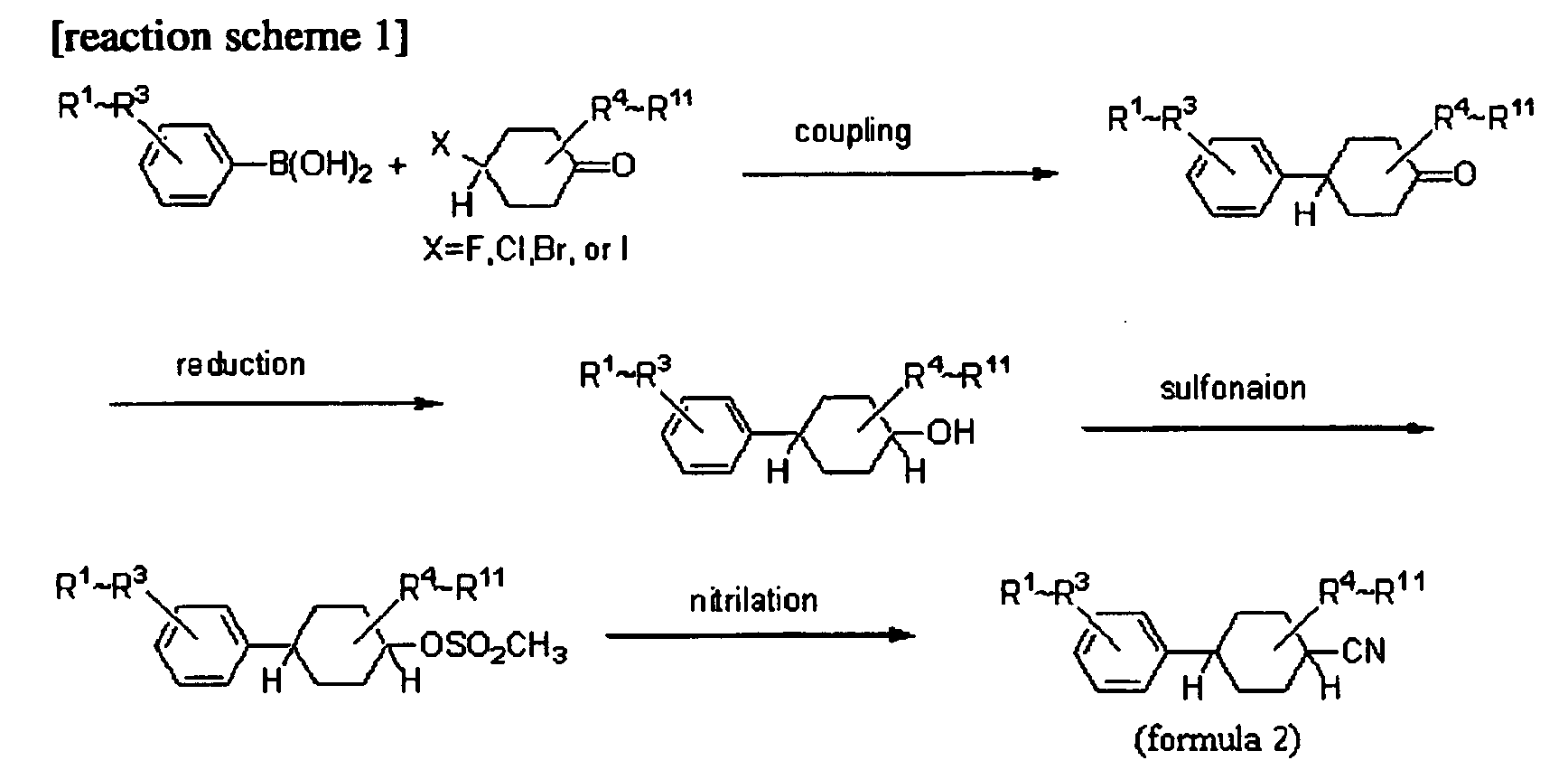
- a compound represented by formula 2 which is a preferred embodiment of the compound represented by formula 1, may be prepared according to the following reaction scheme 1:
- each of R 1 ⁇ R 11 independently represents -H, -F, -Cl, -Br, -I, -OH, -SH, -COOH, -PO 3 H 2 , -NH 2 , -NO 2 , -O(CH 2 CH 2 O) n H (wherein, n is an integer of 1 ⁇ 5), C 1 ⁇ C 12 alkyl group, C 1 ⁇ C 12 aminoalkyl group, C 1 ⁇ C 12 hydroxyalkyl group, C 1 ⁇ C 12 haloalkyl group, C 2 ⁇ C 12 alkenyl group, C 1 ⁇ C 12 alkoxy group, C 1 ⁇ C 12 alkylamino group, C 1 ⁇ C 12 dialkylamino group, C 6 ⁇ C 18 aryl group, C 6 ⁇ C 18 aminoaryl group, C 6 ⁇ C 18 hydroxyaryl group, C 6 ⁇ C 18 haloaryl group, C 7 ⁇ C 18 benzyl group, C 7 ⁇
- a compound represented by the following formula 3 and a compound represented by the following formula 4, which are preferred embodiments of the compound represented by formula 1, may be prepared by the following reaction scheme 2 and reaction scheme 3, respectively:
- the present invention also provides a secondary battery comprising a cathode, an anode and a non-aqueous electrolyte, wherein the non-aqueous electrolyte comprises the compound represented by formula 1, optionally with cyclohexylbenzene or a derivative thereof, as additives.
- the anode active material that may be used in the present invention includes a material capable of lithium ion intercalation/deintercalation, and particular examples thereof include graphite, carbon, lithium metal or lithium alloys.
- the anode active material is graphite.
- the anode may comprise a binder, and particular examples of the binder include PVDF (polyvinylidene fluoride) or SBR (styrene butadiene rubber), but are not limited thereto.
- the non-aqueous electrolyte comprises a solvent, such as a cyclic carbonate, a linear carbonate or a combination thereof.
- a solvent such as a cyclic carbonate, a linear carbonate or a combination thereof.
- the cyclic carbonate include ethylene carbonate (EC), propylene carbonate (PC), gamma-butyrolactone (GBL), or the like.
- the linear carbonate include diethyl carbonate (DEC), dimethyl carbonate (DMC), ethylmethyl carbonate (EMC), methyl propyl carbonate (MPC), or the like.
- the solvent that may be used in the electrolyte according to the present invention is not limited to the above examples.
- the non-aqueous electrolyte comprises a lithium salt as an electrolyte substance.
- the lithium salt include LiClO 4 , LiCF 3 SO 3 , LiPF 6 , LiBF 4 , LiAsF 6 , LiN(CF 3 SO 2 ) 2 , or the like, but are not limited thereto.
- the secondary battery according to the present invention may comprise a separator.
- the separator is a porous separator.
- Particular examples of the porous separator include polypropylene-, polyethylene- or polyolefin-based separators, but are not limited thereto.
- the secondary battery according to the present invention may be manufactured by a conventional method, except that the compound represented by formula 1 is added to a non-aqueous electrolyte.
- a porous separator is interposed between a cathode and an anode to provide an electrode assembly, and then the non-aqueous electrolyte in injected thereto.
- non-aqueous electrolyte according to the present invention may further comprise other additives.
- the secondary battery according to the present invention may have various shapes, including a cylindrical shape, a prismatic shape or a pouch-like shape.
- FIG. 1 is the 1 H-NMR spectrum of 4-cyanocyclohexyl benzene obtained from a preferred embodiment of the present invention
- FIG. 2 is the 13 C-NMR spectrum of 4-cyanocyclohexyl benzene obtained from a preferred embodiment of the present invention.
- FIG. 3 is a graph showing the effect of preventing overcharge in the batteries according to Examples 1 ⁇ 3 and the Comparative Example 1.
- a compound represented by the following formula 5 (4-cyanocyclohexyl benzene) was prepared according to a process represented by the following reaction scheme 4.
- the 1 H-NMM spectrum and the 13 C-NMR spectrum of the resultant compound represented by formula 5 (4-cyanocyclohexyl benzene) are shown in FIG. 1 and FIG. 2 , respectively.
- Example 1 was repeated to provide a battery, except that the compound represented by formula 5 was added to the electrolyte in an amount of 0.5 wt% and CHB (cyclohexylbenzene) was further added thereto in an amount of 1.5 wt%.
- CHB cyclohexylbenzene
- Example 1 was repeated to provide a battery, except that the compound represented by formula 5 was added to the electrolyte in an amount of 0.5 wt% and CHB (cyclohexylbenzene) was further added thereto in an amount of 2.0 wt%.
- CHB cyclohexylbenzene
- Example 1 was repeated to provide a battery, except that the compound represented by formula 5 was not added to the electrolyte and CHB was added to the electrolyte in an amount of 2.0 wt%.
- the batteries according to Examples 1 to 3 and Comparative Example 1 were subjected to one charge/discharge cycle at 0.1C and two charge/discharge cycles at 0.2C, and then were charged at 0.2C to a voltage of 7V. Then, voltage of each battery was observed. The results are shown in FIG. 3 .
- the batteries according to Examples 1 to 3 interrupt overcharge more promptly (i.e. under a smaller charging capacity) and more effectively, as compared to the battery according to Comparative Example 1.
- the present invention provides an additive for a non-aqueous electrolyte and a combination of additives, effective for preventing a secondary battery from being overcharged. Therefore, the additive according to the present invention can improve the safety of a battery upon overcharge.
Landscapes
- Chemical & Material Sciences (AREA)
- Engineering & Computer Science (AREA)
- Manufacturing & Machinery (AREA)
- Chemical Kinetics & Catalysis (AREA)
- Electrochemistry (AREA)
- General Chemical & Material Sciences (AREA)
- Physics & Mathematics (AREA)
- Condensed Matter Physics & Semiconductors (AREA)
- General Physics & Mathematics (AREA)
- Inorganic Chemistry (AREA)
- Secondary Cells (AREA)
Abstract
Description
- The present invention relates to an additive for a non-aqueous electrolyte and a non-aqueous electrolyte secondary battery comprising the same. More particularly, the present invention relates to an additive for a non-aqueous electrolyte, which can improve the safety of a secondary battery upon overcharge, and to a non-aqueous electrolyte secondary battery comprising the same.
- Recently, there has existed increasing interest in energy storage technology. Batteries have been widely used as energy sources in portable phones, camcorders, notebook computers, PCs and electric cars, resulting in intensive research and development for them. In this regard, electrochemical devices are the subject of great interest. Particularly, development of rechargeable secondary batteries is the focus of attention. Recently, continuous studies have been performed to develop a novel electrode and battery having an improved level of capacity density and specific energy.
- Among the currently used secondary batteries, lithium secondary batteries, developed in early 1990's, have a drive voltage and an energy density higher than those of conventional batteries using aqueous electrolytes (such as Ni-MH batteries, Ni-Cd batteries and H2SO4-Pb batteries), and thus are spotlighted in the field of secondary batteries. However, lithium secondary batteries have a problem related to their safety, due to ignition and explosion caused by the use of a non-aqueous electrolyte. The aforementioned problem becomes more serious as the capacity density of a battery increases.
- Meanwhile, in the case of a non-aqueous electrolyte secondary battery, problems related to safety occur under overcharge conditions due to the following reasons: Cathode active materials, such as a lithium-containing metal oxide, capable of lithium and/or lithium ion intercalation/deintercalation are converted into thermally unstable structure due to the deintercalation of lithium under overcharge conditions. Under such overcharged conditions, if the battery reaches a critical temperature due to external physical impact (e.g. exposure to high temperature), oxygen is liberated from the cathode active material having an unstable structure. Then, the oxygen causes an exothermic decomposition reaction with an electrolyte solvent, or the like. Also, combustion of the electrolyte, caused by the above exothermic reaction, is accelerated by the oxygen liberated from the cathode. Such chain reactions accompanied with heat emission finally cause a so-called thermal runaway phenomenon of the battery, resulting in explosion and breakage of the battery.
- Many solutions have been suggested in order to control the ignition or explosion of a battery, caused by an increase in the internal temperature of the battery. For example, it is known to use an additive for a non-aqueous electrolyte. Such additives for a non-aqueous electrolyte include an additive based on a reduction-oxidation shuttle reaction, such as chloroanisole, an additive based on a polymerization reaction, such as biphenyl, an alkylbenzene derivative such as cycohexylbenzene, or the like.
- However, the additive based on a reduction-oxidation shuttle reaction is not effective under a high charging current. Additionally, biphenyl has a problem related to the quality of a battery when it is used alone as an additive for a non-aqueous electrolyte, due to an increase in the resistance of the battery. Further, when using an alkylbenzene derivative such as cyclohexylbenzene, there are problems in that a large amount of additive should be added to prevent heat emission caused by overcharge, and prevention of overcharge cannot be accomplished after repeating charge/discharge cycles, resulting in degradation in the quality of a battery.
- Therefore, there is a continuous need for a means for improving the safety of a non-aqueous electrolyte secondary battery.
WO 2005/076403 discloses a nonaqueous electrolyte solution comprising the following components: (i) a lithium salt; (ii) an electrolyte compound; (iii) a first additive compound with an oxidation initiation potential of more than 4.2 V; and (iv) a second additive compound with an oxidation initiation voltage of more than 4.2 V, which is higher in oxidation initiation potential than the first additive, and deposits oxidative products or forms a polymer film, in oxidation.
JP 2003 308875 A
US 2004/0013946 A1 discloses a non-aqueous electrolytic solution comprising a non-aqueous solvent and an electrolyte, which further contains a nitrile compound and an S=O group-containing compound.
JP 2002 313415 A
US 6,074,777 discloses A non-aqueous rechargeable lithium battery having a lithium insertion compound cathode, a lithium or lithium compound anode, a non-aqueous electrolyte, a maximum operating charging voltage, and an additive mixed in said electrolyte, said additive polymerizing at battery voltages greater than the maximum operating charging voltage thereby protecting the battery during or after overcharge abuse, wherein the additive is selected from the group consisting of: (i) phenyl-R-phenyl compounds wherein R is an aliphatic hydrocarbon, (ii) fluorine substituted biphenyl compounds, and (iii) 3-thiopheneacetonitrile.
EP 0 759 641 A1 discloses a non-aqueous rechargeable lithium battery having a maximum operating voltage comprising: a lithium insertion compound cathode; a lithium compound anode; a separator; a non-aqueous liquid electrolyte incapable of polymerizing at voltages greater than the maximum operating voltage of the battery such that the battery is protected during overcharge abuse; and a monomer additive mixed in said liquid electrolyte, said additive polymerizing at battery voltages greater than the maximum operating voltage thereby increasing the internal resistance of the battery and protecting the battery during overcharge abuse. - The present inventors have found that when a compound that comprises cyclohexylbenzene, having at least one nitrile group introduced thereto, is used as an additive for a non-aqueous electrolyte in a secondary battery, it is possible to improve the safety of the battery upon overcharge of the battery more significantly compared to cyclohexylbenzene (CHB), which has been used conventionally as an additive for a non-aqueous electrolyte. The present inventors have also found that the above compound is used as an additive for a non-aqueous electrolyte in combination with cyclohexylbenzene, it is possible to obtain a synergic effect in terms of the safety upon overcharge. The present invention is based on these findings.
- Therefore, an object of the present invention is to provide a compound comprising cyclohexylbenzene having a nitrile group added thereto. Another object of the present invention is to provide a non-aqueous electrolyte comprising the above compound optionally with cyclohexylbenzene, as additives; and a secondary battery comprising the above non-aqueous electrolyte.
- According to an aspect of the present invention, there is provided a compound represented by the following formula 1:
-

- wherein, each of R1∼R13 independently represents -H, -F, -Cl, -Br, -I, -OH, -SH, -COOH, -PO3H2, -NH2, -NO2, -O(CH2CH2O)nH (wherein, n is an integer of 1∼5), C1∼C C1∼C12 alkyl group, C1∼C12 aminoalkyl group, C1∼C12 hydroxyalkyl group, C1∼C12 haloalkyl group, C2∼C12 alkenyl group, C1∼C12 alkoxy group, C1∼C12 alkylamino group, C1∼C12 dialkylamino group, C6∼C18 aryl group, C6∼C18 aminoaryl group, C6∼C18 hydroxyaryl group, C6∼C18 haloaryl group, C7∼C18 benzyl group, C7∼C18 aminobenzyl group, C7∼C18 hydroxybenzyl group, C7∼C18 halobenzyl group, or nitrile group (-CN); and
- at least one of R4∼R13 is nitrile group (-CN).
- According to another aspect of the present invention, there is provided a non-aqueous electrolyte comprising: (i) a lithium salt, (ii) a solvent, and (iii) a compound represented by the
above formula 1. - According to still another aspect of the present invention, there is provided a non-aqueous electrolyte, which comprises a compound represented by the
above formula 1, and further comprises cyclohexylbenzene or a derivative thereof, as additives. Herein, the derivative of cyclohexylbenzene includes any compound represented byformula 1, having no nitrile group introduced into the cyclohexyl ring. - According to yet another aspect of the present invention, there is provided a secondary battery comprising a cathode, an anode and the aforementioned non-aqueous electrolyte.
- Hereinafter, the present invention will be explained in more detail.
- According to the present invention, the compound represented by
formula 1 is characterized by comprising 1∼10 nitrile (-CN) groups introduced into the cyclohexyl ring present in cyclohexylbenzene or a derivative thereof. - In the compound represented by
formula 1, nitrile groups may be positioned at the same carbon atom or at different carbon atoms on the cyclohexyl ring. - Preferred examples of the compound represented by
formula 1 or the derivatives of cyclohexylbenzene include compounds substituted with C1∼C6 alkyl groups on the benzene ring or on the cyclohexyl ring. This is because a C1∼C6 alkyl group does not inhibit the compound represented byformula 1 or the cyclohexylbenzene portion from exerting the effect of improving the safety of a battery upon overcharge. Therefore, the compound represented byformula 1 or the derivatives of cyclohexylbenzene may be any compounds, as long as they are substituted with a substituent that does not inhibit the compound represented byformula 1 or the cyclohexylbenzene portion from exerting the effect of improving the safety of a battery upon overcharge. Such compounds are also included in the scope of the present invention. - In the present invention, non-limiting examples of the compound represented by
formula 1 include:
- The cyclohexylbenzene portion of the compound represented by
formula 1 can prevent a secondary battery from igniting/exploding upon its overcharged state based on the same functional mechanism as cyclohexylbenzene (CHB), which has been used conventionally as an additive for a non-aqueous electrolyte. - In other words, the cyclohexylbenzene portion forms a polymer on the surface of a cathode upon the overcharged state of a battery, and the polymer increases the interfacial impedance between the cathode and an electrolyte, thereby preventing overcharge. Hence, it is possible to prevent the battery from igniting/exploding upon overcharge.
- Herein, the nitrile group forms a coordination bond with a transition metal, such as Co, present on the surface of the cathode, and thus permits the compound represented by
formula 1 or a derivative thereof to be anchored in the vicinity of the cathode surface and allows the polymer to be formed predominantly and easily on the cathode surface. Therefore, it is possible to maximize the effect of preventing a battery from igniting/exploding upon overcharge. - Additionally, the polymer formed on the cathode surface by the compound represented by
formula 1 serves as a core for the polymer formation, and thus enhances the formation of polymer from cyclohexylbenzene, which is further added to an electrolyte. Therefore, it is possible to provide a synergic effect for preventing overcharge (see Examples 2 and 3, andFIG. 1 ). - Such synergic effects can also be obtained from benzene derivatives, besides cyclohexylbenzene, wherein the benzene derivatives include biphenyl, terphenyl, fluorotoluene, or the like. This is because the aforementioned benzene derivatives have the same mechanism of polymer formation as cyclohexylbenzene. Therefore, a non-aqueous electrolyte comprising a benzene derivative, such as biphenyl, terphenyl or fluorotoluene, in addition to the compound represented by
formula 1, is also included in the scope of the present invention. - Cyclohexylbenzene forms a polymer at an oxidation potential of 4.7V and the compound represented by
formula 1 forms a polymer at an oxidation potential of about 4.6∼4.8V, although the potential may be different depending on the electrode used on the battery. - Meanwhile, excessive oxidation in a cathode, caused by overcharge, results in loss of an abnormally large amount of electrons in the cathode, and thus results in structural collapse of the cathode. Herein, the cathode active material comprises a transition metal, such as Co. The nitrile group on the compound represented by
formula 1 donates electrons to the transition metal element, such as Co, thereby serving to prevent the cathode from experiencing structural collapse. Such effect can be obtained because the nitrile group can form a coordination bond with a transition metal, such as Co. In other words, the nitrile group shares the electrons with the transition metal element such as Co. - Therefore, it is possible to improve the safety of a battery by preventing the liberation of oxygen caused by structural collapse of a cathode, even when the battery is overcharged and is exposed to external impact (e.g. high temperature).
- The compound represented by
formula 1 can be used in an amount determined according to its solubility to the solvent used in the non-aqueous electrolyte. However, if the compound represented byformula 1 is used in an excessively large amount, the electrolyte may show excessively increased viscosity and decreased ion conductivity. Therefore, it is preferable that the compound represented byformula 1 is contained in an amount of 0.5∼10 wt% per 100 wt% of the non-aqueous electrolyte. If the compound represented byformula 1 is used in an amount of less than 0.5 wt%, it is not possible to obtain the effect of preventing overcharge to a sufficient degree. On the other hand, if the compound is used in an amount of greater than 10 wt%, there are problems of degradation in the lifespan of a battery at high temperature and gas generation under high temperature storage conditions. - Additionally, when the compound represented by
formula 1 is used in combination with cyclohexylbenzene or a benzene derivative, it is preferable that the compound represented byformula 1 is used in an amount of 0.5∼10 wt% per 100 wt% of the non-aqueous electrolyte in the same manner as described above. - For example, a compound represented by
formula 2, which is a preferred embodiment of the compound represented byformula 1, may be prepared according to the following reaction scheme 1: -


- wherein, each of R1∼R11 independently represents -H, -F, -Cl, -Br, -I, -OH, -SH, -COOH, -PO3H2, -NH2, -NO2, -O(CH2CH2O)nH (wherein, n is an integer of 1∼5), C1∼C12 alkyl group, C1∼C12 aminoalkyl group, C1∼C12 hydroxyalkyl group, C1∼C12 haloalkyl group, C2∼C12 alkenyl group, C1∼C12 alkoxy group, C1∼C12 alkylamino group, C1∼C12 dialkylamino group, C6∼C18 aryl group, C6∼C18 aminoaryl group, C6∼C18 hydroxyaryl group, C6∼C18 haloaryl group, C7∼C18 benzyl group, C7∼C18 aminobenzyl group, C7∼C18 hydroxybenzyl group, C7∼C18 halobenzyl group, or nitrile group (-CN).
-

- wherein each of R1∼R11 is the same as defined in the
above formula 2. - Additionally, a compound represented by the following
formula 3 and a compound represented by the followingformula 4, which are preferred embodiments of the compound represented byformula 1, may be prepared by the followingreaction scheme 2 andreaction scheme 3, respectively: -

- wherein each of R1∼R3 is the same as defined in the
above formula 2. -

-

- wherein each of R1∼R3 is the same as defined in the
above formula 2. -

- wherein each of R1∼R3 is the same as defined in the
above formula 2. -

- wherein each of R1∼R3 is the same as defined in the
above formula 2. - It is a matter of course that other compounds represented by the
above formula 1 can be prepared with ease by modifying the starting materials or reaction conditions from theabove reaction schemes 1 to 3. - The present invention also provides a secondary battery comprising a cathode, an anode and a non-aqueous electrolyte, wherein the non-aqueous electrolyte comprises the compound represented by
formula 1, optionally with cyclohexylbenzene or a derivative thereof, as additives. - Preferably, the cathode active material that may be used in the present invention is a lithium-containing transition metal oxide, and particular examples thereof include at least one lithium-containing transition metal oxide selected from the group consisting of: LiCoO2, LiNiO2, LiMnO2, LiMn2O4, Li(NiaCobMnc)O2(0<a<1,0<b<1, 0<c<1, a+b+c=1), LiNi1-YCoYO2, LiCo1-YMnYO2, LiNi1-YMnYO2 (wherein 0≤Y < 1), Li(NiaCobMnc)O4(0<a<2,0<b<2,0<c<2, a+b+c=2), LiMn2-zNizO4, LiMn2-zCozO4 (wherein 0<Z<2), LiCoPO4, and LiFeFO4.
- The anode active material that may be used in the present invention includes a material capable of lithium ion intercalation/deintercalation, and particular examples thereof include graphite, carbon, lithium metal or lithium alloys. Preferably, the anode active material is graphite. Herein, the anode may comprise a binder, and particular examples of the binder include PVDF (polyvinylidene fluoride) or SBR (styrene butadiene rubber), but are not limited thereto.
- The non-aqueous electrolyte comprises a solvent, such as a cyclic carbonate, a linear carbonate or a combination thereof. Particular examples of the cyclic carbonate include ethylene carbonate (EC), propylene carbonate (PC), gamma-butyrolactone (GBL), or the like. Particular examples of the linear carbonate include diethyl carbonate (DEC), dimethyl carbonate (DMC), ethylmethyl carbonate (EMC), methyl propyl carbonate (MPC), or the like. However, the solvent that may be used in the electrolyte according to the present invention is not limited to the above examples.
- The non-aqueous electrolyte comprises a lithium salt as an electrolyte substance. Particular examples of the lithium salt include LiClO4, LiCF3SO3, LiPF6, LiBF4, LiAsF 6, LiN(CF3SO2)2, or the like, but are not limited thereto.
- The secondary battery according to the present invention may comprise a separator. Preferably, the separator is a porous separator. Particular examples of the porous separator include polypropylene-, polyethylene- or polyolefin-based separators, but are not limited thereto.
- The secondary battery according to the present invention may be manufactured by a conventional method, except that the compound represented by
formula 1 is added to a non-aqueous electrolyte. In one embodiment of the method, a porous separator is interposed between a cathode and an anode to provide an electrode assembly, and then the non-aqueous electrolyte in injected thereto. - In addition to the compound represented by
formula 1, the non-aqueous electrolyte according to the present invention may further comprise other additives. - The secondary battery according to the present invention may have various shapes, including a cylindrical shape, a prismatic shape or a pouch-like shape.
-
FIG. 1 is the 1H-NMR spectrum of 4-cyanocyclohexyl benzene obtained from a preferred embodiment of the present invention; -
FIG. 2 is the 13C-NMR spectrum of 4-cyanocyclohexyl benzene obtained from a preferred embodiment of the present invention; and -
FIG. 3 is a graph showing the effect of preventing overcharge in the batteries according to Examples 1∼3 and the Comparative Example 1. - Reference will now be made in detail to the preferred embodiments of the present invention. It is to be understood that the following examples are illustrative only and the present invention is not limited thereto.
- [PREPARATION OF 4-CYANOCYCLOHEXYL BENZENE]
- A compound represented by the following formula 5 (4-cyanocyclohexyl benzene) was prepared according to a process represented by the following
reaction scheme 4. The 1H-NMM spectrum and the 13C-NMR spectrum of the resultant compound represented by formula 5 (4-cyanocyclohexyl benzene) are shown inFIG. 1 andFIG. 2 , respectively. -

-

- 4-cyanocyclohexyl benzene
- 1H-NMR (400MHz, CDCl3): δ 7.29∼7.25 (m, 2H), 7.21∼7.15 (m, 3H), 2.94∼2.92 (m, 1H), 2.49∼2.46 (m, 1H), 2.05∼2.01 (m, 2H), 1.85∼1.79 (m, 4H), 1.67∼1.59 (m, 2H).
- 13C-NMR (100MHz, CDCl3): δ 146.4, 128.9, 127.1, 126.7, 122.3, 43.8, 30.3, 29.1, 27.0.
- [MANUFACTURE OF BATTERY]
- Example 1
- The electrolyte used in this example was 1M LiPF6 solution containing EC:EMC=1:2 (v:v). To the electrolyte, the compound represented by formula 5 was added in an amount of 2.0 wt%. LiCoO2 and artificial graphite were used as a cathode active material and an anode active material, respectively. Then, a coin type battery was manufactured by using a conventional method.
- Examples 2
- Example 1 was repeated to provide a battery, except that the compound represented by formula 5 was added to the electrolyte in an amount of 0.5 wt% and CHB (cyclohexylbenzene) was further added thereto in an amount of 1.5 wt%.
- Example 3
- Example 1 was repeated to provide a battery, except that the compound represented by formula 5 was added to the electrolyte in an amount of 0.5 wt% and CHB (cyclohexylbenzene) was further added thereto in an amount of 2.0 wt%.
- Comparative Example 1
- Example 1 was repeated to provide a battery, except that the compound represented by formula 5 was not added to the electrolyte and CHB was added to the electrolyte in an amount of 2.0 wt%.
- [OVERCHARGE TEST]
- The batteries according to Examples 1 to 3 and Comparative Example 1 were subjected to one charge/discharge cycle at 0.1C and two charge/discharge cycles at 0.2C, and then were charged at 0.2C to a voltage of 7V. Then, voltage of each battery was observed. The results are shown in
FIG. 3 . - Interruption of overcharge can be seen from a rapid increase in the voltage, caused by an increase in the resistance, under constant current (V=IR).
- As shown in
FIG. 3 , when the batteries are overcharged, the batteries according to Examples 1 to 3 interrupt overcharge more promptly (i.e. under a smaller charging capacity) and more effectively, as compared to the battery according to Comparative Example 1. - After comparing the result obtained from the battery according to Example 1 (compound represented by formula 5) with the result obtained from the battery according to Comparative Example 1 (CHB), it can be seen that the compound represented by formula 5, having a nitrile group, forms a polymer capable of functioning as an electric resistance more promptly, compared to CHB, and thus interrupts overcharge more effectively.
- Meanwhile, after comparing the results obtained from the batteries according to Comparative Example 1 (CHB) and Example 1 (compound represented by formula 5) with the results obtained from the batteries according to Examples 2 and 3 (compound represented by formula 5 + CHB), it can be seen that the compound represented by formula 5 and CHB provide a synergic effect when interrupting overcharge (i.e. when forming a polymer capable of interrupting an overcharged state).
- As can be seen from the foregoing, the present invention provides an additive for a non-aqueous electrolyte and a combination of additives, effective for preventing a secondary battery from being overcharged. Therefore, the additive according to the present invention can improve the safety of a battery upon overcharge.
Claims (12)
- A compound represented by the following formula 1:

at least one of R4∼R13 is nitrile group (-CN). - A non-aqueous electrolyte, which comprises:(i) a lithium salt;(ii) a solvent; and(ii) a compound represented by the following formula 1:wherein, each of R1∼R13 independently represents -H, -F, -Cl, -Br, -I, -OH, -SH, - COOH, -PO3H2, -NH2, -NO2, -O(CH2CH2O)nH (wherein, n is an integer of 1∼5), C1∼C12 alkyl group, C1∼C12 aminoalkyl group, C1∼C12 hydroxyalkyl group, C1∼C 12 haloalkyl group, C2∼C12 alkenyl group, C1∼C12 alkoxy group, C1∼C12 alkylamino group, C1∼C12 dialkylamino group, C6∼C18 aryl group, C6∼C18 aminoaryl group, C6∼C18 hydroxyaryl group, C6∼C18 haloaryl group, C7∼C18 benzyl group, C7∼C18 aminobenzyl group, C7∼C18 hydroxybenzyl group, C7∼C18 halobenzyl group, or nitrile group (-CN); and

at least one of R4∼R13 is nitrile group (-CN). - The non-aqueous electrolyte according to claim 2, wherein the compound represented by formula 1 is used in an amount of 0.5 wt%∼10 wt% based on 100 wt% of the non-aqueous electrolyte.
- The non-aqueous electrolyte according to claim 2, which further comprises cyclohexylbenzene or a derivative thereof.
- The non-aqueous electrolyte according to claim 2, which further comprises a benzene derivative capable of forming a polymer.
- The non-aqueous electrolyte according to claim 2, wherein the solvent includes at least one cyclic carbonate selected from the group consisting of ethylene carbonate (EC), propylene carbonate (PC), and gamma-butyrolactone (GBL); and at least one linear carbonate selected from the group consisting of diethyl carbonate (DEC), dimethyl carbonate (DMC), ethylmethyl carbonate (EMC), and methyl propyl carbonate (MPC).
- A secondary battery, comprising a cathode, an anode and a non-aqueous electrolyte, wherein the non-aqueous electrolyte is the non-aqueous electrolyte as defined in any one of claims 2 to 6.
- The secondary battery according to claim 7, which is a lithium secondary battery.
- The secondary battery according to claim 7, wherein the cathode comprises a lithium-containing transition metal oxide as a cathode active material.
- A method for preparing a compound represented by the following formula 2, which is represented by the following reaction scheme 1:
- A method for preparing a compound represented by the following formula 3, which is represented by the following reaction scheme 2:

- A method for preparing a compound represented by the following formula 4, which is represented by the following reaction scheme 3:

Applications Claiming Priority (2)
| Application Number | Priority Date | Filing Date | Title |
|---|---|---|---|
| KR20050032877 | 2005-04-20 | ||
| PCT/KR2006/001488 WO2006112676A1 (en) | 2005-04-20 | 2006-04-20 | Additive for non-aqueous electrolyte and secondary battery using the same |
Publications (3)
| Publication Number | Publication Date |
|---|---|
| EP1882282A1 EP1882282A1 (en) | 2008-01-30 |
| EP1882282A4 EP1882282A4 (en) | 2009-11-11 |
| EP1882282B1 true EP1882282B1 (en) | 2011-03-02 |
Family
ID=37115361
Family Applications (1)
| Application Number | Title | Priority Date | Filing Date |
|---|---|---|---|
| EP06747398A Expired - Lifetime EP1882282B1 (en) | 2005-04-20 | 2006-04-20 | Additive for non-aqueous electrolyte and secondary battery using the same |
Country Status (7)
| Country | Link |
|---|---|
| US (2) | US7666330B2 (en) |
| EP (1) | EP1882282B1 (en) |
| KR (1) | KR100752040B1 (en) |
| CN (2) | CN101164191B (en) |
| DE (1) | DE602006020431D1 (en) |
| TW (1) | TWI332937B (en) |
| WO (1) | WO2006112676A1 (en) |
Families Citing this family (17)
| Publication number | Priority date | Publication date | Assignee | Title |
|---|---|---|---|---|
| TWI332937B (en) * | 2005-04-20 | 2010-11-11 | Lg Chemical Ltd | Additive for non-aqueous electrolyte and secondary battery using the same |
| TWI338396B (en) * | 2006-01-17 | 2011-03-01 | Lg Chemical Ltd | Additives for non-aqueous electrolyte and lithium secondary battery using the same |
| US7875388B2 (en) * | 2007-02-06 | 2011-01-25 | 3M Innovative Properties Company | Electrodes including polyacrylate binders and methods of making and using the same |
| US20080206641A1 (en) * | 2007-02-27 | 2008-08-28 | 3M Innovative Properties Company | Electrode compositions and electrodes made therefrom |
| US20080206631A1 (en) * | 2007-02-27 | 2008-08-28 | 3M Innovative Properties Company | Electrolytes, electrode compositions and electrochemical cells made therefrom |
| US20090053589A1 (en) * | 2007-08-22 | 2009-02-26 | 3M Innovative Properties Company | Electrolytes, electrode compositions, and electrochemical cells made therefrom |
| US20080248386A1 (en) * | 2007-04-05 | 2008-10-09 | Obrovac Mark N | Electrodes with raised patterns |
| US20090111022A1 (en) * | 2007-10-24 | 2009-04-30 | 3M Innovative Properties Company | Electrode compositions and methods |
| US8153301B2 (en) * | 2008-07-21 | 2012-04-10 | 3M Innovative Properties Company | Cathode compositions for lithium-ion electrochemical cells |
| US20100028784A1 (en) * | 2008-07-29 | 2010-02-04 | 3M Innovative Properties Company | Electrolyte composition, lithium-containing electrochemical cell, battery pack, and device including the same |
| US20100026240A1 (en) * | 2008-07-30 | 2010-02-04 | 3M Innovative Properties Company | Lithium ion battery pack charging system and device including the same |
| US20110183209A1 (en) * | 2010-01-27 | 2011-07-28 | 3M Innovative Properties Company | High capacity lithium-ion electrochemical cells |
| CN101841062A (en) * | 2010-05-25 | 2010-09-22 | 张家港市国泰华荣化工新材料有限公司 | Electrolyte solution capable of improving over-charge safety performance of lithium battery |
| JP6063397B2 (en) | 2011-02-18 | 2017-01-18 | スリーエム イノベイティブ プロパティズ カンパニー | COMPOSITE PARTICLE, PROCESS FOR PRODUCING THE SAME AND ARTICLE CONTAINING THE SAME |
| KR101516854B1 (en) * | 2012-05-22 | 2015-05-04 | 주식회사 엘지화학 | Non-aqueous electrolyte solution for lithium secondary battery and lithium secondary battery comprising the same |
| US9406974B2 (en) * | 2013-04-25 | 2016-08-02 | Samsung Sdi Co., Ltd. | Additive for electrolyte of lithium battery, organic electrolytic solution comprising the same, and lithium battery using the organic electrolytic solution |
| CN111916829B (en) * | 2020-08-14 | 2022-02-15 | 深圳市新鹏翔电子有限公司 | Lithium ion battery electrolyte and lithium ion battery |
Family Cites Families (31)
| Publication number | Priority date | Publication date | Assignee | Title |
|---|---|---|---|---|
| DE2636684C3 (en) * | 1976-08-14 | 1980-06-19 | Merck Patent Gmbh, 6100 Darmstadt | Phenylcyclohexane derivatives and their use in liquid-crystalline dielectrics |
| JPS5899456A (en) | 1981-12-07 | 1983-06-13 | Chisso Corp | Trans-4-(4'-substituted-phenyl)cyanocyclohexane |
| US4528114A (en) * | 1981-12-18 | 1985-07-09 | Hoffmann-La Roche Inc. | Acetylenes |
| US4985583A (en) * | 1982-08-26 | 1991-01-15 | Merck Patent Gesellschaft Mit Beschrankter Haftung | Cyclohexane derivatives |
| DE3332692A1 (en) * | 1983-09-10 | 1985-03-28 | Merck Patent Gmbh, 6100 Darmstadt | ANISOTROPE COMPOUNDS AND LIQUID CRYSTAL MIXTURES |
| US4629581A (en) * | 1984-06-29 | 1986-12-16 | Hoffmann-La Roche Inc. | Cyclohexanecarbonitriles |
| CA1336441C (en) * | 1987-12-28 | 1995-07-25 | Manabu Uchida | Liquid crystal composition |
| EP0379315B1 (en) * | 1989-01-19 | 1994-05-18 | Seiko Epson Corporation | Electro-optical liquid crystal device |
| CA2156800C (en) | 1995-08-23 | 2003-04-29 | Huanyu Mao | Polymerizable aromatic additives for overcharge protection in non-aqueous rechargeable lithium batteries |
| JP3537265B2 (en) * | 1996-05-08 | 2004-06-14 | チッソ株式会社 | Liquid crystal composition and liquid crystal display device |
| JPH09301897A (en) | 1996-05-10 | 1997-11-25 | Sumitomo Chem Co Ltd | Cyclohexylbenzene derivative, method for producing the same, liquid crystal composition and liquid crystal device containing the same |
| JP3287288B2 (en) * | 1996-11-22 | 2002-06-04 | チッソ株式会社 | Polyhaloalkyl ether derivatives, liquid crystal compositions containing them and liquid crystal display devices |
| CA2216898C (en) * | 1997-09-26 | 2005-03-22 | Moli Energy (1990) Limited | Improved additives for overcharge protection in non-aqueous rechargeable lithium batteries |
| AU5871500A (en) * | 1999-06-11 | 2001-01-02 | Sydney Hyman | Image making medium |
| US6866966B2 (en) * | 1999-08-03 | 2005-03-15 | Ube Industries, Ltd. | Non-aqueous secondary battery having enhanced discharge capacity retention |
| JP3988374B2 (en) | 2000-10-06 | 2007-10-10 | ソニー株式会社 | Non-aqueous electrolyte secondary battery |
| JP4926325B2 (en) * | 2001-02-15 | 2012-05-09 | 富士フイルム株式会社 | Electrolyte composition, electrochemical cell, photoelectrochemical cell, and non-aqueous secondary battery |
| JP4995376B2 (en) | 2001-04-11 | 2012-08-08 | 三洋電機株式会社 | Non-aqueous electrolyte secondary battery |
| JP3631166B2 (en) | 2001-05-31 | 2005-03-23 | 三洋電機株式会社 | Nonaqueous electrolyte secondary battery |
| US6582863B1 (en) * | 2001-06-11 | 2003-06-24 | Advanced Micro Devices, Inc. | Method of controlling photolithography processes based upon scatterometric measurements of sub-nominal grating structures |
| PY0300568A (en) * | 2002-01-31 | 2004-10-01 | Pfizer Prod Inc | METABOLITES OF (3-{[4-TERT-BUTYLBENZYL)-(PYRIDIN-3-SULFONYL)AMINO]METHYL}PHENOXY)ACETIC ACID |
| TWI263235B (en) * | 2002-04-02 | 2006-10-01 | Nippon Catalytic Chem Ind | Material for electrolytic solutions and use thereof |
| JP4625231B2 (en) | 2002-04-18 | 2011-02-02 | 株式会社Gsユアサ | Non-aqueous secondary battery |
| US20040013946A1 (en) | 2002-07-15 | 2004-01-22 | Ube Industries, Ltd. | Non-aqueous electrolytic solution and lithium battery |
| KR100994090B1 (en) | 2002-07-31 | 2010-11-12 | 우베 고산 가부시키가이샤 | Lithium secondary battery |
| KR100482816B1 (en) | 2002-09-12 | 2005-04-14 | 주식회사 엘지화학 | Non-aqueous-electrolyte and lithium secondary battery using the same |
| CA2445222C (en) * | 2002-10-15 | 2010-11-30 | Sumitomo Chemical Company, Limited | Block copolymer and use thereof |
| TWI302760B (en) | 2004-01-15 | 2008-11-01 | Lg Chemical Ltd | Electrochemical device comprising aliphatic nitrile compound |
| EP1728291B1 (en) | 2004-02-10 | 2018-04-04 | LG Chem, Ltd. | Non-aqueous-electrolyte and lithium secondary battery using the same |
| KR100578922B1 (en) | 2004-03-04 | 2006-05-11 | 삼성에스디아이 주식회사 | Electrolyte for lithium secondary battery and lithium secondary battery comprising same |
| TWI332937B (en) * | 2005-04-20 | 2010-11-11 | Lg Chemical Ltd | Additive for non-aqueous electrolyte and secondary battery using the same |
-
2006
- 2006-04-19 TW TW095113948A patent/TWI332937B/en active
- 2006-04-19 US US11/406,640 patent/US7666330B2/en active Active
- 2006-04-20 EP EP06747398A patent/EP1882282B1/en not_active Expired - Lifetime
- 2006-04-20 CN CN200680013288XA patent/CN101164191B/en not_active Expired - Lifetime
- 2006-04-20 CN CN2010101067547A patent/CN101747229B/en not_active Expired - Lifetime
- 2006-04-20 WO PCT/KR2006/001488 patent/WO2006112676A1/en not_active Ceased
- 2006-04-20 KR KR1020060035948A patent/KR100752040B1/en not_active Expired - Lifetime
- 2006-04-20 DE DE602006020431T patent/DE602006020431D1/en not_active Expired - Lifetime
-
2009
- 2009-12-29 US US12/649,100 patent/US7914707B2/en not_active Expired - Lifetime
Also Published As
| Publication number | Publication date |
|---|---|
| CN101747229B (en) | 2012-08-22 |
| CN101747229A (en) | 2010-06-23 |
| KR100752040B1 (en) | 2007-08-23 |
| TW200640829A (en) | 2006-12-01 |
| KR20060110833A (en) | 2006-10-25 |
| US7914707B2 (en) | 2011-03-29 |
| CN101164191A (en) | 2008-04-16 |
| EP1882282A1 (en) | 2008-01-30 |
| WO2006112676A1 (en) | 2006-10-26 |
| US20060263696A1 (en) | 2006-11-23 |
| EP1882282A4 (en) | 2009-11-11 |
| TWI332937B (en) | 2010-11-11 |
| US20100099905A1 (en) | 2010-04-22 |
| US7666330B2 (en) | 2010-02-23 |
| DE602006020431D1 (en) | 2011-04-14 |
| CN101164191B (en) | 2011-02-16 |
Similar Documents
| Publication | Publication Date | Title |
|---|---|---|
| US7914707B2 (en) | Additive for non-aqueous electrolyte and secondary battery using the same | |
| EP1987559B1 (en) | Non-aqueous electrolyte and electrochemical device with improved safety | |
| JP5620817B2 (en) | Non-aqueous electrolyte lithium secondary battery | |
| EP1994599B1 (en) | Non-aqueous electrolyte and electrochemical device with improved safety | |
| EP2206189B1 (en) | Non-aqueous electrolyte lithium secondary battery | |
| US8673507B2 (en) | Inhibitor of reduction of life cycle of redox shuttle additive and non-aqueous electrolyte and secondary battery comprising the same | |
| JP5329638B2 (en) | Nonaqueous electrolyte for lithium secondary battery and lithium secondary battery provided with the same | |
| JP5524225B2 (en) | Nonaqueous electrolyte for lithium secondary battery and lithium secondary battery provided with the same | |
| WO2007094625A1 (en) | Non-aqueous electrolyte and electrochemical device with an improved safety | |
| JP2005056841A (en) | Non-aqueous electrolyte and lithium secondary battery including the same | |
| WO2007061180A1 (en) | Additives for non-aqueous electrolytes and electrochemical device using the same | |
| WO2007004813A1 (en) | Additive for nonaqueous electrolyte and secondary battery using the same | |
| KR100982323B1 (en) | Electrolyte for lithium secondary battery and lithium secondary battery comprising same | |
| KR20040054078A (en) | Nonaqueous Electrolyte for Use in Lithium Battery |
Legal Events
| Date | Code | Title | Description |
|---|---|---|---|
| PUAI | Public reference made under article 153(3) epc to a published international application that has entered the european phase |
Free format text: ORIGINAL CODE: 0009012 |
|
| 17P | Request for examination filed |
Effective date: 20070926 |
|
| AK | Designated contracting states |
Kind code of ref document: A1 Designated state(s): DE FR GB |
|
| DAX | Request for extension of the european patent (deleted) | ||
| RBV | Designated contracting states (corrected) |
Designated state(s): DE FR GB |
|
| A4 | Supplementary search report drawn up and despatched |
Effective date: 20090907 |
|
| 17Q | First examination report despatched |
Effective date: 20100204 |
|
| GRAP | Despatch of communication of intention to grant a patent |
Free format text: ORIGINAL CODE: EPIDOSNIGR1 |
|
| RIC1 | Information provided on ipc code assigned before grant |
Ipc: H01M 10/0567 20100101AFI20100830BHEP |
|
| GRAS | Grant fee paid |
Free format text: ORIGINAL CODE: EPIDOSNIGR3 |
|
| GRAA | (expected) grant |
Free format text: ORIGINAL CODE: 0009210 |
|
| AK | Designated contracting states |
Kind code of ref document: B1 Designated state(s): DE FR GB |
|
| REG | Reference to a national code |
Ref country code: GB Ref legal event code: FG4D |
|
| REF | Corresponds to: |
Ref document number: 602006020431 Country of ref document: DE Date of ref document: 20110414 Kind code of ref document: P |
|
| REG | Reference to a national code |
Ref country code: DE Ref legal event code: R096 Ref document number: 602006020431 Country of ref document: DE Effective date: 20110414 |
|
| PLBE | No opposition filed within time limit |
Free format text: ORIGINAL CODE: 0009261 |
|
| STAA | Information on the status of an ep patent application or granted ep patent |
Free format text: STATUS: NO OPPOSITION FILED WITHIN TIME LIMIT |
|
| 26N | No opposition filed |
Effective date: 20111205 |
|
| REG | Reference to a national code |
Ref country code: DE Ref legal event code: R097 Ref document number: 602006020431 Country of ref document: DE Effective date: 20111205 |
|
| REG | Reference to a national code |
Ref country code: FR Ref legal event code: PLFP Year of fee payment: 10 |
|
| REG | Reference to a national code |
Ref country code: FR Ref legal event code: PLFP Year of fee payment: 11 |
|
| REG | Reference to a national code |
Ref country code: FR Ref legal event code: PLFP Year of fee payment: 12 |
|
| REG | Reference to a national code |
Ref country code: FR Ref legal event code: PLFP Year of fee payment: 13 |
|
| REG | Reference to a national code |
Ref country code: DE Ref legal event code: R081 Ref document number: 602006020431 Country of ref document: DE Owner name: LG ENERGY SOLUTION LTD., KR Free format text: FORMER OWNER: LG CHEM. LTD., SEOUL/SOUL, KR Ref country code: DE Ref legal event code: R081 Ref document number: 602006020431 Country of ref document: DE Owner name: LG ENERGY SOLUTION, LTD., KR Free format text: FORMER OWNER: LG CHEM. LTD., SEOUL/SOUL, KR |
|
| P01 | Opt-out of the competence of the unified patent court (upc) registered |
Effective date: 20230408 |
|
| REG | Reference to a national code |
Ref country code: GB Ref legal event code: 732E Free format text: REGISTERED BETWEEN 20230824 AND 20230831 |
|
| REG | Reference to a national code |
Ref country code: DE Ref legal event code: R081 Ref document number: 602006020431 Country of ref document: DE Owner name: LG ENERGY SOLUTION, LTD., KR Free format text: FORMER OWNER: LG ENERGY SOLUTION LTD., SEOUL, KR |
|
| PGFP | Annual fee paid to national office [announced via postgrant information from national office to epo] |
Ref country code: FR Payment date: 20250321 Year of fee payment: 20 |
|
| PGFP | Annual fee paid to national office [announced via postgrant information from national office to epo] |
Ref country code: GB Payment date: 20250320 Year of fee payment: 20 |
|
| PGFP | Annual fee paid to national office [announced via postgrant information from national office to epo] |
Ref country code: DE Payment date: 20250320 Year of fee payment: 20 |
|
| REG | Reference to a national code |
Ref country code: DE Ref legal event code: R071 Ref document number: 602006020431 Country of ref document: DE |