EP1880650A1 - Water soluble cleaning tool - Google Patents
Water soluble cleaning tool Download PDFInfo
- Publication number
- EP1880650A1 EP1880650A1 EP06746074A EP06746074A EP1880650A1 EP 1880650 A1 EP1880650 A1 EP 1880650A1 EP 06746074 A EP06746074 A EP 06746074A EP 06746074 A EP06746074 A EP 06746074A EP 1880650 A1 EP1880650 A1 EP 1880650A1
- Authority
- EP
- European Patent Office
- Prior art keywords
- water
- compressed
- disintegratable
- cleaning article
- fibers
- Prior art date
- Legal status (The legal status is an assumption and is not a legal conclusion. Google has not performed a legal analysis and makes no representation as to the accuracy of the status listed.)
- Withdrawn
Links
Images






Classifications
-
- A—HUMAN NECESSITIES
- A46—BRUSHWARE
- A46D—MANUFACTURE OF BRUSHES
- A46D1/00—Bristles; Selection of materials for bristles
-
- A—HUMAN NECESSITIES
- A46—BRUSHWARE
- A46B—BRUSHES
- A46B3/00—Brushes characterised by the way in which the bristles are fixed or joined in or on the brush body or carrier
- A46B3/08—Brushes characterised by the way in which the bristles are fixed or joined in or on the brush body or carrier by clamping
-
- A—HUMAN NECESSITIES
- A46—BRUSHWARE
- A46B—BRUSHES
- A46B7/00—Bristle carriers arranged in the brush body
- A46B7/04—Bristle carriers arranged in the brush body interchangeably removable bristle carriers
-
- A—HUMAN NECESSITIES
- A46—BRUSHWARE
- A46D—MANUFACTURE OF BRUSHES
- A46D1/00—Bristles; Selection of materials for bristles
- A46D1/02—Bristles details
- A46D1/0215—Bristles characterised by the material being biodegradable
-
- A—HUMAN NECESSITIES
- A47—FURNITURE; DOMESTIC ARTICLES OR APPLIANCES; COFFEE MILLS; SPICE MILLS; SUCTION CLEANERS IN GENERAL
- A47K—SANITARY EQUIPMENT; ACCESSORIES THEREFOR, e.g. TOILET ACCESSORIES
- A47K11/00—Closets without flushing; Urinals without flushing; Chamber pots; Chairs with toilet conveniences or specially adapted for use with toilets
- A47K11/10—Hand tools for cleaning the toilet bowl, seat or cover, e.g. toilet brushes
-
- A—HUMAN NECESSITIES
- A46—BRUSHWARE
- A46B—BRUSHES
- A46B2200/00—Brushes characterized by their functions, uses or applications
- A46B2200/30—Brushes for cleaning or polishing
- A46B2200/304—Lavatory brush, i.e. brushes for cleaning toilets
Definitions
- the present invention relates to a water-disintegratable cleaning article which is used to remove the dirt in a place where water is used, such as in a flush toilet and which can be discarded into water after the use thereof.
- JP62-186833 discloses a disposable toilet cleaning brush used for cleaning the flush toilet.
- the toilet cleaning brush is produced using a paper comprising: staple fibers of a ligneous pulp and a binder such as carboxyl methyl cellulose (CMC), by a method in which plural cuts are formed in the paper and the paper is wound to form a brush.
- the toilet cleaning brush is fixed to a head of a paper-made handhold of the brush. After a bedpan is wiped with the toilet cleaning brush, the cleaning brush and the handhold are discarded into a flush toilet and are disintegrated in water. It is also described that for controlling the time needed for the dissolution of the paper in water, the surface of the brush is subjected to a wax treatment.
- the JP62-186833 describes that since the time needed for cleaning a bedpan is such a short time as between 10 seconds and 20 seconds, before the paper constituting the toilet cleaning brush is dissolved in water, the cleaning can be accomplished.
- the toilet cleaning brush produced with the paper itself which is produced by fixing a ligneous pulp through a water-soluble carboxyl methyl cellulose (CMC) is swollen at the contact thereof with water during the cleaning of a bedpan and the strength thereof is extremely lowered, so that it becomes difficult to wipe off the dirt adhered to a bedpan by such a brush.
- CMC carboxyl methyl cellulose
- the toilet cleaning brush produced by winding the paper in which plural cuts are formed has a low stiffness, it is difficult to scrub a bedpan or the like by such a brush, and therefore the dirt adhered to a bedpan or the like cannot be effectively removed.
- the present invention solves the above-noted problem accompanying the conventional art. It is therefore an object of the present invention to provide a water-disintegratable cleaning article which can effectively wipe off the dirt adhered to a bedpan of a flush toilet.
- a water-disintegratable cleaning article dispersible in water comprising: a compressed-fiber structure in which a water-dispersible fiber is compressed.
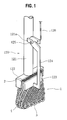
- FIG 1 is a perspective view showing a water-disintegratable cleaning article 1 which is held by a holder 120, under the present invention.
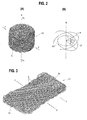
- FIG 2 to FIG 4 are perspective views showing sequentially production steps of the water-disintegratable cleaning article 1 which is held by the holder 120 as shown in FIG 1, according to a first embodiment of the present invention.
- FIG 5 to FIG 14 are perspective views showing the water-disintegratable cleaning articles, according to other embodiments of the present invention.
- FIG. 15A, FIG 15B and FIG 15C are explanatory drawings explaining, respectively, a twined string 4X, a twined string 4Y and a twined string 4Z.
- FIG 4 shows the water-disintegratable cleaning article 1, according to the first embodiment of the present invention.
- the water-disintegratable cleaning article 1 comprises a holding side terminal 2 and a cleaning side terminal 3.
- the holder 120 has a structure where a terminal of a handhold part 121 made of a synthetic resin is integrated with a supporting part 122, and a pressing part 123 made of a synthetic resin is provided at the opposite side to the supporting part 122.
- the supporting part 122 has substantially a flat supporting inside face and the pressing part 123 also has substantially a flat inside face, so that the supporting part 122 and the pressing part 123 face parallel to each other.
- the pressing part 123 is integrated with a lever 124, and the lever 124 is rotatably supported by a bracket 121 a formed on the handhold part 121 through a pivot 125.
- An operating wire 126 is rotatably connected to the top of the lever 124.
- a torsion spring (not illustrated) is attached to the pivot 125, and by the torsion spring, the lever 124 is biased in the clockwise direction around the pivot 125 as the fulcrum, so that the pressing part 123 is biased in the direction approaching the supporting part 122.
- a handle part (not illustrated) is provided in the upper part of the handhold part 121, and an operating lever (not illustrated) is provided in the handle part (not illustrated).
- the upper terminal of the operating wire 126 which is a thick wire is connected to the operating lever (not illustrated).
- the cleaning article 1 By scrubbing the part to be cleaned (such as a bedpan or the like) with the cleaning side terminal 3 of the cleaning article 1 while holding the cleaning article 1 with the holder 120, the dirt adhered to the surface of a bedpan or the like can be removed. At this time, it is also possible that the cleaning article 1 is wetted by the water standing in the bedpan and the bedpan is wiped by the wetted cleaning article 1. After the completion of the cleaning, by releasing the pressing force of the pressing part 123 through pulling up the operating lever (not illustrated), the cleaning article 1 can be discarded into the bedpan without touching the cleaning article 1 by the hand.
- the cleaning article 1 shown in FIG 4 comprises a compressed-fiber structure 11 produced by compressing a bundle of plural strings 4 comprising water-dispersible fibers.
- a compressed-fiber structure 11 produced by compressing a bundle of plural strings 4 comprising water-dispersible fibers.
- a cylinder-shaped structure 10 is produced by winding one string 4 or a plurality of the strings 4.
- the string is wound plural times along the winding direction ⁇ which is formed by inclining the clockwise radius direction of the hypothetical circle HC at an angle ⁇ 1 in the anti-clockwise direction from the radius R.
- the string is wound plural times along the winding direction ⁇ which is formed by inclining the clockwise radius direction of the hypothetical circle HC at an angle ⁇ 2 in the clockwise direction from the radius R.
- the cylinder-shaped structure 10 shown in FIG 2A By repeating alternately a plurality of the windings in the direction ⁇ and a plurality of the windings in the direction ⁇ , the cylinder-shaped structure 10 shown in FIG 2A can be obtained.
- the strings constituting the cylinder-shaped structure 10 are wound in such a manner that they cross each other.
- the compressed-fiber structure 11 By compressing the cylinder-shaped structure 10 shown in FIG. 2A through giving a collapsing force F to the cylinder-shaped structure 10 in the diameter direction using a pressing machine (not illustrated), the compressed-fiber structure 11 can be obtained.
- the pressure of the collapsing force F is in the range of from 2,000 kPa to 6,000 kPa, for example, 3,920 kPa (40 kgf/cm 2 ).
- the compressing time is in the range of from 1 sec to 5 sec. The compressing is performed in a normal temperature or may be performed during the heating.
- the compressed-fiber structure 11 after the compression can maintain the compressed state by means of the mechanical aggregation force and hydrogen bond force of the fibers constituting the string 4.
- the cylinder-shaped structure 10 may be subjected to the heating and the compressing after the cylinder-shaped structure 10 is wetted by spraying water thereto. It is also possible that the dry strength of the compressed-fiber structure 11 is enhanced by producing the cylinder-shaped structure 10 by adhering the strings to each other using a water-soluble binder, such as polyvinyl alcohol (PVA), polyacrylic acid (PAA), carboxyl methyl cellulose (CMC) and the like.
- PVA polyvinyl alcohol
- PAA polyacrylic acid
- CMC carboxyl methyl cellulose
- the compressed-fiber structure 11 shown in FIG 3 is produced by collapsing the cylinder-shaped structure 10 in the diameter direction, at the both terminals of the compressed-fiber structure 11, a loop part 4a of the string 4 is exposed in a collapsed state.
- the compressed-fiber structure 11 shown in FIG 3 can be used, as it is, as the water-disintegratable cleaning article 1, according to the first embodiment, by cutting the compressed-fiber structure 11 along the center line O thereof into halves, two pieces of the cleaning article 1 shown in FIG 4 are produced.
- plural cut end faces 4b of the strings 4 are exposed at the holding side terminal 2, and plural loop parts 4a are exposed in a collapsed state at the cleaning side terminal 3.
- the string 4 is so formed as to have a high density.
- the water-disintegratable sheet 8 comprises fibers having a fiber length of 20 mm or less. When the water-disintegratable sheet 8 contacts a lot of water in a flush toilet or in a purification tank, fibers constituting the water-disintegratable sheet 8 can be separately dispersed in water within a short time.
- the water-disintegratable sheet 8 either is produced by papermaking only pulp fibers so that the fibers are connected to each other through the hydrogen bond force, or is a water-disintegratable paper produced by papermaking pulp fibers and rayon fibers together so that the fibers are connected to each other through the hydrogen bond force.
- the water-disintegratable paper produced by adhering fibers to each other by a water-soluble binder such as polyvinyl alcohol (PVA), polyacrylic acid (PAA), carboxyl methyl cellulose (CMC) and the like, can be also used as the water-disintegratable sheet 8.
- the string 4 By twining the water-disintegratable paper, the string 4 becomes able to maintain the form thereof by the hydrogen bond force. Otherwise, by adding the above-noted water-soluble binder to the twined water-disintegratable paper after the twining thereof, the string 4 becomes able to maintain the form thereof.
- the water-disintegratable sheet 8 which is produced by a method in which pulp fibers are subjected to a water-resistant treatment to slightly lower the hydrophilicity of the pulp fibers and these treated pulp fibers are connected to each other by the water-soluble binder, can be also used.
- the string 4 comprising this water-disintegratable sheet 8 can easily maintain the form of the string, even when the string is wetted by water during the cleaning.
- FIG. 15A, FIG 15B and FIG 15C show more preferred examples of the twined string 4X, the twined string 4Y and the twined string 4Z for forming the string 4 individually, according to the difference in structure.
- the string 4 used for producing the cleaning article 1 comprises any one of the twined string 4X, the twined string 4Y and the twined string 4Z.
- the string 4 used for producing the cleaning article 1 may comprise also a combination of two or more of the twined string 4X, the twined string 4Y and the twined string 4Z.
- the twined string 4X shown in FIG 15A is formed by twisting in one direction the water-disintegratable sheet 8 in a belt which has a predetermined width (e.g., width is 20 mm to 100 mm), followed by the twining.
- a predetermined width e.g., width is 20 mm to 100 mm
- the water-disintegratable sheet 8 comprises a water-disintegratable fiber-interlacing nonwoven fabric.
- the water-disintegratable fiber-interlacing nonwoven fabric can be produced in such a manner that the fibers having a fiber length of 20 mm or less are laminated, in the form of a mesh, on a conveyor of a porous plate and then the thus laminated fibers are subjected to a water jet treatment to interlace the fibers.
- the fiber-interlacing nonwoven fabric comprises fibers having a fiber length, for example, 20 mm or less which fibers can be interlaced by the water jet treatment, and pulp fibers.
- the nonwoven fabric comprises pulp fibers and other fibers having a fiber length of 20 mm or less
- pulp fibers each other and pulp fibers and the other fibers are hydrogen-bonded.
- This fiber-interlacing nonwoven fabric can maintain not only a high dry strength thereof but also the twined form thereof, by the hydrogen bond force of the pulp fibers. Further, when wetted, the fiber-interlacing nonwoven fabric can maintain a high surface strength thereof through the interlacing force between the other fibers.
- biodegradable fibers are preferably used as the other fibers which have a fiber length of 20 mm or less and can be interlaced by the water-jet treatment.
- Preferred examples of the biodegradable fibers include regenerated cellulose fibers, such as viscose rayon fibers, solvent spinning rayon fibers, polynosic rayon fibers, copper-ammonia rayon fibers and alginate rayon fibers.
- Examples of the other fibers which have a fiber length of 20 mm or less and can be interlaced by a water-jet treatment include synthetic resin fibers, such as polyethylene terephthalate (PET) fibers, nylon fibers and polypropylene (PP) fibers.
- PET polyethylene terephthalate
- PP polypropylene
- Examples of the fibers which may be used either in combination with the pulp fibers or instead of the pulp fibers include natural fibers, such as hemp, cotton, bagasse, banana, pineapple and bamboo.
- fibers of polyvinyl alcohol (PVA) which is a water-soluble resin and water-soluble or water-swellable carboxyl methyl cellulose (CMC) may be added as a binder into the composition of the fiber-interlacing nonwoven fabric, for enhancing the dry strength of the nonwoven fabric or for rendering easier the maintaining of the twined form of the string.
- PVA polyvinyl alcohol
- CMC carboxyl methyl cellulose
- a fiber-interlacing nonwoven fabric produced by the following method can be also used: preparing a fibrillated rayon fiber having a surface where a lot of microfibers having a fiber length of 1 mm or less are peel-formed by beating rayon fibers having a fiber length of from 3 mm to 7 mm, papermaking in a wet system the fibers having a fiber length of 20 mm or less in combination with the thus fibrillated rayon fibers, and then subject the resultant fibers to a water-jet treatment.
- this nonwoven fabric Since in this nonwoven fabric, not only the fibers having a fiber length of 20 mm or less are interlaced, but also the fibers are fixed through the hydrogen bond force of the fibrillated rayon fibers, the dry strength and the wet strength of this nonwoven fabric can be enhanced and since particularly the dry strength thereof is high, a strongly twisted string form can be easily maintained.
- the fiber-interlacing nonwoven fabric constituting the twined string 4X comprises preferably 10 % by mass or more of natural fibers such as pulp fibers and 10 % by mass or more of the other fibers such as rayon fibers having a fiber length of 20 mm or less and interlaceable by a water-jet treatment.
- natural fibers such as pulp fibers
- the other fibers such as rayon fibers having a fiber length of 20 mm or less and interlaceable by a water-jet treatment.
- the water-disintegratable sheet 8 comprising a fiber-interlacing nonwoven fabric has preferably a weight per square-meter of from 30 g/m 2 to 120 g/m 2 and a thickness of from 0.1 mm to 0.5 mm.
- the twined string 4X is formed using one water-disintegratable sheet 8 comprising a fiber-interlacing nonwoven fabric, however, the twined string 4X may be formed using the plural water-disintegratable sheets 8 which are superimposed.
- the twined string 4X may be formed using the plural water-disintegratable sheets 8 which are superimposed.
- the twined string 4Y shown in FIG 15B is formed by a method in which the water-disintegratable sheet 8 (comprising a fiber-interlacing nonwoven fabric) and water-disintegratable paper 9 are superimposed and twisted together.
- the water-disintegratable paper 9 is produced by papermaking natural fibers such as pulp fibers or by papermaking natural fibers such as pulp fibers and regenerated cellulose fibers such as rayon fibers, so that the water-disintegratable paper 9 exhibits the strength thereof through the hydrogen bond force between fibers.
- the superimposed sheets can be strongly and tightly twisted and twined because of a high strength of the water-disintegratable sheet 8 comprising a fiber-interlacing nonwoven fabric.
- the twined string can maintain the form thereof obtained through the twining in a dry state, where the above maintaining is achieved by the hydrogen bond force of the fibers constituting the water-disintegratable paper 9 and by the mechanical bond force between the fibers. Accordingly, the twined string 4Y having a high density can be easily processed and can maintain the form thereof.
- the cleaning article 1 is discarded into a flush toilet and contacts a lot of water, the fibers constituting the water-disintegratable paper 9 are loosened and the twine of the string 4 begins to be loosened, consequently the water-disintegratable sheet 8 is loosened.
- twined string 4Y may comprise plural pieces of at least one of the water-disintegratable sheet 8 and the water-disintegratable paper 9.
- the water-disintegratable paper 9 is colored in a color other than white, such as blue and red.
- the water-disintegratable sheet 8 comprising a fiber-interlacing nonwoven fabric is formed with white fibers.
- an air-laid nonwoven fabric may be used.
- the air-laid nonwoven fabric is produced by a method in which a fiber web is produced by laminating pulp fibers according to an air-laid method and the fibers in the fiber webs are adhered to each other through a water-soluble binder, such as polyvinyl alcohol (PVA).
- PVA polyvinyl alcohol
- the air-laid nonwoven fabric has such a low density, as a fiber density of from 0.04 g/cm 3 to 0.07 g/cm 3 and is so bulky as having a thickness of from 0.3 mm to 5 mm.
- the air-laid nonwoven fabric can be disintegrated in water within a short time. Since the air-laid nonwoven fabric has cushion properties, by twining together the air-laid nonwoven fabric and the water-disintegratable sheet 8 which comprises a fiber-interlacing nonwoven fabric, the twined string 4Y which has elasticity can be obtained.
- the twined string 4Z shown in FIG. 15C is formed by the following method: twining: one water-disintegratable paper 9, the plural water-disintegratable papers 9, the air-laid nonwoven fabric, or the water-disintegratable paper 9 and the air-laid nonwoven fabric which are superimposed, to thereby form the core of the string 4Z, winding around the core the water-disintegratable sheet 8 comprising a fiber-interlacing nonwoven fabric, and further twining the water-disintegratable sheet 8. Since the core of the twined string 4Z exhibits a strong hydrogen bond force and the twisted state can be maintained, the twined string 4Z has a high density.
- the surface strength of the string 4 can be enhanced and the form of the string 4 can be easily maintained when the wiping of the dirt is performed by the cleaning article 1 in a wet state.
- the cleaning article 1 contacts a lot of water, the water-disintegratable paper 9 or the air-laid nonwoven fabric each of which constitutes the core is disintegrated and consequently, the twine of the water-disintegratable sheet 8 is loosened, so that the cleaning article 1 becomes able to be water-disintegrated within a short time.
- the number of twining times for forming each of the twined string 4X, the twined string 4Y and the twined string 4Z is preferably from 4 to 30 per the length 250 mm of the water-disintegratable sheet 8 constituting the twined string.
- the number of twining times is less than 4, the density of the string becomes too low, so that the string cannot bear a frictional force during the wiping of the dirt and is easily broken.
- the number of twining times is more than 30, a load is charged to the water-disintegratable sheet 8 during the twining thereof, so that it is feared that the water-disintegratable sheet 8 is cut.
- the thickness of the twined string 4X, the twined string 4Y and the twined string 4Z is preferably in the range of from 1 mm to 10 mm. When the thickness is in this range; the wiping touch of the string 4 is preferable and when the cleaning article 1 is discarded into a flush toilet, the piping is not clogged by the cleaning article 1, so that the cleaning article 1 can be easily discarded.
- the holding side terminal 2 is held between the supporting part 122 and the pressing part 123 of the holder 120 shown in FIG 1.
- the cleaning article 1 comprises the compressed-fiber structure 11, so that when the cleaning article 1 is dry, the plural strings 4 are not separated from each other.
- the cleaning article 1 is wetted by water after the cleaning article 1 has been held by the holder 120, at this time, the cleaning article 1 is supported between the supporting part 122 and the pressing part 123, so that the plural strings 4 are not separated from each other in the holding side terminal 2 during the cleaning.
- the cleaning article 1 shown in FIG 4 Since in the cleaning article 1 shown in FIG 4, the plural strings 4 run obliquely against the cut cross section along the center line O and are compressed in the state in which plural strings 4 cross each other, the cleaning article 1 has, as a whole, a high stiffness and the part to be cleaned of a bedpan or the like can be strongly scrubbed with the cleaning side terminal 3, so that the dirt adhered to the part to be cleaned can be removed by the cleaning side terminal 3.
- the cylinder-shaped structure 10 shown in FIG 2 is formed by winding the long string 4, it is unlikely that the twine of the string 4 is loosened during the production process of the cylinder-shaped structure 10. Further, since the compressed-fiber structure 11 is produced by compressing the cylinder-shaped structure 10 which has been formed, it can be prevented that the twine of the string 4 is loosened during the distribution and custody of the cleaning article 1 as a commercial article. Since the individual cleaning articles 1 are produced by cutting into halves the compressed-fiber structure 11 shown in FIG. 3, the string 4 is cut into plural units in the cleaning article 1. The length of an individual unit of the string 4 is about two times the length between the holding side terminal 2 and the cleaning side terminal 3 in the cleaning article 1.
- the cleaning article 1 when the cleaning article 1 is discarded into a flush toilet after the use thereof, the compressed state of the string 4 is loosened by a lot of water, so that individual units of the string 4 can be further easily dispersed. And then, after the dispersion, the individual units of the string 4 are water-disintegrated.
- the length between the holding side terminal 2 and the cleaning side terminal 3 in the cleaning article 1 is about in the range of from 20 mm to 100 mm, but is not limited by this range.
- the time needed for the water-disintegration of the dispersed individual unit of the string 4 is preferably 700 sec or less, more preferably 600 sec or less, still more preferably 300 sec or less, in terms of the value measured according to JIS P4501 (relaxability test for the toilet paper), based on 100 mm of the length of one piece of the string 4.
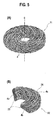
- FIG 5A and FIG 5B are perspective views showing a production method of a water-disintegratable cleaning article 22, according to the second embodiment of the present invention.
- the compressed-fiber structure 21 shown in FIG 5A is produced by compressing the cylinder-shaped structure 10 shown in FIG 2A with the force Fv in the direction along the center line O.
- the conditions for the compressing are the same as those in the production of the compressed-fiber structure 11 shown in FIG 3.
- the article produced by holding the compressed-fiber structure 21, as it is, with the holder 120 can be used as the cleaning article 22.
- the cleaning article 22 shown in FIG 5B is produced by cutting the compressed-fiber structure 21.
- the compressed-fiber structure 21 shown in FIG 5A may be bisected or trisected.
- the trisected compressed-fiber structure 21 which is in the range of 120 ° around the center line O becomes the individual cleaning article 22.
- the tetrasected compressed-fiber structure which is in the range of 90 ° around the center line O may be the individual cleaning article 22.
- the part exposing the cut end face 4b of the string 4 is used as the holding side terminal 23 and the part exposing the loop part 4c of the string 4 along the perimeter of the cleaning article 22 is used as the cleaning side terminal 24.
- the cleaning article 22 is produced also through a step of producing the cylinder-shaped structure 10 by winding the string 4 as shown in FIG 2A and a step of compressing the cylinder-shaped structure 10 as shown in FIG 5A, the twine of the string 4 is unlikely to be loosened during the production of the cleaning article 22 and also during the distribution and custody of the cleaning article 22 as a commercial article. Since the string 4 of the cleaning article 22 is cut into plural short units shown in FIG 5B, when the cleaning article 22 contacts a lot of water, for example, by discarding the cleaning article 22 into a flush toilet, the cleaning article 22 is separated into individual units of the string 4, and further the twine of individual units of the string 4 is loosened, so that the fibers are dispersed in water.
- FIG 6 is a perspective view showing a water-disintegratable cleaning article 31, according to the third embodiment of the present invention.
- the cleaning article 31 is produced by a method comprising: folding the string 4 having a predetermined length at the center of the string 4 into halves; bundling up the plural strings 4 by turning folded parts 4d into one direction; and compressing the bundle of the strings 4.
- the conditions for the compressing are the same as those in the production of the compressed-fiber structure 11 shown in FIG 3 according to the first embodiment and the compressed-fiber structure 21 shown in FIG 5A according to the second embodiment.
- the side in which cut end faces 4g of the strings 4 are lined up is a holding side terminal 32 and the side in which the folded parts 4d of the strings 4 are lined up is a cleaning side terminal 33.
- a compressed part 34 is formed by compressing the bundle of the strings 4.
- a non-compressed part 35 in which the strings 4 are not compressed.
- the compressed part 34 is utilized as a holding part and is supported between the supporting part 122 and the pressing part 123 of the holder 120 shown in FIG 1.
- the cleaning article 31 in a dry state is not disintegrated into pieces and can constantly maintain the form thereof during the custody and the transportation thereof. Since the compressed part 34 is held between the supporting part 122 and the pressing part 123, even when the cleaning article 31 contacts water during the use thereof and the compression of the compressed part 34 is loosened, the cleaning article 31 can maintain the form thereof. In the cleaning side terminal 33, the folded parts 4d of individual strings 4 are in a free state and consequently, the folded parts 4d can independently move freely, so that a wider range of the part to be cleaned can be effectively cleaned.
- the cleaning article 31 When the cleaning article 31 is discarded into a flush toilet and contacts a lot of water after the use thereof, the cleaning article 31 is disintegrated into individual strings 4 and further, the twine of the string 4 is loosened, so that the cleaning article 31 is further disintegrated into individual fibers.
- the whole part of the cleaning article 31 in FIG 6 may be compressed to be the compressed part 34.
- a range (including the holding side terminal 2) having a predetermined length may be made to a compressed part, while the cleaning terminal 3 may be made to a non-compressed part.
- a range (including the holding side terminal 23) having a predetermined length may be made to a compressed part, while the cleaning terminal 24 may be made to a non-compressed part.
- the holding part may be formed by winding a part of the cleaning article 1, the cleaning article 22 and the cleaning article 31, respectively (which part has a predetermined range including the holding side terminal 2, the holding side terminal 23 and the holding side terminal 32, respectively) with a water-disintegratable paper or a water-soluble film.
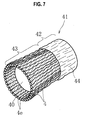
- FIG. 7, Fig. 8 and FIG. 9 show, respectively a water-disintegratable cleaning article 41, a water-disintegratable cleaning article 51 and a water-disintegratable cleaning article 61, respectively, according to a fourth embodiment, a fifth embodiment and a sixth embodiment.
- the cleaning article 41, the cleaning article 51 and the cleaning article 61 each comprise a compressed-fiber structure 40 in a block form which has a predetermined volume.
- the compressed-fiber structure 40 is produced by compressing an aggregate of water-dispersible fibers having a fiber length of 20 mm or less, so that the density of the compressed-fiber structure 40 is enhanced.
- the fibers constituting the compressed-fiber structure 40 include natural fibers such as pulp fibers and regenerated cellulose fibers such as rayon fibers. By compressing the above fibers, the block form of the compressed-fiber structure 40 can be maintained in a dry state through the mechanical bond force and hydrogen bond force between compressed fibers. Otherwise, fibers may be fixed to each other through a water-soluble adhesive.
- the compressed-fiber structure 40 can comprise synthetic fibers, such as PET fibers, PP fibers, PE fibers and nylon fibers.
- the compressed-fiber structure 40 comprises only biodegradable fibers.
- the compressed-fiber structure 40 is produced in a block form using only pulp fibers.
- the production method thereof comprises: a step of dispersing pulp fibers in water to prepare a dispersion of pulp fibers; a step of molding by feeding the dispersion of pulp fibers into a concave-shaped mold for molding a article in a cylindrical form, where the concave-shaped mold has at the bottom thereof a porous part for draining; a step of dehydrating the molded article; and a step of drying the molded article by the heating.
- the following production method comprising: a step of molding by feeding the dispersion of pulp fibers into the above-noted mold or into a different-shaped mold for the pressurization, a step of compressing the molded article by the pressurization using a pressing machine after or while dehydrating the molded article, and drying.
- a still another production method of the compressed-fiber structure 40 comprises: a step of molding by extruding, with a screw extruder, a raw material in a sludge form which is prepared by mixing pulp fibers, a thickener and a water-soluble adhesive; a step of dehydrating the molded article; and a step of drying the molded article by the heating.
- the compressed-fiber structure in a columnar form is produced.
- the compressed-fiber structure 40 comprises fibers having a fiber length of 20 mm or less, preferably pulp fibers
- the cleaning article 41, the cleaning article 51 and the cleaning article 61 each are discarded into a flush toilet or the like
- the compressed-fiber structure 40 can be disintegrated into individual fibers within a relatively short time. Therefore, the size of the compressed-fiber structure 40 can be set optionally according to the form of the cleaning article.
- the time needed for the water-disintegration of one compressed-fiber structure 40 is preferably 700 sec or less, more preferably 600 sec or less, still more preferably 300 sec or less.
- the mass of the compressed-fiber structure 40 is preferably 20 g or less. 20 g corresponds to the mass of a toilet paper having a length of 9 m and is in the range where the clogging of the piping is unlikely to be caused in a normal flush toilet.
- the disintegration of the compressed-fiber structure 40 can be accelerated when the cleaning article 41, the cleaning article 51 and the cleaning article 61 each are discarded into a flush toilet.
- the cleaning effect of the cleaning article 41, the cleaning article 51 and the cleaning article 61 each comprising the above compressed-fiber structure 40 can be enhanced.
- the cleaning article 41, the cleaning article 51 and The cleaning article 61 shown, respectively, in FIG. 7 to FIG. 9 comprise the compressed-fiber structure 40 and the string 4.
- the string 4 comprises either any one of the twined string 4X, the twined string 4Y and the twined string 4Z shown in FIG. 15A, FIG 15B and FIG 15C respectively or a combination of two or more thereof.
- the fifth embodiment and the sixth embodiment shown, respectively, in FIG 7 to FIG 9, as the string 4, a compressed-fiber structure produced by compressing the twined string may be used.
- the plural strings 4 which are cut into a predetermined size are arranged around the compressed-fiber structure 40 in a columnar block form and the base parts of these strings 4 are adhered onto the peripheral surface of the compressed-fiber structure 40 through a water-soluble adhesive.
- a holding material 44 comprising a water-disintegratable sheet is wound around the base parts of the strings 4 and is adhered thereto through a water-soluble adhesive.
- the part wound by the holding material 44 is the holding part 42 and the other part (head) is the cleaning part 43.
- the inside surfaces of the supporting part 122 and the pressing part 123 are both flat; in the holder 120 for the cleaning article 41 shown in FIG 7, the inside surface of the supporting part 122 is in the form of a half part of a concave-curved cylindrical surface and the inside surface of the pressing part 123 is in the form of a half part of a concave-curved cylindrical surface, so that these inside surfaces form together a concave-curved cylindrical surface.
- the holding part 42 of the cleaning article 41 shown in FIG 7 is supported between the inside surface in the form of a half part of a concave-curved cylindrical surface of the supporting part 122 and the inside surface in the form of a half part of a concave-curved cylindrical surface of the pressing part 123. It is satisfactory that the holding part 42 of the cleaning article 41 can exhibit such a level of the strength that the holding part 42 can maintain a cylindrical form thereof until it is held by the holder 120. Even when the holding force of the holding material 44 is weakened by water after the cleaning article 41 has been held by the holder 120, since the cleaning article 41 is held between the supporting part 122 and the pressing part 123, the cleaning article 41 doesn't loose its shape during the cleaning.
- the holding part 42 comprising the holding material 44 looses its shape and the compressed-fiber structure 40 and the string 4 are separated from each other in water. Thereafter, the isolated compressed-fiber structure 40 and the isolated string 4 are water-disintegrated separately. Within an extremely short time after the discard of the cleaning article 41 into water, the compressed-fiber structure 40 and the string 4 are separated from each other and are flushed away with a flush water of a flush toilet, so that the clogging in the piping is unlikely to be caused.
- the compressed-fiber structure 40 In the core part of the cleaning part 43, the compressed-fiber structure 40 is located and around the compressed-fiber structure 40, the strings 4 are arranged, wherein the cut end faces 4e of the strings 4 are turned to the head of the cleaning part 43.
- the part to be cleaned such as a bedpan or the like
- the compressed-fiber structure 40 maintains the block form thereof, and further the compressed-fiber structure 40 which has absorbed water becomes softened and can exhibit the cushion properties. Therefore, the dirt adhered to the part to be cleaned can be effectively removed and the compressed-fiber structure 40 softly contacts the part to be cleaned.
- the strings 4 arranged around the compressed-fiber structure 40 spread to a wider range around the compressed-fiber structure 40, so that a wider range of the part to be cleaned can be cleaned to every corner.
- the strings 4 are arranged around the compressed-fiber structure 40 in a cleaning part 53 and folded parts 4f of the strings 4 are turned to the head of the cleaning part 53.
- a holding part 52 the base parts of the strings 4 are adhered onto the peripheral surface of the compressed-fiber structure 40 through a water-soluble adhesive and the holding material 44 is wound around the peripheral surface of the compressed-fiber structure 40 and is adhered thereto.
- the twines of the strings 4 in FIG 8 are unlikely to be loosened, even when the folded parts 4f absorb water.
- the inside surfaces of the supporting part 122 and the pressing part 123 shown in FIG 1 are both unflat but in the form of a half part of a concave-curved cylindrical surface, so that the holding part 52 is supported between these inside surfaces in the form of a half part of a concave-curved cylindrical surface of the supporting part 122 and the pressing part 123.
- a loop part 4h is formed with plural strings 4 and plural cut end faces 4g of the strings 4 are lined up.
- the strings 4 are adhered to each other through a water-soluble adhesive and further, the holding material 44 is wound around the strings 4 and is adhered thereto through a water-soluble adhesive.
- the water-disintegratable compressed-fiber structure 40 in a columnar form or cylindrical form is inserted into a bundle of the strings 4, and the compressed-fiber structure 40 and the bundle of the strings 4 are adhered and fixed to each other through a water-soluble adhesive.
- the compressed-fiber structure 40 supports the bundle of the strings 4 as the core. Thereby, the dirt can be removed by strongly pressing the loop part 4h of the bundle of the strings 4 to the part to be cleaned. Further, since when the compressed-fiber structure 40 absorbs water, the compressed-fiber structure 40 is swollen and becomes an elastic body, the loop part 4h becomes able to slide on the part to be cleaned with an appropriate pressure.
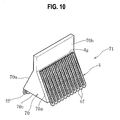
- FIG 10 is a perspective view showing a water-disintegratable cleaning article 71, according to the seventh embodiment of the present invention.
- a compressed-fiber structure 70 constituting the cleaning article 71 is produced by the above-noted injection-molding method or the like, and a triangular-prism part having the slope 70a and the slope 70a which face each other and the holding part 70b having a predetermined size which is located on the triangular-prism part are integrally produced.
- the plural strings 4 are adhered through a water-soluble adhesive.
- the plural strings 4 are lined up with the cut end faces 4g turned upwards and with the folded parts 4f turned downwards.
- the plural folded parts 4f extend to a position lower than the bottom surface of the compressed-fiber structure 70 and are in a free state independently from each other.
- the cleaning article 71 is held in such a manner that the holding part 70b of the cleaning article 71 is supported between the holding part 122 and the pressing part 123 of the holder 120 shown in FIG 1.
- a bottom surface 70c of the compressed-fiber structure 70 on the part to be cleaned such as a bedpan or the like and scrubbing the part to be cleaned, the dirt adhered to the part to be cleaned can be removed, and further since the folded parts 4f of the strings 4 spread along the part to be cleaned, a wider range of the part to be cleaned can be cleaned to every corner.
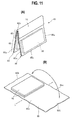
- FIG 11A is a perspective view showing a water-disintegratable cleaning article 81 according to the eighth embodiment of the present invention
- FIG 11B is a developed perspective view explaining the fundamental structure of the cleaning article 81.
- the water-disintegratable cleaning article 81 comprises a holding part 82 and a cleaning part 83.
- the cleaning article 81 comprises at least one cleaning unit 88.
- two overlapped cleaning units 88 are adhered to each other at the upper terminals of the two cleaning units 88 through a water-soluble adhesive, and a holding material 84 such as a water-disintegratable paper covers a part of the two cleaning units 88 respectively over the above-adhered terminals and is adhered to the two cleaning units respectively through a water-soluble adhesive.
- the two cleaning units 88 can independently move freely.
- FIG 11B shows a developed structure of the cleaning unit 88.
- the cleaning unit 88 comprises a water-disintegratable outer sheet 85 and a compressed-fiber structure 86 held in the outer sheet 85.
- the outer sheet 85 comprises the same fiber-interlacing nonwoven fabric as that which the water-disintegratable sheet 8 comprises, wherein the water-disintegratable sheet 8 constitutes the twined string 4X shown in FIG 15A.
- the formulation of the fiber-interlacing nonwoven fabric constituting the outer sheet 85 and the preferable range of the composition of the fiber used in the fiber-interlacing nonwoven fabric are the same as those in the case of the water-disintegratable sheet 8.
- the compressed-fiber structure 86 is in the form of a sheet (a plate) and plural sheets thereof which are piled up are held in the outer sheet 85.
- the compressed-fiber structure 86 is produced by laminating water-dispersible fibers having a fiber length of 20 mm or less and by compressing the thus laminated fibers.
- the fibers include natural fibers, such as pulp fibers, and regenerated cellulose fibers, such as rayon fibers.
- the compressed-fiber structure 86 in a compressed state can maintain the sheet form thereof through the hydrogen bond force of the cellulose fibers and through the mechanical bond force between the fibers which force is generated by the compression. It is also possible that the fibers are connected to each other through a water-soluble adhesive.
- the compressed-fiber structure 86 may comprise synthetic resin fibers, such as PET fibers, PP fibers, PE fibers and nylon fibers.
- the compressed-fiber structure 86 comprises preferably only biodegradable fibers.
- the compressed-fiber structure 86 comprises only pulp fibers.
- the pressure used for the compression by which the compressed-fiber structure 86 is produced is the same as that which is used for the production of the compressed-fiber structure 11 shown in FIG 3 and for the production of the compressed-fiber structure 21 shown in FIG. 5A, and the time for the compression is from 1 sec to 5 sec.
- the compression is performed at normal temperature and may be performed during the heating. By compressing the string with water sprayed thereto and with heating it, the hydrogen bond force between the fibers can be further enhanced.
- the compressed-fiber structure 86 comprises fibers, preferably pulp fibers having a fiber length of 20 mm or less, when the cleaning article 81 is discarded into a flush toilet or the like, the compressed-fiber structure 86 can be disintegrated into individual fibers within a relatively short time. Therefore, the size of the compressed-fiber structure 86 can be set optionally according to the form of the cleaning article 81. However, for disintegrating the compressed-fiber structure 86 in water within a short time, it is preferred that when the compressed-fiber structure 86 contains water having a weight which is 300 % of the own weight of the compressed-fiber structure 86, the compressed-fiber structure 86 is swollen to a volume which is two times or more the volume of the compressed-fiber structure 86 before the swelling.
- the time needed for the water-disintegration of one compressed-fiber structure 86 is preferably 700 sec or less, more preferably 600 sec or less, still more preferably 300 sec or less.
- the mass of the compressed-fiber structure 86 used for one cleaning article 81 is preferably 20 g or less in total. 20 g corresponds to the mass of a toilet paper having a length of 9 m and is in the range where the clogging of the piping is unlikely to be caused in a normal flush toilet.
- the compressed-fiber structure 86 may comprise a cleaning agent, an abrasive, an antimicrobial agent or a perfume.
- the plural compressed-fiber structures 86 are piled up on the developed outer sheet 85 having a rectangle form and the outer sheet 85 is folded along a hypothetical line L. Thereafter, an edge part 85a in a longer side of the outer sheet 85 and another edge part 85a in a longer side of the outer sheet 85 as well as an edge part 85a in another longer side of the outer sheet 85 and another edge part 85a in another longer side of the outer sheet 85, are adhered to each other through a water-soluble adhesive, without adhering the edge parts 85a to the compressed-fiber structure 86. Further, an edge part 85b in a shorter side of the outer sheet 85 and an edge part 85b in another shorter side of the outer sheet 85 are adhered to each other through a water-soluble adhesive.
- an edge part 85a in a longer side, an edge part 85a in another longer side and an edge part 85b in a shorter side are superimposed on respectively another edge part 85a in a longer side, another edge part 85a in another longer side and another edge part 85b in a shorter side, and the folded outer sheet 85 is pressed, or heated and pressed, so that the above-noted edge parts 85a in a longer side, edge parts 85a in another longer side and edge parts 85b in a shorter side respectively can be adhered to each other through the hydrogen bond force and the mechanical bond force of the outer sheet 85.
- the cleaning article 81 shown in FIG 11A is produced comprising two cleaning units 88 which are adhered to each other through a water-soluble adhesive in the range of the cleaning unit 88 from the edge part 85b to a line which is downwards distant along the outer surface of the cleaning unit 88 in parallel from the edge part 85b with a predetermined length, with a folded part 85c (which is caused by folding the outer sheet 85 along the hypothetical line L) turned downwards, and comprising the holding material 84 adhered and fixed to the adhered cleaning units 88 covering the above-noted adhered range of the adhered cleaning units 88.
- the cleaning article 81 is held in such a manner that the holding part 82 of the cleaning article 81 is supported between the supporting part 122 and the pressing part 123 of the holder 120 shown in FIG 1.
- the cleaning part 83 of the cleaning article 81 By sliding the cleaning part 83 of the cleaning article 81 on the part to be cleaned, such as a bedpan or the like, the dirt can be removed by the outer sheet 85.
- the cleaning part 83 has a flat side surface, by sliding the flat side surface of the cleaning part 83 on the part to be cleaned, a wider area of the part to be cleaned can be cleaned.
- the outer sheet 85 comprises a fiber-interlacing nonwoven fabric, the outer sheet 85 is unlikely to be broken during the scrubbing of the part to be cleaned.
- the compressed-fiber structure 86 in the outer sheet 85 is swollen and exhibits elasticity, so that the part to be cleaned can be scrubbed by the outer sheet 85 with an appropriate pressure.
- the holding material 84 comprises a water-disintegratable paper produced by papermaking pulp fibers or by papermaking pulp fibers and adhering fibers to each other through a water-soluble adhesive
- the holding force of the holding material 84 is immediately discharged and the adhered cleaning units 88 are separated into two cleaning units 88.
- the adhesion between the edge parts 85a of the outer sheet 85 and between the edge parts 85b of the outer sheet 85 is discharged, and the outer sheet 85 and the compressed-fiber structure 86 are separated from each other, so that the outer sheet 85 and the compressed-fiber structure 86 are independently disintegrated into individual fibers.
- the cleaning part comprises a compressed-fiber structure 90 in a sheet form and the string 4.
- the compressed-fiber structure 90 in a sheet form is produced by laminating fibers having a fiber length of 20 mm or less and by compressing the laminated fibers into a sheet form, and preferably comprises only pulp fibers.
- the compressed-fiber structure 90 in a sheet form has such a fairly large fiber-weight per square-meter as from 500 g/m 2 to 1,000 g/m 2 , in comparison with that of the water-disintegratable paper 9 shown in FIG 15B (from 10 g/m 2 to 30 g/m 2 ).
- the compressed-fiber structure 90 in a sheet form has a large weight per square-meter, a high density and a high stiffness
- the compressed-fiber structure 90 when the compressed-fiber structure 90 is arranged together with the string 4 in the cleaning part, the dirt adhered to the surface of the part to be cleaned, such as a bedpan or the like can be easily removed by the compressed-fiber structure 90 in a sheet form which has a high stiffness, and further the string 4 is transformed relatively freely, so that a wider range of the part to be cleaned can be wiped.
- the string 4 the cleaning of a corner of a bedpan becomes easier.
- the compressed-fiber structure 90 in a sheet form is disintegrated into individual pulp fibers within a relatively short time.
- a water-disintegratable cleaning article 91 In a water-disintegratable cleaning article 91 according to the ninth embodiment shown in FIG 12, plural sheets (e.g., five sheets to twenty sheets) of the compressed-fiber structure 90 are piled up, and the plural strings 4 are arranged around the sheets.
- the compressed-fiber structures 90 and the strings 4 are adhered to each other through a water-soluble adhesive in a holding part 92 and around the layer of the strings 4, and the holding material 44 comprising a water-disintegratable paper or the like is wound and adhered thereto.
- the individual compressed-fiber structures 90 in a sheet form are independent from each other and individual strings 4 are independent.
- the cut end faces 4e of the strings 4 are turned to the head of the cleaning part 93.
- the inside surfaces of the supporting part 122 and the pressing part 123 shown in FIG. 1 are both unflat but in the form of a half part of a concave-curved cylindrical surface, so that the holding part 92 is supported between these inside surfaces in the form of a half part of a concave-curved cylindrical surface of the supporting part 122 and the pressing part 123.
- the cleaning article 91 by pressing and sliding the top of the cleaning part 93 on the part to be cleaned, the part to be cleaned is scrubbed by the edge surfaces of the compressed-fiber structures 90, and further, the individual strings 4 spread, so that a wider range of the part to be cleaned can be cleaned and the corner part of a bedpan or the like can be cleaned by the strings 4.
- the cut end faces 4e of the strings 4 in the cleaning part 93 can be replaced by the folded parts 4f of the strings 4 shown in FIG 8 according to the fifth embodiment.
- a water-disintegratable cleaning article 101 according to the tenth embodiment shown in FIG 13 comprises one or plural water-disintegratable compressed-fiber structure(s) 90 (which are superimposed) having substantially the same size as that of the cleaning article 101.
- Plural strings 4 are formed in a loop form and the loop parts 4h are arranged surrounding lower sides 90a of the compressed-fiber structures 90 in a sheet form.
- the cut end faces 4g of the plural strings 4 are lined up in such a manner that the vertical level of the cut end faces 4g becomes the same as that of upper sides 90b of the compressed-fiber structures 90 in a sheet form, and the parts of plural strings 4 in the near of the cut end faces 4g are adhered to the both surfaces of the compressed-fiber structure 90.
- the holding material 44 is wound and adhered thereto, so that the holding part 102 in a flat form is formed.
- the individual strings 4 can move independently and also the compressed-fiber structures 90 in a sheet form can move independently.
- the cleaning article 101 by sliding the cleaning part 103 on the part to be cleaned in the Y direction shown in FIG 13, the part to be cleaned can be scrubbed by the lower sides 90a of the compressed-fiber structures 90 in a sheet form. Further, by sliding the cleaning part 103 on the part to be cleaned in the X direction which crosses the Y direction orthogonally, the part to be cleaned can be cleaned by the loop parts 4h of the strings 4.
- a water-disintegratable cleaning article 111 according to the eleventh embodiment shown in FIG 14 is produced by a method comprising plural steps: a step of putting two pieces of the block which is formed by superimposing plural water-disintegratable compressed-fiber structures 90 having a rectangular sheet form in a vertically standing state, beside each other; a step of arranging two pieces of the block of the plural strings 4 respectively beside the both sides of the above-noted two pieces of the block of the plural compressed-fiber structures 90; and a step of winding the holding material 44 around the top side parts of the two blocks of the plural compressed-fiber structures 90 and the two blocks of the plural strings 4 and adhering the holding material 44 thereto, thereby forming the holding part 112 in a flat form.
- the plural strings 4 in which the cut end faces 4e are turned downwards, and plural compressed-fiber structures 90 are positioned independently.
- the wiping can be performed by the compressed-fiber structures 90 in a sheet form and the strings 4.
- the strings 4 in the above-noted two blocks which are arranged respectively beside the both sides of the two blocks of the compressed-fiber structures 90 in a sheet form, may be replaced by either the strings 4 having the folded parts 4f shown in FIG. 8 which are turned downwards or the strings 4 having the loop parts 4h shown in FIG 9 which are turned downwards.
- the water-disintegratable cleaning article under the present invention comprises a compressed-fiber structure having a high strength
- the cleaning article will not be broken or deformed and can effectively scrub off the dirt.
- fibers in the compressed-fiber structure is loosened, so that the cleaning article can be easily water-disintegrated within a relatively short time.
Landscapes
- Health & Medical Sciences (AREA)
- Public Health (AREA)
- Cleaning Implements For Floors, Carpets, Furniture, Walls, And The Like (AREA)
Abstract
Description
- The present invention relates to a water-disintegratable cleaning article which is used to remove the dirt in a place where water is used, such as in a flush toilet and which can be discarded into water after the use thereof.
-
Japanese Patent Application Laid-Open No. Showa 62(1987)-186833 JP62-186833 - The toilet cleaning brush is produced using a paper comprising: staple fibers of a ligneous pulp and a binder such as carboxyl methyl cellulose (CMC), by a method in which plural cuts are formed in the paper and the paper is wound to form a brush. The toilet cleaning brush is fixed to a head of a paper-made handhold of the brush. After a bedpan is wiped with the toilet cleaning brush, the cleaning brush and the handhold are discarded into a flush toilet and are disintegrated in water. It is also described that for controlling the time needed for the dissolution of the paper in water, the surface of the brush is subjected to a wax treatment.
- The
JP62-186833 - However, the toilet cleaning brush produced with the paper itself which is produced by fixing a ligneous pulp through a water-soluble carboxyl methyl cellulose (CMC) is swollen at the contact thereof with water during the cleaning of a bedpan and the strength thereof is extremely lowered, so that it becomes difficult to wipe off the dirt adhered to a bedpan by such a brush. With respect to the brush which has been subjected to a wax treatment, since a wax component may suppress the disintegration of the paper, it takes a long time until the brush has been disintegrated, for example, in a purification tank.
- Further, since the toilet cleaning brush produced by winding the paper in which plural cuts are formed has a low stiffness, it is difficult to scrub a bedpan or the like by such a brush, and therefore the dirt adhered to a bedpan or the like cannot be effectively removed.
- The present invention solves the above-noted problem accompanying the conventional art. It is therefore an object of the present invention to provide a water-disintegratable cleaning article which can effectively wipe off the dirt adhered to a bedpan of a flush toilet.
- It is another object of the present invention to provide a water-disintegratable cleaning article which not only has high strength when the cleaning article scrubs a bedpan or the like, and can exhibit the effect of removing the dirt, but also can be dispersed in water within a relatively short time after the use thereof.
- According to a first aspect of the present invention, there is provided a water-disintegratable cleaning article dispersible in water, comprising: a compressed-fiber structure in which a water-dispersible fiber is compressed.
-
- [FIG 1] FIG 1 is a perspective view showing the water-disintegratable cleaning article which is held by the holder, under the present invention.
- [FIG. 2] FIG 2A and FIG. 2B are perspective views showing a production method of a compressed-fiber structure constituting the water-disintegratable cleaning article, according to a first embodiment of the present invention.
- [FIG. 3] FIG 3 is a perspective view showing the compressed-fiber structure constituting the water-disintegratable cleaning article, according to the first embodiment of the present invention.
- [FIG. 4] FIG 4 is a perspective view showing the water-disintegratable cleaning article produced by cutting the compressed-fiber structure, according to the first embodiment of the present invention.
- [FIG 5] FIG 5A is a perspective view showing a compressed-fiber structure constituting a water-disintegratable cleaning article, according to a second embodiment of the present invention, and FIG 5B is a perspective view showing the water-disintegratable cleaning article produced by cutting the compressed-fiber structure, according to the second embodiment of the present invention.
- [FIG 6] FIG. 6 is a perspective view showing a water-disintegratable cleaning article, according to a third embodiment of the present invention.
- [FIG 7] FIG 7 is a perspective view showing a water-disintegratable cleaning article, according to a fourth embodiment of the present invention.
- [FIG. 8] FIG 8 is a perspective view showing a water-disintegratable cleaning article, according to a fifth embodiment of the present invention.
- [FIG 9] FIG 9 is a perspective view showing a water-disintegratable cleaning article, according to a sixth embodiment of the present invention.
- [FIG. 10] FIG. 10 is a perspective view showing a water-disintegratable cleaning article, according to a seventh embodiment of the present invention.
- [FIG. 11] FIG 11A is a perspective view showing a water-disintegratable cleaning article, according to an eighth embodiment of the present invention, and FIG 11B is a perspective view showing the water-disintegratable cleaning article in a developed form.
- [FIG. 12] FIG 12 is a perspective view showing a water-disintegratable cleaning article, according to a ninth embodiment of the present invention.
- [FIG 13] FIG 13 is a perspective view showing a water-disintegratable cleaning article, according to a tenth embodiment of the present invention.
- [FIG 14] FIG 14 is a perspective view showing the water-disintegratable cleaning article, according to an eleventh embodiment of the present invention.
- [FIG. 15] FIG 15A, FIG 15B and FIG 15C are explanatory drawings explaining three different forming methods of a string by twining only a water-disintegratable sheet or the water-disintegratable sheet and water-disintegratable paper together.
- FIG 1 is a perspective view showing a water-
disintegratable cleaning article 1 which is held by aholder 120, under the present invention. FIG 2 to FIG 4 are perspective views showing sequentially production steps of the water-disintegratable cleaning article 1 which is held by theholder 120 as shown in FIG 1, according to a first embodiment of the present invention. FIG 5 to FIG 14 are perspective views showing the water-disintegratable cleaning articles, according to other embodiments of the present invention. FIG. 15A, FIG 15B and FIG 15C are explanatory drawings explaining, respectively, a twinedstring 4X, a twinedstring 4Y and a twinedstring 4Z. - FIG 4 shows the water-
disintegratable cleaning article 1, according to the first embodiment of the present invention. The water-disintegratable cleaning article 1 comprises aholding side terminal 2 and acleaning side terminal 3. - In FIG 1, the
holder 120 has a structure where a terminal of ahandhold part 121 made of a synthetic resin is integrated with a supportingpart 122, and apressing part 123 made of a synthetic resin is provided at the opposite side to the supportingpart 122. The supportingpart 122 has substantially a flat supporting inside face and thepressing part 123 also has substantially a flat inside face, so that the supportingpart 122 and thepressing part 123 face parallel to each other. Thepressing part 123 is integrated with alever 124, and thelever 124 is rotatably supported by abracket 121 a formed on thehandhold part 121 through apivot 125. Anoperating wire 126 is rotatably connected to the top of thelever 124. - A torsion spring (not illustrated) is attached to the
pivot 125, and by the torsion spring, thelever 124 is biased in the clockwise direction around thepivot 125 as the fulcrum, so that thepressing part 123 is biased in the direction approaching the supportingpart 122. A handle part (not illustrated) is provided in the upper part of thehandhold part 121, and an operating lever (not illustrated) is provided in the handle part (not illustrated). The upper terminal of theoperating wire 126 which is a thick wire is connected to the operating lever (not illustrated). When the operating lever (not illustrated) is pulled up, thelever 124 is rotated, and consequently, thepressing part 123 is spaced part from the supportingpart 122. At this time, when theholding side terminal 2 of thecleaning article 1 is inserted between the supportingpart 122 and thepressing part 123 and the operating lever (not illustrated) is released from the hand, by the bias force of the torsion spring (not illustrated), theholding side terminal 2 of thecleaning article 1 is supported between the supportingpart 122 and thepressing part 123. - By scrubbing the part to be cleaned (such as a bedpan or the like) with the
cleaning side terminal 3 of thecleaning article 1 while holding thecleaning article 1 with theholder 120, the dirt adhered to the surface of a bedpan or the like can be removed. At this time, it is also possible that thecleaning article 1 is wetted by the water standing in the bedpan and the bedpan is wiped by the wettedcleaning article 1. After the completion of the cleaning, by releasing the pressing force of thepressing part 123 through pulling up the operating lever (not illustrated), thecleaning article 1 can be discarded into the bedpan without touching thecleaning article 1 by the hand. - The
cleaning article 1 shown in FIG 4 comprises a compressed-fiber structure 11 produced by compressing a bundle ofplural strings 4 comprising water-dispersible fibers. Hereinbelow, with respect to the production method of the cleaningarticle 1, explanations are given referring to FIG 2 to FIG 4. - As shown in FIG 2A, a cylinder-
shaped structure 10 is produced by winding onestring 4 or a plurality of thestrings 4. At this time, as shown in FIG 2B, when a hypothetical circle HC having a radius R and a center line O of the cylinder-shaped structure 10 cross each other at a right angle is assumed, the string is wound plural times along the winding direction α which is formed by inclining the clockwise radius direction of the hypothetical circle HC at an angle θ1 in the anti-clockwise direction from the radius R. Thereafter continuously, the string is wound plural times along the winding direction β which is formed by inclining the clockwise radius direction of the hypothetical circle HC at an angle θ2 in the clockwise direction from the radius R. By repeating alternately a plurality of the windings in the direction α and a plurality of the windings in the direction β, the cylinder-shaped structure 10 shown in FIG 2A can be obtained. The strings constituting the cylinder-shaped structure 10 are wound in such a manner that they cross each other. - By compressing the cylinder-
shaped structure 10 shown in FIG. 2A through giving a collapsing force F to the cylinder-shaped structure 10 in the diameter direction using a pressing machine (not illustrated), the compressed-fiber structure 11 can be obtained. The pressure of the collapsing force F is in the range of from 2,000 kPa to 6,000 kPa, for example, 3,920 kPa (40 kgf/cm2). The compressing time is in the range of from 1 sec to 5 sec. The compressing is performed in a normal temperature or may be performed during the heating. The compressed-fiber structure 11 after the compression can maintain the compressed state by means of the mechanical aggregation force and hydrogen bond force of the fibers constituting thestring 4. For bonding the fibers to each other through the hydrogen bond force, it is preferred that natural fibers or regenerated cellulose fibers which have a hydroxyl group on the fiber surface thereof are used as the fibers constituting thestring 4. Further, for enhancing the hydrogen bond force, the cylinder-shapedstructure 10 may be subjected to the heating and the compressing after the cylinder-shapedstructure 10 is wetted by spraying water thereto. It is also possible that the dry strength of the compressed-fiber structure 11 is enhanced by producing the cylinder-shapedstructure 10 by adhering the strings to each other using a water-soluble binder, such as polyvinyl alcohol (PVA), polyacrylic acid (PAA), carboxyl methyl cellulose (CMC) and the like. - Since the compressed-
fiber structure 11 shown in FIG 3 is produced by collapsing the cylinder-shapedstructure 10 in the diameter direction, at the both terminals of the compressed-fiber structure 11, aloop part 4a of thestring 4 is exposed in a collapsed state. Although the compressed-fiber structure 11 shown in FIG 3 can be used, as it is, as the water-disintegratable cleaning article 1, according to the first embodiment, by cutting the compressed-fiber structure 11 along the center line O thereof into halves, two pieces of thecleaning article 1 shown in FIG 4 are produced. In thecleaning article 1 shown in FIG 4, plural cut end faces 4b of thestrings 4 are exposed at the holdingside terminal 2, andplural loop parts 4a are exposed in a collapsed state at thecleaning side terminal 3. - By twisting and twining a water-
disintegratable sheet 8 in one direction as shown in FIG 15A, thestring 4 is so formed as to have a high density. The water-disintegratable sheet 8 comprises fibers having a fiber length of 20 mm or less. When the water-disintegratable sheet 8 contacts a lot of water in a flush toilet or in a purification tank, fibers constituting the water-disintegratable sheet 8 can be separately dispersed in water within a short time. The water-disintegratable sheet 8 either is produced by papermaking only pulp fibers so that the fibers are connected to each other through the hydrogen bond force, or is a water-disintegratable paper produced by papermaking pulp fibers and rayon fibers together so that the fibers are connected to each other through the hydrogen bond force. In addition, the water-disintegratable paper produced by adhering fibers to each other by a water-soluble binder, such as polyvinyl alcohol (PVA), polyacrylic acid (PAA), carboxyl methyl cellulose (CMC) and the like, can be also used as the water-disintegratable sheet 8. - By twining the water-disintegratable paper, the
string 4 becomes able to maintain the form thereof by the hydrogen bond force. Otherwise, by adding the above-noted water-soluble binder to the twined water-disintegratable paper after the twining thereof, thestring 4 becomes able to maintain the form thereof. - The water-
disintegratable sheet 8, which is produced by a method in which pulp fibers are subjected to a water-resistant treatment to slightly lower the hydrophilicity of the pulp fibers and these treated pulp fibers are connected to each other by the water-soluble binder, can be also used. Thestring 4 comprising this water-disintegratable sheet 8 can easily maintain the form of the string, even when the string is wetted by water during the cleaning. - FIG. 15A, FIG 15B and FIG 15C show more preferred examples of the twined
string 4X, the twinedstring 4Y and the twinedstring 4Z for forming thestring 4 individually, according to the difference in structure. Thestring 4 used for producing thecleaning article 1 comprises any one of the twinedstring 4X, the twinedstring 4Y and the twinedstring 4Z. In addition, thestring 4 used for producing thecleaning article 1 may comprise also a combination of two or more of the twinedstring 4X, the twinedstring 4Y and the twinedstring 4Z. - The twined
string 4X shown in FIG 15A is formed by twisting in one direction the water-disintegratable sheet 8 in a belt which has a predetermined width (e.g., width is 20 mm to 100 mm), followed by the twining. - For maintaining the wet strength of the twined
string 4X, the water-disintegratable sheet 8 comprises a water-disintegratable fiber-interlacing nonwoven fabric. The water-disintegratable fiber-interlacing nonwoven fabric can be produced in such a manner that the fibers having a fiber length of 20 mm or less are laminated, in the form of a mesh, on a conveyor of a porous plate and then the thus laminated fibers are subjected to a water jet treatment to interlace the fibers. - The fiber-interlacing nonwoven fabric comprises fibers having a fiber length, for example, 20 mm or less which fibers can be interlaced by the water jet treatment, and pulp fibers. When the nonwoven fabric comprises pulp fibers and other fibers having a fiber length of 20 mm or less, by a water-jet treatment, not only the other fibers are interlaced, but also pulp fibers each other and pulp fibers and the other fibers are hydrogen-bonded. This fiber-interlacing nonwoven fabric can maintain not only a high dry strength thereof but also the twined form thereof, by the hydrogen bond force of the pulp fibers. Further, when wetted, the fiber-interlacing nonwoven fabric can maintain a high surface strength thereof through the interlacing force between the other fibers. When the fiber-interlacing nonwoven fabric is discarded into water and contacts a lot of water, due to the separation of pulp fibers from each other, the twine of the string is loosened and the interlacing of the other fibers is easily loosened, thereby the fibers are separated from each other into individual fibers within a relatively short time.
- As the other fibers which have a fiber length of 20 mm or less and can be interlaced by the water-jet treatment, biodegradable fibers are preferably used. Preferred examples of the biodegradable fibers include regenerated cellulose fibers, such as viscose rayon fibers, solvent spinning rayon fibers, polynosic rayon fibers, copper-ammonia rayon fibers and alginate rayon fibers. Examples of the other fibers which have a fiber length of 20 mm or less and can be interlaced by a water-jet treatment include synthetic resin fibers, such as polyethylene terephthalate (PET) fibers, nylon fibers and polypropylene (PP) fibers.
- Examples of the fibers which may be used either in combination with the pulp fibers or instead of the pulp fibers include natural fibers, such as hemp, cotton, bagasse, banana, pineapple and bamboo.
- Further, fibers of polyvinyl alcohol (PVA) which is a water-soluble resin and water-soluble or water-swellable carboxyl methyl cellulose (CMC) may be added as a binder into the composition of the fiber-interlacing nonwoven fabric, for enhancing the dry strength of the nonwoven fabric or for rendering easier the maintaining of the twined form of the string. In addition, a fiber-interlacing nonwoven fabric produced by the following method can be also used: preparing a fibrillated rayon fiber having a surface where a lot of microfibers having a fiber length of 1 mm or less are peel-formed by beating rayon fibers having a fiber length of from 3 mm to 7 mm, papermaking in a wet system the fibers having a fiber length of 20 mm or less in combination with the thus fibrillated rayon fibers, and then subject the resultant fibers to a water-jet treatment. Since in this nonwoven fabric, not only the fibers having a fiber length of 20 mm or less are interlaced, but also the fibers are fixed through the hydrogen bond force of the fibrillated rayon fibers, the dry strength and the wet strength of this nonwoven fabric can be enhanced and since particularly the dry strength thereof is high, a strongly twisted string form can be easily maintained.
- The fiber-interlacing nonwoven fabric constituting the twined
string 4X comprises preferably 10 % by mass or more of natural fibers such as pulp fibers and 10 % by mass or more of the other fibers such as rayon fibers having a fiber length of 20 mm or less and interlaceable by a water-jet treatment. By comprising 10 % by mass or more of natural fibers, the hydrogen bond force in the string formed by strongly twisting and twining can be enhanced, and by comprising 10 % by mass or more of the fibers which can be interlaced, the wet strength of the fiber-interlacing nonwoven fabric can be enhanced. - The water-
disintegratable sheet 8 comprising a fiber-interlacing nonwoven fabric has preferably a weight per square-meter of from 30 g/m2 to 120 g/m2 and a thickness of from 0.1 mm to 0.5 mm. - In FIG. 15A, the twined
string 4X is formed using one water-disintegratable sheet 8 comprising a fiber-interlacing nonwoven fabric, however, the twinedstring 4X may be formed using the plural water-disintegratable sheets 8 which are superimposed. For enhancing the strength of thecleaning article 1 during the cleaning by thickening theindividual strings 4 used for producing thecleaning article 1 shown in FIG 4, it is satisfactory to increase the weight per square-meter and the thickness of one water-disintegratable sheet 8. On the other hand, when the weight per square-meter and the thickness of one water-disintegratable sheet 8 are increased excessively, the water-disintegratable sheet 8 becomes difficult to be twined during the twisting step and the time needed for water-disintegrating the water-disintegratable sheet 8 becomes longer. Therefore, in this case, by forming the twinedstring 4X using the plural water-disintegratable sheets 8, the twined string which is thick and has a high stiffness can be formed, and moreover, at the contact of the string with a lot of water, which causes the loosening of the twine of the string, the string is separated into individual water-disintegratable sheets 8 and becomes easier to be water-disintegrated. - The twined
string 4Y shown in FIG 15B is formed by a method in which the water-disintegratable sheet 8 (comprising a fiber-interlacing nonwoven fabric) and water-disintegratable paper 9 are superimposed and twisted together. The water-disintegratable paper 9 is produced by papermaking natural fibers such as pulp fibers or by papermaking natural fibers such as pulp fibers and regenerated cellulose fibers such as rayon fibers, so that the water-disintegratable paper 9 exhibits the strength thereof through the hydrogen bond force between fibers. - By twining together the water-
disintegratable sheet 8 and the water-disintegratable paper 9 which are superimposed, the superimposed sheets can be strongly and tightly twisted and twined because of a high strength of the water-disintegratable sheet 8 comprising a fiber-interlacing nonwoven fabric. After the twining, the twined string can maintain the form thereof obtained through the twining in a dry state, where the above maintaining is achieved by the hydrogen bond force of the fibers constituting the water-disintegratable paper 9 and by the mechanical bond force between the fibers. Accordingly, the twinedstring 4Y having a high density can be easily processed and can maintain the form thereof. By forming thestring 4 of thecleaning article 1 shown in FIG. 4 using the twinedstring 4Y having a high density, even when thestring 4 contains a little water, the dirt adhered to the surface of a bedpan or the like can be scrubbed off by thestring 4 having a high stiffness. When thecleaning article 1 is discarded into a flush toilet and contacts a lot of water, the fibers constituting the water-disintegratable paper 9 are loosened and the twine of thestring 4 begins to be loosened, consequently the water-disintegratable sheet 8 is loosened. - By twining the water-
disintegratable sheet 8 and the water-disintegratable paper 9 together, many uneven parts can be formed on the surface of the twinedstring 4Y, so that the effect of removing the dirt can be enhanced. The twinedstring 4Y may comprise plural pieces of at least one of the water-disintegratable sheet 8 and the water-disintegratable paper 9. - In the twined
string 4Y shown in FIG 15B, the water-disintegratable paper 9 is colored in a color other than white, such as blue and red. The water-disintegratable sheet 8 comprising a fiber-interlacing nonwoven fabric is formed with white fibers. By twining the water-disintegratable sheet 8 and the water-disintegratable paper 9 which are superimposed, a colored part and a white part are located alternately in the twinedstring 4Y, so that the appearance of the twinedstring 4Y becomes preferable. - In the forming of the twined
string 4Y shown in FIG 15B, instead of the water-disintegratable paper 9, an air-laid nonwoven fabric may be used. The air-laid nonwoven fabric is produced by a method in which a fiber web is produced by laminating pulp fibers according to an air-laid method and the fibers in the fiber webs are adhered to each other through a water-soluble binder, such as polyvinyl alcohol (PVA). The air-laid nonwoven fabric has such a low density, as a fiber density of from 0.04 g/cm3 to 0.07 g/cm3 and is so bulky as having a thickness of from 0.3 mm to 5 mm. In addition, the air-laid nonwoven fabric can be disintegrated in water within a short time. Since the air-laid nonwoven fabric has cushion properties, by twining together the air-laid nonwoven fabric and the water-disintegratable sheet 8 which comprises a fiber-interlacing nonwoven fabric, the twinedstring 4Y which has elasticity can be obtained. - The twined
string 4Z shown in FIG. 15C is formed by the following method: twining: one water-disintegratable paper 9, the plural water-disintegratable papers 9, the air-laid nonwoven fabric, or the water-disintegratable paper 9 and the air-laid nonwoven fabric which are superimposed, to thereby form the core of thestring 4Z, winding around the core the water-disintegratable sheet 8 comprising a fiber-interlacing nonwoven fabric, and further twining the water-disintegratable sheet 8. Since the core of the twinedstring 4Z exhibits a strong hydrogen bond force and the twisted state can be maintained, the twinedstring 4Z has a high density. Since the water-disintegratable sheet 8 having a high wet strength is wound around the core, the surface strength of thestring 4 can be enhanced and the form of thestring 4 can be easily maintained when the wiping of the dirt is performed by thecleaning article 1 in a wet state. In addition, when thecleaning article 1 contacts a lot of water, the water-disintegratable paper 9 or the air-laid nonwoven fabric each of which constitutes the core is disintegrated and consequently, the twine of the water-disintegratable sheet 8 is loosened, so that thecleaning article 1 becomes able to be water-disintegrated within a short time. - The number of twining times for forming each of the twined
string 4X, the twinedstring 4Y and the twinedstring 4Z is preferably from 4 to 30 per the length 250 mm of the water-disintegratable sheet 8 constituting the twined string. When the number of twining times is less than 4, the density of the string becomes too low, so that the string cannot bear a frictional force during the wiping of the dirt and is easily broken. On the other hand, when the number of twining times is more than 30, a load is charged to the water-disintegratable sheet 8 during the twining thereof, so that it is feared that the water-disintegratable sheet 8 is cut. The thickness of the twinedstring 4X, the twinedstring 4Y and the twinedstring 4Z is preferably in the range of from 1 mm to 10 mm. When the thickness is in this range; the wiping touch of thestring 4 is preferable and when thecleaning article 1 is discarded into a flush toilet, the piping is not clogged by thecleaning article 1, so that thecleaning article 1 can be easily discarded. - When the
cleaning article 1 is used, the holdingside terminal 2 is held between the supportingpart 122 and thepressing part 123 of theholder 120 shown in FIG 1. Thecleaning article 1 comprises the compressed-fiber structure 11, so that when thecleaning article 1 is dry, theplural strings 4 are not separated from each other. When thecleaning article 1 is wetted by water after thecleaning article 1 has been held by theholder 120, at this time, thecleaning article 1 is supported between the supportingpart 122 and thepressing part 123, so that theplural strings 4 are not separated from each other in the holdingside terminal 2 during the cleaning. Since in thecleaning article 1 shown in FIG 4, theplural strings 4 run obliquely against the cut cross section along the center line O and are compressed in the state in whichplural strings 4 cross each other, thecleaning article 1 has, as a whole, a high stiffness and the part to be cleaned of a bedpan or the like can be strongly scrubbed with thecleaning side terminal 3, so that the dirt adhered to the part to be cleaned can be removed by the cleaningside terminal 3. - In the
cleaning side terminal 3 of thecleaning article 1,many loop parts 4a of thestring 4 are present and nocut end face 4b is exposed, so that even when thecleaning side terminal 3 is wetted by water, it can be prevented that thestring 4 is excessively loosened. When thecleaning article 1 contacts a relatively large quantity of water during the scrubbing of the part to be cleaned such as a bedpan or the like, the compressed state of thestring 4 is relaxed and theplural loop parts 4a independently slide on the part to be cleaned, so that a wider range of the part to be cleaned can be cleaned by theindividual loop parts 4a. - Since the cylinder-shaped
structure 10 shown in FIG 2 is formed by winding thelong string 4, it is unlikely that the twine of thestring 4 is loosened during the production process of the cylinder-shapedstructure 10. Further, since the compressed-fiber structure 11 is produced by compressing the cylinder-shapedstructure 10 which has been formed, it can be prevented that the twine of thestring 4 is loosened during the distribution and custody of thecleaning article 1 as a commercial article. Since theindividual cleaning articles 1 are produced by cutting into halves the compressed-fiber structure 11 shown in FIG. 3, thestring 4 is cut into plural units in thecleaning article 1. The length of an individual unit of thestring 4 is about two times the length between the holdingside terminal 2 and thecleaning side terminal 3 in thecleaning article 1. Therefore, when thecleaning article 1 is discarded into a flush toilet after the use thereof, the compressed state of thestring 4 is loosened by a lot of water, so that individual units of thestring 4 can be further easily dispersed. And then, after the dispersion, the individual units of thestring 4 are water-disintegrated. - The length between the holding
side terminal 2 and thecleaning side terminal 3 in thecleaning article 1 is about in the range of from 20 mm to 100 mm, but is not limited by this range. - The time needed for the water-disintegration of the dispersed individual unit of the
string 4 is preferably 700 sec or less, more preferably 600 sec or less, still more preferably 300 sec or less, in terms of the value measured according to JIS P4501 (relaxability test for the toilet paper), based on 100 mm of the length of one piece of thestring 4. This is a measurement from a time when thestring 4 is charged into 300 mL of an ion-exchanged water having a temperature of 20 ± 5 °C which is placed in a 300 mL beaker, and then thestring 4 and the ion-exchanged water together are stirred by rotating a rotator at a speed of 600 rpm in the ion-exchanged water, to a time when the form of the string has disappeared and the form of the sheet has not remained, so that individual fibers have been dispersed. - FIG 5A and FIG 5B are perspective views showing a production method of a water-
disintegratable cleaning article 22, according to the second embodiment of the present invention. - The compressed-
fiber structure 21 shown in FIG 5A is produced by compressing the cylinder-shapedstructure 10 shown in FIG 2A with the force Fv in the direction along the center line O. The conditions for the compressing are the same as those in the production of the compressed-fiber structure 11 shown in FIG 3. - In FIG. 5A, the article produced by holding the compressed-
fiber structure 21, as it is, with theholder 120 can be used as thecleaning article 22. However, the cleaningarticle 22 shown in FIG 5B is produced by cutting the compressed-fiber structure 21. At this time, the compressed-fiber structure 21 shown in FIG 5Amay be bisected or trisected. In the case of the trisection, the trisected compressed-fiber structure 21 which is in the range of 120 ° around the center line O becomes theindividual cleaning article 22. Further, in the case of the tetrasection, the tetrasected compressed-fiber structure which is in the range of 90 ° around the center line O may be theindividual cleaning article 22. - In the
cleaning article 22, the part exposing thecut end face 4b of thestring 4 is used as the holdingside terminal 23 and the part exposing theloop part 4c of thestring 4 along the perimeter of thecleaning article 22 is used as thecleaning side terminal 24. - Since the
cleaning article 22 is produced also through a step of producing the cylinder-shapedstructure 10 by winding thestring 4 as shown in FIG 2A and a step of compressing the cylinder-shapedstructure 10 as shown in FIG 5A, the twine of thestring 4 is unlikely to be loosened during the production of thecleaning article 22 and also during the distribution and custody of thecleaning article 22 as a commercial article. Since thestring 4 of thecleaning article 22 is cut into plural short units shown in FIG 5B, when thecleaning article 22 contacts a lot of water, for example, by discarding thecleaning article 22 into a flush toilet, the cleaningarticle 22 is separated into individual units of thestring 4, and further the twine of individual units of thestring 4 is loosened, so that the fibers are dispersed in water. - FIG 6 is a perspective view showing a water-
disintegratable cleaning article 31, according to the third embodiment of the present invention.
The cleaningarticle 31 is produced by a method comprising: folding thestring 4 having a predetermined length at the center of thestring 4 into halves; bundling up theplural strings 4 by turning foldedparts 4d into one direction; and compressing the bundle of thestrings 4. At this time, the conditions for the compressing are the same as those in the production of the compressed-fiber structure 11 shown in FIG 3 according to the first embodiment and the compressed-fiber structure 21 shown in FIG 5A according to the second embodiment. - In the
cleaning article 31 shown in FIG 6, the side in which cut end faces 4g of thestrings 4 are lined up is a holdingside terminal 32 and the side in which the foldedparts 4d of thestrings 4 are lined up is acleaning side terminal 33. In a range (including the holding side terminal 32) having a predetermined length, acompressed part 34 is formed by compressing the bundle of thestrings 4. In a range (including the cleaning side terminal 33) having a predetermined length, there is provided anon-compressed part 35 in which thestrings 4 are not compressed. Thecompressed part 34 is utilized as a holding part and is supported between the supportingpart 122 and thepressing part 123 of theholder 120 shown in FIG 1. - Since the
individual strings 4 are compressed and fixed in thecompressed part 34, the cleaningarticle 31 in a dry state is not disintegrated into pieces and can constantly maintain the form thereof during the custody and the transportation thereof. Since thecompressed part 34 is held between the supportingpart 122 and thepressing part 123, even when thecleaning article 31 contacts water during the use thereof and the compression of thecompressed part 34 is loosened, the cleaningarticle 31 can maintain the form thereof. In thecleaning side terminal 33, the foldedparts 4d ofindividual strings 4 are in a free state and consequently, the foldedparts 4d can independently move freely, so that a wider range of the part to be cleaned can be effectively cleaned. - When the
cleaning article 31 is discarded into a flush toilet and contacts a lot of water after the use thereof, the cleaningarticle 31 is disintegrated intoindividual strings 4 and further, the twine of thestring 4 is loosened, so that thecleaning article 31 is further disintegrated into individual fibers.
The whole part of thecleaning article 31 in FIG 6 may be compressed to be thecompressed part 34. - Moreover, in the
cleaning article 1 shown in FIG 4 according to the first embodiment, a range (including the holding side terminal 2) having a predetermined length may be made to a compressed part, while the cleaningterminal 3 may be made to a non-compressed part. - Moreover likewise, in the
cleaning article 22 shown in FIG 5B according to the second embodiment, a range (including the holding side terminal 23) having a predetermined length may be made to a compressed part, while the cleaningterminal 24 may be made to a non-compressed part. - In each of the first embodiment, the second embodiment and the third embodiment, the holding part may be formed by winding a part of the
cleaning article 1, the cleaningarticle 22 and thecleaning article 31, respectively (which part has a predetermined range including the holdingside terminal 2, the holdingside terminal 23 and the holdingside terminal 32, respectively) with a water-disintegratable paper or a water-soluble film. - FIG. 7, Fig. 8 and FIG. 9 show, respectively a water-
disintegratable cleaning article 41, a water-disintegratable cleaning article 51 and a water-disintegratable cleaning article 61, respectively, according to a fourth embodiment, a fifth embodiment and a sixth embodiment. The cleaningarticle 41, the cleaningarticle 51 and thecleaning article 61 each comprise a compressed-fiber structure 40 in a block form which has a predetermined volume. The compressed-fiber structure 40 is produced by compressing an aggregate of water-dispersible fibers having a fiber length of 20 mm or less, so that the density of the compressed-fiber structure 40 is enhanced. Examples of the fibers constituting the compressed-fiber structure 40 include natural fibers such as pulp fibers and regenerated cellulose fibers such as rayon fibers. By compressing the above fibers, the block form of the compressed-fiber structure 40 can be maintained in a dry state through the mechanical bond force and hydrogen bond force between compressed fibers. Otherwise, fibers may be fixed to each other through a water-soluble adhesive. In this case, the compressed-fiber structure 40 can comprise synthetic fibers, such as PET fibers, PP fibers, PE fibers and nylon fibers. Preferably, the compressed-fiber structure 40 comprises only biodegradable fibers. - For example, the compressed-
fiber structure 40 is produced in a block form using only pulp fibers. The production method thereof comprises: a step of dispersing pulp fibers in water to prepare a dispersion of pulp fibers; a step of molding by feeding the dispersion of pulp fibers into a concave-shaped mold for molding a article in a cylindrical form, where the concave-shaped mold has at the bottom thereof a porous part for draining; a step of dehydrating the molded article; and a step of drying the molded article by the heating. Alternatively, the following production method is allowed comprising: a step of molding by feeding the dispersion of pulp fibers into the above-noted mold or into a different-shaped mold for the pressurization, a step of compressing the molded article by the pressurization using a pressing machine after or while dehydrating the molded article, and drying. - A still another production method of the compressed-
fiber structure 40 comprises: a step of molding by extruding, with a screw extruder, a raw material in a sludge form which is prepared by mixing pulp fibers, a thickener and a water-soluble adhesive; a step of dehydrating the molded article; and a step of drying the molded article by the heating. By this extrusion-molding, the compressed-fiber structure in a columnar form is produced. By an injection-molding in which a raw material in a sludge form is extruded, with a screw extruder, into a mold having a cavity in a predetermined form, the compressed-fiber structure in any three-dimensional form can be obtained. - In the case of the production of the compressed-
fiber structure 40 by the compressing using a pressing machine, the conditions for the compressing are the same as those in the production of the compressed-fiber structure 11 in FIG 3. - Since the compressed-
fiber structure 40 comprises fibers having a fiber length of 20 mm or less, preferably pulp fibers, when thecleaning article 41, the cleaningarticle 51 and thecleaning article 61 each are discarded into a flush toilet or the like, the compressed-fiber structure 40 can be disintegrated into individual fibers within a relatively short time. Therefore, the size of the compressed-fiber structure 40 can be set optionally according to the form of the cleaning article. However, for disintegrating the compressed-fiber structure 40 in water within a short time, it is preferred that when the compressed-fiber structure 40 contains water having a weight which is 300 % of the own weight of the compressed-fiber structure 40, the compressed-fiber structure 40 is swollen to a volume which is two times or more the volume of the compressed-fiber structure 40 before the swelling. The time needed for the water-disintegration of one compressed-fiber structure 40 (a measuring method thereof is noted above) is preferably 700 sec or less, more preferably 600 sec or less, still more preferably 300 sec or less. The mass of the compressed-fiber structure 40 is preferably 20 g or less. 20 g corresponds to the mass of a toilet paper having a length of 9 m and is in the range where the clogging of the piping is unlikely to be caused in a normal flush toilet. - Further, by producing the compressed-
fiber structure 40 in a cylindrical form, i.e., a form in which a hollow part is formed in the block by forming a penetration hole along the center line, the disintegration of the compressed-fiber structure 40 can be accelerated when thecleaning article 41, the cleaningarticle 51 and thecleaning article 61 each are discarded into a flush toilet. - By adding a cleaning agent, an abrasive, an antimicrobial agent or a perfume into the inside of the compressed-
fiber structure 40 in a block form, the cleaning effect of thecleaning article 41, the cleaningarticle 51 and thecleaning article 61 each comprising the above compressed-fiber structure 40 can be enhanced. - The cleaning
article 41, the cleaningarticle 51 and Thecleaning article 61 shown, respectively, in FIG. 7 to FIG. 9 comprise the compressed-fiber structure 40 and thestring 4. Thestring 4 comprises either any one of the twinedstring 4X, the twinedstring 4Y and the twinedstring 4Z shown in FIG. 15A, FIG 15B and FIG 15C respectively or a combination of two or more thereof. As thestring 4, each of the twinedstring 4X, the twinedstring 4Y and the twinedstring 4Z is not compressed. However, according to the fourth embodiment, the fifth embodiment and the sixth embodiment shown, respectively, in FIG 7 to FIG 9, as thestring 4, a compressed-fiber structure produced by compressing the twined string may be used. - In the water-
disintegratable cleaning article 41 according to the fourth embodiment shown in FIG. 7, theplural strings 4 which are cut into a predetermined size are arranged around the compressed-fiber structure 40 in a columnar block form and the base parts of thesestrings 4 are adhered onto the peripheral surface of the compressed-fiber structure 40 through a water-soluble adhesive. Further, a holdingmaterial 44 comprising a water-disintegratable sheet is wound around the base parts of thestrings 4 and is adhered thereto through a water-soluble adhesive. - In the
cleaning article 41, the part wound by the holdingmaterial 44 is the holdingpart 42 and the other part (head) is the cleaningpart 43. While in theholder 120 for thecleaning article 1 shown in FIG. 1, the inside surfaces of the supportingpart 122 and thepressing part 123 are both flat; in theholder 120 for thecleaning article 41 shown in FIG 7, the inside surface of the supportingpart 122 is in the form of a half part of a concave-curved cylindrical surface and the inside surface of thepressing part 123 is in the form of a half part of a concave-curved cylindrical surface, so that these inside surfaces form together a concave-curved cylindrical surface. Therefore, the holdingpart 42 of thecleaning article 41 shown in FIG 7 is supported between the inside surface in the form of a half part of a concave-curved cylindrical surface of the supportingpart 122 and the inside surface in the form of a half part of a concave-curved cylindrical surface of thepressing part 123. It is satisfactory that the holdingpart 42 of thecleaning article 41 can exhibit such a level of the strength that the holdingpart 42 can maintain a cylindrical form thereof until it is held by theholder 120. Even when the holding force of the holdingmaterial 44 is weakened by water after thecleaning article 41 has been held by theholder 120, since thecleaning article 41 is held between the supportingpart 122 and thepressing part 123, the cleaningarticle 41 doesn't loose its shape during the cleaning. - When the
cleaning article 41 is discarded into water after the use thereof, first, the holdingpart 42 comprising the holdingmaterial 44 looses its shape and the compressed-fiber structure 40 and thestring 4 are separated from each other in water. Thereafter, the isolated compressed-fiber structure 40 and theisolated string 4 are water-disintegrated separately. Within an extremely short time after the discard of thecleaning article 41 into water, the compressed-fiber structure 40 and thestring 4 are separated from each other and are flushed away with a flush water of a flush toilet, so that the clogging in the piping is unlikely to be caused. - In the core part of the cleaning
part 43, the compressed-fiber structure 40 is located and around the compressed-fiber structure 40, thestrings 4 are arranged, wherein the cut end faces 4e of thestrings 4 are turned to the head of the cleaningpart 43. When the part to be cleaned, such as a bedpan or the like is scrubbed by the compressed-fiber structure 40, even if the compressed-fiber structure 40 is swollen by water, the compressed-fiber structure 40 maintains the block form thereof, and further the compressed-fiber structure 40 which has absorbed water becomes softened and can exhibit the cushion properties. Therefore, the dirt adhered to the part to be cleaned can be effectively removed and the compressed-fiber structure 40 softly contacts the part to be cleaned. In addition, thestrings 4 arranged around the compressed-fiber structure 40 spread to a wider range around the compressed-fiber structure 40, so that a wider range of the part to be cleaned can be cleaned to every corner. - In the water-
disintegratable cleaning article 51 according to the fifth embodiment shown in FIG 8, thestrings 4 are arranged around the compressed-fiber structure 40 in acleaning part 53 and foldedparts 4f of thestrings 4 are turned to the head of the cleaningpart 53. In a holdingpart 52, the base parts of thestrings 4 are adhered onto the peripheral surface of the compressed-fiber structure 40 through a water-soluble adhesive and the holdingmaterial 44 is wound around the peripheral surface of the compressed-fiber structure 40 and is adhered thereto. Since the foldedparts 4f of thestrings 4 are turned to the head of the cleaningpart 53 and thecut end faces 4e are not turned to the head of the cleaningpart 53, unlike the cleaningpart 43 shown in FIG 7 having the cut end faces 4e turned to the head of the cleaningpart 43, the twines of thestrings 4 in FIG 8 are unlikely to be loosened, even when the foldedparts 4f absorb water. In theholder 120 holding thecleaning article 51, the inside surfaces of the supportingpart 122 and thepressing part 123 shown in FIG 1 are both unflat but in the form of a half part of a concave-curved cylindrical surface, so that the holdingpart 52 is supported between these inside surfaces in the form of a half part of a concave-curved cylindrical surface of the supportingpart 122 and thepressing part 123. - In the water-
disintegratable cleaning article 61 according to the sixth embodiment shown in FIG. 9, aloop part 4h is formed withplural strings 4 and plural cut end faces 4g of thestrings 4 are lined up. In the holdingpart 62, thestrings 4 are adhered to each other through a water-soluble adhesive and further, the holdingmaterial 44 is wound around thestrings 4 and is adhered thereto through a water-soluble adhesive. The water-disintegratable compressed-fiber structure 40 in a columnar form or cylindrical form is inserted into a bundle of thestrings 4, and the compressed-fiber structure 40 and the bundle of thestrings 4 are adhered and fixed to each other through a water-soluble adhesive. - With respect to the
cleaning article 61, when the cleaning is performed, the compressed-fiber structure 40 supports the bundle of thestrings 4 as the core. Thereby, the dirt can be removed by strongly pressing theloop part 4h of the bundle of thestrings 4 to the part to be cleaned. Further, since when the compressed-fiber structure 40 absorbs water, the compressed-fiber structure 40 is swollen and becomes an elastic body, theloop part 4h becomes able to slide on the part to be cleaned with an appropriate pressure. - FIG 10 is a perspective view showing a water-
disintegratable cleaning article 71, according to the seventh embodiment of the present invention.
A compressed-fiber structure 70 constituting thecleaning article 71 is produced by the above-noted injection-molding method or the like, and a triangular-prism part having theslope 70a and theslope 70a which face each other and the holdingpart 70b having a predetermined size which is located on the triangular-prism part are integrally produced. To theslope 70a and theslope 70a respectively, theplural strings 4 are adhered through a water-soluble adhesive. Theplural strings 4 are lined up with the cut end faces 4g turned upwards and with the foldedparts 4f turned downwards. The plural foldedparts 4f extend to a position lower than the bottom surface of the compressed-fiber structure 70 and are in a free state independently from each other. - The cleaning
article 71 is held in such a manner that the holdingpart 70b of thecleaning article 71 is supported between the holdingpart 122 and thepressing part 123 of theholder 120 shown in FIG 1. By pressing abottom surface 70c of the compressed-fiber structure 70 on the part to be cleaned, such as a bedpan or the like and scrubbing the part to be cleaned, the dirt adhered to the part to be cleaned can be removed, and further since the foldedparts 4f of thestrings 4 spread along the part to be cleaned, a wider range of the part to be cleaned can be cleaned to every corner. - FIG 11A is a perspective view showing a water-
disintegratable cleaning article 81 according to the eighth embodiment of the present invention, and FIG 11B is a developed perspective view explaining the fundamental structure of thecleaning article 81. - The water-
disintegratable cleaning article 81 comprises a holdingpart 82 and acleaning part 83. The cleaningarticle 81 comprises at least onecleaning unit 88. According to the eighth embodiment shown in FIG 11A and FIG 11B, two overlappedcleaning units 88 are adhered to each other at the upper terminals of the twocleaning units 88 through a water-soluble adhesive, and a holdingmaterial 84 such as a water-disintegratable paper covers a part of the twocleaning units 88 respectively over the above-adhered terminals and is adhered to the two cleaning units respectively through a water-soluble adhesive. In thecleaning part 83, the twocleaning units 88 can independently move freely. - FIG 11B shows a developed structure of the
cleaning unit 88. Thecleaning unit 88 comprises a water-disintegratableouter sheet 85 and a compressed-fiber structure 86 held in theouter sheet 85. Theouter sheet 85 comprises the same fiber-interlacing nonwoven fabric as that which the water-disintegratable sheet 8 comprises, wherein the water-disintegratable sheet 8 constitutes the twinedstring 4X shown in FIG 15A. The formulation of the fiber-interlacing nonwoven fabric constituting theouter sheet 85 and the preferable range of the composition of the fiber used in the fiber-interlacing nonwoven fabric are the same as those in the case of the water-disintegratable sheet 8. - The compressed-
fiber structure 86 is in the form of a sheet (a plate) and plural sheets thereof which are piled up are held in theouter sheet 85. The compressed-fiber structure 86 is produced by laminating water-dispersible fibers having a fiber length of 20 mm or less and by compressing the thus laminated fibers. Examples of the fibers include natural fibers, such as pulp fibers, and regenerated cellulose fibers, such as rayon fibers. The compressed-fiber structure 86 in a compressed state can maintain the sheet form thereof through the hydrogen bond force of the cellulose fibers and through the mechanical bond force between the fibers which force is generated by the compression. It is also possible that the fibers are connected to each other through a water-soluble adhesive. In this case, the compressed-fiber structure 86 may comprise synthetic resin fibers, such as PET fibers, PP fibers, PE fibers and nylon fibers. However, the compressed-fiber structure 86 comprises preferably only biodegradable fibers. - For example, the compressed-
fiber structure 86 comprises only pulp fibers. The pressure used for the compression by which the compressed-fiber structure 86 is produced is the same as that which is used for the production of the compressed-fiber structure 11 shown in FIG 3 and for the production of the compressed-fiber structure 21 shown in FIG. 5A, and the time for the compression is from 1 sec to 5 sec. The compression is performed at normal temperature and may be performed during the heating. By compressing the string with water sprayed thereto and with heating it, the hydrogen bond force between the fibers can be further enhanced. - Since the compressed-
fiber structure 86 comprises fibers, preferably pulp fibers having a fiber length of 20 mm or less, when thecleaning article 81 is discarded into a flush toilet or the like, the compressed-fiber structure 86 can be disintegrated into individual fibers within a relatively short time. Therefore, the size of the compressed-fiber structure 86 can be set optionally according to the form of thecleaning article 81. However, for disintegrating the compressed-fiber structure 86 in water within a short time, it is preferred that when the compressed-fiber structure 86 contains water having a weight which is 300 % of the own weight of the compressed-fiber structure 86, the compressed-fiber structure 86 is swollen to a volume which is two times or more the volume of the compressed-fiber structure 86 before the swelling. The time needed for the water-disintegration of one compressed-fiber structure 86 (a measuring method thereof is noted above) is preferably 700 sec or less, more preferably 600 sec or less, still more preferably 300 sec or less. The mass of the compressed-fiber structure 86 used for onecleaning article 81 is preferably 20 g or less in total. 20 g corresponds to the mass of a toilet paper having a length of 9 m and is in the range where the clogging of the piping is unlikely to be caused in a normal flush toilet. - The compressed-
fiber structure 86 may comprise a cleaning agent, an abrasive, an antimicrobial agent or a perfume. - As shown in FIG. 11B, the plural compressed-
fiber structures 86 are piled up on the developedouter sheet 85 having a rectangle form and theouter sheet 85 is folded along a hypothetical line L. Thereafter, anedge part 85a in a longer side of theouter sheet 85 and anotheredge part 85a in a longer side of theouter sheet 85 as well as anedge part 85a in another longer side of theouter sheet 85 and anotheredge part 85a in another longer side of theouter sheet 85, are adhered to each other through a water-soluble adhesive, without adhering theedge parts 85a to the compressed-fiber structure 86. Further, anedge part 85b in a shorter side of theouter sheet 85 and anedge part 85b in another shorter side of theouter sheet 85 are adhered to each other through a water-soluble adhesive. Instead of the adhesion using a water-soluble adhesive or as in combination with the adhesion using a water-soluble adhesive, anedge part 85a in a longer side, anedge part 85a in another longer side and anedge part 85b in a shorter side are superimposed on respectively anotheredge part 85a in a longer side, anotheredge part 85a in another longer side and anotheredge part 85b in a shorter side, and the foldedouter sheet 85 is pressed, or heated and pressed, so that the above-notededge parts 85a in a longer side,edge parts 85a in another longer side and edgeparts 85b in a shorter side respectively can be adhered to each other through the hydrogen bond force and the mechanical bond force of theouter sheet 85. - The cleaning
article 81 shown in FIG 11A is produced comprising two cleaningunits 88 which are adhered to each other through a water-soluble adhesive in the range of thecleaning unit 88 from theedge part 85b to a line which is downwards distant along the outer surface of thecleaning unit 88 in parallel from theedge part 85b with a predetermined length, with a foldedpart 85c (which is caused by folding theouter sheet 85 along the hypothetical line L) turned downwards, and comprising the holdingmaterial 84 adhered and fixed to the adheredcleaning units 88 covering the above-noted adhered range of the adheredcleaning units 88. - The cleaning
article 81 is held in such a manner that the holdingpart 82 of thecleaning article 81 is supported between the supportingpart 122 and thepressing part 123 of theholder 120 shown in FIG 1. By sliding the cleaningpart 83 of thecleaning article 81 on the part to be cleaned, such as a bedpan or the like, the dirt can be removed by theouter sheet 85. Since the cleaningpart 83 has a flat side surface, by sliding the flat side surface of the cleaningpart 83 on the part to be cleaned, a wider area of the part to be cleaned can be cleaned. Since theouter sheet 85 comprises a fiber-interlacing nonwoven fabric, theouter sheet 85 is unlikely to be broken during the scrubbing of the part to be cleaned. When thecleaning article 81 contacts water during the cleaning, the compressed-fiber structure 86 in theouter sheet 85 is swollen and exhibits elasticity, so that the part to be cleaned can be scrubbed by theouter sheet 85 with an appropriate pressure. - Since the holding
material 84 comprises a water-disintegratable paper produced by papermaking pulp fibers or by papermaking pulp fibers and adhering fibers to each other through a water-soluble adhesive, when thecleaning article 81 is discarded into water after the use thereof, the holding force of the holdingmaterial 84 is immediately discharged and the adheredcleaning units 88 are separated into two cleaningunits 88. Further, in water, the adhesion between theedge parts 85a of theouter sheet 85 and between theedge parts 85b of theouter sheet 85 is discharged, and theouter sheet 85 and the compressed-fiber structure 86 are separated from each other, so that theouter sheet 85 and the compressed-fiber structure 86 are independently disintegrated into individual fibers. - In a ninth embodiment, a tenth embodiment and an eleventh embodiment shown, respectively, in FIG 12 to FIG 14, the cleaning part comprises a compressed-
fiber structure 90 in a sheet form and thestring 4. - Like the compressed-
fiber structure 86 shown in FIG 11 according to the eighth embodiment, the compressed-fiber structure 90 in a sheet form is produced by laminating fibers having a fiber length of 20 mm or less and by compressing the laminated fibers into a sheet form, and preferably comprises only pulp fibers. The compressed-fiber structure 90 in a sheet form has such a fairly large fiber-weight per square-meter as from 500 g/m2 to 1,000 g/m2, in comparison with that of the water-disintegratable paper 9 shown in FIG 15B (from 10 g/m2 to 30 g/m2). Since the compressed-fiber structure 90 in a sheet form has a large weight per square-meter, a high density and a high stiffness, when the compressed-fiber structure 90 is arranged together with thestring 4 in the cleaning part, the dirt adhered to the surface of the part to be cleaned, such as a bedpan or the like can be easily removed by the compressed-fiber structure 90 in a sheet form which has a high stiffness, and further thestring 4 is transformed relatively freely, so that a wider range of the part to be cleaned can be wiped. In addition, by thestring 4, the cleaning of a corner of a bedpan becomes easier. - When the cleaning article (91, 101, 111 - to be described afterward) is discarded into a flush toilet after the use thereof, the compressed-
fiber structure 90 in a sheet form is disintegrated into individual pulp fibers within a relatively short time. - In a water-
disintegratable cleaning article 91 according to the ninth embodiment shown in FIG 12, plural sheets (e.g., five sheets to twenty sheets) of the compressed-fiber structure 90 are piled up, and theplural strings 4 are arranged around the sheets. The compressed-fiber structures 90 and thestrings 4 are adhered to each other through a water-soluble adhesive in a holdingpart 92 and around the layer of thestrings 4, and the holdingmaterial 44 comprising a water-disintegratable paper or the like is wound and adhered thereto. In acleaning part 93, the individual compressed-fiber structures 90 in a sheet form are independent from each other andindividual strings 4 are independent. The cut end faces 4e of thestrings 4 are turned to the head of the cleaningpart 93. In theholder 120 holding thecleaning article 91, the inside surfaces of the supportingpart 122 and thepressing part 123 shown in FIG. 1 are both unflat but in the form of a half part of a concave-curved cylindrical surface, so that the holdingpart 92 is supported between these inside surfaces in the form of a half part of a concave-curved cylindrical surface of the supportingpart 122 and thepressing part 123. - In the
cleaning article 91, by pressing and sliding the top of the cleaningpart 93 on the part to be cleaned, the part to be cleaned is scrubbed by the edge surfaces of the compressed-fiber structures 90, and further, theindividual strings 4 spread, so that a wider range of the part to be cleaned can be cleaned and the corner part of a bedpan or the like can be cleaned by thestrings 4. In thecleaning article 91, the cut end faces 4e of thestrings 4 in the cleaningpart 93 can be replaced by the foldedparts 4f of thestrings 4 shown in FIG 8 according to the fifth embodiment. - A water-
disintegratable cleaning article 101 according to the tenth embodiment shown in FIG 13 comprises one or plural water-disintegratable compressed-fiber structure(s) 90 (which are superimposed) having substantially the same size as that of thecleaning article 101.Plural strings 4 are formed in a loop form and theloop parts 4h are arranged surroundinglower sides 90a of the compressed-fiber structures 90 in a sheet form. The cut end faces 4g of theplural strings 4 are lined up in such a manner that the vertical level of the cut end faces 4g becomes the same as that ofupper sides 90b of the compressed-fiber structures 90 in a sheet form, and the parts ofplural strings 4 in the near of the cut end faces 4g are adhered to the both surfaces of the compressed-fiber structure 90. Further, around the parts ofplural strings 4 which are adhered to the both surfaces of the compressed-fiber structure 90 in a sheet form, the holdingmaterial 44 is wound and adhered thereto, so that the holdingpart 102 in a flat form is formed. In acleaning part 103, theindividual strings 4 can move independently and also the compressed-fiber structures 90 in a sheet form can move independently. - With respect to the
cleaning article 101, by sliding thecleaning part 103 on the part to be cleaned in the Y direction shown in FIG 13, the part to be cleaned can be scrubbed by thelower sides 90a of the compressed-fiber structures 90 in a sheet form. Further, by sliding thecleaning part 103 on the part to be cleaned in the X direction which crosses the Y direction orthogonally, the part to be cleaned can be cleaned by theloop parts 4h of thestrings 4. - A water-
disintegratable cleaning article 111 according to the eleventh embodiment shown in FIG 14 is produced by a method comprising plural steps: a step of putting two pieces of the block which is formed by superimposing plural water-disintegratable compressed-fiber structures 90 having a rectangular sheet form in a vertically standing state, beside each other; a step of arranging two pieces of the block of theplural strings 4 respectively beside the both sides of the above-noted two pieces of the block of the plural compressed-fiber structures 90; and a step of winding the holdingmaterial 44 around the top side parts of the two blocks of the plural compressed-fiber structures 90 and the two blocks of theplural strings 4 and adhering the holdingmaterial 44 thereto, thereby forming the holdingpart 112 in a flat form. In thecleaning part 113, theplural strings 4 in which thecut end faces 4e are turned downwards, and plural compressed-fiber structures 90 are positioned independently. - With respect to the
cleaning article 111, the wiping can be performed by the compressed-fiber structures 90 in a sheet form and thestrings 4. Thestrings 4 in the above-noted two blocks which are arranged respectively beside the both sides of the two blocks of the compressed-fiber structures 90 in a sheet form, may be replaced by either thestrings 4 having the foldedparts 4f shown in FIG. 8 which are turned downwards or thestrings 4 having theloop parts 4h shown in FIG 9 which are turned downwards. - The entire contents of Patent Application No. 2005-141361 with its filing date of May 13, 2005 in Japan are incorporated herein by reference.
- Although the present invention has been described above by reference to eleven embodiments, the present invention is not limited to the eleven embodiments described above. Modifications and variations of the embodiments described above will occur to those skilled in the art, in light of the above teachings.
- Since the water-disintegratable cleaning article under the present invention comprises a compressed-fiber structure having a high strength, when a bedpan or the like is scrubbed by the cleaning article, the cleaning article will not be broken or deformed and can effectively scrub off the dirt. Moreover, when the cleaning article is discarded into water after the use thereof, fibers in the compressed-fiber structure is loosened, so that the cleaning article can be easily water-disintegrated within a relatively short time.
Claims (13)
- A water-disintegratable cleaning article dispersible in water, comprising:a compressed-fiber structure in which a water-dispersible fiber is compressed.
- The water-disintegratable cleaning article as claimed in claim 1, wherein
the water-dispersible fibers of the compressed-fiber structure are connected to each other through at least one of the followings:a hydrogen bond,an adherence through a water-soluble adhesive anda fiber-interlacing. - The water-disintegratable cleaning article as claimed in claim 1 or 2, further comprising a holder for holding the compressed-fiber structure in an attachable and-detachable manner.
- The water-disintegratable cleaning article as claimed in claim 3, wherein
the compressed-fiber structure comprises:a first part as a compressed part anda second part as a non-compressed part, andthe compressed part is held by the holder. - The water-disintegratable cleaning article as claimed in any of claims 1 to 4, wherein
a string is formed by twining a water-disintegratable sheet, and
the compressed-fiber structure is formed by compressing the plural strings. - The water-disintegratable cleaning article as claimed in claim 5, wherein the compressed-fiber structure is formed by the following sequential operations:winding the plural strings, andcompressing the plural strings.
- The water-disintegratable cleaning article as claimed in any of claims 1 to 4, wherein
the compressed-fiber structure is formed by the following sequential operations:laminating the water-dispersible fibers, andcompressing the laminated fibers into a form of one of a sheet and a block. - The water-disintegratable cleaning article as claimed in claim 7, wherein a string formed by twining a water-disintegratable sheet is used for the compressed-fiber structure in the form of the one of the sheet and the block.
- The water-disintegratable cleaning article as claimed in any of claims 5, 6 and 8, wherein the string of the water-disintegratable sheet is a fiber-interlacing nonwoven fabric in which fibers each having a length of 20 mm or less are interlaced.
- The water-disintegratable cleaning article as claimed in any of claims 5, 6, 8 and 9, wherein
the string comprises:a fiber-interlacing nonwoven fabric in which fibers each having a length of 20 mm or less are interlaced, anda water-disintegratable paper including cellulose fibers. - The water-disintegratable cleaning article as claimed in claim 8, wherein the compressed-fiber structure in the form of the one of the sheet and the block is wrapped with a water-disintegratable outer sheet.
- The water-disintegratable cleaning article as claimed in claim 11, wherein the water-disintegratable outer sheet is a fiber-interlacing nonwoven fabric in which fibers each having a length of 20 mm or less are interlaced.
- The water-disintegratable cleaning article as claimed in any of claims 9, 10 and 12, wherein
the fiber-interlacing nonwoven fabric includes:pulp fibers, andother fibers each having a length of 20 mm or less.
Applications Claiming Priority (2)
| Application Number | Priority Date | Filing Date | Title |
|---|---|---|---|
| JP2005141361A JP4693490B2 (en) | 2005-05-13 | 2005-05-13 | Water-degradable cleaning supplies |
| PCT/JP2006/309243 WO2006121001A1 (en) | 2005-05-13 | 2006-05-08 | Water soluble cleaning tool |
Publications (2)
| Publication Number | Publication Date |
|---|---|
| EP1880650A1 true EP1880650A1 (en) | 2008-01-23 |
| EP1880650A4 EP1880650A4 (en) | 2012-08-15 |
Family
ID=37396509
Family Applications (1)
| Application Number | Title | Priority Date | Filing Date |
|---|---|---|---|
| EP06746074A Withdrawn EP1880650A4 (en) | 2005-05-13 | 2006-05-08 | Water soluble cleaning tool |
Country Status (5)
| Country | Link |
|---|---|
| US (1) | US20060254014A1 (en) |
| EP (1) | EP1880650A4 (en) |
| JP (1) | JP4693490B2 (en) |
| TW (1) | TW200714239A (en) |
| WO (1) | WO2006121001A1 (en) |
Families Citing this family (31)
| Publication number | Priority date | Publication date | Assignee | Title |
|---|---|---|---|---|
| JP2009077786A (en) * | 2007-09-25 | 2009-04-16 | Uni Charm Corp | Cleaning utensil |
| JP2009077787A (en) * | 2007-09-25 | 2009-04-16 | Uni Charm Corp | Cleaning utensil |
| JP5440859B2 (en) * | 2010-03-15 | 2014-03-12 | 優一郎 新崎 | Paper brush manufacturing method and paper brush |
| US20180163325A1 (en) | 2016-12-09 | 2018-06-14 | Robert Wayne Glenn, Jr. | Dissolvable fibrous web structure article comprising active agents |
| RU2607747C1 (en) | 2010-07-02 | 2017-01-10 | Дзе Проктер Энд Гэмбл Компани | Method for producing films from non-woven fabrics |
| MX382405B (en) | 2010-07-02 | 2025-03-13 | Procter & Gamble | METHOD FOR DELIVERY OF AN ACTIVE AGENT. |
| JP5859526B2 (en) | 2010-07-02 | 2016-02-10 | ザ プロクター アンド ギャンブルカンパニー | Filaments containing an activator nonwoven web and methods for making the same |
| EP3533908B1 (en) | 2010-07-02 | 2026-07-01 | The Procter & Gamble Company | NON-WOVEN FABRIC CONTAINING ONE OR MORE ACTIVE INGREDIENTS |
| JP5682028B2 (en) * | 2010-12-08 | 2015-03-11 | 優一郎 新崎 | Solar panel automatic polishing and / or cleaning equipment |
| US9439550B2 (en) * | 2012-10-02 | 2016-09-13 | Diversified Global Technologies, Llc | One-piece foam construct |
| CN110191700A (en) | 2017-01-27 | 2019-08-30 | 宝洁公司 | The composition of soluble solids structure type |
| FR3070589A1 (en) * | 2017-09-05 | 2019-03-08 | Stephane Chevreuil | HYGIENIC TOILET BRUSH |
| WO2019147532A1 (en) | 2018-01-26 | 2019-08-01 | The Procter & Gamble Company | Water-soluble unit dose articles comprising perfume |
| KR102433420B1 (en) | 2018-01-26 | 2022-08-18 | 더 프록터 앤드 갬블 캄파니 | Water-Soluble Articles and Related Methods |
| KR20200086739A (en) | 2018-01-26 | 2020-07-17 | 더 프록터 앤드 갬블 캄파니 | Water soluble unit dose article containing enzyme |
| US20190233785A1 (en) | 2018-01-26 | 2019-08-01 | The Procter & Gamble Company | Water-soluble unit dose articles comprising perfume |
| WO2019168829A1 (en) | 2018-02-27 | 2019-09-06 | The Procter & Gamble Company | A consumer product comprising a flat package containing unit dose articles |
| US10982176B2 (en) | 2018-07-27 | 2021-04-20 | The Procter & Gamble Company | Process of laundering fabrics using a water-soluble unit dose article |
| US12234431B2 (en) | 2018-10-03 | 2025-02-25 | The Procter & Gamble Company | Water-soluble unit dose articles comprising water-soluble fibrous structures and particles |
| EP3883481A1 (en) * | 2018-11-19 | 2021-09-29 | Eren, Efrem | Medical string kit |
| WO2020159860A1 (en) | 2019-01-28 | 2020-08-06 | The Procter & Gamble Company | Recycleable, renewable, or biodegradable package |
| CN109770529A (en) * | 2019-02-27 | 2019-05-21 | 临安大拇指清洁用品有限公司 | A kind of brushhead for toilet cleaning |
| EP3712237A1 (en) | 2019-03-19 | 2020-09-23 | The Procter & Gamble Company | Fibrous water-soluble unit dose articles comprising water-soluble fibrous structures |
| WO2020191166A1 (en) | 2019-03-19 | 2020-09-24 | The Procter & Gamble Company | Process of reducing malodors on fabrics |
| EP3942010A1 (en) | 2019-03-19 | 2022-01-26 | The Procter & Gamble Company | Process of laundering fabrics |
| JP7381613B2 (en) | 2019-06-28 | 2023-11-15 | ザ プロクター アンド ギャンブル カンパニー | Dissolvable solid fibrous article containing anionic surfactant |
| WO2022027067A1 (en) | 2020-07-31 | 2022-02-03 | The Procter & Gamble Company | Water-soluble fibrous pouch containing prills for hair care |
| CN114867834A (en) | 2020-08-19 | 2022-08-05 | 宝洁公司 | Flexible porous dissolvable solid sheet article with directly added microcapsules and method of making same |
| EP4395730A1 (en) | 2021-08-30 | 2024-07-10 | The Procter & Gamble Company | Dissolvable solid structure comprising first and second polymeric structurants |
| US12576013B2 (en) | 2021-12-17 | 2026-03-17 | The Procter & Gamble Company | Dissolvable solid fibrous shampoo articles containing salts |
| US12540238B2 (en) | 2022-03-10 | 2026-02-03 | The Procter & Gamble Company | Dissolvable solid structure having first and second layers |
Family Cites Families (16)
| Publication number | Priority date | Publication date | Assignee | Title |
|---|---|---|---|---|
| GB240353A (en) | 1925-02-11 | 1925-10-01 | Neil Mcleod Whittaker | Improvements relating to teeth cleaning appliances |
| US2816312A (en) | 1951-03-10 | 1957-12-17 | Personal Products Corp | Disposable cleaning swab and holder therefor |
| US3537121A (en) * | 1968-01-17 | 1970-11-03 | Minnesota Mining & Mfg | Cleaning and buffing product |
| GB1587411A (en) * | 1976-07-22 | 1981-04-01 | Iws Nominee Co Ltd | Cleaning pad |
| US4441228A (en) * | 1982-11-12 | 1984-04-10 | Minnesota Mining And Manufacturing Company | Dust mop |
| JPS62186833A (en) * | 1986-02-13 | 1987-08-15 | 内外インタ−ナシヨナル株式会社 | Full-flash disposable toilet cleaning brush |
| US4995133A (en) * | 1988-05-02 | 1991-02-26 | Newell Robert D | Mop head comprising capacitive web elements, and method of making the same |
| JPH03105217A (en) * | 1989-09-20 | 1991-05-02 | Hitachi Ltd | Differential pressure type water level measuring device |
| US5264269A (en) * | 1989-09-21 | 1993-11-23 | Kao Corporation | Water-disintegratable cleaning article in laminated sheet form |
| JPH0713758U (en) * | 1993-08-10 | 1995-03-07 | 株式会社不二レーベル | Packaged article concatenation |
| US5592713A (en) * | 1996-03-18 | 1997-01-14 | Americo | Toilet mop |
| JP3640582B2 (en) * | 1999-01-29 | 2005-04-20 | ユニ・チャーム株式会社 | Water-decomposable fiber sheet containing fibrillated rayon |
| JP3640591B2 (en) * | 1999-10-06 | 2005-04-20 | ユニ・チャーム株式会社 | Method for producing water-degradable fiber sheet having high strength against surface friction |
| US7032270B2 (en) * | 2002-09-05 | 2006-04-25 | Novalabs, Llc | Toilet cleaning apparatus and caddy |
| US7059008B2 (en) * | 2003-11-06 | 2006-06-13 | S.C. Johnson & Son, Inc. | Cleaning brush with replaceable/disposable brush head |
| JP3105217U (en) * | 2004-05-13 | 2004-10-21 | 泰光 野田 | Patterned cleaning tool |
-
2005
- 2005-05-13 JP JP2005141361A patent/JP4693490B2/en not_active Expired - Fee Related
-
2006
- 2006-05-03 TW TW095115770A patent/TW200714239A/en not_active IP Right Cessation
- 2006-05-08 EP EP06746074A patent/EP1880650A4/en not_active Withdrawn
- 2006-05-08 WO PCT/JP2006/309243 patent/WO2006121001A1/en not_active Ceased
- 2006-05-12 US US11/382,996 patent/US20060254014A1/en not_active Abandoned
Also Published As
| Publication number | Publication date |
|---|---|
| TW200714239A (en) | 2007-04-16 |
| EP1880650A4 (en) | 2012-08-15 |
| JP4693490B2 (en) | 2011-06-01 |
| TWI296514B (en) | 2008-05-11 |
| JP2006314617A (en) | 2006-11-24 |
| US20060254014A1 (en) | 2006-11-16 |
| WO2006121001A1 (en) | 2006-11-16 |
Similar Documents
| Publication | Publication Date | Title |
|---|---|---|
| US20060254014A1 (en) | Water-decomposable cleaning product | |
| US7943538B2 (en) | Water-decomposable cleaning product and production method thereof | |
| JP4871528B2 (en) | Water-degradable cleaning supplies | |
| JP3938290B2 (en) | Water-decomposable sheet and method for producing the same | |
| RU2534534C2 (en) | Laminated nonwoven fabric with high cellulose content | |
| KR101194878B1 (en) | Composite cleaning products having shape resilient layer | |
| US4995133A (en) | Mop head comprising capacitive web elements, and method of making the same | |
| CA2247585C (en) | Water-disintegratable fibrous sheet having layered structure and wiping sheet comprising the same | |
| CN103814163A (en) | Flushable moist wipe or hygiene tissue and a method for making it | |
| CA2779110A1 (en) | Polypropylene fibrous elements and processes for making same | |
| RU2733957C1 (en) | Fibrous sheet with improved properties | |
| CN108076647B (en) | Dispersible wet wipes and methods of making the same | |
| JPH09228214A (en) | Water disintegrating nonwoven fabric and method for producing the same | |
| US7788758B2 (en) | Water disintegrable cleaning utensil | |
| KR20250161674A (en) | Unitary nonwoven material | |
| EP3551023A1 (en) | Cleaning pad with split core fibrous structures | |
| JP5130341B2 (en) | Water-disintegratable cleaning article and method for manufacturing the same | |
| JP2004315991A (en) | Fiber assembly for liquid application | |
| JP3578860B2 (en) | Non-woven fabric for wet tissue | |
| JPH06299456A (en) | Production of nonwoven fabric composite sheet | |
| RU2462171C2 (en) | Folded perforated canvas | |
| JPH08260327A (en) | Cupra long-fiber composite non-woven fabric and method for producing the same | |
| HK1185774A (en) | Flushable moist wipe or hygiene tissue | |
| JPH0638895A (en) | Manufacturing method of wiping cloth |
Legal Events
| Date | Code | Title | Description |
|---|---|---|---|
| PUAI | Public reference made under article 153(3) epc to a published international application that has entered the european phase |
Free format text: ORIGINAL CODE: 0009012 |
|
| 17P | Request for examination filed |
Effective date: 20071112 |
|
| AK | Designated contracting states |
Kind code of ref document: A1 Designated state(s): AT BE BG CH CY CZ DE DK EE ES FI FR GB GR HU IE IS IT LI LT LU LV MC NL PL PT RO SE SI SK TR |
|
| DAX | Request for extension of the european patent (deleted) | ||
| A4 | Supplementary search report drawn up and despatched |
Effective date: 20120717 |
|
| RIC1 | Information provided on ipc code assigned before grant |
Ipc: A47L 13/16 20060101ALI20120712BHEP Ipc: A46D 1/00 20060101ALI20120712BHEP Ipc: A46B 3/08 20060101ALI20120712BHEP Ipc: A46B 7/04 20060101ALI20120712BHEP Ipc: A47L 13/10 20060101ALI20120712BHEP Ipc: A47K 11/10 20060101AFI20120712BHEP |
|
| 17Q | First examination report despatched |
Effective date: 20120813 |
|
| STAA | Information on the status of an ep patent application or granted ep patent |
Free format text: STATUS: THE APPLICATION IS DEEMED TO BE WITHDRAWN |
|
| 18D | Application deemed to be withdrawn |
Effective date: 20141202 |