EP1876606A2 - Low voltage cable - Google Patents
Low voltage cable Download PDFInfo
- Publication number
- EP1876606A2 EP1876606A2 EP20070380099 EP07380099A EP1876606A2 EP 1876606 A2 EP1876606 A2 EP 1876606A2 EP 20070380099 EP20070380099 EP 20070380099 EP 07380099 A EP07380099 A EP 07380099A EP 1876606 A2 EP1876606 A2 EP 1876606A2
- Authority
- EP
- European Patent Office
- Prior art keywords
- outer covering
- copper
- covering layer
- central
- low voltage
- Prior art date
- Legal status (The legal status is an assumption and is not a legal conclusion. Google has not performed a legal analysis and makes no representation as to the accuracy of the status listed.)
- Withdrawn
Links
Images
Classifications
-
- H—ELECTRICITY
- H01—ELECTRIC ELEMENTS
- H01B—CABLES; CONDUCTORS; INSULATORS; SELECTION OF MATERIALS FOR THEIR CONDUCTIVE, INSULATING OR DIELECTRIC PROPERTIES
- H01B7/00—Insulated conductors or cables characterised by their form
- H01B7/0009—Details relating to the conductive cores
Definitions
- the object of the present invention is to solve the drawbacks set described above by means of a cable which provides the necessary conductivity for its use in low voltage installations, has a much lower cost than traditional copper cables and furthermore its weight is also lower than that of said copper cables.
- the conductor strands forming the cable are bimetal and consist of a central aluminum core and a copper-based outer covering layer with uniform thickness.
- the central core and outer covering layer of said strands are pressed tightly against each other, such that there is close contact through their opposing surfaces.
- the outer covering layer of copper will be less thick than the radius of the central aluminum core.
- the conductor strand of the cable will preferably be made up of 85% aluminum, which will form the central core, and by 15% copper, which will form the outer covering layer.
- the cable of the invention can have a thin or thick walled insulation for a maximum voltage of 60 volts.
- the manufacture thereof will have a preferred range of sections ranging between 0.35 and 120 mm 2 .
- a cable with electric features similar to that of current copper cables is provided with the described constitution but with a lower cost and less weight.
- Different diameters of conductor strand with an aluminum/copper composition and an identical concentric geometric arrangement can be obtained in each of the different steps by means of a sequential wiredrawing process.
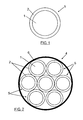
- Figure 1 shows a conductor strand of a cable for low voltage installations, constituted according to the invention, comprising a central aluminum core 1 and a copper-based outer covering layer 2.
- the central core 1 will preferably have a cylindrical section and the copper outer covering layer 2 is crown-shaped, having uniform thickness.
- the central core 1 and outer covering layer 2 are pressed tightly against each other, such that there is close contact between the entire opposing surfaces of both components.
- the thickness of the outer covering layer 2 is relatively small in comparison with the diameter of the central aluminum core 1, the copper outer covering layer 2 in any case having a thickness that is less than the radius of the central aluminum core 1.
- the strands of the cable of the invention will preferably be formed by 85% aluminum, forming the central core 1, and by 15% copper, forming the covering outer covering layer 2.
- Figure 2 shows a cable 4 which is formed by a series of strands 5, such as the one shown in Figure 1, each of them formed by a central aluminum core 1 and an outer copper covering 2. There is an identical concentric geometric arrangement of all the strands in the cable 4, the assembly further being protected with a thin or thick walled insulation layer 6.
- the cable of the invention is designed for low voltage installations, which can especially be applied to automotive installations for voltages that are equal to or less than 60 volts.
- the invention allows providing a cable with electric features similar to that of current copper cables, but with reduced cost and weight, as well as being more environmentally friendly.
Landscapes
- Insulated Conductors (AREA)
- Conductive Materials (AREA)
Abstract
The invention relates to a low voltage cable formed by an assembly of conductor strands, each of which comprises a central aluminum core and a copper-based outer covering layer, having uniform thickness, the central core and outer covering layer of which are pressed tightly against each other in close contact through their opposing surfaces. In each conductor strand, the copper outer covering layer is thinner than the radius of the central aluminum core.
Description
- The present invention relates to a cable for low voltage installations, and more specifically to a cable formed by conductor strands with a bimetal composition which can especially be applied in the automotive field.
- Cables both for the automotive field and for low voltage installations in general, are made entirely of copper. Due to the progressive cost increase of this raw material, copper cables negatively affect the price of the installation.
- To solve this problem, aluminum cables could be used which, in addition to their lower cost, have the advantage of weighing less. However, due to the lower conductivity of this metal and its worse mechanical characteristics in relation to copper, aluminum is not the optimal conductor in low voltage installations.
- The object of the present invention is to solve the drawbacks set described above by means of a cable which provides the necessary conductivity for its use in low voltage installations, has a much lower cost than traditional copper cables and furthermore its weight is also lower than that of said copper cables.
- According to the present invention, the conductor strands forming the cable are bimetal and consist of a central aluminum core and a copper-based outer covering layer with uniform thickness. The central core and outer covering layer of said strands are pressed tightly against each other, such that there is close contact through their opposing surfaces.
- The outer covering layer of copper will be less thick than the radius of the central aluminum core.
- The conductor strand of the cable will preferably be made up of 85% aluminum, which will form the central core, and by 15% copper, which will form the outer covering layer.
- A strand having good conductivity for low voltage installations is provided with the discussed constitution, which can be especially applied in the automotive field, whereby obtaining a lower cost of the installation as well as a weight reduction.
- The cable of the invention, with or without protection, can have a thin or thick walled insulation for a maximum voltage of 60 volts. The manufacture thereof will have a preferred range of sections ranging between 0.35 and 120 mm2.
- A cable with electric features similar to that of current copper cables is provided with the described constitution but with a lower cost and less weight.
- Different diameters of conductor strand with an aluminum/copper composition and an identical concentric geometric arrangement can be obtained in each of the different steps by means of a sequential wiredrawing process.
- The constitution of the cable of the invention will be better understood with the following description, made in reference to the attached drawings, which show a nonlimiting embodiment.
- In the drawings:
- Figure 1 is a diametrical section of a conductor strand of low voltage cable, constituted according to the invention.
- Figure 2 shows a section of a cable formed by a series of mixed conductor strands, constituted according to the invention.
- Figure 1 shows a conductor strand of a cable for low voltage installations, constituted according to the invention, comprising a
central aluminum core 1 and a copper-basedouter covering layer 2. Thecentral core 1 will preferably have a cylindrical section and the copperouter covering layer 2 is crown-shaped, having uniform thickness. - The
central core 1 andouter covering layer 2 are pressed tightly against each other, such that there is close contact between the entire opposing surfaces of both components. - As can be seen in Figure 1, the thickness of the
outer covering layer 2 is relatively small in comparison with the diameter of thecentral aluminum core 1, the copperouter covering layer 2 in any case having a thickness that is less than the radius of thecentral aluminum core 1. - The strands of the cable of the invention will preferably be formed by 85% aluminum, forming the
central core 1, and by 15% copper, forming the coveringouter covering layer 2. - Figure 2 shows a cable 4 which is formed by a series of
strands 5, such as the one shown in Figure 1, each of them formed by acentral aluminum core 1 and an outer copper covering 2. There is an identical concentric geometric arrangement of all the strands in the cable 4, the assembly further being protected with a thin or thick walled insulation layer 6. - As previously mentioned, the cable of the invention is designed for low voltage installations, which can especially be applied to automotive installations for voltages that are equal to or less than 60 volts.
- The invention allows providing a cable with electric features similar to that of current copper cables, but with reduced cost and weight, as well as being more environmentally friendly.
Claims (3)
- A low voltage cable, characterized in that it is formed by an assembly of conductor strands, each strand comprising a central aluminum core and a copper-based outer covering layer, having uniform thickness, the central core and outer covering layer being pressed tightly against each other in close contact through their opposing surfaces.
- A cable according to claim 1, characterized in that the outer covering copper layer in each conductor strand has a thickness that is less than a radius of the central aluminum core.
- A cable according to any of claims 1-2, characterized in that the strands are formed by 85% aluminum, forming the central core, and by 15% copper forming the outer covering layer.
Applications Claiming Priority (1)
| Application Number | Priority Date | Filing Date | Title |
|---|---|---|---|
| ES200601611U ES1063387Y (en) | 2006-07-06 | 2006-07-06 | ELECTRIC CABLE FOR LOW VOLTAGE |
Publications (1)
| Publication Number | Publication Date |
|---|---|
| EP1876606A2 true EP1876606A2 (en) | 2008-01-09 |
Family
ID=37106832
Family Applications (1)
| Application Number | Title | Priority Date | Filing Date |
|---|---|---|---|
| EP20070380099 Withdrawn EP1876606A2 (en) | 2006-07-06 | 2007-04-11 | Low voltage cable |
Country Status (2)
| Country | Link |
|---|---|
| EP (1) | EP1876606A2 (en) |
| ES (1) | ES1063387Y (en) |
-
2006
- 2006-07-06 ES ES200601611U patent/ES1063387Y/en not_active Expired - Fee Related
-
2007
- 2007-04-11 EP EP20070380099 patent/EP1876606A2/en not_active Withdrawn
Also Published As
| Publication number | Publication date |
|---|---|
| ES1063387U (en) | 2006-10-16 |
| ES1063387Y (en) | 2007-01-16 |
Similar Documents
| Publication | Publication Date | Title |
|---|---|---|
| CN110192255B (en) | communication wire | |
| CN109119777B (en) | Electric wire with terminal | |
| JP2005158450A (en) | Electric wire for automobile | |
| US20110147079A1 (en) | Tension-Resistant Electrical Conductor | |
| US20140353002A1 (en) | Electrically conductive wire and method of its production | |
| JP6407501B1 (en) | Connection structure | |
| JP2023169336A (en) | Manufacturing method of electric wire with terminal | |
| US8357856B2 (en) | Electric cable | |
| JP2015196881A (en) | Aluminum alloy strand, aluminum alloy strand wire and electric wire for vehicle | |
| US20160133353A1 (en) | Multilayer Composite Conductor and Manufacturing Method Thereof | |
| WO2006008982A1 (en) | Electric wire for automobile | |
| JP7073871B2 (en) | Conductors, wires and cables | |
| CN103377758A (en) | Aluminum alloy cable | |
| JP2018056101A (en) | Wire and wire with terminal | |
| EP2410534B1 (en) | Cord for high voltage overhead electrical lines, with high thermal limit and with 3 load-bearing cables | |
| JP2015141855A (en) | Strand wire conductor and insulation electric wire | |
| JP2012022989A (en) | Electric wire conductor and method for manufacturing the same | |
| US9941028B2 (en) | Electrical conductor for aeronautical applications | |
| US20190180891A1 (en) | Electrical conductor comprised of solid segments | |
| WO2021210668A1 (en) | Heat-resistant insulated electric wire | |
| JP7772093B2 (en) | Flat curled cord | |
| JP2015196880A (en) | Aluminum alloy strands, aluminum alloy stranded wires and automotive electric wires | |
| CN102969041A (en) | Copper-clad-steel concentric stranded wire | |
| CN203760157U (en) | Automobile wire | |
| CN202473274U (en) | Aerial cable |
Legal Events
| Date | Code | Title | Description |
|---|---|---|---|
| PUAI | Public reference made under article 153(3) epc to a published international application that has entered the european phase |
Free format text: ORIGINAL CODE: 0009012 |
|
| 17P | Request for examination filed |
Effective date: 20070412 |
|
| AK | Designated contracting states |
Kind code of ref document: A2 Designated state(s): AT BE BG CH CY CZ DE DK EE ES FI FR GB GR HU IE IS IT LI LT LU LV MC MT NL PL PT RO SE SI SK TR |
|
| AX | Request for extension of the european patent |
Extension state: AL BA HR MK YU |
|
| STAA | Information on the status of an ep patent application or granted ep patent |
Free format text: STATUS: THE APPLICATION IS DEEMED TO BE WITHDRAWN |
|
| 18D | Application deemed to be withdrawn |
Effective date: 20111101 |