EP1874009A1 - Téléphone avec une station de base et avec un appareil portatif sans/avec fil - Google Patents
Téléphone avec une station de base et avec un appareil portatif sans/avec fil Download PDFInfo
- Publication number
- EP1874009A1 EP1874009A1 EP06013183A EP06013183A EP1874009A1 EP 1874009 A1 EP1874009 A1 EP 1874009A1 EP 06013183 A EP06013183 A EP 06013183A EP 06013183 A EP06013183 A EP 06013183A EP 1874009 A1 EP1874009 A1 EP 1874009A1
- Authority
- EP
- European Patent Office
- Prior art keywords
- handset
- base unit
- radio
- connection
- telephone
- Prior art date
- Legal status (The legal status is an assumption and is not a legal conclusion. Google has not performed a legal analysis and makes no representation as to the accuracy of the status listed.)
- Withdrawn
Links
- 238000000926 separation method Methods 0.000 claims abstract description 10
- 230000003287 optical effect Effects 0.000 claims description 7
- 230000011664 signaling Effects 0.000 claims description 5
- 230000001960 triggered effect Effects 0.000 claims description 5
- 238000000034 method Methods 0.000 claims description 2
- 241000208202 Linaceae Species 0.000 claims 1
- 235000004431 Linum usitatissimum Nutrition 0.000 claims 1
- 230000015556 catabolic process Effects 0.000 claims 1
- 238000006731 degradation reaction Methods 0.000 claims 1
- 230000013011 mating Effects 0.000 description 5
- 230000005670 electromagnetic radiation Effects 0.000 description 3
- 238000004519 manufacturing process Methods 0.000 description 3
- 230000005540 biological transmission Effects 0.000 description 2
- 238000004891 communication Methods 0.000 description 1
- 238000012790 confirmation Methods 0.000 description 1
- 238000010276 construction Methods 0.000 description 1
- 238000005336 cracking Methods 0.000 description 1
- 230000005855 radiation Effects 0.000 description 1
- 230000035939 shock Effects 0.000 description 1
- 230000008054 signal transmission Effects 0.000 description 1
- 230000005236 sound signal Effects 0.000 description 1
Images
Classifications
-
- H—ELECTRICITY
- H04—ELECTRIC COMMUNICATION TECHNIQUE
- H04M—TELEPHONIC COMMUNICATION
- H04M1/00—Substation equipment, e.g. for use by subscribers
- H04M1/72—Mobile telephones; Cordless telephones, i.e. devices for establishing wireless links to base stations without route selection
- H04M1/725—Cordless telephones
- H04M1/72502—Cordless telephones with one base station connected to a single line
Definitions
- the invention relates to a telephone with the features according to the preamble of claim 1.
- Such phones have been known for decades. They have a base unit with an interface with which the telephone can be connected to the public telephone network, for example in analog form or in digital form, for example according to the ISDN standard.
- a base unit with an interface with which the telephone can be connected to the public telephone network, for example in analog form or in digital form, for example according to the ISDN standard.
- To the basic unit is a handset, colloquially also called “telephone handset” connected via an electrical connection line, which is equipped with a loudspeaker device and a microphone.
- the voice signals are transmitted from the handset to the base unit and vice versa via the electrical connection line by electrical means or by means of electrical signals.
- cordless telephones according to the DECT standard are known in which the base unit and the "telephone handset" are connected via a radio link and transmit their voice signals via them.
- the invention has for its object to further develop a telephone of the type specified in such a way that it offers even greater ease of use than previous phones.
- the invention provides that the base unit and the handset each have at least one radio device, wherein the radio device of the handset and the radio of the base unit are adapted to establish a radio link with each other and to transmit the voice signals from the handset to the base unit and vice versa via the radio link if the electrical connection between the handset and the base unit is disconnected.
- a significant advantage of the phones according to the invention is the fact that this provides a very large user comfort; This is concretely due to the fact that in addition to the wired electrical operating mode, a cordless radio mode is provided, which also makes it possible to carry telephone calls when the handset is spatially separated from the basic unit.
- the telephone according to the invention thus enables ease of use, as is known from cordless telephones.
- the voice signals can be transmitted from the handset to the base unit and vice versa, namely via the electrical connection line and thus without radiation, if there is an electrical connection via the electrical connection line.
- the two radio devices are to be activated and generate electromagnetic radiation, for example permanently according to DECT, GSM, UMTS or WLAN standard or at least in each case if a telephone call is to be transmitted. The burden on the user by electromagnetic radiation is thus reduced to a minimum while still maintaining maximum ease of use.
- the two radio devices are preferably already activated, even before the electrical connection is interrupted and the handset and the base unit are spatially separated from each other; This measure avoids dropouts or cracking during an existing voice connection.
- connection line at one end of the line with a user-side plug-in device with which connect the connecting cable to the handset and can be separated from this again.
- the user thus has the opportunity to cause transmission of the voice signals by electrical means by plugging in the connecting cable to the handset and to select a radio link by disconnecting the plug device from the handset.
- the user-side operable plug-in device is attached to the handset associated end of the connecting line, so that when disconnecting the connection, the connection cable remains on the base unit.
- the handset can thus be carried without the connection cable.
- the base unit or the handset has a control device which checks whether there is an electrical connection between the handset and the base unit : In the case of an electrical Connection switches off the control device, the two radios and in the case of a disconnection of the electrical connection, it switches on the two radio devices immediately or at least when a telephone call is to be transmitted.
- control devices may be included in both the base unit and the handset.
- the telephone has only a single keypad for entering telephone numbers; this keyboard can be housed in the base unit or the handset.
- the keyboard is housed exclusively in the basic unit; because in the basic unit, the distance of the keys to each other can be made larger than in the respect to the basic unit preferably much smaller handset.
- the handset can still be used to accept phone calls and make phone calls; only the dialing of telephone numbers or the independent calling of other participants in the conversation is not possible without a confirmation of the basic device.
- radio devices usually take a certain amount of time to bring about complete connection establishment, it is considered advantageous if the establishment of a connection can also be triggered manually before or after a disconnection of the electrical connection line. This can be carried out particularly simply and thus advantageously when the handset and / or the base unit are equipped with a start button with which the structure of the radio link can be manually carried by the user.
- a stop button can be provided with which an interruption of the radio link and manually trigger a switch back to an electrical signal transmission via the electrical connection line.
- the start button and the stop button can be formed, for example, by a single control element, which shuts off during operation during radio operation and this turns on when operated with the radio mode off.
- the already mentioned control device for automatic switching can also be omitted with a view to a cost reduction.
- the handset may be configured such that a full keyboard for entering telephone numbers is missing .;
- the handset has an input device, such as a control button, and one such, with which a call acceptance and a call separation can be triggered.
- the already mentioned control element for switching on and off the radio link can be present.
- the input device and the control element can - as already mentioned - be configured, for example, key-based;
- any other input concepts can be used, for example on the basis of optical sensors, image recognition devices, speech recognition devices and / or a gravitational sensor which detects impacts on the housing of the respective device (handheld or basic device) and evaluates accordingly.
- the handset and / or the base unit are equipped with an optical signaling device, which ensures the existence of a radio link between the handset and the Basic device indicates
- an optical signaling device for example, structurally in the control or the start and / or stop button, with the - as already mentioned.
- the basic device can have very different embodiments: For example, the entire basic device can be accommodated in a single housing and, for example, form a so-called desktop device.
- the basic unit can also be formed by a "distributed system" and comprise a plurality of spatially distributed components.
- the base unit preferably comprises a connection device and a radio network connected thereto, wherein the electrical connection line is connected to the connection device, the radio network comprises at least two radio devices, each of which is suitable for maintaining a radio connection to the handset, and the radio network having the interface for connection to the telecommunications network.
- the base unit comprises a multiplicity of connection devices which are in each case connected to the radio network and can each be connected to a handheld device.
- connection devices which are in each case connected to the radio network and can each be connected to a handheld device.
- the telephone comprises for each connection device in each case a hand-held device.
- the interface of the base unit for connection to the telecommunications network can be configured as desired, for example as a radio interface or as a corded interface.
- the interface for connection to the telecommunications network is formed by a network interface which operates according to the IP protocol or is compatible with it.
- the invention also relates to a handset suitable for connection to a base unit of a telephone.
- the handset to have a loudspeaker device and a microphone, wherein the handset can be electrically connected to the base unit via an electrical connection line in order to transmit these voice signals from the handset to the base unit and vice versa by electrical means, and wherein Handset has at least one radio device and is adapted to maintain a radio connection with the base unit and - in the case of a separation of the electrical connection between the handset and the base unit - to transmit the voice signals from the handset to the base unit and vice versa via the radio link.
- the invention also relates to a base unit which is suitable for connection to a handset of a telephone.
- the base unit to be equipped with an interface for connection to a telecommunications network and to be electrically connectable to the handset of the telephone via an electrical connection line in order to transmit these voice signals from the handset to the base unit and vice versa by electrical means, wherein the base unit has at least one radio device which is suitable for a radio connection to the handset manufacture and - in the case of a separation of the electrical connection between the handset and the base unit - to transmit the voice signals from the handset to the base unit and vice versa via the radio link.
- the invention relates to a method of operating a telephone having a base unit having an interface for connection to a telecommunications network and a handset having a speaker device and a microphone.
- the handset and the base unit are electrically connected to each other via an electrical connection line to transmit via these voice signals from the handset to the base unit and vice versa by electrical means, and that in the case of a separation of the electrical connection between the handset and the base unit - the voice signals are transmitted from the handset to the base unit and vice versa via a radio link between the handset to the base unit.
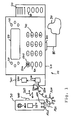
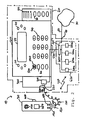
- FIGS. 1 and 2 For the sake of clarity, the same reference numerals are always used in FIGS. 1 and 2 for identical or comparable components.
- a telephone 10 which consists of a base unit 20 and a handset 30.
- the base unit 20 has a keyboard 10, a display 50 and a plurality of function keys 60 with which the telephone 10 can be operated.
- the basic unit 20 is embodied in one piece in the exemplary embodiment according to FIG. 1 and accommodated in a single housing.
- the basic unit 20 is equipped with an interface 70, via which the basic unit 20 can be connected by means of an electrical interface line 80 to a telecommunication network 90 shown only schematically in FIG.
- the interface 70 may, for example, operate on the internet protocol.
- the interface line 80 is preferably designed as a data line;
- interface 70 may operate on the Ethernet standard.
- the base unit 20 is connected via a connecting line 100, which may be, for example, an electric spiral cord connected to the handset 30.
- the handset 30 associated line end 110 of the connection line 100 is equipped with a plug-in device 120 which can be plugged into a mating device 130 of the handset to cause an electrical connection between the handset 30 and the base unit 20.
- the handset 30 is equipped with a loudspeaker device 140 as well as with a microphone 150 so that speech or audio signals can be input into the handset 30 and output from it.
- the corresponding electrical audio or voice signals can be transmitted via the connection line 100 to the base unit 20 and / or vice versa.
- the basic unit 20 also has a radio device 200, which is controlled via a control device 210 of the basic unit 20.
- the control device 210 is connected via a line 220 to a terminal 230 of the base unit 20 in connection to which the connection line 100 is connected.
- the radio 200 is adapted to establish a radio connection to a radio 250 integrated with the handset 30.
- the radio link is schematically indicated in FIG. 1 by an arrow with the reference numeral 260.
- the radio connection can be made according to any standard, for example the DECT, GSM, UMTS or WLAN standard.
- the basic unit 20 has a receiving tray which is configured in such a way that the hand-held unit 30 can be inserted into it or placed on it.
- the telephone 10 according to FIG. 1 can be operated as follows:
- the user of the telephone is physically close to the basic device 10, in order to minimize the radiation exposure he will preferably operate the handheld device 30 cord-bound and insert the plug-in device 120 of the connecting line 100 into the mating plug device 130 of the hand-held device 30.
- the control device 210 which - as stated above - is connected to the terminal 230 of the base unit 20.
- a transmission of the voice information between the handset 30 and the base unit 20 takes place exclusively by electrical means via the electrical speech signals Se.
- the radio device 200 of the base unit 20 and the radio 250 of the handset 30 are turned off in this case, so that no unnecessary electromagnetic radiation is generated.
- the disconnection of the electrical connection between the mating plug device 130 and the plug-in device 120 is detected by the control device 210 so that it activates the radio device 200.
- the radio device 200 will establish a radio connection to the radio device 250, as indicated by the reference numeral 260 in FIG.
- the handset 30 thus remains in communication with the base unit 20 so that the user can continue to make phone calls.
- the control unit 210 will transmit a corresponding call signal to the radio 250 via the radio 200, which is not provided to the user by the loudspeaker 140 or better by means of a separate one, for reasons of clarity in FIG is signaled shown Ruflaut Anlageners.
- the user will activate a control button 400 of the handset 30 to answer the phone call and to conduct the telephone conversation. If the user wants to end the call, he will press the control button 400 again, whereby the call is interrupted.
- the handset 30 is executed without a separate keyboard.
- the handset 30 its own keyboard or the like to allow the user of the handset 30 to dial their own telephone numbers and Making calls with any other parties can, if he is in wireless mode.
- a keyboard can be used for telephone number input and another input component such as a gravitational sensor, which registers the shocks to the handset ("sniff") and evaluates.
- Tn of Figure 1 can be seen beyond an operating element 500, which is provided on the base unit 20.
- the function of the control element 500 is, regardless of whether the control device 210 detects a disconnection of the connection between the plug 220 and the mating plug 130 or not to build the radio link 260 between the two radio devices 200 and 250 as soon as it is operated, for example pressed, becomes.
- the control 500 may also operate as a stop button when operated during radio operation; In this case, the existing radio connection is interrupted.
- An operating element 500 corresponding control element may also be present in the handset 30.
- an optical signal device 510 is also provided in the base unit 20 and / or in the handset 30; This signaling device 510 thus forms a kind of warning device for radio beams.
- the optical signaling device 510 is formed for example by a lamp or a diode which is integrated within the operating element 500.
- FIG. 2 shows a second exemplary embodiment of a telephone 10 according to the invention.
- the basic unit 20 has a connection device 610 and a radio network 620.
- the radio network 620 and the connection device 610 are via a system line 630 interconnected.
- the basic unit 20 is thus executed in several parts and thus forms a kind of basic system.
- the radio network 620 has a total of four radio devices, which are identified by the reference symbols 640a, 640b, 640c and 640d. These four radio devices are connected to a teletone system 650, the A650 port of which provides the interface 70 for connection to the telecommunications network 90 via the interface line 80 and allows for the four radio devices a handover function.
- connection device 610 in contrast to the first exemplary embodiment according to FIG. 1, no radio device is present.
- the telephone 10 according to FIG. 2 can be operated in a manner similar to the telephone according to FIG. If the handset 30 is connected via the connecting line 100 to the connecting device 610 of the basic unit 20, then the voice signals Se are transmitted from the handset 30 to the connecting device 610 of the basic unit 20 and vice versa by electrical means. If, however, the electrical connection between the handset 30 and the connection device 610 is interrupted, this is detected by the control device 210 and transmitted to the telephone system 650. The latter attempts to establish a radio link 260 between one of the radio devices 640a, 640b, 640c or 640d and the handset. Alternatively, the radio link 260 can also-as already explained, for example, in connection with FIG. 1-be produced in that the operating element 500 on the Anschiluss worn 610 or a corresponding operating element is operated on the handset 30, with which the radio link 260 is established manually.
- the control device 210 is a component which is accommodated in the connection device 610.
- An arrangement of the control device 210 in the telephone system 650 is particularly advantageous if a plurality of connection devices 610 is connected to the radio network 620.
- the control device 210 provided centrally in the telephone system 650 can monitor all connection devices 610 and optionally establish radio connections to the handheld devices 30 if there is no electrical connection between the respective connection device 610 and the respective handset 60.
- connection device 610 no radio device is present in the connection device 610 according to FIG. 2;
- a radio device in addition to the radio devices 640 ad of the radio network 620, a radio device may also be included, for example, such as shown in FIG. 1 and designated by the reference numeral 200.
- Such an additional radio device preferably forms with the radio network 620 a complete radio system which is "capable of handover".
Landscapes
- Engineering & Computer Science (AREA)
- Computer Networks & Wireless Communication (AREA)
- Signal Processing (AREA)
- Telephone Function (AREA)
Priority Applications (1)
| Application Number | Priority Date | Filing Date | Title |
|---|---|---|---|
| EP06013183A EP1874009A1 (fr) | 2006-06-27 | 2006-06-27 | Téléphone avec une station de base et avec un appareil portatif sans/avec fil |
Applications Claiming Priority (1)
| Application Number | Priority Date | Filing Date | Title |
|---|---|---|---|
| EP06013183A EP1874009A1 (fr) | 2006-06-27 | 2006-06-27 | Téléphone avec une station de base et avec un appareil portatif sans/avec fil |
Publications (1)
| Publication Number | Publication Date |
|---|---|
| EP1874009A1 true EP1874009A1 (fr) | 2008-01-02 |
Family
ID=37488466
Family Applications (1)
| Application Number | Title | Priority Date | Filing Date |
|---|---|---|---|
| EP06013183A Withdrawn EP1874009A1 (fr) | 2006-06-27 | 2006-06-27 | Téléphone avec une station de base et avec un appareil portatif sans/avec fil |
Country Status (1)
| Country | Link |
|---|---|
| EP (1) | EP1874009A1 (fr) |
Citations (4)
| Publication number | Priority date | Publication date | Assignee | Title |
|---|---|---|---|---|
| EP0282597A1 (fr) * | 1986-08-05 | 1988-09-21 | IWAI, Seizo | Combine telephonique sans fil |
| US5555448A (en) * | 1995-02-27 | 1996-09-10 | Delco Electronics Corporation | Combined wireless/wired phone handset system |
| GB2318949A (en) * | 1996-10-31 | 1998-05-06 | Motorola Inc | Cordless telephone with optional corded operation |
| DE19940295A1 (de) * | 1999-08-25 | 2001-03-08 | Siemens Ag | Telefon mit Festteil und Handapparat |
-
2006
- 2006-06-27 EP EP06013183A patent/EP1874009A1/fr not_active Withdrawn
Patent Citations (4)
| Publication number | Priority date | Publication date | Assignee | Title |
|---|---|---|---|---|
| EP0282597A1 (fr) * | 1986-08-05 | 1988-09-21 | IWAI, Seizo | Combine telephonique sans fil |
| US5555448A (en) * | 1995-02-27 | 1996-09-10 | Delco Electronics Corporation | Combined wireless/wired phone handset system |
| GB2318949A (en) * | 1996-10-31 | 1998-05-06 | Motorola Inc | Cordless telephone with optional corded operation |
| DE19940295A1 (de) * | 1999-08-25 | 2001-03-08 | Siemens Ag | Telefon mit Festteil und Handapparat |
Similar Documents
| Publication | Publication Date | Title |
|---|---|---|
| DE19909806C2 (de) | Ohrhörer-Mikrofon-Adapter | |
| DE3514651C2 (de) | Schnurloses Telefon | |
| DE8816921U1 (de) | Telefonapparat | |
| EP0865186A2 (fr) | Poste téléphonique | |
| DE69411585T2 (de) | Vorrichtung zur umschaltung eines telefonendgerätes mit telefonhörer auf ein zusatzgerät | |
| DE19934252C2 (de) | Mobiles Telekommunikationsendgerät | |
| DE20202790U1 (de) | Von mehreren Kommunikationsgeräten gemeinsam verwendbare Freihandeinrichtung | |
| DE19526981C2 (de) | Mit einem Personalcomputer kombinierte Telefoneinheit | |
| EP2392127B1 (fr) | Procédé pour établir et gérer une connexion d'un terminal de communication mobile à un autocommutateur privé | |
| DE3308986C2 (de) | Schaltungsanordnung für eine digitale Fernsprechstation | |
| DE69803430T2 (de) | Mobiltelefon mit einer vermittlungsanlage-funktion | |
| DE29812185U1 (de) | Fernsehgerät mit Fernbedienung | |
| DE4121195C2 (fr) | ||
| EP1536618B1 (fr) | Interrupteur adapté à la commutation entre communication de signaux audio et vidéo dans des terminaux mobiles | |
| DE4040525C2 (de) | Zusatzeinrichtung zu einer Fernsprechstation zum drahtlosen Sprechen | |
| EP1505808A1 (fr) | Portable pour enfants | |
| DE19949540B4 (de) | Verfahren zum Übertragen von geräte- und/oder kundenspezifischen Daten | |
| DE19940295A1 (de) | Telefon mit Festteil und Handapparat | |
| EP1679860B1 (fr) | Dispositif mobile avec des applications dépendantes de l'arrangement de deux pièces de boîtier | |
| DE3321417C2 (de) | System zur Übermittlung von Notrufen | |
| AT406815B (de) | Verfahren zur vermittlung von gesprächen | |
| DE4423009C2 (de) | Fernsprechendgerät mit schnurgebundener Hör-/Sprecheinrichtung und schnurloser Kopfsprechgarnitur | |
| DE20310288U1 (de) | Freisprecheinrichtung für Mobiltelefone mit einem fahrzeugseitigen Aufnahmehalter | |
| EP2642732B1 (fr) | Monophonie manuelle | |
| DE29702133U1 (de) | Fernsehgerät mit Fernbedienung |
Legal Events
| Date | Code | Title | Description |
|---|---|---|---|
| PUAI | Public reference made under article 153(3) epc to a published international application that has entered the european phase |
Free format text: ORIGINAL CODE: 0009012 |
|
| AK | Designated contracting states |
Kind code of ref document: A1 Designated state(s): AT BE BG CH CY CZ DE DK EE ES FI FR GB GR HU IE IS IT LI LT LU LV MC NL PL PT RO SE SI SK TR |
|
| AX | Request for extension of the european patent |
Extension state: AL BA HR MK YU |
|
| AKX | Designation fees paid | ||
| STAA | Information on the status of an ep patent application or granted ep patent |
Free format text: STATUS: THE APPLICATION IS DEEMED TO BE WITHDRAWN |
|
| 18D | Application deemed to be withdrawn |
Effective date: 20080703 |
|
| REG | Reference to a national code |
Ref country code: DE Ref legal event code: 8566 |