EP1873792A1 - Magnetic sheet and method of producing the same - Google Patents
Magnetic sheet and method of producing the same Download PDFInfo
- Publication number
- EP1873792A1 EP1873792A1 EP07012582A EP07012582A EP1873792A1 EP 1873792 A1 EP1873792 A1 EP 1873792A1 EP 07012582 A EP07012582 A EP 07012582A EP 07012582 A EP07012582 A EP 07012582A EP 1873792 A1 EP1873792 A1 EP 1873792A1
- Authority
- EP
- European Patent Office
- Prior art keywords
- magnetic
- magnetic sheet
- producing
- amorphous phase
- temperature
- Prior art date
- Legal status (The legal status is an assumption and is not a legal conclusion. Google has not performed a legal analysis and makes no representation as to the accuracy of the status listed.)
- Withdrawn
Links
- 238000000034 method Methods 0.000 title claims description 45
- 238000000137 annealing Methods 0.000 claims abstract description 30
- 238000002425 crystallisation Methods 0.000 claims abstract description 11
- 230000008025 crystallization Effects 0.000 claims abstract description 11
- 230000009477 glass transition Effects 0.000 claims abstract description 9
- 239000000463 material Substances 0.000 claims abstract description 5
- 239000000696 magnetic material Substances 0.000 claims description 54
- 229910001004 magnetic alloy Inorganic materials 0.000 claims description 27
- 239000011159 matrix material Substances 0.000 claims description 21
- 230000008569 process Effects 0.000 claims description 15
- 239000000203 mixture Substances 0.000 claims description 11
- 238000002156 mixing Methods 0.000 claims description 9
- 239000007788 liquid Substances 0.000 claims description 7
- 238000009692 water atomization Methods 0.000 claims description 6
- 238000000151 deposition Methods 0.000 claims description 3
- 239000006249 magnetic particle Substances 0.000 abstract description 9
- 229920005989 resin Polymers 0.000 abstract description 9
- 239000011347 resin Substances 0.000 abstract description 9
- 230000035699 permeability Effects 0.000 description 24
- 239000000843 powder Substances 0.000 description 22
- 230000000694 effects Effects 0.000 description 12
- 239000002245 particle Substances 0.000 description 12
- 238000003825 pressing Methods 0.000 description 11
- 239000002002 slurry Substances 0.000 description 8
- 238000003756 stirring Methods 0.000 description 8
- 229910045601 alloy Inorganic materials 0.000 description 7
- 239000000956 alloy Substances 0.000 description 7
- 230000000052 comparative effect Effects 0.000 description 7
- 239000000243 solution Substances 0.000 description 7
- YXFVVABEGXRONW-UHFFFAOYSA-N Toluene Chemical compound CC1=CC=CC=C1 YXFVVABEGXRONW-UHFFFAOYSA-N 0.000 description 6
- 238000010791 quenching Methods 0.000 description 6
- 230000000171 quenching effect Effects 0.000 description 6
- 239000006096 absorbing agent Substances 0.000 description 4
- 238000010586 diagram Methods 0.000 description 4
- 238000011156 evaluation Methods 0.000 description 4
- 230000001629 suppression Effects 0.000 description 4
- KFZMGEQAYNKOFK-UHFFFAOYSA-N Isopropanol Chemical compound CC(C)O KFZMGEQAYNKOFK-UHFFFAOYSA-N 0.000 description 3
- 150000001875 compounds Chemical class 0.000 description 3
- 230000007423 decrease Effects 0.000 description 3
- -1 polyethylene, chloride Polymers 0.000 description 3
- 239000002994 raw material Substances 0.000 description 3
- 229920002050 silicone resin Polymers 0.000 description 3
- 239000002904 solvent Substances 0.000 description 3
- 229910021364 Al-Si alloy Inorganic materials 0.000 description 2
- 238000002441 X-ray diffraction Methods 0.000 description 2
- 230000002238 attenuated effect Effects 0.000 description 2
- 230000008901 benefit Effects 0.000 description 2
- 239000011230 binding agent Substances 0.000 description 2
- 238000001816 cooling Methods 0.000 description 2
- 230000008021 deposition Effects 0.000 description 2
- 238000009689 gas atomisation Methods 0.000 description 2
- 239000011521 glass Substances 0.000 description 2
- 230000000977 initiatory effect Effects 0.000 description 2
- 238000001746 injection moulding Methods 0.000 description 2
- 238000005259 measurement Methods 0.000 description 2
- 238000002844 melting Methods 0.000 description 2
- 230000008018 melting Effects 0.000 description 2
- 239000013526 supercooled liquid Substances 0.000 description 2
- 229910018125 Al-Si Inorganic materials 0.000 description 1
- 229910018520 Al—Si Inorganic materials 0.000 description 1
- PYVHTIWHNXTVPF-UHFFFAOYSA-N F.F.F.F.C=C Chemical compound F.F.F.F.C=C PYVHTIWHNXTVPF-UHFFFAOYSA-N 0.000 description 1
- 229910001030 Iron–nickel alloy Inorganic materials 0.000 description 1
- 229920000877 Melamine resin Polymers 0.000 description 1
- 239000004640 Melamine resin Substances 0.000 description 1
- CTQNGGLPUBDAKN-UHFFFAOYSA-N O-Xylene Chemical compound CC1=CC=CC=C1C CTQNGGLPUBDAKN-UHFFFAOYSA-N 0.000 description 1
- 239000004372 Polyvinyl alcohol Substances 0.000 description 1
- 229910000676 Si alloy Inorganic materials 0.000 description 1
- 239000012298 atmosphere Substances 0.000 description 1
- 239000010953 base metal Substances 0.000 description 1
- 230000008859 change Effects 0.000 description 1
- 239000002131 composite material Substances 0.000 description 1
- 239000000470 constituent Substances 0.000 description 1
- 239000013078 crystal Substances 0.000 description 1
- 230000003247 decreasing effect Effects 0.000 description 1
- 230000006866 deterioration Effects 0.000 description 1
- 229920001971 elastomer Polymers 0.000 description 1
- 239000000806 elastomer Substances 0.000 description 1
- 239000000839 emulsion Substances 0.000 description 1
- 238000005516 engineering process Methods 0.000 description 1
- 238000011049 filling Methods 0.000 description 1
- 238000010438 heat treatment Methods 0.000 description 1
- 230000006872 improvement Effects 0.000 description 1
- 238000004898 kneading Methods 0.000 description 1
- 239000000314 lubricant Substances 0.000 description 1
- 239000002184 metal Substances 0.000 description 1
- 238000012986 modification Methods 0.000 description 1
- 230000004048 modification Effects 0.000 description 1
- 239000012299 nitrogen atmosphere Substances 0.000 description 1
- QIQXTHQIDYTFRH-UHFFFAOYSA-N octadecanoic acid Chemical compound CCCCCCCCCCCCCCCCCC(O)=O QIQXTHQIDYTFRH-UHFFFAOYSA-N 0.000 description 1
- 230000003647 oxidation Effects 0.000 description 1
- 238000007254 oxidation reaction Methods 0.000 description 1
- 239000005011 phenolic resin Substances 0.000 description 1
- 229920002451 polyvinyl alcohol Polymers 0.000 description 1
- 239000004800 polyvinyl chloride Substances 0.000 description 1
- 229920000915 polyvinyl chloride Polymers 0.000 description 1
- 238000012545 processing Methods 0.000 description 1
- 229920002379 silicone rubber Polymers 0.000 description 1
- 239000004945 silicone rubber Substances 0.000 description 1
- 238000004017 vitrification Methods 0.000 description 1
- 230000002747 voluntary effect Effects 0.000 description 1
- XLYOFNOQVPJJNP-UHFFFAOYSA-N water Substances O XLYOFNOQVPJJNP-UHFFFAOYSA-N 0.000 description 1
- 238000005303 weighing Methods 0.000 description 1
- 239000008096 xylene Substances 0.000 description 1
Images



Classifications
-
- H—ELECTRICITY
- H01—ELECTRIC ELEMENTS
- H01F—MAGNETS; INDUCTANCES; TRANSFORMERS; SELECTION OF MATERIALS FOR THEIR MAGNETIC PROPERTIES
- H01F1/00—Magnets or magnetic bodies characterised by the magnetic materials therefor; Selection of materials for their magnetic properties
- H01F1/01—Magnets or magnetic bodies characterised by the magnetic materials therefor; Selection of materials for their magnetic properties of inorganic materials
- H01F1/03—Magnets or magnetic bodies characterised by the magnetic materials therefor; Selection of materials for their magnetic properties of inorganic materials characterised by their coercivity
- H01F1/12—Magnets or magnetic bodies characterised by the magnetic materials therefor; Selection of materials for their magnetic properties of inorganic materials characterised by their coercivity of soft-magnetic materials
- H01F1/14—Magnets or magnetic bodies characterised by the magnetic materials therefor; Selection of materials for their magnetic properties of inorganic materials characterised by their coercivity of soft-magnetic materials metals or alloys
- H01F1/147—Alloys characterised by their composition
- H01F1/153—Amorphous metallic alloys, e.g. glassy metals
- H01F1/15308—Amorphous metallic alloys, e.g. glassy metals based on Fe/Ni
-
- H—ELECTRICITY
- H01—ELECTRIC ELEMENTS
- H01F—MAGNETS; INDUCTANCES; TRANSFORMERS; SELECTION OF MATERIALS FOR THEIR MAGNETIC PROPERTIES
- H01F1/00—Magnets or magnetic bodies characterised by the magnetic materials therefor; Selection of materials for their magnetic properties
- H01F1/01—Magnets or magnetic bodies characterised by the magnetic materials therefor; Selection of materials for their magnetic properties of inorganic materials
- H01F1/03—Magnets or magnetic bodies characterised by the magnetic materials therefor; Selection of materials for their magnetic properties of inorganic materials characterised by their coercivity
- H01F1/12—Magnets or magnetic bodies characterised by the magnetic materials therefor; Selection of materials for their magnetic properties of inorganic materials characterised by their coercivity of soft-magnetic materials
- H01F1/14—Magnets or magnetic bodies characterised by the magnetic materials therefor; Selection of materials for their magnetic properties of inorganic materials characterised by their coercivity of soft-magnetic materials metals or alloys
- H01F1/147—Alloys characterised by their composition
- H01F1/153—Amorphous metallic alloys, e.g. glassy metals
- H01F1/15333—Amorphous metallic alloys, e.g. glassy metals containing nanocrystallites, e.g. obtained by annealing
-
- H—ELECTRICITY
- H01—ELECTRIC ELEMENTS
- H01F—MAGNETS; INDUCTANCES; TRANSFORMERS; SELECTION OF MATERIALS FOR THEIR MAGNETIC PROPERTIES
- H01F1/00—Magnets or magnetic bodies characterised by the magnetic materials therefor; Selection of materials for their magnetic properties
- H01F1/01—Magnets or magnetic bodies characterised by the magnetic materials therefor; Selection of materials for their magnetic properties of inorganic materials
- H01F1/03—Magnets or magnetic bodies characterised by the magnetic materials therefor; Selection of materials for their magnetic properties of inorganic materials characterised by their coercivity
- H01F1/12—Magnets or magnetic bodies characterised by the magnetic materials therefor; Selection of materials for their magnetic properties of inorganic materials characterised by their coercivity of soft-magnetic materials
- H01F1/14—Magnets or magnetic bodies characterised by the magnetic materials therefor; Selection of materials for their magnetic properties of inorganic materials characterised by their coercivity of soft-magnetic materials metals or alloys
- H01F1/147—Alloys characterised by their composition
- H01F1/153—Amorphous metallic alloys, e.g. glassy metals
- H01F1/15358—Making agglomerates therefrom, e.g. by pressing
- H01F1/15366—Making agglomerates therefrom, e.g. by pressing using a binder
- H01F1/15375—Making agglomerates therefrom, e.g. by pressing using a binder using polymers
Definitions
- the present invention relates to a magnetic sheet used as a noise suppression sheet and relates to a method of producing the same.
- portable electronic devices as represented by mobile phones and notebook computers, are broadly used. These portable electronic devices have the problem of electromagnetic interference. In particular, it has been necessary to prevent undesired radio waves of high frequencies. In order to suppress the undesired radio waves, it is preferable to use a magnetic composite having a large imaginary part ⁇ " of complex magnetic permeability in the frequency band to be used. Consequently, a magnetic sheet made of a material in which a powder constituted of a soft magnetic alloy such as an Fe-Al-Si alloy or an Fe-Ni alloy is dispersed has been developed.
- an electromagnetic wave absorber is obtained by mixing a soft magnetic alloy powder having a flat shape with a matrix material and injection molding the resulting mixture.
- the imaginary part ⁇ " of complex magnetic permeability is increased by orienting the flat soft magnetic alloy powder in one direction by the injection molding and thereby improving the filling factor of the soft magnetic alloy powder.
- the electromagnetic wave absorber it is difficult to increase the imaginary part ⁇ " of complex magnetic permeability in a specific frequency range from MHz to GHz bands, particularly, from 100 to 800 MHz in which noise problems tend to occur.
- the electromagnetic wave absorber has a problem that the noise-suppressing effect cannot be achieved in a specific frequency range in 100 to 800 MHz (for example, from 200 to 300 MHz).
- the present invention provides a magnetic sheet having an excellent noise-suppressing effect in a specific frequency range from MHz to GHz bands, particularly, 100 to 800 MHz in which noise problems tend to occur.
- the present invention also provides a method of producing such a magnetic sheet.
- the magnetic sheet according to the present invention contains a matrix material and a magnetic material contained in the matrix material.
- an amorphous phase contains a relatively small amount of crystallites which, preferably, are bcc-Fe or consist mainly of bcc-Fe.
- the amorphous phase contains crystallites of which amount is relatively smaller than that of the amorphous phase. Therefore, the real part ⁇ ' of complex magnetic permeability at a frequency up to about 10 MHz and the imaginary part ⁇ " of complex magnetic permeability at a frequency of 200 to 300 MHz are increased. The thus increased imaginary part ⁇ " of complex magnetic permeability enhances the ability for converting radio waves to heat. Consequently, the noise-suppressing effect can be improved.
- the amorphous phase has a high electric resistance, the ⁇ ' and the ⁇ " can be readily maintained in a high-frequency band. Further, in this structure, since the crystallites are partially deposited, the advantage of the characteristically high electric resistance of the amorphous phase can be still utilized.
- the crystallites are preferably produced by annealing the magnetic material at a temperature of approximately the glass-transition temperature or approximately the crystallization temperature of the magnetic material.
- the magnetic material is preferably an Fe-base soft magnetic alloy.
- a method of producing a magnetic sheet according to the present invention includes a process of producing a magnetic material consisting of an amorphous phase, a process of producing a magnetic sheet containing the magnetic material, and a process of producing crystallites in the amorphous phase by annealing the magnetic sheet at a temperature of approximately the glass-transition temperature or approximately the crystallization temperature of the magnetic material.
- the magnetic material consisting of the amorphous phase is preferably produced by a water atomization method.
- the magnetic sheet is preferably produced by preparing a mixture solution by mixing the magnetic material in a liquid matrix material for constituting the magnetic sheet and then forming the mixture solution into a sheet.
- crystallites of bcc-Fe or consisting mainly of bcc-Fe are preferably deposited.
- the annealing temperature is 325 to 400°C, more preferably 350 to 375°C.
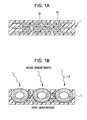
- FIG. 1A is a cross-sectional view illustrating a magnetic sheet according to a first embodiment of the present invention.
- the magnetic sheet 1 according to the present invention is composed of a resin 11 which is a matrix material functioning as a binder and soft magnetic particles 12 which are a magnetic material contained in the resin 11.
- the soft magnetic particles 12 comprise an amorphous phase containing a relatively smaller amount of crystallites than that of the amorphous phase.
- radio waves 2 which become noise are converted to heat, and thereby a noise-suppressing effect is achieved.
- the matrix material examples include silicone resin, polyvinyl chloride, silicone rubber, phenol resin, melamine resin, polyvinyl alcohol, polyethylene, chloride, and various types of elastomers.
- the matrix material is preferably resin, such as silicone resin, which can give an emulsion solution of a magnetic material.
- the magnetic material can be readily processed into a flat shape by adding a lubricant containing stearate or the like to the matrix material. Then, a magnetic material having a high aspect ratio can be obtained. Consequently, the magnetic material of the magnetic sheet tends to be laminated and oriented in the thickness direction of the sheet, and therefore the density becomes high. As a result, the imaginary part ⁇ " of complex magnetic permeability is increased and thereby the noise suppression property can be improved.
- the magnetic material contained in the matrix material is preferably particles or powder constituted of a soft magnetic material.
- the magnetic material used in the magnetic sheet according to the present invention is preferably flat particles or powder.
- the flat particles and powder having an aspect ratio (major axis/thickness) of 2.5 or more, preferably 12 or more, are preferable from the viewpoints of orientation and noise suppression property.
- the improvement of the orientation of flat particles or powder allows the density of the magnetic sheet itself to be increased and the imaginary part ⁇ " of complex magnetic permeability to be increased, and thereby the noise suppression property is improved.
- the aspect ratio is high, the occurrence of eddy current is suppressed and the impedance is increased. Consequently, the imaginary part ⁇ " of complex magnetic permeability in a GHz band is increased.
- the soft magnetic material is preferably a material constituted of an amorphous phase of which main component is Fe and which contains at least P, C, and B. Examples of such a material include an Fe-Ni-Cr-P-C-B-Si alloy.
- Such an amorphous soft magnetic alloy is metal glass having a temperature interval ⁇ Tx of supercooled liquid being 25 K or more.
- the ⁇ Tx is 30 K or more and, further, is significantly large such as 50 K or more.
- the amorphous soft magnetic alloy exhibits excellent soft magnetic properties at room temperature.
- the magnetic material is basically constituted of an amorphous phase which contains crystallites in a relatively smaller ratio than that of the amorphous phase. That is, an amorphous phase rich is formed in the amorphous phase and the crystallites.
- the magnetic material consisting of an amorphous phase has relatively large magnetostriction.
- the drastic change from an amorphous phase to a crystalline phase takes place.
- Fe-rich alloy Fe-base crystallites are deposited.
- the magnetic permeability ⁇ will be increased by the compensation of the positive magnetostriction of the amorphous phase.
- the magnetic permeability ⁇ is increased by a decrease in the magnetostriction of a magnetic material consisting of an amorphous phase, and consequently the imaginary part ⁇ " of complex magnetic permeability is increased.
- the magnetic sheet according to the present invention has a high imaginary part ⁇ " of complex magnetic permeability in a specific frequency range from MHz to GHz bands (for example, from 200 to 300 MHz), particularly, from 100 to 800 MHz in which noise problems tend to occur.
- the magnetostriction is decreased by that the amorphous phase contains crystallites.
- the imaginary part ⁇ " of complex magnetic permeability in a range from MHz to GHz bands particularly, in a specific frequency range from 100 to 800 MHz in which noise problems tend to occur can be increased by keeping the electric resistance of the amorphous phase high.
- the magnetic material is insulated by the matrix material, the impedance of the magnetic sheet itself can be increased. With this, the occurrence of eddy current is suppressed, and the imaginary part ⁇ " of complex magnetic permeability in a range from MHz to GHz bands can be increased in a broad range.
- the noise-suppressing effect can be improved in a high-frequency band.
- the imaginary part ⁇ " of complex magnetic permeability is thus increased, the ability for converting radio waves to heat is increased. Consequently, the noise-suppressing effect can be improved.
- a method of producing a magnetic sheet according to the present invention includes a process of producing a magnetic material consisting of an amorphous phase, a process of producing a magnetic sheet containing the magnetic material particles, and a process of producing crystallites of mainly bcc-Fe in the amorphous phase by annealing the magnetic sheet at a temperature of approximately the glass-transition temperature or approximately the crystallization temperature of the magnetic material.
- the soft magnetic alloy powder is prepared by a water atomization method by weighing raw materials so as to give the composition of the soft magnetic alloy powder, mixing and melting the raw materials, and ejecting the resulting alloy melt into water for quenching.
- the method of producing a magnetic material consisting of an amorphous phase is not limited to the water atomization method.
- a gas atomization method or a liquid quenching method may be employed.
- ribbon obtained by quenching the above-mentioned alloy melt is pulverized into powder.
- the water atomization method, gas atomization method, or liquid quenching method can be carried out under conditions which are usually employed depending on the raw materials.
- the obtained amorphous soft magnetic alloy powder is classified to have a uniform particle size. Then, according to need, the alloy powder is processed into a flat shape with a device such as an attritor.
- the attritor is a device in which a large number of mill balls are placed in a drum.
- the soft magnetic alloy powder is processed to a desired degree of flatness by stirring and mixing the soft magnetic alloy powder put in the drum and the balls with a stirring rod inserted so as to be rotatable around the axis of the drum.
- the flat particles of the soft magnetic alloy powder can be also obtained by the above-mentioned liquid quenching method. Further, the obtained soft magnetic alloy powder may be treated with heat in order to decrease the internal stress, if necessary.
- a magnetic sheet containing magnetic material particles is produced.
- a mixture solution by mixing magnetic particles in a liquid matrix material and then processing the mixture solution into a sheet.
- an amorphous soft magnetic alloy powder as the magnetic material, a resin as the matrix material, and a solvent are put into a stirring vessel 21 shown in FIG. 2A.
- this stirring vessel 21 is mounted on a planetary stirring defoaming device 22, and slurry of the mixture solution is mixed and defoamed for slurry adjustment.
- the solvent include xylene, toluene, and isopropyl alcohol.
- the slurry 24 is applied onto a release film 23 with a doctor blade 25 and then dried for curing. With this, a sheet 26 is formed on the release film 23 as shown in FIG. 2D. Then, as shown in FIG. 2E, the sheet 26 is peeled off the release film 23.
- the amorphous soft magnetic alloy powder (flat particles) contained in the slurry 24 is aligned and oriented in one direction by thus forming the slurry 24 into a sheet. That is, as shown in FIG. 1A, the major axis directions of the soft magnetic particles 12 are oriented so as to be aligned in the in-plane direction of the sheet 26.
- the sheet 26 is set to a pressing machine 27 and is consolidated by pressing.
- the pressing can be carried out under conditions for usual thermocompression.
- the pressing may be conducted under conditions of a heating temperature of 80 to 160°C, a pressing pressure of 50 to 500 kg/cm 2 , and a pressing time of 5 to 60 min.
- This pressing treatment is an optional process, which may not be carried out.
- the sheet 26 after the pressing is put into an annealing furnace 28 for annealing. That is, the magnetic material formed into the sheet 26 is annealed.
- the annealing temperature is adjusted to a temperature of approximately the glass-transition temperature or approximately the crystallization temperature of the soft magnetic alloy as the magnetic material.
- This annealing is a treatment for producing crystallites in the amorphous phase of the soft magnetic alloy as the magnetic material, and the annealing temperature is suitably set according to the magnetic material contained in the magnetic sheet to be annealed.
- the annealing temperature may be a temperature which is sufficient for producing crystallites consisting mainly of bcc-Fe in the amorphous phase of the magnetic material, for example, a temperature of approximately the glass-transition temperature or approximately the crystallization temperature of the magnetic material.
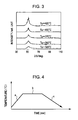
- FIG. 3 shows X-ray diffraction patterns when a magnetic sheet of a soft magnetic Fe 69.9 Ni 6 Cr 4 P 9.8 C 7.3 B 2 Si 1 alloy (Tg: 422° C) as the magnetic material was annealed at different annealing temperatures. It is confirmed from FIG. 3 that a peak of crystallization appears at an annealing temperature (Ta) of 350°C, and the peak becomes significant at a Ta of 375°C.
- Ta annealing temperature
- the annealing temperature is higher than 400°C, peaks of other compound phases appear. The tendency becomes significant when the annealing temperature is 420°C. Therefore, when a soft magnetic alloy having the above-mentioned composition is used, the annealing temperature is preferably 350 to 400°C, more preferably 350 to 375°C. Further, the annealing temperature should be set not to deteriorate the resin used as the matrix material in view of heat resistance and the like of the matrix material.
- the temperature profile in the annealing is adjusted to, for example, a profile shown in FIG. 4. That is, the temperature profile contains a temperature-increasing process (for example, 10°C/min, indicated by a in the figure), a temperature-maintaining process (indicated by b in the figure), and a furnace-cooling process (indicated by c in the figure).
- the temperature profile is not limited to this. The similar effect can be achieved as long as the area of a temperature profile as shown in FIG. 4 is approximately the same, even if the temperature-increasing rate and the temperature-maintaining time are optionally changed.
- the annealing is preferably carried out under an anaerobic atmosphere in view of the oxidation of the powder and deterioration of the matrix material.
- the crystallites are deposited in the amorphous phase of the magnetic material by predeterminedly annealing the magnetic sheet.
- the magnetic material is a Fe-base soft magnetic alloy
- crystallites of bcc-Fe or consisting mainly of bcc-Fe are deposited.
- this magnetic sheet can achieve a different ⁇ '/ ⁇ " - F (real part of complex magnetic permeability/imaginary part of complex magnetic permeability - frequency).
- the magnetic sheet can increase the real part ⁇ ' of complex magnetic permeability at up to about 10 MHz and the imaginary ⁇ " of complex magnetic permeability at 200 to 300 MHz.
- the imaginary ⁇ " of complex magnetic permeability at 200 to 300 MHz can be thus increased, the noise-absorbing effect at 200 to 300 MHz can be achieved.
- a soft magnetic alloy of Fe 69.9 Ni 6 Cr 4 P 9.8 C 7.3 B 2 Si 1 was formed into powder by a water atomization method to produce flat amorphous soft magnetic alloy particles. Then, 100 parts by weight of this Fe-based amorphous soft magnetic alloy particles were put into a stirring vessel 21 shown in FIG. 2A together with 12 parts by weight of a silicone resin functioning as a binder and 260 parts by weight of toluene functioning as a solvent. Then, as shown in FIG. 2B, this stirring vessel 21 was mounted on a planetary stirring defoaming device 22, and the slurry adjustment was carried out by mixing and defoaming the slurry.
- the slurry 24 for forming a sheet was applied onto a release film 23 of an ethylene tetrafluoride resin with a doctor blade 25 and then dried for curing.
- a sheet 26 was formed on the release film 23 as shown in FIG. 2D.
- the sheet 26 was peeled off the release film 23.
- the thus prepared sheet 26 was hot-pressed with a pressing machine 27.
- the pressing conditions were 150°C, 250 kg/cm 2 , and 30 min. Then, as shown in FIG.
- the obtained sheet 26 by the pressing was put into an annealing furnace 28 and annealed at 375°C under a nitrogen atmosphere for changing the ⁇ "-F characteristic of the soft magnetic alloy particles.
- the temperature profile of this case was a temperature-increasing rate of 10°C/min and a maintaining time of 30 min. Then, the sheet was subjected to furnace-cooling. Thus, the magnetic sheet according to the Example was obtained.
- the thus obtained magnetic sheet was mounted on a digital still camera.
- the digital still camera was evaluated in accordance with the specification of VCCI (Voluntary Control Council for Interference by Information Technology Equipment) class B. The evaluation was carried out by a 3 m method in a radio wave darkroom.
- FIG. 5B shows the results.
- a digital still camera not mounted with the magnetic sheet was similarly evaluated for reference.
- FIG. 5A shows the results. These evaluations were conducted at an AC power of 100V/50 Hz, a temperature of 21.8°C, and a humidity of 62.8%.
- FIG. 6 shows the results.
- a magnetic sheet was produced by using an Fe-Al-Si alloy as the magnetic material and polyethylene chloride as the matrix material.
- the ⁇ " of this magnetic sheet was determined similarly as in the above.
- the results are shown in FIG. 6.
- a magnetic sheet was produced by using an Fe-Al-Si-based alloy as the magnetic material and polyethylene chloride as the matrix material.
- the ⁇ " of this magnetic sheet was also determined similarly as in the above. The results are shown in FIG. 6.
- the magnetic sheets of comparative examples 1 and 2 were each produced by kneading the magnetic material and the matrix material and forming it into a sheet.
- the imaginary part ⁇ " of complex magnetic permeability was measured using a sheet with a thickness of 1 mm by E4991A manufactured by Agilent.
- the ⁇ " of the magnetic sheet according to the present invention was stably high in the measured frequency range.
- the ⁇ " of the magnetic sheet of comparative example 1 was low at the higher-frequency band in the measurement range.
- the ⁇ " of the magnetic sheet of comparative example 2 was low in the measured frequency range.
- the magnetic sheet according to the present invention stably achieved a high ⁇ " in a range from MHz to GHz bands.
- the thus obtained magnetic sheet according to the present invention was mounted on a CPU clock of a car navigation system, and its noise level was investigated. The results are shown in FIG. 7.
- a car navigation system not mounted with the magnetic sheet was similarly investigated for its noise level, for reference. The results are shown in FIG. 7.
- a car navigation system mounted with the magnetic sheet of the above-mentioned comparative example 1 was similarly investigated for its noise level. The results are shown in FIG. 7.
- the measurement of the noise level was conducted by a 3 m method in a radio wave darkroom.
- the noise was attenuated and thereby the noise level was very low. This is thought that since the ⁇ " of the magnetic sheet is high, the ability to convert noise to heat is high. On the other hand, in the car navigation system not mounted with the magnetic sheet (without sheet), the noise level was very high. In addition, in the car navigation system mounted with the magnetic sheet of comparative example 1, the noise was slightly attenuated, but the noise level was still high. Thus, it was confirmed that the magnetic sheet according to the present invention achieved a noise-suppressing effect in a range from MHz to GHz bands.
- the present invention is not limited to the above-described example, and various modifications can be made.
- the types and contents of the constituents, blending order, and treatment conditions may be variously modified without departing from the scope of the present invention.
Landscapes
- Chemical & Material Sciences (AREA)
- Engineering & Computer Science (AREA)
- Physics & Mathematics (AREA)
- Electromagnetism (AREA)
- Dispersion Chemistry (AREA)
- Power Engineering (AREA)
- Crystallography & Structural Chemistry (AREA)
- Inorganic Chemistry (AREA)
- Materials Engineering (AREA)
- Soft Magnetic Materials (AREA)
- Shielding Devices Or Components To Electric Or Magnetic Fields (AREA)
- Hard Magnetic Materials (AREA)
Abstract

Description
- This application claims benefit of the
Japanese Patent Application No. 2006-180298 filed on June 29, 2006 - The present invention relates to a magnetic sheet used as a noise suppression sheet and relates to a method of producing the same.
- Recently, portable electronic devices, as represented by mobile phones and notebook computers, are broadly used. These portable electronic devices have the problem of electromagnetic interference. In particular, it has been necessary to prevent undesired radio waves of high frequencies. In order to suppress the undesired radio waves, it is preferable to use a magnetic composite having a large imaginary part µ" of complex magnetic permeability in the frequency band to be used. Consequently, a magnetic sheet made of a material in which a powder constituted of a soft magnetic alloy such as an Fe-Al-Si alloy or an Fe-Ni alloy is dispersed has been developed.
- For example, in
Japanese Unexamined Patent Application Publication No. 2000-068117 - However, in the above-described electromagnetic wave absorber, it is difficult to increase the imaginary part µ" of complex magnetic permeability in a specific frequency range from MHz to GHz bands, particularly, from 100 to 800 MHz in which noise problems tend to occur. Hence, the electromagnetic wave absorber has a problem that the noise-suppressing effect cannot be achieved in a specific frequency range in 100 to 800 MHz (for example, from 200 to 300 MHz).
- The present invention provides a magnetic sheet having an excellent noise-suppressing effect in a specific frequency range from MHz to GHz bands, particularly, 100 to 800 MHz in which noise problems tend to occur. The present invention also provides a method of producing such a magnetic sheet.
- The magnetic sheet according to the present invention contains a matrix material and a magnetic material contained in the matrix material. In the magnetic material, an amorphous phase contains a relatively small amount of crystallites which, preferably, are bcc-Fe or consist mainly of bcc-Fe.
- With such constitution, the amorphous phase contains crystallites of which amount is relatively smaller than that of the amorphous phase. Therefore, the real part µ' of complex magnetic permeability at a frequency up to about 10 MHz and the imaginary part µ" of complex magnetic permeability at a frequency of 200 to 300 MHz are increased. The thus increased imaginary part µ" of complex magnetic permeability enhances the ability for converting radio waves to heat. Consequently, the noise-suppressing effect can be improved. In addition, since the amorphous phase has a high electric resistance, the µ' and the µ" can be readily maintained in a high-frequency band. Further, in this structure, since the crystallites are partially deposited, the advantage of the characteristically high electric resistance of the amorphous phase can be still utilized.
- In the magnetic sheet according to the present invention, the crystallites are preferably produced by annealing the magnetic material at a temperature of approximately the glass-transition temperature or approximately the crystallization temperature of the magnetic material.
- In the magnetic sheet according to the present invention, the magnetic material is preferably an Fe-base soft magnetic alloy.
- A method of producing a magnetic sheet according to the present invention includes a process of producing a magnetic material consisting of an amorphous phase, a process of producing a magnetic sheet containing the magnetic material, and a process of producing crystallites in the amorphous phase by annealing the magnetic sheet at a temperature of approximately the glass-transition temperature or approximately the crystallization temperature of the magnetic material.
- In the method of producing a magnetic sheet according to the present invention, the magnetic material consisting of the amorphous phase is preferably produced by a water atomization method.
- In the method of producing a magnetic sheet according to the present invention, the magnetic sheet is preferably produced by preparing a mixture solution by mixing the magnetic material in a liquid matrix material for constituting the magnetic sheet and then forming the mixture solution into a sheet.
- In the annealing, crystallites of bcc-Fe or consisting mainly of bcc-Fe are preferably deposited. The annealing temperature is 325 to 400°C, more preferably 350 to 375°C.
-
- FIG. 1A is a cross-sectional view of a magnetic sheet according to an embodiment of the present invention.
- FIG. 1B is a diagram illustrating a noise-suppressing effect in the magnetic sheet.
- FIGS. 2A to 2G are diagrams illustrating a method of producing a magnetic sheet according to an embodiment of the present invention.
- FIG. 3 is a graph showing X-ray diffraction patterns when annealing is carried out at different annealing temperatures.
- FIG. 4 is a graph showing a temperature profile in annealing.
- FIG. 5A is a graph showing an evaluation result of a digital still camera in accordance with the specification of VCCI class B.
- FIG. 5B is a graph showing an evaluation result of a digital still camera in accordance with the specification of VCCI class B.
- FIG. 6 is a characteristics diagram showing the relationships between imaginary parts µ" and frequencies.
- FIG. 7 is a diagram showing noise attenuation in car navigation systems of which CPU clocks provided with magnetic sheets.
- The present invention will now be described in detail with embodiments referring to the attached drawings.
- FIG. 1A is a cross-sectional view illustrating a magnetic sheet according to a first embodiment of the present invention. The
magnetic sheet 1 according to the present invention is composed of aresin 11 which is a matrix material functioning as a binder and softmagnetic particles 12 which are a magnetic material contained in theresin 11. The softmagnetic particles 12 comprise an amorphous phase containing a relatively smaller amount of crystallites than that of the amorphous phase. With reference to FIG. 1B, in themagnetic sheet 1,radio waves 2 which become noise are converted to heat, and thereby a noise-suppressing effect is achieved. - Examples of the matrix material include silicone resin, polyvinyl chloride, silicone rubber, phenol resin, melamine resin, polyvinyl alcohol, polyethylene, chloride, and various types of elastomers. In particular, since the magnetic sheet is formed by mixing a magnetic material in a resin solution, the matrix material is preferably resin, such as silicone resin, which can give an emulsion solution of a magnetic material. In addition, the magnetic material can be readily processed into a flat shape by adding a lubricant containing stearate or the like to the matrix material. Then, a magnetic material having a high aspect ratio can be obtained. Consequently, the magnetic material of the magnetic sheet tends to be laminated and oriented in the thickness direction of the sheet, and therefore the density becomes high. As a result, the imaginary part µ" of complex magnetic permeability is increased and thereby the noise suppression property can be improved.
- The magnetic material contained in the matrix material is preferably particles or powder constituted of a soft magnetic material. The magnetic material used in the magnetic sheet according to the present invention is preferably flat particles or powder. The flat particles and powder having an aspect ratio (major axis/thickness) of 2.5 or more, preferably 12 or more, are preferable from the viewpoints of orientation and noise suppression property. The improvement of the orientation of flat particles or powder allows the density of the magnetic sheet itself to be increased and the imaginary part µ" of complex magnetic permeability to be increased, and thereby the noise suppression property is improved. In addition, when the aspect ratio is high, the occurrence of eddy current is suppressed and the impedance is increased. Consequently, the imaginary part µ" of complex magnetic permeability in a GHz band is increased.
- The soft magnetic material is preferably an Fe-base soft magnetic alloy of which main phase is an amorphous phase having a reduced vitrification temperature Tx/Tm (Tx: crystallization initiating temperature, Tm: melting temperature) of 0.55 or more or Fe-base metal glass of which main phase is an amorphous phase having a temperature interval △Tx of supercooled liquid, represented by a formula △Tx = Tx - Tg (Tx: crystallization initiating temperature, Tg: glass transition temperature), being 25 K or more. More specifically, the soft magnetic material is preferably a material constituted of an amorphous phase of which main component is Fe and which contains at least P, C, and B. Examples of such a material include an Fe-Ni-Cr-P-C-B-Si alloy.
- Such an amorphous soft magnetic alloy is metal glass having a temperature interval △Tx of supercooled liquid being 25 K or more. In some compositions, the △Tx is 30 K or more and, further, is significantly large such as 50 K or more. In addition, the amorphous soft magnetic alloy exhibits excellent soft magnetic properties at room temperature.
- The magnetic material is basically constituted of an amorphous phase which contains crystallites in a relatively smaller ratio than that of the amorphous phase. That is, an amorphous phase rich is formed in the amorphous phase and the crystallites.
- The magnetic material consisting of an amorphous phase has relatively large magnetostriction. In the process of producing crystallites in an amorphous phase, the drastic change from an amorphous phase to a crystalline phase takes place. In an Fe-rich alloy, Fe-base crystallites are deposited. At this occasion, it is preferable that only Fe crystals having a bcc structure be formed in the crystallite phase. Since the deposition of a compound phase, such as an Fe-B phase or Fe-P phase, decreases the magnetic permeability µ, the deposition of a compound phase should be avoided as much as possible. Since the crystallite phase of a bcc-Fe phase has negative magnetostriction, the magnetic permeability µ will be increased by the compensation of the positive magnetostriction of the amorphous phase. Thus, the magnetic permeability µ is increased by a decrease in the magnetostriction of a magnetic material consisting of an amorphous phase, and consequently the imaginary part µ" of complex magnetic permeability is increased. The magnetic sheet according to the present invention has a high imaginary part µ" of complex magnetic permeability in a specific frequency range from MHz to GHz bands (for example, from 200 to 300 MHz), particularly, from 100 to 800 MHz in which noise problems tend to occur.
- Thus, in the magnetic sheet according to the present invention, the magnetostriction is decreased by that the amorphous phase contains crystallites. Further, the imaginary part µ" of complex magnetic permeability in a range from MHz to GHz bands, particularly, in a specific frequency range from 100 to 800 MHz in which noise problems tend to occur can be increased by keeping the electric resistance of the amorphous phase high. In addition, since the magnetic material is insulated by the matrix material, the impedance of the magnetic sheet itself can be increased. With this, the occurrence of eddy current is suppressed, and the imaginary part µ" of complex magnetic permeability in a range from MHz to GHz bands can be increased in a broad range. Thus, the noise-suppressing effect can be improved in a high-frequency band. When the imaginary part µ" of complex magnetic permeability is thus increased, the ability for converting radio waves to heat is increased. Consequently, the noise-suppressing effect can be improved.
- A method of producing a magnetic sheet according to the present invention includes a process of producing a magnetic material consisting of an amorphous phase, a process of producing a magnetic sheet containing the magnetic material particles, and a process of producing crystallites of mainly bcc-Fe in the amorphous phase by annealing the magnetic sheet at a temperature of approximately the glass-transition temperature or approximately the crystallization temperature of the magnetic material.
- First, as the magnetic material consisting of an amorphous phase, for example, a soft magnetic alloy powder is prepared. In this case, the soft magnetic alloy powder is prepared by a water atomization method by weighing raw materials so as to give the composition of the soft magnetic alloy powder, mixing and melting the raw materials, and ejecting the resulting alloy melt into water for quenching. The method of producing a magnetic material consisting of an amorphous phase is not limited to the water atomization method. A gas atomization method or a liquid quenching method may be employed. In the liquid quenching method, ribbon obtained by quenching the above-mentioned alloy melt is pulverized into powder. The water atomization method, gas atomization method, or liquid quenching method can be carried out under conditions which are usually employed depending on the raw materials.
- The obtained amorphous soft magnetic alloy powder is classified to have a uniform particle size. Then, according to need, the alloy powder is processed into a flat shape with a device such as an attritor. The attritor is a device in which a large number of mill balls are placed in a drum. The soft magnetic alloy powder is processed to a desired degree of flatness by stirring and mixing the soft magnetic alloy powder put in the drum and the balls with a stirring rod inserted so as to be rotatable around the axis of the drum. In addition, the flat particles of the soft magnetic alloy powder can be also obtained by the above-mentioned liquid quenching method. Further, the obtained soft magnetic alloy powder may be treated with heat in order to decrease the internal stress, if necessary.
- Then, a magnetic sheet containing magnetic material particles is produced. In this case, it is preferable to produce the magnetic sheet by preparing a mixture solution by mixing magnetic particles in a liquid matrix material and then processing the mixture solution into a sheet. For example, an amorphous soft magnetic alloy powder as the magnetic material, a resin as the matrix material, and a solvent are put into a stirring
vessel 21 shown in FIG. 2A. Then, as shown in FIG. 2B, this stirringvessel 21 is mounted on a planetarystirring defoaming device 22, and slurry of the mixture solution is mixed and defoamed for slurry adjustment. Examples of the solvent include xylene, toluene, and isopropyl alcohol. - Then, as shown in FIG. 2C, the
slurry 24 is applied onto arelease film 23 with adoctor blade 25 and then dried for curing. With this, asheet 26 is formed on therelease film 23 as shown in FIG. 2D. Then, as shown in FIG. 2E, thesheet 26 is peeled off therelease film 23. The amorphous soft magnetic alloy powder (flat particles) contained in theslurry 24 is aligned and oriented in one direction by thus forming theslurry 24 into a sheet. That is, as shown in FIG. 1A, the major axis directions of the softmagnetic particles 12 are oriented so as to be aligned in the in-plane direction of thesheet 26. - Then, as shown in FIG. 2F, the
sheet 26 is set to apressing machine 27 and is consolidated by pressing. The pressing can be carried out under conditions for usual thermocompression. For example, the pressing may be conducted under conditions of a heating temperature of 80 to 160°C, a pressing pressure of 50 to 500 kg/cm2, and a pressing time of 5 to 60 min. This pressing treatment is an optional process, which may not be carried out. - Then, as shown in FIG. 2G, the
sheet 26 after the pressing is put into anannealing furnace 28 for annealing. That is, the magnetic material formed into thesheet 26 is annealed. The annealing temperature is adjusted to a temperature of approximately the glass-transition temperature or approximately the crystallization temperature of the soft magnetic alloy as the magnetic material. This annealing is a treatment for producing crystallites in the amorphous phase of the soft magnetic alloy as the magnetic material, and the annealing temperature is suitably set according to the magnetic material contained in the magnetic sheet to be annealed. That is, the annealing temperature may be a temperature which is sufficient for producing crystallites consisting mainly of bcc-Fe in the amorphous phase of the magnetic material, for example, a temperature of approximately the glass-transition temperature or approximately the crystallization temperature of the magnetic material. For example, FIG. 3 shows X-ray diffraction patterns when a magnetic sheet of a soft magnetic Fe69.9Ni6Cr4P9.8C7.3B2Si1 alloy (Tg: 422° C) as the magnetic material was annealed at different annealing temperatures. It is confirmed from FIG. 3 that a peak of crystallization appears at an annealing temperature (Ta) of 350°C, and the peak becomes significant at a Ta of 375°C. However, when the annealing temperature is higher than 400°C, peaks of other compound phases appear. The tendency becomes significant when the annealing temperature is 420°C. Therefore, when a soft magnetic alloy having the above-mentioned composition is used, the annealing temperature is preferably 350 to 400°C, more preferably 350 to 375°C. Further, the annealing temperature should be set not to deteriorate the resin used as the matrix material in view of heat resistance and the like of the matrix material. - The temperature profile in the annealing is adjusted to, for example, a profile shown in FIG. 4. That is, the temperature profile contains a temperature-increasing process (for example, 10°C/min, indicated by a in the figure), a temperature-maintaining process (indicated by b in the figure), and a furnace-cooling process (indicated by c in the figure). The temperature profile is not limited to this. The similar effect can be achieved as long as the area of a temperature profile as shown in FIG. 4 is approximately the same, even if the temperature-increasing rate and the temperature-maintaining time are optionally changed. Further, the annealing is preferably carried out under an anaerobic atmosphere in view of the oxidation of the powder and deterioration of the matrix material.
- The crystallites are deposited in the amorphous phase of the magnetic material by predeterminedly annealing the magnetic sheet. For example, when the magnetic material is a Fe-base soft magnetic alloy, crystallites of bcc-Fe or consisting mainly of bcc-Fe are deposited. With this, a magnetic sheet having magnetic characteristics which are different from a conventional one can be obtained. That is, this magnetic sheet can achieve a different µ'/µ" - F (real part of complex magnetic permeability/imaginary part of complex magnetic permeability - frequency). Specifically, the magnetic sheet can increase the real part µ' of complex magnetic permeability at up to about 10 MHz and the imaginary µ" of complex magnetic permeability at 200 to 300 MHz. Particularly, since the imaginary µ" of complex magnetic permeability at 200 to 300 MHz can be thus increased, the noise-absorbing effect at 200 to 300 MHz can be achieved.
- Next, an Example conducted for clarifying the effects of the present invention will be described. A soft magnetic alloy of Fe69.9Ni6Cr4P9.8C7.3B2Si1 was formed into powder by a water atomization method to produce flat amorphous soft magnetic alloy particles. Then, 100 parts by weight of this Fe-based amorphous soft magnetic alloy particles were put into a stirring
vessel 21 shown in FIG. 2A together with 12 parts by weight of a silicone resin functioning as a binder and 260 parts by weight of toluene functioning as a solvent. Then, as shown in FIG. 2B, this stirringvessel 21 was mounted on a planetarystirring defoaming device 22, and the slurry adjustment was carried out by mixing and defoaming the slurry. - Then, as shown in FIG. 2C, the
slurry 24 for forming a sheet was applied onto arelease film 23 of an ethylene tetrafluoride resin with adoctor blade 25 and then dried for curing. With this, asheet 26 was formed on therelease film 23 as shown in FIG. 2D. Then, as shown in FIG. 2E, thesheet 26 was peeled off therelease film 23. Then, as shown in FIG. 2F, the thusprepared sheet 26 was hot-pressed with apressing machine 27. The pressing conditions were 150°C, 250 kg/cm2, and 30 min. Then, as shown in FIG. 2G, the obtainedsheet 26 by the pressing was put into anannealing furnace 28 and annealed at 375°C under a nitrogen atmosphere for changing the µ"-F characteristic of the soft magnetic alloy particles. The temperature profile of this case was a temperature-increasing rate of 10°C/min and a maintaining time of 30 min. Then, the sheet was subjected to furnace-cooling. Thus, the magnetic sheet according to the Example was obtained. - The thus obtained magnetic sheet was mounted on a digital still camera. The digital still camera was evaluated in accordance with the specification of VCCI (Voluntary Control Council for Interference by Information Technology Equipment) class B. The evaluation was carried out by a 3 m method in a radio wave darkroom. FIG. 5B shows the results. In addition, a digital still camera not mounted with the magnetic sheet was similarly evaluated for reference. FIG. 5A shows the results. These evaluations were conducted at an AC power of 100V/50 Hz, a temperature of 21.8°C, and a humidity of 62.8%.
- As obvious from FIGS. 5A and 5B, in the digital still camera not mounted with the magnetic sheet (FIG. 5A), the noise level was high overall, and a noise level (X part) exceeding a reference value was observed at near 700 MHz. On the other hand, in the digital still camera mounted with the magnetic sheet according to the present invention (FIG. 5B), the noise level was low overall in the measured frequency range. Thus, it was confirmed that the magnetic sheet according to the present invention has achieved a noise-suppressing effect.
- Further, the imaginary part µ" of complex magnetic permeability was determined as a magnetic characteristic of the magnetic sheet. FIG. 6 shows the results. In addition, as comparative example 1, a magnetic sheet was produced by using an Fe-Al-Si alloy as the magnetic material and polyethylene chloride as the matrix material. The µ" of this magnetic sheet was determined similarly as in the above. The results are shown in FIG. 6. Further, as comparative example 2, a magnetic sheet was produced by using an Fe-Al-Si-based alloy as the magnetic material and polyethylene chloride as the matrix material. The µ" of this magnetic sheet was also determined similarly as in the above. The results are shown in FIG. 6. The magnetic sheets of comparative examples 1 and 2 were each produced by kneading the magnetic material and the matrix material and forming it into a sheet. The imaginary part µ" of complex magnetic permeability was measured using a sheet with a thickness of 1 mm by E4991A manufactured by Agilent.
- As obvious from FIG. 6, the µ" of the magnetic sheet according to the present invention (Example) was stably high in the measured frequency range. On the other hand, the µ" of the magnetic sheet of comparative example 1 was low at the higher-frequency band in the measurement range. The µ" of the magnetic sheet of comparative example 2 was low in the measured frequency range. Thus, it was confirmed that the magnetic sheet according to the present invention stably achieved a high µ" in a range from MHz to GHz bands.
- Further, the thus obtained magnetic sheet according to the present invention was mounted on a CPU clock of a car navigation system, and its noise level was investigated. The results are shown in FIG. 7. In addition, a car navigation system not mounted with the magnetic sheet was similarly investigated for its noise level, for reference. The results are shown in FIG. 7. Further, a car navigation system mounted with the magnetic sheet of the above-mentioned comparative example 1 was similarly investigated for its noise level. The results are shown in FIG. 7. The measurement of the noise level was conducted by a 3 m method in a radio wave darkroom.
- As obvious from FIG. 7, in the car navigation system mounted with the magnetic sheet according to the present invention (Example), the noise was attenuated and thereby the noise level was very low. This is thought that since the µ" of the magnetic sheet is high, the ability to convert noise to heat is high. On the other hand, in the car navigation system not mounted with the magnetic sheet (without sheet), the noise level was very high. In addition, in the car navigation system mounted with the magnetic sheet of comparative example 1, the noise was slightly attenuated, but the noise level was still high. Thus, it was confirmed that the magnetic sheet according to the present invention achieved a noise-suppressing effect in a range from MHz to GHz bands.
- The present invention is not limited to the above-described example, and various modifications can be made. For example, the types and contents of the constituents, blending order, and treatment conditions may be variously modified without departing from the scope of the present invention.
Claims (10)
- A magnetic sheet comprising:a matrix material; anda magnetic material contained in the matrix material, whereinthe magnetic material contains crystallites in an amorphous phase in a relatively smaller amount than that of the amorphous phase.
- The magnetic sheet according to Claim 1, wherein the crystallites are produced by annealing the magnetic material at a temperature of approximately the glass-transition temperature or approximately the crystallization temperature of the material constituting the magnetic material.
- The magnetic sheet according to Claim 1 or 2, wherein the magnetic material is an Fe-base soft magnetic alloy.
- The magnetic sheet according to any of Claims 1 to 3, wherein the crystallite phase is bcc-Fe or consists mainly of bcc-Fe.
- A method of producing a magnetic sheet, the method comprising:a process of producing a magnetic material consisting of an amorphous phase;a process of producing a magnetic sheet containing the magnetic material; anda process of producing crystallites in the amorphous phase by annealing the magnetic sheet at a temperature of approximately the glass-transition temperature or approximately the crystallization temperature of the magnetic material.
- The method of producing a magnetic sheet according to Claim 5, wherein the magnetic material consisting of the amorphous phase is produced by a water atomization method.
- The method of producing a magnetic sheet according to Claim 5 or 6, wherein the magnetic sheet is produced by preparing a mixture solution by mixing the magnetic material in a liquid matrix material for constituting the magnetic sheet and then forming the mixture solution into a sheet.
- The method of producing a magnetic sheet according to Claims 5 to 7, wherein the annealing is a process for depositing a crystallite phase being bcc-Fe or consisting mainly of bcc-Fe.
- The method of producing a magnetic sheet according to Claims 5 to 8, wherein the annealing is conducted at 325 to 400°C.
- The method of producing a magnetic sheet according to Claim9 , wherein the annealing is conducted at 350 to 375°C.
Applications Claiming Priority (1)
| Application Number | Priority Date | Filing Date | Title |
|---|---|---|---|
| JP2006180298A JP2008010672A (en) | 2006-06-29 | 2006-06-29 | Magnetic sheet, and manufacturing method thereof |
Publications (1)
| Publication Number | Publication Date |
|---|---|
| EP1873792A1 true EP1873792A1 (en) | 2008-01-02 |
Family
ID=38587846
Family Applications (1)
| Application Number | Title | Priority Date | Filing Date |
|---|---|---|---|
| EP07012582A Withdrawn EP1873792A1 (en) | 2006-06-29 | 2007-06-27 | Magnetic sheet and method of producing the same |
Country Status (3)
| Country | Link |
|---|---|
| US (1) | US20080006352A1 (en) |
| EP (1) | EP1873792A1 (en) |
| JP (1) | JP2008010672A (en) |
Families Citing this family (8)
| Publication number | Priority date | Publication date | Assignee | Title |
|---|---|---|---|---|
| JP4566255B2 (en) * | 2008-08-21 | 2010-10-20 | アルプス電気株式会社 | Magnetic sheet manufacturing method, magnetic sheet and magnetic sheet manufacturing apparatus |
| US8432086B2 (en) * | 2010-02-02 | 2013-04-30 | Cooper Tire & Rubber Company | Ferro fluid for inducing linear stress |
| JP5804346B2 (en) * | 2011-02-08 | 2015-11-04 | 日立金属株式会社 | Dust core |
| JP5455258B2 (en) * | 2012-02-21 | 2014-03-26 | Necトーキン株式会社 | Noise suppression sheet |
| JP6427862B2 (en) * | 2013-10-25 | 2018-11-28 | 日立金属株式会社 | Dust core, manufacturing method thereof, inductance element using the dust core, and rotating electric machine |
| CN107452901A (en) * | 2017-07-31 | 2017-12-08 | 京东方科技集团股份有限公司 | A kind of method for packing of display panel, display panel and display device |
| CN113380506B (en) * | 2021-06-08 | 2022-06-24 | 横店集团东磁股份有限公司 | Power type thin film inductance magnetic sheet and preparation method and application thereof |
| CN117395978B (en) | 2023-12-11 | 2024-03-15 | 杭州象限科技有限公司 | A heat-resistant nanocrystalline magnetic isolation shielding material and its preparation method and application |
Citations (2)
| Publication number | Priority date | Publication date | Assignee | Title |
|---|---|---|---|---|
| US4197146A (en) * | 1978-10-24 | 1980-04-08 | General Electric Company | Molded amorphous metal electrical magnetic components |
| DE19639428A1 (en) * | 1995-09-25 | 1997-03-27 | Alps Electric Co Ltd | High frequency composite material with soft magnetic properties |
Family Cites Families (1)
| Publication number | Priority date | Publication date | Assignee | Title |
|---|---|---|---|---|
| US7323214B2 (en) * | 2001-11-09 | 2008-01-29 | Tdk Corporation | Composite magnetic material electromagnetic wave absorbing sheet method for manufacturing sheet-like product and method for manufacturing electromagnetic wave absorbing sheet |
-
2006
- 2006-06-29 JP JP2006180298A patent/JP2008010672A/en not_active Withdrawn
-
2007
- 2007-06-22 US US11/767,340 patent/US20080006352A1/en not_active Abandoned
- 2007-06-27 EP EP07012582A patent/EP1873792A1/en not_active Withdrawn
Patent Citations (2)
| Publication number | Priority date | Publication date | Assignee | Title |
|---|---|---|---|---|
| US4197146A (en) * | 1978-10-24 | 1980-04-08 | General Electric Company | Molded amorphous metal electrical magnetic components |
| DE19639428A1 (en) * | 1995-09-25 | 1997-03-27 | Alps Electric Co Ltd | High frequency composite material with soft magnetic properties |
Non-Patent Citations (2)
| Title |
|---|
| ADVANCED HARD AND SOFT MAGNETIC MATERIALS. SYMPOSIUM 5-8 APRIL 1999 SAN FRANCISCO, CA, USA, September 1999 (1999-09-01), Advanced Hard and Soft Magnetic Materials. Symposium Mater. Res. Soc Warrendale, PA, USA, pages 557 - 562, ISBN: 1-55899-485-8 * |
| DATABASE INSPEC [online] THE INSTITUTION OF ELECTRICAL ENGINEERS, STEVENAGE, GB; April 1999 (1999-04-01), LEU M S ET AL: "Quantitative crystallization and nano-grain size distribution studies of a FeCuNbSiB nanocrystalline alloy", XP002456481, Database accession no. 6803906 * |
Also Published As
| Publication number | Publication date |
|---|---|
| US20080006352A1 (en) | 2008-01-10 |
| JP2008010672A (en) | 2008-01-17 |
Similar Documents
| Publication | Publication Date | Title |
|---|---|---|
| US20080006352A1 (en) | Magnetic sheet and method of producing the same | |
| KR101399022B1 (en) | Sheet for absorbing electromagnetic wave, manufacturing method thereof and electronic equipment including the same | |
| JP6472939B2 (en) | Soft magnetic powder, Fe-based nanocrystalline alloy powder, magnetic parts and dust core | |
| JP7132231B2 (en) | Powder magnetic core manufacturing method, powder magnetic core and inductor | |
| CN100442402C (en) | Iron-based amorphous alloy powder with excellent high-frequency performance, magnetic powder core and preparation method thereof | |
| JP5617173B2 (en) | Method for producing flat soft magnetic powder and electromagnetic wave absorber | |
| JP2004140322A (en) | Electric wave absorber and manufacturing method of the same | |
| KR20090006729A (en) | Electromagnetic wave suppression sheet | |
| KR101568842B1 (en) | Electric wave absorption sheet for near-field | |
| EP2787514A2 (en) | Amorphous alloy powder, dust core, magnetic element, and electronic device | |
| WO2011016275A1 (en) | Fe-based amorphous alloy, dust core formed using the fe-based amorphous alloy, and dust core with embedded coil | |
| CN103258611A (en) | Soft magnetic powder, method of manufacturing same, noise suppression sheet using same, and method of manufacturing same | |
| CN104078183A (en) | Electric wave absorption sheet for near-field and manufacturing method thereof | |
| Kagotani et al. | Magnetic properties and microwave characteristics of Ni–Zn–Cu ferrite film fabricated by aerosol deposition method | |
| KR101232222B1 (en) | A composite film for absorption emi and the method for preparation of the same | |
| CN100530451C (en) | High-frequency magnetic material and its manufacturing method | |
| JP2010114246A (en) | Multilayer magnetic sheet | |
| JP2006207001A (en) | Method for manufacturing magnetic composite sheet | |
| CN103173683A (en) | A kind of alloy micropowder electromagnetic wave absorber and preparation method thereof | |
| EP1933337B1 (en) | Fe-based amorphous magnetic alloy and magnetic sheet | |
| JP3722391B2 (en) | Composite magnetic body and electromagnetic interference suppressor using the same | |
| KR20190012846A (en) | high-permeability magnetic sheet and manufacturing method thereof | |
| JP2004281846A (en) | High frequency magnetic material, high frequency magnetic component using the same, and manufacturing method | |
| JP2003332113A (en) | Flat soft magnetic powder and composite magnetic sheet using the same | |
| JP2003045708A (en) | Wave absorber and manufacturing method therefor |
Legal Events
| Date | Code | Title | Description |
|---|---|---|---|
| PUAI | Public reference made under article 153(3) epc to a published international application that has entered the european phase |
Free format text: ORIGINAL CODE: 0009012 |
|
| AK | Designated contracting states |
Kind code of ref document: A1 Designated state(s): AT BE BG CH CY CZ DE DK EE ES FI FR GB GR HU IE IS IT LI LT LU LV MC MT NL PL PT RO SE SI SK TR |
|
| AX | Request for extension of the european patent |
Extension state: AL BA HR MK YU |
|
| 17P | Request for examination filed |
Effective date: 20080422 |
|
| AKX | Designation fees paid |
Designated state(s): DE FR GB |
|
| 17Q | First examination report despatched |
Effective date: 20090122 |
|
| STAA | Information on the status of an ep patent application or granted ep patent |
Free format text: STATUS: THE APPLICATION IS DEEMED TO BE WITHDRAWN |
|
| 18D | Application deemed to be withdrawn |
Effective date: 20090602 |