EP1870415A1 - Heterocyclic fused imidazolone, dioxolone, imidazolethione and dioxolethione monomers - Google Patents
Heterocyclic fused imidazolone, dioxolone, imidazolethione and dioxolethione monomers Download PDFInfo
- Publication number
- EP1870415A1 EP1870415A1 EP07109094A EP07109094A EP1870415A1 EP 1870415 A1 EP1870415 A1 EP 1870415A1 EP 07109094 A EP07109094 A EP 07109094A EP 07109094 A EP07109094 A EP 07109094A EP 1870415 A1 EP1870415 A1 EP 1870415A1
- Authority
- EP
- European Patent Office
- Prior art keywords
- compound
- group
- monomer
- reactant
- combinations
- Prior art date
- Legal status (The legal status is an assumption and is not a legal conclusion. Google has not performed a legal analysis and makes no representation as to the accuracy of the status listed.)
- Withdrawn
Links
- 239000000178 monomer Substances 0.000 title claims abstract description 70
- MMGCXSBBWCOBEX-UHFFFAOYSA-N 1,3-dioxole-2-thione Chemical compound S=C1OC=CO1 MMGCXSBBWCOBEX-UHFFFAOYSA-N 0.000 title description 42
- BXNKCKFDLBMOTA-UHFFFAOYSA-N dioxol-3-one Chemical compound O=C1C=COO1 BXNKCKFDLBMOTA-UHFFFAOYSA-N 0.000 title description 41
- CAAMSDWKXXPUJR-UHFFFAOYSA-N 3,5-dihydro-4H-imidazol-4-one Chemical compound O=C1CNC=N1 CAAMSDWKXXPUJR-UHFFFAOYSA-N 0.000 title description 34
- NBGMRMDAEWWFIR-UHFFFAOYSA-N imidazole-2-thione Chemical compound S=C1N=CC=N1 NBGMRMDAEWWFIR-UHFFFAOYSA-N 0.000 title description 33
- 125000000623 heterocyclic group Chemical group 0.000 title description 30
- 150000001875 compounds Chemical class 0.000 claims abstract description 110
- 238000000034 method Methods 0.000 claims abstract description 62
- 229910052721 tungsten Inorganic materials 0.000 claims abstract description 30
- 229910052760 oxygen Inorganic materials 0.000 claims abstract description 26
- 229910052717 sulfur Inorganic materials 0.000 claims abstract description 25
- 229920000642 polymer Polymers 0.000 claims abstract description 23
- 229910052739 hydrogen Inorganic materials 0.000 claims abstract description 14
- 239000001257 hydrogen Substances 0.000 claims abstract description 14
- -1 3,4-disubstituted thiophene Chemical class 0.000 claims abstract description 13
- 125000004169 (C1-C6) alkyl group Chemical group 0.000 claims abstract description 9
- 229910052711 selenium Inorganic materials 0.000 claims abstract description 9
- UFHFLCQGNIYNRP-UHFFFAOYSA-N Hydrogen Chemical compound [H][H] UFHFLCQGNIYNRP-UHFFFAOYSA-N 0.000 claims abstract description 8
- 150000002148 esters Chemical class 0.000 claims abstract description 7
- 239000000376 reactant Substances 0.000 claims description 64
- CDBYLPFSWZWCQE-UHFFFAOYSA-L Sodium Carbonate Chemical compound [Na+].[Na+].[O-]C([O-])=O CDBYLPFSWZWCQE-UHFFFAOYSA-L 0.000 claims description 28
- AGZYNVVJQAOVRP-UHFFFAOYSA-N thiophene-3,4-diamine Chemical compound NC1=CSC=C1N AGZYNVVJQAOVRP-UHFFFAOYSA-N 0.000 claims description 26
- ZMANZCXQSJIPKH-UHFFFAOYSA-N Triethylamine Chemical compound CCN(CC)CC ZMANZCXQSJIPKH-UHFFFAOYSA-N 0.000 claims description 21
- XSQUKJJJFZCRTK-UHFFFAOYSA-N Urea Chemical compound NC(N)=O XSQUKJJJFZCRTK-UHFFFAOYSA-N 0.000 claims description 21
- YTPLMLYBLZKORZ-UHFFFAOYSA-N Thiophene Chemical compound C=1C=CSC=1 YTPLMLYBLZKORZ-UHFFFAOYSA-N 0.000 claims description 20
- MPKQTNAUFAZSIJ-UHFFFAOYSA-N thiophene-3,4-diol Chemical compound OC1=CSC=C1O MPKQTNAUFAZSIJ-UHFFFAOYSA-N 0.000 claims description 20
- 239000000463 material Substances 0.000 claims description 18
- PFKFTWBEEFSNDU-UHFFFAOYSA-N carbonyldiimidazole Chemical compound C1=CN=CN1C(=O)N1C=CN=C1 PFKFTWBEEFSNDU-UHFFFAOYSA-N 0.000 claims description 17
- 239000011541 reaction mixture Substances 0.000 claims description 16
- HEMHJVSKTPXQMS-UHFFFAOYSA-M Sodium hydroxide Chemical compound [OH-].[Na+] HEMHJVSKTPXQMS-UHFFFAOYSA-M 0.000 claims description 15
- 229920001940 conductive polymer Polymers 0.000 claims description 15
- 229910000029 sodium carbonate Inorganic materials 0.000 claims description 13
- RAMOMCXNLLLICQ-UHFFFAOYSA-N thiophene-3,4-diamine;dihydrochloride Chemical compound Cl.Cl.NC1=CSC=C1N RAMOMCXNLLLICQ-UHFFFAOYSA-N 0.000 claims description 12
- UMGDCJDMYOKAJW-UHFFFAOYSA-N thiourea Chemical compound NC(N)=S UMGDCJDMYOKAJW-UHFFFAOYSA-N 0.000 claims description 12
- 125000003118 aryl group Chemical group 0.000 claims description 11
- CWZKSXUEEZEUAQ-UHFFFAOYSA-N selenophene-3,4-diol Chemical compound OC1=C[se]C=C1O CWZKSXUEEZEUAQ-UHFFFAOYSA-N 0.000 claims description 10
- 235000017550 sodium carbonate Nutrition 0.000 claims description 10
- DBSKCYPBZQBTGO-UHFFFAOYSA-N thieno[3,4-d][1,3]dioxol-2-one Chemical compound S1C=C2OC(=O)OC2=C1 DBSKCYPBZQBTGO-UHFFFAOYSA-N 0.000 claims description 10
- 229930192474 thiophene Natural products 0.000 claims description 10
- VHYFNPMBLIVWCW-UHFFFAOYSA-N 4-Dimethylaminopyridine Chemical compound CN(C)C1=CC=NC=C1 VHYFNPMBLIVWCW-UHFFFAOYSA-N 0.000 claims description 9
- KWYUFKZDYYNOTN-UHFFFAOYSA-M Potassium hydroxide Chemical compound [OH-].[K+] KWYUFKZDYYNOTN-UHFFFAOYSA-M 0.000 claims description 9
- 125000000217 alkyl group Chemical group 0.000 claims description 9
- AHPISAGXEFFGEE-UHFFFAOYSA-N selenophene-3,4-diamine Chemical compound NC1=C[se]C=C1N AHPISAGXEFFGEE-UHFFFAOYSA-N 0.000 claims description 9
- CYSGHNMQYZDMIA-UHFFFAOYSA-N 1,3-Dimethyl-2-imidazolidinon Chemical compound CN1CCN(C)C1=O CYSGHNMQYZDMIA-UHFFFAOYSA-N 0.000 claims description 8
- KAESVJOAVNADME-UHFFFAOYSA-N Pyrrole Chemical compound C=1C=CNC=1 KAESVJOAVNADME-UHFFFAOYSA-N 0.000 claims description 8
- 239000004202 carbamide Substances 0.000 claims description 8
- 239000002243 precursor Substances 0.000 claims description 7
- LYCAIKOWRPUZTN-UHFFFAOYSA-N Ethylene glycol Chemical compound OCCO LYCAIKOWRPUZTN-UHFFFAOYSA-N 0.000 claims description 6
- JGFZNNIVVJXRND-UHFFFAOYSA-N N,N-Diisopropylethylamine (DIPEA) Chemical compound CCN(C(C)C)C(C)C JGFZNNIVVJXRND-UHFFFAOYSA-N 0.000 claims description 6
- DNIAPMSPPWPWGF-UHFFFAOYSA-N Propylene glycol Chemical compound CC(O)CO DNIAPMSPPWPWGF-UHFFFAOYSA-N 0.000 claims description 6
- JUJWROOIHBZHMG-UHFFFAOYSA-N Pyridine Chemical compound C1=CC=NC=C1 JUJWROOIHBZHMG-UHFFFAOYSA-N 0.000 claims description 6
- BWHMMNNQKKPAPP-UHFFFAOYSA-L potassium carbonate Chemical compound [K+].[K+].[O-]C([O-])=O BWHMMNNQKKPAPP-UHFFFAOYSA-L 0.000 claims description 6
- 239000002904 solvent Substances 0.000 claims description 6
- FRLDVRNLAPLRST-UHFFFAOYSA-N thieno[3,4-d][1,3]dioxole-2-thione Chemical compound S1C=C2OC(=S)OC2=C1 FRLDVRNLAPLRST-UHFFFAOYSA-N 0.000 claims description 6
- 235000011121 sodium hydroxide Nutrition 0.000 claims description 5
- XTHFKEDIFFGKHM-UHFFFAOYSA-N Dimethoxyethane Chemical compound COCCOC XTHFKEDIFFGKHM-UHFFFAOYSA-N 0.000 claims description 4
- KMTRUDSVKNLOMY-UHFFFAOYSA-N Ethylene carbonate Chemical compound O=C1OCCO1 KMTRUDSVKNLOMY-UHFFFAOYSA-N 0.000 claims description 4
- UFWIBTONFRDIAS-UHFFFAOYSA-N Naphthalene Chemical compound C1=CC=CC2=CC=CC=C21 UFWIBTONFRDIAS-UHFFFAOYSA-N 0.000 claims description 4
- UIIMBOGNXHQVGW-DEQYMQKBSA-M Sodium bicarbonate-14C Chemical compound [Na+].O[14C]([O-])=O UIIMBOGNXHQVGW-DEQYMQKBSA-M 0.000 claims description 4
- WYURNTSHIVDZCO-UHFFFAOYSA-N Tetrahydrofuran Chemical compound C1CCOC1 WYURNTSHIVDZCO-UHFFFAOYSA-N 0.000 claims description 4
- IEJIGPNLZYLLBP-UHFFFAOYSA-N dimethyl carbonate Chemical compound COC(=O)OC IEJIGPNLZYLLBP-UHFFFAOYSA-N 0.000 claims description 4
- 150000007529 inorganic bases Chemical class 0.000 claims description 4
- 239000000203 mixture Substances 0.000 claims description 3
- PSHKMPUSSFXUIA-UHFFFAOYSA-N n,n-dimethylpyridin-2-amine Chemical compound CN(C)C1=CC=CC=N1 PSHKMPUSSFXUIA-UHFFFAOYSA-N 0.000 claims description 3
- 239000011736 potassium bicarbonate Substances 0.000 claims description 3
- 229910000028 potassium bicarbonate Inorganic materials 0.000 claims description 3
- 235000015497 potassium bicarbonate Nutrition 0.000 claims description 3
- 229910000027 potassium carbonate Inorganic materials 0.000 claims description 3
- 235000011181 potassium carbonates Nutrition 0.000 claims description 3
- TYJJADVDDVDEDZ-UHFFFAOYSA-M potassium hydrogencarbonate Chemical compound [K+].OC([O-])=O TYJJADVDDVDEDZ-UHFFFAOYSA-M 0.000 claims description 3
- 235000011118 potassium hydroxide Nutrition 0.000 claims description 3
- UMJSCPRVCHMLSP-UHFFFAOYSA-N pyridine Natural products COC1=CC=CN=C1 UMJSCPRVCHMLSP-UHFFFAOYSA-N 0.000 claims description 3
- GTTOTVFMOPTMTD-UHFFFAOYSA-N selenophene-3,4-diamine;dihydrochloride Chemical compound Cl.Cl.NC1=C[se]C=C1N GTTOTVFMOPTMTD-UHFFFAOYSA-N 0.000 claims description 3
- LFMXSZSVDQJYDU-UHFFFAOYSA-N 1-(tripropoxymethoxy)propane Chemical compound CCCOC(OCCC)(OCCC)OCCC LFMXSZSVDQJYDU-UHFFFAOYSA-N 0.000 claims description 2
- OIFBSDVPJOWBCH-UHFFFAOYSA-N Diethyl carbonate Chemical compound CCOC(=O)OCC OIFBSDVPJOWBCH-UHFFFAOYSA-N 0.000 claims description 2
- VLCDUOXHFNUCKK-UHFFFAOYSA-N N,N'-Dimethylthiourea Chemical compound CNC(=S)NC VLCDUOXHFNUCKK-UHFFFAOYSA-N 0.000 claims description 2
- ZADPBFCGQRWHPN-UHFFFAOYSA-N boronic acid Chemical compound OBO ZADPBFCGQRWHPN-UHFFFAOYSA-N 0.000 claims description 2
- RAFNCPHFRHZCPS-UHFFFAOYSA-N di(imidazol-1-yl)methanethione Chemical compound C1=CN=CN1C(=S)N1C=CN=C1 RAFNCPHFRHZCPS-UHFFFAOYSA-N 0.000 claims description 2
- WGXOEJWQWOECJK-UHFFFAOYSA-N dipyridin-4-yloxymethanethione Chemical compound C=1C=NC=CC=1OC(=S)OC1=CC=NC=C1 WGXOEJWQWOECJK-UHFFFAOYSA-N 0.000 claims description 2
- GUVUOGQBMYCBQP-UHFFFAOYSA-N dmpu Chemical compound CN1CCCN(C)C1=O GUVUOGQBMYCBQP-UHFFFAOYSA-N 0.000 claims description 2
- 125000005843 halogen group Chemical group 0.000 claims description 2
- 125000001997 phenyl group Chemical group [H]C1=C([H])C([H])=C(*)C([H])=C1[H] 0.000 claims description 2
- RUOJZAUFBMNUDX-UHFFFAOYSA-N propylene carbonate Chemical compound CC1COC(=O)O1 RUOJZAUFBMNUDX-UHFFFAOYSA-N 0.000 claims description 2
- YLQBMQCUIZJEEH-UHFFFAOYSA-N tetrahydrofuran Natural products C=1C=COC=1 YLQBMQCUIZJEEH-UHFFFAOYSA-N 0.000 claims description 2
- AHJWSRRHTXRLAQ-UHFFFAOYSA-N tetramethoxymethane Chemical compound COC(OC)(OC)OC AHJWSRRHTXRLAQ-UHFFFAOYSA-N 0.000 claims description 2
- VJYJJHQEVLEOFL-UHFFFAOYSA-N thieno[3,2-b]thiophene Chemical compound S1C=CC2=C1C=CS2 VJYJJHQEVLEOFL-UHFFFAOYSA-N 0.000 claims description 2
- CWLNAJYDRSIKJS-UHFFFAOYSA-N triethoxymethoxyethane Chemical compound CCOC(OCC)(OCC)OCC CWLNAJYDRSIKJS-UHFFFAOYSA-N 0.000 claims description 2
- 238000010438 heat treatment Methods 0.000 claims 6
- VRAVWQUXPCWGSU-UHFFFAOYSA-N bis(1h-1,2,4-triazol-5-yl)methanone Chemical compound N1=CNN=C1C(=O)C=1N=CNN=1 VRAVWQUXPCWGSU-UHFFFAOYSA-N 0.000 claims 1
- 239000003054 catalyst Substances 0.000 claims 1
- 150000002905 orthoesters Chemical class 0.000 claims 1
- 235000013877 carbamide Nutrition 0.000 abstract description 8
- 125000002915 carbonyl group Chemical group [*:2]C([*:1])=O 0.000 abstract description 7
- MABNMNVCOAICNO-UHFFFAOYSA-N selenophene Chemical compound C=1C=C[se]C=1 MABNMNVCOAICNO-UHFFFAOYSA-N 0.000 abstract description 7
- 238000004519 manufacturing process Methods 0.000 abstract description 6
- 150000004649 carbonic acid derivatives Chemical class 0.000 abstract description 3
- 150000005082 selenophenes Chemical class 0.000 abstract description 3
- 125000002813 thiocarbonyl group Chemical group *C(*)=S 0.000 abstract description 3
- 150000003585 thioureas Chemical class 0.000 abstract description 3
- 150000003672 ureas Chemical class 0.000 abstract description 3
- 150000003577 thiophenes Chemical class 0.000 abstract description 2
- 238000006243 chemical reaction Methods 0.000 description 30
- LIKMRBJSBUADIU-UHFFFAOYSA-N 1,3-dihydrothieno[3,4-d]imidazol-2-one Chemical compound S1C=C2NC(=O)NC2=C1 LIKMRBJSBUADIU-UHFFFAOYSA-N 0.000 description 19
- 239000002585 base Substances 0.000 description 16
- 230000008901 benefit Effects 0.000 description 11
- 230000015572 biosynthetic process Effects 0.000 description 10
- 238000002360 preparation method Methods 0.000 description 10
- 150000003839 salts Chemical class 0.000 description 9
- RAXXELZNTBOGNW-UHFFFAOYSA-N imidazole Natural products C1=CNC=N1 RAXXELZNTBOGNW-UHFFFAOYSA-N 0.000 description 8
- 238000004817 gas chromatography Methods 0.000 description 7
- 230000007246 mechanism Effects 0.000 description 7
- IJGRMHOSHXDMSA-UHFFFAOYSA-N Atomic nitrogen Chemical compound N#N IJGRMHOSHXDMSA-UHFFFAOYSA-N 0.000 description 6
- YGYAWVDWMABLBF-UHFFFAOYSA-N Phosgene Chemical compound ClC(Cl)=O YGYAWVDWMABLBF-UHFFFAOYSA-N 0.000 description 6
- 125000002947 alkylene group Chemical group 0.000 description 6
- 239000003153 chemical reaction reagent Substances 0.000 description 6
- 239000002322 conducting polymer Substances 0.000 description 6
- 238000001816 cooling Methods 0.000 description 6
- 238000001914 filtration Methods 0.000 description 6
- 125000002877 alkyl aryl group Chemical group 0.000 description 5
- 125000003710 aryl alkyl group Chemical group 0.000 description 5
- 229920001577 copolymer Polymers 0.000 description 5
- 125000004122 cyclic group Chemical group 0.000 description 5
- 230000008569 process Effects 0.000 description 5
- 239000004065 semiconductor Substances 0.000 description 5
- 239000000243 solution Substances 0.000 description 5
- JITVQETUYJVBKJ-UHFFFAOYSA-N 1,3-dihydrothieno[3,4-d]imidazole-2-thione Chemical compound S1C=C2NC(=S)NC2=C1 JITVQETUYJVBKJ-UHFFFAOYSA-N 0.000 description 4
- FCEHBMOGCRZNNI-UHFFFAOYSA-N 1-benzothiophene Chemical compound C1=CC=C2SC=CC2=C1 FCEHBMOGCRZNNI-UHFFFAOYSA-N 0.000 description 4
- 125000003342 alkenyl group Chemical group 0.000 description 4
- 150000007942 carboxylates Chemical group 0.000 description 4
- 230000005669 field effect Effects 0.000 description 4
- 239000010408 film Substances 0.000 description 4
- 229920001519 homopolymer Polymers 0.000 description 4
- 238000006116 polymerization reaction Methods 0.000 description 4
- 231100000331 toxic Toxicity 0.000 description 4
- 230000002588 toxic effect Effects 0.000 description 4
- 0 C=C1*C*CC1 Chemical compound C=C1*C*CC1 0.000 description 3
- WZELXJBMMZFDDU-UHFFFAOYSA-N Imidazol-2-one Chemical compound O=C1N=CC=N1 WZELXJBMMZFDDU-UHFFFAOYSA-N 0.000 description 3
- 230000000767 anti-ulcer Effects 0.000 description 3
- 230000000052 comparative effect Effects 0.000 description 3
- 229940125904 compound 1 Drugs 0.000 description 3
- 239000004020 conductor Substances 0.000 description 3
- 238000002347 injection Methods 0.000 description 3
- 239000007924 injection Substances 0.000 description 3
- 238000003760 magnetic stirring Methods 0.000 description 3
- 229910052757 nitrogen Inorganic materials 0.000 description 3
- 230000005693 optoelectronics Effects 0.000 description 3
- 150000007530 organic bases Chemical class 0.000 description 3
- 239000003960 organic solvent Substances 0.000 description 3
- 238000010992 reflux Methods 0.000 description 3
- 239000007787 solid Substances 0.000 description 3
- 238000003756 stirring Methods 0.000 description 3
- 238000003786 synthesis reaction Methods 0.000 description 3
- 150000003564 thiocarbonyl compounds Chemical class 0.000 description 3
- YBJHBAHKTGYVGT-ZKWXMUAHSA-N (+)-Biotin Chemical compound N1C(=O)N[C@@H]2[C@H](CCCCC(=O)O)SC[C@@H]21 YBJHBAHKTGYVGT-ZKWXMUAHSA-N 0.000 description 2
- PAYRUJLWNCNPSJ-UHFFFAOYSA-N Aniline Chemical compound NC1=CC=CC=C1 PAYRUJLWNCNPSJ-UHFFFAOYSA-N 0.000 description 2
- LFQSCWFLJHTTHZ-UHFFFAOYSA-N Ethanol Chemical compound CCO LFQSCWFLJHTTHZ-UHFFFAOYSA-N 0.000 description 2
- XEEYBQQBJWHFJM-UHFFFAOYSA-N Iron Chemical compound [Fe] XEEYBQQBJWHFJM-UHFFFAOYSA-N 0.000 description 2
- LRHPLDYGYMQRHN-UHFFFAOYSA-N N-Butanol Chemical compound CCCCO LRHPLDYGYMQRHN-UHFFFAOYSA-N 0.000 description 2
- HSFWRNGVRCDJHI-UHFFFAOYSA-N alpha-acetylene Natural products C#C HSFWRNGVRCDJHI-UHFFFAOYSA-N 0.000 description 2
- 238000004458 analytical method Methods 0.000 description 2
- 239000007864 aqueous solution Substances 0.000 description 2
- 125000004429 atom Chemical group 0.000 description 2
- 125000003354 benzotriazolyl group Chemical group N1N=NC2=C1C=CC=C2* 0.000 description 2
- HKNRNTYTYUWGLN-UHFFFAOYSA-N dithieno[3,2-a:2',3'-d]thiophene Chemical compound C1=CSC2=C1SC1=C2C=CS1 HKNRNTYTYUWGLN-UHFFFAOYSA-N 0.000 description 2
- 239000012458 free base Substances 0.000 description 2
- 150000002431 hydrogen Chemical group 0.000 description 2
- 125000004435 hydrogen atom Chemical group [H]* 0.000 description 2
- 230000003993 interaction Effects 0.000 description 2
- 238000013086 organic photovoltaic Methods 0.000 description 2
- 239000000126 substance Substances 0.000 description 2
- PFZLGKHSYILJTH-UHFFFAOYSA-N thieno[2,3-c]thiophene Chemical group S1C=C2SC=CC2=C1 PFZLGKHSYILJTH-UHFFFAOYSA-N 0.000 description 2
- 239000010409 thin film Substances 0.000 description 2
- JOXIMZWYDAKGHI-UHFFFAOYSA-N toluene-4-sulfonic acid Chemical compound CC1=CC=C(S(O)(=O)=O)C=C1 JOXIMZWYDAKGHI-UHFFFAOYSA-N 0.000 description 2
- 150000003852 triazoles Chemical class 0.000 description 2
- LWIHDJKSTIGBAC-UHFFFAOYSA-K tripotassium phosphate Chemical compound [K+].[K+].[K+].[O-]P([O-])([O-])=O LWIHDJKSTIGBAC-UHFFFAOYSA-K 0.000 description 2
- ZQGWBPQBZHMUFG-UHFFFAOYSA-N 1,1-dimethylthiourea Chemical compound CN(C)C(N)=S ZQGWBPQBZHMUFG-UHFFFAOYSA-N 0.000 description 1
- YBBLOADPFWKNGS-UHFFFAOYSA-N 1,1-dimethylurea Chemical compound CN(C)C(N)=O YBBLOADPFWKNGS-UHFFFAOYSA-N 0.000 description 1
- OGYLKQFEFGIKRJ-UHFFFAOYSA-N 1,3-dihydroselenopheno[3,4-d]imidazol-2-one Chemical compound [se]1C=C2NC(=O)NC2=C1 OGYLKQFEFGIKRJ-UHFFFAOYSA-N 0.000 description 1
- VAYTZRYEBVHVLE-UHFFFAOYSA-N 1,3-dioxol-2-one Chemical class O=C1OC=CO1 VAYTZRYEBVHVLE-UHFFFAOYSA-N 0.000 description 1
- NLLOEPZYASPYON-UHFFFAOYSA-N 1,3-dioxolane-2-thione Chemical compound S=C1OCCO1 NLLOEPZYASPYON-UHFFFAOYSA-N 0.000 description 1
- GKWLILHTTGWKLQ-UHFFFAOYSA-N 2,3-dihydrothieno[3,4-b][1,4]dioxine Chemical compound O1CCOC2=CSC=C21 GKWLILHTTGWKLQ-UHFFFAOYSA-N 0.000 description 1
- RICKKZXCGCSLIU-UHFFFAOYSA-N 2-[2-[carboxymethyl-[[3-hydroxy-5-(hydroxymethyl)-2-methylpyridin-4-yl]methyl]amino]ethyl-[[3-hydroxy-5-(hydroxymethyl)-2-methylpyridin-4-yl]methyl]amino]acetic acid Chemical compound CC1=NC=C(CO)C(CN(CCN(CC(O)=O)CC=2C(=C(C)N=CC=2CO)O)CC(O)=O)=C1O RICKKZXCGCSLIU-UHFFFAOYSA-N 0.000 description 1
- MFGOFGRYDNHJTA-UHFFFAOYSA-N 2-amino-1-(2-fluorophenyl)ethanol Chemical compound NCC(O)C1=CC=CC=C1F MFGOFGRYDNHJTA-UHFFFAOYSA-N 0.000 description 1
- 125000004105 2-pyridyl group Chemical group N1=C([*])C([H])=C([H])C([H])=C1[H] 0.000 description 1
- QLDZNXQMCULGON-UHFFFAOYSA-N 4,6-diethylthieno[3,4-d][1,3]dioxol-2-one Chemical compound O1C(=O)OC2=C(CC)SC(CC)=C21 QLDZNXQMCULGON-UHFFFAOYSA-N 0.000 description 1
- 125000000339 4-pyridyl group Chemical group N1=C([H])C([H])=C([*])C([H])=C1[H] 0.000 description 1
- NSPMIYGKQJPBQR-UHFFFAOYSA-N 4H-1,2,4-triazole Chemical compound C=1N=CNN=1 NSPMIYGKQJPBQR-UHFFFAOYSA-N 0.000 description 1
- 238000010485 C−C bond formation reaction Methods 0.000 description 1
- QXNVGIXVLWOKEQ-UHFFFAOYSA-N Disodium Chemical class [Na][Na] QXNVGIXVLWOKEQ-UHFFFAOYSA-N 0.000 description 1
- VTLYFUHAOXGGBS-UHFFFAOYSA-N Fe3+ Chemical class [Fe+3] VTLYFUHAOXGGBS-UHFFFAOYSA-N 0.000 description 1
- 238000007341 Heck reaction Methods 0.000 description 1
- MGJKQDOBUOMPEZ-UHFFFAOYSA-N N,N'-dimethylurea Chemical compound CNC(=O)NC MGJKQDOBUOMPEZ-UHFFFAOYSA-N 0.000 description 1
- 238000006619 Stille reaction Methods 0.000 description 1
- NINIDFKCEFEMDL-UHFFFAOYSA-N Sulfur Chemical compound [S] NINIDFKCEFEMDL-UHFFFAOYSA-N 0.000 description 1
- 238000006069 Suzuki reaction reaction Methods 0.000 description 1
- 238000007099 Yamamoto allylation reaction Methods 0.000 description 1
- 239000000654 additive Substances 0.000 description 1
- 229960002685 biotin Drugs 0.000 description 1
- 235000020958 biotin Nutrition 0.000 description 1
- 239000011616 biotin Substances 0.000 description 1
- YHNUDLCUIKMNSN-UHFFFAOYSA-N bis(1,2,4-triazol-1-yl)methanone Chemical compound C1=NC=NN1C(=O)N1C=NC=N1 YHNUDLCUIKMNSN-UHFFFAOYSA-N 0.000 description 1
- NRUUWJBKKTYNNG-UHFFFAOYSA-N bis(2-methylimidazol-1-yl)methanethione Chemical compound CC1=NC=CN1C(=S)N1C(C)=NC=C1 NRUUWJBKKTYNNG-UHFFFAOYSA-N 0.000 description 1
- XMFCLBUQBWFZBP-UHFFFAOYSA-N bis(2-methylimidazol-1-yl)methanone Chemical compound CC1=NC=CN1C(=O)N1C(C)=NC=C1 XMFCLBUQBWFZBP-UHFFFAOYSA-N 0.000 description 1
- ZRXHYHZENMJKMG-UHFFFAOYSA-N bis(benzotriazol-1-yl)methanethione Chemical compound N1=NC2=CC=CC=C2N1C(=S)N1C2=CC=CC=C2N=N1 ZRXHYHZENMJKMG-UHFFFAOYSA-N 0.000 description 1
- ZXYBIPTYOWWVQD-UHFFFAOYSA-N bis(benzotriazol-1-yl)methanone Chemical compound N1=NC2=CC=CC=C2N1C(=O)N1C2=CC=CC=C2N=N1 ZXYBIPTYOWWVQD-UHFFFAOYSA-N 0.000 description 1
- 150000001649 bromium compounds Chemical group 0.000 description 1
- FJDQFPXHSGXQBY-UHFFFAOYSA-L caesium carbonate Chemical compound [Cs+].[Cs+].[O-]C([O-])=O FJDQFPXHSGXQBY-UHFFFAOYSA-L 0.000 description 1
- 229910000024 caesium carbonate Inorganic materials 0.000 description 1
- HUCVOHYBFXVBRW-UHFFFAOYSA-M caesium hydroxide Inorganic materials [OH-].[Cs+] HUCVOHYBFXVBRW-UHFFFAOYSA-M 0.000 description 1
- 239000003990 capacitor Substances 0.000 description 1
- 229910052799 carbon Inorganic materials 0.000 description 1
- 125000005392 carboxamide group Chemical group NC(=O)* 0.000 description 1
- 150000003857 carboxamides Chemical class 0.000 description 1
- 235000019994 cava Nutrition 0.000 description 1
- 230000008859 change Effects 0.000 description 1
- 239000007795 chemical reaction product Substances 0.000 description 1
- 231100000481 chemical toxicant Toxicity 0.000 description 1
- 238000000576 coating method Methods 0.000 description 1
- 229920000547 conjugated polymer Polymers 0.000 description 1
- 238000005260 corrosion Methods 0.000 description 1
- 125000006165 cyclic alkyl group Chemical group 0.000 description 1
- SNOJOKOVTYPHMC-UHFFFAOYSA-N di(piperidin-1-yl)methanone Chemical compound C1CCCCN1C(=O)N1CCCCC1 SNOJOKOVTYPHMC-UHFFFAOYSA-N 0.000 description 1
- HJSMLDVJDUBCLQ-UHFFFAOYSA-N diethoxymethanethione Chemical compound CCOC(=S)OCC HJSMLDVJDUBCLQ-UHFFFAOYSA-N 0.000 description 1
- YOKOBAHUBJPMGP-UHFFFAOYSA-N diethyl 3,4-dihydroxythiophene-2,5-dicarboxylate Chemical compound CCOC(=O)C=1SC(C(=O)OCC)=C(O)C=1O YOKOBAHUBJPMGP-UHFFFAOYSA-N 0.000 description 1
- BJIKOZOULYUROB-UHFFFAOYSA-N dimethoxymethanethione Chemical compound COC(=S)OC BJIKOZOULYUROB-UHFFFAOYSA-N 0.000 description 1
- 239000002019 doping agent Substances 0.000 description 1
- 125000005678 ethenylene group Chemical group [H]C([*:1])=C([H])[*:2] 0.000 description 1
- 125000005677 ethinylene group Chemical group [*:2]C#C[*:1] 0.000 description 1
- 125000000524 functional group Chemical group 0.000 description 1
- 150000002391 heterocyclic compounds Chemical class 0.000 description 1
- 238000005984 hydrogenation reaction Methods 0.000 description 1
- 150000002460 imidazoles Chemical class 0.000 description 1
- YAMHXTCMCPHKLN-UHFFFAOYSA-N imidazolidin-2-one Chemical compound O=C1NCCN1 YAMHXTCMCPHKLN-UHFFFAOYSA-N 0.000 description 1
- 238000011065 in-situ storage Methods 0.000 description 1
- 229920000831 ionic polymer Polymers 0.000 description 1
- 229910052742 iron Inorganic materials 0.000 description 1
- 239000004973 liquid crystal related substance Substances 0.000 description 1
- 230000014759 maintenance of location Effects 0.000 description 1
- 238000004949 mass spectrometry Methods 0.000 description 1
- 230000004048 modification Effects 0.000 description 1
- 238000012986 modification Methods 0.000 description 1
- 125000002560 nitrile group Chemical group 0.000 description 1
- 150000002825 nitriles Chemical class 0.000 description 1
- 230000003287 optical effect Effects 0.000 description 1
- 239000007800 oxidant agent Substances 0.000 description 1
- 230000001590 oxidative effect Effects 0.000 description 1
- 229920001197 polyacetylene Polymers 0.000 description 1
- 229910000160 potassium phosphate Inorganic materials 0.000 description 1
- 235000011009 potassium phosphates Nutrition 0.000 description 1
- 239000002244 precipitate Substances 0.000 description 1
- 239000000047 product Substances 0.000 description 1
- 239000012429 reaction media Substances 0.000 description 1
- 150000003384 small molecules Chemical class 0.000 description 1
- 159000000000 sodium salts Chemical class 0.000 description 1
- 239000011232 storage material Substances 0.000 description 1
- 239000011593 sulfur Substances 0.000 description 1
- 230000003746 surface roughness Effects 0.000 description 1
- ZWZVWGITAAIFPS-UHFFFAOYSA-N thiophosgene Chemical compound ClC(Cl)=S ZWZVWGITAAIFPS-UHFFFAOYSA-N 0.000 description 1
- 239000003440 toxic substance Substances 0.000 description 1
Classifications
-
- C—CHEMISTRY; METALLURGY
- C07—ORGANIC CHEMISTRY
- C07D—HETEROCYCLIC COMPOUNDS
- C07D495/00—Heterocyclic compounds containing in the condensed system at least one hetero ring having sulfur atoms as the only ring hetero atoms
- C07D495/02—Heterocyclic compounds containing in the condensed system at least one hetero ring having sulfur atoms as the only ring hetero atoms in which the condensed system contains two hetero rings
- C07D495/04—Ortho-condensed systems
-
- C—CHEMISTRY; METALLURGY
- C07—ORGANIC CHEMISTRY
- C07D—HETEROCYCLIC COMPOUNDS
- C07D517/00—Heterocyclic compounds containing in the condensed system at least one hetero ring having selenium, tellurium, or halogen atoms as ring hetero atoms
- C07D517/02—Heterocyclic compounds containing in the condensed system at least one hetero ring having selenium, tellurium, or halogen atoms as ring hetero atoms in which the condensed system contains two hetero rings
- C07D517/04—Ortho-condensed systems
Definitions
- the present invention is directed to monomers and methods for making monomers for forming electrically conductive polymers.
- Such applications for optoelectronics include polymeric light emitting diodes (thin film displays), solid state lighting, organic photovoltaics, advanced memory devices, organic field effect transistors, ultracapacitors, electroluminescent devices, printed electronics, conductors, lasers, and sensors.
- One of the first of many electrically conducting polymers was polyacetylene and the discovery of conductivity in such polymer created substantial interest in other types of electrically conducting polymers. Recently, conjugated poly(thiophenes) and substituted thiophene derivatives have been discovered to have electrically conducting properties.
- a feature of these polymers is that they can be cast into films and doped with conventional p- and n-type dopants or the doped polymers can be cast into films and their electrical properties modified accordingly, thereby lending themselves suitable for use in a variety of optoelectronic applications.
- US2004/00010115A1 to Sotzing discloses homopolymers and copolymers comprised of repeating units of thieno[3,4- b ]thiophene for use in electroactive applications.
- the thieno[3,4- b ]thiophene compounds disclosed in the US2004/00010115A1 includes the following structure:
- copolymers can be formed with compounds including 3,4-ethylendioxythiophene, dithiophene, pyrrole, and benzothiophene.
- US 2,487,051 to Mozingo et al. discloses preparation of 1 H-thieno[3,4-d]imidazol-2(3H)-one by contacting an aqueous solution of 3,4-diaminothiophene with phosgene.
- the material in US 2,487,051 is disclosed as an analog of biotin and no use of the material in any electronic application is disclosed.
- EP 0 237 248 discloses a substituted imidazole anti-ulcer compound and a method of making the anti-ulcer compound.
- EP 0 237 248 discloses thieno[3,4-d]imidazol-2(3H)-thione as an intermediate compound during the manufacture of the anti-ulcer compound. No alternate use of the intermediate material is disclosed by EP 0 237 248 .
- the article, Hydrogenation of Compounds Containing Divalent Sulfur, J. Am. Chem. Soc. 1945, 67, 2092-2095 by Ralph Mozingo et al. discloses preparation of 1H-thieno[3,4-d]imidazol-2(3H)-one "in low yield" by contacting an aqueous solution of 3,4-diaminothiophene with phosgene.
- the method includes contacting a 3,4-disubstituted thiophene or selenophene or 3,4-disubstituted thiophene or selenophene derivatives with a carbonyl or thiocarbonyl containing compound selected from the group consisting of ureas, thioureas, carbonate esters, thionocarbonates, thiocarbonate esters, or orthocarbonates.
- the monomer compounds are suitable for forming polymers for use in a wide range of electronic applications.
- Another embodiment of the present invention includes heterocyclic fused imidazolone, dioxolone, imidazolethione or dioxolethione monomer compounds according to the following formula: wherein Y is NH or O; and X is O or S,
- Another embodiment of the present invention includes heterocyclic fused dioxolone, or dioxolethione monomer compounds according to the following formula: wherein X is S or O.
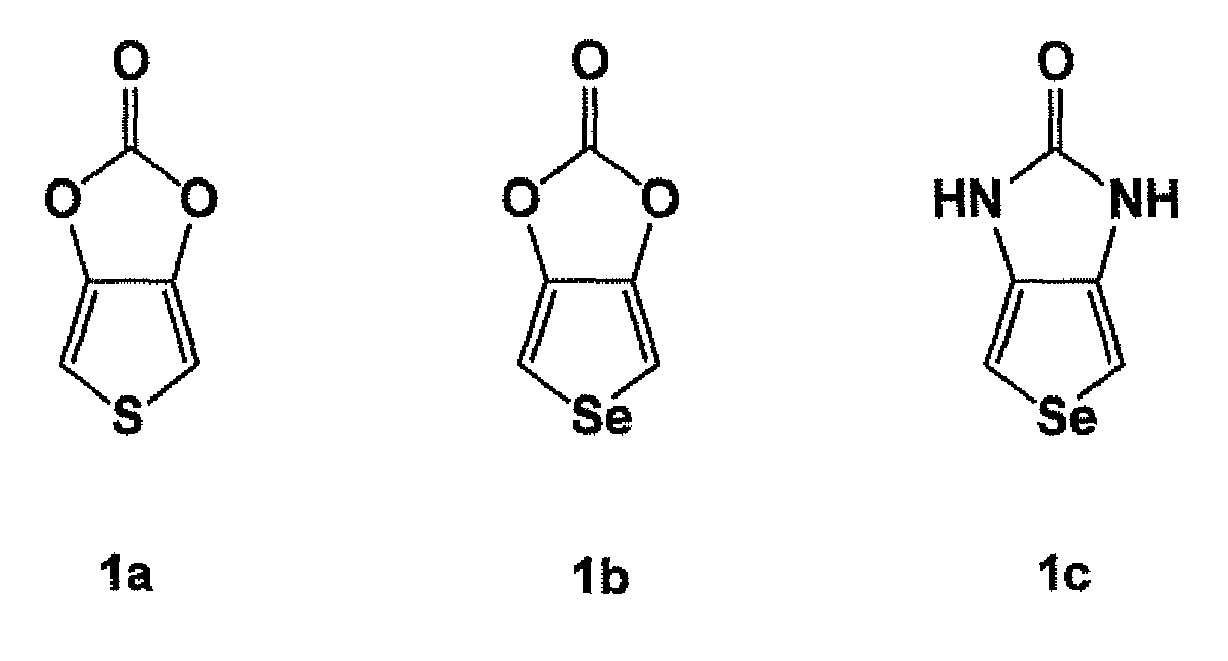
- Another embodiment of the present invention includes heterocyclic fused compounds imidazolone, dioxolone, imidazolethione or dioxolethione including thieno[3,4-d]-1,3-dioxolan-2-one (1 a), selenolo[3,4-d]-1,3-dioxolan-2-one (1b) and 1 H-selenolo[3,4-d]imidazol-2(3H)-one (1c), and the thiocarbonyl compounds thieno[3,4-d]-1,3-dioxolan-2-thione (1d), selenolo[3,4-d]-1,3-dioxolan-2-thione (1e) and 1H-selenolo[3,4-d]imidazol-2(3N)-thione (1f), all shown by the following structures:
- the invention includes heterocyclic fused imidazolone, dioxolone, imidazolethione and dioxolethione based monomers.
- Such monomers and polymers derived therefrom find use in applications, including, but not limited to, hole injection materials, charge transport materials, semiconductors, and/or conductors, in optical, electrooptical or electronic devices, polymeric light emitting diodes (i.e., PLED), electroluminescent devices, organic field effect transistors (i.e., FET or OFET), flat panel display applications (e.g., LCD's), radio frequency identification (i.e., RFID) tags, printed electronics, ultracapacitors, organic photovoltaics (i.e., OPV), sensors, lasers, small molecule or polymer based memory devices, electrolytic capacitors, anti-corrosion coatings, or as hydrogen storage materials.
- PLED polymeric light emitting diodes
- electroluminescent devices i.e., organic field effect transistors (i.e., F
- One advantage of a method according to an embodiment of the present invention includes preparation of previously unknown imidazolone, dioxolone, imidazolethione and dioxolethione monomers having an extended range of performance in many electronic applications.
- Another advantage of a method according to an embodiment of the present invention includes preparation of heterocyclic fused imidazolone, dioxolone, imidazolethione and dioxolethione monomers without the necessity of using phosgene or other toxic reagents. That is, in one aspect of the invention, the monomers and processes for making the monomers can be substantially free of toxic reagents (e.g., the monomer and precursors thereby contain less than about _1_wt.% of phosgene, thiophosgene, among other toxic reagents).
- the heterocyclic fused imidazolone, dioxolone, imidazolethione and dioxolethione monomers may be prepared using readily available, easily handled reagents.
- Still another advantage of a method according to an embodiment of the present invention includes preparation of heterocyclic fused imidazolone, dioxolone, imidazolethione and dioxolethione monomers in high yield, providing for an efficient, cost effective process.
- the inventive process can produce a monomeric product having at least about 75wt.% monomer.
- An advantage of an embodiment of the present invention is that heterocyclic fused imidazolone, dioxolone, imidazolethione and dioxolethione monomers and derivatives thereof may be used to produce conductive polymers having low work functions (e.g., polymers a conductivity of at least about 10 -5 S/cm).
- the present invention includes monomers for fabricating polymers suitable as a hole injecting material.
- heterocyclic fused imidazolone, dioxolone, imidazolethione and dioxolethione monomers and derivatives thereof may be used to produce conducting polymers having a low band gap (e.g., a band gap of about ⁇ 2.5 eV).
- the present invention includes monomers for fabricating polymers suitable as transparent conductors.
- Still another advantage of an embodiment of the present invention is that heterocyclic fused imidazolone, dioxolone, imidazolethione and dioxolethione monomers and derivatives thereof may be used to produce conducting polymers having a wide range of electronic applications.
- Still another advantage of an embodiment of the present invention is that heterocyclic fused imidazolone, dioxolone, imidazolethione and dioxolethione monomers and derivatives thereof may be used to produce a hole injection material having desirable properties including a substantially identical work function level between the hole injection layer (“HIL”) material and the light emitting layer in an electroluminescent device.
- HIL hole injection layer
- Still another advantage of an embodiment of the present invention is that heterocyclic fused imidazolone, dioxolone, imidazolethione and dioxolethione monomers and derivatives thereof may be used to produce an oxidized form of the polymer which results in desirable properties including the formation of a highly delocalized ionic polymer having high conductivity.
- Still another advantage of an embodiment of the present invention is that heterocyclic fused imidazolone, dioxolone, imidazolethione and dioxolethione monomers and derivatives thereof may be used to produce solution processible materials.
- Still another advantage of an embodiment of the present invention is that monomers based upon heterocyclic fused imidazolone, dioxolone, imidazolethione and dioxolethione and derivatives thereof may be used to produce an environmentally stable semiconducting polymer.
- This invention provides a method for making heterocyclic fused imidazolone and dioxolone monomers according to formula (1).
- Z is S or Se; Y is NH or O; and X is O or S.
- the imidazolone, dioxolone, imidazolethione and/or dioxolethione according to formula (1) are fused heterocyclic compounds. "Fused” is defined as sharing a common bond within the ring between a thiophene or a selenophene and the imidazolone, dioxolone, imidazolethione and/or dioxolethione, thereby connecting the ring structures together.
- Another embodiment of the present invention includes heterocyclic fused imidazolone, dioxolone, imidazolethione or dioxolethione monomer compounds according to the following formula:
- Y is NH or O; and X is O or S.
- the monomers of this embodiment include selenophene fused to the imidazolone, dioxolone, imidazolethione and/or dioxolethione groups.
- Another embodiment of the present invention includes heterocyclic fused dioxolone, or dioxolethione monomer compounds according to the following formula:
- X is S or O.
- the monomers of this embodiment include thiophene fused to the dioxalone, and/or dioxolethione groups.
- the present invention also provides for compositions of monomer compounds according to structures (1a - 1f).
- the conductive polymers formed from a process of one embodiment of the invention possess functionalities that enable solid state engineering through hydrogen bonding interactions.
- the structural motifs generated through hydrogen bonding interaction may vary greatly, The structural motifs may be varied by adding additives or other hydrogen bonding enabling molecules as described in the open literature. For examples see, Journal of the American Chemical Society, 1996, 118, 4018-4029 and references therein (hereby incorporated by reference).
- Monomers for formation of the polymer according to the present invention such as 1H-thieno[3,4-d]imidazol-2(3H)-one, form a structural motif that may be characterized as a linear tape. The linear motif is maintained through out the polymerization leading to films of polymers that are highly ordered as evident by their very high gloss.
- Monomers which form conductive polymers upon polymerization but lack solid state engineering through hydrogen bonding appear flat and display high surface roughness values.
- Monomer compounds according to the present invention may be obtained by reaction of a first reactant compound, such as a 3,4-dihydroxy- or 3,4-diamino-substituted thiophene or selenophene, with a second reactant compound, such as a carbonyl or thiocarbonyl containing compound, and reacting the first reactant compound with the second reactant compound to form the desired monomer.
- a first reactant compound such as a 3,4-dihydroxy- or 3,4-diamino-substituted thiophene or selenophene
- a second reactant compound such as a carbonyl or thiocarbonyl containing compound
- the preparation of 3,4-dihydroxy- or 3,4-diamino substituted heterocycles may take place according any suitable preparation method, such as the method disclosed in U.S. Patent No. 6,869,729 to Pope et al. , example 1 or by the method disclosed by Q. T. Zhang and J. M. Tour, J. Am. Chem. Soc. 1997, 119, 9624-9631 ; both hereby incorporated by reference.
- the 3,4-diaminothiophene may be utilized as a first reactant compound precursor obtained as a dihydrochloride salt.
- the dihydrochloride salt may be readily stored and handled.
- the free base of the 3,4 diaminothiophene as the first reactant compound is useful for practicing the method of this invention.
- the use of the free base is advantageous because it does not have to be generated or stored prior to practicing the invention.
- the 3,4 diaminothiophene is generated in situ by inclusion of an appropriate organic or inorganic base with the first reactant compound precursor (e.g. 3,4-diaminothiophene dihydrochloride) in the reaction medium.
- suitable bases can comprise at least one member selected from the group consisting of organic bases such as triethylamine, pyridine, 2-(dimethylamino)pyridine, 4-(dimethylamino)pyridine, 1,8-bis(N,N-dimethylamino)naphthatene, polymer-bound 4-(dimethylamino)pyridine, and N,N-diisopropylethylamine, and inorganic bases such as sodium carbonate, sodium bicarbonate, potassium carbonate, potassium bicarbonate, potassium phosphate, sodium hydroxide, potassium hydroxide, cesium carbonate, and cesium hydroxide, among others.
- organic bases such as triethylamine, pyridine, 2-(dimethylamino)pyridine, 4-(dimethylamino)pyridine, 1,8-bis(N,N-dimethylamino)naphthatene, polymer-bound 4-(dimethylamino)pyridine, and N,N-di
- the second reactant compound is a compound capable of fusing to the thiophene or selenophene to form a imidazolone, dioxolone, imidazolethione and/or dioxolethione.
- Suitable second reactant compounds with which the first reactant compound is reacted may be a urea, represented by formula (2), a carbonate ester, represented by formula (3), or an orthocarbonate, represented by formula (4).
- R 1 , R 2 , R 3 and R 4 are independently chosen from the group consisting of hydrogen; C 1 - C 12 linear, cyclic, and branched alkyl, alkenyl, aryl, aralkyl, and alkaryl groups; imidazole, triazole, or benzotriazole rings or portions thereof; C 2 - C 6 linear or branched alkylenes; and combinations thereof.
- Suitable urea compounds for use as second reactant compounds include, but are not limited to, urea, N,N'-dimethylurea, N,N-dimethylurea, ethyleneurea, 1,1' -carbonyldiimidazole, 1,1'-carbonylbis(2-methylimidazole), 1,1'-carbonyldi(1,2,4-triazole), 1,1'-carbonylbisbenzotriazole, and 1,1'-carbonyldipiperidine.
- R 5 and R 6 are independently chosen from the group consisting of C 1 - C 12 linear, cyclic, and branched alkyl, alkenyl, aryl, aralkyl, and alkaryl groups; C 2 - C 6 alkylene and branched alkylene groups and combinations thereof.
- Suitable carbonate esters for use as the second reactant compound include, but are not limited to, diethyl carbonate, ethylene carbonate, and propylene carbonate.
- R 7 - R 10 are independently chosen from the group consisting of C 1 - C 8 linear, cyclic, and branched alkyl, aryl, aralkyl, and alkaryl groups and combinations thereof.
- Suitable orthocarbonates for use as the second reactant compound include, but are not limited to, tetramethyl orthocarbonate, tetraethyl orthocarbonate, and tetrapropyl orthocarbonate.
- the second reactant compound may include a thiocarbonyl compound with which the first reactant compound, typically a 3,4-disubstituted heterocycle, is reacted.
- Suitable thiocarbonyl compounds for use as the second reactant compound may include thiourea, represented by formula (5), or a thionocarbonate, represented by formula (6).
- R 1 , R 2 , R 3 and R 4 are as before, i.e., independently chosen from the group consisting of hydrogen; C 1 - C 12 linear, cyclic, and branched alkyl, alkenyl, aryl, aralkyl, and alkaryl groups; imidazole, triazole, or benzotriazole rings or portions thereof; C 2 - C 6 linear or branched alkylenes; and combinations thereof.
- Suitable thioureas for use as the second reactant compound include, but are not limited to, thiourea, N,N'-dimethylthiourea, N,N-dimethylthiourea, 1,1'-thiocarbonyldiimidazole, 1,1'-thiocarbonylbis(2-methylimidazole), 1,1'-thiocarbanyldi(1,2,4-triazole), 1,1'-thiocarbonylbisbenzotriazole, and 1,1'-thincarbanyldipiperidine.
- R 11 and R 12 are independently chosen from the group consisting of C 1 - C 12 linear, cyclic, and branched alkyl, alkenyl, aryl, aralkyl, and alkaryl groups; C 2 - C 6 alkylene and branched alkylene groups; 2-pyridyl; and 4-pyridyl.
- suitable thionocarbonate esters include, but are not limited to, dimethyl thionocarbonate, diethyl thionocarbonate, ethylene thionocarbonate, di-2-pyeidyl thionocarbonate, di-4-pyridyl thionocarbonate and combinations thereof.
- a dihydrochloride salt such as 3,4-diaminothiophene dihydrochloride
- a base can be included to prepare the first reactant compound from the salt.
- Suitable bases for this purpose include, but may not be limited to, organic bases such as triethylamine, pyridine, 2-(dimethylamino)pyridine, 4-(dimethylamino)pyridine, polymer-bound 4-(dimethylamino)pyridine, and N,N-diisopropylethylamine, and inorganic bases such as sodium carbonate, sodium bicarbonate, potassium carbonate, potassium bicarbonate, sodium hydroxide, and potassium hydroxide. Bases that are insoluble in the reaction mixture, such as sodium carbonate or sodium bicarbonate, are useful.
- organic solvents may be used as the reaction mixture for preparation of the fused imidazolone, dioxolone, imidazolethione or dioxolethione monomer compounds.
- suitable organic solvents include, but may not be limited to, 1,3-dimethyl-2-imidazolidinone, 1,3-dimethyl-3,4,5,6-tetrahydro-2(1H)-pyrimidinone, ethylene glycol, propylene glycol, 1,2-dimethoxyethane, tetrahydrofuran, and mixtures thereof.
- a desirable organic solvent comprises 1,3-dimethyl-2-imidazolidinone.
- the reaction temperature is sufficiently high to react the first reactant compound with the second reactant compound to form the desired fused imidazolone, dioxolone, imidazolethione or dioxolethione monomer.
- the reaction temperatures may be in the range of from about 80°C to about 175°C, typically from about 85°C to about 150°C, and more typically from about 90°C to about 125°C. The optimum conditions will depend on the reactor configuration, the solvents employed, and other variables.
- Monomers that may be prepared according to the method of the present invention include, but are not limited to, 1 H-thieno[3,4-d]imidazol-2(3H)-one, 1 H-selenolo[3,4-d]imidazol-2(3H)-one, thieno[3,4-d]-1,3-dioxolan-2-one, thieno[3,4-d]-1,3-dioxolan-2-thione, selenolo[3,4-d]-1,3-dioxolan-2-one, 1H-thieno[3,4-d]imidazal-2(3H)-thione, 1 H-selenolo[3,4-d]imidazol-2(3H)-thione, and selenolo[3,4-d]-1,3-dioxolan-2-thione.
- the structures for these monomers are as follows:
- a method of making heterocyclic fused imidazolone, dioxolone, imidazolethione, and dioxolethione according to an embodiment of the present invention may include one or more steps in a single reaction mixture including the following mechanism:
- Z is S or Se; Y is NH or O; and X is O or S.
- the method includes a preparation of the first reactant compound with a base, such as sodium carbonate, triethylamine or 4-(dimethylamino) pyridine, which is used to liberate the first reactant compound, shown as 3,4-diaminothiophene (or 3,4-diaminoselenophene).
- a base such as sodium carbonate, triethylamine or 4-(dimethylamino) pyridine
- the first reactant compound shown above is 3,4-diaminothiophene (or 3,4-diaminoselenophene) and the first reactant compound precursor is 3,4-diaminothiophene (or 3,4-diaminoselenophene) dihydrochloride
- the first reactant compound may be any suitable compound capable of reacting with the second reactant compound to form the heterocyclic fused imidazolone, dioxolone, imidazolethione or dioxolethione based monomers of the present invention.
- the corresponding 3,4-dihydroxythiophene may be utilized in place of the 3,4-diaminothiophene.
- the first reactant compound is reacted with the second reactant compound and the heterocyclic fused imidazolone, dioxolone, imidazolethione or dioxolethione based monomer according to the present invention is formed.
- the method of the present invention may include synthesis of 1 H-thieno[3,4-d]imidazol-2(3H)-one in a single reaction mixture.
- the process according to the present invention for the synthesis of 1 H-thieno[3,4-d]imidazol-2(3H)-one includes the mechanism shown as follows:
- This first reactant compound, the second reactant compound, solvent and base are present in the reaction mixture.
- 3,4-diaminothiophene dihydrochloride reacts in the presence of a base, shown as sodium carbonate (Na 2 CO 3 ), to form 3,4-diaminothiophene, which reacts with the second reactant compound, shown above as urea, to form the 1 H-thieno[3,4-d]imidazol-2(3H)-one.
- the method of the present invention also includes synthesis of imidazolone-based selenophene derivatives.
- 3,4-diaminoselenophene dihydrochloride is reacted as follows:
- 3,4-diaminoselenophene dihydrochloride reacts in the presence of a base, shown above as sodium carbonate (Na 2 CO 3 ), to form 3,4-diaminoselenophene, which reacts with the second reactant compound, shown above as urea, to form the 1H-selenolo[3,4-d]imidazol-2(3H)-one.
- a base shown above as sodium carbonate (Na 2 CO 3 )
- 3,4-dihydroxythiophene or 3,4-dihydroxyselenophene reactant compounds to the corresponding dioxolone a similar mechanism is utilized.
- 3,4-dihydroxythiophene is reacted in a single step, as follows:
- 3,4-dihydroxythiophene reacts in the presence of a base, shown above as sodium hydroxide (NaOH) to form an intermediate sodium salt, shown above as the disodium salt, which reacts with the second reactant compound, shown above as dimethyl carbonate, to form the thieno[3,4-d]-1,3-dioxolan-2-one.
- a base shown above as sodium hydroxide (NaOH)
- an intermediate sodium salt shown above as the disodium salt
- the second reactant compound shown above as dimethyl carbonate
- 3,4-diaminothiophene dihydrochloride reacts in the presence of a base, shown above as sodium carbonate (Na 2 CO 3 ), to form 3,4-diaminothiophene, which reacts with the second reactant compound, shown above as thiourea, to form the 1H-thieno[3,4-d]-imidazol-2(3H)-thione.
- a base shown above as sodium carbonate (Na 2 CO 3 )
- thiourea the second reactant compound
- thieno[3,4-d]-1,3-dioxolan-2-thione a similar mechanism to the conversion of 3,4-dihydroxythiophene to thieno[3,4-d]-1,3-dioxolan-2-one is utilized, except that the second reactant compound is selected to include a thiocarbonate ester.
- derivatives of 3,4-diaminothiophene, 3,4-dihydroxythiophene, 3,4-diaminoselenophene, and 3,4-dihydroxyselenophene may be used as the first reactant compound.
- Suitable derivative compounds for use with this embodiment of the invention include, but are not limited to, 3,4-diaminothiophene, 3,4-dihydroxythiophene, 3,4-diaminoselenophene, and/or 3,4-dihydroxyselenophene having carboxylate groups, nitrile groups and/or carboxamide groups attached to the 2- and 5- positions in the thiophene or selenophene ring.
- the derivative first reactant compounds is reacted with a second reactant compound capable of fusing to the 3,4-diaminothiophene, 3,4-dihydroxythiophene, 3,4-diaminoselenophene, and/or 3,4-dihydroxyselenophene derivative to form a imidazolone, dioxolone, imidazolethione, and dioxolethione represented by the following formula:
- Z is S or Se; Y is NH or O; X is O or S; and W and W' may include any suitable derivative group or atom. Suitable derivative groups include, but are not limited to carboxylate, nitrile and/or carboxamide.
- the derivative groups i.e., W and W'
- W and W' may be removed to provide the corresponding 2,5-unsubstituted imidazolone, dioxolone, imidazolethione, and dioxolethione.
- a 2,5-dicarboxylated 3,4-dihydroxythiophene obtained, e.g., by the method of W. A. Feld, et. al, Synthetic Communications, 1996, 26, 2205-2212 or the method of B. D. Tilak, et. al., Tetrahedron, 1967, 23, 2437-2241
- a 2,5-dicarboxylated 3,4-dihydroxyselenophene or ester thereof obtained, e.g., by the method of M. P. Cava, et.
- the carboxylate groups are removed by any of the procedures in the foregoing three references to provide the corresponding 2,5-unsubstituted dioxolones or dioxolethiones.
- diethyl 3,4-dihydroxythiophene-2,5-dicarboxylate reacts with the second reactant compound, shown as dimethyl carbonate, to form the diethyl thieno[3,4-d]-1,3-dioxolan-2-one 2,5-dicarboxylate.
- the carboxylate groups are removed by any suitable procedure, such as the procedures contained in the foregoing references to Feld, et. al., Tilak, et. al., or Cava, et. al. (hereby incorporated by reference), to provide the corresponding thieno[3,4-d]-1,3-dioxolan-2-one.
- derivatives of the heterocyclic fused imidazolone, dioxolone, imidazolethione, and dioxolethione are formed prior to or after the formation of the fully aromatic fused heterocyclic monomer.
- Monomer derivatives according to the present invention may include compounds having the following formula:
- Z is S or Se; Y is NH or O; X is O or S; and W and W' may include any suitable group or atom.
- R' is C 1-6 alkyl or -OC 1-6 alkyl.
- R" is H or C 1-6 alkyl.
- R"' is H or C 1-6 alkyl.
- Suitable polymerizable aromatic groups may include phenyl, naphthalene, pyrrole, dithiophene, thienothiophene, thiophene, and other polymerizable aromatic group containing moieties.
- the polymerization and the resulting polymer can be controlled by selecting moieties W and W' having the desired polymerization reaction and desired resultant polymer.
- Carbon-carbon bond forming reactions may be completed following any suitable method.
- Methods suitable for use with the monomer of the present invention include, but are not limited to the Suzuki Reaction, the Yamamoto Reaction, the Heck Reaction, the Stille Reaction, the Sonogashira-Hagihara Reaction, the Kumada-Corriu Reaction, the Riecke Reaction, and the McCullogh Reaction.
- Derivatives according to the present invention may include homopolymers and copolymers in which W and W' are H.
- the compounds of the present invention may include homopolymer and copolymers wherein W, and W' are Br.
- the compounds of the present invention may include homopolymer and copolymers wherein W, and W' are trialkylstannyl.
- the W and/or W' containing derivatives may be formed prior to converting thiophene to the first reaction product (e.g., 3,4-dihydroxythiophene) and then undergoing a reaction procedure shown above for the conversion of 3,4-dihydroxythiophene or 3,4-dihydroxyselenophene derivatives to the imidazolone, dioxolone, imidazolethione or dioxolethione based monomers where the W and W' are compatible with the chemistry outlined above.
- the first reaction product e.g., 3,4-dihydroxythiophene
- the compound 1 H-thieno[3,4-d]imidazol-2(3H)-one was prepared in a single reaction mixture in accordance with the method of the present invention.
- triethylamine was utilized as a base to liberate 3,4-diaminothiophene from the dihydrochloride salt.
- Urea was used as the carbonyl containing second reactant compound.
- DAT-HCl 3,4-diaminothiophene dihydrochloride
- 0.1866 gm (3.11 x 10 -3 mole; 3.02 equiv., based on DAT-HCl) urea were added to a 50 mL three-necked flask equipped with magnetic stirring and a reflux condenser. The flask was purged with nitrogen for 15 minutes, after which 20 mL of 1,3-dimethyl-2-imidazolidinone (“DMI”) was added via syringe with stirring.
- DI 1,3-dimethyl-2-imidazolidinone
- Comparative Example 1 B includes an attempt to prepare 1H-thieno[3,4-d]imidazol-2(3H)-one in a single reaction mixture having the components utilized in Example 1. Comparative example 1B utilizes a reaction mixture that is not heated above room temperature.
- Example 1 The procedure of Example 1 was repeated, with use of ethanol as the solvent. in addition, the reaction mixture was not heated and was stirred at room temperature for 58 hrs after addition of the triethylamine. GC analysis at the end of that time showed that none of the 3,4-diaminothiophene had been converted into 1 H-thieno[3,4-d]imidazol-2(3H)-one.
- Example 2 uses an alternate base from Example 1, 4-(dimethylamino)-pyridine, as the base to liberate 3,4-diaminothiophene from the dihydrochloride salt.
- Example 2 utilizes 1,1'-carbonyldiimidazole as the second reactant compound.
- the flask was purged with nitrogen for 15 minutes, after which 20 mL of 1,3-dimethyl-2-imidazolidinone (DMI) was added via syringe with stirring.
- DMI 1,3-dimethyl-2-imidazolidinone
- the temperature of the flask was raised to 115 -120°C and maintained in that temperature range for 4 hours.
- GC analysis showed complete conversion of 3,4-diaminothiophene; selectivity to 1 H-thieno[3,4-d]imidazol-2(3H)-one was >98%.
- Example 3 includes the use of sodium carbonate as the base to liberate 3,4-diaminothiophene from the dihydrochloride salt, and use of 1,1'-carbonyldiimidazole as the second reactant compound.
- Example 2 The procedure of Example 2 was followed with 0.1981 gm (1.059 ⁇ 10 -3 mole) 3,4-diaminothiophene dihydrochloride ("DAT-HCl"), and use of 0.4868 gm (3.005 ⁇ 10 -3 mole; 2.84 equiv., based on DAT-HCl) 1,1'-carbonyldiimidazole as the carbonyl containing reactant and 0.6591 gm (6.218 x 10 -3 mole; 5.87 equiv., based on DAT-HCl) anhydrous sodium carbonate as the included base.
- DAT-HCl 3,4-diaminothiophene dihydrochloride
- GC analysis showed complete conversion of 3,4-diaminothiophene; selectivity to 1H-thieno[3,4-d]imidazol-2(3H)-one was >98%.
- Example 4 includes the use of sodium carbonate as the base to liberate 3,4-diaminothiophene from the dihydrochloride salt, and use of 1,1'-carbonyldiimidazole as the second reactant compound wherein the amount of reactants utilized was increased in comparison to Examples 1-3.
- the flask was purged with nitrogen for 15 minutes, after which 60 mL of 1,3-dimethyl-2-imidazolidinone (DMI) was added via syringe with stirring.
- DMI 1,3-dimethyl-2-imidazolidinone
- the temperature of the flask was raised to 125°C and maintained at that temperature for 3 hours.
- GC analysis showed complete conversion of 3,4-diaminothiophene; selectivity to 1H-thieno[3,4-d]imidazol-2(3H)-one was >98%.
- the compound 1H-thieno[3,4-d]imidazol-2(3H)-one was prepared in a single reaction mixture in accordance with the method of the present invention.
- This example illustrates use of ethylene carbonate as the carbonyl containing compound.
- the compound thieno[3,4-d]-1 ,3-dioxolan-2-one is prepared in a single step procedure in a manner in accordance with the present invention.
- Example 3 The procedure of Example 3 is followed with 0.122 gm (1.0 ⁇ 10 -3 mole) 3,4-dihydroxythiophene (DHT) in place of 3,4-diaminothiophene dihydrochloride, and use of 0.486 gm (3.0 ⁇ 10 -3 mole; 3.0 equiv., based on DHT) 1,1'-carbonyldiimidazole as the carbonyl containing reactant. After cooling and filtration, analysis will show the presence of thieno[3,4-d]-1,3-dioxolan-2-one.
- DHT 3,4-dihydroxythiophene
- a solution containing 1 H,3H-Thieno[3,4-d]imidazol-2-one and the lron(lll) salt of Toluene-4-sulfonic acid in anhydrous n-butanol was prepared.
- the solution was 0.1 M in 1 H,3H-Thieno[3,4-d]imidazol-2-one and 0.16 M in the Iron(III) salt of Toluene-4-sulfonic acid.
- the solution was stored in a closed vial to prevent loss of solvent over time. However, the vial was opened for 10 minutes daily to allow fresh air to enter. Over the course of a week the solution did not change color nor yield any visible precipitate suggesting that 1 H,3H-Thieno[3,4-d]imidazol-2-one is stable in the presence of its iron(lll) oxidant.
Landscapes
- Chemical & Material Sciences (AREA)
- Organic Chemistry (AREA)
- Heterocyclic Carbon Compounds Containing A Hetero Ring Having Oxygen Or Sulfur (AREA)
- Polyoxymethylene Polymers And Polymers With Carbon-To-Carbon Bonds (AREA)
Abstract

Description
- The subject matter of this application is related to
U.S. Patent Application No. 11/446000 - The present invention is directed to monomers and methods for making monomers for forming electrically conductive polymers.
- Electrically conducting polymers have developed into a material of choice for a variety of organic optoelectronics applications, Such applications for optoelectronics include polymeric light emitting diodes (thin film displays), solid state lighting, organic photovoltaics, advanced memory devices, organic field effect transistors, ultracapacitors, electroluminescent devices, printed electronics, conductors, lasers, and sensors.
- One of the first of many electrically conducting polymers was polyacetylene and the discovery of conductivity in such polymer created substantial interest in other types of electrically conducting polymers. Recently, conjugated poly(thiophenes) and substituted thiophene derivatives have been discovered to have electrically conducting properties. A feature of these polymers is that they can be cast into films and doped with conventional p- and n-type dopants or the doped polymers can be cast into films and their electrical properties modified accordingly, thereby lending themselves suitable for use in a variety of optoelectronic applications.
- Representative articles and patents illustrating known thiophene monomers and electrically conducting polymers including thiophene and derivatives thereof include the following:
-
US2004/00010115A1 to Sotzing US2004/00010115A1 
-
US2004/00010115A1 -
US 6,645,401 to Giles et al. discloses conjugated polymers of dithienothiophene (DTT) with vinylene or acetylene connecting groups as suitable for producing semiconductors or charge transport materials useful in electrooptical and electronic devices including field effect transistors ("FET"), photovoltaic, and sensor devices. -
US 6,585,914 to Marks discloses fluorocarbon-functionalized and/or heterocyclic modified poly(thiophenes) such as α, ω-diperfluorohexylsexithiophene for use in forming films which behave as n-type semiconductors. These poly(thiophenes) also can be used to form thin film transistors with FET mobility. -
US 6,676,857 to Heeney et al. discloses polymers having polymerized units of 3-substituted-4-fluorothiophene as liquid crystal materials for use in semiconductors, charge transport materials, electrooptical field effect transistors, photovoltaic and sensor devices. -
US 6,695,978 to Worrall et al. discloses polymers of benzo[b]thiophene and bisbenzo[b]-thiophene and their use as semiconductors and as charge transport materials in electrooptical devices. -
US 6,709,808 to Lelental et al. discloses image forming materials incorporating electrically conductive polymers based upon pyrrole-containing thiophene polymers and aniline containing polymers. -
US 2,487,051 to Mozingo et al. discloses preparation of 1 H-thieno[3,4-d]imidazol-2(3H)-one by contacting an aqueous solution of 3,4-diaminothiophene with phosgene. The material inUS 2,487,051 is disclosed as an analog of biotin and no use of the material in any electronic application is disclosed. -
European Patent EP 0 237 248 discloses a substituted imidazole anti-ulcer compound and a method of making the anti-ulcer compound.EP 0 237 248 discloses thieno[3,4-d]imidazol-2(3H)-thione as an intermediate compound during the manufacture of the anti-ulcer compound. No alternate use of the intermediate material is disclosed byEP 0 237 248 . - The article, Hydrogenation of Compounds Containing Divalent Sulfur, J. Am. Chem. Soc. 1945, 67, 2092-2095 by Ralph Mozingo et al. (hereinafter "the Mozingo Article") discloses preparation of 1H-thieno[3,4-d]imidazol-2(3H)-one "in low yield" by contacting an aqueous solution of 3,4-diaminothiophene with phosgene.
- While the above references include disclosures of known monomer compounds and methods of making these known monomer compounds, none of the above references discloses heterocyclic fused imidazolone, dioxolone, imidazolethione or dioxolethione monomers or methods of making the heterocyclic fused imidazolone, dioxolone, imidazolethione or dioxolethione monomers of the present invention. Further, known methods of forming monomers, particularly the method disclosed in
US 2,487,051 and the Mozingo Article, utilize toxic chemicals, including phosgene, in the preparation of the various monomers, which results in dangerous reaction chemicals that are difficult to handle, store and dispose. - The disclosure of the foregoing patents, patent applications and publications is hereby incorporated by reference.
- What is needed is a monomer capable of forming an electrically conductive polymer for a wide range of electronic applications that can be formed using readily available, easily handled reagents without the use of phosgene or other toxic reagents.
- In one embodiment of the present invention, the invention provides a method of making a compound of the formula shown below is disclosed:

- Another embodiment of the present invention includes heterocyclic fused imidazolone, dioxolone, imidazolethione or dioxolethione monomer compounds according to the following formula:

- Another embodiment of the present invention includes heterocyclic fused dioxolone, or dioxolethione monomer compounds according to the following formula:

- Another embodiment of the present invention includes heterocyclic fused compounds imidazolone, dioxolone, imidazolethione or dioxolethione including thieno[3,4-d]-1,3-dioxolan-2-one (1 a), selenolo[3,4-d]-1,3-dioxolan-2-one (1b) and 1 H-selenolo[3,4-d]imidazol-2(3H)-one (1c), and the thiocarbonyl compounds thieno[3,4-d]-1,3-dioxolan-2-thione (1d), selenolo[3,4-d]-1,3-dioxolan-2-thione (1e) and 1H-selenolo[3,4-d]imidazol-2(3N)-thione (1f), all shown by the following structures:


- The invention includes heterocyclic fused imidazolone, dioxolone, imidazolethione and dioxolethione based monomers. Such monomers and polymers derived therefrom, find use in applications, including, but not limited to, hole injection materials, charge transport materials, semiconductors, and/or conductors, in optical, electrooptical or electronic devices, polymeric light emitting diodes (i.e., PLED), electroluminescent devices, organic field effect transistors (i.e., FET or OFET), flat panel display applications (e.g., LCD's), radio frequency identification (i.e., RFID) tags, printed electronics, ultracapacitors, organic photovoltaics (i.e., OPV), sensors, lasers, small molecule or polymer based memory devices, electrolytic capacitors, anti-corrosion coatings, or as hydrogen storage materials.
- One advantage of a method according to an embodiment of the present invention includes preparation of previously unknown imidazolone, dioxolone, imidazolethione and dioxolethione monomers having an extended range of performance in many electronic applications.
- Another advantage of a method according to an embodiment of the present invention includes preparation of heterocyclic fused imidazolone, dioxolone, imidazolethione and dioxolethione monomers without the necessity of using phosgene or other toxic reagents. That is, in one aspect of the invention, the monomers and processes for making the monomers can be substantially free of toxic reagents (e.g., the monomer and precursors thereby contain less than about _1_wt.% of phosgene, thiophosgene, among other toxic reagents). In addition, the heterocyclic fused imidazolone, dioxolone, imidazolethione and dioxolethione monomers may be prepared using readily available, easily handled reagents.
- Still another advantage of a method according to an embodiment of the present invention includes preparation of heterocyclic fused imidazolone, dioxolone, imidazolethione and dioxolethione monomers in high yield, providing for an efficient, cost effective process. For example, the inventive process can produce a monomeric product having at least about 75wt.% monomer.
- An advantage of an embodiment of the present invention is that heterocyclic fused imidazolone, dioxolone, imidazolethione and dioxolethione monomers and derivatives thereof may be used to produce conductive polymers having low work functions (e.g., polymers a conductivity of at least about 10-5 S/cm). For example, the present invention includes monomers for fabricating polymers suitable as a hole injecting material.
- Another advantage of an embodiment of the present invention is that heterocyclic fused imidazolone, dioxolone, imidazolethione and dioxolethione monomers and derivatives thereof may be used to produce conducting polymers having a low band gap (e.g., a band gap of about <2.5 eV). For example, the present invention includes monomers for fabricating polymers suitable as transparent conductors.
- Still another advantage of an embodiment of the present invention is that heterocyclic fused imidazolone, dioxolone, imidazolethione and dioxolethione monomers and derivatives thereof may be used to produce conducting polymers having a wide range of electronic applications.
- Still another advantage of an embodiment of the present invention is that heterocyclic fused imidazolone, dioxolone, imidazolethione and dioxolethione monomers and derivatives thereof may be used to produce a hole injection material having desirable properties including a substantially identical work function level between the hole injection layer ("HIL") material and the light emitting layer in an electroluminescent device.
- Still another advantage of an embodiment of the present invention is that heterocyclic fused imidazolone, dioxolone, imidazolethione and dioxolethione monomers and derivatives thereof may be used to produce an oxidized form of the polymer which results in desirable properties including the formation of a highly delocalized ionic polymer having high conductivity.
- Still another advantage of an embodiment of the present invention is that heterocyclic fused imidazolone, dioxolone, imidazolethione and dioxolethione monomers and derivatives thereof may be used to produce solution processible materials.
- Still another advantage of an embodiment of the present invention is that monomers based upon heterocyclic fused imidazolone, dioxolone, imidazolethione and dioxolethione and derivatives thereof may be used to produce an environmentally stable semiconducting polymer.
- Other features and advantages of the present invention will be apparent from the following more detailed description of certain embodiments, taken in conjunction with the accompanying drawings which illustrate, by way of example, the principles of the invention.
- This invention provides a method for making heterocyclic fused imidazolone and dioxolone monomers according to formula (1).

- In formula (1), Z is S or Se; Y is NH or O; and X is O or S. The imidazolone, dioxolone, imidazolethione and/or dioxolethione according to formula (1) are fused heterocyclic compounds. "Fused" is defined as sharing a common bond within the ring between a thiophene or a selenophene and the imidazolone, dioxolone, imidazolethione and/or dioxolethione, thereby connecting the ring structures together.
- Another embodiment of the present invention includes heterocyclic fused imidazolone, dioxolone, imidazolethione or dioxolethione monomer compounds according to the following formula:

- In the formula of the above embodiment, Y is NH or O; and X is O or S. The monomers of this embodiment include selenophene fused to the imidazolone, dioxolone, imidazolethione and/or dioxolethione groups.
- Another embodiment of the present invention includes heterocyclic fused dioxolone, or dioxolethione monomer compounds according to the following formula:

- In the formula of the above embodiment, X is S or O. The monomers of this embodiment include thiophene fused to the dioxalone, and/or dioxolethione groups.
- The present invention also provides for compositions of monomer compounds according to structures (1a - 1f).

- The conductive polymers formed from a process of one embodiment of the invention possess functionalities that enable solid state engineering through hydrogen bonding interactions. Depending of the choice of Y and X of formula M1 the structural motifs generated through hydrogen bonding interaction may vary greatly, The structural motifs may be varied by adding additives or other hydrogen bonding enabling molecules as described in the open literature. For examples see, Journal of the American Chemical Society, 1996, 118, 4018-4029 and references therein (hereby incorporated by reference). Monomers for formation of the polymer according to the present invention, such as 1H-thieno[3,4-d]imidazol-2(3H)-one, form a structural motif that may be characterized as a linear tape. The linear motif is maintained through out the polymerization leading to films of polymers that are highly ordered as evident by their very high gloss. Monomers which form conductive polymers upon polymerization but lack solid state engineering through hydrogen bonding appear flat and display high surface roughness values.
- Monomer compounds according to the present invention may be obtained by reaction of a first reactant compound, such as a 3,4-dihydroxy- or 3,4-diamino-substituted thiophene or selenophene, with a second reactant compound, such as a carbonyl or thiocarbonyl containing compound, and reacting the first reactant compound with the second reactant compound to form the desired monomer. A 3,4-dihydroxy- or 3,4-diamino substituted heterocycle suitable for use as the first reactant compound may include 3,4-dihydroxythiophene. The preparation of 3,4-dihydroxy- or 3,4-diamino substituted heterocycles may take place according any suitable preparation method, such as the method disclosed in
U.S. Patent No. 6,869,729 to Pope et al. , example 1 or by the method disclosed by Q. T. Zhang and J. M. Tour, J. Am. Chem. Soc. 1997, 119, 9624-9631; both hereby incorporated by reference. The 3,4-diaminothiophene may be utilized as a first reactant compound precursor obtained as a dihydrochloride salt. The dihydrochloride salt may be readily stored and handled. However, the free base of the 3,4 diaminothiophene as the first reactant compound is useful for practicing the method of this invention. The use of the free base is advantageous because it does not have to be generated or stored prior to practicing the invention. In one embodiment of the invention, the 3,4 diaminothiophene is generated in situ by inclusion of an appropriate organic or inorganic base with the first reactant compound precursor (e.g. 3,4-diaminothiophene dihydrochloride) in the reaction medium. Examples of suitable bases can comprise at least one member selected from the group consisting of organic bases such as triethylamine, pyridine, 2-(dimethylamino)pyridine, 4-(dimethylamino)pyridine, 1,8-bis(N,N-dimethylamino)naphthatene, polymer-bound 4-(dimethylamino)pyridine, and N,N-diisopropylethylamine, and inorganic bases such as sodium carbonate, sodium bicarbonate, potassium carbonate, potassium bicarbonate, potassium phosphate, sodium hydroxide, potassium hydroxide, cesium carbonate, and cesium hydroxide, among others. - The second reactant compound is a compound capable of fusing to the thiophene or selenophene to form a imidazolone, dioxolone, imidazolethione and/or dioxolethione. Suitable second reactant compounds with which the first reactant compound is reacted may be a urea, represented by formula (2), a carbonate ester, represented by formula (3), or an orthocarbonate, represented by formula (4).

- R1, R2, R3 and R4 are independently chosen from the group consisting of hydrogen; C1 - C12 linear, cyclic, and branched alkyl, alkenyl, aryl, aralkyl, and alkaryl groups; imidazole, triazole, or benzotriazole rings or portions thereof; C2 - C6 linear or branched alkylenes; and combinations thereof. Suitable urea compounds for use as second reactant compounds include, but are not limited to, urea, N,N'-dimethylurea, N,N-dimethylurea, ethyleneurea, 1,1' -carbonyldiimidazole, 1,1'-carbonylbis(2-methylimidazole), 1,1'-carbonyldi(1,2,4-triazole), 1,1'-carbonylbisbenzotriazole, and 1,1'-carbonyldipiperidine.
- R5 and R6 are independently chosen from the group consisting of C1 - C12 linear, cyclic, and branched alkyl, alkenyl, aryl, aralkyl, and alkaryl groups; C2 - C6 alkylene and branched alkylene groups and combinations thereof. Suitable carbonate esters for use as the second reactant compound include, but are not limited to, diethyl carbonate, ethylene carbonate, and propylene carbonate.
- R7 - R10 are independently chosen from the group consisting of C1 - C8 linear, cyclic, and branched alkyl, aryl, aralkyl, and alkaryl groups and combinations thereof. Suitable orthocarbonates for use as the second reactant compound include, but are not limited to, tetramethyl orthocarbonate, tetraethyl orthocarbonate, and tetrapropyl orthocarbonate.
- In an alternate embodiment of the present invention, the second reactant compound may include a thiocarbonyl compound with which the first reactant compound, typically a 3,4-disubstituted heterocycle, is reacted. Suitable thiocarbonyl compounds for use as the second reactant compound may include thiourea, represented by formula (5), or a thionocarbonate, represented by formula (6).

- R1, R2, R3 and R4, are as before, i.e., independently chosen from the group consisting of hydrogen; C1 - C12 linear, cyclic, and branched alkyl, alkenyl, aryl, aralkyl, and alkaryl groups; imidazole, triazole, or benzotriazole rings or portions thereof; C2 - C6 linear or branched alkylenes; and combinations thereof. Suitable thioureas for use as the second reactant compound include, but are not limited to, thiourea, N,N'-dimethylthiourea, N,N-dimethylthiourea, 1,1'-thiocarbonyldiimidazole, 1,1'-thiocarbonylbis(2-methylimidazole), 1,1'-thiocarbanyldi(1,2,4-triazole), 1,1'-thiocarbonylbisbenzotriazole, and 1,1'-thincarbanyldipiperidine.
- R11 and R12 are independently chosen from the group consisting of C1 - C12 linear, cyclic, and branched alkyl, alkenyl, aryl, aralkyl, and alkaryl groups; C2 - C6 alkylene and branched alkylene groups; 2-pyridyl; and 4-pyridyl. Examples of suitable thionocarbonate esters include, but are not limited to, dimethyl thionocarbonate, diethyl thionocarbonate, ethylene thionocarbonate, di-2-pyeidyl thionocarbonate, di-4-pyridyl thionocarbonate and combinations thereof.
- In one embodiment of the method of the present invention, a dihydrochloride salt, such as 3,4-diaminothiophene dihydrochloride, is added to the reaction mixture to prepare the first reactant compound. A base can be included to prepare the first reactant compound from the salt. Examples of suitable bases for this purpose include, but may not be limited to, organic bases such as triethylamine, pyridine, 2-(dimethylamino)pyridine, 4-(dimethylamino)pyridine, polymer-bound 4-(dimethylamino)pyridine, and N,N-diisopropylethylamine, and inorganic bases such as sodium carbonate, sodium bicarbonate, potassium carbonate, potassium bicarbonate, sodium hydroxide, and potassium hydroxide. Bases that are insoluble in the reaction mixture, such as sodium carbonate or sodium bicarbonate, are useful.
- A variety of organic solvents may be used as the reaction mixture for preparation of the fused imidazolone, dioxolone, imidazolethione or dioxolethione monomer compounds. Examples of suitable organic solvents include, but may not be limited to, 1,3-dimethyl-2-imidazolidinone, 1,3-dimethyl-3,4,5,6-tetrahydro-2(1H)-pyrimidinone, ethylene glycol, propylene glycol, 1,2-dimethoxyethane, tetrahydrofuran, and mixtures thereof. A desirable organic solvent comprises 1,3-dimethyl-2-imidazolidinone. The reaction temperature is sufficiently high to react the first reactant compound with the second reactant compound to form the desired fused imidazolone, dioxolone, imidazolethione or dioxolethione monomer. The reaction temperatures may be in the range of from about 80°C to about 175°C, typically from about 85°C to about 150°C, and more typically from about 90°C to about 125°C. The optimum conditions will depend on the reactor configuration, the solvents employed, and other variables.
- Monomers that may be prepared according to the method of the present invention include, but are not limited to, 1 H-thieno[3,4-d]imidazol-2(3H)-one, 1 H-selenolo[3,4-d]imidazol-2(3H)-one, thieno[3,4-d]-1,3-dioxolan-2-one, thieno[3,4-d]-1,3-dioxolan-2-thione, selenolo[3,4-d]-1,3-dioxolan-2-one, 1H-thieno[3,4-d]imidazal-2(3H)-thione, 1 H-selenolo[3,4-d]imidazol-2(3H)-thione, and selenolo[3,4-d]-1,3-dioxolan-2-thione. The structures for these monomers are as follows:


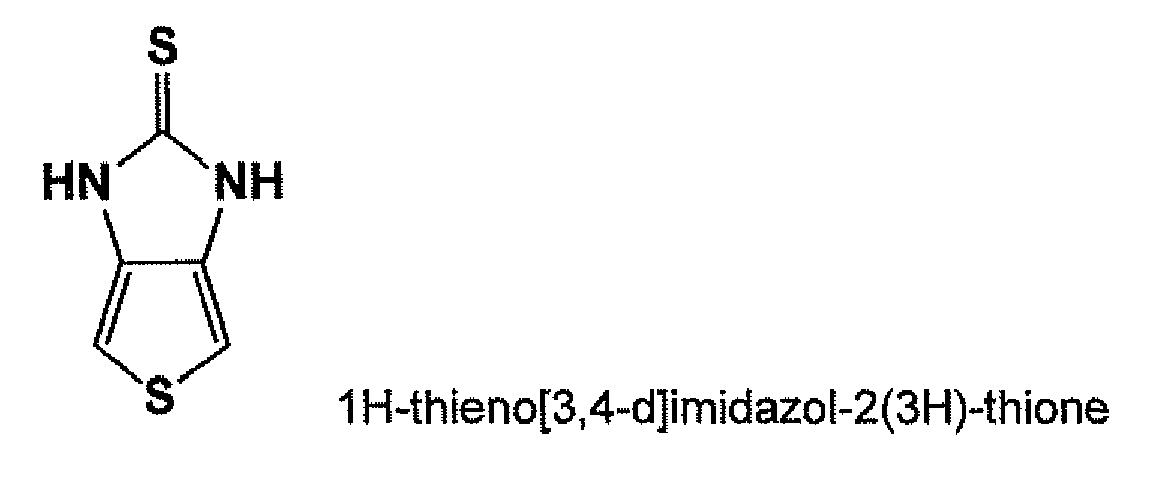


- A method of making heterocyclic fused imidazolone, dioxolone, imidazolethione, and dioxolethione according to an embodiment of the present invention may include one or more steps in a single reaction mixture including the following mechanism:

- In the compounds in the above reaction, Z is S or Se; Y is NH or O; and X is O or S. The method includes a preparation of the first reactant compound with a base, such as sodium carbonate, triethylamine or 4-(dimethylamino) pyridine, which is used to liberate the first reactant compound, shown as 3,4-diaminothiophene (or 3,4-diaminoselenophene). While the first reactant compound shown above is 3,4-diaminothiophene (or 3,4-diaminoselenophene) and the first reactant compound precursor is 3,4-diaminothiophene (or 3,4-diaminoselenophene) dihydrochloride, the first reactant compound may be any suitable compound capable of reacting with the second reactant compound to form the heterocyclic fused imidazolone, dioxolone, imidazolethione or dioxolethione based monomers of the present invention. For example, in the formation of dioxolone or dioxolethione, the corresponding 3,4-dihydroxythiophene may be utilized in place of the 3,4-diaminothiophene. The first reactant compound is reacted with the second reactant compound and the heterocyclic fused imidazolone, dioxolone, imidazolethione or dioxolethione based monomer according to the present invention is formed.
- The method of the present invention may include synthesis of 1 H-thieno[3,4-d]imidazol-2(3H)-one in a single reaction mixture. The process according to the present invention for the synthesis of 1 H-thieno[3,4-d]imidazol-2(3H)-one includes the mechanism shown as follows:

- This first reactant compound, the second reactant compound, solvent and base are present in the reaction mixture. In the reaction above, 3,4-diaminothiophene dihydrochloride reacts in the presence of a base, shown as sodium carbonate (Na2CO3), to form 3,4-diaminothiophene, which reacts with the second reactant compound, shown above as urea, to form the 1 H-thieno[3,4-d]imidazol-2(3H)-one.
- The method of the present invention also includes synthesis of imidazolone-based selenophene derivatives. In this embodiment of the present invention, 3,4-diaminoselenophene dihydrochloride is reacted as follows:

- In the reaction above, 3,4-diaminoselenophene dihydrochloride reacts in the presence of a base, shown above as sodium carbonate (Na2CO3), to form 3,4-diaminoselenophene, which reacts with the second reactant compound, shown above as urea, to form the 1H-selenolo[3,4-d]imidazol-2(3H)-one.
- To convert 3,4-dihydroxythiophene or 3,4-dihydroxyselenophene reactant compounds to the corresponding dioxolone a similar mechanism is utilized. In one embodiment of the present invention, 3,4-dihydroxythiophene is reacted in a single step, as follows:

- In this reaction 3,4-dihydroxythiophene reacts with the second reactant compound, shown above as dimethyl carbonate, to form the thieno[3,4-d]-1,3-dioxolan-2-one.
- In another embodiment of the present invention, 3,4-dihydroxythiophene is reacted as follows:

- In this reaction, 3,4-dihydroxythiophene reacts in the presence of a base, shown above as sodium hydroxide (NaOH) to form an intermediate sodium salt, shown above as the disodium salt, which reacts with the second reactant compound, shown above as dimethyl carbonate, to form the thieno[3,4-d]-1,3-dioxolan-2-one. In order to produce the selenolo[3,4-d]-1,3-dioxolan-2-one, similar reaction mechanisms to those for the conversion of 3,4-dihydroxythiophene to thieno[3,4-d]-1,3-dioxolan-2-one are utilized, except that a 3,4-dihydroxyselenophene is utilized in the place of the 3,4-dihydroxythiophene shown previously.
- In order to produce the imidazolethione or dioxolethione monomers of the present invention, the following reaction may be utilized:

- In this reaction 3,4-diaminothiophene dihydrochloride reacts in the presence of a base, shown above as sodium carbonate (Na2CO3), to form 3,4-diaminothiophene, which reacts with the second reactant compound, shown above as thiourea, to form the 1H-thieno[3,4-d]-imidazol-2(3H)-thione. In order to produce the 1 H-selenolo[3,4-d]imidazol-2(3H)-thione, a similar reaction mechanism to the conversion of 3,4-diaminothiophene dihydrochloride to 1H-thieno[3,4-d]-imidazol-2(3H)-thione is utilized, except a 3,4-diaminoselephene dihydrochloride is utilizes in the place of the 3,4-diaminothiophene dihydrochloride shown previously. Likewise, in order to produce thieno[3,4-d]-1,3-dioxolan-2-thione, a similar mechanism to the conversion of 3,4-dihydroxythiophene to thieno[3,4-d]-1,3-dioxolan-2-one is utilized, except that the second reactant compound is selected to include a thiocarbonate ester.
- In an alternate embodiment of the method of the present invention, derivatives of 3,4-diaminothiophene, 3,4-dihydroxythiophene, 3,4-diaminoselenophene, and 3,4-dihydroxyselenophene may be used as the first reactant compound. Suitable derivative compounds for use with this embodiment of the invention include, but are not limited to, 3,4-diaminothiophene, 3,4-dihydroxythiophene, 3,4-diaminoselenophene, and/or 3,4-dihydroxyselenophene having carboxylate groups, nitrile groups and/or carboxamide groups attached to the 2- and 5- positions in the thiophene or selenophene ring. The derivative first reactant compounds is reacted with a second reactant compound capable of fusing to the 3,4-diaminothiophene, 3,4-dihydroxythiophene, 3,4-diaminoselenophene, and/or 3,4-dihydroxyselenophene derivative to form a imidazolone, dioxolone, imidazolethione, and dioxolethione represented by the following formula:

- In the above compound, Z is S or Se; Y is NH or O; X is O or S; and W and W' may include any suitable derivative group or atom. Suitable derivative groups include, but are not limited to carboxylate, nitrile and/or carboxamide. For example, in the above formula W and W' may be independently selected from the group consisting of hydrogen, -CO2R', -C=ONR'R' , and -C=N; and R' is H or C1-6 alkyl. Subsequent to formation of the imidazolone, dioxolone, imidazolethione, and dioxolethione, the derivative groups (i.e., W and W') may be removed to provide the corresponding 2,5-unsubstituted imidazolone, dioxolone, imidazolethione, and dioxolethione.
- In one embodiment of the method of the present invention, a 2,5-dicarboxylated 3,4-dihydroxythiophene (obtained, e.g., by the method of W. A. Feld, et. al, Synthetic Communications, 1996, 26, 2205-2212 or the method of B. D. Tilak, et. al., Tetrahedron, 1967, 23, 2437-2241) or a 2,5-dicarboxylated 3,4-dihydroxyselenophene or ester thereof (obtained, e.g., by the method of M. P. Cava, et. al., Organic Letters, 2001, 26, 4283-4285; hereby incorporated by reference) is reacted with a second reactant compound capable of fusing to the 3,4-dihydroxythiophene or 3,4-dihydroxyselenophene to form a dioxolone or a dioxolethione represented by the following formula:

- The method of the present invention may include making a fused dioxolone or dioxolethione according to an embodiment of the present invention in a multi-step procedure as follows:

- In the reaction shown above, diethyl 3,4-dihydroxythiophene-2,5-dicarboxylate reacts with the second reactant compound, shown as dimethyl carbonate, to form the diethyl thieno[3,4-d]-1,3-dioxolan-2-one 2,5-dicarboxylate.
- Subsequent to formation of the dioxolone or dioxolethione ring, the carboxylate groups are removed by any suitable procedure, such as the procedures contained in the foregoing references to Feld, et. al., Tilak, et. al., or Cava, et. al. (hereby incorporated by reference), to provide the corresponding thieno[3,4-d]-1,3-dioxolan-2-one.
- In another embodiment of the present invention, derivatives of the heterocyclic fused imidazolone, dioxolone, imidazolethione, and dioxolethione are formed prior to or after the formation of the fully aromatic fused heterocyclic monomer. Monomer derivatives according to the present invention may include compounds having the following formula:

- In the above derivative compound above, Z is S or Se; Y is NH or O; X is O or S; and W and W' may include any suitable group or atom. In one embodiment W and W' are independently selected from the group consisting of hydrogen, halogen atoms, MgCl, MgBr, Mgl, ZnCl, ZnBr, Znl, Sn(R')3, boronic acid, boronic ester, -CH=CHR", -OC1-6 alkyl, -COOC1-6alkyl, -S-COR"', -COR"', -C≡CH, and polymerizable aromatic groups. R' is C1-6 alkyl or -OC1-6 alkyl. R" is H or C1-6 alkyl. R"' is H or C1-6 alkyl. Suitable polymerizable aromatic groups may include phenyl, naphthalene, pyrrole, dithiophene, thienothiophene, thiophene, and other polymerizable aromatic group containing moieties.
- The polymerization and the resulting polymer can be controlled by selecting moieties W and W' having the desired polymerization reaction and desired resultant polymer. Carbon-carbon bond forming reactions may be completed following any suitable method. Methods suitable for use with the monomer of the present invention include, but are not limited to the Suzuki Reaction, the Yamamoto Reaction, the Heck Reaction, the Stille Reaction, the Sonogashira-Hagihara Reaction, the Kumada-Corriu Reaction, the Riecke Reaction, and the McCullogh Reaction.
- Derivatives according to the present invention may include homopolymers and copolymers in which W and W' are H. In another embodiment, the compounds of the present invention may include homopolymer and copolymers wherein W, and W' are Br. In still another embodiment, the compounds of the present invention may include homopolymer and copolymers wherein W, and W' are trialkylstannyl.
- Many of the derivatives of the respective monomers where W and W' are other than H are formed post-formation of the monomers. In one such post-reaction, one or both hydrogen atoms may be replaced with other functional groups such as bromide or trialkylstannyl groups. The replacement of the hydrogen atoms may take place using any reaction mechanism suitable for use with heterocyclic ring structures. In an alternate embodiment, the W and/or W' containing derivatives may be formed prior to converting thiophene to the first reaction product (e.g., 3,4-dihydroxythiophene) and then undergoing a reaction procedure shown above for the conversion of 3,4-dihydroxythiophene or 3,4-dihydroxyselenophene derivatives to the imidazolone, dioxolone, imidazolethione or dioxolethione based monomers where the W and W' are compatible with the chemistry outlined above.
- The following examples are provided to illustrate various embodiments and comparisons and are not intended to restrict the scope of the invention.
- The compound 1 H-thieno[3,4-d]imidazol-2(3H)-one was prepared in a single reaction mixture in accordance with the method of the present invention. In Example 1, triethylamine was utilized as a base to liberate 3,4-diaminothiophene from the dihydrochloride salt. Urea was used as the carbonyl containing second reactant compound.

- An amount of 0.1922 gm (1.028 x 10⁻³ mole) 3,4-diaminothiophene dihydrochloride ("DAT-HCl") and 0.1866 gm (3.11 x 10⁻³ mole; 3.02 equiv., based on DAT-HCl) urea were added to a 50 mL three-necked flask equipped with magnetic stirring and a reflux condenser. The flask was purged with nitrogen for 15 minutes, after which 20 mL of 1,3-dimethyl-2-imidazolidinone ("DMI") was added via syringe with stirring. The contents were warmed to 50°C, at which point 0.45 mL (0.327 gm, 3.23 × 10⁻³ mole; 3.14 equiv., based on DAT-HCl) triethylamine was added via syringe. The temperature of the flask was raised to 115 - 120°C and maintained in that temperature range for 4 hours. After cooling and filtration, gas chromatography ("GC") analysis showed complete conversion of 3,4-diaminothiophene; selectivity to 1 H-thieno[3,4-d]imidazol-2(3H)-one was >98%. Components were identified by gas chromatography ("GC") and mass spectrometry ("MS"), and by comparison of retention times with those of known standards.
- Comparative Example 1 B includes an attempt to prepare 1H-thieno[3,4-d]imidazol-2(3H)-one in a single reaction mixture having the components utilized in Example 1. Comparative example 1B utilizes a reaction mixture that is not heated above room temperature.
- The procedure of Example 1 was repeated, with use of ethanol as the solvent. in addition, the reaction mixture was not heated and was stirred at room temperature for 58 hrs after addition of the triethylamine. GC analysis at the end of that time showed that none of the 3,4-diaminothiophene had been converted into 1 H-thieno[3,4-d]imidazol-2(3H)-one.
- 1 H-thieno[3,4-d]imidazol-2(3H)-one was prepared in a single reaction mixture in accordance with the method of the present invention. Example 2 uses an alternate base from Example 1, 4-(dimethylamino)-pyridine, as the base to liberate 3,4-diaminothiophene from the dihydrochloride salt. In addition, Example 2 utilizes 1,1'-carbonyldiimidazole as the second reactant compound.
- An amount of 0.1934 gm (1.034 x 10⁻³ mole) 3,4-diaminothiophene dihydrochloride (DAT-HCl), 0.4862 gm (3.001 × 10⁻³ mole; 2.90 equiv., based on DAT-HCl) 1,1'-carbonyldiimidazole, and 0.3957 gm (3.243 x 10⁻³ mole; 3.14 equiv., based on DAT-HCl) 4-(dimethylarnino)pyridine were added to a 50 mL three-necked flask equipped with magnetic stirring and a reflux condenser. The flask was purged with nitrogen for 15 minutes, after which 20 mL of 1,3-dimethyl-2-imidazolidinone (DMI) was added via syringe with stirring. The temperature of the flask was raised to 115 -120°C and maintained in that temperature range for 4 hours. After cooling and filtration, GC analysis showed complete conversion of 3,4-diaminothiophene; selectivity to 1 H-thieno[3,4-d]imidazol-2(3H)-one was >98%.
- The compound 1 H-thieno[3,4-d]imidazol-2(3H)-one was prepared in a single reaction mixture in accordance with the method of the present invention. Example 3 includes the use of sodium carbonate as the base to liberate 3,4-diaminothiophene from the dihydrochloride salt, and use of 1,1'-carbonyldiimidazole as the second reactant compound.
- The procedure of Example 2 was followed with 0.1981 gm (1.059 × 10⁻³ mole) 3,4-diaminothiophene dihydrochloride ("DAT-HCl"), and use of 0.4868 gm (3.005 × 10⁻³ mole; 2.84 equiv., based on DAT-HCl) 1,1'-carbonyldiimidazole as the carbonyl containing reactant and 0.6591 gm (6.218 x 10⁻³ mole; 5.87 equiv., based on DAT-HCl) anhydrous sodium carbonate as the included base. After cooling and filtration, GC analysis showed complete conversion of 3,4-diaminothiophene; selectivity to 1H-thieno[3,4-d]imidazol-2(3H)-one was >98%.
- The compound 1 H-thieno[3,4-d]imidazol-2(3H)-one was prepared in a single reaction mixture in accordance with the method of the present invention. Example 4 includes the use of sodium carbonate as the base to liberate 3,4-diaminothiophene from the dihydrochloride salt, and use of 1,1'-carbonyldiimidazole as the second reactant compound wherein the amount of reactants utilized was increased in comparison to Examples 1-3.
- An amount of 1.8890 gm (10.102 × 10⁻³ mole) 3,4-diaminothiophene dihydrochloride (DAT-HC!), 3.2668 gm (20.165 x 10⁻³ mole; 2.00 equiv., based on DAT-HCl) 1,1'-carbanyldiimidazole, and 8.5445 gm (80.608 x 10⁻³ mole; 7.98 equiv., based on DAT-HCl) anhydrous sodium carbonate were added to a 100 mL three-necked flask equipped with magnetic stirring and a reflux condenser. The flask was purged with nitrogen for 15 minutes, after which 60 mL of 1,3-dimethyl-2-imidazolidinone (DMI) was added via syringe with stirring. The temperature of the flask was raised to 125°C and maintained at that temperature for 3 hours. After cooling and filtration, GC analysis showed complete conversion of 3,4-diaminothiophene; selectivity to 1H-thieno[3,4-d]imidazol-2(3H)-one was >98%.
- The compound 1H-thieno[3,4-d]imidazol-2(3H)-one was prepared in a single reaction mixture in accordance with the method of the present invention. This example illustrates use of ethylene carbonate as the carbonyl containing compound.
- The procedure of example 3 was followed, with use of 0.1972 gm (1.054 x 10⁻³ mole) DAT-HCl and 0.2870 gm (3.261 x 10⁻³ mole; 3.09 equiv., based on DAT-HCl) ethylene carbonate in place of the 1,1'-carbonyldiimidazole. After cooling and filtration, GC analysis showed 79% conversion of 3,4-diaminothiophene; selectivity to 1H-thieno[3,4-d]imidazol-2(3H)-one was >90%.
- The compound thieno[3,4-d]-1 ,3-dioxolan-2-one is prepared in a single step procedure in a manner in accordance with the present invention.
- The procedure of Example 3 is followed with 0.122 gm (1.0 × 10⁻³ mole) 3,4-dihydroxythiophene (DHT) in place of 3,4-diaminothiophene dihydrochloride, and use of 0.486 gm (3.0 × 10⁻³ mole; 3.0 equiv., based on DHT) 1,1'-carbonyldiimidazole as the carbonyl containing reactant. After cooling and filtration, analysis will show the presence of thieno[3,4-d]-1,3-dioxolan-2-one.
- A solution containing 1 H,3H-Thieno[3,4-d]imidazol-2-one and the lron(lll) salt of Toluene-4-sulfonic acid in anhydrous n-butanol was prepared. The solution was 0.1 M in 1 H,3H-Thieno[3,4-d]imidazol-2-one and 0.16 M in the Iron(III) salt of Toluene-4-sulfonic acid. The solution was stored in a closed vial to prevent loss of solvent over time. However, the vial was opened for 10 minutes daily to allow fresh air to enter. Over the course of a week the solution did not change color nor yield any visible precipitate suggesting that 1 H,3H-Thieno[3,4-d]imidazol-2-one is stable in the presence of its iron(lll) oxidant.
- While the invention has been described with reference to certain embodiment, it will be understood by those skilled in the art that various changes may be made and equivalents may be substituted for elements thereof without departing from the scope of the invention. In addition, many modifications may be made to adapt a particular situation or material to the teachings of the invention without departing from the essential scope thereof. Therefore, it is intended that the invention not be limited to the particular embodiment disclosed as the best mode contemplated for carrying out this invention, but that the invention will include all embodiments falling within the scope of the appended claims.
Claims (21)
- A method for making a monomer for forming an electrically conductive polymer comprising:providing a first reactant comprising at least one compound selected from the group consisting of 3,4-diaminothiophene, 3,4-dihydroxythiophene, 3,4-diaminoselenophene, 3,4-dihydroxyselenophene, derivatives of 3,4-diaminothiophene, derivatives of 3,4-dihydroxythiophene, derivatives of 3,4-diaminoselenophene, derivatives of 3,4-dihydroxyselenophene, and combinations thereof;providing a second reactant comprising at least one compound selected from the group consisting of a urea containing compound, a carbonate ester containing compound, an orthoester containing compound, a thiourea containing compound, a thionocarbonate containing compound and combinations thereof;contacting the first reactant compound and second reactant compound to form a reaction mixture;heating the reaction mixture to a temperature sufficient to produce a monomer comprising the following formula:wherein Z comprises Se or S; Y comprises NH or O; X comprises O or S and W and W' comprise at least one member independently selected from the group consisting of hydrogen, -CO2R' -C=ONR'R' , and -C≡N; and R' is H or C1-6 alkyl.

- The method of claim 1, wherein the second reactant compound comprises at least one urea compound selected from the group consisting of carbonyldiimidazole, carbonyldi(1,2,4-triazole) and combinations thereof.
- The method of claim 1, wherein the second reactant compound comprises at least one carbonate ester compound selected from the group consisting of dimethyl carbonate, diethyl carbonate, ethylene carbonate, propylene carbonate and combinations thereof.
- The method of claim 1, wherein the second reactant compound comprises at least one orthocarbonate compound selected from the group consisting of tetramethyl orthocarbonate, tetraethyl orthocarbonate, tetrapropyl orthocarbonate and combinations thereof.
- The method of claim 1, wherein the second reactant compound comprises at least one thiourea containing compound is selected from the group consisting of thiourea, N,N'-dimethylthiourea, 1,1'-thiocarbonyldiimidazole, and combinations thereof.
- The method of claim 1, wherein the second reactant compound comprises at least one thionocarbonate containing compound selected from the group consisting of di-2-pyridiyl thionocarbonate, di-4-pyridyl thionocarbonate and combinations thereof.
- The method of claim 1, wherein the heating step includes heating to a temperature from about 80°C and about 175°C.
- The method of claim 7, wherein the heating step includes heating to a temperature from about 90°C and about 125°C.
- The method of claim 1, wherein the contacting is performed in the presence of at least one solvent.
- The method of claim 9, wherein the solvent comprises at least one member selected from the group consisting of 1,3-dimethyl-2-imidazolidinone, 1,3-dimethyl-3,4,5,6-tetrahydro-2(1H)-pyrimidinone, ethylene glycol, propylene glycol, 1,2-dimethoxyethane, tetrahydrofuran, and combinations thereof.
- The method of claim 1, further comprising providing a precursor of the first reactant compound and a base material to convert the first reactant compound precursor into the first reactant compound.
- The method claim 11, wherein the first reactant compound precursor comprises at least one member selected from the group consisting of 3,4-diaminothiophene dihydrochloride or 3,4-diaminoselenophene dihydrochloride.
- The method of claim 12, wherein the base material comprises at least one member selected from the group consisting of triethylamine, pyridine, 2-(dimethylamino)pyridine, 4-(dimethylamino)pyridine, polymer-bound 4-(dimethylamino)pyridine, and N,N-diisopropylethylamine, and inorganic bases such as sodium carbonate, sodium bicarbonate, potassium carbonate, potassium bicarbonate, sodium hydroxide, potassium hydroxide and combinations thereof.
- The method of claim 1, wherein the method further comprises a step of replacing one or more of the W group and W' group with hydrogen after the heating step.
- A monomer compound comprising the following formula:

- The monomer of claim 14, wherein the monomer comprises at least one member selected from the group consisting of 1 H-selenolo[3,4-d]imidazol-2(3H)-one, selenolo[3,4-d]-1,3-dioxolan-2-one, 1 H-selenolo[3,4-d]imidazol-2(3H)-thione, and selenolo[3,4-d]-1,3-dioxolan-2-thione,
- A monomer compound comprising the following formula:

- The monomer of claim 14, wherein the monomer comprises thieno[3,4-d]-1,3-dioxolan-2-one or thieno[3,4-d]-1,3-dioxolan-2-thione.
- A composition comprising at least one monomer of Claim 18 and at least one catalyst.
- A monomer compound derivative comprising the following formula:

- The monomer compound derivative according to claim 20, wherein the polymerizable aromatic groups comprise at least one member selected from the group consisting of phenyl, naphthalene, pyrrole, dithiophene, thienothiophene, and thiophene.
Applications Claiming Priority (1)
| Application Number | Priority Date | Filing Date | Title |
|---|---|---|---|
| US11/446,075 US20070282099A1 (en) | 2006-06-02 | 2006-06-02 | Heterocyclic fused imidazolone, dioxolone, imidazolethione and dioxolethione monomers |
Publications (1)
| Publication Number | Publication Date |
|---|---|
| EP1870415A1 true EP1870415A1 (en) | 2007-12-26 |
Family
ID=38462064
Family Applications (1)
| Application Number | Title | Priority Date | Filing Date |
|---|---|---|---|
| EP07109094A Withdrawn EP1870415A1 (en) | 2006-06-02 | 2007-05-29 | Heterocyclic fused imidazolone, dioxolone, imidazolethione and dioxolethione monomers |
Country Status (7)
| Country | Link |
|---|---|
| US (1) | US20070282099A1 (en) |
| EP (1) | EP1870415A1 (en) |
| JP (1) | JP2008007771A (en) |
| KR (1) | KR20070115777A (en) |
| CN (1) | CN101081852A (en) |
| SG (1) | SG137806A1 (en) |
| TW (1) | TW200801017A (en) |
Cited By (1)
| Publication number | Priority date | Publication date | Assignee | Title |
|---|---|---|---|---|
| EP2338925A4 (en) * | 2008-10-17 | 2012-03-07 | Kuraray Co | ELECTRON CONJUGATED COMPOUND, METHOD FOR MANUFACTURING THE SAME, AND ELECTRONIC CONJUGATED POLYMER OBTAINED USING THE SAME |
Families Citing this family (5)
| Publication number | Priority date | Publication date | Assignee | Title |
|---|---|---|---|---|
| JP2010095485A (en) * | 2008-10-17 | 2010-04-30 | Kuraray Co Ltd | pi ELECTRON CONJUGATED COMPOUND, METHOD FOR PRODUCING THE SAME AND pi ELECTRON CONJUGATED POLYMER PRODUCED BY USING THE SAME |
| JP5308379B2 (en) * | 2010-03-08 | 2013-10-09 | 株式会社クラレ | π-electron conjugated polymer composition and electrochromic display device using the same |
| WO2011111683A1 (en) * | 2010-03-10 | 2011-09-15 | 株式会社クラレ | Electrochromic material and method for producing same |
| KR101777669B1 (en) | 2016-03-18 | 2017-09-14 | 광운대학교 산학협력단 | New selenophene monomer and manufacturing method thereof, new conjugated oligomers synthesized from selenophene monomer and manufacturing method thereof |
| CN112028872B (en) * | 2020-09-16 | 2021-05-04 | 温州大学 | A kind of synthetic method of dibenzoselenophene compound |
Citations (2)
| Publication number | Priority date | Publication date | Assignee | Title |
|---|---|---|---|---|
| EP0237248A2 (en) * | 1986-03-07 | 1987-09-16 | Pfizer Inc. | 2-[(2-Pyridyl)methylsulfinyl]thienoimidazoles and related compounds as antiulcer agents |
| US5463073A (en) * | 1990-10-30 | 1995-10-31 | Takeda Chemical Industries, Ltd. | Thienoimidazole derivatives, their production and use |
Family Cites Families (19)
| Publication number | Priority date | Publication date | Assignee | Title |
|---|---|---|---|---|
| US2466004A (en) * | 1944-12-23 | 1949-04-05 | Parke Davis & Co | 2'-keto-3,4-imidazolido-2-thiophene-valeric acid and methods for obtaining the same |
| US2487051A (en) * | 1945-12-15 | 1949-11-08 | Merck & Co Inc | Biotin intermediate and hydrogenating thiophenes |
| US2489234A (en) * | 1947-07-16 | 1949-11-22 | Hoffmann La Roche | Thiophanes and method for their production |
| DE3018134A1 (en) * | 1980-05-12 | 1981-11-19 | Basf Ag, 6700 Ludwigshafen | 3,4-Di:amino-thiophene- 2-carboxylic acid ester derivs. - prepd. e.g. from 3-amino-thiophene-2-carboxylic acid cpds. useful as intermediates for biotin, pharmaceuticals and dyes |
| DE3018109A1 (en) * | 1980-05-12 | 1981-11-19 | Basf Ag, 6700 Ludwigshafen | Biotin synthesis from 2-formyl-3,4-di:amino-thiophene derivs. - by wittig reaction with a carboxy-propylidene-phosphorane cpd., hydrogenation, de-protection and reaction with phosgene |
| DE3843412A1 (en) * | 1988-04-22 | 1990-06-28 | Bayer Ag | NEW POLYTHIOPHENES, METHOD FOR THEIR PRODUCTION AND THEIR USE |
| DE3814730A1 (en) * | 1988-04-30 | 1989-11-09 | Bayer Ag | SOLID ELECTROLYTE AND ELECTROLYTE CONDENSERS CONTAINING THEM |
| EP0440957B1 (en) * | 1990-02-08 | 1996-03-27 | Bayer Ag | New polythiophene dispersions, their preparation and their use |
| JP3099096B2 (en) * | 1990-10-30 | 2000-10-16 | 武田薬品工業株式会社 | Thienoimidazole derivatives |
| IL102183A (en) * | 1991-06-27 | 1999-11-30 | Takeda Chemical Industries Ltd | Biphenyl substituted heterocyclic compounds their production and pharmaceutical compositions comprising them |
| EP0565754B1 (en) * | 1992-04-15 | 1995-12-27 | Holger Blum | Stabilized coating composition on the basis of urethaneprepolymers having free isocyanate groups |
| US6869729B1 (en) * | 1999-02-01 | 2005-03-22 | John Pope | Single component sulfur-based cathodes for lithium-ion batteries |
| US6709808B2 (en) * | 2001-05-14 | 2004-03-23 | Eastman Kodak Company | Imaging materials comprising electrically conductive polymer particle layers |
| KR20030010508A (en) * | 2001-07-25 | 2003-02-05 | 메르크 파텐트 게엠베하 | Mono-, oligo- and poly-4-fluorothiophenes and their use as charge transport materials |
| ATE461237T1 (en) * | 2001-08-17 | 2010-04-15 | Merck Patent Gmbh | CONJUGATED COPOLYMERS OF DITHIENOTHIOPHENE AND VINYLENE OR ACETYLENE |
| ATE473251T1 (en) * | 2001-09-29 | 2010-07-15 | Merck Patent Gmbh | MONO-, OLIGO- AND POLYMERS OF BENZO(B)THIOPHENE AND 2,2'-BISBENZOTHIOPHENE AND THEIR USE AS CHARGE TRANSPORT MATERIAL |
| US20050148634A1 (en) * | 2002-03-29 | 2005-07-07 | Zeria Pharmaceutical Co., Ltd | 1-N-Aminobenzimidazole derivatives |
| US7071289B2 (en) * | 2002-07-11 | 2006-07-04 | The University Of Connecticut | Polymers comprising thieno [3,4-b]thiophene and methods of making and using the same |
| JP2004067862A (en) * | 2002-08-06 | 2004-03-04 | Konica Minolta Holdings Inc | Organic semiconductor material, field effect transistor using the same |
-
2006
- 2006-06-02 US US11/446,075 patent/US20070282099A1/en not_active Abandoned
-
2007
- 2007-05-23 SG SG200703628-8A patent/SG137806A1/en unknown
- 2007-05-29 EP EP07109094A patent/EP1870415A1/en not_active Withdrawn
- 2007-05-30 TW TW096119385A patent/TW200801017A/en unknown
- 2007-05-31 CN CNA2007101087962A patent/CN101081852A/en active Pending
- 2007-06-01 KR KR1020070053790A patent/KR20070115777A/en not_active Abandoned
- 2007-06-01 JP JP2007147071A patent/JP2008007771A/en active Pending
Patent Citations (2)
| Publication number | Priority date | Publication date | Assignee | Title |
|---|---|---|---|---|
| EP0237248A2 (en) * | 1986-03-07 | 1987-09-16 | Pfizer Inc. | 2-[(2-Pyridyl)methylsulfinyl]thienoimidazoles and related compounds as antiulcer agents |
| US5463073A (en) * | 1990-10-30 | 1995-10-31 | Takeda Chemical Industries, Ltd. | Thienoimidazole derivatives, their production and use |
Non-Patent Citations (2)
| Title |
|---|
| ALCAZAR V ET AL: "A synthesis of biotin based on cycloaddition of a thiocarbonyl ylide", TETRAHEDRON, vol. 46, no. 3, 1990, pages 1057 - 1062, XP002450322 * |
| MOZINGO R ET AL: "Hydrogenation of compounds containing divalent sulfur", JOURNAL OF AMERICAN CHEMICAL SOCIETY, vol. 67, 1945, pages 2092 - 2095, XP002450321 * |
Cited By (1)
| Publication number | Priority date | Publication date | Assignee | Title |
|---|---|---|---|---|
| EP2338925A4 (en) * | 2008-10-17 | 2012-03-07 | Kuraray Co | ELECTRON CONJUGATED COMPOUND, METHOD FOR MANUFACTURING THE SAME, AND ELECTRONIC CONJUGATED POLYMER OBTAINED USING THE SAME |
Also Published As
| Publication number | Publication date |
|---|---|
| US20070282099A1 (en) | 2007-12-06 |
| CN101081852A (en) | 2007-12-05 |
| SG137806A1 (en) | 2007-12-28 |
| JP2008007771A (en) | 2008-01-17 |
| KR20070115777A (en) | 2007-12-06 |
| TW200801017A (en) | 2008-01-01 |
Similar Documents
| Publication | Publication Date | Title |
|---|---|---|
| US6645401B2 (en) | Conjugated copolymers of dithienothiophene with vinylene or acetylene | |
| EP1751166B1 (en) | Mono-, oligo- and polythieno[3,2-b]thiophenes | |
| JP4518368B2 (en) | Process for the production of neutral polythiophene, such compounds, neutral copolymers, and the use of neutral compounds and copolymers | |
| US7572880B2 (en) | Process for substituted polythiophene polymers | |
| US20120004386A1 (en) | Conjugated thiophenes having conducting properties and synthesis of same | |
| JP5350695B2 (en) | Heterocyclic fused selenophene monomer | |
| KR20060051904A (en) | Substituted Thienothiophene Monomers and Conductive Polymers | |
| KR20070115777A (en) | Heterocyclic Fused Imidazolone, Dioxolone, Imidazolthione, and Dioxolthione Monomers | |
| JP5054788B2 (en) | π-electron conjugated compound, production method thereof, and π-electron conjugated polymer obtained by using the same | |
| JP2013537557A (en) | Substituted 3,4-propylenedioxythiophene monomers and 3,4-propylenedioxythiophene crosslinkers and polymers thereof | |
| EP1778695B1 (en) | POLYMERS OF THIENO[2,3-b]THIOPHENE | |
| EP1754736B1 (en) | Process for the polymerisation of thiophene or selenophene derivatives | |
| US20070045592A1 (en) | Process for the polymerisation of thiophene or selenophene compounds | |
| US20070238854A1 (en) | Heterocyclic Fused Isothiazole and Isoselenazole Monomers and Conducting Polymers | |
| EP1284276A1 (en) | Conjugated copolymers of dithienothiophene with vinylene or acetylene | |
| US8148548B2 (en) | Heterocyclic fused selenophene monomers | |
| US5510456A (en) | Bridged cyclic arleneethylene polymers | |
| JP5566727B2 (en) | π-electron conjugated compound and method for producing the same | |
| JP7266697B2 (en) | organic thin film transistor, polymer, composition, organic semiconductor film, compound | |
| KR20020068526A (en) | Novel Thiophenes and Method for Polymerization of Said Thiophenes |
Legal Events
| Date | Code | Title | Description |
|---|---|---|---|
| PUAI | Public reference made under article 153(3) epc to a published international application that has entered the european phase |
Free format text: ORIGINAL CODE: 0009012 |
|
| AK | Designated contracting states |
Kind code of ref document: A1 Designated state(s): AT BE BG CH CY CZ DE DK EE ES FI FR GB GR HU IE IS IT LI LT LU LV MC MT NL PL PT RO SE SI SK TR |
|
| AX | Request for extension of the european patent |
Extension state: AL BA HR MK YU |
|
| 17P | Request for examination filed |
Effective date: 20080128 |
|
| AKX | Designation fees paid |
Designated state(s): AT BE BG CH CY CZ DE DK EE ES FI FR GB GR HU IE IS IT LI LT LU LV MC MT NL PL PT RO SE SI SK TR |
|
| 17Q | First examination report despatched |
Effective date: 20080905 |
|
| STAA | Information on the status of an ep patent application or granted ep patent |
Free format text: STATUS: THE APPLICATION IS DEEMED TO BE WITHDRAWN |
|
| 18D | Application deemed to be withdrawn |
Effective date: 20101201 |