EP1867342A1 - Agents for ameliorating troubles following cerebrovascular failure and inhibiting progress thereof - Google Patents
Agents for ameliorating troubles following cerebrovascular failure and inhibiting progress thereof Download PDFInfo
- Publication number
- EP1867342A1 EP1867342A1 EP07017024A EP07017024A EP1867342A1 EP 1867342 A1 EP1867342 A1 EP 1867342A1 EP 07017024 A EP07017024 A EP 07017024A EP 07017024 A EP07017024 A EP 07017024A EP 1867342 A1 EP1867342 A1 EP 1867342A1
- Authority
- EP
- European Patent Office
- Prior art keywords
- group
- compound
- angiotensin
- cerebrovascular disorder
- antagonistic activity
- Prior art date
- Legal status (The legal status is an assumption and is not a legal conclusion. Google has not performed a legal analysis and makes no representation as to the accuracy of the status listed.)
- Withdrawn
Links
- 230000002401 inhibitory effect Effects 0.000 title claims abstract description 28
- 208000026106 cerebrovascular disease Diseases 0.000 claims abstract description 127
- 150000001875 compounds Chemical class 0.000 claims abstract description 82
- 101800000733 Angiotensin-2 Proteins 0.000 claims abstract description 81
- 229950006323 angiotensin ii Drugs 0.000 claims abstract description 81
- CZGUSIXMZVURDU-JZXHSEFVSA-N Ile(5)-angiotensin II Chemical compound C([C@@H](C(=O)N[C@@H]([C@@H](C)CC)C(=O)N[C@@H](CC=1NC=NC=1)C(=O)N1[C@@H](CCC1)C(=O)N[C@@H](CC=1C=CC=CC=1)C([O-])=O)NC(=O)[C@@H](NC(=O)[C@H](CCCNC(N)=[NH2+])NC(=O)[C@@H]([NH3+])CC([O-])=O)C(C)C)C1=CC=C(O)C=C1 CZGUSIXMZVURDU-JZXHSEFVSA-N 0.000 claims abstract description 80
- 239000003795 chemical substances by application Substances 0.000 claims abstract description 71
- 230000003042 antagnostic effect Effects 0.000 claims abstract description 53
- 150000003839 salts Chemical class 0.000 claims abstract description 30
- 239000000651 prodrug Substances 0.000 claims abstract description 23
- 229940002612 prodrug Drugs 0.000 claims abstract description 23
- 102000005862 Angiotensin II Human genes 0.000 claims abstract 14
- 125000001997 phenyl group Chemical group [H]C1=C([H])C([H])=C(*)C([H])=C1[H] 0.000 claims description 27
- GHOSNRCGJFBJIB-UHFFFAOYSA-N Candesartan cilexetil Chemical compound C=12N(CC=3C=CC(=CC=3)C=3C(=CC=CC=3)C3=NNN=N3)C(OCC)=NC2=CC=CC=1C(=O)OC(C)OC(=O)OC1CCCCC1 GHOSNRCGJFBJIB-UHFFFAOYSA-N 0.000 claims description 24
- 125000001424 substituent group Chemical group 0.000 claims description 24
- 229960004349 candesartan cilexetil Drugs 0.000 claims description 19
- 150000001450 anions Chemical class 0.000 claims description 18
- 208000024891 symptom Diseases 0.000 claims description 18
- 238000004519 manufacturing process Methods 0.000 claims description 16
- 238000000034 method Methods 0.000 claims description 12
- 239000000825 pharmaceutical preparation Substances 0.000 claims description 12
- 241000124008 Mammalia Species 0.000 claims description 10
- 108090000765 processed proteins & peptides Proteins 0.000 claims description 10
- 125000004429 atom Chemical group 0.000 claims description 9
- HTQMVQVXFRQIKW-UHFFFAOYSA-N candesartan Chemical group CCOC1=NC2=CC=CC(C(O)=O)=C2N1CC(C=C1)=CC=C1C1=CC=CC=C1C1=NN=NN1 HTQMVQVXFRQIKW-UHFFFAOYSA-N 0.000 claims description 8
- 125000002915 carbonyl group Chemical group [*:2]C([*:1])=O 0.000 claims description 8
- 230000000694 effects Effects 0.000 claims description 8
- 210000005036 nerve Anatomy 0.000 claims description 8
- 125000005842 heteroatom Chemical group 0.000 claims description 7
- 239000002053 C09CA06 - Candesartan Substances 0.000 claims description 6
- 229960000932 candesartan Drugs 0.000 claims description 6
- RMMXLENWKUUMAY-UHFFFAOYSA-N telmisartan Chemical compound CCCC1=NC2=C(C)C=C(C=3N(C4=CC=CC=C4N=3)C)C=C2N1CC(C=C1)=CC=C1C1=CC=CC=C1C(O)=O RMMXLENWKUUMAY-UHFFFAOYSA-N 0.000 claims description 6
- 125000006850 spacer group Chemical group 0.000 claims description 5
- RTZKZFJDLAIYFH-UHFFFAOYSA-N ether Substances CCOCC RTZKZFJDLAIYFH-UHFFFAOYSA-N 0.000 claims description 4
- YCPOHTHPUREGFM-UHFFFAOYSA-N irbesartan Chemical compound O=C1N(CC=2C=CC(=CC=2)C=2C(=CC=CC=2)C=2[N]N=NN=2)C(CCCC)=NC21CCCC2 YCPOHTHPUREGFM-UHFFFAOYSA-N 0.000 claims description 4
- 125000004430 oxygen atom Chemical group O* 0.000 claims description 4
- 125000000843 phenylene group Chemical group C1(=C(C=CC=C1)*)* 0.000 claims description 4
- 229960004699 valsartan Drugs 0.000 claims description 4
- SJSNUMAYCRRIOM-QFIPXVFZSA-N valsartan Chemical compound C1=CC(CN(C(=O)CCCC)[C@@H](C(C)C)C(O)=O)=CC=C1C1=CC=CC=C1C1=NN=N[N]1 SJSNUMAYCRRIOM-QFIPXVFZSA-N 0.000 claims description 4
- 239000002083 C09CA01 - Losartan Substances 0.000 claims description 3
- 239000002080 C09CA02 - Eprosartan Substances 0.000 claims description 3
- 239000004072 C09CA03 - Valsartan Substances 0.000 claims description 3
- 239000002947 C09CA04 - Irbesartan Substances 0.000 claims description 3
- 239000002081 C09CA05 - Tasosartan Substances 0.000 claims description 3
- 239000005537 C09CA07 - Telmisartan Substances 0.000 claims description 3
- 239000005480 Olmesartan Substances 0.000 claims description 3
- KGSXMPPBFPAXLY-UHFFFAOYSA-N azilsartan Chemical group CCOC1=NC2=CC=CC(C(O)=O)=C2N1CC(C=C1)=CC=C1C1=CC=CC=C1C1=NOC(=O)N1 KGSXMPPBFPAXLY-UHFFFAOYSA-N 0.000 claims description 3
- OROAFUQRIXKEMV-LDADJPATSA-N eprosartan Chemical compound C=1C=C(C(O)=O)C=CC=1CN1C(CCCC)=NC=C1\C=C(C(O)=O)/CC1=CC=CS1 OROAFUQRIXKEMV-LDADJPATSA-N 0.000 claims description 3
- 229960004563 eprosartan Drugs 0.000 claims description 3
- 229960002198 irbesartan Drugs 0.000 claims description 3
- 229960004773 losartan Drugs 0.000 claims description 3
- KJJZZJSZUJXYEA-UHFFFAOYSA-N losartan Chemical group CCCCC1=NC(Cl)=C(CO)N1CC1=CC=C(C=2C(=CC=CC=2)C=2[N]N=NN=2)C=C1 KJJZZJSZUJXYEA-UHFFFAOYSA-N 0.000 claims description 3
- VTRAEEWXHOVJFV-UHFFFAOYSA-N olmesartan Chemical compound CCCC1=NC(C(C)(C)O)=C(C(O)=O)N1CC1=CC=C(C=2C(=CC=CC=2)C=2NN=NN=2)C=C1 VTRAEEWXHOVJFV-UHFFFAOYSA-N 0.000 claims description 3
- 229960005117 olmesartan Drugs 0.000 claims description 3
- ADXGNEYLLLSOAR-UHFFFAOYSA-N tasosartan Chemical compound C12=NC(C)=NC(C)=C2CCC(=O)N1CC(C=C1)=CC=C1C1=CC=CC=C1C=1N=NNN=1 ADXGNEYLLLSOAR-UHFFFAOYSA-N 0.000 claims description 3
- 229960000651 tasosartan Drugs 0.000 claims description 3
- 229960005187 telmisartan Drugs 0.000 claims description 3
- 230000003340 mental effect Effects 0.000 claims description 2
- 125000001183 hydrocarbyl group Chemical group 0.000 claims 1
- -1 1-(cyclohexyloxycarbonyloxy) ethyl 2-ethoxy-1-[[2'-(2H-tetrazole-5-yl)biphenyl-4-yl]methyl]benzimidazole-7-carboxylate Chemical compound 0.000 description 81
- 102400000345 Angiotensin-2 Human genes 0.000 description 67
- 125000004178 (C1-C4) alkyl group Chemical group 0.000 description 37
- 230000002490 cerebral effect Effects 0.000 description 33
- 208000037265 diseases, disorders, signs and symptoms Diseases 0.000 description 29
- 230000009471 action Effects 0.000 description 27
- 230000036772 blood pressure Effects 0.000 description 26
- 235000002639 sodium chloride Nutrition 0.000 description 26
- 125000000229 (C1-C4)alkoxy group Chemical group 0.000 description 25
- 125000000217 alkyl group Chemical group 0.000 description 23
- 206010020772 Hypertension Diseases 0.000 description 22
- 206010008118 cerebral infarction Diseases 0.000 description 20
- 230000005764 inhibitory process Effects 0.000 description 19
- 125000003342 alkenyl group Chemical group 0.000 description 17
- 125000002887 hydroxy group Chemical group [H]O* 0.000 description 17
- 230000009467 reduction Effects 0.000 description 17
- 238000006722 reduction reaction Methods 0.000 description 17
- 239000005557 antagonist Substances 0.000 description 16
- 125000000449 nitro group Chemical group [O-][N+](*)=O 0.000 description 16
- 238000002360 preparation method Methods 0.000 description 16
- 208000006011 Stroke Diseases 0.000 description 15
- 125000003178 carboxy group Chemical group [H]OC(*)=O 0.000 description 15
- 208000035475 disorder Diseases 0.000 description 15
- 125000005843 halogen group Chemical group 0.000 description 15
- 201000010099 disease Diseases 0.000 description 14
- 239000003814 drug Substances 0.000 description 14
- 206010008190 Cerebrovascular accident Diseases 0.000 description 13
- FBPFZTCFMRRESA-KVTDHHQDSA-N D-Mannitol Chemical compound OC[C@@H](O)[C@@H](O)[C@H](O)[C@H](O)CO FBPFZTCFMRRESA-KVTDHHQDSA-N 0.000 description 13
- 125000003118 aryl group Chemical group 0.000 description 13
- 229910052736 halogen Inorganic materials 0.000 description 13
- 150000002367 halogens Chemical class 0.000 description 12
- 125000000623 heterocyclic group Chemical group 0.000 description 12
- 125000001624 naphthyl group Chemical group 0.000 description 12
- 239000003146 anticoagulant agent Substances 0.000 description 11
- 239000002585 base Substances 0.000 description 11
- 230000004087 circulation Effects 0.000 description 11
- 125000006552 (C3-C8) cycloalkyl group Chemical group 0.000 description 10
- 125000003282 alkyl amino group Chemical group 0.000 description 10
- 125000002496 methyl group Chemical group [H]C([H])([H])* 0.000 description 10
- 125000002924 primary amino group Chemical group [H]N([H])* 0.000 description 10
- 0 CC=C=C(C)C(*NC(C)=*)=I Chemical compound CC=C=C(C)C(*NC(C)=*)=I 0.000 description 9
- PEDCQBHIVMGVHV-UHFFFAOYSA-N Glycerine Chemical compound OCC(O)CO PEDCQBHIVMGVHV-UHFFFAOYSA-N 0.000 description 9
- DNIAPMSPPWPWGF-UHFFFAOYSA-N Propylene glycol Chemical compound CC(O)CO DNIAPMSPPWPWGF-UHFFFAOYSA-N 0.000 description 9
- 230000001154 acute effect Effects 0.000 description 9
- 125000003545 alkoxy group Chemical group 0.000 description 9
- 125000003277 amino group Chemical group 0.000 description 9
- 239000001768 carboxy methyl cellulose Substances 0.000 description 9
- 229920002678 cellulose Polymers 0.000 description 9
- 239000001913 cellulose Substances 0.000 description 9
- 230000003727 cerebral blood flow Effects 0.000 description 9
- 125000000113 cyclohexyl group Chemical group [H]C1([H])C([H])([H])C([H])([H])C([H])(*)C([H])([H])C1([H])[H] 0.000 description 9
- 125000001511 cyclopentyl group Chemical group [H]C1([H])C([H])([H])C([H])([H])C([H])(*)C1([H])[H] 0.000 description 9
- 230000005856 abnormality Effects 0.000 description 8
- 230000033228 biological regulation Effects 0.000 description 8
- 125000000582 cycloheptyl group Chemical group [H]C1([H])C([H])([H])C([H])([H])C([H])([H])C([H])(*)C([H])([H])C1([H])[H] 0.000 description 8
- 206010012601 diabetes mellitus Diseases 0.000 description 8
- 229940079593 drug Drugs 0.000 description 8
- 125000001495 ethyl group Chemical group [H]C([H])([H])C([H])([H])* 0.000 description 8
- 150000002430 hydrocarbons Chemical group 0.000 description 8
- HQKMJHAJHXVSDF-UHFFFAOYSA-L magnesium stearate Chemical compound [Mg+2].CCCCCCCCCCCCCCCCCC([O-])=O.CCCCCCCCCCCCCCCCCC([O-])=O HQKMJHAJHXVSDF-UHFFFAOYSA-L 0.000 description 8
- 239000000126 substance Substances 0.000 description 8
- 230000003276 anti-hypertensive effect Effects 0.000 description 7
- 230000017531 blood circulation Effects 0.000 description 7
- 210000004556 brain Anatomy 0.000 description 7
- 230000001965 increasing effect Effects 0.000 description 7
- 235000010355 mannitol Nutrition 0.000 description 7
- 230000002265 prevention Effects 0.000 description 7
- 125000003831 tetrazolyl group Chemical group 0.000 description 7
- 230000002792 vascular Effects 0.000 description 7
- WVDDGKGOMKODPV-UHFFFAOYSA-N Benzyl alcohol Chemical compound OCC1=CC=CC=C1 WVDDGKGOMKODPV-UHFFFAOYSA-N 0.000 description 6
- 206010048962 Brain oedema Diseases 0.000 description 6
- 229920002134 Carboxymethyl cellulose Polymers 0.000 description 6
- 229930006000 Sucrose Natural products 0.000 description 6
- CZMRCDWAGMRECN-UGDNZRGBSA-N Sucrose Chemical compound O[C@H]1[C@H](O)[C@@H](CO)O[C@@]1(CO)O[C@@H]1[C@H](O)[C@@H](O)[C@H](O)[C@@H](CO)O1 CZMRCDWAGMRECN-UGDNZRGBSA-N 0.000 description 6
- 125000002252 acyl group Chemical group 0.000 description 6
- 125000003302 alkenyloxy group Chemical group 0.000 description 6
- 208000006752 brain edema Diseases 0.000 description 6
- 235000010948 carboxy methyl cellulose Nutrition 0.000 description 6
- 239000008112 carboxymethyl-cellulose Substances 0.000 description 6
- 239000007888 film coating Substances 0.000 description 6
- 238000009501 film coating Methods 0.000 description 6
- 125000004435 hydrogen atom Chemical group [H]* 0.000 description 6
- 239000002904 solvent Substances 0.000 description 6
- 125000000999 tert-butyl group Chemical group [H]C([H])([H])C(*)(C([H])([H])[H])C([H])([H])[H] 0.000 description 6
- 229940124597 therapeutic agent Drugs 0.000 description 6
- 238000002560 therapeutic procedure Methods 0.000 description 6
- 201000006474 Brain Ischemia Diseases 0.000 description 5
- 206010008120 Cerebral ischaemia Diseases 0.000 description 5
- GUBGYTABKSRVRQ-QKKXKWKRSA-N Lactose Natural products OC[C@H]1O[C@@H](O[C@H]2[C@H](O)[C@@H](O)C(O)O[C@@H]2CO)[C@H](O)[C@@H](O)[C@H]1O GUBGYTABKSRVRQ-QKKXKWKRSA-N 0.000 description 5
- 241000700159 Rattus Species 0.000 description 5
- FAPWRFPIFSIZLT-UHFFFAOYSA-M Sodium chloride Chemical compound [Na+].[Cl-] FAPWRFPIFSIZLT-UHFFFAOYSA-M 0.000 description 5
- 229920002472 Starch Polymers 0.000 description 5
- 239000004480 active ingredient Substances 0.000 description 5
- 230000001668 ameliorated effect Effects 0.000 description 5
- 230000000702 anti-platelet effect Effects 0.000 description 5
- 229940127219 anticoagulant drug Drugs 0.000 description 5
- 125000003236 benzoyl group Chemical group [H]C1=C([H])C([H])=C(C([H])=C1[H])C(*)=O 0.000 description 5
- 125000001589 carboacyl group Chemical group 0.000 description 5
- 125000004432 carbon atom Chemical group C* 0.000 description 5
- 238000006243 chemical reaction Methods 0.000 description 5
- 238000002512 chemotherapy Methods 0.000 description 5
- 239000011248 coating agent Substances 0.000 description 5
- 238000000576 coating method Methods 0.000 description 5
- 125000004093 cyano group Chemical group *C#N 0.000 description 5
- 125000000753 cycloalkyl group Chemical group 0.000 description 5
- 210000002889 endothelial cell Anatomy 0.000 description 5
- 230000007062 hydrolysis Effects 0.000 description 5
- 238000006460 hydrolysis reaction Methods 0.000 description 5
- 125000000959 isobutyl group Chemical group [H]C([H])([H])C([H])(C([H])([H])[H])C([H])([H])* 0.000 description 5
- 125000001449 isopropyl group Chemical group [H]C([H])([H])C([H])(*)C([H])([H])[H] 0.000 description 5
- 239000008101 lactose Substances 0.000 description 5
- 230000003902 lesion Effects 0.000 description 5
- 230000004089 microcirculation Effects 0.000 description 5
- 210000000056 organ Anatomy 0.000 description 5
- 238000007254 oxidation reaction Methods 0.000 description 5
- 239000000546 pharmaceutical excipient Substances 0.000 description 5
- 230000004962 physiological condition Effects 0.000 description 5
- 239000000049 pigment Substances 0.000 description 5
- 229920000642 polymer Polymers 0.000 description 5
- 239000008107 starch Substances 0.000 description 5
- 239000005720 sucrose Substances 0.000 description 5
- 229910052717 sulfur Inorganic materials 0.000 description 5
- 244000215068 Acacia senegal Species 0.000 description 4
- 206010003210 Arteriosclerosis Diseases 0.000 description 4
- 108090000790 Enzymes Proteins 0.000 description 4
- 102000004190 Enzymes Human genes 0.000 description 4
- LFQSCWFLJHTTHZ-UHFFFAOYSA-N Ethanol Chemical compound CCO LFQSCWFLJHTTHZ-UHFFFAOYSA-N 0.000 description 4
- 229920000084 Gum arabic Polymers 0.000 description 4
- 229920002153 Hydroxypropyl cellulose Polymers 0.000 description 4
- 239000004373 Pullulan Substances 0.000 description 4
- 229920001218 Pullulan Polymers 0.000 description 4
- 235000010489 acacia gum Nutrition 0.000 description 4
- 239000000205 acacia gum Substances 0.000 description 4
- 125000000304 alkynyl group Chemical group 0.000 description 4
- 125000005336 allyloxy group Chemical group 0.000 description 4
- 229940044094 angiotensin-converting-enzyme inhibitor Drugs 0.000 description 4
- 208000011775 arteriosclerosis disease Diseases 0.000 description 4
- 239000011230 binding agent Substances 0.000 description 4
- 210000004369 blood Anatomy 0.000 description 4
- 239000008280 blood Substances 0.000 description 4
- 239000011575 calcium Substances 0.000 description 4
- 230000003915 cell function Effects 0.000 description 4
- 230000001413 cellular effect Effects 0.000 description 4
- OSASVXMJTNOKOY-UHFFFAOYSA-N chlorobutanol Chemical compound CC(C)(O)C(Cl)(Cl)Cl OSASVXMJTNOKOY-UHFFFAOYSA-N 0.000 description 4
- 229920001577 copolymer Polymers 0.000 description 4
- 239000003085 diluting agent Substances 0.000 description 4
- 235000011187 glycerol Nutrition 0.000 description 4
- 235000010977 hydroxypropyl cellulose Nutrition 0.000 description 4
- 239000001863 hydroxypropyl cellulose Substances 0.000 description 4
- 125000001972 isopentyl group Chemical group [H]C([H])([H])C([H])(C([H])([H])[H])C([H])([H])C([H])([H])* 0.000 description 4
- 235000019359 magnesium stearate Nutrition 0.000 description 4
- 230000007246 mechanism Effects 0.000 description 4
- 230000004060 metabolic process Effects 0.000 description 4
- 125000004108 n-butyl group Chemical group [H]C([H])([H])C([H])([H])C([H])([H])C([H])([H])* 0.000 description 4
- 125000000740 n-pentyl group Chemical group [H]C([H])([H])C([H])([H])C([H])([H])C([H])([H])C([H])([H])* 0.000 description 4
- 125000004123 n-propyl group Chemical group [H]C([H])([H])C([H])([H])C([H])([H])* 0.000 description 4
- 125000001971 neopentyl group Chemical group [H]C([*])([H])C(C([H])([H])[H])(C([H])([H])[H])C([H])([H])[H] 0.000 description 4
- 229910052757 nitrogen Inorganic materials 0.000 description 4
- 230000003647 oxidation Effects 0.000 description 4
- 125000002467 phosphate group Chemical group [H]OP(=O)(O[H])O[*] 0.000 description 4
- 239000001267 polyvinylpyrrolidone Substances 0.000 description 4
- 229920000036 polyvinylpyrrolidone Polymers 0.000 description 4
- 235000013855 polyvinylpyrrolidone Nutrition 0.000 description 4
- 125000006239 protecting group Chemical group 0.000 description 4
- 235000019423 pullulan Nutrition 0.000 description 4
- 239000008159 sesame oil Substances 0.000 description 4
- 235000011803 sesame oil Nutrition 0.000 description 4
- 235000019698 starch Nutrition 0.000 description 4
- 125000001273 sulfonato group Chemical group [O-]S(*)(=O)=O 0.000 description 4
- 229920002554 vinyl polymer Polymers 0.000 description 4
- 239000005541 ACE inhibitor Substances 0.000 description 3
- QTBSBXVTEAMEQO-UHFFFAOYSA-N Acetic acid Chemical compound CC(O)=O QTBSBXVTEAMEQO-UHFFFAOYSA-N 0.000 description 3
- GUBGYTABKSRVRQ-XLOQQCSPSA-N Alpha-Lactose Chemical compound O[C@@H]1[C@@H](O)[C@@H](O)[C@@H](CO)O[C@H]1O[C@@H]1[C@@H](CO)O[C@H](O)[C@H](O)[C@H]1O GUBGYTABKSRVRQ-XLOQQCSPSA-N 0.000 description 3
- OYPRJOBELJOOCE-UHFFFAOYSA-N Calcium Chemical compound [Ca] OYPRJOBELJOOCE-UHFFFAOYSA-N 0.000 description 3
- 206010008111 Cerebral haemorrhage Diseases 0.000 description 3
- FBPFZTCFMRRESA-FSIIMWSLSA-N D-Glucitol Natural products OC[C@H](O)[C@H](O)[C@@H](O)[C@H](O)CO FBPFZTCFMRRESA-FSIIMWSLSA-N 0.000 description 3
- FBPFZTCFMRRESA-JGWLITMVSA-N D-glucitol Chemical compound OC[C@H](O)[C@@H](O)[C@H](O)[C@H](O)CO FBPFZTCFMRRESA-JGWLITMVSA-N 0.000 description 3
- 239000004375 Dextrin Substances 0.000 description 3
- 229920001353 Dextrin Polymers 0.000 description 3
- 208000032843 Hemorrhage Diseases 0.000 description 3
- VEXZGXHMUGYJMC-UHFFFAOYSA-N Hydrochloric acid Chemical compound Cl VEXZGXHMUGYJMC-UHFFFAOYSA-N 0.000 description 3
- 206010061216 Infarction Diseases 0.000 description 3
- 206010061218 Inflammation Diseases 0.000 description 3
- 206010030113 Oedema Diseases 0.000 description 3
- MUBZPKHOEPUJKR-UHFFFAOYSA-N Oxalic acid Chemical compound OC(=O)C(O)=O MUBZPKHOEPUJKR-UHFFFAOYSA-N 0.000 description 3
- 239000002202 Polyethylene glycol Substances 0.000 description 3
- VYPSYNLAJGMNEJ-UHFFFAOYSA-N Silicium dioxide Chemical compound O=[Si]=O VYPSYNLAJGMNEJ-UHFFFAOYSA-N 0.000 description 3
- 208000032109 Transient ischaemic attack Diseases 0.000 description 3
- ZMANZCXQSJIPKH-UHFFFAOYSA-N Triethylamine Chemical compound CCN(CC)CC ZMANZCXQSJIPKH-UHFFFAOYSA-N 0.000 description 3
- DPXJVFZANSGRMM-UHFFFAOYSA-N acetic acid;2,3,4,5,6-pentahydroxyhexanal;sodium Chemical compound [Na].CC(O)=O.OCC(O)C(O)C(O)C(O)C=O DPXJVFZANSGRMM-UHFFFAOYSA-N 0.000 description 3
- 239000002253 acid Substances 0.000 description 3
- 125000004423 acyloxy group Chemical group 0.000 description 3
- 230000004520 agglutination Effects 0.000 description 3
- 125000005194 alkoxycarbonyloxy group Chemical group 0.000 description 3
- 125000004414 alkyl thio group Chemical group 0.000 description 3
- 125000003710 aryl alkyl group Chemical group 0.000 description 3
- 150000001556 benzimidazoles Chemical class 0.000 description 3
- 125000001797 benzyl group Chemical group [H]C1=C([H])C([H])=C(C([H])=C1[H])C([H])([H])* 0.000 description 3
- 210000001772 blood platelet Anatomy 0.000 description 3
- 239000000872 buffer Substances 0.000 description 3
- 229910052791 calcium Inorganic materials 0.000 description 3
- 235000001465 calcium Nutrition 0.000 description 3
- 239000002775 capsule Substances 0.000 description 3
- 230000001269 cardiogenic effect Effects 0.000 description 3
- 230000001684 chronic effect Effects 0.000 description 3
- KRKNYBCHXYNGOX-UHFFFAOYSA-N citric acid Chemical compound OC(=O)CC(O)(C(O)=O)CC(O)=O KRKNYBCHXYNGOX-UHFFFAOYSA-N 0.000 description 3
- 125000000000 cycloalkoxy group Chemical group 0.000 description 3
- 230000034994 death Effects 0.000 description 3
- 230000003247 decreasing effect Effects 0.000 description 3
- 235000019425 dextrin Nutrition 0.000 description 3
- 239000003937 drug carrier Substances 0.000 description 3
- 210000003743 erythrocyte Anatomy 0.000 description 3
- 208000019622 heart disease Diseases 0.000 description 3
- 150000002460 imidazoles Chemical class 0.000 description 3
- 230000007574 infarction Effects 0.000 description 3
- 210000004969 inflammatory cell Anatomy 0.000 description 3
- 229940079865 intestinal antiinfectives imidazole derivative Drugs 0.000 description 3
- 210000000265 leukocyte Anatomy 0.000 description 3
- 230000005923 long-lasting effect Effects 0.000 description 3
- 239000000314 lubricant Substances 0.000 description 3
- 125000002950 monocyclic group Chemical group 0.000 description 3
- 229910052760 oxygen Inorganic materials 0.000 description 3
- 239000008194 pharmaceutical composition Substances 0.000 description 3
- 229920001223 polyethylene glycol Polymers 0.000 description 3
- 239000003755 preservative agent Substances 0.000 description 3
- 125000004368 propenyl group Chemical group C(=CC)* 0.000 description 3
- 230000004224 protection Effects 0.000 description 3
- 208000020016 psychiatric disease Diseases 0.000 description 3
- 125000002914 sec-butyl group Chemical group [H]C([H])([H])C([H])([H])C([H])(*)C([H])([H])[H] 0.000 description 3
- 235000019812 sodium carboxymethyl cellulose Nutrition 0.000 description 3
- 229920001027 sodium carboxymethylcellulose Polymers 0.000 description 3
- 229960002920 sorbitol Drugs 0.000 description 3
- 239000000454 talc Substances 0.000 description 3
- 229910052623 talc Inorganic materials 0.000 description 3
- 235000012222 talc Nutrition 0.000 description 3
- 125000002813 thiocarbonyl group Chemical group *C(*)=S 0.000 description 3
- 230000002537 thrombolytic effect Effects 0.000 description 3
- 201000010875 transient cerebral ischemia Diseases 0.000 description 3
- KAKQVSNHTBLJCH-UHFFFAOYSA-N trifluoromethanesulfonimidic acid Chemical group NS(=O)(=O)C(F)(F)F KAKQVSNHTBLJCH-UHFFFAOYSA-N 0.000 description 3
- 231100000216 vascular lesion Toxicity 0.000 description 3
- 125000000391 vinyl group Chemical group [H]C([*])=C([H])[H] 0.000 description 3
- HDTRYLNUVZCQOY-UHFFFAOYSA-N α-D-glucopyranosyl-α-D-glucopyranoside Natural products OC1C(O)C(O)C(CO)OC1OC1C(O)C(O)C(O)C(CO)O1 HDTRYLNUVZCQOY-UHFFFAOYSA-N 0.000 description 2
- 125000004191 (C1-C6) alkoxy group Chemical group 0.000 description 2
- 125000006625 (C3-C8) cycloalkyloxy group Chemical group 0.000 description 2
- HZAXFHJVJLSVMW-UHFFFAOYSA-N 2-Aminoethan-1-ol Chemical compound NCCO HZAXFHJVJLSVMW-UHFFFAOYSA-N 0.000 description 2
- HNUKTDKISXPDPA-UHFFFAOYSA-N 2-oxopropyl Chemical group [CH2]C(C)=O HNUKTDKISXPDPA-UHFFFAOYSA-N 0.000 description 2
- WRMNZCZEMHIOCP-UHFFFAOYSA-N 2-phenylethanol Chemical compound OCCC1=CC=CC=C1 WRMNZCZEMHIOCP-UHFFFAOYSA-N 0.000 description 2
- 125000000094 2-phenylethyl group Chemical group [H]C1=C([H])C([H])=C(C([H])=C1[H])C([H])([H])C([H])([H])* 0.000 description 2
- 125000003903 2-propenyl group Chemical group [H]C([*])([H])C([H])=C([H])[H] 0.000 description 2
- YQEMORVAKMFKLG-UHFFFAOYSA-N 2-stearoylglycerol Chemical compound CCCCCCCCCCCCCCCCCC(=O)OC(CO)CO YQEMORVAKMFKLG-UHFFFAOYSA-N 0.000 description 2
- 125000006283 4-chlorobenzyl group Chemical group [H]C1=C([H])C(=C([H])C([H])=C1Cl)C([H])([H])* 0.000 description 2
- NIXOWILDQLNWCW-UHFFFAOYSA-M Acrylate Chemical compound [O-]C(=O)C=C NIXOWILDQLNWCW-UHFFFAOYSA-M 0.000 description 2
- 102000008873 Angiotensin II receptor Human genes 0.000 description 2
- 108050000824 Angiotensin II receptor Proteins 0.000 description 2
- 102400000349 Angiotensin-4 Human genes 0.000 description 2
- 101800000737 Angiotensin-4 Proteins 0.000 description 2
- 108010064733 Angiotensins Proteins 0.000 description 2
- 239000004215 Carbon black (E152) Substances 0.000 description 2
- VZCYOOQTPOCHFL-OWOJBTEDSA-N Fumaric acid Chemical compound OC(=O)\C=C\C(O)=O VZCYOOQTPOCHFL-OWOJBTEDSA-N 0.000 description 2
- 108010010803 Gelatin Proteins 0.000 description 2
- WQZGKKKJIJFFOK-GASJEMHNSA-N Glucose Natural products OC[C@H]1OC(O)[C@H](O)[C@@H](O)[C@@H]1O WQZGKKKJIJFFOK-GASJEMHNSA-N 0.000 description 2
- 206010019280 Heart failures Diseases 0.000 description 2
- 241000282412 Homo Species 0.000 description 2
- UFHFLCQGNIYNRP-UHFFFAOYSA-N Hydrogen Chemical compound [H][H] UFHFLCQGNIYNRP-UHFFFAOYSA-N 0.000 description 2
- 239000004354 Hydroxyethyl cellulose Substances 0.000 description 2
- 229920000663 Hydroxyethyl cellulose Polymers 0.000 description 2
- 206010022489 Insulin Resistance Diseases 0.000 description 2
- XEEYBQQBJWHFJM-UHFFFAOYSA-N Iron Chemical compound [Fe] XEEYBQQBJWHFJM-UHFFFAOYSA-N 0.000 description 2
- UQSXHKLRYXJYBZ-UHFFFAOYSA-N Iron oxide Chemical compound [Fe]=O UQSXHKLRYXJYBZ-UHFFFAOYSA-N 0.000 description 2
- WHUUTDBJXJRKMK-VKHMYHEASA-N L-glutamic acid Chemical compound OC(=O)[C@@H](N)CCC(O)=O WHUUTDBJXJRKMK-VKHMYHEASA-N 0.000 description 2
- 241001484259 Lacuna Species 0.000 description 2
- AFVFQIVMOAPDHO-UHFFFAOYSA-N Methanesulfonic acid Chemical compound CS(O)(=O)=O AFVFQIVMOAPDHO-UHFFFAOYSA-N 0.000 description 2
- 229920000881 Modified starch Polymers 0.000 description 2
- MWUXSHHQAYIFBG-UHFFFAOYSA-N Nitric oxide Chemical compound O=[N] MWUXSHHQAYIFBG-UHFFFAOYSA-N 0.000 description 2
- ISWSIDIOOBJBQZ-UHFFFAOYSA-N Phenol Chemical compound OC1=CC=CC=C1 ISWSIDIOOBJBQZ-UHFFFAOYSA-N 0.000 description 2
- NBIIXXVUZAFLBC-UHFFFAOYSA-N Phosphoric acid Chemical compound OP(O)(O)=O NBIIXXVUZAFLBC-UHFFFAOYSA-N 0.000 description 2
- 229920003171 Poly (ethylene oxide) Polymers 0.000 description 2
- JUJWROOIHBZHMG-UHFFFAOYSA-N Pyridine Chemical compound C1=CC=NC=C1 JUJWROOIHBZHMG-UHFFFAOYSA-N 0.000 description 2
- KAESVJOAVNADME-UHFFFAOYSA-N Pyrrole Chemical compound C=1C=CNC=1 KAESVJOAVNADME-UHFFFAOYSA-N 0.000 description 2
- CDBYLPFSWZWCQE-UHFFFAOYSA-L Sodium Carbonate Chemical compound [Na+].[Na+].[O-]C([O-])=O CDBYLPFSWZWCQE-UHFFFAOYSA-L 0.000 description 2
- VMHLLURERBWHNL-UHFFFAOYSA-M Sodium acetate Chemical compound [Na+].CC([O-])=O VMHLLURERBWHNL-UHFFFAOYSA-M 0.000 description 2
- ABBQHOQBGMUPJH-UHFFFAOYSA-M Sodium salicylate Chemical compound [Na+].OC1=CC=CC=C1C([O-])=O ABBQHOQBGMUPJH-UHFFFAOYSA-M 0.000 description 2
- 208000032851 Subarachnoid Hemorrhage Diseases 0.000 description 2
- QAOWNCQODCNURD-UHFFFAOYSA-N Sulfuric acid Chemical compound OS(O)(=O)=O QAOWNCQODCNURD-UHFFFAOYSA-N 0.000 description 2
- 208000007536 Thrombosis Diseases 0.000 description 2
- HDTRYLNUVZCQOY-WSWWMNSNSA-N Trehalose Natural products O[C@@H]1[C@@H](O)[C@@H](O)[C@@H](CO)O[C@@H]1O[C@@H]1[C@H](O)[C@@H](O)[C@@H](O)[C@@H](CO)O1 HDTRYLNUVZCQOY-WSWWMNSNSA-N 0.000 description 2
- GSEJCLTVZPLZKY-UHFFFAOYSA-N Triethanolamine Chemical compound OCCN(CCO)CCO GSEJCLTVZPLZKY-UHFFFAOYSA-N 0.000 description 2
- DTQVDTLACAAQTR-UHFFFAOYSA-N Trifluoroacetic acid Chemical compound OC(=O)C(F)(F)F DTQVDTLACAAQTR-UHFFFAOYSA-N 0.000 description 2
- 230000002378 acidificating effect Effects 0.000 description 2
- 230000010933 acylation Effects 0.000 description 2
- 238000005917 acylation reaction Methods 0.000 description 2
- 239000000556 agonist Substances 0.000 description 2
- 125000001980 alanyl group Chemical group 0.000 description 2
- 230000029936 alkylation Effects 0.000 description 2
- 238000005804 alkylation reaction Methods 0.000 description 2
- HDTRYLNUVZCQOY-LIZSDCNHSA-N alpha,alpha-trehalose Chemical compound O[C@@H]1[C@@H](O)[C@H](O)[C@@H](CO)O[C@@H]1O[C@@H]1[C@H](O)[C@@H](O)[C@H](O)[C@@H](CO)O1 HDTRYLNUVZCQOY-LIZSDCNHSA-N 0.000 description 2
- 235000001014 amino acid Nutrition 0.000 description 2
- 150000001413 amino acids Chemical class 0.000 description 2
- 229920003144 amino alkyl methacrylate copolymer Polymers 0.000 description 2
- 229940035676 analgesics Drugs 0.000 description 2
- 239000000730 antalgic agent Substances 0.000 description 2
- 230000002082 anti-convulsion Effects 0.000 description 2
- 229940058303 antinematodal benzimidazole derivative Drugs 0.000 description 2
- 239000003963 antioxidant agent Substances 0.000 description 2
- 235000006708 antioxidants Nutrition 0.000 description 2
- 239000002249 anxiolytic agent Substances 0.000 description 2
- 210000001367 artery Anatomy 0.000 description 2
- 125000004104 aryloxy group Chemical group 0.000 description 2
- 235000019445 benzyl alcohol Nutrition 0.000 description 2
- SESFRYSPDFLNCH-UHFFFAOYSA-N benzyl benzoate Chemical compound C=1C=CC=CC=1C(=O)OCC1=CC=CC=C1 SESFRYSPDFLNCH-UHFFFAOYSA-N 0.000 description 2
- WQZGKKKJIJFFOK-VFUOTHLCSA-N beta-D-glucose Chemical compound OC[C@H]1O[C@@H](O)[C@H](O)[C@@H](O)[C@@H]1O WQZGKKKJIJFFOK-VFUOTHLCSA-N 0.000 description 2
- 230000015572 biosynthetic process Effects 0.000 description 2
- 210000001218 blood-brain barrier Anatomy 0.000 description 2
- 229910052794 bromium Inorganic materials 0.000 description 2
- 210000004027 cell Anatomy 0.000 description 2
- 208000013677 cerebrovascular dementia Diseases 0.000 description 2
- 229910052801 chlorine Inorganic materials 0.000 description 2
- 229960004926 chlorobutanol Drugs 0.000 description 2
- HVYWMOMLDIMFJA-DPAQBDIFSA-N cholesterol Chemical compound C1C=C2C[C@@H](O)CC[C@]2(C)[C@@H]2[C@@H]1[C@@H]1CC[C@H]([C@H](C)CCCC(C)C)[C@@]1(C)CC2 HVYWMOMLDIMFJA-DPAQBDIFSA-N 0.000 description 2
- 125000000490 cinnamyl group Chemical group C(C=CC1=CC=CC=C1)* 0.000 description 2
- 239000003086 colorant Substances 0.000 description 2
- 239000000306 component Substances 0.000 description 2
- 238000007906 compression Methods 0.000 description 2
- 230000006835 compression Effects 0.000 description 2
- 235000005687 corn oil Nutrition 0.000 description 2
- 239000002285 corn oil Substances 0.000 description 2
- 238000012937 correction Methods 0.000 description 2
- 235000012343 cottonseed oil Nutrition 0.000 description 2
- 239000002385 cottonseed oil Substances 0.000 description 2
- 125000004210 cyclohexylmethyl group Chemical group [H]C([H])(*)C1([H])C([H])([H])C([H])([H])C([H])([H])C([H])([H])C1([H])[H] 0.000 description 2
- 125000004851 cyclopentylmethyl group Chemical group C1(CCCC1)C* 0.000 description 2
- 230000002354 daily effect Effects 0.000 description 2
- 230000000881 depressing effect Effects 0.000 description 2
- AAOVKJBEBIDNHE-UHFFFAOYSA-N diazepam Chemical compound N=1CC(=O)N(C)C2=CC=C(Cl)C=C2C=1C1=CC=CC=C1 AAOVKJBEBIDNHE-UHFFFAOYSA-N 0.000 description 2
- 229960003529 diazepam Drugs 0.000 description 2
- XBDQKXXYIPTUBI-UHFFFAOYSA-N dimethylselenoniopropionate Natural products CCC(O)=O XBDQKXXYIPTUBI-UHFFFAOYSA-N 0.000 description 2
- 239000003651 drinking water Substances 0.000 description 2
- 235000020188 drinking water Nutrition 0.000 description 2
- 125000001301 ethoxy group Chemical group [H]C([H])([H])C([H])([H])O* 0.000 description 2
- 125000003754 ethoxycarbonyl group Chemical group C(=O)(OCC)* 0.000 description 2
- 125000005745 ethoxymethyl group Chemical group [H]C([H])([H])C([H])([H])OC([H])([H])* 0.000 description 2
- 230000001747 exhibiting effect Effects 0.000 description 2
- 201000005577 familial hyperlipidemia Diseases 0.000 description 2
- 239000003527 fibrinolytic agent Substances 0.000 description 2
- 230000003480 fibrinolytic effect Effects 0.000 description 2
- 229910052731 fluorine Inorganic materials 0.000 description 2
- 235000003599 food sweetener Nutrition 0.000 description 2
- 210000004211 gastric acid Anatomy 0.000 description 2
- 229920000159 gelatin Polymers 0.000 description 2
- 239000008273 gelatin Substances 0.000 description 2
- 235000019322 gelatine Nutrition 0.000 description 2
- 235000011852 gelatine desserts Nutrition 0.000 description 2
- 239000008103 glucose Substances 0.000 description 2
- 239000008187 granular material Substances 0.000 description 2
- 238000005534 hematocrit Methods 0.000 description 2
- 229930195733 hydrocarbon Natural products 0.000 description 2
- 239000001257 hydrogen Substances 0.000 description 2
- 229910052739 hydrogen Inorganic materials 0.000 description 2
- 235000019447 hydroxyethyl cellulose Nutrition 0.000 description 2
- 235000010979 hydroxypropyl methyl cellulose Nutrition 0.000 description 2
- 239000001866 hydroxypropyl methyl cellulose Substances 0.000 description 2
- 229920003088 hydroxypropyl methyl cellulose Polymers 0.000 description 2
- UFVKGYZPFZQRLF-UHFFFAOYSA-N hydroxypropyl methyl cellulose Chemical compound OC1C(O)C(OC)OC(CO)C1OC1C(O)C(O)C(OC2C(C(O)C(OC3C(C(O)C(O)C(CO)O3)O)C(CO)O2)O)C(CO)O1 UFVKGYZPFZQRLF-UHFFFAOYSA-N 0.000 description 2
- 230000006872 improvement Effects 0.000 description 2
- 230000002757 inflammatory effect Effects 0.000 description 2
- 230000004054 inflammatory process Effects 0.000 description 2
- 239000003112 inhibitor Substances 0.000 description 2
- 238000002347 injection Methods 0.000 description 2
- 239000007924 injection Substances 0.000 description 2
- 238000010253 intravenous injection Methods 0.000 description 2
- 230000000302 ischemic effect Effects 0.000 description 2
- 125000000555 isopropenyl group Chemical group [H]\C([H])=C(\*)C([H])([H])[H] 0.000 description 2
- 230000037356 lipid metabolism Effects 0.000 description 2
- 229940031703 low substituted hydroxypropyl cellulose Drugs 0.000 description 2
- BDAGIHXWWSANSR-UHFFFAOYSA-N methanoic acid Natural products OC=O BDAGIHXWWSANSR-UHFFFAOYSA-N 0.000 description 2
- 125000004184 methoxymethyl group Chemical group [H]C([H])([H])OC([H])([H])* 0.000 description 2
- 229920000609 methyl cellulose Polymers 0.000 description 2
- 235000010981 methylcellulose Nutrition 0.000 description 2
- 239000001923 methylcellulose Substances 0.000 description 2
- 238000002156 mixing Methods 0.000 description 2
- 125000004433 nitrogen atom Chemical group N* 0.000 description 2
- 235000016709 nutrition Nutrition 0.000 description 2
- 230000035764 nutrition Effects 0.000 description 2
- 239000004006 olive oil Substances 0.000 description 2
- 235000008390 olive oil Nutrition 0.000 description 2
- 125000006503 p-nitrobenzyl group Chemical group [H]C1=C([H])C(=C([H])C([H])=C1[N+]([O-])=O)C([H])([H])* 0.000 description 2
- 125000001037 p-tolyl group Chemical group [H]C1=C([H])C(=C([H])C([H])=C1*)C([H])([H])[H] 0.000 description 2
- 125000000951 phenoxy group Chemical group [H]C1=C([H])C([H])=C(O*)C([H])=C1[H] 0.000 description 2
- WVDDGKGOMKODPV-ZQBYOMGUSA-N phenyl(114C)methanol Chemical compound O[14CH2]C1=CC=CC=C1 WVDDGKGOMKODPV-ZQBYOMGUSA-N 0.000 description 2
- 230000026731 phosphorylation Effects 0.000 description 2
- 238000006366 phosphorylation reaction Methods 0.000 description 2
- 239000002504 physiological saline solution Substances 0.000 description 2
- OXCMYAYHXIHQOA-UHFFFAOYSA-N potassium;[2-butyl-5-chloro-3-[[4-[2-(1,2,4-triaza-3-azanidacyclopenta-1,4-dien-5-yl)phenyl]phenyl]methyl]imidazol-4-yl]methanol Chemical compound [K+].CCCCC1=NC(Cl)=C(CO)N1CC1=CC=C(C=2C(=CC=CC=2)C2=N[N-]N=N2)C=C1 OXCMYAYHXIHQOA-UHFFFAOYSA-N 0.000 description 2
- 238000004393 prognosis Methods 0.000 description 2
- 230000002062 proliferating effect Effects 0.000 description 2
- 125000001436 propyl group Chemical group [H]C([*])([H])C([H])([H])C([H])([H])[H] 0.000 description 2
- 239000002516 radical scavenger Substances 0.000 description 2
- 150000003254 radicals Chemical class 0.000 description 2
- 230000002829 reductive effect Effects 0.000 description 2
- 201000000980 schizophrenia Diseases 0.000 description 2
- 239000011734 sodium Substances 0.000 description 2
- 229910052708 sodium Inorganic materials 0.000 description 2
- 235000015424 sodium Nutrition 0.000 description 2
- 239000001632 sodium acetate Substances 0.000 description 2
- 235000017281 sodium acetate Nutrition 0.000 description 2
- 239000011780 sodium chloride Substances 0.000 description 2
- 229960004025 sodium salicylate Drugs 0.000 description 2
- 239000000243 solution Substances 0.000 description 2
- 230000002269 spontaneous effect Effects 0.000 description 2
- 238000009495 sugar coating Methods 0.000 description 2
- 125000000475 sulfinyl group Chemical group [*:2]S([*:1])=O 0.000 description 2
- 239000000375 suspending agent Substances 0.000 description 2
- 239000000725 suspension Substances 0.000 description 2
- 238000013268 sustained release Methods 0.000 description 2
- 239000012730 sustained-release form Substances 0.000 description 2
- 239000003765 sweetening agent Substances 0.000 description 2
- 230000002195 synergetic effect Effects 0.000 description 2
- RZWIIPASKMUIAC-VQTJNVASSA-N thromboxane Chemical compound CCCCCCCC[C@H]1OCCC[C@@H]1CCCCCCC RZWIIPASKMUIAC-VQTJNVASSA-N 0.000 description 2
- JOXIMZWYDAKGHI-UHFFFAOYSA-N toluene-4-sulfonic acid Chemical compound CC1=CC=C(S(O)(=O)=O)C=C1 JOXIMZWYDAKGHI-UHFFFAOYSA-N 0.000 description 2
- VZCYOOQTPOCHFL-UHFFFAOYSA-N trans-butenedioic acid Natural products OC(=O)C=CC(O)=O VZCYOOQTPOCHFL-UHFFFAOYSA-N 0.000 description 2
- 230000007704 transition Effects 0.000 description 2
- GETQZCLCWQTVFV-UHFFFAOYSA-N trimethylamine Chemical compound CN(C)C GETQZCLCWQTVFV-UHFFFAOYSA-N 0.000 description 2
- 125000002221 trityl group Chemical group [H]C1=C([H])C([H])=C([H])C([H])=C1C([*])(C1=C(C(=C(C(=C1[H])[H])[H])[H])[H])C1=C([H])C([H])=C([H])C([H])=C1[H] 0.000 description 2
- 210000003556 vascular endothelial cell Anatomy 0.000 description 2
- XLYOFNOQVPJJNP-UHFFFAOYSA-N water Substances O XLYOFNOQVPJJNP-UHFFFAOYSA-N 0.000 description 2
- LNAZSHAWQACDHT-XIYTZBAFSA-N (2r,3r,4s,5r,6s)-4,5-dimethoxy-2-(methoxymethyl)-3-[(2s,3r,4s,5r,6r)-3,4,5-trimethoxy-6-(methoxymethyl)oxan-2-yl]oxy-6-[(2r,3r,4s,5r,6r)-4,5,6-trimethoxy-2-(methoxymethyl)oxan-3-yl]oxyoxane Chemical compound CO[C@@H]1[C@@H](OC)[C@H](OC)[C@@H](COC)O[C@H]1O[C@H]1[C@H](OC)[C@@H](OC)[C@H](O[C@H]2[C@@H]([C@@H](OC)[C@H](OC)O[C@@H]2COC)OC)O[C@@H]1COC LNAZSHAWQACDHT-XIYTZBAFSA-N 0.000 description 1
- BJEPYKJPYRNKOW-REOHCLBHSA-N (S)-malic acid Chemical compound OC(=O)[C@@H](O)CC(O)=O BJEPYKJPYRNKOW-REOHCLBHSA-N 0.000 description 1
- IXPNQXFRVYWDDI-UHFFFAOYSA-N 1-methyl-2,4-dioxo-1,3-diazinane-5-carboximidamide Chemical compound CN1CC(C(N)=N)C(=O)NC1=O IXPNQXFRVYWDDI-UHFFFAOYSA-N 0.000 description 1
- IIZPXYDJLKNOIY-JXPKJXOSSA-N 1-palmitoyl-2-arachidonoyl-sn-glycero-3-phosphocholine Chemical compound CCCCCCCCCCCCCCCC(=O)OC[C@H](COP([O-])(=O)OCC[N+](C)(C)C)OC(=O)CCC\C=C/C\C=C/C\C=C/C\C=C/CCCCC IIZPXYDJLKNOIY-JXPKJXOSSA-N 0.000 description 1
- VVQNAFBGAWCMLU-UHFFFAOYSA-N 1h-benzimidazole-4-carboxylic acid Chemical class OC(=O)C1=CC=CC2=C1N=CN2 VVQNAFBGAWCMLU-UHFFFAOYSA-N 0.000 description 1
- YQTCQNIPQMJNTI-UHFFFAOYSA-N 2,2-dimethylpropan-1-one Chemical group CC(C)(C)[C]=O YQTCQNIPQMJNTI-UHFFFAOYSA-N 0.000 description 1
- MDLMYYHLFIAVIW-UHFFFAOYSA-N 2,2-dimethylpropanoyloxymethyl 2-ethoxy-3-[[4-[2-(2h-tetrazol-5-yl)phenyl]phenyl]methyl]benzimidazole-4-carboxylate Chemical compound CCOC1=NC2=CC=CC(C(=O)OCOC(=O)C(C)(C)C)=C2N1CC(C=C1)=CC=C1C1=CC=CC=C1C1=NN=NN1 MDLMYYHLFIAVIW-UHFFFAOYSA-N 0.000 description 1
- YGZFYDFBHIDIBH-UHFFFAOYSA-N 2-[bis(2-hydroxyethyl)amino]icosan-1-ol Chemical compound CCCCCCCCCCCCCCCCCCC(CO)N(CCO)CCO YGZFYDFBHIDIBH-UHFFFAOYSA-N 0.000 description 1
- 125000004974 2-butenyl group Chemical group C(C=CC)* 0.000 description 1
- 125000000069 2-butynyl group Chemical group [H]C([H])([H])C#CC([H])([H])* 0.000 description 1
- BSKHPKMHTQYZBB-UHFFFAOYSA-N 2-methylpyridine Chemical compound CC1=CC=CC=N1 BSKHPKMHTQYZBB-UHFFFAOYSA-N 0.000 description 1
- 125000001494 2-propynyl group Chemical group [H]C#CC([H])([H])* 0.000 description 1
- AEDQNOLIADXSBB-UHFFFAOYSA-N 3-(dodecylazaniumyl)propanoate Chemical compound CCCCCCCCCCCCNCCC(O)=O AEDQNOLIADXSBB-UHFFFAOYSA-N 0.000 description 1
- 125000004975 3-butenyl group Chemical group C(CC=C)* 0.000 description 1
- 125000004080 3-carboxypropanoyl group Chemical group O=C([*])C([H])([H])C([H])([H])C(O[H])=O 0.000 description 1
- OSWFIVFLDKOXQC-UHFFFAOYSA-N 4-(3-methoxyphenyl)aniline Chemical compound COC1=CC=CC(C=2C=CC(N)=CC=2)=C1 OSWFIVFLDKOXQC-UHFFFAOYSA-N 0.000 description 1
- LRFVTYWOQMYALW-UHFFFAOYSA-N 9H-xanthine Chemical class O=C1NC(=O)NC2=C1NC=N2 LRFVTYWOQMYALW-UHFFFAOYSA-N 0.000 description 1
- 206010002091 Anaesthesia Diseases 0.000 description 1
- QSBGWDDCOJYQGY-KOQODJNWSA-N Angiotensin IV Chemical compound C([C@@H](C(=O)N[C@@H]([C@@H](C)CC)C(=O)N[C@@H](CC=1NC=NC=1)C(=O)N1[C@@H](CCC1)C(=O)N[C@@H](CC=1C=CC=CC=1)C(O)=O)NC(=O)[C@@H](N)C(C)C)C1=CC=C(O)C=C1 QSBGWDDCOJYQGY-KOQODJNWSA-N 0.000 description 1
- 102000004881 Angiotensinogen Human genes 0.000 description 1
- 108090001067 Angiotensinogen Proteins 0.000 description 1
- 239000004475 Arginine Substances 0.000 description 1
- 108010011485 Aspartame Proteins 0.000 description 1
- BSYNRYMUTXBXSQ-UHFFFAOYSA-N Aspirin Chemical compound CC(=O)OC1=CC=CC=C1C(O)=O BSYNRYMUTXBXSQ-UHFFFAOYSA-N 0.000 description 1
- 239000005552 B01AC04 - Clopidogrel Substances 0.000 description 1
- 239000005528 B01AC05 - Ticlopidine Substances 0.000 description 1
- 206010005746 Blood pressure fluctuation Diseases 0.000 description 1
- 241000283690 Bos taurus Species 0.000 description 1
- 102400000967 Bradykinin Human genes 0.000 description 1
- 101800004538 Bradykinin Proteins 0.000 description 1
- VTYYLEPIZMXCLO-UHFFFAOYSA-L Calcium carbonate Chemical compound [Ca+2].[O-]C([O-])=O VTYYLEPIZMXCLO-UHFFFAOYSA-L 0.000 description 1
- 241000282472 Canis lupus familiaris Species 0.000 description 1
- CURLTUGMZLYLDI-UHFFFAOYSA-N Carbon dioxide Chemical compound O=C=O CURLTUGMZLYLDI-UHFFFAOYSA-N 0.000 description 1
- 208000020446 Cardiac disease Diseases 0.000 description 1
- 206010007572 Cardiac hypertrophy Diseases 0.000 description 1
- 208000006029 Cardiomegaly Diseases 0.000 description 1
- 241000282693 Cercopithecidae Species 0.000 description 1
- 206010065559 Cerebral arteriosclerosis Diseases 0.000 description 1
- VEXZGXHMUGYJMC-UHFFFAOYSA-M Chloride anion Chemical compound [Cl-] VEXZGXHMUGYJMC-UHFFFAOYSA-M 0.000 description 1
- 206010010904 Convulsion Diseases 0.000 description 1
- RYGMFSIKBFXOCR-UHFFFAOYSA-N Copper Chemical compound [Cu] RYGMFSIKBFXOCR-UHFFFAOYSA-N 0.000 description 1
- 229920002261 Corn starch Polymers 0.000 description 1
- 206010011224 Cough Diseases 0.000 description 1
- FEWJPZIEWOKRBE-JCYAYHJZSA-N Dextrotartaric acid Chemical compound OC(=O)[C@H](O)[C@@H](O)C(O)=O FEWJPZIEWOKRBE-JCYAYHJZSA-N 0.000 description 1
- XBPCUCUWBYBCDP-UHFFFAOYSA-N Dicyclohexylamine Chemical compound C1CCCCC1NC1CCCCC1 XBPCUCUWBYBCDP-UHFFFAOYSA-N 0.000 description 1
- 102000015689 E-Selectin Human genes 0.000 description 1
- 108010024212 E-Selectin Proteins 0.000 description 1
- 102000003951 Erythropoietin Human genes 0.000 description 1
- 108090000394 Erythropoietin Proteins 0.000 description 1
- 239000001856 Ethyl cellulose Substances 0.000 description 1
- ZZSNKZQZMQGXPY-UHFFFAOYSA-N Ethyl cellulose Chemical compound CCOCC1OC(OC)C(OCC)C(OCC)C1OC1C(O)C(O)C(OC)C(CO)O1 ZZSNKZQZMQGXPY-UHFFFAOYSA-N 0.000 description 1
- 229920003148 Eudragit® E polymer Polymers 0.000 description 1
- 229920003138 Eudragit® L 30 D-55 Polymers 0.000 description 1
- 229920003136 Eudragit® L polymer Polymers 0.000 description 1
- 229920003153 Eudragit® NE polymer Polymers 0.000 description 1
- 229920003159 Eudragit® RS 100 Polymers 0.000 description 1
- 229920003137 Eudragit® S polymer Polymers 0.000 description 1
- 241000282326 Felis catus Species 0.000 description 1
- WHUUTDBJXJRKMK-UHFFFAOYSA-N Glutamic acid Natural products OC(=O)C(N)CCC(O)=O WHUUTDBJXJRKMK-UHFFFAOYSA-N 0.000 description 1
- QXZGBUJJYSLZLT-UHFFFAOYSA-N H-Arg-Pro-Pro-Gly-Phe-Ser-Pro-Phe-Arg-OH Natural products NC(N)=NCCCC(N)C(=O)N1CCCC1C(=O)N1C(C(=O)NCC(=O)NC(CC=2C=CC=CC=2)C(=O)NC(CO)C(=O)N2C(CCC2)C(=O)NC(CC=2C=CC=CC=2)C(=O)NC(CCCN=C(N)N)C(O)=O)CCC1 QXZGBUJJYSLZLT-UHFFFAOYSA-N 0.000 description 1
- 206010018833 Haematocoele Diseases 0.000 description 1
- 208000005873 Hematocele Diseases 0.000 description 1
- HTTJABKRGRZYRN-UHFFFAOYSA-N Heparin Chemical compound OC1C(NC(=O)C)C(O)OC(COS(O)(=O)=O)C1OC1C(OS(O)(=O)=O)C(O)C(OC2C(C(OS(O)(=O)=O)C(OC3C(C(O)C(O)C(O3)C(O)=O)OS(O)(=O)=O)C(CO)O2)NS(O)(=O)=O)C(C(O)=O)O1 HTTJABKRGRZYRN-UHFFFAOYSA-N 0.000 description 1
- 206010019909 Hernia Diseases 0.000 description 1
- 102000008100 Human Serum Albumin Human genes 0.000 description 1
- 108091006905 Human Serum Albumin Proteins 0.000 description 1
- 229920001479 Hydroxyethyl methyl cellulose Polymers 0.000 description 1
- 208000000386 Hypertensive Intracranial Hemorrhage Diseases 0.000 description 1
- 208000001953 Hypotension Diseases 0.000 description 1
- DGAQECJNVWCQMB-PUAWFVPOSA-M Ilexoside XXIX Chemical compound C[C@@H]1CC[C@@]2(CC[C@@]3(C(=CC[C@H]4[C@]3(CC[C@@H]5[C@@]4(CC[C@@H](C5(C)C)OS(=O)(=O)[O-])C)C)[C@@H]2[C@]1(C)O)C)C(=O)O[C@H]6[C@@H]([C@H]([C@@H]([C@H](O6)CO)O)O)O.[Na+] DGAQECJNVWCQMB-PUAWFVPOSA-M 0.000 description 1
- AHLPHDHHMVZTML-BYPYZUCNSA-N L-Ornithine Chemical compound NCCC[C@H](N)C(O)=O AHLPHDHHMVZTML-BYPYZUCNSA-N 0.000 description 1
- ODKSFYDXXFIFQN-BYPYZUCNSA-P L-argininium(2+) Chemical compound NC(=[NH2+])NCCC[C@H]([NH3+])C(O)=O ODKSFYDXXFIFQN-BYPYZUCNSA-P 0.000 description 1
- 150000000994 L-ascorbates Chemical class 0.000 description 1
- CKLJMWTZIZZHCS-REOHCLBHSA-N L-aspartic acid Chemical compound OC(=O)[C@@H](N)CC(O)=O CKLJMWTZIZZHCS-REOHCLBHSA-N 0.000 description 1
- KDXKERNSBIXSRK-YFKPBYRVSA-N L-lysine Chemical compound NCCCC[C@H](N)C(O)=O KDXKERNSBIXSRK-YFKPBYRVSA-N 0.000 description 1
- KDXKERNSBIXSRK-UHFFFAOYSA-N Lysine Natural products NCCCCC(N)C(O)=O KDXKERNSBIXSRK-UHFFFAOYSA-N 0.000 description 1
- 239000004472 Lysine Substances 0.000 description 1
- FYYHWMGAXLPEAU-UHFFFAOYSA-N Magnesium Chemical compound [Mg] FYYHWMGAXLPEAU-UHFFFAOYSA-N 0.000 description 1
- 229930195725 Mannitol Natural products 0.000 description 1
- 102000014962 Monocyte Chemoattractant Proteins Human genes 0.000 description 1
- 108010064136 Monocyte Chemoattractant Proteins Proteins 0.000 description 1
- 241000699670 Mus sp. Species 0.000 description 1
- 102000003945 NF-kappa B Human genes 0.000 description 1
- 108010057466 NF-kappa B Proteins 0.000 description 1
- YSEXMKHXIOCEJA-FVFQAYNVSA-N Nicergoline Chemical compound C([C@@H]1C[C@]2([C@H](N(C)C1)CC=1C3=C2C=CC=C3N(C)C=1)OC)OC(=O)C1=CN=CC(Br)=C1 YSEXMKHXIOCEJA-FVFQAYNVSA-N 0.000 description 1
- GRYLNZFGIOXLOG-UHFFFAOYSA-N Nitric acid Chemical compound O[N+]([O-])=O GRYLNZFGIOXLOG-UHFFFAOYSA-N 0.000 description 1
- 208000008589 Obesity Diseases 0.000 description 1
- 102000043276 Oncogene Human genes 0.000 description 1
- 108700020796 Oncogene Proteins 0.000 description 1
- AHLPHDHHMVZTML-UHFFFAOYSA-N Orn-delta-NH2 Natural products NCCCC(N)C(O)=O AHLPHDHHMVZTML-UHFFFAOYSA-N 0.000 description 1
- UTJLXEIPEHZYQJ-UHFFFAOYSA-N Ornithine Natural products OC(=O)C(C)CCCN UTJLXEIPEHZYQJ-UHFFFAOYSA-N 0.000 description 1
- 241000283973 Oryctolagus cuniculus Species 0.000 description 1
- 229910019142 PO4 Inorganic materials 0.000 description 1
- 102000010752 Plasminogen Inactivators Human genes 0.000 description 1
- 108010077971 Plasminogen Inactivators Proteins 0.000 description 1
- 239000004372 Polyvinyl alcohol Substances 0.000 description 1
- ZLMJMSJWJFRBEC-UHFFFAOYSA-N Potassium Chemical compound [K] ZLMJMSJWJFRBEC-UHFFFAOYSA-N 0.000 description 1
- TUZYXOIXSAXUGO-UHFFFAOYSA-N Pravastatin Natural products C1=CC(C)C(CCC(O)CC(O)CC(O)=O)C2C(OC(=O)C(C)CC)CC(O)C=C21 TUZYXOIXSAXUGO-UHFFFAOYSA-N 0.000 description 1
- OFOBLEOULBTSOW-UHFFFAOYSA-N Propanedioic acid Natural products OC(=O)CC(O)=O OFOBLEOULBTSOW-UHFFFAOYSA-N 0.000 description 1
- WTKZEGDFNFYCGP-UHFFFAOYSA-N Pyrazole Chemical compound C=1C=NNC=1 WTKZEGDFNFYCGP-UHFFFAOYSA-N 0.000 description 1
- 206010038743 Restlessness Diseases 0.000 description 1
- 229920001800 Shellac Polymers 0.000 description 1
- DBMJMQXJHONAFJ-UHFFFAOYSA-M Sodium laurylsulphate Chemical compound [Na+].CCCCCCCCCCCCOS([O-])(=O)=O DBMJMQXJHONAFJ-UHFFFAOYSA-M 0.000 description 1
- 244000228451 Stevia rebaudiana Species 0.000 description 1
- KDYFGRWQOYBRFD-UHFFFAOYSA-N Succinic acid Natural products OC(=O)CCC(O)=O KDYFGRWQOYBRFD-UHFFFAOYSA-N 0.000 description 1
- 241000282887 Suidae Species 0.000 description 1
- 229940100389 Sulfonylurea Drugs 0.000 description 1
- FEWJPZIEWOKRBE-UHFFFAOYSA-N Tartaric acid Natural products [H+].[H+].[O-]C(=O)C(O)C(O)C([O-])=O FEWJPZIEWOKRBE-UHFFFAOYSA-N 0.000 description 1
- 102000003978 Tissue Plasminogen Activator Human genes 0.000 description 1
- 108090000373 Tissue Plasminogen Activator Proteins 0.000 description 1
- GWEVSGVZZGPLCZ-UHFFFAOYSA-N Titan oxide Chemical compound O=[Ti]=O GWEVSGVZZGPLCZ-UHFFFAOYSA-N 0.000 description 1
- 208000032594 Vascular Remodeling Diseases 0.000 description 1
- 201000004810 Vascular dementia Diseases 0.000 description 1
- 206010047139 Vasoconstriction Diseases 0.000 description 1
- DDNCQMVWWZOMLN-IRLDBZIGSA-N Vinpocetine Chemical compound C1=CC=C2C(CCN3CCC4)=C5[C@@H]3[C@]4(CC)C=C(C(=O)OCC)N5C2=C1 DDNCQMVWWZOMLN-IRLDBZIGSA-N 0.000 description 1
- HCHKCACWOHOZIP-UHFFFAOYSA-N Zinc Chemical compound [Zn] HCHKCACWOHOZIP-UHFFFAOYSA-N 0.000 description 1
- YKTSYUJCYHOUJP-UHFFFAOYSA-N [O--].[Al+3].[Al+3].[O-][Si]([O-])([O-])[O-] Chemical compound [O--].[Al+3].[Al+3].[O-][Si]([O-])([O-])[O-] YKTSYUJCYHOUJP-UHFFFAOYSA-N 0.000 description 1
- DHKHKXVYLBGOIT-UHFFFAOYSA-N acetaldehyde Diethyl Acetal Natural products CCOC(C)OCC DHKHKXVYLBGOIT-UHFFFAOYSA-N 0.000 description 1
- 235000011054 acetic acid Nutrition 0.000 description 1
- 150000001242 acetic acid derivatives Chemical class 0.000 description 1
- VIUCZAYKDLEBOL-UHFFFAOYSA-N acetic acid phthalic acid Chemical compound CC(O)=O.OC(=O)C1=CC=CC=C1C(O)=O.OC(=O)C1=CC=CC=C1C(O)=O.OC(=O)C1=CC=CC=C1C(O)=O.OC(=O)C1=CC=CC=C1C(O)=O VIUCZAYKDLEBOL-UHFFFAOYSA-N 0.000 description 1
- 125000002777 acetyl group Chemical group [H]C([H])([H])C(*)=O 0.000 description 1
- 229960001138 acetylsalicylic acid Drugs 0.000 description 1
- 239000000654 additive Substances 0.000 description 1
- 230000002411 adverse Effects 0.000 description 1
- 229910052783 alkali metal Inorganic materials 0.000 description 1
- 150000001340 alkali metals Chemical class 0.000 description 1
- 229910052784 alkaline earth metal Inorganic materials 0.000 description 1
- 150000001342 alkaline earth metals Chemical class 0.000 description 1
- 125000002947 alkylene group Chemical group 0.000 description 1
- OENHQHLEOONYIE-UKMVMLAPSA-N all-trans beta-carotene Natural products CC=1CCCC(C)(C)C=1/C=C/C(/C)=C/C=C/C(/C)=C/C=C/C=C(C)C=CC=C(C)C=CC1=C(C)CCCC1(C)C OENHQHLEOONYIE-UKMVMLAPSA-N 0.000 description 1
- HSFWRNGVRCDJHI-UHFFFAOYSA-N alpha-acetylene Natural products C#C HSFWRNGVRCDJHI-UHFFFAOYSA-N 0.000 description 1
- BJEPYKJPYRNKOW-UHFFFAOYSA-N alpha-hydroxysuccinic acid Natural products OC(=O)C(O)CC(O)=O BJEPYKJPYRNKOW-UHFFFAOYSA-N 0.000 description 1
- VREFGVBLTWBCJP-UHFFFAOYSA-N alprazolam Chemical compound C12=CC(Cl)=CC=C2N2C(C)=NN=C2CN=C1C1=CC=CC=C1 VREFGVBLTWBCJP-UHFFFAOYSA-N 0.000 description 1
- 229960004538 alprazolam Drugs 0.000 description 1
- AZDRQVAHHNSJOQ-UHFFFAOYSA-N alumane Chemical class [AlH3] AZDRQVAHHNSJOQ-UHFFFAOYSA-N 0.000 description 1
- 229910000147 aluminium phosphate Inorganic materials 0.000 description 1
- 230000002862 amidating effect Effects 0.000 description 1
- 125000003368 amide group Chemical group 0.000 description 1
- 150000001412 amines Chemical class 0.000 description 1
- 230000037005 anaesthesia Effects 0.000 description 1
- 230000000202 analgesic effect Effects 0.000 description 1
- 150000008064 anhydrides Chemical class 0.000 description 1
- 125000002490 anilino group Chemical group [H]N(*)C1=C([H])C([H])=C([H])C([H])=C1[H] 0.000 description 1
- 230000008485 antagonism Effects 0.000 description 1
- 230000000049 anti-anxiety effect Effects 0.000 description 1
- 230000001430 anti-depressive effect Effects 0.000 description 1
- 230000003501 anti-edematous effect Effects 0.000 description 1
- 230000002921 anti-spasmodic effect Effects 0.000 description 1
- 230000002785 anti-thrombosis Effects 0.000 description 1
- 229940125682 antidementia agent Drugs 0.000 description 1
- 239000000935 antidepressant agent Substances 0.000 description 1
- 229940005513 antidepressants Drugs 0.000 description 1
- 239000002220 antihypertensive agent Substances 0.000 description 1
- 229940030600 antihypertensive agent Drugs 0.000 description 1
- 229940127218 antiplatelet drug Drugs 0.000 description 1
- 239000003125 aqueous solvent Substances 0.000 description 1
- 125000001124 arachidoyl group Chemical group O=C([*])C([H])([H])C([H])([H])C([H])([H])C([H])([H])C([H])([H])C([H])([H])C([H])([H])C([H])([H])C([H])([H])C([H])([H])C([H])([H])C([H])([H])C([H])([H])C([H])([H])C([H])([H])C([H])([H])C([H])([H])C([H])([H])C([H])([H])[H] 0.000 description 1
- KXNPVXPOPUZYGB-XYVMCAHJSA-N argatroban Chemical compound OC(=O)[C@H]1C[C@H](C)CCN1C(=O)[C@H](CCCN=C(N)N)NS(=O)(=O)C1=CC=CC2=C1NC[C@H](C)C2 KXNPVXPOPUZYGB-XYVMCAHJSA-N 0.000 description 1
- 229960003856 argatroban Drugs 0.000 description 1
- ODKSFYDXXFIFQN-UHFFFAOYSA-N arginine Natural products OC(=O)C(N)CCCNC(N)=N ODKSFYDXXFIFQN-UHFFFAOYSA-N 0.000 description 1
- 235000010323 ascorbic acid Nutrition 0.000 description 1
- 239000000605 aspartame Substances 0.000 description 1
- IAOZJIPTCAWIRG-QWRGUYRKSA-N aspartame Chemical compound OC(=O)C[C@H](N)C(=O)N[C@H](C(=O)OC)CC1=CC=CC=C1 IAOZJIPTCAWIRG-QWRGUYRKSA-N 0.000 description 1
- 235000010357 aspartame Nutrition 0.000 description 1
- 229960003438 aspartame Drugs 0.000 description 1
- 235000003704 aspartic acid Nutrition 0.000 description 1
- 230000004888 barrier function Effects 0.000 description 1
- 230000008901 benefit Effects 0.000 description 1
- JUHORIMYRDESRB-UHFFFAOYSA-N benzathine Chemical compound C=1C=CC=CC=1CNCCNCC1=CC=CC=C1 JUHORIMYRDESRB-UHFFFAOYSA-N 0.000 description 1
- SRSXLGNVWSONIS-UHFFFAOYSA-N benzenesulfonic acid Chemical compound OS(=O)(=O)C1=CC=CC=C1 SRSXLGNVWSONIS-UHFFFAOYSA-N 0.000 description 1
- 229940092714 benzenesulfonic acid Drugs 0.000 description 1
- 229960003872 benzethonium Drugs 0.000 description 1
- UREZNYTWGJKWBI-UHFFFAOYSA-M benzethonium chloride Chemical compound [Cl-].C1=CC(C(C)(C)CC(C)(C)C)=CC=C1OCCOCC[N+](C)(C)CC1=CC=CC=C1 UREZNYTWGJKWBI-UHFFFAOYSA-M 0.000 description 1
- 229960002903 benzyl benzoate Drugs 0.000 description 1
- OQFSQFPPLPISGP-UHFFFAOYSA-N beta-carboxyaspartic acid Natural products OC(=O)C(N)C(C(O)=O)C(O)=O OQFSQFPPLPISGP-UHFFFAOYSA-N 0.000 description 1
- 235000013734 beta-carotene Nutrition 0.000 description 1
- 239000011648 beta-carotene Substances 0.000 description 1
- TUPZEYHYWIEDIH-WAIFQNFQSA-N beta-carotene Natural products CC(=C/C=C/C=C(C)/C=C/C=C(C)/C=C/C1=C(C)CCCC1(C)C)C=CC=C(/C)C=CC2=CCCCC2(C)C TUPZEYHYWIEDIH-WAIFQNFQSA-N 0.000 description 1
- 229960002747 betacarotene Drugs 0.000 description 1
- 230000008499 blood brain barrier function Effects 0.000 description 1
- 239000012503 blood component Substances 0.000 description 1
- 210000004204 blood vessel Anatomy 0.000 description 1
- 238000005885 boration reaction Methods 0.000 description 1
- QXZGBUJJYSLZLT-FDISYFBBSA-N bradykinin Chemical compound NC(=N)NCCC[C@H](N)C(=O)N1CCC[C@H]1C(=O)N1[C@H](C(=O)NCC(=O)N[C@@H](CC=2C=CC=CC=2)C(=O)N[C@@H](CO)C(=O)N2[C@@H](CCC2)C(=O)N[C@@H](CC=2C=CC=CC=2)C(=O)N[C@@H](CCCNC(N)=N)C(O)=O)CCC1 QXZGBUJJYSLZLT-FDISYFBBSA-N 0.000 description 1
- 210000005013 brain tissue Anatomy 0.000 description 1
- KDYFGRWQOYBRFD-NUQCWPJISA-N butanedioic acid Chemical compound O[14C](=O)CC[14C](O)=O KDYFGRWQOYBRFD-NUQCWPJISA-N 0.000 description 1
- NEDGUIRITORSKL-UHFFFAOYSA-N butyl 2-methylprop-2-enoate;2-(dimethylamino)ethyl 2-methylprop-2-enoate;methyl 2-methylprop-2-enoate Chemical compound COC(=O)C(C)=C.CCCCOC(=O)C(C)=C.CN(C)CCOC(=O)C(C)=C NEDGUIRITORSKL-UHFFFAOYSA-N 0.000 description 1
- 125000000484 butyl group Chemical group [H]C([*])([H])C([H])([H])C([H])([H])C([H])([H])[H] 0.000 description 1
- CJZGTCYPCWQAJB-UHFFFAOYSA-L calcium stearate Chemical compound [Ca+2].CCCCCCCCCCCCCCCCCC([O-])=O.CCCCCCCCCCCCCCCCCC([O-])=O CJZGTCYPCWQAJB-UHFFFAOYSA-L 0.000 description 1
- 235000013539 calcium stearate Nutrition 0.000 description 1
- 239000008116 calcium stearate Substances 0.000 description 1
- 239000011203 carbon fibre reinforced carbon Substances 0.000 description 1
- BVKZGUZCCUSVTD-UHFFFAOYSA-N carbonic acid Chemical compound OC(O)=O BVKZGUZCCUSVTD-UHFFFAOYSA-N 0.000 description 1
- 150000004649 carbonic acid derivatives Chemical class 0.000 description 1
- 239000004203 carnauba wax Substances 0.000 description 1
- 235000013869 carnauba wax Nutrition 0.000 description 1
- 210000001715 carotid artery Anatomy 0.000 description 1
- 239000012876 carrier material Substances 0.000 description 1
- 210000000170 cell membrane Anatomy 0.000 description 1
- 210000001627 cerebral artery Anatomy 0.000 description 1
- 210000004298 cerebral vein Anatomy 0.000 description 1
- 230000008859 change Effects 0.000 description 1
- 239000005482 chemotactic factor Substances 0.000 description 1
- 229930002875 chlorophyll Natural products 0.000 description 1
- 235000019804 chlorophyll Nutrition 0.000 description 1
- ATNHDLDRLWWWCB-AENOIHSZSA-M chlorophyll a Chemical compound C1([C@@H](C(=O)OC)C(=O)C2=C3C)=C2N2C3=CC(C(CC)=C3C)=[N+]4C3=CC3=C(C=C)C(C)=C5N3[Mg-2]42[N+]2=C1[C@@H](CCC(=O)OC\C=C(/C)CCC[C@H](C)CCC[C@H](C)CCCC(C)C)[C@H](C)C2=C5 ATNHDLDRLWWWCB-AENOIHSZSA-M 0.000 description 1
- 235000012000 cholesterol Nutrition 0.000 description 1
- 239000000812 cholinergic antagonist Substances 0.000 description 1
- 150000001860 citric acid derivatives Chemical class 0.000 description 1
- KNHUKKLJHYUCFP-UHFFFAOYSA-N clofibrate Chemical compound CCOC(=O)C(C)(C)OC1=CC=C(Cl)C=C1 KNHUKKLJHYUCFP-UHFFFAOYSA-N 0.000 description 1
- 229960001214 clofibrate Drugs 0.000 description 1
- GKTWGGQPFAXNFI-HNNXBMFYSA-N clopidogrel Chemical compound C1([C@H](N2CC=3C=CSC=3CC2)C(=O)OC)=CC=CC=C1Cl GKTWGGQPFAXNFI-HNNXBMFYSA-N 0.000 description 1
- 229960003009 clopidogrel Drugs 0.000 description 1
- 239000000701 coagulant Substances 0.000 description 1
- 230000015271 coagulation Effects 0.000 description 1
- 238000005345 coagulation Methods 0.000 description 1
- 239000008119 colloidal silica Substances 0.000 description 1
- 238000007796 conventional method Methods 0.000 description 1
- 230000036461 convulsion Effects 0.000 description 1
- 229910052802 copper Inorganic materials 0.000 description 1
- 239000010949 copper Substances 0.000 description 1
- 239000008120 corn starch Substances 0.000 description 1
- 235000010947 crosslinked sodium carboxy methyl cellulose Nutrition 0.000 description 1
- 238000000315 cryotherapy Methods 0.000 description 1
- 239000013078 crystal Substances 0.000 description 1
- 125000001995 cyclobutyl group Chemical group [H]C1([H])C([H])([H])C([H])(*)C1([H])[H] 0.000 description 1
- 125000001559 cyclopropyl group Chemical group [H]C1([H])C([H])([H])C1([H])* 0.000 description 1
- 230000006378 damage Effects 0.000 description 1
- 238000013461 design Methods 0.000 description 1
- 238000011161 development Methods 0.000 description 1
- 238000003745 diagnosis Methods 0.000 description 1
- ZBCBWPMODOFKDW-UHFFFAOYSA-N diethanolamine Chemical compound OCCNCCO ZBCBWPMODOFKDW-UHFFFAOYSA-N 0.000 description 1
- 125000002147 dimethylamino group Chemical group [H]C([H])([H])N(*)C([H])([H])[H] 0.000 description 1
- KCIDZIIHRGYJAE-YGFYJFDDSA-L dipotassium;[(2r,3r,4s,5r,6r)-3,4,5-trihydroxy-6-(hydroxymethyl)oxan-2-yl] phosphate Chemical compound [K+].[K+].OC[C@H]1O[C@H](OP([O-])([O-])=O)[C@H](O)[C@@H](O)[C@H]1O KCIDZIIHRGYJAE-YGFYJFDDSA-L 0.000 description 1
- 239000002270 dispersing agent Substances 0.000 description 1
- 239000012153 distilled water Substances 0.000 description 1
- 239000002552 dosage form Substances 0.000 description 1
- 230000035622 drinking Effects 0.000 description 1
- 238000001647 drug administration Methods 0.000 description 1
- 230000001804 emulsifying effect Effects 0.000 description 1
- 239000000839 emulsion Substances 0.000 description 1
- 230000003511 endothelial effect Effects 0.000 description 1
- 239000003623 enhancer Substances 0.000 description 1
- 230000002255 enzymatic effect Effects 0.000 description 1
- 229940105423 erythropoietin Drugs 0.000 description 1
- BEFDCLMNVWHSGT-UHFFFAOYSA-N ethenylcyclopentane Chemical compound C=CC1CCCC1 BEFDCLMNVWHSGT-UHFFFAOYSA-N 0.000 description 1
- 150000002170 ethers Chemical class 0.000 description 1
- 235000019325 ethyl cellulose Nutrition 0.000 description 1
- 229920001249 ethyl cellulose Polymers 0.000 description 1
- 125000004494 ethyl ester group Chemical group 0.000 description 1
- GDCRSXZBSIRSFR-UHFFFAOYSA-N ethyl prop-2-enoate;2-methylprop-2-enoic acid Chemical compound CC(=C)C(O)=O.CCOC(=O)C=C GDCRSXZBSIRSFR-UHFFFAOYSA-N 0.000 description 1
- 125000002534 ethynyl group Chemical group [H]C#C* 0.000 description 1
- 230000003203 everyday effect Effects 0.000 description 1
- 239000012530 fluid Substances 0.000 description 1
- 235000019253 formic acid Nutrition 0.000 description 1
- 238000009472 formulation Methods 0.000 description 1
- 239000001530 fumaric acid Substances 0.000 description 1
- 235000011087 fumaric acid Nutrition 0.000 description 1
- 210000001035 gastrointestinal tract Anatomy 0.000 description 1
- 239000007903 gelatin capsule Substances 0.000 description 1
- 239000011521 glass Substances 0.000 description 1
- 229930195712 glutamate Natural products 0.000 description 1
- 235000013922 glutamic acid Nutrition 0.000 description 1
- 239000004220 glutamic acid Substances 0.000 description 1
- 150000004676 glycans Chemical class 0.000 description 1
- 239000003102 growth factor Substances 0.000 description 1
- 230000004217 heart function Effects 0.000 description 1
- 201000004920 hematocele of tunica vaginalis testis Diseases 0.000 description 1
- 230000002008 hemorrhagic effect Effects 0.000 description 1
- 229960002897 heparin Drugs 0.000 description 1
- 229920000669 heparin Polymers 0.000 description 1
- 125000003187 heptyl group Chemical group [H]C([*])([H])C([H])([H])C([H])([H])C([H])([H])C([H])([H])C([H])([H])C([H])([H])[H] 0.000 description 1
- 150000002391 heterocyclic compounds Chemical class 0.000 description 1
- 125000004051 hexyl group Chemical group [H]C([H])([H])C([H])([H])C([H])([H])C([H])([H])C([H])([H])C([H])([H])* 0.000 description 1
- 150000004678 hydrides Chemical class 0.000 description 1
- 229920001477 hydrophilic polymer Polymers 0.000 description 1
- 229920003063 hydroxymethyl cellulose Polymers 0.000 description 1
- 229940031574 hydroxymethyl cellulose Drugs 0.000 description 1
- 229920003132 hydroxypropyl methylcellulose phthalate Polymers 0.000 description 1
- 229940031704 hydroxypropyl methylcellulose phthalate Drugs 0.000 description 1
- 229920000639 hydroxypropylmethylcellulose acetate succinate Polymers 0.000 description 1
- 201000009939 hypertensive encephalopathy Diseases 0.000 description 1
- 239000000819 hypertonic solution Substances 0.000 description 1
- 229940021223 hypertonic solution Drugs 0.000 description 1
- 230000036543 hypotension Effects 0.000 description 1
- 230000001976 improved effect Effects 0.000 description 1
- 239000000411 inducer Substances 0.000 description 1
- 230000006698 induction Effects 0.000 description 1
- 230000001939 inductive effect Effects 0.000 description 1
- 208000015181 infectious disease Diseases 0.000 description 1
- 230000008595 infiltration Effects 0.000 description 1
- 238000001764 infiltration Methods 0.000 description 1
- 150000007529 inorganic bases Chemical class 0.000 description 1
- 201000005851 intracranial arteriosclerosis Diseases 0.000 description 1
- 238000010255 intramuscular injection Methods 0.000 description 1
- 239000007927 intramuscular injection Substances 0.000 description 1
- 239000007928 intraperitoneal injection Substances 0.000 description 1
- 238000011835 investigation Methods 0.000 description 1
- 229910052742 iron Inorganic materials 0.000 description 1
- JEIPFZHSYJVQDO-UHFFFAOYSA-N iron(III) oxide Inorganic materials O=[Fe]O[Fe]=O JEIPFZHSYJVQDO-UHFFFAOYSA-N 0.000 description 1
- 230000002427 irreversible effect Effects 0.000 description 1
- 150000002576 ketones Chemical class 0.000 description 1
- 210000003734 kidney Anatomy 0.000 description 1
- 208000017169 kidney disease Diseases 0.000 description 1
- 238000011813 knockout mouse model Methods 0.000 description 1
- 230000002045 lasting effect Effects 0.000 description 1
- 235000010445 lecithin Nutrition 0.000 description 1
- 239000000787 lecithin Substances 0.000 description 1
- 229940067606 lecithin Drugs 0.000 description 1
- 239000007788 liquid Substances 0.000 description 1
- 229940083747 low-ceiling diuretics xanthine derivative Drugs 0.000 description 1
- 229910052749 magnesium Inorganic materials 0.000 description 1
- 239000011777 magnesium Substances 0.000 description 1
- VZCYOOQTPOCHFL-UPHRSURJSA-N maleic acid Chemical compound OC(=O)\C=C/C(O)=O VZCYOOQTPOCHFL-UPHRSURJSA-N 0.000 description 1
- 239000011976 maleic acid Substances 0.000 description 1
- 230000036244 malformation Effects 0.000 description 1
- 239000001630 malic acid Substances 0.000 description 1
- 235000011090 malic acid Nutrition 0.000 description 1
- ANEBWFXPVPTEET-UHFFFAOYSA-N manidipine Chemical compound COC(=O)C1=C(C)NC(C)=C(C(=O)OCCN2CCN(CC2)C(C=2C=CC=CC=2)C=2C=CC=CC=2)C1C1=CC=CC([N+]([O-])=O)=C1 ANEBWFXPVPTEET-UHFFFAOYSA-N 0.000 description 1
- 229960003963 manidipine Drugs 0.000 description 1
- 239000000594 mannitol Substances 0.000 description 1
- 230000000873 masking effect Effects 0.000 description 1
- 239000000463 material Substances 0.000 description 1
- 230000008720 membrane thickening Effects 0.000 description 1
- 239000002207 metabolite Substances 0.000 description 1
- 229940098779 methanesulfonic acid Drugs 0.000 description 1
- WVJKHCGMRZGIJH-UHFFFAOYSA-N methanetriamine Chemical compound NC(N)N WVJKHCGMRZGIJH-UHFFFAOYSA-N 0.000 description 1
- 125000001160 methoxycarbonyl group Chemical group [H]C([H])([H])OC(*)=O 0.000 description 1
- CWWARWOPSKGELM-SARDKLJWSA-N methyl (2s)-2-[[(2s)-2-[[2-[[(2s)-2-[[(2s)-2-[[(2s)-5-amino-2-[[(2s)-5-amino-2-[[(2s)-1-[(2s)-6-amino-2-[[(2s)-1-[(2s)-2-amino-5-(diaminomethylideneamino)pentanoyl]pyrrolidine-2-carbonyl]amino]hexanoyl]pyrrolidine-2-carbonyl]amino]-5-oxopentanoyl]amino]-5 Chemical compound C([C@@H](C(=O)NCC(=O)N[C@@H](CC(C)C)C(=O)N[C@@H](CCSC)C(=O)OC)NC(=O)[C@H](CC=1C=CC=CC=1)NC(=O)[C@H](CCC(N)=O)NC(=O)[C@H](CCC(N)=O)NC(=O)[C@H]1N(CCC1)C(=O)[C@H](CCCCN)NC(=O)[C@H]1N(CCC1)C(=O)[C@@H](N)CCCN=C(N)N)C1=CC=CC=C1 CWWARWOPSKGELM-SARDKLJWSA-N 0.000 description 1
- 125000000250 methylamino group Chemical group [H]N(*)C([H])([H])[H] 0.000 description 1
- MGJXBDMLVWIYOQ-UHFFFAOYSA-N methylazanide Chemical compound [NH-]C MGJXBDMLVWIYOQ-UHFFFAOYSA-N 0.000 description 1
- 239000003094 microcapsule Substances 0.000 description 1
- 150000007522 mineralic acids Chemical class 0.000 description 1
- 239000000203 mixture Substances 0.000 description 1
- 230000004899 motility Effects 0.000 description 1
- 238000000465 moulding Methods 0.000 description 1
- 210000002464 muscle smooth vascular Anatomy 0.000 description 1
- 208000010125 myocardial infarction Diseases 0.000 description 1
- 201000008383 nephritis Diseases 0.000 description 1
- 210000002569 neuron Anatomy 0.000 description 1
- 229960003642 nicergoline Drugs 0.000 description 1
- 229910017604 nitric acid Inorganic materials 0.000 description 1
- 239000002664 nootropic agent Substances 0.000 description 1
- 235000020824 obesity Nutrition 0.000 description 1
- 125000002347 octyl group Chemical group [H]C([*])([H])C([H])([H])C([H])([H])C([H])([H])C([H])([H])C([H])([H])C([H])([H])C([H])([H])[H] 0.000 description 1
- 239000003921 oil Substances 0.000 description 1
- 235000019198 oils Nutrition 0.000 description 1
- 239000002674 ointment Substances 0.000 description 1
- 229960001199 olmesartan medoxomil Drugs 0.000 description 1
- 150000007524 organic acids Chemical class 0.000 description 1
- 235000005985 organic acids Nutrition 0.000 description 1
- 150000007530 organic bases Chemical class 0.000 description 1
- 229960003104 ornithine Drugs 0.000 description 1
- ZVTQYRVARPYRRE-UHFFFAOYSA-N oxadiazol-4-one Chemical group O=C1CON=N1 ZVTQYRVARPYRRE-UHFFFAOYSA-N 0.000 description 1
- JNGDFYLGDPAEBY-UHFFFAOYSA-N oxadiazole-4-thione Chemical group S=C1CON=N1 JNGDFYLGDPAEBY-UHFFFAOYSA-N 0.000 description 1
- 235000006408 oxalic acid Nutrition 0.000 description 1
- 230000001590 oxidative effect Effects 0.000 description 1
- 125000001312 palmitoyl group Chemical group O=C([*])C([H])([H])C([H])([H])C([H])([H])C([H])([H])C([H])([H])C([H])([H])C([H])([H])C([H])([H])C([H])([H])C([H])([H])C([H])([H])C([H])([H])C([H])([H])C([H])([H])C([H])([H])[H] 0.000 description 1
- 239000008188 pellet Substances 0.000 description 1
- 230000000149 penetrating effect Effects 0.000 description 1
- 230000035515 penetration Effects 0.000 description 1
- 125000001147 pentyl group Chemical group C(CCCC)* 0.000 description 1
- 230000002093 peripheral effect Effects 0.000 description 1
- 235000021317 phosphate Nutrition 0.000 description 1
- 150000003013 phosphoric acid derivatives Chemical class 0.000 description 1
- 239000002797 plasminogen activator inhibitor Substances 0.000 description 1
- 239000000106 platelet aggregation inhibitor Substances 0.000 description 1
- 229940093429 polyethylene glycol 6000 Drugs 0.000 description 1
- 235000010482 polyoxyethylene sorbitan monooleate Nutrition 0.000 description 1
- 239000000244 polyoxyethylene sorbitan monooleate Substances 0.000 description 1
- 229920001282 polysaccharide Polymers 0.000 description 1
- 239000005017 polysaccharide Substances 0.000 description 1
- 229920000136 polysorbate Polymers 0.000 description 1
- 229950008882 polysorbate Drugs 0.000 description 1
- 229920000053 polysorbate 80 Polymers 0.000 description 1
- 229940068968 polysorbate 80 Drugs 0.000 description 1
- 229920002451 polyvinyl alcohol Polymers 0.000 description 1
- 235000019422 polyvinyl alcohol Nutrition 0.000 description 1
- 229910052700 potassium Inorganic materials 0.000 description 1
- 239000011591 potassium Substances 0.000 description 1
- 239000000843 powder Substances 0.000 description 1
- TUZYXOIXSAXUGO-PZAWKZKUSA-N pravastatin Chemical compound C1=C[C@H](C)[C@H](CC[C@@H](O)C[C@@H](O)CC(O)=O)[C@H]2[C@@H](OC(=O)[C@@H](C)CC)C[C@H](O)C=C21 TUZYXOIXSAXUGO-PZAWKZKUSA-N 0.000 description 1
- 229960002965 pravastatin Drugs 0.000 description 1
- 229940088417 precipitated calcium carbonate Drugs 0.000 description 1
- 230000002335 preservative effect Effects 0.000 description 1
- 230000009862 primary prevention Effects 0.000 description 1
- 230000008569 process Effects 0.000 description 1
- 102000004196 processed proteins & peptides Human genes 0.000 description 1
- 230000001737 promoting effect Effects 0.000 description 1
- 125000001325 propanoyl group Chemical group O=C([*])C([H])([H])C([H])([H])[H] 0.000 description 1
- 235000019260 propionic acid Nutrition 0.000 description 1
- 229940001470 psychoactive drug Drugs 0.000 description 1
- 239000004089 psychotropic agent Substances 0.000 description 1
- 230000000506 psychotropic effect Effects 0.000 description 1
- UMJSCPRVCHMLSP-UHFFFAOYSA-N pyridine Natural products COC1=CC=CN=C1 UMJSCPRVCHMLSP-UHFFFAOYSA-N 0.000 description 1
- 150000008512 pyrimidinediones Chemical class 0.000 description 1
- 150000008318 pyrimidones Chemical class 0.000 description 1
- 125000002294 quinazolinyl group Chemical class N1=C(N=CC2=CC=CC=C12)* 0.000 description 1
- IUVKMZGDUIUOCP-BTNSXGMBSA-N quinbolone Chemical compound O([C@H]1CC[C@H]2[C@H]3[C@@H]([C@]4(C=CC(=O)C=C4CC3)C)CC[C@@]21C)C1=CCCC1 IUVKMZGDUIUOCP-BTNSXGMBSA-N 0.000 description 1
- 230000009257 reactivity Effects 0.000 description 1
- HELXLJCILKEWJH-NCGAPWICSA-N rebaudioside A Chemical compound O([C@H]1[C@H](O)[C@@H](CO)O[C@H]([C@@H]1O[C@H]1[C@@H]([C@@H](O)[C@H](O)[C@@H](CO)O1)O)O[C@]12C(=C)C[C@@]3(C1)CC[C@@H]1[C@@](C)(CCC[C@]1([C@@H]3CC2)C)C(=O)O[C@H]1[C@@H]([C@@H](O)[C@H](O)[C@@H](CO)O1)O)[C@@H]1O[C@H](CO)[C@@H](O)[C@H](O)[C@H]1O HELXLJCILKEWJH-NCGAPWICSA-N 0.000 description 1
- 102000005962 receptors Human genes 0.000 description 1
- 108020003175 receptors Proteins 0.000 description 1
- 239000006215 rectal suppository Substances 0.000 description 1
- 238000007634 remodeling Methods 0.000 description 1
- 230000036454 renin-angiotensin system Effects 0.000 description 1
- 230000000241 respiratory effect Effects 0.000 description 1
- RAPZEAPATHNIPO-UHFFFAOYSA-N risperidone Chemical compound FC1=CC=C2C(C3CCN(CC3)CCC=3C(=O)N4CCCCC4=NC=3C)=NOC2=C1 RAPZEAPATHNIPO-UHFFFAOYSA-N 0.000 description 1
- 229960001534 risperidone Drugs 0.000 description 1
- CVHZOJJKTDOEJC-UHFFFAOYSA-N saccharin Chemical compound C1=CC=C2C(=O)NS(=O)(=O)C2=C1 CVHZOJJKTDOEJC-UHFFFAOYSA-N 0.000 description 1
- 108010073863 saruplase Proteins 0.000 description 1
- 230000009863 secondary prevention Effects 0.000 description 1
- 239000004208 shellac Substances 0.000 description 1
- 229940113147 shellac Drugs 0.000 description 1
- 235000013874 shellac Nutrition 0.000 description 1
- ZLGIYFNHBLSMPS-ATJNOEHPSA-N shellac Chemical compound OCCCCCC(O)C(O)CCCCCCCC(O)=O.C1C23[C@H](C(O)=O)CCC2[C@](C)(CO)[C@@H]1C(C(O)=O)=C[C@@H]3O ZLGIYFNHBLSMPS-ATJNOEHPSA-N 0.000 description 1
- 235000010413 sodium alginate Nutrition 0.000 description 1
- 239000000661 sodium alginate Substances 0.000 description 1
- 229940005550 sodium alginate Drugs 0.000 description 1
- 229910000029 sodium carbonate Inorganic materials 0.000 description 1
- 239000001509 sodium citrate Substances 0.000 description 1
- NLJMYIDDQXHKNR-UHFFFAOYSA-K sodium citrate Chemical compound O.O.[Na+].[Na+].[Na+].[O-]C(=O)CC(O)(CC([O-])=O)C([O-])=O NLJMYIDDQXHKNR-UHFFFAOYSA-K 0.000 description 1
- 235000019333 sodium laurylsulphate Nutrition 0.000 description 1
- 239000007901 soft capsule Substances 0.000 description 1
- 239000007787 solid Substances 0.000 description 1
- 239000004334 sorbic acid Substances 0.000 description 1
- 235000010199 sorbic acid Nutrition 0.000 description 1
- 229940075582 sorbic acid Drugs 0.000 description 1
- 239000003381 stabilizer Substances 0.000 description 1
- 150000003431 steroids Chemical class 0.000 description 1
- 230000000638 stimulation Effects 0.000 description 1
- 238000010254 subcutaneous injection Methods 0.000 description 1
- 239000007929 subcutaneous injection Substances 0.000 description 1
- 239000000758 substrate Substances 0.000 description 1
- LSNNMFCWUKXFEE-UHFFFAOYSA-L sulfite Chemical class [O-]S([O-])=O LSNNMFCWUKXFEE-UHFFFAOYSA-L 0.000 description 1
- YROXIXLRRCOBKF-UHFFFAOYSA-N sulfonylurea Chemical compound OC(=N)N=S(=O)=O YROXIXLRRCOBKF-UHFFFAOYSA-N 0.000 description 1
- 125000004434 sulfur atom Chemical group 0.000 description 1
- 239000000829 suppository Substances 0.000 description 1
- 239000004094 surface-active agent Substances 0.000 description 1
- 230000005062 synaptic transmission Effects 0.000 description 1
- 229920001059 synthetic polymer Polymers 0.000 description 1
- 239000006188 syrup Substances 0.000 description 1
- 235000020357 syrup Nutrition 0.000 description 1
- 229940042055 systemic antimycotics triazole derivative Drugs 0.000 description 1
- 230000009885 systemic effect Effects 0.000 description 1
- 239000008399 tap water Substances 0.000 description 1
- 235000020679 tap water Nutrition 0.000 description 1
- 239000011975 tartaric acid Substances 0.000 description 1
- 235000002906 tartaric acid Nutrition 0.000 description 1
- 235000019640 taste Nutrition 0.000 description 1
- 125000003718 tetrahydrofuranyl group Chemical group 0.000 description 1
- XWMXMWHHTIEXRE-UHFFFAOYSA-N thiadiazole 1-oxide Chemical group O=S1C=CN=N1 XWMXMWHHTIEXRE-UHFFFAOYSA-N 0.000 description 1
- 230000008719 thickening Effects 0.000 description 1
- 229960000103 thrombolytic agent Drugs 0.000 description 1
- PHWBOXQYWZNQIN-UHFFFAOYSA-N ticlopidine Chemical compound ClC1=CC=CC=C1CN1CC(C=CS2)=C2CC1 PHWBOXQYWZNQIN-UHFFFAOYSA-N 0.000 description 1
- 229960005001 ticlopidine Drugs 0.000 description 1
- 229960000187 tissue plasminogen activator Drugs 0.000 description 1
- OGIDPMRJRNCKJF-UHFFFAOYSA-N titanium oxide Inorganic materials [Ti]=O OGIDPMRJRNCKJF-UHFFFAOYSA-N 0.000 description 1
- 230000002103 transcriptional effect Effects 0.000 description 1
- 229910052723 transition metal Inorganic materials 0.000 description 1
- 150000003624 transition metals Chemical class 0.000 description 1
- 210000001364 upper extremity Anatomy 0.000 description 1
- 239000006216 vaginal suppository Substances 0.000 description 1
- 230000025033 vasoconstriction Effects 0.000 description 1
- 239000005526 vasoconstrictor agent Substances 0.000 description 1
- 230000000304 vasodilatating effect Effects 0.000 description 1
- 229940124549 vasodilator Drugs 0.000 description 1
- 239000003071 vasodilator agent Substances 0.000 description 1
- 235000015112 vegetable and seed oil Nutrition 0.000 description 1
- 239000008158 vegetable oil Substances 0.000 description 1
- 229960000744 vinpocetine Drugs 0.000 description 1
- 235000019154 vitamin C Nutrition 0.000 description 1
- 239000011718 vitamin C Substances 0.000 description 1
- 235000019165 vitamin E Nutrition 0.000 description 1
- 239000011709 vitamin E Substances 0.000 description 1
- 230000002747 voluntary effect Effects 0.000 description 1
- PJVWKTKQMONHTI-UHFFFAOYSA-N warfarin Chemical compound OC=1C2=CC=CC=C2OC(=O)C=1C(CC(=O)C)C1=CC=CC=C1 PJVWKTKQMONHTI-UHFFFAOYSA-N 0.000 description 1
- 238000005303 weighing Methods 0.000 description 1
- 229910052725 zinc Inorganic materials 0.000 description 1
- 239000011701 zinc Substances 0.000 description 1
- OENHQHLEOONYIE-JLTXGRSLSA-N β-Carotene Chemical compound CC=1CCCC(C)(C)C=1\C=C\C(\C)=C\C=C\C(\C)=C\C=C\C=C(/C)\C=C\C=C(/C)\C=C\C1=C(C)CCCC1(C)C OENHQHLEOONYIE-JLTXGRSLSA-N 0.000 description 1
Classifications
-
- A—HUMAN NECESSITIES
- A61—MEDICAL OR VETERINARY SCIENCE; HYGIENE
- A61K—PREPARATIONS FOR MEDICAL, DENTAL OR TOILETRY PURPOSES
- A61K31/00—Medicinal preparations containing organic active ingredients
- A61K31/33—Heterocyclic compounds
- A61K31/395—Heterocyclic compounds having nitrogen as a ring hetero atom, e.g. guanethidine or rifamycins
- A61K31/41—Heterocyclic compounds having nitrogen as a ring hetero atom, e.g. guanethidine or rifamycins having five-membered rings with two or more ring hetero atoms, at least one of which being nitrogen, e.g. tetrazole
- A61K31/4245—Oxadiazoles
-
- A—HUMAN NECESSITIES
- A61—MEDICAL OR VETERINARY SCIENCE; HYGIENE
- A61K—PREPARATIONS FOR MEDICAL, DENTAL OR TOILETRY PURPOSES
- A61K31/00—Medicinal preparations containing organic active ingredients
-
- A—HUMAN NECESSITIES
- A61—MEDICAL OR VETERINARY SCIENCE; HYGIENE
- A61K—PREPARATIONS FOR MEDICAL, DENTAL OR TOILETRY PURPOSES
- A61K31/00—Medicinal preparations containing organic active ingredients
- A61K31/33—Heterocyclic compounds
- A61K31/395—Heterocyclic compounds having nitrogen as a ring hetero atom, e.g. guanethidine or rifamycins
- A61K31/41—Heterocyclic compounds having nitrogen as a ring hetero atom, e.g. guanethidine or rifamycins having five-membered rings with two or more ring hetero atoms, at least one of which being nitrogen, e.g. tetrazole
- A61K31/4164—1,3-Diazoles
- A61K31/4188—1,3-Diazoles condensed with other heterocyclic ring systems, e.g. biotin, sorbinil
-
- A—HUMAN NECESSITIES
- A61—MEDICAL OR VETERINARY SCIENCE; HYGIENE
- A61P—SPECIFIC THERAPEUTIC ACTIVITY OF CHEMICAL COMPOUNDS OR MEDICINAL PREPARATIONS
- A61P25/00—Drugs for disorders of the nervous system
-
- A—HUMAN NECESSITIES
- A61—MEDICAL OR VETERINARY SCIENCE; HYGIENE
- A61P—SPECIFIC THERAPEUTIC ACTIVITY OF CHEMICAL COMPOUNDS OR MEDICINAL PREPARATIONS
- A61P25/00—Drugs for disorders of the nervous system
- A61P25/18—Antipsychotics, i.e. neuroleptics; Drugs for mania or schizophrenia
-
- A—HUMAN NECESSITIES
- A61—MEDICAL OR VETERINARY SCIENCE; HYGIENE
- A61P—SPECIFIC THERAPEUTIC ACTIVITY OF CHEMICAL COMPOUNDS OR MEDICINAL PREPARATIONS
- A61P25/00—Drugs for disorders of the nervous system
- A61P25/28—Drugs for disorders of the nervous system for treating neurodegenerative disorders of the central nervous system, e.g. nootropic agents, cognition enhancers, drugs for treating Alzheimer's disease or other forms of dementia
-
- A—HUMAN NECESSITIES
- A61—MEDICAL OR VETERINARY SCIENCE; HYGIENE
- A61P—SPECIFIC THERAPEUTIC ACTIVITY OF CHEMICAL COMPOUNDS OR MEDICINAL PREPARATIONS
- A61P43/00—Drugs for specific purposes, not provided for in groups A61P1/00-A61P41/00
-
- A—HUMAN NECESSITIES
- A61—MEDICAL OR VETERINARY SCIENCE; HYGIENE
- A61P—SPECIFIC THERAPEUTIC ACTIVITY OF CHEMICAL COMPOUNDS OR MEDICINAL PREPARATIONS
- A61P9/00—Drugs for disorders of the cardiovascular system
- A61P9/08—Vasodilators for multiple indications
-
- A—HUMAN NECESSITIES
- A61—MEDICAL OR VETERINARY SCIENCE; HYGIENE
- A61P—SPECIFIC THERAPEUTIC ACTIVITY OF CHEMICAL COMPOUNDS OR MEDICINAL PREPARATIONS
- A61P9/00—Drugs for disorders of the cardiovascular system
- A61P9/10—Drugs for disorders of the cardiovascular system for treating ischaemic or atherosclerotic diseases, e.g. antianginal drugs, coronary vasodilators, drugs for myocardial infarction, retinopathy, cerebrovascula insufficiency, renal arteriosclerosis
Definitions
- the present invention relates to an agent for preventing recurrence of cerebrovascular disorder comprising a compound having an angiotensin II antagonistic activity, a prodrug thereof or a salt thereof as an active ingredient, as well as an agent for ameliorating troubles following cerebrovascular disorder and inhibiting progress thereof comprising a compound having an angiotensin II antagonistic activity, a prodrug thereof or a salt thereof as an active ingredient.
- cerebrovascular disorder is classified into asymptomatic cerebral infarction, transient ischemic attack (TIA), cerebral apoplexy, cerebrovascular dementia, and hypertensive encephalopathy.
- TIA transient ischemic attack
- cerebral apoplexy includes cerebral hemorrhage, subarachnoid hemorrhage, cranial hemorrhage accompanying a malformation in cerebral arteries and veins, and cerebral infarction, and there are many diseases causing each of them.
- these cerebrovascular disorders are at the second place of causes of death or at the top of causative diseases for bedridden old men at present, and thus countermeasures not only for prevention of occurrence of cerebrovascular disorder but also for prevention of recurrence thereof and progress of troubles following cerebrovascular disorder become important problems.
- Medical treatment of cerebrovascular disorder is divided by a stage of diseases (acute stage, subacute stage, chronic stage, asymptomatic stage), a type of diseases (hemorrhagic, ischemic, etc.) and severity of diseases (presence or absence of hernia).
- Treatment of cerebral apoplexy at an acute stage and a subacute stage includes systemic management including blood pressure, as well as inhibition of cerebral edema, measures against complications (hemorrhage in digestive tracts, infections in respiratory organs, convulsions, unrest, etc.), brain-protecting therapy (treatment by a brain-protecting drug, cryotherapy, etc.) and antithrombotic therapy depending on a particular type of diseases (treatment with thorombolytics, antiplatelets, anticoagulants, etc.), etc.
- For cerebral apoplexy at an acute stage it is necessary to take a measure against cerebral edema in every type of diseases.
- Cerebral edema occurring at an acute stage of cerebrovascular disorder is a phenomenon in which the blood-brain barrier is disturbed by damage to brain, and fluid components in brain tissues are increased to increase the volume of brain, against which chemotherapy is generally conducted by intermittent administration of steroids or by intravenous injection of a hypertonic solution such as mannitol or glycerin.
- a hypertonic solution such as mannitol or glycerin.
- cerebral circulation kinetics that is, a decrease in a cerebral blood flow rate not only in foci but also in a surrounding penambra region and in a part distant from foci in the brain, disorder in the ability for automatic regulation of cerebral blood flow, a reduction in CO 2 reactivity in cerebral vessels, etc.
- Major medical treatment at a chronic stage involves a measure against troubles following cerebrovascular disorder and a measure for preventing recurrence thereof, depending on a particular type of diseases.
- the troubles following cerebrovascular disorder are classified roughly into nerve symptoms, mind symptoms, subjective symptoms (non-localizing subjective symptoms, localizing subjective symptoms, etc.), and obstacles in activities of daily living (ADL).
- nerve symptoms are limited to symptomatic therapy by an antispasmodic, etc.
- Chemotherapy is mainly directed to amelioration of nerve symptoms and subjective symptoms and uses agents for ameliorating cerebral circulation, agents for ameliorating cerebral metabolism (neurotransmission ameliorating agents, cerebral metabolism-activating agents, etc.) and psychotropics (anti-schizophrenia, anti-anxiety, antidepressant, etc.).
- Major treatment of obstacles in ADL involves rehabilitation, and chemotherapy is used as an aid to promote rehabilitation.
- Measures for preventing recurrence of cerebrovascular disorder include not only treatment (indirect measures) of diseases serving as factors causing hypertension, diabetes, hyperlipemia, etc., but also chemotherapy using antiplatelets, anti-coagulants, etc. depending on a particular type of diseases.
- a compound having an AII antagonistic activity can be used in a direct measure for preventing recurrence of cerebrovascular disorder or for ameliorating troubles following cerebrovascular disorder and inhibiting progress thereof.
- the most dangerous factor for cerebrovascular disorder is hypertension
- the dangerous factors for cerebral infarction include an abnormality of sugar resistance and an abnormality in electrocardiogram
- the dangerous factors for cerebral hemorrhage include an abnormality in electrocardiogram, an abnormality in eye ground and drinking, and the like.
- antihypertensive therapy is applied not only to prevention of occurrence of cerebrovascular disorder (primary prevention) but also to prevention of recurrence thereof (secondary prevention).
- cerebral apoplexy usually hypertension accompanying cerebral apoplexy causes complications with diabetes, hyperlipemia and obesity, and accompanies high rates of vascular lesions in hearts, kidneys and peripheral arteries, and in such conditions, a presently existing antihypertensive therapy does not necessarily prevent the recurrence of cerebral apoplexy. This is because, in cerebral infarction after the onset, it is considered that cerebral arteriosclerotic lesions also proceed, and conventional antihypertensives cannot be expected to ameliorate such vascular lesions. Further, atherothrombotic cerebral infarction accompanying constriction and occlusion of a major stem artery occurs due to kinetics of the blood flow mechanism, so hypotension is considered to cause cerebral ischemia.
- the ability for automatic regulation of cerebral circulation has failed at an acute stage of cerebral apoplexy, and therefore rapid depression in blood pressure could conversely cause a reduction in cerebral blood flow to permit progress of cerebral ischemia.
- the upper and lower limits of automatic regulation ability are deviated rightward (toward higher blood pressure level) in old men or patients with hypertension and cerebrovascular disorder, so even a slight depression in blood pressure causes a reduction in cerebral blood flow, to cause recurrence of cerebral ischemia.
- a long-lasting Ca antagonist or an angiotensin converting enzyme (ACE) inhibitor is used as an antihypertensive as a first choice in consideration of its action on cerebral circulation and cerebral vessels, and other drugs used include vasodilative ⁇ - or ⁇ 1 -blockers.
- ACE angiotensin converting enzyme
- the ACE inhibitor can particularly deviate the ability for automatic regulation of cerebral circulation leftward (toward lower blood pressure level), thus preventing or reducing cerebral ischemia developed by kinetics of the blood flow mechanism, and in this respect, the ACE inhibitor is a useful drug.
- the ACE inhibitor has the activity of not only inhibiting AII production but also decomposing inflammatory mediators such as bradykinin and substance P, and because of coughs and vascular edemas resulting therefrom, administration of the drug should inevitably be terminated in many cases.
- an enlargement of edemas and cellular disorder may be induced due to enhancement of the inflammatory action, and particularly pathema at an acute stage (including ultra-acute stage to subacute stage) significantly influencing prognosis could be significantly worsened.
- pathema at an acute stage (including ultra-acute stage to subacute stage) significantly influencing prognosis could be significantly worsened.
- there are little drugs excellent in T/P ratio showing stable depression in blood pressure through 24 hours, and in patients exhibiting a non-dipper having recurrence of cerebrovascular disorder at high rate or patients exhibiting hypertension in early morning, sufficiently stable depression in blood pressure cannot be achieved.
- a compound having an antagonism to AII is known as an agent for treating diseases in circulatory organs, such as hypertension, cardiac diseases (cardiac hypertrophy, heart failure, myocardial infarction, etc.), cerebral apoplexy, nephritis, etc. ( JP-A 4-364171 , etc.), and it is demonstrated that AII having a strong vasoconstrictor action is prevented from acting on AII receptors by this compound to exhibit a durable action of depressing blood pressure.
- Candesartan i.e. an active metabolite of Candesartan cilexetil can deviate the lower limit of automatic regulation leftward (toward lower blood pressure level) ( Vraamark T et al., J Hypertens 13:755-761, 1995 ), but there is no report suggesting that a compound having AII antagonistic activity is useful as an agent for preventing recurrence of cerebrovascular disorder or as an agent for ameliorating troubles following cerebrovascular disorder and inhibiting progress thereof.
- the present invention provides pharmaceutical preparations useful for preventing recurrence of cerebrovascular disorder and for ameliorating troubles following cerebrovascular disorder and inhibiting progress thereof.
- Cerebrovascular disorder causes various troubles following the onset thereof, and therefore reduction of troubles following the cerebrovascular disorder and prevention the recurrence thereof are not only very important for a patient's comeback to normal life, but also can significantly contribute to a reduction in the number of bedridden old men or patients with vascular dementia, to significantly reduce medical expenses and the burden on the family.
- the present inventors intensively studied pharmaceutical preparations useful for preventing recurrence of cerebrovascular disorder and for ameliorating troubles following cerebrovascular disorder and inhibiting progress thereof, and as a result, they found that a compound having an angiotensin II antagonistic activity, especially a compound represented by a specific structural formula and having angiotensin II (AII) antagonistic activity is very effective in preventing recurrence of cerebrovascular disorder and in ameliorating troubles following cerebrovascular disorder and inhibiting progress thereof, and as a result of further examination on the basis of these findings, the invention was completed.
- a compound having an angiotensin II antagonistic activity especially a compound represented by a specific structural formula and having angiotensin II (AII) antagonistic activity is very effective in preventing recurrence of cerebrovascular disorder and in ameliorating troubles following cerebrovascular disorder and inhibiting progress thereof, and as a result of further examination on the basis of these findings, the invention was completed.
- the present invention relates to:
- the compound having an angiotensin II antagonistic activity, a prodrug thereof or a salt thereof can be advantageously used for preventing recurrence of cerebrovascular disorder or ameliorating troubles following cerebrovascular disorder or inhibiting progress thereof, and for preventing occurrence of asymptomatic cerebral infarction or inhibiting transition thereof into symptomatic cerebral infarction, or for inhibiting transition of troubles following cerebrovascular disorder into cerebrovascular dementia.
- the more specific action of the compound of the present invention having an angiotensin II antagonistic activity, a prodrug thereof or a salt thereof includes, for example, inhibition or amelioration of cerebral edema after cerebrovascular disorder; inhibition or amelioration of cellular disorder after cerebrovascular disorder; inhibition or amelioration of cerebral neuron disorder after cerebrovascular disorder; protection of brain after cerebrovascular disorder; inhibition or amelioration of endothelial cellular disorder after cerebrovascular disorder; inhibition or amelioration of infiltration of inflammatory cells or inflammation after cerebrovascular disorder; inhibition of promotion of free radical production from inflammatory cells, etc.
- angiotensin II antagonistic activity refers to the action of competitively or noncompetitively inhibiting binding of angiotensin II to angiotensin II receptors on cell membranes to attenuate strong vasoconstricting action and vascular smooth muscle proliferating action induced by angiotensin II to mitigate symptoms of hypertension.
- the compound having an angiotensin II antagonistic activity used in the present invention may be a peptide or non-peptide compound, preferably a non-peptide antagonistic compound because of the advantage of long-lasting action.
- the compound having an angiotensin II antagonistic activity is preferably a compound having an oxygen atom in the molecule, particularly preferably a compound having an ether bond or a carbonyl group (said carbonyl group may form a hydroxyl group due to resonance), more preferably a compound having an ether bond or a ketone derivative, most preferably an ether derivative.
- non-peptide compounds having an angiotensin II antagonistic activity are not particularly limited, but, for example, imidazole derivatives are disclosed in JP-A 56-71073 , JP-A 56-71074 , JP-A 57-98270 , JP-A 58-157768 , USP 4,355,040 and USP 4,340,598 ; improved imidazole derivatives are disclosed in EP-253310 , EP-291969 , EP-324377 , EP-403158 , WO-9100277 , JP-A 63-23868 and JP-A 1-117876 ; pyrrole, pyrazol and triazole derivatives are disclosed in USP 5,183,899 , EP-323841 , EP-409332 and JP-A 1-287071 ; benzimidazole derivatives are disclosed in USP 4,880,804 , EP-0392317 , EP-0399732 , EP-0400835 , EP-425921
- any non-peptide compounds having an angiotensin II antagonistic activity among which preferably used are Losartan (DuP753), Eprosartan (SK&F108566), Candesartan cilexetil (TCV-116), Valsartan (CGP-48933), Telmisartan (BIBR277), Irbesartan (SR47436) and Tasosartan (ANA-756), Olmesartan (CS-866), as well as active metabolites thereof (Candesartan, etc.), etc.
- Losartan DuP753
- Eprosartan SK&F108566)
- Candesartan cilexetil TCV-116
- Valsartan CGP-48933
- Telmisartan BIBR277
- Irbesartan SR47436
- Tasosartan ANA-756
- Olmesartan CS-866
- non-peptide compounds having an angiotensin II antagonistic activity it is also preferable to employ, for example, a benzimidazole derivative represented by the formula (I): wherein R 1 represents a group capable of forming an anion or being converted into said group, X indicates that the phenylene group and the phenyl group are bound to each other directly or via a spacer of a chain made of 2 or less atoms, n is an integer of 1 or 2, ring A represents a benzene ring which may further have substituent(s), R 2 represents a group capable of forming an anion or being converted into said group, and R 3 represents a hydrocarbon residue which may be bound via a heteroatom and may have substituent(s) (preferably a hydrocarbon residue which is bound via an oxygen atom and may have substituent(s)) or a salt thereof.
- R 1 represents a group capable of forming an anion or being converted into said group
- X indicates that the phenylene group and the phenyl group
- the group capable of forming an anion includes, for example, (1) a carboxyl group, (2) a tetrazolyl group, (3) a trifluoromethanesulfonic acid amide group (-NHSO 2 CF 3 ), (4) a phosphate group, (5) a sulfonate group, (6) a 5- to 7-membered (preferably 5- to 6-membered) monocyclic, optionally substituted heterocyclic residue containing at least one atom selected from N, S and O.
- Examples of the "5- to 7-membered (preferably 5- to 6-membered) monocyclic, optionally substituted heterocyclic residue containing at least one atom selected from N, S and O" include: and the like.
- the bond between the heterocyclic residue represented by R 1 and the phenyl group to which the heterocyclic residue is bound may be not only the carbon-carbon bond, but also one of plural nitrogen atoms present therein.
- R 1 is represented by: then, the bond therebetween is shown by, for example:
- bonds via a nitrogen atom include: and the like.
- the heterocyclic residue represented by R 1 is, for example, a group having both an -NH- or -OH- group as a proton donor such as in an oxadiazolone ring, an oxadiazolothion ring or a thiadiazolone ring and a carbonyl group, a thiocarbonyl group or a sulfinyl group as a proton acceptor.
- the heterocyclic residue represented by R 1 may form a condensed ring by binding a cyclic substituent thereto, but the heterocyclic residue represented by R 1 is preferably a 5- to 6-membered ring, more preferably a 5-membered ring.
- heterocyclic residue (R 1 ) tautomers are present as shown below.
- the group capable of forming an anion may have been protected at replaceable positions by an optionally substituted lower (C 1-4 ) alkyl group or an acyl group (e.g., lower (C 2-5 ) alkanoyl, benzoyl etc.).
- an optionally substituted lower (C 1-4 ) alkyl group or an acyl group e.g., lower (C 2-5 ) alkanoyl, benzoyl etc.
- the optionally substituted lower (C 1-4 ) alkyl group includes, for example, (1) a lower (C 1-4 ) alkyl group which may be substituted with 1 to 3 phenyl groups which may have a halogen atom, nitro, lower (C 1-4 ) alkyl, lower (C 1-4 ) alkoxy etc.
- R 4 represents (a) hydrogen, (b) a C 1-6 straight or branched lower alkyl group (e.g., methyl, ethyl, n-propyl, isopropyl, n-butyl, isobutyl, t-butyl, n-pentyl, isopentyl, neopentyl etc.), (c) a C 2-6 straight or branched lower alkenyl group or (d) a C 3-8 cycloalkyl group (e.g., cyclopentyl, cyclohexyl, cyclo
- a C 2-3 lower alkenyloxy group substituted with a C 3-8 cycloalkyl e.g., cyclopentyl, cyclohexyl, cycloheptyl etc.
- an aryl group which may be substituted e.g., a phenyl or naphthyl group which may have a halogen atom, nitro, lower (C 1-4 ) alkyl, lower (C 1-4 ) alkoxy etc.
- an alkenyloxy moiety such as vinyloxy, propenyloxy, allyloxy, isopropenyloxy etc.
- an aryloxy group which may be substituted e.g., a phenoxy or naphthoxy group which may have a halogen atom, nitro, lower (C 1-4 ) alkyl, lower (C 1-4 ) alkoxy etc. such as phenoxy, p-nitrophenoxy, naphthoxy etc.
- the group capable of forming an anion may have, in addition to the protective group such as an optionally substituted lower (C 1-4 ) alkyl group or an acyl group (e.g., lower (C 2-5 ) alkanoyl, benzoyl etc.), substituent(s) such as a lower (C 1-4 ) alkyl group which may be substituted (the same as the "lower (C 1-4 ) alkyl group which may be substituted" exemplified with respect to the above protective group for the group capable of forming an anion represented by R 1 ), a halogen atom, nitro, cyano, and amino which may be substituted with one or two lower (C 1-4 ) alkyl groups, at replaceable positions.
- the protective group such as an optionally substituted lower (C 1-4 ) alkyl group or an acyl group (e.g., lower (C 2-5 ) alkanoyl, benzoyl etc.)
- substituent(s) such as a
- the group capable of being converted into the group capable of forming an anion may also be a group which can be converted into the group capable of forming an anion under biological, that is, physiological conditions (e.g., reactions in the living body, such as oxidation, reduction or hydrolysis by enzymes in the living body) (so-called a prodrug), or it also may be a group such as (1) a carboxyl group, (2) a tetrazolyl group, (3) a trifluoromethanesulfonic acid amide group (-NHSO 2 CF 3 ), (4) a phosphate group, (5) a sulfonate group, (6) a 5- to 7-membered (preferably 5- to 6-membered) monocyclic, optionally substituted heterocyclic residue containing at least one atom selected from N, S and O, which are protected with cyano, a N
- R 1 is carboxyl which may be protected with an optionally substituted lower (C 1-4 ) alkyl (e.g., methyl, triphenylmethyl, methoxymethyl, ethoxymethyl, p-methoxybenzyl, p-nitrobenzyl etc.) or with an acyl group (e.g., lower (C 2-5 ) alkanoyl, benzoyl etc.); tetrazolyl or 2,5-dihydro-5-oxo-1,2,4-oxadiazole-3-yl (preferably, tetrazolyl); or cyano, N-hydroxycarbamimidoyl (preferably, cyano), among which cyano is particularly preferably used.
- C 1-4 alkyl
- acyl group e.g., lower (C 2-5 ) alkanoyl, benzoyl etc.
- X indicates that the phenylene group and the phenyl group are bound to each other directly or via a spacer of a chain made of 2 or less atoms (preferably a direct bond).
- n is an integer of 1 or 2, preferably 1.
- ring A represents a benzene ring which may further have substituent(s) other than the substituent group R 2 , and said substituent includes, for example, (1) halogen (e.g., F, Cl, Br etc.), (2) cyano, (3) nitro, (4) lower (C 1-4 ) alkyl which may be substituted, (5) lower (C 1-4 ) alkoxy, (6) an amino group which may be substituted (e.g., amino, N-lower (C 1-4 ) alkylamino (e.g., methylamino), N,N-di-lower (C 1-4 ) alkylamino (e.g., dimethylamino etc.), N-arylamino (e.g., phenylamino etc.), alicyclic amino (e.g., morpholino, piperidino, piperazino, N-phenylpiperazino etc.) etc.), (7) a group represented by the formula -CO
- the benzene ring may have been substituted at replaceable positions thereof with one or two of these substituents groups.
- the substituent which is possessed by A in addition to the substituent represented by R 2 is preferably a lower (C 1-4 ) alkyl which may be substituted (e.g., lower (C 1-4 ) alkyl which may be substituted with a hydroxyl group, carboxyl group, halogen etc.), halogen etc., and more preferably, ring A does not have a substituent other than the substituent represented by R 2 .
- the group capable of forming an anion represented by R 2 includes, for example, (1) a carboxyl group which may be esterified or amidated, (2) a tetrazolyl group, (3) a trifluoromethanesulfonic acid amide group (-NHSO 2 CF 3 ), (4) a phosphate group and (5) a sulfonate group, etc.
- lower alkyl group which may be substituted the same as the "lower (C 1-4 ) alkyl group which may be substituted" exemplified with respect to the protective group for the group capable of forming an anion represented by R 1 ) or an acyl group (e.g., lower (C 2-5 ) alkanoyl, benzoyl etc.), and may be any group capable of forming an anion or being converted into said group chemically or biologically i.e. under physiological conditions (e.g., reactions in the living body, such as oxidation, reduction or hydrolysis in enzymes in the living body).
- acyl group e.g., lower (C 2-5 ) alkanoyl, benzoyl etc.
- the carboxyl which may be esterified or amidated includes, for example, groups represented by the formula -CO-D wherein D represents (1) a hydroxyl group, (2) amino which may be substituted (e.g., amino, N-lower (C 1-4 ) alkylamino, N,N-di-lower (C 1-4 ) alkylamino etc.) or (3) alkoxy which may be substituted ⁇ e.g., (i) a lower (C 1 -6) alkoxy group which may be substituted at its alkyl moiety by a hydroxyl group, amino which may be substituted (e.g., amino, N-lower (C 1-4 ) alkylamino, N,N-di-lower (C 1-4 ) alkylamino, piperidino, morpholino etc.), halogen, lower (C 1-6 ) alkoxy, lower (C 1-6 ) alkylthio, lower (C 3-8 ) cycloalk
- D represents
- a C 2-3 lower alkenyloxy group substituted with a C 3-8 cycloalkyl e.g., cyclopentyl, cyclohexyl, cycloheptyl etc.
- an aryl group which may be substituted e.g., a phenyl or naphthyl group which may have a halogen atom, nitro, lower (C 1-4 ) alkyl, lower (C 1-4 ) alkoxy etc.
- an alkenyloxy moiety such as vinyloxy, propenyloxy, allyloxy, isopropenyloxy etc.
- an aryloxy group which may be substituted e.g., a phenoxy or naphthoxy group which may have a halogen atom, nitro, lower (C 1-4 ) alkyl, lower (C 1-4 ) alkoxy etc. such as phenoxy, p-nitrophenoxy, naphthoxy etc.
- R 2 is preferably carboxyl which may be esterified, and examples thereof include -COOH and a salt thereof, -COOMe, -COOEt, -COOtBu, -COOPr, pivaloyloxymethoxycarbonyl, 1-(cyclohexyloxycarbonyloxy) ethoxycarbonyl, 5-methyl-2-oxo-1,3-dioxolene-4-ylmethoxycarbonyl, acetoxymethoxycarbonyl, propionyloxymethoxycarbonyl, n-butyryloxymethoxycarbonyl, isobutyryloxymethoxycarbonyl, 1-(ethoxycarbonyloxy) ethoxycarbonyl, 1-(acetoxy), ethoxycarbonyl, 1-(isobutyryloxy) ethoxycarbonyl, cyclohexylcarbonyloxymethoxycarbonyl, benzoyloxymethoxycarbonyl, cinnamyloxycarbon
- R 2 is preferably a group represented by the formula - CO-D wherein D represents (1) a hydroxyl group or (2) a lower (C 1-4 ) alkoxy which may be substituted at its alkyl moiety by a hydroxyl group, amino, halogen, lower (C 2-6 ) alkanoyloxy (e.g., acetoxy, pivaloyloxy etc.), lower (C 3-8 ) cycloalkanoyloxy, lower (C 1-6 ) alkoxycarbonyloxy (e.g., methoxycarbonyloxy, ethoxycarbonyloxy etc.), lower (C 3-8 ) cycloalkoxycarbonyloxy (e.g., cyclohexyloxycarbonyloxy etc.), lower (C 1-4 ) alkoxy or lower (C 3-8 ) cycloalkoxy, and carboxyl esterified with lower (C 1-4 ) alkyl (preferably methyl or ethyl) is preferable.
- the "hydrocarbon residue” in the "hydrocarbon residue which may be bound via a heteroatom and may have a substituent group” represented by R 3 includes e.g. (1) an alkyl group, (2) an alkenyl group, (3) an alkynyl group, (4) a cycloalkyl group, (5) an aryl group, (6) an aralkyl group and the like, among which an alkyl group, an alkenyl group and a cycloalkyl group are preferable.
- the alkyl group in the above-mentioned (1) is a lower alkyl group containing about 1 to 8 carbon atoms which may be straight or branched, and examples thereof include methyl, ethyl, propyl, isopropyl, butyl, isobutyl, sec-butyl, t-butyl, pentyl, i-pentyl, hexyl, heptyl and octyl.
- the alkenyl group in the above-mentioned (2) is a straight or branched lower alkenyl group containing about 2 to 8 carbon atoms, and examples thereof include vinyl, propenyl, 2-butenyl, 3-butenyl, isobutenyl, 2-octenyl etc.
- the alkynyl group in the above-mentioned (3) is a lower alkynyl group containing about 2 to 8 carbon atoms which may be straight or branched, and examples thereof include ethynyl, 2-propynyl, 2-butynyl, 2-pentynyl, 2-octynyl etc.
- the cycloalkyl group in the above-mentioned (4) includes a lower cycloalkyl containing about 3 to 6 carbon atoms, and examples thereof include cyclopropyl, cyclobutyl, cyclopentyl, cyclohexyl etc.
- alkyl group, alkenyl group, alkynyl group or cycloalkyl group may have been substituted with a hydroxyl group, an amino group which may be substituted (e.g., amino, N-lower (C 1-4 ) alkylamino, N,N-di-lower (C 1-4 ) alkylamino etc.), halogen, a lower (C 1-4 ) alkoxy group, a lower (C 1-4 ) alkylthio group etc.
- the aralkyl group in the above-mentioned (5) includes e.g. phenyl-lower (C 1-4 ) alkyl such as benzyl and phenethyl, and the aryl group in the above-mentioned (6) includes e.g. phenyl.
- the aralkyl group or the aryl group described above may have e.g. halogen (e.g., F, Cl, Br etc.), nitro, an amino group which may be substituted (e.g., amino, N-lower (C 1-4 ) alkylamino, N,N-di-lower (C 1-4 ) alkylamino etc.), lower (C 1-4 ) alkoxy (e.g., methoxy, ethoxy etc.), lower (C 1-4 ) alkylthio (e.g., methylthio, ethylthio etc.) or lower (C 1-4 ) alkyl (e.g., methyl, ethyl etc.) at an arbitrary position on the benzene ring thereof.
- halogen e.g., F, Cl, Br etc.
- nitro an amino group which may be substituted (e.g., amino, N-lower (C 1-4 ) alkylamino,
- the "hydrocarbon residue" in the "hydrocarbon residue which may be bound via a heteroatom and may have a substituent group” represented by R 3 is preferably an alkyl or alkenyl group which may be substituted (e.g., a lower (C 1-5 ) alkyl or lower (C 2-5 ) alkenyl group which may be substituted with a hydroxyl group, an amino group, halogen or a lower (C 1-4 ) alkoxy group), among which a lower (C 1-5 ) alkyl (more preferably ethyl) is preferable.
- heteroatom in the "hydrocarbon residue which may be bound via a heteroatom and may have a substituent group” represented by R 3 includes -O-, -S(O) m - [m is an integer of 0 to 2], and -NR'- [R' is a hydrogen atom or lower (C 1-4 ) alkyl], among which -O- is preferably used.
- R 3 may be bound via -O-, -S(O) m - [m is an integer of 0 to 2] or -NR'- [R' is a hydrogen atom or lower (C 1-4 ) alkyl], and is preferably a lower (C 1-5 ) alkyl or lower (C 2-5 ) alkenyl group which may be substituted with a substituent group selected from a hydroxyl group, an amino group, halogen and a lower (C 1-4 ) alkoxy group, particularly preferably a lower (C 1-5 ) alkyl or lower (C 1-5 ) alkoxy, more preferably ethoxy.
- benzimidazole derivatives can be synthesized by a known method described in, for example, EP-425921 , EP-459136 , EP-553879 , EP-578125 , EP-520423 , EP-668272 etc. or by an analogous method.
- Candesartan cilexetil When Candesartan cilexetil is used, stable C-type crystals described in EP-459136 are preferably used.
- the compound having an angiotensin II antagonistic activity or a prodrug thereof used in the present invention may be used as it is or as a pharmacologically acceptable salt thereof.
- the salt thereof includes those salts with inorganic bases (e.g., alkali metals such as sodium, potassium etc., alkaline earth metals such as calcium, magnesium etc., transition metals such as zinc, iron, copper etc.) and organic bases (e.g., organic amines such as trimethylamine, triethylamine, pyridine, picoline, ethanolamine, diethanolamine, triethanolamine, dicyclohexylamine, N,N'-dibenzyl ethylene diamine etc., basic amino acids such as arginine, lysine, ornithine etc.).
- inorganic bases e.g., alkali metals such as sodium, potassium etc., alkaline earth metals such as calcium, magnesium etc., transition metals such as zinc, iron, copper etc.
- organic bases
- the salt thereof includes those salts with inorganic acids and organic acids (e.g., hydrochloric acid, nitric acid, sulfuric acid, phosphoric acid, carbonic acid, bicarbonic acid, formic acid, acetic acid, propionic acid, trifluoroacetic acid, fumaric acid, oxalic acid, tartaric acid, maleic acid, citric acid, succinic acid, malic acid, methanesulfonic acid, benzenesulfonic acid, p-toluenesulfonic acid etc.), acidic amino acids such as aspartic acid, glutamic acid etc., or the like.
- organic acids e.g., hydrochloric acid, nitric acid, sulfuric acid, phosphoric acid, carbonic acid, bicarbonic acid, formic acid, acetic acid, propionic acid, trifluoroacetic acid, fumaric acid, oxalic acid, tartaric acid, maleic acid, citric acid, succinic
- a prodrug of the compound having an angiotensin II antagonistic activity refers to a compound to be converted into an AII antagonist by reaction with enzymes, gastric acid etc. under physiological conditions in the living body, that is, a compound to be converted into an AII antagonist by enzymatic oxidation, reduction or hydrolysis or a compound to be converted into an AII antagonist by hydrolysis with gastric acid etc.
- a prodrug of an AII antagonist includes compounds derived from an AII antagonist by acylation, alkylation or phosphorylation of an amino group thereof (e.g., compounds wherein an amino group of an AII antagonist has been converted into eicosanoyl, alanyl, pentylaminocarbonyl, (5-methyl-2-oxo-1,3-dioxolene-4-yl)methoxycarbonyl, tetrahydrofuranyl, pyrrolidylmethyl, pivaloyloxymethyl, tert-butyl etc.); compounds derived from an AII antagonist by acylation, alkylation, phosphorylation or boration of a hydroxyl group thereof (e.g., compounds wherein a hydroxyl group of an AII antagonist has been converted into acetyl, palmitoyl, propanoyl, pivaloyl, succinyl, furamallyl, alanyl, dimethylaminomethylcarbonyl etc.); and
- a prodrug of an AII antagonist may be the one to be converted into an AII antagonist under physiological conditions as described in "Iyakuhin no Kaihatsu” (Development of Pharmaceutical Preparations), vol. 7, “Bunshi Sekkei” (Molecular Design), pp. 163-198, published in 1990 by Hirokawa Shoten .
- An AII antagonist may be a hydride or anhydride.
- the compound represented by the formula (I) or a pharmaceutically acceptable salt thereof is low-toxic and can be used as an agent for preventing recurrence of cerebrovascular disorder or as an agent for ameliorating troubles following cerebrovascular disorder and inhibiting progress thereof in mammals (e.g., humans, mice, rats, rabbits, dogs, cats, cattle, pigs, monkeys etc.) as it is or as a pharmaceutical composition thereof with a pharmaceutically acceptable carrier.
- mammals e.g., humans, mice, rats, rabbits, dogs, cats, cattle, pigs, monkeys etc.
- the pharmaceutically acceptable carriers used in the present invention are conventional organic or inorganic carrier materials in pharmaceutical preparations, and are formulated as excipients, lubricants, binders or disintegrators in solid preparations, or as solvents, solubilizers, suspending agents, isotonizing agents, buffers and analgesics in liquid preparations. If necessary, pharmaceutical additives such as preservatives, antioxidants, coloring agents and sweeteners can also be used.
- excipients include lactose, sucrose, D-mannitol, D-sorbitol, starch, ⁇ -starch, dextrin, crystalline cellulose, low-substituted hydroxypropyl cellulose, sodium carboxymethyl cellulose, gum arabic, dextrin, pullulan, light silicic anhydride, synthetic aluminum silicate, magnesium metasilicate aluminate etc.
- lubricants include magnesium stearate, calcium stearate, talc and colloidal silica.
- binders include pregelatinized starch, sucrose, gelatin, gum arabic, methyl cellulose, carboxymethyl cellulose, sodium carboxymethyl cellulose, crystalline cellulose, sucrose, D-mannitol, trehalose, dextrin, pullulan, hydroxypropyl cellulose, hydroxypropylmethyl cellulose, polyvinyl pyrrolidone etc.
- disintegrators include lactose, white sugar, starch, carboxymethyl cellulose, calcium carboxymethyl cellulose, sodium croscarmellose, sodium carboxymethyl starch, light silicic anhydride, low-substituted hydroxypropyl cellulose etc.
- solvents include injectable water, physiological saline, Ringer's solution, alcohol, propylene glycol, polyethylene glycol, sesame oil, corn oil, olive oil, cottonseed oil etc.
- solubilizers include polyethylene glycol, propylene glycol, D-mannitol, trehalose, benzyl benzoate, ethanol, trisaminomethane, cholesterol, triethanolamine, sodium carbonate, sodium citrate, sodium salicylate, sodium acetate etc.
- suspending agents include surfactants such as stearyl triethanolamine, sodium laurylsulfate, lauryl aminopropionic acid, lecithin, benzalconium chloride, benzetonium chloride, and glycerine monostearate; hydrophilic polymers such as polyvinyl alcohol, polyvinyl pyrrolidone, sodium carboxymethyl cellulose, methyl cellulose, hydroxymethyl cellulose, hydroxyethyl cellulose, and hydroxypropyl cellulose; Polysorbate; and polyoxyethylene hardened sesame oil.
- surfactants such as stearyl triethanolamine, sodium laurylsulfate, lauryl aminopropionic acid, lecithin, benzalconium chloride, benzetonium chloride, and glycerine monostearate
- hydrophilic polymers such as polyvinyl alcohol, polyvinyl pyrrolidone, sodium carboxymethyl cellulose, methyl cellulose, hydroxymethyl cellulose, hydroxy
- isotonizing agents examples include sodium chloride, glycerine, D-mannitol, D-sorbitol, glucose etc.
- buffers include buffers such as phosphates, acetates, carbonates and citrates.
- analgesics include benzyl alcohol etc.
- preservatives include paraoxybenzoates, chlorobutanol, benzyl alcohol, phenethyl alcohol, hydroacetic acid, and sorbic acid.
- antioxidants include sulfites, ascorbates etc.
- the coloring agents include water-soluble edible tar pigment (e.g., edible pigments such as Edible Red Nos. 2 and 3, Edible Yellow Nos. 4 and 5, Edible Blue Nos. 1 and 2), water-insoluble lake pigments (e.g., aluminum salts of the water-soluble edible tar pigments described above), natural pigments (e.g., ⁇ -carotene, chlorophyll, red iron oxide etc.) or the like.
- water-soluble edible tar pigment e.g., edible pigments such as Edible Red Nos. 2 and 3, Edible Yellow Nos. 4 and 5, Edible Blue Nos. 1 and 2
- water-insoluble lake pigments e.g., aluminum salts of the water-soluble edible tar pigments described above
- natural pigments e.g., ⁇ -carotene, chlorophyll, red iron oxide etc.
- sweeteners include sodium saccharine, glytylrytin [phonetic] dipotassium, aspartame, stevia etc.
- the dosage form of the pharmaceutical composition includes e.g. oral preparations such as tablets, capsules (including soft capsules, microcapsules etc.), granules, powders, syrups, emulsions and suspensions; and parenteral preparations such as injectable preparations (e.g., those for subcutaneous injection, intravenous injection, intramuscular injection, intraperitoneal injection, injection into the glass body etc.), drips, preparations for external application (e.g., preparations for administration via the nose, transdermal preparations, ointments etc.), suppositories (e.g., rectal suppositories, vaginal suppositories), pellets and drips, and these can be safely administered orally or parenterally.
- oral preparations such as tablets, capsules (including soft capsules, microcapsules etc.), granules, powders, syrups, emulsions and suspensions
- parenteral preparations such as injectable preparations (e.g., those
- the pharmaceutical preparation can be produced by conventional methods in the field of pharmaceutical manufacturing, for example by methods described in the Japanese Pharmacopoeia, etc. Hereinafter, a specific process for producing the pharmaceutical preparation is described in more detail.
- the oral preparation can be produced by adding e.g. excipients (e.g., lactose, sucrose, starch, D-mannitol etc.), disintegrators (e.g., calcium carboxymethyl cellulose etc.), binders (e.g., pregelatinized starch, gum arabic, carboxymethyl cellulose, hydroxypropyl cellulose, polyvinyl pyrrolidone etc.) or lubricants (e.g., talc, magnesium stearate, polyethylene glycol 6000 etc.) to the active ingredient and then molding by compression, if necessary followed by coating thereof in a per se known method with a coating base with the aim of masking tastes or preparing enteric or lasting preparations.
- excipients e.g., lactose, sucrose, starch, D-mannitol etc.
- disintegrators e.g., calcium carboxymethyl cellulose etc.
- binders e.g., pregelatinized starch, gum arab
- the coating base includes e.g. a sugar coating base, a water-soluble film coating base, an enteric film coating base, a sustained release film coating base etc.
- Sucrose is used as the sugar coating base, and at least one member selected from talc, precipitated calcium carbonate, gelatin, gum arabic, pullulan and carnauba wax may further be used alone or in combination.
- the water-soluble film coating base includes e.g. cellulose type polymers such as hydroxypropyl cellulose, hydroxypropylmethyl cellulose, hydroxyethyl cellulose and methylhydroxyethyl cellulose; synthetic polymers such as polyvinyl acetal diethylaminoacetate, aminoalkylmethacrylate copolymer E [Eudragit E (trade name), Rhoem Pharma Ltd.], polyvinyl pyrrolidone etc.; and polysaccharides such as pullulan.
- cellulose type polymers such as hydroxypropyl cellulose, hydroxypropylmethyl cellulose, hydroxyethyl cellulose and methylhydroxyethyl cellulose
- synthetic polymers such as polyvinyl acetal diethylaminoacetate, aminoalkylmethacrylate copolymer E [Eudragit E (trade name), Rhoem Pharma Ltd.], polyvinyl pyrrolidone etc.
- polysaccharides such as pullul
- the enteric film coating base includes e.g. cellulose type polymers such as hydroxypropylmethyl cellulose phthalate, hydroxypropylmethyl cellulose acetatesuccinate, carboxymethylethyl cellulose and acetic acid phthalic acid cellulose; acrylate type polymers such as methacrylate copolymer L [Eudragit L (trade name), Rhoem Pharma Ltd.], methacrylate copolymer LD [Eudragit L-30D55 (trade name), Rhoem Pharma Ltd.] and methacrylate copolymer S [Eudragit S (trade name), Rhoem Pharma Ltd.]; and naturally occurring materials such as shellac.
- cellulose type polymers such as hydroxypropylmethyl cellulose phthalate, hydroxypropylmethyl cellulose acetatesuccinate, carboxymethylethyl cellulose and acetic acid phthalic acid cellulose
- acrylate type polymers such as methacrylate copolymer L [Eudragit L (
- the sustained release film coating base includes e.g. cellulose type polymers such as ethyl cellulose; aminoalkyl methacrylate copolymer RS [Eudragit RS-100 (trade name), Rhoem Pharma Ltd.] and acrylate type polymers such as an ethyl acrylate-methyl methacrylate copolymer suspension [Eudragit NE (trade name), Rhoem Pharma Ltd.].
- cellulose type polymers such as ethyl cellulose; aminoalkyl methacrylate copolymer RS [Eudragit RS-100 (trade name), Rhoem Pharma Ltd.]
- acrylate type polymers such as an ethyl acrylate-methyl methacrylate copolymer suspension [Eudragit NE (trade name), Rhoem Pharma Ltd.].
- Two or more of the coating bases described above may be mixed and used in a suitable ratio.
- sunproofing agents such as titanium oxide, iron oxide etc. may also be used.
- the injectable preparation is produced by dissolving, suspending or emulsifying the active ingredient along with a dispersant (e.g., Polysorbate 80, polyoxyethylene hardened sesame oil 60 etc.), polyethylene glycol, carboxymethyl cellulose, sodium alginate etc.), a preservative (e.g., methyl parabene, propyl parabene, benzyl alcohol, chlorobutanol, phenol etc.), an isotonizing agent (e.g., sodium chloride, glycerine, D-mannitol, D-sorbitol, glucose etc.) etc.
- a dispersant e.g., Polysorbate 80, polyoxyethylene hardened sesame oil 60 etc.
- a preservative e.g., methyl parabene, propyl parabene, benzyl alcohol, chlorobutanol, phenol etc.
- an isotonizing agent e.g., sodium chloride, glycerine, D-manni
- aqueous solvent e.g., distilled water, physiological saline, Ringer's solution etc.
- oil solvent e.g., propylene glycol and vegetable oils such as olive oil, sesame oil, cottonseed oil, corn oil etc.
- additives such as a solubilizer (e.g., sodium salicylate, sodium acetate etc.), a stabilizer (e.g., human serum albumin etc.), an analgesic (e.g., benzyl alcohol etc.) or the like.
- the dose of the compound represented by the formula (I) or a pharmaceutically acceptable salt thereof is varied depending on the subject of administration, administration route, intended diseases, conditions etc., but in the case of oral administration for mammals, particularly humans (weighing 50 kg), the compound represented by the formula (I) or a pharmaceutically acceptable salt thereof as the active ingredient is usually administered in a dose of about 0.001 to 500 mg, preferably 0.1 to 50 mg, and this dose is administered preferably once to thrice every day.
- the agent for preventing recurrence of cerebrovascular disorder or the agent for ameliorating troubles following cerebrovascular disorder and inhibiting progress thereof according to the present invention can be used simultaneously or at intervals with an anti-dementia agent, a nitrogen monoxide action enhancer, a glutamate inhibitor, and an inhibitor of blood vessel thickening, in addition to an agent for ameliorating cerebral circulation and blood flow, an agent for ameliorating cerebral metabolism, an agent for ameliorating mental diseases, an anti-convulsion agent, a therapeutic agent for hypertension, a therapeutic agent for diabetes, an anti-cerebral edema agent, a thrombolytic, an antiplatelet, an anticoagulant, an agent for ameliorating lipid metabolism, and a radical scavenger.
- the respective chemicals can be mixed separately or simultaneously with pharmaceutically acceptable carriers, excipients, binders, diluents etc. and administered orally or parenterally as a pharmaceutical composition.
- the chemicals are formed separately into preparations, the separately formed preparations can be mixed in a diluent and administered, or the separately formed preparations may be administered simultaneously or at intervals into the subject.
- the pharmaceutical preparation of the present invention also encompasses a kit product for mixing the separately formed preparations with a diluent just before use and administering them (e.g., an injection kit comprising ampoules containing each powdery chemical and a diluent for mixing and dissolving two or more chemicals) and a kit product for administering the separately formed preparations simultaneously or at intervals to an intended subject (e.g., a kit for administering two or more kinds of tablets simultaneously or separately at intervals, comprising chemical-containing tablets introduced into an identical or different bag provided if necessary with a column thereon for describing the time of administering the chemical).
- a kit product for mixing the separately formed preparations with a diluent just before use and administering them e.g., an injection kit comprising ampoules containing each powdery chemical and a diluent for mixing and dissolving two or more chemicals
- a kit product for administering the separately formed preparations simultaneously or at intervals to an intended subject e.g., a
- the agent for preventing recurrence of cerebrovascular disorder or the agent for ameliorating troubles following cerebrovascular disorder and inhibiting progress thereof according to the present invention can be used in combination with agents for ameliorating cerebral circulation and blood flow, such as vinpocetine and fulnaridine, agents for ameliorating cerebral metabolism, such as anilacetam and nicergoline, agents for ameliorating mental diseases, for example therapeutic agents for schizophrenia (orazapin, risperidone etc.), anti-anxiety agents (alprazolam, diazepam etc.), anti-depression agents (fluoxcetine, certraline, fluboxamine etc.), anti-convulsion agents such as diazepam, therapeutic agents for hypertension, such as derapuryl hydrochloride and manidipine hydrochloride, therapeutic agents for diabetes, such as boguribose, pyrogritazone, sulfonyl urea agents, anti-cerebral edema agents such as glycerol, thrombolytic
- the agent of the present invention for preventing recurrence of cerebrovascular disorder or the agent for ameliorating troubles following cerebrovascular disorder and inhibiting progress thereof which comprises as an active component the compound having an AII antagonistic activity or a salt thereof can be produced, for example, by the following formulation.
- SHRSP Male SHRSP are used. SHRSP are separately raised and given 1 % saline solution as drinking water to promote and regulate occurrence of cerebral apoplexy.
- rats expressing the non-voluntary motility of raising the foreleg are divided one after another into a control group and a drug administration group. After the first fit, the drinking water is replaced by tap water, and then nerve symptoms are observed. During observation, the rats are examined for severity of nerve symptoms and for change in their weight. After the final administration, the rats are allowed to bleed to death under anesthesia and subjected to histological investigation.
- renin-angiotensin system is revealed to play an important role in the progress of cerebrovascular lesions accompanying hypertension.
- a compound having an AII antagonistic activity can be expected to inhibit the progress of lesions (carotid artery lesions) responsible for cerebral arteriosclerosis and ischemic cerebrovascular disorder not only by the vasodilator action but also by the action of improving endothelial cell functions and inhibiting inner membrane thickening (correction of vascular remodeling).
- the compound is useful for preventing recurrence of cerebrovascular disorder or for ameliorating troubles following cerebrovascular disorder and inhibiting progress thereof.
- Candesartan cilexetil having the following actions can be used effectively as an agent for preventing recurrence of cerebrovascular disorder or as an agent for ameliorating troubles following cerebrovascular disorder and inhibiting progress thereof.
- Candesartan i.e. an active metabolite of Candesartan cilexetil
- can deviate the lower limit of automatic regulation leftward (toward lower blood pressure level) Vraamark T et al., J Hypertens 13:755-761, 1995
- the recurrence of cerebrovascular disorder can be prevented by preventing or decreasing cerebral ischemia by the mechanism of blood flow kinetics as a cause of the recurrence.
- Candesartan cilexetil can prevent recurrence of cerebrovascular disorder by its stable blood pressure depressing action through 24 hours, thus stably controlling blood pressure whereby a significant reduction in blood pressure at night or an increase in blood pressure from night to early morning or in early morning, which is a cause of occurrence and recurrence of cerebrovascular disorder, is prevented.
- Candesartan cilexetil can lower blood pressure safely to a therapeutically desired level in a patient with cerebrovascular disorder having various complications such as diabetes, cardiac diseases and renal diseases in addition to hypertension, thus significantly contributing to inhibition of the progress of organ disorders due to these complications without causing significant reduction in blood pressure, and finally the recurrence of cerebrovascular disorder can be prevented by reducing the dangerous factors for recurrence of cerebrovascular disorder.
- AII have not only a strong vasoconstricting action but also various actions such as proliferating action, inflammation action, oxidizing action, vascular penetrating action, etc., thus playing an important role in the progress of not only hypertension but also cerebrovascular lesions.
- AII thickens cells via expression of oncogenes and growth factors, thickens vascular walls by an increase in production of extracellular substrate, activates a transcriptional factor (NF- ⁇ B) to increase expression of a monocyte chemotactic factor ( Hernandez-Presa M, et al., Circulation 95, 1532-1541, 1997 ), and induces production of free radicals from inflammatory cells ( Zafari AM, et al., Hypertension 32, 488-495, 1998 ), thus significantly influencing various organ disorders including cerebrovascular disorder.
- NF- ⁇ B transcriptional factor
- NF- ⁇ B transcriptional factor
- Zafari AM et al., Hypertension 32, 488-495, 1998
- Candesartan cilexetil not only inhibits these disorders attributable to AII thereby treating hypertension but also exerts actions for prevention of progress of arteriosclerosis, amelioration of vessel remodeling, amelioration of microcirculation, inhibition of edema, amelioration of endothelial cell functions (promotion of NO production in endothelial cells), and protection of cells thereby preventing the progress and recurrence of cerebrovascular disorder and ameliorating troubles after cerebrovascular disorder.
- Candesartan cilexetil is known to improve insulin sensitivity clinically ( Iimura O., et al., Am J Hypertens 8, 353-357, 1995 ), and can ameliorate various disorders accompanying an abnormality in sugar resistance, diabetes and a reduction in insulin sensitivity as dangerous factors for recurrence of cerebrovascular disorder thereby preventing the progress and recurrence of cerebrovascular disorder and ameliorating troubles after cerebrovascular disorder.
- Candesartan cilexetil has actions for anti-inflammation, anti-oxidization, anti-edema, amelioration of microcirculation and improvement of endothelial cell functions as described in the above (2), and can inhibit vasoconstriction and promotion of platelet agglutination caused by various vascular agonists such as endoserin and thromboxane induced and enhanced by AII, whereby the penambra region can be saved by amelioration of blood flow and inhibition of cellular disorders at the acute stage of vascular infarction.
- various vascular agonists such as endoserin and thromboxane induced and enhanced by AII
- angiotensin peptide such as angiotensin IV (angiotensin 3-8) ( Kakinuma Y. et al., Nat Med.
- an angiotensin peptide such as AIV is related to memory and the action of increasing cerebral blood flow ( Wright J W et al., Brain Res Rev 25, 96-124, 1997 ), and the increase in these peptides by administration of Candesartan cilexetil (decomposed products are increased by an increase in AII) can prevent the progress and recurrence of cerebrovascular disorder via the above-described actions and ameliorate troubles after cerebrovascular disorder.
- Candesartan cilexetil so that changes in blood such as coagulation of platelets, leukocytes and erythrocytes are ameliorated, while formation of thrombus is inhibited and microcirculation is ameliorated by the added or synergistic actions in improvement of endothelial cell functions (1) and inhibition of thromboxane production (4), whereby the progress and recurrence of cerebrovascular disorder can be prevented and troubles after cerebrovascular disorder can be ameliorated.
- Candesartan cilexetil can be used in combination with a thrombolytic, an antiplatelet, an anti-blood-coagulant (anticoagulant), an agent for ameliorating cerebral circulation, an agent for ameliorating cerebral metabolism and an agent for ameliorating mental diseases, and by these added or synergistic actions, further excellent effects can be expected, and the dose of these agents and the frequency of administration thereof can be decreased thereby reducing side effects attributable to these chemicals.
Landscapes
- Health & Medical Sciences (AREA)
- Pharmacology & Pharmacy (AREA)
- Veterinary Medicine (AREA)
- Public Health (AREA)
- Chemical & Material Sciences (AREA)
- General Health & Medical Sciences (AREA)
- Medicinal Chemistry (AREA)
- Animal Behavior & Ethology (AREA)
- Life Sciences & Earth Sciences (AREA)
- Engineering & Computer Science (AREA)
- Bioinformatics & Cheminformatics (AREA)
- General Chemical & Material Sciences (AREA)
- Epidemiology (AREA)
- Nuclear Medicine, Radiotherapy & Molecular Imaging (AREA)
- Chemical Kinetics & Catalysis (AREA)
- Organic Chemistry (AREA)
- Neurosurgery (AREA)
- Neurology (AREA)
- Biomedical Technology (AREA)
- Cardiology (AREA)
- Heart & Thoracic Surgery (AREA)
- Psychiatry (AREA)
- Vascular Medicine (AREA)
- Urology & Nephrology (AREA)
- Hospice & Palliative Care (AREA)
- Pharmaceuticals Containing Other Organic And Inorganic Compounds (AREA)
- Plural Heterocyclic Compounds (AREA)
- Medicines That Contain Protein Lipid Enzymes And Other Medicines (AREA)
Abstract
Description
- The present invention relates to an agent for preventing recurrence of cerebrovascular disorder comprising a compound having an angiotensin II antagonistic activity, a prodrug thereof or a salt thereof as an active ingredient, as well as an agent for ameliorating troubles following cerebrovascular disorder and inhibiting progress thereof comprising a compound having an angiotensin II antagonistic activity, a prodrug thereof or a salt thereof as an active ingredient.
- According to the classification of cerebrovascular disorder, 3rd edition (MINDS-III, Stroke 21:637-676, 1990), National Institute of Neurological Disorders and Stroke (MINDS), cerebrovascular disorder is classified into asymptomatic cerebral infarction, transient ischemic attack (TIA), cerebral apoplexy, cerebrovascular dementia, and hypertensive encephalopathy. The type of cerebral apoplexy includes cerebral hemorrhage, subarachnoid hemorrhage, cranial hemorrhage accompanying a malformation in cerebral arteries and veins, and cerebral infarction, and there are many diseases causing each of them. In the past, hypertensive cerebral hemorrhage was a major disease, but by finding and managing hypertension at an early stage and westernization of nutrition intake, the rate of occurrence thereof and the death rate are gradually reduced, while the absolute number of old men with cerebral infarction and the ratio thereof are increasing due to spread of various kinds of image diagnosis techniques. Cerebral infarction is classified into atherothrombotic cerebral infarction, lacuna infarction, and cardiogenic cerebral infarction, among which lacuna infarction is decreasing with the progress of treatment of hypertension. On the other hand, the ratio of atherothrombotic cerebral infarction and cardiogenic cerebral infarction is increasing due to westernization of nutrition intake.
- In Japan, these cerebrovascular disorders are at the second place of causes of death or at the top of causative diseases for bedridden old men at present, and thus countermeasures not only for prevention of occurrence of cerebrovascular disorder but also for prevention of recurrence thereof and progress of troubles following cerebrovascular disorder become important problems.
- Medical treatment of cerebrovascular disorder is divided by a stage of diseases (acute stage, subacute stage, chronic stage, asymptomatic stage), a type of diseases (hemorrhagic, ischemic, etc.) and severity of diseases (presence or absence of hernia).
- Treatment of cerebral apoplexy at an acute stage and a subacute stage includes systemic management including blood pressure, as well as inhibition of cerebral edema, measures against complications (hemorrhage in digestive tracts, infections in respiratory organs, convulsions, unrest, etc.), brain-protecting therapy (treatment by a brain-protecting drug, cryotherapy, etc.) and antithrombotic therapy depending on a particular type of diseases (treatment with thorombolytics, antiplatelets, anticoagulants, etc.), etc. For cerebral apoplexy at an acute stage, it is necessary to take a measure against cerebral edema in every type of diseases. Cerebral edema occurring at an acute stage of cerebrovascular disorder is a phenomenon in which the blood-brain barrier is disturbed by damage to brain, and fluid components in brain tissues are increased to increase the volume of brain, against which chemotherapy is generally conducted by intermittent administration of steroids or by intravenous injection of a hypertonic solution such as mannitol or glycerin. At an acute stage of cerebral apoplexy, in addition to a reactive increase in blood pressure, there are various changes in cerebral circulation kinetics, that is, a decrease in a cerebral blood flow rate not only in foci but also in a surrounding penambra region and in a part distant from foci in the brain, disorder in the ability for automatic regulation of cerebral blood flow, a reduction in CO2 reactivity in cerebral vessels, etc. Accordingly, there is danger that a careless and significant reduction in blood pressure permits cerebral blood flow to be reduced depending on blood pressure and a penambra region can be exposed to irreversible danger. Then, use of an antihypertensive is restricted in principle, unless complications with severe hypertension and organ disorders attributable to hypertension such as heart failure are present. In the case of cerebral hemorrhage, however, there is danger of increasing hematocele, and thus about 20% reduction in blood pressure is often recommended, and in the case of subarachnoid hemorrhage, an increase in blood pressure causes re-bleeding and significantly influences the prognosis of life, and thus a durable depression in blood pressure is required.
- Major medical treatment at a chronic stage involves a measure against troubles following cerebrovascular disorder and a measure for preventing recurrence thereof, depending on a particular type of diseases. The troubles following cerebrovascular disorder are classified roughly into nerve symptoms, mind symptoms, subjective symptoms (non-localizing subjective symptoms, localizing subjective symptoms, etc.), and obstacles in activities of daily living (ADL). In chemotherapy for these troubles following cerebrovascular disorder, nerve symptoms are limited to symptomatic therapy by an antispasmodic, etc. Chemotherapy is mainly directed to amelioration of nerve symptoms and subjective symptoms and uses agents for ameliorating cerebral circulation, agents for ameliorating cerebral metabolism (neurotransmission ameliorating agents, cerebral metabolism-activating agents, etc.) and psychotropics (anti-schizophrenia, anti-anxiety, antidepressant, etc.). Major treatment of obstacles in ADL involves rehabilitation, and chemotherapy is used as an aid to promote rehabilitation. Measures for preventing recurrence of cerebrovascular disorder include not only treatment (indirect measures) of diseases serving as factors causing hypertension, diabetes, hyperlipemia, etc., but also chemotherapy using antiplatelets, anti-coagulants, etc. depending on a particular type of diseases. However, there is no report suggesting that a compound having an AII antagonistic activity can be used in a direct measure for preventing recurrence of cerebrovascular disorder or for ameliorating troubles following cerebrovascular disorder and inhibiting progress thereof.
- While treatment at an acute stage is the most important for treatment of cerebrovascular disorder from the viewpoint of medical economy, prevention of recurrence thereof and its progress are also major problems. However, only an antiplatelet is used for preventing recurrence of cerebrovascular disorder, and its usefulness is low.
- The most dangerous factor for cerebrovascular disorder is hypertension, while the dangerous factors for cerebral infarction include an abnormality of sugar resistance and an abnormality in electrocardiogram, and the dangerous factors for cerebral hemorrhage include an abnormality in electrocardiogram, an abnormality in eye ground and drinking, and the like. As the dangerous factors for recurrence of cerebrovascular disorder, hypertension, cardiac disorders, TIA, diabetes, etc. are pointed out, and it can be considered that antihypertensive therapy is applied not only to prevention of occurrence of cerebrovascular disorder (primary prevention) but also to prevention of recurrence thereof (secondary prevention). However, usually hypertension accompanying cerebral apoplexy causes complications with diabetes, hyperlipemia and obesity, and accompanies high rates of vascular lesions in hearts, kidneys and peripheral arteries, and in such conditions, a presently existing antihypertensive therapy does not necessarily prevent the recurrence of cerebral apoplexy. This is because, in cerebral infarction after the onset, it is considered that cerebral arteriosclerotic lesions also proceed, and conventional antihypertensives cannot be expected to ameliorate such vascular lesions. Further, atherothrombotic cerebral infarction accompanying constriction and occlusion of a major stem artery occurs due to kinetics of the blood flow mechanism, so hypotension is considered to cause cerebral ischemia. In particular, the ability for automatic regulation of cerebral circulation has failed at an acute stage of cerebral apoplexy, and therefore rapid depression in blood pressure could conversely cause a reduction in cerebral blood flow to permit progress of cerebral ischemia. Further, at a chronic stage of 1 month or more after the onset of disease conditions, wherein antihypertensive therapy is usually initiated, the upper and lower limits of automatic regulation ability are deviated rightward (toward higher blood pressure level) in old men or patients with hypertension and cerebrovascular disorder, so even a slight depression in blood pressure causes a reduction in cerebral blood flow, to cause recurrence of cerebral ischemia. Further, patients with hypertension and cerebrovascular disorder often exhibit a non-dipper where blood pressure at night is increased even by administration of an antihypertensive, or an extra-dipper where blood pressure at night is too lowered, and hypertension is caused in early morning, and this change in blood pressure serves as a cause for inducing recurrence of cerebral apoplexy. Accordingly, there is demand for a drug having an anti-arteriosclerosis action, not lowering blood flow, improving the ability for automatic regulation of cerebral blood flow, and showing a stable and durable antihypertensive action.
- At present, a long-lasting Ca antagonist or an angiotensin converting enzyme (ACE) inhibitor is used as an antihypertensive as a first choice in consideration of its action on cerebral circulation and cerebral vessels, and other drugs used include vasodilative β- or α1-blockers. However, these drugs have problems with significant depression in blood pressure, duration of their action, and their side effects, and at present there is no ideal drug. Among them, due to a mechanism which is presumed to be attributable to a reduction in angiotensin II (AII) production in cerebral endarterium, the ACE inhibitor can particularly deviate the ability for automatic regulation of cerebral circulation leftward (toward lower blood pressure level), thus preventing or reducing cerebral ischemia developed by kinetics of the blood flow mechanism, and in this respect, the ACE inhibitor is a useful drug. However, the ACE inhibitor has the activity of not only inhibiting AII production but also decomposing inflammatory mediators such as bradykinin and substance P, and because of coughs and vascular edemas resulting therefrom, administration of the drug should inevitably be terminated in many cases. Further, an enlargement of edemas and cellular disorder may be induced due to enhancement of the inflammatory action, and particularly pathema at an acute stage (including ultra-acute stage to subacute stage) significantly influencing prognosis could be significantly worsened. Further, at present, there are little drugs (excellent in T/P ratio) showing stable depression in blood pressure through 24 hours, and in patients exhibiting a non-dipper having recurrence of cerebrovascular disorder at high rate or patients exhibiting hypertension in early morning, sufficiently stable depression in blood pressure cannot be achieved.
- On the other hand, it is described that a compound having an antagonism to AII is known as an agent for treating diseases in circulatory organs, such as hypertension, cardiac diseases (cardiac hypertrophy, heart failure, myocardial infarction, etc.), cerebral apoplexy, nephritis, etc. (
JP-A 4-364171 - Further, it is reported that Candesartan, i.e. an active metabolite of Candesartan cilexetil can deviate the lower limit of automatic regulation leftward (toward lower blood pressure level) (Vraamark T et al., J Hypertens 13:755-761, 1995), but there is no report suggesting that a compound having AII antagonistic activity is useful as an agent for preventing recurrence of cerebrovascular disorder or as an agent for ameliorating troubles following cerebrovascular disorder and inhibiting progress thereof.
- The present invention provides pharmaceutical preparations useful for preventing recurrence of cerebrovascular disorder and for ameliorating troubles following cerebrovascular disorder and inhibiting progress thereof. Cerebrovascular disorder causes various troubles following the onset thereof, and therefore reduction of troubles following the cerebrovascular disorder and prevention the recurrence thereof are not only very important for a patient's comeback to normal life, but also can significantly contribute to a reduction in the number of bedridden old men or patients with vascular dementia, to significantly reduce medical expenses and the burden on the family.
- Under the above-mentioned circumstances, the present inventors intensively studied pharmaceutical preparations useful for preventing recurrence of cerebrovascular disorder and for ameliorating troubles following cerebrovascular disorder and inhibiting progress thereof, and as a result, they found that a compound having an angiotensin II antagonistic activity, especially a compound represented by a specific structural formula and having angiotensin II (AII) antagonistic activity is very effective in preventing recurrence of cerebrovascular disorder and in ameliorating troubles following cerebrovascular disorder and inhibiting progress thereof, and as a result of further examination on the basis of these findings, the invention was completed.
- That is, the present invention relates to:
- (1) an agent for preventing recurrence of cerebrovascular disorder or an agent for ameliorating troubles following cerebrovascular disorder and inhibiting progress thereof which comprises a compound having an angiotensin II antagonistic activity (that is, a compound having an angiotensin II receptor antagonistic activity), a prodrug thereof or a salt thereof;
- (2) the agent according to the above-mentioned (1), wherein the compound having an angiotensin II antagonistic activity is a non-peptide compound;
- (3) the agent according to the above-mentioned (1), wherein the compound having an angiotensin II antagonistic activity is a compound having an oxygen atom in the molecule;
- (4) the agent according to the above-mentioned (1), wherein the compound having an angiotensin II antagonistic activity is a compound having an ether bond or a carbonyl group:
- (5) the agent according to the above-mentioned (1), wherein the compound having an angiotensin II antagonistic activity is a compound represented by the formula (I):

- (6) the agent according to the above-mentioned (1), wherein the compound having an angiotensin II antagonistic activity is Losartan, Eprosartan, Candesartan cilexetil, Candesartan, Valsartan, Telmisartan, Irbesartan, Olmesartan or Tasosartan;
- (7) the agent according to the above-mentioned (1), wherein the compound having an angiotensin II antagonistic activity is 2-ethoxy-1-[[2'-(1H-tetrazole-5-yl)biphenyl-4-yl]methyl]benzimidazole-7-carboxylic acid;
- (8) the agent according to the above-mentioned (1), wherein the compound having an angiotensin II antagonistic activity is 1-(cyclohexyloxycarbonyloxy) ethyl 2-ethoxy-1-[[2'-(2H-tetrazole-5-yl)biphenyl-4-yl]methyl]benzimidazole-7-carboxylate;
- (9) the agent according to the above-mentioned (1), wherein the compound having an angiotensin II antagonistic activity is 2-ethoxy-1-[[2'-(2,5-dihydro-5-oxo-1,2,4-oxadiazole-3-yl)biphenyl-4-yl]methyl]benzimidazole-7-carboxylic acid;
- (10) the agent according to the above-mentioned (1), wherein the troubles following cerebrovascular disorder are nerve symptoms;
- (11) the agent according to the above-mentioned (1), wherein the troubles following cerebrovascular disorder are mental symptoms;
- (12) the agent according to the above-mentioned (1), wherein the troubles following cerebrovascular disorder are subjective symptoms;
- (13) the agent according to the above-mentioned (1), wherein the troubles following cerebrovascular disorder are obstacles in activities of daily living;
- (14) use of a compound having an angiotensin II antagonistic activity, a prodrug thereof or a salt thereof for preventing recurrence of cerebrovascular disorder or in ameliorating troubles following cerebrovascular disorder or inhibiting progress thereof;
- (15) use of a compound having an angiotensin II antagonistic activity, a prodrug thereof or a salt thereof for manufacturing a pharmaceutical preparation for preventing recurrence of cerebrovascular disorder or for ameliorating troubles following cerebrovascular disorder or inhibiting progress thereof;
- (16) a method for preventing recurrence of cerebrovascular disorder in mammals which comprises administering an effective amount of a compound having an angiotensin II antagonistic activity, a prodrug thereof or a salt thereof to the mammals;
- (17) a method for ameliorating troubles following cerebrovascular disorder or inhibiting progress thereof in mammals which comprises administering an effective amount of a compound having an angiotensin II antagonistic activity, a prodrug thereof or a salt thereof to the mammals;
- (18) use of a compound having an angiotensin II antagonistic activity, a prodrug thereof or a salt thereof for manufacturing a pharmaceutical preparation for preventing recurrence of cerebrovascular disorder; and
- (19) use of a compound having an angiotensin II antagonistic activity, a prodrug thereof or a salt thereof for manufacturing a pharmaceutical preparation for ameliorating troubles following cerebrovascular disorder or inhibiting progress thereof.
- In the present invention, the compound having an angiotensin II antagonistic activity, a prodrug thereof or a salt thereof can be advantageously used for preventing recurrence of cerebrovascular disorder or ameliorating troubles following cerebrovascular disorder or inhibiting progress thereof, and for preventing occurrence of asymptomatic cerebral infarction or inhibiting transition thereof into symptomatic cerebral infarction, or for inhibiting transition of troubles following cerebrovascular disorder into cerebrovascular dementia.
- The more specific action of the compound of the present invention having an angiotensin II antagonistic activity, a prodrug thereof or a salt thereof includes, for example, inhibition or amelioration of cerebral edema after cerebrovascular disorder; inhibition or amelioration of cellular disorder after cerebrovascular disorder; inhibition or amelioration of cerebral neuron disorder after cerebrovascular disorder; protection of brain after cerebrovascular disorder; inhibition or amelioration of endothelial cellular disorder after cerebrovascular disorder; inhibition or amelioration of infiltration of inflammatory cells or inflammation after cerebrovascular disorder; inhibition of promotion of free radical production from inflammatory cells, etc. after cerebrovascular disorder; inhibition of production and/or action of vascular agonists and thrombus inducers whose production increases after cerebrovascular disorder; amelioration of microcirculation after cerebrovascular disorder; inhibition of a promoting action on vascular penetration in cerebrovascular disorder; amelioration of disorder in the penambra region after cerebrovascular disorder; amelioration of the cerebral blood barrier after cerebrovascular disorder; inhibition of an increase in hematocrit (increase in blood viscosity) after cerebrovascular disorder; inhibition of formation of thrombi and emboli causing reoccurrence of cerebrovascular disorder; amelioration of vascular endothelial cell disorder causing reoccurrence of cerebrovascular disorder; amelioration of cardiac function disorder causing reoccurrence of cerebrovascular disorder, particularly cardiogenic cerebral infarction; amelioration of an abnormality in the transformability of erythrocytes after cerebrovascular disorder; inhibition of promotion of the agglutination ability of erythrocytes after cerebrovascular disorder; inhibition of promotion of the agglutination ability of platelets after cerebrovascular disorder; inhibition of promotion of the adherence ability of leukocytes after cerebrovascular disorder; inhibition or amelioration of the progress of arteriosclerosis foci in vascular lesions causing recurrence of cerebrovascular disorder, particularly cerebral infarction; etc.
- In the present invention, the term "angiotensin II antagonistic activity" refers to the action of competitively or noncompetitively inhibiting binding of angiotensin II to angiotensin II receptors on cell membranes to attenuate strong vasoconstricting action and vascular smooth muscle proliferating action induced by angiotensin II to mitigate symptoms of hypertension.
- The compound having an angiotensin II antagonistic activity used in the present invention may be a peptide or non-peptide compound, preferably a non-peptide antagonistic compound because of the advantage of long-lasting action. The compound having an angiotensin II antagonistic activity is preferably a compound having an oxygen atom in the molecule, particularly preferably a compound having an ether bond or a carbonyl group (said carbonyl group may form a hydroxyl group due to resonance), more preferably a compound having an ether bond or a ketone derivative, most preferably an ether derivative.
- The non-peptide compounds having an angiotensin II antagonistic activity are not particularly limited, but, for example, imidazole derivatives are disclosed in
JP-A 56-71073 JP-A 56-71074 JP-A 57-98270 JP-A 58-157768 USP 4,355,040 andUSP 4,340,598 ; improved imidazole derivatives are disclosed inEP-253310 EP-291969 EP-324377 EP-403158 WO-9100277 JP-A 63-23868 JP-A 1-117876 USP 5,183,899 ,EP-323841 EP-409332 JP-A 1-287071 USP 4,880,804 ,EP-0392317 ,EP-0399732 ,EP-0400835 ,EP-425921 EP-459136 JP-A 3-63264 EP-399731 EP-407342 EP-411766 EP-430300 EP-434038 EP-442473 EP-443568 EP-445811 EP-483683 EP-518033 EP-520423 EP-588299 EP-603712 - As the non-peptide compounds having an angiotensin II antagonistic activity, it is also preferable to employ, for example, a benzimidazole derivative represented by the formula (I):

- As R1 in the above-mentioned formula (I), the group capable of forming an anion (that is, a group having a hydrogen atom releasable as a proton) includes, for example, (1) a carboxyl group, (2) a tetrazolyl group, (3) a trifluoromethanesulfonic acid amide group (-NHSO2CF3), (4) a phosphate group, (5) a sulfonate group, (6) a 5- to 7-membered (preferably 5- to 6-membered) monocyclic, optionally substituted heterocyclic residue containing at least one atom selected from N, S and O.
- Examples of the "5- to 7-membered (preferably 5- to 6-membered) monocyclic, optionally substituted heterocyclic residue containing at least one atom selected from N, S and O" include:


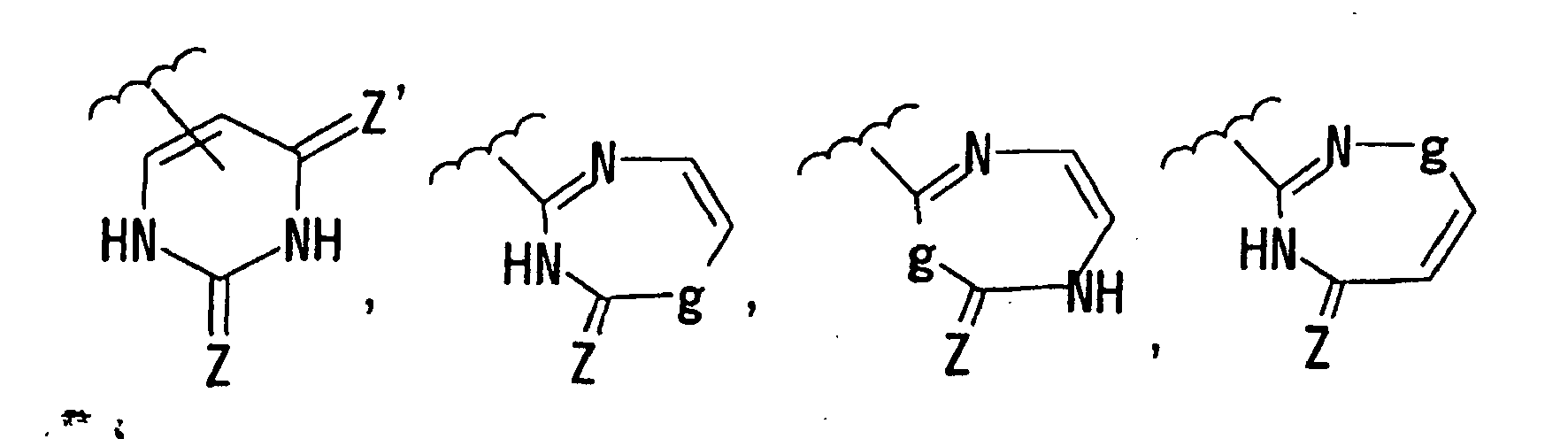
- In the formulas above, when g represents -NH- etc., the bond between the heterocyclic residue represented by R1 and the phenyl group to which the heterocyclic residue is bound may be not only the carbon-carbon bond, but also one of plural nitrogen atoms present therein. For example, if R1 is represented by:


- Other examples of such bonds via a nitrogen atom include:


- In the formulas above, g represents -CH2-, -NH-, -O- or -S(O)m-; >=Z, >=Z' and >=Z" represent a carbonyl group, a thiocarbonyl group and an optionally oxidized sulfur atom (e.g., S, S(O), S(O)2 etc.) (preferably a carbonyl or thiocarbonyl group, more preferably a carbonyl group) respectively; and m is an integer of 0, 1 or 2.
- Preferably, the heterocyclic residue represented by R1 is, for example, a group having both an -NH- or -OH- group as a proton donor such as in an oxadiazolone ring, an oxadiazolothion ring or a thiadiazolone ring and a carbonyl group, a thiocarbonyl group or a sulfinyl group as a proton acceptor. Further, the heterocyclic residue represented by R1 may form a condensed ring by binding a cyclic substituent thereto, but the heterocyclic residue represented by R1 is preferably a 5- to 6-membered ring, more preferably a 5-membered ring.
- The heterocyclic ring represented by R1 is preferably a group represented by the formula:

- As the above heterocyclic residue (R1), tautomers are present as shown below. For example, in the case of:


- As R1, the group capable of forming an anion may have been protected at replaceable positions by an optionally substituted lower (C1-4) alkyl group or an acyl group (e.g., lower (C2-5) alkanoyl, benzoyl etc.).
- The optionally substituted lower (C1-4) alkyl group includes, for example, (1) a lower (C1-4) alkyl group which may be substituted with 1 to 3 phenyl groups which may have a halogen atom, nitro, lower (C1-4) alkyl, lower (C1-4) alkoxy etc. (e.g., methyl, triphenylmethyl, p-methoxybenzyl, p-nitrobenzyl etc.), (2) a lower (C1-4) alkoxy-lower (C1-4) alkyl group (e.g., methoxymethyl, ethoxymethyl etc.), and (3) the formula -CH(R4)-OCOR5 wherein R4 represents (a) hydrogen, (b) a C1-6 straight or branched lower alkyl group (e.g., methyl, ethyl, n-propyl, isopropyl, n-butyl, isobutyl, t-butyl, n-pentyl, isopentyl, neopentyl etc.), (c) a C2-6 straight or branched lower alkenyl group or (d) a C3-8 cycloalkyl group (e.g., cyclopentyl, cyclohexyl, cycloheptyl etc.), and R5 represents (a) a C1-6 straight or branched lower alkyl group (e.g., methyl, ethyl, n-propyl, isopropyl, n-butyl, isobutyl, sec-butyl, t-butyl, n-pentyl, isopentyl, neopentyl etc.), (b) a C2-6 straight or branched lower alkenyl group, (c) a C1-3 lower alkyl group which may be substituted with a C3-8 cycloalkyl group (e.g., cyclopentyl, cyclohexyl, cycloheptyl etc.) or with an aryl group which may be substituted (e.g., a phenyl or naphthyl group which may have a halogen atom, nitro, lower (C1-4) alkyl, lower (C1-4) alkoxy etc.) (e.g., benzyl, p-chlorobenzyl, phenethyl, cyclopentylmethyl, cyclohexylmethyl etc.), (d) a C2-3 lower alkenyl group substituted with C3-8 cycloalkyl or with an aryl group which may be substituted (e.g., a phenyl or naphthyl group which may have a halogen atom, nitro, lower (C1-4) alkyl, lower (C1-4) alkoxy etc.) (e.g., a group such as cinnamyl having an alkenyl moiety such as vinyl, propenyl, allyl, isopropenyl etc.), (e) an aryl group which may be substituted (e.g., a phenyl or naphthyl group which may have a halogen atom, nitro, lower (C1-4) alkyl, lower (C1-4) alkoxy etc., such as phenyl, p-tolyl, naphthyl etc.), (f) a C1-6 straight or branched lower alkoxy group (e.g., methoxy, ethoxy, n-propoxy, isopropoxy, n-butoxy, isobutoxy, sec-butoxy, t-butoxy, n-pentyloxy, isopentyloxy, neopentyloxy etc.), (g) a C2-8 straight or branched lower alkenyloxy group (e.g., allyloxy, isobutenyloxy etc.), (h) a C3-8 cycloalkyloxy group (e.g., cyclopentyloxy, cyclohexyloxy, cycloheptyloxy etc.), (i) a C1-3 lower alkoxy group substituted with a C3-8 cycloalkyl (e.g., cyclopentyl, cyclohexyl, cycloheptyl etc.) or with an aryl group which may be substituted (e.g., a phenyl or naphthyl group which may have a halogen atom, nitro, lower (C1-4) alkyl, lower (C1-4) alkoxy etc.) (e.g., a group such as benzyloxy, phenethyloxy, cyclopentylmethoxy, cyclohexyl methoxy etc. having an alkoxy moiety such as methoxy, ethoxy, n-propoxy, isopropoxy etc.), (j) a C2-3 lower alkenyloxy group substituted with a C3-8 cycloalkyl (e.g., cyclopentyl, cyclohexyl, cycloheptyl etc.) or with an aryl group which may be substituted (e.g., a phenyl or naphthyl group which may have a halogen atom, nitro, lower (C1-4) alkyl, lower (C1-4) alkoxy etc.) (e.g., a group such as cinnamyloxy etc. having an alkenyloxy moiety such as vinyloxy, propenyloxy, allyloxy, isopropenyloxy etc.), or (k) an aryloxy group which may be substituted (e.g., a phenoxy or naphthoxy group which may have a halogen atom, nitro, lower (C1-4) alkyl, lower (C1-4) alkoxy etc. such as phenoxy, p-nitrophenoxy, naphthoxy etc.).
- As R1, the group capable of forming an anion may have, in addition to the protective group such as an optionally substituted lower (C1-4) alkyl group or an acyl group (e.g., lower (C2-5) alkanoyl, benzoyl etc.), substituent(s) such as a lower (C1-4) alkyl group which may be substituted (the same as the "lower (C1-4) alkyl group which may be substituted" exemplified with respect to the above protective group for the group capable of forming an anion represented by R1), a halogen atom, nitro, cyano, and amino which may be substituted with one or two lower (C1-4) alkyl groups, at replaceable positions.
- As R1 in the above-mentioned formula, the group capable of being converted into the group capable of forming an anion (the group having a hydrogen atom releasable as a proton) may also be a group which can be converted into the group capable of forming an anion under biological, that is, physiological conditions (e.g., reactions in the living body, such as oxidation, reduction or hydrolysis by enzymes in the living body) (so-called a prodrug), or it also may be a group such as (1) a carboxyl group, (2) a tetrazolyl group, (3) a trifluoromethanesulfonic acid amide group (-NHSO2CF3), (4) a phosphate group, (5) a sulfonate group, (6) a 5- to 7-membered (preferably 5- to 6-membered) monocyclic, optionally substituted heterocyclic residue containing at least one atom selected from N, S and O, which are protected with cyano, a N-hydroxycarbamimidoyl group (-C(=N-OH)-NH2), an optionally substituted lower (C1-4) alkyl group, and an acyl group respectively, and which can be converted by chemical reaction into the group capable of forming an anion represented by R1 (so-called a synthetic intermediate).
- Preferably, R1 is carboxyl which may be protected with an optionally substituted lower (C1-4) alkyl (e.g., methyl, triphenylmethyl, methoxymethyl, ethoxymethyl, p-methoxybenzyl, p-nitrobenzyl etc.) or with an acyl group (e.g., lower (C2-5) alkanoyl, benzoyl etc.); tetrazolyl or 2,5-dihydro-5-oxo-1,2,4-oxadiazole-3-yl (preferably, tetrazolyl); or cyano, N-hydroxycarbamimidoyl (preferably, cyano), among which cyano is particularly preferably used.
- In the above-mentioned formula, X indicates that the phenylene group and the phenyl group are bound to each other directly or via a spacer of a chain made of 2 or less atoms (preferably a direct bond). The spacer of a chain made of 2 or less atoms may be any divalent chain and may have a side chain insofar as the number of atoms constituting the straight chain is 1 or 2. Specifically, it is lower (C1-4) alkylene having a straight chain consisting of 1 or 2 carbon atoms, -CO-, -O-, -S-, -NH-,-CO-NH-, -O-CH2-, -S-CH2-, -CH=CH-, etc.
- In the above-mentioned formula, n is an integer of 1 or 2, preferably 1.
- In the formula, ring A represents a benzene ring which may further have substituent(s) other than the substituent group R2, and said substituent includes, for example, (1) halogen (e.g., F, Cl, Br etc.), (2) cyano, (3) nitro, (4) lower (C1-4) alkyl which may be substituted, (5) lower (C1-4) alkoxy, (6) an amino group which may be substituted (e.g., amino, N-lower (C1-4) alkylamino (e.g., methylamino), N,N-di-lower (C1-4) alkylamino (e.g., dimethylamino etc.), N-arylamino (e.g., phenylamino etc.), alicyclic amino (e.g., morpholino, piperidino, piperazino, N-phenylpiperazino etc.) etc.), (7) a group represented by the formula -CO-D' wherein D' represents a hydroxyl group or a lower (C1-4) alkoxy which may be substituted at its alkyl moiety by a hydroxyl group, a lower (C1-4) alkoxy, lower (C2-6) alkanoyloxy (e.g., acetoxy, pivaloyloxy etc.), lower (C1-6) alkoxycarbonyloxy (e.g., methoxycarbonyloxy, ethoxycarbonyloxy etc.) or lower (C3-6) cycloalkoxycarbonyloxy (e.g., cyclohexyloxycarbonyloxy etc.), or (8) tetrazolyl, a trifluromethanesulfonic acid amido group, a phosphate group or a sulfonate group which may be protected with acyl (e.g., lower (C2-5) alkanoyl, benzoyl etc.) or with lower (C1-4) alkyl which may be substituted (the same as the "lower (C1-4) alkyl group which may be substituted" exemplified with respect to the protective group for the group capable of forming an anion represented by R1), and the like.
- The benzene ring may have been substituted at replaceable positions thereof with one or two of these substituents groups. The substituent which is possessed by A in addition to the substituent represented by R2 is preferably a lower (C1-4) alkyl which may be substituted (e.g., lower (C1-4) alkyl which may be substituted with a hydroxyl group, carboxyl group, halogen etc.), halogen etc., and more preferably, ring A does not have a substituent other than the substituent represented by R2.
- In the above-mentioned formula, the group capable of forming an anion represented by R2 (that is, a group having a hydrogen atom releasable as a proton) includes, for example, (1) a carboxyl group which may be esterified or amidated, (2) a tetrazolyl group, (3) a trifluoromethanesulfonic acid amide group (-NHSO2CF3), (4) a phosphate group and (5) a sulfonate group, etc. and these may have been protected with a lower alkyl group which may be substituted (the same as the "lower (C1-4) alkyl group which may be substituted" exemplified with respect to the protective group for the group capable of forming an anion represented by R1) or an acyl group (e.g., lower (C2-5) alkanoyl, benzoyl etc.), and may be any group capable of forming an anion or being converted into said group chemically or biologically i.e. under physiological conditions (e.g., reactions in the living body, such as oxidation, reduction or hydrolysis in enzymes in the living body).
- As R2, the carboxyl which may be esterified or amidated includes, for example, groups represented by the formula -CO-D wherein D represents (1) a hydroxyl group, (2) amino which may be substituted (e.g., amino, N-lower (C1-4) alkylamino, N,N-di-lower (C1-4) alkylamino etc.) or (3) alkoxy which may be substituted {e.g., (i) a lower (C1-6) alkoxy group which may be substituted at its alkyl moiety by a hydroxyl group, amino which may be substituted (e.g., amino, N-lower (C1-4) alkylamino, N,N-di-lower (C1-4) alkylamino, piperidino, morpholino etc.), halogen, lower (C1-6) alkoxy, lower (C1-6) alkylthio, lower (C3-8) cycloalkoxy, or dioxolenyl which may be substituted (e.g., S-methyl-2-oxo-1,3-dioxolene-4-yl etc.), or (ii) groups represented by the formula -O-CH(R6)-OCOR7 wherein R6 represents (a) hydrogen, (b) a C1-6 straight or branched lower alkyl group (e.g., methyl, ethyl, n-propyl, isopropyl, n-butyl, isobutyl, t-butyl, n-pentyl, isopentyl, neopentyl etc.), (c) a C2-6 straight or branched lower alkenyl group or (d) a C3-8 cycloalkyl group (e.g., cyclopentyl, cyclohexyl, cycloheptyl etc.), and R7 represents (a) a C1-6 straight or branched lower alkyl group (e.g., methyl, ethyl, n-propyl, isopropyl, n-butyl, isobutyl, sec-butyl, t-butyl, n-pentyl, isopentyl, neopentyl etc.), (b) a C2-6 straight or branched lower alkenyl group, (c) a C1-3 lower alkyl substituted with a C3-8 cycloalkyl group (e.g., cyclopentyl, cyclohexyl, cycloheptyl etc.) or with an aryl group which may be substituted (e.g., a phenyl or naphthyl group which may have a halogen atom, nitro, lower (C1-4) alkyl, lower (C1-4) alkoxy etc.) group (e.g., benzyl, p-chlorobenzyl, phonetic, cyclopentylmethyl, cyclohexylmethyl etc.), (d) a C2-3 lower alkenyl group substituted with C3-8 cycloalkyl or with an aryl group which may be substituted (e.g., a phenyl or naphthyl group which may have a halogen atom, nitro, lower (C1-4) alkyl, lower (C1-4) alkoxy etc.) (e.g., a group such as cinnamyl having an alkenyl moiety such as vinyl, propenyl, allyl, isopropenyl etc.), (e) an aryl group which may be substituted (e.g., a phenyl or naphthyl group such as phenyl, p-tolyl, naphthyl etc., which may have a halogen atom, nitro, lower (C1-4) alkyl, lower (C1-4) alkoxy etc.), (f) a C1-6 straight or branched lower alkoxy group (e.g., methoxy, ethoxy, n-propoxy, isopropoxy, n-butoxy, isobutoxy, sec-butoxy, t-butoxy, n-pentyloxy, isopentyloxy, neopentyloxy etc.), (g) a C2-8 straight or branched lower alkenyloxy group (e.g., allyloxy, isobutenyloxy etc.), (h) a C3-8 cycloalkyloxy group (e.g., cyclopentyloxy, cyclohexyloxy, cycloheptyloxy etc.), (i) a C1-3 lower alkoxy group substituted with a C3-8 cycloalkyl (e.g., cyclopentyl, cyclohexyl, cycloheptyl etc.) or with an aryl group which may be substituted (e.g., a phenyl or naphthyl group which may have a halogen atom, nitro, lower (C1-4) alkyl, lower (C1-4) alkoxy etc.) (e.g., a group such as benzyloxy, phenethyloxy, cyclopentylmethoxy, cyclohexylmethoxy etc. having an alkoxy moiety such as methoxy, ethoxy, n-propoxy, isopropoxy etc.), (j) a C2-3 lower alkenyloxy group substituted with a C3-8 cycloalkyl (e.g., cyclopentyl, cyclohexyl, cycloheptyl etc.) or with an aryl group which may be substituted (e.g., a phenyl or naphthyl group which may have a halogen atom, nitro, lower (C1-4) alkyl, lower (C1-4) alkoxy etc.) (e.g., a group such as cinnamyloxy etc. having an alkenyloxy moiety such as vinyloxy, propenyloxy, allyloxy, isopropenyloxy etc.), or (k) an aryloxy group which may be substituted (e.g., a phenoxy or naphthoxy group which may have a halogen atom, nitro, lower (C1-4) alkyl, lower (C1-4) alkoxy etc. such as phenoxy, p-nitrophenoxy, naphthoxy etc.).
- R2 is preferably carboxyl which may be esterified, and examples thereof include -COOH and a salt thereof, -COOMe, -COOEt, -COOtBu, -COOPr, pivaloyloxymethoxycarbonyl, 1-(cyclohexyloxycarbonyloxy) ethoxycarbonyl, 5-methyl-2-oxo-1,3-dioxolene-4-ylmethoxycarbonyl, acetoxymethoxycarbonyl, propionyloxymethoxycarbonyl, n-butyryloxymethoxycarbonyl, isobutyryloxymethoxycarbonyl, 1-(ethoxycarbonyloxy) ethoxycarbonyl, 1-(acetoxy), ethoxycarbonyl, 1-(isobutyryloxy) ethoxycarbonyl, cyclohexylcarbonyloxymethoxycarbonyl, benzoyloxymethoxycarbonyl, cinnamyloxycarbonyl, cyclopentylcarbonyloxymethoxycarbonyl etc., and R2 may be any group capable of forming an anion (e.g., COO-, derivatives thereof, etc.) or being converted into said group chemically or biologically i.e. under physiological conditions (e.g., reactions in the living body, such as oxidation, reduction or hydrolysis by enzymes in the living body) or may be a carboxyl group or a prodrug thereof.
- R2 is preferably a group represented by the formula - CO-D wherein D represents (1) a hydroxyl group or (2) a lower (C1-4) alkoxy which may be substituted at its alkyl moiety by a hydroxyl group, amino, halogen, lower (C2-6) alkanoyloxy (e.g., acetoxy, pivaloyloxy etc.), lower (C3-8) cycloalkanoyloxy, lower (C1-6) alkoxycarbonyloxy (e.g., methoxycarbonyloxy, ethoxycarbonyloxy etc.), lower (C3-8) cycloalkoxycarbonyloxy (e.g., cyclohexyloxycarbonyloxy etc.), lower (C1-4) alkoxy or lower (C3-8) cycloalkoxy, and carboxyl esterified with lower (C1-4) alkyl (preferably methyl or ethyl) is preferable.
- In the above-mentioned formula, the "hydrocarbon residue" in the "hydrocarbon residue which may be bound via a heteroatom and may have a substituent group" represented by R3 includes e.g. (1) an alkyl group, (2) an alkenyl group, (3) an alkynyl group, (4) a cycloalkyl group, (5) an aryl group, (6) an aralkyl group and the like, among which an alkyl group, an alkenyl group and a cycloalkyl group are preferable.
- The alkyl group in the above-mentioned (1) is a lower alkyl group containing about 1 to 8 carbon atoms which may be straight or branched, and examples thereof include methyl, ethyl, propyl, isopropyl, butyl, isobutyl, sec-butyl, t-butyl, pentyl, i-pentyl, hexyl, heptyl and octyl.
- The alkenyl group in the above-mentioned (2) is a straight or branched lower alkenyl group containing about 2 to 8 carbon atoms, and examples thereof include vinyl, propenyl, 2-butenyl, 3-butenyl, isobutenyl, 2-octenyl etc.
- The alkynyl group in the above-mentioned (3) is a lower alkynyl group containing about 2 to 8 carbon atoms which may be straight or branched, and examples thereof include ethynyl, 2-propynyl, 2-butynyl, 2-pentynyl, 2-octynyl etc.
- The cycloalkyl group in the above-mentioned (4) includes a lower cycloalkyl containing about 3 to 6 carbon atoms, and examples thereof include cyclopropyl, cyclobutyl, cyclopentyl, cyclohexyl etc.
- The above-mentioned alkyl group, alkenyl group, alkynyl group or cycloalkyl group may have been substituted with a hydroxyl group, an amino group which may be substituted (e.g., amino, N-lower (C1-4) alkylamino, N,N-di-lower (C1-4) alkylamino etc.), halogen, a lower (C1-4) alkoxy group, a lower (C1-4) alkylthio group etc.
- The aralkyl group in the above-mentioned (5) includes e.g. phenyl-lower (C1-4) alkyl such as benzyl and phenethyl, and the aryl group in the above-mentioned (6) includes e.g. phenyl.
- The aralkyl group or the aryl group described above may have e.g. halogen (e.g., F, Cl, Br etc.), nitro, an amino group which may be substituted (e.g., amino, N-lower (C1-4) alkylamino, N,N-di-lower (C1-4) alkylamino etc.), lower (C1-4) alkoxy (e.g., methoxy, ethoxy etc.), lower (C1-4) alkylthio (e.g., methylthio, ethylthio etc.) or lower (C1-4) alkyl (e.g., methyl, ethyl etc.) at an arbitrary position on the benzene ring thereof.
- Among the groups described above, the "hydrocarbon residue" in the "hydrocarbon residue which may be bound via a heteroatom and may have a substituent group" represented by R3 is preferably an alkyl or alkenyl group which may be substituted (e.g., a lower (C1-5) alkyl or lower (C2-5) alkenyl group which may be substituted with a hydroxyl group, an amino group, halogen or a lower (C1-4) alkoxy group), among which a lower (C1-5) alkyl (more preferably ethyl) is preferable.
- The "heteroatom" in the "hydrocarbon residue which may be bound via a heteroatom and may have a substituent group" represented by R3 includes -O-, -S(O)m- [m is an integer of 0 to 2], and -NR'- [R' is a hydrogen atom or lower (C1-4) alkyl], among which -O- is preferably used.
- Among those described above, R3 may be bound via -O-, -S(O)m- [m is an integer of 0 to 2] or -NR'- [R' is a hydrogen atom or lower (C1-4) alkyl], and is preferably a lower (C1-5) alkyl or lower (C2-5) alkenyl group which may be substituted with a substituent group selected from a hydroxyl group, an amino group, halogen and a lower (C1-4) alkoxy group, particularly preferably a lower (C1-5) alkyl or lower (C1-5) alkoxy, more preferably ethoxy.
- Those compounds having an angiotensin II antagonistic activity represented by the formula (I) are preferably benzimidazole-7-carboxylic acid derivative or a pharmacologically acceptable salt thereof, represented by the formula (I'):


- The above-described benzimidazole derivatives can be synthesized by a known method described in, for example,
EP-425921 EP-459136 EP-553879 EP-578125 EP-520423 EP-668272 EP-459136 - The compound having an angiotensin II antagonistic activity or a prodrug thereof used in the present invention may be used as it is or as a pharmacologically acceptable salt thereof. When the compound having an angiotensin II antagonistic activity has an acidic group such as a carboxyl group etc., the salt thereof includes those salts with inorganic bases (e.g., alkali metals such as sodium, potassium etc., alkaline earth metals such as calcium, magnesium etc., transition metals such as zinc, iron, copper etc.) and organic bases (e.g., organic amines such as trimethylamine, triethylamine, pyridine, picoline, ethanolamine, diethanolamine, triethanolamine, dicyclohexylamine, N,N'-dibenzyl ethylene diamine etc., basic amino acids such as arginine, lysine, ornithine etc.).
- When the compound having an angiotensin II antagonistic activity has a basic group such as an amino group etc., the salt thereof includes those salts with inorganic acids and organic acids (e.g., hydrochloric acid, nitric acid, sulfuric acid, phosphoric acid, carbonic acid, bicarbonic acid, formic acid, acetic acid, propionic acid, trifluoroacetic acid, fumaric acid, oxalic acid, tartaric acid, maleic acid, citric acid, succinic acid, malic acid, methanesulfonic acid, benzenesulfonic acid, p-toluenesulfonic acid etc.), acidic amino acids such as aspartic acid, glutamic acid etc., or the like.
- In the present invention, a prodrug of the compound having an angiotensin II antagonistic activity [hereinafter, sometimes, referred to as AII antagonist] refers to a compound to be converted into an AII antagonist by reaction with enzymes, gastric acid etc. under physiological conditions in the living body, that is, a compound to be converted into an AII antagonist by enzymatic oxidation, reduction or hydrolysis or a compound to be converted into an AII antagonist by hydrolysis with gastric acid etc. A prodrug of an AII antagonist includes compounds derived from an AII antagonist by acylation, alkylation or phosphorylation of an amino group thereof (e.g., compounds wherein an amino group of an AII antagonist has been converted into eicosanoyl, alanyl, pentylaminocarbonyl, (5-methyl-2-oxo-1,3-dioxolene-4-yl)methoxycarbonyl, tetrahydrofuranyl, pyrrolidylmethyl, pivaloyloxymethyl, tert-butyl etc.); compounds derived from an AII antagonist by acylation, alkylation, phosphorylation or boration of a hydroxyl group thereof (e.g., compounds wherein a hydroxyl group of an AII antagonist has been converted into acetyl, palmitoyl, propanoyl, pivaloyl, succinyl, furamallyl, alanyl, dimethylaminomethylcarbonyl etc.); and compounds derived from an AII antagonist by esterifying or amidating a carboxyl group thereof (e.g., compounds wherein a carboxyl group of an AII antagonist has been converted into ethyl ester, phenyl ester, carboxymethyl ester, dimethyl aminomethyl ester, pivaloyloxy methyl ester, ethoxycarbonyloxy ethyl ester, phthalidyl ester, (5-methyl-2-oxo-1,3-dioxolene-4-yl)methyl ester, cyclohexyloxy carbonyloxy ethyl ester, methyl amide etc.). These compounds can be produced from an AII antagonist by a per se known method.
- A prodrug of an AII antagonist may be the one to be converted into an AII antagonist under physiological conditions as described in "Iyakuhin no Kaihatsu" (Development of Pharmaceutical Preparations), vol. 7, "Bunshi Sekkei" (Molecular Design), pp. 163-198, published in 1990 by Hirokawa Shoten.
- An AII antagonist may be a hydride or anhydride.
- The compound represented by the formula (I) or a pharmaceutically acceptable salt thereof is low-toxic and can be used as an agent for preventing recurrence of cerebrovascular disorder or as an agent for ameliorating troubles following cerebrovascular disorder and inhibiting progress thereof in mammals (e.g., humans, mice, rats, rabbits, dogs, cats, cattle, pigs, monkeys etc.) as it is or as a pharmaceutical composition thereof with a pharmaceutically acceptable carrier.
- The pharmaceutically acceptable carriers used in the present invention are conventional organic or inorganic carrier materials in pharmaceutical preparations, and are formulated as excipients, lubricants, binders or disintegrators in solid preparations, or as solvents, solubilizers, suspending agents, isotonizing agents, buffers and analgesics in liquid preparations. If necessary, pharmaceutical additives such as preservatives, antioxidants, coloring agents and sweeteners can also be used.
- Preferable examples of the excipients include lactose, sucrose, D-mannitol, D-sorbitol, starch, α-starch, dextrin, crystalline cellulose, low-substituted hydroxypropyl cellulose, sodium carboxymethyl cellulose, gum arabic, dextrin, pullulan, light silicic anhydride, synthetic aluminum silicate, magnesium metasilicate aluminate etc.
- Preferable examples of the lubricants include magnesium stearate, calcium stearate, talc and colloidal silica.
- Preferable examples of the binders include pregelatinized starch, sucrose, gelatin, gum arabic, methyl cellulose, carboxymethyl cellulose, sodium carboxymethyl cellulose, crystalline cellulose, sucrose, D-mannitol, trehalose, dextrin, pullulan, hydroxypropyl cellulose, hydroxypropylmethyl cellulose, polyvinyl pyrrolidone etc.
- Preferable examples of the disintegrators include lactose, white sugar, starch, carboxymethyl cellulose, calcium carboxymethyl cellulose, sodium croscarmellose, sodium carboxymethyl starch, light silicic anhydride, low-substituted hydroxypropyl cellulose etc.
- Preferable examples of the solvents include injectable water, physiological saline, Ringer's solution, alcohol, propylene glycol, polyethylene glycol, sesame oil, corn oil, olive oil, cottonseed oil etc.
- Preferable examples of the solubilizers include polyethylene glycol, propylene glycol, D-mannitol, trehalose, benzyl benzoate, ethanol, trisaminomethane, cholesterol, triethanolamine, sodium carbonate, sodium citrate, sodium salicylate, sodium acetate etc.
- Preferable examples of the suspending agents include surfactants such as stearyl triethanolamine, sodium laurylsulfate, lauryl aminopropionic acid, lecithin, benzalconium chloride, benzetonium chloride, and glycerine monostearate; hydrophilic polymers such as polyvinyl alcohol, polyvinyl pyrrolidone, sodium carboxymethyl cellulose, methyl cellulose, hydroxymethyl cellulose, hydroxyethyl cellulose, and hydroxypropyl cellulose; Polysorbate; and polyoxyethylene hardened sesame oil.
- Examples of the isotonizing agents include sodium chloride, glycerine, D-mannitol, D-sorbitol, glucose etc.
- Preferable examples of the buffers include buffers such as phosphates, acetates, carbonates and citrates.
- Preferable examples of the analgesics include benzyl alcohol etc.
- Preferable examples of the preservatives include paraoxybenzoates, chlorobutanol, benzyl alcohol, phenethyl alcohol, hydroacetic acid, and sorbic acid. Preferable examples of the antioxidants include sulfites, ascorbates etc.
- Preferable examples of the coloring agents include water-soluble edible tar pigment (e.g., edible pigments such as Edible Red Nos. 2 and 3, Edible Yellow Nos. 4 and 5, Edible Blue Nos. 1 and 2), water-insoluble lake pigments (e.g., aluminum salts of the water-soluble edible tar pigments described above), natural pigments (e.g., β-carotene, chlorophyll, red iron oxide etc.) or the like.
- Preferable examples of the sweeteners include sodium saccharine, glytylrytin [phonetic] dipotassium, aspartame, stevia etc.
- The dosage form of the pharmaceutical composition includes e.g. oral preparations such as tablets, capsules (including soft capsules, microcapsules etc.), granules, powders, syrups, emulsions and suspensions; and parenteral preparations such as injectable preparations (e.g., those for subcutaneous injection, intravenous injection, intramuscular injection, intraperitoneal injection, injection into the glass body etc.), drips, preparations for external application (e.g., preparations for administration via the nose, transdermal preparations, ointments etc.), suppositories (e.g., rectal suppositories, vaginal suppositories), pellets and drips, and these can be safely administered orally or parenterally.
- The pharmaceutical preparation can be produced by conventional methods in the field of pharmaceutical manufacturing, for example by methods described in the Japanese Pharmacopoeia, etc. Hereinafter, a specific process for producing the pharmaceutical preparation is described in more detail.
- For example, the oral preparation can be produced by adding e.g. excipients (e.g., lactose, sucrose, starch, D-mannitol etc.), disintegrators (e.g., calcium carboxymethyl cellulose etc.), binders (e.g., pregelatinized starch, gum arabic, carboxymethyl cellulose, hydroxypropyl cellulose, polyvinyl pyrrolidone etc.) or lubricants (e.g., talc, magnesium stearate, polyethylene glycol 6000 etc.) to the active ingredient and then molding by compression, if necessary followed by coating thereof in a per se known method with a coating base with the aim of masking tastes or preparing enteric or lasting preparations.
- The coating base includes e.g. a sugar coating base, a water-soluble film coating base, an enteric film coating base, a sustained release film coating base etc.
- Sucrose is used as the sugar coating base, and at least one member selected from talc, precipitated calcium carbonate, gelatin, gum arabic, pullulan and carnauba wax may further be used alone or in combination.
- The water-soluble film coating base includes e.g. cellulose type polymers such as hydroxypropyl cellulose, hydroxypropylmethyl cellulose, hydroxyethyl cellulose and methylhydroxyethyl cellulose; synthetic polymers such as polyvinyl acetal diethylaminoacetate, aminoalkylmethacrylate copolymer E [Eudragit E (trade name), Rhoem Pharma Ltd.], polyvinyl pyrrolidone etc.; and polysaccharides such as pullulan.
- The enteric film coating base includes e.g. cellulose type polymers such as hydroxypropylmethyl cellulose phthalate, hydroxypropylmethyl cellulose acetatesuccinate, carboxymethylethyl cellulose and acetic acid phthalic acid cellulose; acrylate type polymers such as methacrylate copolymer L [Eudragit L (trade name), Rhoem Pharma Ltd.], methacrylate copolymer LD [Eudragit L-30D55 (trade name), Rhoem Pharma Ltd.] and methacrylate copolymer S [Eudragit S (trade name), Rhoem Pharma Ltd.]; and naturally occurring materials such as shellac.
- The sustained release film coating base includes e.g. cellulose type polymers such as ethyl cellulose; aminoalkyl methacrylate copolymer RS [Eudragit RS-100 (trade name), Rhoem Pharma Ltd.] and acrylate type polymers such as an ethyl acrylate-methyl methacrylate copolymer suspension [Eudragit NE (trade name), Rhoem Pharma Ltd.].
- Two or more of the coating bases described above may be mixed and used in a suitable ratio. For coating, e.g. sunproofing agents such as titanium oxide, iron oxide etc. may also be used.
- The injectable preparation is produced by dissolving, suspending or emulsifying the active ingredient along with a dispersant (e.g., Polysorbate 80, polyoxyethylene hardened sesame oil 60 etc.), polyethylene glycol, carboxymethyl cellulose, sodium alginate etc.), a preservative (e.g., methyl parabene, propyl parabene, benzyl alcohol, chlorobutanol, phenol etc.), an isotonizing agent (e.g., sodium chloride, glycerine, D-mannitol, D-sorbitol, glucose etc.) etc. in an aqueous solvent (e.g., distilled water, physiological saline, Ringer's solution etc.) or an oil solvent (e.g., propylene glycol and vegetable oils such as olive oil, sesame oil, cottonseed oil, corn oil etc.) and the like. In this case, it is possible to use additives such as a solubilizer (e.g., sodium salicylate, sodium acetate etc.), a stabilizer (e.g., human serum albumin etc.), an analgesic (e.g., benzyl alcohol etc.) or the like.
- The dose of the compound represented by the formula (I) or a pharmaceutically acceptable salt thereof is varied depending on the subject of administration, administration route, intended diseases, conditions etc., but in the case of oral administration for mammals, particularly humans (weighing 50 kg), the compound represented by the formula (I) or a pharmaceutically acceptable salt thereof as the active ingredient is usually administered in a dose of about 0.001 to 500 mg, preferably 0.1 to 50 mg, and this dose is administered preferably once to thrice every day.
- The agent for preventing recurrence of cerebrovascular disorder or the agent for ameliorating troubles following cerebrovascular disorder and inhibiting progress thereof according to the present invention can be used simultaneously or at intervals with an anti-dementia agent, a nitrogen monoxide action enhancer, a glutamate inhibitor, and an inhibitor of blood vessel thickening, in addition to an agent for ameliorating cerebral circulation and blood flow, an agent for ameliorating cerebral metabolism, an agent for ameliorating mental diseases, an anti-convulsion agent, a therapeutic agent for hypertension, a therapeutic agent for diabetes, an anti-cerebral edema agent, a thrombolytic, an antiplatelet, an anticoagulant, an agent for ameliorating lipid metabolism, and a radical scavenger.
- When these chemicals are used in combination, the respective chemicals can be mixed separately or simultaneously with pharmaceutically acceptable carriers, excipients, binders, diluents etc. and administered orally or parenterally as a pharmaceutical composition. When the chemicals are formed separately into preparations, the separately formed preparations can be mixed in a diluent and administered, or the separately formed preparations may be administered simultaneously or at intervals into the subject. The pharmaceutical preparation of the present invention also encompasses a kit product for mixing the separately formed preparations with a diluent just before use and administering them (e.g., an injection kit comprising ampoules containing each powdery chemical and a diluent for mixing and dissolving two or more chemicals) and a kit product for administering the separately formed preparations simultaneously or at intervals to an intended subject (e.g., a kit for administering two or more kinds of tablets simultaneously or separately at intervals, comprising chemical-containing tablets introduced into an identical or different bag provided if necessary with a column thereon for describing the time of administering the chemical).
- For example, the agent for preventing recurrence of cerebrovascular disorder or the agent for ameliorating troubles following cerebrovascular disorder and inhibiting progress thereof according to the present invention can be used in combination with agents for ameliorating cerebral circulation and blood flow, such as vinpocetine and fulnaridine, agents for ameliorating cerebral metabolism, such as anilacetam and nicergoline, agents for ameliorating mental diseases, for example therapeutic agents for schizophrenia (orazapin, risperidone etc.), anti-anxiety agents (alprazolam, diazepam etc.), anti-depression agents (fluoxcetine, certraline, fluboxamine etc.), anti-convulsion agents such as diazepam, therapeutic agents for hypertension, such as derapuryl hydrochloride and manidipine hydrochloride, therapeutic agents for diabetes, such as boguribose, pyrogritazone, sulfonyl urea agents, anti-cerebral edema agents such as glycerol, thrombolytics such as tissue plasminogen activator and prourokinase, anti-platelet agents such as ticlopidine, clopidogrel, cirostazole and aspirin, anti-coagulants such as heparin, wafarin and argatroban, agents for ameliorating lipid metabolism, such as seribastatin, pravastatin and clofibrate, and radical scavengers such as vitamins E and C.
- Hereinafter, the present invention is described in more detail by reference to Examples, which however are not intended to limit the present invention.
- The agent of the present invention for preventing recurrence of cerebrovascular disorder or the agent for ameliorating troubles following cerebrovascular disorder and inhibiting progress thereof which comprises as an active component the compound having an AII antagonistic activity or a salt thereof can be produced, for example, by the following formulation.
-
(1) Candesartan cilexetil 30 mg (2) Lactose 90 mg (3) Crystalline cellulose 70 mg (4) Magnesium stearate 10 mg 1 capsule 200 mg (1), (2), (3) and 1/2 of (4) are mixed, kneaded and granulated. The remainder of (4) is added thereto, and the whole is encapsulated in a gelatin capsule. -
(1) Candesartan cilexetil 30 mg (2) Lactose 35 mg (3) Corn starch 150 mg (4) Crystalline cellulose 30 mg (5) Magnesium stearate 5 mg 1 tablet 250 mg (1), (2), (3), 2/3 of (4) and 1/2 of (5) are mixed, kneaded and granulated. The remainders of (4) and (5) are added to the granules which are then molded into a table by compression. - Action of Candesartan cilexetil in ameliorating troubles following cerebrovascular disorder in spontaneous hypertension rat with ease spontaneous cerebral apoplexy (SHRSP)
- Male SHRSP are used. SHRSP are separately raised and given 1 % saline solution as drinking water to promote and regulate occurrence of cerebral apoplexy. To regulate apoplexy symptoms, rats expressing the non-voluntary motility of raising the foreleg are divided one after another into a control group and a drug administration group. After the first fit, the drinking water is replaced by tap water, and then nerve symptoms are observed. During observation, the rats are examined for severity of nerve symptoms and for change in their weight. After the final administration, the rats are allowed to bleed to death under anesthesia and subjected to histological investigation.
- The renin-angiotensin system is revealed to play an important role in the progress of cerebrovascular lesions accompanying hypertension. Then, a compound having an AII antagonistic activity (particularly Candesartan cilexetil) can be expected to inhibit the progress of lesions (carotid artery lesions) responsible for cerebral arteriosclerosis and ischemic cerebrovascular disorder not only by the vasodilator action but also by the action of improving endothelial cell functions and inhibiting inner membrane thickening (correction of vascular remodeling). Further, reduction in cerebral blood flow and microcirculation in brain are ameliorated by the action of ameliorating the ability for automatic circulation of cerebral circulation, and there are further brought about various actions for protection of brain (nerves), correction of an abnormality in fibrinolytic system, amelioration of blood properties, etc. Thus, the compound is useful for preventing recurrence of cerebrovascular disorder or for ameliorating troubles following cerebrovascular disorder and inhibiting progress thereof.
- That is, Candesartan cilexetil having the following actions can be used effectively as an agent for preventing recurrence of cerebrovascular disorder or as an agent for ameliorating troubles following cerebrovascular disorder and inhibiting progress thereof.
- It is reported that Candesartan, i.e. an active metabolite of Candesartan cilexetil, can deviate the lower limit of automatic regulation leftward (toward lower blood pressure level) (Vraamark T et al., J Hypertens 13:755-761, 1995), and in a patient with cerebrovascular disorder where the ability for automatic regulation of cerebral vessels is hindered, the recurrence of cerebrovascular disorder can be prevented by preventing or decreasing cerebral ischemia by the mechanism of blood flow kinetics as a cause of the recurrence. Further, Candesartan cilexetil can prevent recurrence of cerebrovascular disorder by its stable blood pressure depressing action through 24 hours, thus stably controlling blood pressure whereby a significant reduction in blood pressure at night or an increase in blood pressure from night to early morning or in early morning, which is a cause of occurrence and recurrence of cerebrovascular disorder, is prevented. Further, Candesartan cilexetil can lower blood pressure safely to a therapeutically desired level in a patient with cerebrovascular disorder having various complications such as diabetes, cardiac diseases and renal diseases in addition to hypertension, thus significantly contributing to inhibition of the progress of organ disorders due to these complications without causing significant reduction in blood pressure, and finally the recurrence of cerebrovascular disorder can be prevented by reducing the dangerous factors for recurrence of cerebrovascular disorder.
- It has been revealed that AII have not only a strong vasoconstricting action but also various actions such as proliferating action, inflammation action, oxidizing action, vascular penetrating action, etc., thus playing an important role in the progress of not only hypertension but also cerebrovascular lesions. That is, it is reported that AII thickens cells via expression of oncogenes and growth factors, thickens vascular walls by an increase in production of extracellular substrate, activates a transcriptional factor (NF-κB) to increase expression of a monocyte chemotactic factor (Hernandez-Presa M, et al., Circulation 95, 1532-1541, 1997), and induces production of free radicals from inflammatory cells (Zafari AM, et al., Hypertension 32, 488-495, 1998), thus significantly influencing various organ disorders including cerebrovascular disorder. Candesartan cilexetil not only inhibits these disorders attributable to AII thereby treating hypertension but also exerts actions for prevention of progress of arteriosclerosis, amelioration of vessel remodeling, amelioration of microcirculation, inhibition of edema, amelioration of endothelial cell functions (promotion of NO production in endothelial cells), and protection of cells thereby preventing the progress and recurrence of cerebrovascular disorder and ameliorating troubles after cerebrovascular disorder.
- Candesartan cilexetil is known to improve insulin sensitivity clinically (Iimura O., et al., Am J Hypertens 8, 353-357, 1995), and can ameliorate various disorders accompanying an abnormality in sugar resistance, diabetes and a reduction in insulin sensitivity as dangerous factors for recurrence of cerebrovascular disorder thereby preventing the progress and recurrence of cerebrovascular disorder and ameliorating troubles after cerebrovascular disorder.
- Candesartan cilexetil has actions for anti-inflammation, anti-oxidization, anti-edema, amelioration of microcirculation and improvement of endothelial cell functions as described in the above (2), and can inhibit vasoconstriction and promotion of platelet agglutination caused by various vascular agonists such as endoserin and thromboxane induced and enhanced by AII, whereby the penambra region can be saved by amelioration of blood flow and inhibition of cellular disorders at the acute stage of vascular infarction.
- Further, it is reported that a disorder in the brain-blood barrier in an angiotensinogen knockout mouse is ameliorated by administration of an angiotensin peptide such as angiotensin IV (angiotensin 3-8) (Kakinuma Y. et al., Nat Med. 4, 1078-1080, 1998), and also that an angiotensin peptide such as AIV is related to memory and the action of increasing cerebral blood flow (Wright J W et al., Brain Res Rev 25, 96-124, 1997), and the increase in these peptides by administration of Candesartan cilexetil (decomposed products are increased by an increase in AII) can prevent the progress and recurrence of cerebrovascular disorder via the above-described actions and ameliorate troubles after cerebrovascular disorder.
- It is reported that stimulation with AII causes an increase in hematocrit due to an increase in production of erythropoietin, an abnormality in the fibrinolytic system due to enhancement of the activity of plasminogen activator inhibitor type-1, and induction of expression of E-selectin in vascular endothelial cells and subsequent adherence of leukocytes (Grafe M et al., Cir Res 81, 804-811, 1997). These are inhibited by Candesartan cilexetil so that changes in blood such as coagulation of platelets, leukocytes and erythrocytes are ameliorated, while formation of thrombus is inhibited and microcirculation is ameliorated by the added or synergistic actions in improvement of endothelial cell functions (1) and inhibition of thromboxane production (4), whereby the progress and recurrence of cerebrovascular disorder can be prevented and troubles after cerebrovascular disorder can be ameliorated.
- Candesartan cilexetil can be used in combination with a thrombolytic, an antiplatelet, an anti-blood-coagulant (anticoagulant), an agent for ameliorating cerebral circulation, an agent for ameliorating cerebral metabolism and an agent for ameliorating mental diseases, and by these added or synergistic actions, further excellent effects can be expected, and the dose of these agents and the frequency of administration thereof can be decreased thereby reducing side effects attributable to these chemicals.
Claims (17)
- An agent for preventing recurrence of cerebrovascular disorder or an agent for ameliorating troubles following cerebrovascular disorder and inhibiting progress thereof which comprises a compound having an angiotensin II antagonistic activity, a prodrug thereof or a salt thereof.
- The agent according to claim 1, wherein the compound having an angiotensin II antagonistic activity is a non-peptide compound.
- The agent according to claim 1, wherein the compound having an angiotensin II antagonistic activity is a compound having an oxygen atom in the molecule.
- The agent according to claim 1, wherein the compound having an angiotensin II antagonistic activity is a compound having an ether bond or a carbonyl group.
- The agent according to claim 1, wherein the compound having an angiotensin II antagonistic activity is a compound represented by the formula (I):

- The agent according to claim 1, wherein the compound having an angiotensin II antagonistic activity is Losartan, Eprosartan, Candesartan cilexetil, Candesartan, Valsartan, Telmisartan, Irbesartan, Olmesartan or Tasosartan.
- The agent according to claim 1, wherein the compound having an angiotensin II antagonistic activity is 2-ethoxy-1-[[2'-(1H-tetrazole-5-yl)biphenyl-4-yl]methyl]benzimidazole-7-carboxylic acid.
- The agent according to claim 1, wherein the compound having an angiotensin II antagonistic activity is 1-(cyclohexyloxycarbonyloxy)ethyl 2-ethoxy-1-[[2'-(1H-tetrazole-5-yl)biphenyl-4-yl]methyl]benzimidazole-7-carboxylate.
- The agent according to claim 1, wherein the compound having an angiotensin II antagonistic activity is 2-ethoxy-1-[[2'-(2,5-dihydro-5-oxo-1,2,4-oxadiazole-3-yl)biphenyl-4-yl]methyl]benzimidazole-7-carboxylic acid.
- The agent according to claim 1, wherein the troubles following cerebrovascular disorder are nerve symptoms.
- The agent according to claim 1, wherein the troubles following cerebrovascular disorder are mental symptoms.
- The agent according to claim 1, wherein the troubles following cerebrovascular disorder are subjective symptoms.
- The agent according to claim 1, wherein the troubles following cerebrovascular disorder are obstacles in activities of daily living.
- A method for preventing recurrence of cerebrovascular disorder in mammals which comprises administering an effective amount of a compound having an angiotensin II antagonistic activity, a prodrug thereof or a salt thereof to the mammals.
- A method for ameliorating troubles following cerebrovascular disorder or inhibiting progress thereof in mammals which comprises administering an effective amount of a compound having an angiotensin II antagonistic activity, a prodrug thereof or a salt thereof to the mammals.
- Use of a compound having an angiotensin II antagonistic activity, a prodrug thereof or a salt thereof for manufacturing a pharmaceutical preparation for preventing recurrence of cerebrovascular disorder.
- Use of a compound having an angiotensin II antagonistic activity, a prodrug thereof or a salt thereof for manufacturing a pharmaceutical preparation for ameliorating troubles following cerebrovascular disorder or inhibiting progress thereof.
Applications Claiming Priority (2)
| Application Number | Priority Date | Filing Date | Title |
|---|---|---|---|
| JP20587799 | 1999-07-21 | ||
| EP00946393A EP1197226B1 (en) | 1999-07-21 | 2000-07-19 | Agents for ameliorating troubles following cerebrovascular failure and inhibiting progress thereof |
Related Parent Applications (1)
| Application Number | Title | Priority Date | Filing Date |
|---|---|---|---|
| EP00946393A Division EP1197226B1 (en) | 1999-07-21 | 2000-07-19 | Agents for ameliorating troubles following cerebrovascular failure and inhibiting progress thereof |
Publications (1)
| Publication Number | Publication Date |
|---|---|
| EP1867342A1 true EP1867342A1 (en) | 2007-12-19 |
Family
ID=16514222
Family Applications (2)
| Application Number | Title | Priority Date | Filing Date |
|---|---|---|---|
| EP00946393A Expired - Lifetime EP1197226B1 (en) | 1999-07-21 | 2000-07-19 | Agents for ameliorating troubles following cerebrovascular failure and inhibiting progress thereof |
| EP07017024A Withdrawn EP1867342A1 (en) | 1999-07-21 | 2000-07-19 | Agents for ameliorating troubles following cerebrovascular failure and inhibiting progress thereof |
Family Applications Before (1)
| Application Number | Title | Priority Date | Filing Date |
|---|---|---|---|
| EP00946393A Expired - Lifetime EP1197226B1 (en) | 1999-07-21 | 2000-07-19 | Agents for ameliorating troubles following cerebrovascular failure and inhibiting progress thereof |
Country Status (7)
| Country | Link |
|---|---|
| US (3) | US6852743B1 (en) |
| EP (2) | EP1197226B1 (en) |
| JP (1) | JP2001089393A (en) |
| AU (1) | AU6019700A (en) |
| CA (1) | CA2379666C (en) |
| DE (1) | DE60037192T2 (en) |
| WO (1) | WO2001005428A1 (en) |
Families Citing this family (16)
| Publication number | Priority date | Publication date | Assignee | Title |
|---|---|---|---|---|
| EP1197226B1 (en) * | 1999-07-21 | 2007-11-21 | Takeda Pharmaceutical Company Limited | Agents for ameliorating troubles following cerebrovascular failure and inhibiting progress thereof |
| CA2436361C (en) * | 2001-01-29 | 2010-11-02 | Takeda Chemical Industries, Ltd. | Angiotensin ii antagonistic compound for use as analgesic and antiinflammatory agent |
| US20040219208A1 (en) * | 2001-08-03 | 2004-11-04 | Ryu Kawamura | Sustained-release medicines |
| PL370270A1 (en) * | 2001-11-23 | 2005-05-16 | Solvay Pharmaceuticals Gmbh | Hypertonia treatment during the acute phase of a cerebrovascular accident |
| JP4484427B2 (en) * | 2001-12-03 | 2010-06-16 | 武田薬品工業株式会社 | Insulin resistance improving agent |
| AU2002349673A1 (en) * | 2001-12-03 | 2003-06-17 | Takeda Chemical Industries, Ltd. | Insulin resistance improving agents |
| TWI299663B (en) * | 2002-05-14 | 2008-08-11 | Novartis Ag | Methods of treatment |
| ATE551056T1 (en) * | 2002-12-27 | 2012-04-15 | Takeda Pharmaceutical | AGENT FOR INHIBITING BODY WEIGHT GAIN |
| RS20050590A (en) * | 2003-01-31 | 2007-09-21 | Sankyo Company Limited, | Medicine for prevention of and treatment for arteriosclerosis and hypertension |
| JP5100039B2 (en) * | 2003-01-31 | 2012-12-19 | 第一三共株式会社 | Pharmaceuticals for the prevention and treatment of arteriosclerosis and hypertension |
| CN1798557A (en) * | 2003-05-29 | 2006-07-05 | 协和梅迪克斯株式会社 | Antidepressants or food and drinks for antidepression |
| WO2005030202A1 (en) * | 2003-09-26 | 2005-04-07 | Novartis Ag | Use of angiotensin ii receptor antagonists for treating cerebrovascular disorders |
| CN101247832B (en) * | 2005-06-27 | 2011-12-28 | 第一三共株式会社 | Pharmaceutical preparation containing an angiotensin II receptor antagonist and a calcium channel blocker |
| TWI399223B (en) * | 2006-09-15 | 2013-06-21 | Daiichi Sankyo Co Ltd | Solid dosage form of olmesartan and amlodipine |
| US7747551B2 (en) * | 2007-02-21 | 2010-06-29 | Neurovista Corporation | Reduction of classification error rates and monitoring system using an artificial class |
| AR065850A1 (en) * | 2007-03-28 | 2009-07-08 | Takeda Pharmaceutical | SOLID PHARMACEUTICAL COMPOSITION INCLUDING A BENZIMIDAZOL-7-CARBOXYLATE DERIVATIVE AND A PH CONTROL AGENT |
Citations (7)
| Publication number | Priority date | Publication date | Assignee | Title |
|---|---|---|---|---|
| EP0425921A1 (en) * | 1989-10-24 | 1991-05-08 | Takeda Chemical Industries, Ltd. | Benzimidazole derivatives, their production and use |
| EP0459136A1 (en) * | 1990-04-27 | 1991-12-04 | Takeda Chemical Industries, Ltd. | Benzimidazole derivatives, their production and use |
| DE4142366A1 (en) * | 1991-07-15 | 1993-06-24 | Thomae Gmbh Dr K | PHENYLALKYL DERIVATIVES, MEDICINAL PRODUCTS CONTAINING THESE COMPOUNDS AND METHOD FOR THE PRODUCTION THEREOF |
| EP0556789A2 (en) * | 1992-02-19 | 1993-08-25 | Dr. Karl Thomae GmbH | Substituted biphenyl derivatives, therapeutic agents containing them and process for their preparation |
| EP0631780A1 (en) * | 1993-07-02 | 1995-01-04 | Takeda Chemical Industries, Ltd. | Use of an angiotensin II antagonist as an ocular hypotensive agent |
| WO2000002543A2 (en) * | 1998-07-10 | 2000-01-20 | Novartis Ag | Antihypersensitive combination of valsartan and calcium channel blocker |
| WO2000016773A1 (en) * | 1998-09-21 | 2000-03-30 | Sanofi-Synthelabo | Pharmaceutical composition containing an angiotensin ii at1 receptor antagonist and an antiplatelet agent |
Family Cites Families (10)
| Publication number | Priority date | Publication date | Assignee | Title |
|---|---|---|---|---|
| US5250554A (en) * | 1989-10-24 | 1993-10-05 | Takeda Chemical Industries, Ltd. | Benzimidazole derivatives useful as angiotensin II inhibitors |
| GB9110636D0 (en) * | 1991-05-16 | 1991-07-03 | Glaxo Group Ltd | Chemical compounds |
| DE4123341A1 (en) | 1991-07-15 | 1993-01-21 | Thomae Gmbh Dr K | PHENYL ALKYL DERIVATIVES, MEDICAMENTS CONTAINING SUCH COMPOUNDS AND METHOD FOR THE PRODUCTION THEREOF |
| GB9223860D0 (en) * | 1992-11-13 | 1993-01-06 | Glaxo Group Ltd | Chemical compounds |
| US5721263A (en) * | 1993-06-07 | 1998-02-24 | Takeda Chemical Industries, Ltd. | Pharmaceutical composition for angiotensin II-mediated diseases |
| US6107323A (en) * | 1996-04-05 | 2000-08-22 | Takeda Chemical Industries, Ltd. | Pharmaceutical composition |
| US6177587B1 (en) | 1997-05-26 | 2001-01-23 | Takeda Chemical Industries, Ltd. | Production method of aminobenzene compound |
| WO1999065500A1 (en) * | 1998-06-17 | 1999-12-23 | Bristol-Myers Squibb Company | Preventing cerebral infarction through administration of adp-receptor antiplatelet and antihypertensive drugs in combination |
| EP1197226B1 (en) * | 1999-07-21 | 2007-11-21 | Takeda Pharmaceutical Company Limited | Agents for ameliorating troubles following cerebrovascular failure and inhibiting progress thereof |
| DE10230272A1 (en) * | 2002-07-05 | 2004-01-22 | Solvay Pharmaceuticals Gmbh | 1 receptor antagonist for the prevention of secondary stroke |
-
2000
- 2000-07-19 EP EP00946393A patent/EP1197226B1/en not_active Expired - Lifetime
- 2000-07-19 CA CA002379666A patent/CA2379666C/en not_active Expired - Fee Related
- 2000-07-19 US US10/031,398 patent/US6852743B1/en not_active Expired - Fee Related
- 2000-07-19 WO PCT/JP2000/004830 patent/WO2001005428A1/en not_active Ceased
- 2000-07-19 AU AU60197/00A patent/AU6019700A/en not_active Abandoned
- 2000-07-19 DE DE60037192T patent/DE60037192T2/en not_active Expired - Lifetime
- 2000-07-19 JP JP2000223871A patent/JP2001089393A/en active Pending
- 2000-07-19 EP EP07017024A patent/EP1867342A1/en not_active Withdrawn
-
2004
- 2004-12-01 US US11/000,425 patent/US20050096382A1/en not_active Abandoned
-
2010
- 2010-01-29 US US12/696,620 patent/US20100120800A1/en not_active Abandoned
Patent Citations (7)
| Publication number | Priority date | Publication date | Assignee | Title |
|---|---|---|---|---|
| EP0425921A1 (en) * | 1989-10-24 | 1991-05-08 | Takeda Chemical Industries, Ltd. | Benzimidazole derivatives, their production and use |
| EP0459136A1 (en) * | 1990-04-27 | 1991-12-04 | Takeda Chemical Industries, Ltd. | Benzimidazole derivatives, their production and use |
| DE4142366A1 (en) * | 1991-07-15 | 1993-06-24 | Thomae Gmbh Dr K | PHENYLALKYL DERIVATIVES, MEDICINAL PRODUCTS CONTAINING THESE COMPOUNDS AND METHOD FOR THE PRODUCTION THEREOF |
| EP0556789A2 (en) * | 1992-02-19 | 1993-08-25 | Dr. Karl Thomae GmbH | Substituted biphenyl derivatives, therapeutic agents containing them and process for their preparation |
| EP0631780A1 (en) * | 1993-07-02 | 1995-01-04 | Takeda Chemical Industries, Ltd. | Use of an angiotensin II antagonist as an ocular hypotensive agent |
| WO2000002543A2 (en) * | 1998-07-10 | 2000-01-20 | Novartis Ag | Antihypersensitive combination of valsartan and calcium channel blocker |
| WO2000016773A1 (en) * | 1998-09-21 | 2000-03-30 | Sanofi-Synthelabo | Pharmaceutical composition containing an angiotensin ii at1 receptor antagonist and an antiplatelet agent |
Non-Patent Citations (3)
| Title |
|---|
| MASAYA TAKAHASHI ET AL: "THERAPEUTIC EFFECTS OF IMIDAPRIL ON CEREBRAL LESIONS OBSERVED BY MAGNETIC RESONANCE IMAGING IN MALIGNANT STROKE-PRONE SPONTANEOUSLY HYPERTENSIVE RATS", JOURNAL OF HYPERTENSION, CURRENT SCIENCE, PHILADELPHIA, PA, US, vol. 12, 1994, pages 761 - 768, XP002934267, ISSN: 0263-6352 * |
| SAAVEDRA J.M.: "THE ROLE OF ANGIOTENSIN II IN THE REGULATION OF CEREBROVASCULAR FUCNTION IN THE RAT", PHARM. PHARMACOL. LETT., vol. 3, 1994, pages 256 - 259, XP009000718 * |
| SCHRADER J ET AL: "HYPERTENSION AND STROKE - RATIONALE BEHIND THE ACCESS TRIAL", BASIC RESEARCH IN CARDIOLOGY, STEINKOPFF, DARMSTADT, DE, vol. 93, no. SUPPL 2, 1998, pages 69 - 78, XP001019616, ISSN: 0300-8428 * |
Also Published As
| Publication number | Publication date |
|---|---|
| EP1197226A4 (en) | 2003-01-07 |
| WO2001005428A1 (en) | 2001-01-25 |
| EP1197226A1 (en) | 2002-04-17 |
| CA2379666A1 (en) | 2001-01-25 |
| AU6019700A (en) | 2001-02-05 |
| CA2379666C (en) | 2009-10-13 |
| US6852743B1 (en) | 2005-02-08 |
| DE60037192T2 (en) | 2008-05-15 |
| JP2001089393A (en) | 2001-04-03 |
| EP1197226B1 (en) | 2007-11-21 |
| DE60037192D1 (en) | 2008-01-03 |
| US20100120800A1 (en) | 2010-05-13 |
| US20050096382A1 (en) | 2005-05-05 |
Similar Documents
| Publication | Publication Date | Title |
|---|---|---|
| US20100120800A1 (en) | Agent for preventing recurrence of cerebrovascular disorder and agent for ameliorating troubles following cerebrovascular disorder and inhibiting progress thereof | |
| CA2420055C (en) | Fibrinogen-lowering agent | |
| CA2436361C (en) | Angiotensin ii antagonistic compound for use as analgesic and antiinflammatory agent | |
| US20060173059A1 (en) | Agent for preventing or treating portal hypertension | |
| JP3057471B2 (en) | Agent for preventing or treating angiotensin II-mediated diseases | |
| KR100865059B1 (en) | Prevention / Treatment / Suppressive Agents for Simple Retinopathy or Proliferative Retinopathy | |
| SK78994A3 (en) | Optic hypotensive agent and method of its preparation | |
| JP2000159671A (en) | Arterialization inhibitor | |
| JP2002212101A (en) | Gingival hypertrophy inhibitor | |
| JP4276768B2 (en) | Prevention, treatment and progression inhibitor of simple retinopathy and preproliferative retinopathy | |
| EP1579872B1 (en) | Body weight gain inhibitor | |
| JP2002201128A (en) | Prophylactic or therapeutic agent for portal hypertension | |
| JP2004002282A (en) | Anticancer agent | |
| JP2002138054A (en) | Fibrinogen lowering agent | |
| JPWO2001005428A1 (en) | Agents for preventing the recurrence of cerebrovascular disorders and agents for improving and inhibiting the progression of sequelae of cerebrovascular disorders | |
| JPWO2000066161A1 (en) | Preventive, therapeutic and progression inhibitor for simple and preproliferative retinopathy | |
| HK1083587B (en) | Body weight gain inhibitor | |
| JP2007077095A (en) | Method for treating tumor and antitumor agent |
Legal Events
| Date | Code | Title | Description |
|---|---|---|---|
| PUAI | Public reference made under article 153(3) epc to a published international application that has entered the european phase |
Free format text: ORIGINAL CODE: 0009012 |
|
| AC | Divisional application: reference to earlier application |
Ref document number: 1197226 Country of ref document: EP Kind code of ref document: P |
|
| AK | Designated contracting states |
Kind code of ref document: A1 Designated state(s): AT BE CH CY DE DK ES FI FR GB GR IE IT LI LU MC NL PT SE |
|
| 17P | Request for examination filed |
Effective date: 20080118 |
|
| AKX | Designation fees paid |
Designated state(s): AT BE CH CY DE DK ES FI FR GB GR IE IT LI LU MC NL PT SE |
|
| 17Q | First examination report despatched |
Effective date: 20090225 |
|
| GRAP | Despatch of communication of intention to grant a patent |
Free format text: ORIGINAL CODE: EPIDOSNIGR1 |
|
| RIC1 | Information provided on ipc code assigned before grant |
Ipc: A61K 31/4188 20060101ALI20111111BHEP Ipc: A61P 25/28 20060101ALI20111111BHEP Ipc: A61K 31/4245 20060101ALI20111111BHEP Ipc: A61K 31/00 20060101AFI20111111BHEP |
|
| RTI1 | Title (correction) |
Free format text: COMPOUNDS HAVING AN ANGIOTENSIN II ANTAGONISTIC ACTIVITY FOR AMELIORATING TROUBLES FOLLOWING CEREBROVASCULAR FAILURE AND INHIBITING PROGRESS THEREOF |
|
| STAA | Information on the status of an ep patent application or granted ep patent |
Free format text: STATUS: THE APPLICATION IS DEEMED TO BE WITHDRAWN |
|
| 18D | Application deemed to be withdrawn |
Effective date: 20120412 |