EP1865645B1 - Procédé de transmission d'informations de contrôle commun dans un système de communication mobile sans fil - Google Patents
Procédé de transmission d'informations de contrôle commun dans un système de communication mobile sans fil Download PDFInfo
- Publication number
- EP1865645B1 EP1865645B1 EP07109975A EP07109975A EP1865645B1 EP 1865645 B1 EP1865645 B1 EP 1865645B1 EP 07109975 A EP07109975 A EP 07109975A EP 07109975 A EP07109975 A EP 07109975A EP 1865645 B1 EP1865645 B1 EP 1865645B1
- Authority
- EP
- European Patent Office
- Prior art keywords
- map
- message
- burst
- control information
- information
- Prior art date
- Legal status (The legal status is an assumption and is not a legal conclusion. Google has not performed a legal analysis and makes no representation as to the accuracy of the status listed.)
- Ceased
Links
Images

Classifications
-
- H—ELECTRICITY
- H04—ELECTRIC COMMUNICATION TECHNIQUE
- H04L—TRANSMISSION OF DIGITAL INFORMATION, e.g. TELEGRAPHIC COMMUNICATION
- H04L1/00—Arrangements for detecting or preventing errors in the information received
- H04L1/0001—Systems modifying transmission characteristics according to link quality, e.g. power backoff
- H04L1/0002—Systems modifying transmission characteristics according to link quality, e.g. power backoff by adapting the transmission rate
- H04L1/0003—Systems modifying transmission characteristics according to link quality, e.g. power backoff by adapting the transmission rate by switching between different modulation schemes
-
- H—ELECTRICITY
- H04—ELECTRIC COMMUNICATION TECHNIQUE
- H04W—WIRELESS COMMUNICATION NETWORKS
- H04W72/00—Local resource management
- H04W72/20—Control channels or signalling for resource management
- H04W72/23—Control channels or signalling for resource management in the downlink direction of a wireless link, i.e. towards a terminal
-
- H—ELECTRICITY
- H04—ELECTRIC COMMUNICATION TECHNIQUE
- H04L—TRANSMISSION OF DIGITAL INFORMATION, e.g. TELEGRAPHIC COMMUNICATION
- H04L1/00—Arrangements for detecting or preventing errors in the information received
- H04L1/0001—Systems modifying transmission characteristics according to link quality, e.g. power backoff
- H04L1/0015—Systems modifying transmission characteristics according to link quality, e.g. power backoff characterised by the adaptation strategy
-
- H—ELECTRICITY
- H04—ELECTRIC COMMUNICATION TECHNIQUE
- H04L—TRANSMISSION OF DIGITAL INFORMATION, e.g. TELEGRAPHIC COMMUNICATION
- H04L1/00—Arrangements for detecting or preventing errors in the information received
- H04L1/0001—Systems modifying transmission characteristics according to link quality, e.g. power backoff
- H04L1/0023—Systems modifying transmission characteristics according to link quality, e.g. power backoff characterised by the signalling
- H04L1/0028—Formatting
-
- H—ELECTRICITY
- H04—ELECTRIC COMMUNICATION TECHNIQUE
- H04L—TRANSMISSION OF DIGITAL INFORMATION, e.g. TELEGRAPHIC COMMUNICATION
- H04L1/00—Arrangements for detecting or preventing errors in the information received
- H04L1/0001—Systems modifying transmission characteristics according to link quality, e.g. power backoff
- H04L1/0009—Systems modifying transmission characteristics according to link quality, e.g. power backoff by adapting the channel coding
-
- H—ELECTRICITY
- H04—ELECTRIC COMMUNICATION TECHNIQUE
- H04L—TRANSMISSION OF DIGITAL INFORMATION, e.g. TELEGRAPHIC COMMUNICATION
- H04L1/00—Arrangements for detecting or preventing errors in the information received
- H04L1/0001—Systems modifying transmission characteristics according to link quality, e.g. power backoff
- H04L1/0023—Systems modifying transmission characteristics according to link quality, e.g. power backoff characterised by the signalling
- H04L1/0026—Transmission of channel quality indication
-
- H—ELECTRICITY
- H04—ELECTRIC COMMUNICATION TECHNIQUE
- H04L—TRANSMISSION OF DIGITAL INFORMATION, e.g. TELEGRAPHIC COMMUNICATION
- H04L1/00—Arrangements for detecting or preventing errors in the information received
- H04L2001/0092—Error control systems characterised by the topology of the transmission link
- H04L2001/0093—Point-to-multipoint
Definitions
- the present invention generally relates to a method for managing resources in a wireless mobile communication system. More particularly, the present invention relates to a method for transmitting common control information in a wireless mobile communication system.
- Providing services with diverse Quality of Service (QoS) requirements at or above 100Mbps to users is an active study area for a future-generation communication system, known as a 4 th Generation (4G) communication system.
- 4G 4 th Generation
- active research is conducted on providing high-speed service by ensuring mobility and QoS to a Broadband Wireless Access (BWA) communication system such as Wireless Local Area Network (WLAN) and Wireless Metropolitan Area Network (WMAN).
- BWA Broadband Wireless Access
- WLAN Wireless Local Area Network
- WMAN Wireless Metropolitan Area Network
- IEEE Institute of Electrical and Electronics Engineers 802.16 communication system.
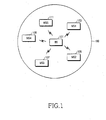
- FIG. 1 illustrates a configuration of a typical IEEE 802.16 communication system.
- the IEEE 802.16 communication system ensures a mobility of Subscriber Stations (SSs) and thus it is deployed in a multi-cell structure.
- SSs Subscriber Stations
- Such cells as illustrated in FIG. 1 are neighboring to one another in the IEEE 802.16 communication system.
- the communication system includes a Base Station (BS) 101 that covers a cell 100 and a plurality of Mobile Stations (MSs) 103, 105, 107, 109, and 111 (referred to as MS1 to MS5, respectively) that receive a communication service from the BS 101.
- Signaling can be carried out in Orthogonal Frequency Division Multiplexing (OFDM)/Orthogonal Frequency Division Multiple Access (OFDMA) between the BS 101 and MS1 to MS5.
- OFDM Orthogonal Frequency Division Multiplexing
- OFDMA Orthogonal Frequency Division Multiple Access
- data is transmitted in frames, each being divided into a MAP area with control information and resource allocation information, a DownLink (DL) burst area, and an UpLink (UL) burst area.
- the BS transmits the resource allocation information to the MSs by MAP messages, DL-MAP and UL-MAP.
- the BS transmits DL and UL resource allocation information by the DL-MAP and UL-MAP messages.
- the MSs detect control information and information about the locations of resources allocated to them by decoding the DL-MAP and UL-MAP messages.
- the MSs are capable of transmitting/receiving DL or UL data using the detected information.
- the MSs are placed in different channel statuses, i.e. different propagation environments due to obstacles or propagation interference between the BS and the MSs. Therefore, the BS adaptively selects a Modulation and Coding Scheme (MCS) level for each of the MSs, according to the channel status of the MS.
- MCS Modulation and Coding Scheme
- MCS levels are combinations of modulation and coding, and range from level 1 to level N according to the number of available MCSs.
- MCS levels are adaptively selected according to the channel statuses between the BS and the MSs. In case of a good channel status between the BS and an MS, the BS may select a high MCS level specifying 64-ary Quadrature Amplitude Modulation (64QAM) and a code rate 5/6 for the MS. In case of a poor channel status between the BS and the MS, the BS may select a low MCS level specifying Quadrature Phase Shift Keying (QPSK) and a code rate 1/12 for the MS.
- QPSK Quadrature Phase Shift Keying
- the BS 101 selects MCS levels based on channel status information received from MS1 103 and MS5 111 and transmits data encoded and modulated using the selected MCS levels to MS1 103 and MS5 111.
- MS1 103 and MS5 111 have different resource requirements according to their channel statuses.
- the BS 101 allocates required resources to them through MCS level selection. In general, the least resources are allocated to the MS in the best channel status and the most resources to the MS in the poorest channel status.
- MAP information including system information and resource allocation information is so significant that MSs must receive the MAP information. That's why the BS 101 transmits the MAP information using the most robust MCS level. For the same amount of information, a lower MCS level requires a larger amount of resources. That is, the MAP information requires the same or more resources in amount, compared to data transmitted to each MS. However, every MS may not need receive the MAP information because a certain MAP IE is destined for a particular MS or some MSs. Consequently, use of a large amount of radio resources for the MAP IE (Information Element) decreases radio resource utilization.
- US 2005/0117536 A1 discloses a wireless communication system, wherein a first level MAP message for transmitting a first level information and a second level MAP message for transmitting a second level resource location information is disclosed.
- a base station transmits the first level MAP message at the start of the frame.
- a mobile station reads said first level MAP message and determines a slot in which it is to receive the second level MAP message.
- An aspect of the present invention is to address at least the problems and/or disadvantages and to provide at least the advantages described below. Accordingly, an aspect of exemplary embodiments of the present invention is to provide a method for efficiently managing radio resources in a wireless mobile communication system.
- a method for transmitting common control information to an MS in a BS in a wireless mobile communication system in which the BS generates a MAP IE using common control information to be transmitted to the MS, the common control information being resource allocation information and control information, converts the MAP IE to a MAP IE message, applies an MCS level corresponding to the channel status of the MS, and transmits the MAP IE message with data to the MS.
- the present invention discloses a method for transmitting MAP information in the form of a message in a wireless mobile communication system.
- This message is a MAC (Medium Access Control) management message.
- Transmission of the MAP information in the form of the message requires fewer resources than transmission of the MAP information in a MAP area because the BS converts the MAP information to the message prior to transmission under the assumption that it already has knowledge of the channel status of the MS.
- the MAP information includes control information and resource allocation information and will be referred to as common control information hereinbelow.
- the present invention is applicable to any wireless mobile communication system using a DL-MAP IE and a UL-MAP IE.
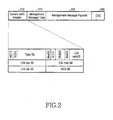
- FIG. 2 illustrates the format of a MAC management message in a wireless mobile communication system according to the present invention.
- a BS exchanges information with an MS through MAC management messages.
- the MAC management messages each include a 6-byte Generic MAC Header field 210, a 1-byte Management Message Type field 220, a variable-length Management Message Payload 230 field , and a 4-byte Cyclic Redundancy Check (CRC) field 240.
- CRC Cyclic Redundancy Check
- the Generic MAC Header field 210 is composed of a Header Type (HT) field, an Encryption Control (EC) field indicating whether data is encrypted, a Type field indicating whether a subheader exists, a CI (CRC Indicator) field indicating the presence or absence of the CRC field, an Encryption Key Sequence (EKS) field, a Length field indicating the total length of the MAC management message, a Connection IDentifier (CID) field, and a Header Check Sequence (HCS) field for use in checking link errors of the Generic MAC Header 210.
- HT Header Type
- EC Encryption Control
- Type field indicating whether a subheader exists
- CI CRC Indicator
- EKS Encryption Key Sequence
- Length field indicating the total length of the MAC management message
- CID Connection IDentifier
- HCS Header Check Sequence
- the Management Message Type field 220 contains an ID identifying the usage of a new DL-MAP IE/UL-MAP IE message proposed according to the present invention. These new DL-MAP IE and UL-MAP IE messages are defined in Table 3 below. Table 3 Type Message Name Message Description Connection TBD (To Be Determined) DL-MAP IE Message Downlink Access Definition Broadcasting or Basic CID TBD UL-MAP IE Message Uplink Access Definition Broadcasting or Basic CID
- the DL-MAP IE message and the UL-MAP IE message described in Table 3 are transmitted along with DL data in the present invention. If the DL-MAP IE message and the UL-MAP IE message are directed to one MS, they can be transmitted using a basic CID specific to the MS.
- Table 4 and Table 5 illustrate the formats of the DL-MAP IE message and the UL-MAP IE message, respectively.
- the length in bytes of the DL-MAP IE message is an integer. If the DL-MAP IE message does not have an integer number of bytes, some bits must be padded in the message and the MS must neglect the padding.
- the length in bytes of the UL-MAP IE message is an integer. If the UL-MAP IE message does not have an integer number of bytes, some bits must be padded in the message and the MS must neglect the padding.
- the BS When transmitting a particular UL burst IE in the UL-MAP IE message, the BS must notify the MS of the absolute position of the UL burst IE in a UL burst area. It is because the MS cannot receive every UL burst IE in a frame, which means that the MS cannot determine the accurate position of the UL burst IE.
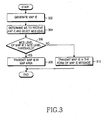
- FIG. 3 is a flowchart illustrating a MAP IE transmission operation in a BS according to the present invention.
- the BS generates a MAP IE in step 302.
- the MAP IE is a DL-MAP IE or a UL-MAP IE and can be directed to one or more MSs.
- the BS determines an MS to receive the MAP IE, selects an MCS level according to the channel status of the MS, and applies the MCS level to the MAP IE.
- step 306 the BS compares the MCS level of the MAP IE with a predetermined MCS level threshold. If the MCS level of the MAP IE is less than or equal to the MCS level threshold, the BS goes to step 308. If the MCS level of the MAP IE is greater than the MCS level threshold, the BS proceeds to step 310.
- step 308 the BS transmits the MAP IE in the MAP area to the MS.
- step 310 the BS converts the MAP IE to a message and transmits the message to the MS.
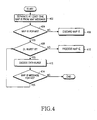
- FIG 4 is a flowchart illustrating a MAP IE reception operation in an MS according to the present invention.
- the MS separates at least one MAP IE from a MAP message received from the BS in step 402.
- the MAP message is a DL/UL-MAP message or a compressed MAP message with the DL-MAP message and the UL-MAP message in combination.
- the MAP message may contain at least one MAP IE.
- the MS determines whether it is supposed to receive and process the MAP IE by checking a CID included in the MAP IE. If the CID of the MS is present in the MAP IE, the MS receives and processes the MAP IE.
- the MS receives and processes the MAP IE. In this manner, the MS detects a MAP IE to receive and process referring to a CID in the MAP IE. Meanwhile, if the MS determines that it is not supposed to receive and process the MAP IE, it discards the MAP IE in step 406.
- step 408 the MS determines whether the MAP IE to receive and process is a DL burst IE associated with data burst allocation. If the MAP IE is a DL burst IE, the MS goes to step 412. If the MAP IE is not a DL burst IE, the MS processes the MAP IE in step 410. The MS decodes a data burst indicated by the DL burst IE in step 412 and determines whether the data burst includes a MAP IE message proposed by the present invention, i.e. a DL-MAP IE message or a UL-MAP IE message in step 414.
- a MAP IE message proposed by the present invention i.e. a DL-MAP IE message or a UL-MAP IE message in step 414.
- the MS checks the CID field of the Generic MAC Header 210 of the MAP IE message. For example, if a broadcasting CID or the ID of the MS is filled in the CID field, the MS processes the MAP IE message. In the presence of the MAP IE message for the MS, the MS returns to step 408 and otherwise, it ends the algorithm of the present invention.
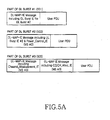
- FIGs. 5A and 5B illustrate exemplary data burst structures and MAP IEs according to the present invention.
- the BS selects a MAP IE from among a plurality of MAP IEs, for transmission along with a data burst, converts the MAP IE in the form of a message, and transmits the MAP IE message to the MS. Therefore, the same MCS level is applied to both the MAP IE message and the data burst.
- a first DL burst 501 (DL burst #1) is for MS 1 but includes a DL-MAP IE message with a DL burst IE for MS2.
- a second DL burst 503 (DL burst #2) is for MS2 and includes a DL-MAP IE message with an UL-Burst_IE and a Power_Control_ IE for MS2.
- a third DL burst 505 (DL burst #3) is for MS3.
- DL burst #3 505 includes a DL-MAP IE message with a Channel Measurement IE for MS3 and a UL-MAP IE message with a Channel Quality Information CHannel (CQICH)_Alloc_IE for MS3.
- CQICH Channel Quality Information CHannel
- FIG. 5B illustrates DL-MAP IEs and UL-MAP IEs.
- all IEs are transmitted in the MAP areas.
- a Channel Measurement IE 507 a DL burst IE for DL burst #1 509, a CID_Switch_IE 511, a DL burst IE for DL burst #2 513, a CQICH_Alloc_IE 515, a Power_Control_IE 517, a UL burst IE for UL burst #1 519, and a UL burst IE for UL burst #2 521 are included in MAP messages.
- some IEs 507, 513, 515, 517 and 521 are converted to MAC management messages and transmitted in data bursts, as illustrated in FIG. 5A . Therefore, radio resources are efficiently utilized.
- MSs decode a DL-MAP message and acquire allocation information about DL burst #1 501. It is assumed herein that DL burst #1 501 is directed to all MSs. Hence, MS2 decodes DL burst #1 501 and is aware that DL burst #1 501 includes a DL-MAP IE message for MS2. Thus, MS2 acquires information with which to decode DL burst #2 503 using the DL-MAP IE message.
- MS2 decodes DL burst #2 503 and recognizes that it includes a UL-MAP IE message with a Power_Control_IE 517. MS2 then processes the UL-MAP IE message so as to transmit a UL burst and changes uplink power as indicated by the Power_Control_IE 517.
- MS3 processes the DL-MAP message or a DL-MAP IE message included in a data burst.
- MS3 decodes DL burst #3 505 and is aware that the DL burst #3 505 includes a DL-MAP IE message with a Channel_Measurement_IE and a UL-MAP IE message with a CQICH_Alloc_IE.
- MS3 reports a channel measurement to the BS on a feedback channel indicated by the Channel_Measurement_IE.
- a BS converts MAP IEs to MAC IE messages and transmits them in data bursts, compared to conventional transmission of the MAP IEs in a MAP area. Therefore, while the lowest MCS level is applied to the MAP IEs in the conventional technology, the MAP IE messages are encoded and modulated using MCS levels that are selected according to the channel statuses of MSs. Consequently, radio resources are saved.
Landscapes
- Engineering & Computer Science (AREA)
- Computer Networks & Wireless Communication (AREA)
- Signal Processing (AREA)
- Quality & Reliability (AREA)
- Mobile Radio Communication Systems (AREA)
Claims (3)
- Procédé permettant de transmettre des informations communes de commande à une Station Mobile (103, 105, 107, 109, 111), MS, à partir d'une Station de Base (101), BS, dans un système d'accès sans fil à large bande, dans lequel une transmission est structurée en trames, lesdites trames étant divisées en une zone au protocole MAP et en une zone de paquets, le procédé comprenant :la génération (302) d'un Élément d'Information au protocole MAP, IE, en utilisant des informations communes de commande à transmettre à la station mobile MS, les informations communes de commande représentant des informations d'allocation de ressources et des informations de commande,la comparaison (306) d'un niveau de Principe de Modulation et de Codage, MCS, correspondant à l'état actuel du canal de la station mobile MS avec un seuil de niveau du principe MCS préréglé par le système,si le niveau actuel du principe MCS dépasse ledit seuil de niveau du principe MCS préréglé par le système,
la conversion (310) de l'élément d'information IE au protocole MAP en un message d'élément d'information IE au protocole MAP, et
la transmission du message d'élément d'information IE au protocole MAP à l'intérieur de la zone de paquets vers la station mobile, ce qui applique de ce fait un niveau du principe MCS correspondant au dit niveau actuel, etsi le niveau actuel du principe MCS ne dépasse pas ledit seuil de niveau du principe MCS préréglé par le système,
la transmission de l'élément d'information IE au protocole MAP à l'intérieur de la zone au protocole MAP. - Procédé selon la revendication 1, dans lequel le message d'élément d'information IE au protocole MAP inclut un identificateur de connexion de diffusion, CID, commun à une pluralité de stations mobiles MS.
- Procédé selon la revendication 1, dans lequel le message d'élément d'information IE au protocole MAP inclut un identificateur CID de base spécifique à la station mobile MS.
Applications Claiming Priority (1)
| Application Number | Priority Date | Filing Date | Title |
|---|---|---|---|
| KR1020060051920A KR101002800B1 (ko) | 2006-06-09 | 2006-06-09 | 무선 이동 통신 시스템에서 공통 제어 정보 송신 방법 |
Publications (2)
| Publication Number | Publication Date |
|---|---|
| EP1865645A1 EP1865645A1 (fr) | 2007-12-12 |
| EP1865645B1 true EP1865645B1 (fr) | 2010-01-20 |
Family
ID=38474168
Family Applications (1)
| Application Number | Title | Priority Date | Filing Date |
|---|---|---|---|
| EP07109975A Ceased EP1865645B1 (fr) | 2006-06-09 | 2007-06-11 | Procédé de transmission d'informations de contrôle commun dans un système de communication mobile sans fil |
Country Status (4)
| Country | Link |
|---|---|
| US (1) | US20070287449A1 (fr) |
| EP (1) | EP1865645B1 (fr) |
| KR (1) | KR101002800B1 (fr) |
| DE (1) | DE602007004380D1 (fr) |
Cited By (1)
| Publication number | Priority date | Publication date | Assignee | Title |
|---|---|---|---|---|
| US10959120B2 (en) | 2005-12-22 | 2021-03-23 | Qualcomm Incorporated | Methods and apparatus related to selecting control channel reporting formats |
Families Citing this family (17)
| Publication number | Priority date | Publication date | Assignee | Title |
|---|---|---|---|---|
| CA2583194C (fr) * | 2004-10-18 | 2014-05-27 | Lg Electronics Inc. | Procede de transmission d'information de retour sur systeme de communications mobiles a multiplexage par repartition orthogonale de la frequence (mrof)/acces mrof |
| WO2008130156A1 (fr) * | 2007-04-19 | 2008-10-30 | Lg Electronics Inc. | Méthode d'attribution de ressources basées sur le groupage, méthode de transmission de signaux l'utilisant et contrôleur d'attribution de ressources basées sur le groupage |
| KR101428502B1 (ko) * | 2008-01-04 | 2014-08-11 | 알까뗄 루슨트 | 접속을 식별하는 방법, 이동국 및 기지국 |
| KR101456004B1 (ko) * | 2008-02-05 | 2014-11-03 | 엘지전자 주식회사 | 전송 및 재전송에 적합한 데이터 패킷의 크기를 결정하는 방법 |
| CN101946427B (zh) * | 2008-02-17 | 2014-06-04 | Lg电子株式会社 | 利用帧进行通信的方法 |
| US8223857B2 (en) * | 2008-02-17 | 2012-07-17 | Lg Electronics Inc. | Method of communication using frame |
| US8195176B2 (en) | 2008-10-27 | 2012-06-05 | Lg Electronics Inc. | Method for informing user equipment of downlink control message construction information in cellular system |
| WO2010050723A2 (fr) * | 2008-10-27 | 2010-05-06 | Lg Electronics Inc. | Procédé pour transmettre des messages de commande en liaison descendante dans un système cellulaire |
| KR101276854B1 (ko) * | 2008-10-27 | 2013-06-18 | 엘지전자 주식회사 | 셀룰러 시스템에 있어서, 하향링크 제어 메시지 구성 정보 통지 방법 |
| WO2010062086A2 (fr) | 2008-11-27 | 2010-06-03 | 엘지전자주식회사 | Dispositif et procédé de transmission de données dans un système de communication sans fil |
| US9154273B2 (en) | 2008-12-22 | 2015-10-06 | Lg Electronics Inc. | Method and apparatus for data transmission using a data frame |
| US20100316007A1 (en) * | 2009-06-12 | 2010-12-16 | Samsung Electronics Co. Ltd. | Apparatus and method for supporting simultaneous transmission of plural broadcast management messages in a wireless communication system |
| US9320055B2 (en) | 2009-07-17 | 2016-04-19 | Lg Electronics Inc. | Method for efficiently transmitting broadcasting message in broadband wireless access system |
| US8780781B2 (en) * | 2009-08-28 | 2014-07-15 | Lg Electronics Inc. | Method and apparatus for receiving multicast and broadcast service in a broadband wireless communication system |
| US8478258B2 (en) * | 2010-03-05 | 2013-07-02 | Intel Corporation | Techniques to reduce false detection of control channel messages in a wireless network |
| CN102571261B (zh) * | 2010-12-30 | 2015-08-12 | 中兴通讯股份有限公司 | 一种空间流的mcs指示方法和装置 |
| CN107211322A (zh) * | 2015-01-19 | 2017-09-26 | 华为技术有限公司 | 一种公共消息的传输方法、系统、基站及用户设备 |
Family Cites Families (13)
| Publication number | Priority date | Publication date | Assignee | Title |
|---|---|---|---|---|
| JP2001325991A (ja) * | 2000-05-15 | 2001-11-22 | Nisshinbo Ind Inc | 電気部品及びその製造方法 |
| US7197022B2 (en) * | 2000-11-15 | 2007-03-27 | Wi-Lan, Inc. | Framing for an adaptive modulation communication system |
| WO2003003776A2 (fr) | 2001-06-27 | 2003-01-09 | Nortel Networks Limited | Mise en correspondance d'informations dans des systemes de radiocommunication |
| US6549759B2 (en) * | 2001-08-24 | 2003-04-15 | Ensemble Communications, Inc. | Asymmetric adaptive modulation in a wireless communication system |
| JP3629261B2 (ja) * | 2002-11-26 | 2005-03-16 | 松下電器産業株式会社 | 無線受信装置 |
| KR20050038977A (ko) * | 2003-10-23 | 2005-04-29 | 삼성전자주식회사 | 무선 통신 시스템에서 자원 할당 정보 송수신 시스템 및방법 |
| AU2004311362B9 (en) * | 2003-11-19 | 2008-10-09 | Samsung Electronics Co., Ltd. | Apparatus and method for transmitting and receiving common control information in a wireless communication system |
| KR100667178B1 (ko) * | 2003-12-02 | 2007-01-12 | 한국전자통신연구원 | 직교 주파수 분할 다중 접속 방식 시스템에서의 자원 할당및 억세스 방법 |
| KR100800887B1 (ko) * | 2004-05-07 | 2008-02-04 | 삼성전자주식회사 | 무선 통신 시스템에서 방송 서비스 데이터 송/수신 방법 및 시스템 |
| WO2006039812A1 (fr) * | 2004-10-15 | 2006-04-20 | Nortel Networks Limited | Systemes et procedes d'affectation de ressources de communication |
| KR20060060382A (ko) * | 2004-11-30 | 2006-06-05 | 삼성전자주식회사 | 직교 주파수 분할 다중 접속 방식을 사용하는 이동 통신시스템에서 채널 정보 송/수신을 위한 시스템 및 방법 |
| KR101080970B1 (ko) * | 2004-12-27 | 2011-11-09 | 엘지전자 주식회사 | 광대역 무선접속 시스템에 적용되는 디코드 정보 전송 방법 |
| CA2603988C (fr) * | 2005-04-09 | 2015-09-29 | Lg Electronics Inc. | Procede de prise en charge de codes multiples dans un systeme de communication mobile sans fil |
-
2006
- 2006-06-09 KR KR1020060051920A patent/KR101002800B1/ko not_active Expired - Fee Related
-
2007
- 2007-06-08 US US11/760,309 patent/US20070287449A1/en not_active Abandoned
- 2007-06-11 DE DE602007004380T patent/DE602007004380D1/de active Active
- 2007-06-11 EP EP07109975A patent/EP1865645B1/fr not_active Ceased
Cited By (1)
| Publication number | Priority date | Publication date | Assignee | Title |
|---|---|---|---|---|
| US10959120B2 (en) | 2005-12-22 | 2021-03-23 | Qualcomm Incorporated | Methods and apparatus related to selecting control channel reporting formats |
Also Published As
| Publication number | Publication date |
|---|---|
| KR101002800B1 (ko) | 2010-12-21 |
| US20070287449A1 (en) | 2007-12-13 |
| DE602007004380D1 (de) | 2010-03-11 |
| EP1865645A1 (fr) | 2007-12-12 |
| KR20070117812A (ko) | 2007-12-13 |
Similar Documents
| Publication | Publication Date | Title |
|---|---|---|
| EP1865645A1 (fr) | Procédé de transmission d'informations de contrôle commun dans un système de communication mobile sans fil | |
| EP1610522B1 (fr) | Procédé et système de génération d'un MAC-PDU comportant un champ de type indiquant si un ou deux champs sont utilisés pour un identificateur de connexion | |
| EP2109338B1 (fr) | Indication du décalage de trame des rafales de données type "Multicast Broadcast Service" dans un message MBS-MAP | |
| EP1969882B1 (fr) | Procédé de communication utilisant une station-relais dans un système de communication mobile | |
| US8611811B2 (en) | Method of performing ranging through relay station and supporting thereof | |
| CA2586911C (fr) | Procede et systeme permettant d'attribuer des rafales de donnees dans un systeme de communication sans fil | |
| JP4339361B2 (ja) | 周波数バンドに応じる適応変調符号化(BandAMC)を用いる広帯域無線接続システムにおけるデータ伝送方法及びシステム | |
| EP1764934B1 (fr) | Méthode de génération de trame dans un système de communication à accès multiple par division de fréquences orthogonales | |
| EP2012483B1 (fr) | Appareil et procédé de traitement d'informations de transmission de message de diffusion constitué par une station de relais (RS) dans un système de communication à accès sans fil de diffusion de relais à sauts multiples (BWA) | |
| CN101978630B (zh) | 接收装置、发送装置、接收方法以及发送方法 | |
| US8134944B2 (en) | Apparatus and method for configuring a relay frame control header in a multi-hop relay broadband wireless access communication system | |
| US8515437B2 (en) | Wireless resource allocation method, wireless mobile station and wireless base station in wireless communication system | |
| US8724580B2 (en) | Reduction of transmission overhead in a wireless communication system | |
| US20060209734A1 (en) | System and method for allocating and indicating ranging region in a broadband wireless access communication system | |
| CN102474734A (zh) | 用于转发器/中继器控制的方法和布置 | |
| KR20080035867A (ko) | 다중홉 릴레이 방식을 사용하는 광대역 무선접속시스템에서 제어정보 통신 장치 및 방법 | |
| KR20090012519A (ko) | 릴레이 스테이션을 포함하는 통신 시스템에서의 피드백채널 제어 방법 | |
| US9320055B2 (en) | Method for efficiently transmitting broadcasting message in broadband wireless access system | |
| WO2008066284A1 (fr) | Procédé d'informations d'allocation de ressources d'émission/réception dans un système de communication | |
| KR101336254B1 (ko) | 무선 이동통신 시스템에서 방송 채널의 커버리지 확대를위한 장치 및 방법 | |
| US20080219161A1 (en) | Method for generating burst in a communication system | |
| WO2009045080A2 (fr) | Procédé de génération de message map et appareil permettant d'améliorer la couverture map dans un système de communication sans fil | |
| KR20080103382A (ko) | 중계 방식의 광대역 무선통신 시스템에서 다양한 맵 구조를사용하기 위한 장치 및 방법 | |
| KR20080032825A (ko) | 광대역 무선접속 시스템에서 제어정보 통신 장치 및 방법 |
Legal Events
| Date | Code | Title | Description |
|---|---|---|---|
| PUAI | Public reference made under article 153(3) epc to a published international application that has entered the european phase |
Free format text: ORIGINAL CODE: 0009012 |
|
| 17P | Request for examination filed |
Effective date: 20070611 |
|
| AK | Designated contracting states |
Kind code of ref document: A1 Designated state(s): AT BE BG CH CY CZ DE DK EE ES FI FR GB GR HU IE IS IT LI LT LU LV MC MT NL PL PT RO SE SI SK TR |
|
| AX | Request for extension of the european patent |
Extension state: AL BA HR MK YU |
|
| 17Q | First examination report despatched |
Effective date: 20080214 |
|
| AKX | Designation fees paid |
Designated state(s): DE FR GB IT SE |
|
| GRAP | Despatch of communication of intention to grant a patent |
Free format text: ORIGINAL CODE: EPIDOSNIGR1 |
|
| GRAC | Information related to communication of intention to grant a patent modified |
Free format text: ORIGINAL CODE: EPIDOSCIGR1 |
|
| RIC1 | Information provided on ipc code assigned before grant |
Ipc: H04W 48/12 20090101ALI20090702BHEP Ipc: H04L 1/00 20060101AFI20090702BHEP |
|
| GRAS | Grant fee paid |
Free format text: ORIGINAL CODE: EPIDOSNIGR3 |
|
| GRAA | (expected) grant |
Free format text: ORIGINAL CODE: 0009210 |
|
| AK | Designated contracting states |
Kind code of ref document: B1 Designated state(s): DE FR GB IT SE |
|
| REG | Reference to a national code |
Ref country code: GB Ref legal event code: FG4D |
|
| REF | Corresponds to: |
Ref document number: 602007004380 Country of ref document: DE Date of ref document: 20100311 Kind code of ref document: P |
|
| PG25 | Lapsed in a contracting state [announced via postgrant information from national office to epo] |
Ref country code: SE Free format text: LAPSE BECAUSE OF FAILURE TO SUBMIT A TRANSLATION OF THE DESCRIPTION OR TO PAY THE FEE WITHIN THE PRESCRIBED TIME-LIMIT Effective date: 20100120 |
|
| PLBE | No opposition filed within time limit |
Free format text: ORIGINAL CODE: 0009261 |
|
| STAA | Information on the status of an ep patent application or granted ep patent |
Free format text: STATUS: NO OPPOSITION FILED WITHIN TIME LIMIT |
|
| 26N | No opposition filed |
Effective date: 20101021 |
|
| PG25 | Lapsed in a contracting state [announced via postgrant information from national office to epo] |
Ref country code: IT Free format text: LAPSE BECAUSE OF NON-PAYMENT OF DUE FEES Effective date: 20100611 |
|
| REG | Reference to a national code |
Ref country code: FR Ref legal event code: PLFP Year of fee payment: 10 |
|
| REG | Reference to a national code |
Ref country code: FR Ref legal event code: PLFP Year of fee payment: 11 |
|
| REG | Reference to a national code |
Ref country code: FR Ref legal event code: PLFP Year of fee payment: 12 |
|
| PGFP | Annual fee paid to national office [announced via postgrant information from national office to epo] |
Ref country code: IT Payment date: 20190614 Year of fee payment: 13 Ref country code: DE Payment date: 20190520 Year of fee payment: 13 |
|
| PGFP | Annual fee paid to national office [announced via postgrant information from national office to epo] |
Ref country code: FR Payment date: 20190522 Year of fee payment: 13 |
|
| PGFP | Annual fee paid to national office [announced via postgrant information from national office to epo] |
Ref country code: GB Payment date: 20190521 Year of fee payment: 13 |
|
| REG | Reference to a national code |
Ref country code: DE Ref legal event code: R119 Ref document number: 602007004380 Country of ref document: DE |
|
| GBPC | Gb: european patent ceased through non-payment of renewal fee |
Effective date: 20200611 |
|
| PG25 | Lapsed in a contracting state [announced via postgrant information from national office to epo] |
Ref country code: FR Free format text: LAPSE BECAUSE OF NON-PAYMENT OF DUE FEES Effective date: 20200630 Ref country code: GB Free format text: LAPSE BECAUSE OF NON-PAYMENT OF DUE FEES Effective date: 20200611 |
|
| PG25 | Lapsed in a contracting state [announced via postgrant information from national office to epo] |
Ref country code: DE Free format text: LAPSE BECAUSE OF NON-PAYMENT OF DUE FEES Effective date: 20210101 |
|
| PG25 | Lapsed in a contracting state [announced via postgrant information from national office to epo] |
Ref country code: IT Free format text: LAPSE BECAUSE OF NON-PAYMENT OF DUE FEES Effective date: 20200611 |