EP1865443A2 - Verfahren und Vorrichtung zum Erkennen von Gesichtsmerkmalen - Google Patents
Verfahren und Vorrichtung zum Erkennen von Gesichtsmerkmalen Download PDFInfo
- Publication number
- EP1865443A2 EP1865443A2 EP07011301A EP07011301A EP1865443A2 EP 1865443 A2 EP1865443 A2 EP 1865443A2 EP 07011301 A EP07011301 A EP 07011301A EP 07011301 A EP07011301 A EP 07011301A EP 1865443 A2 EP1865443 A2 EP 1865443A2
- Authority
- EP
- European Patent Office
- Prior art keywords
- pixels
- digital image
- face
- color
- facial feature
- Prior art date
- Legal status (The legal status is an assumption and is not a legal conclusion. Google has not performed a legal analysis and makes no representation as to the accuracy of the status listed.)
- Withdrawn
Links
Images




Classifications
-
- G—PHYSICS
- G06—COMPUTING OR CALCULATING; COUNTING
- G06V—IMAGE OR VIDEO RECOGNITION OR UNDERSTANDING
- G06V40/00—Recognition of biometric, human-related or animal-related patterns in image or video data
- G06V40/10—Human or animal bodies, e.g. vehicle occupants or pedestrians; Body parts, e.g. hands
- G06V40/16—Human faces, e.g. facial parts, sketches or expressions
- G06V40/161—Detection; Localisation; Normalisation
- G06V40/165—Detection; Localisation; Normalisation using facial parts and geometric relationships
Definitions
- the present invention relates to face recognition technology, and more particularly, but not exclusively, to a method and a device for facial feature detection.
- Face detection and facial feature detection have become popular areas of research in the field of computer vision and a basis for more complicated applications such as face recognition.
- Face recognition applications are just one example of applications that rely on face detection.
- other applications are also known. For example, in order to focus an image to be photographed, automatic and semi-automatic focusing cameras often focus on a portion of a scene. If the camera were able to locate faces in the scene, then the focus could be optimized for the faces, unless the photographer decides otherwise.
- An accurate detection of facial features may enable other beneficial applications and reduce the computational complexity of complex applications such as face recognition.
- face detection has been studied in relation to the subject of image understanding.
- face detection remains an area with high computational requirements, particularly if an accurate recognition of the face outline and facial features is needed.
- U.S. Patent No. 5,835,616, issued on November 11, 1998 discloses a two- step process for automatically identifying a human face in an electronically digitized image (for example, taken by a handheld, digital camera or a digital video-camera such as a camcorder), and for confirming the existence of the face in the image by examining facial features.
- Step 1 is, to detect the human face, enhances the digital image with a blurring filter and edge enhancer in order to better distinguish the unique facial features such as wrinkles and curvature of the facial image.
- preselected curves sometimes referred to as snakelets are superimposed on the image where they become aligned with the natural wrinkles and curves of the facial image.
- Step 2 to confirm the existence of a human face, is done in seven stages by finding facial features of the digital image encompassing the chin, sides of the face, virtual top of the face, eyes, mouth and nose. Ratios of the distances between these found facial features can be compared to previously stored reference ratios for facial recognition.
- this method is computationally expensive and demands a substantial amount of memory allocation.
- the face detection process since the size of the face (and the features therewithin) relative to the size of the digital image are not always known, the face detection process has to include repetitive search steps. The high number of iterations makes such a search computationally expensive.
- the search has to include steps of matching the potential face or potential facial features with different translational, rotational, and scaling parameters. The matching requires the allocation of even more memory.
- such a technique requires a database of faces and/or facial features for the searching. Maintaining this database on a mobile telephone, for example, requires substantial amount of memory allocation.
- One of the challenges in the field is to implement face detection methods in a computing unit with limited memory resources, and with limited computational abilities.
- a method that performs face detection and facial feature detection with low computational complexity is usually different from other face detection and recognition methods.
- the algorithms used, the limited memory and the character of the input digital image are different.
- a few methods that do not use complex databases and algorithms have been developed.
- the patent discloses a digital image processing method for detecting human figures in a digital color image.
- the first step of the disclosed method is providing a digital color image having pixels representing Red-Green-Blue (RGB) values.
- the second step is segmenting the image into nonoverlapping regions of homogeneous color or texture.
- the following step is detecting candidate regions of human skin color and detecting candidate regions of human faces.
- a human figure is constructed by grouping regions in the vicinity of the face region according to a predefined graphical model of a human figure, giving priority to human skin color regions.
- U.S. Patent No. 6,885,761 issued on April 26, 2005 discloses a portable device which is adapted to identify human faces.
- the device includes an image input section which picks up a two-dimensional image containing a person's face, using an image sensor.
- a face area extracting section extracts the image of the face of the person from the image.
- a feature detection section detects the position of characteristic feature(s) of the face of that person.
- a face outline determining section determines a border between a face outline and a background.
- An image processing section generates a person's portrait in which the characteristic feature(s) of the face is emphasized.
- Patent No. 6,885,761 and Patent No. 6,697,502 describe methods that can easily be used to detect human faces in a given digital image. However, the described methods cannot efficiency detect the facial features that include the detected face.
- Embodiments of the present invention provide a method and a device which can detect a facial feature even in an environment where memory is limited.
- embodiments of the present invention provide a method and a device which can detect a facial feature with limited memory and a small quantity of computations.
- a method for detecting a facial feature includes the steps of: a) receiving a digital image including a human face section, the digital image including a plurality of pixels, each one of the pixels including color information; b) using symmetry within the human face section to identify a centerline to substantially bisect a human face region within the human face section; and c) using the centerline as a locator to segment facial feature regions of the human face section.
- the color information represents hue level of a related field of view.
- the lateral borders of the human face section are determined according to the hue level of the pixels in each pixel column of the digital image.
- the upper and lower borders of the human face section are determined according to the hue level of the pixels in each pixel row of the digital image.
- step (b) a morphological map of the human face section according to the color information of the plurality of pixels is generated after the centerline is identified, and, in step (c), the morphological map is used.
- the color information includes Red-Green-Blue (RGB) color coordinates; the method further includes a step of (a1) converting the color information from RGB color coordinates to any of Hue-Saturation-Value (HSV) color coordinates, CIE L*a*b* (CIELAB) color coordinates, and YCbCr color coordinates after step (a); and step (b) is performed following step (a1).
- RGB Red-Green-Blue
- the method further includes a step of (a1) converting the color information from RGB color coordinates to any of Hue-Saturation-Value (HSV) color coordinates, CIE L*a*b* (CIELAB) color coordinates, and YCbCr color coordinates after step (a); and step (b) is performed following step (a1).
- HSV Hue-Saturation-Value
- CIELAB CIE L*a*b*
- YCbCr YCbCr color coordinates
- step (a1) includes a step of generating a new digital image by shifting a contrast filter to scan an overall region of the digital image while changing the level of the color information at a predetermined rate.
- step (b) includes the steps of: i) separately analyzing the color information of each column of pixels of the digital image; ii) separately analyzing the color information of each row of pixels of the digital image; and iii) identifying the human face section by using the outcome of step (i) and step (ii).
- the centerline is iteratively defined according to adopting one of a plurality of potential lines that most symmetrically divide the human face section.
- step (b) includes the steps of: defining, for each of the plurality of potential lines, a pair of corresponding frames which delimits a pair of areas of pixels from opposite side of a relevant potential line of the plurality of potential lines; comparing the two corresponding frames of each of the plurality of potential lines to determine a symmetry level value; and identifying the centerline by using the symmetry level value of each of the plurality of potential lines, wherein the steps of defining, comparing, and identifying are performed in order to adopt one of the plurality of potential lines.
- step (b) includes the steps of: i) segmenting a side template from a first side of the human face section; ii) generating a mirrored side template based on the side template; iii) matching the mirrored side template to at least one equally shaped area from another portion of the human face section; and iv) using the positioning of the side template and the mirrored side template to identify the centerline.
- the method further includes a step between step (b) and step (c) of (b1) generating a Gray Level Morphological Deep Map (GMDM) based on the human face section.
- GMDM Gray Level Morphological Deep Map
- the method further includes a step between step (b1) and step (c) of generating a Binary Morphological Deep Map (BMDM) based on the GMDM.
- BMDM Binary Morphological Deep Map
- step (c) the facial feature regions are segmented by using the GMDM.
- step (c) includes the steps of: i) separately analyzing the color information of each row of pixels of the human face section; ii) using the outcome of step (i) to identify a set of potential facial feature strips; iii) separately analyzing the color information of each column of pixels of the set of potential facial feature strips; and iv) using the outcome of step (iii) to identify at least one facial feature segment that delimits the area of a facial feature.
- a method for detecting a facial feature includes the steps of: a) receiving a digital image including a plurality of color pixels, each of the color pixels including color information; b) identifying a face segment including a face region based on the color information; c) using symmetry within the face segment to identify a centerline to substantially bisect a human face section within the face segment; and d) using the centerline as a locator to segment facial feature regions of the human face section.
- the color information represents hue level of a related field of view.
- the lateral borders of the face segment are determined based on the hue level of the color pixels of each pixel column of the digital image.
- the upper and lower borders of the face segment are determined based on the hue level of the color pixels of each pixel row of the digital image.
- a morphological map of the face segment is generated based on the color information of the plurality of color pixels, and is used in step (d).
- the color information includes Red-Green-Blue (RGB) color coordinates; the method further includes a step of (a1) converting the color information from RGB color coordinates to any of Hue-Saturation-Value (HSV) color coordinates, CIE L*a*b* (CIELAB) color coordinates, and YCbCr color coordinates after step (a); and step (b) is performed following step (a1).
- RGB Red-Green-Blue
- the method further includes a step of (a1) converting the color information from RGB color coordinates to any of Hue-Saturation-Value (HSV) color coordinates, CIE L*a*b* (CIELAB) color coordinates, and YCbCr color coordinates after step (a); and step (b) is performed following step (a1).
- HSV Hue-Saturation-Value
- CIELAB CIE L*a*b*
- YCbCr YCbCr color coordinates
- step (a1) includes a step of generating a new digital image by shifting a contrast filter to scan an overall region of the digital image while changing the level of the color information at a predetermined rate.
- the centerline is identified by correlating between the values of respective columns of pixels in each of the subimages.
- step (b) includes the steps of: i) separately analyzing the color information of each column of pixels of the digital image; ii) separately analyzing the color information of each row of pixels of the digital image; and iii) using the outcome of step (i) and step (ii) to identifying the face segment that delimits the face region.
- step (i) and step (ii) the outcome of the analyzing is smoothed using a Total Variation (TV) smoothing filter.
- TV Total Variation
- step (b) the overall region of the digital image is scanned, a cluster of the color pixels complying with a predefined rule is identified, and then the face segment is identified.
- the predefined rule corresponds to any of a statistical rule, a dynamic rule, a static rule, a deterministic rule, and an event driven rule.
- the predefined rule defines pixels within a given range brightness level as facial skin pixels.
- step (b) the centerline is iteratively defined by adopting one of a plurality of potential lines that most symmetrically divide the human face section.
- step (b) includes the steps of: defining, for each of the plurality of potential lines, a pair of corresponding frames which delimits a pair of areas of pixels from opposite side of a relevant potential line of the plurality of potential lines; comparing the two corresponding frames of each of the plurality of potential lines to determine a symmetry level value; and identifying the centerline by using the symmetry level value of each of the plurality of potential lines, wherein the steps of defining, comparing, and identifying are performed in order to adopt one of the plurality of potential lines.
- step (b) includes the steps of: i) segmenting a side template from a first side of the human face section; ii) generating a mirrored side template based on the side template; iii) matching the mirrored side template to at least one equally shaped area from another portion of the human face section; and iv) using the positioning of the side template and the mirrored side template to identify the centerline.
- the mirrored side template is matched to at least one equally shaped area by using a normalized-correlation process.
- the method further includes a step between step (c) and step (d) of (c1) generating a Gray Level Morphological Deep Map (GMDM) based on the face segment.
- GMDM Gray Level Morphological Deep Map
- the method further includes a step between step (c1) and step (d) of generating a Binary Morphological Deep Map (BMDM) based on the GMDM.
- BMDM Binary Morphological Deep Map
- step (d) the facial feature regions are segmented by using the GMDM.
- step (d) the facial feature regions are segmented by using the BMDM.
- step (d) includes the steps of: i) separately analyzing the color information of each row of pixels of the face segment; ii) using the outcome of step (i) to identify a set of potential facial feature strips; iii) separately analyzing the color information of each column of pixels of the set of potential facial feature strips; and iv) using the outcome of step (iii) to identify at least one facial feature segment that delimits the area of a facial feature.
- step (ii) is smoothed using a TV smoothing filter.
- step (iv) is smoothed using a TV smoothing filter.
- the color information is represented in gray level color space coordinates.
- a device for finding a human facial feature includes: an image input device having a connection to an image sensor, and for receiving a digital image having color information from the image sensor; a face detection module for identifying a candidate face region based on the color information; a face bisector module for identifying a centerline to substantially bisect a human face section within the candidate face region by using symmetry within the candidate face region; and a facial feature detection module for detecting at least one facial feature segment within the region of the human face section by using the centerline.
- the method further includes a facial feature output device for outputting at least one subimage defined according to a related the at least one facial feature segment.
- the image input device includes a color space converter module.
- the color space converter module converts the digital image represented in RGB color coordinates into a new digital image represented in HSV color coordinates.
- the color space converter module converts the digital image represented in RGB color coordinates into a new digital image represented in YCbCr color coordinates.
- the image sensor includes either a Complementary Metal Oxide Semiconductor (CMOS) sensor or a Charged Coupled Device (CCD) sensor.
- CMOS Complementary Metal Oxide Semiconductor
- CCD Charged Coupled Device
- the device further includes a morphological map module for generating at least one morphological map based on the digital image; and the facial feature detection module detects at least one facial feature segment within the region of the human face section by using the at least one morphological map.
- a morphological map module for generating at least one morphological map based on the digital image
- the facial feature detection module detects at least one facial feature segment within the region of the human face section by using the at least one morphological map.
- the morphological map corresponds to a Gray Level Morphological Deep Map (GMDM).
- GMDM Gray Level Morphological Deep Map
- the morphological map corresponds to a Binary Morphological Deep Map (BMDM).
- BMDM Binary Morphological Deep Map
- a method for detecting facial feature areas using morphological map includes the steps of: a) receiving a digital image having a human face section, the digital image including a plurality of color pixels, each of the color pixels including color information; b) generating a gray level image based on the plurality of color pixels; c) generating a Gray Level Morphological Deep Map (GMDM) based on the gray level digital image; and d) using the GMDM as a locator to segment facial feature regions of the human face section.
- GMDM Gray Level Morphological Deep Map
- the gray level image is based on the candidate face region.
- the method further includes a step between step (b) and step (c) of using symmetry within the candidate face region to identify a centerline to substantially bisect a human face section within the candidate face region; and, in step (d), the facial feature regions are segmented by using the centerline as a locator.
- Implementation of the method and system of the present invention involves performing or completing certain selected tasks or steps manually, automatically, or a combination thereof.
- several selected steps could be implemented by hardware or by software on any operating system of any firmware or a combination thereof.
- selected steps of the invention could be implemented as a chip or a circuit.
- selected steps of the invention could be implemented as a plurality of software instructions being executed by a computer using any suitable operating system.
- selected steps of the method and system of the invention could be described as being performed by a data processor, such as a computing platform for executing a plurality of instructions.
- the present embodiments include a device and a method for segmenting an image in order to identify the face and facial features and, more particularly but not exclusively, to a device and a method for segmenting an image of a face for detection of face and facial features using a vertical centerline, the method having linear computational complexity.
- the present invention is a method for facial feature detection.
- the method includes several steps.
- a digital image including a face is received.
- the digital image includes a plurality of color pixels, each pixel including color information.
- the boundaries of the face have to be detected.
- the section of the image that has the face is segmented as a face segment, based upon the color information of pixels of the digital image.
- the face segment includes an outline of the face.
- a centerline is applied to the face according to the symmetrical properties of the face. Then, using the centerline as a reference, the facial features within the face segment are detected.
- This method enables a relatively fast identification of facial features from a digital image of a human face.
- a human facial feature detection device in another embodiment of the present invention there is provided a human facial feature detection device.
- the device includes an image input device having a connection to an image sensor.
- the image input device receives a two-dimensional digital image containing a human face from the image sensor.
- the received digital image is used as the basis and the reference for image processing which is done by other modules of the human facial feature detection device.
- the device further includes a face detection module that detects a face segment within the boundaries of the digital image. The face segment delimits a human face.
- a face bisector module is used to identify a centerline that bisects the delimited face.
- Another module that includes the device is a facial feature detection module.
- the facial feature detection module detects facial feature segments which are delimited within the boundaries of the face segment.
- the device uses a facial feature output device to output a number of subimages. Each subimage is generated according to a respective facial feature segment.
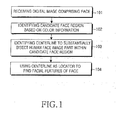
- FIG. 1 depicts a four-step process.
- the computing unit receives a digital image that depicts a human face.
- a digital image includes a plurality of color pixels, each pixel including color information.
- the face which is featured in the digital image is identified and a candidate face region that includes the part of the image that has the face is segmented based on color information which is represented by the color pixels.
- the color information represents the skin color of the face which is depicted in the image.
- the dynamic range of the skin color is quite narrow, thus enabling the differentiation of the face from other objects in the image.
- the face segment includes an outline of the human face.
- a centerline within the boundaries of the outline of the face is identified.
- the centerline bisects the human face into two approximately symmetric half-face sides.
- the centerline is used as a reference to detect facial features which are present within the boundaries of the face segment. Namely, the centerline is used as a locator.
- the computing unit receives a digital image that depicts a human face.
- the digital image includes a plurality of color pixels, each pixel including color information.
- Each pixel holds data bits that represent local brightness and color within the digital image, and the particular image may use any one of a number of different types of color coordinates.
- the image sensor which is used to capture such images typically outputs a digital image in Red-Blue-Green (RGB) color coordinates or other color space coordinates.
- RGB color coordinates of each pixel can disclose important information about the objects which are depicted in the digital image.
- other color coordinates schemes may be used.
- the method includes a step of converting the RGB color coordinates of the digital image to Hue-Saturation-Value (HSV) color coordinates.
- HSV Hue-Saturation-Value
- the image sensor which is used to capture such images may output a digital image in a variety of color coordinates.
- the method may preferably include a step of converting the color space coordinates of the digital image to HSV color coordinates.
- the HSV color coordinates defines a color space in terms of three constituent components.
- the Hue component defines the color type between the values of 0 and 360. The values may be normalized between 0 and 1.
- the Saturation component defines the purity of the related hue component of the color between 0 and 1, thus representing the purity of the color. The lower the saturation level of a certain pixel, the grayer is the color type.
- the Value component defines the intensity of the brightness of the color between 0 and 1. Each one of the values, which may be represented in the range between 0 and 1, is correlated with the aforementioned values.
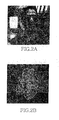
- FIG. 2a is a digital image picked up by an image sensor which is received in step 101 of FIG. 1. This digital image is used in a method for facial feature detection in accordance with the present invention.
- the digital image is filtered to remove noise, e.g., salt and pepper noise.
- noise e.g., salt and pepper noise.
- the salt and pepper noise can be reduced using filters n*m order filters.
- Minimum filters, Maximum filters or Median filters may be used to reduce the salt and pepper noise.
- Using a median filter for reducing the salt and paper noise may require significant amount of computational resources.
- Using a number of minimal or maximal order filters for the same purpose requires a smaller amount of computational resources. Therefore preferably, an erosion-dilation process using two different order filters is performed in order to reduce the noise. Initially, a first order filter, which is a minimum filter, is used for eroding objects on the digital image. Then a second order filter, which is a maximum filter, is used for dilating objects on the digital image. This two step process achieves an effect of removing salt and pepper noise.
- the process is computationally cheaper and achieves the effect of removing salt noise which is in fact the noise dominantly affecting the image quality of the hue image (dark parts are sought). Reducing the salt and pepper noise substantially improves the processing of the gray level digital image, which is generated during the following steps.
- step 102 the boundaries of the candidate face region are identified and the part of the image that includes the human face is segmented.
- Such segmentation reduces the number of pixels which have to be analyzed in order to identify the requested facial features.
- the contrast between the face area and the rest of the image is sharpened.
- the HSV color space may be very helpful for identifying the area of the digital image where the face is found.
- the hue segmentation of a face segment is based on color information of the color pixels.
- the hue distribution of human skin is in a certain range. This characteristic is reflected as the common hue level of most of the color pixels which represent human skin. Additionally or alternatively the common hue level may be used to detect a cluster of color pixels which represent the skin of the face of the digitally-imaged person in the digital image.
- the saturation level of each pixel may be used in addition to the hue level in order to augment the determination of whether the pixel represents human skin.
- the RGB color space is converted to YCbCr color space.
- the YCbCr color space can also be used to identify pixels which are estimated as representing human skin based on the Cb and Cr components of skin.
- the gray levels of the digital image are inverted and are contrast corrected. This procedure intensifies the contrast between the pixels that represent human skin and pixels that represent the rest of the digital image. Now, the gray levels of pixels representing skin are relatively bright (high).
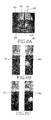
- FIG. 2b is a processed result of the digital image of FIG. 2a.
- the processed image is based on the hue level of the digital image after it has been inverted and its contrast has been corrected, for example by using gamma correction.
- the hue level of human skin is relatively dark. Hence, after the aforementioned inversion it is relatively bright. Hence, emphasizing the contrast between bright pixels to dark pixels may assist the face detection process. Preferably, the contrast between dark pixels and bright pixels is strengthened by a contrast correction process.
- the value of gamma is 4, This correction is extremely effective when gamma is greater than 1 because after the gray level inversion the value of the face pixels get closer to the maximum.
- the high values of the face pixels can be used for choosing such a contrast correction scheme. Since the digital image has been gamma corrected and the contrast between the bright pixels and the dark pixels has been strengthened, it is easier to differentiate between the face area and the rest of the image.
- the received digital image is a bitmapped image.
- the rows and the columns are used to create a one-dimensional projection profile. The complexity of analyzing this profile is substantially lower than the computational complexity of two-dimensional analysis. The profile can be analyzed in linear computational time and will, therefore, substantially reduce the computational complexity of two dimensional analysis.
- FIGs. 3a and 3b depict comparative graphs.
- the graphs depict a one-dimensional projection of the hue level values on the X axis and on the Y axis, respectively.
- the hue level value of pixels that represent the face area is estimated to be in a predefined skin hue range.
- the mean value of pixels in each digital image column or row that includes face area pixels is usually closer to the skin hue range than any other column or row.
- the method By processing the one-dimensional projection on the X axis of each column of the digital image, the method reveals the columns which have a high number of face hue pixels that represent, inter alia, skin color. As described above, since the hue level of face pixels is higher than the hue level of other pixels, the sum of rows that include face pixels is higher. In the same manner, by separately processing a one-dimensional projection on the Y axis of each one of the rows, the method reveals the rows with a high number of face area pixels. Since human faces are usually long relative to their width, projecting on the X axis, that is to say, a summation of the value of pixels in each column produces more facial data than projecting on the Y axis. Hence, preferably, the projection on the X axis is done first.
- the hue level of pixels of each column of pixels is summed separately. Since the brightness level of the facial skin is relativity high, the sum of each column which includes pixels that represent a human face is respectively high.
- a threshold filter is configured to define if a certain pixel is a face area pixel.
- the threshold filter is shifted to separately scan each column and to count how many pixels are face pixels. A cluster of columns with a many number of face pixels is clearly apparent as a candidate face interval.
- FIG. 3a depicts the outcome of a one-dimensional projection on the X axis based on a digital image which has been pixelated to include 240 columns and 214 rows of pixels.
- the values of pixels of the columns with X coordinates between 70 and 170 have been summed up and have been determined to represent the horizontal placement of the face area in the digital image.
- a sum greater than 70 implies that the columns represent the face area in the digital image.
- Individual thresholds for the domain to the right of the peak in the x projection and the right of the maximum have been dynamically determined. The thresholds are determined by being the first inflection or local-minimum point in each direction below a given percentage of the maximal value of the projection curve.
- both thresholds are above 70 and are marked with an X in FIG. 3a.
- Such a dynamic threshold-finding process promises efficient segmentation under varying illumination and observation conditions.
- the individual left and right dynamic thresholds the left and right boundaries 205 and 206 of the face segment are determined.
- each row is projected to generate a one-dimensional projection on the Y axis in a similar manner, as described above.
- the left and right boundaries of the face segment are already known, there is no reason to reassess some of the image areas which already have been identified as unrelated to the candidate face region.
- FIG. 3b depicts the outcome of a one-dimensional projection on the Y axis based on the same digital image as above.
- the one-dimensional projection on the Y axis resembles the one-dimensional projection on the X axis.
- there are a few differences For example, since faces are longer than they are wide, fewer face pixels are estimated to be in each row that includes pixels from the face area.
- pixels have been cut out from both sides of the rows during the one-dimensional projection on the X axis. Therefore, each analyzed row has fewer pixels than the rows of the original image.
- the upper and lower boundaries 207 and 208 of the face segment are determined.
- the upper and lower boundaries 207 and 208 of the face segment are determined.
- the face segment 301 made up of the rectangle to which each of the boundaries determined in FIG. 3 is applied, can be checked.
- the one-dimensional projection of each one of the columns has produced the left and right boundaries 310, and the one-dimensional projection of each of the rows has produced the upper and lower boundaries 311.
- FIGs. 4a and 4b depict the outcome of the same one-dimensional projections of the hue level values on the X axis and on the Y axis as in FIGs. 3a and 3b, respectively.
- the outcomes of the one-dimensional projection have been smoothed using a Total Variation (TV) smoothing process. It is these smoothed graphs 4A and 4B which are used in determining the left and right thresholds and boundaries for the x and y projections. The method of determining these thresholds have been described above in relation to FIGs. 3a and 3b.
- the one-dimensional projection may generate an irregular graph that might reduce the accuracy of the boundary identification.
- the outcome of the one-dimensional projection process on both the X axis and the Y axis may be smoothed, preferably, by a TV smoothing process.
- ⁇ denotes the balance between smoothing and interpolation
- D denotes a one dimensional derivative operator
- k is the number of derivatives taken.
- the algorithm outputs a set of smoothed values, zi.
- the value of k is 2 so that ⁇ is essentially balancing out minimal curvature with interpolation.
- the value of ⁇ is 500.
- the output z set plots a smoothed graph that highlights the tendency of the graph and facilitates a better processing of the projection curves.
- the face segment is identified by applying a predefined function to each pixel of the digital image. Such a function may be included in a statistical, a static, a dynamic or any other condition regarding the hue level of each pixel. Such a function may be used to perform a connected component analysis that identifies clusters of pixels that correspond with the functions. The biggest elliptic cluster is segmented as the estimated face area.
- a process is an example of an image binarization process. Though an image binarization process may identify more accurately the candidate face region, the computational complexity of the image binarization process is higher than the computational complexity of the projection process which has been described above.
- step 103 may be performed.
- a centerline that bisects the human face which is delimited within the boundaries of the face segment is identified.
- human faces are generally symmetric.
- the left side of a human face is approximately a mirror image of the right side of the same face. If a vertical line of symmetry is drawn through the center of the face, the left side of the face is almost identical to the right side.
- the fact that human faces are symmetric can be used in order to identify a centerline, and the centerline can then be used as a reference to identify the exact location of facial features within the boundaries of the face segment.
- a face segment has been identified.
- the face segment is searched to determine a centerline that bisects the face into two approximately symmetric sides.
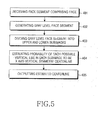
- the first step in finding a centerline is receiving a face segment and then, at step 402, generating a gray level image based upon the face segment.
- the gray level image is generated using standard coefficients on the red, green, and blue color layers of the original face segment in order to generate a gray level face segment based on the original face segment. Since the gray level of each pixel of the face segment can be represented using one byte (0 - 255), the computational complexity of analyzing such a segment is lower than that of analyzing segments which are represented in RGB, HSV, CIELAB, or YCbCr color coordinates.
- the gray level face segment is divided into several, preferably two, subimages.
- the human face includes facial features which can be bisected into two symmetric parts.
- the eye for example, can be bisected. Teeth or noses may also be bisected into two approximately symmetric sides.
- the face segment is divided into different subimages.
- Each one of the subimages potentially includes different facial features.
- the division of grey level face segment into subimages is enabled by gauging the difference between the symmetry levels of different segments along the column of pixels. By separately analyzing each subimage, the robustness of the centerline identification process increases.
- the gray level face segment may be bisected into one subimage that includes the upper half of the gray level face segment and another subimage that includes the lower half of the gray level face segment.
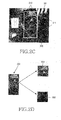
- FIGs. 2c and 2d illustrate a digital image 300 with a face segment 301, an exemplary gray level face segment 303, and related subimages 302 and 304.
- the gray level face segment 303 has been generated according to the face segment 301 of the digital image 300.
- the gray level face segment 303 has been bisected into an upper subimage 304 and a lower subimage 302.
- each subimage is analyzed.
- the analysis, in step 404, is used to estimate the probability of each possible vertical line in each subimage being part of an X axis vertical symmetry centerline.
- FIGs. 6a, 6b, and 6c which illustrate an exemplary subimage at various steps of the centerline detection process
- a description of the centerline detection process is made as follows.
- the first step of the centerline detection process is to define the boundaries of the region in which the vertical symmetry centerline is looked for.
- the analysis is based on a subimage of the gray level face segment.
- the process of identifying a vertical symmetry centerline is based on predefined regions from opposite sides of the probed potential vertical symmetry centerline. Accordingly, a sufficient space to contain the predefined regions has to be presented from both sides of the probed potential vertical symmetry centerline. Accordingly, columns which are positioned on the left and the right edges of gray level face segments cannot be probed as a potential vertical symmetry centerline since the predefined regions cannot be formed beyond the boundaries of the gray level face segment. Hence, columns from the left and right ends of the face segment are not probed as a potential vertical symmetry centerline.
- each subimage is divided into two equal sections. As illustrated in FIG. 6a, each section extends along a certain percentage, preferably around 25 percent, of the height of the subimage to the width thereof. With reference to FIG. 6, in such an embodiment the section 600 which is located in the proximity of the left edge of the face segment and the section 607 which is located in the proximity of the right edge of the face segment are not probed as a potential vertical symmetry centerline.
- each remaining column of pixels within the face segment is probed as a potential centerline.
- the centerline is supposed to symmetrically bisect the face into two symmetric sides. Hence, sections from parallel positions of the face should include symmetric factors.
- a column of pixels 603 is chosen as a potential centerline.
- a virtual window 601 is, preferably, defined in between an arbitrary column 603 of pixels and a line 604 which is located around one quarter of the subimage length in one direction from the arbitrary column 603 of pixels.
- Another virtual window 602 is, preferably, defined in between the arbitrary column 603 of pixels and a line 605 which is located around one quarter of the subimage length in the other direction with the arbitrary column 603 of pixels as reference.
- the pixels included in the virtual windows are compared.
- the rows of pixels of one of the virtual windows are horizontally mirrored.
- the rows of pixels of the right virtual window 602 are horizontally mirrored to produce virtual window 606.
- the horizontally mirrored rows of virtual window 606 are compared with corresponding rows of the left virtual window 601.
- a normalized correlation value between the horizontally mirrored rows and the rows of the left virtual window 601 is calculated.
- the normalized correlation value reflects the level of symmetry between the two virtual windows.
- the normalized correlation value may lie between -1 and 1. If negative correlation values are set to zero, then this level can reflect the likelihood that the arbitrary column 603 of pixels is the vertical symmetric centerline.
- the calculation of a normalized correlation value is generally well known and therefore is not described here in greater detail.
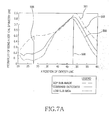
- a comparative graph illustrated in FIG. 7a shows the outcome of the calculation of the normalized correlation value of columns of pixels along the X axis of the face segment as described above.
- the X axis of the graph denotes the X position of the analyzed column of pixels.
- the Y axis of the graph denotes the outcome of the calculation of the normalized correlation value, i.e., the probability that the related column of pixels will be a vertical symmetry centerline.
- FIG. 7b illustrates an example of face segment which has been used to generate the graph which is depicted in FIG. 7a.
- a comparative graph of FIG. 7a indicates the analysis of different columns of pixels in a face segment which has been divided into an upper subimage and a lower subimage.
- a first curve 501 denotes the normalized correlation value of each of columns of pixels in the upper subimage.
- a second curve 503 denotes the normalized correlation value of each of columns of pixels in the lower subimage.
- the normalized correlation value denotes the probability of each column of pixels to be the vertical symmetry centerline of a certain image.
- the normalized correlation values corresponding to columns of pixels of different subimages of the same gray level face segment should be analyzed together.
- the normalized correlation values at respective columns of pixels (x values) are used to generate a curve of normalized correlation values which spans along the length of the gray level face segment.
- a combined normalized correlation value curve 502 denotes a function of the normalized correlation values of the upper subimage and the lower subimage.
- the function represents an intersection of the normalized correlation values.
- the subimage curves 501 and 503 are correlated.
- the difference is even clearer when probing the combined normalized correlation value curve 502.
- a virtual vertical symmetry centerline passes through the coordinates of the curvature peak.
- Such a vertical symmetry centerline approximately bisects the nose and the mouth, and divides the space between the eyes approximately in half. The positioning of the centerline in relation to the facial features may be used, during the subsequent step, in finding the facial features.
- a vertical symmetry centerline is chosen, as shown in a solid line 508 of FIG. 7b.
- the identified vertical symmetry centerline is output as a centerline, as in step 405 in FIG. 5.
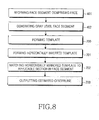
- FIG. 8 illustrates another process for identifying a centerline of a human face within the boundaries of a face segment, according to another preferred embodiment of the present invention.
- step 401 of receiving a face segment and step 402 of generating a gray level face segment based on the original face segment are identical to the first steps of the process which is depicted in FIG. 5.
- the present embodiment further includes steps 700 to 703 that depict a process of identifying a general symmetric symmetry axis using templates.
- a left side of a human face is approximately symmetric to a mirror image of the right side of the same face.
- a template is used at some stage in the process, as described below, as a reference to horizontally mirrored template.
- a template is chosen on one side of the gray level face segment.
- the template is used to generate a parallel horizontally mirrored template which is matched with a section of the other side of the face.
- the face may be positioned at a different angle.
- the angle of the face has an influence on the position of the symmetry line that bisects the face which is delimited in the gray level face segment.
- the chosen template includes only a limited section, the parallel horizontally mirrored template may not be matched.
- the chosen template encircles a relatively large section, the computational complexity of the matching process is respectively increased and the matching accuracy is diminished.
- the template has to be shorter than the height of the gray level face segment to allow for potential rotation of the face and narrower than the width of one side of the gray level face segment.
- a template is preferably chosen as an original template in consideration of the above mentioned limitations.
- the original template a template which is almost as long as the gray level face segment, and is about one third as wide as the image is chosen.
- the difference between the length of the template and the height of the original image determines the amount which can be searched above and below and determines the maximum rotation that one can allow in the algorithm. Namely, the extent of the rotation that you can calculate can be determined by the size, i.e. the length and height, of the template.
- the template is taken from the left side of the gray level face segment.
- the template is stretched from the tenth column of pixels of the left end of the gray level segment to a vertical line of a position corresponding to one third of the gray level face segment's width with the left end as reference. Not all the rows are covered by the template.
- the coverage of rows of pixels is inferred from the size of the gray level face segment.
- the width of the upper and lower margins of the gray level face segment which are not covered by the template can be a derivative of the gray level face segment length.
- the template covers only rows of pixels from the 40th row of pixels with the top of the gray level face segment as reference to the 50th row of pixels with the bottom of the gray level face segment as reference.
- a horizontally mirrored template is generated.
- the horizontally mirrored template is compared with different respective sections of the gray level face segment in order to find a matching section. A normalized correlation value between the horizontally mirrored rows of the original template and the rows of the compared section is calculated.
- the calculated value may be interpreted as the level of symmetry between the two sections.
- the normalized correlation value is between '-1' and '1.' Clearly, this level represents the extent that the compared section is symmetric to the original template as compared with the original template.
- a section which is symmetric to the original template is chosen as a mirrored template. Additionally, one may choose several templates whose joint normalized correlation maps may more accurately identify the symmetric match, and can use the chosen templates.
- Both the original template and the horizontally mirrored template include center points that represent the centers of the templates. These center points are used to identify a general symmetric axis that approximately bisects the face which is bounded within the face segment.
- a general symmetry axis is plotted as a perpendicular bisector of the line between the two center points.
- an estimated centerline is outputted.
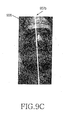
- FIGs. 9a, 9b, and 9c illustrate a gray level face segment 906 with a template 900 and a corresponding matching section 901, a template 900 and a related corresponding horizontally mirrored template 905, and a gray level face segment 906 with an estimated centerline 907, respectively.
- the two center points i.e. a first and a second center points 902 and 903 respectively included in the template 900 and the matching section 901 are used to define a dotted line 908.
- An identified general symmetric symmetry axis 907A is defined as the perpendicular bisector of the dotted line 908 which is plotted in the middle of the line which is stretched between the two center points 902 and 903. As shown in FIG. 9c, the general symmetry axis 907A is used as a basis for an estimated centerline 907B. As shown, the estimated centerline 907B is approximately parallel to the angle of the face which is delimited within the gray level face segment.
- the vertical symmetry centerline bisects the portion of the face which is delimited in the gray level face segment. Accordingly, the gray level face segment is divided by the vertical symmetry centerline into two side images.
- the side images may be unequal. Since each side image includes one side of the bisected face, it is clear that the width of the narrower side is sufficient for either side of the bisected face.
- the gray level face segment is slimmed down. During the slimming process, both side images of the gray level face segment are slimmed to have the same width, such that the width of each side image is equal to the width of the narrower side of the bisected face.
- the slimmer the face segment is according to the slimming process, the faster gray level face segment that can be analyzed.
- step 104 wherein it is shown that, after the centerline has been identified, it is used to segment facial features.
- the first step of the facial feature segmentation is to generate a Gray Level Morphological Deep Map (GMDM) and a Binary Morphological Deep Map (BMDM) based on the gray level face segment.
- GMDM Gray Level Morphological Deep Map
- BMDM Binary Morphological Deep Map
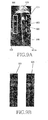
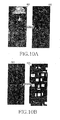
- FIGs. 10a and 10b are versions of the same gray level face segment of a digital image.
- FIG. 10a exemplifies the conversion of the gray level face segment to a GMDM
- FIG. 10b exemplifies the conversion of the gray level morphological deep map to a BMDM.
- morphological erosion is performed twice, each with square structuring elements of different sizes.
- the first erosion uses a relatively small structuring element which is used to darken pixels according to their immediate surroundings.
- the second erosion uses a structuring element which is larger and which is used to darken pixels according to a wider area.
- the smaller structuring element is first used in order to generate a first temporary morphological map.
- Each pixel of the first temporary morphological map represents a corresponding pixel in the gray level face segment which has been changed according to the brightness of a set of pixels which has been positioned within the region defined by the smaller structuring element during the eroding.
- the larger structuring element is then used in order to generate a second temporary morphological map.
- Each pixel of the second temporary morphological map represents a corresponding pixel in the gray level face segment which has been changed according to the brightness of a set of pixels which has been positioned within the region defined by the larger structuring element during the eroding.
- the value of each pixel of the first temporary morphological map is decreased by the value of a corresponding pixel in the second temporary morphological map.
- the outcome of each decrement is stored in a corresponding pixel of the GMDM.
- the eye and mouth pixels of the gray level face segment 801 are represented as large clusters of dark pixels in the output of GMDM 802.
- each one of the temporary morphological maps is based on the same picture. Accordingly, the value of the pixels that have the minimum values in the first temporary morphological map must be equal to the value of respective pixels in the second temporary morphological map. Moreover, as described above, each pixel of the GMDM 802 represents the difference between the corresponding pixels in the temporary morphological maps. Therefore, the value of the pixels in the GMDM that correspond to pixels in the temporary morphological map that have minimum values is equal to zero.
- regions that include a collection of pixels having zero value have a high probability of including such facial features.
- the GMDM 802 can be easily binarized.
- the BMDM generation process transforms the GMDM 802 to a BMDM 803.
- the BMDM 803 includes only emphasized clusters of pixels that indicate the position of the darkest and the deepest clusters of pixels of the Gray Level Face Segment 801.
- the eyes and the mouth may be detected.
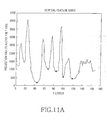
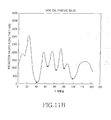
- FIGs. 11a and 11b show the comparative graphs.
- FIG. 11a depicts a one-dimensional projection of the pixel values on the Y axis.
- FIG. 11b depicts a one-dimensional projection of the pixel values on the Y axis which has been smoothed, using a TV smoothing process.
- the GMDM is searched for facial features.
- Each row of pixels of the GMDM is separately summed. Since the pixels that represent the eyes and the mouth are the darkest and deepest pixels of the GMDM, the values of the summed rows that include the eyes and mouth pixels should be lower than the values of other GMDM rows.
- FIG. 11a depicts the output of a one-dimensional projection of the pixel values on the Y axis.
- Each asterisk represents a row with substantially low pixel gray level values, a potential feature sink.
- the rows which are positioned in the vicinity of the asterisks lie along bottom portions of the curve. These portions of the curve represent a series of potential facial features.
- the rows with substantially low pixel gray level values, the sinks are stored in a potential facial feature array.
- a TV smoothing process is performed in order to smooth the outcome, and the smoothed version of the graph is as in FIG. 11b.
- the TV smoothing filter is used, and preferably, the ⁇ value is equal to '50'.
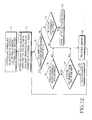
- FIG. 12 illustrates an eye strip detection process.
- a potential facial feature array that includes the outcome of the one-dimensional projection on the Y axis of the gray level face segment, is generated.
- an eye level function (a function which takes values and puts them into a certain order) is used to sort members of the potential facial feature array in ascending order, according to the one-dimensional projection values (vertical feature sinks) of the array members.
- the low values respectively corresponding to columns 44, 67, 86, 104 and 123 of the graph in FIG. 11a are stored in an array in the following order: 44, 123, 86, 104, and 67.
- the member of the ordered array is analyzed in order to determine if each row is part of the eye strip. During the analysis, a potential eye strip is defined.
- a predetermined equal number of rows from both the upper and the lower surrounding areas of the analyzed row includes the potential eye strip.
- the columns of the potential eye strip are separately summed to generate a one-dimensional projection (vertical feature sink) on the X axis of the potential eye strip.
- the one-dimensional projection (vertical feature sink) on the X axis of the potential eye strip is analyzed through an eye match function.
- the eye match function matches the one-dimensional projection (vertical feature sink) on the X axis of the potential eye strip with predefined characteristics of a typical area containing a pair of eyes and a bridge of the nose.
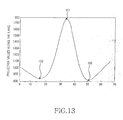
- a predefined characteristic of the eye match function is a pattern of a peak positioned in between two shallow bottoms in a graph illustrated in FIG. 13.
- the eye match function assesses the proximity of the peak and the two shallow bottoms in the graph to the center symmetry centerline which has been previously identified to determine that the positions of the eyes and nose correspond with the centerline.
- FIG. 13 shows a typical outcome of one-dimensional projection on the X axis of a typical eye strip.
- the eyes are represented as two bottoms 150 in the graph.
- the bridge of the nose area is represented as a peak 151 in the graph which is positioned in between the two bottoms 150 that represent the eyes.
- step 176 if the match between the potential eye strip and the predefined characteristics has failed, and if there are other members of the array which have not yet been matched after members of the array are checked in step 176, then the next member of the array is matched according to the above order by using the eye match function. This process is repeatedly performed until matched members of the array are detected.
- each member of the array of potential facial features includes a one-dimensional projection of rows of pixels.
- the member of the potential array of feature sink that represents the eye strip cannot be the last member of the potential array of feature sink or would include no member corresponding to the mouth.
- the position of the potential eye strip is taken into consideration, such that members which are not positioned in the expected position of the eyes are disregarded.
- step 178 If none of the potential eye strips which have been identified, as described above, matches the predefined characteristics, the whole process fails, as in step 178. However, if a matched eye strip has been found, as in step 175, other facial features are still to be identified.
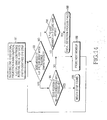
- FIG. 14 illustrates the mouth strip detection process according to a preferred embodiment of the present invention. Since the nose and the mouth are located below the eyes, the original ordering of the potential facial feature sink array may be used to estimate their position (step 181).
- the row members of the potential array of feature sink which are located below the eye strip, are analyzed to identify the mouth.
- the analysis is done using a mouth match function.
- the mouth match function marks the mouth strip.
- the mouth strip is defined as a batch of rows including a predetermined equal number of rows from both the upper and the lower surrounding area of the analyzed row member of the potential array of feature sink.
- the columns of the mouth strip are separately summed to create a one-dimensional projection of the potential mouth strip on the X axis.
- FIG. 15 depicts a typical one-dimensional projection of a mouth strip.
- the mouth match function matches the one-dimensional projection of the potential mouth strip with predefined characteristics of a mouth.
- a mild peak in the graph with a sunken bottom in its apex can be presented.
- the mild peak in the graph is positioned in between two shallow bottoms, as depicted in FIG. 15.
- the mouth match function assesses the proximity of the two bottoms in the graph to a vertical symmetry centerline. If the match between the potential mouth strip and the predefined characteristics has failed, in step 183, the next one-dimensional projection on the Y axis of a row which is listed in the potential array of feature sink is matched, as described above, using the mouth match function. Namely, it is checked in step 186 whether members of the potential array of feature sink which are compared by stages remain, and if there are other members of the array which have not yet been matched, then the next member of the array is matched, in step 189. This process is cyclic and is carried on until a match is achieved.
- a member of the potential facial feature sink array which has been identified as part of the eye strip cannot be identified as a part of the mouth strip.
- a member of the potential facial feature sink array, which is positioned above the eye strip cannot be identified as part of the mouth strip either.
- step 188 If none of the potential mouth strips which have been identified as described above match the predefined characteristics, the whole process fails, in step 188. After a match has been found, as shown in step 185, the segments that include the mouth and the eyes can be identified.
- the identified positioning of the mouth and the eyes may be used together with the positioning of the centerline to determine its estimated or approximate positioning.
- the potential position of the nose is delimited to a limited space, and the nose is approximately bisected by the centerline.
- the nose has to be positioned between the eyes and the mouth.
- the distance between the eyes and mouth may be used to determine the positioning of the nose.
- the possible vertical positioning of the nose is also limited. If a minimum of the GMDM Y projection, as described above, is in near proximity to the expected position of the nose and does not correspond to either the mouth or to the eyes, the position of the nose will be determined to be as where the minimum is found.
- the BMDM is used to identify the mouth, the nose and the eye segments.
- the coordinates of the identified eye strip are used to define the BMDM area in which the clusters or blobs of pixels that represent the eyes should be (cluster analysis).
- the BMDM includes areas of pixels that represent the positions of the darkest and the deepest areas of pixels in the GMDM.
- the areas of pixels which represent the eyes have to be positioned on different sides of the identified vertical symmetry centerline. Aspect ratios, distances from the vertical symmetry centerline and other bio-morphological characteristics can be used to determine the compatibility of the areas to representing the eyes of the depicted face.
- the identified areas of pixels that delimit the eyes aid in horizontally delimiting the mouth area.
- the coordinates of the identified mouth strip are used to delimit the vertical positioning of the clusters of pixels in the BMDM that depict the mouth of the face.
- the mouth is divided by the centerline of the face, and the center of the eye areas may be used to delimit the horizontal positioning of the mouth area because the edges of the mouth should not exceed the centre of the eye area.
- the BMDM area in which the mouth area is located is in between two lines which are perpendicular to other lines which bisect the two areas of pixels that delimit the eyes of the face.
- a horizontal nose line is determined according to the positioning of the centerline, the mouth and the eyes, as described above.
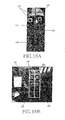
- FIGs. 16a and 16b depict the facial feature segments which have been identified.
- FIG. 16a depicts an exemplary gray level face segment 191 which has been identified by the face detection process and facial features which have been identified thereby.
- FIG. 16b depicts an exemplary digital image that includes a human face.
- the clusters of pixels 192 which delimit the eyes in the gray level face segment 191 are the identified facial features.
- FIGs. 16a and 16b depict the gray level face segment 191 including the centerline 194, the horizontal nose line 193, the clusters of pixels 192 of the eyes, and the cluster of pixels 195 of the mouth.
- the depicted facial feature segments are the output of the process and can be used as inputs for different applications such as face recognition applications other image processing applications.
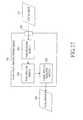
- FIG. 17 depicts a human facial feature finding device according to a preferred embodiment of the present invention.
- the human facial feature finding device 250 receives a digital image 251 from an image sensor via a designated image input module 252.
- the received digital image includes a human face.
- the image sensor can be a complementary metal oxide semiconductor (CMOS) sensor or a charged coupled device (CCD) sensor.
- CMOS complementary metal oxide semiconductor
- CCD charged coupled device
- the digital image is transferred to a face detection module 253.
- the face detection module is used to identify a face segment from the digital image.
- the face segment delimits the face which is depicted in the digital image. The delimitation enhances a faster analysis of the face area and reduces the computational complexity of detecting facial features.
- the candidate face region is transferred to a face bisector module 254.
- the bisector module 254 is used to identify a centerline that bisects the face into two approximately symmetric sides.
- the centerline and the face segment are transferred to a facial feature detection module 255.
- the facial feature detection module 255 segments facial features from the face segment. In order to segment the facial features, the facial feature detection module 255 may use the centerline to determine an estimated position of each facial feature.
- the identified facial feature segments 256 are output.
- the output includes Bounding Boxes around Facial Features that represent the regions of the facial features in relation to the digital image.
- the output includes a series of bitmaps, each bitmap representing a different facial feature segment.
- facial features can be detected even in an environment where memory is limited, and also, can be detected with a small quantity of computations.
Landscapes
- Engineering & Computer Science (AREA)
- Health & Medical Sciences (AREA)
- Physics & Mathematics (AREA)
- Oral & Maxillofacial Surgery (AREA)
- Human Computer Interaction (AREA)
- General Health & Medical Sciences (AREA)
- Geometry (AREA)
- General Physics & Mathematics (AREA)
- Multimedia (AREA)
- Theoretical Computer Science (AREA)
- Image Analysis (AREA)
- Image Processing (AREA)
- Collating Specific Patterns (AREA)
Applications Claiming Priority (2)
| Application Number | Priority Date | Filing Date | Title |
|---|---|---|---|
| US11/449,849 US7860280B2 (en) | 2006-06-09 | 2006-06-09 | Facial feature detection method and device |
| KR1020070055244A KR101390756B1 (ko) | 2006-06-09 | 2007-06-05 | 안면 특징 검출 방법 및 장치 |
Publications (2)
| Publication Number | Publication Date |
|---|---|
| EP1865443A2 true EP1865443A2 (de) | 2007-12-12 |
| EP1865443A3 EP1865443A3 (de) | 2010-03-17 |
Family
ID=38474259
Family Applications (1)
| Application Number | Title | Priority Date | Filing Date |
|---|---|---|---|
| EP07011301A Withdrawn EP1865443A3 (de) | 2006-06-09 | 2007-06-08 | Verfahren und Vorrichtung zum Erkennen von Gesichtsmerkmalen |
Country Status (1)
| Country | Link |
|---|---|
| EP (1) | EP1865443A3 (de) |
Cited By (3)
| Publication number | Priority date | Publication date | Assignee | Title |
|---|---|---|---|---|
| CN101630410B (zh) * | 2009-08-18 | 2011-08-17 | 北京航空航天大学 | 一种基于单摄像机的人体坐姿判定方法 |
| CN102376090A (zh) * | 2010-08-19 | 2012-03-14 | 索尼公司 | 图像处理装置和方法以及程序 |
| EP3462376A1 (de) * | 2017-09-28 | 2019-04-03 | Cal-Comp Big Data Inc | Körperinformationsanalysevorrichtung und verfahren zum hilfsvergleich von augenbrauenformen davon |
Citations (1)
| Publication number | Priority date | Publication date | Assignee | Title |
|---|---|---|---|---|
| US20070076957A1 (en) * | 2005-10-05 | 2007-04-05 | Haohong Wang | Video frame motion-based automatic region-of-interest detection |
Family Cites Families (1)
| Publication number | Priority date | Publication date | Assignee | Title |
|---|---|---|---|---|
| GB2341231A (en) * | 1998-09-05 | 2000-03-08 | Sharp Kk | Face detection in an image |
-
2007
- 2007-06-08 EP EP07011301A patent/EP1865443A3/de not_active Withdrawn
Patent Citations (1)
| Publication number | Priority date | Publication date | Assignee | Title |
|---|---|---|---|---|
| US20070076957A1 (en) * | 2005-10-05 | 2007-04-05 | Haohong Wang | Video frame motion-based automatic region-of-interest detection |
Non-Patent Citations (2)
| Title |
|---|
| CHOW G ET AL: "TOWARDS A SYSTEM FOR AUTOMATIC FACIAL FEATURE DETECTION", PATTERN RECOGNITION, ELSEVIER, GB, vol. 26, no. 12, 1 December 1993 (1993-12-01), pages 1739 - 1755, XP000420368, ISSN: 0031-3203, DOI: 10.1016/0031-3203(93)90173-T * |
| HAI HAN ET AL: "Eye detection based on grayscale morphology", IEEE TENCON' 02. 2002 IEEE REGION 10 CONFERENCE ON COMPUTERS, COMMUNICATIONS, CONTROL AND POWER ENGINEERING PROCEEDINGS. BEIJING, CHINA, OCT. 28 - 31, 2002; [IEEE REGION 10 ANNUAL CONFERENCE], NEW YORK, NY : IEEE, US, vol. 1, 28 October 2002 (2002-10-28), pages 498 - 502, XP010628532, ISBN: 978-0-7803-7490-4, DOI: 10.1109/TENCON.2002.1181322 * |
Cited By (5)
| Publication number | Priority date | Publication date | Assignee | Title |
|---|---|---|---|---|
| CN101630410B (zh) * | 2009-08-18 | 2011-08-17 | 北京航空航天大学 | 一种基于单摄像机的人体坐姿判定方法 |
| CN102376090A (zh) * | 2010-08-19 | 2012-03-14 | 索尼公司 | 图像处理装置和方法以及程序 |
| CN102376090B (zh) * | 2010-08-19 | 2016-03-16 | 索尼公司 | 图像处理装置和方法 |
| EP3462376A1 (de) * | 2017-09-28 | 2019-04-03 | Cal-Comp Big Data Inc | Körperinformationsanalysevorrichtung und verfahren zum hilfsvergleich von augenbrauenformen davon |
| US10521648B2 (en) | 2017-09-28 | 2019-12-31 | Cal-Comp Big Data, Inc. | Body information analysis apparatus and method of auxiliary comparison of eyebrow shapes thereof |
Also Published As
| Publication number | Publication date |
|---|---|
| EP1865443A3 (de) | 2010-03-17 |
Similar Documents
| Publication | Publication Date | Title |
|---|---|---|
| US7860280B2 (en) | Facial feature detection method and device | |
| US9530045B2 (en) | Method, system and non-transitory computer storage medium for face detection | |
| US8244003B2 (en) | Image preprocessing | |
| US8254646B2 (en) | Image preprocessing | |
| US7035461B2 (en) | Method for detecting objects in digital images | |
| US8660323B2 (en) | Image Preprocessing | |
| CN103098078B (zh) | 笑容检测系统及方法 | |
| KR20150117646A (ko) | 적어도 하나의 추가적인 이미지를 사용한 이미지 향상과 에지 검증을 위한 방법 및 장치 | |
| JP4528309B2 (ja) | オブジェクト検出方法、オブジェクト検出装置、およびオブジェクト検出プログラム | |
| WO2015070723A1 (zh) | 眼部图像处理方法和装置 | |
| CN101142584A (zh) | 面部特征检测的方法 | |
| US20070098260A1 (en) | Detecting and correcting peteye | |
| TW201432620A (zh) | 具有邊緣選擇功能性之影像處理器 | |
| US8244004B2 (en) | Image preprocessing | |
| US20130287254A1 (en) | Method and Device for Detecting an Object in an Image | |
| EP1865443A2 (de) | Verfahren und Vorrichtung zum Erkennen von Gesichtsmerkmalen | |
| CN110188640B (zh) | 人脸识别方法、装置、服务器和计算机可读介质 | |
| CN101447026B (zh) | 一种红眼检测装置及其检测方法 | |
| KR101315464B1 (ko) | 이미지 처리방법 | |
| Mariani | Subpixellic eyes detection | |
| AL-Dabbagh | Eye Localization in a Full Frontal Still Image. | |
| JP2007025966A (ja) | 画像処理方法、画像処理装置及び画像処理プログラム | |
| JP2009258771A (ja) | 画像処理方法、画像処理装置、画像処理プログラム、撮像装置 | |
| OA17354A (en) | Face calibration method and system, and computer storage medium. |
Legal Events
| Date | Code | Title | Description |
|---|---|---|---|
| PUAI | Public reference made under article 153(3) epc to a published international application that has entered the european phase |
Free format text: ORIGINAL CODE: 0009012 |
|
| 17P | Request for examination filed |
Effective date: 20070608 |
|
| AK | Designated contracting states |
Kind code of ref document: A2 Designated state(s): AT BE BG CH CY CZ DE DK EE ES FI FR GB GR HU IE IS IT LI LT LU LV MC MT NL PL PT RO SE SI SK TR |
|
| AX | Request for extension of the european patent |
Extension state: AL BA HR MK YU |
|
| PUAL | Search report despatched |
Free format text: ORIGINAL CODE: 0009013 |
|
| AK | Designated contracting states |
Kind code of ref document: A3 Designated state(s): AT BE BG CH CY CZ DE DK EE ES FI FR GB GR HU IE IS IT LI LT LU LV MC MT NL PL PT RO SE SI SK TR |
|
| AX | Request for extension of the european patent |
Extension state: AL BA HR MK RS |
|
| 17Q | First examination report despatched |
Effective date: 20100823 |
|
| AKX | Designation fees paid |
Designated state(s): DE FR GB |
|
| RAP1 | Party data changed (applicant data changed or rights of an application transferred) |
Owner name: SAMSUNG ELECTRONICS CO., LTD. |
|
| STAA | Information on the status of an ep patent application or granted ep patent |
Free format text: STATUS: THE APPLICATION IS DEEMED TO BE WITHDRAWN |
|
| 18D | Application deemed to be withdrawn |
Effective date: 20140603 |