EP1864989A1 - Method for producing l-2-amino-4-(hydroxymethylphosphinyl)- butanoic acid - Google Patents
Method for producing l-2-amino-4-(hydroxymethylphosphinyl)- butanoic acid Download PDFInfo
- Publication number
- EP1864989A1 EP1864989A1 EP06730167A EP06730167A EP1864989A1 EP 1864989 A1 EP1864989 A1 EP 1864989A1 EP 06730167 A EP06730167 A EP 06730167A EP 06730167 A EP06730167 A EP 06730167A EP 1864989 A1 EP1864989 A1 EP 1864989A1
- Authority
- EP
- European Patent Office
- Prior art keywords
- formula
- represented
- bis
- group
- phosphorano
- Prior art date
- Legal status (The legal status is an assumption and is not a legal conclusion. Google has not performed a legal analysis and makes no representation as to the accuracy of the status listed.)
- Granted
Links
- 0 C[C@]1C(*)P(*P2C(*)C(*)C(*)C2*)C(*)C1* Chemical compound C[C@]1C(*)P(*P2C(*)C(*)C(*)C2*)C(*)C1* 0.000 description 1
Classifications
-
- C—CHEMISTRY; METALLURGY
- C07—ORGANIC CHEMISTRY
- C07B—GENERAL METHODS OF ORGANIC CHEMISTRY; APPARATUS THEREFOR
- C07B53/00—Asymmetric syntheses
-
- C—CHEMISTRY; METALLURGY
- C07—ORGANIC CHEMISTRY
- C07F—ACYCLIC, CARBOCYCLIC OR HETEROCYCLIC COMPOUNDS CONTAINING ELEMENTS OTHER THAN CARBON, HYDROGEN, HALOGEN, OXYGEN, NITROGEN, SULFUR, SELENIUM OR TELLURIUM
- C07F9/00—Compounds containing elements of Groups 5 or 15 of the Periodic Table
- C07F9/02—Phosphorus compounds
- C07F9/28—Phosphorus compounds with one or more P—C bonds
- C07F9/30—Phosphinic acids [R2P(=O)(OH)]; Thiophosphinic acids ; [R2P(=X1)(X2H) (X1, X2 are each independently O, S or Se)]
- C07F9/301—Acyclic saturated acids which can have further substituents on alkyl
-
- C—CHEMISTRY; METALLURGY
- C07—ORGANIC CHEMISTRY
- C07F—ACYCLIC, CARBOCYCLIC OR HETEROCYCLIC COMPOUNDS CONTAINING ELEMENTS OTHER THAN CARBON, HYDROGEN, HALOGEN, OXYGEN, NITROGEN, SULFUR, SELENIUM OR TELLURIUM
- C07F9/00—Compounds containing elements of Groups 5 or 15 of the Periodic Table
- C07F9/02—Phosphorus compounds
- C07F9/547—Heterocyclic compounds, e.g. containing phosphorus as a ring hetero atom
- C07F9/6564—Heterocyclic compounds, e.g. containing phosphorus as a ring hetero atom having phosphorus atoms, with or without nitrogen, oxygen, sulfur, selenium or tellurium atoms, as ring hetero atoms
- C07F9/6568—Heterocyclic compounds, e.g. containing phosphorus as a ring hetero atom having phosphorus atoms, with or without nitrogen, oxygen, sulfur, selenium or tellurium atoms, as ring hetero atoms having phosphorus atoms as the only ring hetero atoms
- C07F9/65683—Heterocyclic compounds, e.g. containing phosphorus as a ring hetero atom having phosphorus atoms, with or without nitrogen, oxygen, sulfur, selenium or tellurium atoms, as ring hetero atoms having phosphorus atoms as the only ring hetero atoms the ring phosphorus atom being part of a phosphine
Definitions
- This invention relates to a method for producing L-2-amino-4-(hydroxymethylphosphinyl)-butanoic acid (abbreviated as L-AMPB herein) which is useful as a herbicide.
- L-AMPB L-2-amino-4-(hydroxymethylphosphinyl)-butanoic acid
- D,L-2-amino-4-(hydroxymethylphosphinyl)-butanoic acid (abbreviated as DL-AMPB herein) is a well known compound having a herbicidal activity, and is used as an effective herbicide having a broad-spectrum ( JP Patent Kokai JP-A-52-139727 ).
- L-AMPB L-2-amino-4-(hydroxymethylphosphinyl)-butanoic acid
- L-AMPB conventionally known methods for producing L-AMPB include (a) methods making use of microorganisms, enzymes, and (b) asymmetric synthesis methods.
- methods (a) there are disclosures such as a method for producing L-AMPB from 4-(hydroxymethylphosphinyl)-2-oxobutanoic acid with transaminase ( JP Patent Kohyo JP-A-2003-528572 ) and a method for subjecting N-acetyl-DL-AMPB to enzymatic racemic resolution to produce L-AMPB ( JP Patent Kohyo JP-A-2003-505031 ).
- the asymmetric hydrogenation reaction is carried out using a rhodium catalyst comprising an optically active diphenylphosphine compound as a ligand. Therefore, it is thought that this method is efficient in terms of the use of chiral source in a catalytic amount. However, there is a problem such that optical yield is not high in this method.
- the present inventors have conducted studies on asymmetric catalysts in asymmetric hydrogenation reaction of 2-acetylamide-4-(hydroxymethylphosphinyl)-butenoic acid and, as a result, found that L-AMPB is efficiently obtained in a high enantiomeric excess in case of using a rhodium catalyst having an optically active cyclic phosphine ligand. This finding has led to the completion of the present invention.
- L in the formula (2) or (3) can be a ligand represented by the formula (8), and, in another preferred embodiment of the present invention, L in the formula (2) or (3) can be a ligand represented by the formula (6).
- L can be 1,2-bis(2,5-dimethyl phosphorano) benzene, 1,2-bis(2,5-diethyl phosphorano) benzene, 1,2-bis(2,5-diisopropyl phosphorano) benzene, 1,2-bis(2,5-dimethyl-3,4-dihydroxyphosphorano) benzene, 1,2-bis(2,5-dimethyl phosphorano) ethane, or 1,2-bis(2,5-diethyl phosphorano) ethane.
- the asymmetric catalyst represented by the formula (2) can be used.
- the asymmetric catalyst represented by the formula (2) can be used, and L in the formula (2) can be a ligand represented by the formula (6).
- L in the formula (2) or (3) can be a ligand represented by the formula (6)
- Y in the ligand represented by the formula (6) can be a group selected from the groups represented by the following formula (9):
- L can be 1,2-bis(2,5-dimethyl phosphorano) benzene, 1,2-bis(2,5-diethyl phosphorano) benzene, 1,2-bis(2,5-diisopropyl phosphorano) benzene, 1,2-bis(2,5-dimethyl-3,4-dihydroxyphosphorano) benzene, 1,2-bis(2,5-dimethyl phosphorano) ethane, or 1,2-bis(2,5-diethyl phosphorano) ethane.
- the asymmetric catalyst represented by the formula (2), wherein X is OTf or BF 4 can be used.
- R 1 and R 2 can be hydrogen atom and R 3 can be C 1-4 alkyl group, in the formula (1).
- L-AMPB which is useful as a herbicide, can be efficiently produced in high enantiomeric excess, 92%ee or more.
- C 1-4 alkyl groups represented by R 1 , R 2 and R 3 or C 1-4 alkyl groups existing on the substituent represented by R 1 , R 2 and R 3 are specifically exemplified by methyl group, ethyl group, n-propyl group, isopropyl group, n-butyl group, 2-butyl group, isobutyl group, and t-butyl group.
- Aryl groups represented by R 1 , R 2 and R 3 or aryl groups on the groups represented by R 1 , R 2 and R 3 are specifically exemplified by phenyl group, naphthyl group, and anthracenyl group.
- the compound represented by the formula (1) can be synthesized by the method described in JP Patent Kokai JP-A-62-226993 or J. Org. Chem. 56, 1783 (1991 ).
- R 1 and R 2 are hydrogen atom, and R 3 is C 1-4 alkyl group.
- C 1-4 alkyl groups represented by R 5 , R 8 , R 9 and R 10 are concretely exemplified by methyl group, ethyl group, n-propyl group, isopropyl group, n-butyl group, 2-butyl group, isobutyl group, and t-butyl group.
- Halogen atoms represented by Z are concretely exemplified by chlorine atom, bromine atom, and iodine atom.
- R 5 and R 8 are C 1-4 alkyl group, and R 6 and R 7 are hydrogen atom; or R 5 and R 8 are C 1-4 alkyl group, and R 6 and R 7 are hydroxy group.
- the asymmetric ligand represented by L can be synthesized by the method described in J. Am. Chem. Soc., 113, 8518 (1991 ), J. Org. Chem., 63, 8031 (1998 ), J. Org. Chem. 65, 3489 (2000 ), Angew. Chem. Int. Ed. 39, 1981 (2000 ), or J. Org. Chem. 68, 1701 (2003 ), or is commercially available.
- L is, preferably, a ligand represented by the formula (6) or (8), more preferably, a ligand represented by the formula (6).
- Y is preferably a group selected from the groups represented by the formula (9).
- L is exemplified by the ligand represented by the formula (6), wherein Y is phenyl group, and R 5 and R 8 are C 1-4 alkyl group, and R 6 and R 7 are hydrogen atom.
- L examples include, for example, 1,2-bis(2,5-dimethyl phosphorano) benzene, 1,2-bis(2,5-diethyl phosphorano) benzene, 1,2-bis(2,5-diisopropyl phosphorano) benzene, 1,2-bis(2,5-dimethyl-3,4-dihydroxy phosphorano) benzene, 1,2-bis(2,5-dimethyl phosphorano) ethane, 1,2-bis(2,5-diethyl phosphorano) ethane, 1,1'-bis(2,4-dimethyl phosphothano) ferrocene, 1,1'-bis(2,4-diethyl phosphothano) ferrocene, 2,3-bis(2,5-dimethyl phosphoranyl)maleic anhydride, 2,3-bis(2,5-dimethyl phosphoranyl) maleic-N-methylimide, 2,3-bis(2,5-dimethyl phosphorano) be
- L More concrete examples of L include (S, S)-1,2-bis(2,5-dimethyl phosphorano) benzene (abbreviated as (S, S)-Me-DUPHOSTM), (S, S)-1,2-bis(2,5-diethyl phosphorano) benzene (abbreviated as (S, S)-Et-DUPHOSTM), (R, R)-1,2-bis(2,5-diisopropyl phosphorano) benzene (abbreviated as (R, R)-iPr-DUPHOSTTM), (S, S, S, S)-1,2-bis(2,5-dimethyl-3,4-dihydroxy phosphorano) benzene (abbreviated as (S, S, S, S)-ROPHOS R ), (S, S)-1,2-bis(2,5-dimethyl phosphorano) ethane (abbreviated as (S, S)-Me-BPE), (S, S)
- (S, S)-Me-DUPHOSTM, (S, S)-Et-DUPHOSTM, (R, R)-iPr-DUPHOSTM, (S, S, S, S)-ROPHOS R , (S, S)-Me-BPE, or (S, S)-Et-BPE is selected.
- the asymmetric catalysts represented by the formulae (2) and (3) can be synthesized by the method described in J. Am. Chem. Soc., 93, 3089 (1971 ), J. Am. Chem. Soc., 99, 5946 (1977 ), Chemical Society of Japan, "JIKKEN KAGAKU KOZA (Course of Study of Experimental Chemical) 4th ed.”, Organic metallic complex, 18, 339-344 (1991) Maruzen , or can be purchased from a market.
- the compound represented by the formula (2) is preferably used.
- the asymmetric catalyst represented by the formula (2) or (3) is concretely exemplified by [Rh(L)Cl] 2 , [Rh(L)Br] 2 , [Rh(L)I] 2 , [Rh(cod)L]BF 4 , [Rh(cod)L]OTf, [Rh(cod)L]BPh 4 , [Rh(cod)L]ClO 4 , [Rh(cod)L]PF 6 , [Rh(nbd)L] BF 4 , [Rh(nbd)L] OTf, [Rh(nbd)L]BPh 4 , [Rh(nbd)L]ClO 4 , and [Rh(nbd)L]PF 6 , etc.
- [Rh(cod)L]BF 4 , [Rh(cod)L]OTf, [Rh(nbd)L]BF 4 , or [Rh(nbd)L]OTf is selected (in this case where, especially preferably, L is exemplified by the ligand represented by the formula (6), wherein Y is phenyl group, R 5 and R 8 are C 1-4 alkyl group, and R 6 and R 7 are hydrogen atom).
- cod and nbd represent 1,5-cyclooctadiene and norbornadiene, respectively.
- solvents to be used are exemplified by methanol, ethanol, n-propanol, isopropanol, n-butanol, s-butanol, t-butanol, n-pentanol, methoxyethanol, trifluoroethanol, diethylether, tetrahydrofuran, dimethoxyethane, dioxane, water, methylene chloride, chloroform, benzene, toluene, acetone, acetonitrile, N,N-dimethylformamide, dimethylsulfoxide and a combination(s) of two or more kinds of these solvents.
- methanol, ethanol, n-propanol, n-butanol, n-pentanol, water or a combination of two or more kinds of these solvents is selected.
- the reaction concentration is selected within the range of from 1 to 60 % by mass, preferably from 5 to 40 % by mass.
- the amount of use of asymmetric catalyst is selected such that the ratio of the compound represented by the formula (1)/asymmetric catalyst represented by the formula (2) or (3) in molar ratio is within the range of from 10 to 100000, preferably from 100 to 10000.
- the reaction temperature is selected within the range of from 0 to 100°C, preferably from 15 to 60°C.
- the hydrogen pressure is selected within the range of from a hydrogen atmosphere to 100 atmospheres, preferably from 1 to 10 atmospheres.
- the reaction time differs depending on the sort or the used amount of the catalyst.
- the reaction time is ordinarily selected within the range of from 1 minute to 48 hours, preferably from 10 minutes to 24 hours.
- solvents to be used are exemplified by water
- acids to be used are exemplified by mineral acids such as hydrochloric acid and sulfuric acid.
- concentration in case of using hydrochloric acid is ordinarily selected within the range of from 6 to 12M
- concentration in case of using sulfuric acid is ordinarily selected within the range of from 2 to 18M.
- the reaction temperature is selected within the range of from 20 to 150°C, preferably from 50 to 120°C.
- the reaction time is selected within the range of from 2 to 12 hours, preferably from 4 to 8 hours.
- (+)-1,2-bis((2S, 5S)-2,5-dimethyl phosphorano benzene(cyclooctadiene)rhodium(I)trifluoromethanesulfonate is abbreviated as [Rh((S, S)-Me-DUPHOSTM)(cod)]OTf
- (+)-1,2-bis((2S, 5S)-2,5-diethyl phosphorano benzene(cyclooctadiene)rhodium(I)trifluoromethanesulfonate is abbreviated as [Rh((S, S)-Et-DUPHOSTM)(cod)]OTf
- bis(1,5-cyclooctadiene)rhodium(I)trifluoromethanesulfonate is abbreviated as [Rh(cod) 2 ]OTf
- the enantiomeric excess for the produced compound (5) was determined using high performance liquid chromatography (HPLC) under the following conditions. The D-form is firstly eluted, and the L-form is secondly eluted.
- HPLC high performance liquid chromatography
- the method of the present invention a compound represented by the formula (1) is subjected to asymmetric hydrogenation reaction using a rhodium catalyst having an optically active cyclic phosphine ligand to synthesize L-AMPB selectively. Therefore, the method of the present invention is an excellent method for synthesizing an optically active substance inexpensively, effectively, and high-selectively as compared to the conventional methods for synthesizing the optically active substance.
Landscapes
- Chemical & Material Sciences (AREA)
- Organic Chemistry (AREA)
- Health & Medical Sciences (AREA)
- Life Sciences & Earth Sciences (AREA)
- Biochemistry (AREA)
- General Health & Medical Sciences (AREA)
- Molecular Biology (AREA)
- Organic Low-Molecular-Weight Compounds And Preparation Thereof (AREA)
- Low-Molecular Organic Synthesis Reactions Using Catalysts (AREA)
- Catalysts (AREA)
Abstract
[where R4 represents 1,5-cyclooctadien or norbornadien; L represents a substance represented by the following formula (6):

Description
- This invention relates to a method for producing L-2-amino-4-(hydroxymethylphosphinyl)-butanoic acid (abbreviated as L-AMPB herein) which is useful as a herbicide.
- D,L-2-amino-4-(hydroxymethylphosphinyl)-butanoic acid (abbreviated as DL-AMPB herein) is a well known compound having a herbicidal activity, and is used as an effective herbicide having a broad-spectrum (
JP Patent Kokai JP-A-52-139727 JP Patent Kokai JP-A-55-000025 JP Patent Kokai JP-A-59-219297 - Conventionally known methods for producing L-AMPB include (a) methods making use of microorganisms, enzymes, and (b) asymmetric synthesis methods. As the methods (a), there are disclosures such as a method for producing L-AMPB from 4-(hydroxymethylphosphinyl)-2-oxobutanoic acid with transaminase (
JP Patent Kohyo JP-A-2003-528572 JP Patent Kohyo JP-A-2003-505031 JP Patent Kokai JP-A-62-132891 JP Patent Kokai JP-A-62-226993 - On the other hand, asymmetric hydrogenation reaction to convert dehydroamino acid into amino acid using the rhodium catalyst in general is well known already (Chem. Rev., 103, 3029-3070 (2003)). However, most of the reactions are asymmetric reductions against dehydroamino acid having alkyl group and aryl group at side chain(s), and reactions using dehydroamino acid having highly polar substituent at side chain(s) are scarcely exemplified.
- [Patent Publication 1]
JP Patent Kokai JP-A-52-139727 - [Patent Publication 2]
JP Patent Kokai JP-A-55-000025 - [Patent Publication 3]
JP Patent Kokai JP-A-59-219297 - [Patent Publication 4]
JP Patent Kohyo JP-A-2003-505031 - [Patent Publication 5]
JP Patent Kokai JP-A-62-132891 - [Patent Publication 6]
JP Patent Kokai JP-A-62-226993 - [Non-patent Document 1] Tetrahedron Lett. 1255 (1987)
- [Non-patent Document 2] Tetrahedron 8263 (1992)
- [Non-patent Document 3] J. Org. Chem. 56, 1783 (1991)
- [Non-patent Document 4] Chem. Rev., 103, 3029-3070 (2003)
- It is an object of the present invention to provide an efficient method for producing L-AMPB, which is useful as a herbicide, in high enantiomeric excess through catalytic asymmetric synthesis reaction.
- The present inventors have conducted studies on asymmetric catalysts in asymmetric hydrogenation reaction of 2-acetylamide-4-(hydroxymethylphosphinyl)-butenoic acid and, as a result, found that L-AMPB is efficiently obtained in a high enantiomeric excess in case of using a rhodium catalyst having an optically active cyclic phosphine ligand. This finding has led to the completion of the present invention.
- That is, the present invention is set forth as follows.
- A method for producing L-2-amino-4-(hydroxymethylphosphinyl)-butanoic acid represented by the following formula (5):

- subjecting a compound represented by the following formula (1):
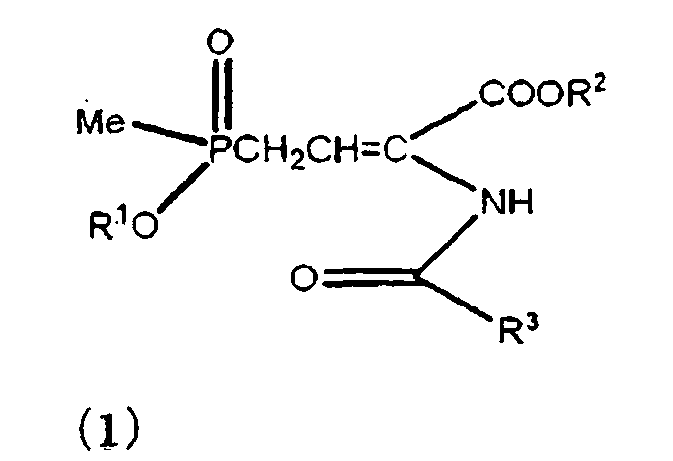
to hydrogenation reaction under hydrogen atmosphere in the presence of asymmetric catalyst to produce a compound represented by the following formula (4):
- and sudjecting the produced compound represented by the formula (4) to hydrolysis;
- said asymmetric catalyst being represented by the following formula (2):
[Rh(R4)(L)]X (2)
[where R4 represents 1,5-cyclooctadiene or norbornadiene, L represents an optically active cyclic phosphine ligand represented by the following formula (6) or (8), and X represents BF4, ClO4, PF6, SbF6, BPh4, or OTf (where Tf represents trifluoromethanesulfonyl group)]
or the following formula (3):
[Rh(L)(Z)]2 (3)
[where L has the same meaning as in the formula (2), and Z represents halogen atom]; - said formula (6) being:


said formula (8) being
- Moreover, in one preferred embodiment of the present invention, L in the formula (2) or (3) can be a ligand represented by the formula (8), and, in another preferred embodiment of the present invention, L in the formula (2) or (3) can be a ligand represented by the formula (6).
- In a further preferred embodiment of the present invention, L can be 1,2-bis(2,5-dimethyl phosphorano) benzene, 1,2-bis(2,5-diethyl phosphorano) benzene, 1,2-bis(2,5-diisopropyl phosphorano) benzene, 1,2-bis(2,5-dimethyl-3,4-dihydroxyphosphorano) benzene, 1,2-bis(2,5-dimethyl phosphorano) ethane, or 1,2-bis(2,5-diethyl phosphorano) ethane.
- In a preferred embodiment of the present invention, the asymmetric catalyst represented by the formula (2) can be used.
- In a preferred embodiment of the present invention, the asymmetric catalyst represented by the formula (2) can be used, and L in the formula (2) can be a ligand represented by the formula (6).
- In a preferred embodiment of the present invention, L in the formula (2) or (3) can be a ligand represented by the formula (6), and Y in the ligand represented by the formula (6) can be a group selected from the groups represented by the following formula (9):
-

- In a preferred embodiment of the present invention, the asymmetric catalyst represented by the formula (2), wherein X is OTf or BF4, can be used.
- In a preferred embodiment of the present invention, R1 and R2 can be hydrogen atom and R3 can be C1-4 alkyl group, in the formula (1).
- According to the method of the present invention, L-AMPB, which is useful as a herbicide, can be efficiently produced in high enantiomeric excess, 92%ee or more.
- The groups represented by R1, R2 and R3 in the compounds represented by the formulae (1) and (4) used in the present invention are explained.
C1-4 alkyl groups represented by R1, R2 and R3 or C1-4 alkyl groups existing on the substituent represented by R1, R2 and R3 are specifically exemplified by methyl group, ethyl group, n-propyl group, isopropyl group, n-butyl group, 2-butyl group, isobutyl group, and t-butyl group.
Aryl groups represented by R1, R2 and R3 or aryl groups on the groups represented by R1, R2 and R3 are specifically exemplified by phenyl group, naphthyl group, and anthracenyl group. - The compound represented by the formula (1) can be synthesized by the method described in
JP Patent Kokai JP-A-62-226993 - In the compound represented by the formula (1), it is preferable that R1 and R2 are hydrogen atom, and R3 is C1-4 alkyl group.
- Concrete examples of the compounds represented by the formula (1) include the following compounds:
- 2-acetamide-4-(hydroxymethylphosphinyl)-butenoic acid,
- 2-propionylamide-4-(hydroxymethylphosphinyl)-butenoic acid,
- 2-benzoylamide-4-(hydroxymethylphosphinyl)-butenoic acid,
- 2-t-butoxycarbonylamide-4-(hydroxymethylphosphinyl)-butenoic acid,
- 2-benzyloxycarbonylamide-4-(hydroxymethylphosphinyl)-butenoic acid,
- 2-acetamide-4-(methoxy(methyl)phosphinyl)-butenoic acid methyl ester,
- 2-propionylamide-4-(methoxy(methyl)phosphinyl)-butenoic acid methyl ester,
- 2-benzoylamide-4-(methoxy(methyl)phosphinyl)-butenoic acid methyl ester,
- 2-t-butoxycarbonylamide-4-(methoxy(methyl)phosphinyl)-butenoic acid methyl ester,
- 2-benzyloxycarbonylamide-4-(methoxy(methyl)phosphinyl)-butenoic acid methyl ester,
- 2-acetamide-4-(methoxy(methyl)phosphinyl)-butenoic acid methyl ester,
- 2-propionylamide-4-(methoxy(methyl)phosphinyl)-butenoic acid,
- 2-benzoylamide-4-(methoxy(methyl)phosphinyl)-butenoic acid,
- 2-t-butoxycarbonylamide-4-(methoxy(methyl)phosphinyl)-butenoic acid,
- 2-benzyloxycarbonylamide-4-(methoxy(methyl)phosphinyl)-butenoic acid,
- 2-acetamide-4-(hydroxymethylphosphinyl)-butenoic acid methyl ester,
- 2-propionylamide-4-(hydroxymethylphosphinyl)-butenoic acid methyl ester,
- 2-benzoylamide-4-(hydroxymethylphosphinyl)-butenoic acid methyl ester,
- 2-t-butoxycarbonylamide-4-(hydroxymethylphosphinyl)-butenoic acid methyl ester, and
- 2-benzyloxycarbonylamide-4-(hydroxymethylphosphinyl)-butenoic acid methyl ester.
- The groups represented by R5, R8, R9, R10 and Z in the asymmetric catalysts represented by the formulae (2) and (3) used in the present invention are explained.
C1-4 alkyl groups represented by R5, R8, R9 and R10 are concretely exemplified by methyl group, ethyl group, n-propyl group, isopropyl group, n-butyl group, 2-butyl group, isobutyl group, and t-butyl group.
Halogen atoms represented by Z are concretely exemplified by chlorine atom, bromine atom, and iodine atom. - With respect to a combination(s) of R5, R6, R7, and R8 in the ligand represented by the formula (6) used in the present invention, it is preferable that R5 and R8 are C1-4 alkyl group, and R6 and R7 are hydrogen atom; or R5 and R8 are C1-4 alkyl group, and R6 and R7 are hydroxy group.
- Moreover, the asymmetric ligand represented by L can be synthesized by the method described in J. Am. Chem. Soc., 113, 8518 (1991), J. Org. Chem., 63, 8031 (1998), J. Org. Chem. 65, 3489 (2000), Angew. Chem. Int. Ed. 39, 1981 (2000), or J. Org. Chem. 68, 1701 (2003), or is commercially available.
- L is, preferably, a ligand represented by the formula (6) or (8), more preferably, a ligand represented by the formula (6). Further, Y is preferably a group selected from the groups represented by the formula (9). Especially preferably, L is exemplified by the ligand represented by the formula (6), wherein Y is phenyl group, and R5 and R8 are C1-4 alkyl group, and R6 and R7 are hydrogen atom.
- Concrete examples of L include, for example, 1,2-bis(2,5-dimethyl phosphorano) benzene, 1,2-bis(2,5-diethyl phosphorano) benzene, 1,2-bis(2,5-diisopropyl phosphorano) benzene, 1,2-bis(2,5-dimethyl-3,4-dihydroxy phosphorano) benzene, 1,2-bis(2,5-dimethyl phosphorano) ethane, 1,2-bis(2,5-diethyl phosphorano) ethane, 1,1'-bis(2,4-dimethyl phosphothano) ferrocene, 1,1'-bis(2,4-diethyl phosphothano) ferrocene, 2,3-bis(2,5-dimethyl phosphoranyl)maleic anhydride, 2,3-bis(2,5-dimethyl phosphoranyl) maleic-N-methylimide, 2,3-bis(2,5-dimethyl phosphorano) benzo[b]thiophene, and 2,3-bis(2,5-diethyl phosphorano) benzo[b]thiophene, etc. Preferably, 1,2-bis(2,5-dimethyl phosphorano) benzene, 1,2-bis(2,5-diethyl phosphorano) benzene, 1,2-bis(2,5-diisopropyl phosphorano) benzene, 1,2-bis(2,5-dimethyl-3,4-dihydroxy phosphorano) benzene, 1,2-bis(2,5-dimethyl phosphorano) ethane, or 1,2-bis(2,5-diethyl phosphorano) ethane is selected. More concrete examples of L include (S, S)-1,2-bis(2,5-dimethyl phosphorano) benzene (abbreviated as (S, S)-Me-DUPHOS™), (S, S)-1,2-bis(2,5-diethyl phosphorano) benzene (abbreviated as (S, S)-Et-DUPHOS™), (R, R)-1,2-bis(2,5-diisopropyl phosphorano) benzene (abbreviated as (R, R)-iPr-DUPHOST™), (S, S, S, S)-1,2-bis(2,5-dimethyl-3,4-dihydroxy phosphorano) benzene (abbreviated as (S, S, S, S)-ROPHOSR), (S, S)-1,2-bis(2,5-dimethyl phosphorano) ethane (abbreviated as (S, S)-Me-BPE), (S, S)-1,2-bis(2,5-diethyl phosphorano) ethane (abbreviated as (S, S)-Et-BPE), 1,1'-bis(2,4-dimethyl phosphothano) ferrocene (abbreviated as Me-FerroTANER), (S, S)-1,1'-bis(2,4-diethyl phosphothano) ferrocene (abbreviated as (S, S)-Et-FerroTANER), (S, S)-2,3-bis(2,5-dimethyl phosphoranyl) maleic anhydride, (S, S)-2,3-bis(2,5-dimethyl phosphoranyl) maleic-N-methylimide, (S, S)-2,3-bis(2,5-dimethyl phosphorano) benzo[b]thiophene, and (S, S)-2,3-bis(2,5-diethyl phosphorano) benzo[b]thiophene. Preferably, (S, S)-Me-DUPHOS™, (S, S)-Et-DUPHOS™, (R, R)-iPr-DUPHOS™, (S, S, S, S)-ROPHOSR, (S, S)-Me-BPE, or (S, S)-Et-BPE is selected.
- The asymmetric catalysts represented by the formulae (2) and (3) can be synthesized by the method described in J. Am. Chem. Soc., 93, 3089 (1971), J. Am. Chem. Soc., 99, 5946 (1977), Chemical Society of Japan, "JIKKEN KAGAKU KOZA (Course of Study of Experimental Chemical) 4th ed.", Organic metallic complex, 18, 339-344 (1991) Maruzen, or can be purchased from a market.
- With respect to the asymmetric catalyst, the compound represented by the formula (2) is preferably used.
- The asymmetric catalyst represented by the formula (2) or (3) is concretely exemplified by [Rh(L)Cl]2, [Rh(L)Br]2, [Rh(L)I]2, [Rh(cod)L]BF4, [Rh(cod)L]OTf, [Rh(cod)L]BPh4, [Rh(cod)L]ClO4, [Rh(cod)L]PF6, [Rh(nbd)L] BF4, [Rh(nbd)L] OTf, [Rh(nbd)L]BPh4, [Rh(nbd)L]ClO4, and [Rh(nbd)L]PF6, etc. More preferably, [Rh(cod)L]BF4, [Rh(cod)L]OTf, [Rh(nbd)L]BF4, or [Rh(nbd)L]OTf is selected (in this case where, especially preferably, L is exemplified by the ligand represented by the formula (6), wherein Y is phenyl group, R5 and R8 are C1-4 alkyl group, and R6 and R7 are hydrogen atom). Here, cod and nbd represent 1,5-cyclooctadiene and norbornadiene, respectively.
- In the method of subjecting the compound represented by the formula (1) to hydrogenation reaction using the asymmetric catalyst represented by the formula (2) or (3), to produce the compound represented by the formula (4), solvents to be used are exemplified by methanol, ethanol, n-propanol, isopropanol, n-butanol, s-butanol, t-butanol, n-pentanol, methoxyethanol, trifluoroethanol, diethylether, tetrahydrofuran, dimethoxyethane, dioxane, water, methylene chloride, chloroform, benzene, toluene, acetone, acetonitrile, N,N-dimethylformamide, dimethylsulfoxide and a combination(s) of two or more kinds of these solvents. Preferably, methanol, ethanol, n-propanol, n-butanol, n-pentanol, water or a combination of two or more kinds of these solvents is selected. The reaction concentration is selected within the range of from 1 to 60 % by mass, preferably from 5 to 40 % by mass. The amount of use of asymmetric catalyst is selected such that the ratio of the compound represented by the formula (1)/asymmetric catalyst represented by the formula (2) or (3) in molar ratio is within the range of from 10 to 100000, preferably from 100 to 10000. The reaction temperature is selected within the range of from 0 to 100°C, preferably from 15 to 60°C. The hydrogen pressure is selected within the range of from a hydrogen atmosphere to 100 atmospheres, preferably from 1 to 10 atmospheres. The reaction time differs depending on the sort or the used amount of the catalyst. The reaction time is ordinarily selected within the range of from 1 minute to 48 hours, preferably from 10 minutes to 24 hours.
- In the reaction of subjecting the compound represented by the formula (4) to hydrolysis to produce the compound represented by the formula (5), solvents to be used are exemplified by water, and acids to be used are exemplified by mineral acids such as hydrochloric acid and sulfuric acid. The concentration in case of using hydrochloric acid is ordinarily selected within the range of from 6 to 12M, and the concentration in case of using sulfuric acid is ordinarily selected within the range of from 2 to 18M. The reaction temperature is selected within the range of from 20 to 150°C, preferably from 50 to 120°C. The reaction time is selected within the range of from 2 to 12 hours, preferably from 4 to 8 hours.
- Hereinafter, the present invention is concretely explained by referring to Examples. However, the present invention is not limited to these
- In the following Examples, (+)-1,2-bis((2S, 5S)-2,5-dimethyl phosphorano benzene(cyclooctadiene)rhodium(I)trifluoromethanesulfonate is abbreviated as [Rh((S, S)-Me-DUPHOS™)(cod)]OTf, and (+)-1,2-bis((2S, 5S)-2,5-diethyl phosphorano benzene(cyclooctadiene)rhodium(I)trifluoromethanesulfonate is abbreviated as [Rh((S, S)-Et-DUPHOS™)(cod)]OTf, and bis(1,5-cyclooctadiene)rhodium(I)trifluoromethanesulfonate is abbreviated as [Rh(cod)2]OTf, and (-)-1,2-bis((2S, 5S)-2,5-diisopropyl phosphorano benzene is abbreviated as (S, S)-iPr-DUPHOS™, and (+)-1,2-bis((2S, 5S)-2,5-dimethyl-(3S, 4S)-3,4-dihydroxy phosphorano)benzene bis(trifluoromethanesulfonate) is abbreviated as (S, S, S, S)-ROPHOSR-bis(OTf), and (-)-1,1'-bis((2S, 4S)-2,4-diethyl phosphothano)ferrocene(1,5-cyclooctadiene)rhodium(I)tetrafluoroborate is abbreviated as [Rh((S, S)-Et-FerroTANER)(cod)]BF4. Here, [Rh((S,S)-Me-DUPHOS™)(cod)] OTf, [Rh((S,S)-Et-DUPHOS™)(cod)]OTf, [Rh(cod)2]OTf, (S,S)-iPr-DUPHOS™, (S,S,S,S)-ROPHOSR-bis(OTf) and [Rh((S,S)-Et-FerroTANER)(cod)]BF4, which are manufactured by Strem Co., were used.
- The enantiomeric excess for the produced compound (5) was determined using high performance liquid chromatography (HPLC) under the following conditions. The D-form is firstly eluted, and the L-form is secondly eluted.
Column: SUMICHIRAL OA6100(4.6x150mm),
Mobile phase: 2mM copper sulfate aqueous solution
Detection: UV254nm
Flow rate: 1.0ml/min
Column temperature: 30°C - 300mg of 2-acetamino-4-(hydroxymethylphosphinyl)-butenoic acid, 9.0mg of [Rh((S,S)-Me-DUPHOS™)(cod)]OTf, and 10ml of methanol were put in a stainless autoclave under argon atmosphere, and then stirred at room temperature for 22 hours under a hydrogen pressure of 0.3MPa. After the conclusion of the reaction, the solvent was concentrated under reduced pressure, and to the residue thus obtained was added 10ml of 6N hydrochloric acid, and the mixture thus obtained was refluxed for 12 hours. The solvent was distilled away under reduced pressure, and 4ml of propyleneoxide was added, and the mixture thus obtained was stirred for 1 hour. After the concentration under reduced pressure, the residue thus obtained was purified with ion-exchange resin (DowexR 1×4 Ac, 200-400mesh: eluent 10% acetic acid aqueous solution) to obtain 211mg of objective L-2-amino-4-(hydroxymethylphosphinyl)-butanoic acid as a solid. HPLC analysis (retention time: D-form 4.0 minutes, L-form 5.5minutes) indicated that the enantiomeric excess of this product was 92.9%ee.
1H-NMR(D2O)δ: 1.28(3H, d, J=13.9Hz), 1.57-1.78(2H, m), 1.95-2.11(2H, m), 3.89(1H, t, J=6.1Hz).
APIMASS: m/z 182[M+H]+. - When the reaction was carried out in the same manner as in Example 1 except that 10ml of n-butanol was used as a solvent instead of 10ml of methanol in Example 1, 215mg of objective L-2-amino-4-(hydroxymethylphosphinyl)-butanoic acid was obtained. HPLC analysis indicated that the enantiomeric excess of this product was 92.7%ee.
- When the reaction was carried out in the same manner as in Example 1 except that 9.8mg of [Rh((S,S)-Et-DUPHOS™(cod)]OTf was used as a catalyst instead of 9.0mg of [Rh((S,S)-Me-DUPHOS™)(cod)]OTf in Example 1 and 10ml of n-butanol was used as a solvent instead of 10ml of methanol, 180mg of objective L-2-amino-4-(hydroxymethylphosphinyl)-butanoic acid was obtained. HPLC analysis indicated that the enantiomeric excess of this product was 95.6%ee.
- When the reaction was carried out in the same manner as in Example 1 except that 6.4mg of [Rh(cod)2]OTf and 5.7mg of (S,S)-iPr-DUPHOS™ were used as a catalyst instead of 9.0mg of [Rh((S,S)-Me-DUPHOS™)(cod)]OTf in Example 1 and 10ml of n-propanol was used as a solvent instead of 10ml of methanol, 218mg of objective D-2-amino-4-(hydroxymethylphosphinyl)-butanoic acid was obtained. HPLC analysis indicated that the enantiomeric excess of this product was 93.6%ee.
- When the reaction was carried out in the same manner as in Example 1 except that 6.4mg of [Rh(cod)2]OTf and 9.1mg of (S,S,S,S)-ROPHOSR-bis(OTf) were used as a catalyst instead of 9.0mg of [Rh((S,S)-Me-DUPHOS™)(cod)]OTf in Example 1 and 27.5mg of triethylamine was added as an additive with a reaction time being from 22 to 44 hours, 190mg of objective L-2-amino-4-(hydroxymethylphosphinyl)-butanoic acid was obtained. HPLC analysis indicated that the enantiomeric excess of this product was 92.4%ee.
- When the reaction was carried out in the same manner as in Example 1 except that 10.1mg of [Rh((S,S)-Et-FerroTANER)(cod)]BF4 was used as a catalyst instead of 9.0mg of [Rh((S,S)-Me-DUPHOS™)(cod)]OTf in Example 1 and 10ml of n-propanol was used as a solvent instead of 10ml of methanol, 221mg of objective L-2-amino-4-(hydroxymethylphosphinyl)-butanoic acid was obtained. HPLC analysis indicated that the enantiomeric excess of this product was 92.0%ee.
- When the reaction was carried out in the same manner as in Example 1 except that 340mg of methyl 2-acetamino-4-(methoxy(methyl)phosphinyl)-butenoate was used as a raw material instead of 300mg of 2-acetamino-4-(hydroxymethylphosphinyl)-butenoic acid in Example 1 and 9.8mg of [Rh((S,S)-Et-DUPHOS™)(cod)]OTf was used as a catalyst instead of 9.0mg of [Rh((S,S)-Me-DUPHOS™)(cod)]OTf, 159mg of objective L-2-amino-4-(hydroxymethylphosphinyl)-butanoic acid was obtained. HPLC analysis indicated that the enantiomeric excess of this product was 92.1%ee.
- In the method of the present invention, a compound represented by the formula (1) is subjected to asymmetric hydrogenation reaction using a rhodium catalyst having an optically active cyclic phosphine ligand to synthesize L-AMPB selectively. Therefore, the method of the present invention is an excellent method for synthesizing an optically active substance inexpensively, effectively, and high-selectively as compared to the conventional methods for synthesizing the optically active substance.
Claims (9)
- A method for producing L-2-amino-4-(hydroxymethylphosphinyl)-butanoic acid represented by the following formula (5):
 subjecting a compound represented by the following formula (1):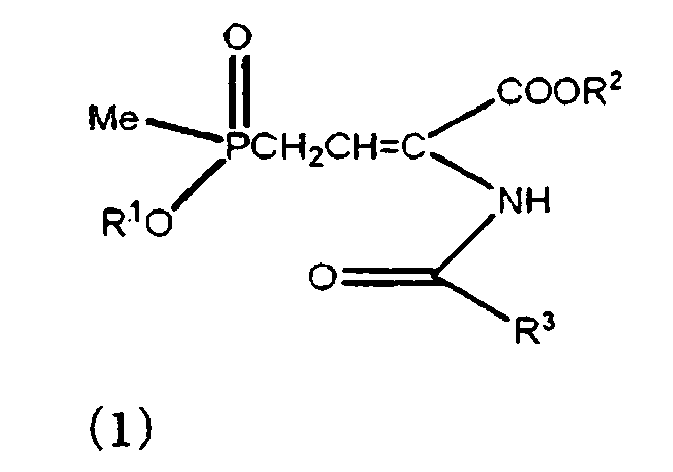
to hydrogenation reaction under hydrogen atmosphere in the presence of asymmetric catalyst to produce a compound represented by the following formula (4): and sudjecting the produced compound represented by the formula (4) to hydrolysis;said asymmetric catalyst being represented by the following formula (2):
[Rh(R4)(L)]X (2)
[where R4 represents 1,5-cyclooctadiene or norbornadiene, L represents an optically active cyclic phosphine ligand represented by the following formula (6) or (8), and X represents BF4, ClO4, PF6, SbF6, BPh4, or OTf (where Tf represents trifluoromethanesulfonyl group)]
or the following formula (3):
[Rh(L)(Z)]2 (3)
[where L has the same meaning as in the formula (2), and Z represents halogen atom];said formula (6) being:
 said formula (8) being
- The method as defined in claim 1, wherein L in the formula (2) or (3) is a ligand represented by the formula (8).
- The method as defined in claim 1, wherein L in the formula (2) or (3) is a ligand represented by the formula (6).
- The method as defined in claim 1, wherein the asymmetric catalyst represented by the formula (2) is used.
- The method as defined in claim 1, wherein the asymmetric catalyst represented by the formula (2) is used and L in the formula (2) is a ligand represented by the formula (6).
- The method as defined in claim 1, wherein L in the formula (2) or (3) is a ligand represented by the formula (6) and Y in the ligand represented by the formula (6) is a group selected from the groups represented by the following formula (9):

- The method as defined in any one of claims 1 to 6, wherein the asymmetric catalyst represented by the formula (2), wherein X is OTf or BF4, is used.
- The method as defined in any one of claims 1 to 7, wherein R1 and R2 are hydrogen atom and R3 is C1-4 alkyl group, in the formula (1).
- The method as defined in claim 6, wherein L is 1,2-bis(2,5-dimethyl phosphorano) benzene, 1,2-bis(2,5-diethyl phosphorano) benzene, 1,2-bis(2,5-diisopropyl phosphorano) benzene, 1,2-bis(2,5-dimethyl-3,4-dihydroxyphosphorano) benzene, 1,2-bis(2,5-dimethyl phosphorano) ethane, or 1,2-bis(2,5-diethyl phosphorano) ethane.
Applications Claiming Priority (2)
| Application Number | Priority Date | Filing Date | Title |
|---|---|---|---|
| JP2005093949 | 2005-03-29 | ||
| PCT/JP2006/306219 WO2006104120A1 (en) | 2005-03-29 | 2006-03-28 | Method for producing l-2-amino-4-(hydroxymethylphosphinyl)- butanoic acid |
Publications (3)
| Publication Number | Publication Date |
|---|---|
| EP1864989A1 true EP1864989A1 (en) | 2007-12-12 |
| EP1864989A4 EP1864989A4 (en) | 2010-06-23 |
| EP1864989B1 EP1864989B1 (en) | 2012-07-18 |
Family
ID=37053376
Family Applications (1)
| Application Number | Title | Priority Date | Filing Date |
|---|---|---|---|
| EP06730167A Expired - Lifetime EP1864989B1 (en) | 2005-03-29 | 2006-03-28 | Method for producing l-2-amino-4-(hydroxymethylphosphinyl)- butanoic acid |
Country Status (6)
| Country | Link |
|---|---|
| US (1) | US7772426B2 (en) |
| EP (1) | EP1864989B1 (en) |
| JP (1) | JP4970249B2 (en) |
| ES (1) | ES2391468T3 (en) |
| TW (1) | TW200714572A (en) |
| WO (1) | WO2006104120A1 (en) |
Cited By (5)
| Publication number | Priority date | Publication date | Assignee | Title |
|---|---|---|---|---|
| US9255115B2 (en) | 2011-09-30 | 2016-02-09 | Meiji Seika Pharma Co. Ltd. | Method for producing glufosinate P free acid |
| CN107434812A (en) * | 2017-09-08 | 2017-12-05 | 南京工业大学 | Method for synthesizing 2-amido-4- (O-alkyl phosphonomethyliminoyl) -2-butenoic acid and ester thereof |
| WO2018108797A1 (en) | 2016-12-15 | 2018-06-21 | Bayer Cropscience Aktiengesellschaft | Method for producing l-glufosinate or the salts thereof using ephedrine |
| WO2018108794A1 (en) | 2016-12-15 | 2018-06-21 | Bayer Cropscience Aktiengesellschaft | Method for producing d-glufosinate or salts thereof using ephedrine |
| WO2022207753A1 (en) | 2021-04-01 | 2022-10-06 | Basf Se | Methods for preparing l-glufosinate |
Families Citing this family (48)
| Publication number | Priority date | Publication date | Assignee | Title |
|---|---|---|---|---|
| WO2008114808A1 (en) | 2007-03-19 | 2008-09-25 | Meiji Seika Kaisha Ltd. | Process for producing phosphorus-containing dehydroamino acid |
| CN101641363A (en) * | 2007-03-23 | 2010-02-03 | 明治制果株式会社 | Method for producing phosphorus-containing alpha-keto acid |
| WO2019018406A1 (en) | 2017-07-18 | 2019-01-24 | Agrimetis, Llc | Methods for the purification of l-glufosinate |
| WO2019030087A1 (en) | 2017-08-09 | 2019-02-14 | Basf Se | Herbicidal mixtures comprising l-glufosinate or its salt and at least one lipid biosynthesis inhibitor |
| BR122023021519A2 (en) | 2017-08-09 | 2024-01-09 | Basf Se | HERBICIDES MIXTURE, PESTICIDE COMPOSITION AND VEGETATION CONTROL METHOD |
| WO2019030089A1 (en) | 2017-08-09 | 2019-02-14 | Basf Se | Herbicidal mixtures comprising l-glufosinate or its salt and at least one als inhibitor |
| CA3263155A1 (en) * | 2017-08-09 | 2025-03-15 | Basf Se | Herbicidal mixtures comprising l-glufosinate or its salt and at least one vlcfa inhibitor |
| EP3440939A1 (en) | 2017-08-09 | 2019-02-13 | Basf Se | Herbicidal mixtures comprising l-glufosinate |
| WO2019030100A1 (en) | 2017-08-09 | 2019-02-14 | Basf Se | Herbicidal mixtures comprising l-glufosinate or its salt and at least one mitosis inhibitor |
| WO2019030092A1 (en) | 2017-08-09 | 2019-02-14 | Basf Se | Herbicidal mixtures comprising l-glufosinate or its salt and at least one photosynthesis inhibitor |
| EP3440937A1 (en) | 2017-08-09 | 2019-02-13 | Basf Se | Herbicidal mixtures comprising l-glufosinate or its salt and a second herbicide |
| WO2019030088A1 (en) | 2017-08-09 | 2019-02-14 | Basf Se | Herbicidal mixtures comprising l-glufosinate and their use in cereal cultures |
| BR112020002666A2 (en) | 2017-08-09 | 2020-07-28 | Basf Se | use of herbicide mixture, pesticide mixture, pesticide composition and vegetation control method |
| WO2019030102A1 (en) | 2017-08-09 | 2019-02-14 | Basf Se | Herbicidal mixtures comprising l-glufosinate or its salt and glyphosate or its salts |
| TW202519118A (en) | 2017-08-09 | 2025-05-16 | 德商巴地斯顏料化工廠 | Herbicidal mixtures comprising l-glufosinate or its salt and at least one protoporphyrinogen-ix oxidase inhibitor |
| CA3070177A1 (en) | 2017-08-09 | 2019-02-14 | Basf Se | Herbicidal mixtures comprising l-glufosinate and their use in canola cultures |
| WO2019030090A1 (en) | 2017-08-09 | 2019-02-14 | Basf Se | Herbicidal mixtures comprising l-glufosinate and their use in rice cultures |
| WO2019030103A1 (en) | 2017-08-09 | 2019-02-14 | Basf Se | Herbicidal mixtures comprising l-glufosinate or its salt and at least one auxinic herbicide |
| BR122023020912A2 (en) | 2017-08-09 | 2024-01-09 | Basf Se | USE OF A HERBICIDE MIXTURE, PESTICIDE MIXTURE, PESTICIDE COMPOSITION AND METHOD FOR CONTROLLING UNDESIRABLE VEGETATION |
| CN113767107A (en) | 2019-04-16 | 2021-12-07 | 巴斯夫欧洲公司 | Process for producing crystalline L-glufosinate ammonium salt monohydrate |
| BR112022014559A2 (en) | 2020-01-23 | 2022-09-20 | Basf Se | AGROCHEMICAL COMPOSITION, COMPOUND OF FORMULA (I), ADJUVANT SOLUTION AND METHOD TO CONTROL UNDESIRABLE VEGETATION |
| US20230068414A1 (en) | 2020-01-31 | 2023-03-02 | Basf Se | Herbicide combinations comprising glufosinate and trifludimoxazin |
| WO2021151741A1 (en) | 2020-01-31 | 2021-08-05 | Basf Se | Herbicide combinations comprising glufosinate and tiafenacil |
| WO2021151734A1 (en) | 2020-01-31 | 2021-08-05 | Basf Se | Herbicide combinations comprising glufosinate and flumiclorac-pentyl |
| BR112022014960A2 (en) | 2020-01-31 | 2022-09-20 | Basf Se | COMBINATION OF HERBICIDES, COMPOSITION, METHODS OF PRODUCTION OF A COMBINATION OF HERBICIDES, TO CONTROL THE GROWTH OF UNWANTED PLANTS, TO TREAT OR PROTECT LINE CROPS AND SPECIALTY AND USE CROPS |
| BR112022014824A2 (en) | 2020-01-31 | 2022-12-13 | Basf Se | COMBINATION OF HERBICIDES, COMPOSITION, METHODS OF PRODUCING HERBICIDIAL COMBINATIONS, OF TREATMENT OR PROTECTION OF PRODUCING PLANTS IN ROWS AND OF TREATMENT OR PROTECTION OF SPECIALIZED PLANTS AND USE OF THE HERBICIDIAL COMPOSITION |
| US12568968B2 (en) | 2020-01-31 | 2026-03-10 | Basf Se | Herbicide combinations comprising glufosinate and epyrifencacil |
| WO2021151744A1 (en) | 2020-01-31 | 2021-08-05 | Basf Se | Herbicide combinations comprising glufosinate and oxyfluorfen |
| BR112022014879A2 (en) | 2020-01-31 | 2022-09-20 | Basf Se | COMBINATION OF HERBICIDES, COMPOSITION, METHODS OF PRODUCTION OF COMBINATIONS OF HERBICIDES, OF TREATMENT OR PROTECTION OF PRODUCING PLANTS IN ROWS AND OF TREATMENT OR PROTECTION OF SPECIALIZED PLANTS AND USE OF COMBINATION OF HERBICIDES |
| US20230076646A1 (en) | 2020-01-31 | 2023-03-09 | Basf Se | Herbicide combinations comprising glufosinate and sulfentrazone |
| BR112022014955A2 (en) | 2020-01-31 | 2022-09-20 | Basf Se | HERBICIDE COMBINATION, COMPOSITION, METHODS TO PRODUCE A HERBICIDE COMBINATION, TO CONTROL UNDESIRABLE PLANTS GROWTH AND/OR CONTROL HARMFUL PLANTS, TO TREAT OR PROTECT IN-LINE CROPS AND TO TREAT OR PROTECT SPECIAL CROPS AND HERBICIDE COMBINATION USE |
| BR112022014950A2 (en) | 2020-01-31 | 2022-09-20 | Basf Se | COMBINATION OF HERBICIDES, COMPOSITION, METHODS OF PRODUCTION OF COMBINATION OF HERBICIDES, OF CONTROL OF UNWANTED PLANT GROWTH AND OF TREATMENT OR PROTECTION OF PLANTS AND USE OF COMBINATION OF HERBICIDES |
| BR112022014800A2 (en) | 2020-01-31 | 2022-09-20 | Basf Se | COMBINATION OF HERBICIDES, COMPOSITION, METHODS TO PRODUCE COMBINATION OF HERBICIDES, TO CONTROL UNWANTED PLANTS GROWTH AND/OR CONTROL OF HARMFUL PLANTS AND TO TREAT OR PROTECT CROPS AND USE OF COMBINATION HERBICIDES |
| BR112022014727A2 (en) | 2020-01-31 | 2022-10-11 | Basf Se | COMBINATION OF HERBICIDES, COMPOSITION, METHODS TO PRODUCE A COMBINATION OF HERBICIDES, TO CONTROL UNDESIRABLE PLANTS GROWTH, TO TREAT OR PROTECT INLINE CROPS AND TO TREAT OR PROTECT SPECIAL CROPS AND USE OF A COMBINATION OF HERBICIDES |
| US20230091888A1 (en) | 2020-01-31 | 2023-03-23 | Basf Se | Herbicide combinations comprising glufosinate and selected ppo inhibitors |
| US12262715B2 (en) | 2020-02-05 | 2025-04-01 | Basf Se | Herbicidal mixtures comprising L-glufosinate or its salt and at least one protoporphyrinogen-IX oxidase inhibitor |
| CN113462730B (en) * | 2020-03-31 | 2023-08-25 | 江苏扬农化工股份有限公司 | Method for preparing L-glufosinate-ammonium by double enzyme-linked method |
| WO2022078972A1 (en) | 2020-10-12 | 2022-04-21 | Basf Se | Herbicide combination comprising glufosinate, saflufenacil and trifludimoxazin |
| EP4000400A1 (en) | 2020-11-17 | 2022-05-25 | Basf Se | Herbicide combination comprising glufosinate, saflufenacil and trifludimoxazin |
| US20230397609A1 (en) | 2020-10-27 | 2023-12-14 | Basf Se | Pesticide microemulsion compositions |
| CR20230380A (en) | 2021-02-05 | 2023-10-12 | Basf Se | Liquid herbicidal compositions |
| CA3219689A1 (en) | 2021-05-21 | 2022-11-24 | Anna SOYK | Computer-implemented method for applying a glutamine synthetase inhibitor on an agricultural field |
| EP4432830A1 (en) | 2021-11-15 | 2024-09-25 | Basf Se | Method for increasing the efficacy of a herbicide |
| CN119451575A (en) | 2022-06-29 | 2025-02-14 | 巴斯夫欧洲公司 | Herbicidal mixture comprising L-phosphinothricin or its salt and a second herbicide |
| CA3266992A1 (en) | 2022-09-14 | 2024-03-21 | Basf Se | Use of an alkylether sulfate for improving the efficacy of herbicides |
| EP4338592A1 (en) | 2022-09-15 | 2024-03-20 | Basf Se | Use of compound for improving the efficacy of herbicides |
| AR133862A1 (en) | 2023-09-21 | 2025-11-12 | Specialty Operations France | CONCENTRATED WATER EMULSION COMPRISING GLUFOSINATE, VLCFA INHIBITOR AND SPECIFIC SURFACTANTS |
| AR133857A1 (en) | 2023-09-21 | 2025-11-05 | Specialty Operations France | HERBICIDE COMPOSITIONS COMPRISING SPECIFIC SURFACTANTS |
Family Cites Families (13)
| Publication number | Priority date | Publication date | Assignee | Title |
|---|---|---|---|---|
| DE2717440C2 (en) | 1976-05-17 | 1984-04-05 | Hoechst Ag, 6230 Frankfurt | Weed control with [(3-amino-3-carboxy) propyl-1] methylphosphinic acid derivatives |
| JPS5525A (en) | 1978-05-25 | 1980-01-05 | Meiji Seika Kaisha Ltd | Preparation of phosphorus-containing amino acid |
| JPS59219297A (en) * | 1983-05-27 | 1984-12-10 | Meiji Seika Kaisha Ltd | Preparation of optically active ((3-amino-3-carboxy) propyl-1) phosphinic acid derivative |
| DE3542645A1 (en) * | 1985-12-03 | 1987-06-04 | Hoechst Ag | METHOD FOR PRODUCING L-HOMOALANIN-4-YL (METHYL) -PHOSPHINIC ACID AND ITS ALKYLESTER |
| DE3609818A1 (en) * | 1986-03-22 | 1987-09-24 | Hoechst Ag | METHOD FOR PRODUCING L-PHOSPHINOTHRICIN (DERIVATIVES) AND ITS ALKYLESTER |
| US6337406B1 (en) * | 1998-08-21 | 2002-01-08 | The Penn State Research Foundation | Asymmetric catalysis based on chiral phospholanes and hydroxyl phospholanes |
| US6727377B2 (en) * | 1998-08-21 | 2004-04-27 | The Penn State Research Foundation | Asymmetric catalysis based on chiral phospholanes and hydroxyl phospholanes |
| CA2340943A1 (en) * | 1998-08-21 | 2000-03-02 | The Penn State Research Foundation | Asymmetric catalysis based on chiral phospholanes |
| DE19919848A1 (en) | 1999-04-30 | 2000-11-02 | Aventis Cropscience Gmbh | Process for the preparation of L-phosphinothricin by enzymatic transamination with aspartate |
| DE19933362A1 (en) * | 1999-07-20 | 2001-02-08 | Aventis Cropscience Gmbh | Process for the production of L-amino acids from their racemic N-acetyl-D, L derivatives by enzymatic racemate cleavage using isolated, recombinant enzymes |
| CN1608074B (en) * | 2001-11-09 | 2011-09-07 | 宾夕法尼亚州研究基金会 | P-chiral phospholanes and phosphocyclic compounds and their use in asymmetric catalytic reactions |
| US7169953B2 (en) * | 2001-11-09 | 2007-01-30 | The Penn State Research Foundation | P-chiral phospholanes and phosphocyclic compounds and their use in asymmetric catalytic reactions |
| WO2004035594A1 (en) | 2002-10-01 | 2004-04-29 | Meiji Seika Kaisha, Ltd. | Intermediate for producing carboxypeptidase b inhibitor |
-
2006
- 2006-03-28 US US11/909,839 patent/US7772426B2/en not_active Expired - Fee Related
- 2006-03-28 EP EP06730167A patent/EP1864989B1/en not_active Expired - Lifetime
- 2006-03-28 WO PCT/JP2006/306219 patent/WO2006104120A1/en not_active Ceased
- 2006-03-28 JP JP2007510509A patent/JP4970249B2/en not_active Expired - Lifetime
- 2006-03-28 ES ES06730167T patent/ES2391468T3/en not_active Expired - Lifetime
- 2006-03-29 TW TW095110872A patent/TW200714572A/en unknown
Cited By (6)
| Publication number | Priority date | Publication date | Assignee | Title |
|---|---|---|---|---|
| US9255115B2 (en) | 2011-09-30 | 2016-02-09 | Meiji Seika Pharma Co. Ltd. | Method for producing glufosinate P free acid |
| WO2018108797A1 (en) | 2016-12-15 | 2018-06-21 | Bayer Cropscience Aktiengesellschaft | Method for producing l-glufosinate or the salts thereof using ephedrine |
| WO2018108794A1 (en) | 2016-12-15 | 2018-06-21 | Bayer Cropscience Aktiengesellschaft | Method for producing d-glufosinate or salts thereof using ephedrine |
| CN107434812A (en) * | 2017-09-08 | 2017-12-05 | 南京工业大学 | Method for synthesizing 2-amido-4- (O-alkyl phosphonomethyliminoyl) -2-butenoic acid and ester thereof |
| CN107434812B (en) * | 2017-09-08 | 2019-07-02 | 南京工业大学 | A kind of method of synthesizing 2-amido-4-(O-alkyl methylphosphono)-2-butenoic acid and ester thereof |
| WO2022207753A1 (en) | 2021-04-01 | 2022-10-06 | Basf Se | Methods for preparing l-glufosinate |
Also Published As
| Publication number | Publication date |
|---|---|
| US20080146837A1 (en) | 2008-06-19 |
| EP1864989A4 (en) | 2010-06-23 |
| WO2006104120A1 (en) | 2006-10-05 |
| JPWO2006104120A1 (en) | 2008-09-11 |
| JP4970249B2 (en) | 2012-07-04 |
| ES2391468T3 (en) | 2012-11-27 |
| US7772426B2 (en) | 2010-08-10 |
| TW200714572A (en) | 2007-04-16 |
| EP1864989B1 (en) | 2012-07-18 |
Similar Documents
| Publication | Publication Date | Title |
|---|---|---|
| EP1864989B1 (en) | Method for producing l-2-amino-4-(hydroxymethylphosphinyl)- butanoic acid | |
| EP0295109B1 (en) | Process for preparing optically active alcohol | |
| KR101414917B1 (en) | Method for producing optically active aminophosphinylbutanoic acid | |
| Duan et al. | Enantioselective Synthesis of Optically Active Alkanephos‐phonates via Rhodium‐Catalyzed Asymmetric Hydrogenation of β‐Substituted α, β‐Unsaturated Phosphonates with Ferrocene‐Based Monophosphoramidite Ligands | |
| JP4201916B2 (en) | Optically active 1,2-bis (dialkylphosphino) benzene derivative, process for producing the same, and rhodium metal complex having the compound as a ligand | |
| EP0732337A1 (en) | Optically active asymmetric diphosphine and process for producing optically active substance in its presence | |
| EP1439162B1 (en) | Process for producing optically active 3,5-dihydroxycarboxylic acid derivative | |
| US6472533B1 (en) | Ligands for chiral catalysis | |
| JPH06122690A (en) | New aminophosphine phosphonite, its preparation and its use in an enantioselective reaction | |
| EP1030854A2 (en) | Catalysts for asymmetric synthesis containing rigid chiral ligands | |
| JP4148702B2 (en) | Novel diphosphine compound, production intermediate thereof, transition metal complex having the compound as a ligand, and asymmetric hydrogenation catalyst containing the complex | |
| US8222433B2 (en) | Axially asymmetric phosphorus compound and production method thereof | |
| JP2006527221A (en) | Chiral ligands for use in asymmetric synthesis | |
| Wilt | Application of chiral bis (phosphine) monosulfide ligands to palladium-catalyzed asymmetric allylic alkylation | |
| JP2006520748A (en) | Enantioselective hydrogenation of intermediates in the synthesis of tipranavir. | |
| JP2005247773A (en) | Method for producing 2-pyridylalanine | |
| ITMI20011322A1 (en) | MIXED CHIRALITY AMINOPHOSPHITES AS CHIRAL TIMBER FOR STEREO-CONTROLLED HOMOGENEOUS CATALYSIS WITH TRANS METAL COMPLEXES | |
| JPH0460B2 (en) |
Legal Events
| Date | Code | Title | Description |
|---|---|---|---|
| PUAI | Public reference made under article 153(3) epc to a published international application that has entered the european phase |
Free format text: ORIGINAL CODE: 0009012 |
|
| 17P | Request for examination filed |
Effective date: 20071008 |
|
| AK | Designated contracting states |
Kind code of ref document: A1 Designated state(s): AT BE BG CH CY CZ DE DK EE ES FI FR GB GR HU IE IS IT LI LT LU LV MC NL PL PT RO SE SI SK TR |
|
| DAX | Request for extension of the european patent (deleted) | ||
| A4 | Supplementary search report drawn up and despatched |
Effective date: 20100527 |
|
| GRAP | Despatch of communication of intention to grant a patent |
Free format text: ORIGINAL CODE: EPIDOSNIGR1 |
|
| RIC1 | Information provided on ipc code assigned before grant |
Ipc: C07F 9/30 20060101AFI20120110BHEP Ipc: C07B 53/00 20060101ALI20120110BHEP Ipc: C07F 9/6568 20060101ALI20120110BHEP |
|
| RAP1 | Party data changed (applicant data changed or rights of an application transferred) |
Owner name: MEIJI SEIKA PHARMA CO., LTD. |
|
| GRAS | Grant fee paid |
Free format text: ORIGINAL CODE: EPIDOSNIGR3 |
|
| GRAA | (expected) grant |
Free format text: ORIGINAL CODE: 0009210 |
|
| AK | Designated contracting states |
Kind code of ref document: B1 Designated state(s): AT BE BG CH CY CZ DE DK EE ES FI FR GB GR HU IE IS IT LI LT LU LV MC NL PL PT RO SE SI SK TR |
|
| REG | Reference to a national code |
Ref country code: GB Ref legal event code: FG4D |
|
| REG | Reference to a national code |
Ref country code: CH Ref legal event code: EP |
|
| REG | Reference to a national code |
Ref country code: AT Ref legal event code: REF Ref document number: 566990 Country of ref document: AT Kind code of ref document: T Effective date: 20120815 Ref country code: IE Ref legal event code: FG4D |
|
| REG | Reference to a national code |
Ref country code: DE Ref legal event code: R096 Ref document number: 602006030834 Country of ref document: DE Effective date: 20120913 |
|
| REG | Reference to a national code |
Ref country code: ES Ref legal event code: FG2A Ref document number: 2391468 Country of ref document: ES Kind code of ref document: T3 Effective date: 20121127 |
|
| REG | Reference to a national code |
Ref country code: NL Ref legal event code: VDEP Effective date: 20120718 |
|
| REG | Reference to a national code |
Ref country code: AT Ref legal event code: MK05 Ref document number: 566990 Country of ref document: AT Kind code of ref document: T Effective date: 20120718 |
|
| REG | Reference to a national code |
Ref country code: LT Ref legal event code: MG4D Effective date: 20120718 |
|
| PG25 | Lapsed in a contracting state [announced via postgrant information from national office to epo] |
Ref country code: AT Free format text: LAPSE BECAUSE OF FAILURE TO SUBMIT A TRANSLATION OF THE DESCRIPTION OR TO PAY THE FEE WITHIN THE PRESCRIBED TIME-LIMIT Effective date: 20120718 Ref country code: IS Free format text: LAPSE BECAUSE OF FAILURE TO SUBMIT A TRANSLATION OF THE DESCRIPTION OR TO PAY THE FEE WITHIN THE PRESCRIBED TIME-LIMIT Effective date: 20121118 Ref country code: CY Free format text: LAPSE BECAUSE OF FAILURE TO SUBMIT A TRANSLATION OF THE DESCRIPTION OR TO PAY THE FEE WITHIN THE PRESCRIBED TIME-LIMIT Effective date: 20120718 Ref country code: FI Free format text: LAPSE BECAUSE OF FAILURE TO SUBMIT A TRANSLATION OF THE DESCRIPTION OR TO PAY THE FEE WITHIN THE PRESCRIBED TIME-LIMIT Effective date: 20120718 Ref country code: LT Free format text: LAPSE BECAUSE OF FAILURE TO SUBMIT A TRANSLATION OF THE DESCRIPTION OR TO PAY THE FEE WITHIN THE PRESCRIBED TIME-LIMIT Effective date: 20120718 Ref country code: BE Free format text: LAPSE BECAUSE OF FAILURE TO SUBMIT A TRANSLATION OF THE DESCRIPTION OR TO PAY THE FEE WITHIN THE PRESCRIBED TIME-LIMIT Effective date: 20120718 |
|
| PG25 | Lapsed in a contracting state [announced via postgrant information from national office to epo] |
Ref country code: GR Free format text: LAPSE BECAUSE OF FAILURE TO SUBMIT A TRANSLATION OF THE DESCRIPTION OR TO PAY THE FEE WITHIN THE PRESCRIBED TIME-LIMIT Effective date: 20121019 Ref country code: PL Free format text: LAPSE BECAUSE OF FAILURE TO SUBMIT A TRANSLATION OF THE DESCRIPTION OR TO PAY THE FEE WITHIN THE PRESCRIBED TIME-LIMIT Effective date: 20120718 Ref country code: LV Free format text: LAPSE BECAUSE OF FAILURE TO SUBMIT A TRANSLATION OF THE DESCRIPTION OR TO PAY THE FEE WITHIN THE PRESCRIBED TIME-LIMIT Effective date: 20120718 Ref country code: SE Free format text: LAPSE BECAUSE OF FAILURE TO SUBMIT A TRANSLATION OF THE DESCRIPTION OR TO PAY THE FEE WITHIN THE PRESCRIBED TIME-LIMIT Effective date: 20120718 Ref country code: PT Free format text: LAPSE BECAUSE OF FAILURE TO SUBMIT A TRANSLATION OF THE DESCRIPTION OR TO PAY THE FEE WITHIN THE PRESCRIBED TIME-LIMIT Effective date: 20121119 Ref country code: SI Free format text: LAPSE BECAUSE OF FAILURE TO SUBMIT A TRANSLATION OF THE DESCRIPTION OR TO PAY THE FEE WITHIN THE PRESCRIBED TIME-LIMIT Effective date: 20120718 |
|
| PG25 | Lapsed in a contracting state [announced via postgrant information from national office to epo] |
Ref country code: NL Free format text: LAPSE BECAUSE OF FAILURE TO SUBMIT A TRANSLATION OF THE DESCRIPTION OR TO PAY THE FEE WITHIN THE PRESCRIBED TIME-LIMIT Effective date: 20120718 |
|
| PG25 | Lapsed in a contracting state [announced via postgrant information from national office to epo] |
Ref country code: RO Free format text: LAPSE BECAUSE OF FAILURE TO SUBMIT A TRANSLATION OF THE DESCRIPTION OR TO PAY THE FEE WITHIN THE PRESCRIBED TIME-LIMIT Effective date: 20120718 Ref country code: EE Free format text: LAPSE BECAUSE OF FAILURE TO SUBMIT A TRANSLATION OF THE DESCRIPTION OR TO PAY THE FEE WITHIN THE PRESCRIBED TIME-LIMIT Effective date: 20120718 Ref country code: CZ Free format text: LAPSE BECAUSE OF FAILURE TO SUBMIT A TRANSLATION OF THE DESCRIPTION OR TO PAY THE FEE WITHIN THE PRESCRIBED TIME-LIMIT Effective date: 20120718 Ref country code: DK Free format text: LAPSE BECAUSE OF FAILURE TO SUBMIT A TRANSLATION OF THE DESCRIPTION OR TO PAY THE FEE WITHIN THE PRESCRIBED TIME-LIMIT Effective date: 20120718 |
|
| PLBE | No opposition filed within time limit |
Free format text: ORIGINAL CODE: 0009261 |
|
| STAA | Information on the status of an ep patent application or granted ep patent |
Free format text: STATUS: NO OPPOSITION FILED WITHIN TIME LIMIT |
|
| PG25 | Lapsed in a contracting state [announced via postgrant information from national office to epo] |
Ref country code: SK Free format text: LAPSE BECAUSE OF FAILURE TO SUBMIT A TRANSLATION OF THE DESCRIPTION OR TO PAY THE FEE WITHIN THE PRESCRIBED TIME-LIMIT Effective date: 20120718 |
|
| 26N | No opposition filed |
Effective date: 20130419 |
|
| PG25 | Lapsed in a contracting state [announced via postgrant information from national office to epo] |
Ref country code: BG Free format text: LAPSE BECAUSE OF FAILURE TO SUBMIT A TRANSLATION OF THE DESCRIPTION OR TO PAY THE FEE WITHIN THE PRESCRIBED TIME-LIMIT Effective date: 20121018 |
|
| REG | Reference to a national code |
Ref country code: DE Ref legal event code: R097 Ref document number: 602006030834 Country of ref document: DE Effective date: 20130419 |
|
| PG25 | Lapsed in a contracting state [announced via postgrant information from national office to epo] |
Ref country code: MC Free format text: LAPSE BECAUSE OF NON-PAYMENT OF DUE FEES Effective date: 20130331 |
|
| REG | Reference to a national code |
Ref country code: CH Ref legal event code: PL |
|
| REG | Reference to a national code |
Ref country code: IE Ref legal event code: MM4A |
|
| PG25 | Lapsed in a contracting state [announced via postgrant information from national office to epo] |
Ref country code: LI Free format text: LAPSE BECAUSE OF NON-PAYMENT OF DUE FEES Effective date: 20130331 Ref country code: CH Free format text: LAPSE BECAUSE OF NON-PAYMENT OF DUE FEES Effective date: 20130331 Ref country code: IE Free format text: LAPSE BECAUSE OF NON-PAYMENT OF DUE FEES Effective date: 20130328 |
|
| REG | Reference to a national code |
Ref country code: DE Ref legal event code: R082 Ref document number: 602006030834 Country of ref document: DE Representative=s name: GODEMEYER BLUM LENZE PATENTANWAELTE, PARTNERSC, DE Ref country code: DE Ref legal event code: R082 Ref document number: 602006030834 Country of ref document: DE Representative=s name: GODEMEYER BLUM LENZE PARTNERSCHAFT, PATENTANWA, DE |
|
| REG | Reference to a national code |
Ref country code: FR Ref legal event code: PLFP Year of fee payment: 10 |
|
| PG25 | Lapsed in a contracting state [announced via postgrant information from national office to epo] |
Ref country code: TR Free format text: LAPSE BECAUSE OF FAILURE TO SUBMIT A TRANSLATION OF THE DESCRIPTION OR TO PAY THE FEE WITHIN THE PRESCRIBED TIME-LIMIT Effective date: 20120718 |
|
| PG25 | Lapsed in a contracting state [announced via postgrant information from national office to epo] |
Ref country code: HU Free format text: LAPSE BECAUSE OF FAILURE TO SUBMIT A TRANSLATION OF THE DESCRIPTION OR TO PAY THE FEE WITHIN THE PRESCRIBED TIME-LIMIT; INVALID AB INITIO Effective date: 20060328 Ref country code: LU Free format text: LAPSE BECAUSE OF NON-PAYMENT OF DUE FEES Effective date: 20130328 |
|
| REG | Reference to a national code |
Ref country code: FR Ref legal event code: PLFP Year of fee payment: 11 |
|
| REG | Reference to a national code |
Ref country code: FR Ref legal event code: PLFP Year of fee payment: 12 |
|
| PGFP | Annual fee paid to national office [announced via postgrant information from national office to epo] |
Ref country code: FR Payment date: 20170213 Year of fee payment: 12 |
|
| PGFP | Annual fee paid to national office [announced via postgrant information from national office to epo] |
Ref country code: GB Payment date: 20170322 Year of fee payment: 12 |
|
| PGFP | Annual fee paid to national office [announced via postgrant information from national office to epo] |
Ref country code: IT Payment date: 20170320 Year of fee payment: 12 Ref country code: ES Payment date: 20170214 Year of fee payment: 12 |
|
| GBPC | Gb: european patent ceased through non-payment of renewal fee |
Effective date: 20180328 |
|
| PG25 | Lapsed in a contracting state [announced via postgrant information from national office to epo] |
Ref country code: GB Free format text: LAPSE BECAUSE OF NON-PAYMENT OF DUE FEES Effective date: 20180328 Ref country code: IT Free format text: LAPSE BECAUSE OF NON-PAYMENT OF DUE FEES Effective date: 20180328 |
|
| PG25 | Lapsed in a contracting state [announced via postgrant information from national office to epo] |
Ref country code: FR Free format text: LAPSE BECAUSE OF NON-PAYMENT OF DUE FEES Effective date: 20180331 |
|
| REG | Reference to a national code |
Ref country code: ES Ref legal event code: FD2A Effective date: 20190911 |
|
| PG25 | Lapsed in a contracting state [announced via postgrant information from national office to epo] |
Ref country code: ES Free format text: LAPSE BECAUSE OF NON-PAYMENT OF DUE FEES Effective date: 20180329 |
|
| PGFP | Annual fee paid to national office [announced via postgrant information from national office to epo] |
Ref country code: DE Payment date: 20200317 Year of fee payment: 15 |
|
| REG | Reference to a national code |
Ref country code: DE Ref legal event code: R119 Ref document number: 602006030834 Country of ref document: DE |
|
| PG25 | Lapsed in a contracting state [announced via postgrant information from national office to epo] |
Ref country code: DE Free format text: LAPSE BECAUSE OF NON-PAYMENT OF DUE FEES Effective date: 20211001 |