EP1864714A1 - Catalyst for producing arylamine and process for producing arylamine by means thereof - Google Patents
Catalyst for producing arylamine and process for producing arylamine by means thereof Download PDFInfo
- Publication number
- EP1864714A1 EP1864714A1 EP07109615A EP07109615A EP1864714A1 EP 1864714 A1 EP1864714 A1 EP 1864714A1 EP 07109615 A EP07109615 A EP 07109615A EP 07109615 A EP07109615 A EP 07109615A EP 1864714 A1 EP1864714 A1 EP 1864714A1
- Authority
- EP
- European Patent Office
- Prior art keywords
- arylamine
- catalyst
- producing
- group
- compound
- Prior art date
- Legal status (The legal status is an assumption and is not a legal conclusion. Google has not performed a legal analysis and makes no representation as to the accuracy of the status listed.)
- Granted
Links
Classifications
-
- B—PERFORMING OPERATIONS; TRANSPORTING
- B01—PHYSICAL OR CHEMICAL PROCESSES OR APPARATUS IN GENERAL
- B01J—CHEMICAL OR PHYSICAL PROCESSES, e.g. CATALYSIS OR COLLOID CHEMISTRY; THEIR RELEVANT APPARATUS
- B01J31/00—Catalysts comprising hydrides, coordination complexes or organic compounds
- B01J31/16—Catalysts comprising hydrides, coordination complexes or organic compounds containing coordination complexes
- B01J31/24—Phosphines, i.e. phosphorus bonded to only carbon atoms, or to both carbon and hydrogen atoms, including e.g. sp2-hybridised phosphorus compounds such as phosphabenzene, phosphole or anionic phospholide ligands
-
- C—CHEMISTRY; METALLURGY
- C07—ORGANIC CHEMISTRY
- C07C—ACYCLIC OR CARBOCYCLIC COMPOUNDS
- C07C209/00—Preparation of compounds containing amino groups bound to a carbon skeleton
- C07C209/04—Preparation of compounds containing amino groups bound to a carbon skeleton by substitution of functional groups by amino groups
- C07C209/06—Preparation of compounds containing amino groups bound to a carbon skeleton by substitution of functional groups by amino groups by substitution of halogen atoms
- C07C209/10—Preparation of compounds containing amino groups bound to a carbon skeleton by substitution of functional groups by amino groups by substitution of halogen atoms with formation of amino groups bound to carbon atoms of six-membered aromatic rings or from amines having nitrogen atoms bound to carbon atoms of six-membered aromatic rings
-
- C—CHEMISTRY; METALLURGY
- C07—ORGANIC CHEMISTRY
- C07C—ACYCLIC OR CARBOCYCLIC COMPOUNDS
- C07C209/00—Preparation of compounds containing amino groups bound to a carbon skeleton
- C07C209/66—Preparation of compounds containing amino groups bound to a carbon skeleton from or via metallo-organic compounds
-
- B—PERFORMING OPERATIONS; TRANSPORTING
- B01—PHYSICAL OR CHEMICAL PROCESSES OR APPARATUS IN GENERAL
- B01J—CHEMICAL OR PHYSICAL PROCESSES, e.g. CATALYSIS OR COLLOID CHEMISTRY; THEIR RELEVANT APPARATUS
- B01J2231/00—Catalytic reactions performed with catalysts classified in B01J31/00
- B01J2231/40—Substitution reactions at carbon centres, e.g. C-C or C-X, i.e. carbon-hetero atom, cross-coupling, C-H activation or ring-opening reactions
- B01J2231/42—Catalytic cross-coupling, i.e. connection of previously not connected C-atoms or C- and X-atoms without rearrangement
- B01J2231/4277—C-X Cross-coupling, e.g. nucleophilic aromatic amination, alkoxylation or analogues
- B01J2231/4283—C-X Cross-coupling, e.g. nucleophilic aromatic amination, alkoxylation or analogues using N nucleophiles, e.g. Buchwald-Hartwig amination
-
- B—PERFORMING OPERATIONS; TRANSPORTING
- B01—PHYSICAL OR CHEMICAL PROCESSES OR APPARATUS IN GENERAL
- B01J—CHEMICAL OR PHYSICAL PROCESSES, e.g. CATALYSIS OR COLLOID CHEMISTRY; THEIR RELEVANT APPARATUS
- B01J2531/00—Additional information regarding catalytic systems classified in B01J31/00
- B01J2531/80—Complexes comprising metals of Group VIII as the central metal
- B01J2531/82—Metals of the platinum group
- B01J2531/824—Palladium
Definitions
- a specific example of the pyrazole may, for example, be pyrazole, 3-methylpyrazole, 3,5-dimethylpyrazole, 3-phenylpyrazole or 3,5-diphenylpyrazole.
- a specific example of the imidazole may, for example, be imidazole, 2-methylimidazole, 4-methylimidazole, 2,4-dimethylimidazole, 2-phenylimidazole or 4-phenylimidazole.
- a specific example of the indazole may, for example, be indazole, 5-methylindazole or 5-dimethylaminoindazole.
- the tertiary phosphine to be used in combination with the palladium compound is not particularly limited, but it may, for example, be a monodentate phosphine such as triethylphosphine, tricyclohexylphosphine, triisopropylphosphine, tri-n-butylphosphine, tri-iso-butylphosphine, tri-sec-butylphosphine, tri-tert-butylphosphine, triphenylphosphine, tri-pentafluorophenylphosphine, trio-tolylphosphine, tri-m-tolylphosphine, tri-p-tolylphosphine, tri(2,6-dimethylphenoxy)phosphine, tri(2-tert-butylphenoxy)phosphine, triphenoxyphosphine, tri(4-methylphenoxy)phosphine, tri(2-methylphenoxy)
- the palladium compound and the tertiary phosphine are essential, and both are combined to be a catalyst, which is added to the reaction system.
- a catalyst which is added to the reaction system.
- they may be independently added to the reaction system, or they may be preliminarily formulated in the form of a complex, which may be added.
- the present catalyst is effective particularly for a reaction of an aryl compound having an active group with the above-mentioned aromatic cyclic amine compound.
- the amount of the base to be used is usually within a range of from 0.8 to 8 times by mol, preferably within a range of from 1 to 4 times by mol, to the aryl compound having an active group.
- Example 2 The same operation as in Example 1 was carried out except that no 18-crown-6 was added, whereby 0.34 g (yield: 28%) of N-phenylcarbazole was obtained.
Landscapes
- Chemical & Material Sciences (AREA)
- Organic Chemistry (AREA)
- Inorganic Chemistry (AREA)
- Engineering & Computer Science (AREA)
- Materials Engineering (AREA)
- Chemical Kinetics & Catalysis (AREA)
- Indole Compounds (AREA)
- Low-Molecular Organic Synthesis Reactions Using Catalysts (AREA)
- Catalysts (AREA)
- Organic Low-Molecular-Weight Compounds And Preparation Thereof (AREA)
Abstract
Description
- The present invention relates to a process for producing an arylamine highly selectively and highly efficiently wherein an inexpensive base is employed.
- Aryl amines are a group of compounds useful as materials for pharmaceuticals and agricultural chemicals and for electronic materials, and it has been known since long ago that such a group of compounds can be prepared by a Ullmann method employing a copper catalyst (e.g. Patent Document 1 and Non-Patent Document 1). Further, in recent years, it has been reported that a wide range of arylamines can easily be prepared from an amine compound and an aryl halide by a combination of a palladium catalyst with a proper ligand and tert-BuONa as a strong base (e.g. Patent Document 2 and Non-Patent Documents 2 to 4). Further, an N-arylation reaction of a cyclic conjugated amine has been reported wherein a weak base such as potassium carbonate is used as a base, and a catalyst system comprising tri-tert-butylphosphine and palladium is used (e.g. Patent Document 3).
- Patent Document 1:
JP-A-8-48974 - Patent Document 2:
JP-A-10-139742 - Patent Document 3:
JP-A-2001-11046 - Non-Patent Document 1: Chem. Lett., pp. 1145-1148 (1989)
- Non-Patent Document 2: Angew. Chem. Int. Ed. Engl., 34, No. 12, 1348 (1995)
- Non-Patent Document 3: J. Am. Chem. Soc., 118, 7215 (1996)
- Non-Patent Document 4: J. Org. Chem., 61, 1133 (1996)
- However, the Ullmann method required a high temperature of at least 150°C and a long reaction time, and the reactivity was low, and the yield of the desired arylamines was not satisfactory. Further, a large amount of a copper catalyst was required, whereby such a method was problematic also from the viewpoint of the environmental problem. In the method of combining a palladium catalyst with a proper ligand and tert-BuONa as a strong base, the reactivity was sufficiently improved as compared with the Ullmann method, but a strong base was essential, whereby there was a problem that the method was hardly applicable to an N-arylation reaction of an amine compound having a relatively low pKa value of N-H proton like a carbazole.
- Namely, in an N-arylation reaction represented by a carbazole, if a strong base such as tert-BuONa is employed, sodium amide which is inert to the reaction will readily be formed, and therefore there is a restriction such that a weak base represented by potassium carbonate has to be used. In an N-arylation reaction employing such a weak base, the reactivity will be substantially influenced by the aryl compound having an active group or the amine compound, to be used, and there has been no established reaction conditions. In
JP-A-2001-11046 - It is an object of the present invention to provide a process for producing an arylamine, which is carried out under a mild condition employing an inexpensive inorganic base and which is extremely effective in an N-arylation reaction of a wide range of amine compounds, particularly in an N-arylation reaction of an amine compound having a relatively low pKa value like a carbazole.
- The present inventors have conducted an extensive study to solve the above-mentioned problems and as a result, have found it possible to prepare an arylamine highly selectively and highly efficiently in the presence of an inexpensive base by using a catalyst system comprising a palladium compound having a tertiary phosphine group and a phase-transfer catalyst. Thus, the present invention has been accomplished.
- Namely, the present invention provides a catalyst for producing an arylamine, which comprises a palladium compound having a tertiary phosphine group and a phase-transfer catalyst, and a novel process for producing an arylamine by means of such a catalyst.
- Now, the present invention will be described in detail with reference to the preferred embodiments.
- The aryl compound having an active group to be used in the present invention is specifically a compound represented by the following formula (I):

- A specific example of the Ar group is not particularly limited, but may, for example, be an aryl group such as a phenyl group, a naphthyl group, an anthracenyl group, a biphenyl group, a terphenyl group, an indenyl group, a fluorenyl group, a fluorenonyl group or a pyranyl group, or a heteroaryl group such as a pyridinyl group, a pyradinyl group, a quinolyl group, an isoquinolyl group, a furanyl group, a benzofuranyl group, a thiophenyl group, a benzothiophenyl group, a pyrrolyl group, an indolyl group or a carbazoyl group.
- The amine compound to be used in the present invention may be a primary amine or a secondary amine. The primary amine is not particularly limited, but may, for example, be an aliphatic primary amine such as ethylamine, propylamine, butylamine, pentylamine or octylamine, or an aromatic primary amine such as aniline, 2-naphthylamine, 2-aminobiphenyl or 4-aminobiphenyl, which may have a substituent on the aromatic ring. The secondary amine is not particularly limited, but may, for example, be an alicyclic secondary amine such as piperazine, 2-methylpiperazine, N-methylpiperazine, N-benzylpiperazine, piperidine, 2-ethylpiperidine or pyrrolidine, an aliphatic secondary amine such as dimethylamine or diethylamine, an aromatic secondary amine such as N-methylaniline, N-ethylaniline, N-ethylbenzylamine or diphenylamine, which may have a substituent on the aromatic ring, or an aromatic cyclic amine compound such as a carbazole, an indole, a pyrrole, a pyrazole, an imidazole, an indazole, or a benzimidazole. A specific example of the carbazole may, for example, be carbazole, 2-methylcarbazole or 2-methoxycarbazole. A specific example of the indole may, for example, be indole, 2-methylindole, 3-methylindole, 4-methylindole, 5-methylindole, 2-phenylindole or 5-methoxyindole. A specific example of the pyrrole may, for example, be pyrrole, 2-methylpyrrole, 2-acetylpyrrole or 2-dimethylaminopyrrole. A specific example of the pyrazole may, for example, be pyrazole, 3-methylpyrazole, 3,5-dimethylpyrazole, 3-phenylpyrazole or 3,5-diphenylpyrazole. A specific example of the imidazole may, for example, be imidazole, 2-methylimidazole, 4-methylimidazole, 2,4-dimethylimidazole, 2-phenylimidazole or 4-phenylimidazole. A specific example of the indazole may, for example, be indazole, 5-methylindazole or 5-dimethylaminoindazole. A specific example of the benzimidazole may, for example, be benzimidazole, 2-methylbenzimidazole, 5,6-dimethylbenzimidazole, 5-methoxybenzimidazole or 2-phenylbenzimidazole.
- In the present invention, the amount of the amine compound to be added, is not particularly limited, but it is usually within a range of from 0.5 to 8 times by mol to the aryl compound having an active group, preferably within a range of from 0.8 to 4 times by mol, from the viewpoint of the economical efficiency and purification efficiency after the reaction.
- In the present invention, a catalyst system comprising a palladium compound having a tertiary phosphine group and a phase-transfer catalyst, is used. The palladium compound is not particularly limited, but may, for example, be a tetravalent palladium compound such as sodium hexachloropalladium(IV) acid tetrahydrate or potassium hexachloropalladium(IV) acid, a bivalent palladium compound such as palladium(II) chloride, palladium(II) bromide, palladium(II) acetate, palladium(II) acetylacetonate, palladium(II) dichlorobis(benzonitrile), palladium(II) dichlorobis(acetonitrile), palladium(II) dichlorobis(triphenylphosphine), palladium(II) dichlorotetraammine, palladium(II) dichloro(cycloocta-1,5-diene) or palladium(II) trifluoroacetate, or a zero valent palladium compound such as dipalladium(0) tris(dibenzylideneacetone), dipalladium(0) tris(dibenzylideneacetone) chloroform complex, or palladium(0) tetrakis(triphenylphosphine).
- Such palladium compounds may be used alone or in combination as a mixture of two or more of them.
- In the present invention, the amount of the palladium compound to be used is not particularly limited, but usually within a range of from 0.00001 to 20 mol%, as calculated as palladium, per mol of the aryl compound having an active group. When the palladium compound is within the above range, the arylamine can be prepared with a high selectivity, but with a view to further improving the activity or to use an expensive palladium compound properly, a more preferred amount of the palladium compound to be used is within a range of from 0.001 to 5 mol%, as calculated as palladium, per mol of the aryl compound having an active group.
- In the present invention, the tertiary phosphine to be used in combination with the palladium compound is not particularly limited, but it may, for example, be a monodentate phosphine such as triethylphosphine, tricyclohexylphosphine, triisopropylphosphine, tri-n-butylphosphine, tri-iso-butylphosphine, tri-sec-butylphosphine, tri-tert-butylphosphine, triphenylphosphine, tri-pentafluorophenylphosphine, trio-tolylphosphine, tri-m-tolylphosphine, tri-p-tolylphosphine, tri(2,6-dimethylphenoxy)phosphine, tri(2-tert-butylphenoxy)phosphine, triphenoxyphosphine, tri(4-methylphenoxy)phosphine, tri(2-methylphenoxy)phosphine, 2-(dicyclohexylphosphino)biphenyl or (2-cyclohexylphenyl)di-tert-butylphosphine, or a bidentate phosphine such as 1,2-bis(diphenylphosphino)benzene, 2,2'-bis(diphenylphosphino)-1,1'-binaphthyl, 1,2-bis(diphenylphosphino)ethane, 1,3-bis(diphenylphosphino)propane or 1,1-(diphenylphosphino)ferrocene. Among them, tri-tert-butylphosphine is more preferred in order to improve the selectivity for an arylamine.
- Such tertiary phosphines may be used alone or in combination as a mixture of two or more of them.
- In the present invention, the amount of the tertiary phosphine to be used is usually within a range of from 0.01 to 10,000 times by mol to the palladium compound. When the amount of the tertiary phosphine to be used is within the above range, there will be no change in the selectivity for the arylamine. In order to further improve the activity or to use the expensive tertiary phosphine properly, a more preferred amount of the tertiary phosphine to be used is within a range of from 0.1 to 10 times by mol to the palladium compound.
- In the present invention, the palladium compound and the tertiary phosphine are essential, and both are combined to be a catalyst, which is added to the reaction system. As the addition method, they may be independently added to the reaction system, or they may be preliminarily formulated in the form of a complex, which may be added.
- In the present invention, a phase-transfer catalyst is used. Such a phase-transfer catalyst is not particularly limited, but specifically, it may, for example, be a crown ether such as 24-crown-8, 18-crown-6, 15-crown-5, 12-crown-4, benzo-18-crown-6, benzo-15-crown-5, benzo-12-crown-4, dibenzo-30-crown-10, dibenzo-24-crown-8, dibenzo-21-crown-7, dibenzo-18-crown-6, dicyclohexano-24-crown-8, dicyclohexano-18-crown-6, N,N'-dibenzyl-4, or 13-diaza-18-crown-6, or a quaternary ammonium salt such as tetra(n-butyl)ammonium chloride, tetra(n-butyl)ammonium bromide, benzyltriethylammonium chloride, triethyl-n-dodecylammonium chloride, triethyl-n-dodecylammonium bromide, trimethyl-n-hexadecylammonium chloride, or trimethyl-n-hexadecylammonium bromide. Among them, preferred from the viewpoint of the reactivity is a crown ether, and from the viewpoint of the reactivity and economical efficiency, more preferred is 18-crown-6.
- Such phase-transfer catalysts may be used alone or in combination as a mixture of two or more of them.
- In the present invention, the amount of the phase-transfer catalyst is usually within a range of from 0.5 to 20 times by mol, more preferably within a range of from 1 to 10 times by mol, to the palladium compound.
- The present catalyst is effective particularly for a reaction of an aryl compound having an active group with the above-mentioned aromatic cyclic amine compound.
- In the present invention, an inorganic base is preferably used as the base. The inorganic base is not particularly limited, but specifically, it may, for example, be an alkali metal salt such as lithium carbonate, sodium carbonate, potassium carbonate, rubidium carbonate, cesium carbonate, sodium hydrogencarbonate, potassium hydrogencarbonate, rubidium hydrogencarbonate or potassium phosphate; or an alkaline earth metal salt such as magnesium carbonate or calcium carbonate. Among them, particularly preferred from the viewpoint of the economical efficiency is potassium carbonate.
- In the present invention, the amount of the base to be used is usually within a range of from 0.8 to 8 times by mol, preferably within a range of from 1 to 4 times by mol, to the aryl compound having an active group.
- The amination reaction in the present invention is carried out usually in the presence of an inert solvent. Such an inert solvent is not particularly limited so long as it is a solvent not to substantially impair the present reaction. Specifically, an aromatic hydrocarbon solvent such as benzene, toluene, xylene or mesitylene, may be preferably employed.
- The process of the present invention is preferably carried out under normal pressure in an atmosphere of an inert gas such as nitrogen or argon, but it may be carried out under a pressurized condition.
- In the present invention, the reaction temperature may be within a range of from 20 to 300°C, more preferably within a range of from 50 to 200°C, further preferably within a range of from 60 to 160°C.
- According to the present invention, by using a crown ether as a phase-transfer catalyst, an arylamine may be prepared highly selectively and highly efficiently in the presence of an inexpensive base. Further, there is no fear of a side reaction at the time of employing a strong base, whereby it is possible to present a process which is superior also industrially.
- Now, the present invention will be described with reference to Examples. However, it should be understood that the present invention is by no means restricted to such Examples. The results of reactions by combinations of substrates are shown in Tables 1 and 2.
- Further, the gas chromatography quantitative analyses were carried out by using GC-17A, manufactured by Shimadzu Corporation, a capillary column (NB-5, manufactured by GL Sciences Company) and a detector (FID) under a temperature-raising condition of 8°C/min from 100°C to 300°C.
- Into a 10 mL Schrenk tube, a stirrer was put, and the tube was flushed with nitrogen. Then, 45 mg (0.049 mmol) of dipalladium(0) tris(dibenzylideneacetone), 66 mg (0.32 mmol) of tri-tert-butylphosphine and 1 mL of o-xylene were added, and this solution was stirred for 20 minutes at 60°C in a nitrogen atmosphere to obtain a catalyst solution. A 100 mL three necked round bottomed flask was flushed with nitrogen, 0.79 g (5.0 mmol) of bromobenzene, 1.66 g (9.9 mmol) of carbazole, 1.37 g (9.9 mmol) of potassium carbonate, 39 mg (0.15 mmol) of 18-crown-6 and 30 mL of o-xylene were added. At room temperature, to this solution, the previous catalyst solution was added by a syringe, and the reaction solution was heated to 120°C. Two hours later, the heating was terminated, and the reaction solution was left to cool to room temperature. This reaction solution was extracted with 100 g of toluene, and the obtained organic layer was dried over anhydrous magnesium sulfate. This organic layer was subjected to a gas chromatography quantitative analysis using triphenylamine as an internal standard substance, whereby N-phenyl carbazole was 1.21 g (yield: 99%).
- Into a 10 mL Schrenk tube, a stirrer was put, and the tube was flushed with nitrogen. Then, 45 mg (0.049 mmol) of dipalladium(0) tris (dibenzylideneacetone), 66 mg (0.32 mmol) of tri-tert-butylphosphine and 1 mL of o-xylene were added, and this solution was stirred for 20 minutes at 60°C in a nitrogen atmosphere to obtain a catalyst solution. A 100 mL three necked round bottomed flask was flushed with nitrogen, and 1.00 g (5.0 mmol) of p-bromonitrobenzene, 1.66 g (9.9 mmol) of carbazole, 1.37 g (9.9 mmol) of potassium carbonate, 39 mg (0.15 mmol) of 18-crown-6 and 30 mL of o-xylene were added. At room temperature, to this solution, the previous catalyst solution was added by a syringe, and the reaction solution was heated to 120°C. Seven hours later, the heating was terminated, and the reaction solution was left to cool to room temperature. This reaction solution was extracted with 100 g of toluene, and the obtained organic layer was dried over anhydrous magnesium sulfate. This organic layer was subjected to a gas chromatography quantitative analysis using triphenylamine as an internal standard substance, whereby N-(4-nitrophenyl)carbazole was 1.14 g (yield: 80%).
- Into a 10 mL Schrenk tube, a stirrer was put, and the tube was flushed with nitrogen. Then, 45 mg (0.049 mmol) of dipalladium(0) tris(dibenzylideneacetone), 66 mg (0.32 mmol) of tri-tert-butylphosphine and 1 mL of o-xylene were added, and this solution was stirred for 20 minutes at 60°C in a nitrogen atmosphere to obtain a catalyst solution. A 100 mL three necked round bottomed flask was flushed with nitrogen, and 0.94 g (5.0 mmol) of p-bromoanisole, 1.66 g (9.9 mmol) of carbazole, 1.37 g (9.9 mmol) of potassium carbonate, 39 mg (0.15 mmol) of 18-crown-6 and 30 mL of o-xylene were added. At room temperature, to this solution, the previous catalyst solution was added by a syringe, and the reaction solution was heated to 120°C. Five hours later, the heating was terminated, and the reaction solution was left to cool to room temperature. This reaction solution was extracted with 100 g of toluene, and the obtained organic layer was dried over anhydrous magnesium sulfate. This organic layer was subjected to a gas chromatography quantitative analysis using triphenylamine as an internal standard substance, whereby N-(4-methoxyphenyl)carbazole was 0.87 g (yield: 71%).
- Into a 10 mL Schrenk tube, a stirrer was put, and the tube was flushed with nitrogen. Then, 45 mg (0.049 mmol) of dipalladium(0) tris(dibenzylideneacetone), 66 mg (0.32 mmol) of tri-tert-butylphosphine and 1 mL of benzene were added, and this solution was stirred for 20 minutes at 60°C in a nitrogen atmosphere to obtain a catalyst solution. A 100 mL three necked round bottomed flask was flushed with nitrogen, and 1.08 g (5.0 mmol) of methyl 4-bromobenzoate, 1.66 g (9.9 mmol) of carbazole, 1.37 g (9.9 mmol) of potassium carbonate, 39 mg (0.15 mmol) of 18-crown-6 and 30 mL of benzene were added. At room temperature, to this solution, the previous catalyst solution was added by a syringe, and the reaction solution was heated to 90°C. Seven hours later, the heating was terminated, and the reaction solution was left to cool to room temperature. This reaction solution was extracted with 100 g of toluene, and the obtained organic layer was dried over anhydrous magnesium sulfate. This organic layer was subjected to a gas chromatography quantitative analysis using triphenylamine as an internal standard substance, whereby N-(4-methyl benzoate)carbazole was 1.50 g (yield: 99%).
- The same operation as in Example 1 was carried out except that no 18-crown-6 was added, whereby 0.34 g (yield: 28%) of N-phenylcarbazole was obtained.
- The same operation as in Example 1 was carried out except that no 18-crown-6 was added, and the reaction time was changed to 31 hours, whereby 0.90 g (yield: 74%) of N-phenylcarbazole was obtained.
- The same operation as in Example 2 was carried out except that no 18-crown-6 was added, whereby 0.20 g (yield: 14%) of N-(4-nitrophenyl)carbazole was obtained.
- The same operation as in Example 2 was carried out except that no 18-crown-6 was added, and the reaction time was changed to 28 hours, whereby 0.65 g (yield: 45%) of N-(4-nitrophenyl)carbazole was obtained.
- The same operation as in Example 3 was carried out except that no 18-crown-6 was added, whereby 0.23 g (yield: 19%) of N-(4-methoxyphenyl)carbazole was obtained.
- The same operation as in Example 3 was carried out except that no 18-crown-6 was added, and the reaction time was changed to 31 hours, whereby 0.43 g (yield: 31%) of N-(4-methoxyphenyl)carbazole was obtained.
- The same operation as in Example 4 was carried out except that no 18-crown-6 was added, whereby 0.47 g (yield: 31%) of N-(4-methyl benzoate)carbazole was obtained.
- The same operation as in Example 4 was carried out except that no 18-crown-6 was added, and the reaction time was changed to 22 hours, whereby 0.83 g (yield: 55%) of N-(4-methyl benzoate)carbazole was obtained.
TABLE 1 Amine compound Ar-X Product Reaction time (hr) Yield (%) Ex. 1 


2 99 Comp. Ex. 1 2 28 Comp. Ex. 2 31 74 Ex. 2 


7 80 Comp. Ex. 3 7 14 Comp. Ex. 4 28 45 Ex. 3 


5 71 Comp. Ex. 5 5 19 Comp. Ex. 6 31 31 Ex. 4 

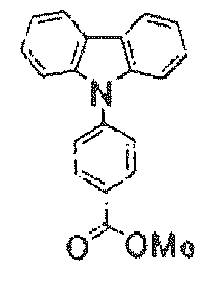
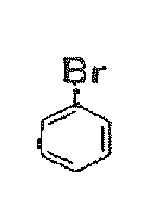
7 99 Comp. Ex. 7 7 31 Comp. Ex. 8 22 55 - Into a 10 mL Schrenk tube, a stirrer was put, and the tube was flushed with nitrogen. Then, 45 mg (0.049 mmol) of dipalladium(0) tris(dibenzylideneacetone), 66 mg (0.32 mmol) of tri-tert-butylphosphine and 1 mL of o-xylene were added, and this solution was stirred for 20 minutes at 60°C in a nitrogen atmosphere to obtain a catalyst solution. A 100 mL three necked round bottomed flask was flushed with nitrogen, and 0.79 g (5.0 mmol) of bromobenzene, 1.69 g (10.0 mmol) of diphenylamine, 2.12 g (10.0 mmol) of potassium phosphate, 39 mg (0.15 mmol) of 18-crown-6 and 30 mL of o-xylene were added. At room temperature, to this solution, the previous catalyst solution was added by a syringe, and the reaction solution was heated to 120°C. Ten hours later, the heating was terminated, and the reaction solution was left to cool to room temperature. This reaction solution was extracted with 100 g of toluene, and the obtained organic layer was dried over anhydrous magnesium sulfate. This organic layer was subjected to a gas chromatography quantitative analysis using 2-bromonaphthalene as an internal standard substance, whereby triphenylamine was 0.86 g (yield: 70%).
- The same operation as in Example 5 was carried out except that no 18-crown-6 was added, whereby 0.25 g (yield: 20%) of triphenylamine was obtained.
- The same operation as in Example 5 was carried out except that no 18-crown-6 was added, and the reaction time was changed to 23 hours, whereby 0.66 g (yield: 54%) of triphenylamine was obtained.
TABLE 2 Amine compound Ar-X Product Reaction time (hr) Yield (%) Ex. 5 

10 70 Comp. Ex. 9 10 20 Comp. Ex. 10 23 54 - The entire disclosure of
Japanese Patent Application No. 2006-156919 filed on June 6, 2006
Claims (8)
- A catalyst for producing an arylamine, which comprises a palladium compound having a tertiary phosphine group and a phase-transfer catalyst.
- The catalyst for producing an arylamine according to Claim 1, wherein the phase-transfer catalyst is a crown ether compound.
- The catalyst for producing an arylamine according to Claim 1 or 2, wherein the tertiary phosphine is tri-tert-butyl phosphine.
- A process for producing an arylamine, which comprises reacting an aryl compound having an active group with an amine compound in the presence of a base by means of the catalyst for producing an arylamine as defined in any one of Claims 1 to 3.
- The process for producing an arylamine according to Claim 4, wherein the active group is a triflate or a halogen atom.
- The process for producing an arylamine according to Claim 4 or 5, wherein the base is an inorganic base.
- The process for producing an arylamine according to Claim 6, wherein the inorganic base is an alkali metal salt or an alkaline earth metal salt.
- The process for producing an arylamine according to any one of Claims 4 to 7, wherein the amine compound is a compound selected from the group consisting of carbazoles, pyrroles, indoles and imidazoles.
Applications Claiming Priority (1)
| Application Number | Priority Date | Filing Date | Title |
|---|---|---|---|
| JP2006156919A JP4784402B2 (en) | 2006-06-06 | 2006-06-06 | Catalyst for producing arylamines and method for producing arylamines using the same |
Publications (2)
| Publication Number | Publication Date |
|---|---|
| EP1864714A1 true EP1864714A1 (en) | 2007-12-12 |
| EP1864714B1 EP1864714B1 (en) | 2016-11-23 |
Family
ID=38481267
Family Applications (1)
| Application Number | Title | Priority Date | Filing Date |
|---|---|---|---|
| EP07109615.0A Ceased EP1864714B1 (en) | 2006-06-06 | 2007-06-05 | Process for producing arylamine |
Country Status (3)
| Country | Link |
|---|---|
| US (1) | US7803953B2 (en) |
| EP (1) | EP1864714B1 (en) |
| JP (1) | JP4784402B2 (en) |
Families Citing this family (3)
| Publication number | Priority date | Publication date | Assignee | Title |
|---|---|---|---|---|
| WO2010125923A1 (en) * | 2009-04-30 | 2010-11-04 | 株式会社カネカ | Polymer-supported catalyst and method for producing aromatic hetero compound using the catalyst |
| JP6046950B2 (en) * | 2011-09-02 | 2016-12-21 | 高砂香料工業株式会社 | Process for producing N- (hetero) arylazoles |
| KR20240069893A (en) | 2022-11-11 | 2024-05-21 | 주식회사 셀켐 | Novel method for preparing high purity 9-phenylcarbazole |
Citations (4)
| Publication number | Priority date | Publication date | Assignee | Title |
|---|---|---|---|---|
| WO1998033765A1 (en) * | 1997-02-04 | 1998-08-06 | E.I. Du Pont De Nemours And Company | Fungicidal carboxamides |
| JP2001011046A (en) * | 1999-06-30 | 2001-01-16 | Tosoh Corp | Method for producing N-arylazole |
| WO2004092245A1 (en) * | 2003-04-18 | 2004-10-28 | Hitachi Chemical Co., Ltd. | Polyquinoline copolymer having a branched structure and organic electroluminescent device using same |
| US20070073086A1 (en) * | 2005-09-28 | 2007-03-29 | Appleton Papers Inc. | Process for manufacturing diphenylamines |
Family Cites Families (18)
| Publication number | Priority date | Publication date | Assignee | Title |
|---|---|---|---|---|
| JPH078836B2 (en) * | 1990-03-30 | 1995-02-01 | 工業技術院長 | Process for producing 7-bromo-9,10-dihydrophenanthrene-2-carboxylic acid ester |
| JPH078835B2 (en) * | 1990-03-30 | 1995-02-01 | 工業技術院長 | Process for producing 4'-bromobiphenyl-4-carboxylic acid ester |
| DE4102289A1 (en) * | 1991-01-26 | 1992-07-30 | Bayer Ag | METHOD FOR PRODUCING (HETERO) ARYLALK (EN / IN) -YLAMINES AND NEW (HETERO) ARYLKINYLAMINE |
| ATE171186T1 (en) * | 1992-01-28 | 1998-10-15 | Schering Corp | NEW STEROID INTERMEDIATE PRODUCTS AND METHOD FOR THE PRODUCTION THEREOF |
| JP3471910B2 (en) | 1994-08-09 | 2003-12-02 | 靖彦 城田 | Organic EL device |
| US6410732B2 (en) * | 1996-01-16 | 2002-06-25 | Lumigen, Inc. | Processing and synthetic intermediates for preparing N-arylacridancarboxylic acid derivatives |
| JP3161360B2 (en) | 1996-04-19 | 2001-04-25 | 東ソー株式会社 | Method for producing arylamines |
| US5929281A (en) | 1996-04-19 | 1999-07-27 | Tosoh Corporation | Process for producing heterocyclic aromatic amine or arylamine |
| JP4507294B2 (en) * | 1999-05-27 | 2010-07-21 | チッソ株式会社 | Method for producing biaryl derivative |
| TWI278448B (en) * | 2000-01-27 | 2007-04-11 | Univ Kanagawa | Unsaturated monocarboxylic ester compound, process for producing the same, and composition curable with actinic energy ray |
| US6818368B2 (en) * | 2000-04-14 | 2004-11-16 | Canon Kabushiki Kaisha | Electrophotographic photosensitive member, process cartridge, and electrophotographic apparatus |
| US6455720B1 (en) * | 2000-06-28 | 2002-09-24 | Takasago International Corporation | 2,2(diarlyl)vinylphosphine compound, palladium catalyst thereof, and process for producing arylamine, diaryl, or arylalkyne with the catalyst |
| EP1310485A4 (en) * | 2000-07-28 | 2005-07-20 | Sumitomo Pharma | pyrrole |
| US6518444B1 (en) * | 2000-12-18 | 2003-02-11 | Univation Technologies, Llc | Preparation of polymerization catalysts |
| US20040082813A1 (en) * | 2001-03-16 | 2004-04-29 | Toshihiro Iwakuma | Method for producting aromatic amino compound |
| CN1266112C (en) * | 2001-04-24 | 2006-07-26 | 麻省理工学院 | Copper-catalyzed carbon-heteroatom bond and carbon-carbon bond formation |
| JP3768196B2 (en) * | 2003-02-10 | 2006-04-19 | 出光興産株式会社 | Method for producing aromatic diamine derivative |
| DE102004043497A1 (en) * | 2004-09-06 | 2006-03-09 | Basf Ag | Synthesis of polynaphthalenes and their use |
-
2006
- 2006-06-06 JP JP2006156919A patent/JP4784402B2/en not_active Expired - Fee Related
-
2007
- 2007-06-01 US US11/806,565 patent/US7803953B2/en active Active
- 2007-06-05 EP EP07109615.0A patent/EP1864714B1/en not_active Ceased
Patent Citations (5)
| Publication number | Priority date | Publication date | Assignee | Title |
|---|---|---|---|---|
| WO1998033765A1 (en) * | 1997-02-04 | 1998-08-06 | E.I. Du Pont De Nemours And Company | Fungicidal carboxamides |
| JP2001011046A (en) * | 1999-06-30 | 2001-01-16 | Tosoh Corp | Method for producing N-arylazole |
| WO2004092245A1 (en) * | 2003-04-18 | 2004-10-28 | Hitachi Chemical Co., Ltd. | Polyquinoline copolymer having a branched structure and organic electroluminescent device using same |
| US20070027299A1 (en) * | 2003-04-18 | 2007-02-01 | Yoshii Morishita | Quinoline copolymer having branced structure and organic electroluminescent device employing same |
| US20070073086A1 (en) * | 2005-09-28 | 2007-03-29 | Appleton Papers Inc. | Process for manufacturing diphenylamines |
Non-Patent Citations (1)
| Title |
|---|
| KUWANO R ET AL: "Aqueous Hydroxide as a Base for Palladium-Catalyzed Amination of Aryl Chlorides and Bromides", JOURNAL OF ORGANIC CHEMISTRY, AMERICAN CHEMICAL SOCIETY. EASTON, US, vol. 67, no. 18, 2002, pages 6479 - 6486, XP002366816, ISSN: 0022-3263 * |
Also Published As
| Publication number | Publication date |
|---|---|
| US20070282111A1 (en) | 2007-12-06 |
| EP1864714B1 (en) | 2016-11-23 |
| US7803953B2 (en) | 2010-09-28 |
| JP4784402B2 (en) | 2011-10-05 |
| JP2007325982A (en) | 2007-12-20 |
Similar Documents
| Publication | Publication Date | Title |
|---|---|---|
| Kim et al. | Room-temperature Cu-catalyzed amination of aryl bromides enabled by DFT-guided ligand design | |
| KR101942125B1 (en) | Process for producing n-(hetero)arylazoles | |
| Yamamoto et al. | Palladium-catalyzed synthesis of triarylamines from aryl halides and diarylamines | |
| Kelkar et al. | Copper-catalyzed amination of aryl halides: single-step synthesis of triarylamines | |
| Nandurkar et al. | N-Arylation of aliphatic, aromatic and heteroaromatic amines catalyzed by copper bis (2, 2, 6, 6-tetramethyl-3, 5-heptanedionate) | |
| CN102627672B (en) | N-heterocyclic carbine palladium compound containing pyridyl-2-formate or pyridyl-2,6-diformate ligand, preparation thereof and application thereof | |
| Zhao et al. | CuCl-catalyzed Ullmann-type C–N cross-coupling reaction of carbazoles and 2-bromopyridine derivatives | |
| EP1864714B1 (en) | Process for producing arylamine | |
| Semeniuchenko et al. | (DiMeIHeptCl) Pd: A Low-Load Catalyst for Solvent-Free (Melt) Amination | |
| JP5651483B2 (en) | Method for producing aromatic amino compound | |
| JP4496566B2 (en) | Method for producing N-arylazole | |
| Wang et al. | Tetraphosphine/palladium‐catalyzed Suzuki–Miyaura coupling of heteroaryl halides with 3‐pyridine‐and 3‐thiopheneboronic acid: an efficient catalyst for the formation of biheteroaryls | |
| JP2018070527A (en) | Method for producing aromatic amine | |
| Moschona et al. | Scalable synthesis of cinnamylamines via the Heck reaction: application in the synthesis of abamine, naftifine and reboxetine | |
| EP2752402A1 (en) | Production method for 2-alkenylamine compound | |
| Mom et al. | Palladium-catalyzed formation of secondary and tertiary amines from aryl dihalides with air-stable ferrocenyl tri-and diphosphines: Synthesis and X-ray structure of efficient catalysts beyond [PdCl2 (DPPF)] | |
| JP5284037B2 (en) | Method for producing bisarylamine derivative | |
| JP6238290B6 (en) | Method for producing N-vinylazoles | |
| JP6238290B2 (en) | Method for producing N-vinylazoles | |
| JP2018140985A (en) | Method for production of aromatic compound | |
| JP4779185B2 (en) | Nitrogen-containing heterocyclic compound and method for producing the same | |
| JPH11100355A (en) | Method for producing N-arylamines | |
| JP2000319273A (en) | Method for producing (diarylamino) furans | |
| Suramwar et al. | Room Temperature N‐Arylation of 1, 2, 4‐Triazoles under Ligand‐Free Condition | |
| Potratz | Transition metal catalyzed nucleophilic substitution at thiophene halides |
Legal Events
| Date | Code | Title | Description |
|---|---|---|---|
| PUAI | Public reference made under article 153(3) epc to a published international application that has entered the european phase |
Free format text: ORIGINAL CODE: 0009012 |
|
| AK | Designated contracting states |
Kind code of ref document: A1 Designated state(s): AT BE BG CH CY CZ DE DK EE ES FI FR GB GR HU IE IS IT LI LT LU LV MC MT NL PL PT RO SE SI SK TR |
|
| AX | Request for extension of the european patent |
Extension state: AL BA HR MK YU |
|
| 17P | Request for examination filed |
Effective date: 20080612 |
|
| AKX | Designation fees paid |
Designated state(s): DE FR GB |
|
| 17Q | First examination report despatched |
Effective date: 20091214 |
|
| REG | Reference to a national code |
Ref country code: DE Ref legal event code: R079 Ref document number: 602007048845 Country of ref document: DE Free format text: PREVIOUS MAIN CLASS: B01J0031240000 Ipc: C07C0209080000 |
|
| RIC1 | Information provided on ipc code assigned before grant |
Ipc: B01J 31/24 20060101ALI20160405BHEP Ipc: C07C 209/08 20060101AFI20160405BHEP Ipc: C07C 209/10 20060101ALI20160405BHEP Ipc: C07C 209/66 20060101ALI20160405BHEP |
|
| GRAP | Despatch of communication of intention to grant a patent |
Free format text: ORIGINAL CODE: EPIDOSNIGR1 |
|
| INTG | Intention to grant announced |
Effective date: 20160513 |
|
| RIN1 | Information on inventor provided before grant (corrected) |
Inventor name: MATSUMOTO, NAOKI Inventor name: NISHIYAMA, MASAKAZU Inventor name: MIYAZAKI, TAKANORI |
|
| GRAS | Grant fee paid |
Free format text: ORIGINAL CODE: EPIDOSNIGR3 |
|
| GRAJ | Information related to disapproval of communication of intention to grant by the applicant or resumption of examination proceedings by the epo deleted |
Free format text: ORIGINAL CODE: EPIDOSDIGR1 |
|
| GRAL | Information related to payment of fee for publishing/printing deleted |
Free format text: ORIGINAL CODE: EPIDOSDIGR3 |
|
| GRAR | Information related to intention to grant a patent recorded |
Free format text: ORIGINAL CODE: EPIDOSNIGR71 |
|
| GRAA | (expected) grant |
Free format text: ORIGINAL CODE: 0009210 |
|
| INTC | Intention to grant announced (deleted) | ||
| AK | Designated contracting states |
Kind code of ref document: B1 Designated state(s): DE FR GB |
|
| INTG | Intention to grant announced |
Effective date: 20161018 |
|
| REG | Reference to a national code |
Ref country code: GB Ref legal event code: FG4D |
|
| REG | Reference to a national code |
Ref country code: DE Ref legal event code: R096 Ref document number: 602007048845 Country of ref document: DE |
|
| REG | Reference to a national code |
Ref country code: FR Ref legal event code: PLFP Year of fee payment: 11 |
|
| REG | Reference to a national code |
Ref country code: DE Ref legal event code: R097 Ref document number: 602007048845 Country of ref document: DE |
|
| PLBE | No opposition filed within time limit |
Free format text: ORIGINAL CODE: 0009261 |
|
| STAA | Information on the status of an ep patent application or granted ep patent |
Free format text: STATUS: NO OPPOSITION FILED WITHIN TIME LIMIT |
|
| 26N | No opposition filed |
Effective date: 20170824 |
|
| REG | Reference to a national code |
Ref country code: FR Ref legal event code: PLFP Year of fee payment: 12 |
|
| PGFP | Annual fee paid to national office [announced via postgrant information from national office to epo] |
Ref country code: FR Payment date: 20210513 Year of fee payment: 15 |
|
| PGFP | Annual fee paid to national office [announced via postgrant information from national office to epo] |
Ref country code: GB Payment date: 20210512 Year of fee payment: 15 |
|
| GBPC | Gb: european patent ceased through non-payment of renewal fee |
Effective date: 20220605 |
|
| PG25 | Lapsed in a contracting state [announced via postgrant information from national office to epo] |
Ref country code: FR Free format text: LAPSE BECAUSE OF NON-PAYMENT OF DUE FEES Effective date: 20220630 |
|
| PG25 | Lapsed in a contracting state [announced via postgrant information from national office to epo] |
Ref country code: GB Free format text: LAPSE BECAUSE OF NON-PAYMENT OF DUE FEES Effective date: 20220605 |
|
| P01 | Opt-out of the competence of the unified patent court (upc) registered |
Effective date: 20230523 |
|
| PGFP | Annual fee paid to national office [announced via postgrant information from national office to epo] |
Ref country code: DE Payment date: 20240502 Year of fee payment: 18 |
|
| REG | Reference to a national code |
Ref country code: DE Ref legal event code: R119 Ref document number: 602007048845 Country of ref document: DE |
|
| PG25 | Lapsed in a contracting state [announced via postgrant information from national office to epo] |
Ref country code: DE Free format text: LAPSE BECAUSE OF NON-PAYMENT OF DUE FEES Effective date: 20260101 |