EP1862457A2 - Fluoropyrrolidines as dipeptidyl peptidase inhibitors - Google Patents
Fluoropyrrolidines as dipeptidyl peptidase inhibitors Download PDFInfo
- Publication number
- EP1862457A2 EP1862457A2 EP07117167A EP07117167A EP1862457A2 EP 1862457 A2 EP1862457 A2 EP 1862457A2 EP 07117167 A EP07117167 A EP 07117167A EP 07117167 A EP07117167 A EP 07117167A EP 1862457 A2 EP1862457 A2 EP 1862457A2
- Authority
- EP
- European Patent Office
- Prior art keywords
- amino
- mmol
- fluoropyrrolidine
- solution
- compound
- Prior art date
- Legal status (The legal status is an assumption and is not a legal conclusion. Google has not performed a legal analysis and makes no representation as to the accuracy of the status listed.)
- Granted
Links
- 102000003779 Dipeptidyl-peptidases and tripeptidyl-peptidases Human genes 0.000 title claims abstract description 12
- 108090000194 Dipeptidyl-peptidases and tripeptidyl-peptidases Proteins 0.000 title claims abstract description 12
- 239000000137 peptide hydrolase inhibitor Substances 0.000 title description 2
- 150000001875 compounds Chemical class 0.000 claims abstract description 233
- 102000012479 Serine Proteases Human genes 0.000 claims abstract description 13
- 108010022999 Serine Proteases Proteins 0.000 claims abstract description 13
- 230000001225 therapeutic effect Effects 0.000 claims abstract description 13
- 238000004519 manufacturing process Methods 0.000 claims abstract description 9
- VEXZGXHMUGYJMC-UHFFFAOYSA-N Hydrochloric acid Chemical compound Cl VEXZGXHMUGYJMC-UHFFFAOYSA-N 0.000 claims description 89
- 102100025012 Dipeptidyl peptidase 4 Human genes 0.000 claims description 46
- 208000037265 diseases, disorders, signs and symptoms Diseases 0.000 claims description 23
- 208000035475 disorder Diseases 0.000 claims description 19
- 206010012601 diabetes mellitus Diseases 0.000 claims description 15
- 102000035195 Peptidases Human genes 0.000 claims description 13
- 108091005804 Peptidases Proteins 0.000 claims description 13
- NOESYZHRGYRDHS-UHFFFAOYSA-N insulin Chemical compound N1C(=O)C(NC(=O)C(CCC(N)=O)NC(=O)C(CCC(O)=O)NC(=O)C(C(C)C)NC(=O)C(NC(=O)CN)C(C)CC)CSSCC(C(NC(CO)C(=O)NC(CC(C)C)C(=O)NC(CC=2C=CC(O)=CC=2)C(=O)NC(CCC(N)=O)C(=O)NC(CC(C)C)C(=O)NC(CCC(O)=O)C(=O)NC(CC(N)=O)C(=O)NC(CC=2C=CC(O)=CC=2)C(=O)NC(CSSCC(NC(=O)C(C(C)C)NC(=O)C(CC(C)C)NC(=O)C(CC=2C=CC(O)=CC=2)NC(=O)C(CC(C)C)NC(=O)C(C)NC(=O)C(CCC(O)=O)NC(=O)C(C(C)C)NC(=O)C(CC(C)C)NC(=O)C(CC=2NC=NC=2)NC(=O)C(CO)NC(=O)CNC2=O)C(=O)NCC(=O)NC(CCC(O)=O)C(=O)NC(CCCNC(N)=N)C(=O)NCC(=O)NC(CC=3C=CC=CC=3)C(=O)NC(CC=3C=CC=CC=3)C(=O)NC(CC=3C=CC(O)=CC=3)C(=O)NC(C(C)O)C(=O)N3C(CCC3)C(=O)NC(CCCCN)C(=O)NC(C)C(O)=O)C(=O)NC(CC(N)=O)C(O)=O)=O)NC(=O)C(C(C)CC)NC(=O)C(CO)NC(=O)C(C(C)O)NC(=O)C1CSSCC2NC(=O)C(CC(C)C)NC(=O)C(NC(=O)C(CCC(N)=O)NC(=O)C(CC(N)=O)NC(=O)C(NC(=O)C(N)CC=1C=CC=CC=1)C(C)C)CC1=CN=CN1 NOESYZHRGYRDHS-UHFFFAOYSA-N 0.000 claims description 12
- 238000011282 treatment Methods 0.000 claims description 12
- 239000004365 Protease Substances 0.000 claims description 11
- 206010000210 abortion Diseases 0.000 claims description 10
- 231100000176 abortion Toxicity 0.000 claims description 10
- 230000005764 inhibitory process Effects 0.000 claims description 10
- 230000001404 mediated effect Effects 0.000 claims description 10
- 239000003814 drug Substances 0.000 claims description 9
- 230000000968 intestinal effect Effects 0.000 claims description 9
- 239000008194 pharmaceutical composition Substances 0.000 claims description 9
- 208000031886 HIV Infections Diseases 0.000 claims description 8
- 208000037357 HIV infectious disease Diseases 0.000 claims description 8
- 208000034493 Mucous membrane disease Diseases 0.000 claims description 8
- ONIBWKKTOPOVIA-UHFFFAOYSA-N Proline Natural products OC(=O)C1CCCN1 ONIBWKKTOPOVIA-UHFFFAOYSA-N 0.000 claims description 8
- 206010003246 arthritis Diseases 0.000 claims description 8
- 208000033519 human immunodeficiency virus infectious disease Diseases 0.000 claims description 8
- 235000019419 proteases Nutrition 0.000 claims description 8
- 208000023275 Autoimmune disease Diseases 0.000 claims description 7
- 206010007559 Cardiac failure congestive Diseases 0.000 claims description 7
- 206010010774 Constipation Diseases 0.000 claims description 7
- 206010049119 Emotional distress Diseases 0.000 claims description 7
- 206010019280 Heart failures Diseases 0.000 claims description 7
- 208000031226 Hyperlipidaemia Diseases 0.000 claims description 7
- 206010020751 Hypersensitivity Diseases 0.000 claims description 7
- 206010020772 Hypertension Diseases 0.000 claims description 7
- 206010061218 Inflammation Diseases 0.000 claims description 7
- 206010049287 Lipodystrophy acquired Diseases 0.000 claims description 7
- 208000008589 Obesity Diseases 0.000 claims description 7
- 201000004681 Psoriasis Diseases 0.000 claims description 7
- 206010052779 Transplant rejections Diseases 0.000 claims description 7
- 230000007815 allergy Effects 0.000 claims description 7
- 230000000295 complement effect Effects 0.000 claims description 7
- 230000003001 depressive effect Effects 0.000 claims description 7
- 230000009429 distress Effects 0.000 claims description 7
- 201000002491 encephalomyelitis Diseases 0.000 claims description 7
- 208000024348 heart neoplasm Diseases 0.000 claims description 7
- 208000027866 inflammatory disease Diseases 0.000 claims description 7
- 230000004054 inflammatory process Effects 0.000 claims description 7
- 208000006132 lipodystrophy Diseases 0.000 claims description 7
- 235000020824 obesity Nutrition 0.000 claims description 7
- 238000011321 prophylaxis Methods 0.000 claims description 7
- 230000035882 stress Effects 0.000 claims description 7
- 230000000451 tissue damage Effects 0.000 claims description 7
- 231100000827 tissue damage Toxicity 0.000 claims description 7
- 230000003612 virological effect Effects 0.000 claims description 7
- 102000004877 Insulin Human genes 0.000 claims description 6
- 108090001061 Insulin Proteins 0.000 claims description 6
- 229940125396 insulin Drugs 0.000 claims description 6
- 102100020751 Dipeptidyl peptidase 2 Human genes 0.000 claims description 5
- 102000003728 Peroxisome Proliferator-Activated Receptors Human genes 0.000 claims description 5
- 108090000029 Peroxisome Proliferator-Activated Receptors Proteins 0.000 claims description 5
- 208000030159 metabolic disease Diseases 0.000 claims description 5
- 125000004482 piperidin-4-yl group Chemical group N1CCC(CC1)* 0.000 claims description 5
- 125000001325 propanoyl group Chemical group O=C([*])C([H])([H])C([H])([H])[H] 0.000 claims description 5
- 239000000126 substance Substances 0.000 claims description 5
- OSEOAYTVJJHMLF-KBAXVOBLSA-N (2s,4s)-1-[(2r)-2-amino-3-(2,1,3-benzoxadiazol-5-ylmethylsulfanyl)-3-methylbutanoyl]-4-fluoropyrrolidine-2-carbonitrile;hydrochloride Chemical compound Cl.O=C([C@@H](N)C(C)(SCC1=CC2=NON=C2C=C1)C)N1C[C@@H](F)C[C@H]1C#N OSEOAYTVJJHMLF-KBAXVOBLSA-N 0.000 claims description 4
- ZVMVUWXCBVRDBO-ZPQOTBKHSA-N (2s,4s)-1-[(2r)-2-amino-3-[(2-methoxyphenyl)methylsulfonyl]-3-methylbutanoyl]-4-fluoropyrrolidine-2-carbonitrile;hydrochloride Chemical compound Cl.COC1=CC=CC=C1CS(=O)(=O)C(C)(C)[C@H](N)C(=O)N1[C@H](C#N)C[C@H](F)C1 ZVMVUWXCBVRDBO-ZPQOTBKHSA-N 0.000 claims description 4
- WVSDPYNXYHRZBD-ZPQOTBKHSA-N (2s,4s)-1-[(2r)-2-amino-3-[(3-methoxyphenyl)methylsulfonyl]-3-methylbutanoyl]-4-fluoropyrrolidine-2-carbonitrile;hydrochloride Chemical compound Cl.COC1=CC=CC(CS(=O)(=O)C(C)(C)[C@H](N)C(=O)N2[C@@H](C[C@H](F)C2)C#N)=C1 WVSDPYNXYHRZBD-ZPQOTBKHSA-N 0.000 claims description 4
- YJNSZXRGKDLXFA-UEHWSTJSSA-N (2s,4s)-1-[(2r)-2-amino-3-[(4-fluorophenyl)methylsulfonyl]-3-methylbutanoyl]-4-fluoropyrrolidine-2-carbonitrile;hydrochloride Chemical compound Cl.O=C([C@@H](N)C(C)(C)S(=O)(=O)CC=1C=CC(F)=CC=1)N1C[C@@H](F)C[C@H]1C#N YJNSZXRGKDLXFA-UEHWSTJSSA-N 0.000 claims description 4
- AJDVNFSSPLSLMI-ZPQOTBKHSA-N (2s,4s)-1-[(2r)-2-amino-3-[(4-methoxyphenyl)methylsulfanyl]-3-methylbutanoyl]-4-fluoropyrrolidine-2-carbonitrile;hydrochloride Chemical compound Cl.C1=CC(OC)=CC=C1CSC(C)(C)[C@H](N)C(=O)N1[C@H](C#N)C[C@H](F)C1 AJDVNFSSPLSLMI-ZPQOTBKHSA-N 0.000 claims description 4
- BDTQEQACPFOCBY-ZUZBSIPJSA-N (2s,4s)-1-[(2r)-2-amino-3-[(5-chloro-1,1-dioxo-1-benzothiophen-3-yl)methylsulfonyl]-3-methylbutanoyl]-4-fluoropyrrolidine-2-carbonitrile;hydrochloride Chemical compound Cl.O=C([C@@H](N)C(C)(C)S(=O)(=O)CC=1C2=CC(Cl)=CC=C2S(=O)(=O)C=1)N1C[C@@H](F)C[C@H]1C#N BDTQEQACPFOCBY-ZUZBSIPJSA-N 0.000 claims description 4
- KUZMXTVZAIDNLE-YESZJQIVSA-N (2s,4s)-1-[(2r)-2-amino-3-methyl-3-(3-phenylpropylsulfonyl)butanoyl]-4-fluoropyrrolidine-2-carbonitrile Chemical compound O=C([C@@H](N)C(C)(C)S(=O)(=O)CCCC=1C=CC=CC=1)N1C[C@@H](F)C[C@H]1C#N KUZMXTVZAIDNLE-YESZJQIVSA-N 0.000 claims description 4
- NLCOLHPPKMEOCR-UVBMRUIMSA-N (2s,4s)-1-[(2r)-2-amino-3-methyl-3-(pyridin-2-ylmethylsulfanyl)butanoyl]-4-fluoropyrrolidine-2-carbonitrile;hydrochloride Chemical compound Cl.CC(C)([C@H](N)C(=O)N1[C@@H](C[C@H](F)C1)C#N)SCC1=CC=CC=N1 NLCOLHPPKMEOCR-UVBMRUIMSA-N 0.000 claims description 4
- NBVWMXLMILUSAI-ZTLGLYPESA-N (2s,4s)-1-[(2r)-2-amino-3-methyl-3-[(3-phenoxyphenyl)methylsulfonyl]butanoyl]-4-fluoropyrrolidine-2-carbonitrile;hydrochloride Chemical compound Cl.O=C([C@@H](N)C(C)(C)S(=O)(=O)CC=1C=C(OC=2C=CC=CC=2)C=CC=1)N1C[C@@H](F)C[C@H]1C#N NBVWMXLMILUSAI-ZTLGLYPESA-N 0.000 claims description 4
- SLVCKEHDRFPWMW-HRCADAONSA-N (2s,4s)-1-[(2r)-2-amino-3-methyl-3-[(4-methylphenyl)methylsulfonyl]butanoyl]-4-fluoropyrrolidine-2-carbonitrile Chemical compound C1=CC(C)=CC=C1CS(=O)(=O)C(C)(C)[C@H](N)C(=O)N1[C@H](C#N)C[C@H](F)C1 SLVCKEHDRFPWMW-HRCADAONSA-N 0.000 claims description 4
- SSLIGHRGRCXZAL-OFQRWUPVSA-N (2s,4s)-1-[(2r)-2-amino-3-methyl-3-[(4-methylsulfonylphenyl)methylsulfonyl]butanoyl]-4-fluoropyrrolidine-2-carbonitrile Chemical compound O=C([C@@H](N)C(C)(C)S(=O)(=O)CC=1C=CC(=CC=1)S(C)(=O)=O)N1C[C@@H](F)C[C@H]1C#N SSLIGHRGRCXZAL-OFQRWUPVSA-N 0.000 claims description 4
- WALJCXHYCAPREY-JAXLGGSGSA-N (2s,4s)-1-[(2r)-2-amino-3-methyl-3-[(4-phenylmethoxyphenyl)methylsulfonyl]butanoyl]-4-fluoropyrrolidine-2-carbonitrile Chemical compound O=C([C@@H](N)C(C)(C)S(=O)(=O)CC=1C=CC(OCC=2C=CC=CC=2)=CC=1)N1C[C@@H](F)C[C@H]1C#N WALJCXHYCAPREY-JAXLGGSGSA-N 0.000 claims description 4
- CQUTTZVHXPDYGJ-OBEKMTESSA-N (2s,4s)-1-[(2r)-2-amino-3-methyl-3-[(4-phenylphenyl)methylsulfonyl]butanoyl]-4-fluoropyrrolidine-2-carbonitrile;hydrochloride Chemical compound Cl.O=C([C@@H](N)C(C)(C)S(=O)(=O)CC=1C=CC(=CC=1)C=1C=CC=CC=1)N1C[C@@H](F)C[C@H]1C#N CQUTTZVHXPDYGJ-OBEKMTESSA-N 0.000 claims description 4
- STZVFQOEUWERMW-AHBISNNASA-N (2s,4s)-1-[(2s)-2-amino-2-(1-ethenylcyclopentyl)acetyl]-4-fluoropyrrolidine-2-carbonitrile;hydrochloride Chemical compound Cl.O=C([C@@H](N)C1(CCCC1)C=C)N1C[C@@H](F)C[C@H]1C#N STZVFQOEUWERMW-AHBISNNASA-N 0.000 claims description 4
- SNIMAYDCHKGXQW-JDFMPCBTSA-N (2s,4s)-1-[(2s)-2-amino-2-[1-[(4-fluorophenyl)methyl]cyclopentyl]acetyl]-4-fluoropyrrolidine-2-carbonitrile;hydrochloride Chemical compound Cl.O=C([C@@H](N)C1(CC=2C=CC(F)=CC=2)CCCC1)N1C[C@@H](F)C[C@H]1C#N SNIMAYDCHKGXQW-JDFMPCBTSA-N 0.000 claims description 4
- XPSBXFQTAVMGHL-UEHWSTJSSA-N (2s,4s)-1-[(2s)-2-amino-2-[1-[(4-fluorophenyl)methyl]cyclopropyl]acetyl]-4-fluoropyrrolidine-2-carbonitrile;hydrochloride Chemical compound Cl.O=C([C@@H](N)C1(CC=2C=CC(F)=CC=2)CC1)N1C[C@@H](F)C[C@H]1C#N XPSBXFQTAVMGHL-UEHWSTJSSA-N 0.000 claims description 4
- QSEFTUKHNRQPBC-RGESYUBESA-N (2s,4s)-1-[(2s)-2-amino-3-(1-benzothiophen-3-yl)propanoyl]-4-fluoropyrrolidine-2-carbonitrile;hydrochloride Chemical compound Cl.O=C([C@H](CC=1C2=CC=CC=C2SC=1)N)N1C[C@@H](F)C[C@H]1C#N QSEFTUKHNRQPBC-RGESYUBESA-N 0.000 claims description 4
- WMDFAZUSQZKRLC-ZMRQYYASSA-N (2s,4s)-1-[(2s)-2-amino-3-(1-propan-2-ylsulfonylpiperidin-3-yl)propanoyl]-4-fluoropyrrolidine-2-carbonitrile;hydrochloride Chemical compound Cl.C1N(S(=O)(=O)C(C)C)CCCC1C[C@H](N)C(=O)N1[C@H](C#N)C[C@H](F)C1 WMDFAZUSQZKRLC-ZMRQYYASSA-N 0.000 claims description 4
- DSGKAYNOLWAZSB-MIJUGGHASA-N (2s,4s)-1-[(2s)-2-amino-3-[1-(4-methylphenyl)sulfonylpiperidin-3-yl]propanoyl]-4-fluoropyrrolidine-2-carbonitrile;hydrochloride Chemical compound Cl.C1=CC(C)=CC=C1S(=O)(=O)N1CC(C[C@H](N)C(=O)N2[C@@H](C[C@H](F)C2)C#N)CCC1 DSGKAYNOLWAZSB-MIJUGGHASA-N 0.000 claims description 4
- VPFPSCPSOKYTQD-NPTJMSEESA-N (2s,4s)-1-[(2s)-2-amino-3-methyl-3-[4-(trifluoromethyl)phenyl]butanoyl]-4-fluoropyrrolidine-2-carbonitrile;hydrochloride Chemical compound Cl.O=C([C@@H](N)C(C)(C)C=1C=CC(=CC=1)C(F)(F)F)N1C[C@@H](F)C[C@H]1C#N VPFPSCPSOKYTQD-NPTJMSEESA-N 0.000 claims description 4
- FOWROBXEMHWGMS-NSOONZCPSA-N (2s,4s)-1-[(2s)-2-amino-3-piperidin-2-ylpropanoyl]-4-fluoropyrrolidine-2-carbonitrile;dihydrochloride Chemical compound Cl.Cl.C([C@H](N)C(=O)N1[C@@H](C[C@H](F)C1)C#N)C1CCCCN1 FOWROBXEMHWGMS-NSOONZCPSA-N 0.000 claims description 4
- XJEJUINYEHRMAD-PCOPQSSHSA-N (2s,4s)-1-[(2s)-2-amino-3-piperidin-3-ylpropanoyl]-4-fluoropyrrolidine-2-carbonitrile;dihydrochloride Chemical compound Cl.Cl.C([C@H](N)C(=O)N1[C@@H](C[C@H](F)C1)C#N)C1CCCNC1 XJEJUINYEHRMAD-PCOPQSSHSA-N 0.000 claims description 4
- MXTGLIRRWYZPMV-LFELFHSZSA-N (2s,4s)-1-[(2s)-2-amino-3-pyridin-3-ylpropanoyl]-4-fluoropyrrolidine-2-carbonitrile;hydrochloride Chemical compound Cl.C([C@H](N)C(=O)N1[C@@H](C[C@H](F)C1)C#N)C1=CC=CN=C1 MXTGLIRRWYZPMV-LFELFHSZSA-N 0.000 claims description 4
- NHNWXLUDBZLKFQ-NOYXXFKXSA-N (2s,4s)-1-[(2s)-2-amino-5-(4-methoxyphenyl)-3,3-dimethylpentanoyl]-4-fluoropyrrolidine-2-carbonitrile;hydrochloride Chemical compound Cl.C1=CC(OC)=CC=C1CCC(C)(C)[C@H](N)C(=O)N1[C@H](C#N)C[C@H](F)C1 NHNWXLUDBZLKFQ-NOYXXFKXSA-N 0.000 claims description 4
- 229940077274 Alpha glucosidase inhibitor Drugs 0.000 claims description 4
- 229940123208 Biguanide Drugs 0.000 claims description 4
- 208000018522 Gastrointestinal disease Diseases 0.000 claims description 4
- 229940122199 Insulin secretagogue Drugs 0.000 claims description 4
- 229940122355 Insulin sensitizer Drugs 0.000 claims description 4
- 239000003888 alpha glucosidase inhibitor Substances 0.000 claims description 4
- 150000004283 biguanides Chemical class 0.000 claims description 4
- DXQFCYDFPUAKLB-HRCADAONSA-N (2s,4s)-1-[(2r)-2-amino-3-[(4-cyanophenyl)methylsulfonyl]-3-methylbutanoyl]-4-fluoropyrrolidine-2-carbonitrile Chemical compound O=C([C@@H](N)C(C)(C)S(=O)(=O)CC=1C=CC(=CC=1)C#N)N1C[C@@H](F)C[C@H]1C#N DXQFCYDFPUAKLB-HRCADAONSA-N 0.000 claims description 3
- HOOMBBLHTOHAFO-KHYKBMNLSA-N (2s,4s)-1-[(2r)-2-amino-3-[(4-methoxyphenyl)methylsulfinyl]-3-methylbutanoyl]-4-fluoropyrrolidine-2-carbonitrile;hydrochloride Chemical compound Cl.C1=CC(OC)=CC=C1CS(=O)C(C)(C)[C@H](N)C(=O)N1[C@H](C#N)C[C@H](F)C1 HOOMBBLHTOHAFO-KHYKBMNLSA-N 0.000 claims description 3
- AXBAPGQMEIHAJE-ZPQOTBKHSA-N (2s,4s)-1-[(2r)-2-amino-3-[(4-methoxyphenyl)methylsulfonyl]-3-methylbutanoyl]-4-fluoropyrrolidine-2-carbonitrile;hydrochloride Chemical compound Cl.C1=CC(OC)=CC=C1CS(=O)(=O)C(C)(C)[C@H](N)C(=O)N1[C@H](C#N)C[C@H](F)C1 AXBAPGQMEIHAJE-ZPQOTBKHSA-N 0.000 claims description 3
- FBAOEQHEEFGIGA-JDFMPCBTSA-N (2s,4s)-1-[(2r)-2-amino-3-[3-(4-fluorophenyl)propylsulfanyl]-3-methylbutanoyl]-4-fluoropyrrolidine-2-carbonitrile;hydrochloride Chemical compound Cl.CC(C)([C@H](N)C(=O)N1[C@@H](C[C@H](F)C1)C#N)SCCCC1=CC=C(F)C=C1 FBAOEQHEEFGIGA-JDFMPCBTSA-N 0.000 claims description 3
- AHDOJTNYCMFSGQ-UEHWSTJSSA-N (2s,4s)-1-[(2r)-2-amino-3-benzylsulfonyl-3-methylbutanoyl]-4-fluoropyrrolidine-2-carbonitrile;hydrochloride Chemical compound Cl.O=C([C@@H](N)C(C)(C)S(=O)(=O)CC=1C=CC=CC=1)N1C[C@@H](F)C[C@H]1C#N AHDOJTNYCMFSGQ-UEHWSTJSSA-N 0.000 claims description 3
- FRXDNOMDDUVGLR-MLZPLGHASA-N (2s,4s)-1-[(2r)-2-amino-3-methyl-3-(2-phenylethylsulfanyl)butanoyl]-4-fluoropyrrolidine-2-carbonitrile;hydrochloride Chemical compound Cl.CC(C)([C@H](N)C(=O)N1[C@@H](C[C@H](F)C1)C#N)SCCC1=CC=CC=C1 FRXDNOMDDUVGLR-MLZPLGHASA-N 0.000 claims description 3
- XDQPJTBCNVFHAU-JDFMPCBTSA-N (2s,4s)-1-[(2r)-2-amino-3-methyl-3-(3-phenylpropylsulfanyl)butanoyl]-4-fluoropyrrolidine-2-carbonitrile;hydrochloride Chemical compound Cl.CC(C)([C@H](N)C(=O)N1[C@@H](C[C@H](F)C1)C#N)SCCCC1=CC=CC=C1 XDQPJTBCNVFHAU-JDFMPCBTSA-N 0.000 claims description 3
- PWTRIZXLBXMDKV-MELADBBJSA-N (2s,4s)-1-[(2r)-2-amino-3-methyl-3-(pyridin-3-ylmethylsulfanyl)butanoyl]-4-fluoropyrrolidine-2-carbonitrile Chemical compound CC(C)([C@H](N)C(=O)N1[C@@H](C[C@H](F)C1)C#N)SCC1=CC=CN=C1 PWTRIZXLBXMDKV-MELADBBJSA-N 0.000 claims description 3
- DMBNSIRXRZGBGZ-NPTJMSEESA-N (2s,4s)-1-[(2r)-2-amino-3-methyl-3-(pyridin-4-ylmethylsulfanyl)butanoyl]-4-fluoropyrrolidine-2-carbonitrile;hydrochloride Chemical compound Cl.CC(C)([C@H](N)C(=O)N1[C@@H](C[C@H](F)C1)C#N)SCC1=CC=NC=C1 DMBNSIRXRZGBGZ-NPTJMSEESA-N 0.000 claims description 3
- SXDOAQADKQDIMF-ZTLGLYPESA-N (2s,4s)-1-[(2r)-2-amino-3-methyl-3-[(3-phenoxyphenyl)methylsulfanyl]butanoyl]-4-fluoropyrrolidine-2-carbonitrile;hydrochloride Chemical compound Cl.CC(C)([C@H](N)C(=O)N1[C@@H](C[C@H](F)C1)C#N)SCC(C=1)=CC=CC=1OC1=CC=CC=C1 SXDOAQADKQDIMF-ZTLGLYPESA-N 0.000 claims description 3
- CXFRNIINSZWNJG-UEHWSTJSSA-N (2s,4s)-1-[(2r)-2-amino-3-methyl-3-[[4-(trifluoromethyl)phenyl]methylsulfanyl]butanoyl]-4-fluoropyrrolidine-2-carbonitrile;hydrochloride Chemical compound Cl.CC(C)([C@H](N)C(=O)N1[C@@H](C[C@H](F)C1)C#N)SCC1=CC=C(C(F)(F)F)C=C1 CXFRNIINSZWNJG-UEHWSTJSSA-N 0.000 claims description 3
- JLEJRLNTDALDLV-MLZPLGHASA-N (2s,4s)-1-[(2s)-2-amino-2-[1-[4-(trifluoromethyl)phenyl]cyclopentyl]acetyl]-4-fluoropyrrolidine-2-carbonitrile;hydrochloride Chemical compound Cl.O=C([C@@H](N)C1(CCCC1)C=1C=CC(=CC=1)C(F)(F)F)N1C[C@@H](F)C[C@H]1C#N JLEJRLNTDALDLV-MLZPLGHASA-N 0.000 claims description 3
- RBKNJNTUMIDRKO-QMBKNIKNSA-N (2s,4s)-1-[(2s)-2-amino-3-[1-(4-methylphenyl)sulfonylpiperidin-4-yl]propanoyl]-4-fluoropyrrolidine-2-carbonitrile;hydrochloride Chemical compound Cl.C1=CC(C)=CC=C1S(=O)(=O)N1CCC(C[C@H](N)C(=O)N2[C@@H](C[C@H](F)C2)C#N)CC1 RBKNJNTUMIDRKO-QMBKNIKNSA-N 0.000 claims description 3
- JWPPWAJQISNHJD-MGKSKXMVSA-N (2s,4s)-1-[(2s)-2-amino-3-piperidin-4-ylpropanoyl]-4-fluoropyrrolidine-2-carbonitrile;dihydrochloride Chemical compound Cl.Cl.C([C@H](N)C(=O)N1[C@@H](C[C@H](F)C1)C#N)C1CCNCC1 JWPPWAJQISNHJD-MGKSKXMVSA-N 0.000 claims description 3
- PPLUJEYKOLBXKX-LFELFHSZSA-N (2s,4s)-1-[(2s)-2-amino-3-pyridin-4-ylpropanoyl]-4-fluoropyrrolidine-2-carbonitrile;hydrochloride Chemical compound Cl.C([C@H](N)C(=O)N1[C@@H](C[C@H](F)C1)C#N)C1=CC=NC=C1 PPLUJEYKOLBXKX-LFELFHSZSA-N 0.000 claims description 3
- VMGDJIPIVXMFNS-MLZPLGHASA-N (2s,4s)-1-[(2s)-2-amino-5-(4-fluorophenyl)-3,3-dimethylpentanoyl]-4-fluoropyrrolidine-2-carbonitrile;hydrochloride Chemical compound Cl.CC(C)([C@H](N)C(=O)N1[C@@H](C[C@H](F)C1)C#N)CCC1=CC=C(F)C=C1 VMGDJIPIVXMFNS-MLZPLGHASA-N 0.000 claims description 3
- 102000000536 PPAR gamma Human genes 0.000 claims description 3
- 108010016731 PPAR gamma Proteins 0.000 claims description 3
- 239000000556 agonist Substances 0.000 claims description 3
- 239000003937 drug carrier Substances 0.000 claims description 3
- 239000003446 ligand Substances 0.000 claims description 3
- XUFXOAAUWZOOIT-SXARVLRPSA-N (2R,3R,4R,5S,6R)-5-[[(2R,3R,4R,5S,6R)-5-[[(2R,3R,4S,5S,6R)-3,4-dihydroxy-6-methyl-5-[[(1S,4R,5S,6S)-4,5,6-trihydroxy-3-(hydroxymethyl)-1-cyclohex-2-enyl]amino]-2-oxanyl]oxy]-3,4-dihydroxy-6-(hydroxymethyl)-2-oxanyl]oxy]-6-(hydroxymethyl)oxane-2,3,4-triol Chemical compound O([C@H]1O[C@H](CO)[C@H]([C@@H]([C@H]1O)O)O[C@H]1O[C@@H]([C@H]([C@H](O)[C@H]1O)N[C@@H]1[C@@H]([C@@H](O)[C@H](O)C(CO)=C1)O)C)[C@@H]1[C@@H](CO)O[C@@H](O)[C@H](O)[C@H]1O XUFXOAAUWZOOIT-SXARVLRPSA-N 0.000 claims description 2
- YJVOCIMLGCVULY-NPTJMSEESA-N (2s,4s)-1-[(2r)-2-amino-3-methyl-3-(pyridin-4-ylmethylsulfonyl)butanoyl]-4-fluoropyrrolidine-2-carbonitrile;hydrochloride Chemical compound Cl.O=C([C@@H](N)C(C)(C)S(=O)(=O)CC=1C=CN=CC=1)N1C[C@@H](F)C[C@H]1C#N YJVOCIMLGCVULY-NPTJMSEESA-N 0.000 claims description 2
- 108010067722 Dipeptidyl Peptidase 4 Proteins 0.000 claims description 2
- 101710087084 Dipeptidyl peptidase 2 Proteins 0.000 claims description 2
- IBAQFPQHRJAVAV-ULAWRXDQSA-N Miglitol Chemical compound OCCN1C[C@H](O)[C@@H](O)[C@H](O)[C@H]1CO IBAQFPQHRJAVAV-ULAWRXDQSA-N 0.000 claims description 2
- FZNCGRZWXLXZSZ-CIQUZCHMSA-N Voglibose Chemical compound OCC(CO)N[C@H]1C[C@](O)(CO)[C@@H](O)[C@H](O)[C@H]1O FZNCGRZWXLXZSZ-CIQUZCHMSA-N 0.000 claims description 2
- 229960002632 acarbose Drugs 0.000 claims description 2
- XUFXOAAUWZOOIT-UHFFFAOYSA-N acarviostatin I01 Natural products OC1C(O)C(NC2C(C(O)C(O)C(CO)=C2)O)C(C)OC1OC(C(C1O)O)C(CO)OC1OC1C(CO)OC(O)C(O)C1O XUFXOAAUWZOOIT-UHFFFAOYSA-N 0.000 claims description 2
- 229940125708 antidiabetic agent Drugs 0.000 claims description 2
- 239000003472 antidiabetic agent Substances 0.000 claims description 2
- 229960004111 buformin Drugs 0.000 claims description 2
- XSEUMFJMFFMCIU-UHFFFAOYSA-N buformin Chemical compound CCCC\N=C(/N)N=C(N)N XSEUMFJMFFMCIU-UHFFFAOYSA-N 0.000 claims description 2
- 229950000269 emiglitate Drugs 0.000 claims description 2
- NWWORXYTJRPSMC-QKPAOTATSA-N ethyl 4-[2-[(2r,3r,4r,5s)-3,4,5-trihydroxy-2-(hydroxymethyl)piperidin-1-yl]ethoxy]benzoate Chemical compound C1=CC(C(=O)OCC)=CC=C1OCCN1[C@H](CO)[C@@H](O)[C@H](O)[C@@H](O)C1 NWWORXYTJRPSMC-QKPAOTATSA-N 0.000 claims description 2
- XZWYZXLIPXDOLR-UHFFFAOYSA-N metformin Chemical compound CN(C)C(=N)NC(N)=N XZWYZXLIPXDOLR-UHFFFAOYSA-N 0.000 claims description 2
- 229960003105 metformin Drugs 0.000 claims description 2
- 229960001110 miglitol Drugs 0.000 claims description 2
- ICFJFFQQTFMIBG-UHFFFAOYSA-N phenformin Chemical compound NC(=N)NC(=N)NCCC1=CC=CC=C1 ICFJFFQQTFMIBG-UHFFFAOYSA-N 0.000 claims description 2
- 229960003243 phenformin Drugs 0.000 claims description 2
- 229960001729 voglibose Drugs 0.000 claims description 2
- 101000930822 Giardia intestinalis Dipeptidyl-peptidase 4 Proteins 0.000 abstract description 47
- 238000000034 method Methods 0.000 abstract description 15
- 230000002401 inhibitory effect Effects 0.000 abstract description 3
- 102000016622 Dipeptidyl Peptidase 4 Human genes 0.000 abstract 2
- 239000000243 solution Substances 0.000 description 416
- XEKOWRVHYACXOJ-UHFFFAOYSA-N Ethyl acetate Chemical compound CCOC(C)=O XEKOWRVHYACXOJ-UHFFFAOYSA-N 0.000 description 412
- RTZKZFJDLAIYFH-UHFFFAOYSA-N Diethyl ether Chemical compound CCOCC RTZKZFJDLAIYFH-UHFFFAOYSA-N 0.000 description 271
- CSNNHWWHGAXBCP-UHFFFAOYSA-L Magnesium sulfate Chemical compound [Mg+2].[O-][S+2]([O-])([O-])[O-] CSNNHWWHGAXBCP-UHFFFAOYSA-L 0.000 description 270
- 239000007787 solid Substances 0.000 description 247
- YMWUJEATGCHHMB-UHFFFAOYSA-N Dichloromethane Chemical compound ClCCl YMWUJEATGCHHMB-UHFFFAOYSA-N 0.000 description 214
- 235000019439 ethyl acetate Nutrition 0.000 description 191
- HEDRZPFGACZZDS-MICDWDOJSA-N Trichloro(2H)methane Chemical compound [2H]C(Cl)(Cl)Cl HEDRZPFGACZZDS-MICDWDOJSA-N 0.000 description 190
- 238000005160 1H NMR spectroscopy Methods 0.000 description 179
- OKKJLVBELUTLKV-UHFFFAOYSA-N Methanol Chemical compound OC OKKJLVBELUTLKV-UHFFFAOYSA-N 0.000 description 170
- VLKZOEOYAKHREP-UHFFFAOYSA-N n-Hexane Chemical class CCCCCC VLKZOEOYAKHREP-UHFFFAOYSA-N 0.000 description 157
- UIIMBOGNXHQVGW-UHFFFAOYSA-M Sodium bicarbonate Chemical compound [Na+].OC([O-])=O UIIMBOGNXHQVGW-UHFFFAOYSA-M 0.000 description 155
- 229910052943 magnesium sulfate Inorganic materials 0.000 description 135
- JGFZNNIVVJXRND-UHFFFAOYSA-N N,N-Diisopropylethylamine (DIPEA) Chemical compound CCN(C(C)C)C(C)C JGFZNNIVVJXRND-UHFFFAOYSA-N 0.000 description 131
- XLYOFNOQVPJJNP-UHFFFAOYSA-N water Substances O XLYOFNOQVPJJNP-UHFFFAOYSA-N 0.000 description 122
- 238000003756 stirring Methods 0.000 description 108
- 239000002904 solvent Substances 0.000 description 101
- 239000011541 reaction mixture Substances 0.000 description 93
- 229940126062 Compound A Drugs 0.000 description 85
- NLDMNSXOCDLTTB-UHFFFAOYSA-N Heterophylliin A Natural products O1C2COC(=O)C3=CC(O)=C(O)C(O)=C3C3=C(O)C(O)=C(O)C=C3C(=O)OC2C(OC(=O)C=2C=C(O)C(O)=C(O)C=2)C(O)C1OC(=O)C1=CC(O)=C(O)C(O)=C1 NLDMNSXOCDLTTB-UHFFFAOYSA-N 0.000 description 85
- CSCPPACGZOOCGX-UHFFFAOYSA-N Acetone Chemical compound CC(C)=O CSCPPACGZOOCGX-UHFFFAOYSA-N 0.000 description 81
- 239000000203 mixture Substances 0.000 description 76
- QTBSBXVTEAMEQO-UHFFFAOYSA-N Acetic acid Chemical compound CC(O)=O QTBSBXVTEAMEQO-UHFFFAOYSA-N 0.000 description 72
- 239000010410 layer Substances 0.000 description 71
- YXFVVABEGXRONW-UHFFFAOYSA-N Toluene Chemical compound CC1=CC=CC=C1 YXFVVABEGXRONW-UHFFFAOYSA-N 0.000 description 66
- 239000003921 oil Substances 0.000 description 64
- 235000019198 oils Nutrition 0.000 description 64
- 229910000030 sodium bicarbonate Inorganic materials 0.000 description 64
- HEMHJVSKTPXQMS-UHFFFAOYSA-M Sodium hydroxide Chemical compound [OH-].[Na+] HEMHJVSKTPXQMS-UHFFFAOYSA-M 0.000 description 60
- VYPSYNLAJGMNEJ-UHFFFAOYSA-N Silicium dioxide Chemical compound O=[Si]=O VYPSYNLAJGMNEJ-UHFFFAOYSA-N 0.000 description 58
- 238000006243 chemical reaction Methods 0.000 description 58
- KWYUFKZDYYNOTN-UHFFFAOYSA-M Potassium hydroxide Chemical compound [OH-].[K+] KWYUFKZDYYNOTN-UHFFFAOYSA-M 0.000 description 57
- LVTJOONKWUXEFR-FZRMHRINSA-N protoneodioscin Natural products O(C[C@@H](CC[C@]1(O)[C@H](C)[C@@H]2[C@]3(C)[C@H]([C@H]4[C@@H]([C@]5(C)C(=CC4)C[C@@H](O[C@@H]4[C@H](O[C@H]6[C@@H](O)[C@@H](O)[C@@H](O)[C@H](C)O6)[C@@H](O)[C@H](O[C@H]6[C@@H](O)[C@@H](O)[C@@H](O)[C@H](C)O6)[C@H](CO)O4)CC5)CC3)C[C@@H]2O1)C)[C@H]1[C@H](O)[C@H](O)[C@H](O)[C@@H](CO)O1 LVTJOONKWUXEFR-FZRMHRINSA-N 0.000 description 56
- FAPWRFPIFSIZLT-UHFFFAOYSA-M sodium chloride Inorganic materials [Na+].[Cl-] FAPWRFPIFSIZLT-UHFFFAOYSA-M 0.000 description 53
- WYURNTSHIVDZCO-UHFFFAOYSA-N Tetrahydrofuran Chemical compound C1CCOC1 WYURNTSHIVDZCO-UHFFFAOYSA-N 0.000 description 52
- DTQVDTLACAAQTR-UHFFFAOYSA-N Trifluoroacetic acid Chemical compound OC(=O)C(F)(F)F DTQVDTLACAAQTR-UHFFFAOYSA-N 0.000 description 52
- 238000001035 drying Methods 0.000 description 51
- 238000000746 purification Methods 0.000 description 48
- TYCJUPDDHFBIBD-CKDWGAALSA-N (2s,4s)-4-fluoropyrrolidine-2-carbonitrile;4-methylbenzenesulfonic acid Chemical compound F[C@@H]1CN[C@H](C#N)C1.CC1=CC=C(S(O)(=O)=O)C=C1 TYCJUPDDHFBIBD-CKDWGAALSA-N 0.000 description 44
- 239000007821 HATU Substances 0.000 description 41
- 125000000217 alkyl group Chemical group 0.000 description 39
- 125000003118 aryl group Chemical group 0.000 description 39
- 238000003818 flash chromatography Methods 0.000 description 38
- ZMANZCXQSJIPKH-UHFFFAOYSA-N Triethylamine Chemical compound CCN(CC)CC ZMANZCXQSJIPKH-UHFFFAOYSA-N 0.000 description 37
- 239000000284 extract Substances 0.000 description 37
- 239000002244 precipitate Substances 0.000 description 36
- WEVYAHXRMPXWCK-UHFFFAOYSA-N Acetonitrile Chemical compound CC#N WEVYAHXRMPXWCK-UHFFFAOYSA-N 0.000 description 35
- QGZKDVFQNNGYKY-UHFFFAOYSA-N Ammonia Chemical compound N QGZKDVFQNNGYKY-UHFFFAOYSA-N 0.000 description 35
- 239000006260 foam Substances 0.000 description 35
- IAZDPXIOMUYVGZ-WFGJKAKNSA-N Dimethyl sulfoxide Chemical compound [2H]C([2H])([2H])S(=O)C([2H])([2H])[2H] IAZDPXIOMUYVGZ-WFGJKAKNSA-N 0.000 description 34
- 238000004440 column chromatography Methods 0.000 description 34
- HPALAKNZSZLMCH-UHFFFAOYSA-M sodium;chloride;hydrate Chemical compound O.[Na+].[Cl-] HPALAKNZSZLMCH-UHFFFAOYSA-M 0.000 description 31
- 239000012458 free base Substances 0.000 description 30
- 229910000069 nitrogen hydride Inorganic materials 0.000 description 29
- 239000012044 organic layer Substances 0.000 description 29
- 125000001072 heteroaryl group Chemical group 0.000 description 28
- 150000003839 salts Chemical class 0.000 description 28
- RYHBNJHYFVUHQT-UHFFFAOYSA-N 1,4-Dioxane Chemical compound C1COCCO1 RYHBNJHYFVUHQT-UHFFFAOYSA-N 0.000 description 27
- 239000007832 Na2SO4 Substances 0.000 description 27
- PMZURENOXWZQFD-UHFFFAOYSA-L Sodium Sulfate Chemical compound [Na+].[Na+].[O-]S([O-])(=O)=O PMZURENOXWZQFD-UHFFFAOYSA-L 0.000 description 27
- 229910052938 sodium sulfate Inorganic materials 0.000 description 27
- DYHSDKLCOJIUFX-UHFFFAOYSA-N tert-butoxycarbonyl anhydride Chemical compound CC(C)(C)OC(=O)OC(=O)OC(C)(C)C DYHSDKLCOJIUFX-UHFFFAOYSA-N 0.000 description 26
- 239000000047 product Substances 0.000 description 25
- 239000000741 silica gel Substances 0.000 description 25
- 229910002027 silica gel Inorganic materials 0.000 description 25
- -1 but not limited to Proteins 0.000 description 24
- 229960000583 acetic acid Drugs 0.000 description 23
- 239000012267 brine Substances 0.000 description 22
- 238000001914 filtration Methods 0.000 description 21
- 238000010898 silica gel chromatography Methods 0.000 description 21
- 239000011780 sodium chloride Substances 0.000 description 21
- 238000006386 neutralization reaction Methods 0.000 description 20
- 238000003828 vacuum filtration Methods 0.000 description 20
- JNGZXGGOCLZBFB-IVCQMTBJSA-N compound E Chemical compound N([C@@H](C)C(=O)N[C@@H]1C(N(C)C2=CC=CC=C2C(C=2C=CC=CC=2)=N1)=O)C(=O)CC1=CC(F)=CC(F)=C1 JNGZXGGOCLZBFB-IVCQMTBJSA-N 0.000 description 19
- 238000006467 substitution reaction Methods 0.000 description 19
- NLXLAEXVIDQMFP-UHFFFAOYSA-N Ammonia chloride Chemical compound [NH4+].[Cl-] NLXLAEXVIDQMFP-UHFFFAOYSA-N 0.000 description 17
- 230000009471 action Effects 0.000 description 17
- 125000000753 cycloalkyl group Chemical group 0.000 description 17
- KATRCIRDUXIZQK-ZCFIWIBFSA-N (2r)-3-methyl-2-[(2-methylpropan-2-yl)oxycarbonylamino]-3-sulfanylbutanoic acid Chemical compound CC(C)(C)OC(=O)N[C@H](C(O)=O)C(C)(C)S KATRCIRDUXIZQK-ZCFIWIBFSA-N 0.000 description 16
- HEDRZPFGACZZDS-UHFFFAOYSA-N Chloroform Chemical compound ClC(Cl)Cl HEDRZPFGACZZDS-UHFFFAOYSA-N 0.000 description 16
- IAZDPXIOMUYVGZ-UHFFFAOYSA-N Dimethylsulphoxide Chemical compound CS(C)=O IAZDPXIOMUYVGZ-UHFFFAOYSA-N 0.000 description 16
- 229910052736 halogen Inorganic materials 0.000 description 16
- 150000002367 halogens Chemical class 0.000 description 16
- 125000003545 alkoxy group Chemical group 0.000 description 15
- NHQDETIJWKXCTC-UHFFFAOYSA-N 3-chloroperbenzoic acid Chemical compound OOC(=O)C1=CC=CC(Cl)=C1 NHQDETIJWKXCTC-UHFFFAOYSA-N 0.000 description 14
- 125000001188 haloalkyl group Chemical group 0.000 description 14
- 238000012360 testing method Methods 0.000 description 14
- 125000003342 alkenyl group Chemical group 0.000 description 13
- 125000000304 alkynyl group Chemical group 0.000 description 13
- 125000004093 cyano group Chemical group *C#N 0.000 description 13
- 125000000623 heterocyclic group Chemical group 0.000 description 13
- LFQSCWFLJHTTHZ-UHFFFAOYSA-N Ethanol Chemical compound CCO LFQSCWFLJHTTHZ-UHFFFAOYSA-N 0.000 description 12
- 230000002378 acidificating effect Effects 0.000 description 12
- 125000004390 alkyl sulfonyl group Chemical group 0.000 description 12
- 239000007864 aqueous solution Substances 0.000 description 12
- 239000000706 filtrate Substances 0.000 description 12
- 150000003840 hydrochlorides Chemical class 0.000 description 12
- 125000001997 phenyl group Chemical group [H]C1=C([H])C([H])=C(*)C([H])=C1[H] 0.000 description 12
- 239000000758 substrate Substances 0.000 description 12
- 125000002947 alkylene group Chemical group 0.000 description 11
- 125000002924 primary amino group Chemical group [H]N([H])* 0.000 description 11
- WORJRXHJTUTINR-UHFFFAOYSA-N 1,4-dioxane;hydron;chloride Chemical compound Cl.C1COCCO1 WORJRXHJTUTINR-UHFFFAOYSA-N 0.000 description 10
- JUJWROOIHBZHMG-UHFFFAOYSA-N Pyridine Chemical compound C1=CC=NC=C1 JUJWROOIHBZHMG-UHFFFAOYSA-N 0.000 description 10
- 125000002252 acyl group Chemical group 0.000 description 10
- SIPUZPBQZHNSDW-UHFFFAOYSA-N bis(2-methylpropyl)aluminum Chemical compound CC(C)C[Al]CC(C)C SIPUZPBQZHNSDW-UHFFFAOYSA-N 0.000 description 10
- 230000000694 effects Effects 0.000 description 10
- 125000002887 hydroxy group Chemical group [H]O* 0.000 description 10
- 239000003112 inhibitor Substances 0.000 description 10
- 239000000463 material Substances 0.000 description 10
- 238000002360 preparation method Methods 0.000 description 10
- VMHLLURERBWHNL-UHFFFAOYSA-M Sodium acetate Chemical compound [Na+].CC([O-])=O VMHLLURERBWHNL-UHFFFAOYSA-M 0.000 description 9
- 238000001816 cooling Methods 0.000 description 9
- 230000002255 enzymatic effect Effects 0.000 description 9
- 238000009472 formulation Methods 0.000 description 9
- 229910052739 hydrogen Inorganic materials 0.000 description 9
- RAXXELZNTBOGNW-UHFFFAOYSA-N imidazole Natural products C1=CNC=N1 RAXXELZNTBOGNW-UHFFFAOYSA-N 0.000 description 9
- 125000000449 nitro group Chemical group [O-][N+](*)=O 0.000 description 9
- 239000003981 vehicle Substances 0.000 description 9
- KDLHZDBZIXYQEI-UHFFFAOYSA-N Palladium Chemical compound [Pd] KDLHZDBZIXYQEI-UHFFFAOYSA-N 0.000 description 8
- 125000002496 methyl group Chemical group [H]C([H])([H])* 0.000 description 8
- 238000010992 reflux Methods 0.000 description 8
- 239000001632 sodium acetate Substances 0.000 description 8
- 235000017281 sodium acetate Nutrition 0.000 description 8
- MFRIHAYPQRLWNB-UHFFFAOYSA-N sodium tert-butoxide Chemical compound [Na+].CC(C)(C)[O-] MFRIHAYPQRLWNB-UHFFFAOYSA-N 0.000 description 8
- VHUUQVKOLVNVRT-UHFFFAOYSA-N Ammonium hydroxide Chemical compound [NH4+].[OH-] VHUUQVKOLVNVRT-UHFFFAOYSA-N 0.000 description 7
- 102000004190 Enzymes Human genes 0.000 description 7
- 108090000790 Enzymes Proteins 0.000 description 7
- DTHNMHAUYICORS-KTKZVXAJSA-N Glucagon-like peptide 1 Chemical compound C([C@@H](C(=O)N[C@@H]([C@@H](C)CC)C(=O)N[C@@H](C)C(=O)N[C@@H](CC=1C2=CC=CC=C2NC=1)C(=O)N[C@@H](CC(C)C)C(=O)N[C@@H](C(C)C)C(=O)N[C@@H](CCCCN)C(=O)NCC(=O)N[C@@H](CCCNC(N)=N)C(N)=O)NC(=O)[C@H](CCC(O)=O)NC(=O)[C@H](CCCCN)NC(=O)[C@H](C)NC(=O)[C@H](C)NC(=O)[C@H](CCC(N)=O)NC(=O)CNC(=O)[C@H](CCC(O)=O)NC(=O)[C@H](CC(C)C)NC(=O)[C@H](CC=1C=CC(O)=CC=1)NC(=O)[C@H](CO)NC(=O)[C@H](CO)NC(=O)[C@@H](NC(=O)[C@H](CC(O)=O)NC(=O)[C@H](CO)NC(=O)[C@@H](NC(=O)[C@H](CC=1C=CC=CC=1)NC(=O)[C@@H](NC(=O)CNC(=O)[C@H](CCC(O)=O)NC(=O)[C@H](C)NC(=O)[C@@H](N)CC=1N=CNC=1)[C@@H](C)O)[C@@H](C)O)C(C)C)C1=CC=CC=C1 DTHNMHAUYICORS-KTKZVXAJSA-N 0.000 description 7
- 125000004450 alkenylene group Chemical group 0.000 description 7
- 125000004419 alkynylene group Chemical group 0.000 description 7
- 125000004104 aryloxy group Chemical group 0.000 description 7
- 229940088598 enzyme Drugs 0.000 description 7
- 229910052731 fluorine Inorganic materials 0.000 description 7
- 239000007788 liquid Substances 0.000 description 7
- 238000000926 separation method Methods 0.000 description 7
- 239000012453 solvate Substances 0.000 description 7
- IJGRMHOSHXDMSA-UHFFFAOYSA-N Atomic nitrogen Chemical compound N#N IJGRMHOSHXDMSA-UHFFFAOYSA-N 0.000 description 6
- 101710198884 GATA-type zinc finger protein 1 Proteins 0.000 description 6
- 102400000322 Glucagon-like peptide 1 Human genes 0.000 description 6
- UFHFLCQGNIYNRP-UHFFFAOYSA-N Hydrogen Chemical compound [H][H] UFHFLCQGNIYNRP-UHFFFAOYSA-N 0.000 description 6
- ONIBWKKTOPOVIA-BYPYZUCNSA-N L-Proline Chemical compound OC(=O)[C@@H]1CCCN1 ONIBWKKTOPOVIA-BYPYZUCNSA-N 0.000 description 6
- 102000003729 Neprilysin Human genes 0.000 description 6
- 108090000028 Neprilysin Proteins 0.000 description 6
- CSJLBAMHHLJAAS-UHFFFAOYSA-N diethylaminosulfur trifluoride Chemical compound CCN(CC)S(F)(F)F CSJLBAMHHLJAAS-UHFFFAOYSA-N 0.000 description 6
- 125000005842 heteroatom Chemical group 0.000 description 6
- 239000001257 hydrogen Substances 0.000 description 6
- 238000005086 pumping Methods 0.000 description 6
- WBHQBSYUUJJSRZ-UHFFFAOYSA-M sodium bisulfate Chemical compound [Na+].OS([O-])(=O)=O WBHQBSYUUJJSRZ-UHFFFAOYSA-M 0.000 description 6
- 229910000342 sodium bisulfate Inorganic materials 0.000 description 6
- 125000001424 substituent group Chemical group 0.000 description 6
- VEXZGXHMUGYJMC-UHFFFAOYSA-M Chloride anion Chemical compound [Cl-] VEXZGXHMUGYJMC-UHFFFAOYSA-M 0.000 description 5
- 101000908391 Homo sapiens Dipeptidyl peptidase 4 Proteins 0.000 description 5
- 102000005741 Metalloproteases Human genes 0.000 description 5
- 108010006035 Metalloproteases Proteins 0.000 description 5
- 241001465754 Metazoa Species 0.000 description 5
- 239000004480 active ingredient Substances 0.000 description 5
- 238000003556 assay Methods 0.000 description 5
- 239000012298 atmosphere Substances 0.000 description 5
- 210000004369 blood Anatomy 0.000 description 5
- 229910052799 carbon Inorganic materials 0.000 description 5
- 239000008241 heterogeneous mixture Substances 0.000 description 5
- 238000004128 high performance liquid chromatography Methods 0.000 description 5
- 230000000670 limiting effect Effects 0.000 description 5
- GLXDVVHUTZTUQK-UHFFFAOYSA-M lithium;hydroxide;hydrate Chemical compound [Li+].O.[OH-] GLXDVVHUTZTUQK-UHFFFAOYSA-M 0.000 description 5
- IUBQJLUDMLPAGT-UHFFFAOYSA-N potassium bis(trimethylsilyl)amide Chemical compound C[Si](C)(C)N([K])[Si](C)(C)C IUBQJLUDMLPAGT-UHFFFAOYSA-N 0.000 description 5
- NNFCIKHAZHQZJG-UHFFFAOYSA-N potassium cyanide Chemical compound [K+].N#[C-] NNFCIKHAZHQZJG-UHFFFAOYSA-N 0.000 description 5
- UMJSCPRVCHMLSP-UHFFFAOYSA-N pyridine Natural products COC1=CC=CN=C1 UMJSCPRVCHMLSP-UHFFFAOYSA-N 0.000 description 5
- 125000003107 substituted aryl group Chemical group 0.000 description 5
- 125000000446 sulfanediyl group Chemical group *S* 0.000 description 5
- 208000001072 type 2 diabetes mellitus Diseases 0.000 description 5
- 125000004169 (C1-C6) alkyl group Chemical group 0.000 description 4
- UTDVHCQTKWTQEA-UHFFFAOYSA-N 1-(2-aminoacetyl)-n-(4-methyl-2-oxochromen-7-yl)pyrrolidine-2-carboxamide Chemical compound C1=CC=2C(C)=CC(=O)OC=2C=C1NC(=O)C1CCCN1C(=O)CN UTDVHCQTKWTQEA-UHFFFAOYSA-N 0.000 description 4
- NVNPLEPBDPJYRZ-UHFFFAOYSA-N 1-(bromomethyl)-4-fluorobenzene Chemical compound FC1=CC=C(CBr)C=C1 NVNPLEPBDPJYRZ-UHFFFAOYSA-N 0.000 description 4
- KXDHJXZQYSOELW-UHFFFAOYSA-N Carbamic acid Chemical class NC(O)=O KXDHJXZQYSOELW-UHFFFAOYSA-N 0.000 description 4
- OKKJLVBELUTLKV-MZCSYVLQSA-N Deuterated methanol Chemical compound [2H]OC([2H])([2H])[2H] OKKJLVBELUTLKV-MZCSYVLQSA-N 0.000 description 4
- WQZGKKKJIJFFOK-GASJEMHNSA-N Glucose Natural products OC[C@H]1OC(O)[C@H](O)[C@@H](O)[C@@H]1O WQZGKKKJIJFFOK-GASJEMHNSA-N 0.000 description 4
- 102100033320 Lysosomal Pro-X carboxypeptidase Human genes 0.000 description 4
- MZRVEZGGRBJDDB-UHFFFAOYSA-N N-Butyllithium Chemical compound [Li]CCCC MZRVEZGGRBJDDB-UHFFFAOYSA-N 0.000 description 4
- 241000700159 Rattus Species 0.000 description 4
- 239000007983 Tris buffer Substances 0.000 description 4
- 239000008280 blood Substances 0.000 description 4
- 239000003610 charcoal Substances 0.000 description 4
- 201000010099 disease Diseases 0.000 description 4
- 239000011737 fluorine Substances 0.000 description 4
- 239000011521 glass Substances 0.000 description 4
- 239000008103 glucose Substances 0.000 description 4
- 239000005457 ice water Substances 0.000 description 4
- 108010057284 lysosomal Pro-X carboxypeptidase Proteins 0.000 description 4
- 238000001819 mass spectrum Methods 0.000 description 4
- 229910052757 nitrogen Inorganic materials 0.000 description 4
- 229910052760 oxygen Inorganic materials 0.000 description 4
- XHXFXVLFKHQFAL-UHFFFAOYSA-N phosphoryl trichloride Chemical compound ClP(Cl)(Cl)=O XHXFXVLFKHQFAL-UHFFFAOYSA-N 0.000 description 4
- 230000003389 potentiating effect Effects 0.000 description 4
- 108090000765 processed proteins & peptides Proteins 0.000 description 4
- 239000007858 starting material Substances 0.000 description 4
- 125000000547 substituted alkyl group Chemical group 0.000 description 4
- 125000000475 sulfinyl group Chemical group [*:2]S([*:1])=O 0.000 description 4
- 229910052717 sulfur Inorganic materials 0.000 description 4
- FYSNRJHAOHDILO-UHFFFAOYSA-N thionyl chloride Chemical compound ClS(Cl)=O FYSNRJHAOHDILO-UHFFFAOYSA-N 0.000 description 4
- LENZDBCJOHFCAS-UHFFFAOYSA-N tris Chemical compound OCC(N)(CO)CO LENZDBCJOHFCAS-UHFFFAOYSA-N 0.000 description 4
- NUVCZAVLQGNQDN-QMBKNIKNSA-N (2s,4s)-1-[(2s)-2-amino-3,3-bis(4-fluorophenyl)propanoyl]-4-fluoropyrrolidine-2-carbonitrile;hydrochloride Chemical compound Cl.C=1C=C(F)C=CC=1C([C@H](N)C(=O)N1[C@@H](C[C@H](F)C1)C#N)C1=CC=C(F)C=C1 NUVCZAVLQGNQDN-QMBKNIKNSA-N 0.000 description 3
- DDYAPMZTJAYBOF-ZMYDTDHYSA-N (3S)-4-[[(2S)-1-[[(2S)-1-[[(2S)-5-amino-1-[[(2S)-1-[[(2S)-1-[[(2S)-1-[[(2S)-4-amino-1-[[(2S,3R)-1-[[(2S)-6-amino-1-[[(2S)-1-[[(2S)-4-amino-1-[[(2S)-1-[[(2S)-4-amino-1-[[(2S)-4-amino-1-[[(2S,3S)-1-[[(1S)-1-carboxyethyl]amino]-3-methyl-1-oxopentan-2-yl]amino]-1,4-dioxobutan-2-yl]amino]-1,4-dioxobutan-2-yl]amino]-5-carbamimidamido-1-oxopentan-2-yl]amino]-1,4-dioxobutan-2-yl]amino]-5-carbamimidamido-1-oxopentan-2-yl]amino]-1-oxohexan-2-yl]amino]-3-hydroxy-1-oxobutan-2-yl]amino]-1,4-dioxobutan-2-yl]amino]-4-methylsulfanyl-1-oxobutan-2-yl]amino]-4-methyl-1-oxopentan-2-yl]amino]-3-(1H-indol-3-yl)-1-oxopropan-2-yl]amino]-1,5-dioxopentan-2-yl]amino]-3-methyl-1-oxobutan-2-yl]amino]-1-oxo-3-phenylpropan-2-yl]amino]-3-[[(2S)-5-amino-2-[[(2S)-2-[[(2S)-2-[[(2S)-2-[[(2S)-2-[[(2S)-2-[[(2S)-2-[[(2S)-2-[[(2S)-6-amino-2-[[(2S)-2-[[(2S)-2-[[(2S)-2-[[(2S)-2-[[(2S,3R)-2-[[(2S)-2-[[(2S,3R)-2-[[2-[[(2S)-5-amino-2-[[(2S)-2-[[(2S)-2-amino-3-(1H-imidazol-4-yl)propanoyl]amino]-3-hydroxypropanoyl]amino]-5-oxopentanoyl]amino]acetyl]amino]-3-hydroxybutanoyl]amino]-3-phenylpropanoyl]amino]-3-hydroxybutanoyl]amino]-3-hydroxypropanoyl]amino]-3-carboxypropanoyl]amino]-3-(4-hydroxyphenyl)propanoyl]amino]-3-hydroxypropanoyl]amino]hexanoyl]amino]-3-(4-hydroxyphenyl)propanoyl]amino]-4-methylpentanoyl]amino]-3-carboxypropanoyl]amino]-3-hydroxypropanoyl]amino]-5-carbamimidamidopentanoyl]amino]-5-carbamimidamidopentanoyl]amino]propanoyl]amino]-5-oxopentanoyl]amino]-4-oxobutanoic acid Chemical class [H]N[C@@H](CC1=CNC=N1)C(=O)N[C@@H](CO)C(=O)N[C@@H](CCC(N)=O)C(=O)NCC(=O)N[C@@H]([C@@H](C)O)C(=O)N[C@@H](CC1=CC=CC=C1)C(=O)N[C@@H]([C@@H](C)O)C(=O)N[C@@H](CO)C(=O)N[C@@H](CC(O)=O)C(=O)N[C@@H](CC1=CC=C(O)C=C1)C(=O)N[C@@H](CO)C(=O)N[C@@H](CCCCN)C(=O)N[C@@H](CC1=CC=C(O)C=C1)C(=O)N[C@@H](CC(C)C)C(=O)N[C@@H](CC(O)=O)C(=O)N[C@@H](CO)C(=O)N[C@@H](CCCNC(N)=N)C(=O)N[C@@H](CCCNC(N)=N)C(=O)N[C@@H](C)C(=O)N[C@@H](CCC(N)=O)C(=O)N[C@@H](CC(O)=O)C(=O)N[C@@H](CC1=CC=CC=C1)C(=O)N[C@@H](C(C)C)C(=O)N[C@@H](CCC(N)=O)C(=O)N[C@@H](CC1=CNC2=C1C=CC=C2)C(=O)N[C@@H](CC(C)C)C(=O)N[C@@H](CCSC)C(=O)N[C@@H](CC(N)=O)C(=O)N[C@@H]([C@@H](C)O)C(=O)N[C@@H](CCCCN)C(=O)N[C@@H](CCCNC(N)=N)C(=O)N[C@@H](CC(N)=O)C(=O)N[C@@H](CCCNC(N)=N)C(=O)N[C@@H](CC(N)=O)C(=O)N[C@@H](CC(N)=O)C(=O)N[C@@H]([C@@H](C)CC)C(=O)N[C@@H](C)C(O)=O DDYAPMZTJAYBOF-ZMYDTDHYSA-N 0.000 description 3
- 125000003161 (C1-C6) alkylene group Chemical group 0.000 description 3
- 241000282472 Canis lupus familiaris Species 0.000 description 3
- 102000004127 Cytokines Human genes 0.000 description 3
- 108090000695 Cytokines Proteins 0.000 description 3
- PXGOKWXKJXAPGV-UHFFFAOYSA-N Fluorine Chemical compound FF PXGOKWXKJXAPGV-UHFFFAOYSA-N 0.000 description 3
- YLQBMQCUIZJEEH-UHFFFAOYSA-N Furan Chemical compound C=1C=COC=1 YLQBMQCUIZJEEH-UHFFFAOYSA-N 0.000 description 3
- 108010088406 Glucagon-Like Peptides Proteins 0.000 description 3
- 108091016366 Histone-lysine N-methyltransferase EHMT1 Proteins 0.000 description 3
- QNAYBMKLOCPYGJ-REOHCLBHSA-N L-alanine Chemical compound C[C@H](N)C(O)=O QNAYBMKLOCPYGJ-REOHCLBHSA-N 0.000 description 3
- WMFOQBRAJBCJND-UHFFFAOYSA-M Lithium hydroxide Chemical compound [Li+].[OH-] WMFOQBRAJBCJND-UHFFFAOYSA-M 0.000 description 3
- 102100027998 Macrophage metalloelastase Human genes 0.000 description 3
- 108090000855 Matrilysin Proteins 0.000 description 3
- 102000000380 Matrix Metalloproteinase 1 Human genes 0.000 description 3
- 108010016113 Matrix Metalloproteinase 1 Proteins 0.000 description 3
- 241001529936 Murinae Species 0.000 description 3
- 102000056251 Prolyl Oligopeptidases Human genes 0.000 description 3
- DNIAPMSPPWPWGF-UHFFFAOYSA-N Propylene glycol Chemical compound CC(O)CO DNIAPMSPPWPWGF-UHFFFAOYSA-N 0.000 description 3
- RWRDLPDLKQPQOW-UHFFFAOYSA-N Pyrrolidine Chemical compound C1CCNC1 RWRDLPDLKQPQOW-UHFFFAOYSA-N 0.000 description 3
- 150000001242 acetic acid derivatives Chemical class 0.000 description 3
- 235000004279 alanine Nutrition 0.000 description 3
- 150000001338 aliphatic hydrocarbons Chemical class 0.000 description 3
- 125000003282 alkyl amino group Chemical group 0.000 description 3
- 150000001408 amides Chemical class 0.000 description 3
- 229910021529 ammonia Inorganic materials 0.000 description 3
- 125000001769 aryl amino group Chemical group 0.000 description 3
- 125000004391 aryl sulfonyl group Chemical group 0.000 description 3
- 125000001797 benzyl group Chemical group [H]C1=C([H])C([H])=C(C([H])=C1[H])C([H])([H])* 0.000 description 3
- 239000012455 biphasic mixture Substances 0.000 description 3
- 150000007942 carboxylates Chemical class 0.000 description 3
- 210000004027 cell Anatomy 0.000 description 3
- 230000000052 comparative effect Effects 0.000 description 3
- 125000006310 cycloalkyl amino group Chemical group 0.000 description 3
- SVPZJHKVRMRREG-UHFFFAOYSA-N cyclopentanecarbonitrile Chemical compound N#CC1CCCC1 SVPZJHKVRMRREG-UHFFFAOYSA-N 0.000 description 3
- UAOMVDZJSHZZME-UHFFFAOYSA-N diisopropylamine Chemical compound CC(C)NC(C)C UAOMVDZJSHZZME-UHFFFAOYSA-N 0.000 description 3
- 238000010790 dilution Methods 0.000 description 3
- 239000012895 dilution Substances 0.000 description 3
- 239000000839 emulsion Substances 0.000 description 3
- 235000019441 ethanol Nutrition 0.000 description 3
- PQVSTLUFSYVLTO-UHFFFAOYSA-N ethyl n-ethoxycarbonylcarbamate Chemical compound CCOC(=O)NC(=O)OCC PQVSTLUFSYVLTO-UHFFFAOYSA-N 0.000 description 3
- 230000005284 excitation Effects 0.000 description 3
- 210000003608 fece Anatomy 0.000 description 3
- 239000007850 fluorescent dye Substances 0.000 description 3
- 230000002496 gastric effect Effects 0.000 description 3
- 239000012362 glacial acetic acid Substances 0.000 description 3
- 125000005241 heteroarylamino group Chemical group 0.000 description 3
- 125000005143 heteroarylsulfonyl group Chemical group 0.000 description 3
- 210000003734 kidney Anatomy 0.000 description 3
- 229940040692 lithium hydroxide monohydrate Drugs 0.000 description 3
- 230000002503 metabolic effect Effects 0.000 description 3
- IOIILSZSUWULCE-SSDOTTSWSA-N methyl (2r)-3-methyl-2-[(2-methylpropan-2-yl)oxycarbonylamino]-3-sulfanylbutanoate Chemical compound COC(=O)[C@H](C(C)(C)S)NC(=O)OC(C)(C)C IOIILSZSUWULCE-SSDOTTSWSA-N 0.000 description 3
- UPSFMJHZUCSEHU-JYGUBCOQSA-N n-[(2s,3r,4r,5s,6r)-2-[(2r,3s,4r,5r,6s)-5-acetamido-4-hydroxy-2-(hydroxymethyl)-6-(4-methyl-2-oxochromen-7-yl)oxyoxan-3-yl]oxy-4,5-dihydroxy-6-(hydroxymethyl)oxan-3-yl]acetamide Chemical compound CC(=O)N[C@@H]1[C@@H](O)[C@H](O)[C@@H](CO)O[C@H]1O[C@H]1[C@H](O)[C@@H](NC(C)=O)[C@H](OC=2C=C3OC(=O)C=C(C)C3=CC=2)O[C@@H]1CO UPSFMJHZUCSEHU-JYGUBCOQSA-N 0.000 description 3
- 150000002825 nitriles Chemical class 0.000 description 3
- 238000003305 oral gavage Methods 0.000 description 3
- 230000008569 process Effects 0.000 description 3
- 125000006239 protecting group Chemical group 0.000 description 3
- 230000004044 response Effects 0.000 description 3
- 229920006395 saturated elastomer Polymers 0.000 description 3
- 210000002966 serum Anatomy 0.000 description 3
- 239000000377 silicon dioxide Substances 0.000 description 3
- 235000010356 sorbitol Nutrition 0.000 description 3
- 239000000600 sorbitol Substances 0.000 description 3
- 239000011550 stock solution Substances 0.000 description 3
- 239000000725 suspension Substances 0.000 description 3
- LMBFAGIMSUYTBN-MPZNNTNKSA-N teixobactin Chemical compound C([C@H](C(=O)N[C@@H]([C@@H](C)CC)C(=O)N[C@@H](CO)C(=O)N[C@H](CCC(N)=O)C(=O)N[C@H]([C@@H](C)CC)C(=O)N[C@@H]([C@@H](C)CC)C(=O)N[C@@H](CO)C(=O)N[C@H]1C(N[C@@H](C)C(=O)N[C@@H](C[C@@H]2NC(=N)NC2)C(=O)N[C@H](C(=O)O[C@H]1C)[C@@H](C)CC)=O)NC)C1=CC=CC=C1 LMBFAGIMSUYTBN-MPZNNTNKSA-N 0.000 description 3
- 125000000999 tert-butyl group Chemical group [H]C([H])([H])C(*)(C([H])([H])[H])C([H])([H])[H] 0.000 description 3
- FQDFBGHXNWQNNL-JENIJYKNSA-N tert-butyl n-[(2r)-1-[(2s,4s)-2-cyano-4-fluoropyrrolidin-1-yl]-3-[(4-methoxyphenyl)methylsulfanyl]-3-methyl-1-oxobutan-2-yl]carbamate Chemical compound C1=CC(OC)=CC=C1CSC(C)(C)[C@H](NC(=O)OC(C)(C)C)C(=O)N1[C@H](C#N)C[C@H](F)C1 FQDFBGHXNWQNNL-JENIJYKNSA-N 0.000 description 3
- 238000004809 thin layer chromatography Methods 0.000 description 3
- 210000001519 tissue Anatomy 0.000 description 3
- JOXIMZWYDAKGHI-UHFFFAOYSA-N toluene-4-sulfonic acid Chemical compound CC1=CC=C(S(O)(=O)=O)C=C1 JOXIMZWYDAKGHI-UHFFFAOYSA-N 0.000 description 3
- 238000005406 washing Methods 0.000 description 3
- WUOZBACYMYYTOQ-CABZTGNLSA-N (2s)-1-[(2s)-2-aminopropanoyl]-n-(4-nitrophenyl)pyrrolidine-2-carboxamide Chemical compound C[C@H](N)C(=O)N1CCC[C@H]1C(=O)NC1=CC=C([N+]([O-])=O)C=C1 WUOZBACYMYYTOQ-CABZTGNLSA-N 0.000 description 2
- DMJBIYDCCUIVGN-ZDUSSCGKSA-N (2s)-2-[(2-methylpropan-2-yl)oxycarbonylamino]-3-[1-[(2-methylpropan-2-yl)oxycarbonyl]piperidin-4-yl]propanoic acid Chemical compound CC(C)(C)OC(=O)N[C@H](C(O)=O)CC1CCN(C(=O)OC(C)(C)C)CC1 DMJBIYDCCUIVGN-ZDUSSCGKSA-N 0.000 description 2
- JLBCSWWZSSVXRQ-JTQLQIEISA-N (2s)-2-[(2-methylpropan-2-yl)oxycarbonylamino]-3-pyridin-3-ylpropanoic acid Chemical compound CC(C)(C)OC(=O)N[C@H](C(O)=O)CC1=CC=CN=C1 JLBCSWWZSSVXRQ-JTQLQIEISA-N 0.000 description 2
- FNYWDMKESUACOU-JTQLQIEISA-N (2s)-2-[(2-methylpropan-2-yl)oxycarbonylamino]-3-pyridin-4-ylpropanoic acid Chemical compound CC(C)(C)OC(=O)N[C@H](C(O)=O)CC1=CC=NC=C1 FNYWDMKESUACOU-JTQLQIEISA-N 0.000 description 2
- JRHWVGRGXGKMQM-VWMHFEHESA-N (2s)-4,4-difluoropyrrolidine-2-carbonitrile;4-methylbenzenesulfonic acid Chemical compound FC1(F)CN[C@H](C#N)C1.CC1=CC=C(S(O)(=O)=O)C=C1 JRHWVGRGXGKMQM-VWMHFEHESA-N 0.000 description 2
- BENKAPCDIOILGV-RQJHMYQMSA-N (2s,4r)-4-hydroxy-1-[(2-methylpropan-2-yl)oxycarbonyl]pyrrolidine-2-carboxylic acid Chemical compound CC(C)(C)OC(=O)N1C[C@H](O)C[C@H]1C(O)=O BENKAPCDIOILGV-RQJHMYQMSA-N 0.000 description 2
- KTAMGZPPBHPTEN-QMBKNIKNSA-N (2s,4s)-1-[(2s)-2-amino-3,3-diphenylpropanoyl]-4-fluoropyrrolidine-2-carbonitrile;hydrochloride Chemical compound Cl.C=1C=CC=CC=1C([C@H](N)C(=O)N1[C@@H](C[C@H](F)C1)C#N)C1=CC=CC=C1 KTAMGZPPBHPTEN-QMBKNIKNSA-N 0.000 description 2
- PPIBJOQGAJBQDF-CBAPKCEASA-N (4s,5r)-4-methyl-5-phenyl-1,3-oxazolidin-2-one Chemical compound C[C@@H]1NC(=O)O[C@@H]1C1=CC=CC=C1 PPIBJOQGAJBQDF-CBAPKCEASA-N 0.000 description 2
- AEMWUHCKKDPRSK-UHFFFAOYSA-N (ne)-n-diazo-2,4,6-tri(propan-2-yl)benzenesulfonamide Chemical compound CC(C)C1=CC(C(C)C)=C(S(=O)(=O)N=[N+]=[N-])C(C(C)C)=C1 AEMWUHCKKDPRSK-UHFFFAOYSA-N 0.000 description 2
- WSLDOOZREJYCGB-UHFFFAOYSA-N 1,2-Dichloroethane Chemical compound ClCCCl WSLDOOZREJYCGB-UHFFFAOYSA-N 0.000 description 2
- MMGVMGXKGNKRAU-UHFFFAOYSA-N 1-(3-chloropropyl)-4-fluorobenzene Chemical compound FC1=CC=C(CCCCl)C=C1 MMGVMGXKGNKRAU-UHFFFAOYSA-N 0.000 description 2
- FCEHBMOGCRZNNI-UHFFFAOYSA-N 1-benzothiophene Chemical compound C1=CC=C2SC=CC2=C1 FCEHBMOGCRZNNI-UHFFFAOYSA-N 0.000 description 2
- HDECRAPHCDXMIJ-UHFFFAOYSA-N 2-methylbenzenesulfonyl chloride Chemical compound CC1=CC=CC=C1S(Cl)(=O)=O HDECRAPHCDXMIJ-UHFFFAOYSA-N 0.000 description 2
- 102100030988 Angiotensin-converting enzyme Human genes 0.000 description 2
- 208000019901 Anxiety disease Diseases 0.000 description 2
- ZAMOUSCENKQFHK-UHFFFAOYSA-N Chlorine atom Chemical compound [Cl] ZAMOUSCENKQFHK-UHFFFAOYSA-N 0.000 description 2
- 208000000094 Chronic Pain Diseases 0.000 description 2
- FBPFZTCFMRRESA-FSIIMWSLSA-N D-Glucitol Natural products OC[C@H](O)[C@H](O)[C@@H](O)[C@H](O)CO FBPFZTCFMRRESA-FSIIMWSLSA-N 0.000 description 2
- 108010010803 Gelatin Proteins 0.000 description 2
- 102400000326 Glucagon-like peptide 2 Human genes 0.000 description 2
- 101800000221 Glucagon-like peptide 2 Proteins 0.000 description 2
- 102100035043 Histone-lysine N-methyltransferase EHMT1 Human genes 0.000 description 2
- 101001095266 Homo sapiens Prolyl endopeptidase Proteins 0.000 description 2
- MHAJPDPJQMAIIY-UHFFFAOYSA-N Hydrogen peroxide Chemical compound OO MHAJPDPJQMAIIY-UHFFFAOYSA-N 0.000 description 2
- SIKJAQJRHWYJAI-UHFFFAOYSA-N Indole Chemical compound C1=CC=C2NC=CC2=C1 SIKJAQJRHWYJAI-UHFFFAOYSA-N 0.000 description 2
- 206010022489 Insulin Resistance Diseases 0.000 description 2
- VVNCNSJFMMFHPL-GSVOUGTGSA-N L-penicillamine Chemical compound CC(C)(S)[C@H](N)C(O)=O VVNCNSJFMMFHPL-GSVOUGTGSA-N 0.000 description 2
- 235000010643 Leucaena leucocephala Nutrition 0.000 description 2
- 240000007472 Leucaena leucocephala Species 0.000 description 2
- FYYHWMGAXLPEAU-UHFFFAOYSA-N Magnesium Chemical compound [Mg] FYYHWMGAXLPEAU-UHFFFAOYSA-N 0.000 description 2
- 102000004318 Matrilysin Human genes 0.000 description 2
- 241000579835 Merops Species 0.000 description 2
- YNAVUWVOSKDBBP-UHFFFAOYSA-N Morpholine Chemical compound C1COCCN1 YNAVUWVOSKDBBP-UHFFFAOYSA-N 0.000 description 2
- LRHPLDYGYMQRHN-UHFFFAOYSA-N N-Butanol Chemical compound CCCCO LRHPLDYGYMQRHN-UHFFFAOYSA-N 0.000 description 2
- 150000001204 N-oxides Chemical class 0.000 description 2
- 108090000812 Neurolysin Proteins 0.000 description 2
- 102100023072 Neurolysin, mitochondrial Human genes 0.000 description 2
- 229910019213 POCl3 Inorganic materials 0.000 description 2
- 208000002193 Pain Diseases 0.000 description 2
- 108090000882 Peptidyl-Dipeptidase A Proteins 0.000 description 2
- NQRYJNQNLNOLGT-UHFFFAOYSA-N Piperidine Chemical compound C1CCNCC1 NQRYJNQNLNOLGT-UHFFFAOYSA-N 0.000 description 2
- ZLMJMSJWJFRBEC-UHFFFAOYSA-N Potassium Chemical compound [K] ZLMJMSJWJFRBEC-UHFFFAOYSA-N 0.000 description 2
- 102100040918 Pro-glucagon Human genes 0.000 description 2
- KYQCOXFCLRTKLS-UHFFFAOYSA-N Pyrazine Chemical compound C1=CN=CC=N1 KYQCOXFCLRTKLS-UHFFFAOYSA-N 0.000 description 2
- KAESVJOAVNADME-UHFFFAOYSA-N Pyrrole Chemical compound C=1C=CNC=1 KAESVJOAVNADME-UHFFFAOYSA-N 0.000 description 2
- SMWDFEZZVXVKRB-UHFFFAOYSA-N Quinoline Chemical compound N1=CC=CC2=CC=CC=C21 SMWDFEZZVXVKRB-UHFFFAOYSA-N 0.000 description 2
- MTCFGRXMJLQNBG-UHFFFAOYSA-N Serine Natural products OCC(N)C(O)=O MTCFGRXMJLQNBG-UHFFFAOYSA-N 0.000 description 2
- 208000013738 Sleep Initiation and Maintenance disease Diseases 0.000 description 2
- PXIPVTKHYLBLMZ-UHFFFAOYSA-N Sodium azide Chemical compound [Na+].[N-]=[N+]=[N-] PXIPVTKHYLBLMZ-UHFFFAOYSA-N 0.000 description 2
- 102100022831 Somatoliberin Human genes 0.000 description 2
- 101710142969 Somatoliberin Proteins 0.000 description 2
- 208000005392 Spasm Diseases 0.000 description 2
- NINIDFKCEFEMDL-UHFFFAOYSA-N Sulfur Chemical compound [S] NINIDFKCEFEMDL-UHFFFAOYSA-N 0.000 description 2
- QAOWNCQODCNURD-UHFFFAOYSA-N Sulfuric acid Chemical compound OS(O)(=O)=O QAOWNCQODCNURD-UHFFFAOYSA-N 0.000 description 2
- YTPLMLYBLZKORZ-UHFFFAOYSA-N Thiophene Chemical compound C=1C=CSC=1 YTPLMLYBLZKORZ-UHFFFAOYSA-N 0.000 description 2
- 238000002835 absorbance Methods 0.000 description 2
- VVJKQRBUFOJMLK-PPHPATTJSA-N acetic acid;(2s)-2-[(2-methylpropan-2-yl)oxycarbonylamino]-3-piperidin-4-ylpropanoic acid Chemical compound CC(O)=O.CC(C)(C)OC(=O)N[C@H](C(O)=O)CC1CCNCC1 VVJKQRBUFOJMLK-PPHPATTJSA-N 0.000 description 2
- 239000000654 additive Substances 0.000 description 2
- 235000019270 ammonium chloride Nutrition 0.000 description 2
- MWPLVEDNUUSJAV-UHFFFAOYSA-N anthracene Chemical compound C1=CC=CC2=CC3=CC=CC=C3C=C21 MWPLVEDNUUSJAV-UHFFFAOYSA-N 0.000 description 2
- 230000036506 anxiety Effects 0.000 description 2
- 239000002585 base Substances 0.000 description 2
- 230000008901 benefit Effects 0.000 description 2
- 150000001555 benzenes Chemical group 0.000 description 2
- WPYMKLBDIGXBTP-UHFFFAOYSA-N benzoic acid group Chemical group C(C1=CC=CC=C1)(=O)O WPYMKLBDIGXBTP-UHFFFAOYSA-N 0.000 description 2
- 239000011230 binding agent Substances 0.000 description 2
- 230000033228 biological regulation Effects 0.000 description 2
- GZUXJHMPEANEGY-UHFFFAOYSA-N bromomethane Chemical compound BrC GZUXJHMPEANEGY-UHFFFAOYSA-N 0.000 description 2
- 125000004432 carbon atom Chemical group C* 0.000 description 2
- 125000002915 carbonyl group Chemical group [*:2]C([*:1])=O 0.000 description 2
- 125000003178 carboxy group Chemical group [H]OC(*)=O 0.000 description 2
- 230000000747 cardiac effect Effects 0.000 description 2
- 238000000451 chemical ionisation Methods 0.000 description 2
- 239000003795 chemical substances by application Substances 0.000 description 2
- 239000000460 chlorine Substances 0.000 description 2
- 229910052801 chlorine Inorganic materials 0.000 description 2
- 229910052681 coesite Inorganic materials 0.000 description 2
- 230000002860 competitive effect Effects 0.000 description 2
- 230000008878 coupling Effects 0.000 description 2
- 238000010168 coupling process Methods 0.000 description 2
- 238000005859 coupling reaction Methods 0.000 description 2
- 229910052906 cristobalite Inorganic materials 0.000 description 2
- 125000000113 cyclohexyl group Chemical group [H]C1([H])C([H])([H])C([H])([H])C([H])(*)C([H])([H])C1([H])[H] 0.000 description 2
- 238000007405 data analysis Methods 0.000 description 2
- NNBZCPXTIHJBJL-UHFFFAOYSA-N decalin Chemical compound C1CCCC2CCCCC21 NNBZCPXTIHJBJL-UHFFFAOYSA-N 0.000 description 2
- 230000007423 decrease Effects 0.000 description 2
- 108090000212 dipeptidyl peptidase II Proteins 0.000 description 2
- ZUOUZKKEUPVFJK-UHFFFAOYSA-N diphenyl Chemical compound C1=CC=CC=C1C1=CC=CC=C1 ZUOUZKKEUPVFJK-UHFFFAOYSA-N 0.000 description 2
- LOKCTEFSRHRXRJ-UHFFFAOYSA-I dipotassium trisodium dihydrogen phosphate hydrogen phosphate dichloride Chemical compound P(=O)(O)(O)[O-].[K+].P(=O)(O)([O-])[O-].[Na+].[Na+].[Cl-].[K+].[Cl-].[Na+] LOKCTEFSRHRXRJ-UHFFFAOYSA-I 0.000 description 2
- 239000007884 disintegrant Substances 0.000 description 2
- 229940079593 drug Drugs 0.000 description 2
- 238000000132 electrospray ionisation Methods 0.000 description 2
- 206010015037 epilepsy Diseases 0.000 description 2
- 210000000981 epithelium Anatomy 0.000 description 2
- 150000002148 esters Chemical class 0.000 description 2
- RIFGWPKJUGCATF-UHFFFAOYSA-N ethyl chloroformate Chemical compound CCOC(Cl)=O RIFGWPKJUGCATF-UHFFFAOYSA-N 0.000 description 2
- 125000001495 ethyl group Chemical group [H]C([H])([H])C([H])([H])* 0.000 description 2
- 239000000945 filler Substances 0.000 description 2
- 231100000414 gastrointestinal toxicity Toxicity 0.000 description 2
- 239000008273 gelatin Substances 0.000 description 2
- 229920000159 gelatin Polymers 0.000 description 2
- 235000019322 gelatine Nutrition 0.000 description 2
- 235000011852 gelatine desserts Nutrition 0.000 description 2
- TWSALRJGPBVBQU-PKQQPRCHSA-N glucagon-like peptide 2 Chemical compound C([C@@H](C(=O)N[C@H](C(=O)N[C@@H](CC(N)=O)C(=O)N[C@@H](CC=1C2=CC=CC=C2NC=1)C(=O)N[C@@H](CC(C)C)C(=O)N[C@@H]([C@@H](C)CC)C(=O)N[C@@H](CCC(N)=O)C(=O)N[C@@H]([C@@H](C)O)C(=O)N[C@@H](CCCCN)C(=O)N[C@@H]([C@@H](C)CC)C(=O)N[C@@H]([C@@H](C)O)C(=O)N[C@@H](CC(O)=O)C(O)=O)[C@@H](C)CC)NC(=O)[C@H](CC(O)=O)NC(=O)[C@H](CCCNC(N)=N)NC(=O)[C@H](C)NC(=O)[C@H](C)NC(=O)[C@H](CC(C)C)NC(=O)[C@H](CC(N)=O)NC(=O)[C@H](CC(O)=O)NC(=O)[C@H](CC(C)C)NC(=O)[C@@H](NC(=O)[C@@H](NC(=O)[C@H](CC(N)=O)NC(=O)[C@H](CCSC)NC(=O)[C@H](CCC(O)=O)NC(=O)[C@H](CC(O)=O)NC(=O)[C@H](CO)NC(=O)[C@H](CC=1C=CC=CC=1)NC(=O)[C@H](CO)NC(=O)CNC(=O)[C@H](CC(O)=O)NC(=O)[C@H](C)NC(=O)[C@@H](N)CC=1NC=NC=1)[C@@H](C)O)[C@@H](C)CC)C1=CC=CC=C1 TWSALRJGPBVBQU-PKQQPRCHSA-N 0.000 description 2
- 125000005553 heteroaryloxy group Chemical group 0.000 description 2
- 102000045598 human DPP4 Human genes 0.000 description 2
- 238000000338 in vitro Methods 0.000 description 2
- 238000002347 injection Methods 0.000 description 2
- 239000007924 injection Substances 0.000 description 2
- 206010022437 insomnia Diseases 0.000 description 2
- 125000001449 isopropyl group Chemical group [H]C([H])([H])C([H])(*)C([H])([H])[H] 0.000 description 2
- AWJUIBRHMBBTKR-UHFFFAOYSA-N isoquinoline Chemical compound C1=NC=CC2=CC=CC=C21 AWJUIBRHMBBTKR-UHFFFAOYSA-N 0.000 description 2
- 210000004185 liver Anatomy 0.000 description 2
- 239000000314 lubricant Substances 0.000 description 2
- 239000011777 magnesium Substances 0.000 description 2
- 229910052749 magnesium Inorganic materials 0.000 description 2
- 238000002844 melting Methods 0.000 description 2
- 230000008018 melting Effects 0.000 description 2
- VNWKTOKETHGBQD-UHFFFAOYSA-N methane Chemical compound C VNWKTOKETHGBQD-UHFFFAOYSA-N 0.000 description 2
- 125000000956 methoxy group Chemical group [H]C([H])([H])O* 0.000 description 2
- 229920000609 methyl cellulose Polymers 0.000 description 2
- 235000010981 methylcellulose Nutrition 0.000 description 2
- 239000001923 methylcellulose Substances 0.000 description 2
- YNTOKMNHRPSGFU-UHFFFAOYSA-N n-Propyl carbamate Chemical compound CCCOC(N)=O YNTOKMNHRPSGFU-UHFFFAOYSA-N 0.000 description 2
- 125000004108 n-butyl group Chemical group [H]C([H])([H])C([H])([H])C([H])([H])C([H])([H])* 0.000 description 2
- QIQXTHQIDYTFRH-UHFFFAOYSA-N octadecanoic acid Chemical compound CCCCCCCCCCCCCCCCCC(O)=O QIQXTHQIDYTFRH-UHFFFAOYSA-N 0.000 description 2
- CTSLXHKWHWQRSH-UHFFFAOYSA-N oxalyl chloride Chemical compound ClC(=O)C(Cl)=O CTSLXHKWHWQRSH-UHFFFAOYSA-N 0.000 description 2
- KJIFKLIQANRMOU-UHFFFAOYSA-N oxidanium;4-methylbenzenesulfonate Chemical compound O.CC1=CC=C(S(O)(=O)=O)C=C1 KJIFKLIQANRMOU-UHFFFAOYSA-N 0.000 description 2
- 125000004430 oxygen atom Chemical group O* 0.000 description 2
- ZRSNZINYAWTAHE-UHFFFAOYSA-N p-methoxybenzaldehyde Chemical compound COC1=CC=C(C=O)C=C1 ZRSNZINYAWTAHE-UHFFFAOYSA-N 0.000 description 2
- 230000020477 pH reduction Effects 0.000 description 2
- YNPNZTXNASCQKK-UHFFFAOYSA-N phenanthrene Chemical compound C1=CC=C2C3=CC=CC=C3C=CC2=C1 YNPNZTXNASCQKK-UHFFFAOYSA-N 0.000 description 2
- 239000002953 phosphate buffered saline Substances 0.000 description 2
- 239000001267 polyvinylpyrrolidone Substances 0.000 description 2
- 229920000036 polyvinylpyrrolidone Polymers 0.000 description 2
- 235000013855 polyvinylpyrrolidone Nutrition 0.000 description 2
- 239000011591 potassium Substances 0.000 description 2
- 229910052700 potassium Inorganic materials 0.000 description 2
- NROKBHXJSPEDAR-UHFFFAOYSA-M potassium fluoride Chemical compound [F-].[K+] NROKBHXJSPEDAR-UHFFFAOYSA-M 0.000 description 2
- 239000000843 powder Substances 0.000 description 2
- 102000004196 processed proteins & peptides Human genes 0.000 description 2
- 108010070701 procolipase Proteins 0.000 description 2
- 125000001500 prolyl group Chemical group [H]N1C([H])(C(=O)[*])C([H])([H])C([H])([H])C1([H])[H] 0.000 description 2
- DRINJBFRTLBHNF-UHFFFAOYSA-N propane-2-sulfonyl chloride Chemical compound CC(C)S(Cl)(=O)=O DRINJBFRTLBHNF-UHFFFAOYSA-N 0.000 description 2
- 125000001436 propyl group Chemical group [H]C([*])([H])C([H])([H])C([H])([H])[H] 0.000 description 2
- 235000019833 protease Nutrition 0.000 description 2
- 230000009467 reduction Effects 0.000 description 2
- 230000001105 regulatory effect Effects 0.000 description 2
- 238000007363 ring formation reaction Methods 0.000 description 2
- 201000000980 schizophrenia Diseases 0.000 description 2
- 238000013207 serial dilution Methods 0.000 description 2
- 229910052682 stishovite Inorganic materials 0.000 description 2
- 235000000346 sugar Nutrition 0.000 description 2
- 125000000472 sulfonyl group Chemical group *S(*)(=O)=O 0.000 description 2
- 239000011593 sulfur Substances 0.000 description 2
- XTQHKBHJIVJGKJ-UHFFFAOYSA-N sulfur monoxide Chemical class S=O XTQHKBHJIVJGKJ-UHFFFAOYSA-N 0.000 description 2
- 229910052815 sulfur oxide Inorganic materials 0.000 description 2
- 239000000375 suspending agent Substances 0.000 description 2
- 235000020357 syrup Nutrition 0.000 description 2
- 239000006188 syrup Substances 0.000 description 2
- 239000003826 tablet Substances 0.000 description 2
- ISGKNURQVBUGBO-BQBZGAKWSA-N tert-butyl (2s,4s)-2-carbamoyl-4-hydroxypyrrolidine-1-carboxylate Chemical compound CC(C)(C)OC(=O)N1C[C@@H](O)C[C@H]1C(N)=O ISGKNURQVBUGBO-BQBZGAKWSA-N 0.000 description 2
- QAKRZINKSNCLEV-YUMQZZPRSA-N tert-butyl (2s,4s)-2-cyano-4-fluoropyrrolidine-1-carboxylate Chemical compound CC(C)(C)OC(=O)N1C[C@@H](F)C[C@H]1C#N QAKRZINKSNCLEV-YUMQZZPRSA-N 0.000 description 2
- CRRLCLNPMCURIE-SOUVJXGZSA-N tert-butyl n-[(1s)-2-[(2s,4s)-2-cyano-4-fluoropyrrolidin-1-yl]-1-(1-ethenylcyclopentyl)-2-oxoethyl]carbamate Chemical compound O=C([C@@H](NC(=O)OC(C)(C)C)C1(CCCC1)C=C)N1C[C@@H](F)C[C@H]1C#N CRRLCLNPMCURIE-SOUVJXGZSA-N 0.000 description 2
- LQZXKZBVEXXRLH-SLFFLAALSA-N tert-butyl n-[(2r)-1-[(2s,4s)-2-cyano-4-fluoropyrrolidin-1-yl]-3-methyl-1-oxo-3-(3-phenylpropylsulfanyl)butan-2-yl]carbamate Chemical compound O=C([C@@H](NC(=O)OC(C)(C)C)C(C)(C)SCCCC=1C=CC=CC=1)N1C[C@@H](F)C[C@H]1C#N LQZXKZBVEXXRLH-SLFFLAALSA-N 0.000 description 2
- GOCJSVCPPVIXEZ-YESZJQIVSA-N tert-butyl n-[(2r)-1-[(2s,4s)-2-cyano-4-fluoropyrrolidin-1-yl]-3-methyl-1-oxo-3-(pyridin-4-ylmethylsulfanyl)butan-2-yl]carbamate Chemical compound O=C([C@@H](NC(=O)OC(C)(C)C)C(C)(C)SCC=1C=CN=CC=1)N1C[C@@H](F)C[C@H]1C#N GOCJSVCPPVIXEZ-YESZJQIVSA-N 0.000 description 2
- 125000005931 tert-butyloxycarbonyl group Chemical group [H]C([H])([H])C(OC(*)=O)(C([H])([H])[H])C([H])([H])[H] 0.000 description 2
- 229910052905 tridymite Inorganic materials 0.000 description 2
- QAEDZJGFFMLHHQ-UHFFFAOYSA-N trifluoroacetic anhydride Chemical compound FC(F)(F)C(=O)OC(=O)C(F)(F)F QAEDZJGFFMLHHQ-UHFFFAOYSA-N 0.000 description 2
- 125000002023 trifluoromethyl group Chemical group FC(F)(F)* 0.000 description 2
- 238000001851 vibrational circular dichroism spectroscopy Methods 0.000 description 2
- 239000000080 wetting agent Substances 0.000 description 2
- ROJRPJGXULOHAA-CYBMUJFWSA-N (2r)-3-(2,1,3-benzoxadiazol-5-ylmethylsulfanyl)-3-methyl-2-[(2-methylpropan-2-yl)oxycarbonylamino]butanoic acid Chemical compound C1=C(CSC(C)(C)[C@@H](C(O)=O)NC(=O)OC(C)(C)C)C=CC2=NON=C21 ROJRPJGXULOHAA-CYBMUJFWSA-N 0.000 description 1
- HOILCQRIIHOQNS-CQSZACIVSA-N (2r)-3-[(2-methoxyphenyl)methylsulfanyl]-3-methyl-2-[(2-methylpropan-2-yl)oxycarbonylamino]butanoic acid Chemical compound COC1=CC=CC=C1CSC(C)(C)[C@H](NC(=O)OC(C)(C)C)C(O)=O HOILCQRIIHOQNS-CQSZACIVSA-N 0.000 description 1
- TVSGGEDJIGGONY-CQSZACIVSA-N (2r)-3-[(3-methoxyphenyl)methylsulfanyl]-3-methyl-2-[(2-methylpropan-2-yl)oxycarbonylamino]butanoic acid Chemical compound COC1=CC=CC(CSC(C)(C)[C@H](NC(=O)OC(C)(C)C)C(O)=O)=C1 TVSGGEDJIGGONY-CQSZACIVSA-N 0.000 description 1
- ZIKOKRGTHURYDL-CQSZACIVSA-N (2r)-3-[(4-cyanophenyl)methylsulfanyl]-3-methyl-2-[(2-methylpropan-2-yl)oxycarbonylamino]butanoic acid Chemical compound CC(C)(C)OC(=O)N[C@H](C(O)=O)C(C)(C)SCC1=CC=C(C#N)C=C1 ZIKOKRGTHURYDL-CQSZACIVSA-N 0.000 description 1
- IBDXEXXJMZCHMC-CYBMUJFWSA-N (2r)-3-[(4-fluorophenyl)methylsulfanyl]-3-methyl-2-[(2-methylpropan-2-yl)oxycarbonylamino]butanoic acid Chemical compound CC(C)(C)OC(=O)N[C@H](C(O)=O)C(C)(C)SCC1=CC=C(F)C=C1 IBDXEXXJMZCHMC-CYBMUJFWSA-N 0.000 description 1
- NEUHEEDQLRFEIM-CQSZACIVSA-N (2r)-3-[(4-methoxyphenyl)methylsulfanyl]-3-methyl-2-[(2-methylpropan-2-yl)oxycarbonylamino]butanoic acid Chemical compound COC1=CC=C(CSC(C)(C)[C@H](NC(=O)OC(C)(C)C)C(O)=O)C=C1 NEUHEEDQLRFEIM-CQSZACIVSA-N 0.000 description 1
- ARJZYCYAIJDNJQ-OAHLLOKOSA-N (2r)-3-[3-(4-fluorophenyl)propylsulfanyl]-3-methyl-2-[(2-methylpropan-2-yl)oxycarbonylamino]butanoic acid Chemical compound CC(C)(C)OC(=O)N[C@H](C(O)=O)C(C)(C)SCCCC1=CC=C(F)C=C1 ARJZYCYAIJDNJQ-OAHLLOKOSA-N 0.000 description 1
- VRBDYPPRPAUGCG-CYBMUJFWSA-N (2r)-3-benzylsulfanyl-3-methyl-2-[(2-methylpropan-2-yl)oxycarbonylamino]butanoic acid Chemical compound CC(C)(C)OC(=O)N[C@H](C(O)=O)C(C)(C)SCC1=CC=CC=C1 VRBDYPPRPAUGCG-CYBMUJFWSA-N 0.000 description 1
- GPBFEKMRFCKSGV-CQSZACIVSA-N (2r)-3-methyl-2-[(2-methylpropan-2-yl)oxycarbonylamino]-3-(2-phenylethylsulfanyl)butanoic acid Chemical compound CC(C)(C)OC(=O)N[C@H](C(O)=O)C(C)(C)SCCC1=CC=CC=C1 GPBFEKMRFCKSGV-CQSZACIVSA-N 0.000 description 1
- OUUQQAZKFACKLQ-OAHLLOKOSA-N (2r)-3-methyl-2-[(2-methylpropan-2-yl)oxycarbonylamino]-3-(3-phenylpropylsulfanyl)butanoic acid Chemical compound CC(C)(C)OC(=O)N[C@H](C(O)=O)C(C)(C)SCCCC1=CC=CC=C1 OUUQQAZKFACKLQ-OAHLLOKOSA-N 0.000 description 1
- BMMQWWPFSZYCMO-GFCCVEGCSA-N (2r)-3-methyl-2-[(2-methylpropan-2-yl)oxycarbonylamino]-3-(pyridin-2-ylmethylsulfanyl)butanoic acid Chemical compound CC(C)(C)OC(=O)N[C@H](C(O)=O)C(C)(C)SCC1=CC=CC=N1 BMMQWWPFSZYCMO-GFCCVEGCSA-N 0.000 description 1
- JLPMMRJVPDODEM-GFCCVEGCSA-N (2r)-3-methyl-2-[(2-methylpropan-2-yl)oxycarbonylamino]-3-(pyridin-3-ylmethylsulfanyl)butanoic acid Chemical compound CC(C)(C)OC(=O)N[C@H](C(O)=O)C(C)(C)SCC1=CC=CN=C1 JLPMMRJVPDODEM-GFCCVEGCSA-N 0.000 description 1
- FLFKHKKGEGPZRM-GFCCVEGCSA-N (2r)-3-methyl-2-[(2-methylpropan-2-yl)oxycarbonylamino]-3-(pyridin-4-ylmethylsulfanyl)butanoic acid Chemical compound CC(C)(C)OC(=O)N[C@H](C(O)=O)C(C)(C)SCC1=CC=NC=C1 FLFKHKKGEGPZRM-GFCCVEGCSA-N 0.000 description 1
- UFGJCKVCOIVESY-LJQANCHMSA-N (2r)-3-methyl-2-[(2-methylpropan-2-yl)oxycarbonylamino]-3-[(3-phenoxyphenyl)methylsulfanyl]butanoic acid Chemical compound CC(C)(C)OC(=O)N[C@H](C(O)=O)C(C)(C)SCC1=CC=CC(OC=2C=CC=CC=2)=C1 UFGJCKVCOIVESY-LJQANCHMSA-N 0.000 description 1
- IYHKUODHFIQOEJ-CQSZACIVSA-N (2r)-3-methyl-2-[(2-methylpropan-2-yl)oxycarbonylamino]-3-[(4-methylsulfonylphenyl)methylsulfanyl]butanoic acid Chemical compound CC(C)(C)OC(=O)N[C@H](C(O)=O)C(C)(C)SCC1=CC=C(S(C)(=O)=O)C=C1 IYHKUODHFIQOEJ-CQSZACIVSA-N 0.000 description 1
- PGUUSXQXTCDTOI-HXUWFJFHSA-N (2r)-3-methyl-2-[(2-methylpropan-2-yl)oxycarbonylamino]-3-[(4-phenylmethoxyphenyl)methylsulfanyl]butanoic acid Chemical compound C1=CC(CSC(C)(C)[C@@H](C(O)=O)NC(=O)OC(C)(C)C)=CC=C1OCC1=CC=CC=C1 PGUUSXQXTCDTOI-HXUWFJFHSA-N 0.000 description 1
- JEINRBGLWKXXBD-CYBMUJFWSA-N (2r)-3-methyl-2-[(2-methylpropan-2-yl)oxycarbonylamino]-3-[[4-(trifluoromethyl)phenyl]methylsulfanyl]butanoic acid Chemical compound CC(C)(C)OC(=O)N[C@H](C(O)=O)C(C)(C)SCC1=CC=C(C(F)(F)F)C=C1 JEINRBGLWKXXBD-CYBMUJFWSA-N 0.000 description 1
- SIBYHJVDFRKDDV-CQSZACIVSA-N (2r)-3-methyl-3-[(4-methylphenyl)methylsulfanyl]-2-[(2-methylpropan-2-yl)oxycarbonylamino]butanoic acid Chemical compound CC1=CC=C(CSC(C)(C)[C@H](NC(=O)OC(C)(C)C)C(O)=O)C=C1 SIBYHJVDFRKDDV-CQSZACIVSA-N 0.000 description 1
- TYJDOLCFYZSNQC-KRWDZBQOSA-N (2s)-2-[(2-methylpropan-2-yl)oxycarbonylamino]-3,3-diphenylpropanoic acid Chemical compound C=1C=CC=CC=1C([C@H](NC(=O)OC(C)(C)C)C(O)=O)C1=CC=CC=C1 TYJDOLCFYZSNQC-KRWDZBQOSA-N 0.000 description 1
- CSOMTIPCQUHVBC-ABLWVSNPSA-N (2s)-2-[(2-methylpropan-2-yl)oxycarbonylamino]-3-(1-propan-2-ylsulfonylpiperidin-3-yl)propanoic acid Chemical compound CC(C)S(=O)(=O)N1CCCC(C[C@H](NC(=O)OC(C)(C)C)C(O)=O)C1 CSOMTIPCQUHVBC-ABLWVSNPSA-N 0.000 description 1
- TVTXOZRBMURPBN-ZDUSSCGKSA-N (2s)-2-[(2-methylpropan-2-yl)oxycarbonylamino]-3-(1-propan-2-ylsulfonylpiperidin-4-yl)propanoic acid Chemical compound CC(C)S(=O)(=O)N1CCC(C[C@H](NC(=O)OC(C)(C)C)C(O)=O)CC1 TVTXOZRBMURPBN-ZDUSSCGKSA-N 0.000 description 1
- BHKBWRNYVCPRMM-ABLWVSNPSA-N (2s)-2-[(2-methylpropan-2-yl)oxycarbonylamino]-3-[1-[(2-methylpropan-2-yl)oxycarbonyl]piperidin-2-yl]propanoic acid Chemical compound CC(C)(C)OC(=O)N[C@H](C(O)=O)CC1CCCCN1C(=O)OC(C)(C)C BHKBWRNYVCPRMM-ABLWVSNPSA-N 0.000 description 1
- SSXVHXIAJXOXNC-ABLWVSNPSA-N (2s)-2-[(2-methylpropan-2-yl)oxycarbonylamino]-3-[1-[(2-methylpropan-2-yl)oxycarbonyl]piperidin-3-yl]propanoic acid Chemical compound CC(C)(C)OC(=O)N[C@H](C(O)=O)CC1CCCN(C(=O)OC(C)(C)C)C1 SSXVHXIAJXOXNC-ABLWVSNPSA-N 0.000 description 1
- CLBXRMZQUKCXFD-AXDSSHIGSA-N (2s)-2-[(2-methylpropan-2-yl)oxycarbonylamino]-3-piperidin-2-ylpropanoic acid Chemical compound CC(C)(C)OC(=O)N[C@H](C(O)=O)CC1CCCCN1 CLBXRMZQUKCXFD-AXDSSHIGSA-N 0.000 description 1
- GETPKHLMTQAZSX-AXDSSHIGSA-N (2s)-2-[(2-methylpropan-2-yl)oxycarbonylamino]-3-piperidin-3-ylpropanoic acid Chemical compound CC(C)(C)OC(=O)N[C@H](C(O)=O)CC1CCCNC1 GETPKHLMTQAZSX-AXDSSHIGSA-N 0.000 description 1
- KMODKKCXWFNEIK-JTQLQIEISA-N (2s)-2-[(2-methylpropan-2-yl)oxycarbonylamino]-3-pyridin-2-ylpropanoic acid Chemical compound CC(C)(C)OC(=O)N[C@H](C(O)=O)CC1=CC=CC=N1 KMODKKCXWFNEIK-JTQLQIEISA-N 0.000 description 1
- WQUNIOUMWBRBNU-AWEZNQCLSA-N (2s)-2-amino-3,3-bis(4-fluorophenyl)propanoic acid Chemical compound C=1C=C(F)C=CC=1C([C@H](N)C(O)=O)C1=CC=C(F)C=C1 WQUNIOUMWBRBNU-AWEZNQCLSA-N 0.000 description 1
- LXUFYGLEWCKTKN-KRWDZBQOSA-N (2s)-3,3-bis(4-fluorophenyl)-2-[(2-methylpropan-2-yl)oxycarbonylamino]propanoic acid Chemical compound C=1C=C(F)C=CC=1C([C@H](NC(=O)OC(C)(C)C)C(O)=O)C1=CC=C(F)C=C1 LXUFYGLEWCKTKN-KRWDZBQOSA-N 0.000 description 1
- MURVSBJYXHTRJQ-LBPRGKRZSA-N (2s)-3-(1-benzothiophen-3-yl)-2-[(2-methylpropan-2-yl)oxycarbonylamino]propanoic acid Chemical compound C1=CC=C2C(C[C@H](NC(=O)OC(C)(C)C)C(O)=O)=CSC2=C1 MURVSBJYXHTRJQ-LBPRGKRZSA-N 0.000 description 1
- SVYPAMUBUJGOBI-KRWDZBQOSA-N (2s)-3-[1-(4-methylphenyl)sulfonylpiperidin-4-yl]-2-[(2-methylpropan-2-yl)oxycarbonylamino]propanoic acid Chemical compound C1=CC(C)=CC=C1S(=O)(=O)N1CCC(C[C@H](NC(=O)OC(C)(C)C)C(O)=O)CC1 SVYPAMUBUJGOBI-KRWDZBQOSA-N 0.000 description 1
- OZNBCMBTZBSNTG-CFQCZDIASA-N (2s,4s)-1-[(2r)-2-amino-3-[(4-methoxyphenyl)methylsulfinyl]-3-methylbutanoyl]-4-fluoropyrrolidine-2-carbonitrile Chemical compound C1=CC(OC)=CC=C1CS(=O)C(C)(C)[C@H](N)C(=O)N1[C@H](C#N)C[C@H](F)C1 OZNBCMBTZBSNTG-CFQCZDIASA-N 0.000 description 1
- FMUJNELECYPGKU-OFQRWUPVSA-N (2s,4s)-1-[(2r)-2-amino-3-[(4-methoxyphenyl)methylsulfonyl]-3-methylbutanoyl]-4-fluoropyrrolidine-2-carbonitrile Chemical compound C1=CC(OC)=CC=C1CS(=O)(=O)C(C)(C)[C@H](N)C(=O)N1[C@H](C#N)C[C@H](F)C1 FMUJNELECYPGKU-OFQRWUPVSA-N 0.000 description 1
- IIKCZGQEACUCTC-YESZJQIVSA-N (2s,4s)-1-[(2r)-2-amino-3-[3-(4-fluorophenyl)propylsulfanyl]-3-methylbutanoyl]-4-fluoropyrrolidine-2-carbonitrile Chemical compound CC(C)([C@H](N)C(=O)N1[C@@H](C[C@H](F)C1)C#N)SCCCC1=CC=C(F)C=C1 IIKCZGQEACUCTC-YESZJQIVSA-N 0.000 description 1
- XDDWSPGTSMSJHY-HRCADAONSA-N (2s,4s)-1-[(2r)-2-amino-3-methyl-3-(2-phenylethylsulfanyl)butanoyl]-4-fluoropyrrolidine-2-carbonitrile Chemical compound CC(C)([C@H](N)C(=O)N1[C@@H](C[C@H](F)C1)C#N)SCCC1=CC=CC=C1 XDDWSPGTSMSJHY-HRCADAONSA-N 0.000 description 1
- BJXIVQVJSPSKQE-YESZJQIVSA-N (2s,4s)-1-[(2r)-2-amino-3-methyl-3-(3-phenylpropylsulfanyl)butanoyl]-4-fluoropyrrolidine-2-carbonitrile Chemical compound CC(C)([C@H](N)C(=O)N1[C@@H](C[C@H](F)C1)C#N)SCCCC1=CC=CC=C1 BJXIVQVJSPSKQE-YESZJQIVSA-N 0.000 description 1
- CDHOXSZASOLBMA-NPTJMSEESA-N (2s,4s)-1-[(2r)-2-amino-3-methyl-3-(pyridin-3-ylmethylsulfanyl)butanoyl]-4-fluoropyrrolidine-2-carbonitrile;hydrochloride Chemical compound Cl.CC(C)([C@H](N)C(=O)N1[C@@H](C[C@H](F)C1)C#N)SCC1=CC=CN=C1 CDHOXSZASOLBMA-NPTJMSEESA-N 0.000 description 1
- TWDUAKTVLFNPTO-SOUVJXGZSA-N (2s,4s)-1-[(2r)-2-amino-3-methyl-3-[[4-(trifluoromethyl)phenyl]methylsulfanyl]butanoyl]-4-fluoropyrrolidine-2-carbonitrile Chemical compound CC(C)([C@H](N)C(=O)N1[C@@H](C[C@H](F)C1)C#N)SCC1=CC=C(C(F)(F)F)C=C1 TWDUAKTVLFNPTO-SOUVJXGZSA-N 0.000 description 1
- XIOPTAWGLYIVDQ-YESZJQIVSA-N (2s,4s)-1-[(2s)-2-amino-2-[1-[(4-fluorophenyl)methyl]cyclopentyl]acetyl]-4-fluoropyrrolidine-2-carbonitrile Chemical compound O=C([C@@H](N)C1(CC=2C=CC(F)=CC=2)CCCC1)N1C[C@@H](F)C[C@H]1C#N XIOPTAWGLYIVDQ-YESZJQIVSA-N 0.000 description 1
- MZBBHCPTBQMHBW-HRCADAONSA-N (2s,4s)-1-[(2s)-2-amino-2-[1-[4-(trifluoromethyl)phenyl]cyclopentyl]acetyl]-4-fluoropyrrolidine-2-carbonitrile Chemical compound O=C([C@@H](N)C1(CCCC1)C=1C=CC(=CC=1)C(F)(F)F)N1C[C@@H](F)C[C@H]1C#N MZBBHCPTBQMHBW-HRCADAONSA-N 0.000 description 1
- BNYIEAAQVPVWMB-LFELFHSZSA-N (2s,4s)-1-[(2s)-2-amino-3-piperidin-4-ylpropanoyl]-4-fluoropyrrolidine-2-carbonitrile;hydrochloride Chemical compound Cl.C([C@H](N)C(=O)N1[C@@H](C[C@H](F)C1)C#N)C1CCNCC1 BNYIEAAQVPVWMB-LFELFHSZSA-N 0.000 description 1
- YGWZXQOYEBWUTH-BQBZGAKWSA-N (2s,4s)-4-fluoro-1-[(2-methylpropan-2-yl)oxycarbonyl]pyrrolidine-2-carboxylic acid Chemical compound CC(C)(C)OC(=O)N1C[C@@H](F)C[C@H]1C(O)=O YGWZXQOYEBWUTH-BQBZGAKWSA-N 0.000 description 1
- VJBHPAFKJWRNHO-FYSMJZIKSA-N (4s,5r)-3-[3,3-bis(4-fluorophenyl)propanoyl]-4-methyl-5-phenyl-1,3-oxazolidin-2-one Chemical compound O([C@@H]([C@@H]1C)C=2C=CC=CC=2)C(=O)N1C(=O)CC(C=1C=CC(F)=CC=1)C1=CC=C(F)C=C1 VJBHPAFKJWRNHO-FYSMJZIKSA-N 0.000 description 1
- PPIBJOQGAJBQDF-IONNQARKSA-N (4s,5s)-4-methyl-5-phenyl-1,3-oxazolidin-2-one Chemical compound C[C@@H]1NC(=O)O[C@H]1C1=CC=CC=C1 PPIBJOQGAJBQDF-IONNQARKSA-N 0.000 description 1
- 125000004191 (C1-C6) alkoxy group Chemical group 0.000 description 1
- 125000004739 (C1-C6) alkylsulfonyl group Chemical group 0.000 description 1
- 125000000171 (C1-C6) haloalkyl group Chemical group 0.000 description 1
- GHOKWGTUZJEAQD-ZETCQYMHSA-N (D)-(+)-Pantothenic acid Chemical compound OCC(C)(C)[C@@H](O)C(=O)NCCC(O)=O GHOKWGTUZJEAQD-ZETCQYMHSA-N 0.000 description 1
- IJXJGQCXFSSHNL-QMMMGPOBSA-N (R)-(-)-2-Phenylglycinol Chemical compound OC[C@H](N)C1=CC=CC=C1 IJXJGQCXFSSHNL-QMMMGPOBSA-N 0.000 description 1
- AMMZSMPPFOSLMW-UHFFFAOYSA-N 1,1,1-trichloro-5-(4-methoxyphenyl)-3,3-dimethylpentan-2-ol Chemical compound COC1=CC=C(CCC(C)(C)C(O)C(Cl)(Cl)Cl)C=C1 AMMZSMPPFOSLMW-UHFFFAOYSA-N 0.000 description 1
- ZORQXIQZAOLNGE-UHFFFAOYSA-N 1,1-difluorocyclohexane Chemical compound FC1(F)CCCCC1 ZORQXIQZAOLNGE-UHFFFAOYSA-N 0.000 description 1
- VDFVNEFVBPFDSB-UHFFFAOYSA-N 1,3-dioxane Chemical compound C1COCOC1 VDFVNEFVBPFDSB-UHFFFAOYSA-N 0.000 description 1
- IKSNDOVDVVPSMA-UHFFFAOYSA-N 1-(bromomethyl)-4-(trifluoromethyl)benzene Chemical compound FC(F)(F)C1=CC=C(CBr)C=C1 IKSNDOVDVVPSMA-UHFFFAOYSA-N 0.000 description 1
- UAWVMPOAIVZWFQ-UHFFFAOYSA-N 1-(chloromethyl)-2-methoxybenzene Chemical compound COC1=CC=CC=C1CCl UAWVMPOAIVZWFQ-UHFFFAOYSA-N 0.000 description 1
- VGISFWWEOGVMED-UHFFFAOYSA-N 1-(chloromethyl)-3-methoxybenzene Chemical compound COC1=CC=CC(CCl)=C1 VGISFWWEOGVMED-UHFFFAOYSA-N 0.000 description 1
- QUYVTGFWFHQVRO-UHFFFAOYSA-N 1-(chloromethyl)-3-phenoxybenzene Chemical compound ClCC1=CC=CC(OC=2C=CC=CC=2)=C1 QUYVTGFWFHQVRO-UHFFFAOYSA-N 0.000 description 1
- DMHZDOTYAVHSEH-UHFFFAOYSA-N 1-(chloromethyl)-4-methylbenzene Chemical compound CC1=CC=C(CCl)C=C1 DMHZDOTYAVHSEH-UHFFFAOYSA-N 0.000 description 1
- LXPRVXKHIXWBJZ-UHFFFAOYSA-N 1-(chloromethyl)-4-methylsulfonylbenzene Chemical compound CS(=O)(=O)C1=CC=C(CCl)C=C1 LXPRVXKHIXWBJZ-UHFFFAOYSA-N 0.000 description 1
- HLQZCRVEEQKNMS-UHFFFAOYSA-N 1-(chloromethyl)-4-phenylbenzene Chemical compound C1=CC(CCl)=CC=C1C1=CC=CC=C1 HLQZCRVEEQKNMS-UHFFFAOYSA-N 0.000 description 1
- UYQPSKUPEXAQRJ-UHFFFAOYSA-N 1-(chloromethyl)-4-phenylmethoxybenzene Chemical compound C1=CC(CCl)=CC=C1OCC1=CC=CC=C1 UYQPSKUPEXAQRJ-UHFFFAOYSA-N 0.000 description 1
- ZXKQNRWJASJNOH-UHFFFAOYSA-N 1-[(4-fluorophenyl)methyl]cyclopentane-1-carbaldehyde Chemical compound C1=CC(F)=CC=C1CC1(C=O)CCCC1 ZXKQNRWJASJNOH-UHFFFAOYSA-N 0.000 description 1
- MQSKSRAHVHEKCI-UHFFFAOYSA-N 1-[(4-fluorophenyl)methyl]cyclopentane-1-carbonitrile Chemical compound C1=CC(F)=CC=C1CC1(C#N)CCCC1 MQSKSRAHVHEKCI-UHFFFAOYSA-N 0.000 description 1
- SGWDEDGPGCUHSH-UHFFFAOYSA-N 1-[(4-fluorophenyl)methyl]cyclopropane-1-carbaldehyde Chemical compound C1=CC(F)=CC=C1CC1(C=O)CC1 SGWDEDGPGCUHSH-UHFFFAOYSA-N 0.000 description 1
- QOZZKSUKQKMALD-UHFFFAOYSA-N 1-[(4-fluorophenyl)methyl]cyclopropane-1-carbonitrile Chemical compound C1=CC(F)=CC=C1CC1(C#N)CC1 QOZZKSUKQKMALD-UHFFFAOYSA-N 0.000 description 1
- UUUHXMGGBIUAPW-UHFFFAOYSA-N 1-[1-[2-[[5-amino-2-[[1-[5-(diaminomethylideneamino)-2-[[1-[3-(1h-indol-3-yl)-2-[(5-oxopyrrolidine-2-carbonyl)amino]propanoyl]pyrrolidine-2-carbonyl]amino]pentanoyl]pyrrolidine-2-carbonyl]amino]-5-oxopentanoyl]amino]-3-methylpentanoyl]pyrrolidine-2-carbon Chemical compound C1CCC(C(=O)N2C(CCC2)C(O)=O)N1C(=O)C(C(C)CC)NC(=O)C(CCC(N)=O)NC(=O)C1CCCN1C(=O)C(CCCN=C(N)N)NC(=O)C1CCCN1C(=O)C(CC=1C2=CC=CC=C2NC=1)NC(=O)C1CCC(=O)N1 UUUHXMGGBIUAPW-UHFFFAOYSA-N 0.000 description 1
- SFLBUWNIEZIWSB-UHFFFAOYSA-N 1-[4-(trifluoromethyl)phenyl]cyclopentane-1-carbaldehyde Chemical compound C1=CC(C(F)(F)F)=CC=C1C1(C=O)CCCC1 SFLBUWNIEZIWSB-UHFFFAOYSA-N 0.000 description 1
- HDLXZRNBHPORST-UHFFFAOYSA-N 1-[4-(trifluoromethyl)phenyl]cyclopentane-1-carbonitrile Chemical compound C1=CC(C(F)(F)F)=CC=C1C1(C#N)CCCC1 HDLXZRNBHPORST-UHFFFAOYSA-N 0.000 description 1
- XAGZJIQIVXSURR-UHFFFAOYSA-N 1-[4-(trifluoromethyl)phenyl]piperidin-2-one Chemical group C1=CC(C(F)(F)F)=CC=C1N1C(=O)CCCC1 XAGZJIQIVXSURR-UHFFFAOYSA-N 0.000 description 1
- OKGHUXJLDXCNGS-UHFFFAOYSA-N 1-cyclopropylpyrrolidine Chemical compound C1CC1N1CCCC1 OKGHUXJLDXCNGS-UHFFFAOYSA-N 0.000 description 1
- UNNNAIWPDLRVRN-UHFFFAOYSA-N 1-fluoro-4-(trifluoromethyl)benzene Chemical compound FC1=CC=C(C(F)(F)F)C=C1 UNNNAIWPDLRVRN-UHFFFAOYSA-N 0.000 description 1
- 125000001637 1-naphthyl group Chemical group [H]C1=C([H])C([H])=C2C(*)=C([H])C([H])=C([H])C2=C1[H] 0.000 description 1
- MZMNEDXVUJLQAF-SFYZADRCSA-N 1-o-tert-butyl 2-o-methyl (2s,4r)-4-hydroxypyrrolidine-1,2-dicarboxylate Chemical compound COC(=O)[C@@H]1C[C@@H](O)CN1C(=O)OC(C)(C)C MZMNEDXVUJLQAF-SFYZADRCSA-N 0.000 description 1
- METPQQHVRNLTRX-YUMQZZPRSA-N 1-o-tert-butyl 2-o-methyl (2s,4s)-4-fluoropyrrolidine-1,2-dicarboxylate Chemical compound COC(=O)[C@@H]1C[C@H](F)CN1C(=O)OC(C)(C)C METPQQHVRNLTRX-YUMQZZPRSA-N 0.000 description 1
- IIZPXYDJLKNOIY-JXPKJXOSSA-N 1-palmitoyl-2-arachidonoyl-sn-glycero-3-phosphocholine Chemical compound CCCCCCCCCCCCCCCC(=O)OC[C@H](COP([O-])(=O)OCC[N+](C)(C)C)OC(=O)CCC\C=C/C\C=C/C\C=C/C\C=C/CCCCC IIZPXYDJLKNOIY-JXPKJXOSSA-N 0.000 description 1
- BAXOFTOLAUCFNW-UHFFFAOYSA-N 1H-indazole Chemical compound C1=CC=C2C=NNC2=C1 BAXOFTOLAUCFNW-UHFFFAOYSA-N 0.000 description 1
- JVSFQJZRHXAUGT-UHFFFAOYSA-N 2,2-dimethylpropanoyl chloride Chemical compound CC(C)(C)C(Cl)=O JVSFQJZRHXAUGT-UHFFFAOYSA-N 0.000 description 1
- JQDNCGRNPYKRAO-UHFFFAOYSA-N 2-(bromomethyl)pyridine;hydron;bromide Chemical compound Br.BrCC1=CC=CC=N1 JQDNCGRNPYKRAO-UHFFFAOYSA-N 0.000 description 1
- ONFDBDVVJCUMGU-UHFFFAOYSA-N 2-[(2-methylpropan-2-yl)oxycarbonylamino]-2-[1-[4-(trifluoromethyl)phenyl]cyclopentyl]acetic acid Chemical compound C=1C=C(C(F)(F)F)C=CC=1C1(C(C(O)=O)NC(=O)OC(C)(C)C)CCCC1 ONFDBDVVJCUMGU-UHFFFAOYSA-N 0.000 description 1
- XYBHZORWNGPOQI-UHFFFAOYSA-N 2-[1-[(4-fluorophenyl)methyl]cyclopentyl]-2-[(2-methylpropan-2-yl)oxycarbonylamino]acetic acid Chemical compound C=1C=C(F)C=CC=1CC1(C(C(O)=O)NC(=O)OC(C)(C)C)CCCC1 XYBHZORWNGPOQI-UHFFFAOYSA-N 0.000 description 1
- UAWUZONOLXKWIK-UHFFFAOYSA-N 2-[1-[(4-fluorophenyl)methyl]cyclopropyl]-2-[(2-methylpropan-2-yl)oxycarbonylamino]acetic acid Chemical compound C=1C=C(F)C=CC=1CC1(C(C(O)=O)NC(=O)OC(C)(C)C)CC1 UAWUZONOLXKWIK-UHFFFAOYSA-N 0.000 description 1
- NGNBDVOYPDDBFK-UHFFFAOYSA-N 2-[2,4-di(pentan-2-yl)phenoxy]acetyl chloride Chemical class CCCC(C)C1=CC=C(OCC(Cl)=O)C(C(C)CCC)=C1 NGNBDVOYPDDBFK-UHFFFAOYSA-N 0.000 description 1
- NXFFJDQHYLNEJK-UHFFFAOYSA-N 2-[4-[(4-chlorophenyl)methyl]-7-fluoro-5-methylsulfonyl-2,3-dihydro-1h-cyclopenta[b]indol-3-yl]acetic acid Chemical compound C1=2C(S(=O)(=O)C)=CC(F)=CC=2C=2CCC(CC(O)=O)C=2N1CC1=CC=C(Cl)C=C1 NXFFJDQHYLNEJK-UHFFFAOYSA-N 0.000 description 1
- YPWJQFQQEVSKMB-UHFFFAOYSA-N 2-amino-2-[1-[(4-fluorophenyl)methyl]cyclopentyl]acetic acid;hydrochloride Chemical compound Cl.C=1C=C(F)C=CC=1CC1(C(C(O)=O)N)CCCC1 YPWJQFQQEVSKMB-UHFFFAOYSA-N 0.000 description 1
- FAYFBNWBEHASAF-UHFFFAOYSA-N 2-amino-2-[1-[(4-fluorophenyl)methyl]cyclopentyl]acetonitrile Chemical compound C=1C=C(F)C=CC=1CC1(C(C#N)N)CCCC1 FAYFBNWBEHASAF-UHFFFAOYSA-N 0.000 description 1
- RAOLZKMUINEJCA-UHFFFAOYSA-N 2-amino-2-[1-[(4-fluorophenyl)methyl]cyclopropyl]acetic acid;hydrochloride Chemical compound Cl.C=1C=C(F)C=CC=1CC1(C(C(O)=O)N)CC1 RAOLZKMUINEJCA-UHFFFAOYSA-N 0.000 description 1
- YUXNTQOBJJPJHQ-UHFFFAOYSA-N 2-amino-2-[1-[(4-fluorophenyl)methyl]cyclopropyl]acetonitrile Chemical compound C=1C=C(F)C=CC=1CC1(C(C#N)N)CC1 YUXNTQOBJJPJHQ-UHFFFAOYSA-N 0.000 description 1
- PKWCAHCZDFESLN-UHFFFAOYSA-N 2-amino-2-[1-[4-(trifluoromethyl)phenyl]cyclopentyl]acetic acid;hydrochloride Chemical compound Cl.C=1C=C(C(F)(F)F)C=CC=1C1(C(C(O)=O)N)CCCC1 PKWCAHCZDFESLN-UHFFFAOYSA-N 0.000 description 1
- IHVBYNMIBOEJJP-UHFFFAOYSA-N 2-amino-2-[1-[4-(trifluoromethyl)phenyl]cyclopentyl]acetonitrile Chemical compound C=1C=C(C(F)(F)F)C=CC=1C1(C(C#N)N)CCCC1 IHVBYNMIBOEJJP-UHFFFAOYSA-N 0.000 description 1
- GQNNVKHICSNUDE-UHFFFAOYSA-N 2-amino-3-methyl-3-[4-(trifluoromethyl)phenyl]butanenitrile Chemical compound N#CC(N)C(C)(C)C1=CC=C(C(F)(F)F)C=C1 GQNNVKHICSNUDE-UHFFFAOYSA-N 0.000 description 1
- DLTZDZOELBIXHN-UHFFFAOYSA-N 2-amino-3-methyl-3-[4-(trifluoromethyl)phenyl]butanoic acid;hydrochloride Chemical compound Cl.OC(=O)C(N)C(C)(C)C1=CC=C(C(F)(F)F)C=C1 DLTZDZOELBIXHN-UHFFFAOYSA-N 0.000 description 1
- KNJVXRCSZKXFPP-UHFFFAOYSA-N 2-amino-4-(4-fluorophenyl)-3,3-dimethylbutanenitrile Chemical compound N#CC(N)C(C)(C)CC1=CC=C(F)C=C1 KNJVXRCSZKXFPP-UHFFFAOYSA-N 0.000 description 1
- LCLHKSWPAYAYQX-UHFFFAOYSA-N 2-amino-4-(4-fluorophenyl)-3,3-dimethylbutanoic acid Chemical compound OC(=O)C(N)C(C)(C)CC1=CC=C(F)C=C1 LCLHKSWPAYAYQX-UHFFFAOYSA-N 0.000 description 1
- HWFUDSMRGATFRD-UHFFFAOYSA-N 2-azido-5-(4-methoxyphenyl)-3,3-dimethylpentanoic acid Chemical compound COC1=CC=C(CCC(C)(C)C(N=[N+]=[N-])C(O)=O)C=C1 HWFUDSMRGATFRD-UHFFFAOYSA-N 0.000 description 1
- LDNRERGPKFITFU-UHFFFAOYSA-N 2-methyl-2-[4-(trifluoromethyl)phenyl]propanal Chemical compound O=CC(C)(C)C1=CC=C(C(F)(F)F)C=C1 LDNRERGPKFITFU-UHFFFAOYSA-N 0.000 description 1
- YEBSQXKOGNKPMQ-UHFFFAOYSA-N 2-methyl-2-[4-(trifluoromethyl)phenyl]propanenitrile Chemical compound N#CC(C)(C)C1=CC=C(C(F)(F)F)C=C1 YEBSQXKOGNKPMQ-UHFFFAOYSA-N 0.000 description 1
- 125000001622 2-naphthyl group Chemical group [H]C1=C([H])C([H])=C2C([H])=C(*)C([H])=C([H])C2=C1[H] 0.000 description 1
- WMPPDTMATNBGJN-UHFFFAOYSA-N 2-phenylethylbromide Chemical compound BrCCC1=CC=CC=C1 WMPPDTMATNBGJN-UHFFFAOYSA-N 0.000 description 1
- MGADZUXDNSDTHW-UHFFFAOYSA-N 2H-pyran Chemical compound C1OC=CC=C1 MGADZUXDNSDTHW-UHFFFAOYSA-N 0.000 description 1
- HUYYDQOPQPMEAL-UHFFFAOYSA-N 3,3-bis(4-fluorophenyl)-3-hydroxypropanoic acid Chemical compound C=1C=C(F)C=CC=1C(O)(CC(=O)O)C1=CC=C(F)C=C1 HUYYDQOPQPMEAL-UHFFFAOYSA-N 0.000 description 1
- QPSQQAPCAZZMRK-UHFFFAOYSA-N 3,3-bis(4-fluorophenyl)prop-2-enoic acid Chemical compound C=1C=C(F)C=CC=1C(=CC(=O)O)C1=CC=C(F)C=C1 QPSQQAPCAZZMRK-UHFFFAOYSA-N 0.000 description 1
- KIAWGXRQLBWNEE-UHFFFAOYSA-N 3,3-bis(4-fluorophenyl)propanoic acid Chemical compound C=1C=C(F)C=CC=1C(CC(=O)O)C1=CC=C(F)C=C1 KIAWGXRQLBWNEE-UHFFFAOYSA-N 0.000 description 1
- PNLHPZFIBGXSQL-UHFFFAOYSA-N 3-(4-fluorophenyl)-2,2-dimethylpropan-1-ol Chemical compound OCC(C)(C)CC1=CC=C(F)C=C1 PNLHPZFIBGXSQL-UHFFFAOYSA-N 0.000 description 1
- MHEUVIADIPFTNH-UHFFFAOYSA-N 3-(4-fluorophenyl)-2,2-dimethylpropanenitrile Chemical compound N#CC(C)(C)CC1=CC=C(F)C=C1 MHEUVIADIPFTNH-UHFFFAOYSA-N 0.000 description 1
- PJSWZGHHUVINHR-UHFFFAOYSA-N 3-(4-fluorophenyl)propan-1-ol Chemical compound OCCCC1=CC=C(F)C=C1 PJSWZGHHUVINHR-UHFFFAOYSA-N 0.000 description 1
- ZMKXWDPUXLPHCA-UHFFFAOYSA-N 3-(4-fluorophenyl)propanoic acid Chemical compound OC(=O)CCC1=CC=C(F)C=C1 ZMKXWDPUXLPHCA-UHFFFAOYSA-N 0.000 description 1
- FKQSFVITUNJLCY-UHFFFAOYSA-N 3-(bromomethyl)-5-chloro-1-benzothiophene Chemical compound ClC1=CC=C2SC=C(CBr)C2=C1 FKQSFVITUNJLCY-UHFFFAOYSA-N 0.000 description 1
- FNHPUOJKUXFUKN-UHFFFAOYSA-N 3-(bromomethyl)pyridine;hydron;bromide Chemical compound Br.BrCC1=CC=CN=C1 FNHPUOJKUXFUKN-UHFFFAOYSA-N 0.000 description 1
- XMZQWZJMTBCUFT-UHFFFAOYSA-N 3-bromopropylbenzene Chemical compound BrCCCC1=CC=CC=C1 XMZQWZJMTBCUFT-UHFFFAOYSA-N 0.000 description 1
- FEWJPZIEWOKRBE-UHFFFAOYSA-M 3-carboxy-2,3-dihydroxypropanoate Chemical compound OC(=O)C(O)C(O)C([O-])=O FEWJPZIEWOKRBE-UHFFFAOYSA-M 0.000 description 1
- ALKYHXVLJMQRLQ-UHFFFAOYSA-M 3-carboxynaphthalen-2-olate Chemical compound C1=CC=C2C=C(C([O-])=O)C(O)=CC2=C1 ALKYHXVLJMQRLQ-UHFFFAOYSA-M 0.000 description 1
- ZTOPLMZCTVBJFS-UHFFFAOYSA-N 3-methyl-2-[(2-methylpropan-2-yl)oxycarbonylamino]-3-[4-(trifluoromethyl)phenyl]butanoic acid Chemical compound CC(C)(C)OC(=O)NC(C(O)=O)C(C)(C)C1=CC=C(C(F)(F)F)C=C1 ZTOPLMZCTVBJFS-UHFFFAOYSA-N 0.000 description 1
- CUVGUPIVTLGRGI-UHFFFAOYSA-N 4-(3-phosphonopropyl)piperazine-2-carboxylic acid Chemical compound OC(=O)C1CN(CCCP(O)(O)=O)CCN1 CUVGUPIVTLGRGI-UHFFFAOYSA-N 0.000 description 1
- HBYZVEVUQFJULZ-UHFFFAOYSA-N 4-(4-fluorophenyl)-2,2-dimethylbutanal Chemical compound O=CC(C)(C)CCC1=CC=C(F)C=C1 HBYZVEVUQFJULZ-UHFFFAOYSA-N 0.000 description 1
- FCALQPXTYNUMPD-UHFFFAOYSA-N 4-(4-fluorophenyl)-2,2-dimethylbutanenitrile Chemical compound N#CC(C)(C)CCC1=CC=C(F)C=C1 FCALQPXTYNUMPD-UHFFFAOYSA-N 0.000 description 1
- BHOJYQLPAAGKQZ-UHFFFAOYSA-N 4-(4-fluorophenyl)-3,3-dimethyl-2-[(2-methylpropan-2-yl)oxycarbonylamino]butanoic acid Chemical compound CC(C)(C)OC(=O)NC(C(O)=O)C(C)(C)CC1=CC=C(F)C=C1 BHOJYQLPAAGKQZ-UHFFFAOYSA-N 0.000 description 1
- STLWZMUVFHUENU-UHFFFAOYSA-N 4-(4-methoxyphenyl)-2,2-dimethylbutanal Chemical compound COC1=CC=C(CCC(C)(C)C=O)C=C1 STLWZMUVFHUENU-UHFFFAOYSA-N 0.000 description 1
- NIZCCJDRZAIKIC-UHFFFAOYSA-N 4-(4-methoxyphenyl)-2,2-dimethylbutanenitrile Chemical compound COC1=CC=C(CCC(C)(C)C#N)C=C1 NIZCCJDRZAIKIC-UHFFFAOYSA-N 0.000 description 1
- UMLFTCYAQPPZER-UHFFFAOYSA-N 4-(bromomethyl)benzonitrile Chemical compound BrCC1=CC=C(C#N)C=C1 UMLFTCYAQPPZER-UHFFFAOYSA-N 0.000 description 1
- VAJUUDUWDNCECT-UHFFFAOYSA-N 4-(bromomethyl)pyridine;hydron;bromide Chemical compound Br.BrCC1=CC=NC=C1 VAJUUDUWDNCECT-UHFFFAOYSA-N 0.000 description 1
- QCQCHGYLTSGIGX-GHXANHINSA-N 4-[[(3ar,5ar,5br,7ar,9s,11ar,11br,13as)-5a,5b,8,8,11a-pentamethyl-3a-[(5-methylpyridine-3-carbonyl)amino]-2-oxo-1-propan-2-yl-4,5,6,7,7a,9,10,11,11b,12,13,13a-dodecahydro-3h-cyclopenta[a]chrysen-9-yl]oxy]-2,2-dimethyl-4-oxobutanoic acid Chemical compound N([C@@]12CC[C@@]3(C)[C@]4(C)CC[C@H]5C(C)(C)[C@@H](OC(=O)CC(C)(C)C(O)=O)CC[C@]5(C)[C@H]4CC[C@@H]3C1=C(C(C2)=O)C(C)C)C(=O)C1=CN=CC(C)=C1 QCQCHGYLTSGIGX-GHXANHINSA-N 0.000 description 1
- XXYMSQQCBUKFHE-UHFFFAOYSA-N 4-nitro-n-phenylaniline Chemical compound C1=CC([N+](=O)[O-])=CC=C1NC1=CC=CC=C1 XXYMSQQCBUKFHE-UHFFFAOYSA-N 0.000 description 1
- 125000001572 5'-adenylyl group Chemical group C=12N=C([H])N=C(N([H])[H])C=1N=C([H])N2[C@@]1([H])[C@@](O[H])([H])[C@@](O[H])([H])[C@](C(OP(=O)(O[H])[*])([H])[H])([H])O1 0.000 description 1
- RCKZYEHFMBBJTL-XJDOXCRVSA-N 5-(4-fluorophenyl)-2-[[(1r)-2-hydroxy-1-phenylethyl]amino]-3,3-dimethylpentanenitrile Chemical compound N([C@@H](CO)C=1C=CC=CC=1)C(C#N)C(C)(C)CCC1=CC=C(F)C=C1 RCKZYEHFMBBJTL-XJDOXCRVSA-N 0.000 description 1
- AQZBWJMTXVBFTE-NQCNTLBGSA-N 5-(4-fluorophenyl)-3,3-dimethyl-2-[[(1r)-1-phenyl-2-trimethylsilyloxyethyl]amino]pentanenitrile Chemical compound N([C@@H](CO[Si](C)(C)C)C=1C=CC=CC=1)C(C#N)C(C)(C)CCC1=CC=C(F)C=C1 AQZBWJMTXVBFTE-NQCNTLBGSA-N 0.000 description 1
- BUJFLTNYWUEROF-UHFFFAOYSA-N 5-(bromomethyl)-2,1,3-benzoxadiazole Chemical compound C1=C(CBr)C=CC2=NON=C21 BUJFLTNYWUEROF-UHFFFAOYSA-N 0.000 description 1
- DFGKGUXTPFWHIX-UHFFFAOYSA-N 6-[2-[4-[2-(2,3-dihydro-1H-inden-2-ylamino)pyrimidin-5-yl]piperazin-1-yl]acetyl]-3H-1,3-benzoxazol-2-one Chemical compound C1C(CC2=CC=CC=C12)NC1=NC=C(C=N1)N1CCN(CC1)CC(=O)C1=CC2=C(NC(O2)=O)C=C1 DFGKGUXTPFWHIX-UHFFFAOYSA-N 0.000 description 1
- VFFZWMWTUSXDCB-ZDUSSCGKSA-N 6-[2-[[2-[(2s)-2-cyanopyrrolidin-1-yl]-2-oxoethyl]amino]ethylamino]pyridine-3-carbonitrile Chemical compound N1([C@@H](CCC1)C#N)C(=O)CNCCNC1=CC=C(C#N)C=N1 VFFZWMWTUSXDCB-ZDUSSCGKSA-N 0.000 description 1
- ZCYVEMRRCGMTRW-UHFFFAOYSA-N 7553-56-2 Chemical compound [I] ZCYVEMRRCGMTRW-UHFFFAOYSA-N 0.000 description 1
- HBAQYPYDRFILMT-UHFFFAOYSA-N 8-[3-(1-cyclopropylpyrazol-4-yl)-1H-pyrazolo[4,3-d]pyrimidin-5-yl]-3-methyl-3,8-diazabicyclo[3.2.1]octan-2-one Chemical class C1(CC1)N1N=CC(=C1)C1=NNC2=C1N=C(N=C2)N1C2C(N(CC1CC2)C)=O HBAQYPYDRFILMT-UHFFFAOYSA-N 0.000 description 1
- 108091007504 ADAM10 Proteins 0.000 description 1
- ITZMJCSORYKOSI-AJNGGQMLSA-N APGPR Enterostatin Chemical compound C[C@H](N)C(=O)N1CCC[C@H]1C(=O)NCC(=O)N1[C@H](C(=O)N[C@@H](CCCN=C(N)N)C(O)=O)CCC1 ITZMJCSORYKOSI-AJNGGQMLSA-N 0.000 description 1
- QTBSBXVTEAMEQO-UHFFFAOYSA-M Acetate Chemical compound CC([O-])=O QTBSBXVTEAMEQO-UHFFFAOYSA-M 0.000 description 1
- 102100032488 Acylamino-acid-releasing enzyme Human genes 0.000 description 1
- 108010061216 Acylaminoacyl-peptidase Proteins 0.000 description 1
- 235000019489 Almond oil Nutrition 0.000 description 1
- 101710082401 Aminopeptidase Ey Proteins 0.000 description 1
- 102100022749 Aminopeptidase N Human genes 0.000 description 1
- 102000001921 Aminopeptidase P Human genes 0.000 description 1
- 108090000915 Aminopeptidases Proteins 0.000 description 1
- 102000004400 Aminopeptidases Human genes 0.000 description 1
- ATRRKUHOCOJYRX-UHFFFAOYSA-N Ammonium bicarbonate Chemical compound [NH4+].OC([O-])=O ATRRKUHOCOJYRX-UHFFFAOYSA-N 0.000 description 1
- 229910000013 Ammonium bicarbonate Inorganic materials 0.000 description 1
- 108010043324 Amyloid Precursor Protein Secretases Proteins 0.000 description 1
- 102000002659 Amyloid Precursor Protein Secretases Human genes 0.000 description 1
- 108010039627 Aprotinin Proteins 0.000 description 1
- 240000006439 Aspergillus oryzae Species 0.000 description 1
- 235000002247 Aspergillus oryzae Nutrition 0.000 description 1
- 241000416162 Astragalus gummifer Species 0.000 description 1
- 101710134735 Attractin Proteins 0.000 description 1
- 102100027936 Attractin Human genes 0.000 description 1
- 241000894006 Bacteria Species 0.000 description 1
- 235000017166 Bambusa arundinacea Nutrition 0.000 description 1
- 235000017491 Bambusa tulda Nutrition 0.000 description 1
- BVKZGUZCCUSVTD-UHFFFAOYSA-M Bicarbonate Chemical compound OC([O-])=O BVKZGUZCCUSVTD-UHFFFAOYSA-M 0.000 description 1
- BTBUEUYNUDRHOZ-UHFFFAOYSA-N Borate Chemical compound [O-]B([O-])[O-] BTBUEUYNUDRHOZ-UHFFFAOYSA-N 0.000 description 1
- CPELXLSAUQHCOX-UHFFFAOYSA-M Bromide Chemical compound [Br-] CPELXLSAUQHCOX-UHFFFAOYSA-M 0.000 description 1
- WKBOTKDWSSQWDR-UHFFFAOYSA-N Bromine atom Chemical compound [Br] WKBOTKDWSSQWDR-UHFFFAOYSA-N 0.000 description 1
- YNXLOPYTAAFMTN-SBUIBGKBSA-N C([C@H](N)C(=O)N1CCC[C@H]1C(=O)N[C@@H]([C@@H](C)CC)C(=O)N[C@@H](CCCCN)C(=O)N1[C@@H](CCC1)C(=O)N[C@@H](CCC(O)=O)C(=O)N[C@@H](C)C(=O)N1[C@@H](CCC1)C(=O)NCC(=O)N[C@@H](CCC(O)=O)C(=O)N[C@@H](CC(O)=O)C(=O)N[C@@H](C)C(=O)N[C@@H](CO)C(=O)N1[C@@H](CCC1)C(=O)N[C@@H](CCC(O)=O)C(=O)N[C@@H](CCC(O)=O)C(=O)N[C@@H](CC(C)C)C(=O)N[C@@H](CC(N)=O)C(=O)N[C@@H](CCCNC(N)=N)C(=O)N[C@@H](CC=1C=CC(O)=CC=1)C(=O)N[C@@H](CC=1C=CC(O)=CC=1)C(=O)N[C@@H](C)C(=O)N[C@@H](CO)C(=O)N[C@@H](CC(C)C)C(=O)N[C@@H](CCCNC(N)=N)C(=O)N[C@@H](CC=1NC=NC=1)C(=O)N[C@@H](CC=1C=CC(O)=CC=1)C(=O)N[C@@H](CC(C)C)C(=O)N[C@@H](CC(N)=O)C(=O)N[C@@H](CC(C)C)C(=O)N[C@@H](C(C)C)C(=O)N[C@@H]([C@@H](C)O)C(=O)N[C@@H](CCCNC(N)=N)C(=O)N[C@@H](CCC(N)=O)C(=O)N[C@@H](CCCNC(N)=N)C(=O)N[C@@H](CC=1C=CC(O)=CC=1)C(N)=O)C1=CC=C(O)C=C1 Chemical compound C([C@H](N)C(=O)N1CCC[C@H]1C(=O)N[C@@H]([C@@H](C)CC)C(=O)N[C@@H](CCCCN)C(=O)N1[C@@H](CCC1)C(=O)N[C@@H](CCC(O)=O)C(=O)N[C@@H](C)C(=O)N1[C@@H](CCC1)C(=O)NCC(=O)N[C@@H](CCC(O)=O)C(=O)N[C@@H](CC(O)=O)C(=O)N[C@@H](C)C(=O)N[C@@H](CO)C(=O)N1[C@@H](CCC1)C(=O)N[C@@H](CCC(O)=O)C(=O)N[C@@H](CCC(O)=O)C(=O)N[C@@H](CC(C)C)C(=O)N[C@@H](CC(N)=O)C(=O)N[C@@H](CCCNC(N)=N)C(=O)N[C@@H](CC=1C=CC(O)=CC=1)C(=O)N[C@@H](CC=1C=CC(O)=CC=1)C(=O)N[C@@H](C)C(=O)N[C@@H](CO)C(=O)N[C@@H](CC(C)C)C(=O)N[C@@H](CCCNC(N)=N)C(=O)N[C@@H](CC=1NC=NC=1)C(=O)N[C@@H](CC=1C=CC(O)=CC=1)C(=O)N[C@@H](CC(C)C)C(=O)N[C@@H](CC(N)=O)C(=O)N[C@@H](CC(C)C)C(=O)N[C@@H](C(C)C)C(=O)N[C@@H]([C@@H](C)O)C(=O)N[C@@H](CCCNC(N)=N)C(=O)N[C@@H](CCC(N)=O)C(=O)N[C@@H](CCCNC(N)=N)C(=O)N[C@@H](CC=1C=CC(O)=CC=1)C(N)=O)C1=CC=C(O)C=C1 YNXLOPYTAAFMTN-SBUIBGKBSA-N 0.000 description 1
- 102100036845 C-C motif chemokine 22 Human genes 0.000 description 1
- 102100032367 C-C motif chemokine 5 Human genes 0.000 description 1
- JOKBZRVQHSBHRB-IUVARISZSA-N C[C@H]1[C@@H](C(\C)=C\C=C/C=C)OC(=O)N1C(=O)[C@@H](N=[N+]=[N-])C(C=1C=CC(F)=CC=1)C1=CC=C(F)C=C1 Chemical compound C[C@H]1[C@@H](C(\C)=C\C=C/C=C)OC(=O)N1C(=O)[C@@H](N=[N+]=[N-])C(C=1C=CC(F)=CC=1)C1=CC=C(F)C=C1 JOKBZRVQHSBHRB-IUVARISZSA-N 0.000 description 1
- 241000189662 Calla Species 0.000 description 1
- OKTJSMMVPCPJKN-UHFFFAOYSA-N Carbon Chemical compound [C] OKTJSMMVPCPJKN-UHFFFAOYSA-N 0.000 description 1
- BVKZGUZCCUSVTD-UHFFFAOYSA-L Carbonate Chemical compound [O-]C([O-])=O BVKZGUZCCUSVTD-UHFFFAOYSA-L 0.000 description 1
- 229920002134 Carboxymethyl cellulose Polymers 0.000 description 1
- 108010006303 Carboxypeptidases Proteins 0.000 description 1
- 102000005367 Carboxypeptidases Human genes 0.000 description 1
- 108010083701 Chemokine CCL22 Proteins 0.000 description 1
- 108010055166 Chemokine CCL5 Proteins 0.000 description 1
- 102000016947 Chemokine CXCL6 Human genes 0.000 description 1
- 108010014423 Chemokine CXCL6 Proteins 0.000 description 1
- 241000195585 Chlamydomonas Species 0.000 description 1
- 101001073834 Chlamydomonas reinhardtii Autolysin Proteins 0.000 description 1
- 102000011022 Chorionic Gonadotropin Human genes 0.000 description 1
- 108010062540 Chorionic Gonadotropin Proteins 0.000 description 1
- KRKNYBCHXYNGOX-UHFFFAOYSA-K Citrate Chemical compound [O-]C(=O)CC(O)(CC([O-])=O)C([O-])=O KRKNYBCHXYNGOX-UHFFFAOYSA-K 0.000 description 1
- HZZVJAQRINQKSD-UHFFFAOYSA-N Clavulanic acid Natural products OC(=O)C1C(=CCO)OC2CC(=O)N21 HZZVJAQRINQKSD-UHFFFAOYSA-N 0.000 description 1
- 102100025892 Complement C1q tumor necrosis factor-related protein 1 Human genes 0.000 description 1
- 229920002261 Corn starch Polymers 0.000 description 1
- 108010067110 Corticotropin-Like Intermediate Lobe Peptide Proteins 0.000 description 1
- 102100034560 Cytosol aminopeptidase Human genes 0.000 description 1
- FBPFZTCFMRRESA-JGWLITMVSA-N D-glucitol Chemical compound OC[C@H](O)[C@@H](O)[C@H](O)[C@H](O)CO FBPFZTCFMRRESA-JGWLITMVSA-N 0.000 description 1
- RGHNJXZEOKUKBD-SQOUGZDYSA-M D-gluconate Chemical compound OC[C@@H](O)[C@@H](O)[C@H](O)[C@@H](O)C([O-])=O RGHNJXZEOKUKBD-SQOUGZDYSA-M 0.000 description 1
- FEWJPZIEWOKRBE-JCYAYHJZSA-N Dextrotartaric acid Chemical compound OC(=O)[C@H](O)[C@@H](O)C(O)=O FEWJPZIEWOKRBE-JCYAYHJZSA-N 0.000 description 1
- 206010012735 Diarrhoea Diseases 0.000 description 1
- 101710089839 Dipeptidyl aminopeptidase A Proteins 0.000 description 1
- 102100036968 Dipeptidyl peptidase 8 Human genes 0.000 description 1
- 102100036969 Dipeptidyl peptidase 9 Human genes 0.000 description 1
- 101710087092 Dipeptidyl-peptidase 5 Proteins 0.000 description 1
- 101800001224 Disintegrin Proteins 0.000 description 1
- 102100039673 Disintegrin and metalloproteinase domain-containing protein 10 Human genes 0.000 description 1
- KCXVZYZYPLLWCC-UHFFFAOYSA-N EDTA Chemical compound OC(=O)CN(CC(O)=O)CCN(CC(O)=O)CC(O)=O KCXVZYZYPLLWCC-UHFFFAOYSA-N 0.000 description 1
- 102000002322 Egg Proteins Human genes 0.000 description 1
- 108010000912 Egg Proteins Proteins 0.000 description 1
- 101100379216 Emericella nidulans (strain FGSC A4 / ATCC 38163 / CBS 112.46 / NRRL 194 / M139) apdE gene Proteins 0.000 description 1
- 101100223032 Emericella nidulans (strain FGSC A4 / ATCC 38163 / CBS 112.46 / NRRL 194 / M139) dapB gene Proteins 0.000 description 1
- 241000194032 Enterococcus faecalis Species 0.000 description 1
- 101001023854 Enterococcus faecalis (strain ATCC 700802 / V583) Gelatinase Proteins 0.000 description 1
- 102100023688 Eotaxin Human genes 0.000 description 1
- 101710139422 Eotaxin Proteins 0.000 description 1
- 241000588724 Escherichia coli Species 0.000 description 1
- OTMSDBZUPAUEDD-UHFFFAOYSA-N Ethane Chemical compound CC OTMSDBZUPAUEDD-UHFFFAOYSA-N 0.000 description 1
- 238000005033 Fourier transform infrared spectroscopy Methods 0.000 description 1
- VZCYOOQTPOCHFL-OWOJBTEDSA-N Fumaric acid Chemical compound OC(=O)\C=C\C(O)=O VZCYOOQTPOCHFL-OWOJBTEDSA-N 0.000 description 1
- 241000233866 Fungi Species 0.000 description 1
- 102100025614 Galectin-related protein Human genes 0.000 description 1
- 241000287828 Gallus gallus Species 0.000 description 1
- 108010004460 Gastric Inhibitory Polypeptide Proteins 0.000 description 1
- 108090001053 Gastrin releasing peptide Proteins 0.000 description 1
- 206010059024 Gastrointestinal toxicity Diseases 0.000 description 1
- 102000013382 Gelatinases Human genes 0.000 description 1
- 108010026132 Gelatinases Proteins 0.000 description 1
- VXKCPBPQEKKERH-IUCAKERBSA-N Gly-Arg-Pro Chemical compound NC(N)=NCCC[C@H](NC(=O)CN)C(=O)N1CCC[C@H]1C(O)=O VXKCPBPQEKKERH-IUCAKERBSA-N 0.000 description 1
- 241000606790 Haemophilus Species 0.000 description 1
- 241000238631 Hexapoda Species 0.000 description 1
- 101000804947 Homo sapiens Dipeptidyl peptidase 8 Proteins 0.000 description 1
- 101000804945 Homo sapiens Dipeptidyl peptidase 9 Proteins 0.000 description 1
- 101001039966 Homo sapiens Pro-glucagon Proteins 0.000 description 1
- 102000004157 Hydrolases Human genes 0.000 description 1
- 108090000604 Hydrolases Proteins 0.000 description 1
- 239000004354 Hydroxyethyl cellulose Substances 0.000 description 1
- 229920000663 Hydroxyethyl cellulose Polymers 0.000 description 1
- PMMYEEVYMWASQN-DMTCNVIQSA-N Hydroxyproline Chemical compound O[C@H]1CN[C@H](C(O)=O)C1 PMMYEEVYMWASQN-DMTCNVIQSA-N 0.000 description 1
- 108010002231 IgA-specific serine endopeptidase Proteins 0.000 description 1
- DGAQECJNVWCQMB-PUAWFVPOSA-M Ilexoside XXIX Chemical compound C[C@@H]1CC[C@@]2(CC[C@@]3(C(=CC[C@H]4[C@]3(CC[C@@H]5[C@@]4(CC[C@@H](C5(C)C)OS(=O)(=O)[O-])C)C)[C@@H]2[C@]1(C)O)C)C(=O)O[C@H]6[C@@H]([C@H]([C@@H]([C@H](O6)CO)O)O)O.[Na+] DGAQECJNVWCQMB-PUAWFVPOSA-M 0.000 description 1
- WHUUTDBJXJRKMK-VKHMYHEASA-N L-glutamic acid Chemical compound OC(=O)[C@@H](N)CCC(O)=O WHUUTDBJXJRKMK-VKHMYHEASA-N 0.000 description 1
- 102400000618 LD78-beta(3-70) Human genes 0.000 description 1
- 101800003710 LD78-beta(3-70) Proteins 0.000 description 1
- JVTAAEKCZFNVCJ-UHFFFAOYSA-M Lactate Chemical compound CC(O)C([O-])=O JVTAAEKCZFNVCJ-UHFFFAOYSA-M 0.000 description 1
- GUBGYTABKSRVRQ-QKKXKWKRSA-N Lactose Natural products OC[C@H]1O[C@@H](O[C@H]2[C@H](O)[C@@H](O)C(O)O[C@@H]2CO)[C@H](O)[C@@H](O)[C@H]1O GUBGYTABKSRVRQ-QKKXKWKRSA-N 0.000 description 1
- 229910010084 LiAlH4 Inorganic materials 0.000 description 1
- WHXSMMKQMYFTQS-UHFFFAOYSA-N Lithium Chemical compound [Li] WHXSMMKQMYFTQS-UHFFFAOYSA-N 0.000 description 1
- 101150014058 MMP1 gene Proteins 0.000 description 1
- 108010064699 MSH Release-Inhibiting Hormone Proteins 0.000 description 1
- 108030001712 Macrophage elastases Proteins 0.000 description 1
- 101710187853 Macrophage metalloelastase Proteins 0.000 description 1
- 235000019759 Maize starch Nutrition 0.000 description 1
- 241000124008 Mammalia Species 0.000 description 1
- 102100030417 Matrilysin Human genes 0.000 description 1
- 108010076501 Matrix Metalloproteinase 12 Proteins 0.000 description 1
- 101710151321 Melanostatin Proteins 0.000 description 1
- NOOJLZTTWSNHOX-UWVGGRQHSA-N Melanostatin Chemical compound NC(=O)CNC(=O)[C@H](CC(C)C)NC(=O)[C@@H]1CCCN1 NOOJLZTTWSNHOX-UWVGGRQHSA-N 0.000 description 1
- 102000003843 Metalloendopeptidases Human genes 0.000 description 1
- 108090000131 Metalloendopeptidases Proteins 0.000 description 1
- AFVFQIVMOAPDHO-UHFFFAOYSA-N Methanesulfonic acid Chemical compound CS(O)(=O)=O AFVFQIVMOAPDHO-UHFFFAOYSA-N 0.000 description 1
- 241001467578 Microbacterium Species 0.000 description 1
- 229920000168 Microcrystalline cellulose Polymers 0.000 description 1
- 101150101095 Mmp12 gene Proteins 0.000 description 1
- LSQXZIUREIDSHZ-ZJZGAYNASA-N Morphiceptin Chemical compound C([C@H](N)C(=O)N1[C@@H](CCC1)C(=O)N[C@@H](CC=1C=CC=CC=1)C(=O)N1[C@@H](CCC1)C(N)=O)C1=CC=C(O)C=C1 LSQXZIUREIDSHZ-ZJZGAYNASA-N 0.000 description 1
- 229920000715 Mucilage Polymers 0.000 description 1
- 101001011882 Mus musculus Interstitial collagenase A Proteins 0.000 description 1
- 241000699670 Mus sp. Species 0.000 description 1
- PYUSHNKNPOHWEZ-YFKPBYRVSA-N N-formyl-L-methionine Chemical compound CSCC[C@@H](C(O)=O)NC=O PYUSHNKNPOHWEZ-YFKPBYRVSA-N 0.000 description 1
- MBBZMMPHUWSWHV-BDVNFPICSA-N N-methylglucamine Chemical compound CNC[C@H](O)[C@@H](O)[C@H](O)[C@H](O)CO MBBZMMPHUWSWHV-BDVNFPICSA-N 0.000 description 1
- 229910002651 NO3 Inorganic materials 0.000 description 1
- 241000588653 Neisseria Species 0.000 description 1
- 206010061309 Neoplasm progression Diseases 0.000 description 1
- 101710158070 Neurolysin, mitochondrial Proteins 0.000 description 1
- 102400000064 Neuropeptide Y Human genes 0.000 description 1
- NHNBFGGVMKEFGY-UHFFFAOYSA-N Nitrate Chemical compound [O-][N+]([O-])=O NHNBFGGVMKEFGY-UHFFFAOYSA-N 0.000 description 1
- DEEVWIQHGNRZJF-SLFFLAALSA-N O=C([C@@H](NC(=O)OC(C)(C)C)C1(CC=2C=CC(F)=CC=2)CCCC1)N1C[C@@H](F)C[C@H]1C#N Chemical compound O=C([C@@H](NC(=O)OC(C)(C)C)C1(CC=2C=CC(F)=CC=2)CCCC1)N1C[C@@H](F)C[C@H]1C#N DEEVWIQHGNRZJF-SLFFLAALSA-N 0.000 description 1
- WBSILQLWWGRPKA-GBESFXJTSA-N O=C([C@@H](NC(=O)OC(C)(C)C)C1(CCCC1)C=1C=CC(=CC=1)C(F)(F)F)N1C[C@@H](F)C[C@H]1C#N Chemical compound O=C([C@@H](NC(=O)OC(C)(C)C)C1(CCCC1)C=1C=CC(=CC=1)C(F)(F)F)N1C[C@@H](F)C[C@H]1C#N WBSILQLWWGRPKA-GBESFXJTSA-N 0.000 description 1
- 235000019502 Orange oil Nutrition 0.000 description 1
- ZCQWOFVYLHDMMC-UHFFFAOYSA-N Oxazole Chemical compound C1=COC=N1 ZCQWOFVYLHDMMC-UHFFFAOYSA-N 0.000 description 1
- 229910019142 PO4 Inorganic materials 0.000 description 1
- 108010084214 Peptide PHI Proteins 0.000 description 1
- 239000000132 Peptide PHI Substances 0.000 description 1
- 108010088847 Peptide YY Proteins 0.000 description 1
- PCNDJXKNXGMECE-UHFFFAOYSA-N Phenazine Natural products C1=CC=CC2=NC3=CC=CC=C3N=C21 PCNDJXKNXGMECE-UHFFFAOYSA-N 0.000 description 1
- 244000082204 Phyllostachys viridis Species 0.000 description 1
- 235000015334 Phyllostachys viridis Nutrition 0.000 description 1
- 108010004684 Pituitary adenylate cyclase-activating polypeptide Proteins 0.000 description 1
- 102400000979 Pituitary adenylate cyclase-activating polypeptide 38 Human genes 0.000 description 1
- 244000100388 Pleioblastus hindsii Species 0.000 description 1
- 239000002202 Polyethylene glycol Substances 0.000 description 1
- 239000004793 Polystyrene Substances 0.000 description 1
- 101710168595 Probable dipeptidyl-peptidase 5 Proteins 0.000 description 1
- 102000003946 Prolactin Human genes 0.000 description 1
- 108010057464 Prolactin Proteins 0.000 description 1
- 101710178372 Prolyl endopeptidase Proteins 0.000 description 1
- 102100023832 Prolyl endopeptidase FAP Human genes 0.000 description 1
- 101710161610 Prolyl tripeptidyl peptidase Proteins 0.000 description 1
- 241001225899 Prosopis velutina Species 0.000 description 1
- 101710180316 Protease 2 Proteins 0.000 description 1
- 241000589774 Pseudomonas sp. Species 0.000 description 1
- WTKZEGDFNFYCGP-UHFFFAOYSA-N Pyrazole Chemical compound C=1C=NNC=1 WTKZEGDFNFYCGP-UHFFFAOYSA-N 0.000 description 1
- CZPWVGJYEJSRLH-UHFFFAOYSA-N Pyrimidine Chemical compound C1=CN=CN=C1 CZPWVGJYEJSRLH-UHFFFAOYSA-N 0.000 description 1
- 241001467519 Pyrococcus sp. Species 0.000 description 1
- 241000283984 Rodentia Species 0.000 description 1
- 101150028158 STE13 gene Proteins 0.000 description 1
- 240000004808 Saccharomyces cerevisiae Species 0.000 description 1
- 235000014680 Saccharomyces cerevisiae Nutrition 0.000 description 1
- DBMJMQXJHONAFJ-UHFFFAOYSA-M Sodium laurylsulphate Chemical compound [Na+].CCCCCCCCCCCCOS([O-])(=O)=O DBMJMQXJHONAFJ-UHFFFAOYSA-M 0.000 description 1
- 229920002472 Starch Polymers 0.000 description 1
- 235000021355 Stearic acid Nutrition 0.000 description 1
- 241000187747 Streptomyces Species 0.000 description 1
- 238000000692 Student's t-test Methods 0.000 description 1
- 230000006044 T cell activation Effects 0.000 description 1
- 210000001744 T-lymphocyte Anatomy 0.000 description 1
- 229920002253 Tannate Polymers 0.000 description 1
- YPWFISCTZQNZAU-UHFFFAOYSA-N Thiane Chemical compound C1CCSCC1 YPWFISCTZQNZAU-UHFFFAOYSA-N 0.000 description 1
- FZWLAAWBMGSTSO-UHFFFAOYSA-N Thiazole Chemical compound C1=CSC=N1 FZWLAAWBMGSTSO-UHFFFAOYSA-N 0.000 description 1
- 229920001615 Tragacanth Polymers 0.000 description 1
- 241001480048 Trichophyton tonsurans Species 0.000 description 1
- 108010003205 Vasoactive Intestinal Peptide Proteins 0.000 description 1
- 102400000015 Vasoactive intestinal peptide Human genes 0.000 description 1
- 102400000194 Vasostatin-1 Human genes 0.000 description 1
- 108010038900 X-Pro aminopeptidase Proteins 0.000 description 1
- 238000002441 X-ray diffraction Methods 0.000 description 1
- RUGYPUXSOBNXFO-AWEZNQCLSA-N [(1s)-1-carboxy-2,2-bis(4-fluorophenyl)ethyl]-diazonioazanide Chemical compound C=1C=C(F)C=CC=1C([C@H](N=[N+]=[N-])C(=O)O)C1=CC=C(F)C=C1 RUGYPUXSOBNXFO-AWEZNQCLSA-N 0.000 description 1
- INVBWXJQWIYMHY-GIIGEWEBSA-N [1-[(2s,4s)-2-cyano-4-fluoropyrrolidin-1-yl]-5-(4-methoxyphenyl)-3,3-dimethyl-1-oxopentan-2-yl]-diazonioazanide Chemical compound C1=CC(OC)=CC=C1CCC(C)(C)C(N=[N+]=[N-])C(=O)N1[C@H](C#N)C[C@H](F)C1 INVBWXJQWIYMHY-GIIGEWEBSA-N 0.000 description 1
- XSHHKTJQTXBMTN-UHFFFAOYSA-N [phenoxy(phenyl)methyl] hypofluorite Chemical compound C=1C=CC=CC=1C(OF)OC1=CC=CC=C1 XSHHKTJQTXBMTN-UHFFFAOYSA-N 0.000 description 1
- 230000005856 abnormality Effects 0.000 description 1
- CSCPPACGZOOCGX-WFGJKAKNSA-N acetone d6 Chemical compound [2H]C([2H])([2H])C(=O)C([2H])([2H])[2H] CSCPPACGZOOCGX-WFGJKAKNSA-N 0.000 description 1
- 125000002777 acetyl group Chemical group [H]C([H])([H])C(*)=O 0.000 description 1
- 239000002253 acid Substances 0.000 description 1
- 230000003213 activating effect Effects 0.000 description 1
- 239000008186 active pharmaceutical agent Substances 0.000 description 1
- 125000005073 adamantyl group Chemical group C12(CC3CC(CC(C1)C3)C2)* 0.000 description 1
- 239000000853 adhesive Substances 0.000 description 1
- 230000002411 adverse Effects 0.000 description 1
- 108010051873 alkaline protease Proteins 0.000 description 1
- 125000004453 alkoxycarbonyl group Chemical group 0.000 description 1
- 125000004685 alkoxythiocarbonyl group Chemical group 0.000 description 1
- 125000005115 alkyl carbamoyl group Chemical group 0.000 description 1
- 125000004644 alkyl sulfinyl group Chemical group 0.000 description 1
- 125000004414 alkyl thio group Chemical group 0.000 description 1
- 239000013566 allergen Substances 0.000 description 1
- 239000008168 almond oil Substances 0.000 description 1
- HSFWRNGVRCDJHI-UHFFFAOYSA-N alpha-acetylene Natural products C#C HSFWRNGVRCDJHI-UHFFFAOYSA-N 0.000 description 1
- 229910052782 aluminium Inorganic materials 0.000 description 1
- XAGFODPZIPBFFR-UHFFFAOYSA-N aluminium Chemical compound [Al] XAGFODPZIPBFFR-UHFFFAOYSA-N 0.000 description 1
- 235000010210 aluminium Nutrition 0.000 description 1
- 125000004397 aminosulfonyl group Chemical group NS(=O)(=O)* 0.000 description 1
- 235000012538 ammonium bicarbonate Nutrition 0.000 description 1
- 239000001099 ammonium carbonate Substances 0.000 description 1
- 235000011114 ammonium hydroxide Nutrition 0.000 description 1
- 150000003863 ammonium salts Chemical class 0.000 description 1
- 238000004458 analytical method Methods 0.000 description 1
- 238000010171 animal model Methods 0.000 description 1
- 230000003178 anti-diabetic effect Effects 0.000 description 1
- 230000003110 anti-inflammatory effect Effects 0.000 description 1
- 230000006907 apoptotic process Effects 0.000 description 1
- 229960004405 aprotinin Drugs 0.000 description 1
- 239000008135 aqueous vehicle Substances 0.000 description 1
- 125000005116 aryl carbamoyl group Chemical group 0.000 description 1
- 125000005161 aryl oxy carbonyl group Chemical group 0.000 description 1
- 125000005135 aryl sulfinyl group Chemical group 0.000 description 1
- 125000005110 aryl thio group Chemical group 0.000 description 1
- 239000012131 assay buffer Substances 0.000 description 1
- 239000011425 bamboo Substances 0.000 description 1
- 230000009286 beneficial effect Effects 0.000 description 1
- RFRXIWQYSOIBDI-UHFFFAOYSA-N benzarone Chemical compound CCC=1OC2=CC=CC=C2C=1C(=O)C1=CC=C(O)C=C1 RFRXIWQYSOIBDI-UHFFFAOYSA-N 0.000 description 1
- 229940077388 benzenesulfonate Drugs 0.000 description 1
- SRSXLGNVWSONIS-UHFFFAOYSA-M benzenesulfonate Chemical compound [O-]S(=O)(=O)C1=CC=CC=C1 SRSXLGNVWSONIS-UHFFFAOYSA-M 0.000 description 1
- RWCCWEUUXYIKHB-UHFFFAOYSA-N benzophenone Chemical compound C=1C=CC=CC=1C(=O)C1=CC=CC=C1 RWCCWEUUXYIKHB-UHFFFAOYSA-N 0.000 description 1
- 239000012965 benzophenone Substances 0.000 description 1
- AGEZXYOZHKGVCM-UHFFFAOYSA-N benzyl bromide Chemical compound BrCC1=CC=CC=C1 AGEZXYOZHKGVCM-UHFFFAOYSA-N 0.000 description 1
- 125000002619 bicyclic group Chemical group 0.000 description 1
- 230000004071 biological effect Effects 0.000 description 1
- 235000010290 biphenyl Nutrition 0.000 description 1
- 239000004305 biphenyl Substances 0.000 description 1
- 210000004556 brain Anatomy 0.000 description 1
- GDTBXPJZTBHREO-UHFFFAOYSA-N bromine Substances BrBr GDTBXPJZTBHREO-UHFFFAOYSA-N 0.000 description 1
- 229910052794 bromium Inorganic materials 0.000 description 1
- 125000001246 bromo group Chemical group Br* 0.000 description 1
- 239000000872 buffer Substances 0.000 description 1
- 125000004063 butyryl group Chemical group O=C([*])C([H])([H])C([H])([H])C([H])([H])[H] 0.000 description 1
- 239000001506 calcium phosphate Substances 0.000 description 1
- 229910000389 calcium phosphate Inorganic materials 0.000 description 1
- 235000011010 calcium phosphates Nutrition 0.000 description 1
- MIOPJNTWMNEORI-UHFFFAOYSA-N camphorsulfonic acid Chemical compound C1CC2(CS(O)(=O)=O)C(=O)CC1C2(C)C MIOPJNTWMNEORI-UHFFFAOYSA-N 0.000 description 1
- 239000007894 caplet Substances 0.000 description 1
- 239000002775 capsule Substances 0.000 description 1
- 125000003917 carbamoyl group Chemical group [H]N([H])C(*)=O 0.000 description 1
- RBHJBMIOOPYDBQ-UHFFFAOYSA-N carbon dioxide;propan-2-one Chemical compound O=C=O.CC(C)=O RBHJBMIOOPYDBQ-UHFFFAOYSA-N 0.000 description 1
- 235000010948 carboxy methyl cellulose Nutrition 0.000 description 1
- 239000001768 carboxy methyl cellulose Substances 0.000 description 1
- 239000008112 carboxymethyl-cellulose Substances 0.000 description 1
- 108010054847 carboxypeptidase P Proteins 0.000 description 1
- 230000004663 cell proliferation Effects 0.000 description 1
- 210000002421 cell wall Anatomy 0.000 description 1
- 125000001309 chloro group Chemical group Cl* 0.000 description 1
- 229940015047 chorionic gonadotropin Drugs 0.000 description 1
- 238000004587 chromatography analysis Methods 0.000 description 1
- 229940090805 clavulanate Drugs 0.000 description 1
- HZZVJAQRINQKSD-PBFISZAISA-N clavulanic acid Chemical compound OC(=O)[C@H]1C(=C/CO)/O[C@@H]2CC(=O)N21 HZZVJAQRINQKSD-PBFISZAISA-N 0.000 description 1
- ZYDMZKPAPSZILB-XDGGXQJNSA-N clilp Chemical compound C([C@@H](C(=O)N1CCC[C@H]1C(=O)N[C@@H](CC(C)C)C(=O)N[C@@H](CCC(O)=O)C(=O)N[C@@H](CC=1C=CC=CC=1)C(O)=O)NC(=O)[C@H](C)NC(=O)[C@H](CCC(O)=O)NC(=O)[C@H](C)NC(=O)[C@H](CO)NC(=O)[C@H](CCC(O)=O)NC(=O)[C@H](CC(O)=O)NC(=O)[C@H](CCC(O)=O)NC(=O)[C@H](C)NC(=O)CNC(=O)[C@H](CC(N)=O)NC(=O)[C@H]1N(CCC1)C(=O)[C@H](CC=1C=CC(O)=CC=1)NC(=O)[C@@H](NC(=O)[C@H](CCCCN)NC(=O)[C@@H](NC(=O)C1N(CCC1)C(=O)[C@@H](N)CCCNC(N)=N)C(C)C)C(C)C)C1=CC=CC=C1 ZYDMZKPAPSZILB-XDGGXQJNSA-N 0.000 description 1
- 229940110456 cocoa butter Drugs 0.000 description 1
- 235000019868 cocoa butter Nutrition 0.000 description 1
- 239000003240 coconut oil Substances 0.000 description 1
- 235000019864 coconut oil Nutrition 0.000 description 1
- 108700004333 collagenase 1 Proteins 0.000 description 1
- 239000012230 colorless oil Substances 0.000 description 1
- 210000001100 crypt cell Anatomy 0.000 description 1
- 238000002425 crystallisation Methods 0.000 description 1
- 230000008025 crystallization Effects 0.000 description 1
- 125000004966 cyanoalkyl group Chemical group 0.000 description 1
- WZHCOOQXZCIUNC-UHFFFAOYSA-N cyclandelate Chemical compound C1C(C)(C)CC(C)CC1OC(=O)C(O)C1=CC=CC=C1 WZHCOOQXZCIUNC-UHFFFAOYSA-N 0.000 description 1
- 125000004122 cyclic group Chemical group 0.000 description 1
- 125000004367 cycloalkylaryl group Chemical group 0.000 description 1
- 125000005144 cycloalkylsulfonyl group Chemical group 0.000 description 1
- 125000001995 cyclobutyl group Chemical group [H]C1([H])C([H])([H])C([H])(*)C1([H])[H] 0.000 description 1
- 125000000582 cycloheptyl group Chemical group [H]C1([H])C([H])([H])C([H])([H])C([H])([H])C([H])(*)C([H])([H])C1([H])[H] 0.000 description 1
- 125000001511 cyclopentyl group Chemical group [H]C1([H])C([H])([H])C([H])([H])C([H])(*)C1([H])[H] 0.000 description 1
- AUQDITHEDVOTCU-UHFFFAOYSA-N cyclopropyl cyanide Chemical compound N#CC1CC1 AUQDITHEDVOTCU-UHFFFAOYSA-N 0.000 description 1
- 125000001559 cyclopropyl group Chemical group [H]C1([H])C([H])([H])C1([H])* 0.000 description 1
- 230000003247 decreasing effect Effects 0.000 description 1
- 238000006731 degradation reaction Methods 0.000 description 1
- 230000000593 degrading effect Effects 0.000 description 1
- 239000003405 delayed action preparation Substances 0.000 description 1
- ACYGYJFTZSAZKR-UHFFFAOYSA-J dicalcium;2-[2-[bis(carboxylatomethyl)amino]ethyl-(carboxylatomethyl)amino]acetate Chemical compound [Ca+2].[Ca+2].[O-]C(=O)CN(CC([O-])=O)CCN(CC([O-])=O)CC([O-])=O ACYGYJFTZSAZKR-UHFFFAOYSA-J 0.000 description 1
- ASWXNYNXAOQCCD-UHFFFAOYSA-N dichloro(triphenyl)-$l^{5}-phosphane Chemical compound C=1C=CC=CC=1P(Cl)(C=1C=CC=CC=1)(Cl)C1=CC=CC=C1 ASWXNYNXAOQCCD-UHFFFAOYSA-N 0.000 description 1
- 229940043279 diisopropylamine Drugs 0.000 description 1
- XBDQKXXYIPTUBI-UHFFFAOYSA-N dimethylselenoniopropionate Natural products CCC(O)=O XBDQKXXYIPTUBI-UHFFFAOYSA-N 0.000 description 1
- 108010049944 dipeptidyl aminopeptidase B Proteins 0.000 description 1
- 239000001177 diphosphate Substances 0.000 description 1
- XPPKVPWEQAFLFU-UHFFFAOYSA-J diphosphate(4-) Chemical compound [O-]P([O-])(=O)OP([O-])([O-])=O XPPKVPWEQAFLFU-UHFFFAOYSA-J 0.000 description 1
- 235000011180 diphosphates Nutrition 0.000 description 1
- 239000002270 dispersing agent Substances 0.000 description 1
- POULHZVOKOAJMA-UHFFFAOYSA-M dodecanoate Chemical compound CCCCCCCCCCCC([O-])=O POULHZVOKOAJMA-UHFFFAOYSA-M 0.000 description 1
- 238000007876 drug discovery Methods 0.000 description 1
- 229940088679 drug related substance Drugs 0.000 description 1
- 229940009662 edetate Drugs 0.000 description 1
- 239000008157 edible vegetable oil Substances 0.000 description 1
- 235000013345 egg yolk Nutrition 0.000 description 1
- 210000002969 egg yolk Anatomy 0.000 description 1
- 229950005627 embonate Drugs 0.000 description 1
- 239000003995 emulsifying agent Substances 0.000 description 1
- 238000005516 engineering process Methods 0.000 description 1
- 229940032049 enterococcus faecalis Drugs 0.000 description 1
- 229950000206 estolate Drugs 0.000 description 1
- CCIVGXIOQKPBKL-UHFFFAOYSA-M ethanesulfonate Chemical compound CCS([O-])(=O)=O CCIVGXIOQKPBKL-UHFFFAOYSA-M 0.000 description 1
- BEFDCLMNVWHSGT-UHFFFAOYSA-N ethenylcyclopentane Chemical compound C=CC1CCCC1 BEFDCLMNVWHSGT-UHFFFAOYSA-N 0.000 description 1
- 125000005678 ethenylene group Chemical group [H]C([*:1])=C([H])[*:2] 0.000 description 1
- 125000005677 ethinylene group Chemical group [*:2]C#C[*:1] 0.000 description 1
- 125000002534 ethynyl group Chemical group [H]C#C* 0.000 description 1
- 238000001704 evaporation Methods 0.000 description 1
- 230000008020 evaporation Effects 0.000 description 1
- 238000000605 extraction Methods 0.000 description 1
- 238000010265 fast atom bombardment Methods 0.000 description 1
- 239000003925 fat Substances 0.000 description 1
- 235000019197 fats Nutrition 0.000 description 1
- 210000002950 fibroblast Anatomy 0.000 description 1
- 108010072257 fibroblast activation protein alpha Proteins 0.000 description 1
- 239000012467 final product Substances 0.000 description 1
- 125000001153 fluoro group Chemical group F* 0.000 description 1
- 230000037406 food intake Effects 0.000 description 1
- 235000012631 food intake Nutrition 0.000 description 1
- 229940050411 fumarate Drugs 0.000 description 1
- 230000006870 function Effects 0.000 description 1
- 230000002538 fungal effect Effects 0.000 description 1
- 230000030136 gastric emptying Effects 0.000 description 1
- 230000030135 gastric motility Effects 0.000 description 1
- 210000001035 gastrointestinal tract Anatomy 0.000 description 1
- 239000000499 gel Substances 0.000 description 1
- 229960001731 gluceptate Drugs 0.000 description 1
- KWMLJOLKUYYJFJ-VFUOTHLCSA-N glucoheptonic acid Chemical compound OC[C@@H](O)[C@@H](O)[C@H](O)[C@@H](O)[C@@H](O)C(O)=O KWMLJOLKUYYJFJ-VFUOTHLCSA-N 0.000 description 1
- 229940050410 gluconate Drugs 0.000 description 1
- 235000001727 glucose Nutrition 0.000 description 1
- 230000009229 glucose formation Effects 0.000 description 1
- 229930195712 glutamate Natural products 0.000 description 1
- 229940049906 glutamate Drugs 0.000 description 1
- 125000005456 glyceride group Chemical group 0.000 description 1
- 125000004438 haloalkoxy group Chemical group 0.000 description 1
- 235000015220 hamburgers Nutrition 0.000 description 1
- 230000035876 healing Effects 0.000 description 1
- 208000035861 hematochezia Diseases 0.000 description 1
- 230000002440 hepatic effect Effects 0.000 description 1
- 125000005226 heteroaryloxycarbonyl group Chemical group 0.000 description 1
- 125000005150 heteroarylsulfinyl group Chemical group 0.000 description 1
- 125000005368 heteroarylthio group Chemical group 0.000 description 1
- IPCSVZSSVZVIGE-UHFFFAOYSA-M hexadecanoate Chemical compound CCCCCCCCCCCCCCCC([O-])=O IPCSVZSSVZVIGE-UHFFFAOYSA-M 0.000 description 1
- 239000012456 homogeneous solution Substances 0.000 description 1
- XGIHQYAWBCFNPY-AZOCGYLKSA-N hydrabamine Chemical compound C([C@@H]12)CC3=CC(C(C)C)=CC=C3[C@@]2(C)CCC[C@@]1(C)CNCCNC[C@@]1(C)[C@@H]2CCC3=CC(C(C)C)=CC=C3[C@@]2(C)CCC1 XGIHQYAWBCFNPY-AZOCGYLKSA-N 0.000 description 1
- BNRNAKTVFSZAFA-UHFFFAOYSA-N hydrindane Chemical compound C1CCCC2CCCC21 BNRNAKTVFSZAFA-UHFFFAOYSA-N 0.000 description 1
- QAOWNCQODCNURD-UHFFFAOYSA-M hydrogensulfate Chemical compound OS([O-])(=O)=O QAOWNCQODCNURD-UHFFFAOYSA-M 0.000 description 1
- KLGSHNXEUZOKHH-JBUOLDKXSA-N hydron;methyl (2s,4r)-4-hydroxypyrrolidine-2-carboxylate;chloride Chemical compound Cl.COC(=O)[C@@H]1C[C@@H](O)CN1 KLGSHNXEUZOKHH-JBUOLDKXSA-N 0.000 description 1
- 230000002209 hydrophobic effect Effects 0.000 description 1
- 125000002768 hydroxyalkyl group Chemical group 0.000 description 1
- 235000019447 hydroxyethyl cellulose Nutrition 0.000 description 1
- 235000010979 hydroxypropyl methyl cellulose Nutrition 0.000 description 1
- 229920003088 hydroxypropyl methyl cellulose Polymers 0.000 description 1
- 239000007943 implant Substances 0.000 description 1
- 238000002513 implantation Methods 0.000 description 1
- 239000012535 impurity Substances 0.000 description 1
- 238000001727 in vivo Methods 0.000 description 1
- PZOUSPYUWWUPPK-UHFFFAOYSA-N indole Natural products CC1=CC=CC2=C1C=CN2 PZOUSPYUWWUPPK-UHFFFAOYSA-N 0.000 description 1
- RKJUIXBNRJVNHR-UHFFFAOYSA-N indolenine Natural products C1=CC=C2CC=NC2=C1 RKJUIXBNRJVNHR-UHFFFAOYSA-N 0.000 description 1
- 238000001802 infusion Methods 0.000 description 1
- 239000004615 ingredient Substances 0.000 description 1
- ZPNFWUPYTFPOJU-LPYSRVMUSA-N iniprol Chemical compound C([C@H]1C(=O)NCC(=O)NCC(=O)N[C@H]2CSSC[C@H]3C(=O)N[C@@H](CCCCN)C(=O)N[C@@H](C)C(=O)N[C@@H](CCCNC(N)=N)C(=O)N[C@H](C(N[C@H](C(=O)N[C@@H](CCCNC(N)=N)C(=O)N[C@@H](CC=4C=CC(O)=CC=4)C(=O)N[C@@H](CC=4C=CC=CC=4)C(=O)N[C@@H](CC=4C=CC(O)=CC=4)C(=O)N[C@@H](CC(N)=O)C(=O)N[C@@H](C)C(=O)N[C@@H](CCCCN)C(=O)N[C@@H](C)C(=O)NCC(=O)N[C@@H](CC(C)C)C(=O)N[C@@H](CSSC[C@H](NC(=O)[C@H](CC(O)=O)NC(=O)[C@H](CCC(O)=O)NC(=O)[C@H](C)NC(=O)[C@H](CO)NC(=O)[C@H](CCCCN)NC(=O)[C@H](CC=4C=CC=CC=4)NC(=O)[C@H](CC(N)=O)NC(=O)[C@H](CC(N)=O)NC(=O)[C@H](CCCNC(N)=N)NC(=O)[C@H](CCCCN)NC(=O)[C@H](C)NC(=O)[C@H](CCCNC(N)=N)NC2=O)C(=O)N[C@@H](CCSC)C(=O)N[C@@H](CCCNC(N)=N)C(=O)N[C@@H]([C@@H](C)O)C(=O)N[C@@H](CSSC[C@H](NC(=O)[C@H](CC=2C=CC=CC=2)NC(=O)[C@H](CC(O)=O)NC(=O)[C@H]2N(CCC2)C(=O)[C@@H](N)CCCNC(N)=N)C(=O)N[C@@H](CC(C)C)C(=O)N[C@@H](CCC(O)=O)C(=O)N2[C@@H](CCC2)C(=O)N2[C@@H](CCC2)C(=O)N[C@@H](CC=2C=CC(O)=CC=2)C(=O)N[C@@H]([C@@H](C)O)C(=O)NCC(=O)N2[C@@H](CCC2)C(=O)N3)C(=O)NCC(=O)NCC(=O)N[C@@H](C)C(O)=O)C(=O)N[C@@H](CCC(N)=O)C(=O)N[C@H](C(=O)N[C@@H](CC=2C=CC=CC=2)C(=O)N[C@H](C(=O)N1)C(C)C)[C@@H](C)O)[C@@H](C)CC)=O)[C@@H](C)CC)C1=CC=C(O)C=C1 ZPNFWUPYTFPOJU-LPYSRVMUSA-N 0.000 description 1
- 230000003914 insulin secretion Effects 0.000 description 1
- 230000003870 intestinal permeability Effects 0.000 description 1
- 210000000936 intestine Anatomy 0.000 description 1
- 238000010255 intramuscular injection Methods 0.000 description 1
- 239000007927 intramuscular injection Substances 0.000 description 1
- VBUWHHLIZKOSMS-RIWXPGAOSA-N invicorp Chemical compound C([C@@H](C(=O)N[C@@H](CC(C)C)C(=O)N[C@@H](CC(N)=O)C(=O)N[C@@H](CO)C(=O)N[C@@H]([C@@H](C)CC)C(=O)N[C@@H](CC(C)C)C(=O)N[C@@H](CC(N)=O)C(O)=O)NC(=O)[C@H](CCCCN)NC(=O)[C@H](CCCCN)NC(=O)[C@@H](NC(=O)[C@H](C)NC(=O)[C@H](CCSC)NC(=O)[C@H](CCC(N)=O)NC(=O)[C@H](CCCCN)NC(=O)[C@H](CCCNC(N)=N)NC(=O)[C@H](CC(C)C)NC(=O)[C@H](CCCNC(N)=N)NC(=O)[C@@H](NC(=O)[C@H](CC=1C=CC(O)=CC=1)NC(=O)[C@H](CC(N)=O)NC(=O)[C@H](CC(O)=O)NC(=O)[C@@H](NC(=O)[C@H](CC=1C=CC=CC=1)NC(=O)[C@@H](NC(=O)[C@H](C)NC(=O)[C@H](CC(O)=O)NC(=O)[C@H](CO)NC(=O)[C@@H](N)CC=1NC=NC=1)C(C)C)[C@@H](C)O)[C@@H](C)O)C(C)C)C1=CC=C(O)C=C1 VBUWHHLIZKOSMS-RIWXPGAOSA-N 0.000 description 1
- 229910052740 iodine Inorganic materials 0.000 description 1
- 239000011630 iodine Substances 0.000 description 1
- 125000002346 iodo group Chemical group I* 0.000 description 1
- 239000003456 ion exchange resin Substances 0.000 description 1
- 229920003303 ion-exchange polymer Polymers 0.000 description 1
- SUMDYPCJJOFFON-UHFFFAOYSA-N isethionic acid Chemical compound OCCS(O)(=O)=O SUMDYPCJJOFFON-UHFFFAOYSA-N 0.000 description 1
- 125000000959 isobutyl group Chemical group [H]C([H])([H])C([H])(C([H])([H])[H])C([H])([H])* 0.000 description 1
- LRDFRRGEGBBSRN-UHFFFAOYSA-N isobutyronitrile Chemical compound CC(C)C#N LRDFRRGEGBBSRN-UHFFFAOYSA-N 0.000 description 1
- ZLTPDFXIESTBQG-UHFFFAOYSA-N isothiazole Chemical compound C=1C=NSC=1 ZLTPDFXIESTBQG-UHFFFAOYSA-N 0.000 description 1
- CTAPFRYPJLPFDF-UHFFFAOYSA-N isoxazole Chemical compound C=1C=NOC=1 CTAPFRYPJLPFDF-UHFFFAOYSA-N 0.000 description 1
- 229940001447 lactate Drugs 0.000 description 1
- 229940099584 lactobionate Drugs 0.000 description 1
- JYTUSYBCFIZPBE-AMTLMPIISA-N lactobionic acid Chemical compound OC(=O)[C@H](O)[C@@H](O)[C@@H]([C@H](O)CO)O[C@@H]1O[C@H](CO)[C@H](O)[C@H](O)[C@H]1O JYTUSYBCFIZPBE-AMTLMPIISA-N 0.000 description 1
- 239000008101 lactose Substances 0.000 description 1
- 229940070765 laurate Drugs 0.000 description 1
- ACKFDYCQCBEDNU-UHFFFAOYSA-J lead(2+);tetraacetate Chemical compound [Pb+2].CC([O-])=O.CC([O-])=O.CC([O-])=O.CC([O-])=O ACKFDYCQCBEDNU-UHFFFAOYSA-J 0.000 description 1
- 235000010445 lecithin Nutrition 0.000 description 1
- 239000000787 lecithin Substances 0.000 description 1
- 229940067606 lecithin Drugs 0.000 description 1
- 229910052744 lithium Inorganic materials 0.000 description 1
- 239000012280 lithium aluminium hydride Substances 0.000 description 1
- YNESATAKKCNGOF-UHFFFAOYSA-N lithium bis(trimethylsilyl)amide Chemical compound [Li+].C[Si](C)(C)[N-][Si](C)(C)C YNESATAKKCNGOF-UHFFFAOYSA-N 0.000 description 1
- 210000005229 liver cell Anatomy 0.000 description 1
- 210000004072 lung Anatomy 0.000 description 1
- 230000006674 lysosomal degradation Effects 0.000 description 1
- 230000002132 lysosomal effect Effects 0.000 description 1
- 210000003712 lysosome Anatomy 0.000 description 1
- 230000001868 lysosomic effect Effects 0.000 description 1
- 229940049920 malate Drugs 0.000 description 1
- BJEPYKJPYRNKOW-UHFFFAOYSA-N malic acid Chemical compound OC(=O)C(O)CC(O)=O BJEPYKJPYRNKOW-UHFFFAOYSA-N 0.000 description 1
- IWYDHOAUDWTVEP-UHFFFAOYSA-M mandelate Chemical compound [O-]C(=O)C(O)C1=CC=CC=C1 IWYDHOAUDWTVEP-UHFFFAOYSA-M 0.000 description 1
- 201000001441 melanoma Diseases 0.000 description 1
- 210000004379 membrane Anatomy 0.000 description 1
- 239000012528 membrane Substances 0.000 description 1
- 230000004060 metabolic process Effects 0.000 description 1
- 239000002207 metabolite Substances 0.000 description 1
- 229910052751 metal Inorganic materials 0.000 description 1
- 239000002184 metal Chemical class 0.000 description 1
- FIXGPNLTDAUQQF-SCSAIBSYSA-N methyl (2r)-2-amino-3-methyl-3-sulfanylbutanoate Chemical compound COC(=O)[C@@H](N)C(C)(C)S FIXGPNLTDAUQQF-SCSAIBSYSA-N 0.000 description 1
- FRXXRDUSUFRERS-OAHLLOKOSA-N methyl (2r)-3-methyl-2-[(2-methylpropan-2-yl)oxycarbonylamino]-3-(2-phenylethylsulfanyl)butanoate Chemical compound CC(C)(C)OC(=O)N[C@H](C(=O)OC)C(C)(C)SCCC1=CC=CC=C1 FRXXRDUSUFRERS-OAHLLOKOSA-N 0.000 description 1
- QBMRSFYJBIRCKF-MRXNPFEDSA-N methyl (2r)-3-methyl-2-[(2-methylpropan-2-yl)oxycarbonylamino]-3-(3-phenylpropylsulfanyl)butanoate Chemical compound CC(C)(C)OC(=O)N[C@H](C(=O)OC)C(C)(C)SCCCC1=CC=CC=C1 QBMRSFYJBIRCKF-MRXNPFEDSA-N 0.000 description 1
- CWWARWOPSKGELM-SARDKLJWSA-N methyl (2s)-2-[[(2s)-2-[[2-[[(2s)-2-[[(2s)-2-[[(2s)-5-amino-2-[[(2s)-5-amino-2-[[(2s)-1-[(2s)-6-amino-2-[[(2s)-1-[(2s)-2-amino-5-(diaminomethylideneamino)pentanoyl]pyrrolidine-2-carbonyl]amino]hexanoyl]pyrrolidine-2-carbonyl]amino]-5-oxopentanoyl]amino]-5 Chemical compound C([C@@H](C(=O)NCC(=O)N[C@@H](CC(C)C)C(=O)N[C@@H](CCSC)C(=O)OC)NC(=O)[C@H](CC=1C=CC=CC=1)NC(=O)[C@H](CCC(N)=O)NC(=O)[C@H](CCC(N)=O)NC(=O)[C@H]1N(CCC1)C(=O)[C@H](CCCCN)NC(=O)[C@H]1N(CCC1)C(=O)[C@@H](N)CCCN=C(N)N)C1=CC=CC=C1 CWWARWOPSKGELM-SARDKLJWSA-N 0.000 description 1
- 229940102396 methyl bromide Drugs 0.000 description 1
- LRMHVVPPGGOAJQ-UHFFFAOYSA-N methyl nitrate Chemical compound CO[N+]([O-])=O LRMHVVPPGGOAJQ-UHFFFAOYSA-N 0.000 description 1
- 235000010270 methyl p-hydroxybenzoate Nutrition 0.000 description 1
- JZMJDSHXVKJFKW-UHFFFAOYSA-M methyl sulfate(1-) Chemical compound COS([O-])(=O)=O JZMJDSHXVKJFKW-UHFFFAOYSA-M 0.000 description 1
- 125000000325 methylidene group Chemical group [H]C([H])=* 0.000 description 1
- 235000019813 microcrystalline cellulose Nutrition 0.000 description 1
- 229940016286 microcrystalline cellulose Drugs 0.000 description 1
- 239000008108 microcrystalline cellulose Substances 0.000 description 1
- 230000002438 mitochondrial effect Effects 0.000 description 1
- 125000002950 monocyclic group Chemical group 0.000 description 1
- 108010081351 morphiceptin Proteins 0.000 description 1
- 210000000663 muscle cell Anatomy 0.000 description 1
- DUWWHGPELOTTOE-UHFFFAOYSA-N n-(5-chloro-2,4-dimethoxyphenyl)-3-oxobutanamide Chemical compound COC1=CC(OC)=C(NC(=O)CC(C)=O)C=C1Cl DUWWHGPELOTTOE-UHFFFAOYSA-N 0.000 description 1
- 125000000740 n-pentyl group Chemical group [H]C([H])([H])C([H])([H])C([H])([H])C([H])([H])C([H])([H])* 0.000 description 1
- 125000004123 n-propyl group Chemical group [H]C([H])([H])C([H])([H])C([H])([H])* 0.000 description 1
- 125000001624 naphthyl group Chemical group 0.000 description 1
- BPGXUIVWLQTVLZ-OFGSCBOVSA-N neuropeptide y(npy) Chemical compound C([C@@H](C(=O)N[C@@H]([C@@H](C)CC)C(=O)N[C@@H](CC(N)=O)C(=O)N[C@@H](CC(C)C)C(=O)N[C@@H]([C@@H](C)CC)C(=O)N[C@@H]([C@@H](C)O)C(=O)N[C@@H](CCCN=C(N)N)C(=O)N[C@@H](CCC(N)=O)C(=O)N[C@@H](CCCN=C(N)N)C(=O)N[C@@H](CC=1C=CC(O)=CC=1)C(O)=O)NC(=O)[C@H](CC=1N=CNC=1)NC(=O)[C@H](CCCN=C(N)N)NC(=O)[C@H](CC(C)C)NC(=O)[C@H](C)NC(=O)[C@H](CO)NC(=O)[C@H](CC=1C=CC(O)=CC=1)NC(=O)[C@H](CC=1C=CC(O)=CC=1)NC(=O)[C@H](CCCN=C(N)N)NC(=O)[C@H](C)NC(=O)[C@H](CC(C)C)NC(=O)[C@H](CC(O)=O)NC(=O)[C@H](CCC(O)=O)NC(=O)[C@H](C)NC(=O)[C@H]1N(CCC1)C(=O)[C@H](C)NC(=O)[C@H](CC(O)=O)NC(=O)[C@H](CCC(O)=O)NC(=O)CNC(=O)[C@H]1N(CCC1)C(=O)[C@H](CC(N)=O)NC(=O)[C@H](CC(O)=O)NC(=O)[C@H]1N(CCC1)C(=O)[C@H](CCCCN)NC(=O)[C@H](CO)NC(=O)[C@H]1N(CCC1)C(=O)[C@@H](N)CC=1C=CC(O)=CC=1)C1=CC=C(O)C=C1 BPGXUIVWLQTVLZ-OFGSCBOVSA-N 0.000 description 1
- 239000002687 nonaqueous vehicle Substances 0.000 description 1
- URPYMXQQVHTUDU-OFGSCBOVSA-N nucleopeptide y Chemical compound C([C@@H](C(=O)N[C@@H]([C@@H](C)CC)C(=O)N[C@@H](CC(N)=O)C(=O)N[C@@H](CC(C)C)C(=O)N[C@@H]([C@@H](C)CC)C(=O)N[C@@H]([C@@H](C)O)C(=O)N[C@@H](CCCNC(N)=N)C(=O)N[C@@H](CCC(N)=O)C(=O)N[C@@H](CCCNC(N)=N)C(=O)N[C@@H](CC=1C=CC(O)=CC=1)C(N)=O)NC(=O)[C@H](CC=1NC=NC=1)NC(=O)[C@H](CCCNC(N)=N)NC(=O)[C@H](CC(C)C)NC(=O)[C@H](C)NC(=O)[C@H](CO)NC(=O)[C@H](CC=1C=CC(O)=CC=1)NC(=O)[C@H](CC=1C=CC(O)=CC=1)NC(=O)[C@H](CCCNC(N)=N)NC(=O)[C@H](C)NC(=O)[C@H](CC(C)C)NC(=O)[C@H](CC(O)=O)NC(=O)[C@H](CCC(O)=O)NC(=O)[C@H](C)NC(=O)[C@H]1N(CCC1)C(=O)[C@H](C)NC(=O)[C@H](CC(O)=O)NC(=O)[C@H](CCC(O)=O)NC(=O)CNC(=O)[C@H]1N(CCC1)C(=O)[C@H](CC(N)=O)NC(=O)[C@H](CC(O)=O)NC(=O)[C@H]1N(CCC1)C(=O)[C@H](CCCCN)NC(=O)[C@H](CO)NC(=O)[C@H]1N(CCC1)C(=O)[C@@H](N)CC=1C=CC(O)=CC=1)C1=CC=C(O)C=C1 URPYMXQQVHTUDU-OFGSCBOVSA-N 0.000 description 1
- 235000015816 nutrient absorption Nutrition 0.000 description 1
- OQCDKBAXFALNLD-UHFFFAOYSA-N octadecanoic acid Natural products CCCCCCCC(C)CCCCCCCCC(O)=O OQCDKBAXFALNLD-UHFFFAOYSA-N 0.000 description 1
- 108010032563 oligopeptidase Proteins 0.000 description 1
- 108090000857 oligopeptidase B Proteins 0.000 description 1
- 230000003287 optical effect Effects 0.000 description 1
- 239000010502 orange oil Substances 0.000 description 1
- WCPAKWJPBJAGKN-UHFFFAOYSA-N oxadiazole Chemical compound C1=CON=N1 WCPAKWJPBJAGKN-UHFFFAOYSA-N 0.000 description 1
- 125000006505 p-cyanobenzyl group Chemical group [H]C1=C([H])C(=C([H])C([H])=C1C#N)C([H])([H])* 0.000 description 1
- 229940014662 pantothenate Drugs 0.000 description 1
- 235000019161 pantothenic acid Nutrition 0.000 description 1
- 239000011713 pantothenic acid Substances 0.000 description 1
- 238000007911 parenteral administration Methods 0.000 description 1
- 230000007170 pathology Effects 0.000 description 1
- 108010004282 penicillolysin Proteins 0.000 description 1
- YLBIOQUUAYXLJJ-WZUUGAJWSA-N peptide histidine methionine Chemical compound C([C@@H](C(=O)N[C@@H](CC(C)C)C(=O)N[C@@H](CCC(O)=O)C(=O)N[C@@H](CO)C(=O)N[C@@H](CC(C)C)C(=O)N[C@@H](CCSC)C(N)=O)NC(=O)[C@H](CCCCN)NC(=O)[C@H](CCCCN)NC(=O)[C@H](C)NC(=O)[C@H](CO)NC(=O)[C@H](CC(C)C)NC(=O)[C@H](CCC(N)=O)NC(=O)CNC(=O)[C@H](CC(C)C)NC(=O)[C@H](CC(C)C)NC(=O)[C@H](CCCCN)NC(=O)[C@H](CO)NC(=O)[C@H](CC=1C=CC=CC=1)NC(=O)[C@H](CC(O)=O)NC(=O)[C@H](CO)NC(=O)[C@@H](NC(=O)[C@H](CC=1C=CC=CC=1)NC(=O)[C@@H](NC(=O)CNC(=O)[C@H](CC(O)=O)NC(=O)[C@H](C)NC(=O)[C@@H](N)CC=1N=CNC=1)C(C)C)[C@@H](C)O)C1=CC=C(O)C=C1 YLBIOQUUAYXLJJ-WZUUGAJWSA-N 0.000 description 1
- 125000001151 peptidyl group Chemical group 0.000 description 1
- 125000005010 perfluoroalkyl group Chemical group 0.000 description 1
- 239000008177 pharmaceutical agent Substances 0.000 description 1
- 239000000546 pharmaceutical excipient Substances 0.000 description 1
- NMHMNPHRMNGLLB-UHFFFAOYSA-N phloretic acid Chemical class OC(=O)CCC1=CC=C(O)C=C1 NMHMNPHRMNGLLB-UHFFFAOYSA-N 0.000 description 1
- NBIIXXVUZAFLBC-UHFFFAOYSA-K phosphate Chemical compound [O-]P([O-])([O-])=O NBIIXXVUZAFLBC-UHFFFAOYSA-K 0.000 description 1
- 239000010452 phosphate Substances 0.000 description 1
- 239000008363 phosphate buffer Substances 0.000 description 1
- DHRLEVQXOMLTIM-UHFFFAOYSA-N phosphoric acid;trioxomolybdenum Chemical compound O=[Mo](=O)=O.O=[Mo](=O)=O.O=[Mo](=O)=O.O=[Mo](=O)=O.O=[Mo](=O)=O.O=[Mo](=O)=O.O=[Mo](=O)=O.O=[Mo](=O)=O.O=[Mo](=O)=O.O=[Mo](=O)=O.O=[Mo](=O)=O.O=[Mo](=O)=O.OP(O)(O)=O DHRLEVQXOMLTIM-UHFFFAOYSA-N 0.000 description 1
- 230000035790 physiological processes and functions Effects 0.000 description 1
- 125000004483 piperidin-3-yl group Chemical group N1CC(CCC1)* 0.000 description 1
- 230000001817 pituitary effect Effects 0.000 description 1
- 229920001223 polyethylene glycol Polymers 0.000 description 1
- 235000010482 polyoxyethylene sorbitan monooleate Nutrition 0.000 description 1
- 229920001184 polypeptide Polymers 0.000 description 1
- 229920000053 polysorbate 80 Polymers 0.000 description 1
- 229920002223 polystyrene Polymers 0.000 description 1
- 235000003270 potassium fluoride Nutrition 0.000 description 1
- 239000011698 potassium fluoride Substances 0.000 description 1
- QPMDWIOUHQWKHV-ODZAUARKSA-M potassium;(z)-4-hydroxy-4-oxobut-2-enoate Chemical compound [K+].OC(=O)\C=C/C([O-])=O QPMDWIOUHQWKHV-ODZAUARKSA-M 0.000 description 1
- 229920001592 potato starch Polymers 0.000 description 1
- 238000002953 preparative HPLC Methods 0.000 description 1
- 239000003755 preservative agent Substances 0.000 description 1
- 230000002265 prevention Effects 0.000 description 1
- 229940097325 prolactin Drugs 0.000 description 1
- 108010066823 proline dipeptidase Proteins 0.000 description 1
- 108010017378 prolyl aminopeptidase Proteins 0.000 description 1
- 230000000069 prophylactic effect Effects 0.000 description 1
- 235000019260 propionic acid Nutrition 0.000 description 1
- 235000010232 propyl p-hydroxybenzoate Nutrition 0.000 description 1
- QELSKZZBTMNZEB-UHFFFAOYSA-N propylparaben Chemical class CCCOC(=O)C1=CC=C(O)C=C1 QELSKZZBTMNZEB-UHFFFAOYSA-N 0.000 description 1
- 230000004844 protein turnover Effects 0.000 description 1
- 235000018102 proteins Nutrition 0.000 description 1
- 102000004169 proteins and genes Human genes 0.000 description 1
- 108090000623 proteins and genes Proteins 0.000 description 1
- 238000000425 proton nuclear magnetic resonance spectrum Methods 0.000 description 1
- PBMFSQRYOILNGV-UHFFFAOYSA-N pyridazine Chemical compound C1=CC=NN=C1 PBMFSQRYOILNGV-UHFFFAOYSA-N 0.000 description 1
- 239000000376 reactant Substances 0.000 description 1
- 102000005962 receptors Human genes 0.000 description 1
- 108020003175 receptors Proteins 0.000 description 1
- 230000010656 regulation of insulin secretion Effects 0.000 description 1
- 238000011160 research Methods 0.000 description 1
- 230000036186 satiety Effects 0.000 description 1
- 235000019627 satiety Nutrition 0.000 description 1
- 230000003248 secreting effect Effects 0.000 description 1
- 235000020374 simple syrup Nutrition 0.000 description 1
- 210000002027 skeletal muscle Anatomy 0.000 description 1
- 239000002002 slurry Substances 0.000 description 1
- 239000003998 snake venom Substances 0.000 description 1
- 239000011734 sodium Substances 0.000 description 1
- 229910052708 sodium Inorganic materials 0.000 description 1
- 235000019333 sodium laurylsulphate Nutrition 0.000 description 1
- JQWHASGSAFIOCM-UHFFFAOYSA-M sodium periodate Chemical compound [Na+].[O-]I(=O)(=O)=O JQWHASGSAFIOCM-UHFFFAOYSA-M 0.000 description 1
- 229940080313 sodium starch Drugs 0.000 description 1
- ABBQHOQBGMUPJH-UHFFFAOYSA-N sodium;2-hydroxybenzoic acid Chemical compound [Na+].OC(=O)C1=CC=CC=C1O ABBQHOQBGMUPJH-UHFFFAOYSA-N 0.000 description 1
- 235000010199 sorbic acid Nutrition 0.000 description 1
- 239000004334 sorbic acid Substances 0.000 description 1
- 229940075582 sorbic acid Drugs 0.000 description 1
- 235000011069 sorbitan monooleate Nutrition 0.000 description 1
- 239000001593 sorbitan monooleate Substances 0.000 description 1
- 229940035049 sorbitan monooleate Drugs 0.000 description 1
- 238000001228 spectrum Methods 0.000 description 1
- 210000000952 spleen Anatomy 0.000 description 1
- 239000003381 stabilizer Substances 0.000 description 1
- 230000000087 stabilizing effect Effects 0.000 description 1
- 239000008107 starch Substances 0.000 description 1
- 229940032147 starch Drugs 0.000 description 1
- 235000019698 starch Nutrition 0.000 description 1
- 239000008117 stearic acid Substances 0.000 description 1
- 239000012258 stirred mixture Substances 0.000 description 1
- 210000002536 stromal cell Anatomy 0.000 description 1
- PXQLVRUNWNTZOS-UHFFFAOYSA-N sulfanyl Chemical compound [SH] PXQLVRUNWNTZOS-UHFFFAOYSA-N 0.000 description 1
- 239000000829 suppository Substances 0.000 description 1
- 239000002511 suppository base Substances 0.000 description 1
- 230000004083 survival effect Effects 0.000 description 1
- 230000002459 sustained effect Effects 0.000 description 1
- 239000000454 talc Substances 0.000 description 1
- 229910052623 talc Inorganic materials 0.000 description 1
- 229940095064 tartrate Drugs 0.000 description 1
- 229950002757 teoclate Drugs 0.000 description 1
- FBQFSNRSVLFGLE-LURJTMIESA-N tert-butyl (2s)-2-carbamoyl-4,4-difluoropyrrolidine-1-carboxylate Chemical compound CC(C)(C)OC(=O)N1CC(F)(F)C[C@H]1C(N)=O FBQFSNRSVLFGLE-LURJTMIESA-N 0.000 description 1
- GFCHZNWKGRGZBJ-ZETCQYMHSA-N tert-butyl (2s)-2-carbamoyl-4-oxopyrrolidine-1-carboxylate Chemical compound CC(C)(C)OC(=O)N1CC(=O)C[C@H]1C(N)=O GFCHZNWKGRGZBJ-ZETCQYMHSA-N 0.000 description 1
- NZUSVVISTGILKC-ZETCQYMHSA-N tert-butyl (2s)-2-cyano-4,4-difluoropyrrolidine-1-carboxylate Chemical compound CC(C)(C)OC(=O)N1CC(F)(F)C[C@H]1C#N NZUSVVISTGILKC-ZETCQYMHSA-N 0.000 description 1
- ISGKNURQVBUGBO-RQJHMYQMSA-N tert-butyl (2s,4r)-2-carbamoyl-4-hydroxypyrrolidine-1-carboxylate Chemical compound CC(C)(C)OC(=O)N1C[C@H](O)C[C@H]1C(N)=O ISGKNURQVBUGBO-RQJHMYQMSA-N 0.000 description 1
- UNVNZVOSYRUJTH-JGVFFNPUSA-N tert-butyl (2s,4r)-2-cyano-4-hydroxypyrrolidine-1-carboxylate Chemical compound CC(C)(C)OC(=O)N1C[C@H](O)C[C@H]1C#N UNVNZVOSYRUJTH-JGVFFNPUSA-N 0.000 description 1
- SQGNCVVKJIZGLC-BQBZGAKWSA-N tert-butyl (2s,4s)-2-carbamoyl-4-fluoropyrrolidine-1-carboxylate Chemical compound CC(C)(C)OC(=O)N1C[C@@H](F)C[C@H]1C(N)=O SQGNCVVKJIZGLC-BQBZGAKWSA-N 0.000 description 1
- NIOBAEVFQKPHAU-OKZBNKHCSA-N tert-butyl n-[(1s)-2-[(2s,4s)-2-cyano-4-fluoropyrrolidin-1-yl]-1-[1-[(4-fluorophenyl)methyl]cyclopropyl]-2-oxoethyl]carbamate Chemical compound O=C([C@@H](NC(=O)OC(C)(C)C)C1(CC=2C=CC(F)=CC=2)CC1)N1C[C@@H](F)C[C@H]1C#N NIOBAEVFQKPHAU-OKZBNKHCSA-N 0.000 description 1
- KLICGXDZLLRUFE-JENIJYKNSA-N tert-butyl n-[(2r)-1-[(2s,4s)-2-cyano-4-fluoropyrrolidin-1-yl]-3-[(2-methoxyphenyl)methylsulfanyl]-3-methyl-1-oxobutan-2-yl]carbamate Chemical compound COC1=CC=CC=C1CSC(C)(C)[C@H](NC(=O)OC(C)(C)C)C(=O)N1[C@H](C#N)C[C@H](F)C1 KLICGXDZLLRUFE-JENIJYKNSA-N 0.000 description 1
- ANKGXHXJKXTGIR-JENIJYKNSA-N tert-butyl n-[(2r)-1-[(2s,4s)-2-cyano-4-fluoropyrrolidin-1-yl]-3-[(2-methoxyphenyl)methylsulfonyl]-3-methyl-1-oxobutan-2-yl]carbamate Chemical compound COC1=CC=CC=C1CS(=O)(=O)C(C)(C)[C@H](NC(=O)OC(C)(C)C)C(=O)N1[C@H](C#N)C[C@H](F)C1 ANKGXHXJKXTGIR-JENIJYKNSA-N 0.000 description 1
- JUTCHTSWFATXKB-JENIJYKNSA-N tert-butyl n-[(2r)-1-[(2s,4s)-2-cyano-4-fluoropyrrolidin-1-yl]-3-[(3-methoxyphenyl)methylsulfanyl]-3-methyl-1-oxobutan-2-yl]carbamate Chemical compound COC1=CC=CC(CSC(C)(C)[C@H](NC(=O)OC(C)(C)C)C(=O)N2[C@@H](C[C@H](F)C2)C#N)=C1 JUTCHTSWFATXKB-JENIJYKNSA-N 0.000 description 1
- VDPMIFDYZXUTAL-JENIJYKNSA-N tert-butyl n-[(2r)-1-[(2s,4s)-2-cyano-4-fluoropyrrolidin-1-yl]-3-[(3-methoxyphenyl)methylsulfonyl]-3-methyl-1-oxobutan-2-yl]carbamate Chemical compound COC1=CC=CC(CS(=O)(=O)C(C)(C)[C@H](NC(=O)OC(C)(C)C)C(=O)N2[C@@H](C[C@H](F)C2)C#N)=C1 VDPMIFDYZXUTAL-JENIJYKNSA-N 0.000 description 1
- XPZYHQISBJTNOB-GBESFXJTSA-N tert-butyl n-[(2r)-1-[(2s,4s)-2-cyano-4-fluoropyrrolidin-1-yl]-3-[(4-cyanophenyl)methylsulfanyl]-3-methyl-1-oxobutan-2-yl]carbamate Chemical compound O=C([C@@H](NC(=O)OC(C)(C)C)C(C)(C)SCC=1C=CC(=CC=1)C#N)N1C[C@@H](F)C[C@H]1C#N XPZYHQISBJTNOB-GBESFXJTSA-N 0.000 description 1
- MDUJKHFABYKBAU-GBESFXJTSA-N tert-butyl n-[(2r)-1-[(2s,4s)-2-cyano-4-fluoropyrrolidin-1-yl]-3-[(4-cyanophenyl)methylsulfonyl]-3-methyl-1-oxobutan-2-yl]carbamate Chemical compound O=C([C@@H](NC(=O)OC(C)(C)C)C(C)(C)S(=O)(=O)CC=1C=CC(=CC=1)C#N)N1C[C@@H](F)C[C@H]1C#N MDUJKHFABYKBAU-GBESFXJTSA-N 0.000 description 1
- ZWGSZDUWWLLURU-OKZBNKHCSA-N tert-butyl n-[(2r)-1-[(2s,4s)-2-cyano-4-fluoropyrrolidin-1-yl]-3-[(4-fluorophenyl)methylsulfanyl]-3-methyl-1-oxobutan-2-yl]carbamate Chemical compound O=C([C@@H](NC(=O)OC(C)(C)C)C(C)(C)SCC=1C=CC(F)=CC=1)N1C[C@@H](F)C[C@H]1C#N ZWGSZDUWWLLURU-OKZBNKHCSA-N 0.000 description 1
- WEZZCAZSBYHVLM-OKZBNKHCSA-N tert-butyl n-[(2r)-1-[(2s,4s)-2-cyano-4-fluoropyrrolidin-1-yl]-3-[(4-fluorophenyl)methylsulfonyl]-3-methyl-1-oxobutan-2-yl]carbamate Chemical compound O=C([C@@H](NC(=O)OC(C)(C)C)C(C)(C)S(=O)(=O)CC=1C=CC(F)=CC=1)N1C[C@@H](F)C[C@H]1C#N WEZZCAZSBYHVLM-OKZBNKHCSA-N 0.000 description 1
- AQVHCHLHJMHDFQ-RZACHIDUSA-N tert-butyl n-[(2r)-1-[(2s,4s)-2-cyano-4-fluoropyrrolidin-1-yl]-3-[(4-methoxyphenyl)methylsulfinyl]-3-methyl-1-oxobutan-2-yl]carbamate Chemical compound C1=CC(OC)=CC=C1CS(=O)C(C)(C)[C@H](NC(=O)OC(C)(C)C)C(=O)N1[C@H](C#N)C[C@H](F)C1 AQVHCHLHJMHDFQ-RZACHIDUSA-N 0.000 description 1
- KEZKLPKDTMRAHC-JENIJYKNSA-N tert-butyl n-[(2r)-1-[(2s,4s)-2-cyano-4-fluoropyrrolidin-1-yl]-3-[(4-methoxyphenyl)methylsulfonyl]-3-methyl-1-oxobutan-2-yl]carbamate Chemical compound C1=CC(OC)=CC=C1CS(=O)(=O)C(C)(C)[C@H](NC(=O)OC(C)(C)C)C(=O)N1[C@H](C#N)C[C@H](F)C1 KEZKLPKDTMRAHC-JENIJYKNSA-N 0.000 description 1
- DPLMZGJVTSRTEG-SLFFLAALSA-N tert-butyl n-[(2r)-1-[(2s,4s)-2-cyano-4-fluoropyrrolidin-1-yl]-3-[3-(4-fluorophenyl)propylsulfanyl]-3-methyl-1-oxobutan-2-yl]carbamate Chemical compound O=C([C@@H](NC(=O)OC(C)(C)C)C(C)(C)SCCCC=1C=CC(F)=CC=1)N1C[C@@H](F)C[C@H]1C#N DPLMZGJVTSRTEG-SLFFLAALSA-N 0.000 description 1
- JUFSNAWLKQYBLV-GBESFXJTSA-N tert-butyl n-[(2r)-1-[(2s,4s)-2-cyano-4-fluoropyrrolidin-1-yl]-3-methyl-1-oxo-3-(2-phenylethylsulfanyl)butan-2-yl]carbamate Chemical compound O=C([C@@H](NC(=O)OC(C)(C)C)C(C)(C)SCCC=1C=CC=CC=1)N1C[C@@H](F)C[C@H]1C#N JUFSNAWLKQYBLV-GBESFXJTSA-N 0.000 description 1
- JGFRHSFHGJSIOG-SLFFLAALSA-N tert-butyl n-[(2r)-1-[(2s,4s)-2-cyano-4-fluoropyrrolidin-1-yl]-3-methyl-1-oxo-3-(3-phenylpropylsulfonyl)butan-2-yl]carbamate Chemical compound O=C([C@@H](NC(=O)OC(C)(C)C)C(C)(C)S(=O)(=O)CCCC=1C=CC=CC=1)N1C[C@@H](F)C[C@H]1C#N JGFRHSFHGJSIOG-SLFFLAALSA-N 0.000 description 1
- VYOXYNFTELJPOS-BHYGNILZSA-N tert-butyl n-[(2r)-1-[(2s,4s)-2-cyano-4-fluoropyrrolidin-1-yl]-3-methyl-1-oxo-3-(pyridin-2-ylmethylsulfanyl)butan-2-yl]carbamate Chemical compound O=C([C@@H](NC(=O)OC(C)(C)C)C(C)(C)SCC=1N=CC=CC=1)N1C[C@@H](F)C[C@H]1C#N VYOXYNFTELJPOS-BHYGNILZSA-N 0.000 description 1
- STBPSFJWCOHTEQ-YESZJQIVSA-N tert-butyl n-[(2r)-1-[(2s,4s)-2-cyano-4-fluoropyrrolidin-1-yl]-3-methyl-1-oxo-3-(pyridin-3-ylmethylsulfanyl)butan-2-yl]carbamate Chemical compound O=C([C@@H](NC(=O)OC(C)(C)C)C(C)(C)SCC=1C=NC=CC=1)N1C[C@@H](F)C[C@H]1C#N STBPSFJWCOHTEQ-YESZJQIVSA-N 0.000 description 1
- KPUIQKKPVKOPEW-AWRGLXIESA-N tert-butyl n-[(2r)-1-[(2s,4s)-2-cyano-4-fluoropyrrolidin-1-yl]-3-methyl-1-oxo-3-[(3-phenoxyphenyl)methylsulfanyl]butan-2-yl]carbamate Chemical compound O=C([C@@H](NC(=O)OC(C)(C)C)C(C)(C)SCC=1C=C(OC=2C=CC=CC=2)C=CC=1)N1C[C@@H](F)C[C@H]1C#N KPUIQKKPVKOPEW-AWRGLXIESA-N 0.000 description 1
- HJBISYWBZJPBBE-AWRGLXIESA-N tert-butyl n-[(2r)-1-[(2s,4s)-2-cyano-4-fluoropyrrolidin-1-yl]-3-methyl-1-oxo-3-[(3-phenoxyphenyl)methylsulfonyl]butan-2-yl]carbamate Chemical compound O=C([C@@H](NC(=O)OC(C)(C)C)C(C)(C)S(=O)(=O)CC=1C=C(OC=2C=CC=CC=2)C=CC=1)N1C[C@@H](F)C[C@H]1C#N HJBISYWBZJPBBE-AWRGLXIESA-N 0.000 description 1
- LTBAJQQQYJYDHN-SONWIMMPSA-N tert-butyl n-[(2r)-1-[(2s,4s)-2-cyano-4-fluoropyrrolidin-1-yl]-3-methyl-1-oxo-3-[(4-phenylmethoxyphenyl)methylsulfanyl]butan-2-yl]carbamate Chemical compound O=C([C@@H](NC(=O)OC(C)(C)C)C(C)(C)SCC=1C=CC(OCC=2C=CC=CC=2)=CC=1)N1C[C@@H](F)C[C@H]1C#N LTBAJQQQYJYDHN-SONWIMMPSA-N 0.000 description 1
- NEFBTNGQKUUCKN-SONWIMMPSA-N tert-butyl n-[(2r)-1-[(2s,4s)-2-cyano-4-fluoropyrrolidin-1-yl]-3-methyl-1-oxo-3-[(4-phenylmethoxyphenyl)methylsulfonyl]butan-2-yl]carbamate Chemical compound O=C([C@@H](NC(=O)OC(C)(C)C)C(C)(C)S(=O)(=O)CC=1C=CC(OCC=2C=CC=CC=2)=CC=1)N1C[C@@H](F)C[C@H]1C#N NEFBTNGQKUUCKN-SONWIMMPSA-N 0.000 description 1
- BCCGIVVLDSFRJM-KMDXXIMOSA-N tert-butyl n-[(2r)-1-[(2s,4s)-2-cyano-4-fluoropyrrolidin-1-yl]-3-methyl-1-oxo-3-[(4-phenylphenyl)methylsulfanyl]butan-2-yl]carbamate Chemical compound O=C([C@@H](NC(=O)OC(C)(C)C)C(C)(C)SCC=1C=CC(=CC=1)C=1C=CC=CC=1)N1C[C@@H](F)C[C@H]1C#N BCCGIVVLDSFRJM-KMDXXIMOSA-N 0.000 description 1
- HQRWBWGUZATLTI-KMDXXIMOSA-N tert-butyl n-[(2r)-1-[(2s,4s)-2-cyano-4-fluoropyrrolidin-1-yl]-3-methyl-1-oxo-3-[(4-phenylphenyl)methylsulfonyl]butan-2-yl]carbamate Chemical compound O=C([C@@H](NC(=O)OC(C)(C)C)C(C)(C)S(=O)(=O)CC=1C=CC(=CC=1)C=1C=CC=CC=1)N1C[C@@H](F)C[C@H]1C#N HQRWBWGUZATLTI-KMDXXIMOSA-N 0.000 description 1
- DXSCWSUXEZZRCX-OKZBNKHCSA-N tert-butyl n-[(2r)-1-[(2s,4s)-2-cyano-4-fluoropyrrolidin-1-yl]-3-methyl-1-oxo-3-[[4-(trifluoromethyl)phenyl]methylsulfanyl]butan-2-yl]carbamate Chemical compound O=C([C@@H](NC(=O)OC(C)(C)C)C(C)(C)SCC=1C=CC(=CC=1)C(F)(F)F)N1C[C@@H](F)C[C@H]1C#N DXSCWSUXEZZRCX-OKZBNKHCSA-N 0.000 description 1
- NLIQZSPNHLKHTF-GBESFXJTSA-N tert-butyl n-[(2r)-1-[(2s,4s)-2-cyano-4-fluoropyrrolidin-1-yl]-3-methyl-3-[(4-methylphenyl)methylsulfanyl]-1-oxobutan-2-yl]carbamate Chemical compound C1=CC(C)=CC=C1CSC(C)(C)[C@H](NC(=O)OC(C)(C)C)C(=O)N1[C@H](C#N)C[C@H](F)C1 NLIQZSPNHLKHTF-GBESFXJTSA-N 0.000 description 1
- VRXHQSBDKOEZMS-GBESFXJTSA-N tert-butyl n-[(2r)-1-[(2s,4s)-2-cyano-4-fluoropyrrolidin-1-yl]-3-methyl-3-[(4-methylphenyl)methylsulfonyl]-1-oxobutan-2-yl]carbamate Chemical compound C1=CC(C)=CC=C1CS(=O)(=O)C(C)(C)[C@H](NC(=O)OC(C)(C)C)C(=O)N1[C@H](C#N)C[C@H](F)C1 VRXHQSBDKOEZMS-GBESFXJTSA-N 0.000 description 1
- LLIFYUJEYRGEKX-JENIJYKNSA-N tert-butyl n-[(2r)-1-[(2s,4s)-2-cyano-4-fluoropyrrolidin-1-yl]-3-methyl-3-[(4-methylsulfonylphenyl)methylsulfanyl]-1-oxobutan-2-yl]carbamate Chemical compound O=C([C@@H](NC(=O)OC(C)(C)C)C(C)(C)SCC=1C=CC(=CC=1)S(C)(=O)=O)N1C[C@@H](F)C[C@H]1C#N LLIFYUJEYRGEKX-JENIJYKNSA-N 0.000 description 1
- ASLGVQNZWPTOSW-JENIJYKNSA-N tert-butyl n-[(2r)-1-[(2s,4s)-2-cyano-4-fluoropyrrolidin-1-yl]-3-methyl-3-[(4-methylsulfonylphenyl)methylsulfonyl]-1-oxobutan-2-yl]carbamate Chemical compound O=C([C@@H](NC(=O)OC(C)(C)C)C(C)(C)S(=O)(=O)CC=1C=CC(=CC=1)S(C)(=O)=O)N1C[C@@H](F)C[C@H]1C#N ASLGVQNZWPTOSW-JENIJYKNSA-N 0.000 description 1
- LKZVFRVPXBOCRN-RLFYNMQTSA-N tert-butyl n-[(2r)-3-(2,1,3-benzoxadiazol-5-ylmethylsulfanyl)-1-[(2s,4s)-2-cyano-4-fluoropyrrolidin-1-yl]-3-methyl-1-oxobutan-2-yl]carbamate Chemical compound O=C([C@@H](NC(=O)OC(C)(C)C)C(C)(C)SCC1=CC2=NON=C2C=C1)N1C[C@@H](F)C[C@H]1C#N LKZVFRVPXBOCRN-RLFYNMQTSA-N 0.000 description 1
- XCVZAINQMNDZLR-ABSDTBQOSA-N tert-butyl n-[(2r)-3-[(5-chloro-1,1-dioxo-1-benzothiophen-3-yl)methylsulfonyl]-1-[(2s,4s)-2-cyano-4-fluoropyrrolidin-1-yl]-3-methyl-1-oxobutan-2-yl]carbamate Chemical compound O=C([C@@H](NC(=O)OC(C)(C)C)C(C)(C)S(=O)(=O)CC=1C2=CC(Cl)=CC=C2S(=O)(=O)C=1)N1C[C@@H](F)C[C@H]1C#N XCVZAINQMNDZLR-ABSDTBQOSA-N 0.000 description 1
- JQPUHVDSJVEFIE-ABSDTBQOSA-N tert-butyl n-[(2r)-3-[(5-chloro-1-benzothiophen-3-yl)methylsulfanyl]-1-[(2s,4s)-2-cyano-4-fluoropyrrolidin-1-yl]-3-methyl-1-oxobutan-2-yl]carbamate Chemical compound O=C([C@@H](NC(=O)OC(C)(C)C)C(C)(C)SCC=1C2=CC(Cl)=CC=C2SC=1)N1C[C@@H](F)C[C@H]1C#N JQPUHVDSJVEFIE-ABSDTBQOSA-N 0.000 description 1
- HRQJRFYCGQAQID-OKZBNKHCSA-N tert-butyl n-[(2r)-3-benzylsulfanyl-1-[(2s,4s)-2-cyano-4-fluoropyrrolidin-1-yl]-3-methyl-1-oxobutan-2-yl]carbamate Chemical compound O=C([C@@H](NC(=O)OC(C)(C)C)C(C)(C)SCC=1C=CC=CC=1)N1C[C@@H](F)C[C@H]1C#N HRQJRFYCGQAQID-OKZBNKHCSA-N 0.000 description 1
- JOVUYAGUUFUWOW-OKZBNKHCSA-N tert-butyl n-[(2r)-3-benzylsulfonyl-1-[(2s,4s)-2-cyano-4-fluoropyrrolidin-1-yl]-3-methyl-1-oxobutan-2-yl]carbamate Chemical compound O=C([C@@H](NC(=O)OC(C)(C)C)C(C)(C)S(=O)(=O)CC=1C=CC=CC=1)N1C[C@@H](F)C[C@H]1C#N JOVUYAGUUFUWOW-OKZBNKHCSA-N 0.000 description 1
- JMDFHGSBTJTUKM-ONTIZHBOSA-N tert-butyl n-[(2s)-1-[(2s,4s)-2-cyano-4-fluoropyrrolidin-1-yl]-3,3-bis(4-fluorophenyl)-1-oxopropan-2-yl]carbamate Chemical compound C=1C=C(F)C=CC=1C([C@H](NC(=O)OC(C)(C)C)C(=O)N1[C@@H](C[C@H](F)C1)C#N)C1=CC=C(F)C=C1 JMDFHGSBTJTUKM-ONTIZHBOSA-N 0.000 description 1
- BTXROINNRDOYQM-OKZBNKHCSA-N tert-butyl n-[(2s)-1-[(2s,4s)-2-cyano-4-fluoropyrrolidin-1-yl]-4-(4-fluorophenyl)-3,3-dimethyl-1-oxobutan-2-yl]carbamate Chemical compound O=C([C@@H](NC(=O)OC(C)(C)C)C(C)(C)CC=1C=CC(F)=CC=1)N1C[C@@H](F)C[C@H]1C#N BTXROINNRDOYQM-OKZBNKHCSA-N 0.000 description 1
- LTDNYFNAUFYXCK-GBESFXJTSA-N tert-butyl n-[(2s)-1-[(2s,4s)-2-cyano-4-fluoropyrrolidin-1-yl]-5-(4-fluorophenyl)-3,3-dimethyl-1-oxopentan-2-yl]carbamate Chemical compound O=C([C@@H](NC(=O)OC(C)(C)C)C(C)(C)CCC=1C=CC(F)=CC=1)N1C[C@@H](F)C[C@H]1C#N LTDNYFNAUFYXCK-GBESFXJTSA-N 0.000 description 1
- 210000001550 testis Anatomy 0.000 description 1
- RAOIDOHSFRTOEL-UHFFFAOYSA-N tetrahydrothiophene Chemical compound C1CCSC1 RAOIDOHSFRTOEL-UHFFFAOYSA-N 0.000 description 1
- 150000003536 tetrazoles Chemical class 0.000 description 1
- VLLMWSRANPNYQX-UHFFFAOYSA-N thiadiazole Chemical compound C1=CSN=N1.C1=CSN=N1 VLLMWSRANPNYQX-UHFFFAOYSA-N 0.000 description 1
- 125000003441 thioacyl group Chemical group 0.000 description 1
- 229930192474 thiophene Natural products 0.000 description 1
- 238000004448 titration Methods 0.000 description 1
- 231100000440 toxicity profile Toxicity 0.000 description 1
- 230000002110 toxicologic effect Effects 0.000 description 1
- 231100000759 toxicological effect Toxicity 0.000 description 1
- 235000010487 tragacanth Nutrition 0.000 description 1
- 239000000196 tragacanth Substances 0.000 description 1
- 229940116362 tragacanth Drugs 0.000 description 1
- FGMPLJWBKKVCDB-UHFFFAOYSA-N trans-L-hydroxy-proline Natural products ON1CCCC1C(O)=O FGMPLJWBKKVCDB-UHFFFAOYSA-N 0.000 description 1
- VZCYOOQTPOCHFL-UHFFFAOYSA-N trans-butenedioic acid Natural products OC(=O)C=CC(O)=O VZCYOOQTPOCHFL-UHFFFAOYSA-N 0.000 description 1
- 238000012546 transfer Methods 0.000 description 1
- 150000003852 triazoles Chemical class 0.000 description 1
- QORWJWZARLRLPR-UHFFFAOYSA-H tricalcium bis(phosphate) Chemical compound [Ca+2].[Ca+2].[Ca+2].[O-]P([O-])([O-])=O.[O-]P([O-])([O-])=O QORWJWZARLRLPR-UHFFFAOYSA-H 0.000 description 1
- GETQZCLCWQTVFV-UHFFFAOYSA-N trimethylamine Chemical compound CN(C)C GETQZCLCWQTVFV-UHFFFAOYSA-N 0.000 description 1
- LEIMLDGFXIOXMT-UHFFFAOYSA-N trimethylsilyl cyanide Chemical compound C[Si](C)(C)C#N LEIMLDGFXIOXMT-UHFFFAOYSA-N 0.000 description 1
- 230000005751 tumor progression Effects 0.000 description 1
- 230000007306 turnover Effects 0.000 description 1
- 238000000825 ultraviolet detection Methods 0.000 description 1
- NQPDZGIKBAWPEJ-UHFFFAOYSA-N valeric acid Chemical class CCCCC(O)=O NQPDZGIKBAWPEJ-UHFFFAOYSA-N 0.000 description 1
- 108010059391 vasostatin I Proteins 0.000 description 1
- PXXNTAGJWPJAGM-UHFFFAOYSA-N vertaline Natural products C1C2C=3C=C(OC)C(OC)=CC=3OC(C=C3)=CC=C3CCC(=O)OC1CC1N2CCCC1 PXXNTAGJWPJAGM-UHFFFAOYSA-N 0.000 description 1
- 230000035899 viability Effects 0.000 description 1
- 125000000391 vinyl group Chemical group [H]C([*])=C([H])[H] 0.000 description 1
- 229920002554 vinyl polymer Polymers 0.000 description 1
- 238000010792 warming Methods 0.000 description 1
- 230000004580 weight loss Effects 0.000 description 1
- 238000011684 zucker rat (obese) Methods 0.000 description 1
Classifications
-
- C—CHEMISTRY; METALLURGY
- C07—ORGANIC CHEMISTRY
- C07D—HETEROCYCLIC COMPOUNDS
- C07D207/00—Heterocyclic compounds containing five-membered rings not condensed with other rings, with one nitrogen atom as the only ring hetero atom
- C07D207/02—Heterocyclic compounds containing five-membered rings not condensed with other rings, with one nitrogen atom as the only ring hetero atom with only hydrogen or carbon atoms directly attached to the ring nitrogen atom
- C07D207/18—Heterocyclic compounds containing five-membered rings not condensed with other rings, with one nitrogen atom as the only ring hetero atom with only hydrogen or carbon atoms directly attached to the ring nitrogen atom having one double bond between ring members or between a ring member and a non-ring member
- C07D207/22—Heterocyclic compounds containing five-membered rings not condensed with other rings, with one nitrogen atom as the only ring hetero atom with only hydrogen or carbon atoms directly attached to the ring nitrogen atom having one double bond between ring members or between a ring member and a non-ring member with hetero atoms or with carbon atoms having three bonds to hetero atoms with at the most one bond to halogen, e.g. ester or nitrile radicals, directly attached to ring carbon atoms
- C07D207/24—Oxygen or sulfur atoms
- C07D207/26—2-Pyrrolidones
- C07D207/273—2-Pyrrolidones with hetero atoms or with carbon atoms having three bonds to hetero atoms with at the most one bond to halogen, e.g. ester or nitrile radicals, directly attached to other ring carbon atoms
-
- A—HUMAN NECESSITIES
- A61—MEDICAL OR VETERINARY SCIENCE; HYGIENE
- A61P—SPECIFIC THERAPEUTIC ACTIVITY OF CHEMICAL COMPOUNDS OR MEDICINAL PREPARATIONS
- A61P1/00—Drugs for disorders of the alimentary tract or the digestive system
-
- A—HUMAN NECESSITIES
- A61—MEDICAL OR VETERINARY SCIENCE; HYGIENE
- A61P—SPECIFIC THERAPEUTIC ACTIVITY OF CHEMICAL COMPOUNDS OR MEDICINAL PREPARATIONS
- A61P1/00—Drugs for disorders of the alimentary tract or the digestive system
- A61P1/12—Antidiarrhoeals
-
- A—HUMAN NECESSITIES
- A61—MEDICAL OR VETERINARY SCIENCE; HYGIENE
- A61P—SPECIFIC THERAPEUTIC ACTIVITY OF CHEMICAL COMPOUNDS OR MEDICINAL PREPARATIONS
- A61P13/00—Drugs for disorders of the urinary system
- A61P13/12—Drugs for disorders of the urinary system of the kidneys
-
- A—HUMAN NECESSITIES
- A61—MEDICAL OR VETERINARY SCIENCE; HYGIENE
- A61P—SPECIFIC THERAPEUTIC ACTIVITY OF CHEMICAL COMPOUNDS OR MEDICINAL PREPARATIONS
- A61P17/00—Drugs for dermatological disorders
-
- A—HUMAN NECESSITIES
- A61—MEDICAL OR VETERINARY SCIENCE; HYGIENE
- A61P—SPECIFIC THERAPEUTIC ACTIVITY OF CHEMICAL COMPOUNDS OR MEDICINAL PREPARATIONS
- A61P17/00—Drugs for dermatological disorders
- A61P17/06—Antipsoriatics
-
- A—HUMAN NECESSITIES
- A61—MEDICAL OR VETERINARY SCIENCE; HYGIENE
- A61P—SPECIFIC THERAPEUTIC ACTIVITY OF CHEMICAL COMPOUNDS OR MEDICINAL PREPARATIONS
- A61P19/00—Drugs for skeletal disorders
- A61P19/02—Drugs for skeletal disorders for joint disorders, e.g. arthritis, arthrosis
-
- A—HUMAN NECESSITIES
- A61—MEDICAL OR VETERINARY SCIENCE; HYGIENE
- A61P—SPECIFIC THERAPEUTIC ACTIVITY OF CHEMICAL COMPOUNDS OR MEDICINAL PREPARATIONS
- A61P25/00—Drugs for disorders of the nervous system
-
- A—HUMAN NECESSITIES
- A61—MEDICAL OR VETERINARY SCIENCE; HYGIENE
- A61P—SPECIFIC THERAPEUTIC ACTIVITY OF CHEMICAL COMPOUNDS OR MEDICINAL PREPARATIONS
- A61P25/00—Drugs for disorders of the nervous system
- A61P25/18—Antipsychotics, i.e. neuroleptics; Drugs for mania or schizophrenia
-
- A—HUMAN NECESSITIES
- A61—MEDICAL OR VETERINARY SCIENCE; HYGIENE
- A61P—SPECIFIC THERAPEUTIC ACTIVITY OF CHEMICAL COMPOUNDS OR MEDICINAL PREPARATIONS
- A61P25/00—Drugs for disorders of the nervous system
- A61P25/24—Antidepressants
-
- A—HUMAN NECESSITIES
- A61—MEDICAL OR VETERINARY SCIENCE; HYGIENE
- A61P—SPECIFIC THERAPEUTIC ACTIVITY OF CHEMICAL COMPOUNDS OR MEDICINAL PREPARATIONS
- A61P29/00—Non-central analgesic, antipyretic or antiinflammatory agents, e.g. antirheumatic agents; Non-steroidal antiinflammatory drugs [NSAID]
-
- A—HUMAN NECESSITIES
- A61—MEDICAL OR VETERINARY SCIENCE; HYGIENE
- A61P—SPECIFIC THERAPEUTIC ACTIVITY OF CHEMICAL COMPOUNDS OR MEDICINAL PREPARATIONS
- A61P3/00—Drugs for disorders of the metabolism
-
- A—HUMAN NECESSITIES
- A61—MEDICAL OR VETERINARY SCIENCE; HYGIENE
- A61P—SPECIFIC THERAPEUTIC ACTIVITY OF CHEMICAL COMPOUNDS OR MEDICINAL PREPARATIONS
- A61P3/00—Drugs for disorders of the metabolism
- A61P3/04—Anorexiants; Antiobesity agents
-
- A—HUMAN NECESSITIES
- A61—MEDICAL OR VETERINARY SCIENCE; HYGIENE
- A61P—SPECIFIC THERAPEUTIC ACTIVITY OF CHEMICAL COMPOUNDS OR MEDICINAL PREPARATIONS
- A61P3/00—Drugs for disorders of the metabolism
- A61P3/06—Antihyperlipidemics
-
- A—HUMAN NECESSITIES
- A61—MEDICAL OR VETERINARY SCIENCE; HYGIENE
- A61P—SPECIFIC THERAPEUTIC ACTIVITY OF CHEMICAL COMPOUNDS OR MEDICINAL PREPARATIONS
- A61P3/00—Drugs for disorders of the metabolism
- A61P3/08—Drugs for disorders of the metabolism for glucose homeostasis
- A61P3/10—Drugs for disorders of the metabolism for glucose homeostasis for hyperglycaemia, e.g. antidiabetics
-
- A—HUMAN NECESSITIES
- A61—MEDICAL OR VETERINARY SCIENCE; HYGIENE
- A61P—SPECIFIC THERAPEUTIC ACTIVITY OF CHEMICAL COMPOUNDS OR MEDICINAL PREPARATIONS
- A61P31/00—Antiinfectives, i.e. antibiotics, antiseptics, chemotherapeutics
- A61P31/12—Antivirals
-
- A—HUMAN NECESSITIES
- A61—MEDICAL OR VETERINARY SCIENCE; HYGIENE
- A61P—SPECIFIC THERAPEUTIC ACTIVITY OF CHEMICAL COMPOUNDS OR MEDICINAL PREPARATIONS
- A61P31/00—Antiinfectives, i.e. antibiotics, antiseptics, chemotherapeutics
- A61P31/12—Antivirals
- A61P31/14—Antivirals for RNA viruses
- A61P31/18—Antivirals for RNA viruses for HIV
-
- A—HUMAN NECESSITIES
- A61—MEDICAL OR VETERINARY SCIENCE; HYGIENE
- A61P—SPECIFIC THERAPEUTIC ACTIVITY OF CHEMICAL COMPOUNDS OR MEDICINAL PREPARATIONS
- A61P35/00—Antineoplastic agents
-
- A—HUMAN NECESSITIES
- A61—MEDICAL OR VETERINARY SCIENCE; HYGIENE
- A61P—SPECIFIC THERAPEUTIC ACTIVITY OF CHEMICAL COMPOUNDS OR MEDICINAL PREPARATIONS
- A61P37/00—Drugs for immunological or allergic disorders
-
- A—HUMAN NECESSITIES
- A61—MEDICAL OR VETERINARY SCIENCE; HYGIENE
- A61P—SPECIFIC THERAPEUTIC ACTIVITY OF CHEMICAL COMPOUNDS OR MEDICINAL PREPARATIONS
- A61P37/00—Drugs for immunological or allergic disorders
- A61P37/02—Immunomodulators
-
- A—HUMAN NECESSITIES
- A61—MEDICAL OR VETERINARY SCIENCE; HYGIENE
- A61P—SPECIFIC THERAPEUTIC ACTIVITY OF CHEMICAL COMPOUNDS OR MEDICINAL PREPARATIONS
- A61P37/00—Drugs for immunological or allergic disorders
- A61P37/02—Immunomodulators
- A61P37/06—Immunosuppressants, e.g. drugs for graft rejection
-
- A—HUMAN NECESSITIES
- A61—MEDICAL OR VETERINARY SCIENCE; HYGIENE
- A61P—SPECIFIC THERAPEUTIC ACTIVITY OF CHEMICAL COMPOUNDS OR MEDICINAL PREPARATIONS
- A61P37/00—Drugs for immunological or allergic disorders
- A61P37/08—Antiallergic agents
-
- A—HUMAN NECESSITIES
- A61—MEDICAL OR VETERINARY SCIENCE; HYGIENE
- A61P—SPECIFIC THERAPEUTIC ACTIVITY OF CHEMICAL COMPOUNDS OR MEDICINAL PREPARATIONS
- A61P43/00—Drugs for specific purposes, not provided for in groups A61P1/00-A61P41/00
-
- A—HUMAN NECESSITIES
- A61—MEDICAL OR VETERINARY SCIENCE; HYGIENE
- A61P—SPECIFIC THERAPEUTIC ACTIVITY OF CHEMICAL COMPOUNDS OR MEDICINAL PREPARATIONS
- A61P9/00—Drugs for disorders of the cardiovascular system
-
- A—HUMAN NECESSITIES
- A61—MEDICAL OR VETERINARY SCIENCE; HYGIENE
- A61P—SPECIFIC THERAPEUTIC ACTIVITY OF CHEMICAL COMPOUNDS OR MEDICINAL PREPARATIONS
- A61P9/00—Drugs for disorders of the cardiovascular system
- A61P9/04—Inotropic agents, i.e. stimulants of cardiac contraction; Drugs for heart failure
-
- A—HUMAN NECESSITIES
- A61—MEDICAL OR VETERINARY SCIENCE; HYGIENE
- A61P—SPECIFIC THERAPEUTIC ACTIVITY OF CHEMICAL COMPOUNDS OR MEDICINAL PREPARATIONS
- A61P9/00—Drugs for disorders of the cardiovascular system
- A61P9/12—Antihypertensives
-
- C—CHEMISTRY; METALLURGY
- C07—ORGANIC CHEMISTRY
- C07D—HETEROCYCLIC COMPOUNDS
- C07D207/00—Heterocyclic compounds containing five-membered rings not condensed with other rings, with one nitrogen atom as the only ring hetero atom
- C07D207/02—Heterocyclic compounds containing five-membered rings not condensed with other rings, with one nitrogen atom as the only ring hetero atom with only hydrogen or carbon atoms directly attached to the ring nitrogen atom
- C07D207/04—Heterocyclic compounds containing five-membered rings not condensed with other rings, with one nitrogen atom as the only ring hetero atom with only hydrogen or carbon atoms directly attached to the ring nitrogen atom having no double bonds between ring members or between ring members and non-ring members
- C07D207/10—Heterocyclic compounds containing five-membered rings not condensed with other rings, with one nitrogen atom as the only ring hetero atom with only hydrogen or carbon atoms directly attached to the ring nitrogen atom having no double bonds between ring members or between ring members and non-ring members with hetero atoms or with carbon atoms having three bonds to hetero atoms with at the most one bond to halogen, e.g. ester or nitrile radicals, directly attached to ring carbon atoms
- C07D207/16—Carbon atoms having three bonds to hetero atoms with at the most one bond to halogen, e.g. ester or nitrile radicals
-
- C—CHEMISTRY; METALLURGY
- C07—ORGANIC CHEMISTRY
- C07D—HETEROCYCLIC COMPOUNDS
- C07D207/00—Heterocyclic compounds containing five-membered rings not condensed with other rings, with one nitrogen atom as the only ring hetero atom
- C07D207/46—Heterocyclic compounds containing five-membered rings not condensed with other rings, with one nitrogen atom as the only ring hetero atom with hetero atoms directly attached to the ring nitrogen atom
- C07D207/48—Sulfur atoms
-
- C—CHEMISTRY; METALLURGY
- C07—ORGANIC CHEMISTRY
- C07D—HETEROCYCLIC COMPOUNDS
- C07D277/00—Heterocyclic compounds containing 1,3-thiazole or hydrogenated 1,3-thiazole rings
- C07D277/02—Heterocyclic compounds containing 1,3-thiazole or hydrogenated 1,3-thiazole rings not condensed with other rings
- C07D277/04—Heterocyclic compounds containing 1,3-thiazole or hydrogenated 1,3-thiazole rings not condensed with other rings having no double bonds between ring members or between ring members and non-ring members
- C07D277/06—Heterocyclic compounds containing 1,3-thiazole or hydrogenated 1,3-thiazole rings not condensed with other rings having no double bonds between ring members or between ring members and non-ring members with carbon atoms having three bonds to hetero atoms with at the most one bond to halogen, e.g. ester or nitrile radicals, directly attached to ring carbon atoms
-
- C—CHEMISTRY; METALLURGY
- C07—ORGANIC CHEMISTRY
- C07D—HETEROCYCLIC COMPOUNDS
- C07D401/00—Heterocyclic compounds containing two or more hetero rings, having nitrogen atoms as the only ring hetero atoms, at least one ring being a six-membered ring with only one nitrogen atom
- C07D401/02—Heterocyclic compounds containing two or more hetero rings, having nitrogen atoms as the only ring hetero atoms, at least one ring being a six-membered ring with only one nitrogen atom containing two hetero rings
- C07D401/06—Heterocyclic compounds containing two or more hetero rings, having nitrogen atoms as the only ring hetero atoms, at least one ring being a six-membered ring with only one nitrogen atom containing two hetero rings linked by a carbon chain containing only aliphatic carbon atoms
-
- C—CHEMISTRY; METALLURGY
- C07—ORGANIC CHEMISTRY
- C07D—HETEROCYCLIC COMPOUNDS
- C07D401/00—Heterocyclic compounds containing two or more hetero rings, having nitrogen atoms as the only ring hetero atoms, at least one ring being a six-membered ring with only one nitrogen atom
- C07D401/02—Heterocyclic compounds containing two or more hetero rings, having nitrogen atoms as the only ring hetero atoms, at least one ring being a six-membered ring with only one nitrogen atom containing two hetero rings
- C07D401/12—Heterocyclic compounds containing two or more hetero rings, having nitrogen atoms as the only ring hetero atoms, at least one ring being a six-membered ring with only one nitrogen atom containing two hetero rings linked by a chain containing hetero atoms as chain links
-
- C—CHEMISTRY; METALLURGY
- C07—ORGANIC CHEMISTRY
- C07D—HETEROCYCLIC COMPOUNDS
- C07D401/00—Heterocyclic compounds containing two or more hetero rings, having nitrogen atoms as the only ring hetero atoms, at least one ring being a six-membered ring with only one nitrogen atom
- C07D401/14—Heterocyclic compounds containing two or more hetero rings, having nitrogen atoms as the only ring hetero atoms, at least one ring being a six-membered ring with only one nitrogen atom containing three or more hetero rings
-
- C—CHEMISTRY; METALLURGY
- C07—ORGANIC CHEMISTRY
- C07D—HETEROCYCLIC COMPOUNDS
- C07D403/00—Heterocyclic compounds containing two or more hetero rings, having nitrogen atoms as the only ring hetero atoms, not provided for by group C07D401/00
- C07D403/02—Heterocyclic compounds containing two or more hetero rings, having nitrogen atoms as the only ring hetero atoms, not provided for by group C07D401/00 containing two hetero rings
- C07D403/12—Heterocyclic compounds containing two or more hetero rings, having nitrogen atoms as the only ring hetero atoms, not provided for by group C07D401/00 containing two hetero rings linked by a chain containing hetero atoms as chain links
-
- C—CHEMISTRY; METALLURGY
- C07—ORGANIC CHEMISTRY
- C07D—HETEROCYCLIC COMPOUNDS
- C07D409/00—Heterocyclic compounds containing two or more hetero rings, at least one ring having sulfur atoms as the only ring hetero atoms
- C07D409/02—Heterocyclic compounds containing two or more hetero rings, at least one ring having sulfur atoms as the only ring hetero atoms containing two hetero rings
- C07D409/06—Heterocyclic compounds containing two or more hetero rings, at least one ring having sulfur atoms as the only ring hetero atoms containing two hetero rings linked by a carbon chain containing only aliphatic carbon atoms
-
- C—CHEMISTRY; METALLURGY
- C07—ORGANIC CHEMISTRY
- C07D—HETEROCYCLIC COMPOUNDS
- C07D409/00—Heterocyclic compounds containing two or more hetero rings, at least one ring having sulfur atoms as the only ring hetero atoms
- C07D409/02—Heterocyclic compounds containing two or more hetero rings, at least one ring having sulfur atoms as the only ring hetero atoms containing two hetero rings
- C07D409/12—Heterocyclic compounds containing two or more hetero rings, at least one ring having sulfur atoms as the only ring hetero atoms containing two hetero rings linked by a chain containing hetero atoms as chain links
-
- C—CHEMISTRY; METALLURGY
- C07—ORGANIC CHEMISTRY
- C07D—HETEROCYCLIC COMPOUNDS
- C07D413/00—Heterocyclic compounds containing two or more hetero rings, at least one ring having nitrogen and oxygen atoms as the only ring hetero atoms
- C07D413/02—Heterocyclic compounds containing two or more hetero rings, at least one ring having nitrogen and oxygen atoms as the only ring hetero atoms containing two hetero rings
- C07D413/12—Heterocyclic compounds containing two or more hetero rings, at least one ring having nitrogen and oxygen atoms as the only ring hetero atoms containing two hetero rings linked by a chain containing hetero atoms as chain links
-
- C—CHEMISTRY; METALLURGY
- C07—ORGANIC CHEMISTRY
- C07D—HETEROCYCLIC COMPOUNDS
- C07D413/00—Heterocyclic compounds containing two or more hetero rings, at least one ring having nitrogen and oxygen atoms as the only ring hetero atoms
- C07D413/14—Heterocyclic compounds containing two or more hetero rings, at least one ring having nitrogen and oxygen atoms as the only ring hetero atoms containing three or more hetero rings
-
- C—CHEMISTRY; METALLURGY
- C07—ORGANIC CHEMISTRY
- C07D—HETEROCYCLIC COMPOUNDS
- C07D451/00—Heterocyclic compounds containing 8-azabicyclo [3.2.1] octane, 9-azabicyclo [3.3.1] nonane, or 3-oxa-9-azatricyclo [3.3.1.0<2,4>] nonane ring systems, e.g. tropane or granatane alkaloids, scopolamine; Cyclic acetals thereof
- C07D451/02—Heterocyclic compounds containing 8-azabicyclo [3.2.1] octane, 9-azabicyclo [3.3.1] nonane, or 3-oxa-9-azatricyclo [3.3.1.0<2,4>] nonane ring systems, e.g. tropane or granatane alkaloids, scopolamine; Cyclic acetals thereof containing not further condensed 8-azabicyclo [3.2.1] octane or 3-oxa-9-azatricyclo [3.3.1.0<2,4>] nonane ring systems, e.g. tropane; Cyclic acetals thereof
- C07D451/04—Heterocyclic compounds containing 8-azabicyclo [3.2.1] octane, 9-azabicyclo [3.3.1] nonane, or 3-oxa-9-azatricyclo [3.3.1.0<2,4>] nonane ring systems, e.g. tropane or granatane alkaloids, scopolamine; Cyclic acetals thereof containing not further condensed 8-azabicyclo [3.2.1] octane or 3-oxa-9-azatricyclo [3.3.1.0<2,4>] nonane ring systems, e.g. tropane; Cyclic acetals thereof with hetero atoms directly attached in position 3 of the 8-azabicyclo [3.2.1] octane or in position 7 of the 3-oxa-9-azatricyclo [3.3.1.0<2,4>] nonane ring system
Definitions
- the present invention relates to compounds inhibiting dipeptidyl peptidases, such as II (DPP-II) and IV (DPP-IV), to methods for their production, and to their therapeutic utility.
- DPP-II dipeptidyl peptidases
- DPP-IV IV
- Dipeptidyl peptidase IV is a post-proline/alanine cleaving serine protease found in various tissues of the body including kidney, liver, and intestine. DPP-IV is thought to regulate the activity of multiple physiogically important peptides, including, but not limited to, GLP1, GIP, GLP2, GRP, vasoactive intestinal peptide, peptide histidine methionine, PYY, substance P, beta-casomorphine, NPY, PACAP38, prolactin, chorionic gonadotropin, aprotinin, corticotropin-like intermediate lobe peptide, pituitary adenylyl cyclase-activating peptide, (Tyr)melanostatin, LD78beta(3-70), RANTES, eotaxin procolipase, enterostatin, vasostatin 1, endomorphin, morphiceptin, stromal
- DPP-IV is believed to be involved in a variety of metabolic, gastrointestinal, viral, and inflammatory diseases, including, but not limited to, diabetes, obesity, hyperlipidemia, dermatological or mucous membrane disorders, psoriasis, intestinal distress, constipation, autoimmune disorders such as encephalomyelitis, complement mediated disorders such as glomerulonepritis, lipodystrophy, and tissue tissue damage, psychosomatic, depressive, and neuropsychiatric disease such as anxiety, depression, insomnia, schizophrenia, epilepsy, spasm, and chronic pain, HIV infection, allergies, inflammation, arthritis, transplant rejection, high blood pressure, congestive heart failure, tumors, and stress-induced abortions, for example cytokine-mediated murine abortions.
- diseases including, but not limited to, diabetes, obesity, hyperlipidemia, dermatological or mucous membrane disorders, psoriasis, intestinal distress, constipation, autoimmune disorders such as encephalomyelitis, complement mediated disorders such as glomerulonepritis,
- DPP-IV also known as CD26
- CD26 mediates T-cell activation and HIV infection
- T-cells expressing DPP-IV/CD26 are preferentially infected and depleted in HIV-infected individuals (Ohtsuki et al., 2000).
- DPP-IV inhibitors have demonstrated anti-inflammatory effects in animal models of arthritis (Tanaka et al, 1997). Additionally, DPP-IV inhibition has been shown to prolong cardiac transplant survival (Korom et al., 1997). In vitro studies suggest that DPP-IV/CD26 expression correlate with tumor progression of malignant melanomas of the skin (Van den Oord, 1998).
- DPP-IV is thought to regulate metabolism by cleaving the penultimate proline/alanine at the amino-terminus of polypeptides (Mentlein, 1999), such as glucagon-like peptides (GLP) and neuropeptide Y (NPY).
- GLP glucagon-like peptides
- NPY neuropeptide Y
- GLPs help metabolize glucose and, thus, regulation of GLPs likely should be beneficial in the treatment of metabolic disorders such as diabetes.
- Diabetes for example type 2 (also called noninsulin-dependent diabetes mellitus (NIDDM) or maturity-onset) diabetes, results in elevated blood sugar levels due to absolute or relative insufficiencies of insulin.
- Type 2 diabetes is the more common form of diabetes, accounting for 90% of cases, or about 16 million Americans.
- Most type 2 diabetics produce variable, sometimes normal, amounts of insulin, but they have abnormalities in liver and muscle cells that resist its actions. Insulin attaches to the receptors of cells, but glucose does not get inside, a condition known as insulin resistance. Many type 2 diabetics seem to be incapable of secreting enough insulin to overcome insulin resistance.
- GLP-1 enhances insulin secretion.
- regulation of GLP-1 correlates to a regulation of insulin secretion.
- GLP-1 decreases hepatic glucose production, gastric emptying, and food intake (Deacon et al., 1995).
- GLP-2 maintains the integrity of the intestinal mucosal epithelium via effects on gastric motility, nutrient absorption, crypt cell proliferation and apoptosis, and intestinal permeability (Drucker, 2001).
- DPP-IV inhibitors preserve GLP-1 function for a longer time (Balka, 1999).
- DPP-IV inhibitors may promote satiety, weight loss, and the antidiabetic effects of GLP-1 (Deacon et al., 1995; Holst and Deacon, 1998).
- inhibition of DPP-IV with the known compound NVP-DPP728 increases plasma GLP-1 (2-36 amide) concentrations and improves oral glucose tolerance in obese Zucker rats. See, Diabetologia 42: 1324-1331 .
- Both subcutaneously and intravenously administered GLP-1 is rapidly degraded from the NH 2 -terminus in type II diabetic patients and in healthy subjects. See, Diabetes 44:1126, 1995 .
- DPP-IV inhibitors preserve GLP-2 for longer periods of time and, thus, may be useful for treating intestinal insufficiencies and mucous membrane disorders (Hartmann B et al., 2000).
- DPP-IV is the predominate protease regulating GLP turnover, similar substrate or inhibitor specificity may be observed for related proteases.
- Related serine proteases include, but are not limited to, dipeptidyl peptidase-II (DPP-II), dipeptidyl peptidase IV beta, dipeptidyl peptidase 8, dipeptidyl peptidase 9, aminopeptidase P, fibroblast activating protein alpha (seprase), prolyl tripeptidyl peptidase, prolyl oligopeptidase (endoproteinase Pro-C), attractin (soluble dipeptidyl-aminopeptidase), acylaminoacyl-peptidase (N-acylpeptide hydrolase; fMet aminopeptidase) and lysosomal Pro-X carboxypeptidase (angiotensinase C, prolyl carboxypeptidase).
- DPP-II dipeptidyl peptid
- Proline-cleaving metallopeptidases that may share similar substrate or inhibitor specificity to DPP-IV include membrane Pro-X carboxypeptidase (carboxypeptidase P), angiotensin-converting enzyme (Peptidyl-dipeptidase A multipeptidase], collagenase 1 (interstitial collagenase; matrix metalloproteinase 1; MMP-1; Mcol-A), ADAM 10 (alpha-secretase, myelinassociated disintegrin metalloproteinase), neprilysin (atriopeptidase; CALLA; CD10; endopeptidase 24.11; enkephalinase), Macrophage elastase (metalloelastase; matrix metalloproteinase 12; MMP-12], Matrilysin (matrix metalloproteinase 7; MMP-7), and neurolysin (endopeptidase 24.16; microsomal endo
- non-mammalian proteases may share similar substrate or inhibitor specificity to DPP-IV.
- non-limiting examples of such non-mammalian serine proteases include prolyl aminopeptidase (prolyl iminopeptidase), IgA1-specific serine type prolyl endopeptidase (IgA protease, Neisseria, Haemophilus), dipeptidyl aminopeptidase A (STE13) (Saccharomyces cerevisiae), dipeptidyl aminopeptidase B (fungus), prolyl oligopeptidase homologue (Pyrococcus sp.), oligopeptidase B (Escherichia coli alkaline proteinase II; protease II), dipeptidyl aminopeptidase B1 (Pseudomonas sp.), dipeptidyl-peptide
- prolyl aminopeptidase prolyl iminopeptidase
- Non-limiting examples of such non-mammalian proline-cleaving metallopeptidases include penicillolysin (fungal acid metalloendopeptidase), proline-specific peptidyl-dipeptidase (Streptomyces), coccolysin (gelatinase, Enterococcus faecalis), aminopeptidase Ey, (hen egg yolk) (apdE g.p.; Gallus gallus domesticus), gametolysin (Chlamydomonas cell wall degrading protease), and snake venom proline-cleaving metalloproteases as well. See http://merops.iapc.bbsrc.ac.uk/ for further reference.
- DPP II Dipeptidyl peptidase II
- DPP-II has significant sequence homology and substrate specificity to quiescent cell proline dipeptidase and prolyl carboxypeptidase, suggesting possible overlapping functions between these proteases ( Araki H et al., J Biochem (Tokyo) 2001, 129:279-88 ).
- the present invention includes novel DPP-II and/or DPP-IV inhibitors, as well as methods of their therapeutic use and methods of their production. While not being limited thereby, the compounds of the present invention are believed useful for the treatment of a variety of metabolic, gastrointestinal, viral, and inflammatory diseases, including, but not limited to, diabetes, obesity, hyperlipidemia, dermatological or mucous membrane disorders, psoriasis, intestinal distress, constipation, autoimmune disorders such as encephalomyelitis, complement mediated disorders such as glomerulonepritis, lipodystrophy, and tissue damage, psychosomatic, depressive, and neuropsychiatric disease such as anxiety, depression, insomnia, schizophrenia, epilepsy, spasm, and chronic pain, HIV infection, allergies, inflammation, arthritis, transplant rejection, high blood pressure, congestive heart failure, tumors, and stress-induced abortions, for example cytokine-mediated murine abortions.
- diseases including, but not limited to, diabetes, obesity, hyperlipidemia, dermatological or mucous membrane disorders
- the compounds of the present invention provide improved stability, potency, duration of action, and/or safety/toxicity profiles.
- the present invention includes compounds of formula (I): including salts, solvates, and pharmaceutically functional derivatives thereof, wherein X is F or H; R 1 and R 2 each are either H; alkyl; optionally substituted aryl or heteroaryl; or combine to form a 3 to 14 membered ring sytem, optionally containing one or more heteroatoms, and optionally containing one or more degrees of unsaturation.
- R 1 and R 2 are optionally substituted aryl or heteroaryl, then R 3 is H or alkyl.
- R 3 is where n is 0-5; m is 0-12; Y is S(O)p, O, alkylene, alkenylene, alkynylene, or a bond; p is 0-2; R 4 is R 5 when Y is S, O, alkylene, alkenylene, alkynylene, or a bond, where R 5 is optionally substituted alkyl, alkenyl, alkynyl, aryl, cycloalkyl, heteroaryl, or heterocyclyl; and R 4 is R 6 when Y is S(O) or S(O) 2 , where R 6 is optionally substituted alkyl, aryl, cycloalkyl, heteroaryl, amino, alkylamino, arylamino, heteroarylamino, or cycloalkylamino.
- optional substitutents include one or more of alkyl, alkoxy, aryloxy, halogen, haloalkyl, cyano, alkylsulfonyl, or aryl. More preferably, optional substituents includes one or more of C 1 -C 6 alkyl, C 1 -C 6 alkoxy, phenoxy, benzoxy, fluorine, chlorine, C 1 -C 6 haloalkyl, cyano, C 1 -C 6 alkylsulfonyl, phenyl, or benzyl.
- R 1 and R 2 are each aryl, and R 3 is H.
- each aryl is phenyl. More preferably each phenyl is substituted with halogen. More preferably each halogen is fluorine, more preferabyl 4-fluorine.
- R 1 and R 2 are each alkyl and R 3 is Preferably each of alkyl is C 1 -C 6 alkyl. More preferably each alkyl is methyl.
- n is 0, m is 1, and Y is S(O) p .
- p is 0, R 4 is R 5 , and R 5 is optionally substituted aryl.
- R 5 is phenyl substituted with alkoxy. More preferably the alkoxy is methoxy.
- p is 1 or 2
- R 4 is R 6
- R 6 is optionally substitued aryl.
- R 6 is phenyl substituted with alkoxy. More preferably the alkoxy is methoxy. More preferably p is 2.
- the depicted NH 2 group is cis to the depicted nitrile warhead. In another embodiment preferably the depicted NH 2 group is trans to the depicted nitrile warhead.
- A is H.
- the depicted F is cis to the depicted nitrile.
- Particularly preferred compounds of the present invention include compounds of formula (I): including salts, solvates, and pharmaceutically functional derivatives thereof, wherein X is F or H; R 1 and R 2 each are optionally substituted aryl or heteroaryl; and R 3 is H or alkyl.
- Particularly preferred compounds of the present invention include compounds of formula (I): including salts, solvates, and pharmaceutically functional derivatives thereof, wherein X is F or H; R 1 and R 2 each are either
- p is 1 or 2. More preferably p is 2.
- R 1 and R 2 each are alkyl. More preferably R 1 and R 2 are each C 1 -C 6 alkyl. More preferably R 1 and R 2 are each methyl.
- Particularly preferred compounds of the present invention include:
- Particularly preferred compounds are selected from:
- Another aspect of the present invention includes pharmaceutical formulations that include a compound of the present invention.
- the pharmaceutical formulation further includes a pharmaceutically acceptable carrier.
- Another aspect of the present invention includes a method of inhibiting a post proline/analine cleaving protease through administration of a compound of the present invention.
- the post proline/analine cleaving protease is a serine protease. More preferably the serine protease is a dipeptidyl peptidase. More preferably the dipeptidyl peptidase is DPP-II or DPP-IV.
- Another aspect of the present invention includes a method for the treatment or prophylaxis of metabolic disorders, gastrointestinal disorders, viral disorders, inflammatory disorders, diabetes, obesity, hyperlipidemia, dermatological or mucous membrane disorders, psoriasis, intestinal distress, constipation, autoimmune disorders, encephalomyelitis, complement mediated disorders, glomerulonepritis, lipodystrophy, tissue damage, psychosomatic, depressive, and neuropsychiatric disorders, HIV infection, allergies, inflammation, arthritis, transplant rejection, high blood pressure, congestive heart failure, tumors, and stress-induced abortions through the administration of a compound of the present invention.
- the administration is for the treatment or prophylaxis of diabetes.
- Another aspect of the present invention includes the use of a compound of the present invention in the manufacture of a medicament for the inhibition of a post proline/analine cleaving protease.
- the post proline/analine cleaving protease is a serine protease. More preferably the serine protease is a dipeptidyl peptidase. More preferably the dipeptidyl peptidase is DPP-II or DPP-IV.
- Another aspect of the present invention includes the use of a compound of the present invention in the manufacture of a medicament for the treatment or prophylaxis of metabolic disorders, gastrointestinal disorders, viral disorders, inflammatory disorders, diabetes, obesity, hyperlipidemia, dermatological or mucous membrane disorders, psoriasis, intestinal distress, constipation, autoimmune disorders, encephalomyelitis, complement mediated disorders, glomerulonepritis, lipodystrophy, tissue damage, psychosomatic, depressive, and neuropsychiatric disorders, HIV infection, allergies, inflammation, arthritis, transplant rejection, high blood pressure, congestive heart failure, tumors, and stress-induced abortions.
- a compound of the present invention for use as an active therapeutic substance.
- a compound of the present invention may be used in the manufacture of a medicament for the inhibition of serine protease.
- alkyl refers to a straight or branched chain saturated aliphatic hydrocarbon that may be optionally substituted, with multiple degrees of substitution being allowed.
- alkyl include, but are not limited to methyl, ethyl, n-propyl, isopropyl, n-butyl, t-butyl, n-pentyl, isobutyl, and the like.
- C x -C y alkyl refers to an alkyl group, as herein defined, containing the specified number of carbon atoms. Similar terminology will apply for other preferred ranges as well.
- alkylene refers to a divalent straight or branched chain aliphatic hydrocarbon radical that may be optionally substituted, with multiple degrees of substitution being allowed.
- An example of “alkylene” includes, without limitation, methylene, namely -CH 2 -.
- alkenyl refers to a straight or branched chain aliphatic hydrocarbon, containing one or more carbon-to-carbon double bonds that may be optionally substituted, with multiple degrees of substitution being allowed. Examples include, but are not limited to, vinyl and the like.
- alkenylene refers to a divalent straight or branched chain aliphatic hydrocarbon radical, containing one or more carbon-to-carbon double bonds, which may be optionally substituted, with multiple degrees of substitution being allowed.
- alkynyl refers to a straight or branched aliphatic hydrocarbon containing one or more triple bond, which may optionally be substituted, with multuiple degrees of substitution being allowed.
- alkynyl as used herein include, but are not limited to, ethynyl and the like.
- alkynylene refers to a divalent straight or branched chain aliphatic hydrocarbon radical, containing at least one carbon-to-carbon triple bond, that may be further substituted, with multiple degrees of substitution being allowed.
- An example of “alkynylene” includes, without limitation, ethynylene, namely -C ⁇ C-.
- aryl refers to an aromatic ring system, such as an optionally substituted benzene ring system, such as phenyl.
- the term encompasses fused systems where one or more optionally substituted benzene rings form, for example, anthracene, phenanthrene, or naphthalene ring systems.
- the term includes ring(s) optionally substituted, with multiple degrees of substitution being allowed, and also includes an optional alkylene linker, such as C 1 -C 6 alkylene, through which the aryl group may be attached.
- Examples of "aryl” groups include, but are not limited to phenyl, benzyl, 2-naphthyl, 1-naphthyl, biphenyl, as well as substituted derivatives thereof.
- heteroaryl refers to a monocyclic aromatic ring system, or to a fused bicyclic aromatic ring system comprising two or more aromatic rings. These heteroaryl rings contain one or more nitrogen, sulfur, and/or oxygen atoms, where N-oxides, sulfur oxides, and dioxides are permissible heteroatom substitutions and the rings may be optionally substituted, with multiple degrees of substitution being allowed.
- the term includes ring(s) optionally substituted, with multiple degrees of substitution being allowed, and also includes an optional alkylene linker, such as C 1 -C 6 alkylene, through which the heteroaryl group may be attached.
- heteroaryl groups used herein include furan, thiophene, pyrrole, imidazole, pyrazole, triazole, tetrazole, thiazole, oxazole, isoxazole, oxadiazole, thiadiazole, isothiazole, pyridine, pyridazine, pyrazine, pyrimidine, quinoline, isoquinoline, benzofuran, benzothiophene, indole, indazole, and substituted versions thereof.
- cycloalkyl refers to a mono- or bi-cyclic hydrocarbon ring system, which may be further substituted with multiple degrees of substitution being allowed, and which optionally includes an alkylene linker through which the cycloalkyl may be attached.
- exemplary "cycloalkyl” groups include, but are not limited to, cyclopropyl, cyclobutyl, cyclopentyl, cyclohexyl, and cycloheptyl.
- one preferred substituent location for cycloalkyl groups of the present invention is at the "1-position.” To illustrate, without limitation, a preferred location for a substituent is represented below with the substituent referred to as "R":
- cycloalkyl includes bridged or fused ring systems, as well, such as hydrindane, decalin, or adamantyl.
- cycloalkyl/aryl fused systems where, for example, a cycloalkyl, such as cyclohexyl, is fused with an aromatic ring, such as a benzene ring, to form groups such as
- heterocyclic or the term “heterocyclyl” refers to a heterocyclic ring, preferably three to twelve-membered, that is either saturated or has one or more degrees of unsaturation. These heterocyclic rings contain one or more heteroatom, such as nitrogen, sulfur, and/or oxygen atoms, where N-oxides, sulfur oxides, and dioxides are permissible heteroatom substitutions. As used herein heterocyclic groups optionally may be substituted, with multiple degrees of substitution being allowed, and also includes an optional alkylene linker, such as C 1 -C 6 alkylene, through which the heterocyclyl group may be attached.
- Such a ring may be optionally fused to one or more of another "heterocyclic" ring(s), aryl ring(s), or cycloalkyl ring(s).
- heterocyclic include, but are not limited to, tetrahydrofuran, pyran, 1,4-dioxane, 1,3-dioxane, piperidine, pyrrolidine, morpholine, tetrahydrothiopyran, tetrahydrothiophene, and the like.
- halogen refers to fluorine, chlorine, bromine, or iodine.
- haloalkyl refers to an alkyl group, as defined herein that is substituted with at least one halogen.
- haloalkyl groups include methyl, ethyl, propyl, isopropyl, n-butyl, and t-butyl substituted independently with one or more halogens, e.g., fluoro, chloro, bromo, and/or iodo.
- haloalkyl should be interpreted to include such substituents as perfluoroalkyl, for example, trifluoromethyl, CF 3 , and the like.
- haloalkoxy refers to the group -OR a , where R a is haloalkyl as herein defined.
- alkoxy refers to the group -OR a , where R a is alkyl as herein defined.
- aryloxy refers to the group -OR b , where R b is aryl as herein defined.
- aryl includes optionally substituted aryl groups
- aryloxy includes optionally substituted aryloxy groups.
- the optional substitution applies for all applicable terms herein defined.
- aryl includes alkylene-linked aryl groups.
- terms such as “aryloxy” and the like should be considered to include alkylene-linked aryl groups.
- one aryloxy group may be -OR b , where R b is benzyl.
- heteroaryloxy refers to the group -OR b , where R b is heteroaryl as herein defined.
- alkoxycarbonyl refers to the group -C(O)OR a , where R a is alkyl as herein defined.
- aryloxycarbonyl refers to the group -C(O)OR a , where R a is aryl as herein defined.
- heteroaryloxycarbonyl refers to the group -C(O)OR a , where R a is heteroaryl as herein defined.
- alkoxythiocarbonyl refers to the group -C(S)OR a , where R a is alkyl as herein defined.
- aryloxythiocarbonyl refers to the group -C(S)OR a , where R a is aryl as herein defined.
- heteroaryloxythiocarbonyl refers to the group -C(S)OR a , where R a is heteroaryl as herein defined.
- mercapto refers to the group -SH.
- thio shall refer to the group -S-.
- sulfinyl shall refer to the group -S(O)-.
- sulfonyl shall refer to the group -S(O) 2 -.
- alkylthio refers to the group -SR a , where R a is alkyl as herein defined.
- arylthio refers to the group -SR b , where R b is aryl as herein defined.
- heteroarylthio refers to the group -SR b , where R b is heteroaryl as herein defined.
- alkylsulfinyl refers to the group -S(O)R a , where R a is alkyl as herein defined.
- arylsulfinyl refers to the group -S(O)R b , where R b is aryl as herein defined.
- heteroarylsulfinyl refers to the group -S(O)R b , where R b is heteroaryl as herein defined.
- alkylsulfonyl refers to the group -S(O) 2 R a , where R a is alkyl as herein defined.
- cycloalkylsulfonyl refers to the group -S(O) 2 R a , where R a is cycloalkyl as herein defined.
- arylsulfonyl refers to the group -S(O) 2 R b , where R b is aryl as herein defined.
- heteroarylsulfonyl refers to the group -S(O) 2 R b , where R b is heteroaryl as herein defined.
- aminosulfonyl refers to the group -S(O) 2 NH 2 .
- cyano refers to the group -CN.
- cyanoalkyl refers to the group -R a CN wherein R a is an alkylene as herein defined.
- carboxy refers to the group -COOH.
- carbamoyl refers to the group -C(O)NH 2 .
- alkylcarbamoyl refers to the group -C(O)N(R a ) 2 , where one R a is alkyl and the other R a is independently H or alkyl.
- arylcarbamoyl refers to the group -C(O)N(R a ) 2 , where one R a is aryl and the other R a is independently H or aryl, as herein defined.
- heteroarylcarbamoyl refers to the group -C(O)N(R a ) 2 , where one R a is heteroaryl and the other R a is independently H or heteroaryl, as herein defined.
- thiocarbamoyl refers to the group -C(S)NH 2 .
- alkylthiocarbamoyl refers to the group -C(S)N(R a ) 2 , where one R a is alkyl and the other R a is independently H or alkyl.
- arylthiocarbamoyl refers to the group -C(S)N(R a ) 2 , where one R a is aryl and the other R a is independently H or aryl, as herein defined.
- heteroarylthiocarbamoyl refers to the group -C(S)N(R a ) 2 , where one R a is heteroaryl and the other R a is independently H or heteroaryl, as herein defined.
- amino refers to the group -NH 2 .
- alkylamino refers to the group -N(R a ) 2 , where one R a is alkyl and the other R a independently is H or alkyl, as herein defined.
- cycloalkylamino refers to the group -N(R a ) 2 , where one R a is cycloalkyl and the other R a independently is H or cycloalkyl, as herein defined.
- arylamino refers to the group -N(R a ) 2 , where one R a is aryl and the other R a independently is H or aryl, as herein defined.
- heteroarylamino refers to the group - N(R a ) 2 , where one R a is heteroaryl and the other R a independently is H or heteroaryl, as herein defined.
- acyl refers to the group -C(O)R a , where R a is alkyl, aryl, heteroaryl, cycloalkyl, or heterocyclyl, each as herein defined.
- thioacyl refers to the group -C(S)R a , where R a is alkyl, aryl, heteroaryl, cycloalkyl, or heterocyclyl, each as herein defined.
- hydroxy refers to the group -OH.
- hydroxyalkyl refers to the group -R a OH wherein R a is an alkylene as herein defined.
- acyl denotes an optional substitution, one or more times, with, as the terms are herein defined, acyl; alkyl; alkenyl; alkynyl; alkylsulfonyl; alkoxy; cyano; halogen; haloalkyl; hydroxy; nitro; aryl, which may be further substituted with acyl, alkoxy, alkyl, alkenyl, alkynyl, alkylsulfonyl, cyano, halogen, haloalkyl, hydroxy, or nitro; heteroaryl, which may be further substituted with acyl, alkoxy, alkyl, alkenyl, alkynyl, alkylsulfonyl, cyano, halogen, haloalkyl, hydroxy, or nitro; arylsulfonyl, which may be further substituted with acyl, alkoxy, alkyl, alkenyl, alkynyl, alkyl
- the compounds of the present invention may have the ability to crystallize in more than one form, a characteristic known as polymorphism. All polymorphic forms ("polymorphs'') are within the scope of the present invention. Polymorphism generally can occur as a response to changes in temperature or pressure, or both, and can also result from variations in the crystallization process. Polymorphs can be distinguished by various physical characteristics that are known in the art such as x-ray diffraction patterns, solubility, and melting point.
- Certain of the compounds described herein contain one or more chiral centers, or may otherwise be capable of existing as multiple stereoisomers.
- the scope of the present invention includes pure stereoisomers as well as mixtures of stereoisomers, such as purified enantiomers/diasteromers or enantiomerically/diastereomerically enriched mixtures. Also included within the scope of the invention are the individual isomers of the compounds per se, as well as any wholly or partially equilibrated mixtures thereof.
- the present invention covers the individual isomers of the compounds represented by the formulas above as mixtures with isomers thereof in which one or more chiral centers are inverted.
- the present invention includes salts, solvates, and pharmaceutically functional derivatives of the compounds of the present invention.
- Salts include addition salts, metal salts, or optionally alkylated ammonium salts. Examples of such salts include hydrochloric, hydrobromic, hydroiodic, phosphoric, sulfuric, trifluoroacetic, trichloroacetic, oxalic, maleic, pyruvic, malonic, succinic, citric, mandelic, benzoic, cinnamic, methane sulphonic, ethane sulphonic, picric, and the like. Further salts include lithium, sodium, potassium, magnesium, and the like.
- Still further salts include acetate, benzenesulfonate, benzoate, bicarbonate, bisulfate, bitartrate, borate, bromide, calcium edetate, camsylate, carbonate, chloride, clavulanate, citrate, dihydrochloride, edetate, edisylate, estolate, esylate, fumarate, gluceptate, gluconate, glutamate, glycollylarsanilate, hexylresorcinate, hydrabamine, hydroxynaphthoate, isethionate, lactate, lactobionate, laurate, malate, mandelate, mesylate, methylbromide, methylnitrate, methylsulfate, monopotassium maleate, mucate, napsylate, nitrate, N-methylglucamine, pamoate (embonate), palmitate, pantothenate, phosphate/diphosphate
- solvate refers to a complex of variable stoichiometry formed by a solute or a salt or pharmaceutically functional derivative thereof and a solvent.
- solvents for the purpose of the invention should not interfere with the biological activity of the solute.
- solvents include, but are not limited to water, methanol, ethanol, and acetic acid.
- the solvent used is a pharmaceutically acceptable solvent.
- pharmaceutically acceptable solvents include water, ethanol, and acetic acid.
- pharmaceutically functional derivative refers to any pharmaceutically acceptable derivative of a compound of the present invention, for example, an ester or an amide, which upon administration to a mammal is capable of providing (directly or indirectly) a compound of the present invention or an active metabolite thereof.
- Such derivatives are recognizable to those skilled in the art, without undue experimentation. Nevertheless reference is made to the teaching of Burger's Medicinal Chemistry and Drug Discovery, 5th Edition, Vol 1: Principles and Practice , which is incorporated herein by reference to the extent of teaching pharmaceutically functional derivatives. While compounds of the present invention may be administered as the raw chemical, preferably the compounds of the present invention are presented as an active ingredient within a pharmaceutical formulation as known in the art.
- the present invention further includes a pharmaceutical formulation comprising a compound of the present invention, or salt, solvate, or pharmaceutically functional derivative thereof together with one or more pharmaceutically acceptable carriers.
- a pharmaceutical formulation comprising a compound of the present invention, or salt, solvate, or pharmaceutically functional derivative thereof together with one or more pharmaceutically acceptable carriers.
- other therapeutic and/or prophylactic ("active'') ingredients may be included in the pharmaceutical formulation as well.
- the compounds of the present invention may be combined with other anti-diabetic agents, such as one or more of the following agents: insulin, ⁇ -glucosidase inhibitors, biguanides, insulin secretagogue, or insulin sensitizers.
- ⁇ -glucosidase inhibitors include acarbose, emiglitate, miglitol, and voglibose.
- Non-limiting examples of biguanides include metformin, buformin, and phenformin.
- Non-limiting examples of insulin secretagogues include sulphonylureas.
- Non-limiting examples of insulin sensitizers include peroxisome proliferator activated receptor (PPAR) ligands, such as PPAR- ⁇ agonists, for example ActosTM and AvandiaTM.
- PPAR peroxisome proliferator activated receptor
- Formulations of the present invention include those especially formulated for oral, buccal, parental, transdermal, inhalation, intranasal, transmucosal, implant, or rectal administration.
- oral administration typically is preferred.
- tablets, capsules, and caplets may contain conventional excipients such as binding agents, fillers, lubricants, disintegrants, and/or wetting agents.
- binding agents include syrup, acacia, gelatin, sorbitol, tragacanth, mucilage of starch, or polyvinylpyrrolidone (PVP).
- Non-limiting examples of fillers include, for example, lactose, sugar, microcrystalline cellulose, maize-starch, calcium phosphate or sorbitol.
- Non-limiting examples of lubricants include, for example, magnesium sterate, stearic acid, talc, polyethylene glycol or silica.
- Non-limiting examples of disintegrants include, for example, potato starch or sodium starch glycollate.
- a non-limiting example of a wetting agent includes sodium lauryl sulfate.
- the tablets additionally may be coated according to methods known in the art.
- the compounds of the present invention may be incorporated into oral liquid preparations such as aqueous or oily suspensions, solutions, emulsions, syrups, or elixirs.
- formulations containing these compounds may be presented as a dry product for constitution with water or other suitable vehicle before use.
- Liquid preparations may contain conventional additives.
- Non-limiting examples of such additives include suspending agents such as sorbitol syrup, methyl cellulose, glucose/sugar syrup, gelatin, hydroxyethylcellulose, carboxymethyl cellulose, aluminum sterate gel or hydrogenated edible fats.
- emulsifying agents such as lecithin, sorbitan mono-oleate or acacia
- non-aqueous vehicles which may include edible oils
- preservatives such as methyl or propyl p-hydroxybenzoates or sorbic acid, may be incorporated into the preparation.
- Such preparations may also be formulated as suppositories, for example, containing conventional suppository bases such as cocoa butter or other glycerides.
- formulations of the present invention may be formulated for parenteral administration by injection or continuous infusion.
- Formulations for injection may take such forms as suspensions, solutions, or emulsions in oily or aqueous vehicles, and may contain formulatory agents such as suspending, stabilizing and/or dispersing agents.
- the active ingredient may be in powder form for constitution with a suitable vehicle, for example, sterile, pyrogen-free water, before use.
- the formulations according to the invention may also be formulated as a depot preparation. Such long acting formulations may be administered by implantation, for example, subcutaneously or intramuscularly, or by intramuscular injection. Accordingly, the compounds of the invention may be formulated with suitable polymeric or hydrophobic materials, such as an emulsion in an acceptable oil, ion exchange resins, or as sparingly soluble derivatives, such as a sparingly soluble salt.
- compositions may be presented in unit dose forms containing a predetermined amount of active ingredient per unit dose.
- a unit may contain certain amounts of a compound of the present invention depending on the condition being treated, the route of administration, and the age, weight and condition of the patient. Examples of such amounts include the formulation containing about 0.1 to about 99.9% active ingredient.
- Preferred unit dosage formulations are those containing a predetermined dose, such as a daily dose, or an appropriate fraction thereof, of an active ingredient.
- Such pharmaceutical formulations may be prepared by any of the methods well known in the pharmacy art.
- the term "effective amount” means that amount of a drug or pharmaceutical agent that will elicit the biological or medical response of a tissue, system, animal, or human that is being sought, for instance, by a researcher or clinician.
- therapeutically effective amount means any amount which, as compared to a corresponding subject who has not received such amount, results in improved treatment, healing, prevention, or amelioration of a disease, disorder, or side effect, or a decrease in the rate of advancement of a disease or disorder.
- the term also includes within its scope amounts effective to enhance normal physiological function.
- the therapeutically effective amount of a compound of the present invention will depend upon a number of factors including, for example, the age and weight of the animal, the precise condition requiring treatment and its severity, the nature of the formulation, and the route of administration. Therapeutic effectiveness ultimately will be at the discretion of the attendant physician or veterinarian.
- An effective amount of a salt or solvate, or pharmaceutically functional derivative thereof, may be determined as a proportion of the effective amount of a compound of the present invention per se.
- Dosages may vary, depending upon the appropriate inhibition of DPP-IV for purposes of treatment or prophylaxis of a variety of metabolic, gastrointestinal, viral, and inflammatory diseases, including, but not limited to, diabetes, obesity, hyperlipidemia, dermatological or mucous membrane disorders, psoriasis, intestinal distress, constipation, autoimmune disorders such as encephalomyelitis, complement mediated disorders such as glomerulonepritis, lipodystrophy, and tissue damage, psychosomatic, depressive, and neuropsychiatric disorders, HIV infection, allergies, inflammation, arthritis, transplant rejection, high blood pressure, congestive heart failure, tumors, and stress-induced abortions, for example cytokine-mediated murine abortions.
- diabetes obesity, hyperlipidemia, dermatological or mucous membrane disorders, psoriasis, intestinal distress, constipation, autoimmune disorders such as encephalomyelitis, complement mediated disorders such as glomerulonepritis, lipodystrophy, and tissue damage, psychosomatic
- MS mass spectra
- MS-AX505HA JOEL JMS-AX505HA
- JOEL SX-102 or a SCIEX-APIiii spectrometer
- high resolution MS were obtained using a JOEL SX-102A spectrometer.
- All mass spectra were taken under electrospray ionization (ESI), chemical ionization (CI), electron impact (EI) or by fast atom bombardment (FAB) methods.
- ESI electrospray ionization
- CI chemical ionization
- EI electron impact
- FAB fast atom bombardment
- IR Infrared
- IUPAC names are included to further identify particular compounds of the present invention.
- the IUPAC names stated herein should in no way limit the scope of the present invention.
- one embodiment of the compounds of the present invention can be prepared by reacting a compound of formula II with an ⁇ - or ⁇ -amino carboxylate or with an ⁇ - or ⁇ -amino activated carboxylate, both designated herein generally as aminocarboxylates, under standard coupling conditions, for example, with HATU, DMF, Hunigs base.
- a compound of formula II may be reacted with an amino carboxylate, where the amino carboxylate is suitably protected, for example on the ⁇ -nitrogen, with an appropriate protecting group such as, for example, a t-butyl carboxy protecting group.
- a compound of formula II may be reacted with an amino activated carboxylate, such as, for example, N-hydroxysuccinimide ester or acid chloride, where the amino activated carboxylate is suitably protected, for example, on the ⁇ -nitrogen with an appropriate protecting group such as, for example, a t-butyl carboxy protecting group. Removal of the protecting group under suitable conditions, such as, for example, trifluoroacetic acid for the removal of the t-butyl carboxy, then generates compounds of formula (I).
- an amino activated carboxylate such as, for example, N-hydroxysuccinimide ester or acid chloride
- the solution was degassed 4X and then placed under a balloon of hydrogen. After 6.5 hr the solution was filtered through a bed of celite with the celite being rinsed thoroughly with CH 2 Cl 2 . The solvent was removed in vacuo and the residual solid purified via column chromatography (5%methanolic NH 3 /CH 2 Cl 2 ) yielding 251 mg (0.72 mmol) of compound E as the freebase. This material was then dissolved in 2 mL of CH 2 Cl 2 and 3.0 mL of a 4.0 M dioxane solution of HCl was added. The solvent was then immediately removed in vacuo and the residual oil triterated with Et 2 O.
- N,N-diisopropylethylamine 788 mg, 6.09 mmol
- HATU 2.21 g, 5.82 mmol
- the resulting solution stirred for 30 min at which time a DMF solution (27 mL) containing (2S,4S)-4-fluoro-2-pyrrolidinecarbonitrile 4-methylbenzenesulfonate (1.66 g, 5.82 mmol) and N,N-diisopropylethylamine (752 mg, 5.82 mmol) was added.
- H-Ala-Pro-pNA•HCl was purchased from BACHEM Bioscience Inc. (product no. L-1115). A 500 mM stock solution was prepared with dimethylsulfoxide and stored at -20 °C. Gly-Pro-AMC was purchased from Enzyme System Products (product no. AMC-39) and stored at -20 °C as a 10 mM stock solution in dimethylsulfoxide. Test compounds were dissolved to 10 mM in dimethylsulfoxide and this was used as a stock solution for DPP-IV titration assays. Athens Research and Technology, Inc prepared the purified human DPP-IV. The material was isolated from human prostasomes using the method of DeMeester et al., J. Immunol. Methods 189, 99-105. (1996 ).
- test compounds Two-fold serial dilutions of test compounds in 100 % dimethylsulfoxide were performed in 96-well polystyrene flat bottom plates (Costar, #9017). The average enzymatic activity from wells containing dimethylsulfoxide but lacking test compound was used as a control value for calculating percent inhibition.
- DPP-IV (20 ng/mL) was mixed in microtiter plates with test compounds, substrate and assay buffer to yield 100 ⁇ M H-Ala-Pro-pNA•HCl in 25 mM Tris, pH 7.5, 10 mM KCI, 140 mM NaCl.
- the intact peptide contains a p-nitrophenylanilide which, when hydrolyzed by DPP-IV, releases the absorbant p-nitrophenylaniline.
- the absorbency was monitored in 20 minutes intervals at a wavelength of 387 nm using a Molecular Devices SpectraMax 250 absorbency plate reader.
- the enzymatic activity was determined by estimating the best linear fit to the data. Values for enzymatic activity were taken directly from the linear fit determined by the software on the plate reader.
- V max was the best fit estimate of the maximal enzymatic activity.
- K i values were calculated from IC 50 values using equation 3 assuming a competitive model.
- K i I ⁇ C 50 * 1 - S S + K m
- the intermediate plate contained 5.3 ⁇ L of test compound in 2-fold serial dilutions across the plate.
- a volume of 209 ⁇ L of buffer (100 mM sodium acetate pH 5.5) containing substrate (H-Lys-Ala-pNA-2HCl; product no. L-2085; BACHEM Bioscience Inc.:) was added to each well of the intermediate plate, then mixed.
- the reaction was initiated with the transfer of 180 ⁇ L of the substrate/test compound solution to the assay plate containing 20 ⁇ L of enzyme.
- Final concentrations in the assay were 100 nM enzyme and 1000 ⁇ M substrate in 100 mM NaOAc, pH 5.5, 2.5% DMSO in a final volume of 200 ⁇ L.
- the absorbance was monitored every 20 minutes for 5 hours at 387 nm using a Molecular Devices SpectraMax 250 absorbance plate reader.
- K i values were calculated from IC 50 values using equation 3 assuming a competitive model.
- K i I ⁇ C 50 * 1 - S S + K m
- Certain compounds of the present invention showed activity for DPP-II, for example pKi values > 6.0, while others demonstrated selectivity for DPP-IV, discussed hereinabove.
- mice Age and weight matched male CD1 mice were housed individually at 72° F and 50% relative humidity with a 12 h light/dark cycle. Animals were dosed by oral gavage with 10 ml/kg vehicle (0.5% methylcellulose (HPMC) with 0.1% Tween 80) or 1 mg/kg test compound in vehicle. The animals were anesthetized with isofluorane for blood collection at the specified times (0-6 hours). Plasma DPP-IV activity was measured using the fluorogenic substrate Gly-Pro-AMC (50 ⁇ M) according to the manufacturers specification (Enzyme System Products, Livermore CA). The substrate was mixed with 50 mM Tris, pH 7.8 and 20% plasma. The samples were incubated for 20 min at 30°C and fluorescence measured using a cytofluor spectrofluoremeter with the filters set at 360 nm excitation and 460 nm emission.
- HPMC methylcellulose
- Tween 80 0.1% Tween 80
- Plasma DPP-IV activity was measured using the fluorogenic
- the compounds of the present invention demonstrate a number of preferred characterisitcs. Not to be limtied thereby, but the preferred characteristics of the compounds of the present invention are believed due to the unexpected benefits gained through manipulation of the substitution patterns of the compounds of Formula (I).
- the results of comparative testing illustrate several surprising and unexpected benefits. More specifically, the comparative tests indicate that the compounds of the present invention demonstrate: (i) increased potency, as characterized by DPP-IV inhibition activity measured from plasma; (ii) increased selectivity; (iii) increased duration of action; and/or (iv) an increased safety profile.
- duration of action includes the ability of the compound to maintain effectiveness, preferably therapeutic effectiveness, over a sustained period of time.
- a compound demonstrating the preferred level of duration of action provides therapeutic effectiveness with once-daily dosing.
- a once-a-day dosage regimen as is appreciated in the pharmaceutical arts, may be advantageous over multiple daily dosing regimens for reasons such as patient compliance and convenience.
- preferred compounds should not only be sufficiently potent but should also demonstrate desired levels of duration of action.
- Age and weight matched male CD rats were housed individually at 72° F and 50% relative humidity with a 12 h light/dark cycle. Animals were dosed by oral gavage with vehicle (10 mM acetic acid) or 1 mg/kg test compound in vehicle. After 6 hrs administration of compound, the rats were anesthetized with isofluorane for cardiac blood collection. DPP-IV activity in serum was measured using the fluorogenic substrate Gly-Pro-AMC (50 mM) according to the manufacturers specification (Enzyme System Products, Livermore CA). The substrate was mixed with 50 mM Tris, pH 7.8, in plasma (20% final v/v) and the samples were incubated for 5-20 min at 30°C.
- Comparison Examples 1, 2, and 4 are very potent, each having IC 50 values of ⁇ 5.6 nM.
- the compounds illustrative of the present invention, Examples 2 and 9 demonstrate adequate potency, namely IC 50 values of 22 and 72 respectively.
- the Comparison Examples 1, 2, and 4 were tested for duration of action, however, they each demonstrated a poor level of duration.
- Comparison Example 5 is included to further demonstrate the unpredictability between potency and duration of action. More specifically, Comparison Example 5 illustrates one compound having both high binding affinity and duration of action. Thus, the relationship of potency to duration of action can not be characterized strictly as either a parallel or an inverse relationship. Rather the relationship is not predictable.
- the compounds of the present invention have at least two identical ⁇ -substitutions, namely, R 1 and R 2 are the same.
- the compounds of the present invention are di- ⁇ -substituted, as illustrated with Examples 1 and 10, respectively:
- R 1 and R 2 are each alkyl, more preferably C 1 -C 6 alkyl, more preferably, methyl.
- Example 1 Another preferred embodiment is illustrated by Example 1, namely, when R 1 and R 2 are each aryl, more preferably phenyl, and, as illustrated in Example 2, more preferably phenyl substituted with halogen, preferably fluorine.
- di- ⁇ -substituted compounds, such as those of the present invention do not tend to cyclize with the nitruile warhead to form the cyclic amidine, and, therefore, are stable.
- the area under the drug substance peak is compared to the initial area for each chromatogram and plotted as percent remaining from initial time (t 0 ).
- the compounds of the present invention demonstrate desired stability as well.
- the dog is a common non-rodent species routinely used to satisfy regulatory requirements.
- the beagle was chosen to examine the safety of the compounds of the present invention because of the knowledge of this strain's general pathology and response to a wide variety of drugs.
- Dogs (Marshall Farms Inc., North Rose, NY, USA) from 9 to 12 months (5 to 12 kg) were dosed by oral gavage at 10 mL/kg/day with vehicle (10 mM acetic acid, pH 3.3) or test compound in vehicle. Each dose was followed by a flush of approximately 10 mL of water, once daily with 24-48 hours between each subsequent dose. If limiting gastrointestinal toxicity was not observed, the dose was increased 3-fold no sooner than approximately 24 hours after the preceding dose.
- Limiting GI toxicity includes diarrhea, loose or mucoid feces, blood in stool, and/or sloughing of the gut epithelium. Clinical observations were made at least three times daily during treatment (once prior to dosing, approximately one hour post dose, and once in conjunction with pm viability). DPP-IV activity in serum was measured using the fluorogenic substrate Gly-Pro-AMC (50 mM) according to the manufacturers specification (Enzyme System Products, Livermore CA). The substrate was mixed with 50 mM Tris, pH 7.8, in serum (20% final v/v) and the samples were incubated for 5-20 min at 30°C. DPP-IV activity was determined by measuring fluorescence using a cytofluor spectrofluoremeter with the filters set at 360 nm excitation and 460 nm emission.
- Comparison Example 5 contains a relatively small P2 portion as determined by molecular weight.
- Comparison Example 5 and compounds of the present invention which are herein described as having large P2 portions, namely Examples 2 and 9 for illustration, were each tested in the described dose escalation studies.
- Example 9 caused no adverse affects. Upon escalation to 3 mg/kg, however, Example 9 caused loose/mucoid feces with traces of blood.
- Comparison Example 5 inhibited DPP4 by 2%.
- 0.2 mg/kg of Example 9 inhibited DPP4 by 76% indicating that Example 9 significantly inhibits DPP4 activity in serum.
- Example 2 had no adverse affects on gastrointestinal toxicity and 0.5 mg/kg of Example 2 inhibited DPP4 by 45% 12 hours after oral dosing.
Landscapes
- Chemical & Material Sciences (AREA)
- Organic Chemistry (AREA)
- Health & Medical Sciences (AREA)
- Life Sciences & Earth Sciences (AREA)
- Public Health (AREA)
- Animal Behavior & Ethology (AREA)
- Veterinary Medicine (AREA)
- Chemical Kinetics & Catalysis (AREA)
- General Chemical & Material Sciences (AREA)
- Medicinal Chemistry (AREA)
- Nuclear Medicine, Radiotherapy & Molecular Imaging (AREA)
- General Health & Medical Sciences (AREA)
- Pharmacology & Pharmacy (AREA)
- Bioinformatics & Cheminformatics (AREA)
- Engineering & Computer Science (AREA)
- Immunology (AREA)
- Diabetes (AREA)
- Obesity (AREA)
- Hematology (AREA)
- Cardiology (AREA)
- Virology (AREA)
- Biomedical Technology (AREA)
- Neurosurgery (AREA)
- Heart & Thoracic Surgery (AREA)
- Neurology (AREA)
- Oncology (AREA)
- Communicable Diseases (AREA)
- Dermatology (AREA)
- Rheumatology (AREA)
- Pain & Pain Management (AREA)
- Psychiatry (AREA)
- AIDS & HIV (AREA)
- Physical Education & Sports Medicine (AREA)
- Molecular Biology (AREA)
- Endocrinology (AREA)
- Child & Adolescent Psychology (AREA)
- Emergency Medicine (AREA)
- Transplantation (AREA)
- Hospice & Palliative Care (AREA)
- Orthopedic Medicine & Surgery (AREA)
Abstract
Description
- The present invention relates to compounds inhibiting dipeptidyl peptidases, such as II (DPP-II) and IV (DPP-IV), to methods for their production, and to their therapeutic utility.
- Dipeptidyl peptidase IV (DPP-IV) is a post-proline/alanine cleaving serine protease found in various tissues of the body including kidney, liver, and intestine. DPP-IV is thought to regulate the activity of multiple physiogically important peptides, including, but not limited to, GLP1, GIP, GLP2, GRP, vasoactive intestinal peptide, peptide histidine methionine, PYY, substance P, beta-casomorphine, NPY, PACAP38, prolactin, chorionic gonadotropin, aprotinin, corticotropin-like intermediate lobe peptide, pituitary adenylyl cyclase-activating peptide, (Tyr)melanostatin, LD78beta(3-70), RANTES, eotaxin procolipase, enterostatin, vasostatin 1, endomorphin, morphiceptin, stromal cell derived factor, macrophage-derived chemokine, granulocyte chemotactic protein-2, and GHRH/GRF. As examples of the therapeutic value of DPP-IV, DPP-IV is believed to be involved in a variety of metabolic, gastrointestinal, viral, and inflammatory diseases, including, but not limited to, diabetes, obesity, hyperlipidemia, dermatological or mucous membrane disorders, psoriasis, intestinal distress, constipation, autoimmune disorders such as encephalomyelitis, complement mediated disorders such as glomerulonepritis, lipodystrophy, and tissue tissue damage, psychosomatic, depressive, and neuropsychiatric disease such as anxiety, depression, insomnia, schizophrenia, epilepsy, spasm, and chronic pain, HIV infection, allergies, inflammation, arthritis, transplant rejection, high blood pressure, congestive heart failure, tumors, and stress-induced abortions, for example cytokine-mediated murine abortions. For example, DPP-IV, also known as CD26, mediates T-cell activation and HIV infection (Ohtsuki et al., 2000). T-cells expressing DPP-IV/CD26 are preferentially infected and depleted in HIV-infected individuals (Ohtsuki et al., 2000). DPP-IV inhibitors have demonstrated anti-inflammatory effects in animal models of arthritis (Tanaka et al, 1997). Additionally, DPP-IV inhibition has been shown to prolong cardiac transplant survival (Korom et al., 1997). In vitro studies suggest that DPP-IV/CD26 expression correlate with tumor progression of malignant melanomas of the skin (Van den Oord, 1998). Furthermore, DPP-IV is thought to regulate metabolism by cleaving the penultimate proline/alanine at the amino-terminus of polypeptides (Mentlein, 1999), such as glucagon-like peptides (GLP) and neuropeptide Y (NPY).
- More specifically, GLPs help metabolize glucose and, thus, regulation of GLPs likely should be beneficial in the treatment of metabolic disorders such as diabetes. Diabetes, for example type 2 (also called noninsulin-dependent diabetes mellitus (NIDDM) or maturity-onset) diabetes, results in elevated blood sugar levels due to absolute or relative insufficiencies of insulin. Type 2 diabetes is the more common form of diabetes, accounting for 90% of cases, or about 16 million Americans. Most type 2 diabetics produce variable, sometimes normal, amounts of insulin, but they have abnormalities in liver and muscle cells that resist its actions. Insulin attaches to the receptors of cells, but glucose does not get inside, a condition known as insulin resistance. Many type 2 diabetics seem to be incapable of secreting enough insulin to overcome insulin resistance. GLP-1 enhances insulin secretion. Thus, regulation of GLP-1 correlates to a regulation of insulin secretion. Moreover, GLP-1 decreases hepatic glucose production, gastric emptying, and food intake (Deacon et al., 1995). Further, GLP-2 maintains the integrity of the intestinal mucosal epithelium via effects on gastric motility, nutrient absorption, crypt cell proliferation and apoptosis, and intestinal permeability (Drucker, 2001).
- DPP-IV inhibitors preserve GLP-1 function for a longer time (Balka, 1999). Thus, DPP-IV inhibitors may promote satiety, weight loss, and the antidiabetic effects of GLP-1 (Deacon et al., 1995; Holst and Deacon, 1998). For example, inhibition of DPP-IV with the known compound NVP-DPP728 increases plasma GLP-1 (2-36 amide) concentrations and improves oral glucose tolerance in obese Zucker rats. See, Diabetologia 42: 1324-1331. Both subcutaneously and intravenously administered GLP-1 is rapidly degraded from the NH2-terminus in type II diabetic patients and in healthy subjects. See, Diabetes 44:1126, 1995.
- Moreover, DPP-IV inhibitors preserve GLP-2 for longer periods of time and, thus, may be useful for treating intestinal insufficiencies and mucous membrane disorders (Hartmann B et al., 2000).
- While DPP-IV is the predominate protease regulating GLP turnover, similar substrate or inhibitor specificity may be observed for related proteases. Related serine proteases include, but are not limited to, dipeptidyl peptidase-II (DPP-II), dipeptidyl peptidase IV beta, dipeptidyl peptidase 8, dipeptidyl peptidase 9, aminopeptidase P, fibroblast activating protein alpha (seprase), prolyl tripeptidyl peptidase, prolyl oligopeptidase (endoproteinase Pro-C), attractin (soluble dipeptidyl-aminopeptidase), acylaminoacyl-peptidase (N-acylpeptide hydrolase; fMet aminopeptidase) and lysosomal Pro-X carboxypeptidase (angiotensinase C, prolyl carboxypeptidase). Proline-cleaving metallopeptidases that may share similar substrate or inhibitor specificity to DPP-IV include membrane Pro-X carboxypeptidase (carboxypeptidase P), angiotensin-converting enzyme (Peptidyl-dipeptidase A multipeptidase], collagenase 1 (interstitial collagenase; matrix metalloproteinase 1; MMP-1; Mcol-A), ADAM 10 (alpha-secretase, myelinassociated disintegrin metalloproteinase), neprilysin (atriopeptidase; CALLA; CD10; endopeptidase 24.11; enkephalinase), Macrophage elastase (metalloelastase; matrix metalloproteinase 12; MMP-12], Matrilysin (matrix metalloproteinase 7; MMP-7), and neurolysin (endopeptidase 24.16; microsomal endopeptidase; mitochondrial oligopeptidase). See http://merops.iapc.bbsrc.ac.uk/.
- Furthermore, beyond mammalian serine peptidases and proline-cleaving metallopeptidases, other non-mammalian proteases may share similar substrate or inhibitor specificity to DPP-IV. Non-limiting examples of such non-mammalian serine proteases include prolyl aminopeptidase (prolyl iminopeptidase), IgA1-specific serine type prolyl endopeptidase (IgA protease, Neisseria, Haemophilus), dipeptidyl aminopeptidase A (STE13) (Saccharomyces cerevisiae), dipeptidyl aminopeptidase B (fungus), prolyl oligopeptidase homologue (Pyrococcus sp.), oligopeptidase B (Escherichia coli alkaline proteinase II; protease II), dipeptidyl aminopeptidase B1 (Pseudomonas sp.), dipeptidyl-peptidase IV (bacteria), dipeptidyl aminopeptidase (Aureobacterium), dipeptidyl-peptidase IV (insect), dipeptidyl-peptidase V, allergen Tri t 4 (Trichophyton tonsurans), secreted alanyl DPP (Aspergillus oryzae), peptidase II-mes (Prosopis velutina), and bamboo serine proteinase (Pleioblastus hindsii). Non-limiting examples of such non-mammalian proline-cleaving metallopeptidases include penicillolysin (fungal acid metalloendopeptidase), proline-specific peptidyl-dipeptidase (Streptomyces), coccolysin (gelatinase, Enterococcus faecalis), aminopeptidase Ey, (hen egg yolk) (apdE g.p.; Gallus gallus domesticus), gametolysin (Chlamydomonas cell wall degrading protease), and snake venom proline-cleaving metalloproteases as well. See http://merops.iapc.bbsrc.ac.uk/ for further reference.
- Dipeptidyl peptidase II (DPP II) is a serine protease localized to lysosomes in cells and believed to be involved in lysosomal degradation and protein turnover. The order of expression of DPP-II is kidney >> testis > or = heart > brain > or = lung > spleen > skeletal muscle > or = liver (Araki H et al., J Biochem (Tokyo) 2001, 129:279-88). This expression suggests possible utility in kidney or lysosomal-related disorders. Substrate specificity studies indicated that purified DPP-II hydrolyzes specifically alanine or proline residues at acidic pH (4.5-5.5). DPP-II has significant sequence homology and substrate specificity to quiescent cell proline dipeptidase and prolyl carboxypeptidase, suggesting possible overlapping functions between these proteases (Araki H et al., J Biochem (Tokyo) 2001, 129:279-88).
- The present invention includes novel DPP-II and/or DPP-IV inhibitors, as well as methods of their therapeutic use and methods of their production. While not being limited thereby, the compounds of the present invention are believed useful for the treatment of a variety of metabolic, gastrointestinal, viral, and inflammatory diseases, including, but not limited to, diabetes, obesity, hyperlipidemia, dermatological or mucous membrane disorders, psoriasis, intestinal distress, constipation, autoimmune disorders such as encephalomyelitis, complement mediated disorders such as glomerulonepritis, lipodystrophy, and tissue damage, psychosomatic, depressive, and neuropsychiatric disease such as anxiety, depression, insomnia, schizophrenia, epilepsy, spasm, and chronic pain, HIV infection, allergies, inflammation, arthritis, transplant rejection, high blood pressure, congestive heart failure, tumors, and stress-induced abortions, for example cytokine-mediated murine abortions.
- As compared to other di peptidyl peptidase inhibitors, the compounds of the present invention provide improved stability, potency, duration of action, and/or safety/toxicity profiles.
- The present invention includes compounds of formula (I):

X is F or H; R1 and R2 each are either H; alkyl; optionally substituted aryl or heteroaryl; or
combine to form a 3 to 14 membered ring sytem, optionally containing one or more heteroatoms, and optionally containing one or more degrees of unsaturation. When R1 and R2 are optionally substituted aryl or heteroaryl, then R3 is H or alkyl. Otherwise, R3 is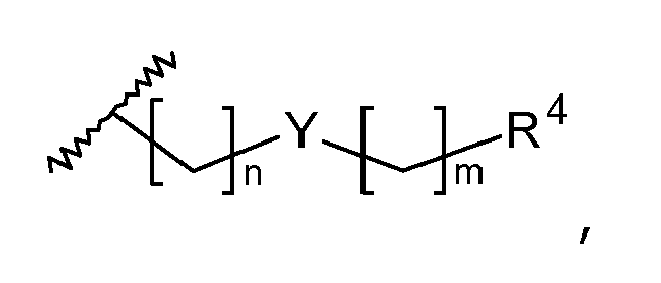
- Although not limiting, preferred optional substitutents include one or more of alkyl, alkoxy, aryloxy, halogen, haloalkyl, cyano, alkylsulfonyl, or aryl. More preferably, optional substituents includes one or more of C1-C6 alkyl, C1-C6 alkoxy, phenoxy, benzoxy, fluorine, chlorine, C1-C6 haloalkyl, cyano, C1-C6 alkylsulfonyl, phenyl, or benzyl.
- In one embodiment, R1 and R2 are each aryl, and R3 is H. Preferably, each aryl is phenyl. More preferably each phenyl is substituted with halogen. More preferably each halogen is fluorine, more preferabyl 4-fluorine.
- In another embodiment, R1 and R2 are each alkyl and R3 is

- In one embodiment, preferably the depicted NH2 group is cis to the depicted nitrile warhead. In another embodiment preferably the depicted NH2 group is trans to the depicted nitrile warhead.
- Preferably A is H. Preferably the depicted F is cis to the depicted nitrile.
- Particularly preferred compounds of the present invention include compounds of formula (I):

X is F or H; R1 and R2 each are optionally substituted aryl or heteroaryl; and
R3 is H or alkyl. - Particularly preferred compounds of the present invention include compounds of formula (I):

X is F or H; R1 and R2 each are either - (i) alkyl; or
- (ii) combine to form a 3 to 14 membered ring sytem, optionally containing one or more heteroatoms, and optionally containing one or more degrees of unsaturation;
- Preferably p is 1 or 2. More preferably p is 2. Preferably R1 and R2 each are alkyl. More preferably R1 and R2 are each C1-C6 alkyl. More preferably R1 and R2 are each methyl.
- Particularly preferred compounds of the present invention include:


- Particularly preferred compounds are selected from:
- (2S,4S)-1-[(2S)-2-Amino-3,3-diphenylpropanoyl]-4-fluoropyrrolidine-2-carbonitrile hydrochloride;
- (2S,4S)-1-[(2S)-2-Amino-3,3-bis(4-fluorophenyl)propanoyl]-4-fluoropyrrolidine-2-carbonitrile hydrochloride;
- (2S,4S)-1-[(2S)-2-Amino-5-(4-fluorophenyl)-3,3-dimethylpentanoyl]-4-fluoro-2-pyrrolidinecarbonitrile hydrochloride;
- (2S,4R)-1-[(2S)-2-Amino-4-(4-fluorophenyl)-3,3-dimethylbutanoyl]-4-fluoropyrrrolidine-2-carbonitrile hydrochloride;
- (2S,4S)-1-{(2R)-2-Amino-3-[(4-methoxybenzyl)thio]-3-methylbutanoyl}-4-fluoropyrrolidine-2-carbonitrile hydrochloride;
- (2S,4S)-1-{(2R)-2-Amino-3-methyl-3-[(3-phenylpropyl)thio]butanoyl}-4-fluoropyrrolidine-2-carbonitrile hydrochloride;
- (2S,4S)-1-{(2R)-2-Amino-3-methyl-3-[(2-phenylethyl)thio]butanoyl}-4-fluoropyrrolidine-2-carbonitrile hydrochloride;
- (2S,4S)-1-((2R)-2-Amino-3-{[3-(4-fluorophenyl)propyl]thio}-3-methylbutanoyl)-4-fluoropyrrolidine-2-carbonitrile hydrochloride;
- (2S,4S)-1-{(2R)-2-Amino-3-[(4-methoxybenzyl)sulfonyl]-3-methylbutanoyl}-4-fluoropyrrolidine-2-carbonitrile hydrochloride;
- (2S,4S)-1-{(2R)-2-Amino-3-[(4-methoxybenzyl)sulfinyl]-3-methylbutanoyl}-4-fluoropyrrolidine-2-carbonitrile hydrochloride;
- (2S,4S)-1-((2R)-2-Amino-3-methyl-3-{[4-(trifluoromethyl)benzyl]thio}butanoyl)-4-fluoropyrrolidine-2-carbonitrile hydrochloride;
- (2S,4S)-1-[(2S)-2-Amino-2-(1-vinylcyclopentyl)ethanoyl]-4-fluoropyrrolidine-2-carbonitrile hydrochloride;
- (2S,4S)-1-[(2S)-2-Amino-5-(4-methoxyphenyl)-3,3-dimethylpentanoyl]-4-fluoropyrrolidine-2-carbonitrile hydrochloride;
- (2S,4S)-1-{(2R)-2-Amino-3-methyl-3-[(3-phenylpropyl)sulfonyl]butanoyl}-4-fluoropyrrolidine-2-carbonitrile;
- (2S,4S)-1-{(2R)-2-Amino-3-methyl-3-[(4-methylbenzyl)sulfonyl]butanoyl}-4-fluoropyrrolidine-2-carbonitrile;
- (2S,4S)-1-((2R)-2-amino-3-{[4-(benzyloxy)benzyl]sulfonyl}-3-methylbutanoyl)-4-fluoropyrrolidine-2-carbonitrile;
- (2S,4S)-1-{(2R)-2-amino-3-[(4-cyanobenzyl)sulfonyl]-3-methylbutanoyl}-4-fluoropyrrolidine-2-carbonitrile;
- (2S,4S)-1-((2R)-2-amino-3-methyl-3-{[4-(methylsulfonyl)benzyl]sulfonyl}butanoyl)-4-fluoropyrrolidine-2-carbonitrile;
- (2S,4S)-1-{(2S)-2-Amino-2-[1-(4-fluorobenzyl)cyclopentyl]ethanoyl}-4-fluoropyrrolidine-2-carbonitrile hydrochloride;
- (2S,4S)-1-((2S)-2-Amino-2-{1-[4-(trifluoromethyl)phenyl]cyclopentyl}ethanoyl)-4-fluoropyrrolidine-2-carbonitrile hydrochloride;
- (2S,4S)-1-{(2S)-2-Amino-2-[1-(4-fluorobenzyl)cyclopropyl]ethanoyl}-4-fluoropyrrolidine-2-carbonitrile hydrochloride;
- (2S,4S)-1-[(2R)-2-Amino-3- (benzylsulfonyl)-3-methylbutanoyl]-4-fluoropyrrolidine-2-carbonitrile hydrochloride;
- (2S,4S)-1-{(2R)-2-amino-3-[(3-methoxybenzyl)sulfonyl]-3-methylbutanoyl}-4-fluoropyrrolidine-2-carbonitrile hydrochloride;
- (2S,4S)-1-{(2R)-2-Amino-3-[(1,1'-biphenyl-4-ylmethyl)sulfonyl]-3-methylbutanoyl}-4-fluoropyrrolidine-2-carbonitrile hydrochloride;
- (2S,4S)-1-{(2R)-2-Amino-3-[(2-methoxybenzyl)sulfonyl]-3-methylbutanoyl}-4-fluoropyrrolidine-2-carbonitrile hydrochloride;
- (2S,4S)-1-{(2R)-2-Amino-3-methyl-3-[(pyridin-3-ylmethyl)thio]butanoyl}-4-fluoropyrrolidine-2-carbonitrile;
- (2S,4S)-1-{(2R)-2-Amino-3-methyl-3-[(pyridin-2-ylmethyl)thio]butanoyl}-4-fluoropyrrolidine-2-carbonitrile hydrochloride;
- (2S,4S)-1-{(2R)-2-amino-3-methyl-3-[(pyridin-4-ylmethyl)thio]butanoyl}-4-fluoropyrrolidine-2-carbonitrile hydrochloride;
- (2S,4S)-1-{(2R)-2-amino-3-[(4-fluorobenzyl)sulfonyl]-3-methylbutanoyl}-4-fluoropyrrolidine-2-carbonitrile hydrochloride;
- (2S,4S)-1-{(2R)-2-amino-3-methyl-3-[(3-phenoxybenzyl)sulfonyl]butanoyl}-4-fluoropyrrolidine-2-carbonitrile hydrochloride;
- (2S,4S)-1-{(2R)-2-amino-3-methyl-3-[(3-phenoxybenzyl)thio]butanoyl}-4-fluoropyrrolidine-2-carbonitrile hydrochloride;
- (2S,4S)-1-((2R)-2-Amino-3-{[(5-chloro-1,1-dioxido-1-benzothien-3-yl)methyl]sulfonyl}-3-methylbutanoyl)-4-fluoropyrrolidine-2-carbonitrile hydrochloride;
- (2S,4S)-1-{(2R)-2-Amino-3-[(2,1,3-benzoxadiazol-5-ylmethyl)thio]-3-methylbutanoyl}-4-fluoropyrrolidine-2-carbonitrile hydrochloride;
- (2S,4S)-1-{(2R)-2-Amino-3-methyl-3-[(pyridin-4-ylmethyl)sulfonyl]butanoyl}-4-fluoropyrrolidine-2-carbonitrile hydrochloride;
- (2S,4S)-1-[(2S)-2-Amino-3-pyridin-4-ylpropanoyl]-4-fluoropyrrolidine-2-carbonitrile hydrochloride;
- (2S,4S)-1-[(2S)-2-Amino-3-pyridin-3-ylpropanoyl]-4-fluoropyrrolidine-2-carbonitrile hydrochloride;
- (2S,4S)-1-[(2S)-2-Amino-3-piperidin-4-ylpropanoyl]-4-fluoropyrrolidine-2-carbonitrile dihydrochloride;
- (2S,4S)-1-[(2S)-2-Amino-3-piperidin-3-ylpropanoyl]-4-fluoropyrrolidine-2-carbonitrile dihydrochloride;
- (2S,4S)-1-[(2S)-2-Amino-3-piperidin-2-ylpropanoyl]-4-fluoropyrrolidine-2-carbonitrile dihydrochloride;
- (2S,4S)-1-{(2S)-2-Amino-3-[1-(isopropylsulfonyl)piperidin-4-yl]propanoyl}-4-fluoropyrrolidine-2-carbonitrilehydrochloride;
- (2S,4S)-1-{(2,S)-2-Amino-3-[1-(4-methylphenylsulfonyl)piperidin-4-yl]propanoyl}-4-fluoropyrrolidine-2-carbonitrile hydrochloride;
- (2S,4S)-1-{(2S)-2-Amino-3-[1-(isopropylsulfonyl)piperidin-3-yl]propanoyl}-4-fluoropyrrolidine-2-carbonitrile hydrochloride;
- (2S,4S)-1-{(2S)-2-Amino-3-[1-(4-methylphenylsulfonyl)piperidin-3-yl]propanoyl}-4-fluoropyrrolidine-2-carbonitrile hydrochloride;
- (2S,4S)-1-[(2S)-2-Amino-3-(1-benzothien-3-yl)propanoyl]-4-fluoropyrrolidine-2-carbonitrile hydrochloride; and
- (2S,4S)-1-{(2S)-2-Amino-3-methyl-3-[4-(trifluoromethyl)phenyl]butanoyl}-4-fluoropyrrolidine-2-carbonitrile hydrochloride.
- Another aspect of the present invention includes pharmaceutical formulations that include a compound of the present invention. Preferably the pharmaceutical formulation further includes a pharmaceutically acceptable carrier.
- Another aspect of the present invention includes a method of inhibiting a post proline/analine cleaving protease through administration of a compound of the present invention. Preferably the post proline/analine cleaving protease is a serine protease. More preferably the serine protease is a dipeptidyl peptidase. More preferably the dipeptidyl peptidase is DPP-II or DPP-IV.
- Another aspect of the present invention includes a method for the treatment or prophylaxis of metabolic disorders, gastrointestinal disorders, viral disorders, inflammatory disorders, diabetes, obesity, hyperlipidemia, dermatological or mucous membrane disorders, psoriasis, intestinal distress, constipation, autoimmune disorders, encephalomyelitis, complement mediated disorders, glomerulonepritis, lipodystrophy, tissue damage, psychosomatic, depressive, and neuropsychiatric disorders, HIV infection, allergies, inflammation, arthritis, transplant rejection, high blood pressure, congestive heart failure, tumors, and stress-induced abortions through the administration of a compound of the present invention. Preferably the administration is for the treatment or prophylaxis of diabetes.
- Another aspect of the present invention includes the use of a compound of the present invention in the manufacture of a medicament for the inhibition of a post proline/analine cleaving protease. Preferably the post proline/analine cleaving protease is a serine protease. More preferably the serine protease is a dipeptidyl peptidase. More preferably the dipeptidyl peptidase is DPP-II or DPP-IV.
- Another aspect of the present invention includes the use of a compound of the present invention in the manufacture of a medicament for the treatment or prophylaxis of metabolic disorders, gastrointestinal disorders, viral disorders, inflammatory disorders, diabetes, obesity, hyperlipidemia, dermatological or mucous membrane disorders, psoriasis, intestinal distress, constipation, autoimmune disorders, encephalomyelitis, complement mediated disorders, glomerulonepritis, lipodystrophy, tissue damage, psychosomatic, depressive, and neuropsychiatric disorders, HIV infection, allergies, inflammation, arthritis, transplant rejection, high blood pressure, congestive heart failure, tumors, and stress-induced abortions.
- Another aspect of the present invention includes a compound of the present invention for use as an active therapeutic substance. In addtion a compound of the present invention may be used in the manufacture of a medicament for the inhibition of serine protease. Preferably such use is for the manufacture of a medicament for the treatment or prophylaxis of metabolic disorders, gastrointestinal disorders, viral disorders, inflammatory disorders, diabetes, obesity, hyperlipidemia, dermatological or mucous membrane disorders, psoriasis, intestinal distress, constipation, autoimmune disorders, encephalomyelitis, complement mediated disorders, glomerulonepritis, lipodystrophy, tissue damage, psychosomatic, depressive, and neuropsychiatric disorders, HIV infection, allergies, inflammation, arthritis, transplant rejection, high blood pressure, congestive heart failure, tumors, and stress-induced abortions.
- The term "alkyl" refers to a straight or branched chain saturated aliphatic hydrocarbon that may be optionally substituted, with multiple degrees of substitution being allowed. Examples of "alkyl" include, but are not limited to methyl, ethyl, n-propyl, isopropyl, n-butyl, t-butyl, n-pentyl, isobutyl, and the like.
- As used throughout this specification, the preferred number of carbon atoms will be represented by, for example, the phrase "Cx-Cy alkyl" which refers to an alkyl group, as herein defined, containing the specified number of carbon atoms. Similar terminology will apply for other preferred ranges as well.
- The term "alkylene" refers to a divalent straight or branched chain aliphatic hydrocarbon radical that may be optionally substituted, with multiple degrees of substitution being allowed. An example of "alkylene" includes, without limitation, methylene, namely -CH2-.
- The term "alkenyl" refers to a straight or branched chain aliphatic hydrocarbon, containing one or more carbon-to-carbon double bonds that may be optionally substituted, with multiple degrees of substitution being allowed. Examples include, but are not limited to, vinyl and the like.
- As used herein the term "alkenylene" refers to a divalent straight or branched chain aliphatic hydrocarbon radical, containing one or more carbon-to-carbon double bonds, which may be optionally substituted, with multiple degrees of substitution being allowed. An example of "alkenylene" includes, without limitation, vinylene, namely, -CH=CH-.
- As used herein the term "alkynyl" refers to a straight or branched aliphatic hydrocarbon containing one or more triple bond, which may optionally be substituted, with multuiple degrees of substitution being allowed. Examples of "alkynyl" as used herein include, but are not limited to, ethynyl and the like.
- As used herein the term "alkynylene" refers to a divalent straight or branched chain aliphatic hydrocarbon radical, containing at least one carbon-to-carbon triple bond, that may be further substituted, with multiple degrees of substitution being allowed. An example of "alkynylene" includes, without limitation, ethynylene, namely -C≡C-.
- The term "aryl" refers to an aromatic ring system, such as an optionally substituted benzene ring system, such as phenyl. The term encompasses fused systems where one or more optionally substituted benzene rings form, for example, anthracene, phenanthrene, or naphthalene ring systems. The term includes ring(s) optionally substituted, with multiple degrees of substitution being allowed, and also includes an optional alkylene linker, such as C1-C6 alkylene, through which the aryl group may be attached. Examples of "aryl" groups include, but are not limited to phenyl, benzyl, 2-naphthyl, 1-naphthyl, biphenyl, as well as substituted derivatives thereof.
- The term "heteroaryl" refers to a monocyclic aromatic ring system, or to a fused bicyclic aromatic ring system comprising two or more aromatic rings. These heteroaryl rings contain one or more nitrogen, sulfur, and/or oxygen atoms, where N-oxides, sulfur oxides, and dioxides are permissible heteroatom substitutions and the rings may be optionally substituted, with multiple degrees of substitution being allowed. The term includes ring(s) optionally substituted, with multiple degrees of substitution being allowed, and also includes an optional alkylene linker, such as C1-C6 alkylene, through which the heteroaryl group may be attached. Examples of "heteroaryl" groups used herein include furan, thiophene, pyrrole, imidazole, pyrazole, triazole, tetrazole, thiazole, oxazole, isoxazole, oxadiazole, thiadiazole, isothiazole, pyridine, pyridazine, pyrazine, pyrimidine, quinoline, isoquinoline, benzofuran, benzothiophene, indole, indazole, and substituted versions thereof.
- As used herein, the term "cycloalkyl" refers to a mono- or bi-cyclic hydrocarbon ring system, which may be further substituted with multiple degrees of substitution being allowed, and which optionally includes an alkylene linker through which the cycloalkyl may be attached. Exemplary "cycloalkyl" groups include, but are not limited to, cyclopropyl, cyclobutyl, cyclopentyl, cyclohexyl, and cycloheptyl. When substituted, one preferred substituent location for cycloalkyl groups of the present invention is at the "1-position." To illustrate, without limitation, a preferred location for a substituent is represented below with the substituent referred to as "R":

- The term "cycloalkyl" includes bridged or fused ring systems, as well, such as hydrindane, decalin, or adamantyl. For ease of reference, also included within the term are cycloalkyl/aryl fused systems where, for example, a cycloalkyl, such as cyclohexyl, is fused with an aromatic ring, such as a benzene ring, to form groups such as
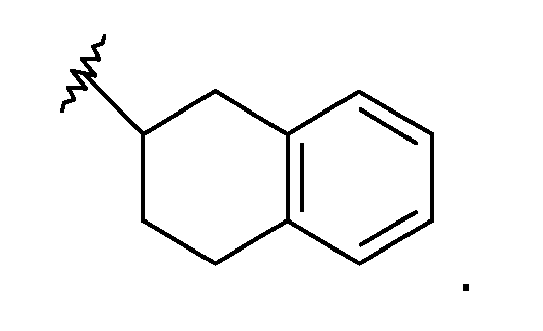
- As used herein, the term "heterocyclic" or the term "heterocyclyl" refers to a heterocyclic ring, preferably three to twelve-membered, that is either saturated or has one or more degrees of unsaturation. These heterocyclic rings contain one or more heteroatom, such as nitrogen, sulfur, and/or oxygen atoms, where N-oxides, sulfur oxides, and dioxides are permissible heteroatom substitutions. As used herein heterocyclic groups optionally may be substituted, with multiple degrees of substitution being allowed, and also includes an optional alkylene linker, such as C1-C6 alkylene, through which the heterocyclyl group may be attached. Such a ring may be optionally fused to one or more of another "heterocyclic" ring(s), aryl ring(s), or cycloalkyl ring(s). Examples of "heterocyclic" include, but are not limited to, tetrahydrofuran, pyran, 1,4-dioxane, 1,3-dioxane, piperidine, pyrrolidine, morpholine, tetrahydrothiopyran, tetrahydrothiophene, and the like.
- The term "halogen" refers to fluorine, chlorine, bromine, or iodine.
- The term "haloalkyl" refers to an alkyl group, as defined herein that is substituted with at least one halogen. Non-limiting examples of "haloalkyl" groups include methyl, ethyl, propyl, isopropyl, n-butyl, and t-butyl substituted independently with one or more halogens, e.g., fluoro, chloro, bromo, and/or iodo. The term "haloalkyl" should be interpreted to include such substituents as perfluoroalkyl, for example, trifluoromethyl, CF3, and the like.
- As used herein, the term "haloalkoxy" refers to the group -ORa, where Ra is haloalkyl as herein defined.
- As used herein, the term "alkoxy" refers to the group -ORa, where Ra is alkyl as herein defined.
- As used herein, the term "aryloxy" refers to the group -ORb, where Rb is aryl as herein defined.
- As an example, and to be applied throughout the specification, since the term "aryl" includes optionally substituted aryl groups, the term "aryloxy" includes optionally substituted aryloxy groups. The optional substitution applies for all applicable terms herein defined. Further, as defined above, the term "aryl" includes alkylene-linked aryl groups. Thus, terms such as "aryloxy" and the like should be considered to include alkylene-linked aryl groups. As an example and not meant as limiting, one aryloxy group may be -ORb, where Rb is benzyl.
- As used herein, the term "heteroaryloxy" refers to the group -ORb, where Rb is heteroaryl as herein defined.
- As used herein, the term "alkoxycarbonyl" refers to the group -C(O)ORa, where Ra is alkyl as herein defined.
- As used herein, the term "aryloxycarbonyl" refers to the group -C(O)ORa, where Ra is aryl as herein defined.
- As used herein, the term "heteroaryloxycarbonyl" refers to the group -C(O)ORa, where Ra is heteroaryl as herein defined.
- As used herein, the term "alkoxythiocarbonyl" refers to the group -C(S)ORa, where Ra is alkyl as herein defined.
- As used herein, the term "aryloxythiocarbonyl" refers to the group -C(S)ORa, where Ra is aryl as herein defined.
- As used herein, the term "heteroaryloxythiocarbonyl" refers to the group -C(S)ORa, where Ra is heteroaryl as herein defined.
- As used herein, the term "oxo" refers to the group =O.
- As used herein, the term "mercapto" refers to the group -SH.
- As used herein, the term "thio" shall refer to the group -S-.
- As used herein, the term "sulfinyl" shall refer to the group -S(O)-.
- As used herein, the term "sulfonyl" shall refer to the group -S(O)2-.
- As used herein, the term "alkylthio" refers to the group -SRa, where Ra is alkyl as herein defined.
- As used herein, the term "arylthio" refers to the group -SRb, where Rb is aryl as herein defined.
- As used herein, the term "heteroarylthio" refers to the group -SRb, where Rb is heteroaryl as herein defined.
- As used herein, the term "alkylsulfinyl" refers to the group -S(O)Ra, where Ra is alkyl as herein defined.
- As used herein, the term "arylsulfinyl" refers to the group -S(O)Rb, where Rb is aryl as herein defined.
- As used herein, the term "heteroarylsulfinyl" refers to the group -S(O)Rb, where Rb is heteroaryl as herein defined.
- As used herein, the term "alkylsulfonyl" refers to the group -S(O)2Ra, where Ra is alkyl as herein defined.
- As used herein, the term "cycloalkylsulfonyl" refers to the group -S(O)2Ra, where Ra is cycloalkyl as herein defined.
- As used herein the term "arylsulfonyl" refers to the group -S(O)2Rb, where Rb is aryl as herein defined.
- As used herein the term "heteroarylsulfonyl" refers to the group -S(O)2Rb, where Rb is heteroaryl as herein defined.
- As used herein, the term "aminosulfonyl" refers to the group -S(O)2NH2.
- As used herein, the term "cyano" refers to the group -CN.
- As used herein the term "cyanoalkyl" refers to the group -RaCN wherein Ra is an alkylene as herein defined.
- As used herein, the term "carboxy" refers to the group -COOH.
- As used herein, the term "carbamoyl" refers to the group -C(O)NH2.
- As used herein, the term "alkylcarbamoyl" refers to the group -C(O)N(Ra)2, where one Ra is alkyl and the other Ra is independently H or alkyl.
- As used herein, the term "arylcarbamoyl" refers to the group -C(O)N(Ra)2, where one Ra is aryl and the other Ra is independently H or aryl, as herein defined.
- As used herein, the term "heteroarylcarbamoyl" refers to the group -C(O)N(Ra)2, where one Ra is heteroaryl and the other Ra is independently H or heteroaryl, as herein defined.
- As used herein, the term "thiocarbamoyl" refers to the group -C(S)NH2.
- As used herein, the term "alkylthiocarbamoyl" refers to the group -C(S)N(Ra)2, where one Ra is alkyl and the other Ra is independently H or alkyl.
- As used herein, the term "arylthiocarbamoyl" refers to the group -C(S)N(Ra)2, where one Ra is aryl and the other Ra is independently H or aryl, as herein defined.
- As used herein, the term "heteroarylthiocarbamoyl" refers to the group -C(S)N(Ra)2, where one Ra is heteroaryl and the other Ra is independently H or heteroaryl, as herein defined.
- As used herein, the term "amino" refers to the group -NH2.
- As used herein, the term "alkylamino" refers to the group -N(Ra)2, where one Ra is alkyl and the other Ra independently is H or alkyl, as herein defined.
- As used herein, the term "cycloalkylamino" refers to the group -N(Ra)2, where one Ra is cycloalkyl and the other Ra independently is H or cycloalkyl, as herein defined.
- As used herein, the term "arylamino" refers to the group -N(Ra)2, where one Ra is aryl and the other Ra independently is H or aryl, as herein defined.
- As used herein, the term "heteroarylamino" refers to the group - N(Ra)2, where one Ra is heteroaryl and the other Ra independently is H or heteroaryl, as herein defined.
- As used herein, the term "acyl" refers to the group -C(O)Ra, where Ra is alkyl, aryl, heteroaryl, cycloalkyl, or heterocyclyl, each as herein defined.
- As used herein, the term "thioacyl" refers to the group -C(S)Ra, where Ra is alkyl, aryl, heteroaryl, cycloalkyl, or heterocyclyl, each as herein defined.
- As used herein, the term "hydroxy" refers to the group -OH.
- As used herein the term "hydroxyalkyl" refers to the group -RaOH wherein Ra is an alkylene as herein defined.
- Also, as used herein throughout the present specification, the phrase "optionally substituted" denotes an optional substitution, one or more times, with, as the terms are herein defined, acyl; alkyl; alkenyl; alkynyl; alkylsulfonyl; alkoxy; cyano; halogen; haloalkyl; hydroxy; nitro; aryl, which may be further substituted with acyl, alkoxy, alkyl, alkenyl, alkynyl, alkylsulfonyl, cyano, halogen, haloalkyl, hydroxy, or nitro; heteroaryl, which may be further substituted with acyl, alkoxy, alkyl, alkenyl, alkynyl, alkylsulfonyl, cyano, halogen, haloalkyl, hydroxy, or nitro; arylsulfonyl, which may be further substituted with acyl, alkoxy, alkyl, alkenyl, alkynyl, alkylsulfonyl, cyano, halogen, haloalkyl, hydroxy, or nitro; heteroarylsulfonyl, which may be further substituted with acyl, alkoxy, alkyl, alkenyl, alkynyl, alkylsulfonyl, cyano, halogen, haloalkyl, hydroxy, or nitro; aryloxy, which may be further substituted with acyl, alkoxy, alkyl, alkenyl, alkynyl, alkylsulfonyl, cyano, halogen, haloalkyl, hydroxy, or nitro; heteroaryloxy, which may be further substituted with acyl, alkoxy, alkyl, alkenyl, alkynyl, alkylsulfonyl, cyano, halogen, haloalkyl, hydroxy, or nitro; -R'OR'R4; or -NR4R5; where for each occurrence R' is alkylene, alkenylene, or alkynylene, and R4 and R5 are each independently selected from H, alkyl, alkenyl, alkynyl, cycloalkyl, heterocyclyl, aryl, heteroaryl, alkylsulfonyl, arylsulfonyl, or heteroarylsulfonyl, where each occurrence of such aryl or heteroaryl may be substituted with one or more acyl, alkoxy, alkyl, alkenyl, alkylsulfonyl, cyano, halogen, haloalkyl, hydroxy, or nitro, or R4 and R5 may combine to form a ring, optionally having additional heteroatoms, optionally having one or more degrees of unsaturation, and optionally being further substituted with acyl, alkoxy, alkyl, alkenyl, alkynyl, alkylsulfonyl, cyano, halogen, haloalkyl, hydroxy, or nitro.
- The compounds of the present invention may have the ability to crystallize in more than one form, a characteristic known as polymorphism. All polymorphic forms ("polymorphs'') are within the scope of the present invention. Polymorphism generally can occur as a response to changes in temperature or pressure, or both, and can also result from variations in the crystallization process. Polymorphs can be distinguished by various physical characteristics that are known in the art such as x-ray diffraction patterns, solubility, and melting point.
- Certain of the compounds described herein contain one or more chiral centers, or may otherwise be capable of existing as multiple stereoisomers. The scope of the present invention includes pure stereoisomers as well as mixtures of stereoisomers, such as purified enantiomers/diasteromers or enantiomerically/diastereomerically enriched mixtures. Also included within the scope of the invention are the individual isomers of the compounds per se, as well as any wholly or partially equilibrated mixtures thereof. The present invention covers the individual isomers of the compounds represented by the formulas above as mixtures with isomers thereof in which one or more chiral centers are inverted.
- As noted above, the present invention includes salts, solvates, and pharmaceutically functional derivatives of the compounds of the present invention. Salts include addition salts, metal salts, or optionally alkylated ammonium salts. Examples of such salts include hydrochloric, hydrobromic, hydroiodic, phosphoric, sulfuric, trifluoroacetic, trichloroacetic, oxalic, maleic, pyruvic, malonic, succinic, citric, mandelic, benzoic, cinnamic, methane sulphonic, ethane sulphonic, picric, and the like. Further salts include lithium, sodium, potassium, magnesium, and the like. Still further salts include acetate, benzenesulfonate, benzoate, bicarbonate, bisulfate, bitartrate, borate, bromide, calcium edetate, camsylate, carbonate, chloride, clavulanate, citrate, dihydrochloride, edetate, edisylate, estolate, esylate, fumarate, gluceptate, gluconate, glutamate, glycollylarsanilate, hexylresorcinate, hydrabamine, hydroxynaphthoate, isethionate, lactate, lactobionate, laurate, malate, mandelate, mesylate, methylbromide, methylnitrate, methylsulfate, monopotassium maleate, mucate, napsylate, nitrate, N-methylglucamine, pamoate (embonate), palmitate, pantothenate, phosphate/diphosphate, polygalacturonate, potassium, salicylate, sodium, stearate, subacetate, tannate, tartrate, teoclate, tosylate, triethiodide, trimethylammonium, and valerate salts. Reference is also made to Journal of Pharmaceutical Science, 1997, 66, 2, incorporated herein by reference, as relevant to salts.
- As used herein, the term "solvate" refers to a complex of variable stoichiometry formed by a solute or a salt or pharmaceutically functional derivative thereof and a solvent. Such solvents for the purpose of the invention should not interfere with the biological activity of the solute. Examples of solvents include, but are not limited to water, methanol, ethanol, and acetic acid. Preferably the solvent used is a pharmaceutically acceptable solvent. Examples of pharmaceutically acceptable solvents include water, ethanol, and acetic acid.
- The term "pharmaceutically functional derivative" refers to any pharmaceutically acceptable derivative of a compound of the present invention, for example, an ester or an amide, which upon administration to a mammal is capable of providing (directly or indirectly) a compound of the present invention or an active metabolite thereof. Such derivatives are recognizable to those skilled in the art, without undue experimentation. Nevertheless reference is made to the teaching of Burger's Medicinal Chemistry and Drug Discovery, 5th Edition, Vol 1: Principles and Practice, which is incorporated herein by reference to the extent of teaching pharmaceutically functional derivatives.
While compounds of the present invention may be administered as the raw chemical, preferably the compounds of the present invention are presented as an active ingredient within a pharmaceutical formulation as known in the art. Accordingly, the present invention further includes a pharmaceutical formulation comprising a compound of the present invention, or salt, solvate, or pharmaceutically functional derivative thereof together with one or more pharmaceutically acceptable carriers. Optionally, other therapeutic and/or prophylactic ("active'') ingredients may be included in the pharmaceutical formulation as well. For example, the compounds of the present invention may be combined with other anti-diabetic agents, such as one or more of the following agents: insulin, α-glucosidase inhibitors, biguanides, insulin secretagogue, or insulin sensitizers. Non-limiting examples of α-glucosidase inhibitors include acarbose, emiglitate, miglitol, and voglibose. Non-limiting examples of biguanides include metformin, buformin, and phenformin. Non-limiting examples of insulin secretagogues include sulphonylureas. Non-limiting examples of insulin sensitizers include peroxisome proliferator activated receptor (PPAR) ligands, such as PPAR-γ agonists, for example Actos™ and Avandia™. - Formulations of the present invention include those especially formulated for oral, buccal, parental, transdermal, inhalation, intranasal, transmucosal, implant, or rectal administration. Among the variety of administrations, oral administration typically is preferred. For oral administration tablets, capsules, and caplets may contain conventional excipients such as binding agents, fillers, lubricants, disintegrants, and/or wetting agents. Non-limiting examples of binding agents include syrup, acacia, gelatin, sorbitol, tragacanth, mucilage of starch, or polyvinylpyrrolidone (PVP). Non-limiting examples of fillers include, for example, lactose, sugar, microcrystalline cellulose, maize-starch, calcium phosphate or sorbitol. Non-limiting examples of lubricants include, for example, magnesium sterate, stearic acid, talc, polyethylene glycol or silica. Non-limiting examples of disintegrants include, for example, potato starch or sodium starch glycollate. A non-limiting example of a wetting agent includes sodium lauryl sulfate. The tablets additionally may be coated according to methods known in the art.
- Alternatively, the compounds of the present invention may be incorporated into oral liquid preparations such as aqueous or oily suspensions, solutions, emulsions, syrups, or elixirs. Moreover, formulations containing these compounds may be presented as a dry product for constitution with water or other suitable vehicle before use. Liquid preparations may contain conventional additives. Non-limiting examples of such additives include suspending agents such as sorbitol syrup, methyl cellulose, glucose/sugar syrup, gelatin, hydroxyethylcellulose, carboxymethyl cellulose, aluminum sterate gel or hydrogenated edible fats. Additionally, emulsifying agents such as lecithin, sorbitan mono-oleate or acacia; non-aqueous vehicles (which may include edible oils) such as almond oil, fractionated coconut oil, oily esters, propylene glycol or ethyl alcohol my be included. Further, preservatives such as methyl or propyl p-hydroxybenzoates or sorbic acid, may be incorporated into the preparation. Such preparations may also be formulated as suppositories, for example, containing conventional suppository bases such as cocoa butter or other glycerides.
- Additionally, formulations of the present invention may be formulated for parenteral administration by injection or continuous infusion.
Formulations for injection may take such forms as suspensions, solutions, or emulsions in oily or aqueous vehicles, and may contain formulatory agents such as suspending, stabilizing and/or dispersing agents. Alternatively, the active ingredient may be in powder form for constitution with a suitable vehicle, for example, sterile, pyrogen-free water, before use. - The formulations according to the invention may also be formulated as a depot preparation. Such long acting formulations may be administered by implantation, for example, subcutaneously or intramuscularly, or by intramuscular injection. Accordingly, the compounds of the invention may be formulated with suitable polymeric or hydrophobic materials, such as an emulsion in an acceptable oil, ion exchange resins, or as sparingly soluble derivatives, such as a sparingly soluble salt.
- Pharmaceutical formulations may be presented in unit dose forms containing a predetermined amount of active ingredient per unit dose. Such a unit may contain certain amounts of a compound of the present invention depending on the condition being treated, the route of administration, and the age, weight and condition of the patient. Examples of such amounts include the formulation containing about 0.1 to about 99.9% active ingredient. Preferred unit dosage formulations are those containing a predetermined dose, such as a daily dose, or an appropriate fraction thereof, of an active ingredient. Such pharmaceutical formulations may be prepared by any of the methods well known in the pharmacy art.
- As used herein, the term "effective amount" means that amount of a drug or pharmaceutical agent that will elicit the biological or medical response of a tissue, system, animal, or human that is being sought, for instance, by a researcher or clinician. Furthermore, the term "therapeutically effective amount" means any amount which, as compared to a corresponding subject who has not received such amount, results in improved treatment, healing, prevention, or amelioration of a disease, disorder, or side effect, or a decrease in the rate of advancement of a disease or disorder. The term also includes within its scope amounts effective to enhance normal physiological function.
- The therapeutically effective amount of a compound of the present invention will depend upon a number of factors including, for example, the age and weight of the animal, the precise condition requiring treatment and its severity, the nature of the formulation, and the route of administration. Therapeutic effectiveness ultimately will be at the discretion of the attendant physician or veterinarian. An effective amount of a salt or solvate, or pharmaceutically functional derivative thereof, may be determined as a proportion of the effective amount of a compound of the present invention per se. Dosages may vary, depending upon the appropriate inhibition of DPP-IV for purposes of treatment or prophylaxis of a variety of metabolic, gastrointestinal, viral, and inflammatory diseases, including, but not limited to, diabetes, obesity, hyperlipidemia, dermatological or mucous membrane disorders, psoriasis, intestinal distress, constipation, autoimmune disorders such as encephalomyelitis, complement mediated disorders such as glomerulonepritis, lipodystrophy, and tissue damage, psychosomatic, depressive, and neuropsychiatric disorders, HIV infection, allergies, inflammation, arthritis, transplant rejection, high blood pressure, congestive heart failure, tumors, and stress-induced abortions, for example cytokine-mediated murine abortions.
- No toxicological effects are indicated/expected when a compound of the present invention is administered in the above mentioned dosage range.
- The following examples illustrate aspects of this invention, but should not be construed as limitations. As used herein the symbols and conventions used in these processes, schemes and examples are consistent with those used in the contemporary scientific literature, for example, the Journal of the American Chemical Society or the Journal of Biological Chemistry. Unless otherwise noted, all starting materials were obtained from commercial suppliers and used without further purification.
- 1H NMR spectra were recorded on a Varian VXR-300, a Varian Unity-300, a Varian Unity-400 instrument, or a General Electric QE-300. Chemical shifts are expressed in parts per million (ppm, δ units). Coupling constants are in units of hertz (Hz). Splitting patterns describe apparent multiplicities and are designated as s (singlet), d (doublet), t (triplet), q (quartet), m (multiplet), br (broad).
- Low-resolution mass spectra (MS) were recorded on a JOEL JMS-AX505HA, JOEL SX-102, or a SCIEX-APIiii spectrometer; high resolution MS were obtained using a JOEL SX-102A spectrometer. All mass spectra were taken under electrospray ionization (ESI), chemical ionization (CI), electron impact (EI) or by fast atom bombardment (FAB) methods. Infrared (IR) spectra were obtained on a Nicolet 510 FT-IR spectrometer using a 1-mm NaCl cell. All reactions were monitored by thin-layer chromatography on 0.25 mm E. Merck silica gel plates (60F-254), visualized with UV light, 5% ethanolic phosphomolybdic acid or p-anisaldehyde solution. Flash column chromatography was performed on silica gel (230-400 mesh, Merck). Optical rotations were obtained using a Perkin Elmer Model 241 Polarimeter. Melting points were determined using a Mel-Temp II apparatus and are uncorrected.
- IUPAC names are included to further identify particular compounds of the present invention. The IUPAC names stated herein should in no way limit the scope of the present invention.
- In accordance with the present invention and as below, one embodiment of the compounds of the present invention can be prepared by reacting a compound of formula II with an α- or β-amino carboxylate or with an α- or β-amino activated carboxylate, both designated herein generally as aminocarboxylates, under standard coupling conditions, for example, with HATU, DMF, Hunigs base.

- More specifically, a compound of formula II may be reacted with an amino carboxylate, where the amino carboxylate is suitably protected, for example on the α-nitrogen, with an appropriate protecting group such as, for example, a t-butyl carboxy protecting group.
- In an alternate embodiment, a compound of formula II may be reacted with an amino activated carboxylate, such as, for example, N-hydroxysuccinimide ester or acid chloride, where the amino activated carboxylate is suitably protected, for example, on the α-nitrogen with an appropriate protecting group such as, for example, a t-butyl carboxy protecting group. Removal of the protecting group under suitable conditions, such as, for example, trifluoroacetic acid for the removal of the t-butyl carboxy, then generates compounds of formula (I).
- For further detail regarding the preparation of amino carboxylates for use in preparing the compounds of the present invention, reference may be had to
WO 95/15309 WO 98/19998 -

- To a MeOH solution (420 mL) containing L-hydroxyproline (62.67 g, 478 mmol) cooled in an ice water bath was added thionyl chloride (58.6 g, 492.3 mmol) dropwise. Upon complete addition the suspension was stirred at RT for 2 h. The mixture was then heated to reflux for 6 h at which time it was cooled to RT and the solvent removed in vacuo. The residual solid was pumped on under high vacuum yielding 86.03 g (474 mmol, 99% yield) of compound A as a white solid.
1H NMR (d4-MeOH) 400 MHz δ 4.62-4.57 (m, 2H), 3.85 (s, 3H), 3.43 (dd, 1H, J = 12.2, 3.7 Hz), 3.30 (m, 1H), 2.41 (dd, 1H, J = 13.6, 7.6 Hz), 2.19 (m, 1H) ppm. - To a CH2Cl2 solution (1.4 L) containing compound A (88.67 g, 0.49 mol) and di-t-butyldicarbonate (109.8 g, 0.50 mol) was added, at 0°C, triethylamine (123.6 g, 1.22 mol) dropwise over 1.5 h. The resulting solution was then slowly allowed to warm to RT overnight. The solvent was then removed in vacuo and Et2O was added to the residual solid. The solid was collected via vacuum filtration and washed thoroughly with Et2O. The filtrate then had the solvent removed in vacuo and was dissolved in CH2Cl2. The organics were washed with sat. NaCl and sat. NaHCO3 followed by drying over MgSO4. Filtration and removal of the solvent in vacuo yielded a light yellow oil which, after pumping on under high vacuum for ~ 15 min., solidified. The resulting solid had 500 mL of hexanes added to it and then stirred overnight. The solid was collected via vacuum filtration and pumped on under high vacuum yielding 104.5g (0.43 mol, 87% yield) compound B as a white solid.
1H NMR (d4-MeOH) 400 MHz δ 4.37-4.32 (m, 2H), 3.72-3.71 (m, 3H), 3.51 (m, 1H), 3.43 (m, 1H), 2.23 (m, 1H), 2.02 (m, 1H), 1.42 (m, 9H) ppm. - To a 2 L flask containing compound B (124.25 g, 0.51 mol), in 1.25 L of 1,2-dichloroethane cooled to -30 °C, was added DAST neat (125 g, 0.78 mol). The reaction slowly warmed to -10 °C over 1 hr at which time the cold bath was removed. Stirring continued at RT for 24 hr when the dark solution was poured into two 2 L flasks that contained crushed ice and solid NaHCO3. The flasks were periodically swirled and stirred until no CO2 evolution was observed (note: additional solid NaHCO3 was periodically added). The organic layer was separated and the aqueous layer extracted with CH2Cl2. After drying over MgSO4 the solvent was removed in vacuo and the residual dark oil was dissolved in 200 mL of EtOAc and then 800 mL of hexanes was added.
- To this solution was added 100 g of SiO2. After stirring for 30 min the solution was filtered with the SiO2 being washed with hexanes/EtOAc (4:1, ~ 500 mL). Removal of the solvent in vacuo and pumping on under high vacuum overnight yielded 121.81 g (0.40 mol, 97% yield) of compound C as a dark oil.
1H NMR (CDCl3) 400 MHz δ 5.18 (d(br), 1H, J = 53 Hz), 4.53 (d, 1/2H, J = 9.7 Hz), 4.40 (d, 1/2H, J = 9.4 Hz), 3.87-3.59 (m, 2H), 3.73 (s, 3H), 2.51-2.28 (m, 2H), 1.46 (s, 3H, rotomer), 1.41 (s, 6H, rotomer) ppm. - To a 2 L flask containing compound C (121.8 g, 0.49 mol), in 1.1 L of dioxane, was added 380 mL of H2O followed by lithium hydroxide hydrate (103.6 g, 2.46 mol) at RT. The resulting solution stirred for 23 hr (note: by TLC the reaction appeared to be done after 5 hr) at which time the bulk of the dioxane was removed in vacuo. The residual material was dissolved in additional H2O and then charcoal was added. After stirring for 15 min., the solution was filtered through a bed of celite. The filtrate had solid NaCl added to it until it didn't dissolve any further. It was then cooled in an ice water bath and was acidified with concentrated HCl to pH 3 whilst maintaining the solution temperature between 5 - 10 °C. The product began to precipitate out at pH 4 and upon reaching pH 3 the tan solid was collected via vacuum filtration. After pumping on under high vacuum overnight the solid was dissolved in CH3CN (1.5 L) and dried over MgSO4. Removal of the solvent in vacuo and drying under high vacuum yielded 92.7 g (0.40 mol, 81% yield) of compound as a tan solid.
1H NMR (d6-DMSO) 400 MHz δ 12.5 (s(br), 1H), 5.22 (d(br), 1H, J = 54 Hz), 4.25 (m, 1H), 3.60-3.43 (m, 2H), 2.45 (m, 1H), 2.20 (m, 1H), 1.33 (m, 9H) ppm. - To a 2 L, 3-neck flask equipped with an air-driven stirrer was added compound D (92.7 g, 0.40 mol), CH3CN (1.1 L), di-t-butyldicarbonate (130 g, 0.60 mol), and pyridine (32.4 g, 0.41 mol) at RT. After stirring for 20 min., ammonium hydrogen carbonate (47.2 g, 0.60 mol) was added. The reaction stirred for 23 hr at which time the bulk of the CH3CN was removed in vacuo. The residue was then dissolved in CH2Cl2 and washed with a 1:1 1M HCl/sat. NaCl solution. The aqueous layer was then extracted 2X with CH2Cl2. The combined organic layers were dried (MgSO4) and the solvent removed in vacuo. The tan solid was triturated with hexanes (~ 0.5 L) and collected via vacuum filtration. After pumping under high vacuum, 68.75 g (0.30 mol, 74% yield) compound E was obtained as a light tan solid. The filtrate after removal of the solvent in vacuo gave a dark oil that also appeared to contain additional product by 1H NMR.
1H NMR (d6-DMSO) 400 MHz δ 7.21 (s(br), 1/2H), 7.14 (s(br), 1/2H), 6.94 (s(br), 1H), 5.19 (d(br), 1H, J = 54 Hz), 4.11 (m, 1H), 3.63-3.47 (m, 2H), 2.38 (m, 1H), 2.11 (m, 1H), 1.39 (s, 3H, rotomer), 1.34 (s, 6H, rotomer) ppm. - To a flask containing imidazole (2.93 g, 43.1 mmol), was added pyridine (75 g, 0.9 mol, 15 volumes by weight to the amide). The solution was then cooled to 0 °C and after stirring for 10 min., BOC-4-fluoroproline carboxamide (5.0 g, 21.6 mmol) was added in one portion. The solution was then cooled to -30 °C (note: going below this temperature may lead to a heterogeneous solution) and POCl3 (13.2 g, 86.4 mmol) was added dropwise over 5 minutes.
- Upon complete addition the dry-ice acetone bath was replaced with an ice water bath and stirring continued at 0 °C for 1 hr at which time it was poured into a crushed ice, solid NaCl and EtOAc mixture. The organic layer was separated and the aqueous layer was extracted with EtOAc (2X). The solvent was removed in vacuo (note: keep rotovap bath < 35°C) and the residue dissolved in EtOAc. The organics were washed with sat. NaCl and 1 M HCl (2X). After drying over MgSO4 the solvent was removed in vacuo yielding 4.0 g (18.6 mmol, 86% yield) of compound F as a light tan solid.
1H NMR (d4-MeOH) 400 MHz δ 5.32 (d(br), 1H, J = 52 Hz), 4.78 (m, 1H), 3.74-3.48 (m, 2H), 2.55-2.40 (m, 2H), 1.52-1.43 (m, 9H) ppm. - To a CH3CN solution (1 L) containing compound F (56.62 g, 0.26 mol), was added p-toluenesulfonic acid hydrate (75.4 g, 0.40 mol) at RT. After 24 hr the CH3CN was removed in vacuo and then the residual brown oil was dissolved in 500 mL of EtOAc. Within 1 min a solid precipitated out and the solution was cooled in an ice-water bath and after stirring for 1 hr the solid was collected via vacuum filtration. The collected solid was rinsed with cold (-20 °C) EtOAc (~ 500 mL) and then pumped on under high vacuum overnight yielding 60.94 g (0.21 mol, 82% yield) of compound G as a light tan solid.
1H NMR (d4-MeOH) 400 MHz δ 7.69 (d, 2H, J = 8.1 Hz), 7.23 (d, 2H, J = 8.0 Hz), 5.52 (dd, 1H, J = 51, 3.4 Hz), 4.96 (dd, 1H, J = 9.8, 3.6 Hz), 3.78 (m, 1H), 3.55 (m, 1H), 2.84-2.63 (m, 2H), 2.36 (s, 3H) ppm. -

- To a THF solution (420 mL) containing BOC-L-hydroxyproline (30.0 g, 129 mmol) and triethylamine (14.4 g, 141.9 mmol) cooled to -15 °C was added ethyl chloroformate (15.4 g, 141.9 mmol) dropwise. The resulting solution stirred for 10 min when 80 mL of 28% NH4OH was added. The reaction was allowed to slowly warm to 5 °C over 2 hr at which time sat. NH4Cl was added until the entire white solid had dissolved. The THF was separated and the aqueous layer extracted with THF. The combined organic layers were dried (MgSO4) and the solvent removed in vacuo. The residual oil was treated with Et2O and a small amount of CH2Cl2 and MeOH. After storing in the freezer for 1 hr the resulting white solid was collected via vacuum filtration yielding 22.0 g (95.6 mmol, 74% yield) of compound A.
1H NMR (d6-DMSO) 400 MHz δ 7.33-7.29 (d(br), 1H, rotomers), 6.88-6.80 (d(br), 1H, rotomers), 4.94 (s(br), 1H), 4.18 (s(br), 1H), 4.04 (m, 1H), 3.35 (m, 1H), 3.21 (m, 1H), 1.99 (m, 1H), 1.77 (m, 1H), 1.36-1.31 (d, 9H, rotomers) ppm. - To a pyridine solution (180 mL) containing compound A (17.89 g, 77.8 mmol) cooled to -20 °C was added trifluoroacetic anhydride (40.8 g, 194.4 mmol) dropwise. Upon complete addition the reaction was allowed to warm to RT. After 6 hr the reaction was quenched with H2O and then poured into EtOAc (ca 500 mL). The organics were washed with sat. NaCl, 1.0 M HCl and 2.0 M NaOH followed by drying over MgSO4. The filtrate had charcoal added to it and after stirring for 10 min the solution was filtered through a bed of celite. The solvent was removed in vacuo (the rotovap temperature was at 34 °C) yielding 13.21 g (62.3 mmol, 80% yield) of compound B as an orange oil.
1H NMR (d4-MeOH) 400 MHz δ 4.60 (m, 1H), 4.40 (s(br), 1H), 3.49 - 3.41 (m, 2H), 2.36 - 2.34 (m, 2H), 1.51-1.48 (m, 9H, rotomers) - To a 1,2-dichloroethane solution (300 mL) containing compound B (13.21 g, 62.3 mmol) cooled to -30 °C was added DAST (15.1 g, 93.4 mmol). After 30 min the cold bath was removed and stirring continued for 24 hr at which time the reaction was quenched carefully with sat. NaHCO3. The solution was then poured onto crushed ice and the organics extracted with CH2Cl2 (2X). After a final washing with sat. NaHSO4 the organics were dried (MgSO4) and the solvent removed in vacuo yielding 10.86 g (50.7 mmol, 81% yield) of compound C as a brown semi-solid.
1H NMR (d4-MeOH) 400 MHz δ 5.32 (d(br), 1H, J = 52 Hz), 4.78 (m, 1H), 3.74-3.48 (m, 2H), 2.55-2.40 (m, 2H), 1.52-1.43 (m, 9H) ppm. - To an CH3CN solution (200 mL) containing compound C (10.86 g, 50. 7 mmol) was added p-toluenesulfonic acid (14.8 g, 78 mmol) at RT. The resulting solution stirred for 24 hr at which time the CH3CN was removed in vacuo. The residual brown oil was dissolved in EtOAc (300 mL) and within 1 min a solid precipitated out. The solution was cooled in an ice-bath for 2 hr and then the solid collected via vacuum filtration. It was then washed with 300 mL of cold (-20 °C) EtOAc yielding 10.07 g (35.2 mmol, 69% yield) of compound D.
1H NMR (d4-MeOH) 400 MHz δ 7.69 (d, 2H, J = 8.1 Hz), 7.23 (d, 2H, J = 8.0 Hz), 5.52 (dd, 1H, J = 51, 3.4 Hz), 4.96 (dd, 1H, J = 9.8, 3.6 Hz), 3.78 (m, 1H), 3.55 (m, 1H), 2.84-2.63 (m, 2H), 2.36 (s, 3H) ppm. -

- A. Tert-butyl (2S, 4S)-2-(aminocarbonyl)-4-hydroxy-1-pyrrolidinecarboxylate. To a THF solution (420 mL) containing BOC-L-hydroxyproline (30.0 g, 129 mmol) and Et3N (14.4 g, 141.9 mmol) cooled to -15 °C was added ethyl chloroformate (15.4 g, 141.9 mmol) dropwise. The resulting white solution stirred at -15 °C for 30 min when 80 mL of a 28% NH4OH solution was added via syringe. Upon complete addition the cold bath was removed and stirring continued for 19 hr. The homogeneous solution was poured into sat. NH4Cl and the organic layer separated. The aqueous layer was extracted with THF and then the combined organic layers dried (MgSO4). The solvent was removed in vacuo and the semisolid pumped under high vacuum for 2 hr. The resulting white solid was collected via vacuum filtration with Et2O yielding 15.86 g (68.9 mmol, 53% yield) of compound A.
1H NMR (d6-DMSO) 400 MHz δ 7.34 (s(br), 1H, rotomer), 7.31 (s(br), 1H, rotomer), 6.90 (s(br), 1H, rotomer), 6.82 (s(br), 1H, rotomer), 4.95 (d, 1H, J = 3.1 Hz), 4.05 (m, 1H), 3.36 (m, 1H), 3.22 (m, 1H), 2.03 (m, 1H), 1.78 (m, 1H), 1.37 (s, 3H, rotomer), 1.32 (s, 6H, rotomer) ppm. - To a CH2Cl2 solution (12 mL) containing oxalyl chloride (607 mg, 4.78 mmol) cooled to -78 °C was added a CH2Cl2 solution (3 mL) containing DMSO. After 5 min tert-butyl (2S, 4S)-2-(aminocarbonyl)-4-hydroxy-1-pyrrolidinecarboxylate (1.0 g, 4.35 mmol, as described in step E above) in a CH2Cl2/THF solution (20 mL/15 mL) was added dropwise. Upon complete addition the reaction stirred for 20 min when Et3N (2.20 g, 21.7 mmol) was added. After 10 min the cold bath was removed and stirring continued for 1 hr. The solution was poured into sat. NaHCO3 and the organics extracted with CH2Cl2. After drying over MgSO4 the solvent was removed in vacuo and the residual yellow oil purified via column chromatography (CH2Cl2/MeOH (15:1)) yielding 560 mg (2.45 mmol, 56% yield) of compound B as a white solid.
1H NMR (d6-DMSO) 400 MHz δ 7.58 (s(br), 1H), 7.15 (s(br), 1H, rotomer), 7.09 (s(br), 1H, rotomer), 4.51 (d, 1H, J = 9.7 Hz, rotomer), 4.46 (d, 1H, J = 8.8 Hz, rotomer), 3.76-3.64 (m, 2H), 3.02 (m, 1H), 2.28 (m, 1H), 1.39 (s, 3H, rotomer), 1.37 (s, 6H, rotomer) ppm. - To a CH2Cl2 solution (10 mL) containing compound B (423 mg, 1.85 mmol) cooled to -70 °C was added DAST (889 mg, 5.50 mmol). The resulting solution stirred at -70 °C for 30 min and then at RT for 2 hr. The reaction was quenched with sat. NaHCO3 and the organics extracted with CH2Cl2. After drying over MgSO4 the residual yellow solid was purified via column chromatography (CH2Cl2/MeOH (15:1)) yielding 211 mg (0.84 mmol, 46% yield) of compound C.
1H NMR (d4-MeOH) 400 MHz δ 4.38 (m, 1H), 3.84-3.75 (m, 2H), 2.76 (m, 1H), 2.41 (m, 1H), 1.44 (s(br), 9H) ppm. - To a pyridine solution (20 mL) containing compound C (658 mg, 2.63 mmol) and imidazole (358 mg, 5.26 mmol) cooled to -35 °C was added POCl3 (1.61 g, 10.5 mmol). The resulting slurry stirred for 1.5 hr at which time it had warmed to 10 °C. The solution was diluted with EtOAc and them washed 3X with 1 M HCl. After drying over MgSO4 the solvent was removed in vacuo yielding 610 mg (2.63 mmol, 100% yield) of compound D which was taken directly on to E (below).
1H NMR (d4-MeOH) 400 MHz δ 4.88 (s(br), 1H), 3.79-3.72 (m, 2H), 2.87 (m, 1H), 2.69 (m, 1H), 1.50 (s, 9H) ppm. - To a CH3CN solution (15 mL) containing compound D (512 mg, 2.21 mmol) was added p-toluenesulfonic acid hydrate (839 mg, 4.42 mmol) at RT. The resulting solution stirred for 2 hr at which time the CH3CN was removed in vacuo. To the residual oil was added EtOAc (~ 10 mL) and this was then removed in vacuo. The resulting solid was triterated with Et2O followed by addition of EtOAc. The solid was collected via vacuum filtration yielding 375 mg (1.23 mmol, 56% yield) of compound E as a white solid.
1H NMR (d4-MeOH) δ 400 MHz δ 7.70 (d, 2H, J = 8.2 Hz), 7.23 (d, 2H, J = 7.9 Hz), 5.12 (t, 1H, J = 7.9 Hz), 3.91-3.78 (m, 2H), 3.08-2.89 (m, 2H), 2.89 (s, 3H), 2.36 (s, 9H) ppm. -

- To dry DMF (25 mL) was added (2S)-2-[(tert-butoxycarbonyl)amino]-3,3-diphenylpropanoic acid (1.96 g, 6.0 mmol), HATU (2.28 g, 6.0 mmol) and N,N-diisopropylethylamine (1.05 mL, 6.0 mmol). After stirring at RT for 30 min (2S, 4S)-4-fluoro-2-pyrrolidinecarbonitrile 4-methylbenzenesulfonate (1.31 g, 4.5 mmol) and additional N,N-diisopropylethylamine (0.783 mL, 4.5 mmol) were added. This solution was allowed to stir at RT for 12 hr and then saturated sodium bicarbonate (110 mL) was added. The mixture was extracted with ethyl acetate (2 X 100 mL) and the organics were washed with saturated NaCl (100 mL), dried over MgSO4 and concentrated to dryness to give a crude solid. The solid was chromatographed (silica gel, hexanes/EtOAc 4:1) to provide a solid which was stirred in a dioxane-HCl (4.0 M, 20 mL) solution for 2 hrs followed by the addition of diethyl ether (100 mL). The resulting precipitate was collected by filtration and dried under high vacuum yielding 1.36 g (3.64 mmol, 81 % yield) of compound A as a white solid.
1H NMR (d6-DMSO) 400 MHz δ 8.45-8.41 (s(br), 3H), 7.70 (m, 2H), 7.38-7.36 (m, 2H), 7.29-7.26 (m, 3H), 7.24-7.18 (m, 3H), 5.39 (d, 1H, J= 51 Hz), 4.89-4.85 (m, 2H), 4.38 (d, 1H, J = 11.3 Hz), 3.98 (ddd, 1H, J = 38.8, 12.4 & 3.1 Hz), 3.39-3.33 (m, 1H), 2.30-2.18 (m, 2H) ppm. -

- To an anhydrous THF (80 mL) solution of n-butyl lithium (46 mL of 2.5 M, 115 mmol) at 0 °C was added dropwise diisopropylamine (11.13 g, 115 mmol) and the solution stirred for 10 minutes. Keeping the solution at 0 °C, acetic acid (2.64 g, 44 mmol) was added dropwise and the mixture stirred for 10 min and it was then heated 50 °C. After 30 min a heavy precipitate had formed and the solution was allowed to cool. A solution of 4,4'-diflurobenzophenone (9.6 g, 0.044 mol) in THF (50 mL, anhydrous) was added at 0 °C, and the solution stirred at room temperature overnight. Water (100 mL) and diethyl ether (100 mL) were added and the aqueous layer was separated and acidified with 1M HCl to pH 3. The organics were extracted with ethyl acetate (3 X 200 mL) followed by drying over MgSO4. Filtration and removal of the solvent in vacuo yielded a crude white solid that could be washed with cold CHCl3 to remove trace amounts of the benzophenone. The solid was dried under high vacuum yielding 5.63 g (20.2 mmol, 46% yield) of compound A as a white solid.
1H NMR (d6-DMSO) 400 MHz δ 12.4 (s(br), 1H), 7.48-7.39 (m, 4H), 7.19-7.02 (m, 4H), 5.91 (s(br), 1H), 3.25 (s, 2H) ppm. - To a 20% solution of sulfuric acid in acetic acid (50 mL, V/V) was compound A (5.6 g, 20.2 mmol) and the mixture stirred for 30 minutes at RT. To this solution was added H2O (500 mL) and the organics were extracted with ethyl acetate (3 X 150 mL) followed by drying over MgSO4. Filtration and removal of the solvent in vacuo yielded a white solid. The solid was dried under high vacuum yielding 4.97g (19.1mmol, 95% yield) of compound B as a white solid.
1H NMR (CDCl3) 400 MHz δ 7.27-7.21 (m, 2H), 7.19-7.13 (m, 2H), 7.10-6.95 (m, 4H), 6.26 (s, 1H) ppm. - To a solution of compound B (2.5 g, 9.61mmol) in ethyl acetate (250 mL) was added 10% palladium on carbon (50% w/w) and hydrogenated at 1 atmosphere of hydrogen for 12 hours. The heterogeneous solution was filtered through celite and concentrated in vacuo to provide a yellow oil. The oil was dried under high vacuum yielding 2.40 g (9.16 mmol, 95 % yield) of compound C as a yellow oil.
1H NMR (d6-DMSO) 400 MHz δ 12.08 (brs, 1H), 7.40-7.30 (m, 4H), 7.15-7.05 (m, 4H), 4.45 (t, 1H, J = 8.1 Hz), 3.05(d, 2H, J = 8.1 Hz) ppm. - To a THF (50 mL, anhydrous) containing compound C (2.0 g, 7.63 mmol) was added N,N-diisopropylethylamine (1.18 g, 9.16 mmol) and then the solution cooled to -78 °C. To this solution was added trimethylacetyl chloride (0.97 g, 8.01 mmol) and the solution warmed to 0 °C over 1 hour. The cloudy mixture was filtered and the filtrate added slowly over 10 min to a solution of the lithiated (4S,5S)-(-)-4-methyl-5-phenyl-2-oxazolidinone at -78 °C, which was prepared by the dropwise addition of n-butyl lithium (3.0 mL of 2.5 M, 7.63 mmol) to a THF (50 mL) solution of (4S,5R)-(-)-4-methyl-5-phenyl-2-oxazolidinone (1.35 g, 7.63 mmol) at -78 °C which had stirred for 10 min to provide the lithiated (4S,5R)-(-)-4-methyl-5-phenyl-2-oxazolidinone. The yellow mixture was warmed to 0 °C and quenched with H2O (50 mL) and extracted with diethyl ether (3 X 250 mL) followed by drying over MgSO4.
- Filtration and removal of the solvent in vacuo yielded a solid. Flash chromatography (silica gel, 20 % ethyl acetate/ hexanes) provided compound D. The white solid was dried under high vacuum yielding 2.31g (5.49 mmol, 72% yield) as a white solid.
1H NMR (d6-DMSO) 400 MHz δ 7.40-7.25 (m, 9H), 7.18-7.02 (m, 4H), 5.76 (d, 1H, J = 7.6 Hz), 4.65 (m, 1H), 4.58 (t, 1H, J = 7.6 Hz), 3.72 (dd, 1H, J = 16.8, 7.0 Hz) 3.57 (dd, 1H, J = 16.8, 7.0 Hz), 0.58 (d, 3H, J = 6.7 Hz) ppm. - To a THF (50 mL, anhydrous) solution containing compound D (2.0 g, 4.75 mmol) at -78 °C was added dropwise potassium bis(trimethylsilyl)amide (10.0 mL of 0.5 M toluene solution, 4.98 mmol). After stirring for 10 min 2,4,6-triisopropylbenzenesulfonyl azide (trisyl azide) (1.84 g, 5.94 mmol) in THF (10 mL, anhydrous) was added in one portion. After 3 minutes acetic acid was added (1.31 g, 21.8 mmol) at -78 °C and then the reaction quickly warmed to 30 °C and stirred for 1 hr at that temperature generating a light yellow solution. To this solution was added H2O (100 mL) and the organics were extracted with ethyl acetate (500 mL). After washing with sat. NaHCO3 (100 mL) and drying over MgSO4 the solvent was reomved in vacuo yielding a yellow oil. Column chromatography (ethyl acetate/hexanes 1:9) provided compound E as a white solid. HPLC showed a single diastereoisomer. The white solid was dried under high vacuum yielding 1.71g (3.70 mmol, 78% yield) as a white solid.
1H NMR (CDCl3) 400 MHz δ 7.42-7.35 (m, H), 7.25-7.18 (m, H), 7.10-7.06 (m, 2H), 7.05-6.92 (m, 2H), 5.95 (d, 1H, J = 10.8 Hz), 5.05 (d, 1H, J = 7.1 Hz), 4.60 (d, 1H, J = 10.8 Hz), 4.38 (m, 1H), 0.95 (d, 3H, J = 6.8 Hz) ppm. - To a THF/H2O (4:1, 50 mL) solution of compound E (1.5 g, 3.25 mmol) at 0 °C was added a solution of lithium hydroxide (0.272 g, 6.49 mmol) in hydrogen peroxide (1.50 mL of 30% soln in H2O, 48.75 mmol). The mixture was stirred at 0 °C for 1 hr and then quenched with Na2SO4 (6.3 g, 50 mL of 1.0 M solution in H2O). The THF was removed in vacuo and the solution acidified to pH 1 with 6.0 M HCl at 0°C. The organics were extracted with ethyl acetate (2 X 200 mL) followed by drying over MgSO4. Filtration and removal of the solvent in vacuo yielded a clear oil. Column chromatography (EtOAc/hexanes/acetic acid 50:50:1) provided compound F as a white solid. The solid was dried under high vacuum yielding 0.78 g (2.60 mmol, 80% yield) as a white solid.
1H NMR (CDCl3) 400 MHz δ 9.60(s(br), 1H), 7.25-7.10 (m, 4H), 7.10-6.95 (m, 4H), 4.50 (d, 2H, J = 8.6 Hz) ppm. - To an ethyl acetate (250 mL) solution of compound F (1.5 g, 4.95 mmol) was added 10% palladium on carbon (10% w/w) and hydrogenated at 1 atmosphere of hydrogen for 12 hr. The heterogeneous solution was filtered through celite (1 g) and the filtrate concentrated in vacuo to provide a clear oil. The oil was dried under high vacuum yielding 1.30 g (4.70 mmol, 95% yield) of compound G as a white solid.
1H NMR (d6-DMSO) 400 MHz δ 10.2(s(br), 1H), 7.38-7.27(m, 4H), 7.08-6.98 (m, 4H), 4.25 (d, 1H, J = 8.3 Hz), 3.95 (d, 1H, J = 8.3 Hz) ppm. - H. (2S)-2-[(tert-Butoxycarbonyl)amino]-3,3-bis(4-fluorophenyl)propanoic acid. To a CH2Cl2 (150 mL) solution containing compound G (1.30 g, 4.69 mmol) was added triethylamine (2.37 g, 23.4 mmol) and di-tert-butyl dicarbonate (1.23 g, 5.63 mmol). After stirring for 12 hr H2O (50 mL) and CH2Cl2 (300 mL) were added and the solution acidified to pH 3 with 1.0 M HCl. Separation of the ethyl acetate layer followed by drying over MgSO4 and removal of the solvent in vacuo yielded a clear oil. The oil was dried under high vacuum yielding 1.68 g (4.4 mmol, 95% yield) of compound H as a white solid.
1H NMR (d6-DMSO) 400 MHz δ 12.4 (s(br), 1H), 7.35-7.22 (m, 4H), 7.15-6.95 (m, 4H), 4.78 (t, 1H, J = 8.9 Hz), 4.25 (d, 1H, J = 8.9 Hz), 3.05 (m, 1H), 1.20 (s, 3H), 1.15 (s, 6H) ppm. - To a DMF solution (25 mL, anhydrous) was compound H (1.0 g, 2.65 mmol) and HATU (1.0 g, 2.65 mmol). To this solution was added N,N-diisopropylethylamine (0.462 mL, 2.65 mmol) and after 30 min (2S, 4S)-4-fluoro-2-pyrrolidinecarbonitrile 4-methylbenzenesulfonate (0.619 g, 2.12 mmol) and additional N,N-diisopropylethylamine (0.37 mL, 2.12 mmol) were added. This solution was allowed to stir at RT for 12 hr and then saturated sodium bicarbonate (100 mL) was added. The resulting gummy mixture was extracted with ethyl acetate (3 X 100 mL) and the organics were washed with saturated Nacl (50 mL) followed by drying over MgSO4. Filtration and removal of the solvent in vacuo yielded a clear oil. The oil was chromatographed on silica gel (hexanes/EtOAc 4:1) to provide a white solid. The solid was dried under high vacuum yielding 815 mg (1.72 mmol, 65% yield) of compound I as a white solid.
1H NMR (CDCl3) 400 MHz δ 7.38-7.32 (m, 2H), 7.21-7.15 (m, 2H), 7.12-6.98(m, 4H), 5.15 (d, 1H, J= 51 Hz), 5.03 (d, 1H, J = 8.9 Hz, 4.89 (d, 1H, J = 11.2 Hz), 4.86 (d, 1H, J = 8.9 Hz), 4.40 (d, 1H, J = 11.2 Hz), 3.83 (ddd, 1H, J = 36.8, 12.1, 3.7 Hz), 3.05 (d, 1H, J = 12.2 Hz), 2.62 (t, 1H, J = 15.3 Hz), 2.25 (m, 1H), 1.38 (s, 9H) ppm. - To compound I (0.5 g, 1.05 mmol) was added 4.0 N HCl in 1,4-dioxane (10 mL, 40 mmol) and after 3 hr diethyl ether (100 mL) was added. The resulting precipitate was collected by filtration and after drying under high vacuum 0.41g (1.0mmol, 95% yield) of compound A was obtained as a white solid.
1H NMR (d6-DMSO) 400 MHz δ 8.42 (s(br), 3H), 7.72-7.66 (m, 2H), 7.38-7.32 (m, 2H), 7.25-7.19 (m, 2H), 7.06-7.0 (m, 2H), 5.38 (d, 1H, J= 51 Hz), 4.91 (d, 2H, J = 8.8 Hz), 4.82 (d, 1H, J = 11.3 Hz), 4.41 (d, 1H, J = 11.3 Hz), 3.86 (ddd, 1H, J = 39.2, 12.4, 3.1 Hz), 3.45 (q, 1H, J = 12.4 Hz), 2.38-2.20 (m, 2H) ppm. -

- To a flask containing 4-(4-fluorophenyl)-2,2-dimethylbutanenitrile (see: Org. Lett. 2000, 2, 3285; Knochel, P. et al. for preparation of this compound) (13.4 g, 70.2 mmol) in 300 mL of toluene cooled to -78 °C was added 70.2 mL of a 1.5 M toluene solution of DIBAL (105.3 mmol). After 2.5 hr a H2O/TH (250 mL/50 mL) solution containing 17.9 g of sodium acetate and 17.9 mL of acetic acid was gradually added. Upon complete addition celite and Et2O were added and the flask was allowed to warm to RT. After stirring for 1hr the heterogeneous solution was filtered through a bed of celite. The celite was rinsed with Et2O and then the filtrate was washed with H2O. After drying over MgSO4 the solvent was removed in vacuo and the residual oil was purified via column chromatography (5% EtOAc/hexanes) yielding 11.3 g (58.2 mmol, 83% yield) of compound A.
1H NMR (CDCl3) 400 MHz δ 9.47 (s, 1H), 7.12 - 7.10 (m, 2H), 7.09 - 6.93 (m, 2H), 2.51 - 2.47 (m, 2H), 1.77 - 1.72 (m, 2H), 1.12 (s, 6H) ppm. - To a CH2Cl2 solution (250 mL) containing compound A (9.07 g, 46.8 mmol) was added (R)-phenylglycinol (6.41 g, 46.8 mmol) at RT. The resulting solution stirred for 1.5 hr at which time it was cooled to 0 °C and trimethylsilyl cyanide (9.28 g, 93.5 mmol) was added. The yellow solution was slowly allowed to warm to RT overnight. It was then quenched with sat. NaHSO4 and the organic layer separated. The organics were washed with H2O dried (MgSO4) and decolorized with charcoal. After filtering through celite the yellow oil was purified via column chromatography (hexanes/EtOAc (9:1)) yielding 11.9 g (28.9 mmol, 62% yield) of compound B as 6:1 mixture of diastereomers.
- Major diastereomer: 1H NMR (CDCl3) 400 MHz δ 7.38 - 7.29 (m, 5H), 7.11 - 7.07 (m, 2H), 6.98 - 6.93 (m, 2H), 4.03 (dd, 1H, J = 9.95, 3.8 Hz), 3.68 (m, 1H), 3.52 (t, 1H, J = 10.2 Hz), 3.06 (d, 1H), J = 13.4 Hz), 2.44 - 2.34 (m, 3H), 1.73 - 1.65 (m, 2H), 1.11 (s, 3H), 1.09 (s, 3H), 0.14 (s, 9H) ppm.
- To a MeOH solution (300 mL) containing compound B (11.85 g, 28.8 mmol) was added potassium fluoride (16.7 g, 287.6 mmol) at RT. The solution stirred for 1.5 hr at which time the bulk of the MeOH was removed in vacuo. CH2Cl2 and H2O were added and the organic layer separated. After drying over MgSO4 the solvent was removed in vacuo and the resulting oil purified via column chromatography (hexanes/EtOAc (4:1)) yielding 8.86 g (26.1 mmol, 90% yield) of compound C as a 6:1 mixture of diastereomers.
Major diastereomer: 1H NMR (CDCl3) 400 MHz δ 7.38 - 7.30 (m, 5H), 7.10 - 7.06 (m, 2H), 6.97 - 6.92 (m, 2H), 4.06 (dd, 1H, J = 9.5, 4.0 Hz), 3.79 (m, 1H), 3.58 (m, 1H), 3.07 (d, 1H, J = 12.5 Hz), 2.43 - 2.30 (m, 3H), 1.95 (dd, 1H, J = 7.8, 4.1 Hz), 1.74 - 1.64 (m, 2H), 1.11 (s, 3H), 1.09 (s, 3H) ppm. - To a CH2Cl2 (10 mL)/MeOH (4 mL) solution containing compound C (494 mg, 1.45 mmol) cooled to 0 °C was added lead tetraacetate (838 mg, 1.89 mmol). The resulting solution stirred overnight at which time it had warmed to ambient temperature. To this solution was added 20 mL of a pH 7.2 phosphate buffer. After 30 min the cloudy solution was filtered through a bed of celite with the celite being rinsed thoroughly with CH2Cl2. The filtrate had H2O added to it and the organic layer was separated. The aqueous layer was extracted with CH2Cl2 and then the combined organic layers were dried (MgSO4). The solvent was removed in vacuo and the oil purified via column chromatography (hexanes/EtOAc (9: 1)) yielding 270 mg (0.88 mmol, 60% yield) of compound D.
1H NMR (CDCl3) 400 MHz δ 8.50 (d, 1H, J = 1.4 Hz), 7.81 - 7.80 (d, 2H, J = 6.6 Hz), 7.54 - 7.43 (m, 3H), 7.17 - 7.13 (m, 3H), 6.99 - 6.94 (m, 2H), 4.48 (s, 1H), 2.68 - 2.64 (m, 2H), 1.81 - 1.74 (m, 2H), 1.19 (s, 3H), 1.15 (s, 3H) ppm. - To a flask containing compound D (268 mg, 0.87 mmol) was added 7 mL of concentrated HCl. The solution was heated to reflux for 18 hr at which time it was cooled and extracted with Et2O. The aqueous layer had the solvent removed in vacuo and the residual oily solid was dissolved in Et2O/MeOH and was decolorized with charcoal. After filtration and removal of the solvent in vacuo the residue was triterated with Et2O and the solvent removed in vacuo yielding 180 mg (0.65 mmol, 75% yield) of compound E as an oily solid which was taken on crude.
1H NMR (d4-MeOH) 400 MHz δ 7.25 - 7.20 (m, 2H), 7.01 - 6.95 (m, 2H), 4.45 (s(br), 1H), 2.67 - 2.63 (m, 2H), 1.76 - 1.72 (m, 2H), 1.22 - 1.13 (m, 6H). - To a dioxane solution (5 mL) containing compound E (180 mg, 0.65 mmol) was added 2.5 mL of a 2 M NaOH solution at RT. The resulting solution then had di-t-butyldicarbonate (284 mg, 1.34 mmol) added to it. After stirring overnight the solution was acidified with 1.0 M HCl. The organics were extracted with EtOAc (2X), dried (MgSO4) and the solvent removed in vacuo. The residual oil was purified via column chroma-tography (5% MeOH/CH2Cl2) yielding 76 mg (0.22 mmol, 34% yield) of compound F.
1H NMR (d4-MeOH) 400 MHz δ 7.18 - 7.15 (m, 2H), 6.96 - 6.92 (m, 2H), 6.62 (d, 1H, J = 9.3 Hz), 4.18 (d, 1H, J = 9.5 Hz), 2.65 - 2.58 (m, 2H), 1.62 - 1.53 (m, 2H), 1.44 (s, 9H), 1.05 (s, 3H), 1.01 (s, 3H) ppm. - To a DMF solution (4 mL) containing compound F (172 mg, 0.51 mmol) was added diisopropylethyl amine (98 mg, 0.76 mmol) followed by HATU (213 mg, 0.56 mmol) at RT. After 15 min (2S,4S)-4-fluoro-2-pyrrolidinecarbonitrile 4-methylbenzenesulfonate (153 mg, 0.53 mmol) and diisopropylethyl amine (68 mg, 0.53 mmol) in 2 mL of DMF was added. The reaction stirred overnight at which time it was poured into EtOAc. The organics were washed with H2O (2X), sat. NaHCO3 and sat. NaHSO4. After drying over MgSO4 the solvent was removed in vacuo and the residual yellow oil purified via column chromatography (2% MeOH/CH2Cl2) yielding 147 mg of compound G which underwent further purification via semi-prep HPLC yielding 80 mg of compound G.
1H NMR (CDCl3) 400 MHz δ 7.15 - 7.12 (m, 2H), 6.96 - 6.92 (m, 2H), 5.40 (d(br), 1H, J = 52.0 Hz), 5.18 (d, 1H, J = 9.7 Hz), 5.04 (d, 1H, J = 9.3 Hz), 4.31 (d, 1H, J = 9.9 Hz), 4.11 (s, 1H), 4.03 (m, 1H), 2.70 - 2.52 (m, 3H), 2.33 (m, 1H), 1.64 - 1.60 (m, 2H), 1.41 (s, 9H), 1.11 (s, 3H), 1.09 (s, 3H) ppm. - To a CH2Cl2 solution (4 mL) containing compound G (80 mg, 0.18 mmol) was added 71 µL of TFA (5 eq). After 30 min another 5 eq of TFA was added followed by an additional 10 eq after an hour. Upon stirring for a total of 3.5 hr the solvent was removed in vacuo and the residue dissolved in EtOAc. The organics were washed with sat. NaHCO3, dried (MgSO4) and the solvent removed in vacuo. The residual oil had 1.5 mL of dioxane added to it followed by 2.0 mL of a 4.0 M dioxane solution of HCl. The solvent was removed in vacuo and Et2O added. The precipitated solid was collected via vacuum filtration yielding 40 mg (0.11 mmol, 60% yield) of compound H.
1H NMR (d4-MeOH) 400 MHz δ 7.25 - 7.22 (m, 2H), 7.00 - 6.95 (m, 2H), 5.46 (d(br), 1H, J = 51.1 Hz), 5.09 (d, 1H, J = 9.4 Hz), 4.12 (m, 1H), 4.03 (s, 1H), 3.90 (ddd, 1H, J = 37.6, 12.7, 3.0 Hz), 2.68 - 2.44 (m, 4H), 1.78 - 1.73 (m, 2H), 1.21 (s, 6H) ppm. -

- To a toluene solution (60 mL) containing isobutyronitrile (5.0 g, 72.3 mmol) cooled to 0 °C was added 152 mL of a 0.5 M toluene solution of KHMDS (76.0 mmol). After 15 min 4-fluorobenzylbromide (14.4 g, 76.0 mmol) was added. The solution slowly warmed to ambient temperature overnight at which time it was quenched with H2O. The organics were extracted with EtOAc and washed with sat. NaHSO4. After drying over MgSO4 the solvent was removed in vacuo and the residual yellow oil purified via column chromatography (5%EtOAc/hexanes) yielding 10.05 g (56.8 mmol, 79% yield) of compound A.
1H NMR (CDCl3) 400 MHz δ 7.25 - 7.22 (m, 2H), 7.05 - 7.00 (m, 2H), 2.78 (s, 2H), 1.34 (s, 6H) ppm. - To a toluene solution (100 mL) containing compound A (10.0 g, 56.5 mmol) cooled to -78 °C was added 56.5 mL of a 1.5 M toluene solution of DIBAL (84.7 mmol). After 2.5 hr a H2O/THF solution (160 mL/40 mL) containing sodium acetate (14.3 g) and acetic acid (14.3 mL) was added followed by celite. The solution stirred for 1 hr and then Et2O was added. The solution was filtered through celite with the celite being rinsed thoroughly with Et2O. The filtrate was washed with H2O (2X) and then with sat. NaHCO3. After drying over MgSO4 the solvent was removed in vacuo and the residual oil purified via column chromatography (5%EtOAc/hexanes) yielding 9.23 g (51.3 mmol, 91% yield) of compound B.
1H NMR (CDCl3) 400 MHz δ 9.56 (s, 1H), 7.06 - 7.03 (m, 2H), 6.97 - 6.93 (m, 2H), 2.75 (s, 2H), 1.04 (s, 6H) ppm. - To a MeOH solution (32 mL) containing compound B (5.0 g, 27.8 mmol) was added 3.8 mL of 30% NH4OH, potassium cyanide (1.9 g, 29.2 mmol) and 15 mL of H2O. To this solution was added ammonium chloride (1.64 g, 30.6 mmol) at RT. The resulting solution stirred overnight at which time it was heated to 70 °C. After 5 hr the solution was cooled, diluted with EtOAc and then washed with H2O (2X) followed by sat. NaHCO3. After drying over MgSO4 the solvent was removed in vacuo and the remaining yellow oil purified via column chromatography (hexanes/EtOAc (1:1)) yielding 3.69 g (17.9 mmol, 64% yield) of compound C.
1H NMR (CDCl3) 400 MHz δ 7.17 - 7.13 (m, 2H), 7.00 - 6.95 (m, 2H), 3.33 (t, 1H, J = 8.5 Hz), 2.80 (d, 1 H, J = 13.4 Hz), 2.61 (d, 1H, J = 13.4 Hz), 1.58 - 1.57 (m, 2H), 1.03 (s, 3H), 1.02 (s, 3H) ppm. - To a flask containing compound C (3.69 g, 17.9 mmol) was added 80 mL of concentrated HCl. The solution was then heated to reflux for 24 hr. The heterogeneous solution was then cooled in an ice bath and the white solid collected via vacuum filtration. After pumping on under high vacuum 4.06 g of a white powder was obtained. This material was taken on crude.
- To a dioxane solution (20 mL) containing compound D (2.0 g, 7.66 mmol) was added 5 mL of H2O and 9.6 mL of a 2.0 M aqueous solution of NaOH. To this solution was added di-t-butyl dicarbonate (2.34 g, 10.7 mmol) at RT. After stirring overnight the heterogeneous solution was poured into sat. NaHCO3 and washed with Et2O. The Et2O layer was washed with sat. NaHCO3 and then the combined aqueous layers were acidified with 1.0 M HCl and extracted with EtOAc (2X). After drying over MgSO4 the solvent was removed in vacuo yielding 928 mg (2.86 mmol, 37% yield) of compound E.
1H NMR (d4-MeOH) 400 MHz δ 7.21 - 7.18 (m, 2H), 7.00 - 6.95 (m, 2H) 6.74 (d, 1H, J = 9.0 Hz), 3.98 (d, 1H, J = 9.0 Hz), 2.68 (d, 1H, J = 13.4 Hz), 2.62 (d, 1H, J = 13.3 Hz), 1.45 (s(br), 9H), 0.93 (s, 3H), 0.92 (s, 3H) ppm. - To a DMF solution (20 mL) containing compound E (928 mg, 2.86 mmol) was added diisopropylethylamine (406 mg, 3.14 mmol) followed by HATU (1.14 g, 3.00 mmol) at RT. After 30 min (2S,4S)-4-fluoro-2-pyrrolidinecarbonitrile 4-methylbenzenesulfonate (857 mg, 3.00 mmol) and diisopropylethylamine (388 mg, 3.00 mmol) in 13 mL DMF was added. After stirring overnight the solution was poured into EtOAc and washed with H2O (2X), sat. NaHCO3 and 1.0 M HCl. After drying over MgSO4 the solvent was removed in vacuo. The residual oil was purified via column chromatography (hexanes/EtOAc/CH2Cl2 (5:4:1)) yielding 273 mg (0.65 mmol, low Rf material) of the (S)-diastereromer as determined by vibrational circular dichroism and 226 mg of a mixture of the (R)-diastereomer plus an unknown impurity. The (S)-diastereomer was taken on.
1H NMR (CDCl3) 400 MHz δ 7.15 - 7.11 (m, 2H), 7.01 - 6.96 (m, 2H), 5.32 (dt, 1H, J = 51.3, 3.3 Hz), 5.20 (d, 1H, J = 9.7 Hz), 5.01 (d, 1H, J = 9.3 Hz), 4.16 (d, 1H, J = 10.1 Hz), 3.91 (m, 1H), 3.68 (dd, 1H, J = 23.6, 12.1 Hz), 2.72 - 2.56 (m, 2H), 2.30 (m, 1H), 1.43 (s, 9H), 1.08 (s, 3H), 0.95 (s, 3H) ppm. - To a CH2Cl2 solution (7 mL) containing compound F (242 mg, 0.58 mmol) was added 443 µL (10 eq) of TFA at RT. After 30 min and additional 10 eq of TFA was added and after a total of 3 hr the reaction mixture was poured into sat. NaHCO3. The organics were extracted with EtOAc, dried (MgSO4) and the solvent removed in vacuo. The residual oil was dissolved in dioxane (4 mL) and then 4.0 mL of a 4.0 M HCl solution in dioxane was added. The solvent was removed in vacuo and the residue triturated with Et2O. The resulting solid was collected via vacuum filtration affording 175 mg (0.46 mmol, 79% yield) of salt G.
1H NMR (d4-MeOH) 400 MHz δ 7.22 - 7.19 (m, 2H), 7.08 - 7.04 (m, 2H), 5.43 (d(br), 1H, J = 51.1 Hz), 5.09 (d, 1H, J = 9.5 Hz), 4.05 (s, 1H), 3.97 - 3.74 (m, 2H), 2.82 (d, 1H, J = 13.4 Hz), 2.72 (d, 1H, J = 13.2 Hz), 2.64 - 2.39 (m, 2H), 1.07 (s, 3H), 1.00 (s, 3H) ppm. -

- To a DMF solution (35 mL) containing (2R)-2-[(tert-butoxycarbonyl)amino]-3-[(4-methoxybenzyl)thio]-3-methylbutanoic acid (2.0 g, 5.41 mmol, 1.2 eq) was added N,N-diisopropylethylamine (1.06 mL, 6.09 mmol, 1.35 eq) followed by HATU (2.9 g, 7.67 mmol, 1.7 eq). The resulting amber solution was stirred at RT for 20 min. To this stirring solution was added a solution of (2S, 4S)-4-fluoro-2-pyrrolidinecarbonitrile 4-methylbenzenesulfonate (1.29 g, 4.51 mmol, 1.0 eq) and N,N-diisopropylethylamine (864 µL, 4.96 mmol, 1.1 eq) in DMF (12 mL). The resulting solution was stirred at RT for 18 hr and was then quenched with a sat. NaHCO3 solution (ca 50 mL). The cloudy solution was then poured into H2O (ca 100 mL) and extracted with EtOAc (3 x 50 mL). The combined organic extracts were washed with H2O (2X) and brine (1X); dried over MgSO4 and concentrated in vacuo. The resulting amber oil was purified via flash chromatography using 1:1 hexanes/EtOAc as the mobile phase. Isolated 1.96 g (4.23 mmol, 78% yield) of compound A as a white foam.
1H NMR (CDCl3) 400 MHz δ 7.29 (d, 2H, J = 8.8 Hz), 6.83 (d, 2H, J = 8.6 Hz), 5.48 (d, 1H, J = 51.4 Hz), 5.43 (d, 1H, J = 9.2 Hz), 5.04 (d, 1H, J = 9.3 Hz), 4.38 (d, 1H, J = 8.9 Hz), 4.27 (m, 1H), 4.04 (m, 1H), 3.80 (s, 2H), 3.77 (s, 3H), 2.72 (t, 1H, 15.5 Hz), 2.37 (m, 1H), 1.47-1.41 (m, 14H) ppm. - To a CH2Cl2 (60 mL) solution containing trifluoroacetic acid (8 mL) was added compound A (1.2 g, 2.58 mmol, 1.0 eq). The resulting pale yellow solution was stirred at RT for 2 hr at which time the solvent was removed in vacuo. The resulting TFA salt was converted to the free base by addition of a sat. NaHCO3 solution and extracting the aqueous layer (2X) with EtOAc. The combined organic extracts were dried over Na2SO4 and concentrated in vacuo. The resulting off-white foam was purified via flash chromatography using 5% MeOH (with 0.1% NH3) in CH2Cl2 as the mobile phase affording 897 mg (2.45 mmol, 95% yield) of a white foam. To form the HCl salt, the free base was taken up in Et2O and acetone added until all solids were in solution. 2.0 M HCl in ether was added dropwise until no more precipitate formed. The precipitate was then filtered and washed several times with Et2O. The resulting salt was dried under high vacuum.
1H NMR (D2O) 400 MHz δ 7.31 (d, 2H, J = 8.6 Hz), 6.88 (d, 2H, J = 8.5 Hz), 5.49 (d, 1H, J = 50.5 Hz), 5.00 (d, 1H, J = 9.8 Hz), 4.02-3.52 (m, 8H), 2.65 (t, 1H, J = 15.7 Hz), 2.40 (m, 1H), 1.44 (s, 3H), 1.31 (s, 3H) ppm. -

- To a methanol (18 mL, 1.14 M) solution containing L-penicillamine (3.0 g, 20.11 mmol, 1.0 eq) was added thionyl chloride (1.5 mL, 20.7 mmol, 1.03 eq). The resulting mixture was heated to reflux for 18 hr and the solvent removed in vacuo. The resulting clear semi-solid was used in the next step without further purification. Isolated 3.28 g (20.1 mmol, 100% yield).
- B. Methyl (2R)-2-[(tert-butoxycarbonyl)amino]-3-mercapto-3-methylbutanoate To a CH2Cl2 (60 mL) containing compound A (3.28 g, 20.1 mmol, 1.0 eq) was added di-tert-butyldicarbonate (4.48 g, 20.5 mmol, 1.02 eq) and triethylamine (7.0 mL, 50.3 mmol, 2.5 eq). The resulting mixture was allowed to stir at RT for 18 hr. The solvent was removed in vacuo and the residue taken up it Et2O. The insoluble white solid was filtered and the filtrate washed with brine, dried over MgSO4, and concentrated in vacuo. Resulting white solid was used in next step without further purification. Isolated 5.01 g (19.02 mmol, 95% yield).
1H NMR (d4-MeOH) 400 MHz δ 4.26 (m, 1H), 3.72 (s, 3H), 1.44-1.42 (m, 15H) ppm. - To a CH3CN (20 mL) solution containing compound B (346 mg, 1.31 mmol, 1.0 eq) was added sodium tert-butoxide (138 mg, 1.44 mmol, 1.1 eq). The resulting pale yellow mixture was allowed to stir at RT for 10 min at which time 1-bromo-3-phenylpropane (219 µL, 1.44 mmol, 1.1 eq) was added. The resulting solution was allowed to stir at RT for 18 hr. The reaction was then quenched with a sat NH4Cl solution, poured into H2O, and extracted (2X) with EtOAc. The combined extracts were dried over MgSO4 and concentrated in vacuo. Purified via flash chromatography using 2:1 Hexane/EtOAc as the mobile phase. Isolated 376 mg (0.988 mmol, 76% yield).
1H NMR (CDCl3) 400 MHz δ 7.30-7.16 (m, 5H), 5.38 (d, 1H, J = 8.8 Hz), 4.29 (d, 1H, J = 9.0 Hz), 3.71 (s, 3H), 2.72 (t, 2H, J = 7.4 Hz), 2.58-2.51 (m, 2H), 1.89-1.82 (m, 2H), 1.44 (s, 9H), 1.36 (d, 6H, J = 8.8 Hz) ppm. - To a dioxane (7.5 mL) / H2O (2.5 mL) solution containing compound C (376 mg, 0.988 mmol, 1.0 eq) was added lithium hydroxide monohydrate (207 mg, 4.94 mmol, 5.0 eq). The resulting heterogeneous mixture was allowed to stir at RT for 18 hr. The reaction was then quenched with a sat. NH4Cl solution, poured into H2O and extracted (2X) with EtOAc. The combined extracts were dried over MgSO4 and concentrated in vacuo. Purified via flash chromatography using 1:1 hexanes/EtOAc (with 0.1% AcOH) as the mobile phase. Isolated 230 mg (0.626 mmol, 64% yield).
1H NMR (CDCl3) 400 MHz δ 7.31-7.16 (m, 5H), 5.51 (d, 1H, J= 9.5 Hz), 4.33 (d, 1H, J = 9.5 Hz), 3.41 (t, 2H, J = 6.8 Hz), 2.79 (t, 2H, J = 7.3 Hz), 2.20-2.13 (m, 2H), 1.47-1.44 (m, 15H) ppm. - To a DMF solution (5 mL) containing compound D (230 mg, 0.626 mmol, 1.2 eq) was added N,N-diisopropylethylamine (123 µL, 0.705 mmol, 1.35 eq) followed by HATU (337 mg, 0.887 mmol, 1.7 eq). The resulting amber solution was stirred at RT for 20 min. To this stirring solution was added a solution of (2S, 4S)-4-fluoro-2-pyrrolidinecarbonitrile 4-methylbenzenesulfonate (149 mg, 0.522 mmol, 1.0 eq) and N,N-diisopropylethylamine (100 µL, 0.574 mmol, 1.1 eq) in DMF (2 mL). The resulting solution was stirred at RT for 18 hr and quenched with a sat. NaHCO3 solution (ca 5 mL). The cloudy solution was then poured into H2O (ca 20 mL) and extracted with EtOAc (3 X 10 mL). The combined organic extracts were washed with H2O (2X) and brine (1X); dried over MgSO4 and concentrated in vacuo. The resulting amber oil was purified via flash chromatography using 1:1 hexanes/EtOAc as the mobile phase. Isolated 190 mg (0.411 mmol, 79% yield) of compound E as a white foam.
1H NMR (CDCl3) 400 MHz δ 7.28-7.17 (m, 5H), 5.46 (d, 1H, J = 51.4 Hz), 5.37 (d, 1H, J = 9.0 Hz), 5.00 (d, 1H, J = 9.3 Hz), 4.38-4.29 (m, 2H), 4.01 (m, 1H), 2.77-2.58 (m, 5H), 2.35 (m, 1H), 1.92-1.80 (m, 2H), 1.44-1.34 (m, 15H) ppm. - To a CH2Cl2 (10 mL) solution containing trifluoroacetic acid (1 mL) was added compound E (190 mg, 0.411 mmol, 1.0 eq). The resulting pale yellow solution was stirred at RT for 2 hours at which time the solvent was removed in vacuo. The resulting TFA salt was converted to the free base by addition of a sat. NaHCO3 solution and extracting the aqueous layer (2X) with EtOAc. The combined organic extracts were dried over Na2SO4 and concentrated in vacuo. The resulting off-white foam was purified via flash chromatography using 5% MeOH (with 0.1% NH3) in CH2Cl2 as the mobile phase affording 134 mg (0.389 mmol, 94% yield) of a white foam. To form the HCl salt, the free base was taken up in Et2O and acetone added until all solids were in solution. 2.0 M HCl in ether was added dropwise until no more precipitate formed. The precipitate was then filtered and washed several times with Et2O. The resulting salt was dried under high vacuum.
1H NMR (D2O) 400 MHz δ 7.23-7.11 (m, 5H), 5.46 (d, 1H, J = 50.4 Hz), 4.98 (d, 1H, J = 9.1 Hz), 4.04-3.96 (m, 2H), 3.68 (m, 1H), 2.62-2.30 (m, 6H), 1.78-1.71 (m, 2H), 1.29 (d, 6H, J = 9.7 Hz) ppm. -

- To a CH3CN (50 mL) solution containing methyl (2R)-2-[(tert-butoxycarbonyl)amino]-3-mercapto-3-methylbutanoate (as described above) (1.26 g, 4.78 mmol, 1.0 eq) was added sodium tert-butoxide (597 mg, 6.21 mmol, 1.3 eq). The resulting pale yellow mixture was allowed to stir at RT for 10 min at which time (2-bromoethyl) benzene (718 µL, 5.26 mmol, 1.1 eq) was added. The resulting solution was allowed to stir at RT for 18 hr. The reaction was then quenched with a sat NH4Cl solution, poured into H2O and extracted (2X) with EtOAc. Combined extracts were dried over MgSO4 and concentrated in vacuo. Purified via flash chromatography using 5:1 hexanes/EtOAc as the mobile phase. Isolated 761 mg (2.07 mmol, 45% yield).
1H NMR (CDCl3) 400 MHz δ 7.31-7.19 (m, 5H), 5.36 (d, 1H, J = 9.0 Hz), 4.33 (d, 1H, J = 9.1 Hz), 3.71 (s, 3H), 2.83-2.78 (m, 4H), 1.44 (s, 9H), 1.36 (d, 6H, J = 7.5 Hz) ppm. - To a dioxane (20 mL) / H2O (7 mL) solution containing compound A (761 mg, 2.07 mmol, 1.0 eq) was added lithium hydroxide monohydrate (434 mg, 10.35 mmol, 5.0 eq). The resulting heterogeneous mixture was allowed to stir at RT for 18 hr. The reaction was then quenched with a sat NH4Cl solution, poured into H2O, and extracted (2X) with EtOAc. The combined extracts were dried over MgSO4 and concentrated in vacuo. Purified via flash chromatography using 1:1 hexanes/EtOac (with 0.1% AcOH) as the mobile phase. Isolated 502 mg (1.42 mmol, 69% yield).
1H NMR (CDCl3) 400 MHz δ 7.31-7.18 (m, 5H), 5.42 (d, 1H, J = 8.3 Hz), 4.32 (s(br), 1H), 2.87-2.81 (m, 4H), 1.44 (s, 9H), 1.40 (s, 3H), 1.36 (s, 3H) ppm. - To a DMF solution (10 mL) containing compound B (502 mg, 1.42 mmol, 1.2 eq) was added N,N-diisopropylethylamine (278 µL, 1.59 mmol, 1.35 eq) followed by HATU (764 mg, 2.01 mmol, 1.7 eq). The resulting amber solution was stirred at RT for 20 min. To this stirring solution was added a solution of (2S, 4S)-4-fluoro-2-pyrrolidinecarbonitrile 4-methylbenzenesulfonate (338 mg, 1.18 mmol, 1.0 eq) and N,N-diisopropylethylamine (226 µL, 1.3 mmol, 1.1 eq) in DMF (5 mL). The resulting solution was stirred at RT for 18 h and quenched with a sat. NaHCO3 solution (ca 5 mL). The cloudy solution was then poured into H2O (ca 20 mL) and extracted with EtOAc (3 X 10 mL). The combined organic extracts were washed with H2O (2X) and brine (1X); dried over MgSO4 and concentrated in vacuo. The resulting amber oil was purified via flash chromatography using 1:1 hexanes/EtOAc as the mobile phase. Isolated 361 mg (0.803 mmol, 80% yield) of compound C as a white foam.
1H NMR (CDCl3) 400 MHz δ 7.30-7.20 (m, 5H), 5.46 (d, 1H, J = 51.0 Hz), 5.38 (d, 1H, J = 9.2 Hz), 5.01 (d, 1H, J = 9.4 Hz), 4.36-4.25 (m, 2H), 4.06 (m, 1H), 2.87-2.84 (m, 4H), 2.70 (t, 1H, J = 15.0 Hz), 2.35 (m, 1H), 1.41-1.37 (m, 15H) ppm. - To a CH2Cl2 (20 mL) solution containing trifluoroacetic acid (2 mL) was added compound C (361 mg, 0.803 mmol, 1.0 eq). The resulting pale yellow solution was stirred at RT for 2 h at which time the solvent was removed in vacuo. The resulting TFA salt was converted to the free base by addition of a sat. NaHCO3 solution and extracting the aqueous layer (2X) with EtOAc. The combined organic extracts were dried over Na2SO4 and concentrated in vacuo. The resulting off-white foam was purified via flash chromatography using 5% MeOH (with 0.1% NH3) in CH2Cl2 as the mobile phase affording 223 mg (0.638 mmol, 80% yield) of a white foam. To form the HCl salt, the free base was taken up in Et2O and acetone added until all solids were in solution. 2.0 M HCl in ether was added dropwise until no more precipitate formed. The precipitate was then filtered and washed several times with Et2O. The resulting salt was dried under high vacuum.
1H NMR (D2O) 400 MHz δ 7.20-7.09 (m, 5H), 5.43 (d, 1H, J = 50.5 Hz), 4.94 (d, 1H, J = 9.5 Hz), 4.13 (m, 1H), 3.89 (s, 1H), 3.71 (m, 1H), 2.84-2.70 (m, 4H), 2.59 (t, 1H J = 15.7 Hz), 2.37 (m, 1H), 1.28 (s, 3H), 1.22 (s, 3H) ppm. -

- To a THF (200 mL) solution containing 3-(4-fluorophenyl)propanoic acid (33.6 g, 0.2 mol) was added a 1.0 M solution of LiAlH4 in Et2O (200 mL, 0.2 mol) over a period of 0.5 h. The resulting mixture was allowed to stir at RT for 18 h. The reaction was slowly quenched with H2O and the aqueous layer extracted (1x) with Et2O. The combined organic extracts were dried over MgSO4 and concentrated in vacuo. The resulting oil was used in the next step without further purification. Isolated 31.4 g (0.2 mol, 100% yield).
- To a CH2Cl2 (300 mL) solution containing compound A (31.4 g, 0.2 mol) was added dichlorotriphenylphosphorane (110 g, 0.33 mol). The resulting mixture was stirred at RT for 20 min and then concentrated in vacuo. Hexanes (ca 200 mL) was added to the residue and the resulting heterogeneous mixture was stirred at RT for 30 min. The insoluble solids were filtered and washed with hexanes. The filtrate was concentrated in vacuo and the resulting oil was used in the next step without further purification. Isolated 33.3 g (0.193 mol, 96% yield).
- To a CH3CN (60 mL) solution containing methyl (2R)-2-[(tert-butoxycarbonyl)amino]-3-mercapto-3-methylbutanoate (as described above) (1.51 g, 5.73 mmol, 1.0 eq) was added sodium tert-butoxide (716 mg, 7.45 mmol, 1.3 eq). The resulting pale yellow mixture was allowed to stir at RT for 10 min at which time 1-(3-chloropropyl)-4-fluorobenzene (as described above) (1.09 g, 6.3 mmol, 1.1 eq) was added. The resulting solution was allowed to stir at RT for 18 hr. The reaction was then quenched with a sat. NH4Cl solution, poured into H2O, and extracted (2X) with EtOAc. The combined extracts were dried over MgSO4 and concentrated in vacuo and then purified via flash chromatography using 5:1 hexanes/EtOAc as the mobile phase. Isolated 700 mg (1.75 mmol, 31% yield).
1H NMR (CDCl3) 400 MHz δ 7.14-7.10 (m, 2H), 6.98-6.93 (m, 2H), 5.36 (d, 1H, J = 9.1 Hz), 4.29 (d, 1H, J = 9.2 Hz), 3.71 (s, 3H), 2.68 (t, 2H, J = 7.4 Hz), 2.56-2.49 (m, 2H), 1.86-1.79 (m, 2H), 1.43 (s, 9H), 1.35 (d, 6H, J = 6.8 Hz) ppm. - To a dioxane (20 mL) / H2O (7 mL) solution containing compound A (700 mg, 1.75 mmol, 1.0 eq) was added lithium hydroxide monohydrate (367 mg, 8.75 mmol, 5.0 eq). The resulting heterogeneous mixture was allowed to stir at RT for 18 hr. The reaction was then quenched with a sat NH4Cl solution, poured into H2O, and extracted (2X) with EtOAc. The combined extracts were dried over MgSO4 and concentrated in vacuo. Purified via flash chromatography using 1:1 hexanes/EtOAc (with 0.1% AcOH) as the mobile phase. Isolated 512 mg (1.33 mmol, 76% yield).
1H NMR (CDCl3) 400 MHz δ 7.13-7.10 (m, 2H), 6.99-6.93 (m, 2H), 5.41 (d, 1H, J = 8.1 Hz), 4.29 (s(br), 1H), 2.68-2.55 (m, 4H), 1.88-1.80 (m, 2H), 1.43 (s, 9H), 1.39 (s, 3H), 1.36 (s, 3H) ppm. - To a DMF solution (15 mL) containing compound B (512 mg, 1.33 mmol, 1.2 eq) was added N,N-diisopropylethylamine (261 µL, 1.5 mmol, 1.35 eq) followed by HATU (717 mg, 1.89 mmol, 1.7 eq). The resulting amber solution was stirred at RT for 20 min. To this stirring solution was added a solution of (2S, 4S)-4-fluoro-2-pyrrolidinecarbonitrile 4-methylbenzenesulfonate (317 mg, 1.11 mmol, 1.0 eq) and N,N-diisopropylethylamine (213 µL, 1.22 mmol, 1.1 eq) in DMF (10 mL). The resulting solution was stirred at RT for 18 hr and quenched with a sat. NaHCO3 solution (ca 5 mL). The cloudy solution was then poured into H2O (ca 20 mL) and extracted with EtOAc (3 X 10 mL). The combined organic extracts were washed with H2O (2X) and brine (1X); dried over MgSO4 and concentrated in vacuo. The resulting amber oil was purified via flash chromatography using 1:1 Hexane/EtOAc as the mobile phase. Isolated 420 mg (0.872 mmol, 79% yield) of compound C as a white foam.
1H NMR (CDCl3) 400 MHz δ 7.14-7.11 (m, 2H), 6.97-6.92 (m, 2H), 5.47 (d, 1H, J = 50.9 Hz), 5.36 (d, 1H, J = 8.4 Hz), 5.00 (d, 1H, J = 9.3 Hz), 4.42-4.32 (m, 2H), 4.01 (m, 1H), 2.74-2.57 (m, 5H), 2.36 (m, 1H), 1.89-1.76 (m, 2H), 1.41-1.37 (m, 15H) ppm. - To a CH2Cl2 (30 mL) solution containing trifluoroacetic acid (3 mL) was added compound C (420 mg, 0.872 mmol, 1.0 eq). The resulting pale yellow solution was stirred at RT for 2 hr at which time the solvent was removed in vacuo. The resulting TFA salt was converted to the free base by addition of a sat. NaHCO3 solution and extracting the aqueous layer (2X) with EtOAc. The combined organic extracts were dried over Na2SO4 and concentrated in vacuo. The resulting off-white foam was purified via flash chromatography using 5% MeOH (with 0.1% NH3) in CH2Cl2 as the mobile phase affording 275 mg (0.721 mmol, 83% yield) of a white foam. To form the HCl salt, the free base was taken up in Et2O and acetone added until all solids were in solution. 2.0 M HCl in ether was added dropwise until no more precipitate formed. The precipitate was then filtered and washed several times with Et2O. The resulting salt was dried under high vacuum.
1H NMR (D2O) 400 MHz δ 7.15-7.10 (m, 2H), 6.96-6.90 (m, 2H), 5.48 (d, 1H, J = 50.9 Hz), 4.99 (d, 1H, J = 9.6 Hz), 4.07-3.98 (m, 2H), 3.74 (m, 1H), 2.64-2.32 (m, 6H), 1.80-1.68 (m, 2H), 1.30 (d, 6H, J = 6.6 Hz) ppm. -

- To a CHCl3 (25 mL) solution containing tert-butyl (1R)-1-{[(2S,4S)-2-cyano-4-fluoropyrrolidin-1-yl]carbonyl}-2-[(4-methoxybenzyl)thio]-2-methylpropylcarbamate (as described above) (473 mg, 1.017 mmol, 1.0 eq) was added 3-chloroperoxybenzoic acid (1.76 g, 10.18 mmol, 10 eq). The resulting mixture was stirred at RT for 18 hr. The reaction was then quenched with 1.0 N NaOH (ca 5mL) and the layers separated. The organic layer was dried over MgSO4 and concentrated in vacuo. The resulting white fluffy solid was used in the next step without further purification. Isolated 400 mg (0.805 mmol, 80% yield).
1H NMR (CDCl3) 400 MHz δ 7.35 (d, 2H, J = 8.8 Hz), 6.92 (d, 2H, J = 8.8 Hz), 5.48 (d, 1H, J = 51.0 Hz), 5.04 (d, 1H, J = 9.1 Hz), 4.99 (d, 1H, J = 9.4 Hz), 4.34-3.98 (m, 4H), 3.81 (s, 3H), 2.73 (t, 1H, J = 15.0 Hz), 2.39 (m, 1H), 1.58 (s, 3H), 1.53 (s, 3H), 1.42 (s, 9H) ppm. - To a CH2Cl2 (40 mL) solution containing trifluoroacetic acid (4 mL) was added compound A (400 mg, 0.805 mmol, 1.0 eq). The resulting pale yellow solution was stirred at RT for 2 hr at which time the solvent was removed in vacuo. The resulting TFA salt was converted to the free base by addition of a sat. NaHCO3 solution and extracting the aqueous layer (2X) with EtOAc. The combined organic extracts were dried over Na2SO4 and concentrated in vacuo. The resulting off-white foam was purified via flash chromatography using 5% MeOH (with 0.1% NH3) in CH2Cl2 as the mobile phase affording 296 mg (0.745 mmol, 93% yield) of a white foam. To form the HCl salt, the free base was taken up in Et2O and acetone added until all solids were in solution. 2.0 M HCl in ether was added dropwise until no more precipitate formed. The precipitate was then filtered and washed several times with Et2O. The resulting salt was dried under high vacuum.
1H NMR (D2O) 400 MHz δ 7.28 (d, 2H, J = 8.8 Hz), 6.92 (d, 2H, J = 8.8 Hz), 5.47 (d, 1H, J = 50.6 Hz), 5.00 (d, 1H, J = 10.0 Hz), 4.66 (s, 1H), 4.51 (s, 2H), 4.05 (m, 1H), 3.81 (m, 1H), 3.69 (s, 3H), 2.64 (t, 1H, J = 15.7 Hz), 2.42 (m, 1H), 1.62 (s, 3H), 1.48 (s, 3H) ppm. -

- To a methanol (10 mL) solution containing tert-butyl (1R)-1-{[(2S,4S)-2-cyano-4-fluoropyrrolidin-1-yl]carbonyl}-2-[(4-methoxybenzyl)thio]-2-methylpropylcarbamate (as described above) (660 mg, 1.42 mmol, 1.0 eq) was added a solution of NaIO4 (334 mg, 1.56 mmol, 1.1 eq) in H2O (10 mL). The resulting mixture was stirred at RT for 18 hr. The resulting heterogeneous mixture was partitioned between CH2Cl2 and H2O. The organic layer was dried over MgSO4 and concentrated in vacuo. Resulting white fluffy solid was used in the next step without further purification. Isolated 600 mg (1.25 mmol, 87% yield) as a mixture of diastereomers.
1H NMR (CDCl3) 400 MHz δ 7.27-7.25 (m, 2H), 6.90-6.88 (m, 2H), 5.87 (s(br), 1H), 5.40 (m, 1H), 5.03-4.95 (m, 2H), 4.19-3.66 (m, 7H), 2.65 (m, 1H), 2.36 (m, 1H), 1.49-1.38 (m, 15H) ppm. - To a CH2Cl2 (50 mL) solution containing trifluoroacetic acid (5 mL) was added compound A (600 mg, 1.25 mmol, 1.0 eq). The resulting pale yellow solution was stirred at RT for 2 hr at which time the solvent was removed in vacuo. The resulting TFA salt was converted to the free base by addition of a sat. NaHCO3 solution and extracting the aqueous layer (2X) with EtOAc. The combined organic extracts were dried over Na2SO4 and concentrated in vacuo. The resulting off-white foam was purified via flash chromatography using 5% MeOH (with 0.1% NH3) in CH2Cl2 as the mobile phase affording 368 mg (0.965 mmol, 77% yield) of a white foam. To form the HCl salt, the free base was taken up in Et2O and acetone added until all solids were in solution. 2.0 M HCl in ether was added dropwise until no more precipitate formed. The precipitate was then filtered and washed several times with Et2O. The resulting salt was dried under high vacuum.
1H NMR (D2O) 400 MHz δ 7.25-7.21 (m, 2H), 6.93-6.90 m, 2H), 5.42 (m, 1H), 5.02 (m, 1H), 4.48 (m, 1H), 4.24-3.70 (m, 7H), 2.68-2.31 (m, 2H), 1.52-1.32 (m, 6H) ppm. -

- A. (2R)-2-[(Tert-butoxycarbonyl)amino]-3-mercapto-3-methylbutanoic acid. To a THF (300 mL) solution containing L-penicillamine (5.0 g, 33.51 mmol, 1.0 eq) was added potassium hydroxide (1.88 g, 33.51 mmol, 1.0 eq). The mixture was then cooled to 0 °C and di-tert-butyldicarbonate (7.31 g, 33.51 mmol, 1.0 eq) was added. The resulting stirred mixture was allowed to warm to RT overnight. The reaction was then poured into H2O (ca 300 mL) and extracted (2X) with EtOAc. The combined organic extracts were dried over MgSO4 and concentrated in vacuo. The resulting white solid was used in the next step without further purification. Isolated 7.68 g (30.80 mmol, 92% yield).
1H NMR (CDCl3) 400 MHz δ 5.51 (d, 1H, J = 9.6 Hz), 4.33 (d, 1H, J = 9.6 Hz), 1.55 (s, 3H), 1.45 (s, 9H), 1.41 (s, 3H) ppm. - To a CH3CN (40 mL) solution containing compound A (1.0 g, 4.011 mmol, 1.0 eq) was added sodium tert-butoxide (810 mg, 8.42 mmol, 2.1 eq). The resulting pale yellow solution was allowed to stir for 10 min at which time 4-(trifluoromethyl)benzylbromide ( 1.05 g, 4.41 mmol, 1.1 eq). The resulting mixture was heated to 50 °C and allowed to stir for 18 hr. The reaction was then poured into H2O (ca 50 mL) and extracted (2X) with EtOAc. The combined extracts were dried over MgSO4 and concentrated in vacuo. The resulting solid was used in the next step without further purification. Isolated 1.45 g (3.55 mmol, 89% yield).
1H NMR (CDCl3) 400 MHz δ 7.55 (d, 2H, J = 8.1 Hz), 7.44 (d, 2H, J = 8.1 Hz), 5.39 (s(br), 1H), 4.44 (s(br), 1H), 3.85 (s, 2H), 1.45-1.43 (m, 15H) ppm. - To a DMF solution (30 mL) containing compound B (1.45 mg, 3.55 mmol, 1.2 eq) was added N,N-diisopropylethylamine (698 µL, 4.01 mmol, 1.35 eq) followed by HATU (1.92 g, 5.05 mmol, 1.7 eq). The resulting amber solution was stirred at RT for 20 min. To this stirring solution was added a solution of (2S, 4S)-4-fluoro-2-pyrrolidinecarbonitrile 4-methylbenzenesulfonate (849 mg, 2.97 mmol, 1.0 eq) and N,N-diisopropylethylamine (569 µL, 3.27 mmol, 1.1 eq) in DMF (25 mL). The resulting solution was stirred at RT for 18 hr and then quenched with a sat. NaHCO3 solution (ca 5 mL). The cloudy solution was then poured into H2O (ca 20 mL) and extracted with EtOAc (3 X 10 mL). The combined organic extracts were washed with H2O (2X) and brine (1X); dried over MgSO4 and concentrated in vacuo. The resulting amber oil was purified via flash chromatography using 1:1 hexanes/EtOAc as the mobile phase. Isolated 682 mg (1.35 mmol, 45% yield) of compound C as a white foam.
1H NMR (CDCl3) 400 MHz δ 7.55 (d, 2H, J = 8.1 Hz), 7.50 (d, 2H, J = 8.8 Hz), 5.49 (d, 1H, J = 50.8 Hz), 5.42 (d, 1H, J = 9.9 Hz), 5.03 (d, 1H, J = 10.0 Hz), 4.40 (d, 1H, J = 9.5 Hz), 4.32 (m, 1H), 4.04 (m, 1H), 3.88 (s, 2H), 2.74 (t, 1H, J= 15.1 Hz), 2.38 (m, 1H), 1.47 (s, 3H), 1.42 (s, 9H), 1.41 (s, 3H) ppm. - To a CH2Cl2 (70 mL) solution containing trifluoroacetic acid (7 mL) was added compound A (682 mg, 1.35 mmol, 1.0 eq). The resulting pale yellow solution was stirred at RT for 2 hr at which time the solvent was removed in vacuo. The resulting TFA salt was converted to the free base by addition of a sat. NaHCO3 solution and extracting the aqueous layer (2X) with EtOAc. The combined organic extracts were dried over Na2SO4 and concentrated in vacuo. The resulting off-white foam was purified via flash chromatography using 5% MeOH (with 0.1% NH3) in CH2Cl2 as the mobile phase affording 390 mg (0.967 mmol, 72% yield) of a white foam. To form the HCl salt, the free base was taken up in Et2O and acetone added until all solids were in solution. 2.0 M HCl in ether was added dropwise until no more precipitate formed. The precipitate was then filtered and washed several times with Et2O. The resulting salt was dried under high vacuum.
1H NMR (D2O) 400 MHz δ 7.57 (d, 2H, J = 8.1 Hz), 7.49 (d, 2H, J = 8.5 Hz), 5.46 (d, 1H, J = 51.4 Hz), 4.98 (d, 1H, J = 9.5 Hz), 4.05-3.53 (m, 5H), 2.62-2.28 (m, 2H), 1.40 (s, 3H), 1.31 (s, 3H) ppm. -

- To a DMF solution (25 mL) containing racemic [(tert-butoxycarbony)lamino](1-vinylcyclopentyl)acetic acid (as described in Robl, Jeffrey A.; Sulsky, Richard B.; Augeri, David J.; Magnin, David R.; Hamann, Lawrence G.; Betebenner, David A. Preparation of fused cyclopropylpyrrolidine-based inhibitors of dipeptidyl peptidase IV ,
WO 200168603A2
1H NMR (CDCl3) 400 MHz δ 5.92 (dd 1H, J = 10.8, 17.3 Hz), 5.38 (m, 1H), 5.22 (dd, 2 H, J = 10.8, 27.4 Hz), 5.02 (d, 1H, J = 10.3 Hz), 4.23 (d, 1H, J = 9.2 Hz), 4.06 (m, 2H), 2.63 (t, 1H, J = 15.5 Hz), 2.40-2.23 (m, 2H), 1.85 (m, 1H), 1.75-1.52 (m, 6H), 1.43 (m, 1H), 1.37 (s, 9H) ppm. - To a flask containing tert-butyl (1S)-2-[(2S,4S)-2-cyano-4-fluoropyrrolidin-1-yl]-2-oxo-1-(1-vinylcyclopentyl)ethylcarbamate (70 mg, 0.19 mmol) in 1 mL of 1,4-dioxane was added 2 mL of 4 N HCl in 1,4-dioxane followed by 1 mL of 2 N HCl in Et2O. The resulting solution was stirred at RT for 3 hr at which time starting material had been consumed as judged by TLC. 3 mL of Et2O was added to the reaction mixture followed by 3 mL of hexanes. The resulting light tan precipitate was filtered, triturated with Et2O collected via vacuum filtration and dried under vacuum to afford compound B as a cream-colored solid (35 mg, 70% yield).
1H NMR (d4-MeOH) 400 MHz δ 5.83 (dd, 1H, J = 10.7, 17.6 Hz), 5.36 (dd, 2H, J = 10.7, 27.7 Hz), 5.07 (d, 1H, J = 9.7 Hz), 4.16 (m, 2H), 3.79 (m, 1H), 2.63 (t, 1H, J = 16.2 Hz), 2.45 (m, 1H), 1.86-1.58 (m, 7H), 1.36 (M, 3H) ppm. -

- To a toluene solution (80 mL) containing 4-(4-methoxyphenyl)-2,2-dimethylbutanenitrile (3.65 g, 18.0 mmol; see: Knochel, P. et al. Org. Lett. 2000, 2, 3285 for the preparation of this compound) cooled to -78 °C was added 18.0 mL of a 1.5 M toluene solution of DIBAL (27.0 mmol). After 3 hr at -78 °C the reaction was quenched with a H2O/THF solution (75 mL/15 mL) containing sodium acetate (4.6 g) and acetic acid (4.6 mL) at -78 °C. To this solution was added celite followed by Et2O. The solution was allowed to warm to RT at which time it was filtered through a bed of celite. The celite was rinsed thoroughly with Et2O and then the filtrate washed with H2O. After drying over MgSO4 the solvent was removed in vacuo and the residue purified via column chromatography (hexanes/EtOAc (9:1)) yielding 3.55 g (17.2 mmol, 96% yield) of compound A.
1H NMR (CDCl3) 400 MHz δ 9.47 (s, 1H), 7.07 (d, 2H, J = 8.6 Hz), 6.81 (d, 2H, J = 8.4 Hz), 3.78 (s, 3H), 2.48 - 2.44 (m, 2H), 1.77 - 1.73 (m, 2H), 1.11 (s, 6H) ppm. - To a THF solution (10 mL) containing compound A (511 mg, 2.48 mmol) and anhydrous chloroform (311 mg, 2.60 mmol) cooled to -78 °C was added 2.6 mL of a 1.0 M THF solution of LiHMDS (2.60 mmol) dropwise over 5 min. The resulting solution stirred at -78 °C for 30 min at which time the reaction was quenched with H2O. Upon warming the organics were extracted with EtOAc and after drying over MgSO4 the solvent was removed in vacuo. The residual yellow oil was purified via column chromatography (10%EtOAc/hexanes) yielding 588 mg (1.81 mmol, 73% yield) of compound B as a white solid.
1H NMR (CDCl3) 400 MHz δ 7.10 (d, 2H, J = 8.7 Hz), 6.82 (d, 2H, J = 8.4 Hz), 4.05 (d, 1H, J = 5.7 Hz), 3.78 (s, 3H), 2.95 (d, 1H, J = 5.7 Hz), 2.64 - 2.59 (m, 2H), 1.95 (m, 1H), 1.73 (m, 1H), 1.32 (s, 3H), 1.25 (s, 3H) ppm. - To a DME solution (4 mL) containing compound B (581 mg, 1.79 mmol) was added 7 mL of an aqueous solution containing sodium azide (232 mg, 3.58 mmol) and sodium hydroxide (286 mg, 7.15 mmol) at RT. After stirring overnight the solution was poured into 2.0 M NaOH and the organics extracted with Et2O. The aqueous layer was acidifed with sat. NaHSO4 and the organics extracted with EtOAc (2X). After drying over MgSO4 the solvent was removed in vacuo and the residual oil purified via column chromatography (5%MeOH/CH2Cl2) yielding 186 mg (0.67 mmol, 37% yield) of compound C.
1H NMR (CDCl3) 400 MHz δ 7.09 (d, 2H, J = 8.4 Hz), 6.82 (d, 2H, J = 8.6 Hz), 3.91 (s, 1H), 3.78 (s, 3H), 2.58 - 2.52 (m, 2H), 1.71 - 1.61 (m, 2H), 1.10 (s, 6H) ppm. - To a DMF solution (15 mL) containing compound C (696 mg, 2.52 mmol) and N,N-diisopropylethylamine (358 mg, 2.77 mmol) was added HATU (1.05 g, 2.77 mmol) at RT. After 20 min a DMF solution (8 mL) containing (2S,4S)-4-fluoro-2-pyrrolidinecarbonitrile 4-methylbenzenesulfonate (755 mg, 2.64 mmol) and N,N-diisopropylethylamine (341 mg, 2.64 mmol) was added. The solution stirred overnight at which time it was diluted with EtOAc and washed with H2O (3X), sat. NaHCO3 and 2.0 M HCl. After drying over MgSO4 the solvent was removed in vacuo. The residual yellow oil was purified via column chromatography (initially hexanes/EtOAc/CH2Cl2 (6:3:1) then hexanes/EtOAc/CH2Cl2 (3:1:1)) yielding 605 mg (1.62 mmol, 64% yield) of compound D as a white solid that by 1H NMR was a 3:2 mixture of diastereomers. The diastereomeric mixture was taken on.
- To an EtOH solution (8 mL) containing 10% Pd/C (200 mg) was added a 1:1 THF/EtOH solution (10 mL) containing compound D (593 mg, 1.59 mmol).
- The solution was degassed 4X and then placed under a balloon of hydrogen. After 6.5 hr the solution was filtered through a bed of celite with the celite being rinsed thoroughly with CH2Cl2. The solvent was removed in vacuo and the residual solid purified via column chromatography (5%methanolic NH3/CH2Cl2) yielding 251 mg (0.72 mmol) of compound E as the freebase. This material was then dissolved in 2 mL of CH2Cl2 and 3.0 mL of a 4.0 M dioxane solution of HCl was added. The solvent was then immediately removed in vacuo and the residual oil triterated with Et2O. The resulting soild was collected via vacuum filtration yielding 231 mg (0.60 mmol) of compound E as the hydrochloride salt.
1H NMR (d4-MeOH) 400 MHz δ 7.13 (d, 2H, J = 8.6 Hz), 6.81 (d, 2H, J = 8.7 Hz), 5.31 (d(br), 1H, J = 51.1 Hz), 5.09 (d, 1H, J = 9.5 Hz), 4.10 (m, 1H), 4.01 (s, 1H), 3.86 (m, 1H), 3.74 (s, 3H), 2.65 - 2.42 (m, 4H), 1.76 - 1.72 (m, 2H), 1.20 (s, 6H) ppm. -

- To a CHCl3 (50 mL) solution containing tert-butyl (1R)-1-{[(2S,4S)-2-cyano-4-fluoropyrrolidin-1-yl]carbonyl}-2-methyl-2-[(3-phenylpropyl)thio]propylcarbamate (as described above) (830 mg, 1.79 mmol, 1.0 eq) was added 3-chloroperoxybenzoic acid (3.09 g, 17.9 mmol, 10 eq). The resulting mixture was stirred at RT for 18 h. The reaction was then quenched with 1.0 N NaOH (ca 10 mL) and the layers separated. The organic layer was dried over MgSO4 and concentrated in vacuo. The resulting white fluffy solid was used in the next step without further purification. Isolated 800 mg of compound A (1.62 mmol, 91% yield).
- To a CH2Cl2 (50 mL) solution containing trifluoroacetic acid (5 mL) was added compound A (800 mg, 1.62 mmol, 1.0 eq). The resulting pale yellow solution was stirred at RT for 2 h at which time the solvent was removed in vacuo. The resulting TFA salt was converted to the free base by addition of a sat. NaHCO3 solution and extracting the aqueous layer (2X) with EtOAc. The combined organic extracts were dried over Na2SO4 and concentrated in vacuo. The resulting off-white foam was purified via flash chromatography using 5% MeOH (with 0.1% NH3) in CH2Cl2 as the mobile phase affording 532 mg of compound B as the freebase (1.35 mmol, 83% yield). To form the HCl salt, the free base was taken up in Et2O and acetone added until all solids were in solution. 2.0 M HCl in ether was added dropwise until no more precipitate formed. The precipitate was then filtered and washed several times with Et2O. The resulting salt was dried under high vacuum.
1H NMR (D2O) 400 MHz δ 7.26-7.13 (m, 5H), 5.48 (d, 1H, J = 50.7 Hz), 5.00 (d, 1H, J = 9.7 Hz), 4.63 (s, 1H), 4.02 (m, 1H), 3.81 (m, 1H), 3.20-3.15 (m, 2H), 2.71 (t, 2H, J = 7.5 Hz), 2.65-2.33 (m, 2H), 2.09-2.01 (m, 2H), 1.50 (s, 3H), 1.35 (s, 3H) ppm. -

- To a 1.0 N NaOH (50 mL) solution containing (2R)-2-[(tert-butoxycarbonyl)amino]-3-mercapto-3-methylbutanoic acid (as described above) (1.0 g, 4.01 mmol, 1.0 eq) was added 4-methylbenzyl chloride (584 µL, 4.41 mmol, 1.1 eq). The resulting mixture was allowed to stir at RT for 18 h. The reaction mixture was then poured into a seperatory funnel and washed with Et2O (1X) to remove any unreacted chloride. Concentrated HCl was added to the aqueous layer until the pH reached 2-3. The aqueous layer was then extracted with Et2O (2X). The combined organic extracts were dried over MgSO4 and concentrated in vacuo. The resulting white fluffy solid was used in the next step without further purification. Isolated 1.29 g of compound A (3.65 mmol, 91% yield).
1H NMR (CDCl3) 400 MHz δ 7.21 (d, 2H, J = 7.9 Hz), 7.11 (d, 2H, J = 8.3 Hz), 5.46 (d (br), 1H, J = 8.5 Hz), 4.40 (s (br), 1H), 3.83 (q, 2H, J = 11.7 Hz), 2.31 (s, 3H), 1.48-1.42 (m, 15H) ppm. - To a DMF solution (25 mL) containing compound A (1.29 g, 3.65 mmol, 1.2 eq) was added N,N-diisopropylethylamine (715 µL, 4.1 mmol, 1.35 eq) followed by HATU (1.96 g, 5.17 mmol, 1.7 eq). The resulting amber solution was stirred at RT for 20 min. To this stirring solution was added a solution of (2S, 4S)-4-fluoro-2-pyrrolidinecarbonitrile 4-methylbenzenesulfonate (869 mg, 3.04 mmol, 1.0 eq) and N,N-diisopropylethylamine (582 µL, 3.34 mmol, 1.1 eq) in DMF (15 mL). The resulting solution was stirred at RT for 18 h and quenched with a sat. NaHCO3 solution (ca 5 ml). The cloudy solution was then poured into H2O (ca 20 mL) and extracted with EtOAc (3 x 10 ml). The combined organic extracts were washed with H2O (2X) and brine (1X); dried over MgSO4 and concentrated in vacuo. The resulting amber oil was purified via flash chromatography using 1:1 hexanes/EtOAc as the mobile phase. Isolated 1.14 g (2.54 mmol, 84% yield) of compound B as a white foam.
1H NMR (CDCl3) 400 MHz δ 7.26 (d, 2H, J = 8.4 Hz), 7.10 (d, 2H, J = 7.8 Hz), 5.48 (d, 1H, J = 51.9 Hz), 5.44 (d, 1H, J = 9.5 Hz), 5.04 (d, 1H, J = 9.2 Hz), 4.37 (d, 1H, J = 9.0 Hz), 4.25 (m, 1H), 4.04 (m, 1H), 3.81 (s, 2H), 2.72 (t, 1H, J = 15.2 Hz), 2.45-2.28 (m, 4H), 1.47-1.41 (m, 15H) ppm. - To a CHCl3 (75 mL) solution containing compound B (1.14 g, 2.54 mmol, 1.0 eq) was added 3-chloroperoxybenzoic acid (3.09 g, 17.9 mmol, 10 eq). The resulting mixture was stirred at RT for 18 h. The reaction was then quenched with 1.0 N NaOH (ca 15 mL) and the layers separated. The organic layer was dried over MgSO4 and concentrated in vacuo. The resulting white fluffy solid was used in the next step without further purification. Isolated 1.03 g of compound C (2.14 mmol, 84% yield).
1H NMR (CDCl3) 400 MHz δ 7.32 (d, 2H, J = 8.0 Hz), 7.19 (d, 2H, J = 7.9 Hz), 5.51 (m, 1H), 5.48 (d, 1H, J = 50.7 Hz), 5.04 (d, 1H, J = 9.2 Hz), 4.99 (d, 1H, J = 9.7 Hz), 4.32-3.97 (m, 4H), 2.72 (t, 1H, J = 15.7 Hz), 2.46-2.29 (m, 4H), 1.58 (s, 3H), 1.52 (s, 3H), 1.41 (s, 9H) ppm. - To a CH2Cl2 (100 mL) solution containing trifluoroacetic acid (10 mL) was added compound C (1.03 g, 2.14 mmol, 1.0 eq). The resulting pale yellow solution was stirred at RT for 2 h at which time the solvent was removed in vacuo. The resulting TFA salt was converted to the free base by addition of a sat. NaHCO3 solution and extracting the aqueous layer (2X) with EtOAc. The combined organic extracts were dried over Na2SO4 and concentrated in vacuo. The resulting off-white foam was purified via flash chromatography using 5% MeOH (with 0.1% NH3) in CH2Cl2 as the mobile phase affording 577 mg (1.51 mmol, 71% yield) of compound D freebase as a white foam. To form the HCl salt, the free base was taken up in Et2O and acetone added until all solids were in solution. 2.0 M HCl in ether was added dropwise until no more precipitate formed. The precipitate was then filtered and washed several times with Et2O. The resulting salt was dried under high vacuum.
1H NMR (d4-MeOH) 400 MHz δ 7.38 (d, 2H, J = 8.1 Hz), 7.24 (d, 2H, J = 7.7 Hz), 5.56 (d, 1H, J = 50.7 Hz), 5.12 (d, 1H, J = 9.7 Hz), 4.74 (s, 1H), 4.64 (ABq, 2H, J = 19.7, 13.3 Hz), 4.12 (m, 1H), 3.94 (m, 1H), 2.70-2.43 (m, 2H), 2.36 (s, 3H), 1.76 (s, 3H), 1.58 (s, 3H) ppm. -

- To a 1.0 N NaOH (25 mL) solution containing (2R)-2-[(tert-butoxycarbonyl)amino]-3-mercapto-3-methylbutanoic acid (as described above) (500 mg, 2.01 mmol, 1.0 eq) was added 4-benzyloxybenzyl chloride (515 mg, 2.21 mmol, 1.1 eq). The resulting mixture was allowed to stir at RT for 18 h. The reaction mixture was then poured into a seperatory funnel and washed with Et2O (1X) to remove any unreacted chloride. Concentrated HCl was added to the aqueous layer until the pH reached 2-3. The aqueous layer was then extracted with Et2O (2X). The combined organic extracts were dried over MgSO4 and concentrated in vacuo. The resulting white fluffy solid was used in the next step without further purification. Isolated 700 mg of compound A (1.57 mmol, 78% yield).
1H NMR (CDCl3) 400 MHz δ 7.42-7.31 (m, 5H), 7.24 (d, 2H, J = 8.6 Hz), 6.90 (d, 2H, J = 8.6 Hz), 5.46 (s(br), 1H), 5.03 (s, 2H), 4.39 (s(br), 1H), 3.81 (q, 2H, J = 11.5 Hz), 1.47-1.41 (m, 15H) ppm. - To a DMF solution (20 mL) containing compound A (700 mg, 1.57 mmol, 1.2 eq) was added N,N-diisopropylethylamine (308 µL, 1.77 mmol, 1.35 eq) followed by HATU (847 mg, 2.23 mmol, 1.7 eq). The resulting amber solution was stirred at RT for 20 min. To this stirring solution was added a solution of (2S, 4S)-4-fluoro-2-pyrrolidinecarbonitrile 4-methylbenzenesulfonate (375 mg, 1.31 mmol, 1.0 eq) and N,N-diisopropylethylamine (251 µL, 1.44 mmol, 1.1 eq) in DMF (10 mL). The resulting solution was stirred at RT for 18 h and quenched with a sat. NaHCO3 solution (ca 5 mL). The cloudy solution was then poured into H2O (ca 20 mL) and extracted with EtOAc (3 x 10 mL). The combined organic extracts were washed with H2O (2X) and brine (1X); dried over MgSO4 and concentrated in vacuo. The resulting amber oil was purified via flash chromatography using 1:1 hexanes/EtOAc as the mobile phase. Isolated 340 mg (0.628 mmol, 48% yield) of compound B as a white foam.
1H NMR (CDCl3) 400 MHz δ 7.42-7.27 (m, 7H), 6.91 (d, 2H, J = 8.8 Hz), 5.46 (d, 1H, J = 50.9 Hz), 5.43 (d, 1H, J = 9.3 Hz), 5.05-5.01 (m, 3H), 4.37 (d, 1H, J = 9.0 Hz), 4.26 (m, 1H), 4.03 (m, 1H), 3.80 (s, 2H), 2.71 (t, 1H, J = 15.2 Hz), 2.36 (m, 1H), 1.47-1.41 (m, 15H) ppm. - To a CHCl3 (30 mL) solution containing compound B (340 mg, 0.628 mmol, 1.0 eq) was added 3-chloroperoxybenzoic acid (1.08 g, 6.28 mmol, 10 eq). The resulting mixture was stirred at RT for 18 h. The reaction was then quenched with 1.0 N NaOH (ca 5 mL) and the layers separated. The organic layer was dried over MgSO4 and concentrated in vacuo. The resulting white fluffy solid was used in the next step without further purification. Isolated 280 mg of compound C (0.488 mmol, 78% yield).
1H NMR (CDCl3) 400 MHz 87.43-7.32 (m, 7H), 7.00 (d, 2H, J = 8.8 Hz), 5.51 (s(br), 1H), 5.48 (d, 1H, J = 50.7 Hz), 5.06-4.97 (m, 4H), 4.34-3.99 (m, 4H), 2.73 (t, 1H, J = 15.2 Hz), 2.38 (m, 1H), 1.59 (s, 3H), 1.53 (s, 3H), 1.42 (s, 9H) ppm. - To a CH2Cl2 (27 mL) solution containing trifluoroacetic acid (3 mL) was added compound C (280 mg, 0.488 mmol, 1.0 eq). The resulting pale yellow solution was stirred at RT for 2 h at which time the solvent was removed in vacuo. The resulting TFA salt was converted to the free base by addition of a sat. NaHCO3 solution and extracting the aqueous layer (2X) with EtOAc. The combined organic extracts were dried over Na2SO4 and concentrated in vacuo. The resulting off-white foam was purified via flash chromatography using 5% MeOH (with 0.1% NH3) in CH2Cl2 as the mobile phase affording 182 mg (0.385 mmol, 79% yield) of compound D freebase as a white foam. To form the HCl salt, the free base was taken up in Et2O and acetone added until all solids were in solution. 2.0 M HCl in ether was added dropwise until no more precipitate formed. The precipitate was then filtered and washed several times with Et2O. The resulting salt was dried under high vacuum.
1H NMR (d4-MeOH) 400 MHz δ 7.44-7.29 (m, 7H), 7.05 (d, 2H, J = 8.8 Hz), 5.56 (d, 1H, J = 50.0 Hz), 5.11-5.09 (m, 3H), 4.72 (s, 1H), 4.61 (ABq, 2H, J = 18.1, 13.5 Hz), 4.13 (m, 1H), 3.91 (m, 1H), 2.70-2.42 (m, 2H), 1.75 (s, 3H), 1.58 (s, 3H) ppm. -

- To a 1.0 N NaOH (25 mL) solution containing (2R)-2-[(tert-butoxycarbonyl)amino]-3-mercapto-3-methylbutanoic acid (as described above) (500 mg, 2.01 mmol, 1.0 eq) was added 4-cyanobenzyl bromide (433 mg, 2.21 mmol, 1.1 eq). The resulting mixture was allowed to stir at RT for 18 h. The reaction mixture was then poured into a seperatory funnel and washed with Et2O (1X) to remove any unreacted chloride. Concentrated HCl was added to the aqueous layer until the pH reached 2-3. The aqueous layer was then extracted with Et2O (2X). The combined organic extracts were dried over MgSO4 and concentrated in vacuo. The resulting white fluffy solid was used in the next step without further purification. Isolated 792 mg of compound A (1.72 mmol, 86% yield).
- To a DMF solution (25 mL) containing compound A (792 mg, 1.72 mmol, 1.2 eq) was added N,N-diisopropylethylamine (337 µL, 1.93 mmol, 1.35 eq) followed by HATU (924 mg, 2.43 mmol, 1.7 eq). The resulting amber solution was stirred at RT for 20 min. To this stirring solution was added a solution of (2S, 4S)-4-fluoro-2-pyrrolidinecarbonitrile 4-methylbenzenesulfonate (409 mg, 1.43 mmol, 1.0 eq) and N,N-diisopropylethylamine (274 µL, 1.57 mmol, 1.1 eq) in DMF (10 mL). The resulting solution was stirred at RT for 18 h and quenched with a sat. NaHCO3 solution (ca 5 mL). The cloudy solution was then poured into H2O (ca 20 mL) and extracted with EtOAc (3 x 10 ml). The combined organic extracts were washed with H2O (2X) and brine (1X); dried over MgSO4 and concentrated in vacuo. The resulting amber oil was purified via flash chromatography using 1:1 hexanes/EtOAc as the mobile phase. Isolated 572 mg (1.24 mmol, 87% yield) of compound B as a white foam.
1H NMR (CDCl3) 400 MHz δ 7.59 (d, 2H, J = 8.4 Hz), 7.50 (d, 2H, J = 8.4 Hz), 5.50 (d, 1H, J = 50.5 Hz), 5.42 (d, 1H, J = 9.7 Hz), 5.03 (d, 1H, J = 9.5 Hz), 4.41-4.30 (m, 2H), 4.04 (m, 1H), 3.88 (s, 2H), 2.75 (t, 1H, J = 15.7 Hz), 2.39 (m, 1H), 1.46-1.41 (m, 15H) ppm. - To a CHCl3 (50 mL) solution containing compound B (572 mg, 1.24 mmol, 1.0 eq) was added 3-chloroperoxybenzoic acid (2.14 g, 12.4 mmol, 10 eq). The resulting mixture was stirred at RT for 18 h. The reaction was then quenched with 1.0 N NaOH (ca 5 mL) and the layers separated. The organic layer was dried over MgSO4 and concentrated in vacuo. The resulting white fluffy solid was used in the next step without further purification. Isolated 487 mg of compound C (0.989 mmol, 80% yield).
1H NMR (CDCl3) 400 MHz δ 7.70 (d, 2H, J = 8.5 Hz), 7.57 (d, 2H, J = 8.4 Hz), 5.53 (s(br), 1H), 5.51 (d, 1H, J = 50.7 Hz), 5.04 (d, 1H, J = 9.9 Hz), 4.99 (d, 1H, J = 9.8 Hz), 4.43-4.29 (m, 3H), 4.04 (m, 1H), 2.77 (t, 1H, J = 15.0 Hz), 2.42 (m, 1H), 1.61 (d, 6H, J = 5.8 Hz), 1.44 (s, 9H) ppm. - To a CH2Cl2 (54 mL) solution containing trifluoroacetic acid (6 mL) was added compound C (487 mg, 0.989 mmol, 1.0 eq). The resulting pale yellow solution was stirred at RT for 2 h at which time the solvent was removed in vacuo. The resulting TFA salt was converted to the free base by addition of a sat. NaHCO3 solution and extracting the aqueous layer (2X) with EtOAc. The combined organic extracts were dried over Na2SO4 and concentrated in vacuo. The resulting off-white foam was purified via flash chromatography using 5% MeOH (with 0.1% NH3) in CH2Cl2 as the mobile phase affording 285 mg (0.726 mmol, 73% yield) of compound D freebase as a white foam. To form the HCl salt, the free base was taken up in Et2O and acetone added until all solids were in solution. 2.0 M HCl in ether was added dropwise until no more precipitate formed. The precipitate was then filtered and washed several times with Et2O. The resulting salt was dried under high vacuum.
1H NMR (D2O 400 MHz δ 7.72 (d, 2H, J = 8.6 Hz), 7.51 (d, 2H, J = 8.5 Hz), 5.49 (d, 1H, J = 50.6 Hz), 5.02 (d, 1H, J = 9.7 Hz), 4.72-4.67 (m, 3H), 4.08 (m, 1H), 3.85 (m, 1H), 2.66-2.35 (m, 2H), 1.66 (s, 3H), 1.51 (s, 3H) ppm. -

- To a 1.0 N NaOH (25 mL) solution containing (2R)-2-[(tert-butoxycarbonyl)amino]-3-mercapto-3-methylbutanoic acid (as described above) (500 mg, 2.01 mmol, 1.0 eq) was added 4-methylsulfonylbenzyl chloride (452 mg, 2.21 mmol, 1.1 eq). The resulting mixture was allowed to stir at RT for 18 h. The reaction mixture was then poured into a seperatory funnel and washed with Et2O (1X) to remove any unreacted chloride. Concentrated HCl was added to the aqueous layer until the pH reached 2-3. The aqueous layer was then extracted with Et2O (2X). The combined organic extracts were dried over MgSO4 and concentrated in vacuo. The resulting white fluffy solid was used in the next step without further purification. Isolated 768 mg of compound A (1.84 mmol, 92% yield).
1H NMR (CDCl3) 400 MHz δ 7.87 (d, 2H, J = 8.5 Hz), 7.54 (d, 2H, J = 8.5 Hz), 5.39 (s(br), 1H), 4.44 (s(br), 1H), 3.88 (s, 2H), 3.03 (s, 3H), 1.46-1.43 (m, 15H) ppm. - To a DMF solution (25 mL) containing compound A (768 mg, 1.84 mmol, 1.2 eq) was added N,N-diisopropylethylamine (361 µL, 2.07 mmol, 1.35 eq) followed by HATU (989 mg, 2.60 mmol, 1.7 eq). The resulting amber solution was stirred at RT for 20 min. To this stirring solution was added a solution of (2S, 4S)-4-fluoro-2-pyrrolidinecarbonitrile 4-methylbenzenesulfonate (438 mg, 1.53 mmol, 1.0 eq) and N,N-diisopropylethylamine (293 µL, 1.68 mmol, 1.1 eq) in DMF (10 mL). The resulting solution was stirred at RT for 18 h and quenched with a sat. NaHCO3 solution (ca 5 mL). The cloudy solution was then poured into H2O (ca 20 mL) and extracted with EtOAc (3 x 10 mL). The combined organic extracts were washed with H2O (2X) and brine (1X); dried over MgSO4 and concentrated in vacuo. The resulting amber oil was purified via flash chromatography using 1:1 hexanes/EtOAc as the mobile phase. Isolated 683 mg (1.33 mmol, 87% yield) of compound B as a white foam.
1H NMR (CDCl3) 400 MHz δ 7.86 (d, 2H, J = 8.5 Hz), 7.58 (d, 2H, J = 8.3 Hz), 5.50 (d, 1H, J = 50.9 Hz), 5.43 (d, 1H, J = 9.9 Hz), 4.43-4.30 (m, 2H), 4.03 (m, 1H), 3.90 (s, 2H), 3.02 (s, 3H), 2.74 (t, 1H, J = 15.6 Hz), 2.39 (m, 1H), 1.47-1.41 (m, 15H) ppm. - To a CHCl3 (50 mL) solution containing compound B (683 mg, 1.33 mmol, 1.0 eq) was added 3-chloroperoxybenzoic acid (2.30 g, 13.3 mmol, 10 eq). The resulting mixture was stirred at RT for 18 h. The reaction was then quenched with 1.0 N NaOH (ca 5 mL) and the layers separated. The organic layer was dried over MgSO4 and concentrated in vacuo. The resulting white fluffy solid was used in the next step without further purification. Isolated 581 mg of compound C (1.06 mmol, 80% yield).
1H NMR (CDCl3) 400 MHz δ 7.98 (d, 2H, J = 8.6 Hz), 7.66 (d, 2H, J = 8.5 Hz), 5.53 (s, 1H), 5.51 (d, 1H, J = 50.5 Hz), 5.08 (d, 1H, J = 10.0 Hz), 4.99 (d, 1H, J = 9.5 Hz), 4.44-4.32 (m, 2H), 4.03 (m, 1H), 3.06 (s, 3H), 2.77 (t, 1H, J = 16.0 Hz), 2.41 (m, 1H), 1.63 (s, 3H), 1.60 (s, 3H), 1.43 (s, 9H) ppm. - To a CH2Cl2 (63 mL) solution containing trifluoroacetic acid (7 mL) was added compound C (581 mg, 1.06 mmol, 1.0 eq). The resulting pale yellow solution was stirred at RT for 2 h at which time the solvent was removed in vacuo. The resulting TFA salt was converted to the free base by addition of a sat. NaHCO3 solution and extracting the aqueous layer (2X) with EtOAc. The combined organic extracts were dried over Na2SO4 and concentrated in vacuo. The resulting off-white foam was purified via flash chromatography using 5% MeOH (with 0.1% NH3) in CH2Cl2 as the mobile phase affording 296 mg (0.664 mmol, 63% yield) of compound D freebase as a white foam. To form the HCl salt, the free base was taken up in Et2O and acetone added until all solids were in solution. 2.0 M HCl in ether was added dropwise until no more precipitate formed. The precipitate was then filtered and washed several times with Et2O. The resulting salt was dried under high vacuum.
1H NMR (D2O) 400 MHz δ 7.91 (d, 2H, J = 8.1 Hz), 7.63 (d, 2H, J = 8.2 Hz), 5.49 (d, 1H, J = 50.3 Hz), 5.02 (d, 1H, J = 9.7 Hz), 4.77-4.68 (m, 3H), 4.09 (m, 1H), 3.85 (m, 1H), 3.14 (s, 3H), 2.66-2.36 (m, 2H), 1.67 (s, 3H), 1.53 (s, 3H) ppm. -

- To a stirred solution of 4-fluorobenzyl bromide (10.0 g, 52.9 mmol) in toluene (100 mL) was added cyclopentanecarbonitrile (6.1 mL, 58.2 mmol). The mixture was stirred thoroughly and cooled to 0 °C. A solution of 0.5 M KHMDS in toluene (159 mL, 79.35 mmol) was added slowly via an addition funnel, and the reaction mixture was then warmed to RT and stirred for 14 hours. The reaction mixture was then quenched with 1.0 M HCl until pH <7. The layers were separated and aqueous layer was re-extracted with EtOAc. The combined organic layers were washed with saturated NaHCO3, water, brine, dried over MgSO4, filtered, and concentrated in vacuo. Purification via silica gel chromatography (10:1 hexanes:EtOAc) afforded 8.61 g (80% yield) of compound A as a yellow liquid.
1H NMR (CDCl3) 400 MHz δ 7.28-7.24 (m, 2H), 7.01 (t, J=8.7 Hz, 2H), 2.84 (s, 2H), 2.07-2.01 (m, 2H), 1.89-1.66 (m, 6H) ppm. - A stirred solution of compound A (8.61 g, 42.36 mmol) in toluene (150 mL) was cooled to -78 °C. Neat diisobutylaluminum hydride (DIBAL, 11.3 mL, 63.54 mmol) was added dropwise via syringe and the reaction mixture was stirred at -78°C for 2 hours. A solution of THF (100 mL), water (30 mL), acetic acid (8 mL), and sodium acetate (7 g) was carefully added and the reaction mixture was warmed to RT and stirred one additional hour. After adding Et2O, the biphasic mixture was vacuum filtered through a pad of Celite, poured into a separatory funnel, and the aqueous layer drawn off. The organic layer was washed with saturated NaHCO3, water, brine, dried over MgSO4, filtered, and concentrated in vacuo. Purification via silica gel chromatography (10:1 hexanes:EtOAc) afforded 6.55 g (75% yield) of compound B as a colorless liquid.
1H NMR (CDCl3) 400 MHz δ 9.53 (s, 1H), 7.07 (dd, J=8.4, 5.5 Hz, 2H), 6.93 (t, J=8.7 Hz, 2H), 2.88 (s, 2H), 1.93-1.87 (m, 2H), 1.67-1.48 (m, 6H) ppm. - To a stirred solution of compound B (6.55 g, 31.76 mmol) in methanol (30 mL) and water (18 mL) was added NH4OH (~30% ammonia content, 4.4 mL, 33.35 mmol), KCN (2.17 g, 33.35 mmol), and NH4Cl (1.87 g, 34.94 mmol). The cloudy reaction mixture was heated to 70°C for 14 hours. After cooling to RT, the reaction mixture was diluted with EtOAc and washed with saturated NaHCO3, water, brine, dried over MgSO4, filtered, and concentrated in vacuo. Flash chromatography over silica gel (4:1 hexanes:EtOAc) afforded 5.99 g (81% yield) of compound C as a colorless, viscous oil.
1H NMR (CDCl3) 400 MHz δ 7.23-7.19 (m, 2H), 6.98 (t, J=8.7 Hz, 2H), 3.54 (d, J=3.5 Hz, 1H), 2.97 (d, J=13.6 Hz, 1H), 2.63 (d, J=13.7 Hz, 1H), 2.08 (br s, 2H), 1.75-1.57 (m, 8H) ppm. - To a stirred solution of compound C (5.99 g, 25.79 mmol) in glacial acetic acid (20 mL) was added concentrated HCl (100 mL). The reaction mixture was heated to a gentle reflux (130 °C) for 16 hours. After cooling to RT, the reaction mixture was concentrated in vacuo to dryness producing a white solid. The solid was washed with Et2O on a glass frit via vacuum filtration and dried under high vacuum to produce 6.33 g (85% yield) of compound D as a white solid.
1H NMR (CD3OD) 400 MHz δ 7.30 (dd, J=8.7, 5.4 Hz, 2H), 7.04 (t, J=8.8 Hz, 2H), 3.89 (s, 1H), 2.85-2.76 (m, 2H), 1.79-1.43 (m, 8H) ppm. - To a stirred solution of compound D (6.33 g, 21.99 mmol) in 1,4-dioxane (100 mL) was added a solution of 1.0 M NaOH in water (76 mL, 75.57 mmol) followed by water (24 mL). The reaction mixture was stirred at RT for several minutes until all of the starting material was completely dissolved. Solid di-tert-butyldicarbonate (BOC2O, 8.25 g, 37.78 mmol) was added and the reaction mixture was stirred at RT for 14 hours. Concentrated HCl was then added slowly until pH < 7 followed by dilution with EtOAc. The aqueous layer was separated and then re-extracted with two portions of EtOAc. The combined organic layers were dried over MgSO4, filtered, and concentrated in vacuo to produce 7.95 g (90% yield) of compound E as a white foam.
1H NMR (CDCl3) 400 MHz δ 7.20 (dd, J=8.6, 5.5 Hz, 2H), 6.96 (t, J=8.7 Hz, 2H), 5.00 (d, J=9.1 Hz, 1H), 4.28 (d, J=9.0 Hz, 1H), 2.72-2.64 (m, 2H), 1.63-1.35 (m, 8H), 1.45 (s, 9H) ppm. - To a stirred solution of compound E (1.90 g, 5.41 mmol) in DMF (54 mL) was added (2S,4S)-4-fluoropyrrolidine-2-carbonitrile 4-methylbenzenesulfonate (1.55 g, 5.41 mmol), HATU (2.06 g, 5.41 mmol), and diisopropylethylamine (2.83 mL, 16.23 mmol). The reaction mixture was stirred at RT for 16 hours. After adding water (50 mL), the reaction mixture was extracted with five portions of EtOAc. The combined extracts were washed with water, saturated NH4Cl, saturated NaHCO3, brine, dried over MgSO4, filtered, and concentrated in vacuo. The two diastereomers were separated via flash chromatography over silica gel (2:1 hexanes:EtOAc) to afford 586 mg (25% yield of the desired diastereomer) of compound F as a colorless oil. Compound F was the more polar (lower Rf) of the two diastereomers.
1H NMR (CDCl3) 400 MHz δ 7.20-7.16 (m, 2H), 7.00 (t, J=8.7, 2H), 5.22 (br d, J=51.1 Hz, 1H), 5.15 (d, J=5.9 Hz, 1H), 4.93 (d, J=9.3 Hz, 1H), 4.26 (d, J=9.7 Hz, 1H), 3.77-3.63 (m, 1H), 3.28-3.19 (m, 1H), 2.78-2.52 (m, 4H), 2.32-2.11 (m, 2H), 1.73-1.52 (m, 6H), 1.42 (s, 9H) ppm. - To a stirred solution of compound F (586 mg, 1.31 mmol) in CH2Cl2 (13 mL) was added TFA (1.00 mL, 13.1 mmol). The reaction mixture was stirred at RT for 14 hours. After concentration in vacuo, the reaction mixture was redissolved in EtOAc and washed with saturated NaHCO3, dried over MgSO4, filtered, and concentrated in vacuo. Purification via silica gel flash chromatography (5% MeOH (with 2% NH3) in CH2Cl2) afforded 160 mg (35% yield) of compound G as a white solid.
1H NMR (CDCl3) 400 MHz δ 7.21-7.17 (m, 2H), 6.99 (t, J=8.6 Hz, 2H), 5.24 (br d, J=51.1 Hz, 1H), 4.93 (d, J=9.3 Hz, 1H), 3.53-3.40 (m, 1H), 3.34 (s, 1H), 3.29-3.20 (m, 1H), 2.92 (d, J=13.6 Hz, 1H), 2.66 (d, J=13.7 Hz, 1H), 2.63-2.49 (m, 2H), 2.31-1.32 (m, 8H) ppm. - To a stirred solution of compound G (160 mg, 0.460 mmol) in Et2O (5 mL) was added a solution of 2.0 M HCl in Et2O (1.0 mL). The reaction mixture was stirred at RT for 5 minutes, during which time a white solid precipitated. The solid was collected via vacuum filtration on a glass frit and dried overnight under high vacuum to give 139 mg (79% yield) of compound H as a white solid.
1H NMR (CD3OD) 400 MHz δ 7.31-7.27 (m, 2H), 7.13 (t, J=8.8 Hz, 2H), 5.30 (br d, J=51.1, 1H), 5.01 (d, J=9.5 Hz, 1H), 4.04 (s, 1H), 3.56-3.43 (m, 1H), 3.20-3.11 (m, 1H), 2.90 (d, J=13.9 Hz, 1H), 2.73 (d, J=14.0 Hz, 1H), 2.60-2.30 (m, 2H), 2.14-1.37 (m, 8H) ppm. -

- To a stirred solution of 4-fluorobenzotrifluoride (5.0 g, 30.47 mmol) in toluene (40 mL) was added cyclopentanecarbonitrile (10.5 mL, 100.55 mmol) followed by a solution of 0.5 M KHMDS in toluene (92 mL, 45.71 mmol). The reaction mixture was heated to 70 °C and stirred for 14 hours. After cooling to RT, the reaction mixture was quenched with 1 M HCl until pH < 7. The layers were separated and the organic layer was washed with saturated NaHCO3, water, brine, dried over MgSO4, filtered, and concentrated in vacuo. Purification via silica gel chromatography (6:1 hexanes:EtOAc) afforded 7.53 g of a mixture of compound A and residual cyclopentanecarbonitrile. Because these two compounds were not easily separable by chromatography, this mixture was carried directly to the next step.
- A stirred solution of compound A (7.53 g as described above) in toluene (100 mL) was cooled to -78°C. A solution of 1.5 M diisobutylaluminum hydride in toluene (DIBAL, 32.0 mL, 47.21 mmol) was added slowly via syringe and the reaction mixture was stirred at -78°C for 2 hours. A solution of THF (100 mL), water (20 mL), acetic acid (6 mL), and sodium acetate (6.6 g) was carefully added and the reaction mixture was warmed to RT and stirred one additional hour. After adding Et2O, the biphasic mixture was vacuum filtered through a pad of Celite, poured into a separatory funnel, and the aqueous layer drawn off. The organic layer was washed with saturated NaHCO3, water, brine, dried over MgSO4, filtered, and concentrated in vacuo. Purification via silica gel chromatography (10:1 hexanes:EtOAc) afforded 3.91 g (53% yield over the last two steps) of compound B as a colorless liquid.
1H NMR (CDCl3) 400 MHz δ 9.41 (s, 1H), 7.61 (d, J=8.1 Hz, 2H), 7.38 (d, J=8.2 Hz, 2H), 2.58-2.52 (m, 2H), 1.93-1.65 (m, 6H) ppm. - To a stirred solution of compound B (3.91 g, 16.14 mmol) in methanol (20 mL) and water (12 mL) was added NH4OH (~30% ammonia content, 2.20 mL, 16.95 mmol), KCN (1.11 g, 16.95 mmol), and NH4Cl (950 mg, 17.76 mmol). The cloudy reaction mixture was heated to 70 °C for 6 hours. After cooling to RT, the reaction mixture was diluted with EtOAc and washed with saturated NaHCO3, water, brine, dried over MgSO4, filtered, and concentrated in vacuo. Flash chromatography over silica gel (2:1 hexanes:EtOAc) afforded 2.16 g (50% yield) of compound C as a white solid.
1H NMR (CDCl3) 400 MHz δ 7.63 (d, J=8.4 Hz, 2H), 7.54 (d, J=8.4 Hz, 2H), 3.74 (s, 1H), 2.43-2.36 (m, 1H), 2.32-2.25 (m, 1H), 2.15-2.08 (m, 1H), 2.01-1.93 (m, 1H), 1.85-1.72 (m, 4H), 1.54 (br s, 2H) ppm. - To a stirred solution of compound C (2.16 g, 8.05 mmol) in glacial acetic acid (10 mL) was added concentrated HCl (50 mL). The reaction mixture was heated to a gentle reflux (130 °C) for 16 hours. After cooling to RT, the reaction mixture was concentrated in vacuo to dryness producing a white solid. The solid was dried under high vacuum to produce 2.61 g (100% yield) of compound D as a white solid.
1H NMR (d4-MeOH) 400 MHz δ 7.69 (d, J=8.4 Hz, 2H), 7.60 (d, J=8.4 Hz, 2H), 4.20 (d, J=2.4 Hz, 1H), 2.42-2.34 (m, 2H), 2.27-2.19 (m, 1H), 2.14-2.07 (m, 1H), 1.86-1.79 (m, 2H), 1.61-1.51 (m, 2H) ppm. - To a stirred solution of compound D (2.61 g, 8.05 mmol) in 1,4-dioxane (20 mL) and water (20 mL) was added solid NaOH (1.08 g, 27.06 mmol). After stirring at RT for several minutes, solid di-tert-butyldicarbonate (BOC2O 3.94 g, 18.04 mmol) was added and the reaction mixture was stirred at RT for 14 hours. Concentrated HCl was then added slowly until pH < 7 followed by dilution with EtOAc. The aqueous layer was separated, saturated with NaCl, and then re-extracted with two portions of EtOAc. The combined organic layers were dried over MgSO4, filtered, and concentrated in vacuo to produce 3.01 g (86% yield) of compound E as a colorless, viscous oil.
1H NMR (CDCl3) 400 MHz δ 7.55 (d, J=7.8 Hz, 2H), 7.40 (d, J=8.2 Hz, 2H), 4.85 (d, J=8.5 Hz, 1H), 4.55 (d, J=8.5 Hz, 1H), 2.43-1.59 (m, 8H), 1.42 (s, 9H) ppm. - To a stirred solution of compound E (1.01 g, 2.61 mmol) in DMF (26 mL) was added (2S,4S)-4-fluoropyrrolidine-2-carbonitrile 4-methylbenzenesulfonate (747 mg, 2.61 mmol), HATU (993 mg, 2.61 mmol), and diisopropylethylamine (1.40 mL, 7.83 mmol). The reaction mixture was stirred at RT for 16 hours. After adding water (20 mL), the reaction mixture was extracted with five portions of EtOAc. The combined extracts were washed with water, 1.0 M NaHSO4, saturated NaHCO3, brine, dried over MgSO4, filtered, and concentrated in vacuo. Purification via silica gel chromatography (1:1 hexanes:EtOAc) produced 442 mg (35% yield) of the product as a mixture of diastereomers. Further silica gel chromatography (2:1 hexanes:EtOAc) separated the diastereomers and afforded 145 mg of compound F as a white foam. Compound F was the more polar (lower Rf) of the two diastereomers.
1H NMR (CDCl3) 400 MHz δ 7.63 (d, J=8.4 Hz, 2H), 7.56 (d, J=8.6 Hz, 2H), 5.27 (d, J=9.7 Hz, 1H), 5.08 (br d, J=50.9 Hz, 1H), 4.84 (d, J=9.5 Hz, 1H), 4.49 (d, J=9.9 Hz, 1H), 3.63-3.50 (m, 1H), 2.77 (dd, J=23.6, 12.0 Hz, 1H), 2.48 (t, J=15.5 Hz, 1H), 2.25-2.20 (m, 2H), 2.10-2.03 (m, 2H), 1.77-1.71 (m, 2H), 1.52-1.48 (m, 2H), 1.41 (s, 9H) ppm. - To a stirred solution of compound F (145 mg, 0.30 mmol) in CH2Cl2 (3 mL) was added TFA (0.116 mL, 1.50 mmol). The reaction mixture was stirred at RT for 14 hours. After concentration in vacuo, the reaction mixture was redissolved in EtOAc and washed with saturated NaHCO3, dried over MgSO4, filtered, and concentrated in vacuo. Purification via silica gel flash chromatography (5% MeOH (with 2% NH3) in CH2Cl2) afforded 62 mg (54% yield) of compound G as a white solid.
1H NMR (CDCl3) 400 MHz δ 7.62 (d, J=8.2 Hz, 2H), 7.54 (d, J=8.6 Hz, 2H), 5.12 (br d, J=51.1 Hz, 1H), 4.86 (d, J=9.5 Hz, 1H), 3.57 (s, 1H), 3.55-3.42 (m, 1H), 2.97-2.88 (m, 1H), 2.50 (t, J=15.2 Hz, 1H), 2.24-2.10 (m, 5H), 1.99 (br s, 2H), 1.76-1.71 (m, 2H), 1.54-1.41 (m, 2H) ppm. - Diethyl ether (3 mL) was added to a flask containing compound G (51 mg, 0.133 mmol). A few drops of acetone were added to allow the solution to become homogeneous. A solution of 2.0 M HCl in Et2O (1.0 mL) was added and the reaction mixture was stirred at RT for 5 minutes. The solvent was removed in vacuo and the resulting solid was dried overnight under high vacuum to afford 55 mg (98% yield) of compound H as a white solid.
1H NMR (D2O 400 MHz δ 7.62 (d, J=8.8 Hz, 2H), 7.58 (d, J=9.0 Hz, 2H), 5.13 (br d, J=51.1 Hz, 1H), 4.86 (d, J=9.5 Hz, 1H), 4.37 (s, 1H), 3.54-3.40 (m, 1H), 2.95-2.86 (m, 1H), 2.44-2.18 (m, 4H), 1.92-1.84 (m, 2H), 1.64-1.58 (m, 2H), 1.33-1.25 (m, 2H) ppm. -

- A stirred solution of cyclopropanecarbonitrile (4.3 mL, 58.2 mmol) in toluene (100 mL) was cooled to 0 °C. A solution of 0.5 M KHMDS in toluene (159 mL, 79.35 mmol) was added slowly via an addition funnel and the reaction mixture was stirred at 0 °C for 30 minutes. A solution of 4-fluorobenzyl bromide (10.0 g, 52.9 mmol) in toluene (20 mL) was then added dropwise at 0 °C. The reaction mixture was warmed to RT and stirred for 3 hours. The reaction mixture was then quenched with 1.0 M HCl until pH < 7. The layers were separated and aqueous layer was re-extracted with EtOAc. The combined organic layers were washed with saturated NaHCO3, water, brine, dried over MgSO4, filtered, and concentrated in vacuo. Purification via silica gel chromatography (5% EtOAc in hexanes) afforded 7.76 g (84% yield) of compound A as a yellow liquid.
1H NMR (CDCl3) 400 MHz δ 7.25-7.22 (m, 2H), 7.03 (t, J=8.7 Hz, 2H), 2.77 (s, 2H), 1.28 (dd, J=7.1, 5.1 Hz, 2H), 0.94 (dd, J=7.1, 5.1 Hz, 2H) ppm. - A stirred solution of compound A (7.76 g, 44.29 mmol) in toluene (150 mL) was cooled to -78 °C. Neat diisobutylaluminum hydride (DIBAL, 11.8 mL, 66.43 mmol) was added dropwise via syringe and the reaction mixture was stirred at -78 °C for 2 hours. A solution of THF (100 mL), water (40 mL), acetic acid (8 mL), and sodium acetate (7.5 g) was carefully added and the reaction mixture was warmed to RT and stirred one additional hour. After adding Et2O, the biphasic mixture was vacuum filtered through a pad of celite, poured into a separatory funnel, and the aqueous layer drawn off. The organic layer was washed with saturated NaHCO3, water, brine, dried over MgSO4, filtered, and concentrated in vacuo. Purification via silica gel chromatography (5% EtOAc in hexanes) afforded 7.20 g (91% yield) of compound B as a colorless liquid.
1H NMR (CDCl3) 400 MHz δ 8.71 (s, 1H), 7.16-7.13 (m, 2H), 6.94 (t, J=8.8 Hz, 2H), 2.96 (s, 2H), 1.20-1.17 (m, 2H), 1.00-0.97 (m, 2H) ppm. - To a stirred solution of compound B (7.20 g, 40.40 mmol) in methanol (40 mL) and water (25 mL) was added NH4OH (~30% ammonia content, 5.51 mL, 42.42 mmol), KCN (2.76 g, 42.42 mmol), and NH4Cl (2.38 g, 44.44 mmol). The cloudy reaction mixture was heated to 70 °C for 14 hours. After cooling to RT, the reaction mixture was diluted with EtOAc and washed with saturated NaHCO3, water, brine, dried over MgSO4, filtered, and concentrated in vacuo. Flash chromatography over silica gel (20% EtOAc in hexanes) afforded 2.21 g (27% yield) of compound C as a colorless, viscous oil.
1H NMR (CDCl3) 400 MHz δ 7.22-7.19 (m, 2H), 6.98 (t, J=8.6 Hz, 2H), 3.62 (d, J=3.3 Hz, 1H), 3.12 (d, J=14.3 Hz, 1H), 2.56 (d, J=14.3 Hz, 1H), 1.93 (br s, 1H), 1.82 (br s, 1H), 0.78-0.76 (m, 2H), 0.67-0.64 (m, 1H), 0.54-0.51 (m, 1H) ppm. - To a stirred solution of compound C (2.21 g, 10.82 mmol) in glacial acetic acid (10 mL) was added concentrated HCl (50 mL). The reaction mixture was heated to a gentle reflux (130 °C) for 16 hours. After cooling to RT, the reaction mixture was concentrated in vacuo to dryness producing a white solid. The solid was washed with Et2O on a glass frit via vacuum filtration and dried under high vacuum to produce 2.81 g (100% yield) of compound D as a white solid.
1H NMR (d4-MeOH) 400 MHz δ 7.18 (dd, J=8.8, 5.5 Hz, 2H), 7.01 (t, J=8.8 Hz, 2H), 3.54 (s, 1H), 2.84 (d, J=4.9 Hz, 2H), 0.89-0.84 (m, 1H), 0.70-0.59 (m, 2H), 0.51-0.47 (m, 1H) ppm. - To a stirred solution of compound D (2.81 g, 10.85 mmol) in 1,4-dioxane (50 mL) was added a solution of 1.0 M NaOH in water (33 mL, 33.03 mmol) followed by water (17 mL). The reaction mixture was stirred at RT for several minutes until all of the starting material was completely dissolved. Solid di-tert-butyldicarbonate (BOC2O, 3.60 g, 16.52 mmol) was added and the reaction mixture was stirred at RT for 14 hours. Concentrated HCl was then added slowly until pH < 7 followed by dilution with EtOAc. The aqueous layer was separated and then re-extracted with two portions of EtOAc. The combined organic layers were dried over MgSO4, filtered, and concentrated in vacuo to produce 4.06 g (112% yield) of compound E as a viscous, light yellow oil.
1H NMR (CDCl3) 400 MHz δ 7.19-7.15 (m, 2H), 6.95 (t, J=8.7 Hz, 2H), 4.98 (d, J=7.0 Hz, 1H), 3.98 (d, J=7.5 Hz, 1H), 2.85 (d, J=14.5 Hz, 1H), 2.60 (d, J=14.2 Hz, 1H), 1.45 (s, 9H), 0.79-0.72 (m, 2H), 0.51-0.47 (m, 2H) ppm. - To a stirred solution of compound E (4.06 g, 12.56 mmol) in DMF (125 mL) was added (2S,4S)-4-fluoropyrrolidine-2-carbonitrile 4-methylbenzenesulfonate (3.60 g, 12.56 mmol), HATU (4.78 g, 12.56 mmol), and diisopropylethylamine (6.60 mL, 37.68 mmol). The reaction mixture was stirred at RT for 16 hours. After adding water (125 mL), the reaction mixture was extracted with four portions of EtOAc. The combined extracts were washed with saturated NH4Cl, saturated NaHCO3, water, brine, dried over MgSO4, filtered, and concentrated in vacuo. Purification via flash chromatography over silica gel (1:1 hexanes:EtOAc) afforded 1.29 g (25% yield) of the product as a mixture of diastereomers. Additional silica gel flash chromatography (2:1 hexanes:EtOAc) separated the diastereomers and afforded 853 mg of compound F as a white foam. Compound F was the more polar (lower Rf) of the two diastereomers.
1H NMR (CDCl3) 400 MHz δ 7.29 (dd, J=8.6, 5.5 Hz, 2H), 7.03 (t, J=8.7 Hz, 2H), 5.15 (d, J=9.3 Hz, 1H), 5.14 (br d, J=51.1 Hz, 1H), 4.76 (d, J=9.3 Hz, 1H), 4.42 (d, J=9.3 Hz, 1H), 3.29-3.16 (m, 1H), 3.15-3.11 (m, 1H), 3.07-2.98 (m, 1H), 2.52 (t, J=15.2 Hz, 1H), 2.24-2.17 (m, 1H), 2.14-2.07 (m, 1H), 1.44 (s, 9H), 0.86-0.76 (m, 2H), 0.56-0.45 (m, 2H) ppm. - To a stirred solution of compound F (853 mg, 2.03 mmol) in CH2Cl2 (20 mL) was added TFA (1.56 mL, 20.4 mmol). The reaction mixture was stirred at RT for 18 hours. After concentration in vacuo, the reaction mixture was redissolved in EtOAc and washed with saturated NaHCO3, dried over MgSO4, filtered, and concentrated in vacuo. Purification via silica gel flash chromatography (5% MeOH (with 2% NH3) in CH2Cl2) afforded 401 mg (62% yield) of compound G as a white solid.
1H NMR (CDCl3) 400 MHz δ 7.27-7.24 (m, 2H), 7.00 (t, J=8.6 Hz, 2H), 5.17 (br d, J=51.3 Hz, 1H), 4.76 (d, J=9.3 Hz, 1H), 3.48 (s, 1H), 3.32-3.01 (m, 3H), 2.54 (t, J=15.0 Hz, 1H), 2.22-2.05 (m, 2H), 1.74 (br s, 2H), 0.79-0.71 (m, 2H), 0.53-0.39 (m, 2H) ppm. - Diethyl ether (8 mL) was added to a flask containing compound G (401 mg, 1.26 mmol). Approximately 1 mL of acetone was added to make the solution homogeneous. A solution of 2.0 M HCl in Et2O (6.0 mL) was added and the reaction mixture was stirred for 5 minutes. Removal of the solvent in vacuo produced a white solid that was triturated with a portion of the HCl/Et2O solution. The solid was collected via vacuum filtration on a glass frit, washed with several portions of Et2O, and dried overnight under high vacuum to give 376 mg (84% yield) of compound H as a white solid.
1H NMR (D2O) 400 MHz δ 7.29-7.23 (m, 2H), 7.07-7.01 (m, 2H), 5.22 (br d, J=50.6 Hz, 1H), 4.82 (d, J=9.1 Hz, 1H), 4.10 (s, 1H), 3.25-2.92 (m, 3H), 2.28 (t, J=16.0 Hz, 1H), 2.32-2.21 (m, 2H), 1.16-0.43 (m, 4H) ppm. -

- A. (2R)-3-(benzylthio)-2-[(tert-butoxycarbonyl)amino]-3-methylbutanoic acid To a 1.0 N KOH solution (50 mL) containing (2R)-2-[(tert-butoxycarbonyl)amino]-3-mercapto-3-methylbutanoic acid (1 g, 0.00401 mole) was added benzyl bromide (755 mg, 0.00441 mole) at RT. After 17.0 hours the reaction mixture was diluted with water and washed with diethyl ether. The organics were discarded and the aqueous layer was cooled to 0-5 °C. The aqueous solution was made acidic (pH 3.5) using concentrated HCl and the product was extracted into EtOAc. The organics were dried over MgSO4 and concentrated to dryness to yield a total of 1.1 g (81%) of compound A as a pure oily solid.
1H NMR (CDCl3) 400 MHz δ 7.32-7.20 (m, 5H), 5.44 (d (br), 1H, J = 7.2 Hz), 4.38 (d (br), 1H, J = 8.0 Hz), 3.80 (m, 2H), 1.45-1.43 (m, 15H) ppm. - To a DMF solution (20 mL) containing compound A (1.1g, 0.0032 mole) and N,N-diisopropylethylamine (1.4 g, 0.0107 mole) was added HATU (1.85 g, 0.0049 mole) at RT. After 30 minutes the reaction mixture was mixed with (2S, 4S)-4-fluoro-2-pyrrolidinecarbonitrile 4-methylbenzenesulfonate (1.0g, 0.0035 mole). After stirring overnight the reaction was quenched with NaHCO3 and the organics extracted with EtOAc (2X). The organics were washed with sat. NaCl and dried over MgSO4. Removal of the solvent in vacuo and purification via column chromatography (1/1 hexanes/EtOAc) yielded 445 mg (32%) of compound B.
1H NMR (CDCl3) 400 MHz δ 7.36-7.18 (m, 5H), 5.37 (d (br), 1H), 5.45 (d (br), 1H, J=51.6 Hz), 5.00 (d, 1H, J = 9.2 Hz), 4.35 (d, 1H, J=8.8), 4.27-3.92 (m, 4H), 2.67-2.59 (m, 1H), 2.40-2.23 (m, 1H), 1.46-1.36 (m, 15H) ppm. - To a CH2Cl2 solution (75 mL) containing compound B (445 mg, 0.00102 mole) was added 3-chloroperoxybenzoic acid (57-86%) (1.8g 0.0102 mole). The reaction mixture was allowed to stir at RT for a period of 16.0 hours followed by neutralization with 2.0 N KOH. The organics were separated, dried over MgSO4 and concentrated to dryness to afford 421 mg of crude compound C (88%). The resulting tan solid was used without further purification.
- To a CH2Cl2 solution (45mL) containing compound C (421 mg, 0.00102 mole) was added TFA (5 mL). The reaction mixture was allowed to stir at RT for a period of 16.0 hours followed by neutralization with sat. NaHCO3. The organics were dried over MgSO4 and concentrated to dryness to afford a crude solid. The resulting solid was purified using silica gel chromatography (99% CH2Cl2/1% MeOH with 2.0 M NH3). The pure tan solid was dissolved into an acetone/ether mixture (1/1) and precipitated using 2.0 N HCl in ether. The resulting solid was filtered in vacuo and washed with ether. After drying under high vacuum the reaction yielded a total of 96 mg of compound D.
1H NMR (d4-MeOH) 400 MHz δ 7.49-7.35 (m, 5H), 5.47 (d (br), 1H, J=50.8 Hz), 5.10 (d, 1H, J = 8.8 Hz), 4.92-4.59 (m, 3H), 4.15-3.91 (m, 2H), 2.71-2.43 (m, 2H), 1.77 (s, 3H), 1.60 (s, 3H) ppm. -
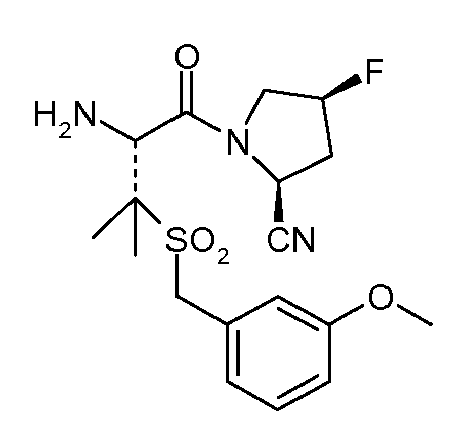
- To a 1.0 N KOH solution (50 mL) containing (2R)-2-[(tert-butoxycarbonyl)amino]-3-mercapto-3-methylbutanoic acid (1 g, 0.00401 mole) was added 3-methoxybenzyl chloride (691 mg, 0.00441 mole) at RT. After 17.0 hours the reaction mixture was diluted with water (50 mL) and washed with diethyl ether. The organics were discarded and the aqueous layer was cooled to 0-5 °C. The aqueous layer was made acidic (pH 3.5) using concentrated HCl and extracted into EtOAc. The organics were dried over MgSO4 and concentrated to dryness to yield a total of 1.35 g (91%) of compound A.
1H NMR (CDCl3) 400 MHz δ 7.19 (dd, 1H, J=7.8 Hz), 6.90 (d, 1H, J=7.2 Hz), 6.86 (s, 1H), 6.76 (dd, 1H, J=8.4 Hz), 5.43 (d (br), 1H, J = 6.4 Hz), 4.39 (d (br), 1H, J = 6.8 Hz), 3.82-3.74 (m, 5H), 1.45-1.35 (m, 15H) ppm. - To a DMF solution (25 ml) containing compound A (1.3 g, 0.0035 mole) and N,N-diisopropylethylamine (1.36 g, 0.0106 mole) was added HATU (2.0 g, 0.0053 mole) at RT. After 30 minutes the reaction mixture was mixed with (2S, 4S)-4-fluoro-2-pyrrolidinecarbonitrile 4-methylbenzenesulfonate (1.1 g, 0.0038 mole). After stirring overnight the reaction was quenched with NaHCO3 and the organics extracted with EtOAc (2X). The organics were washed with sat. NaCl and dried over MgSO4. Removal of the solvent in vacuo and purification via column chromatography (1/1 hexanes/EtOAc) yielded 617 mg (38%) of compound B.
1H NMR (CDCl3) 400 MHz δ 7.18 (dd, 1H, J=7.8 Hz), 6.95 (s, 1H,), 6.92 (d (br), 1H, J=2.8), 6.74 (dd, 1H, J=8.2 Hz), 5.41 (d (br), 1H, J = 8.8 Hz), 5.39 (d (br), 1H, J=51.2), 5.00 (d, 1H, J=9.6 Hz), 4.35 (d, 1H, J = 8.8 Hz), 4.28-3.78 (m, 7H), 2.71-2.52 (m, 1H), 2.46-2.27 (m, 1H), 1.62-1.39 (m, 15H) ppm. - To a CH2Cl2 solution (100 mL) containing compound B (617 mg, 0.0013 mole) was added 3-chloroperoxybenzoic acid (57-86%) (2.3g 0.013 mole). The reaction mixture was allowed to stir at RT for a period of 16.0 hours followed by neutralization with 2.0 N KOH. The organics were dried over MgSO4 and concentrated to dryness to afford 647mg of crude solid (98%). The resulting off white solid was used without further purification.
1H NMR (CDCl3) 400 MHz δ 7.30-7.25 (m, 1H), 7.01-6.98 (m, 2H,), 6.92-6.88 (m, 1H), 5.49 (d (br), 1H, J=8.4 Hz), 5.39 (d (br), 1H, J = 50.8 Hz), 5.03 (d (br), 1H, J=9.2), 4.96 (d, 1H, J = 9.2 Hz), 4.32-3.80 (m, 4H), 3.79 (s, 3H), 2.71-2.54 (m, 1H), 2.46-2.24 (m, 1H), 1.59-1.39 (m, 15H) ppm. - To a CH2Cl2 solution (45 mL) containing compound C (647 mg, 0.0013 mole) was added TFA (5mL). The reaction mixture was allowed to stir at RT for a period of 16.0 hours followed by neutralization with sat. NaHCO3. The organics were separated, dried over MgSO4 and concentrated to dryness to afford a crude solid. The resulting solid was purified using silica gel chromatography (99% CH2Cl2/1% MeOH with 2.0M NH3). The pure solid was dissolved into an acetone/ether mixture (1/1) and precipitated using 2.0 N HCl in ether. The resulting solid was filtered in vacuo and washed with ether. After drying under high vacuum the reaction yielded a total of 221mg of compound D.
1H NMR (d4-MeOH) 400 MHz δ 7.31 (dd, 1H, J=8.0 Hz), 7.18-7.06 (m, 2H), 6.98 (d, 1H, J=8.0 Hz), 5.49 (d (br), 1H, J=50.8 Hz), 5.10 (d, 1H, J = 9.2 Hz), 4.72-4.58 (m, 3H), 4.15-3.88 (m, 2H), 3.81 (s, 3H), 2.69-2.44 (m, 2H), 1.75 (s, 3H), 1.59 (s, 3H) ppm. -

- To a 1.0 N KOH solution (50 mL) containing 1,4-dioxane (10 mL), and (2R)-2-[(tert-butoxycarbonyl)amino]-3-mercapto-3-methylbutanoic acid (1 g, 0.00401 mole) was added 4-phenylbenzyl chloride (894 mg, 0.00441 mole) at RT. After 17.0 hours the reaction mixture was diluted with water and washed with diethyl ether. The organics were discarded and the aqueous layer was cooled to 0-5 °C. The aqueous solution was made acidic (pH 3.5) using concentrated HCl and the product was extracted into ether. The organics were dried over MgSO4 and concentrated to dryness to yield a total of 1.4 g (82%) of compound A as a white solid.
1H NMR (CDCl3) 400 MHz δ 7.59-7.31 (m, 9H), 5.49 (m, 1H), 4.32 (d (br), 1H, J = 9.6 Hz), 3.88-3.71 (m, 2H), 1.57-1.40 (m, 15H) ppm. - To a DMF solution (25 mL) containing compound A (1.4 g, 0.0034 mole) and N,N-diisopropylethylamine (1.3 g, 0.0101 mole) was added HATU (1.9 g, 0.0051 mole) at RT. After 30 minutes the reaction mixture was mixed with (2S, 4S)-4-fluoro-2-pyrrolidinecarbonitrile 4-methylbenzenesulfonate (1.1 g, 0.0037 mole). After stirring overnight the reaction was quenched with NaHCO3 and the organics extracted with EtOAc (2X). The organics were washed with sat. NaCl and dried over MgSO4. Removal of the solvent in vacuo and purification via column chromatography (1/1 hexanes/EtOAc) yielded 828mg (48% yield) of extremely pure product.
1H NMR (CDCl3) 400 MHz δ 7.57-7.30 (m, 9H), 5.47-5.33 (m, 2H), 5.03 (d(br), 1H, J=9.6), 4.39 (d, 1H, J = 8.8 Hz), 4.31-3.97 (m, 2H), 3.89 (s, 2H), 2.68 (dd, 1H, J=15.6 Hz), 2.44-2.28 (m, 1H), 1.58-1.41 (m, 15H) ppm. - To a CH2Cl2 solution (100 mL) containing compound B (828 mg, 0.0016 mole) was added 3-chloroperoxybenzoic acid(57-86%) (2.8 g 0.0162 mole). The reaction mixture was allowed to stir at RT for a period of 16.0 hours followed by neutralization with 2.0 N KOH. The organics were dried over MgSO4 and concentrated to dryness to afford 867 mg of compound C (99% yield). The resulting white solid was used without further purification.
1H NMR (CDCl3) 400 MHz δ 7.63-7.33 (m, 9H), 5.53 (d(br), 1H, J=8.4 Hz), 5.42 (d(br), 1H, J = 50.8 Hz), 5.07 (d(br), 1H, J=9.2), 4.99 (d, 1H, J = 9.2 Hz), 4.39-4.00 (m, 4H), 2.70 (dd, 1H, J=15.2 Hz), 2.47-2.34 (m, 1H), 1.62-1.40 (m, 15H) ppm. - To a CH2Cl2 solution (45 mL) containing compound C (867 mg, 0.0016 mole) was added TFA (5 mL). The reaction mixture was allowed to stir at RT for a period of 16.0 hours followed by neutralization with sat. NaHCO3. The organics were separated, dried over MgSO4 and concentrated to dryness to afford a crude solid. The resulting solid was purified using silica gel chromatography (99% CH2Cl2/1% MeOH with 2.0M NH3). The pure solid was dissolved into an acetone/ether mixture (1/1) and precipitated using 2.0 N HCl in ether. The resulting solid was filtered in vacuo and washed with ether. After drying under high vacuum the reaction yielded a total of 307mg of compound D.
1H NMR (d4-MeOH) 400 MHz δ 7.66-7.32 (m, 9H), 5.48 (d(br), 1H, J=50.4 Hz), 5.10 (d, 1H, J=8.0), 4.86-4.64 (m, 3H), 4.19-3.86 (m, 2H), 2.70-2.41 (m, 2H), 1.78 (s, 3H), 1.63 (s, 3H) ppm. -

- To a 1.0 N KOH solution (50 mL) containing (2R)-2-[(tert-butoxycarbonyl)amino]-3-mercapto-3-methylbutanoic acid (1 g, 0.00401 mole) was added 2-methoxybenzyl chloride (691mg, 0.00441 mole) at RT. After 17.0 hours the reaction mixture was diluted with water and washed with diethyl ether. The organics were discarded and the aqueous layer was cooled to 0-5 °C. The aqueous solution was made acidic (pH 3.5) using concentrated HCl and the product was extracted into EtOAc. The organics were dried over MgSO4 and concentrated to dryness to yield a total of 1.1 g (74%) of compound A.
1H NMR (CDCl3) 400 MHz δ 7.25-7.21 (m, 2H), 6.90-6.85 (m, 2H), 5.63-5.55 (m, 1H), 4.31 (d(br), 1H, J = 9.2 Hz), 3.88-3.79 (m, 5H), 1.58-1.33 (m, 15H) ppm. - To a DMF solution (25 mL) containing compound A (1.0 g, 0.0027 mole) and N,N-diisopropylethylamine (1.05 g, 0.0081 mole) was added HATU (1.5 g, 0.00405 mole) at RT. After 30 minutes the reaction mixture was mixed with (2S, 4S)-4-fluoro-2-pyrrolidinecarbonitrile 4-methylbenzenesulfonate (851mg, 0.003 mole). After stirring overnight the reaction was quenched with NaHCO3 and the organics extracted with EtOAc (2X). The organics were washed with sat. NaCl and dried over MgSO4. Removal of the solvent in vacuo and purification via column chromatography (1/1 hexanes/EtOAc) yielded 668 mg (53% yield) of compound B.
1H NMR (CDCl3) 400 MHz δ 7.31 (dd, 1H, J=7.6Hz), 7.19 (dd, 1H, J=8.0 Hz), 6.92-6.83 (m, 2H), 5.47-5.31 (m, 2H), 5.03 (d(br), 1H, J=9.2), 4.34 (d, 1H, J = 8.4 Hz), 4.26-3.66 (m, 7H), 2.68 (dd, 1H, J=15.2 Hz), 2.43-2.26 (m, 1H), 1.57-1.37 (m, 15H) ppm. - To a CH2Cl2 solution (75 mL) containing compound B (668 mg, 0.0014 mole) was added 3-chloroperoxybenzoic acid(57-86%) (2.5 g 0.0140 mole). The reaction mixture was allowed to stir at RT for a period of 16.0 hours followed by neutralization with 2.0 N KOH. The organics were dried over MgSO4 and concentrated to dryness to afford 678 mg of compound C (95%). The resulting off white solid was used without further purification.
1H NMR (CDCl3) 400 MHz δ 7.44 (dd, 1H, J=7.6Hz), 7.34 (m, 1H), 6.99-6.91 (m, 2H), 5.61-5.57 (m, 1H), 5.40 (d(br), 1H, J=51.2 Hz), 5.00-4.95 (m, 2H), 4.49-3.85 (m, 7H), 2.65 (dd, 1H, J=15.6 Hz), 2.45-2.28 (m, 1H), 1.62-1.37 (m, 15H) ppm. - To a CH2Cl2 solution (45 mL) containing compound C (678 mg, 0.00136 mole) was added TFA (5 mL). The reaction mixture was allowed to stir at RT for a period of 16.0 hours followed by neutralization with sat. NaHCO3. The organics were separated, dried over MgSO4 and concentrated to dryness to afford a crude solid. The resulting solid was purified using silica gel chromatography (99% CH2Cl2/1% MeOH with 2.0 M NH3). The pure solid was dissolved into an acetone/ether mixture (1/1) and precipitated using 2.0 N HCl in ether. The resulting solid was filtered in vacuo and washed with ether. After drying under high vacuum the reaction yielded a total of 313 mg of compound D.
1H NMR (d4-MeOH) 400 MHz δ 7.45-7.38 (m, 2H), 7.06 (d, 1H, J=8.4 Hz), 6.99-6.99 (dd, 1H, J=7.2 Hz), 5.49 (d(br), 1H, J=50.8 Hz), 5.09 (m, 1H, J=9.2), 4.13-3.84 (m, 6H), 2.67-2.44 (m, 2H), 1.74 (s, 3H), 1.58 (s, 3H) ppm. -

- To a 1.0 N KOH solution (50 mL) containing (2R)-2-[(tert-butoxycarbonyl)amino]-3-mercapto-3-methylbutanoic acid (1 g, 0.00401 mole) was added 3-(bromomethyl)pyridine hydrobromide (1.1 g, 0.00441 mole) at RT. After 17.0 hours the reaction mixture was diluted with water and washed with diethyl ether. The organics were discarded and the aqueous layer was cooled to 0-5 °C. The aqueous solution was made acidic (pH 4.0) using concentrated HCl and the product was extracted into EtOAc. The organics were dried over Na2SO4 and concentrated to dryness to yield a total of 403 mg (30%) of compound A as a pure oily solid.
1H NMR (CDCl3) 400 MHz δ 8.77 (s, 1H), 8.56 (d, 1H, J=5.6 Hz), 7.80 (d, 1H, J=8.0 Hz), 7.37 (dd, 1H, J=8.0 Hz), 5.47 (d(br), 1H, J = 9.6 Hz), 4.53 (d(br), 1H, J = 9.6 Hz), 3.95 (dd, 2H, J=69.6 Hz), 1.60-1.35 (m, 15H) ppm. - To a DMF solution (20 mL) containing compound A (400 mg, 0.0012 mole) and N,N-diisopropylethylamine (456 mg, 0.0035 mole) was added HATU (670 mg, 0.0018 mole) at RT. After 30 minutes the reaction mixture was mixed with (2S, 4S)-4-fluoro-2-pyrrolidinecarbonitrile 4-methylbenzenesulfonate (370 mg, 0.0013 mole). After stirring overnight the reaction was quenched with NaHCO3 and the organics extracted with EtOAc (2X). The organics were washed with sat. NaCl and dried over Na2SO4. Removal of the solvent in vacuo and purification via column chromatography (1/1 hexanes/EtOAc) yielded 314 mg (61%) of compound B.
1H NMR (CDCl3) 400 MHz δ 8.58 (s, 1H), 8.46 (d, 1H, J=4.8 Hz), 7.71 (d, 1H, J=8.0 Hz), 7.21 (dd, 1H, J=8.0 Hz), 5.45 (d(br), 1H, J=9.2 Hz), 5.43 (d(br), 1H, J=51.2 Hz), 5.02 (d, 1H, J=9.2 Hz), 4.41 (d, 1H, J = 9.6 Hz), 4.37-3.79 (m, 4H), 2.70 (dd, 1H, J=15.6 Hz), 2.46-2.29 (m, 1H), 1.55-1.39 (m, 15H) ppm. - To a CH2Cl2 solution (22 mL) containing compound B (314 mg, 0.720mmol) was added TFA (3 mL). The reaction mixture was allowed to stir at RT for a period of 16.0 hours followed by neutralization with sat. NaHCO3. The organics were separated, dried over Na2SO4 and concentrated to dryness to afford a crude solid. The resulting solid was purified using silica gel chromatography (99% CH2Cl2/1% MeOH with 2.0 M NH3). The pure solid was dissolved into an acetone/ether mixture (1/1) and precipitated using 2.0 N HCl in ether. The resulting solid was filtered in vacuo and washed with ether. After drying under high vacuum the reaction yielded a total of 69 mg of compound C.
1H NMR (CDCl3) 400 MHz δ 8.57 (s, 1H), 8.46 (d, 1H, J=5.2 Hz), 7.71 (d, 1H, J=6.4 Hz), 7.23 (dd, 1H, J=8.0 Hz), 5.44 (d(br), 1H, J=51.2 Hz), 4.97 (d, 1H, J=9.6 Hz), 4.20-3.58 (m, 5H), 2.66 (dd, 1H, J=15.2 Hz), 2.39-2.22 (m, 1H), 1.78 (s(br), 2H), 1.48 (s, 3H), 1.39 (s, 3H) ppm. -

- To a 1.0 N KOH solution (50 mL) containing (2R)-2-[(tert-butoxycarbonyl)amino]-3-mercapto-3-methylbutanoic acid (1 g, 0.00401 mole) was added 2-(bromomethyl)pyridine hydrobromide (1.1 g, 0.00441 mole) at RT. After 17.0 hours the reaction mixture was diluted with water and washed with diethyl ether. The organics were discarded and the aqueous layer was cooled to 0-5 °C. The aqueous solution was made acidic (pH 4.0) using concentrated HCl and the product was extracted into EtoAc. The organics were dried over Na2SO4 and concentrated to dryness to yield a total of 557 mg (41%) of compound A as a white solid.
1H NMR (CDCl3) 400 MHz δ 8.53 (d, 1H, J=4.8 Hz), 7.75 (dd, 1H, J=7.6 Hz), 7.34-7.30 (m, 2H), 5.73 (d(br), 1H, J = 8.8 Hz), 4.47 (d, 1H, J = 8.8 Hz), 4.41-4.01 (m, 2H) 1.55 (m, 15H) ppm. - To a DMF solution (20 mL) containing compound A (557 mg, 0.0016 mole) and N,N-diisopropylethylamine (635 mg, 0.0049 mole) was added HATU (912 mg, 0.0024 mole) at RT. After 30 minutes the reaction mixture was mixed with (2S, 4S)-4-fluoro-2-pyrrolidinecarbonitrile 4-methylbenzenesulfonate (504 mg, 0.00176 mole). After stirring overnight the reaction was quenched with NaHCO3 and the organics extracted with EtOAc (2X). The organics were washed with sat. NaCl and dried over Na2SO4. Removal of the solvent in vacuo and purification via column chromatography (1/1 hexanes/EtOAc) yielded 466 mg (65%) of compound B.
1H NMR (d6 Acetone) 400 MHz δ 8.46 (d, 1H, J=4.4 Hz), 7.71 (dd, 1H, J=7.6 Hz), 7.48 (d, 1H, J=8.0 Hz), 7.21 (dd, 1H, J=7.6 Hz), 6.25 (d(br), 1H, J=8.4 Hz), 5.60 (d(br), 1H, J=50.8 Hz), 5.05 (m, 1H), 4.61 (d, 1H, J = 8.8 Hz), 4.43-3.83 (m, 4H), 2.83-2.52 (m, 2H), 1.50-1.35 (m, 15H) ppm. - To a CH2Cl2 solution (45 mL) containing compound B (314 mg, 0.00107mol) was added TFA (5 mL). The reaction mixture was allowed to stir at RT for a period of 16.0 hours followed by neutralization with sat. NaHCO3. The organics were separated, dried over Na2SO4 and concentrated to dryness to afford a crude solid. The resulting solid was purified using silica gel chromatography (99% CH2Cl2/1% MeOH with 2.0 M NH3). The pure solid was dissolved into an acetone/ether mixture (1/1) and precipitated using 2.0 N HCl in ether. The resulting solid was filtered in vacuo and washed with ether. After drying under high vacuum the reaction yielded a total of 127 mg of compound C.
1H NMR (D2O 400 MHz δ 8.54 (d, 1H, J=5.6 Hz), 8.34 (dd, 1H, J=8.0 Hz), 7.92 (d, 1H, J=8.4 Hz), 7.21 (dd, 1H, J=6.4 Hz), 5.44 (d(br), 1H, J=50.4 Hz), 5.02 (d, 1H, J=10 Hz), 4.60 (m, 5H), 2.62 (dd, 1H, J=15.6 Hz), 2.54-2.34 (m, 1H), 1.40 (s, 6H) ppm. -

- To a 1.0 N KOH solution (50 mL) containing (2R)-2-[(tert-butoxycarbonyl)amino]-3-mercapto-3-methylbutanoic acid (1 g, 0.00401 mole) was added 4-(bromomethyl)pyridine hydrobromide (1.1 g, 0.00441 mole) at RT. After 17.0 hours the reaction mixture was diluted with water and washed with diethyl ether. The organics were discarded and the aqueous layer was cooled to 0-5 °C. The aqueous solution was made acidic (pH 4.0) using concentrated HCl and the product was extracted into EtOAc. The organics were dried over Na2SO4 and concentrated to dryness to yield a total of 482 mg (35%) of compound A as a white solid.
1H NMR (CDCl3) 400 MHz δ 8.48 (d, 2H, J=6.0 Hz), 7.40 (d, 2H, J=5.6 Hz), 5.48 (d(br), 1H, J = 9.2 Hz), 4.41 (d, 1H, J = 9.2 Hz), 3.82 (s, 2H) 1.52-1.38 (m, 15H) ppm. - To a DMF solution (20 mL) containing compound A (482 mg, 0.00142 mole) and N,N-diisopropylethylamine (549 mg, 0.0042 mole) was added HATU (810 mg, 0.00213 mole) at RT. After 30 minutes the reaction mixture was mixed with (2S, 4S)-4-fluoro-2-pyrrolidinecarbonitrile 4-methylbenzenesulfonate (447 mg, 0.00156 mole). After stirring overnight the reaction was quenched with NaHCO3 and the organics extracted with EtOAc (2X). The organics were washed with sat. NaCl and dried over Na2SO4. Removal of the solvent in vacuo and purification via column chromatography (1/1 hexanes/EtOAc) yielded 476 mg (77%) of compound B.
1H NMR (CDCl3) 400 MHz δ 8.51 (d, 2H, J=4.4 Hz), 7.31 (d, 2H, J=6.4 Hz), 5.43 (d(br), 1H, J=9.6 Hz), 5.43 (d(br), 1H, J=51.2 Hz), 5.01 (d, 1H, J=9.6 Hz), 4.39 (d, 1H, J=9.6 Hz), 4.35-3.96 (m, 2H), 3.80 (s, 2H), 2.70 (dd, 1H, J=15.4), 2.46-2.29 (m, 1H), 1.45-1.41 (m,15H) ppm. - To a CH2Cl2 solution (45 mL) containing compound B (476 mg, 0.00109mol) was added TFA (5 mL). The reaction mixture was allowed to stir at RT for a period of 16.0 hours followed by neutralization with sat. NaHCO3. The organics were separated, dried over Na2SO4 and concentrated to dryness to afford a crude solid. The resulting solid was purified using silica gel chromatography (99% CH2Cl2/1% MeOH with 2.0 M NH3). The pure solid was dissolved into an acetone/ether mixture (1/1) and precipitated using 2.0 N HCl in ether. The resulting solid was filtered in vacuo and washed with ether. After drying under high vacuum the reaction yielded a total of 107 mg of compound C.
1H NMR (d4-MeOH) 400 MHz δ 8.81 (d, 2H, J=4.8 Hz), 8.08 (d, 2H, J=6.4 Hz), 5.51 (d(br), 1H, J=51.2 Hz), 5.10 (d, 1H, J=9.2 Hz), 4.35-3.96 (m, 4H), 2.65-2.43 (m, 2H), 1.62-1.42 (m,6H) ppm. -
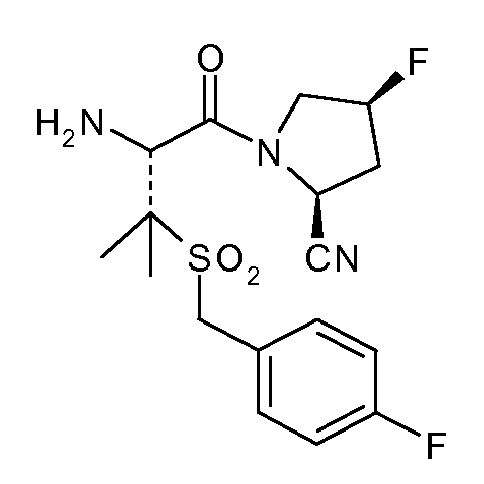
- To a 1.0 N KOH solution (50 mL) containing (2R)-2-[(tert-butoxycarbonyl)amino]-3-mercapto-3-methylbutanoic acid (1.0 g, 0.00401 mole) was added 1-(bromomethyl)-4-fluorobenzene (834 mg, 0.00441 mole) at RT. After 17.0 hours the reaction mixture was diluted with water and washed with ether. The organics were discarded and the aqueous layer was cooled to 0-5 °C. The aqueous solution was made acidic (pH 3.5) using concentrated HCl and the product was extracted into EtOAc. The organics were dried over MgSO4 and concentrated to dryness to yield a total of 1.2 g (86%) of compound A as an oil.
1H NMR (CDCl3) 400 MHz δ 7.29-7.26 (m, 2H), 6.99-6.94 (m, 2H), 5.40 (d(br), 1H, J = 8.0 Hz), 4.40 (d(br), 1H, J = 8.0 Hz), 3.80-3.74 (m, 2H) 1.50-1.40 (m, 15H) ppm. - To a DMF solution (25 mL) containing compound A (1.2 g, 0.0034 mole) and N,N-diisopropylethylamine (1.3 g, 0.0101 mole) was added HATU (1.9 g, 0.0051 mole) at RT. After 30 minutes the reaction mixture was mixed with (2S, 4S)-4-fluoro-2-pyrrolidinecarbonitrile 4-methylbenzenesulfonate (1.1 g, 0.0037 mole). After stirring overnight the reaction was quenched with NaHCO3 and the organics extracted with EtOAc (2X). The organics were washed with sat. NaCl and dried over Na2SO4. Removal of the solvent in vacuo and purification via column chromatography (1/1 hexanes/EtOAc) yielded 929mg (61% yield) of compound B.
1H NMR (CDCl3) 400 MHz δ 7.33 (dd, 2H, J=8.4 Hz), 6.96 (dd, 2H, J=8.8 Hz), 5.42 (d(br), 1H, J=9.2 Hz), 5.43 (d(br), 1H, J=51.6 Hz), 5.02 (d, 1H, J=9.6 Hz), 4.38 (d, 1H, J=9.2 Hz), 4.34-3.97 (m, 2H), 3.82 (s, 2H), 2.69 (dd, 1H, J=15.4 Hz), 2.46-2.28 (m, 1H), 1.45-1.41 (m,15H) ppm. - To a CH2Cl2 solution (100 mL) containing compound B (929 mg, 0.0019 mole) was added 3-chloroperoxybenzoic acid (57-86%) (3.3 g 0.0191 mole). The reaction mixture was allowed to stir at RT for a period of 16.0 hours followed by neutralization with 2.0 N KOH. The organics were dried over MgSO4 and concentrated to dryness to afford 678 mg of compound C (97% yield). The resulting off white solid was used without further purification.
1H NMR (CDCl3) 400 MHz δ 7.40 (dd, 2H, J=8.8 Hz), 7.07 (dd, 2H, J=8.6 Hz), 5.52 (d(br), 1H, J=9.2 Hz), 5.43 (d(br), 1H, J=51.2 Hz), 5.03 (d, 1H, J=9.6 Hz), 4.97 (d, 1H, J=9.6 Hz), 4.36-3.74 (m, 4H), 2.70 (dd, 1H, J=15.2 Hz), 2.47-2.28 (m, 1H), 1.72-1.35 (m, 15H) ppm. - To a CH2Cb solution (45 mL) containing compound C (678 mg, 0.00140 mole) was added TFA (5 mL). The reaction mixture was allowed to stir at RT for a period of 16.0 hours followed by neutralization with sat. NaHCO3. The organics were separated, dried over MgSO4 and concentrated to dryness to afford a crude solid. The resulting solid was purified using silica gel chromatography (99% CH2Cl2/1% MeOH with 2.0 M NH3). The pure solid was dissolved into an acetone/ether mixture (1/1) and precipitated using 2.0 N HCl in ether. The resulting solid was filtered in vacuo and washed with ether. After drying under high vacuum the reaction yielded a total of 254 mg of compound D as a white solid.
1H NMR (CDCl3) 400 MHz δ 7.39 (dd, 2H, J=8.4 Hz), 7.08 (dd, 2H, J=8.6 Hz), 5.41 (d(br), 1H, J=50.8 Hz), 4.94 (d, 1H, J=9.6 Hz), 4.63 (d, 1H, J=13.2 Hz), 4.35-3.55 (m, 4H), 2.70 (dd, 1H, J=15.4 Hz), 2.43-2.26 (m, 1H), 1.80-1.39 (m, 8H) ppm. -

- To a 1.0 N KOH solution (50 mL) containing (2R)-2-[(tert-butoxycarbonyl)amino]-3-mercapto-3-methylbutanoic acid (1 g, 0.00401 mole) was added 1-(chloromethyl)-3-phenoxybenzene (964 mg, 0.00441 mole) and 1,4-dioxane (15 mL) at RT. After 17.0 hours the reaction mixture was diluted with water and washed with diethyl ether. The organics were discarded and the aqueous layer was cooled to 0-5 °C. The aqueous solution was made acidic (pH 3.5) using concentrated HCl and the product was extracted into ether. The organics were dried over MgSO4 and concentrated to dryness to yield a total of 1.4 g (82%) of compound A as a white solid.
1H NMR (CDCl3) 400 MHz δ 7.34-6.98 (m, 8H), 6.85 (dd, 1H, J=8.0 Hz), 5.44 (m, 1H), 4.38 (m, 1H), 3.80 (m, 2H), 1.50-1.40 (m, 15H) ppm. - To a DMF solution (20 mL) containing compound A (1.4 g, 0.0032 mole) and N,N-diisopropylethylamine (1.3 g, 0.0100 mole) was added HATU (1.8 g, 0.0048 mole) at RT. After 30 minutes the reaction mixture was mixed with (2S, 4S)-4-fluoro-2-pyrrolidinecarbonitrile 4-methylbenzenesulfonate (1.0 g, 0.0035 mole). After stirring overnight the reaction was quenched with NaHCO3 and the organics extracted with EtOAc (2X). The organics were washed with sat. NaCl and dried over MgSO4. Removal of the solvent in vacuo and purification via column chromatography (1/1 hexanes/EtOAc) yielded 1.1 g (65%) of compound B.
1H NMR (CDCl3) 400 MHz δ 7.34-6.97 (m, 8H), 6.84 (dd, 1H, J=8.0 Hz), 5.44 (d(br), 1H, J=9.2 Hz), 5.39 (d(br), 1H, J=51.2 Hz), 5.01 (d, 1H, J=9.6 Hz), 4.36 (d, 1H, J=9.2 Hz), 4.29-3.90 (m, 2H), 3.80 (s, 2H), 2.66 (dd, 1H, J=15.4 Hz), 2.43-2.26 (m, 1H), 1.52-1.38 (m,15H) ppm. - To a CH2Cl2 solution (50 mL) containing compound B (600 mg, 0.0011 mol) was added 3-chloroperoxybenzoic acid (57-86%) (2.0 g 0.011 mole). The reaction mixture was allowed to stir at RT for a period of 16.0 hours followed by neutralization with 2.0 N KOH. The organics were dried over MgSO4 and concentrated to dryness to afford 594 mg of compound C (93% yield). The resulting off white solid was used without further purification.
1H NMR (CDCl3) 400 MHz δ 7.34-7.00 (m, 9H), 5.40 (d(br), 1H, J=51.2 Hz), 5.27 (d(br), 1H, J=8.8 Hz), 4.93 (d, 1H, J=9.6 Hz), 4.62 (d, 1H, J=13.2 Hz), 4.46-3.55 (m, 4H), 2.69 (dd, 1H, J=15.4 Hz), 2.42-2.25 (m, 1H), 1.62-1.43 (m,15H) ppm. - To a CH2Cl2 solution (45 mL) containing compound C (678 mg, 0.00106 mole) was added TFA (5 mL). The reaction mixture was allowed to stir at RT for a period of 16.0 hours followed by neutralization with sat. NaHCO3. The organics were separated, dried over MgSO4 and concentrated to dryness to afford a crude solid. The resulting solid was purified using silica gel chromatography (99% CH2Cl2/1% MeOH with 2.0 M NH3). The pure solid was dissolved into an acetone/ether mixture (1/1) and precipitated using 2.0 N HCl in ether. The resulting solid was filtered in vacuo and washed with ether. After drying under high vacuum the reaction yielded a total of 268 mg of compound D as a white solid.
1H NMR (d6-DMSO) 400 MHz δ 7.42-6.99 (m, 9H), 5.54 (d(br), 1H, J=51.2 Hz), 5.04 (d, 1H, J=9.2 Hz), 4.70 (m, 2H), 4.46 (m, 1H), 4.16-3.79 (m, 2H), 2.55-2.30 (m, 2H), 1.55 (s, 3H), 1.47 (s, 3H) ppm. -

- To a CH2Cl2 solution (45mL) containing tert-butyl (1R)-1-{[(2S,4S)-2-cyano-4-fluoropyrrolidin-1-yl]carbonyl}-2-methyl-2-[(3-phenoxybenzyl)thio]propylcarbamate (500 mg, 0.0010 mol) was added TFA (5 mL). The reaction mixture was allowed to stir at RT for a period of 16.0 hours followed by neutralization with sat. NaHCO3. The organics were separated, dried over MgSO4 and concentrated to dryness to afford a crude solid. The resulting solid was purified using silica gel chromatography (99% CH2Cl2/1% MeOH with 2.0 M NH3). The pure solid was dissolved into an acetone/ether mixture (1/1) and precipitated using 2.0 N HCl in ether. The resulting solid was filtered in vacuo and washed with ether. After drying under high vacuum the reaction yielded a total of 132 mg of the title compound .
1H NMR (D2O) 400 MHz δ 7.17-6.71 (m, 9H), 5.38 (d(br), 1H, J=50.4 Hz), 5.00 (d, 1H, J=9.6 Hz), 4.16-3.60 (m, 4H), 2.62-2.30 (m, 2H), 1.38-1.29 (s, 6H) ppm. -

- To a 1.0 N KOH solution (50 mL) containing (2R)-2-[(tert-butoxycarbonyl)amino]-3-mercapto-3-methylbutanoic acid (1 g, 0.00401 mole) was added 3-(bromomethyl)-5-chloro-1-benzothiophene (1.2 g, 0.00441 mole) and 1,4-dioxane (10 mL) at RT. After 17.0 hours the reaction mixture was diluted with water and washed with diethyl ether. The organics were discarded and the aqueous layer was cooled to 0-5 °C. The aqueous solution was made acidic (pH 3.5) using concentrated HCl and the product was extracted into ether. The organics were dried over MgSO4 and concentrated to dryness to yield a total of 1.0 g (59%) of compound A as a tan solid.
1H NMR (CDCl3) 400 MHz δ 7.84 (s, 1H), 7.72 (d, 1H, J=8.4 Hz), 7.39 (s, 1H), 7.30 (d, 1H, J=8.4 Hz), 5.44 (m, 1H), 4.45 (m, 1H, J=7.6 Hz), 4.07-4.00 (m, 2H), 1.55-1.40 (m, 15H) ppm. - To a DMF solution (20 mL) containing compound A (1.0 g, 0.0023 mole) and N,N-diisopropylethylamine (902 mg, 0.007 mole) was added HATU (1.3 g, 0.00345 mole) at RT. After 30 minutes the reaction mixture was mixed with (2S, 4S)-4-fluoro-2-pyrrolidinecarbonitrile 4-methylbenzenesulfonate (725 mg, 0.0025 mole). After stirring overnight the reaction was quenched with NaHCO3 and the organics extracted with EtOAc (2X). The organics were washed with sat. NaCl and dried over MgSO4. Removal of the solvent in vacuo and purification via column chromatography (1/1 hexanes/EtOAc) yielded 738 mg (60%) of compound B.
1H NMR (CDCl3) 400 MHz δ 7.91 (s, 1H), 7.72 (d, 1H, J=8.8 Hz), 7.47 (s, 1H), 7.30 (d, 1H, J=8.4 Hz), 5.49-5.35 (m, 2H), 5.04 (d, 1H, J=9.6 Hz), 4.41 (d, 1H, J=9.2 Hz), 4.35-3.98 (m, 4H), 2.69 (dd, 1H, J=15.2 Hz), 2.46-2.29 (m, 1H), 1.47-1.40 (m, 15H) ppm. - To a CH2Cl2 solution (100 mL) containing compound B (738 mg, 0.0014 mole) was added 3-chloroperoxybenzoic acid (57-86%) (4.8 g 0.028 mole). The reaction mixture was allowed to stir at RT for a period of 16.0 hours followed by neutralization with 2.0 N KOH. The organics were dried over MgSO4 and concentrated to dryness to afford 803 mg of compound C (97% yield). The resulting off white solid was used without further purification.
1H NMR (CDCl3) 400 MHz δ 8.05 (s, 1H), 7.96 (d, 1H, J=7.6 Hz), 7.48 (m, 3H), 5.45 (d(br), 1H J=10 Hz), 5.44 (d(br), 1H, J=50.8 Hz), 5.02 (d, 1H, J=10 Hz), 4.95 (d, 1H, J=9.6 Hz), 4.77-3.96 (m, 4H), 2.70 (dd, 1H, J=14.8 Hz), 2.46-2.30 (m, 1H), 1.70-1.37 (m, 15H) ppm. - To a CH2Cl2 solution (45 mL) containing compound C (500 mg, 0.0010 mole) was added TFA (5 mL). The reaction mixture was allowed to stir at RT for a period of 16.0 hours followed by neutralization with sat. NaHCO3. The organics were separated, dried over MgSO4 and concentrated to dryness to afford a crude solid. The resulting solid was purified using silica gel chromatography (99% CH2Cl2/1% MeOH with 2.0 M NH3). The pure solid was dissolved into an acetone/ether mixture (1/1) and precipitated using 2.0 N HCl in ether. The resulting solid was filtered in vacuo and washed with ether. After drying under high vacuum the reaction yielded a total of 132 mg of compound D.
1H NMR (D2O) 400 MHz δ 7.99 (s, 1H), 7.81-7.56 (m, 3H), 5.44 (d(br), 1H, J=50.4 Hz), 5.01 (d, 1H, J=9.6 Hz), 4.19-3.80 (m, 4H), 2.66-2.22 (m, 2H), 1.58 (s, 3H), 1.43 (s, 3H) ppm. -

- To a 1.0 N KOH solution (50 mL) containing (2R)-2-[(tert-butoxycarbonyl)amino]-3-mercapto-3-methylbutanoic acid (1 g, 0.00401 mole) was added 5-(bromomethyl)-2,1,3-benzoxadiazole (940 mg, 0.00441 mole) and 1,4-dioxane (5 mL) at RT. After 17.0 hours the reaction mixture was diluted with water and washed with diethyl ether. The organics were discarded and the aqueous layer was cooled to 0-5 °C. The aqueous solution was made acidic (pH 4.0) using concentrated HCl and the product was extracted into EtOAc. The organics were dried over Na2SO4 and concentrated to dryness to yield a total of 622 mg (41%) of compound A as a brown solid. 1H NMR (CDCl3) 400 MHz δ 7.76 (d, 1H, J=9.2 Hz), 7.72 (s, 1H), 7.44 (d, 1H, J=9.2 Hz), 5.40 (d (br), 1H, J = 8.0 Hz), 4.46 (d (br), 1H, J=8.4 Hz), 3.89 (s, 2H) 1.47-1.40 (m, 15H) ppm.
- To a DMF solution (20 mL) containing compound A (622 mg, 0.00163 mole) and N,N-diisopropylethylamine (632 mg, 0.0049 mole) was added HATU (930 mg, 0.00244 mole) at RT. After 30 minutes the reaction mixture was mixed with (2S, 4S)-4-fluoro-2-pyrrolidinecarbonitrile 4-methylbenzenesulfonate (514 mg, 0.00180 mole). After stirring overnight the reaction was quenched with NaHCO3 and the organics extracted with EtOAc (2X). The organics were washed with sat. NaCl and dried over Na2SO4. Removal of the solvent in vacuo and purification via column chromatography (1/1 hexanes/EtOAc) yielded mg 444 mg (45% yield) of compound B.
1H NMR (CDCl3) 400 MHz δ 7.78 (s, 1H), 7.76 (d, 1H, J=9.2 Hz), 7.48 (d, 1H, J=9.2 Hz), 5.43 (d (br), 1H, J=9.6 Hz), 5.45 (d (br), 1H, J=50.8 Hz), 5.02 (d, 1H, J=9.6 Hz), 4.44 (d, 1H, J=9.6 Hz), 4.39-3.89 (m, 4H), 2.72 (dd, 1H, J=15.2), 2.48-2.32 (m, 1H), 1.60-1.40 (m, 15H) ppm. - To a CH2Cl2 solution (45 mL) containing compound B (444 mg, 0.770mmol) was added TFA (5 mL). The reaction mixture was allowed to stir at RT for a period of 16.0 hours followed by neutralization with sat. NaHCO3. The organics were separated, dried over Na2SO4 and concentrated to dryness to afford a crude solid. The resulting solid was purified using silica gel chromatography (99% CH2Cl2/1% MeOH with 2.0M NH3). The pure solid was dissolved into an acetone/ether mixture (1/1) and precipitated using 2.0 N HCl in ether. The resulting solid was filtered in vacuo and washed with ether. After drying under high vacuum the reaction yielded a total of 105 mg of compound C.
1H NMR (d6-DMSO) 400 MHz δ 8.02-7.99 (m, 2H), 7.63 (d, 1H, J=9.6 Hz), 5.55 (d (br), 1H, J=51.2 Hz), 5.07 (d, 1H, J=9.2 Hz), 4.22-3.98 (m, 5H), 2.58-2.32 (m, 2H), 1.48 (s, 3H), 1.40 (s, 3H) ppm. -

- To a CH2Cl2 solution (90 mL) containing tert-butyl (1R)-1-{[(2S,4S)-2-cyano-4-fluoropyrrolidin-1-yl]carbonyl}-2-methyl-2-[(pyridin-4-ylmethyl)thio]propylcarbamate (500 mg, 0.0011mol) was added TFA (10 mL). The reaction mixture was allowed to stir at RT for a period of 16.0 hours followed by the addition of 3-chloroperoxybenzoic acid (2.0 g, 0.0114 moles). The reaction was stirred for a period of 4.0 hours followed by neutralization with 2.0 N NaOH. The organics were separated, dried over Na2SO4 and concentrated to dryness to afford a crude solid. The resulting solid was purified using silica gel chromatography (99% CH2Cl2/1% MeOH with 2.0 M NH3). The pure solid was dissolved into an acetone/ether mixture (1/1) and precipitated using 2.0 N HCl in ether. The resulting solid was filtered in vacuo and washed with ether. After drying under high vacuum the reaction yielded a total of 22 mg of the title compound.
1H NMR (d4 CDCl3) 400 MHz δ 8.64 (d, 2H, J=5.6 Hz), 7.37 (d, 2H, J=5.6 Hz), 5.42 (d (br), 1H, J=51.2 Hz), 4.94 (d, 1H, J=9.6 Hz), 4.77 (d, 1H, J=13.2 Hz), 4.39-3.75 (m, 4H), 2.71 (dd, 1H, J=15.6 Hz), 2.43-2.29 (m, 1H), 2.06-1.86 (s (br), 2H), 1.62 (s, 3H), 1.46 (s, 3H) ppm. -

- To dry DMF (25 mL) was added (2S)-2-[(tert-butoxycarbonyl)amino]-3-pyridin-4-ylpropanoic acid (705 mg, 2.65 mmol), HATU (1.0 g, 2.65 mmol) and N,N-diisopropylethylamine (0.46 mL, 2.65 mmol). After stirring at RT for 30 min (2S, 4S)-4-fluoro-2-pyrrolidinecarbonitrile 4-methylbenzenesulfonate (581 mg, 1.99 mmol) and additional N,N-diisopropylethylamine (0.35 mL, 1.99 mmol) were added. This solution was allowed to stir at RT for 12 hours. Then was added saturated sodium bicarbonate (100 mL) and the mixture was extracted with ethyl acetate (2 X 100 mL) and the organics were washed with saturated NaCl (100 mL) and dried over MgSO4 and concentrated to dryness to give the crude solid. The solid was purified by column chromatography (silica gel, hexanes/EtOAc 4: 1) to provide a solid which was stirred in a dioxane solution containing HCl (4.0 M, 20 mL) for 2 hrs followed by the addition of diethyl ether (100 mL). The precipitated solid was collected by filtration and dried under high vacuum yielding 388 mg (1.3 mmol, 65% yield) of compound A as a white solid.
1H NMR (d6-DMSO) 400 MHz δ 8.92 (s(br), 3H), 8.84 (d, 2H, J= 6.2 Hz), 7.96 (d, 2H, J= 6.2 Hz), 5.45 (d, 1H, J = 51Hz), 5.00 (d, 1H, J = 8.8 Hz), 4.47 (m(br), 1H), 4.05-3.78 (m, 2H), 3.41-3.36 (m, 2H), 2.42-2.25 (m, 2H) ppm. -

- To dry DMF (25 mL) was added (2S)-2-[(tert-butoxycarbonyl)amino]-3-pyridin-3-ylpropanoic acid (534 mg, 2.0 mmol), HATU (0.76 g, 2.0 mmol) and N,N-diisopropylethylamine (0.35 mL, 2.0 mmol). After stirring at RT for 30 min (2S, 4S)-4-fluoro-2-pyrrolidinecarbonitrile 4-methylbenzenesulfonate (438 mg, 1.5 mmol) and additional N,N-diisopropylethylamine (0.26 mL, 1.5 mmol) were added. This solution was allowed to stir at RT for a total of 12 hr and then saturated sodium bicarbonate (150 mL) was added. The mixture was extracted with ethyl acetate (3 X 100 mL) and the organics were washed with saturated NaCl (100 mL), dried over MgSO4 and concentrated to dryness to give the crude solid. The solid was chromatographed (silica gel, hexanes/EtOAc 4:1) to provide a solid which was stirred in a dioxane-HCl (4.0 M, 25 mL) solution for 2 hrs followed by the addition of diethyl ether (200 mL). The precipitated solid was collected by filtration and dried under high vacuum yielding 266 mg (0.89 mmol, 59% yield) of compound A as a white solid.
1H NMR (d6-DMSO) 400 MHz δ 8.88 (s, 1H), 5.51 (d, 1H, J= 51 Hz), 5.01 (d, 1H, J = 8.8 Hz), 4.45-4.38 (m(br), 1H), 4.00-3.86 (m, 2H), 3.38-3.27 (m, 2H), 2.42-2.30 (m, 3H) ppm. -

- To an acetic acid (glacial, 50 mL) solution of (2S)-2-[(tert-butoxycarbonyl)amino]-3-pyridin-4-ylpropanoic acid (0.69 g, 2.58 mmol) was added 10% Pd/C (50 % w/w, 0.35 g) and hydrogenated at 60 psi under a hydrogen atmosphere. The solution was filtered through celite and concentrated to provide a white solid. Then dried under high vacuum yielding 822 mg (2.48 mmol, 96% yield) of compound A as the acetic acid salt.
1H NMR (d6-DMSO) 400 MHz δ 10.5 (s(br), 1H), 6.21-6.19 (m(br), 1H), 3.69-3.62 (m, 1H), 3.19-3.06 (m, 2H), 2.75-2.65 (m, 2H), 1.92 (s, 3H), 1.80-1.45 (m, 6H), 1.35 (s, 9H), 1.21-1.05 (m, 1H) ppm. - To a CH2Cl2 (150 mL) solution of (2S)-2-[(tert-butoxycarbonyl)amino]-3-piperidin-4-ylpropanoic acid acetic acid salt (1.0 g, 3.00 mmol) was added triethylamine (1.52 g, 15 mmol) and di-tert-butyl dicarbonate (786 mg, 3.6 mmol) and stirred for 12 hr. Then was added H2O (50 mL) and CH2Cl2 (300 mL), acidified to pH 4 with 1.0 M HCl. Separation of the ethyl acetate layer followed by drying over MgSO4 and filtration and removal of the solvent in vacuo yielded a clear oil. The oil was dried under high vacuum yielding 1.06 g (2.86 mmol, 95% yield) of compound B as a white solid.
1H NMR (d6-DMSO) 400 MHz δ 12.4 (s(br), 1H), 7.08 (d, 1H, J = 8.3 Hz), 3.98-3.81 (m(br), 3H), 2.78-2.59 (m(br), 2H), 1.68-1.42 (m, 6H), 1.39 (s, 16H), 1.02-0.89 (m, 2H) ppm. - To dry DMF (25 mL) was added (2S)-2-[(tert-butoxycarbonyl)amino]-3-[1-(tert-butoxycarbonyl)piperidin-4-yl]propanoic acid (0.85 g, 2.28 mmol), HATU (0.87 g, 2.28 mmol) and N,N-diisopropylethylamine (0.40 mL, 2.28 mmol). After stirring at RT for 30 min (2S, 4S)-4-fluoro-2-pyrrolidinecarbonitrile 4-methylbenzenesulfonate (500 mg, 1.71 mmol) and additional N,N-diisopropylethylamine (0.30 mL, 1.71 mmol) were added. This solution was allowed to stir at RT for 12 hr and then saturated sodium bicarbonate (100 mL) was added. The mixture was extracted with ethyl acetate (2 X 100 mL) and the organics were washed with saturated NaCl (50 mL) followed by drying over MgSO4. Evaporation in vacuo gave the crude solid which was chromatographed (silica gel, hexanes/EtOAc 4: 1) to provide a solid which was stirred in a dioxane-HCl (4.0 M, 20 mL) solution for 2 hrs followed by the addition of diethyl ether (100 mL). The resulting precipitate was collected by filtration and dried under high vacuum yielding 432 mg (1.26 mmol, 74% yield) of compound C as a white solid.
1H NMR (d6-DMSO) 400 MHz δ 9.0-8.83 (s(br), 2H), 8.80-8.60 (s(br), 3H), 5.52 (d, 1H, J = 51 Hz), 5.06 (d, 1H, J = 8.8 Hz), 4.07-4.01 (m(br), 1H), 3.94-3.81 (m, 2H), 3.23-3.20 (m, 2H), 2.87 (s, 1H), 2.74-2.66 (m, 3H), 2.46-2.37 (m, 2H), 1.95-1.91 (m, 1H), 1.77-1.58 (m, 3H), 1.42-1.31 (m, 1H) ppm. -

- To an acetic acid (glacial, 50 mL) solution of (2S)-2-[(tert-butoxycarbonyl)amino]-3-pyridin-3-ylpropanoic acid (0.8 g, 3.0 mmol) was added 10% Pd/C (50 % w/w, 0.40 g) and hydrogenated at 60 psi under a hydrogen atmosphere. The solution was filtered through celite, concentrated and then dried under high vacuum yielding 946 mg (2.85 mmol, 95% yield) of compound A as the acetic acid salt.
1H NMR (d6-DMSO) 400 MHz δ 10.2 (s(br), 1H), 6.15-6.05 (m, 1H), 3.69-2.64 (m, 1H), 3.21-3.07 (m, 2H), 2.67-2.61 (m, 1H), 2.39-2.31 (m(br), 1H),1.95 (s, 3H), 1.91-1.41 (m, 6H), 1.91 (s, 9H), 1.08-1.01 (m, 1H) ppm. - To a CH2Cl2 (150 mL) solution containing compound A (1.0 g, 3.00 mmol) was added triethylamine (1.52 g, 15 mmol) and di-tert-butyl dicarbonate (786 mg, 3.6 mmol) and stirred for 12 hr. The reaction was then quenched with H2O (50 mL) and CH2Cl2 (300 mL) added. The organic layer was separated and the aqueous layer acidified to pH 4 with 1.0 M HCl followed by extraction with EtOAc. The combined organic layers were dried over MgSO4 and the solvent removed in vacuo yielding a clear oil. The oil was dried under high vacuum yielding 1.07 g (2.87 mmol, 95% yield) of compound B as a white solid.
1H NMR (d6-DMSO) 400 MHz δ 12.15 (s(br), 1H), 7.17 (d, 1H, J = 8.3 Hz), 3.95-3.87 (m(br), 3H), 2.61-2.45 (m(br), 2H), 1.73-1.40 (m, 6H), 1.35 (s, 16H), 1.2-0.89 (m, 2H) ppm. - To dry DMF (25 mL) was added compound B (0.85 g, 2.28 mmol), HATU (0.87 g, 2.28 mmol) and N,N-diisopropylethylamine (0.40 mL, 2.28mmol). After stirring at RT for 30 minutes (2S, 4S)-4-fluoro-2-pyrrolidinecarbonitrile 4-methylbenzenesulfonate (500 mg, 1.71 mmol) and additional N,N-diisopropylethylamine (0.30 mL, 1.71 mmol) were added. This solution was allowed to stir at RT for a total of 12 hours at which time saturated sodium bicarbonate (100 mL) was added. The mixture was extracted with ethyl acetate (2 X 100 mL) and the organics were washed with saturated NaCl (50 mL) and dried over MgSO4. Removal of the solvent in vacuo gave the crude solid. The solid was chromatographed (silica gel, hexanes/EtOAc 4:1) to provide a solid which was stirred in a dioxane-HCl (4.0 M, 20 mL) solution for 2 hrs followed by the addition of diethyl ether (100 mL). The resulting precipitate was collected by filtration and dried under high vacuum yielding 419 mg (1.23 mmol, 72% yield) of compound C as a white solid.
1H NMR (d6-DMSO) 400 MHz δ 9.0-8.83 (s(br), 2H), 8.60-8.50 (s(br), 3H), 5.52 (d, 1H, J =51 Hz), 5.02 (d, 1H, J = 8.8 Hz), 4.13-4.08 (m(br), 1H), 3.99-3.87 (m, 2H), 3.37-3.31 (m, 2H), 3.05-3.01 (m, 1H), 2.87 (m, 2H), 2.46-2.37 (m, 2H), 1.95-1.91 (m, 5H), 1.22-1.11(m, 1H) ppm. -

- To an acetic acid (glacial, 50mL) solution of (2S)-2-[(tert-butoxycarbonyl)amino]-3-pyridin-2-ylpropanoic acid (1.6 g, 6.0 mmol) was added 10% Pd/C (50 % w/w, 0.80 g) and hydrogenated at 60 psi under a hydrogen atmosphere. The solution was filtered through celite, concentrated and then dried under high vacuum yielding 951 mg (2.85 mmol, 95% yield) of compound A as the acetic acid salt.
1H NMR (d6-DMSO) 400 MHz δ 10.15 (s(br), 1H), 6.21-6.19 (m, 1H), 3.69-2.64 (m, 1H), 3.61-3.56 (m, 2H), 3.27-3.12 (m, 2H), 2.72-2.65 (m, 1H), 1.89 (s, 3H), 1.81-1.63 (m, 5H), 1.52-2.42 (m, 1H), 1.91 (s, 9H) ppm. - To a CH2Cl2 (150 mL) solution of compound A (1.5 g, 4.50 mmol) was added triethylamine (2.27 g, 23 mmol) and di-tert-butyl dicarbonate (1.18 g, 5.4 mmol). After stirring for 12 hr H2O (50 mL) and CH2Cl2 (300 mL) were added followed by acidification to pH 3 with 1.0 M HCl. Separation of the organic layer followed by drying over MgSO4 and removal of the solvent in vacuo yielded a clear oil. The oil was dried under high vacuum yielding 1.68g (4.45 mmol, 95% yield) of compound B as a white solid.
1H NMR (d6-DMSO) 400 MHz δ 12.2 (s(br), 1H), 7.15 (d, 1H, J = 8.3 Hz), 4.25-3.99 (m(br), 3H), 3.89-3.78 (m(br), 2H), 2.68-2.58 (m, 1H) 1.79-1.40 (m, 5H), 1.35 (s, 16H), 1.2-1.14 (m, 2H) ppm. - To dry DMF (25 mL) was added compound B (850 mg, 2.28 mmol), HATU (869 mg, 2.28 mmol) and N,N-diisopropylethylamine (0.40 mL, 2.28 mmol). After stirring at RT for 30 min (2S, 4S)-4-fluoro-2-pyrrolidinecarbonitrile 4-methylbenzenesulfonate (500 mg, 1.71 mmol) and additional N,N-diisopropylethylamine (0.30 mL, 1.71 mmol) were added. This solution was allowed to stir at RT for 12 hr and then saturated sodium bicarbonate (110 mL) was added. The mixture was extracted with ethyl acetate (2 X 100 mL) and the organics were washed with saturated NaCl (50 mL) and dried over MgSO4. Removal of the solvent in vacuo gave a crude solid. The solid was chromatographed (silica gel, hexanes/EtOAc 4:1) to provide a solid which was stirred in a dioxane-HCl (4.0 M, 20 mL) solution for 2 hrs followed by the addition of diethyl ether (100 mL). The resulting precipitate was collected by filtration and dried under high vacuum yielding 365 mg (1.07mmol, 63% yield) of compound C as a white solid.
1H NMR (d6-DMSO) 400 MHz δ 9.32-9.10 (s(br), 2H), 8.79-8.53 (s(br), 3H), 5.51 (d, 1H, J =51 Hz), 5.04 (d, 1H, J = 8.8 Hz), 4.25-4.21 (m(br), 1H), 4.19-3.88 (m, 2H), 3.58-3.46 (m, 1H), 3.42-3.32 (m, 2H), 2.85 (s, 1H), 2.71-2.63 (m, 2H), 2.27-2.14 (m, 1H), 2.05-1.97 (m, 1H), 1.81-1.40 (m, 5H) ppm. -

- To an CH3CN (150 mL) solution of compound A from example 12 (1.0 g, 3.00 mmol) was added triethylamine (1.52 g, 15 mmol) and isopropylsulfonyl chloride (513 mg, 3.6 mmol). After stirring for 6 hrs the acetonitrile was removed in vacuo and H2O (50 mL) and ethyl acetate (300 mL) were added. Separation of the ethyl acetate layer followed by drying over MgSO4 and removal of the solvent in vacuo yielded a solid which was washed with ether and dried under high vacuum yielding 860 mg (2.26 mmol, 75% yield) of compound A as a white solid.
1H NMR (d6-DMSO) 400 MHz δ 12.4 (s(br), 1H), 7.15 (d, 1H, J = 8.3 Hz), 4.37-4.29 (m, 1H), 3.99-3.95 (m(br), 1H), 3.85-3.80 (m, 1H), 3.62-3.58 (m, 1H), 2.97-2.92 (m, 1H), 2.42-2.37 (m, 1H), 1.91-1.89 (m, 1H) 1.87-1.46 (m, 7H), 1.37 (s, 9H), 1.19-0.89 (d, 4H) ppm. - To dry DMF (25 mL) was added compound A (1.75 g, 4.62 mmol), HATU (1.76 g, 4.62 mmol) and N,N-diisopropylethylamine (0.80 mL, 4.62 mmol). After stirring at RT for 30 minutes (2S, 4S)-4-fluoro-2-pyrrolidinecarbonitrile 4-methylbenzenesulfonate (1.0 g, 3.47 mmol) and additional N,N-diisopropylethylamine (0.60 mL, 3.47 mmol) were added. This solution was allowed to stir at RT for 12 hr and then saturated sodium bicarbonate (110 mL) was added. The mixture was extracted with ethyl acetate (2 X 100 mL) and the organics were washed with saturated NaCl (50 mL) and dried over MgSO4. Removal of the solvent in vacuo gave a crude solid. The solid was chromatographed (silica gel, hexanes/EtOAc 4: 1) to provide a solid which was stirred in a dioxane-HCl (4.0 M, 20 mL) solution for 2 hrs followed by the addition of diethyl ether (100 mL). The precipitate was collected by filtration and dried under high vacuum yielding 969 mg (2.35 mmol, 68 % yield) of compound B as a white solid..
1H NMR (d6-DMSO) 400 MHz δ 8.51-8.44 (s(br), 3H), 5.15 (d, 1H, J= 51 Hz), 5.06 (d, 1H, J = 8.8 Hz), 4.04-4.01 (s(br), 1H), 3.96-3.84 (m, 2H), 3.72-3.61 (m, 2H), 3.51-3.37 (m(br), 2H), 3.35-3.27 (m, 1H), 2.79-2.76 (m, 2H), 1.82-1.69 (m, 5H), 1.17 (m, 8H) ppm. -

- To a CH3CN (150 mL) solution of compound A from example 12 (1.0 g, 3.00 mmol) was added triethylamine (1.52 g, 15 mmol) and toluenesulfonyl chloride (686 mg, 3.6 mmol). After stirring for 6 hrs the acetonitrile was removed in vacuo and H2O (50 mL) and ethyl acetate (300 mL) were added. Separation of the ethyl acetate layer followed by drying over MgSO4 and removal of the solvent in vacuo yielded a solid which was washed with ether and dried under high vacuum yielding 1.09 g (2.56 mmol, 85% yield) of compound A as a white solid.
1H NMR (d6-DMSO) 400 MHz δ 12.4 (s(br), 1H), 7.61 (d, 2H, J = 8.2 Hz), 7.42 (d, 2H, J = 8.2 Hz), 7.13 (d, 1H, J = 8.3 Hz), 4.27-4.21 (m, 1H), 3.98-3.95 (m, 1H), 3.58-3.52 (m, 1H), 2.98-2.91 (m, 1H), 2.42 (s, 3H), 2.21-2.20 (m, 1H), 1.81-1.50 (m, 6H), 1.39 (s, 9H), 1.21-1.08 (m, 1H) ppm. - To dry DMF (25 mL) was added compound A (2.13 g, 5.0 mmol), HATU (1.90 g, 5.00 mmol).and N,N-diisopropylethylamine (0.87 mL, 5.0 mmol). After stirring at RT for 30 minutes (2S, 4S)-4-fluoro-2-pyrrolidinecarbonitrile 4-methylbenzenesulfonate (1.1 g, 3.75 mmol) and additional N,N-diisopropylethylamine (0.65 mL, 3.75 mmol) were added. This solution was allowed to stir at RT for 12 hr and then saturated sodium bicarbonate (110 mL) was added. The mixture was extracted with ethyl acetate (2 X 100 mL) and the organics were washed with saturated NaCl (50 mL) and dried over MgSO4. Removal of the solvent in vacuo gave a crude solid that was chromatographed (silica gel, hexanes/EtOAc 4: 1) to provide a solid which was stirred in a dioxane-HCl (4.0 M, 20 mL) solution for 2 hrs followed by the addition of diethyl ether (100 mL). The resulting precipitate was collected by filtration and dried under high vacuum yielding 1.10 g (2.4 mmol, 64 % yield) of compound B as a white solid.
1H NMR (d6-DMSO) 400 MHz δ 8.21-8.05 (s(br), 3H), 7.60 (d, 2H, J = 7.9 Hz), 7.43 (d, 2H, J = 7.9 Hz), 3.91-3.88 (m, 2H), 3.07-2.99 (m, 1H), 2.43 (s, 3H), 2.09-2.03 (m, 1H), 1.94-1.29 (m, 8H), 1.12-1.02 (m, 1H) ppm. -

- To a CH3CN (150 mL) solution compound A from example 13 (1.0 g, 3.00 mmol) was added triethylamine (1.52 g, 15 mmol) and isopropylsulfonyl chloride (513 mg, 3.6 mmol). After stirring for 6 hr the acetonitrile was removed in vacuo and then added H2O (50 mL) and ethyl acetate (300 mL) were added. Separation of the ethyl acetate layer followed by drying over MgSO4 and removal of the solvent in vacuo yielded a solid which was washed with ether and dried under high vacuum yielding 926 mg (2.43 mmol, 81% yield) of compound A as a white solid.
1H NMR (d6-DMSO) 400 MHz δ 12.2 (s(br), 1H), 7.18 (d, 1H, J = 8.3 Hz), 3.94-3.89 (m, 1H), 3.55-3.49 (m(br)" 2H), 3.35-3.30 (m, 2H), 2.89-2.85 (m, 1H), 2.62-2.57 (m, 1H), 1.91-1.42 (m, 5H), 1.39 (s, 9H), 1.19 (d, 6H) ppm. - To dry DMF (25 mL) was added compound A (1.75g, 4.62 mmol), HATU (1.76 g, 4.62 mmol) and N,N-diisopropylethylamine (0.80 mL, 4.62 mmol). After stirring at RT for 30 minutes (2S, 4S)-4-fluoro-2-pyrrolidinecarbonitrile 4-methylbenzenesulfonate (1.0 g, 3.47 mmol) and additional N,N-diisopropylethylamine (0.60 mL, 3.47 mmol) were added. This solution was allowed to stir at RT for 12 hr and then saturated sodium bicarbonate (110 mL) was added. The mixture was extracted with ethyl acetate (2 X 100 mL) and the organics were washed with saturated NaCl (50 mL) and dried over MgSO4. Removal of the solvent in vacuo gave a crude solid. This solid was chromatographed (silica gel, hexanes/EtOAc 4: 1) to provide a solid which was stirred in a dioxane-HCl (4.0 M, 20 mL) solution for 2 hrs followed by the addition of diethyl ether (100 mL). The resulting precipitate was collected by filtration and dried under high vacuum yielding 1.01 g (2.46 mmol, 71 % yield) of compound B as a white solid.
1H NMR (d6-DMSO) 400 MHz δ 8.42-8.39 (s(br), 3H), 5.51 (d, 1H, J =51 Hz), 5.06 (d, 1H, J = 8.8 Hz), 4.07-4.01 (s(br), 1H), 3.98-3.84 (m, 2H), 3.52-3.49 (m, 1H), 3.41-3.27 (m(br), 4H), 3.09-3.02 (m, 1H), 2.98-2.80 (m, 1H), 2.65-2.61 (m, 1H), 1.77-1.63 (m, 6H), 1.18 (m, 8H) ppm. -

- To an CH3CN (150 mL) solution of compound A from example 13 (1.0g, 3.00mmol) was added triethylamine (1.52 g, 15 mmol) and toluene sulfonyl chloride (686 mg, 3.6 mmol). After stirring for 6 hrs the acetonitrile was removed in vacuo and then H2O (50 mL) and ethyl acetate (300 mL) were added. Separation of the ethyl acetate layer followed by drying over MgSO4 and removal of the solvent in vacuo yielded a solid which was washed with ether and dried under high vacuum yielding 946 mg (2.22 mmol, 74% yield) of compound A as a white solid.
1H NMR (d6-DMSO) 400 MHz δ 12.4 (s(br), 1H), 7.61 (d, 2H, J = 8.2 Hz), 7.41 (d, 2H, J = 8.2 Hz), 7.15 (d, 1H, J = 8.3 Hz), 3.98-3.91 (m, 1H), 3.45-3.41 (m, 2H), 2.42 (s, 3H), 2.21-2.20 (m, 1H), 2.05-1.95 (m, 1H), 1.87-1.45 (m, 6H), 1.42 (s, 9H), 1.21-1.08 (m, 1H) ppm. - To a dry DMF (25 mL) was added compound A (2.13 g, 5.0 mmol), HATU ( 1.90 g, 5.00 mmol) and N,N-diisopropylethylamine (0.87 mL, 5.0 mmol). After stirring at RT for 30 minutes (2S, 4S)-4-fluoro-2-pyrrolidinecarbonitrile 4-methylbenzenesulfonate (1.1 g, 3.75 mmol) and additional N,N-diisopropylethylamine (0.65 mL, 3.75 mmol) were added. This solution was allowed to stir at RT for a total of 12 hr and then saturated sodium bicarbonate (110 mL) was added. The mixture was extracted with ethyl acetate (2 X 100 mL) and the organics were washed with saturated NaCl (50 mL) and dried over MgSO4 and concentrated to dryness to give a crude solid. The solid was chromatographed (silica gel, hexanes/EtOAc 4:1) to provide a solid which was stirred in a dioxane-HCl (4.0 M, 20 mL) solution for 2 hrs followed by the addition of diethyl ether (100 mL). The resulting precipitate was collected by filtration and dried under high vacuum yielding 1.17 g (2.55 mmol, 51 % yield) of compound B as a white solid..
1H NMR (d6-DMSO) 400 MHz δ 8.50-8.43 (s(br), 3H), 7.61 (d, 2H, J = 7.9 Hz), 7.43 (d, 2H, J = 7.9 Hz), 5.51 (d, 1H, J= 51 Hz), 5.07 (d, 1H, J = 8.8 Hz), 4.07-4.01 (brm, 1H), 3.91-3.83 (m, 1H), 3.48-3.40 (m, 2H), 3.17-3.05 (m, 2H), 2.57-2.51 (m, 1H), 2.38 (s, 3H), 1.84-1.23 (m, 8H), 1.07-1.05 (m, 1H) ppm. -
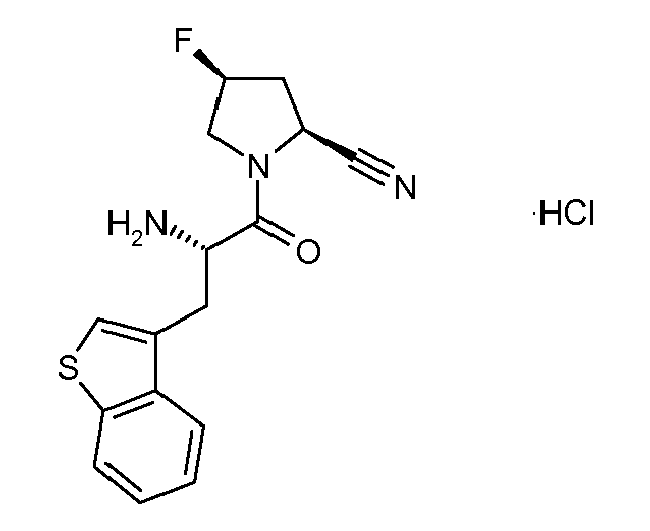
- To dry DMF (25 mL) was added (2S)-3-(1-benzothien-3-yl)-2-[(tert-butoxycarbonyl)amino]propanoic acid (1.92 g, 6.0 mmol), HATU (2.28 g, 6.0 mmol) and N,N-diisopropylethylamine (1.05 mL, 6.0 mmol). After stirring at RT for 30 min (2S, 4S)-4-fluoro-2-pyrrolidinecarbonitrile 4-methylbenzenesulfonate (1.31 g, 4.5 mmol) and additional N,N-diisopropylethylamine (0.78 mL, 4.5 mmol) were added. This solution was allowed to stir at RT for 12 hr and then saturated sodium bicarbonate (110 mL) was added. The mixture was extracted with ethyl acetate (2 X 100 mL) and the organics were washed with saturated NaCl (50 mL), dried over MgSO4 and concentrated to dryness to give a crude solid. The solid was chromatographed (silica gel, hexanes/EtOAc 4:1) to provide a solid which was stirred in a dioxane-HCl (4.0 M, 20 mL) solution for 2 hrs followed by the addition of diethyl ether (100 mL). The precipitate was collected by filtration and dried under high vacuum yielding 1.0 g (2.84 mmol, 63 % yield) of compound A as a white solid.
1H NMR (d6-DMSO) 400 MHz δ 8.70-8.61 (s(br), 3H), 8.05-8.00 (m, 2H), 7.45-7.36 (m, 3H), 5.21 (d, 1H, J = 51 Hz), 5.01 (d, 1H, J= 8.8 Hz), 4.23-4.20 (m, 1H), 3.71 (ddd, 1H, J= 41.1, 12.3, 3.2 Hz), 3.55-3.51 (m, 1H), 3.30-3.24 (m, 1H), 2.73 (q, 1H, J= 12.1 Hz), 2.39-2.14 (m, 2H) ppm. -

- To a toluene solution (90 mL) containing 2methyl-2-[4-(trifluoromethyl)phenyl] propanenitrile (see: J. Am. Chem. Soc. 2000, 122, 712, Caron, S. et al. for the preparation of this compound) (5.54 g, 26.0 mmol) cooled to -78 °C was added 26.0 mL of a 1.5 M toluene solution of DIBAL (39.0 mmol). The resulting solution stirred at -78 °C for 2.5 hr at which time it was quenched with an aqueous THF solution (105 mL/20 mL) containing sodium acetate (6.6 g) and acetic acid (6.6 mL). After 5 min the cold bath was removed and stirring continued for 20 min at RT when celite and Et2O were added. Upon stirring an additional 30 min, the heterogeneous solution was filtered through a bed of celite. The celite was rinsed thoroughly with Et2O and then the aqueous layer separated. The organics were washed with H2O, dried (MgSO4) and the solvent removed in vacuo. The residual oil was purified via column chromatography (5%EtOAc/hexanes) yielding 4.22 g (19.5 mmol, 75% yield) of compound A as a clear oil.
1H NMR (CDCl3) 400 MHz δ 9.52 (s, 1H), 7.63 (d, 2H, J = 8.2 Hz), 7.39 (d, 2H, J = 8.2 Hz), 1.49 (s, 3H) ppm. - To a MeOH solution (10 mL) containing compound A (1.87 g, 8.66 mmol) was added 1.2 mL of 30% NH4OH, H2O (6 mL) and potassium cyanide (592 mg, 9.09 mmol). To this solution was added ammonium chloride (510 mg, 9.53 mmol) at RT. After 1 hr the solution was heated to 70 °C for 6 hr. Upon cooling, the reaction was diluted with EtOAc and then washed with sat. NaHCO3 and H2O. After drying over MgSO4 the solvent was removed in vacuo and the residue purified via column chromatography (EtOAc/hexanes (3:2)) yielding 1.52 g (6.27 mmol, 72% yield) of compound B.
1H NMR (CDCl3) 400 MHz 87.63 (d, 2H, J = 8.4 Hz), 7.55 (d, 2H, J = 8.5 Hz), 3.80 (t, 1H, J = 7.9 Hz), 1.56 (s, 3H), 1.53 (s, 3H), 1.40 (d(br), 2H, J = 6.9 Hz) ppm. - To a flask containing compound B (2.96 g, 12.2 mmol) was added 10 mL of acetic acid followed by 60 mL of concentrated HCl. The solution was then heated to reflux overnight and upon cooling the bulk of the solvent was removed in vacuo. The resulting white solid was triterated with an Et2O/hexane (2:1) solution and collected via vacuum filtration. After pumping on under high vacuum 3.13 g (10.5 mmol, 86% yield) of compound C was obtained as a white solid.
1H NMR (d4-MeOH) 400 MHz δ 7.69 - 7.68 (m, 4H), 4.33 (s, 1H), 1.57 (s, 3H), 1.53 (s, 3H) ppm. - To a dioxane (30 mL)/H2O (7 mL) solution containing compound C (3.05 g, 10.2 mmol) was added 12.8 mL of a 2.0 M NaOH solution (25.6 mmol) followed by di-t-butyl dicarbonate (3.13 g, 14.4 mmol) at RT. The solution stirred overnight at which time it was poured into sat. NaHCO3 and washed with Et2O. The Et2O layer was washed with sat. NaHCO3 and then the aqueous layers combined. After acidification with 1.0 M HCl the organics were extracted with EtOAc (2X). After drying over MgSO4 the solvent was removed in vacuo yielding 3.58 g (9.92 mmol, 97% yield) of compound D as a white solid.
1H NMR (CDCl3) 400 MHz δ 7.57 (d, 2H, J = 8.2 Hz), 7.49 (d, 2H, J = 8.3 Hz), 4.99 (d(br), 1H, J = 9.2 Hz), 4.63 (d(br), 1H, J = 9.3 Hz), 1.45 (s, 3H), 1.44 (s, 3H), 1.36 (s, 9H) ppm. - To a DMF solution (45 mL) containing compound D (2.0 g, 5.54 mmol) was added N,N-diisopropylethylamine (788 mg, 6.09 mmol) followed by HATU (2.21 g, 5.82 mmol) at RT. The resulting solution stirred for 30 min at which time a DMF solution (27 mL) containing (2S,4S)-4-fluoro-2-pyrrolidinecarbonitrile 4-methylbenzenesulfonate (1.66 g, 5.82 mmol) and N,N-diisopropylethylamine (752 mg, 5.82 mmol) was added. After stirring overnight the solution was diluted with EtOAc and washed with H2O (3X), sat. NaHCO3 and 1.0 M HCl. After drying over MgSO4 the solvent was removed in vacuo and the residual dark oil purified via column chromatography (hexanes/EtOAc/CH2Cl2 (5:4:1)). A low Rf material (610 mg, 1.37 mmol) was obtained which was a single stereoisomer by 1H NMR and LC plus 335 mg of a high Rf material which contained desired product, but was contaiminated with another compound. The low Rf material turned out to be the (S)-diastereomer after in vitro testing.
Low Rf diastereomer:
1H NMR (CDCl3) 400 MHz δ 7.65 - 7.60 (m, 2H), 7.59 - 7.55 (m, 2H), 5.29 (d, 1H, J = 9.9 Hz), 5.06 (dt, 1H, J = 51.1, 3.3 Hz), 4.85 (d, 1H, J = 9.4 Hz), 4.34 (d, 1H, J = 9.9 Hz), 3.55 (ddd, 1H, J = 3.4, 12.1, 36.2 Hz), 2.70 (dd, 1H, J = 12.3, 17.8 Hz), 2.48 (t, 1H, J = 15.4 Hz), 2.15 (m, 1H), 1.53 (s, 3H), 1.51 (s, 3H), 1.40 (s, 9H) ppm. - To a CH2Cl2 solution (10 mL) containing compound E (643 mg, 1.44 mmol, low Rf isomer) was added TFA (1.65 g, 14.4 mmol) at RT. After 1 hr an additional 5 eq of TFA was added and after a total of 2 hr the solvent was removed in vacuo and the residual oil dissolved in 5 mL of dioxane. To this solution was added 10 mL of a 4.0 M dioxane solution of HCl. The solvent was removed in vacuo followed by the addition of CH2Cl2 and Et2O. This process was repeated 3X until a consistent solid formed. The solid was collected via vacuum filtration yielding 406 mg (1.03 mmol, 72% yield) of compound F.
1H NMR (d4-MeOH) 400 MHz δ 7.74 - 7.66 (m, 4H), 5.13 (d(br), 1H, J = 51.3 Hz), 4.97 (d, 1H, J = 9.3 Hz), 4.25 (s, 1H), 3.52 (m, 1H), 2.74 (dd, 1H, J = 22.0, 11.9 Hz), 2.47 - 2.22 (m, 2H), 1.67 (s, 3H), 1.60 (s, 3H) ppm. - H-Ala-Pro-pNA•HCl was purchased from BACHEM Bioscience Inc. (product no. L-1115). A 500 mM stock solution was prepared with dimethylsulfoxide and stored at -20 °C. Gly-Pro-AMC was purchased from Enzyme System Products (product no. AMC-39) and stored at -20 °C as a 10 mM stock solution in dimethylsulfoxide. Test compounds were dissolved to 10 mM in dimethylsulfoxide and this was used as a stock solution for DPP-IV titration assays. Athens Research and Technology, Inc prepared the purified human DPP-IV. The material was isolated from human prostasomes using the method of DeMeester et al., J. Immunol. Methods 189, 99-105. (1996).
- Two-fold serial dilutions of test compounds in 100 % dimethylsulfoxide were performed in 96-well polystyrene flat bottom plates (Costar, #9017). The average enzymatic activity from wells containing dimethylsulfoxide but lacking test compound was used as a control value for calculating percent inhibition. DPP-IV (20 ng/mL) was mixed in microtiter plates with test compounds, substrate and assay buffer to yield 100 µM H-Ala-Pro-pNA•HCl in 25 mM Tris, pH 7.5, 10 mM KCI, 140 mM NaCl. The intact peptide contains a p-nitrophenylanilide which, when hydrolyzed by DPP-IV, releases the absorbant p-nitrophenylaniline. The absorbency was monitored in 20 minutes intervals at a wavelength of 387 nm using a Molecular Devices SpectraMax 250 absorbency plate reader. The enzymatic activity was determined by estimating the best linear fit to the data. Values for enzymatic activity were taken directly from the linear fit determined by the software on the plate reader.
- Data Analysis: The enzymatic activity was determined by estimating the best linear fit to the data. Data reduction was performed using the Microsoft Excel RoboSage.
- Determination of IC50 values: The enzymatic activity was plotted against the concentration of test compound, including [I] = 0, and the IC50 determined from a fit of equation 2 to the data.

- Vmax was the best fit estimate of the maximal enzymatic activity.
- Determination of Ki values: Ki values were calculated from IC50 values using equation 3 assuming a competitive model.

- The apparent pKi values were > 5.0 for each of the examples.
- The intermediate plate contained 5.3 µL of test compound in 2-fold serial dilutions across the plate. A volume of 209 µL of buffer (100 mM sodium acetate pH 5.5) containing substrate (H-Lys-Ala-pNA-2HCl; product no. L-2085; BACHEM Bioscience Inc.:) was added to each well of the intermediate plate, then mixed. The reaction was initiated with the transfer of 180 µL of the substrate/test compound solution to the assay plate containing 20 µL of enzyme. Final concentrations in the assay were 100 nM enzyme and 1000 µM substrate in 100 mM NaOAc, pH 5.5, 2.5% DMSO in a final volume of 200 µL. The absorbance was monitored every 20 minutes for 5 hours at 387 nm using a Molecular Devices SpectraMax 250 absorbance plate reader.
- Data Analysis: The enzymatic activity was determined by estimating the best linear fit to the data. Data reduction was performed using the Microsoft Excel RoboSage.
- Determination of IC50 values: The enzymatic activity was plotted against the concentration of test compound, including [I] = 0, and the IC50 determined from a fit of equation 2 to the data.

Vmax was the best fit estimate of the maximal enzymatic activity. - Determination of Ki values: Ki values were calculated from IC50 values using equation 3 assuming a competitive model.

- Certain compounds of the present invention showed activity for DPP-II, for example pKi values > 6.0, while others demonstrated selectivity for DPP-IV, discussed hereinabove.
- Age and weight matched male CD1 mice were housed individually at 72° F and 50% relative humidity with a 12 h light/dark cycle. Animals were dosed by oral gavage with 10 ml/kg vehicle (0.5% methylcellulose (HPMC) with 0.1% Tween 80) or 1 mg/kg test compound in vehicle. The animals were anesthetized with isofluorane for blood collection at the specified times (0-6 hours). Plasma DPP-IV activity was measured using the fluorogenic substrate Gly-Pro-AMC (50 µM) according to the manufacturers specification (Enzyme System Products, Livermore CA). The substrate was mixed with 50 mM Tris, pH 7.8 and 20% plasma. The samples were incubated for 20 min at 30°C and fluorescence measured using a cytofluor spectrofluoremeter with the filters set at 360 nm excitation and 460 nm emission.
- The compounds of the present invention demonstrate a number of preferred characterisitcs. Not to be limtied thereby, but the preferred characteristics of the compounds of the present invention are believed due to the unexpected benefits gained through manipulation of the substitution patterns of the compounds of Formula (I). The results of comparative testing illustrate several surprising and unexpected benefits. More specifically, the comparative tests indicate that the compounds of the present invention demonstrate: (i) increased potency, as characterized by DPP-IV inhibition activity measured from plasma; (ii) increased selectivity; (iii) increased duration of action; and/or (iv) an increased safety profile.
-


- Surprisingly, with regard to inhibtion of dipeptidyl peptidases, in particular with DPP-IV, compounds that demonstrate high affinity for the enzyme (i.e. potent) do not necessarily possess the duration of action desired for therapeutic effectievness. Duration of action, as used herein, includes the ability of the compound to maintain effectiveness, preferably therapeutic effectiveness, over a sustained period of time. A compound demonstrating the preferred level of duration of action provides therapeutic effectiveness with once-daily dosing. A once-a-day dosage regimen, as is appreciated in the pharmaceutical arts, may be advantageous over multiple daily dosing regimens for reasons such as patient compliance and convenience. Thus, preferred compounds should not only be sufficiently potent but should also demonstrate desired levels of duration of action.
- Unfortunately, as is appreciated by those skilled in the art, there is no necessary correlation between potency and duration of action. In other words, although a compound demonstrates high affinity for the DPP-IV enzyme, the compound does not necessarily have appropriate duration properties to be considered for preferential once-daily dosing. The following illustrates this lack of correlation between potency and duration of action. The following data illustates the invention but should not be interpreted to limit the invention.
- Age and weight matched male CD rats were housed individually at 72° F and 50% relative humidity with a 12 h light/dark cycle. Animals were dosed by oral gavage with vehicle (10 mM acetic acid) or 1 mg/kg test compound in vehicle. After 6 hrs administration of compound, the rats were anesthetized with isofluorane for cardiac blood collection. DPP-IV activity in serum was measured using the fluorogenic substrate Gly-Pro-AMC (50 mM) according to the manufacturers specification (Enzyme System Products, Livermore CA). The substrate was mixed with 50 mM Tris, pH 7.8, in plasma (20% final v/v) and the samples were incubated for 5-20 min at 30°C. DPP-IV activity was determined by measuring fluorescence using a cytofluor spectrofluoremeter with the filters set at 360 nm excitation and 460 nm emission. Averages and standard deviations from each group (n=3) were calculated using students t-test and compared to vehicle treated rats to determine percent inhibition as shown in Table I.
TABLE I IC50 (nM) Human DPP-IV Percent DPP-IV inhibition At 6 hrs In Rats Comparison Example 1 1.3 32 ± 3 Comparison Example 2 3 32 ± 3 Comparison Example 4 5.6 2.8 ± 0.1 Comparison Example 5 3 71 ± 13 Example 2 22 68 ± 4 Example 9 72 64 ± 12 - As shown, Comparison Examples 1, 2, and 4 are very potent, each having IC50 values of <5.6 nM. The compounds illustrative of the present invention, Examples 2 and 9 demonstrate adequate potency, namely IC50 values of 22 and 72 respectively. When the Comparison Examples 1, 2, and 4 were tested for duration of action, however, they each demonstrated a poor level of duration. The compounds of the present invention, although less potent, present a duration of action preferred for overall therapeutic profile.
- Comparison Example 5 is included to further demonstrate the unpredictability between potency and duration of action. More specifically, Comparison Example 5 illustrates one compound having both high binding affinity and duration of action. Thus, the relationship of potency to duration of action can not be characterized strictly as either a parallel or an inverse relationship. Rather the relationship is not predictable.
- This lack of correlation between potency and duration of action presents a lack of predictability among inhibitors of dipeptidyl peptidases, specifically DPP-IV. This unpredictability has not heretofore been recognized. As shown above, binding data, alone, may or may not be enough to ascertain the therapeutic utility of such compounds. The compounds of the present invention demonstrate desired levels of both potency and duration of action in addition to the other properties herein discussed.
- As described herein, the compounds of the present invention have at least two identical β-substitutions, namely, R1 and R2 are the same. As referenced herein the compounds of the present invention are di-β-substituted, as illustrated with Examples 1 and 10, respectively:

- On the other hand, mono-β-substituted compounds, for example, Comparison Examples 3 and 4 illustrated hereinabove, where the β carbon does not carry two identical substituents tend to cyclize and, therefore, demonstrate relatively short stability half-lives, as measured by t1/2.
- In addition, generally compounds with the gem-substitution pattern on the β-carbon demonstrate increased selectivity as well.
- Typically 0.2 - 0.5 mg of compound is dissolved in 1 mL of Phosphate Buffered Saline (PBS) in a HPLC sample vial and placed in an autosampler thermostatically controlled at 37°C. An initial time point HPLC chromatogram is obtained followed by successive HPLC chromatograms at time points of 24, 48, 72, etc hours.
HPLC method: - Column: Phenomenex Luna C18(2), 3µ, 100 x 4.6 mm, thermostated at 40 °C
- Mobile Phase A: 95:5:0.2% Water: Acetonitrile: Trifluoroacetic acid
- Mobile Phase B: 5:95:0.2% Water: Acetonitrile: Trifluoroacetic acid
- Flow rate: 1 mL/minute
- Gradient: 0 - 100 %B in 15 minutes
- UV Detection wavelength: 215 nm
- The area under the drug substance peak is compared to the initial area for each chromatogram and plotted as percent remaining from initial time (t0).
- Comparison of the cyclization/degradation reaction half-lives (t 1/2) of compounds show increased stability for the di-β-substituted compounds, such as Examples 2 and 9. Increased t 1/2 is related directly to increased stability of the compound.
TABLE 2 Compound t ½ at 37 °C Example 9 1733 hrs Example 2 266 hrs Comparison Example 4 33.5 hrs Comparison Example 3 23 hrs (calc.)* 47 hrs at 23°C *Note: For Comparison Example 3 the autosampler was not thermostatically controlled as described hereinabove, rather the autosampler was left at ambient room temperature. Typically an increase in 10 °C increases the reaction rate two-fold, thereby decreasing the t 1/2 by two-fold. As will be apprciated by those skilled in the art, a reasonably calculated t 1/2 for Comparison Example 3 would be one half (or less) of the measured value at room temperature (23 °C). - Thus, in addition to potency and duration of action, the compounds of the present invention demonstrate desired stability as well.
- The dog is a common non-rodent species routinely used to satisfy regulatory requirements. The beagle was chosen to examine the safety of the compounds of the present invention because of the knowledge of this strain's general pathology and response to a wide variety of drugs. Dogs (Marshall Farms Inc., North Rose, NY, USA) from 9 to 12 months (5 to 12 kg) were dosed by oral gavage at 10 mL/kg/day with vehicle (10 mM acetic acid, pH 3.3) or test compound in vehicle. Each dose was followed by a flush of approximately 10 mL of water, once daily with 24-48 hours between each subsequent dose. If limiting gastrointestinal toxicity was not observed, the dose was increased 3-fold no sooner than approximately 24 hours after the preceding dose. Limiting GI toxicity includes diarrhea, loose or mucoid feces, blood in stool, and/or sloughing of the gut epithelium. Clinical observations were made at least three times daily during treatment (once prior to dosing, approximately one hour post dose, and once in conjunction with pm viability). DPP-IV activity in serum was measured using the fluorogenic substrate Gly-Pro-AMC (50 mM) according to the manufacturers specification (Enzyme System Products, Livermore CA). The substrate was mixed with 50 mM Tris, pH 7.8, in serum (20% final v/v) and the samples were incubated for 5-20 min at 30°C. DPP-IV activity was determined by measuring fluorescence using a cytofluor spectrofluoremeter with the filters set at 360 nm excitation and 460 nm emission.
- The compound illustrated above as Comparison Example 5 contains a relatively small P2 portion as determined by molecular weight. Thus, Comparison Example 5 and compounds of the present invention, which are herein described as having large P2 portions, namely Examples 2 and 9 for illustration, were each tested in the described dose escalation studies.
- Based on dose escalation studies in dogs, 0.3 mg/kg of Comparison Example 5 caused loose/mucoid feces with traces of blood whereas 1 mg/kg of a compound of the present invention, Example 9 caused no adverse affects. Upon escalation to 3 mg/kg, however, Example 9 caused loose/mucoid feces with traces of blood.
- In contrast, 12 hours after oral dosing 0.2 mg/kg of Comparison Example 5, Comparison Example 5 inhibited DPP4 by 2%. Surprisingly, 0.2 mg/kg of Example 9 inhibited DPP4 by 76% indicating that Example 9 significantly inhibits DPP4 activity in serum.
- Likewise with other compounds of the present invention, 10 mg/kg of Example 2 had no adverse affects on gastrointestinal toxicity and 0.5 mg/kg of Example 2 inhibited DPP4 by 45% 12 hours after oral dosing.
- Based upon dose escalation studies in dogs, compounds of the present invention, as illustrated by Examples 2 and 9, that have a larger molecular weight P2 portion are preferred.
- When compounds of the present invention were tested in vivo at time periods ranging from 0 to 10 hours, the flurorinated compounds of the present invention demonstrated a significant increase in DPP-IV inhibition over their non-fluorinated counterparts. Thus, the compounds of the present invention provide an unexpected potency that was not heretofore appreciated. For example, Example 2 and its non-fluorinated version, Comparison Example 6, were compared to determine the benefit of the 4-fluoro substituent. Surprisingly, the 4-fluoro substituent prolongs the duration of the enzyme inhibitor complex dramatically as well as providing a significant increase in potency. These beneficial properties have not heretofore been appreciated.
TABLE 3 IC50 (nM) Human DPP-IV % DPP-IV Inhibition @ 6 Hrs. In Rats Example 2 22 68 ± 4 Comparison Example 6 151 15 ± 1 - All research complied with the principles of laboratory animal care (NIH publication No. 85-23, revised 1985) and GlaxoSmithKline policy on animal use.
- Although specific embodiments of the present invention have been illustrated and described in detail, the invention is not limited thereto. The above detailed description of preferred embodiments is provided for example only and should not be construed as constituting any limitation of the invention. Modifications will be obvious to those skilled in the art, and all modifications that do not depart from the spirit of the invention are intended to be included within the scope of the appended claims.

Claims (18)
- A compound of general formula (I):
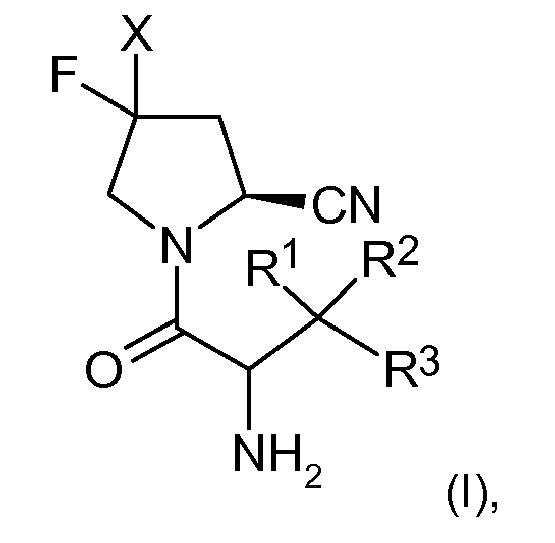 (2S,4S)-1-[(2S)-2-Amino-5-(4-fluorophenyl)-3,3-dimethylpentanoyl]-4-fluoro-2-pyrrolidinecarbonitrile hydrochloride;(2S,4R)-1-[(2S)-2-Amino-4-(4-fluorophenyl)-3,3-dimethylbutanoyl]-4-fluoropyrrrolidine-2-carbonitrile hydrochloride;(2S,4S)-1-{(2R)-2-Amino-3-[(4-methoxybenzyl)thio]-3-methylbutanoyl}-4-fluoropyrrolidine-2-carbonitrile hydrochloride;(2S,4S)-1-{(2R)-2-Amino-3-methyl-3-[(3-phenylpropyl)thio]butanoyl}-4-fluoropyrrolidine-2-carbonitrile hydrochloride;(2S,4S)-1-{(2R)-2-Amino-3-methyl-3-[(2-phenylethyl)thio]butanoyl}-4-fluoropyrrolidine-2-carbonitrile hydrochloride;(2S,4S)-1-((2R)-2-Amino-3-{[3-(4-fluorophenyl)propyl]thio}-3-methylbutanoyl)-4-fluoropyrrolidine-2-carbonitrile hydrochloride;(2S,4S)-1-{(2R)-2-Amino-3-[(4-methoxybenzyl)sulfonyl]-3-methylbutanoyl}-4-fluoropyrrolidine-2-carbonitrile hydrochloride;(2S,4S)-1-{(2R)-2-Amino-3-[(4-methoxybenzyl)sulfinyl]-3-methylbutanoyl}-4-fluoropyrrolidine-2-carbonitrile hydrochloride;(2S,4S)-1-((2R)-2-Amino-3-methyl-3-{[4-(trifluoromethyl)benzyl]thio}butanoyl)-4-fluoropyrrolidine-2-carbonitrile hydrochloride;(2S,4S)-1-[(2S)-2-Amino-2-(1-vinylcyclopentyl)ethanoyl]-4-fluoropyrrolidine-2-carbonitrile hydrochloride;(2S,4S)-1-[(2S)-2-Amino-5-(4-methoxyphenyl)-3,3-dimethylpentanoyl]-4-fluoropyrrolidine-2-carbonitrile hydrochloride;(2S,4S)-1-{(2R)-2-Amino-3-methyl-3-[(3-phenylpropyl)sulfonyl]butanoyl}-4-fluoropyrrolidine-2-carbonitrile;(2S,4S)-1-{(2R)-2-Amino-3-methyl-3-[(4-methylbenzyl)sulfonyl]butanoyl}-4-fluoropyrrolidine-2-carbonitrile;(2S,4S)-1-((2R)-2-amino-3-{[4-(benzyloxy)benzyl]sulfonyl}-3-methylbutanoyl)-4-fluoropyrrolidine-2-carbonitrile;(2S,4S)-1-{(2R)-2-amino-3-[(4-cyanobenzyl)sulfonyl]-3-methylbutanoyl}-4-fluoropyrrolidine-2-carbonitrile;(2S,4S)-1-((2R)-2-amino-3-methyl-3-{[4-(methylsulfonyl)benzyl]sulfonyl}butanoyl)-4-fluoropyrrolidine-2-carbonitrile;(2S,4S)-1-{(2S)-2-Amino-2-[1-(4-fluorobenzyl)cyclopentyl]ethanoyl}-4-fluoropyrrolidine-2-carbonitrile hydrochloride;(2S,4S)-1-((2S)-2-Amino-2-{1-[4-(trifluoromethyl)phenyl]cyclopentyl}ethanoyl)-4-fluoropyrrolidine-2-carbonitrile hydrochloride;(2S,4S)-1-{(2S)-2-Amino-2-[1-(4-fluorobenzyl)cyclopropyl]ethanoyl}-4-fluoropyrrolidine-2-carbonitrile hydrochloride;(2S,4S)-1-[(2R)-2-Amino-3- (benzylsulfonyl)-3-methylbutanoyl]-4-fluoropyrrolidine-2-carbonitrile hydrochloride;(2S,4S)-1-{(2R)-2-amino-3-[(3-methoxybenzyl)sulfonyl]-3-methylbutanoyl}-4-fluoropyrrolidine-2-carbonitrile hydrochloride;(2S,4S)-1-{(2R)-2-Amino-3-[(1,1'-biphenyl-4-ylmethyl)sulfonyl]-3-methylbutanoyl}-4-fluoropyrrolidine-2-carbonitrile hydrochloride;(2S,4S)-1-{(2R)-2-Amino-3-[(2-methoxybenzyl)sulfonyl]-3-methylbutanoyl}-4-fluoropyrrolidine-2-carbonitrile hydrochloride;(2S,4S)-1-{(2R)-2-Amino-3-methyl-3-[(pyridin-3-ylmethyl)thio]butanoyl}-4-fluoropyrrolidine-2-carbonitrile;(2S,4S)-1-{(2R)-2-Amino-3-methyl-3-[(pyridin-2-ylmethyl)thio]butanoyl}-4-fluoropyrrolidine-2-carbonitrile hydrochloride;(2S,4S)-1-{(2R)-2-amino-3-methyl-3-[(pyridin-4-ylmethyl)thio]butanoyl}-4-fluoropyrrolidine-2-carbonitrile hydrochloride;(2S,4S)-1-{(2R)-2-amino-3-[(4-fluorobenzyl)sulfonyl]-3-methylbutanoyl}-4-fluoropyrrolidine-2-carbonitrile hydrochloride;(2S,4S)-1-{(2R)-2-amino-3-methyl-3-[(3-phenoxybenzyl)sulfonyl]butanoyl}-4-fluoropyrrolidine-2-carbonitrile hydrochloride;(2S,4S)-1-{(2R)-2-amino-3-methyl-3-[(3-phenoxybenzyl)thio]butanoyl}-4-fluoropyrrolidine-2-carbonitrile hydrochloride;(2S,4S)-1-((2R)-2-Amino-3-{[(5-chloro-1,1-dioxido-1-benzothien-3-yl)methyl]sulfonyl}-3-methylbutanoyl)-4-fluoropyrrolidine-2-carbonitrile hydrochloride;(2S,4S)-1-{(2R)-2-Amino-3-[(2,1,3-benzoxadiazol-5-ylmethyl)thio]-3-methylbutanoyl}-4-fluoropyrrolidine-2-carbonitrile hydrochloride;(2S,4S)-1-{(2R)-2-Amino-3-methyl-3-[(pyridin-4-ylmethyl)sulfonyl]butanoyl}-4-fluoropyrrolidine-2-carbonitrile hydrochloride;(2S,4S)-1-[(2S)-2-Amino-3-pyridin-4-ylpropanoyl]-4-fluoropyrrolidine-2-carbonitrile hydrochloride;(2S,4S)-1-[(2S)-2-Amino-3-pyridin-3-ylpropanoyl]-4-fluoropyrrolidine-2-carbonitrile hydrochloride;(2S,4S)-1-[(2S)-2-Amino-3-piperidin-4-ylpropanoyl]-4-fluoropyrrolidine-2-carbonitrile dihydrochloride;(2S,4S)-1-[(2S)-2-Amino-3-piperidin-3-ylpropanoyl]-4-fluoropyrrolidine-2-carbonitrile dihydrochloride;(2S,4S)-1-[(2S)-2-Amino-3-piperidin-2-ylpropanoyl]-4-fluoropyrrolidine-2-carbonitrile dihydrochloride;(2S,4S)-1-{(2S)-2-Amino-3-[1-(isopropylsulfonyl)piperidin-4-yl]propanoyl}-4-fluoropyrrolidine-2-carbonitrilehydrochloride;(2S,4S)-1-{(2S)-2-Amino-3-[1-(4-methylphenylsulfonyl)piperidin-4-yl]propanoyl}-4-fluoropyrrolidine-2-carbonitrile hydrochloride;(2S,4S)-1-{(2S)-2-Amino-3-[1-(isopropylsulfonyl)piperidin-3-yl]propanoyl}-4-fluoropyrrolidine-2-carbonitrile hydrochloride;(2S,4S)-1-{(2S)-2-Amino-3-[1-(4-methylphenylsulfonyl)piperidin-3-yl]propanoyl}-4-fluoropyrrolidine-2-carbonitrile hydrochloride;(2S,4S)-1-[(2S)-2-Amino-3-(1-benzothien-3-yl)propanoyl]-4-fluoropyrrolidine-2-carbonitrile hydrochloride; and(2S,4S)-1-{(2S)-2-Amino-3-methyl-3-[4-(trifluoromethyl)phenyl]butanoyl}-4-fluoropyrrolidine-2-carbonitrile hydrochloride.
 - A pharmaceutical formulation comprising a compound of claim 1.
- The pharmaceutical formulation of claim 2 further comprising a pharmaceutically acceptable carrier.
- Use of a compound of claim 1 in the manufacture of a medicament for the inhibition of a post proline/analine cleaving protease.
- The use of claim 4 wherein the post proline/analine cleaving protease is a serine protease.
- The use of claim 5 wherein the serine protease is a dipeptidyl peptidase.
- The use of claim 6 wherein the dipeptidyl peptidase is DPP-II.
- The use of claim 6 wherein the dipeptidyl peptidase is DPP-IV.
- Use of a compound of claim 1 in the manufacture of a medicament for the treatment or prophylaxis of metabolic disorders, gastrointestinal disorders, viral disorders, inflammatory disorders, diabetes, obesity, hyperlipidemia, dermatological or mucous membrane disorders, psoriasis, intestinal distress, constipation, autoimmune disorders, encephalomyelitis, complement mediated disorders, glomerulonepritis, lipodystrophy, tissue damage, psychosomatic, depressive, and neuropsychiatric disorders, HIV infection, allergies, inflammation, arthritis, transplant rejection, high blood pressure, congestive heart failure, tumors, and stress-induced abortions.
- Use as claimed in claim 9 wherein the medicament is for the treatment or prophylaxis of diabetes.
- A compound according to claim 1 for use as an active therapeutic substance.
- A combination comprising a compound as claimed in claim 1, and one or more other anti-diabetic agents, selected from insulin, α-glucosidase inhibitors, biguanides, insulin secretagogues, or insulin sensitizers.
- A combination as claimed in claim 12 wherein said α-glucosidase inhibitors are selected from acarbose, emiglitate, miglitol, and voglibose.
- A combination as claimed in claim 12 wherein said biguanides are selected from metformin, buformin, and phenformin.
- A combination as claimed in claim 12 wherein said insulin secretagogues are selcted from sulphonylureas.
- A combination as claimed in claim 12 wherein said insulin sensitizers are selected from peroxisome proliferator activated receptor (PPAR) ligands.
- A combination as claimed in claim 16 wherein said PPAR ligands are selected from PPAR-γ agonists.
- A combination as claimed in claim 17 wherein said PPAR-γ agonists are selected from Actos™ and Avandia™.
Applications Claiming Priority (3)
| Application Number | Priority Date | Filing Date | Title |
|---|---|---|---|
| US30133301P | 2001-06-27 | 2001-06-27 | |
| US37601502P | 2002-04-26 | 2002-04-26 | |
| EP02756329A EP1406873B1 (en) | 2001-06-27 | 2002-06-26 | Fluoropyrrolidines as dipeptidyl peptidase inhibitors |
Related Parent Applications (1)
| Application Number | Title | Priority Date | Filing Date |
|---|---|---|---|
| EP02756329A Division EP1406873B1 (en) | 2001-06-27 | 2002-06-26 | Fluoropyrrolidines as dipeptidyl peptidase inhibitors |
Publications (3)
| Publication Number | Publication Date |
|---|---|
| EP1862457A2 true EP1862457A2 (en) | 2007-12-05 |
| EP1862457A3 EP1862457A3 (en) | 2008-02-20 |
| EP1862457B1 EP1862457B1 (en) | 2010-01-20 |
Family
ID=26972302
Family Applications (2)
| Application Number | Title | Priority Date | Filing Date |
|---|---|---|---|
| EP07117167A Expired - Lifetime EP1862457B1 (en) | 2001-06-27 | 2002-06-26 | Fluoropyrrolidines as dipeptidyl peptidase inhibitors |
| EP02756329A Expired - Lifetime EP1406873B1 (en) | 2001-06-27 | 2002-06-26 | Fluoropyrrolidines as dipeptidyl peptidase inhibitors |
Family Applications After (1)
| Application Number | Title | Priority Date | Filing Date |
|---|---|---|---|
| EP02756329A Expired - Lifetime EP1406873B1 (en) | 2001-06-27 | 2002-06-26 | Fluoropyrrolidines as dipeptidyl peptidase inhibitors |
Country Status (20)
| Country | Link |
|---|---|
| US (1) | US7132443B2 (en) |
| EP (2) | EP1862457B1 (en) |
| JP (3) | JP3909056B2 (en) |
| KR (1) | KR20040015298A (en) |
| CN (3) | CN1723196A (en) |
| AT (2) | ATE455759T1 (en) |
| AU (1) | AU2002322344C1 (en) |
| BR (1) | BR0210644A (en) |
| CA (1) | CA2450722A1 (en) |
| CO (1) | CO5600998A2 (en) |
| CZ (1) | CZ20033521A3 (en) |
| DE (2) | DE60235212D1 (en) |
| ES (2) | ES2296979T3 (en) |
| HU (1) | HUP0400321A2 (en) |
| IL (1) | IL158923A0 (en) |
| MX (1) | MXPA03011907A (en) |
| NO (1) | NO20035603D0 (en) |
| NZ (1) | NZ529973A (en) |
| PL (1) | PL367527A1 (en) |
| WO (1) | WO2003002531A2 (en) |
Families Citing this family (193)
| Publication number | Priority date | Publication date | Assignee | Title |
|---|---|---|---|---|
| GB0010188D0 (en) * | 2000-04-26 | 2000-06-14 | Ferring Bv | Inhibitors of dipeptidyl peptidase IV |
| TWI243162B (en) * | 2000-11-10 | 2005-11-11 | Taisho Pharmaceutical Co Ltd | Cyanopyrrolidine derivatives |
| EP1385508B1 (en) | 2001-03-27 | 2008-05-21 | Merck & Co., Inc. | Dipeptidyl peptidase inhibitors for the treatment or prevention of diabetes |
| HUP0200849A2 (en) * | 2002-03-06 | 2004-08-30 | Sanofi-Synthelabo | N-aminoacetyl-pyrrolidine-2-carbonitrile derivatives, pharmaceutical compositions containing them and process for producing them |
| JPWO2003095425A1 (en) * | 2002-05-09 | 2005-09-15 | 大正製薬株式会社 | Cyanopyrrolidine derivatives |
| US7105526B2 (en) | 2002-06-28 | 2006-09-12 | Banyu Pharmaceuticals Co., Ltd. | Benzimidazole derivatives |
| US7407955B2 (en) | 2002-08-21 | 2008-08-05 | Boehringer Ingelheim Pharma Gmbh & Co., Kg | 8-[3-amino-piperidin-1-yl]-xanthines, the preparation thereof and their use as pharmaceutical compositions |
| US7772188B2 (en) | 2003-01-28 | 2010-08-10 | Ironwood Pharmaceuticals, Inc. | Methods and compositions for the treatment of gastrointestinal disorders |
| CA2518465A1 (en) | 2003-03-25 | 2004-10-14 | Takeda San Diego, Inc. | Dipeptidyl peptidase inhibitors |
| WO2004092128A1 (en) * | 2003-04-10 | 2004-10-28 | Smithkline Beecham Corporation | Anhydrous crystalline forms of (2s, 4s)-1-{(2r)-2-amino-3-‘4-methoxybenzyl)sulfonyl!-3-methylbutanoyl}-4-fluoropyrrolindine-2-carbonitrile |
| JP4806628B2 (en) | 2003-05-05 | 2011-11-02 | プロビオドルグ エージー | Glutaminyl cyclase inhibitor |
| MXPA05011861A (en) | 2003-05-05 | 2006-02-17 | Probiodrug Ag | Medical use of inhibitors of glutaminyl and glutamate cyclases. |
| NZ568459A (en) | 2003-05-05 | 2009-06-26 | Probiodrug Ag | Use of effectors of glutaminyl and glutamate cyclases |
| US7638638B2 (en) | 2003-05-14 | 2009-12-29 | Takeda San Diego, Inc. | Dipeptidyl peptidase inhibitors |
| KR20060037391A (en) * | 2003-07-21 | 2006-05-03 | 스미스클라인 비참 코포레이션 | (2S, 4S) -4-fluoro-1- [4-fluoro-beta- (4-fluorophenyl) -L-phenylalanyl] -2-pyrrolidinecarbonitrile p-toluenesulfonate and its Anhydrous crystal form |
| US6995183B2 (en) | 2003-08-01 | 2006-02-07 | Bristol Myers Squibb Company | Adamantylglycine-based inhibitors of dipeptidyl peptidase IV and methods |
| KR20060041309A (en) | 2003-08-13 | 2006-05-11 | 다케다 야쿠힌 고교 가부시키가이샤 | 4-pyrimidone derivatives and their use as peptidyl peptidase inhibitors |
| US7678909B1 (en) | 2003-08-13 | 2010-03-16 | Takeda Pharmaceutical Company Limited | Dipeptidyl peptidase inhibitors |
| US7169926B1 (en) | 2003-08-13 | 2007-01-30 | Takeda Pharmaceutical Company Limited | Dipeptidyl peptidase inhibitors |
| HU227684B1 (en) * | 2003-08-29 | 2011-11-28 | Sanofi Aventis | Adamantane and azabicyclo-octane and nonane derivatives and their use as dpp-iv inhibitors |
| JP2007505121A (en) | 2003-09-08 | 2007-03-08 | 武田薬品工業株式会社 | Dipeptidyl peptidase inhibitor |
| JP4765627B2 (en) | 2003-09-22 | 2011-09-07 | Msd株式会社 | Novel piperidine derivatives |
| CA2542419C (en) | 2003-10-15 | 2013-06-04 | Probiodrug Ag | Use of glutamyl cyclase inhibitors in the treatment of familial british dementia and familial danish dementia |
| WO2005049027A2 (en) | 2003-11-03 | 2005-06-02 | Probiodrug Ag | Combinations useful for the treatment of neuronal disorders |
| KR20150132601A (en) | 2003-11-17 | 2015-11-25 | 노파르티스 아게 | Use of dipeptidyl peptidase iv inhibitors |
| CN1890228B (en) * | 2003-12-11 | 2011-07-20 | 田边三菱制药株式会社 | α-amino acid derivatives and their use as medicines |
| WO2005058849A1 (en) * | 2003-12-15 | 2005-06-30 | Glenmark Pharmaceuticals Ltd. | New dipeptidyl peptidase in inhibitors; process for their preparation and compositions containing them |
| EP3366283B1 (en) | 2004-01-20 | 2021-09-01 | Novartis AG | Direct compression formulation and process |
| JP2005213165A (en) * | 2004-01-28 | 2005-08-11 | Mitsui Chemicals Inc | Method for producing fluoroproline compounds |
| ATE537141T1 (en) * | 2004-02-05 | 2011-12-15 | Kyorin Seiyaku Kk | BICYCLOESTER DERIVATIVE |
| KR101099206B1 (en) | 2004-02-05 | 2011-12-27 | 프로비오드룩 아게 | Novel Inhibitors of Glutaminyl Cyclase |
| WO2005077900A1 (en) * | 2004-02-18 | 2005-08-25 | Kyorin Pharmaceutical Co., Ltd. | Bicyclic amide derivatives |
| US7501426B2 (en) | 2004-02-18 | 2009-03-10 | Boehringer Ingelheim International Gmbh | 8-[3-amino-piperidin-1-yl]-xanthines, their preparation and their use as pharmaceutical compositions |
| EP1719757B1 (en) * | 2004-02-27 | 2013-10-09 | Kyorin Pharmaceutical Co., Ltd. | Bicyclo derivative |
| US7732446B1 (en) | 2004-03-11 | 2010-06-08 | Takeda Pharmaceutical Company Limited | Dipeptidyl peptidase inhibitors |
| EA013427B1 (en) | 2004-03-15 | 2010-04-30 | Такеда Фармасьютикал Компани Лимитед | DIPEPTIDYLPEPTIDASE INHIBITORS |
| CA2560314A1 (en) | 2004-03-29 | 2005-10-20 | Merck & Co., Inc. | Diaryltriazoles as inhibitors of 11-beta-hydroxysteroid dehydrogenase-1 |
| US20080125403A1 (en) | 2004-04-02 | 2008-05-29 | Merck & Co., Inc. | Method of Treating Men with Metabolic and Anthropometric Disorders |
| EP1586559A1 (en) * | 2004-04-13 | 2005-10-19 | Cephalon, Inc. | Biaryl-methanethio-, -sulphinyl- and sulphonyl derivatives |
| US7449481B2 (en) * | 2004-04-13 | 2008-11-11 | Cephalon, Inc. | Thio-substituted biaryl-methanesulfinyl derivatives |
| US7297817B2 (en) * | 2004-04-13 | 2007-11-20 | Cephalon France | Thio-substituted arylmethanesulfinyl derivatives |
| EP1589016A1 (en) * | 2004-04-13 | 2005-10-26 | Cephalon France | Thio-substituted tricyclic and bicyclic aromatic methanesulfinyl derivatives |
| US7119214B2 (en) * | 2004-04-13 | 2006-10-10 | Cephalon France | Thio-substituted tricyclic and bicyclic aromatic methanesulfinyl derivatives |
| EP1753748B1 (en) | 2004-05-12 | 2009-07-29 | Pfizer Products Inc. | Proline derivatives and their use as dipeptidyl peptidase iv inhibitors |
| JP2008501714A (en) | 2004-06-04 | 2008-01-24 | 武田薬品工業株式会社 | Dipeptidyl peptidase inhibitor |
| WO2006019965A2 (en) | 2004-07-16 | 2006-02-23 | Takeda San Diego, Inc. | Dipeptidyl peptidase inhibitors |
| WO2006012395A2 (en) * | 2004-07-23 | 2006-02-02 | Susan Marie Royalty | Peptidase inhibitors |
| DE602005022089D1 (en) | 2004-08-06 | 2010-08-12 | Merck Sharp & Dohme | SULFONYL COMPOUNDS AS INHIBITORS OF 11-BETA-HYDROXYSTEROIDDEHYDROGENASE-1 |
| EP1799639B1 (en) | 2004-10-12 | 2013-09-04 | Glenmark Pharmaceuticals S.A. | Novel dipeptidyl peptidase iv inhibitors, pharmaceutical compositions containing them, and process for their preparation |
| TW200630337A (en) * | 2004-10-14 | 2006-09-01 | Euro Celtique Sa | Piperidinyl compounds and the use thereof |
| DE102004054054A1 (en) | 2004-11-05 | 2006-05-11 | Boehringer Ingelheim Pharma Gmbh & Co. Kg | Process for preparing chiral 8- (3-amino-piperidin-1-yl) -xanthines |
| EP1828192B1 (en) | 2004-12-21 | 2014-12-03 | Takeda Pharmaceutical Company Limited | Dipeptidyl peptidase inhibitors |
| DOP2006000008A (en) | 2005-01-10 | 2006-08-31 | Arena Pharm Inc | COMBINED THERAPY FOR THE TREATMENT OF DIABETES AND RELATED AFFECTIONS AND FOR THE TREATMENT OF AFFECTIONS THAT IMPROVE THROUGH AN INCREASE IN THE BLOOD CONCENTRATION OF GLP-1 |
| WO2006086727A2 (en) * | 2005-02-09 | 2006-08-17 | Entelos, Inc. | Treating diabetes with glucagon-like peptide-1 secretagogues |
| CN101277949A (en) | 2005-04-22 | 2008-10-01 | 阿兰托斯制药控股公司 | Dipeptidyl peptidase-iv inhibitors |
| EP1724253A3 (en) * | 2005-05-10 | 2009-11-04 | Ajinomoto Co., Inc. | Production method of optically active diphenylalanine compounds |
| US8138206B2 (en) | 2005-05-30 | 2012-03-20 | Msd. K.K. | Piperidine derivative |
| MY152185A (en) | 2005-06-10 | 2014-08-29 | Novartis Ag | Modified release 1-[(3-hydroxy-adamant-1-ylamino)-acetyl]-pyrrolidine-2(s)-carbonitrile formulation |
| DE102005035891A1 (en) | 2005-07-30 | 2007-02-08 | Boehringer Ingelheim Pharma Gmbh & Co. Kg | 8- (3-amino-piperidin-1-yl) -xanthines, their preparation and their use as pharmaceuticals |
| EP1749816A1 (en) | 2005-08-04 | 2007-02-07 | Ajinomoto Co., Ltd. | Production method of optically active diphenylalanine compounds |
| CA2618112A1 (en) | 2005-08-10 | 2007-02-15 | Banyu Pharmaceutical Co., Ltd. | Pyridone compound |
| WO2007024004A1 (en) | 2005-08-24 | 2007-03-01 | Banyu Pharmaceutical Co., Ltd. | Phenylpyridone derivative |
| AU2006288153A1 (en) | 2005-09-07 | 2007-03-15 | Msd K.K. | Bicyclic aromatic substituted pyridone derivative |
| AU2006290205B2 (en) | 2005-09-14 | 2012-12-13 | Takeda Pharmaceutical Company Limited | Dipeptidyl peptidase inhibitors for treating diabetes |
| CA2622642C (en) | 2005-09-16 | 2013-12-31 | Takeda Pharmaceutical Company Limited | Dipeptidyl peptidase inhibitors |
| KR20080048502A (en) | 2005-09-29 | 2008-06-02 | 머크 앤드 캄파니 인코포레이티드 | Acylated spiropiperidine derivatives as melanocortin-4 receptor modulators |
| CA2627139A1 (en) | 2005-10-27 | 2007-05-03 | Banyu Pharmaceutical Co., Ltd. | Novel benzoxathiin derivative |
| ES2381205T3 (en) | 2005-11-10 | 2012-05-24 | Msd K.K. | Aza-substituted spiro derivative |
| WO2007063928A1 (en) * | 2005-11-30 | 2007-06-07 | Toray Industries, Inc. | Novel noncyclic amine carboxamide derivative and salt thereof |
| EP1801098A1 (en) | 2005-12-16 | 2007-06-27 | Merck Sante | 2-Adamantylurea derivatives as selective 11B-HSD1 inhibitors |
| GB0526291D0 (en) | 2005-12-23 | 2006-02-01 | Prosidion Ltd | Therapeutic method |
| EP1976513B1 (en) * | 2006-01-06 | 2016-08-24 | Sunovion Pharmaceuticals Inc. | Cycloalkylamines as monoamine reuptake inhibitors |
| AU2007224066B2 (en) * | 2006-03-08 | 2011-10-27 | Kyorin Pharmaceutical Co., Ltd. | Method for producing aminoacetylpyrrolidinecarbonitrile derivative and production intermediate thereof |
| WO2007112347A1 (en) | 2006-03-28 | 2007-10-04 | Takeda Pharmaceutical Company Limited | Dipeptidyl peptidase inhibitors |
| US8247442B2 (en) | 2006-03-29 | 2012-08-21 | Purdue Pharma L.P. | Benzenesulfonamide compounds and their use |
| PE20071221A1 (en) | 2006-04-11 | 2007-12-14 | Arena Pharm Inc | GPR119 RECEPTOR AGONISTS IN METHODS TO INCREASE BONE MASS AND TO TREAT OSTEOPOROSIS AND OTHER CONDITIONS CHARACTERIZED BY LOW BONE MASS, AND COMBINED THERAPY RELATED TO THESE AGONISTS |
| BRPI0709984A2 (en) | 2006-04-12 | 2011-08-02 | Probiodrug Ag | enzyme inhibitors |
| TW200812963A (en) | 2006-04-13 | 2008-03-16 | Euro Celtique Sa | Benzenesulfonamide compounds and the use thereof |
| TW200815353A (en) | 2006-04-13 | 2008-04-01 | Euro Celtique Sa | Benzenesulfonamide compounds and their use |
| EP1852108A1 (en) | 2006-05-04 | 2007-11-07 | Boehringer Ingelheim Pharma GmbH & Co.KG | DPP IV inhibitor formulations |
| PE20080251A1 (en) | 2006-05-04 | 2008-04-25 | Boehringer Ingelheim Int | USES OF DPP IV INHIBITORS |
| CN102838599A (en) | 2006-05-04 | 2012-12-26 | 贝林格尔.英格海姆国际有限公司 | Polymorphs |
| UA100497C2 (en) | 2006-09-07 | 2013-01-10 | Никомед Гмбх | Combination treatment for diabetes mellitus |
| US8324383B2 (en) | 2006-09-13 | 2012-12-04 | Takeda Pharmaceutical Company Limited | Methods of making polymorphs of benzoate salt of 2-[[6-[(3R)-3-amino-1-piperidinyl]-3,4-dihydro-3-methyl-2,4-dioxo-1(2H)-pyrimidinyl]methyl]-benzonitrile |
| US8173629B2 (en) | 2006-09-22 | 2012-05-08 | Merck Sharp & Dohme Corp. | Method of treatment using fatty acid synthesis inhibitors |
| WO2008047544A1 (en) | 2006-09-28 | 2008-04-24 | Banyu Pharmaceutical Co., Ltd. | Diaryl ketimine derivative |
| JP2008115178A (en) | 2006-11-03 | 2008-05-22 | Ajinomoto Co Inc | PRODUCTION METHOD OF DIPHENYLALANINE-Ni(II) COMPLEX |
| US8278345B2 (en) | 2006-11-09 | 2012-10-02 | Probiodrug Ag | Inhibitors of glutaminyl cyclase |
| TW200838536A (en) | 2006-11-29 | 2008-10-01 | Takeda Pharmaceutical | Polymorphs of succinate salt of 2-[6-(3-amino-piperidin-1-yl)-3-methyl-2,4-dioxo-3,4-dihydro-2H-pyrimidin-1-ylmethy]-4-fluor-benzonitrile and methods of use therefor |
| JP5523107B2 (en) | 2006-11-30 | 2014-06-18 | プロビオドルグ エージー | Novel inhibitors of glutaminyl cyclase |
| EP1935420A1 (en) | 2006-12-21 | 2008-06-25 | Merck Sante | 2-Adamantyl-butyramide derivatives as selective 11beta-HSD1 inhibitors |
| US8093236B2 (en) | 2007-03-13 | 2012-01-10 | Takeda Pharmaceuticals Company Limited | Weekly administration of dipeptidyl peptidase inhibitors |
| ATE550319T1 (en) * | 2007-03-22 | 2012-04-15 | Kyorin Seiyaku Kk | METHOD FOR PRODUCING AN AMINOACETYLPYRROLIDINE CARBONITRILE DERIVATIVE |
| JP5319518B2 (en) | 2007-04-02 | 2013-10-16 | Msd株式会社 | Indoledione derivative |
| KR101361427B1 (en) | 2007-04-03 | 2014-02-10 | 미쓰비시 타나베 파마 코퍼레이션 | Combined use of dipeptidyl peptidase iv inhibitor compound and sweetener |
| US8399486B2 (en) * | 2007-04-09 | 2013-03-19 | Purdue Pharma L.P. | Benzenesulfonyl compounds and the use thereof |
| WO2008128985A1 (en) | 2007-04-18 | 2008-10-30 | Probiodrug Ag | Thiourea derivatives as glutaminyl cyclase inhibitors |
| EP2155187B1 (en) | 2007-05-07 | 2016-05-25 | Merck Sharp & Dohme Corp. | Method of treatment using fused aromatic compounds having anti-diabetic activity |
| US8969514B2 (en) | 2007-06-04 | 2015-03-03 | Synergy Pharmaceuticals, Inc. | Agonists of guanylate cyclase useful for the treatment of hypercholesterolemia, atherosclerosis, coronary heart disease, gallstone, obesity and other cardiovascular diseases |
| MX2009013293A (en) | 2007-06-04 | 2010-02-15 | Synergy Pharmaceuticals Inc | Agonists of guanylate cyclase useful for the treatment of gastrointestinal disorders, inflammation, cancer and other disorders. |
| KR101560844B1 (en) | 2007-06-04 | 2015-10-15 | 벤-구리온 유니버시티 오브 더 네게브 리서치 앤드 디벨럽먼트 어쏘러티 | - tri-aryl compounds and compositions comprising the same |
| CN101318922B (en) * | 2007-06-08 | 2010-11-10 | 上海阳帆医药科技有限公司 | Novel dipeptidyl peptidase restrainer, synthesizing process and uses thereof |
| PE20090938A1 (en) * | 2007-08-16 | 2009-08-08 | Boehringer Ingelheim Int | PHARMACEUTICAL COMPOSITION INCLUDING A BENZENE DERIVATIVE SUBSTITUTED WITH GLUCOPYRANOSIL |
| US8338450B2 (en) * | 2007-09-21 | 2012-12-25 | Lupin Limited | Compounds as dipeptidyl peptidase IV (DPP IV) inhibitors |
| US8765736B2 (en) | 2007-09-28 | 2014-07-01 | Purdue Pharma L.P. | Benzenesulfonamide compounds and the use thereof |
| KR20100098683A (en) * | 2007-12-12 | 2010-09-08 | 아스트라제네카 아베 | Peptidyl nitriles and use thereof as dipeptidyl peptidase i inhibitors |
| CL2008003653A1 (en) | 2008-01-17 | 2010-03-05 | Mitsubishi Tanabe Pharma Corp | Use of a glucopyranosyl-derived sglt inhibitor and a selected dppiv inhibitor to treat diabetes; and pharmaceutical composition. |
| JPWO2009110510A1 (en) | 2008-03-06 | 2011-07-14 | Msd株式会社 | Alkylaminopyridine derivatives |
| US20110015198A1 (en) | 2008-03-28 | 2011-01-20 | Banyu Pharmaceutical Co., Inc. | Diarylmethylamide derivative having melanin-concentrating hormone receptor antagonism |
| PE20091730A1 (en) | 2008-04-03 | 2009-12-10 | Boehringer Ingelheim Int | FORMULATIONS INVOLVING A DPP4 INHIBITOR |
| EP2146210A1 (en) | 2008-04-07 | 2010-01-20 | Arena Pharmaceuticals, Inc. | Methods of using A G protein-coupled receptor to identify peptide YY (PYY) secretagogues and compounds useful in the treatment of conditions modulated by PYY |
| EP2110374A1 (en) | 2008-04-18 | 2009-10-21 | Merck Sante | Benzofurane, benzothiophene, benzothiazol derivatives as FXR modulators |
| EP2810951B1 (en) | 2008-06-04 | 2017-03-15 | Synergy Pharmaceuticals Inc. | Agonists of guanylate cyclase useful for the treatment of gastrointestinal disorders, inflammation, cancer and other disorders |
| JPWO2009154132A1 (en) | 2008-06-19 | 2011-12-01 | Msd株式会社 | Spirodiamine-diarylketoxime derivatives |
| CA2730603C (en) | 2008-07-16 | 2019-09-24 | Synergy Pharmaceuticals Inc. | Agonists of guanylate cyclase useful for the treatment of gastrointestinal disorders, inflammation, cancer and other disorders |
| JPWO2010013595A1 (en) | 2008-07-30 | 2012-01-12 | Msd株式会社 | 5-membered or 5-membered or 6-membered condensed cycloalkylamine derivative |
| UY32030A (en) | 2008-08-06 | 2010-03-26 | Boehringer Ingelheim Int | "TREATMENT FOR DIABETES IN INAPPROPRIATE PATIENTS FOR THERAPY WITH METFORMIN" |
| KR20200118243A (en) | 2008-08-06 | 2020-10-14 | 베링거 인겔하임 인터내셔날 게엠베하 | Treatment for diabetes in patients inappropriate for metformin therapy |
| CN102119139A (en) * | 2008-08-07 | 2011-07-06 | 杏林制药株式会社 | Process for production of bicyclo[2.2.2]octylamine derivative |
| EP2327406A4 (en) * | 2008-08-14 | 2014-04-09 | Kyorin Seiyaku Kk | STABILIZED PHARMACEUTICAL COMPOSITION |
| BRPI0919288A2 (en) | 2008-09-10 | 2015-12-15 | Boehring Ingelheim Internat Gmbh | combination therapy for treatment of diabetes and related conditions. |
| US20200155558A1 (en) | 2018-11-20 | 2020-05-21 | Boehringer Ingelheim International Gmbh | Treatment for diabetes in patients with insufficient glycemic control despite therapy with an oral antidiabetic drug |
| EP2348857B1 (en) | 2008-10-22 | 2016-02-24 | Merck Sharp & Dohme Corp. | Novel cyclic benzimidazole derivatives useful anti-diabetic agents |
| EP2350010B1 (en) | 2008-10-30 | 2014-03-26 | Merck Sharp & Dohme Corp. | Isonicotinamide orexin receptor antagonists |
| JP5557845B2 (en) | 2008-10-31 | 2014-07-23 | メルク・シャープ・アンド・ドーム・コーポレーション | Novel cyclic benzimidazole derivatives useful as antidiabetic agents |
| US8759539B2 (en) | 2008-11-17 | 2014-06-24 | Merck Sharp & Dohme Corp. | Substituted bicyclic amines for the treatment of diabetes |
| EA022310B1 (en) | 2008-12-23 | 2015-12-30 | Бёрингер Ингельхайм Интернациональ Гмбх | SALT FORMS OF ORGANIC COMPOUND |
| AR074990A1 (en) | 2009-01-07 | 2011-03-02 | Boehringer Ingelheim Int | TREATMENT OF DIABETES IN PATIENTS WITH AN INAPPROPRIATE GLUCEMIC CONTROL THROUGH METFORMIN THERAPY |
| PL2395983T3 (en) | 2009-02-13 | 2020-09-07 | Boehringer Ingelheim International Gmbh | Pharmaceutical composition comprisng a sglt2 inhibitor, a dpp-iv inhibitor and optionally a further antidiabetic agent and uses thereof |
| AU2010244218B2 (en) | 2009-05-07 | 2012-07-19 | Astrazeneca Ab | Substituted 1-cyanoethylheterocyclylcarboxamide compounds 750 |
| US8748457B2 (en) | 2009-06-18 | 2014-06-10 | Lupin Limited | 2-amino-2- [8-(dimethyl carbamoyl)- 8-aza- bicyclo [3.2.1] oct-3-yl]-exo- ethanoyl derivatives as potent DPP-IV inhibitors |
| AR077642A1 (en) | 2009-07-09 | 2011-09-14 | Arena Pharm Inc | METABOLISM MODULATORS AND THE TREATMENT OF DISORDERS RELATED TO THE SAME |
| WO2011011506A1 (en) | 2009-07-23 | 2011-01-27 | Schering Corporation | Spirocyclic oxazepine compounds as stearoyl-coenzyme a delta-9 desaturase inhibitors |
| US20120220567A1 (en) | 2009-07-23 | 2012-08-30 | Shipps Jr Gerald W | Benzo-fused oxazepine compounds as stearoyl-coenzyme a delta-9 desaturase inhibitors |
| MX2012002993A (en) | 2009-09-11 | 2012-04-19 | Probiodrug Ag | Heterocylcic derivatives as inhibitors of glutaminyl cyclase. |
| EP2501685A1 (en) | 2009-11-16 | 2012-09-26 | Mellitech | [1,5]-diazocin derivatives |
| NZ599298A (en) | 2009-11-27 | 2014-11-28 | Boehringer Ingelheim Int | Treatment of genotyped diabetic patients with dpp-iv inhibitors such as linagliptin |
| CA2784799C (en) | 2009-12-30 | 2014-06-10 | Shanghai Fochon Pharmaceutical Co Ltd | Certain dipeptidyl peptidase inhibtors |
| AU2011218830B2 (en) | 2010-02-25 | 2014-07-24 | Merck Sharp & Dohme Corp. | Novel cyclic benzimidazole derivatives useful anti-diabetic agents |
| JP6026284B2 (en) | 2010-03-03 | 2016-11-16 | プロビオドルグ エージー | Inhibitors of glutaminyl cyclase |
| KR101040187B1 (en) * | 2010-03-08 | 2011-06-09 | 주식회사 진우씨스템 | Wall mounted luminaires |
| US8269019B2 (en) | 2010-03-10 | 2012-09-18 | Probiodrug Ag | Inhibitors |
| MX2012011631A (en) | 2010-04-06 | 2013-01-18 | Arena Pharm Inc | Modulators of the gpr119 receptor and the treatment of disorders related thereto. |
| WO2011131748A2 (en) | 2010-04-21 | 2011-10-27 | Probiodrug Ag | Novel inhibitors |
| WO2011138421A1 (en) | 2010-05-05 | 2011-11-10 | Boehringer Ingelheim International Gmbh | Combination therapy |
| CN102260265B (en) | 2010-05-24 | 2015-09-02 | 上海阳帆医药科技有限公司 | Hexahydropyrrolo [3,4-b] pyrrole derivative, Its Preparation Method And Use |
| NZ603319A (en) | 2010-06-24 | 2015-04-24 | Boehringer Ingelheim Int | Diabetes therapy |
| US20130156720A1 (en) | 2010-08-27 | 2013-06-20 | Ironwood Pharmaceuticals, Inc. | Compositions and methods for treating or preventing metabolic syndrome and related diseases and disorders |
| US9616097B2 (en) | 2010-09-15 | 2017-04-11 | Synergy Pharmaceuticals, Inc. | Formulations of guanylate cyclase C agonists and methods of use |
| MX2013003184A (en) | 2010-09-22 | 2013-06-07 | Arena Pharm Inc | Modulators of the gpr119 receptor and the treatment of disorders related thereto. |
| AR083878A1 (en) | 2010-11-15 | 2013-03-27 | Boehringer Ingelheim Int | VASOPROTECTORA AND CARDIOPROTECTORA ANTIDIABETIC THERAPY, LINAGLIPTINA, TREATMENT METHOD |
| MX348131B (en) | 2011-02-25 | 2017-05-26 | Merck Sharp & Dohme | Novel cyclic azabenzimidazole derivatives useful as anti-diabetic agents. |
| CA3100941C (en) | 2011-03-01 | 2024-03-05 | Synergy Pharmaceuticals Inc. | Process of preparing guanylate cyclase c agonists |
| UY33937A (en) | 2011-03-07 | 2012-09-28 | Boehringer Ingelheim Int | PHARMACEUTICAL COMPOSITIONS CONTAINING DPP-4 AND / OR SGLT-2 AND METFORMIN INHIBITORS |
| ES2570167T3 (en) | 2011-03-16 | 2016-05-17 | Probiodrug Ag | Benzimidazole derivatives as glutaminyl cyclase inhibitors |
| WO2012135570A1 (en) | 2011-04-01 | 2012-10-04 | Arena Pharmaceuticals, Inc. | Modulators of the gpr119 receptor and the treatment of disorders related thereto |
| WO2012145361A1 (en) | 2011-04-19 | 2012-10-26 | Arena Pharmaceuticals, Inc. | Modulators of the gpr119 receptor and the treatment of disorders related thereto |
| US20140051714A1 (en) | 2011-04-22 | 2014-02-20 | Arena Pharmaceuticals, Inc. | Modulators Of The GPR119 Receptor And The Treatment Of Disorders Related Thereto |
| US20140038889A1 (en) | 2011-04-22 | 2014-02-06 | Arena Pharmaceuticals, Inc. | Modulators Of The GPR119 Receptor And The Treatment Of Disorders Related Thereto |
| WO2012170702A1 (en) | 2011-06-08 | 2012-12-13 | Arena Pharmaceuticals, Inc. | Modulators of the gpr119 receptor and the treatment of disorders related thereto |
| CA2841552C (en) | 2011-07-15 | 2020-06-23 | Boehringer Ingelheim International Gmbh | Substituted quinazolines, the preparation thereof and the use thereof in pharmaceutical compositions |
| WO2013055910A1 (en) | 2011-10-12 | 2013-04-18 | Arena Pharmaceuticals, Inc. | Modulators of the gpr119 receptor and the treatment of disorders related thereto |
| AR088352A1 (en) | 2011-10-19 | 2014-05-28 | Merck Sharp & Dohme | ANTAGONISTS OF THE RECEIVER OF 2-PIRIDILOXI-4-NITRILE OREXINE |
| US9555001B2 (en) | 2012-03-07 | 2017-01-31 | Boehringer Ingelheim International Gmbh | Pharmaceutical composition and uses thereof |
| US20130303554A1 (en) | 2012-05-14 | 2013-11-14 | Boehringer Ingelheim International Gmbh | Use of a dpp-4 inhibitor in sirs and/or sepsis |
| EP3685839A1 (en) | 2012-05-14 | 2020-07-29 | Boehringer Ingelheim International GmbH | Linagliptin for use in the treatment of albuminuria and kidney related diseases |
| WO2013174767A1 (en) | 2012-05-24 | 2013-11-28 | Boehringer Ingelheim International Gmbh | A xanthine derivative as dpp -4 inhibitor for use in modifying food intake and regulating food preference |
| WO2014022528A1 (en) | 2012-08-02 | 2014-02-06 | Merck Sharp & Dohme Corp. | Antidiabetic tricyclic compounds |
| WO2014074668A1 (en) | 2012-11-08 | 2014-05-15 | Arena Pharmaceuticals, Inc. | Modulators of gpr119 and the treatment of disorders related thereto |
| WO2014130608A1 (en) | 2013-02-22 | 2014-08-28 | Merck Sharp & Dohme Corp. | Antidiabetic bicyclic compounds |
| WO2014139388A1 (en) | 2013-03-14 | 2014-09-18 | Merck Sharp & Dohme Corp. | Novel indole derivatives useful as anti-diabetic agents |
| JP2016514671A (en) | 2013-03-15 | 2016-05-23 | シナジー ファーマシューティカルズ インコーポレイテッド | Guanylate cyclase agonists and uses thereof |
| JP2016514670A (en) | 2013-03-15 | 2016-05-23 | シナジー ファーマシューティカルズ インコーポレイテッド | Guanylate cyclase receptor agonists in combination with other drugs |
| EA201592263A1 (en) | 2013-06-05 | 2016-05-31 | Синерджи Фармасьютикалз, Инк. | ULTRASCULAR AGONISTS OF GUANYLACYCLASE C, METHOD OF THEIR RECEIVING AND USING |
| WO2015051496A1 (en) | 2013-10-08 | 2015-04-16 | Merck Sharp & Dohme Corp. | Antidiabetic tricyclic compounds |
| EA201690938A1 (en) | 2013-11-05 | 2016-11-30 | Бен-Гурион Юниверсити Оф Дзе Негев Рисерч Энд Дивелопмент Оторити | COMPOUNDS FOR THE TREATMENT OF DIABETES AND COMPLICATIONS ARISING OUT OF THIS DISEASE |
| ES2950384T3 (en) | 2014-02-28 | 2023-10-09 | Boehringer Ingelheim Int | Medical use of a DPP-4 inhibitor |
| EP3186242B1 (en) | 2014-08-29 | 2021-10-06 | Tes Pharma S.r.l. | Inhibitors of alpha-amino-beta-carboxymuconic acid semialdehyde decarboxylase |
| GB201415598D0 (en) | 2014-09-03 | 2014-10-15 | Univ Birmingham | Elavated Itercranial Pressure Treatment |
| HK1249847A1 (en) | 2015-03-09 | 2018-11-16 | Intekrin Therapeutics, Inc. | Methods for the treatment of nonalcoholic fatty liver disease and/or lipodystrophy |
| CN105085278A (en) * | 2015-08-07 | 2015-11-25 | 常州大学 | Method for preparing 2-methyl-1-substituted phenyl-2-propyl amine compound |
| WO2017211979A1 (en) | 2016-06-10 | 2017-12-14 | Boehringer Ingelheim International Gmbh | Combinations of linagliptin and metformin |
| AU2017342083A1 (en) | 2016-10-14 | 2019-04-11 | Tes Pharma S.R.L. | Inhibitors of alpha-amino-beta-carboxymuconic acid semialdehyde decarboxylase |
| US11072602B2 (en) | 2016-12-06 | 2021-07-27 | Merck Sharp & Dohme Corp. | Antidiabetic heterocyclic compounds |
| EP3558298B1 (en) | 2016-12-20 | 2026-03-11 | Merck Sharp & Dohme LLC | Antidiabetic spirochroman compounds |
| KR20200036808A (en) | 2017-04-03 | 2020-04-07 | 코히러스 바이오사이언시스, 인크. | PPARγ agonist for the treatment of advanced nuclear paralysis |
| PL3461819T3 (en) | 2017-09-29 | 2020-11-30 | Probiodrug Ag | Inhibitors of glutaminyl cyclase |
| AR117122A1 (en) | 2018-11-20 | 2021-07-14 | Tes Pharma S R L | A-AMINO-b-CARBOXIMUCONIC ACID INHIBITORS SEMIALDEHYDE DECARBOXYLASE |
| EP3923933A4 (en) | 2019-02-13 | 2022-08-17 | Merck Sharp & Dohme Corp. | PYRROLIDINE-LIKE OREXIN RECEPTOR AGONISTS |
| TW202045476A (en) | 2019-02-13 | 2020-12-16 | 美商默沙東藥廠 | 5-alkyl pyrrolidine orexin receptor agonists |
| WO2021026047A1 (en) | 2019-08-08 | 2021-02-11 | Merck Sharp & Dohme Corp. | Heteroaryl pyrrolidine and piperidine orexin receptor agonists |
| CN113045484B (en) * | 2019-12-27 | 2024-01-26 | 南京药石科技股份有限公司 | A kind of preparation method of 2-amino-2-(1-methyl-4-piperidinyl)propan-1-ol |
| MX2023001840A (en) | 2020-08-18 | 2023-03-13 | Merck Sharp & Dohme Llc | Bicycloheptane pyrrolidine orexin receptor agonists. |
Citations (3)
| Publication number | Priority date | Publication date | Assignee | Title |
|---|---|---|---|---|
| WO1995015309A1 (en) | 1993-12-03 | 1995-06-08 | Ferring B.V. | Dp-iv-serine protease inhibitors |
| WO1998019998A2 (en) | 1996-11-07 | 1998-05-14 | Novartis Ag | N-substituted 2-cyanopyrrolidines |
| WO2001068603A2 (en) | 2000-03-10 | 2001-09-20 | Bristol-Myers Squibb Co. | Cyclopropyl-fused pyrrolidine-based inhibitors of dipeptidyl iv, processes for their preparation, and their use |
Family Cites Families (126)
| Publication number | Priority date | Publication date | Assignee | Title |
|---|---|---|---|---|
| DE3406129C1 (en) | 1984-02-21 | 1985-07-25 | Maschinenfabrik Sulzer-Rüti AG, Rüti, Zürich | Weaving rotor for row shed weaving machines |
| US4766109A (en) | 1986-10-17 | 1988-08-23 | Schering Corporation | Hydrophobic peptides |
| DK0610317T3 (en) | 1991-10-22 | 2001-02-19 | New England Medical Center Inc | Inhibitors of dipeptidyl aminopeptidase type IV |
| US5198548A (en) | 1992-01-30 | 1993-03-30 | Warner-Lambert Company | Process for the preparation of D(-) and L(+)-3,3-diphenylalanine and D(-) and L(+)-substituted 3,3-diphenylalanines and derivatives thereof |
| US5554753A (en) | 1993-08-25 | 1996-09-10 | Indiana University Foundation | Catalytic enantioselective synthesis of α-amino acid derivatives by phase-transfer catalysis |
| FR2719049B1 (en) | 1994-04-22 | 1996-06-14 | Pasteur Institut | Multi-representation of a peptide analog of the DPPIV substrate, in particular of the KPR type, in order to inhibit the entry of HIV into cells. |
| US5543396A (en) | 1994-04-28 | 1996-08-06 | Georgia Tech Research Corp. | Proline phosphonate derivatives |
| AU2790895A (en) * | 1994-06-10 | 1996-01-05 | Universitaire Instelling Antwerpen | Purification of serine protease and synthetic inhibitors thereof |
| US5623087A (en) | 1995-03-10 | 1997-04-22 | Ndsu-Research Foundation | Method for preparation of optically active diarylalanines |
| US20020006899A1 (en) | 1998-10-06 | 2002-01-17 | Pospisilik Andrew J. | Use of dipeptidyl peptidase IV effectors for lowering blood pressure in mammals |
| DE122010000020I1 (en) | 1996-04-25 | 2010-07-08 | Prosidion Ltd | Method for lowering the blood glucose level in mammals |
| US6011155A (en) * | 1996-11-07 | 2000-01-04 | Novartis Ag | N-(substituted glycyl)-2-cyanopyrrolidines, pharmaceutical compositions containing them and their use in inhibiting dipeptidyl peptidase-IV |
| GB2332566B (en) | 1997-12-19 | 2001-09-19 | Rolls Royce Power Eng | Electrical circuit breaker |
| EP2823812A1 (en) | 1998-02-02 | 2015-01-14 | Trustees Of Tufts College | Dipeptidylpeptidase IV inhibitors for use in the treatment of Type II diabetes |
| DE19823831A1 (en) | 1998-05-28 | 1999-12-02 | Probiodrug Ges Fuer Arzneim | New pharmaceutical use of isoleucyl thiazolidide and its salts |
| DE19828114A1 (en) | 1998-06-24 | 2000-01-27 | Probiodrug Ges Fuer Arzneim | Produgs of unstable inhibitors of dipeptidyl peptidase IV |
| DE19828113A1 (en) | 1998-06-24 | 2000-01-05 | Probiodrug Ges Fuer Arzneim | Prodrugs of Dipeptidyl Peptidase IV Inhibitors |
| US20030176357A1 (en) | 1998-10-06 | 2003-09-18 | Pospisilik Andrew J. | Dipeptidyl peptidase IV inhibitors and their uses for lowering blood pressure levels |
| CO5150173A1 (en) * | 1998-12-10 | 2002-04-29 | Novartis Ag | COMPOUNDS N- (REPLACED GLYCLE) -2-DIPEPTIDYL-IV PEPTIDASE INHIBITING CYANOPIRROLIDINS (DPP-IV) WHICH ARE EFFECTIVE IN THE TREATMENT OF CONDITIONS MEDIATED BY DPP-IV INHIBITION |
| GB9906714D0 (en) | 1999-03-23 | 1999-05-19 | Ferring Bv | Compositions for improving fertility |
| JP4121215B2 (en) | 1999-05-17 | 2008-07-23 | 財団法人微生物化学研究会 | Sulfostin analog, and method for producing sulfostine and its analog |
| US6107317A (en) | 1999-06-24 | 2000-08-22 | Novartis Ag | N-(substituted glycyl)-thiazolidines, pharmaceutical compositions containing them and their use in inhibiting dipeptidyl peptidase-IV |
| US6172081B1 (en) | 1999-06-24 | 2001-01-09 | Novartis Ag | Tetrahydroisoquinoline 3-carboxamide derivatives |
| US6110949A (en) | 1999-06-24 | 2000-08-29 | Novartis Ag | N-(substituted glycyl)-4-cyanothiazolidines, pharmaceutical compositions containing them and their use in inhibiting dipeptidyl peptidase-IV |
| JP2003503350A (en) | 1999-06-30 | 2003-01-28 | 第一製薬株式会社 | VLA-4 inhibitor compounds |
| DE19940130A1 (en) | 1999-08-24 | 2001-03-01 | Probiodrug Ges Fuer Arzneim | New effectors of Dipeptidyl Peptidase IV for topical use |
| JP4748908B2 (en) | 1999-09-10 | 2011-08-17 | ザ・ユニバーシティ・オブ・シドニー | Dipeptidyl peptidase |
| AU1916401A (en) | 1999-11-12 | 2001-06-06 | Guilford Pharmaceuticals Inc. | Dipeptidyl peptidase iv inhibitors and methods of making and using dipeptidyl peptidase iv inhibitors |
| GB9928330D0 (en) | 1999-11-30 | 2000-01-26 | Ferring Bv | Novel antidiabetic agents |
| DK1248604T4 (en) | 2000-01-21 | 2012-05-21 | Novartis Ag | Combinations containing dipeptidyl peptidase IV inhibitors and antidiabetic agents |
| AU2001228309A1 (en) | 2000-01-24 | 2001-08-07 | Novo-Nordisk A/S | N-substituted 2-cyanopyroles and -pyrrolines which are inhibitors of the enzyme dpp-iv |
| JP2003523396A (en) | 2000-02-25 | 2003-08-05 | ノボ ノルディスク アクティーゼルスカブ | Inhibition of beta cell degeneration |
| AU2001254763A1 (en) | 2000-03-31 | 2001-10-08 | Prosidion Limited | Method for the improvement of islet signaling in diabetes mellitus and for its prevention |
| GB0010188D0 (en) | 2000-04-26 | 2000-06-14 | Ferring Bv | Inhibitors of dipeptidyl peptidase IV |
| GB0010183D0 (en) | 2000-04-26 | 2000-06-14 | Ferring Bv | Inhibitors of dipeptidyl peptidase IV |
| TW583185B (en) | 2000-06-13 | 2004-04-11 | Novartis Ag | N-(substituted glycyl)-2-cyanopyrrolidines and pharmaceutical composition for inhibiting dipeptidyl peptidase-IV (DPP-IV) or for the prevention or treatment of diseases or conditions associated with elevated levels of DPP-IV comprising the same |
| US6432969B1 (en) | 2000-06-13 | 2002-08-13 | Novartis Ag | N-(substituted glycyl)-2 cyanopyrrolidines, pharmaceutical compositions containing them and their use in inhibiting dipeptidyl peptidase-IV |
| GB0014969D0 (en) | 2000-06-19 | 2000-08-09 | Smithkline Beecham Plc | Novel method of treatment |
| GB2363982A (en) | 2000-06-26 | 2002-01-16 | Mw Encap Ltd | Tamper-proof capsules |
| AU6895801A (en) | 2000-07-04 | 2002-01-14 | Novo Nordisk As | Heterocyclic compounds, which are inhibitors of the enzyme dpp-iv |
| ATE407924T1 (en) | 2000-10-06 | 2008-09-15 | Mitsubishi Tanabe Pharma Corp | NITROGEN CONTAINING FIVE-MEMBED RING COMPOUNDS |
| ZA200302394B (en) | 2000-10-27 | 2004-03-29 | Probiodrug Ag | Method for the treatment of neurological and neuropsychological disorders. |
| TWI243162B (en) * | 2000-11-10 | 2005-11-11 | Taisho Pharmaceutical Co Ltd | Cyanopyrrolidine derivatives |
| JPWO2002051836A1 (en) | 2000-12-27 | 2004-04-22 | 協和醗酵工業株式会社 | Dipeptidyl peptidase-IV inhibitor |
| PE20021002A1 (en) | 2001-02-02 | 2002-12-06 | Takeda Chemical Industries Ltd | CONDENSED HETEROCYCLIC COMPOUNDS |
| JP2002265439A (en) | 2001-03-08 | 2002-09-18 | Mitsubishi Pharma Corp | Cyanopyrrolidine derivatives and their pharmaceutical uses |
| EP1385508B1 (en) | 2001-03-27 | 2008-05-21 | Merck & Co., Inc. | Dipeptidyl peptidase inhibitors for the treatment or prevention of diabetes |
| FR2822826B1 (en) | 2001-03-28 | 2003-05-09 | Servier Lab | NOVEL ALPHA-AMINO ACID SULPHONYL DERIVATIVES, PROCESS FOR PREPARING THEM AND PHARMACEUTICAL COMPOSITIONS CONTAINING SAME |
| GB0109146D0 (en) | 2001-04-11 | 2001-05-30 | Ferring Bv | Treatment of type 2 diabetes |
| US6573287B2 (en) | 2001-04-12 | 2003-06-03 | Bristo-Myers Squibb Company | 2,1-oxazoline and 1,2-pyrazoline-based inhibitors of dipeptidyl peptidase IV and method |
| US20030060494A1 (en) | 2001-05-18 | 2003-03-27 | Nobuyuki Yasuda | Pharmaceutical use of N-carbamoylazole derivatives |
| EP1406872B1 (en) | 2001-06-20 | 2007-12-19 | Merck & Co., Inc. | Dipeptidyl peptidase inhibitors for the treatment of diabetes |
| DE60209348T2 (en) | 2001-06-20 | 2006-10-12 | Merck & Co., Inc. | DIPEPTIDYLPEPTIDASE INHIBITORS FOR THE TREATMENT OF DIABETES |
| GB0115517D0 (en) | 2001-06-25 | 2001-08-15 | Ferring Bv | Novel antidiabetic agents |
| ATE385238T1 (en) | 2001-06-27 | 2008-02-15 | Probiodrug Ag | USE OF DPIV INHIBITORS AS THERAPEUTICS FOR MEDICAL NEUROLOGICAL CONDITIONS |
| WO2003002530A2 (en) * | 2001-06-27 | 2003-01-09 | Smithkline Beecham Corporation | Pyrrolidines as dipeptidyl peptidase inhibitors |
| EP1404675B1 (en) | 2001-07-03 | 2008-03-12 | Novo Nordisk A/S | Dpp-iv-inhibiting purine derivatives for the treatment of diabetes |
| UA74912C2 (en) | 2001-07-06 | 2006-02-15 | Merck & Co Inc | Beta-aminotetrahydroimidazo-(1,2-a)-pyrazines and tetratriazolo-(4,3-a)-pyrazines as inhibitors of dipeptylpeptidase for the treatment or prevention of diabetes |
| EP1426366A4 (en) | 2001-09-14 | 2004-12-08 | Mitsubishi Pharma Corp | THIAZOLIDINE DERIVATIVE AND ITS MEDICINAL USE |
| EP1463727A2 (en) | 2001-09-19 | 2004-10-06 | Novo Nordisk A/S | Heterocyclic compounds that are inhibitors of the enzyme dpp-iv |
| DE10152351B4 (en) | 2001-10-18 | 2005-09-22 | Schering Ag | Solid drug formulation for a piperazine urea derivative |
| GB0125446D0 (en) | 2001-10-23 | 2001-12-12 | Ferring Bv | Novel anti-diabetic agents |
| US6861440B2 (en) | 2001-10-26 | 2005-03-01 | Hoffmann-La Roche Inc. | DPP IV inhibitors |
| AU2002360732A1 (en) | 2001-12-26 | 2003-07-24 | Guilford Pharmaceuticals | Change inhibitors of dipeptidyl peptidase iv |
| ATE472536T1 (en) | 2002-02-13 | 2010-07-15 | Hoffmann La Roche | PYRIDINE AND PYRIMIDINE DERIVATIVES |
| CN1308311C (en) | 2002-02-13 | 2007-04-04 | 霍夫曼-拉罗奇有限公司 | Novel pyridine- and quinoline-derivatives |
| EP1338595B1 (en) | 2002-02-25 | 2006-05-03 | Eisai Co., Ltd. | Xanthine derivatives as DPP-IV inhibitors |
| JP2004026820A (en) | 2002-05-09 | 2004-01-29 | Taisho Pharmaceut Co Ltd | Dipeptidyl peptidase IV inhibitor |
| JPWO2003095425A1 (en) | 2002-05-09 | 2005-09-15 | 大正製薬株式会社 | Cyanopyrrolidine derivatives |
| MXPA04011958A (en) | 2002-06-04 | 2005-03-31 | Pfizer Prod Inc | Flourinated cyclic amides as dipeptidyl peptidase iv inhibitors. |
| HUP0202001A2 (en) | 2002-06-14 | 2005-08-29 | Sanofi-Aventis | Azabicyclo-octane and nonane derivatives with ddp-iv inhibiting activity |
| JPWO2004007446A1 (en) | 2002-07-10 | 2005-11-10 | アステラス製薬株式会社 | Novel azetidine derivative or salt thereof |
| JP4530852B2 (en) | 2002-07-15 | 2010-08-25 | メルク・シャープ・エンド・ドーム・コーポレイション | Piperidinopyrimidine dipeptidyl peptidase inhibitors for the treatment of diabetes |
| TW200401635A (en) | 2002-07-23 | 2004-02-01 | Yamanouchi Pharma Co Ltd | 2-Cyano-4-fluoropyrrolidine derivative or salt thereof |
| AU2003254852A1 (en) | 2002-08-08 | 2004-02-25 | Takeda Pharmaceutical Company Limited | Fused heterocyclic compounds as peptidase inhibitors |
| PT1528931E (en) | 2002-08-09 | 2008-08-13 | Prosidion Ltd | Dipeptidyl peptidase iv inhibitors for decreasing the rate of chronic weight gain |
| UA78104C2 (en) | 2002-08-29 | 2007-02-15 | Taisho Pharmaceutical Co Ltd | Benzenesulfonate salts of 4-fluoro-2-cyanopyrrolidine derivatives |
| US20040058876A1 (en) | 2002-09-18 | 2004-03-25 | Torsten Hoffmann | Secondary binding site of dipeptidyl peptidase IV (DP IV) |
| US7262207B2 (en) | 2002-09-19 | 2007-08-28 | Abbott Laboratories | Pharmaceutical compositions as inhibitors of dipeptidyl peptidase-IV (DPP-IV) |
| ATE370141T1 (en) | 2002-10-07 | 2007-09-15 | Merck & Co Inc | ANTIDIABETIC HETEROCYCLIC BETA-AMINO COMPOUNDS AS INHIBITORS OF DIPEPTIDYLPEPTIDASE |
| US6870067B2 (en) | 2002-10-08 | 2005-03-22 | Merck & Co., Inc. | Process for the synthesis of trifluorophenylacetic acids |
| DK1556362T3 (en) | 2002-10-18 | 2008-06-09 | Merck & Co Inc | Heterocyclic beta-aminodipeptidyl peptidase inhibitors for the treatment or prevention of diabetes |
| ATE469645T1 (en) | 2002-10-23 | 2010-06-15 | Bristol Myers Squibb Co | GLYCINENITRIL BASED INHIBITORS OF DIPEPTIDYLPEPTIDASE IV |
| MXPA05004890A (en) | 2002-11-07 | 2005-07-22 | Merck & Co Inc | Phenylalanine derivatives as dipeptidyl peptidase inhibitors for the treatment or prevention of diabetes. |
| EP1422293A1 (en) | 2002-11-25 | 2004-05-26 | F. Hoffmann-La Roche Ag | Crystal structure of dipeptidyl peptidase IV |
| AU2003297564A1 (en) | 2002-12-04 | 2004-06-23 | Merck & Co., Inc. | Phenylalanine derivatives as dipeptidyl peptidase inhibitors for the treatment or prevention of diabetes |
| US7420079B2 (en) | 2002-12-09 | 2008-09-02 | Bristol-Myers Squibb Company | Methods and compounds for producing dipeptidyl peptidase IV inhibitors and intermediates thereof |
| PT1572196E (en) | 2002-12-10 | 2008-11-20 | Novartis Ag | COMBINATION OF A DPP-IV INHIBITOR AND A PPAR ALPHA COMPOUND |
| CA2508947A1 (en) | 2002-12-20 | 2004-07-15 | Merck & Co., Inc. | 3-amino-4-phenylbutanoic acid derivatives as dipeptidyl peptidase inhibitors for the treatment or prevention of diabetes |
| WO2004064778A2 (en) | 2003-01-17 | 2004-08-05 | Merck & Co. Inc. | 3-amino-4-phenylbutanoic acid derivatives as dipeptidyl peptidase inhibitors for the treatment or prevention of diabetes |
| DE10309005A1 (en) | 2003-03-01 | 2004-09-09 | Morphochem Aktiengesellschaft für kombinatorische Chemie | New conjugates comprising a dipeptidyl peptidase inhibitor linked to a neural endopeptidase inhibitor, e.g. useful for treating diabetes, obesity, growth hormone deficiency, immunosuppression, HIV infection |
| AR043443A1 (en) | 2003-03-07 | 2005-07-27 | Merck & Co Inc | PROCEDURE FOR THE PREPARATION OF TETRAHYDROTRIAZOLOPIRAZINS AND INTERMEDIATE PRODUCTS |
| AR043505A1 (en) | 2003-03-18 | 2005-08-03 | Merck & Co Inc | PREPARATION OF BETA-CETOAMIDS AND REACTION INTERMEDIARIES |
| WO2004085661A2 (en) | 2003-03-24 | 2004-10-07 | Merck & Co., Inc | Process to chiral beta-amino acid derivatives |
| CA2518465A1 (en) | 2003-03-25 | 2004-10-14 | Takeda San Diego, Inc. | Dipeptidyl peptidase inhibitors |
| WO2004087650A2 (en) | 2003-03-27 | 2004-10-14 | Merck & Co. Inc. | Process and intermediates for the preparation of beta-amino acid amide dipeptidyl peptidase-iv inhibitors |
| WO2004089362A1 (en) | 2003-04-11 | 2004-10-21 | Novo Nordisk A/S | 2-cyanopyrroles and their analogues as ddp-iv inhibitors |
| US20040229848A1 (en) | 2003-05-05 | 2004-11-18 | Hans-Ulrich Demuth | Glutaminyl based DP IV-inhibitors |
| AU2003902260A0 (en) | 2003-05-09 | 2003-05-29 | Fujisawa Pharmaceutical Co., Ltd. | Dpp-iv inhibitor |
| US7638638B2 (en) | 2003-05-14 | 2009-12-29 | Takeda San Diego, Inc. | Dipeptidyl peptidase inhibitors |
| ATE447574T1 (en) | 2003-05-14 | 2009-11-15 | Merck & Co Inc | 3-AMINO-4-PHENYLBUTANIC ACID DERIVATIVES AS DIPEPTIDYLPEPTIDASE INHIBITORS FOR THE TREATMENT OR PREVENTION OF DIABETES |
| EP1627870A1 (en) | 2003-05-15 | 2006-02-22 | Taisho Pharmaceutical Co., Ltd | Cyanofluoropyrrolidine derivative |
| AU2003902828A0 (en) | 2003-06-05 | 2003-06-26 | Fujisawa Pharmaceutical Co., Ltd. | Dpp-iv inhibitor |
| US7332520B2 (en) | 2003-06-06 | 2008-02-19 | Merck & Co., Inc. | Fused indoles as dipeptidyl peptidase inhibitors for the treatment or prevention of diabetes |
| AU2003902946A0 (en) | 2003-06-12 | 2003-06-26 | Fujisawa Pharmaceutical Co., Ltd. | Dpp-iv inhibitor |
| AU2004249163A1 (en) | 2003-06-17 | 2004-12-29 | Merck & Co., Inc. | Cyclohexylglycine derivatives as dipeptidyl peptidase inhibitors for the treatment or prevention of diabetes |
| DE10327439A1 (en) | 2003-06-18 | 2005-01-05 | Boehringer Ingelheim Pharma Gmbh & Co. Kg | Novel imidazopyridazinone and imidazopyridone derivatives, their production and their use as pharmaceuticals |
| BRPI0411713B8 (en) | 2003-06-20 | 2021-05-25 | Hoffmann La Roche | compounds, process for their manufacture, pharmaceutical compositions comprising them, method for treatment and/or prophylaxis of diseases that are associated with dpp-iv and their use |
| BRPI0411509A (en) | 2003-06-20 | 2006-07-25 | Hoffmann La Roche | compounds, process for their manufacture, pharmaceutical compositions comprising them, method for treating and / or prophylaxis of diseases that are associated with dpp-iv and their use |
| JO2625B1 (en) | 2003-06-24 | 2011-11-01 | ميرك شارب اند دوم كوربوريشن | Phosphoric acid salt of a dipeptidyl peptidase-IV inhibitor |
| DE10333935A1 (en) | 2003-07-25 | 2005-02-24 | Aventis Pharma Deutschland Gmbh | New bicyclic cyano-heterocycles, process for their preparation and their use as pharmaceuticals |
| AU2004261186A1 (en) | 2003-07-31 | 2005-02-10 | Merck & Co., Inc. | Hexahydrodiazepinones as dipeptidyl peptidase-IV inhibitors for the treatment or prevention of diabetes |
| KR20060041309A (en) | 2003-08-13 | 2006-05-11 | 다케다 야쿠힌 고교 가부시키가이샤 | 4-pyrimidone derivatives and their use as peptidyl peptidase inhibitors |
| WO2005019168A2 (en) | 2003-08-20 | 2005-03-03 | Pfizer Products Inc. | Fluorinated lysine derivatives as dipeptidyl peptidase iv inhibitors |
| JPWO2005021550A1 (en) | 2003-08-29 | 2006-10-26 | 大日本住友製薬株式会社 | Bicyclic pyrazole derivatives |
| HU227684B1 (en) | 2003-08-29 | 2011-11-28 | Sanofi Aventis | Adamantane and azabicyclo-octane and nonane derivatives and their use as dpp-iv inhibitors |
| WO2005023762A1 (en) | 2003-09-04 | 2005-03-17 | Abbott Laboratories | Pyrrolidine-2-carbonitrile derivatives and their use as inhibitors of dipeptidyl peptidase-iv (dpp-iv) |
| WO2005030751A2 (en) | 2003-09-08 | 2005-04-07 | Takeda Pharmaceutical Company Limited | Dipeptidyl peptidase inhibitors |
| JP2007505121A (en) | 2003-09-08 | 2007-03-08 | 武田薬品工業株式会社 | Dipeptidyl peptidase inhibitor |
| AR046330A1 (en) | 2003-09-09 | 2005-12-07 | Japan Tobacco Inc | DIPEPTIDILPEPTIDASA IV INHIBITOR |
| EP1671649B1 (en) | 2003-10-03 | 2011-11-23 | Takeda Pharmaceutical Company Limited | Dipeptidyl peptidase IV inhibitors for treating diabetic patients with sulfonylurea secondary failure |
| WO2005033099A2 (en) | 2003-10-03 | 2005-04-14 | Glenmark Pharmaceuticals Ltd. | Novel dipeptidyl peptidase iv inhibitors; processes for their preparation and compositions thereof |
| JP2007516154A (en) | 2003-10-06 | 2007-06-21 | トレント・ファーマシューティカルズ・リミテッド | Azolidinecarbonitriles and their use as DPP-IV inhibitors |
| DE10348044A1 (en) | 2003-10-15 | 2005-05-19 | Imtm Gmbh | Dual alanyl aminopeptidase and dipeptidyl peptidase IV inhibitors for the functional influence of different cells and for the treatment of immunological, inflammatory, neuronal and other diseases |
| JP2005139107A (en) | 2003-11-05 | 2005-06-02 | Taisho Pharmaceut Co Ltd | Dipeptidyl peptidase IV inhibitor |
| EP1541143A1 (en) | 2003-12-09 | 2005-06-15 | Graffinity Pharmaceuticals Aktiengesellschaft | Dpp-iv inhibitors |
-
2002
- 2002-06-26 CN CNA028127366A patent/CN1723196A/en active Pending
- 2002-06-26 KR KR10-2003-7016958A patent/KR20040015298A/en not_active Withdrawn
- 2002-06-26 ES ES02756329T patent/ES2296979T3/en not_active Expired - Lifetime
- 2002-06-26 IL IL15892302A patent/IL158923A0/en unknown
- 2002-06-26 NZ NZ529973A patent/NZ529973A/en unknown
- 2002-06-26 ES ES07117167T patent/ES2339813T3/en not_active Expired - Lifetime
- 2002-06-26 CA CA002450722A patent/CA2450722A1/en not_active Abandoned
- 2002-06-26 CN CNA2007100044705A patent/CN1990469A/en active Pending
- 2002-06-26 CZ CZ20033521A patent/CZ20033521A3/en unknown
- 2002-06-26 CN CNA2007100044692A patent/CN1990468A/en active Pending
- 2002-06-26 AU AU2002322344A patent/AU2002322344C1/en not_active Ceased
- 2002-06-26 US US10/481,293 patent/US7132443B2/en not_active Expired - Fee Related
- 2002-06-26 AT AT07117167T patent/ATE455759T1/en not_active IP Right Cessation
- 2002-06-26 DE DE60235212T patent/DE60235212D1/en not_active Expired - Lifetime
- 2002-06-26 JP JP2003508714A patent/JP3909056B2/en not_active Expired - Fee Related
- 2002-06-26 HU HU0400321A patent/HUP0400321A2/en unknown
- 2002-06-26 PL PL02367527A patent/PL367527A1/en not_active Application Discontinuation
- 2002-06-26 EP EP07117167A patent/EP1862457B1/en not_active Expired - Lifetime
- 2002-06-26 AT AT02756329T patent/ATE374181T1/en not_active IP Right Cessation
- 2002-06-26 DE DE60222667T patent/DE60222667T2/en not_active Expired - Lifetime
- 2002-06-26 WO PCT/US2002/020471 patent/WO2003002531A2/en not_active Ceased
- 2002-06-26 MX MXPA03011907A patent/MXPA03011907A/en unknown
- 2002-06-26 BR BR0210644-2A patent/BR0210644A/en not_active IP Right Cessation
- 2002-06-26 EP EP02756329A patent/EP1406873B1/en not_active Expired - Lifetime
-
2003
- 2003-12-16 NO NO20035603A patent/NO20035603D0/en unknown
- 2003-12-22 CO CO03111632A patent/CO5600998A2/en not_active Application Discontinuation
-
2006
- 2006-06-27 JP JP2006177193A patent/JP2006306886A/en active Pending
- 2006-11-01 JP JP2006297713A patent/JP2007063286A/en active Pending
Patent Citations (3)
| Publication number | Priority date | Publication date | Assignee | Title |
|---|---|---|---|---|
| WO1995015309A1 (en) | 1993-12-03 | 1995-06-08 | Ferring B.V. | Dp-iv-serine protease inhibitors |
| WO1998019998A2 (en) | 1996-11-07 | 1998-05-14 | Novartis Ag | N-substituted 2-cyanopyrrolidines |
| WO2001068603A2 (en) | 2000-03-10 | 2001-09-20 | Bristol-Myers Squibb Co. | Cyclopropyl-fused pyrrolidine-based inhibitors of dipeptidyl iv, processes for their preparation, and their use |
Non-Patent Citations (9)
| Title |
|---|
| ARAKI H ET AL., J BIOCHEM, vol. 129, 2001, pages 279 - 88 |
| CARON, S, J. AM. CHEM. SOC., vol. 122, 2000, pages 712 |
| DEMEESTER ET AL., J. IMMUNOL. METHODS, vol. 189, 1996, pages 99 - 105 |
| DIABETES, vol. 44, 1995, pages 1126 |
| DIABETOLOGIA, vol. 42, pages 1324 - 1331 |
| KNOCHEL, P. ET AL., ORG. LETT., vol. 2, 2000, pages 3285 |
| NIH, vol. 85-23, 1985 |
| ORG. LETT., vol. 2, 2000, pages 3285 |
| ROBL, JEFFREY A. ET AL., PREPARATION OF FUSED CYCLOPROPYLPYRROLIDINE-BASED INHIBITORS OF DIPEPTIDYL PEPTIDASE IV |
Also Published As
Similar Documents
| Publication | Publication Date | Title |
|---|---|---|
| EP1406873B1 (en) | Fluoropyrrolidines as dipeptidyl peptidase inhibitors | |
| AU2002322344A1 (en) | Fluoropyrrolidines as dipeptidyl peptidase inhibitors | |
| EP1399433B1 (en) | Fluoropyrrolidines as dipeptidyl peptidase inhibitors | |
| US7196201B2 (en) | Pyrrolidines as dipeptidyl peptidase inhibitors | |
| KR100848491B1 (en) | 2-thiazolidine derivatives having a betaamino group, pharmaceutically acceptable salts thereof and preparation method thereof | |
| AU2002344820B2 (en) | Dipeptidyl peptidase inhibitors for the treatment of diabetes | |
| JP2005532283A (en) | Thiazolidine-4-carbonitrile and the like and their use as dipeptidyl-peptidase inhibitors | |
| WO2005058849A1 (en) | New dipeptidyl peptidase in inhibitors; process for their preparation and compositions containing them | |
| HK1111419A (en) | Fluoropyrrolidines as dipeptidyl peptidase inhibitors |
Legal Events
| Date | Code | Title | Description |
|---|---|---|---|
| PUAI | Public reference made under article 153(3) epc to a published international application that has entered the european phase |
Free format text: ORIGINAL CODE: 0009012 |
|
| 17P | Request for examination filed |
Effective date: 20070925 |
|
| AC | Divisional application: reference to earlier application |
Ref document number: 1406873 Country of ref document: EP Kind code of ref document: P |
|
| AK | Designated contracting states |
Kind code of ref document: A2 Designated state(s): AT BE CH CY DE DK ES FI FR GB GR IE IT LI LU MC NL PT SE TR |
|
| AX | Request for extension of the european patent |
Extension state: SI |
|
| PUAL | Search report despatched |
Free format text: ORIGINAL CODE: 0009013 |
|
| AK | Designated contracting states |
Kind code of ref document: A3 Designated state(s): AT BE CH CY DE DK ES FI FR GB GR IE IT LI LU MC NL PT SE TR |
|
| AX | Request for extension of the european patent |
Extension state: SI |
|
| RIC1 | Information provided on ipc code assigned before grant |
Ipc: A61K 31/40 20060101ALI20080111BHEP Ipc: C07D 401/12 20060101ALI20080111BHEP Ipc: C07D 207/16 20060101AFI20071026BHEP Ipc: A61K 31/4025 20060101ALI20080111BHEP Ipc: C07D 409/12 20060101ALI20080111BHEP Ipc: C07D 413/12 20060101ALI20080111BHEP Ipc: A61P 3/10 20060101ALI20080111BHEP |
|
| REG | Reference to a national code |
Ref country code: HK Ref legal event code: DE Ref document number: 1111419 Country of ref document: HK |
|
| 17Q | First examination report despatched |
Effective date: 20080930 |
|
| AKX | Designation fees paid |
Designated state(s): AT BE CH CY DE DK ES FI FR GB GR IE IT LI LU MC NL PT SE TR |
|
| GRAP | Despatch of communication of intention to grant a patent |
Free format text: ORIGINAL CODE: EPIDOSNIGR1 |
|
| GRAS | Grant fee paid |
Free format text: ORIGINAL CODE: EPIDOSNIGR3 |
|
| GRAA | (expected) grant |
Free format text: ORIGINAL CODE: 0009210 |
|
| RAX | Requested extension states of the european patent have changed |
Extension state: SI Payment date: 20070925 |
|
| AC | Divisional application: reference to earlier application |
Ref document number: 1406873 Country of ref document: EP Kind code of ref document: P |
|
| AK | Designated contracting states |
Kind code of ref document: B1 Designated state(s): AT BE CH CY DE DK ES FI FR GB GR IE IT LI LU MC NL PT SE TR |
|
| AX | Request for extension of the european patent |
Extension state: SI |
|
| REG | Reference to a national code |
Ref country code: GB Ref legal event code: FG4D |
|
| REG | Reference to a national code |
Ref country code: CH Ref legal event code: EP |
|
| REG | Reference to a national code |
Ref country code: IE Ref legal event code: FG4D |
|
| REF | Corresponds to: |
Ref document number: 60235212 Country of ref document: DE Date of ref document: 20100311 Kind code of ref document: P |
|
| RAP2 | Party data changed (patent owner data changed or rights of a patent transferred) |
Owner name: GLAXOSMITHKLINE LLC |
|
| REG | Reference to a national code |
Ref country code: ES Ref legal event code: FG2A Ref document number: 2339813 Country of ref document: ES Kind code of ref document: T3 |
|
| REG | Reference to a national code |
Ref country code: NL Ref legal event code: VDEP Effective date: 20100120 |
|
| PG25 | Lapsed in a contracting state [announced via postgrant information from national office to epo] |
Ref country code: AT Free format text: LAPSE BECAUSE OF FAILURE TO SUBMIT A TRANSLATION OF THE DESCRIPTION OR TO PAY THE FEE WITHIN THE PRESCRIBED TIME-LIMIT Effective date: 20100120 |
|
| REG | Reference to a national code |
Ref country code: FR Ref legal event code: CA Ref country code: FR Ref legal event code: CD |
|
| PG25 | Lapsed in a contracting state [announced via postgrant information from national office to epo] |
Ref country code: PT Free format text: LAPSE BECAUSE OF FAILURE TO SUBMIT A TRANSLATION OF THE DESCRIPTION OR TO PAY THE FEE WITHIN THE PRESCRIBED TIME-LIMIT Effective date: 20100520 Ref country code: NL Free format text: LAPSE BECAUSE OF FAILURE TO SUBMIT A TRANSLATION OF THE DESCRIPTION OR TO PAY THE FEE WITHIN THE PRESCRIBED TIME-LIMIT Effective date: 20100120 |
|
| PGFP | Annual fee paid to national office [announced via postgrant information from national office to epo] |
Ref country code: ES Payment date: 20100618 Year of fee payment: 9 Ref country code: FR Payment date: 20100617 Year of fee payment: 9 |
|
| PG25 | Lapsed in a contracting state [announced via postgrant information from national office to epo] |
Ref country code: FI Free format text: LAPSE BECAUSE OF FAILURE TO SUBMIT A TRANSLATION OF THE DESCRIPTION OR TO PAY THE FEE WITHIN THE PRESCRIBED TIME-LIMIT Effective date: 20100120 |
|
| PGFP | Annual fee paid to national office [announced via postgrant information from national office to epo] |
Ref country code: IT Payment date: 20100623 Year of fee payment: 9 |
|
| PG25 | Lapsed in a contracting state [announced via postgrant information from national office to epo] |
Ref country code: GR Free format text: LAPSE BECAUSE OF FAILURE TO SUBMIT A TRANSLATION OF THE DESCRIPTION OR TO PAY THE FEE WITHIN THE PRESCRIBED TIME-LIMIT Effective date: 20100421 Ref country code: SE Free format text: LAPSE BECAUSE OF FAILURE TO SUBMIT A TRANSLATION OF THE DESCRIPTION OR TO PAY THE FEE WITHIN THE PRESCRIBED TIME-LIMIT Effective date: 20100120 Ref country code: CY Free format text: LAPSE BECAUSE OF FAILURE TO SUBMIT A TRANSLATION OF THE DESCRIPTION OR TO PAY THE FEE WITHIN THE PRESCRIBED TIME-LIMIT Effective date: 20100120 |
|
| PGFP | Annual fee paid to national office [announced via postgrant information from national office to epo] |
Ref country code: BE Payment date: 20100630 Year of fee payment: 9 |
|
| PLBE | No opposition filed within time limit |
Free format text: ORIGINAL CODE: 0009261 |
|
| STAA | Information on the status of an ep patent application or granted ep patent |
Free format text: STATUS: NO OPPOSITION FILED WITHIN TIME LIMIT |
|
| PGFP | Annual fee paid to national office [announced via postgrant information from national office to epo] |
Ref country code: DE Payment date: 20100630 Year of fee payment: 9 Ref country code: GB Payment date: 20100401 Year of fee payment: 9 |
|
| 26N | No opposition filed |
Effective date: 20101021 |
|
| PG25 | Lapsed in a contracting state [announced via postgrant information from national office to epo] |
Ref country code: DK Free format text: LAPSE BECAUSE OF FAILURE TO SUBMIT A TRANSLATION OF THE DESCRIPTION OR TO PAY THE FEE WITHIN THE PRESCRIBED TIME-LIMIT Effective date: 20100120 Ref country code: MC Free format text: LAPSE BECAUSE OF NON-PAYMENT OF DUE FEES Effective date: 20100630 |
|
| REG | Reference to a national code |
Ref country code: CH Ref legal event code: PL |
|
| PG25 | Lapsed in a contracting state [announced via postgrant information from national office to epo] |
Ref country code: IE Free format text: LAPSE BECAUSE OF NON-PAYMENT OF DUE FEES Effective date: 20100626 Ref country code: LI Free format text: LAPSE BECAUSE OF NON-PAYMENT OF DUE FEES Effective date: 20100630 Ref country code: CH Free format text: LAPSE BECAUSE OF NON-PAYMENT OF DUE FEES Effective date: 20100630 |
|
| BERE | Be: lapsed |
Owner name: GLAXOSMITHKLINE LLC Effective date: 20110630 |
|
| GBPC | Gb: european patent ceased through non-payment of renewal fee |
Effective date: 20110626 |
|
| PG25 | Lapsed in a contracting state [announced via postgrant information from national office to epo] |
Ref country code: IT Free format text: LAPSE BECAUSE OF NON-PAYMENT OF DUE FEES Effective date: 20110626 |
|
| REG | Reference to a national code |
Ref country code: FR Ref legal event code: ST Effective date: 20120229 |
|
| PG25 | Lapsed in a contracting state [announced via postgrant information from national office to epo] |
Ref country code: BE Free format text: LAPSE BECAUSE OF NON-PAYMENT OF DUE FEES Effective date: 20110630 |
|
| REG | Reference to a national code |
Ref country code: DE Ref legal event code: R119 Ref document number: 60235212 Country of ref document: DE Effective date: 20120103 |
|
| PG25 | Lapsed in a contracting state [announced via postgrant information from national office to epo] |
Ref country code: DE Free format text: LAPSE BECAUSE OF NON-PAYMENT OF DUE FEES Effective date: 20120103 Ref country code: FR Free format text: LAPSE BECAUSE OF NON-PAYMENT OF DUE FEES Effective date: 20110630 |
|
| PG25 | Lapsed in a contracting state [announced via postgrant information from national office to epo] |
Ref country code: GB Free format text: LAPSE BECAUSE OF NON-PAYMENT OF DUE FEES Effective date: 20110626 |
|
| PG25 | Lapsed in a contracting state [announced via postgrant information from national office to epo] |
Ref country code: LU Free format text: LAPSE BECAUSE OF NON-PAYMENT OF DUE FEES Effective date: 20100626 |
|
| PG25 | Lapsed in a contracting state [announced via postgrant information from national office to epo] |
Ref country code: TR Free format text: LAPSE BECAUSE OF FAILURE TO SUBMIT A TRANSLATION OF THE DESCRIPTION OR TO PAY THE FEE WITHIN THE PRESCRIBED TIME-LIMIT Effective date: 20100120 |
|
| REG | Reference to a national code |
Ref country code: ES Ref legal event code: FD2A Effective date: 20121116 |
|
| PG25 | Lapsed in a contracting state [announced via postgrant information from national office to epo] |
Ref country code: ES Free format text: LAPSE BECAUSE OF NON-PAYMENT OF DUE FEES Effective date: 20110627 |