EP1862301A1 - Image recording material, planographic printing plate precursor, and planographic printing method using the same - Google Patents
Image recording material, planographic printing plate precursor, and planographic printing method using the same Download PDFInfo
- Publication number
- EP1862301A1 EP1862301A1 EP07010883A EP07010883A EP1862301A1 EP 1862301 A1 EP1862301 A1 EP 1862301A1 EP 07010883 A EP07010883 A EP 07010883A EP 07010883 A EP07010883 A EP 07010883A EP 1862301 A1 EP1862301 A1 EP 1862301A1
- Authority
- EP
- European Patent Office
- Prior art keywords
- group
- image recording
- acid
- planographic printing
- compound
- Prior art date
- Legal status (The legal status is an assumption and is not a legal conclusion. Google has not performed a legal analysis and makes no representation as to the accuracy of the status listed.)
- Granted
Links
- 239000000463 material Substances 0.000 title claims abstract description 57
- 238000007639 printing Methods 0.000 title claims description 278
- 238000000034 method Methods 0.000 title claims description 176
- 239000002243 precursor Substances 0.000 title claims description 155
- 150000001875 compounds Chemical class 0.000 claims abstract description 279
- 229920000642 polymer Polymers 0.000 claims abstract description 107
- 239000002253 acid Substances 0.000 claims abstract description 84
- 239000011230 binding agent Substances 0.000 claims abstract description 71
- 230000036961 partial effect Effects 0.000 claims abstract description 53
- 239000003505 polymerization initiator Substances 0.000 claims abstract description 40
- 229920001477 hydrophilic polymer Polymers 0.000 claims abstract description 24
- XLYOFNOQVPJJNP-UHFFFAOYSA-N water Substances O XLYOFNOQVPJJNP-UHFFFAOYSA-N 0.000 claims description 73
- 150000003839 salts Chemical class 0.000 claims description 30
- 239000006096 absorbing agent Substances 0.000 claims description 18
- 238000010521 absorption reaction Methods 0.000 claims description 14
- 150000002484 inorganic compounds Chemical class 0.000 claims description 13
- 229910010272 inorganic material Inorganic materials 0.000 claims description 13
- 230000005855 radiation Effects 0.000 claims description 6
- -1 benzoin alkyl ether Chemical class 0.000 description 314
- 239000010410 layer Substances 0.000 description 283
- 239000000975 dye Substances 0.000 description 106
- 229910052782 aluminium Inorganic materials 0.000 description 103
- 125000003118 aryl group Chemical group 0.000 description 97
- XAGFODPZIPBFFR-UHFFFAOYSA-N aluminium Chemical compound [Al] XAGFODPZIPBFFR-UHFFFAOYSA-N 0.000 description 93
- 239000011241 protective layer Substances 0.000 description 92
- 238000011282 treatment Methods 0.000 description 86
- 238000000576 coating method Methods 0.000 description 84
- 239000011248 coating agent Substances 0.000 description 83
- 125000004432 carbon atom Chemical group C* 0.000 description 81
- 125000001424 substituent group Chemical group 0.000 description 75
- 239000002585 base Substances 0.000 description 71
- 239000000243 solution Substances 0.000 description 65
- 125000000217 alkyl group Chemical group 0.000 description 58
- 125000004435 hydrogen atom Chemical group [H]* 0.000 description 53
- 239000000049 pigment Substances 0.000 description 50
- 238000011161 development Methods 0.000 description 49
- 230000018109 developmental process Effects 0.000 description 49
- 230000002349 favourable effect Effects 0.000 description 48
- 239000000203 mixture Substances 0.000 description 46
- 150000003254 radicals Chemical class 0.000 description 46
- 230000035945 sensitivity Effects 0.000 description 46
- 239000000976 ink Substances 0.000 description 43
- 239000010408 film Substances 0.000 description 41
- 230000008569 process Effects 0.000 description 38
- 125000004429 atom Chemical group 0.000 description 34
- 229910052760 oxygen Inorganic materials 0.000 description 34
- 238000006116 polymerization reaction Methods 0.000 description 34
- 238000007788 roughening Methods 0.000 description 34
- 229920002451 polyvinyl alcohol Polymers 0.000 description 33
- 150000002148 esters Chemical group 0.000 description 32
- 235000019422 polyvinyl alcohol Nutrition 0.000 description 31
- 239000000126 substance Substances 0.000 description 31
- 239000004094 surface-active agent Substances 0.000 description 31
- 125000001931 aliphatic group Chemical group 0.000 description 30
- QVGXLLKOCUKJST-UHFFFAOYSA-N atomic oxygen Chemical compound [O] QVGXLLKOCUKJST-UHFFFAOYSA-N 0.000 description 30
- 125000003178 carboxy group Chemical group [H]OC(*)=O 0.000 description 30
- 229920001577 copolymer Polymers 0.000 description 30
- 125000005843 halogen group Chemical group 0.000 description 30
- 239000001301 oxygen Substances 0.000 description 30
- 230000001235 sensitizing effect Effects 0.000 description 30
- 229910052751 metal Inorganic materials 0.000 description 29
- 239000002184 metal Substances 0.000 description 29
- 239000007787 solid Substances 0.000 description 28
- 239000003513 alkali Substances 0.000 description 27
- 239000003795 chemical substances by application Substances 0.000 description 27
- 239000004372 Polyvinyl alcohol Substances 0.000 description 26
- 239000003086 colorant Substances 0.000 description 26
- 239000010445 mica Substances 0.000 description 25
- 229910052618 mica group Inorganic materials 0.000 description 25
- ZWEHNKRNPOVVGH-UHFFFAOYSA-N 2-Butanone Chemical compound CCC(C)=O ZWEHNKRNPOVVGH-UHFFFAOYSA-N 0.000 description 24
- 239000000178 monomer Substances 0.000 description 24
- 239000003921 oil Substances 0.000 description 24
- 229920003169 water-soluble polymer Polymers 0.000 description 24
- 125000005647 linker group Chemical group 0.000 description 22
- 229910052717 sulfur Inorganic materials 0.000 description 22
- HEMHJVSKTPXQMS-UHFFFAOYSA-M Sodium hydroxide Chemical compound [OH-].[Na+] HEMHJVSKTPXQMS-UHFFFAOYSA-M 0.000 description 21
- 239000007864 aqueous solution Substances 0.000 description 21
- 125000004434 sulfur atom Chemical group 0.000 description 21
- 125000003342 alkenyl group Chemical group 0.000 description 20
- 125000003277 amino group Chemical group 0.000 description 20
- 235000014113 dietary fatty acids Nutrition 0.000 description 20
- 239000000194 fatty acid Substances 0.000 description 20
- 229930195729 fatty acid Natural products 0.000 description 20
- 125000000623 heterocyclic group Chemical group 0.000 description 20
- 229920003171 Poly (ethylene oxide) Polymers 0.000 description 19
- 125000003545 alkoxy group Chemical group 0.000 description 19
- 125000000304 alkynyl group Chemical group 0.000 description 19
- 125000004093 cyano group Chemical group *C#N 0.000 description 19
- 239000007788 liquid Substances 0.000 description 19
- 239000002904 solvent Substances 0.000 description 19
- 238000006243 chemical reaction Methods 0.000 description 18
- 230000000052 comparative effect Effects 0.000 description 18
- 125000004430 oxygen atom Chemical group O* 0.000 description 18
- 239000002245 particle Substances 0.000 description 17
- 229920005989 resin Polymers 0.000 description 17
- 239000011347 resin Substances 0.000 description 17
- 239000004065 semiconductor Substances 0.000 description 17
- ANRHNWWPFJCPAZ-UHFFFAOYSA-M thionine Chemical compound [Cl-].C1=CC(N)=CC2=[S+]C3=CC(N)=CC=C3N=C21 ANRHNWWPFJCPAZ-UHFFFAOYSA-M 0.000 description 17
- 230000015572 biosynthetic process Effects 0.000 description 16
- 229910052731 fluorine Inorganic materials 0.000 description 16
- 150000002430 hydrocarbons Chemical group 0.000 description 16
- 239000003999 initiator Substances 0.000 description 16
- 239000003094 microcapsule Substances 0.000 description 16
- ZMXDDKWLCZADIW-UHFFFAOYSA-N N,N-Dimethylformamide Chemical compound CN(C)C=O ZMXDDKWLCZADIW-UHFFFAOYSA-N 0.000 description 15
- VYPSYNLAJGMNEJ-UHFFFAOYSA-N Silicium dioxide Chemical compound O=[Si]=O VYPSYNLAJGMNEJ-UHFFFAOYSA-N 0.000 description 15
- 239000006185 dispersion Substances 0.000 description 15
- 239000011734 sodium Substances 0.000 description 15
- QAOWNCQODCNURD-UHFFFAOYSA-N Sulfuric acid Chemical compound OS(O)(=O)=O QAOWNCQODCNURD-UHFFFAOYSA-N 0.000 description 14
- 125000002947 alkylene group Chemical group 0.000 description 14
- 125000003368 amide group Chemical group 0.000 description 14
- 150000001408 amides Chemical class 0.000 description 14
- 239000003945 anionic surfactant Substances 0.000 description 14
- 150000001768 cations Chemical group 0.000 description 14
- 230000007423 decrease Effects 0.000 description 14
- 125000005842 heteroatom Chemical group 0.000 description 14
- 159000000000 sodium salts Chemical class 0.000 description 14
- 125000004104 aryloxy group Chemical group 0.000 description 13
- 125000002915 carbonyl group Chemical group [*:2]C([*:1])=O 0.000 description 13
- 125000002887 hydroxy group Chemical group [H]O* 0.000 description 13
- 239000004615 ingredient Substances 0.000 description 13
- 238000004519 manufacturing process Methods 0.000 description 13
- FBPFZTCFMRRESA-FSIIMWSLSA-N D-Glucitol Natural products OC[C@H](O)[C@H](O)[C@@H](O)[C@H](O)CO FBPFZTCFMRRESA-FSIIMWSLSA-N 0.000 description 12
- XEKOWRVHYACXOJ-UHFFFAOYSA-N Ethyl acetate Chemical compound CCOC(C)=O XEKOWRVHYACXOJ-UHFFFAOYSA-N 0.000 description 12
- YCKRFDGAMUMZLT-UHFFFAOYSA-N Fluorine atom Chemical compound [F] YCKRFDGAMUMZLT-UHFFFAOYSA-N 0.000 description 12
- OKKJLVBELUTLKV-UHFFFAOYSA-N Methanol Chemical compound OC OKKJLVBELUTLKV-UHFFFAOYSA-N 0.000 description 12
- GRYLNZFGIOXLOG-UHFFFAOYSA-N Nitric acid Chemical compound O[N+]([O-])=O GRYLNZFGIOXLOG-UHFFFAOYSA-N 0.000 description 12
- KWYUFKZDYYNOTN-UHFFFAOYSA-M Potassium hydroxide Chemical compound [OH-].[K+] KWYUFKZDYYNOTN-UHFFFAOYSA-M 0.000 description 12
- YXFVVABEGXRONW-UHFFFAOYSA-N Toluene Chemical compound CC1=CC=CC=C1 YXFVVABEGXRONW-UHFFFAOYSA-N 0.000 description 12
- RJDOZRNNYVAULJ-UHFFFAOYSA-L [O--].[O--].[O--].[O--].[O--].[O--].[O--].[O--].[O--].[O--].[F-].[F-].[Mg++].[Mg++].[Mg++].[Al+3].[Si+4].[Si+4].[Si+4].[K+] Chemical compound [O--].[O--].[O--].[O--].[O--].[O--].[O--].[O--].[O--].[O--].[F-].[F-].[Mg++].[Mg++].[Mg++].[Al+3].[Si+4].[Si+4].[Si+4].[K+] RJDOZRNNYVAULJ-UHFFFAOYSA-L 0.000 description 12
- 239000000654 additive Substances 0.000 description 12
- 238000007743 anodising Methods 0.000 description 12
- 125000001951 carbamoylamino group Chemical group C(N)(=O)N* 0.000 description 12
- 238000004132 cross linking Methods 0.000 description 12
- 238000005530 etching Methods 0.000 description 12
- 150000004665 fatty acids Chemical class 0.000 description 12
- 239000011737 fluorine Substances 0.000 description 12
- 238000005755 formation reaction Methods 0.000 description 12
- 125000002496 methyl group Chemical group [H]C([H])([H])* 0.000 description 12
- 229910017604 nitric acid Inorganic materials 0.000 description 12
- 125000001997 phenyl group Chemical group [H]C1=C([H])C([H])=C(*)C([H])=C1[H] 0.000 description 12
- XAEFZNCEHLXOMS-UHFFFAOYSA-M potassium benzoate Chemical compound [K+].[O-]C(=O)C1=CC=CC=C1 XAEFZNCEHLXOMS-UHFFFAOYSA-M 0.000 description 12
- 239000000600 sorbitol Substances 0.000 description 12
- FBPFZTCFMRRESA-JGWLITMVSA-N D-glucitol Chemical compound OC[C@H](O)[C@@H](O)[C@H](O)[C@H](O)CO FBPFZTCFMRRESA-JGWLITMVSA-N 0.000 description 11
- VEXZGXHMUGYJMC-UHFFFAOYSA-N Hydrochloric acid Chemical compound Cl VEXZGXHMUGYJMC-UHFFFAOYSA-N 0.000 description 11
- 125000004453 alkoxycarbonyl group Chemical group 0.000 description 11
- 230000000694 effects Effects 0.000 description 11
- 239000010419 fine particle Substances 0.000 description 11
- 125000000524 functional group Chemical group 0.000 description 11
- 230000001976 improved effect Effects 0.000 description 11
- 230000035699 permeability Effects 0.000 description 11
- 125000001476 phosphono group Chemical group [H]OP(*)(=O)O[H] 0.000 description 11
- 238000005507 spraying Methods 0.000 description 11
- 125000000547 substituted alkyl group Chemical group 0.000 description 11
- RTZKZFJDLAIYFH-UHFFFAOYSA-N Diethyl ether Chemical group CCOCC RTZKZFJDLAIYFH-UHFFFAOYSA-N 0.000 description 10
- MUBZPKHOEPUJKR-UHFFFAOYSA-N Oxalic acid Chemical compound OC(=O)C(O)=O MUBZPKHOEPUJKR-UHFFFAOYSA-N 0.000 description 10
- 238000002835 absorbance Methods 0.000 description 10
- 229910052910 alkali metal silicate Inorganic materials 0.000 description 10
- 125000004397 aminosulfonyl group Chemical group NS(=O)(=O)* 0.000 description 10
- QGZKDVFQNNGYKY-UHFFFAOYSA-O ammonium group Chemical group [NH4+] QGZKDVFQNNGYKY-UHFFFAOYSA-O 0.000 description 10
- JHIVVAPYMSGYDF-UHFFFAOYSA-N cyclohexanone Chemical compound O=C1CCCCC1 JHIVVAPYMSGYDF-UHFFFAOYSA-N 0.000 description 10
- 238000005868 electrolysis reaction Methods 0.000 description 10
- 229920001519 homopolymer Polymers 0.000 description 10
- XEEYBQQBJWHFJM-UHFFFAOYSA-N iron Substances [Fe] XEEYBQQBJWHFJM-UHFFFAOYSA-N 0.000 description 10
- 230000008961 swelling Effects 0.000 description 10
- 238000005406 washing Methods 0.000 description 10
- CSCPPACGZOOCGX-UHFFFAOYSA-N Acetone Chemical compound CC(C)=O CSCPPACGZOOCGX-UHFFFAOYSA-N 0.000 description 9
- WMFOQBRAJBCJND-UHFFFAOYSA-M Lithium hydroxide Chemical compound [Li+].[OH-] WMFOQBRAJBCJND-UHFFFAOYSA-M 0.000 description 9
- DNIAPMSPPWPWGF-UHFFFAOYSA-N Propylene glycol Chemical compound CC(O)CO DNIAPMSPPWPWGF-UHFFFAOYSA-N 0.000 description 9
- JUJWROOIHBZHMG-UHFFFAOYSA-N Pyridine Chemical compound C1=CC=NC=C1 JUJWROOIHBZHMG-UHFFFAOYSA-N 0.000 description 9
- 150000001450 anions Chemical group 0.000 description 9
- 229910052799 carbon Inorganic materials 0.000 description 9
- 150000001735 carboxylic acids Chemical class 0.000 description 9
- 239000003112 inhibitor Substances 0.000 description 9
- 229910052755 nonmetal Inorganic materials 0.000 description 9
- 229910052708 sodium Inorganic materials 0.000 description 9
- 238000003860 storage Methods 0.000 description 9
- 239000000758 substrate Substances 0.000 description 9
- 238000004381 surface treatment Methods 0.000 description 9
- XLLIQLLCWZCATF-UHFFFAOYSA-N 2-methoxyethyl acetate Chemical compound COCCOC(C)=O XLLIQLLCWZCATF-UHFFFAOYSA-N 0.000 description 8
- IAZDPXIOMUYVGZ-UHFFFAOYSA-N Dimethylsulphoxide Chemical compound CS(C)=O IAZDPXIOMUYVGZ-UHFFFAOYSA-N 0.000 description 8
- DHMQDGOQFOQNFH-UHFFFAOYSA-N Glycine Chemical compound NCC(O)=O DHMQDGOQFOQNFH-UHFFFAOYSA-N 0.000 description 8
- BPQQTUXANYXVAA-UHFFFAOYSA-N Orthosilicate Chemical compound [O-][Si]([O-])([O-])[O-] BPQQTUXANYXVAA-UHFFFAOYSA-N 0.000 description 8
- 235000010724 Wisteria floribunda Nutrition 0.000 description 8
- 230000002378 acidificating effect Effects 0.000 description 8
- 239000000470 constituent Substances 0.000 description 8
- 239000013078 crystal Substances 0.000 description 8
- 239000012153 distilled water Substances 0.000 description 8
- 238000001035 drying Methods 0.000 description 8
- 239000008151 electrolyte solution Substances 0.000 description 8
- LZCLXQDLBQLTDK-UHFFFAOYSA-N ethyl 2-hydroxypropanoate Chemical compound CCOC(=O)C(C)O LZCLXQDLBQLTDK-UHFFFAOYSA-N 0.000 description 8
- 238000011156 evaluation Methods 0.000 description 8
- 125000000449 nitro group Chemical group [O-][N+](*)=O 0.000 description 8
- 229910052757 nitrogen Inorganic materials 0.000 description 8
- 239000003960 organic solvent Substances 0.000 description 8
- VLTRZXGMWDSKGL-UHFFFAOYSA-M perchlorate Chemical compound [O-]Cl(=O)(=O)=O VLTRZXGMWDSKGL-UHFFFAOYSA-M 0.000 description 8
- 229920000036 polyvinylpyrrolidone Polymers 0.000 description 8
- 239000001267 polyvinylpyrrolidone Substances 0.000 description 8
- 235000013855 polyvinylpyrrolidone Nutrition 0.000 description 8
- 238000007127 saponification reaction Methods 0.000 description 8
- 125000003107 substituted aryl group Chemical group 0.000 description 8
- 125000000020 sulfo group Chemical group O=S(=O)([*])O[H] 0.000 description 8
- 229920002554 vinyl polymer Polymers 0.000 description 8
- 239000011701 zinc Substances 0.000 description 8
- ARXJGSRGQADJSQ-UHFFFAOYSA-N 1-methoxypropan-2-ol Chemical compound COCC(C)O ARXJGSRGQADJSQ-UHFFFAOYSA-N 0.000 description 7
- 125000003903 2-propenyl group Chemical group [H]C([*])([H])C([H])=C([H])[H] 0.000 description 7
- PEDCQBHIVMGVHV-UHFFFAOYSA-N Glycerine Chemical compound OCC(O)CO PEDCQBHIVMGVHV-UHFFFAOYSA-N 0.000 description 7
- 125000003282 alkyl amino group Chemical group 0.000 description 7
- 150000001412 amines Chemical class 0.000 description 7
- 230000008859 change Effects 0.000 description 7
- 239000010949 copper Substances 0.000 description 7
- 125000004122 cyclic group Chemical group 0.000 description 7
- 125000004663 dialkyl amino group Chemical group 0.000 description 7
- 238000005516 engineering process Methods 0.000 description 7
- XMBWDFGMSWQBCA-UHFFFAOYSA-N hydrogen iodide Chemical class I XMBWDFGMSWQBCA-UHFFFAOYSA-N 0.000 description 7
- 230000005764 inhibitory process Effects 0.000 description 7
- 230000000977 initiatory effect Effects 0.000 description 7
- 239000011777 magnesium Substances 0.000 description 7
- PXHVJJICTQNCMI-UHFFFAOYSA-N nickel Substances [Ni] PXHVJJICTQNCMI-UHFFFAOYSA-N 0.000 description 7
- 239000002736 nonionic surfactant Substances 0.000 description 7
- 230000003287 optical effect Effects 0.000 description 7
- 229920000620 organic polymer Polymers 0.000 description 7
- 125000002467 phosphate group Chemical group [H]OP(=O)(O[H])O[*] 0.000 description 7
- 235000011121 sodium hydroxide Nutrition 0.000 description 7
- 125000000472 sulfonyl group Chemical group *S(*)(=O)=O 0.000 description 7
- 125000000391 vinyl group Chemical group [H]C([*])=C([H])[H] 0.000 description 7
- 229920002134 Carboxymethyl cellulose Polymers 0.000 description 6
- LFQSCWFLJHTTHZ-UHFFFAOYSA-N Ethanol Chemical compound CCO LFQSCWFLJHTTHZ-UHFFFAOYSA-N 0.000 description 6
- 239000004677 Nylon Substances 0.000 description 6
- 239000004115 Sodium Silicate Substances 0.000 description 6
- PPBRXRYQALVLMV-UHFFFAOYSA-N Styrene Chemical compound C=CC1=CC=CC=C1 PPBRXRYQALVLMV-UHFFFAOYSA-N 0.000 description 6
- WYURNTSHIVDZCO-UHFFFAOYSA-N Tetrahydrofuran Chemical compound C1CCOC1 WYURNTSHIVDZCO-UHFFFAOYSA-N 0.000 description 6
- YRKCREAYFQTBPV-UHFFFAOYSA-N acetylacetone Natural products CC(=O)CC(C)=O YRKCREAYFQTBPV-UHFFFAOYSA-N 0.000 description 6
- NIXOWILDQLNWCW-UHFFFAOYSA-N acrylic acid group Chemical group C(C=C)(=O)O NIXOWILDQLNWCW-UHFFFAOYSA-N 0.000 description 6
- 125000002252 acyl group Chemical group 0.000 description 6
- 125000004423 acyloxy group Chemical group 0.000 description 6
- 229910052783 alkali metal Inorganic materials 0.000 description 6
- 229910045601 alloy Inorganic materials 0.000 description 6
- 239000000956 alloy Substances 0.000 description 6
- 150000004056 anthraquinones Chemical class 0.000 description 6
- 125000003917 carbamoyl group Chemical group [H]N([H])C(*)=O 0.000 description 6
- 235000010948 carboxy methyl cellulose Nutrition 0.000 description 6
- 239000013522 chelant Substances 0.000 description 6
- 229910052802 copper Inorganic materials 0.000 description 6
- 230000005611 electricity Effects 0.000 description 6
- 239000003792 electrolyte Substances 0.000 description 6
- 230000006870 function Effects 0.000 description 6
- 229910052736 halogen Inorganic materials 0.000 description 6
- 239000001257 hydrogen Substances 0.000 description 6
- 229910052739 hydrogen Inorganic materials 0.000 description 6
- 230000002209 hydrophobic effect Effects 0.000 description 6
- RKJUIXBNRJVNHR-UHFFFAOYSA-N indolenine group Chemical group N1=CCC2=CC=CC=C12 RKJUIXBNRJVNHR-UHFFFAOYSA-N 0.000 description 6
- 229910052742 iron Inorganic materials 0.000 description 6
- AWJUIBRHMBBTKR-UHFFFAOYSA-N isoquinoline Chemical compound C1=NC=CC2=CC=CC=C21 AWJUIBRHMBBTKR-UHFFFAOYSA-N 0.000 description 6
- 229910052749 magnesium Inorganic materials 0.000 description 6
- 125000001434 methanylylidene group Chemical group [H]C#[*] 0.000 description 6
- 125000004433 nitrogen atom Chemical group N* 0.000 description 6
- 229920001778 nylon Polymers 0.000 description 6
- 125000005010 perfluoroalkyl group Chemical group 0.000 description 6
- 230000009257 reactivity Effects 0.000 description 6
- NTHWMYGWWRZVTN-UHFFFAOYSA-N sodium silicate Chemical compound [Na+].[Na+].[O-][Si]([O-])=O NTHWMYGWWRZVTN-UHFFFAOYSA-N 0.000 description 6
- 229910052911 sodium silicate Inorganic materials 0.000 description 6
- 238000003786 synthesis reaction Methods 0.000 description 6
- 239000010936 titanium Substances 0.000 description 6
- 229910052725 zinc Inorganic materials 0.000 description 6
- XNWFRZJHXBZDAG-UHFFFAOYSA-N 2-METHOXYETHANOL Chemical compound COCCO XNWFRZJHXBZDAG-UHFFFAOYSA-N 0.000 description 5
- 244000215068 Acacia senegal Species 0.000 description 5
- 229910000838 Al alloy Inorganic materials 0.000 description 5
- RWSOTUBLDIXVET-UHFFFAOYSA-N Dihydrogen sulfide Chemical class S RWSOTUBLDIXVET-UHFFFAOYSA-N 0.000 description 5
- XTHFKEDIFFGKHM-UHFFFAOYSA-N Dimethoxyethane Chemical compound COCCOC XTHFKEDIFFGKHM-UHFFFAOYSA-N 0.000 description 5
- IMROMDMJAWUWLK-UHFFFAOYSA-N Ethenol Chemical group OC=C IMROMDMJAWUWLK-UHFFFAOYSA-N 0.000 description 5
- 229920000084 Gum arabic Polymers 0.000 description 5
- CERQOIWHTDAKMF-UHFFFAOYSA-N Methacrylic acid Chemical compound CC(=C)C(O)=O CERQOIWHTDAKMF-UHFFFAOYSA-N 0.000 description 5
- 239000004793 Polystyrene Substances 0.000 description 5
- 235000010489 acacia gum Nutrition 0.000 description 5
- 239000000205 acacia gum Substances 0.000 description 5
- 150000005215 alkyl ethers Chemical class 0.000 description 5
- 125000005037 alkyl phenyl group Chemical group 0.000 description 5
- 125000004390 alkyl sulfonyl group Chemical group 0.000 description 5
- 239000002280 amphoteric surfactant Substances 0.000 description 5
- 125000004391 aryl sulfonyl group Chemical group 0.000 description 5
- 230000004888 barrier function Effects 0.000 description 5
- 239000011651 chromium Substances 0.000 description 5
- 238000000151 deposition Methods 0.000 description 5
- 230000008021 deposition Effects 0.000 description 5
- 238000004090 dissolution Methods 0.000 description 5
- 125000006575 electron-withdrawing group Chemical group 0.000 description 5
- 125000004185 ester group Chemical group 0.000 description 5
- 125000001495 ethyl group Chemical group [H]C([H])([H])C([H])([H])* 0.000 description 5
- 125000001072 heteroaryl group Chemical group 0.000 description 5
- 229910052744 lithium Inorganic materials 0.000 description 5
- 125000001624 naphthyl group Chemical group 0.000 description 5
- 229910052759 nickel Inorganic materials 0.000 description 5
- 125000000962 organic group Chemical group 0.000 description 5
- 230000000704 physical effect Effects 0.000 description 5
- 229920002635 polyurethane Polymers 0.000 description 5
- 239000004814 polyurethane Substances 0.000 description 5
- WVIICGIFSIBFOG-UHFFFAOYSA-N pyrylium Chemical class C1=CC=[O+]C=C1 WVIICGIFSIBFOG-UHFFFAOYSA-N 0.000 description 5
- 229910052710 silicon Inorganic materials 0.000 description 5
- 239000000377 silicon dioxide Substances 0.000 description 5
- YLQBMQCUIZJEEH-UHFFFAOYSA-N tetrahydrofuran Natural products C=1C=COC=1 YLQBMQCUIZJEEH-UHFFFAOYSA-N 0.000 description 5
- 125000004001 thioalkyl group Chemical group 0.000 description 5
- 229910052719 titanium Inorganic materials 0.000 description 5
- 125000002023 trifluoromethyl group Chemical group FC(F)(F)* 0.000 description 5
- WSLDOOZREJYCGB-UHFFFAOYSA-N 1,2-Dichloroethane Chemical compound ClCCCl WSLDOOZREJYCGB-UHFFFAOYSA-N 0.000 description 4
- JIHQDMXYYFUGFV-UHFFFAOYSA-N 1,3,5-triazine Chemical class C1=NC=NC=N1 JIHQDMXYYFUGFV-UHFFFAOYSA-N 0.000 description 4
- TXBCBTDQIULDIA-UHFFFAOYSA-N 2-[[3-hydroxy-2,2-bis(hydroxymethyl)propoxy]methyl]-2-(hydroxymethyl)propane-1,3-diol Chemical compound OCC(CO)(CO)COCC(CO)(CO)CO TXBCBTDQIULDIA-UHFFFAOYSA-N 0.000 description 4
- VVBLNCFGVYUYGU-UHFFFAOYSA-N 4,4'-Bis(dimethylamino)benzophenone Chemical compound C1=CC(N(C)C)=CC=C1C(=O)C1=CC=C(N(C)C)C=C1 VVBLNCFGVYUYGU-UHFFFAOYSA-N 0.000 description 4
- YEJRWHAVMIAJKC-UHFFFAOYSA-N 4-Butyrolactone Chemical compound O=C1CCCO1 YEJRWHAVMIAJKC-UHFFFAOYSA-N 0.000 description 4
- KDYVCOSVYOSHOL-UHFFFAOYSA-N 7-methylquinoline Chemical compound C1=CC=NC2=CC(C)=CC=C21 KDYVCOSVYOSHOL-UHFFFAOYSA-N 0.000 description 4
- JRLTTZUODKEYDH-UHFFFAOYSA-N 8-methylquinoline Chemical compound C1=CN=C2C(C)=CC=CC2=C1 JRLTTZUODKEYDH-UHFFFAOYSA-N 0.000 description 4
- LPEKGGXMPWTOCB-UHFFFAOYSA-N 8beta-(2,3-epoxy-2-methylbutyryloxy)-14-acetoxytithifolin Natural products COC(=O)C(C)O LPEKGGXMPWTOCB-UHFFFAOYSA-N 0.000 description 4
- LSNNMFCWUKXFEE-UHFFFAOYSA-M Bisulfite Chemical compound OS([O-])=O LSNNMFCWUKXFEE-UHFFFAOYSA-M 0.000 description 4
- 235000011960 Brassica ruvo Nutrition 0.000 description 4
- RYGMFSIKBFXOCR-UHFFFAOYSA-N Copper Chemical compound [Cu] RYGMFSIKBFXOCR-UHFFFAOYSA-N 0.000 description 4
- XDTMQSROBMDMFD-UHFFFAOYSA-N Cyclohexane Chemical compound C1CCCCC1 XDTMQSROBMDMFD-UHFFFAOYSA-N 0.000 description 4
- RGSFGYAAUTVSQA-UHFFFAOYSA-N Cyclopentane Chemical compound C1CCCC1 RGSFGYAAUTVSQA-UHFFFAOYSA-N 0.000 description 4
- 239000004593 Epoxy Substances 0.000 description 4
- JOYRKODLDBILNP-UHFFFAOYSA-N Ethyl urethane Chemical compound CCOC(N)=O JOYRKODLDBILNP-UHFFFAOYSA-N 0.000 description 4
- 108010010803 Gelatin Proteins 0.000 description 4
- 239000004471 Glycine Substances 0.000 description 4
- QIGBRXMKCJKVMJ-UHFFFAOYSA-N Hydroquinone Chemical compound OC1=CC=C(O)C=C1 QIGBRXMKCJKVMJ-UHFFFAOYSA-N 0.000 description 4
- 238000012695 Interfacial polymerization Methods 0.000 description 4
- 229910018830 PO3H Inorganic materials 0.000 description 4
- 229910019142 PO4 Inorganic materials 0.000 description 4
- NBIIXXVUZAFLBC-UHFFFAOYSA-N Phosphoric acid Chemical compound OP(O)(O)=O NBIIXXVUZAFLBC-UHFFFAOYSA-N 0.000 description 4
- 206010034972 Photosensitivity reaction Diseases 0.000 description 4
- 239000004698 Polyethylene Substances 0.000 description 4
- SMWDFEZZVXVKRB-UHFFFAOYSA-N Quinoline Chemical compound N1=CC=CC2=CC=CC=C21 SMWDFEZZVXVKRB-UHFFFAOYSA-N 0.000 description 4
- CDBYLPFSWZWCQE-UHFFFAOYSA-L Sodium Carbonate Chemical compound [Na+].[Na+].[O-]C([O-])=O CDBYLPFSWZWCQE-UHFFFAOYSA-L 0.000 description 4
- FKNQFGJONOIPTF-UHFFFAOYSA-N Sodium cation Chemical compound [Na+] FKNQFGJONOIPTF-UHFFFAOYSA-N 0.000 description 4
- 229920002125 Sokalan® Polymers 0.000 description 4
- QAOWNCQODCNURD-UHFFFAOYSA-L Sulfate Chemical compound [O-]S([O-])(=O)=O QAOWNCQODCNURD-UHFFFAOYSA-L 0.000 description 4
- HCHKCACWOHOZIP-UHFFFAOYSA-N Zinc Chemical compound [Zn] HCHKCACWOHOZIP-UHFFFAOYSA-N 0.000 description 4
- DHKHKXVYLBGOIT-UHFFFAOYSA-N acetaldehyde Diethyl Acetal Chemical group CCOC(C)OCC DHKHKXVYLBGOIT-UHFFFAOYSA-N 0.000 description 4
- 150000008065 acid anhydrides Chemical group 0.000 description 4
- 150000001252 acrylic acid derivatives Chemical class 0.000 description 4
- 150000001298 alcohols Chemical class 0.000 description 4
- 125000002723 alicyclic group Chemical group 0.000 description 4
- 229910000272 alkali metal oxide Inorganic materials 0.000 description 4
- 229910052784 alkaline earth metal Inorganic materials 0.000 description 4
- 125000004450 alkenylene group Chemical group 0.000 description 4
- 150000003863 ammonium salts Chemical class 0.000 description 4
- PYKYMHQGRFAEBM-UHFFFAOYSA-N anthraquinone Natural products CCC(=O)c1c(O)c2C(=O)C3C(C=CC=C3O)C(=O)c2cc1CC(=O)OC PYKYMHQGRFAEBM-UHFFFAOYSA-N 0.000 description 4
- 125000001769 aryl amino group Chemical group 0.000 description 4
- 125000005161 aryl oxy carbonyl group Chemical group 0.000 description 4
- 239000000987 azo dye Substances 0.000 description 4
- IISBACLAFKSPIT-UHFFFAOYSA-N bisphenol A Chemical compound C=1C=C(O)C=CC=1C(C)(C)C1=CC=C(O)C=C1 IISBACLAFKSPIT-UHFFFAOYSA-N 0.000 description 4
- 125000000707 boryl group Chemical group B* 0.000 description 4
- 125000000484 butyl group Chemical group [H]C([*])([H])C([H])([H])C([H])([H])C([H])([H])[H] 0.000 description 4
- 150000001721 carbon Chemical group 0.000 description 4
- 239000003093 cationic surfactant Substances 0.000 description 4
- 229920002678 cellulose Polymers 0.000 description 4
- 235000010980 cellulose Nutrition 0.000 description 4
- 239000007795 chemical reaction product Substances 0.000 description 4
- 229910052804 chromium Inorganic materials 0.000 description 4
- 229910052681 coesite Inorganic materials 0.000 description 4
- 238000006482 condensation reaction Methods 0.000 description 4
- 230000001276 controlling effect Effects 0.000 description 4
- 229910052906 cristobalite Inorganic materials 0.000 description 4
- 230000003247 decreasing effect Effects 0.000 description 4
- 238000013461 design Methods 0.000 description 4
- SWXVUIWOUIDPGS-UHFFFAOYSA-N diacetone alcohol Chemical compound CC(=O)CC(C)(C)O SWXVUIWOUIDPGS-UHFFFAOYSA-N 0.000 description 4
- 125000004986 diarylamino group Chemical group 0.000 description 4
- 239000012954 diazonium Substances 0.000 description 4
- 150000001989 diazonium salts Chemical class 0.000 description 4
- UKMSUNONTOPOIO-UHFFFAOYSA-N docosanoic acid Chemical compound CCCCCCCCCCCCCCCCCCCCCC(O)=O UKMSUNONTOPOIO-UHFFFAOYSA-N 0.000 description 4
- ODQWQRRAPPTVAG-GZTJUZNOSA-N doxepin Chemical compound C1OC2=CC=CC=C2C(=C/CCN(C)C)/C2=CC=CC=C21 ODQWQRRAPPTVAG-GZTJUZNOSA-N 0.000 description 4
- 229940093499 ethyl acetate Drugs 0.000 description 4
- 235000019439 ethyl acetate Nutrition 0.000 description 4
- 229940116333 ethyl lactate Drugs 0.000 description 4
- 238000009472 formulation Methods 0.000 description 4
- 239000008273 gelatin Substances 0.000 description 4
- 229920000159 gelatin Polymers 0.000 description 4
- 235000019322 gelatine Nutrition 0.000 description 4
- 235000011852 gelatine desserts Nutrition 0.000 description 4
- DMEGYFMYUHOHGS-UHFFFAOYSA-N heptamethylene Natural products C1CCCCCC1 DMEGYFMYUHOHGS-UHFFFAOYSA-N 0.000 description 4
- 230000002401 inhibitory effect Effects 0.000 description 4
- 230000003993 interaction Effects 0.000 description 4
- 239000012948 isocyanate Substances 0.000 description 4
- 125000001449 isopropyl group Chemical group [H]C([H])([H])C([H])(*)C([H])([H])[H] 0.000 description 4
- 239000011572 manganese Substances 0.000 description 4
- 229910044991 metal oxide Inorganic materials 0.000 description 4
- 150000004706 metal oxides Chemical class 0.000 description 4
- 229940057867 methyl lactate Drugs 0.000 description 4
- 125000001570 methylene group Chemical group [H]C([H])([*:1])[*:2] 0.000 description 4
- 238000002156 mixing Methods 0.000 description 4
- 238000006386 neutralization reaction Methods 0.000 description 4
- 238000007254 oxidation reaction Methods 0.000 description 4
- 125000001820 oxy group Chemical group [*:1]O[*:2] 0.000 description 4
- 230000036211 photosensitivity Effects 0.000 description 4
- 238000005498 polishing Methods 0.000 description 4
- 229920000728 polyester Polymers 0.000 description 4
- 229920000573 polyethylene Polymers 0.000 description 4
- 229920006316 polyvinylpyrrolidine Polymers 0.000 description 4
- 238000001556 precipitation Methods 0.000 description 4
- 239000000047 product Substances 0.000 description 4
- 230000001737 promoting effect Effects 0.000 description 4
- LLHKCFNBLRBOGN-UHFFFAOYSA-N propylene glycol methyl ether acetate Chemical compound COCC(C)OC(C)=O LLHKCFNBLRBOGN-UHFFFAOYSA-N 0.000 description 4
- WQGWDDDVZFFDIG-UHFFFAOYSA-N pyrogallol Chemical compound OC1=CC=CC(O)=C1O WQGWDDDVZFFDIG-UHFFFAOYSA-N 0.000 description 4
- 239000007870 radical polymerization initiator Substances 0.000 description 4
- 230000001105 regulatory effect Effects 0.000 description 4
- 238000000926 separation method Methods 0.000 description 4
- 150000003384 small molecules Chemical class 0.000 description 4
- 229910001415 sodium ion Inorganic materials 0.000 description 4
- 229910052682 stishovite Inorganic materials 0.000 description 4
- 125000000542 sulfonic acid group Chemical group 0.000 description 4
- 238000007669 thermal treatment Methods 0.000 description 4
- 125000004149 thio group Chemical group *S* 0.000 description 4
- 125000003396 thiol group Chemical group [H]S* 0.000 description 4
- VZCYOOQTPOCHFL-UHFFFAOYSA-N trans-butenedioic acid Chemical class OC(=O)C=CC(O)=O VZCYOOQTPOCHFL-UHFFFAOYSA-N 0.000 description 4
- 229910052905 tridymite Inorganic materials 0.000 description 4
- 229960004418 trolamine Drugs 0.000 description 4
- JAHNSTQSQJOJLO-UHFFFAOYSA-N 2-(3-fluorophenyl)-1h-imidazole Chemical class FC1=CC=CC(C=2NC=CN=2)=C1 JAHNSTQSQJOJLO-UHFFFAOYSA-N 0.000 description 3
- HZAXFHJVJLSVMW-UHFFFAOYSA-N 2-Aminoethan-1-ol Chemical compound NCCO HZAXFHJVJLSVMW-UHFFFAOYSA-N 0.000 description 3
- IUVCFHHAEHNCFT-INIZCTEOSA-N 2-[(1s)-1-[4-amino-3-(3-fluoro-4-propan-2-yloxyphenyl)pyrazolo[3,4-d]pyrimidin-1-yl]ethyl]-6-fluoro-3-(3-fluorophenyl)chromen-4-one Chemical compound C1=C(F)C(OC(C)C)=CC=C1C(C1=C(N)N=CN=C11)=NN1[C@@H](C)C1=C(C=2C=C(F)C=CC=2)C(=O)C2=CC(F)=CC=C2O1 IUVCFHHAEHNCFT-INIZCTEOSA-N 0.000 description 3
- ZNQVEEAIQZEUHB-UHFFFAOYSA-N 2-ethoxyethanol Chemical compound CCOCCO ZNQVEEAIQZEUHB-UHFFFAOYSA-N 0.000 description 3
- YTTFFPATQICAQN-UHFFFAOYSA-N 2-methoxypropan-1-ol Chemical compound COC(C)CO YTTFFPATQICAQN-UHFFFAOYSA-N 0.000 description 3
- CCTFMNIEFHGTDU-UHFFFAOYSA-N 3-methoxypropyl acetate Chemical compound COCCCOC(C)=O CCTFMNIEFHGTDU-UHFFFAOYSA-N 0.000 description 3
- GJCOSYZMQJWQCA-UHFFFAOYSA-N 9H-xanthene Chemical compound C1=CC=C2CC3=CC=CC=C3OC2=C1 GJCOSYZMQJWQCA-UHFFFAOYSA-N 0.000 description 3
- NIXOWILDQLNWCW-UHFFFAOYSA-M Acrylate Chemical compound [O-]C(=O)C=C NIXOWILDQLNWCW-UHFFFAOYSA-M 0.000 description 3
- BTBUEUYNUDRHOZ-UHFFFAOYSA-N Borate Chemical compound [O-]B([O-])[O-] BTBUEUYNUDRHOZ-UHFFFAOYSA-N 0.000 description 3
- BHPQYMZQTOCNFJ-UHFFFAOYSA-N Calcium cation Chemical compound [Ca+2] BHPQYMZQTOCNFJ-UHFFFAOYSA-N 0.000 description 3
- OKTJSMMVPCPJKN-UHFFFAOYSA-N Carbon Chemical compound [C] OKTJSMMVPCPJKN-UHFFFAOYSA-N 0.000 description 3
- 239000004215 Carbon black (E152) Substances 0.000 description 3
- LYCAIKOWRPUZTN-UHFFFAOYSA-N Ethylene glycol Chemical compound OCCO LYCAIKOWRPUZTN-UHFFFAOYSA-N 0.000 description 3
- FYYHWMGAXLPEAU-UHFFFAOYSA-N Magnesium Chemical compound [Mg] FYYHWMGAXLPEAU-UHFFFAOYSA-N 0.000 description 3
- 125000005118 N-alkylcarbamoyl group Chemical group 0.000 description 3
- NHNBFGGVMKEFGY-UHFFFAOYSA-N Nitrate Chemical compound [O-][N+]([O-])=O NHNBFGGVMKEFGY-UHFFFAOYSA-N 0.000 description 3
- JCXJVPUVTGWSNB-UHFFFAOYSA-N Nitrogen dioxide Chemical compound O=[N]=O JCXJVPUVTGWSNB-UHFFFAOYSA-N 0.000 description 3
- ABLZXFCXXLZCGV-UHFFFAOYSA-N Phosphorous acid Chemical group OP(O)=O ABLZXFCXXLZCGV-UHFFFAOYSA-N 0.000 description 3
- 229920002396 Polyurea Polymers 0.000 description 3
- OFOBLEOULBTSOW-UHFFFAOYSA-N Propanedioic acid Chemical class OC(=O)CC(O)=O OFOBLEOULBTSOW-UHFFFAOYSA-N 0.000 description 3
- NINIDFKCEFEMDL-UHFFFAOYSA-N Sulfur Chemical compound [S] NINIDFKCEFEMDL-UHFFFAOYSA-N 0.000 description 3
- RTAQQCXQSZGOHL-UHFFFAOYSA-N Titanium Chemical compound [Ti] RTAQQCXQSZGOHL-UHFFFAOYSA-N 0.000 description 3
- GSEJCLTVZPLZKY-UHFFFAOYSA-N Triethanolamine Chemical compound OCCN(CCO)CCO GSEJCLTVZPLZKY-UHFFFAOYSA-N 0.000 description 3
- ZMANZCXQSJIPKH-UHFFFAOYSA-N Triethylamine Chemical compound CCN(CC)CC ZMANZCXQSJIPKH-UHFFFAOYSA-N 0.000 description 3
- XTXRWKRVRITETP-UHFFFAOYSA-N Vinyl acetate Chemical compound CC(=O)OC=C XTXRWKRVRITETP-UHFFFAOYSA-N 0.000 description 3
- QYKIQEUNHZKYBP-UHFFFAOYSA-N Vinyl ether Chemical class C=COC=C QYKIQEUNHZKYBP-UHFFFAOYSA-N 0.000 description 3
- 238000005299 abrasion Methods 0.000 description 3
- 150000001241 acetals Chemical group 0.000 description 3
- 150000007513 acids Chemical class 0.000 description 3
- 125000004442 acylamino group Chemical group 0.000 description 3
- 238000007259 addition reaction Methods 0.000 description 3
- 230000000996 additive effect Effects 0.000 description 3
- 239000000853 adhesive Substances 0.000 description 3
- 230000001070 adhesive effect Effects 0.000 description 3
- 125000002877 alkyl aryl group Chemical group 0.000 description 3
- 125000004414 alkyl thio group Chemical group 0.000 description 3
- 125000002029 aromatic hydrocarbon group Chemical group 0.000 description 3
- 125000005110 aryl thio group Chemical group 0.000 description 3
- 125000000732 arylene group Chemical group 0.000 description 3
- 239000012298 atmosphere Substances 0.000 description 3
- ISAOCJYIOMOJEB-UHFFFAOYSA-N benzoin Chemical compound C=1C=CC=CC=1C(O)C(=O)C1=CC=CC=C1 ISAOCJYIOMOJEB-UHFFFAOYSA-N 0.000 description 3
- RWCCWEUUXYIKHB-UHFFFAOYSA-N benzophenone Chemical compound C=1C=CC=CC=1C(=O)C1=CC=CC=C1 RWCCWEUUXYIKHB-UHFFFAOYSA-N 0.000 description 3
- 239000012965 benzophenone Substances 0.000 description 3
- DZBUGLKDJFMEHC-UHFFFAOYSA-N benzoquinolinylidene Natural products C1=CC=CC2=CC3=CC=CC=C3N=C21 DZBUGLKDJFMEHC-UHFFFAOYSA-N 0.000 description 3
- IOJUPLGTWVMSFF-UHFFFAOYSA-N benzothiazole Chemical class C1=CC=C2SC=NC2=C1 IOJUPLGTWVMSFF-UHFFFAOYSA-N 0.000 description 3
- 125000001797 benzyl group Chemical group [H]C1=C([H])C([H])=C(C([H])=C1[H])C([H])([H])* 0.000 description 3
- 229910001424 calcium ion Inorganic materials 0.000 description 3
- 239000006229 carbon black Substances 0.000 description 3
- 150000001732 carboxylic acid derivatives Chemical class 0.000 description 3
- 150000001733 carboxylic acid esters Chemical class 0.000 description 3
- 125000002843 carboxylic acid group Chemical group 0.000 description 3
- 238000005266 casting Methods 0.000 description 3
- 239000001913 cellulose Substances 0.000 description 3
- 239000000460 chlorine Substances 0.000 description 3
- 229930002875 chlorophyll Natural products 0.000 description 3
- 235000019804 chlorophyll Nutrition 0.000 description 3
- KRKNYBCHXYNGOX-UHFFFAOYSA-N citric acid Chemical compound OC(=O)CC(O)(C(O)=O)CC(O)=O KRKNYBCHXYNGOX-UHFFFAOYSA-N 0.000 description 3
- 238000003776 cleavage reaction Methods 0.000 description 3
- 238000004040 coloring Methods 0.000 description 3
- 238000007334 copolymerization reaction Methods 0.000 description 3
- 125000006165 cyclic alkyl group Chemical group 0.000 description 3
- 125000000113 cyclohexyl group Chemical group [H]C1([H])C([H])([H])C([H])([H])C([H])(*)C([H])([H])C1([H])[H] 0.000 description 3
- 230000007547 defect Effects 0.000 description 3
- MTHSVFCYNBDYFN-UHFFFAOYSA-N diethylene glycol Chemical compound OCCOCCO MTHSVFCYNBDYFN-UHFFFAOYSA-N 0.000 description 3
- SBZXBUIDTXKZTM-UHFFFAOYSA-N diglyme Chemical compound COCCOCCOC SBZXBUIDTXKZTM-UHFFFAOYSA-N 0.000 description 3
- UAOMVDZJSHZZME-UHFFFAOYSA-N diisopropylamine Chemical compound CC(C)NC(C)C UAOMVDZJSHZZME-UHFFFAOYSA-N 0.000 description 3
- 239000000839 emulsion Substances 0.000 description 3
- 239000003822 epoxy resin Substances 0.000 description 3
- 125000001033 ether group Chemical group 0.000 description 3
- 125000000816 ethylene group Chemical group [H]C([H])([*:1])C([H])([H])[*:2] 0.000 description 3
- 125000002485 formyl group Chemical group [H]C(*)=O 0.000 description 3
- 239000007789 gas Substances 0.000 description 3
- 235000011187 glycerol Nutrition 0.000 description 3
- 238000005469 granulation Methods 0.000 description 3
- 230000003179 granulation Effects 0.000 description 3
- 238000010438 heat treatment Methods 0.000 description 3
- 125000004051 hexyl group Chemical group [H]C([H])([H])C([H])([H])C([H])([H])C([H])([H])C([H])([H])C([H])([H])* 0.000 description 3
- 229930195733 hydrocarbon Natural products 0.000 description 3
- 230000007062 hydrolysis Effects 0.000 description 3
- 238000006460 hydrolysis reaction Methods 0.000 description 3
- 230000005660 hydrophilic surface Effects 0.000 description 3
- 150000002500 ions Chemical class 0.000 description 3
- 125000000959 isobutyl group Chemical group [H]C([H])([H])C([H])(C([H])([H])[H])C([H])([H])* 0.000 description 3
- 150000002513 isocyanates Chemical class 0.000 description 3
- 150000002576 ketones Chemical class 0.000 description 3
- QDLAGTHXVHQKRE-UHFFFAOYSA-N lichenxanthone Natural products COC1=CC(O)=C2C(=O)C3=C(C)C=C(OC)C=C3OC2=C1 QDLAGTHXVHQKRE-UHFFFAOYSA-N 0.000 description 3
- 229910001416 lithium ion Inorganic materials 0.000 description 3
- VZCYOOQTPOCHFL-UPHRSURJSA-N maleic acid Chemical class OC(=O)\C=C/C(O)=O VZCYOOQTPOCHFL-UPHRSURJSA-N 0.000 description 3
- 239000011976 maleic acid Chemical class 0.000 description 3
- 229910052748 manganese Inorganic materials 0.000 description 3
- 150000002739 metals Chemical class 0.000 description 3
- FQPSGWSUVKBHSU-UHFFFAOYSA-N methacrylamide Chemical class CC(=C)C(N)=O FQPSGWSUVKBHSU-UHFFFAOYSA-N 0.000 description 3
- VNWKTOKETHGBQD-UHFFFAOYSA-N methane Chemical compound C VNWKTOKETHGBQD-UHFFFAOYSA-N 0.000 description 3
- LVHBHZANLOWSRM-UHFFFAOYSA-N methylenebutanedioic acid Natural products OC(=O)CC(=C)C(O)=O LVHBHZANLOWSRM-UHFFFAOYSA-N 0.000 description 3
- YCWSUKQGVSGXJO-NTUHNPAUSA-N nifuroxazide Chemical group C1=CC(O)=CC=C1C(=O)N\N=C\C1=CC=C([N+]([O-])=O)O1 YCWSUKQGVSGXJO-NTUHNPAUSA-N 0.000 description 3
- 235000006408 oxalic acid Nutrition 0.000 description 3
- 230000003647 oxidation Effects 0.000 description 3
- 239000012071 phase Substances 0.000 description 3
- 125000000843 phenylene group Chemical group C1(=C(C=CC=C1)*)* 0.000 description 3
- 235000021317 phosphate Nutrition 0.000 description 3
- 150000003009 phosphonic acids Chemical class 0.000 description 3
- XNGIFLGASWRNHJ-UHFFFAOYSA-N phthalic acid Chemical class OC(=O)C1=CC=CC=C1C(O)=O XNGIFLGASWRNHJ-UHFFFAOYSA-N 0.000 description 3
- IEQIEDJGQAUEQZ-UHFFFAOYSA-N phthalocyanine Chemical compound N1C(N=C2C3=CC=CC=C3C(N=C3C4=CC=CC=C4C(=N4)N3)=N2)=C(C=CC=C2)C2=C1N=C1C2=CC=CC=C2C4=N1 IEQIEDJGQAUEQZ-UHFFFAOYSA-N 0.000 description 3
- 239000002985 plastic film Substances 0.000 description 3
- 229920006255 plastic film Polymers 0.000 description 3
- 239000004014 plasticizer Substances 0.000 description 3
- 239000004584 polyacrylic acid Substances 0.000 description 3
- 229920000515 polycarbonate Polymers 0.000 description 3
- 239000004417 polycarbonate Substances 0.000 description 3
- 229920000647 polyepoxide Polymers 0.000 description 3
- 229920001223 polyethylene glycol Polymers 0.000 description 3
- 229920006324 polyoxymethylene Polymers 0.000 description 3
- 229920002223 polystyrene Polymers 0.000 description 3
- 239000011148 porous material Substances 0.000 description 3
- 239000002244 precipitate Substances 0.000 description 3
- 238000012545 processing Methods 0.000 description 3
- 125000001436 propyl group Chemical group [H]C([*])([H])C([H])([H])C([H])([H])[H] 0.000 description 3
- UMJSCPRVCHMLSP-UHFFFAOYSA-N pyridine Natural products COC1=CC=CN=C1 UMJSCPRVCHMLSP-UHFFFAOYSA-N 0.000 description 3
- XSCHRSMBECNVNS-UHFFFAOYSA-N quinoxaline Chemical class N1=CC=NC2=CC=CC=C21 XSCHRSMBECNVNS-UHFFFAOYSA-N 0.000 description 3
- 230000009467 reduction Effects 0.000 description 3
- 230000002829 reductive effect Effects 0.000 description 3
- 230000004044 response Effects 0.000 description 3
- 230000007017 scission Effects 0.000 description 3
- 239000010703 silicon Substances 0.000 description 3
- 230000003595 spectral effect Effects 0.000 description 3
- 125000005415 substituted alkoxy group Chemical group 0.000 description 3
- 125000005156 substituted alkylene group Chemical group 0.000 description 3
- 125000000475 sulfinyl group Chemical group [*:2]S([*:1])=O 0.000 description 3
- 125000001273 sulfonato group Chemical group [O-]S(*)(=O)=O 0.000 description 3
- 239000011593 sulfur Substances 0.000 description 3
- 125000000999 tert-butyl group Chemical group [H]C([H])([H])C(*)(C([H])([H])[H])C([H])([H])[H] 0.000 description 3
- 238000012360 testing method Methods 0.000 description 3
- 125000005000 thioaryl group Chemical group 0.000 description 3
- LDHQCZJRKDOVOX-UHFFFAOYSA-N trans-crotonic acid Natural products CC=CC(O)=O LDHQCZJRKDOVOX-UHFFFAOYSA-N 0.000 description 3
- 238000012546 transfer Methods 0.000 description 3
- 239000002699 waste material Substances 0.000 description 3
- AIGNCQCMONAWOL-UHFFFAOYSA-N 1,3-benzoselenazole Chemical class C1=CC=C2[se]C=NC2=C1 AIGNCQCMONAWOL-UHFFFAOYSA-N 0.000 description 2
- AZQWKYJCGOJGHM-UHFFFAOYSA-N 1,4-benzoquinone Chemical compound O=C1C=CC(=O)C=C1 AZQWKYJCGOJGHM-UHFFFAOYSA-N 0.000 description 2
- KBPLFHHGFOOTCA-UHFFFAOYSA-N 1-Octanol Chemical compound CCCCCCCCO KBPLFHHGFOOTCA-UHFFFAOYSA-N 0.000 description 2
- IANQTJSKSUMEQM-UHFFFAOYSA-N 1-benzofuran Chemical compound C1=CC=C2OC=CC2=C1 IANQTJSKSUMEQM-UHFFFAOYSA-N 0.000 description 2
- 125000004973 1-butenyl group Chemical group C(=CCC)* 0.000 description 2
- 125000004972 1-butynyl group Chemical group [H]C([H])([H])C([H])([H])C#C* 0.000 description 2
- UZKWTJUDCOPSNM-UHFFFAOYSA-N 1-ethenoxybutane Chemical compound CCCCOC=C UZKWTJUDCOPSNM-UHFFFAOYSA-N 0.000 description 2
- RRQYJINTUHWNHW-UHFFFAOYSA-N 1-ethoxy-2-(2-ethoxyethoxy)ethane Chemical compound CCOCCOCCOCC RRQYJINTUHWNHW-UHFFFAOYSA-N 0.000 description 2
- JOLQKTGDSGKSKJ-UHFFFAOYSA-N 1-ethoxypropan-2-ol Chemical compound CCOCC(C)O JOLQKTGDSGKSKJ-UHFFFAOYSA-N 0.000 description 2
- LIPRQQHINVWJCH-UHFFFAOYSA-N 1-ethoxypropan-2-yl acetate Chemical compound CCOCC(C)OC(C)=O LIPRQQHINVWJCH-UHFFFAOYSA-N 0.000 description 2
- VBICKXHEKHSIBG-UHFFFAOYSA-N 1-monostearoylglycerol Chemical compound CCCCCCCCCCCCCCCCCC(=O)OCC(O)CO VBICKXHEKHSIBG-UHFFFAOYSA-N 0.000 description 2
- JLIDVCMBCGBIEY-UHFFFAOYSA-N 1-penten-3-one Chemical compound CCC(=O)C=C JLIDVCMBCGBIEY-UHFFFAOYSA-N 0.000 description 2
- 125000006017 1-propenyl group Chemical group 0.000 description 2
- 125000000530 1-propynyl group Chemical group [H]C([H])([H])C#C* 0.000 description 2
- TZMSYXZUNZXBOL-UHFFFAOYSA-N 10H-phenoxazine Chemical compound C1=CC=C2NC3=CC=CC=C3OC2=C1 TZMSYXZUNZXBOL-UHFFFAOYSA-N 0.000 description 2
- QFHQOCHIQSELJD-UHFFFAOYSA-N 1h-benzo[e][1,2]benzodithiole Chemical compound C1=CC=CC2=C3CSSC3=CC=C21 QFHQOCHIQSELJD-UHFFFAOYSA-N 0.000 description 2
- KGRVJHAUYBGFFP-UHFFFAOYSA-N 2,2'-Methylenebis(4-methyl-6-tert-butylphenol) Chemical compound CC(C)(C)C1=CC(C)=CC(CC=2C(=C(C=C(C)C=2)C(C)(C)C)O)=C1O KGRVJHAUYBGFFP-UHFFFAOYSA-N 0.000 description 2
- QWQNFXDYOCUEER-UHFFFAOYSA-N 2,3-ditert-butyl-4-methylphenol Chemical compound CC1=CC=C(O)C(C(C)(C)C)=C1C(C)(C)C QWQNFXDYOCUEER-UHFFFAOYSA-N 0.000 description 2
- SMZOUWXMTYCWNB-UHFFFAOYSA-N 2-(2-methoxy-5-methylphenyl)ethanamine Chemical compound COC1=CC=C(C)C=C1CCN SMZOUWXMTYCWNB-UHFFFAOYSA-N 0.000 description 2
- SBASXUCJHJRPEV-UHFFFAOYSA-N 2-(2-methoxyethoxy)ethanol Chemical compound COCCOCCO SBASXUCJHJRPEV-UHFFFAOYSA-N 0.000 description 2
- INQDDHNZXOAFFD-UHFFFAOYSA-N 2-[2-(2-prop-2-enoyloxyethoxy)ethoxy]ethyl prop-2-enoate Chemical compound C=CC(=O)OCCOCCOCCOC(=O)C=C INQDDHNZXOAFFD-UHFFFAOYSA-N 0.000 description 2
- HCLJOFJIQIJXHS-UHFFFAOYSA-N 2-[2-[2-(2-prop-2-enoyloxyethoxy)ethoxy]ethoxy]ethyl prop-2-enoate Chemical compound C=CC(=O)OCCOCCOCCOCCOC(=O)C=C HCLJOFJIQIJXHS-UHFFFAOYSA-N 0.000 description 2
- NQBXSWAWVZHKBZ-UHFFFAOYSA-N 2-butoxyethyl acetate Chemical compound CCCCOCCOC(C)=O NQBXSWAWVZHKBZ-UHFFFAOYSA-N 0.000 description 2
- SVONRAPFKPVNKG-UHFFFAOYSA-N 2-ethoxyethyl acetate Chemical compound CCOCCOC(C)=O SVONRAPFKPVNKG-UHFFFAOYSA-N 0.000 description 2
- OMIGHNLMNHATMP-UHFFFAOYSA-N 2-hydroxyethyl prop-2-enoate Chemical compound OCCOC(=O)C=C OMIGHNLMNHATMP-UHFFFAOYSA-N 0.000 description 2
- CWBAMDVCIHSKNW-UHFFFAOYSA-N 2-iminonaphthalene-1,4-dione Chemical compound C1=CC=C2C(=O)C(=N)CC(=O)C2=C1 CWBAMDVCIHSKNW-UHFFFAOYSA-N 0.000 description 2
- 125000003229 2-methylhexyl group Chemical group [H]C([H])([H])C([H])([H])C([H])([H])C([H])([H])C([H])(C([H])([H])[H])C([H])([H])* 0.000 description 2
- 125000004135 2-norbornyl group Chemical group [H]C1([H])C([H])([H])C2([H])C([H])([H])C1([H])C([H])([H])C2([H])* 0.000 description 2
- KUDUQBURMYMBIJ-UHFFFAOYSA-N 2-prop-2-enoyloxyethyl prop-2-enoate Chemical compound C=CC(=O)OCCOC(=O)C=C KUDUQBURMYMBIJ-UHFFFAOYSA-N 0.000 description 2
- HCGFUIQPSOCUHI-UHFFFAOYSA-N 2-propan-2-yloxyethanol Chemical compound CC(C)OCCO HCGFUIQPSOCUHI-UHFFFAOYSA-N 0.000 description 2
- HXIQYSLFEXIOAV-UHFFFAOYSA-N 2-tert-butyl-4-(5-tert-butyl-4-hydroxy-2-methylphenyl)sulfanyl-5-methylphenol Chemical compound CC1=CC(O)=C(C(C)(C)C)C=C1SC1=CC(C(C)(C)C)=C(O)C=C1C HXIQYSLFEXIOAV-UHFFFAOYSA-N 0.000 description 2
- GNSFRPWPOGYVLO-UHFFFAOYSA-N 3-hydroxypropyl 2-methylprop-2-enoate Chemical compound CC(=C)C(=O)OCCCO GNSFRPWPOGYVLO-UHFFFAOYSA-N 0.000 description 2
- QZPSOSOOLFHYRR-UHFFFAOYSA-N 3-hydroxypropyl prop-2-enoate Chemical compound OCCCOC(=O)C=C QZPSOSOOLFHYRR-UHFFFAOYSA-N 0.000 description 2
- JDFDHBSESGTDAL-UHFFFAOYSA-N 3-methoxypropan-1-ol Chemical compound COCCCO JDFDHBSESGTDAL-UHFFFAOYSA-N 0.000 description 2
- ITQTTZVARXURQS-UHFFFAOYSA-N 3-methylpyridine Chemical compound CC1=CC=CN=C1 ITQTTZVARXURQS-UHFFFAOYSA-N 0.000 description 2
- DTBDAFLSBDGPEA-UHFFFAOYSA-N 3-methylquinoline Chemical compound C1=CC=CC2=CC(C)=CN=C21 DTBDAFLSBDGPEA-UHFFFAOYSA-N 0.000 description 2
- JIGUICYYOYEXFS-UHFFFAOYSA-N 3-tert-butylbenzene-1,2-diol Chemical compound CC(C)(C)C1=CC=CC(O)=C1O JIGUICYYOYEXFS-UHFFFAOYSA-N 0.000 description 2
- WHGMHGPIJZTKTI-UHFFFAOYSA-N 3h-1,2-benzodithiole Chemical class C1=CC=C2CSSC2=C1 WHGMHGPIJZTKTI-UHFFFAOYSA-N 0.000 description 2
- NDWUBGAGUCISDV-UHFFFAOYSA-N 4-hydroxybutyl prop-2-enoate Chemical compound OCCCCOC(=O)C=C NDWUBGAGUCISDV-UHFFFAOYSA-N 0.000 description 2
- CUYTYLVEYFUAAX-UHFFFAOYSA-N 4-methylbenzenesulfonic acid;sodium Chemical compound [Na].CC1=CC=C(S(O)(=O)=O)C=C1 CUYTYLVEYFUAAX-UHFFFAOYSA-N 0.000 description 2
- QMHIMXFNBOYPND-UHFFFAOYSA-N 4-methylthiazole Chemical compound CC1=CSC=N1 QMHIMXFNBOYPND-UHFFFAOYSA-N 0.000 description 2
- KDVYCTOWXSLNNI-UHFFFAOYSA-N 4-t-Butylbenzoic acid Chemical compound CC(C)(C)C1=CC=C(C(O)=O)C=C1 KDVYCTOWXSLNNI-UHFFFAOYSA-N 0.000 description 2
- VWMQXAYLHOSRKA-UHFFFAOYSA-N 5-chloro-1,3-benzoxazole Chemical compound ClC1=CC=C2OC=NC2=C1 VWMQXAYLHOSRKA-UHFFFAOYSA-N 0.000 description 2
- IZSHZLKNFQAAKX-UHFFFAOYSA-N 5-cyclopenta-2,4-dien-1-ylcyclopenta-1,3-diene Chemical group C1=CC=CC1C1C=CC=C1 IZSHZLKNFQAAKX-UHFFFAOYSA-N 0.000 description 2
- LMYVCXSKCQSIEQ-UHFFFAOYSA-N 5-methylquinoline Chemical compound C1=CC=C2C(C)=CC=CC2=N1 LMYVCXSKCQSIEQ-UHFFFAOYSA-N 0.000 description 2
- ZLLOWHFKKIOINR-UHFFFAOYSA-N 5-phenyl-1,3-thiazole Chemical compound S1C=NC=C1C1=CC=CC=C1 ZLLOWHFKKIOINR-UHFFFAOYSA-N 0.000 description 2
- FKYKJYSYSGEDCG-UHFFFAOYSA-N 6-methoxy-1,3-benzoxazole Chemical compound COC1=CC=C2N=COC2=C1 FKYKJYSYSGEDCG-UHFFFAOYSA-N 0.000 description 2
- HFDLDPJYCIEXJP-UHFFFAOYSA-N 6-methoxyquinoline Chemical compound N1=CC=CC2=CC(OC)=CC=C21 HFDLDPJYCIEXJP-UHFFFAOYSA-N 0.000 description 2
- UJOBWOGCFQCDNV-UHFFFAOYSA-N 9H-carbazole Chemical compound C1=CC=C2C3=CC=CC=C3NC2=C1 UJOBWOGCFQCDNV-UHFFFAOYSA-N 0.000 description 2
- HRPVXLWXLXDGHG-UHFFFAOYSA-N Acrylamide Chemical compound NC(=O)C=C HRPVXLWXLXDGHG-UHFFFAOYSA-N 0.000 description 2
- 229920000178 Acrylic resin Polymers 0.000 description 2
- 239000004925 Acrylic resin Substances 0.000 description 2
- 229910000980 Aluminium gallium arsenide Inorganic materials 0.000 description 2
- IJGRMHOSHXDMSA-UHFFFAOYSA-N Atomic nitrogen Chemical compound N#N IJGRMHOSHXDMSA-UHFFFAOYSA-N 0.000 description 2
- 235000021357 Behenic acid Nutrition 0.000 description 2
- 229910000906 Bronze Inorganic materials 0.000 description 2
- KAKZBPTYRLMSJV-UHFFFAOYSA-N Butadiene Chemical compound C=CC=C KAKZBPTYRLMSJV-UHFFFAOYSA-N 0.000 description 2
- IRIAEXORFWYRCZ-UHFFFAOYSA-N Butylbenzyl phthalate Chemical compound CCCCOC(=O)C1=CC=CC=C1C(=O)OCC1=CC=CC=C1 IRIAEXORFWYRCZ-UHFFFAOYSA-N 0.000 description 2
- SOGAXMICEFXMKE-UHFFFAOYSA-N Butylmethacrylate Chemical compound CCCCOC(=O)C(C)=C SOGAXMICEFXMKE-UHFFFAOYSA-N 0.000 description 2
- JUQPZRLQQYSMEQ-UHFFFAOYSA-N CI Basic red 9 Chemical compound [Cl-].C1=CC(N)=CC=C1C(C=1C=CC(N)=CC=1)=C1C=CC(=[NH2+])C=C1 JUQPZRLQQYSMEQ-UHFFFAOYSA-N 0.000 description 2
- VYZAMTAEIAYCRO-UHFFFAOYSA-N Chromium Chemical compound [Cr] VYZAMTAEIAYCRO-UHFFFAOYSA-N 0.000 description 2
- RGHNJXZEOKUKBD-SQOUGZDYSA-N D-gluconic acid Chemical compound OC[C@@H](O)[C@@H](O)[C@H](O)[C@@H](O)C(O)=O RGHNJXZEOKUKBD-SQOUGZDYSA-N 0.000 description 2
- MQIUGAXCHLFZKX-UHFFFAOYSA-N Di-n-octyl phthalate Natural products CCCCCCCCOC(=O)C1=CC=CC=C1C(=O)OCCCCCCCC MQIUGAXCHLFZKX-UHFFFAOYSA-N 0.000 description 2
- PYGXAGIECVVIOZ-UHFFFAOYSA-N Dibutyl decanedioate Chemical compound CCCCOC(=O)CCCCCCCCC(=O)OCCCC PYGXAGIECVVIOZ-UHFFFAOYSA-N 0.000 description 2
- NIQCNGHVCWTJSM-UHFFFAOYSA-N Dimethyl phthalate Chemical compound COC(=O)C1=CC=CC=C1C(=O)OC NIQCNGHVCWTJSM-UHFFFAOYSA-N 0.000 description 2
- ROSDSFDQCJNGOL-UHFFFAOYSA-N Dimethylamine Chemical compound CNC ROSDSFDQCJNGOL-UHFFFAOYSA-N 0.000 description 2
- ORAWFNKFUWGRJG-UHFFFAOYSA-N Docosanamide Chemical compound CCCCCCCCCCCCCCCCCCCCCC(N)=O ORAWFNKFUWGRJG-UHFFFAOYSA-N 0.000 description 2
- BRLQWZUYTZBJKN-UHFFFAOYSA-N Epichlorohydrin Chemical compound ClCC1CO1 BRLQWZUYTZBJKN-UHFFFAOYSA-N 0.000 description 2
- QUSNBJAOOMFDIB-UHFFFAOYSA-N Ethylamine Chemical compound CCN QUSNBJAOOMFDIB-UHFFFAOYSA-N 0.000 description 2
- IAYPIBMASNFSPL-UHFFFAOYSA-N Ethylene oxide Chemical compound C1CO1 IAYPIBMASNFSPL-UHFFFAOYSA-N 0.000 description 2
- WSFSSNUMVMOOMR-UHFFFAOYSA-N Formaldehyde Chemical compound O=C WSFSSNUMVMOOMR-UHFFFAOYSA-N 0.000 description 2
- VZCYOOQTPOCHFL-OWOJBTEDSA-N Fumaric acid Chemical compound OC(=O)\C=C\C(O)=O VZCYOOQTPOCHFL-OWOJBTEDSA-N 0.000 description 2
- UFHFLCQGNIYNRP-UHFFFAOYSA-N Hydrogen Chemical compound [H][H] UFHFLCQGNIYNRP-UHFFFAOYSA-N 0.000 description 2
- WOBHKFSMXKNTIM-UHFFFAOYSA-N Hydroxyethyl methacrylate Chemical compound CC(=C)C(=O)OCCO WOBHKFSMXKNTIM-UHFFFAOYSA-N 0.000 description 2
- RRHGJUQNOFWUDK-UHFFFAOYSA-N Isoprene Chemical compound CC(=C)C=C RRHGJUQNOFWUDK-UHFFFAOYSA-N 0.000 description 2
- JLVVSXFLKOJNIY-UHFFFAOYSA-N Magnesium ion Chemical compound [Mg+2] JLVVSXFLKOJNIY-UHFFFAOYSA-N 0.000 description 2
- CERQOIWHTDAKMF-UHFFFAOYSA-M Methacrylate Chemical compound CC(=C)C([O-])=O CERQOIWHTDAKMF-UHFFFAOYSA-M 0.000 description 2
- BAPJBEWLBFYGME-UHFFFAOYSA-N Methyl acrylate Chemical compound COC(=O)C=C BAPJBEWLBFYGME-UHFFFAOYSA-N 0.000 description 2
- BAVYZALUXZFZLV-UHFFFAOYSA-N Methylamine Chemical compound NC BAVYZALUXZFZLV-UHFFFAOYSA-N 0.000 description 2
- 229920000881 Modified starch Polymers 0.000 description 2
- CNCOEDDPFOAUMB-UHFFFAOYSA-N N-Methylolacrylamide Chemical compound OCNC(=O)C=C CNCOEDDPFOAUMB-UHFFFAOYSA-N 0.000 description 2
- 229910002651 NO3 Inorganic materials 0.000 description 2
- 229930192627 Naphthoquinone Natural products 0.000 description 2
- 239000004952 Polyamide Substances 0.000 description 2
- 239000002202 Polyethylene glycol Substances 0.000 description 2
- 239000004743 Polypropylene Substances 0.000 description 2
- 239000004111 Potassium silicate Substances 0.000 description 2
- KYQCOXFCLRTKLS-UHFFFAOYSA-N Pyrazine Chemical compound C1=CN=CC=N1 KYQCOXFCLRTKLS-UHFFFAOYSA-N 0.000 description 2
- KAESVJOAVNADME-UHFFFAOYSA-N Pyrrole Chemical compound C=1C=CNC=1 KAESVJOAVNADME-UHFFFAOYSA-N 0.000 description 2
- 229910006069 SO3H Inorganic materials 0.000 description 2
- 239000006087 Silane Coupling Agent Substances 0.000 description 2
- XUIMIQQOPSSXEZ-UHFFFAOYSA-N Silicon Chemical compound [Si] XUIMIQQOPSSXEZ-UHFFFAOYSA-N 0.000 description 2
- WQDUMFSSJAZKTM-UHFFFAOYSA-N Sodium methoxide Chemical compound [Na+].[O-]C WQDUMFSSJAZKTM-UHFFFAOYSA-N 0.000 description 2
- 244000028419 Styrax benzoin Species 0.000 description 2
- 235000000126 Styrax benzoin Nutrition 0.000 description 2
- 235000008411 Sumatra benzointree Nutrition 0.000 description 2
- YSMRWXYRXBRSND-UHFFFAOYSA-N TOTP Chemical compound CC1=CC=CC=C1OP(=O)(OC=1C(=CC=CC=1)C)OC1=CC=CC=C1C YSMRWXYRXBRSND-UHFFFAOYSA-N 0.000 description 2
- KKEYFWRCBNTPAC-UHFFFAOYSA-N Terephthalic acid Chemical compound OC(=O)C1=CC=C(C(O)=O)C=C1 KKEYFWRCBNTPAC-UHFFFAOYSA-N 0.000 description 2
- YTPLMLYBLZKORZ-UHFFFAOYSA-N Thiophene Chemical compound C=1C=CSC=1 YTPLMLYBLZKORZ-UHFFFAOYSA-N 0.000 description 2
- ATJFFYVFTNAWJD-UHFFFAOYSA-N Tin Chemical compound [Sn] ATJFFYVFTNAWJD-UHFFFAOYSA-N 0.000 description 2
- GWEVSGVZZGPLCZ-UHFFFAOYSA-N Titan oxide Chemical compound O=[Ti]=O GWEVSGVZZGPLCZ-UHFFFAOYSA-N 0.000 description 2
- ZJCCRDAZUWHFQH-UHFFFAOYSA-N Trimethylolpropane Chemical compound CCC(CO)(CO)CO ZJCCRDAZUWHFQH-UHFFFAOYSA-N 0.000 description 2
- 241000221561 Ustilaginales Species 0.000 description 2
- DGEZNRSVGBDHLK-UHFFFAOYSA-N [1,10]phenanthroline Chemical compound C1=CN=C2C3=NC=CC=C3C=CC2=C1 DGEZNRSVGBDHLK-UHFFFAOYSA-N 0.000 description 2
- HVVWZTWDBSEWIH-UHFFFAOYSA-N [2-(hydroxymethyl)-3-prop-2-enoyloxy-2-(prop-2-enoyloxymethyl)propyl] prop-2-enoate Chemical compound C=CC(=O)OCC(CO)(COC(=O)C=C)COC(=O)C=C HVVWZTWDBSEWIH-UHFFFAOYSA-N 0.000 description 2
- XQAXGZLFSSPBMK-UHFFFAOYSA-M [7-(dimethylamino)phenothiazin-3-ylidene]-dimethylazanium;chloride;trihydrate Chemical compound O.O.O.[Cl-].C1=CC(=[N+](C)C)C=C2SC3=CC(N(C)C)=CC=C3N=C21 XQAXGZLFSSPBMK-UHFFFAOYSA-M 0.000 description 2
- 239000003082 abrasive agent Substances 0.000 description 2
- 150000001251 acridines Chemical class 0.000 description 2
- 125000005035 acylthio group Chemical group 0.000 description 2
- 125000003172 aldehyde group Chemical group 0.000 description 2
- 229910001413 alkali metal ion Inorganic materials 0.000 description 2
- 229910001420 alkaline earth metal ion Inorganic materials 0.000 description 2
- 125000004466 alkoxycarbonylamino group Chemical group 0.000 description 2
- 125000005138 alkoxysulfonyl group Chemical group 0.000 description 2
- 150000004996 alkyl benzenes Chemical class 0.000 description 2
- 125000005907 alkyl ester group Chemical class 0.000 description 2
- 125000005600 alkyl phosphonate group Chemical group 0.000 description 2
- 125000004644 alkyl sulfinyl group Chemical group 0.000 description 2
- 125000005332 alkyl sulfoxy group Chemical group 0.000 description 2
- 125000004419 alkynylene group Chemical group 0.000 description 2
- 229910000147 aluminium phosphate Inorganic materials 0.000 description 2
- ANBBXQWFNXMHLD-UHFFFAOYSA-N aluminum;sodium;oxygen(2-) Chemical compound [O-2].[O-2].[Na+].[Al+3] ANBBXQWFNXMHLD-UHFFFAOYSA-N 0.000 description 2
- 238000000137 annealing Methods 0.000 description 2
- 239000001000 anthraquinone dye Substances 0.000 description 2
- 229940111121 antirheumatic drug quinolines Drugs 0.000 description 2
- 239000008346 aqueous phase Substances 0.000 description 2
- 125000005162 aryl oxy carbonyl amino group Chemical group 0.000 description 2
- 125000005142 aryl oxy sulfonyl group Chemical group 0.000 description 2
- 125000005135 aryl sulfinyl group Chemical group 0.000 description 2
- 125000000852 azido group Chemical group *N=[N+]=[N-] 0.000 description 2
- 125000005235 azinium group Chemical group 0.000 description 2
- IWOUKMZUPDVPGQ-UHFFFAOYSA-N barium nitrate Chemical compound [Ba+2].[O-][N+]([O-])=O.[O-][N+]([O-])=O IWOUKMZUPDVPGQ-UHFFFAOYSA-N 0.000 description 2
- 229940116226 behenic acid Drugs 0.000 description 2
- QMKYBPDZANOJGF-UHFFFAOYSA-N benzene-1,3,5-tricarboxylic acid Chemical compound OC(=O)C1=CC(C(O)=O)=CC(C(O)=O)=C1 QMKYBPDZANOJGF-UHFFFAOYSA-N 0.000 description 2
- WPYMKLBDIGXBTP-UHFFFAOYSA-N benzoic acid Chemical compound OC(=O)C1=CC=CC=C1 WPYMKLBDIGXBTP-UHFFFAOYSA-N 0.000 description 2
- 229960002130 benzoin Drugs 0.000 description 2
- 230000008033 biological extinction Effects 0.000 description 2
- 230000005540 biological transmission Effects 0.000 description 2
- 125000006267 biphenyl group Chemical group 0.000 description 2
- BJQHLKABXJIVAM-UHFFFAOYSA-N bis(2-ethylhexyl) phthalate Chemical compound CCCCC(CC)COC(=O)C1=CC=CC=C1C(=O)OCC(CC)CCCC BJQHLKABXJIVAM-UHFFFAOYSA-N 0.000 description 2
- HSUIVCLOAAJSRE-UHFFFAOYSA-N bis(2-methoxyethyl) benzene-1,2-dicarboxylate Chemical compound COCCOC(=O)C1=CC=CC=C1C(=O)OCCOC HSUIVCLOAAJSRE-UHFFFAOYSA-N 0.000 description 2
- JWEXHQAEWHKGCW-UHFFFAOYSA-N bis[2-(6-fluoro-3,4-dihydro-2h-chromen-2-yl)-2-hydroxyethyl]azanium;chloride Chemical compound Cl.C1CC2=CC(F)=CC=C2OC1C(O)CNCC(O)C1OC2=CC=C(F)C=C2CC1 JWEXHQAEWHKGCW-UHFFFAOYSA-N 0.000 description 2
- 229910052797 bismuth Inorganic materials 0.000 description 2
- JCXGWMGPZLAOME-UHFFFAOYSA-N bismuth atom Chemical compound [Bi] JCXGWMGPZLAOME-UHFFFAOYSA-N 0.000 description 2
- 229910052794 bromium Inorganic materials 0.000 description 2
- 125000004799 bromophenyl group Chemical group 0.000 description 2
- 239000010974 bronze Substances 0.000 description 2
- GKRVGTLVYRYCFR-UHFFFAOYSA-N butane-1,4-diol;2-methylidenebutanedioic acid Chemical compound OCCCCO.OC(=O)CC(=C)C(O)=O.OC(=O)CC(=C)C(O)=O GKRVGTLVYRYCFR-UHFFFAOYSA-N 0.000 description 2
- FUSUHKVFWTUUBE-UHFFFAOYSA-N buten-2-one Chemical compound CC(=O)C=C FUSUHKVFWTUUBE-UHFFFAOYSA-N 0.000 description 2
- 239000011575 calcium Substances 0.000 description 2
- 229910052791 calcium Inorganic materials 0.000 description 2
- ZCCIPPOKBCJFDN-UHFFFAOYSA-N calcium nitrate Chemical compound [Ca+2].[O-][N+]([O-])=O.[O-][N+]([O-])=O ZCCIPPOKBCJFDN-UHFFFAOYSA-N 0.000 description 2
- 150000001728 carbonyl compounds Chemical class 0.000 description 2
- 125000002057 carboxymethyl group Chemical group [H]OC(=O)C([H])([H])[*] 0.000 description 2
- 229910052801 chlorine Inorganic materials 0.000 description 2
- 125000000068 chlorophenyl group Chemical group 0.000 description 2
- ATNHDLDRLWWWCB-AENOIHSZSA-M chlorophyll a Chemical compound C1([C@@H](C(=O)OC)C(=O)C2=C3C)=C2N2C3=CC(C(CC)=C3C)=[N+]4C3=CC3=C(C=C)C(C)=C5N3[Mg-2]42[N+]2=C1[C@@H](CCC(=O)OC\C=C(/C)CCC[C@H](C)CCC[C@H](C)CCCC(C)C)[C@H](C)C2=C5 ATNHDLDRLWWWCB-AENOIHSZSA-M 0.000 description 2
- KRVSOGSZCMJSLX-UHFFFAOYSA-L chromic acid Substances O[Cr](O)(=O)=O KRVSOGSZCMJSLX-UHFFFAOYSA-L 0.000 description 2
- 125000000490 cinnamyl group Chemical group C(C=CC1=CC=CC=C1)* 0.000 description 2
- 238000004140 cleaning Methods 0.000 description 2
- 239000000084 colloidal system Substances 0.000 description 2
- KUNSUQLRTQLHQQ-UHFFFAOYSA-N copper tin Chemical compound [Cu].[Sn] KUNSUQLRTQLHQQ-UHFFFAOYSA-N 0.000 description 2
- XTVVROIMIGLXTD-UHFFFAOYSA-N copper(II) nitrate Chemical compound [Cu+2].[O-][N+]([O-])=O.[O-][N+]([O-])=O XTVVROIMIGLXTD-UHFFFAOYSA-N 0.000 description 2
- LDHQCZJRKDOVOX-NSCUHMNNSA-N crotonic acid Chemical compound C\C=C\C(O)=O LDHQCZJRKDOVOX-NSCUHMNNSA-N 0.000 description 2
- 125000002592 cumenyl group Chemical group C1(=C(C=CC=C1)*)C(C)C 0.000 description 2
- 125000001511 cyclopentyl group Chemical group [H]C1([H])C([H])([H])C([H])([H])C([H])(*)C1([H])[H] 0.000 description 2
- 125000002704 decyl group Chemical group [H]C([H])([H])C([H])([H])C([H])([H])C([H])([H])C([H])([H])C([H])([H])C([H])([H])C([H])([H])C([H])([H])C([H])([H])* 0.000 description 2
- 230000006866 deterioration Effects 0.000 description 2
- DOIRQSBPFJWKBE-UHFFFAOYSA-N dibutyl phthalate Chemical compound CCCCOC(=O)C1=CC=CC=C1C(=O)OCCCC DOIRQSBPFJWKBE-UHFFFAOYSA-N 0.000 description 2
- ZBCBWPMODOFKDW-UHFFFAOYSA-N diethanolamine Chemical compound OCCNCCO ZBCBWPMODOFKDW-UHFFFAOYSA-N 0.000 description 2
- FLKPEMZONWLCSK-UHFFFAOYSA-N diethyl phthalate Chemical compound CCOC(=O)C1=CC=CC=C1C(=O)OCC FLKPEMZONWLCSK-UHFFFAOYSA-N 0.000 description 2
- 229940019778 diethylene glycol diethyl ether Drugs 0.000 description 2
- XXJWXESWEXIICW-UHFFFAOYSA-N diethylene glycol monoethyl ether Chemical compound CCOCCOCCO XXJWXESWEXIICW-UHFFFAOYSA-N 0.000 description 2
- 229940075557 diethylene glycol monoethyl ether Drugs 0.000 description 2
- MGWAVDBGNNKXQV-UHFFFAOYSA-N diisobutyl phthalate Chemical compound CC(C)COC(=O)C1=CC=CC=C1C(=O)OCC(C)C MGWAVDBGNNKXQV-UHFFFAOYSA-N 0.000 description 2
- ALOUNLDAKADEEB-UHFFFAOYSA-N dimethyl sebacate Chemical compound COC(=O)CCCCCCCCC(=O)OC ALOUNLDAKADEEB-UHFFFAOYSA-N 0.000 description 2
- SZXQTJUDPRGNJN-UHFFFAOYSA-N dipropylene glycol Chemical compound OCCCOCCCO SZXQTJUDPRGNJN-UHFFFAOYSA-N 0.000 description 2
- 238000010494 dissociation reaction Methods 0.000 description 2
- 230000005593 dissociations Effects 0.000 description 2
- 125000004119 disulfanediyl group Chemical group *SS* 0.000 description 2
- 150000004662 dithiols Chemical class 0.000 description 2
- 125000003438 dodecyl group Chemical group [H]C([H])([H])C([H])([H])C([H])([H])C([H])([H])C([H])([H])C([H])([H])C([H])([H])C([H])([H])C([H])([H])C([H])([H])C([H])([H])C([H])([H])* 0.000 description 2
- 230000002708 enhancing effect Effects 0.000 description 2
- 125000003700 epoxy group Chemical group 0.000 description 2
- FJKIXWOMBXYWOQ-UHFFFAOYSA-N ethenoxyethane Chemical compound CCOC=C FJKIXWOMBXYWOQ-UHFFFAOYSA-N 0.000 description 2
- 229940052303 ethers for general anesthesia Drugs 0.000 description 2
- JVICFMRAVNKDOE-UHFFFAOYSA-M ethyl violet Chemical compound [Cl-].C1=CC(N(CC)CC)=CC=C1C(C=1C=CC(=CC=1)N(CC)CC)=C1C=CC(=[N+](CC)CC)C=C1 JVICFMRAVNKDOE-UHFFFAOYSA-M 0.000 description 2
- 125000002534 ethynyl group Chemical group [H]C#C* 0.000 description 2
- FWQHNLCNFPYBCA-UHFFFAOYSA-N fluoran Chemical compound C12=CC=CC=C2OC2=CC=CC=C2C11OC(=O)C2=CC=CC=C21 FWQHNLCNFPYBCA-UHFFFAOYSA-N 0.000 description 2
- AWJWCTOOIBYHON-UHFFFAOYSA-N furo[3,4-b]pyrazine-5,7-dione Chemical compound C1=CN=C2C(=O)OC(=O)C2=N1 AWJWCTOOIBYHON-UHFFFAOYSA-N 0.000 description 2
- 230000004927 fusion Effects 0.000 description 2
- 239000000499 gel Substances 0.000 description 2
- 235000019382 gum benzoic Nutrition 0.000 description 2
- 239000008233 hard water Substances 0.000 description 2
- 125000003187 heptyl group Chemical group [H]C([*])([H])C([H])([H])C([H])([H])C([H])([H])C([H])([H])C([H])([H])C([H])([H])[H] 0.000 description 2
- JTHNLKXLWOXOQK-UHFFFAOYSA-N hex-1-en-3-one Chemical compound CCCC(=O)C=C JTHNLKXLWOXOQK-UHFFFAOYSA-N 0.000 description 2
- 150000002433 hydrophilic molecules Chemical class 0.000 description 2
- 125000004464 hydroxyphenyl group Chemical group 0.000 description 2
- 230000001965 increasing effect Effects 0.000 description 2
- 125000003454 indenyl group Chemical group C1(C=CC2=CC=CC=C12)* 0.000 description 2
- 239000011229 interlayer Substances 0.000 description 2
- 229910052740 iodine Inorganic materials 0.000 description 2
- IQPQWNKOIGAROB-UHFFFAOYSA-N isocyanate group Chemical group [N-]=C=O IQPQWNKOIGAROB-UHFFFAOYSA-N 0.000 description 2
- 125000004491 isohexyl group Chemical group C(CCC(C)C)* 0.000 description 2
- 125000001972 isopentyl group Chemical group [H]C([H])([H])C([H])(C([H])([H])[H])C([H])([H])C([H])([H])* 0.000 description 2
- KFZMGEQAYNKOFK-UHFFFAOYSA-N isopropyl alcohol Natural products CC(C)O KFZMGEQAYNKOFK-UHFFFAOYSA-N 0.000 description 2
- JVTAAEKCZFNVCJ-UHFFFAOYSA-N lactic acid Chemical compound CC(O)C(O)=O JVTAAEKCZFNVCJ-UHFFFAOYSA-N 0.000 description 2
- 230000000670 limiting effect Effects 0.000 description 2
- ZCSHNCUQKCANBX-UHFFFAOYSA-N lithium diisopropylamide Chemical compound [Li+].CC(C)[N-]C(C)C ZCSHNCUQKCANBX-UHFFFAOYSA-N 0.000 description 2
- PAZHGORSDKKUPI-UHFFFAOYSA-N lithium metasilicate Chemical compound [Li+].[Li+].[O-][Si]([O-])=O PAZHGORSDKKUPI-UHFFFAOYSA-N 0.000 description 2
- 229910052912 lithium silicate Inorganic materials 0.000 description 2
- 238000004020 luminiscence type Methods 0.000 description 2
- 229910001425 magnesium ion Inorganic materials 0.000 description 2
- YIXJRHPUWRPCBB-UHFFFAOYSA-N magnesium nitrate Chemical compound [Mg+2].[O-][N+]([O-])=O.[O-][N+]([O-])=O YIXJRHPUWRPCBB-UHFFFAOYSA-N 0.000 description 2
- 229940107698 malachite green Drugs 0.000 description 2
- WPBNNNQJVZRUHP-UHFFFAOYSA-L manganese(2+);methyl n-[[2-(methoxycarbonylcarbamothioylamino)phenyl]carbamothioyl]carbamate;n-[2-(sulfidocarbothioylamino)ethyl]carbamodithioate Chemical compound [Mn+2].[S-]C(=S)NCCNC([S-])=S.COC(=O)NC(=S)NC1=CC=CC=C1NC(=S)NC(=O)OC WPBNNNQJVZRUHP-UHFFFAOYSA-L 0.000 description 2
- 238000000691 measurement method Methods 0.000 description 2
- 230000007246 mechanism Effects 0.000 description 2
- NGYIMTKLQULBOO-UHFFFAOYSA-L mercury dibromide Chemical compound Br[Hg]Br NGYIMTKLQULBOO-UHFFFAOYSA-L 0.000 description 2
- 150000002736 metal compounds Chemical class 0.000 description 2
- 229910052976 metal sulfide Inorganic materials 0.000 description 2
- 125000005395 methacrylic acid group Chemical group 0.000 description 2
- 125000001160 methoxycarbonyl group Chemical group [H]C([H])([H])OC(*)=O 0.000 description 2
- 150000007522 mineralic acids Chemical class 0.000 description 2
- 235000019426 modified starch Nutrition 0.000 description 2
- XTEGVFVZDVNBPF-UHFFFAOYSA-N naphthalene-1,5-disulfonic acid Chemical compound C1=CC=C2C(S(=O)(=O)O)=CC=CC2=C1S(O)(=O)=O XTEGVFVZDVNBPF-UHFFFAOYSA-N 0.000 description 2
- 150000002791 naphthoquinones Chemical class 0.000 description 2
- 125000001971 neopentyl group Chemical group [H]C([*])([H])C(C([H])([H])[H])(C([H])([H])[H])C([H])([H])[H] 0.000 description 2
- QJGQUHMNIGDVPM-UHFFFAOYSA-N nitrogen group Chemical group [N] QJGQUHMNIGDVPM-UHFFFAOYSA-N 0.000 description 2
- 125000001400 nonyl group Chemical group [H]C([*])([H])C([H])([H])C([H])([H])C([H])([H])C([H])([H])C([H])([H])C([H])([H])C([H])([H])C([H])([H])[H] 0.000 description 2
- 239000011824 nuclear material Substances 0.000 description 2
- 125000002347 octyl group Chemical group [H]C([*])([H])C([H])([H])C([H])([H])C([H])([H])C([H])([H])C([H])([H])C([H])([H])C([H])([H])[H] 0.000 description 2
- 238000007645 offset printing Methods 0.000 description 2
- 150000007524 organic acids Chemical class 0.000 description 2
- 150000002894 organic compounds Chemical class 0.000 description 2
- 150000002916 oxazoles Chemical class 0.000 description 2
- CMOAHYOGLLEOGO-UHFFFAOYSA-N oxozirconium;dihydrochloride Chemical compound Cl.Cl.[Zr]=O CMOAHYOGLLEOGO-UHFFFAOYSA-N 0.000 description 2
- NWVVVBRKAWDGAB-UHFFFAOYSA-N p-methoxyphenol Chemical compound COC1=CC=C(O)C=C1 NWVVVBRKAWDGAB-UHFFFAOYSA-N 0.000 description 2
- 125000001147 pentyl group Chemical group C(CCCC)* 0.000 description 2
- 150000002978 peroxides Chemical class 0.000 description 2
- 125000002080 perylenyl group Chemical group C1(=CC=C2C=CC=C3C4=CC=CC5=CC=CC(C1=C23)=C45)* 0.000 description 2
- CSHWQDPOILHKBI-UHFFFAOYSA-N peryrene Natural products C1=CC(C2=CC=CC=3C2=C2C=CC=3)=C3C2=CC=CC3=C1 CSHWQDPOILHKBI-UHFFFAOYSA-N 0.000 description 2
- ISWSIDIOOBJBQZ-UHFFFAOYSA-N phenol group Chemical group C1(=CC=CC=C1)O ISWSIDIOOBJBQZ-UHFFFAOYSA-N 0.000 description 2
- NBIIXXVUZAFLBC-UHFFFAOYSA-K phosphate Chemical compound [O-]P([O-])([O-])=O NBIIXXVUZAFLBC-UHFFFAOYSA-K 0.000 description 2
- 150000004714 phosphonium salts Chemical class 0.000 description 2
- 229910052698 phosphorus Inorganic materials 0.000 description 2
- LFSXCDWNBUNEEM-UHFFFAOYSA-N phthalazine Chemical compound C1=NN=CC2=CC=CC=C21 LFSXCDWNBUNEEM-UHFFFAOYSA-N 0.000 description 2
- 239000001007 phthalocyanine dye Substances 0.000 description 2
- 229920003023 plastic Polymers 0.000 description 2
- 239000004033 plastic Substances 0.000 description 2
- 229920000162 poly(ureaurethane) Polymers 0.000 description 2
- 229920002647 polyamide Polymers 0.000 description 2
- 229920006267 polyester film Polymers 0.000 description 2
- 229920000570 polyether Polymers 0.000 description 2
- 229920000139 polyethylene terephthalate Polymers 0.000 description 2
- 239000005020 polyethylene terephthalate Substances 0.000 description 2
- 229920001228 polyisocyanate Polymers 0.000 description 2
- 239000005056 polyisocyanate Substances 0.000 description 2
- 229920001155 polypropylene Polymers 0.000 description 2
- 229920001451 polypropylene glycol Polymers 0.000 description 2
- 229920002689 polyvinyl acetate Polymers 0.000 description 2
- 239000011118 polyvinyl acetate Substances 0.000 description 2
- 150000004032 porphyrins Chemical class 0.000 description 2
- 229910052700 potassium Inorganic materials 0.000 description 2
- BWHMMNNQKKPAPP-UHFFFAOYSA-L potassium carbonate Chemical compound [K+].[K+].[O-]C([O-])=O BWHMMNNQKKPAPP-UHFFFAOYSA-L 0.000 description 2
- NNHHDJVEYQHLHG-UHFFFAOYSA-N potassium silicate Chemical compound [K+].[K+].[O-][Si]([O-])=O NNHHDJVEYQHLHG-UHFFFAOYSA-N 0.000 description 2
- 229910052913 potassium silicate Inorganic materials 0.000 description 2
- 235000019353 potassium silicate Nutrition 0.000 description 2
- 238000002360 preparation method Methods 0.000 description 2
- 125000002924 primary amino group Chemical group [H]N([H])* 0.000 description 2
- FBCQUCJYYPMKRO-UHFFFAOYSA-N prop-2-enyl 2-methylprop-2-enoate Chemical compound CC(=C)C(=O)OCC=C FBCQUCJYYPMKRO-UHFFFAOYSA-N 0.000 description 2
- 125000004805 propylene group Chemical group [H]C([H])([H])C([H])([*:1])C([H])([H])[*:2] 0.000 description 2
- BBEAQIROQSPTKN-UHFFFAOYSA-N pyrene Chemical compound C1=CC=C2C=CC3=CC=CC4=CC=C1C2=C43 BBEAQIROQSPTKN-UHFFFAOYSA-N 0.000 description 2
- 229940079877 pyrogallol Drugs 0.000 description 2
- CYIDZMCFTVVTJO-UHFFFAOYSA-N pyromellitic acid Chemical compound OC(=O)C1=CC(C(O)=O)=C(C(O)=O)C=C1C(O)=O CYIDZMCFTVVTJO-UHFFFAOYSA-N 0.000 description 2
- 239000002994 raw material Substances 0.000 description 2
- 238000007670 refining Methods 0.000 description 2
- PYWVYCXTNDRMGF-UHFFFAOYSA-N rhodamine B Chemical compound [Cl-].C=12C=CC(=[N+](CC)CC)C=C2OC2=CC(N(CC)CC)=CC=C2C=1C1=CC=CC=C1C(O)=O PYWVYCXTNDRMGF-UHFFFAOYSA-N 0.000 description 2
- 229940043267 rhodamine b Drugs 0.000 description 2
- 239000010731 rolling oil Substances 0.000 description 2
- YGSDEFSMJLZEOE-UHFFFAOYSA-N salicylic acid Chemical compound OC(=O)C1=CC=CC=C1O YGSDEFSMJLZEOE-UHFFFAOYSA-N 0.000 description 2
- 239000004576 sand Substances 0.000 description 2
- 125000002914 sec-butyl group Chemical group [H]C([H])([H])C([H])([H])C([H])(*)C([H])([H])[H] 0.000 description 2
- 125000003548 sec-pentyl group Chemical group [H]C([H])([H])C([H])([H])C([H])([H])C([H])(*)C([H])([H])[H] 0.000 description 2
- 229910052814 silicon oxide Inorganic materials 0.000 description 2
- 229910000108 silver(I,III) oxide Inorganic materials 0.000 description 2
- 125000003808 silyl group Chemical group [H][Si]([H])([H])[*] 0.000 description 2
- 229910001388 sodium aluminate Inorganic materials 0.000 description 2
- 229910000029 sodium carbonate Inorganic materials 0.000 description 2
- 241000894007 species Species 0.000 description 2
- 230000006641 stabilisation Effects 0.000 description 2
- 238000011105 stabilization Methods 0.000 description 2
- 239000007858 starting material Substances 0.000 description 2
- DHEQXMRUPNDRPG-UHFFFAOYSA-N strontium nitrate Chemical compound [Sr+2].[O-][N+]([O-])=O.[O-][N+]([O-])=O DHEQXMRUPNDRPG-UHFFFAOYSA-N 0.000 description 2
- 238000006467 substitution reaction Methods 0.000 description 2
- 150000003871 sulfonates Chemical class 0.000 description 2
- 125000003375 sulfoxide group Chemical group 0.000 description 2
- 230000001629 suppression Effects 0.000 description 2
- 230000003746 surface roughness Effects 0.000 description 2
- 230000002194 synthesizing effect Effects 0.000 description 2
- CIHOLLKRGTVIJN-UHFFFAOYSA-N tert‐butyl hydroperoxide Chemical compound CC(C)(C)OO CIHOLLKRGTVIJN-UHFFFAOYSA-N 0.000 description 2
- WGTYBPLFGIVFAS-UHFFFAOYSA-M tetramethylammonium hydroxide Chemical compound [OH-].C[N+](C)(C)C WGTYBPLFGIVFAS-UHFFFAOYSA-M 0.000 description 2
- 229920001169 thermoplastic Polymers 0.000 description 2
- 125000005309 thioalkoxy group Chemical group 0.000 description 2
- 150000003573 thiols Chemical class 0.000 description 2
- YRHRIQCWCFGUEQ-UHFFFAOYSA-N thioxanthen-9-one Chemical compound C1=CC=C2C(=O)C3=CC=CC=C3SC2=C1 YRHRIQCWCFGUEQ-UHFFFAOYSA-N 0.000 description 2
- 229910052718 tin Inorganic materials 0.000 description 2
- OGIDPMRJRNCKJF-UHFFFAOYSA-N titanium oxide Inorganic materials [Ti]=O OGIDPMRJRNCKJF-UHFFFAOYSA-N 0.000 description 2
- 125000003944 tolyl group Chemical group 0.000 description 2
- 229910052723 transition metal Inorganic materials 0.000 description 2
- 125000005270 trialkylamine group Chemical group 0.000 description 2
- 125000003866 trichloromethyl group Chemical group ClC(Cl)(Cl)* 0.000 description 2
- GETQZCLCWQTVFV-UHFFFAOYSA-N trimethylamine Chemical compound CN(C)C GETQZCLCWQTVFV-UHFFFAOYSA-N 0.000 description 2
- LWIHDJKSTIGBAC-UHFFFAOYSA-K tripotassium phosphate Chemical group [K+].[K+].[K+].[O-]P([O-])([O-])=O LWIHDJKSTIGBAC-UHFFFAOYSA-K 0.000 description 2
- RYFMWSXOAZQYPI-UHFFFAOYSA-K trisodium phosphate Chemical compound [Na+].[Na+].[Na+].[O-]P([O-])([O-])=O RYFMWSXOAZQYPI-UHFFFAOYSA-K 0.000 description 2
- 150000003673 urethanes Chemical class 0.000 description 2
- 229910052720 vanadium Inorganic materials 0.000 description 2
- 229920001567 vinyl ester resin Polymers 0.000 description 2
- 125000005023 xylyl group Chemical group 0.000 description 2
- WRXCBRHBHGNNQA-UHFFFAOYSA-N (2,4-dichlorobenzoyl) 2,4-dichlorobenzenecarboperoxoate Chemical compound ClC1=CC(Cl)=CC=C1C(=O)OOC(=O)C1=CC=C(Cl)C=C1Cl WRXCBRHBHGNNQA-UHFFFAOYSA-N 0.000 description 1
- VMHYWKBKHMYRNF-UHFFFAOYSA-N (2-chlorophenyl)-phenylmethanone Chemical compound ClC1=CC=CC=C1C(=O)C1=CC=CC=C1 VMHYWKBKHMYRNF-UHFFFAOYSA-N 0.000 description 1
- CKGKXGQVRVAKEA-UHFFFAOYSA-N (2-methylphenyl)-phenylmethanone Chemical compound CC1=CC=CC=C1C(=O)C1=CC=CC=C1 CKGKXGQVRVAKEA-UHFFFAOYSA-N 0.000 description 1
- HGXJDMCMYLEZMJ-UHFFFAOYSA-N (2-methylpropan-2-yl)oxy 2,2-dimethylpropaneperoxoate Chemical compound CC(C)(C)OOOC(=O)C(C)(C)C HGXJDMCMYLEZMJ-UHFFFAOYSA-N 0.000 description 1
- FGWLXBPNONTBPX-UHFFFAOYSA-N (2-methylpropan-2-yl)oxy dodecaneperoxoate Chemical compound CCCCCCCCCCCC(=O)OOOC(C)(C)C FGWLXBPNONTBPX-UHFFFAOYSA-N 0.000 description 1
- MLIWQXBKMZNZNF-PWDIZTEBSA-N (2e,6e)-2,6-bis[(4-azidophenyl)methylidene]-4-methylcyclohexan-1-one Chemical compound O=C1\C(=C\C=2C=CC(=CC=2)N=[N+]=[N-])CC(C)C\C1=C/C1=CC=C(N=[N+]=[N-])C=C1 MLIWQXBKMZNZNF-PWDIZTEBSA-N 0.000 description 1
- CUNWUEBNSZSNRX-RKGWDQTMSA-N (2r,3r,4r,5s)-hexane-1,2,3,4,5,6-hexol;(z)-octadec-9-enoic acid Chemical compound OC[C@H](O)[C@@H](O)[C@H](O)[C@H](O)CO.OC[C@H](O)[C@@H](O)[C@H](O)[C@H](O)CO.CCCCCCCC\C=C/CCCCCCCC(O)=O.CCCCCCCC\C=C/CCCCCCCC(O)=O.CCCCCCCC\C=C/CCCCCCCC(O)=O CUNWUEBNSZSNRX-RKGWDQTMSA-N 0.000 description 1
- JNYAEWCLZODPBN-JGWLITMVSA-N (2r,3r,4s)-2-[(1r)-1,2-dihydroxyethyl]oxolane-3,4-diol Chemical compound OC[C@@H](O)[C@H]1OC[C@H](O)[C@H]1O JNYAEWCLZODPBN-JGWLITMVSA-N 0.000 description 1
- LIZLYZVAYZQVPG-UHFFFAOYSA-N (3-bromo-2-fluorophenyl)methanol Chemical compound OCC1=CC=CC(Br)=C1F LIZLYZVAYZQVPG-UHFFFAOYSA-N 0.000 description 1
- URBLVRAVOIVZFJ-UHFFFAOYSA-N (3-methylphenyl)-phenylmethanone Chemical compound CC1=CC=CC(C(=O)C=2C=CC=CC=2)=C1 URBLVRAVOIVZFJ-UHFFFAOYSA-N 0.000 description 1
- BNGXYYYYKUGPPF-UHFFFAOYSA-M (3-methylphenyl)methyl-triphenylphosphanium;chloride Chemical compound [Cl-].CC1=CC=CC(C[P+](C=2C=CC=CC=2)(C=2C=CC=CC=2)C=2C=CC=CC=2)=C1 BNGXYYYYKUGPPF-UHFFFAOYSA-M 0.000 description 1
- KEOLYBMGRQYQTN-UHFFFAOYSA-N (4-bromophenyl)-phenylmethanone Chemical compound C1=CC(Br)=CC=C1C(=O)C1=CC=CC=C1 KEOLYBMGRQYQTN-UHFFFAOYSA-N 0.000 description 1
- JAMNSIXSLVPNLC-UHFFFAOYSA-N (4-ethenylphenyl) acetate Chemical compound CC(=O)OC1=CC=C(C=C)C=C1 JAMNSIXSLVPNLC-UHFFFAOYSA-N 0.000 description 1
- WXPWZZHELZEVPO-UHFFFAOYSA-N (4-methylphenyl)-phenylmethanone Chemical compound C1=CC(C)=CC=C1C(=O)C1=CC=CC=C1 WXPWZZHELZEVPO-UHFFFAOYSA-N 0.000 description 1
- OAKFFVBGTSPYEG-UHFFFAOYSA-N (4-prop-2-enoyloxycyclohexyl) prop-2-enoate Chemical compound C=CC(=O)OC1CCC(OC(=O)C=C)CC1 OAKFFVBGTSPYEG-UHFFFAOYSA-N 0.000 description 1
- 125000006832 (C1-C10) alkylene group Chemical group 0.000 description 1
- 125000004169 (C1-C6) alkyl group Chemical group 0.000 description 1
- 229920002818 (Hydroxyethyl)methacrylate Polymers 0.000 description 1
- DNIAPMSPPWPWGF-GSVOUGTGSA-N (R)-(-)-Propylene glycol Chemical compound C[C@@H](O)CO DNIAPMSPPWPWGF-GSVOUGTGSA-N 0.000 description 1
- BJEPYKJPYRNKOW-REOHCLBHSA-N (S)-malic acid Chemical compound OC(=O)[C@@H](O)CC(O)=O BJEPYKJPYRNKOW-REOHCLBHSA-N 0.000 description 1
- FGTUGLXGCCYKPJ-SPIKMXEPSA-N (Z)-but-2-enedioic acid 2-[2-(2-hydroxyethoxy)ethoxy]ethanol Chemical compound OC(=O)\C=C/C(O)=O.OC(=O)\C=C/C(O)=O.OCCOCCOCCO FGTUGLXGCCYKPJ-SPIKMXEPSA-N 0.000 description 1
- SORHAFXJCOXOIC-CCAGOZQPSA-N (z)-4-[2-[(z)-3-carboxyprop-2-enoyl]oxyethoxy]-4-oxobut-2-enoic acid Chemical compound OC(=O)\C=C/C(=O)OCCOC(=O)\C=C/C(O)=O SORHAFXJCOXOIC-CCAGOZQPSA-N 0.000 description 1
- AVQQQNCBBIEMEU-UHFFFAOYSA-N 1,1,3,3-tetramethylurea Chemical compound CN(C)C(=O)N(C)C AVQQQNCBBIEMEU-UHFFFAOYSA-N 0.000 description 1
- NALFRYPTRXKZPN-UHFFFAOYSA-N 1,1-bis(tert-butylperoxy)-3,3,5-trimethylcyclohexane Chemical compound CC1CC(C)(C)CC(OOC(C)(C)C)(OOC(C)(C)C)C1 NALFRYPTRXKZPN-UHFFFAOYSA-N 0.000 description 1
- HSLFISVKRDQEBY-UHFFFAOYSA-N 1,1-bis(tert-butylperoxy)cyclohexane Chemical compound CC(C)(C)OOC1(OOC(C)(C)C)CCCCC1 HSLFISVKRDQEBY-UHFFFAOYSA-N 0.000 description 1
- ZORQXIQZAOLNGE-UHFFFAOYSA-N 1,1-difluorocyclohexane Chemical compound FC1(F)CCCCC1 ZORQXIQZAOLNGE-UHFFFAOYSA-N 0.000 description 1
- ABFQGXBZQWZNKI-UHFFFAOYSA-N 1,1-dimethoxyethanol Chemical compound COC(C)(O)OC ABFQGXBZQWZNKI-UHFFFAOYSA-N 0.000 description 1
- MYWOJODOMFBVCB-UHFFFAOYSA-N 1,2,6-trimethylphenanthrene Chemical compound CC1=CC=C2C3=CC(C)=CC=C3C=CC2=C1C MYWOJODOMFBVCB-UHFFFAOYSA-N 0.000 description 1
- OVHCEGVNLYZQIJ-UHFFFAOYSA-N 1,2-dimethoxypropan-2-ylperoxy hydrogen carbonate Chemical compound COCC(C)(OC)OOOC(O)=O OVHCEGVNLYZQIJ-UHFFFAOYSA-N 0.000 description 1
- VDYWHVQKENANGY-UHFFFAOYSA-N 1,3-Butyleneglycol dimethacrylate Chemical compound CC(=C)C(=O)OC(C)CCOC(=O)C(C)=C VDYWHVQKENANGY-UHFFFAOYSA-N 0.000 description 1
- YFKBXYGUSOXJGS-UHFFFAOYSA-N 1,3-Diphenyl-2-propanone Chemical compound C=1C=CC=CC=1CC(=O)CC1=CC=CC=C1 YFKBXYGUSOXJGS-UHFFFAOYSA-N 0.000 description 1
- UUJOCRCAIOAPFK-UHFFFAOYSA-N 1,3-benzoselenazol-5-ol Chemical compound OC1=CC=C2[se]C=NC2=C1 UUJOCRCAIOAPFK-UHFFFAOYSA-N 0.000 description 1
- BREUOIWLJRZAFF-UHFFFAOYSA-N 1,3-benzothiazol-5-ol Chemical compound OC1=CC=C2SC=NC2=C1 BREUOIWLJRZAFF-UHFFFAOYSA-N 0.000 description 1
- ORIIXCOYEOIFSN-UHFFFAOYSA-N 1,3-benzothiazol-6-ol Chemical compound OC1=CC=C2N=CSC2=C1 ORIIXCOYEOIFSN-UHFFFAOYSA-N 0.000 description 1
- UPPYOQWUJKAFSG-UHFFFAOYSA-N 1,3-benzoxazol-5-ol Chemical compound OC1=CC=C2OC=NC2=C1 UPPYOQWUJKAFSG-UHFFFAOYSA-N 0.000 description 1
- SAHAKBXWZLDNAA-UHFFFAOYSA-N 1,3-benzoxazol-6-ol Chemical compound OC1=CC=C2N=COC2=C1 SAHAKBXWZLDNAA-UHFFFAOYSA-N 0.000 description 1
- BCMCBBGGLRIHSE-UHFFFAOYSA-N 1,3-benzoxazole Chemical compound C1=CC=C2OC=NC2=C1 BCMCBBGGLRIHSE-UHFFFAOYSA-N 0.000 description 1
- 150000000183 1,3-benzoxazoles Chemical class 0.000 description 1
- RTTZISZSHSCFRH-UHFFFAOYSA-N 1,3-bis(isocyanatomethyl)benzene Chemical compound O=C=NCC1=CC=CC(CN=C=O)=C1 RTTZISZSHSCFRH-UHFFFAOYSA-N 0.000 description 1
- CYHVDCMBRUBZSS-UHFFFAOYSA-N 1,3-diethyl-2h-benzimidazole Chemical compound C1=CC=C2N(CC)CN(CC)C2=C1 CYHVDCMBRUBZSS-UHFFFAOYSA-N 0.000 description 1
- YHMYGUUIMTVXNW-UHFFFAOYSA-N 1,3-dihydrobenzimidazole-2-thione Chemical class C1=CC=C2NC(S)=NC2=C1 YHMYGUUIMTVXNW-UHFFFAOYSA-N 0.000 description 1
- LDVVTQMJQSCDMK-UHFFFAOYSA-N 1,3-dihydroxypropan-2-yl formate Chemical compound OCC(CO)OC=O LDVVTQMJQSCDMK-UHFFFAOYSA-N 0.000 description 1
- SYXGMLCOGSEGGS-UHFFFAOYSA-N 1,3-dimethylbenzimidazole Chemical compound C1=CC=C2N(C)[CH]N(C)C2=C1 SYXGMLCOGSEGGS-UHFFFAOYSA-N 0.000 description 1
- FLBAYUMRQUHISI-UHFFFAOYSA-N 1,8-naphthyridine Chemical compound N1=CC=CC2=CC=CN=C21 FLBAYUMRQUHISI-UHFFFAOYSA-N 0.000 description 1
- BYEMOPAVGULHAT-UHFFFAOYSA-N 1-(2-methylphenyl)propan-1-ol Chemical compound CCC(O)C1=CC=CC=C1C BYEMOPAVGULHAT-UHFFFAOYSA-N 0.000 description 1
- OGBWMWKMTUSNKE-UHFFFAOYSA-N 1-(2-methylprop-2-enoyloxy)hexyl 2-methylprop-2-enoate Chemical compound CCCCCC(OC(=O)C(C)=C)OC(=O)C(C)=C OGBWMWKMTUSNKE-UHFFFAOYSA-N 0.000 description 1
- RPUJTMFKJTXSHW-UHFFFAOYSA-N 1-(methoxymethoxy)ethanol Chemical compound COCOC(C)O RPUJTMFKJTXSHW-UHFFFAOYSA-N 0.000 description 1
- HXKKHQJGJAFBHI-UHFFFAOYSA-N 1-aminopropan-2-ol Chemical compound CC(O)CN HXKKHQJGJAFBHI-UHFFFAOYSA-N 0.000 description 1
- GYSCBCSGKXNZRH-UHFFFAOYSA-N 1-benzothiophene-2-carboxamide Chemical compound C1=CC=C2SC(C(=O)N)=CC2=C1 GYSCBCSGKXNZRH-UHFFFAOYSA-N 0.000 description 1
- XXCVIFJHBFNFBO-UHFFFAOYSA-N 1-ethenoxyoctane Chemical compound CCCCCCCCOC=C XXCVIFJHBFNFBO-UHFFFAOYSA-N 0.000 description 1
- OVGRCEFMXPHEBL-UHFFFAOYSA-N 1-ethenoxypropane Chemical compound CCCOC=C OVGRCEFMXPHEBL-UHFFFAOYSA-N 0.000 description 1
- HOUFOJVBRDZQAX-UHFFFAOYSA-N 1-ethyl-3-phenyl-2h-benzimidazole Chemical compound C12=CC=CC=C2N(CC)CN1C1=CC=CC=C1 HOUFOJVBRDZQAX-UHFFFAOYSA-N 0.000 description 1
- LIKMAJRDDDTEIG-UHFFFAOYSA-N 1-hexene Chemical group CCCCC=C LIKMAJRDDDTEIG-UHFFFAOYSA-N 0.000 description 1
- 239000012956 1-hydroxycyclohexylphenyl-ketone Substances 0.000 description 1
- 125000006019 1-methyl-1-propenyl group Chemical group 0.000 description 1
- IXPNQXFRVYWDDI-UHFFFAOYSA-N 1-methyl-2,4-dioxo-1,3-diazinane-5-carboximidamide Chemical compound CN1CC(C(N)=N)C(=O)NC1=O IXPNQXFRVYWDDI-UHFFFAOYSA-N 0.000 description 1
- RZRNAYUHWVFMIP-KTKRTIGZSA-N 1-oleoylglycerol Chemical compound CCCCCCCC\C=C/CCCCCCCC(=O)OCC(O)CO RZRNAYUHWVFMIP-KTKRTIGZSA-N 0.000 description 1
- KUIZKZHDMPERHR-UHFFFAOYSA-N 1-phenylprop-2-en-1-one Chemical compound C=CC(=O)C1=CC=CC=C1 KUIZKZHDMPERHR-UHFFFAOYSA-N 0.000 description 1
- VOBUAPTXJKMNCT-UHFFFAOYSA-N 1-prop-2-enoyloxyhexyl prop-2-enoate Chemical compound CCCCCC(OC(=O)C=C)OC(=O)C=C VOBUAPTXJKMNCT-UHFFFAOYSA-N 0.000 description 1
- VVZRKVYGKNFTRR-UHFFFAOYSA-N 12h-benzo[a]xanthene Chemical compound C1=CC=CC2=C3CC4=CC=CC=C4OC3=CC=C21 VVZRKVYGKNFTRR-UHFFFAOYSA-N 0.000 description 1
- BAXOFTOLAUCFNW-UHFFFAOYSA-N 1H-indazole Chemical compound C1=CC=C2C=NNC2=C1 BAXOFTOLAUCFNW-UHFFFAOYSA-N 0.000 description 1
- AAQTWLBJPNLKHT-UHFFFAOYSA-N 1H-perimidine Chemical compound N1C=NC2=CC=CC3=CC=CC1=C32 AAQTWLBJPNLKHT-UHFFFAOYSA-N 0.000 description 1
- RYHQDYUGPBZCFQ-UHFFFAOYSA-N 2'-anilino-3'-methyl-6'-piperidin-1-ylspiro[2-benzofuran-3,9'-xanthene]-1-one Chemical compound CC1=CC=2OC3=CC(N4CCCCC4)=CC=C3C3(C4=CC=CC=C4C(=O)O3)C=2C=C1NC1=CC=CC=C1 RYHQDYUGPBZCFQ-UHFFFAOYSA-N 0.000 description 1
- JFNWGAYGVJGNBG-UHFFFAOYSA-N 2'-anilino-3'-methyl-6'-pyrrolidin-1-ylspiro[2-benzofuran-3,9'-xanthene]-1-one Chemical compound CC1=CC=2OC3=CC(N4CCCC4)=CC=C3C3(C4=CC=CC=C4C(=O)O3)C=2C=C1NC1=CC=CC=C1 JFNWGAYGVJGNBG-UHFFFAOYSA-N 0.000 description 1
- CEGHCPGGKKWOKF-UHFFFAOYSA-N 2'-anilino-6'-[cyclohexyl(methyl)amino]-3'-methylspiro[2-benzofuran-3,9'-xanthene]-1-one Chemical compound C=1C=C(C2(C3=CC=CC=C3C(=O)O2)C2=CC(NC=3C=CC=CC=3)=C(C)C=C2O2)C2=CC=1N(C)C1CCCCC1 CEGHCPGGKKWOKF-UHFFFAOYSA-N 0.000 description 1
- HQOVXPHOJANJBR-UHFFFAOYSA-N 2,2-bis(tert-butylperoxy)butane Chemical compound CC(C)(C)OOC(C)(CC)OOC(C)(C)C HQOVXPHOJANJBR-UHFFFAOYSA-N 0.000 description 1
- PIZHFBODNLEQBL-UHFFFAOYSA-N 2,2-diethoxy-1-phenylethanone Chemical compound CCOC(OCC)C(=O)C1=CC=CC=C1 PIZHFBODNLEQBL-UHFFFAOYSA-N 0.000 description 1
- KWVGIHKZDCUPEU-UHFFFAOYSA-N 2,2-dimethoxy-2-phenylacetophenone Chemical compound C=1C=CC=CC=1C(OC)(OC)C(=O)C1=CC=CC=C1 KWVGIHKZDCUPEU-UHFFFAOYSA-N 0.000 description 1
- QRINVLDPXAXANH-UHFFFAOYSA-N 2,3,3a,4-tetrahydro-1,3-benzoselenazole Chemical compound C1C=CC=C2[Se]CNC21 QRINVLDPXAXANH-UHFFFAOYSA-N 0.000 description 1
- ALUQMCBDQKDRAK-UHFFFAOYSA-N 2,3,3a,4-tetrahydro-1,3-benzothiazole Chemical compound C1C=CC=C2SCNC21 ALUQMCBDQKDRAK-UHFFFAOYSA-N 0.000 description 1
- RICRAVHJCLFPFF-UHFFFAOYSA-N 2,4,6-tris(chloromethyl)-1,3,5-triazine Chemical compound ClCC1=NC(CCl)=NC(CCl)=N1 RICRAVHJCLFPFF-UHFFFAOYSA-N 0.000 description 1
- CCZNFGBAORROPB-UHFFFAOYSA-N 2,4,6-tris(dibromomethyl)-1,3,5-triazine Chemical compound BrC(Br)C1=NC(C(Br)Br)=NC(C(Br)Br)=N1 CCZNFGBAORROPB-UHFFFAOYSA-N 0.000 description 1
- LNRJBPCTMHMOFA-UHFFFAOYSA-N 2,4,6-tris(dichloromethyl)-1,3,5-triazine Chemical compound ClC(Cl)C1=NC(C(Cl)Cl)=NC(C(Cl)Cl)=N1 LNRJBPCTMHMOFA-UHFFFAOYSA-N 0.000 description 1
- URJAUSYMVIZTHC-UHFFFAOYSA-N 2,4,6-tris(tribromomethyl)-1,3,5-triazine Chemical compound BrC(Br)(Br)C1=NC(C(Br)(Br)Br)=NC(C(Br)(Br)Br)=N1 URJAUSYMVIZTHC-UHFFFAOYSA-N 0.000 description 1
- DXUMYHZTYVPBEZ-UHFFFAOYSA-N 2,4,6-tris(trichloromethyl)-1,3,5-triazine Chemical compound ClC(Cl)(Cl)C1=NC(C(Cl)(Cl)Cl)=NC(C(Cl)(Cl)Cl)=N1 DXUMYHZTYVPBEZ-UHFFFAOYSA-N 0.000 description 1
- BRKORVYTKKLNKX-UHFFFAOYSA-N 2,4-di(propan-2-yl)thioxanthen-9-one Chemical compound C1=CC=C2C(=O)C3=CC(C(C)C)=CC(C(C)C)=C3SC2=C1 BRKORVYTKKLNKX-UHFFFAOYSA-N 0.000 description 1
- NJJQKUCTKNDSPO-UHFFFAOYSA-N 2,4-diamino-1,5-diphenylpenta-1,4-dien-3-one Chemical class C=1C=CC=CC=1C=C(N)C(=O)C(N)=CC1=CC=CC=C1 NJJQKUCTKNDSPO-UHFFFAOYSA-N 0.000 description 1
- BTJPUDCSZVCXFQ-UHFFFAOYSA-N 2,4-diethylthioxanthen-9-one Chemical compound C1=CC=C2C(=O)C3=CC(CC)=CC(CC)=C3SC2=C1 BTJPUDCSZVCXFQ-UHFFFAOYSA-N 0.000 description 1
- LCHAFMWSFCONOO-UHFFFAOYSA-N 2,4-dimethylthioxanthen-9-one Chemical compound C1=CC=C2C(=O)C3=CC(C)=CC(C)=C3SC2=C1 LCHAFMWSFCONOO-UHFFFAOYSA-N 0.000 description 1
- DMWVYCCGCQPJEA-UHFFFAOYSA-N 2,5-bis(tert-butylperoxy)-2,5-dimethylhexane Chemical compound CC(C)(C)OOC(C)(C)CCC(C)(C)OOC(C)(C)C DMWVYCCGCQPJEA-UHFFFAOYSA-N 0.000 description 1
- JGBAASVQPMTVHO-UHFFFAOYSA-N 2,5-dihydroperoxy-2,5-dimethylhexane Chemical compound OOC(C)(C)CCC(C)(C)OO JGBAASVQPMTVHO-UHFFFAOYSA-N 0.000 description 1
- BQDBORJXHYJUIV-UHFFFAOYSA-N 2-(2-bromophenyl)-2-[2-(2-bromophenyl)-4,5-diphenylimidazol-2-yl]-4,5-diphenylimidazole Chemical compound BrC1=CC=CC=C1C1(C2(N=C(C(=N2)C=2C=CC=CC=2)C=2C=CC=CC=2)C=2C(=CC=CC=2)Br)N=C(C=2C=CC=CC=2)C(C=2C=CC=CC=2)=N1 BQDBORJXHYJUIV-UHFFFAOYSA-N 0.000 description 1
- MYSSRTPFZFYMLM-UHFFFAOYSA-N 2-(2-chlorophenyl)-2-[2-(2-chlorophenyl)-4,5-bis(3-methoxyphenyl)imidazol-2-yl]-4,5-bis(3-methoxyphenyl)imidazole Chemical compound COC1=CC=CC(C=2C(=NC(N=2)(C=2C(=CC=CC=2)Cl)C2(N=C(C(=N2)C=2C=C(OC)C=CC=2)C=2C=C(OC)C=CC=2)C=2C(=CC=CC=2)Cl)C=2C=C(OC)C=CC=2)=C1 MYSSRTPFZFYMLM-UHFFFAOYSA-N 0.000 description 1
- GBOJZXLCJZDBKO-UHFFFAOYSA-N 2-(2-chlorophenyl)-2-[2-(2-chlorophenyl)-4,5-diphenylimidazol-2-yl]-4,5-diphenylimidazole Chemical compound ClC1=CC=CC=C1C1(C2(N=C(C(=N2)C=2C=CC=CC=2)C=2C=CC=CC=2)C=2C(=CC=CC=2)Cl)N=C(C=2C=CC=CC=2)C(C=2C=CC=CC=2)=N1 GBOJZXLCJZDBKO-UHFFFAOYSA-N 0.000 description 1
- GYQVIILSLSOFDA-UHFFFAOYSA-N 2-(2-methylphenyl)-2-[2-(2-methylphenyl)-4,5-diphenylimidazol-2-yl]-4,5-diphenylimidazole Chemical compound CC1=CC=CC=C1C1(C2(N=C(C(=N2)C=2C=CC=CC=2)C=2C=CC=CC=2)C=2C(=CC=CC=2)C)N=C(C=2C=CC=CC=2)C(C=2C=CC=CC=2)=N1 GYQVIILSLSOFDA-UHFFFAOYSA-N 0.000 description 1
- FNHQLSVILKHZNI-UHFFFAOYSA-N 2-(2-nitrophenyl)-2-[2-(2-nitrophenyl)-4,5-diphenylimidazol-2-yl]-4,5-diphenylimidazole Chemical compound [O-][N+](=O)C1=CC=CC=C1C1(C2(N=C(C(=N2)C=2C=CC=CC=2)C=2C=CC=CC=2)C=2C(=CC=CC=2)[N+]([O-])=O)N=C(C=2C=CC=CC=2)C(C=2C=CC=CC=2)=N1 FNHQLSVILKHZNI-UHFFFAOYSA-N 0.000 description 1
- DQMOHZLFVGYNAN-UHFFFAOYSA-N 2-(2-phenylethenyl)-4,6-bis(trichloromethyl)-1,3,5-triazine Chemical compound ClC(Cl)(Cl)C1=NC(C(Cl)(Cl)Cl)=NC(C=CC=2C=CC=CC=2)=N1 DQMOHZLFVGYNAN-UHFFFAOYSA-N 0.000 description 1
- XMNIXWIUMCBBBL-UHFFFAOYSA-N 2-(2-phenylpropan-2-ylperoxy)propan-2-ylbenzene Chemical compound C=1C=CC=CC=1C(C)(C)OOC(C)(C)C1=CC=CC=C1 XMNIXWIUMCBBBL-UHFFFAOYSA-N 0.000 description 1
- SYTVDYOZWMSSKT-UHFFFAOYSA-N 2-(3h-dithiol-4-yl)acetic acid Chemical compound OC(=O)CC1=CSSC1 SYTVDYOZWMSSKT-UHFFFAOYSA-N 0.000 description 1
- WJKHYAJKIXYSHS-UHFFFAOYSA-N 2-(4-chlorophenyl)-4,6-bis(trichloromethyl)-1,3,5-triazine Chemical compound C1=CC(Cl)=CC=C1C1=NC(C(Cl)(Cl)Cl)=NC(C(Cl)(Cl)Cl)=N1 WJKHYAJKIXYSHS-UHFFFAOYSA-N 0.000 description 1
- LRPLPGGILHNNFA-UHFFFAOYSA-N 2-(4-methoxyphenyl)-1,3-thiazole Chemical compound C1=CC(OC)=CC=C1C1=NC=CS1 LRPLPGGILHNNFA-UHFFFAOYSA-N 0.000 description 1
- QRHHZFRCJDAUNA-UHFFFAOYSA-N 2-(4-methoxyphenyl)-4,6-bis(trichloromethyl)-1,3,5-triazine Chemical compound C1=CC(OC)=CC=C1C1=NC(C(Cl)(Cl)Cl)=NC(C(Cl)(Cl)Cl)=N1 QRHHZFRCJDAUNA-UHFFFAOYSA-N 0.000 description 1
- MPNIGZBDAMWHSX-UHFFFAOYSA-N 2-(4-methylphenyl)-4,6-bis(trichloromethyl)-1,3,5-triazine Chemical compound C1=CC(C)=CC=C1C1=NC(C(Cl)(Cl)Cl)=NC(C(Cl)(Cl)Cl)=N1 MPNIGZBDAMWHSX-UHFFFAOYSA-N 0.000 description 1
- CNBYZPJKDYMZFP-UHFFFAOYSA-N 2-(4-naphthalen-1-yloxynaphthalen-1-yl)-4,6-bis(trichloromethyl)-1,3,5-triazine Chemical compound ClC(Cl)(Cl)C1=NC(C(Cl)(Cl)Cl)=NC(C=2C3=CC=CC=C3C(OC=3C4=CC=CC=C4C=CC=3)=CC=2)=N1 CNBYZPJKDYMZFP-UHFFFAOYSA-N 0.000 description 1
- XLQIRWWNVOTDQS-UHFFFAOYSA-N 2-(7-oxabicyclo[4.1.0]hepta-1(6),2,4-trien-4-yl)-4,6-bis(trichloromethyl)-1,3,5-triazine Chemical compound ClC(Cl)(Cl)C1=NC(C(Cl)(Cl)Cl)=NC(C=2C=C3OC3=CC=2)=N1 XLQIRWWNVOTDQS-UHFFFAOYSA-N 0.000 description 1
- PJUXPMVQAZLJEX-UHFFFAOYSA-N 2-(carboxymethylamino)benzoic acid Chemical compound OC(=O)CNC1=CC=CC=C1C(O)=O PJUXPMVQAZLJEX-UHFFFAOYSA-N 0.000 description 1
- GMBZSYUPMWCDGK-UHFFFAOYSA-N 2-(carboxymethylsulfanyl)benzoic acid Chemical compound OC(=O)CSC1=CC=CC=C1C(O)=O GMBZSYUPMWCDGK-UHFFFAOYSA-N 0.000 description 1
- GOXQRTZXKQZDDN-UHFFFAOYSA-N 2-Ethylhexyl acrylate Chemical compound CCCCC(CC)COC(=O)C=C GOXQRTZXKQZDDN-UHFFFAOYSA-N 0.000 description 1
- LBLYYCQCTBFVLH-UHFFFAOYSA-N 2-Methylbenzenesulfonic acid Chemical compound CC1=CC=CC=C1S(O)(=O)=O LBLYYCQCTBFVLH-UHFFFAOYSA-N 0.000 description 1
- APJRQJNSYFWQJD-GGWOSOGESA-N 2-[(e)-but-2-enoyl]oxyethyl (e)-but-2-enoate Chemical compound C\C=C\C(=O)OCCOC(=O)\C=C\C APJRQJNSYFWQJD-GGWOSOGESA-N 0.000 description 1
- APJRQJNSYFWQJD-GLIMQPGKSA-N 2-[(z)-but-2-enoyl]oxyethyl (z)-but-2-enoate Chemical compound C\C=C/C(=O)OCCOC(=O)\C=C/C APJRQJNSYFWQJD-GLIMQPGKSA-N 0.000 description 1
- LCZVSXRMYJUNFX-UHFFFAOYSA-N 2-[2-(2-hydroxypropoxy)propoxy]propan-1-ol Chemical compound CC(O)COC(C)COC(C)CO LCZVSXRMYJUNFX-UHFFFAOYSA-N 0.000 description 1
- LBNDGEZENJUBCO-UHFFFAOYSA-N 2-[2-(2-methylprop-2-enoyloxy)ethyl]butanedioic acid Chemical compound CC(=C)C(=O)OCCC(C(O)=O)CC(O)=O LBNDGEZENJUBCO-UHFFFAOYSA-N 0.000 description 1
- YJGHMLJGPSVSLF-UHFFFAOYSA-N 2-[2-(2-octanoyloxyethoxy)ethoxy]ethyl octanoate Chemical compound CCCCCCCC(=O)OCCOCCOCCOC(=O)CCCCCCC YJGHMLJGPSVSLF-UHFFFAOYSA-N 0.000 description 1
- MCNPOZMLKGDJGP-UHFFFAOYSA-N 2-[2-(4-methoxyphenyl)ethenyl]-4,6-bis(trichloromethyl)-1,3,5-triazine Chemical compound C1=CC(OC)=CC=C1C=CC1=NC(C(Cl)(Cl)Cl)=NC(C(Cl)(Cl)Cl)=N1 MCNPOZMLKGDJGP-UHFFFAOYSA-N 0.000 description 1
- HLUNXDCPKMLNMH-UHFFFAOYSA-N 2-[2-(4-propoxyphenyl)ethenyl]-4,6-bis(trichloromethyl)-1,3,5-triazine Chemical compound C1=CC(OCCC)=CC=C1C=CC1=NC(C(Cl)(Cl)Cl)=NC(C(Cl)(Cl)Cl)=N1 HLUNXDCPKMLNMH-UHFFFAOYSA-N 0.000 description 1
- HWSSEYVMGDIFMH-UHFFFAOYSA-N 2-[2-[2-(2-methylprop-2-enoyloxy)ethoxy]ethoxy]ethyl 2-methylprop-2-enoate Chemical compound CC(=C)C(=O)OCCOCCOCCOC(=O)C(C)=C HWSSEYVMGDIFMH-UHFFFAOYSA-N 0.000 description 1
- ZVMAGJJPTALGQB-UHFFFAOYSA-N 2-[3-(carboxymethoxy)phenoxy]acetic acid Chemical compound OC(=O)COC1=CC=CC(OCC(O)=O)=C1 ZVMAGJJPTALGQB-UHFFFAOYSA-N 0.000 description 1
- BBKYXHDUYXDDMX-UHFFFAOYSA-N 2-[3-(carboxymethylamino)anilino]acetic acid Chemical compound OC(=O)CNC1=CC=CC(NCC(O)=O)=C1 BBKYXHDUYXDDMX-UHFFFAOYSA-N 0.000 description 1
- DNXOCFKTVLHUMU-UHFFFAOYSA-N 2-[4-(carboxymethoxy)phenoxy]acetic acid Chemical compound OC(=O)COC1=CC=C(OCC(O)=O)C=C1 DNXOCFKTVLHUMU-UHFFFAOYSA-N 0.000 description 1
- ZYGPJSLWIIMUMO-UHFFFAOYSA-N 2-[4-[2-[4-(carboxymethoxy)phenyl]propan-2-yl]phenoxy]acetic acid Chemical compound C=1C=C(OCC(O)=O)C=CC=1C(C)(C)C1=CC=C(OCC(O)=O)C=C1 ZYGPJSLWIIMUMO-UHFFFAOYSA-N 0.000 description 1
- VIYWVRIBDZTTMH-UHFFFAOYSA-N 2-[4-[2-[4-[2-(2-methylprop-2-enoyloxy)ethoxy]phenyl]propan-2-yl]phenoxy]ethyl 2-methylprop-2-enoate Chemical compound C1=CC(OCCOC(=O)C(=C)C)=CC=C1C(C)(C)C1=CC=C(OCCOC(=O)C(C)=C)C=C1 VIYWVRIBDZTTMH-UHFFFAOYSA-N 0.000 description 1
- XXPDXWQABFJKPM-UHFFFAOYSA-N 2-[8-(carboxymethoxy)dibenzofuran-2-yl]oxyacetic acid Chemical compound C1=C(OCC(O)=O)C=C2C3=CC(OCC(=O)O)=CC=C3OC2=C1 XXPDXWQABFJKPM-UHFFFAOYSA-N 0.000 description 1
- SZQUPQVVCLFZLC-UHFFFAOYSA-N 2-[benzyl(carboxymethyl)amino]acetic acid Chemical compound OC(=O)CN(CC(O)=O)CC1=CC=CC=C1 SZQUPQVVCLFZLC-UHFFFAOYSA-N 0.000 description 1
- HWURWIWEIFEWDZ-UHFFFAOYSA-N 2-[carboxymethyl(ethyl)amino]benzoic acid Chemical compound OC(=O)CN(CC)C1=CC=CC=C1C(O)=O HWURWIWEIFEWDZ-UHFFFAOYSA-N 0.000 description 1
- MJKMQXNJCUJLMX-UHFFFAOYSA-N 2-[carboxymethyl(propyl)amino]benzoic acid Chemical compound CCCN(CC(O)=O)C1=CC=CC=C1C(O)=O MJKMQXNJCUJLMX-UHFFFAOYSA-N 0.000 description 1
- FNVWVUCRGDETAF-UHFFFAOYSA-N 2-[n-(carboxymethyl)-3-methoxyanilino]acetic acid Chemical compound COC1=CC=CC(N(CC(O)=O)CC(O)=O)=C1 FNVWVUCRGDETAF-UHFFFAOYSA-N 0.000 description 1
- UZGBWUYYTOHRQR-UHFFFAOYSA-N 2-[n-(carboxymethyl)anilino]-5-methoxybenzoic acid Chemical compound OC(=O)C1=CC(OC)=CC=C1N(CC(O)=O)C1=CC=CC=C1 UZGBWUYYTOHRQR-UHFFFAOYSA-N 0.000 description 1
- SSERUHHPRWEKSG-UHFFFAOYSA-N 2-[n-(carboxymethyl)anilino]benzoic acid Chemical compound C=1C=CC=C(C(O)=O)C=1N(CC(=O)O)C1=CC=CC=C1 SSERUHHPRWEKSG-UHFFFAOYSA-N 0.000 description 1
- MDKVDJZIHRFUBO-UHFFFAOYSA-N 2-amino-3-benzoyl-4-(2-benzoylphenyl)iminocyclohexa-2,5-dien-1-one Chemical compound C1=CC=C(C=C1)C(=O)C2=CC=CC=C2N=C3C=CC(=O)C(=C3C(=O)C4=CC=CC=C4)N MDKVDJZIHRFUBO-UHFFFAOYSA-N 0.000 description 1
- VOSMLKSLZCLWIG-UHFFFAOYSA-N 2-amino-3-phenyliminonaphthalene-1,4-dione Chemical compound NC1C(=O)c2ccccc2C(=O)C1=Nc1ccccc1 VOSMLKSLZCLWIG-UHFFFAOYSA-N 0.000 description 1
- 125000000022 2-aminoethyl group Chemical group [H]C([*])([H])C([H])([H])N([H])[H] 0.000 description 1
- UXGVMFHEKMGWMA-UHFFFAOYSA-N 2-benzofuran Chemical compound C1=CC=CC2=COC=C21 UXGVMFHEKMGWMA-UHFFFAOYSA-N 0.000 description 1
- FGTYTUFKXYPTML-UHFFFAOYSA-N 2-benzoylbenzoic acid Chemical compound OC(=O)C1=CC=CC=C1C(=O)C1=CC=CC=C1 FGTYTUFKXYPTML-UHFFFAOYSA-N 0.000 description 1
- QEMUVGKPNFMGAZ-UHFFFAOYSA-N 2-benzylsulfanyl-4,6-bis(trichloromethyl)-1,3,5-triazine Chemical compound ClC(Cl)(Cl)C1=NC(C(Cl)(Cl)Cl)=NC(SCC=2C=CC=CC=2)=N1 QEMUVGKPNFMGAZ-UHFFFAOYSA-N 0.000 description 1
- QPBGNSFASPVGTP-UHFFFAOYSA-N 2-bromoterephthalic acid Chemical compound OC(=O)C1=CC=C(C(O)=O)C(Br)=C1 QPBGNSFASPVGTP-UHFFFAOYSA-N 0.000 description 1
- 125000004974 2-butenyl group Chemical group C(C=CC)* 0.000 description 1
- 125000000069 2-butynyl group Chemical group [H]C([H])([H])C#CC([H])([H])* 0.000 description 1
- GPOGMJLHWQHEGF-UHFFFAOYSA-N 2-chloroethyl 2-methylprop-2-enoate Chemical compound CC(=C)C(=O)OCCCl GPOGMJLHWQHEGF-UHFFFAOYSA-N 0.000 description 1
- 125000001340 2-chloroethyl group Chemical group [H]C([H])(Cl)C([H])([H])* 0.000 description 1
- WHBAYNMEIXUTJV-UHFFFAOYSA-N 2-chloroethyl prop-2-enoate Chemical compound ClCCOC(=O)C=C WHBAYNMEIXUTJV-UHFFFAOYSA-N 0.000 description 1
- ZCDADJXRUCOCJE-UHFFFAOYSA-N 2-chlorothioxanthen-9-one Chemical compound C1=CC=C2C(=O)C3=CC(Cl)=CC=C3SC2=C1 ZCDADJXRUCOCJE-UHFFFAOYSA-N 0.000 description 1
- KRDXTHSSNCTAGY-UHFFFAOYSA-N 2-cyclohexylpyrrolidine Chemical compound C1CCNC1C1CCCCC1 KRDXTHSSNCTAGY-UHFFFAOYSA-N 0.000 description 1
- VUIWJRYTWUGOOF-UHFFFAOYSA-N 2-ethenoxyethanol Chemical compound OCCOC=C VUIWJRYTWUGOOF-UHFFFAOYSA-N 0.000 description 1
- VGZZAZYCLRYTNQ-UHFFFAOYSA-N 2-ethoxyethoxycarbonyloxy 2-ethoxyethyl carbonate Chemical compound CCOCCOC(=O)OOC(=O)OCCOCC VGZZAZYCLRYTNQ-UHFFFAOYSA-N 0.000 description 1
- WDQMWEYDKDCEHT-UHFFFAOYSA-N 2-ethylhexyl 2-methylprop-2-enoate Chemical compound CCCCC(CC)COC(=O)C(C)=C WDQMWEYDKDCEHT-UHFFFAOYSA-N 0.000 description 1
- YJQMXVDKXSQCDI-UHFFFAOYSA-N 2-ethylthioxanthen-9-one Chemical compound C1=CC=C2C(=O)C3=CC(CC)=CC=C3SC2=C1 YJQMXVDKXSQCDI-UHFFFAOYSA-N 0.000 description 1
- MIRQGKQPLPBZQM-UHFFFAOYSA-N 2-hydroperoxy-2,4,4-trimethylpentane Chemical compound CC(C)(C)CC(C)(C)OO MIRQGKQPLPBZQM-UHFFFAOYSA-N 0.000 description 1
- IEVADDDOVGMCSI-UHFFFAOYSA-N 2-hydroxybutyl 2-methylprop-2-enoate Chemical compound CCC(O)COC(=O)C(C)=C IEVADDDOVGMCSI-UHFFFAOYSA-N 0.000 description 1
- VHSHLMUCYSAUQU-UHFFFAOYSA-N 2-hydroxypropyl methacrylate Chemical compound CC(O)COC(=O)C(C)=C VHSHLMUCYSAUQU-UHFFFAOYSA-N 0.000 description 1
- GWZMWHWAWHPNHN-UHFFFAOYSA-N 2-hydroxypropyl prop-2-enoate Chemical compound CC(O)COC(=O)C=C GWZMWHWAWHPNHN-UHFFFAOYSA-N 0.000 description 1
- XYKPEDAFWPOVCY-UHFFFAOYSA-N 2-methoxy-4,6-bis(tribromomethyl)-1,3,5-triazine Chemical compound COC1=NC(C(Br)(Br)Br)=NC(C(Br)(Br)Br)=N1 XYKPEDAFWPOVCY-UHFFFAOYSA-N 0.000 description 1
- LWRBVKNFOYUCNP-UHFFFAOYSA-N 2-methyl-1-(4-methylsulfanylphenyl)-2-morpholin-4-ylpropan-1-one Chemical compound C1=CC(SC)=CC=C1C(=O)C(C)(C)N1CCOCC1 LWRBVKNFOYUCNP-UHFFFAOYSA-N 0.000 description 1
- GOTIJEQQGSMAIN-UHFFFAOYSA-N 2-methyl-4,6-bis(tribromomethyl)-1,3,5-triazine Chemical compound CC1=NC(C(Br)(Br)Br)=NC(C(Br)(Br)Br)=N1 GOTIJEQQGSMAIN-UHFFFAOYSA-N 0.000 description 1
- LETDRANQSOEVCX-UHFFFAOYSA-N 2-methyl-4,6-bis(trichloromethyl)-1,3,5-triazine Chemical compound CC1=NC(C(Cl)(Cl)Cl)=NC(C(Cl)(Cl)Cl)=N1 LETDRANQSOEVCX-UHFFFAOYSA-N 0.000 description 1
- HGJDNBZIDQOMEU-UHFFFAOYSA-N 2-methyl-n,n-bis(prop-2-enyl)prop-2-enamide Chemical compound CC(=C)C(=O)N(CC=C)CC=C HGJDNBZIDQOMEU-UHFFFAOYSA-N 0.000 description 1
- TURITJIWSQEMDB-UHFFFAOYSA-N 2-methyl-n-[(2-methylprop-2-enoylamino)methyl]prop-2-enamide Chemical compound CC(=C)C(=O)NCNC(=O)C(C)=C TURITJIWSQEMDB-UHFFFAOYSA-N 0.000 description 1
- YBKWKURHPIBUEM-UHFFFAOYSA-N 2-methyl-n-[6-(2-methylprop-2-enoylamino)hexyl]prop-2-enamide Chemical compound CC(=C)C(=O)NCCCCCCNC(=O)C(C)=C YBKWKURHPIBUEM-UHFFFAOYSA-N 0.000 description 1
- VRWOCLJWLOZDAI-UHFFFAOYSA-N 2-methyl-n-propanoylprop-2-enamide Chemical compound CCC(=O)NC(=O)C(C)=C VRWOCLJWLOZDAI-UHFFFAOYSA-N 0.000 description 1
- XBIPWOJKRZBTQK-UHFFFAOYSA-N 2-methylidenebut-3-enamide Chemical compound NC(=O)C(=C)C=C XBIPWOJKRZBTQK-UHFFFAOYSA-N 0.000 description 1
- GDHSRTFITZTMMP-UHFFFAOYSA-N 2-methylidenebutanedioic acid;propane-1,2-diol Chemical compound CC(O)CO.OC(=O)CC(=C)C(O)=O.OC(=O)CC(=C)C(O)=O GDHSRTFITZTMMP-UHFFFAOYSA-N 0.000 description 1
- LYWGFACZNUMJKR-UHFFFAOYSA-N 2-methylpenta-2,4-dienamide Chemical compound NC(=O)C(C)=CC=C LYWGFACZNUMJKR-UHFFFAOYSA-N 0.000 description 1
- RUMACXVDVNRZJZ-UHFFFAOYSA-N 2-methylpropyl 2-methylprop-2-enoate Chemical compound CC(C)COC(=O)C(C)=C RUMACXVDVNRZJZ-UHFFFAOYSA-N 0.000 description 1
- CFVWNXQPGQOHRJ-UHFFFAOYSA-N 2-methylpropyl prop-2-enoate Chemical compound CC(C)COC(=O)C=C CFVWNXQPGQOHRJ-UHFFFAOYSA-N 0.000 description 1
- PZBLUWVMZMXIKZ-UHFFFAOYSA-N 2-o-(2-ethoxy-2-oxoethyl) 1-o-ethyl benzene-1,2-dicarboxylate Chemical compound CCOC(=O)COC(=O)C1=CC=CC=C1C(=O)OCC PZBLUWVMZMXIKZ-UHFFFAOYSA-N 0.000 description 1
- YJERZJLSXBRUDQ-UHFFFAOYSA-N 2-o-(3,4-dihydroxybutyl) 1-o-methyl benzene-1,2-dicarboxylate Chemical compound COC(=O)C1=CC=CC=C1C(=O)OCCC(O)CO YJERZJLSXBRUDQ-UHFFFAOYSA-N 0.000 description 1
- HAZQZUFYRLFOLC-UHFFFAOYSA-N 2-phenyl-4,6-bis(trichloromethyl)-1,3,5-triazine Chemical compound ClC(Cl)(Cl)C1=NC(C(Cl)(Cl)Cl)=NC(C=2C=CC=CC=2)=N1 HAZQZUFYRLFOLC-UHFFFAOYSA-N 0.000 description 1
- CWZWBNXFJNGGRL-UHFFFAOYSA-N 2-phenylethenyl 2-methylprop-2-enoate Chemical compound CC(=C)C(=O)OC=CC1=CC=CC=C1 CWZWBNXFJNGGRL-UHFFFAOYSA-N 0.000 description 1
- LUDSLRVDTMIOHA-UHFFFAOYSA-N 2-phenylethenyl prop-2-enoate Chemical compound C=CC(=O)OC=CC1=CC=CC=C1 LUDSLRVDTMIOHA-UHFFFAOYSA-N 0.000 description 1
- 125000000094 2-phenylethyl group Chemical group [H]C1=C([H])C([H])=C(C([H])=C1[H])C([H])([H])C([H])([H])* 0.000 description 1
- RCUOAHPSDFRHOR-UHFFFAOYSA-N 2-phenylsulfanyl-4,6-bis(trichloromethyl)-1,3,5-triazine Chemical compound ClC(Cl)(Cl)C1=NC(C(Cl)(Cl)Cl)=NC(SC=2C=CC=CC=2)=N1 RCUOAHPSDFRHOR-UHFFFAOYSA-N 0.000 description 1
- GLULCKCBVYGUDD-UHFFFAOYSA-N 2-phosphonobutane-1,1,1-tricarboxylic acid Chemical compound CCC(P(O)(O)=O)C(C(O)=O)(C(O)=O)C(O)=O GLULCKCBVYGUDD-UHFFFAOYSA-N 0.000 description 1
- ZCYIYBNDJKVCBR-UHFFFAOYSA-N 2-prop-2-enoxyethyl 2-methylprop-2-enoate Chemical compound CC(=C)C(=O)OCCOCC=C ZCYIYBNDJKVCBR-UHFFFAOYSA-N 0.000 description 1
- AKSBCQNPVMRHRZ-UHFFFAOYSA-N 2-prop-2-enoxyethyl prop-2-enoate Chemical compound C=CCOCCOC(=O)C=C AKSBCQNPVMRHRZ-UHFFFAOYSA-N 0.000 description 1
- VFZKVQVQOMDJEG-UHFFFAOYSA-N 2-prop-2-enoyloxypropyl prop-2-enoate Chemical compound C=CC(=O)OC(C)COC(=O)C=C VFZKVQVQOMDJEG-UHFFFAOYSA-N 0.000 description 1
- KTALPKYXQZGAEG-UHFFFAOYSA-N 2-propan-2-ylthioxanthen-9-one Chemical compound C1=CC=C2C(=O)C3=CC(C(C)C)=CC=C3SC2=C1 KTALPKYXQZGAEG-UHFFFAOYSA-N 0.000 description 1
- DOSGQNSHFPTAOA-UHFFFAOYSA-N 2-propyl-4,6-bis(trichloromethyl)-1,3,5-triazine Chemical compound CCCC1=NC(C(Cl)(Cl)Cl)=NC(C(Cl)(Cl)Cl)=N1 DOSGQNSHFPTAOA-UHFFFAOYSA-N 0.000 description 1
- 125000001494 2-propynyl group Chemical group [H]C#CC([H])([H])* 0.000 description 1
- ZMPRRFPMMJQXPP-UHFFFAOYSA-N 2-sulfobenzoic acid Chemical compound OC(=O)C1=CC=CC=C1S(O)(=O)=O ZMPRRFPMMJQXPP-UHFFFAOYSA-N 0.000 description 1
- MGADZUXDNSDTHW-UHFFFAOYSA-N 2H-pyran Chemical compound C1OC=CC=C1 MGADZUXDNSDTHW-UHFFFAOYSA-N 0.000 description 1
- BCHZICNRHXRCHY-UHFFFAOYSA-N 2h-oxazine Chemical compound N1OC=CC=C1 BCHZICNRHXRCHY-UHFFFAOYSA-N 0.000 description 1
- AGIJRRREJXSQJR-UHFFFAOYSA-N 2h-thiazine Chemical compound N1SC=CC=C1 AGIJRRREJXSQJR-UHFFFAOYSA-N 0.000 description 1
- GRIKUIPJBHJPPN-UHFFFAOYSA-N 3',6'-dimethoxyspiro[2-benzofuran-3,9'-xanthene]-1-one Chemical compound O1C(=O)C2=CC=CC=C2C21C1=CC=C(OC)C=C1OC1=CC(OC)=CC=C21 GRIKUIPJBHJPPN-UHFFFAOYSA-N 0.000 description 1
- JZEPXWWZAJGALH-UHFFFAOYSA-N 3,3-bis(1-butyl-2-methylindol-3-yl)-2-benzofuran-1-one Chemical compound C1=CC=C2C(C3(C4=CC=CC=C4C(=O)O3)C3=C(C)N(C4=CC=CC=C43)CCCC)=C(C)N(CCCC)C2=C1 JZEPXWWZAJGALH-UHFFFAOYSA-N 0.000 description 1
- CONFUNYOPVYVDC-UHFFFAOYSA-N 3,3-bis(1-ethyl-2-methylindol-3-yl)-2-benzofuran-1-one Chemical compound C1=CC=C2C(C3(C4=CC=CC=C4C(=O)O3)C3=C(C)N(C4=CC=CC=C43)CC)=C(C)N(CC)C2=C1 CONFUNYOPVYVDC-UHFFFAOYSA-N 0.000 description 1
- NKSZCPBUWGZONP-UHFFFAOYSA-N 3,4-dihydroisoquinoline Chemical compound C1=CC=C2C=NCCC2=C1 NKSZCPBUWGZONP-UHFFFAOYSA-N 0.000 description 1
- KKAJSJJFBSOMGS-UHFFFAOYSA-N 3,6-diamino-10-methylacridinium chloride Chemical compound [Cl-].C1=C(N)C=C2[N+](C)=C(C=C(N)C=C3)C3=CC2=C1 KKAJSJJFBSOMGS-UHFFFAOYSA-N 0.000 description 1
- FRIBMENBGGCKPD-UHFFFAOYSA-N 3-(2,3-dimethoxyphenyl)prop-2-enal Chemical compound COC1=CC=CC(C=CC=O)=C1OC FRIBMENBGGCKPD-UHFFFAOYSA-N 0.000 description 1
- PYSRRFNXTXNWCD-UHFFFAOYSA-N 3-(2-phenylethenyl)furan-2,5-dione Chemical compound O=C1OC(=O)C(C=CC=2C=CC=CC=2)=C1 PYSRRFNXTXNWCD-UHFFFAOYSA-N 0.000 description 1
- XYFRHHAYSXIKGH-UHFFFAOYSA-N 3-(5-methoxy-2-methoxycarbonyl-1h-indol-3-yl)prop-2-enoic acid Chemical compound C1=C(OC)C=C2C(C=CC(O)=O)=C(C(=O)OC)NC2=C1 XYFRHHAYSXIKGH-UHFFFAOYSA-N 0.000 description 1
- COODLTPEOVQSDP-UHFFFAOYSA-N 3-(carboxymethylsulfanyl)naphthalene-2-carboxylic acid Chemical compound C1=CC=C2C=C(C(O)=O)C(SCC(=O)O)=CC2=C1 COODLTPEOVQSDP-UHFFFAOYSA-N 0.000 description 1
- WADSJYLPJPTMLN-UHFFFAOYSA-N 3-(cycloundecen-1-yl)-1,2-diazacycloundec-2-ene Chemical compound C1CCCCCCCCC=C1C1=NNCCCCCCCC1 WADSJYLPJPTMLN-UHFFFAOYSA-N 0.000 description 1
- ALKYHXVLJMQRLQ-UHFFFAOYSA-N 3-Hydroxy-2-naphthoate Chemical compound C1=CC=C2C=C(O)C(C(=O)O)=CC2=C1 ALKYHXVLJMQRLQ-UHFFFAOYSA-N 0.000 description 1
- REEBWSYYNPPSKV-UHFFFAOYSA-N 3-[(4-formylphenoxy)methyl]thiophene-2-carbonitrile Chemical compound C1=CC(C=O)=CC=C1OCC1=C(C#N)SC=C1 REEBWSYYNPPSKV-UHFFFAOYSA-N 0.000 description 1
- HOUWRQXIBSGOHF-UHFFFAOYSA-N 3-[4-(diethylamino)phenyl]-3-(1-ethyl-2-methylindol-3-yl)-2-benzofuran-1-one Chemical compound C1=CC(N(CC)CC)=CC=C1C1(C=2C3=CC=CC=C3N(CC)C=2C)C2=CC=CC=C2C(=O)O1 HOUWRQXIBSGOHF-UHFFFAOYSA-N 0.000 description 1
- FSTPGJJFBSOEPY-UHFFFAOYSA-N 3-[bis(carboxymethyl)amino]benzoic acid Chemical compound OC(=O)CN(CC(O)=O)C1=CC=CC(C(O)=O)=C1 FSTPGJJFBSOEPY-UHFFFAOYSA-N 0.000 description 1
- BQQPOHNKDNBHLP-UHFFFAOYSA-N 3-[bis(carboxymethyl)amino]naphthalene-2-carboxylic acid Chemical compound C1=CC=C2C=C(C(O)=O)C(N(CC(O)=O)CC(=O)O)=CC2=C1 BQQPOHNKDNBHLP-UHFFFAOYSA-N 0.000 description 1
- 125000000474 3-butynyl group Chemical group [H]C#CC([H])([H])C([H])([H])* 0.000 description 1
- IWTYTFSSTWXZFU-UHFFFAOYSA-N 3-chloroprop-1-enylbenzene Chemical compound ClCC=CC1=CC=CC=C1 IWTYTFSSTWXZFU-UHFFFAOYSA-N 0.000 description 1
- DQYSALLXMHVJAV-UHFFFAOYSA-M 3-heptyl-2-[(3-heptyl-4-methyl-1,3-thiazol-3-ium-2-yl)methylidene]-4-methyl-1,3-thiazole;iodide Chemical compound [I-].CCCCCCCN1C(C)=CS\C1=C\C1=[N+](CCCCCCC)C(C)=CS1 DQYSALLXMHVJAV-UHFFFAOYSA-M 0.000 description 1
- VKTGGNKPUDNPQI-UHFFFAOYSA-N 3-methoxy-1-(3-methoxy-3-methylbutyl)peroxy-3-methylbutane Chemical group COC(C)(C)CCOOCCC(C)(C)OC VKTGGNKPUDNPQI-UHFFFAOYSA-N 0.000 description 1
- FQMIAEWUVYWVNB-UHFFFAOYSA-N 3-prop-2-enoyloxybutyl prop-2-enoate Chemical compound C=CC(=O)OC(C)CCOC(=O)C=C FQMIAEWUVYWVNB-UHFFFAOYSA-N 0.000 description 1
- HKQFXVINVHWEJC-UHFFFAOYSA-N 3h-dithiole-4,5-dicarbonitrile Chemical compound N#CC1=C(C#N)SSC1 HKQFXVINVHWEJC-UHFFFAOYSA-N 0.000 description 1
- YVORRVFKHZLJGZ-UHFFFAOYSA-N 4,5-Dimethyloxazole Chemical compound CC=1N=COC=1C YVORRVFKHZLJGZ-UHFFFAOYSA-N 0.000 description 1
- UWSONZCNXUSTKW-UHFFFAOYSA-N 4,5-Dimethylthiazole Chemical compound CC=1N=CSC=1C UWSONZCNXUSTKW-UHFFFAOYSA-N 0.000 description 1
- RKMMPKMLFQVSDD-UHFFFAOYSA-N 4,5-bis(4-methoxyphenyl)-4,5-dihydro-1,3-thiazole Chemical compound C1=CC(OC)=CC=C1C1C(C=2C=CC(OC)=CC=2)N=CS1 RKMMPKMLFQVSDD-UHFFFAOYSA-N 0.000 description 1
- KRDFEKUOYMMXKQ-UHFFFAOYSA-N 4,5-bis(furan-2-yl)-1,3-thiazole Chemical compound C1=COC(C2=C(SC=N2)C=2OC=CC=2)=C1 KRDFEKUOYMMXKQ-UHFFFAOYSA-N 0.000 description 1
- VDCNMRYIECAHBD-UHFFFAOYSA-N 4,5-bis(furan-2-yl)-4,5-dihydro-1,3-thiazole Chemical compound S1C=NC(C=2OC=CC=2)C1C1=CC=CO1 VDCNMRYIECAHBD-UHFFFAOYSA-N 0.000 description 1
- KKDMBXJVGJCOAA-UHFFFAOYSA-N 4,5-bis(trifluoromethyl)-3H-dithiole Chemical compound FC(C=1CSSC=1C(F)(F)F)(F)F KKDMBXJVGJCOAA-UHFFFAOYSA-N 0.000 description 1
- AAQUIEMNXHFBCF-UHFFFAOYSA-N 4,5-dimethyl-3h-dithiole Chemical class CC1=C(C)SSC1 AAQUIEMNXHFBCF-UHFFFAOYSA-N 0.000 description 1
- MQULHHGPCRMEGA-UHFFFAOYSA-N 4,5-dimethyl-4,5-dihydro-1,3-thiazole Chemical compound CC1SC=NC1C MQULHHGPCRMEGA-UHFFFAOYSA-N 0.000 description 1
- ODKHOKLXMBWVOQ-UHFFFAOYSA-N 4,5-diphenyl-1,3-oxazole Chemical compound O1C=NC(C=2C=CC=CC=2)=C1C1=CC=CC=C1 ODKHOKLXMBWVOQ-UHFFFAOYSA-N 0.000 description 1
- BGTVICKPWACXLR-UHFFFAOYSA-N 4,5-diphenyl-1,3-thiazole Chemical compound S1C=NC(C=2C=CC=CC=2)=C1C1=CC=CC=C1 BGTVICKPWACXLR-UHFFFAOYSA-N 0.000 description 1
- GXUIACDNQJEIMR-UHFFFAOYSA-N 4,5-diphenyl-4,5-dihydro-1,3-thiazole Chemical compound S1C=NC(C=2C=CC=CC=2)C1C1=CC=CC=C1 GXUIACDNQJEIMR-UHFFFAOYSA-N 0.000 description 1
- NDUHYERSZLRFNL-UHFFFAOYSA-N 4,6-dimethyl-1,3-benzoxazole Chemical compound CC1=CC(C)=C2N=COC2=C1 NDUHYERSZLRFNL-UHFFFAOYSA-N 0.000 description 1
- MUPJJZVGSOUSFH-UHFFFAOYSA-N 4-(2-cyanoethyl)-4-nitroheptanedinitrile Chemical compound N#CCCC([N+](=O)[O-])(CCC#N)CCC#N MUPJJZVGSOUSFH-UHFFFAOYSA-N 0.000 description 1
- FUWHCTSQIAULAK-UHFFFAOYSA-N 4-(2-hydroxyethyl)benzoic acid Chemical compound OCCC1=CC=C(C(O)=O)C=C1 FUWHCTSQIAULAK-UHFFFAOYSA-N 0.000 description 1
- XOJWAAUYNWGQAU-UHFFFAOYSA-N 4-(2-methylprop-2-enoyloxy)butyl 2-methylprop-2-enoate Chemical compound CC(=C)C(=O)OCCCCOC(=O)C(C)=C XOJWAAUYNWGQAU-UHFFFAOYSA-N 0.000 description 1
- MKTOIPPVFPJEQO-UHFFFAOYSA-N 4-(3-carboxypropanoylperoxy)-4-oxobutanoic acid Chemical compound OC(=O)CCC(=O)OOC(=O)CCC(O)=O MKTOIPPVFPJEQO-UHFFFAOYSA-N 0.000 description 1
- LABJFIBQJFPXHZ-UHFFFAOYSA-N 4-(carboxymethoxy)benzoic acid Chemical compound OC(=O)COC1=CC=C(C(O)=O)C=C1 LABJFIBQJFPXHZ-UHFFFAOYSA-N 0.000 description 1
- ZQVKTHRQIXSMGY-UHFFFAOYSA-N 4-Ethylbenzoic acid Chemical compound CCC1=CC=C(C(O)=O)C=C1 ZQVKTHRQIXSMGY-UHFFFAOYSA-N 0.000 description 1
- JLBJTVDPSNHSKJ-UHFFFAOYSA-N 4-Methylstyrene Chemical compound CC1=CC=C(C=C)C=C1 JLBJTVDPSNHSKJ-UHFFFAOYSA-N 0.000 description 1
- KTZOPXAHXBBDBX-FCXRPNKRSA-N 4-[(e)-but-2-enoyl]oxybutyl (e)-but-2-enoate Chemical compound C\C=C\C(=O)OCCCCOC(=O)\C=C\C KTZOPXAHXBBDBX-FCXRPNKRSA-N 0.000 description 1
- MGUKYHHAGPFJMC-UHFFFAOYSA-N 4-[3-(4-hydroxy-2,5-dimethylphenyl)-1,1-dioxo-2,1$l^{6}-benzoxathiol-3-yl]-2,5-dimethylphenol Chemical compound C1=C(O)C(C)=CC(C2(C3=CC=CC=C3S(=O)(=O)O2)C=2C(=CC(O)=C(C)C=2)C)=C1C MGUKYHHAGPFJMC-UHFFFAOYSA-N 0.000 description 1
- OLQIKGSZDTXODA-UHFFFAOYSA-N 4-[3-(4-hydroxy-2-methylphenyl)-1,1-dioxo-2,1$l^{6}-benzoxathiol-3-yl]-3-methylphenol Chemical compound CC1=CC(O)=CC=C1C1(C=2C(=CC(O)=CC=2)C)C2=CC=CC=C2S(=O)(=O)O1 OLQIKGSZDTXODA-UHFFFAOYSA-N 0.000 description 1
- WCKQPPQRFNHPRJ-UHFFFAOYSA-N 4-[[4-(dimethylamino)phenyl]diazenyl]benzoic acid Chemical compound C1=CC(N(C)C)=CC=C1N=NC1=CC=C(C(O)=O)C=C1 WCKQPPQRFNHPRJ-UHFFFAOYSA-N 0.000 description 1
- ASLSBECRIAGZBX-UHFFFAOYSA-N 4-[bis(carboxymethyl)amino]benzoic acid Chemical compound OC(=O)CN(CC(O)=O)C1=CC=C(C(O)=O)C=C1 ASLSBECRIAGZBX-UHFFFAOYSA-N 0.000 description 1
- DBCAQXHNJOFNGC-UHFFFAOYSA-N 4-bromo-1,1,1-trifluorobutane Chemical compound FC(F)(F)CCCBr DBCAQXHNJOFNGC-UHFFFAOYSA-N 0.000 description 1
- JFKUBRAOUZEZSL-UHFFFAOYSA-N 4-butylbenzoic acid Chemical compound CCCCC1=CC=C(C(O)=O)C=C1 JFKUBRAOUZEZSL-UHFFFAOYSA-N 0.000 description 1
- IFEPGHPDQJOYGG-UHFFFAOYSA-N 4-chloro-1,3-benzothiazole Chemical compound ClC1=CC=CC2=C1N=CS2 IFEPGHPDQJOYGG-UHFFFAOYSA-N 0.000 description 1
- MPFIISCRTZAMEQ-UHFFFAOYSA-N 4-chloro-n-(2-methylprop-2-enoyl)benzamide Chemical compound CC(=C)C(=O)NC(=O)C1=CC=C(Cl)C=C1 MPFIISCRTZAMEQ-UHFFFAOYSA-N 0.000 description 1
- IRQWEODKXLDORP-UHFFFAOYSA-N 4-ethenylbenzoic acid Chemical compound OC(=O)C1=CC=C(C=C)C=C1 IRQWEODKXLDORP-UHFFFAOYSA-N 0.000 description 1
- WQJKBLBBLUDZEW-UHFFFAOYSA-N 4-ethoxy-1,3-benzothiazole Chemical compound CCOC1=CC=CC2=C1N=CS2 WQJKBLBBLUDZEW-UHFFFAOYSA-N 0.000 description 1
- JNLMYHMSHBPTHD-UHFFFAOYSA-N 4-ethoxy-1,3-benzoxazole Chemical compound CCOC1=CC=CC2=C1N=CO2 JNLMYHMSHBPTHD-UHFFFAOYSA-N 0.000 description 1
- GQPBBURQQRLAKF-UHFFFAOYSA-N 4-ethyl-1,3-oxazole Chemical compound CCC1=COC=N1 GQPBBURQQRLAKF-UHFFFAOYSA-N 0.000 description 1
- YKXAYLPDMSGWEV-UHFFFAOYSA-N 4-hydroxybutyl 2-methylprop-2-enoate Chemical compound CC(=C)C(=O)OCCCCO YKXAYLPDMSGWEV-UHFFFAOYSA-N 0.000 description 1
- XQPAPBLJJLIQGV-UHFFFAOYSA-N 4-methoxy-1,3-benzothiazole Chemical compound COC1=CC=CC2=C1N=CS2 XQPAPBLJJLIQGV-UHFFFAOYSA-N 0.000 description 1
- PIUXNZAIHQAHBY-UHFFFAOYSA-N 4-methyl-1,3-benzothiazole Chemical compound CC1=CC=CC2=C1N=CS2 PIUXNZAIHQAHBY-UHFFFAOYSA-N 0.000 description 1
- PUMREIFKTMLCAF-UHFFFAOYSA-N 4-methyl-1,3-oxazole Chemical compound CC1=COC=N1 PUMREIFKTMLCAF-UHFFFAOYSA-N 0.000 description 1
- BJATXNRFAXUVCU-UHFFFAOYSA-N 4-methyl-1,3-selenazole Chemical compound CC1=C[se]C=N1 BJATXNRFAXUVCU-UHFFFAOYSA-N 0.000 description 1
- SRGCYOMCADXFJA-UHFFFAOYSA-N 4-methyl-4,5-dihydro-1,3-thiazole Chemical compound CC1CSC=N1 SRGCYOMCADXFJA-UHFFFAOYSA-N 0.000 description 1
- CWJJAFQCTXFSTA-UHFFFAOYSA-N 4-methylphthalic acid Chemical compound CC1=CC=C(C(O)=O)C(C(O)=O)=C1 CWJJAFQCTXFSTA-UHFFFAOYSA-N 0.000 description 1
- RILRYAJSOCTFBV-UHFFFAOYSA-N 4-phenyl-1,3-benzothiazole Chemical compound C1=CC=C2SC=NC2=C1C1=CC=CC=C1 RILRYAJSOCTFBV-UHFFFAOYSA-N 0.000 description 1
- NTFMLYSGIKHECT-UHFFFAOYSA-N 4-phenyl-1,3-oxazole Chemical compound O1C=NC(C=2C=CC=CC=2)=C1 NTFMLYSGIKHECT-UHFFFAOYSA-N 0.000 description 1
- MLBGDGWUZBTFHT-UHFFFAOYSA-N 4-phenyl-1,3-selenazole Chemical compound [se]1C=NC(C=2C=CC=CC=2)=C1 MLBGDGWUZBTFHT-UHFFFAOYSA-N 0.000 description 1
- KXCQDIWJQBSUJF-UHFFFAOYSA-N 4-phenyl-1,3-thiazole Chemical compound S1C=NC(C=2C=CC=CC=2)=C1 KXCQDIWJQBSUJF-UHFFFAOYSA-N 0.000 description 1
- IQJSZNXSTUXHMV-UHFFFAOYSA-N 4-phenyl-3h-dithiole Chemical class C1SSC=C1C1=CC=CC=C1 IQJSZNXSTUXHMV-UHFFFAOYSA-N 0.000 description 1
- CMIWIRFHWMTUFP-UHFFFAOYSA-N 4-phenyl-4,5-dihydro-1,3-thiazole Chemical compound C1SC=NC1C1=CC=CC=C1 CMIWIRFHWMTUFP-UHFFFAOYSA-N 0.000 description 1
- IICHURGZQPGTRD-UHFFFAOYSA-N 4-phenyldiazenylnaphthalen-1-amine Chemical compound C12=CC=CC=C2C(N)=CC=C1N=NC1=CC=CC=C1 IICHURGZQPGTRD-UHFFFAOYSA-N 0.000 description 1
- JHWGFJBTMHEZME-UHFFFAOYSA-N 4-prop-2-enoyloxybutyl prop-2-enoate Chemical compound C=CC(=O)OCCCCOC(=O)C=C JHWGFJBTMHEZME-UHFFFAOYSA-N 0.000 description 1
- ATZHGRNFEFVDDJ-UHFFFAOYSA-N 4-propylbenzoic acid Chemical compound CCCC1=CC=C(C(O)=O)C=C1 ATZHGRNFEFVDDJ-UHFFFAOYSA-N 0.000 description 1
- WNKQDGLSQUASME-UHFFFAOYSA-N 4-sulfophthalic acid Chemical compound OC(=O)C1=CC=C(S(O)(=O)=O)C=C1C(O)=O WNKQDGLSQUASME-UHFFFAOYSA-N 0.000 description 1
- YXGBCQGWEUFUID-UHFFFAOYSA-N 4-thiophen-2-yl-1,3-thiazole Chemical compound C1=CSC(C=2N=CSC=2)=C1 YXGBCQGWEUFUID-UHFFFAOYSA-N 0.000 description 1
- GDRVFDDBLLKWRI-UHFFFAOYSA-N 4H-quinolizine Chemical compound C1=CC=CN2CC=CC=C21 GDRVFDDBLLKWRI-UHFFFAOYSA-N 0.000 description 1
- HYXKRZZFKJHDRT-UHFFFAOYSA-N 5,6-dimethoxy-1,3-benzothiazole Chemical compound C1=C(OC)C(OC)=CC2=C1SC=N2 HYXKRZZFKJHDRT-UHFFFAOYSA-N 0.000 description 1
- RWNMLYACWNIEIG-UHFFFAOYSA-N 5,6-dimethyl-1,3-benzoxazole Chemical compound C1=C(C)C(C)=CC2=C1OC=N2 RWNMLYACWNIEIG-UHFFFAOYSA-N 0.000 description 1
- FEVBCOFFMNIYBB-UHFFFAOYSA-N 5-amino-2-(carboxymethylsulfanyl)benzoic acid Chemical compound NC1=CC=C(SCC(O)=O)C(C(O)=O)=C1 FEVBCOFFMNIYBB-UHFFFAOYSA-N 0.000 description 1
- KBZFDRWPMZESDI-UHFFFAOYSA-N 5-aminobenzene-1,3-dicarboxylic acid Chemical compound NC1=CC(C(O)=O)=CC(C(O)=O)=C1 KBZFDRWPMZESDI-UHFFFAOYSA-N 0.000 description 1
- KFDDRUWQFQJGNL-UHFFFAOYSA-N 5-bromo-1,3-benzothiazole Chemical compound BrC1=CC=C2SC=NC2=C1 KFDDRUWQFQJGNL-UHFFFAOYSA-N 0.000 description 1
- NGTZRRAYYJFRDA-UHFFFAOYSA-N 5-bromo-2-(carboxymethylamino)benzoic acid Chemical compound OC(=O)CNC1=CC=C(Br)C=C1C(O)=O NGTZRRAYYJFRDA-UHFFFAOYSA-N 0.000 description 1
- DUMYZVKQCMCQHJ-UHFFFAOYSA-N 5-chloro-1,3-benzoselenazole Chemical compound ClC1=CC=C2[se]C=NC2=C1 DUMYZVKQCMCQHJ-UHFFFAOYSA-N 0.000 description 1
- YTSFYTDPSSFCLU-UHFFFAOYSA-N 5-chloro-1,3-benzothiazole Chemical compound ClC1=CC=C2SC=NC2=C1 YTSFYTDPSSFCLU-UHFFFAOYSA-N 0.000 description 1
- GWKNDCJHRNOQAR-UHFFFAOYSA-N 5-ethoxy-1,3-benzothiazole Chemical compound CCOC1=CC=C2SC=NC2=C1 GWKNDCJHRNOQAR-UHFFFAOYSA-N 0.000 description 1
- NOOVEGWEWDKPBG-UHFFFAOYSA-N 5-ethoxybenzo[e][2,1]benzothiazole Chemical compound C1=CC=C2C(OCC)=CC3=NSC=C3C2=C1 NOOVEGWEWDKPBG-UHFFFAOYSA-N 0.000 description 1
- GLKZKYSZPVHLDK-UHFFFAOYSA-N 5-iodo-1,3-benzothiazole Chemical compound IC1=CC=C2SC=NC2=C1 GLKZKYSZPVHLDK-UHFFFAOYSA-N 0.000 description 1
- AHIHYPVDBXEDMN-UHFFFAOYSA-N 5-methoxy-1,3-benzoselenazole Chemical compound COC1=CC=C2[se]C=NC2=C1 AHIHYPVDBXEDMN-UHFFFAOYSA-N 0.000 description 1
- PNJKZDLZKILFNF-UHFFFAOYSA-N 5-methoxy-1,3-benzothiazole Chemical compound COC1=CC=C2SC=NC2=C1 PNJKZDLZKILFNF-UHFFFAOYSA-N 0.000 description 1
- IQQKXTVYGHYXFX-UHFFFAOYSA-N 5-methoxy-1,3-benzoxazole Chemical compound COC1=CC=C2OC=NC2=C1 IQQKXTVYGHYXFX-UHFFFAOYSA-N 0.000 description 1
- BCRINXLZHIRZCG-UHFFFAOYSA-N 5-methoxybenzo[e][2,1]benzothiazole Chemical compound C1=CC=C2C(OC)=CC3=NSC=C3C2=C1 BCRINXLZHIRZCG-UHFFFAOYSA-N 0.000 description 1
- SEBIXVUYSFOUEL-UHFFFAOYSA-N 5-methyl-1,3-benzothiazole Chemical compound CC1=CC=C2SC=NC2=C1 SEBIXVUYSFOUEL-UHFFFAOYSA-N 0.000 description 1
- UBIAVBGIRDRQLD-UHFFFAOYSA-N 5-methyl-1,3-benzoxazole Chemical compound CC1=CC=C2OC=NC2=C1 UBIAVBGIRDRQLD-UHFFFAOYSA-N 0.000 description 1
- ZYMHCFYHVYGFMS-UHFFFAOYSA-N 5-methyl-1,3-oxazole Chemical compound CC1=CN=CO1 ZYMHCFYHVYGFMS-UHFFFAOYSA-N 0.000 description 1
- NIZCZQGZLIFMBD-UHFFFAOYSA-N 5-methyl-3h-1,2-benzodithiole Chemical compound CC1=CC=C2SSCC2=C1 NIZCZQGZLIFMBD-UHFFFAOYSA-N 0.000 description 1
- RLYUNPNLXMSXAX-UHFFFAOYSA-N 5-methylthiazole Chemical compound CC1=CN=CS1 RLYUNPNLXMSXAX-UHFFFAOYSA-N 0.000 description 1
- NBDAHKQJXVLAID-UHFFFAOYSA-N 5-nitroisophthalic acid Chemical compound OC(=O)C1=CC(C(O)=O)=CC([N+]([O-])=O)=C1 NBDAHKQJXVLAID-UHFFFAOYSA-N 0.000 description 1
- AAKPXIJKSNGOCO-UHFFFAOYSA-N 5-phenyl-1,3-benzothiazole Chemical compound C=1C=C2SC=NC2=CC=1C1=CC=CC=C1 AAKPXIJKSNGOCO-UHFFFAOYSA-N 0.000 description 1
- NIFNXGHHDAXUGO-UHFFFAOYSA-N 5-phenyl-1,3-benzoxazole Chemical compound C=1C=C2OC=NC2=CC=1C1=CC=CC=C1 NIFNXGHHDAXUGO-UHFFFAOYSA-N 0.000 description 1
- YPYPBEGIASEWKA-UHFFFAOYSA-N 5-phenyl-1,3-oxazole Chemical compound O1C=NC=C1C1=CC=CC=C1 YPYPBEGIASEWKA-UHFFFAOYSA-N 0.000 description 1
- YCPXWRQRBFJBPZ-UHFFFAOYSA-N 5-sulfosalicylic acid Chemical compound OC(=O)C1=CC(S(O)(=O)=O)=CC=C1O YCPXWRQRBFJBPZ-UHFFFAOYSA-N 0.000 description 1
- MPYZPXREYOMGRA-UHFFFAOYSA-N 5-tert-butyl-3h-1,2-benzodithiole Chemical compound CC(C)(C)C1=CC=C2SSCC2=C1 MPYZPXREYOMGRA-UHFFFAOYSA-N 0.000 description 1
- AIBQGOMAISTKSR-UHFFFAOYSA-N 6-chloro-1,3-benzothiazole Chemical compound ClC1=CC=C2N=CSC2=C1 AIBQGOMAISTKSR-UHFFFAOYSA-N 0.000 description 1
- XZIIFPSPUDAGJM-UHFFFAOYSA-N 6-chloro-2-n,2-n-diethylpyrimidine-2,4-diamine Chemical compound CCN(CC)C1=NC(N)=CC(Cl)=N1 XZIIFPSPUDAGJM-UHFFFAOYSA-N 0.000 description 1
- GKJSZXGYFJBYRQ-UHFFFAOYSA-N 6-chloroquinoline Chemical compound N1=CC=CC2=CC(Cl)=CC=C21 GKJSZXGYFJBYRQ-UHFFFAOYSA-N 0.000 description 1
- AJAKVPMSAABZRX-UHFFFAOYSA-N 6-ethoxyquinoline Chemical compound N1=CC=CC2=CC(OCC)=CC=C21 AJAKVPMSAABZRX-UHFFFAOYSA-N 0.000 description 1
- NICZKYFUJVAZLV-UHFFFAOYSA-N 6-iodo-1,3-benzothiazole Chemical compound IC1=CC=C2N=CSC2=C1 NICZKYFUJVAZLV-UHFFFAOYSA-N 0.000 description 1
- AHOIGFLSEXUWNV-UHFFFAOYSA-N 6-methoxy-1,3-benzothiazole Chemical compound COC1=CC=C2N=CSC2=C1 AHOIGFLSEXUWNV-UHFFFAOYSA-N 0.000 description 1
- IVKILQAPNDCUNJ-UHFFFAOYSA-N 6-methyl-1,3-benzothiazole Chemical compound CC1=CC=C2N=CSC2=C1 IVKILQAPNDCUNJ-UHFFFAOYSA-N 0.000 description 1
- SZWNDAUMBWLYOQ-UHFFFAOYSA-N 6-methylbenzoxazole Chemical compound CC1=CC=C2N=COC2=C1 SZWNDAUMBWLYOQ-UHFFFAOYSA-N 0.000 description 1
- RXEDQOMFMWCKFW-UHFFFAOYSA-N 7-chloro-1,3-benzothiazole Chemical compound ClC1=CC=CC2=C1SC=N2 RXEDQOMFMWCKFW-UHFFFAOYSA-N 0.000 description 1
- FKCXEFZYHDZZJJ-UHFFFAOYSA-N 7-methoxybenzo[e][1,2]benzothiazole Chemical compound C1=CC2=CC(OC)=CC=C2C2=C1SN=C2 FKCXEFZYHDZZJJ-UHFFFAOYSA-N 0.000 description 1
- FYYIUODUDSPAJQ-UHFFFAOYSA-N 7-oxabicyclo[4.1.0]heptan-4-ylmethyl 2-methylprop-2-enoate Chemical compound C1C(COC(=O)C(=C)C)CCC2OC21 FYYIUODUDSPAJQ-UHFFFAOYSA-N 0.000 description 1
- DPTGFYXXFXSRIR-UHFFFAOYSA-N 7-oxabicyclo[4.1.0]heptan-4-ylmethyl prop-2-enoate Chemical compound C1C(COC(=O)C=C)CCC2OC21 DPTGFYXXFXSRIR-UHFFFAOYSA-N 0.000 description 1
- ZCYVEMRRCGMTRW-UHFFFAOYSA-N 7553-56-2 Chemical compound [I] ZCYVEMRRCGMTRW-UHFFFAOYSA-N 0.000 description 1
- 239000005725 8-Hydroxyquinoline Substances 0.000 description 1
- RUSMDMDNFUYZTM-UHFFFAOYSA-N 8-chloroquinoline Chemical compound C1=CN=C2C(Cl)=CC=CC2=C1 RUSMDMDNFUYZTM-UHFFFAOYSA-N 0.000 description 1
- FSPXGIGFANKNKG-UHFFFAOYSA-N 8-methoxybenzo[e][1,2]benzothiazole Chemical compound C12=CC(OC)=CC=C2C=CC2=C1C=NS2 FSPXGIGFANKNKG-UHFFFAOYSA-N 0.000 description 1
- QTBSBXVTEAMEQO-UHFFFAOYSA-M Acetate Chemical compound CC([O-])=O QTBSBXVTEAMEQO-UHFFFAOYSA-M 0.000 description 1
- NLHHRLWOUZZQLW-UHFFFAOYSA-N Acrylonitrile Chemical compound C=CC#N NLHHRLWOUZZQLW-UHFFFAOYSA-N 0.000 description 1
- ATRRKUHOCOJYRX-UHFFFAOYSA-N Ammonium bicarbonate Chemical compound [NH4+].OC([O-])=O ATRRKUHOCOJYRX-UHFFFAOYSA-N 0.000 description 1
- VHUUQVKOLVNVRT-UHFFFAOYSA-N Ammonium hydroxide Chemical group [NH4+].[OH-] VHUUQVKOLVNVRT-UHFFFAOYSA-N 0.000 description 1
- 239000004254 Ammonium phosphate Substances 0.000 description 1
- NOWKCMXCCJGMRR-UHFFFAOYSA-N Aziridine Chemical compound C1CN1 NOWKCMXCCJGMRR-UHFFFAOYSA-N 0.000 description 1
- 239000005711 Benzoic acid Substances 0.000 description 1
- KYNSBQPICQTCGU-UHFFFAOYSA-N Benzopyrane Chemical compound C1=CC=C2C=CCOC2=C1 KYNSBQPICQTCGU-UHFFFAOYSA-N 0.000 description 1
- 239000004342 Benzoyl peroxide Substances 0.000 description 1
- OMPJBNCRMGITSC-UHFFFAOYSA-N Benzoylperoxide Chemical compound C=1C=CC=CC=1C(=O)OOC(=O)C1=CC=CC=C1 OMPJBNCRMGITSC-UHFFFAOYSA-N 0.000 description 1
- KWIUHFFTVRNATP-UHFFFAOYSA-N Betaine Natural products C[N+](C)(C)CC([O-])=O KWIUHFFTVRNATP-UHFFFAOYSA-N 0.000 description 1
- NDKYEUQMPZIGFN-UHFFFAOYSA-N Butyl dodecanoate Chemical compound CCCCCCCCCCCC(=O)OCCCC NDKYEUQMPZIGFN-UHFFFAOYSA-N 0.000 description 1
- GOJCZVPJCKEBQV-UHFFFAOYSA-N Butyl phthalyl butylglycolate Chemical compound CCCCOC(=O)COC(=O)C1=CC=CC=C1C(=O)OCCCC GOJCZVPJCKEBQV-UHFFFAOYSA-N 0.000 description 1
- GAWIXWVDTYZWAW-UHFFFAOYSA-N C[CH]O Chemical group C[CH]O GAWIXWVDTYZWAW-UHFFFAOYSA-N 0.000 description 1
- LAKGQRZUKPZJDH-GLIMQPGKSA-N C\C=C/C(=O)OCC(CO)(CO)COC(=O)\C=C/C Chemical compound C\C=C/C(=O)OCC(CO)(CO)COC(=O)\C=C/C LAKGQRZUKPZJDH-GLIMQPGKSA-N 0.000 description 1
- KXDHJXZQYSOELW-UHFFFAOYSA-N Carbamic acid Chemical class NC(O)=O KXDHJXZQYSOELW-UHFFFAOYSA-N 0.000 description 1
- BVKZGUZCCUSVTD-UHFFFAOYSA-L Carbonate Chemical compound [O-]C([O-])=O BVKZGUZCCUSVTD-UHFFFAOYSA-L 0.000 description 1
- 229920001747 Cellulose diacetate Polymers 0.000 description 1
- DQEFEBPAPFSJLV-UHFFFAOYSA-N Cellulose propionate Chemical compound CCC(=O)OCC1OC(OC(=O)CC)C(OC(=O)CC)C(OC(=O)CC)C1OC1C(OC(=O)CC)C(OC(=O)CC)C(OC(=O)CC)C(COC(=O)CC)O1 DQEFEBPAPFSJLV-UHFFFAOYSA-N 0.000 description 1
- 229920002284 Cellulose triacetate Polymers 0.000 description 1
- 150000000703 Cerium Chemical class 0.000 description 1
- VEXZGXHMUGYJMC-UHFFFAOYSA-M Chloride anion Chemical compound [Cl-] VEXZGXHMUGYJMC-UHFFFAOYSA-M 0.000 description 1
- 229910021591 Copper(I) chloride Inorganic materials 0.000 description 1
- 229910021595 Copper(I) iodide Inorganic materials 0.000 description 1
- 229910021594 Copper(II) fluoride Inorganic materials 0.000 description 1
- IPAJDLMMTVZVPP-UHFFFAOYSA-N Crystal violet lactone Chemical compound C1=CC(N(C)C)=CC=C1C1(C=2C=CC(=CC=2)N(C)C)C2=CC=C(N(C)C)C=C2C(=O)O1 IPAJDLMMTVZVPP-UHFFFAOYSA-N 0.000 description 1
- VMQMZMRVKUZKQL-UHFFFAOYSA-N Cu+ Chemical compound [Cu+] VMQMZMRVKUZKQL-UHFFFAOYSA-N 0.000 description 1
- FCKYPQBAHLOOJQ-UHFFFAOYSA-N Cyclohexane-1,2-diaminetetraacetic acid Chemical compound OC(=O)CN(CC(O)=O)C1CCCCC1N(CC(O)=O)CC(O)=O FCKYPQBAHLOOJQ-UHFFFAOYSA-N 0.000 description 1
- LVZWSLJZHVFIQJ-UHFFFAOYSA-N Cyclopropane Chemical compound C1CC1 LVZWSLJZHVFIQJ-UHFFFAOYSA-N 0.000 description 1
- RGHNJXZEOKUKBD-UHFFFAOYSA-N D-gluconic acid Natural products OCC(O)C(O)C(O)C(O)C(O)=O RGHNJXZEOKUKBD-UHFFFAOYSA-N 0.000 description 1
- GHVNFZFCNZKVNT-UHFFFAOYSA-N Decanoic acid Natural products CCCCCCCCCC(O)=O GHVNFZFCNZKVNT-UHFFFAOYSA-N 0.000 description 1
- FEWJPZIEWOKRBE-JCYAYHJZSA-N Dextrotartaric acid Chemical compound OC(=O)[C@H](O)[C@@H](O)C(O)=O FEWJPZIEWOKRBE-JCYAYHJZSA-N 0.000 description 1
- 239000004641 Diallyl-phthalate Substances 0.000 description 1
- VOWAEIGWURALJQ-UHFFFAOYSA-N Dicyclohexyl phthalate Chemical compound C=1C=CC=C(C(=O)OC2CCCCC2)C=1C(=O)OC1CCCCC1 VOWAEIGWURALJQ-UHFFFAOYSA-N 0.000 description 1
- RPNUMPOLZDHAAY-UHFFFAOYSA-N Diethylenetriamine Chemical compound NCCNCCN RPNUMPOLZDHAAY-UHFFFAOYSA-N 0.000 description 1
- RDOFJDLLWVCMRU-UHFFFAOYSA-N Diisobutyl adipate Chemical compound CC(C)COC(=O)CCCCC(=O)OCC(C)C RDOFJDLLWVCMRU-UHFFFAOYSA-N 0.000 description 1
- ZVFDTKUVRCTHQE-UHFFFAOYSA-N Diisodecyl phthalate Chemical compound CC(C)CCCCCCCOC(=O)C1=CC=CC=C1C(=O)OCCCCCCCC(C)C ZVFDTKUVRCTHQE-UHFFFAOYSA-N 0.000 description 1
- KCXVZYZYPLLWCC-UHFFFAOYSA-N EDTA Chemical compound OC(=O)CN(CC(O)=O)CCN(CC(O)=O)CC(O)=O KCXVZYZYPLLWCC-UHFFFAOYSA-N 0.000 description 1
- JIGUQPWFLRLWPJ-UHFFFAOYSA-N Ethyl acrylate Chemical compound CCOC(=O)C=C JIGUQPWFLRLWPJ-UHFFFAOYSA-N 0.000 description 1
- PIICEJLVQHRZGT-UHFFFAOYSA-N Ethylenediamine Chemical compound NCCN PIICEJLVQHRZGT-UHFFFAOYSA-N 0.000 description 1
- DBVJJBKOTRCVKF-UHFFFAOYSA-N Etidronic acid Chemical compound OP(=O)(O)C(O)(C)P(O)(O)=O DBVJJBKOTRCVKF-UHFFFAOYSA-N 0.000 description 1
- CWYNVVGOOAEACU-UHFFFAOYSA-N Fe2+ Chemical compound [Fe+2] CWYNVVGOOAEACU-UHFFFAOYSA-N 0.000 description 1
- VTLYFUHAOXGGBS-UHFFFAOYSA-N Fe3+ Chemical compound [Fe+3] VTLYFUHAOXGGBS-UHFFFAOYSA-N 0.000 description 1
- KRHYYFGTRYWZRS-UHFFFAOYSA-N Fluorane Chemical compound F KRHYYFGTRYWZRS-UHFFFAOYSA-N 0.000 description 1
- KRHYYFGTRYWZRS-UHFFFAOYSA-M Fluoride anion Chemical compound [F-] KRHYYFGTRYWZRS-UHFFFAOYSA-M 0.000 description 1
- 229910000530 Gallium indium arsenide Inorganic materials 0.000 description 1
- AEMRFAOFKBGASW-UHFFFAOYSA-N Glycolic acid Chemical class OCC(O)=O AEMRFAOFKBGASW-UHFFFAOYSA-N 0.000 description 1
- 229910003771 Gold(I) chloride Inorganic materials 0.000 description 1
- 229910003767 Gold(III) bromide Inorganic materials 0.000 description 1
- 229910003803 Gold(III) chloride Inorganic materials 0.000 description 1
- 244000043261 Hevea brasiliensis Species 0.000 description 1
- OAZWDJGLIYNYMU-UHFFFAOYSA-N Leucocrystal Violet Chemical compound C1=CC(N(C)C)=CC=C1C(C=1C=CC(=CC=1)N(C)C)C1=CC=C(N(C)C)C=C1 OAZWDJGLIYNYMU-UHFFFAOYSA-N 0.000 description 1
- HBBGRARXTFLTSG-UHFFFAOYSA-N Lithium ion Chemical compound [Li+] HBBGRARXTFLTSG-UHFFFAOYSA-N 0.000 description 1
- PEEHTFAAVSWFBL-UHFFFAOYSA-N Maleimide Chemical compound O=C1NC(=O)C=C1 PEEHTFAAVSWFBL-UHFFFAOYSA-N 0.000 description 1
- 229920000877 Melamine resin Polymers 0.000 description 1
- VVQNEPGJFQJSBK-UHFFFAOYSA-N Methyl methacrylate Chemical compound COC(=O)C(C)=C VVQNEPGJFQJSBK-UHFFFAOYSA-N 0.000 description 1
- WWKGVZASJYXZKN-UHFFFAOYSA-N Methyl violet 2B Chemical compound [Cl-].C1=CC(N(C)C)=CC=C1C(C=1C=CC(N)=CC=1)=C1C=CC(=[N+](C)C)C=C1 WWKGVZASJYXZKN-UHFFFAOYSA-N 0.000 description 1
- GYCMBHHDWRMZGG-UHFFFAOYSA-N Methylacrylonitrile Chemical compound CC(=C)C#N GYCMBHHDWRMZGG-UHFFFAOYSA-N 0.000 description 1
- FXHOOIRPVKKKFG-UHFFFAOYSA-N N,N-Dimethylacetamide Chemical compound CN(C)C(C)=O FXHOOIRPVKKKFG-UHFFFAOYSA-N 0.000 description 1
- QPCDCPDFJACHGM-UHFFFAOYSA-N N,N-bis{2-[bis(carboxymethyl)amino]ethyl}glycine Chemical compound OC(=O)CN(CC(O)=O)CCN(CC(=O)O)CCN(CC(O)=O)CC(O)=O QPCDCPDFJACHGM-UHFFFAOYSA-N 0.000 description 1
- SECXISVLQFMRJM-UHFFFAOYSA-N N-Methylpyrrolidone Chemical compound CN1CCCC1=O SECXISVLQFMRJM-UHFFFAOYSA-N 0.000 description 1
- WHNWPMSKXPGLAX-UHFFFAOYSA-N N-Vinyl-2-pyrrolidone Chemical compound C=CN1CCCC1=O WHNWPMSKXPGLAX-UHFFFAOYSA-N 0.000 description 1
- GNULGOSSPWDTMD-UHFFFAOYSA-N NC(=O)OCC.C(CCCCCN=C=O)N=C=O.C(C=C)(=O)OCC(COC(C=C)=O)(COC(C=C)=O)CO Chemical compound NC(=O)OCC.C(CCCCCN=C=O)N=C=O.C(C=C)(=O)OCC(COC(C=C)=O)(COC(C=C)=O)CO GNULGOSSPWDTMD-UHFFFAOYSA-N 0.000 description 1
- 239000000020 Nitrocellulose Substances 0.000 description 1
- 229920000305 Nylon 6,10 Polymers 0.000 description 1
- HJRBEHGGICYUDN-UHFFFAOYSA-N O=S.[B+3] Chemical class O=S.[B+3] HJRBEHGGICYUDN-UHFFFAOYSA-N 0.000 description 1
- YDMUKYUKJKCOEE-SPIKMXEPSA-N OC(=O)\C=C/C(O)=O.OC(=O)\C=C/C(O)=O.OCC(CO)(CO)CO Chemical compound OC(=O)\C=C/C(O)=O.OC(=O)\C=C/C(O)=O.OCC(CO)(CO)CO YDMUKYUKJKCOEE-SPIKMXEPSA-N 0.000 description 1
- BEAWHIRRACSRDJ-UHFFFAOYSA-N OCC(CO)(CO)CO.OC(=O)CC(=C)C(O)=O.OC(=O)CC(=C)C(O)=O Chemical compound OCC(CO)(CO)CO.OC(=O)CC(=C)C(O)=O.OC(=O)CC(=C)C(O)=O BEAWHIRRACSRDJ-UHFFFAOYSA-N 0.000 description 1
- AMFGWXWBFGVCKG-UHFFFAOYSA-N Panavia opaque Chemical compound C1=CC(OCC(O)COC(=O)C(=C)C)=CC=C1C(C)(C)C1=CC=C(OCC(O)COC(=O)C(C)=C)C=C1 AMFGWXWBFGVCKG-UHFFFAOYSA-N 0.000 description 1
- 229930040373 Paraformaldehyde Natural products 0.000 description 1
- PCNDJXKNXGMECE-UHFFFAOYSA-N Phenazine Natural products C1=CC=CC2=NC3=CC=CC=C3N=C21 PCNDJXKNXGMECE-UHFFFAOYSA-N 0.000 description 1
- QLZHNIAADXEJJP-UHFFFAOYSA-N Phenylphosphonic acid Chemical compound OP(O)(=O)C1=CC=CC=C1 QLZHNIAADXEJJP-UHFFFAOYSA-N 0.000 description 1
- 229920002845 Poly(methacrylic acid) Polymers 0.000 description 1
- 229920000388 Polyphosphate Polymers 0.000 description 1
- 229920001214 Polysorbate 60 Polymers 0.000 description 1
- NPYPAHLBTDXSSS-UHFFFAOYSA-N Potassium ion Chemical compound [K+] NPYPAHLBTDXSSS-UHFFFAOYSA-N 0.000 description 1
- XBDQKXXYIPTUBI-UHFFFAOYSA-M Propionate Chemical compound CCC([O-])=O XBDQKXXYIPTUBI-UHFFFAOYSA-M 0.000 description 1
- WTKZEGDFNFYCGP-UHFFFAOYSA-N Pyrazole Chemical compound C=1C=NNC=1 WTKZEGDFNFYCGP-UHFFFAOYSA-N 0.000 description 1
- CZPWVGJYEJSRLH-UHFFFAOYSA-N Pyrimidine Chemical compound C1=CN=CN=C1 CZPWVGJYEJSRLH-UHFFFAOYSA-N 0.000 description 1
- NRCMAYZCPIVABH-UHFFFAOYSA-N Quinacridone Chemical compound N1C2=CC=CC=C2C(=O)C2=C1C=C1C(=O)C3=CC=CC=C3NC1=C2 NRCMAYZCPIVABH-UHFFFAOYSA-N 0.000 description 1
- 229910006146 SO3M1 Inorganic materials 0.000 description 1
- 229910006130 SO4 Inorganic materials 0.000 description 1
- 235000010842 Sarcandra glabra Nutrition 0.000 description 1
- 240000004274 Sarcandra glabra Species 0.000 description 1
- BUGBHKTXTAQXES-UHFFFAOYSA-N Selenium Chemical group [Se] BUGBHKTXTAQXES-UHFFFAOYSA-N 0.000 description 1
- 229910007157 Si(OH)3 Inorganic materials 0.000 description 1
- 229910021607 Silver chloride Inorganic materials 0.000 description 1
- 229910021612 Silver iodide Inorganic materials 0.000 description 1
- 229910021608 Silver(I) fluoride Inorganic materials 0.000 description 1
- KEAYESYHFKHZAL-UHFFFAOYSA-N Sodium Chemical compound [Na] KEAYESYHFKHZAL-UHFFFAOYSA-N 0.000 description 1
- HVUMOYIDDBPOLL-XWVZOOPGSA-N Sorbitan monostearate Chemical compound CCCCCCCCCCCCCCCCCC(=O)OC[C@@H](O)[C@H]1OC[C@H](O)[C@H]1O HVUMOYIDDBPOLL-XWVZOOPGSA-N 0.000 description 1
- 229920000147 Styrene maleic anhydride Polymers 0.000 description 1
- 229930006000 Sucrose Natural products 0.000 description 1
- FEWJPZIEWOKRBE-UHFFFAOYSA-N Tartaric acid Natural products [H+].[H+].[O-]C(=O)C(O)C(O)C([O-])=O FEWJPZIEWOKRBE-UHFFFAOYSA-N 0.000 description 1
- BOTDANWDWHJENH-UHFFFAOYSA-N Tetraethyl orthosilicate Chemical compound CCO[Si](OCC)(OCC)OCC BOTDANWDWHJENH-UHFFFAOYSA-N 0.000 description 1
- FZWLAAWBMGSTSO-UHFFFAOYSA-N Thiazole Chemical compound C1=CSC=N1 FZWLAAWBMGSTSO-UHFFFAOYSA-N 0.000 description 1
- DOOTYTYQINUNNV-UHFFFAOYSA-N Triethyl citrate Chemical compound CCOC(=O)CC(O)(C(=O)OCC)CC(=O)OCC DOOTYTYQINUNNV-UHFFFAOYSA-N 0.000 description 1
- DAKWPKUUDNSNPN-UHFFFAOYSA-N Trimethylolpropane triacrylate Chemical compound C=CC(=O)OCC(CC)(COC(=O)C=C)COC(=O)C=C DAKWPKUUDNSNPN-UHFFFAOYSA-N 0.000 description 1
- OKKRPWIIYQTPQF-UHFFFAOYSA-N Trimethylolpropane trimethacrylate Chemical compound CC(=C)C(=O)OCC(CC)(COC(=O)C(C)=C)COC(=O)C(C)=C OKKRPWIIYQTPQF-UHFFFAOYSA-N 0.000 description 1
- SLGBZMMZGDRARJ-UHFFFAOYSA-N Triphenylene Natural products C1=CC=C2C3=CC=CC=C3C3=CC=CC=C3C2=C1 SLGBZMMZGDRARJ-UHFFFAOYSA-N 0.000 description 1
- 229920001807 Urea-formaldehyde Polymers 0.000 description 1
- 238000002441 X-ray diffraction Methods 0.000 description 1
- 229910009372 YVO4 Inorganic materials 0.000 description 1
- MCMNRKCIXSYSNV-UHFFFAOYSA-N ZrO2 Inorganic materials O=[Zr]=O MCMNRKCIXSYSNV-UHFFFAOYSA-N 0.000 description 1
- PZQBWGFCGIRLBB-NJYHNNHUSA-N [(2r)-2-[(2s,3r,4s)-3,4-dihydroxyoxolan-2-yl]-2-octadecanoyloxyethyl] octadecanoate Chemical compound CCCCCCCCCCCCCCCCCC(=O)OC[C@@H](OC(=O)CCCCCCCCCCCCCCCCC)[C@H]1OC[C@H](O)[C@H]1O PZQBWGFCGIRLBB-NJYHNNHUSA-N 0.000 description 1
- NNLVGZFZQQXQNW-ADJNRHBOSA-N [(2r,3r,4s,5r,6s)-4,5-diacetyloxy-3-[(2s,3r,4s,5r,6r)-3,4,5-triacetyloxy-6-(acetyloxymethyl)oxan-2-yl]oxy-6-[(2r,3r,4s,5r,6s)-4,5,6-triacetyloxy-2-(acetyloxymethyl)oxan-3-yl]oxyoxan-2-yl]methyl acetate Chemical compound O([C@@H]1O[C@@H]([C@H]([C@H](OC(C)=O)[C@H]1OC(C)=O)O[C@H]1[C@@H]([C@@H](OC(C)=O)[C@H](OC(C)=O)[C@@H](COC(C)=O)O1)OC(C)=O)COC(=O)C)[C@@H]1[C@@H](COC(C)=O)O[C@@H](OC(C)=O)[C@H](OC(C)=O)[C@H]1OC(C)=O NNLVGZFZQQXQNW-ADJNRHBOSA-N 0.000 description 1
- FJWGYAHXMCUOOM-QHOUIDNNSA-N [(2s,3r,4s,5r,6r)-2-[(2r,3r,4s,5r,6s)-4,5-dinitrooxy-2-(nitrooxymethyl)-6-[(2r,3r,4s,5r,6s)-4,5,6-trinitrooxy-2-(nitrooxymethyl)oxan-3-yl]oxyoxan-3-yl]oxy-3,5-dinitrooxy-6-(nitrooxymethyl)oxan-4-yl] nitrate Chemical compound O([C@@H]1O[C@@H]([C@H]([C@H](O[N+]([O-])=O)[C@H]1O[N+]([O-])=O)O[C@H]1[C@@H]([C@@H](O[N+]([O-])=O)[C@H](O[N+]([O-])=O)[C@@H](CO[N+]([O-])=O)O1)O[N+]([O-])=O)CO[N+](=O)[O-])[C@@H]1[C@@H](CO[N+]([O-])=O)O[C@@H](O[N+]([O-])=O)[C@H](O[N+]([O-])=O)[C@H]1O[N+]([O-])=O FJWGYAHXMCUOOM-QHOUIDNNSA-N 0.000 description 1
- CBMCZKMIOZYAHS-NSCUHMNNSA-N [(e)-prop-1-enyl]boronic acid Chemical compound C\C=C\B(O)O CBMCZKMIOZYAHS-NSCUHMNNSA-N 0.000 description 1
- GQPVFBDWIUVLHG-UHFFFAOYSA-N [2,2-bis(hydroxymethyl)-3-(2-methylprop-2-enoyloxy)propyl] 2-methylprop-2-enoate Chemical compound CC(=C)C(=O)OCC(CO)(CO)COC(=O)C(C)=C GQPVFBDWIUVLHG-UHFFFAOYSA-N 0.000 description 1
- CQHKDHVZYZUZMJ-UHFFFAOYSA-N [2,2-bis(hydroxymethyl)-3-prop-2-enoyloxypropyl] prop-2-enoate Chemical compound C=CC(=O)OCC(CO)(CO)COC(=O)C=C CQHKDHVZYZUZMJ-UHFFFAOYSA-N 0.000 description 1
- ULQMPOIOSDXIGC-UHFFFAOYSA-N [2,2-dimethyl-3-(2-methylprop-2-enoyloxy)propyl] 2-methylprop-2-enoate Chemical compound CC(=C)C(=O)OCC(C)(C)COC(=O)C(C)=C ULQMPOIOSDXIGC-UHFFFAOYSA-N 0.000 description 1
- JUDXBRVLWDGRBC-UHFFFAOYSA-N [2-(hydroxymethyl)-3-(2-methylprop-2-enoyloxy)-2-(2-methylprop-2-enoyloxymethyl)propyl] 2-methylprop-2-enoate Chemical compound CC(=C)C(=O)OCC(CO)(COC(=O)C(C)=C)COC(=O)C(C)=C JUDXBRVLWDGRBC-UHFFFAOYSA-N 0.000 description 1
- LAKGQRZUKPZJDH-GGWOSOGESA-N [2-[[(e)-but-2-enoyl]oxymethyl]-3-hydroxy-2-(hydroxymethyl)propyl] (e)-but-2-enoate Chemical compound C\C=C\C(=O)OCC(CO)(CO)COC(=O)\C=C\C LAKGQRZUKPZJDH-GGWOSOGESA-N 0.000 description 1
- SWHLOXLFJPTYTL-UHFFFAOYSA-N [2-methyl-3-(2-methylprop-2-enoyloxy)-2-(2-methylprop-2-enoyloxymethyl)propyl] 2-methylprop-2-enoate Chemical compound CC(=C)C(=O)OCC(C)(COC(=O)C(C)=C)COC(=O)C(C)=C SWHLOXLFJPTYTL-UHFFFAOYSA-N 0.000 description 1
- HSZUHSXXAOWGQY-UHFFFAOYSA-N [2-methyl-3-prop-2-enoyloxy-2-(prop-2-enoyloxymethyl)propyl] prop-2-enoate Chemical compound C=CC(=O)OCC(C)(COC(=O)C=C)COC(=O)C=C HSZUHSXXAOWGQY-UHFFFAOYSA-N 0.000 description 1
- ZKURGBYDCVNWKH-UHFFFAOYSA-N [3,7-bis(dimethylamino)phenothiazin-10-yl]-phenylmethanone Chemical compound C12=CC=C(N(C)C)C=C2SC2=CC(N(C)C)=CC=C2N1C(=O)C1=CC=CC=C1 ZKURGBYDCVNWKH-UHFFFAOYSA-N 0.000 description 1
- KNSXNCFKSZZHEA-UHFFFAOYSA-N [3-prop-2-enoyloxy-2,2-bis(prop-2-enoyloxymethyl)propyl] prop-2-enoate Chemical compound C=CC(=O)OCC(COC(=O)C=C)(COC(=O)C=C)COC(=O)C=C KNSXNCFKSZZHEA-UHFFFAOYSA-N 0.000 description 1
- FHLPGTXWCFQMIU-UHFFFAOYSA-N [4-[2-(4-prop-2-enoyloxyphenyl)propan-2-yl]phenyl] prop-2-enoate Chemical class C=1C=C(OC(=O)C=C)C=CC=1C(C)(C)C1=CC=C(OC(=O)C=C)C=C1 FHLPGTXWCFQMIU-UHFFFAOYSA-N 0.000 description 1
- IIOBAWYKQQMMEQ-UHFFFAOYSA-N [B+3].I Chemical class [B+3].I IIOBAWYKQQMMEQ-UHFFFAOYSA-N 0.000 description 1
- RJRZPEGSCQEPNL-UHFFFAOYSA-N [B+3].P Chemical class [B+3].P RJRZPEGSCQEPNL-UHFFFAOYSA-N 0.000 description 1
- IRXUPISPXFFGEO-UHFFFAOYSA-N [B+3].S Chemical class [B+3].S IRXUPISPXFFGEO-UHFFFAOYSA-N 0.000 description 1
- YDONNITUKPKTIG-UHFFFAOYSA-N [Nitrilotris(methylene)]trisphosphonic acid Chemical compound OP(O)(=O)CN(CP(O)(O)=O)CP(O)(O)=O YDONNITUKPKTIG-UHFFFAOYSA-N 0.000 description 1
- 239000006061 abrasive grain Substances 0.000 description 1
- 238000009825 accumulation Methods 0.000 description 1
- 125000004062 acenaphthenyl group Chemical group C1(CC2=CC=CC3=CC=CC1=C23)* 0.000 description 1
- 239000011354 acetal resin Substances 0.000 description 1
- CKJBFEQMHZICJP-UHFFFAOYSA-N acetic acid;1,3-diaminopropan-2-ol Chemical compound CC(O)=O.CC(O)=O.CC(O)=O.CC(O)=O.NCC(O)CN CKJBFEQMHZICJP-UHFFFAOYSA-N 0.000 description 1
- RFUZHZOLHOAGIX-UHFFFAOYSA-N acetic acid;2-chloroacetic acid Chemical compound CC(O)=O.OC(=O)CCl RFUZHZOLHOAGIX-UHFFFAOYSA-N 0.000 description 1
- WDJHALXBUFZDSR-UHFFFAOYSA-N acetoacetic acid Chemical compound CC(=O)CC(O)=O WDJHALXBUFZDSR-UHFFFAOYSA-N 0.000 description 1
- 125000001539 acetonyl group Chemical group [H]C([H])([H])C(=O)C([H])([H])* 0.000 description 1
- 150000008062 acetophenones Chemical class 0.000 description 1
- DPKHZNPWBDQZCN-UHFFFAOYSA-N acridine orange free base Chemical compound C1=CC(N(C)C)=CC2=NC3=CC(N(C)C)=CC=C3C=C21 DPKHZNPWBDQZCN-UHFFFAOYSA-N 0.000 description 1
- 229940023020 acriflavine Drugs 0.000 description 1
- 150000003926 acrylamides Chemical class 0.000 description 1
- 125000003647 acryloyl group Chemical group O=C([*])C([H])=C([H])[H] 0.000 description 1
- 230000009471 action Effects 0.000 description 1
- 230000006978 adaptation Effects 0.000 description 1
- 238000012644 addition polymerization Methods 0.000 description 1
- WNLRTRBMVRJNCN-UHFFFAOYSA-L adipate(2-) Chemical compound [O-]C(=O)CCCCC([O-])=O WNLRTRBMVRJNCN-UHFFFAOYSA-L 0.000 description 1
- 230000032683 aging Effects 0.000 description 1
- 238000007754 air knife coating Methods 0.000 description 1
- 150000001340 alkali metals Chemical class 0.000 description 1
- 150000001336 alkenes Chemical class 0.000 description 1
- 150000004703 alkoxides Chemical class 0.000 description 1
- 125000005370 alkoxysilyl group Chemical group 0.000 description 1
- 125000005250 alkyl acrylate group Chemical group 0.000 description 1
- 150000003973 alkyl amines Chemical class 0.000 description 1
- 150000001350 alkyl halides Chemical class 0.000 description 1
- 125000005189 alkyl hydroxy group Chemical group 0.000 description 1
- 125000005529 alkyleneoxy group Chemical group 0.000 description 1
- 125000001118 alkylidene group Chemical group 0.000 description 1
- XYLMUPLGERFSHI-UHFFFAOYSA-N alpha-Methylstyrene Chemical compound CC(=C)C1=CC=CC=C1 XYLMUPLGERFSHI-UHFFFAOYSA-N 0.000 description 1
- BJEPYKJPYRNKOW-UHFFFAOYSA-N alpha-hydroxysuccinic acid Natural products OC(=O)C(O)CC(O)=O BJEPYKJPYRNKOW-UHFFFAOYSA-N 0.000 description 1
- WNROFYMDJYEPJX-UHFFFAOYSA-K aluminium hydroxide Chemical compound [OH-].[OH-].[OH-].[Al+3] WNROFYMDJYEPJX-UHFFFAOYSA-K 0.000 description 1
- PNEYBMLMFCGWSK-UHFFFAOYSA-N aluminium oxide Inorganic materials [O-2].[O-2].[O-2].[Al+3].[Al+3] PNEYBMLMFCGWSK-UHFFFAOYSA-N 0.000 description 1
- 230000002862 amidating effect Effects 0.000 description 1
- 235000001014 amino acid Nutrition 0.000 description 1
- 150000001413 amino acids Chemical class 0.000 description 1
- 239000001099 ammonium carbonate Substances 0.000 description 1
- 235000012501 ammonium carbonate Nutrition 0.000 description 1
- 239000000908 ammonium hydroxide Chemical group 0.000 description 1
- 229910000148 ammonium phosphate Inorganic materials 0.000 description 1
- 235000019289 ammonium phosphates Nutrition 0.000 description 1
- 239000010407 anodic oxide Substances 0.000 description 1
- 238000002048 anodisation reaction Methods 0.000 description 1
- 125000005428 anthryl group Chemical group [H]C1=C([H])C([H])=C2C([H])=C3C(*)=C([H])C([H])=C([H])C3=C([H])C2=C1[H] 0.000 description 1
- 125000001204 arachidyl group Chemical group [H]C([*])([H])C([H])([H])C([H])([H])C([H])([H])C([H])([H])C([H])([H])C([H])([H])C([H])([H])C([H])([H])C([H])([H])C([H])([H])C([H])([H])C([H])([H])C([H])([H])C([H])([H])C([H])([H])C([H])([H])C([H])([H])C([H])([H])C([H])([H])[H] 0.000 description 1
- XKRFYHLGVUSROY-UHFFFAOYSA-N argon Substances [Ar] XKRFYHLGVUSROY-UHFFFAOYSA-N 0.000 description 1
- 229910052786 argon Inorganic materials 0.000 description 1
- 125000006615 aromatic heterocyclic group Chemical group 0.000 description 1
- VUEDNLCYHKSELL-UHFFFAOYSA-N arsonium Chemical class [AsH4+] VUEDNLCYHKSELL-UHFFFAOYSA-N 0.000 description 1
- 125000003710 aryl alkyl group Chemical group 0.000 description 1
- JPIYZTWMUGTEHX-UHFFFAOYSA-N auramine O free base Chemical compound C1=CC(N(C)C)=CC=C1C(=N)C1=CC=C(N(C)C)C=C1 JPIYZTWMUGTEHX-UHFFFAOYSA-N 0.000 description 1
- 229940052223 basic fuchsin Drugs 0.000 description 1
- 230000009286 beneficial effect Effects 0.000 description 1
- 230000008901 benefit Effects 0.000 description 1
- DUZWNKDFSDMOHT-UHFFFAOYSA-N benzene-1,3-diol;formaldehyde;urea Chemical compound O=C.NC(N)=O.OC1=CC=CC(O)=C1 DUZWNKDFSDMOHT-UHFFFAOYSA-N 0.000 description 1
- SRSXLGNVWSONIS-UHFFFAOYSA-N benzenesulfonic acid Chemical compound OS(=O)(=O)C1=CC=CC=C1 SRSXLGNVWSONIS-UHFFFAOYSA-N 0.000 description 1
- 229940092714 benzenesulfonic acid Drugs 0.000 description 1
- 150000001556 benzimidazoles Chemical class 0.000 description 1
- JOCPPNOEKLUWCH-UHFFFAOYSA-N benzo[e][1,2]benzoselenazole Chemical compound C1=CC=CC2=C3C=N[se]C3=CC=C21 JOCPPNOEKLUWCH-UHFFFAOYSA-N 0.000 description 1
- XYKSABPYIZPLRX-UHFFFAOYSA-N benzo[e][1,2]benzothiazole Chemical compound C1=CC=CC2=C3C=NSC3=CC=C21 XYKSABPYIZPLRX-UHFFFAOYSA-N 0.000 description 1
- KZCMZPDROXCRGA-UHFFFAOYSA-N benzo[e][1,2]benzoxazole Chemical compound C1=CC=CC2=C3C=NOC3=CC=C21 KZCMZPDROXCRGA-UHFFFAOYSA-N 0.000 description 1
- AMTXUWGBSGZXCJ-UHFFFAOYSA-N benzo[e][1,3]benzoselenazole Chemical class C1=CC=C2C(N=C[se]3)=C3C=CC2=C1 AMTXUWGBSGZXCJ-UHFFFAOYSA-N 0.000 description 1
- KXNQKOAQSGJCQU-UHFFFAOYSA-N benzo[e][1,3]benzothiazole Chemical class C1=CC=C2C(N=CS3)=C3C=CC2=C1 KXNQKOAQSGJCQU-UHFFFAOYSA-N 0.000 description 1
- WMUIZUWOEIQJEH-UHFFFAOYSA-N benzo[e][1,3]benzoxazole Chemical class C1=CC=C2C(N=CO3)=C3C=CC2=C1 WMUIZUWOEIQJEH-UHFFFAOYSA-N 0.000 description 1
- VUBCPKXFERPHDI-UHFFFAOYSA-N benzo[e][2,1]benzoselenazole Chemical compound C1=CC=C2C3=C[se]N=C3C=CC2=C1 VUBCPKXFERPHDI-UHFFFAOYSA-N 0.000 description 1
- GDJSVWSYEXFOTJ-UHFFFAOYSA-N benzo[e][2,1]benzothiazole Chemical compound C1=CC=C2C3=CSN=C3C=CC2=C1 GDJSVWSYEXFOTJ-UHFFFAOYSA-N 0.000 description 1
- QJOFPHDURCNXSG-UHFFFAOYSA-N benzo[e][2,1]benzoxazole Chemical compound C1=CC=C2C3=CON=C3C=CC2=C1 QJOFPHDURCNXSG-UHFFFAOYSA-N 0.000 description 1
- 235000010233 benzoic acid Nutrition 0.000 description 1
- 150000001558 benzoic acid derivatives Chemical class 0.000 description 1
- 150000008366 benzophenones Chemical class 0.000 description 1
- 235000019400 benzoyl peroxide Nutrition 0.000 description 1
- AOJOEFVRHOZDFN-UHFFFAOYSA-N benzyl 2-methylprop-2-enoate Chemical compound CC(=C)C(=O)OCC1=CC=CC=C1 AOJOEFVRHOZDFN-UHFFFAOYSA-N 0.000 description 1
- GCTPMLUUWLLESL-UHFFFAOYSA-N benzyl prop-2-enoate Chemical compound C=CC(=O)OCC1=CC=CC=C1 GCTPMLUUWLLESL-UHFFFAOYSA-N 0.000 description 1
- FAJDWNKDRFAWLS-UHFFFAOYSA-N benzyl-[9-(diethylamino)benzo[a]phenoxazin-5-ylidene]azanium;chloride Chemical compound [Cl-].O1C2=CC(N(CC)CC)=CC=C2N=C(C2=CC=CC=C22)C1=CC2=[NH+]CC1=CC=CC=C1 FAJDWNKDRFAWLS-UHFFFAOYSA-N 0.000 description 1
- 229960003237 betaine Drugs 0.000 description 1
- 230000001588 bifunctional effect Effects 0.000 description 1
- YGWAFVKXCAQAGJ-UHFFFAOYSA-N bis(2-methylpentan-2-yl) 4-[3,4-bis(2-methylpentan-2-ylperoxycarbonyl)benzoyl]benzene-1,2-dicarboperoxoate Chemical group C1=C(C(=O)OOC(C)(C)CCC)C(C(=O)OOC(C)(C)CCC)=CC=C1C(=O)C1=CC=C(C(=O)OOC(C)(C)CCC)C(C(=O)OOC(C)(C)CCC)=C1 YGWAFVKXCAQAGJ-UHFFFAOYSA-N 0.000 description 1
- ZFMQKOWCDKKBIF-UHFFFAOYSA-N bis(3,5-difluorophenyl)phosphane Chemical compound FC1=CC(F)=CC(PC=2C=C(F)C=C(F)C=2)=C1 ZFMQKOWCDKKBIF-UHFFFAOYSA-N 0.000 description 1
- QUDWYFHPNIMBFC-UHFFFAOYSA-N bis(prop-2-enyl) benzene-1,2-dicarboxylate Chemical compound C=CCOC(=O)C1=CC=CC=C1C(=O)OCC=C QUDWYFHPNIMBFC-UHFFFAOYSA-N 0.000 description 1
- MQDJYUACMFCOFT-UHFFFAOYSA-N bis[2-(1-hydroxycyclohexyl)phenyl]methanone Chemical compound C=1C=CC=C(C(=O)C=2C(=CC=CC=2)C2(O)CCCCC2)C=1C1(O)CCCCC1 MQDJYUACMFCOFT-UHFFFAOYSA-N 0.000 description 1
- FAMJVEVTWNPFSF-UHFFFAOYSA-N bis[2-(2-hydroxypropan-2-yl)-4-propan-2-ylphenyl]methanone Chemical compound CC(O)(C)C1=CC(C(C)C)=CC=C1C(=O)C1=CC=C(C(C)C)C=C1C(C)(C)O FAMJVEVTWNPFSF-UHFFFAOYSA-N 0.000 description 1
- 239000001055 blue pigment Substances 0.000 description 1
- 229940063013 borate ion Drugs 0.000 description 1
- 229910021538 borax Inorganic materials 0.000 description 1
- KGBXLFKZBHKPEV-UHFFFAOYSA-N boric acid Chemical class OB(O)O KGBXLFKZBHKPEV-UHFFFAOYSA-N 0.000 description 1
- 125000005619 boric acid group Chemical group 0.000 description 1
- 229910052796 boron Inorganic materials 0.000 description 1
- 150000001642 boronic acid derivatives Chemical class 0.000 description 1
- 125000001626 borono group Chemical group [H]OB([*])O[H] 0.000 description 1
- 125000005997 bromomethyl group Chemical group 0.000 description 1
- 239000001058 brown pigment Substances 0.000 description 1
- 244000309464 bull Species 0.000 description 1
- HQABUPZFAYXKJW-UHFFFAOYSA-N butan-1-amine Chemical compound CCCCN HQABUPZFAYXKJW-UHFFFAOYSA-N 0.000 description 1
- OZQCLFIWZYVKKK-UHFFFAOYSA-N butane-1,3-diol 2-methylidenebutanedioic acid Chemical compound CC(O)CCO.OC(=O)CC(=C)C(O)=O.OC(=O)CC(=C)C(O)=O OZQCLFIWZYVKKK-UHFFFAOYSA-N 0.000 description 1
- CQEYYJKEWSMYFG-UHFFFAOYSA-N butyl acrylate Chemical compound CCCCOC(=O)C=C CQEYYJKEWSMYFG-UHFFFAOYSA-N 0.000 description 1
- 229910052793 cadmium Inorganic materials 0.000 description 1
- 235000010410 calcium alginate Nutrition 0.000 description 1
- 239000000648 calcium alginate Substances 0.000 description 1
- 229960002681 calcium alginate Drugs 0.000 description 1
- OKHHGHGGPDJQHR-YMOPUZKJSA-L calcium;(2s,3s,4s,5s,6r)-6-[(2r,3s,4r,5s,6r)-2-carboxy-6-[(2r,3s,4r,5s,6r)-2-carboxylato-4,5,6-trihydroxyoxan-3-yl]oxy-4,5-dihydroxyoxan-3-yl]oxy-3,4,5-trihydroxyoxane-2-carboxylate Chemical compound [Ca+2].O[C@@H]1[C@H](O)[C@H](O)O[C@@H](C([O-])=O)[C@H]1O[C@H]1[C@@H](O)[C@@H](O)[C@H](O[C@H]2[C@H]([C@@H](O)[C@H](O)[C@H](O2)C([O-])=O)O)[C@H](C(O)=O)O1 OKHHGHGGPDJQHR-YMOPUZKJSA-L 0.000 description 1
- 238000004364 calculation method Methods 0.000 description 1
- 239000011203 carbon fibre reinforced carbon Substances 0.000 description 1
- 125000005587 carbonate group Chemical group 0.000 description 1
- 125000005626 carbonium group Chemical group 0.000 description 1
- 239000001768 carboxy methyl cellulose Substances 0.000 description 1
- 150000007942 carboxylates Chemical group 0.000 description 1
- 239000008112 carboxymethyl-cellulose Substances 0.000 description 1
- 239000005018 casein Substances 0.000 description 1
- BECPQYXYKAMYBN-UHFFFAOYSA-N casein, tech. Chemical compound NCCCCC(C(O)=O)N=C(O)C(CC(O)=O)N=C(O)C(CCC(O)=N)N=C(O)C(CC(C)C)N=C(O)C(CCC(O)=O)N=C(O)C(CC(O)=O)N=C(O)C(CCC(O)=O)N=C(O)C(C(C)O)N=C(O)C(CCC(O)=N)N=C(O)C(CCC(O)=N)N=C(O)C(CCC(O)=N)N=C(O)C(CCC(O)=O)N=C(O)C(CCC(O)=O)N=C(O)C(COP(O)(O)=O)N=C(O)C(CCC(O)=N)N=C(O)C(N)CC1=CC=CC=C1 BECPQYXYKAMYBN-UHFFFAOYSA-N 0.000 description 1
- 235000021240 caseins Nutrition 0.000 description 1
- 239000004359 castor oil Substances 0.000 description 1
- 229920002301 cellulose acetate Polymers 0.000 description 1
- 229920006217 cellulose acetate butyrate Polymers 0.000 description 1
- 229920001727 cellulose butyrate Polymers 0.000 description 1
- 229920006218 cellulose propionate Polymers 0.000 description 1
- 239000000919 ceramic Substances 0.000 description 1
- VYXSBFYARXAAKO-WTKGSRSZSA-N chembl402140 Chemical compound Cl.C1=2C=C(C)C(NCC)=CC=2OC2=C\C(=N/CC)C(C)=CC2=C1C1=CC=CC=C1C(=O)OCC VYXSBFYARXAAKO-WTKGSRSZSA-N 0.000 description 1
- 238000003486 chemical etching Methods 0.000 description 1
- 238000001311 chemical methods and process Methods 0.000 description 1
- 238000007385 chemical modification Methods 0.000 description 1
- 239000003638 chemical reducing agent Substances 0.000 description 1
- 150000001805 chlorine compounds Chemical class 0.000 description 1
- 125000004218 chloromethyl group Chemical group [H]C([H])(Cl)* 0.000 description 1
- 229940099898 chlorophyllin Drugs 0.000 description 1
- 235000019805 chlorophyllin Nutrition 0.000 description 1
- 239000001752 chlorophylls and chlorophyllins Substances 0.000 description 1
- QZHPTGXQGDFGEN-UHFFFAOYSA-N chromene Chemical compound C1=CC=C2C=C[CH]OC2=C1 QZHPTGXQGDFGEN-UHFFFAOYSA-N 0.000 description 1
- WCZVZNOTHYJIEI-UHFFFAOYSA-N cinnoline Chemical compound N1=NC=CC2=CC=CC=C21 WCZVZNOTHYJIEI-UHFFFAOYSA-N 0.000 description 1
- 235000015165 citric acid Nutrition 0.000 description 1
- 239000002734 clay mineral Substances 0.000 description 1
- 238000005354 coacervation Methods 0.000 description 1
- 239000011247 coating layer Substances 0.000 description 1
- 229910017052 cobalt Inorganic materials 0.000 description 1
- 239000010941 cobalt Substances 0.000 description 1
- GUTLYIVDDKVIGB-UHFFFAOYSA-N cobalt atom Chemical compound [Co] GUTLYIVDDKVIGB-UHFFFAOYSA-N 0.000 description 1
- 238000005097 cold rolling Methods 0.000 description 1
- 239000008119 colloidal silica Substances 0.000 description 1
- 239000002131 composite material Substances 0.000 description 1
- IQFVPQOLBLOTPF-HKXUKFGYSA-L congo red Chemical compound [Na+].[Na+].C1=CC=CC2=C(N)C(/N=N/C3=CC=C(C=C3)C3=CC=C(C=C3)/N=N/C3=C(C4=CC=CC=C4C(=C3)S([O-])(=O)=O)N)=CC(S([O-])(=O)=O)=C21 IQFVPQOLBLOTPF-HKXUKFGYSA-L 0.000 description 1
- 238000001816 cooling Methods 0.000 description 1
- 239000013256 coordination polymer Substances 0.000 description 1
- OXBLHERUFWYNTN-UHFFFAOYSA-M copper(I) chloride Chemical compound [Cu]Cl OXBLHERUFWYNTN-UHFFFAOYSA-M 0.000 description 1
- 229910000153 copper(II) phosphate Inorganic materials 0.000 description 1
- XCJYREBRNVKWGJ-UHFFFAOYSA-N copper(II) phthalocyanine Chemical compound [Cu+2].C12=CC=CC=C2C(N=C2[N-]C(C3=CC=CC=C32)=N2)=NC1=NC([C]1C=CC=CC1=1)=NC=1N=C1[C]3C=CC=CC3=C2[N-]1 XCJYREBRNVKWGJ-UHFFFAOYSA-N 0.000 description 1
- ARUVKPQLZAKDPS-UHFFFAOYSA-L copper(II) sulfate Chemical compound [Cu+2].[O-][S+2]([O-])([O-])[O-] ARUVKPQLZAKDPS-UHFFFAOYSA-L 0.000 description 1
- 229910000366 copper(II) sulfate Inorganic materials 0.000 description 1
- GWFAVIIMQDUCRA-UHFFFAOYSA-L copper(ii) fluoride Chemical compound [F-].[F-].[Cu+2] GWFAVIIMQDUCRA-UHFFFAOYSA-L 0.000 description 1
- OBRMNDMBJQTZHV-UHFFFAOYSA-N cresol red Chemical compound C1=C(O)C(C)=CC(C2(C3=CC=CC=C3S(=O)(=O)O2)C=2C=C(C)C(O)=CC=2)=C1 OBRMNDMBJQTZHV-UHFFFAOYSA-N 0.000 description 1
- 239000003431 cross linking reagent Substances 0.000 description 1
- 238000002425 crystallisation Methods 0.000 description 1
- 230000008025 crystallization Effects 0.000 description 1
- SPTHWAJJMLCAQF-UHFFFAOYSA-M ctk4f8481 Chemical compound [O-]O.CC(C)C1=CC=CC=C1C(C)C SPTHWAJJMLCAQF-UHFFFAOYSA-M 0.000 description 1
- 238000007766 curtain coating Methods 0.000 description 1
- 125000004802 cyanophenyl group Chemical group 0.000 description 1
- 125000000753 cycloalkyl group Chemical group 0.000 description 1
- LMGZGXSXHCMSAA-UHFFFAOYSA-N cyclodecane Chemical compound C1CCCCCCCCC1 LMGZGXSXHCMSAA-UHFFFAOYSA-N 0.000 description 1
- PDXRQENMIVHKPI-UHFFFAOYSA-N cyclohexane-1,1-diol Chemical compound OC1(O)CCCCC1 PDXRQENMIVHKPI-UHFFFAOYSA-N 0.000 description 1
- OIWOHHBRDFKZNC-UHFFFAOYSA-N cyclohexyl 2-methylprop-2-enoate Chemical compound CC(=C)C(=O)OC1CCCCC1 OIWOHHBRDFKZNC-UHFFFAOYSA-N 0.000 description 1
- 125000004956 cyclohexylene group Chemical group 0.000 description 1
- WJTCGQSWYFHTAC-UHFFFAOYSA-N cyclooctane Chemical compound C1CCCCCCC1 WJTCGQSWYFHTAC-UHFFFAOYSA-N 0.000 description 1
- 239000004914 cyclooctane Substances 0.000 description 1
- PESYEWKSBIWTAK-UHFFFAOYSA-N cyclopenta-1,3-diene;titanium(2+) Chemical class [Ti+2].C=1C=C[CH-]C=1.C=1C=C[CH-]C=1 PESYEWKSBIWTAK-UHFFFAOYSA-N 0.000 description 1
- 230000002950 deficient Effects 0.000 description 1
- 238000007872 degassing Methods 0.000 description 1
- 238000005238 degreasing Methods 0.000 description 1
- 230000018044 dehydration Effects 0.000 description 1
- 238000006297 dehydration reaction Methods 0.000 description 1
- 230000002939 deleterious effect Effects 0.000 description 1
- 230000005595 deprotonation Effects 0.000 description 1
- 238000010537 deprotonation reaction Methods 0.000 description 1
- GUJOJGAPFQRJSV-UHFFFAOYSA-N dialuminum;dioxosilane;oxygen(2-);hydrate Chemical compound O.[O-2].[O-2].[O-2].[Al+3].[Al+3].O=[Si]=O.O=[Si]=O.O=[Si]=O.O=[Si]=O GUJOJGAPFQRJSV-UHFFFAOYSA-N 0.000 description 1
- MNNHAPBLZZVQHP-UHFFFAOYSA-N diammonium hydrogen phosphate Chemical group [NH4+].[NH4+].OP([O-])([O-])=O MNNHAPBLZZVQHP-UHFFFAOYSA-N 0.000 description 1
- 125000005520 diaryliodonium group Chemical group 0.000 description 1
- IJGRMHOSHXDMSA-UHFFFAOYSA-O diazynium Chemical group [NH+]#N IJGRMHOSHXDMSA-UHFFFAOYSA-O 0.000 description 1
- JBSLOWBPDRZSMB-FPLPWBNLSA-N dibutyl (z)-but-2-enedioate Chemical compound CCCCOC(=O)\C=C/C(=O)OCCCC JBSLOWBPDRZSMB-FPLPWBNLSA-N 0.000 description 1
- ZFTFAPZRGNKQPU-UHFFFAOYSA-N dicarbonic acid Chemical compound OC(=O)OC(O)=O ZFTFAPZRGNKQPU-UHFFFAOYSA-N 0.000 description 1
- PUFGCEQWYLJYNJ-UHFFFAOYSA-N didodecyl benzene-1,2-dicarboxylate Chemical compound CCCCCCCCCCCCOC(=O)C1=CC=CC=C1C(=O)OCCCCCCCCCCCC PUFGCEQWYLJYNJ-UHFFFAOYSA-N 0.000 description 1
- ATDSIFQRBWKGGF-UHFFFAOYSA-N diethyl 3h-dithiole-4,5-dicarboxylate Chemical class CCOC(=O)C1=C(C(=O)OCC)SSC1 ATDSIFQRBWKGGF-UHFFFAOYSA-N 0.000 description 1
- HPNMFZURTQLUMO-UHFFFAOYSA-N diethylamine Chemical compound CCNCC HPNMFZURTQLUMO-UHFFFAOYSA-N 0.000 description 1
- 238000009792 diffusion process Methods 0.000 description 1
- URSLCTBXQMKCFE-UHFFFAOYSA-N dihydrogenborate Chemical group OB(O)[O-] URSLCTBXQMKCFE-UHFFFAOYSA-N 0.000 description 1
- 229940031769 diisobutyl adipate Drugs 0.000 description 1
- LVTYICIALWPMFW-UHFFFAOYSA-N diisopropanolamine Chemical compound CC(O)CNCC(C)O LVTYICIALWPMFW-UHFFFAOYSA-N 0.000 description 1
- 229940043276 diisopropanolamine Drugs 0.000 description 1
- 229940043279 diisopropylamine Drugs 0.000 description 1
- 239000000539 dimer Substances 0.000 description 1
- OLKXZCXIXPMTGE-UHFFFAOYSA-N dimethyl 3h-dithiole-4,5-dicarboxylate Chemical class COC(=O)C1=C(C(=O)OC)SSC1 OLKXZCXIXPMTGE-UHFFFAOYSA-N 0.000 description 1
- FBSAITBEAPNWJG-UHFFFAOYSA-N dimethyl phthalate Natural products CC(=O)OC1=CC=CC=C1OC(C)=O FBSAITBEAPNWJG-UHFFFAOYSA-N 0.000 description 1
- 229940014772 dimethyl sebacate Drugs 0.000 description 1
- 229960001760 dimethyl sulfoxide Drugs 0.000 description 1
- 229960001826 dimethylphthalate Drugs 0.000 description 1
- XWVQUJDBOICHGH-UHFFFAOYSA-N dioctyl nonanedioate Chemical compound CCCCCCCCOC(=O)CCCCCCCC(=O)OCCCCCCCC XWVQUJDBOICHGH-UHFFFAOYSA-N 0.000 description 1
- PPSZHCXTGRHULJ-UHFFFAOYSA-N dioxazine Chemical compound O1ON=CC=C1 PPSZHCXTGRHULJ-UHFFFAOYSA-N 0.000 description 1
- 238000003618 dip coating Methods 0.000 description 1
- GWZCCUDJHOGOSO-UHFFFAOYSA-N diphenic acid Chemical compound OC(=O)C1=CC=CC=C1C1=CC=CC=C1C(O)=O GWZCCUDJHOGOSO-UHFFFAOYSA-N 0.000 description 1
- USIUVYZYUHIAEV-UHFFFAOYSA-N diphenyl ether Chemical class C=1C=CC=CC=1OC1=CC=CC=C1 USIUVYZYUHIAEV-UHFFFAOYSA-N 0.000 description 1
- CZZYITDELCSZES-UHFFFAOYSA-N diphenylmethane Chemical compound C=1C=CC=CC=1CC1=CC=CC=C1 CZZYITDELCSZES-UHFFFAOYSA-N 0.000 description 1
- BJZIJOLEWHWTJO-UHFFFAOYSA-H dipotassium;hexafluorozirconium(2-) Chemical compound [F-].[F-].[F-].[F-].[F-].[F-].[K+].[K+].[Zr+4] BJZIJOLEWHWTJO-UHFFFAOYSA-H 0.000 description 1
- 238000012674 dispersion polymerization Methods 0.000 description 1
- KGGOIDKBHYYNIC-UHFFFAOYSA-N ditert-butyl 4-[3,4-bis(tert-butylperoxycarbonyl)benzoyl]benzene-1,2-dicarboperoxoate Chemical group C1=C(C(=O)OOC(C)(C)C)C(C(=O)OOC(C)(C)C)=CC=C1C(=O)C1=CC=C(C(=O)OOC(C)(C)C)C(C(=O)OOC(C)(C)C)=C1 KGGOIDKBHYYNIC-UHFFFAOYSA-N 0.000 description 1
- YCZJVRCZIPDYHH-UHFFFAOYSA-N ditridecyl benzene-1,2-dicarboxylate Chemical compound CCCCCCCCCCCCCOC(=O)C1=CC=CC=C1C(=O)OCCCCCCCCCCCCC YCZJVRCZIPDYHH-UHFFFAOYSA-N 0.000 description 1
- NFDRPXJGHKJRLJ-UHFFFAOYSA-N edtmp Chemical compound OP(O)(=O)CN(CP(O)(O)=O)CCN(CP(O)(O)=O)CP(O)(O)=O NFDRPXJGHKJRLJ-UHFFFAOYSA-N 0.000 description 1
- 238000002848 electrochemical method Methods 0.000 description 1
- 238000004070 electrodeposition Methods 0.000 description 1
- 238000010894 electron beam technology Methods 0.000 description 1
- 230000008030 elimination Effects 0.000 description 1
- 238000003379 elimination reaction Methods 0.000 description 1
- 239000003995 emulsifying agent Substances 0.000 description 1
- 230000001804 emulsifying effect Effects 0.000 description 1
- YQGOJNYOYNNSMM-UHFFFAOYSA-N eosin Chemical compound [Na+].OC(=O)C1=CC=CC=C1C1=C2C=C(Br)C(=O)C(Br)=C2OC2=C(Br)C(O)=C(Br)C=C21 YQGOJNYOYNNSMM-UHFFFAOYSA-N 0.000 description 1
- IINNWAYUJNWZRM-UHFFFAOYSA-L erythrosin B Chemical compound [Na+].[Na+].[O-]C(=O)C1=CC=CC=C1C1=C2C=C(I)C(=O)C(I)=C2OC2=C(I)C([O-])=C(I)C=C21 IINNWAYUJNWZRM-UHFFFAOYSA-L 0.000 description 1
- 229940011411 erythrosine Drugs 0.000 description 1
- 239000004174 erythrosine Substances 0.000 description 1
- 235000012732 erythrosine Nutrition 0.000 description 1
- DAOJMFXILKTYRL-UHFFFAOYSA-N ethane-1,2-diol;2-methylidenebutanedioic acid Chemical compound OCCO.OC(=O)CC(=C)C(O)=O.OC(=O)CC(=C)C(O)=O DAOJMFXILKTYRL-UHFFFAOYSA-N 0.000 description 1
- 150000002169 ethanolamines Chemical class 0.000 description 1
- NHOGGUYTANYCGQ-UHFFFAOYSA-N ethenoxybenzene Chemical compound C=COC1=CC=CC=C1 NHOGGUYTANYCGQ-UHFFFAOYSA-N 0.000 description 1
- XJELOQYISYPGDX-UHFFFAOYSA-N ethenyl 2-chloroacetate Chemical compound ClCC(=O)OC=C XJELOQYISYPGDX-UHFFFAOYSA-N 0.000 description 1
- FFYWKOUKJFCBAM-UHFFFAOYSA-N ethenyl 2-methylprop-2-enoate Chemical compound CC(=C)C(=O)OC=C FFYWKOUKJFCBAM-UHFFFAOYSA-N 0.000 description 1
- BLCTWBJQROOONQ-UHFFFAOYSA-N ethenyl prop-2-enoate Chemical compound C=COC(=O)C=C BLCTWBJQROOONQ-UHFFFAOYSA-N 0.000 description 1
- 125000003754 ethoxycarbonyl group Chemical group C(=O)(OCC)* 0.000 description 1
- ZSBYCGYHRQGYNA-UHFFFAOYSA-N ethyl 1,3-benzothiazole-5-carboxylate Chemical compound CCOC(=O)C1=CC=C2SC=NC2=C1 ZSBYCGYHRQGYNA-UHFFFAOYSA-N 0.000 description 1
- SUPCQIBBMFXVTL-UHFFFAOYSA-N ethyl 2-methylprop-2-enoate Chemical compound CCOC(=O)C(C)=C SUPCQIBBMFXVTL-UHFFFAOYSA-N 0.000 description 1
- XPKFLEVLLPKCIW-UHFFFAOYSA-N ethyl 4-(diethylamino)benzoate Chemical compound CCOC(=O)C1=CC=C(N(CC)CC)C=C1 XPKFLEVLLPKCIW-UHFFFAOYSA-N 0.000 description 1
- UHESRSKEBRADOO-UHFFFAOYSA-N ethyl carbamate;prop-2-enoic acid Chemical class OC(=O)C=C.CCOC(N)=O UHESRSKEBRADOO-UHFFFAOYSA-N 0.000 description 1
- STVZJERGLQHEKB-UHFFFAOYSA-N ethylene glycol dimethacrylate Substances CC(=C)C(=O)OCCOC(=O)C(C)=C STVZJERGLQHEKB-UHFFFAOYSA-N 0.000 description 1
- 238000002474 experimental method Methods 0.000 description 1
- KTWOOEGAPBSYNW-UHFFFAOYSA-N ferrocene Chemical compound [Fe+2].C=1C=C[CH-]C=1.C=1C=C[CH-]C=1 KTWOOEGAPBSYNW-UHFFFAOYSA-N 0.000 description 1
- 238000011049 filling Methods 0.000 description 1
- GVEPBJHOBDJJJI-UHFFFAOYSA-N fluoranthrene Natural products C1=CC(C2=CC=CC=C22)=C3C2=CC=CC3=C1 GVEPBJHOBDJJJI-UHFFFAOYSA-N 0.000 description 1
- 125000003983 fluorenyl group Chemical group C1(=CC=CC=2C3=CC=CC=C3CC12)* 0.000 description 1
- GNBHRKFJIUUOQI-UHFFFAOYSA-N fluorescein Chemical compound O1C(=O)C2=CC=CC=C2C21C1=CC=C(O)C=C1OC1=CC(O)=CC=C21 GNBHRKFJIUUOQI-UHFFFAOYSA-N 0.000 description 1
- 125000001153 fluoro group Chemical group F* 0.000 description 1
- 125000003709 fluoroalkyl group Chemical group 0.000 description 1
- MDQRDWAGHRLBPA-UHFFFAOYSA-N fluoroamine Chemical compound FN MDQRDWAGHRLBPA-UHFFFAOYSA-N 0.000 description 1
- 125000001207 fluorophenyl group Chemical group 0.000 description 1
- 239000001530 fumaric acid Substances 0.000 description 1
- JKFAIQOWCVVSKC-UHFFFAOYSA-N furazan Chemical compound C=1C=NON=1 JKFAIQOWCVVSKC-UHFFFAOYSA-N 0.000 description 1
- 125000002541 furyl group Chemical group 0.000 description 1
- 239000000174 gluconic acid Substances 0.000 description 1
- 235000012208 gluconic acid Nutrition 0.000 description 1
- YQEMORVAKMFKLG-UHFFFAOYSA-N glycerine monostearate Natural products CCCCCCCCCCCCCCCCCC(=O)OC(CO)CO YQEMORVAKMFKLG-UHFFFAOYSA-N 0.000 description 1
- RZRNAYUHWVFMIP-HXUWFJFHSA-N glycerol monolinoleate Natural products CCCCCCCCC=CCCCCCCCC(=O)OC[C@H](O)CO RZRNAYUHWVFMIP-HXUWFJFHSA-N 0.000 description 1
- SVUQHVRAGMNPLW-UHFFFAOYSA-N glycerol monostearate Natural products CCCCCCCCCCCCCCCCC(=O)OCC(O)CO SVUQHVRAGMNPLW-UHFFFAOYSA-N 0.000 description 1
- VOZRXNHHFUQHIL-UHFFFAOYSA-N glycidyl methacrylate Chemical compound CC(=C)C(=O)OCC1CO1 VOZRXNHHFUQHIL-UHFFFAOYSA-N 0.000 description 1
- 150000002334 glycols Chemical class 0.000 description 1
- 229910052737 gold Inorganic materials 0.000 description 1
- FDWREHZXQUYJFJ-UHFFFAOYSA-M gold monochloride Chemical compound [Cl-].[Au+] FDWREHZXQUYJFJ-UHFFFAOYSA-M 0.000 description 1
- OVWPJGBVJCTEBJ-UHFFFAOYSA-K gold tribromide Chemical compound Br[Au](Br)Br OVWPJGBVJCTEBJ-UHFFFAOYSA-K 0.000 description 1
- RJHLTVSLYWWTEF-UHFFFAOYSA-K gold trichloride Chemical compound Cl[Au](Cl)Cl RJHLTVSLYWWTEF-UHFFFAOYSA-K 0.000 description 1
- NIXONLGLPJQPCW-UHFFFAOYSA-K gold trifluoride Chemical compound F[Au](F)F NIXONLGLPJQPCW-UHFFFAOYSA-K 0.000 description 1
- DDYSHSNGZNCTKB-UHFFFAOYSA-N gold(III) oxide Inorganic materials [O-2].[O-2].[O-2].[Au+3].[Au+3] DDYSHSNGZNCTKB-UHFFFAOYSA-N 0.000 description 1
- 229920000578 graft copolymer Polymers 0.000 description 1
- 230000005484 gravity Effects 0.000 description 1
- 239000001056 green pigment Substances 0.000 description 1
- KWLMIXQRALPRBC-UHFFFAOYSA-L hectorite Chemical compound [Li+].[OH-].[OH-].[Na+].[Mg+2].O1[Si]2([O-])O[Si]1([O-])O[Si]([O-])(O1)O[Si]1([O-])O2 KWLMIXQRALPRBC-UHFFFAOYSA-L 0.000 description 1
- 229910000271 hectorite Inorganic materials 0.000 description 1
- KPXWHWLOLCWXRN-UHFFFAOYSA-N hexadecapotassium tetrasilicate Chemical compound [K+].[K+].[K+].[K+].[K+].[K+].[K+].[K+].[K+].[K+].[K+].[K+].[K+].[K+].[K+].[K+].[O-][Si]([O-])([O-])[O-].[O-][Si]([O-])([O-])[O-].[O-][Si]([O-])([O-])[O-].[O-][Si]([O-])([O-])[O-] KPXWHWLOLCWXRN-UHFFFAOYSA-N 0.000 description 1
- LNCPIMCVTKXXOY-UHFFFAOYSA-N hexyl 2-methylprop-2-enoate Chemical compound CCCCCCOC(=O)C(C)=C LNCPIMCVTKXXOY-UHFFFAOYSA-N 0.000 description 1
- LNMQRPPRQDGUDR-UHFFFAOYSA-N hexyl prop-2-enoate Chemical compound CCCCCCOC(=O)C=C LNMQRPPRQDGUDR-UHFFFAOYSA-N 0.000 description 1
- 238000009775 high-speed stirring Methods 0.000 description 1
- 238000000265 homogenisation Methods 0.000 description 1
- 229960002050 hydrofluoric acid Drugs 0.000 description 1
- 230000003301 hydrolyzing effect Effects 0.000 description 1
- XLYOFNOQVPJJNP-UHFFFAOYSA-M hydroxide Chemical compound [OH-] XLYOFNOQVPJJNP-UHFFFAOYSA-M 0.000 description 1
- 238000005286 illumination Methods 0.000 description 1
- 238000003384 imaging method Methods 0.000 description 1
- 150000002462 imidazolines Chemical class 0.000 description 1
- 150000003949 imides Chemical class 0.000 description 1
- 150000002466 imines Chemical class 0.000 description 1
- NBZBKCUXIYYUSX-UHFFFAOYSA-N iminodiacetic acid Chemical compound OC(=O)CNCC(O)=O NBZBKCUXIYYUSX-UHFFFAOYSA-N 0.000 description 1
- 238000007654 immersion Methods 0.000 description 1
- 230000006872 improvement Effects 0.000 description 1
- 239000012535 impurity Substances 0.000 description 1
- 238000011065 in-situ storage Methods 0.000 description 1
- 239000011256 inorganic filler Substances 0.000 description 1
- 229910003475 inorganic filler Inorganic materials 0.000 description 1
- 239000001023 inorganic pigment Substances 0.000 description 1
- 229910000765 intermetallic Inorganic materials 0.000 description 1
- 239000011630 iodine Substances 0.000 description 1
- MGFYSGNNHQQTJW-UHFFFAOYSA-N iodonium Chemical compound [IH2+] MGFYSGNNHQQTJW-UHFFFAOYSA-N 0.000 description 1
- 238000010884 ion-beam technique Methods 0.000 description 1
- LDHQCZJRKDOVOX-IHWYPQMZSA-N isocrotonic acid Chemical compound C\C=C/C(O)=O LDHQCZJRKDOVOX-IHWYPQMZSA-N 0.000 description 1
- ZFSLODLOARCGLH-UHFFFAOYSA-N isocyanuric acid Chemical compound OC1=NC(O)=NC(O)=N1 ZFSLODLOARCGLH-UHFFFAOYSA-N 0.000 description 1
- PXZQEOJJUGGUIB-UHFFFAOYSA-N isoindolin-1-one Chemical compound C1=CC=C2C(=O)NCC2=C1 PXZQEOJJUGGUIB-UHFFFAOYSA-N 0.000 description 1
- JJWLVOIRVHMVIS-UHFFFAOYSA-N isopropylamine Chemical compound CC(C)N JJWLVOIRVHMVIS-UHFFFAOYSA-N 0.000 description 1
- ZLTPDFXIESTBQG-UHFFFAOYSA-N isothiazole Chemical compound C=1C=NSC=1 ZLTPDFXIESTBQG-UHFFFAOYSA-N 0.000 description 1
- CTAPFRYPJLPFDF-UHFFFAOYSA-N isoxazole Chemical compound C=1C=NOC=1 CTAPFRYPJLPFDF-UHFFFAOYSA-N 0.000 description 1
- 239000004310 lactic acid Substances 0.000 description 1
- 235000014655 lactic acid Nutrition 0.000 description 1
- 238000010030 laminating Methods 0.000 description 1
- 229910052747 lanthanoid Inorganic materials 0.000 description 1
- 150000002602 lanthanoids Chemical class 0.000 description 1
- 230000031700 light absorption Effects 0.000 description 1
- CDOSHBSSFJOMGT-UHFFFAOYSA-N linalool Chemical compound CC(C)=CCCC(C)(O)C=C CDOSHBSSFJOMGT-UHFFFAOYSA-N 0.000 description 1
- SXQCTESRRZBPHJ-UHFFFAOYSA-M lissamine rhodamine Chemical compound [Na+].C=12C=CC(=[N+](CC)CC)C=C2OC2=CC(N(CC)CC)=CC=C2C=1C1=CC=C(S([O-])(=O)=O)C=C1S([O-])(=O)=O SXQCTESRRZBPHJ-UHFFFAOYSA-M 0.000 description 1
- 229920002521 macromolecule Polymers 0.000 description 1
- ZLNQQNXFFQJAID-UHFFFAOYSA-L magnesium carbonate Chemical compound [Mg+2].[O-]C([O-])=O ZLNQQNXFFQJAID-UHFFFAOYSA-L 0.000 description 1
- 239000001095 magnesium carbonate Substances 0.000 description 1
- 229910000021 magnesium carbonate Inorganic materials 0.000 description 1
- 239000000395 magnesium oxide Substances 0.000 description 1
- CPLXHLVBOLITMK-UHFFFAOYSA-N magnesium oxide Inorganic materials [Mg]=O CPLXHLVBOLITMK-UHFFFAOYSA-N 0.000 description 1
- AXZKOIWUVFPNLO-UHFFFAOYSA-N magnesium;oxygen(2-) Chemical compound [O-2].[Mg+2] AXZKOIWUVFPNLO-UHFFFAOYSA-N 0.000 description 1
- 238000012423 maintenance Methods 0.000 description 1
- FDZZZRQASAIRJF-UHFFFAOYSA-M malachite green Chemical compound [Cl-].C1=CC(N(C)C)=CC=C1C(C=1C=CC=CC=1)=C1C=CC(=[N+](C)C)C=C1 FDZZZRQASAIRJF-UHFFFAOYSA-M 0.000 description 1
- FPYJFEHAWHCUMM-UHFFFAOYSA-N maleic anhydride Chemical compound O=C1OC(=O)C=C1 FPYJFEHAWHCUMM-UHFFFAOYSA-N 0.000 description 1
- 239000001630 malic acid Substances 0.000 description 1
- 235000011090 malic acid Nutrition 0.000 description 1
- MINVSWONZWKMDC-UHFFFAOYSA-L mercuriooxysulfonyloxymercury Chemical compound [Hg+].[Hg+].[O-]S([O-])(=O)=O MINVSWONZWKMDC-UHFFFAOYSA-L 0.000 description 1
- QSHDDOUJBYECFT-UHFFFAOYSA-N mercury Chemical compound [Hg] QSHDDOUJBYECFT-UHFFFAOYSA-N 0.000 description 1
- 229910052753 mercury Inorganic materials 0.000 description 1
- YFDLHELOZYVNJE-UHFFFAOYSA-L mercury diiodide Chemical compound I[Hg]I YFDLHELOZYVNJE-UHFFFAOYSA-L 0.000 description 1
- GWKYQEBUGCQKCH-UHFFFAOYSA-N mercury(1+);dinitrate Chemical compound [Hg+].[Hg+].[O-][N+]([O-])=O.[O-][N+]([O-])=O GWKYQEBUGCQKCH-UHFFFAOYSA-N 0.000 description 1
- DRXYRSRECMWYAV-UHFFFAOYSA-N mercury(I) nitrate Inorganic materials [Hg+].[O-][N+]([O-])=O DRXYRSRECMWYAV-UHFFFAOYSA-N 0.000 description 1
- 229910000371 mercury(I) sulfate Inorganic materials 0.000 description 1
- ORMNPSYMZOGSSV-UHFFFAOYSA-N mercury(II) nitrate Inorganic materials [Hg+2].[O-][N+]([O-])=O.[O-][N+]([O-])=O ORMNPSYMZOGSSV-UHFFFAOYSA-N 0.000 description 1
- 229910000372 mercury(II) sulfate Inorganic materials 0.000 description 1
- 150000002734 metacrylic acid derivatives Chemical class 0.000 description 1
- 229910001507 metal halide Inorganic materials 0.000 description 1
- 150000005309 metal halides Chemical class 0.000 description 1
- 229910052987 metal hydride Inorganic materials 0.000 description 1
- 150000004681 metal hydrides Chemical class 0.000 description 1
- 229920003240 metallophthalocyanine polymer Polymers 0.000 description 1
- 229940051142 metanil yellow Drugs 0.000 description 1
- NYGZLYXAPMMJTE-UHFFFAOYSA-M metanil yellow Chemical compound [Na+].[O-]S(=O)(=O)C1=CC=CC(N=NC=2C=CC(NC=3C=CC=CC=3)=CC=2)=C1 NYGZLYXAPMMJTE-UHFFFAOYSA-M 0.000 description 1
- 125000005641 methacryl group Chemical group 0.000 description 1
- 229940117841 methacrylic acid copolymer Drugs 0.000 description 1
- 229920003145 methacrylic acid copolymer Polymers 0.000 description 1
- 125000005397 methacrylic acid ester group Chemical group 0.000 description 1
- 239000000113 methacrylic resin Substances 0.000 description 1
- 125000005394 methallyl group Chemical group 0.000 description 1
- 125000004184 methoxymethyl group Chemical group [H]C([H])([H])OC([H])([H])* 0.000 description 1
- YDKNBNOOCSNPNS-UHFFFAOYSA-N methyl 1,3-benzoxazole-2-carboxylate Chemical compound C1=CC=C2OC(C(=O)OC)=NC2=C1 YDKNBNOOCSNPNS-UHFFFAOYSA-N 0.000 description 1
- ISTWZXBTFWOVSC-UHFFFAOYSA-N methyl 2-(3h-dithiol-4-yl)acetate Chemical compound COC(=O)CC1=CSSC1 ISTWZXBTFWOVSC-UHFFFAOYSA-N 0.000 description 1
- HZTBGFPVGXHWGF-UHFFFAOYSA-N methyl 3h-dithiole-4-carboxylate Chemical class COC(=O)C1=CSSC1 HZTBGFPVGXHWGF-UHFFFAOYSA-N 0.000 description 1
- 125000004492 methyl ester group Chemical group 0.000 description 1
- DWCZIOOZPIDHAB-UHFFFAOYSA-L methyl green Chemical compound [Cl-].[Cl-].C1=CC(N(C)C)=CC=C1C(C=1C=CC(=CC=1)[N+](C)(C)C)=C1C=CC(=[N+](C)C)C=C1 DWCZIOOZPIDHAB-UHFFFAOYSA-L 0.000 description 1
- 229940012189 methyl orange Drugs 0.000 description 1
- STZCRXQWRGQSJD-GEEYTBSJSA-M methyl orange Chemical compound [Na+].C1=CC(N(C)C)=CC=C1\N=N\C1=CC=C(S([O-])(=O)=O)C=C1 STZCRXQWRGQSJD-GEEYTBSJSA-M 0.000 description 1
- JFTBTTPUYRGXDG-UHFFFAOYSA-N methyl violet Chemical compound Cl.C1=CC(=NC)C=CC1=C(C=1C=CC(=CC=1)N(C)C)C1=CC=C(N(C)C)C=C1 JFTBTTPUYRGXDG-UHFFFAOYSA-N 0.000 description 1
- 125000004674 methylcarbonyl group Chemical class CC(=O)* 0.000 description 1
- 125000004092 methylthiomethyl group Chemical group [H]C([H])([H])SC([H])([H])* 0.000 description 1
- 229960000907 methylthioninium chloride Drugs 0.000 description 1
- 230000004048 modification Effects 0.000 description 1
- 238000012986 modification Methods 0.000 description 1
- 150000002762 monocarboxylic acid derivatives Chemical class 0.000 description 1
- 125000002950 monocyclic group Chemical group 0.000 description 1
- 229910052901 montmorillonite Inorganic materials 0.000 description 1
- ZIUHHBKFKCYYJD-UHFFFAOYSA-N n,n'-methylenebisacrylamide Chemical compound C=CC(=O)NCNC(=O)C=C ZIUHHBKFKCYYJD-UHFFFAOYSA-N 0.000 description 1
- BLYOHBPLFYXHQA-UHFFFAOYSA-N n,n-bis(prop-2-enyl)prop-2-enamide Chemical compound C=CCN(CC=C)C(=O)C=C BLYOHBPLFYXHQA-UHFFFAOYSA-N 0.000 description 1
- SHXOKQKTZJXHHR-UHFFFAOYSA-N n,n-diethyl-5-iminobenzo[a]phenoxazin-9-amine;hydrochloride Chemical compound [Cl-].C1=CC=C2C3=NC4=CC=C(N(CC)CC)C=C4OC3=CC(=[NH2+])C2=C1 SHXOKQKTZJXHHR-UHFFFAOYSA-N 0.000 description 1
- KYIDWERKVBGXBC-UHFFFAOYSA-N n,n-dimethyl-1,3-benzothiazol-6-amine Chemical compound CN(C)C1=CC=C2N=CSC2=C1 KYIDWERKVBGXBC-UHFFFAOYSA-N 0.000 description 1
- PSHKMPUSSFXUIA-UHFFFAOYSA-N n,n-dimethylpyridin-2-amine Chemical compound CN(C)C1=CC=CC=N1 PSHKMPUSSFXUIA-UHFFFAOYSA-N 0.000 description 1
- UUORTJUPDJJXST-UHFFFAOYSA-N n-(2-hydroxyethyl)prop-2-enamide Chemical compound OCCNC(=O)C=C UUORTJUPDJJXST-UHFFFAOYSA-N 0.000 description 1
- VIAPGVLSJAGIPY-UHFFFAOYSA-N n-(trimethylsilylmethyl)aniline Chemical class C[Si](C)(C)CNC1=CC=CC=C1 VIAPGVLSJAGIPY-UHFFFAOYSA-N 0.000 description 1
- MVBJSQCJPSRKSW-UHFFFAOYSA-N n-[1,3-dihydroxy-2-(hydroxymethyl)propan-2-yl]prop-2-enamide Chemical compound OCC(CO)(CO)NC(=O)C=C MVBJSQCJPSRKSW-UHFFFAOYSA-N 0.000 description 1
- YQCFXPARMSSRRK-UHFFFAOYSA-N n-[6-(prop-2-enoylamino)hexyl]prop-2-enamide Chemical compound C=CC(=O)NCCCCCCNC(=O)C=C YQCFXPARMSSRRK-UHFFFAOYSA-N 0.000 description 1
- OJBZOTFHZFZOIJ-UHFFFAOYSA-N n-acetyl-2-methylprop-2-enamide Chemical compound CC(=O)NC(=O)C(C)=C OJBZOTFHZFZOIJ-UHFFFAOYSA-N 0.000 description 1
- 125000004108 n-butyl group Chemical group [H]C([H])([H])C([H])([H])C([H])([H])C([H])([H])* 0.000 description 1
- PMJFVKWBSWWAKT-UHFFFAOYSA-N n-cyclohexylprop-2-enamide Chemical compound C=CC(=O)NC1CCCCC1 PMJFVKWBSWWAKT-UHFFFAOYSA-N 0.000 description 1
- BNTUIAFSOCHRHV-UHFFFAOYSA-N n-ethyl-n-phenylprop-2-enamide Chemical compound C=CC(=O)N(CC)C1=CC=CC=C1 BNTUIAFSOCHRHV-UHFFFAOYSA-N 0.000 description 1
- SWPMNMYLORDLJE-UHFFFAOYSA-N n-ethylprop-2-enamide Chemical compound CCNC(=O)C=C SWPMNMYLORDLJE-UHFFFAOYSA-N 0.000 description 1
- FYCBGURDLIKBDA-UHFFFAOYSA-N n-hexyl-2-methylprop-2-enamide Chemical compound CCCCCCNC(=O)C(C)=C FYCBGURDLIKBDA-UHFFFAOYSA-N 0.000 description 1
- DAHPIMYBWVSMKQ-UHFFFAOYSA-N n-hydroxy-n-phenylnitrous amide Chemical compound O=NN(O)C1=CC=CC=C1 DAHPIMYBWVSMKQ-UHFFFAOYSA-N 0.000 description 1
- SQDFHQJTAWCFIB-UHFFFAOYSA-N n-methylidenehydroxylamine Chemical compound ON=C SQDFHQJTAWCFIB-UHFFFAOYSA-N 0.000 description 1
- NXURUGRQBBVNNM-UHFFFAOYSA-N n-nitro-2-phenylprop-2-enamide Chemical compound [O-][N+](=O)NC(=O)C(=C)C1=CC=CC=C1 NXURUGRQBBVNNM-UHFFFAOYSA-N 0.000 description 1
- BPCNEKWROYSOLT-UHFFFAOYSA-N n-phenylprop-2-enamide Chemical compound C=CC(=O)NC1=CC=CC=C1 BPCNEKWROYSOLT-UHFFFAOYSA-N 0.000 description 1
- CHDKQNHKDMEASZ-UHFFFAOYSA-N n-prop-2-enoylprop-2-enamide Chemical compound C=CC(=O)NC(=O)C=C CHDKQNHKDMEASZ-UHFFFAOYSA-N 0.000 description 1
- CNPHCSFIDKZQAK-UHFFFAOYSA-N n-prop-2-enylprop-2-enamide Chemical compound C=CCNC(=O)C=C CNPHCSFIDKZQAK-UHFFFAOYSA-N 0.000 description 1
- 125000004123 n-propyl group Chemical group [H]C([H])([H])C([H])([H])C([H])([H])* 0.000 description 1
- KYAHXDQYSVFOOV-UHFFFAOYSA-N naphthalene-1,2-dithiol Chemical class C1=CC=CC2=C(S)C(S)=CC=C21 KYAHXDQYSVFOOV-UHFFFAOYSA-N 0.000 description 1
- OLAPPGSPBNVTRF-UHFFFAOYSA-N naphthalene-1,4,5,8-tetracarboxylic acid Chemical compound C1=CC(C(O)=O)=C2C(C(=O)O)=CC=C(C(O)=O)C2=C1C(O)=O OLAPPGSPBNVTRF-UHFFFAOYSA-N 0.000 description 1
- PSZYNBSKGUBXEH-UHFFFAOYSA-M naphthalene-1-sulfonate Chemical compound C1=CC=C2C(S(=O)(=O)[O-])=CC=CC2=C1 PSZYNBSKGUBXEH-UHFFFAOYSA-M 0.000 description 1
- KHARCSTZAGNHOT-UHFFFAOYSA-N naphthalene-2,3-dicarboxylic acid Chemical compound C1=CC=C2C=C(C(O)=O)C(C(=O)O)=CC2=C1 KHARCSTZAGNHOT-UHFFFAOYSA-N 0.000 description 1
- 125000004957 naphthylene group Chemical group 0.000 description 1
- 229920003052 natural elastomer Polymers 0.000 description 1
- 229920001194 natural rubber Polymers 0.000 description 1
- 150000002823 nitrates Chemical class 0.000 description 1
- MGFYIUFZLHCRTH-UHFFFAOYSA-N nitrilotriacetic acid Chemical compound OC(=O)CN(CC(O)=O)CC(O)=O MGFYIUFZLHCRTH-UHFFFAOYSA-N 0.000 description 1
- 229920001220 nitrocellulos Polymers 0.000 description 1
- 125000000018 nitroso group Chemical group N(=O)* 0.000 description 1
- UMRZSTCPUPJPOJ-KNVOCYPGSA-N norbornane Chemical group C1C[C@H]2CC[C@@H]1C2 UMRZSTCPUPJPOJ-KNVOCYPGSA-N 0.000 description 1
- 239000010680 novolac-type phenolic resin Substances 0.000 description 1
- 230000000269 nucleophilic effect Effects 0.000 description 1
- 229940065472 octyl acrylate Drugs 0.000 description 1
- ANISOHQJBAQUQP-UHFFFAOYSA-N octyl prop-2-enoate Chemical compound CCCCCCCCOC(=O)C=C ANISOHQJBAQUQP-UHFFFAOYSA-N 0.000 description 1
- 150000004010 onium ions Chemical class 0.000 description 1
- 239000001053 orange pigment Substances 0.000 description 1
- 150000001451 organic peroxides Chemical class 0.000 description 1
- 230000010355 oscillation Effects 0.000 description 1
- RPQRDASANLAFCM-UHFFFAOYSA-N oxiran-2-ylmethyl prop-2-enoate Chemical compound C=CC(=O)OCC1CO1 RPQRDASANLAFCM-UHFFFAOYSA-N 0.000 description 1
- KQXXODKTLDKCAM-UHFFFAOYSA-N oxo(oxoauriooxy)gold Chemical compound O=[Au]O[Au]=O KQXXODKTLDKCAM-UHFFFAOYSA-N 0.000 description 1
- DCKVFVYPWDKYDN-UHFFFAOYSA-L oxygen(2-);titanium(4+);sulfate Chemical compound [O-2].[Ti+4].[O-]S([O-])(=O)=O DCKVFVYPWDKYDN-UHFFFAOYSA-L 0.000 description 1
- RVTZCBVAJQQJTK-UHFFFAOYSA-N oxygen(2-);zirconium(4+) Chemical compound [O-2].[O-2].[Zr+4] RVTZCBVAJQQJTK-UHFFFAOYSA-N 0.000 description 1
- 229960003540 oxyquinoline Drugs 0.000 description 1
- CKMXAIVXVKGGFM-UHFFFAOYSA-N p-cumic acid Chemical compound CC(C)C1=CC=C(C(O)=O)C=C1 CKMXAIVXVKGGFM-UHFFFAOYSA-N 0.000 description 1
- 229910052763 palladium Inorganic materials 0.000 description 1
- 125000000913 palmityl group Chemical group [H]C([*])([H])C([H])([H])C([H])([H])C([H])([H])C([H])([H])C([H])([H])C([H])([H])C([H])([H])C([H])([H])C([H])([H])C([H])([H])C([H])([H])C([H])([H])C([H])([H])C([H])([H])C([H])([H])[H] 0.000 description 1
- FJKROLUGYXJWQN-UHFFFAOYSA-N papa-hydroxy-benzoic acid Natural products OC(=O)C1=CC=C(O)C=C1 FJKROLUGYXJWQN-UHFFFAOYSA-N 0.000 description 1
- 229910001737 paragonite Inorganic materials 0.000 description 1
- FZUGPQWGEGAKET-UHFFFAOYSA-N parbenate Chemical compound CCOC(=O)C1=CC=C(N(C)C)C=C1 FZUGPQWGEGAKET-UHFFFAOYSA-N 0.000 description 1
- 238000005192 partition Methods 0.000 description 1
- UCUUFSAXZMGPGH-UHFFFAOYSA-N penta-1,4-dien-3-one Chemical class C=CC(=O)C=C UCUUFSAXZMGPGH-UHFFFAOYSA-N 0.000 description 1
- WXZMFSXDPGVJKK-UHFFFAOYSA-N pentaerythritol Chemical compound OCC(CO)(CO)CO WXZMFSXDPGVJKK-UHFFFAOYSA-N 0.000 description 1
- 125000004817 pentamethylene group Chemical group [H]C([H])([*:2])C([H])([H])C([H])([H])C([H])([H])C([H])([H])[*:1] 0.000 description 1
- 229960003330 pentetic acid Drugs 0.000 description 1
- GYDSPAVLTMAXHT-UHFFFAOYSA-N pentyl 2-methylprop-2-enoate Chemical compound CCCCCOC(=O)C(C)=C GYDSPAVLTMAXHT-UHFFFAOYSA-N 0.000 description 1
- ULDDEWDFUNBUCM-UHFFFAOYSA-N pentyl prop-2-enoate Chemical compound CCCCCOC(=O)C=C ULDDEWDFUNBUCM-UHFFFAOYSA-N 0.000 description 1
- PNJWIWWMYCMZRO-UHFFFAOYSA-N pent‐4‐en‐2‐one Natural products CC(=O)CC=C PNJWIWWMYCMZRO-UHFFFAOYSA-N 0.000 description 1
- DGBWPZSGHAXYGK-UHFFFAOYSA-N perinone Chemical compound C12=NC3=CC=CC=C3N2C(=O)C2=CC=C3C4=C2C1=CC=C4C(=O)N1C2=CC=CC=C2N=C13 DGBWPZSGHAXYGK-UHFFFAOYSA-N 0.000 description 1
- 230000000737 periodic effect Effects 0.000 description 1
- 239000003208 petroleum Substances 0.000 description 1
- 238000005191 phase separation Methods 0.000 description 1
- 125000005561 phenanthryl group Chemical group 0.000 description 1
- 239000010452 phosphate Substances 0.000 description 1
- 229940085991 phosphate ion Drugs 0.000 description 1
- UEZVMMHDMIWARA-UHFFFAOYSA-M phosphonate Chemical group [O-]P(=O)=O UEZVMMHDMIWARA-UHFFFAOYSA-M 0.000 description 1
- XYFCBTPGUUZFHI-UHFFFAOYSA-O phosphonium Chemical compound [PH4+] XYFCBTPGUUZFHI-UHFFFAOYSA-O 0.000 description 1
- 150000003013 phosphoric acid derivatives Chemical class 0.000 description 1
- 239000011574 phosphorus Substances 0.000 description 1
- 238000006552 photochemical reaction Methods 0.000 description 1
- 230000001443 photoexcitation Effects 0.000 description 1
- XNGIFLGASWRNHJ-UHFFFAOYSA-L phthalate(2-) Chemical compound [O-]C(=O)C1=CC=CC=C1C([O-])=O XNGIFLGASWRNHJ-UHFFFAOYSA-L 0.000 description 1
- 229910052697 platinum Inorganic materials 0.000 description 1
- 229920002454 poly(glycidyl methacrylate) polymer Polymers 0.000 description 1
- 229920002492 poly(sulfone) Polymers 0.000 description 1
- 229920002037 poly(vinyl butyral) polymer Polymers 0.000 description 1
- 229920000058 polyacrylate Polymers 0.000 description 1
- 229920006122 polyamide resin Polymers 0.000 description 1
- 229920000768 polyamine Polymers 0.000 description 1
- 238000012643 polycondensation polymerization Methods 0.000 description 1
- 238000006068 polycondensation reaction Methods 0.000 description 1
- 125000003367 polycyclic group Chemical group 0.000 description 1
- 229920001225 polyester resin Polymers 0.000 description 1
- 239000004645 polyester resin Substances 0.000 description 1
- 229920001721 polyimide Polymers 0.000 description 1
- 239000009719 polyimide resin Substances 0.000 description 1
- 230000037048 polymerization activity Effects 0.000 description 1
- ODGAOXROABLFNM-UHFFFAOYSA-N polynoxylin Chemical compound O=C.NC(N)=O ODGAOXROABLFNM-UHFFFAOYSA-N 0.000 description 1
- 229920005862 polyol Polymers 0.000 description 1
- 229920000259 polyoxyethylene lauryl ether Polymers 0.000 description 1
- 229920002503 polyoxyethylene-polyoxypropylene Polymers 0.000 description 1
- 239000001205 polyphosphate Substances 0.000 description 1
- 235000011176 polyphosphates Nutrition 0.000 description 1
- 229920005749 polyurethane resin Polymers 0.000 description 1
- 229910000027 potassium carbonate Inorganic materials 0.000 description 1
- 235000011181 potassium carbonates Nutrition 0.000 description 1
- 239000001508 potassium citrate Substances 0.000 description 1
- 229960002635 potassium citrate Drugs 0.000 description 1
- QEEAPRPFLLJWCF-UHFFFAOYSA-K potassium citrate (anhydrous) Chemical compound [K+].[K+].[K+].[O-]C(=O)CC(O)(CC([O-])=O)C([O-])=O QEEAPRPFLLJWCF-UHFFFAOYSA-K 0.000 description 1
- 235000011082 potassium citrates Nutrition 0.000 description 1
- NTTOTNSKUYCDAV-UHFFFAOYSA-N potassium hydride Chemical compound [KH] NTTOTNSKUYCDAV-UHFFFAOYSA-N 0.000 description 1
- 229910000105 potassium hydride Inorganic materials 0.000 description 1
- 229910001414 potassium ion Inorganic materials 0.000 description 1
- 229910000160 potassium phosphate Inorganic materials 0.000 description 1
- 235000011009 potassium phosphates Nutrition 0.000 description 1
- 159000000001 potassium salts Chemical class 0.000 description 1
- LPNYRYFBWFDTMA-UHFFFAOYSA-N potassium tert-butoxide Chemical compound [K+].CC(C)(C)[O-] LPNYRYFBWFDTMA-UHFFFAOYSA-N 0.000 description 1
- CHHHXKFHOYLYRE-XSOJFRPOSA-N potassium;(2e,4z)-hexa-2,4-dienoic acid Chemical compound [K+].C\C=C/C=C/C(O)=O CHHHXKFHOYLYRE-XSOJFRPOSA-N 0.000 description 1
- GHTWQCXOBQMUHR-UHFFFAOYSA-M potassium;2-[2-[bis(carboxymethyl)amino]ethyl-(carboxymethyl)amino]acetate Chemical compound [K+].OC(=O)CN(CC(O)=O)CCN(CC(O)=O)CC([O-])=O GHTWQCXOBQMUHR-UHFFFAOYSA-M 0.000 description 1
- HHDOORYZQSEMGM-UHFFFAOYSA-L potassium;oxalate;titanium(4+) Chemical compound [K+].[Ti+4].[O-]C(=O)C([O-])=O HHDOORYZQSEMGM-UHFFFAOYSA-L 0.000 description 1
- SQTLECAKIMBJGK-UHFFFAOYSA-I potassium;titanium(4+);pentafluoride Chemical compound [F-].[F-].[F-].[F-].[F-].[K+].[Ti+4] SQTLECAKIMBJGK-UHFFFAOYSA-I 0.000 description 1
- 239000000843 powder Substances 0.000 description 1
- 239000003755 preservative agent Substances 0.000 description 1
- 230000002335 preservative effect Effects 0.000 description 1
- 238000003672 processing method Methods 0.000 description 1
- DOKHEARVIDLSFF-UHFFFAOYSA-N prop-1-en-1-ol Chemical group CC=CO DOKHEARVIDLSFF-UHFFFAOYSA-N 0.000 description 1
- UHDJLJWVPNZJJO-UHFFFAOYSA-N prop-1-enyl 2-methylprop-2-enoate Chemical compound CC=COC(=O)C(C)=C UHDJLJWVPNZJJO-UHFFFAOYSA-N 0.000 description 1
- UJEZSMGEGJNRNV-UHFFFAOYSA-N prop-1-enyl prop-2-enoate Chemical compound CC=COC(=O)C=C UJEZSMGEGJNRNV-UHFFFAOYSA-N 0.000 description 1
- QTECDUFMBMSHKR-UHFFFAOYSA-N prop-2-enyl prop-2-enoate Chemical compound C=CCOC(=O)C=C QTECDUFMBMSHKR-UHFFFAOYSA-N 0.000 description 1
- WPBNLDNIZUGLJL-UHFFFAOYSA-N prop-2-ynyl prop-2-enoate Chemical compound C=CC(=O)OCC#C WPBNLDNIZUGLJL-UHFFFAOYSA-N 0.000 description 1
- BDERNNFJNOPAEC-UHFFFAOYSA-N propan-1-ol Chemical compound CCCO BDERNNFJNOPAEC-UHFFFAOYSA-N 0.000 description 1
- BWJUFXUULUEGMA-UHFFFAOYSA-N propan-2-yl propan-2-yloxycarbonyloxy carbonate Chemical compound CC(C)OC(=O)OOC(=O)OC(C)C BWJUFXUULUEGMA-UHFFFAOYSA-N 0.000 description 1
- QLNJFJADRCOGBJ-UHFFFAOYSA-N propionamide Chemical compound CCC(N)=O QLNJFJADRCOGBJ-UHFFFAOYSA-N 0.000 description 1
- 229940080818 propionamide Drugs 0.000 description 1
- NHARPDSAXCBDDR-UHFFFAOYSA-N propyl 2-methylprop-2-enoate Chemical compound CCCOC(=O)C(C)=C NHARPDSAXCBDDR-UHFFFAOYSA-N 0.000 description 1
- CPNGPNLZQNNVQM-UHFFFAOYSA-N pteridine Chemical compound N1=CN=CC2=NC=CN=C21 CPNGPNLZQNNVQM-UHFFFAOYSA-N 0.000 description 1
- 239000008262 pumice Substances 0.000 description 1
- JEXVQSWXXUJEMA-UHFFFAOYSA-N pyrazol-3-one Chemical compound O=C1C=CN=N1 JEXVQSWXXUJEMA-UHFFFAOYSA-N 0.000 description 1
- PBMFSQRYOILNGV-UHFFFAOYSA-N pyridazine Chemical compound C1=CC=NN=C1 PBMFSQRYOILNGV-UHFFFAOYSA-N 0.000 description 1
- 150000003222 pyridines Chemical class 0.000 description 1
- JUJWROOIHBZHMG-UHFFFAOYSA-O pyridinium Chemical compound C1=CC=[NH+]C=C1 JUJWROOIHBZHMG-UHFFFAOYSA-O 0.000 description 1
- 125000004076 pyridyl group Chemical group 0.000 description 1
- 125000000168 pyrrolyl group Chemical group 0.000 description 1
- 125000001453 quaternary ammonium group Chemical group 0.000 description 1
- 150000003242 quaternary ammonium salts Chemical class 0.000 description 1
- JWVCLYRUEFBMGU-UHFFFAOYSA-N quinazoline Chemical compound N1=CN=CC2=CC=CC=C21 JWVCLYRUEFBMGU-UHFFFAOYSA-N 0.000 description 1
- OVYWMEWYEJLIER-UHFFFAOYSA-N quinolin-6-ol Chemical compound N1=CC=CC2=CC(O)=CC=C21 OVYWMEWYEJLIER-UHFFFAOYSA-N 0.000 description 1
- MCJGNVYPOGVAJF-UHFFFAOYSA-N quinolin-8-ol Chemical compound C1=CN=C2C(O)=CC=CC2=C1 MCJGNVYPOGVAJF-UHFFFAOYSA-N 0.000 description 1
- IZMJMCDDWKSTTK-UHFFFAOYSA-N quinoline yellow Chemical compound C1=CC=CC2=NC(C3C(C4=CC=CC=C4C3=O)=O)=CC=C21 IZMJMCDDWKSTTK-UHFFFAOYSA-N 0.000 description 1
- 125000005493 quinolyl group Chemical group 0.000 description 1
- 239000001008 quinone-imine dye Substances 0.000 description 1
- 239000001054 red pigment Substances 0.000 description 1
- 230000002787 reinforcement Effects 0.000 description 1
- 229910052703 rhodium Inorganic materials 0.000 description 1
- 238000005096 rolling process Methods 0.000 description 1
- 229940081623 rose bengal Drugs 0.000 description 1
- AZJPTIGZZTZIDR-UHFFFAOYSA-L rose bengal Chemical compound [K+].[K+].[O-]C(=O)C1=C(Cl)C(Cl)=C(Cl)C(Cl)=C1C1=C2C=C(I)C(=O)C(I)=C2OC2=C(I)C([O-])=C(I)C=C21 AZJPTIGZZTZIDR-UHFFFAOYSA-L 0.000 description 1
- 229930187593 rose bengal Natural products 0.000 description 1
- STRXNPAVPKGJQR-UHFFFAOYSA-N rose bengal A Natural products O1C(=O)C(C(=CC=C2Cl)Cl)=C2C21C1=CC(I)=C(O)C(I)=C1OC1=C(I)C(O)=C(I)C=C21 STRXNPAVPKGJQR-UHFFFAOYSA-N 0.000 description 1
- 229910052707 ruthenium Inorganic materials 0.000 description 1
- 229960004889 salicylic acid Drugs 0.000 description 1
- 238000006748 scratching Methods 0.000 description 1
- 230000002393 scratching effect Effects 0.000 description 1
- 150000003335 secondary amines Chemical class 0.000 description 1
- 229910052711 selenium Inorganic materials 0.000 description 1
- 239000011669 selenium Substances 0.000 description 1
- SPVXKVOXSXTJOY-UHFFFAOYSA-O selenonium Chemical class [SeH3+] SPVXKVOXSXTJOY-UHFFFAOYSA-O 0.000 description 1
- 238000010008 shearing Methods 0.000 description 1
- 150000004760 silicates Chemical class 0.000 description 1
- ADZWSOLPGZMUMY-UHFFFAOYSA-M silver bromide Chemical compound [Ag]Br ADZWSOLPGZMUMY-UHFFFAOYSA-M 0.000 description 1
- HKZLPVFGJNLROG-UHFFFAOYSA-M silver monochloride Chemical compound [Cl-].[Ag+] HKZLPVFGJNLROG-UHFFFAOYSA-M 0.000 description 1
- 229910000161 silver phosphate Inorganic materials 0.000 description 1
- 239000002002 slurry Substances 0.000 description 1
- 229910021647 smectite Inorganic materials 0.000 description 1
- 239000000344 soap Substances 0.000 description 1
- 235000010413 sodium alginate Nutrition 0.000 description 1
- 239000000661 sodium alginate Substances 0.000 description 1
- 229940005550 sodium alginate Drugs 0.000 description 1
- 235000017550 sodium carbonate Nutrition 0.000 description 1
- 239000001509 sodium citrate Substances 0.000 description 1
- NLJMYIDDQXHKNR-UHFFFAOYSA-K sodium citrate Chemical compound O.O.[Na+].[Na+].[Na+].[O-]C(=O)CC(O)(CC([O-])=O)C([O-])=O NLJMYIDDQXHKNR-UHFFFAOYSA-K 0.000 description 1
- 235000011083 sodium citrates Nutrition 0.000 description 1
- GCLGEJMYGQKIIW-UHFFFAOYSA-H sodium hexametaphosphate Chemical compound [Na]OP1(=O)OP(=O)(O[Na])OP(=O)(O[Na])OP(=O)(O[Na])OP(=O)(O[Na])OP(=O)(O[Na])O1 GCLGEJMYGQKIIW-UHFFFAOYSA-H 0.000 description 1
- 239000012312 sodium hydride Substances 0.000 description 1
- 229910000104 sodium hydride Inorganic materials 0.000 description 1
- 235000019795 sodium metasilicate Nutrition 0.000 description 1
- 239000001488 sodium phosphate Substances 0.000 description 1
- 229910000162 sodium phosphate Inorganic materials 0.000 description 1
- 229940045919 sodium polymetaphosphate Drugs 0.000 description 1
- 235000010339 sodium tetraborate Nutrition 0.000 description 1
- ZLBSUOGMZDXYKE-UHFFFAOYSA-M sodium;7-[(3-chloro-6-methyl-5,5-dioxo-11h-benzo[c][2,1]benzothiazepin-11-yl)amino]heptanoate Chemical compound [Na+].O=S1(=O)N(C)C2=CC=CC=C2C(NCCCCCCC([O-])=O)C2=CC=C(Cl)C=C21 ZLBSUOGMZDXYKE-UHFFFAOYSA-M 0.000 description 1
- GGCZERPQGJTIQP-UHFFFAOYSA-N sodium;9,10-dioxoanthracene-2-sulfonic acid Chemical compound [Na+].C1=CC=C2C(=O)C3=CC(S(=O)(=O)O)=CC=C3C(=O)C2=C1 GGCZERPQGJTIQP-UHFFFAOYSA-N 0.000 description 1
- 229940100515 sorbitan Drugs 0.000 description 1
- 229940035044 sorbitan monolaurate Drugs 0.000 description 1
- 239000001593 sorbitan monooleate Substances 0.000 description 1
- 235000011069 sorbitan monooleate Nutrition 0.000 description 1
- 229940035049 sorbitan monooleate Drugs 0.000 description 1
- 239000001587 sorbitan monostearate Substances 0.000 description 1
- 235000011076 sorbitan monostearate Nutrition 0.000 description 1
- 229940035048 sorbitan monostearate Drugs 0.000 description 1
- 229960005078 sorbitan sesquioleate Drugs 0.000 description 1
- LXMSZDCAJNLERA-ZHYRCANASA-N spironolactone Chemical compound C([C@@H]1[C@]2(C)CC[C@@H]3[C@@]4(C)CCC(=O)C=C4C[C@H]([C@@H]13)SC(=O)C)C[C@@]21CCC(=O)O1 LXMSZDCAJNLERA-ZHYRCANASA-N 0.000 description 1
- 238000001694 spray drying Methods 0.000 description 1
- 230000007480 spreading Effects 0.000 description 1
- 238000003892 spreading Methods 0.000 description 1
- 239000010935 stainless steel Substances 0.000 description 1
- 229910001220 stainless steel Inorganic materials 0.000 description 1
- 238000003756 stirring Methods 0.000 description 1
- 229910052712 strontium Inorganic materials 0.000 description 1
- 150000003440 styrenes Chemical class 0.000 description 1
- 125000005504 styryl group Chemical group 0.000 description 1
- 125000005649 substituted arylene group Chemical group 0.000 description 1
- 125000005760 substituted naphthylene group Chemical group 0.000 description 1
- 125000005650 substituted phenylene group Chemical group 0.000 description 1
- 239000005720 sucrose Substances 0.000 description 1
- 125000000626 sulfinic acid group Chemical group 0.000 description 1
- HXJUTPCZVOIRIF-UHFFFAOYSA-N sulfolane Chemical compound O=S1(=O)CCCC1 HXJUTPCZVOIRIF-UHFFFAOYSA-N 0.000 description 1
- 125000000565 sulfonamide group Chemical group 0.000 description 1
- 150000003460 sulfonic acids Chemical class 0.000 description 1
- RWSOTUBLDIXVET-UHFFFAOYSA-O sulfonium Chemical compound [SH3+] RWSOTUBLDIXVET-UHFFFAOYSA-O 0.000 description 1
- 230000008093 supporting effect Effects 0.000 description 1
- 239000000725 suspension Substances 0.000 description 1
- 238000001308 synthesis method Methods 0.000 description 1
- 229920003051 synthetic elastomer Polymers 0.000 description 1
- 239000005061 synthetic rubber Substances 0.000 description 1
- 239000003760 tallow Substances 0.000 description 1
- 239000008399 tap water Substances 0.000 description 1
- 235000020679 tap water Nutrition 0.000 description 1
- 239000011975 tartaric acid Substances 0.000 description 1
- 235000002906 tartaric acid Nutrition 0.000 description 1
- 229910052714 tellurium Inorganic materials 0.000 description 1
- PORWMNRCUJJQNO-UHFFFAOYSA-N tellurium atom Chemical group [Te] PORWMNRCUJJQNO-UHFFFAOYSA-N 0.000 description 1
- NMOALOSNPWTWRH-UHFFFAOYSA-N tert-butyl 7,7-dimethyloctaneperoxoate Chemical compound CC(C)(C)CCCCCC(=O)OOC(C)(C)C NMOALOSNPWTWRH-UHFFFAOYSA-N 0.000 description 1
- BWSZXUOMATYHHI-UHFFFAOYSA-N tert-butyl octaneperoxoate Chemical compound CCCCCCCC(=O)OOC(C)(C)C BWSZXUOMATYHHI-UHFFFAOYSA-N 0.000 description 1
- 150000003512 tertiary amines Chemical class 0.000 description 1
- LFQCEHFDDXELDD-UHFFFAOYSA-N tetramethyl orthosilicate Chemical compound CO[Si](OC)(OC)OC LFQCEHFDDXELDD-UHFFFAOYSA-N 0.000 description 1
- 125000000383 tetramethylene group Chemical group [H]C([H])([*:1])C([H])([H])C([H])([H])C([H])([H])[*:2] 0.000 description 1
- YNHJECZULSZAQK-UHFFFAOYSA-N tetraphenylporphyrin Chemical compound C1=CC(C(=C2C=CC(N2)=C(C=2C=CC=CC=2)C=2C=CC(N=2)=C(C=2C=CC=CC=2)C2=CC=C3N2)C=2C=CC=CC=2)=NC1=C3C1=CC=CC=C1 YNHJECZULSZAQK-UHFFFAOYSA-N 0.000 description 1
- 150000004897 thiazines Chemical class 0.000 description 1
- 150000003557 thiazoles Chemical class 0.000 description 1
- CBDKQYKMCICBOF-UHFFFAOYSA-N thiazoline Chemical compound C1CN=CS1 CBDKQYKMCICBOF-UHFFFAOYSA-N 0.000 description 1
- 150000003549 thiazolines Chemical class 0.000 description 1
- 125000001544 thienyl group Chemical group 0.000 description 1
- 239000010409 thin film Substances 0.000 description 1
- 125000002813 thiocarbonyl group Chemical group *C(*)=S 0.000 description 1
- 125000000101 thioether group Chemical group 0.000 description 1
- JOUDBUYBGJYFFP-FOCLMDBBSA-N thioindigo Chemical compound S\1C2=CC=CC=C2C(=O)C/1=C1/C(=O)C2=CC=CC=C2S1 JOUDBUYBGJYFFP-FOCLMDBBSA-N 0.000 description 1
- 150000007944 thiolates Chemical class 0.000 description 1
- 229930192474 thiophene Natural products 0.000 description 1
- RMVRSNDYEFQCLF-UHFFFAOYSA-N thiophenol Chemical group SC1=CC=CC=C1 RMVRSNDYEFQCLF-UHFFFAOYSA-N 0.000 description 1
- OKYDCMQQLGECPI-UHFFFAOYSA-N thiopyrylium Chemical compound C1=CC=[S+]C=C1 OKYDCMQQLGECPI-UHFFFAOYSA-N 0.000 description 1
- PRZSXZWFJHEZBJ-UHFFFAOYSA-N thymol blue Chemical compound C1=C(O)C(C(C)C)=CC(C2(C3=CC=CC=C3S(=O)(=O)O2)C=2C(=CC(O)=C(C(C)C)C=2)C)=C1C PRZSXZWFJHEZBJ-UHFFFAOYSA-N 0.000 description 1
- 229960005138 tianeptine Drugs 0.000 description 1
- 229910000348 titanium sulfate Inorganic materials 0.000 description 1
- XJDNKRIXUMDJCW-UHFFFAOYSA-J titanium tetrachloride Chemical compound Cl[Ti](Cl)(Cl)Cl XJDNKRIXUMDJCW-UHFFFAOYSA-J 0.000 description 1
- NLLZTRMHNHVXJJ-UHFFFAOYSA-J titanium tetraiodide Chemical compound I[Ti](I)(I)I NLLZTRMHNHVXJJ-UHFFFAOYSA-J 0.000 description 1
- YONPGGFAJWQGJC-UHFFFAOYSA-K titanium(iii) chloride Chemical compound Cl[Ti](Cl)Cl YONPGGFAJWQGJC-UHFFFAOYSA-K 0.000 description 1
- 238000004448 titration Methods 0.000 description 1
- 229950003937 tolonium Drugs 0.000 description 1
- HNONEKILPDHFOL-UHFFFAOYSA-M tolonium chloride Chemical compound [Cl-].C1=C(C)C(N)=CC2=[S+]C3=CC(N(C)C)=CC=C3N=C21 HNONEKILPDHFOL-UHFFFAOYSA-M 0.000 description 1
- 125000005424 tosyloxy group Chemical group S(=O)(=O)(C1=CC=C(C)C=C1)O* 0.000 description 1
- 150000003624 transition metals Chemical class 0.000 description 1
- URAYPUMNDPQOKB-UHFFFAOYSA-N triacetin Chemical compound CC(=O)OCC(OC(C)=O)COC(C)=O URAYPUMNDPQOKB-UHFFFAOYSA-N 0.000 description 1
- 229960002622 triacetin Drugs 0.000 description 1
- 125000005369 trialkoxysilyl group Chemical group 0.000 description 1
- YWYZEGXAUVWDED-UHFFFAOYSA-N triammonium citrate Chemical compound [NH4+].[NH4+].[NH4+].[O-]C(=O)CC(O)(CC([O-])=O)C([O-])=O YWYZEGXAUVWDED-UHFFFAOYSA-N 0.000 description 1
- 125000005409 triarylsulfonium group Chemical group 0.000 description 1
- WYXIGTJNYDDFFH-UHFFFAOYSA-Q triazanium;borate Chemical group [NH4+].[NH4+].[NH4+].[O-]B([O-])[O-] WYXIGTJNYDDFFH-UHFFFAOYSA-Q 0.000 description 1
- 125000002889 tridecyl group Chemical group [H]C([*])([H])C([H])([H])C([H])([H])C([H])([H])C([H])([H])C([H])([H])C([H])([H])C([H])([H])C([H])([H])C([H])([H])C([H])([H])C([H])([H])C([H])([H])[H] 0.000 description 1
- 239000001069 triethyl citrate Substances 0.000 description 1
- VMYFZRTXGLUXMZ-UHFFFAOYSA-N triethyl citrate Natural products CCOC(=O)C(O)(C(=O)OCC)C(=O)OCC VMYFZRTXGLUXMZ-UHFFFAOYSA-N 0.000 description 1
- 235000013769 triethyl citrate Nutrition 0.000 description 1
- ZIBGPFATKBEMQZ-UHFFFAOYSA-N triethylene glycol Chemical compound OCCOCCOCCO ZIBGPFATKBEMQZ-UHFFFAOYSA-N 0.000 description 1
- 125000004953 trihalomethyl group Chemical group 0.000 description 1
- RKBCYCFRFCNLTO-UHFFFAOYSA-N triisopropylamine Chemical compound CC(C)N(C(C)C)C(C)C RKBCYCFRFCNLTO-UHFFFAOYSA-N 0.000 description 1
- 239000013638 trimer Substances 0.000 description 1
- 229940096522 trimethylolpropane triacrylate Drugs 0.000 description 1
- 125000000026 trimethylsilyl group Chemical group [H]C([H])([H])[Si]([*])(C([H])([H])[H])C([H])([H])[H] 0.000 description 1
- XZZNDPSIHUTMOC-UHFFFAOYSA-N triphenyl phosphate Chemical compound C=1C=CC=CC=1OP(OC=1C=CC=CC=1)(=O)OC1=CC=CC=C1 XZZNDPSIHUTMOC-UHFFFAOYSA-N 0.000 description 1
- 125000005580 triphenylene group Chemical group 0.000 description 1
- AAAQKTZKLRYKHR-UHFFFAOYSA-N triphenylmethane Chemical compound C1=CC=CC=C1C(C=1C=CC=CC=1)C1=CC=CC=C1 AAAQKTZKLRYKHR-UHFFFAOYSA-N 0.000 description 1
- WUUHFRRPHJEEKV-UHFFFAOYSA-N tripotassium borate Chemical group [K+].[K+].[K+].[O-]B([O-])[O-] WUUHFRRPHJEEKV-UHFFFAOYSA-N 0.000 description 1
- BSVBQGMMJUBVOD-UHFFFAOYSA-N trisodium borate Chemical group [Na+].[Na+].[Na+].[O-]B([O-])[O-] BSVBQGMMJUBVOD-UHFFFAOYSA-N 0.000 description 1
- KMZJRCPGGAQHGC-UHFFFAOYSA-N trisodium boric acid borate Chemical compound [Na+].[Na+].[Na+].OB(O)O.[O-]B([O-])[O-] KMZJRCPGGAQHGC-UHFFFAOYSA-N 0.000 description 1
- WFKWXMTUELFFGS-UHFFFAOYSA-N tungsten Chemical compound [W] WFKWXMTUELFFGS-UHFFFAOYSA-N 0.000 description 1
- 229910052721 tungsten Inorganic materials 0.000 description 1
- 239000010937 tungsten Substances 0.000 description 1
- 125000002948 undecyl group Chemical group [H]C([*])([H])C([H])([H])C([H])([H])C([H])([H])C([H])([H])C([H])([H])C([H])([H])C([H])([H])C([H])([H])C([H])([H])C([H])([H])[H] 0.000 description 1
- GPPXJZIENCGNKB-UHFFFAOYSA-N vanadium Chemical compound [V]#[V] GPPXJZIENCGNKB-UHFFFAOYSA-N 0.000 description 1
- ROVRRJSRRSGUOL-UHFFFAOYSA-N victoria blue bo Chemical compound [Cl-].C12=CC=CC=C2C(NCC)=CC=C1C(C=1C=CC(=CC=1)N(CC)CC)=C1C=CC(=[N+](CC)CC)C=C1 ROVRRJSRRSGUOL-UHFFFAOYSA-N 0.000 description 1
- KOZCZZVUFDCZGG-UHFFFAOYSA-N vinyl benzoate Chemical compound C=COC(=O)C1=CC=CC=C1 KOZCZZVUFDCZGG-UHFFFAOYSA-N 0.000 description 1
- ZTWTYVWXUKTLCP-UHFFFAOYSA-N vinylphosphonic acid Chemical compound OP(O)(=O)C=C ZTWTYVWXUKTLCP-UHFFFAOYSA-N 0.000 description 1
- 230000003313 weakening effect Effects 0.000 description 1
- 150000003732 xanthenes Chemical class 0.000 description 1
- 229910052724 xenon Inorganic materials 0.000 description 1
- FHNFHKCVQCLJFQ-UHFFFAOYSA-N xenon atom Chemical compound [Xe] FHNFHKCVQCLJFQ-UHFFFAOYSA-N 0.000 description 1
- 239000008096 xylene Substances 0.000 description 1
- 125000006839 xylylene group Chemical group 0.000 description 1
- 239000001052 yellow pigment Substances 0.000 description 1
- DUNKXUFBGCUVQW-UHFFFAOYSA-J zirconium tetrachloride Chemical compound Cl[Zr](Cl)(Cl)Cl DUNKXUFBGCUVQW-UHFFFAOYSA-J 0.000 description 1
- 229910000859 α-Fe Inorganic materials 0.000 description 1
Classifications
-
- B—PERFORMING OPERATIONS; TRANSPORTING
- B41—PRINTING; LINING MACHINES; TYPEWRITERS; STAMPS
- B41C—PROCESSES FOR THE MANUFACTURE OR REPRODUCTION OF PRINTING SURFACES
- B41C1/00—Forme preparation
- B41C1/10—Forme preparation for lithographic printing; Master sheets for transferring a lithographic image to the forme
- B41C1/1008—Forme preparation for lithographic printing; Master sheets for transferring a lithographic image to the forme by removal or destruction of lithographic material on the lithographic support, e.g. by laser or spark ablation; by the use of materials rendered soluble or insoluble by heat exposure, e.g. by heat produced from a light to heat transforming system; by on-the-press exposure or on-the-press development, e.g. by the fountain of photolithographic materials
- B41C1/1016—Forme preparation for lithographic printing; Master sheets for transferring a lithographic image to the forme by removal or destruction of lithographic material on the lithographic support, e.g. by laser or spark ablation; by the use of materials rendered soluble or insoluble by heat exposure, e.g. by heat produced from a light to heat transforming system; by on-the-press exposure or on-the-press development, e.g. by the fountain of photolithographic materials characterised by structural details, e.g. protective layers, backcoat layers or several imaging layers
-
- B—PERFORMING OPERATIONS; TRANSPORTING
- B41—PRINTING; LINING MACHINES; TYPEWRITERS; STAMPS
- B41C—PROCESSES FOR THE MANUFACTURE OR REPRODUCTION OF PRINTING SURFACES
- B41C2201/00—Location, type or constituents of the non-imaging layers in lithographic printing formes
- B41C2201/02—Cover layers; Protective layers
-
- B—PERFORMING OPERATIONS; TRANSPORTING
- B41—PRINTING; LINING MACHINES; TYPEWRITERS; STAMPS
- B41C—PROCESSES FOR THE MANUFACTURE OR REPRODUCTION OF PRINTING SURFACES
- B41C2201/00—Location, type or constituents of the non-imaging layers in lithographic printing formes
- B41C2201/04—Intermediate layers
-
- B—PERFORMING OPERATIONS; TRANSPORTING
- B41—PRINTING; LINING MACHINES; TYPEWRITERS; STAMPS
- B41C—PROCESSES FOR THE MANUFACTURE OR REPRODUCTION OF PRINTING SURFACES
- B41C2201/00—Location, type or constituents of the non-imaging layers in lithographic printing formes
- B41C2201/06—Backcoats; Back layers
-
- B—PERFORMING OPERATIONS; TRANSPORTING
- B41—PRINTING; LINING MACHINES; TYPEWRITERS; STAMPS
- B41C—PROCESSES FOR THE MANUFACTURE OR REPRODUCTION OF PRINTING SURFACES
- B41C2201/00—Location, type or constituents of the non-imaging layers in lithographic printing formes
- B41C2201/10—Location, type or constituents of the non-imaging layers in lithographic printing formes characterised by inorganic compounds, e.g. pigments
-
- B—PERFORMING OPERATIONS; TRANSPORTING
- B41—PRINTING; LINING MACHINES; TYPEWRITERS; STAMPS
- B41C—PROCESSES FOR THE MANUFACTURE OR REPRODUCTION OF PRINTING SURFACES
- B41C2201/00—Location, type or constituents of the non-imaging layers in lithographic printing formes
- B41C2201/12—Location, type or constituents of the non-imaging layers in lithographic printing formes characterised by non-macromolecular organic compounds
-
- B—PERFORMING OPERATIONS; TRANSPORTING
- B41—PRINTING; LINING MACHINES; TYPEWRITERS; STAMPS
- B41C—PROCESSES FOR THE MANUFACTURE OR REPRODUCTION OF PRINTING SURFACES
- B41C2201/00—Location, type or constituents of the non-imaging layers in lithographic printing formes
- B41C2201/14—Location, type or constituents of the non-imaging layers in lithographic printing formes characterised by macromolecular organic compounds, e.g. binder, adhesives
-
- B—PERFORMING OPERATIONS; TRANSPORTING
- B41—PRINTING; LINING MACHINES; TYPEWRITERS; STAMPS
- B41C—PROCESSES FOR THE MANUFACTURE OR REPRODUCTION OF PRINTING SURFACES
- B41C2210/00—Preparation or type or constituents of the imaging layers, in relation to lithographic printing forme preparation
- B41C2210/04—Negative working, i.e. the non-exposed (non-imaged) areas are removed
-
- B—PERFORMING OPERATIONS; TRANSPORTING
- B41—PRINTING; LINING MACHINES; TYPEWRITERS; STAMPS
- B41C—PROCESSES FOR THE MANUFACTURE OR REPRODUCTION OF PRINTING SURFACES
- B41C2210/00—Preparation or type or constituents of the imaging layers, in relation to lithographic printing forme preparation
- B41C2210/06—Developable by an alkaline solution
-
- B—PERFORMING OPERATIONS; TRANSPORTING
- B41—PRINTING; LINING MACHINES; TYPEWRITERS; STAMPS
- B41C—PROCESSES FOR THE MANUFACTURE OR REPRODUCTION OF PRINTING SURFACES
- B41C2210/00—Preparation or type or constituents of the imaging layers, in relation to lithographic printing forme preparation
- B41C2210/22—Preparation or type or constituents of the imaging layers, in relation to lithographic printing forme preparation characterised by organic non-macromolecular additives, e.g. dyes, UV-absorbers, plasticisers
-
- B—PERFORMING OPERATIONS; TRANSPORTING
- B41—PRINTING; LINING MACHINES; TYPEWRITERS; STAMPS
- B41C—PROCESSES FOR THE MANUFACTURE OR REPRODUCTION OF PRINTING SURFACES
- B41C2210/00—Preparation or type or constituents of the imaging layers, in relation to lithographic printing forme preparation
- B41C2210/24—Preparation or type or constituents of the imaging layers, in relation to lithographic printing forme preparation characterised by a macromolecular compound or binder obtained by reactions involving carbon-to-carbon unsaturated bonds, e.g. acrylics, vinyl polymers
Definitions
- the present invention relates to an image recording material, and more specifically, to an image recording material preferably used as a negative-working planographic printing plate precursor which allows so-called direct plate making, in which the precursor is directly made into a printing plate using a laser based on digital signals outputted from a computer or the like.
- the conventionally known method of forming an image with a photopolymerizable composition by light exposure there are various kinds of known methods such as a method of forming a hardened relief image by forming a recording layer using a photopolymerizable composition containing an ethylenically unsaturated compound and a photopolymerizable initiator on the surface of a support and then subjecting it to imagewise exposure to polymerize and cure the ethylenically unsaturated compound in a light-exposed portion, followed by removing a light-unexposed portion by dissolution, a method of forming an image by changing the bonding strength of a photopolymerizable composition layer (recording layer) to a support by light exposure and then removing the support, and a method of forming an image by utilizing a change in the adhesion of a toner to a photopolymerizable composition caused by light,.
- the photopolymerization initiator used in each of these methods is an initiator that is responsive to light having shorter wavelength centered in the ultraviolet region of 400 nm or less, such as benzoin, benzoin alkyl ether, benzyl ketal, benzophenone, anthraquinone, benzyl ketone or Michler's ketone.
- photosensitive materials highly sensitive to lights in the visible region are strongly demanded.
- many photopolymerizable compositions with a sensitivity range extended to about 500 nm are proposed for a laser plate making system employing an oscillation beam at 488 nm of an argon ion laser.
- photopolymerizable compositions sensitive to lights in the longer wavelength range exceeding 600 nm are actively studied in response to laser plate making systems employing a He-Ne laser or semiconductor laser, and reproduction techniques for full color images.
- photopolymerizable composition which includes an ethylenically unsaturated compound and a photopolymerization initiation system, wherein the photopolymerization initiation system is composed of a cyanine dye having a specific structure and heterocycles linked through a monomethine, trimethine, pentamethine, or heptamethine chain, and a s-triazine derivative having a specific structure (e.g. see Japanese Patent Application Laid-Open ( JP-A) No. 58-29803 and JP-A 4-31863 ).
- JP-A Japanese Patent Application Laid-Open
- the active radical generating capacity of photopolymerization initiators is known to rapidly decrease in sensitivity with the decrease in the photoexcitation energy.
- Any of the above-described conventionally proposed photopolymerizable compositions does not has a sufficient sensitivity for lights in longer wavelength regions, and cause photopolymerization reaction during handling under a white fluorescent lamp. Under such circumstance, it is difficult to achieve a photopolymerizable composition of stable quality.
- a photopolymerizable composition and the like containing an ethylenically unsaturated compound, a specific dye, and a photopolymerization initiator (triazine compound, etc.) (e.g. triazine compound) are proposed (e.g. see JP-A No. 2000-131837 ).
- the planographic printing plate when the composition is used in a recording layer of a planographic printing plate, radicals generated from the photopolymerization initiator can be deactivated by the influence of atmospheric oxygen to decrease the recording sensitivity. Therefore, the planographic printing plate must have an oxygen barrier layer composed of polyvinyl alcohol on the image recording layer for ensuring sensitivity. In often cases, a planographic printing plate having an oxygen barrier layer on the surface of an image recording layer is subjected to a water washing process to remove the water-soluble oxygen barrier layer before development in order to reduce the developing time and preventing the decrease of stability during development.
- a planographic printing plate includes a lipophilic image region receiving ink in a printing process and a hydrophilic non-image region receiving dampening water.
- Planographic printing is a method wherein the property of repellency between water and oil-based ink is utilized to cause a difference in adhesion of the ink to the surface of the planographic printing plate in which the lipophilic image region serves as an ink receiving part and the hydrophilic non-image region serves as a dampening water receiving part (part not receiving the ink), and the ink is allowed to adhere to only the image region and then transferred to a material to be printed such as paper.
- planographic printing plate precursor PS plate
- image recording layer a planographic printing plate precursor having a lipophilic photosensitive resin layer (image recording layer) arranged on a hydrophilic substrate
- the planographic printing plate is obtained by a method wherein the planographic printing plate precursor is exposed to light via an original image on a lithographic film or the like, and the image recording layer in the image region is allowed to remain, while the image recording layer in the non-image region is removed by dissolution with an alkali developing solution or an organic solvent, thereby exposing the surface of the hydrophilic substrate to make a printing plate.
- the method of in-machine development includes, for example, a method of using a planographic printing plate precursor having an image recording layer capable of being dissolved or dispersed in dampening water, an ink solvent or an emulsion of ink and dampening water, a method which involves physical removal of an image recording layer by contact with a roller or a blanket cylinder in a printing machine, and a method which involves physical removal of an image recording layer by contact with a roller or a blanket cylinder after weakening either the cohesive force of the image recording layer or the adhesion between the image recording layer and a substrate by permeation with dampening water, an ink solvent, or the like.
- development treatment process in the invention refers to a process wherein the region of a planographic printing plate precursor which has not been exposed to light from an infrared laser is removed by contact with a liquid (usually an alkaline developing solution) in an apparatus (usually an automatic developing machine) other than a printing machine, to expose the surface of a hydrophilic substrate
- in-machine development refers to a method and process wherein the region of a planographic printing plate precursor which has not been exposed to light from an infrared laser is removed by contact with a liquid (usually printing ink and/or dampening water) in a printing machine.
- a liquid usually printing ink and/or dampening water
- CTP computer-to-plate
- the conventional plate-making method involves imagewise exposure to light at low to medium intensity, to record an image by an imagewise change in physical properties due to a photochemical reaction in the image recording layer.
- the method of using a high-power laser involves emitting a large amount of light energy in avery short time onto a region to be exposed to light, to convert the light energy efficiently into heat energy by which the image recording layer is caused to undergo thermal change such as a chemical change, a phase change, or a change in form or structure, and then utilizing the change in image recording.
- the image information is outputted by light energy such as laser light
- image recording is conducted not only by light energy but also by heat energy.
- the recording system using generation of heat by exposure to high-power density light is called heat mode recording, and conversion of light energy into heat energy is called light/heat conversion.
- a great advantage of the plate-making method using heat mode recording is that the image recording layer is not sensitive to light at an ordinary intensity level such as interior illumination, and also that fixation of an image recorded by exposure to high-intensity light is not essential. That is, the planographic printing plate precursor used in heat mode recording is not sensitive to indoor light before light exposure is carried out, and fixation of the resulting image after light exposure is carried out is not essential. Accordingly, the plate-making process wherein an image recording layer to be made insoluble or soluble by exposure to light from a high-power laser is exposed to imagewise light to form a planographic printing plate can be carried out using in-machine development, thereby realizing a printing system wherein the image is not influenced even by exposure to indoor ambient light. Accordingly, it is expected that a planographic printing plate precursor used preferably in in-machine development can be obtained by utilizing heat mode recording.
- a planographic printing plate precursor including a hydrophilic support having thereon an image formation layer composed of hydrophobic thermoplastic polymer particles dispersed in a hydrophilic binder is described (e.g. see Japanese Patent No. 2938397 ).
- the planographic printing plate precursor is exposed to infrared laser light, thereby hydrophobic thermoplastic polymer particles are heated and merged to form an image. After the light exposure, the precursor is mounted on a cylinder of a printing machine, and developed in the machine using a dampening water and/or an ink.
- the image region formed by mere heat fusion of fine particles has very low strength, more specifically, adhesiveness between the support and image region, thus possess a problem of insufficient printing durability.
- planographic printing plates suitable for in-machine development include a planographic printing precursor including a hydrophilic support having thereon microcapsules containing a polymerizable compound (e.g. see JP-A No. 2001-277740 , and JP-A No. 2001-277742 ), and a planographic printing plate precursor including a support having thereon a photosensitive layer containing an infrared ray absorbing agent, a radical polymerization initiator, and a polymerizable compound (e.g. see JP-A No. 2002-287334 ).
- a planographic printing precursor including a hydrophilic support having thereon microcapsules containing a polymerizable compound (e.g. see JP-A No. 2001-277740 , and JP-A No. 2001-277742 )
- a planographic printing plate precursor including a support having thereon a photosensitive layer containing an infrared ray absorbing agent, a radical polymerization initiator, and a polymerizable compound
- An image region formed through polymerization reaction has relatively higher strength than an image region formed by heat fusion of polymer fine particles owing to the high density of chemical bonds in the image region.
- the method does not provide sufficient in-machine developability, printing durability, and polymerization efficiency (sensitivity). Therefore, the method has not been implemented.
- a protective layer containing a hydrophilic polymer is often provided on an image recording layer in order to suppress polymerization inhibition by oxygen thereby improving the sensitivity.
- the protective layer improves the sensitivity, however must be removed together with the non-image region during printing, which tends to decrease the in-machine developability in comparison with those having no protective layer.
- removal of the protective layer may be made even harder by, for example, storage at high temperature, which can decrease the in-machine developability over time.
- the invention has been made in view of the above circumstances and provides an image recording material, planographic printing plate precursor, and planographic printing method using the same.
- a first aspect of the invention provides an image recording material comprising a support having provided thereon in this order an image recording layer containing a binder polymer (A), a compound having a polymerizable unsaturated group (B), and a polymerization initiator (C), and a layer containing a hydrophilic polymer and a compound having within the molecule thereof an acid group and a partial structure functioning as a base.
- A binder polymer
- B compound having a polymerizable unsaturated group
- C polymerization initiator
- the image recording material of the present invention is provided in consideration of the above-described problems, and is composed of a support having provided thereon in this order an image recording layer containing (A) a binder polymer, (B) a compound having a polymerizable unsaturated group, and (C) a polymerization initiator, and a layer containing a hydrophilic polymer and a compound having within the molecule thereof an acid group and a partial structure functioning as a base.
- the image recording layer preferably further contain (D) a dye having the absorption maximum in a range of from 300 to 1200 nm, and the polymerization initiator (C) be an onium salt from the viewpoint of sensitivity, and that the binder polymer (A) used in the image recording layer be a polymer having within the molecule thereof an alkali soluble group from the viewpoint of improving developability.
- an inorganic compound be contained in the layer containing a hydrophilic polymer and a compound having within the molecule thereof an acid group and a partial structure functioning as a base from the viewpoint of effectiveness.
- the material of the invention is useful for both the planographic printing methods employing ordinary developing treatment, and employing no wet process developing treatment.
- the planographic printing method includes an exposure process of imagewise exposing a planographic printing plate precursor to infrared laser light, and a printing process of supplying an oil-based ink and an aqueous component to the light-exposed planographic printing plate precursor and performing printing without subjecting the planographic printing plate precursor to any developing treatment, wherein the planographic printing plate precursor is composed of a support having provided thereon in this order an image recording layer which is recordable by irradiation with infrared rays and contains a binder polymer (A), a compound having a polymerizable unsaturated group (B), a polymerization initiator (C), and an infrared ray absorbing agent (D), and a layer containing a hydrophilic polymer and a compound having within the molecule thereof an acid group and a partial structure functioning as a base, and a portion of the planographic printing plate precursor unexposed to infrared laser light is removed during printing.
- A binder polymer
- B compound having a polymerizable
- a planographic printing plate precursor for printing method of the present invention contains a hydrophilic polymer and further a layer containing a compound having within the molecule therof an acid group and a partial structure functioning as a base (The above layer is called as a specific protective layer in the following.).
- a specific protective layer pereferably contains mainly a hydrophilic polymer having high water solubility and high water dispersibility in the viewpoint of improving development performance.
- the planographic printing plate precursor of the invention includes the specific protective layer for the purpose of preventing the low molecular weight compounds from being included in the image recording layer, and thereby preventing the inhibition of the image formation reaction initiated by light exposure in the atmosphere.
- the specific protective layer according to the invention is desired to have low permeability to low molecular weight compounds such as oxygen, favorable permeability to light used for light exposure, and excellent adhesiveness to the image recording layer.
- the specific protective layer after development is desired to be easily removed in the developing process.
- Hydrophilic polymers commonly used in a protective layer have low oxygen permeability, however do not have sufficient developability.
- improved developability is achieved with low oxygen permeability is maintained by combining the hydrophilic polymer with a compound having within the molecule thereof an acid group and a partial structure such as a basic group which functions as a base.
- the specific protective layer according to the invention is composed essentially of a hydrophilic polymer (a) and a compound (b) having within the molecule thereof an acid group and a partial structure functioning as a base, and if desired, further contains an inorganic compound (c), which is preferably an inorganic layered compound (c-1).
- the water-soluble polymer used as the main component, or the film forming component is preferably a water-soluble polymer compound having relatively excellent crystallinity, and specific examples thereof include water-soluble polymers such as polyvinyl alcohol, polyvinyl pyrrolidone, acidic celluloses, gelatin, gum arabic, and polyacrylic acid.
- polyvinyl alcohol is particularly preferable as the main component from the viewpoint of achieving favorable basic properties such as oxygen impermeability and development removability.
- water-soluble polymers are also useful, and specific examples thereof include PVA-105, PVA-110, PVA-117, PVA-117H, PVA-120, PVA-124, PVA-124H, PVA-CS, PVA-CST, PVA-HC, PVA-203, PVA-204, PVA-205, PVA-210, PVA-217, PVA-220, PVA-224, PVA-217EE, PVA-217E, PVA-220E, PVA-224E, PVA-405, PVA-420, PVA-613, and L-8 (manufactured by Kuraray Co., Ltd.).
- Polyvinyl alcohols according to the invention used in the specific protective layer may be used in combination with those partially substituted by ester, ether, or acetal as long as it contains unsubstituted vinyl alcohol units in an amount enough to develop required oxygen impermeability and water solubility. Also, it may be a copolymer which partially includes repeating units other than vinyl alcohol units.
- copolymer containing unsubstituted vinyl alcohol units and other repeating units examples include 88 to 100% hydrolyzed polyvinyl acetate chloroacetate or propionate, polyvinyl formal, polyvinyl acetal, and copolymers thereof.
- examples of other useful water-soluble polymer compounds include polyvinyl pyrrolidone, gelatin, and gum arabic, which may be used alone or in combination thereof.
- polyvinyl alcohols preferably used in the specific protective layer include those having a saponification degree of from 71 to 100%, and a molecular weight in a range of from 200 to 2400. It is more preferable to use a polyvinyl alcohol having a saponification degree of 91 mol% or more from the viewpoint of achieving favorable oxygen impermeability, excellent film forming property, and low adhesiveness of the surface.
- commercial polyvinyl alcohols usable in the recording layer include PVA-102, PVA-103, PVA-104, PVA-105, PVA-110, PVA-117, PVA-120, PVA-124, PVA-117H, PVA-135H, PVA-HC, PVA-617, PVA-624, PVA-706, PVA-613, PVA-CS and PVA-CST manufactured by Kuraray Co., Ltd., GOSENOL NL-05, NM-11, NM-14, AL-06, P-610, C-500, A-300 and AH-17 manufactured by Nippon Synthetic Chemical Industry Co., Ltd., and JF-04, JF-05, JF-10, JF-17, JF-17L, JM-05, JM-10, JM-17, JM-17L, JT-05, JT-13 and JT-15 manufactured by JAPAN VAM&POVAL CO., LTD.
- Acid-modified polyvinyl alcohols can also be preferably used.
- Preferable examples include a carboxy-modified polyvinyl alcohol modified with itaconic acid or maleic acid and a polyvinyl alcohol modified with sulfonic acid.
- Use of an acid-modified polyvinyl alcohol having a saponification degree of 91 mol% or higher is more preferable.
- acid-modified polyvinyl alcohol examples include KL-118, KM-618, KM-118, SK-5102, MP-102 and R-2105 manufactured by Kuraray Co., Ltd., GOSENAL CKS-50, T-HS-1, T-215, T-350, T-330 and T-330H manufactured by Nippon Synthetic Chemical Industry Co., Ltd., and AF-17, AT- 17 etc. manufactured by JAPAN VAM&POVAL CO., LTD.
- polyvinyl alcohol and polyvinyl pyrrolidone may be simultaneously used in the specific protective layer.
- the ratio of (polyvinyl alcohol having a saponification degree of 91 mol% or more/polyvinyl pyrrolidone ratio (mass ratio)) is preferably not higher than 3/1.
- acidic cellulose, gelatin, gum arabic, and polyacrylic acid, which are relatively high in crystallinity, and copolymers thereof can also be used in combination with polyvinyl alcohol.
- the content of the water-soluble polymer (a) is preferably in a range of from 45 to 95% by mass, and more preferably in a range of from 50 to 90% by mass to the total solid content in the specific protective layer from the viewpoints of suppressing decrease in the sensitivity of the resulting planographic printing precursor, and suppressing adhesion between laminated planographic printing plate precursors.
- the water-soluble polymer (a) may be used at least one kind, or in combination of a plurality kinds of them. Even when a plurality kinds of water-soluble polymer compounds are used, the total amount is preferably in the above-described mass range.
- the compound having within the molecule thereof an acid group and a partial structure functioning as a base which is used in the specific protective layer according to the invention is not particularly limited as long as it has within one molecule thereof at least one acid group (acidic group) and at least one partial structure functioning as a base, preferably a basic functional group.
- Examples of the acid group (acidic group) of the compound include a carboxyl group, phenol group (phenolic hydroxy group), sulfonic acid group, sulfinic acid group, phosphate group, phosphate group, monosulfate group, thiophenol group, and sulfonamide group.
- the partial structure functioning as a base is preferably an amino group, and may be a primary, secondary, or tertiary amine.
- the compound having within one molecule thereof an acid group and a partial structure functioning as a base include a compound in which an acid group and a partial structure functioning as a base are present as a cation structure and an anion structure, respectively, which forms an intramolecular salt.
- the compound is preferably a compound having (1) a cyclic structure and an amino group and (2) an acid group from the viewpoint of suppressing the variation in developability over time.
- Compounds having (1) a cyclic amino structure and (2) an acid group are also preferable.
- the molecular weight is not particularly defined, but preferably in a range of 75 to 1000 from the viewpoint of developability.
- the solid content of the compound (b) having within the molecule thereof an acid group and a partial structure functioning as a base in the specific protective layer is preferably in a range of from 0.5% by mass to 50% by mass, more preferably from 1% by mass to 30% by mass, and most preferably from 2% by mass to 25% by mass.
- the specific protective layer containing a hydrophilic polymer and a compound having within the molecule thereof an acid group and a base may be added to the specific protective layer containing a hydrophilic polymer and a compound having within the molecule thereof an acid group and a base.
- the specific protective layer preferably contains an inorganic compound (c) from the viewpoint of improving oxygen permeabilty and abrasion resistance.
- the inorganic compound (c) refers to, for example, a metal oxide or an oxide having a plurality of metal atoms, and may be selected as appropriate from these compounds to achieve excellent oxygen impermeability and favorable light permeability.
- the compound is preferably soluble or dispersible in water. It is preferable that the inorganic layered compound (c-1) be used as the inorganic compound (c).
- the specific protective layer according to the invention preferably contains an inorganic layered compound, more specifically, an inorganic compound having a layered structure and a plate shape.
- an inorganic layered compound further improves the oxygen impermeability, further improves the film strength of the protective layer to improve the flaw resistance, and imparts matting property to the specific protective layer.
- the specific protective layer not only has oxygen impermeability as described above, but can also prevent flaws and deterioration due to deformation.
- the adhesion of the surface of the protective layer of a planographic printing plate precursor to the back surface of the support of an adjacent planographic printing plate precursor can be suppressed when planographic printing plate precursors are stacked.
- the inorganic layered compound preferably a mica compound
- the "compound (b) having within the molecule thereof an acid group and a partial structure functioning as a base” in the specific protective layer they are mixed in a solvent to make a protective layer coating solution with no precipitation of the inorganic layered compound.
- a hydrophilic compound having a highly polar hydrophilic site such as a sulfonic acid group alone or ammonium group alone, precipitation may be readily caused by mixing.
- Examples of the inorganic layered compound include mica compounds such as a natural mica and a synthetic mica represented by, for example, the Formula: A(B, C) 2 -5D 4 O 10 (OH, F, O) 2 wherein A is K, Na or Ca; each of B and C is Fe(II), Fe(III), Mn, Al, Mg, or V; and D is Si or Al.
- A K, Na or Ca
- B and C is Fe(II), Fe(III), Mn, Al, Mg, or V
- D is Si or Al.
- Examples of natural mica compounds include white mica, paragonite, bronze mica, black mica and flaky mica.
- Examples of synthetic mica compounds include non-swelling mica such as fluorine bronze mica KMg 3 (AlSi 3 O 10 )F 2 and potassium tetrasilicate mica KMg 2.5 (Si 4 O 10 )F 2 and swelling mica such as Na tetrasilyric mica NaMg 2.5 (Si 4 O 10 )F 2 , Na or Li teniolite (Na, Li) Mg 2 Li (Si 4 O 10 )F 2 , montmorillonite type Na or Li hectorite (Na, Li) 1/8 Ng 2/5 Li 1/8 (Si 4 O 10 )F 2 . Synthetic smectite is also useful.
- the swelling synthetic mica has a laminated structure composed of unit crystal latticed layers having a thickness of about 10 to 15 A, and the metal atom substitution within the lattice is considerably large in comparison with other clay minerals. Consequently, the latticed layer lacks a positive charge, and cations such as Na + , Ca 2 + and Mg 2+ are adsorbed between layers to compensate therefor. These interlayer cations are called exchangeable cations because they are exchanged with various cations.
- the interlayer cations are Li + or Na + having a small ion radius
- the layered crystal lattices are so weakly bonded each other that they cause large swelling by water.
- the compound is sheared in this state, cleavage occurs easily and a stable sol is formed in water.
- Swelling synthetic mica exhibits a strong tendency to swell in this manner, and useful for an aspect of the invention.
- swelling synthesis mica is preferable from the viewpoints of availability and uniform quality.
- the mica compound has a plate shape.
- the thickness of the compound is preferably smaller from the viewpoint of diffusion control, and the size of the plate is preferably larger as long as it does not impair the smoothness of the coated surface and permeability of active lights.
- the aspect ratio is 20 or more, preferably 100 or more, and most preferably 200 or more.
- the aspect ratio is a ratio of the thickness to major axis of a particle, and is measured from, for example, a microphotographic projection view of the particle. The higher the aspect ratio, the higher effect is achieved.
- the particle diameter of the mica compound may be 0.3 to 20 ⁇ m, preferably 0.5 to 10 ⁇ m, more preferably 1 to 5 ⁇ m, in terms of the average length of the major axis.
- the average thickness of the particles may be 0.1 ⁇ m or less, preferably 0.05 ⁇ m or less, more preferably 0.01 ⁇ m or less.
- the size of the swelling synthetic mica as a typical compound has a thickness of from 1 to 50 nm and a major axis length (plane size) of from about 1 to about 20 ⁇ m.
- the amount of the inorganic layered compound contained in the specific protective layer is preferably in a range of from 5 to 50 mass%, more preferably in a range of from 10 to 40 mass%, based on the total solid content of the protective layer, from the viewpoint of suppression of the adhesion between the planographic printing plate precursors when stacked, suppression of flaw generation, deterioration in sensitivity due to shielding at the time of exposure to laser light, and low oxygen permeability.
- the total amount of the inorganic layered compounds is preferably in the range (mass%) described above.
- the kind and content of the components of the specific protective layer for example, a water-soluble polymer (a) such as polyvinyl alcohol, a compound (b) having within the molecule thereof an acid group and a partial structure functioning as a base, an inorganic layered compound (c-1), and other compounds such as additives, the coating amount of the specific protective layer, and other factors may be determined as appropriate in consideration of required oxygen impermeability, development removability, fogging property, adhesiveness, and flaw resistance.
- a water-soluble polymer (a) such as polyvinyl alcohol
- a compound (b) having within the molecule thereof an acid group and a partial structure functioning as a base an inorganic layered compound (c-1), and other compounds such as additives
- the coating amount of the specific protective layer, and other factors may be determined as appropriate in consideration of required oxygen impermeability, development removability, fogging property, adhesiveness, and flaw resistance.
- the specific protective layer in the invention preferably has an oxygen permeability of 0.5 ml/m 2 per day or more and 100 ml/m 2 per day or less at 25°C and 1 barometric pressure. It is preferable that the coating amount be adjusted in such a manner that the oxygen permeability is achieved.
- the specific protective layer coating solution may contain known additives such as a surfactant for improving the coatability, and a water-soluble plasticizing agent for improving the physical property of the resulting coating film.
- water-soluble plasticizing agent or flexibilizer for the coating film examples include propionamide, cyclohexanediol, glycerol, and sorbitol dipropylene glycol, which can be added in an amount of several % by mass with respect to the water-soluble polymer (a). Further, a water-soluble (meth)acrylic polymer may be added.
- surfactant examples include: anionic surfactants such as sodium alkylsulfate and sodium alkylsulfonate; amphoteric surfactants such as alkylamino carboxylates and alkylamino dicarboxylate; and nonionic surfactants such as polyoxyethylene alkyl phenyl ether, which can be added in an amount of several % by mass with respect to the water-soluble polymer (a).
- anionic surfactants such as sodium alkylsulfate and sodium alkylsulfonate
- amphoteric surfactants such as alkylamino carboxylates and alkylamino dicarboxylate
- nonionic surfactants such as polyoxyethylene alkyl phenyl ether, which can be added in an amount of several % by mass with respect to the water-soluble polymer (a).
- the specific protective layer may also contain a coloring agent (water-soluble dye) which has excellent permeability to lights used for exposing the image recording layer, and efficiently absorbs lights having a wavelength not involved in the light exposure. As a result of this, the safelight suitability is improved with no decrease in the sensitivity.
- a coloring agent water-soluble dye
- protective layer is not particularly limited as to the method, and is performed by applying an aqueous coating solution for protective layer containing the above-described components onto the image recording layer which will be further described later.
- an aqueous coating solution for protective layer containing the above-described components onto the image recording layer which will be further described later.
- the methods described in U.S. Patent No. 3,458,311 or JP-ANo. 55-49729 are also applicable.
- an inorganic layered compound (c-1) such as a mica compound, a water-soluble polymer (a) such as polyvinyl alcohol, and a compound (b) having within the molecule thereof an acid group and a partial structure functioning as a base is further described below.
- the inorganic layered compound (c-1) such as a mica compound is dispersed to make a dispersion liquid, and the dispersion liquid is mixed with the water-soluble polymer (a) such as polyvinyl alcohol (or an aqueous solution of the water-soluble polymer) and the compound (b) having within the molecule thereof an acid group and a partial structure functioning as a base to form a protective layer coating solution, and the coating solution is applied onto the image recording layer to form a protective layer.
- the water-soluble polymer (a) such as polyvinyl alcohol (or an aqueous solution of the water-soluble polymer)
- the compound (b) having within the molecule thereof an acid group and a partial structure functioning as a base to form a protective layer coating solution, and the coating solution is applied onto the image recording layer to form a protective layer.
- the disperser examples include various mills which perform dispersion by mechanically applying direct force, a high-speed stirring dispersers having a large shearing force, and dispersers giving strong ultrasonic energy. Specific examples thereof include a ball mill, a sand grinder mill, a visco mill, a colloid mill, a homogenizer, a dissolver, a polytron, a homomixer, a homoblender, a keddy mill, a jet aditor, a capillary emulsifier, a liquid siren, an electromagnetic strictive ultrasonic wave generator, and an emulsifying device with a Paulman whistle.
- a ball mill a sand grinder mill, a visco mill, a colloid mill, a homogenizer, a dissolver, a polytron, a homomixer, a homoblender, a keddy mill, a jet aditor, a capillary emulsifier, a liquid siren,
- the dispersion of the mica compound dispersed by the above-described method is highly viscous or gelatinous, and has significantly favorable storage stability.
- the dispersion be diluted with water, thoroughly stirred, and then blended with a water-soluble polymer such as polyvinyl alcohol (or an aqueous solution of a water-soluble polymer such as polyvinyl alcohol).
- the coating amount of the specific protective layer is preferably from 0.1 g/m 2 to 4.0 g/m 2 , and more preferably from 0.3 g/m 2 to 3.0 g/m 2 in the viewpoints of the film strength and flaw resistance of the resulting protective layer, maintenance of the image quality, and adequate oxygen permeability for imparting safelight suitability.
- the thickness of the protective layer is preferably from 0.1 to 5 ⁇ m, and particularly preferably from 0.2 to 2 ⁇ m.
- Other properties such as the adhesiveness to the image region and flaw resistance are also significantly important factors for handling the planographic printing plate precursor. More specifically, when the protective layer having hydrophilicity due to the water-soluble polymer component is laminated to the image recording layer having lipophilicity, insufficient adhesive force tends to cause the separation of the protective layer, where defects such as insufficient curing of the film may be caused by polymerization inhibition by oxygen.
- the adhesiveness to the image region on the image recording layer and uniformity of the film are also regarded as sinificantly important properties. More specifically, when the hydrophilic protective layer composed mainly of a water-soluble polymer (a) is laminated to the lipophilic image recording layer, insufficient adhesive force tends to cause the separation of the protective layer, where defects such as insufficient curing of the film may occur due to polymerization inhibition by oxygen. For improving the adhesiveness between the two layers, various proposals have been made. For example, U.S. Application No. 292,501 and U.S. Application No.
- the image recording material of the invention is composed of a support; an image recording layer provided on the support, which contains (a) a binder polymer, (b) a compound having a polymerizable unsaturated group, and (c) a polymerization initiator; and the above-described specific protective layer formed on the surface of the image recording layer in a direct manner or via an appropriate layer for improving the adhesiveness.
- the image recording layer preferably further contains (d) a dye having the absorption maximum in a range of from 300 to 1200 nm in the viewpoint of sensitivity.
- the polymerization initiator (c) existing in the binder polymer (a) generates polymerization initiating species such as radicals upon heat and/or light energy, and the initiating species causes polymerization of the compound (b) having a polymerizable unsaturated group to cure the light-exposed portion alone. Thereafter the image recording layer is subjected to alkali developing treatment for rapidly removing the uncured region to form an image.
- polymerization initiating species such as radicals upon heat and/or light energy
- the polymerization initiator used in the invention may be a compound which generates radicals upon heat and/or light energy to initiate and promote the polymerization of a compound having a polymerizable unsaturated group. Specific examples thereof include known radical generators.
- the radical generator used in the invention may be a known heat polymerization initiator, a compound with smaller dissociation energy, or a photopolymerization initiator.
- the radical-generating compound preferably used in the invention refers to a compound which generates radicals upon heat energy to initiate and promote the polymerization of a compound having a polymerizable unsaturated group.
- the polymerization initiator which generates radicals upon energy deposition may be contained alone or in combination of two or more of them in the image recording layer.
- radical generator examples include organic halogenated compounds (a), carbonyl compounds (b), organic peroxide compounds (c), azo-based polymerization initiators (d), azido compounds (e), metallocene compounds (f), hexaarylbiimidazol compounds (g), organic boric acid compounds (h), disulfon compounds (i), oxime ester compounds (j), and onium salt compounds (k).
- organic halogenated compounds (a) include the compounds described in, for example, Wakabayashi et al. "Bull Chem. Soc Japan” 42, 2924 (1969 ), U.S. Patent No. 3,905,815 , Japanese Patent Application Publication ( JP-B) No. 46-4605 , JP-A No. 48-36281 , JP-A No. 55-32070 , JP-A No. 60-239736 , JP-A No. 61-169835 , JP-ANo. 61-169837 , JP-A No. 62-58241 , JP-A No. 62-212401 , JP-A No. 63-70243 , and JP-A No.
- the organic halogenated compound is more preferably an s-triazine derivative wherein at least one mono, di or trihalogen-substituted methyl group is bonded to an s-triazine ring, and specific examples include 2,4,6-tris(monochloromethyl)-s-triazine, 2,4,6-tris(dichloromethyl)-s-triazine, 2,4,6-tris(trichloromethyl)-s-triazine, 2-methyl-4,6-bis(trichloromethyl)-s-triazine, 2-n-propyl-4,6-bis(trichloromethyl)-s-triazine, 2-( ⁇ , ⁇ , ⁇ -trichloroethyl)-4,6-bis(trichloromethyl)-s-triazine, 2-phenyl-4,6-bis(trichloromethyl)-s-triazine, 2-(p-methoxyphenyl)-4,6-bis(trichloromethyl
- Examples of the carbonyl compound (b) include benzophenone, benzophenone derivatives such as Michler's ketone, 2-methyl benzophenone, 3-methyl benzophenone, 4-methyl benzophenone, 2-chlorobenzophenone, 4-bromobenzophenone, 2-carboxybenzophenone, etc., acetophenone derivatives such as 2,2-dimethoxy-2-phenyl acetophenone, 2,2-diethoxy acetophenone, 1-hydroxycyclohexylphenyl ketone, ⁇ -hydroxy-2-methyl phenyl propane, 1-hydroxy-1-methylethyl-(p-isopropylphenyl) ketone, 1-hydroxy-1-(p-dodecylphenyl) ketone, 2-methyl-(4'-(methylthio) phenyl)-2-morpholino-1-propanone, 1,1,1-trichloromethyl-(p-butylphenyl) ketone, etc., thiox
- organic peroxide compounds (c) include trimethylcyclohexanone peroxide, acetylacetone peroxide, 1,1-bis(tert-butylperoxy)-3,3,5-trimethylcyclohexane, 1,1-bis(tert-butylperoxy)cyclohexane, 2,2-bis(tert-butylperoxy)butane, tert-butylhydroperoxide, cumenehydroperoxide, diisopropylbenzenehydroperoxide, 2,5-dimethylhexane-2,5-dihydroperoxide, 1,1,3,3-tetramethylbutylhydroperoxide, tert-butylcumylperoxide, dicumylperoxide, 2,5-dimethyl-2,5-di(tert-butylperoxy)hexane, 2,5-oxanoylperoxide, succinic acid peroxide, benzoyl peroxide,
- Example of the azo-based polymerization initiators (d) include azo compounds described in JP-ANo. 8-108621 .
- azido compounds (e) examples include 2,6-bis(4-azidobenzylidene)-4-methylcyclohexanone.
- metallocene compounds (f) examples include various titanocene compounds described in JP-A No. 59-152396 , JP-A No. 61-151197 , JP-A No. 63-41484 , JP-A No. 2-249 , JP-A No. 2-4705 , and JP-A No.
- di-cyclopentadienyl-Ti-bis-phenyl di-cyclopentadienyl-Ti-bis-2,6-difluorophen-1-yl, di-cyclopentadienyl-Ti-bis-2,4-di-fluorophen-1-yl, di-cyclopentadienyl-Ti-bis-2,4,6-trifluorophen-1-yl, di-cyclopentadienyl-Ti-bis-2,3,5,6-tetrafluorophen-1-yl, di-cyclopentadienyl-Ti-bis-2,3,4,5,6-pentafluorophen-1-yl, di-methylcyclopentadienyl-Ti-bis-2,6-difluorophen-1-yl, di-methyl cyclopentadienyl-Ti-bis-2,4,6-trifluorophen-1-yl, di-methylcyclopentadienyl-Ti
- hexaarylbiimidazol compounds (g) examples include various compounds described in JP-B No. 6-29285 , U.S. Patent No. 3,479,185 , U.S. Patent No. 4,311,783 , and U.S. Patent No.
- 4,622,286 such as 2,2'-bis(o-chlorophenyl)-4,4',5,5'-tetraphenylbiimidazole, 2,2'-bis(o-bromophenyl)-4,4',5,5'-tetraphenylbiimidazole, 2,2'-bis(o,p-dichlorophenyl)-4,4',5,5'-tetraphenylbiimidazole, 2,2'-bis(o-chlorophenyl)-4,4',5,5'-tetra(m-methoxyphenyl)biimidazole, 2,2'-bis(o,o'-dichlorophenyl)-4,4',5,5'-tetraphenylbiimidazole, 2,2'-bis(o-nitrophenyl)-4,4',5,5'-tetraphenylbiimidazole, 2,2'-bis(o-methyl phenyl
- organic boric aid compounds include organic borates described in, for example, JP-A No. 62-143044 , JP-A No. 62-150242 , JP-A No. 9-188685 , JP-A No. 9-188686 , JP-A No. 9-188710 , JP-A No. 2000-131837 , JP-A No. 2002-107916 , Japanese Patent No. 2764769 , Japanese Patent Application No. 2000-310808 , and Kunz, Martin 'Rad Tech' 98.
- Examples of the disulfone compounds (i) include compounds described in JP-A No. 61-166544 , and Japanese Patent Application No. 2001-132318 .
- Examples of the oxime ester compounds (j) include compounds described in J. C. S. Perkin II, pp. 1653-1660 (1979 ), J. C. S. Perkin II, pp. 156-162 (1979 ), Journal of Photopolymer Science and Technology, pp. 202-232 (1995 ) and JP-A No. 2000-66385 , and compounds described in JP-A No. 2000-80068 , and specific examples thereof include the following compounds.
- Examples of theonium salt compounds (k) include diazonium salts described in S. I. Schlesinger, Photogr, Sci, Eng., 18,387 (1974 ), T. S. Bal et al, Polymer, 21,423 (1980 ), ammonium salts described in U.S. Patent No. 4,069,055 and JP-ANo. 4-365049 , phosphonium salts described in U.S. Patent No. 4,069,055 and U.S. Patent No. 4,069,056 , iodonium salts described in European Patent Application No. 104,143 , U.S. Patent No. 339,049 and U.S. Patent No. 410,201 , JP-A No.
- German Patent No. 3,604,580 and German Patent No. 3,604,581 , selenonium salts described in J. V. Crivello et al, Macromolecules, 10 (6), 1307 (1977 ), J. V. Crivello et al, J. Polymer Sci., Polymer Chem, Ed., 17, 1047 (1979 ), and arsonium salts described in C. S. Wen et al, Teh, Proc. Conf. Rad, Curing ASIA, p. 478, Tokyo, Oct (1988) .
- the above-described oxime ester compounds and diazonium salts, iodonium salts, and sulfonium salts, which will be further described later, are particularly preferable examples of the polymerization initiator.
- the onium salt functions not as an acid generator, but as an ionic radical polymerization initiator.
- the onium salts represented by the following Formulae (RI-I) to (RI-III) are preferable.
- Ar 11 represents an aryl group containing 20 or less carbon atoms, which may have 1 to 6 substituents, and the substituents are preferably selected from alkyl groups each containing 1 to 12 carbon atoms, alkenyl groups each containing 1 to 12 carbon atoms, alkynyl groups each containing 1 to 12 carbon atoms, aryl groups each containing 1 to 12 carbon atoms, alkoxy groups each containing 1 to 12 carbon atoms, aryloxy groups each containing 1 to 12 carbon atoms, halogen atoms, alkylamino groups each containing 1 to 12 carbon atoms, dialkylamino groups each containing 1 to 12 carbon atoms, alkyl amide groups each containing 1 to 12 carbon atoms, aryl amide groups each containing 1 to 12 carbon atoms, carbonyl groups, carboxyl groups, cyano groups, sulfonyl groups, thioalkyl groups each containing 1 to 12 carbon atoms,
- Z 11- represents a monovalent anion which may be selected from a halogen ion, a perchlorate ion, a hexafluorophosphate ion, a tetrafluoroborate ion, a sulfonate ion, a sulfinate ion, a thiosulfonate ion and a sulfate ion.
- Z 11- preferably represents a perchlorate ion, a hexafluorophosphate ion, a tetrafluoroborate ion, a sulfonate ion, a sulfinate ion, or a carboxylate ion from the viewpoint of stability and reactivity.
- Ar 21 and Ar 22 each independently represent an aryl group containing 20 or less carbon atoms, which may have 1 to 6 substituents, and the substituents are preferably selected from alkyl groups each containing 1 to 12 carbon atoms, alkenyl groups each containing 1 to 12 carbon atoms, alkynyl groups each containing 1 to 12 carbon atoms, aryl groups each containing 1 to 12 carbon atoms, alkoxy groups each containing 1 to 12 carbon atoms, aryloxy groups each containing 1 to 12 carbon atoms, halogen atoms, alkylamino groups each containing 1 to 12 carbon atoms, dialkylamino groups each containing 1 to 12 carbon atoms, alkyl amide groups each containing 1 to 12 carbon atoms, aryl amide groups each containing 1 to 12 carbon atoms, carbonyl groups, carboxyl groups, cyano groups, sulfonyl groups, thioalkyl groups each containing
- Z 21- represents a monovalent anion which may be selected from a halogen ion, a perchlorate ion, a hexafluorophosphate ion, a tetrafluoroborate ion, a sulfonate ion, a sulfinate ion, a thiosulfonate ion and a sulfate ion.
- Z 21- preferably represents a perchlorate ion, a hexafluorophosphate ion, a tetrafluoroborate ion, a sulfonate ion, or a sulfinate ion from the viewpoint of stability.
- R 31 , R 32 and R 33 each independently represent an aryl group, alkyl group, alkenyl group or alkynyl group containing 20 or less carbon atoms which may have 1 to 6 substituents, and is preferably an aryl group in respect of reactivity and safety.
- the substituents are preferably selected from alkyl groups each containing 1 to 12 carbon atoms, alkenyl groups each containing 1 to 12 carbon atoms, alkynyl groups each containing 1 to 12 carbon atoms, aryl groups each containing 1 to 12 carbon atoms, alkoxy groups each containing 1 to 12 carbon atoms, aryloxy groups each containing 1 to 12 carbon atoms, halogen atoms, alkylamino groups each containing 1 to 12 carbon atoms, dialkylamino groups each containing 1 to 12 carbon atoms, alkyl amide groups each containing 1 to 12 carbon atoms, aryl amide groups each containing 1 to 12 carbon atoms, carbonyl groups, carboxyl groups, cyano groups, sulfonyl groups, thioalkyl groups each containing 1 to 12 carbon atoms, and thioaryl groups each containing 1 to 12 carbon atoms.
- Z 31- represents a monovalent anion which may be selected from a halogen ion, a perchlorate ion, a hexafluorophosphate ion, a tetrafluoroborate ion, a sulfonate ion, a sulfinate ion, a thiosulfonate ion and a sulfate ion.
- Z 31- preferably represents a perchlorate ion, a hexafluorophosphate ion, a tetrafluoroborate ion, a sulfonate ion, a sulfinate ion, or a carboxylate ion from the viewpoint of stability and reactivity.
- Z 31- represents a carboxylate ion disclosed in JP-A 2001-343742 , the disclosure of which is incorporated by reference herein.
- Z 31- represents a carboxylate ion disclosed in JP-A 2002-148790 , the disclosure of which is incorporated by reference herein.
- diazonium salts, iodonium salts, and sulfonium salts included in oxime ester compounds (j) or (k) onium chlorides are preferable as the polymerization initiator in the invention from the viewpoint of particularly the reactivity and stability.
- the onium salt functions not as an acid generator, but an ionic radical polymerization initiator.
- the polymerization initiator in the invention is particularly preferably an iodonium salt having an electron-donating group or sulfonium salt having an electron-withdrawing group from the viewpoint of the balance between the reactivity and stability, and in particular, an iodonium salt having two or more alkoxy groups in its skeleton with a cation portion is preferable, and an iodonium salt having three or more alkoxy groups is most preferable.
- the polymerization initiator (C) is used in an amount of from 0.1 to 50% by mass, preferably from 0.5 to 30% by mass, most preferably from 1 to 20% by mass with respect to the total solid content composing the image recording layer. When the amount is within the range, favorable sensitivity and favorable stain resistance of the non-image region during printing are achieved.
- the polymerization initiator may be used alone, or in combination of two or more of them.
- the polymerization initiator may be added to the same layer together with other components, or may be added to an independently formed layer.
- This section describes the binder polymer used for developing treatment, more specifically for removal of the non-image region after light exposure by dissolving with a developer or the like according to the image recording layer.
- a binder polymer may be used.
- the binder is preferably a linear organic polymer.
- the "linear organic polymer” may be freely selected from known ones. It is preferable to select a linear organic polymer which is soluble or swells in water or weak alkaline water for allowing water development or weak alkaline development.
- the linear organic polymer is selected and used not only as an agent for forming a coating film of the image recording material, but also as a water, weak alkaline water, or organic solvent developer.
- a polymer having within the molecule thereof an alkali-soluble group it is preferable to use a polymer having within the molecule thereof an alkali-soluble group to achieve favorable alkali developability.
- a water-soluble organic polymer allows water development.
- the linear organic polymer include radical polymers having in the side chain thereof a carboxylic acid group described in, for example, JP-A No. 59-44615 , JP-B No. 54-34327 , JP-B No. 58-12577 , and JP-B No. 54-25957 , JP-A No. 54-92723 , JP-A No. 59-53836 , and JP-A No.
- 59-71048 and specific examples thereof include resins prepared by homopolymerizing or copolymerizing monomers having a carboxyl group, resins prepared by hydrolyzing, half-esterifying, or half amidating an acid anhydride unit prepared by homopolymerizing or copolymerizing monomers having an acid anhydride, and epoxy acrylates prepared by modifying an epoxy resin with an unsaturated monocarboxylic acid and an acid anhydride.
- the monomers having a carboxyl group include acrylic acid, methacrylic acid, itaconic acid, crotonic acid, maleic acid, fumaric acid, and 4-carboxylstyrene
- examples of the monomers having an acid anhydride include maleic anhydride.
- acidic cellulose derivatives having in the side chain thereof a carboxylic acid group.
- An adduct of a hydroxy group-containing polymer and a cyclic acid anhydride is also useful.
- the compound to be copolymerized with the resin may be a monomer other than the above-described monomers.
- the other monomers include the following compounds listed in (1) to (13):
- (meth)acrylic resins having in the side chain thereof an allyl group or a vinyl ester group and a carboxyl group preferable are (meth)acrylic resins having in the side chain thereof an allyl group or a vinyl ester group and a carboxyl group, alkali soluble resins having in the side chain thereof a double bond described in JP-A No. 2000-187322 and JP-A No. 2002-62698 , and alkali soluble resins having in the side chain thereof an amide group described in JP-A No. 2001-242612 , from the viewpoints of excellent balance between the film strength, sensitivity, and developability.
- Urethane-containing binder polymers containing an acid group as described in JP-B No. 7-12004 , JP-B No. 7-120041 , JP-B No. 7-120042 , JP-B No. 8-12424 , JP-A No. 63-287944 , JP-A No. 63-287947 , JP-A No. 1-271741 and JP-A No. 10-116232 and urethane-containing binder polymers containing an acid group and a double bond as described in JP-A No. 2002-107918 are very excellent in strength and thus advantageous in respect of printing durability and low-exposure suitability.
- Acetal-modified polyvinyl alcohol-containing binder polymers having an acid group as described in EP993966 , EP1204000 , and JP-A No. 2001-318463 are preferable because they are excellent in the balance between film strength and developability.
- polyvinyl pyrrolidone and polyethylene oxide are useful.
- alcohol-soluble nylon polyethers of 2,2-bis-(4-hydroxyphenyl)-propane and epichlorohydrin, etc. are also useful.
- the weight-average molecular weight of the polymer used in the invention is preferably fom 5000 or more, more preferably in a range of from 10,000 to 300,000, and the number-average molecular weight thereof is preferably 1,000 or more, more preferably in a range of from 2,000 to 250,000.
- Polydispersity is preferably 1 or more, more preferably in a range of from 1.1 to 10.
- the polymer may be a random polymer, a block polymer or a graft polymer.
- the polymer used in the invention can be synthesized in a method known in the art.
- the solvent used in synthesis include tetrahydrofuran, ethylene dichloride, cyclohexanone, methyl ethyl ketone, acetone, methanol, ethanol, ethylene glycol monomethyl ether, ethylene glycol monoethyl ether, 2-methoxyethyl acetate, diethylene glycol dimethyl ether, 1-methoxy-2-propanol, 1-methoxy-2-propyl acetate, N,N-dimethyl formamide, N,N-dimethyl acetamide, toluene, ethyl acetate, methyl lactate, ethyl lactate, dimethyl sulfoxide, and water. Only one solvent may be used, or a mixture of two or more solvents may be used.
- radical polymerization initiator used for synthesizing the polymer used in the invention known compounds such as an azo initiator or a peroxide initiator can be used.
- binder polymers having a repeating unit represented by the following Formula (I) shown in Japanese Patent Application No. 2002-287920 such as 2-methacryloyloxyethylsuccinic acid polymer and 2-methacryloyloxyethylhexahydrophthalic acid copolymer, are preferable from the viewpoint of preventing damage caused by a developer.
- R 1 represents a hydrogen atom or a methyl group
- R 2 is a linking group composed of two or more atoms selected from the group consisting of carbon atoms, hydrogen atoms, oxygen atoms, nitrogen atoms and sulfur atoms wherein the number of atoms in the linking group is 2 to 82
- A represents an oxygen atom or -NR 3 - wherein R 3 represents a hydrogen atom or a C 1-10 monovalent hydrocarbon group
- n is an integer of 1 to 5.
- the number of atoms in the main skeleton of the linking group represented by R 2 is preferably 1 to 30.
- R 2 preferably has an alkylene structure or a structure including alkylene structures linked via ester linkages.
- R 1 in the Formula (I) represents a hydrogen atom or a methyl group, preferably a methyl group.
- the linking group represented by R 2 in the Formula (I) is a linking group composed of two or more atoms selected from the group consisting of carbon atoms, hydrogen atoms, oxygen atoms, nitrogen atoms and sulfur atoms wherein the number of atoms in the linking group is 2 to 82, preferably 2 to 50, more preferably 2 to 30.
- the number of atoms refers to the number of atoms including the atoms in the substituent(s) on the linking group.
- the number of atoms in the main skeleton of the linking group represented by R 2 is preferably 1 to 30, more preferably 3 to 25, still more preferably 4 to 20, most preferably 5 to 10.
- the "main skeleton of the linking group" in the invention refers to an atom or an atomic group serving to link A to the terminal COOH in the Formula (I).
- the main skeleton refers to the atom or atomic group constituting the linking route having the smallest number of atoms. Accordingly, when the linking group has a cyclic structure, the number of atoms to be used for calculation varies depending on the linking site (for example, o-, m-, p-etc.).
- the linking group represented by R 2 in the Formula (I) is more specifically an alkylene, a substituted alkylene, an arylene, a substituted arylene, or a group in which plural divalent groups, such as those described above, are linked via amide or ester linkages.
- a linking group in the chain structure may be ethylene, propylene etc.
- a structure including such alkylene groups linked via ester linkages is also preferable.
- the linking group represented by R 2 in the Formula (I) is preferably a (n+1)-valent hydrocarbon group having a C 3-30 alicyclic structure.
- examples thereof include (n+1)-valent hydrocarbon groups obtained by removing (n+1) hydrogen atoms on one or more arbitrary carbon atoms constituting a compound having an alicyclic structure such as cyclopropane, cyclopentane, cyclohexane, cycloheptane, cyclooctane, cyclodecane, dicyclohexyl, tertiary cyclohexyl or norbornane which may be substituted by one or more arbitrary substituents.
- R 2 preferably has 3 to 30 carbon atoms including the carbon atoms in the substituent(s) if any.
- R 2 is preferably a (n+1)-valent hydrocarbon group having an alicyclic structure which may have a substituent and which includes two or more rings and has 5 to 30 carbon atoms, such as a condensed polycyclic aliphatic hydrocarbon, a crosslinked alicyclic hydrocarbon, a spiroaliphatic hydrocarbon, and a combination of aliphatic hydrocarbon rings (a structure in which rings are combined by bonds or via linking groups).
- the number of carbon atoms refers to the number of carbon atoms including the carbon atoms in the substituent(s) if any.
- linking groups represented by R 2 the number of atoms is further preferably 5 to 10.
- Linking groups having a chain structure in which includes a ester bond or a cyclic structure are preferable.
- a substituent which can be introduced into the linking group represented by R 2 may be a monovalent non-metal atomic group excluding hydrogen, and examples thereof include a halogen atom (-F, -Br, -Cl, -I), a hydroxyl group, an alkoxy group, an aryloxy group, a mercapto group, an alkyl thio group, an aryl thio group, an alkyl dithio group, an aryl dithio group, an amino group, a N-alkyl amino group, a N,N-dialkyl amino group, a N-aryl amino group, a N,N-diaryl amino group, a N-alkyl-N-aryl amino group, an acyloxy group, a carbamoyloxy group, a N-alkylcarbamoyloxy group, a N-aryl carbamoyloxy group, a N,N-dialkyl carbamoyloxy group, a
- a substituent having a hydrogen atom capable of hydrogen bonding particularly a substituent having acidity whose acid dissociation constant (pKa) is lower than that of carboxylic acid, may not be preferable because it tends to lower printing durability.
- a hydrophobic substituent such as a halogen atom, a hydrocarbon group (alkyl group, aryl group, alkenyl group, or alkynyl group), an alkoxy group and an aryloxy group is preferable because it tends to improve printing durability.
- the cyclic structure is a six-membered or lower-memberred monocyclic aliphatic hydrocarbon such as cyclopentane or cyclohexane
- the hydrocarbon preferably has such hydrophobic substituents. If possible, these substituents may be bound to one another or to a substituted hydrocarbon group to form a ring. The substituents may themselves be substituted.
- R 3 represents a hydrogen atom or monovalent hydrocarbon group having 1 to 10 carbon atoms.
- Examples of the monovalent hydrocarbon group having 1 to 10 carbon atoms represented by R 3 include linear, branched , or cyclic alkyl groups having 1 to 10 carbon atoms such as an alkyl group, an aryl group, an alkenyl group, and an alkynyl group.
- alkyl group examples include a methyl group, an ethyl group, a propyl group, a butyl group, a pentyl group, a hexyl group, a heptyl group, an octyl group, a nonyl group, a decyl group, an isopropyl group, an isobutyl group, a sec-butyl group, a tert-butyl group, an isopentyl group, a neopentyl group, a 1-methylbutyl group, an isohexyl group, a 2-ethylhexyl group, a 2-methylhexyl group, a cyclopentyl group, a cyclohexyl group, a 1-adamantyl group, and a 2-norbornyl group.
- aryl group examples include aryl groups having 1 to 10 carbon atoms such as a phenyl group, a naphthyl group, and an indenyl group, heteroaryl groups having 1 to 10 carbon atoms and containing a heteroatom selected from the group consisting of a nitrogen atom, an oxygen atom, and a sulfur atom, for example, a furyl group, a thienyl group, a pyrrolyl group, a pyridyl group, and a quinolyl group.
- alkenyl group examples include linear, branched , or cyclic alkenyl groups having 1 to 10 carbon atoms such as a vinyl group, a 1-propenyl group, a 1-butenyl group, a 1-methyl-1-propenyl group, a 1-cyclopentenyl group, and a 1-cyclohexenyl group.
- alkynyl group examples include alkynyl groups having 1 to 10 carbon atoms such as an ethynyl group, a 1-propynyl group, a 1-butynyl group, and a 1-octynyl group.
- substituent which may be introduced into R 3 are the same as those listed as the substituent which may be introduced into R 2 .
- R 3 has 1 to 10 carbon atoms including the carbon atoms in the substituent.
- A is preferably an oxygen atom or -NH- from the viewpoint of easiness of synthesis.
- n denotes an integer of 1 to 5, and is preferably 1 from the viewpoint of printing durability.
- Specific examples of the repeating unit represented by the Formula (I) composing the binder polymer particularly suitable for the invention are listed below, however are not limited to them.
- one kind of repeating unit represented by Formula (I) is included in the binder polymer.
- two or more kinds of repeating unit represented by the Formula (I) are contained in the binder polymer.
- the binder polymer preferred in the invention may be a polymer composed exclusively of the repeating unit represented by the Formula (I), but is generally used as a copolymer containing one or more other copolymerizable components.
- the total content of the repeating unit represented by the Formula (I) in the copolymer is determined suitably depending on the structure of the copolymer, the design of the polymerizable composition, etc., but is preferably from 1 to 99 mol-%, more preferably from 5 to 40 mol-%, still more preferably from 5 to 20 mol-%, based on the total molar amount of the polymer components.
- Copolymer components used as a copolymer may be selected from radical polymerizable monomers known in the art without particular limitation. Specific examples include monomers described in Polymer Data Handbook - Fundamental Version - (in Japanese) compiled by the Society of Polymer Science, Japan and published by Baifukan, 1986 . Such additional copolymerizable components may include only one copolymerization component, or a combination of two or more compolymerization components.
- binder polymers [allyl (meth)acrylate/(meth)acrylic acid/optionally together with other addition polymerizable vinyl monomer] copolymers, and polymers containing an acryl group, a methacryl group, and an allyl group as described in JP-A No. 2000-131837 , JP-A No. 2002-62648 , JP-A No. 2000-187322 , and Japanese Patent Application No. 2002-287920 are particularly preferable from the viewpoint of the excellent balance between the film strength, sensitivity, and developability.
- polymers having a repeating unit represented by the Formula (1) and a radical polymerizable group (carbon-carbon double bond) represented by any one of the Formulae (II) to (IV) structure are most preferable.
- R 4 to R 14 each independently represent a hydrogen atom or a monovalent substituent
- X and Y each independently represent an oxygen atom, a sulfur atom or N-R 15
- Z represents an oxygen atom, a sulfur atom, -N-R 15 or a phenylene group wherein R 15 represents a hydrogen atom or a monovalent organic group.
- R 4 to R 6 each independently represent a hydrogen atom or a monovalent substituent.
- R 4 may be a hydrogen atom or an optionally substituted organic group such as an alkyl group.
- a hydrogen atom, a methyl group, a methylalkoxy group or a methyl ester group is preferable.
- R 5 and R 6 each independently represent a hydrogen atom, a halogen atom, an amino group, a dialkylamino group, a carboxyl group, an alkoxycarbonyl group, a sulfo group, a nitro group, a cyano group, an optionally substituted alkyl group, an optionally substituted aryl group, an optionally substituted alkoxy group, an optionally substituted aryloxy group, an optionally substituted alkylamino group, an optionally substituted arylamino group, an optionally substituted alkylsulfonyl group and an optionally substituted arylsulfonyl group, among which a hydrogen atom, a carboxyl group, an alkoxycarbonyl group, an optionally substituted alkyl group and an optionally substituted aryl group are preferable.
- Substituents which can be introduced into these groups include a methoxycarbonyl group, an ethoxycarbonyl group, an isopropioxycarbonyl group, a methyl group, an ethyl group, and a phenyl group.
- X represents an oxygen atom, a sulfur atom or -N-R 15 wherein R 15 includes an optionally substituted alkyl group etc.
- R 7 to R 11 each independently represents a hydrogen atom or monovalent substituent.
- R 7 to R 11 include a hydrogen atom, a halogen atom, an amino group, a dialkylamino group, a carboxyl group, an alkoxycarbonyl group, a sulfo group, a nitro group, a cyano group, an optionally substituted alkyl group, an optionally substituted aryl group, an optionally substituted alkoxy group, an optionally substituted aryloxy group, an optionally substituted alkylamino group, an optionally substituted arylamino group, an optionally substituted alkylsulfonyl group, and an optionally substituted arylsulfonyl group.
- a hydrogen atom, a carboxyl group, an alkoxycarbonyl group, an optionally substituted alkyl group, and an optionally substituted aryl group are preferable.
- Y represents an oxygen atom, a sulfur atom, or -N-R 15 .
- R 15 include the same groups those listed for the Formula (II).
- R 12 to R 14 each independently represent a hydrogen atom or monovalent substituent.
- a hydrogen atom, a carboxyl group, an alkoxycarbonyl group, an optionally substituted alkyl group, and an optionally substituted aryl group are preferable.
- Z represents an oxygen atom, a sulfur atom, -NR 15 or a phenylene group.
- -NR 15 include those listed for the Formula (II).
- radical-polymerizable groups having a structure represented by the Formula (II) or (III) are preferable.
- binder polymers In an embodiment, only one of such binder polymers is useed. In another embodiment, a mixture of two or more of such binder polymers is used.
- the molecular weight of the binder polymer (A) in the invention can be suitably determined from the viewpoint of image-forming property and printing durability.
- the molecular weight is preferably in a range of 2,000 to 1,000,000, more preferably 5,000 to 500,000, still more preferably 10,000 to 200,000.
- the binder polymer (A) preferably used in the invention is a polymer substantially insoluble in water but soluble in an aqueous alkali solution. It follows that as the developer, an environmentally undesirable organic solvent is not used, or the amount of such an organic solvent can be limited to a very small amount.
- the acid value (i.e. acid content per g of the polymer, expressed in terms of chemical equivalence) and molecular weight of the binder polymer (A) are suitably selected from the viewpoint of image strength and developability.
- the acid value is preferably in a range of 0.4 to 3.0 meq/g, and the molecular weight is preferably 2,000 to 500,000, and more preferably, the acid value is in a range of 0.6 to 2.0, and the molecular weight is in a range of 10,000 to 300,000.
- the binder polymer used in the invention may be freely selected from known ones, and is preferably a polymer having film-forming property.
- the binder polymer include an acrylic resin, a polyvinyl acetal resin, a polyurethane resin, a polyurea resin, a polyimide resin, a polyamide resin, an epoxy resin, a methacrylic resin, a polystyrene-based resin, a novolac type phenolic resin, a polyester resin, a synthetic rubber, and a natural rubber.
- the binder polymer may has crosslinking property for improving the coating strength on the image region.
- a crosslinking functional group such as an ethylenically unsaturated bond may be introduced into the main chain or side chain of the polymer.
- the crosslinking functional group may be introduced by copolymerization.
- polystyrene resin examples include poly-1,4-butadiene and poly-1,4-isoprene having an ethylenically unsaturated bond.
- Examples of the polymer having within the main chain of the molecule thereof an ethylenically unsaturated bond include (meth)acrylic acid ester or amide polymers having an ethylenically unsaturated bond within the ester or amide residue (R in -COOR or -CONHR).
- the crosslinking binder polymer is cured, for example, as follows: a free radical (a polymerization initiating radical or a growing radical of a polymerizable compound during polymerization) is added to the crosslinking functional group of the polymer, and the polymers are polymerized in a direct manner or through a polymerization chain of the polymerizable compound to form a crosslink between the polymer molecules.
- a free radical a polymerization initiating radical or a growing radical of a polymerizable compound during polymerization
- an atom in the polymer for example, a hydrogen atom on carbon atom adjacent to the functional crosslinking group
- the polymer radical combines with another polymer radical to form a crosslink between the polymer molecules.
- the content of the crosslinking group in the binder polymer is preferably from 0.1 to 10.0 mmol, more preferably from 1.0 to 7.0 mmol, and most preferably from 2.0 to 5.5 mmol with respect to 1 g of the binder polymer.
- content is within the range, favorable sensitivity and favorable storage stability are achieved.
- the binder polymer (A) preferably has high solubility or dispersibility in ink and/or dampening water from the viewpoint of improving in-machine developability of the photopolymerization layer in the light-unexposed portion.
- the binder polymer (A) is preferably lipophilic for improving the solubility or dispersibility in ink, while preferably hydrophilic for improving the solubility or dispersibility in dampening water. Accordingly, it is also effective in the invention to combine a lipophilic binder polymer with a hydrophilic binder polymer.
- hydrophilic binder polymer examples include those having a hydrophilic group such as a hydroxy group, a carboxyl group, a carboxylate group, a hydroxyethyl group, a polyoxyethyl group, a hydroxypropyl group, a polyoxypropyl group, an amino group, an aminoethyl group, an aminopropyl group, an ammonium group, an amide group, a carboxymethyl group, a sulfonate group, and a phosphate group.
- a hydrophilic group such as a hydroxy group, a carboxyl group, a carboxylate group, a hydroxyethyl group, a polyoxyethyl group, a hydroxypropyl group, a polyoxypropyl group, an amino group, an aminoethyl group, an aminopropyl group, an ammonium group, an amide group, a carboxymethyl group, a sulfonate group, and a phosphate group
- Specific examples thereof include gum arabic, casein, gelatin, starch derivative, carboxymethyl cellulose and sodium salts thereof, cellulose acetate, sodium alginate, vinyl acetate-maleic acid copolymers, styrene-maleic acid copolymers, polyacrylic acids and salts thereof, polymethacrylic acids and salts thereof, homopolymers and copolymers of hydroxyethyl methacrylate, homopolymers and copolymers of hydroxyethyl acrylate, homopolymers and copolymers of hydroxypropyl methacrylate, homopolymers and copolymers of hydroxypropyl acrylate, homopolymers and copolymers of hydroxybutyl methacrylate, homopolymers and copolymers of hydroxybutyl acrylate, polyethylene glycols, hydroxypropylene polymers, polyvinyl alcohols, hydrolyzed polyvinyl acetate having a degree of hydrolysis of 60 mol% or more,
- a binder polymer having within the molecule thereof an ether group represented by -[CH 2 -(CHR) m -O] n - may be used, wherein R represents a hydrogen atom or a methyl group, m is 1, 3, or 5, and n denotes an integer of 1 to 20.
- n is preferably an integer of 1 to 7, more preferably an integer of 1 to 4, and most preferably an integer of 1 to 2.
- Specific examples thereof include a homopolymer or copolymer of an acrylate or methacrylate having within the side chain thereof the above-described ether group.
- Examples of the copolymerized monomer include a monomer having the above-described crosslinking group and other monomers listed in the description of the specific copolymer.
- the hydrophilicity of the ether group is effective for achieving the favorable in-machine developability.
- the weight-average molecular weight of the binder polymer is preferably 5000 or more, and more preferably 10000 to 300000.
- the number-average molecular weight of the binder polymer is preferably 1000 or more, and more preferably 2000 to 250000.
- the polydispersity index (weight-average molecular weight/number-average molecular weight) of the binder polymer is preferably from 1.1 to 10.
- the content of the binder polymer (A) is preferably from 5 to 90% by mass, more preferably from 5 to 80% by mass, and further preferably from 10 to 70% by mass with respect to the total solid content in the photopolymerization layer. When the content is within the range, favorable strength and image forming ability in the image region are achieved.
- the mass ratio between the polymerizable compound (B) and the binder polymer (A) is preferably from 0.5/1 to 4/1.
- a compound having an unsaturated group (hereinafter referred to sometimes as polymerizable compound) is contained in the polymerizable composition according to the invention or in the recording layer of the planographic printing plate precursor according to the invention.
- the polymerizable compound used in the invention is preferably an addition-polymerizable compound having at least one ethylenically unsaturated double bond and is selected preferably from compounds each having at least one, preferably two or more, terminal ethylenically unsaturated bonds.
- a group of such compounds is well-known in this industrial field, and in the invention, these compounds can be used without any particular limitation.
- the scope of these compounds include those in chemical forms such as monomers, prepolymers (i.e., dimers, trimers and oligomers), as well as mixtures and copolymers thereof.
- Examples of such monomers and copolymers include unsaturated carboxylic acids (e.g., acrylic acid, methacrylic acid, itaconic acid, crotonic acid, isocrotonic acid, maleic acid etc.) and esters and amides thereof, and preferably used among these compounds are esters between unsaturated carboxylic acids and aliphatic polyvalent alcohols and amides between unsaturated carboxylic acids and aliphatic polyvalent amines.
- unsaturated carboxylic acids e.g., acrylic acid, methacrylic acid, itaconic acid, crotonic acid, isocrotonic acid, maleic acid etc.
- esters and amides thereof are esters between unsaturated carboxylic acids and aliphatic polyvalent alcohols and amides between unsaturated carboxylic acids and aliphatic polyvalent amines.
- unsaturated carboxylic esters having a nucleophilic substituent such as a hydroxyl group, an amino group or a mercapto group, addition-reaction products of amides with monofunctional or multifunctional isocyanates or epoxy compounds, and dehydration condensation reaction products of amides with monofunctional or multifunctional carboxylic acids.
- unsaturated carboxylic esters having an electrophilic substituent such as an isocyanate group or an epoxy group
- addition-reaction products of amides with monofunctional or multifunctional alcohols, amines or thiols unsaturated carboxylic esters having an eliminating substituent such as a halogen group and a tosyloxy group
- substitution-reaction products of amides with monofunctional or multifunctional alcohols, amines or thiols Compounds obtained by replacing the above-described carboxylic acids with unsaturated phosphonic acids, styrene, vinyl ethers etc.
- ester monomers between aliphatic polyvalent alcohols and unsaturated carboxylic acids include:
- preferable esters include aliphatic alcohol-based esters described in JP-B No. 46-27926 , JP-B No. 51-47334 and JP-ANo. 57-196231 , those having an aromatic skeleton described in JP-A No. 59-5240 , JP-A No. 59-5241 and JP-A No. 2-226149 , and those having an amino group described in JP-A No. 1-165613 .
- Examples of monomers of the amides between aliphatic polyvalent amine compounds and unsaturated carboxylic acids include methylene bis-acrylamide, methylene bis-methacrylamide, 1,6-hexamethylene bis-acrylamide, 1,6-hexamethylene bis-methacrylamide, diethylene triamine trisacrylamide, xylylene bisacrylamide, and xylylene bismethacrylamide.
- amide-containing monomers include those having a cyclohexylene structure described in JP-B No. 54-21726 .
- Urethane-containing addition-polymerizable compounds produced by addition reaction between isocyanates and hydroxyl groups are also preferable, and examples thereof include a vinyl urethane compound containing two or more polymerizable vinyl groups in one molecule which is prepared by adding a vinyl monomer containing a hydroxyl group shown in the Formula below to a polyisocyanate compound having two or more isocyanate groups in one molecule as described in JP-B No. 48-41708 .
- R and R' each independently represent H or CH 3 .
- Addition-polymerizable compounds having an amino structure or sulfide structure in the molecule as described in JP-A No. 63-277653 , JP-A No. 63-260909 and JP-A No. 1-105238 can be used to prepare heat-sensitive compositions excellent in curing speed.
- multifunctional acrylates and methacrylates such as polyester acrylates and epoxy acrylates obtained by reacting epoxy resin with (meth)acrylic acid, as described in JP-A No. 48-64183 , JP-B No. 49-43191 and JP-B 52-30490 , can be mentioned.
- Specific unsaturated compounds described in JP-B No. 46-43946 , JP-B No. 1-40337 and JP-B No. 1-40336 and vinyl phosphonic acid-based compounds described in JP-A No. 2-25493 can also be mentioned.
- a structure containing a perfluoroalkyl group described in JP-A No. 61-22048 is preferably used.
- Photosetting monomers and oligomers described in the Journal of Japanese Adhesive Society, vol. 20, No. 7, pp. 300-308 (1984) can also be used.
- the polymerizable compounds - what structure is used, whether they are used singly or in combination, and the addition amount - can be arbitrarily determined in accordance with the performance and design of the final photosensitive material. For example, they are selected from the following viewpoints.
- their structure preferably has a high unsaturated group content per one molecule, and in many cases, they are preferably bifunctional or higher-functional.
- they are preferably trifunctional or higher-functional. It is also effective to use a method of regulating both photosensitivity and strength by combined use of compounds (e.g.
- acrylic esters, methacrylic esters, styrene-containing compounds, and vinyl ether-containing compounds having different functionalities and different polymerizable groups.
- a higher content of the polymerizable compound (B) is advantageous in respect of sensitivity.
- the content is excessively high, there may be problems in undesirable phase separation, troubles in production process caused by the adhesiveness of the composition (e.g., defects in production process caused by transfer and adhesion of components in the photosensitive component), and separation from the developer when used in a planographic printing plate precursor.
- the content of the polymerizable compound (B) in the polymerizable composition according to the invention or in the recording layer of the planographic printing plate precursor is preferably in a range of 20 to 70% by weight, more preferably 25 to 50% by weight, based on the total solid content.
- only one polymerizable compound (B) is used. In another embodiment, two or more polymerizable compounds (B) are used.
- the method of selecting and using the polymerizable compound is an important factor for compatibility and dispersibility with other components (e.g. a binder polymer, an initiator, a colorant etc.) in the recording layer used in the planographic printing plate precursor, and the compatibility may be improved by using e.g. a low-purity compound or a combination of two or more compounds.
- other components e.g. a binder polymer, an initiator, a colorant etc.
- the image recording layer in the invention may contain a dye having the absorption maximun at the wavelength from 300 to 1200 nm.
- the dye functions as a sensitizing dye, and preferably has the absorption maximun at the wavelength from 750 to 900 nm from the viewpoint of improving the performance such as image quality.
- the sensitizing dye include spectral sensitizing dyes, or dyes or pigments as listed below which absorb light from a light source to interact with a photopolymerization initiator.
- spectral sensitizing dyes include polynuclear aromatics (e.g. pyrene, perylene, and triphenylene), xanthenes (e.g. fluorescein, eosin, erythrosine, rhodamine B, and rose bengal), cyanines (e.g. thiacarbocyanine, and oxacarbocyanine), melocyanines (e.g. melocyanine and carbomelocyanine), thiazines (e.g. thioene, methylene blue, and toluidine blue), acridines (e.g.
- polynuclear aromatics e.g. pyrene, perylene, and triphenylene
- xanthenes e.g. fluorescein, eosin, erythrosine, rhodamine B, and rose bengal
- cyanines e.g. thiacarbocyanine
- phthalocyanines e.g. phthalocyanine and metallophthalocyanine
- porphyrins e.g. tetraphenyl porphyrin, center metal substituted porphyrin
- chlorophylls e.g. chlorophyll, chlorophyllin, and center metal substituted chlorophyll
- metal complexes anthraquinones (e.g. anthraquinone), and squaryliums (e.g. squarylium).
- spectral sensitizing dyes include styryl-based dyes described in JP-B No. 37-13034 , cation dyes described in JP-A No. 62-143044 , quinoxalinium salts described in JP-B No. 59-24147 , novel methylene blue compounds described in JP-A No. 64-33104 , anthraquinones described in JP-A No. 64-56767 , benzoxanthene dyes described in JP-A No. 2-1714 , acridines described in JP-A No. 2-226148 and JP-A No. 2-226149 , pyrylium salts described in JP-B No.
- the sensitizing dye used in the invention is more preferably represented by the following Formula (12).
- A represents an optionally substituted aromatic ring or heterocycle
- X represents an oxygen atom, a sulfur atom, or -N(R 1 )-
- Y represents an oxygen atom or -N(R 1 )-.
- R 1 , R 2 , and R 3 each independently represents a hydrogen atom or a monovalent group of nonmetal atoms. A, R 1 , R 2 , and R 3 may be combined with each other to form an aliphatic or aromatic ring.
- R 1 , R 2 , and R 3 each represents a monovalent group of nonmetal atoms, and preferably represents a substituted or unsubstituted alkyl group or aryl group.
- R 1 , R 2 , and R 3 are described below.
- Preferable examples of the alkyl group include linear, branched, and cyclic alkyl groups having 1 to 20 carbon atoms, and specific examples thereof include a methyl group, an ethyl group, a propyl group, a butyl group, a pentyl group, a hexyl group, a heptyl group, an octyl group, a nonyl group, a decyl group, an undecyl group, a dodecyl group, a tridecyl group, a hexadecyl group, an octadecy group, an eicosyl group, an isopropyl group, an isobutyl group, a s-butyl group, a t-butyl group, an isopentyl group, a neopentyl group, a 1-methylbutyl
- a monovalent group of nonmetal atoms excluding hydrogen atoms is used, preferable examples thereof include a halogen atom (-F, -Br, -Cl, or -I), a hydroxyl group, an alkoxy group, an aryloxy group, a mercapto group, an alkylthio group, an arylthio group, an alkyldithio group, an aryldithio group, an amino group, a N-alkylamino group, a N,N-dialkylamino group, a N-arylamino group, a N,N-diarylamino group, a N-alkyl-N-arylamino group, an acyloxy group, a carbamoyloxy group, a N-alkylcarbamoyloxy group, a N-arylcarbamoyloxy group, a N,N-dialkylcar
- alkyl group in these substituents include the above-described alkyl groups, which may be further substituted.
- aryl group examples include a phenyl group, a biphenyl group, a naphthyl group, a tolyl group, a xylyl group, a mesityl group, a cumenyl group, a chlorophenyl group, a bromophenyl group, a chloromethylphenyl group, a hydroxyphenyl group, a methoxyphenyl group, an ethoxyphenyl group, a phenoxyphenyl group, an acetoxyphenyl group, a benzoyloxyphenyl group, a methylthiophenyl group, a phenylthiophenyl group, a methylaminophenyl group, a dimethylaminophenyl group, an acetylaminophenyl group, a carboxyphenyl group, a methoxycarbonylphenyl group, an ethoxyphenylcarbonyl group, a
- the heteroaryl group is a group derived from a monocyclic or polycyclic aromatic ring containing at least one of a nitrogen atom, an oxygen atom, and a sulfur atom.
- Particularly preferable examples of the heteroaryl ring in the heteroaryl group include thiophene, thiathrene, furan, pyran, isobenzofuran, chromene, xanthene, phenoxazine, pyrrole, pyrazole, isothiazole, isoxazole, pyrazine, pyrimidine, pyridazine, indolysine, isoindolysine, indoyl, indazole, prine, quinolizine, isoquinoline, phthalazine, naphthyridine, quinazoline, cinnoline, pteridine, carbazole, carboline, phenanthroline, acridine, perimidine, phenanthroline,
- Examples of the alkenyl group include a vinyl group, a 1-propenyl group, a 1-butenyl group, a cinnamyl group, and a 2-chloro-1-ethenyl group
- examples of the alkynyl group include an ethynyl group, a 1-propynyl group, a 1-butynyl group, and a trimethylsilylethynyl group.
- Examples of G 1 in the acyl group (G 1 CO-) include a hydrogen atom, and the above-described alkyl group and aryl group.
- more preferable examples include a halogen atom (-F, -Br, -Cl, and -I), an alkoxy group, an aryloxy group, an alkylthio group, an arylthio group, a N-alkylamino group, a N,N-dialkylamino group, an acyloxy group, a N-alkylcarbamoyloxy group, a N-arylcarbamoyloxy group, an acylamino group, a formyl group, an acyl group, a carboxyl group, an alkoxycarbonyl group, an aryloxycarbonyl group, a carbamoyl group, a N-alkylcarbamoyl group, a N,N-dialkylcarbamoyl group, a N-arylcarbamoyl group, a N-alkyl-N-arylcarbamoyl group, a s
- Examples of the alkylene group in the substituted alkyl group include a divalent organic residue obtained by removing any one of the hydrogen atoms on the above-described alkyl group having 1 to 20 carbon atoms, and preferable examples thereof include a linear alkylene group having 1 to 12 carbon atoms, a branched alkylene group having 3 to 12 carbon atoms, and a cyclic alkylene group having 5 to 10 carbon atoms.
- R 1 , R 2 , or R 3 Specific examples of the substituted alkyl group which is obtained by combining the above-described substituent with an alkylene group and is preferable as R 1 , R 2 , or R 3 include a chloromethyl group, a bromomethyl group, a 2-chloroethyl group, a trifluoromethyl group, a methoxymethyl group, a methoxyethoxyethyl group, an allyloxymethyl group, a phenoxymethyl group, a methylthiomethyl group, a tolylthiomethyl group, an ethylaminoethyl group, a diethylaminopropyl group, a morpholinopropyl group, an acetyloxymethyl group, a benzoyloxymethyl group, a N-cyclohexylcarbamoyloxyethyl group, a N-phenylcarbamoyloxyethyl group, an ace
- aryl group preferable as R 1 , R 2 , or R 3 include a condensed ring formed by 1 to 3 benzene rings, and a condensed ring formed by a benzene ring and a 5-membered unsaturated ring, and specific examples thereof include a phenyl group, a naphthyl group, an anthryl group, a phenanthryl group, an indenyl group, an acenaphthenyl group, and a fluorenyl group.
- a phenyl group, and a naphthyl group are more preferable.
- substituted aryl group preferable as R 1 , R 2 , or R 3 include a the above-described aryl group having a monovalent group of nonmetal atoms (excluding hydrogen atoms) as a substituent on the carbon atom forming the ring.
- substituent include the above-described alkyl group, substituted alkyl group, and examples of the substituents in the alkyl group.
- the substituted aryl group include a biphenyl group, a tolyl group, a xylyl group, a mesityl group, a cumenyl group, a chlorophenyl group, a bromophenyl group, a fluorophenyl group, a chloromethylphenyl group, a trifluoromethylphenyl group, a hydroxyphenyl group, a methoxyphenyl group, a methoxyethoxyphenyl group, an allyloxyphenyl group, a phenoxyphenyl group, a methylthiophenyl group, a tolylthiophenyl group, an ethylaminophenyl group, a diethylaminophenyl group, a morpholinophenyl group, an acetyloxyphenyl group, a benzoyloxyphenyl group, a N-cyclohexylcarbamoyl group,
- R 2 and R 3 include a substituted or unsubstituted alkyl group. More preferable examples of R 1 include a substituted or unsubstituted aryl group. The reason for this is not evident, but is considered that these substituents particularly strengthen the interaction between electrons excited upon light absorption and the initiator compound, which improves the efficiency of the initiator compound to generate a radical, acid, or base.
- a in the Formula (12) is further described.
- A represents an optionally substituted aromatic ring or heterocycle, and specific examples of the optionally substituted aromatic ring or heterocycle include the same examples as those listed in the above-described description of R 1 , R 2 , or R 3 in the Formula (12).
- preferable examples of A include an aryl group having an alkoxy group, a thioalkyl group, or an amino group, and particularly preferable examples of A include an aryl group having an amino group.
- Y in the Formula (12) is further described.
- Y represents a group of nonmetal atoms necessary for forming a heterocycle together with the above-described A and the adjacent carbon atom.
- the heterocycle include a 5-, 6-, or 7-membered nitrogen-containing or sulfur-containing heterocycle which may have a condensed ring. Among them, a 5- or 6-membered heterocycle is preferable.
- nitrogen-containing heterocycle examples include those known as a component of basic nuclei in melocyanine dyes described in L.G.Brooker et al., J. Am, Chem. Soc., vol. 73 (1951), pp. 5326-5358 and reference documents cited therein. Specific examples thereof include, thiazoles (e.g.
- thiazole 4-methylthiazole, 4-phenylthiazole, 5-methylthiazole, 5-phenylthiazole, 4,5-dimethylthiazole, 4,5-diphenylthiazole, 4,5-di(p-methoxyphenylthiazole), 4-(2-thienyl)thiazole, and 4,5-di(2-furyl)thiazole),
- benzothiazoles e.g. benzothiazole, 4-chlorobenzothiazole, 5-chlorobenzothiazole, 6-chlorobenzothiazole, 7-chlorobenzothiazole, 4-methylbenzothiazole, 5-methylbenzothiazole, 6-methylbenzothiazole, 5-bromobenzothiazole, 4-phenylbenzothiazole, 5-phenylbenzothiazole, 4-methoxybenzothiazole, 5-methoxybenzothiazole, 6-methoxybenzothiazole, 5-iodobenzothiazole, 6-iodobenzothiazole, 4-ethoxybenzothiazole, 5-ethoxybenzothiazole, tetrahydrobenzothiazole, 5,6-dimethoxybenzothiazole, 5,6-dioxymethylene benzothiazole, 5-hydroxybenzothiazole, 6-hydroxybenzothiazole, 6-dimethylaminobenzothiazole, and 5-e
- naphthothiazoles e.g. naphtho[1,2]thiazole, naphtho[2,1]thiazole, 5-methoxynaphtho[2,1]thiazole, 5-ethoxynaphtho[2,1]thiazole, 8-methoxynaphtho[1,2]thiazole, and 7-methoxynaphtho[1,2]thiazole
- thianaphtheno-7',6',4,5-thiazoles e.g. 4'-methoxythianaphtheno-7',6',4,5-thiazole
- oxazoles e.g.
- benzoxazole 5-chlorobenzoxazole, 5-methyl benzoxazole, 5-phenylbenzooxazole, 6-methylbenzoxazole, 5,6-dimethylbenzoxazole, 4,6-dimethylbenzoxazole, 6-methoxybenzoxazole, 5-methoxybenzoxazole, 4-ethoxybenzoxazole, 5-chlorobenzoxazole, 6-methoxybenzoxazole, 5-hydroxybenzoxazole, and 6-hydroxybenzoxazole), naphthooxazoles (e.g. naphtho[1,2]oxazole and naphtho[2,1]oxazole), selenazoles(e.g.
- 4-methylselenazole and 4-phenylselenazole 4-methylselenazole and 4-phenylselenazole
- benzoselenazoles e.g. benzoselenazole, 5-chlorobenzoselenazole, 5-methoxybenzoselenazole, 5-hydroxybenzoselenazole, and tetrahydrobenzoselenazole
- naphthoselenazoles e.g. naphtho[1,2]selenazole, and naphtho[2,1]selenazole
- thiazolines e.g. thiazoline, 4-methylthiazoline, 4,5-dimethylthiazoline, 4-phenylthiazoline, 4,5-di(2-furyl)thiazoline, 4,5-diphenylthiazoline, and 4,5-di(p-methoxyphenyl)thiazoline
- 2-quinolines e.g. quinoline, 3-methylquinoline, 5-methylquinoline, 7-methylquinoline, 8-methylquinoline, 6-chloroquinoline, 8-chloroquinoline, 6-methoxyquinoline, 6-ethoxyquinoline, 6-hydroxyquinoline, and 8-hydroxyquinoline
- 4-quinolines e.g.
- quinoline 6-methoxyquinoline, 7-methylquinoline, and 8-methylquinoline
- 1-isoquinolines e.g. isoquinoline and 3,4-dihydroisoquinoline
- 3-isoquinolines e.g. isoquinoline
- benzimidazoles e.g. 1,3-dimethylbenzimidazole, 1,3-diethylbenzimidazole, and 1-ethyl-3-phenylbenzimidazole
- 3,3-dialkylindolenines e.g. 3,3-dimethylindolenine, 3,3,5-trimethylindolenine, and 3,3,7-trimethylindolenine
- 2-pyridines e.g. pyridine and 5-methyl pyridine
- 4-pyridine e.g. pyridine
- sulfur-containing heterocycle examples include dithiol partial structures in dyes described in JP-A No. 3-296759 .
- benzodithiols e.g. benzodithiol, 5-t-butylbenzodithiol, and 5-methylbenzodithiol
- naphthodithiols e.g. naphtho[1,2]dithiol and naphtho[2,1]dithiol
- dithiols e.g.
- 4,5-dimethyldithiols 4-phenyldithiols, 4-methoxycarbonyldithiols, 4,5-dimethoxycarbonyldithiols, 4,5-diethoxycarbonyldithiols, 4,5-ditrifluoromethyldithiol, 4,5-dicyano dithiol, 4-methoxycarbonylmethyldithiol, and 4-carboxymethyldithiol).
- the dye having a structure represented by the partial structural Formula of the following Formula (13) is particularly preferable because it offers a photosensitive composition having high sensitizing capacity and very excellent storage stability.
- A represents an optionally substituted aromatic ring or heterocycle
- X represents an oxygen atom, a sulfur atom, or -N(R 1 )-
- R 1 , R 4 , R 5 , and R 6 each independently represents a hydrogen atom or a monovalent group of nonmetal atoms, and A, R 1 , R 4 , R 5 , and R 6 may be combined with each other to form an aliphatic or aromatic ring.
- a and R 1 are each equivalent to those in the Formula (12)
- R 4 is equivalent to R 2 in the Formula (12)
- R 5 is equivalent to R 3 in the Formula (12)
- R 6 is equivalent to R 1 in the Formula (12).
- the compound represented by the Formula (12) is further preferably a compound represented by the following Formula (14).
- A represents an optionally substituted aromatic ring or heterocycle
- X represents an oxygen atom, a sulfur atom, or -N(R 1 )-.
- R 1 , R 4 , and R 5 are each independently a hydrogen atom or a monovalent group of nonmetal atoms, and A, R 1 , R 4 , and R 5 may be combined with each other to form an aliphatic or aromatic ring.
- Ar represents a substituted aromatic ring or heterocycle. The sum total of the Hammett's values of the substituents on the Ar skeleton must be greater than 0.
- the "sum total of Hammett's values is larger than 0" as used herein may be that one substituent is present and the Hammett's value of the substituent is larger than 0 or that a plurality of substituents are present and the sum total of the Hammett's values of these substituents is larger than 0.
- a and R 1 are equivalent to those in the Formula (12), R 4 is equivalent to R 2 in the Formula (12), and R 5 is equivalent to R 3 in the Formula (12).
- Ar represents a substituted aromatic ring or heterocycle, and specific examples thereof include the same specific examples of the substituted aromatic ring or heterocycle as those listed for A in the description of the Formula (12).
- the total sum of the Hammett's values of the substituents to be introduced into Ar in the Formula (14) must be 0 or more.
- substituents include a trifluoromethyl group, a carbonyl group, an ester group, a halogen atom, a nitro group, a cyano group, a sulfoxide group, an amide group, and a carboxyl group.
- the Hammett's value of these substituents are as follows: trifluoromethyl group (-CF 3 , m: 0.43, p: 0.54); carbonyl group (e.g. -COH, m: 0.36, p: 0.43); ester group (-COOCH 3 , m: 0.37, p: 0. 45); halogen atom (e.g.
- cyano group (-CN, m: 0.56, p: 0.66); sulfoxide group (e.g.-SOCH 3 , m: 0.52, p: 0.45); amide group (e.g. -NHCOCH 3 , m: 0.21, p: 0.00); and carboxyl group (-COOH, m: 0.37, p: 0.45).
- the site of the substituent in the aryl skeleton and the Hammett's value of the substituent are listed inside the parentheses, and (m: 0.50) means that the Hammett's value of the substituent upon introduction into the meta position is 0.50.
- Ar include a substituted phenyl group
- preferable examples of the substituent on the Ar skeleton include an ester group and a cyano group.
- the substituent is particularly preferably located in the ortho position on the Ar skeleton.
- exemplary compounds D1 to D57 are shown below, however the invention is not limited to them.
- exemplary compounds D2, D6, D10, D18, D21, D28, D31, D33, D35, D38, D41, and D45 to D57 correspond to the compound represented by the Formula (13).
- the compound represented by the Formula (12) is usually prepared by condensation reaction between an acidic nucleus having an active methylene group and a substituted or nonsubstituted aromatic ring or heterocycle, which can be synthesized with respect to JP-B No. 59-28329 .
- Examples of the reaction method include condensation reaction between an acidic nuclear compound and a basic nuclear material having an aldehyde group or a carbonyl group on the heterocycle, as shown in the following reaction Formula (1).
- the condensation reaction is conducted, as necessary, in the presence of a base.
- the base may be freely selected from generally used bases such as amines, pyridines (e.g.
- metal amides e.g. lithium diisopropylamide
- metal alkoxides e.g. sodium methoxide and potassium-t-butoxide
- metal hydrides e.g. sodium hydride and potassium hydride
- Examples of the other preferable synthesis method include a method according to the following reaction Formula (2). More specifically, an acidic nuclear compound in which Y is a sulfur atom is used as the starting material in the reaction Formula (1), and condensed with a basic nuclear material having an aldehyde group or a carbonyl group on the heterocycle to form a dye precursor in the same manner as the reaction Formula (1), thereafter the dye precursor is further reacted with a metal salt, which chemically interacts with a sulfur atom to form a metal sulfide, and water or a primary amine compound (R-NH 2 , wherein R represents a monovalent group of nonmetal atoms).
- the reaction represented by the reaction Formula (2) provides a high yield in each reaction, and particularly preferable from the viewpoint of synthesis efficiency.
- the reaction represented by the reaction Formula (2) is useful for the synthesis of the compound represented by the Formula (13).
- M n + X n represents a metal salt which chemically interacts with a sulfur atom in the thiocarbonyl group to form a metal sulfide.
- the compound include AgBr, AgI, AgF, AgO, AgCl, Ag 2 O, Ag(NO 3 ), AgSO 4 , AgNO 2 , Ag 2 CrO 4 , Ag 3 PO 4 , Hg 2 (NO 3 ) 2 , HgBr 2 , Hg 2 Br 2 , HgO, HgI 2 , Hg(NO 3 ) 2 , Hg(NO 2 ) 2 , HgBr 2 , HgSO 4 , Hg 2 I 2 , Hg 2 SO 4 , Hg(CH 3 CO 2 ) 2 , AuBr, AuBr 3 , AuI, Aul 3 , AuF 3 , Au 2 O 3 , AuCl, AuCl 3 , CuCl, CuI, CuI 2 , CuF 2 , CuF 2 ,
- the sensitizing dye represented by the Formula (12) used in the invention can be subjected to various chemical modification to improve the property of the image recording layer.
- the sensitizing dye may be combined with an addition polymerizable compound structure (e.g. an acryloyl group or a methacryloyl group) through a covalent bond, an ionic bond, a hydrogen bond, or the like to increase the strength of the light-exposed film and suppress the unnecessary deposition of dyes from the light-exposed film.
- an addition polymerizable compound structure e.g. an acryloyl group or a methacryloyl group
- photosensitivity can be remarkably enhanced under particularly low concentration of an optical initiation system, by bonding the sensitizing dye with the above-described radical generating partial structure in the initiator compound (e.g. reduction decomposable sites such as alkyl halide, onium, peroxide, and biimidazole, and oxidation disintegrating sites such as borate, amine, trimethylsilylmethyl, carboxymethyl, carbonyl, and imine).
- the sensitizing dye e.g. reduction decomposable sites such as alkyl halide, onium, peroxide, and biimidazole, and oxidation disintegrating sites such as borate, amine, trimethylsilylmethyl, carboxymethyl, carbonyl, and imine).
- the image recording material of the invention is used as a planographic printing plate precursor having a negative-working image recording layer, which is a preferable aspect of the invention, it is effective to introduce a hydrophilic site (acid groups or polar groups such as a carboxyl group and esters thereof, a sulfonic group and esters thereof, and an ethylene oxide group).
- a hydrophilic site acid groups or polar groups such as a carboxyl group and esters thereof, a sulfonic group and esters thereof, and an ethylene oxide group.
- an ester type hydrophilic group exhibits excellent compatibility in the photosensitive layer due to its relatively hydrophobic structure, and generates an acid group upon hydrolysis to increase its hydrophilicity in a developer.
- a substituent may be introduced as appropriate to improve compatibility in the photosensitive layer and to suppress crystal deposition.
- an unsaturated bond such as an aryl group or an allyl group may be considerably effective at improving the compatibility.
- crystal deposition is remarkably suppressed by introducing steric hindrance between the ⁇ planes of the dye through introduction of a branched alkyl structure or other method.
- adhesiveness of a metal, metal oxide and the like to an inorganic substance is improved by introducing a phosphonate group, an epoxy group, a trialkoxysilyl group, or the like.
- polymerization of the sensitizing dye or other methods may be used according to the intended use.
- the sensitizing dye used the invention preferably includes at least one sensitizing dye represented by the Formula (12).
- the range represented by the Formula (12) details of the use-what structure is used (e.g. the above-described modification), whether they are used alone or in combination of two or more of them, and the addition amount- can be determined as appropriate in accordance with the performance and design of the final photosensitive material.
- the combination of two or more kinds of sensitizing dyes improves the compatibility with the image recording layer.
- the selection of the sensitizing dye largely depends on its photosensitivity and molar extinction coefficient at the luminescence wavelength of the light source to be used.
- the use of a dye having a large molar extinction coefficient can relatively decrease the addition amount of the dye, which is economical and beneficial to the physical property of the image recording layer.
- the addition amount of the sensitizing dye is selected as appropriate in consideration of the photosensitivity, resolution, and film physical properties of the image recording layer which are significantly influenced by the absorbance at the wavelength of the light source.
- the sensitivity decreases, and the resolution decreases because of the influence of halation.
- a low absorbance may be suitable for curing a thick film having a thickness of 5 ⁇ m or more.
- the absorbance is 3 or higher, a large part of the light is absorbed into the surface of the image recording layer, which inhibits inside curing, and resulting in, for example in the case where the image recording material of the invention is used as a planographic printing plate precursor, insufficient film strength and adhesiveness to the substrate.
- the addition amount of the sensitizing dye is preferably determined in such a manner that the absorbance of the image recording layer is in a range of from 0.1 to 1.5, preferably in a range of from 0.25 to 1.
- the absorbance is determined by the addition amount of the sensitizing dye and the thickness of the image recording layer, hence the predetermined absorbance is achieved by controlling these factors.
- the absorbance of the image recording layer may be measured by ordinary methods.
- Examples of the measurement method include a method of forming an image recording layer on a transparent or white support in an appropriately determined thickness such that the coating amount after drying is within the range necessary for a planographic printing plate, and measuring the absorbance with a transmission optical densitometer, and a method of forming a recording layer on a reflective support such as an aluminum support, and measuring the reflection density.
- the addition amount of the sensitizing dye is usually in a range of from 0.05 to 30 parts by mass, preferably from 0.1 to 20 parts by mass, and further preferably from 0.2 to 10 parts by mass with respect to 100 parts by mass of the total solid content in the image recording layer.
- an infrared ray absorbing agent having the absorption maximum in the wavelength range is usually used as a sensitizing dye.
- the infrared ray absorbing agent is capable of absorbing infrared rays and converting them into heat.
- a radical generator (polymerization initiator) is heat-decomposed by the heat generated upon light exposure, and generates radicals.
- the infrared ray absorbing agent used in the invention is a dye or pigment having an absorption maximum at wavelengths of from 750 nm to 850 nm.
- the dye may be a commercially available dye or a known dye as described in reference documents such as " Senryo Binran (Dye Handbook) (edited by The Society of Synthetic Organic Chemistry, Japan 1970 ). Specific examples thereof include azo dyes, metal complex salt azo dyes, pyrazolone azo dyes, naphthoquinone dyes, anthraquinone dyes, phthalocyanine dyes, carbonium dyes, quinoneimine dyes, methine dyes, cyanine dyes, squarylium dyes, pyrylium salt, and metal thiolate complex dyes.
- dyes include cyanine dyes described in JP-A No. 58-125246 , JP-A No. 59-84356 , JP-A No. 59-202829 , and JP-ANo. 60-78787 , methine dyes described in JP-A No. 58-173696 , JP-A No. 58-181690 , and JP-A No. 58-194595 , naphthoquinone dyes described in JP-A No. 58-112793 , JP-A No. 58-224793 , JP-A No. 59-48187 , JP-A No. 59-73996 , JP-A No. 60-52940 , and JP-A No. 60-63744 , squarylium dyes described in JP-A No. 58-112792 , and cyanine dyes described in U.K. Patent No. 434,875 .
- Near-infrared absorbing sensitizers described in U.S. Patent No. 5,156,938 are also preferably used.
- a substituted arylbenzo(thio)pyrylium salt described in U.S. Patent No. 3,881,924 a trimethinethiapyrylium salt described in JP-A No. 57-142645 ( U.S. Patent No. 4,327,169 ), pyrylium type compounds described in JP-A Nos. 58-181051 , 58-220143 , 59-41363 , 59-84248 , 59-84249 , 59-146063 and 59-146061 , cyanine dyes described in JP-A No.
- infrared absorbing dye may include near-infrared absorbing dyes described as Formulae (I) and (II) in U.S. Patent No. 4,756,993 .
- infrared radiation absorption dye in the invention include specific indolenine cyanine dyes described in Japanese Patent Application No. 2001-6326 , and Japanese Patent Application No. 2001-237840 , which are shown below.
- cyanine colorants particularly preferable among these dyes are cyanine colorants, phthalocyanine dyes, oxonol dyes, squarylium colorants, pyrylium salts, thiopyrylium dyes, and nickel thiolate complexes.
- cyanine colorants represented by Formula (a) below are most preferable because they give high polymerization activity and are excellent in stability and economical efficiency when used in the recording layer in the invention.
- X 1 represents a hydrogen atom, halogen atom, -NAr x 2, X 2 -L 1 or the group shown below.
- Ar x represents a C 6 to C 14 aromatic hydrocarbon group which may have one or more substituents selected from the group consisting of halogen atoms, alkyl groups, allyl groups, alkenyl groups, alkynyl groups, cyano groups, carboxy groups, nitro groups, amide groups, ester groups, alkoxy groups, amino groups and heterocyclic groups, and these substituents may themselves be substituted by such a substituent as those described above.
- X 2 represents an oxygen atom, a sulfur atom or -N(R x )- wherein R x represents a hydrogen atom or a C 1 to C 10 hydrocarbon group.
- L 1 represents a C 1 to C 12 hydrocarbon group, an aromatic ring having a heteroatom, or a C 1 to C 12 hydrocarbon group containing a heteroatom.
- heteroatom used herein refers to an atom selected from N, S, O, a halogen atom or Se.
- X a - has the same definition as that of Z a - defined later, and R a represents a hydrogen atom or a substituent selected from an alkyl group, an aryl group, a substituted or unsubstituted amino group, or a halogen atom.
- R 1 and R 2 each independently represent a C 1-12 hydrocarbon group.
- each of R 1 and R 2 is preferably a hydrocarbon group containing two or more carbon atoms, and more preferably R 1 and R 2 are bound to each other to form a 5- or 6-memberred ring.
- Ar 1 and Ar 2 may be the same or different, and each independently represent an aromatic hydrocarbon group which may have a substituent.
- the aromatic hydrocarbon group is preferably a benzene ring or a naphthalene ring.
- the substituent is preferably a hydrocarbon group containing 12 or less carbon atoms, a halogen atom or an alkoxy group containing 12 or less carbon atoms.
- Y 1 and Y 2 may be the same or different, and each independently represent a sulfur atom or a dialkyl methylene group containing 12 or less carbon atoms.
- R 3 and R 4 may be the same or different, and each independently represent a hydrocarbon group containing 20 or less carbon atoms which may have a substituent.
- the substituent is preferably an alkoxy group containing 12 or less carbon atoms, a carboxyl group or a sulfo group.
- R 5 , R 6 , R 7 and R 8 may be the same or different, and each independently represent a hydrogen atom or a hydrocarbon group containing 12 or less carbon atoms.
- Each of R 5 , R 6 , R 7 and R 8 is preferably a hydrogen atom because the starting material is easily available.
- Z a - represents a counter anion. However, when the cyanine colorant represented by the Formula (a) has an anionic substituent in its structure and does not necessitate neutralization of the charge, Z a - is not necessary.
- Z a - is preferably a halogen ion, a perchlorate ion, a tetrafluoroborate ion, a hexafluorophosphate ion or a sulfonate ion, particularly preferably a perchlorate ion, a hexafluorophosphate ion or an aryl sulfonate ion.
- cyanine colorants represented by the Formula (a) which can be used preferably in the invention, include not only those illustrated below, but also those described in paragraph numbers (0017) to (0019) in JP-A No. 2001-133969 , paragraph numbers (0012) to (0038) in JP-ANo. 2002-40638 , and paragraph numbers (0012) to (0023) in JP-A No. 2002-23360 .
- L represents a methine chain containing 7 or more conjugated carbon atoms, and the methine chain may have a substituent, and the substituents may be bound to each other to form a ring structure.
- Z b + represents a counter cation.
- the counter cation is preferably ammonium, iodonium, sulfonium, phosphonium, pyridinium or an alkali metal cation (Ni + , K + , Li + ).
- R 9 to R 14 and R 15 to R 20 each independently represent a hydrogen atom or a substituent selected from a halogen atom, a cyano group, an alkyl group, an aryl group, an alkenyl group, an alkynyl group, a carbonyl group, a thio group, a sulfonyl group, a sulfinyl group, an oxy group or an amino group, or a substituent composed of a combination of two or three such substituents which may be bound to each other to form a ring structure.
- Y 3 and Y 4 each independently represent an oxygen atom, a sulfur atom, a selenium atom or a tellurium atom; M represents a methine chain containing 5 or more conjugated carbon atoms; R 21 to R 24 and R 25 to R 28 may be the same as or different from one another, and each independently represent a hydrogen atom, a halogen atom, a cyano group, an alkyl group, an aryl group, an alkenyl group, an alkynyl group, a carbonyl group, a thio group, a sulfonyl group, a sulfinyl group, an oxy group or an amino group; and Z a - represents a counter anion and has the same definition as that of Z a - in the Formula (a) above.
- R 29 to R 31 each independently represent a hydrogen atom, an alkyl group or an aryl group
- R 33 and R 34 each independently represent an alkyl group, a substituted oxy group or a halogen atom
- n and m each independently represent an integer of 0 to 4
- R 29 and R 30 , or R 31 and R 32 may be bound to each other to form a ring
- R 29 and/or R 30 may be bound to R 33 to form a ring
- R 31 and/or R 32 may be bound to R 34 to form a ring
- when plural R 34 s are present, some of R 34 s may be mutually bound to form a ring
- X 2 and X 3 each independently represent a hydrogen atom, an alkyl group or an aryl group, and at least one of X 2 and X 3 represents a hydrogen atom or an alkyl group
- Q
- R 35 to R 50 each independently represent a hydrogen atom, halogen atom, cyano group, alkyl group, aryl group, alkenyl group, alkynyl group, hydroxyl group, carbonyl group, thio group, sulfonyl group, sulfinyl group, oxy group, amino group, and onium salt structure, each of which may have a substituent; and M represents two hydrogen atoms, a metal atom, a halometal group or an oxymetal group, and examples of the metal atom contained therein include the groups IA, IIA, IIIB and IVB atoms in the periodic table, the transition metals in the first, second and third periods, and lanthanoid elements, among which copper, magnesium, iron, zinc, cobalt, aluminum, titanium and vanadium are preferable.
- Examples of the pigment used in the invention include commercial pigments and those described in Color Index (C. I.) Handbook, “Saishin Ganryo Binran” (Newest Dye Handbook) (published in 1977 and compiled by Japanese Society of Pigment Technology ), “Saishin Ganryho Oyo Gijyutsu” (Newest Pigment Applied Technology) (published in 1986 by CMC ), and “Insatsu Inki Gijyutsu” (Printing Ink Technology) (published in 1984 by CMC ).
- C. I. Color Index
- Saishin Ganryo Binran Newest Dye Handbook
- Saishin Ganryho Oyo Gijyutsu Newest Pigment Applied Technology
- Insatsu Inki Gijyutsu Print Ink Technology
- examples of usable pigments include black pigments, yellow pigments, orange pigments, brown pigments, red pigments, violet pigments, blue pigments, green pigments, fluorescent pigments, metallic powder pigments, and other pigments such as polymer-binding colorants.
- insoluble azo pigments examples thereof include insoluble azo pigments, azo lake pigments, condensed azo pigments, chelate azo pigments, phthalocyanine pigments, anthraquinone pigments, perylene pigments, perinone pigments, thioindigo pigments, quinacridone pigments, dioxazine pigments, isoindolinone pigments, quinophthalone pigments, dyed lake pigments, azine pigments, nitroso pigments, nitro pigments, natural pigments, fluorescent pigments, inorganic pigments, and carbon black.
- a preferable pigment among those described above is carbon black.
- Such pigments may be used with or without being subjected to surface treatment.
- the method of surface treatment include a method of coating the surface with a resin or a wax, a method of allowing a surfactant to adhere to the surface, and a method of bonding a reactive substance (e.g., a silane coupling agent, an epoxy compound, a polyisocyanate etc.) onto the surface of the pigment.
- a reactive substance e.g., a silane coupling agent, an epoxy compound, a polyisocyanate etc.
- the particle diameter of the pigment is preferably in a range of from 0.01 to 10 ⁇ m, more preferably from 0.05 to 1 ⁇ m, still more preferably fom 0.1 to 1 ⁇ m.
- a pigment particle diameter of less than 0.01 ⁇ m is not preferable in respect of the stability of a pigment dispersion in the image recording layer coating liquid, whereas a particle diameter of more than 10 ⁇ m is not preferable in respect of the uniformity of the image recording layer.
- any known dispersion techniques used in production of inks or toners can be used.
- the dispersing machine include a supersonic dispersing device, a sand mill, an attritor, a pearl mill, a super mill, a ball mill, an impeller, a disperser, a KD mill, a colloid mill, a dynatron, a triple roll mill, and a press kneader. Details thereof are described in "Saishin Ganryho Oyo Gijyutsu” (Newest Pigment Applied Technology) (published in 1986 by CMC Shuppan ).
- the components (D) in the invention may include only one substance or a combination of two or more substances.
- the component (D) in the invention is preferably a cyanine colorant.
- the component (D) is more preferably a cyanine colorant represented by the Formula (A).
- a cyanine colorant having an electron-withdrawing group or a heavy atom-containing substituent at each of indolenine sites at both terminals is also preferable, and for example, the one described in Japanese Patent Application No. 2001-6323 is preferably used.
- a cyanine colorant which has an electron-withdrawing group at each of indolenine sites at both terminals, and which has a diarylamino group as X 1 is most preferable.
- the sensitizing dye (D) such as the above-described infrared ray absorbing agent, which is added to promote curing of the polymerizable compositions, may be added to the image recording layer, or an independently provided other layer, for example, a topcoat layer or an undercoat layer.
- the sensitizing dye (D) preferably has an optical density of fom 0.1 to 3.0 in the image recording layer at the absorption maximum in a wavelength range of from 760 nm to 1200 nm from the viewpoint of sensitivity. The optical density is determined according to the addition amount of the infrared ray absorbing agent and the thickness of the image recording layer, hence the predetermined optical density is achieved by controlling these factors.
- the optical density of the image recording layer can be measured by an ordinary method.
- the measurement method include a method of forming an image recording layer on a transparent or white support in an appropriately determined thickness such that the coating amount after drying is within the range necessary for a planographic printing plate, and measuring the absorbance with a transmission optical densitometer, and a method of forming a recording layer on a reflective support such as an aluminum support, and measuring the reflection density.
- the addition amount of the sensitizing dye to the image recording layer is preferably from 0.5 to 20% by mass with respect to the total solid content in the image recording layer. Within the range, property changes are highly sensitive to light exposure, thereby high sensitivity is achieved with no deleterious influences on the uniformity and strength of the film.
- the image recording material of the invention is usable in various fields as long as it is cured by light exposure and the light-unexposed portion is removed by alkali developing treatment to form an image.
- Examples of the application include a planographic printing plate precursor, a resist, and a coating.
- the image recording material is used as a planographic printing plate precursor having a negative-working image recording layer because it is capable of forming images with high sensitivity, and has excellent alkali developability.
- planographic printing plate precursor which is a preferable aspect of the invention, is described below, however the application of the image recording material of the invention is not limited to them.
- the planographic printing plate precursor is composed of a support having provided thereon an image recording layer containing at least each of the above-described components (A) to (C), the above-described specific protective layer, and as necessary other layers such as an intermediate layer, an undercoat layer, and a back coat layer.
- the recording layer of the planographic printing plate precursor according to the invention contains the components (A) to (C) and preferably contains a compound (D) having absorption maximum at 700 to 1200 nm from the viewpoint of improving sensitivity.
- the component (C) in the recording layer of the planographic printing plate precursor according to the invention functions particularly as a polymerization initiator for initiating and accelerating the polymerization of the polymerizable compound that is the component (B).
- the compound used as the polymerizable compound (B) used in the recording layer of the planographic printing plate precursor are described in detail above.
- the selection of the compound to be used may depend on the requirements described above.
- a compound having a specific structure may be selected for the purpose of improving the adhesiveness to the support, the overcoat layer, or the like described later.
- the usage of the polymerizable compound may be arbitrarily selected as to its appropriate structure, Formulation, and addition amount in consideration of the polymerization degree of inhibition by oxygen, resolution, fogging property, refractive index variation, and surface tackiness. According to circumstances, a layer structure and a coating method containing an undercoat and a topcoat are possible.
- a certain additive in the polymerizable composition, the sensitivity can be further improved.
- a co-sensitizer in the polymerizable composition, the sensitivity can be further improved.
- a co-sensitizer in the polymerizable composition, the sensitivity can be further improved.
- Its working mechanism is not clear, but is considered to be based mainly on the following chemical process. That is, it is estimated that various intermediate active species (radials, cations) generated in the photo-reaction initiated by the heat-polymerization initiator and in the subsequent addition-polymerization reaction react with the co-sensitizer to form new active radicals.
- Such co-sensitizers can be roughly classified into (i) those capable of forming active radicals when reduced, (ii) those capable of forming active radicals when oxidized, and (iii) those converted into highly active radicals through reaction with radicals with low activity or those acting as chain transfer agents. There are many compounds whose classification is not commonly understood.
- nitrogen-nitrogen bond is reductively cleaved to form active radicals.
- hexaryl biimidazoles can be preferably used.
- Onium compounds It is considered that a carbon-heteroatom bond or an oxygen-nitrogen bond is reductively cleaved to generate active radicals.
- diaryl iodonium salts, triaryl sulfonium salts, and N-alkoxy pyridinium (azinium) salts can be preferably used.
- Ferrocene, iron arene complexes Capable of forming active radicals reductively.
- Alkylate complexes It is considered that a carbon-heteroatom bond is oxidatively cleaved to generate active radicals.
- triaryl alkyl borates can be preferably used.
- Alkyl amine compounds It is considered that a C-X bond on a carbon adjacent to the nitrogen is cleaved by oxidation to form active radicals.
- X is preferably a hydrogen atom, a carboxyl group, a trimethylsilyl group, or a benzyl group.
- ethanol amines, N-phenyl glycines, N-phenyliminodiacetic acid and its derivatives, and N-trimethylsilylmethyl anilines can be mentioned.
- Sulfur- or tin-containing compounds A compound obtained by replacing the nitrogen atom in any of the above-described amines with a sulfur atom or a tin atom can form active radicals in a similar mechanism. Further, compounds having S-S bonds are known to act as sensitizers by cleavage of the S-S bonds.
- ⁇ -Substituted methyl carbonyl compounds Capable of forming active radicals through the cleavage of the carbonyl- ⁇ carbon bond upon oxidation. Further, compounds obtained by replacing the carbonyl in such a compound with an oxime ether exhibit the same action. Specifically, examples include 2-alkyl-1-[4-(alkylthio) phenyl]-2-morpholinopronone-1 and derivatives thereof, as well as oxime ethers prepared by reacting such compounds with hydroxy amines and then etherifying N-OH.
- Sulfinates Capable of forming active radicals reductively. Specifically, sodium aryl sulfinates can be mentioned.
- a polycarboxylic acid compound containing an aromatic ring or heterocyclic aromatic ring structure to which at least two carboxyl groups are bonded directly or via a divalent linking group is contained for the purpose of improving sensitivity and/or developability.
- polycarboxylic acid compound examples include (p-acetamidophenylimido) diacetic acid, 3-(bis(carboxymethyl)amino) benzoic acid, 4-(bis(carboxymethyl)amino) benzoic acid, 2-[(carboxymethyl)phenylamino] benzoic acid, 2-[(carboxymethyl)phenylamino]-5-methoxybenzoic acid, 3-[bis(carboxymethyl)amino]-2-naphthalene carboxylic acid, N-(4-aminophenyl)-N-(carboxymethyl) glycine, N,N'-1,3-phenylene-bis-glycine, N,N'-1,3-phenylenebis[N-(carboxymethyl)] glycine, N,N'-1,2-phenylenebis[N-(carboxymethyl)] glycine, N-(carboxymethyl)-N-(4-methoxyphenyl)
- N-arylpolycarboxylic acids represented by the following Formula (VI) or compounds represented by the following Formula (VII) are preferable.
- Ar represents a monosubstituted, polysubstituted or unsubstituted aryl group, and m is an integer from 1 to 5.
- Examples of a substituent which can be introduced into the aryl group include a C 1 to C 3 alkyl group, a C 1 to C 3 alkoxy group, a C 1 to C 3 thioalkyl group and a halogen atom.
- This aryl group preferably has 1 to 3 identical or different substituents.
- m is preferably 1, and Ar preferably represents a phenyl group.
- R 1 represents a hydrogen atom or a C 1 to C 6 alkyl group, and each of n and p is an integer from 1 to 5.
- n is preferably 1, and R 1 is preferably a hydrogen atom.
- the most preferable polycarboxylic acid is anilinodiacetic acid.
- Another compound preferable for improving sensitivity and/or developability is a compound having two or more groups selected from carboxylic acid groups and sulfonic acid groups, and specific examples thereof include 5-aminoisophthalic acid, 5-nitroisophthalic acid, 4-methylphthalic acid, terephthalic acid, 2-bromoterephthalic acid, 2,3-naphthalenedicarboxylic acid, diphenic acid, 1,4,5,8-naphthalenetetracarboxylic acid, N-benzyliminodiacetic acid, N-(2-carboxyphenylglycine), N-phenyliminodiacetic acid, 1,3,5-benzenetricarboxylic acid, 1,2,4,5-benzenetetracarboxylic acid, 5-sulfosalicylic acid, 2-sulfobenzoic acid, 1,5-naphthalenedisulfonic acid, and 4-sulfophthalic acid.
- the above compound can be further substituted by an alkyl group, an alkenyl group, an alkynyl group, a cyano group, a halogen atom, a hydroxyl group, a carboxyl group, a carbonyl group, an alkoxy group, an amino group, an amide group, a thiol group, a thioalkoxy group, or a sulfonyl group.
- the most preferable compound is a compound represented by the Formula (V) or (VI).
- the amount of such poly(carboxylic acid/sulfonic acid) compound to be added is preferably 0.5 to 15 mass%, more preferably 1 to 10 mass%, still more preferably 3 to 8 mass%, based on the solid content of the polymerizable composition.
- co-sensitizer Only one co-sensitizer, or a combination of two or more co-sensitizers, may be used.
- the amount of the co-sensitizer to be used may be in a range of 0.05 to 100 parts by mass, preferably 1 to 80 parts by mass, more preferably 3 to 50 parts by mass, relative to 100 parts by mass of the polymerizable compound (B).
- a small amount of a heat-polymerization inhibitor is preferably added so as to inhibit unnecessary heat polymerization of the polymerizable compound during production or storage of the composition used in the recording layer.
- Suitable examples of the heat-polymerization inhibitor include hydroquinone, p-methoxyphenol, di-t-butyl-p-cresol, pyrogallol, t-butyl catechol, benzoquinone, 4,4'-thiobis(3-methyl-6-t-butyl phenol), 2,2'-methylene bis(4-methyl-6-t-butyl phenol), and N-nitrosophenyl hydroxylamine primary cerium salts.
- the amount of the heat-polymerization inhibitor to be added is preferably about 0.01 mass% to about 5 mass% relative to the mass of the entire composition.
- a higher fatty acid derivative such as behenic acid or behenic amide may be added as necessary so that the higher fatty acid derivative localizes on the surface of the recording layer in the drying process after application onto a support etc. during the production process of the planographic printing plate precursor.
- the amount of the higher fatty acid derivative to be added is preferably about 0.5 mass% to about 10 mass% based on the entire composition.
- a dye or pigment may be added to the planographic printing plate precursor according to the invention, for the purpose of coloring its recording layer.
- the plate-checking property of the printing plate such as visibility after plate-making and compatibility with an image densitometer, can thereby be improved.
- the colorant is preferably a pigment since many dyes lower the sensitivity of the photopolymerizable recording layer.
- examples of the colorant include pigments such as phthalocyanine pigments, azo pigments, carbon black and titanium oxide, and dyes such as Ethyl Violet, Crystal Violet, azo dyes, anthraquinone dyes and cyanine dyes.
- the amount of the dyes and pigments to be added is preferably about 0.5 mass% to about 5 mass% based on the entire composition.
- some aspects may be used for including the image recording layer constituents in the image recording layer.
- An aspect is a molecule dispersion type image recording layer as described in JP-A No. 2002-287334 , which is formed by dissolving the constituents in an appropriate solvent and applying the solution.
- Another aspect is a microcapsule type image recording layer as described in, for example, JP-A No. 2001-277740 , and JP-ANo. 2001-277742 , in which microcapsules containing all or some constituents are contained in the image recording layer. In the microcapsule type image recording layer, the constituents may be present outside the microcapsules.
- the microcapsule type image recording layer is composed of a hydrophobic constituent contained in microcapsules, and a hydrophilic constituent outside the microcapsules.
- Another aspect is an image recording layer containing crosslinking resin particles, more specifically a microgel.
- the microgel may contain some constituents in the gel and/or on the surface of the gel.
- the microgel is particularly preferably a reactive microgel having a polymerizable compound on the surface thereof from the viewpoint of image formation sensitivity and printing durability. particularly preferable.
- the image recording layer is preferably a microcapsule type or microgel type image recording layer.
- Known methods may be used for microencapsulation or microgelation of the image recording layer constituents.
- Examples of the method for producing the microcapsules include, however not limited to, a method using coacervation as described in U.S. Patent Nos. 2800457 , and 2800458 , a method using interfacial polymerization as described in U.S. Patent No. 3287154 , JP-B Nos. 38-19574 , and 42-446 , a method using polymer deposition as described in U.S. Patent Nos. 3418250 and 3660304 , a method using an isocyanate polyol wall material as described in U.S. Patent No. 3796669 , a method using an isocyanate wall material as described in U.S. Patent No.
- the wall of microcapsules used in the invention preferably has a three-dimensional crosslink, and swells in a solvent.
- the wall material of the microcapsules is preferably polyurea, polyurethane, polyester, polycarbonate, polyamide, or a mixture thereof, and is particularly preferably polyurea or polyurethane.
- the microcapsule wall may contain a compound having a crosslinking functional group such as an ethylenically unsaturated bond which allows the introduction of a binder polymer.
- Examples of the method for preparing a microgel include, however not limited to, granulation through interfacial polymerization as described in JP-B Nos. 38-19574 and 42-446 , or granulation through nonaqueous dispersion polymerization as described in JP-A No. 5-61214 .
- the above-described known method for producing microcapsules is applicable to the method using interfacial polymerization.
- the microgel preferably used in the invention is preferably prepared by granulation through interfacial polymerization and preferably has a three-dimensional crosslinking. From these viewpoints, the raw material or the microgel is preferably polyurea, polyurethane, polyester, polycarbonate, polyamide, or a mixture thereof, and particularly preferably polyurea or polyurethane.
- the average particle diameter of the microcapsules and microgel is preferably from 0.01 to 3.0 ⁇ m, more preferably from 0.05 to 2.0 ⁇ m, and particuraly preferably 0.10 to 1.0 ⁇ m. When the diameter is within the range, favorable resolution which is stable over time is achieved.
- the image recording layer preferably contains a surfactant for promoting the in-machine developability at the beginning of printing, and for improving the property of the coated surface.
- a surfactant for promoting the in-machine developability at the beginning of printing, and for improving the property of the coated surface.
- the surfactant include a nonionic surfactant, an anionic surfactant, a cationic surfactant, an amphoteric surfactant, a fluorine-based surfactant. These surfactants may be used alone or in combination of two or more of them.
- the nonionic surfactant used in the image recording layer of the invention is not particularly limited, and may be a conventionally known nonionic surfactant.
- examples thereof include polyoxyethylene alkyl ethers, polyoxyethylene alkyl phenyl ethers, polyoxyethylene polystyryl phenyl ethers, polyoxyethylene polyoxypropylene alkyl ethers, glycerin fatty acid partial esters, sorbitan fatty acid partial esters, pentaerythritol fatty acid partial esters, propylene glycol monofatty acid esters, sucrose fatty acid partial esters, polyoxyethylene sorbitan fatty acid partial esters, polyoxyethylene sorbitol fatty acid partial esters, polyethylene glycol fatty acid esters, polyglycerin fatty acid partial esters, polyoxyethylene castor oils, polyoxyethylene glycerin fatty acid partial esters, fatty acid diethanol amides, N,N-bis-2-hydroxyalkyl amines, polyoxy
- the anionic surfactant used in the invention is not particularly limited, and may be a conventionally known anionic surfactant.
- examples thereof include fatty acid salts, abietates, hydroxyalkane sulfonates, alkane sulfonates, dialkylsulfosuccinic ester salts, linear alkyl benzene sulfonates, branched alkyl benzene sulfonates, alkyl naphthalene sulfonates, alkyl phenoxy polyoxyethylene propyl sulfonates, polyoxyethylene alkyl sulfophenyl ether salts, N-methyl-N-oleyl taurine sodium salt, N-alkyl sulfosuccinic monoamide disodium salt, petroleum sulfonates, sulfated tallow oil, sulfuric ester salts of alkyl esters of fatty acids, alkyl sulfuric ester salts, polyoxyethylene al
- the cationic surfactant used in the invention is not particularly limited, and may be a conventionally known cationic surfactant. Examples thereof include alkyl amine salts, quaternary ammonium salts, polyoxyethylene alkyl amine salts and polyethylene polyamine derivatives.
- amphoteric surfactant used in the invention is not particularly limited, and may be a conventionally known amphoteric surfactant. Examples thereof include carboxy betaines, aminocarboxylic acids, sulfobetaines, aminosulfates and imidazolines.
- surfactant further includes the surfactants obtained by replacing the polyoxyethylene in the above surfactants by a polyoxyalkylene such as a polyoxymethylene, a polyoxypropylene, or a polyoxybutylene.
- Fluorine-based surfactants containing perfluoroalkyl groups are further preferable.
- the fluorine-based surfactants include: anionic surfactants such as perfluoroalkyl carboxylates, perfluoroalkyl sulfonates and perfluoroalkyl phosphates; amphoteric surfactants such as perfluoroalkyl betaine; cationic surfactants such as perfluoroalkyl trimethyl ammonium salts; and nonionic surfactants such as perfluoroalkyl amine oxides, perfluoroalkyl ethylene oxide adducts, oligomers each having a perfluoroalkyl group and a hydrophilic group, oligomers each having a perfluoroalkyl group and a lipophilic group, oligomers each having a perfluoroalkyl group, a hydrophilic group, and a lipophilic group, and urethanes each having a perfluoro
- the content of the surfactant is preferably 0.001 to 10 % by mass, more preferably 0.01 to 5 % by mass, based on the total solid content of the image recoding layer.
- a compound whose color can be changed by an acid or by a radical may be added to the image recording layer in order to form a printout image.
- a compound may be, for example, a colorant such as a diphenyl methane colorant, a triphenyl methane colorant, a thiazine colorant, an oxazine colorant, a xanthene colorant, an anthraquinone colorant, an iminoquinone colorant, an azo colrant, or an azomethine colorant.
- dyes such as Brilliant Green, Ethyl Violet, Methyl Green, Crystal Violet, Basic Fuchsin, Methyl Violet 2B, Quinaldine Red, Rose Bengal, Metanil Yellow, Thymol Sulfophthalein, Xylenol Blue, Methyl Orange, Paramethyl Red, Congo Red, Benzopurprin 4B, ⁇ -Naphthyl Red, Nile Blue 2B, Nile Blue A, Methyl Violet, Malachite Green, Parafuchsin, Victoria Pure Blue BOH (manufactured by Hodogaya Kagaku Co., Ltd.), Oil Blue #603 (manufactured by Orient Chemical Industries, Ltd.), Oil Pink #312 (manufactured by Orient Chemical Industries, Ltd.), Oil Red 5B (manufactured by Orient Chemical Industries, Ltd.), Oil Scarlet #308 (manufactured by Orient Chemical Industries, Ltd.), Oil Red OG (manufactured by Orient Chemical Industries,
- the printout agent further include leuco dyes known as materials for thermal sensitive paper and pressure sensitive paper.
- leuco dyes known as materials for thermal sensitive paper and pressure sensitive paper.
- specific examples thereof include crystal violet lactone, malachite green lactone, benzoyl leucomethylene blue, 2-(N-phenyl-N-methylamino)-6-(N-p-tolyl-N-ethyl) amino-fluoran, 2-anilino-3-methyl-6-(N-ethyl-p-toluidino) fluoran, 3,6-dimethoxy fluoran, 3-(N,N-diethylamino)-5-methyl-7-(N,N-dibenzylamino)-fluoran, 3-(N-cyclohexyl-N-methylamino)-6-methyl-7-anilinofluoran, 3-(N,N-diethylamino)-6-methyl-7-anilinofluoran, 3-(N,N-diethylamin
- the amount of the dye whose color is changed by an acid or by a radical is from 0.01 to 10 % by mass based on the total solid content in the hydrophilic film.
- a borate compound may be used for improving the color development property of the light-exposed portion.
- the borate compound may be freely selected from compounds having a borate anion structure, and is preferably a borate compound having the following structure.
- R 1 to R 4 each independently represent a monovalent organic group, and Z n+ represents an n-valent cation.
- n denotes an integer of 1 to 6.
- Examples of the monovalent organic group represented by R 1 to R 4 include an alkyl group, an alkenyl group, an aryl group, an alkynylgroup, and a cycloalkyl group, which may be substituted by an alkyl group, an alkenyl group, an alkynyl group, an aryl group, a halogen atom, an alkoxy group, an alkoxycarbonyl group, an amino group, a cyano group, an amide group, an urethane group, a sulfo group, a thioalkoxy group, or a carboxyl group.
- R 1 to R 4 preferably each independently represent an aryl group, and are more preferably an aryl group having an electron-withdrawing group.
- the electron-withdrawing group is preferably a halogen atom or a fluoroalkyl group, and most preferably a fluorine atom or a trifluoromethyl group.
- Z n+ may be freely selected from cations, and is preferably an alkali metal ion, an alkaline earth metal ion, or an onium salt such as a sulfonium salt, an iodonium salt, an azinium salt, an ammonium salt, a phosphonium salt, or a diazonium salt.
- the image recording layer of the invention preferably contains a small amount of heat polymerization inhibitor, which is added during making or storage of the image recording layer.
- heat polymerization inhibitor examples include hydroquinone, p-methoxyphenol, di-t-butyl-p-cresol, pyrogallol, t-butylcatechol, benzoquinone, 4,4'-thiobis(3-methyl-6-t-butylphenol), 2,2'-methylenebis(4-methyl-6-t-butylphenol), and aluminum N-nitroso-N-phenylhydroxylamine.
- the addition amount of the heat polymerization inhibitor is preferably about 0.01 to about 5% by mass with respect to the total solid content in the image recording layer.
- the image recording layer of the invention may contain a higher fatty acid derivative such as behenic acid or behenic acid amide, which is localized on the surface of the image recording layer during the drying process after applying the layer.
- the addition amount of the higher fatty acid derivative is preferably about 0.1 to about 10% by mass with respect to the total solid content in the image recording layer.
- the image recording layer of the invention may contain a plasticizing agent for improving the in-machine developability.
- the plasticizing agent include phthalate esters such as dimethyl phthalate, diethyl phthalate, dibutyl phthalate, diisobutyl phthalate, dioctyl phthalate, octylcapryl phthalate, dicyclohexyl phthalate, ditridecyl phthalate, butylbenzyl phthalate, diisodecyl phthalate, and diallyl phthalate; glycolates such as dimethylglycol phthalate, ethylphthalylethyl glycolate, methylphthalylethyl glycolate, butylphthalylbutyl glycolate, and triethyleneglycoldicaprylic acid ester; phosphates such as tricresyl phosphate and triphenylphosphate ; aliphatic dibasic acid esters such as diisobutyl adip
- the image recording layer may further include inorganic fine particles in order to improve the strength of the cured film, hydrophilicity and water holding property of the hydrophilic film.
- the inorganic fine particles include, for example, silica, alumina, magnesium oxide, titanium oxide, magnesium carbonate, calcium alginate and mixtures thereof. Even if an inorganic fine particle cannot convert light to heat, the inorganic fine particle may be used for reinforcement of the coating film and improvement of the interfacial adhesiveness by surface roughening.
- the average particle size of the inorganic fine particle is preferably 5 nm to 10 ⁇ m, more preferably 0.5 ⁇ m to 3 ⁇ m.
- the inorganic fine particles can be dispersed stably in the image recording layer, whereby excellent film strength of the image recording layer is obtained and a highly hydrophilic non-image area which is hardly blemished during printing is obtained.
- the inorganic fine particles described above are easily available as commercially available products such as colloidal silica dispersions.
- the content of the inorganic fine particles is preferably 20 % by mass or lower, more preferably 10 % by mass or lower, based on the total solid content of the image recording layer.
- the image recording layer of the invention may contain a low molecule weight compound for improving the in-machine developability.
- the hydrophilic low molecular weight compound include water-soluble organic compounds such as glycols and ether or ester derivatives thereof such as ethylene glycol, diethylene glycol, triethylene glycol, propylene glycol, dipropylene glycol, and tripropylene glycol, polyhydroxys such as glycerol and pentaerythritol, organic amines and salts thereof such as triethanolamine, diethanolamine, and monoethanolamine, organic sulfonic acids and salts thereof such as toluenesulfonic acid and benzenesulfonic acid, organic phosphonic acids and salts thereof such as phenylphosphonic acid, and organic carboxylic acids and salts thereof such as tartaric acid, oxalic acid, citric acid, malic acid, lactic acid, gluconic acid, and amino acids.
- water-soluble organic compounds such as glycols and ether
- planographic printing plate precursor of the invention may further contain other known additives such as an inorganic filler in order to improve the physical property of the cured film, a plasticizer, and an oil-sensitizing agent for improving the ink settlement on the surface of the recording layer.
- an inorganic filler in order to improve the physical property of the cured film
- a plasticizer in order to improve the physical property of the cured film
- an oil-sensitizing agent for improving the ink settlement on the surface of the recording layer.
- plasticizer examples include dioctyl phthalate, didodecyl phthalate, triethyleneglycol dicaprylate, dimethylglycol phthalate, tricresyl phosphate, dioxtyl adipate, dibutyl sebacate, and triacetylglycerol.
- the plasticizer may be added in an amount of 10% by mass or lower with respect to the total mass of a compound having an ethylenically unsaturated bond and the binder.
- additives such as a UV initiator and a heat crosslinking agent may be added for enhancing the effect of heating and light exposure after development to improve the film strength (printing durability).
- additives or an intermediate layer may be used to improve the adhesiveness between the recording layer and support, and enhance the development removability of the light-unexposed recording layer.
- the adhesiveness and printing durability can be improved by adding or undercoating with a compound which relatively strongly interacts with a substrate, such as a compound having a diazonium structure or a phosphonate compound, and the developability in the non-image region and stain resistance can be improved by adding or undercoating with a hydrophilic polymer such as polyacrylic acid or polysulfone acid.
- the planographic printing plate precursor is produced by dissolving coating solution components for forming intended layers such as a recording layer and a protective layer in appropriate solvents, and applying the coating solutions on an appropriate support.
- solvent to be used examples include acetone, methylethylketone, cyclohexane, ethylacetate, ethylene dichloride, tetrahydrofuran, toluene, ethylene glycol monomethylether, ethylene glycol monoethylether, ethylene glycol dimethylether, propylene glycol monomethylether, propylene glycol monoethylether, acetylacetone, cyclohexanone, diacetone alcohol, ethylene glycol monomethylether acetate, ethylene glycol ethylether acetate, ethylene glycol monoisopropylether, ethylene glycol monobutylether acetate, 3-methoxypropanol, methoxymethoxyethanol, diethylene glycol monomethylether, diethylene glycol monoethylether, diethylene glycol dimethylether, diethylene glycol diethylether, propylene glycol monomethylether acetate, propylene glycol monoethylether acetate,
- the coating amount of the recording layer on the support be selected as appropriate according to the intended use in consideration of the sensitivity and developability of the recording layer, strength of the light-exposed film, printing durability, and other influences. If the coating amount is too small, the printing durability is insufficient, and if excessive, the sensitivity decreases, which results in prolongation of the time necessary for light exposure and developing treatment.
- the coating amount on the planographic printing plate precursor of the invention is preferably in a range of fom about 0.1 to about 10 g/m 2 , and more preferably fom 0.5 to 5 g/m 2 at a mass after drying.
- a resin intermediate layer including an alkali-soluble polymer can be arranged as necessary between the recording layer and the support.
- the recording layer that is an infrared light-sensitive layer whose solubility in an alkali developer is decreased upon exposure to light
- the resin intermediate layer between the support and the infrared light-sensitive recording layer acts as a heat insulating layer, thereby preventing heat generated upon exposure to infrared laser light from diffusing in the support. Therefore, the heat is used effectively, and the sensitivity can be heightened.
- the photosensitive layer (recording layer) made impermeable to an alkali developer functions as a protective layer for the resin intermediate layer, thus improving development stability, forming an image excellent in discrimination and securing stability with time, while in a light-unexposed portion, an unhardened binder component is rapidly dissolved and dispersed in a developer.
- the resin intermediate layer provided adjacent to the support is made of an alkali-soluble polymer, the resin intermediate layer is excellent in solubility in a developer, and is rapidly dissolved to attain excellent developability without generating a remaining layer even if, for example, a developer having lowered activity is used.
- the support used in the invention may be paper, a polyester film or an aluminum plate, among which an aluminum plate is particularly preferable because it is excellent in dimensional stability, is relatively inexpensive, can provide a surface excellent in hydrophilicity and strength by performing surface treatment as necessary.
- the aluminum plate as used herein is a dimensionally stable metal plate including aluminum as a major component, and the scope of the aluminum plate includes not only a pure aluminum plate but also an alloy plate including aluminum as a major component and a very small amount of hetero elements, and a plastic film or paper having aluminum (alloy) laminated or vapor-deposited thereon.
- supports made of aluminum or aluminum alloys are referred to collectively as aluminum supports.
- the hetero elements contained in the aluminum alloy include silicon, iron, manganese, copper, magnesium, chromium, zinc, bismuth, nickel, and titanium.
- the content of the hetero elements in the alloy is 10 mass% or less.
- a pure aluminum plate is particularly preferable, but because production of completely pure aluminum is difficult from the viewpoint of refining techniques, aluminum may contain a very small amount of hetero elements.
- the composition of the aluminum plate is not limited, and any aluminum plates made of known and conventionally used aluminum materials such as JIS A 1050, JIS A 1100, JIS A 3103 and JIS A 3005 can be used as necessary.
- the thickness of the aluminum support is from about 0.1 to about 0.6 mm. This thickness can be suitably changed depending on the size of a printing machine, the size of a printing plate, and user's requests.
- the aluminum support may be subjected to the following surface treatment to make it hydrophilic.
- Examples of the surface roughening treatment include mechanical roughening, chemical etching and electrolytic grain as disclosed in JP-A No. 56-28893 .
- Other examples include an electrochemical surface roughening method of electrochemically roughening the surface in a hydrochloric acid or nitric acid electrolytic solution, and mechanical surface roughening methods such as a wire brush grain method of scratching an aluminum surface with a metallic wire, a pole grain method of graining an aluminum surface with abrasive grains and an abrasive, or a brush grain method of roughening the surface with a nylon brush and an abrasive. Only one of these surface roughening methods may be used, or a combination of two or more of these surface roughening methods may be used.
- the electrochemical method of roughening the surface chemically in a hydrochloric acid or nitric acid electrolytic solution is particularly useful in surface roughening.
- the anode time electricity is preferably in a range of 50 to 400 C/dm 2 .
- the aluminum support thus surface-roughened may be etched chemically with acid or alkali.
- the etching agent to be used include sodium hydroxide, sodium carbonate, sodium aluminate, sodium metasilicate, sodium phosphate, potassium hydroxide, lithium hydroxide etc., and the concentration and temperature are preferably in a range of from 1 to 50% and fom 20 to 100°C, respectively.
- washing with acid may be carried out to remove blemish (smuts) remaining on the surface.
- the acid to be used include nitric acid, sulfuric acid, phosphoric acid, chromic acid, fluoric acid and hydrofluoboric acid.
- the method of removing smuts after electrochemical surface roughening treatment is preferably a method of contacting with from 15 to 65% by mass sulfuric acid at a temperature of from 50 to 90°C as described in JP-A No. 53-12739 or a method of alkali etching as described in JP-B No. 48-28123 .
- the method and conditions are not particularly limited as long as the surface roughness Ra of the treated surface is about 0.2 to 0.5 ⁇ m after the treatment.
- the thus treated aluminum support having an oxide layer formed thereon is then subjected to anodizing treatment.
- an aqueous solution of sulfuric acid, phosphoric acid, oxalic acid or boric acid-sodium borate, or an aqueous solution of a combination of two or more of such substances can be used as the major component in an electrolytic bath.
- the electrolytic solution may naturally contain at least components usually contained in the A1 alloy plate, the electrodes, tap water and underground water. Second and third components may also be contained.
- the range of the second and third components include, for example, cations of metals such as Na, K, Mg, Li, Ca, Ti, Al, V, Cr, Mn, Fe, Co, Ni, Cu and Zn, ammonium ions, and anions such as nitrate ion, carbonate ion, chlorine ion, phosphate ion, fluorine ion, sulfite ion, titanate ion, silicate ion and borate ion, and the concentration thereof may be from about 0 to 10000 ppm.
- metals such as Na, K, Mg, Li, Ca, Ti, Al, V, Cr, Mn, Fe, Co, Ni, Cu and Zn
- ammonium ions such as nitrate ion, carbonate ion, chlorine ion, phosphate ion, fluorine ion, sulfite ion, titanate ion, silicate ion and borate ion, and the concentration thereof may
- the plate is preferably treated with 30 to 500 g/L solution at a temperature of 10 to 70°C by direct current or alternating current electrolysis in a range of a current density of 0.1 to 40 A/m 2 .
- the thickness of the anodized layer formed may be in a range of 0.5 to 1.5 ⁇ m. Preferably, the thickness is in a range of 0.5 to 1.0 ⁇ m.
- the treatment conditions are preferably selected such that the pore diameter of micropores present in the anodized layer formed on the support by the treatment described above is 5 to 10 nm and such that the pore density is 8 ⁇ 10 15 to 2 ⁇ 10 16 pores/m 2 .
- the treatment for imparting hydrophilicity to the surface of the support may be selected from various known methods.
- the treatment is particularly preferably hydrophilicity-imparting treatment with a silicate, polyvinylphosphonic acid, or the like.
- the obtained layer may have a Si or P element content of 2 to 40 mg/m 2 , preferably 4 to 30 mg/m 2 .
- the coating amount can be measured by fluorescence X ray analysis.
- the aluminum support having an anodized layer formed thereon is dipped in an aqueous solution at pH 10 to 13 (determined at 25°C) containing an alkali metal silicate or polyvinylphosphonic acid in an amount of 1 to 30 mass%, more preferably 2 to 15 mass%, for example at 15 to 80°C for 0.5 to 120 seconds.
- alkali metal silicate used in the treatment for imparting hydrophilicity sodium silicate, potassium silicate, lithium silicate, or the like is used.
- the hydroxide used for raising the pH value of the aqueous alkali metal silicate solution may be sodium hydroxide, potassium hydroxide, lithium hydroxide, or the like.
- Alkaline earth metal salts or the group IVB metal salts may be incorporated into the treating solution described above. Examples of the alkaline earth metal salts include nitrates such as calcium nitrate, strontium nitrate, magnesium nitrate and barium nitrate, and water-soluble salts such as sulfate, hydrochloride, phosphate, acetate, oxalate and borate.
- Examples of the group IVB metal salts include titanium tetrachloride, titanium trichloride, titanium potassium fluoride, titanium potassium oxalate, titanium sulfate, titanium tetraiodide, zirconium chloride oxide, zirconium dioxide, zirconium oxychloride, and zirconium tetrachloride.
- only one selected from alkaline earth metal salts and group IVB metal salts is used.
- a combination of two or more selected from alkaline earth metal salts and group IVB metal salts is used.
- the amount of these metal salts is preferably in a range of from 0.01 to 10% by mass, more preferably from 0.05 to 5.0% by mass.
- Electrodeposition with silicate as described in US Patent No. 3,658,662 is also effective.
- a surface treatment which is a combination of a support which has been subjected to electrolytic graining as disclosed in JP-B No. 46-27481 , JP-A No. 52-58602 and JP-A No. 52-30503 , and the anodizing treatment and the hydrophilicity-imparting treatment described above, is also useful.
- planographic printing plate precursor according to the invention may have the recording layer and the specific protective layer described above on this order on a support and may be provided if necessary with an intermediate layer (undercoat layer) etc.
- Such a planographic printing plate precursor can be produced by applying coating liquids containing the respective components sequentially onto a support.
- the recording layer components are dissolved in an organic solvent, which may be selected from various organic solvents, to form a recording layer coating liquid.
- the recording layer coating liquid is then applied onto the support or the undercoat layer.
- Examples of the solvent to be used for the recording layer coating liquid include acetone, methyl ethyl ketone, cyclohexane, ethyl acetate, ethylene dichloride, tetrahydrofuran, toluene, ethylene glycol monomethyl ether, ethylene glycol monoethyl ether, ethylene glycol dimethyl ether, propylene glycol monomethyl ether, propylene glycol monoethyl ether, acetyl acetone, cyclohexanone, diacetone alcohol, ethylene glycol monomethyl ether acetate, ethylene glycol ethyl ether acetate, ethylene glycol monoisopropyl ether, ethylene glycol monobutyl ether acetate, 3-methoxy propanol, methoxy methoxy ethanol, diethylene glycol monomethyl ether, diethylene glycol monoethyl ether, diethylene glycol dimethyl ether, diethylene glycol diethyl ether
- the coating amount of the recording layer can mainly influence the sensitivity of the recording layer, the strength of the light-exposed layer, developability, and the printing durability of the resultant printing plate, and is desirably selected in accordance with the application.
- the coating amount in terms of the mass of the recording layer after drying is preferably in a range of from about 0.1 g/m 2 to about 10 g/m 2 , more preferably from 0.5 to 5 g/m 2 .
- the planographic printing plate precursor may have an intermediate layer (undercoat layer).
- the intermediate layer include those described in JP-B No. 50-7481 , JP-A No. 54-72104 , JP-A No. 59-101651 , JP-A No. 60-149491 , JP-ANo. 60-232998 , JP-A 3-56177 , JP-A No. 4-282637 , JP-ANo. 5-16558 , JP-A No. 5-246171 , JP-ANo. 7-159983 , JP-ANo. 7-314937 , JP-ANo.
- a plurality of the planographic printing plate precursors described above are stacked such that the protective layer directly contacts with the back surface of the support; the stack of the planographic printing plate precursors is then set in a plate setter and the planographic printing plate precursors are automatically conveyed one by one; each precursor is imagewise exposed to light having a wavelengths of 750 to 1400 nm; and then the precursor is developed to remove the non-image portion so that the plate-making process is completed.
- planographic printing plate precursors according to the invention are stacked without inserting interleaf paper between the precursors, the adhesion between the planographic printing plate precursors and flaws on the protective layer can be suppressed, and therefore, the planographic printing plate precursor can be applied to the plate-making method described above.
- this plate-making method since the stack of the planographic printing plate precursors in which the precursors are stacked without using interleaf paper between the precursors is used, the process of removing interleaf paper is unnecessary, and thus the productivity in the plate-making process is improved.
- plate-making can be conducted using a stack in which the planographic printing plate precursors according to the invention and sheets of interleaf paper are stacked alternately.
- the method for light-exposing the planographic printing plate precursor composed of the image recording material of the invention may be freely selected from known methods.
- the light source for light-exposing the image recording layer of the image recording material of the invention may be freely selected from known ones.
- Light sources having a wavelength of from 300 nm to 1200 nm may be used.
- various lasers may be used as the light source, and in particular a semiconductor laser emitting infrared rays having a wavelength of from 760 nm to 1200 nm is useful.
- the light source is preferably a laser
- examples available laser beam sources having a wavelength of from 350 nm to 450 nm include the followings: gas lasers such as an Ar ion laser (364 nm, 351 nm, 10 mW to 1 W), a Kr ion laser (356 nm,351 nm,10 mW to 1 W), a He-Cd laser (441 nm,325 nm, 1 mW to 100 mW); solid lasers such as a combination of Nd:YAG (YVO 4 ) and SHG crystal ⁇ 2 (355 nm, 5 mW to 1 W), and a combination of Cr:LiSAF and SHG crystal (430 nm, 10 mW); semiconductor lasers such as a KnbO 3 ring resonator (430 nm, 30 mW), a combination of a waveguide type wavelength converting element and AlGaAs and InGaAs semiconductos (380
- an AlGaInN semiconductor laser (commercially available InGaN semiconductor laser from 400 to 410 nm, 5 to 30 mW) is preferable from the viewpoints of wavelength property and cost.
- available light sources having a wavelength of 450 nm to 700 nm include an Ar + laser (488 nm), YAG-SHG laser (532 nm), a He-Ne laser (633 nm), a He-Cd laser, a red semiconductor laser (650 to 690 nm), and preferable examples of available light sources having a wavelength of 700 nm to 1200 nm include a semiconductor laser (800 to 850 nm), and a Nd-YAG laser (1064 nm).
- useful light sources include mercury lamps of ultrahigh pressure, high pressure, middle pressure, or low pressure, chemical lamps, carbon arc lamp, xenon lamps, metal halide lamps, ultraviolet laser lamps (e.g. an ArF excimer laser, a KrF excimer laser), various visible laser lamps, fluorescent lamps, tungsten lamps, solar light, and radiations such as electron beams, X rays, ion beams, and far infrared rays.
- mercury lamps of ultrahigh pressure, high pressure, middle pressure, or low pressure
- chemical lamps e.g. an ArF excimer laser, a KrF excimer laser
- various visible laser lamps e.g. an ArF excimer laser, a KrF excimer laser
- fluorescent lamps e.g. an ArF excimer laser, a KrF excimer laser
- tungsten lamps e.g. an ArF excimer laser
- solar light e.g. an ArF excimer laser, a KrF exci
- the light source of the rays used for the imagewise exposure of the image recording material according to the invention is preferably a light source having a luminescence wavelength in the near-infrared region to infrared region, and is particularly preferably a solid laser or a semiconductor laser.
- the light exposure device may be any of internal drum system, external drum system, and flatbed system.
- the light source may be freely selected from those emitting rays having the wavelength.
- the imagewise exposure is preferably conducted by a solid laser or a semiconductor laser emitting infrared rays having a wavelength of from 750 nm to 1400 nm.
- the laser preferably has an output of 100 mW or more, and preferably includes a multi-beam laser device for reducing the light exposure time.
- the light exposure time for one pixel is preferably 20 ⁇ seconds or shorter.
- the amount of radiation energy radiated per unit area of the planographic printing plate precursor is preferably from 10 to 300 mJ/cm 2 .
- the light exposure can be carried out by overlapping beams from a light source.
- overlapping means that exposure is conducted under such a condition that the sub-scanning pitch is smaller than the beam diameter.
- FWHM full-width at half-maximum
- overlapping can be quantitatively expressed in FWHM/sub-scanning pitch (overlapping coefficient).
- the overlapping coefficient is preferably 0.1 or more.
- the scanning system for a light source in the light exposure device is not particularly limited, and a drum outer surface scanning method, a drum inner surface scanning method, a flatbed scanning method, or the like can be used.
- the channel of the light source may be a single channel or a multi-channel, but in the case of the drum outer surface scanning method, a multi-channel is preferably used.
- the planographic printing plate precursor according to the invention can be subjected to development treatment without carrying out special thermal treatment and/or water washing treatment usually conducted after exposure treatment. Because the thermal treatment is not carried out, image unevenness attributable to the thermal treatment can be prevented. Because the thermal treatment and/or water washing treatment is not carried out, stable high-speed treatment is possible in development treatment.
- the developer used for the developing treatment conducted after the light exposure treatment is further described below.
- the developer used in the invention is not particularly limited, and is usually an aqueous alkali solution containing an alkaline chemical and having a pH of 14 or lower, preferably a pH from 9.0 to 13.0.
- alkali agent used in the developer examples include inorganic alkali agents such as tertiary sodium phosphate, tertiary potassium phosphate, tertiary ammonium phosphate, sodium borate, potassium borate, ammonium borate, sodium hydroxide, potassium hydroxide, ammonium hydroxide and lithium hydroxide, and organic alkali agents such as monomethylamine, dimethylamine, trimethylamine, monoethylamine, diethylamine, triethylamine, monoisopropylamine, diisopropylamine, triisopropylamine, n-butylamine, monoethanolamine, diethanolamine, triethanolamine, monoisopropanolamine, diisopropanolamine, ethylene imine, ethylene diamine, pyridine and tetramethyl ammonium hydroxide. Only one alkali agent may be used, or a combination of two or more alkali agents may be used.
- Alkali agents other than those described above include alkali silicates.
- Alkali silicates may used in combination with a base.
- the alkali silicates to be used may be those showing alkalinity when dissolved in water, and examples thereof include sodium silicate, potassium silicate, lithium silicate and ammonium silicate. In an embodiment, only one alkali silicate is used. In another embodiment, a mixture of two or more alkali silicates is used.
- the characteristics of the developer can be adjusted easily to the optimum range by controlling the mixing ratio and concentration of silicon oxide SiO 2 as silicate component and alkali oxide M 2 O (M is an alkali metal or an ammonium group) as alkali component.
- the mixing ratio of silicon oxide SiO 2 to alkali metal oxide M 2 O is preferably in a range of from 0.75 to 4.0, more preferably in a range of from 0.75 to 3.5.
- the amount of SiO 2 relative to the mass of the developer is preferably in a range of from 0.01 to 1 mol/L, more preferably from 0.05 to 0.8 mol/L from the viewpoint of inhibitory effects on dissolution (etching) of the anodized film on a support, developability, inhibitory effects on precipitation and crystallization, and inhibitory effects on gelling upon neutralization at the time of waste liquid treatment.
- the developer preferably contains an aromatic anionic surfactant from the viewpoint of the development accelerating effect, stabilization of a dispersion of the negative-working polymerizable recording layer components and protective layer components in the developer, and stabilization of development treatment.
- the aromatic anionic surfactant is not particularly limited, but is preferably a compound represented by the following Formula (A) or (B):
- R 1 and R 3 each independently represent a linear or branched C 1 to C 5 alkylene group, and specific examples include an ethylene group, a propylene group, a butylene group and a pentylene group, among which an ethylene group and a propylene group are particularly preferable.
- n and d each independently represent an integer from 1 to 100, and is preferably from 1 to 30, more preferably from 2 to 20.
- R 1 s which may be the same as or different from each other.
- R 3 s which may be the same as or different from each other.
- t and u each independently represent 0 or 1.
- R 2 and R 4 each independently represent a linear or branched C 1 to C 20 alkyl group, and specific examples include a methyl group, an ethyl group, a propyl group, a butyl group, a hexyl group and a dodecyl group, among which a methyl group, an ethyl group, an iso-propyl group, an n-propyl group, an n-butyl group, an iso-butyl group and a tert-butyl group are particularly preferable.
- Each of p and q represents an integer from 0 to 2.
- Each of Y 1 and Y 2 represents a single bond or a C 1 to C 10 alkylene group and is preferably a single bond, a methylene group or an ethylene group, particularly preferably a single bond.
- (Z 1 ) r+ and (Z 2 ) s+ each independently represent an alkali metal ion, an alkaline earth metal ion, unsubstituted ammonium ion or an ammonium ion substituted by an alkyl group. Specific examples include a lithium ion, a sodium ion, a potassium ion, a magnesium ion, a calcium ion, an ammonium ion, a secondary to quaternary ammonium ion substituted by an alkyl, aryl or aralkyl group having 20 or less carbon atoms.
- (Z 1 ) r+ and (Z 2 ) s+ each is particularly preferably a sodium ion. r and s each independently represent 1 or 2.
- the concentration of the aromatic anionic surfactant in the developer is preferably in a range of from 1.0 to 10 mass%, more preferably in a range of from 2 to 10 mass%.
- the aromatic anionic surfactant may be used in combination with one or more other surfactants.
- Such other surfactants may be nonionic surfactants, and examples thereof include polyoxyethylene alkyl ethers such as polyoxyethylene naphthyl ether, polyoxyethylene alkyl phenyl ether, polyoxyethylene lauryl ether, polyoxyethylene cetyl ether, and polyoxyethylene stearyl ether, polyoxyethylene alkyl esters such as polyoxyethylene stearate, sorbitan alkyl esters such as sorbitan monolaurate, sorbitan monostearate, sorbitan distearate, sorbitan monooleate, sorbitan sesquioleate and sorbitan triooleate, and monoglyceride alkyl esters such as glycerol monostearate and glycerol monooleate.
- the content of such additional surfactant in the developer is preferably from 0.1 to 10 mass%.
- a chelate agent for divalent metals is preferably contained in the developer.
- the chelate agent for divalent metals include polyphosphates such as Na 2 P 2 O 7 , Na 5 P 3 O 3 , Na 3 P 3 O 9 , Na 2 O 4 P(NaO 3 P)PO 3 Na 2 , and Calgon (sodium polymetaphosphate), aminopolycarboxylic acids (for example, ethylenediaminetetraacetic acid, potassium salts thereof, and sodium salts thereof, amine salt thereof; diethylenetriaminepentaacetic acid, potassium salt thereof, sodium salt thereof; triethylenetetraminehexaacetic acid, potassium salt thereof, sodium salt thereof; hydroxyethylenediaminetriacetic acid, potassium salt thereof, sodium salt thereof; nitrilotriacetic acid, potassium salt thereof, sodium salt thereof; 1,2-diaminocyclohexanetetraacetic acid, potassium salt thereof
- the optimum amount of the chelate agent varies depending on the hardness and amount of hard water used.
- the chelate agent is contained in a range of 0.01 to 5 mass%, more preferably from 0.01 to 0.5 mass%, in the developer at use.
- an alkali metal salt of an organic acid and/or an alkali metal salt of an inorganic acid may be added as the development regulating agent to the developer.
- sodium carbonate, potassium carbonate, ammonium carbonate, sodium citrate, potassium citrate or ammonium citrate, or a combination of two or more of such salts may be used.
- organic carboxylic acids such as benzoic acid, phthalic acid, p-ethylbenzoic acid, p-n-propylbenzoic acid, p-isopropylbenzoic acid, p-n-butylbenzoic acid, p-t-butylbenzoic acid, p-t-butylbenzoic acid, p-2-hydroxyethylbenzoic acid, decanoic acid, salicylic acid and 3-hydroxy-2-naphthoic acid, organic solvents such as propylene glycol, and other components such as a reducing agent, a dye, a pigment and a preservative.
- organic carboxylic acids such as benzoic acid, phthalic acid, p-ethylbenzoic acid, p-n-propylbenzoic acid, p-isopropylbenzoic acid, p-n-butylbenzoic acid, p-t-butylbenzoic acid, p-
- the pH of the developer at 25°C is preferably in a range of pH 10 to 12.5, more preferably in a range of pH 11 to 12.5.
- the electric conductivity x of the developer is preferably within the range: 2 ⁇ x ⁇ 30 mS/cm, and is more preferably from 5 to 25 mS/cm.
- an alkali metal salt of an organic acid and/or an alkali metal salt of an inorganic acid are added preferably as the electric conductivity regulating agent.
- the developer can be used as a developer and a replenisher for the light-exposed planographic printing plate precursor, and is preferably applied to an automatic developing machine.
- a replenisher for the light-exposed planographic printing plate precursor
- the developer is exhausted depending on throughput. Therefore, processing power may be recovered by using a replenisher or a fresh developer.
- This replenishing system can be preferably used also in the plate-making method in the invention.
- replenishing can be conducted by a method described in US Patent No. 4,882,246 .
- Developers described in JP-A No. 50-26601 , JP-A No. 58-54341 , JP-B No. 56-39464 , JP-B No. 56-42860 and JP-B No. 57-7427 are also preferable.
- planographic printing plate precursor which was subjected to development treatment in this manner is post-treated with washing water, a surfactant-containing rinse, or a desensitizing gum solution containing gum arabic or a starch derivative, as described in JP-A No. 54-8002 , JP-A No. 55-115045 and JP-A No. 59-58431 .
- Various combinations of these treatments can be used.
- the whole surface of the image after development can be heated or exposed to light.
- Very severe conditions can be utilized for the heating after development, and the heating temperature is usually in a range of 200 to 500°C.
- planographic printing plate obtained by these treatments is loaded onto an offset printing machine, and used for printing on a large number of sheets.
- a plate cleaner used for removing dirt from the plate may be a PS plate cleaner conventionally known in the art, such as Multi-cleaners CL-1, CL-2, CP, CN-4, CN, CG-1, PC-1, SR or IC (Fuji Film Corporation).
- the image recording layer of the invention is formed by applying a coating solution prepared by dispersing or dissolving the above-described necessary components in a solvent.
- a solvent include, however not limited to, ethylene dichloride, cyclohexanone, methyl ethyl ketone, methanol, ethanol, propanol, ethylene glycol monomethyl ether, 1-methoxy-2-propanol, 2-methoxyethyl acetate, 1-methoxy-2-propyl acetate, dimethoxyethane, methyl lactate, ethyl lactate, N,N-dimethylformamide, N,N-dimethylformamide, tetramethyl urea, N-methylpyrrolidone, dimethylsulfoxide, sulfolane, ⁇ -butyl lactone, toluene, and water. These solvents are used alone or as a mixture.
- the concentration of the solid content in a coating solution is preferably from 1 to 50% by
- the image recording layer of the invention may be formed by preparing a plurality of coating solutions by dispersing or dissolving one or a plurality of the above-described components in one or a plurality of solvents, and repeatedly applying and drying the solutions a plurality of times.
- the coating amount (solid content) of the image recording layer on the support after the application and drying processs differs according to the intended use, but, in usual cases, is preferably from 0.3 to 3.0 g/m 2 . When the coating amount is within the range, favorable sensitivity and favorable coating property of the image recording layer are achieved.
- the method for coating may be selected from various methods, such as bar coater coating, rotary coating, spray coating, curtain coating, dip coating, air knife coating, blade coating, and roll coating.
- the support used in the planographic printing plate precursor of the invention may be freely selected from dimensionally stable plate materials, such as paper, paper laminated with a plastic (e.g. polyethylene, polypropylene, and polystyrene), a metal plate (e.g. aluminum, zinc, or copper), a plastic film (e.g. cellulose diacetate, cellulose triacetate, cellulose propionate, cellulose butyrate, cellulose acetate butyrate, cellulose nitrate, polyethylene terephthalate, polyethylene, polystyrene, polypropylene, polycarbonate, and polyvinyl acetal), and paper or a plastic film laminated or vapor deposited with the above-described metal.
- a plastic e.g. polyethylene, polypropylene, and polystyrene
- a metal plate e.g. aluminum, zinc, or copper
- a plastic film e.g. cellulose diacetate, cellulose triacetate, cellulose propionate, cellulose but
- the scope of the aluminum plate includes not only a pure aluminum plate but also an alloy plate including aluminum as a major component and a very small amount of hetero elements, and a thin film of aluminum or an aluminum alloy laminated with a plastic.
- the hetero elements contained in the aluminum alloy include silicon, iron, manganese, copper, magnesium, chromium, zinc, bismuth, nickel, and titanium.
- the content of the hetero elements in the alloy is preferably 10% by mass or less.
- the aluminum plate used in the invention is preferable a pure aluminum plate, however because production of completely pure aluminum is difficult from the viewpoint of refining techniques, aluminum may contain a very small amount of hetero elements.
- the composition of the aluminum plate is not limited, and any aluminum plates made of known and conventionally used aluminum materials can be used as necessary.
- the thickness of the support is preferably from 0.1 to 0.6 mm, more preferably from 0.15 to 0.4 mm, and further preferably from 0.2 to 0.3 mm.
- the aluminum plate is preferably subjected to surface treatment such as surface roughening treatment and anodizing treatment before use.
- the surface treatment improves the hydrophilicity and facilitates providing adhesiveness between the image recording layer and the support.
- the aluminum plate is, if desired, subjected to degreasing treatment with a surfactant, an organic solvent, or an alkaline aqueous solution to remove the rolling oil on the surface.
- the surface roughening treatment of the aluminum plate is conducted by various methods such as mechanical surface roughening treatment, electrochemical surface roughening treatment (surface roughening treatment by electrochemically dissolving the surface), and chemical surface roughening treatment (surface roughening treatment by chemically and selectively dissolving the surface).
- the mechanical surface roughening treatment may be conducted by a known method such as a ball polishing method, a brush polishing method, a blast polishing method, or a buff polishing method.
- the electrochemical surface roughening treatment is conducted, for example, with an alternating current or direct current in an electrolytic solution containing an acid such as hydrochloric acid or nitric acid.
- an acid such as hydrochloric acid or nitric acid.
- Another example is a method using a mixed acid as described in JP-A No. 54-63902 .
- the surface roughened aluminum plate is as necessary subjected to alkali etching treatment using an aqueous solution of potassium hydroxide, sodium hydroxide, or the like, and neutralized, and if desired, subjected to anodizing treatment to improve the abrasion resistance.
- the electrolyte used for the anodizing treatment of the aluminum plate may be selected from various electrolytes which form a porous oxide film. In general cases, sulfuric acid, hydrochloric acid, oxalic acid, chromic acid or a mixed acid thereof is used. The concentration of the electrolyte is determined as appropriate according to the kind of the electrolyte.
- the conditions of the anodizing treatment vary with the electrolyte to be used and cannot be specified. In general, however, it is preferable that the concentration of the electrolyte be from 1% to 80% by mass, the solution temperature be from 5 to 70°C, the current density be from 5 to 60 A/dm 2 , the voltage be from 1 V to 100 V, and the electrolytic time be from 10 seconds to 5 minutes. Under the conditions, favorable printing durability and flaw resistance in the non-image region of the planographic printing plate are achieved.
- the surface of the aluminum plate is, as necessary, subjected to hydrophilizing treatment.
- the method for hydrophilizing treatment include an alkali metal silicate method described in U.S. Patent Nos. 2,714,066 , 3,181,461 , 3,280,734 , and 3,902,734 . In the method, the
- a support is immersed or electrolyzed in an aqueous solution of sodium silicate or the like.
- Other examples of the method include a method of treating with potassium fluorozirconate described in JP-B No. 36-22063 , and a method of treating with polyvinylphosphonic acid as described in U.S. Patent Nos. 3,276,868 , 4,153,461 , and 4,689,272 .
- the center line average roughness of the support is preferably from 0. 10 to 1.2 ⁇ m. When the roughness is within the range, favorable adhesiveness to the image recording layer, favorable printing durability, and favorable stain resistance are achieved.
- the color density of the support is preferably from 0.15 to 0.65 as a reflection density value.
- the color density is within the range, halation is prevented during the image exposure, hence favorable image forming ability and favorable plate check property after development are achieved.
- a back coat layer may be provided on the backface of the support.
- the back coat layer include a coating layer composed of a metal oxide prepared by hydrolysis and polycondensation of an organic polymer compound described in JP-A No. 5-45885 , an organic metal compound, or an inorganic metal compound described in JP-ANo. 6-35174 .
- alkoxy compounds of silicon such as Si(OCH 3 ) 4 , Si(OC 2 H 5 ) 4 , Si(OC 3 H 7 ) 4 , and Si(OC 4 H 9 )4 are preferable from the viewpoints of the low cost and ready availability of the raw materials.
- the planographic printing plate precursor of the invention used for the planographic printing method of the invention may include, as necessary, an undercoat layer between the image recording layer and the support.
- the undercoat layer functions as a heat insulating layer, hence heat generated by light exposure with an infrared laser is efficiently utilized with no dissipation into the support, by which higher sensitivity is achieved.
- the undercoat layer facilitate the separation of the light-unexposed portion of the image recording layer from the support, which improves the in-machine developability.
- the undercoat layer include a silane coupling agent having an addition-polymerizable ethylenic double bond reactive group, and a phosphorus compound having an ethylenic double bond reactive group described in JP-A No. 10-282679 .
- a silane coupling agent having an addition-polymerizable ethylenic double bond reactive group and a phosphorus compound having an ethylenic double bond reactive group described in JP-A No. 10-282679 .
- the undercoat layer include a copolymer having a repeating unit (a1) containing at least one ethylenically unsaturated bond, a repeating unit (a2) containing at least one functional group interacting with the support surface, and a repeating unit (a3) containing at least one hydrophilic group described in JP-A No. 2005-125749 .
- the functional group (a1) having an ethylenically unsaturated bond is preferably represented by the following Formula (A1).
- R 1 to R 3 each independently represent a hydrogen atom, an alkyl group having 1 to 6 carbon atoms, or a halogen atom.
- R 4 to R 6 each independently represent a hydrogen atom, an alkyl group having 1 to 6 carbon atoms, a halogen atom, an acyl group, or an acyloxy group.
- R 4 and R 5 , or R 5 and R 6 may form a ring.
- L represents a divalent linking group selected from the group consisting of -CO-, -O-, -NH-, a divalent aliphatic group, a divalent aromatic group, and a combination thereof.
- L composed of a combination
- the left side is bonded to the main chain
- the right side is bonded to the ethylenically unsaturated bond.
- the divalent aliphatic group refers to an alkylene group, a substituted alkylene group, an alkenylene group, a substituted alkenylene group, an alkynylene group, a substituted alkynylene group, or a polyalkyleneoxy group.
- an alkylene group, a substituted alkylene group, an alkenylene group, and a substituted alkenylene group are preferable, and an alkylene group and a substituted alkylene group are more preferable.
- the divalent aliphatic group preferably has an open-chain structure rather than a cyclic structure, and further preferably has a linear structure rather than a branched chain structure.
- the carbon atoms in the divalent aliphatic group is preferably from 1 to 20, more preferably from 1 to 15, even further preferably from 1 to 12, even further preferably from 1 to 10, and most preferably from 1 to 8.
- Examples of the substituent of the divalent aliphatic group include a halogen atom (F, Cl, Br, or I), a hydroxyl group, a carboxyl group, an amino group, a cyano group, an aryl group, an alkoxy group, an aryloxy group, an acyl group, an alkoxycarbonyl group, an aryloxycarbonyl group, an acyloxy group, a monoalkylamino group, a dialkylamino group, an arylamino group, and a diarylamino group.
- a halogen atom F, Cl, Br, or I
- a hydroxyl group a carboxyl group, an amino group, a cyano group, an aryl group, an alkoxy group, an aryloxy group, an acyl group, an alkoxycarbonyl group, an aryloxycarbonyl group, an acyloxy group, a monoalkylamino group, a dialkylamin
- the divalent aromatic group refers to an arylene group or a substituted arylene group, and is preferably a phenylene group, a substituted phenylene group, a naphthylene, or a substituted naphthylene group.
- L 1 to L 17 L 1 , L 3 , L 5 , L 7 , and L 17 are preferable.
- Examples of the functional group (a2) interacting with the support surface include groups which interact with a metal, metal oxide, or hydroxy group existing on the anodized or hydrophilized support through a covalent bond, ionic bond, hydrogen bond, polarity interaction, or van der Waal's interaction.
- R 11 to R 13 each independently represent a hydrogen atom, an alkyl group, an aryl group, an alkynyl group, or an alkenyl group
- M 1 and M 2 each independently represent a hydrogen atom, a metal atom, or an ammonium group
- X - represents a counter anion.
- an onium base such as an ammonium group and a pyridinium group
- a ⁇ -diketone group such as a phosphate group, a phosphonic acid group, a boric acid group, and an acetylacetone group are preferable as the specific functional group.
- the logP value of the hydrophilic group (a3) is preferably from -3 to 3, and more preferably from -1 to 2. When the logP value is within the range, favorable in-machine developability and stain resistance are achieved.
- the logP value is the logarithm of the octanol/water partition coefficient(P)of the compound calculated using a software PC Models developed by Medical Chemistry Prolect, Pomona College, Claremont. California, and available from Daylight Chemical Information System Inc..
- the hydrophilic group preferably contains an alkyleneoxy group, an amide group, a carboxylic acid (salt) group, a sulfonic acid (salt) group, and particularly preferably contains a sulfonic acid (salt) group from the viewpoint of stain resistance.
- the coating amount (solid content) of the undercoat layer is preferably from 0.1 to 100 mg/m 2 , and more preferably from 3 to 30 mg/m 2
- planographic printing plate precursor of the invention is imagewisely exposed to infrared laser light.
- the infrared laser used in the invention is not particularly limited, and is preferably a solid laser or a semiconductor laser which emits infrared rays having a wavelength of 760 to 1200 nm.
- the output of the infrared laser is preferably 100 mW or more.
- a multi-beam laser device be used to reduced the light exposure time.
- the light exposure time for a pixel is preferably 20 ⁇ seconds or less.
- the amount of irradiation energy is preferably from 10 to 300 mJ/cm 2 .
- planographic printing plate precursor of the invention is imagewisely exposed to infrared laser light, and then subjected to the printing process using a oil-based ink and an aqueous component without subjecting to any development process.
- the printing method include a method of exposing the planographic printing plate precursor to infrared laser light, and subjecting the precursor to the printing process on a printing machine without subjecting to any development process, and a method of mounting the planographic printing plate precursor on a printing machine, thereafter exposing the precursor to infrared laser light on the printing machine, and subjecting the precursor to the printing process without subjecting to any development process.
- the planographic printing plate precursor is imagewisely exposed to infrared laser light, and then subjected to the printing process using an aqueous component and a oil-based ink without subjecting to any development process, wherein the light-exposed portion on the image recording layer is cured to form a oil-based ink-receiving portion having a lipophilic surface.
- the uncured portion of image recording layer is dissolved or dispersed by the aqueous component and/or oil-based ink and removed, where the hydrophilic surface is exposed.
- the aqueous component such as a dampening water adheres to the hydrophilic surface, the oil-based ink settles on the light-exposed region on the image recording layer, then printing is started.
- the aqueous component or oil-based ink may be supplied to the plate surface first, however, it is preferable that the oil-based ink be supplied first to prevent the aqueous component from being contaminated with the light-unexposed portion of the image recording layer.
- the aqueous component and oil-based ink may be a dampening water and a printing ink used for ordinary planographic printing.
- planographic printing plate precursor is developed on the offset printing machine, and used for printing on a lot of sheets.
- Example A ordinary developing treatment was conducted following light exposure.
- a plate of JIA A 1050 aluminum having a thickness of 0.24 mm and a width of 1030 mm was continuously subjected to the following treatment processs (A) to (j). After each process and water washing, liquids were removed by a nip roller.
- the aluminum plate was mechanically surface roughened with rotating nylon brush rollers while a suspension of an abrasive material (pumice) had a specific gravity of 1.12 in water as an abrasive slurry supplied to the aluminum plate surface.
- the abrasive material had an average particle diameter of 40 to 45 ⁇ m, and a maximum diameter of 200 ⁇ m.
- the nylon brushes were made of nylon-6, 10 and had a bristle length of 50 mm and a bristle diameter of 0.3 mm.
- Three rotating brush rollers were used, each of which composed of a perforated stainless-steel cylinder having a diameter of 300 mm and bundles of such nylon bristles densely attached thereto by filling them into the perforations.
- the apparatus had under the brush rollers two supporting rollers (200 mm in diameter) apart from each other at a distance of 300 mm.
- the brush rollers were pressed against the aluminum plate in such a degree that the load imposed on the driving motor rotating the brush rollers increased to a value higher by 7 kW than that as measured before the brush rollers were pressed against the aluminum plate.
- the direction of rotation of the brush rollers was the same as the direction of running of the aluminum plate, and the rotational speed thereof was 200 rpm.
- the aluminum plate was etched by spraying with an etching solution having a caustic soda concentration of 2.6% by mass and an aluminum ion concentration of 6.5% by mass at a temperature of 70°C to dissolve the aluminum plate in an amount of 0.3 g/m 2 . Thereafter, the aluminum plate was washed with water by spraying.
- the aluminum plate was desmutted by spraying with an aqueous solution having a nitric acid concentration of 1% by mass (containing 0.5% by mass of aluminum ions) and a temperature of 30°C. Thereafter, the aluminum plate was washed with water by spraying.
- the aqueous nitric acid solution used for the desmutting treatment was a waste liquid resulting from the process of electrochemical surface roughening with an alternating current in an aqueous nitric acid solution.
- the aluminum plate was continuously subjected to electrochemical surface roughening using a 60 Hz AC voltage.
- the electrolytic solution used was a 1% by mass aqueous nitric acid solution (containing 0.5% by mass of aluminum ions and 0.007% by mass of ammonium ions) having a temperature of 40°C.
- the AC power source used was one providing a trapezoidal rectangular wave alternating current wherein the TP, which is the time required for the current value to increase from zero to a peak, was 2 msec and the duty ratio was 1:1.
- a carbon electrode was used as a counter electrode, and ferrite was used as an auxiliary anode to conduct the electrochemical surface roughening treatment.
- the current density was 30 A/dm 2 in terms of peak value, and the quantity of electricity was 255 C/cm 2 in terms of the sum of electricity at the time when the aluminum plate was functioning as an anode. 5% of the current flowing from the power source was supplied to the auxiliary anode. After this surface roughening treatment, the aluminum plate was washed with water by spraying.
- the aluminum plate was etched by spraying with an etching solution having a caustic soda concentration of 26% by mass and an aluminum ion concentration of 6.5% by mass at 32°C to dissolve the aluminum plate in an amount of 0.2 g/m 2 .
- the smut ingredients composed mainly of aluminum hydroxide produced by the preceding process of electrochemical surface roughening with an alternating current were removed and, simultaneously therewith, the edges of the pits formed were partly dissolved away and rounded to be smooth. Thereafter, the aluminum plate was washed with water by spraying.
- the aluminum plate was desmutted by spraying with an aqueous solution having a nitric acid concentration of 25% by mass (containing 0.5% by mass of aluminum ions) and a temperature of 60°C. Thereafter, the aluminum plate was washed with water by spraying.
- An anodizing apparatus based on the two-stage-feed electrolytic processing method (lengths of first and second electrolysis zones, 6 m each; length of first feed zone, 3 m; length of second feed zone, 3 m; lengths of first and second feeder electrodes, 2.4 m each) was used to anodize the aluminum plate under the conditions of a sulfuric acid concentration in the electrolysis zones of 170 g/little (containing 0.5% by mass of aluminum ions) and a temperature of 38°C. Thereafter, the aluminum plate was washed with water by spraying.
- a current supplied from a power source flowed to a first feeder electrode disposed in the first feed zone and then to the aluminum plate through the electrolytic solution to form an oxide film on the surface of the aluminum plate in the first electrolysis zone.
- the current then passed through an electrolysis electrode disposed in the first feed zone and returned to the power source.
- another current supplied from the power source flowed to a second feeder electrode disposed in the second feed zone and likewise to the aluminum plate through the electrolytic solution to form an oxide film on the surface of the aluminum plate in the second electrolysis zone.
- the quantity of electricity fed to the first feed zone from the power source was equal to that fed to the second feed zone from the power source.
- the current density in the surface of the oxide film in the second feed zone was about 25 A/dm 2 .
- electricity was fed through the oxide film of 1.35 g/m 2 .
- the amount of the oxide film finally obtained was 2.7 g/m 2 .
- the aluminum plate subjected to the above-described treatment processs (A) to (g) is referred to as an aluminum support [1].
- the aluminum support [1] was subjected to silicate treatment for enhancing the hydrophilicity of the nonimage region of the printing plate.
- silicate treatment for enhancing the hydrophilicity of the nonimage region of the printing plate.
- the aluminum web was passed through a 1.5% aqueous solution of No. 3 sodium silicate kept at 70°C, in such a manner that the web/solution contact time was 15 seconds. Thereafter, the web was washed with water.
- the amount of Si deposited on the aluminum support was 10 mg/m 2 .
- the aluminum support [1] having a hydrophilic surface is referred to as an aluminum support [2].
- An image recording layer coating solution (1) consisted of the following ingredients was applied to the aluminum support [1] treated as described above in a dry coating amount of 1.0 to 1.2 g/m 2 . The coating was dried at 100°C for 1 minute to form an image recording layer.
- Pigment Blue 15:6 15 parts by mass Allyl methacrylate/methacrylic acid copolymer (copolymerization molar ratio 80/20, weight-average molecular weight 40000) 10 parts by mass Cyclohexanone 15 parts by mass Methoxypropyl acetate 20 parts by mass Propylene glycol monomethyl ether 40 parts by mass
- the ingredients used in the image recording layer coating solution (1) are as follows.
- M-1 Pentaerythritol tetraacrylate (trade name: NK Ester A-TMMT, manufactured by Shin-nakamura Chemical Co., Ltd.)
- the protective layer coating solution (1) consisted of the following ingredients was applied to the image recording layer with a wire bar. Thereafter, the coating was dried in an oven at 125°C for 75 seconds to form a protective layer in a dry coating amount of 1.80 g/m 2 . Thus planographic printing plate precursors of Examples 1 to 5 were obtained.
- a planographic printing plate precursor of Comparative Example 1 was made in the same manner as Example 1, except that the compound having within the molecule thereof an acid group and a partial structure functioning as a base was not added to the protective layer coating solution (1).
- a planographic printing plate precursor of Comparative Example 2 was made in the same manner as Example 1, except that the compound having within the molecule thereof an acid group and a partial structure functioning as a base added to the protective layer coating solution (1) was replaced with the same amount of sodium p-toluenesulfonic acid, which is a known development promoting compound.
- planographic printing plate precursors of Examples A1 to A5, and Comparative Examples A1 and A2 made as described above were each loaded onto a violet semiconductor laser setter (trade name: Vx 9600, manufactured by FUJIFILM Electronic Imaging Ltd)(InGaN semiconductor laser, 405 nm ⁇ 10 nn emission/output 30 mW), and subjected to halftone dot image exposure from 1% to 99% in increments of 1% at a light intensity of 90 ⁇ J/cm 2 , and a resolution of 2438 dpi. Thereafter, the precursors were heated in an oven at 100°C for 10 seconds.
- a violet semiconductor laser setter trade name: Vx 9600, manufactured by FUJIFILM Electronic Imaging Ltd
- the planographic printing plates made as described above were loaded onto a LITHRONE printing machine (manufactured by Komori Corporation), and subjected to continuous printing with a GRAPH G(N) ink (manufactured by Dainippon Ink And Chemicals, Inc.) A hundredth printed sheet was visually observed to evaluate the developability. When no stain was present in the non-image region, the developability was judged as favorable, while when stains were present because of insufficient removal of the non-image region after the development, the developability was judged as defective. The results are shown in the following Table 1.
- the developer D-1 is an aqueous solution having a pH of 10 and is consisted of the following ingredients. Monoethanolamine 0.1 parts by mass Triethanolamine 1.5 parts by mass Compound represented by the following Formula 1 4.0 parts by mass Compound represented by the following Formula 2 2.5 parts by mass Compound represented by the following Formula 3 0.2 parts by mass Water 91.7 parts by mass
- the (Formula 1) represents a mixture of compounds in which R 14 is a hydrogen atom or a butyl group.
- n is an integer of 2 to 20.
- the planographic printing plate precursor of the invention having the specific protective layer exhibited sufficient curing property, and the image region obtained exhibited excellent printing durability and favorable developability.
- Comparative Example 1 which contained in the protective layer thereof no compound (B) having within the molecule thereof an acid group and a partial structure functioning as a base, exhibited insufficient developability
- Comparative Example A2 which contained in the protective layer thereof a known development promoting compound, exhibited favorable developability, while poor curing property was shown because of the decreased oxygen impermeability of the protective layer, and was inferior in printing durability to Examples.
- the image recording layer coating solution (2) consisted of the following ingredients was applied with a wire bar to the aluminum support [2] made as described above. Thereafter, the coating was dried in an oven at 100°C for 60 seconds to form an image recording layer in a dry coating amount of 1.3 g/m 2 .
- Binder polymer [component (A), compound listed in Table] 0.162 g Polymerization initiator [component (C), compound listed in Table] 0.160 g Infrared ray absorbing agent [sensitizing dye: component (D), compound listed in Table] 0.038 g Polymerizable compound [component (B), compound listed in Table] 0.385 g Additive (C-1) 0.080 g Fluorine-based surfactant (1) 0.044 g Methyl ethyl ketone 4.091 g 2-methoxy-1-propanol 8.609 g
- the structure of the binder polymer (A), polymerization initiator (C), polymerizable compound (B), and sensitizing dye (D) used in the image recording layer coating solution (2) is shown below.
- M-2 ethoxylated bisphenol A diacrylate (trade name: SR-601, manufactured by Nippon Kayaku Co., Ltd.)
- M-3 pentaerythritol triacrylate hexamethylene diisocyanate urethane prepolymer (trade name: UA-306H, manufactured by Kyoeisha Chemical Co., Ltd.) binder polymer (B-3) polyurethane compound which is prepared in condensation polymerization of the following monomers at the following rate
- the protective layer coating solution (2) consisted of the following ingredients was applied to the image recording layer with a wire bar. Thereafter, the coating was dried in an oven at 125C for 75 seconds to form a protective layer in a dry coating amount of 2.00 g/m 2 .
- planographic printing plate precursors of Examples 5 to 14 were obtained.
- Polyvinyl alcohol (trade name: PVA105, manufactured by Kuraray Co., Ltd., saponification degree of 98.5 mol%, polymerization degree of 500) 2.24 g
- planographic printing plate precursors of Examples 5 to 14, and Comparative Examples 3 and 4 made as described above were subjected to light exposure using Trendsetter 3244 VFS (manufactured by Creo Products, Inc.) equipped with a water-cooled 40 W infrared semiconductor (830 nm) laser with an output power of 9 W, an external drum rotation speed of 210 rpm, a plate surface energy of 100 mJ/cm 2 , and a resolution of 2400 dpi.
- Trendsetter 3244 VFS manufactured by Creo Products, Inc.
- a developer (trade name: DV-2, manufactured by Fuji Photo Film Co., Ltd.) and a finisher (trade name: FN-6, manufactured by Fuji Photo Film Co., Ltd.) diluted with water at a ratio of 1:1 were charged into an automatic developing machine (trade name: STABLON 900N, manufactured by Fuji Photo Film Co., Ltd.). Each plate was developed at 30°C for 12 seconds to make a planographic printing plate.
- Printing was conducted using a LITHRONE printing machine (manufactured by Komori Corporation) and a GRAPH G(N) ink (manufactured by Dainippon Ink And Chemicals, Inc.).
- the printing durability of the solid image region was evaluated in terms of the number of printed sheets obtained by the time when the image began to be thinned.
- the printing durability was relatively evaluated with the number of printed sheets obtained with the precursor of Comparative Example 3 as 100. The larger the number, the better the printing durability. The results are shown in the following Table 2.
- the non-image region after light exposure and development was measured using Spectrodensitometer (manufactured by X-Rite) for the cyan density in the light-unexposed portion.
- the color residue rate was calculated by the following Formula. Those showed a color residue rate of 7% or less were regarded as having favorable developability with no color residue, while those showed a color residue rate of 7% or more were regarded as having poor developability with significant color residues. The results are shown in the following Table 2.
- Color residue rate % [ ( cyan density in the light - unexposed portion after development - cyan density of uncoated aluminum substrate ) / ( cyan density of uncoated aluminum substrate ) ] [Table 2]
- Compound (B) having within the molecule thereof an acid group and a partial structure functioning as a base Compound used in image recording layer Evaluation result Polymerizable compound (C) Binder (A) Sensitizing dye (D) Polymerization initiator (B) Color residues Printing durability Example A5 A M-3 B-3 IR-1 I-2 Favorable 105 Example A6 B M-3 B-3 IR-1 I-2 Favorable 105 Example A7 C M-3 B-3 IR-1 I-2 Favorable 105 Example A8 D M-2 B-3 IR-I 1-3 Favorable 100 Example A9 E M-2 B-2 IR-2 I-4 Favorable 100 Example A10 F M-2 B-3 IR-2 I-2 Favorable 105 Example A11 G M-1 B-2 IR-2 I-2 Favorable 105 Example A12 H M-3 B-3 IR-1 I
- the planographic printing plate precursor of the invention having the specific protective layer achieved sufficient curing property, and the image region obtained exhibited excellent printing durability and favorable developability.
- Comparative Example 3 which contained in the protective layer thereof no compound (B) having within the molecule thereof an acid group and a partial structure functioning as a base, exhibited insufficient developability
- Comparative Example 4 which contained in the protective layer thereof a known development promoting compound, exhibited favorable developability, while poor curing property was shown because of the decreased oxygen impermeability of the protective layer, and was inferior in printing durability to Examples.
- planographic printing plate precursor of the invention having the specific protective layer achieves the same excellent effects even when the Formulation of the negative-working image recording layer is changed.
- Example B describes a case where the light-exposed planographic printing plate precursor is subjected to the printing process using an oil-based ink and an aqueous component without subjecting to any developing treatment process. It involves a printing process, a portion of the planographic printing plate precursor unexposed to infrared laser light is removed during printing.
- Example B describes a case where the planographic printing plate precursor after light exposure receives a oil-based ink and an aqueous component, and is subjected to printing without subjecting to any developing treatment.
- the invention is not limited to it.
- a molten metal of a JIS A1050 aluminum alloy composed of 99.5% by mass or more of Al, 0.30% by mass or more of Fe, 0.10% by mass or more of Si, 0.02 by mass or more of Ti, 0.013 by mass or more of Cu, and the remainder of unavoidable impurities was subjected to cleaning treatment, and casting.
- the cleaning treatment was conducted by degassing to remove unnecessary gas such as hydrogen from the molten metal, and treating with a ceramic tube filter.
- the casting was performed by the DC casting method.
- the solidified ingot having a plate thickness of 500 mm was scalped to 10 mm from the surface and subjected to a homogenization treatment at 550°C for 10 hours so as to prevent the intermetallic compound from becoming coarse.
- the plate was hot-rolled at 400°C, subjected to intermediate annealing at 500°C for 60 seconds in a continuous annealing furnace, and then cold-rolled to obtain an aluminum rolled plate having a thickness of 0.30 mm.
- the center line average surface roughness Ra accordinging to JIS B0601
- the plate was applied with a tension leveler to improve the flatness.
- the obtained aluminum plate was surface-treated as follows.
- the aluminum plate was first degreased with an aqueous 10% by mass sodium aluminate solution at 50°C for 30 seconds to remove the rolling oil on the plate surface and then treated for neutralization and desmutting with an aqueous 30% by mass nitric acid solution at 50°C for 30 seconds.
- the aluminum plate was subjected to a surface-roughening treatment so as to obtain good adhesion between the image recording layer and the support and at the same time to impart water receptivity to the non-image area. More specifically, while passing the aluminum plate web through an aqueous solution (liquid temperature: 45°C) supplied to an indirect power feed cell and containing 1% by mass of nitric acid and 0.5% by mass of aluminum nitrate, the electrolysis was performed by using an alternating waveform having a duty ratio of 1:1 at a current density of 20 A/dm 2 to give a quantity of electricity of 240 C/dm 2 when the aluminum plate was serving as the anode, thereby effecting the electrochemical surface-roughening treatment.
- aqueous solution liquid temperature: 45°C
- the electrolysis was performed by using an alternating waveform having a duty ratio of 1:1 at a current density of 20 A/dm 2 to give a quantity of electricity of 240 C/dm 2 when the aluminum plate was serving as the anode, thereby
- the plate was etched with an aqueous 10% by mass sodium hydroxide solution at 35°C for 30 seconds and then treated for neutralization and desmutting with an aqueous 30% by mass sulfuric acid solution at 50°C for 30 seconds.
- the aluminum plate was subjected to an anodization treatment. More specifically, while passing the aluminum plate web through an aqueous 20% by mass sulfuric acid solution (liquid temperature: 35°C) supplied to an indirect power feed cell, the electrolysis was performed by using a direct current at a current density of 14 A/dm 2 to form an anodic oxide film of 2.5 g/m 2 .
- the plate was subjected to a silicate treatment with 1.5% by mass of an aqueous No. 3 sodium silicate solution at 70°C for 15 seconds.
- the amount of Si deposited was 10 mg/m 2 .
- the resulting support was washed with water to complete the support.
- the obtained support had a center line average roughness Ra of 0.25 ⁇ m.
- undercoat solution (1) was applied to the above-described support in a dry coating amount of 6 mg/m 2 to form an undercoat layer containing a water-soluble polymer.
- supports used for the following experiments were made.
- Undercoat compound (1) shown below (Mw: 40,000) 0.017 g Methanol 9.00 g Water 1.00 g
- the image recording layer coating solution (1) consisted of the following ingredients was applied with a wire bar to the support surface having formed with the undercoat layer. Thereafter, the coating was dried in an oven at 100°C for 60 seconds to form an image recording layer in a dry coating amount of 1.0 g/m 2 . (Descriptions of supports 1 to 4 are omitted.)
- the image recording layer coating solution (1) was prepared by mixing and stirring the following photosensitive solution (1) and microgel solution (1) immediately before application.
- Binder polymer (A) (compound listed in Table 3) 0.165 g Polymerization initiator (C) (compound listed in Table 3) 0.090 g Infrared ray absorbing agent (compound listed in Table 3) 0.020 g Polymerizable compound (B) (compound listed in Table 3) 0.385 g Fluorine-based surfactant (1) 0.044 g Methyl ethyl ketone 1.091 g 2-methoxy-1-propanol 8.609 g Microgel solution (1) Microgel (1) synthesized as described below 2.640 g Distilled water 2.425 g
- binder polymer (D) [binder polymer B-2 (Mw: 70000), binder polymer B-3 (Mw: 100000-150000)], infrared ray absorbing agent (A), polymerization initiator (B), polymerizable compound (C), and fluorine-based surfactant (1) used in the photosensitive solution (1) is shown below.
- oil phase component 10 g of an adduct of trimethylolpropane and xylene diisocyanate (trade name: TAKENATE D-110N, manufactured by Mitsui Takeda Chemicals, Inc), 3.15 g of pentaerythritol triacrylate (trade name: SR444, manufactured by Nippon Kayaku Co., Ltd.), and 0.1 g of PIONIN A-41C (manufactured by Takemoto Oil & Fat Co., Ltd.) were dissolved in 17 g of ethyl acetate.
- aqueous phase component 40 g of a 4% by mass aqueous solution of PVA-205 was prepared.
- the oil phase component was mixed with the aqueous phase component, and emulsified using a homogenizer at 12,000 rpm for 10 minutes.
- the emulsion thus obtained was added to 25 g of distilled water, stirred at room temperature for 30 minutes, and further stirred at 50°C for 3 hours.
- the microgel solution thus obtained was diluted with distilled water in such a manner that the concentration of the solid content was 15% by mass.
- the average particle diameter was 0.2 ⁇ m.
- the protective layer coating solution (1) consisted of the following ingredients was applied with a wire bar to the image recording layer. Thereafter, the coating was dried in an oven at 125°C for 75 seconds to form a protective layer in a dry coating amount of 0.15 g/m 2 . Thus a planographic printing plate precursor was obtained.
- the image recording layer coating solution (2) consisted of the following ingredients was applied with a wire bar to each of the supports listed in Table 3. Thereafter, the coating was dried in an oven at 100°C for 60 seconds to form an image recording layer in a dry coating amount of 1.3 g/m 2 . Subsequently, a protective layer was formed in the same manner as Example 1. Thus planographic printing plate precursors were obtained.
- Binder polymer (A) (compound listed in Table 3) 0.162 g Polymerization initiator 1 (C) (compound listed in Table 3) 0.160 g (Polymerization initiator 2 was omitted.)
- Infrared ray absorbing agent (compound listed in Table 3) 0.038 g
- Polymerizable compound (B) (compound listed in Table 3) 0.385 g
- Fluorine-based surfactant (1) 0.044 g Methyl ethyl ketone 4.091 g 2-methoxy-1-propanol 8.609 g
- Each of the planographic printing plate precursors was subjected to light exposure using Trendsetter 3244 VX (manufactured by Creo Products, Inc.) equipped with a water-cooled 40 W infrared semiconductor laser with an output power of 9 W, an external drum rotation speed of 210 rpm, and a resolution of 2400 dpi.
- the sensitivity was evaluated in terms of the minimum amount of light required to form an image on the exposed printing plate mounted on the printing machine. The smaller number, the higher the sensitivity, and the better the performance.
- Each of the planographic printing plate precursors was subjected to light exposure using Trendsetter 3244 VX (manufactured by Creo Products, Inc.) equipped with a water-cooled 40 W infrared semiconductor laser with an output power of 9 W, an external drum rotation speed of 210 rpm, and a resolution of 2400 dpi.
- the light-exposed image contained a thin line chart.
- the light-exposed precursor was mounted on the cylinder of a printing machine (trade name: SOR-M, manufactured by Heidelberg) without being subjected to developing treatment.
- the in-machine developability was evaluated in terms of the number of printed sheets obtained by the time when no ink was transferred to the light-unexposed portion (non-image region) on the image recording layer. The results are shown in Table 3 as "in-machine developability".
- the light exposed precursors obtained in the same manner as described above were immersed in a constant temperature and humidity bath adjusted to 45°C, 75%RH for 3 days. Thereafter, each of the precursors was light-exposed under the above-described light exposure conditions, and mounted on the cylinder of a printing machine (trade name: SOR-M, manufactured by Heidelberg).
- the present invention provides a recording material having favarable developability and this material can form the image with sufficient curing property by exposure.
- the invention provides: a planographic printing plate method which provides excellent in-machine developability which will not decrease even after storage, wherein an image is drawn directly from digital data such as computer data and recorded on a planographic printing plate precursor capable of image recording using an infrared laser, and the plate is in-machine developed without subjecting the planographic plate precursor to any wet developing process; and a planographic printing plate precursor which is preferably used for the planographic printing plate method and has excellent in-machine developability which is stable over time.
- the invention also includes the following embodiments.
Landscapes
- Physics & Mathematics (AREA)
- Optics & Photonics (AREA)
- Thermal Sciences (AREA)
- Engineering & Computer Science (AREA)
- Manufacturing & Machinery (AREA)
- Materials For Photolithography (AREA)
- Printing Plates And Materials Therefor (AREA)
- Manufacture Or Reproduction Of Printing Formes (AREA)
Abstract
Description
- The present invention relates to an image recording material, and more specifically, to an image recording material preferably used as a negative-working planographic printing plate precursor which allows so-called direct plate making, in which the precursor is directly made into a printing plate using a laser based on digital signals outputted from a computer or the like.
- As the conventionally known method of forming an image with a photopolymerizable composition by light exposure, there are various kinds of known methods such as a method of forming a hardened relief image by forming a recording layer using a photopolymerizable composition containing an ethylenically unsaturated compound and a photopolymerizable initiator on the surface of a support and then subjecting it to imagewise exposure to polymerize and cure the ethylenically unsaturated compound in a light-exposed portion, followed by removing a light-unexposed portion by dissolution, a method of forming an image by changing the bonding strength of a photopolymerizable composition layer (recording layer) to a support by light exposure and then removing the support, and a method of forming an image by utilizing a change in the adhesion of a toner to a photopolymerizable composition caused by light,. The photopolymerization initiator used in each of these methods is an initiator that is responsive to light having shorter wavelength centered in the ultraviolet region of 400 nm or less, such as benzoin, benzoin alkyl ether, benzyl ketal, benzophenone, anthraquinone, benzyl ketone or Michler's ketone.
- On the other hand, with the recent developments in the image formation techniques, photosensitive materials highly sensitive to lights in the visible region are strongly demanded. For example, many photopolymerizable compositions with a sensitivity range extended to about 500 nm are proposed for a laser plate making system employing an oscillation beam at 488 nm of an argon ion laser. Further, photopolymerizable compositions sensitive to lights in the longer wavelength range exceeding 600 nm are actively studied in response to laser plate making systems employing a He-Ne laser or semiconductor laser, and reproduction techniques for full color images.
- There is a known photopolymerizable composition which includes an ethylenically unsaturated compound and a photopolymerization initiation system, wherein the photopolymerization initiation system is composed of a cyanine dye having a specific structure and heterocycles linked through a monomethine, trimethine, pentamethine, or heptamethine chain, and a s-triazine derivative having a specific structure (e.g. see Japanese Patent Application Laid-Open (
JP-A) No. 58-29803 JP-A 4-31863 JP-ANo. 4-106548 - However in ordinary cases, for lights having a wavelength of 500 nm or more, particularly lights having a wavelength exceeding 600 nm, the active radical generating capacity of photopolymerization initiators is known to rapidly decrease in sensitivity with the decrease in the photoexcitation energy. Any of the above-described conventionally proposed photopolymerizable compositions does not has a sufficient sensitivity for lights in longer wavelength regions, and cause photopolymerization reaction during handling under a white fluorescent lamp. Under such circumstance, it is difficult to achieve a photopolymerizable composition of stable quality.
- In order to increase the sensitivity of the photopolymerizable compositions and improve their handleability under a white light, a photopolymerizable composition and the like containing an ethylenically unsaturated compound, a specific dye, and a photopolymerization initiator (triazine compound, etc.) (e.g. triazine compound) are proposed (e.g. see
JP-A No. 2000-131837 - However, when the composition is used in a recording layer of a planographic printing plate, radicals generated from the photopolymerization initiator can be deactivated by the influence of atmospheric oxygen to decrease the recording sensitivity. Therefore, the planographic printing plate must have an oxygen barrier layer composed of polyvinyl alcohol on the image recording layer for ensuring sensitivity. In often cases, a planographic printing plate having an oxygen barrier layer on the surface of an image recording layer is subjected to a water washing process to remove the water-soluble oxygen barrier layer before development in order to reduce the developing time and preventing the decrease of stability during development.
- Although favorable developability is ensured by water washing, the water washing process requires additional apparatuses and drainage treatment. Therefore, a method for ensuring favorable developability without water washing is needed. In order to improve the removability (developability) of the oxygen barrier layer thereby eliminating the water washing process, it is studied to add a compound having higher hydrophilicity than polyvinyl alcohol to the oxygen barrier layer. This method improves the developability, however can decrease the sensitivity, which may result in decreased printing durability under exposure to the same amount of light.
- Generally, a planographic printing plate includes a lipophilic image region receiving ink in a printing process and a hydrophilic non-image region receiving dampening water. Planographic printing is a method wherein the property of repellency between water and oil-based ink is utilized to cause a difference in adhesion of the ink to the surface of the planographic printing plate in which the lipophilic image region serves as an ink receiving part and the hydrophilic non-image region serves as a dampening water receiving part (part not receiving the ink), and the ink is allowed to adhere to only the image region and then transferred to a material to be printed such as paper.
- For making such a planographic printing plate, a planographic printing plate precursor (PS plate) having a lipophilic photosensitive resin layer (image recording layer) arranged on a hydrophilic substrate has been widely used. Usually, the planographic printing plate is obtained by a method wherein the planographic printing plate precursor is exposed to light via an original image on a lithographic film or the like, and the image recording layer in the image region is allowed to remain, while the image recording layer in the non-image region is removed by dissolution with an alkali developing solution or an organic solvent, thereby exposing the surface of the hydrophilic substrate to make a printing plate.
- In a plate-making process using a conventional planographic printing plate precursor,a process of removing the non-image region by dissolution with a developing solution corresponding to the image recording layer is necessary after exposure to light, and elimination or simplification of such additional wet treatment is mentioned as a task to be achieved. In recent years, disposal of waste liquid discharged in the wet treatment is a matter of high concern for the whole industry in consideration of the global environment, so there is an increasing demand for achieving this task.
- In response to this demand, a method called in-machine development wherein an image recording layer from which a non-image region on a planographic printing plate precursor can be removed in an ordinary printing process is used and the non-image region is removed in a printing machine after exposure to light to provide a planographic printing plate has been proposed as an easy plate-making method.
- Specifically, the method of in-machine development includes, for example, a method of using a planographic printing plate precursor having an image recording layer capable of being dissolved or dispersed in dampening water, an ink solvent or an emulsion of ink and dampening water, a method which involves physical removal of an image recording layer by contact with a roller or a blanket cylinder in a printing machine, and a method which involves physical removal of an image recording layer by contact with a roller or a blanket cylinder after weakening either the cohesive force of the image recording layer or the adhesion between the image recording layer and a substrate by permeation with dampening water, an ink solvent, or the like.
- Unless otherwise noted, "development treatment process" in the invention refers to a process wherein the region of a planographic printing plate precursor which has not been exposed to light from an infrared laser is removed by contact with a liquid (usually an alkaline developing solution) in an apparatus (usually an automatic developing machine) other than a printing machine, to expose the surface of a hydrophilic substrate, and "in-machine development" refers to a method and process wherein the region of a planographic printing plate precursor which has not been exposed to light from an infrared laser is removed by contact with a liquid (usually printing ink and/or dampening water) in a printing machine.However, when an image recording layer in a conventional image recording system using ultraviolet rays or visible light is used, the image recording layer is not fixed even after light exposure, thus making it necessary to use a troublesome method wherein the exposed planographic printing plate precursor is stored in a completely shaded state or under thermostatic conditions until it is fitted into a printing machine.
- In recent years, digitalization techniques which involve electronic processing, accumulation and output of image information with a computer are spreading, and a wide variety of new image output systems compatible with the digitalization techniques have come to be practically used. As a result, attention has been paid to computer-to-plate (CTP) techniques of producing a planographic printing plate directly by scanning a planographic printing plate precursor with highly directional light such as laser light carrying digitized image information without using a lithographic film. Accordingly, it is an important technical problem to provide a planographic printing plate precursor adapted to these techniques.
- As described above, simplification of a plate-making operation as well as providing a dry, treatment-free plate-making operation has been desired more strongly than in the past because of concern about both the global environment and adaptation to digitalization.
- Because high-power lasers such as semiconductor lasers, YAG lasers, and the like have come to be inexpensively available in recent years, a method of using such a high-power laser as an image recording means is regarded as a promising method of producing a planographic printing plate by scanning light which can be easily adapted to digitalization techniques.
- The conventional plate-making method involves imagewise exposure to light at low to medium intensity, to record an image by an imagewise change in physical properties due to a photochemical reaction in the image recording layer. On the other hand, the method of using a high-power laser involves emitting a large amount of light energy in avery short time onto a region to be exposed to light, to convert the light energy efficiently into heat energy by which the image recording layer is caused to undergo thermal change such as a chemical change, a phase change, or a change in form or structure, and then utilizing the change in image recording. Accordingly, although the image information is outputted by light energy such as laser light, image recording is conducted not only by light energy but also by heat energy. Usually, the recording system using generation of heat by exposure to high-power density light is called heat mode recording, and conversion of light energy into heat energy is called light/heat conversion.
- A great advantage of the plate-making method using heat mode recording is that the image recording layer is not sensitive to light at an ordinary intensity level such as interior illumination, and also that fixation of an image recorded by exposure to high-intensity light is not essential. That is, the planographic printing plate precursor used in heat mode recording is not sensitive to indoor light before light exposure is carried out, and fixation of the resulting image after light exposure is carried out is not essential. Accordingly, the plate-making process wherein an image recording layer to be made insoluble or soluble by exposure to light from a high-power laser is exposed to imagewise light to form a planographic printing plate can be carried out using in-machine development, thereby realizing a printing system wherein the image is not influenced even by exposure to indoor ambient light. Accordingly, it is expected that a planographic printing plate precursor used preferably in in-machine development can be obtained by utilizing heat mode recording.
- The development of lasers in recent years has been remarkable, and in particular, high-power, small-size solid lasers and semiconductor lasers emitting infrared rays of wavelengths of from 760 to 1200 nm can be easily obtained. These infrared lasers are very useful as recording light sources for direct plate-making by digital data from computers, etc.
- However, many photosensitive recording materials that are practically useful as the image
recording layer have photosensitive wavelengths in the visible light range of 760 nm or less and therefore cannot be used in recording an image with an infrared laser. Accordingly, there is a need for materials capable of image recording with an infrared laser. - In response to this demand, for example, a planographic printing plate precursor including a hydrophilic support having thereon an image formation layer composed of hydrophobic thermoplastic polymer particles dispersed in a hydrophilic binder is described (e.g. see
Japanese Patent No. 2938397 - The image region formed by mere heat fusion of fine particles has very low strength, more specifically, adhesiveness between the support and image region, thus possess a problem of insufficient printing durability.
- Examples of the planographic printing plates suitable for in-machine development include a planographic printing precursor including a hydrophilic support having thereon microcapsules containing a polymerizable compound (e.g. see
JP-A No. 2001-277740 JP-A No. 2001-277742 JP-A No. 2002-287334 - An image region formed through polymerization reaction has relatively higher strength than an image region formed by heat fusion of polymer fine particles owing to the high density of chemical bonds in the image region. However, from the viewpoint of practicality, the method does not provide sufficient in-machine developability, printing durability, and polymerization efficiency (sensitivity). Therefore, the method has not been implemented.
- In the method of forming an image through polymerization reaction, a protective layer containing a hydrophilic polymer is often provided on an image recording layer in order to suppress polymerization inhibition by oxygen thereby improving the sensitivity. The protective layer improves the sensitivity, however must be removed together with the non-image region during printing, which tends to decrease the in-machine developability in comparison with those having no protective layer. In addition, removal of the protective layer may be made even harder by, for example, storage at high temperature, which can decrease the in-machine developability over time.
- The invention has been made in view of the above circumstances and provides an image recording material, planographic printing plate precursor, and planographic printing method using the same.
- A first aspect of the invention provides an image recording material comprising a support having provided thereon in this order an image recording layer containing a binder polymer (A), a compound having a polymerizable unsaturated group (B), and a polymerization initiator (C), and a layer containing a hydrophilic polymer and a compound having within the molecule thereof an acid group and a partial structure functioning as a base.
- The image recording material of the present invention is provided in consideration of the above-described problems, and is composed of a support having provided thereon in this order an image recording layer containing (A) a binder polymer, (B) a compound having a polymerizable unsaturated group, and (C) a polymerization initiator, and a layer containing a hydrophilic polymer and a compound having within the molecule thereof an acid group and a partial structure functioning as a base.
- It is preferable that the image recording layer preferably further contain (D) a dye having the absorption maximum in a range of from 300 to 1200 nm, and the polymerization initiator (C) be an onium salt from the viewpoint of sensitivity, and that the binder polymer (A) used in the image recording layer be a polymer having within the molecule thereof an alkali soluble group from the viewpoint of improving developability.
- Further, it is preferable that an inorganic compound be contained in the layer containing a hydrophilic polymer and a compound having within the molecule thereof an acid group and a partial structure functioning as a base from the viewpoint of effectiveness.
- The material of the invention is useful for both the planographic printing methods employing ordinary developing treatment, and employing no wet process developing treatment.
- The planographic printing method according to one aspect of the invention includes an exposure process of imagewise exposing a planographic printing plate precursor to infrared laser light, and a printing process of supplying an oil-based ink and an aqueous component to the light-exposed planographic printing plate precursor and performing printing without subjecting the planographic printing plate precursor to any developing treatment, wherein the planographic printing plate precursor is composed of a support having provided thereon in this order an image recording layer which is recordable by irradiation with infrared rays and contains a binder polymer (A), a compound having a polymerizable unsaturated group (B), a polymerization initiator (C), and an infrared ray absorbing agent (D), and a layer containing a hydrophilic polymer and a compound having within the molecule thereof an acid group and a partial structure functioning as a base, and a portion of the planographic printing plate precursor unexposed to infrared laser light is removed during printing. The material of the invention is further described in detail below.
- A planographic printing plate precursor for printing method of the present invention contains a hydrophilic polymer and further a layer containing a compound having within the molecule therof an acid group and a partial structure functioning as a base (The above layer is called as a specific protective layer in the following.). A specific protective layer pereferably contains mainly a hydrophilic polymer having high water solubility and high water dispersibility in the viewpoint of improving development performance.
- When an image is formed on the planographic printing plate precursor, light exposure is normally conducted in the atmosphere. However, low molecular weight compounds in the atmosphere such as oxygen and basic substances inhibit the image formation reaction in the image recording layer initiated by light exposure. The planographic printing plate precursor of the invention includes the specific protective layer for the purpose of preventing the low molecular weight compounds from being included in the image recording layer, and thereby preventing the inhibition of the image formation reaction initiated by light exposure in the atmosphere. Accordingly, the specific protective layer according to the invention is desired to have low permeability to low molecular weight compounds such as oxygen, favorable permeability to light used for light exposure, and excellent adhesiveness to the image recording layer. In addition, when an automatic development system including developing process is employed, the specific protective layer after development is desired to be easily removed in the developing process.
- Hydrophilic polymers commonly used in a protective layer have low oxygen permeability, however do not have sufficient developability. In the invention, improved developability is achieved with low oxygen permeability is maintained by combining the hydrophilic polymer with a compound having within the molecule thereof an acid group and a partial structure such as a basic group which functions as a base.
- The specific protective layer according to the invention is composed essentially of a hydrophilic polymer (a) and a compound (b) having within the molecule thereof an acid group and a partial structure functioning as a base, and if desired, further contains an inorganic compound (c), which is preferably an inorganic layered compound (c-1).
- The components contained in the specific protective layer will be described below.
- In the specific protective layer, the water-soluble polymer used as the main component, or the film forming component, is preferably a water-soluble polymer compound having relatively excellent crystallinity, and specific examples thereof include water-soluble polymers such as polyvinyl alcohol, polyvinyl pyrrolidone, acidic celluloses, gelatin, gum arabic, and polyacrylic acid. Among them, polyvinyl alcohol is particularly preferable as the main component from the viewpoint of achieving favorable basic properties such as oxygen impermeability and development removability.
- Commercially available water-soluble polymers are also useful, and specific examples thereof include PVA-105, PVA-110, PVA-117, PVA-117H, PVA-120, PVA-124, PVA-124H, PVA-CS, PVA-CST, PVA-HC, PVA-203, PVA-204, PVA-205, PVA-210, PVA-217, PVA-220, PVA-224, PVA-217EE, PVA-217E, PVA-220E, PVA-224E, PVA-405, PVA-420, PVA-613, and L-8 (manufactured by Kuraray Co., Ltd.).
- Polyvinyl alcohols according to the invention used in the specific protective layer may be used in combination with those partially substituted by ester, ether, or acetal as long as it contains unsubstituted vinyl alcohol units in an amount enough to develop required oxygen impermeability and water solubility. Also, it may be a copolymer which partially includes repeating units other than vinyl alcohol units.
- Examples of the copolymer containing unsubstituted vinyl alcohol units and other repeating units include 88 to 100% hydrolyzed polyvinyl acetate chloroacetate or propionate, polyvinyl formal, polyvinyl acetal, and copolymers thereof. Examples of other useful water-soluble polymer compounds include polyvinyl pyrrolidone, gelatin, and gum arabic, which may be used alone or in combination thereof.
- Examples of polyvinyl alcohols preferably used in the specific protective layer include those having a saponification degree of from 71 to 100%, and a molecular weight in a range of from 200 to 2400. It is more preferable to use a polyvinyl alcohol having a saponification degree of 91 mol% or more from the viewpoint of achieving favorable oxygen impermeability, excellent film forming property, and low adhesiveness of the surface.
- Specifically, commercial polyvinyl alcohols usable in the recording layer include PVA-102, PVA-103, PVA-104, PVA-105, PVA-110, PVA-117, PVA-120, PVA-124, PVA-117H, PVA-135H, PVA-HC, PVA-617, PVA-624, PVA-706, PVA-613, PVA-CS and PVA-CST manufactured by Kuraray Co., Ltd., GOSENOL NL-05, NM-11, NM-14, AL-06, P-610, C-500, A-300 and AH-17 manufactured by Nippon Synthetic Chemical Industry Co., Ltd., and JF-04, JF-05, JF-10, JF-17, JF-17L, JM-05, JM-10, JM-17, JM-17L, JT-05, JT-13 and JT-15 manufactured by JAPAN VAM&POVAL CO., LTD.
- Acid-modified polyvinyl alcohols can also be preferably used. Preferable examples include a carboxy-modified polyvinyl alcohol modified with itaconic acid or maleic acid and a polyvinyl alcohol modified with sulfonic acid. Use of an acid-modified polyvinyl alcohol having a saponification degree of 91 mol% or higher is more preferable.
- Specific examples of the acid-modified polyvinyl alcohol include KL-118, KM-618, KM-118, SK-5102, MP-102 and R-2105 manufactured by Kuraray Co., Ltd., GOSENAL CKS-50, T-HS-1, T-215, T-350, T-330 and T-330H manufactured by Nippon Synthetic Chemical Industry Co., Ltd., and AF-17, AT- 17 etc. manufactured by JAPAN VAM&POVAL CO., LTD.
- From the viewpoint of adhesion to the image recording layer, sensitivity, and occurrence of unnecessary fogging, polyvinyl alcohol and polyvinyl pyrrolidone may be simultaneously used in the specific protective layer. As to the ratio between the respective components in this case, the ratio of (polyvinyl alcohol having a saponification degree of 91 mol% or more/polyvinyl pyrrolidone ratio (mass ratio)) is preferably not higher than 3/1. Other than polyvinyl pyrrolidone, acidic cellulose, gelatin, gum arabic, and polyacrylic acid, which are relatively high in crystallinity, and copolymers thereof can also be used in combination with polyvinyl alcohol.
- The content of the water-soluble polymer (a) is preferably in a range of from 45 to 95% by mass, and more preferably in a range of from 50 to 90% by mass to the total solid content in the specific protective layer from the viewpoints of suppressing decrease in the sensitivity of the resulting planographic printing precursor, and suppressing adhesion between laminated planographic printing plate precursors.
- The water-soluble polymer (a) may be used at least one kind, or in combination of a plurality kinds of them. Even when a plurality kinds of water-soluble polymer compounds are used, the total amount is preferably in the above-described mass range.
- The compound having within the molecule thereof an acid group and a partial structure functioning as a base which is used in the specific protective layer according to the invention is not particularly limited as long as it has within one molecule thereof at least one acid group (acidic group) and at least one partial structure functioning as a base, preferably a basic functional group.
- Examples of the acid group (acidic group) of the compound include a carboxyl group, phenol group (phenolic hydroxy group), sulfonic acid group, sulfinic acid group, phosphate group, phosphate group, monosulfate group, thiophenol group, and sulfonamide group.
- The partial structure functioning as a base (basic functional group) is preferably an amino group, and may be a primary, secondary, or tertiary amine.
- Other preferable examples of the compound having within one molecule thereof an acid group and a partial structure functioning as a base include a compound in which an acid group and a partial structure functioning as a base are present as a cation structure and an anion structure, respectively, which forms an intramolecular salt.
- The compound is preferably a compound having (1) a cyclic structure and an amino group and (2) an acid group from the viewpoint of suppressing the variation in developability over time. Compounds having (1) a cyclic amino structure and (2) an acid group are also preferable.
- The molecular weight is not particularly defined, but preferably in a range of 75 to 1000 from the viewpoint of developability.
- Specific examples of the compound having within the molecule thereof an acid group and a partial structure functioning as a base which is useful in the invention are listed below, however the invention is not limited to the following compounds.


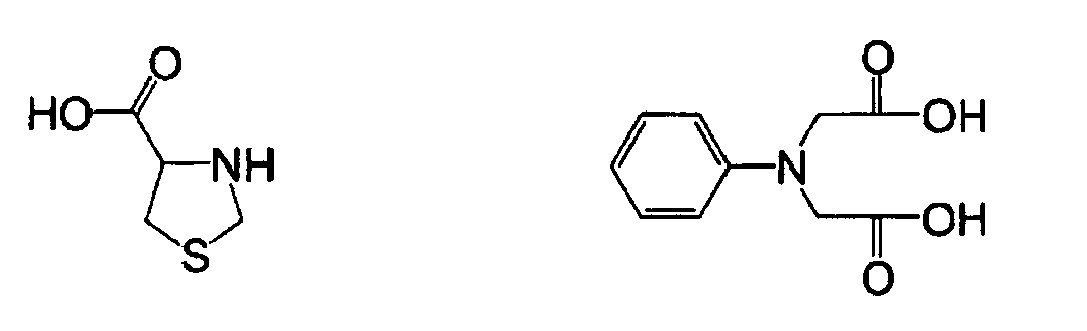


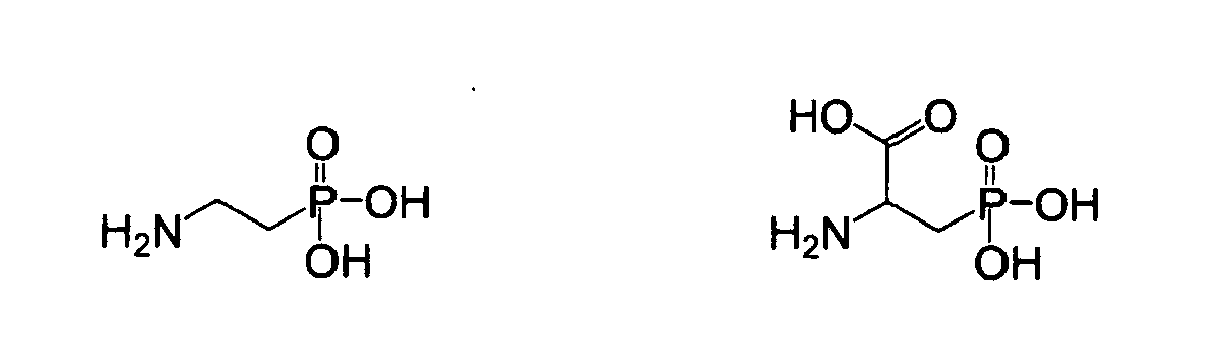


- The solid content of the compound (b) having within the molecule thereof an acid group and a partial structure functioning as a base in the specific protective layer is preferably in a range of from 0.5% by mass to 50% by mass, more preferably from 1% by mass to 30% by mass, and most preferably from 2% by mass to 25% by mass.
- As necessary, other components may be added to the specific protective layer containing a hydrophilic polymer and a compound having within the molecule thereof an acid group and a base.
- The specific protective layer preferably contains an inorganic compound (c) from the viewpoint of improving oxygen permeabilty and abrasion resistance. The inorganic compound (c) refers to, for example, a metal oxide or an oxide having a plurality of metal atoms, and may be selected as appropriate from these compounds to achieve excellent oxygen impermeability and favorable light permeability. The compound is preferably soluble or dispersible in water. It is preferable that the inorganic layered compound (c-1) be used as the inorganic compound (c).
- The specific protective layer according to the invention preferably contains an inorganic layered compound, more specifically, an inorganic compound having a layered structure and a plate shape. The combined use of such an inorganic layered compound further improves the oxygen impermeability, further improves the film strength of the protective layer to improve the flaw resistance, and imparts matting property to the specific protective layer.
- As a result, the specific protective layer, not only has oxygen impermeability as described above, but can also prevent flaws and deterioration due to deformation. By imparting matting property to the protective layer, the adhesion of the surface of the protective layer of a planographic printing plate precursor to the back surface of the support of an adjacent planographic printing plate precursor can be suppressed when planographic printing plate precursors are stacked.
- In the case where the inorganic layered compound (preferably a mica compound) is used in combination with the "compound (b) having within the molecule thereof an acid group and a partial structure functioning as a base" in the specific protective layer, they are mixed in a solvent to make a protective layer coating solution with no precipitation of the inorganic layered compound. Generally, when an inorganic layered compound is used in combination with a hydrophilic compound having a highly polar hydrophilic site such as a sulfonic acid group alone or ammonium group alone, precipitation may be readily caused by mixing. The reason for the ready formation of a precipitate by combination of an inorganic layered compound and a compound having a hydrophilic site, however it is considered that the inorganic layered compound and the hydrophilic site interacts to form a precipitate. On the other hand, the "compound (b) having within the molecule thereof an acid group and a partial structure functioning as a base" used in the specific protective layer of the invention scarcely produces precipitates probably due to little interaction with an inorganic layered compound. It is thus considered that the combination use of an inorganic layered compound in the specific protective layer of the invention allows the efficient development in the addition effects of a mica compound and others.
- Examples of the inorganic layered compound include mica compounds such as a natural mica and a synthetic mica represented by, for example, the Formula: A(B, C)2-5D4O10(OH, F, O)2 wherein A is K, Na or Ca; each of B and C is Fe(II), Fe(III), Mn, Al, Mg, or V; and D is Si or Al.
- Examples of natural mica compounds include white mica, paragonite, bronze mica, black mica and flaky mica. Examples of synthetic mica compounds include non-swelling mica such as fluorine bronze mica KMg3 (AlSi3O10)F2 and potassium tetrasilicate mica KMg2.5 (Si4O10)F2 and swelling mica such as Na tetrasilyric mica NaMg2.5 (Si4O10)F2, Na or Li teniolite (Na, Li) Mg2Li (Si4O10)F2, montmorillonite type Na or Li hectorite (Na, Li)1/8Ng2/5Li1/8 (Si4O10)F2. Synthetic smectite is also useful.
- Among the mica compounds, fluorine-based swelling mica is particularly useful. More specifically, the swelling synthetic mica has a laminated structure composed of unit crystal latticed layers having a thickness of about 10 to 15 A, and the metal atom substitution within the lattice is considerably large in comparison with other clay minerals. Consequently, the latticed layer lacks a positive charge, and cations such as Na+, Ca2+ and Mg2+ are adsorbed between layers to compensate therefor. These interlayer cations are called exchangeable cations because they are exchanged with various cations. In particular, when the interlayer cations are Li+ or Na+ having a small ion radius, the layered crystal lattices are so weakly bonded each other that they cause large swelling by water. When the compound is sheared in this state, cleavage occurs easily and a stable sol is formed in water. Swelling synthetic mica exhibits a strong tendency to swell in this manner, and useful for an aspect of the invention. In particular, swelling synthesis mica is preferable from the viewpoints of availability and uniform quality.
- The mica compound has a plate shape. The thickness of the compound is preferably smaller from the viewpoint of diffusion control, and the size of the plate is preferably larger as long as it does not impair the smoothness of the coated surface and permeability of active lights. Accordingly, the aspect ratio is 20 or more, preferably 100 or more, and most preferably 200 or more. The aspect ratio is a ratio of the thickness to major axis of a particle, and is measured from, for example, a microphotographic projection view of the particle. The higher the aspect ratio, the higher effect is achieved.
- The particle diameter of the mica compound may be 0.3 to 20 µm, preferably 0.5 to 10 µm, more preferably 1 to 5 µm, in terms of the average length of the major axis. The average thickness of the particles may be 0.1 µm or less, preferably 0.05 µm or less, more preferably 0.01 µm or less. Specifically, the size of the swelling synthetic mica as a typical compound has a thickness of from 1 to 50 nm and a major axis length (plane size) of from about 1 to about 20 µm.
- The amount of the inorganic layered compound contained in the specific protective layer is preferably in a range of from 5 to 50 mass%, more preferably in a range of from 10 to 40 mass%, based on the total solid content of the protective layer, from the viewpoint of suppression of the adhesion between the planographic printing plate precursors when stacked, suppression of flaw generation, deterioration in sensitivity due to shielding at the time of exposure to laser light, and low oxygen permeability. When plural inorganic layered compounds are simultaneously used, the total amount of the inorganic layered compounds is preferably in the range (mass%) described above.
- The kind and content of the components of the specific protective layer, for example, a water-soluble polymer (a) such as polyvinyl alcohol, a compound (b) having within the molecule thereof an acid group and a partial structure functioning as a base, an inorganic layered compound (c-1), and other compounds such as additives, the coating amount of the specific protective layer, and other factors may be determined as appropriate in consideration of required oxygen impermeability, development removability, fogging property, adhesiveness, and flaw resistance.
- The specific protective layer in the invention preferably has an oxygen permeability of 0.5 ml/m2 per day or more and 100 ml/m2 per day or less at 25°C and 1 barometric pressure. It is preferable that the coating amount be adjusted in such a manner that the oxygen permeability is achieved.
- The specific protective layer coating solution may contain known additives such as a surfactant for improving the coatability, and a water-soluble plasticizing agent for improving the physical property of the resulting coating film.
- Examples of the water-soluble plasticizing agent or flexibilizer for the coating film include propionamide, cyclohexanediol, glycerol, and sorbitol dipropylene glycol, which can be added in an amount of several % by mass with respect to the water-soluble polymer (a). Further, a water-soluble (meth)acrylic polymer may be added. Examples of the surfactant include: anionic surfactants such as sodium alkylsulfate and sodium alkylsulfonate; amphoteric surfactants such as alkylamino carboxylates and alkylamino dicarboxylate; and nonionic surfactants such as polyoxyethylene alkyl phenyl ether, which can be added in an amount of several % by mass with respect to the water-soluble polymer (a).
- The specific protective layer may also contain a coloring agent (water-soluble dye) which has excellent permeability to lights used for exposing the image recording layer, and efficiently absorbs lights having a wavelength not involved in the light exposure. As a result of this, the safelight suitability is improved with no decrease in the sensitivity.
- Application of the protective layer is not particularly limited as to the method, and is performed by applying an aqueous coating solution for protective layer containing the above-described components onto the image recording layer which will be further described later. For example, the methods described in
U.S. Patent No. 3,458,311 orJP-ANo. 55-49729 - The method for applying the protective layer containing an inorganic layered compound (c-1) such as a mica compound, a water-soluble polymer (a) such as polyvinyl alcohol, and a compound (b) having within the molecule thereof an acid group and a partial structure functioning as a base is further described below.
- In the first place, the inorganic layered compound (c-1) such as a mica compound is dispersed to make a dispersion liquid, and the dispersion liquid is mixed with the water-soluble polymer (a) such as polyvinyl alcohol (or an aqueous solution of the water-soluble polymer) and the compound (b) having within the molecule thereof an acid group and a partial structure functioning as a base to form a protective layer coating solution, and the coating solution is applied onto the image recording layer to form a protective layer.
- An example of the method for dispersing the inorganic layered compound such as a mica compound used for the protective layer is described below. In the first place, 5 to 10 parts by mass of a swelling mica compound, which has been exemplified as a preferable mica compound, to 100 parts by mass of water, thoroughly blended with water for swelling, and dispersed with a disperser.
- Examples of the disperser include various mills which perform dispersion by mechanically applying direct force, a high-speed stirring dispersers having a large shearing force, and dispersers giving strong ultrasonic energy. Specific examples thereof include a ball mill, a sand grinder mill, a visco mill, a colloid mill, a homogenizer, a dissolver, a polytron, a homomixer, a homoblender, a keddy mill, a jet aditor, a capillary emulsifier, a liquid siren, an electromagnetic strictive ultrasonic wave generator, and an emulsifying device with a Paulman whistle.
- Generally, 2 to 15% by mass of the dispersion of the mica compound dispersed by the above-described method is highly viscous or gelatinous, and has significantly favorable storage stability. When the dispersion is used for the preparation of the protective layer coating solution, it is preferable that the dispersion be diluted with water, thoroughly stirred, and then blended with a water-soluble polymer such as polyvinyl alcohol (or an aqueous solution of a water-soluble polymer such as polyvinyl alcohol).
- The coating amount of the specific protective layer is preferably from 0.1 g/m2 to 4.0 g/m2, and more preferably from 0.3 g/m2 to 3.0 g/m2 in the viewpoints of the film strength and flaw resistance of the resulting protective layer, maintenance of the image quality, and adequate oxygen permeability for imparting safelight suitability.
- The thickness of the protective layer is preferably from 0.1 to 5 µm, and particularly preferably from 0.2 to 2 µm. Other properties such as the adhesiveness to the image region and flaw resistance are also significantly important factors for handling the planographic printing plate precursor. More specifically, when the protective layer having hydrophilicity due to the water-soluble polymer component is laminated to the image recording layer having lipophilicity, insufficient adhesive force tends to cause the separation of the protective layer, where defects such as insufficient curing of the film may be caused by polymerization inhibition by oxygen.
- Regarding the specific protective layer, the adhesiveness to the image region on the image recording layer and uniformity of the film are also regarded as sinificantly important properties. More specifically, when the hydrophilic protective layer composed mainly of a water-soluble polymer (a) is laminated to the lipophilic image recording layer, insufficient adhesive force tends to cause the separation of the protective layer, where defects such as insufficient curing of the film may occur due to polymerization inhibition by oxygen. For improving the adhesiveness between the two layers, various proposals have been made. For example,
U.S. Application No. 292,501 andU.S. Application No. 44,563 describe that sufficient adhesiveness is achieved by adding 20 to 60% by mass of an acrylic emulsion or water-insoluble vinyl pyrrolidone-vinyl acetate copolymer to a hydrophilic polymer composed mainly of polyvinyl alcohol, and laminating to the image recording layer. These known techniques for improving the adhesiveness between an image recording layer and a hydrophilic layer such as the specific protective layer are all applicable for the planographic printing method of the invention, and the preparation of the planographic printing plate precursor of the invention used therefor. - The image recording material of the invention is composed of a support; an image recording layer provided on the support, which contains (a) a binder polymer, (b) a compound having a polymerizable unsaturated group, and (c) a polymerization initiator; and the above-described specific protective layer formed on the surface of the image recording layer in a direct manner or via an appropriate layer for improving the adhesiveness.
- The image recording layer preferably further contains (d) a dye having the absorption maximum in a range of from 300 to 1200 nm in the viewpoint of sensitivity.
- In the image recording layer, the polymerization initiator (c) existing in the binder polymer (a) generates polymerization initiating species such as radicals upon heat and/or light energy, and the initiating species causes polymerization of the compound (b) having a polymerizable unsaturated group to cure the light-exposed portion alone. Thereafter the image recording layer is subjected to alkali developing treatment for rapidly removing the uncured region to form an image.
- The components of the image recording layer will be described below.
- The polymerization initiator used in the invention may be a compound which generates radicals upon heat and/or light energy to initiate and promote the polymerization of a compound having a polymerizable unsaturated group. Specific examples thereof include known radical generators. The radical generator used in the invention may be a known heat polymerization initiator, a compound with smaller dissociation energy, or a photopolymerization initiator. The radical-generating compound preferably used in the invention refers to a compound which generates radicals upon heat energy to initiate and promote the polymerization of a compound having a polymerizable unsaturated group.
- The polymerization initiator which generates radicals upon energy deposition may be contained alone or in combination of two or more of them in the image recording layer.
- Examples of the radical generator include organic halogenated compounds (a), carbonyl compounds (b), organic peroxide compounds (c), azo-based polymerization initiators (d), azido compounds (e), metallocene compounds (f), hexaarylbiimidazol compounds (g), organic boric acid compounds (h), disulfon compounds (i), oxime ester compounds (j), and onium salt compounds (k).
- These compounds will be described below.
- Specific examples of the organic halogenated compounds (a) include the compounds described in, for example, Wakabayashi et al. "Bull Chem. Soc Japan" 42, 2924 (1969),
U.S. Patent No. 3,905,815 , Japanese Patent Application Publication (JP-B) No. 46-4605 JP-A No. 48-36281 JP-A No. 55-32070 JP-A No. 60-239736 JP-A No. 61-169835 JP-ANo. 61-169837 JP-A No. 62-58241 JP-A No. 62-212401 JP-A No. 63-70243 JP-A No. 63-298339 - The organic halogenated compound is more preferably an s-triazine derivative wherein at least one mono, di or trihalogen-substituted methyl group is bonded to an s-triazine ring, and specific examples include 2,4,6-tris(monochloromethyl)-s-triazine, 2,4,6-tris(dichloromethyl)-s-triazine, 2,4,6-tris(trichloromethyl)-s-triazine, 2-methyl-4,6-bis(trichloromethyl)-s-triazine, 2-n-propyl-4,6-bis(trichloromethyl)-s-triazine, 2-(α,α,β-trichloroethyl)-4,6-bis(trichloromethyl)-s-triazine, 2-phenyl-4,6-bis(trichloromethyl)-s-triazine, 2-(p-methoxyphenyl)-4,6-bis(trichloromethyl)-s-triazine, 2-(3,4-epoxyphenyl)-4,6-bis(trichloromethyl)-s-triazine, 2-(p-chlorophenyl)-4,6-bis(trichloromethyl)-s-triazine, 2-[1-(p-methoxyphenyl)-2,4-butadienyl]-4,6-bis(trichloromethyl)-s-triazine, 2-styryl-4,6-bis(trichloromethyl)-s-triazine, 2-(p-methoxystyryl)-4,6-bis(trichloromethyl)-s-triazine, 2-(p-i-propyloxystyryl)-4,6-bis(trichloromethyl)-s-triazine, 2-(p-tolyl)-4,6-bis(trichloromethyl)-s-triazine, 2-(4-naphthoxynaphthyl)-4,6-bis(trichloromethyl)-s-triazine, 2-phenylthio-4,6-bis(trichloromethyl)-s-triazine, 2-benzylthio-4,6-bis(trichloromethyl)-s-triazine, 2,4,6-tris(dibromomethyl)-s-triazine, 2,4,6-tris(tribromomethyl)-s-triazine, 2-methyl-4,6-bis(tribromomethyl)-s-triazine, 2-methoxy-4,6-bis(tribromomethyl)-s-triazine, etc.
- Examples of the carbonyl compound (b) include benzophenone, benzophenone derivatives such as Michler's ketone, 2-methyl benzophenone, 3-methyl benzophenone, 4-methyl benzophenone, 2-chlorobenzophenone, 4-bromobenzophenone, 2-carboxybenzophenone, etc., acetophenone derivatives such as 2,2-dimethoxy-2-phenyl acetophenone, 2,2-diethoxy acetophenone, 1-hydroxycyclohexylphenyl ketone, α-hydroxy-2-methyl phenyl propane, 1-hydroxy-1-methylethyl-(p-isopropylphenyl) ketone, 1-hydroxy-1-(p-dodecylphenyl) ketone, 2-methyl-(4'-(methylthio) phenyl)-2-morpholino-1-propanone, 1,1,1-trichloromethyl-(p-butylphenyl) ketone, etc., thioxanthone, thioxanthone derivatives such as 2-ethyl thioxanthone, 2-isopropyl thioxanthone, 2-chlorothioxanthone, 2,4-dimethyl thioxanthone, 2,4-diethyl thioxanthone, 2,4-diisopropyl thioxanthone, etc., and benzoate esters such as ethyl p-dimethylaminobenzoate, ethyl p-diethylaminobenzoate, etc.
- Examples of the organic peroxide compounds (c) include trimethylcyclohexanone peroxide, acetylacetone peroxide, 1,1-bis(tert-butylperoxy)-3,3,5-trimethylcyclohexane, 1,1-bis(tert-butylperoxy)cyclohexane, 2,2-bis(tert-butylperoxy)butane, tert-butylhydroperoxide, cumenehydroperoxide, diisopropylbenzenehydroperoxide, 2,5-dimethylhexane-2,5-dihydroperoxide, 1,1,3,3-tetramethylbutylhydroperoxide, tert-butylcumylperoxide, dicumylperoxide, 2,5-dimethyl-2,5-di(tert-butylperoxy)hexane, 2,5-oxanoylperoxide, succinic acid peroxide, benzoyl peroxide, 2,4-dichlorobenzoyl peroxide, diisopropylperoxy dicarbonate, di-2-ethylhexylperoxy dicarbonate, di-2-ethoxyethylperoxy dicarbonate, dimethoxyisopropylperoxy carbonate, di(3-methyl-3-methoxybutyl)peroxy dicarbonate, tert-butylperoxy acetate, tert-butylperoxy pivalate, tert-butylperoxyneodecanoate, tert-butylperoxy octanoate, tert-butylperoxy laurate, tertiary carbonate, 3,3',4,4'-tetra-(t-butylperoxycarbonyl)benzophenone, 3,3',4,4'-tetra-(t-hexylperoxycarbonyl)benzophenone, 3,3,,4,4'-tetra-(p-isopropylcumylperoxycarbonyl) benzophenone, carbonyldi(t-butylperoxydihydrogen diphthalate), and carbonyldi(t-hexylperoxydihydrogen diphthalate).
- Example of the azo-based polymerization initiators (d) include azo compounds described in
JP-ANo. 8-108621 - Examples of the azido compounds (e) include 2,6-bis(4-azidobenzylidene)-4-methylcyclohexanone.
- Examples of the metallocene compounds (f) include various titanocene compounds described in
JP-A No. 59-152396 JP-A No. 61-151197 JP-A No. 63-41484 JP-A No. 2-249 JP-A No. 2-4705 JP-A No. 5-83588 JP-A No. 1-304453 JP-ANo. 1-152109 - Examples of the hexaarylbiimidazol compounds (g) include various compounds described in
JP-B No. 6-29285 U.S. Patent No. 3,479,185 ,U.S. Patent No. 4,311,783 , andU.S. Patent No. 4,622,286 , such as 2,2'-bis(o-chlorophenyl)-4,4',5,5'-tetraphenylbiimidazole, 2,2'-bis(o-bromophenyl)-4,4',5,5'-tetraphenylbiimidazole, 2,2'-bis(o,p-dichlorophenyl)-4,4',5,5'-tetraphenylbiimidazole, 2,2'-bis(o-chlorophenyl)-4,4',5,5'-tetra(m-methoxyphenyl)biimidazole, 2,2'-bis(o,o'-dichlorophenyl)-4,4',5,5'-tetraphenylbiimidazole, 2,2'-bis(o-nitrophenyl)-4,4',5,5'-tetraphenylbiimidazole, 2,2'-bis(o-methyl phenyl)-4,4',5,5'-tetraphenylbiimidazole, and 2,2'-bis(o-trifluorophenyl)-4,4',5,5'-tetraphenyl biimidazole. - Specific examples of the (h) organic boric aid compounds include organic borates described in, for example,
JP-A No. 62-143044 JP-A No. 62-150242 JP-A No. 9-188685 JP-A No. 9-188686 JP-A No. 9-188710 JP-A No. 2000-131837 JP-A No. 2002-107916 Japanese Patent No. 2764769 Japanese Patent Application No. 2000-310808 JP-A No. 6-157623 JP-A No. 6-175564 JP-A No. 6-175561 JP-A No. 6-175554 JP-A No. 6-175553 JP-A No. 9-188710 JP-A No. 6-348011 JP-A No. 7-128785 JP-A No. 7-140589 JP-A No. 7-306527 JP-A No. 7-292014 - Examples of the disulfone compounds (i) include compounds described in
JP-A No. 61-166544 Japanese Patent Application No. 2001-132318 - Examples of the oxime ester compounds (j) include compounds described in J. C. S. Perkin II, pp. 1653-1660 (1979), J. C. S. Perkin II, pp. 156-162 (1979), Journal of Photopolymer Science and Technology, pp. 202-232 (1995) and
JP-A No. 2000-66385 JP-A No. 2000-80068 


- Examples of theonium salt compounds (k) include diazonium salts described in S. I. Schlesinger, Photogr, Sci, Eng., 18,387 (1974), T. S. Bal et al, Polymer, 21,423 (1980), ammonium salts described in
U.S. Patent No. 4,069,055 andJP-ANo. 4-365049 U.S. Patent No. 4,069,055 andU.S. Patent No. 4,069,056 , iodonium salts described inEuropean Patent Application No. 104,143 U.S. Patent No. 339,049 andU.S. Patent No. 410,201 ,JP-A No. 2-150848 JP-A No. 2-296514 European Patent Application No. 370,693 European Patent Application No. 390,214 European Patent Application No. 233,567 European Patent Application No. 297,443 European Patent Application No. 297,442 U.S. Patent No. 4,933,377 ,U.S. Patent No. 161,811 ,U.S. Patent No. 410,201 ,U.S. Patent No. 339,049 ,U.S. Patent No. 4,760,013 ,U.S. Patent No. 4,734,444 ,U.S. Patent No. 2,833,827 ,German Patent No. 2,904,626 ,German Patent No. 3,604,580 , andGerman Patent No. 3,604,581 , selenonium salts described in J. V. Crivello et al, Macromolecules, 10 (6), 1307 (1977), J. V. Crivello et al, J. Polymer Sci., Polymer Chem, Ed., 17, 1047 (1979), and arsonium salts described inC. S. Wen et al, Teh, Proc. Conf. Rad, Curing ASIA, p. 478, Tokyo, Oct (1988). - From the viewpoint of the reactivity and stability, the above-described oxime ester compounds and diazonium salts, iodonium salts, and sulfonium salts, which will be further described later, are particularly preferable examples of the polymerization initiator. In the invention, the onium salt functions not as an acid generator, but as an ionic radical polymerization initiator.
- In the invention, the onium salts represented by the following Formulae (RI-I) to (RI-III) are preferable.


- In the Formula (RI-I), Ar11 represents an aryl group containing 20 or less carbon atoms, which may have 1 to 6 substituents, and the substituents are preferably selected from alkyl groups each containing 1 to 12 carbon atoms, alkenyl groups each containing 1 to 12 carbon atoms, alkynyl groups each containing 1 to 12 carbon atoms, aryl groups each containing 1 to 12 carbon atoms, alkoxy groups each containing 1 to 12 carbon atoms, aryloxy groups each containing 1 to 12 carbon atoms, halogen atoms, alkylamino groups each containing 1 to 12 carbon atoms, dialkylamino groups each containing 1 to 12 carbon atoms, alkyl amide groups each containing 1 to 12 carbon atoms, aryl amide groups each containing 1 to 12 carbon atoms, carbonyl groups, carboxyl groups, cyano groups, sulfonyl groups, thioalkyl groups each containing 1 to 12 carbon atoms, and thioaryl groups each containing 1 to 12 carbon atoms. Z11- represents a monovalent anion which may be selected from a halogen ion, a perchlorate ion, a hexafluorophosphate ion, a tetrafluoroborate ion, a sulfonate ion, a sulfinate ion, a thiosulfonate ion and a sulfate ion. Z11- preferably represents a perchlorate ion, a hexafluorophosphate ion, a tetrafluoroborate ion, a sulfonate ion, a sulfinate ion, or a carboxylate ion from the viewpoint of stability and reactivity.
- In the Formula (RI-II), Ar21 and Ar22 each independently represent an aryl group containing 20 or less carbon atoms, which may have 1 to 6 substituents, and the substituents are preferably selected from alkyl groups each containing 1 to 12 carbon atoms, alkenyl groups each containing 1 to 12 carbon atoms, alkynyl groups each containing 1 to 12 carbon atoms, aryl groups each containing 1 to 12 carbon atoms, alkoxy groups each containing 1 to 12 carbon atoms, aryloxy groups each containing 1 to 12 carbon atoms, halogen atoms, alkylamino groups each containing 1 to 12 carbon atoms, dialkylamino groups each containing 1 to 12 carbon atoms, alkyl amide groups each containing 1 to 12 carbon atoms, aryl amide groups each containing 1 to 12 carbon atoms, carbonyl groups, carboxyl groups, cyano groups, sulfonyl groups, thioalkyl groups each containing 1 to 12 carbon atoms, and thioaryl groups each containing 1 to 12 carbon atoms. Z21- represents a monovalent anion which may be selected from a halogen ion, a perchlorate ion, a hexafluorophosphate ion, a tetrafluoroborate ion, a sulfonate ion, a sulfinate ion, a thiosulfonate ion and a sulfate ion. Z21- preferably represents a perchlorate ion, a hexafluorophosphate ion, a tetrafluoroborate ion, a sulfonate ion, or a sulfinate ion from the viewpoint of stability.
- In the Formula (RI-III), R31, R32 and R33 each independently represent an aryl group, alkyl group, alkenyl group or alkynyl group containing 20 or less carbon atoms which may have 1 to 6 substituents, and is preferably an aryl group in respect of reactivity and safety. The substituents are preferably selected from alkyl groups each containing 1 to 12 carbon atoms, alkenyl groups each containing 1 to 12 carbon atoms, alkynyl groups each containing 1 to 12 carbon atoms, aryl groups each containing 1 to 12 carbon atoms, alkoxy groups each containing 1 to 12 carbon atoms, aryloxy groups each containing 1 to 12 carbon atoms, halogen atoms, alkylamino groups each containing 1 to 12 carbon atoms, dialkylamino groups each containing 1 to 12 carbon atoms, alkyl amide groups each containing 1 to 12 carbon atoms, aryl amide groups each containing 1 to 12 carbon atoms, carbonyl groups, carboxyl groups, cyano groups, sulfonyl groups, thioalkyl groups each containing 1 to 12 carbon atoms, and thioaryl groups each containing 1 to 12 carbon atoms. Z31- represents a monovalent anion which may be selected from a halogen ion, a perchlorate ion, a hexafluorophosphate ion, a tetrafluoroborate ion, a sulfonate ion, a sulfinate ion, a thiosulfonate ion and a sulfate ion. Z31- preferably represents a perchlorate ion, a hexafluorophosphate ion, a tetrafluoroborate ion, a sulfonate ion, a sulfinate ion, or a carboxylate ion from the viewpoint of stability and reactivity. In an embodiment, Z31- represents a carboxylate ion disclosed in
JP-A 2001-343742 JP-A 2002-148790 - Examples of the polymerization initiator usable in the invention are shown below. However, the examples should not be construed as limiting the invention.


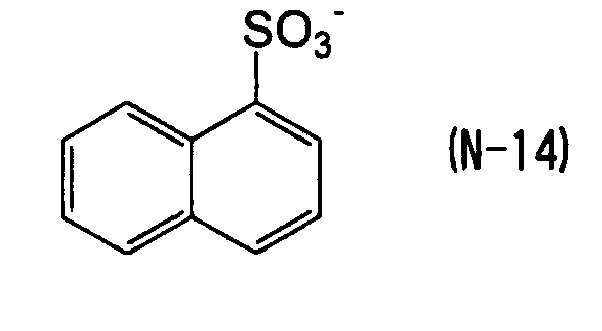


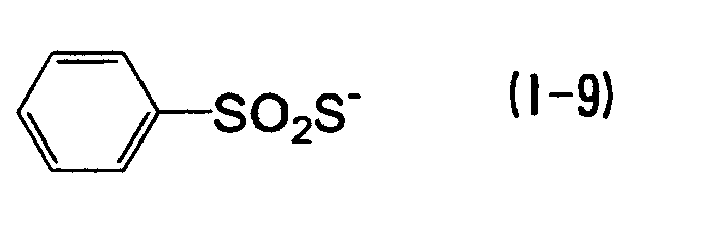


- Among the above-described compounds, diazonium salts, iodonium salts, and sulfonium salts included in oxime ester compounds (j) or (k) onium chlorides are preferable as the polymerization initiator in the invention from the viewpoint of particularly the reactivity and stability. In the invention, the onium salt functions not as an acid generator, but an ionic radical polymerization initiator.
- The polymerization initiator in the invention is particularly preferably an iodonium salt having an electron-donating group or sulfonium salt having an electron-withdrawing group from the viewpoint of the balance between the reactivity and stability, and in particular, an iodonium salt having two or more alkoxy groups in its skeleton with a cation portion is preferable, and an iodonium salt having three or more alkoxy groups is most preferable.
- The polymerization initiator (C) is used in an amount of from 0.1 to 50% by mass, preferably from 0.5 to 30% by mass, most preferably from 1 to 20% by mass with respect to the total solid content composing the image recording layer. When the amount is within the range, favorable sensitivity and favorable stain resistance of the non-image region during printing are achieved. The polymerization initiator may be used alone, or in combination of two or more of them. The polymerization initiator may be added to the same layer together with other components, or may be added to an independently formed layer.
- This section describes the binder polymer used for developing treatment, more specifically for removal of the non-image region after light exposure by dissolving with a developer or the like according to the image recording layer.
- For the purpose of improving the coating property of the recording layer to be formed, as necessary, a binder polymer may be used. The binder is preferably a linear organic polymer. The "linear organic polymer" may be freely selected from known ones. It is preferable to select a linear organic polymer which is soluble or swells in water or weak alkaline water for allowing water development or weak alkaline development. The linear organic polymer is selected and used not only as an agent for forming a coating film of the image recording material, but also as a water, weak alkaline water, or organic solvent developer.
- In the invention, it is preferable to use a polymer having within the molecule thereof an alkali-soluble group to achieve favorable alkali developability.
- For example, the use of a water-soluble organic polymer allows water development. Examples of the linear organic polymer include radical polymers having in the side chain thereof a carboxylic acid group described in, for example,
JP-A No. 59-44615 JP-B No. 54-34327 JP-B No. 58-12577 JP-B No. 54-25957 JP-A No. 54-92723 JP-A No. 59-53836 JP-A No. 59-71048 - Other examples include acidic cellulose derivatives having in the side chain thereof a carboxylic acid group. An adduct of a hydroxy group-containing polymer and a cyclic acid anhydride is also useful.
- In the case where a copolymer of an alkali soluble resin is used, the compound to be copolymerized with the resin may be a monomer other than the above-described monomers. Examples of the other monomers include the following compounds listed in (1) to (13):
- (1) acrylic esters and methacrylic acid esters having an aliphatic hydroxy group such as 2-hydroxyethyl acrylate, 2-hydroxypropyl acrylate, 3-hydroxypropyl acrylate, 4-hydroxybutyl acrylate, 2-hydroxyethyl methacrylate, 2-hydroxypropyl methacrylate, 3-hydroxypropyl methacrylate, and 4-hydroxybutyl methacrylate;
- (2) alkyl acrylates such as methyl acrylate, ethyl acrylate, acrylate propyl, butyl acrylate, isobutyl acrylate, amyl acrylate, hexyl acrylate, 2-ethylhexyl acrylate , octyl acrylate, benzyl acrylate, 2-chloroethyl acrylate, glycidyl acrylate, 3,4-epoxycyclohexylmethyl acrylate, vinyl acrylate, 2-phenylvinyl acrylate, 1-propenyl acrylate, allyl acrylate, 2-allyloxyethyl acrylate, and propargyl acrylate;
- (3) alkyl methacrylates such as methyl methacrylate, ethyl methacrylate, propyl methacrylate, butyl methacrylate, isobutyl methacrylate, amyl methacrylate, hexyl methacrylate, 2-ethylhexyl methacrylate, cyclohexyl methacrylate, benzyl methacrylate, 2-chloroethyl methacrylate, glycidyl methacrylate, 3,4-epoxycyclohexylmethyl methacrylate, vinyl methacrylate, 2-phenylvinyl methacrylate, 1-propenyl methacrylate, allyl methacrylate, 2-allyloxyethyl methacrylate, and propargyl methacrylate;
- (4) acrylamides or methacrylamides such as acrylamide, methacrylamide, N-methylolacrylamide, N-ethylacrylamide, N-hexylmethacrylamide, N-cyclohexylacrylamide, N-hydroxyethylacrylamide, N-phenylacrylamide, N-nitrophenylacrylamide, N-ethyl-N-phenylacrylamide, vinylacrylamide, vinylmethacrylamide, N,N-diallylacrylamide, N,N-diallylmethacrylamide, allylacrylamide, and allylmethacrylamide;
- (5) vinyl ethers such as ethyl vinyl ether, 2-chloroethyl vinyl ether, hydroxyethyl vinyl ether, propyl vinyl ether, butyl vinyl ether, octyl vinyl ether, and phenyl vinyl ether;
- (6) vinyl esters such as vinyl acetate, vinyl chloroacetate, vinyl butylate, and vinyl benzoate;
- (7) styrenes such as styrene, α-methylstyrene, methylstyrene, chloromethylstyrene, and p-acetoxystyrene;
- (8) vinyl ketones such as methyl vinyl ketone, ethyl vinyl ketone, propyl vinyl ketone, and phenyl vinyl ketone;
- (9) olefins such as ethylene, propylene, isobutylene, butadiene, and isoprene;
- (10) N-vinylpyrrolidone, acrylonitrile, methacrylonitrile, and the like;
- (11) unsaturated imides such as maleimide, N-acryloylacrylamide, N-acetylmethacrylamide, N-propionylmethacrylamide, and N-(p-chlorobenzoyl)methacrylamide; and
- (12) methacrylate monomers having a hetero atom in the α position, examples thereof include compounds described in
Japanese Patent Application No. 2001-115595 Japanese Patent Application No. 2001-115598 - Among them, preferable are (meth)acrylic resins having in the side chain thereof an allyl group or a vinyl ester group and a carboxyl group, alkali soluble resins having in the side chain thereof a double bond described in
JP-A No. 2000-187322 JP-A No. 2002-62698 JP-A No. 2001-242612 - Urethane-containing binder polymers containing an acid group as described in
JP-B No. 7-12004 JP-B No. 7-120041 JP-B No. 7-120042 JP-B No. 8-12424 JP-A No. 63-287944 JP-A No. 63-287947 JP-A No. 1-271741 JP-A No. 10-116232 JP-A No. 2002-107918 - Acetal-modified polyvinyl alcohol-containing binder polymers having an acid group as described in
EP993966 EP1204000 , andJP-A No. 2001-318463 - As other water-soluble linear organic compounds, polyvinyl pyrrolidone and polyethylene oxide are useful. To increase the strength of the cured film, alcohol-soluble nylon, polyethers of 2,2-bis-(4-hydroxyphenyl)-propane and epichlorohydrin, etc. are also useful.
- The weight-average molecular weight of the polymer used in the invention is preferably fom 5000 or more, more preferably in a range of from 10,000 to 300,000, and the number-average molecular weight thereof is preferably 1,000 or more, more preferably in a range of from 2,000 to 250,000. Polydispersity (weight-average molecular weight/number-average molecular weight) is preferably 1 or more, more preferably in a range of from 1.1 to 10.
- The polymer may be a random polymer, a block polymer or a graft polymer.
- The polymer used in the invention can be synthesized in a method known in the art. Examples of the solvent used in synthesis include tetrahydrofuran, ethylene dichloride, cyclohexanone, methyl ethyl ketone, acetone, methanol, ethanol, ethylene glycol monomethyl ether, ethylene glycol monoethyl ether, 2-methoxyethyl acetate, diethylene glycol dimethyl ether, 1-methoxy-2-propanol, 1-methoxy-2-propyl acetate, N,N-dimethyl formamide, N,N-dimethyl acetamide, toluene, ethyl acetate, methyl lactate, ethyl lactate, dimethyl sulfoxide, and water. Only one solvent may be used, or a mixture of two or more solvents may be used.
- As the radical polymerization initiator used for synthesizing the polymer used in the invention, known compounds such as an azo initiator or a peroxide initiator can be used.
- Among the binders described above, binder polymers having a repeating unit represented by the following Formula (I) shown in
Japanese Patent Application No. 2002-287920 
- In Formula (I), R1 represents a hydrogen atom or a methyl group; R2 is a linking group composed of two or more atoms selected from the group consisting of carbon atoms, hydrogen atoms, oxygen atoms, nitrogen atoms and sulfur atoms wherein the number of atoms in the linking group is 2 to 82; A represents an oxygen atom or -NR3- wherein R3 represents a hydrogen atom or a C1-10 monovalent hydrocarbon group; and n is an integer of 1 to 5.
- In the Formula (I) above, the number of atoms in the main skeleton of the linking group represented by R2 is preferably 1 to 30. R2 preferably has an alkylene structure or a structure including alkylene structures linked via ester linkages.
- Hereinafter, the repeating units represented by the Formula (I) will be described in detail.
- R1 in the Formula (I) represents a hydrogen atom or a methyl group, preferably a methyl group.
- The linking group represented by R2 in the Formula (I) is a linking group composed of two or more atoms selected from the group consisting of carbon atoms, hydrogen atoms, oxygen atoms, nitrogen atoms and sulfur atoms wherein the number of atoms in the linking group is 2 to 82, preferably 2 to 50, more preferably 2 to 30. When the linking group has substituent(s), the number of atoms refers to the number of atoms including the atoms in the substituent(s) on the linking group.
- Specifically, the number of atoms in the main skeleton of the linking group represented by R2 is preferably 1 to 30, more preferably 3 to 25, still more preferably 4 to 20, most preferably 5 to 10. The "main skeleton of the linking group" in the invention refers to an atom or an atomic group serving to link A to the terminal COOH in the Formula (I). When plural linking routes are present, the main skeleton refers to the atom or atomic group constituting the linking route having the smallest number of atoms. Accordingly, when the linking group has a cyclic structure, the number of atoms to be used for calculation varies depending on the linking site (for example, o-, m-, p-etc.).
- The structure of the specific binder polymer according to the invention, and the number of atoms constituting the main skeleton of the linking group represented by R2 in the structure and the method of calculating the number of atoms, are both shown below.
Numbers of atoms constituting main skeleton of linking group (1) 
:6 (2) 
:6 (3) 
:6 (4) 
:8 (5) 
:6 (6) 
:6 (7) 
:7 (8) 
:6 - The linking group represented by R2 in the Formula (I) is more specifically an alkylene, a substituted alkylene, an arylene, a substituted arylene, or a group in which plural divalent groups, such as those described above, are linked via amide or ester linkages.
- A linking group in the chain structure may be ethylene, propylene etc. A structure including such alkylene groups linked via ester linkages is also preferable.
- The linking group represented by R2 in the Formula (I) is preferably a (n+1)-valent hydrocarbon group having a C3-30 alicyclic structure. Examples thereof include (n+1)-valent hydrocarbon groups obtained by removing (n+1) hydrogen atoms on one or more arbitrary carbon atoms constituting a compound having an alicyclic structure such as cyclopropane, cyclopentane, cyclohexane, cycloheptane, cyclooctane, cyclodecane, dicyclohexyl, tertiary cyclohexyl or norbornane which may be substituted by one or more arbitrary substituents. R2 preferably has 3 to 30 carbon atoms including the carbon atoms in the substituent(s) if any.
- One or more arbitrary carbon atoms in the compound having an alicyclic structure may be substituted by one or more heteroatoms selected from the group consisting of nitrogen atoms, oxygen atoms and sulfur atoms. In respect of printing durability, R2 is preferably a (n+1)-valent hydrocarbon group having an alicyclic structure which may have a substituent and which includes two or more rings and has 5 to 30 carbon atoms, such as a condensed polycyclic aliphatic hydrocarbon, a crosslinked alicyclic hydrocarbon, a spiroaliphatic hydrocarbon, and a combination of aliphatic hydrocarbon rings (a structure in which rings are combined by bonds or via linking groups). The number of carbon atoms refers to the number of carbon atoms including the carbon atoms in the substituent(s) if any.
- Regarding linking groups represented by R2, the number of atoms is further preferably 5 to 10. Linking groups having a chain structure in which includes a ester bond or a cyclic structure are preferable.
- A substituent which can be introduced into the linking group represented by R2 may be a monovalent non-metal atomic group excluding hydrogen, and examples thereof include a halogen atom (-F, -Br, -Cl, -I), a hydroxyl group, an alkoxy group, an aryloxy group, a mercapto group, an alkyl thio group, an aryl thio group, an alkyl dithio group, an aryl dithio group, an amino group, a N-alkyl amino group, a N,N-dialkyl amino group, a N-aryl amino group, a N,N-diaryl amino group, a N-alkyl-N-aryl amino group, an acyloxy group, a carbamoyloxy group, a N-alkylcarbamoyloxy group, a N-aryl carbamoyloxy group, a N,N-dialkyl carbamoyloxy group, a N,N-diaryl carbamoyloxy group, a N-alkyl-N-aryl carbamoyloxy group, an alkyl sulfoxy group, an aryl sulfoxy group, an acyl thio group, an acyl amino group, a N-alkyl acyl amino group, a N-aryl acyl amino group, a ureido group, a N'-alkyl ureido group, a N',N'-dialkyl ureido group, a N'-aryl ureido group, a N',N'-diaryl ureido group, a N'-alkyl-N'-aryl ureido group, a N-alkyl ureido group, a N-aryl ureido group, a N'-alkyl-N-alkyl ureido group, a N'-alkyl-N-aryl ureido group, a N',N'-dialkyl-N-alkyl ureido group, a N',N'-dialkyl-N-aryl ureido group, a N'-aryl-N-alkyl ureido group, a N'-aryl-N-aryl ureido group, a N',N'-diaryl-N-alkyl ureido group, a N',N'-diaryl-N-aryl ureido group, a N'-alkyl-N'-aryl-N-alkyl ureido group, a N'-alkyl-N'-aryl-N-aryl ureido group, an alkoxy carbonyl amino group, an aryloxy carbonyl amino group, a N-alkyl-N-alkoxycarbonyl amino group, a N-alkyl-N-aryloxy carbonyl amino group, a N-aryl-N-alkoxycarbonyl amino group, a N-aryl-N-aryloxycarbonyl amino group, a formyl group, an acyl group, a carboxyl group and its conjugate base group, an alkoxy carbonyl group, an aryloxy carbonyl group, a carbamoyl group, a N-alkyl carbamoyl group, a N,N-dialkyl carbamoyl group, a N-aryl carbamoyl group, a N,N-diaryl carbamoyl group, a N-alkyl-N-aryl carbamoyl group, an alkyl sulfinyl group, an aryl sulfinyl group, an alkyl sulfonyl group, an aryl sulfonyl group, a sulfo group (-SO3H) and its conjugate base group, an alkoxy sulfonyl group, an aryloxy sulfonyl group, a sulfinamoyl group, a N-alkyl sulfinamoyl group, a N,N-dialkyl sulfinamoyl group, a N-aryl sulfinamoyl group, a N,N-diaryl sulfinamoyl group, a N-alkyl-N-aryl sulfinamoyl group, a sulfamoyl group, a N-alkyl sulfamoyl group, a N,N-dialkyl sulfamoyl group, a N-aryl sulfamoyl group, a N,N-diaryl sulfamoyl group, a N-alkyl-N-aryl sulfamoyl group, a N-acyl sulfamoyl group and its conjugate base group, a N-alkyl sulfonyl sulfamoyl group (-SO2NHSO2 (alkyl)) and its conjugate base group, a N-aryl sulfonyl sulfamoyl group (-SO2NHSO2 (allyl)) and its conjugate base group, a N-alkyl sulfonyl carbamoyl group (-CONHSO2 (alkyl)) and its conjugate base group, a N-aryl sulfonyl carbamoyl group (-CONHSO2 (aryl)) and its conjugate base group, an alkoxy silyl group (-Si(O-alkyl)3), an aryloxy silyl group (-Si(O-aryl)3), a hydroxysilyl group (-Si(OH)3) and its conjugate base group, a phosphono group (-PO3H2) and is conjugate base group, a dialkyl phosphono group (-PO3 (alkyl)2), a diaryl phosphono group (-PO3(aryl)2), an alkyl aryl phosphono group (-PO3(alkyl)(aryl)), a monoalkyl phosphono group (-PO3H(alkyl)) and its conjugate base group, a monoaryl phosphono group (-PO3H(aryl)) and its conjugate base group, a phosphonoxy group (-OPO3H2) and its conjugate base group, a dialkyl phosphonoxy group (-OPO3(alkyl)2), a diaryl phosphonoxy group (-OPO3(aryl)2), an alkyl aryl phosphonoxy group (-OPO3(alkyl)(aryl)), a monoalkyl phosphonoxy group (-OPO3H(alkyl)) and its conjugate base group, a monoaryl phosphonoxy group (-OPO3H(aryl)) and its conjugate base group, a cyano group, a nitro group, a dialkyl boryl group (-B(alkyl)2), a diaryl boryl group (-B(aryl)2), an alkyl aryl boryl group (-B(alkyl)(aryl)), a dihydroxy boryl group (-B(OH)2) and its conjugate base group, an alkyl hydroxy boryl group (-B(alkyl)(OH)) and its conjugate base group, an aryl hydroxy boryl group (-B(aryl)(OH)) and its conjugate base group, an aryl group, an alkenyl group and an alkynyl group.
- According to the design of the recording layer, a substituent having a hydrogen atom capable of hydrogen bonding, particularly a substituent having acidity whose acid dissociation constant (pKa) is lower than that of carboxylic acid, may not be preferable because it tends to lower printing durability. On the other hand, a hydrophobic substituent such as a halogen atom, a hydrocarbon group (alkyl group, aryl group, alkenyl group, or alkynyl group), an alkoxy group and an aryloxy group is preferable because it tends to improve printing durability. In particular, when the cyclic structure is a six-membered or lower-memberred monocyclic aliphatic hydrocarbon such as cyclopentane or cyclohexane, the hydrocarbon preferably has such hydrophobic substituents. If possible, these substituents may be bound to one another or to a substituted hydrocarbon group to form a ring. The substituents may themselves be substituted.
- In the Formula (I), when A is NR3-, R3 represents a hydrogen atom or monovalent hydrocarbon group having 1 to 10 carbon atoms. Examples of the monovalent hydrocarbon group having 1 to 10 carbon atoms represented by R3 include linear, branched , or cyclic alkyl groups having 1 to 10 carbon atoms such as an alkyl group, an aryl group, an alkenyl group, and an alkynyl group. Specific examples of the alkyl group include a methyl group, an ethyl group, a propyl group, a butyl group, a pentyl group, a hexyl group, a heptyl group, an octyl group, a nonyl group, a decyl group, an isopropyl group, an isobutyl group, a sec-butyl group, a tert-butyl group, an isopentyl group, a neopentyl group, a 1-methylbutyl group, an isohexyl group, a 2-ethylhexyl group, a 2-methylhexyl group, a cyclopentyl group, a cyclohexyl group, a 1-adamantyl group, and a 2-norbornyl group. Specific examples of the aryl group include aryl groups having 1 to 10 carbon atoms such as a phenyl group, a naphthyl group, and an indenyl group, heteroaryl groups having 1 to 10 carbon atoms and containing a heteroatom selected from the group consisting of a nitrogen atom, an oxygen atom, and a sulfur atom, for example, a furyl group, a thienyl group, a pyrrolyl group, a pyridyl group, and a quinolyl group.
- Specific examples of the alkenyl group include linear, branched , or cyclic alkenyl groups having 1 to 10 carbon atoms such as a vinyl group, a 1-propenyl group, a 1-butenyl group, a 1-methyl-1-propenyl group, a 1-cyclopentenyl group, and a 1-cyclohexenyl group.
- Specific examples of the alkynyl group include alkynyl groups having 1 to 10 carbon atoms such as an ethynyl group, a 1-propynyl group, a 1-butynyl group, and a 1-octynyl group. Examples of the substituent which may be introduced into R3 are the same as those listed as the substituent which may be introduced into R2. However, R3 has 1 to 10 carbon atoms including the carbon atoms in the substituent.
- In the Formula (I), A is preferably an oxygen atom or -NH- from the viewpoint of easiness of synthesis.
- In the Formula (I), n denotes an integer of 1 to 5, and is preferably 1 from the viewpoint of printing durability.
Specific examples of the repeating unit represented by the Formula (I) composing the binder polymer particularly suitable for the invention are listed below, however are not limited to them.


- In an embodiment, one kind of repeating unit represented by Formula (I) is included in the binder polymer. In another embodiment, two or more kinds of repeating unit represented by the Formula (I) are contained in the binder polymer. The binder polymer preferred in the invention may be a polymer composed exclusively of the repeating unit represented by the Formula (I), but is generally used as a copolymer containing one or more other copolymerizable components. The total content of the repeating unit represented by the Formula (I) in the copolymer is determined suitably depending on the structure of the copolymer, the design of the polymerizable composition, etc., but is preferably from 1 to 99 mol-%, more preferably from 5 to 40 mol-%, still more preferably from 5 to 20 mol-%, based on the total molar amount of the polymer components.
- Copolymer components used as a copolymer may be selected from radical polymerizable monomers known in the art without particular limitation. Specific examples include monomers described in Polymer Data Handbook - Fundamental Version - (in Japanese) compiled by the Society of Polymer Science, Japan and published by Baifukan, 1986. Such additional copolymerizable components may include only one copolymerization component, or a combination of two or more compolymerization components.
Among the above-described binder polymers, [allyl (meth)acrylate/(meth)acrylic acid/optionally together with other addition polymerizable vinyl monomer] copolymers, and polymers containing an acryl group, a methacryl group, and an allyl group as described inJP-A No. 2000-131837 JP-A No. 2002-62648 JP-A No. 2000-187322 Japanese Patent Application No. 2002-287920 - In particular, polymers having a repeating unit represented by the Formula (1) and a radical polymerizable group (carbon-carbon double bond) represented by any one of the Formulae (II) to (IV) structure are most preferable.


- In the Formulae (II) to (IV), R4 to R14 each independently represent a hydrogen atom or a monovalent substituent; X and Y each independently represent an oxygen atom, a sulfur atom or N-R15; Z represents an oxygen atom, a sulfur atom, -N-R15 or a phenylene group wherein R15 represents a hydrogen atom or a monovalent organic group.
- In the Formula (II) above, R4 to R6 each independently represent a hydrogen atom or a monovalent substituent. R4 may be a hydrogen atom or an optionally substituted organic group such as an alkyl group. In particular, specifically, a hydrogen atom, a methyl group, a methylalkoxy group or a methyl ester group is preferable. R5 and R6 each independently represent a hydrogen atom, a halogen atom, an amino group, a dialkylamino group, a carboxyl group, an alkoxycarbonyl group, a sulfo group, a nitro group, a cyano group, an optionally substituted alkyl group, an optionally substituted aryl group, an optionally substituted alkoxy group, an optionally substituted aryloxy group, an optionally substituted alkylamino group, an optionally substituted arylamino group, an optionally substituted alkylsulfonyl group and an optionally substituted arylsulfonyl group, among which a hydrogen atom, a carboxyl group, an alkoxycarbonyl group, an optionally substituted alkyl group and an optionally substituted aryl group are preferable.
- Substituents which can be introduced into these groups include a methoxycarbonyl group, an ethoxycarbonyl group, an isopropioxycarbonyl group, a methyl group, an ethyl group, and a phenyl group.
- X represents an oxygen atom, a sulfur atom or -N-R15 wherein R15 includes an optionally substituted alkyl group etc.
- In the Formula (III), R7 to R11 each independently represents a hydrogen atom or monovalent substituent. Specific examples of R7 to R11 include a hydrogen atom, a halogen atom, an amino group, a dialkylamino group, a carboxyl group, an alkoxycarbonyl group, a sulfo group, a nitro group, a cyano group, an optionally substituted alkyl group, an optionally substituted aryl group, an optionally substituted alkoxy group, an optionally substituted aryloxy group, an optionally substituted alkylamino group, an optionally substituted arylamino group, an optionally substituted alkylsulfonyl group, and an optionally substituted arylsulfonyl group. Among them, a hydrogen atom, a carboxyl group, an alkoxycarbonyl group, an optionally substituted alkyl group, and an optionally substituted aryl group are preferable.
- Examples of the substituent which may be introduced into these groups include those listed as the substituent which may be introduced into the Formula (II).
- Y represents an oxygen atom, a sulfur atom, or -N-R15. Examples of R15 include the same groups those listed for the Formula (II).
- In the Formula (IV), R12 to R14 each independently represent a hydrogen atom or monovalent substituent. Specific examples thereof include a hydrogen atom, a halogen atom, an amino group, a dialkylamino group, a carboxyl group, an alkoxycarbonyl group, a sulfo group, a nitro group, a cyano group, an optionally substituted alkyl group, an optionally substituted aryl group, an optionally substituted alkoxy group, an optionally substituted aryloxy group, an optionally substituted alkylamino group, an optionally substituted arylamino group, an optionally substituted alkylsulfonyl group, and an optionally substituted arylsulfonyl group. Among them, a hydrogen atom, a carboxyl group, an alkoxycarbonyl group, an optionally substituted alkyl group, and an optionally substituted aryl group are preferable.
- Examples of the substituent which may be introduced into these groups include those listed as the substituent which may be introduced into the Formula (II).
- Z represents an oxygen atom, a sulfur atom, -NR15 or a phenylene group. Examples of -NR15 include those listed for the Formula (II).
- Among these radical polymerizable groups, radical-polymerizable groups having a structure represented by the Formula (II) or (III) are preferable.
- In an embodiment, only one of such binder polymers is useed. In another embodiment, a mixture of two or more of such binder polymers is used.
- The molecular weight of the binder polymer (A) in the invention can be suitably determined from the viewpoint of image-forming property and printing durability. Usually the molecular weight is preferably in a range of 2,000 to 1,000,000, more preferably 5,000 to 500,000, still more preferably 10,000 to 200,000.
- The binder polymer (A) preferably used in the invention is a polymer substantially insoluble in water but soluble in an aqueous alkali solution. It follows that as the developer, an environmentally undesirable organic solvent is not used, or the amount of such an organic solvent can be limited to a very small amount. The acid value (i.e. acid content per g of the polymer, expressed in terms of chemical equivalence) and molecular weight of the binder polymer (A) are suitably selected from the viewpoint of image strength and developability. The acid value is preferably in a range of 0.4 to 3.0 meq/g, and the molecular weight is preferably 2,000 to 500,000, and more preferably, the acid value is in a range of 0.6 to 2.0, and the molecular weight is in a range of 10,000 to 300,000.
- The binder polymer used in the invention may be freely selected from known ones, and is preferably a polymer having film-forming property. Examples of the binder polymer include an acrylic resin, a polyvinyl acetal resin, a polyurethane resin, a polyurea resin, a polyimide resin, a polyamide resin, an epoxy resin, a methacrylic resin, a polystyrene-based resin, a novolac type phenolic resin, a polyester resin, a synthetic rubber, and a natural rubber.
- The binder polymer may has crosslinking property for improving the coating strength on the image region. To impart crosslinking property to the binder polymer, a crosslinking functional group such as an ethylenically unsaturated bond may be introduced into the main chain or side chain of the polymer. The crosslinking functional group may be introduced by copolymerization.
- Examples of the polymer having within the main chain of the molecule thereof include poly-1,4-butadiene and poly-1,4-isoprene having an ethylenically unsaturated bond.
- Examples of the polymer having within the main chain of the molecule thereof an ethylenically unsaturated bond include (meth)acrylic acid ester or amide polymers having an ethylenically unsaturated bond within the ester or amide residue (R in -COOR or -CONHR).
- Examples of the residue (the above-described R) having an ethylenically unsaturated bond include -(CH2)nCR1=CR2R3, -(CH2O)nCH2CR1=CR2R3, -(CH2CH2O)nCH2CR1=CR2R3, -(CH2)nNH-CO-O-CH2CR1=CR2R3, -(CH2)n-O-CO-CR1=CR2R3, and -(CH2CH2O)2-X (wherein R1 to R3 each represents a hydrogen atom, a halogen atom, or an alkyl, aryl , alkoxy, or aryloxy group having 1 to 20 carbon atoms; R1 may be combined with R2 or R3 to form a ring; n denotes an integer of 1 to 10; and X represents a dicyclopentadienyl residue).
- Specific examples of the ester residue include -CH2CH=CH2 (described in
JP-B No. 7-21633 - The crosslinking binder polymer is cured, for example, as follows: a free radical (a polymerization initiating radical or a growing radical of a polymerizable compound during polymerization) is added to the crosslinking functional group of the polymer, and the polymers are polymerized in a direct manner or through a polymerization chain of the polymerizable compound to form a crosslink between the polymer molecules. Alternately, an atom in the polymer (for example, a hydrogen atom on carbon atom adjacent to the functional crosslinking group) is extracted by a free radial to form a polymer radical, and the polymer radical combines with another polymer radical to form a crosslink between the polymer molecules.
- The content of the crosslinking group in the binder polymer (content of the radical-polymerizable unsaturated double bond as determined by iodine titration) is preferably from 0.1 to 10.0 mmol, more preferably from 1.0 to 7.0 mmol, and most preferably from 2.0 to 5.5 mmol with respect to 1 g of the binder polymer. When the content is within the range, favorable sensitivity and favorable storage stability are achieved.
- The binder polymer (A) preferably has high solubility or dispersibility in ink and/or dampening water from the viewpoint of improving in-machine developability of the photopolymerization layer in the light-unexposed portion.
- The binder polymer (A) is preferably lipophilic for improving the solubility or dispersibility in ink, while preferably hydrophilic for improving the solubility or dispersibility in dampening water. Accordingly, it is also effective in the invention to combine a lipophilic binder polymer with a hydrophilic binder polymer.
- Preferable examples of the hydrophilic binder polymer include those having a hydrophilic group such as a hydroxy group, a carboxyl group, a carboxylate group, a hydroxyethyl group, a polyoxyethyl group, a hydroxypropyl group, a polyoxypropyl group, an amino group, an aminoethyl group, an aminopropyl group, an ammonium group, an amide group, a carboxymethyl group, a sulfonate group, and a phosphate group.
- Specific examples thereof include gum arabic, casein, gelatin, starch derivative, carboxymethyl cellulose and sodium salts thereof, cellulose acetate, sodium alginate, vinyl acetate-maleic acid copolymers, styrene-maleic acid copolymers, polyacrylic acids and salts thereof, polymethacrylic acids and salts thereof, homopolymers and copolymers of hydroxyethyl methacrylate, homopolymers and copolymers of hydroxyethyl acrylate, homopolymers and copolymers of hydroxypropyl methacrylate, homopolymers and copolymers of hydroxypropyl acrylate, homopolymers and copolymers of hydroxybutyl methacrylate, homopolymers and copolymers of hydroxybutyl acrylate, polyethylene glycols, hydroxypropylene polymers, polyvinyl alcohols, hydrolyzed polyvinyl acetate having a degree of hydrolysis of 60 mol% or more, preferably 80 mol% or more, polyvinyl formal, polyvinyl butyral, polyvinyl pyrrolidone, homopolymers and copolymers of acrylamide, homopolymers and copolymers of methacrylamide, homopolymers and copolymers of N-methylolacrylamide, polyvinyl pyrrolidone, alcohol-soluble nylon, and polyethers of 2,2-bis-(4-hydroxyphenyl)-propane and epichlorohydrin.
- In the invention, a binder polymer having within the molecule thereof an ether group represented by -[CH2-(CHR)m-O]n- may be used, wherein R represents a hydrogen atom or a methyl group, m is 1, 3, or 5, and n denotes an integer of 1 to 20. n is preferably an integer of 1 to 7, more preferably an integer of 1 to 4, and most preferably an integer of 1 to 2.
- Specific examples thereof include a homopolymer or copolymer of an acrylate or methacrylate having within the side chain thereof the above-described ether group. Examples of the copolymerized monomer include a monomer having the above-described crosslinking group and other monomers listed in the description of the specific copolymer.
- The hydrophilicity of the ether group is effective for achieving the favorable in-machine developability.
- In the invention, the weight-average molecular weight of the binder polymer is preferably 5000 or more, and more preferably 10000 to 300000. The number-average molecular weight of the binder polymer is preferably 1000 or more, and more preferably 2000 to 250000. The polydispersity index (weight-average molecular weight/number-average molecular weight) of the binder polymer is preferably from 1.1 to 10.
- The content of the binder polymer (A) is preferably from 5 to 90% by mass, more preferably from 5 to 80% by mass, and further preferably from 10 to 70% by mass with respect to the total solid content in the photopolymerization layer. When the content is within the range, favorable strength and image forming ability in the image region are achieved.
- The mass ratio between the polymerizable compound (B) and the binder polymer (A) is preferably from 0.5/1 to 4/1.
- A compound having an unsaturated group (hereinafter referred to sometimes as polymerizable compound) is contained in the polymerizable composition according to the invention or in the recording layer of the planographic printing plate precursor according to the invention.
- The polymerizable compound used in the invention is preferably an addition-polymerizable compound having at least one ethylenically unsaturated double bond and is selected preferably from compounds each having at least one, preferably two or more, terminal ethylenically unsaturated bonds. A group of such compounds is well-known in this industrial field, and in the invention, these compounds can be used without any particular limitation. The scope of these compounds include those in chemical forms such as monomers, prepolymers (i.e., dimers, trimers and oligomers), as well as mixtures and copolymers thereof.
- Examples of such monomers and copolymers include unsaturated carboxylic acids (e.g., acrylic acid, methacrylic acid, itaconic acid, crotonic acid, isocrotonic acid, maleic acid etc.) and esters and amides thereof, and preferably used among these compounds are esters between unsaturated carboxylic acids and aliphatic polyvalent alcohols and amides between unsaturated carboxylic acids and aliphatic polyvalent amines. Also preferably used among these compounds are unsaturated carboxylic esters having a nucleophilic substituent such as a hydroxyl group, an amino group or a mercapto group, addition-reaction products of amides with monofunctional or multifunctional isocyanates or epoxy compounds, and dehydration condensation reaction products of amides with monofunctional or multifunctional carboxylic acids.
- Also preferably used among these compounds are unsaturated carboxylic esters having an electrophilic substituent such as an isocyanate group or an epoxy group, addition-reaction products of amides with monofunctional or multifunctional alcohols, amines or thiols, unsaturated carboxylic esters having an eliminating substituent such as a halogen group and a tosyloxy group, and substitution-reaction products of amides with monofunctional or multifunctional alcohols, amines or thiols. Compounds obtained by replacing the above-described carboxylic acids with unsaturated phosphonic acids, styrene, vinyl ethers etc.
- Examples of the ester monomers between aliphatic polyvalent alcohols and unsaturated carboxylic acids include:
- acrylic esters such as ethylene glycol diacrylate, triethylene glycol diacrylate, 1,3-butane diol diacrylate, tetramethylene glycol diacrylate, propylene glycol diacrylate, neopentyl glycol diacrylate, trimethylol propane triacrylate, trimethylol propane tri(acryloyloxypropyl)ether, trimethylol ethane triacrylate, hexane diol diacrylate, 1,4-cyclohexane diol diacrylate, tetraethylene glycol diacrylate, pentaerythritol diacrylate, pentaerythritol triacrylate, pentaerythritol tetracrylate, dipentaerythritol diacrylate, dipentaerythritol hexacrylate, sorbitol triacrylate, sorbitol tetracrylate, sorbitol pentacrylate, sorbitol hexacrylate, tri(acryloyloxyethyl) isocyanurate, and polyester acrylate oligomers;
- methacrylic esters such as tetramethylene glycol dimethacrylate, triethylene glycol dimethacrylate, neopentyl glycol dimethacrylate, trimethylol propane trimethacrylate, trimethylol ethane trimethacrylate, ethylene glycol dimethacrylate, 1,3-butane diol dimethacrylate, hexane diol dimethacrylate, pentaerythritol dimethacrylate, pentaerythritol trimethacrylate, pentaerythritol tetramethacrylate, dipentaerythritol dimethacrylate, dipentaerythritol hexamethacrylate, sorbitol trimethacrylate, sorbitol tetramethacrylate, bis[p-(3-methacryloxy-2-hydroxypropoxy)phenyl]dimethyl methane, and bis[p-(methacryloxyethoxy)phenyl]dimethyl methane;
- itaconic esters such as ethylene glycol diitaconate, propylene glycol diitaconate, 1,3-butane diol diitaconate, 1,4-butane diol diitaconate, tetramethylene glycol diitaconate, pentaerythritol diitaconate, and sorbitol tetraitaconate;
- crotonic esters such as ethylene glycol dicrotonate, tetramethylene glycol dicrotonate, pentaerythritol dicrotonate, sorbitol tetradicrotonate;
- isocrotonic esters such as ethylene glycol diisocrotonate, pentaerythritol diisocrotonate, and sorbitol tetraisocrotonate; and
- maleic esters such as ethylene glycol dimaleate, triethylene glycol dimaleate, pentaerythritol dimaleate, and sorbitol tetramaleate.
- Other examples of preferable esters include aliphatic alcohol-based esters described in
JP-B No. 46-27926 JP-B No. 51-47334 JP-ANo. 57-196231 JP-A No. 59-5240 JP-A No. 59-5241 JP-A No. 2-226149 JP-A No. 1-165613 - In an embodiment, a mixture of such ester monomers is used.
- Examples of monomers of the amides between aliphatic polyvalent amine compounds and unsaturated carboxylic acids include methylene bis-acrylamide, methylene bis-methacrylamide, 1,6-hexamethylene bis-acrylamide, 1,6-hexamethylene bis-methacrylamide, diethylene triamine trisacrylamide, xylylene bisacrylamide, and xylylene bismethacrylamide.
- Preferable examples of other amide-containing monomers include those having a cyclohexylene structure described in
JP-B No. 54-21726 - Urethane-containing addition-polymerizable compounds produced by addition reaction between isocyanates and hydroxyl groups are also preferable, and examples thereof include a vinyl urethane compound containing two or more polymerizable vinyl groups in one molecule which is prepared by adding a vinyl monomer containing a hydroxyl group shown in the Formula below to a polyisocyanate compound having two or more isocyanate groups in one molecule as described in
JP-B No. 48-41708 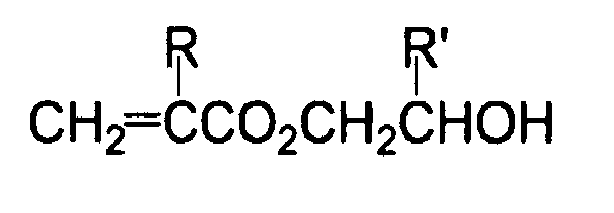
- In the above Formula, R and R' each independently represent H or CH3.
- Urethane acrylates described in
JP-ANo. 51-37193 JP-B No. 2-32293 JP-B No. 2-16765 JP-B No. 58-49860 JP-B No. 56-17654 JP-B No. 62-39417 JP-B No. 62-39418 - Addition-polymerizable compounds having an amino structure or sulfide structure in the molecule as described in
JP-A No. 63-277653 JP-A No. 63-260909 JP-A No. 1-105238 - As other examples, multifunctional acrylates and methacrylates such as polyester acrylates and epoxy acrylates obtained by reacting epoxy resin with (meth)acrylic acid, as described in
JP-A No. 48-64183 JP-B No. 49-43191 JP-B 52-30490 JP-B No. 46-43946 JP-B No. 1-40337 JP-B No. 1-40336 JP-A No. 2-25493 JP-A No. 61-22048 - Details of the use of the polymerizable compounds - what structure is used, whether they are used singly or in combination, and the addition amount - can be arbitrarily determined in accordance with the performance and design of the final photosensitive material. For example, they are selected from the following viewpoints. In respect of photoresponse speed, their structure preferably has a high unsaturated group content per one molecule, and in many cases, they are preferably bifunctional or higher-functional. To increase the strength of an image portion i.e. the cured layer, they are preferably trifunctional or higher-functional. It is also effective to use a method of regulating both photosensitivity and strength by combined use of compounds (e.g. acrylic esters, methacrylic esters, styrene-containing compounds, and vinyl ether-containing compounds) having different functionalities and different polymerizable groups. Compounds having a higher molecular weight or compounds with higher hydrophobicity, though being excellent in photoresponse speed and layer strength, may be undesirable in some cases in respect of developing speed and precipitation in the developer.
- A higher content of the polymerizable compound (B) is advantageous in respect of sensitivity. However, when the content is excessively high, there may be problems in undesirable phase separation, troubles in production process caused by the adhesiveness of the composition (e.g., defects in production process caused by transfer and adhesion of components in the photosensitive component), and separation from the developer when used in a planographic printing plate precursor. From these viewpoints, the content of the polymerizable compound (B) in the polymerizable composition according to the invention or in the recording layer of the planographic printing plate precursor is preferably in a range of 20 to 70% by weight, more preferably 25 to 50% by weight, based on the total solid content.
- In an embodiment, only one polymerizable compound (B) is used. In another embodiment, two or more polymerizable compounds (B) are used.
- The method of selecting and using the polymerizable compound is an important factor for compatibility and dispersibility with other components (e.g. a binder polymer, an initiator, a colorant etc.) in the recording layer used in the planographic printing plate precursor, and the compatibility may be improved by using e.g. a low-purity compound or a combination of two or more compounds.
- The image recording layer in the invention may contain a dye having the absorption maximun at the wavelength from 300 to 1200 nm. The dye functions as a sensitizing dye, and preferably has the absorption maximun at the wavelength from 750 to 900 nm from the viewpoint of improving the performance such as image quality. Examples of the sensitizing dye include spectral sensitizing dyes, or dyes or pigments as listed below which absorb light from a light source to interact with a photopolymerization initiator.
- Preferable examples of the spectral sensitizing dyes include polynuclear aromatics (e.g. pyrene, perylene, and triphenylene), xanthenes (e.g. fluorescein, eosin, erythrosine, rhodamine B, and rose bengal), cyanines (e.g. thiacarbocyanine, and oxacarbocyanine), melocyanines (e.g. melocyanine and carbomelocyanine), thiazines (e.g. thioene, methylene blue, and toluidine blue), acridines (e.g. acridine orange, chloroflavine, and acriflavine), phthalocyanines (e.g. phthalocyanine and metallophthalocyanine), porphyrins (e.g. tetraphenyl porphyrin, center metal substituted porphyrin), chlorophylls (e.g. chlorophyll, chlorophyllin, and center metal substituted chlorophyll), metal complexes, anthraquinones (e.g. anthraquinone), and squaryliums (e.g. squarylium).
- More preferable examples of the spectral sensitizing dyes include styryl-based dyes described in
JP-B No. 37-13034 JP-A No. 62-143044 JP-B No. 59-24147 JP-A No. 64-33104 JP-A No. 64-56767 JP-A No. 2-1714 JP-A No. 2-226148 JP-A No. 2-226149 JP-B No. 40-28499 JP-B No. 46-42363 JP-A No. 2-63053 JP-A No. 2-85858 JP-A No. 2-216154 JP-ANo. 57-10605 JP-B No. 2-30321 JP-A No. 1-287105 JP-A No. 62-31844 JP-A No. 62-31848 JP-A No. 62-143043 JP-B No. 59-28325 JP-B No. 61-9621 JP-A No. 2-179643 JP-A No. 2-244050 JP-B No. 59-28326 JP-A No. 59-89803 JP-A No. 8-129257 JP-A No. 8-334897 - The sensitizing dye used in the invention is more preferably represented by the following Formula (12).
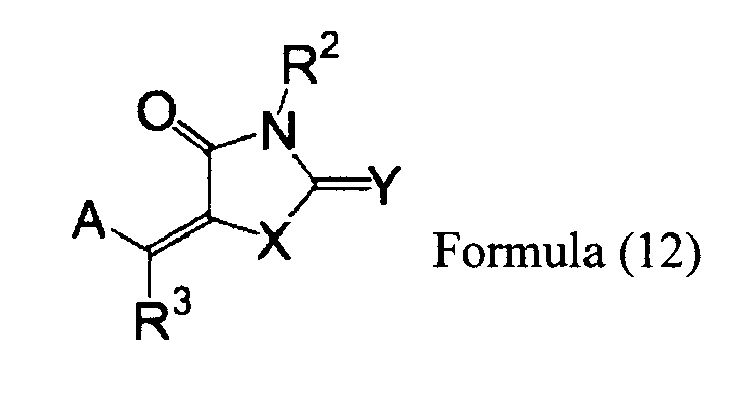
- In the Formula (12), A represents an optionally substituted aromatic ring or heterocycle, X represents an oxygen atom, a sulfur atom, or -N(R1)-, and Y represents an oxygen atom or -N(R1)-. R1, R2, and R3 each independently represents a hydrogen atom or a monovalent group of nonmetal atoms. A, R1, R2, and R3 may be combined with each other to form an aliphatic or aromatic ring.
- When R1, R2, and R3 each represents a monovalent group of nonmetal atoms, and preferably represents a substituted or unsubstituted alkyl group or aryl group.
- Specific preferable examples of R1, R2, and R3 are described below. Preferable examples of the alkyl group include linear, branched, and cyclic alkyl groups having 1 to 20 carbon atoms, and specific examples thereof include a methyl group, an ethyl group, a propyl group, a butyl group, a pentyl group, a hexyl group, a heptyl group, an octyl group, a nonyl group, a decyl group, an undecyl group, a dodecyl group, a tridecyl group, a hexadecyl group, an octadecy group, an eicosyl group, an isopropyl group, an isobutyl group, a s-butyl group, a t-butyl group, an isopentyl group, a neopentyl group, a 1-methylbutyl group, an isohexyl group, a 2-ethylhexyl group, a 2-methylhexyl group, a cyclohexyl group, a cyclopentyl group, and a 2-norbornyl group. Among them, linear alkyl groups having 1 to 12 carbon atoms, branched alkyl groups having 3 to 12 carbon atoms, and cyclic alkyl groups having 5 to 10 carbon atoms are more preferable.
- As the substituent of the substituted alkyl group, a monovalent group of nonmetal atoms excluding hydrogen atoms is used, preferable examples thereof include a halogen atom (-F, -Br, -Cl, or -I), a hydroxyl group, an alkoxy group, an aryloxy group, a mercapto group, an alkylthio group, an arylthio group, an alkyldithio group, an aryldithio group, an amino group, a N-alkylamino group, a N,N-dialkylamino group, a N-arylamino group, a N,N-diarylamino group, a N-alkyl-N-arylamino group, an acyloxy group, a carbamoyloxy group, a N-alkylcarbamoyloxy group, a N-arylcarbamoyloxy group, a N,N-dialkylcarbamoyloxy group, a N,N-diarylcarbamoyloxy group, a N-alkyl-N-arylcarbamoyloxy group, an alkylsulfoxy group, an arylsulfoxy group, an acyloxy group, an acylthio group, an acylamino group, a N-alkylacylamino group, a N-arylacylamino group, an ureido group, a N'-alkylureido group, a N',N'-dialkylureido group, a N'-arylureido group, a N',N'-diarylureido group, a N'-alkyl-N'-arylureido group, a N-alkylureido group, a N-arylureido group, a N'-alkyl-N-alkylureido group, a N'-alkyl-N-arylureido group, a N',N'-dialkyl-N-alkylureido group, a N',N'-dialkyl-N-arylureido group, a N'-aryl-N-alkylureido group, a N'-aryl-N-arylureido group, a N',N'-diaryl-N-alkylureido group, a N',N'-diaryl-N-arylureido group, a N'-alkyl-N'-aryl-N-alkylureido group, a N'-alkyl-N'-aryl-N-arylureido group, an alkoxycarbonylamino group, an aryloxycarbonylamino group, a N-alkyl-N-alkoxycarbonylamino group, a N-alkyl-N-aryloxycarbonylamino group, a N-aryl-N-alkoxycarbonylamino group, a N-aryl-N-aryloxycarbonylamino group, a formyl group, an acyl group, a carboxyl group, an alkoxycarbonyl group, an aryloxycarbonyl group, a carbamoyl group, a N-alkylcarbamoyl group, a N,N-dialkylcarbamoyl group, a N-arylcarbamoyl group, a N,N-diarylcarbamoyl group, a N-alkyl-N-arylcarbamoyl group,
- an alkylsulfinyl group, an arylsulfinyl group, an alkylsulfonyl group, an arylsulfonyl group, a sulfo group (-SO3H and conjugate base groups thereof (hereinafter, referred to as a sulfonate group), an alkoxysulfonyl group, an aryloxysulfonyl group, a sulfinamoyl group, a N-alkylsulfinamoyl group, a N,N-dialkylsulfinamoyl group, a N-arylsulfinamoyl group, a N,N-diarylsulfinamoyl group, a N-alkyl-N-arylsulfinamoyl group, a sulfamoyl group, a N-alkylsulfamoyl group, a N,N-dialkylsulfamoyl group, a N-arylsulfamoyl group, a N,N-diarylsulfamoyl group, a N-alkyl-N-arylsulfamoyl group, a phosphono group (-PO3H2) and conjugate base groups thereof (hereinafter, referred to as a phosphonate group), a dialkylphosphono group (-PO3(alkyl)2), diarylphosphono group (-PO3(aryl)2), an alkylarylphosphono group(-PO3(alkyl)(aryl)), a monoalkylphosphono group (-PO3H(alkyl)) and conjugate base groups thereof (hereinafter, referred to as an alkylphosphonate group), a monoarylphosphono group (-PO3H(aryl)) and conjugate base groups thereof (hereinafter, referred to as an arylphosphonate group), phosphonooxy group (-OPO3H2) and conjugate base groups thereof (hereinafter, referred to as a phosphonateoxy group), a dialkyl phosphonooxy group (-OPO3(alkyl)2), diarylphosphonooxy group (-OPO3(aryl)2), alkylarylphosphonooxy group (-OPO3(alkyl) (aryl)), monoalkylphosphonooxy group (-OPO3H(alkyl)) and conjugate base groups thereof (hereinafter, referred to as an alkylphosphonateoxy group), monoarylphosphonooxy group (-OPO3H(aryl)) and conjugate base groups thereof (hereinafter, referred to as an arylphosphonateoxy group), a cyano group, a nitro group, an aryl group, a heteroaryl group, an alkenyl group, an alkynyl group, and a silyl group.
- Specific examples of the alkyl group in these substituents include the above-described alkyl groups, which may be further substituted.
- Specific examples of the aryl group include a phenyl group, a biphenyl group, a naphthyl group, a tolyl group, a xylyl group, a mesityl group, a cumenyl group, a chlorophenyl group, a bromophenyl group, a chloromethylphenyl group, a hydroxyphenyl group, a methoxyphenyl group, an ethoxyphenyl group, a phenoxyphenyl group, an acetoxyphenyl group, a benzoyloxyphenyl group, a methylthiophenyl group, a phenylthiophenyl group, a methylaminophenyl group, a dimethylaminophenyl group, an acetylaminophenyl group, a carboxyphenyl group, a methoxycarbonylphenyl group, an ethoxyphenylcarbonyl group, a phenoxycarbonylphenyl group, a N-phenylcarbamoylphenyl group, a phenyl group, a cyanophenyl group, a sulfophenyl group, a sulfonatephenyl group, a phosphonophenyl group, and a phosphonatephenyl group.
- The heteroaryl group is a group derived from a monocyclic or polycyclic aromatic ring containing at least one of a nitrogen atom, an oxygen atom, and a sulfur atom. Particularly preferable examples of the heteroaryl ring in the heteroaryl group include thiophene, thiathrene, furan, pyran, isobenzofuran, chromene, xanthene, phenoxazine, pyrrole, pyrazole, isothiazole, isoxazole, pyrazine, pyrimidine, pyridazine, indolysine, isoindolysine, indoyl, indazole, prine, quinolizine, isoquinoline, phthalazine, naphthyridine, quinazoline, cinnoline, pteridine, carbazole, carboline, phenanthroline, acridine, perimidine, phenanthroline, phthalazine, phenarsazine, phenoxazine, and furazan, which may be further benzo-condensed ring, or may be substituted.
- Examples of the alkenyl group include a vinyl group, a 1-propenyl group, a 1-butenyl group, a cinnamyl group, and a 2-chloro-1-ethenyl group, and examples of the alkynyl group include an ethynyl group, a 1-propynyl group, a 1-butynyl group, and a trimethylsilylethynyl group. Examples of G1 in the acyl group (G1CO-) include a hydrogen atom, and the above-described alkyl group and aryl group. Among these substituents, more preferable examples include a halogen atom (-F, -Br, -Cl, and -I), an alkoxy group, an aryloxy group, an alkylthio group, an arylthio group, a N-alkylamino group, a N,N-dialkylamino group, an acyloxy group, a N-alkylcarbamoyloxy group, a N-arylcarbamoyloxy group, an acylamino group, a formyl group, an acyl group, a carboxyl group, an alkoxycarbonyl group, an aryloxycarbonyl group, a carbamoyl group, a N-alkylcarbamoyl group, a N,N-dialkylcarbamoyl group, a N-arylcarbamoyl group, a N-alkyl-N-arylcarbamoyl group, a sulfo group, a sulfonate group, a sulfamoyl group, a N-alkylsulfamoyl group, a N,N-dialkylsulfamoyl group, a N-arylsulfamoyl group, a N-alkyl-N-arylsulfamoyl group, a phosphono group,a phosphonate group, a dialkylphosphono group, a diarylphosphono group, a monoalkylphosphono group, an alkylphosphonate group, a monoarylphosphono group, an arylphosphonate group, a phosphonooxy group, a phosphonateoxy group, an aryl group, an alkenyl group, and an alkylidene group (e.g. methylene group).
- Examples of the alkylene group in the substituted alkyl group include a divalent organic residue obtained by removing any one of the hydrogen atoms on the above-described alkyl group having 1 to 20 carbon atoms, and preferable examples thereof include a linear alkylene group having 1 to 12 carbon atoms, a branched alkylene group having 3 to 12 carbon atoms, and a cyclic alkylene group having 5 to 10 carbon atoms.
- Specific examples of the substituted alkyl group which is obtained by combining the above-described substituent with an alkylene group and is preferable as R1, R2, or R3 include a chloromethyl group, a bromomethyl group, a 2-chloroethyl group, a trifluoromethyl group, a methoxymethyl group, a methoxyethoxyethyl group, an allyloxymethyl group, a phenoxymethyl group, a methylthiomethyl group, a tolylthiomethyl group, an ethylaminoethyl group, a diethylaminopropyl group, a morpholinopropyl group, an acetyloxymethyl group, a benzoyloxymethyl group, a N-cyclohexylcarbamoyloxyethyl group, a N-phenylcarbamoyloxyethyl group, an acetylaminoethyl group, a N-methylbenzoylaminopropyl group, a 2-oxoethyl group, a 2-oxopropyl group, a carboxypropyl group, a methoxycarbonylethyl group, an allyloxycarbonylbutyl group, a chlorophenoxycarbonylmethyl group, a carbamoylmethyl group, a N-methylcarbamoylethyl group, a N,N-dipropylcarbamoylmethyl group, a N-(methoxyphenyl)carbamoylethyl group, a N-methyl-N-(sulfophenyl)carbamoylmethyl group, a sulfobutyl group, a sulfonatepropyl group, a sulfonatebutyl group, a sulfamoylbutyl group, a N-ethylsulfamoylmethyl group, a N,N-dipropylsulfamoylpropyl group, a N-tolylsulfamoylpropyl group, a N-methyl-N-(phosphonophenyl)sulfamoyloctyl group, a phosphonobutyl group, a phosphonatehexyl group, a diethylphosphonobutyl group, a diphenylphosphonopropyl group, a methylphosphonobutyl group, a methylphosphonatebutyl group, a tolylphosphonohexyl group, a tolylphosphonatehexyl group, a phosphonooxypropyl group, a phosphonateoxybutyl group, a benzyl group, a phenethyl group, an α-methylbenzyl group, a 1-methyl-1-phenylethyl group, a p-methylbenzyl group, a cinnamyl group, an allyl group, a 1-propenylmethyl group, a 2-butenyl group, a 2-methylallyl group, a 2-methylpropenylmethyl group, a 2-propynyl group, a 2-butynyl group, and a 3-butynyl group.
- Specific examples of the aryl group preferable as R1, R2, or R3 include a condensed ring formed by 1 to 3 benzene rings, and a condensed ring formed by a benzene ring and a 5-membered unsaturated ring, and specific examples thereof include a phenyl group, a naphthyl group, an anthryl group, a phenanthryl group, an indenyl group, an acenaphthenyl group, and a fluorenyl group. Among these groups, a phenyl group, and a naphthyl group are more preferable.
- Specific examples of the substituted aryl group preferable as R1, R2, or R3 include a the above-described aryl group having a monovalent group of nonmetal atoms (excluding hydrogen atoms) as a substituent on the carbon atom forming the ring. Preferable examples of the substituent include the above-described alkyl group, substituted alkyl group, and examples of the substituents in the alkyl group. Specific preferable examples of the substituted aryl group include a biphenyl group, a tolyl group, a xylyl group, a mesityl group, a cumenyl group, a chlorophenyl group, a bromophenyl group, a fluorophenyl group, a chloromethylphenyl group, a trifluoromethylphenyl group, a hydroxyphenyl group, a methoxyphenyl group, a methoxyethoxyphenyl group, an allyloxyphenyl group, a phenoxyphenyl group, a methylthiophenyl group, a tolylthiophenyl group, an ethylaminophenyl group, a diethylaminophenyl group, a morpholinophenyl group, an acetyloxyphenyl group, a benzoyloxyphenyl group, a N-cyclohexylcarbamoyloxyphenyl group, a N-phenylcarbamoyloxyphenyl group, an acetylaminophenyl group, a N-methylbenzoylaminophenyl group, a carboxyphenyl group, a methoxycarbonylphenyl group, an allyloxycarbonylphenyl group, a chlorophenoxycarbonylphenyl group, a carbamoylphenyl group, a N-methylcarbamoylphenyl group, a N,N-dipropylcarbamoylphenyl group, a N-(methoxyphenyl)carbamoylphenyl group, a N-methyl-N-(sulfophenyl)carbamoylphenyl group, a sulfophenyl group, a sulfonatephenyl group, a sulfamoylphenyl group, a N-ethylsulfamoylphenyl group, a N,N-dipropylsulfamoylphenyl group, a N-tolylsulfamoylphenyl group, a N-methyl-N-(phosphonophenyl)sulfamoylphenyl group, a phosphonophenyl group, a phosphonatephenyl group, a diethylphosphonophenyl group, a diphenylphosphonophenyl group, a methylphosphonophenyl group, a methylphosphonatephenyl group, a tolylphosphonophenyl group, a tolylphosphonatephenyl group, an allylphenyl group, a 1-propenylmethylphenyl group, a 2-butenylphenyl group, a 2-methylallylphenyl group, a 2-methylpropenylphenyl group, a 2-propynylphenyl group, a 2-butynylphenyl group, and 3-butynylphenyl group.
- Particularly preferable examples of R2 and R3 include a substituted or unsubstituted alkyl group. More preferable examples of R1 include a substituted or unsubstituted aryl group. The reason for this is not evident, but is considered that these substituents particularly strengthen the interaction between electrons excited upon light absorption and the initiator compound, which improves the efficiency of the initiator compound to generate a radical, acid, or base.
- In the next place, A in the Formula (12) is further described. A represents an optionally substituted aromatic ring or heterocycle, and specific examples of the optionally substituted aromatic ring or heterocycle include the same examples as those listed in the above-described description of R1, R2, or R3 in the Formula (12).
- Among them, preferable examples of A include an aryl group having an alkoxy group, a thioalkyl group, or an amino group, and particularly preferable examples of A include an aryl group having an amino group.
- In the next place, Y in the Formula (12) is further described. Y represents a group of nonmetal atoms necessary for forming a heterocycle together with the above-described A and the adjacent carbon atom. Examples of the heterocycle include a 5-, 6-, or 7-membered nitrogen-containing or sulfur-containing heterocycle which may have a condensed ring. Among them, a 5- or 6-membered heterocycle is preferable.
- Preferable examples of the nitrogen-containing heterocycle include those known as a component of basic nuclei in melocyanine dyes described in L.G.Brooker et al., J. Am, Chem. Soc., vol. 73 (1951), pp. 5326-5358 and reference documents cited therein. Specific examples thereof include, thiazoles (e.g. thiazole, 4-methylthiazole, 4-phenylthiazole, 5-methylthiazole, 5-phenylthiazole, 4,5-dimethylthiazole, 4,5-diphenylthiazole, 4,5-di(p-methoxyphenylthiazole), 4-(2-thienyl)thiazole, and 4,5-di(2-furyl)thiazole),
- benzothiazoles (e.g. benzothiazole, 4-chlorobenzothiazole, 5-chlorobenzothiazole, 6-chlorobenzothiazole, 7-chlorobenzothiazole, 4-methylbenzothiazole, 5-methylbenzothiazole, 6-methylbenzothiazole, 5-bromobenzothiazole, 4-phenylbenzothiazole, 5-phenylbenzothiazole, 4-methoxybenzothiazole, 5-methoxybenzothiazole, 6-methoxybenzothiazole, 5-iodobenzothiazole, 6-iodobenzothiazole, 4-ethoxybenzothiazole, 5-ethoxybenzothiazole, tetrahydrobenzothiazole, 5,6-dimethoxybenzothiazole, 5,6-dioxymethylene benzothiazole, 5-hydroxybenzothiazole, 6-hydroxybenzothiazole, 6-dimethylaminobenzothiazole, and 5-ethoxycarbonylbenzothiazole),
- naphthothiazoles (e.g. naphtho[1,2]thiazole, naphtho[2,1]thiazole, 5-methoxynaphtho[2,1]thiazole, 5-ethoxynaphtho[2,1]thiazole, 8-methoxynaphtho[1,2]thiazole, and 7-methoxynaphtho[1,2]thiazole), thianaphtheno-7',6',4,5-thiazoles (e.g. 4'-methoxythianaphtheno-7',6',4,5-thiazole), oxazoles (e.g. 4-methyloxazole, 5-methyloxazole, 4-phenyloxazole, 4,5-diphenyloxazole, 4-ethyloxazole, 4,5-dimethyloxazole, and 5-phenyloxazole), benzoxazoles (e.g. benzoxazole, 5-chlorobenzoxazole, 5-methyl benzoxazole, 5-phenylbenzooxazole, 6-methylbenzoxazole, 5,6-dimethylbenzoxazole, 4,6-dimethylbenzoxazole, 6-methoxybenzoxazole, 5-methoxybenzoxazole, 4-ethoxybenzoxazole, 5-chlorobenzoxazole, 6-methoxybenzoxazole, 5-hydroxybenzoxazole, and 6-hydroxybenzoxazole), naphthooxazoles (e.g. naphtho[1,2]oxazole and naphtho[2,1]oxazole), selenazoles(e.g. 4-methylselenazole and 4-phenylselenazole), benzoselenazoles (e.g. benzoselenazole, 5-chlorobenzoselenazole, 5-methoxybenzoselenazole, 5-hydroxybenzoselenazole, and tetrahydrobenzoselenazole), naphthoselenazoles (e.g. naphtho[1,2]selenazole, and naphtho[2,1]selenazole),
- thiazolines (e.g. thiazoline, 4-methylthiazoline, 4,5-dimethylthiazoline, 4-phenylthiazoline, 4,5-di(2-furyl)thiazoline, 4,5-diphenylthiazoline, and 4,5-di(p-methoxyphenyl)thiazoline), 2-quinolines (e.g. quinoline, 3-methylquinoline, 5-methylquinoline, 7-methylquinoline, 8-methylquinoline, 6-chloroquinoline, 8-chloroquinoline, 6-methoxyquinoline, 6-ethoxyquinoline, 6-hydroxyquinoline, and 8-hydroxyquinoline), 4-quinolines (e.g. quinoline, 6-methoxyquinoline, 7-methylquinoline, and 8-methylquinoline), 1-isoquinolines (e.g. isoquinoline and 3,4-dihydroisoquinoline), 3-isoquinolines (e.g. isoquinoline), benzimidazoles (e.g. 1,3-dimethylbenzimidazole, 1,3-diethylbenzimidazole, and 1-ethyl-3-phenylbenzimidazole), 3,3-dialkylindolenines (e.g. 3,3-dimethylindolenine, 3,3,5-trimethylindolenine, and 3,3,7-trimethylindolenine), 2-pyridines (e.g. pyridine and 5-methyl pyridine), and 4-pyridine (e.g. pyridine). These ring substituents may be combined with each other to form a ring.
- Examples of the sulfur-containing heterocycle include dithiol partial structures in dyes described in
JP-A No. 3-296759 - Specific examples thereof include benzodithiols (e.g. benzodithiol, 5-t-butylbenzodithiol, and 5-methylbenzodithiol), naphthodithiols (e.g. naphtho[1,2]dithiol and naphtho[2,1]dithiol), dithiols (e.g. 4,5-dimethyldithiols, 4-phenyldithiols, 4-methoxycarbonyldithiols, 4,5-dimethoxycarbonyldithiols, 4,5-diethoxycarbonyldithiols, 4,5-ditrifluoromethyldithiol, 4,5-dicyano dithiol, 4-methoxycarbonylmethyldithiol, and 4-carboxymethyldithiol).
- In the Formula (12), among the examples of nitrogen-containing or sulfur-containing heterocycles formed by Y together with the above-described A and adjacent carbon atom, the dye having a structure represented by the partial structural Formula of the following Formula (13) is particularly preferable because it offers a photosensitive composition having high sensitizing capacity and very excellent storage stability.

- In the Formula (13), A represents an optionally substituted aromatic ring or heterocycle, and X represents an oxygen atom, a sulfur atom, or -N(R1)-, R1, R4, R5, and R6 each independently represents a hydrogen atom or a monovalent group of nonmetal atoms, and A, R1, R4, R5, and R6 may be combined with each other to form an aliphatic or aromatic ring. In the Formula (13), A and R1 are each equivalent to those in the Formula (12), R4 is equivalent to R2 in the Formula (12), R5 is equivalent to R3 in the Formula (12), and R6 is equivalent to R1 in the Formula (12).
- The compound represented by the Formula (12) is further preferably a compound represented by the following Formula (14).

- In the Formula (14), A represents an optionally substituted aromatic ring or heterocycle, and X represents an oxygen atom, a sulfur atom, or -N(R1)-. R1, R4, and R5 are each independently a hydrogen atom or a monovalent group of nonmetal atoms, and A, R1, R4, and R5 may be combined with each other to form an aliphatic or aromatic ring. Ar represents a substituted aromatic ring or heterocycle. The sum total of the Hammett's values of the substituents on the Ar skeleton must be greater than 0. The "sum total of Hammett's values is larger than 0" as used herein may be that one substituent is present and the Hammett's value of the substituent is larger than 0 or that a plurality of substituents are present and the sum total of the Hammett's values of these substituents is larger than 0.
- In the Formula (14), A and R1 are equivalent to those in the Formula (12), R4 is equivalent to R2 in the Formula (12), and R5 is equivalent to R3 in the Formula (12). Ar represents a substituted aromatic ring or heterocycle, and specific examples thereof include the same specific examples of the substituted aromatic ring or heterocycle as those listed for A in the description of the Formula (12). The total sum of the Hammett's values of the substituents to be introduced into Ar in the Formula (14) must be 0 or more. Examples of the substituents include a trifluoromethyl group, a carbonyl group, an ester group, a halogen atom, a nitro group, a cyano group, a sulfoxide group, an amide group, and a carboxyl group. The Hammett's value of these substituents are as follows: trifluoromethyl group (-CF3, m: 0.43, p: 0.54); carbonyl group (e.g. -COH, m: 0.36, p: 0.43); ester group (-COOCH3, m: 0.37, p: 0. 45); halogen atom (e.g. Cl, m: 0.37, p: 0.23); cyano group (-CN, m: 0.56, p: 0.66); sulfoxide group (e.g.-SOCH3, m: 0.52, p: 0.45); amide group (e.g. -NHCOCH3, m: 0.21, p: 0.00); and carboxyl group (-COOH, m: 0.37, p: 0.45). The site of the substituent in the aryl skeleton and the Hammett's value of the substituent are listed inside the parentheses, and (m: 0.50) means that the Hammett's value of the substituent upon introduction into the meta position is 0.50. Preferable examples of Ar include a substituted phenyl group, and preferable examples of the substituent on the Ar skeleton include an ester group and a cyano group. The substituent is particularly preferably located in the ortho position on the Ar skeleton.
- Preferable specific examples of the sensitizing dye represented by the Formula (12) (exemplary compounds D1 to D57) are shown below, however the invention is not limited to them. Among them, exemplary compounds D2, D6, D10, D18, D21, D28, D31, D33, D35, D38, D41, and D45 to D57 correspond to the compound represented by the Formula (13).


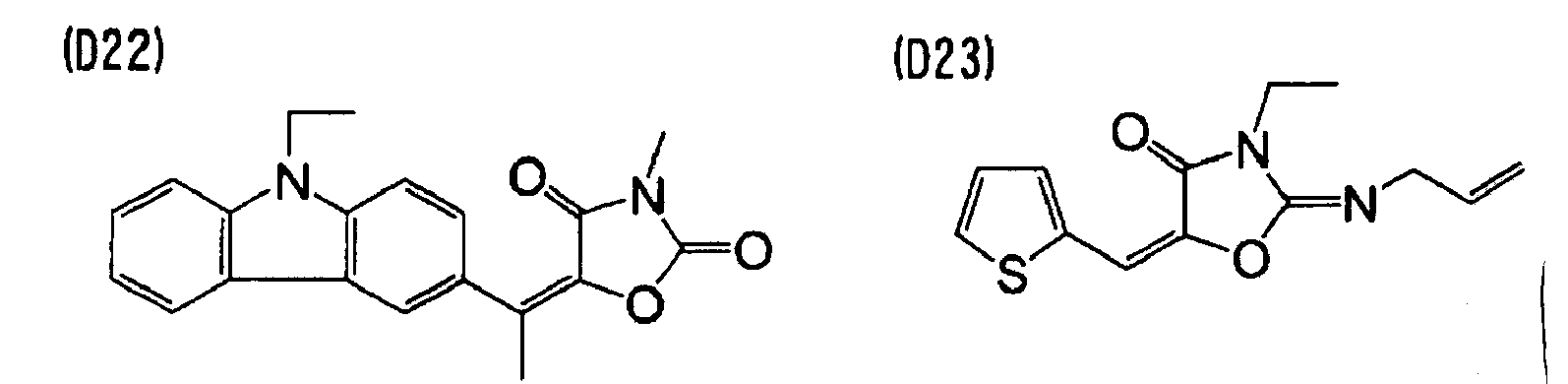


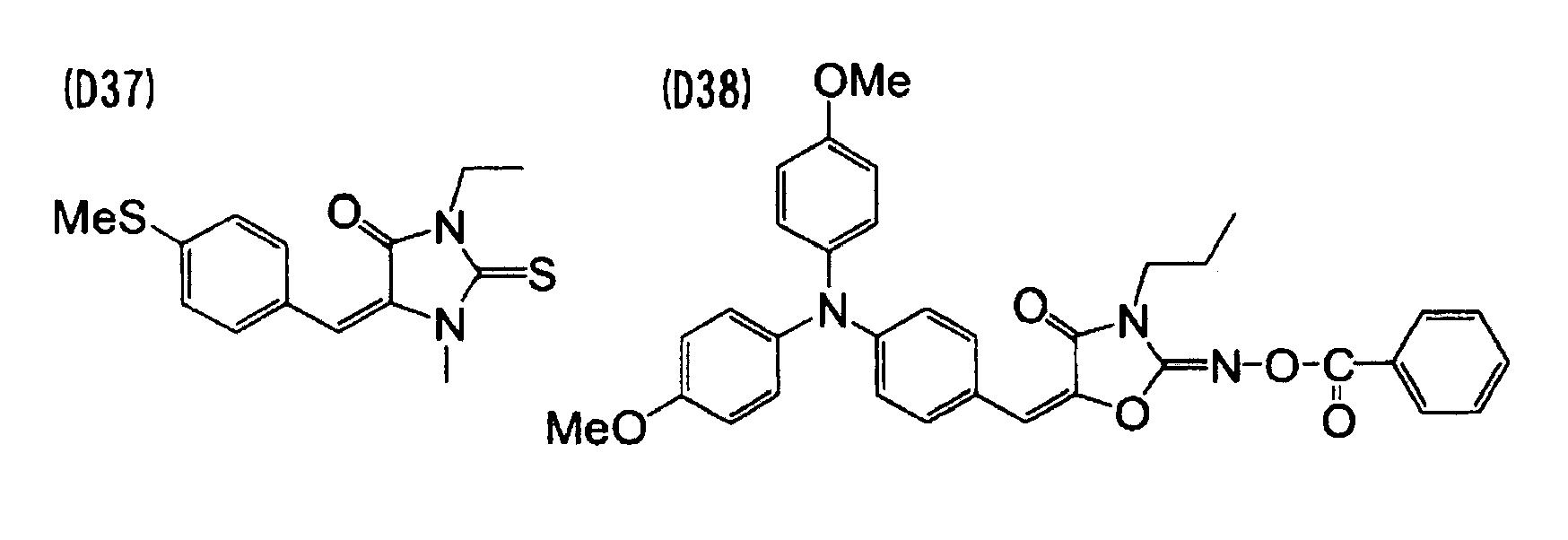


- The method for synthesizing the compound represented by the Formula (12) is described below.
- The compound represented by the Formula (12) is usually prepared by condensation reaction between an acidic nucleus having an active methylene group and a substituted or nonsubstituted aromatic ring or heterocycle, which can be synthesized with respect to
JP-B No. 59-28329 
- Examples of the other preferable synthesis method include a method according to the following reaction Formula (2). More specifically, an acidic nuclear compound in which Y is a sulfur atom is used as the starting material in the reaction Formula (1), and condensed with a basic nuclear material having an aldehyde group or a carbonyl group on the heterocycle to form a dye precursor in the same manner as the reaction Formula (1), thereafter the dye precursor is further reacted with a metal salt, which chemically interacts with a sulfur atom to form a metal sulfide, and water or a primary amine compound (R-NH2, wherein R represents a monovalent group of nonmetal atoms).
- Among them, the reaction represented by the reaction Formula (2) provides a high yield in each reaction, and particularly preferable from the viewpoint of synthesis efficiency. In particular, the reaction represented by the reaction Formula (2) is useful for the synthesis of the compound represented by the Formula (13).

- In the reaction Formula (2), Mn + Xn represents a metal salt which chemically interacts with a sulfur atom in the thiocarbonyl group to form a metal sulfide. Specific examples of the compound include AgBr, AgI, AgF, AgO, AgCl, Ag2O, Ag(NO3), AgSO4, AgNO2, Ag2CrO4, Ag3PO4, Hg2(NO3)2, HgBr2, Hg2Br2, HgO, HgI2, Hg(NO3)2, Hg(NO2)2, HgBr2, HgSO4, Hg2I2, Hg2SO4, Hg(CH3CO2)2, AuBr, AuBr3, AuI, Aul3, AuF3, Au2O3, AuCl, AuCl3, CuCl, CuI, CuI2, CuF2, CuO, CuO2, Cu(NO3)2, CuSO4, and Cu3(PO4)2, in which M is Al, Au, Ag, Hg, Cu, Zn, Fe, Cd, Cr, Co, Ce, Bi, Mn, Mo, Ga, Ni, Pd, Pt, Ru, Rh, Sc, Sb, Sr, Mg, Ti, or the like, and X is F, Cl, Br, I, NO3, SO4, NO2, PO4, CH3CO2, or the like. Among them, a silver salt is a most preferable metal salt because it readily interacts with a sulfur atom.
- The sensitizing dye represented by the Formula (12) used in the invention can be subjected to various chemical modification to improve the property of the image recording layer. For example, the sensitizing dye may be combined with an addition polymerizable compound structure (e.g. an acryloyl group or a methacryloyl group) through a covalent bond, an ionic bond, a hydrogen bond, or the like to increase the strength of the light-exposed film and suppress the unnecessary deposition of dyes from the light-exposed film.
- Further, photosensitivity can be remarkably enhanced under particularly low concentration of an optical initiation system, by bonding the sensitizing dye with the above-described radical generating partial structure in the initiator compound (e.g. reduction decomposable sites such as alkyl halide, onium, peroxide, and biimidazole, and oxidation disintegrating sites such as borate, amine, trimethylsilylmethyl, carboxymethyl, carbonyl, and imine).
- Further, in the case where the image recording material of the invention is used as a planographic printing plate precursor having a negative-working image recording layer, which is a preferable aspect of the invention, it is effective to introduce a hydrophilic site (acid groups or polar groups such as a carboxyl group and esters thereof, a sulfonic group and esters thereof, and an ethylene oxide group). Particularly, an ester type hydrophilic group exhibits excellent compatibility in the photosensitive layer due to its relatively hydrophobic structure, and generates an acid group upon hydrolysis to increase its hydrophilicity in a developer.
- Additionally, for example, a substituent may be introduced as appropriate to improve compatibility in the photosensitive layer and to suppress crystal deposition. For example, in a certain kind of photosensitive system, an unsaturated bond such as an aryl group or an allyl group may be considerably effective at improving the compatibility. Besides, crystal deposition is remarkably suppressed by introducing steric hindrance between the π planes of the dye through introduction of a branched alkyl structure or other method. Further, adhesiveness of a metal, metal oxide and the like to an inorganic substance is improved by introducing a phosphonate group, an epoxy group, a trialkoxysilyl group, or the like. Alternatively, polymerization of the sensitizing dye or other methods may be used according to the intended use.
- The sensitizing dye used the invention preferably includes at least one sensitizing dye represented by the Formula (12). Within the range represented by the Formula (12), details of the use-what structure is used (e.g. the above-described modification), whether they are used alone or in combination of two or more of them, and the addition amount- can be determined as appropriate in accordance with the performance and design of the final photosensitive material. For example, the combination of two or more kinds of sensitizing dyes improves the compatibility with the image recording layer.
- The selection of the sensitizing dye largely depends on its photosensitivity and molar extinction coefficient at the luminescence wavelength of the light source to be used. The use of a dye having a large molar extinction coefficient can relatively decrease the addition amount of the dye, which is economical and beneficial to the physical property of the image recording layer.
- In the invention, other general-purpose sensitizing dyes except for the sensitizing dye represented by the Formula (12) may be used within the range which does not impair the effect of the invention.
- The addition amount of the sensitizing dye is selected as appropriate in consideration of the photosensitivity, resolution, and film physical properties of the image recording layer which are significantly influenced by the absorbance at the wavelength of the light source.
- For example, in a region where the absorbance is 0.1 or lower, the sensitivity decreases, and the resolution decreases because of the influence of halation. However, such a low absorbance may be suitable for curing a thick film having a thickness of 5 µm or more. In a region where the absorbance is 3 or higher, a large part of the light is absorbed into the surface of the image recording layer, which inhibits inside curing, and resulting in, for example in the case where the image recording material of the invention is used as a planographic printing plate precursor, insufficient film strength and adhesiveness to the substrate.
- For example, in the case where the image recording material of the invention is used in a planographic printing plate precursor having a relatively thin image recording layer, the addition amount of the sensitizing dye is preferably determined in such a manner that the absorbance of the image recording layer is in a range of from 0.1 to 1.5, preferably in a range of from 0.25 to 1. The absorbance is determined by the addition amount of the sensitizing dye and the thickness of the image recording layer, hence the predetermined absorbance is achieved by controlling these factors. The absorbance of the image recording layer may be measured by ordinary methods. Examples of the measurement method include a method of forming an image recording layer on a transparent or white support in an appropriately determined thickness such that the coating amount after drying is within the range necessary for a planographic printing plate, and measuring the absorbance with a transmission optical densitometer, and a method of forming a recording layer on a reflective support such as an aluminum support, and measuring the reflection density.
- In the case where the image recording layer in the invention is used as a recording layer of a planographic printing plate precursor, the addition amount of the sensitizing dye is usually in a range of from 0.05 to 30 parts by mass, preferably from 0.1 to 20 parts by mass, and further preferably from 0.2 to 10 parts by mass with respect to 100 parts by mass of the total solid content in the image recording layer.
- In the invention, when light exposure is performed using a laser light source emitting infrared rays having wavelengths of from 760 to 1,200 nm, an infrared ray absorbing agent having the absorption maximum in the wavelength range is usually used as a sensitizing dye. The infrared ray absorbing agent is capable of absorbing infrared rays and converting them into heat. A radical generator (polymerization initiator) is heat-decomposed by the heat generated upon light exposure, and generates radicals. The infrared ray absorbing agent used in the invention is a dye or pigment having an absorption maximum at wavelengths of from 750 nm to 850 nm.
- The dye may be a commercially available dye or a known dye as described in reference documents such as "Senryo Binran (Dye Handbook) (edited by The Society of Synthetic Organic Chemistry, Japan 1970). Specific examples thereof include azo dyes, metal complex salt azo dyes, pyrazolone azo dyes, naphthoquinone dyes, anthraquinone dyes, phthalocyanine dyes, carbonium dyes, quinoneimine dyes, methine dyes, cyanine dyes, squarylium dyes, pyrylium salt, and metal thiolate complex dyes.
- Preferable examples of dyes include cyanine dyes described in
JP-A No. 58-125246 JP-A No. 59-84356 JP-A No. 59-202829 JP-ANo. 60-78787 JP-A No. 58-173696 JP-A No. 58-181690 JP-A No. 58-194595 JP-A No. 58-112793 JP-A No. 58-224793 JP-A No. 59-48187 JP-A No. 59-73996 JP-A No. 60-52940 JP-A No. 60-63744 JP-A No. 58-112792 U.K. Patent No. 434,875 - Near-infrared absorbing sensitizers described in
U.S. Patent No. 5,156,938 are also preferably used. A substituted arylbenzo(thio)pyrylium salt described inU.S. Patent No. 3,881,924 , a trimethinethiapyrylium salt described inJP-A No. 57-142645 U.S. Patent No. 4,327,169 ), pyrylium type compounds described inJP-A Nos. 58-181051 58-220143 59-41363 59-84248 59-84249 59-146063 59-146061 JP-A No. 59-216146 U.S. Patent No. 4,283,475 and pyrylium compounds disclosed inJP-B Nos. 5-13514 5-19702 - Other preferable examples of the infrared absorbing dye may include near-infrared absorbing dyes described as Formulae (I) and (II) in
U.S. Patent No. 4,756,993 . - Other preferable examples of the infrared radiation absorption dye in the invention include specific indolenine cyanine dyes described in
Japanese Patent Application No. 2001-6326 Japanese Patent Application No. 2001-237840 


- Particularly preferable among these dyes are cyanine colorants, phthalocyanine dyes, oxonol dyes, squarylium colorants, pyrylium salts, thiopyrylium dyes, and nickel thiolate complexes. From the viewpoint of sensitivity, preferable among these dyes are those represented by Formulae (a) to (e) below, and cyanine colorants represented by Formula (a) below are most preferable because they give high polymerization activity and are excellent in stability and economical efficiency when used in the recording layer in the invention.

- In the Formula (a), X1 represents a hydrogen atom, halogen atom, -NArx2, X2-L1 or the group shown below. Arx represents a C6 to C14 aromatic hydrocarbon group which may have one or more substituents selected from the group consisting of halogen atoms, alkyl groups, allyl groups, alkenyl groups, alkynyl groups, cyano groups, carboxy groups, nitro groups, amide groups, ester groups, alkoxy groups, amino groups and heterocyclic groups, and these substituents may themselves be substituted by such a substituent as those described above. X2 represents an oxygen atom, a sulfur atom or -N(Rx)- wherein Rx represents a hydrogen atom or a C1 to C10 hydrocarbon group. L1 represents a C1 to C12 hydrocarbon group, an aromatic ring having a heteroatom, or a C1 to C12 hydrocarbon group containing a heteroatom. The term "heteroatom" used herein refers to an atom selected from N, S, O, a halogen atom or Se.

- In the above Formula, Xa - has the same definition as that of Za - defined later, and Ra represents a hydrogen atom or a substituent selected from an alkyl group, an aryl group, a substituted or unsubstituted amino group, or a halogen atom.
- R1 and R2 each independently represent a C1-12 hydrocarbon group. For the storage stability of the recording layer coating liquid, each of R1 and R2 is preferably a hydrocarbon group containing two or more carbon atoms, and more preferably R1 and R2 are bound to each other to form a 5- or 6-memberred ring.
- Ar1 and Ar2 may be the same or different, and each independently represent an aromatic hydrocarbon group which may have a substituent. The aromatic hydrocarbon group is preferably a benzene ring or a naphthalene ring. The substituent is preferably a hydrocarbon group containing 12 or less carbon atoms, a halogen atom or an alkoxy group containing 12 or less carbon atoms. Y1 and Y2 may be the same or different, and each independently represent a sulfur atom or a dialkyl methylene group containing 12 or less carbon atoms. R3 and R4 may be the same or different, and each independently represent a hydrocarbon group containing 20 or less carbon atoms which may have a substituent. The substituent is preferably an alkoxy group containing 12 or less carbon atoms, a carboxyl group or a sulfo group. R5, R6, R7 and R8 may be the same or different, and each independently represent a hydrogen atom or a hydrocarbon group containing 12 or less carbon atoms. Each of R5, R6, R7 and R8 is preferably a hydrogen atom because the starting material is easily available. Za - represents a counter anion. However, when the cyanine colorant represented by the Formula (a) has an anionic substituent in its structure and does not necessitate neutralization of the charge, Za - is not necessary. Because of the storage stability of the recording layer coating liquid, Za - is preferably a halogen ion, a perchlorate ion, a tetrafluoroborate ion, a hexafluorophosphate ion or a sulfonate ion, particularly preferably a perchlorate ion, a hexafluorophosphate ion or an aryl sulfonate ion.
- Specific examples of the cyanine colorants represented by the Formula (a), which can be used preferably in the invention, include not only those illustrated below, but also those described in paragraph numbers (0017) to (0019) in
JP-A No. 2001-133969 JP-ANo. 2002-40638 JP-A No. 2002-23360 


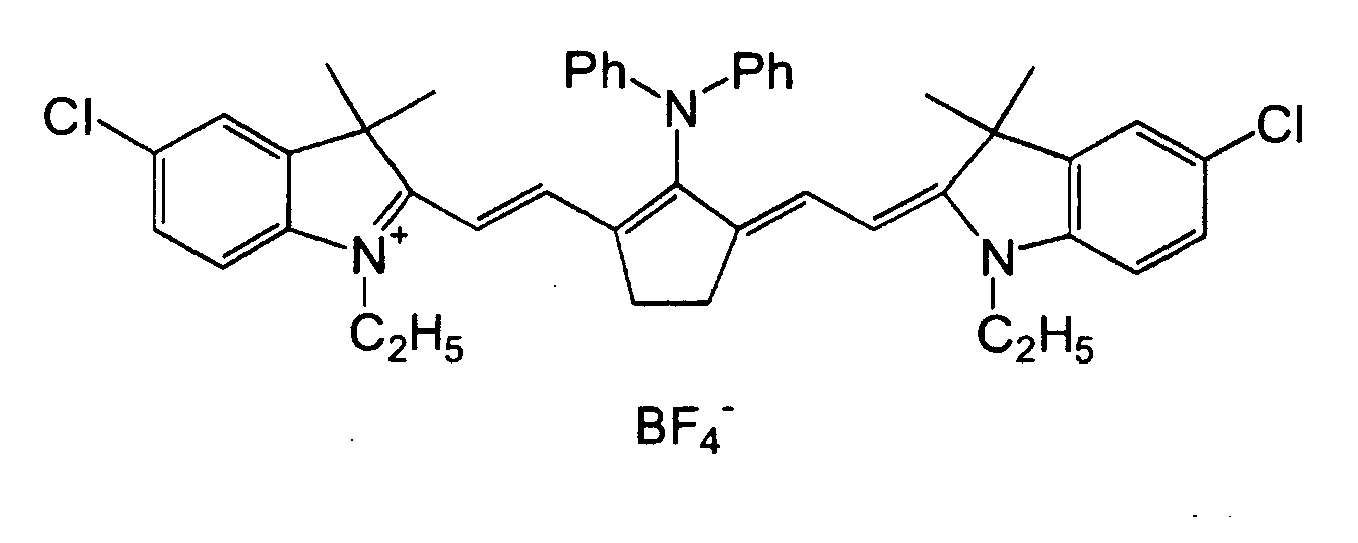

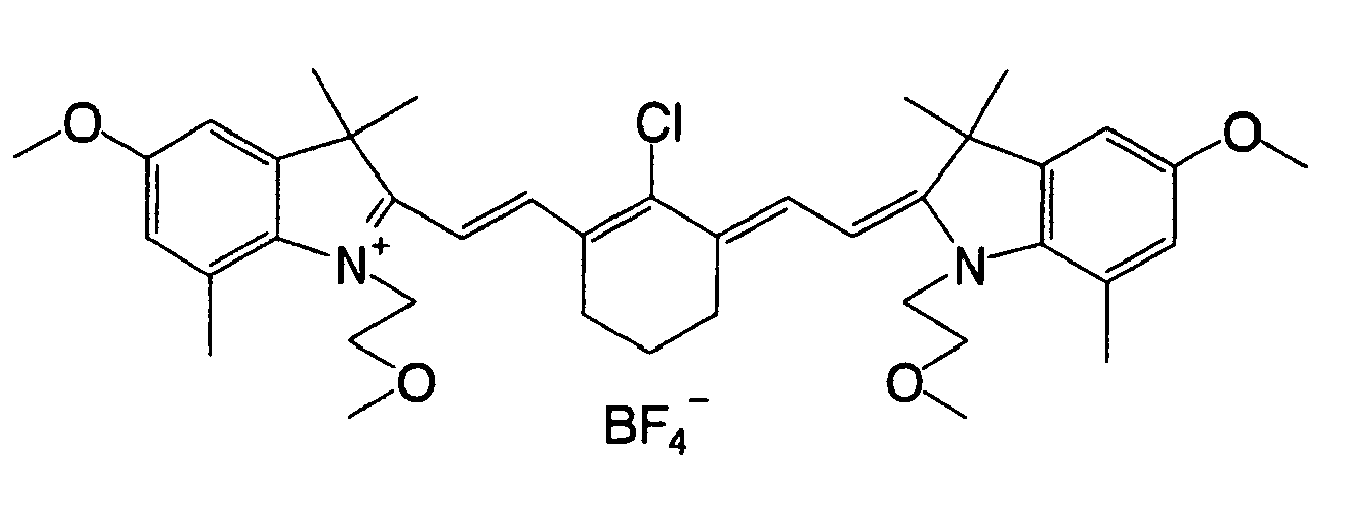


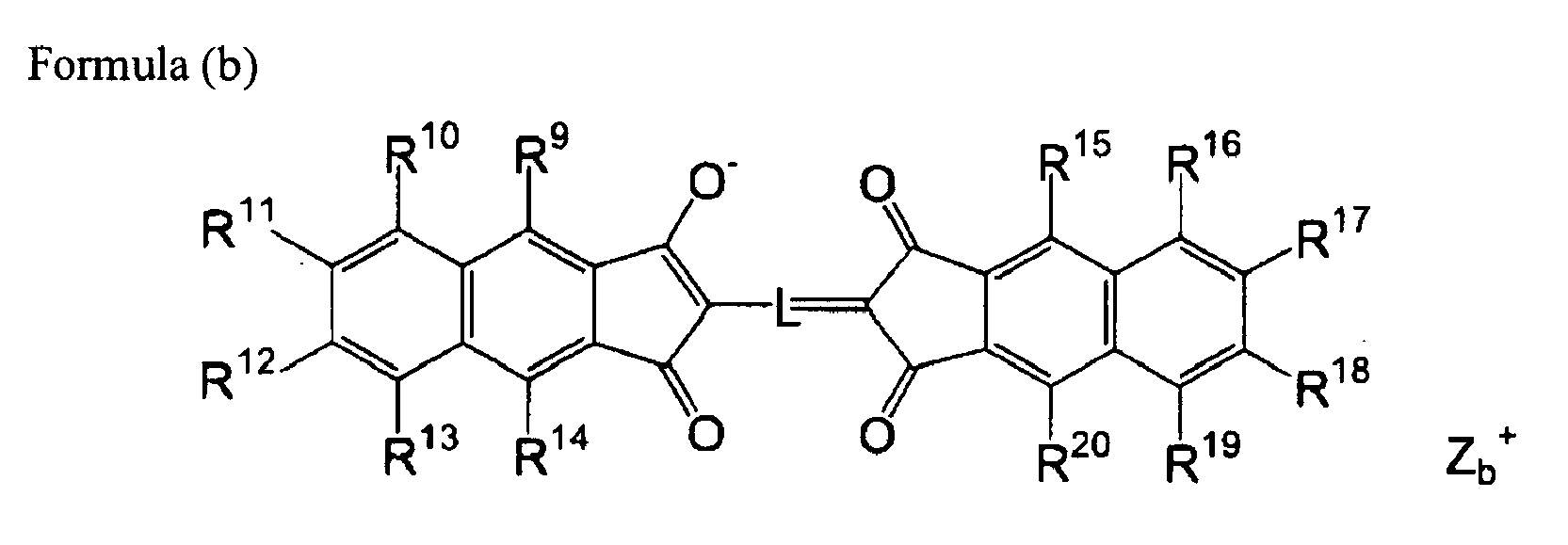
- In the Formula (b), L represents a methine chain containing 7 or more conjugated carbon atoms, and the methine chain may have a substituent, and the substituents may be bound to each other to form a ring structure. Zb + represents a counter cation. The counter cation is preferably ammonium, iodonium, sulfonium, phosphonium, pyridinium or an alkali metal cation (Ni+, K+, Li+). R9 to R14 and R15 to R20 each independently represent a hydrogen atom or a substituent selected from a halogen atom, a cyano group, an alkyl group, an aryl group, an alkenyl group, an alkynyl group, a carbonyl group, a thio group, a sulfonyl group, a sulfinyl group, an oxy group or an amino group, or a substituent composed of a combination of two or three such substituents which may be bound to each other to form a ring structure. Among the compounds of the Formula (b), those having a methine chain containing 7 conjugated carbon atoms as L, and those in which each of R9 to R14 and R15 to R20 represents a hydrogen atom, are preferable from the viewpoint of easy availability and effects.
- Examples of the dyes represented by the Formula (b), which can be used preferably in the invention, include those illustrated below:


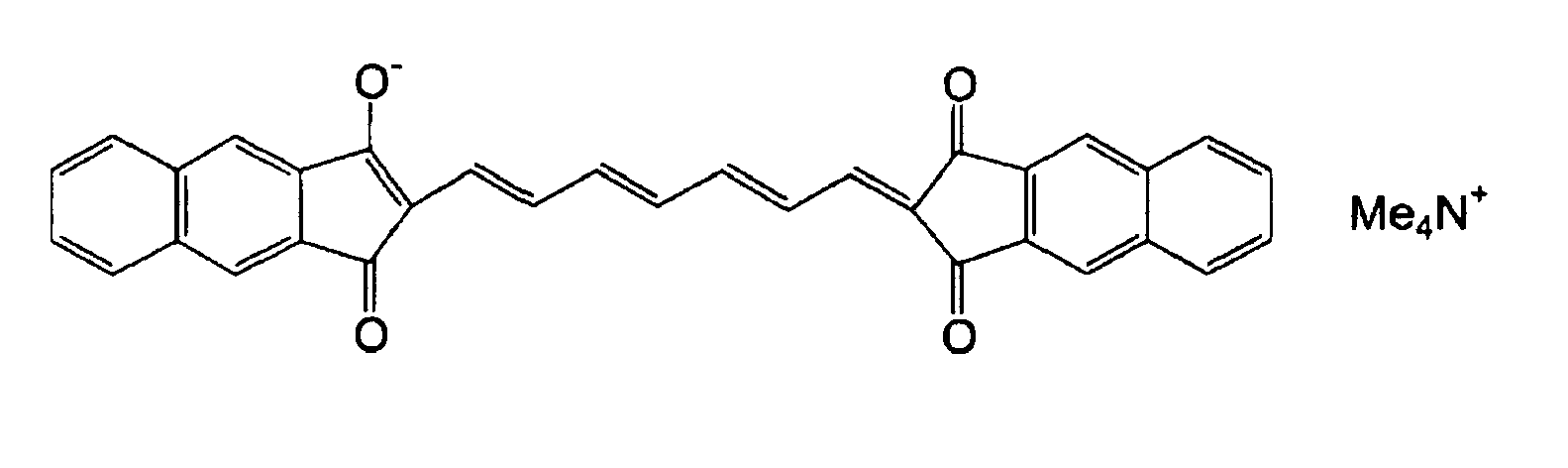

- In the Formula (c), Y3 and Y4 each independently represent an oxygen atom, a sulfur atom, a selenium atom or a tellurium atom; M represents a methine chain containing 5 or more conjugated carbon atoms; R21 to R24 and R25 to R28 may be the same as or different from one another, and each independently represent a hydrogen atom, a halogen atom, a cyano group, an alkyl group, an aryl group, an alkenyl group, an alkynyl group, a carbonyl group, a thio group, a sulfonyl group, a sulfinyl group, an oxy group or an amino group; and Za - represents a counter anion and has the same definition as that of Za - in the Formula (a) above.
- Examples of the dyes represented by the Formula (c), which can be used preferably in the invention, include those illustrated below:


- In the Formula (d), R29 to R31 each independently represent a hydrogen atom, an alkyl group or an aryl group; R33 and R34 each independently represent an alkyl group, a substituted oxy group or a halogen atom; n and m each independently represent an integer of 0 to 4; R29 and R30, or R31 and R32, may be bound to each other to form a ring; R29 and/or R30 may be bound to R33 to form a ring; R31 and/or R32 may be bound to R34 to form a ring; when plural R33s are present, some of R33s may be mutually bound to form a ring; when plural R34s are present, some of R34s may be mutually bound to form a ring; X2 and X3 each independently represent a hydrogen atom, an alkyl group or an aryl group, and at least one of X2 and X3 represents a hydrogen atom or an alkyl group; Q is an optionally substituted trimethine group or pentamethine group which may form a ring structure with a divalent organic group; and Zc- represents a counter anion and has the same definition as that of Za - in the Formula (A) above.
- Examples of the dyes represented by the Formula (d), which can be used preferably in the invention, include those illustrated below:


- In the Formula (e), R35 to R50 each independently represent a hydrogen atom, halogen atom, cyano group, alkyl group, aryl group, alkenyl group, alkynyl group, hydroxyl group, carbonyl group, thio group, sulfonyl group, sulfinyl group, oxy group, amino group, and onium salt structure, each of which may have a substituent; and M represents two hydrogen atoms, a metal atom, a halometal group or an oxymetal group, and examples of the metal atom contained therein include the groups IA, IIA, IIIB and IVB atoms in the periodic table, the transition metals in the first, second and third periods, and lanthanoid elements, among which copper, magnesium, iron, zinc, cobalt, aluminum, titanium and vanadium are preferable.
- Examples of the dyes represented by the Formula (e), which can be used preferably in the invention, include those illustrated below:


- Examples of the pigment used in the invention include commercial pigments and those described in Color Index (C. I.) Handbook, "Saishin Ganryo Binran" (Newest Dye Handbook) (published in 1977 and compiled by Japanese Society of Pigment Technology), "Saishin Ganryho Oyo Gijyutsu" (Newest Pigment Applied Technology) (published in 1986 by CMC), and "Insatsu Inki Gijyutsu" (Printing Ink Technology) (published in 1984 by CMC).
- As to the type of the pigment, examples of usable pigments include black pigments, yellow pigments, orange pigments, brown pigments, red pigments, violet pigments, blue pigments, green pigments, fluorescent pigments, metallic powder pigments, and other pigments such as polymer-binding colorants. Specific examples thereof include insoluble azo pigments, azo lake pigments, condensed azo pigments, chelate azo pigments, phthalocyanine pigments, anthraquinone pigments, perylene pigments, perinone pigments, thioindigo pigments, quinacridone pigments, dioxazine pigments, isoindolinone pigments, quinophthalone pigments, dyed lake pigments, azine pigments, nitroso pigments, nitro pigments, natural pigments, fluorescent pigments, inorganic pigments, and carbon black. A preferable pigment among those described above is carbon black.
- Such pigments may be used with or without being subjected to surface treatment. Examples of the method of surface treatment include a method of coating the surface with a resin or a wax, a method of allowing a surfactant to adhere to the surface, and a method of bonding a reactive substance (e.g., a silane coupling agent, an epoxy compound, a polyisocyanate etc.) onto the surface of the pigment. These methods of surface treatment are described in "Kinzoku Sekken No Seishitsu To Oyo" (Properties and Application of Metallic Soap) (Sachi Shobo), "Insatsu Inki Gijyutsu" (Printing Ink Technology) (published in 1984 by CMC Shuppan) and "Saishin Ganryho Oyo Gijyutsu" (Newest Pigment Applied Technology) (published in 1986 by CMC Shuppan).
- The particle diameter of the pigment is preferably in a range of from 0.01 to 10 µm, more preferably from 0.05 to 1 µm, still more preferably fom 0.1 to 1 µm. A pigment particle diameter of less than 0.01 µm is not preferable in respect of the stability of a pigment dispersion in the image recording layer coating liquid, whereas a particle diameter of more than 10 µm is not preferable in respect of the uniformity of the image recording layer.
- As the method of dispersing the pigments, any known dispersion techniques used in production of inks or toners can be used. Examples of the dispersing machine include a supersonic dispersing device, a sand mill, an attritor, a pearl mill, a super mill, a ball mill, an impeller, a disperser, a KD mill, a colloid mill, a dynatron, a triple roll mill, and a press kneader. Details thereof are described in "Saishin Ganryho Oyo Gijyutsu" (Newest Pigment Applied Technology) (published in 1986 by CMC Shuppan).
- The components (D) in the invention may include only one substance or a combination of two or more substances.
- The component (D) in the invention is preferably a cyanine colorant.
- From the viewpoint of sensitivity, the component (D) is more preferably a cyanine colorant represented by the Formula (A). Among colorants represented by the Formula (A), cyanine colorants in which X1 is a diarylamino group or X2-L1 is preferaeble, and those having a diaryl amino group are more preferable.
- A cyanine colorant having an electron-withdrawing group or a heavy atom-containing substituent at each of indolenine sites at both terminals is also preferable, and for example, the one described in
Japanese Patent Application No. 2001-6323 - In the case where the image recording material of the invention is used as a negative-working planographic printing plate precursor, the sensitizing dye (D) such as the above-described infrared ray absorbing agent, which is added to promote curing of the polymerizable compositions, may be added to the image recording layer, or an independently provided other layer, for example, a topcoat layer or an undercoat layer. In particular, when the image recording material of the invention is used as an image recording layer of a negative-working photosensitive planographic printing plate, the sensitizing dye (D) preferably has an optical density of fom 0.1 to 3.0 in the image recording layer at the absorption maximum in a wavelength range of from 760 nm to 1200 nm from the viewpoint of sensitivity. The optical density is determined according to the addition amount of the infrared ray absorbing agent and the thickness of the image recording layer, hence the predetermined optical density is achieved by controlling these factors.
- The optical density of the image recording layer can be measured by an ordinary method. Examples of the measurement method include a method of forming an image recording layer on a transparent or white support in an appropriately determined thickness such that the coating amount after drying is within the range necessary for a planographic printing plate, and measuring the absorbance with a transmission optical densitometer, and a method of forming a recording layer on a reflective support such as an aluminum support, and measuring the reflection density.
- The addition amount of the sensitizing dye to the image recording layer is preferably from 0.5 to 20% by mass with respect to the total solid content in the image recording layer. Within the range, property changes are highly sensitive to light exposure, thereby high sensitivity is achieved with no deleterious influences on the uniformity and strength of the film.
- The image recording material of the invention is usable in various fields as long as it is cured by light exposure and the light-unexposed portion is removed by alkali developing treatment to form an image. Examples of the application include a planographic printing plate precursor, a resist, and a coating. Preferably, the image recording material is used as a planographic printing plate precursor having a negative-working image recording layer because it is capable of forming images with high sensitivity, and has excellent alkali developability.
- An example of a planographic printing plate precursor, which is a preferable aspect of the invention, is described below, however the application of the image recording material of the invention is not limited to them.
- The layer structure of a planographic printing plate precursor including the image recording material of the invention is described below.
- The planographic printing plate precursor is composed of a support having provided thereon an image recording layer containing at least each of the above-described components (A) to (C), the above-described specific protective layer, and as necessary other layers such as an intermediate layer, an undercoat layer, and a back coat layer.
- In the planographic printing plate precursor according to the invention, the recording layer having a function of forming an image will be described. The recording layer of the planographic printing plate precursor according to the invention contains the components (A) to (C) and preferably contains a compound (D) having absorption maximum at 700 to 1200 nm from the viewpoint of improving sensitivity.
- The component (C) in the recording layer of the planographic printing plate precursor according to the invention functions particularly as a polymerization initiator for initiating and accelerating the polymerization of the polymerizable compound that is the component (B).
- Details of the compound used as the polymerizable compound (B) used in the recording layer of the planographic printing plate precursor are described in detail above. The selection of the compound to be used may depend on the requirements described above. In addition, a compound having a specific structure may be selected for the purpose of improving the adhesiveness to the support, the overcoat layer, or the like described later.
- The usage of the polymerizable compound may be arbitrarily selected as to its appropriate structure, Formulation, and addition amount in consideration of the polymerization degree of inhibition by oxygen, resolution, fogging property, refractive index variation, and surface tackiness. According to circumstances, a layer structure and a coating method containing an undercoat and a topcoat are possible.
- Other components suitable for the intended use, the production method etc. can further be added if necessary to the polymerizable composition according to the invention or to the composition constituting the recording layer of the planographic printing plate precursor. Hereinafter, preferable additives will be described.
- By use of a certain additive in the polymerizable composition, the sensitivity can be further improved. Such a compound will be referred to as a co-sensitizer hereinafter. Its working mechanism is not clear, but is considered to be based mainly on the following chemical process. That is, it is estimated that various intermediate active species (radials, cations) generated in the photo-reaction initiated by the heat-polymerization initiator and in the subsequent addition-polymerization reaction react with the co-sensitizer to form new active radicals. Such co-sensitizers can be roughly classified into (i) those capable of forming active radicals when reduced, (ii) those capable of forming active radicals when oxidized, and (iii) those converted into highly active radicals through reaction with radicals with low activity or those acting as chain transfer agents. There are many compounds whose classification is not commonly understood.
- Compounds having a carbon-halogen bond: It is considered that the carbon-halogen bond is reductively cleaved to generate active radicals. Specifically, for example, trihalomethyl-s-triazines and trihalomethyl oxadiazoles can be preferably used.
- Compounds having a nitrogen-nitrogen bond: It is considered that the nitrogen-nitrogen bond is reductively cleaved to form active radicals. Specifically, hexaryl biimidazoles can be preferably used.
- Compounds having an oxygen-oxygen bond: It is considered that the oxygen-oxygen bond is reductively cleaved to generate active radicals. Specifically, organic peroxides can be preferably used.
- Onium compounds: It is considered that a carbon-heteroatom bond or an oxygen-nitrogen bond is reductively cleaved to generate active radicals. Specifically, diaryl iodonium salts, triaryl sulfonium salts, and N-alkoxy pyridinium (azinium) salts can be preferably used.
- Ferrocene, iron arene complexes: Capable of forming active radicals reductively.
- Alkylate complexes: It is considered that a carbon-heteroatom bond is oxidatively cleaved to generate active radicals. Specifically, for example, triaryl alkyl borates can be preferably used.
- Alkyl amine compounds: It is considered that a C-X bond on a carbon adjacent to the nitrogen is cleaved by oxidation to form active radicals. X is preferably a hydrogen atom, a carboxyl group, a trimethylsilyl group, or a benzyl group. Specifically, ethanol amines, N-phenyl glycines, N-phenyliminodiacetic acid and its derivatives, and N-trimethylsilylmethyl anilines can be mentioned.
- Sulfur- or tin-containing compounds: A compound obtained by replacing the nitrogen atom in any of the above-described amines with a sulfur atom or a tin atom can form active radicals in a similar mechanism. Further, compounds having S-S bonds are known to act as sensitizers by cleavage of the S-S bonds.
- α-Substituted methyl carbonyl compounds: Capable of forming active radicals through the cleavage of the carbonyl-α carbon bond upon oxidation. Further, compounds obtained by replacing the carbonyl in such a compound with an oxime ether exhibit the same action. Specifically, examples include 2-alkyl-1-[4-(alkylthio) phenyl]-2-morpholinopronone-1 and derivatives thereof, as well as oxime ethers prepared by reacting such compounds with hydroxy amines and then etherifying N-OH.
- Sulfinates: Capable of forming active radicals reductively. Specifically, sodium aryl sulfinates can be mentioned.
- In a preferable embodiment, a polycarboxylic acid compound containing an aromatic ring or heterocyclic aromatic ring structure to which at least two carboxyl groups are bonded directly or via a divalent linking group is contained for the purpose of improving sensitivity and/or developability. Specific examples of the polycarboxylic acid compound include (p-acetamidophenylimido) diacetic acid, 3-(bis(carboxymethyl)amino) benzoic acid, 4-(bis(carboxymethyl)amino) benzoic acid, 2-[(carboxymethyl)phenylamino] benzoic acid, 2-[(carboxymethyl)phenylamino]-5-methoxybenzoic acid, 3-[bis(carboxymethyl)amino]-2-naphthalene carboxylic acid, N-(4-aminophenyl)-N-(carboxymethyl) glycine, N,N'-1,3-phenylene-bis-glycine, N,N'-1,3-phenylenebis[N-(carboxymethyl)] glycine, N,N'-1,2-phenylenebis[N-(carboxymethyl)] glycine, N-(carboxymethyl)-N-(4-methoxyphenyl) glycine, N-(carboxymethyl)-N-(3-methoxyphenyl) glycine, N-(carboxymethyl)-N-(3-hydroxyphenyl) glycine, N-(carboxymethyl)-N-(3-chlorophenyl) glycine, N-(carboxymethyl)-N-(4-bromophenyl) glycine, N-(carboxymethyl)-N-(4-chlorophenyl) glycine, N-(carboxymethyl)-N-(2-chlorophenyl) glycine, N-(carboxymethyl)-N-(4-ethylphenyl) glycine, N-(carboxymethyl)-N-(2,3-dimethylphenyl) glycine, N-(carboxymethyl)-N-(3,4-dimethylphenyl) glycine, N-(carboxymethyl)-N-(3,5-dimethylphenyl) glycine, N-(carboxymethyl)-N-(2,4-dimethylphenyl) glycine, N-(carboxymethyl)-N-(2,6-dimethylphenyl) glycine, N-(carboxymethyl)-N-(4-formylphenyl) glycine, N-(carboxymethyl)-N-ethylanthranilic acid, N-(carboxymethyl)-N-propylanthranilic acid, 5-bromo-N-(carboxymethyl) anthranilic acid, N-(2-carboxyphenyl) glycine, o-dianisidine-N,N,N',N'-tetraacetic acid, N,N'-[1,2-ethanediylbis(oxy-2,1-phenylene)] bis[N-(carboxymethyl) glycine], 4-carboxyphenoxy acetic acid, cathecol-O,O'-diacetic acid, 4-methylcatechol-O,O'-diacetic acid, resorcinol-O,O'-diacetic acid, hydroquinone-O,O'-diacetic acid, α-carboxy-o-anisic acid, 4,4'-isopropylidene diphenoxy acetic acid, 2,2'-(dibenzofuran-2,8-diyldioxy) diacetic acid, 2-(carboxymethylthio) benzoic acid, 5-amino-2-(carboxymethylthio) benzoic acid, and 3-[(carboxymethyl)thio]-2-naphthalene carboxylic acid.
- In particular, N-arylpolycarboxylic acids represented by the following Formula (VI) or compounds represented by the following Formula (VII) are preferable.

- In Formula (V), Ar represents a monosubstituted, polysubstituted or unsubstituted aryl group, and m is an integer from 1 to 5.
- Examples of a substituent which can be introduced into the aryl group include a C1 to C3 alkyl group, a C1 to C3 alkoxy group, a C1 to C3 thioalkyl group and a halogen atom. This aryl group preferably has 1 to 3 identical or different substituents. m is preferably 1, and Ar preferably represents a phenyl group.

- In Formula (VI), R1 represents a hydrogen atom or a C1 to C6 alkyl group, and each of n and p is an integer from 1 to 5.
- n is preferably 1, and R1 is preferably a hydrogen atom. The most preferable polycarboxylic acid is anilinodiacetic acid.
- Another compound preferable for improving sensitivity and/or developability is a compound having two or more groups selected from carboxylic acid groups and sulfonic acid groups, and specific examples thereof include 5-aminoisophthalic acid, 5-nitroisophthalic acid, 4-methylphthalic acid, terephthalic acid, 2-bromoterephthalic acid, 2,3-naphthalenedicarboxylic acid, diphenic acid, 1,4,5,8-naphthalenetetracarboxylic acid, N-benzyliminodiacetic acid, N-(2-carboxyphenylglycine), N-phenyliminodiacetic acid, 1,3,5-benzenetricarboxylic acid, 1,2,4,5-benzenetetracarboxylic acid, 5-sulfosalicylic acid, 2-sulfobenzoic acid, 1,5-naphthalenedisulfonic acid, and 4-sulfophthalic acid. The above compound can be further substituted by an alkyl group, an alkenyl group, an alkynyl group, a cyano group, a halogen atom, a hydroxyl group, a carboxyl group, a carbonyl group, an alkoxy group, an amino group, an amide group, a thiol group, a thioalkoxy group, or a sulfonyl group.
- Among those described above, the most preferable compound is a compound represented by the Formula (V) or (VI).
- The amount of such poly(carboxylic acid/sulfonic acid) compound to be added is preferably 0.5 to 15 mass%, more preferably 1 to 10 mass%, still more preferably 3 to 8 mass%, based on the solid content of the polymerizable composition.
- A large number of more specific examples of these co-sensitizers are described, for example, in
JP-A No. 9-236913 - Only one co-sensitizer, or a combination of two or more co-sensitizers, may be used. The amount of the co-sensitizer to be used may be in a range of 0.05 to 100 parts by mass, preferably 1 to 80 parts by mass, more preferably 3 to 50 parts by mass, relative to 100 parts by mass of the polymerizable compound (B).
- In the invention, in addition to the basic components described above, a small amount of a heat-polymerization inhibitor is preferably added so as to inhibit unnecessary heat polymerization of the polymerizable compound during production or storage of the composition used in the recording layer. Suitable examples of the heat-polymerization inhibitor include hydroquinone, p-methoxyphenol, di-t-butyl-p-cresol, pyrogallol, t-butyl catechol, benzoquinone, 4,4'-thiobis(3-methyl-6-t-butyl phenol), 2,2'-methylene bis(4-methyl-6-t-butyl phenol), and N-nitrosophenyl hydroxylamine primary cerium salts. The amount of the heat-polymerization inhibitor to be added is preferably about 0.01 mass% to about 5 mass% relative to the mass of the entire composition. To prevent the polymerization inhibition by oxygen, a higher fatty acid derivative such as behenic acid or behenic amide may be added as necessary so that the higher fatty acid derivative localizes on the surface of the recording layer in the drying process after application onto a support etc. during the production process of the planographic printing plate precursor. The amount of the higher fatty acid derivative to be added is preferably about 0.5 mass% to about 10 mass% based on the entire composition.
- A dye or pigment may be added to the planographic printing plate precursor according to the invention, for the purpose of coloring its recording layer. The plate-checking property of the printing plate, such as visibility after plate-making and compatibility with an image densitometer, can thereby be improved. The colorant is preferably a pigment since many dyes lower the sensitivity of the photopolymerizable recording layer. Examples of the colorant include pigments such as phthalocyanine pigments, azo pigments, carbon black and titanium oxide, and dyes such as Ethyl Violet, Crystal Violet, azo dyes, anthraquinone dyes and cyanine dyes. The amount of the dyes and pigments to be added is preferably about 0.5 mass% to about 5 mass% based on the entire composition.
- In the invention, some aspects may be used for including the image recording layer constituents in the image recording layer. An aspect is a molecule dispersion type image recording layer as described in
JP-A No. 2002-287334 JP-A No. 2001-277740 JP-ANo. 2001-277742 - In order to achieve more favorable in-machine developability, the image recording layer is preferably a microcapsule type or microgel type image recording layer.
- Known methods may be used for microencapsulation or microgelation of the image recording layer constituents.
- Examples of the method for producing the microcapsules include, however not limited to, a method using coacervation as described in
U.S. Patent Nos. 2800457 , and2800458 , a method using interfacial polymerization as described inU.S. Patent No. 3287154 ,JP-B Nos. 38-19574 42-446 U.S. Patent Nos. 3418250 and3660304 , a method using an isocyanate polyol wall material as described inU.S. Patent No. 3796669 , a method using an isocyanate wall material as described inU.S. Patent No. 3914511 , a method using a urea-formaldehyde-based or urea formaldehyde-resorcinol-based wall forming material as described inU.S. Patent Nos. 4001140 ,4087376 , and4089802 , a method of using a wall material such as a melamine-formaldehyde resin or hydroxy cellulose as described inU.S. Patent No. 4025445 , a in situ method by monomer polymerization as described inJP-B Nos. 36-9163 51-9079 U.K. Patent No. 930422 U.S. Patent No. 3111407 , and an electrolysis dispersion cooling method as described inU.K. Patent Nos. 952807 967074 - The wall of microcapsules used in the invention preferably has a three-dimensional crosslink, and swells in a solvent. From these viewpoints, the wall material of the microcapsules is preferably polyurea, polyurethane, polyester, polycarbonate, polyamide, or a mixture thereof, and is particularly preferably polyurea or polyurethane. The microcapsule wall may contain a compound having a crosslinking functional group such as an ethylenically unsaturated bond which allows the introduction of a binder polymer.
- Examples of the method for preparing a microgel include, however not limited to, granulation through interfacial polymerization as described in
JP-B Nos. 38-19574 42-446 JP-A No. 5-61214 - The above-described known method for producing microcapsules is applicable to the method using interfacial polymerization. The microgel preferably used in the invention is preferably prepared by granulation through interfacial polymerization and preferably has a three-dimensional crosslinking. From these viewpoints, the raw material or the microgel is preferably polyurea, polyurethane, polyester, polycarbonate, polyamide, or a mixture thereof, and particularly preferably polyurea or polyurethane.
- The average particle diameter of the microcapsules and microgel is preferably from 0.01 to 3.0 µm, more preferably from 0.05 to 2.0 µm, and particuraly preferably 0.10 to 1.0 µm. When the diameter is within the range, favorable resolution which is stable over time is achieved.
- In the invention, the image recording layer preferably contains a surfactant for promoting the in-machine developability at the beginning of printing, and for improving the property of the coated surface. Examples of the surfactant include a nonionic surfactant, an anionic surfactant, a cationic surfactant, an amphoteric surfactant, a fluorine-based surfactant. These surfactants may be used alone or in combination of two or more of them.
- The nonionic surfactant used in the image recording layer of the invention is not particularly limited, and may be a conventionally known nonionic surfactant. Examples thereof include polyoxyethylene alkyl ethers, polyoxyethylene alkyl phenyl ethers, polyoxyethylene polystyryl phenyl ethers, polyoxyethylene polyoxypropylene alkyl ethers, glycerin fatty acid partial esters, sorbitan fatty acid partial esters, pentaerythritol fatty acid partial esters, propylene glycol monofatty acid esters, sucrose fatty acid partial esters, polyoxyethylene sorbitan fatty acid partial esters, polyoxyethylene sorbitol fatty acid partial esters, polyethylene glycol fatty acid esters, polyglycerin fatty acid partial esters, polyoxyethylene castor oils, polyoxyethylene glycerin fatty acid partial esters, fatty acid diethanol amides, N,N-bis-2-hydroxyalkyl amines, polyoxyethylene alkyl amine, triethanol amine fatty acid esters, trialkyl amine oxides, polyethylene glycol, and polyethylene glycol-polypropylene glycol copolymers.
- The anionic surfactant used in the invention is not particularly limited, and may be a conventionally known anionic surfactant. Examples thereof include fatty acid salts, abietates, hydroxyalkane sulfonates, alkane sulfonates, dialkylsulfosuccinic ester salts, linear alkyl benzene sulfonates, branched alkyl benzene sulfonates, alkyl naphthalene sulfonates, alkyl phenoxy polyoxyethylene propyl sulfonates, polyoxyethylene alkyl sulfophenyl ether salts, N-methyl-N-oleyl taurine sodium salt, N-alkyl sulfosuccinic monoamide disodium salt, petroleum sulfonates, sulfated tallow oil, sulfuric ester salts of alkyl esters of fatty acids, alkyl sulfuric ester salts, polyoxyethylene alkyl ether sulfuric ester salts, fatty acid monoglyceride sulfuric ester salts, polyoxyethylene alkyl phenyl ether sulfuric ester salts, polyoxyethylene styryl phenyl ether sulfuric ester salts, alkyl phosphoric ester salts, polyoxyethylene alkyl ether phosphoric ester salts, polyoxyethylene alkyl phenyl ether phosphoric ester salts, partially saponified styrene-maleic anhydride copolymers, partially saponified olefin-maleic anhydride copolymers and naphthalene sulfonate formalin condensates.
- The cationic surfactant used in the invention is not particularly limited, and may be a conventionally known cationic surfactant. Examples thereof include alkyl amine salts, quaternary ammonium salts, polyoxyethylene alkyl amine salts and polyethylene polyamine derivatives.
- The amphoteric surfactant used in the invention is not particularly limited, and may be a conventionally known amphoteric surfactant. Examples thereof include carboxy betaines, aminocarboxylic acids, sulfobetaines, aminosulfates and imidazolines.
- Examples of the surfactant further includes the surfactants obtained by replacing the polyoxyethylene in the above surfactants by a polyoxyalkylene such as a polyoxymethylene, a polyoxypropylene, or a polyoxybutylene..
- Fluorine-based surfactants containing perfluoroalkyl groups are further preferable. Examples of the fluorine-based surfactants include: anionic surfactants such as perfluoroalkyl carboxylates, perfluoroalkyl sulfonates and perfluoroalkyl phosphates; amphoteric surfactants such as perfluoroalkyl betaine; cationic surfactants such as perfluoroalkyl trimethyl ammonium salts; and nonionic surfactants such as perfluoroalkyl amine oxides, perfluoroalkyl ethylene oxide adducts, oligomers each having a perfluoroalkyl group and a hydrophilic group, oligomers each having a perfluoroalkyl group and a lipophilic group, oligomers each having a perfluoroalkyl group, a hydrophilic group, and a lipophilic group, and urethanes each having a perfluoroalkyl group and a lipophilic group. The fluorine-based surfactants described in
JP-A Nos. 62-170950 62-226143 60-168144 - Only a single surfactant may be used or two or more surfactants may be used.
- The content of the surfactant is preferably 0.001 to 10 % by mass, more preferably 0.01 to 5 % by mass, based on the total solid content of the image recoding layer.
- A compound whose color can be changed by an acid or by a radical may be added to the image recording layer in order to form a printout image. Such a compound may be, for example, a colorant such as a diphenyl methane colorant, a triphenyl methane colorant, a thiazine colorant, an oxazine colorant, a xanthene colorant, an anthraquinone colorant, an iminoquinone colorant, an azo colrant, or an azomethine colorant.
- Specific examples thereof include dyes such as Brilliant Green, Ethyl Violet, Methyl Green, Crystal Violet, Basic Fuchsin, Methyl Violet 2B, Quinaldine Red, Rose Bengal, Metanil Yellow, Thymol Sulfophthalein, Xylenol Blue, Methyl Orange, Paramethyl Red, Congo Red, Benzopurprin 4B, α-Naphthyl Red, Nile Blue 2B, Nile Blue A, Methyl Violet, Malachite Green, Parafuchsin, Victoria Pure Blue BOH (manufactured by Hodogaya Kagaku Co., Ltd.), Oil Blue #603 (manufactured by Orient Chemical Industries, Ltd.), Oil Pink #312 (manufactured by Orient Chemical Industries, Ltd.), Oil Red 5B (manufactured by Orient Chemical Industries, Ltd.), Oil Scarlet #308 (manufactured by Orient Chemical Industries, Ltd.), Oil Red OG (manufactured by Orient Chemical Industries, Ltd.), Oil Red RR (manufactured by Orient Chemical Industries, Ltd.), Oil Green #502 (manufactured by Orient Chemical Industries, Ltd.), Spirone Red BEH Special (manufactured by Hodogaya Kagaku Co., Ltd.), m-Cresol Purple, Cresol Red, Rhodamine B, Rhodamine 6G, Sulforhodamine B, Auramine, 4-p-diethylaminophenyl iminonaphthoquinone, 2-carboxyanilino-4-p-diethylaminophenyl iminonaphthoquinone, 2-carboxystearylamino-4-p-N,N-bis(hydroxyethyl) amino-phenyliminonaphthoquinone, 1-phenyl-3-methyl-4-p-diethylaminophenylimino-5-pyrazolone and 1-β-naphthyl-4-p-diethylaminophenylimino-5-pyrazolone, and leuco dyes such as p,p',p"-hexamethyl triaminophenyl methane (Leuco Crystal Violet) and Pergascript Blue SRB (manufactured by Ciba-Geigy).
- In addition to those described above, preferable examples of the printout agent further include leuco dyes known as materials for thermal sensitive paper and pressure sensitive paper. Specific examples thereof include crystal violet lactone, malachite green lactone, benzoyl leucomethylene blue, 2-(N-phenyl-N-methylamino)-6-(N-p-tolyl-N-ethyl) amino-fluoran, 2-anilino-3-methyl-6-(N-ethyl-p-toluidino) fluoran, 3,6-dimethoxy fluoran, 3-(N,N-diethylamino)-5-methyl-7-(N,N-dibenzylamino)-fluoran, 3-(N-cyclohexyl-N-methylamino)-6-methyl-7-anilinofluoran, 3-(N,N-diethylamino)-6-methyl-7-anilinofluoran, 3-(N,N-diethylamino)-6-methyl-7-xylidinofluoran, 3-(N,N-diethylamino)-6-methyl-7-chlorofluoran, 3-(N,N-diethylamino)-6-methoxy-7-aminofluoran, 3-(N,N-diethylamino)-7-(4-chloroanilino) fluoran, 3-(N,N-diethylamino)-7-chlorofluoran, 3-(N,N-diethylamino)-7-benzyl aminofluoran, 3-(N,N-diethylamino)-7,8-benzofluoran, 3-(N,N-dibutylamino)-6-methyl-7-anilinofluoran, 3-(N,N-dibutylamino)-6-methyl-7-xylidinofluoran, 3-piperidino-6-methyl-7-anilinofluoran, 3-pyrrolidino-6-methyl-7-anilinofluoran, 3,3-bis(1-ethyl-2-methylindol-3-yl) phthalide, 3,3-bis(1-n-butyl-2-methylindol-3-yl) phthalide, 3,3-bis(p-dimethylaminophenyl)-6-dimethyl amino phthalide, 3-(4-diethylamino-2-ethoxyphenyl)-3-(1-ethyl-2-methylindol-3-yl)-4-phthalide, and 3-(4-diethylaminophenyl)-3-(1-ethyl-2-methylindol-3-yl) phthalide.
- The amount of the dye whose color is changed by an acid or by a radical is from 0.01 to 10 % by mass based on the total solid content in the hydrophilic film.
- In the invention, a borate compound may be used for improving the color development property of the light-exposed portion. The borate compound may be freely selected from compounds having a borate anion structure, and is preferably a borate compound having the following structure.

- In the Formula, R1 to R4 each independently represent a monovalent organic group, and Zn+ represents an n-valent cation. n denotes an integer of 1 to 6.
- Examples of the monovalent organic group represented by R1 to R4 include an alkyl group, an alkenyl group, an aryl group, an alkynylgroup, and a cycloalkyl group, which may be substituted by an alkyl group, an alkenyl group, an alkynyl group, an aryl group, a halogen atom, an alkoxy group, an alkoxycarbonyl group, an amino group, a cyano group, an amide group, an urethane group, a sulfo group, a thioalkoxy group, or a carboxyl group.
- R1 to R4 preferably each independently represent an aryl group, and are more preferably an aryl group having an electron-withdrawing group. The electron-withdrawing group is preferably a halogen atom or a fluoroalkyl group, and most preferably a fluorine atom or a trifluoromethyl group.
- Zn+ may be freely selected from cations, and is preferably an alkali metal ion, an alkaline earth metal ion, or an onium salt such as a sulfonium salt, an iodonium salt, an azinium salt, an ammonium salt, a phosphonium salt, or a diazonium salt.
- To prevent unnecessary heat polymerization of the radical polymerizable compound (C), the image recording layer of the invention preferably contains a small amount of heat polymerization inhibitor, which is added during making or storage of the image recording layer.
- Preferable examples of the heat polymerization inhibitor include hydroquinone, p-methoxyphenol, di-t-butyl-p-cresol, pyrogallol, t-butylcatechol, benzoquinone, 4,4'-thiobis(3-methyl-6-t-butylphenol), 2,2'-methylenebis(4-methyl-6-t-butylphenol), and aluminum N-nitroso-N-phenylhydroxylamine. The addition amount of the heat polymerization inhibitor is preferably about 0.01 to about 5% by mass with respect to the total solid content in the image recording layer.
- To prevent polymerization inhibition by oxygen, the image recording layer of the invention may contain a higher fatty acid derivative such as behenic acid or behenic acid amide, which is localized on the surface of the image recording layer during the drying process after applying the layer. The addition amount of the higher fatty acid derivative is preferably about 0.1 to about 10% by mass with respect to the total solid content in the image recording layer.
- The image recording layer of the invention may contain a plasticizing agent for improving the in-machine developability. Preferable examples of the plasticizing agent include phthalate esters such as dimethyl phthalate, diethyl phthalate, dibutyl phthalate, diisobutyl phthalate, dioctyl phthalate, octylcapryl phthalate, dicyclohexyl phthalate, ditridecyl phthalate, butylbenzyl phthalate, diisodecyl phthalate, and diallyl phthalate; glycolates such as dimethylglycol phthalate, ethylphthalylethyl glycolate, methylphthalylethyl glycolate, butylphthalylbutyl glycolate, and triethyleneglycoldicaprylic acid ester; phosphates such as tricresyl phosphate and triphenylphosphate ; aliphatic dibasic acid esters such as diisobutyl adipate, dioctyl adipate, dimethyl sebacate, dibutyl sebacate, dioctyl azelate, and dibutyl maleate; and polyglycidyl methacrylate, triethyl citrate, glyceroltriacetyl ester, and butyl laurate. The content of the plasticizing agent is preferably about 30% by mass or lower with respect to the total solid content in the image recording layer.
- In the invention, the image recording layer may further include inorganic fine particles in order to improve the strength of the cured film, hydrophilicity and water holding property of the hydrophilic film.
- Examples of the inorganic fine particles include, for example, silica, alumina, magnesium oxide, titanium oxide, magnesium carbonate, calcium alginate and mixtures thereof. Even if an inorganic fine particle cannot convert light to heat, the inorganic fine particle may be used for reinforcement of the coating film and improvement of the interfacial adhesiveness by surface roughening.
- The average particle size of the inorganic fine particle is preferably 5 nm to 10 µm, more preferably 0.5 µm to 3 µm. When the average particle diameter is in the above range, the inorganic fine particles can be dispersed stably in the image recording layer, whereby excellent film strength of the image recording layer is obtained and a highly hydrophilic non-image area which is hardly blemished during printing is obtained.
- The inorganic fine particles described above are easily available as commercially available products such as colloidal silica dispersions.
- The content of the inorganic fine particles is preferably 20 % by mass or lower, more preferably 10 % by mass or lower, based on the total solid content of the image recording layer.
- The image recording layer of the invention may contain a low molecule weight compound for improving the in-machine developability. Examples of the hydrophilic low molecular weight compound include water-soluble organic compounds such as glycols and ether or ester derivatives thereof such as ethylene glycol, diethylene glycol, triethylene glycol, propylene glycol, dipropylene glycol, and tripropylene glycol, polyhydroxys such as glycerol and pentaerythritol, organic amines and salts thereof such as triethanolamine, diethanolamine, and monoethanolamine, organic sulfonic acids and salts thereof such as toluenesulfonic acid and benzenesulfonic acid, organic phosphonic acids and salts thereof such as phenylphosphonic acid, and organic carboxylic acids and salts thereof such as tartaric acid, oxalic acid, citric acid, malic acid, lactic acid, gluconic acid, and amino acids.
- The planographic printing plate precursor of the invention may further contain other known additives such as an inorganic filler in order to improve the physical property of the cured film, a plasticizer, and an oil-sensitizing agent for improving the ink settlement on the surface of the recording layer.
- Examples of the plasticizer include dioctyl phthalate, didodecyl phthalate, triethyleneglycol dicaprylate, dimethylglycol phthalate, tricresyl phosphate, dioxtyl adipate, dibutyl sebacate, and triacetylglycerol. In the case where a binder is used, the plasticizer may be added in an amount of 10% by mass or lower with respect to the total mass of a compound having an ethylenically unsaturated bond and the binder.
- Further, the below-described additives such as a UV initiator and a heat crosslinking agent may be added for enhancing the effect of heating and light exposure after development to improve the film strength (printing durability).
- In addition, other additives or an intermediate layer may be used to improve the adhesiveness between the recording layer and support, and enhance the development removability of the light-unexposed recording layer. For example, the adhesiveness and printing durability can be improved by adding or undercoating with a compound which relatively strongly interacts with a substrate, such as a compound having a diazonium structure or a phosphonate compound, and the developability in the non-image region and stain resistance can be improved by adding or undercoating with a hydrophilic polymer such as polyacrylic acid or polysulfone acid.
- The planographic printing plate precursor is produced by dissolving coating solution components for forming intended layers such as a recording layer and a protective layer in appropriate solvents, and applying the coating solutions on an appropriate support.
- Examples of the solvent to be used include acetone, methylethylketone, cyclohexane, ethylacetate, ethylene dichloride, tetrahydrofuran, toluene, ethylene glycol monomethylether, ethylene glycol monoethylether, ethylene glycol dimethylether, propylene glycol monomethylether, propylene glycol monoethylether, acetylacetone, cyclohexanone, diacetone alcohol, ethylene glycol monomethylether acetate, ethylene glycol ethylether acetate, ethylene glycol monoisopropylether, ethylene glycol monobutylether acetate, 3-methoxypropanol, methoxymethoxyethanol, diethylene glycol monomethylether, diethylene glycol monoethylether, diethylene glycol dimethylether, diethylene glycol diethylether, propylene glycol monomethylether acetate, propylene glycol monoethylether acetate, 3-methoxypropyl acetate, N,N-dimethylformamide, dimethylsulfoxide, γ-butyrolactone, methyl lactate, and ethyl lactate. These solvents may be used alone or as a mixture. The concentration of the solid content in a coating solution is preferably from 2 to 50% by mass.
- It is preferable that the coating amount of the recording layer on the support be selected as appropriate according to the intended use in consideration of the sensitivity and developability of the recording layer, strength of the light-exposed film, printing durability, and other influences. If the coating amount is too small, the printing durability is insufficient, and if excessive, the sensitivity decreases, which results in prolongation of the time necessary for light exposure and developing treatment. The coating amount on the planographic printing plate precursor of the invention is preferably in a range of fom about 0.1 to about 10 g/m2, and more preferably fom 0.5 to 5 g/m2 at a mass after drying.
- In the planographic printing plate precursor according to the invention, a resin intermediate layer including an alkali-soluble polymer can be arranged as necessary between the recording layer and the support.
- When the recording layer that is an infrared light-sensitive layer whose solubility in an alkali developer is decreased upon exposure to light is disposed as a light exposure surface or in the vicinity thereof, the sensitivity to an infrared laser light is improved. Further, the resin intermediate layer between the support and the infrared light-sensitive recording layer acts as a heat insulating layer, thereby preventing heat generated upon exposure to infrared laser light from diffusing in the support. Therefore, the heat is used effectively, and the sensitivity can be heightened.
- It is estimated that in a light-exposed portion, the photosensitive layer (recording layer) made impermeable to an alkali developer functions as a protective layer for the resin intermediate layer, thus improving development stability, forming an image excellent in discrimination and securing stability with time, while in a light-unexposed portion, an unhardened binder component is rapidly dissolved and dispersed in a developer. Since the resin intermediate layer provided adjacent to the support is made of an alkali-soluble polymer, the resin intermediate layer is excellent in solubility in a developer, and is rapidly dissolved to attain excellent developability without generating a remaining layer even if, for example, a developer having lowered activity is used.
- The support used in the invention may be paper, a polyester film or an aluminum plate, among which an aluminum plate is particularly preferable because it is excellent in dimensional stability, is relatively inexpensive, can provide a surface excellent in hydrophilicity and strength by performing surface treatment as necessary. A composite sheet having an aluminum sheet bonded to a polyethylene terephthalate film, as described in
JP-B No. 48-18327 - The aluminum plate as used herein is a dimensionally stable metal plate including aluminum as a major component, and the scope of the aluminum plate includes not only a pure aluminum plate but also an alloy plate including aluminum as a major component and a very small amount of hetero elements, and a plastic film or paper having aluminum (alloy) laminated or vapor-deposited thereon. In the following description, supports made of aluminum or aluminum alloys are referred to collectively as aluminum supports. Examples of the hetero elements contained in the aluminum alloy include silicon, iron, manganese, copper, magnesium, chromium, zinc, bismuth, nickel, and titanium. The content of the hetero elements in the alloy is 10 mass% or less. A pure aluminum plate is particularly preferable, but because production of completely pure aluminum is difficult from the viewpoint of refining techniques, aluminum may contain a very small amount of hetero elements. The composition of the aluminum plate is not limited, and any aluminum plates made of known and conventionally used aluminum materials such as JIS A 1050, JIS A 1100, JIS A 3103 and JIS A 3005 can be used as necessary.
- The thickness of the aluminum support is from about 0.1 to about 0.6 mm. This thickness can be suitably changed depending on the size of a printing machine, the size of a printing plate, and user's requests.
- The aluminum support may be subjected to the following surface treatment to make it hydrophilic.
- Examples of the surface roughening treatment include mechanical roughening, chemical etching and electrolytic grain as disclosed in
JP-A No. 56-28893 - The aluminum support thus surface-roughened may be etched chemically with acid or alkali. Preferable examples of the etching agent to be used include sodium hydroxide, sodium carbonate, sodium aluminate, sodium metasilicate, sodium phosphate, potassium hydroxide, lithium hydroxide etc., and the concentration and temperature are preferably in a range of from 1 to 50% and fom 20 to 100°C, respectively. After etching, washing with acid may be carried out to remove blemish (smuts) remaining on the surface. Examples of the acid to be used include nitric acid, sulfuric acid, phosphoric acid, chromic acid, fluoric acid and hydrofluoboric acid. The method of removing smuts after electrochemical surface roughening treatment is preferably a method of contacting with from 15 to 65% by mass sulfuric acid at a temperature of from 50 to 90°C as described in
JP-A No. 53-12739 JP-B No. 48-28123 - The thus treated aluminum support having an oxide layer formed thereon is then subjected to anodizing treatment.
- In the anodizing treatment, an aqueous solution of sulfuric acid, phosphoric acid, oxalic acid or boric acid-sodium borate, or an aqueous solution of a combination of two or more of such substances, can be used as the major component in an electrolytic bath. In this case, the electrolytic solution may naturally contain at least components usually contained in the A1 alloy plate, the electrodes, tap water and underground water. Second and third components may also be contained. The range of the second and third components include, for example, cations of metals such as Na, K, Mg, Li, Ca, Ti, Al, V, Cr, Mn, Fe, Co, Ni, Cu and Zn, ammonium ions, and anions such as nitrate ion, carbonate ion, chlorine ion, phosphate ion, fluorine ion, sulfite ion, titanate ion, silicate ion and borate ion, and the concentration thereof may be from about 0 to 10000 ppm. Although the conditions for the anodizing treatment are not particularly limited, the plate is preferably treated with 30 to 500 g/L solution at a temperature of 10 to 70°C by direct current or alternating current electrolysis in a range of a current density of 0.1 to 40 A/m2. The thickness of the anodized layer formed may be in a range of 0.5 to 1.5 µm. Preferably, the thickness is in a range of 0.5 to 1.0 µm. The treatment conditions are preferably selected such that the pore diameter of micropores present in the anodized layer formed on the support by the treatment described above is 5 to 10 nm and such that the pore density is 8×10¹⁵ to 2×10¹⁶ pores/m2.
- The treatment for imparting hydrophilicity to the surface of the support may be selected from various known methods. The treatment is particularly preferably hydrophilicity-imparting treatment with a silicate, polyvinylphosphonic acid, or the like. The obtained layer may have a Si or P element content of 2 to 40 mg/m2, preferably 4 to 30 mg/m2. The coating amount can be measured by fluorescence X ray analysis.
- In the hydrophilicity-imparting treatment, the aluminum support having an anodized layer formed thereon is dipped in an aqueous solution at pH 10 to 13 (determined at 25°C) containing an alkali metal silicate or polyvinylphosphonic acid in an amount of 1 to 30 mass%, more preferably 2 to 15 mass%, for example at 15 to 80°C for 0.5 to 120 seconds.
- As the alkali metal silicate used in the treatment for imparting hydrophilicity, sodium silicate, potassium silicate, lithium silicate, or the like is used. The hydroxide used for raising the pH value of the aqueous alkali metal silicate solution may be sodium hydroxide, potassium hydroxide, lithium hydroxide, or the like. Alkaline earth metal salts or the group IVB metal salts may be incorporated into the treating solution described above. Examples of the alkaline earth metal salts include nitrates such as calcium nitrate, strontium nitrate, magnesium nitrate and barium nitrate, and water-soluble salts such as sulfate, hydrochloride, phosphate, acetate, oxalate and borate. Examples of the group IVB metal salts include titanium tetrachloride, titanium trichloride, titanium potassium fluoride, titanium potassium oxalate, titanium sulfate, titanium tetraiodide, zirconium chloride oxide, zirconium dioxide, zirconium oxychloride, and zirconium tetrachloride.
- In an embodiment, only one selected from alkaline earth metal salts and group IVB metal salts is used. In another embodiment, a combination of two or more selected from alkaline earth metal salts and group IVB metal salts is used. The amount of these metal salts is preferably in a range of from 0.01 to 10% by mass, more preferably from 0.05 to 5.0% by mass. Electrodeposition with silicate as described in
US Patent No. 3,658,662 is also effective. A surface treatment which is a combination of a support which has been subjected to electrolytic graining as disclosed inJP-B No. 46-27481 JP-A No. 52-58602 JP-A No. 52-30503 - The planographic printing plate precursor according to the invention may have the recording layer and the specific protective layer described above on this order on a support and may be provided if necessary with an intermediate layer (undercoat layer) etc. Such a planographic printing plate precursor can be produced by applying coating liquids containing the respective components sequentially onto a support.
- When the recording layer is formed by coating, the recording layer components are dissolved in an organic solvent, which may be selected from various organic solvents, to form a recording layer coating liquid. The recording layer coating liquid is then applied onto the support or the undercoat layer.
- Examples of the solvent to be used for the recording layer coating liquid include acetone, methyl ethyl ketone, cyclohexane, ethyl acetate, ethylene dichloride, tetrahydrofuran, toluene, ethylene glycol monomethyl ether, ethylene glycol monoethyl ether, ethylene glycol dimethyl ether, propylene glycol monomethyl ether, propylene glycol monoethyl ether, acetyl acetone, cyclohexanone, diacetone alcohol, ethylene glycol monomethyl ether acetate, ethylene glycol ethyl ether acetate, ethylene glycol monoisopropyl ether, ethylene glycol monobutyl ether acetate, 3-methoxy propanol, methoxy methoxy ethanol, diethylene glycol monomethyl ether, diethylene glycol monoethyl ether, diethylene glycol dimethyl ether, diethylene glycol diethyl ether, propylene glycol monomethyl ether acetate, propylene glycol monoethyl ether acetate, 3-methoxy propyl acetate, N,N-dimethyl formamide, dimethyl sulfoxide, γ-butyrolactone, methyl lactate and ethyl lactate. The solvent to be used may include only one of these solvents or a mixture of two or more of these solvents. A suitable solids content of the recording layer coating liquid is from 2 to 50 mass%.
- The coating amount of the recording layer can mainly influence the sensitivity of the recording layer, the strength of the light-exposed layer, developability, and the printing durability of the resultant printing plate, and is desirably selected in accordance with the application. In the case of the planographic printing plate precursor for scanning exposure, the coating amount in terms of the mass of the recording layer after drying is preferably in a range of from about 0.1 g/m2 to about 10 g/m2, more preferably from 0.5 to 5 g/m2.
- For the purpose of improving the adhesiveness between the recording layer and the support and stain resistance, the planographic printing plate precursor may have an intermediate layer (undercoat layer). Specific examples of the intermediate layer include those described in
JP-B No. 50-7481 JP-A No. 54-72104 JP-A No. 59-101651 JP-A No. 60-149491 JP-ANo. 60-232998 JP-A 3-56177 JP-A No. 4-282637 JP-ANo. 5-16558 JP-A No. 5-246171 JP-ANo. 7-159983 JP-ANo. 7-314937 JP-ANo. 8-202025 JP-A No. 8-320551 JP-ANo. 9-34104 JP-ANo. 9-236911 JP-ANo. 9-269593 JP-ANo. 10-69092 JP-ANo. 10-115931 JP-ANo. 10-161317 JP-A No. 10-260536 JP-A No. 10-282682 JP-A No. 11-84674 JP-A No. 10-69092 JP-ANo. 10-115931 JP-ANo. 11-38635 JP-ANo. 11-38629 JP-ANo. 10-282645 JP-ANo. 10-301262 JP-ANo. 11-24277 JP-ANo. 11-109641 JP-ANo. 10-319600 JP-ANo. 11-84674 JP-ANo. 11-327152 JP-ANo. 2000-10292 JP-ANo. 2000-235254 JP-A No. 2000-352854 JP-A No. 2001-209170 JP-A No. 2001-175001 - Hereinafter, the method of making a plate from the planographic printing plate precursor according to the invention will be described.
- In an embodiment of the method of making a plate from the planographic printing plate precursor, a plurality of the planographic printing plate precursors described above are stacked such that the protective layer directly contacts with the back surface of the support; the stack of the planographic printing plate precursors is then set in a plate setter and the planographic printing plate precursors are automatically conveyed one by one; each precursor is imagewise exposed to light having a wavelengths of 750 to 1400 nm; and then the precursor is developed to remove the non-image portion so that the plate-making process is completed. Even when the planographic printing plate precursors according to the invention are stacked without inserting interleaf paper between the precursors, the adhesion between the planographic printing plate precursors and flaws on the protective layer can be suppressed, and therefore, the planographic printing plate precursor can be applied to the plate-making method described above. According to this plate-making method, since the stack of the planographic printing plate precursors in which the precursors are stacked without using interleaf paper between the precursors is used, the process of removing interleaf paper is unnecessary, and thus the productivity in the plate-making process is improved.
- As a matter of course, plate-making can be conducted using a stack in which the planographic printing plate precursors according to the invention and sheets of interleaf paper are stacked alternately.
- The method for light-exposing the planographic printing plate precursor composed of the image recording material of the invention may be freely selected from known methods.
- The light source for light-exposing the image recording layer of the image recording material of the invention may be freely selected from known ones. Light sources having a wavelength of from 300 nm to 1200 nm may be used. Specifically various lasers may be used as the light source, and in particular a semiconductor laser emitting infrared rays having a wavelength of from 760 nm to 1200 nm is useful.
- The light source is preferably a laser, and examples available laser beam sources having a wavelength of from 350 nm to 450 nm include the followings: gas lasers such as an Ar ion laser (364 nm, 351 nm, 10 mW to 1 W), a Kr ion laser (356 nm,351 nm,10 mW to 1 W), a He-Cd laser (441 nm,325 nm, 1 mW to 100 mW); solid lasers such as a combination of Nd:YAG (YVO4) and SHG crystal × 2 (355 nm, 5 mW to 1 W), and a combination of Cr:LiSAF and SHG crystal (430 nm, 10 mW); semiconductor lasers such as a KnbO3 ring resonator (430 nm, 30 mW), a combination of a waveguide type wavelength converting element and AlGaAs and InGaAs semiconductos (380 nm to 450 nm, 5 mW to 100 mW), a combination of a waveguide type wavelength converting element and AlGaInP and AlGaAs semiconductos (300 nm to 350 nm, 5 mW to 100 mW) and AlGaInN (350 nm to 450 nm, 5 mW to 30 mW); and pulse lasers such as a N2 laser (337 nm, pulse 0.1 to 10 mJ), and a XeF laser (351 nm, pulse 10 to 250 mJ).
- Among them, particularly an AlGaInN semiconductor laser (commercially available InGaN semiconductor laser from 400 to 410 nm, 5 to 30 mW) is preferable from the viewpoints of wavelength property and cost.
- Other examples of available light sources having a wavelength of 450 nm to 700 nm include an Ar+ laser (488 nm), YAG-SHG laser (532 nm), a He-Ne laser (633 nm), a He-Cd laser, a red semiconductor laser (650 to 690 nm), and preferable examples of available light sources having a wavelength of 700 nm to 1200 nm include a semiconductor laser (800 to 850 nm), and a Nd-YAG laser (1064 nm).
- Other examples of useful light sources include mercury lamps of ultrahigh pressure, high pressure, middle pressure, or low pressure, chemical lamps, carbon arc lamp, xenon lamps, metal halide lamps, ultraviolet laser lamps (e.g. an ArF excimer laser, a KrF excimer laser), various visible laser lamps, fluorescent lamps, tungsten lamps, solar light, and radiations such as electron beams, X rays, ion beams, and far infrared rays.
- Among them, the light source of the rays used for the imagewise exposure of the image recording material according to the invention is preferably a light source having a luminescence wavelength in the near-infrared region to infrared region, and is particularly preferably a solid laser or a semiconductor laser.
- The light exposure device may be any of internal drum system, external drum system, and flatbed system.
- In particular, in the case where a light source having a wavelength of from 750 nm to 1400 nm is used for light exposure, the light source may be freely selected from those emitting rays having the wavelength. However, the imagewise exposure is preferably conducted by a solid laser or a semiconductor laser emitting infrared rays having a wavelength of from 750 nm to 1400 nm.
- The laser preferably has an output of 100 mW or more, and preferably includes a multi-beam laser device for reducing the light exposure time. The light exposure time for one pixel is preferably 20 µ seconds or shorter. The amount of radiation energy radiated per unit area of the planographic printing plate precursor is preferably from 10 to 300 mJ/cm2.
- The light exposure can be carried out by overlapping beams from a light source. The term "overlapping" means that exposure is conducted under such a condition that the sub-scanning pitch is smaller than the beam diameter. For example, when the beam diameter is expressed in terms of full-width at half-maximum (FWHM) of the beam intensity, overlapping can be quantitatively expressed in FWHM/sub-scanning pitch (overlapping coefficient). In the invention, the overlapping coefficient is preferably 0.1 or more.
- The scanning system for a light source in the light exposure device is not particularly limited, and a drum outer surface scanning method, a drum inner surface scanning method, a flatbed scanning method, or the like can be used. The channel of the light source may be a single channel or a multi-channel, but in the case of the drum outer surface scanning method, a multi-channel is preferably used.
- In plate-making, the planographic printing plate precursor according to the invention can be subjected to development treatment without carrying out special thermal treatment and/or water washing treatment usually conducted after exposure treatment. Because the thermal treatment is not carried out, image unevenness attributable to the thermal treatment can be prevented. Because the thermal treatment and/or water washing treatment is not carried out, stable high-speed treatment is possible in development treatment.
- The developer used for the developing treatment conducted after the light exposure treatment is further described below.
- The developer used in the invention is not particularly limited, and is usually an aqueous alkali solution containing an alkaline chemical and having a pH of 14 or lower, preferably a pH from 9.0 to 13.0.
- Examples of the alkali agent used in the developer include inorganic alkali agents such as tertiary sodium phosphate, tertiary potassium phosphate, tertiary ammonium phosphate, sodium borate, potassium borate, ammonium borate, sodium hydroxide, potassium hydroxide, ammonium hydroxide and lithium hydroxide, and organic alkali agents such as monomethylamine, dimethylamine, trimethylamine, monoethylamine, diethylamine, triethylamine, monoisopropylamine, diisopropylamine, triisopropylamine, n-butylamine, monoethanolamine, diethanolamine, triethanolamine, monoisopropanolamine, diisopropanolamine, ethylene imine, ethylene diamine, pyridine and tetramethyl ammonium hydroxide. Only one alkali agent may be used, or a combination of two or more alkali agents may be used.
- Alkali agents other than those described above include alkali silicates. Alkali silicates may used in combination with a base. The alkali silicates to be used may be those showing alkalinity when dissolved in water, and examples thereof include sodium silicate, potassium silicate, lithium silicate and ammonium silicate. In an embodiment, only one alkali silicate is used. In another embodiment, a mixture of two or more alkali silicates is used.
- When a silicate is used, the characteristics of the developer can be adjusted easily to the optimum range by controlling the mixing ratio and concentration of silicon oxide SiO2 as silicate component and alkali oxide M2O (M is an alkali metal or an ammonium group) as alkali component. From the viewpoint of suppressing blemish attributable to excess dissolution (etching) of the anodized film on a support and inhibiting generation of insoluble gas attributable to formation of a complex of dissolved aluminum and a silicate, the mixing ratio of silicon oxide SiO2 to alkali metal oxide M2O (SiO2/M2O molar ratio) is preferably in a range of from 0.75 to 4.0, more preferably in a range of from 0.75 to 3.5.
- Regarding the concentration of the alkali silicate salt in the developer, the amount of SiO2 relative to the mass of the developer is preferably in a range of from 0.01 to 1 mol/L, more preferably from 0.05 to 0.8 mol/L from the viewpoint of inhibitory effects on dissolution (etching) of the anodized film on a support, developability, inhibitory effects on precipitation and crystallization, and inhibitory effects on gelling upon neutralization at the time of waste liquid treatment.
- The developer preferably contains an aromatic anionic surfactant from the viewpoint of the development accelerating effect, stabilization of a dispersion of the negative-working polymerizable recording layer components and protective layer components in the developer, and stabilization of development treatment.
- The aromatic anionic surfactant is not particularly limited, but is preferably a compound represented by the following Formula (A) or (B):


- In the Formula (A) or (B) above, R1 and R3 each independently represent a linear or branched C1 to C5 alkylene group, and specific examples include an ethylene group, a propylene group, a butylene group and a pentylene group, among which an ethylene group and a propylene group are particularly preferable.
- m and d each independently represent an integer from 1 to 100, and is preferably from 1 to 30, more preferably from 2 to 20. When m is 2 or greater, there are plural R1s which may be the same as or different from each other. When n is 2 or greater, there are plural R3s which may be the same as or different from each other.
- t and u each independently represent 0 or 1.
- R2 and R4 each independently represent a linear or branched C1 to C20 alkyl group, and specific examples include a methyl group, an ethyl group, a propyl group, a butyl group, a hexyl group and a dodecyl group, among which a methyl group, an ethyl group, an iso-propyl group, an n-propyl group, an n-butyl group, an iso-butyl group and a tert-butyl group are particularly preferable.
- Each of p and q represents an integer from 0 to 2. Each of Y1 and Y2 represents a single bond or a C1 to C10 alkylene group and is preferably a single bond, a methylene group or an ethylene group, particularly preferably a single bond.
- (Z1)r+ and (Z2)s+ each independently represent an alkali metal ion, an alkaline earth metal ion, unsubstituted ammonium ion or an ammonium ion substituted by an alkyl group. Specific examples include a lithium ion, a sodium ion, a potassium ion, a magnesium ion, a calcium ion, an ammonium ion, a secondary to quaternary ammonium ion substituted by an alkyl, aryl or aralkyl group having 20 or less carbon atoms. (Z1)r+ and (Z2)s+ each is particularly preferably a sodium ion. r and s each independently represent 1 or 2.
- Specific examples of the aromatic anionic surfactant are shown below. However, the examples should not be construed as limiting the invention.


- In an embodiment, only one aromatic anionic surfactant is used. In another embodiment, an arbitrary combination of two or more aromatic anionic surfactants is used. The amount of aromatic anionic surfactant to be added is not particularly limited. From the viewpoint of developability, the solubility of the recording layer components and the protective layer components, and the printing durability of the resultant printing plate, the concentration of the aromatic anionic surfactant in the developer is preferably in a range of from 1.0 to 10 mass%, more preferably in a range of from 2 to 10 mass%.
- In the developer, the aromatic anionic surfactant may be used in combination with one or more other surfactants. Such other surfactants may be nonionic surfactants, and examples thereof include polyoxyethylene alkyl ethers such as polyoxyethylene naphthyl ether, polyoxyethylene alkyl phenyl ether, polyoxyethylene lauryl ether, polyoxyethylene cetyl ether, and polyoxyethylene stearyl ether, polyoxyethylene alkyl esters such as polyoxyethylene stearate, sorbitan alkyl esters such as sorbitan monolaurate, sorbitan monostearate, sorbitan distearate, sorbitan monooleate, sorbitan sesquioleate and sorbitan triooleate, and monoglyceride alkyl esters such as glycerol monostearate and glycerol monooleate.
- The content of such additional surfactant in the developer is preferably from 0.1 to 10 mass%.
- For the purpose of preventing the influence from calcium ions etc. contained in hard water, for example, a chelate agent for divalent metals is preferably contained in the developer. Examples of the chelate agent for divalent metals include polyphosphates such as Na2P2O7, Na5P3O3, Na3P3O9, Na2O4P(NaO3P)PO3Na2, and Calgon (sodium polymetaphosphate), aminopolycarboxylic acids (for example, ethylenediaminetetraacetic acid, potassium salts thereof, and sodium salts thereof, amine salt thereof; diethylenetriaminepentaacetic acid, potassium salt thereof, sodium salt thereof; triethylenetetraminehexaacetic acid, potassium salt thereof, sodium salt thereof; hydroxyethylenediaminetriacetic acid, potassium salt thereof, sodium salt thereof; nitrilotriacetic acid, potassium salt thereof, sodium salt thereof; 1,2-diaminocyclohexanetetraacetic acid, potassium salt thereof, sodium salt thereof; 1,3-diamino-2-propanol tetraacetic acid, potassium salt thereof, sodium salt thereof); other polycarboxylic acids (for example, 2-phosphonobutanetricarboxylic acid-1,2,4, potassium salt thereof, sodium salt thereof; 2-phosphonobutanonetricarboxylic acid-2,3,4, potassium salt thereof, sodium salt thereof), organic phosphonic acids (for example, 1-phosphonoethanetricarboxylic acid-1,2,2, potassium salt thereof, sodium salt thereof; 1-hydroxyethane-1,1-diphosphonic acid, potassium salt thereof, sodium salt thereof; and aminotri(methylene phosphonic acid), potassium salt thereof, and sodium salt thereof, among which ethylenediaminetetraacetic acid, potassium salt thereof, sodium salt thereof, amine salt thereof; ethylenediaminetetra(methylenephosphonic acid), ammonium salt thereof, potassium salt thereof; hexamethylenediaminetetra(methylenephosponic acid), ammonium salt thereof, and potassium salt thereof are particularly preferable.
- The optimum amount of the chelate agent varies depending on the hardness and amount of hard water used. In general, the chelate agent is contained in a range of 0.01 to 5 mass%, more preferably from 0.01 to 0.5 mass%, in the developer at use.
- In addition, an alkali metal salt of an organic acid and/or an alkali metal salt of an inorganic acid may be added as the development regulating agent to the developer. For example, sodium carbonate, potassium carbonate, ammonium carbonate, sodium citrate, potassium citrate or ammonium citrate, or a combination of two or more of such salts may be used.
- In addition to the components described above, components such as the following can be simultaneously used if necessary in the developer: organic carboxylic acids such as benzoic acid, phthalic acid, p-ethylbenzoic acid, p-n-propylbenzoic acid, p-isopropylbenzoic acid, p-n-butylbenzoic acid, p-t-butylbenzoic acid, p-t-butylbenzoic acid, p-2-hydroxyethylbenzoic acid, decanoic acid, salicylic acid and 3-hydroxy-2-naphthoic acid, organic solvents such as propylene glycol, and other components such as a reducing agent, a dye, a pigment and a preservative.
- From the viewpoint of developability of the non-image portion during development, reduction of damage to the image portion, and handling property of the developer, the pH of the developer at 25°C is preferably in a range of pH 10 to 12.5, more preferably in a range of pH 11 to 12.5.
- The electric conductivity x of the developer is preferably within the range: 2 < x < 30 mS/cm, and is more preferably from 5 to 25 mS/cm. For regulating the electric conductivity, an alkali metal salt of an organic acid and/or an alkali metal salt of an inorganic acid are added preferably as the electric conductivity regulating agent.
- The developer can be used as a developer and a replenisher for the light-exposed planographic printing plate precursor, and is preferably applied to an automatic developing machine. When the planographic printing plate precursor is developed with an automatic developing machine, the developer is exhausted depending on throughput. Therefore, processing power may be recovered by using a replenisher or a fresh developer. This replenishing system can be preferably used also in the plate-making method in the invention.
- To restore the processing power of the developer in an automatic developing machine, replenishing can be conducted by a method described in
US Patent No. 4,882,246 . Developers described inJP-A No. 50-26601 JP-A No. 58-54341 JP-B No. 56-39464 JP-B No. 56-42860 JP-B No. 57-7427 - The planographic printing plate precursor which was subjected to development treatment in this manner is post-treated with washing water, a surfactant-containing rinse, or a desensitizing gum solution containing gum arabic or a starch derivative, as described in
JP-A No. 54-8002 JP-A No. 55-115045 JP-A No. 59-58431 - For the purpose of improving strength of image portion and printing durability, the whole surface of the image after development can be heated or exposed to light. Very severe conditions can be utilized for the heating after development, and the heating temperature is usually in a range of 200 to 500°C.
- The planographic printing plate obtained by these treatments is loaded onto an offset printing machine, and used for printing on a large number of sheets.
- At the time of printing, a plate cleaner used for removing dirt from the plate may be a PS plate cleaner conventionally known in the art, such as Multi-cleaners CL-1, CL-2, CP, CN-4, CN, CG-1, PC-1, SR or IC (Fuji Film Corporation).
- The image recording layer of the invention is formed by applying a coating solution prepared by dispersing or dissolving the above-described necessary components in a solvent. Examples of the solvent include, however not limited to, ethylene dichloride, cyclohexanone, methyl ethyl ketone, methanol, ethanol, propanol, ethylene glycol monomethyl ether, 1-methoxy-2-propanol, 2-methoxyethyl acetate, 1-methoxy-2-propyl acetate, dimethoxyethane, methyl lactate, ethyl lactate, N,N-dimethylformamide, N,N-dimethylformamide, tetramethyl urea, N-methylpyrrolidone, dimethylsulfoxide, sulfolane, γ-butyl lactone, toluene, and water. These solvents are used alone or as a mixture. The concentration of the solid content in a coating solution is preferably from 1 to 50% by mass.
- The image recording layer of the invention may be formed by preparing a plurality of coating solutions by dispersing or dissolving one or a plurality of the above-described components in one or a plurality of solvents, and repeatedly applying and drying the solutions a plurality of times.
- The coating amount (solid content) of the image recording layer on the support after the application and drying processs differs according to the intended use, but, in usual cases, is preferably from 0.3 to 3.0 g/m2. When the coating amount is within the range, favorable sensitivity and favorable coating property of the image recording layer are achieved.
- The method for coating may be selected from various methods, such as bar coater coating, rotary coating, spray coating, curtain coating, dip coating, air knife coating, blade coating, and roll coating.
- The support used in the planographic printing plate precursor of the invention may be freely selected from dimensionally stable plate materials, such as paper, paper laminated with a plastic (e.g. polyethylene, polypropylene, and polystyrene), a metal plate (e.g. aluminum, zinc, or copper), a plastic film (e.g. cellulose diacetate, cellulose triacetate, cellulose propionate, cellulose butyrate, cellulose acetate butyrate, cellulose nitrate, polyethylene terephthalate, polyethylene, polystyrene, polypropylene, polycarbonate, and polyvinyl acetal), and paper or a plastic film laminated or vapor deposited with the above-described metal. Preferable examples of the support include a polyester film and an aluminum plate. Among them, an aluminum plate is most preferable because it is dimensionally stable and relatively inexpensive.
- The scope of the aluminum plate includes not only a pure aluminum plate but also an alloy plate including aluminum as a major component and a very small amount of hetero elements, and a thin film of aluminum or an aluminum alloy laminated with a plastic. Examples of the hetero elements contained in the aluminum alloy include silicon, iron, manganese, copper, magnesium, chromium, zinc, bismuth, nickel, and titanium. The content of the hetero elements in the alloy is preferably 10% by mass or less. The aluminum plate used in the invention is preferable a pure aluminum plate, however because production of completely pure aluminum is difficult from the viewpoint of refining techniques, aluminum may contain a very small amount of hetero elements. The composition of the aluminum plate is not limited, and any aluminum plates made of known and conventionally used aluminum materials can be used as necessary.
- The thickness of the support is preferably from 0.1 to 0.6 mm, more preferably from 0.15 to 0.4 mm, and further preferably from 0.2 to 0.3 mm.
- The aluminum plate is preferably subjected to surface treatment such as surface roughening treatment and anodizing treatment before use. The surface treatment improves the hydrophilicity and facilitates providing adhesiveness between the image recording layer and the support. Before the surface roughening treatment, the aluminum plate is, if desired, subjected to degreasing treatment with a surfactant, an organic solvent, or an alkaline aqueous solution to remove the rolling oil on the surface.
- The surface roughening treatment of the aluminum plate is conducted by various methods such as mechanical surface roughening treatment, electrochemical surface roughening treatment (surface roughening treatment by electrochemically dissolving the surface), and chemical surface roughening treatment (surface roughening treatment by chemically and selectively dissolving the surface).
- The mechanical surface roughening treatment may be conducted by a known method such as a ball polishing method, a brush polishing method, a blast polishing method, or a buff polishing method.
- The electrochemical surface roughening treatment is conducted, for example, with an alternating current or direct current in an electrolytic solution containing an acid such as hydrochloric acid or nitric acid. Another example is a method using a mixed acid as described in
JP-A No. 54-63902 - The surface roughened aluminum plate is as necessary subjected to alkali etching treatment using an aqueous solution of potassium hydroxide, sodium hydroxide, or the like, and neutralized, and if desired, subjected to anodizing treatment to improve the abrasion resistance.
- The electrolyte used for the anodizing treatment of the aluminum plate may be selected from various electrolytes which form a porous oxide film. In general cases, sulfuric acid, hydrochloric acid, oxalic acid, chromic acid or a mixed acid thereof is used. The concentration of the electrolyte is determined as appropriate according to the kind of the electrolyte.
- The conditions of the anodizing treatment vary with the electrolyte to be used and cannot be specified. In general, however, it is preferable that the concentration of the electrolyte be from 1% to 80% by mass, the solution temperature be from 5 to 70°C, the current density be from 5 to 60 A/dm2, the voltage be from 1 V to 100 V, and the electrolytic time be from 10 seconds to 5 minutes. Under the conditions, favorable printing durability and flaw resistance in the non-image region of the planographic printing plate are achieved.
- After the anodizing treatment the surface of the aluminum plate is, as necessary, subjected to hydrophilizing treatment. Examples of the method for hydrophilizing treatment include an alkali metal silicate method described in
U.S. Patent Nos. 2,714,066 ,3,181,461 ,3,280,734 , and3,902,734 . In the method, the - support is immersed or electrolyzed in an aqueous solution of sodium silicate or the like. Other examples of the method include a method of treating with potassium fluorozirconate described in
JP-B No. 36-22063 U.S. Patent Nos. 3,276,868 ,4,153,461 , and4,689,272 . - The center line average roughness of the support is preferably from 0. 10 to 1.2 µm. When the roughness is within the range, favorable adhesiveness to the image recording layer, favorable printing durability, and favorable stain resistance are achieved.
- The color density of the support is preferably from 0.15 to 0.65 as a reflection density value. When the color density is within the range, halation is prevented during the image exposure, hence favorable image forming ability and favorable plate check property after development are achieved.
- After the surface treatment of or formation of an undercoat layer on the support, as necessary, a back coat layer may be provided on the backface of the support. Preferable examples of the back coat layer include a coating layer composed of a metal oxide prepared by hydrolysis and polycondensation of an organic polymer compound described in
JP-A No. 5-45885 JP-ANo. 6-35174 - The planographic printing plate precursor of the invention used for the planographic printing method of the invention may include, as necessary, an undercoat layer between the image recording layer and the support. The undercoat layer functions as a heat insulating layer, hence heat generated by light exposure with an infrared laser is efficiently utilized with no dissipation into the support, by which higher sensitivity is achieved. In addition, the undercoat layer facilitate the separation of the light-unexposed portion of the image recording layer from the support, which improves the in-machine developability.
- Specific preferable examples of the undercoat layer include a silane coupling agent having an addition-polymerizable ethylenic double bond reactive group, and a phosphorus compound having an ethylenic double bond reactive group described in
JP-A No. 10-282679 - Specific examples of the undercoat layer include a copolymer having a repeating unit (a1) containing at least one ethylenically unsaturated bond, a repeating unit (a2) containing at least one functional group interacting with the support surface, and a repeating unit (a3) containing at least one hydrophilic group described in
JP-A No. 2005-125749 - The functional group (a1) having an ethylenically unsaturated bond is preferably represented by the following Formula (A1).

- In the Formula, R1 to R3 each independently represent a hydrogen atom, an alkyl group having 1 to 6 carbon atoms, or a halogen atom. R4 to R6 each independently represent a hydrogen atom, an alkyl group having 1 to 6 carbon atoms, a halogen atom, an acyl group, or an acyloxy group. R4 and R5, or R5 and R6 may form a ring. L represents a divalent linking group selected from the group consisting of -CO-, -O-, -NH-, a divalent aliphatic group, a divalent aromatic group, and a combination thereof.
- Specific examples of L composed of a combination are listed below. In the following examples, the left side is bonded to the main chain, and the right side is bonded to the ethylenically unsaturated bond.
- L1: -CO-NH-divalent aliphatic group-O-CO-
- L2: -CO-divalent aliphatic group-O-CO-
- L3: -CO-O-divalent aliphatic group-O-CO-
- L4: -divalent aliphatic group-O-CO-
- L5: -CO-NH-divalent aromatic group-O-CO-.
- L6: -CO-divalent aromatic group-O-CO-
- L7: -divalent aromatic group-O-CO-
- L8: -CO-divalent aliphatic group-CO-O-divalent aliphatic group-O-CO-
- L9: -CO-divalent aliphatic group-O-CO-divalent aliphatic group-O-CO-
- L10: -CO-divalent aromatic group-CO-O-divalent aliphatic group-O-CO-
- L11: -CO-divalent aromatic group-O-CO-divalent aliphatic group-O-CO-
- L12: -CO-divalent aliphatic group-CO-O-divalent aromatic group-O-CO-
- L13: -CO-divalent aliphatic group-O-CO-divalent aromatic group-O-CO-
- L14: -CO-divalent aromatic group-CO-O-divalent aromatic group-O-CO-
- L15: -CO-divalent aromatic group-O-CO-divalent aromatic group-O-CO-
- L16: -CO-O-divalent aromatic group-O-CO-NH-divalent aliphatic group-O-CO-
- L17: -CO-O-divalent aliphatic group-O-CO-NH-divalent aliphatic group-O-CO-
- The divalent aliphatic group refers to an alkylene group, a substituted alkylene group, an alkenylene group, a substituted alkenylene group, an alkynylene group, a substituted alkynylene group, or a polyalkyleneoxy group. Among them, an alkylene group, a substituted alkylene group, an alkenylene group, and a substituted alkenylene group are preferable, and an alkylene group and a substituted alkylene group are more preferable.
- The divalent aliphatic group preferably has an open-chain structure rather than a cyclic structure, and further preferably has a linear structure rather than a branched chain structure. The carbon atoms in the divalent aliphatic group is preferably from 1 to 20, more preferably from 1 to 15, even further preferably from 1 to 12, even further preferably from 1 to 10, and most preferably from 1 to 8.
- Examples of the substituent of the divalent aliphatic group include a halogen atom (F, Cl, Br, or I), a hydroxyl group, a carboxyl group, an amino group, a cyano group, an aryl group, an alkoxy group, an aryloxy group, an acyl group, an alkoxycarbonyl group, an aryloxycarbonyl group, an acyloxy group, a monoalkylamino group, a dialkylamino group, an arylamino group, and a diarylamino group.
- The divalent aromatic group refers to an arylene group or a substituted arylene group, and is preferably a phenylene group, a substituted phenylene group, a naphthylene, or a substituted naphthylene group.
- Among the above-described L1 to L17, L1, L3, L5, L7, and L17 are preferable.
- Examples of the functional group (a2) interacting with the support surface include groups which interact with a metal, metal oxide, or hydroxy group existing on the anodized or hydrophilized support through a covalent bond, ionic bond, hydrogen bond, polarity interaction, or van der Waal's interaction.
- Specific examples of the specific functional group are listed below.
-PO3H2 -SO3M1 -OSO3M1


- Among them, an onium base such as an ammonium group and a pyridinium group, and a β-diketone group such as a phosphate group, a phosphonic acid group, a boric acid group, and an acetylacetone group are preferable as the specific functional group.
- The logP value of the hydrophilic group (a3) is preferably from -3 to 3, and more preferably from -1 to 2. When the logP value is within the range, favorable in-machine developability and stain resistance are achieved.
- The logP value is the logarithm of the octanol/water partition coefficient(P)of the compound calculated using a software PC Models developed by Medical Chemistry Prolect, Pomona College, Claremont. California, and available from Daylight Chemical Information System Inc..
- Specifically, the hydrophilic group preferably contains an alkyleneoxy group, an amide group, a carboxylic acid (salt) group, a sulfonic acid (salt) group, and particularly preferably contains a sulfonic acid (salt) group from the viewpoint of stain resistance.
- The coating amount (solid content) of the undercoat layer is preferably from 0.1 to 100 mg/m2, and more preferably from 3 to 30 mg/m2
- In the planographic printing method of the invention, the planographic printing plate precursor of the invention is imagewisely exposed to infrared laser light.
- The infrared laser used in the invention is not particularly limited, and is preferably a solid laser or a semiconductor laser which emits infrared rays having a wavelength of 760 to 1200 nm. The output of the infrared laser is preferably 100 mW or more. In addition, it is preferable that a multi-beam laser device be used to reduced the light exposure time.
- The light exposure time for a pixel is preferably 20 µ seconds or less. The amount of irradiation energy is preferably from 10 to 300 mJ/cm2.
- In the planographic printing method of the invention, as described above, the planographic printing plate precursor of the invention is imagewisely exposed to infrared laser light, and then subjected to the printing process using a oil-based ink and an aqueous component without subjecting to any development process.
- Specific examples of the printing method include a method of exposing the planographic printing plate precursor to infrared laser light, and subjecting the precursor to the printing process on a printing machine without subjecting to any development process, and a method of mounting the planographic printing plate precursor on a printing machine, thereafter exposing the precursor to infrared laser light on the printing machine, and subjecting the precursor to the printing process without subjecting to any development process.
- The planographic printing plate precursor is imagewisely exposed to infrared laser light, and then subjected to the printing process using an aqueous component and a oil-based ink without subjecting to any development process, wherein the light-exposed portion on the image recording layer is cured to form a oil-based ink-receiving portion having a lipophilic surface. In the light-unexposed portion, the uncured portion of image recording layer is dissolved or dispersed by the aqueous component and/or oil-based ink and removed, where the hydrophilic surface is exposed.
- As a result, the aqueous component such as a dampening water adheres to the hydrophilic surface, the oil-based ink settles on the light-exposed region on the image recording layer, then printing is started. Either the aqueous component or oil-based ink may be supplied to the plate surface first, however, it is preferable that the oil-based ink be supplied first to prevent the aqueous component from being contaminated with the light-unexposed portion of the image recording layer. The aqueous component and oil-based ink may be a dampening water and a printing ink used for ordinary planographic printing.
- As described above, the planographic printing plate precursor is developed on the offset printing machine, and used for printing on a lot of sheets.
- The invention is illustrated by the following Examples, however the invention is not particularly limited to them. In the following Example A, ordinary developing treatment was conducted following light exposure.
- A plate of JIA A 1050 aluminum having a thickness of 0.24 mm and a width of 1030 mm was continuously subjected to the following treatment processs (A) to (j). After each process and water washing, liquids were removed by a nip roller.
- Using a mechanical surface roughening apparatus, the aluminum plate was mechanically surface roughened with rotating nylon brush rollers while a suspension of an abrasive material (pumice) had a specific gravity of 1.12 in water as an abrasive slurry supplied to the aluminum plate surface. The abrasive material had an average particle diameter of 40 to 45 µm, and a maximum diameter of 200 µm. The nylon brushes were made of nylon-6, 10 and had a bristle length of 50 mm and a bristle diameter of 0.3 mm. Three rotating brush rollers were used, each of which composed of a perforated stainless-steel cylinder having a diameter of 300 mm and bundles of such nylon bristles densely attached thereto by filling them into the perforations. The apparatus had under the brush rollers two supporting rollers (200 mm in diameter) apart from each other at a distance of 300 mm. The brush rollers were pressed against the aluminum plate in such a degree that the load imposed on the driving motor rotating the brush rollers increased to a value higher by 7 kW than that as measured before the brush rollers were pressed against the aluminum plate. The direction of rotation of the brush rollers was the same as the direction of running of the aluminum plate, and the rotational speed thereof was 200 rpm.
- The aluminum plate was etched by spraying with an etching solution having a caustic soda concentration of 2.6% by mass and an aluminum ion concentration of 6.5% by mass at a temperature of 70°C to dissolve the aluminum plate in an amount of 0.3 g/m2. Thereafter, the aluminum plate was washed with water by spraying.
- The aluminum plate was desmutted by spraying with an aqueous solution having a nitric acid concentration of 1% by mass (containing 0.5% by mass of aluminum ions) and a temperature of 30°C. Thereafter, the aluminum plate was washed with water by spraying. The aqueous nitric acid solution used for the desmutting treatment was a waste liquid resulting from the process of electrochemical surface roughening with an alternating current in an aqueous nitric acid solution.
- The aluminum plate was continuously subjected to electrochemical surface roughening using a 60 Hz AC voltage. The electrolytic solution used was a 1% by mass aqueous nitric acid solution (containing 0.5% by mass of aluminum ions and 0.007% by mass of ammonium ions) having a temperature of 40°C. The AC power source used was one providing a trapezoidal rectangular wave alternating current wherein the TP, which is the time required for the current value to increase from zero to a peak, was 2 msec and the duty ratio was 1:1. A carbon electrode was used as a counter electrode, and ferrite was used as an auxiliary anode to conduct the electrochemical surface roughening treatment.
- The current density was 30 A/dm2 in terms of peak value, and the quantity of electricity was 255 C/cm2 in terms of the sum of electricity at the time when the aluminum plate was functioning as an anode. 5% of the current flowing from the power source was supplied to the auxiliary anode. After this surface roughening treatment, the aluminum plate was washed with water by spraying.
- The aluminum plate was etched by spraying with an etching solution having a caustic soda concentration of 26% by mass and an aluminum ion concentration of 6.5% by mass at 32°C to dissolve the aluminum plate in an amount of 0.2 g/m2. Thus, the smut ingredients composed mainly of aluminum hydroxide produced by the preceding process of electrochemical surface roughening with an alternating current were removed and, simultaneously therewith, the edges of the pits formed were partly dissolved away and rounded to be smooth. Thereafter, the aluminum plate was washed with water by spraying.
- The aluminum plate was desmutted by spraying with an aqueous solution having a nitric acid concentration of 25% by mass (containing 0.5% by mass of aluminum ions) and a temperature of 60°C. Thereafter, the aluminum plate was washed with water by spraying.
- An anodizing apparatus based on the two-stage-feed electrolytic processing method (lengths of first and second electrolysis zones, 6 m each; length of first feed zone, 3 m; length of second feed zone, 3 m; lengths of first and second feeder electrodes, 2.4 m each) was used to anodize the aluminum plate under the conditions of a sulfuric acid concentration in the electrolysis zones of 170 g/little (containing 0.5% by mass of aluminum ions) and a temperature of 38°C. Thereafter, the aluminum plate was washed with water by spraying.
- In this anodizing apparatus, a current supplied from a power source flowed to a first feeder electrode disposed in the first feed zone and then to the aluminum plate through the electrolytic solution to form an oxide film on the surface of the aluminum plate in the first electrolysis zone. The current then passed through an electrolysis electrode disposed in the first feed zone and returned to the power source. On the other hand, another current supplied from the power source flowed to a second feeder electrode disposed in the second feed zone and likewise to the aluminum plate through the electrolytic solution to form an oxide film on the surface of the aluminum plate in the second electrolysis zone. The quantity of electricity fed to the first feed zone from the power source was equal to that fed to the second feed zone from the power source. The current density in the surface of the oxide film in the second feed zone was about 25 A/dm2. In the second feed zone, electricity was fed through the oxide film of 1.35 g/m2. The amount of the oxide film finally obtained was 2.7 g/m2. The aluminum plate subjected to the above-described treatment processs (A) to (g) is referred to as an aluminum support [1].
- The aluminum support [1] was subjected to silicate treatment for enhancing the hydrophilicity of the nonimage region of the printing plate. In this treatment, the aluminum web was passed through a 1.5% aqueous solution of No. 3 sodium silicate kept at 70°C, in such a manner that the web/solution contact time was 15 seconds. Thereafter, the web was washed with water. As a result, the amount of Si deposited on the aluminum support was 10 mg/m2. The aluminum support [1] having a hydrophilic surface is referred to as an aluminum support [2].
- An image recording layer coating solution (1) consisted of the following ingredients was applied to the aluminum support [1] treated as described above in a dry coating amount of 1.0 to 1.2 g/m2. The coating was dried at 100°C for 1 minute to form an image recording layer.
-
Addition polymerizable compound (M-1) 1.7 g Binder polymer (B-1) g 1.9 Sensitizing dye (Dye-1) g 0.2 Photopolymerization initiator (I-1) g 0.40 Other additive (C-1) g 0.4 Fluorine-based nonionic surfactant (trade name: MEGAFAC F-177, manufactured by Dainippon Ink And Chemicals, Inc.) 0.03 g Heat polymerization inhibitor (N-nitrosophenylhydroxylamine aluminum salt) 0.01 g Coloring pigment dispersion consisted of the following ingredients 2.0 g Methyl ethyl ketone 10.0 g Popylene glycol monomethyl ether 20.0 g Methanol 10.0 g Water (distilled water) 2.0 g -
Pigment Blue 15:6 15 parts by mass Allyl methacrylate/methacrylic acid copolymer (copolymerization molar ratio 80/20, weight-average molecular weight 40000) 10 parts by mass Cyclohexanone 15 parts by mass Methoxypropyl acetate 20 parts by mass Propylene glycol monomethyl ether 40 parts by mass - The ingredients used in the image recording layer coating solution (1) are as follows.
- M-1: Pentaerythritol tetraacrylate (trade name: NK Ester A-TMMT, manufactured by Shin-nakamura Chemical Co., Ltd.)
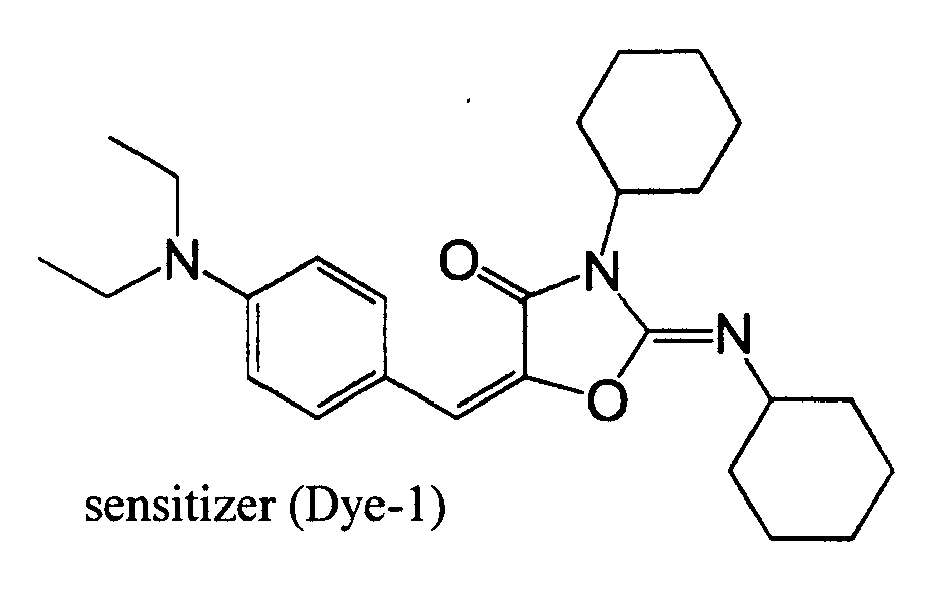


- The protective layer coating solution (1) consisted of the following ingredients was applied to the image recording layer with a wire bar. Thereafter, the coating was dried in an oven at 125°C for 75 seconds to form a protective layer in a dry coating amount of 1.80 g/m2. Thus planographic printing plate precursors of Examples 1 to 5 were obtained.
-
6% by mass aqueous solution of polyvinyl alcohol 4.12 g (trade name: PVA 105, manufactured by Kuraray Co., Ltd., saponification degree of 98.5 mol%, polymerization degree of 500) - Compound having within the molecule thereof an acid group and a partial structure functioning as a base
(compound listed in Table 1) 0.04 g Polyvinylpyrrolidone (K30) 0.0053 g 1% by mass aqueous solution of a surfactant (trade name: EMALEX 710, manufactured by Kao Corporation) 2.15 g Distilled water 10.60 g - The compounds having within the molecule thereof an acid group and a partial structure functioning as a base used in Examples 1 to 4 and below-described Examples 5 to 14 are shown below.
- A planographic printing plate precursor of Comparative Example 1 was made in the same manner as Example 1, except that the compound having within the molecule thereof an acid group and a partial structure functioning as a base was not added to the protective layer coating solution (1).
- Further, a planographic printing plate precursor of Comparative Example 2 was made in the same manner as Example 1, except that the compound having within the molecule thereof an acid group and a partial structure functioning as a base added to the protective layer coating solution (1) was replaced with the same amount of sodium p-toluenesulfonic acid, which is a known development promoting compound.


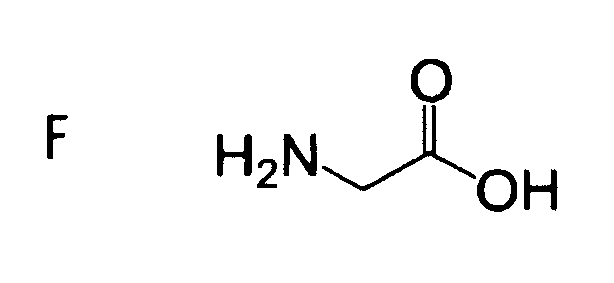

- The planographic printing plate precursors of Examples A1 to A5, and Comparative Examples A1 and A2 made as described above were each loaded onto a violet semiconductor laser setter (trade name: Vx 9600, manufactured by FUJIFILM Electronic Imaging Ltd)(InGaN semiconductor laser, 405 nm±10 nn emission/output 30 mW), and subjected to halftone dot image exposure from 1% to 99% in increments of 1% at a light intensity of 90 µJ/cm2, and a resolution of 2438 dpi. Thereafter, the precursors were heated in an oven at 100°C for 10 seconds.
- After the light exposure, the following developer D-1 and finisher (trade name: FP-2W, manufactured by Fuji Photo Film Co., Ltd.) were charged into an automatic developing machine (trade name: FLP-813, manufactured by Fuji Photo Film Co., Ltd.). Each plate which had been exposed was developed to make a planographic printing plate under the conditions of a developer temperature of 30°C and a developing time of 12 seconds.
- The planographic printing plates made as described above were loaded onto a LITHRONE printing machine (manufactured by Komori Corporation), and subjected to continuous printing with a GRAPH G(N) ink (manufactured by Dainippon Ink And Chemicals, Inc.) A hundredth printed sheet was visually observed to evaluate the developability. When no stain was present in the non-image region, the developability was judged as favorable, while when stains were present because of insufficient removal of the non-image region after the development, the developability was judged as defective. The results are shown in the following Table 1.
- The developer D-1 is an aqueous solution having a pH of 10 and is consisted of the following ingredients.
Monoethanolamine 0.1 parts by mass Triethanolamine 1.5 parts by mass Compound represented by the following Formula 1 4.0 parts by mass Compound represented by the following Formula 2 2.5 parts by mass Compound represented by the following Formula 3 0.2 parts by mass Water 91.7 parts by mass 

- The (Formula 1) represents a mixture of compounds in which R14 is a hydrogen atom or a butyl group. In the (Formula 2), n is an integer of 2 to 20.
- In the same manner as the above-described developability evaluation, printing was continuously conducted using a LITHRONE printing machine (manufactured by Komori Corporation) and a GRAPH G(N) ink (manufactured by Dainippon Ink And Chemicals, Inc.). The printing durability of the solid image region was evaluated in terms of the number of printed sheets obtained by the time when the image began to be thinned. The printing durability was relatively evaluated with the number of printed sheets obtained with the precursor of Comparative Example A1 as 100. The larger the number, the better the printing durability. The results are shown in the following Table 1.
[Table 1] Compound (B) having within the molecule thereof an acid group and a partial structure functioning as a base Printing durability Developability Example A1 A 105 Favorable Example A2 B 100 Favorable Example A3 C 105 Favorable Example A4 D 100 Favorable Comparative example A1 None 100 Color residues Comparative example A2 Sodium p-toluenesulfonic acid 65 Favorable - As evident from Table 1, the planographic printing plate precursor of the invention having the specific protective layer exhibited sufficient curing property, and the image region obtained exhibited excellent printing durability and favorable developability. On the other hand, Comparative Example 1, which contained in the protective layer thereof no compound (B) having within the molecule thereof an acid group and a partial structure functioning as a base, exhibited insufficient developability, and Comparative Example A2, which contained in the protective layer thereof a known development promoting compound, exhibited favorable developability, while poor curing property was shown because of the decreased oxygen impermeability of the protective layer, and was inferior in printing durability to Examples.
- The image recording layer coating solution (2) consisted of the following ingredients was applied with a wire bar to the aluminum support [2] made as described above. Thereafter, the coating was dried in an oven at 100°C for 60 seconds to form an image recording layer in a dry coating amount of 1.3 g/m2.
-
Binder polymer [component (A), compound listed in Table] 0.162 g Polymerization initiator [component (C), compound listed in Table] 0.160 g Infrared ray absorbing agent [sensitizing dye: component (D), compound listed in Table] 0.038 g Polymerizable compound [component (B), compound listed in Table] 0.385 g Additive (C-1) 0.080 g Fluorine-based surfactant (1) 0.044 g Methyl ethyl ketone 4.091 g 2-methoxy-1-propanol 8.609 g - The structure of the binder polymer (A), polymerization initiator (C), polymerizable compound (B), and sensitizing dye (D) used in the image recording layer coating solution (2) is shown below.
- M-2: ethoxylated bisphenol A diacrylate (trade name: SR-601, manufactured by Nippon Kayaku Co., Ltd.)
- M-3: pentaerythritol triacrylate hexamethylene diisocyanate urethane prepolymer (trade name: UA-306H, manufactured by Kyoeisha Chemical Co., Ltd.)


polyurethane compound which is prepared in condensation polymerization of the following monomers at the following rate

-

- The protective layer coating solution (2) consisted of the following ingredients was applied to the image recording layer with a wire bar. Thereafter, the coating was dried in an oven at 125C for 75 seconds to form a protective layer in a dry coating amount of 2.00 g/m2. Thus planographic printing plate precursors of Examples 5 to 14 were obtained.
- Polyvinyl alcohol (trade name: PVA105, manufactured by Kuraray Co., Ltd., saponification degree of 98.5 mol%, polymerization degree of 500) 2.24 g
- Compound having within the molecule thereof an acid group and a partial structure functioning as a base
(compound listed in Table 1) 0.012 g Polyvinylpyrrolidone (K30) 0.0053 g 1 % by mass aqueous solution of a surfactant (trade name: EMALEX 710, manufactured by Kao Corporation) 2.15 g 3.4% by mass aqueous dispersion of scaly synthetic mica 3.75 g (trade name: MEB3L, manufactured by UNICOO, average particle diameter 1 to 5 µm) Distilled water 10.60 g - The planographic printing plate precursors of Examples 5 to 14, and Comparative Examples 3 and 4 made as described above were subjected to light exposure using Trendsetter 3244 VFS (manufactured by Creo Products, Inc.) equipped with a water-cooled 40 W infrared semiconductor (830 nm) laser with an output power of 9 W, an external drum rotation speed of 210 rpm, a plate surface energy of 100 mJ/cm2, and a resolution of 2400 dpi.
- After the light exposure, a developer (trade name: DV-2, manufactured by Fuji Photo Film Co., Ltd.) and a finisher (trade name: FN-6, manufactured by Fuji Photo Film Co., Ltd.) diluted with water at a ratio of 1:1 were charged into an automatic developing machine (trade name: STABLON 900N, manufactured by Fuji Photo Film Co., Ltd.). Each plate was developed at 30°C for 12 seconds to make a planographic printing plate.
- Printing was conducted using a LITHRONE printing machine (manufactured by Komori Corporation) and a GRAPH G(N) ink (manufactured by Dainippon Ink And Chemicals, Inc.). The printing durability of the solid image region was evaluated in terms of the number of printed sheets obtained by the time when the image began to be thinned. The printing durability was relatively evaluated with the number of printed sheets obtained with the precursor of Comparative Example 3 as 100. The larger the number, the better the printing durability. The results are shown in the following Table 2.
- The developability of the non-image region after light exposure and development was evaluated in terms of color residues.
- After aging, the non-image region after light exposure and development was measured using Spectrodensitometer (manufactured by X-Rite) for the cyan density in the light-unexposed portion. On the basis of the cyan density in the non-image region of the plate after immersion (after development), the color residue rate was calculated by the following Formula. Those showed a color residue rate of 7% or less were regarded as having favorable developability with no color residue, while those showed a color residue rate of 7% or more were regarded as having poor developability with significant color residues. The results are shown in the following Table 2.

[Table 2] Compound (B) having within the molecule thereof an acid group and a partial structure functioning as a base Compound used in image recording layer Evaluation result Polymerizable compound (C) Binder (A) Sensitizing dye (D) Polymerization initiator (B) Color residues Printing durability Example A5 A M-3 B-3 IR-1 I-2 Favorable 105 Example A6 B M-3 B-3 IR-1 I-2 Favorable 105 Example A7 C M-3 B-3 IR-1 I-2 Favorable 105 Example A8 D M-2 B-3 IR-I 1-3 Favorable 100 Example A9 E M-2 B-2 IR-2 I-4 Favorable 100 Example A10 F M-2 B-3 IR-2 I-2 Favorable 105 Example A11 G M-1 B-2 IR-2 I-2 Favorable 105 Example A12 H M-3 B-3 IR-1 I-2 Favorable 105 Example A13 I M-2 B-2 IR-1 I-3 Favorable 100 Example A14 J M-3 B-2 IR-1 I-2 Favorable 105 Comparative example A3 None M-2 B-3 IR-1 I-3 poor 100 Comparative example A4 2-sodium naphthalenesulfonate M-2 B-3 IR-1 I-3 Favorable 65 - As evident from Table 2, the planographic printing plate precursor of the invention having the specific protective layer achieved sufficient curing property, and the image region obtained exhibited excellent printing durability and favorable developability. On the other hand, Comparative Example 3, which contained in the protective layer thereof no compound (B) having within the molecule thereof an acid group and a partial structure functioning as a base, exhibited insufficient developability, and Comparative Example 4, which contained in the protective layer thereof a known development promoting compound, exhibited favorable developability, while poor curing property was shown because of the decreased oxygen impermeability of the protective layer, and was inferior in printing durability to Examples.
- These evaluation results show that the planographic printing plate precursor of the invention having the specific protective layer achieves the same excellent effects even when the Formulation of the negative-working image recording layer is changed.
- The following Example B describes a case where the light-exposed planographic printing plate precursor is subjected to the printing process using an oil-based ink and an aqueous component without subjecting to any developing treatment process. It involves a printing process, a portion of the planographic printing plate precursor unexposed to infrared laser light is removed during printing.
- The following Example B describes a case where the planographic printing plate precursor after light exposure receives a oil-based ink and an aqueous component, and is subjected to printing without subjecting to any developing treatment. The invention is not limited to it.
- A molten metal of a JIS A1050 aluminum alloy composed of 99.5% by mass or more of Al, 0.30% by mass or more of Fe, 0.10% by mass or more of Si, 0.02 by mass or more of Ti, 0.013 by mass or more of Cu, and the remainder of unavoidable impurities was subjected to cleaning treatment, and casting. The cleaning treatment was conducted by degassing to remove unnecessary gas such as hydrogen from the molten metal, and treating with a ceramic tube filter.
- The casting was performed by the DC casting method. The solidified ingot having a plate thickness of 500 mm was scalped to 10 mm from the surface and subjected to a homogenization treatment at 550°C for 10 hours so as to prevent the intermetallic compound from becoming coarse. Subsequently, the plate was hot-rolled at 400°C, subjected to intermediate annealing at 500°C for 60 seconds in a continuous annealing furnace, and then cold-rolled to obtain an aluminum rolled plate having a thickness of 0.30 mm. By controlling the roughness of the rolling roller, the center line average surface roughness Ra (according to JIS B0601) after the cold rolling was controlled to 0.2 µm. Thereafter, the plate was applied with a tension leveler to improve the flatness. The obtained aluminum plate was surface-treated as follows.
- The aluminum plate was first degreased with an aqueous 10% by mass sodium aluminate solution at 50°C for 30 seconds to remove the rolling oil on the plate surface and then treated for neutralization and desmutting with an aqueous 30% by mass nitric acid solution at 50°C for 30 seconds.
- Subsequently, the aluminum plate was subjected to a surface-roughening treatment so as to obtain good adhesion between the image recording layer and the support and at the same time to impart water receptivity to the non-image area. More specifically, while passing the aluminum plate web through an aqueous solution (liquid temperature: 45°C) supplied to an indirect power feed cell and containing 1% by mass of nitric acid and 0.5% by mass of aluminum nitrate, the electrolysis was performed by using an alternating waveform having a duty ratio of 1:1 at a current density of 20 A/dm2 to give a quantity of electricity of 240 C/dm2 when the aluminum plate was serving as the anode, thereby effecting the electrochemical surface-roughening treatment.
- Furthermore, the plate was etched with an aqueous 10% by mass sodium hydroxide solution at 35°C for 30 seconds and then treated for neutralization and desmutting with an aqueous 30% by mass sulfuric acid solution at 50°C for 30 seconds.
- Thereafter, in order to improve the abrasion resistance, chemical resistance and water receptivity, the aluminum plate was subjected to an anodization treatment. More specifically, while passing the aluminum plate web through an aqueous 20% by mass sulfuric acid solution (liquid temperature: 35°C) supplied to an indirect power feed cell, the electrolysis was performed by using a direct current at a current density of 14 A/dm2 to form an anodic oxide film of 2.5 g/m2.
- Further, in order to ensure hydrophilicity of the non-image area the plate was subjected to a silicate treatment with 1.5% by mass of an aqueous No. 3 sodium silicate solution at 70°C for 15 seconds. The amount of Si deposited was 10 mg/m2. The resulting support was washed with water to complete the support. The obtained support had a center line average roughness Ra of 0.25 µm.
- The following undercoat solution (1) was applied to the above-described support in a dry coating amount of 6 mg/m2 to form an undercoat layer containing a water-soluble polymer. Thus supports used for the following experiments were made.
-
Undercoat compound (1) shown below (Mw: 40,000) 0.017 g Methanol 9.00 g Water 1.00 g 

- The image recording layer coating solution (1) consisted of the following ingredients was applied with a wire bar to the support surface having formed with the undercoat layer. Thereafter, the coating was dried in an oven at 100°C for 60 seconds to form an image recording layer in a dry coating amount of 1.0 g/m2. (Descriptions of supports 1 to 4 are omitted.)
- The image recording layer coating solution (1) was prepared by mixing and stirring the following photosensitive solution (1) and microgel solution (1) immediately before application.
-
Binder polymer (A) (compound listed in Table 3) 0.165 g Polymerization initiator (C) (compound listed in Table 3) 0.090 g Infrared ray absorbing agent (compound listed in Table 3) 0.020 g Polymerizable compound (B) (compound listed in Table 3) 0.385 g Fluorine-based surfactant (1) 0.044 g Methyl ethyl ketone 1.091 g 2-methoxy-1-propanol 8.609 g Microgel solution (1) Microgel (1) synthesized as described below 2.640 g Distilled water 2.425 g - The structure of the binder polymer (D) [binder polymer B-2 (Mw: 70000), binder polymer B-3 (Mw: 100000-150000)], infrared ray absorbing agent (A), polymerization initiator (B), polymerizable compound (C), and fluorine-based surfactant (1) used in the photosensitive solution (1) is shown below.


-


-


- M-1: ARONIX M-215(manufactured by Toagosei Co., Ltd.)
- M-2: dipentaerythritol hydroxypentaacrylate (trade name: SR-399E, manufactured by Nippon Kayaku Co., Ltd.)

- As the oil phase component, 10 g of an adduct of trimethylolpropane and xylene diisocyanate (trade name: TAKENATE D-110N, manufactured by Mitsui Takeda Chemicals, Inc), 3.15 g of pentaerythritol triacrylate (trade name: SR444, manufactured by Nippon Kayaku Co., Ltd.), and 0.1 g of PIONIN A-41C (manufactured by Takemoto Oil & Fat Co., Ltd.) were dissolved in 17 g of ethyl acetate. As the aqueous phase component, 40 g of a 4% by mass aqueous solution of PVA-205 was prepared. The oil phase component was mixed with the aqueous phase component, and emulsified using a homogenizer at 12,000 rpm for 10 minutes. The emulsion thus obtained was added to 25 g of distilled water, stirred at room temperature for 30 minutes, and further stirred at 50°C for 3 hours. The microgel solution thus obtained was diluted with distilled water in such a manner that the concentration of the solid content was 15% by mass. The average particle diameter was 0.2 µm.
- The protective layer coating solution (1) consisted of the following ingredients was applied with a wire bar to the image recording layer. Thereafter, the coating was dried in an oven at 125°C for 75 seconds to form a protective layer in a dry coating amount of 0.15 g/m2. Thus a planographic printing plate precursor was obtained.
-
6% by mass aqueous solution of water-soluble polymer (A) (polyvinyl alcohol) (trade name: PVA 105, manufactured by Kuraray Co., Ltd., saponification degree of 98.5 mol%, polymerization degree of 500) 2.24 g Water-soluble polymer (a) [polyvinylpyrrolidone (K30)] 0.0053 g Compound (b) having within the molecule thereof an acid group and a partial structure functioning as a base (compound listed in Table 1) 0.25 g 1% by mass aqueous solution of a surfactant (trade name: EMALEX 710, manufactured by Kao Corporation) 2.15 g 3.4% by mass aqueous dispersion of scaly synthetic mica (c-1) 3.75 g (trade name: MEB3L, manufactured by UNICOO, average particle diameter 1 to 5 µmφ) Distilled water 10.60 g -
6% by mass aqueous solution of water-soluble polymer (A) (polyvinyl alcohol) (trade name: PVA 105, manufactured by Kuraray Co., Ltd., saponification degree of 98.5 mol%, polymerization degree of 500) 4.12 g Water-soluble polymer (a) [polyvinylpyrrolidone (K30)] 0.0053 g Compound (b) having within the molecule thereof an acid group and a partial structure functioning as a base (compound listed in Table 3) 0.80 g 1% by mass aqueous solution of a surfactant (trade name: EMALEX 710, manufactured by Kao Corporation) 2.15 g Distilled water 10.60 g 


- The image recording layer coating solution (2) consisted of the following ingredients was applied with a wire bar to each of the supports listed in Table 3. Thereafter, the coating was dried in an oven at 100°C for 60 seconds to form an image recording layer in a dry coating amount of 1.3 g/m2. Subsequently, a protective layer was formed in the same manner as Example 1. Thus planographic printing plate precursors were obtained.
-
Binder polymer (A) (compound listed in Table 3) 0.162 g Polymerization initiator 1 (C) (compound listed in Table 3) 0.160 g (Polymerization initiator 2 was omitted.) Infrared ray absorbing agent (compound listed in Table 3) 0.038 g Polymerizable compound (B) (compound listed in Table 3) 0.385 g Fluorine-based surfactant (1) 0.044 g Methyl ethyl ketone 4.091 g 2-methoxy-1-propanol 8.609 g - The planographic printing plate precursors made described above were evaluated as follows. The results are shown in the following Table 3.
- Each of the planographic printing plate precursors was subjected to light exposure using Trendsetter 3244 VX (manufactured by Creo Products, Inc.) equipped with a water-cooled 40 W infrared semiconductor laser with an output power of 9 W, an external drum rotation speed of 210 rpm, and a resolution of 2400 dpi.
- The sensitivity was evaluated in terms of the minimum amount of light required to form an image on the exposed printing plate mounted on the printing machine. The smaller number, the higher the sensitivity, and the better the performance.
- Each of the planographic printing plate precursors was subjected to light exposure using Trendsetter 3244 VX (manufactured by Creo Products, Inc.) equipped with a water-cooled 40 W infrared semiconductor laser with an output power of 9 W, an external drum rotation speed of 210 rpm, and a resolution of 2400 dpi. The light-exposed image contained a thin line chart.
- The light-exposed precursor was mounted on the cylinder of a printing machine (trade name: SOR-M, manufactured by Heidelberg) without being subjected to developing treatment. A dampening water [EU-3 (etching solution manufactured by Fuji Photo Film Co., Ltd.)]/water/isopropyl alcohol = 1/89/10 (volume ratio)) and a black ink (trade name: TRANS-G(N), manufactured by Dainippon Ink And Chemicals, Inc.) were supplied to the precursor, and printing was conducted at a printing speed of 6,000 sheets an hour.
- The in-machine developability was evaluated in terms of the number of printed sheets obtained by the time when no ink was transferred to the light-unexposed portion (non-image region) on the image recording layer. The results are shown in Table 3 as "in-machine developability".
- The light exposed precursors obtained in the same manner as described above were immersed in a constant temperature and humidity bath adjusted to 45°C, 75%RH for 3 days. Thereafter, each of the precursors was light-exposed under the above-described light exposure conditions, and mounted on the cylinder of a printing machine (trade name: SOR-M, manufactured by Heidelberg). A dampening water [IF102 (etching solution manufactured by Fuji Photo Film Co., Ltd.)]/water = 4/96 (volume ratio)) and a black ink (trade name: TRANS-G(N), manufactured by Dainippon Ink And Chemicals, Inc.) were supplied to the precursor, and the in-machine developability was determined in the same manner as described above. The results are shown in Table 1 as "In-machine developability after standing high temperature and humidity environment. (The difference in the number of in-machine developed sheets before and after standing is described. The smaller the difference, the higher the stability. When the difference is within 20 sheets, the stability is regarded as favorable.
- The smaller the number of in-machine developed sheets before standing, the better the developability.
[Table 3] Protective layer Compounds used in image recording layer Evaluation result Compound (B) Protective layer Formulation Polymerization initiator (C) Infrared ray absorbing agent Binder (A) Polymerizable compound (B) Number of in-machine developed sheets Number of in-machine developed sheets after standing in high temperature and humidity environment Sensitivity Example B1 A 1 R-3 IR-3 B-2 M-1 24 38 80 Example B2 B 2 R-4 IR-3 B-2 M-2 24 39 80 Example B3 C 1 R-1 IR-3 B-2 M-1 20 25 70 Example B4 D 2 R-2 IR-3 B-2 M-2 23 30 70 Example B5 E 1 R-1 IR-4 B-2 M-1 22 27 75 Example B6 F 2 R-5 IR-4 B-3 M-1 28 45 80 Example B7 G I R-5 IR-3 B-2 M-2 26 44 80 Example B8 H 1 R-2 IR-3 B-3 M-2 23 33 70 Example B9 I 2 R-1 IR-3 B-2 M-1 21 27 70 Example B10 J 1 R-3 IR-4 B-3 M-1 25 36 80 Example B11 K 1 R-1 IR-5 B-2 M-1 21 26 70 Example B12 L 2 R-5 IR-6 B-2 M-2 28 46 80 Comparative example B1 - 1 R-3 IR-3 B-2 M-1 40 68 80 Comparative example B2 - 2 R-5 IR-6 B-2 M-2 43 75 80 - As evident from Table 3, according to the planographic printing method of the invention using the planographic printing plate precursor any of Examples 1 to 10 of the invention, excellent in-machine developability which is stable over time is provided with high sensitivity equivalent to that achieved with the planographic printing plate precursors having a prior art protective layer (Comparative Examples 1 and 2) is maintained. The results of Examples 11 and 12 show that the similar effects are achieved even the Formulation of the image recording layer is changed. Further, the comparison between the results of the protective layers 1 and 2 show that the addition of the inorganic layered compound (C-1) to the specific protective layer of the invention further improves the in-machine developability and stability thereof.
- The present invention provides a recording material having favarable developability and this material can form the image with sufficient curing property by exposure.
- Further, the invention provides: a planographic printing plate method which provides excellent in-machine developability which will not decrease even after storage, wherein an image is drawn directly from digital data such as computer data and recorded on a planographic printing plate precursor capable of image recording using an infrared laser, and the plate is in-machine developed without subjecting the planographic plate precursor to any wet developing process; and a planographic printing plate precursor which is preferably used for the planographic printing plate method and has excellent in-machine developability which is stable over time.
- The invention also includes the following embodiments.
- <1> An image recording material comprising a support having provided thereon in this order an image recording layer containing a binder polymer (A), a compound having a polymerizable unsaturated group (B), and a polymerization initiator (C), and a layer containing a hydrophilic polymer and a compound having within the molecule thereof an acid group and a partial structure functioning as a base.
- <2> The image recording material of item <1> , wherein the image recording layer further comprises a dye (D) having an absorption maximum in a range of from 300 to 1200 nm.
- <3> The image recording material of item <2>, wherein the dye (D) having an absorption maximum in a range of from 300 to 1200 nm is an infrared dye.
- <4> The image recording material of any one of items <1> to <3>, wherein the binder polymer (A) is a polymer having within the molecule thereof an alkali-soluble group.
- <5> The image recording material of item <1>, wherein the layer containing a hydrophilic polymer and a compound having within the molecule thereof an acid group and a partial structure functioning as a base further comprise an inorganic compound.
- <6> The image recording material of item <1>, wherein the polymerization initiator (C) is an onium salt.
- <7> A planographic printing method comprising an exposure process of imagewise exposing a planographic printing plate precursor to radiation, a process of developing the printing plate precursor, and a printing process of performing printing using an oil-based ink, wherein the planographic printing plate precursor comprises a support having provided thereon in this order an image recording layer which is recordable by irradiation with radiation and contains a binder polymer (A), a compound having a polymerizable unsaturated group (B), and a polymerization initiator (C), and a layer containing a hydrophilic polymer and a compound having within the molecule thereof an acid group and a partial structure functioning as a base.
- <8> The planographic printing method of item <7>, wherein the binder polymer (A) is a polymer having within the molecule thereof an alkali soluble group.
- <9> The planographic printing method of items <7> or <8>, wherein the layer containing a hydrophilic polymer and a compound having within the molecule thereof an acid group and a partial structure functioning as a base further comprises an inorganic compound.
- <10> The planographic printing method of any one of items <7> to <9>, wherein the layer containing a hydrophilic polymer and a compound having within the molecule thereof an acid group and a partial structure functioning as a base further comprises an inorganic compound.
- <11> A planographic printing method comprising an exposure process of imagewise exposing a planographic printing plate precursor to infrared laser light, and a printing process of subjecting the light-exposed planographic printing plate precursor to printing using an oil-based ink and an aqueous component without subjecting the planographic printing plate precursor to any developing, wherein the planographic printing plate precursor comprises a support having provided thereon in this order an image recording layer which is recordable by irradiation with infrared ray and contains a binder polymer (A), a compound having a polymerizable unsaturated group (B), a polymerization initiator (C), and an infrared ray absorbing agent (D), and a layer containing a hydrophilic polymer and a compound having within the molecule thereof an acid group and a partial structure functioning as a base, and a portion of the planographic printing plate precursor unexposed to the infrared laser light is removed during printing.
- <12> A planographic printing plate precursor comprising a support having provided thereon in this order an image recording layer containing an infrared ray absorbing agent (A), a polymerization initiator (B), a polymerizable compound (C), and a binder polymer (D), and a layer containing a hydrophilic polymer and a compound having within the molecule thereof an acid group and a partial structure functioning as a base, wherein a non-image region is removable with a printing ink and/or dampening water.
- <13> The planographic printing plate precursor of items <11> or <12>, wherein the layer containing a hydrophilic polymer and a compound having within the molecule thereof an acid group and a partial structure functioning as a base further comprises an inorganic compound.
- All publications, patent applications, and technical standards mentioned in this specification are herein incorporated by reference to the same extent as if such individual publication, patent application, or technical standard was specifically and individually indicated to be incorporated by reference.
- It will be obvious to those having skill in the art that many changes may be made in the above-described details of the preferred embodiments of the present invention. The scope of the invention, therefore, should be determined by the following claims.
Claims (11)
- An image recording material comprising a support having provided thereon in this order(i) an image recording layer containing a binder polymer (A), a compound having a polymerizable unsaturated group (B), and a polymerization initiator (C), and(ii) a layer containing a hydrophilic polymer and a compound having within the molecule thereof an acid group and a partial structure functioning as a base.
- The image recording material of Claim 1, wherein the image recording layer further comprises a dye (D) having an absorption maximum in a range of from 300 to 1200 nm.
- The image recording material of Claim 2, wherein the dye (D) having an absorption maximum in a range of from 300 to 1200 nm is an infrared dye.
- The image recording material of any of Claims 1-3, wherein the binder polymer (A) is a polymer having within the molecule thereof an alkali-soluble group.
- The image recording material of any of Claims 1-4, wherein the layer (ii) further comprises an inorganic compound.
- The image recording material of any of Claims 1-5, wherein the polymerization initiator (C) is an onium salt.
- A planographic printing method comprising- imagewise exposing a planographic printing plate precursor comprising the image recording material of any of Claims 1-6 to radiation,- developing the printing plate precursor, and- printing using an oil-based ink.
- A planographic printing method comprising- imagewise exposing a planographic printing plate precursor comprising an image recording material of Claim 1, wherein the image recording layer is recordable by irradiation with infrared ray and contains an infrared ray absorbing agent, to infrared laser light, and- subjecting the light-exposed planographic printing plate precursor to printing using an oil-based ink and an aqueous component without subjecting the planographic printing plate precursor to any developing, thus removing the portion of the planographic printing plate precursor unexposed to the infrared laser light during printing.
- The planographic printing method of Claim 8, wherein the layer (ii) of the image recording material of Claim 1 further comprises an inorganic compound.
- A planographic printing plate precursor wherein a non-image region is removable with a printing ink and/or dampening water, comprising an image recording material of Claim 1, which further contains an infrared ray absorbing agent in the image recording layer (i).
- The planographic printing plate precursor of Claim 10, wherein the layer (ii) of the image recording material of Claim 1 further comprises an inorganic compound.
Applications Claiming Priority (2)
| Application Number | Priority Date | Filing Date | Title |
|---|---|---|---|
| JP2006155266 | 2006-06-02 | ||
| JP2006198634 | 2006-07-20 |
Publications (2)
| Publication Number | Publication Date |
|---|---|
| EP1862301A1 true EP1862301A1 (en) | 2007-12-05 |
| EP1862301B1 EP1862301B1 (en) | 2011-09-28 |
Family
ID=38344782
Family Applications (1)
| Application Number | Title | Priority Date | Filing Date |
|---|---|---|---|
| EP07010883A Not-in-force EP1862301B1 (en) | 2006-06-02 | 2007-06-01 | Image recording material, planographic printing plate precursor, and planographic printing method using the same |
Country Status (3)
| Country | Link |
|---|---|
| US (1) | US20070298351A1 (en) |
| EP (1) | EP1862301B1 (en) |
| AT (1) | ATE526156T1 (en) |
Cited By (5)
| Publication number | Priority date | Publication date | Assignee | Title |
|---|---|---|---|---|
| EP2082875A1 (en) | 2008-01-22 | 2009-07-29 | FUJIFILM Corporation | Lithographic printing plate precursor and plate making method thereof |
| WO2010038795A1 (en) | 2008-09-30 | 2010-04-08 | 富士フイルム株式会社 | Lithographic printing original plate, method for producing lithographic printing plate, and polymerizable monomer |
| WO2010104560A1 (en) * | 2009-03-13 | 2010-09-16 | Eastman Kodak Company | Negative-working imageable elements with overcoat |
| EP2239138A2 (en) | 2009-03-30 | 2010-10-13 | FUJIFILM Corporation | Lithographic printing plate precursor and plate making method thereof |
| EP2157478A3 (en) * | 2008-08-22 | 2012-06-06 | Fujifilm Corporation | Method of producing lithographic printing plate |
Families Citing this family (11)
| Publication number | Priority date | Publication date | Assignee | Title |
|---|---|---|---|---|
| JP4644458B2 (en) * | 2003-09-30 | 2011-03-02 | 富士フイルム株式会社 | Planographic printing plate precursor and planographic printing method |
| US7733684B2 (en) * | 2005-12-13 | 2010-06-08 | Kabushiki Kaisha Toshiba | Data read/write device |
| EP2025512B1 (en) * | 2007-08-14 | 2011-05-18 | Agfa Graphics N.V. | Method for making a lithographic printing plate |
| JP5171483B2 (en) * | 2008-08-29 | 2013-03-27 | 富士フイルム株式会社 | Preparation method of lithographic printing plate |
| JP2010079083A (en) * | 2008-09-26 | 2010-04-08 | Fujifilm Corp | Plate making method of lithographic printing plate |
| KR20140089351A (en) | 2011-10-06 | 2014-07-14 | 닛산 가가쿠 고교 가부시키 가이샤 | Composition for forming resist upperlayer film for lithography |
| US10108087B2 (en) * | 2016-03-11 | 2018-10-23 | Macdermid Graphics Solutions Llc | Method of improving light stability of flexographic printing plates featuring flat top dots |
| KR20180054434A (en) * | 2016-11-15 | 2018-05-24 | 주식회사 엘지화학 | Low resistance anode having excellent adhesiveness and lithium secondary battery comprising the same |
| US10731103B2 (en) * | 2017-12-11 | 2020-08-04 | Infineum International Limited | Low ash and ash-free acid neutralizing compositions and lubricating oil compositions containing same |
| US11426818B2 (en) | 2018-08-10 | 2022-08-30 | The Research Foundation for the State University | Additive manufacturing processes and additively manufactured products |
| CN121522969B (en) * | 2026-01-13 | 2026-05-01 | 浙江珏芯微电子有限公司 | Method for verifying photoresist layer residue |
Citations (10)
| Publication number | Priority date | Publication date | Assignee | Title |
|---|---|---|---|---|
| JPS5829803A (en) | 1981-08-17 | 1983-02-22 | Mitsubishi Chem Ind Ltd | Photopolymerizable composition |
| JPH0431863A (en) | 1990-05-29 | 1992-02-04 | Mitsubishi Kasei Corp | Photopolymerizable composition |
| JPH04106548A (en) | 1990-08-27 | 1992-04-08 | Mitsubishi Kasei Corp | Photopolymerizable composition |
| JP2000131837A (en) | 1998-08-17 | 2000-05-12 | Mitsubishi Chemicals Corp | Photopolymerizable composition, photopolymerizable lithographic printing plate, and image forming method |
| JP2001277740A (en) | 2000-01-27 | 2001-10-10 | Fuji Photo Film Co Ltd | Original plate for lithographic printing plate |
| JP2001277742A (en) | 2000-01-27 | 2001-10-10 | Fuji Photo Film Co Ltd | Original plate for lithographic printing plate |
| JP2002287334A (en) | 2001-03-26 | 2002-10-03 | Fuji Photo Film Co Ltd | Original plate of planographic printing plate and planographic prirting method |
| WO2003091022A1 (en) * | 2002-04-25 | 2003-11-06 | Kodak Polychrome Graphics Gmbh | Stabilized infrared-sensitive polymerizable systems |
| EP1516725A2 (en) * | 2003-09-22 | 2005-03-23 | Fuji Photo Film Co., Ltd. | Lithographic printing plate precursor |
| US20050089802A1 (en) * | 2003-10-16 | 2005-04-28 | Agfa-Gevaert | Method of making a heat-sensitive lithographic printing plate |
Family Cites Families (8)
| Publication number | Priority date | Publication date | Assignee | Title |
|---|---|---|---|---|
| JP4288445B2 (en) * | 2000-10-23 | 2009-07-01 | 信越化学工業株式会社 | Novel onium salt, photoacid generator for resist material, resist material and pattern forming method |
| JP2004252201A (en) * | 2003-02-20 | 2004-09-09 | Fuji Photo Film Co Ltd | Lithographic printing original plate |
| JP4644458B2 (en) * | 2003-09-30 | 2011-03-02 | 富士フイルム株式会社 | Planographic printing plate precursor and planographic printing method |
| JP2005181684A (en) * | 2003-12-19 | 2005-07-07 | Konica Minolta Medical & Graphic Inc | Lithographic printing plate material and method for making lithographic printing plate |
| US7144676B2 (en) * | 2004-02-06 | 2006-12-05 | Rohm And Haas Electronic Materials Llc | Imaging compositions and methods |
| ATE389900T1 (en) * | 2004-08-24 | 2008-04-15 | Fujifilm Corp | METHOD FOR PRODUCING A LITHOGRAPHIC PRINTING PLATE |
| JP4429116B2 (en) * | 2004-08-27 | 2010-03-10 | 富士フイルム株式会社 | Planographic printing plate precursor and lithographic printing plate making method |
| US20060216646A1 (en) * | 2005-03-22 | 2006-09-28 | Fuji Photo Film Co., Ltd. | Plate-making method of lithographic printing plate precursor |
-
2007
- 2007-06-01 EP EP07010883A patent/EP1862301B1/en not_active Not-in-force
- 2007-06-01 AT AT07010883T patent/ATE526156T1/en not_active IP Right Cessation
- 2007-06-04 US US11/757,438 patent/US20070298351A1/en not_active Abandoned
Patent Citations (10)
| Publication number | Priority date | Publication date | Assignee | Title |
|---|---|---|---|---|
| JPS5829803A (en) | 1981-08-17 | 1983-02-22 | Mitsubishi Chem Ind Ltd | Photopolymerizable composition |
| JPH0431863A (en) | 1990-05-29 | 1992-02-04 | Mitsubishi Kasei Corp | Photopolymerizable composition |
| JPH04106548A (en) | 1990-08-27 | 1992-04-08 | Mitsubishi Kasei Corp | Photopolymerizable composition |
| JP2000131837A (en) | 1998-08-17 | 2000-05-12 | Mitsubishi Chemicals Corp | Photopolymerizable composition, photopolymerizable lithographic printing plate, and image forming method |
| JP2001277740A (en) | 2000-01-27 | 2001-10-10 | Fuji Photo Film Co Ltd | Original plate for lithographic printing plate |
| JP2001277742A (en) | 2000-01-27 | 2001-10-10 | Fuji Photo Film Co Ltd | Original plate for lithographic printing plate |
| JP2002287334A (en) | 2001-03-26 | 2002-10-03 | Fuji Photo Film Co Ltd | Original plate of planographic printing plate and planographic prirting method |
| WO2003091022A1 (en) * | 2002-04-25 | 2003-11-06 | Kodak Polychrome Graphics Gmbh | Stabilized infrared-sensitive polymerizable systems |
| EP1516725A2 (en) * | 2003-09-22 | 2005-03-23 | Fuji Photo Film Co., Ltd. | Lithographic printing plate precursor |
| US20050089802A1 (en) * | 2003-10-16 | 2005-04-28 | Agfa-Gevaert | Method of making a heat-sensitive lithographic printing plate |
Cited By (8)
| Publication number | Priority date | Publication date | Assignee | Title |
|---|---|---|---|---|
| EP2082875A1 (en) | 2008-01-22 | 2009-07-29 | FUJIFILM Corporation | Lithographic printing plate precursor and plate making method thereof |
| EP2157478A3 (en) * | 2008-08-22 | 2012-06-06 | Fujifilm Corporation | Method of producing lithographic printing plate |
| WO2010038795A1 (en) | 2008-09-30 | 2010-04-08 | 富士フイルム株式会社 | Lithographic printing original plate, method for producing lithographic printing plate, and polymerizable monomer |
| US9032876B2 (en) | 2008-09-30 | 2015-05-19 | Fujifilm Corporation | Lithographic printing plate precursor, lithographic printing plate platemaking method, and polymerizable monomer |
| WO2010104560A1 (en) * | 2009-03-13 | 2010-09-16 | Eastman Kodak Company | Negative-working imageable elements with overcoat |
| CN102349025A (en) * | 2009-03-13 | 2012-02-08 | 伊斯曼柯达公司 | Negative-working imageable elements with overcoat |
| US8318405B2 (en) | 2009-03-13 | 2012-11-27 | Eastman Kodak Company | Negative-working imageable elements with overcoat |
| EP2239138A2 (en) | 2009-03-30 | 2010-10-13 | FUJIFILM Corporation | Lithographic printing plate precursor and plate making method thereof |
Also Published As
| Publication number | Publication date |
|---|---|
| ATE526156T1 (en) | 2011-10-15 |
| US20070298351A1 (en) | 2007-12-27 |
| EP1862301B1 (en) | 2011-09-28 |
Similar Documents
| Publication | Publication Date | Title |
|---|---|---|
| EP1862301B1 (en) | Image recording material, planographic printing plate precursor, and planographic printing method using the same | |
| US9032876B2 (en) | Lithographic printing plate precursor, lithographic printing plate platemaking method, and polymerizable monomer | |
| EP2039509B1 (en) | Curable composition, image forming material, and planographic printing plate precursor | |
| EP2042522B1 (en) | Planographic printing plate precursor | |
| JP5376289B2 (en) | Negative-type planographic printing plate precursor and planographic printing method using the same | |
| EP1975707B1 (en) | Curable composition and planographic printing plate precursor | |
| EP1801651A1 (en) | Polymerizable composition and planographic printing plate precursor using the same | |
| US8399172B2 (en) | Negative-working lithographic printing plate precursor and method of lithographic printing using same | |
| EP1901124B1 (en) | Image recording material | |
| US7723011B2 (en) | Image recording material and novel compound | |
| EP2042928B1 (en) | Negative-working photosensitive material and negative-working planographic printing plate precursor | |
| JP5222495B2 (en) | Planographic printing plate precursor and planographic printing method | |
| JP2008044348A (en) | Image recording material and planographic printing method | |
| EP2100731B1 (en) | Lithographic printing plate precursor and method of lithographic printing | |
| EP1630611B1 (en) | Planographic printing plate precursor | |
| JP2010122507A (en) | Lithographic printing plate precursor and plate making method for lithographic printing plate | |
| JP2010083028A (en) | Lithographic printing original plate and manufacturing method for lithographic printing plate |
Legal Events
| Date | Code | Title | Description |
|---|---|---|---|
| PUAI | Public reference made under article 153(3) epc to a published international application that has entered the european phase |
Free format text: ORIGINAL CODE: 0009012 |
|
| AK | Designated contracting states |
Kind code of ref document: A1 Designated state(s): AT BE BG CH CY CZ DE DK EE ES FI FR GB GR HU IE IS IT LI LT LU LV MC MT NL PL PT RO SE SI SK TR |
|
| AX | Request for extension of the european patent |
Extension state: AL BA HR MK YU |
|
| 17P | Request for examination filed |
Effective date: 20080331 |
|
| AKX | Designation fees paid |
Designated state(s): AT BE BG CH CY CZ DE DK EE ES FI FR GB GR HU IE IS IT LI LT LU LV MC MT NL PL PT RO SE SI SK TR |
|
| 17Q | First examination report despatched |
Effective date: 20090507 |
|
| GRAP | Despatch of communication of intention to grant a patent |
Free format text: ORIGINAL CODE: EPIDOSNIGR1 |
|
| RIN1 | Information on inventor provided before grant (corrected) |
Inventor name: WARIISHI, KOJI Inventor name: SHIMADA, KAZUTO Inventor name: ENDO, AKIHIRO |
|
| GRAS | Grant fee paid |
Free format text: ORIGINAL CODE: EPIDOSNIGR3 |
|
| GRAA | (expected) grant |
Free format text: ORIGINAL CODE: 0009210 |
|
| AK | Designated contracting states |
Kind code of ref document: B1 Designated state(s): AT BE BG CH CY CZ DE DK EE ES FI FR GB GR HU IE IS IT LI LT LU LV MC MT NL PL PT RO SE SI SK TR |
|
| REG | Reference to a national code |
Ref country code: GB Ref legal event code: FG4D |
|
| REG | Reference to a national code |
Ref country code: CH Ref legal event code: EP |
|
| REG | Reference to a national code |
Ref country code: IE Ref legal event code: FG4D |
|
| REG | Reference to a national code |
Ref country code: DE Ref legal event code: R096 Ref document number: 602007017455 Country of ref document: DE Effective date: 20111124 |
|
| REG | Reference to a national code |
Ref country code: NL Ref legal event code: VDEP Effective date: 20110928 |
|
| PG25 | Lapsed in a contracting state [announced via postgrant information from national office to epo] |
Ref country code: LT Free format text: LAPSE BECAUSE OF FAILURE TO SUBMIT A TRANSLATION OF THE DESCRIPTION OR TO PAY THE FEE WITHIN THE PRESCRIBED TIME-LIMIT Effective date: 20110928 Ref country code: FI Free format text: LAPSE BECAUSE OF FAILURE TO SUBMIT A TRANSLATION OF THE DESCRIPTION OR TO PAY THE FEE WITHIN THE PRESCRIBED TIME-LIMIT Effective date: 20110928 Ref country code: SE Free format text: LAPSE BECAUSE OF FAILURE TO SUBMIT A TRANSLATION OF THE DESCRIPTION OR TO PAY THE FEE WITHIN THE PRESCRIBED TIME-LIMIT Effective date: 20110928 |
|
| LTIE | Lt: invalidation of european patent or patent extension |
Effective date: 20110928 |
|
| PG25 | Lapsed in a contracting state [announced via postgrant information from national office to epo] |
Ref country code: CY Free format text: LAPSE BECAUSE OF FAILURE TO SUBMIT A TRANSLATION OF THE DESCRIPTION OR TO PAY THE FEE WITHIN THE PRESCRIBED TIME-LIMIT Effective date: 20110928 Ref country code: LV Free format text: LAPSE BECAUSE OF FAILURE TO SUBMIT A TRANSLATION OF THE DESCRIPTION OR TO PAY THE FEE WITHIN THE PRESCRIBED TIME-LIMIT Effective date: 20110928 Ref country code: GR Free format text: LAPSE BECAUSE OF FAILURE TO SUBMIT A TRANSLATION OF THE DESCRIPTION OR TO PAY THE FEE WITHIN THE PRESCRIBED TIME-LIMIT Effective date: 20111229 Ref country code: AT Free format text: LAPSE BECAUSE OF FAILURE TO SUBMIT A TRANSLATION OF THE DESCRIPTION OR TO PAY THE FEE WITHIN THE PRESCRIBED TIME-LIMIT Effective date: 20110928 Ref country code: SI Free format text: LAPSE BECAUSE OF FAILURE TO SUBMIT A TRANSLATION OF THE DESCRIPTION OR TO PAY THE FEE WITHIN THE PRESCRIBED TIME-LIMIT Effective date: 20110928 |
|
| REG | Reference to a national code |
Ref country code: AT Ref legal event code: MK05 Ref document number: 526156 Country of ref document: AT Kind code of ref document: T Effective date: 20110928 |
|
| PG25 | Lapsed in a contracting state [announced via postgrant information from national office to epo] |
Ref country code: BE Free format text: LAPSE BECAUSE OF FAILURE TO SUBMIT A TRANSLATION OF THE DESCRIPTION OR TO PAY THE FEE WITHIN THE PRESCRIBED TIME-LIMIT Effective date: 20110928 |
|
| PG25 | Lapsed in a contracting state [announced via postgrant information from national office to epo] |
Ref country code: CZ Free format text: LAPSE BECAUSE OF FAILURE TO SUBMIT A TRANSLATION OF THE DESCRIPTION OR TO PAY THE FEE WITHIN THE PRESCRIBED TIME-LIMIT Effective date: 20110928 Ref country code: IS Free format text: LAPSE BECAUSE OF FAILURE TO SUBMIT A TRANSLATION OF THE DESCRIPTION OR TO PAY THE FEE WITHIN THE PRESCRIBED TIME-LIMIT Effective date: 20120128 Ref country code: SK Free format text: LAPSE BECAUSE OF FAILURE TO SUBMIT A TRANSLATION OF THE DESCRIPTION OR TO PAY THE FEE WITHIN THE PRESCRIBED TIME-LIMIT Effective date: 20110928 |
|
| PG25 | Lapsed in a contracting state [announced via postgrant information from national office to epo] |
Ref country code: PT Free format text: LAPSE BECAUSE OF FAILURE TO SUBMIT A TRANSLATION OF THE DESCRIPTION OR TO PAY THE FEE WITHIN THE PRESCRIBED TIME-LIMIT Effective date: 20120130 Ref country code: IT Free format text: LAPSE BECAUSE OF FAILURE TO SUBMIT A TRANSLATION OF THE DESCRIPTION OR TO PAY THE FEE WITHIN THE PRESCRIBED TIME-LIMIT Effective date: 20110928 Ref country code: NL Free format text: LAPSE BECAUSE OF FAILURE TO SUBMIT A TRANSLATION OF THE DESCRIPTION OR TO PAY THE FEE WITHIN THE PRESCRIBED TIME-LIMIT Effective date: 20110928 Ref country code: EE Free format text: LAPSE BECAUSE OF FAILURE TO SUBMIT A TRANSLATION OF THE DESCRIPTION OR TO PAY THE FEE WITHIN THE PRESCRIBED TIME-LIMIT Effective date: 20110928 Ref country code: RO Free format text: LAPSE BECAUSE OF FAILURE TO SUBMIT A TRANSLATION OF THE DESCRIPTION OR TO PAY THE FEE WITHIN THE PRESCRIBED TIME-LIMIT Effective date: 20110928 |
|
| PG25 | Lapsed in a contracting state [announced via postgrant information from national office to epo] |
Ref country code: DK Free format text: LAPSE BECAUSE OF FAILURE TO SUBMIT A TRANSLATION OF THE DESCRIPTION OR TO PAY THE FEE WITHIN THE PRESCRIBED TIME-LIMIT Effective date: 20110928 |
|
| PGFP | Annual fee paid to national office [announced via postgrant information from national office to epo] |
Ref country code: DE Payment date: 20120530 Year of fee payment: 6 |
|
| PLBE | No opposition filed within time limit |
Free format text: ORIGINAL CODE: 0009261 |
|
| STAA | Information on the status of an ep patent application or granted ep patent |
Free format text: STATUS: NO OPPOSITION FILED WITHIN TIME LIMIT |
|
| PG25 | Lapsed in a contracting state [announced via postgrant information from national office to epo] |
Ref country code: PL Free format text: LAPSE BECAUSE OF FAILURE TO SUBMIT A TRANSLATION OF THE DESCRIPTION OR TO PAY THE FEE WITHIN THE PRESCRIBED TIME-LIMIT Effective date: 20110928 |
|
| PGFP | Annual fee paid to national office [announced via postgrant information from national office to epo] |
Ref country code: GB Payment date: 20120530 Year of fee payment: 6 |
|
| 26N | No opposition filed |
Effective date: 20120629 |
|
| REG | Reference to a national code |
Ref country code: DE Ref legal event code: R097 Ref document number: 602007017455 Country of ref document: DE Effective date: 20120629 |
|
| PG25 | Lapsed in a contracting state [announced via postgrant information from national office to epo] |
Ref country code: MC Free format text: LAPSE BECAUSE OF NON-PAYMENT OF DUE FEES Effective date: 20120630 |
|
| REG | Reference to a national code |
Ref country code: CH Ref legal event code: PL |
|
| REG | Reference to a national code |
Ref country code: CH Ref legal event code: PL |
|
| REG | Reference to a national code |
Ref country code: IE Ref legal event code: MM4A |
|
| REG | Reference to a national code |
Ref country code: FR Ref legal event code: ST Effective date: 20130228 |
|
| PG25 | Lapsed in a contracting state [announced via postgrant information from national office to epo] |
Ref country code: CH Free format text: LAPSE BECAUSE OF NON-PAYMENT OF DUE FEES Effective date: 20120630 Ref country code: LI Free format text: LAPSE BECAUSE OF NON-PAYMENT OF DUE FEES Effective date: 20120630 Ref country code: FR Free format text: LAPSE BECAUSE OF NON-PAYMENT OF DUE FEES Effective date: 20120702 Ref country code: IE Free format text: LAPSE BECAUSE OF NON-PAYMENT OF DUE FEES Effective date: 20120601 Ref country code: ES Free format text: LAPSE BECAUSE OF FAILURE TO SUBMIT A TRANSLATION OF THE DESCRIPTION OR TO PAY THE FEE WITHIN THE PRESCRIBED TIME-LIMIT Effective date: 20120108 |
|
| PG25 | Lapsed in a contracting state [announced via postgrant information from national office to epo] |
Ref country code: BG Free format text: LAPSE BECAUSE OF FAILURE TO SUBMIT A TRANSLATION OF THE DESCRIPTION OR TO PAY THE FEE WITHIN THE PRESCRIBED TIME-LIMIT Effective date: 20111228 |
|
| PG25 | Lapsed in a contracting state [announced via postgrant information from national office to epo] |
Ref country code: MT Free format text: LAPSE BECAUSE OF FAILURE TO SUBMIT A TRANSLATION OF THE DESCRIPTION OR TO PAY THE FEE WITHIN THE PRESCRIBED TIME-LIMIT Effective date: 20110928 |
|
| GBPC | Gb: european patent ceased through non-payment of renewal fee |
Effective date: 20130601 |
|
| REG | Reference to a national code |
Ref country code: DE Ref legal event code: R119 Ref document number: 602007017455 Country of ref document: DE Effective date: 20140101 |
|
| PG25 | Lapsed in a contracting state [announced via postgrant information from national office to epo] |
Ref country code: GB Free format text: LAPSE BECAUSE OF NON-PAYMENT OF DUE FEES Effective date: 20130601 Ref country code: DE Free format text: LAPSE BECAUSE OF NON-PAYMENT OF DUE FEES Effective date: 20140101 Ref country code: TR Free format text: LAPSE BECAUSE OF FAILURE TO SUBMIT A TRANSLATION OF THE DESCRIPTION OR TO PAY THE FEE WITHIN THE PRESCRIBED TIME-LIMIT Effective date: 20110928 |
|
| PG25 | Lapsed in a contracting state [announced via postgrant information from national office to epo] |
Ref country code: LU Free format text: LAPSE BECAUSE OF NON-PAYMENT OF DUE FEES Effective date: 20120601 |
|
| PG25 | Lapsed in a contracting state [announced via postgrant information from national office to epo] |
Ref country code: HU Free format text: LAPSE BECAUSE OF FAILURE TO SUBMIT A TRANSLATION OF THE DESCRIPTION OR TO PAY THE FEE WITHIN THE PRESCRIBED TIME-LIMIT Effective date: 20070601 |