EP1859629B1 - Modusauswahlverfahren zur intra-prädikativen videokodierung - Google Patents
Modusauswahlverfahren zur intra-prädikativen videokodierung Download PDFInfo
- Publication number
- EP1859629B1 EP1859629B1 EP06718489A EP06718489A EP1859629B1 EP 1859629 B1 EP1859629 B1 EP 1859629B1 EP 06718489 A EP06718489 A EP 06718489A EP 06718489 A EP06718489 A EP 06718489A EP 1859629 B1 EP1859629 B1 EP 1859629B1
- Authority
- EP
- European Patent Office
- Prior art keywords
- encoding
- prediction
- intra
- mode selection
- block
- Prior art date
- Legal status (The legal status is an assumption and is not a legal conclusion. Google has not performed a legal analysis and makes no representation as to the accuracy of the status listed.)
- Expired - Lifetime
Links
Images



Classifications
-
- H—ELECTRICITY
- H04—ELECTRIC COMMUNICATION TECHNIQUE
- H04N—PICTORIAL COMMUNICATION, e.g. TELEVISION
- H04N19/00—Methods or arrangements for coding, decoding, compressing or decompressing digital video signals
- H04N19/10—Methods or arrangements for coding, decoding, compressing or decompressing digital video signals using adaptive coding
- H04N19/102—Methods or arrangements for coding, decoding, compressing or decompressing digital video signals using adaptive coding characterised by the element, parameter or selection affected or controlled by the adaptive coding
- H04N19/103—Selection of coding mode or of prediction mode
- H04N19/11—Selection of coding mode or of prediction mode among a plurality of spatial predictive coding modes
-
- H—ELECTRICITY
- H04—ELECTRIC COMMUNICATION TECHNIQUE
- H04N—PICTORIAL COMMUNICATION, e.g. TELEVISION
- H04N19/00—Methods or arrangements for coding, decoding, compressing or decompressing digital video signals
- H04N19/10—Methods or arrangements for coding, decoding, compressing or decompressing digital video signals using adaptive coding
- H04N19/134—Methods or arrangements for coding, decoding, compressing or decompressing digital video signals using adaptive coding characterised by the element, parameter or criterion affecting or controlling the adaptive coding
- H04N19/136—Incoming video signal characteristics or properties
-
- H—ELECTRICITY
- H04—ELECTRIC COMMUNICATION TECHNIQUE
- H04N—PICTORIAL COMMUNICATION, e.g. TELEVISION
- H04N19/00—Methods or arrangements for coding, decoding, compressing or decompressing digital video signals
- H04N19/10—Methods or arrangements for coding, decoding, compressing or decompressing digital video signals using adaptive coding
- H04N19/169—Methods or arrangements for coding, decoding, compressing or decompressing digital video signals using adaptive coding characterised by the coding unit, i.e. the structural portion or semantic portion of the video signal being the object or the subject of the adaptive coding
- H04N19/17—Methods or arrangements for coding, decoding, compressing or decompressing digital video signals using adaptive coding characterised by the coding unit, i.e. the structural portion or semantic portion of the video signal being the object or the subject of the adaptive coding the unit being an image region, e.g. an object
- H04N19/176—Methods or arrangements for coding, decoding, compressing or decompressing digital video signals using adaptive coding characterised by the coding unit, i.e. the structural portion or semantic portion of the video signal being the object or the subject of the adaptive coding the unit being an image region, e.g. an object the region being a block, e.g. a macroblock
Definitions
- This disclosure relates to digital image processing and, more particularly, encoding of images or image frames of a video sequence.
- Digital video capabilities can be incorporated into a wide range of devices, including digital televisions, digital direct broadcast systems, wireless communication devices, personal digital assistants (PDAs), laptop computers, desktop computers, digital cameras, digital recording devices, cellular or satellite radio telephones, and the like. Digital video devices can provide significant improvements over conventional analog video systems in creating, modifying, transmitting, storing, recording and playing full motion video sequences.
- PDAs personal digital assistants
- Digital video devices can provide significant improvements over conventional analog video systems in creating, modifying, transmitting, storing, recording and playing full motion video sequences.
- MPEG Moving Picture Experts Group
- MPEG-1 has developed a number of standards including MPEG-1, MPEG-2 and MPEG-4.
- Other standards include the International Telecommunication Union (TTU) H.263 standard, QuickTimeTM technology developed by Apple Computer of Cupertino California, Video for WindowsTM and WindowsTM media developed by Microsoft Corporation of Redmond, Washington, IndeoTM developed by Intel Corporation, RealVideoTM from RealNetworks, Inc. of Seattle, Washington, and CinepakTM developed by SuperMac, Inc. Updated versions of these standards as well as new standards continue to emerge and evolve, including the ITU H.264 standard and a number of proprietary standards.
- Many image encoding standards have also been developed for compression of still images, such as the JPEG standard.
- JPEG stands for "Joint Photographic Experts Group," which is a standardization committee.
- intra-prediction encoding or simply “intra-prediction.”
- intra-prediction encoding is also referred to as “advanced intra-coding,” and the prediction process is commonly referred to as “AC/DC prediction.”
- intra-prediction encoding refers to an encoding process that exploits redundancy within a given video frame or image in order to compress the amount of data needed to encoded the video frame or image.
- Intra-prediction encoding may be used alone as a compression technique, such as for still image compression, but is more commonly implemented along with other video encoding techniques in the compression of video sequences.
- intra-prediction encoding may be used in conjunction with inter-frame encoding techniques that utilize similarities between successive video frames, referred to as temporal or inter-frame correlation.
- Inter-frame encoding can provide for inter-frame compression by exploiting data redundancy across frames and converting pixel-based representations of video frames to motion representations.
- video sequences can be significantly compressed.
- a digital video device typically includes an encoder for compressing digital video sequences, and a decoder for decompressing the digital video sequences.
- the encoder and decoder form an integrated encoder/decoder (CODEC) that operates on blocks of pixels within frames that define the sequence of video images.
- CDEC integrated encoder/decoder
- the encoder may utilize a mode-selection engine, which selects the best mode for intra-prediction of a given frame or image.
- a mode-selection engine which selects the best mode for intra-prediction of a given frame or image.
- Annex I of the ITU H.263 encoding standard provides for three possible intra-prediction modes, a horizontal AC/DC mode, a vertical AC/DC mode and a DC only mode.
- DC modes refer to modes that use the DC coefficient of video blocks, which represents the average value of a video block
- AC modes uses AC coefficients, which are the remaining (non-DC) coefficients of the video block.
- Annex I of the ITU H.263 encoding standard also specifies how the mode selection can be performed.
- the hardware components that accelerate the kernels of encoding are implemented as application specific instruction-set processors.
- the article " Fast Transcoding of Intra Frames Between H.263 and H.264” by J. Bialkowski et al., International Conference on Image Processing, October 24 - 27, 2004, ISBN: 0-7803-8554-3 discloses algorithms for transcoding between H.263 and H.264. It shows that due to basic pattern similarities between frequency domain prediction of H.263 and spatial prediction of H.264 it is possible to reuse predictor side information to simplify the mode and direction decision for intra prediction.
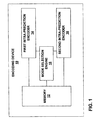
- FIG. 1 is a block diagram illustrating an exemplary encoding device according to an embodiment of this disclosure.
- FIG. 2 is a diagram used to help explain the encoding process described in Annex I for the ITU H.263 standard.
- FIG. 3 is a diagram used to help explain the encoding process that uses mode selection similar to that described in MPEG-4 documentation.
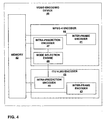
- FIG. 4 is a block diagram of a video encoding device that supports MPEG-4 compliant encoding and ITU H.263 compliant encoding.
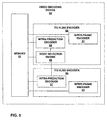
- FIG. 5 is a diagram of a video encoding device that supports ITU H.264 compliant encoding and TTU H.263 compliant encoding.
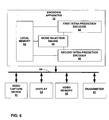
- FIG. 6 is another block diagram illustrating an exemplary encoding device according to an embodiment of this disclosure.
- FIG. 7 is a flow diagram illustrating a process consistent with the teaching of this disclosure.
- FIGS. 8-11 are graphs of experimental results that confirm that the mode selection techniques described herein achieve very good results
- FIG. 1 is a block diagram illustrating an exemplary encoding device 10.
- Encoding device 10 generally refers to any encoding device that can perform intra-prediction encoding techniques.
- encoding device 10 comprises a video encoding device that encodes frames of video sequences.
- encoding device 10 may include a number of additional components, e.g., for performing various inter-frame encoding techniques.
- various components of encoding device 10 may perform the intra-prediction encoding techniques, as described herein, on still images.
- Examples of encoding devices may include digital televisions, digital cameras, digital direct broadcast systems, wireless communication devices, personal digital assistants (PDAs), laptop computers, desktop computers, digital recording devices, cellular or satellite radio telephones, and the like.
- PDAs personal digital assistants
- any device that performs the encoding techniques described herein may be an encoding device.
- Encoding device 10 includes a memory 12 that initially stores uncompressed images or uncompressed video frames.
- this disclosure generally refers to operations and techniques that are performed with respect to video frames. It is understood, however, that similar techniques may be applied with regard to compression of still images.
- a video frame is essentially the same as a still image for purposes of intra-prediction encoding techniques.
- Encoding device 10 includes various components for intra-prediction encoding of the frames stored in memory 12, e.g., in order to compress the frames. More specifically, encoding device 10 supports intra-prediction encoding according to two or more different encoding standards. As described in this disclosure, however, a hardware engine designed to support and accelerate mode selection for this intra-prediction encoding is shared and used regardless of which of the two or more different encoding standards are used at a given time. Encoding device 10 may be programmable to allow a vendor to program the specific standard to be used, yet flexible so that the vendor can select from two or more standards. Although generally described as including two encoders, encoding device 10 may include any number of encoders. The number of mode selection engines may be less than the number of encoders.
- encoding device 10 includes a first intra-prediction encoder 14 and a second intra-prediction encoder 16.
- First intra-prediction encoder 14 performs intra-prediction encoding according to a first encoding standard
- second intra-prediction encoder 16 performs intra-prediction encoding according to a second encoding standard.
- First intra-prediction encoder 14 and a second intra-prediction encoder 16 each may be implemented by a combination of hardware, software, and firmware.
- encoders 14, 16 may be implemented using one or more digital signal processors (DSPs), application specific integrated circuits (ASICs), field programmable logic arrays (FPGAs), general purpose processors, or any combinations thereof.
- DSPs digital signal processors
- ASICs application specific integrated circuits
- FPGAs field programmable logic arrays
- Intra-prediction encoding refers to a encoding process that exploits redundancy within a given video frame or image in order to compress the amount of data needed to encoded the video frame or image.
- Encoder 10 allows for intra-prediction encoding according to at least two different encoding standards. In each case, however, the intra-prediction may be used alone as a compression technique, such as for still image compression, or may be used as part of a video encoding technique that also performs inter-frame correlation, and/or other encoding techniques.
- a mode selection process is performed as part of the intra-prediction encoding process.
- Encoding device 10 includes a mode selection engine 18 to perform this mode selection for intra-prediction encoding.
- mode selection engine 18 may select an intra-prediction mode, based on a desirable encoding rate, compression ratio or encoding efficiency needed at any given time.
- encoding device 10 uses the same mode selection engine 18 to facilitate mode selection for intra-prediction encoder 14 and a second intra-prediction encoder 16.
- Mode selection engine 18 may comprise a hardware component used with either of the first intra-prediction encoder 14 and a second intra-prediction encoder 16.
- Mode selection hardware for example, can accelerate the mode selection process.
- a vendor may be able to program encoding device 10 to support either of the two standards associated with either of encoders 14 and 16, but mode selection engine 18 is used regardless of this selection. Accordingly, use of a single mode selection engine 18 can result in a reduction in hardware in an encoding device that supports multiple standards.
- Mode selection is generally a process of identifying one portion of the frame that will be used to encode and compress another portion of the frame.
- the ITU H.263 video encoding standard includes an Annex I, which describes a preferred mode selection process in compliance with that standard.
- the mode selection process described in Annex I of H.263 defines how the coding of "intra" video blocks is performed. The coding efficiency of intra video blocks is said to be improved by allowing flexibility in the prediction modes.
- Annex I of H.263 defines three different prediction modes. Other standards documentation may define three prediction modes, or possibly more, but in any case, the suggested manner for selecting these different modes typically varies considerably between standards documentation.
- the mode selector of the encoder typically determines the best mode using the minimum sum of absolute different (SAD) criterion.
- SAD absolute different
- the intra-prediction mode selection process, as described in Annex I for the ITU H.263 standard, can be better understood with reference to FIG. 2 .
- DC modes refer to a mode that uses the DC coefficient of video blocks, which represents the average value of a video block, whereas AC modes use AC coefficients, which are the remaining (non-DC) coefficients of the video block.
- C [i, j] denotes the discrete cosine transform (DCT) coefficients of the current block before prediction
- C' [0, 0] denotes the predicted DC component of the current block using Mode 0
- B' [0, j], j 0, 1, ... 7, denotes the predicted left column of the current block using Mode 2.
- SAD0, SAD1, SAD2 represent the sum of absolute difference (SAD) metric for Mode 0, 1, and 2 respectively.
- the intra-prediction process including the mode selection process is performed, in accordance with the suggested standards documentation for ITU H.263 standard, in the DCT domain rather than a spatial domain.
- intra-prediction mode selection must be implemented after the DCT transformation of pixels in the spatial domain, but before the quantization on the DCT coefficients is performed.
- DCT coefficients are not typically generated at the time when mode selection is performed in accordance with intra-prediction with other standards, such as the ITU H.264 standard.
- mode selection decisions consistent with the proposed standards documentation for intra-prediction in the ITU H.263 standard using the SAD between the DCT coefficients of the current block and the predictor block, are not feasible for a mode selection engine designed for standards such as ITU H.264 standard.
- intra-prediction and mode selection for intra-prediction are typically performed in the DCT domain, but in a much simpler fashion than ITU H.263.
- This disclosure contemplates at least two different alternatives for ITU H.263 mode selection.
- the ITU H.263 mode selection may not rely on the DCT coefficients of the current block. Accordingly, this disclosure may allow a common mode selection engine to perform mode selection regardless of whether the ITU H.263 standard or another standard is currently being supported.
- the intra-prediction mode for the current block is typically determined from the coefficients of adjacent blocks, which does not depend on any coefficient of the current block.
- a mode for each 8x8 block is determined.
- the proposed mode selection scheme for the ITU H.263 standard only needs a determination of the mode for the top left sub-block of a 16 by 16 "macroblock," which is used for the entire macroblock.
- algorithm 1 illustrates how mode selection can be performed for MPEG-4 compliant encoders. Briefly, mode 0 is used when neighboring blocks are outside of a current video segment. A vertical prediction is used if the average DC difference between blocks B and A is smaller than the average difference between blocks B and C. A horizontal prediction is used if the average difference between blocks B and C is smaller than the average difference between blocks B and A.
- Algorithm 1 can be slightly modified, as follows, to achieve better performance.
- Algorithm 2 Compared with Algorithm 1, Algorithm 2 poses an additional condition that the average DC difference between the two neighboring blocks has to be lower than a threshold, in order to perform either horizontal or vertical predication, instead of DC prediction.
- mode 0 is used when neighboring blocks are outside of a current video segment, or when the average DC difference between the two neighboring blocks is not lower than a threshold.
- the intra-prediction mode selection process in MPEG-4 has the advantage of low complexity relative to mode selection processes for other standards such as the ITU H.263 standard.
- the intra-prediction is based on pixels instead of DCT coefficients, unlike the ITU H.263 standards recommendation.
- the best 16x16 luma mode can be determined in accordance with the ITU H.264 standards documentation, as the mode for ITU H.263 intra-prediction, without a significant loss of compression or significant degradation of peak signal-to-noise ratio (PSNR).
- PSNR peak signal-to-noise ratio
- the luma component of a macroblock there are four 16x16 luma modes for the luma component of a macroblock: DC, vertical, horizontal, and planar.
- the vertical, horizontal and planar modes use AC coefficients of video blocks.
- the first three modes: DC, vertical and horizontal, can be used to correspond to the modes for the ITU H.263 standard for intra-prediction. In some cases, only the first three modes are used for ITU H.264 mode selection as well, as the planar mode may be more complicated to calculate, particularly for hand-held devices where power consumption is a concern and processing power is limited.
- encoding device 10 includes a mode selection engine 18 that performs mode selection for intra-prediction encoding regardless of whether the encoding device is programmed to comply with a first encoding standard or a second encoding standard.
- a first encoder 14 performs the intra-prediction encoding according to the selected mode in compliance with the first encoding standard when encoding device 10 is programmed to comply with the first encoding standard.
- a second encoder 16 performs the intra-prediction encoding according to the selected mode in compliance with the second encoding standard when the encoding device is programmed to comply with the second encoding standard.
- encoding device 10 may comprise a handset that can be programmed to comply with either the first encoding standard or the second encoding standard. Accordingly, a vendor may program encoding device 10 to comply with either of the first or second standards, providing greater flexibility to the vendor. Moreover, since first encoder 14 and second encoder 16 use a common mode selection engine 18, encoding device 10 can be simplified relative to conventional dual-standard encoding devices with mode selection hardware to accelerate the mode selection process.
- Other examples of encoding device 10 include digital televisions, digital direct broadcast systems, wireless communication devices, personal digital assistants (PDAs), laptop computers, desktop computers, digital cameras, digital recording devices, cellular or satellite radio telephones, and the like.
- mode selection engine 18 may form part of first encoder 14. In that case, second encoder 16 implements mode selection engine 18 from first encoder 14 when encoding device 10 is programmed to comply with the second encoding standard. In other words, although illustrated as separate components, mode selection engine 18 may form a hardware component of one of the encoders, and the other of the encoders can also use that mode selection hardware. A wide variety of other components may also be included in encoding device 10, but are not specifically illustrated for simplicity. Additional encoders may also be included. Regardless of the number of encoders, however, two or more of the encoders may share a mode selection engine, as described herein.
- FIG. 4 is more specific block diagram of a video encoding device 40 that supports MPEG-4 compliant encoding and ITU H.263 compliant encoding.
- video encoding device 40 includes a memory 42 that initially stores uncompressed images or uncompressed video frames. Throughout the encoding process, memory 42 may also be used to store video data as it is encoded and compressed.
- Video device 40 includes an MPEG-4 encoder 44 and an ITU H.263 encoder 46.
- MPEG-4 encoder 44 encodes video sequences in compliance with the MPEG-4 video encoding standard
- ITU H.263 encoder 46 encodes video sequences in compliance with the ITU H.263 video encoding standard.
- Each of these standards make use of both intra-prediction encoding and intra-frame encoding.
- MPEG-4 encoder 44 includes an intra-prediction encoder 47 and an inter-frame encoder 41
- ITU H.263 encoder 46 includes an intra-prediction encoder 45 and an inter-frame encoder 43.
- Each of these components generally comply with the respective encoding standards associated with encoders 44 and 46.
- intra-prediction mode selection is contemplated for both MPEG-4 encoding and ITU H.263 encoding, although the recommended standards documentation for these different standards specify different ways to perform the mode selection.
- the suggested MPEG-4 intra-prediction mode selection is much less complex than the suggested ITU H.263 intra-prediction mode selection.
- MPEG-4 encoder 44 includes a mode selection engine 48.
- Mode selection engine 48 comprises hardware designed to accelerate the mode selection process. Moreover, mode selection engine 48 performs mode selection in substantial conformity with the suggested standards documentation for the MPEG-4 standard. Mode selection engine 48 performs mode selection in a DCT domain, but in a simplified manner relative to ITU H.263 suggested documentation, e.g., without requiring the DCT coefficients from the current block being coded.
- ITU H.263 encoder 46 does not include its own mode selection engine. Instead, for mode selection, ITU H.263 encoder 46 implements mode selection engine 48 of MPEG-4 encoder 44. This disclosure recognizes, however, that mode selection for ITU H.263 according to MPEG-4 mode selection, provides acceptable results for ITU H.263 mode selection.
- Encoding device 40 may receive programming instructions, e.g., from a vendor, specifying the encoding standard from a plurality of encoding standards.
- the vendor may specify either MPEG-4 encoding or ITU H.263 encoding. In either case, intra-prediction encoding is performed in compliance with the selected encoding standard.
- mode selection as outlined above may be performed as described in suggested MPEG-4 documentation, regardless of whether MPEG-4 encoding or ITU H.263 encoding is specified by the vendor.
- FIG. 5 is more specific block diagram of a video encoding device 50 that supports ITU H.264 compliant encoding and ITU H.263 compliant encoding.
- video encoding device 50 includes a memory 52 that initially stores uncompressed images or uncompressed video frames. Throughout the encoding process, memory 52 may also be used to store video data as it is encoded and compressed.
- a method according to this disclosure may comprise performing mode selection in a spatial domain for intra-prediction encoding in an encoding device programmed to comply with an encoding standard having suggested standards documentation that specifies intra-prediction in a discrete cosine transform (DCT) domain.
- DCT discrete cosine transform
- Video device 50 includes an ITU H.264 encoder 54 and an ITU H.263 encoder 56.
- ITU H.264 encoder 54 encodes video sequences in compliance with the ITU H.264 video encoding standard
- ITU H.263 encoder 56 encodes video sequences in compliance with the ITU H.263 video encoding standard.
- Each of these standards make use of both intra-prediction encoding and intra-frame encoding.
- ITU H.264 encoder 54 includes an intra-prediction encoder 57 and an inter-frame encoder 51
- ITU H.263 encoder 56 includes an intra-prediction encoder 55 and an inter-frame encoder 53.
- Each of these components generally comply with the respective encoding standards associated with encoders 54 and 56.
- the ITU H.264 recommended standards documentation specifies that intra-prediction should be performed with respect to pixels in the spatial domain. Again, the suggested ITU H.263 intra-prediction, in contrast, is performed in with respect to coefficients in the discrete cosign transform (DCT) domain.
- DCT discrete cosign transform
- ITU H.264 encoder 54 includes a mode selection engine 58.
- Mode selection engine 58 comprises hardware designed to accelerate the mode selection process.
- mode selection engine 58 performs mode selection in substantial conformity with the suggested standards documentation for the ITU H.264 standard. In some cases, however, only the first three modes are used for ITU H.264 mode selection, as the planar mode may be more complicated to process. Avoiding the use of planar mode for ITU H.264 mode selection can help simplify the hardware of video encoding device 50, reduce power consumption, and extend battery life.
- mode selection engine 58 performs mode selection in a spatial domain, i.e., based on pixel values in the spatial domain.
- ITU H.263 encoder 56 does not include its own mode selection engine. Instead, for mode selection, ITU H.263 encoder 56 implements mode selection engine 58 of ITU H.264 encoder 54. Again, this is counterintuitive, as the recommended standards documentation for the ITU H.263 standard specifies that intra-prediction is to be performed in a DCT domain, i.e., based on DCT coefficients. This disclosure recognizes, however, that mode selection for ITU H.263 in the spatial domain, provides acceptable results.
- the first three DC, vertical and horizontal, can be determined by mode selection engine 58 and used by ITU H.263 encoder 56 to correspond to the modes for the ITU H.263 standard for intra-prediction.
- the first three modes are used by ITU H.264 encoder 54 for ITU H.264 mode selection, as the planar mode may be more complicated to calculate, particularly for hand-held devices where power consumption and processing power are more limited.
- the planar mode can be calculated by mode selection engine 58 for use by encoder 54, but if device 50 is programmed to support ITU H.263 encoding, mode selection engine 58 may avoid such calculations associated with a planar mode.
- FIG. 6 is a block diagram of video encoding device 60, which supports video encoding according to two or more encoding standards.
- Video encoding device 60 is very similar to video encoding device 10 of FIG. 1 , but includes several additional components.
- Encoding apparatus 70 may comprise a chip set packaged into device 60 along with a video capture device 61, a display 63, video memory 65 and transmitter 67.
- Transmitter 67 may be a wireless transmitter.
- These various components may be communicatively coupled via a communication bus 69. Other components may also be included.
- Encoding apparatus 60 includes a local high speed memory 62, loaded with video sequences from off-chip video memory 65. The video sequences are encoded, as described herein.
- Device 60 supports multiple encoding standards, and a vendor can select an encoding standard to be used.
- Encoding apparatus 70 includes a mode selection engine 68 that performs mode selection for intra-prediction encoding regardless of whether the encoding apparatus 70 is programmed to comply with first encoding standard or a second encoding standard.
- Mode selection engine 68 may comprise hardware implemented to accelerate the mode selection process.
- Apparatus 70 also includes a first intra-prediction encoder 64 that performs the intra-prediction encoding according to the selected mode in compliance with the first encoding standard when apparatus 70 is programmed to comply with the first encoding standard, and a second first intra-prediction encoder 66 that performs the intra-prediction encoding according to the selected mode in compliance with the second encoding standard when the encoding device is programmed to comply with the second encoding standard.
- Encoders 64 and 66 each may comprise any combination of hardware, software, and firmware. Encoders 64, 66 may also be implemented by one or more digital signal processors (DSPs), application specific integrated circuits (ASICs), FPGAs, general purpose processors, or any combinations thereof.
- DSPs digital signal processors
- ASICs application specific integrated circuits
- FPGAs field-programmable gate arrays
- general purpose processors or any combinations thereof.
- Video capture device 61 may comprise a video camera to capture video sequences and store the captured sequences in video memory 65.
- video capture device 61 may include a charge coupled device (CCD), a charge injection device, an array of photodiodes, a complementary metal oxide semiconductor (CMOS) device, or any other photosensitive device capable of capturing video images or digital video sequences.
- Display 63 may display decoded video sequences, and transmitter 67 may transmit encoded video sequences.
- video capture device captures video sequences, which are encoded according to the selected standard and then transmitted in real-time by transmitter 67.
- Mode selection engine 68 can improve this real-time encoding by accelerating the mode selection process during intra-prediction encoding.
- Video memory 65 typically comprises a relatively large memory space.
- Video memory 65 may comprise dynamic random access memory (DRAM), or FLASH memory.
- video memory 65 may comprise a non-volatile memory or any other data storage device.
- local memory 62 may comprise a smaller and faster memory space relative to video memory 65.
- local memory 62 may comprise synchronous random access memory (SRAM).
- SRAM synchronous random access memory
- Local memory 62 may also comprise "on-chip" memory integrated with the other components of apparatus 70 to provide for very fast access to data during the processor-intensive encoding process.
- FIG. 7 is a flow diagram illustrating a process consistent with the teaching of this disclosure.
- device 10 performs mode selection using mode selection engine 18 in substantial compliance with a first encoding standard (standard 1) (71). If device 10 is programmed to encode according to the first standard (standard 1 branch of 72), then device encodes the frames in compliance with standard 1 (73). If device 10 is programmed to encode according to the second standard (standard 2 branch of 72), then device encodes the frames in compliance with standard 2 (74).
- standard 1 standard
- standard 2 branch of 72 standard 2
- the mode selection engine 18 can be shared for both standards, even if the mode selection engine 18 performs such mode selection in domain that is different than the intra-prediction domain for one of the standards. Tables 1-4 below and the graphs of FIGS. 8-11 provide experimental results that confirm that the mode selection techniques described herein achieve very good results.
- Tables 1-4 below correspond to the graphs of FIGS. 8-11 respectively.
- four video sequences were tested during ITU H.263 encoding.
- the sequences were named Foreman, Mother, Coast-guard, and Claire to distinguish the different sequences.
- Each sequence consisted of 300 frames.
- Each sequence was intra-prediction encoded in compliance with the ITU H.263 standard using various mode decision schemes substantially consistent with the recommended standards documentation for H.263, MPEG-4 and ITU H.264.
- the Intra period was 5 frames.
- the peak signal to noise ratios (PSNR), as well as the rate increase due to the use of MPEG-4 schemes or ITU H.264 schemes instead of the minimum SAD method, are listed in tables 1-4.
- the respective rate-distortion curves for each sequence are plotted in FIGS. 8-11
- H.263 refers to the ITU H.263 encoding when minimum SAD mode selection was used, as outlined in Annex I of the ITU H.263 standards documentation.
- MPEG-4 refers to the ITU H.263 encoding when a slightly modified mode selection technique relative to the MPEG-4 recommended standards documentation was used, consistent with Algorithm 2 (above).
- H.264 refers to the encoding when the first three modes (excluding planar mode) of the ITU H.264 recommended standards documentation were used for mode selection in ITU H.263 encoding.
- the "Rate inc.” for MPEG-4 and H.264 identifies the rate increase relative to encoding with H.263 mode selection.
- ITU H.263 intra-prediction mode selection can be used for ITU H.263 intra-prediction, but is performed in a spatial domain, in contrast to the suggested documentation for ITU H.263 intra-prediction.
- MPEG-4 mode selection can also be used for ITU H.263 intra-prediction, but is much less complex than the suggested documentation for ITU H.263.
- the mode selection decisions of an ITS H.264 mode selection engine serve as a good alternative for the minimum SAD method that requires the DCT coefficients. The performance gap is very small. If even lower complexity is desired, the mode selection decisions of MPEG-4 mode selection engine, as slightly modified by algorithm 2 (above), is an alternative with a reasonably lower performance.
Landscapes
- Engineering & Computer Science (AREA)
- Multimedia (AREA)
- Signal Processing (AREA)
- Compression Or Coding Systems Of Tv Signals (AREA)
Claims (8)
- Eine Vorrichtung (10), aufweisend:eine Modusauswahlengine (18), die einen ersten Codierungsstandard im Wesentlichen erfüllt, zum Durchführen von Modusauswahl auf Blockebene für Intra-Prognosecodierung (,,intra-prediction encoding"), unabhängig davon ob die Vorrichtung programmiert ist zum Erfüllen eines ersten Codierungsstandards oder eines zweiten Codierungsstandards; wobei die Modusauswahlengine betriebsfähig ist zum Durchführen einer horizontalen oder vertikalen Prognose anstatt von DC-Prognose, wenn eine durchschnittliche DC-Differenz zwischen zwei benachbarten Blöcken niedriger ist als ein Schwellwert; und wobei eine vertikale Prognose durchgeführt wird, falls die durchschnittliche DC-Differenz zwischen Blöcken B und A kleiner ist als die durchschnittliche Differenz zwischen Blöcken B und C; und wobei ferner eine horizontale Prognose durchgeführt wird, falls die durchschnittliche Differenz zwischen Blöcken B und C kleiner ist als die durchschnittliche Differenz zwischen Blöcken B und A; wobei Block A der unmittelbare linke Nachbar von Block X ist; Block C der unmittelbare obere Nachbar von Block X ist; und Block B der unmittelbare obere Nachbar von Block A ist; und wobei ferner Block X der Block oben links eines gegenwärtigen Makroblocks ist, der verarbeitet wird;Mittel zum Durchführen (14) der Intra-Prognosecodierung gemäß dem ausgewählten Modus in Erfüllung des ersten Kodierungsstandards, wenn die Vorrichtung programmiert ist zum Erfüllen des ersten Kodierungsstandards; undMittel zum Durchführen (16) der Intra-Prognosecodierung gemäß dem ausgewählten Modus in Erfüllung des zweiten Kodierungsstandards, wenn die Vorrichtung programmiert ist zum Erfüllen des zweiten Kodierungsstandards, wobei der zweite Kodierungsstandard H.263 ist.
- Die Vorrichtung nach Anspruch 1, wobei die Vorrichtung programmiert sein kann zum Erfüllen entweder des ersten Kodierungsstandards oder des zweiten Kodierungsstandards.
- Die Vorrichtung nach Anspruch 1, wobei die Mittel zum Durchführen der Intra-Prognosecodierung Videoencoder enthalten, die Videosequenzen kodieren.
- Die Vorrichtung nach Anspruch 1, ferner aufweisend Mittel zum Übertragen von Videorahmen, kodiert durch eines der Mittel (14, 16) zum Durchführen der Intra-Prognosecodierung in Erfüllung des ersten Kodierungsstandards oder in Erfüllung des zweiten Kodierungsstandards.
- Die Vorrichtung nach Anspruch 4, ferner aufweisend Mittel zum Erfassen von Videorahmen in Echtzeit, wobei die ersten und zweiten Mittel zum Kodieren konfiguriert sind zum Kodieren der Videorahmen in Echtzeit und die Mittel zum Übertragen konfiguriert sind zum Übertragen der kodierten Videorahmen in Echtzeit.
- Ein Verfahren, aufweisend:Durchführen von Modusauswahl (71) für Intra-Prognosecodierung auf Blockebene unter Verwendung einer Modusauswahlengine, die einen ersten Codierungsstandard im Wesentlichen erfüllt, unabhängig davon ob eine Vorrichtung, die das Verfahren durchführt, programmiert ist zum Erfüllen des ersten Kodierungsstandards oder eines zweiten Kodierungsstandards; wobei das Durchführen der Modusauswahl aufweist Durchführen einer horizontalen oder einer vertikalen Prognose anstatt von DC-Prognose, wenn eine durchschnittliche DC-Differenz zwischen zwei benachbarten Blöcken niedriger ist als ein Schwellwert; und wobei eine vertikale Prognose durchgeführt wird, falls die durchschnittliche DC-Differenz zwischen Blöcken B und A kleiner ist als die durchschnittliche Differenz zwischen Blöcken B und C; und wobei ferner eine horizontale Prognose durchgeführt wird, falls die durchschnittliche Differenz zwischen Blöcken B und C kleiner ist als die durchschnittliche Differenz zwischen Blöcken B und A; wobei Block A der unmittelbare linke Nachbar von Block X ist; Block C der unmittelbare obere Nachbar von Block X ist; und Block B der unmittelbare obere Nachbar von Block A ist; und wobei ferner Block X der Block oben links eines gegenwärtigen Makroblocks ist, der verarbeitet wird;Durchführen der Intra-Prognosecodierung (73) gemäß dem ausgewählten Modus in Erfüllung des ersten Kodierungsstandards, wenn die Kodierungsvorrichtung programmiert ist zum Erfüllen des ersten Kodierungsstandards; undDurchführen der Intra-Prognosecodierung (74) gemäß dem ausgewählten Modus in Erfüllung des zweiten Kodierungsstandards, wenn die Kodierungsvorrichtung programmiert ist zum Erfüllen des zweiten Kodierungsstandards, wobei der zweite Kodierungsstandard H.263 ist.
- Computerprogramm, aufweisend Instruktionen, welche das Verfahren nach Anspruch 6 implementieren bei Ausführung auf einem Computer.
- Speichermedium, das das Computerprogramm nach Anspruch 7 verkörpert.
Applications Claiming Priority (2)
| Application Number | Priority Date | Filing Date | Title |
|---|---|---|---|
| US11/036,447 US7830960B2 (en) | 2005-01-13 | 2005-01-13 | Mode selection techniques for intra-prediction video encoding |
| PCT/US2006/001421 WO2006076675A1 (en) | 2005-01-13 | 2006-01-13 | Mode selection techniques for intra-prediction video encoding |
Publications (2)
| Publication Number | Publication Date |
|---|---|
| EP1859629A1 EP1859629A1 (de) | 2007-11-28 |
| EP1859629B1 true EP1859629B1 (de) | 2011-09-07 |
Family
ID=36250771
Family Applications (1)
| Application Number | Title | Priority Date | Filing Date |
|---|---|---|---|
| EP06718489A Expired - Lifetime EP1859629B1 (de) | 2005-01-13 | 2006-01-13 | Modusauswahlverfahren zur intra-prädikativen videokodierung |
Country Status (7)
| Country | Link |
|---|---|
| US (1) | US7830960B2 (de) |
| EP (1) | EP1859629B1 (de) |
| JP (1) | JP4700069B2 (de) |
| KR (1) | KR100937275B1 (de) |
| CN (1) | CN101133648B (de) |
| AT (1) | ATE524019T1 (de) |
| WO (1) | WO2006076675A1 (de) |
Families Citing this family (26)
| Publication number | Priority date | Publication date | Assignee | Title |
|---|---|---|---|---|
| WO2006052399A1 (en) * | 2004-11-04 | 2006-05-18 | Thomson Licensing | Fast intra mode prediction for a video encoder |
| JPWO2006100946A1 (ja) * | 2005-03-24 | 2008-09-04 | パイオニア株式会社 | 画像信号再符号化装置及び画像信号再符号化方法 |
| WO2006123307A2 (en) * | 2005-05-20 | 2006-11-23 | Nxp B.V. | Video encoder using a refresh map |
| KR100727972B1 (ko) * | 2005-09-06 | 2007-06-14 | 삼성전자주식회사 | 영상의 인트라 예측 부호화, 복호화 방법 및 장치 |
| KR100856223B1 (ko) * | 2006-10-19 | 2008-09-03 | 삼성전자주식회사 | H.264 인코더의 적응적 인코딩 모드 결정 장치 및결정 방법 |
| KR101375669B1 (ko) * | 2006-11-07 | 2014-03-19 | 삼성전자주식회사 | 인터 예측 부호화, 복호화 방법 및 장치 |
| JP4908180B2 (ja) * | 2006-12-20 | 2012-04-04 | 株式会社東芝 | 動画像符号化装置 |
| KR101365569B1 (ko) * | 2007-01-18 | 2014-02-21 | 삼성전자주식회사 | 인트라 예측 부호화, 복호화 방법 및 장치 |
| WO2009080133A1 (en) * | 2007-12-21 | 2009-07-02 | Telefonaktiebolaget Lm Ericsson (Publ) | Adaptive intra mode selection |
| CN101340581B (zh) * | 2008-08-15 | 2010-06-02 | 上海富瀚微电子有限公司 | 一种基于m算法的帧内预测模式选择方法及其实现装置 |
| US8483285B2 (en) * | 2008-10-03 | 2013-07-09 | Qualcomm Incorporated | Video coding using transforms bigger than 4×4 and 8×8 |
| JP5169978B2 (ja) * | 2009-04-24 | 2013-03-27 | ソニー株式会社 | 画像処理装置および方法 |
| EP4507309A3 (de) | 2010-02-08 | 2025-02-26 | Nokia Technologies Oy | Vorrichtung, verfahren und computerprogramm zur videocodierung |
| KR20120016991A (ko) * | 2010-08-17 | 2012-02-27 | 오수미 | 인터 프리딕션 방법 |
| US10136130B2 (en) * | 2010-08-17 | 2018-11-20 | M&K Holdings Inc. | Apparatus for decoding an image |
| US11284072B2 (en) | 2010-08-17 | 2022-03-22 | M&K Holdings Inc. | Apparatus for decoding an image |
| US9066097B2 (en) | 2011-02-01 | 2015-06-23 | Sony Corporation | Method to optimize the transforms and/or predictions in a video codec |
| US9654785B2 (en) | 2011-06-09 | 2017-05-16 | Qualcomm Incorporated | Enhanced intra-prediction mode signaling for video coding using neighboring mode |
| EP2774360B1 (de) * | 2011-11-04 | 2017-08-02 | Huawei Technologies Co., Ltd. | Intraprädiktion mit differentieller pulscodemodulation für hocheffiziente videocodierung |
| US9319684B2 (en) * | 2012-08-21 | 2016-04-19 | Qualcomm Incorporated | Alternative transform in scalable video coding |
| CN104601989A (zh) * | 2015-01-19 | 2015-05-06 | 北京北方常安铁路电务工程技术有限公司 | 视频编码方法 |
| JP7036628B2 (ja) * | 2017-03-10 | 2022-03-15 | パナソニック インテレクチュアル プロパティ コーポレーション オブ アメリカ | 符号化装置、復号装置、符号化方法及び復号方法 |
| KR20250155071A (ko) * | 2018-05-10 | 2025-10-29 | 삼성전자주식회사 | 비디오 부호화 방법 및 장치, 비디오 복호화 방법 및 장치 |
| JP7243732B2 (ja) * | 2018-09-14 | 2023-03-22 | 株式会社ソシオネクスト | 動画像符号化方法及び動画像符号化装置 |
| EP3664451B1 (de) * | 2018-12-06 | 2020-10-21 | Axis AB | Verfahren und vorrichtung zur codierung mehrerer bilder |
| CN118509423B (zh) * | 2024-07-18 | 2024-09-13 | 北京尚优力达科技有限公司 | 一种融合通信音视频传输方法 |
Family Cites Families (9)
| Publication number | Priority date | Publication date | Assignee | Title |
|---|---|---|---|---|
| US6014694A (en) * | 1997-06-26 | 2000-01-11 | Citrix Systems, Inc. | System for adaptive video/audio transport over a network |
| US6625211B1 (en) * | 1999-02-25 | 2003-09-23 | Matsushita Electric Industrial Co., Ltd. | Method and apparatus for transforming moving picture coding system |
| US7103669B2 (en) * | 2001-02-16 | 2006-09-05 | Hewlett-Packard Development Company, L.P. | Video communication method and system employing multiple state encoding and path diversity |
| JP4423820B2 (ja) * | 2001-06-27 | 2010-03-03 | ソニー株式会社 | 画像処理装置及び方法、並びにプログラム及び記録媒体 |
| US20040258162A1 (en) * | 2003-06-20 | 2004-12-23 | Stephen Gordon | Systems and methods for encoding and decoding video data in parallel |
| CN1209928C (zh) * | 2003-07-04 | 2005-07-06 | 清华大学 | 一种基于预测块组的采用帧内预测的帧内编码帧编码方法 |
| US7324595B2 (en) * | 2003-09-22 | 2008-01-29 | Lsi Logic Corporation | Method and/or apparatus for reducing the complexity of non-reference frame encoding using selective reconstruction |
| CN1235411C (zh) * | 2003-10-17 | 2006-01-04 | 中国科学院计算技术研究所 | 基于流水线的帧内预测模式块编码加速方法 |
| CN100536573C (zh) * | 2004-01-16 | 2009-09-02 | 北京工业大学 | 基于方向的dc预测方法及用于视频编码的帧内预测方法 |
-
2005
- 2005-01-13 US US11/036,447 patent/US7830960B2/en active Active
-
2006
- 2006-01-13 AT AT06718489T patent/ATE524019T1/de not_active IP Right Cessation
- 2006-01-13 JP JP2007551445A patent/JP4700069B2/ja not_active Expired - Fee Related
- 2006-01-13 EP EP06718489A patent/EP1859629B1/de not_active Expired - Lifetime
- 2006-01-13 KR KR1020077018452A patent/KR100937275B1/ko not_active Expired - Fee Related
- 2006-01-13 CN CN200680006508.6A patent/CN101133648B/zh not_active Expired - Fee Related
- 2006-01-13 WO PCT/US2006/001421 patent/WO2006076675A1/en not_active Ceased
Also Published As
| Publication number | Publication date |
|---|---|
| CN101133648A (zh) | 2008-02-27 |
| KR100937275B1 (ko) | 2010-01-18 |
| JP4700069B2 (ja) | 2011-06-15 |
| WO2006076675A9 (en) | 2008-12-31 |
| ATE524019T1 (de) | 2011-09-15 |
| KR20070104595A (ko) | 2007-10-26 |
| JP2008527933A (ja) | 2008-07-24 |
| WO2006076675A1 (en) | 2006-07-20 |
| CN101133648B (zh) | 2014-11-12 |
| EP1859629A1 (de) | 2007-11-28 |
| US20060153292A1 (en) | 2006-07-13 |
| US7830960B2 (en) | 2010-11-09 |
Similar Documents
| Publication | Publication Date | Title |
|---|---|---|
| EP1859629B1 (de) | Modusauswahlverfahren zur intra-prädikativen videokodierung | |
| RU2452128C2 (ru) | Адаптивное кодирование информации заголовка видеоблока | |
| US7924925B2 (en) | Flexible macroblock ordering with reduced data traffic and power consumption | |
| EP1862011B1 (de) | Adaptive rahmenüberspringungstechniken für ratengesteuerte videocodierung | |
| US7277587B2 (en) | System and method for lossless video coding | |
| US8917757B2 (en) | Video processing system and device with encoding and decoding modes and method for use therewith | |
| US8009734B2 (en) | Method and/or apparatus for reducing the complexity of H.264 B-frame encoding using selective reconstruction | |
| CN101248673B (zh) | 用于根据多个视频标准进行视频编码的去块滤波技术 | |
| US20140254660A1 (en) | Video encoder, method of detecting scene change and method of controlling video encoder | |
| US20070110160A1 (en) | Multi-dimensional neighboring block prediction for video encoding | |
| US20070036218A1 (en) | Video transcoding | |
| US20060120612A1 (en) | Motion estimation techniques for video encoding | |
| US8160144B1 (en) | Video motion estimation | |
| CN1812577A (zh) | 译码数字影像位流所含画面的方法及其数字影像译码系统 | |
| US8355440B2 (en) | Motion search module with horizontal compression preprocessing and methods for use therewith | |
| US8363722B2 (en) | Method and apparatus for hierarchical bi-directional intra-prediction in a video encoder | |
| EP1838108A1 (de) | Verarbeitung von Videodaten mit einer Zielrate | |
| US20080031333A1 (en) | Motion compensation module and methods for use therewith | |
| JP3947316B2 (ja) | 動きベクトル検出装置及びこれを用いた動画像符号化装置 | |
| KR100497760B1 (ko) | 이동통신 단말기용 동영상 부호화 시스템 및 방법 | |
| HK1111289A (en) | Mode selection techniques for intra-prediction video encoding | |
| Ding et al. | Memory bandwidth efficient hardware architecture for AVS encoder | |
| Shenbagavalli et al. | Adaptive Algorithm To Reduce Computational Complexity In Video Coders | |
| KR20040031868A (ko) | 동영상 부호화 방법 |
Legal Events
| Date | Code | Title | Description |
|---|---|---|---|
| PUAI | Public reference made under article 153(3) epc to a published international application that has entered the european phase |
Free format text: ORIGINAL CODE: 0009012 |
|
| 17P | Request for examination filed |
Effective date: 20070725 |
|
| AK | Designated contracting states |
Kind code of ref document: A1 Designated state(s): AT BE BG CH CY CZ DE DK EE ES FI FR GB GR HU IE IS IT LI LT LU LV MC NL PL PT RO SE SI SK TR |
|
| RIN1 | Information on inventor provided before grant (corrected) |
Inventor name: LIANG, YI Inventor name: MOLLOY, STEPHEN |
|
| 17Q | First examination report despatched |
Effective date: 20080109 |
|
| DAX | Request for extension of the european patent (deleted) | ||
| RIN1 | Information on inventor provided before grant (corrected) |
Inventor name: MOLLOY, STEPHEN Inventor name: LIANG, YI |
|
| GRAP | Despatch of communication of intention to grant a patent |
Free format text: ORIGINAL CODE: EPIDOSNIGR1 |
|
| RIN1 | Information on inventor provided before grant (corrected) |
Inventor name: LIANG, YI Inventor name: MOLLOY, STEPHEN |
|
| GRAS | Grant fee paid |
Free format text: ORIGINAL CODE: EPIDOSNIGR3 |
|
| GRAA | (expected) grant |
Free format text: ORIGINAL CODE: 0009210 |
|
| REG | Reference to a national code |
Ref country code: GB Ref legal event code: FG4D |
|
| REG | Reference to a national code |
Ref country code: CH Ref legal event code: EP |
|
| REG | Reference to a national code |
Ref country code: IE Ref legal event code: FG4D |
|
| REG | Reference to a national code |
Ref country code: DE Ref legal event code: R096 Ref document number: 602006024191 Country of ref document: DE Effective date: 20111117 |
|
| REG | Reference to a national code |
Ref country code: NL Ref legal event code: VDEP Effective date: 20110907 |
|
| PG25 | Lapsed in a contracting state [announced via postgrant information from national office to epo] |
Ref country code: FI Free format text: LAPSE BECAUSE OF FAILURE TO SUBMIT A TRANSLATION OF THE DESCRIPTION OR TO PAY THE FEE WITHIN THE PRESCRIBED TIME-LIMIT Effective date: 20110907 Ref country code: SE Free format text: LAPSE BECAUSE OF FAILURE TO SUBMIT A TRANSLATION OF THE DESCRIPTION OR TO PAY THE FEE WITHIN THE PRESCRIBED TIME-LIMIT Effective date: 20110907 Ref country code: LT Free format text: LAPSE BECAUSE OF FAILURE TO SUBMIT A TRANSLATION OF THE DESCRIPTION OR TO PAY THE FEE WITHIN THE PRESCRIBED TIME-LIMIT Effective date: 20110907 |
|
| LTIE | Lt: invalidation of european patent or patent extension |
Effective date: 20110907 |
|
| PG25 | Lapsed in a contracting state [announced via postgrant information from national office to epo] |
Ref country code: LV Free format text: LAPSE BECAUSE OF FAILURE TO SUBMIT A TRANSLATION OF THE DESCRIPTION OR TO PAY THE FEE WITHIN THE PRESCRIBED TIME-LIMIT Effective date: 20110907 Ref country code: AT Free format text: LAPSE BECAUSE OF FAILURE TO SUBMIT A TRANSLATION OF THE DESCRIPTION OR TO PAY THE FEE WITHIN THE PRESCRIBED TIME-LIMIT Effective date: 20110907 Ref country code: GR Free format text: LAPSE BECAUSE OF FAILURE TO SUBMIT A TRANSLATION OF THE DESCRIPTION OR TO PAY THE FEE WITHIN THE PRESCRIBED TIME-LIMIT Effective date: 20111208 Ref country code: SI Free format text: LAPSE BECAUSE OF FAILURE TO SUBMIT A TRANSLATION OF THE DESCRIPTION OR TO PAY THE FEE WITHIN THE PRESCRIBED TIME-LIMIT Effective date: 20110907 Ref country code: CY Free format text: LAPSE BECAUSE OF FAILURE TO SUBMIT A TRANSLATION OF THE DESCRIPTION OR TO PAY THE FEE WITHIN THE PRESCRIBED TIME-LIMIT Effective date: 20110907 |
|
| REG | Reference to a national code |
Ref country code: AT Ref legal event code: MK05 Ref document number: 524019 Country of ref document: AT Kind code of ref document: T Effective date: 20110907 |
|
| PG25 | Lapsed in a contracting state [announced via postgrant information from national office to epo] |
Ref country code: BE Free format text: LAPSE BECAUSE OF FAILURE TO SUBMIT A TRANSLATION OF THE DESCRIPTION OR TO PAY THE FEE WITHIN THE PRESCRIBED TIME-LIMIT Effective date: 20110907 |
|
| PG25 | Lapsed in a contracting state [announced via postgrant information from national office to epo] |
Ref country code: IS Free format text: LAPSE BECAUSE OF FAILURE TO SUBMIT A TRANSLATION OF THE DESCRIPTION OR TO PAY THE FEE WITHIN THE PRESCRIBED TIME-LIMIT Effective date: 20120107 Ref country code: SK Free format text: LAPSE BECAUSE OF FAILURE TO SUBMIT A TRANSLATION OF THE DESCRIPTION OR TO PAY THE FEE WITHIN THE PRESCRIBED TIME-LIMIT Effective date: 20110907 Ref country code: CZ Free format text: LAPSE BECAUSE OF FAILURE TO SUBMIT A TRANSLATION OF THE DESCRIPTION OR TO PAY THE FEE WITHIN THE PRESCRIBED TIME-LIMIT Effective date: 20110907 |
|
| PG25 | Lapsed in a contracting state [announced via postgrant information from national office to epo] |
Ref country code: PT Free format text: LAPSE BECAUSE OF FAILURE TO SUBMIT A TRANSLATION OF THE DESCRIPTION OR TO PAY THE FEE WITHIN THE PRESCRIBED TIME-LIMIT Effective date: 20120109 Ref country code: EE Free format text: LAPSE BECAUSE OF FAILURE TO SUBMIT A TRANSLATION OF THE DESCRIPTION OR TO PAY THE FEE WITHIN THE PRESCRIBED TIME-LIMIT Effective date: 20110907 Ref country code: PL Free format text: LAPSE BECAUSE OF FAILURE TO SUBMIT A TRANSLATION OF THE DESCRIPTION OR TO PAY THE FEE WITHIN THE PRESCRIBED TIME-LIMIT Effective date: 20110907 Ref country code: IT Free format text: LAPSE BECAUSE OF FAILURE TO SUBMIT A TRANSLATION OF THE DESCRIPTION OR TO PAY THE FEE WITHIN THE PRESCRIBED TIME-LIMIT Effective date: 20110907 Ref country code: NL Free format text: LAPSE BECAUSE OF FAILURE TO SUBMIT A TRANSLATION OF THE DESCRIPTION OR TO PAY THE FEE WITHIN THE PRESCRIBED TIME-LIMIT Effective date: 20110907 Ref country code: RO Free format text: LAPSE BECAUSE OF FAILURE TO SUBMIT A TRANSLATION OF THE DESCRIPTION OR TO PAY THE FEE WITHIN THE PRESCRIBED TIME-LIMIT Effective date: 20110907 |
|
| PLBE | No opposition filed within time limit |
Free format text: ORIGINAL CODE: 0009261 |
|
| STAA | Information on the status of an ep patent application or granted ep patent |
Free format text: STATUS: NO OPPOSITION FILED WITHIN TIME LIMIT |
|
| PG25 | Lapsed in a contracting state [announced via postgrant information from national office to epo] |
Ref country code: DK Free format text: LAPSE BECAUSE OF FAILURE TO SUBMIT A TRANSLATION OF THE DESCRIPTION OR TO PAY THE FEE WITHIN THE PRESCRIBED TIME-LIMIT Effective date: 20110907 |
|
| 26N | No opposition filed |
Effective date: 20120611 |
|
| PG25 | Lapsed in a contracting state [announced via postgrant information from national office to epo] |
Ref country code: MC Free format text: LAPSE BECAUSE OF NON-PAYMENT OF DUE FEES Effective date: 20120131 |
|
| REG | Reference to a national code |
Ref country code: CH Ref legal event code: PL |
|
| REG | Reference to a national code |
Ref country code: DE Ref legal event code: R097 Ref document number: 602006024191 Country of ref document: DE Effective date: 20120611 |
|
| REG | Reference to a national code |
Ref country code: FR Ref legal event code: ST Effective date: 20120928 |
|
| REG | Reference to a national code |
Ref country code: IE Ref legal event code: MM4A |
|
| PG25 | Lapsed in a contracting state [announced via postgrant information from national office to epo] |
Ref country code: LI Free format text: LAPSE BECAUSE OF NON-PAYMENT OF DUE FEES Effective date: 20120131 Ref country code: CH Free format text: LAPSE BECAUSE OF NON-PAYMENT OF DUE FEES Effective date: 20120131 |
|
| PG25 | Lapsed in a contracting state [announced via postgrant information from national office to epo] |
Ref country code: FR Free format text: LAPSE BECAUSE OF NON-PAYMENT OF DUE FEES Effective date: 20120131 |
|
| PG25 | Lapsed in a contracting state [announced via postgrant information from national office to epo] |
Ref country code: IE Free format text: LAPSE BECAUSE OF NON-PAYMENT OF DUE FEES Effective date: 20120113 |
|
| PG25 | Lapsed in a contracting state [announced via postgrant information from national office to epo] |
Ref country code: ES Free format text: LAPSE BECAUSE OF FAILURE TO SUBMIT A TRANSLATION OF THE DESCRIPTION OR TO PAY THE FEE WITHIN THE PRESCRIBED TIME-LIMIT Effective date: 20111218 |
|
| PG25 | Lapsed in a contracting state [announced via postgrant information from national office to epo] |
Ref country code: BG Free format text: LAPSE BECAUSE OF FAILURE TO SUBMIT A TRANSLATION OF THE DESCRIPTION OR TO PAY THE FEE WITHIN THE PRESCRIBED TIME-LIMIT Effective date: 20111207 |
|
| PG25 | Lapsed in a contracting state [announced via postgrant information from national office to epo] |
Ref country code: TR Free format text: LAPSE BECAUSE OF FAILURE TO SUBMIT A TRANSLATION OF THE DESCRIPTION OR TO PAY THE FEE WITHIN THE PRESCRIBED TIME-LIMIT Effective date: 20110907 |
|
| PG25 | Lapsed in a contracting state [announced via postgrant information from national office to epo] |
Ref country code: LU Free format text: LAPSE BECAUSE OF NON-PAYMENT OF DUE FEES Effective date: 20120113 |
|
| PG25 | Lapsed in a contracting state [announced via postgrant information from national office to epo] |
Ref country code: HU Free format text: LAPSE BECAUSE OF FAILURE TO SUBMIT A TRANSLATION OF THE DESCRIPTION OR TO PAY THE FEE WITHIN THE PRESCRIBED TIME-LIMIT Effective date: 20060113 |
|
| PGFP | Annual fee paid to national office [announced via postgrant information from national office to epo] |
Ref country code: GB Payment date: 20171228 Year of fee payment: 13 |
|
| PGFP | Annual fee paid to national office [announced via postgrant information from national office to epo] |
Ref country code: DE Payment date: 20180109 Year of fee payment: 13 |
|
| REG | Reference to a national code |
Ref country code: DE Ref legal event code: R119 Ref document number: 602006024191 Country of ref document: DE |
|
| GBPC | Gb: european patent ceased through non-payment of renewal fee |
Effective date: 20190113 |
|
| PG25 | Lapsed in a contracting state [announced via postgrant information from national office to epo] |
Ref country code: DE Free format text: LAPSE BECAUSE OF NON-PAYMENT OF DUE FEES Effective date: 20190801 |
|
| PG25 | Lapsed in a contracting state [announced via postgrant information from national office to epo] |
Ref country code: GB Free format text: LAPSE BECAUSE OF NON-PAYMENT OF DUE FEES Effective date: 20190113 |