EP1854516A1 - Voice output device, voice output method, information recording medium, and program - Google Patents
Voice output device, voice output method, information recording medium, and program Download PDFInfo
- Publication number
- EP1854516A1 EP1854516A1 EP06714876A EP06714876A EP1854516A1 EP 1854516 A1 EP1854516 A1 EP 1854516A1 EP 06714876 A EP06714876 A EP 06714876A EP 06714876 A EP06714876 A EP 06714876A EP 1854516 A1 EP1854516 A1 EP 1854516A1
- Authority
- EP
- European Patent Office
- Prior art keywords
- sound
- sound producing
- unit
- producing units
- change rate
- Prior art date
- Legal status (The legal status is an assumption and is not a legal conclusion. Google has not performed a legal analysis and makes no representation as to the accuracy of the status listed.)
- Withdrawn
Links
- 238000000034 method Methods 0.000 title claims description 29
- 230000003321 amplification Effects 0.000 claims abstract description 66
- 238000003199 nucleic acid amplification method Methods 0.000 claims abstract description 66
- 238000002156 mixing Methods 0.000 claims abstract description 23
- 229920006395 saturated elastomer Polymers 0.000 claims description 5
- 238000004364 calculation method Methods 0.000 description 16
- 230000010365 information processing Effects 0.000 description 12
- 239000013598 vector Substances 0.000 description 11
- 238000010586 diagram Methods 0.000 description 10
- 230000006870 function Effects 0.000 description 10
- 230000007423 decrease Effects 0.000 description 7
- 238000004891 communication Methods 0.000 description 4
- 230000000694 effects Effects 0.000 description 4
- PHEDXBVPIONUQT-RGYGYFBISA-N phorbol 13-acetate 12-myristate Chemical compound C([C@]1(O)C(=O)C(C)=C[C@H]1[C@@]1(O)[C@H](C)[C@H]2OC(=O)CCCCCCCCCCCCC)C(CO)=C[C@H]1[C@H]1[C@]2(OC(C)=O)C1(C)C PHEDXBVPIONUQT-RGYGYFBISA-N 0.000 description 3
- 230000002708 enhancing effect Effects 0.000 description 2
- 210000000003 hoof Anatomy 0.000 description 2
- 230000005236 sound signal Effects 0.000 description 2
- 241000283086 Equidae Species 0.000 description 1
- 230000006399 behavior Effects 0.000 description 1
- 230000001413 cellular effect Effects 0.000 description 1
- 230000003247 decreasing effect Effects 0.000 description 1
- 230000002250 progressing effect Effects 0.000 description 1
- 238000009877 rendering Methods 0.000 description 1
- 238000005070 sampling Methods 0.000 description 1
- 239000004065 semiconductor Substances 0.000 description 1
- 230000001629 suppression Effects 0.000 description 1
- 230000001360 synchronised effect Effects 0.000 description 1
- 230000002194 synthesizing effect Effects 0.000 description 1
- XLYOFNOQVPJJNP-UHFFFAOYSA-N water Substances O XLYOFNOQVPJJNP-UHFFFAOYSA-N 0.000 description 1
Images

Classifications
-
- G—PHYSICS
- G10—MUSICAL INSTRUMENTS; ACOUSTICS
- G10K—SOUND-PRODUCING DEVICES; METHODS OR DEVICES FOR PROTECTING AGAINST, OR FOR DAMPING, NOISE OR OTHER ACOUSTIC WAVES IN GENERAL; ACOUSTICS NOT OTHERWISE PROVIDED FOR
- G10K15/00—Acoustics not otherwise provided for
- G10K15/04—Sound-producing devices
-
- G—PHYSICS
- G10—MUSICAL INSTRUMENTS; ACOUSTICS
- G10K—SOUND-PRODUCING DEVICES; METHODS OR DEVICES FOR PROTECTING AGAINST, OR FOR DAMPING, NOISE OR OTHER ACOUSTIC WAVES IN GENERAL; ACOUSTICS NOT OTHERWISE PROVIDED FOR
- G10K15/00—Acoustics not otherwise provided for
- G10K15/02—Synthesis of acoustic waves
-
- A—HUMAN NECESSITIES
- A63—SPORTS; GAMES; AMUSEMENTS
- A63F—CARD, BOARD, OR ROULETTE GAMES; INDOOR GAMES USING SMALL MOVING PLAYING BODIES; VIDEO GAMES; GAMES NOT OTHERWISE PROVIDED FOR
- A63F13/00—Video games, i.e. games using an electronically generated display having two or more dimensions
- A63F13/50—Controlling the output signals based on the game progress
- A63F13/54—Controlling the output signals based on the game progress involving acoustic signals, e.g. for simulating revolutions per minute [RPM] dependent engine sounds in a driving game or reverberation against a virtual wall
-
- G—PHYSICS
- G10—MUSICAL INSTRUMENTS; ACOUSTICS
- G10L—SPEECH ANALYSIS TECHNIQUES OR SPEECH SYNTHESIS; SPEECH RECOGNITION; SPEECH OR VOICE PROCESSING TECHNIQUES; SPEECH OR AUDIO CODING OR DECODING
- G10L13/00—Speech synthesis; Text to speech systems
- G10L13/02—Methods for producing synthetic speech; Speech synthesisers
-
- G—PHYSICS
- G10—MUSICAL INSTRUMENTS; ACOUSTICS
- G10L—SPEECH ANALYSIS TECHNIQUES OR SPEECH SYNTHESIS; SPEECH RECOGNITION; SPEECH OR VOICE PROCESSING TECHNIQUES; SPEECH OR AUDIO CODING OR DECODING
- G10L19/00—Speech or audio signals analysis-synthesis techniques for redundancy reduction, e.g. in vocoders; Coding or decoding of speech or audio signals, using source filter models or psychoacoustic analysis
- G10L19/008—Multichannel audio signal coding or decoding using interchannel correlation to reduce redundancy, e.g. joint-stereo, intensity-coding or matrixing
-
- A—HUMAN NECESSITIES
- A63—SPORTS; GAMES; AMUSEMENTS
- A63F—CARD, BOARD, OR ROULETTE GAMES; INDOOR GAMES USING SMALL MOVING PLAYING BODIES; VIDEO GAMES; GAMES NOT OTHERWISE PROVIDED FOR
- A63F2300/00—Features of games using an electronically generated display having two or more dimensions, e.g. on a television screen, showing representations related to the game
- A63F2300/60—Methods for processing data by generating or executing the game program
- A63F2300/6063—Methods for processing data by generating or executing the game program for sound processing
-
- A—HUMAN NECESSITIES
- A63—SPORTS; GAMES; AMUSEMENTS
- A63F—CARD, BOARD, OR ROULETTE GAMES; INDOOR GAMES USING SMALL MOVING PLAYING BODIES; VIDEO GAMES; GAMES NOT OTHERWISE PROVIDED FOR
- A63F2300/00—Features of games using an electronically generated display having two or more dimensions, e.g. on a television screen, showing representations related to the game
- A63F2300/60—Methods for processing data by generating or executing the game program
- A63F2300/6063—Methods for processing data by generating or executing the game program for sound processing
- A63F2300/6081—Methods for processing data by generating or executing the game program for sound processing generating an output signal, e.g. under timing constraints, for spatialization
-
- A—HUMAN NECESSITIES
- A63—SPORTS; GAMES; AMUSEMENTS
- A63F—CARD, BOARD, OR ROULETTE GAMES; INDOOR GAMES USING SMALL MOVING PLAYING BODIES; VIDEO GAMES; GAMES NOT OTHERWISE PROVIDED FOR
- A63F2300/00—Features of games using an electronically generated display having two or more dimensions, e.g. on a television screen, showing representations related to the game
- A63F2300/60—Methods for processing data by generating or executing the game program
- A63F2300/64—Methods for processing data by generating or executing the game program for computing dynamical parameters of game objects, e.g. motion determination or computation of frictional forces for a virtual car
Definitions
- the present invention relates to a sound output device and sound output method suitable for defining the difference between sounds from two sound producing units moving in a virtual space to enhance a feeling of reality, a computer readable program for recording a program for realizing these on a computer, and the program.
- a technique for allowing a player to operate by using a controller, a vehicle of any type such as a motorcycle, a car, or an airplane, or a character who runs and jumps on the ground, flies in the sky, or swims in the water (hereinafter collectively referred to as "object") in a virtual space such as a two-dimensional plane or a three-dimensional space, to move the object in the virtual space, or automatically move the object according to a predetermined algorithm in the virtual space, and participate in a competition.
- a virtual space such as a two-dimensional plane or a three-dimensional space
- Patent Literature 1 Japanese Patent Publication No. 3455739
- Patent Literature 1 there has been proposed a technique for prioritizing in a horse race game the hooves of the horses in the order of closeness to a viewpoint location, and grouping together the sounds of the hoof-beats produced from those hooves with lower priority to reduce the number of sounds used in synthesized output.
- Techniques for synthesizing and outputting sounds produced by an object moving in a virtual space in this manner are critical from the viewpoint of enabling the user to perceive the state of a virtual space.
- the present invention has been made to overcome problems such as described above, and it is an object of the present invention to provide a sound output device and sound output method suitable for defining the difference between sounds from two sound producing units moving in a virtual space to enhance a feeling of reality, a computer readable program for recording a program for realizing these on a computer, and the program.
- a sound output device includes a storage unit, a distance calculating unit, a change rate calculating unit, an amplification factor calculating unit, and a mixing and outputting unit, which are configured as follows.
- the storage unit stores the sound information and volume coefficients respectively associated with two sound producing units moving in a virtual space.
- the sound information is stored in a storage medium such as CD-ROM (Compact Disk Ready Only Memory), hard disk, etc., as a file of a format such as PCM (Pulse Coded Modulation), MP3 (MPeg audio layer 3), etc.
- the volume coefficients are coefficients related to the degree of "intensity" of the sound information, and are associated with the amount of energy of the sound output from the sound producing unit, the average volume of the sound information, etc.
- the distance calculating unit calculates the respective distances between a predetermined gazing point and the two sound producing units in the virtual space.
- the predetermined gazing point typically corresponds to a viewpoint location in a case where three-dimensional graphics are displayed in a virtual space.
- the volume of the sound produced by a sound producing unit becomes softer as the distance from the gazing point becomes longer, and thus, in order to take into consideration the effect caused by this distance, the distance between the gazing point and the sound producing unit is calculated.
- the "distance" employed may be normal distance (the size of the difference between position vectors), squared distance (the square of the size of the difference between position vectors), or Manhattan distance (the sum of the absolute values of each element of the difference between position vectors).
- the change rate calculating unit calculates the change rates at which the volumes of the sounds respectively produced from the two sound producing units change as the sound producing units move away the calculated respective distances.
- the change rate calculating unit finds the change rate that indicates the degree to which the volume decreases.
- the normal sound produced by a sound producing unit in a virtual space can be simulated by simply multiplying the amplitude of the wave based on the sound information of the sound producing unit by this change rate.
- the amplitude factor calculating unit calculates, for a sound producing unit associated with the larger of the two volume coefficients, an amplification factor that is larger than its change rate, and calculates, for a sound producing unit associated with the smaller of the two volume coefficients, an amplification factor that is smaller than its change rate.
- the sound produced by a sound producing unit in a virtual space can be simulated by simply multiplying the amplitude of the sound information by the change rate as described above, to enhance the difference and define the contrast between the sounds produced from two sound producing units, the sound producing unit having a larger volume coefficient adopts an amplification factor that is larger than its identified change rate, and the sound producing unit having a smaller volume coefficient adopts an amplification factor that is smaller than its identified change rate.
- the sound producing unit having a larger volume coefficient adopts an amplification factor that is larger than its identified change rate
- the sound producing unit having a smaller volume coefficient adopts an amplification factor that is smaller than its identified change rate.
- the mixing and outputting unit amplifies the sound information respectively associated with the two sound producing units by amplification factors calculated for the sound producing units, and outputs the sound obtained by adding the amplified results.
- the respective sound information of the two sound producing units is amplified by the identified respective amplification factors and the waveforms are added, thereby generating a waveform of the sound to be heard at the gazing point.
- the present invention makes it possible to further enhance the difference and define the contrast between the sounds produced by two sound producing units based on volume coefficients assigned thereto, thereby enabling the user of the sound output device to more clearly grasp the features of the two sound producing units.
- the mixing and outputting unit may be configured to amplify the sound information respectively associated with the two sound producing units by the respectively calculated change rates and output the sound obtained by adding the amplified results in a case where the position of the predetermined gazing point and the positions of the two sound producing units in the virtual space satisfy predetermined conditions, and to amplify the sound information respectively associated with the two sound producing units by amplification factors respectively calculated for the sound producing units and output the sound obtained by adding the amplified results in a case where the predetermined conditions are not satisfied.
- Cases also exist where the above-described difference need not be defined, such as, for example, a case where the direction in which the sound of a sound producing unit is produced is indicated by stereo sound output or 5.1 channel sound output, or in a case where the orientations in which two sound producing units viewed from a gazing point are arranged in a virtual space are away from each other.
- the two sets of sound information are simply multiplied by the change rates and then added.
- Various conditions may be employed for the relationship between the positions of the two sound producing units and the position of the gazing point, such as, for example, whether or not the angle formed by the first sound producing unit, the gazing point, and the second sound producing unit is less than a certain angle, or whether or not the distance between the first sound producing unit and the second sound producing unit is less than a certain length.
- the present invention makes it possible to provide a sound output device that outputs sound without enhancing contrast in a case where there is little need to enhance the difference between sounds due to the positional relationship of the two sound producing units, thereby leaving the user with a natural impression.
- the amplification factor calculating unit may be configured to, using the ratio of the greater to the smaller of the two volume coefficients, set the amplification factor for the sound producing unit associated with the greater of the two volume coefficients as the product of the change rate and the ratio, and set the amplification factor for the sound producing unit associated with the smaller of the two volume coefficients as the product of the change rate and the inverse of the ratio.
- a ⁇ 1 c ⁇ 1 ⁇ p ⁇ 1 / p ⁇ 2 > c ⁇ 1 ;
- a ⁇ 2 c ⁇ 2 ⁇ p ⁇ 2 / p ⁇ 1 ⁇ c ⁇ 2
- the present invention in the above-described preferred embodiment of the present invention, makes it possible to simply calculate an amplification factor by using a volume coefficient.
- the amplification factor calculating unit may be configured to, using a predetermined power of the ratio of the greater to the smaller of the two volume coefficients, set the amplification factor for the sound producing unit associated with the greater of the two volume coefficients as the product of the change rate and the predetermined power of the ratio, and set the amplification factor of the sound producing unit associated with the smaller of the two volume coefficients as the product of the change rate and the inverse of the predetermined power of the ratio.
- the present invention in the above-described preferred embodiment of the present invention, makes it possible to simply calculate an amplification factor by using a volume coefficient.
- the mixing and outputting unit may be configured to use saturated addition in the addition of the sound information.
- the present invention makes it possible to simulate a "sound distortion” phenomenon by using saturated addition in a case where the volume becomes extremely loud, and therefore provide more intense sound to a user in a case where the contrast is to be enhanced prior to sound output.
- a sound output method uses a storage unit, includes a distance calculating step, a change rate calculating step, an amplification factor calculating step, and a mixing and outputting step, which are configured as follows.
- the storage unit stores the sound information and volume coefficients respectively associated with two sound producing units moving in a virtual space.
- the distance calculating step the respective distances between a predetermined gazing point and the two sound producing units in the virtual space are calculated.
- the change rates at which the volumes of the sounds respectively produced from the two sound producing units change as the sound producing units move away the calculated respective distances are calculated.
- an amplification factor that is larger than its change rate is calculated, and, for a sound producing unit associated with the smaller of the two volume coefficients, an amplification factor that is smaller than its change rate is calculated.
- the sound information respectively associated with the two sound producing units is amplified by amplification factors calculated for the sound producing units, and the sound obtained by adding the amplified results is output.
- a program according to another aspect of the present invention is configured to control a computer to function as the above-described sound output device, or to execute the above-described sound output method on a computer.
- the program of the present invention can be recorded on a computer readable information storage medium, such as a compact disk, a flexible disk, a hard disk, a magneto-optical disk, a digital video disk, a magnetic tape or a semiconductor memory.
- the program can be distributed and sold, independently of a computer which executes the program, over a computer communication network.
- the information storage medium can be distributed and sold, independently of the computer.
- a sound output device and sound output method suitable for defining the difference between sounds from two sound producing units to enhance a feeling of reality, a computer readable program for recording a program for realizing these on a computer, and the program.
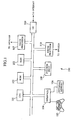
- FIG. 1 is an explanatory diagram illustrating the schematic configuration of a typical information processing device on which a sound output device of the present invention will be realized. A description will be given hereinbelow referring to these diagrams.
- An information processing device 100 comprises a CPU (Central Processing Unit) 101, a ROM 102, a RAM (Random Access Memory) 103, an interface 104, a controller 105, an external memory 106, an image processor 107, a DVD-ROM (Digital Versatile Disc ROM) drive 108, an NIC (Network Interface Card) 109, and a sound processor 110.
- a DVD-ROM storing a program and data for a game is loaded into the DVD-ROM drive 108 and the information processing device 100 is powered on, the program is executed to realize the display device of the embodiment.
- the CPU 101 controls the general operation of the information processing device 100, and is connected to individual components to exchange a control signal and data therewith. Further, by using an ALU (Arithmetic Logic Unit) (not shown), the CPU 101 can perform arithmetic operations such as addition, subtraction, multiplication, division, etc., logical operations such as logical addition, logical multiplication, logical negotiation, etc., bit operations such as bit addition, bit multiplication, bit inversion, bit shift, bit rotation, etc., on a storage area, or a register (not shown) which can be accessed at a high speed.
- ALU Arimetic Logic Unit
- the CPU 101 itself may be designed to be able to rapidly perform saturate operations such as addition, subtraction, multiplication, division, etc., for handling multimedia processes, vector operations such as trigonometric function, etc., or may realize these with a coprocessor.
- An IPL (Initial Program Loader) which is executed immediately after power-on is recorded in the ROM 102.
- the program recorded in the DVD-ROM is read into the RAM 103 and is executed by the CPU 101.
- the RAM 102 stores a program and various data for an operating system necessary for controlling the overall operation of the information processing device 100.
- the RAM 103 is for temporarily storing data and programs, and retains the program and data read from the DVD-ROM, and other data needed for progressing a game and chat communication. Further, the CPU 101 performs processes such as securing a variable area in the RAM 103 to work the ALU directly upon the value stored in the variable to perform operations, or once storing the value stored in the RAM 103 in the register, performing operations on the register, and writing back the operation result to the memory, etc.
- the controller 105 connected via the interface 104 receives an operation input which is made when a user plays a game such as a racing game.
- the external memory 106 detachably connected via the interface 104 rewritably stores data indicating the play status (past performance, etc.) of a racing game, etc., data indicating the progress status of the game, data of chat communication logs (records), etc. As the user makes an instruction input via the controller 105, these data can adequately be recorded in the external memory 106.
- the program for realizing the game and the image data and sound data accompanying the game are recorded in the DVD-ROM to be loaded into the DVD-ROM drive 108.
- the DVD-ROM drive 108 Under the control of the CPU 101, the DVD-ROM drive 108 performs a process of reading from the DVD-ROM loaded therein to read a necessary program and data, and these are temporarily stored in the RAM 103 or the like.
- the image processor 107 processes data read from the DVD-ROM by means of the CPU 101 and an image operation processor (not shown) the image processor 107 has, and then records the data in a frame memory (not shown) in the image processor 107.
- the image information recorded in the frame memory is converted to a video signal at a predetermined synchronous timing, which is in turn output to a monitor (not shown) connected to the image processor 107.
- the image operation processor can enable fast execution of an overlay operation of a two-dimensional image, a transparent operation like ⁇ blending, and various kinds of saturate operations.
- the CPU 101 and the image operation processor cooperate to be able to write a string of characters as a two-dimensional image in the frame memory or on each polygon surface according to font information which defines the shapes of characters.
- the NIC 109 serves to connect the information processing device 100 to a computer communication network (not shown), such as the Internet.
- the NIC 109 includes an analog modem according to the 10 BASE-T/101 BASE-T standard which is used at the time of constructing a LAN (Local Area Network) or for connecting to the Internet using a telephone circuit, an ISDN (Integrated Services Digital Network) modem, an ADSL (Asymmetric Digital Subscriber Line) modem, a cable model for connecting to the Internet using a cable television circuit, or the like, and an interface (not shown) which intervenes between these modems and the CPU 101.
- LAN Local Area Network
- ADSL Asymmetric Digital Subscriber Line
- the sound processor 110 converts sound data read from the DVD-ROM to an analog sound signal, and outputs the sound signal from a speaker (not shown) connected thereto. Under the control of the CPU 101, the sound processor 110 generates sound effects and music data to be generated during progress of the game, and outputs sounds corresponding thereto from a speaker.
- the sound processor 110 refers to the sound source data included in the data, and converts the MIDI data to PCM data. Further, in a case where the sound data is compressed sound data of ADPCM format or Ogg Vorbis format, etc., the sound processor 110 expands the data, converting it to PCM data.
- the PCM data is D/A (Digital/Analog) converted at a timing corresponding to the sampling frequency of the data and output to the speaker, thereby enabling sound output.
- the information processing device 100 may be configured to achieve the same functions as the ROM 102, the RAM 103, the external memory 106, and the DVD-ROM or the like which is to be loaded into the DVD-ROM drive 108 by using a large-capacity external storage device, such as a hard disk.
- a large-capacity external storage device such as a hard disk.
- FIG. 2 is an exemplary diagram illustrating the schematic configuration of a sound output device according to one embodiment of the present invention.
- the sound output device is realized on the above-described information processing device 100.A description will be given hereinbelow referring to these diagrams.
- the sound output device 201 includes a storage unit 202, a distance calculating unit 203, a change rate calculating unit 204, an amplification factor calculating unit 205, and a mixing and outputting unit 206.
- the storage unit 202 stores the sound information and volume coefficients respectively associated with two sound producing units moving in a virtual space.
- the sound information is a file of a format such as PCM format or MP3 format.
- the volume coefficients are coefficients related to the degree of "intensity" of the sound information, and are associated with the amount of energy of the sound output from the sound producing unit, the average volume of the sound information, etc.
- the volume coefficients may be found and stored in the storage unit 202 in advance, or may be found in realtime by scanning the sound information as necessary and storing the results in the storage unit 202.
- the RAM 103, DVD-ROM or CD-ROM loaded in the DVD-ROM drive 108, or a large-capacity external storage device such as a hard disk functions as the storage unit 202.
- volume coefficient of one sound producing unit is p1 and the volume coefficient of the other sound producing unit is p2, where p1 > p2 > 0.
- the sound information of one sound producing unit is expressed as a1(t), and the sound information of the other sound producing unit is expressed as a2(t).
- the integral may be simply calculated from the PCM waveform, etc.
- the RAM 103 has other areas for storing various state parameters, such as the positions and speed of the two sound producing units and the gazing point (the viewpoints from which the virtual space is observed) in the virtual space, and movement within the virtual space is adequately performed based on user instruction input and predetermined algorithms.
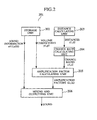
- FIG. 3 is a flowchart illustrating the flow of control of sound output processing executed on the sound output device. A description will be given hereinbelow referring to these diagrams.
- the various state parameters such as the positions, etc., of the gazing point and two sound producing units are initialized (step S301).
- the initialization is equivalent to the initialization prior to the start of playing the game, and each initial value may be a value stored in advance in the DVD-ROM, the external memory 106, etc., or may be determined using random numbers.
- 0 is set in the area that stores the multiplication factors A1 and A2 prepared in the RAM 103 (step S302).
- the mixing and outputting unit 206 issues to the sound processor 110 of the information processing device 100 instructions to "refer to the amplification factors A1 and A2 stored in the RAM 103, amplify the sound information a1(t) using the value stored in A1, amplify the sound information a2(t) using the value stored in A2, perform mixing, and output the sound" (step 5303).
- the amplification, mixing, and outputting of sound by sound processor 110 is performed in parallel with subsequent processing.
- the CPU 101 functions as the mixing and outputting unit 206 with the RAM 103 and the sound processor 110.
- saturate operations may be adequately used for the multiplication performed to amplify a1(t) by a multiplication factor of A1 and a2(t) by a multiplication factor of A2, and for the addition performed to mix these results.
- an effect such as noise distortion in a case where the volume is loud due to close proximity of the microphone can be achieved.
- the present various state parameters such as the positions, etc., of the gazing point and two sound producing units are used to calculate the same state parameters after a predetermined minute period of time (step S304), and the state parameters stored in the RAM 103 are updated with the new calculated values (step S305).
- the interval between vertical synchronization interrupts of the monitor screen may be employed as the predetermined minute period, enabling suppression of the blur and flickering of the image of the display difference.
- the calculation of state parameters is in accordance with the laws of physics established within a virtual space, and updates are performed based on instruction input provided by the player using the controller 105 and instruction input generated by the CPU 101 based on a predetermined algorithm. For example, a method similar to the method that determines the behavior of the player's character or other characters in a racing game or horse race game may be employed.
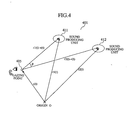
- FIG. 4 is an explanatory diagram illustrating the positional relationship between a gazing point and two sound producing units arranged in a virtual space at time t after having been updated in this manner. A description will be given hereinbelow referring to these diagrams.
- the position vector of a gazing point 405 is established as s(t)
- the position vector of a sound producing unit 411 associated with the volume coefficient p1 is established as r1(t)
- a position vector of a sound producing unit 412 associated with the volume coefficient p2 is established as r2(t).
- the Manhattan distance in a case where an Euclidean coordinate system is employed, can be found as the sum of the absolute values of the respective elements in the x, y, and z axial directions of vector r1(t)-s(t), etc.
- the distance calculating unit 203 calculates the respective distances between the predetermined gazing point 405 and the sound producing units 411 and 412 in the virtual space 401 (step S306).
- a distance d1 between the gazing point 405 and the sound producing unit 411, and a distance d2 between the gazing point 405 and the sound producing unit 412 can be found using a vector calculation such as described above.
- the CPU 101 functions as the distance calculating unit 203 with the RAM 103, etc. These distances d1 and d2 are also temporarily stored in the RAM 103.
- the change rate calculating unit 204 calculates change rates c1 and c2 that change as the volumes of the sounds respectively produced by the sound producing unit 411 and the sound producing unit 412 move away from the gazing point 405 by the respective distances d1 and d2 (step S307).
- the function f(•) is typically a monotonically decreasing function that increases to the extent the sound producing unit is near (i.e., increases as distance decreases), and decreases to the extent the sound producing unit is far away (i.e., decreases as distance increases).
- the change rate calculating unit 204 finds the change rate that indicates the degree to which the volume decreases.
- the normal sound produced by a sound producing unit in the virtual space 401 can be simulated by simply multiplying the amplitude of the wave based on the sound information of the sound producing unit by the change rate.
- ] ; ⁇ arccos r ⁇ 1 t - s t • [ r ⁇ 2 t - s t ] / [ r ⁇ 1 t - s t ⁇
- the CPU 101 assesses whether or not the calculated angle ⁇ is smaller than a predetermined angle ⁇ (step S309).
- a predetermined angle ⁇ a somewhat larger angle is preferred. It is convenient, however, to set the angle to 90 degrees ( ⁇ /2), for example, which enables assessment based on the positive/negative state of the inner product [r1(t)-s(t)]•[r2(t)-s(t)] without directly calculating ⁇ and cos ⁇ , thereby reducing the calculation amount.
- Whether or not the angle 0 is smaller than the predetermined angle can also be determined by whether or not the angle ⁇ is greater than a predetermined value corresponding to cos ⁇ . When the latter of these determination methods is used, the operation is completed without performing the arccos (•) calculation, which has a high calculation cost.
- the amplification calculating unit 205 calculates the amplification factor A1 that is greater than the change rate c1 corresponding to the sound producing unit 411 associated with the greater of the two volume coefficients p1, and the amplification factor A2 that is smaller than the change rate c2 corresponding to the sound producing unit 412 associated with the smaller of the two volume coefficients p2, and stores and updates the calculation results in the above-described area of the RAM 103 (step S310).
- A1 which satisfies A1 > c1 and A2 which satisfies A2 ⁇ c2 are each respectively calculated using some type of method.
- the sound produced by a sound producing unit in the virtual space 401 can be simulated by simply multiplying the amplitude of the sound information by the change rate as described above, to enhance the difference and define the contrast between the sounds produced by the sound producing unit 411 and the sound producing unit 412
- the sound producing unit having a larger volume coefficient employs an amplification factor that is larger than its identified change rate
- the sound producing unit having a smaller volume coefficient employs an amplification factor that is smaller than its identified change rate.
- a ⁇ 1 c ⁇ 1 ⁇ p ⁇ 1 / p ⁇ 2 > c ⁇ 1 ;
- a ⁇ 2 c ⁇ 2 ⁇ p ⁇ 2 / p ⁇ 1 ⁇ c ⁇ 2
- the mixing and outputting unit 206 amplifies the sound information a1(t) and a2(5) respectively associated with the sound producing unit 411 and the sound producing unit 412 by the respectively calculated amplification factors A1 and A2, and outputs the added amplified results, thereby further enhancing the difference and defining the contrast between the sounds produced by the sound producing unit 411 and the sound producing unit 412 based on the volume coefficients p1 and p2 assigned thereto, making it possible for the user to more clearly grasp the features of the sound producing unit 411 and the sound producing unit 412.
- step S312 After the A1 and A2 calculation and the RAM 103 update are completed, the flow proceeds to step S312.
- step S3111 RAM 103 is updated so that the change rate c1 is employed as the amplification factor A1 and the change rate c2 is employed as the amplification factor A2 (step S311), and the flow proceeds to step S312.
- step S312 This applies to a case where the sound producing unit 411 and the sound producing unit 412 are sufficiently separated and there is no need to define the contrast thereof.
- step S310 may be completely omitted and the processing of step S310 always performed.
- the assessment may be made according to whether or not the distance
- an instruction that specifies the amplification factors A1 and A2 to the hardware of the sound processor 110 may be issued in place of the processing that stores and updates the amplification factors A1 and A2 in the RAM 103.
- step 5312 After the amplification factors A1 and A2 stored in the RAM 103 have been updated in this manner, a three-dimensional graphics image viewing from the gazing point 405 the virtual space 401 that includes the sound producing unit 411 and the sound producing unit 412 is generated (step 5312), the mode changes to standby mode until a vertical synchronization interrupt occurs (step 5313), the generated graphics image is transferred to frame memory once the vertical synchronization interrupt occurs (step S314), and the flow returns to step S304.
- the present invention makes it possible to further enhance the difference and define the contrast between the sounds produced by two sound producing units based on volume coefficients assigned thereto, thereby enabling the user of the sound output device to more clearly grasp the features of the two sound producing units.
- the embodiment described hereafter corresponds to a case where there are three or more sound producing units (and it is preferable to define the contrast between each). That is, given n sound producing units and the volume coefficients p1, p2, p3, ..., pn thereof, the present embodiment considers the following relationship: p ⁇ 1 > p ⁇ 3 > ... > pn > p ⁇ 2
- the respective change rates for the sound producing units having the volume coefficients p1, p2, p3, ... , pn may be found in a similar manner as the above-described embodiment, and thus become: c ⁇ 1 , c ⁇ 2 , c ⁇ 3 , ... , cn
- the amplification factors A1 and A2 of the sound producing units having the volume coefficients p1 and p2 are found in a similar manner as the above-described embodiment.
- the method for determining the amplification factors A3, ... , An respectively corresponding to the sound producing units having the volume coefficients p3, ..., pn is determined.
- a sound output device and sound output method suitable for defining the difference between the sounds from two sound producing units to enhance a feeling of reality
- a computer readable information recording medium for storing a program for realizing these on a computer, and the program, and to apply these to realizing various competition games, etc., in a game device and to virtual reality techniques for providing various virtual experiences for educational purposes, etc.
Landscapes
- Engineering & Computer Science (AREA)
- Multimedia (AREA)
- Physics & Mathematics (AREA)
- Acoustics & Sound (AREA)
- Health & Medical Sciences (AREA)
- Audiology, Speech & Language Pathology (AREA)
- General Health & Medical Sciences (AREA)
- Computational Linguistics (AREA)
- Human Computer Interaction (AREA)
- Mathematical Physics (AREA)
- Signal Processing (AREA)
- Stereophonic System (AREA)
- Processing Or Creating Images (AREA)
Abstract
In a sound output device (201) for defining the difference between sounds from two sound producing units to enhance a feeling of reality, a storage unit (202) stores sound information and volume coefficients of two sound producing units moving in a virtual space, a distance calculating unit (203) calculates respective distances between a gazing point and the sound producing units, a change rate calculating unit (204) calculates change rates at which the volumes of sounds produced by the sound producing units change as they move away respective distances, an amplification factor calculating unit (205) calculates, for a sound producing unit having a larger volume coefficient, an amplification factor that is larger than its change rate and calculates, for a sound producing unit having a smaller volume coefficient, an amplification factor that is smaller than its change rate, and a mixing and outputting unit (206) amplifies sound information respectively associated with sound producing units by amplification factors respectively calculated for respective sound producing units and outputs the sound obtained by adding the amplified results.
Description
- The present invention relates to a sound output device and sound output method suitable for defining the difference between sounds from two sound producing units moving in a virtual space to enhance a feeling of reality, a computer readable program for recording a program for realizing these on a computer, and the program.
- Conventionally, there has been proposed a technique for allowing a player to operate, by using a controller, a vehicle of any type such as a motorcycle, a car, or an airplane, or a character who runs and jumps on the ground, flies in the sky, or swims in the water (hereinafter collectively referred to as "object") in a virtual space such as a two-dimensional plane or a three-dimensional space, to move the object in the virtual space, or automatically move the object according to a predetermined algorithm in the virtual space, and participate in a competition.
- There has also been proposed a technique for generating sound presumably produced by the object at this time to provide a more real environment. When sound is produced in a virtual space in this manner, the object is also called a sound producing unit. Such a technique is disclosed in, for example, the following literature.
Patent Literature 1:Japanese Patent Publication No. 3455739 - In Patent Literature 1, there has been proposed a technique for prioritizing in a horse race game the hooves of the horses in the order of closeness to a viewpoint location, and grouping together the sounds of the hoof-beats produced from those hooves with lower priority to reduce the number of sounds used in synthesized output.
- Techniques for synthesizing and outputting sounds produced by an object moving in a virtual space in this manner are critical from the viewpoint of enabling the user to perceive the state of a virtual space.
- In a case where a plurality of objects provided in a virtual space produce sounds as described above, it is sometimes preferable to enhance the difference between sounds produced by these objects so that the user can clearly perceive contrast between the objects. Thus, a technique for addressing such a need has been in demand.
The present invention has been made to overcome problems such as described above, and it is an object of the present invention to provide a sound output device and sound output method suitable for defining the difference between sounds from two sound producing units moving in a virtual space to enhance a feeling of reality, a computer readable program for recording a program for realizing these on a computer, and the program.
Means for Solving the Problem - To achieve the above objective, the following invention will be disclosed according to the principle of the present invention.
- A sound output device according to a first aspect of the present invention includes a storage unit, a distance calculating unit, a change rate calculating unit, an amplification factor calculating unit, and a mixing and outputting unit, which are configured as follows.
- That is, the storage unit stores the sound information and volume coefficients respectively associated with two sound producing units moving in a virtual space.
- Typically, the sound information is stored in a storage medium such as CD-ROM (Compact Disk Ready Only Memory), hard disk, etc., as a file of a format such as PCM (Pulse Coded Modulation), MP3 (MPeg audio layer 3), etc.. The volume coefficients are coefficients related to the degree of "intensity" of the sound information, and are associated with the amount of energy of the sound output from the sound producing unit, the average volume of the sound information, etc.
- Meanwhile, the distance calculating unit calculates the respective distances between a predetermined gazing point and the two sound producing units in the virtual space.
- Here, the predetermined gazing point typically corresponds to a viewpoint location in a case where three-dimensional graphics are displayed in a virtual space. The volume of the sound produced by a sound producing unit becomes softer as the distance from the gazing point becomes longer, and thus, in order to take into consideration the effect caused by this distance, the distance between the gazing point and the sound producing unit is calculated. Furthermore, the "distance" employed may be normal distance (the size of the difference between position vectors), squared distance (the square of the size of the difference between position vectors), or Manhattan distance (the sum of the absolute values of each element of the difference between position vectors).
- Furthermore, the change rate calculating unit calculates the change rates at which the volumes of the sounds respectively produced from the two sound producing units change as the sound producing units move away the calculated respective distances.
- Since the volume of the sound heard decreases as the distance between the sound producing unit and the gazing point at which the sound produced by thereby is heard increases, the change rate calculating unit finds the change rate that indicates the degree to which the volume decreases. The normal sound produced by a sound producing unit in a virtual space can be simulated by simply multiplying the amplitude of the wave based on the sound information of the sound producing unit by this change rate.
- Then, the amplitude factor calculating unit calculates, for a sound producing unit associated with the larger of the two volume coefficients, an amplification factor that is larger than its change rate, and calculates, for a sound producing unit associated with the smaller of the two volume coefficients, an amplification factor that is smaller than its change rate.
- While the sound produced by a sound producing unit in a virtual space can be simulated by simply multiplying the amplitude of the sound information by the change rate as described above, to enhance the difference and define the contrast between the sounds produced from two sound producing units, the sound producing unit having a larger volume coefficient adopts an amplification factor that is larger than its identified change rate, and the sound producing unit having a smaller volume coefficient adopts an amplification factor that is smaller than its identified change rate. Preferred embodiments that take into consideration various calculation methods will be described later.
- Meanwhile, the mixing and outputting unit amplifies the sound information respectively associated with the two sound producing units by amplification factors calculated for the sound producing units, and outputs the sound obtained by adding the amplified results.
- That is, the respective sound information of the two sound producing units is amplified by the identified respective amplification factors and the waveforms are added, thereby generating a waveform of the sound to be heard at the gazing point.
- The present invention makes it possible to further enhance the difference and define the contrast between the sounds produced by two sound producing units based on volume coefficients assigned thereto, thereby enabling the user of the sound output device to more clearly grasp the features of the two sound producing units.
- In the sound output device of the present invention, the mixing and outputting unit may be configured to amplify the sound information respectively associated with the two sound producing units by the respectively calculated change rates and output the sound obtained by adding the amplified results in a case where the position of the predetermined gazing point and the positions of the two sound producing units in the virtual space satisfy predetermined conditions, and to amplify the sound information respectively associated with the two sound producing units by amplification factors respectively calculated for the sound producing units and output the sound obtained by adding the amplified results in a case where the predetermined conditions are not satisfied.
- Cases also exist where the above-described difference need not be defined, such as, for example, a case where the direction in which the sound of a sound producing unit is produced is indicated by stereo sound output or 5.1 channel sound output, or in a case where the orientations in which two sound producing units viewed from a gazing point are arranged in a virtual space are away from each other. Here, in such a case, the two sets of sound information are simply multiplied by the change rates and then added.
- Various conditions may be employed for the relationship between the positions of the two sound producing units and the position of the gazing point, such as, for example, whether or not the angle formed by the first sound producing unit, the gazing point, and the second sound producing unit is less than a certain angle, or whether or not the distance between the first sound producing unit and the second sound producing unit is less than a certain length.
- The present invention makes it possible to provide a sound output device that outputs sound without enhancing contrast in a case where there is little need to enhance the difference between sounds due to the positional relationship of the two sound producing units, thereby leaving the user with a natural impression.
- Further, in the sound output device according to the present invention, the amplification factor calculating unit may be configured to, using the ratio of the greater to the smaller of the two volume coefficients, set the amplification factor for the sound producing unit associated with the greater of the two volume coefficients as the product of the change rate and the ratio, and set the amplification factor for the sound producing unit associated with the smaller of the two volume coefficients as the product of the change rate and the inverse of the ratio.
- For example, given a volume coefficient p1, a change rate c1, and an amplification factor A1 of one sound producing unit, and a volume coefficient p2, a change rate c2, and an amplification factor A2 of the other sound producing unit, where p1 > p2 > 0, then:


- The present invention, in the above-described preferred embodiment of the present invention, makes it possible to simply calculate an amplification factor by using a volume coefficient.
- Further, in the sound output device according to the present invention, the amplification factor calculating unit may be configured to, using a predetermined power of the ratio of the greater to the smaller of the two volume coefficients, set the amplification factor for the sound producing unit associated with the greater of the two volume coefficients as the product of the change rate and the predetermined power of the ratio, and set the amplification factor of the sound producing unit associated with the smaller of the two volume coefficients as the product of the change rate and the inverse of the predetermined power of the ratio.
- Similar to the above-described example, given a predetermined power R (where R ≥ 1), then:


- The present invention, in the above-described preferred embodiment of the present invention, makes it possible to simply calculate an amplification factor by using a volume coefficient.
- Further, in the sound output device according to the present invention, the mixing and outputting unit may be configured to use saturated addition in the addition of the sound information.
- In particular, in the calculation that amplifies the sound information based on the amplification factor and change rate, saturated multiplication or ordinary multiplication is employed and, for the addition difference, saturated addition is used.
- The present invention makes it possible to simulate a "sound distortion" phenomenon by using saturated addition in a case where the volume becomes extremely loud, and therefore provide more intense sound to a user in a case where the contrast is to be enhanced prior to sound output.
- A sound output method according to another aspect of the present invention uses a storage unit, includes a distance calculating step, a change rate calculating step, an amplification factor calculating step, and a mixing and outputting step, which are configured as follows.
- That is, the storage unit stores the sound information and volume coefficients respectively associated with two sound producing units moving in a virtual space.
- Meanwhile, in the distance calculating step, the respective distances between a predetermined gazing point and the two sound producing units in the virtual space are calculated.
- Furthermore, in the change rate calculating step, the change rates at which the volumes of the sounds respectively produced from the two sound producing units change as the sound producing units move away the calculated respective distances are calculated.
- Then, in the amplitude factor calculating step, for a sound producing unit associated with the larger of the two volume coefficients, an amplification factor that is larger than its change rate is calculated, and, for a sound producing unit associated with the smaller of the two volume coefficients, an amplification factor that is smaller than its change rate is calculated.
- Meanwhile, in the mixing and outputting step, the sound information respectively associated with the two sound producing units is amplified by amplification factors calculated for the sound producing units, and the sound obtained by adding the amplified results is output.
- A program according to another aspect of the present invention is configured to control a computer to function as the above-described sound output device, or to execute the above-described sound output method on a computer.
The program of the present invention can be recorded on a computer readable information storage medium, such as a compact disk, a flexible disk, a hard disk, a magneto-optical disk, a digital video disk, a magnetic tape or a semiconductor memory.
The program can be distributed and sold, independently of a computer which executes the program, over a computer communication network. The information storage medium can be distributed and sold, independently of the computer. - According to the present invention, it is possible to provide a sound output device and sound output method suitable for defining the difference between sounds from two sound producing units to enhance a feeling of reality, a computer readable program for recording a program for realizing these on a computer, and the program.
-
- [FIG.1] An explanatory diagram illustrating the schematic configuration of a typical information processing device on which a sound output device according to one embodiment of the present invention is realized.
- [FIG. 2] An exemplary diagram illustrating the schematic configuration of a sound output device according to one embodiment of the present invention.
- [FIG. 3] A flowchart illustrating the flow of control of sound output processing executed on the sound output device.
- [FIG. 4] An explanatory diagram illustrating the positional relationship between a gazing point and two sound producing units arranged in a virtual space.
-
- 100
- information processing device
- 101
- CPU
- 102
- ROM
- 103
- RAM
- 104
- interface
- 105
- controller
- 106
- external memory
- 107
- image processor
- 108
- DVD-ROM drive
- 109
- NIC
- 110
- sound processor
- 201
- sound output device
- 202
- storage unit
- 203
- distance calculating unit
- 204
- change rate calculating unit
- 205
- amplification factor calculating unit
- 206
- mixing and outputting unit
- 401
- virtual space
- 405
- gazing point
- 411
- sound producing unit
- 412
- sound producing unit
- An embodiment of the present invention will be described below. While the following describes an embodiment in which the invention is adapted to a game device on which three-dimensional graphics are displayed and sound is output for the ease of understanding, the invention can also be adapted to information processing apparatuses, such as various computers, PDAs (Personal Data Assistants) and cellular phones. That is, the embodiment to be described below is given by way of illustration only, and does not limit the scope of the invention. Therefore, those skilled in the art can employ embodiments in which the individual elements or all the elements are replaced with equivalent ones, and which are also encompassed in the scope of the invention.
- FIG. 1 is an explanatory diagram illustrating the schematic configuration of a typical information processing device on which a sound output device of the present invention will be realized. A description will be given hereinbelow referring to these diagrams.
- An
information processing device 100 comprises a CPU (Central Processing Unit) 101, aROM 102, a RAM (Random Access Memory) 103, aninterface 104, acontroller 105, anexternal memory 106, animage processor 107, a DVD-ROM (Digital Versatile Disc ROM)drive 108, an NIC (Network Interface Card) 109, and asound processor 110.
As a DVD-ROM storing a program and data for a game is loaded into the DVD-ROM drive 108 and theinformation processing device 100 is powered on, the program is executed to realize the display device of the embodiment. - The
CPU 101 controls the general operation of theinformation processing device 100, and is connected to individual components to exchange a control signal and data therewith. Further, by using an ALU (Arithmetic Logic Unit) (not shown), theCPU 101 can perform arithmetic operations such as addition, subtraction, multiplication, division, etc., logical operations such as logical addition, logical multiplication, logical negotiation, etc., bit operations such as bit addition, bit multiplication, bit inversion, bit shift, bit rotation, etc., on a storage area, or a register (not shown) which can be accessed at a high speed. Furthermore, theCPU 101 itself may be designed to be able to rapidly perform saturate operations such as addition, subtraction, multiplication, division, etc., for handling multimedia processes, vector operations such as trigonometric function, etc., or may realize these with a coprocessor. - An IPL (Initial Program Loader) which is executed immediately after power-on is recorded in the
ROM 102. As the IPL is executed, the program recorded in the DVD-ROM is read into theRAM 103 and is executed by theCPU 101. Further, theRAM 102 stores a program and various data for an operating system necessary for controlling the overall operation of theinformation processing device 100. - The
RAM 103 is for temporarily storing data and programs, and retains the program and data read from the DVD-ROM, and other data needed for progressing a game and chat communication. Further, theCPU 101 performs processes such as securing a variable area in theRAM 103 to work the ALU directly upon the value stored in the variable to perform operations, or once storing the value stored in theRAM 103 in the register, performing operations on the register, and writing back the operation result to the memory, etc. - The
controller 105 connected via theinterface 104 receives an operation input which is made when a user plays a game such as a racing game. - The
external memory 106 detachably connected via theinterface 104 rewritably stores data indicating the play status (past performance, etc.) of a racing game, etc., data indicating the progress status of the game, data of chat communication logs (records), etc. As the user makes an instruction input via thecontroller 105, these data can adequately be recorded in theexternal memory 106. - The program for realizing the game and the image data and sound data accompanying the game are recorded in the DVD-ROM to be loaded into the DVD-ROM drive 108.Under the control of the
CPU 101, the DVD-ROM drive 108 performs a process of reading from the DVD-ROM loaded therein to read a necessary program and data, and these are temporarily stored in theRAM 103 or the like. - The
image processor 107 processes data read from the DVD-ROM by means of theCPU 101 and an image operation processor (not shown) theimage processor 107 has, and then records the data in a frame memory (not shown) in the image processor 107.The image information recorded in the frame memory is converted to a video signal at a predetermined synchronous timing, which is in turn output to a monitor (not shown) connected to theimage processor 107. Thereby, image displays of various types are available.
The image operation processor can enable fast execution of an overlay operation of a two-dimensional image, a transparent operation like α blending, and various kinds of saturate operations. - It is also possible to enable fast execution of an operation of rendering polygon information which is arranged in virtual three-dimensional space and to which various kinds of texture information are added, by a Z buffer scheme to acquire a rendered image with a downward view of a polygon toward a predetermined view point position, arranged in the virtual three-dimensional space, from the predetermined view point position.
Further, theCPU 101 and the image operation processor cooperate to be able to write a string of characters as a two-dimensional image in the frame memory or on each polygon surface according to font information which defines the shapes of characters. - The
NIC 109 serves to connect theinformation processing device 100 to a computer communication network (not shown), such as the Internet. TheNIC 109 includes an analog modem according to the 10 BASE-T/101 BASE-T standard which is used at the time of constructing a LAN (Local Area Network) or for connecting to the Internet using a telephone circuit, an ISDN (Integrated Services Digital Network) modem, an ADSL (Asymmetric Digital Subscriber Line) modem, a cable model for connecting to the Internet using a cable television circuit, or the like, and an interface (not shown) which intervenes between these modems and theCPU 101. - The
sound processor 110 converts sound data read from the DVD-ROM to an analog sound signal, and outputs the sound signal from a speaker (not shown) connected thereto. Under the control of theCPU 101, thesound processor 110 generates sound effects and music data to be generated during progress of the game, and outputs sounds corresponding thereto from a speaker.
In a case where the sound data recorded on the DVD-ROM is MIDI data, thesound processor 110 refers to the sound source data included in the data, and converts the MIDI data to PCM data. Further, in a case where the sound data is compressed sound data of ADPCM format or Ogg Vorbis format, etc., thesound processor 110 expands the data, converting it to PCM data. The PCM data is D/A (Digital/Analog) converted at a timing corresponding to the sampling frequency of the data and output to the speaker, thereby enabling sound output. - In addition, the
information processing device 100 may be configured to achieve the same functions as theROM 102, theRAM 103, theexternal memory 106, and the DVD-ROM or the like which is to be loaded into the DVD-ROM drive 108 by using a large-capacity external storage device, such as a hard disk. - FIG. 2 is an exemplary diagram illustrating the schematic configuration of a sound output device according to one embodiment of the present invention. The sound output device is realized on the above-described information processing device 100.A description will be given hereinbelow referring to these diagrams.
- The
sound output device 201 includes astorage unit 202, adistance calculating unit 203, a changerate calculating unit 204, an amplificationfactor calculating unit 205, and a mixing and outputtingunit 206. - First, the
storage unit 202 stores the sound information and volume coefficients respectively associated with two sound producing units moving in a virtual space. - In the present embodiment, the sound information is a file of a format such as PCM format or MP3 format. The volume coefficients are coefficients related to the degree of "intensity" of the sound information, and are associated with the amount of energy of the sound output from the sound producing unit, the average volume of the sound information, etc.
- In a case where the average volume of the sound information is employed as the volume coefficient, the volume coefficients may be found and stored in the
storage unit 202 in advance, or may be found in realtime by scanning the sound information as necessary and storing the results in thestorage unit 202. - The
RAM 103, DVD-ROM or CD-ROM loaded in the DVD-ROM drive 108, or a large-capacity external storage device such as a hard disk functions as thestorage unit 202. - Here, for example, it is assumed that the volume coefficient of one sound producing unit is p1 and the volume coefficient of the other sound producing unit is p2,
where p1 > p2 > 0. - Based on the amplification of elapsed time t, the sound information of one sound producing unit is expressed as a1(t), and the sound information of the other sound producing unit is expressed as a2(t).
- The volume coefficients may be arbitrarily determined as follows. Given that the sound information is repeatedly reproduced at time lengths T and T,' respectively, in a case where the volume coefficients are average volumes, the volume coefficients are respectively established as follows:


- In a case where the volume coefficients are average amplitudes, the volume coefficients may be respectively found using the following calculations:


- The
RAM 103 has other areas for storing various state parameters, such as the positions and speed of the two sound producing units and the gazing point (the viewpoints from which the virtual space is observed) in the virtual space, and movement within the virtual space is adequately performed based on user instruction input and predetermined algorithms. - The sound output processing begins in the
sound output device 201 from a state in which such sound information, sound coefficients, etc., are stored in the storage unit 202.FIG. 3 is a flowchart illustrating the flow of control of sound output processing executed on the sound output device. A description will be given hereinbelow referring to these diagrams. - First, the various state parameters such as the positions, etc., of the gazing point and two sound producing units are initialized (step S301). The initialization is equivalent to the initialization prior to the start of playing the game, and each initial value may be a value stored in advance in the DVD-ROM, the
external memory 106, etc., or may be determined using random numbers. - Then, 0 is set in the area that stores the multiplication factors A1 and A2 prepared in the RAM 103 (step S302).
- Furthermore, the mixing and outputting
unit 206 issues to thesound processor 110 of theinformation processing device 100 instructions to "refer to the amplification factors A1 and A2 stored in theRAM 103, amplify the sound information a1(t) using the value stored in A1, amplify the sound information a2(t) using the value stored in A2, perform mixing, and output the sound" (step 5303).The amplification, mixing, and outputting of sound bysound processor 110 is performed in parallel with subsequent processing. - Thus, the
CPU 101 functions as the mixing and outputtingunit 206 with theRAM 103 and thesound processor 110. - Furthermore, saturate operations may be adequately used for the multiplication performed to amplify a1(t) by a multiplication factor of A1 and a2(t) by a multiplication factor of A2, and for the addition performed to mix these results. When saturate operations are used, an effect such as noise distortion in a case where the volume is loud due to close proximity of the microphone can be achieved.
- After sound mixing and outputting begin in parallel, the present various state parameters such as the positions, etc., of the gazing point and two sound producing units are used to calculate the same state parameters after a predetermined minute period of time (step S304), and the state parameters stored in the
RAM 103 are updated with the new calculated values (step S305).The interval between vertical synchronization interrupts of the monitor screen may be employed as the predetermined minute period, enabling suppression of the blur and flickering of the image of the display difference. - Further, the calculation of state parameters is in accordance with the laws of physics established within a virtual space, and updates are performed based on instruction input provided by the player using the
controller 105 and instruction input generated by theCPU 101 based on a predetermined algorithm. For example, a method similar to the method that determines the behavior of the player's character or other characters in a racing game or horse race game may be employed. - FIG. 4 is an explanatory diagram illustrating the positional relationship between a gazing point and two sound producing units arranged in a virtual space at time t after having been updated in this manner. A description will be given hereinbelow referring to these diagrams.
- As shown in the figure, in a
virtual space 401, the position vector of agazing point 405 is established as s(t), the position vector of asound producing unit 411 associated with the volume coefficient p1 is established as r1(t), and a position vector of asound producing unit 412 associated with the volume coefficient p2 is established as r2(t). - In a case where the
gazing point 405, thesound producing unit 411, and the sound producing 412 are so arranged, the squared distance and the Euclidean distance between thegazing point 405 and thesound producing unit 411 can be respectively expressed as follows:

- Similarly, the squared distance and Euclidean distance between the
gazing point 405 and thesound producing unit 411 can be respectively expressed as follows:

- Further, the Manhattan distance, in a case where an Euclidean coordinate system is employed, can be found as the sum of the absolute values of the respective elements in the x, y, and z axial directions of vector r1(t)-s(t), etc.
- After the positional relationship has been updated as described above, the
distance calculating unit 203 calculates the respective distances between thepredetermined gazing point 405 and thesound producing units - When the squared distance, the Euclidean distance, or the Manhattan distance is employed as the "distance," a distance d1 between the
gazing point 405 and thesound producing unit 411, and a distance d2 between thegazing point 405 and thesound producing unit 412 can be found using a vector calculation such as described above. Thus, theCPU 101 functions as thedistance calculating unit 203 with theRAM 103, etc. These distances d1 and d2 are also temporarily stored in theRAM 103. - Subsequently, the change
rate calculating unit 204 calculates change rates c1 and c2 that change as the volumes of the sounds respectively produced by thesound producing unit 411 and thesound producing unit 412 move away from thegazing point 405 by the respective distances d1 and d2 (step S307). - Given function f(•) for finding these change rates c1 and c2, the change rates c 1 and c2 can be written as follows:


- For example, given positive constants K and J, functions such as the following may be employed.


- As described above, since the volume of the sound heard decreases as the distance between the
sound producing units gazing point 405 at which the sounds produced by these are heard increases, the changerate calculating unit 204 finds the change rate that indicates the degree to which the volume decreases. The normal sound produced by a sound producing unit in thevirtual space 401 can be simulated by simply multiplying the amplitude of the wave based on the sound information of the sound producing unit by the change rate. - Furthermore, in the present embodiment, in conjunction with the distance calculation, the angles θ and cos θ at which the
sound producing unit 411 and thesound producing unit 412 are to be estimated from thegazing point 405 are calculated (step 5308).That is, θ and cos θ are calculated by the following:

sound producing unit 411 sound source and the sound of thesound producing unit 412 sound source that are to arrive at thegazing point 405 approach from different directions can be identified. In this calculation, values common to the above-described distance calculation are used, making it efficient to collectively perform the common calculations accordingly. - Next, the
CPU 101 assesses whether or not the calculated angle θ is smaller than a predetermined angle Φ (step S309).As the predetermined angle Φ, a somewhat larger angle is preferred. It is convenient, however, to set the angle to 90 degrees (π/2), for example, which enables assessment based on the positive/negative state of the inner product [r1(t)-s(t)]•[r2(t)-s(t)] without directly calculating θ and cos θ, thereby reducing the calculation amount. - Whether or not the angle 0 is smaller than the predetermined angle can also be determined by whether or not the angle θ is greater than a predetermined value corresponding to cos θ. When the latter of these determination methods is used, the operation is completed without performing the arccos (•) calculation, which has a high calculation cost.
- In a case where, as a result of assessment, the angle θ has been assessed as smaller than the predetermined angle Φ (step S309: Yes), the
amplification calculating unit 205 calculates the amplification factor A1 that is greater than the change rate c1 corresponding to thesound producing unit 411 associated with the greater of the two volume coefficients p1, and the amplification factor A2 that is smaller than the change rate c2 corresponding to thesound producing unit 412 associated with the smaller of the two volume coefficients p2, and stores and updates the calculation results in the above-described area of the RAM 103 (step S310). - That is, when p1 > p2, A1 which satisfies A1 > c1 and A2 which satisfies A2 < c2 are each respectively calculated using some type of method.
- While the sound produced by a sound producing unit in the
virtual space 401 can be simulated by simply multiplying the amplitude of the sound information by the change rate as described above, to enhance the difference and define the contrast between the sounds produced by thesound producing unit 411 and thesound producing unit 412, the sound producing unit having a larger volume coefficient employs an amplification factor that is larger than its identified change rate, and the sound producing unit having a smaller volume coefficient employs an amplification factor that is smaller than its identified change rate. While various methods of calculation may be considered, a method such as the following, for example, is conceivable. - (1) Given a p1/p2 ratio > 1 and its inverse p2/p1 < 1 for p1 and p2, then:


- (2) Furthermore, in addition to the above (1), with use of a predetermined positive integer R that is greater than or equal to 1, then:


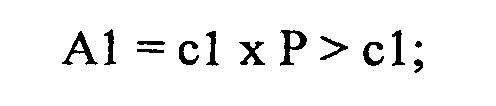
- (3) Using a positive integer P that is greater than 1 and a positive integer Q that is less than 1, then:

- As described above, the mixing and outputting
unit 206 amplifies the sound information a1(t) and a2(5) respectively associated with thesound producing unit 411 and thesound producing unit 412 by the respectively calculated amplification factors A1 and A2, and outputs the added amplified results, thereby further enhancing the difference and defining the contrast between the sounds produced by thesound producing unit 411 and thesound producing unit 412 based on the volume coefficients p1 and p2 assigned thereto, making it possible for the user to more clearly grasp the features of thesound producing unit 411 and thesound producing unit 412. - After the A1 and A2 calculation and the
RAM 103 update are completed, the flow proceeds to step S312. - On the other hand, in a case where the angle θ has been assessed as greater than or equal to the predetermined angle Φ (step 5309: No),
RAM 103 is updated so that the change rate c1 is employed as the amplification factor A1 and the change rate c2 is employed as the amplification factor A2 (step S311), and the flow proceeds to step S312. This applies to a case where thesound producing unit 411 and thesound producing unit 412 are sufficiently separated and there is no need to define the contrast thereof. A case also exists where such a difference need not be defined, such as, for example, a case where the direction in which the sound of a sound producing unit is produced is indicated by stereo sound output or 5.1 channel sound output, or in a case where the orientations in which thesound producing unit 411 and thesound producing unit 412 viewed from thegazing point 405 are arranged in thevirtual space 401 are away from each other. - Furthermore, the cos θ and θ calculation and the θ and Φ comparison may be completely omitted and the processing of step S310 always performed.
- Further, rather than using the estimating angle θ, the assessment may be made according to whether or not the distance |r1(t)-r2(t)| between the
sound producing unit 411 and thesound producing unit 412 of thevirtual space 401 is less than a predetermined threshold value. - Furthermore, depending on the form of the hardware of the
sound processor 110, a case also exists where the amplification factors A1 and A2 that should be changed at an intended time are directly instructed after the sound information a1(t) and a2(t) subject to mixing are set. In such a case, an instruction that specifies the amplification factors A1 and A2 to the hardware of thesound processor 110 may be issued in place of the processing that stores and updates the amplification factors A1 and A2 in theRAM 103. - After the amplification factors A1 and A2 stored in the
RAM 103 have been updated in this manner, a three-dimensional graphics image viewing from thegazing point 405 thevirtual space 401 that includes thesound producing unit 411 and thesound producing unit 412 is generated (step 5312), the mode changes to standby mode until a vertical synchronization interrupt occurs (step 5313), the generated graphics image is transferred to frame memory once the vertical synchronization interrupt occurs (step S314), and the flow returns to step S304. - In this manner, the present invention makes it possible to further enhance the difference and define the contrast between the sounds produced by two sound producing units based on volume coefficients assigned thereto, thereby enabling the user of the sound output device to more clearly grasp the features of the two sound producing units.
- The embodiment described hereafter corresponds to a case where there are three or more sound producing units (and it is preferable to define the contrast between each). That is, given n sound producing units and the volume coefficients p1, p2, p3, ..., pn thereof, the present embodiment considers the following relationship:

- First, the respective change rates for the sound producing units having the volume coefficients p1, p2, p3, ... , pn may be found in a similar manner as the above-described embodiment, and thus become:

- Next, the amplification factors A1 and A2 of the sound producing units having the volume coefficients p1 and p2 are found in a similar manner as the above-described embodiment.
- Subsequently, the method for determining the amplification factors A3, ... , An respectively corresponding to the sound producing units having the volume coefficients p3, ..., pn is determined.
- In such a case, for example, a method that determines the amplification factor Ai (3 ≤ I ≤ n) for the sound producing unit having the volume coefficient pi (3 ≤ i ≤ n) so that the following various relationships are satisfied is possible.


- Employing such a method makes it possible to further enhance the difference and define the contrast between sounds based on the volume coefficients assigned to each sound producing unit, even in a case where there are three or more sound producing units.
- The present application claims priority based on
Japanese Patent Application No. 2005-060312 - As explained above, according to the present invention, it is possible to provide a sound output device and sound output method suitable for defining the difference between the sounds from two sound producing units to enhance a feeling of reality, a computer readable information recording medium for storing a program for realizing these on a computer, and the program, and to apply these to realizing various competition games, etc., in a game device and to virtual reality techniques for providing various virtual experiences for educational purposes, etc.
Claims (8)
- A sound output device (201) comprising:a storage unit (202) that stores sound information and volume coefficients respectively associated with two sound producing units moving in a virtual space;a distance calculating unit (203) that calculates respective distances between a predetermined gazing point and the two sound producing units in the virtual space;a change rate calculating unit (204) that calculates change rates at which the volumes of the sounds respectively produced from the two sound producing units change as the sound producing units move away the respectively calculated distances;an amplitude factor calculating unit (205) that calculates, for a sound producing unit associated with the larger of the two volume coefficients, an amplification factor that is larger than its change rate, and calculates, for a sound producing unit associated with the smaller of the two volume coefficients, an amplification factor that is smaller than its change rate; anda mixing and outputting unit (206) that amplifies sound information respectively associated with the two sound producing units by amplification factors respectively calculated for said sound producing units, and outputs the sound obtained by adding the amplified results.
- The sound output device (201) according to claim 1, wherein the mixing and outputting unit (206) amplifies the sound information respectively associated with the two sound producing units by the calculated change rates and outputs the sound obtained by adding the amplified results in a case where the position of the predetermined gazing point and the positions of the two sound producing units in the virtual space satisfy predetermined conditions, and amplifies the sound information respectively associated with the two sound producing units by amplification factors calculated for the sound producing units and outputs the sound obtained by adding the amplified results in a case where the predetermined conditions are not satisfied.
- The sound output device (201) according to claim 1, wherein said amplification factor calculating unit (205), using the ratio of the greater to the smaller of the two volume coefficients, sets the amplification factor for the sound producing unit associated with the greater of the two volume coefficients as the product of the change rate and the ratio, and sets the amplification factor for the sound producing unit associated with the smaller of the two volume coefficients as the product of the change rate and the inverse of the ratio.
- The sound output device (201) according to claim 1, wherein said amplification factor calculating unit (205), using a predetermined power of the ratio of the greater to the smaller of the two volume coefficients, sets the amplification factor for the sound producing unit associated with the greater of the two volume coefficients as the product of the change rate and the predetermined power of the ratio, and sets the amplification factor for the sound producing unit associated with the smaller of the two volume coefficients as the product of the change rate and the inverse of the predetermined power of the ratio.
- The sound output device (201) according to claim 1, wherein said mixing and outputting unit (206) uses saturated addition in the addition of the sound information.
- A sound output method that uses a storage unit that stores sound information and volume coefficients respectively associated with two sound producing units moving in a virtual space, the sound output method comprising:a distance calculating step of calculating respective distances between a predetermined gazing point and the two sound producing units in the virtual space;a change rate calculating step of calculating change rates at which the volumes of the sounds respectively produced by the two sound producing units change as the sound producing units move away the respectively calculated distances;an amplitude factor calculating step of calculating, for a sound producing unit associated with the larger of the two volume coefficients, an amplification factor that is larger than its change rate, and of calculating, for a sound producing unit associated with the smaller of the two volume coefficients, an amplification factor that is smaller than its change rate; anda mixing and outputting step of amplifying sound information respectively associated with the two sound producing units by amplification factors calculated for the sound producing units, and outputting the sound obtained by adding the amplified results.
- A computer-readable information recording medium storing a program for controlling a computer to function as:a storage unit (202) that stores sound information and volume coefficients respectively associated with two sound producing units moving in a virtual space;a distance calculating unit (203) that calculates respective distances between a predetermined gazing point and the two sound producing units in the virtual space;a change rate calculating unit (204) that calculates change rates at which the volumes of the sounds respectively produced by the two sound producing units change as the sound producing units move away the respectively calculated distances;an amplitude factor calculating unit (205) that calculates, for a sound producing unit associated with the larger of the two volume coefficients, an amplification factor that is larger than its change rate, and calculates, for a sound producing unit associated with the smaller of the two volume coefficients, an amplification factor that is smaller than its change rate; anda mixing and outputting unit (206) that amplifies sound information respectively associated with the two sound producing units by amplification factors respectively calculated for the sound producing units, and outputs the sound obtained by adding the amplified results.
- A program for controlling a computer to function as:a storage unit (202) that stores sound information and volume coefficients respectively associated with two sound producing units moving in a virtual space;a distance calculating unit (203) that calculates respective distances between a predetermined gazing point and the two sound producing units in the virtual space;a change rate calculating unit (204) that calculates change rates at which the volumes of the sounds respectively produced by the two sound producing units change as the sound producing units move away the respectively calculated distances;an amplitude factor calculating unit (205) that calculates, for a sound producing unit associated with the larger of the two volume coefficients, an amplification factor that is larger than its change rate, and calculates, for a sound producing unit associated with the smaller of the two volume coefficients, an amplification factor that is smaller than its change rate; anda mixing and outputting unit (206) that amplifies sound information respectively associated with the two sound producing units by amplification factors respectively calculated for the sound producing units, and outputs the sound obtained by adding the amplified results.
Applications Claiming Priority (2)
| Application Number | Priority Date | Filing Date | Title |
|---|---|---|---|
| JP2005060312A JP3863165B2 (en) | 2005-03-04 | 2005-03-04 | Audio output device, audio output method, and program |
| PCT/JP2006/303746 WO2006093145A1 (en) | 2005-03-04 | 2006-02-28 | Voice output device, voice output method, information recording medium, and program |
Publications (2)
| Publication Number | Publication Date |
|---|---|
| EP1854516A1 true EP1854516A1 (en) | 2007-11-14 |
| EP1854516A4 EP1854516A4 (en) | 2008-05-21 |
Family
ID=36941174
Family Applications (1)
| Application Number | Title | Priority Date | Filing Date |
|---|---|---|---|
| EP06714876A Withdrawn EP1854516A4 (en) | 2005-03-04 | 2006-02-28 | Voice output device, voice output method, information recording medium, and program |
Country Status (7)
| Country | Link |
|---|---|
| US (1) | US20090023498A1 (en) |
| EP (1) | EP1854516A4 (en) |
| JP (1) | JP3863165B2 (en) |
| KR (1) | KR100903500B1 (en) |
| CN (1) | CN101132838B (en) |
| TW (1) | TWI305705B (en) |
| WO (1) | WO2006093145A1 (en) |
Cited By (8)
| Publication number | Priority date | Publication date | Assignee | Title |
|---|---|---|---|---|
| EP2244797A4 (en) * | 2008-01-17 | 2011-06-15 | Vivox Inc | Scalable techniques for providing real-lime per-avatar streaming data in virtual reality systems thai employ per-avatar rendered environments |
| WO2015027241A1 (en) * | 2013-08-23 | 2015-02-26 | Tobii Technology Ab | Systems and methods for providing audio to a user based on gaze input |
| US9740452B2 (en) | 2013-08-23 | 2017-08-22 | Tobii Ab | Systems and methods for providing audio to a user based on gaze input |
| US9952883B2 (en) | 2014-08-05 | 2018-04-24 | Tobii Ab | Dynamic determination of hardware |
| US10025389B2 (en) | 2004-06-18 | 2018-07-17 | Tobii Ab | Arrangement, method and computer program for controlling a computer apparatus based on eye-tracking |
| US10895908B2 (en) | 2013-03-04 | 2021-01-19 | Tobii Ab | Targeting saccade landing prediction using visual history |
| US11619989B2 (en) | 2013-03-04 | 2023-04-04 | Tobil AB | Gaze and saccade based graphical manipulation |
| US11714487B2 (en) | 2013-03-04 | 2023-08-01 | Tobii Ab | Gaze and smooth pursuit based continuous foveal adjustment |
Families Citing this family (5)
| Publication number | Priority date | Publication date | Assignee | Title |
|---|---|---|---|---|
| JP4074879B1 (en) | 2006-10-18 | 2008-04-16 | 株式会社コナミデジタルエンタテインメント | GAME DEVICE, MESSAGE DISPLAY METHOD, AND PROGRAM |
| JP4561766B2 (en) * | 2007-04-06 | 2010-10-13 | 株式会社デンソー | Sound data search support device, sound data playback device, program |
| TWI563850B (en) * | 2012-09-07 | 2016-12-21 | Hon Hai Prec Ind Co Ltd | Spot detection system and method |
| CN104715753B (en) * | 2013-12-12 | 2018-08-31 | 联想(北京)有限公司 | A kind of method and electronic equipment of data processing |
| CN108886599B (en) * | 2015-12-11 | 2021-04-27 | 索尼公司 | Information processing apparatus, information processing method, and program |
Family Cites Families (12)
| Publication number | Priority date | Publication date | Assignee | Title |
|---|---|---|---|---|
| JP2684833B2 (en) * | 1990-09-11 | 1997-12-03 | ヤマハ株式会社 | Music signal generator |
| US5633993A (en) * | 1993-02-10 | 1997-05-27 | The Walt Disney Company | Method and apparatus for providing a virtual world sound system |
| JP3377272B2 (en) * | 1993-12-22 | 2003-02-17 | 株式会社ナムコ | Multiplayer game device |
| JPH1073525A (en) * | 1996-08-30 | 1998-03-17 | Shimadzu Corp | Specific gravity measuring device |
| DE69841857D1 (en) * | 1998-05-27 | 2010-10-07 | Sony France Sa | Music Room Sound Effect System and Procedure |
| JP2000267675A (en) * | 1999-03-16 | 2000-09-29 | Sega Enterp Ltd | Sound signal processing device |
| JP4226238B2 (en) * | 2001-09-18 | 2009-02-18 | 日本放送協会 | Sound field reproduction device |
| JP3455739B2 (en) * | 2001-12-26 | 2003-10-14 | コナミ株式会社 | GAME DEVICE AND PROGRAM |
| JP2004267433A (en) | 2003-03-07 | 2004-09-30 | Namco Ltd | Information processing apparatus, server, program, and recording medium for providing voice chat function |
| JP3740518B2 (en) * | 2003-07-31 | 2006-02-01 | コナミ株式会社 | GAME DEVICE, COMPUTER CONTROL METHOD, AND PROGRAM |
| GB2414369B (en) * | 2004-05-21 | 2007-08-01 | Hewlett Packard Development Co | Processing audio data |
| US7928311B2 (en) * | 2004-12-01 | 2011-04-19 | Creative Technology Ltd | System and method for forming and rendering 3D MIDI messages |
-
2005
- 2005-03-04 JP JP2005060312A patent/JP3863165B2/en not_active Expired - Fee Related
-
2006
- 2006-02-28 US US11/817,131 patent/US20090023498A1/en not_active Abandoned
- 2006-02-28 KR KR1020077019284A patent/KR100903500B1/en not_active Expired - Fee Related
- 2006-02-28 WO PCT/JP2006/303746 patent/WO2006093145A1/en not_active Ceased
- 2006-02-28 CN CN2006800070243A patent/CN101132838B/en not_active Expired - Fee Related
- 2006-02-28 EP EP06714876A patent/EP1854516A4/en not_active Withdrawn
- 2006-03-03 TW TW095107145A patent/TWI305705B/en not_active IP Right Cessation
Cited By (12)
| Publication number | Priority date | Publication date | Assignee | Title |
|---|---|---|---|---|
| US10025389B2 (en) | 2004-06-18 | 2018-07-17 | Tobii Ab | Arrangement, method and computer program for controlling a computer apparatus based on eye-tracking |
| EP2244797A4 (en) * | 2008-01-17 | 2011-06-15 | Vivox Inc | Scalable techniques for providing real-lime per-avatar streaming data in virtual reality systems thai employ per-avatar rendered environments |
| US10895908B2 (en) | 2013-03-04 | 2021-01-19 | Tobii Ab | Targeting saccade landing prediction using visual history |
| US11619989B2 (en) | 2013-03-04 | 2023-04-04 | Tobil AB | Gaze and saccade based graphical manipulation |
| US11714487B2 (en) | 2013-03-04 | 2023-08-01 | Tobii Ab | Gaze and smooth pursuit based continuous foveal adjustment |
| WO2015027241A1 (en) * | 2013-08-23 | 2015-02-26 | Tobii Technology Ab | Systems and methods for providing audio to a user based on gaze input |
| US9740452B2 (en) | 2013-08-23 | 2017-08-22 | Tobii Ab | Systems and methods for providing audio to a user based on gaze input |
| US10055191B2 (en) | 2013-08-23 | 2018-08-21 | Tobii Ab | Systems and methods for providing audio to a user based on gaze input |
| US10346128B2 (en) | 2013-08-23 | 2019-07-09 | Tobii Ab | Systems and methods for providing audio to a user based on gaze input |
| US10430150B2 (en) | 2013-08-23 | 2019-10-01 | Tobii Ab | Systems and methods for changing behavior of computer program elements based on gaze input |
| US10635386B2 (en) | 2013-08-23 | 2020-04-28 | Tobii Ab | Systems and methods for providing audio to a user based on gaze input |
| US9952883B2 (en) | 2014-08-05 | 2018-04-24 | Tobii Ab | Dynamic determination of hardware |
Also Published As
| Publication number | Publication date |
|---|---|
| WO2006093145A1 (en) | 2006-09-08 |
| CN101132838B (en) | 2010-09-08 |
| TWI305705B (en) | 2009-01-21 |
| JP2006239211A (en) | 2006-09-14 |
| TW200701824A (en) | 2007-01-01 |
| US20090023498A1 (en) | 2009-01-22 |
| KR20070104625A (en) | 2007-10-26 |
| KR100903500B1 (en) | 2009-06-18 |
| EP1854516A4 (en) | 2008-05-21 |
| JP3863165B2 (en) | 2006-12-27 |
| CN101132838A (en) | 2008-02-27 |
Similar Documents
| Publication | Publication Date | Title |
|---|---|---|
| US8189813B2 (en) | Audio system and method for effectively reproducing sound in accordance with the distance between a source and a position where the sound is heard in virtual space | |
| EP1758061A1 (en) | Display, displaying method, information recording medium, and program | |
| US20090023498A1 (en) | Voice output device, voice output method, information recording medium and program | |
| EP1795240B1 (en) | Game machine, game machine control method, information recording medium, and program | |
| CN101405770A (en) | Image creating device, image creating method, information recording medium, and program | |
| US8155324B2 (en) | Voice processor, voice processing method, program, and information recording medium | |
| EP1796046A1 (en) | Image processor, image processing method, information recording medium, and program | |
| JP4881981B2 (en) | Virtual space display device, viewpoint setting method, and program | |
| US8469807B2 (en) | Game device, game control method, and information memory medium | |
| JP4508918B2 (en) | Image generation system and information storage medium | |
| JP4437993B2 (en) | Audio processing apparatus, audio processing method, and program | |
| JP4785163B2 (en) | Image generation system, program, and information storage medium | |
| JP2004294844A (en) | Device for outputting effect sound, method for generating effect sound, and program | |
| HK1106052B (en) | Image processor and image processing method |
Legal Events
| Date | Code | Title | Description |
|---|---|---|---|
| PUAI | Public reference made under article 153(3) epc to a published international application that has entered the european phase |
Free format text: ORIGINAL CODE: 0009012 |
|
| 17P | Request for examination filed |
Effective date: 20070822 |
|
| AK | Designated contracting states |
Kind code of ref document: A1 Designated state(s): DE FR GB |
|
| A4 | Supplementary search report drawn up and despatched |
Effective date: 20080417 |
|
| DAX | Request for extension of the european patent (deleted) | ||
| RBV | Designated contracting states (corrected) |
Designated state(s): DE FR GB |
|
| 17Q | First examination report despatched |
Effective date: 20080619 |
|
| STAA | Information on the status of an ep patent application or granted ep patent |
Free format text: STATUS: THE APPLICATION IS DEEMED TO BE WITHDRAWN |
|
| 18D | Application deemed to be withdrawn |
Effective date: 20110901 |