EP1851897B1 - System and method for three-phase data encryption - Google Patents
System and method for three-phase data encryption Download PDFInfo
- Publication number
- EP1851897B1 EP1851897B1 EP06720902A EP06720902A EP1851897B1 EP 1851897 B1 EP1851897 B1 EP 1851897B1 EP 06720902 A EP06720902 A EP 06720902A EP 06720902 A EP06720902 A EP 06720902A EP 1851897 B1 EP1851897 B1 EP 1851897B1
- Authority
- EP
- European Patent Office
- Prior art keywords
- message
- content
- prime number
- secret
- pattern
- Prior art date
- Legal status (The legal status is an assumption and is not a legal conclusion. Google has not performed a legal analysis and makes no representation as to the accuracy of the status listed.)
- Expired - Lifetime
Links
Images



Classifications
-
- H—ELECTRICITY
- H04—ELECTRIC COMMUNICATION TECHNIQUE
- H04L—TRANSMISSION OF DIGITAL INFORMATION, e.g. TELEGRAPHIC COMMUNICATION
- H04L9/00—Cryptographic mechanisms or cryptographic arrangements for secret or secure communications; Network security protocols
- H04L9/30—Public key, i.e. encryption algorithm being computationally infeasible to invert or user's encryption keys not requiring secrecy
-
- G—PHYSICS
- G06—COMPUTING OR CALCULATING; COUNTING
- G06Q—INFORMATION AND COMMUNICATION TECHNOLOGY [ICT] SPECIALLY ADAPTED FOR ADMINISTRATIVE, COMMERCIAL, FINANCIAL, MANAGERIAL OR SUPERVISORY PURPOSES; SYSTEMS OR METHODS SPECIALLY ADAPTED FOR ADMINISTRATIVE, COMMERCIAL, FINANCIAL, MANAGERIAL OR SUPERVISORY PURPOSES, NOT OTHERWISE PROVIDED FOR
- G06Q20/00—Payment architectures, schemes or protocols
- G06Q20/08—Payment architectures
- G06Q20/20—Point-of-sale [POS] network systems
-
- H—ELECTRICITY
- H04—ELECTRIC COMMUNICATION TECHNIQUE
- H04L—TRANSMISSION OF DIGITAL INFORMATION, e.g. TELEGRAPHIC COMMUNICATION
- H04L9/00—Cryptographic mechanisms or cryptographic arrangements for secret or secure communications; Network security protocols
- H04L9/06—Cryptographic mechanisms or cryptographic arrangements for secret or secure communications; Network security protocols the encryption apparatus using shift registers or memories for block-wise or stream coding, e.g. DES systems or RC4; Hash functions; Pseudorandom sequence generators
-
- H—ELECTRICITY
- H04—ELECTRIC COMMUNICATION TECHNIQUE
- H04L—TRANSMISSION OF DIGITAL INFORMATION, e.g. TELEGRAPHIC COMMUNICATION
- H04L9/00—Cryptographic mechanisms or cryptographic arrangements for secret or secure communications; Network security protocols
- H04L9/30—Public key, i.e. encryption algorithm being computationally infeasible to invert or user's encryption keys not requiring secrecy
- H04L9/3006—Public key, i.e. encryption algorithm being computationally infeasible to invert or user's encryption keys not requiring secrecy underlying computational problems or public-key parameters
- H04L9/302—Public key, i.e. encryption algorithm being computationally infeasible to invert or user's encryption keys not requiring secrecy underlying computational problems or public-key parameters involving the integer factorization problem, e.g. RSA or quadratic sieve [QS] schemes
Definitions
- the outside party may gain access to the wire or to a server coupled therewith and closely monitor data streams until the outside party can determine when one transaction has been received or transmitted by the server.
- the outside party may try to access the data contained on the server, such as any secure databases stored thereon. Once accessed, and enough data is gathered, the attacker may be able decrypt the data.
- Techniques are known for protecting data stored on a server and the relative inaccessibility of the wired media makes accessing and intercepting wired communication inherently difficult.
- the wireless signals carrying the communications are often broadcast omni-directionally, thereby making them accessible to anyone within range who cares to listen.
- any transaction using wireless networks one of the main concerns is the ability of an outside party to intercept a transaction and decrypt the transaction, where it has been encrypted for protection, to obtain personal and/or secure information such as credit card numbers, bank account numbers, and social security numbers. Therefore, it is desirable to protect wireless transactions to prohibit an outside party from intercepting and decrypting transactions.
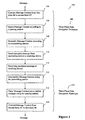
- Figure 1 is a flow chart of a three-phase encryption and decryption technique in accordance with one embodiment of the invention
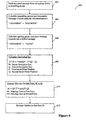
- Figure 2 is a flow chart of one embodiment of a conversion phase of the three-phase encryption technique
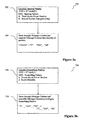
- Figure 3a is a flow chart of one embodiment of a separating phase of the three-phase encryption technique
- Figure 3b is a flow chart of a scrambilization phase of the embodiment of the three-phase encryption technique of Figure 3a ;
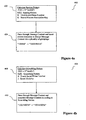
- Figure 4a is a flow chart of another embodiment of a separating phase of the three-phase encryption technique
- Figure 4b is a flow chart of a scrambilization phase of the embodiment of the three-phase encryption technique of Figure 4a ;
- Figure 5 is a flow chart of a three-phase decryption technique of the embodiment of the three-phase encryption technique of Figures 3a and 3b ;
- Figure 6 is a flow chart of a three-phase decryption technique of the embodiment of the three-phase encryption technique of Figures 4a and 4b ;
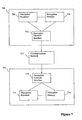
- Figure 7 is a block diagram of one embodiment of an encryption module and one embodiment of a decryption module
- Figure 8a is a flowchart of an example of an embodiment of a three-phase encryption technique
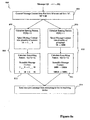
- Figure 8b is a flowchart of an example of a three-phase decryption technique of the embodiment of Figure 8a ;
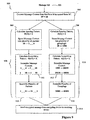
- Figure 9 is a flowchart of an example of an embodiment of a three-phase encryption technique with an additional fourth phase.
- Fig. 1 is a flow chart 100 depicting one embodiment of a three-phase encryption technique and one embodiment of a three-phase decryption technique. It will be appreciated that any single device may implement either the three-phase encryption technique, the three-phase decryption technique, or combinations thereof.
- the disclosed three-phase encryption and decryption techniques may be used to protect communications taking part at least partially over a wireless network.
- the disclosed three-phase encryption and decryption techniques may be used for communications over a hardwired medium or any other type of communications medium.
- the three-phase encryption technique is generally used by a transmitting device to encrypt a message before the transmitting device transmits the message to a receiving device.
- the transmitting device encrypts the message to prevent an outside party from easily intercepting a message traveling over a communications medium to the receiving device and gaining access to personal and/or secure information such as credit card numbers, bank account numbers, and social security number.
- the three-phase decryption technique is generally used by the receiving device to decrypt the message after the receiving device receives the message from the transmitting device.
- the receiving device decrypts the message to gain access to the personal and/or secure information such.as credit card numbers, bank account numbers, and social security number that the three-phase encryption technique protects.
- a sending/transmitting device having an encryption capability encrypts a message using the disclosed three-phase encryption technique 102 and sends the message to a receiving device 110.
- communications may be bi-directional and that various devices may be capable of both sending and receiving. Accordingly, the designation of sending device or receiving device used herein are contextually applied, and a sending device for one communication may be a receiving device for another communications, etc.
- the sending device may include a personal computer; a personal digital assistant; a server; a workstation; an appliance, e.g.
- the receiving device receives the message 111 and decrypt the encrypted message using the disclosed three-phase decryption technique 112.
- the receiving device may include a personal computer; a personal digital assistant; a server; a workstation; an appliance, e.g.
- smart appliance such as a washer/dryer, refrigerator, water treatment system or stove operative to send or receive data over a network; or any other type of network enabled device known in the art, or combinations thereof, including non-network enabled devices retrofitted or otherwise adapted to be network enabled.
- the wireless protocol used to send the encrypted message 110 from the encrypting device to the receiving device may include wireless fidelity ("Wi-Fi") compatible with the IEEE 802.11 standard set, such as 802.11 (a), 802.11 (b) or 802.11 (g); general packet radio service ("GPRS"); Bluetooth, satellite or cellular transmissions; ultra wideband; WiMax; or any other type of wireless protocol using RF, light or other transmission medium, and may further include combinations of different wireless technologies over various portions of the network.
- Wi-Fi wireless fidelity
- the content of the message is converted from a first form M to a second form M' 104, typically using prime-factorization, to hide the original content of the message during transmission.
- the content of the message is then separated 106, typically into a plurality of distinct packets or a plurality of groupings, as described in detail below, to de-homogenize the intervals at which the content of the message is transmitted, thereby increasing the difficulty for a third party to listen to a transmission and decipher the message content.
- the content of the message may be broken up so that a portion of the content of the message is spread throughout a plurality of distinct packets that are separated by a given amount of time when transmitted.
- excess characters such as spaces, are inserted throughout the content of the message to distribute the content of the message into a plurality of groupings.
- the plurality of distinct packets, or the plurality of groupings, containing the content of the message are scrambled according to a user-defined pattern 108, examples of which are described in detail below.
- the three-phase encryption technique 102 is simply reversed 112.
- the receiving device will know the necessary algorithms and variables for decrypting a message that has been encrypted using the disclosed three-phase encryption technique 102.
- the necessary algorithms and variables for decrypting a message may be passed to the receiving device at the cost of decreased security.
- the content of the message within the plurality of distinct pulses or the plurality of groupings is descrambled 114 by reversing the user-defined pattern.
- the plurality of packets that comprise the content of the message are reformed back into a single message, or the excess characters between the plurality of groupings are removed 116; depending upon the method that was used to break up the original message.
- the method used to break up the original message is indicated at the head of a message in the form of a one or two digit number.
- the content of the message is converted from the second form M' into the first form M 118.
- Fig. 2 is a flow chart depicting one embodiment of the conversion phase 200 of the three-phase encryption technique.
- the alphabetical syntax of the content of the message is converted to a numerical representation 202.
- the letter “a” may be converted to be represented numerically as 01
- the letter “b” may be converted to be represented numerically as 02
- the alphabetic conversions may comply with the American Standard Code for Information Interchange ("ASCII") or the Extended Binary Code Decimal Interchange Code (“EBCDIC”) standards, or may be an arbitrary conversion.
- ASCII American Standard Code for Information Interchange
- EBCDIC Extended Binary Code Decimal Interchange Code
- a function for converting alphabetical syntax into numerical representation is well known and most programming languages include a standard function to perform this type of operation.
- the encryption component and the decryption component of the sending device and/or receiving device are programmed with a first secret prime number P, a second secret prime number Q, a known encryption key E, and a secret encryption key D. Additionally, the product of the first and second secret prime numbers is defined to be N.
- GCD is the greatest common divisor or factor.
- two or more integers are defined to be relatively prime if they share no common positive factors (divisors) except the number 1.
- the secret decryption key D is typically not openly known.
- Figs. 3a and 4a are flow charts for the separating phase of the three-phase encryption technique. Typically the content of the message is separated after the conversion phase,
- the content of the message is broken up 300 so that the content of the message is spread throughout a plurality of distinct packets 304.
- a third secret prime number R and a second known encryption key K are chosen.
- the value of the openly known encryption key K may be any modulus such as 10, the value of the secret encryption, key D, or any other recommended value.
- the spacing pattern may be a number of characters that the encrypting device waits between the plurality of distinct packets. However, in other embodiments, a user may choose to have the value of the spacing pattern correspond to other meanings with respect to the spacing between the plurality of distinct packets.
- the content of the message is spaced so that excess characters are inserted throughout the content of the message 404 to distribute the content of the message into a plurality of groupings.
- the excess characters may be spaces or any other type of characters desired by the user.
- the spacing pattern for the number of excess characters may be determined according to the same process described above for determining the spacing pattern in the embodiment of Fig. 3a .
- a third secret prime number R and a second known encryption key K are chosen.
- the value of the second known encryption key K may be any modulus such as 10, the value of the secret encryption key D, or any other recommended value.
- the sections of the content of the message remaining are scrambled 306, 406.
- the order of the three-phase encryption technique may be changed such that the content of the message is scrambled 306, 406 before the spacing phase 30a, 400.
- Fig. 3b is a flow chart for the scrambling phase 306 of the three-phase data encryption method of the embodiment of Fig. 3a .
- a fourth prime number S and a secret modulus J are chosen.
- the value of the secret modulus J may be any integer such as 10, one of the secret encryption keys, or a set of secret whole numbers.
- the scrambilization pattern may represent which of the plurality of distinct packets will be scrambled according to a predefined method. For example, if the scrambitization pattern were to equal the number 2, this may represent a strambling action taking place on every other distinct packet.
- the scrambling action may include reversing two numerical characters, adding a constant to a numerical message value, or any other function desired by a user 310.
- Fig. 4b is a flow chart for the scrambling phase 406 of the embodiment of Fig. 4a .
- a fourth prime number S and a secret modulus J are chosen.
- Fig 5 is a flowchart of the decryption 500 of an encrypted message created according to the embodiment, of Figs. 3a and 3b .
- the encrypted message may be sent to a receiving device 502. Once received, the receiving device reverses the three-phase encryption technique to decrypt the encrypted message.
- the content of the message within the plurality of distinct packets is descrambled 504 by simply reversing the process described in Fig. 3b above.
- the receiving device will know the secret modulus J and the fourth prime number S to be able to calculate the scrambilization pattern and parse through the encrypted content of the message to reverse the scrambilization 504.
- the receiving device will know the third secret prime number R and the second known encryption key K so that the receiving device may calculate the spacing pattern and parse through the message to reverse the process described in Fig. 3a above 506.
- the content of the message is converted from the second form M' to the first form M 510.
- the receiving device will know the openly known encryption Key E and the first and second secret prime numbers P, Q.
- Fig 6 is a flowchart of the decryption 600 of an encrypted message received from an encrypting device 602 in accordance with the embodiment of Figs. 4a and 4b .
- the content of the message distributed by excess characters is descrambled 604 by simply reversing the process described in Fig. 4b above.
- the receiving device will know the secret modulus J and the fourth prime number S to be able to calculate the scrambling pattern and parse through the message to reverse the scrambling process.
- the receiving device will know the prime number R and the second known encryption key K to be able to calculate the spacing pattern and parse through the message to reverse the separating process described in Fig. 4a above.
- the content of the message is converted 610 from the second form M' to the first form M.
- the receiving device will know the known encryption key E, the first secret prime number P, and the second secret prime number Q.
- the order of the phases in the decryption process may be reversed in other embodiments.
- Fig. 7 is a block diagram showing one embodiment of an encryption module 702 for encrypting a message using the three-phrase encryption technique and one embodiment of a decryption module 704 for decrypting a message using a three-phase decryption technique.
- the encryption and decryption modules 702, 704 may be any type of hardware or software capable of performing the three-phase encryption and decryption techniques.
- a single device may comprise both the encryption and decryption modules 702, 704 so that the single device is capable of bi-directional communication, or the single device may comprise either the encryption or decryption module 702, 704 so that the single device is capable of communication in only one direction.
- the encryption module 702 typically includes an encryption processor 706, an encryption memory 708 coupled with the encryption processor 706, and an encryption network interface 710 coupled with the encryption processor 706, encryption memory 708, and a communications network 712.
- the phrase "coupled with” is defined to mean directly connected to or indirectly connected through one or more intermediate components. Such intermediate components may include both hardware and software based components.
- the encryption processor 706 may be a standard Pentium processor, an Intel embedded processor, a custom processor; or any other type of processor hardwired, or capable of running software programs, to execute the functions described above of converting the content of a message from a first form M to a second form M', separating the content of the message according to a spacing pattern, and scrambling the content of the message according to the scrambilization pattern.
- these functions will be implemented as logic in software programs, stored in the encryption memory 708, and executable by the encryption processor 706.
- the encryption memory 708 may be any type of memory such as ROM or flash memory, or may be any type of permanent or removable disk or drive.
- the encryption network interface 710 may be any type of network interface capable of communications over a wireless network, a hardwired communication network, or any other type of communications medium.
- the decryption module 704 also typically includes a decryption processor 714, a decryption memory 716 coupled with the decryption processor 714, and a decryption network interface 718 coupled with the decryption processor 714, decryption memory 716, and the communications network 712.
- the decryption processor 714 may be a standard Pentium processor, an Intel embedded processor, a custom processor; or any other type of processor hardwired, or capable of running software programs, to execute the functions described above of descrambling the content of a message according to the scrambling pattern, unifying the separated content of the message according to a spacing pattern, and converting the content of the message form the second form M' to the first form M.
- these functions will be implemented as logic in software programs, stored in the decryption memory 716, and executable by the decryption processor 714.
- the decryption memory 716 may be any type of memory such as ROM or flash memory, or may be any type of permanent or removable disk or drive.
- the decryption memory 716 may be any type of memory such as ROM or flash memory, or may be any type of permanent or removable disk or drive.
- the decryption network interface 718 may be any type of network interface capable of communications over a wireless network, a hardwired communication network, or any other type of communications medium.
- Figs. 8a and 8b are flowcharts showing an example of a message encrypted ( Fig. 8a ) and then decrypted ( Fig. 8b ) using one embodiment of a three-phase data encryption method.
- the message in the first form M is defined to have a value of 23 802.
- the first secret prime number is defined to have a value of 5
- the second secret prime number is defined to have a value of 7
- the known encryption key E is defined to have a value of 29.
- the value of the first and second secret prime numbers are prime and the known encryption key E is relatively prime to the first and second secret prime numbers.
- the product of the first and second prime number is calculate to be 35, meeting the requirement that the product of the first and second prime numbers be greater than the value of the message in the first form M.
- the message value in the first form M of 23 is calculated to have a value of 18 in the second form M'.
- the spacing phase 806 is performed.
- the third secret prime is defined as 31 and the second known encryption key is defined as 10.
- the value of 1 is defined to be a single space, "00".
- a value of 1 results in the message separate from "18" to a value of "1 _ _ 8" with a single space between the distinct packets.
- the message is separated from "1-8" to a value of "1008" with two excess characters, defined to be a space, between the plurality of groupings.
- the scrambilization pattern is calculated 812.
- the fourth prime number is defined to be 17 and the secret modulus is defined to be 15.
- the value of 2 is defined to mean that every other packet or grouping is scrambled.
- the message of "1008" is first changed to "10018" and then to "10081". Therefore, the message value of 23 has an encrypted value of 10081.
- the encrypting device may then send the encrypted value of 10081 to the receiving device 814.
- the receiving device receives this encrypted message 818 and may first descramble the content of the message 820.
- the receiving device must know that each grouping or packet that is scrambled must have the two numerical characters reversed and an added value of 10 to the original message. Additionally, the receiving device must know the fourth prime number is defined to be 17 and the secret modulus is defined to be 15 so that the receiving device can correctly calculate that the value of the scrambling pattern is 2 as described above.
- the message of "1 _ _ 81" is first changed to "1 _ _ 18" and then to "1 _ _ 8" 820.
- the message of "10081" is first changed to "10018" and then to "1008" 820.
- the receiving device places the message back into a unified message 826.
- the receiving device must know that the third secret prime is defined as 31 and the openly known modulus is defined as 10 so that the receiving device may correctly calculate a spacing pattern of 1 and know than one space, or "00," has been inserted between the groupings or packets of the content of the message.
- the message of "1_ _8" is changed to "18". Further, in the embodiment where excess spaces are placed between the plurality of groups to distribute the message 824, the message of "1008" is changed to "18".
- the receiving device performs the conversion phase 830 to convert the content of the message form the second form M' back into the first form M.
- the above formula results 830 in a value of the message in the first form M of 23, the same as the value of the message in the first form before the three-phase encryption process is performed.
- Devices implementing the three-phase encryption technique or the three-phase decryption technique may also integrate additional phases into the three-phase encryption technique or the three-phase decryption technique.
- a device implementing the three-phase decryption technique of Fig. 8a may perform a fourth phase 916 of scrambling the order of the plurality of packets or the plurality of groupings.
- any additional phase may be added to the three-phase encryption technique or the three-phase decryption technique so long as the new phase does not distort the data to an extent that the new phase cannot be accurately reversed.
Landscapes
- Engineering & Computer Science (AREA)
- Theoretical Computer Science (AREA)
- Business, Economics & Management (AREA)
- Computing Systems (AREA)
- Computer Security & Cryptography (AREA)
- Computer Networks & Wireless Communication (AREA)
- Signal Processing (AREA)
- Accounting & Taxation (AREA)
- Finance (AREA)
- Strategic Management (AREA)
- Physics & Mathematics (AREA)
- General Business, Economics & Management (AREA)
- General Physics & Mathematics (AREA)
- Storage Device Security (AREA)
- Mobile Radio Communication Systems (AREA)
- Two-Way Televisions, Distribution Of Moving Picture Or The Like (AREA)
- Computer And Data Communications (AREA)
- Data Exchanges In Wide-Area Networks (AREA)
- Circuits Of Receivers In General (AREA)
Applications Claiming Priority (2)
| Application Number | Priority Date | Filing Date | Title |
|---|---|---|---|
| US11/064,912 US7725715B2 (en) | 2005-02-24 | 2005-02-24 | System and method for three-phase data encryption |
| PCT/US2006/005942 WO2006091528A2 (en) | 2005-02-24 | 2006-02-21 | System and method for three-phase data encryption |
Publications (2)
| Publication Number | Publication Date |
|---|---|
| EP1851897A2 EP1851897A2 (en) | 2007-11-07 |
| EP1851897B1 true EP1851897B1 (en) | 2009-06-10 |
Family
ID=36694118
Family Applications (1)
| Application Number | Title | Priority Date | Filing Date |
|---|---|---|---|
| EP06720902A Expired - Lifetime EP1851897B1 (en) | 2005-02-24 | 2006-02-21 | System and method for three-phase data encryption |
Country Status (14)
| Country | Link |
|---|---|
| US (1) | US7725715B2 (enExample) |
| EP (1) | EP1851897B1 (enExample) |
| JP (1) | JP5106124B2 (enExample) |
| KR (1) | KR101126024B1 (enExample) |
| CN (1) | CN101129015B (enExample) |
| AT (1) | ATE433624T1 (enExample) |
| AU (1) | AU2006216855B2 (enExample) |
| CA (1) | CA2596665A1 (enExample) |
| DE (1) | DE602006007217D1 (enExample) |
| MY (1) | MY142512A (enExample) |
| NZ (1) | NZ556741A (enExample) |
| RU (1) | RU2376712C2 (enExample) |
| TW (1) | TWI379572B (enExample) |
| WO (1) | WO2006091528A2 (enExample) |
Families Citing this family (8)
| Publication number | Priority date | Publication date | Assignee | Title |
|---|---|---|---|---|
| US20090228554A1 (en) * | 2008-03-04 | 2009-09-10 | Access Business Group International Llc | Method and system for assigning unique and dynamic information-carrying serial numbers |
| US20090228959A1 (en) | 2008-03-04 | 2009-09-10 | Access Business Group International Llc | System and markup language for information extraction from stand-alone devices in webspace |
| US8666079B2 (en) * | 2008-05-29 | 2014-03-04 | Broadcom Corporation | Decoding and encoding data |
| US8069100B2 (en) | 2009-01-06 | 2011-11-29 | Access Business Group International Llc | Metered delivery of wireless power |
| US20120297182A1 (en) * | 2011-05-18 | 2012-11-22 | Sherisse Hawkins | Cipher and annotation technologies for digital content devices |
| US9154471B2 (en) | 2013-11-26 | 2015-10-06 | At&T Intellectual Property I, L.P. | Method and apparatus for unified encrypted messaging |
| US12483881B2 (en) | 2022-02-07 | 2025-11-25 | Qualcomm Incorporated | Encrypting discovery messages |
| CN115174261B (zh) * | 2022-08-02 | 2024-09-27 | 黄博暄 | 基于分阶划层与密中密分发的混合加密解密系统与方法 |
Family Cites Families (38)
| Publication number | Priority date | Publication date | Assignee | Title |
|---|---|---|---|---|
| US4218582A (en) * | 1977-10-06 | 1980-08-19 | The Board Of Trustees Of The Leland Stanford Junior University | Public key cryptographic apparatus and method |
| ATE55033T1 (de) * | 1986-03-05 | 1990-08-15 | Holger Sedlak | Kryptographie-verfahren und kryptographieprozessor zur durchfuehrung des verfahrens. |
| JPH01122227A (ja) * | 1987-11-06 | 1989-05-15 | Konica Corp | 伝送装置 |
| US5136290A (en) * | 1990-06-18 | 1992-08-04 | Bond James W | Message expansion decoder and decoding method for a communication channel |
| JPH0488736A (ja) * | 1990-07-31 | 1992-03-23 | Matsushita Electric Ind Co Ltd | データ伝送方式 |
| US5289542A (en) * | 1991-03-04 | 1994-02-22 | At&T Bell Laboratories | Caller identification system with encryption |
| US5295188A (en) * | 1991-04-04 | 1994-03-15 | Wilson William J | Public key encryption and decryption circuitry and method |
| JP2864813B2 (ja) * | 1991-09-26 | 1999-03-08 | 日本電気株式会社 | 暗号化装置及び復号化装置 |
| US5295598A (en) * | 1992-06-24 | 1994-03-22 | Gerlach David D | Drinking vessel and retainer therefor |
| US5627893A (en) | 1992-12-22 | 1997-05-06 | Telstra Corporation Limited | Cryptographic method |
| GB2278518B (en) | 1993-05-14 | 1997-12-10 | Trafford Limited | Encrypted data transfer |
| RU2071180C1 (ru) * | 1993-08-02 | 1996-12-27 | Томский государственный университет | Способ шифрования сообщений открытым ключом и система для его осуществления |
| US5585598A (en) * | 1994-03-11 | 1996-12-17 | Ricoh Company, Ltd. | Rotary developing device for an image forming apparatus |
| US5604806A (en) * | 1995-01-20 | 1997-02-18 | Ericsson Inc. | Apparatus and method for secure radio communication |
| JPH08335040A (ja) * | 1995-06-02 | 1996-12-17 | Fujitsu Ltd | 暗号化処理方式 |
| US5999626A (en) * | 1996-04-16 | 1999-12-07 | Certicom Corp. | Digital signatures on a smartcard |
| US5737425A (en) * | 1996-05-21 | 1998-04-07 | International Business Machines Corporation | Cryptosystem employing worst-case difficult-to solve lattice problem |
| JPH1165439A (ja) * | 1996-08-09 | 1999-03-05 | Nippon Telegr & Teleph Corp <Ntt> | N進表現暗号による通信および認証方法、ならびにそれらの装置、およびn進表現暗号による通信および認証プログラムを格納した記憶媒体 |
| DE59708572D1 (de) | 1996-09-03 | 2002-11-28 | Siemens Ag | Anordnung und verfahren zur kryptographischen bearbeitung eines digitalen datenstroms, der eine beliebige anzahl von daten aufweist |
| JP3358954B2 (ja) * | 1996-09-17 | 2002-12-24 | アイオニクス沖縄株式会社 | 擬似ランダムビット列生成器及びそれを使用する暗号通信方法 |
| DE19703928A1 (de) * | 1997-02-04 | 1998-08-06 | Deutsche Telekom Ag | Verfahren zum Verschlüsseln einer als Zahlenwert dargestellten Nachricht |
| JPH1155247A (ja) * | 1997-07-31 | 1999-02-26 | Nippon Telegr & Teleph Corp <Ntt> | 送信者匿名性確保秘密情報伝達方法、その装置及びそのプログラム記録媒体 |
| CA2302784A1 (en) * | 1997-09-17 | 1999-03-25 | Frank C. Luyster | Improved block cipher method |
| US6652380B1 (en) * | 1998-12-04 | 2003-11-25 | Sierra Design Group | Cashless gaming system and method |
| DE19963408A1 (de) * | 1999-12-28 | 2001-08-30 | Giesecke & Devrient Gmbh | Tragbarer Datenträger mit Zugriffsschutz durch Schlüsselteilung |
| US20020087884A1 (en) * | 2000-06-12 | 2002-07-04 | Hovav Shacham | Method and apparatus for enhancing network security protection server performance |
| US6675152B1 (en) * | 2000-09-13 | 2004-01-06 | Igt | Transaction signature |
| DE10061697A1 (de) * | 2000-12-12 | 2002-06-27 | Infineon Technologies Ag | Verfahren und Vorrichtung zum Ermitteln eines Schlüsselpaars und zum Erzeugen von RSA-Schlüsseln |
| US20020131590A1 (en) * | 2001-02-02 | 2002-09-19 | Henson Kevin M. | Key matrix methodology |
| US6722985B2 (en) * | 2001-04-19 | 2004-04-20 | Igt | Universal player tracking system |
| US6585598B2 (en) * | 2001-06-28 | 2003-07-01 | Igt | Method for cashless gaming |
| US6685567B2 (en) * | 2001-08-08 | 2004-02-03 | Igt | Process verification |
| US6898288B2 (en) * | 2001-10-22 | 2005-05-24 | Telesecura Corporation | Method and system for secure key exchange |
| JP2003157003A (ja) * | 2001-11-19 | 2003-05-30 | Mitsubishi Electric Corp | デジタル信号記録再生装置、記録装置、及び再生装置、並びに、デジタル信号記録再生方法、記録方法、及び再生方法 |
| RU2260916C2 (ru) * | 2002-09-23 | 2005-09-20 | Таганрогский государственный радиотехнический университет | Способ шифрования двоичной информации |
| US9015467B2 (en) * | 2002-12-05 | 2015-04-21 | Broadcom Corporation | Tagging mechanism for data path security processing |
| GB0313666D0 (en) * | 2003-06-13 | 2003-07-16 | Hewlett Packard Development Co | RSA cryptographic method and system |
| US6996233B2 (en) * | 2003-06-19 | 2006-02-07 | International Business Machines Corporation | System and method for encrypting and verifying messages using three-phase encryption |
-
2005
- 2005-02-24 US US11/064,912 patent/US7725715B2/en not_active Expired - Fee Related
-
2006
- 2006-02-21 JP JP2007557086A patent/JP5106124B2/ja not_active Expired - Fee Related
- 2006-02-21 CN CN2006800061102A patent/CN101129015B/zh not_active Expired - Fee Related
- 2006-02-21 CA CA002596665A patent/CA2596665A1/en not_active Abandoned
- 2006-02-21 DE DE602006007217T patent/DE602006007217D1/de not_active Expired - Lifetime
- 2006-02-21 TW TW095105749A patent/TWI379572B/zh not_active IP Right Cessation
- 2006-02-21 EP EP06720902A patent/EP1851897B1/en not_active Expired - Lifetime
- 2006-02-21 AU AU2006216855A patent/AU2006216855B2/en not_active Ceased
- 2006-02-21 AT AT06720902T patent/ATE433624T1/de not_active IP Right Cessation
- 2006-02-21 KR KR1020077018259A patent/KR101126024B1/ko not_active Expired - Fee Related
- 2006-02-21 WO PCT/US2006/005942 patent/WO2006091528A2/en not_active Ceased
- 2006-02-21 RU RU2007131731/02A patent/RU2376712C2/ru not_active IP Right Cessation
- 2006-02-21 NZ NZ556741A patent/NZ556741A/en not_active IP Right Cessation
- 2006-02-23 MY MYPI20060779A patent/MY142512A/en unknown
Also Published As
| Publication number | Publication date |
|---|---|
| CA2596665A1 (en) | 2006-08-31 |
| WO2006091528A2 (en) | 2006-08-31 |
| WO2006091528A3 (en) | 2007-08-16 |
| US7725715B2 (en) | 2010-05-25 |
| RU2007131731A (ru) | 2009-03-27 |
| WO2006091528A8 (en) | 2007-09-27 |
| TW200644557A (en) | 2006-12-16 |
| KR101126024B1 (ko) | 2012-03-20 |
| EP1851897A2 (en) | 2007-11-07 |
| CN101129015B (zh) | 2013-01-02 |
| RU2376712C2 (ru) | 2009-12-20 |
| MY142512A (en) | 2010-11-30 |
| US20060190728A1 (en) | 2006-08-24 |
| AU2006216855A1 (en) | 2006-08-31 |
| DE602006007217D1 (de) | 2009-07-23 |
| JP2008532075A (ja) | 2008-08-14 |
| TWI379572B (en) | 2012-12-11 |
| KR20070106515A (ko) | 2007-11-01 |
| NZ556741A (en) | 2010-04-30 |
| HK1117975A1 (en) | 2009-01-23 |
| JP5106124B2 (ja) | 2012-12-26 |
| ATE433624T1 (de) | 2009-06-15 |
| AU2006216855B2 (en) | 2010-01-07 |
| CN101129015A (zh) | 2008-02-20 |
Similar Documents
| Publication | Publication Date | Title |
|---|---|---|
| US5544245A (en) | Mutual authentication/cipher key delivery system | |
| US5517567A (en) | Key distribution system | |
| US10187200B1 (en) | System and method for generating a multi-stage key for use in cryptographic operations | |
| US8396218B2 (en) | Cryptographic module distribution system, apparatus, and program | |
| US7254232B2 (en) | Method and system for selecting encryption keys from a plurality of encryption keys | |
| US9960911B2 (en) | System and method for securing wireless communication through physical layer control and data channel | |
| JP5901884B2 (ja) | 個人向けホワイトボックス・デスクランバー | |
| KR101991775B1 (ko) | Fpga기반의 데이터 암복호화 방법 | |
| EP1851897B1 (en) | System and method for three-phase data encryption | |
| RU2040117C1 (ru) | Способ передачи и приема с обеспечением подлинности и конфиденциальности сообщения | |
| Kuppuswamy et al. | New Innovation of Arabic language Encryption Technique using New symmetric key algorithm | |
| CN117221878B (zh) | 一种基于无线网络设备的信息安全管控方法及装置 | |
| JPH10243470A (ja) | 携帯電話機セキュリティコード割当システム及び方法 | |
| JPH07336328A (ja) | 秘匿装置 | |
| EP3406050B1 (en) | Method for safeguarding the confidentiality of the sender's identification of messages transmitted through promiscuous channels | |
| HK1117975B (en) | System and method for three-phase data encryption | |
| US20250088356A1 (en) | Method for securely transferring data elements values | |
| US20070024471A1 (en) | Systems and methods for secure communication over wired transmission channels | |
| DONADZE et al. | COMBINED METHOD OF ENCRYPTION OF DATA FROM UNAUTHORIZED ACCESS | |
| KR101616717B1 (ko) | 버냄 사이퍼 암호 알고리즘을 이용한 암복호화 서비스 제공 방법 및 시스템 | |
| JP2001119387A (ja) | 鍵供託装置 | |
| JPH11224048A (ja) | 暗号変換装置、復号変換装置、および暗号通信方法 | |
| JPH10133574A (ja) | 慣用暗号装置 |
Legal Events
| Date | Code | Title | Description |
|---|---|---|---|
| PUAI | Public reference made under article 153(3) epc to a published international application that has entered the european phase |
Free format text: ORIGINAL CODE: 0009012 |
|
| 17P | Request for examination filed |
Effective date: 20070830 |
|
| AK | Designated contracting states |
Kind code of ref document: A2 Designated state(s): AT BE BG CH CY CZ DE DK EE ES FI FR GB GR HU IE IS IT LI LT LU LV MC NL PL PT RO SE SI SK TR |
|
| AX | Request for extension of the european patent |
Extension state: AL BA HR MK YU |
|
| DAX | Request for extension of the european patent (deleted) | ||
| 17Q | First examination report despatched |
Effective date: 20080702 |
|
| GRAP | Despatch of communication of intention to grant a patent |
Free format text: ORIGINAL CODE: EPIDOSNIGR1 |
|
| RTI1 | Title (correction) |
Free format text: SYSTEM AND METHOD FOR THREE-PHASE DATA ENCRYPTION |
|
| GRAS | Grant fee paid |
Free format text: ORIGINAL CODE: EPIDOSNIGR3 |
|
| GRAA | (expected) grant |
Free format text: ORIGINAL CODE: 0009210 |
|
| AK | Designated contracting states |
Kind code of ref document: B1 Designated state(s): AT BE BG CH CY CZ DE DK EE ES FI FR GB GR HU IE IS IT LI LT LU LV MC NL PL PT RO SE SI SK TR |
|
| REG | Reference to a national code |
Ref country code: GB Ref legal event code: FG4D |
|
| REG | Reference to a national code |
Ref country code: CH Ref legal event code: EP |
|
| REG | Reference to a national code |
Ref country code: IE Ref legal event code: FG4D |
|
| REF | Corresponds to: |
Ref document number: 602006007217 Country of ref document: DE Date of ref document: 20090723 Kind code of ref document: P |
|
| PG25 | Lapsed in a contracting state [announced via postgrant information from national office to epo] |
Ref country code: AT Free format text: LAPSE BECAUSE OF FAILURE TO SUBMIT A TRANSLATION OF THE DESCRIPTION OR TO PAY THE FEE WITHIN THE PRESCRIBED TIME-LIMIT Effective date: 20090610 Ref country code: LT Free format text: LAPSE BECAUSE OF FAILURE TO SUBMIT A TRANSLATION OF THE DESCRIPTION OR TO PAY THE FEE WITHIN THE PRESCRIBED TIME-LIMIT Effective date: 20090610 Ref country code: FI Free format text: LAPSE BECAUSE OF FAILURE TO SUBMIT A TRANSLATION OF THE DESCRIPTION OR TO PAY THE FEE WITHIN THE PRESCRIBED TIME-LIMIT Effective date: 20090610 |
|
| PG25 | Lapsed in a contracting state [announced via postgrant information from national office to epo] |
Ref country code: LV Free format text: LAPSE BECAUSE OF FAILURE TO SUBMIT A TRANSLATION OF THE DESCRIPTION OR TO PAY THE FEE WITHIN THE PRESCRIBED TIME-LIMIT Effective date: 20090610 Ref country code: SI Free format text: LAPSE BECAUSE OF FAILURE TO SUBMIT A TRANSLATION OF THE DESCRIPTION OR TO PAY THE FEE WITHIN THE PRESCRIBED TIME-LIMIT Effective date: 20090610 Ref country code: SE Free format text: LAPSE BECAUSE OF FAILURE TO SUBMIT A TRANSLATION OF THE DESCRIPTION OR TO PAY THE FEE WITHIN THE PRESCRIBED TIME-LIMIT Effective date: 20090910 Ref country code: PL Free format text: LAPSE BECAUSE OF FAILURE TO SUBMIT A TRANSLATION OF THE DESCRIPTION OR TO PAY THE FEE WITHIN THE PRESCRIBED TIME-LIMIT Effective date: 20090610 |
|
| PG25 | Lapsed in a contracting state [announced via postgrant information from national office to epo] |
Ref country code: CZ Free format text: LAPSE BECAUSE OF FAILURE TO SUBMIT A TRANSLATION OF THE DESCRIPTION OR TO PAY THE FEE WITHIN THE PRESCRIBED TIME-LIMIT Effective date: 20090610 Ref country code: EE Free format text: LAPSE BECAUSE OF FAILURE TO SUBMIT A TRANSLATION OF THE DESCRIPTION OR TO PAY THE FEE WITHIN THE PRESCRIBED TIME-LIMIT Effective date: 20090610 Ref country code: RO Free format text: LAPSE BECAUSE OF FAILURE TO SUBMIT A TRANSLATION OF THE DESCRIPTION OR TO PAY THE FEE WITHIN THE PRESCRIBED TIME-LIMIT Effective date: 20090610 Ref country code: IS Free format text: LAPSE BECAUSE OF FAILURE TO SUBMIT A TRANSLATION OF THE DESCRIPTION OR TO PAY THE FEE WITHIN THE PRESCRIBED TIME-LIMIT Effective date: 20091010 Ref country code: ES Free format text: LAPSE BECAUSE OF FAILURE TO SUBMIT A TRANSLATION OF THE DESCRIPTION OR TO PAY THE FEE WITHIN THE PRESCRIBED TIME-LIMIT Effective date: 20090921 |
|
| PG25 | Lapsed in a contracting state [announced via postgrant information from national office to epo] |
Ref country code: BE Free format text: LAPSE BECAUSE OF FAILURE TO SUBMIT A TRANSLATION OF THE DESCRIPTION OR TO PAY THE FEE WITHIN THE PRESCRIBED TIME-LIMIT Effective date: 20090610 Ref country code: SK Free format text: LAPSE BECAUSE OF FAILURE TO SUBMIT A TRANSLATION OF THE DESCRIPTION OR TO PAY THE FEE WITHIN THE PRESCRIBED TIME-LIMIT Effective date: 20090610 |
|
| PG25 | Lapsed in a contracting state [announced via postgrant information from national office to epo] |
Ref country code: BG Free format text: LAPSE BECAUSE OF FAILURE TO SUBMIT A TRANSLATION OF THE DESCRIPTION OR TO PAY THE FEE WITHIN THE PRESCRIBED TIME-LIMIT Effective date: 20090910 Ref country code: PT Free format text: LAPSE BECAUSE OF FAILURE TO SUBMIT A TRANSLATION OF THE DESCRIPTION OR TO PAY THE FEE WITHIN THE PRESCRIBED TIME-LIMIT Effective date: 20091010 |
|
| PLBE | No opposition filed within time limit |
Free format text: ORIGINAL CODE: 0009261 |
|
| STAA | Information on the status of an ep patent application or granted ep patent |
Free format text: STATUS: NO OPPOSITION FILED WITHIN TIME LIMIT |
|
| PG25 | Lapsed in a contracting state [announced via postgrant information from national office to epo] |
Ref country code: DK Free format text: LAPSE BECAUSE OF FAILURE TO SUBMIT A TRANSLATION OF THE DESCRIPTION OR TO PAY THE FEE WITHIN THE PRESCRIBED TIME-LIMIT Effective date: 20090610 |
|
| 26N | No opposition filed |
Effective date: 20100311 |
|
| REG | Reference to a national code |
Ref country code: CH Ref legal event code: PL |
|
| PG25 | Lapsed in a contracting state [announced via postgrant information from national office to epo] |
Ref country code: LI Free format text: LAPSE BECAUSE OF NON-PAYMENT OF DUE FEES Effective date: 20100228 Ref country code: MC Free format text: LAPSE BECAUSE OF NON-PAYMENT OF DUE FEES Effective date: 20100301 Ref country code: CH Free format text: LAPSE BECAUSE OF NON-PAYMENT OF DUE FEES Effective date: 20100228 Ref country code: GR Free format text: LAPSE BECAUSE OF FAILURE TO SUBMIT A TRANSLATION OF THE DESCRIPTION OR TO PAY THE FEE WITHIN THE PRESCRIBED TIME-LIMIT Effective date: 20090911 |
|
| REG | Reference to a national code |
Ref country code: FR Ref legal event code: ST Effective date: 20101029 |
|
| PG25 | Lapsed in a contracting state [announced via postgrant information from national office to epo] |
Ref country code: IE Free format text: LAPSE BECAUSE OF NON-PAYMENT OF DUE FEES Effective date: 20100221 Ref country code: FR Free format text: LAPSE BECAUSE OF NON-PAYMENT OF DUE FEES Effective date: 20100301 |
|
| PG25 | Lapsed in a contracting state [announced via postgrant information from national office to epo] |
Ref country code: IT Free format text: LAPSE BECAUSE OF FAILURE TO SUBMIT A TRANSLATION OF THE DESCRIPTION OR TO PAY THE FEE WITHIN THE PRESCRIBED TIME-LIMIT Effective date: 20090610 |
|
| PGFP | Annual fee paid to national office [announced via postgrant information from national office to epo] |
Ref country code: DE Payment date: 20110228 Year of fee payment: 6 Ref country code: NL Payment date: 20110216 Year of fee payment: 6 |
|
| PGFP | Annual fee paid to national office [announced via postgrant information from national office to epo] |
Ref country code: GB Payment date: 20110124 Year of fee payment: 6 |
|
| PG25 | Lapsed in a contracting state [announced via postgrant information from national office to epo] |
Ref country code: CY Free format text: LAPSE BECAUSE OF FAILURE TO SUBMIT A TRANSLATION OF THE DESCRIPTION OR TO PAY THE FEE WITHIN THE PRESCRIBED TIME-LIMIT Effective date: 20090610 |
|
| REG | Reference to a national code |
Ref country code: NL Ref legal event code: V1 Effective date: 20120901 |
|
| PG25 | Lapsed in a contracting state [announced via postgrant information from national office to epo] |
Ref country code: LU Free format text: LAPSE BECAUSE OF NON-PAYMENT OF DUE FEES Effective date: 20100221 Ref country code: HU Free format text: LAPSE BECAUSE OF FAILURE TO SUBMIT A TRANSLATION OF THE DESCRIPTION OR TO PAY THE FEE WITHIN THE PRESCRIBED TIME-LIMIT Effective date: 20091211 |
|
| GBPC | Gb: european patent ceased through non-payment of renewal fee |
Effective date: 20120221 |
|
| PG25 | Lapsed in a contracting state [announced via postgrant information from national office to epo] |
Ref country code: TR Free format text: LAPSE BECAUSE OF FAILURE TO SUBMIT A TRANSLATION OF THE DESCRIPTION OR TO PAY THE FEE WITHIN THE PRESCRIBED TIME-LIMIT Effective date: 20090610 |
|
| REG | Reference to a national code |
Ref country code: DE Ref legal event code: R119 Ref document number: 602006007217 Country of ref document: DE Effective date: 20120901 |
|
| PG25 | Lapsed in a contracting state [announced via postgrant information from national office to epo] |
Ref country code: GB Free format text: LAPSE BECAUSE OF NON-PAYMENT OF DUE FEES Effective date: 20120221 Ref country code: NL Free format text: LAPSE BECAUSE OF NON-PAYMENT OF DUE FEES Effective date: 20120901 |
|
| PG25 | Lapsed in a contracting state [announced via postgrant information from national office to epo] |
Ref country code: DE Free format text: LAPSE BECAUSE OF NON-PAYMENT OF DUE FEES Effective date: 20120901 |