EP1851013B1 - Improvements in or relating to scissors - Google Patents
Improvements in or relating to scissors Download PDFInfo
- Publication number
- EP1851013B1 EP1851013B1 EP06709781A EP06709781A EP1851013B1 EP 1851013 B1 EP1851013 B1 EP 1851013B1 EP 06709781 A EP06709781 A EP 06709781A EP 06709781 A EP06709781 A EP 06709781A EP 1851013 B1 EP1851013 B1 EP 1851013B1
- Authority
- EP
- European Patent Office
- Prior art keywords
- blade
- scissors
- restraining member
- cutting
- blade portion
- Prior art date
- Legal status (The legal status is an assumption and is not a legal conclusion. Google has not performed a legal analysis and makes no representation as to the accuracy of the status listed.)
- Not-in-force
Links
- 230000000452 restraining effect Effects 0.000 abstract description 85
- 238000004140 cleaning Methods 0.000 description 4
- 230000000694 effects Effects 0.000 description 3
- 238000004659 sterilization and disinfection Methods 0.000 description 3
- 230000008901 benefit Effects 0.000 description 2
- 210000003041 ligament Anatomy 0.000 description 2
- 239000000463 material Substances 0.000 description 2
- 230000007246 mechanism Effects 0.000 description 2
- 238000000034 method Methods 0.000 description 2
- 230000001954 sterilising effect Effects 0.000 description 2
- 238000001356 surgical procedure Methods 0.000 description 2
- 206010061218 Inflammation Diseases 0.000 description 1
- 230000009286 beneficial effect Effects 0.000 description 1
- 230000015572 biosynthetic process Effects 0.000 description 1
- 230000003670 easy-to-clean Effects 0.000 description 1
- 238000005755 formation reaction Methods 0.000 description 1
- 230000004054 inflammatory process Effects 0.000 description 1
- 208000014674 injury Diseases 0.000 description 1
- 230000000306 recurrent effect Effects 0.000 description 1
- 238000009877 rendering Methods 0.000 description 1
- 238000010008 shearing Methods 0.000 description 1
- 239000004753 textile Substances 0.000 description 1
- 230000008733 trauma Effects 0.000 description 1
Images

Classifications
-
- A—HUMAN NECESSITIES
- A61—MEDICAL OR VETERINARY SCIENCE; HYGIENE
- A61B—DIAGNOSIS; SURGERY; IDENTIFICATION
- A61B17/00—Surgical instruments, devices or methods
- A61B17/32—Surgical cutting instruments
- A61B17/3201—Scissors
-
- B—PERFORMING OPERATIONS; TRANSPORTING
- B26—HAND CUTTING TOOLS; CUTTING; SEVERING
- B26B—HAND-HELD CUTTING TOOLS NOT OTHERWISE PROVIDED FOR
- B26B13/00—Hand shears; Scissors
- B26B13/06—Hand shears; Scissors characterised by the shape of the blades
-
- B—PERFORMING OPERATIONS; TRANSPORTING
- B26—HAND CUTTING TOOLS; CUTTING; SEVERING
- B26B—HAND-HELD CUTTING TOOLS NOT OTHERWISE PROVIDED FOR
- B26B13/00—Hand shears; Scissors
- B26B13/06—Hand shears; Scissors characterised by the shape of the blades
- B26B13/08—Hand shears; Scissors characterised by the shape of the blades with cutting edges wavy or toothed in the plane of the blade
-
- B—PERFORMING OPERATIONS; TRANSPORTING
- B26—HAND CUTTING TOOLS; CUTTING; SEVERING
- B26B—HAND-HELD CUTTING TOOLS NOT OTHERWISE PROVIDED FOR
- B26B13/00—Hand shears; Scissors
- B26B13/12—Hand shears; Scissors characterised by the shape of the handles
- B26B13/20—Hand shears; Scissors characterised by the shape of the handles with gripping bows in the handle
-
- A—HUMAN NECESSITIES
- A61—MEDICAL OR VETERINARY SCIENCE; HYGIENE
- A61B—DIAGNOSIS; SURGERY; IDENTIFICATION
- A61B90/00—Instruments, implements or accessories specially adapted for surgery or diagnosis and not covered by any of the groups A61B1/00 - A61B50/00, e.g. for luxation treatment or for protecting wound edges
- A61B90/08—Accessories or related features not otherwise provided for
- A61B2090/0813—Accessories designed for easy sterilising, i.e. re-usable
Definitions
- the present invention relates to scissors and more particularly but not exclusively to surgical scissors.
- Surgical scissors are indispensable tools for surgeons, operating theatre staff and other medical practitioners and are used for cutting and excising patient tissue or sutures. These scissors need to be able to cut cleanly, effectively and accurately, to be robust, and to be suitable for sterilisation. It can be appreciated that accuracy of cutting is important in any surgical procedure. Achieving a clean cut is particularly important for minimising trauma and inflammation to the surrounding tissues.
- Conventional surgical scissors comprise two scissor members, each scissor member having a distal blade portion and a proximal handle portion.
- the blade portion has a cutting edge, a contacting face, an outer face and a distal tip.
- a finger opening is at the proximal end of the handle portion.
- the scissor members are pivotally connected to each other at a pivot axis between the blade portion and the handle portion such that their contacting faces can mutually abut when closed.
- the contacting faces of the blade portions slide relative to each other parallel to their planes.
- a possible way of overcoming some disadvantages of conventional surgical scissors would be to use stiffer blades so that they do not splay apart as readily. Stiffer blades may be achieved by using a stiffer material, which would be more expensive, or by making the blades thicker. However, thicker blades are both undesirable and impractical as the scissors may be too bulky to manoeuvre in confined spaces, heavier and therefore more tiring to use, and more expensive to make.
- An object of the present invention is to provide improved scissors which are robust, cut cleanly and effectively and avoid or minimise the disadvantages of current scissors as outlined above.
- a scissors according to the preamble of claim 1 is also known from US 3,846,910
- the invention resides in scissors having first and second pivotably connected elongate blade members, each blade member having a handle portion and a blade portion, wherein at least one of the handle portions comprises a wedge means co-operable with the other handle portion during a cutting stroke to urge the handle portions apart laterally while biasing the blade portions laterally together to oppose relative lateral movement of the blade portions away from each other during the cutting stroke, characterised in that the wedge means has a thick end and a thin end, and an area of contact between the wedge means and the other handle portion moves from the thin end towards the thick end during the cutting stroke to provide a continuous wedging force throughout the cutting stroke.
- the restraining member resists splaying deflection of the blade members, which facilitates cutting of tough tissues such as ligaments.
- the restraining member is not necessarily in contact with the first blade member during normal cutting but as soon as minor deflection of the first blade member takes up the clearance, the restraining member begins to limit further deflection.
- the restraining member may bear against the first blade member during the cutting stroke.
- the restraining member may bear resiliently against the first blade member to deflect resiliently as the first blade member moves during the cutting stroke.
- the restraining member can act continually to resist deflection of the first blade member.
- the first blade member may be thicker or wider than the width of the slot or channel, so that resilient deflection of the restraining member is essential to accommodate the first blade member.
- the restraining member may be circular in cross-section.
- the second blade member and the restraining member may be conjoined along at least part of their shared length.
- the second blade member and the restraining member may together define a U-shaped cross-section.
- the second blade member and the restraining member may be separate along most of their shared length, for example being joined at opposed ends of the restraining member. This means that the second blade member and the restraining member can together define an open-bottomed slot, which is easier to clean and less likely to give rise to jamming.
- the second blade member and the restraining member can be joined at a proximal end of the restraining member such that a distal end of the restraining member is not joined to the second blade member.
- the proximal end of the restraining member can form a fulcrum between the first blade member and the second blade member.
- the first blade member defines a first cutting edge and the second blade member defines a second cutting edge whose point of mutual intersection moves distally during the cutting stroke.
- the restraining member can define a third cutting edge, the first cutting edge passing between the second and third cutting edges during the cutting stroke. At least one of these cutting edges may be chamfered or bevelled laterally, to prevent tissues moving out of the blades: they may also or alternatively be serrated, curved, or scalloped longitudinally to prevent tissues moving out of the blades.
- the point or area of contact between the first blade portion and the restraining member can move in register with the point of intersection of the opposing cutting edges, to resist splaying deflection of the first blade portion opposite the point at which the deflecting force is exerted.
- An edge of the restraining member is preferably parallel to the cutting edge of the second blade portion, and more preferably level or co-planar with the cutting edge of the second blade portion.
- the restraining member is preferably shorter than the second blade portion defining a difference in height at least equal to the width of the slot or channel between them.
- the restraining member and the first blade member have opposed co-operable faces and the arrangement is preferably such that an increasing proportion of the first blade member is received in the slot or channel as the cutting stroke progresses. This lends progressively greater support to the distal end of the first blade member.
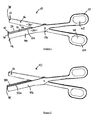
- each scissor member 12, 14 has a distal blade portion 16, 18 and a proximal handle portion 20, 22 and the scissor members 12, 14 are pivotally connected to each other by a rivet, screw, stud or pin 24 at a pivot axis between the blade portion 16, 18 and the handle portion 20, 22.
- the blade portion 16, 18 has a cutting edge 26, 28, a contacting face 30, 32, an outer face 34, 36 and a distal tip 38, 40, and a finger opening 42, 44 is provided at the proximal end of the handle portion 20, 22.
- a restraining member 46 is associated with the second blade portion 18 and may be integral with, or distinct from but attached to, the second blade portion 18.
- An integral restraining member 46 is shown in Figure 1 .
- the restraining member 46 is of substantially the same shape as the second blade portion 18 and has an inner face 48, an outer face 50 and a flat top edge 52 orthogonal to the inner and outer faces 48, 50.
- the inner and outer faces 48, 50 of the restraining member 46 lie parallel to the contacting face 32 and outer face 36 of the second blade portion 18, with the inner face 48 of the restraining member 46 opposed to and spaced from the contacting face 32 of the second blade portion 18.
- the integral restraining member 46 and second blade portion 18 of Figure 1 are defined by a U-shaped cross-section (as shown in Figure 8(a) ) wherein the second blade portion 18 is one arm of the U and the restraining member 46 is the other arm of the U, both arms being joined by a common base 54.
- the contacting face 32 of the second blade portion 18 and the inner face 48 of the restraining member 46 define a channel or slot 56 for receiving the cutting edge portion of the first blade portion 16 during cutting.
- a substantial part of the first blade portion 16 including its cutting edge 26 lies in the channel or slot 56, sandwiched between the second blade portion 18 and the restraining member 46.
- the outer face 34 of the first blade portion 16 and the inner face 48 of the restraining member 46 may be spaced from one another to define a small clearance, or they may abut one another in a sliding fit.
- the restraining member 46 may deflect resiliently to facilitate sliding movement of the first blade portion 16 if needs be. This will be necessary if the channel or slot 56 is narrower than the thickness of the first blade portion 16 to be received in it.
- the restraining member 46 restrains lateral splaying movement of the first blade portion 16 away from the second blade portion 18. Such lateral movement would be transverse to the length of the blade portions 16, 18 and parallel to the pivot axis defined by the pivotable connection 24. As the distal tips 38, 40 of the first and second blade portions 16, 18 swing closer together, an increasing proportion of the first blade portion 16 is received into the slot or channel 56 defined by the contacting face 32 of the second blade portion 18 and the inner face 48 of the restraining member 46. The first blade portion 16 is thereby prevented from splaying away from the second blade portion 18 by virtue of contact with the restraining member 46.
- first blade portion 16 If there is a clearance between the first blade portion 16 and the restraining member 46, lateral movement of the first blade portion 16 is resisted as soon as the first blade portion 16 takes up this clearance and its outer face 34 comes into contact with the inner face 48 of the restraining member 46. If there is no clearance, that is if the outer face 34 of the first blade portion 16 is in sliding contact with the inner face 48 of the restraining member 18 lateral movement of the first blade portion 16 is resisted from the outset.
- the point or area of contact between the first blade portion 16 and the restraining member 46 moves along in register with the point of intersection of the opposing cutting edges 26, 28, so that splaying deflection of the first blade portion 16 is resisted opposite the point at which the deflecting force is exerted.
- this enables cutting of tough or slippery items which might otherwise cause the blades to splay away from each other.
- the top edge 52 of the restraining member 46 may provide a third cutting edge 58 which is optionally parallel to the cutting edge 28 of the second blade portion 18 as shown.
- This third cutting edge 58 may be co-operable with a secondary cutting edge 60 on the first blade portion 16, or may be co-operable with the same cutting edge 26 on the first blade portion 16 that co-operates with the cutting edge 28 of the second blade portion 18.
- the second and third cutting edges 60, 58 in Figure 1 also shown in Figure 8(a) , are flat and co-planar, lying in a plane orthogonal to the plane in which the first blade portion 16 moves about the pivotable connection between the scissor members 12, 14.
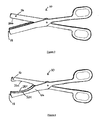
- Figures 2 to 7 differ from Figure 1 in that the cutting edges of the first and second blade portions and the top edge of the restraining member have been adapted to improve the grip on tissue by the scissors before and during cutting.
- the cutting edge 28a of the second blade portion 18 and the top edge 52a of the restraining member 46 are serrated.
- the embodiment of Figure 3 differs from that of Figure 2 only in that the cutting edge 26b of the first blade portion 16 is also serrated.
- the cutting edges 26c, 28c of the first and second blade portions 16, 18 and the top edge 52c of the restraining member 46 are concave-curved.
- the other cutting edge(s) may be straight or otherwise shaped.
- the edges opposite the cutting edges of the distal blade portions 16, 18 and/or the proximal handle portions 20, 22 may also be concave-curved to reduce the overall weight of the scissors and improve manageability.
- the cutting edge 26d of the first blade portion 16 has a series of concave curvatures, or peaks and troughs, defining a wavy scalloped line.
- the cutting edge 28e of the second blade portion 18 and the top edge 52e of the restraining member 46 have a series of concave curvatures.
- all of the cutting edges could have similar formations.
- Figure 7 shows a further embodiment which differs from that of Figure 6 in that the concave curvatures of the top edge 52f of the restraining member 46 and the cutting edge 28f of the second blade portion 18 are serrated. Alternatively, just one of the scalloped edges 28f, 52f may be serrated. Although not shown, it will be apparent that the curved edges of the embodiments shown in Figures 4 and 5 may also be serrated. Further alternative embodiments are possible where the scissors comprise at least one flat serrated edge in combination with the serrated and/or non-serrated curved edges described above. Serrated edges are advantageous in that they have an improved grip on the tissues and require sharpening less often than edges without serrations.
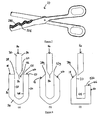
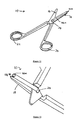
- Figures 8(b) and 8(c) and Figures 9(a) to 9(c) show cross-sectional views of different variants of the scissors of all preceding embodiments.
- Figures 8(b) and 8(c) differ from Figures 1 to 7 and 8(a) in that the cutting edge 28g of the second blade portion 18 is chamfered instead of flat.
- the top edge 52g of the restraining member 46 is also chamfered.
- Figure 8(c) only the cutting edge 28g of the second blade portion 18 is chamfered whilst the top face 52h of the restraining member 46 is flat and orthogonal to its the inner and outer faces 48, 50.
- the restraining member 46 is shorter than the second blade portion 18, their difference in height being equal to the width of the gap between them i.e. the distance between the opposed contacting face 32 of the second blade portion 18 and the inner face 48 of the restraining member 46.
- the shortened restraining member 46 allows easier access to the channel 56 between the restraining member 46 and the second blade portion 18, which is advantageous for cleaning and sterilising purposes.
- the ratio of the height difference between the restraining member 46 and the second blade portion 18 to the width of the gap between them may be more or less than 1:1 i.e. the restraining member may be shorter or longer than the width of the gap between the restraining member and the second blade portion.
- Figures 9(a) to 9(c), 10 and 11 differ from all of the preceding embodiments in that the second blade portion 18 and the restraining member 46 are not a U shape in cross-section. Otherwise, they correspond to Figures 8(a) to 8(c) respectively: for example Figure 9(c) shows a chamfered cutting edge 28g of the second blade portion 18 and a flat top edge 52h of the restraining member 46 orthogonal to its the inner and outer faces 48, 50, the difference in height between the restraining member 46 and the second blade portion 18 being equal to the width of the gap between them.
- the second blade portion 18 and the restraining member 46 do not have a common base extending along their length but instead may be joined at their ends.
- the second blade portion 18 and the restraining member 46 may have a common base extending part of the way along their length or along parts of their length.
- the second blade portion 18 and the restraining member 46 may be bridged at some points along their length by a common base which may be integral with either, or both, the second blade portion 18 and the restraining member 46, or distinct but attached to the second blade portion 18 and the restraining member 46.
- the length of the restraining member may be shorter than the length of the second blade portion. This is particularly beneficial in sharp pointed scissors where a shorter length restraining member prevents the twisting or the crossing-over of the sharp pointed distal tips of the first and second blade portions.
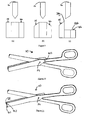
- Figure 10 which is not of the present invention, shows the second blade portion 18 joined to the restraining member 46 by a rivet, screw, stud or pin 100 at their proximal ends, and located close to the pivot axis 24 between the blade portion 16, 18 and the handle portion 20, 22.
- the embodiment shown in Figure 11 differs from that shown in Figure 10 in that the second blade portion 18 and the restraining member 46 are joined by a rivet, screw, stud or pin 102 at their distal tips 38, 40 instead of their proximal ends.
- the second blade portion 18 and the restraining member 46 can be joined by a rivet at both their distal and their proximal tips.
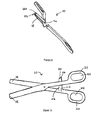
- FIG. 12 to 14 A further alternative embodiment, which is not of the present invention, is shown in Figures 12 to 14 , which differs from the previous embodiments in that it has a restraining member 46a which is substantially the same length as the second blade portion 18, extending along the length of the second blade portion 18, but is cylindrical in shape, having a substantially circular transverse cross-section.
- the restraining member 46a is a piece of wire or rod and has a free or unattached distal end or tip 104.
- the other end of the restraining member 46a forms the fulcrum at the pivot axis between the blade portions 16, 18 and the handle portions 20, 22.
- end of the restraining member 46a extends through a hole in the first blade portion 16 and is fixed to the second blade portion 18.
- the rounded profile of the restraining member 46a is easy to clean using normal cleaning and sterilising techniques.
- the restraining member 46a may be attached to or integral with the second blade portion 18 at both ends of the restraining member which would reduce splaying of the first blade portion 16.
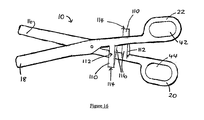
- Figures 15 and 16 show an embodiment of the scissors of the present invention which differs from the preceding embodiments in that instead of having a restraining member associated with the second blade portion 18, at least one of the proximal handle portions of the scissors 10 comprise at least one protuberance or projection in the shape of a wedge extending in a direction transverse to the length of the handle portion, towards the other proximal handle portion.
- the wedge projection 110 has a thick end 112, a thin end 114, and at least one inclined face 116 which is in sliding contact with the other blade member.
- the wedge projection 110 is substantially triangular in cross-section.
- Figure 15 shows a pair of scissors 10 comprising such a wedge projection 110 extending from the first handle portion 20 towards the second handle portion 22.
- the wedge projection 110 is located approximately midway along the length of the first handle portion 20.
- the thick end 112 of the wedge projection 110 may be integral with, or be distinct from but attached to, the first handle portion 20, in a fixed position with respect to the first handle portion 20.
- the wedge projection 110 may also be arranged so that it is moveable along the first handle portion 20.
- the scissors 10 having the moveable wedge projection 110 may comprise a fixing mechanism to allow the moveable wedge projection to be fixed or secured in position along the first handle portion 20.
- the inclined face 116 of the wedge projection 110 and the opposing face (not shown) of the second handle portion 22 slide relative to each other.
- the area of contact between them on the inclined face 116 of the wedge projection 110 moves from its thin end 114 towards its thick end 112, resulting in the first and second handle portions 20, 22 being splayed or forced apart laterally.
- This biasing of the blade portions 16, 18 towards each other opposes lateral splaying movement of the blade portions 16, 18 during cutting.
- the positioning of the wedge projection 110 and the angle of its inclined face 116 is such that the wedge projection 110 does not impart any lateral force between the handle portions 20, 22 when the scissors 10 (handle portions and blade portions) are in an open position.
- Figure 16 differs from the embodiment shown in Figure 15 in that the second handle portion 22 also comprises a wedge projection 110 extending towards the first handle portion 20.
- This second wedge projection 110 is similar to that of Figure 15 both in appearance and functionality.
- the inclined face 116 of the second wedge projection 110 is in sliding contact with the opposing face of the first handle portion 20.
- the handle portions 20, 22 may comprise more than one wedge projection which may be positioned at any point along their length. These wedge projections 110 may be fixed or moveable with respect to the handle portions 20, 22.
- the advantage of having one or more moveable wedge projections 110 is that the wedging effect, and hence the force that splays the handle portions 20, 22 apart and the blade portions 16, 18 together, can be adjusted for reliable cutting while minimising the effort required of the user.
- the scissors described herein may be embodied in other specific forms without departing from the essential attributes.
- the outer faces of the second blade portion and the restraining member do not have to be parallel.
- the first blade member may have an associated restraining member, defining a channel or slot that receives and minimises deflection of the second blade member.
- the restraining member may also have the effect of stiffening the blade member with which it is associated.
- the restraining member need not be of substantially the same shape or length as the second blade portion.
Landscapes
- Life Sciences & Earth Sciences (AREA)
- Health & Medical Sciences (AREA)
- Engineering & Computer Science (AREA)
- Mechanical Engineering (AREA)
- Forests & Forestry (AREA)
- Surgery (AREA)
- Medical Informatics (AREA)
- Heart & Thoracic Surgery (AREA)
- Biomedical Technology (AREA)
- Molecular Biology (AREA)
- Animal Behavior & Ethology (AREA)
- General Health & Medical Sciences (AREA)
- Public Health (AREA)
- Veterinary Medicine (AREA)
- Nuclear Medicine, Radiotherapy & Molecular Imaging (AREA)
- Pathology (AREA)
- Scissors And Nippers (AREA)
- Surgical Instruments (AREA)
Applications Claiming Priority (2)
| Application Number | Priority Date | Filing Date | Title |
|---|---|---|---|
| GB0503210A GB2423269A (en) | 2005-02-16 | 2005-02-16 | Scissors with laterally restrained blades |
| PCT/GB2006/000544 WO2006087554A1 (en) | 2005-02-16 | 2006-02-16 | Improvements in or relating to scissors |
Publications (2)
| Publication Number | Publication Date |
|---|---|
| EP1851013A1 EP1851013A1 (en) | 2007-11-07 |
| EP1851013B1 true EP1851013B1 (en) | 2012-01-11 |
Family
ID=34385583
Family Applications (1)
| Application Number | Title | Priority Date | Filing Date |
|---|---|---|---|
| EP06709781A Not-in-force EP1851013B1 (en) | 2005-02-16 | 2006-02-16 | Improvements in or relating to scissors |
Country Status (6)
| Country | Link |
|---|---|
| US (1) | US20080004650A1 (OSRAM) |
| EP (1) | EP1851013B1 (OSRAM) |
| JP (1) | JP2008529700A (OSRAM) |
| AT (1) | ATE540784T1 (OSRAM) |
| GB (1) | GB2423269A (OSRAM) |
| WO (1) | WO2006087554A1 (OSRAM) |
Cited By (1)
| Publication number | Priority date | Publication date | Assignee | Title |
|---|---|---|---|---|
| RU198842U1 (ru) * | 2020-04-16 | 2020-07-30 | Александр Григорьевич Сонис | Устройство для частичной резекции ногтевой пластины |
Families Citing this family (99)
| Publication number | Priority date | Publication date | Assignee | Title |
|---|---|---|---|---|
| US20080045990A1 (en) * | 2006-08-15 | 2008-02-21 | Susan Lynn Valerio | Combination medical bandage scissors |
| US20080200755A1 (en) * | 2007-02-15 | 2008-08-21 | Bakos Gregory J | Method and device for retrieving suture tags |
| US20080200933A1 (en) * | 2007-02-15 | 2008-08-21 | Bakos Gregory J | Surgical devices and methods for forming an anastomosis between organs by gaining access thereto through a natural orifice in the body |
| US7655004B2 (en) | 2007-02-15 | 2010-02-02 | Ethicon Endo-Surgery, Inc. | Electroporation ablation apparatus, system, and method |
| US20080200911A1 (en) * | 2007-02-15 | 2008-08-21 | Long Gary L | Electrical ablation apparatus, system, and method |
| US20080200934A1 (en) * | 2007-02-15 | 2008-08-21 | Fox William D | Surgical devices and methods using magnetic force to form an anastomosis |
| US20080200762A1 (en) * | 2007-02-16 | 2008-08-21 | Stokes Michael J | Flexible endoscope shapelock |
| US7815662B2 (en) * | 2007-03-08 | 2010-10-19 | Ethicon Endo-Surgery, Inc. | Surgical suture anchors and deployment device |
| US8075572B2 (en) * | 2007-04-26 | 2011-12-13 | Ethicon Endo-Surgery, Inc. | Surgical suturing apparatus |
| US8100922B2 (en) * | 2007-04-27 | 2012-01-24 | Ethicon Endo-Surgery, Inc. | Curved needle suturing tool |
| USD723689S1 (en) * | 2007-08-13 | 2015-03-03 | Samuel George | Surgical scissors |
| US20090054728A1 (en) * | 2007-08-21 | 2009-02-26 | Trusty Robert M | Manipulatable guide system and methods for natural orifice translumenal endoscopic surgery |
| US20090062795A1 (en) * | 2007-08-31 | 2009-03-05 | Ethicon Endo-Surgery, Inc. | Electrical ablation surgical instruments |
| US8262655B2 (en) * | 2007-11-21 | 2012-09-11 | Ethicon Endo-Surgery, Inc. | Bipolar forceps |
| US8568410B2 (en) * | 2007-08-31 | 2013-10-29 | Ethicon Endo-Surgery, Inc. | Electrical ablation surgical instruments |
| US8579897B2 (en) | 2007-11-21 | 2013-11-12 | Ethicon Endo-Surgery, Inc. | Bipolar forceps |
| US20090062788A1 (en) * | 2007-08-31 | 2009-03-05 | Long Gary L | Electrical ablation surgical instruments |
| US8480657B2 (en) | 2007-10-31 | 2013-07-09 | Ethicon Endo-Surgery, Inc. | Detachable distal overtube section and methods for forming a sealable opening in the wall of an organ |
| US20090112059A1 (en) | 2007-10-31 | 2009-04-30 | Nobis Rudolph H | Apparatus and methods for closing a gastrotomy |
| US20090131751A1 (en) * | 2007-11-20 | 2009-05-21 | Spivey James T | Anal surgical instrument guides |
| US20090182332A1 (en) * | 2008-01-15 | 2009-07-16 | Ethicon Endo-Surgery, Inc. | In-line electrosurgical forceps |
| US8262680B2 (en) | 2008-03-10 | 2012-09-11 | Ethicon Endo-Surgery, Inc. | Anastomotic device |
| US20090281559A1 (en) * | 2008-05-06 | 2009-11-12 | Ethicon Endo-Surgery, Inc. | Anastomosis patch |
| US8317806B2 (en) * | 2008-05-30 | 2012-11-27 | Ethicon Endo-Surgery, Inc. | Endoscopic suturing tension controlling and indication devices |
| US8679003B2 (en) * | 2008-05-30 | 2014-03-25 | Ethicon Endo-Surgery, Inc. | Surgical device and endoscope including same |
| US8771260B2 (en) | 2008-05-30 | 2014-07-08 | Ethicon Endo-Surgery, Inc. | Actuating and articulating surgical device |
| US8070759B2 (en) | 2008-05-30 | 2011-12-06 | Ethicon Endo-Surgery, Inc. | Surgical fastening device |
| US8652150B2 (en) * | 2008-05-30 | 2014-02-18 | Ethicon Endo-Surgery, Inc. | Multifunction surgical device |
| US8114072B2 (en) | 2008-05-30 | 2012-02-14 | Ethicon Endo-Surgery, Inc. | Electrical ablation device |
| US8906035B2 (en) * | 2008-06-04 | 2014-12-09 | Ethicon Endo-Surgery, Inc. | Endoscopic drop off bag |
| US8403926B2 (en) | 2008-06-05 | 2013-03-26 | Ethicon Endo-Surgery, Inc. | Manually articulating devices |
| US8361112B2 (en) | 2008-06-27 | 2013-01-29 | Ethicon Endo-Surgery, Inc. | Surgical suture arrangement |
| US20100010303A1 (en) * | 2008-07-09 | 2010-01-14 | Ethicon Endo-Surgery, Inc. | Inflatable access device |
| US20100010294A1 (en) * | 2008-07-10 | 2010-01-14 | Ethicon Endo-Surgery, Inc. | Temporarily positionable medical devices |
| US8262563B2 (en) * | 2008-07-14 | 2012-09-11 | Ethicon Endo-Surgery, Inc. | Endoscopic translumenal articulatable steerable overtube |
| US8888792B2 (en) | 2008-07-14 | 2014-11-18 | Ethicon Endo-Surgery, Inc. | Tissue apposition clip application devices and methods |
| US8211125B2 (en) | 2008-08-15 | 2012-07-03 | Ethicon Endo-Surgery, Inc. | Sterile appliance delivery device for endoscopic procedures |
| US20100048990A1 (en) * | 2008-08-25 | 2010-02-25 | Ethicon Endo-Surgery, Inc. | Endoscopic needle for natural orifice translumenal endoscopic surgery |
| US8529563B2 (en) | 2008-08-25 | 2013-09-10 | Ethicon Endo-Surgery, Inc. | Electrical ablation devices |
| US8241204B2 (en) * | 2008-08-29 | 2012-08-14 | Ethicon Endo-Surgery, Inc. | Articulating end cap |
| US8480689B2 (en) | 2008-09-02 | 2013-07-09 | Ethicon Endo-Surgery, Inc. | Suturing device |
| US8409200B2 (en) * | 2008-09-03 | 2013-04-02 | Ethicon Endo-Surgery, Inc. | Surgical grasping device |
| US8114119B2 (en) * | 2008-09-09 | 2012-02-14 | Ethicon Endo-Surgery, Inc. | Surgical grasping device |
| US20100076451A1 (en) * | 2008-09-19 | 2010-03-25 | Ethicon Endo-Surgery, Inc. | Rigidizable surgical instrument |
| US8337394B2 (en) * | 2008-10-01 | 2012-12-25 | Ethicon Endo-Surgery, Inc. | Overtube with expandable tip |
| DE102008057624B4 (de) * | 2008-11-10 | 2013-11-14 | Simon Siewert | Zackenschere |
| US8157834B2 (en) | 2008-11-25 | 2012-04-17 | Ethicon Endo-Surgery, Inc. | Rotational coupling device for surgical instrument with flexible actuators |
| US8172772B2 (en) | 2008-12-11 | 2012-05-08 | Ethicon Endo-Surgery, Inc. | Specimen retrieval device |
| US20100152539A1 (en) * | 2008-12-17 | 2010-06-17 | Ethicon Endo-Surgery, Inc. | Positionable imaging medical devices |
| US8361066B2 (en) | 2009-01-12 | 2013-01-29 | Ethicon Endo-Surgery, Inc. | Electrical ablation devices |
| US8828031B2 (en) * | 2009-01-12 | 2014-09-09 | Ethicon Endo-Surgery, Inc. | Apparatus for forming an anastomosis |
| US20100191050A1 (en) * | 2009-01-23 | 2010-07-29 | Ethicon Endo-Surgery, Inc. | Variable length accessory for guiding a flexible endoscopic tool |
| US20100191267A1 (en) * | 2009-01-26 | 2010-07-29 | Ethicon Endo-Surgery, Inc. | Rotary needle for natural orifice translumenal endoscopic surgery |
| US9226772B2 (en) | 2009-01-30 | 2016-01-05 | Ethicon Endo-Surgery, Inc. | Surgical device |
| US8252057B2 (en) | 2009-01-30 | 2012-08-28 | Ethicon Endo-Surgery, Inc. | Surgical access device |
| US8037591B2 (en) | 2009-02-02 | 2011-10-18 | Ethicon Endo-Surgery, Inc. | Surgical scissors |
| US20100298642A1 (en) * | 2009-05-19 | 2010-11-25 | Ethicon Endo-Surgery, Inc. | Manipulatable guide system and methods for natural orifice translumenal endoscopic surgery |
| US20110098704A1 (en) | 2009-10-28 | 2011-04-28 | Ethicon Endo-Surgery, Inc. | Electrical ablation devices |
| US20110098694A1 (en) * | 2009-10-28 | 2011-04-28 | Ethicon Endo-Surgery, Inc. | Methods and instruments for treating cardiac tissue through a natural orifice |
| US8608652B2 (en) | 2009-11-05 | 2013-12-17 | Ethicon Endo-Surgery, Inc. | Vaginal entry surgical devices, kit, system, and method |
| US20110115891A1 (en) * | 2009-11-13 | 2011-05-19 | Ethicon Endo-Surgery, Inc. | Energy delivery apparatus, system, and method for deployable medical electronic devices |
| US20110152878A1 (en) * | 2009-12-17 | 2011-06-23 | Ethicon Endo-Surgery, Inc. | Interface systems for aiding clinicians in controlling and manipulating at least one endoscopic surgical instrument and a cable controlled guide tube system |
| US8353487B2 (en) | 2009-12-17 | 2013-01-15 | Ethicon Endo-Surgery, Inc. | User interface support devices for endoscopic surgical instruments |
| US20110152610A1 (en) * | 2009-12-17 | 2011-06-23 | Ethicon Endo-Surgery, Inc. | Intralumenal accessory tip for endoscopic sheath arrangements |
| US8496574B2 (en) | 2009-12-17 | 2013-07-30 | Ethicon Endo-Surgery, Inc. | Selectively positionable camera for surgical guide tube assembly |
| US8506564B2 (en) | 2009-12-18 | 2013-08-13 | Ethicon Endo-Surgery, Inc. | Surgical instrument comprising an electrode |
| US9028483B2 (en) * | 2009-12-18 | 2015-05-12 | Ethicon Endo-Surgery, Inc. | Surgical instrument comprising an electrode |
| US20110160514A1 (en) * | 2009-12-31 | 2011-06-30 | Ethicon Endo-Surgery, Inc. | Electrical ablation devices |
| US20110190764A1 (en) * | 2010-01-29 | 2011-08-04 | Ethicon Endo-Surgery, Inc. | Surgical instrument comprising an electrode |
| US9005198B2 (en) | 2010-01-29 | 2015-04-14 | Ethicon Endo-Surgery, Inc. | Surgical instrument comprising an electrode |
| WO2012022028A1 (en) * | 2010-08-17 | 2012-02-23 | Empire Technology Development Llc | Multi-rooted tooth extraction device |
| JP4693194B1 (ja) * | 2010-10-29 | 2011-06-01 | 正一 中村 | 外科手術用器具 |
| US10092291B2 (en) | 2011-01-25 | 2018-10-09 | Ethicon Endo-Surgery, Inc. | Surgical instrument with selectively rigidizable features |
| US9597810B2 (en) | 2011-02-10 | 2017-03-21 | Samuel George | Scissors |
| JP5707575B2 (ja) * | 2011-02-10 | 2015-04-30 | 学校法人金沢工業大学 | 軟性内視鏡用処置具および鋏鉗子 |
| US9254169B2 (en) | 2011-02-28 | 2016-02-09 | Ethicon Endo-Surgery, Inc. | Electrical ablation devices and methods |
| US9314620B2 (en) | 2011-02-28 | 2016-04-19 | Ethicon Endo-Surgery, Inc. | Electrical ablation devices and methods |
| US9233241B2 (en) | 2011-02-28 | 2016-01-12 | Ethicon Endo-Surgery, Inc. | Electrical ablation devices and methods |
| US9049987B2 (en) | 2011-03-17 | 2015-06-09 | Ethicon Endo-Surgery, Inc. | Hand held surgical device for manipulating an internal magnet assembly within a patient |
| US8986199B2 (en) | 2012-02-17 | 2015-03-24 | Ethicon Endo-Surgery, Inc. | Apparatus and methods for cleaning the lens of an endoscope |
| US9427255B2 (en) | 2012-05-14 | 2016-08-30 | Ethicon Endo-Surgery, Inc. | Apparatus for introducing a steerable camera assembly into a patient |
| US9078662B2 (en) | 2012-07-03 | 2015-07-14 | Ethicon Endo-Surgery, Inc. | Endoscopic cap electrode and method for using the same |
| JP6028429B2 (ja) * | 2012-07-10 | 2016-11-16 | 富士ゼロックス株式会社 | 表示制御装置、サービス提供装置、及びプログラム |
| US9545290B2 (en) | 2012-07-30 | 2017-01-17 | Ethicon Endo-Surgery, Inc. | Needle probe guide |
| US9572623B2 (en) | 2012-08-02 | 2017-02-21 | Ethicon Endo-Surgery, Inc. | Reusable electrode and disposable sheath |
| US10314649B2 (en) | 2012-08-02 | 2019-06-11 | Ethicon Endo-Surgery, Inc. | Flexible expandable electrode and method of intraluminal delivery of pulsed power |
| US9277957B2 (en) | 2012-08-15 | 2016-03-08 | Ethicon Endo-Surgery, Inc. | Electrosurgical devices and methods |
| US10098527B2 (en) | 2013-02-27 | 2018-10-16 | Ethidcon Endo-Surgery, Inc. | System for performing a minimally invasive surgical procedure |
| USD753973S1 (en) * | 2015-01-07 | 2016-04-19 | Peacekorea Co., Ltd. | Scissors |
| KR101677261B1 (ko) * | 2015-08-24 | 2016-11-17 | 신우성 | 동물의 대퇴골두 절단기 |
| CN105708525B (zh) * | 2016-03-29 | 2018-03-23 | 中国人民解放军第二军医大学 | 一种新型微粒皮快速制皮器械 |
| USD823538S1 (en) * | 2016-05-12 | 2018-07-17 | Maria Ruggaber | Eyelash applicator |
| DE102016116624A1 (de) * | 2016-09-06 | 2018-03-22 | Karl Leibinger Medizintechnik Gmbh & Co. Kg | Medizinisches Instrument mit Reinigungsspalt im Verschlussbereich |
| EP3518785B1 (en) * | 2016-11-23 | 2021-05-19 | Boston Scientific Scimed, Inc. | Biopsy devices |
| USD833689S1 (en) * | 2017-01-25 | 2018-11-13 | Angel Namoi Carrigan | Animal grooming safety scissors |
| US11617429B2 (en) * | 2017-03-10 | 2023-04-04 | John Lazar | Medical scraping tool for human nails or skin |
| DE102019134018B4 (de) | 2019-12-11 | 2022-04-14 | Karl Storz Se & Co. Kg | Mikroinvasiv-medizinische Schere |
| USD1002311S1 (en) * | 2021-06-16 | 2023-10-24 | Mylenya Crawford | Shear razor device |
| US20240074781A1 (en) * | 2022-09-07 | 2024-03-07 | William Miguel Hasbun | Low Cost Multifunctional Medical Scissors |
Family Cites Families (36)
| Publication number | Priority date | Publication date | Assignee | Title |
|---|---|---|---|---|
| US183404A (en) * | 1876-10-17 | Improvement in band-cutting shears | ||
| US2315326A (en) * | 1943-03-30 | Surgical instrument | ||
| US69960A (en) * | 1867-10-22 | Improvement in soissoes and shears | ||
| US865918A (en) * | 1907-01-28 | 1907-09-10 | Hunter Arnold | Cutting-tool. |
| US1101181A (en) * | 1913-09-04 | 1914-06-23 | Louis M Schmidt | Pliers and similar tool. |
| US1956588A (en) * | 1932-03-04 | 1934-05-01 | Bard Parker Company Inc | Scissors |
| US2025345A (en) * | 1934-01-30 | 1935-12-24 | Hyman H Harris | Surgical instrument |
| US2027190A (en) * | 1935-03-21 | 1936-01-07 | Trane Co | Valve |
| US2195353A (en) * | 1937-09-16 | 1940-03-26 | Byron L Atchison | Scissors |
| US2127190A (en) * | 1938-02-02 | 1938-08-16 | David I Solomon | Combined surgical instrument |
| US2627656A (en) * | 1947-02-06 | 1953-02-10 | Richartz Paul | Scissors with twist in each blade |
| US2965967A (en) * | 1958-10-24 | 1960-12-27 | Wahl Clipper Corp | Scissors |
| US3548496A (en) * | 1968-07-15 | 1970-12-22 | Alco Standard Corp | Filament clip scissors |
| US3750282A (en) * | 1972-10-04 | 1973-08-07 | Web Prod Inc | Scissors |
| US3972333A (en) * | 1973-03-02 | 1976-08-03 | Leveen Harry H | Disposable surgical tool |
| US3846910A (en) * | 1973-09-24 | 1974-11-12 | True Temper Corp | Shear bumper |
| US3921640A (en) * | 1974-03-22 | 1975-11-25 | Int Paper Co | Disposable surgical instruments |
| US4049002A (en) * | 1975-07-18 | 1977-09-20 | Bio-Medicus, Inc. | Fluid conveying surgical instrument |
| US4009899A (en) * | 1975-10-16 | 1977-03-01 | Fluoroware, Inc. | Wafer tongs |
| USD250629S (en) * | 1977-01-31 | 1978-12-26 | Oy Fiskars Ab | Thread nipper |
| US4212305A (en) * | 1978-03-02 | 1980-07-15 | Dart Industries Inc. | Disposable forceps |
| DE3325602C2 (de) * | 1983-07-15 | 1985-09-26 | Karl-Heinz 8631 Ahorn Kantwerk | Kombinationswerkzeug |
| US4611592A (en) * | 1983-08-05 | 1986-09-16 | Talboy Glenn E | Clamp for holding surgical lines |
| US5065516A (en) * | 1987-05-11 | 1991-11-19 | Andrew Tool Company | Disassemblable scissors means |
| US5007170A (en) * | 1989-03-14 | 1991-04-16 | Nt Incorporated | Scissors for both right and left hand use |
| US5320636A (en) * | 1991-04-04 | 1994-06-14 | Symbiosis Corporation | Endoscopic scissors instrument with cammed surface end effectors |
| CA2113967A1 (en) * | 1993-03-30 | 1994-10-01 | Erkki Olavi Linden | Tool having integral hinge member |
| US5469626A (en) * | 1993-04-23 | 1995-11-28 | Vogel Brothers Corporation | Scissors |
| US5560107A (en) * | 1995-08-14 | 1996-10-01 | Herbert; Paul W. | Cutting tool |
| US5711075A (en) * | 1996-04-25 | 1998-01-27 | Wolf; Jeffrey A. | Unitarily formed plastic soft tissue nipper |
| US5964033A (en) * | 1996-04-25 | 1999-10-12 | Wolf; Jeffrey A. | Soft tissue nipper with unitarily formed plastic support for nipper blades |
| US5925052A (en) * | 1996-06-26 | 1999-07-20 | Simmons; Paul L. | Umbilical surgical scissors |
| GB2345857B (en) * | 1999-01-23 | 2000-12-06 | Ahmad Fahmi Juanroyee | Scissors-clip diathermy (SCD) |
| US6702820B2 (en) * | 2000-10-24 | 2004-03-09 | John B. Mazur | Surgical cutting instrument having concative jaw tips |
| US6976992B2 (en) * | 2002-07-16 | 2005-12-20 | Suturecut, Llc | Dual-function medical instrument |
| TW201144005A (en) * | 2010-06-04 | 2011-12-16 | Allprofessional Meg Co Ltd | Clipper |
-
2005
- 2005-02-16 GB GB0503210A patent/GB2423269A/en not_active Withdrawn
-
2006
- 2006-02-16 JP JP2007555698A patent/JP2008529700A/ja active Pending
- 2006-02-16 AT AT06709781T patent/ATE540784T1/de active
- 2006-02-16 EP EP06709781A patent/EP1851013B1/en not_active Not-in-force
- 2006-02-16 WO PCT/GB2006/000544 patent/WO2006087554A1/en not_active Ceased
-
2007
- 2007-08-13 US US11/891,825 patent/US20080004650A1/en not_active Abandoned
Cited By (1)
| Publication number | Priority date | Publication date | Assignee | Title |
|---|---|---|---|---|
| RU198842U1 (ru) * | 2020-04-16 | 2020-07-30 | Александр Григорьевич Сонис | Устройство для частичной резекции ногтевой пластины |
Also Published As
| Publication number | Publication date |
|---|---|
| JP2008529700A (ja) | 2008-08-07 |
| GB2423269A (en) | 2006-08-23 |
| ATE540784T1 (de) | 2012-01-15 |
| US20080004650A1 (en) | 2008-01-03 |
| GB0503210D0 (en) | 2005-03-23 |
| WO2006087554A1 (en) | 2006-08-24 |
| EP1851013A1 (en) | 2007-11-07 |
Similar Documents
| Publication | Publication Date | Title |
|---|---|---|
| EP1851013B1 (en) | Improvements in or relating to scissors | |
| US5431674A (en) | Compound motion cutting device | |
| US5569258A (en) | Laminectomy rongeurs | |
| AU653691B2 (en) | Laparoscopic hook scissors | |
| US5209755A (en) | Dermal exciser | |
| US5282817A (en) | Actuating handle for multipurpose surgical instrument | |
| US5026375A (en) | Surgical cutting instrument | |
| US4669470A (en) | Surgical forceps/scissors | |
| US5015252A (en) | Surgical forceps with suture cutters | |
| JP5307142B2 (ja) | 外科用切断器具 | |
| EP1066798A2 (en) | Curved laparoscopic scissor having two arcs of curvature | |
| EP2160273B1 (en) | Multipurpose shears | |
| EP2398408B1 (en) | Probe for carpal tunnel release tool or tissue dissection | |
| US3915169A (en) | Surgical knife having malleable shank | |
| US20110213369A1 (en) | Kerrison rongeurs | |
| US5711075A (en) | Unitarily formed plastic soft tissue nipper | |
| US20230210551A1 (en) | System and method for harvesting a tendon | |
| US10220528B2 (en) | Scissors | |
| US20060041266A1 (en) | Surgical scalpel | |
| US20060260135A1 (en) | Gripcut tool | |
| US10092299B2 (en) | Disposable kerrison rongeur | |
| US8114107B2 (en) | Laparoscopic scissor blades | |
| US10925618B2 (en) | Rongeur with a disposable attribute | |
| US9398912B1 (en) | Suture removal tool | |
| US20220330928A1 (en) | Multi-Orientation Razor Blade |
Legal Events
| Date | Code | Title | Description |
|---|---|---|---|
| PUAI | Public reference made under article 153(3) epc to a published international application that has entered the european phase |
Free format text: ORIGINAL CODE: 0009012 |
|
| 17P | Request for examination filed |
Effective date: 20070904 |
|
| AK | Designated contracting states |
Kind code of ref document: A1 Designated state(s): AT BE BG CH CY CZ DE DK EE ES FI FR GB GR HU IE IS IT LI LT LU LV MC NL PL PT RO SE SI SK TR |
|
| DAX | Request for extension of the european patent (deleted) | ||
| 17Q | First examination report despatched |
Effective date: 20080730 |
|
| GRAP | Despatch of communication of intention to grant a patent |
Free format text: ORIGINAL CODE: EPIDOSNIGR1 |
|
| GRAS | Grant fee paid |
Free format text: ORIGINAL CODE: EPIDOSNIGR3 |
|
| GRAA | (expected) grant |
Free format text: ORIGINAL CODE: 0009210 |
|
| AK | Designated contracting states |
Kind code of ref document: B1 Designated state(s): AT BE BG CH CY CZ DE DK EE ES FI FR GB GR HU IE IS IT LI LT LU LV MC NL PL PT RO SE SI SK TR |
|
| REG | Reference to a national code |
Ref country code: GB Ref legal event code: FG4D |
|
| REG | Reference to a national code |
Ref country code: CH Ref legal event code: EP |
|
| REG | Reference to a national code |
Ref country code: AT Ref legal event code: REF Ref document number: 540784 Country of ref document: AT Kind code of ref document: T Effective date: 20120115 |
|
| REG | Reference to a national code |
Ref country code: IE Ref legal event code: FG4D |
|
| REG | Reference to a national code |
Ref country code: DE Ref legal event code: R096 Ref document number: 602006026980 Country of ref document: DE Effective date: 20120315 |
|
| REG | Reference to a national code |
Ref country code: NL Ref legal event code: VDEP Effective date: 20120111 |
|
| PG25 | Lapsed in a contracting state [announced via postgrant information from national office to epo] |
Ref country code: SI Free format text: LAPSE BECAUSE OF FAILURE TO SUBMIT A TRANSLATION OF THE DESCRIPTION OR TO PAY THE FEE WITHIN THE PRESCRIBED TIME-LIMIT Effective date: 20120111 |
|
| LTIE | Lt: invalidation of european patent or patent extension |
Effective date: 20120111 |
|
| PG25 | Lapsed in a contracting state [announced via postgrant information from national office to epo] |
Ref country code: BE Free format text: LAPSE BECAUSE OF FAILURE TO SUBMIT A TRANSLATION OF THE DESCRIPTION OR TO PAY THE FEE WITHIN THE PRESCRIBED TIME-LIMIT Effective date: 20120111 Ref country code: BG Free format text: LAPSE BECAUSE OF FAILURE TO SUBMIT A TRANSLATION OF THE DESCRIPTION OR TO PAY THE FEE WITHIN THE PRESCRIBED TIME-LIMIT Effective date: 20120411 Ref country code: NL Free format text: LAPSE BECAUSE OF FAILURE TO SUBMIT A TRANSLATION OF THE DESCRIPTION OR TO PAY THE FEE WITHIN THE PRESCRIBED TIME-LIMIT Effective date: 20120111 Ref country code: IS Free format text: LAPSE BECAUSE OF FAILURE TO SUBMIT A TRANSLATION OF THE DESCRIPTION OR TO PAY THE FEE WITHIN THE PRESCRIBED TIME-LIMIT Effective date: 20120511 Ref country code: LT Free format text: LAPSE BECAUSE OF FAILURE TO SUBMIT A TRANSLATION OF THE DESCRIPTION OR TO PAY THE FEE WITHIN THE PRESCRIBED TIME-LIMIT Effective date: 20120111 |
|
| PG25 | Lapsed in a contracting state [announced via postgrant information from national office to epo] |
Ref country code: GR Free format text: LAPSE BECAUSE OF FAILURE TO SUBMIT A TRANSLATION OF THE DESCRIPTION OR TO PAY THE FEE WITHIN THE PRESCRIBED TIME-LIMIT Effective date: 20120412 Ref country code: PT Free format text: LAPSE BECAUSE OF FAILURE TO SUBMIT A TRANSLATION OF THE DESCRIPTION OR TO PAY THE FEE WITHIN THE PRESCRIBED TIME-LIMIT Effective date: 20120511 Ref country code: LV Free format text: LAPSE BECAUSE OF FAILURE TO SUBMIT A TRANSLATION OF THE DESCRIPTION OR TO PAY THE FEE WITHIN THE PRESCRIBED TIME-LIMIT Effective date: 20120111 Ref country code: FI Free format text: LAPSE BECAUSE OF FAILURE TO SUBMIT A TRANSLATION OF THE DESCRIPTION OR TO PAY THE FEE WITHIN THE PRESCRIBED TIME-LIMIT Effective date: 20120111 Ref country code: PL Free format text: LAPSE BECAUSE OF FAILURE TO SUBMIT A TRANSLATION OF THE DESCRIPTION OR TO PAY THE FEE WITHIN THE PRESCRIBED TIME-LIMIT Effective date: 20120111 |
|
| REG | Reference to a national code |
Ref country code: AT Ref legal event code: MK05 Ref document number: 540784 Country of ref document: AT Kind code of ref document: T Effective date: 20120111 |
|
| PG25 | Lapsed in a contracting state [announced via postgrant information from national office to epo] |
Ref country code: MC Free format text: LAPSE BECAUSE OF NON-PAYMENT OF DUE FEES Effective date: 20120229 Ref country code: CY Free format text: LAPSE BECAUSE OF FAILURE TO SUBMIT A TRANSLATION OF THE DESCRIPTION OR TO PAY THE FEE WITHIN THE PRESCRIBED TIME-LIMIT Effective date: 20120111 |
|
| REG | Reference to a national code |
Ref country code: CH Ref legal event code: PL |
|
| PG25 | Lapsed in a contracting state [announced via postgrant information from national office to epo] |
Ref country code: CZ Free format text: LAPSE BECAUSE OF FAILURE TO SUBMIT A TRANSLATION OF THE DESCRIPTION OR TO PAY THE FEE WITHIN THE PRESCRIBED TIME-LIMIT Effective date: 20120111 Ref country code: EE Free format text: LAPSE BECAUSE OF FAILURE TO SUBMIT A TRANSLATION OF THE DESCRIPTION OR TO PAY THE FEE WITHIN THE PRESCRIBED TIME-LIMIT Effective date: 20120111 Ref country code: RO Free format text: LAPSE BECAUSE OF FAILURE TO SUBMIT A TRANSLATION OF THE DESCRIPTION OR TO PAY THE FEE WITHIN THE PRESCRIBED TIME-LIMIT Effective date: 20120111 Ref country code: SE Free format text: LAPSE BECAUSE OF FAILURE TO SUBMIT A TRANSLATION OF THE DESCRIPTION OR TO PAY THE FEE WITHIN THE PRESCRIBED TIME-LIMIT Effective date: 20120111 Ref country code: CH Free format text: LAPSE BECAUSE OF NON-PAYMENT OF DUE FEES Effective date: 20120229 Ref country code: LI Free format text: LAPSE BECAUSE OF NON-PAYMENT OF DUE FEES Effective date: 20120229 Ref country code: DK Free format text: LAPSE BECAUSE OF FAILURE TO SUBMIT A TRANSLATION OF THE DESCRIPTION OR TO PAY THE FEE WITHIN THE PRESCRIBED TIME-LIMIT Effective date: 20120111 |
|
| PLBE | No opposition filed within time limit |
Free format text: ORIGINAL CODE: 0009261 |
|
| STAA | Information on the status of an ep patent application or granted ep patent |
Free format text: STATUS: NO OPPOSITION FILED WITHIN TIME LIMIT |
|
| REG | Reference to a national code |
Ref country code: IE Ref legal event code: MM4A |
|
| REG | Reference to a national code |
Ref country code: FR Ref legal event code: ST Effective date: 20121031 |
|
| PG25 | Lapsed in a contracting state [announced via postgrant information from national office to epo] |
Ref country code: IT Free format text: LAPSE BECAUSE OF FAILURE TO SUBMIT A TRANSLATION OF THE DESCRIPTION OR TO PAY THE FEE WITHIN THE PRESCRIBED TIME-LIMIT Effective date: 20120111 Ref country code: SK Free format text: LAPSE BECAUSE OF FAILURE TO SUBMIT A TRANSLATION OF THE DESCRIPTION OR TO PAY THE FEE WITHIN THE PRESCRIBED TIME-LIMIT Effective date: 20120111 |
|
| 26N | No opposition filed |
Effective date: 20121012 |
|
| PG25 | Lapsed in a contracting state [announced via postgrant information from national office to epo] |
Ref country code: AT Free format text: LAPSE BECAUSE OF FAILURE TO SUBMIT A TRANSLATION OF THE DESCRIPTION OR TO PAY THE FEE WITHIN THE PRESCRIBED TIME-LIMIT Effective date: 20120111 Ref country code: IE Free format text: LAPSE BECAUSE OF NON-PAYMENT OF DUE FEES Effective date: 20120216 Ref country code: FR Free format text: LAPSE BECAUSE OF NON-PAYMENT OF DUE FEES Effective date: 20120312 |
|
| REG | Reference to a national code |
Ref country code: DE Ref legal event code: R097 Ref document number: 602006026980 Country of ref document: DE Effective date: 20121012 |
|
| PG25 | Lapsed in a contracting state [announced via postgrant information from national office to epo] |
Ref country code: ES Free format text: LAPSE BECAUSE OF FAILURE TO SUBMIT A TRANSLATION OF THE DESCRIPTION OR TO PAY THE FEE WITHIN THE PRESCRIBED TIME-LIMIT Effective date: 20120422 |
|
| PG25 | Lapsed in a contracting state [announced via postgrant information from national office to epo] |
Ref country code: TR Free format text: LAPSE BECAUSE OF FAILURE TO SUBMIT A TRANSLATION OF THE DESCRIPTION OR TO PAY THE FEE WITHIN THE PRESCRIBED TIME-LIMIT Effective date: 20120111 |
|
| PG25 | Lapsed in a contracting state [announced via postgrant information from national office to epo] |
Ref country code: LU Free format text: LAPSE BECAUSE OF NON-PAYMENT OF DUE FEES Effective date: 20120216 |
|
| PG25 | Lapsed in a contracting state [announced via postgrant information from national office to epo] |
Ref country code: HU Free format text: LAPSE BECAUSE OF FAILURE TO SUBMIT A TRANSLATION OF THE DESCRIPTION OR TO PAY THE FEE WITHIN THE PRESCRIBED TIME-LIMIT Effective date: 20060216 |
|
| PGFP | Annual fee paid to national office [announced via postgrant information from national office to epo] |
Ref country code: DE Payment date: 20170228 Year of fee payment: 12 |
|
| PGFP | Annual fee paid to national office [announced via postgrant information from national office to epo] |
Ref country code: GB Payment date: 20170303 Year of fee payment: 12 |
|
| REG | Reference to a national code |
Ref country code: DE Ref legal event code: R119 Ref document number: 602006026980 Country of ref document: DE |
|
| GBPC | Gb: european patent ceased through non-payment of renewal fee |
Effective date: 20180216 |
|
| PG25 | Lapsed in a contracting state [announced via postgrant information from national office to epo] |
Ref country code: DE Free format text: LAPSE BECAUSE OF NON-PAYMENT OF DUE FEES Effective date: 20180901 |
|
| PG25 | Lapsed in a contracting state [announced via postgrant information from national office to epo] |
Ref country code: GB Free format text: LAPSE BECAUSE OF NON-PAYMENT OF DUE FEES Effective date: 20180216 |