EP1849600A1 - Bakeable radiation-sensitive elements with a high resistance to chemicals - Google Patents
Bakeable radiation-sensitive elements with a high resistance to chemicals Download PDFInfo
- Publication number
- EP1849600A1 EP1849600A1 EP06008510A EP06008510A EP1849600A1 EP 1849600 A1 EP1849600 A1 EP 1849600A1 EP 06008510 A EP06008510 A EP 06008510A EP 06008510 A EP06008510 A EP 06008510A EP 1849600 A1 EP1849600 A1 EP 1849600A1
- Authority
- EP
- European Patent Office
- Prior art keywords
- radiation
- sensitive
- copolymer
- sensitive element
- element according
- Prior art date
- Legal status (The legal status is an assumption and is not a legal conclusion. Google has not performed a legal analysis and makes no representation as to the accuracy of the status listed.)
- Granted
Links
- 230000005855 radiation Effects 0.000 title claims abstract description 109
- 239000000126 substance Substances 0.000 title abstract description 24
- 229920001577 copolymer Polymers 0.000 claims abstract description 90
- 238000000576 coating method Methods 0.000 claims abstract description 72
- 239000011248 coating agent Substances 0.000 claims abstract description 64
- 239000000758 substrate Substances 0.000 claims abstract description 31
- 239000000178 monomer Substances 0.000 claims abstract description 26
- 239000012670 alkaline solution Substances 0.000 claims abstract 2
- 239000010410 layer Substances 0.000 claims description 114
- 229920003986 novolac Polymers 0.000 claims description 61
- 229920000642 polymer Polymers 0.000 claims description 47
- 125000003118 aryl group Chemical group 0.000 claims description 46
- 239000006096 absorbing agent Substances 0.000 claims description 42
- 125000000217 alkyl group Chemical group 0.000 claims description 38
- 150000001875 compounds Chemical class 0.000 claims description 34
- 239000001257 hydrogen Substances 0.000 claims description 34
- 229910052739 hydrogen Inorganic materials 0.000 claims description 34
- 229920005989 resin Polymers 0.000 claims description 31
- 239000011347 resin Substances 0.000 claims description 31
- 125000004435 hydrogen atom Chemical class [H]* 0.000 claims description 29
- 125000000623 heterocyclic group Chemical group 0.000 claims description 26
- 239000000203 mixture Substances 0.000 claims description 24
- 125000004432 carbon atom Chemical group C* 0.000 claims description 23
- 125000002837 carbocyclic group Chemical group 0.000 claims description 21
- 239000002356 single layer Substances 0.000 claims description 16
- CERQOIWHTDAKMF-UHFFFAOYSA-N Methacrylic acid Chemical compound CC(=C)C(O)=O CERQOIWHTDAKMF-UHFFFAOYSA-N 0.000 claims description 11
- 239000012954 diazonium Substances 0.000 claims description 10
- IJGRMHOSHXDMSA-UHFFFAOYSA-O diazynium Chemical compound [NH+]#N IJGRMHOSHXDMSA-UHFFFAOYSA-O 0.000 claims description 9
- 125000002496 methyl group Chemical group [H]C([H])([H])* 0.000 claims description 9
- 239000002253 acid Substances 0.000 claims description 7
- 238000006068 polycondensation reaction Methods 0.000 claims description 7
- 125000004093 cyano group Chemical group *C#N 0.000 claims description 6
- 230000007423 decrease Effects 0.000 claims description 6
- 125000006850 spacer group Chemical group 0.000 claims description 6
- AZQWKYJCGOJGHM-UHFFFAOYSA-N 1,4-benzoquinone Chemical compound O=C1C=CC(=O)C=C1 AZQWKYJCGOJGHM-UHFFFAOYSA-N 0.000 claims description 4
- 229910052736 halogen Inorganic materials 0.000 claims description 4
- 150000002367 halogens Chemical class 0.000 claims description 4
- 239000002904 solvent Substances 0.000 claims description 4
- 238000001228 spectrum Methods 0.000 claims description 3
- 238000010526 radical polymerization reaction Methods 0.000 claims description 2
- 238000007639 printing Methods 0.000 abstract description 55
- 239000002243 precursor Substances 0.000 abstract description 34
- 150000003949 imides Chemical class 0.000 abstract description 7
- 150000001408 amides Chemical class 0.000 abstract description 6
- -1 siloxanes Chemical class 0.000 description 45
- 239000011230 binding agent Substances 0.000 description 37
- 239000000975 dye Substances 0.000 description 25
- 229920001568 phenolic resin Polymers 0.000 description 19
- 239000005011 phenolic resin Substances 0.000 description 19
- 125000001424 substituent group Chemical group 0.000 description 18
- 125000002887 hydroxy group Chemical group [H]O* 0.000 description 17
- 125000003710 aryl alkyl group Chemical group 0.000 description 16
- 239000000243 solution Substances 0.000 description 15
- 125000001997 phenyl group Chemical group [H]C1=C([H])C([H])=C(*)C([H])=C1[H] 0.000 description 14
- UFHFLCQGNIYNRP-UHFFFAOYSA-N Hydrogen Chemical compound [H][H] UFHFLCQGNIYNRP-UHFFFAOYSA-N 0.000 description 13
- ISWSIDIOOBJBQZ-UHFFFAOYSA-N Phenol Chemical compound OC1=CC=CC=C1 ISWSIDIOOBJBQZ-UHFFFAOYSA-N 0.000 description 13
- 125000005843 halogen group Chemical group 0.000 description 13
- 239000000976 ink Substances 0.000 description 13
- 229910052760 oxygen Inorganic materials 0.000 description 13
- XLYOFNOQVPJJNP-UHFFFAOYSA-N water Substances O XLYOFNOQVPJJNP-UHFFFAOYSA-N 0.000 description 13
- 229910052782 aluminium Inorganic materials 0.000 description 12
- XAGFODPZIPBFFR-UHFFFAOYSA-N aluminium Chemical compound [Al] XAGFODPZIPBFFR-UHFFFAOYSA-N 0.000 description 12
- 229910052717 sulfur Inorganic materials 0.000 description 12
- 125000005842 heteroatom Chemical group 0.000 description 11
- 229910052757 nitrogen Inorganic materials 0.000 description 11
- NIXOWILDQLNWCW-UHFFFAOYSA-M Acrylate Chemical compound [O-]C(=O)C=C NIXOWILDQLNWCW-UHFFFAOYSA-M 0.000 description 10
- 238000005299 abrasion Methods 0.000 description 10
- 239000002355 dual-layer Substances 0.000 description 10
- 238000000034 method Methods 0.000 description 10
- IAZDPXIOMUYVGZ-UHFFFAOYSA-N Dimethylsulphoxide Chemical compound CS(C)=O IAZDPXIOMUYVGZ-UHFFFAOYSA-N 0.000 description 9
- 239000000463 material Substances 0.000 description 9
- 239000000049 pigment Substances 0.000 description 9
- 125000000547 substituted alkyl group Chemical group 0.000 description 9
- 125000003837 (C1-C20) alkyl group Chemical group 0.000 description 8
- HRPVXLWXLXDGHG-UHFFFAOYSA-N Acrylamide Chemical compound NC(=O)C=C HRPVXLWXLXDGHG-UHFFFAOYSA-N 0.000 description 8
- 239000007848 Bronsted acid Substances 0.000 description 8
- PPBRXRYQALVLMV-UHFFFAOYSA-N Styrene Chemical compound C=CC1=CC=CC=C1 PPBRXRYQALVLMV-UHFFFAOYSA-N 0.000 description 8
- 238000010521 absorption reaction Methods 0.000 description 8
- 125000000524 functional group Chemical group 0.000 description 8
- 238000003384 imaging method Methods 0.000 description 8
- 229920006395 saturated elastomer Polymers 0.000 description 8
- 125000003107 substituted aryl group Chemical group 0.000 description 8
- 150000001252 acrylic acid derivatives Chemical class 0.000 description 7
- 150000001299 aldehydes Chemical class 0.000 description 7
- 229910052801 chlorine Inorganic materials 0.000 description 7
- 239000000047 product Substances 0.000 description 7
- 125000003866 trichloromethyl group Chemical group ClC(Cl)(Cl)* 0.000 description 7
- QGKMIGUHVLGJBR-UHFFFAOYSA-M (4z)-1-(3-methylbutyl)-4-[[1-(3-methylbutyl)quinolin-1-ium-4-yl]methylidene]quinoline;iodide Chemical compound [I-].C12=CC=CC=C2N(CCC(C)C)C=CC1=CC1=CC=[N+](CCC(C)C)C2=CC=CC=C12 QGKMIGUHVLGJBR-UHFFFAOYSA-M 0.000 description 6
- 125000002373 5 membered heterocyclic group Chemical group 0.000 description 6
- 125000004070 6 membered heterocyclic group Chemical group 0.000 description 6
- NBBJYMSMWIIQGU-UHFFFAOYSA-N Propionic aldehyde Chemical compound CCC=O NBBJYMSMWIIQGU-UHFFFAOYSA-N 0.000 description 6
- 125000002947 alkylene group Chemical group 0.000 description 6
- 229910052731 fluorine Inorganic materials 0.000 description 6
- 239000011888 foil Substances 0.000 description 6
- 150000002894 organic compounds Chemical class 0.000 description 6
- 150000002989 phenols Chemical class 0.000 description 6
- 150000003254 radicals Chemical class 0.000 description 6
- 150000003839 salts Chemical class 0.000 description 6
- 238000012360 testing method Methods 0.000 description 6
- 101001114654 Homo sapiens Methylmalonic aciduria type A protein, mitochondrial Proteins 0.000 description 5
- 102100023377 Methylmalonic aciduria type A protein, mitochondrial Human genes 0.000 description 5
- 125000001931 aliphatic group Chemical group 0.000 description 5
- ZTQSAGDEMFDKMZ-UHFFFAOYSA-N butyric aldehyde Natural products CCCC=O ZTQSAGDEMFDKMZ-UHFFFAOYSA-N 0.000 description 5
- 125000003178 carboxy group Chemical group [H]OC(*)=O 0.000 description 5
- 239000000460 chlorine Substances 0.000 description 5
- 125000004122 cyclic group Chemical group 0.000 description 5
- ISAOCJYIOMOJEB-UHFFFAOYSA-N desyl alcohol Natural products C=1C=CC=CC=1C(O)C(=O)C1=CC=CC=C1 ISAOCJYIOMOJEB-UHFFFAOYSA-N 0.000 description 5
- 229940052303 ethers for general anesthesia Drugs 0.000 description 5
- 125000001072 heteroaryl group Chemical group 0.000 description 5
- IQPQWNKOIGAROB-UHFFFAOYSA-N isocyanate group Chemical group [N-]=C=O IQPQWNKOIGAROB-UHFFFAOYSA-N 0.000 description 5
- 238000004519 manufacturing process Methods 0.000 description 5
- 229910052751 metal Inorganic materials 0.000 description 5
- 239000002184 metal Substances 0.000 description 5
- 239000003960 organic solvent Substances 0.000 description 5
- 239000002985 plastic film Substances 0.000 description 5
- 229920006255 plastic film Polymers 0.000 description 5
- 230000008569 process Effects 0.000 description 5
- 125000004169 (C1-C6) alkyl group Chemical group 0.000 description 4
- HIDBROSJWZYGSZ-UHFFFAOYSA-N 1-phenylpyrrole-2,5-dione Chemical compound O=C1C=CC(=O)N1C1=CC=CC=C1 HIDBROSJWZYGSZ-UHFFFAOYSA-N 0.000 description 4
- VVBLNCFGVYUYGU-UHFFFAOYSA-N 4,4'-Bis(dimethylamino)benzophenone Chemical compound C1=CC(N(C)C)=CC=C1C(=O)C1=CC=C(N(C)C)C=C1 VVBLNCFGVYUYGU-UHFFFAOYSA-N 0.000 description 4
- FUGYGGDSWSUORM-UHFFFAOYSA-N 4-hydroxystyrene Chemical compound OC1=CC=C(C=C)C=C1 FUGYGGDSWSUORM-UHFFFAOYSA-N 0.000 description 4
- WKBOTKDWSSQWDR-UHFFFAOYSA-N Bromine atom Chemical compound [Br] WKBOTKDWSSQWDR-UHFFFAOYSA-N 0.000 description 4
- 125000000172 C5-C10 aryl group Chemical group 0.000 description 4
- 241001301450 Crocidium multicaule Species 0.000 description 4
- RTZKZFJDLAIYFH-UHFFFAOYSA-N Diethyl ether Chemical compound CCOCC RTZKZFJDLAIYFH-UHFFFAOYSA-N 0.000 description 4
- NBIIXXVUZAFLBC-UHFFFAOYSA-N Phosphoric acid Chemical compound OP(O)(O)=O NBIIXXVUZAFLBC-UHFFFAOYSA-N 0.000 description 4
- XXROGKLTLUQVRX-UHFFFAOYSA-N allyl alcohol Chemical compound OCC=C XXROGKLTLUQVRX-UHFFFAOYSA-N 0.000 description 4
- 125000000732 arylene group Chemical group 0.000 description 4
- IISBACLAFKSPIT-UHFFFAOYSA-N bisphenol A Chemical compound C=1C=C(O)C=CC=1C(C)(C)C1=CC=C(O)C=C1 IISBACLAFKSPIT-UHFFFAOYSA-N 0.000 description 4
- 239000003054 catalyst Substances 0.000 description 4
- 239000007795 chemical reaction product Substances 0.000 description 4
- 239000007859 condensation product Substances 0.000 description 4
- 239000002989 correction material Substances 0.000 description 4
- 239000003431 cross linking reagent Substances 0.000 description 4
- SWXVUIWOUIDPGS-UHFFFAOYSA-N diacetone alcohol Chemical compound CC(=O)CC(C)(C)O SWXVUIWOUIDPGS-UHFFFAOYSA-N 0.000 description 4
- 125000000664 diazo group Chemical group [N-]=[N+]=[*] 0.000 description 4
- 125000005442 diisocyanate group Chemical group 0.000 description 4
- 238000010438 heat treatment Methods 0.000 description 4
- 150000002431 hydrogen Chemical class 0.000 description 4
- RLSSMJSEOOYNOY-UHFFFAOYSA-N m-methyl-PhOH Natural products CC1=CC=CC(O)=C1 RLSSMJSEOOYNOY-UHFFFAOYSA-N 0.000 description 4
- 150000002734 metacrylic acid derivatives Chemical class 0.000 description 4
- 125000004433 nitrogen atom Chemical group N* 0.000 description 4
- IWDCLRJOBJJRNH-UHFFFAOYSA-N p-cresol Chemical compound CC1=CC=C(O)C=C1 IWDCLRJOBJJRNH-UHFFFAOYSA-N 0.000 description 4
- 235000013824 polyphenols Nutrition 0.000 description 4
- 230000009467 reduction Effects 0.000 description 4
- 230000003595 spectral effect Effects 0.000 description 4
- 239000001003 triarylmethane dye Substances 0.000 description 4
- 238000005406 washing Methods 0.000 description 4
- 125000004400 (C1-C12) alkyl group Chemical group 0.000 description 3
- 0 *C(*)(C(*)(*)N1*OC(C(*)=*)=O)NC1=O Chemical compound *C(*)(C(*)(*)N1*OC(C(*)=*)=O)NC1=O 0.000 description 3
- YXIWHUQXZSMYRE-UHFFFAOYSA-N 1,3-benzothiazole-2-thiol Chemical compound C1=CC=C2SC(S)=NC2=C1 YXIWHUQXZSMYRE-UHFFFAOYSA-N 0.000 description 3
- DXUMYHZTYVPBEZ-UHFFFAOYSA-N 2,4,6-tris(trichloromethyl)-1,3,5-triazine Chemical compound ClC(Cl)(Cl)C1=NC(C(Cl)(Cl)Cl)=NC(C(Cl)(Cl)Cl)=N1 DXUMYHZTYVPBEZ-UHFFFAOYSA-N 0.000 description 3
- KXGFMDJXCMQABM-UHFFFAOYSA-N 2-methoxy-6-methylphenol Chemical compound [CH]OC1=CC=CC([CH])=C1O KXGFMDJXCMQABM-UHFFFAOYSA-N 0.000 description 3
- HAZQZUFYRLFOLC-UHFFFAOYSA-N 2-phenyl-4,6-bis(trichloromethyl)-1,3,5-triazine Chemical compound ClC(Cl)(Cl)C1=NC(C(Cl)(Cl)Cl)=NC(C=2C=CC=CC=2)=N1 HAZQZUFYRLFOLC-UHFFFAOYSA-N 0.000 description 3
- 125000003903 2-propenyl group Chemical group [H]C([*])([H])C([H])=C([H])[H] 0.000 description 3
- 125000001960 7 membered carbocyclic group Chemical group 0.000 description 3
- YCKRFDGAMUMZLT-UHFFFAOYSA-N Fluorine atom Chemical compound [F] YCKRFDGAMUMZLT-UHFFFAOYSA-N 0.000 description 3
- WSFSSNUMVMOOMR-UHFFFAOYSA-N Formaldehyde Chemical compound O=C WSFSSNUMVMOOMR-UHFFFAOYSA-N 0.000 description 3
- OKKJLVBELUTLKV-UHFFFAOYSA-N Methanol Chemical compound OC OKKJLVBELUTLKV-UHFFFAOYSA-N 0.000 description 3
- 239000004793 Polystyrene Substances 0.000 description 3
- SMWDFEZZVXVKRB-UHFFFAOYSA-N Quinoline Chemical class N1=CC=CC2=CC=CC=C21 SMWDFEZZVXVKRB-UHFFFAOYSA-N 0.000 description 3
- 235000000126 Styrax benzoin Nutrition 0.000 description 3
- 244000028419 Styrax benzoin Species 0.000 description 3
- 235000008411 Sumatra benzointree Nutrition 0.000 description 3
- IKHGUXGNUITLKF-XPULMUKRSA-N acetaldehyde Chemical compound [14CH]([14CH3])=O IKHGUXGNUITLKF-XPULMUKRSA-N 0.000 description 3
- 239000000654 additive Substances 0.000 description 3
- 239000003513 alkali Substances 0.000 description 3
- 150000001450 anions Chemical class 0.000 description 3
- PYKYMHQGRFAEBM-UHFFFAOYSA-N anthraquinone Natural products CCC(=O)c1c(O)c2C(=O)C3C(C=CC=C3O)C(=O)c2cc1CC(=O)OC PYKYMHQGRFAEBM-UHFFFAOYSA-N 0.000 description 3
- 150000004056 anthraquinones Chemical class 0.000 description 3
- 150000008365 aromatic ketones Chemical class 0.000 description 3
- 229960002130 benzoin Drugs 0.000 description 3
- 229910052794 bromium Inorganic materials 0.000 description 3
- 229910052799 carbon Inorganic materials 0.000 description 3
- 229920002678 cellulose Polymers 0.000 description 3
- 235000010980 cellulose Nutrition 0.000 description 3
- 125000001309 chloro group Chemical group Cl* 0.000 description 3
- 238000000354 decomposition reaction Methods 0.000 description 3
- FHIVAFMUCKRCQO-UHFFFAOYSA-N diazinon Chemical group CCOP(=S)(OCC)OC1=CC(C)=NC(C(C)C)=N1 FHIVAFMUCKRCQO-UHFFFAOYSA-N 0.000 description 3
- 125000004925 dihydropyridyl group Chemical group N1(CC=CC=C1)* 0.000 description 3
- 150000002148 esters Chemical class 0.000 description 3
- JVICFMRAVNKDOE-UHFFFAOYSA-M ethyl violet Chemical compound [Cl-].C1=CC(N(CC)CC)=CC=C1C(C=1C=CC(=CC=1)N(CC)CC)=C1C=CC(=[N+](CC)CC)C=C1 JVICFMRAVNKDOE-UHFFFAOYSA-M 0.000 description 3
- 239000011737 fluorine Substances 0.000 description 3
- 235000019382 gum benzoic Nutrition 0.000 description 3
- 150000002430 hydrocarbons Chemical group 0.000 description 3
- 239000003999 initiator Substances 0.000 description 3
- 230000003993 interaction Effects 0.000 description 3
- 239000007788 liquid Substances 0.000 description 3
- WSFSSNUMVMOOMR-NJFSPNSNSA-N methanone Chemical compound O=[14CH2] WSFSSNUMVMOOMR-NJFSPNSNSA-N 0.000 description 3
- IJGRMHOSHXDMSA-UHFFFAOYSA-N nitrogen Substances N#N IJGRMHOSHXDMSA-UHFFFAOYSA-N 0.000 description 3
- 125000004430 oxygen atom Chemical group O* 0.000 description 3
- 238000006116 polymerization reaction Methods 0.000 description 3
- 229920002223 polystyrene Polymers 0.000 description 3
- 239000000376 reactant Substances 0.000 description 3
- 229930195734 saturated hydrocarbon Natural products 0.000 description 3
- 230000035945 sensitivity Effects 0.000 description 3
- 239000010936 titanium Substances 0.000 description 3
- 150000003918 triazines Chemical class 0.000 description 3
- 150000003739 xylenols Chemical class 0.000 description 3
- YHMYGUUIMTVXNW-UHFFFAOYSA-N 1,3-dihydrobenzimidazole-2-thione Chemical compound C1=CC=C2NC(S)=NC2=C1 YHMYGUUIMTVXNW-UHFFFAOYSA-N 0.000 description 2
- YNGDWRXWKFWCJY-UHFFFAOYSA-N 1,4-Dihydropyridine Chemical class C1C=CNC=C1 YNGDWRXWKFWCJY-UHFFFAOYSA-N 0.000 description 2
- AFBBKYQYNPNMAT-UHFFFAOYSA-N 1h-1,2,4-triazol-1-ium-3-thiolate Chemical compound SC=1N=CNN=1 AFBBKYQYNPNMAT-UHFFFAOYSA-N 0.000 description 2
- OZAIFHULBGXAKX-UHFFFAOYSA-N 2-(2-cyanopropan-2-yldiazenyl)-2-methylpropanenitrile Chemical compound N#CC(C)(C)N=NC(C)(C)C#N OZAIFHULBGXAKX-UHFFFAOYSA-N 0.000 description 2
- LEJBBGNFPAFPKQ-UHFFFAOYSA-N 2-(2-prop-2-enoyloxyethoxy)ethyl prop-2-enoate Chemical compound C=CC(=O)OCCOCCOC(=O)C=C LEJBBGNFPAFPKQ-UHFFFAOYSA-N 0.000 description 2
- XNWFRZJHXBZDAG-UHFFFAOYSA-N 2-METHOXYETHANOL Chemical compound COCCO XNWFRZJHXBZDAG-UHFFFAOYSA-N 0.000 description 2
- XFCMNSHQOZQILR-UHFFFAOYSA-N 2-[2-(2-methylprop-2-enoyloxy)ethoxy]ethyl 2-methylprop-2-enoate Chemical compound CC(=C)C(=O)OCCOCCOC(=O)C(C)=C XFCMNSHQOZQILR-UHFFFAOYSA-N 0.000 description 2
- INQDDHNZXOAFFD-UHFFFAOYSA-N 2-[2-(2-prop-2-enoyloxyethoxy)ethoxy]ethyl prop-2-enoate Chemical compound C=CC(=O)OCCOCCOCCOC(=O)C=C INQDDHNZXOAFFD-UHFFFAOYSA-N 0.000 description 2
- MCNPOZMLKGDJGP-UHFFFAOYSA-N 2-[2-(4-methoxyphenyl)ethenyl]-4,6-bis(trichloromethyl)-1,3,5-triazine Chemical compound C1=CC(OC)=CC=C1C=CC1=NC(C(Cl)(Cl)Cl)=NC(C(Cl)(Cl)Cl)=N1 MCNPOZMLKGDJGP-UHFFFAOYSA-N 0.000 description 2
- HCLJOFJIQIJXHS-UHFFFAOYSA-N 2-[2-[2-(2-prop-2-enoyloxyethoxy)ethoxy]ethoxy]ethyl prop-2-enoate Chemical compound C=CC(=O)OCCOCCOCCOCCOC(=O)C=C HCLJOFJIQIJXHS-UHFFFAOYSA-N 0.000 description 2
- HEQOJEGTZCTHCF-UHFFFAOYSA-N 2-amino-1-phenylethanone Chemical class NCC(=O)C1=CC=CC=C1 HEQOJEGTZCTHCF-UHFFFAOYSA-N 0.000 description 2
- POAOYUHQDCAZBD-UHFFFAOYSA-N 2-butoxyethanol Chemical compound CCCCOCCO POAOYUHQDCAZBD-UHFFFAOYSA-N 0.000 description 2
- 125000000954 2-hydroxyethyl group Chemical group [H]C([*])([H])C([H])([H])O[H] 0.000 description 2
- LETDRANQSOEVCX-UHFFFAOYSA-N 2-methyl-4,6-bis(trichloromethyl)-1,3,5-triazine Chemical compound CC1=NC(C(Cl)(Cl)Cl)=NC(C(Cl)(Cl)Cl)=N1 LETDRANQSOEVCX-UHFFFAOYSA-N 0.000 description 2
- QTWJRLJHJPIABL-UHFFFAOYSA-N 2-methylphenol;3-methylphenol;4-methylphenol Chemical compound CC1=CC=C(O)C=C1.CC1=CC=CC(O)=C1.CC1=CC=CC=C1O QTWJRLJHJPIABL-UHFFFAOYSA-N 0.000 description 2
- QOXOZONBQWIKDA-UHFFFAOYSA-N 3-hydroxypropyl Chemical group [CH2]CCO QOXOZONBQWIKDA-UHFFFAOYSA-N 0.000 description 2
- SXIFAEWFOJETOA-UHFFFAOYSA-N 4-hydroxy-butyl Chemical group [CH2]CCCO SXIFAEWFOJETOA-UHFFFAOYSA-N 0.000 description 2
- QHPQWRBYOIRBIT-UHFFFAOYSA-N 4-tert-butylphenol Chemical compound CC(C)(C)C1=CC=C(O)C=C1 QHPQWRBYOIRBIT-UHFFFAOYSA-N 0.000 description 2
- ZCYVEMRRCGMTRW-UHFFFAOYSA-N 7553-56-2 Chemical compound [I] ZCYVEMRRCGMTRW-UHFFFAOYSA-N 0.000 description 2
- CSCPPACGZOOCGX-UHFFFAOYSA-N Acetone Chemical compound CC(C)=O CSCPPACGZOOCGX-UHFFFAOYSA-N 0.000 description 2
- 229920000178 Acrylic resin Polymers 0.000 description 2
- 239000004925 Acrylic resin Substances 0.000 description 2
- PLXMOAALOJOTIY-FPTXNFDTSA-N Aesculin Natural products OC[C@@H]1[C@@H](O)[C@H](O)[C@@H](O)[C@H](O)[C@H]1Oc2cc3C=CC(=O)Oc3cc2O PLXMOAALOJOTIY-FPTXNFDTSA-N 0.000 description 2
- KZBUYRJDOAKODT-UHFFFAOYSA-N Chlorine Chemical compound ClCl KZBUYRJDOAKODT-UHFFFAOYSA-N 0.000 description 2
- ZAMOUSCENKQFHK-UHFFFAOYSA-N Chlorine atom Chemical compound [Cl] ZAMOUSCENKQFHK-UHFFFAOYSA-N 0.000 description 2
- LFQSCWFLJHTTHZ-UHFFFAOYSA-N Ethanol Chemical compound CCO LFQSCWFLJHTTHZ-UHFFFAOYSA-N 0.000 description 2
- QPFXPETVDSOTAM-UHFFFAOYSA-N FC1=CC=C(N2C=CC=C2)C(F)=C1[Ti](C=1C(=C(C=CC=1F)N1C=CC=C1)F)(C1C=CC=C1)C1C=CC=C1 Chemical compound FC1=CC=C(N2C=CC=C2)C(F)=C1[Ti](C=1C(=C(C=CC=1F)N1C=CC=C1)F)(C1C=CC=C1)C1C=CC=C1 QPFXPETVDSOTAM-UHFFFAOYSA-N 0.000 description 2
- VZCYOOQTPOCHFL-OWOJBTEDSA-N Fumaric acid Chemical compound OC(=O)\C=C\C(O)=O VZCYOOQTPOCHFL-OWOJBTEDSA-N 0.000 description 2
- VEXZGXHMUGYJMC-UHFFFAOYSA-N Hydrochloric acid Chemical compound Cl VEXZGXHMUGYJMC-UHFFFAOYSA-N 0.000 description 2
- KFZMGEQAYNKOFK-UHFFFAOYSA-N Isopropanol Chemical compound CC(C)O KFZMGEQAYNKOFK-UHFFFAOYSA-N 0.000 description 2
- AMIMRNSIRUDHCM-UHFFFAOYSA-N Isopropylaldehyde Chemical compound CC(C)C=O AMIMRNSIRUDHCM-UHFFFAOYSA-N 0.000 description 2
- UFWIBTONFRDIAS-UHFFFAOYSA-N Naphthalene Chemical compound C1=CC=CC2=CC=CC=C21 UFWIBTONFRDIAS-UHFFFAOYSA-N 0.000 description 2
- 229920002845 Poly(methacrylic acid) Polymers 0.000 description 2
- 239000004698 Polyethylene Substances 0.000 description 2
- 239000004743 Polypropylene Substances 0.000 description 2
- 229920002125 Sokalan® Polymers 0.000 description 2
- QAOWNCQODCNURD-UHFFFAOYSA-N Sulfuric acid Chemical compound OS(O)(=O)=O QAOWNCQODCNURD-UHFFFAOYSA-N 0.000 description 2
- QCWXUUIWCKQGHC-UHFFFAOYSA-N Zirconium Chemical compound [Zr] QCWXUUIWCKQGHC-UHFFFAOYSA-N 0.000 description 2
- 238000000862 absorption spectrum Methods 0.000 description 2
- 239000003377 acid catalyst Substances 0.000 description 2
- 150000003926 acrylamides Chemical class 0.000 description 2
- 125000003342 alkenyl group Chemical group 0.000 description 2
- 125000003545 alkoxy group Chemical group 0.000 description 2
- 125000004849 alkoxymethyl group Chemical group 0.000 description 2
- 125000005210 alkyl ammonium group Chemical group 0.000 description 2
- 125000002877 alkyl aryl group Chemical group 0.000 description 2
- 125000005227 alkyl sulfonate group Chemical group 0.000 description 2
- 229910000147 aluminium phosphate Inorganic materials 0.000 description 2
- 239000007864 aqueous solution Substances 0.000 description 2
- 150000004982 aromatic amines Chemical class 0.000 description 2
- 125000004429 atom Chemical group 0.000 description 2
- HUMNYLRZRPPJDN-UHFFFAOYSA-N benzaldehyde Chemical compound O=CC1=CC=CC=C1 HUMNYLRZRPPJDN-UHFFFAOYSA-N 0.000 description 2
- 150000008366 benzophenones Chemical class 0.000 description 2
- YXVFYQXJAXKLAK-UHFFFAOYSA-N biphenyl-4-ol Chemical compound C1=CC(O)=CC=C1C1=CC=CC=C1 YXVFYQXJAXKLAK-UHFFFAOYSA-N 0.000 description 2
- 229940106691 bisphenol a Drugs 0.000 description 2
- GDTBXPJZTBHREO-UHFFFAOYSA-N bromine Substances BrBr GDTBXPJZTBHREO-UHFFFAOYSA-N 0.000 description 2
- 230000001680 brushing effect Effects 0.000 description 2
- 150000001721 carbon Chemical group 0.000 description 2
- 150000001728 carbonyl compounds Chemical class 0.000 description 2
- 125000002915 carbonyl group Chemical group [*:2]C([*:1])=O 0.000 description 2
- 150000001732 carboxylic acid derivatives Chemical class 0.000 description 2
- 125000002091 cationic group Chemical group 0.000 description 2
- 150000001768 cations Chemical class 0.000 description 2
- 239000001913 cellulose Substances 0.000 description 2
- 238000006243 chemical reaction Methods 0.000 description 2
- 239000000994 contrast dye Substances 0.000 description 2
- ZYGHJZDHTFUPRJ-UHFFFAOYSA-N coumarin Chemical compound C1=CC=C2OC(=O)C=CC2=C1 ZYGHJZDHTFUPRJ-UHFFFAOYSA-N 0.000 description 2
- 229930003836 cresol Natural products 0.000 description 2
- 150000001896 cresols Chemical class 0.000 description 2
- 239000013078 crystal Substances 0.000 description 2
- ZXJXZNDDNMQXFV-UHFFFAOYSA-M crystal violet Chemical compound [Cl-].C1=CC(N(C)C)=CC=C1[C+](C=1C=CC(=CC=1)N(C)C)C1=CC=C(N(C)C)C=C1 ZXJXZNDDNMQXFV-UHFFFAOYSA-M 0.000 description 2
- 125000000058 cyclopentadienyl group Chemical group C1(=CC=CC1)* 0.000 description 2
- ZUOUZKKEUPVFJK-UHFFFAOYSA-N diphenyl Chemical compound C1=CC=CC=C1C1=CC=CC=C1 ZUOUZKKEUPVFJK-UHFFFAOYSA-N 0.000 description 2
- 150000008376 fluorenones Chemical class 0.000 description 2
- 125000001153 fluoro group Chemical group F* 0.000 description 2
- 239000003574 free electron Substances 0.000 description 2
- HYBBIBNJHNGZAN-UHFFFAOYSA-N furfural Chemical compound O=CC1=CC=CO1 HYBBIBNJHNGZAN-UHFFFAOYSA-N 0.000 description 2
- 230000005660 hydrophilic surface Effects 0.000 description 2
- 125000004029 hydroxymethyl group Chemical group [H]OC([H])([H])* 0.000 description 2
- 230000006872 improvement Effects 0.000 description 2
- 229910052740 iodine Inorganic materials 0.000 description 2
- 239000011630 iodine Substances 0.000 description 2
- MGFYSGNNHQQTJW-UHFFFAOYSA-N iodonium Chemical compound [IH2+] MGFYSGNNHQQTJW-UHFFFAOYSA-N 0.000 description 2
- NNPPMTNAJDCUHE-UHFFFAOYSA-N isobutane Chemical compound CC(C)C NNPPMTNAJDCUHE-UHFFFAOYSA-N 0.000 description 2
- 125000000468 ketone group Chemical group 0.000 description 2
- 150000002576 ketones Chemical class 0.000 description 2
- FPYJFEHAWHCUMM-UHFFFAOYSA-N maleic anhydride Chemical compound O=C1OC(=O)C=C1 FPYJFEHAWHCUMM-UHFFFAOYSA-N 0.000 description 2
- DZVCFNFOPIZQKX-LTHRDKTGSA-M merocyanine Chemical compound [Na+].O=C1N(CCCC)C(=O)N(CCCC)C(=O)C1=C\C=C\C=C/1N(CCCS([O-])(=O)=O)C2=CC=CC=C2O\1 DZVCFNFOPIZQKX-LTHRDKTGSA-M 0.000 description 2
- QVEIBLDXZNGPHR-UHFFFAOYSA-N naphthalene-1,4-dione;diazide Chemical class [N-]=[N+]=[N-].[N-]=[N+]=[N-].C1=CC=C2C(=O)C=CC(=O)C2=C1 QVEIBLDXZNGPHR-UHFFFAOYSA-N 0.000 description 2
- 125000001624 naphthyl group Chemical group 0.000 description 2
- QJGQUHMNIGDVPM-UHFFFAOYSA-N nitrogen group Chemical group [N] QJGQUHMNIGDVPM-UHFFFAOYSA-N 0.000 description 2
- SNQQPOLDUKLAAF-UHFFFAOYSA-N nonylphenol Chemical class CCCCCCCCCC1=CC=CC=C1O SNQQPOLDUKLAAF-UHFFFAOYSA-N 0.000 description 2
- 238000007645 offset printing Methods 0.000 description 2
- 150000004010 onium ions Chemical class 0.000 description 2
- 230000003287 optical effect Effects 0.000 description 2
- 150000002978 peroxides Chemical class 0.000 description 2
- XYFCBTPGUUZFHI-UHFFFAOYSA-O phosphonium Chemical compound [PH4+] XYFCBTPGUUZFHI-UHFFFAOYSA-O 0.000 description 2
- 230000000704 physical effect Effects 0.000 description 2
- 229920000573 polyethylene Polymers 0.000 description 2
- 229920000139 polyethylene terephthalate Polymers 0.000 description 2
- 239000005020 polyethylene terephthalate Substances 0.000 description 2
- 229920001155 polypropylene Polymers 0.000 description 2
- 239000003755 preservative agent Substances 0.000 description 2
- 125000002924 primary amino group Chemical group [H]N([H])* 0.000 description 2
- WQGWDDDVZFFDIG-UHFFFAOYSA-N pyrogallol Chemical compound OC1=CC=CC(O)=C1O WQGWDDDVZFFDIG-UHFFFAOYSA-N 0.000 description 2
- 150000004053 quinones Chemical class 0.000 description 2
- XSCHRSMBECNVNS-UHFFFAOYSA-N quinoxaline Chemical compound N1=CC=NC2=CC=CC=C21 XSCHRSMBECNVNS-UHFFFAOYSA-N 0.000 description 2
- 125000006413 ring segment Chemical group 0.000 description 2
- SPVXKVOXSXTJOY-UHFFFAOYSA-O selenonium Chemical compound [SeH3+] SPVXKVOXSXTJOY-UHFFFAOYSA-O 0.000 description 2
- 239000007787 solid Substances 0.000 description 2
- 150000005846 sugar alcohols Polymers 0.000 description 2
- 150000003457 sulfones Chemical class 0.000 description 2
- RWSOTUBLDIXVET-UHFFFAOYSA-O sulfonium Chemical compound [SH3+] RWSOTUBLDIXVET-UHFFFAOYSA-O 0.000 description 2
- 125000000472 sulfonyl group Chemical group *S(*)(=O)=O 0.000 description 2
- 239000004094 surface-active agent Substances 0.000 description 2
- 229920001169 thermoplastic Polymers 0.000 description 2
- 239000004416 thermosoftening plastic Substances 0.000 description 2
- YRHRIQCWCFGUEQ-UHFFFAOYSA-N thioxanthen-9-one Chemical class C1=CC=C2C(=O)C3=CC=CC=C3SC2=C1 YRHRIQCWCFGUEQ-UHFFFAOYSA-N 0.000 description 2
- 229910052719 titanium Inorganic materials 0.000 description 2
- JOXIMZWYDAKGHI-UHFFFAOYSA-N toluene-4-sulfonic acid Chemical compound CC1=CC=C(S(O)(=O)=O)C=C1 JOXIMZWYDAKGHI-UHFFFAOYSA-N 0.000 description 2
- VZCYOOQTPOCHFL-UHFFFAOYSA-N trans-butenedioic acid Natural products OC(=O)C=CC(O)=O VZCYOOQTPOCHFL-UHFFFAOYSA-N 0.000 description 2
- LDHQCZJRKDOVOX-UHFFFAOYSA-N trans-crotonic acid Natural products CC=CC(O)=O LDHQCZJRKDOVOX-UHFFFAOYSA-N 0.000 description 2
- 229930195735 unsaturated hydrocarbon Natural products 0.000 description 2
- 238000007740 vapor deposition Methods 0.000 description 2
- ROVRRJSRRSGUOL-UHFFFAOYSA-N victoria blue bo Chemical compound [Cl-].C12=CC=CC=C2C(NCC)=CC=C1C(C=1C=CC(=CC=1)N(CC)CC)=C1C=CC(=[N+](CC)CC)C=C1 ROVRRJSRRSGUOL-UHFFFAOYSA-N 0.000 description 2
- JNELGWHKGNBSMD-UHFFFAOYSA-N xanthone Chemical compound C1=CC=C2C(=O)C3=CC=CC=C3OC2=C1 JNELGWHKGNBSMD-UHFFFAOYSA-N 0.000 description 2
- 229910052726 zirconium Inorganic materials 0.000 description 2
- PSXVVEFTUBMHJR-UHFFFAOYSA-N (1,3-dioxoisoindol-2-yl) benzoate Chemical compound O=C1C2=CC=CC=C2C(=O)N1OC(=O)C1=CC=CC=C1 PSXVVEFTUBMHJR-UHFFFAOYSA-N 0.000 description 1
- MCJPJAJHPRCILL-UHFFFAOYSA-N (2,6-dinitrophenyl)methyl 4-methylbenzenesulfonate Chemical compound C1=CC(C)=CC=C1S(=O)(=O)OCC1=C([N+]([O-])=O)C=CC=C1[N+]([O-])=O MCJPJAJHPRCILL-UHFFFAOYSA-N 0.000 description 1
- DLDWUFCUUXXYTB-UHFFFAOYSA-N (2-oxo-1,2-diphenylethyl) 4-methylbenzenesulfonate Chemical compound C1=CC(C)=CC=C1S(=O)(=O)OC(C=1C=CC=CC=1)C(=O)C1=CC=CC=C1 DLDWUFCUUXXYTB-UHFFFAOYSA-N 0.000 description 1
- LIZLYZVAYZQVPG-UHFFFAOYSA-N (3-bromo-2-fluorophenyl)methanol Chemical compound OCC1=CC=CC(Br)=C1F LIZLYZVAYZQVPG-UHFFFAOYSA-N 0.000 description 1
- CLECMSNCZUMKLM-UHFFFAOYSA-N (4-ethenylphenyl)methanol Chemical compound OCC1=CC=C(C=C)C=C1 CLECMSNCZUMKLM-UHFFFAOYSA-N 0.000 description 1
- 125000006273 (C1-C3) alkyl group Chemical group 0.000 description 1
- 125000004178 (C1-C4) alkyl group Chemical group 0.000 description 1
- 125000006527 (C1-C5) alkyl group Chemical group 0.000 description 1
- 125000004191 (C1-C6) alkoxy group Chemical group 0.000 description 1
- 125000006700 (C1-C6) alkylthio group Chemical group 0.000 description 1
- MYWOJODOMFBVCB-UHFFFAOYSA-N 1,2,6-trimethylphenanthrene Chemical compound CC1=CC=C2C3=CC(C)=CC=C3C=CC2=C1C MYWOJODOMFBVCB-UHFFFAOYSA-N 0.000 description 1
- 150000000182 1,3,5-triazines Chemical class 0.000 description 1
- UAJRSHJHFRVGMG-UHFFFAOYSA-N 1-ethenyl-4-methoxybenzene Chemical compound COC1=CC=C(C=C)C=C1 UAJRSHJHFRVGMG-UHFFFAOYSA-N 0.000 description 1
- KHXVVWQPIQVNRH-UHFFFAOYSA-N 1-isocyanato-3-(isocyanatomethyl)-1-methylcyclohexane Chemical compound O=C=NC1(C)CCCC(CN=C=O)C1 KHXVVWQPIQVNRH-UHFFFAOYSA-N 0.000 description 1
- POVRXYLNLVVNGW-UHFFFAOYSA-N 2,3-Diphenyl-1-indanone Chemical compound C12=CC=CC=C2C(=O)C(C=2C=CC=CC=2)=C1C1=CC=CC=C1 POVRXYLNLVVNGW-UHFFFAOYSA-N 0.000 description 1
- VEPOHXYIFQMVHW-XOZOLZJESA-N 2,3-dihydroxybutanedioic acid (2S,3S)-3,4-dimethyl-2-phenylmorpholine Chemical compound OC(C(O)C(O)=O)C(O)=O.C[C@H]1[C@@H](OCCN1C)c1ccccc1 VEPOHXYIFQMVHW-XOZOLZJESA-N 0.000 description 1
- ZWFRXFUJUMAUTM-UHFFFAOYSA-N 2,4,5-trinaphthalen-1-yl-2-(2,4,5-trinaphthalen-1-ylimidazol-2-yl)imidazole Chemical compound C1=CC=C2C(C3(N=C(C(=N3)C=3C4=CC=CC=C4C=CC=3)C=3C4=CC=CC=C4C=CC=3)C3(C=4C5=CC=CC=C5C=CC=4)N=C(C(=N3)C=3C4=CC=CC=C4C=CC=3)C=3C4=CC=CC=C4C=CC=3)=CC=CC2=C1 ZWFRXFUJUMAUTM-UHFFFAOYSA-N 0.000 description 1
- ALHLRQWXKHIGBF-UHFFFAOYSA-N 2,4,5-triphenyl-2-(2,4,5-triphenylimidazol-2-yl)imidazole Chemical compound C1=CC=CC=C1C1=NC(C2(N=C(C(=N2)C=2C=CC=CC=2)C=2C=CC=CC=2)C=2C=CC=CC=2)(C=2C=CC=CC=2)N=C1C1=CC=CC=C1 ALHLRQWXKHIGBF-UHFFFAOYSA-N 0.000 description 1
- LXFQSRIDYRFTJW-UHFFFAOYSA-M 2,4,6-trimethylbenzenesulfonate Chemical compound CC1=CC(C)=C(S([O-])(=O)=O)C(C)=C1 LXFQSRIDYRFTJW-UHFFFAOYSA-M 0.000 description 1
- URJAUSYMVIZTHC-UHFFFAOYSA-N 2,4,6-tris(tribromomethyl)-1,3,5-triazine Chemical compound BrC(Br)(Br)C1=NC(C(Br)(Br)Br)=NC(C(Br)(Br)Br)=N1 URJAUSYMVIZTHC-UHFFFAOYSA-N 0.000 description 1
- PQWNRNOCOCJPFO-UHFFFAOYSA-N 2,4-dimethyl-n-methylsulfonylbenzenesulfonamide Chemical compound CC1=CC=C(S(=O)(=O)NS(C)(=O)=O)C(C)=C1 PQWNRNOCOCJPFO-UHFFFAOYSA-N 0.000 description 1
- 150000003923 2,5-pyrrolediones Chemical class 0.000 description 1
- VBBHWVIJCMGVMR-UHFFFAOYSA-N 2-(1,3-benzodioxol-5-yl)-2-[2-(1,3-benzodioxol-5-yl)-4,5-diphenylimidazol-2-yl]-4,5-diphenylimidazole Chemical compound C1=C2OCOC2=CC=C1C(N=1)(C2(N=C(C(=N2)C=2C=CC=CC=2)C=2C=CC=CC=2)C=2C=C3OCOC3=CC=2)N=C(C=2C=CC=CC=2)C=1C1=CC=CC=C1 VBBHWVIJCMGVMR-UHFFFAOYSA-N 0.000 description 1
- TZWMFMSDVQGDTC-UHFFFAOYSA-N 2-(2,4-dichlorophenyl)-2-[2-(2,4-dichlorophenyl)-4,5-diphenylimidazol-2-yl]-4,5-diphenylimidazole Chemical compound ClC1=CC(Cl)=CC=C1C1(C2(N=C(C(=N2)C=2C=CC=CC=2)C=2C=CC=CC=2)C=2C(=CC(Cl)=CC=2)Cl)N=C(C=2C=CC=CC=2)C(C=2C=CC=CC=2)=N1 TZWMFMSDVQGDTC-UHFFFAOYSA-N 0.000 description 1
- GKMCBABQMZZZDL-UHFFFAOYSA-N 2-(2,4-dimethoxyphenyl)-2-[2-(2,4-dimethoxyphenyl)-4,5-diphenylimidazol-2-yl]-4,5-diphenylimidazole Chemical compound COC1=CC(OC)=CC=C1C1(C2(N=C(C(=N2)C=2C=CC=CC=2)C=2C=CC=CC=2)C=2C(=CC(OC)=CC=2)OC)N=C(C=2C=CC=CC=2)C(C=2C=CC=CC=2)=N1 GKMCBABQMZZZDL-UHFFFAOYSA-N 0.000 description 1
- UMJFUBDSMZWKCT-UHFFFAOYSA-N 2-(2,4-dimethylphenyl)-2-[2-(2,4-dimethylphenyl)-4,5-diphenylimidazol-2-yl]-4,5-diphenylimidazole Chemical compound CC1=CC(C)=CC=C1C1(C2(N=C(C(=N2)C=2C=CC=CC=2)C=2C=CC=CC=2)C=2C(=CC(C)=CC=2)C)N=C(C=2C=CC=CC=2)C(C=2C=CC=CC=2)=N1 UMJFUBDSMZWKCT-UHFFFAOYSA-N 0.000 description 1
- SZYHUXQVUDMYJR-UHFFFAOYSA-N 2-(2,6-dichlorophenyl)-2-[2-(2,6-dichlorophenyl)-4,5-diphenylimidazol-2-yl]-4,5-diphenylimidazole Chemical compound ClC1=CC=CC(Cl)=C1C1(C2(N=C(C(=N2)C=2C=CC=CC=2)C=2C=CC=CC=2)C=2C(=CC=CC=2Cl)Cl)N=C(C=2C=CC=CC=2)C(C=2C=CC=CC=2)=N1 SZYHUXQVUDMYJR-UHFFFAOYSA-N 0.000 description 1
- GOHMMTKNVKOPNH-UHFFFAOYSA-N 2-(2-bromophenyl)-2-[2-(2-bromophenyl)-4,5-bis(4-chloro-4-methoxycyclohexa-1,5-dien-1-yl)imidazol-2-yl]-4,5-bis(4-chloro-4-methoxycyclohexa-1,5-dien-1-yl)imidazole Chemical compound C1=CC(OC)(Cl)CC=C1C1=NC(C2(N=C(C(=N2)C=2C=CC(Cl)(OC)CC=2)C=2C=CC(Cl)(OC)CC=2)C=2C(=CC=CC=2)Br)(C=2C(=CC=CC=2)Br)N=C1C1=CCC(Cl)(OC)C=C1 GOHMMTKNVKOPNH-UHFFFAOYSA-N 0.000 description 1
- FOSPSJLWLJXWCE-UHFFFAOYSA-N 2-(2-bromophenyl)-2-[2-(2-bromophenyl)-4,5-bis(4-iodophenyl)imidazol-2-yl]-4,5-bis(4-iodophenyl)imidazole Chemical compound BrC1=CC=CC=C1C1(C2(N=C(C(=N2)C=2C=CC(I)=CC=2)C=2C=CC(I)=CC=2)C=2C(=CC=CC=2)Br)N=C(C=2C=CC(I)=CC=2)C(C=2C=CC(I)=CC=2)=N1 FOSPSJLWLJXWCE-UHFFFAOYSA-N 0.000 description 1
- BQDBORJXHYJUIV-UHFFFAOYSA-N 2-(2-bromophenyl)-2-[2-(2-bromophenyl)-4,5-diphenylimidazol-2-yl]-4,5-diphenylimidazole Chemical compound BrC1=CC=CC=C1C1(C2(N=C(C(=N2)C=2C=CC=CC=2)C=2C=CC=CC=2)C=2C(=CC=CC=2)Br)N=C(C=2C=CC=CC=2)C(C=2C=CC=CC=2)=N1 BQDBORJXHYJUIV-UHFFFAOYSA-N 0.000 description 1
- MYSSRTPFZFYMLM-UHFFFAOYSA-N 2-(2-chlorophenyl)-2-[2-(2-chlorophenyl)-4,5-bis(3-methoxyphenyl)imidazol-2-yl]-4,5-bis(3-methoxyphenyl)imidazole Chemical compound COC1=CC=CC(C=2C(=NC(N=2)(C=2C(=CC=CC=2)Cl)C2(N=C(C(=N2)C=2C=C(OC)C=CC=2)C=2C=C(OC)C=CC=2)C=2C(=CC=CC=2)Cl)C=2C=C(OC)C=CC=2)=C1 MYSSRTPFZFYMLM-UHFFFAOYSA-N 0.000 description 1
- JGDRZSSOPISKQM-UHFFFAOYSA-N 2-(2-chlorophenyl)-2-[2-(2-chlorophenyl)-4,5-bis(4-fluorophenyl)imidazol-2-yl]-4,5-bis(4-fluorophenyl)imidazole Chemical compound C1=CC(F)=CC=C1C1=NC(C2(N=C(C(=N2)C=2C=CC(F)=CC=2)C=2C=CC(F)=CC=2)C=2C(=CC=CC=2)Cl)(C=2C(=CC=CC=2)Cl)N=C1C1=CC=C(F)C=C1 JGDRZSSOPISKQM-UHFFFAOYSA-N 0.000 description 1
- IZZHVFDUHKKIOM-UHFFFAOYSA-N 2-(2-chlorophenyl)-2-[2-(2-chlorophenyl)-4,5-bis(4-methoxyphenyl)imidazol-2-yl]-4,5-bis(4-methoxyphenyl)imidazole Chemical compound C1=CC(OC)=CC=C1C1=NC(C2(N=C(C(=N2)C=2C=CC(OC)=CC=2)C=2C=CC(OC)=CC=2)C=2C(=CC=CC=2)Cl)(C=2C(=CC=CC=2)Cl)N=C1C1=CC=C(OC)C=C1 IZZHVFDUHKKIOM-UHFFFAOYSA-N 0.000 description 1
- GBOJZXLCJZDBKO-UHFFFAOYSA-N 2-(2-chlorophenyl)-2-[2-(2-chlorophenyl)-4,5-diphenylimidazol-2-yl]-4,5-diphenylimidazole Chemical compound ClC1=CC=CC=C1C1(C2(N=C(C(=N2)C=2C=CC=CC=2)C=2C=CC=CC=2)C=2C(=CC=CC=2)Cl)N=C(C=2C=CC=CC=2)C(C=2C=CC=CC=2)=N1 GBOJZXLCJZDBKO-UHFFFAOYSA-N 0.000 description 1
- VCPXGICPARDNEO-UHFFFAOYSA-N 2-(2-chlorophenyl)-4,5-bis(4-chlorophenyl)-2-[2-(2-chlorophenyl)-4,5-bis(4-chlorophenyl)imidazol-2-yl]imidazole Chemical compound C1=CC(Cl)=CC=C1C1=NC(C2(N=C(C(=N2)C=2C=CC(Cl)=CC=2)C=2C=CC(Cl)=CC=2)C=2C(=CC=CC=2)Cl)(C=2C(=CC=CC=2)Cl)N=C1C1=CC=C(Cl)C=C1 VCPXGICPARDNEO-UHFFFAOYSA-N 0.000 description 1
- VRDWYOCQIAXDFW-UHFFFAOYSA-N 2-(2-ethoxyphenyl)-2-[2-(2-ethoxyphenyl)-4,5-diphenylimidazol-2-yl]-4,5-diphenylimidazole Chemical compound CCOC1=CC=CC=C1C1(C2(N=C(C(=N2)C=2C=CC=CC=2)C=2C=CC=CC=2)C=2C(=CC=CC=2)OCC)N=C(C=2C=CC=CC=2)C(C=2C=CC=CC=2)=N1 VRDWYOCQIAXDFW-UHFFFAOYSA-N 0.000 description 1
- OBNDKPYBWSTKBI-UHFFFAOYSA-N 2-(2-fluorophenyl)-2-[2-(2-fluorophenyl)-4,5-diphenylimidazol-2-yl]-4,5-diphenylimidazole Chemical compound FC1=CC=CC=C1C1(C2(N=C(C(=N2)C=2C=CC=CC=2)C=2C=CC=CC=2)C=2C(=CC=CC=2)F)N=C(C=2C=CC=CC=2)C(C=2C=CC=CC=2)=N1 OBNDKPYBWSTKBI-UHFFFAOYSA-N 0.000 description 1
- KFJDBNKONFUFCA-UHFFFAOYSA-N 2-(2-hexoxyphenyl)-2-[2-(2-hexoxyphenyl)-4,5-diphenylimidazol-2-yl]-4,5-diphenylimidazole Chemical compound CCCCCCOC1=CC=CC=C1C1(C2(N=C(C(=N2)C=2C=CC=CC=2)C=2C=CC=CC=2)C=2C(=CC=CC=2)OCCCCCC)N=C(C=2C=CC=CC=2)C(C=2C=CC=CC=2)=N1 KFJDBNKONFUFCA-UHFFFAOYSA-N 0.000 description 1
- SJPLABLBRDEXRK-UHFFFAOYSA-N 2-(2-hexylphenyl)-2-[2-(2-hexylphenyl)-4,5-bis(4-methoxyphenyl)imidazol-2-yl]-4,5-bis(4-methoxyphenyl)imidazole Chemical compound CCCCCCC1=CC=CC=C1C1(C2(N=C(C(=N2)C=2C=CC(OC)=CC=2)C=2C=CC(OC)=CC=2)C=2C(=CC=CC=2)CCCCCC)N=C(C=2C=CC(OC)=CC=2)C(C=2C=CC(OC)=CC=2)=N1 SJPLABLBRDEXRK-UHFFFAOYSA-N 0.000 description 1
- DVZGSAUNAZEWAI-UHFFFAOYSA-N 2-(2-methoxyphenyl)-2-[2-(2-methoxyphenyl)-4,5-diphenylimidazol-2-yl]-4,5-diphenylimidazole Chemical compound COC1=CC=CC=C1C1(C2(N=C(C(=N2)C=2C=CC=CC=2)C=2C=CC=CC=2)C=2C(=CC=CC=2)OC)N=C(C=2C=CC=CC=2)C(C=2C=CC=CC=2)=N1 DVZGSAUNAZEWAI-UHFFFAOYSA-N 0.000 description 1
- GYQVIILSLSOFDA-UHFFFAOYSA-N 2-(2-methylphenyl)-2-[2-(2-methylphenyl)-4,5-diphenylimidazol-2-yl]-4,5-diphenylimidazole Chemical compound CC1=CC=CC=C1C1(C2(N=C(C(=N2)C=2C=CC=CC=2)C=2C=CC=CC=2)C=2C(=CC=CC=2)C)N=C(C=2C=CC=CC=2)C(C=2C=CC=CC=2)=N1 GYQVIILSLSOFDA-UHFFFAOYSA-N 0.000 description 1
- FNHQLSVILKHZNI-UHFFFAOYSA-N 2-(2-nitrophenyl)-2-[2-(2-nitrophenyl)-4,5-diphenylimidazol-2-yl]-4,5-diphenylimidazole Chemical compound [O-][N+](=O)C1=CC=CC=C1C1(C2(N=C(C(=N2)C=2C=CC=CC=2)C=2C=CC=CC=2)C=2C(=CC=CC=2)[N+]([O-])=O)N=C(C=2C=CC=CC=2)C(C=2C=CC=CC=2)=N1 FNHQLSVILKHZNI-UHFFFAOYSA-N 0.000 description 1
- DQMOHZLFVGYNAN-UHFFFAOYSA-N 2-(2-phenylethenyl)-4,6-bis(trichloromethyl)-1,3,5-triazine Chemical compound ClC(Cl)(Cl)C1=NC(C(Cl)(Cl)Cl)=NC(C=CC=2C=CC=CC=2)=N1 DQMOHZLFVGYNAN-UHFFFAOYSA-N 0.000 description 1
- JAHNSTQSQJOJLO-UHFFFAOYSA-N 2-(3-fluorophenyl)-1h-imidazole Chemical compound FC1=CC=CC(C=2NC=CN=2)=C1 JAHNSTQSQJOJLO-UHFFFAOYSA-N 0.000 description 1
- ZICPDJWAFPWVCW-UHFFFAOYSA-N 2-(3-fluorophenyl)-2-[2-(3-fluorophenyl)-4,5-diphenylimidazol-2-yl]-4,5-diphenylimidazole Chemical compound FC1=CC=CC(C2(N=C(C(=N2)C=2C=CC=CC=2)C=2C=CC=CC=2)C2(N=C(C(=N2)C=2C=CC=CC=2)C=2C=CC=CC=2)C=2C=C(F)C=CC=2)=C1 ZICPDJWAFPWVCW-UHFFFAOYSA-N 0.000 description 1
- HJYOYEFAVHOGHZ-UHFFFAOYSA-N 2-(4,5-diphenyl-2-thiophen-3-ylimidazol-2-yl)-4,5-diphenyl-2-thiophen-3-ylimidazole Chemical compound S1C=CC(C2(N=C(C(=N2)C=2C=CC=CC=2)C=2C=CC=CC=2)C2(N=C(C(=N2)C=2C=CC=CC=2)C=2C=CC=CC=2)C2=CSC=C2)=C1 HJYOYEFAVHOGHZ-UHFFFAOYSA-N 0.000 description 1
- UXFWTIGUWHJKDD-UHFFFAOYSA-N 2-(4-bromobutyl)isoindole-1,3-dione Chemical compound C1=CC=C2C(=O)N(CCCCBr)C(=O)C2=C1 UXFWTIGUWHJKDD-UHFFFAOYSA-N 0.000 description 1
- IWFXTVVCXVUAEW-UHFFFAOYSA-N 2-(4-chlorophenyl)-2-[2-(4-chlorophenyl)-4,5-bis(4-methoxyphenyl)imidazol-2-yl]-4,5-bis(4-methoxyphenyl)imidazole Chemical compound C1=CC(OC)=CC=C1C1=NC(C2(N=C(C(=N2)C=2C=CC(OC)=CC=2)C=2C=CC(OC)=CC=2)C=2C=CC(Cl)=CC=2)(C=2C=CC(Cl)=CC=2)N=C1C1=CC=C(OC)C=C1 IWFXTVVCXVUAEW-UHFFFAOYSA-N 0.000 description 1
- WJKHYAJKIXYSHS-UHFFFAOYSA-N 2-(4-chlorophenyl)-4,6-bis(trichloromethyl)-1,3,5-triazine Chemical compound C1=CC(Cl)=CC=C1C1=NC(C(Cl)(Cl)Cl)=NC(C(Cl)(Cl)Cl)=N1 WJKHYAJKIXYSHS-UHFFFAOYSA-N 0.000 description 1
- FXULXJFVRAOEMJ-UHFFFAOYSA-N 2-(4-fluorophenyl)-2-[2-(4-fluorophenyl)-4,5-diphenylimidazol-2-yl]-4,5-diphenylimidazole Chemical compound C1=CC(F)=CC=C1C1(C2(N=C(C(=N2)C=2C=CC=CC=2)C=2C=CC=CC=2)C=2C=CC(F)=CC=2)N=C(C=2C=CC=CC=2)C(C=2C=CC=CC=2)=N1 FXULXJFVRAOEMJ-UHFFFAOYSA-N 0.000 description 1
- QRHHZFRCJDAUNA-UHFFFAOYSA-N 2-(4-methoxyphenyl)-4,6-bis(trichloromethyl)-1,3,5-triazine Chemical compound C1=CC(OC)=CC=C1C1=NC(C(Cl)(Cl)Cl)=NC(C(Cl)(Cl)Cl)=N1 QRHHZFRCJDAUNA-UHFFFAOYSA-N 0.000 description 1
- BHUMYAUXNFELRY-UHFFFAOYSA-N 2-(5-methoxy-2-nitrophenyl)-2-[2-(5-methoxy-2-nitrophenyl)-4,5-diphenylimidazol-2-yl]-4,5-diphenylimidazole Chemical compound COC1=CC=C([N+]([O-])=O)C(C2(N=C(C(=N2)C=2C=CC=CC=2)C=2C=CC=CC=2)C2(N=C(C(=N2)C=2C=CC=CC=2)C=2C=CC=CC=2)C=2C(=CC=C(OC)C=2)[N+]([O-])=O)=C1 BHUMYAUXNFELRY-UHFFFAOYSA-N 0.000 description 1
- LBLYYCQCTBFVLH-UHFFFAOYSA-N 2-Methylbenzenesulfonic acid Chemical compound CC1=CC=CC=C1S(O)(=O)=O LBLYYCQCTBFVLH-UHFFFAOYSA-N 0.000 description 1
- HWSSEYVMGDIFMH-UHFFFAOYSA-N 2-[2-[2-(2-methylprop-2-enoyloxy)ethoxy]ethoxy]ethyl 2-methylprop-2-enoate Chemical compound CC(=C)C(=O)OCCOCCOCCOC(=O)C(C)=C HWSSEYVMGDIFMH-UHFFFAOYSA-N 0.000 description 1
- RGFWGXUUKPORLW-UHFFFAOYSA-M 2-[2-[2-(benzenesulfonyl)-3-[2-(1,3,3-trimethylindol-1-ium-2-yl)ethenyl]cyclohex-2-en-1-ylidene]ethylidene]-1,3,3-trimethylindole;chloride Chemical compound [Cl-].CC1(C)C2=CC=CC=C2N(C)C1=CC=C1CCCC(C=CC=2C(C3=CC=CC=C3[N+]=2C)(C)C)=C1S(=O)(=O)C1=CC=CC=C1 RGFWGXUUKPORLW-UHFFFAOYSA-M 0.000 description 1
- LTHJXDSHSVNJKG-UHFFFAOYSA-N 2-[2-[2-[2-(2-methylprop-2-enoyloxy)ethoxy]ethoxy]ethoxy]ethyl 2-methylprop-2-enoate Chemical compound CC(=C)C(=O)OCCOCCOCCOCCOC(=O)C(C)=C LTHJXDSHSVNJKG-UHFFFAOYSA-N 0.000 description 1
- MGGLZGLXMPQIJJ-UHFFFAOYSA-N 2-[2-[3-[2-(3h-1,3-benzothiazol-2-ylidene)butylidene]-2-chlorocyclohexen-1-yl]ethenyl]-3-ethyl-1,3-benzothiazol-3-ium;4-methylbenzenesulfonate Chemical compound CC1=CC=C(S([O-])(=O)=O)C=C1.N1C2=CC=CC=C2SC1=C(CC)C=C1C(Cl)=C(C=CC2=[N+](C3=CC=CC=C3S2)CC)CCC1 MGGLZGLXMPQIJJ-UHFFFAOYSA-N 0.000 description 1
- UBSHZFKFYGQLSP-UHFFFAOYSA-N 2-[4,5-bis(2,4-dimethylphenyl)-2-phenylimidazol-2-yl]-4,5-bis(2,4-dimethylphenyl)-2-phenylimidazole Chemical compound CC1=CC(C)=CC=C1C1=NC(C2(N=C(C(=N2)C=2C(=CC(C)=CC=2)C)C=2C(=CC(C)=CC=2)C)C=2C=CC=CC=2)(C=2C=CC=CC=2)N=C1C1=CC=C(C)C=C1C UBSHZFKFYGQLSP-UHFFFAOYSA-N 0.000 description 1
- NGBGMWPBBBHEMS-UHFFFAOYSA-N 2-[4,5-bis(3-methoxyphenyl)-2-(2-nitrophenyl)imidazol-2-yl]-4,5-bis(3-methoxyphenyl)-2-(2-nitrophenyl)imidazole Chemical compound COC1=CC=CC(C=2C(=NC(N=2)(C=2C(=CC=CC=2)[N+]([O-])=O)C2(N=C(C(=N2)C=2C=C(OC)C=CC=2)C=2C=C(OC)C=CC=2)C=2C(=CC=CC=2)[N+]([O-])=O)C=2C=C(OC)C=CC=2)=C1 NGBGMWPBBBHEMS-UHFFFAOYSA-N 0.000 description 1
- INKJCCWKZAUKET-UHFFFAOYSA-N 2-[4,5-bis(4-methoxyphenyl)-2-naphthalen-1-ylimidazol-2-yl]-4,5-bis(4-methoxyphenyl)-2-naphthalen-1-ylimidazole Chemical compound C1=CC(OC)=CC=C1C1=NC(C2(N=C(C(=N2)C=2C=CC(OC)=CC=2)C=2C=CC(OC)=CC=2)C=2C3=CC=CC=C3C=CC=2)(C=2C3=CC=CC=C3C=CC=2)N=C1C1=CC=C(OC)C=C1 INKJCCWKZAUKET-UHFFFAOYSA-N 0.000 description 1
- USFWRWZUTRKSFL-UHFFFAOYSA-N 2-[4,5-bis(4-methoxyphenyl)-2-phenanthren-9-ylimidazol-2-yl]-4,5-bis(4-methoxyphenyl)-2-phenanthren-9-ylimidazole Chemical compound C1=CC(OC)=CC=C1C1=NC(C2(N=C(C(=N2)C=2C=CC(OC)=CC=2)C=2C=CC(OC)=CC=2)C=2C3=CC=CC=C3C3=CC=CC=C3C=2)(C=2C3=CC=CC=C3C3=CC=CC=C3C=2)N=C1C1=CC=C(OC)C=C1 USFWRWZUTRKSFL-UHFFFAOYSA-N 0.000 description 1
- QJFAGFNZYQNXAQ-UHFFFAOYSA-N 2-[4,5-diphenyl-2-(2,4,5-trimethylphenyl)imidazol-2-yl]-4,5-diphenyl-2-(2,4,5-trimethylphenyl)imidazole Chemical compound C1=C(C)C(C)=CC(C)=C1C1(C2(N=C(C(=N2)C=2C=CC=CC=2)C=2C=CC=CC=2)C=2C(=CC(C)=C(C)C=2)C)N=C(C=2C=CC=CC=2)C(C=2C=CC=CC=2)=N1 QJFAGFNZYQNXAQ-UHFFFAOYSA-N 0.000 description 1
- MZCBATCCRYJUFE-UHFFFAOYSA-N 2-[4,5-diphenyl-2-(4-phenylphenyl)imidazol-2-yl]-4,5-diphenyl-2-(4-phenylphenyl)imidazole Chemical compound C1=CC=CC=C1C1=NC(C2(N=C(C(=N2)C=2C=CC=CC=2)C=2C=CC=CC=2)C=2C=CC(=CC=2)C=2C=CC=CC=2)(C=2C=CC(=CC=2)C=2C=CC=CC=2)N=C1C1=CC=CC=C1 MZCBATCCRYJUFE-UHFFFAOYSA-N 0.000 description 1
- FTARXHURAWYOMV-UHFFFAOYSA-N 2-[4-(benzenesulfonyl)phenyl]-2-[2-[4-(benzenesulfonyl)phenyl]-4,5-diphenylimidazol-2-yl]-4,5-diphenylimidazole Chemical compound C=1C=C(C2(N=C(C(=N2)C=2C=CC=CC=2)C=2C=CC=CC=2)C2(N=C(C(=N2)C=2C=CC=CC=2)C=2C=CC=CC=2)C=2C=CC(=CC=2)S(=O)(=O)C=2C=CC=CC=2)C=CC=1S(=O)(=O)C1=CC=CC=C1 FTARXHURAWYOMV-UHFFFAOYSA-N 0.000 description 1
- MMAOQDGDIVMLOC-UHFFFAOYSA-N 2-hydroxy-1-[2-(hydroxymethyl)phenyl]-2-phenylethanone;4-methylbenzenesulfonic acid Chemical compound CC1=CC=C(S(O)(=O)=O)C=C1.OCC1=CC=CC=C1C(=O)C(O)C1=CC=CC=C1 MMAOQDGDIVMLOC-UHFFFAOYSA-N 0.000 description 1
- FLFWJIBUZQARMD-UHFFFAOYSA-N 2-mercapto-1,3-benzoxazole Chemical compound C1=CC=C2OC(S)=NC2=C1 FLFWJIBUZQARMD-UHFFFAOYSA-N 0.000 description 1
- GJPOZQOWUCKRNI-UHFFFAOYSA-N 2-phenyl-2-[2-phenyl-4,5-bis(4-phenylphenyl)imidazol-2-yl]-4,5-bis(4-phenylphenyl)imidazole Chemical compound C1=CC=CC=C1C1=CC=C(C=2C(=NC(N=2)(C=2C=CC=CC=2)C2(N=C(C(=N2)C=2C=CC(=CC=2)C=2C=CC=CC=2)C=2C=CC(=CC=2)C=2C=CC=CC=2)C=2C=CC=CC=2)C=2C=CC(=CC=2)C=2C=CC=CC=2)C=C1 GJPOZQOWUCKRNI-UHFFFAOYSA-N 0.000 description 1
- XLLXMBCBJGATSP-UHFFFAOYSA-N 2-phenylethenol Chemical class OC=CC1=CC=CC=C1 XLLXMBCBJGATSP-UHFFFAOYSA-N 0.000 description 1
- ZPSJGADGUYYRKE-UHFFFAOYSA-N 2H-pyran-2-one Chemical compound O=C1C=CC=CO1 ZPSJGADGUYYRKE-UHFFFAOYSA-N 0.000 description 1
- KGBXHAVIEYXXRU-UHFFFAOYSA-N 2h-thiopyran 1-oxide Chemical compound O=S1CC=CC=C1 KGBXHAVIEYXXRU-UHFFFAOYSA-N 0.000 description 1
- TYHPOEXKGFJMNY-UHFFFAOYSA-N 3-[2-(4,5-diphenyl-2-pyridin-3-ylimidazol-2-yl)-4,5-diphenylimidazol-2-yl]pyridine Chemical compound C1=CC=CC=C1C1=NC(C2(N=C(C(=N2)C=2C=CC=CC=2)C=2C=CC=CC=2)C=2C=NC=CC=2)(C=2C=NC=CC=2)N=C1C1=CC=CC=C1 TYHPOEXKGFJMNY-UHFFFAOYSA-N 0.000 description 1
- DYUMBFTYRJMAFK-UHFFFAOYSA-N 3-cyano-2-pyridone Chemical class OC1=NC=CC=C1C#N DYUMBFTYRJMAFK-UHFFFAOYSA-N 0.000 description 1
- YONNBTJPSQYHCI-UHFFFAOYSA-N 4-(2-methoxyphenyl)-2-(4-methoxyphenyl)-2-[4-(2-methoxyphenyl)-2-(4-methoxyphenyl)-5-phenylimidazol-2-yl]-5-phenylimidazole Chemical compound C1=CC(OC)=CC=C1C1(C2(N=C(C(=N2)C=2C=CC=CC=2)C=2C(=CC=CC=2)OC)C=2C=CC(OC)=CC=2)N=C(C=2C(=CC=CC=2)OC)C(C=2C=CC=CC=2)=N1 YONNBTJPSQYHCI-UHFFFAOYSA-N 0.000 description 1
- SDRVEJACLQKZOT-UHFFFAOYSA-N 4-(2-methylphenyl)-2-(4-methylphenyl)-2-[4-(2-methylphenyl)-2-(4-methylphenyl)-5-phenylimidazol-2-yl]-5-phenylimidazole Chemical compound C1=CC(C)=CC=C1C1(C2(N=C(C(=N2)C=2C=CC=CC=2)C=2C(=CC=CC=2)C)C=2C=CC(C)=CC=2)N=C(C=2C(=CC=CC=2)C)C(C=2C=CC=CC=2)=N1 SDRVEJACLQKZOT-UHFFFAOYSA-N 0.000 description 1
- KMAYMOCFQUWTSZ-UHFFFAOYSA-N 4-[2-[4,5-diphenyl-2-(4-sulfamoylphenyl)imidazol-2-yl]-4,5-diphenylimidazol-2-yl]benzenesulfonamide Chemical compound C1=CC(S(=O)(=O)N)=CC=C1C1(C2(N=C(C(=N2)C=2C=CC=CC=2)C=2C=CC=CC=2)C=2C=CC(=CC=2)S(N)(=O)=O)N=C(C=2C=CC=CC=2)C(C=2C=CC=CC=2)=N1 KMAYMOCFQUWTSZ-UHFFFAOYSA-N 0.000 description 1
- BDNHPUWVZQIZIQ-UHFFFAOYSA-N 4-chloro-3-[2-[2-(2-chloro-5-sulfophenyl)-4,5-diphenylimidazol-2-yl]-4,5-diphenylimidazol-2-yl]benzenesulfonic acid Chemical compound OS(=O)(=O)C1=CC=C(Cl)C(C2(N=C(C(=N2)C=2C=CC=CC=2)C=2C=CC=CC=2)C2(N=C(C(=N2)C=2C=CC=CC=2)C=2C=CC=CC=2)C=2C(=CC=C(C=2)S(O)(=O)=O)Cl)=C1 BDNHPUWVZQIZIQ-UHFFFAOYSA-N 0.000 description 1
- QKJHNPXSYSFZMJ-UHFFFAOYSA-N 4-ethenyl-2-methylphenol Chemical compound CC1=CC(C=C)=CC=C1O QKJHNPXSYSFZMJ-UHFFFAOYSA-N 0.000 description 1
- 125000004172 4-methoxyphenyl group Chemical group [H]C1=C([H])C(OC([H])([H])[H])=C([H])C([H])=C1* 0.000 description 1
- UOPITUDDUGJACT-UHFFFAOYSA-N 4-methyl-n-methylsulfonylbenzenesulfonamide Chemical compound CC1=CC=C(S(=O)(=O)NS(C)(=O)=O)C=C1 UOPITUDDUGJACT-UHFFFAOYSA-N 0.000 description 1
- HXAVJDMVJXYOKL-UHFFFAOYSA-M 4-methylbenzenesulfonate;1,3,3-trimethyl-2-[2-[2-thiophen-2-yl-3-[2-(1,3,3-trimethylindol-1-ium-2-yl)ethenyl]cyclopent-2-en-1-ylidene]ethylidene]indole Chemical compound CC1=CC=C(S([O-])(=O)=O)C=C1.CC1(C)C2=CC=CC=C2N(C)C1=CC=C1CCC(C=CC=2C(C3=CC=CC=C3[N+]=2C)(C)C)=C1C1=CC=CS1 HXAVJDMVJXYOKL-UHFFFAOYSA-M 0.000 description 1
- CDSULTPOCMWJCM-UHFFFAOYSA-N 4h-chromene-2,3-dione Chemical compound C1=CC=C2OC(=O)C(=O)CC2=C1 CDSULTPOCMWJCM-UHFFFAOYSA-N 0.000 description 1
- 125000003341 7 membered heterocyclic group Chemical group 0.000 description 1
- WPDAVTSOEQEGMS-UHFFFAOYSA-N 9,10-dihydroanthracene Chemical class C1=CC=C2CC3=CC=CC=C3CC2=C1 WPDAVTSOEQEGMS-UHFFFAOYSA-N 0.000 description 1
- YYVYAPXYZVYDHN-UHFFFAOYSA-N 9,10-phenanthroquinone Chemical compound C1=CC=C2C(=O)C(=O)C3=CC=CC=C3C2=C1 YYVYAPXYZVYDHN-UHFFFAOYSA-N 0.000 description 1
- 229910000838 Al alloy Inorganic materials 0.000 description 1
- QGZKDVFQNNGYKY-UHFFFAOYSA-O Ammonium Chemical compound [NH4+] QGZKDVFQNNGYKY-UHFFFAOYSA-O 0.000 description 1
- 229910017048 AsF6 Inorganic materials 0.000 description 1
- LSNNMFCWUKXFEE-UHFFFAOYSA-M Bisulfite Chemical compound OS([O-])=O LSNNMFCWUKXFEE-UHFFFAOYSA-M 0.000 description 1
- WXBUDEYZZBHQBC-UHFFFAOYSA-N CC(O)=O.CC(O)=O.NC1=CC=CC=C1 Chemical compound CC(O)=O.CC(O)=O.NC1=CC=CC=C1 WXBUDEYZZBHQBC-UHFFFAOYSA-N 0.000 description 1
- OKTJSMMVPCPJKN-UHFFFAOYSA-N Carbon Chemical compound [C] OKTJSMMVPCPJKN-UHFFFAOYSA-N 0.000 description 1
- 229920001747 Cellulose diacetate Polymers 0.000 description 1
- DQEFEBPAPFSJLV-UHFFFAOYSA-N Cellulose propionate Chemical compound CCC(=O)OCC1OC(OC(=O)CC)C(OC(=O)CC)C(OC(=O)CC)C1OC1C(OC(=O)CC)C(OC(=O)CC)C(OC(=O)CC)C(COC(=O)CC)O1 DQEFEBPAPFSJLV-UHFFFAOYSA-N 0.000 description 1
- 229920002284 Cellulose triacetate Polymers 0.000 description 1
- RYGMFSIKBFXOCR-UHFFFAOYSA-N Copper Chemical compound [Cu] RYGMFSIKBFXOCR-UHFFFAOYSA-N 0.000 description 1
- RWSOTUBLDIXVET-UHFFFAOYSA-N Dihydrogen sulfide Chemical compound S RWSOTUBLDIXVET-UHFFFAOYSA-N 0.000 description 1
- MYMOFIZGZYHOMD-UHFFFAOYSA-N Dioxygen Chemical group O=O MYMOFIZGZYHOMD-UHFFFAOYSA-N 0.000 description 1
- 239000004593 Epoxy Substances 0.000 description 1
- LYCAIKOWRPUZTN-UHFFFAOYSA-N Ethylene glycol Chemical class OCCO LYCAIKOWRPUZTN-UHFFFAOYSA-N 0.000 description 1
- IAYPIBMASNFSPL-UHFFFAOYSA-N Ethylene oxide Chemical compound C1CO1 IAYPIBMASNFSPL-UHFFFAOYSA-N 0.000 description 1
- OAKJQQAXSVQMHS-UHFFFAOYSA-N Hydrazine Chemical compound NN OAKJQQAXSVQMHS-UHFFFAOYSA-N 0.000 description 1
- 235000000177 Indigofera tinctoria Nutrition 0.000 description 1
- 239000005058 Isophorone diisocyanate Substances 0.000 description 1
- 229930194542 Keto Natural products 0.000 description 1
- CERQOIWHTDAKMF-UHFFFAOYSA-M Methacrylate Chemical compound CC(=C)C([O-])=O CERQOIWHTDAKMF-UHFFFAOYSA-M 0.000 description 1
- NPKSPKHJBVJUKB-UHFFFAOYSA-N N-phenylglycine Chemical compound OC(=O)CNC1=CC=CC=C1 NPKSPKHJBVJUKB-UHFFFAOYSA-N 0.000 description 1
- 229910003813 NRa Inorganic materials 0.000 description 1
- GRYLNZFGIOXLOG-UHFFFAOYSA-N Nitric acid Chemical compound O[N+]([O-])=O GRYLNZFGIOXLOG-UHFFFAOYSA-N 0.000 description 1
- 239000000020 Nitrocellulose Substances 0.000 description 1
- 229910021188 PF6 Inorganic materials 0.000 description 1
- PCNDJXKNXGMECE-UHFFFAOYSA-N Phenazine Natural products C1=CC=CC2=NC3=CC=CC=C3N=C21 PCNDJXKNXGMECE-UHFFFAOYSA-N 0.000 description 1
- 239000002202 Polyethylene glycol Substances 0.000 description 1
- 239000004721 Polyphenylene oxide Substances 0.000 description 1
- OFOBLEOULBTSOW-UHFFFAOYSA-N Propanedioic acid Natural products OC(=O)CC(O)=O OFOBLEOULBTSOW-UHFFFAOYSA-N 0.000 description 1
- DNIAPMSPPWPWGF-UHFFFAOYSA-N Propylene glycol Chemical class CC(O)CO DNIAPMSPPWPWGF-UHFFFAOYSA-N 0.000 description 1
- GOOHAUXETOMSMM-UHFFFAOYSA-N Propylene oxide Chemical group CC1CO1 GOOHAUXETOMSMM-UHFFFAOYSA-N 0.000 description 1
- JUJWROOIHBZHMG-UHFFFAOYSA-N Pyridine Chemical class C1=CC=NC=C1 JUJWROOIHBZHMG-UHFFFAOYSA-N 0.000 description 1
- ZONYXWQDUYMKFB-UHFFFAOYSA-N SJ000286395 Natural products O1C2=CC=CC=C2C(=O)CC1C1=CC=CC=C1 ZONYXWQDUYMKFB-UHFFFAOYSA-N 0.000 description 1
- 239000004115 Sodium Silicate Substances 0.000 description 1
- GAMYVSCDDLXAQW-AOIWZFSPSA-N Thermopsosid Natural products O(C)c1c(O)ccc(C=2Oc3c(c(O)cc(O[C@H]4[C@H](O)[C@@H](O)[C@H](O)[C@H](CO)O4)c3)C(=O)C=2)c1 GAMYVSCDDLXAQW-AOIWZFSPSA-N 0.000 description 1
- DAKWPKUUDNSNPN-UHFFFAOYSA-N Trimethylolpropane triacrylate Chemical compound C=CC(=O)OCC(CC)(COC(=O)C=C)COC(=O)C=C DAKWPKUUDNSNPN-UHFFFAOYSA-N 0.000 description 1
- OKKRPWIIYQTPQF-UHFFFAOYSA-N Trimethylolpropane trimethacrylate Chemical compound CC(=C)C(=O)OCC(CC)(COC(=O)C(C)=C)COC(=O)C(C)=C OKKRPWIIYQTPQF-UHFFFAOYSA-N 0.000 description 1
- 238000003848 UV Light-Curing Methods 0.000 description 1
- XSQUKJJJFZCRTK-UHFFFAOYSA-N Urea Chemical compound NC(N)=O XSQUKJJJFZCRTK-UHFFFAOYSA-N 0.000 description 1
- 229920001807 Urea-formaldehyde Polymers 0.000 description 1
- QYKIQEUNHZKYBP-UHFFFAOYSA-N Vinyl ether Chemical group C=COC=C QYKIQEUNHZKYBP-UHFFFAOYSA-N 0.000 description 1
- HCHKCACWOHOZIP-UHFFFAOYSA-N Zinc Chemical compound [Zn] HCHKCACWOHOZIP-UHFFFAOYSA-N 0.000 description 1
- NNLVGZFZQQXQNW-ADJNRHBOSA-N [(2r,3r,4s,5r,6s)-4,5-diacetyloxy-3-[(2s,3r,4s,5r,6r)-3,4,5-triacetyloxy-6-(acetyloxymethyl)oxan-2-yl]oxy-6-[(2r,3r,4s,5r,6s)-4,5,6-triacetyloxy-2-(acetyloxymethyl)oxan-3-yl]oxyoxan-2-yl]methyl acetate Chemical compound O([C@@H]1O[C@@H]([C@H]([C@H](OC(C)=O)[C@H]1OC(C)=O)O[C@H]1[C@@H]([C@@H](OC(C)=O)[C@H](OC(C)=O)[C@@H](COC(C)=O)O1)OC(C)=O)COC(=O)C)[C@@H]1[C@@H](COC(C)=O)O[C@@H](OC(C)=O)[C@H](OC(C)=O)[C@H]1OC(C)=O NNLVGZFZQQXQNW-ADJNRHBOSA-N 0.000 description 1
- FJWGYAHXMCUOOM-QHOUIDNNSA-N [(2s,3r,4s,5r,6r)-2-[(2r,3r,4s,5r,6s)-4,5-dinitrooxy-2-(nitrooxymethyl)-6-[(2r,3r,4s,5r,6s)-4,5,6-trinitrooxy-2-(nitrooxymethyl)oxan-3-yl]oxyoxan-3-yl]oxy-3,5-dinitrooxy-6-(nitrooxymethyl)oxan-4-yl] nitrate Chemical compound O([C@@H]1O[C@@H]([C@H]([C@H](O[N+]([O-])=O)[C@H]1O[N+]([O-])=O)O[C@H]1[C@@H]([C@@H](O[N+]([O-])=O)[C@H](O[N+]([O-])=O)[C@@H](CO[N+]([O-])=O)O1)O[N+]([O-])=O)CO[N+](=O)[O-])[C@@H]1[C@@H](CO[N+]([O-])=O)O[C@@H](O[N+]([O-])=O)[C@H](O[N+]([O-])=O)[C@H]1O[N+]([O-])=O FJWGYAHXMCUOOM-QHOUIDNNSA-N 0.000 description 1
- JUDXBRVLWDGRBC-UHFFFAOYSA-N [2-(hydroxymethyl)-3-(2-methylprop-2-enoyloxy)-2-(2-methylprop-2-enoyloxymethyl)propyl] 2-methylprop-2-enoate Chemical compound CC(=C)C(=O)OCC(CO)(COC(=O)C(C)=C)COC(=O)C(C)=C JUDXBRVLWDGRBC-UHFFFAOYSA-N 0.000 description 1
- HVVWZTWDBSEWIH-UHFFFAOYSA-N [2-(hydroxymethyl)-3-prop-2-enoyloxy-2-(prop-2-enoyloxymethyl)propyl] prop-2-enoate Chemical compound C=CC(=O)OCC(CO)(COC(=O)C=C)COC(=O)C=C HVVWZTWDBSEWIH-UHFFFAOYSA-N 0.000 description 1
- INXWLSDYDXPENO-UHFFFAOYSA-N [2-(hydroxymethyl)-3-prop-2-enoyloxy-2-[[3-prop-2-enoyloxy-2,2-bis(prop-2-enoyloxymethyl)propoxy]methyl]propyl] prop-2-enoate Chemical compound C=CC(=O)OCC(COC(=O)C=C)(CO)COCC(COC(=O)C=C)(COC(=O)C=C)COC(=O)C=C INXWLSDYDXPENO-UHFFFAOYSA-N 0.000 description 1
- XRMBQHTWUBGQDN-UHFFFAOYSA-N [2-[2,2-bis(prop-2-enoyloxymethyl)butoxymethyl]-2-(prop-2-enoyloxymethyl)butyl] prop-2-enoate Chemical compound C=CC(=O)OCC(COC(=O)C=C)(CC)COCC(CC)(COC(=O)C=C)COC(=O)C=C XRMBQHTWUBGQDN-UHFFFAOYSA-N 0.000 description 1
- MPIAGWXWVAHQBB-UHFFFAOYSA-N [3-prop-2-enoyloxy-2-[[3-prop-2-enoyloxy-2,2-bis(prop-2-enoyloxymethyl)propoxy]methyl]-2-(prop-2-enoyloxymethyl)propyl] prop-2-enoate Chemical compound C=CC(=O)OCC(COC(=O)C=C)(COC(=O)C=C)COCC(COC(=O)C=C)(COC(=O)C=C)COC(=O)C=C MPIAGWXWVAHQBB-UHFFFAOYSA-N 0.000 description 1
- 230000002378 acidificating effect Effects 0.000 description 1
- 150000007513 acids Chemical class 0.000 description 1
- 239000000999 acridine dye Substances 0.000 description 1
- DPKHZNPWBDQZCN-UHFFFAOYSA-N acridine orange free base Chemical compound C1=CC(N(C)C)=CC2=NC3=CC(N(C)C)=CC=C3C=C21 DPKHZNPWBDQZCN-UHFFFAOYSA-N 0.000 description 1
- NIXOWILDQLNWCW-UHFFFAOYSA-N acrylic acid group Chemical group C(C=C)(=O)O NIXOWILDQLNWCW-UHFFFAOYSA-N 0.000 description 1
- 239000012190 activator Substances 0.000 description 1
- 125000006852 aliphatic spacer Chemical group 0.000 description 1
- 125000006193 alkinyl group Chemical group 0.000 description 1
- 229940045714 alkyl sulfonate alkylating agent Drugs 0.000 description 1
- PNEYBMLMFCGWSK-UHFFFAOYSA-N aluminium oxide Inorganic materials [O-2].[O-2].[O-2].[Al+3].[Al+3] PNEYBMLMFCGWSK-UHFFFAOYSA-N 0.000 description 1
- 125000003368 amide group Chemical group 0.000 description 1
- 125000000129 anionic group Chemical group 0.000 description 1
- 238000007743 anodising Methods 0.000 description 1
- 239000001000 anthraquinone dye Substances 0.000 description 1
- 239000003963 antioxidant agent Substances 0.000 description 1
- 235000006708 antioxidants Nutrition 0.000 description 1
- 239000007900 aqueous suspension Substances 0.000 description 1
- XKRFYHLGVUSROY-UHFFFAOYSA-N argon Substances [Ar] XKRFYHLGVUSROY-UHFFFAOYSA-N 0.000 description 1
- 229910052786 argon Inorganic materials 0.000 description 1
- 150000004945 aromatic hydrocarbons Chemical class 0.000 description 1
- 229910052785 arsenic Inorganic materials 0.000 description 1
- VUEDNLCYHKSELL-UHFFFAOYSA-N arsonium Chemical class [AsH4+] VUEDNLCYHKSELL-UHFFFAOYSA-N 0.000 description 1
- 150000008378 aryl ethers Chemical class 0.000 description 1
- 125000005228 aryl sulfonate group Chemical group 0.000 description 1
- 239000002585 base Substances 0.000 description 1
- 230000008901 benefit Effects 0.000 description 1
- WURBFLDFSFBTLW-UHFFFAOYSA-N benzil Chemical compound C=1C=CC=CC=1C(=O)C(=O)C1=CC=CC=C1 WURBFLDFSFBTLW-UHFFFAOYSA-N 0.000 description 1
- WPYMKLBDIGXBTP-UHFFFAOYSA-M benzoate Chemical compound [O-]C(=O)C1=CC=CC=C1 WPYMKLBDIGXBTP-UHFFFAOYSA-M 0.000 description 1
- WPYMKLBDIGXBTP-UHFFFAOYSA-N benzoic acid Chemical class OC(=O)C1=CC=CC=C1 WPYMKLBDIGXBTP-UHFFFAOYSA-N 0.000 description 1
- RWCCWEUUXYIKHB-UHFFFAOYSA-N benzophenone Chemical compound C=1C=CC=CC=1C(=O)C1=CC=CC=C1 RWCCWEUUXYIKHB-UHFFFAOYSA-N 0.000 description 1
- 239000012965 benzophenone Substances 0.000 description 1
- DZBUGLKDJFMEHC-UHFFFAOYSA-N benzoquinolinylidene Natural products C1=CC=CC2=CC3=CC=CC=C3N=C21 DZBUGLKDJFMEHC-UHFFFAOYSA-N 0.000 description 1
- IOJUPLGTWVMSFF-UHFFFAOYSA-N benzothiazole Chemical class C1=CC=C2SC=NC2=C1 IOJUPLGTWVMSFF-UHFFFAOYSA-N 0.000 description 1
- SXCFTTXBMDWJCZ-UHFFFAOYSA-N benzyl-[(2-cyanophenyl)methyl]sulfanium trifluoromethanesulfonate Chemical compound [O-]S(=O)(=O)C(F)(F)F.N#CC1=CC=CC=C1C[SH+]CC1=CC=CC=C1 SXCFTTXBMDWJCZ-UHFFFAOYSA-N 0.000 description 1
- 230000015572 biosynthetic process Effects 0.000 description 1
- 239000004305 biphenyl Substances 0.000 description 1
- 235000010290 biphenyl Nutrition 0.000 description 1
- 238000012662 bulk polymerization Methods 0.000 description 1
- 239000006227 byproduct Substances 0.000 description 1
- 239000004202 carbamide Substances 0.000 description 1
- 239000006229 carbon black Substances 0.000 description 1
- 229910002092 carbon dioxide Inorganic materials 0.000 description 1
- 150000001244 carboxylic acid anhydrides Chemical class 0.000 description 1
- 229920002301 cellulose acetate Polymers 0.000 description 1
- 229920006217 cellulose acetate butyrate Polymers 0.000 description 1
- 229920006218 cellulose propionate Polymers 0.000 description 1
- 230000008859 change Effects 0.000 description 1
- 239000003795 chemical substances by application Substances 0.000 description 1
- 229910001914 chlorine tetroxide Inorganic materials 0.000 description 1
- 239000003086 colorant Substances 0.000 description 1
- 239000002131 composite material Substances 0.000 description 1
- 238000009833 condensation Methods 0.000 description 1
- 230000005494 condensation Effects 0.000 description 1
- 229910052802 copper Inorganic materials 0.000 description 1
- 239000010949 copper Substances 0.000 description 1
- 229910052593 corundum Inorganic materials 0.000 description 1
- 229960000956 coumarin Drugs 0.000 description 1
- 235000001671 coumarin Nutrition 0.000 description 1
- 150000004775 coumarins Chemical class 0.000 description 1
- 238000004132 cross linking Methods 0.000 description 1
- LDHQCZJRKDOVOX-NSCUHMNNSA-N crotonic acid Chemical compound C\C=C\C(O)=O LDHQCZJRKDOVOX-NSCUHMNNSA-N 0.000 description 1
- 125000006165 cyclic alkyl group Chemical group 0.000 description 1
- 125000000753 cycloalkyl group Chemical group 0.000 description 1
- 125000002993 cycloalkylene group Chemical group 0.000 description 1
- BOXSCYUXSBYGRD-UHFFFAOYSA-N cyclopenta-1,3-diene;iron(3+) Chemical class [Fe+3].C=1C=C[CH-]C=1.C=1C=C[CH-]C=1 BOXSCYUXSBYGRD-UHFFFAOYSA-N 0.000 description 1
- 238000011161 development Methods 0.000 description 1
- 230000018109 developmental process Effects 0.000 description 1
- 125000004663 dialkyl amino group Chemical group 0.000 description 1
- 239000001002 diarylmethane dye Substances 0.000 description 1
- 150000001989 diazonium salts Chemical group 0.000 description 1
- 230000004069 differentiation Effects 0.000 description 1
- 238000003618 dip coating Methods 0.000 description 1
- 238000010494 dissociation reaction Methods 0.000 description 1
- 230000005593 dissociations Effects 0.000 description 1
- CETRZFQIITUQQL-UHFFFAOYSA-N dmso dimethylsulfoxide Chemical compound CS(C)=O.CS(C)=O CETRZFQIITUQQL-UHFFFAOYSA-N 0.000 description 1
- 238000001035 drying Methods 0.000 description 1
- 230000000694 effects Effects 0.000 description 1
- 239000003792 electrolyte Substances 0.000 description 1
- 239000000839 emulsion Substances 0.000 description 1
- 238000007720 emulsion polymerization reaction Methods 0.000 description 1
- 238000005516 engineering process Methods 0.000 description 1
- 238000005886 esterification reaction Methods 0.000 description 1
- 150000002170 ethers Chemical class 0.000 description 1
- UHESRSKEBRADOO-UHFFFAOYSA-N ethyl carbamate;prop-2-enoic acid Chemical class OC(=O)C=C.CCOC(N)=O UHESRSKEBRADOO-UHFFFAOYSA-N 0.000 description 1
- 238000011156 evaluation Methods 0.000 description 1
- 230000005284 excitation Effects 0.000 description 1
- 239000004744 fabric Substances 0.000 description 1
- 229930003949 flavanone Natural products 0.000 description 1
- 150000002207 flavanone derivatives Chemical class 0.000 description 1
- 235000011981 flavanones Nutrition 0.000 description 1
- 229930003944 flavone Natural products 0.000 description 1
- 150000002212 flavone derivatives Chemical class 0.000 description 1
- 235000011949 flavones Nutrition 0.000 description 1
- 238000010528 free radical solution polymerization reaction Methods 0.000 description 1
- 239000001530 fumaric acid Substances 0.000 description 1
- 125000002541 furyl group Chemical group 0.000 description 1
- 229930195733 hydrocarbon Natural products 0.000 description 1
- 229920001480 hydrophilic copolymer Polymers 0.000 description 1
- 125000002768 hydroxyalkyl group Chemical group 0.000 description 1
- 229940097275 indigo Drugs 0.000 description 1
- COHYTHOBJLSHDF-UHFFFAOYSA-N indigo powder Natural products N1C2=CC=CC=C2C(=O)C1=C1C(=O)C2=CC=CC=C2N1 COHYTHOBJLSHDF-UHFFFAOYSA-N 0.000 description 1
- HOBCFUWDNJPFHB-UHFFFAOYSA-N indolizine Chemical compound C1=CC=CN2C=CC=C21 HOBCFUWDNJPFHB-UHFFFAOYSA-N 0.000 description 1
- 239000003112 inhibitor Substances 0.000 description 1
- 230000000977 initiatory effect Effects 0.000 description 1
- PNDPGZBMCMUPRI-UHFFFAOYSA-N iodine Chemical group II PNDPGZBMCMUPRI-UHFFFAOYSA-N 0.000 description 1
- DCYOBGZUOMKFPA-UHFFFAOYSA-N iron(2+);iron(3+);octadecacyanide Chemical compound [Fe+2].[Fe+2].[Fe+2].[Fe+3].[Fe+3].[Fe+3].[Fe+3].N#[C-].N#[C-].N#[C-].N#[C-].N#[C-].N#[C-].N#[C-].N#[C-].N#[C-].N#[C-].N#[C-].N#[C-].N#[C-].N#[C-].N#[C-].N#[C-].N#[C-].N#[C-] DCYOBGZUOMKFPA-UHFFFAOYSA-N 0.000 description 1
- LDHQCZJRKDOVOX-IHWYPQMZSA-N isocrotonic acid Chemical compound C\C=C/C(O)=O LDHQCZJRKDOVOX-IHWYPQMZSA-N 0.000 description 1
- 239000012948 isocyanate Substances 0.000 description 1
- 150000002513 isocyanates Chemical class 0.000 description 1
- NIMLQBUJDJZYEJ-UHFFFAOYSA-N isophorone diisocyanate Chemical compound CC1(C)CC(N=C=O)CC(C)(CN=C=O)C1 NIMLQBUJDJZYEJ-UHFFFAOYSA-N 0.000 description 1
- 239000002648 laminated material Substances 0.000 description 1
- CDOSHBSSFJOMGT-UHFFFAOYSA-N linalool Chemical compound CC(C)=CCCC(C)(O)C=C CDOSHBSSFJOMGT-UHFFFAOYSA-N 0.000 description 1
- 238000001459 lithography Methods 0.000 description 1
- VZCYOOQTPOCHFL-UPHRSURJSA-N maleic acid Chemical compound OC(=O)\C=C/C(O)=O VZCYOOQTPOCHFL-UPHRSURJSA-N 0.000 description 1
- 239000011976 maleic acid Substances 0.000 description 1
- 125000005439 maleimidyl group Chemical group C1(C=CC(N1*)=O)=O 0.000 description 1
- 230000000873 masking effect Effects 0.000 description 1
- 239000011159 matrix material Substances 0.000 description 1
- 230000007246 mechanism Effects 0.000 description 1
- QSHDDOUJBYECFT-UHFFFAOYSA-N mercury Chemical compound [Hg] QSHDDOUJBYECFT-UHFFFAOYSA-N 0.000 description 1
- 229910052753 mercury Inorganic materials 0.000 description 1
- 229910001507 metal halide Inorganic materials 0.000 description 1
- 150000005309 metal halides Chemical class 0.000 description 1
- 150000002739 metals Chemical class 0.000 description 1
- 125000005395 methacrylic acid group Chemical class 0.000 description 1
- 125000000956 methoxy group Chemical group [H]C([H])([H])O* 0.000 description 1
- LVHBHZANLOWSRM-UHFFFAOYSA-N methylenebutanedioic acid Natural products OC(=O)CC(=C)C(O)=O LVHBHZANLOWSRM-UHFFFAOYSA-N 0.000 description 1
- SYSQUGFVNFXIIT-UHFFFAOYSA-N n-[4-(1,3-benzoxazol-2-yl)phenyl]-4-nitrobenzenesulfonamide Chemical class C1=CC([N+](=O)[O-])=CC=C1S(=O)(=O)NC1=CC=C(C=2OC3=CC=CC=C3N=2)C=C1 SYSQUGFVNFXIIT-UHFFFAOYSA-N 0.000 description 1
- UKYHUQYCBBUNIA-UHFFFAOYSA-N naphthalene-1,5-dione Chemical compound O=C1C=CC=C2C(=O)C=CC=C21 UKYHUQYCBBUNIA-UHFFFAOYSA-N 0.000 description 1
- 229910017604 nitric acid Inorganic materials 0.000 description 1
- 150000002825 nitriles Chemical class 0.000 description 1
- 125000000449 nitro group Chemical group [O-][N+](*)=O 0.000 description 1
- 229920001220 nitrocellulos Polymers 0.000 description 1
- 125000006574 non-aromatic ring group Chemical group 0.000 description 1
- 125000003518 norbornenyl group Chemical group C12(C=CC(CC1)C2)* 0.000 description 1
- 150000007524 organic acids Chemical class 0.000 description 1
- 150000001451 organic peroxides Chemical class 0.000 description 1
- 150000002916 oxazoles Chemical class 0.000 description 1
- 238000006025 oxidative dimerization reaction Methods 0.000 description 1
- 150000002924 oxiranes Chemical class 0.000 description 1
- TWNQGVIAIRXVLR-UHFFFAOYSA-N oxo(oxoalumanyloxy)alumane Chemical compound O=[Al]O[Al]=O TWNQGVIAIRXVLR-UHFFFAOYSA-N 0.000 description 1
- 239000001301 oxygen Chemical group 0.000 description 1
- QNGNSVIICDLXHT-UHFFFAOYSA-N para-ethylbenzaldehyde Natural products CCC1=CC=C(C=O)C=C1 QNGNSVIICDLXHT-UHFFFAOYSA-N 0.000 description 1
- 239000002245 particle Substances 0.000 description 1
- WXZMFSXDPGVJKK-UHFFFAOYSA-N pentaerythritol Chemical compound OCC(CO)(CO)CO WXZMFSXDPGVJKK-UHFFFAOYSA-N 0.000 description 1
- VLTRZXGMWDSKGL-UHFFFAOYSA-M perchlorate Chemical compound [O-]Cl(=O)(=O)=O VLTRZXGMWDSKGL-UHFFFAOYSA-M 0.000 description 1
- 239000012466 permeate Substances 0.000 description 1
- 150000008379 phenol ethers Chemical class 0.000 description 1
- 150000007965 phenolic acids Chemical class 0.000 description 1
- 235000009048 phenolic acids Nutrition 0.000 description 1
- 150000003004 phosphinoxides Chemical class 0.000 description 1
- 150000003014 phosphoric acid esters Chemical class 0.000 description 1
- 229910052698 phosphorus Inorganic materials 0.000 description 1
- IEQIEDJGQAUEQZ-UHFFFAOYSA-N phthalocyanine Chemical compound N1C(N=C2C3=CC=CC=C3C(N=C3C4=CC=CC=C4C(=N4)N3)=N2)=C(C=CC=C2)C2=C1N=C1C2=CC=CC=C2C4=N1 IEQIEDJGQAUEQZ-UHFFFAOYSA-N 0.000 description 1
- 239000001007 phthalocyanine dye Substances 0.000 description 1
- 229920003023 plastic Polymers 0.000 description 1
- 239000004033 plastic Substances 0.000 description 1
- 229920000233 poly(alkylene oxides) Polymers 0.000 description 1
- 229920000412 polyarylene Polymers 0.000 description 1
- 239000004417 polycarbonate Substances 0.000 description 1
- 229920000515 polycarbonate Polymers 0.000 description 1
- 229920000728 polyester Polymers 0.000 description 1
- 229920006267 polyester film Polymers 0.000 description 1
- 229920000570 polyether Polymers 0.000 description 1
- 229920001223 polyethylene glycol Polymers 0.000 description 1
- 229920000123 polythiophene Polymers 0.000 description 1
- 229920002689 polyvinyl acetate Polymers 0.000 description 1
- 239000011118 polyvinyl acetate Substances 0.000 description 1
- 238000002360 preparation method Methods 0.000 description 1
- 230000002335 preservative effect Effects 0.000 description 1
- 235000013772 propylene glycol Nutrition 0.000 description 1
- 125000004076 pyridyl group Chemical group 0.000 description 1
- 229940079877 pyrogallol Drugs 0.000 description 1
- WVIICGIFSIBFOG-UHFFFAOYSA-N pyrylium Chemical compound C1=CC=[O+]C=C1 WVIICGIFSIBFOG-UHFFFAOYSA-N 0.000 description 1
- 238000001226 reprecipitation Methods 0.000 description 1
- 238000011160 research Methods 0.000 description 1
- 239000001022 rhodamine dye Substances 0.000 description 1
- 229910052594 sapphire Inorganic materials 0.000 description 1
- 239000010980 sapphire Substances 0.000 description 1
- 125000000467 secondary amino group Chemical group [H]N([*:1])[*:2] 0.000 description 1
- 239000004065 semiconductor Substances 0.000 description 1
- 238000000926 separation method Methods 0.000 description 1
- NTHWMYGWWRZVTN-UHFFFAOYSA-N sodium silicate Chemical compound [Na+].[Na+].[O-][Si]([O-])=O NTHWMYGWWRZVTN-UHFFFAOYSA-N 0.000 description 1
- 229910052911 sodium silicate Inorganic materials 0.000 description 1
- 239000011877 solvent mixture Substances 0.000 description 1
- 238000004528 spin coating Methods 0.000 description 1
- 238000005507 spraying Methods 0.000 description 1
- 230000000087 stabilizing effect Effects 0.000 description 1
- 150000003440 styrenes Chemical class 0.000 description 1
- BUUPQKDIAURBJP-UHFFFAOYSA-N sulfinic acid Chemical compound OS=O BUUPQKDIAURBJP-UHFFFAOYSA-N 0.000 description 1
- 125000000475 sulfinyl group Chemical group [*:2]S([*:1])=O 0.000 description 1
- 125000001174 sulfone group Chemical group 0.000 description 1
- 150000003459 sulfonic acid esters Chemical class 0.000 description 1
- 150000003462 sulfoxides Chemical class 0.000 description 1
- 125000005537 sulfoxonium group Chemical group 0.000 description 1
- 125000004434 sulfur atom Chemical group 0.000 description 1
- 238000004381 surface treatment Methods 0.000 description 1
- 239000000725 suspension Substances 0.000 description 1
- 238000010557 suspension polymerization reaction Methods 0.000 description 1
- 238000003786 synthesis reaction Methods 0.000 description 1
- VTLHPSMQDDEFRU-UHFFFAOYSA-O telluronium Chemical compound [TeH3+] VTLHPSMQDDEFRU-UHFFFAOYSA-O 0.000 description 1
- 125000001544 thienyl group Chemical group 0.000 description 1
- 150000003568 thioethers Chemical class 0.000 description 1
- 150000003573 thiols Chemical class 0.000 description 1
- DWWMSEANWMWMCB-UHFFFAOYSA-N tribromomethylsulfonylbenzene Chemical compound BrC(Br)(Br)S(=O)(=O)C1=CC=CC=C1 DWWMSEANWMWMCB-UHFFFAOYSA-N 0.000 description 1
- ZIBGPFATKBEMQZ-UHFFFAOYSA-N triethylene glycol Chemical compound OCCOCCOCCO ZIBGPFATKBEMQZ-UHFFFAOYSA-N 0.000 description 1
- 229940096522 trimethylolpropane triacrylate Drugs 0.000 description 1
- XZZNDPSIHUTMOC-UHFFFAOYSA-N triphenyl phosphate Chemical compound C=1C=CC=CC=1OP(OC=1C=CC=CC=1)(=O)OC1=CC=CC=C1 XZZNDPSIHUTMOC-UHFFFAOYSA-N 0.000 description 1
- AAAQKTZKLRYKHR-UHFFFAOYSA-N triphenylmethane Chemical compound C1=CC=CC=C1C(C=1C=CC=CC=1)C1=CC=CC=C1 AAAQKTZKLRYKHR-UHFFFAOYSA-N 0.000 description 1
- 229920006305 unsaturated polyester Polymers 0.000 description 1
- 229920006337 unsaturated polyester resin Polymers 0.000 description 1
- HGBOYTHUEUWSSQ-UHFFFAOYSA-N valeric aldehyde Natural products CCCCC=O HGBOYTHUEUWSSQ-UHFFFAOYSA-N 0.000 description 1
- 229910052720 vanadium Inorganic materials 0.000 description 1
- JEVGKYBUANQAKG-UHFFFAOYSA-N victoria blue R Chemical compound [Cl-].C12=CC=CC=C2C(=[NH+]CC)C=CC1=C(C=1C=CC(=CC=1)N(C)C)C1=CC=C(N(C)C)C=C1 JEVGKYBUANQAKG-UHFFFAOYSA-N 0.000 description 1
- 229920002554 vinyl polymer Polymers 0.000 description 1
- VHBFFQKBGNRLFZ-UHFFFAOYSA-N vitamin p Natural products O1C2=CC=CC=C2C(=O)C=C1C1=CC=CC=C1 VHBFFQKBGNRLFZ-UHFFFAOYSA-N 0.000 description 1
- 239000000080 wetting agent Substances 0.000 description 1
- 239000001018 xanthene dye Substances 0.000 description 1
- 229910052724 xenon Inorganic materials 0.000 description 1
- FHNFHKCVQCLJFQ-UHFFFAOYSA-N xenon atom Chemical compound [Xe] FHNFHKCVQCLJFQ-UHFFFAOYSA-N 0.000 description 1
- 229910001845 yogo sapphire Inorganic materials 0.000 description 1
- 229910052727 yttrium Inorganic materials 0.000 description 1
- 229910052725 zinc Inorganic materials 0.000 description 1
- 239000011701 zinc Substances 0.000 description 1
Classifications
-
- B—PERFORMING OPERATIONS; TRANSPORTING
- B41—PRINTING; LINING MACHINES; TYPEWRITERS; STAMPS
- B41M—PRINTING, DUPLICATING, MARKING, OR COPYING PROCESSES; COLOUR PRINTING
- B41M5/00—Duplicating or marking methods; Sheet materials for use therein
- B41M5/26—Thermography ; Marking by high energetic means, e.g. laser otherwise than by burning, and characterised by the material used
- B41M5/36—Thermography ; Marking by high energetic means, e.g. laser otherwise than by burning, and characterised by the material used using a polymeric layer, which may be particulate and which is deformed or structurally changed with modification of its' properties, e.g. of its' optical hydrophobic-hydrophilic, solubility or permeability properties
- B41M5/368—Thermography ; Marking by high energetic means, e.g. laser otherwise than by burning, and characterised by the material used using a polymeric layer, which may be particulate and which is deformed or structurally changed with modification of its' properties, e.g. of its' optical hydrophobic-hydrophilic, solubility or permeability properties involving the creation of a soluble/insoluble or hydrophilic/hydrophobic permeability pattern; Peel development
-
- B—PERFORMING OPERATIONS; TRANSPORTING
- B41—PRINTING; LINING MACHINES; TYPEWRITERS; STAMPS
- B41C—PROCESSES FOR THE MANUFACTURE OR REPRODUCTION OF PRINTING SURFACES
- B41C1/00—Forme preparation
- B41C1/10—Forme preparation for lithographic printing; Master sheets for transferring a lithographic image to the forme
- B41C1/1008—Forme preparation for lithographic printing; Master sheets for transferring a lithographic image to the forme by removal or destruction of lithographic material on the lithographic support, e.g. by laser or spark ablation; by the use of materials rendered soluble or insoluble by heat exposure, e.g. by heat produced from a light to heat transforming system; by on-the-press exposure or on-the-press development, e.g. by the fountain of photolithographic materials
-
- C—CHEMISTRY; METALLURGY
- C08—ORGANIC MACROMOLECULAR COMPOUNDS; THEIR PREPARATION OR CHEMICAL WORKING-UP; COMPOSITIONS BASED THEREON
- C08F—MACROMOLECULAR COMPOUNDS OBTAINED BY REACTIONS ONLY INVOLVING CARBON-TO-CARBON UNSATURATED BONDS
- C08F220/00—Copolymers of compounds having one or more unsaturated aliphatic radicals, each having only one carbon-to-carbon double bond, and only one being terminated by only one carboxyl radical or a salt, anhydride ester, amide, imide or nitrile thereof
- C08F220/02—Monocarboxylic acids having less than ten carbon atoms; Derivatives thereof
- C08F220/04—Acids; Metal salts or ammonium salts thereof
- C08F220/06—Acrylic acid; Methacrylic acid; Metal salts or ammonium salts thereof
-
- C—CHEMISTRY; METALLURGY
- C08—ORGANIC MACROMOLECULAR COMPOUNDS; THEIR PREPARATION OR CHEMICAL WORKING-UP; COMPOSITIONS BASED THEREON
- C08F—MACROMOLECULAR COMPOUNDS OBTAINED BY REACTIONS ONLY INVOLVING CARBON-TO-CARBON UNSATURATED BONDS
- C08F220/00—Copolymers of compounds having one or more unsaturated aliphatic radicals, each having only one carbon-to-carbon double bond, and only one being terminated by only one carboxyl radical or a salt, anhydride ester, amide, imide or nitrile thereof
- C08F220/02—Monocarboxylic acids having less than ten carbon atoms; Derivatives thereof
- C08F220/52—Amides or imides
- C08F220/54—Amides, e.g. N,N-dimethylacrylamide or N-isopropylacrylamide
-
- C—CHEMISTRY; METALLURGY
- C08—ORGANIC MACROMOLECULAR COMPOUNDS; THEIR PREPARATION OR CHEMICAL WORKING-UP; COMPOSITIONS BASED THEREON
- C08F—MACROMOLECULAR COMPOUNDS OBTAINED BY REACTIONS ONLY INVOLVING CARBON-TO-CARBON UNSATURATED BONDS
- C08F222/00—Copolymers of compounds having one or more unsaturated aliphatic radicals, each having only one carbon-to-carbon double bond, and at least one being terminated by a carboxyl radical and containing at least one other carboxyl radical in the molecule; Salts, anhydrides, esters, amides, imides, or nitriles thereof
- C08F222/36—Amides or imides
- C08F222/40—Imides, e.g. cyclic imides
- C08F222/402—Alkyl substituted imides
-
- G—PHYSICS
- G03—PHOTOGRAPHY; CINEMATOGRAPHY; ANALOGOUS TECHNIQUES USING WAVES OTHER THAN OPTICAL WAVES; ELECTROGRAPHY; HOLOGRAPHY
- G03F—PHOTOMECHANICAL PRODUCTION OF TEXTURED OR PATTERNED SURFACES, e.g. FOR PRINTING, FOR PROCESSING OF SEMICONDUCTOR DEVICES; MATERIALS THEREFOR; ORIGINALS THEREFOR; APPARATUS SPECIALLY ADAPTED THEREFOR
- G03F7/00—Photomechanical, e.g. photolithographic, production of textured or patterned surfaces, e.g. printing surfaces; Materials therefor, e.g. comprising photoresists; Apparatus specially adapted therefor
- G03F7/004—Photosensitive materials
- G03F7/016—Diazonium salts or compounds
- G03F7/021—Macromolecular diazonium compounds; Macromolecular additives, e.g. binders
- G03F7/0212—Macromolecular diazonium compounds; Macromolecular additives, e.g. binders characterised by the polymeric binder or the macromolecular additives other than the diazo resins or the polymeric diazonium compounds
-
- G—PHYSICS
- G03—PHOTOGRAPHY; CINEMATOGRAPHY; ANALOGOUS TECHNIQUES USING WAVES OTHER THAN OPTICAL WAVES; ELECTROGRAPHY; HOLOGRAPHY
- G03F—PHOTOMECHANICAL PRODUCTION OF TEXTURED OR PATTERNED SURFACES, e.g. FOR PRINTING, FOR PROCESSING OF SEMICONDUCTOR DEVICES; MATERIALS THEREFOR; ORIGINALS THEREFOR; APPARATUS SPECIALLY ADAPTED THEREFOR
- G03F7/00—Photomechanical, e.g. photolithographic, production of textured or patterned surfaces, e.g. printing surfaces; Materials therefor, e.g. comprising photoresists; Apparatus specially adapted therefor
- G03F7/004—Photosensitive materials
- G03F7/022—Quinonediazides
- G03F7/023—Macromolecular quinonediazides; Macromolecular additives, e.g. binders
- G03F7/0233—Macromolecular quinonediazides; Macromolecular additives, e.g. binders characterised by the polymeric binders or the macromolecular additives other than the macromolecular quinonediazides
-
- G—PHYSICS
- G03—PHOTOGRAPHY; CINEMATOGRAPHY; ANALOGOUS TECHNIQUES USING WAVES OTHER THAN OPTICAL WAVES; ELECTROGRAPHY; HOLOGRAPHY
- G03F—PHOTOMECHANICAL PRODUCTION OF TEXTURED OR PATTERNED SURFACES, e.g. FOR PRINTING, FOR PROCESSING OF SEMICONDUCTOR DEVICES; MATERIALS THEREFOR; ORIGINALS THEREFOR; APPARATUS SPECIALLY ADAPTED THEREFOR
- G03F7/00—Photomechanical, e.g. photolithographic, production of textured or patterned surfaces, e.g. printing surfaces; Materials therefor, e.g. comprising photoresists; Apparatus specially adapted therefor
- G03F7/004—Photosensitive materials
- G03F7/027—Non-macromolecular photopolymerisable compounds having carbon-to-carbon double bonds, e.g. ethylenic compounds
- G03F7/032—Non-macromolecular photopolymerisable compounds having carbon-to-carbon double bonds, e.g. ethylenic compounds with binders
- G03F7/033—Non-macromolecular photopolymerisable compounds having carbon-to-carbon double bonds, e.g. ethylenic compounds with binders the binders being polymers obtained by reactions only involving carbon-to-carbon unsaturated bonds, e.g. vinyl polymers
-
- G—PHYSICS
- G03—PHOTOGRAPHY; CINEMATOGRAPHY; ANALOGOUS TECHNIQUES USING WAVES OTHER THAN OPTICAL WAVES; ELECTROGRAPHY; HOLOGRAPHY
- G03F—PHOTOMECHANICAL PRODUCTION OF TEXTURED OR PATTERNED SURFACES, e.g. FOR PRINTING, FOR PROCESSING OF SEMICONDUCTOR DEVICES; MATERIALS THEREFOR; ORIGINALS THEREFOR; APPARATUS SPECIALLY ADAPTED THEREFOR
- G03F7/00—Photomechanical, e.g. photolithographic, production of textured or patterned surfaces, e.g. printing surfaces; Materials therefor, e.g. comprising photoresists; Apparatus specially adapted therefor
- G03F7/004—Photosensitive materials
- G03F7/038—Macromolecular compounds which are rendered insoluble or differentially wettable
- G03F7/0382—Macromolecular compounds which are rendered insoluble or differentially wettable the macromolecular compound being present in a chemically amplified negative photoresist composition
-
- B—PERFORMING OPERATIONS; TRANSPORTING
- B41—PRINTING; LINING MACHINES; TYPEWRITERS; STAMPS
- B41C—PROCESSES FOR THE MANUFACTURE OR REPRODUCTION OF PRINTING SURFACES
- B41C1/00—Forme preparation
- B41C1/10—Forme preparation for lithographic printing; Master sheets for transferring a lithographic image to the forme
- B41C1/1008—Forme preparation for lithographic printing; Master sheets for transferring a lithographic image to the forme by removal or destruction of lithographic material on the lithographic support, e.g. by laser or spark ablation; by the use of materials rendered soluble or insoluble by heat exposure, e.g. by heat produced from a light to heat transforming system; by on-the-press exposure or on-the-press development, e.g. by the fountain of photolithographic materials
- B41C1/1016—Forme preparation for lithographic printing; Master sheets for transferring a lithographic image to the forme by removal or destruction of lithographic material on the lithographic support, e.g. by laser or spark ablation; by the use of materials rendered soluble or insoluble by heat exposure, e.g. by heat produced from a light to heat transforming system; by on-the-press exposure or on-the-press development, e.g. by the fountain of photolithographic materials characterised by structural details, e.g. protective layers, backcoat layers or several imaging layers
-
- B—PERFORMING OPERATIONS; TRANSPORTING
- B41—PRINTING; LINING MACHINES; TYPEWRITERS; STAMPS
- B41C—PROCESSES FOR THE MANUFACTURE OR REPRODUCTION OF PRINTING SURFACES
- B41C2201/00—Location, type or constituents of the non-imaging layers in lithographic printing formes
- B41C2201/02—Cover layers; Protective layers
-
- B—PERFORMING OPERATIONS; TRANSPORTING
- B41—PRINTING; LINING MACHINES; TYPEWRITERS; STAMPS
- B41C—PROCESSES FOR THE MANUFACTURE OR REPRODUCTION OF PRINTING SURFACES
- B41C2201/00—Location, type or constituents of the non-imaging layers in lithographic printing formes
- B41C2201/14—Location, type or constituents of the non-imaging layers in lithographic printing formes characterised by macromolecular organic compounds, e.g. binder, adhesives
-
- B—PERFORMING OPERATIONS; TRANSPORTING
- B41—PRINTING; LINING MACHINES; TYPEWRITERS; STAMPS
- B41C—PROCESSES FOR THE MANUFACTURE OR REPRODUCTION OF PRINTING SURFACES
- B41C2210/00—Preparation or type or constituents of the imaging layers, in relation to lithographic printing forme preparation
- B41C2210/02—Positive working, i.e. the exposed (imaged) areas are removed
-
- B—PERFORMING OPERATIONS; TRANSPORTING
- B41—PRINTING; LINING MACHINES; TYPEWRITERS; STAMPS
- B41C—PROCESSES FOR THE MANUFACTURE OR REPRODUCTION OF PRINTING SURFACES
- B41C2210/00—Preparation or type or constituents of the imaging layers, in relation to lithographic printing forme preparation
- B41C2210/04—Negative working, i.e. the non-exposed (non-imaged) areas are removed
-
- B—PERFORMING OPERATIONS; TRANSPORTING
- B41—PRINTING; LINING MACHINES; TYPEWRITERS; STAMPS
- B41C—PROCESSES FOR THE MANUFACTURE OR REPRODUCTION OF PRINTING SURFACES
- B41C2210/00—Preparation or type or constituents of the imaging layers, in relation to lithographic printing forme preparation
- B41C2210/06—Developable by an alkaline solution
-
- B—PERFORMING OPERATIONS; TRANSPORTING
- B41—PRINTING; LINING MACHINES; TYPEWRITERS; STAMPS
- B41C—PROCESSES FOR THE MANUFACTURE OR REPRODUCTION OF PRINTING SURFACES
- B41C2210/00—Preparation or type or constituents of the imaging layers, in relation to lithographic printing forme preparation
- B41C2210/14—Multiple imaging layers
-
- B—PERFORMING OPERATIONS; TRANSPORTING
- B41—PRINTING; LINING MACHINES; TYPEWRITERS; STAMPS
- B41C—PROCESSES FOR THE MANUFACTURE OR REPRODUCTION OF PRINTING SURFACES
- B41C2210/00—Preparation or type or constituents of the imaging layers, in relation to lithographic printing forme preparation
- B41C2210/22—Preparation or type or constituents of the imaging layers, in relation to lithographic printing forme preparation characterised by organic non-macromolecular additives, e.g. dyes, UV-absorbers, plasticisers
-
- B—PERFORMING OPERATIONS; TRANSPORTING
- B41—PRINTING; LINING MACHINES; TYPEWRITERS; STAMPS
- B41C—PROCESSES FOR THE MANUFACTURE OR REPRODUCTION OF PRINTING SURFACES
- B41C2210/00—Preparation or type or constituents of the imaging layers, in relation to lithographic printing forme preparation
- B41C2210/24—Preparation or type or constituents of the imaging layers, in relation to lithographic printing forme preparation characterised by a macromolecular compound or binder obtained by reactions involving carbon-to-carbon unsaturated bonds, e.g. acrylics, vinyl polymers
-
- B—PERFORMING OPERATIONS; TRANSPORTING
- B41—PRINTING; LINING MACHINES; TYPEWRITERS; STAMPS
- B41C—PROCESSES FOR THE MANUFACTURE OR REPRODUCTION OF PRINTING SURFACES
- B41C2210/00—Preparation or type or constituents of the imaging layers, in relation to lithographic printing forme preparation
- B41C2210/26—Preparation or type or constituents of the imaging layers, in relation to lithographic printing forme preparation characterised by a macromolecular compound or binder obtained by reactions not involving carbon-to-carbon unsaturated bonds
- B41C2210/262—Phenolic condensation polymers, e.g. novolacs, resols
-
- Y—GENERAL TAGGING OF NEW TECHNOLOGICAL DEVELOPMENTS; GENERAL TAGGING OF CROSS-SECTIONAL TECHNOLOGIES SPANNING OVER SEVERAL SECTIONS OF THE IPC; TECHNICAL SUBJECTS COVERED BY FORMER USPC CROSS-REFERENCE ART COLLECTIONS [XRACs] AND DIGESTS
- Y10—TECHNICAL SUBJECTS COVERED BY FORMER USPC
- Y10S—TECHNICAL SUBJECTS COVERED BY FORMER USPC CROSS-REFERENCE ART COLLECTIONS [XRACs] AND DIGESTS
- Y10S430/00—Radiation imagery chemistry: process, composition, or product thereof
- Y10S430/1053—Imaging affecting physical property or radiation sensitive material, or producing nonplanar or printing surface - process, composition, or product: radiation sensitive composition or product or process of making binder containing
- Y10S430/1055—Radiation sensitive composition or product or process of making
- Y10S430/106—Binder containing
- Y10S430/111—Polymer of unsaturated acid or ester
-
- Y—GENERAL TAGGING OF NEW TECHNOLOGICAL DEVELOPMENTS; GENERAL TAGGING OF CROSS-SECTIONAL TECHNOLOGIES SPANNING OVER SEVERAL SECTIONS OF THE IPC; TECHNICAL SUBJECTS COVERED BY FORMER USPC CROSS-REFERENCE ART COLLECTIONS [XRACs] AND DIGESTS
- Y10—TECHNICAL SUBJECTS COVERED BY FORMER USPC
- Y10T—TECHNICAL SUBJECTS COVERED BY FORMER US CLASSIFICATION
- Y10T428/00—Stock material or miscellaneous articles
- Y10T428/24—Structurally defined web or sheet [e.g., overall dimension, etc.]
- Y10T428/24802—Discontinuous or differential coating, impregnation or bond [e.g., artwork, printing, retouched photograph, etc.]
Definitions
- the present invention relates to radiation-sensitive elements, in particular printing plate precursors, with a high resistance to chemicals and developers whose coating is furthermore bakeable so that the resistance to chemicals and abrasion can be increased even more.
- the invention also relates to processes for the production and imaging of such elements, as well as radiation-sensitive compositions and copolymers for producing such elements.
- Lithographic printing is based on the immiscibility of oil and water, wherein the oily material or the printing ink is preferably accepted by the image area, and the water or fountain solution is preferably accepted by the non-image area.
- the background or non-image area accepts the water and repels the printing ink
- the image area accepts the printing ink and repels the water.
- the printing ink in the image area is then transferred to the surface of a material such as paper, fabric and the like, on which the image is to be formed.
- the printing ink is first transferred to an intermediate material, referred to as blanket; which then in turn transfers the printing ink onto the surface of the material on which the image is to be formed; this technique is referred to as offset lithography.
- a frequently used type of lithographic printing plate precursor (in this context, the term printing plate precursor refers to a coated printing plate prior to exposure and developing) comprises a photosensitive coating applied onto a substrate on aluminum basis.
- the coating can react to radiation such that the exposed portion becomes so soluble that it is removed during the developing process.
- Such a plate is referred to as positive working.
- a plate is referred to as negative working if the exposed portion of the coating is hardened by the radiation.
- the remaining image area accepts printing ink, i.e. is oleophilic
- the non-image area (background) accepts water, i.e. is hydrophilic. The differentiation between image and non-image areas takes place during exposure.
- a film containing the information to be transferred is attached to the printing plate precursor under vacuum in order to guarantee good contact.
- the plate is then exposed by means of a radiation source, part of which is comprised of UV radiation.
- a radiation source part of which is comprised of UV radiation.
- the area on the film corresponding to the image on the plate is so opaque that the light does not affect the plate, while the area on the film corresponding to the non-image area is clear and allows light to permeate the coating, whose solubility increases.
- a negative plate the opposite takes place: The area on the film corresponding to the image on the plate is clear, while the non-image area is opaque.
- the coating beneath the clear film area is hardened due to the incident light, while the area not affected by the light is removed during developing.
- the light-hardened surface of a negative working plate is therefore oleophilic and accepts printing ink, while the non-image area that used to be coated with the coating removed by the developer is desensitized and therefore hydrophilic.
- thermoplates heat-sensitive printing plate precursors
- imaging is carried out by the direct application of heat or by radiation (such as IR radiation) which is converted to heat by a light-heat converter (e.g. IR absorber).
- a light-heat converter e.g. IR absorber
- a positive working, direct laser addressable printing plate precursor is described in US-A-4,708,925 .
- the patent describes a lithographic printing plate precursor whose imaging layer comprises a phenolic resin and a radiation-sensitive onium salt.
- the interaction between the phenolic resin and the onium salt results in an alkali insolubility of the composition, which restores the alkali solubility by photolytic decomposition of the onium salt.
- the printing plate precursor can be used as a precursor of a positive working printing plate or as a precursor of a negative printing plate, if additional process steps are added between exposure and developing, as described in detail in British patent no. 2,082,339 .
- EP-A-0 823 327 describes IR-sensitive printing plate precursors whose radiation-sensitive layer comprises, in addition to an IR absorber and a polymer such as for example novolak, a substance that decreases the solubility of the composition in an alkaline developer.
- a polymer such as for example novolak
- sulfonic acid esters, phosphoric acid esters, aromatic carboxylic acid esters, carboxylic acid anhydrides, aromatic ketones and aldehydes, aromatic amines and aromatic ethers are mentioned as such "insolubilizers”.
- These printing plate precursors show a high degree of IR sensitivity and do not require additional steps between exposure and developing; furthermore, they can be handled under normal lighting conditions (daylight with a certain portion of UV radiation), i.e. they do not require yellow light.
- the resistance of the developed printing plates to press room chemicals is unsatisfactory.
- WO 99/21725 discloses IR-sensitive positive working printing plate precursors whose heat-sensitive layer comprises a substance that improves the resistance of the non-heated areas to an attack by the alkaline developer; this substance is selected from compounds with polyalkylene oxide units, siloxanes, as well as esters, ethers and amides of polyhydric alcohols. These printing plate precursors as well are characterized by a high degree of IR sensitivity and can be handled in normal daylight. Here as well, an improved resistance to press room chemicals would be desirable. For printing applications involving large numbers of copies, a baking step is recommended.
- WO 2005/016645 describes heat-sensitive elements wherein a (C 4 -C 20 -alkyl)phenol novolak is used instead of the siloxanes described in WO 99/21725 .
- IR-sensitive elements are described whose IR-sensitive coatings additionally comprise a carboxylic acid derivative of a cellulose polymer.
- the use of this acidic cellulose polymer resulted in an improved resistance of the coating to organic solvents, which are e.g. contained in some printing inks, fountain solutions and washing solutions, so that the printing plates yielded higher numbers of copies.
- organic solvents which are e.g. contained in some printing inks, fountain solutions and washing solutions, so that the printing plates yielded higher numbers of copies.
- further improvement would be desirable.
- US 6,294,311 B1 , US 6,358,669 B1 and US 6,555,291 B1 each describe dual-layer heat-sensitive dual-layer printing plate precursors; however, an improved resistance to chemicals and abrasion resistance would be desirable.
- a radiation-sensitive element comprising a substrate and a single- or multi-layer radiation-sensitive coating comprising a copolymer comprising the (meth)acryl unit A, the imide unit B and the amide unit C, wherein unit A has the following formula the imide unit B has the following formula and the unit C is at least one unit selected from wherein each R and each R 1 is independently selected from hydrogen, alkyl, aryl, halogen and -CN, X is a spacer, each R' is independently selected from hydrogen, alkyl and aryl, n is 0 or 1 and R 2a , R 2 , R 3a and R 3 are independently selected from hydrogen and alkyl, or R 2 and R 3 or R 2a and R 3a , together with the two C-atoms to which they are bonded, form an aryl group, a hetereoaryl group or an unsaturated or saturated carbocyclic or heterocyclic group; r, s, t and u are each unit selected from wherein
- alkyl refers to a straight-chain or branched saturated hydrocarbon group preferably comprising 1 to 18 carbon atoms, especially preferred 1 to 10 carbon atoms and most preferred 1 to 6 carbon atoms.
- the alkyl group can optionally comprise one or more substituents (preferably 0 or 1 substituent) selected for example from halogen atoms (fluorine, chlorine, bromine, iodine), CN, NO 2 , NR' 2 , COOR' and OR' (R' independently represents a hydrogen atom, or an alkyl group).
- a saturated carbocyclic group should comprise 5 to 10 ring carbon atoms.
- Bridged, saturated cyclic hydrocarbons such as e.g. bicyclic hydrocarbons (a norbomane group would be an example thereof) should be encompassed as well, wherein the bridge can also comprise a heteroatom selected from O, S and N.
- the carbocyclic group can optionally comprise one or more substituents, e.g. selected from alkyl groups, halogen atoms, -OR', -NR' 2 and CN (R' independently represents a hydrogen atom or an alkyl group).
- the group is referred to as a saturated heterocyclic group.
- the carbocyclic group contains one or more double bonds without forming an aromatic ring system, it is referred to as an unsaturated carbocyclic group; in this case as well, bridged systems (wherein the bridge optionally comprises a heteroatom selected from O, S and N), such as e.g. a norbornene group, should be encompassed.
- heterocyclic group contains one or more double bonds without forming an aromatic ring system, it is referred to as an unsaturated heterocyclic group; here as well, bridged systems optionally comprising a heteroatom selected from O, S and N in the bridge should be encompassed.
- Unsaturated carbocyclic groups and saturated and unsaturated heterocyclic groups can optionally comprise one or more substituents, e.g. selected from those mentioned in connection with saturated carbocyclic groups.
- aryl refers to an aromatic carbocyclic group with one or more fused rings, which preferably comprises 5 to 14 carbon atoms.
- the aryl group can optionally comprise one or more substituents (preferably 0 to 3) selected for example from halogen atoms, alkyl groups, alkoxy groups, CN, NO 2 NR' 2 , COOR' and OR' (wherein each R' is independently selected from hydrogen and alkyl).
- substituents preferably 0 to 3
- substituents preferably 0 to 3
- alkyl groups alkoxy groups
- CN NO 2 NR' 2 , COOR' and OR'
- Preferred examples include a phenyl group and a naphthyl group which can optionally be substituted.
- a heteroaryl group as referred to in the present invention is an aryl group wherein at least 1 (preferably 1 to 3) ring carbon atom is replaced with a heteroatom selected from O, S and N (preferably N); substituents include those mentioned above in connection with aryl.
- a fused ring or ring system as referred to in the present invention is a ring that shares two atoms with the ring to which it is fused; e.g. naphthalene.
- a coating can consist of one layer or of several layers applied one after the other. It is also possible that only one coating solution is applied but that due to separation processes during drying two layers are formed. A coating comprising several layers is considered "radiation-sensitive" if at least one of the layers is radiation-sensitive.
- the new copolymer used in the present invention comprises a (meth)acryl unit A, an imide unit B and an amide unit C selected from (C-1), (C-2) and (C-3): wherein each R and each R 1 is independently selected from hydrogen, alkyl, aryl, halogen and -CN, X is a spacer, each R' is independently selected from hydrogen, alkyl and aryl, n is 0 or 1 and R 2a , R 2 , R 3a and R 3 are independently selected from hydrogen and alkyl, or R 2 and R 3 or R 2a and R 3a , together with the two C-atoms to which they are bonded, form an aryl group, a heteroaryl group or an unsaturated or saturated carbocyclic or heterocyclic group; r, s, t and u are each 0 or 1, with the proviso that one of r and s is 0 if the C-atom to which R 2 and R 2a are bonded is part of a C
- R is preferably hydrogen or an optionally substituted alkyl group, especially preferred hydrogen or a methyl group, and particularly preferred a methyl group.
- Each R 1 is preferably independently an optionally substituted alkyl group or hydrogen and especially preferred hydrogen.
- n is preferably 0.
- R 2 and R 3 or R 2a and R 3a together with the two C-atoms to which they are bonded, form an aryl group (especially preferred an optionally substituted phenyl group) or an unsaturated or saturated carbocyclic group (preferably with 6 ring atoms). It is especially preferred that the carbocyclic group be monounsaturated and it optionally comprises a bridge optionally containing an O-atom; -CH 2 - and -O- are preferred bridges.
- the C-atoms to which R 2 , R 2a , R 3 and R 3a are bonded are preferably not part of the C-C double bond. If R 2 and R 3 form a ring, R 2a and R 3a are preferably both hydrogen; if R 2a and R 3a form a ring, R 2 and R 3 are preferably both hydrogen.
- R 2 , R 2a , R 3 and R 3a are bonded are not part of a C-C double bond, preferably one of R 2 and R 2a and one of R 3 and R 3a is a hydrogen atom.
- each R' independently represents hydrogen or an optionally substituted alkyl group; preferably no or only one group R' is different from hydrogen.
- X is preferably selected from alkylene, arylene, an optionally unsaturated heterocyclic group, an optionally unsaturated carbocyclic group, a heteroaryl group (wherein each of the above groups is optionally mono- or polysubstituted), a group of formula (1) a group of formula (2) and a group of formula (3) wherein z and y independently represent 0 or an integer from 1 to 20, x is an integer from 1 to 20 and each R" is independently selected from alkyl and aryl; the divalent group of formula (2) can be bonded to the oxygen atom of the carboxy group either via the -CH 2 - end or the -CH(CH 3 )- end, while the divalent group of formula (3) can only be bonded to the oxygen atom of the carboxy group via the Si atom.
- X be an alkylene or arylene group, in particular an alkylene , group.
- unit A has the following formula (A'): wherein R is as defined above and preferably represents hydrogen or methyl.
- unit B has the following formula (B') wherein R is as defined above and preferably represents hydrogen or methyl and R 2 , R 2a , R 3 , R 3a , n, r, s, t and u are as defined above.
- unit C is at least one of formulas (C-1'), (C-2') and (C-3') wherein R is as defined above and preferably represents hydrogen or methyl.
- the monomer unit A is preferably present in the copolymer of the present invention in an amount of 1 to 98 wt.-%, based on the copolymer, more preferred 5 to 60 wt.-%, especially preferred 20 to 40 wt.-%.
- Unit B is preferably present in an amount of 1 to 98 wt.-%, based on the copolymer, more preferred 10 to 90 wt.-%, especially preferred 20 to 80 wt.-%.
- Unit C is preferably present in an amount of 1 to 98 wt.-%, based on the copolymer, more preferred 5 to 60. wt.-% , especially preferred 20 to 40 wt.-%.
- the weight-average molecular weight of the copolymer (determined by means of GPC) is preferably 1,000 to 1,000,000, especially preferred 5,000 to 250,000.
- the copolymer can be prepared by means of common polymerization processes (e.g. solution polymerization, mass polymerization, emulsion and suspension polymerizations) from the monomers M-A and M-B as well as a monomer M-C selected from M-C-1, M-C-2 and M-C-3, wherein R, R 1 , R 2 , R 3 R 2a , R 3a , R', X, n, r, s, t and u are as defined for A, B and C, and optionally further monomers.
- a solution containing the monomers M-A, M-B and M-C is heated and a common initiator is added. It is also possible to add the initiator to the monomer mixture, then add an organic solvent and subsequently heat the resulting solution.
- Methacrylic acid is an especially preferred monomer M-A.
- Especially preferred monomers M-C are those wherein R represents -CH 3 .
- the copolymers of the present invention can also comprise other structural units.
- the amount of optional structural units is preferably 0 to 80 wt.-%, based on the copolymer, more preferred no more than 50 wt.-% and especially preferred no more than 35 wt.-%.
- no further structural units are present in the copolymer in addition to units (A), (B) and (C).
- Optional structural units are for example those derived from styrene and substituted styrenes, (meth)acrylates, allyl compounds and the like.
- the novel copolymers can be used as binders for UV/VIS sensitive (250 to 750 nm, preferably 300 to 450 nm) elements and for IR-sensitive (more than 750 to 1,200 nm, preferably 800 to 1,100 nm) elements. They can be used both in positive working and in negative working elements. They are preferably used in IR-sensitive elements, and particularly preferred in positive working IR-sensitive elements since those often exhibit the problem of a low resistance to chemicals.
- the novel copolymers furthermore have the advantage that they are bakeable.
- the radiation-sensitive elements are precursors of lithographic printing plates; however, they can also be printed boards for integrated circuits and photomasks. They comprise a substrate (in the case of lithographic printing plate precursors, a substrate with a hydrophilic surface) and a radiation-sensitive coating applied thereon.
- the substrate used for the radiation-sensitive element is preferably a dimensionally stable plate or foil-shaped material.
- a dimensionally stable plate or foil-shaped material can be used that has already been used as a substrate for printing matter.
- substrates include paper, paper coated with plastic materials (such as polyethylene, polypropylene, polystyrene), a metal plate or foil, such as e.g. aluminum (including aluminum alloys), zinc and copper plates, plastic films made e.g.
- an aluminum plate or foil is especially preferred since it shows a remarkable degree of dimensional stability, is inexpensive and furthermore exhibits excellent adhesion to the radiation-sensitive coating.
- a composite film can be used wherein an aluminum foil has been laminated onto a plastic film, such as e.g. a polyethylene terephthalate film, or paper, or a plastic film onto which aluminum has been applied by means of vapor deposition.
- a plastic film such as e.g. a polyethylene terephthalate film, or paper, or a plastic film onto which aluminum has been applied by means of vapor deposition.
- a metal substrate in particular an aluminum substrate, is preferably subjected to a surface treatment, for example graining by brushing in a dry state or brushing with abrasive suspensions, or electrochemical graining, e.g. by means of a hydrochloric acid electrolyte or HNO 3 and optionally anodizing, e.g. in sulfuric acid or phosphoric acid.
- a surface treatment for example graining by brushing in a dry state or brushing with abrasive suspensions, or electrochemical graining, e.g. by means of a hydrochloric acid electrolyte or HNO 3 and optionally anodizing, e.g. in sulfuric acid or phosphoric acid.
- An aluminum foil which preferably has a thickness of 0.1 to 0.7 mm, more preferred 0.15 to 0.5 mm, is an especially preferred substrate. It is preferred that the foil be grained (preferably electrochemically) and then show an average roughness of 0.2 to 1 ⁇ m, especially preferred 0.3 to 0.8 ⁇ m.
- the grained aluminum foil was furthermore anodized.
- the layer weight of the resulting aluminum oxide is preferably 1.5 to 5 g/m 2 , especially preferred 2 to 4 g/m 2 .
- the metal substrate can be subjected to an aftertreatment with an aqueous solution of e.g. sodium silicate, calcium zirconium fluoride, polyvinylphosphonic acid or phosphoric acid.
- an aqueous solution e.g. sodium silicate, calcium zirconium fluoride, polyvinylphosphonic acid or phosphoric acid.
- Negative working coatings are described in numerous references, e.g. UV-sensitive coatings on the basis of negative diazo resins are described in EP 0 752 430 B1 , photopolymer layers sensitive to 405 nm are described in DE 103 07 451 , photopolymer layers sensitive to VIS are described in EP 0 684 522 B1 and IR-sensitive polymerizable systems are described in DE 199 06 823 2 .
- One type of negative working coating applied onto a substrate comprises (a) at least one absorber component selected from photoinitiators and sensitizer/coinitiator systems which absorbs radiation of a wavelength in the range of 250 to 1,200 nm and is capable of initiating a free-radical polymerization and (b) a free-radical polymerizable monomer, oligomer and/or prepolymer; in such coatings, the novel copolymers can be used as the sole polymeric binder or together with other binders.
- the radiation-sensitive coating furthermore comprises at least one absorber component selected from photoinitiators and sensitizer/coinitiator systems.
- the absorber component is selected such that it is capable of significant absorption in the range in which the radiation source to be used later on during imaging emits; preferably, the absorber shows an absorption maximum in that range.
- the absorber should essentially absorb radiation in the range of about 750 to 1,200 nm and preferably show an absorption maximum in that range.
- imaging is to be carried out by means of UV/VIS radiation
- the absorber should essentially absorb radiation in the range of about 250 to 750 nm and preferably show an absorption maximum in that range.
- Suitable photoinitiators and/or sensitizers are known to the person skilled in the art, or it can easily be determined whether significant absorption occurs in the desired wave length range by means of simple tests (e.g. recording an absorption spectrum).
- a photoinitiator is a compound capable of absorbing radiation when exposed and of forming free radicals by itself, i.e. without the addition of coinitiators.
- suitable photoinitiators absorbing UV or VIS radiation include triazine derivatives with 1 to 3 CX 3 groups (wherein every X is independently selected from a chlorine or bromine atom, and is preferably a chlorine atom), hexaarylbisimidazole compounds, benzoin ethers, benzil ketals, oxime ethers, oxime esters, ⁇ -hydroxy- or ⁇ -amino-acetophenones, acylphosphines, acylphosphine oxides, acylphosphine sulfides, metallocenes, peroxides etc.
- Suitable triazine derivatives include 2-phenyl-4,6-bis(trichloromethyl)-s-triazine, 2,4,6-tris(trichloromethyl)-s-triazine, 2-methyl-4,6-bis(trichloromethyl)-s-triazine, 2-(styryl-4,6-bis(trichloromethyl)-s-triazine, 2-(p-methoxystyryl)-4,6-bis(trichloromethyl)-s-triazine, 2-(4-methoxy-naphtho-1-yl)-4,6-bis(trichloromethyl)-s-triazine, and 2-(4-ethoxy-naphtho-1-yl)-4,6-bis(trichloromethyl)-s-triazine and 2-[4-(2-ethoxyethyl)-naphtho-1-yl]-4,6-bis(trichloromethyl)-s-
- Suitable oxime ethers and oxime esters are for example those derived from benzoin.
- Preferred metallocenes are for example titanocenes with two five-membered cyclodienyl groups such as e.g. cyclopentadienyl groups and one or two six-membered aromatic groups having at least one ortho-fluorine atom and optionally also one pyrryl group; most preferred metallocenes are bis(cyclopentadienyl)-bis-[2,6-difluoro-3-(pyrr-1-yl)-phenyl]titanium and dicyclopentadiene-bis-2,4,6-trifluorophenyl-titanium or zirconium.
- a single photoinitiator or a mixture of two or more can be used.
- the photoinitiators can be used alone or in combination with one or more coinitiators; the addition of coinitiators can increase the effectiveness of the photoinitiation.
- the amount of photoinitiator(s) is not particularly restricted; however, if photoinitiators are present, it is preferably in the range of 0.2 to 25 wt.-%, based on the dry layer weight, especially preferred 0.5 to 15 wt.-%.
- a sensitizer as referred to in the present invention is a compound which can absorb radiation when it is exposed but which cannot by itself, i.e. without the addition of coinitiators, form free radicals.
- All light-absorbing compounds that are photooxidizable or photoreducible or capable of transferring their excitation energy to receptor molecules are suitable sensitizers for use in the present invention.
- suitable sensitizers include cyanine dyes, merocyanine dyes, oxonol dyes, diarylmethane dyes, triarylmethane dyes, xanthene dyes, coumarin derivatives, ketocoumarin dyes, acridine dyes, phenazine dyes, quinoxaline dyes, pyrrylium dyes or thiapyrrylium dyes, azaanulene dyes (such as phthalocyanines and porphyrines), indigo dyes, anthraquinone dyes, polyarylenes, polyarylpolyenes, 2,5-diphenylisobenzofuranes, 2,5-diarylfuranes, 2,5-diarylthiofuranes, 2,5-diarylpyrroles, 2,5-d
- Coumarin sensitizers of formula (I) are for example suitable for the UV range of the electromagnetic spectrum: wherein R 1 , R 16 , R 17 and R 18 are independently selected from -H, a halogen atom, C 1 -C 20 alkyl, -OH, -O-R 4 and -NR 5 R 6 , wherein R 4 is C 1 -C 20 alkyl, C 5 -C 10 aryl or C 6 -C 30 aralkyl (preferably C 1 -C 6 alkyl) and R 5 and R 6 are independently selected from a hydrogen atom and C 1 -C 20 alkyl, or R 1 and R 16 , R 16 and R 17 or R 17 and R 18 together form a 5- or 6-membered heterocyclic ring with a heteroatom, selected from N and O, in one or both positions adjacent to the phenyl ring shown in formula (I), or R 16 or R 17 forms, together with its two adjacent substituents, a 5- or 6-membered heterocyclic ring
- bisoxazole derivatives and analogues of the formula (II) are suitable for the UV range wherein X is a spacer group comprising at least one C-C double bond conjugated to the heterocycles, Y and Z independently represent an optionally substituted fused aromatic ring and V and W are independently selected from O, S and NR, wherein R is an alkyl, aryl or aralkyl group which can optionally be mono- or polysubstituted, as described in more detail in WO 2004/074929 A2 , and oxazole compounds of the formula (III) wherein each R 1 , R 2 and R 3 is independently selected from a halogen atom, an optionally substituted alkyl group, an optionally substituted aryl group, which may also be fused, an optionally substituted aralkyl group, a group -NR 4 R 5 and a group -OR 6 , wherein R 4 and R 5 are independently selected from a hydrogen atom, an alkyl,
- the 1,4-dihydropyridine compounds of formula (IV) as described in WO 2004/111731 A1 are an example of another class of sensitizers suitable for the UV range wherein R 1 is selected from a hydrogen atom, -C(O)OR 7 , an optionally substituted alkyl group, an optionally substituted aryl group and an optionally substituted aralkyl group, R 2 and R 3 are independently selected from optionally substituted alkyl groups, optionally substituted aryl groups, CN and a hydrogen atom, R 4 and R 5 are independently selected from -C(O)OR 7 , -C(O)R 7 , -C(O)NR 8 R 9 and CN, or R 2 and R 4 together form an optionally substituted phenyl ring or a 5- to 7-membered carbocyclic or heterocyclic ring, wherein the unit is present in the carbocyclic or heterocyclic ring adjacent to position 5 of the dihydropyridine ring and wherein the carbo
- each R 1 and R 2 is independently selected from a halogen atom, an alkyl, aryl or aralkyl group, a group -NR 4 R 5 or a group -OR 6 , R 4 , R 5 and R 6 are independently selected from an alkyl, aryl and aralkyl group and n is an integer of at least 2 and k and m independently represent 0 or an integer from 1 to 5, which are described in more detail in DE 10 2004 051 810 , as well as the oligomeric or polymeric compounds of formula (VI) wherein is an aromatic or heteroaromatic unit or a combination of the two so that a conjugated ⁇ -system is present between the two groups Z in structure (I), each Z independently represents a heteroatom connecting the spacer AS and the conjugated system, each R 1 and R 2 is independently selected from a halogen atom, an alkyl, aryl, alky
- the cyanopyridone derivatives described in WO 03/069411 A1 are for example suitable as sensitizers.
- the sensitizers are for example selected from carbon black, phthalocyanine pigments/dyes and pigments/dyes of the polythiophene, squarylium, thiazolium, croconate, merocyanine, cyanine, indolizine, pyrylium or metaldithiolin classes, especially preferred from the cyanine class.
- the compounds mentioned in Table 1 of US 6,326,122 for example are suitable IR absorbers. Further examples can be found in US 4,327,169 , US 4,756,993 , US 5,156,938 , WO 00/29214 , US 6,410,207 and EP 1 176 007 A1 .
- a cyanine dye of formula (VII) is used, wherein
- R' represents an alkylsulfonate group
- an internal salt can form so that no anion A - is necessary.
- R' represents an alkylammonium group, a second counterion is needed which is the same as or different from A - .
- IR dyes of formula (VII) dyes with a symmetrical structure are especially preferred.
- especially preferred dyes include:
- one sensitizer or a mixture of two or more can be used.
- the sensitizers are used in combination with one or more coinitiators. Additionally, photoinitiators can be used; however, this is not preferred.
- sensitizer(s) is not particularly restricted; however, if sensitizers are present, it is preferably in the range of 0.2 to 15 wt.-%, based on the dry layer weight, especially preferred 0.5 to 10 wt.-%. If both photoinitiators and sensitizers are present in the coating, their total amount is preferably 0.5 to 30 wt.-%, based on the dry layer weight, especially preferred 1 to 15 wt.-%.
- a coinitiator as referred to in the present invention is a compound that is essentially unable to absorb when irradiated but forms free radicals together with the radiation-absorbing sensitizers used in the present invention.
- the coinitiators are for example selected from onium compounds, for example those where the onium cation is selected from iodonium (such as e.g.
- triaryliodonium salts such as triarylsulfonium salts
- sulfonium such as triarylsulfonium salts
- phosphonium oxylsulfoxonium, oxysulfonium, sulfoxonium, ammonium, diazonium, selenonium, arsenonium and N-substituted N-heterocyclic onium cations wherein N is substituted with an optionally substituted alkyl, alkenyl, alkinyl or aryl; N-arylglycines and derivatives thereof (e.g.
- N-phenylglycine aromatic sulfonyl halides; trihalomethylarylsulfones; imides such as N-benzoyloxyphthalimide; diazosulfonates; 9,10-dihydroanthracene derivatives; N-aryl, S-aryl or O-aryl polycarboxylic acids with at least two carboxy groups of which at least one is bonded to the nitrogen, oxygen or sulfur atom of the aryl unit (e.g. aniline diacetic acid and derivatives thereof and other coinitiators described in US-A-5,629,354 ); hexaarylbiimidazoles; thiol compounds (e.g.
- mercaptobenzthiazole mercaptobenzimidazole and mercaptotriazole
- 1,3,5-triazine derivatives with 1 to 3 CX 3 groups (wherein every X is independently selected from a chlorine or bromine atom, and is preferably a chlorine atom), such as e.g.
- cyclopentadienyl groups and one or two six-membered aromatic groups with at least one ortho fluorine atom and optionally also a pyrryl group such as bis(cyclopentadienyl)-bis-[2,6-difluoro-3-(pyrr-1-yl)-phenyl]titanium and dicyclopentadiene-bis-2,4,6-trifluorophenyl-titanium or zirconium); acylphosphine oxides, diacylphosphine oxides and peroxides (e.g.
- EP-A1-1 035 435 activators of the type of an organic peroxide
- ⁇ -hydroxy or ⁇ -amino acetophenones acylphosphines, acylphosphinesulfides, carbonyl compounds such as aromatic ketones or quinones, e.g. benzophenone derivatives, Michler's ketone, thioxanthone derivatives, anthraquinone derivatives and fluorenone derivatives.
- Suitable 2,2',4,4',5,5'-hexaarylbiimidazoles are represented by the following formula (VIII): wherein A 1 -A 6 are substituted or unsubstituted C 5 -C 20 aryl groups which are identical or different from each other and in whose rings one or more carbon atoms can optionally be substituted by heteroatoms selected from O, N and S.
- Suitable substituents for the aryl groups are those that do not inhibit the light-induced dissociation to triarylimidazolyl radicals, e.g.
- halogen atoms fluorine, chlorine, bromine, iodine
- -CN C 1 -C 6 alkyl
- substituents selected from halogen atoms, -CN and -OH
- C 1 -C 6 alkoxy C 1 -C 6 alkylthio
- C 1 -C 6 alkyl sulfonyl
- Preferred aryl groups are substituted and unsubstituted phenyl, biphenyl, naphthyl, pyridyl, furyl and thienyl groups. Especially preferred are substituted and unsubstituted phenyl groups, and particularly preferred are halogen-substituted phenyl groups.
- Examples include:
- Suitable hexaarylbiimidazoles can be prepared according to known methods (see e.g. US-A-3,445,232 ).
- a preferred process is the oxidative dimerization of corresponding triarylimidazoles with iron-(III)-hexacyanoferrate (II) in an alkali solution.
- hexaarylbiimidazole isomer (or mixture of isomers) is used (e.g. 1,2'-, 1,1'-, 1,4'; 2,2'-, 2,4'- and 4,4'-isomer), as long as it is photodissociable and provides triarylimidazolyl free radicals in the process.
- trihalogenmethyl compounds suitable as coinitiators are capable of forming free radicals.
- Trihalogenmethyl-,substituted triazines and trihalogenmethyl-arylsulfones are preferred. The following can be mentioned as examples (without restricting the invention to these compounds):
- coinitiators can also function as photoinitiators when they are exposed in their absorption band. This way, photosensitive layers can be obtained that are e.g. sensitive over a wide spectral range because a photoinitiator or sensitizer covers the long-wavelength spectral range (IR and/or visible range) and a coinitiator covers the short-wavelength spectral range (e.g. the UV range). This effect can be advantageous if the consumer wants to irradiate the same material with different radiation sources.
- the coinitiator functions as an actual coinitiator in the sense of the definition given above for the IR or visible range, while it functions as a photoinitiator for the UV range.
- one coinitiator or a mixture of coinitiators can be used.
- the amount of coinitiator(s) is not particularly restricted; however, it is preferably in the range of 0.2. to 25 wt.-%, based on the dry layer weight, especially preferred 0.5 to 15 wt.-%.
- sensitizers and coinitiators for IR-sensitive coatings are also mentioned in WO 2004/041544 , WO 2000/48836 and DE 10 2004 003143 .
- All monomers, oligomers and polymers which comprise at least one C-C double bond can be used as free-radical polymerizable monomers, oligomers and polymers.
- Monomers/oligomers/polymers with C-C triple bonds can also be used, but they are not preferred.
- Suitable compounds are well known to the person skilled in the art and can be used in the present invention without any particular limitations.
- Esters of acrylic and methacrylic acids, itaconic acid, crotonic and isocrotonic acid, maleic acid and fumaric acid with one or more unsaturated groups in the form of monomers, oligomers or prepolymers are preferred. They may be present in solid or liquid form, with solid and highly viscous forms being preferred.
- Compounds suitable as monomers include for instance trimethylol propane triacrylate and trimethacrylate, pentaerythritol triacrylate and trimethacrylate, dipentaerythritolmonohydroxy pentaacrylate and pentamethacrylate, dipentaerythritol hexaacrylate and hexamethacrylate, pentaerythritol tetraacrylate and tetramethacrylate, ditrimethylol propane tetraacrylate and tetramethacrylate, diethyleneglycol diacrylate and dimethacrylate, triethyleneglycol diacrylate and dimethacrylate or tetraethyleneglycol diacrylate and dimethacrylate.
- Suitable oligomers and/or prepolymers are for example urethane acrylates and methacrylates, epoxide acrylates and methacrylates, polyester acrylates and methacrylates, polyether acrylates and methacrylates or unsaturated polyester resins.
- polymers comprising free-radical polymerizable C-C double bonds in the main or side chains.
- examples thereof include reaction products of maleic acid anhydride copolymers and hydroxyalkyl(meth)acrylates (cf. e.g. DE 4 311 738 C1 ); (meth)acrylic acid polymers, partially or fully esterified with allyl alcohol (cf. e.g.
- reaction products of polymeric polyalcohols and isocyanatoalkyl(meth)acrylates unsaturated polyesters; (meth)acrylate-terminated polystyrenes, poly(meth)acrylic acid ester, poly(meth)acrylic acids, poly(meth)acrylamides; (meth)acrylic acid polymers, partially or fully esterified with epoxides comprising free-radical polymerizable groups; and polymers with allyl side-groups which can for example be obtained by polymerization of allyl(meth)acrylate, optionally with further comonomers.
- Free-radical polymerizable compounds that can be used in the present invention also include compounds that have a molecular weight of 3,000 or less and are reaction products obtained by reacting a diisocyanate with (i) an ethylenically unsaturated compound with one hydroxy group, and at the same time (ii) a saturated organic compound with one NH group and one OH group, wherein the reactants are used in amounts according to the following condition:
- diisocyanate refers to an organic compound comprising two isocyanate groups but no OH groups and no secondary and primary amino groups.
- D can for example be an alkylene group (CH 2 ) w , wherein w is an integer from 1 to 12, preferably 1 to 6, and one or more hydrogen atoms are optionally replaced with substituents such as e.g. alkyl groups (preferably C 1 -C 6 ), a cycloalkylene group, an arylene group or a saturated or unsaturated heterocyclic group.
- substituents such as e.g. alkyl groups (preferably C 1 -C 6 ), a cycloalkylene group, an arylene group or a saturated or unsaturated heterocyclic group.
- the ethylenically unsaturated compound (i), which comprises a hydroxy group, comprises at least one non-aromatic C-C double bond, which is preferably terminal.
- the hydroxy group is preferably not bonded to a doubly bonded carbon atom; the hydroxy group is not part of a carboxy group.
- the ethylenically unsaturated compound (i) does not comprise any further functional groups, such as e.g. NH, which can react with the isocyanate.
- Examples of the ethylenically unsaturated compound (i) include
- Hydroxy(C 1 -C 12 )alkyl(meth)acrylates e.g. 2-hydroxyethyl(meth)acrylate, 2- or 3-hydroxypropyl(meth)acrylate, 2-, 3- or 4-hydroxybutyl(meth)acrylate
- hydroxy(C 1 -C 12 )alkyl(meth)acrylamides e.g. 2-hydroxyethyl(meth)acrylamide, 2- or 3-hydroxypropyl(meth)acrylamide, 2-, 3- or 4-hydroxybutyl(meth)acrylamide
- mono(meth)acrylates of oligomeric or polymeric ethylene glycols or propylene glycols e.g.
- polyethylene glycol mono(meth)acrylate triethylene glycol mono(meth)acrylate), allyl alcohol, pentaerythritol tri(meth)acrylate, 4-hydroxy(C 1 -C 12 )alkylstyrene (e.g. 4-hydroxymethylstyrene), 4-hydroxystyrene, hydroxycyclohexyl(meth)acrylate.
- (meth)acrylate indicates that both methacrylate and acrylate etc. are meant.
- the saturated organic compound (ii) is a compound with one OH and one NH group.
- the saturated organic compound (ii) can for example be represented by the following formula (X) or (XI) wherein R 10 is a straight-chain (preferably C 1 -C 12 , especially preferred C 1 -C 4 ), branched (preferably C 3 -C 12 , especially preferred C 3 -C 6 ) or cyclic (preferably C 3 -C 8 , especially preferred C 5 -C 6 ) alkyl group, E is a straight-chain (preferably C 1 -C 6 , especially preferred C 1 -C 2 ), branched (preferably C 3 -C 12 , especially preferred C 3 -C 6 ) or cyclic (preferably C 3 -C 8 , especially preferred C 5 -C 6 ) alkylene group, represents a saturated heterocyclic ring with 5 to 7 ring atoms, which in addition to the nitrogen atom shown above optionally comprises another heteroatom selected from S, O and NR 12 , wherein R 12 is an alkyl group optionally substituted with an OH group, R 11
- the number of moles of isocyanate groups must not exceed the number of moles of OH groups and NH groups combined since the product should not comprise any more free isocyanate groups.
- the free-radical polymerizable component is preferably used in an amount of 5 to 95 wt.-%, based on the dry layer weight, especially preferred 10 to 85 wt.-%.
- novel copolymers can be used as binders in photopolymerizable systems (UV/VIS or IR-sensitive).
- novel copolymers are used as the sole binder, they are preferably present in an amount of 5 to 95 wt.-%, based on the dry layer weight, especially preferred 10 to 85 wt.-%.
- novel copolymers can also be used in admixture with other polymers/copolymers soluble or dispersible in aqueous alkaline developer, such as e.g. phenolic resins such as novolaks and resols, and copolymers of (meth)acrylic acid, N-phenylmaleiinide and (meth)acrylamide (see DE 199 36 331 ).
- the total amount of binders is then preferably 5 to 95 wt.-%, based on the dry layer weight, especially preferred 10 to 85 wt.-%.
- the amount of novel copolymers preferably accounts for 5 to 95% of the total amount of binders, especially preferred 10 to 85 wt.-%.
- Another type of negative working UV-sensitive coating - applied onto a substrate - comprises a diazonium polycondensation product; here as well, the novel polymers can be used as the sole binder or together with other binders.
- Diazonium polycondensation products known to the person skilled in the art can be used as diazonium polycondensation product.
- Such condensation products can for example be prepared according to known methods by condensing a diazo monomer described in EP-A-0 104 863 with a condensation agent such as formaldehyde, acetaldehyde, propionaldehyde, butyraldehyde, isobutyraldehyde or benzaldehyde.
- co-condensation products which in addition to the diazonium salt units also comprise other units which are not photosensitive and are derived from condensable compounds, in particular aromatic amines, phenols, phenol ethers, aromatic thiolethers, aromatic hydrocarbons, aromatic heterocycles and organic acid amides.
- diazonium polycondensation products include reaction products of diphenylamine-4-diazonium salts, which optionally contain a methoxy group in the phenyl group carrying the diazo group, and formaldehyde or 4,4'-bismethoxymethyldiphenylether.
- Aromatic sulfonates such as 4-tolylsulfonate or mesitylene sulfonate, tetrafluoroborate, hexafluorophosphate, hexafluoroantimonate and hexafluoroarsenate are especially suitable as anions of these diazo resins.
- the diazonium polycondensation product is preferably present in an amount of 3 to 60 wt.-% in the photosensitive composition.
- Hybrid systems of diazonium polycondensation products and the above-mentioned UV-sensitive free-radical polymerizable system can also be used as binders in the negative working radiation-sensitive coating together with the novel copolymers.
- the novel copolymer as the sole binder is preferably present in an amount of 5 to 95 wt.-%, based on the dry layer weight, especially preferred 10 to 85 wt.-%.
- novel copolymers can also be used in admixture with other polymers/copolymers soluble or dispersible in aqueous alkaline developer, such as e.g. phenolic resins such as novolaks and resols, and copolymers of (meth)acrylic acid, N-phenylmaleimide and (meth)acrylamide (see DE 199 36 331 ).
- the total amount of binders is then preferably 5 to 95 wt.-%, based on the dry layer weight, especially preferred 10 to 85 wt.-%.
- the amount of novel copolymers preferably accounts for 5 to 95% of the total amount of binders, especially preferred 10 to 85%.
- novel copolymer can also be used as binder in the production of another type of negative working single-layer IR-sensitive elements wherein the radiation-sensitive layer on a substrate is rendered insoluble in or impenetrable by aqueous alkaline developer upon IR irradiation and comprises
- Ionic and nonionic Bronsted acids can be used as latent Bronsted acid.
- ionic latent Bronsted acids include onium salts, in particular iodonium, sulfonium, oxysulfoxonium, oxysulfonium, phosphonium, selenonium, telluronium, diazonium and arsonium salts.
- diphenyliodonium-hexafluorophosphate triphenylsulfonium-hexafluoroantimonate
- phenylmethyl-ortho-cyanobenzylsulfonium-tri-fluoromethanesulfonate 2-methoxy-4-aminophenyl-diazonium-hexafluorophosphate.
- nonionic latent Bronsted acids include RCH 2 X, RCHX 2 , RCX 3 , R(CH 2 X) 2 and R(CH 2 X) 3 , wherein X represents Cl, Br, F or CF 3 SO 3 and R is an aromatic, aliphatic or araliphatic group.
- Ionic latent Bronsted acids of the formula X ⁇ R 1a R 1b R 1c R 1d W ⁇ are also suitable, wherein if X represents iodine, R 1c and R 1d are free electron pairs and R 1a and R 1b are aryl groups or substituted aryl groups, if X represents S or Se, R 1d is a free electron pair and R 1a , R 1b , R 1c are independently selected from aryl groups, substituted aryl groups, an aliphatic group or substituted aliphatic group, if X represents P or As, R 1d can be an aryl group, substituted aryl group, aliphatic group or substituted aliphatic group, and wherein W is selected from BF 4 , CF 3 SO 3 , SbF 6 , CCl 3 CO 2 , ClO 4 , AsF 6 or PF 6 .
- C 1 -C 5 -alkyl sulfonates e.g. benzoin tosylate, 2-hydroxymethylbenzoin tosylate and 2,6-dinitrobenzyl tosylate
- arylsulfonates e.g. benzoin tosylate, 2-hydroxymethylbenzoin tosylate and 2,6-dinitrobenzyl tosylate
- N-C 1 -C 5 -alkyl-sulfonylsulfonamides e.g. N-methanesulfonyl-p-toluene-sulfonamide and N-methanesulfonyl-2,4-dimethylbenzenesulfonamide
- the latent Bronsted acids are preferably used in an amount of 0.5 to 50 wt.-%, especially preferred 3 to 20 wt.-%, based on the dry layer weight.
- the cross-linking agent can for example be a resin, selected from resols, C 1 -C 5 -alkoxymethylmelamines, C 1 -C 5 -alkoxymethyl-glycoluril resins, poly(C 1 -C 5 -alkoxy-methylstyrenes) and poly(C 1 -C 5 -alkoxymethylacrylamides), epoxidized novolak resins and urea resins.
- compounds comprising at least 2 groups in a molecule, selected from hydroxymethyl, alkoxymethyl, epoxy and vinylether groups, bonded to an aromatic ring, can be used as cross-linking agents; of those, phenol derivatives with at least 2 groups selected from hydroxymethyl and alkoxymethyl groups, bonded to a benzene ring, 3 to 5 benzene rings and a molecular weight of 1,200 or less, as listed in columns 31 to 37 of US 5,965,319 , are preferred.
- the cross-linking agent is preferably used in an amount of 5 to 90 wt.-%, based on the dry layer weight, especially preferred 10 to 60 wt.-%.
- the novel copolymer can act as the binder in the radiation-sensitive layer.
- one or more additional binder can be present, for example selected from alkali-soluble or dispersible (co)polymers, such as novolaks, acetone pyrogallol resin, polyhydroxystyrenes and hydroxystyrene-N-substituted maleimide-copolymers as listed in US 5,965,319 as component (C), polymers as mentioned in US 5,919,601 as binder resins and copolymers as described in DE 199 36 331 .
- alkali-soluble or dispersible (co)polymers such as novolaks, acetone pyrogallol resin, polyhydroxystyrenes and hydroxystyrene-N-substituted maleimide-copolymers as listed in US 5,965,319 as component (C)
- polymers as mentioned in US 5,919,601 as binder resins and copolymers as described in
- novel copolymers are used as the sole binder, they are preferably present in an amount of 5 to 95 wt.-%, based on the dry layer weight, especially preferred 5 to 60 wt.-%. If they are used in admixture with other polymers/copolymers, their amount in the total amount of binders (preferably 5 to 95 wt.-%, based on the dry layer weight, especially preferred 10 to 85 wt.-%) accounts for preferably 5 to 95 wt.-%, based on the total amount of binders, especially preferred 10 to 85 wt.-%.
- known IR-sensitive elements with a single-layer structure can be modified by the additional use of the novel copolymer in the coating.
- the modified polymer is preferably used in an amount of 5 to 80 wt.-%, based on the dry layer weight, especially preferred 20 to 60 wt.-%.
- Positive working UV-sensitive elements can for example be based on quinone diazides (preferably naphthoquinone diazides) and novolaks, as for example described in US 4,594,306 .
- the novel copolymers can be used as binders in such coatings.
- novel copolymers are used as the sole binder, they are preferably present in an amount of 5 to 95 wt.-%, based on the dry layer weight, especially preferred 10 to 85 wt.-%.
- novel copolymers can also be used in admixture with other polymers/copolymers soluble or dispersible in aqueous alkaline developer, such as e.g. phenolic resins such as novolaks and resols, and copolymers of (meth)acrylic acid, N-phenylmaleimide and (meth)acrylamide (see DE 199 36 331 ).
- the total amount of binders is then preferably 5 to 95 wt.-%, based on the dry layer weight, especially preferred 10 to 85 wt.-%.
- the amount of novel copolymers preferably accounts for 5 to 95% of the total amount of binders, especially preferred 10 to 85%.
- positive working IR-sensitive elements which can be divided into two groups: those with one layer and those with two layers.
- the novel copolymers can also be used as binders in single-layer positive working IR-sensitive elements in order to increase their resistance to chemicals and abrasion resistance.
- the known single-layer positive working IR-sensitive elements are usually not bakeable so that baking is not an option for improving these properties.
- the use of the novel copolymers improves resistance even without baking and it can be improved even further by baking.
- single-layer positive working IR-sensitive elements comprise
- Polymers with hydroxyl, carboxylic acid, amino, amide and maleimide groups can for example be used as polymers soluble in aqueous alkaline developer.
- these compounds include phenolic resins, copolymers of 4-hydroxystyrene and 3-Methyl-4-hydroxystyrene or 4-methoxystyrene, copolymers of (meth)acrylic acid and styrene, copolymers of maleimides and styrene, hydroxy- or carboxy-functionalized celluloses, copolymers of maleic acid anhydride and styrene and partially hydrolyzed polymers of maleic acid anhydride.
- Phenolic acids, in particular novolak are especially preferred.
- Suitable novolak resins are condensation products of phenols, e.g. phenol itself, C-alkyl-substituted phenols (including cresols, xylenols, p-tert-butylphenol, p-phenylphenol and nonyl phenols) and diphenols (e.g. bisphenol-A), with suitable aldehydes such as formaldehyde, acetaldehyde, propionaldehyde, and furfuraldehyde.
- suitable aldehydes such as formaldehyde, acetaldehyde, propionaldehyde, and furfuraldehyde.
- the type of catalyst and the molar ratio of the reactants determine the molecular structure and thus the physical properties of the resin.
- an aldehyde/phenol ratio of about 0.5:1 to 1:1, preferably 0.5:1 to 0.8:1, and an acid catalyst are used in order to produce those phenolic resins known as "novolaks" and having a thermoplastic character.
- the term "novolak resin” should also encompass the phenolic resins known as "resols" which are obtained at higher aldehyde/phenol ratios and in the presence of alkaline catalysts.
- the novolak resin is preferably present in an amount of at least 40 wt.-%, more preferred at least 50 wt.-%, even more preferred at least 70 wt.-% and particularly preferred at least 80 wt.-%. Usually, the amount does not exceed 95 wt.-%, more preferred 85 wt.-%.
- the chemical structure of the IR absorber is not particularly restricted as long as it is capable of converting the absorbed radiation into heat.
- the IR absorbers mentioned above in connection with photopolymerizable IR-sensitive elements can be used.
- the IR absorber is preferably present in an amount of at least 0.1 1 wt.-% based on the dry layer weight, more preferred at least 1 wt.-%, and particularly preferred at least 2 wt.-%. Usually, the amount of IR absorber does not exceed 25 wt.-%, more preferred 20 wt.-% and particularly preferred 15 wt.-%. Either a single IR absorber or a mixture of two or more can be present; in the latter case, the amounts given refer to the total amount of all IR absorbers.
- the amount of IR absorber to be used also has to be considered in view of the dry layer thickness of the coating. It should preferably be selected such that the optical density of the coating - measured for example on a transparent polyester film - preferably shows values between 0.4 and 1.0 at the wavelength of the IR light with which the coating is irradiated.
- the IR-sensitive coating furthermore comprises at least one substance that reduces the aqueous alkaline developer solubility of the polymer like novolak, whereby this reduction in solubility is reversed by the application of heat.
- this substance is briefly referred to as "insolubilizer”.
- the insolubilizer may or may not be covalently bonded to a polymer.
- Suitable insolubilizers include for example the compounds described in WO 98/42507 and EP-A 0 823 327 which are not photosensitive and comprise functional groups that can enter into a hydrogen bond with the phenolic OH groups of novolak resins.
- WO 98/42507 mentions sulfone, sulfoxide, thion, phosphinoxide, nitrile, imide, amide, thiol, ether, alcohol, urea, nitroso, azo, azoxy and nitro groups, halogens and in particular keto groups as suitable functional groups.
- Xanthone, flavanone, flavone, 2,3-diphenyl-1-indenone, pyrone, thiopyrone and 1'-(2'-acetonaphthonyl)benzoate are mentioned as examples of suitable compounds.
- polymers with specific functional groups Q which preferably do not comprise diazide groups, acid groups or acid-forming groups are used as insolubilizers, and according to a preferred embodiment, Q is selected from amino, monoalkylamino, dialkylamino, amido, monoalkylamido, dialkylamido groups, fluorine atoms, chlorine atoms, carbonyl, sulfinyl or sulfonyl groups.
- Q is selected from amino, monoalkylamino, dialkylamino, amido, monoalkylamido, dialkylamido groups, fluorine atoms, chlorine atoms, carbonyl, sulfinyl or sulfonyl groups.
- These polymeric insolubilizers can also be used in the present invention.
- insolubilizers described in WO 99/01796 in this case compounds with diazide units, can be used in the present invention as well.
- insolubilizers suitable for use in the present invention is described in WO 97/39894 .
- They are e.g. nitrogen-containing compounds wherein at least one nitrogen atom is quaternized and forms part of a heterocyclic ring; examples include e.g. quinolinium compounds, benzothiazolium compounds and pyridinium compounds, and in particular cationic trimethylmethane dyes such as Victoria Blue (C I Basic Blue 7), crystal violet (C I Basic Violet 3) and ethyl violet (C I Basic Violet 4).
- compounds with carbonyl function such as N-(4-bromobutyl)-phthalimide, benzophenone and phenanthrenequinone are mentioned.
- IR absorbers comprise the structural elements mentioned in WO 97/39894 , they also function as insolubilizers.
- the functionalized novolaks described in US 6,320,018 B can be used in the heat-sensitive elements of the present invention as well. These novolaks contain substituents which allow a two- or four-center hydrogen bond (preferably a four-center hydrogen bond, also named quadrupol hydrogen bonding QHB) between the polymer molecules. This also decreases the aqueous alkaline developer solubility of the underlying novolak. Such hydrogen bonds are broken by heating and the original solubility of the novolak is restored.
- substituents which allow a two- or four-center hydrogen bond (preferably a four-center hydrogen bond, also named quadrupol hydrogen bonding QHB) between the polymer molecules. This also decreases the aqueous alkaline developer solubility of the underlying novolak. Such hydrogen bonds are broken by heating and the original solubility of the novolak is restored.
- the functionalized novolaks comprise at least one covalently bonded unit and at least one non-covalently bonded unit, with the non-covalent bond being thermally unstable; these novolaks have a two- or four-center hydrogen bond at essentially every non-covalently bonded unit.
- a preferred group of such functionalized novolaks which can be used as novolak with a simultaneous insolubilizing function can be described with the following formula (XII): wherein R and R' are independently selected from a hydrogen atom and a cyclic or straight or branched saturated or unsaturated hydrocarbon group with preferably 1 to 22 carbon atoms (preferably hydrogen and C 1 -C 4 alkyl), R" is a phenolic group derived from a novolak R"(OH) p , Y is a divalent cyclic or straight or branched saturated or unsaturated hydrocarbon group with preferably 1 to 22 carbon atoms derived from a diisocyanate of the formula Y(NCO) 2 (e.g. isophorone diisocyanate, toluene-1,2-diisocyanate, 3-isocyanatomethyl-1-methylcyclo-hexylisocyanate), m is at least 1 and p is 1 or 2.
- R and R' are independently
- Suitable functionalized resins such as e.g. functionalized phenolic resins and in particular functionalized novolaks, is disclosed in US 6,537,735 B . While the non-functionalized resin is soluble in aqueous alkaline developer, the functionalized resin is insoluble in the developer; however, the application of heat (for example generated by IR radiation) renders it soluble in the developer.
- the non-functionalized resin comprises OH or SH groups which in the functionalized resin are at least partially converted to covalently bonded functional groups Q; preferably, the functional groups Q are formed via an esterification reaction of the OH groups and are preferably selected from -O-SO 2 -tolyl, -O-dansyl, -O-SO 2 -thienyl, -O-SO 2 -naphthyl and -O-CO-phenyl.
- the ratio of functional groups Q to OH groups is preferably 1:100 to 1:2, more preferred 1:50 to 1:3.
- the novolak resins, resols, acrylic resins with phenolic side chains and hydroxystyrenes described above can for example be used as non-functionalized resins.
- An especially preferred functionalized resin of this class is a phenolic resin (preferably a novolak), partially (e.g. 10 to 20%) esterified with toluenesulfonic acid or sulfonic acid chloride; however, all the other functionalized resins described in US 6,537,735 can be used in the present invention as well.
- Cyanine dyes can be used in the heat-sensitive coating of the present invention, the following are preferred: Cyanine dyes, triarylmethane dyes, quinolinium compounds, the above insolubilizers with (a) keto group(s) and the above insolubilizers with (a) sulfone group(s), as well as novolaks functionalized with substituents capable of forming four-center hydrogen bonds.
- the cyanine dyes, triarylmethane dyes, quinolinium compounds, ketones and sulfones can be used as low-molecular substances or bonded to a polymer.
- a single insolubilizer or mixtures of two or more compounds can be used in the heat-sensitive elements of the present invention.
- the amount of insolubilizer(s) is not particularly restricted as long as it reduces the aqueous alkaline developer solubility of the novolak.
- the solubility reduction has to take place to such an extent that when an aqueous alkaline developer is used, the heated areas of the coating are removed considerably faster than the non-heated areas.
- the insolubilizer Independently of whether the insolubilizer also functions as IR absorber, it is preferably present in an amount of at least 0.1 wt.-% based on the dry layer weight, more preferred at least 0.5 wt.-%, especially preferred at least 1 wt.-% and particularly preferred at least 2 wt.-%. Preferably, no more than 25 wt.-%, more preferred no more than 15 wt.-%, are used.
- novel copolymers are used as the sole binder, they are preferably present in an amount of 1 to 99 wt.-%, based on the dry layer weight, especially preferred 10 to 98 wt.-%.
- novel copolymers can also be used in admixture with other polymers/copolymers soluble or dispersible in aqueous alkaline developer, such as e.g. phenolic resins such as novolaks and resols, and copolymers of (meth)acrylic acid, N-phenylmaleimide and (meth)acrylamide (see DE 199 36 331 ).
- the total amount of binders is then preferably 1 to 99 wt.-%, based on the dry layer weight, especially preferred 10 to 98 wt.-%.
- the amount of novel copolymers preferably accounts for 5 to 95% of the total amount of binders.
- the copolymers of the present invention can also be used as the sole polymers in IR-sensitive single-layer elements; i.e. the positive working heat-sensitive layer does not comprise a novolak or the like as a component that interacts with an insolubilizer, but it only comprises, in addition to optional coating components, (a) at least one copolymer according to the present invention, (b) an insolubilizer and optionally (c) an IR absorber, whereby it is also possible to use an IR absorber which acts as an insolubilizer at the same time.
- Layers consisting of an IR absorber and the copolymer according to the present invention (and possibly optional additives) are imageable in particular if the unit (C) of the copolymer is a unit of formula (C-2), such as e.g. ureylmethacrylate.
- They can also be positive working dual-layer elements wherein a first layer is provided on the hydrophilic surface of the substrate which is soluble in aqueous alkaline developer and a top layer ("masking layer") on top of the first layer which is not dispersible or soluble in and not penetrable by an aqueous alkaline developer, and which is rendered soluble or dispersible in or penetrable by the developer by IR irradiation.
- a first layer is provided on the hydrophilic surface of the substrate which is soluble in aqueous alkaline developer and a top layer (“masking layer”) on top of the first layer which is not dispersible or soluble in and not penetrable by an aqueous alkaline developer, and which is rendered soluble or dispersible in or penetrable by the developer by IR irradiation.
- novel copolymers are suitable as binders for the first ("lower") layer of such dual-layer positive working IR-sensitive elements; they can be used as the sole binder or in admixture with other polymers/copolymers soluble or dispersible in aqueous alkaline developer, such as e.g. phenolic resins such as novolaks and resols, and copolymers of (meth)acrylic acid, N-phenylmaleimide and (meth)acrylamide (see DE 199 36 331 ).
- phenolic resins such as novolaks and resols
- copolymers of (meth)acrylic acid, N-phenylmaleimide and (meth)acrylamide see DE 199 36 331 .
- novel copolymers are used as the sole binder, they are preferably present in an amount of 5 to 99 wt.-%, based on the dry layer weight, especially preferred 10 to 98 wt.-%. If they are used in admixture with other binders, their amount preferably accounts for 5 to 95% of the total amount of binders.
- An IR absorber (“photothermal conversion material”) is present in the first layer, or the top layer or in both layers; it can also be present in a separate “absorber layer”. Preferably the IR absorber is present in the first layer.
- the chemical structure of the IR absorber is not particularly restricted as long as it is capable of converting the absorbed IR radiation into heat.
- the IR absorbers mentioned above in connection with photopolymerizable IR-sensitive elements can be used.
- the IR absorber is preferably present in an amount of at least 1 wt.-% based on the dry layer weight of the layer in which it is present, more preferred at least 2 wt.-%, and particularly preferred at least 5 wt.-%. Usually, the amount of IR absorber does not exceed 35 wt.-%, more preferred 30 wt.-% and particularly preferred 25 wt.-% of the layer in which it is present.
- the IR absorber is only present in the first layer, its amount in said layer is preferably from 10, to 20 wt.-%, based on the dry layer weight of the first layer. Either a single IR absorber or a mixture of two or more can be present; in the latter case, the amounts given refer to the total amount of all IR absorbers present in one layer.
- the top layer protects the first layer from being dissolved by an aqueous alkaline developer. It is therefore necessary that the top layer itself is not soluble or dispersible in or penetrable by an aqueous alkaline developer.
- the top layer can resist the attack of an aqueous alkaline developer having a pH of at least 8 for at least 2 minutes. However, upon exposure to IR radiation the top layer becomes removable by an aqueous alkaline developer (necessary dwell time: less than 2 minutes).
- the top layer can also comprise a polymer which is not soluble/dispersible in an aqueous alkaline developer at usual developing conditions (i.e. the top layer can resist the attack of a developer for at least 2 minutes).
- phenolic resins are preferably used for a top layer of the type (a) as described above.
- Suitable phenolic resins include e.g. novolaks, resols, acrylic resins with phenolic side chains and polyvinyl phenolic resins, whereby novolaks are especially preferred.
- Novolak resins suitable for the present invention are condensation products of suitable phenols, e.g. phenol itself, C-alkyl-substituted phenols (including cresols, xylenols, p-tert-butylphenol, p-phenylphenol and nonylphenols), and of diphenols (e.g. bisphenol-A), with suitable aldehydes such as formaldehyde, acetaldehyde, propionaldehyde and furfuraldehyde.
- suitable aldehydes such as formaldehyde, acetaldehyde, propionaldehyde and furfuraldehyde.
- the type of catalyst and the molar ratio of the reactants determine the molecular structure and thus the physical properties of the resin.
- an aldehyde/phenol ratio of about 0.5:1 to 1:1, preferably 0.5:1 to 0.8:1, and an acid catalyst are used in order to produce those phenolic resins known as "novolaks" which have a thermoplastic character.
- novolak resin should also encompass the phenolic resins known as "resols" which are obtained at higher aldehyde/phenol ratios and in the presence of alkaline catalysts.
- the amount of insolubilizer(s) in a top layer of type (a) above is not particularly restricted as long as it reduces the aqueous alkaline developer solubility of the novolak.
- the solubility reduction has to take place to such an extent that when an aqueous alkaline developer is used, the heated areas of the coating are removed considerably faster than the non-heated areas.
- the insolubilizer is preferably present in an amount of at least 0.1 wt.-% based on the dry layer weight, more preferred at least 0.5 wt.-%, especially preferred at least 2 wt.-% and particularly preferred at least 5 wt.-%. Preferably, no more than 40 wt.-%, more preferred no more than 25 wt.-%, are used.
- Polymers useful for a top layer of type (b) are for instance functionalized novolaks like those of formula (XII) mentioned above and functionalized phenolic resins like those mentioned in US 6,537,735 B (e.g. tosylated novolaks), see also above under the headline "Single-layer plates”.
- Modified alkylphenol resins like those commercially available from Schenectady under the trade name SP1077 and HRJ302
- novolaks based on xylenol and cresol like those commercially available from AZ-Electronics under the trade name SPN-572 are also useful for a top layer of type (b).
- the radiation-sensitive coating can comprise one or more of the following optional components in addition to the essential components. If the coating consists of several layers, the optional component can be present in one, several or all of the layers. Dyes or pigments having a high absorption in the visible spectral range can be present in order to increase the contrast ("contrast dyes and pigments"). Particularly suitable dyes and pigments are those that dissolve well in the solvent or solvent mixture used for coating or are easily introduced in the disperse form of a pigment.
- Suitable contrast dyes include inter alia rhodamine dyes, triarylmethane dyes such as Victoria blue R and Victoria blue BO, crystal violet and methyl violet, anthraquinone pigments, azo pigments and phthalocyanine dyes and/or pigments.
- the colorants are preferably present in an amount of 0 to 15 wt.-%, more preferred 0.5 to 10 wt.-%; particularly preferred 1.5 to 7 wt.-%, based on the dry layer weight.
- the layer(s) can comprise surfactants (e.g. anionic, cationic, amphoteric or nonionic tensides or mixtures thereof).
- surfactants e.g. anionic, cationic, amphoteric or nonionic tensides or mixtures thereof.
- Suitable examples include fluorine-containing polymers, polymers with ethylene oxide and/or propylene oxide groups, sorbitol-tri-stearate and alkyl-di-(aminoethyl)-glycines. They are preferably present in an amount of 0 to 10 wt.-%, based on the dry layer weight, especially preferred 0.2 to 5 wt.-%.
- the layer(s) can furthermore comprise print-out dyes such as crystal violet lactone or photochromic dyes (e.g. spiropyrans etc.). They are preferably present in an amount of 0 to 15 wt.-%, based on the dry layer weight, especially preferred 0.5 to 5 wt.-%.
- print-out dyes such as crystal violet lactone or photochromic dyes (e.g. spiropyrans etc.). They are preferably present in an amount of 0 to 15 wt.-%, based on the dry layer weight, especially preferred 0.5 to 5 wt.-%.
- flow improvers can be present in the layer(s), such as poly(glycol)ether-modified siloxanes; they are preferably present in an amount of 0 to 1 wt.-%, based on the dry layer weight.
- the layer(s) can furthermore comprise antioxidants such as e.g. mercapto compounds (2-mercaptobenzimidazole, 2-mercaptobenzthiazole, 2-mercaptobenzoxazole and 3-mercapto-1,2,4-triazole), and triphenylphosphate. They are preferably used in an amount of 0 to 15 wt.-%, based on the dry layer weight, especially preferred 0.5 to 5 wt.-%.
- antioxidants such as e.g. mercapto compounds (2-mercaptobenzimidazole, 2-mercaptobenzthiazole, 2-mercaptobenzoxazole and 3-mercapto-1,2,4-triazole
- triphenylphosphate are preferably used in an amount of 0 to 15 wt.-%, based on the dry layer weight, especially preferred 0.5 to 5 wt.-%.
- the radiation-sensitive composition and optional additional layers can be applied to the surface of the substrate by means of common coating processes, e.g. spin coating, dip coating, spray coating, coating with a slot coater and coating by means of a doctor blade. It is possible to apply the radiation-sensitive composition and further layers on both sides of the substrate; however, it is preferred that the radiation-sensitive coating be only applied to one side of the substrate.
- the thus produced radiation-sensitive elements are image-wise exposed in a manner known to the person skilled in the art with UV/VIS radiation of a wavelength of 250 to 750 nm.
- common lamps such as carbon arc lamps, mercury lamps, xenon lamps and metal halide lamps, or lasers or laser diodes can be used.
- argon ion lasers emitting in the visible range (488 nm or 514 nm) and frequency-doubled fd:Nd:YAG lasers emitting at around 532 nm are of particular interest as a radiation source.
- the sensitizer absorbs IR radiation, i.e. noticeably absorbs radiation of a wavelength in the range of more than 750 to 1,200 nm, and preferably shows an absorption maximum in this range in its absorption spectrum
- IR radiation sources e.g. semi-conductor lasers or laser diodes which emit in the range of 750 to 1200 nm, for example Nd:YAG lasers (1,064 nm), laser diodes which emit between 790 and 990 nm, and Ti:sapphire lasers.
- the laser radiation can be digitally controlled via a computer, i.e.
- the irradiated areas or the non-irradiated areas, respectively are subsequently removed with a developer (preferably an aqueous alkaline developer) so that printing image areas and non-printing background areas are obtained.
- a developer preferably an aqueous alkaline developer
- the developed elements are usually treated with a preservative ("gumming").
- the preservatives are aqueous solutions of hydrophilic (co)polymers, wetting agents and other known additives.
- the imaged plate is treated with a solution that protects the non-image areas such that the heat treatment does not cause these areas to accept ink.
- a solution suitable for this purpose is e.g. described in US-A-4,355,096 .
- Baking usually takes place at a temperature in the range of 150 to 250°C. When both baking and overall exposure are carried out, the two treatment steps can be performed simultaneously or one after the other.
- Elements according to the present invention are characterized by an improved resistance to chemicals; the developed printing plates show an excellent abrasion resistance which allows high numbers of copies to be printed.
- the term "radiation-sensitive element” also encompasses an element wherein the substrate comprises a radiation-sensitive coating on both sides.
- a one-sided coating is preferred.
- Copolymers were prepared from the monomers listed in Table 1.
- the monomers were placed in a flask equipped with a stirrer and a nitrogen inlet at 60°C in methylglycol (total monomer concentration: 2.5 mole/1) and 0.1 mole-% azobisisobutyronitrile are added as initiator. The reprecipitation took place in triple the amount of methanol. The resulting copolymers were dried at 50°C for 48 hours.
- the resulting copolymers were examined for their chemical and mechanical properties.
- a solution of the various copolymers in a suitable organic solvent e.g. methylglycol
- a suitable organic solvent e.g. methylglycol
- the samples are treated for 15 minutes with an aqueous suspension containing an abrasive (25 ⁇ Al 2 O 3 particles). Then the abrasion is determined gravimetrically and expressed as a percentage of the original layer weight.
Landscapes
- Physics & Mathematics (AREA)
- Spectroscopy & Molecular Physics (AREA)
- Chemical & Material Sciences (AREA)
- Chemical Kinetics & Catalysis (AREA)
- General Physics & Mathematics (AREA)
- Organic Chemistry (AREA)
- Medicinal Chemistry (AREA)
- Polymers & Plastics (AREA)
- Health & Medical Sciences (AREA)
- Optics & Photonics (AREA)
- Thermal Sciences (AREA)
- Engineering & Computer Science (AREA)
- Manufacturing & Machinery (AREA)
- Materials For Photolithography (AREA)
- Coating Of Shaped Articles Made Of Macromolecular Substances (AREA)
- Addition Polymer Or Copolymer, Post-Treatments, Or Chemical Modifications (AREA)
- Photosensitive Polymer And Photoresist Processing (AREA)
Abstract
Description
- The present invention relates to radiation-sensitive elements, in particular printing plate precursors, with a high resistance to chemicals and developers whose coating is furthermore bakeable so that the resistance to chemicals and abrasion can be increased even more. The invention also relates to processes for the production and imaging of such elements, as well as radiation-sensitive compositions and copolymers for producing such elements.
- Lithographic printing is based on the immiscibility of oil and water, wherein the oily material or the printing ink is preferably accepted by the image area, and the water or fountain solution is preferably accepted by the non-image area. When an appropriately produced surface is moistened with water and a printing ink is applied, the background or non-image area accepts the water and repels the printing ink, while the image area accepts the printing ink and repels the water. The printing ink in the image area is then transferred to the surface of a material such as paper, fabric and the like, on which the image is to be formed. Generally, however, the printing ink is first transferred to an intermediate material, referred to as blanket; which then in turn transfers the printing ink onto the surface of the material on which the image is to be formed; this technique is referred to as offset lithography.
- A frequently used type of lithographic printing plate precursor (in this context, the term printing plate precursor refers to a coated printing plate prior to exposure and developing) comprises a photosensitive coating applied onto a substrate on aluminum basis. The coating can react to radiation such that the exposed portion becomes so soluble that it is removed during the developing process. Such a plate is referred to as positive working. On the other hand, a plate is referred to as negative working if the exposed portion of the coating is hardened by the radiation. In both cases, the remaining image area accepts printing ink, i.e. is oleophilic, and the non-image area (background) accepts water, i.e. is hydrophilic. The differentiation between image and non-image areas takes place during exposure.
- In conventional plates, a film containing the information to be transferred is attached to the printing plate precursor under vacuum in order to guarantee good contact. The plate is then exposed by means of a radiation source, part of which is comprised of UV radiation. When a positive plate is used, the area on the film corresponding to the image on the plate is so opaque that the light does not affect the plate, while the area on the film corresponding to the non-image area is clear and allows light to permeate the coating, whose solubility increases. In the case of a negative plate, the opposite takes place: The area on the film corresponding to the image on the plate is clear, while the non-image area is opaque. The coating beneath the clear film area is hardened due to the incident light, while the area not affected by the light is removed during developing. The light-hardened surface of a negative working plate is therefore oleophilic and accepts printing ink, while the non-image area that used to be coated with the coating removed by the developer is desensitized and therefore hydrophilic.
- For several decades, positive working commercial printing plate precursors were characterized by the use of alkali-soluble phenolic resins and naphthoquinone diazide derivatives; imaging was carried out by means of UV radiation.
- Recent developments in the field of lithographic printing plate precursors have led to radiation-sensitive compositions suitable for the production of printing plate precursors which can be addressed directly by lasers. The digital image-forming information can be used to convey an image onto a printing plate precursor without the use of a film, as is common in conventional plates.
- In the past few years, concentrated efforts have been made to develop heat-sensitive printing plate precursors (often also referred to as "thermoplates"). Here, imaging is carried out by the direct application of heat or by radiation (such as IR radiation) which is converted to heat by a light-heat converter (e.g. IR absorber).
- One example of a positive working, direct laser addressable printing plate precursor is described in
US-A-4,708,925 . The patent describes a lithographic printing plate precursor whose imaging layer comprises a phenolic resin and a radiation-sensitive onium salt. As described in the patent, the interaction between the phenolic resin and the onium salt results in an alkali insolubility of the composition, which restores the alkali solubility by photolytic decomposition of the onium salt. The printing plate precursor can be used as a precursor of a positive working printing plate or as a precursor of a negative printing plate, if additional process steps are added between exposure and developing, as described in detail inBritish patent no. 2,082,339 - Another example of a direct laser addressable printing plate precursor that can be used as a positive working system is described in
US-A-5,372,907 andUS-A-5,491,046 . These two patents describe the decomposition of a latent Bronsted acid by radiation in order to increase solubility of the resin matrix upon image-wise exposure. As in the case of the printing plate precursor described inUS-A-4,708,925 , these systems can also be used as negative working systems in combination with additional process steps between imaging and developing. In the case of the negative working printing plate precursors, the decomposition by-products are subsequently used to catalyze a cross-linking reaction between the resins in order to render the layer of the irradiated areas insoluble, which requires a heating step prior to developing. -
EP-A-0 823 327 describes IR-sensitive printing plate precursors whose radiation-sensitive layer comprises, in addition to an IR absorber and a polymer such as for example novolak, a substance that decreases the solubility of the composition in an alkaline developer. Amongst others, sulfonic acid esters, phosphoric acid esters, aromatic carboxylic acid esters, carboxylic acid anhydrides, aromatic ketones and aldehydes, aromatic amines and aromatic ethers are mentioned as such "insolubilizers". These printing plate precursors show a high degree of IR sensitivity and do not require additional steps between exposure and developing; furthermore, they can be handled under normal lighting conditions (daylight with a certain portion of UV radiation), i.e. they do not require yellow light. However, the resistance of the developed printing plates to press room chemicals (fountain solution, organic solvents in printing inks, washing solutions etc.) is unsatisfactory. -
WO 99/21725 -
WO 2005/016645 describes heat-sensitive elements wherein a (C4-C20-alkyl)phenol novolak is used instead of the siloxanes described inWO 99/21725 - In
EP-A-1 101 607 , IR-sensitive elements are described whose IR-sensitive coatings additionally comprise a carboxylic acid derivative of a cellulose polymer. The use of this acidic cellulose polymer resulted in an improved resistance of the coating to organic solvents, which are e.g. contained in some printing inks, fountain solutions and washing solutions, so that the printing plates yielded higher numbers of copies. However, further improvement would be desirable. -
US 6,294,311 B1 ,US 6,358,669 B1 andUS 6,555,291 B1 each describe dual-layer heat-sensitive dual-layer printing plate precursors; however, an improved resistance to chemicals and abrasion resistance would be desirable. - In recent years, offset printing plates have had to meet ever growing demands for resistance to solvents and common press room chemicals such as plate cleansers or blanket washing solutions and alcohol substitutes in the fountain solution. In particular when printing with UV-curing inks, where washing solutions with a high ester, ether or ketone content are used, the chemical resistance of conventional plates, especially IR-sensitive positive working plates, is no longer sufficient unless they are subjected to special stabilizing processes.
- Thus, despite extensive research in the field of chemically resistant binders for offset printing plates, the current technology still has room for improvement, in particular with respect to binders that can be employed more flexibly.
- It is therefore the object of the present invention to provide radiation-sensitive elements such as printing plate precursors, printed boards for integrated circuits and photomasks, whose radiation-sensitive coating has a high degree of chemical resistance without substantially affecting radiation sensitivity. It would furthermore be advantageous if the coating is bakeable since baking usually leads to a further increase in the resistance to chemicals and an increase in abrasion resistance.
- This object is achieved by a radiation-sensitive element comprising a substrate and a single- or multi-layer radiation-sensitive coating comprising a copolymer comprising the (meth)acryl unit A, the imide unit B and the amide unit C, wherein unit A has the following formula

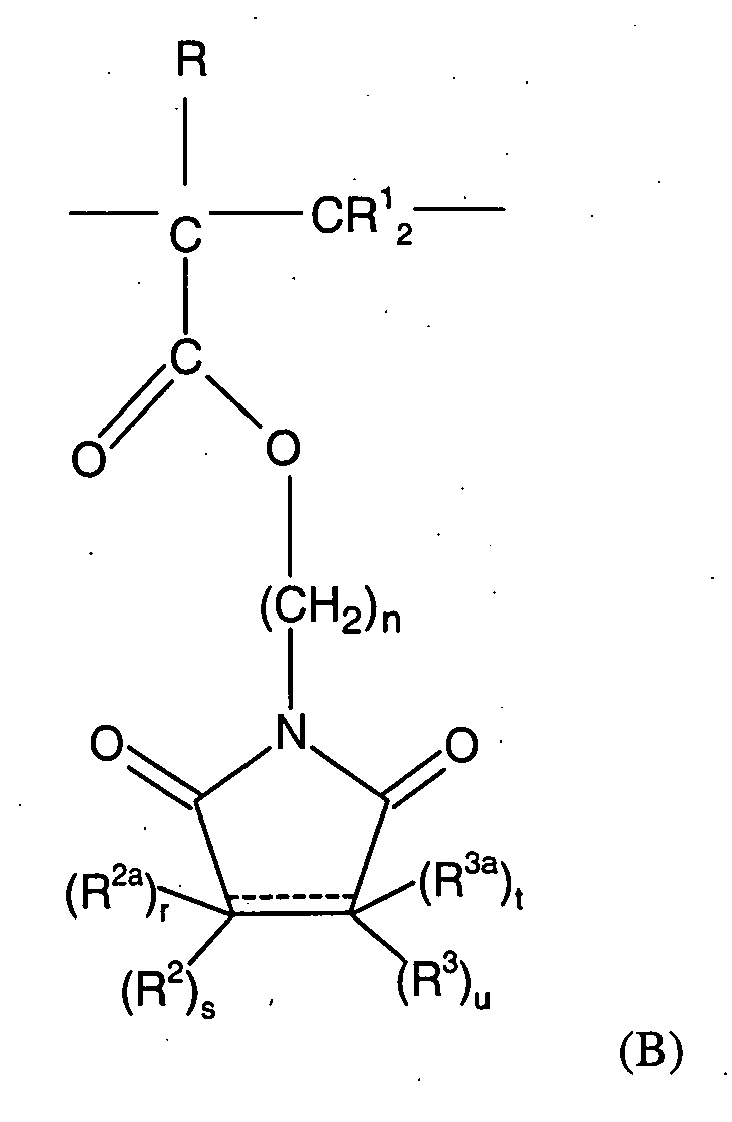

each R and each R1 is independently selected from hydrogen, alkyl, aryl, halogen and -CN, X is a spacer,
each R' is independently selected from hydrogen, alkyl and aryl,
n is 0 or 1 and
R2a, R2, R3a and R3 are independently selected from hydrogen and alkyl, or
R2 and R3 or R2a and R3a, together with the two C-atoms to which they are bonded, form an aryl group, a hetereoaryl group or an unsaturated or saturated carbocyclic or heterocyclic group;
r, s, t and u are each 0 or 1, with the proviso that one of r and s is 0 if the C-atom to which R2 and R2a are bonded is part of a C-C double bond, and with the proviso that one of t and u is 0 if the C-atom to which R3 and R3a are bonded is part of a C-C double bond;
and the dotted line indicates a double bond which may or may not be present. - Unless defined otherwise, the term "alkyl" as used in the present invention refers to a straight-chain or branched saturated hydrocarbon group preferably comprising 1 to 18 carbon atoms, especially preferred 1 to 10 carbon atoms and most preferred 1 to 6 carbon atoms. The alkyl group can optionally comprise one or more substituents (preferably 0 or 1 substituent) selected for example from halogen atoms (fluorine, chlorine, bromine, iodine), CN, NO2, NR'2, COOR' and OR' (R' independently represents a hydrogen atom, or an alkyl group).
- Unless defined otherwise, a saturated carbocyclic group should comprise 5 to 10 ring carbon atoms. Bridged, saturated cyclic hydrocarbons, such as e.g. bicyclic hydrocarbons (a norbomane group would be an example thereof) should be encompassed as well, wherein the bridge can also comprise a heteroatom selected from O, S and N. The carbocyclic group can optionally comprise one or more substituents, e.g. selected from alkyl groups, halogen atoms, -OR', -NR'2 and CN (R' independently represents a hydrogen atom or an alkyl group). If one or more (preferably 1 or 2) ring carbon atoms are replaced with heteroatoms selected from O, S and NR' (R' is hydrogen or alkyl), the group is referred to as a saturated heterocyclic group. If the carbocyclic group contains one or more double bonds without forming an aromatic ring system, it is referred to as an unsaturated carbocyclic group; in this case as well, bridged systems (wherein the bridge optionally comprises a heteroatom selected from O, S and N), such as e.g. a norbornene group, should be encompassed. If a heterocyclic group contains one or more double bonds without forming an aromatic ring system, it is referred to as an unsaturated heterocyclic group; here as well, bridged systems optionally comprising a heteroatom selected from O, S and N in the bridge should be encompassed. Unsaturated carbocyclic groups and saturated and unsaturated heterocyclic groups can optionally comprise one or more substituents, e.g. selected from those mentioned in connection with saturated carbocyclic groups.
- Unless defined otherwise, the term "aryl" as used in the present invention refers to an aromatic carbocyclic group with one or more fused rings, which preferably comprises 5 to 14 carbon atoms. The aryl group can optionally comprise one or more substituents (preferably 0 to 3) selected for example from halogen atoms, alkyl groups, alkoxy groups, CN, NO2 NR'2, COOR' and OR' (wherein each R' is independently selected from hydrogen and alkyl). Preferred examples include a phenyl group and a naphthyl group which can optionally be substituted.
- A heteroaryl group as referred to in the present invention is an aryl group wherein at least 1 (preferably 1 to 3) ring carbon atom is replaced with a heteroatom selected from O, S and N (preferably N); substituents include those mentioned above in connection with aryl.
- A fused ring or ring system as referred to in the present invention is a ring that shares two atoms with the ring to which it is fused; e.g. naphthalene.
- According to the present invention, a coating can consist of one layer or of several layers applied one after the other. It is also possible that only one coating solution is applied but that due to separation processes during drying two layers are formed. A coating comprising several layers is considered "radiation-sensitive" if at least one of the layers is radiation-sensitive.
- The new copolymer used in the present invention comprises a (meth)acryl unit A, an imide unit B and an amide unit C selected from (C-1), (C-2) and (C-3):


each R and each R1 is independently selected from hydrogen, alkyl, aryl, halogen and -CN,
X is a spacer,
each R' is independently selected from hydrogen, alkyl and aryl,
n is 0 or 1 and
R2a, R2, R3a and R3 are independently selected from hydrogen and alkyl, or
R2 and R3 or R2a and R3a, together with the two C-atoms to which they are bonded, form an aryl group, a heteroaryl group or an unsaturated or saturated carbocyclic or heterocyclic group;
r, s, t and u are each 0 or 1, with the proviso that one of r and s is 0 if the C-atom to which R2 and R2a are bonded is part of a C-C double bond, and with the proviso that one of t and u is 0 if the C-atom to which R3 and R3a are bonded is part of a C-C double bond;
and the dotted line indicates a double bond which may or may not be present. - R is preferably hydrogen or an optionally substituted alkyl group, especially preferred hydrogen or a methyl group, and particularly preferred a methyl group.
Each R1 is preferably independently an optionally substituted alkyl group or hydrogen and especially preferred hydrogen.
n is preferably 0.
Preferably, R2 and R3 or R2a and R3a, together with the two C-atoms to which they are bonded, form an aryl group (especially preferred an optionally substituted phenyl group) or an unsaturated or saturated carbocyclic group (preferably with 6 ring atoms). It is especially preferred that the carbocyclic group be monounsaturated and it optionally comprises a bridge optionally containing an O-atom; -CH2- and -O- are preferred bridges. If the carbocyclic ring is monounsaturated, the C-atoms to which R2, R2a, R3 and R3a are bonded are preferably not part of the C-C double bond. If R2 and R3 form a ring, R2a and R3a are preferably both hydrogen; if R2a and R3a form a ring, R2 and R3 are preferably both hydrogen. - If the C-atoms to which R2, R2a, R3 and R3a are bonded are not part of a C-C double bond, preferably one of R2 and R2a and one of R3 and R3a is a hydrogen atom.
- In the unit of formula (C-2), each R' independently represents hydrogen or an optionally substituted alkyl group; preferably no or only one group R' is different from hydrogen.
- X is preferably selected from alkylene, arylene, an optionally unsaturated heterocyclic group, an optionally unsaturated carbocyclic group, a heteroaryl group (wherein each of the above groups is optionally mono- or polysubstituted), a group of formula (1)


- It is especially preferred that X be an alkylene or arylene group, in particular an alkylene , group.
- It is especially preferred that unit A has the following formula (A'):

- It is especially preferred that unit B has the following formula (B')

- It is especially preferred that unit C is at least one of formulas (C-1'), (C-2') and (C-3')

- The monomer unit A is preferably present in the copolymer of the present invention in an amount of 1 to 98 wt.-%, based on the copolymer, more preferred 5 to 60 wt.-%, especially preferred 20 to 40 wt.-%.
- Unit B is preferably present in an amount of 1 to 98 wt.-%, based on the copolymer, more preferred 10 to 90 wt.-%, especially preferred 20 to 80 wt.-%.
- Unit C is preferably present in an amount of 1 to 98 wt.-%, based on the copolymer, more preferred 5 to 60. wt.-% , especially preferred 20 to 40 wt.-%.
- The weight-average molecular weight of the copolymer (determined by means of GPC) is preferably 1,000 to 1,000,000, especially preferred 5,000 to 250,000.
- The copolymer can be prepared by means of common polymerization processes (e.g. solution polymerization, mass polymerization, emulsion and suspension polymerizations) from the monomers M-A and M-B as well as a monomer M-C selected from M-C-1, M-C-2 and M-C-3,


- Methacrylic acid is an especially preferred monomer M-A.
- Especially preferred monomers M-B are those with an N-O bond (i.e. n=0); the following are particularly preferred:


- Especially preferred monomers M-C are those wherein R represents -CH3.
- In addition to the units (A), (B) and (C), the copolymers of the present invention can also comprise other structural units. The amount of optional structural units is preferably 0 to 80 wt.-%, based on the copolymer, more preferred no more than 50 wt.-% and especially preferred no more than 35 wt.-%. According to a preferred embodiment, no further structural units are present in the copolymer in addition to units (A), (B) and (C). Optional structural units are for example those derived from styrene and substituted styrenes, (meth)acrylates, allyl compounds and the like.
- The novel copolymers can be used as binders for UV/VIS sensitive (250 to 750 nm, preferably 300 to 450 nm) elements and for IR-sensitive (more than 750 to 1,200 nm, preferably 800 to 1,100 nm) elements. They can be used both in positive working and in negative working elements. They are preferably used in IR-sensitive elements, and particularly preferred in positive working IR-sensitive elements since those often exhibit the problem of a low resistance to chemicals. The novel copolymers furthermore have the advantage that they are bakeable.
- According to a preferred embodiment, the radiation-sensitive elements are precursors of lithographic printing plates; however, they can also be printed boards for integrated circuits and photomasks. They comprise a substrate (in the case of lithographic printing plate precursors, a substrate with a hydrophilic surface) and a radiation-sensitive coating applied thereon.
- The substrate used for the radiation-sensitive element is preferably a dimensionally stable plate or foil-shaped material. In the production of printing plate precursors, a dimensionally stable plate or foil-shaped material can be used that has already been used as a substrate for printing matter. Examples of such substrates include paper, paper coated with plastic materials (such as polyethylene, polypropylene, polystyrene), a metal plate or foil, such as e.g. aluminum (including aluminum alloys), zinc and copper plates, plastic films made e.g. from cellulose diacetate, cellulose triacetate, cellulose propionate, cellulose acetate, cellulose acetatebutyrate, cellulose nitrate, polyethylene terephthalate, polyethylene, polystyrene, polypropylene, polycarbonate and polyvinyl acetate, and a laminated material made from paper or a plastic film and one of the above-mentioned metals, or a paper/plastic film that has been metallized by vapor deposition. Among these substrates, an aluminum plate or foil is especially preferred since it shows a remarkable degree of dimensional stability, is inexpensive and furthermore exhibits excellent adhesion to the radiation-sensitive coating. Furthermore, a composite film can be used wherein an aluminum foil has been laminated onto a plastic film, such as e.g. a polyethylene terephthalate film, or paper, or a plastic film onto which aluminum has been applied by means of vapor deposition.
- A metal substrate, in particular an aluminum substrate, is preferably subjected to a surface treatment, for example graining by brushing in a dry state or brushing with abrasive suspensions, or electrochemical graining, e.g. by means of a hydrochloric acid electrolyte or HNO3 and optionally anodizing, e.g. in sulfuric acid or phosphoric acid.
- An aluminum foil which preferably has a thickness of 0.1 to 0.7 mm, more preferred 0.15 to 0.5 mm, is an especially preferred substrate. It is preferred that the foil be grained (preferably electrochemically) and then show an average roughness of 0.2 to 1 µm, especially preferred 0.3 to 0.8 µm.
- According to an especially preferred embodiment, the grained aluminum foil was furthermore anodized. The layer weight of the resulting aluminum oxide is preferably 1.5 to 5 g/m2, especially preferred 2 to 4 g/m2.
- Furthermore, in order to improve the hydrophilic properties of the surface of the metal substrate that has been grained and optionally anodized, the metal substrate can be subjected to an aftertreatment with an aqueous solution of e.g. sodium silicate, calcium zirconium fluoride, polyvinylphosphonic acid or phosphoric acid.
- The details of the above-mentioned substrate treatment are well known to the person skilled in the art.
- Negative working coatings are described in numerous references, e.g. UV-sensitive coatings on the basis of negative diazo resins are described in
EP 0 752 430 B1 , photopolymer layers sensitive to 405 nm are described inDE 103 07 451 , photopolymer layers sensitive to VIS are described inEP 0 684 522 B1 and IR-sensitive polymerizable systems are described inDE 199 06 823 2 . - One type of negative working coating applied onto a substrate comprises (a) at least one absorber component selected from photoinitiators and sensitizer/coinitiator systems which absorbs radiation of a wavelength in the range of 250 to 1,200 nm and is capable of initiating a free-radical polymerization and (b) a free-radical polymerizable monomer, oligomer and/or prepolymer; in such coatings, the novel copolymers can be used as the sole polymeric binder or together with other binders.
- The radiation-sensitive coating furthermore comprises at least one absorber component selected from photoinitiators and sensitizer/coinitiator systems.
- The absorber component is selected such that it is capable of significant absorption in the range in which the radiation source to be used later on during imaging emits; preferably, the absorber shows an absorption maximum in that range. Thus, if the radiation-sensitive element is e.g. going to be imaged by means of an IR laser, the absorber should essentially absorb radiation in the range of about 750 to 1,200 nm and preferably show an absorption maximum in that range. On the other hand, if imaging is to be carried out by means of UV/VIS radiation, the absorber should essentially absorb radiation in the range of about 250 to 750 nm and preferably show an absorption maximum in that range. Suitable photoinitiators and/or sensitizers are known to the person skilled in the art, or it can easily be determined whether significant absorption occurs in the desired wave length range by means of simple tests (e.g. recording an absorption spectrum).
- In the present invention, a photoinitiator is a compound capable of absorbing radiation when exposed and of forming free radicals by itself, i.e. without the addition of coinitiators. Examples of suitable photoinitiators absorbing UV or VIS radiation include triazine derivatives with 1 to 3 CX3 groups (wherein every X is independently selected from a chlorine or bromine atom, and is preferably a chlorine atom), hexaarylbisimidazole compounds, benzoin ethers, benzil ketals, oxime ethers, oxime esters, α-hydroxy- or α-amino-acetophenones, acylphosphines, acylphosphine oxides, acylphosphine sulfides, metallocenes, peroxides etc. Examples of suitable triazine derivatives include 2-phenyl-4,6-bis(trichloromethyl)-s-triazine, 2,4,6-tris(trichloromethyl)-s-triazine, 2-methyl-4,6-bis(trichloromethyl)-s-triazine, 2-(styryl-4,6-bis(trichloromethyl)-s-triazine, 2-(p-methoxystyryl)-4,6-bis(trichloromethyl)-s-triazine, 2-(4-methoxy-naphtho-1-yl)-4,6-bis(trichloromethyl)-s-triazine, and 2-(4-ethoxy-naphtho-1-yl)-4,6-bis(trichloromethyl)-s-triazine and 2-[4-(2-ethoxyethyl)-naphtho-1-yl]-4,6-bis(trichloromethyl)-s-triazine. Suitable oxime ethers and oxime esters are for example those derived from benzoin. Preferred metallocenes are for example titanocenes with two five-membered cyclodienyl groups such as e.g. cyclopentadienyl groups and one or two six-membered aromatic groups having at least one ortho-fluorine atom and optionally also one pyrryl group; most preferred metallocenes are bis(cyclopentadienyl)-bis-[2,6-difluoro-3-(pyrr-1-yl)-phenyl]titanium and dicyclopentadiene-bis-2,4,6-trifluorophenyl-titanium or zirconium.
- In the present invention, a single photoinitiator or a mixture of two or more can be used.
- The photoinitiators can be used alone or in combination with one or more coinitiators; the addition of coinitiators can increase the effectiveness of the photoinitiation.
- The amount of photoinitiator(s) is not particularly restricted; however, if photoinitiators are present, it is preferably in the range of 0.2 to 25 wt.-%, based on the dry layer weight, especially preferred 0.5 to 15 wt.-%.
- A sensitizer as referred to in the present invention is a compound which can absorb radiation when it is exposed but which cannot by itself, i.e. without the addition of coinitiators, form free radicals.
- All light-absorbing compounds that are photooxidizable or photoreducible or capable of transferring their excitation energy to receptor molecules are suitable sensitizers for use in the present invention. Examples of such dyes include cyanine dyes, merocyanine dyes, oxonol dyes, diarylmethane dyes, triarylmethane dyes, xanthene dyes, coumarin derivatives, ketocoumarin dyes, acridine dyes, phenazine dyes, quinoxaline dyes, pyrrylium dyes or thiapyrrylium dyes, azaanulene dyes (such as phthalocyanines and porphyrines), indigo dyes, anthraquinone dyes, polyarylenes, polyarylpolyenes, 2,5-diphenylisobenzofuranes, 2,5-diarylfuranes, 2,5-diarylthiofuranes, 2,5-diarylpyrroles, 2,5-diarylcyclopentadienes, polyarylphenylenes, polyaryl-2-pyrazolines, carbonyl compounds such as aromatic ketones or quinones, e.g. benzophenone derivatives, Michler's ketone, thioxanthone derivatives, anthraquinone derivatives and fluorenone derivatives.
- Coumarin sensitizers of formula (I) are for example suitable for the UV range of the electromagnetic spectrum:

R1, R16, R17 and R18 are independently selected from -H, a halogen atom, C1-C20 alkyl, -OH, -O-R4 and -NR5R6, wherein R4 is C1-C20 alkyl, C5-C10 aryl or C6-C30 aralkyl (preferably C1-C6 alkyl) and R5 and R6 are independently selected from a hydrogen atom and C1-C20 alkyl,
or R1 and R16, R16 and R17 or R17 and R18 together form a 5- or 6-membered heterocyclic ring with a heteroatom, selected from N and O, in one or both positions adjacent to the phenyl ring shown in formula (I),
or R16 or R17 forms, together with its two adjacent substituents, a 5- or 6-membered heterocyclic ring with a heteroatom, selected from N and O, in one or both positions adjacent to the phenyl ring shown in formula (I),
wherein each formed 5- or 6-membered heterocyclic ring can independently be substituted with one or more C1-C6 alkyl groups,
with the proviso that at least one of R1, R16, R17 and R18 is different from hydrogen and C1-C20 alkyl,
R2 is a hydrogen atom, C1-C20 alkyl, C5-C10 aryl or C6-C30 aralkyl and
R3 is a hydrogen atom or a substituent selected from
-COOH, -COOR7, -COR8, -CONR9R10, -CN, C5-C10 aryl, C6-C30aralkyl, a 5- or 6-membered heterocyclic optionally benzofused group, a group -CH=CH-R12 and
or R2 and R3, together with the carbon atoms to which they are bonded, form a 5- or 6-membered, optionally aromatic, ring. - They are described in more detail e.g. in
WO 2004/049068 A1 . - Furthermore, bisoxazole derivatives and analogues of the formula (II) are suitable for the UV range

Y and Z independently represent an optionally substituted fused aromatic ring and
V and W are independently selected from O, S and NR, wherein R is an alkyl, aryl or aralkyl group which can optionally be mono- or polysubstituted, as described in more detail inWO 2004/074929 A2 , and oxazole compounds of the formula (III)
wherein R4 and R5 are independently selected from a hydrogen atom, an alkyl, aryl or aralkyl group,
R6 is an optionally substituted alkyl, aryl or aralkyl group or a hydrogen atom, and k, m and n are independently 0 or an integer from 1 to 5, as described in detail inWO 2004/074930 A2 . - The 1,4-dihydropyridine compounds of formula (IV) as described in
WO 2004/111731 A1 are an example of another class of sensitizers suitable for the UV range
R1 is selected from a hydrogen atom, -C(O)OR7, an optionally substituted alkyl group, an optionally substituted aryl group and an optionally substituted aralkyl group,
R2 and R3 are independently selected from optionally substituted alkyl groups, optionally substituted aryl groups, CN and a hydrogen atom,
R4 and R5 are independently selected from -C(O)OR7, -C(O)R7, -C(O)NR8R9 and CN,
or R2 and R4 together form an optionally substituted phenyl ring or a 5- to 7-membered carbocyclic or heterocyclic ring, wherein the unit
or both R2 and R4 as well as R3 and R5 form either optionally substituted phenyl rings or 5- to 7-membered carbocyclic or heterocyclic rings, wherein the unit
or one of the pairs R2/R4 and R3/R5 forms a 5- to 7-membered carbocyclic or heterocyclic ring,
wherein the unit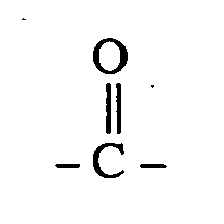
or R2 and R1 or R3 and R1 form a 5- to 7-membered heterocyclic ring which can optionally comprise one or more substituents and which, in addition to the nitrogen atom it shares with the 1,4-dihydropyridine ring, optionally comprises additional nitrogen atoms, -NR13 groups, -S- or -O-,
R13 is selected from a hydrogen atom, an alkyl group, aryl group and aralkyl group,
R6 is selected from an alkyl group optionally substituted with a halogen atom or a -C(O) group, an optionally substituted aryl group, an optionally substituted aralkyl group, an optionally substituted heterocyclic group and the group
R7 is a hydrogen atom, aryl group, aralkyl group or alkyl group, wherein the alkyl group and the alkyl unit of the aralkyl group optionally comprise one or more C-C double and/or C-C triple bonds,
and R8 and R9 are independently selected from a hydrogen atom, an optionally substituted alkyl group, an optionally substituted aryl group and an optionally substituted aralkyl group. - The sensitizers of formula (V)

and each independently represent an aromatic or heteroaromatic unit,
each R1 and R2 is independently selected from a halogen atom, an alkyl, aryl or aralkyl group, a group -NR4R5 or a group -OR6,
R4, R5 and R6 are independently selected from an alkyl, aryl and aralkyl group and
n is an integer of at least 2 and
k and m independently represent 0 or an integer from 1 to 5,
which are described in more detail inDE 10 2004 051 810 ,
as well as the oligomeric or polymeric compounds of formula (VI) is an aromatic or heteroaromatic unit or a combination of the two so that a conjugated π-system is present between the two groups Z in structure (I),
each Z independently represents a heteroatom connecting the spacer AS and the conjugated system,
each R1 and R2 is independently selected from a halogen atom, an alkyl, aryl, alkylaryl or aralkyl group, a group -NR3R4 and a group -OR5,
each R3, R4 and R5 is independently selected from an alkyl, aryl, alkylaryl and aralkyl group,
a and b independently represent 0 or an integer from 1 to 4,
n has a value of >1 and
AS is an aliphatic spacer,
which are described in more detail inDE 10 2004 055 733 ,
are also suitable sensitizers for UV-sensitive elements. - If the radiation-sensitive elements are to be exposed with VIS laser diodes, the cyanopyridone derivatives described in
WO 03/069411 A1 - For IR-sensitive elements, the sensitizers are for example selected from carbon black, phthalocyanine pigments/dyes and pigments/dyes of the polythiophene, squarylium, thiazolium, croconate, merocyanine, cyanine, indolizine, pyrylium or metaldithiolin classes, especially preferred from the cyanine class. The compounds mentioned in Table 1 of
US 6,326,122 for example are suitable IR absorbers. Further examples can be found inUS 4,327,169 ,US 4,756,993 ,US 5,156,938 ,WO 00/29214 US 6,410,207 andEP 1 176 007 A1 . - According to one embodiment, a cyanine dye of formula (VII)

- each Z1
- independently represents S, O, NRa or C(alkyl)2;
- each R'
- independently represents an alkyl group, an alkylsulfonate group or an alkylammonium group;
- R"
- represents a halogen atom, SRa, ORa, SO2Ra or NRa 2;
- each R'"
- independently represents a hydrogen atom, an alkyl group, -COORa, -ORa, -SRa, -NRa 2 or a halogen atom; R"' can also be a benzofused ring;
- A-
- represents an anion;
- Rb and Rc
- either both represent hydrogen atoms or, together with the carbon atoms to which they are bonded, form a carbocyclic five- or six-membered ring;
- Ra
- represents a hydrogen atom, an alkyl or aryl group;
- If R' represents an alkylsulfonate group, an internal salt can form so that no anion A- is necessary. If R' represents an alkylammonium group, a second counterion is needed which is the same as or different from A-.

- Of the IR dyes of formula (VII), dyes with a symmetrical structure are especially preferred. Examples of especially preferred dyes include:
- 2-[2-[2-Phenylsulfonyl-3-[2-(1,3-dihydro-1,3,3-trimethyl-2H-indole-2-ylidene)-ethylidene]-1-cyclohexene-1-yl]-ethenyl]-1,3,3-trimethyl-3H-indolium chloride,
- 2-[2-[2-thiophenyl-3-[2-(1,3-dihydro-1;3,3-trimethyl-2H-indole-2-ylidene)-ethylidene]-1-cyclohexene-1-yl]-ethenyl]-1,3,3-trimethyl-3H-indolium chloride,
- 2-[2-[2-thiophenyl-3-[2-(1,3-dihydro-1,3,3-trimethyl-2H-indole-2-ylidene)-ethylidene]-1-cyclopentene-1-yl]-ethenyl]-1,3,3-trimethyl-3H-indolium tosylate,
- 2-[2-[2-chloro-3-[2-(1,3-dihydro-1,3,3-trimethyl-2H-benzo[e]-indole-2-ylidene)-ethylidene]-1-cyclohexene-1-yl]-ethenyl]-1,3,3-trimethyl-1H-benzo[e]-indolium tosylate and
- 2-[2-[2-chloro-3-[2-ethyl-(3H-benzthiazole-2-ylidene)-ethylidene]-1-cyclohexene-1-yl]-ethenyl]-3-ethyl-benzthiazolium tosylate.
- The following compounds are also IR absorbers suitable for the present invention:


- In the present invention, one sensitizer or a mixture of two or more can be used.
- The sensitizers are used in combination with one or more coinitiators. Additionally, photoinitiators can be used; however, this is not preferred.
- The amount of sensitizer(s) is not particularly restricted; however, if sensitizers are present, it is preferably in the range of 0.2 to 15 wt.-%, based on the dry layer weight, especially preferred 0.5 to 10 wt.-%. If both photoinitiators and sensitizers are present in the coating, their total amount is preferably 0.5 to 30 wt.-%, based on the dry layer weight, especially preferred 1 to 15 wt.-%.
- A coinitiator as referred to in the present invention is a compound that is essentially unable to absorb when irradiated but forms free radicals together with the radiation-absorbing sensitizers used in the present invention. The coinitiators are for example selected from onium compounds, for example those where the onium cation is selected from iodonium (such as e.g. triaryliodonium salts), sulfonium (such as triarylsulfonium salts), phosphonium, oxylsulfoxonium, oxysulfonium, sulfoxonium, ammonium, diazonium, selenonium, arsenonium and N-substituted N-heterocyclic onium cations wherein N is substituted with an optionally substituted alkyl, alkenyl, alkinyl or aryl; N-arylglycines and derivatives thereof (e.g. N-phenylglycine); aromatic sulfonyl halides; trihalomethylarylsulfones; imides such as N-benzoyloxyphthalimide; diazosulfonates; 9,10-dihydroanthracene derivatives; N-aryl, S-aryl or O-aryl polycarboxylic acids with at least two carboxy groups of which at least one is bonded to the nitrogen, oxygen or sulfur atom of the aryl unit (e.g. aniline diacetic acid and derivatives thereof and other coinitiators described in
US-A-5,629,354 ); hexaarylbiimidazoles; thiol compounds (e.g. mercaptobenzthiazole, mercaptobenzimidazole and mercaptotriazole); 1,3,5-triazine derivatives with 1 to 3 CX3 groups (wherein every X is independently selected from a chlorine or bromine atom, and is preferably a chlorine atom), such as e.g. 2-phenyl-4,6-bis(trichloromethyl)-s-triazine, 2,4,6-tris(trichloromethyl)-s-triazine, 2-methyl-4,6-bis(trichloromethyl)-s-triazine, 2-styryl-4,6-bis(trichloromethyl)-s-triazine, 2-(p-methoxystyryl)-4,6-bis(trichloromethyl)-s-triazine, 2-(4-methoxy-naphtho-1-yl)-4,6-bis(trichloromethyl)-s-triazine, 2-(4-ethoxy-naphtho-1-yl)-4,6-bis(trichloromethyl)-s-triazine and 2-[4-(2-ethoxyethyl)-naphtho-1-yl]-4,6-bis(trichloromethyl)-s-triazine; oxime ethers and oxime esters, such as for example those derived from benzoin; metallocenes (preferably titanocenes, and especially preferred those with two five-membered cyclodienyl groups, such as e.g. cyclopentadienyl groups and one or two six-membered aromatic groups with at least one ortho fluorine atom and optionally also a pyrryl group, such as bis(cyclopentadienyl)-bis-[2,6-difluoro-3-(pyrr-1-yl)-phenyl]titanium and dicyclopentadiene-bis-2,4,6-trifluorophenyl-titanium or zirconium); acylphosphine oxides, diacylphosphine oxides and peroxides (e.g. those listed inEP-A1-1 035 435 as activators of the type of an organic peroxide), α-hydroxy or α-amino acetophenones, acylphosphines, acylphosphinesulfides, carbonyl compounds such as aromatic ketones or quinones, e.g. benzophenone derivatives, Michler's ketone, thioxanthone derivatives, anthraquinone derivatives and fluorenone derivatives. - Suitable 2,2',4,4',5,5'-hexaarylbiimidazoles (in the following simply referred to as hexaarylbiimidazoles) are represented by the following formula (VIII):

- Preferred aryl groups are substituted and unsubstituted phenyl, biphenyl, naphthyl, pyridyl, furyl and thienyl groups. Especially preferred are substituted and unsubstituted phenyl groups, and particularly preferred are halogen-substituted phenyl groups.
- Examples include:
- 2,2'-Bis(bromophenyl)-4,4',5,5'-tetraphenylbiimidazole,
- 2,2'-bis(p-carboxyphenyl)-4,4',5,5"-tetraphenylbiimidazole,
- 2,2'-bis(o-chlorophenyl)-4,4',5,5'-tetrakis(p-methoxyphenyl)-biimidazole,
- 2,2'-bis(p-chlorophenyl)-4,4',5,5'-tetrakis(p-methoxyphenyl)-biimidazole,
- 2,2'-bis(p-cyanophenyl)-4,4'5,5'-tetrakis(p-methoxyphenyl)-biimidazole,
- 2,2'-bis(2,4-dichlorophenyl)-4,4',5,5'-tetraphenylbiimidazole,
- 2,2'-bis(2,4-dimethoxyphenyl)-4,4',5,5'-tetraphenylbiimidazole,
- 2,2'-bis(o-ethoxyphenyl)-4,4',5,5'-tetraphenylbiimidazole,
- 2,2'-bis(m-fluorophenyl)-4,4',5,5'-tetraphenylbiimidazole,
- 2,2'-bis(o-fluorophenyl)-4,4',5,5'-tetraphenylbiimidazole,
- 2,2'-bis(p-fluorophenyl)-4,4',5,5'-tetraphenylbiimidazole,
- 2,2'-bis(o-hexoxyphenyl)-4,4',5,5'-tetraphenylbiimidazole,
- 2,2'-bis(o-hexylphenyl)-4,4',5,5'-tetrakis(p-methoxyphenyl)-biimidazole,
- 2,2'-bis(3,4-methylenedioxyphenyl)-4,4',5,5'-tetraphenylbiimidazole,
- 2,2'-bis(o-chlorophenyl)-4,4',5,5'-tetrakis(m-methoxyphenyl)biimidazole,
- 2,2'-bis(o-chlorophenyl)-4,4',5,5'-tetrakis[m-(betaphenoxy-ethoxyphenyl)]biimidazole,
- 2,2'-bis(2,6-dichlorophenyl)-4,4',5,5'-tetraphenylbiimidazole,
- 2,2'-bis(o-methoxyphenyl)-4,4',5,5'-tetraphenylbiimidazole,
- 2,2'-bis(p-methoxyphenyl)-4,4'-bis(o-methoxyphenyl)-5,5'-diphenylbiimidazole,
- 2,2'-bis(o-nitrophenyl)-4,4',5,5'-tetraphenylbiimidazole,
- 2,2'-bis(p-phenylsulfonylphenyl)-4,4',5,5'-tetraphenyl-biimidazole,
- 2,2'-bis(p-sulfamoylphenyl)-4,4',5,5'-tetraphenylbiimidazole,
- 2,2'-bis(2,4,5-trimethylphenyl)-4,4',5,5'-tetraphenylbiimidazole,
- 2,2'-di-4-biphenylyl-4,4',5,5'-tetraphenylbiimidazole,
- 2,2'-di-1-naphthyl-4,4',5,5'-tetrakis(p-methoxyphenyl)-biimidazole,
- 2,2'-di-9-phenanthryl-4,4',5,5'-tetrakis(p-methoxyphenyl)-biimidazole,
- 2,2'-diphenyl-4,4',5,5'-tetra-4-biphenylylbiimidazole,
- 2,2'-diphenyl-4,4',5,5'-tetra-2,4-xylylbiimidazole,
- 2,2'-di-3-pyridyl-4,4',5,5'-tetraphenylbiimidazole,
- 2,2'-di-3-thienyl-4,4',5,5'-tetraphenylbiimidazole,
- 2,2'-di-o-tolyl-4,4',5,5'-tetraphenylbiimidazole,
- 2,2'-di-p-tolyl-4,4'-di-o-tolyl-5,5'-diphenylbiimidazole,
- 2,2'-di-2,4-xylyl-4,4',5,5'-tetraphenylbiimidazole,
- 2,2',4,4',5,5'-hexakis(p-benylthiophenyl)biimidazole,
- 2,2',4,4',5,5'-hexa-1-naphthylbiimidazole,
- 2,2',4,4',5,5'-hexaphenylbiimidazole,
- 2,2'-bis(2-nitro-5-methoxyphenyl)-4,4',5,5'-tetraphenylbiimidazole,
- 2,2'-bis(o-nitrophenyl)-4,4',5,5'-tetrakis(m-methoxyphenyl)biimidazole, and
- 2,2'-bis(2-chloro-5-sulfophenyl)-4,4',5,5'-tetraphenylbiimidazole,
- 2,2'-bis(o-chlorophenyl)-4,4',5,5'-tetraphenylbiimidazole,
- 2,2'-bis(o-chlorophenyl)-4,4',5,5'-tetra(p-fluorophenyl)biimidazole,
- 2,2'-bis(o-bromophenyl)-4,4',5,5'-tetra(p-iodophenyl)biimidazole,
- 2,2'-bis(o-chlorophenyl)-4,4',5,5'-tetra(p-chloronaphthyl)biimidazole,
- 2,2'-bis(o-chlorophenyl)-4,4',5,5'-tetra(p-chlorophenyl)biimidazole,
- 2,2'-bis(o-bromophenyl)-4,4',5,5'-tetra(p-chloro-p-methoxyphenyl)biimidazole,
- 2,2'-bis(o-chlorophenyl)-4,4',5,5'-tetra(o,p-dichlorophenyl)biimidazole,
- 2,2'-bis(o-chlorophenyl)-4,4',5,5'-tetra(o,p-dibromophenyl)biimidazole,
- 2,2'-bis(o-bromophenyl)-4,4',5,5'-tetra(o,p-dichlorophenyl)biimidazole or
- 2,2'-bis(o,p-dichlorophenyl)-4,4',5,5',-tetra(o,p-dichlorophenyl)biimidazole;
- Suitable hexaarylbiimidazoles can be prepared according to known methods (see e.g.
US-A-3,445,232 ). A preferred process is the oxidative dimerization of corresponding triarylimidazoles with iron-(III)-hexacyanoferrate (II) in an alkali solution. - It is irrelevant for the purposes of the present invention which hexaarylbiimidazole isomer (or mixture of isomers) is used (e.g. 1,2'-, 1,1'-, 1,4'; 2,2'-, 2,4'- and 4,4'-isomer), as long as it is photodissociable and provides triarylimidazolyl free radicals in the process.
- The trihalogenmethyl compounds suitable as coinitiators are capable of forming free radicals. Trihalogenmethyl-,substituted triazines and trihalogenmethyl-arylsulfones are preferred. The following can be mentioned as examples (without restricting the invention to these compounds):
- 2-(4-Methoxyphenyl)-4,6-bis(trichloromethyl)-s-triazine,
- 2-(4-chlorophenyl)-4,6-bis-(trichloromethyl)-s-triazine,
- 2-phenyl-4,6-bis(trichloromethyl)-s-triazine,
- 2,4,6-tris-(trichloromethyl)-s-triazine,
- 2,4,6-tris-(tribromomethyl)-s-triazine and
- Many coinitiators can also function as photoinitiators when they are exposed in their absorption band. This way, photosensitive layers can be obtained that are e.g. sensitive over a wide spectral range because a photoinitiator or sensitizer covers the long-wavelength spectral range (IR and/or visible range) and a coinitiator covers the short-wavelength spectral range (e.g. the UV range). This effect can be advantageous if the consumer wants to irradiate the same material with different radiation sources. In this case, the coinitiator functions as an actual coinitiator in the sense of the definition given above for the IR or visible range, while it functions as a photoinitiator for the UV range.
- In the present invention, one coinitiator or a mixture of coinitiators can be used.
- The amount of coinitiator(s) is not particularly restricted; however, it is preferably in the range of 0.2. to 25 wt.-%, based on the dry layer weight, especially preferred 0.5 to 15 wt.-%.
- Further examples of suitable sensitizers and coinitiators for IR-sensitive coatings are also mentioned in
WO 2004/041544 ,WO 2000/48836 DE 10 2004 003143 . - All monomers, oligomers and polymers which comprise at least one C-C double bond can be used as free-radical polymerizable monomers, oligomers and polymers. Monomers/oligomers/polymers with C-C triple bonds can also be used, but they are not preferred. Suitable compounds are well known to the person skilled in the art and can be used in the present invention without any particular limitations. Esters of acrylic and methacrylic acids, itaconic acid, crotonic and isocrotonic acid, maleic acid and fumaric acid with one or more unsaturated groups in the form of monomers, oligomers or prepolymers are preferred. They may be present in solid or liquid form, with solid and highly viscous forms being preferred. Compounds suitable as monomers include for instance trimethylol propane triacrylate and trimethacrylate, pentaerythritol triacrylate and trimethacrylate, dipentaerythritolmonohydroxy pentaacrylate and pentamethacrylate, dipentaerythritol hexaacrylate and hexamethacrylate, pentaerythritol tetraacrylate and tetramethacrylate, ditrimethylol propane tetraacrylate and tetramethacrylate, diethyleneglycol diacrylate and dimethacrylate, triethyleneglycol diacrylate and dimethacrylate or tetraethyleneglycol diacrylate and dimethacrylate. Suitable oligomers and/or prepolymers are for example urethane acrylates and methacrylates, epoxide acrylates and methacrylates, polyester acrylates and methacrylates, polyether acrylates and methacrylates or unsaturated polyester resins.
- In addition to monomers and/or oligomers, use can also be made of polymers comprising free-radical polymerizable C-C double bonds in the main or side chains. Examples thereof include reaction products of maleic acid anhydride copolymers and hydroxyalkyl(meth)acrylates (cf. e.g.
DE 4 311 738 C1 ); (meth)acrylic acid polymers, partially or fully esterified with allyl alcohol (cf. e.g.DE 3 332 640 A1 ); reaction products of polymeric polyalcohols and isocyanatoalkyl(meth)acrylates; unsaturated polyesters; (meth)acrylate-terminated polystyrenes, poly(meth)acrylic acid ester, poly(meth)acrylic acids, poly(meth)acrylamides; (meth)acrylic acid polymers, partially or fully esterified with epoxides comprising free-radical polymerizable groups; and polymers with allyl side-groups which can for example be obtained by polymerization of allyl(meth)acrylate, optionally with further comonomers. - Free-radical polymerizable compounds that can be used in the present invention also include compounds that have a molecular weight of 3,000 or less and are reaction products obtained by reacting a diisocyanate with (i) an ethylenically unsaturated compound with one hydroxy group, and at the same time (ii) a saturated organic compound with one NH group and one OH group, wherein the reactants are used in amounts according to the following condition:
- Number of moles of isocyanate groups ≤ number of moles of OH plus NH groups.
- Examples of diisocyanates are represented by the following formula:
O = C = N -(CR9 2)a-D -(CR9 2)b- N = C = O (IX)
wherein a and b independently represent 0 or an integer from 1 to 3, each R9 is independently selected from H and C1-C3 alkyl and D is a saturated or unsaturated spacer which can optionally comprise further substituents in addition to the two isocyanate groups. D can be a chain-shaped or a ring-shaped unit. As used in the present invention, the term "diisocyanate" refers to an organic compound comprising two isocyanate groups but no OH groups and no secondary and primary amino groups. - D can for example be an alkylene group (CH2)w, wherein w is an integer from 1 to 12, preferably 1 to 6, and one or more hydrogen atoms are optionally replaced with substituents such as e.g. alkyl groups (preferably C1-C6), a cycloalkylene group, an arylene group or a saturated or unsaturated heterocyclic group.
- The ethylenically unsaturated compound (i), which comprises a hydroxy group, comprises at least one non-aromatic C-C double bond, which is preferably terminal. The hydroxy group is preferably not bonded to a doubly bonded carbon atom; the hydroxy group is not part of a carboxy group. In addition to the one OH group, the ethylenically unsaturated compound (i) does not comprise any further functional groups, such as e.g. NH, which can react with the isocyanate.
- Hydroxy(C1-C12)alkyl(meth)acrylates (e.g. 2-hydroxyethyl(meth)acrylate, 2- or 3-hydroxypropyl(meth)acrylate, 2-, 3- or 4-hydroxybutyl(meth)acrylate), hydroxy(C1-C12)alkyl(meth)acrylamides (e.g. 2-hydroxyethyl(meth)acrylamide, 2- or 3-hydroxypropyl(meth)acrylamide, 2-, 3- or 4-hydroxybutyl(meth)acrylamide), mono(meth)acrylates of oligomeric or polymeric ethylene glycols or propylene glycols (e.g. polyethylene glycol mono(meth)acrylate, triethylene glycol mono(meth)acrylate), allyl alcohol, pentaerythritol tri(meth)acrylate, 4-hydroxy(C1-C12)alkylstyrene (e.g. 4-hydroxymethylstyrene), 4-hydroxystyrene, hydroxycyclohexyl(meth)acrylate.
The term "(meth)acrylate" as used in the present invention indicates that both methacrylate and acrylate etc. are meant. - The saturated organic compound (ii) is a compound with one OH and one NH group.
- The saturated organic compound (ii) can for example be represented by the following formula (X) or (XI)

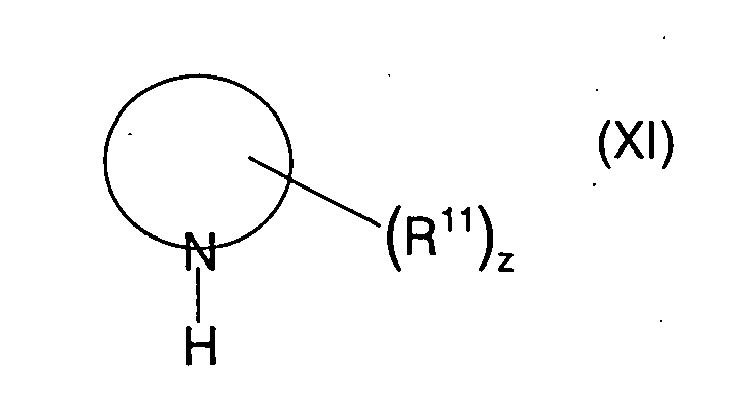
E is a straight-chain (preferably C1-C6, especially preferred C1-C2), branched (preferably C3-C12, especially preferred C3-C6) or cyclic (preferably C3-C8, especially preferred C5-C6) alkylene group,
R11 is OH or a straight-chain, branched or cyclic alkyl group substituted with an OH group, and z = 0 if the heterocyclic ring comprises NR12 and R12 is an alkyl group substituted with OH and z = 1 if the saturated heterocyclic ring does not comprise NR12 or if the saturated heterocyclic ring comprises NR12 and R12 is an unsubstituted alkyl group. - The number of moles of isocyanate groups must not exceed the number of moles of OH groups and NH groups combined since the product should not comprise any more free isocyanate groups.
- Additional suitable C-C unsaturated free-radical polymerizable compounds are described e.g. in
EP 1 176 007 A2 . - It is of course possible to use different kinds of monomers, oligomers or polymers in the mixture; furthermore, mixtures of monomers and oligomers and/or polymers can be used in the present invention, as well as mixtures of oligomers and polymers.
- The free-radical polymerizable component is preferably used in an amount of 5 to 95 wt.-%, based on the dry layer weight, especially preferred 10 to 85 wt.-%.
- The novel copolymers can be used as binders in photopolymerizable systems (UV/VIS or IR-sensitive).
- If the novel copolymers are used as the sole binder, they are preferably present in an amount of 5 to 95 wt.-%, based on the dry layer weight, especially preferred 10 to 85 wt.-%.
- However, the novel copolymers can also be used in admixture with other polymers/copolymers soluble or dispersible in aqueous alkaline developer, such as e.g. phenolic resins such as novolaks and resols, and copolymers of (meth)acrylic acid, N-phenylmaleiinide and (meth)acrylamide (see
DE 199 36 331 ). The total amount of binders is then preferably 5 to 95 wt.-%, based on the dry layer weight, especially preferred 10 to 85 wt.-%. The amount of novel copolymers preferably accounts for 5 to 95% of the total amount of binders, especially preferred 10 to 85 wt.-%. - Another type of negative working UV-sensitive coating - applied onto a substrate - comprises a diazonium polycondensation product; here as well, the novel polymers can be used as the sole binder or together with other binders.
- Diazonium polycondensation products known to the person skilled in the art can be used as diazonium polycondensation product. Such condensation products can for example be prepared according to known methods by condensing a diazo monomer described in
EP-A-0 104 863 with a condensation agent such as formaldehyde, acetaldehyde, propionaldehyde, butyraldehyde, isobutyraldehyde or benzaldehyde. Furthermore, co-condensation products are used which in addition to the diazonium salt units also comprise other units which are not photosensitive and are derived from condensable compounds, in particular aromatic amines, phenols, phenol ethers, aromatic thiolethers, aromatic hydrocarbons, aromatic heterocycles and organic acid amides. Especially advantageous examples of the diazonium polycondensation products include reaction products of diphenylamine-4-diazonium salts, which optionally contain a methoxy group in the phenyl group carrying the diazo group, and formaldehyde or 4,4'-bismethoxymethyldiphenylether. Aromatic sulfonates such as 4-tolylsulfonate or mesitylene sulfonate, tetrafluoroborate, hexafluorophosphate, hexafluoroantimonate and hexafluoroarsenate are especially suitable as anions of these diazo resins. The diazonium polycondensation product is preferably present in an amount of 3 to 60 wt.-% in the photosensitive composition. - Hybrid systems of diazonium polycondensation products and the above-mentioned UV-sensitive free-radical polymerizable system can also be used as binders in the negative working radiation-sensitive coating together with the novel copolymers.
- In this type of negative working UV-sensitive coating, the novel copolymer as the sole binder is preferably present in an amount of 5 to 95 wt.-%, based on the dry layer weight, especially preferred 10 to 85 wt.-%.
- However, the novel copolymers can also be used in admixture with other polymers/copolymers soluble or dispersible in aqueous alkaline developer, such as e.g. phenolic resins such as novolaks and resols, and copolymers of (meth)acrylic acid, N-phenylmaleimide and (meth)acrylamide (see
DE 199 36 331 ). The total amount of binders is then preferably 5 to 95 wt.-%, based on the dry layer weight, especially preferred 10 to 85 wt.-%. The amount of novel copolymers preferably accounts for 5 to 95% of the total amount of binders, especially preferred 10 to 85%. - The novel copolymer can also be used as binder in the production of another type of negative working single-layer IR-sensitive elements wherein the radiation-sensitive layer on a substrate is rendered insoluble in or impenetrable by aqueous alkaline developer upon IR irradiation and comprises
- (i) at least one compound which forms an acid upon the application of heat (in the following also referred to as "latent Bronsted acid"), and
- (ii) a component cross-linkable by an acid (in the following also referred to as "cross-linking agent") or a mixture thereof and
- (iii) at least one IR absorber.
- All the sensitizers described above which absorb radiation from the IR range (more than 750 to 1,200 nm) can be used as IR absorbers.
- Ionic and nonionic Bronsted acids can be used as latent Bronsted acid. Examples of ionic latent Bronsted acids include onium salts, in particular iodonium, sulfonium, oxysulfoxonium, oxysulfonium, phosphonium, selenonium, telluronium, diazonium and arsonium salts. Specific examples are diphenyliodonium-hexafluorophosphate, triphenylsulfonium-hexafluoroantimonate, phenylmethyl-ortho-cyanobenzylsulfonium-tri-fluoromethanesulfonate and 2-methoxy-4-aminophenyl-diazonium-hexafluorophosphate.
- Examples of nonionic latent Bronsted acids include RCH2X, RCHX2, RCX3, R(CH2X)2 and R(CH2X)3, wherein X represents Cl, Br, F or CF3SO3 and R is an aromatic, aliphatic or araliphatic group.
- Ionic latent Bronsted acids of the formula
X⊕R1aR1bR1cR1d W⊖
are also suitable, wherein if X represents iodine, R1c and R1d are free electron pairs and R1a and R1b are aryl groups or substituted aryl groups,
if X represents S or Se, R1d is a free electron pair and R1a, R1b, R1c are independently selected from aryl groups, substituted aryl groups, an aliphatic group or substituted aliphatic group,
if X represents P or As, R1d can be an aryl group, substituted aryl group, aliphatic group or substituted aliphatic group, and
wherein W is selected from BF4, CF3SO3, SbF6, CCl3CO2, ClO4, AsF6 or PF6. - C1-C5-alkyl sulfonates, arylsulfonates (e.g. benzoin tosylate, 2-hydroxymethylbenzoin tosylate and 2,6-dinitrobenzyl tosylate) and N-C1-C5-alkyl-sulfonylsulfonamides (e.g. N-methanesulfonyl-p-toluene-sulfonamide and N-methanesulfonyl-2,4-dimethylbenzenesulfonamide) are also suitable.
- Specific suitable onium compounds are for example listed in detail in
US 5,965,319 as formulas (I) to (III). - The latent Bronsted acids are preferably used in an amount of 0.5 to 50 wt.-%, especially preferred 3 to 20 wt.-%, based on the dry layer weight.
- The cross-linking agent can for example be a resin, selected from resols, C1-C5-alkoxymethylmelamines, C1-C5-alkoxymethyl-glycoluril resins, poly(C1-C5-alkoxy-methylstyrenes) and poly(C1-C5-alkoxymethylacrylamides), epoxidized novolak resins and urea resins. In particular, compounds comprising at least 2 groups in a molecule, selected from hydroxymethyl, alkoxymethyl, epoxy and vinylether groups, bonded to an aromatic ring, can be used as cross-linking agents; of those, phenol derivatives with at least 2 groups selected from hydroxymethyl and alkoxymethyl groups, bonded to a benzene ring, 3 to 5 benzene rings and a molecular weight of 1,200 or less, as listed in columns 31 to 37 of
US 5,965,319 , are preferred. - The cross-linking agent is preferably used in an amount of 5 to 90 wt.-%, based on the dry layer weight, especially preferred 10 to 60 wt.-%.
- The novel copolymer can act as the binder in the radiation-sensitive layer. However, optionally one or more additional binder can be present, for example selected from alkali-soluble or dispersible (co)polymers, such as novolaks, acetone pyrogallol resin, polyhydroxystyrenes and hydroxystyrene-N-substituted maleimide-copolymers as listed in
US 5,965,319 as component (C), polymers as mentioned inUS 5,919,601 as binder resins and copolymers as described inDE 199 36 331 . - If the novel copolymers are used as the sole binder, they are preferably present in an amount of 5 to 95 wt.-%, based on the dry layer weight, especially preferred 5 to 60 wt.-%. If they are used in admixture with other polymers/copolymers, their amount in the total amount of binders (preferably 5 to 95 wt.-%, based on the dry layer weight, especially preferred 10 to 85 wt.-%) accounts for preferably 5 to 95 wt.-%, based on the total amount of binders, especially preferred 10 to 85 wt.-%.
- In principle, known IR-sensitive elements with a single-layer structure, as for example described in
US 5,919,601 andWO 00/17711 A1 - Positive working UV-sensitive elements can for example be based on quinone diazides (preferably naphthoquinone diazides) and novolaks, as for example described in
US 4,594,306 . The novel copolymers can be used as binders in such coatings. - If the novel copolymers are used as the sole binder, they are preferably present in an amount of 5 to 95 wt.-%, based on the dry layer weight, especially preferred 10 to 85 wt.-%.
- However, the novel copolymers can also be used in admixture with other polymers/copolymers soluble or dispersible in aqueous alkaline developer, such as e.g. phenolic resins such as novolaks and resols, and copolymers of (meth)acrylic acid, N-phenylmaleimide and (meth)acrylamide (see
DE 199 36 331 ). The total amount of binders is then preferably 5 to 95 wt.-%, based on the dry layer weight, especially preferred 10 to 85 wt.-%. The amount of novel copolymers preferably accounts for 5 to 95% of the total amount of binders, especially preferred 10 to 85%. - There are numerous examples, of positive working IR-sensitive elements, which can be divided into two groups: those with one layer and those with two layers.
- The novel copolymers can also be used as binders in single-layer positive working IR-sensitive elements in order to increase their resistance to chemicals and abrasion resistance. The known single-layer positive working IR-sensitive elements are usually not bakeable so that baking is not an option for improving these properties. The use of the novel copolymers improves resistance even without baking and it can be improved even further by baking. Usually, single-layer positive working IR-sensitive elements comprise
- (a) an optionally pretreated substrate
- (b) a positive working heat-sensitive layer comprising
- (i) at least one polymer soluble in aqueous alkaline developer, such as e.g. a novolak resin,
- (ii) at least one component which reduces the aqueous alkaline developer solubility of the developer soluble polymer (e.g. novolak), wherein said reduction in solubility is reversed upon the application of heat ("insolubilizer"), and
- (iii) optionally an IR absorber (i.e. a compound which absorbs IR radiation and converts it to heat),
- Polymers with hydroxyl, carboxylic acid, amino, amide and maleimide groups can for example be used as polymers soluble in aqueous alkaline developer. In particular, these compounds include phenolic resins, copolymers of 4-hydroxystyrene and 3-Methyl-4-hydroxystyrene or 4-methoxystyrene, copolymers of (meth)acrylic acid and styrene, copolymers of maleimides and styrene, hydroxy- or carboxy-functionalized celluloses, copolymers of maleic acid anhydride and styrene and partially hydrolyzed polymers of maleic acid anhydride. Phenolic acids, in particular novolak, are especially preferred.
- Suitable novolak resins are condensation products of phenols, e.g. phenol itself, C-alkyl-substituted phenols (including cresols, xylenols, p-tert-butylphenol, p-phenylphenol and nonyl phenols) and diphenols (e.g. bisphenol-A), with suitable aldehydes such as formaldehyde, acetaldehyde, propionaldehyde, and furfuraldehyde. The type of catalyst and the molar ratio of the reactants determine the molecular structure and thus the physical properties of the resin. An aldehyde/phenol ratio of about 0.5:1 to 1:1, preferably 0.5:1 to 0.8:1, and an acid catalyst are used in order to produce those phenolic resins known as "novolaks" and having a thermoplastic character. However, as used in the present application, the term "novolak resin" should also encompass the phenolic resins known as "resols" which are obtained at higher aldehyde/phenol ratios and in the presence of alkaline catalysts.
- Based on the dry layer weight, the novolak resin is preferably present in an amount of at least 40 wt.-%, more preferred at least 50 wt.-%, even more preferred at least 70 wt.-% and particularly preferred at least 80 wt.-%. Usually, the amount does not exceed 95 wt.-%, more preferred 85 wt.-%.
- The chemical structure of the IR absorber is not particularly restricted as long as it is capable of converting the absorbed radiation into heat. The IR absorbers mentioned above in connection with photopolymerizable IR-sensitive elements can be used. The IR absorber is preferably present in an amount of at least 0.1 1 wt.-% based on the dry layer weight, more preferred at least 1 wt.-%, and particularly preferred at least 2 wt.-%. Usually, the amount of IR absorber does not exceed 25 wt.-%, more preferred 20 wt.-% and particularly preferred 15 wt.-%. Either a single IR absorber or a mixture of two or more can be present; in the latter case, the amounts given refer to the total amount of all IR absorbers.
- The amount of IR absorber to be used also has to be considered in view of the dry layer thickness of the coating. It should preferably be selected such that the optical density of the coating - measured for example on a transparent polyester film - preferably shows values between 0.4 and 1.0 at the wavelength of the IR light with which the coating is irradiated.
- The IR-sensitive coating furthermore comprises at least one substance that reduces the aqueous alkaline developer solubility of the polymer like novolak, whereby this reduction in solubility is reversed by the application of heat. In the following, this substance is briefly referred to as "insolubilizer". The insolubilizer may or may not be covalently bonded to a polymer.
- Use can be made of insolubilizers already described in the prior art or of different ones.
- Suitable insolubilizers include for example the compounds described in
WO 98/42507 EP-A 0 823 327 which are not photosensitive and comprise functional groups that can enter into a hydrogen bond with the phenolic OH groups of novolak resins.WO 98/42507 - In
WO 99/01795 - The insolubilizers described in
WO 99/01796 - Another group of insolubilizers suitable for use in the present invention is described in
WO 97/39894 - If the IR absorbers comprise the structural elements mentioned in
WO 97/39894 - The functionalized novolaks described in
US 6,320,018 B can be used in the heat-sensitive elements of the present invention as well. These novolaks contain substituents which allow a two- or four-center hydrogen bond (preferably a four-center hydrogen bond, also named quadrupol hydrogen bonding QHB) between the polymer molecules. This also decreases the aqueous alkaline developer solubility of the underlying novolak. Such hydrogen bonds are broken by heating and the original solubility of the novolak is restored. If such a functionalized novolak is used, it assumes the function of components (i) and (ii) of the heat-sensitive composition so that the additional use of a novolak without corresponding functional groups and/or an insolubilizer as described above is not necessary, but not excluded, either. - The functionalized novolaks comprise at least one covalently bonded unit and at least one non-covalently bonded unit, with the non-covalent bond being thermally unstable; these novolaks have a two- or four-center hydrogen bond at essentially every non-covalently bonded unit. A preferred group of such functionalized novolaks which can be used as novolak with a simultaneous insolubilizing function can be described with the following formula (XII):

- The preparation of functionalized novolaks of formula (XII) can e.g. be inferred from
US 2002/0,150,833 A1 . - Another class of suitable functionalized resins, such as e.g. functionalized phenolic resins and in particular functionalized novolaks, is disclosed in
US 6,537,735 B . While the non-functionalized resin is soluble in aqueous alkaline developer, the functionalized resin is insoluble in the developer; however, the application of heat (for example generated by IR radiation) renders it soluble in the developer. Preferably, the non-functionalized resin comprises OH or SH groups which in the functionalized resin are at least partially converted to covalently bonded functional groups Q; preferably, the functional groups Q are formed via an esterification reaction of the OH groups and are preferably selected from -O-SO2-tolyl, -O-dansyl, -O-SO2-thienyl, -O-SO2-naphthyl and -O-CO-phenyl. The ratio of functional groups Q to OH groups is preferably 1:100 to 1:2, more preferred 1:50 to 1:3. The novolak resins, resols, acrylic resins with phenolic side chains and hydroxystyrenes described above can for example be used as non-functionalized resins. An especially preferred functionalized resin of this class is a phenolic resin (preferably a novolak), partially (e.g. 10 to 20%) esterified with toluenesulfonic acid or sulfonic acid chloride; however, all the other functionalized resins described inUS 6,537,735 can be used in the present invention as well. - Although all the insolubilizers mentioned above can be used in the heat-sensitive coating of the present invention, the following are preferred: Cyanine dyes, triarylmethane dyes, quinolinium compounds, the above insolubilizers with (a) keto group(s) and the above insolubilizers with (a) sulfone group(s), as well as novolaks functionalized with substituents capable of forming four-center hydrogen bonds. The cyanine dyes, triarylmethane dyes, quinolinium compounds, ketones and sulfones can be used as low-molecular substances or bonded to a polymer.
- A single insolubilizer or mixtures of two or more compounds can be used in the heat-sensitive elements of the present invention.
- The amount of insolubilizer(s) is not particularly restricted as long as it reduces the aqueous alkaline developer solubility of the novolak. However, the solubility reduction has to take place to such an extent that when an aqueous alkaline developer is used, the heated areas of the coating are removed considerably faster than the non-heated areas.
- Independently of whether the insolubilizer also functions as IR absorber, it is preferably present in an amount of at least 0.1 wt.-% based on the dry layer weight, more preferred at least 0.5 wt.-%, especially preferred at least 1 wt.-% and particularly preferred at least 2 wt.-%. Preferably, no more than 25 wt.-%, more preferred no more than 15 wt.-%, are used.
- If the novel copolymers are used as the sole binder, they are preferably present in an amount of 1 to 99 wt.-%, based on the dry layer weight, especially preferred 10 to 98 wt.-%.
- However, the novel copolymers can also be used in admixture with other polymers/copolymers soluble or dispersible in aqueous alkaline developer, such as e.g. phenolic resins such as novolaks and resols, and copolymers of (meth)acrylic acid, N-phenylmaleimide and (meth)acrylamide (see
DE 199 36 331 ). The total amount of binders is then preferably 1 to 99 wt.-%, based on the dry layer weight, especially preferred 10 to 98 wt.-%. The amount of novel copolymers preferably accounts for 5 to 95% of the total amount of binders. - It has been shown that at least some of the copolymers of the present invention can also be used as the sole polymers in IR-sensitive single-layer elements; i.e. the positive working heat-sensitive layer does not comprise a novolak or the like as a component that interacts with an insolubilizer, but it only comprises, in addition to optional coating components, (a) at least one copolymer according to the present invention, (b) an insolubilizer and optionally (c) an IR absorber, whereby it is also possible to use an IR absorber which acts as an insolubilizer at the same time.
- Layers consisting of an IR absorber and the copolymer according to the present invention (and possibly optional additives) are imageable in particular if the unit (C) of the copolymer is a unit of formula (C-2), such as e.g. ureylmethacrylate.
- They can also be positive working dual-layer elements wherein a first layer is provided on the hydrophilic surface of the substrate which is soluble in aqueous alkaline developer and a top layer ("masking layer") on top of the first layer which is not dispersible or soluble in and not penetrable by an aqueous alkaline developer, and which is rendered soluble or dispersible in or penetrable by the developer by IR irradiation.
- The novel copolymers are suitable as binders for the first ("lower") layer of such dual-layer positive working IR-sensitive elements; they can be used as the sole binder or in admixture with other polymers/copolymers soluble or dispersible in aqueous alkaline developer, such as e.g. phenolic resins such as novolaks and resols, and copolymers of (meth)acrylic acid, N-phenylmaleimide and (meth)acrylamide (see
DE 199 36 331 ). - If the novel copolymers are used as the sole binder, they are preferably present in an amount of 5 to 99 wt.-%, based on the dry layer weight, especially preferred 10 to 98 wt.-%. If they are used in admixture with other binders, their amount preferably accounts for 5 to 95% of the total amount of binders.
- An IR absorber ("photothermal conversion material") is present in the first layer, or the top layer or in both layers; it can also be present in a separate "absorber layer". Preferably the IR absorber is present in the first layer.
- The chemical structure of the IR absorber is not particularly restricted as long as it is capable of converting the absorbed IR radiation into heat. The IR absorbers mentioned above in connection with photopolymerizable IR-sensitive elements can be used. The IR absorber is preferably present in an amount of at least 1 wt.-% based on the dry layer weight of the layer in which it is present, more preferred at least 2 wt.-%, and particularly preferred at least 5 wt.-%. Usually, the amount of IR absorber does not exceed 35 wt.-%, more preferred 30 wt.-% and particularly preferred 25 wt.-% of the layer in which it is present. If the IR absorber is only present in the first layer, its amount in said layer is preferably from 10, to 20 wt.-%, based on the dry layer weight of the first layer. Either a single IR absorber or a mixture of two or more can be present; in the latter case, the amounts given refer to the total amount of all IR absorbers present in one layer.
- The top layer protects the first layer from being dissolved by an aqueous alkaline developer. It is therefore necessary that the top layer itself is not soluble or dispersible in or penetrable by an aqueous alkaline developer. By the wording "not soluble in, dispersible in or penetrable by an aqueous alkaline developer", it is meant that the top layer can resist the attack of an aqueous alkaline developer having a pH of at least 8 for at least 2 minutes. However, upon exposure to IR radiation the top layer becomes removable by an aqueous alkaline developer (necessary dwell time: less than 2 minutes).
- Various dual-layer plates are known in the art, however, the mechanisms of change of solubility/dispersibility/penetrability due to exposure to IR radiation are still not fully understood. Such dual-layer systems are for instance described in
US 6,352,812 ,US 6,352,811 ,US 6,358,669 ,US 2002/0,150,833 A1 ,US 6,320,018 ,US 6,537,735 andWO 02/14071 - In principle, the following types of top layers are known:
- a) The top layer comprises a polymer like a novolak which itself is soluble/dispersible in an aqueous alkaline developer and an "insolubilizer" which reduces the solubility/dispersibility to such a high degree that the layer is not soluble or penetrable under developing conditions. The interaction between the polymer and the inhibitor is deemed to be weakened by IR radiation to such a degree that the irradiated (heated) areas of the layer are rendered soluble/dispersible in or penetrable by the developer. Such systems are for example described in
US 6,352,811 andUS 6,358,669 . The polymer/insolubilizer systems can be the same as those described above for single layer plates. - (b) The top layer comprises a polymer like a novolak which as such is soluble/dispersible in an aqueous alkaline developer but which has been chemically modified (for instance by chemically binding an "insolubilizer") so that it is not soluble/dispersible/penetrable by an aqueous alkaline developer. Such functionalized resins (like e.g. functionalized novolaks) are for instance described in
US 2002/0,150,833 A1 ,US 6,320,018 B andUS 6,537,735 B . - The top layer can also comprise a polymer which is not soluble/dispersible in an aqueous alkaline developer at usual developing conditions (i.e. the top layer can resist the attack of a developer for at least 2 minutes).
- It is assumed that either there are any interactions within the top layer which are weakened by IR radiation or microcracks and/or bubbles are formed in the top layer or in the interface between first layer and top layer due to exposure to IR radiation (and the heat created thereby) which allows removal of the initially insoluble/inpenetrable top layer together with the soluble bottom layer by the developer in the exposed areas.
- Polymers and copolymers with phenolic OH groups, i.e. phenolic resins, are preferably used for a top layer of the type (a) as described above. Suitable phenolic resins include e.g. novolaks, resols, acrylic resins with phenolic side chains and polyvinyl phenolic resins, whereby novolaks are especially preferred.
- Novolak resins suitable for the present invention are condensation products of suitable phenols, e.g. phenol itself, C-alkyl-substituted phenols (including cresols, xylenols, p-tert-butylphenol, p-phenylphenol and nonylphenols), and of diphenols (e.g. bisphenol-A), with suitable aldehydes such as formaldehyde, acetaldehyde, propionaldehyde and furfuraldehyde. The type of catalyst and the molar ratio of the reactants determine the molecular structure and thus the physical properties of the resin. An aldehyde/phenol ratio of about 0.5:1 to 1:1, preferably 0.5:1 to 0.8:1, and an acid catalyst are used in order to produce those phenolic resins known as "novolaks" which have a thermoplastic character. As used in the present application, however, the term "novolak resin" should also encompass the phenolic resins known as "resols" which are obtained at higher aldehyde/phenol ratios and in the presence of alkaline catalysts.
- The amount of insolubilizer(s) in a top layer of type (a) above is not particularly restricted as long as it reduces the aqueous alkaline developer solubility of the novolak. However, the solubility reduction has to take place to such an extent that when an aqueous alkaline developer is used, the heated areas of the coating are removed considerably faster than the non-heated areas.
- The insolubilizer is preferably present in an amount of at least 0.1 wt.-% based on the dry layer weight, more preferred at least 0.5 wt.-%, especially preferred at least 2 wt.-% and particularly preferred at least 5 wt.-%. Preferably, no more than 40 wt.-%, more preferred no more than 25 wt.-%, are used.
- Polymers useful for a top layer of type (b) are for instance functionalized novolaks like those of formula (XII) mentioned above and functionalized phenolic resins like those mentioned in
US 6,537,735 B (e.g. tosylated novolaks), see also above under the headline "Single-layer plates". Modified alkylphenol resins (like those commercially available from Schenectady under the trade name SP1077 and HRJ302) as well as novolaks based on xylenol and cresol (like those commercially available from AZ-Electronics under the trade name SPN-572) are also useful for a top layer of type (b). - Independently of whether the element is UV/VIS- or IR-sensitive, the radiation-sensitive coating can comprise one or more of the following optional components in addition to the essential components. If the coating consists of several layers, the optional component can be present in one, several or all of the layers. Dyes or pigments having a high absorption in the visible spectral range can be present in order to increase the contrast ("contrast dyes and pigments"). Particularly suitable dyes and pigments are those that dissolve well in the solvent or solvent mixture used for coating or are easily introduced in the disperse form of a pigment. Suitable contrast dyes include inter alia rhodamine dyes, triarylmethane dyes such as Victoria blue R and Victoria blue BO, crystal violet and methyl violet, anthraquinone pigments, azo pigments and phthalocyanine dyes and/or pigments. The colorants are preferably present in an amount of 0 to 15 wt.-%, more preferred 0.5 to 10 wt.-%; particularly preferred 1.5 to 7 wt.-%, based on the dry layer weight.
- Furthermore, the layer(s) can comprise surfactants (e.g. anionic, cationic, amphoteric or nonionic tensides or mixtures thereof). Suitable examples include fluorine-containing polymers, polymers with ethylene oxide and/or propylene oxide groups, sorbitol-tri-stearate and alkyl-di-(aminoethyl)-glycines. They are preferably present in an amount of 0 to 10 wt.-%, based on the dry layer weight, especially preferred 0.2 to 5 wt.-%.
- The layer(s) can furthermore comprise print-out dyes such as crystal violet lactone or photochromic dyes (e.g. spiropyrans etc.). They are preferably present in an amount of 0 to 15 wt.-%, based on the dry layer weight, especially preferred 0.5 to 5 wt.-%.
- Also, flow improvers can be present in the layer(s), such as poly(glycol)ether-modified siloxanes; they are preferably present in an amount of 0 to 1 wt.-%, based on the dry layer weight.
- The layer(s) can furthermore comprise antioxidants such as e.g. mercapto compounds (2-mercaptobenzimidazole, 2-mercaptobenzthiazole, 2-mercaptobenzoxazole and 3-mercapto-1,2,4-triazole), and triphenylphosphate. They are preferably used in an amount of 0 to 15 wt.-%, based on the dry layer weight, especially preferred 0.5 to 5 wt.-%.
- Other coating additives can of course be present as well.
- The radiation-sensitive composition and optional additional layers can be applied to the surface of the substrate by means of common coating processes, e.g. spin coating, dip coating, spray coating, coating with a slot coater and coating by means of a doctor blade. It is possible to apply the radiation-sensitive composition and further layers on both sides of the substrate; however, it is preferred that the radiation-sensitive coating be only applied to one side of the substrate.
- If the sensitizer absorbs UV/VIS radiation, the thus produced radiation-sensitive elements are image-wise exposed in a manner known to the person skilled in the art with UV/VIS radiation of a wavelength of 250 to 750 nm. For this purpose, common lamps, such as carbon arc lamps, mercury lamps, xenon lamps and metal halide lamps, or lasers or laser diodes can be used. UV laser diodes emitting UV radiation in the range of about 405 nm (e.g. 405 ± 10 nm), argon ion lasers emitting in the visible range (488 nm or 514 nm) and frequency-doubled fd:Nd:YAG lasers emitting at around 532 nm are of particular interest as a radiation source.
- If the sensitizer absorbs IR radiation, i.e. noticeably absorbs radiation of a wavelength in the range of more than 750 to 1,200 nm, and preferably shows an absorption maximum in this range in its absorption spectrum, image-wise exposure can be carried out with IR radiation sources. Suitable radiation sources are e.g. semi-conductor lasers or laser diodes which emit in the range of 750 to 1200 nm, for example Nd:YAG lasers (1,064 nm), laser diodes which emit between 790 and 990 nm, and Ti:sapphire lasers. The laser radiation can be digitally controlled via a computer, i.e. it can be turned on or off so that an image-wise exposure of the plates can be effected via stored digitized information in the computer; this way, so-called computer-to-plate (ctp) printing plates can be obtained. Any image-setters equipped with IR lasers that are known to the person skilled in the art can be used.
- Depending on whether the radiation-sensitive element is positive working or negative working, the irradiated areas or the non-irradiated areas, respectively, are subsequently removed with a developer (preferably an aqueous alkaline developer) so that printing image areas and non-printing background areas are obtained.
- The developed elements are usually treated with a preservative ("gumming"). The preservatives are aqueous solutions of hydrophilic (co)polymers, wetting agents and other known additives.
- For certain applications, it is furthermore advantageous to increase the mechanical strength of the obtained image areas by subjecting them to a heat treatment (what is referred as "baking") and/or overall exposure (e.g. to UV light). For this purpose, prior to the treatment, the imaged plate is treated with a solution that protects the non-image areas such that the heat treatment does not cause these areas to accept ink. A solution suitable for this purpose is e.g. described in
US-A-4,355,096 . Baking usually takes place at a temperature in the range of 150 to 250°C. When both baking and overall exposure are carried out, the two treatment steps can be performed simultaneously or one after the other. - Elements according to the present invention are characterized by an improved resistance to chemicals; the developed printing plates show an excellent abrasion resistance which allows high numbers of copies to be printed.
- Within the framework of the present invention, the term "radiation-sensitive element" also encompasses an element wherein the substrate comprises a radiation-sensitive coating on both sides. However, a one-sided coating is preferred.
- The present invention is described in more details in the following examples.
- The following abbreviations are used:
- DAA
- diacetone alcohol
- BG
- butyl glycol
- DMSO
- dimethylsulfoxide
- TN13
- novolak, partially tosylated
- PD-140
- m/p-cresol novolak with Mw=7,000
- P-3000
- 2,1,5-naphthoquinone diazide
- LB 6564
- cresol/phenol novolak with Mw=7,000
- PD 494
- m/p-cresol novolak with Mw=9,000
- Violet 612
- triphenylmethane dye
- Copolymers were prepared from the monomers listed in Table 1. For polymerization, the monomers were placed in a flask equipped with a stirrer and a nitrogen inlet at 60°C in methylglycol (total monomer concentration: 2.5 mole/1) and 0.1 mole-% azobisisobutyronitrile are added as initiator. The reprecipitation took place in triple the amount of methanol. The resulting copolymers were dried at 50°C for 48 hours.
Table 1 Methacrylic acid [wt.-%] Imide [wt.-%] Imide Amide [wt.-%] Amide VP1 21 PMI 41.6 MAm 37.4 VP2 15 PMI 50 MAm 35 VP3 20 PMI 45 MAm 35 P1 20 M-NHND 50 MAm 30 P2 20 M-NHP 50 MAm 30 P3 20 M-NHMP 50 MAm 30 VP4 20 M-NHEP 50 MAm 30 VP5 20 PMI 50 UMA 30 P5 20 M-NHND 50 UMA 30 P6 25 M-NHND 45 UMA 30 P7 30 M-NHND 45 UMA 25 P8 30 M-NHND 40 UMA 30 P9 35 M-NHND 35 UMA 30 P10 . 40 M-NHND 30 UMA 30 P11 20 M-NHP 50 UMA 30 P12 25 M-NHP 45 UMA 30 P13 30 M-NHP 40 UMA 30 P14 35 M-NHP 35 UMA 30 P15 20 M-NHMP 50 UMA 30 VP6 20 M-NHEP 50 UMA 30 VP7 20 PMI 50 MMAA 30 P17 20 M-NHND 50 MMAA 30 P18 20 M-NHP 50 MMAA 30 P19 25 M-NHP 45 MMAA 30 P20 30 M-NHP 40 MMAA 30 - The resulting copolymers were examined for their chemical and mechanical properties.
- A solution of the various copolymers in a suitable organic solvent (e.g. methylglycol) was applied to a grained and anodized aluminum substrate such that a dry layer weight of about 1.5 g/m2 was obtained.
- The resistance of the coating to diacetone alcohol/H2O (ratio: 80:20) and butylglycol/H2O (ratio: 80:20) was examined as follows:
- The plate samples are subjected to the liquids in 30s increments for up to 8 minutes. The attack on the surface of the coating is evaluated visually.
- The samples are treated for 15 minutes with an aqueous suspension containing an abrasive (25µ Al2O3 particles). Then the abrasion is determined gravimetrically and expressed as a percentage of the original layer weight.
- The results of the tests described above can be inferred from Table 2.
- Furthermore, the properties of the copolymers were examined when a coating prepared therefrom was baked for 8 minutes at 235°C.
- Abrasion resistance was examined as described above.
- Furthermore, the resistance of the coating to DMSO and to a commercial correction fluid (correction fluid 243 from Kodak Polychrome Graphics) was examined. The tests were carried out as follows:
- The plate samples are subjected to the liquids in 30s increments for up to 8 minutes. The attack on the surface of the coating is evaluated visually.
- The results of the tests on baked coatings described above can also be inferred from Table 2.
Table 2 unbaked baked (235°C, 8 min) Polymer DAA / H2O BG / H2O Correction fluid 243 DMSO Loss due to abrasion VP2 2-3 min 4-5 min << 1 min << 1 min 1.46 g/m2 VP3 2-3 min 4-5 min << 1 min << 1 min 1.42 g/m2 P1 >> 4 min >> 4 min >> 8 min >> 8 min 0.71 g/m2 P2 >> 4 min >> 4 min >> 8 min 2 min 0.48 g/m2 P3 >> 4 min >> 4 min 3-4 min 1-2 min 0.56 g/m2 VP4 >> 4 min >> 4 min 3-4 min 1-2 min 0.96 g/m2 VP5 4 min >> 4 min 1-2 min << 1 min 1.17 g/m2 P6 >> 4 min >> 4 min >> 8 min >> 8 min 0.53 g/m2 P10 >> 4min >> 4 min >> 8 min >> 8 min 0.59 g/m2 P11 4 min >> 4 min >> 8 min >> 8 min 0.61 g/m2 P14 >> 4min >> 4 min >> 8 min >> 8 min 0.63 g/m2 P15 3-4 min >> 4 min > 8 min > 8 min 0.76 g/m2 VP6 2-3 min >> 4 min 2-3 min 1-2 min 1.03 g/m2 VP7 0.5 min 0.5 min 2.3 min 1-2 min 1.14 g/m2 P17 >> 4 min >> 4 min >> 8 min >> 8 min 0.90 g/m2 P18 >> 4 min >> 4 min >> 8 min >> 8 min 0.50 g/m2 - Two layers as shown in Table 3 were applied onto an aluminum substrate as described above in order to test the copolymers of the present invention in dual-layer IR-sensitive printing plate precursors.
Table 3 Bottom layer: 15% Trump Dye 85% polymer Top layer: 69.50% PD-140 29.80% P-3000 0.7% ethyl violet - At first, only the bottom layer was applied onto the aluminum substrate and its resistance was examined in an unbaked and a baked state. The results can be inferred from Table 4; the tests were carried out as described above.
Table 4 unbaked baked (235°C, 8 min) Polymer DAA/H2O BG/H2O Correction fluid 243 DMSO Loss due to abrasion VP2 1-2 min 2 min < 1min < 1min 1.0 g/m2 VP3 1-2 min 2 min < 1min < 1min 1.1 g/m2 P1 > 4 min > 4 min > 8 min 4 min 0.64 g/m2 VP5 2 min > 4 min 2-4 min 1 min 1.03 g/m2 P6 2 min > 4 min > 8 min > 8 min 0.60 g/m2 P10 2 min > 4 min > 8 min > 8 min 0.53 g/m2 P11 2 min > 4 min > 8 min > 8 min 0.70 g/m2 P14 2 min >4min > 8 min > 8 min 0.63 g/m2 P15 2-3 min > 4 min > 8 min > 8 min 0.77 g/m2 VP6 1 min > 4 min > 8 min > 8 min 0.91 g/m2 VP7 < 0.5 min 1min 1-2 min < 0.5 min 1.03 g/m2 P17 >> 4 min >> 4 min >> 8 min >> 8 min 0.76 g/m2 P18 < 0.5 min 2 min >> 8 min >> 8 min 0.54 g/m2 - Furthermore, dual-layer precursors were prepared (see Table 3), imagewise exposed with a Creo image-setter (830 nm) and developed using the developer 956 from Kodak Polychrome Graphics. The energy necessary to obtain the same tonal values at 1x1, 2x2 and 4x4 screen points using a UGRA gray scale V 2.0 EPS (i.e. all screen points are of the same lightness or darkness) was measured. The optimal exposure energy values and the optical evaluation of the developed plates are given in Table 5.
Table 5 Polymer in the bottom layer optimal exposure energy Comment VP1 150 mJ plate well developed with clean background P8 200 mJ clean background P13 200 mJ clean background VP7 > 250 mJ slight residue in the background area P10 150 clean background P14 150 clean background - Single-layer IR-sensitive printing plate precursors were prepared from the compositions shown in Table 6 using the substrate described above.
Table 6 Reference Series A Series B LB6564 1.6250 g 1.6250 g 1.0375 g PD494 0.5875 g 0 0.5875.g Polymer 0 0.5875 g 0.5875 g Violet 612 0.0500 g 0.0500 g 0.0500 g Trump Dye 0.0375 g 0.0375 g 0.0375 g - The resistance of the (unbaked) coating to Goldstar developer and an organic solvent (naphtha / isopropanol / water 79:20:1) was examined; the results can be inferred from Table 7.
Table 7 Resistance to Goldstar Solvent resistance Reference 120 s 0 min P1-B 120 s 3-4 min P6-A 180 s >> 4 min P1-B 120 s >> 4 min VP7-A 90 s 2-3 min VP7-B 180 s 2-3 min P17-A > 120 s >> 4 min P17-B >> 180 s >> 4 min *) A and B refers to the series A and B, respectively, of Table 5; VP and P refer to the copolymer used (see Table 1) - A coating with a dry layer weight of 1.7 g/m2 containing 15 wt.-% Trump Dye and 85 wt.-% copolymer (see Table 8) was applied to an aluminum substrate as described above.
- It was examined whether imageable printing plate precursors were obtained whose coating is rendered more soluble upon IR radiation. Table 8 shows when an attack of the coating (in unexposed areas) due to the Goldstar developer could be observed, and how much time was required to obtain a clean background during developing after exposure with 200 mJ; whenever the time difference between the developer resistance before and after exposure was too small, no image could be obtained.
Table 8 Resistance to Goldstar developer Time required for clean background [sec] Exposure energy [Creo Trendsetter] VP1 < 5 s < 5 s no image obtained VP3 < 5 s < 5 s no image obtained P5 120 s 60 s 200 - 300 mJ P6 50 s 40 s 200 mJ P12 40 s 25 s 200 mJ


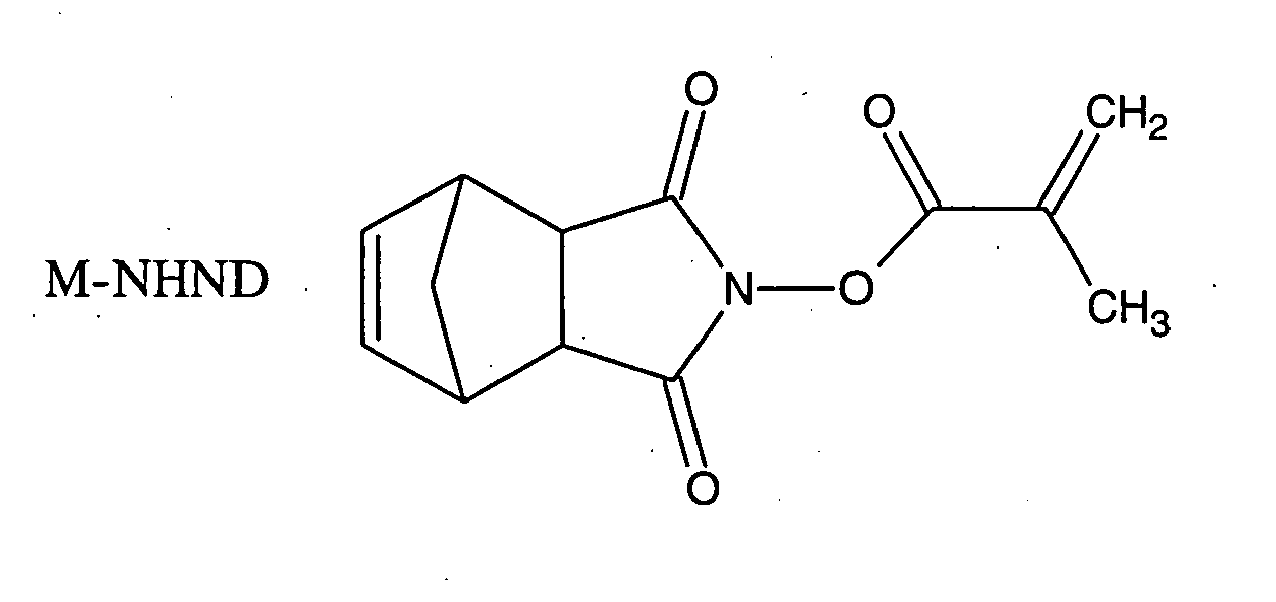


Claims (20)
- Radiation-sensitive element comprising(a) a substrate and(b) a single-layer or multi-layer radiation-sensitive coating comprisinga copolymer soluble or dispersible in aqueous alkaline solution and comprising the units A, B and C, wherein unit A has the following formula


each R and each R1 is independently selected from hydrogen, alkyl, aryl, halogen and -CN,
X is a spacer,
each R' is independently selected from hydrogen, alkyl and aryl,
n is 0 or 1 and
R2a, R2, R3a and R3 are independently selected from hydrogen and alkyl, or
R2 and R3 or R2a and R3a, together with the two C-atoms to which they are bonded, form an aryl group, a hetereoaryl group or an unsaturated or saturated carbocyclic or heterocyclic group;
r, s, t and u are each 0 or 1, with the proviso that one of r and s is 0 if the C-atom to which R2 and R2a are bonded is part of a C-C double bond, and with the proviso that one of t and u is 0 if the C-atom to which R3 and R3a are bonded is part of a C-C double bond;
and the dotted line indicates a double bond which may or may not be present. - Radiation-sensitive element according to claim 1, wherein the radiation-sensitive coating is sensitive to the range of more than 750 to 1,200 nm of the electromagnetic spectrum.
- Radiation-sensitive element according to claim 1, wherein the radiation-sensitive coating is sensitive to the range of 250 to 750 nm of the electromagnetic spectrum.
- Radiation-sensitive element according to any of claims 1 to 3, wherein the radiation-sensitive element is a positive working element.
- Radiation-sensitive element according to any of claims 1 to 3, wherein the radiation-sensitive element is a negative working element.
- Radiation-sensitive element according to claim 5, further comprising an oxygen-impermeable overcoat layer on top of the radiation-sensitive coating.
- Radiation-sensitive element according to any of claims 1 to 6, wherein the copolymer consists of units A, B and C.
- Radiation-sensitive element according to any of claims 1 to 7, wherein unit A has the following formula

and/or unit B has the following formula
and/or
unit C is at least one unit selected from
- Radiation-sensitive element according to any of claims 1 to 8, wherein unit A is derived from methacrylic acid;
and/or
unit B is derived from one or more of the following monomers:

unit C is derived from one or more of the following monomers:

- Radiation-sensitive element according to any of claims 1 to 9, wherein the amount of unit A or, if different units A are present, their total amount, accounts for 5 to 60 wt.-%, based on the copolymer;
and/or the amount of unit B or, if different units B are present, their total amount, accounts for 10 to 90 wt.-%, based on the copolymer;
and/or the amount of unit C or, if different units C are present, their total amount, accounts for 5 to 60 wt.-%, based on the copolymer. - Radiation-sensitive element according to claim 2, wherein in addition to the copolymer the coating comprises: at least one-novolak resin, at least one IR absorber and at least one component which decreases the aqueous alkaline developer solubility of novolak whereby this decrease in solubility is reversed by the application of heat, wherein the at least one IR absorber and the at least one component which decreases the solubility of novolak are the same or different compounds.
- Radiation-sensitive element according to claim 2, wherein the coating comprises a bottom layer and a top layer, wherein the bottom layer comprises the copolymer and the top layer comprises (i) a novolak resin soluble in aqueous alkaline developer and a component which decreases the aqueous alkaline developer solubility of novolak, or (ii) a novolak chemically modified so that it is insoluble in, not dispersible in and not penetrable by an aqueous alkaline developer; and the IR absorber is present in the bottom layer or in the top layer or in both.
- Radiation-sensitive element according to claim 2 or 3, wherein the radiation-sensitive coating is photopolymerizable and, in addition to the copolymer, comprises:(a) an absorber component selected from photoinitiators and sensitizer/coinitiator systems which either absorbs radiation in the range of 250 to 750 nm or radiation in the range of more than 750 nm to 1,200 nm and initiates free-radical polymerization, and(b) a free-radical polymerizable monomer, oligomer or prepolymer, or a mixture of 2 or more thereof.
- Radiation-sensitive element according to claim 3, wherein in addition to the copolymer the radiation-sensitive coating comprises a diazonium polycondensation product.
- Radiation-sensitive element according to claim 2, wherein in addition to the copolymer the radiation-sensitive coating comprises:(a) at least one compound which forms an acid when subjected to IR radiation and(b) at least one component cross-linkable by an acid.
- Radiation-sensitive element according to claim 3, wherein in addition to the copolymer the radiation-sensitive coating comprises one or more novolaks and one or more quinone diazides.
- Radiation-sensitive element according to claim 2, wherein the coating comprises an IR absorber and the copolymer is the-only polymer in the coating.
- Use of a copolymer as defined in any of claims 1 and 7 to 10 for improving the solvent and developer resistance of the radiation-sensitive coating of a radiation-sensitive element.
- Radiation-sensitive composition comprising a radiation-sensitive component and a copolymer as defined in any of claims 1 and 7 to 10.
- Copolymer as defined in any of claims 1 and 7 to 10.
Priority Applications (5)
| Application Number | Priority Date | Filing Date | Title |
|---|---|---|---|
| EP06008510.7A EP1849600B1 (en) | 2006-04-25 | 2006-04-25 | Bakeable radiation-sensitive elements with a high resistance to chemicals |
| CN2007800148191A CN101432139B (en) | 2006-04-25 | 2007-04-12 | Bakeable lithographic plate with a high resistance to chemicals |
| PCT/EP2007/003271 WO2007121871A1 (en) | 2006-04-25 | 2007-04-12 | Bakeable lithographic printing plates with a high resistance to chemicals |
| JP2009506945A JP5059849B2 (en) | 2006-04-25 | 2007-04-12 | Bakeable lithographic printing plate with high chemical resistance |
| US12/297,058 US8137891B2 (en) | 2006-04-25 | 2007-04-12 | Bakeable lithographic printing plates with a high resistance to chemicals |
Applications Claiming Priority (1)
| Application Number | Priority Date | Filing Date | Title |
|---|---|---|---|
| EP06008510.7A EP1849600B1 (en) | 2006-04-25 | 2006-04-25 | Bakeable radiation-sensitive elements with a high resistance to chemicals |
Publications (2)
| Publication Number | Publication Date |
|---|---|
| EP1849600A1 true EP1849600A1 (en) | 2007-10-31 |
| EP1849600B1 EP1849600B1 (en) | 2013-12-11 |
Family
ID=36790963
Family Applications (1)
| Application Number | Title | Priority Date | Filing Date |
|---|---|---|---|
| EP06008510.7A Expired - Lifetime EP1849600B1 (en) | 2006-04-25 | 2006-04-25 | Bakeable radiation-sensitive elements with a high resistance to chemicals |
Country Status (5)
| Country | Link |
|---|---|
| US (1) | US8137891B2 (en) |
| EP (1) | EP1849600B1 (en) |
| JP (1) | JP5059849B2 (en) |
| CN (1) | CN101432139B (en) |
| WO (1) | WO2007121871A1 (en) |
Cited By (2)
| Publication number | Priority date | Publication date | Assignee | Title |
|---|---|---|---|---|
| US20150099229A1 (en) * | 2013-10-03 | 2015-04-09 | Christopher D. Simpson | Negative-working lithographic printing plate precursor |
| CN112759959A (en) * | 2019-10-21 | 2021-05-07 | 杭州光粒科技有限公司 | Photopolymer composition and optical grating |
Families Citing this family (6)
| Publication number | Priority date | Publication date | Assignee | Title |
|---|---|---|---|---|
| JP6182864B2 (en) * | 2012-01-17 | 2017-08-23 | 住友化学株式会社 | Method for producing resist pattern |
| EP2915856B1 (en) * | 2014-03-03 | 2019-10-16 | Agfa-Gevaert | Etch-resistant inkjet inks for manufacturing conductive patterns |
| CN111258180B (en) * | 2018-11-30 | 2024-03-08 | 常州正洁智造科技有限公司 | Hexaarylbisimidazoles mixed photoinitiator and application thereof |
| EP3686011A1 (en) * | 2019-01-23 | 2020-07-29 | Agfa Nv | A lithographic printing plate precursor |
| CN109799681B (en) * | 2019-01-29 | 2022-05-20 | 浙江康尔达新材料股份有限公司 | Ultraviolet and visible light sensitive positive working lithographic printing plate precursor and method for forming image |
| CN110007564B (en) * | 2019-01-29 | 2022-05-20 | 浙江康尔达新材料股份有限公司 | Multi-coat infrared radiation sensitive positive working lithographic printing plate precursor and method of forming image |
Citations (14)
| Publication number | Priority date | Publication date | Assignee | Title |
|---|---|---|---|---|
| GB2082339A (en) | 1980-08-05 | 1982-03-03 | Horsell Graphic Ind Ltd | Lithographic Printing Plates and Method for Processing |
| US4551410A (en) * | 1983-07-14 | 1985-11-05 | Fuji Photo Film Co., Ltd. | Photographic element for color diffusion transfer with two neutralizing layers |
| US4708925A (en) | 1984-12-11 | 1987-11-24 | Minnesota Mining And Manufacturing Company | Photosolubilizable compositions containing novolac phenolic resin |
| US5372907A (en) | 1993-05-19 | 1994-12-13 | Eastman Kodak Company | Radiation-sensitive composition containing a resole resin and a novolac resin and use thereof in lithographic printing plates |
| US5491046A (en) | 1995-02-10 | 1996-02-13 | Eastman Kodak Company | Method of imaging a lithographic printing plate |
| EP0823327A2 (en) | 1996-08-06 | 1998-02-11 | Mitsubishi Chemical Corporation | Positive photosensitive composition, positive photosensitive lithographic printing plate and method for making positive photosensitive lithographic printing plate |
| WO1999021725A1 (en) | 1997-10-29 | 1999-05-06 | Kodak Polychrome Graphics Company Ltd | Pattern formation |
| EP1101607A1 (en) | 1999-11-19 | 2001-05-23 | Kodak Polychrome Graphics Company Ltd. | Article having imageable coatings |
| US20030194632A1 (en) * | 2002-04-05 | 2003-10-16 | Kevin Ray | Multi-layer negative working imageable element |
| US6803438B1 (en) * | 1999-09-08 | 2004-10-12 | Polytherics Limited | Uniform molecular weight polymers |
| WO2005016645A1 (en) | 2003-08-14 | 2005-02-24 | Kodak Polychrome Graphics Gmbh | Heat-sensitive positive working lithogaphic printing plate precursor |
| EP1522417A1 (en) * | 2003-10-08 | 2005-04-13 | Kodak Polychrome Graphics LLC | Multilayer imageable elements |
| US6969579B1 (en) * | 2004-12-21 | 2005-11-29 | Eastman Kodak Company | Solvent resistant imageable element |
| US20060034807A1 (en) * | 2002-08-09 | 2006-02-16 | Ottawa Health Research Institute | Innervated artificial tissues and uses thereof |
Family Cites Families (12)
| Publication number | Priority date | Publication date | Assignee | Title |
|---|---|---|---|---|
| EP0021019B1 (en) * | 1979-05-18 | 1984-10-17 | Ciba-Geigy Ag | Photocrosslinkable copolymers, photosensitive recording material containing them, its utilisation in the production of photographic pictures and process for the production of photographic pictures |
| JPH0859589A (en) * | 1994-08-17 | 1996-03-05 | Konica Corp | Diazo compound, photosensitive lithographic printing plate using the diazo compound, and method for developing photosensitive lithographic printing plate |
| US6555291B1 (en) | 2000-08-14 | 2003-04-29 | Kodak Polychrome Graphics, Llc | Thermal digital lithographic printing plate |
| US6605407B2 (en) * | 2000-12-26 | 2003-08-12 | Creo Inc. | Thermally convertible lithographic printing precursor |
| JP4213876B2 (en) * | 2001-04-13 | 2009-01-21 | 富士フイルム株式会社 | Photosensitive composition and negative planographic printing plate |
| JP2003001959A (en) * | 2001-06-25 | 2003-01-08 | Fuji Photo Film Co Ltd | Plate for lithographic printing plate for heat mode laser drawing |
| US6593055B2 (en) * | 2001-09-05 | 2003-07-15 | Kodak Polychrome Graphics Llc | Multi-layer thermally imageable element |
| EP1433594B1 (en) * | 2002-12-27 | 2008-04-09 | FUJIFILM Corporation | Heat-sensitive lithographic printing plate precursor |
| JP2005024646A (en) * | 2003-06-30 | 2005-01-27 | Fuji Photo Film Co Ltd | Resin composition and planographic printing plate precursor |
| JP4458984B2 (en) * | 2004-08-16 | 2010-04-28 | 富士フイルム株式会社 | Planographic printing plate precursor |
| US20060210917A1 (en) * | 2005-03-18 | 2006-09-21 | Kodak Polychrome Graphics Llc | Positive-working, thermally sensitive imageable element |
| JP4686367B2 (en) * | 2006-01-17 | 2011-05-25 | 富士フイルム株式会社 | Positive photosensitive composition and pattern forming method using the same |
-
2006
- 2006-04-25 EP EP06008510.7A patent/EP1849600B1/en not_active Expired - Lifetime
-
2007
- 2007-04-12 JP JP2009506945A patent/JP5059849B2/en not_active Expired - Fee Related
- 2007-04-12 US US12/297,058 patent/US8137891B2/en not_active Expired - Fee Related
- 2007-04-12 CN CN2007800148191A patent/CN101432139B/en not_active Expired - Fee Related
- 2007-04-12 WO PCT/EP2007/003271 patent/WO2007121871A1/en not_active Ceased
Patent Citations (14)
| Publication number | Priority date | Publication date | Assignee | Title |
|---|---|---|---|---|
| GB2082339A (en) | 1980-08-05 | 1982-03-03 | Horsell Graphic Ind Ltd | Lithographic Printing Plates and Method for Processing |
| US4551410A (en) * | 1983-07-14 | 1985-11-05 | Fuji Photo Film Co., Ltd. | Photographic element for color diffusion transfer with two neutralizing layers |
| US4708925A (en) | 1984-12-11 | 1987-11-24 | Minnesota Mining And Manufacturing Company | Photosolubilizable compositions containing novolac phenolic resin |
| US5372907A (en) | 1993-05-19 | 1994-12-13 | Eastman Kodak Company | Radiation-sensitive composition containing a resole resin and a novolac resin and use thereof in lithographic printing plates |
| US5491046A (en) | 1995-02-10 | 1996-02-13 | Eastman Kodak Company | Method of imaging a lithographic printing plate |
| EP0823327A2 (en) | 1996-08-06 | 1998-02-11 | Mitsubishi Chemical Corporation | Positive photosensitive composition, positive photosensitive lithographic printing plate and method for making positive photosensitive lithographic printing plate |
| WO1999021725A1 (en) | 1997-10-29 | 1999-05-06 | Kodak Polychrome Graphics Company Ltd | Pattern formation |
| US6803438B1 (en) * | 1999-09-08 | 2004-10-12 | Polytherics Limited | Uniform molecular weight polymers |
| EP1101607A1 (en) | 1999-11-19 | 2001-05-23 | Kodak Polychrome Graphics Company Ltd. | Article having imageable coatings |
| US20030194632A1 (en) * | 2002-04-05 | 2003-10-16 | Kevin Ray | Multi-layer negative working imageable element |
| US20060034807A1 (en) * | 2002-08-09 | 2006-02-16 | Ottawa Health Research Institute | Innervated artificial tissues and uses thereof |
| WO2005016645A1 (en) | 2003-08-14 | 2005-02-24 | Kodak Polychrome Graphics Gmbh | Heat-sensitive positive working lithogaphic printing plate precursor |
| EP1522417A1 (en) * | 2003-10-08 | 2005-04-13 | Kodak Polychrome Graphics LLC | Multilayer imageable elements |
| US6969579B1 (en) * | 2004-12-21 | 2005-11-29 | Eastman Kodak Company | Solvent resistant imageable element |
Non-Patent Citations (1)
| Title |
|---|
| A.F. SHAABAN ET AL.: "Binary copolymerizations of N-acryloxyphthalimide", ACTA POLYMERICA, vol. 40, no. 7, July 1989 (1989-07-01), pages 445 - 448, XP002396068 * |
Cited By (6)
| Publication number | Priority date | Publication date | Assignee | Title |
|---|---|---|---|---|
| US20150099229A1 (en) * | 2013-10-03 | 2015-04-09 | Christopher D. Simpson | Negative-working lithographic printing plate precursor |
| WO2015050713A1 (en) * | 2013-10-03 | 2015-04-09 | Eastman Kodak Company | Negative-working lithographic printing plate precursor |
| US9201302B2 (en) | 2013-10-03 | 2015-12-01 | Eastman Kodak Company | Negative-working lithographic printing plate precursor |
| CN105637418A (en) * | 2013-10-03 | 2016-06-01 | 伊斯曼柯达公司 | Negative-working lithographic printing plate precursor |
| CN105637418B (en) * | 2013-10-03 | 2019-08-23 | 伊斯曼柯达公司 | Negative-working lithographic printing plate precursors |
| CN112759959A (en) * | 2019-10-21 | 2021-05-07 | 杭州光粒科技有限公司 | Photopolymer composition and optical grating |
Also Published As
| Publication number | Publication date |
|---|---|
| US8137891B2 (en) | 2012-03-20 |
| US20090269554A1 (en) | 2009-10-29 |
| EP1849600B1 (en) | 2013-12-11 |
| JP2009534714A (en) | 2009-09-24 |
| CN101432139A (en) | 2009-05-13 |
| JP5059849B2 (en) | 2012-10-31 |
| WO2007121871A1 (en) | 2007-11-01 |
| CN101432139B (en) | 2011-05-04 |
Similar Documents
| Publication | Publication Date | Title |
|---|---|---|
| EP2470369B1 (en) | Lithographic printing plate precursors and stacks | |
| CN101517493B (en) | Method for developing and sealing lithographic printing plates | |
| US7285372B2 (en) | Radiation-sensitive elements and their storage stability | |
| EP2293144B1 (en) | Method of drying lithographic printing plates after single-step-processing | |
| US8137891B2 (en) | Bakeable lithographic printing plates with a high resistance to chemicals | |
| KR20040106325A (en) | On-press developable ir sensitive printing plates using binder resins having polyethylene oxide segments | |
| WO2007064527A1 (en) | Imageable members with improved chemical resistance | |
| EP1969426B1 (en) | Photopolymer composition suitable for lithographic printing plates | |
| WO2008002393A2 (en) | Negative-working radiation-sensitive compositions and imageable element | |
| EP2217450B1 (en) | Processing of lithographic printing plates with hydrophilic polymer in finisher solution | |
| US20070184381A1 (en) | Lithographic printing plates with high print run stability | |
| EP1910896B1 (en) | Photopolymer composition suitable for lithographic printing plates | |
| US20080286694A1 (en) | Method to obtain a positive-working thermal lithographic printing master | |
| WO2004022337A1 (en) | Stabilized infrared-sensitive elements | |
| US20080274424A1 (en) | Positive photosensitive element comprising vinyl polymers |
Legal Events
| Date | Code | Title | Description |
|---|---|---|---|
| PUAI | Public reference made under article 153(3) epc to a published international application that has entered the european phase |
Free format text: ORIGINAL CODE: 0009012 |
|
| AK | Designated contracting states |
Kind code of ref document: A1 Designated state(s): AT BE BG CH CY CZ DE DK EE ES FI FR GB GR HU IE IS IT LI LT LU LV MC NL PL PT RO SE SI SK TR |
|
| AX | Request for extension of the european patent |
Extension state: AL BA HR MK YU |
|
| 17P | Request for examination filed |
Effective date: 20080208 |
|
| 17Q | First examination report despatched |
Effective date: 20080409 |
|
| AKX | Designation fees paid |
Designated state(s): DE FR GB |
|
| GRAP | Despatch of communication of intention to grant a patent |
Free format text: ORIGINAL CODE: EPIDOSNIGR1 |
|
| RIC1 | Information provided on ipc code assigned before grant |
Ipc: C08F 220/52 20060101ALI20130528BHEP Ipc: B41C 1/10 20060101AFI20130528BHEP Ipc: G03F 7/023 20060101ALI20130528BHEP Ipc: C08F 220/06 20060101ALI20130528BHEP Ipc: G03F 7/038 20060101ALI20130528BHEP Ipc: B41M 5/36 20060101ALI20130528BHEP Ipc: C08F 222/40 20060101ALI20130528BHEP Ipc: C08F 220/54 20060101ALI20130528BHEP Ipc: G03F 7/039 20060101ALI20130528BHEP Ipc: G03F 7/033 20060101ALI20130528BHEP Ipc: G03F 7/021 20060101ALI20130528BHEP Ipc: C08F 220/58 20060101ALI20130528BHEP Ipc: C08F 220/36 20060101ALI20130528BHEP |
|
| INTG | Intention to grant announced |
Effective date: 20130624 |
|
| GRAS | Grant fee paid |
Free format text: ORIGINAL CODE: EPIDOSNIGR3 |
|
| GRAA | (expected) grant |
Free format text: ORIGINAL CODE: 0009210 |
|
| AK | Designated contracting states |
Kind code of ref document: B1 Designated state(s): DE FR GB |
|
| REG | Reference to a national code |
Ref country code: GB Ref legal event code: FG4D |
|
| REG | Reference to a national code |
Ref country code: DE Ref legal event code: R096 Ref document number: 602006039555 Country of ref document: DE Effective date: 20140206 |
|
| REG | Reference to a national code |
Ref country code: DE Ref legal event code: R097 Ref document number: 602006039555 Country of ref document: DE |
|
| PLBE | No opposition filed within time limit |
Free format text: ORIGINAL CODE: 0009261 |
|
| STAA | Information on the status of an ep patent application or granted ep patent |
Free format text: STATUS: NO OPPOSITION FILED WITHIN TIME LIMIT |
|
| 26N | No opposition filed |
Effective date: 20140912 |
|
| REG | Reference to a national code |
Ref country code: DE Ref legal event code: R097 Ref document number: 602006039555 Country of ref document: DE Effective date: 20140912 |
|
| REG | Reference to a national code |
Ref country code: FR Ref legal event code: ST Effective date: 20141231 |
|
| PG25 | Lapsed in a contracting state [announced via postgrant information from national office to epo] |
Ref country code: FR Free format text: LAPSE BECAUSE OF NON-PAYMENT OF DUE FEES Effective date: 20140430 |
|
| PGFP | Annual fee paid to national office [announced via postgrant information from national office to epo] |
Ref country code: GB Payment date: 20150325 Year of fee payment: 10 |
|
| PGFP | Annual fee paid to national office [announced via postgrant information from national office to epo] |
Ref country code: DE Payment date: 20150429 Year of fee payment: 10 |
|
| REG | Reference to a national code |
Ref country code: DE Ref legal event code: R119 Ref document number: 602006039555 Country of ref document: DE |
|
| GBPC | Gb: european patent ceased through non-payment of renewal fee |
Effective date: 20160425 |
|
| PG25 | Lapsed in a contracting state [announced via postgrant information from national office to epo] |
Ref country code: DE Free format text: LAPSE BECAUSE OF NON-PAYMENT OF DUE FEES Effective date: 20161101 Ref country code: GB Free format text: LAPSE BECAUSE OF NON-PAYMENT OF DUE FEES Effective date: 20160425 |