EP0938413B1 - Radiation-sensitive compositions and printing plates - Google Patents
Radiation-sensitive compositions and printing plates Download PDFInfo
- Publication number
- EP0938413B1 EP0938413B1 EP97946526A EP97946526A EP0938413B1 EP 0938413 B1 EP0938413 B1 EP 0938413B1 EP 97946526 A EP97946526 A EP 97946526A EP 97946526 A EP97946526 A EP 97946526A EP 0938413 B1 EP0938413 B1 EP 0938413B1
- Authority
- EP
- European Patent Office
- Prior art keywords
- composition
- radiation
- dyes
- group
- acid generator
- Prior art date
- Legal status (The legal status is an assumption and is not a legal conclusion. Google has not performed a legal analysis and makes no representation as to the accuracy of the status listed.)
- Expired - Lifetime
Links
- 239000000203 mixture Substances 0.000 title claims description 77
- 230000005855 radiation Effects 0.000 title claims description 47
- 239000000975 dye Substances 0.000 claims description 43
- -1 alkoxymethyl amide Chemical class 0.000 claims description 41
- 239000002253 acid Substances 0.000 claims description 29
- 229920005989 resin Polymers 0.000 claims description 28
- 239000011347 resin Substances 0.000 claims description 28
- 229920000642 polymer Polymers 0.000 claims description 25
- 229910052782 aluminium Inorganic materials 0.000 claims description 22
- XAGFODPZIPBFFR-UHFFFAOYSA-N aluminium Chemical compound [Al] XAGFODPZIPBFFR-UHFFFAOYSA-N 0.000 claims description 22
- PPBRXRYQALVLMV-UHFFFAOYSA-N Styrene Natural products C=CC1=CC=CC=C1 PPBRXRYQALVLMV-UHFFFAOYSA-N 0.000 claims description 19
- 239000000758 substrate Substances 0.000 claims description 16
- 238000004132 cross linking Methods 0.000 claims description 12
- 238000000034 method Methods 0.000 claims description 12
- 150000001768 cations Chemical class 0.000 claims description 11
- 150000003839 salts Chemical class 0.000 claims description 11
- 150000001450 anions Chemical class 0.000 claims description 10
- 230000000269 nucleophilic effect Effects 0.000 claims description 10
- 229920003987 resole Polymers 0.000 claims description 9
- 239000006096 absorbing agent Substances 0.000 claims description 7
- YOZHLACIXDCHPV-UHFFFAOYSA-N n-(methoxymethyl)-2-methylprop-2-enamide Chemical compound COCNC(=O)C(C)=C YOZHLACIXDCHPV-UHFFFAOYSA-N 0.000 claims description 7
- MWPLVEDNUUSJAV-UHFFFAOYSA-N anthracene Chemical compound C1=CC=CC2=CC3=CC=CC=C3C=C21 MWPLVEDNUUSJAV-UHFFFAOYSA-N 0.000 claims description 6
- 239000011230 binding agent Substances 0.000 claims description 6
- 238000003384 imaging method Methods 0.000 claims description 6
- 229910052757 nitrogen Inorganic materials 0.000 claims description 6
- 229940124530 sulfonamide Drugs 0.000 claims description 6
- YRHRIQCWCFGUEQ-UHFFFAOYSA-N thioxanthen-9-one Chemical group C1=CC=C2C(=O)C3=CC=CC=C3SC2=C1 YRHRIQCWCFGUEQ-UHFFFAOYSA-N 0.000 claims description 6
- MGFYSGNNHQQTJW-UHFFFAOYSA-N iodonium Chemical compound [IH2+] MGFYSGNNHQQTJW-UHFFFAOYSA-N 0.000 claims description 5
- NLXLAEXVIDQMFP-UHFFFAOYSA-N Ammonia chloride Chemical compound [NH4+].[Cl-] NLXLAEXVIDQMFP-UHFFFAOYSA-N 0.000 claims description 4
- QGZKDVFQNNGYKY-UHFFFAOYSA-O Ammonium Chemical compound [NH4+] QGZKDVFQNNGYKY-UHFFFAOYSA-O 0.000 claims description 4
- 229920000877 Melamine resin Polymers 0.000 claims description 4
- 125000005577 anthracene group Chemical group 0.000 claims description 4
- 229920006037 cross link polymer Polymers 0.000 claims description 4
- KCTMTGOHHMRJHZ-UHFFFAOYSA-N n-(2-methylpropoxymethyl)prop-2-enamide Chemical compound CC(C)COCNC(=O)C=C KCTMTGOHHMRJHZ-UHFFFAOYSA-N 0.000 claims description 4
- 239000000049 pigment Substances 0.000 claims description 4
- 125000004400 (C1-C12) alkyl group Chemical group 0.000 claims description 3
- 125000006527 (C1-C5) alkyl group Chemical group 0.000 claims description 3
- GKNWQHIXXANPTN-UHFFFAOYSA-N 1,1,2,2,2-pentafluoroethanesulfonic acid Chemical compound OS(=O)(=O)C(F)(F)C(F)(F)F GKNWQHIXXANPTN-UHFFFAOYSA-N 0.000 claims description 3
- KYETUPHNMRUUQV-UHFFFAOYSA-N 1,1,2,2,2-pentafluoroethyl acetate Chemical compound CC(=O)OC(F)(F)C(F)(F)F KYETUPHNMRUUQV-UHFFFAOYSA-N 0.000 claims description 3
- JIHQDMXYYFUGFV-UHFFFAOYSA-N 1,3,5-triazine Chemical class C1=NC=NC=N1 JIHQDMXYYFUGFV-UHFFFAOYSA-N 0.000 claims description 3
- KSNKQSPJFRQSEI-UHFFFAOYSA-M 3,3,3-trifluoropropanoate Chemical compound [O-]C(=O)CC(F)(F)F KSNKQSPJFRQSEI-UHFFFAOYSA-M 0.000 claims description 3
- 125000000217 alkyl group Chemical group 0.000 claims description 3
- 229940045714 alkyl sulfonate alkylating agent Drugs 0.000 claims description 3
- 125000005228 aryl sulfonate group Chemical group 0.000 claims description 3
- 150000001732 carboxylic acid derivatives Chemical class 0.000 claims description 3
- 150000001875 compounds Chemical class 0.000 claims description 3
- 238000009833 condensation Methods 0.000 claims description 3
- 230000005494 condensation Effects 0.000 claims description 3
- 239000012954 diazonium Substances 0.000 claims description 3
- IJGRMHOSHXDMSA-UHFFFAOYSA-O diazynium Chemical compound [NH+]#N IJGRMHOSHXDMSA-UHFFFAOYSA-O 0.000 claims description 3
- CCIVGXIOQKPBKL-UHFFFAOYSA-M ethanesulfonate Chemical compound CCS([O-])(=O)=O CCIVGXIOQKPBKL-UHFFFAOYSA-M 0.000 claims description 3
- 229910052739 hydrogen Inorganic materials 0.000 claims description 3
- 239000001257 hydrogen Substances 0.000 claims description 3
- 125000002496 methyl group Chemical group [H]C([H])([H])* 0.000 claims description 3
- ISWSIDIOOBJBQZ-UHFFFAOYSA-N phenol group Chemical group C1(=CC=CC=C1)O ISWSIDIOOBJBQZ-UHFFFAOYSA-N 0.000 claims description 3
- 125000001997 phenyl group Chemical group [H]C1=C([H])C([H])=C(*)C([H])=C1[H] 0.000 claims description 3
- XYFCBTPGUUZFHI-UHFFFAOYSA-O phosphonium Chemical compound [PH4+] XYFCBTPGUUZFHI-UHFFFAOYSA-O 0.000 claims description 3
- RWSOTUBLDIXVET-UHFFFAOYSA-O sulfonium Chemical compound [SH3+] RWSOTUBLDIXVET-UHFFFAOYSA-O 0.000 claims description 3
- ITMCEJHCFYSIIV-UHFFFAOYSA-M triflate Chemical compound [O-]S(=O)(=O)C(F)(F)F ITMCEJHCFYSIIV-UHFFFAOYSA-M 0.000 claims description 3
- XVXKXOPCFWAOLN-UHFFFAOYSA-N 1-ethenyl-4-(methoxymethyl)benzene Chemical compound COCC1=CC=C(C=C)C=C1 XVXKXOPCFWAOLN-UHFFFAOYSA-N 0.000 claims description 2
- SIKJAQJRHWYJAI-UHFFFAOYSA-O 1H-indol-1-ium Chemical compound C1=CC=C2[NH2+]C=CC2=C1 SIKJAQJRHWYJAI-UHFFFAOYSA-O 0.000 claims description 2
- OXBLVCZKDOZZOJ-UHFFFAOYSA-N 2,3-Dihydrothiophene Chemical compound C1CC=CS1 OXBLVCZKDOZZOJ-UHFFFAOYSA-N 0.000 claims description 2
- DVRKZTKTNYRYLF-UHFFFAOYSA-N 9-methoxyanthracene Chemical compound C1=CC=C2C(OC)=C(C=CC=C3)C3=CC2=C1 DVRKZTKTNYRYLF-UHFFFAOYSA-N 0.000 claims description 2
- CPGPAVAKSZHMBP-UHFFFAOYSA-N 9-methylanthracene Chemical compound C1=CC=C2C(C)=C(C=CC=C3)C3=CC2=C1 CPGPAVAKSZHMBP-UHFFFAOYSA-N 0.000 claims description 2
- WDJHALXBUFZDSR-UHFFFAOYSA-M acetoacetate Chemical group CC(=O)CC([O-])=O WDJHALXBUFZDSR-UHFFFAOYSA-M 0.000 claims description 2
- 235000019270 ammonium chloride Nutrition 0.000 claims description 2
- 239000001055 blue pigment Substances 0.000 claims description 2
- 239000006229 carbon black Substances 0.000 claims description 2
- XCJYREBRNVKWGJ-UHFFFAOYSA-N copper(II) phthalocyanine Chemical compound [Cu+2].C12=CC=CC=C2C(N=C2[N-]C(C3=CC=CC=C32)=N2)=NC1=NC([C]1C=CC=CC1=1)=NC=1N=C1[C]3C=CC=CC3=C2[N-]1 XCJYREBRNVKWGJ-UHFFFAOYSA-N 0.000 claims description 2
- 238000010438 heat treatment Methods 0.000 claims description 2
- 125000004435 hydrogen atom Chemical group [H]* 0.000 claims description 2
- ZCQWOFVYLHDMMC-UHFFFAOYSA-O hydron;1,3-oxazole Chemical compound C1=COC=[NH+]1 ZCQWOFVYLHDMMC-UHFFFAOYSA-O 0.000 claims description 2
- 125000004356 hydroxy functional group Chemical group O* 0.000 claims description 2
- 239000000434 metal complex dye Substances 0.000 claims description 2
- 150000002912 oxalic acid derivatives Chemical class 0.000 claims description 2
- 229920001568 phenolic resin Polymers 0.000 claims description 2
- 239000005011 phenolic resin Substances 0.000 claims description 2
- 229920000767 polyaniline Polymers 0.000 claims description 2
- 229920000128 polypyrrole Polymers 0.000 claims description 2
- 229920000123 polythiophene Polymers 0.000 claims description 2
- 239000001294 propane Substances 0.000 claims description 2
- PWEBUXCTKOWPCW-UHFFFAOYSA-N squaric acid Chemical class OC1=C(O)C(=O)C1=O PWEBUXCTKOWPCW-UHFFFAOYSA-N 0.000 claims description 2
- 150000003456 sulfonamides Chemical class 0.000 claims description 2
- ANRHNWWPFJCPAZ-UHFFFAOYSA-M thionine Chemical compound [Cl-].C1=CC(N)=CC2=[S+]C3=CC(N)=CC=C3N=C21 ANRHNWWPFJCPAZ-UHFFFAOYSA-M 0.000 claims description 2
- 125000005259 triarylamine group Chemical group 0.000 claims description 2
- 125000004432 carbon atom Chemical group C* 0.000 claims 3
- 125000006552 (C3-C8) cycloalkyl group Chemical group 0.000 claims 2
- UFHFLCQGNIYNRP-UHFFFAOYSA-N Hydrogen Chemical compound [H][H] UFHFLCQGNIYNRP-UHFFFAOYSA-N 0.000 claims 2
- 125000004849 alkoxymethyl group Chemical group 0.000 claims 2
- 150000002430 hydrocarbons Chemical group 0.000 claims 2
- 229910052760 oxygen Inorganic materials 0.000 claims 2
- 229910052717 sulfur Inorganic materials 0.000 claims 2
- BTJPUDCSZVCXFQ-UHFFFAOYSA-N 2,4-diethylthioxanthen-9-one Chemical compound C1=CC=C2C(=O)C3=CC(CC)=CC(CC)=C3SC2=C1 BTJPUDCSZVCXFQ-UHFFFAOYSA-N 0.000 claims 1
- ZCDADJXRUCOCJE-UHFFFAOYSA-N 2-chlorothioxanthen-9-one Chemical compound C1=CC=C2C(=O)C3=CC(Cl)=CC=C3SC2=C1 ZCDADJXRUCOCJE-UHFFFAOYSA-N 0.000 claims 1
- KXGFMDJXCMQABM-UHFFFAOYSA-N 2-methoxy-6-methylphenol Chemical class [CH]OC1=CC=CC([CH])=C1O KXGFMDJXCMQABM-UHFFFAOYSA-N 0.000 claims 1
- KTALPKYXQZGAEG-UHFFFAOYSA-N 2-propan-2-ylthioxanthen-9-one Chemical compound C1=CC=C2C(=O)C3=CC(C(C)C)=CC=C3SC2=C1 KTALPKYXQZGAEG-UHFFFAOYSA-N 0.000 claims 1
- SGSKTOKJZHJRCN-UHFFFAOYSA-N 4-chlorothioxanthen-9-one Chemical compound S1C2=CC=CC=C2C(=O)C2=C1C(Cl)=CC=C2 SGSKTOKJZHJRCN-UHFFFAOYSA-N 0.000 claims 1
- IKVYHNPVKUNCJM-UHFFFAOYSA-N 4-propan-2-ylthioxanthen-9-one Chemical compound S1C2=CC=CC=C2C(=O)C2=C1C(C(C)C)=CC=C2 IKVYHNPVKUNCJM-UHFFFAOYSA-N 0.000 claims 1
- JWJMBKSFTTXMLL-UHFFFAOYSA-N 9,10-dimethoxyanthracene Chemical compound C1=CC=C2C(OC)=C(C=CC=C3)C3=C(OC)C2=C1 JWJMBKSFTTXMLL-UHFFFAOYSA-N 0.000 claims 1
- BTBUEUYNUDRHOZ-UHFFFAOYSA-N Borate Chemical compound [O-]B([O-])[O-] BTBUEUYNUDRHOZ-UHFFFAOYSA-N 0.000 claims 1
- 238000010521 absorption reaction Methods 0.000 claims 1
- 150000003926 acrylamides Chemical class 0.000 claims 1
- 239000003513 alkali Substances 0.000 claims 1
- 125000000732 arylene group Chemical group 0.000 claims 1
- 238000006555 catalytic reaction Methods 0.000 claims 1
- 230000002209 hydrophobic effect Effects 0.000 claims 1
- ULYOZOPEFCQZHH-UHFFFAOYSA-N n-(methoxymethyl)prop-2-enamide Chemical compound COCNC(=O)C=C ULYOZOPEFCQZHH-UHFFFAOYSA-N 0.000 claims 1
- NFHFRUOZVGFOOS-UHFFFAOYSA-N palladium;triphenylphosphane Chemical compound [Pd].C1=CC=CC=C1P(C=1C=CC=CC=1)C1=CC=CC=C1.C1=CC=CC=C1P(C=1C=CC=CC=1)C1=CC=CC=C1.C1=CC=CC=C1P(C=1C=CC=CC=1)C1=CC=CC=C1.C1=CC=CC=C1P(C=1C=CC=CC=1)C1=CC=CC=C1 NFHFRUOZVGFOOS-UHFFFAOYSA-N 0.000 claims 1
- 239000002245 particle Substances 0.000 claims 1
- 125000001302 tertiary amino group Chemical group 0.000 claims 1
- 229920001169 thermoplastic Polymers 0.000 claims 1
- JOXIMZWYDAKGHI-UHFFFAOYSA-N toluene-4-sulfonic acid Chemical compound CC1=CC=C(S(O)(=O)=O)C=C1 JOXIMZWYDAKGHI-UHFFFAOYSA-N 0.000 claims 1
- 238000000576 coating method Methods 0.000 description 34
- 239000000243 solution Substances 0.000 description 33
- 239000011248 coating agent Substances 0.000 description 31
- PLXMOAALOJOTIY-FPTXNFDTSA-N Aesculin Natural products OC[C@@H]1[C@@H](O)[C@H](O)[C@@H](O)[C@H](O)[C@H]1Oc2cc3C=CC(=O)Oc3cc2O PLXMOAALOJOTIY-FPTXNFDTSA-N 0.000 description 27
- ZWEHNKRNPOVVGH-UHFFFAOYSA-N 2-Butanone Chemical compound CCC(C)=O ZWEHNKRNPOVVGH-UHFFFAOYSA-N 0.000 description 24
- OKKJLVBELUTLKV-UHFFFAOYSA-N Methanol Chemical compound OC OKKJLVBELUTLKV-UHFFFAOYSA-N 0.000 description 21
- SOGAXMICEFXMKE-UHFFFAOYSA-N Butylmethacrylate Chemical compound CCCCOC(=O)C(C)=C SOGAXMICEFXMKE-UHFFFAOYSA-N 0.000 description 18
- 238000006068 polycondensation reaction Methods 0.000 description 13
- CERQOIWHTDAKMF-UHFFFAOYSA-N Methacrylic acid Chemical compound CC(=C)C(O)=O CERQOIWHTDAKMF-UHFFFAOYSA-N 0.000 description 12
- XNWFRZJHXBZDAG-UHFFFAOYSA-N 2-METHOXYETHANOL Chemical compound COCCO XNWFRZJHXBZDAG-UHFFFAOYSA-N 0.000 description 10
- WOBHKFSMXKNTIM-UHFFFAOYSA-N Hydroxyethyl methacrylate Chemical compound CC(=C)C(=O)OCCO WOBHKFSMXKNTIM-UHFFFAOYSA-N 0.000 description 10
- 229940044192 2-hydroxyethyl methacrylate Drugs 0.000 description 9
- 239000011877 solvent mixture Substances 0.000 description 9
- 238000001228 spectrum Methods 0.000 description 9
- IJGRMHOSHXDMSA-UHFFFAOYSA-N Atomic nitrogen Chemical compound N#N IJGRMHOSHXDMSA-UHFFFAOYSA-N 0.000 description 8
- WSFSSNUMVMOOMR-UHFFFAOYSA-N Formaldehyde Chemical compound O=C WSFSSNUMVMOOMR-UHFFFAOYSA-N 0.000 description 8
- JESXATFQYMPTNL-UHFFFAOYSA-N 2-ethenylphenol Chemical compound OC1=CC=CC=C1C=C JESXATFQYMPTNL-UHFFFAOYSA-N 0.000 description 6
- XGQJGMGAMHFMAO-UHFFFAOYSA-N 1,3,4,6-tetrakis(methoxymethyl)-3a,6a-dihydroimidazo[4,5-d]imidazole-2,5-dione Chemical compound COCN1C(=O)N(COC)C2C1N(COC)C(=O)N2COC XGQJGMGAMHFMAO-UHFFFAOYSA-N 0.000 description 5
- XLYOFNOQVPJJNP-UHFFFAOYSA-N water Substances O XLYOFNOQVPJJNP-UHFFFAOYSA-N 0.000 description 5
- VVQNEPGJFQJSBK-UHFFFAOYSA-N Methyl methacrylate Chemical compound COC(=O)C(C)=C VVQNEPGJFQJSBK-UHFFFAOYSA-N 0.000 description 4
- RFQSMLBZXQOMKK-UHFFFAOYSA-N [3-[(4,8-diamino-6-bromo-1,5-dioxonaphthalen-2-yl)amino]phenyl]-trimethylazanium;chloride Chemical compound [Cl-].C[N+](C)(C)C1=CC=CC(NC=2C(C3=C(N)C=C(Br)C(=O)C3=C(N)C=2)=O)=C1 RFQSMLBZXQOMKK-UHFFFAOYSA-N 0.000 description 4
- 238000006243 chemical reaction Methods 0.000 description 4
- 239000011888 foil Substances 0.000 description 4
- 239000000047 product Substances 0.000 description 4
- 239000010453 quartz Substances 0.000 description 4
- VYPSYNLAJGMNEJ-UHFFFAOYSA-N silicon dioxide Inorganic materials O=[Si]=O VYPSYNLAJGMNEJ-UHFFFAOYSA-N 0.000 description 4
- 239000004094 surface-active agent Substances 0.000 description 4
- OZAIFHULBGXAKX-UHFFFAOYSA-N 2-(2-cyanopropan-2-yldiazenyl)-2-methylpropanenitrile Chemical compound N#CC(C)(C)N=NC(C)(C)C#N OZAIFHULBGXAKX-UHFFFAOYSA-N 0.000 description 3
- WNAHIZMDSQCWRP-UHFFFAOYSA-N dodecane-1-thiol Chemical compound CCCCCCCCCCCCS WNAHIZMDSQCWRP-UHFFFAOYSA-N 0.000 description 3
- 238000001914 filtration Methods 0.000 description 3
- 229920003986 novolac Polymers 0.000 description 3
- 238000012545 processing Methods 0.000 description 3
- 239000000126 substance Substances 0.000 description 3
- DLDWUFCUUXXYTB-UHFFFAOYSA-N (2-oxo-1,2-diphenylethyl) 4-methylbenzenesulfonate Chemical compound C1=CC(C)=CC=C1S(=O)(=O)OC(C=1C=CC=CC=1)C(=O)C1=CC=CC=C1 DLDWUFCUUXXYTB-UHFFFAOYSA-N 0.000 description 2
- GDIYMWAMJKRXRE-UHFFFAOYSA-N (2z)-2-[(2e)-2-[2-chloro-3-[(z)-2-(1,3,3-trimethylindol-1-ium-2-yl)ethenyl]cyclohex-2-en-1-ylidene]ethylidene]-1,3,3-trimethylindole Chemical compound CC1(C)C2=CC=CC=C2N(C)C1=CC=C1C(Cl)=C(C=CC=2C(C3=CC=CC=C3[N+]=2C)(C)C)CCC1 GDIYMWAMJKRXRE-UHFFFAOYSA-N 0.000 description 2
- VYUKAAZJZMQJGE-UHFFFAOYSA-N (4-methylphenyl)methanesulfonic acid Chemical compound CC1=CC=C(CS(O)(=O)=O)C=C1 VYUKAAZJZMQJGE-UHFFFAOYSA-N 0.000 description 2
- HRPVXLWXLXDGHG-UHFFFAOYSA-N Acrylamide Chemical compound NC(=O)C=C HRPVXLWXLXDGHG-UHFFFAOYSA-N 0.000 description 2
- 229920001342 Bakelite® Polymers 0.000 description 2
- CURLTUGMZLYLDI-UHFFFAOYSA-N Carbon dioxide Chemical compound O=C=O CURLTUGMZLYLDI-UHFFFAOYSA-N 0.000 description 2
- 229920003270 Cymel® Polymers 0.000 description 2
- LFQSCWFLJHTTHZ-UHFFFAOYSA-N Ethanol Chemical compound CCO LFQSCWFLJHTTHZ-UHFFFAOYSA-N 0.000 description 2
- 239000004640 Melamine resin Substances 0.000 description 2
- CERQOIWHTDAKMF-UHFFFAOYSA-M Methacrylate Chemical compound CC(=C)C([O-])=O CERQOIWHTDAKMF-UHFFFAOYSA-M 0.000 description 2
- 239000007864 aqueous solution Substances 0.000 description 2
- 239000004637 bakelite Substances 0.000 description 2
- OIWOHHBRDFKZNC-UHFFFAOYSA-N cyclohexyl 2-methylprop-2-enoate Chemical compound CC(=C)C(=O)OC1CCCCC1 OIWOHHBRDFKZNC-UHFFFAOYSA-N 0.000 description 2
- 230000007246 mechanism Effects 0.000 description 2
- JDSHMPZPIAZGSV-UHFFFAOYSA-N melamine Chemical compound NC1=NC(N)=NC(N)=N1 JDSHMPZPIAZGSV-UHFFFAOYSA-N 0.000 description 2
- 239000002904 solvent Substances 0.000 description 2
- 238000003756 stirring Methods 0.000 description 2
- MCJPJAJHPRCILL-UHFFFAOYSA-N (2,6-dinitrophenyl)methyl 4-methylbenzenesulfonate Chemical compound C1=CC(C)=CC=C1S(=O)(=O)OCC1=C([N+]([O-])=O)C=CC=C1[N+]([O-])=O MCJPJAJHPRCILL-UHFFFAOYSA-N 0.000 description 1
- 229920002818 (Hydroxyethyl)methacrylate Polymers 0.000 description 1
- OCQDPIXQTSYZJL-UHFFFAOYSA-N 1,4-bis(butylamino)anthracene-9,10-dione Chemical compound O=C1C2=CC=CC=C2C(=O)C2=C1C(NCCCC)=CC=C2NCCCC OCQDPIXQTSYZJL-UHFFFAOYSA-N 0.000 description 1
- WSPPHHAIMCTKNN-UHFFFAOYSA-N 1-amino-4-hydroxy-2-methoxyanthracene-9,10-dione Chemical compound C1=CC=C2C(=O)C3=C(N)C(OC)=CC(O)=C3C(=O)C2=C1 WSPPHHAIMCTKNN-UHFFFAOYSA-N 0.000 description 1
- KODNTHAUOGOFJY-UHFFFAOYSA-N 2,4-diethylxanthen-9-one Chemical compound C1=CC=C2C(=O)C3=CC(CC)=CC(CC)=C3OC2=C1 KODNTHAUOGOFJY-UHFFFAOYSA-N 0.000 description 1
- PQWNRNOCOCJPFO-UHFFFAOYSA-N 2,4-dimethyl-n-methylsulfonylbenzenesulfonamide Chemical compound CC1=CC=C(S(=O)(=O)NS(C)(=O)=O)C(C)=C1 PQWNRNOCOCJPFO-UHFFFAOYSA-N 0.000 description 1
- QXWJBMBPMNWGDS-UHFFFAOYSA-N 2-(2-phenyl-1,3-dioxolan-2-yl)ethyl 4-methylbenzenesulfonate Chemical compound C1=CC(C)=CC=C1S(=O)(=O)OCCC1(C=2C=CC=CC=2)OCCO1 QXWJBMBPMNWGDS-UHFFFAOYSA-N 0.000 description 1
- FEJPWLNPOFOBSP-UHFFFAOYSA-N 2-[4-[(2-chloro-4-nitrophenyl)diazenyl]-n-ethylanilino]ethanol Chemical compound C1=CC(N(CCO)CC)=CC=C1N=NC1=CC=C([N+]([O-])=O)C=C1Cl FEJPWLNPOFOBSP-UHFFFAOYSA-N 0.000 description 1
- PRWJZNITVOUZBU-UHFFFAOYSA-N 2-chloroxanthen-9-one Chemical compound C1=CC=C2C(=O)C3=CC(Cl)=CC=C3OC2=C1 PRWJZNITVOUZBU-UHFFFAOYSA-N 0.000 description 1
- DCKSYKWZGWDJTL-UHFFFAOYSA-N 2-ethoxyisoquinolin-2-ium Chemical compound C1=CC=CC2=C[N+](OCC)=CC=C21 DCKSYKWZGWDJTL-UHFFFAOYSA-N 0.000 description 1
- MMAOQDGDIVMLOC-UHFFFAOYSA-N 2-hydroxy-1-[2-(hydroxymethyl)phenyl]-2-phenylethanone;4-methylbenzenesulfonic acid Chemical compound CC1=CC=C(S(O)(=O)=O)C=C1.OCC1=CC=CC=C1C(=O)C(O)C1=CC=CC=C1 MMAOQDGDIVMLOC-UHFFFAOYSA-N 0.000 description 1
- BNCADMBVWNPPIZ-UHFFFAOYSA-N 2-n,2-n,4-n,4-n,6-n,6-n-hexakis(methoxymethyl)-1,3,5-triazine-2,4,6-triamine Chemical class COCN(COC)C1=NC(N(COC)COC)=NC(N(COC)COC)=N1 BNCADMBVWNPPIZ-UHFFFAOYSA-N 0.000 description 1
- ILZXXGLGJZQLTR-UHFFFAOYSA-N 2-phenylethyl 2-methylprop-2-enoate Chemical compound CC(=C)C(=O)OCCC1=CC=CC=C1 ILZXXGLGJZQLTR-UHFFFAOYSA-N 0.000 description 1
- GYGYLGPQOCOYHH-UHFFFAOYSA-N 2-propan-2-ylxanthen-9-one Chemical compound C1=CC=C2C(=O)C3=CC(C(C)C)=CC=C3OC2=C1 GYGYLGPQOCOYHH-UHFFFAOYSA-N 0.000 description 1
- QGHDLJAZIIFENW-UHFFFAOYSA-N 4-[1,1,1,3,3,3-hexafluoro-2-(4-hydroxy-3-prop-2-enylphenyl)propan-2-yl]-2-prop-2-enylphenol Chemical group C1=C(CC=C)C(O)=CC=C1C(C(F)(F)F)(C(F)(F)F)C1=CC=C(O)C(CC=C)=C1 QGHDLJAZIIFENW-UHFFFAOYSA-N 0.000 description 1
- KZQPPYHUDFFCCL-UHFFFAOYSA-N 4-chloroxanthen-9-one Chemical compound O1C2=CC=CC=C2C(=O)C2=C1C(Cl)=CC=C2 KZQPPYHUDFFCCL-UHFFFAOYSA-N 0.000 description 1
- UOPITUDDUGJACT-UHFFFAOYSA-N 4-methyl-n-methylsulfonylbenzenesulfonamide Chemical compound CC1=CC=C(S(=O)(=O)NS(C)(=O)=O)C=C1 UOPITUDDUGJACT-UHFFFAOYSA-N 0.000 description 1
- ICEIXCOSZKFQAA-UHFFFAOYSA-N 4-propan-2-ylxanthen-9-one Chemical compound O1C2=CC=CC=C2C(=O)C2=C1C(C(C)C)=CC=C2 ICEIXCOSZKFQAA-UHFFFAOYSA-N 0.000 description 1
- LPEKGGXMPWTOCB-UHFFFAOYSA-N 8beta-(2,3-epoxy-2-methylbutyryloxy)-14-acetoxytithifolin Natural products COC(=O)C(C)O LPEKGGXMPWTOCB-UHFFFAOYSA-N 0.000 description 1
- JTGMTYWYUZDRBK-UHFFFAOYSA-N 9,10-dimethylanthracene Chemical compound C1=CC=C2C(C)=C(C=CC=C3)C3=C(C)C2=C1 JTGMTYWYUZDRBK-UHFFFAOYSA-N 0.000 description 1
- 244000215068 Acacia senegal Species 0.000 description 1
- 239000007848 Bronsted acid Substances 0.000 description 1
- OKTJSMMVPCPJKN-UHFFFAOYSA-N Carbon Chemical compound [C] OKTJSMMVPCPJKN-UHFFFAOYSA-N 0.000 description 1
- FOQABOMYTOFLPZ-ISLYRVAYSA-N Disperse Red 1 Chemical compound C1=CC(N(CCO)CC)=CC=C1\N=N\C1=CC=C([N+]([O-])=O)C=C1 FOQABOMYTOFLPZ-ISLYRVAYSA-N 0.000 description 1
- 229920000084 Gum arabic Polymers 0.000 description 1
- MBHRHUJRKGNOKX-UHFFFAOYSA-N [(4,6-diamino-1,3,5-triazin-2-yl)amino]methanol Chemical class NC1=NC(N)=NC(NCO)=N1 MBHRHUJRKGNOKX-UHFFFAOYSA-N 0.000 description 1
- 235000010489 acacia gum Nutrition 0.000 description 1
- 239000000205 acacia gum Substances 0.000 description 1
- 150000001408 amides Chemical class 0.000 description 1
- 229910052799 carbon Inorganic materials 0.000 description 1
- 239000001569 carbon dioxide Substances 0.000 description 1
- 229910002092 carbon dioxide Inorganic materials 0.000 description 1
- 239000003795 chemical substances by application Substances 0.000 description 1
- 239000003086 colorant Substances 0.000 description 1
- 239000007859 condensation product Substances 0.000 description 1
- 238000006482 condensation reaction Methods 0.000 description 1
- 238000007796 conventional method Methods 0.000 description 1
- 125000000753 cycloalkyl group Chemical group 0.000 description 1
- ODQWQRRAPPTVAG-GZTJUZNOSA-N doxepin Chemical compound C1OC2=CC=CC=C2C(=C/CCN(C)C)/C2=CC=CC=C21 ODQWQRRAPPTVAG-GZTJUZNOSA-N 0.000 description 1
- SUPCQIBBMFXVTL-UHFFFAOYSA-N ethyl 2-methylprop-2-enoate Chemical compound CCOC(=O)C(C)=C SUPCQIBBMFXVTL-UHFFFAOYSA-N 0.000 description 1
- 238000011156 evaluation Methods 0.000 description 1
- VPVSTMAPERLKKM-UHFFFAOYSA-N glycoluril Chemical compound N1C(=O)NC2NC(=O)NC21 VPVSTMAPERLKKM-UHFFFAOYSA-N 0.000 description 1
- 238000010348 incorporation Methods 0.000 description 1
- 239000000463 material Substances 0.000 description 1
- QSHDDOUJBYECFT-UHFFFAOYSA-N mercury Chemical compound [Hg] QSHDDOUJBYECFT-UHFFFAOYSA-N 0.000 description 1
- FQPSGWSUVKBHSU-UHFFFAOYSA-N methacrylamide Chemical compound CC(=C)C(N)=O FQPSGWSUVKBHSU-UHFFFAOYSA-N 0.000 description 1
- 125000005395 methacrylic acid group Chemical group 0.000 description 1
- 229940057867 methyl lactate Drugs 0.000 description 1
- 238000012986 modification Methods 0.000 description 1
- 230000004048 modification Effects 0.000 description 1
- 239000000178 monomer Substances 0.000 description 1
- 239000000843 powder Substances 0.000 description 1
- 230000008569 process Effects 0.000 description 1
- 239000011541 reaction mixture Substances 0.000 description 1
- BDVSYMIUOUTJIN-UHFFFAOYSA-N tert-butyl 2-methyl-2-[(4-methylphenyl)sulfonyloxymethyl]-3-oxobutanoate Chemical compound CC(C)(C)OC(=O)C(C)(C(=O)C)COS(=O)(=O)C1=CC=C(C)C=C1 BDVSYMIUOUTJIN-UHFFFAOYSA-N 0.000 description 1
- 238000005979 thermal decomposition reaction Methods 0.000 description 1
- LMYRWZFENFIFIT-UHFFFAOYSA-N toluene-4-sulfonamide Chemical compound CC1=CC=C(S(N)(=O)=O)C=C1 LMYRWZFENFIFIT-UHFFFAOYSA-N 0.000 description 1
- WFKWXMTUELFFGS-UHFFFAOYSA-N tungsten Chemical compound [W] WFKWXMTUELFFGS-UHFFFAOYSA-N 0.000 description 1
- 229910052721 tungsten Inorganic materials 0.000 description 1
- 239000010937 tungsten Substances 0.000 description 1
- 238000002371 ultraviolet--visible spectrum Methods 0.000 description 1
- JEVGKYBUANQAKG-UHFFFAOYSA-N victoria blue R Chemical compound [Cl-].C12=CC=CC=C2C(=[NH+]CC)C=CC1=C(C=1C=CC(=CC=1)N(C)C)C1=CC=C(N(C)C)C=C1 JEVGKYBUANQAKG-UHFFFAOYSA-N 0.000 description 1
- ROVRRJSRRSGUOL-UHFFFAOYSA-N victoria blue bo Chemical compound [Cl-].C12=CC=CC=C2C(NCC)=CC=C1C(C=1C=CC(=CC=1)N(CC)CC)=C1C=CC(=[N+](CC)CC)C=C1 ROVRRJSRRSGUOL-UHFFFAOYSA-N 0.000 description 1
- 238000005406 washing Methods 0.000 description 1
Classifications
-
- B—PERFORMING OPERATIONS; TRANSPORTING
- B41—PRINTING; LINING MACHINES; TYPEWRITERS; STAMPS
- B41C—PROCESSES FOR THE MANUFACTURE OR REPRODUCTION OF PRINTING SURFACES
- B41C1/00—Forme preparation
- B41C1/10—Forme preparation for lithographic printing; Master sheets for transferring a lithographic image to the forme
- B41C1/1008—Forme preparation for lithographic printing; Master sheets for transferring a lithographic image to the forme by removal or destruction of lithographic material on the lithographic support, e.g. by laser or spark ablation; by the use of materials rendered soluble or insoluble by heat exposure, e.g. by heat produced from a light to heat transforming system; by on-the-press exposure or on-the-press development, e.g. by the fountain of photolithographic materials
-
- G—PHYSICS
- G03—PHOTOGRAPHY; CINEMATOGRAPHY; ANALOGOUS TECHNIQUES USING WAVES OTHER THAN OPTICAL WAVES; ELECTROGRAPHY; HOLOGRAPHY
- G03F—PHOTOMECHANICAL PRODUCTION OF TEXTURED OR PATTERNED SURFACES, e.g. FOR PRINTING, FOR PROCESSING OF SEMICONDUCTOR DEVICES; MATERIALS THEREFOR; ORIGINALS THEREFOR; APPARATUS SPECIALLY ADAPTED THEREFOR
- G03F7/00—Photomechanical, e.g. photolithographic, production of textured or patterned surfaces, e.g. printing surfaces; Materials therefor, e.g. comprising photoresists; Apparatus specially adapted therefor
- G03F7/004—Photosensitive materials
- G03F7/0045—Photosensitive materials with organic non-macromolecular light-sensitive compounds not otherwise provided for, e.g. dissolution inhibitors
-
- G—PHYSICS
- G03—PHOTOGRAPHY; CINEMATOGRAPHY; ANALOGOUS TECHNIQUES USING WAVES OTHER THAN OPTICAL WAVES; ELECTROGRAPHY; HOLOGRAPHY
- G03F—PHOTOMECHANICAL PRODUCTION OF TEXTURED OR PATTERNED SURFACES, e.g. FOR PRINTING, FOR PROCESSING OF SEMICONDUCTOR DEVICES; MATERIALS THEREFOR; ORIGINALS THEREFOR; APPARATUS SPECIALLY ADAPTED THEREFOR
- G03F7/00—Photomechanical, e.g. photolithographic, production of textured or patterned surfaces, e.g. printing surfaces; Materials therefor, e.g. comprising photoresists; Apparatus specially adapted therefor
- G03F7/004—Photosensitive materials
- G03F7/038—Macromolecular compounds which are rendered insoluble or differentially wettable
-
- B—PERFORMING OPERATIONS; TRANSPORTING
- B41—PRINTING; LINING MACHINES; TYPEWRITERS; STAMPS
- B41C—PROCESSES FOR THE MANUFACTURE OR REPRODUCTION OF PRINTING SURFACES
- B41C2210/00—Preparation or type or constituents of the imaging layers, in relation to lithographic printing forme preparation
- B41C2210/02—Positive working, i.e. the exposed (imaged) areas are removed
-
- B—PERFORMING OPERATIONS; TRANSPORTING
- B41—PRINTING; LINING MACHINES; TYPEWRITERS; STAMPS
- B41C—PROCESSES FOR THE MANUFACTURE OR REPRODUCTION OF PRINTING SURFACES
- B41C2210/00—Preparation or type or constituents of the imaging layers, in relation to lithographic printing forme preparation
- B41C2210/04—Negative working, i.e. the non-exposed (non-imaged) areas are removed
-
- B—PERFORMING OPERATIONS; TRANSPORTING
- B41—PRINTING; LINING MACHINES; TYPEWRITERS; STAMPS
- B41C—PROCESSES FOR THE MANUFACTURE OR REPRODUCTION OF PRINTING SURFACES
- B41C2210/00—Preparation or type or constituents of the imaging layers, in relation to lithographic printing forme preparation
- B41C2210/06—Developable by an alkaline solution
-
- B—PERFORMING OPERATIONS; TRANSPORTING
- B41—PRINTING; LINING MACHINES; TYPEWRITERS; STAMPS
- B41C—PROCESSES FOR THE MANUFACTURE OR REPRODUCTION OF PRINTING SURFACES
- B41C2210/00—Preparation or type or constituents of the imaging layers, in relation to lithographic printing forme preparation
- B41C2210/22—Preparation or type or constituents of the imaging layers, in relation to lithographic printing forme preparation characterised by organic non-macromolecular additives, e.g. dyes, UV-absorbers, plasticisers
-
- B—PERFORMING OPERATIONS; TRANSPORTING
- B41—PRINTING; LINING MACHINES; TYPEWRITERS; STAMPS
- B41C—PROCESSES FOR THE MANUFACTURE OR REPRODUCTION OF PRINTING SURFACES
- B41C2210/00—Preparation or type or constituents of the imaging layers, in relation to lithographic printing forme preparation
- B41C2210/24—Preparation or type or constituents of the imaging layers, in relation to lithographic printing forme preparation characterised by a macromolecular compound or binder obtained by reactions involving carbon-to-carbon unsaturated bonds, e.g. acrylics, vinyl polymers
-
- B—PERFORMING OPERATIONS; TRANSPORTING
- B41—PRINTING; LINING MACHINES; TYPEWRITERS; STAMPS
- B41C—PROCESSES FOR THE MANUFACTURE OR REPRODUCTION OF PRINTING SURFACES
- B41C2210/00—Preparation or type or constituents of the imaging layers, in relation to lithographic printing forme preparation
- B41C2210/26—Preparation or type or constituents of the imaging layers, in relation to lithographic printing forme preparation characterised by a macromolecular compound or binder obtained by reactions not involving carbon-to-carbon unsaturated bonds
- B41C2210/262—Phenolic condensation polymers, e.g. novolacs, resols
-
- Y—GENERAL TAGGING OF NEW TECHNOLOGICAL DEVELOPMENTS; GENERAL TAGGING OF CROSS-SECTIONAL TECHNOLOGIES SPANNING OVER SEVERAL SECTIONS OF THE IPC; TECHNICAL SUBJECTS COVERED BY FORMER USPC CROSS-REFERENCE ART COLLECTIONS [XRACs] AND DIGESTS
- Y10—TECHNICAL SUBJECTS COVERED BY FORMER USPC
- Y10S—TECHNICAL SUBJECTS COVERED BY FORMER USPC CROSS-REFERENCE ART COLLECTIONS [XRACs] AND DIGESTS
- Y10S430/00—Radiation imagery chemistry: process, composition, or product thereof
- Y10S430/1053—Imaging affecting physical property or radiation sensitive material, or producing nonplanar or printing surface - process, composition, or product: radiation sensitive composition or product or process of making binder containing
- Y10S430/1055—Radiation sensitive composition or product or process of making
- Y10S430/127—Spectral sensitizer containing
Definitions
- the invention relates to radiation-sensitive compositions, printing plates containing such compositions and methods for imaging same.
- Printing plates e.g. aluminum substrates containing a layer of the radiation-sensitive composition on one surface thereof, may be readily imaged with an IR and/or UV/visible radiation source and thereafter developed.
- Printing plates containing radiation-sensitive compositions are well known. Such printing plates are imageable by infrared and/or UV/visible radiation. As a result of such radiation, the exposed area of a positive plate becomes more soluble in the developer than the non-exposed area (in a negative printing plate, the reverse is true).
- Prior art examples disclosing radiation-sensitive compositions, and printing plates containing same include United States Patents: 4,708,925; 5,085,972; 5,286,612; 5,372,907; 5,372,915; 5,441,850; 5,466,557; 5,491,046; 5,340,699; and 5,466,557; and European Patent Application 0 672 954 A2.
- EP-A-0 773 112 and EP-A-0 819 980 Radiation-sensitive compositions and printing plates comprising same are also disclosed in EP-A-0 773 112 and EP-A-0 819 980, which constitute prior art under Art.
- U.S. Patent 5,491,046 is an example of a printing plate containing a radiation-sensitive composition wherein the composition is comprised of a resole resin; novolac resin; latent Bronsted acid; and infrared absorber.
- the resin for such radiation-sensitive composition requires the combination of a resole and novolac resin. If, for example, the novolac resin is omitted, the image/exposure step will not provide a useful means of imaging, since subsequent contact with the developer will remove the coating from both the exposed and unexposed areas. Consequently, printing plates processed in such manner are not useful.
- Printing plates containing the radiation-sensitive compositions of the present invention have several distinct advantages over printing plates containing the prior art compositions.
- the radiation sensitive composition for the printing plates of the present invention are not restricted to a particular resin system; are imageable by infrared or ultraviolet radiation sources; and employ developers low in alkalinity. Therefore, the radiation-sensitive composition of the present invention provide greater processing latitude (e.g. temperature, dwell time, etc.) and a greater degree of flexibility in customizing the printing plates to meet the particular needs of each printer.
- printing plates containing the radiation-sensitive compositions of the present invention, have significantly greater press life (printing runs in excess of 100,000 copies) if not post-baked when compared with non-post-baked prior art printing plates. Such difference in press life is maintained when the plates are post-baked (as a general rule, post-baking extends the press life of printing plates).
- the invention relates to radiation-sensitive compositions and to printing plates containing such composition wherein the compositions are as defined in the claim 1.
- the radiation-sensitive compositions of the present invention are sensitive to infrared and ultraviolet (UV) radiation sources.
- UV radiation sources such as infrared and ultraviolet (UV) radiation sources.
- the composition must additionally contain an UV/visible radiation-activated acid generator as a component.
- the invention also relates to a method of imaging printing plates employing said radiation-sensitive composition.
- Printing plates containing the radiation sensitive compositions of the present invention are uniquely adapted for "direct-to-plate" imaging.
- Direct-to-plate systems utilize digitized information, as stored on a computer disk or computer tape, which is intended to be printed.
- the bits of information in a digitized record corresponds to the image elements or pixels of the image to be printed.
- This pixel record is used to control an exposure device which may, for example, take the form of a modulated. laser beam.
- the position of the exposure beam in turn, may be controlled by a rotating drum, a leadscrew, or a turning mirror.
- the exposure beam is then turned off in correspondence with the pixels to be printed.
- the exposing beam is focused onto a presensitized unexposed plate.
- the exposed plate is then submitted to any required processing steps, such as removal of unexposed material, washing, baking, etc. to produce a printing plate ready for the printing press.
- the printing plate of the present invention is also suitable for use with conventional plate making, wherein the presensitized plate is exposed through an imaged film which it is in contact with, followed by any required plate processing steps.
- thermal-activated acid generator of the present invention promotes the matrix-forming reaction between the crosslinking resin and the binder resin, when the composition is exposed to a suitable radiation source.
- Thermal-activated acid generators suitable for use in the invention include, for example, straight or branched-chain C 1 -C 5 alkyl sulfonates, aryl sulfonates, straight or branched chain N- C 1 -C 5 alkylsulfonyl sulfonamides, salts containing an onium cation and non-nucleophilic anion; and combinations thereof.
- Particularly useful aryl sulfonates include, for example, benzoin tosylate, 2-hydroxymethylbenzoin tosylate and 2,6-dinitrobenzyl tosylate.
- Particularly useful N-alkylsulfonyl sulfonamides include N-methanesulfonyl-p-toluene sulfonamide and N-methanesulfonyl-2,4-dimethylbenzene sulfonamide.
- Particularly useful salts include, for example, those in which the onium cation is selected from iodonium, sulphonium, phosphonium, oxysulphoxonium, oxysulphonium, sulphoxonium, ammonium and diazonium, and the non-nucleophilic anion is selected from tetrafluoroborate, hexafluorophosphate, hexafluoroarsenate, hexafluoroantimonate, triflate, tetrakis(pentafluorophenyl)borate, pentafluoroethyl sulfonate, p-methylbenzyl sulfonate, ethyl sulfonate, trifluoromethyl acetate and pentafluoroethyl acetate.
- the onium cation is selected from iodonium, sulphonium, phosphonium, oxysulphoxonium,
- the thermal-activated acid generator is incorporated in the composition of the invention in an amount of from about 1 to 25, preferably 5 to 20, weight percent (based on the weight of the composition).
- Preferred are salts wherein the onium cation is iodonium or ammonium.
- crosslinking resin is selected from resole resins, C 1 -C 5 alkoxymethyl melamine and glycoluril resins, poly(C 1 -C 5 -alkoxy- methylstyrene) , poly(C 1 -C 5 -alkoxymethylacrylamide) derivatives and combinations thereof.
- the crosslinking resin is a resole resin prepared from a C 1 -C 5 alkylphenol and formaldehyde; a tetra C 1 -C 5 - alkoxymethyl glycoluril; polymers of (4-methoxymethylstyrene); [(N-methoxymethyl) acrylamide]; [(N-n-butoxymethyl)acrylamide]; and butylated phenolic resins.
- the crosslinking resin is incorporated in the composition of 'this invention in an amount of from about 5 to 40, preferably 10 to 25, weight percent (based on the weight of the composition).
- the binder resin is one or more polymers containing first reactive pendant groups selected from carboxylic acid, sulfonamide and alcoxymethyl amide, said group being capable of undergoing an acid-catalyzed condensation reaction with the crosslinking resin at a temperature in the range of about 60-200°C to form a crosslinked polymer.
- said polymers additionally contain second reactive pendant groups capable of undergoing acid catalyzed condensation with the crosslinking resin at a temperature in the range of about 60-200°C to form a crosslinked polymer, said second groups being selected from hydroxy and alkoxymethyl amide.
- Suitable examples of such polymers include poly(styrene/butylmethacrylate/methylmethacrylate/methacrylic acid), poly(butylmethacrylate/methacrylic acid), poly(styrene/n-butylmethacrylate/2-hydroxyethylmethacrylate/methacrylic acid), poly(styrene/ethylmethacrylate/2-hydroxyethylmethacrylate/methacrylic acid) and poly (N-methoxymethyl methacrylamide/2-phenylethyl methacrylate/methacrylic acid.
- the binder resin is present in an amount of about 20 to 65, preferably 30 to 55, weight percent (based on the weight of the composition).
- the radiation composition of this invention also requires, as a component, an infrared absorber to render the composition sensitive to infrared radiation and cause the printing plate to be imagable by exposure to a laser source emitting in the infrared region.
- the infrared absorber can be a dye and/or pigment.
- a wide range of such compounds is well known in the art and include dyes and/or pigments selected from triarylamine dyes, thiazolium dyes, indolium dyes, oxazolium dyes, cyanine dyes, polyaniline dyes, polypyrrole dyes, polythiophene dyes, thiolene metal complex dyes, carbon black and polymeric phthalocyanine blue pigments.
- a dye and/or pigment is employed as the infrared absorber, it is used in an amount from about 2 to 30, preferably 5 to 20 weight percent (based on the weight of the composition).
- the radiation-sensitive composition of this invention may optionally be sensitized to UV/visible radiation by incorporating, as a component of the composition, a UV/visible radiation-activated acid generator.
- a UV/visible radiation-activated acid generator may be selected from halo C 1 -C 5 alkyl substituted S-triazines and salts containing an onium cation and non-nucleophilic anion.
- the onium cation is preferably selected from iodonium, sulphonium, phosphonium, oxysulphoxonium, oxysulphonium, sulphoxonium, ammonium and diazonium
- the non-nucleophilic anion is preferably selected from tetrafluoroborate, hexafluorophosphate, hexafluoroarsenate, hexafluoroantimonate, triflate, tetrakis(pentafluorophenyl)borate, pentafluoroethyl sulfonate, p-methylbenzyl sulfonate, ethyl sulfon
- composition of this invention include a UV/visible sensitizer; an indicator dye; and a secondary acid generator.
- the UV/visible sensitizers suitable for use in this invention include, for example, monomolecular or polymeric compounds containing an anthracene moiety, thioxanthone moiety, or alkylaminobenzophenone moiety.
- Particularly useful molecular compounds include anthracene, 9-methylanthracene, 9-methoxyanthracene, 9,10-dimethylanthracene, thioxanthone, 2-chloroxanthone, 4-chloroxanthone, 2-isopropylxanthone, 4-isopropylxanthone, 2,4-diethylxanthone and 2-hydroxy-(3,4-dimethyl - 9-oxo-9H-thioxanthone-2-yloxy)-N,N,N-trimethyl-1-propane ammonium chloride.
- Particularly useful polymeric compounds containing the anthracene moiety have the structure: particularly useful polymeric compounds containing the thioxanthone moiety have the structure: wherein R 1 , R 2 and R 3 are independently selected from hydrogen or methyl groups; R 4 is a straight or branched-chain C 1 -C 12 alkyl group, a C 5 -C 8 cycloalkyl group, the moiety (CH 2 -CH 2 -O) a -G, and combinations thereof; wherein G is phenyl or a C 1 -C 5 straight or branched-chain alkyl group; and a is an integer from 1 to 6; and e has a value of 0.1 to 0.5, provided that the sum of e, f and g equal 1.0.
- Suitable indicator dyes include, for example, Basic Blue 7, CI Basic Blue 11, CI Basic Blue 26, CI Disperse Red 1, CI Disperse Red 4 and CI Disperse Red 13.
- the composition also contains an indicator dye which is present in an amount of about 0.05 to 10, preferably 0.1 to 5, wt.%, based on the weight of the composition.
- Suitable secondary acid generators are those capable of undergoing an acid-catalyzed thermal decomposition to form additional acid.
- Secondary acid generators of this type include, for example, acetoacetate, a squaric acid derivative, or an oxalic acid derivative.
- Particularly useful secondary acid generators include tert-butyl-2-methyl-2- (tosyloxymethyl)- acetoacetate, 2-phenyl-2-(2-tosyloxyethyl)-1,3-dioxolane and a 3,4-dialkoxycyclobut-3-ene-1,2-dione.
- compositions of the invention may be readily coated on a smooth or grained surface aluminum substrate to provide printing plates especially useful for lithographic printing processes.
- the compositions typically may be dissolved in an appropriate solvent or solvent mixture, to the extent of about 5 to 15 weight percent (based on the weight of the composition).
- Appropriate solvents or solvent mixtures include methyl ethyl ketone, methanol, methyl lactate, etc.
- the coating solution will also contain a typical silicone-type flow control agent.
- the substrate typically aluminum, may be coated by conventional methods, e.g. roll, gravure, spin or hopper coating processes, at the rate of about 5-15 meters/minute.
- the coated plate is dried with the aid of an airstream having a temperature of from about 60-100°C for about 0.5 to 10 minutes.
- the resultant plate will contain a coating of the composition having a thickness of about 0.5 to 3 micrometers.
- the printing plates of the invention may be image exposed by a radiation source that emits in the infrared region, i.e. between about 700 and 1,400 nm.
- a radiation source that emits in the infrared region
- the printing plates may also be exposed using conventional UV/visible radiation sources, provided a UV/visible radiation-activated acid generator is incorporated in the composition.
- UV/visible radiation sources include carbon arc lamps, mercury vapor lamps, fluorescent lamps, tungsten lamps and photoflood lamps operating in the UV/visible spectrum between about 250 and 700 nm.
- Lasers using such sources provide a mechanism for scanning the write beam across the plate to generate an image.
- the intensity or power level of the write beam generated by the laser source ranges from 0.1 to 10 W.
- the plate to be exposed is placed in the retaining mechanism of the writing device and the write beam is scanned across the plate to generate an image.
- the imaged printing plate may then be hand developed or machine developed using conventional aqueous, alkaline developing solutions.
- Preferred aqueous developing solutions are commercially available.
- Negative developers such as Polychrome® PC-952, as well as negative/positive developers, such as Polychrome® PC-9000 (Polychrome is a registered trademark of the Polychrome Corporation, Fort Lee, New Jersey).
- the printing plate is usually treated with a finisher such as gum arabic.
- a coating solution was prepared by dissolving 3.0 g poly(2-hydroxyethylmethacrylate/cyclohexylmethacrylate /methacrylic acid), (50/42.3/7.7 wt. %; synthesized in accordance with the procedure in Example 6) 3.0 g poly(vinylphenol/2-hydroxyethylmethacrylate) (available from Maruzen America, Inc., NY, NY) 2.2 g tetramethoxymethyl glycoluril (available from Cytec Industries, Stamford, CT), 1.0 g 4-octyloxyphenyl, phenyl iodonium hexafluoroantimonate, 0.8 g infrared dye (Spectra IR830A, available from the Spectra Colors Corporation, Kearny, New Jersey ), 0.4 g Triazine-E and 0.02 g indicator dye (CI Basic Blue 26) into 120 g of a solvent mixture containing 60% methyl ethyl ketone
- One plate was imaged with a UV/visible light source having a maximum emission of about 380 nm and an energy density between 200 and 400 mJ/cm 2 , while the other plate was imaged with an infrared laser diode having a wavelength of 830 nm at an energy density between 120 and 250 mJ/cm 2 .
- Each imaged plate was heated at 125°C for 60 seconds to induce the polycondensation reactions and then developed with an aqueous developer (Polychrome PC-T-153, all Polychrome developers available from the Polychrome Corporation, Fort Lee, New Jersey) to give a clean printing image.
- Example 1 was repeated, except that a modified hexamethoxymethyl melamine resin (Cymel 303, available from Cytec Industries, Stamford, CT) replaced the tetramethoxymethyl glycoluril.
- the solution was spin-coated on the surface of two electro-grained aluminum substrates at 70 rpm and dried at 60°C for 3 minutes to produce plates having a coating weight of 1.8 g/m 2 .
- One plate was imaged with a UV/visible light source having a maximum emission of about 380 nm and an energy density between 200 and 400 mJ/cm 2 , while the other plate was imaged with an infrared laser diode having a wavelength of 830 nm at an energy density between 120 and 250 mJ/cm 2 .
- Each imaged plate was heated at 125°C for 60 seconds to induce the polycondensation reactions and then developed with an aqueous developer (Polychrome PC-952) to give a clean printing image.
- Example 1 was repeated, except that poly-(4-methoxymethylstyrene) replaced the tetramethoxymethyl glycoluril.
- the solution was spin-coated on the surface of two electro-grained aluminum substrates at 70 rpm and dried at 60°C for 3 minutes to produce plates having a coating weight of 1.8 g/m 2 .
- One plate was imaged with a UV/visible light source having a maximum emission of about 380 nm and an energy density between 200 and 400 mJ/cm 2 , while the other plate was imaged with an infrared laser diode having a wavelength of 830 nm at an energy density between 120 and 250 mJ/cm 2 .
- Each imaged plate was heated at 125°C for 60 seconds to induce the polycondensation reactions and then developed with an aqueous developer (Polychrome PC-952) to give a clean printing image.
- a coating solution was prepared by dissolving 1.35 g poly(vinylphenol/2-hydroxyethylmethacrylate) (available from Maruzen America, Inc., NY, NY), 1.2 g poly(styrene/n-butylmethacrylate/2-hydroxy ethyl methacrylate/methacrylic acid) (33.5/7.65/51.0/7.85 wt. %; synthesized in accordance with the procedure in Example 6), 1.2 g poly(N-iso-butoxymethyl acrylamide/2-hydroxy ethyl methacrylate/methyl methyacrylate) (30/20/50 wt.
- One plate was imaged with a UV/visible light source having a maximum emission of about 380 nm and an energy density between 300 and 700 mJ/cm 2 .
- the other plate was imaged with an infrared laser diode having a wavelength of 830 nm at an energy density between 120 and 250 mJ/cm 2 .
- Each imaged plate was heated at 125°C for 1 to 3 minutes to induce the polycondensation reactions and then developed with an aqueous developer (Polychrome PC-T-153) to give a clean printing image.
- a coating solution was prepared by dissolving of 10.2 g of polymer of example 5, 5.1 g cresole resole (Bakelite Resin 9900 LB), 3.0 g N-ethoxy isoquinolinium hexofluorophosphate, 1.6 g infrared dye (Spectra IR 830 A) and 0.05 g indicator dye CI Oil Blue 513 into 150 g of a solvent mixture containing 45% methanol, 30% methyl cellosolve and 25% methyl ethyl ketone. After filtering the solution it is applied to electrochemically roughened and anodized aluminum foils that were subject to an aftertreatment using an aqueous solution of poly(vinyl phosphonic acid) by means of a wire coater. The coatings were dried at 80°C for 4 minutes to produce plates having a coating weight of between 1.5 and 1.8 g/m 2 .
- One plate was imaged with ultraviolet light between 340 and 420 nm and an energy density between 200 and 400 mJ/cm 2 , while the other plate was imaged with an infrared laser diode having a wavelength of 830 nm at an energy density between 150 and 250 mJ/cm 2 .
- Each imaged plate was heated to 130°C for 60 seconds to induce the polycondensation reactions and then developed with an aqueous developer (Polychrome PC-952) to give a clean printing image.
- a coating solution was prepared by dissolving 5.0 g of polymer of Example 6, 6.0 g of an alkyl phenol resole (Bakelite 9435 LA), 2.0 g (4-octyloxyphenyl)-phenyliodonium hexafluoroantimonate, 1.0 g infrared dye (Spectra IR 830 A) and 0.05 g indicator dye (CI Oil Blue 613) into 100 g of a solvent mixture containing 45% methanol, 30% methyl cellosolve and 25% methyl ethyl ketone. After filtering the solution, it is applied to an electrochemically roughened and anodized aluminum foil that was sealed with poly(vinyl phosphonic acid) by means of a wire coater. The coating was dried at 80°C for 4 minutes to produce a plate having a coating weight of between 1.5 and 1.7 g/m 2 .
- the plate was imaged with an infrared laser diode having a wavelength of 830 nm at an energy density between 150 and 250 mJ/cm 2 . After imaging, the plate was heated to 130°C for 60 seconds to induce the polycondensation reactions and then developed with an aqueous developer (Polychrome PC-9000) to give a clean printing plate.
- an infrared laser diode having a wavelength of 830 nm at an energy density between 150 and 250 mJ/cm 2 .
- an aqueous developer Polychrome PC-9000
- Example 8 was repeated, except that a condensation product of formaldehyde and 4-toluenesulphonamide (Akzo Ketjenflex MS80, available from the Akzo Chemical Company) replaced the alkyl phenol resole.
- the solution was,wire-coated to electro-grained, anodized and with poly(vinyl phosphonic acid) sealed aluminum foil and dried at 80°C for 4 minutes to produce a plate having a coating weight of 1.6 g/m 2 .
- the plate was imaged with a diode infrared laser having a wavelength of 830 nm at an energy density between 125 and 250 mJ/cm 2 . After exposure, the plate was heated at 135°C for 60 seconds to induce the polycondensation reactions and then developed with an aqueous developer (Polychrome PC-956) to give a clean printing image.
- a diode infrared laser having a wavelength of 830 nm at an energy density between 125 and 250 mJ/cm 2 .
- the plate was heated at 135°C for 60 seconds to induce the polycondensation reactions and then developed with an aqueous developer (Polychrome PC-956) to give a clean printing image.
- a coating solution was prepared by dissolving 10.2 g of polymer of Example 5, 4.7 g of a formaldehyde arylsulfonamide condensate (Reichold 44-444, available from the Reichold Chemical Company), 3.2 g dicumyliodonium hexoflubrophosphate, 1.6 g infrared dye (Spectra IR 830A) and 0.05 g indicator dye (CI Oil Blue 613) into 150 g of a solvent mixture containing 45% methanol, 30% methyl cellosolve and 25% methyl ethyl ketone.
- the plates were imaged with an infrared laser diode having a wavelength of 830 nm at an energy density between 150 and 250 mJ/cm 2 . After exposure, the plates were heated at 130°C for 60 seconds to induce the polycondensation reactions and then developed with an aqueous developer (Polychrome PC-952) to give a clean printing image.
- an infrared laser diode having a wavelength of 830 nm at an energy density between 150 and 250 mJ/cm 2 .
- the plates were heated at 130°C for 60 seconds to induce the polycondensation reactions and then developed with an aqueous developer (Polychrome PC-952) to give a clean printing image.
- a coating solution was prepared by dissolving 1.4 g poly(vinylphenol/2-hydroxyethylmethacrylate) (available from Maruzen America, Inc. NY, NY), 2.0 g poly(styrene/n-butylmethacrylate/methacrylic acid/N-methoxymethyl methacrylamide) (synthesized in accordance with the procedure in Example 6), 1.0 g iodonium hexofluoroantimonate salt (CD1012, available from Sartomer Company, Exton, PA), 0.5 g infrared dye (Spectra IR 830A), 0.02 g solvent Blue 35 into 85 g solvent mixture containing 60% methyl ethyl ketone, 20% methanol, 19.9% methyl cellosolve, and 0.01% surfactant (BYK361). The solution was spin coated on the surface of the grained aluminum substrate at 85 rpm and dried at 60°C for 3 minutes to produce plates having a coating weight of between 1.2 and 1.6g/m
- the plate was imaged with a laser diode image setter (Creo Trendsetter) at the energy between 140 and 250 mJ/cm 2 .
- the imaged plate was heated to 125°C with the speed of 1.6 ft/min.
- the plate was then developed with an aqueous developer (Polychrome T-153) using a Polychrome Quartz processor to give a high resolution printing plate.
- a coating solution was prepared by dissolving 0.50 g poly(2-hydroxyethylmethacrylate/cyclohexylmethacrylate) (43.6/56.4 wt. %; synthesized in accordance with the procedure in Example 5), 0.20 g poly(styrene/butylmethacrylate/methylmethacrylate/methacrylic acid) (17/17/51/15 wt.
- the plate was imaged with an infrared laser diode having a wavelength of 830 nm at an energy density level between 100 and 400 mJ/cm 2 .
- the imaged plate was heated at 100°C for 90 seconds to induce the polycondensation reactions and then developed with an aqueous developer (Polychrome PC4400) to give a clean printing image.
- Example 12 was repeated using a modified hydroxymethyl melamine resin (Cymel 303) in place of the tetramethoxymethyl glycoluril.
- the solution was spin-coated on the surface of an electrograined aluminum substrate and dried at 60°C for 3 minutes to produce a coating weight of about 1.8 g/m 2 .
- the plate was imaged with a diode infrared laser having a wavelength of 830 nm at an energy density level between 100 and 400 mJ/cm 2 .
- the imaged plate was heated at 100°C for 90 seconds to induce the polycondensation reactions and then developed with an aqueous developer (Polychrome PC4400) to give a clean printing image.
- a coating solution was prepared similar to that of Example 13, except that infrared dye (Epolite-178) was used instead of the heptamethine cyanine infrared dye.
- the solution was spin-coated on the surface of an electrograined aluminum substrate and dried at 60°C for 3 minutes to produce a coating weight of about 1.8 g/m 2 .
- the plate was imaged with a YAG infrared laser using a wavelength of 1064 hm and an energy density between 100 and 400 mJ/cm 2 .
- the imaged plate was heated at 100°C for 90 seconds to induce the polycondensation reactions and thereafter developed with an aqueous developer (Polychrome PC 4400) to give a clean printing image.
- a coating solution was prepared similar to that of Example 12, except that triarylsulphonium hexafluoroantimonate (available from the General Electric Company) was replaced by bis-4-dodeaylphenyl iodonium hexafluoroantimonate.
- the solution was spin-coated on electrograined aluminum at 70 rpm and dried at 60°C for 3 minutes to give a coating weight of 1.8 g/cm 2 .
- the plate was imaged with an infrared laser diode having a wavelength of 830 nm at an energy density level between 100 and 400 mJ/cm 2 .
- the imaged plate was heated at 100°C for 90 seconds to induce the polycondensation reactions and then developed with an aqueous developer (Polychrome PC4400) to give a clean printing image.
- a coating solution was prepared similar to that of Example 12, except that triarylsulphonium hexafluoroantimonate was replaced by benzoin tosylate.
- the solution was spin-coated on electrograined aluminum at 70 rpm and dried at 60°C for 3 minutes to give a coating weight of 1.8 g/cm 2 .
- the plate was imaged with an infrared laser diode having a wavelength of 830 nm at an energy density level between 100 and 400 mJ/cm 2 .
- the imaged plate was heated at 100°C for 90 seconds to induce the polycondensation reactions and then developed with an aqueous developer (Polychrome PC4400) to give a clean printing image.
- Example 11 was repeated, except that poly(styrene/n-butylmethacrylate/methacrylic acid/N-methoxymethyl-methacrylamide) was replaced with poly(styrene/n-butylmethacrylate/methacrylic acid/N-isobutoxymethyl-methacrylamide) (synthesized in accordance with the procedure in Example 6 with N-isobutoxy-methylmethacrylate used in place of N-methoxy-methylmethacrylate).
- the solution was spin coated on the surface of the grained aluminum substrate at 85 rpm and dried at 60°C for 3 minutes to produce plates having a coating weight of between 1.2 and 1.6 g/m 2 .
- the plate was imaged with a laser diode image setter (Creo Trendsetter) at the energy between 140 and 250 mJ/cm 2 .
- the imaged plate was heated to 125°C with the speed of 1.6 ft/min.
- the plate was then developed with a Polychrome T-153 developer using a Polychrome Quartz processor to give a high resolution printing plate.
- Example 11 was repeated, except that infrared dye (Spectra IR 830A) was replaced with infrared dye IR-140 (available from Aldrich Chemical, Milwaukee, WI).
- the solution was spin coated on the surface of the grained aluminum substrate at 85 rpm and dried at 60°C for 3 minutes to produce plates having a coating weight of between 1.2 and 1.6 g/m 2 .
- the plate was imaged with a laser diode image setter (Creo Trendsetter) at the energy between 140 and 250 mJ/cm 2 .
- the imaged plate was heated to 125°C with the speed of 1.6 ft/min.
- the plate was then developed with an aqueous developer (Polychrome T-153) using a Polychrome Quartz processor to give a high resolution printing plate.
- Example 11 was repeated, except that infrared dye (Spectra IR 830A) was replaced with infrared dye (Epolite III-178, available from Epoline, Newark, NJ).
- the solution was spin coated on the surface of the grained aluminum substrate at 85 rpm and dried at 60°C for 3 minutes to produce plates having a coating weight of between 1.2 and 1.6 g/m 2 .
- the plate was imaged with a laser diode image setter (Creo Trendsetter) at the energy between 140 and 250 mJ/cm 2 .
- the imaged plate was heated to 125°C with the speed of 1.6 ft/min.
- the plate was then developed with a Polychrome T-153 developer using a Polychrome Quartz processor to give a high resolution printing plate.
Landscapes
- Physics & Mathematics (AREA)
- Spectroscopy & Molecular Physics (AREA)
- General Physics & Mathematics (AREA)
- Optics & Photonics (AREA)
- Thermal Sciences (AREA)
- Engineering & Computer Science (AREA)
- Manufacturing & Machinery (AREA)
- Printing Plates And Materials Therefor (AREA)
- Photosensitive Polymer And Photoresist Processing (AREA)
- Manufacture Or Reproduction Of Printing Formes (AREA)
- Materials For Photolithography (AREA)
Description


Claims (22)
- A radiation-sensitive composition comprising:with the exception of an image forming layer comprising hydrophobic thermoplastic polymer particles dispersed in a hydrophilic binder, and provided that both (1) the composition does not comprise a polymer containing the structure represented by the following general formula (I) in the polymer side chain(a) a thermal-activated acid generator;(b) a crosslinking resin;(c) a binder resin comprising a polymer containing first reactive pendant groups capable of undergoing acid-catalyzed condensation with the crosslinking resin at a temperature in the range of about 60-200°C to form a crosslinked polymer, said first reactive pendant groups selected from the group consisting of carboxylic acid, sulfonamide, and alkoxymethyl amide; and(d) an infrared absorber,wherein, Ar1 represents an arylene group having 20 or less carbon atoms which may be substituted; X1 represents NR2, O, S or SiR3R4; X2 represents NR5, O, S or SiR6R7; R1 represents a hydrocarbon group having 20 or less carbon atoms which may be substituted; R2, R3, R4, R5, R6 and R7 may be the same or different, and each represents a hydrogen atom or a hydrocarbon group having 20 or less carbon atoms which may be substituted; m represents an integer from 0 to 5; and n represents 1 when m is 0, and 0 or 1 when m is from 1 to 5

and (2) the composition does not comprise an alkali soluble or swellable resin having a phenolic hydroxy group. - The composition of claim 1 wherein said polymer additionally contains second reactive pendant groups capable of undergoing acid-catalyzed condensation with the crosslinking resin at a temperature in the range of about 60-200°C to form a crosslinked polymer, said second reactive pendant groups selected from the group consisting of hydroxy and alkoxymethyl amide.
- The composition of claim 1 or claim 2 wherein said first reactive pendant groups are carboxylic acid.
- The composition of claims 1-3 wherein the thermal-activated acid generator is selected from the group consisting of: straight or branched chain C1-C5 alkyl sulfonates; straight or branched chain C1-C5 alkylsulfonyl sulfonamides; salts containing an onium cation and a non-nucleophilic anion; and combinations thereof.
- The composition of claims 1-4 wherein the infrared absorber is a dye or a pigment having a strong absorption band in the region between 700 and 1400 nm.
- The composition of claims 1-5 wherein the infrared absorber is selected from the group consisting of triarylamine dyes, thiazolium dyes, indolium dyes, oxazolium dyes, cyanine dyes, polyaniline dyes, polypyrrole dyes, polythiophene dyes, thiolene metal complex dyes, carbon black and polymeric phthalocyanine blue pigments.
- The composition of claims 1-6 wherein the crosslinking resin is selected from resole resins, C1-C5 alkoxymethyl melamine resins, C1-C5 alkoxymethyl glycoluril resins, poly(C1-C5 alkoxymethyl styrene), polymers of 4-methoxymethyl styrene, polymers of (N-methoxymethyl)-acrylamide, polymers of (N-methoxymethyl)methacrylamide, polymers of (N-iso-butoxymethyl)acrylamide, poly(C1-C5 alkoxymethyl (meth)acrylamide) derivatives, butylated phenolic resins, and combinations thereof.
- The composition of claims 1-7 wherein said crosslinking resin is either a resole resin or a butylated phenolic resin.
- The composition of claims 1-8 wherein said thermal-activated acid generator is selected from: straight or branched-chain C1-C5 alkyl sulfonates; aryl sulfonates; straight or branched-chain N-C1-C5 alkylsulfonyl sulfonamides; salts containing an onium cation and non-nucleophilic anion; and combinations thereof.
- The composition of claims 1-9 wherein said thermal-activated acid generator is a salt containing an onium cation and non-nucleophilic anion, the onium cation selected from iodonium, sulphonium, phosphonium, oxysulphoxonium, oxysulphonium, sulphoxonium, ammonium and diazonium.
- The composition of claims 1-10 wherein said thermal-activated acid generator is a salt containing an onium cation and non-nucleophilic anion, the non-nucleophilic anion selected from tetrafluoroborate, hexafluoroborate, hexafluoroarsenate, hexafluoroantimonate, triflate, tetrakis(pentafluoro)borate, pentafluoroethyl sulfonate, p-methylbenzene sulfonate, ethyl sulfonate, trifluoromethyl acetate and pentafluoroethyl acetate.
- The composition of claims 1-11 further comprising a UV/visible radiation-activated acid generator.
- The composition of claim 12 wherein the UV/visible radiation-activated acid generator is selected from halo C1-C5 alkyl substituted s-triazines; salts containing an onium cation and non-nucleophilic anion; and combinations thereof.
- The composition of claim 12 and claim 13 further comprising a UV/visible sensitizer selected from monomolecular and polymeric compounds containing an anthracene moiety, thioxanthone moiety, or alkylaminobenzophenone moiety.
- The composition of claim 14 wherein the UV/visible sensitizer is a monomolecular compound is selected from anthracene, 9-methylanthracene, 9-methoxyanthracene, 9,10-dimethoxyanthracene, thioxanthone, 2-chlorothioxanthone, 4-chlorothioxanthone, 2-iso-propylthioxanthone, 4-iso-propylthioxanthone, 2,4-diethylthioxanthone and 2-hydroxy-(3,4-dimethyl-9-oxo-9H-thioxanthone-2-yloxy)-N,N,N-trimethyl-1-propane ammonium chloride.
- The composition of claim 14 wherein the UV/visible sensitizer is a polymeric compound containing an anthracene moiety having the structure:
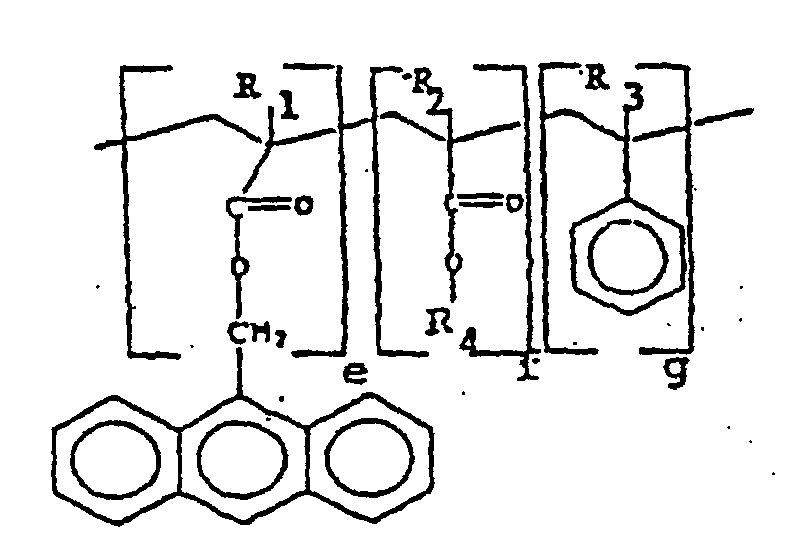 wherein R1, R2, and R3 are independently hydrogen or methyl; R4 is a straight or branched-chain C1-C12 alkyl group, a C3-C8 cycloalkyl group, the moiety (CH2-CH2-O)a-G, and combinations thereof;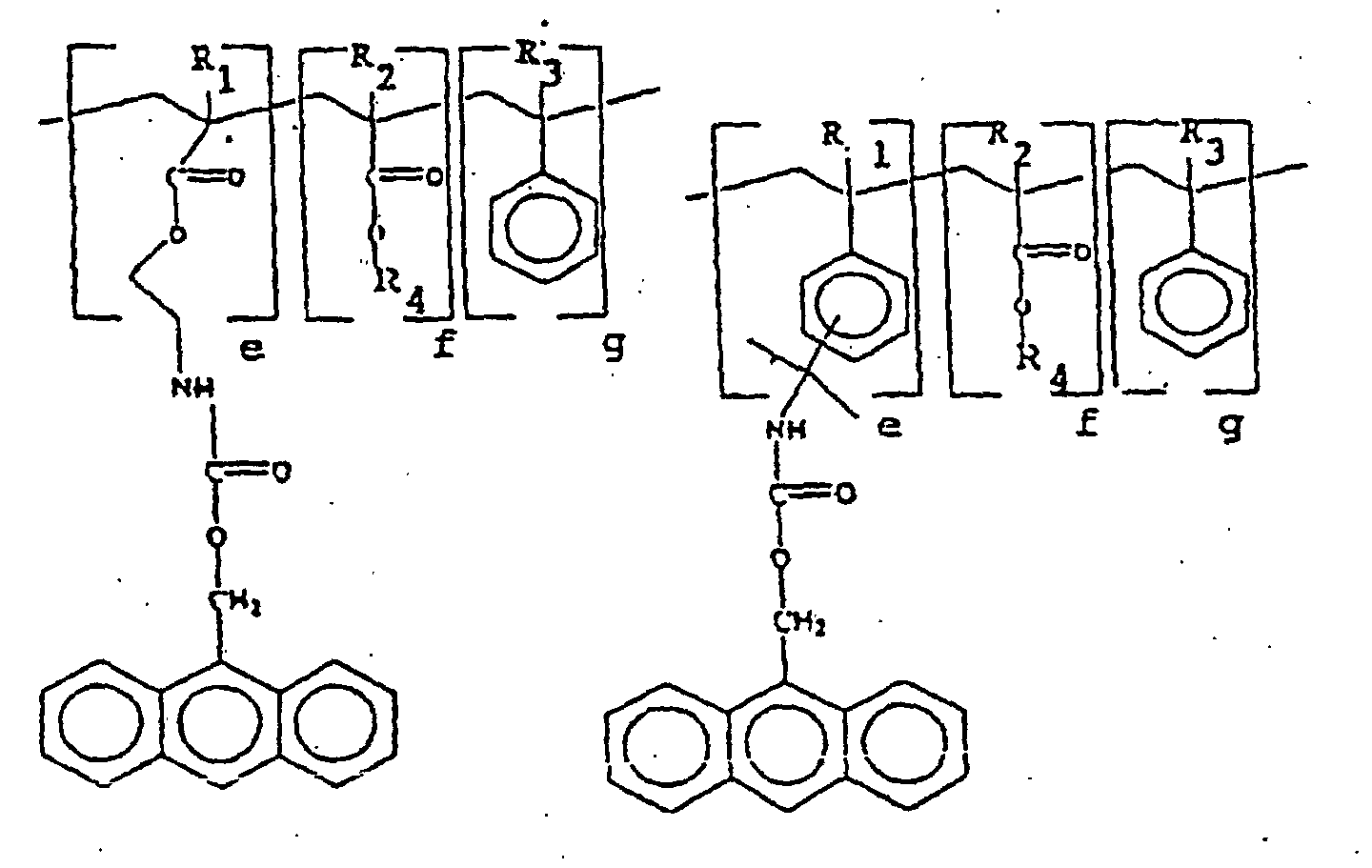
wherein G is phenyl or a C1-C5 straight or branched-chain alkyl group; and a is an integer from 1 to 6; and e has a value of 0.1 to 0.5, provided that the sum of e, f, and g equals 1.0. - The composition of claim 14 wherein the UV/visible sensitizer is a polymeric compound containing a thioxanthone moiety having the structure:wherein R1, R2, and R3 are independently hydrogen or methyl; R4 is a straight or branched-chain C1-C12 alkyl group, a C3-C8 cycloalkyl group, the moiety (CH2-CH2-O)a-G, and combinations thereof;
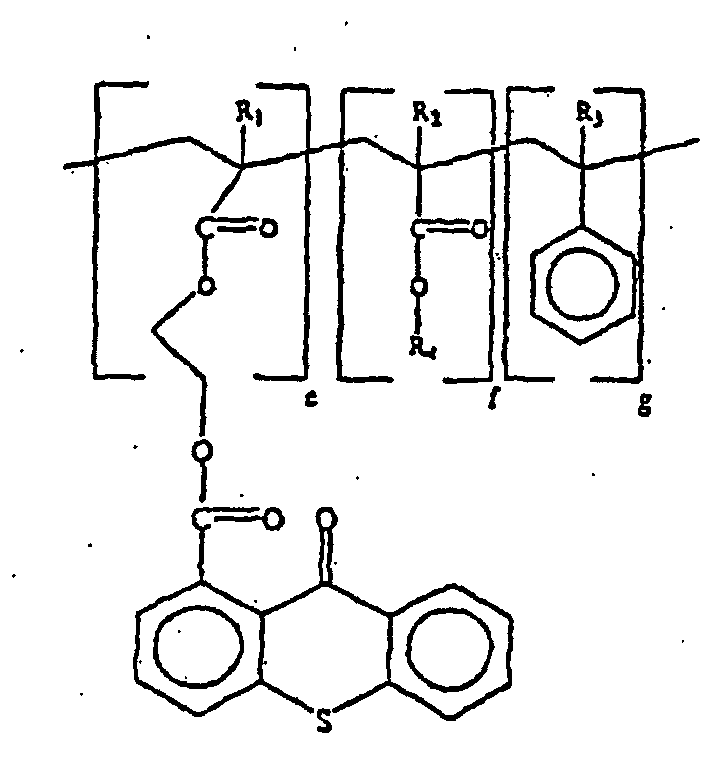
wherein G is phenyl or a C1-C5 straight or branched-chain alkyl group; and a is an integer from 1 to 6; and e has a value of 0.1 to 0.5, provided that the sum of e, f, and g equals 1.0. - The composition of claims 1-17 further comprising a secondary acid generator capable of undergoing an acid-catalyzed reaction to form additional acid.
- The composition of claim 18 wherein the secondary acid generator is selected from acetoacetate, squaric acid derivatives, and oxalic acid derivatives.
- The composition of claims 1-20 further comprising an indicator dye.
- A printing plate comprising a layer of the radiation-sensitive composition of any of the preceding claims on an aluminum substrate.
- A method of imaging a printing plate comprising a layer of the radiation-sensitive composition of any of the preceding claims on an aluminum substrate, the method comprising the steps of:(a) imagewise exposing the layer of radiation sensitive composition with a high intensity radiation source having an intensity at the surface of the printing plate of at least 0.1 to 10 watts;(b) heating the printing plate; and(c) contacting the printing plate with an aqueous developing solution.
Applications Claiming Priority (3)
| Application Number | Priority Date | Filing Date | Title |
|---|---|---|---|
| US08/745,534 US5919601A (en) | 1996-11-12 | 1996-11-12 | Radiation-sensitive compositions and printing plates |
| US745534 | 1996-11-12 | ||
| PCT/US1997/020138 WO1998021038A1 (en) | 1996-11-12 | 1997-11-06 | Radiation-sensitive compositions and printing plates |
Publications (2)
| Publication Number | Publication Date |
|---|---|
| EP0938413A1 EP0938413A1 (en) | 1999-09-01 |
| EP0938413B1 true EP0938413B1 (en) | 2004-03-03 |
Family
ID=24997091
Family Applications (1)
| Application Number | Title | Priority Date | Filing Date |
|---|---|---|---|
| EP97946526A Expired - Lifetime EP0938413B1 (en) | 1996-11-12 | 1997-11-06 | Radiation-sensitive compositions and printing plates |
Country Status (4)
| Country | Link |
|---|---|
| US (1) | US5919601A (en) |
| EP (1) | EP0938413B1 (en) |
| DE (1) | DE69727959T2 (en) |
| WO (1) | WO1998021038A1 (en) |
Cited By (3)
| Publication number | Priority date | Publication date | Assignee | Title |
|---|---|---|---|---|
| EP2194429A1 (en) | 2008-12-02 | 2010-06-09 | Eastman Kodak Company | Gumming compositions with nano-particles for improving scratch sensitivity in image and non-image areas of lithographic printing plates |
| EP2284005A1 (en) | 2009-08-10 | 2011-02-16 | Eastman Kodak Company | Lithographic printing plate precursors with beta-hydroxy alkylamide crosslinkers |
| EP2293144A1 (en) | 2009-09-04 | 2011-03-09 | Eastman Kodak Company | Method and apparatus for drying after single-step-processing of lithographic printing plates |
Families Citing this family (122)
| Publication number | Priority date | Publication date | Assignee | Title |
|---|---|---|---|---|
| US6489078B1 (en) * | 1996-07-19 | 2002-12-03 | Agfa-Gevaert | IR radiation-sensitive imaging element and a method for producing lithographic plates therewith |
| US6068963A (en) * | 1997-01-20 | 2000-05-30 | Fuji Photo Film Co., Ltd. | Negative-type image recording materials |
| US6165676A (en) * | 1997-04-22 | 2000-12-26 | Konica Corporation | Light sensitive composition, image forming material and image forming material manufacturing method |
| JP3779444B2 (en) * | 1997-07-28 | 2006-05-31 | 富士写真フイルム株式会社 | Positive photosensitive composition for infrared laser |
| DE69804230T2 (en) * | 1997-09-02 | 2002-10-24 | Kodak Polychrome Graphics Llc, Norwalk | PROCESSING-FREE FLAT PRINTING PLATE FOR LASER IMAGE |
| US6261740B1 (en) * | 1997-09-02 | 2001-07-17 | Kodak Polychrome Graphics, Llc | Processless, laser imageable lithographic printing plate |
| JP3858374B2 (en) * | 1997-09-18 | 2006-12-13 | コニカミノルタホールディングス株式会社 | Photosensitive composition and image forming material |
| GB2335282B (en) * | 1998-03-13 | 2002-05-08 | Horsell Graphic Ind Ltd | Improvements in relation to pattern-forming methods |
| US6242155B1 (en) * | 1998-08-14 | 2001-06-05 | Fuji Photo Film Co., Ltd. | Method of making lithographic printing plate and photopolymer composition |
| BR9901906B1 (en) * | 1998-09-21 | 2008-11-18 | Useful radiation sensitive coating composition for lithographic printing plates and the like. | |
| US6114085A (en) * | 1998-11-18 | 2000-09-05 | Clariant Finance (Bvi) Limited | Antireflective composition for a deep ultraviolet photoresist |
| US6323287B1 (en) | 1999-03-12 | 2001-11-27 | Arch Specialty Chemicals, Inc. | Hydroxy-amino thermally cured undercoat for 193 NM lithography |
| KR100574482B1 (en) * | 1999-09-07 | 2006-04-27 | 주식회사 하이닉스반도체 | Organic diffuse reflection prevention film composition and preparation method thereof |
| KR100557585B1 (en) * | 1999-10-29 | 2006-03-03 | 주식회사 하이닉스반도체 | Photoresist composition for resist flow process and method of forming contact hole using same |
| JP4050854B2 (en) * | 1999-12-21 | 2008-02-20 | 富士フイルム株式会社 | Image forming method |
| JP4119597B2 (en) * | 2000-05-17 | 2008-07-16 | 富士フイルム株式会社 | Planographic printing plate precursor |
| US6458511B1 (en) | 2000-06-07 | 2002-10-01 | Kodak Polychrome Graphics Llc | Thermally imageable positive-working lithographic printing plate precursor and method for imaging |
| JP2002023350A (en) | 2000-07-07 | 2002-01-23 | Fuji Photo Film Co Ltd | Negative type lithographic printing plate precursor |
| KR100596873B1 (en) * | 2000-07-13 | 2006-07-04 | 주식회사 하이닉스반도체 | Photoresist composition for TPS |
| US6794431B1 (en) * | 2000-08-18 | 2004-09-21 | Veil Corporation | Near infrared electromagnetic radiation absorbing composition and method of use |
| US20080192233A1 (en) * | 2000-08-18 | 2008-08-14 | Veil Corporation | Near infrared electromagnetic radiation absorbing composition and method of use |
| US6451502B1 (en) | 2000-10-10 | 2002-09-17 | Kodak Polychrome Graphics Llc | manufacture of electronic parts |
| KR100557615B1 (en) * | 2000-10-23 | 2006-03-10 | 주식회사 하이닉스반도체 | Photoresist composition for resist flow process |
| JP4512281B2 (en) | 2001-02-22 | 2010-07-28 | 富士フイルム株式会社 | Negative type planographic printing plate precursor |
| JP4266077B2 (en) | 2001-03-26 | 2009-05-20 | 富士フイルム株式会社 | Planographic printing plate precursor and planographic printing method |
| US7049046B2 (en) * | 2004-03-30 | 2006-05-23 | Eastman Kodak Company | Infrared absorbing compounds and their use in imageable elements |
| US6692890B2 (en) * | 2001-04-04 | 2004-02-17 | Kodak Polychrome Graphics Llc | Substrate improvements for thermally imageable composition and methods of preparation |
| US6436601B1 (en) | 2001-06-25 | 2002-08-20 | Citiplate, Inc. | Thermally sensitive coating compositions containing mixed diazo novolaks useful for lithographic elements |
| US6638679B2 (en) | 2001-07-12 | 2003-10-28 | Kodak Polychrome Graphics, Llc | Photosensitive compositions having mixtures of alkoxy and non-alkoxy diazonium salt containing compounds |
| US7056639B2 (en) * | 2001-08-21 | 2006-06-06 | Eastman Kodak Company | Imageable composition containing an infrared absorber with counter anion derived from a non-volatile acid |
| US6806020B2 (en) | 2001-08-21 | 2004-10-19 | Kodak Polychrome Graphics Llc | Negative working imageable composition containing sulfonic acid |
| US6921620B2 (en) | 2001-08-21 | 2005-07-26 | Kodak Polychrome Graphics Llc | Imageable composition containing colorant having a counter anion derived from a non-volatile acid |
| US6800426B2 (en) | 2001-12-13 | 2004-10-05 | Kodak Polychrome Graphics Llc | Process for making a two layer thermal negative plate |
| US6723495B2 (en) | 2002-01-24 | 2004-04-20 | Kodak Polychrome Graphics Llc | Water-developable negative-working ultraviolet and infrared imageable element |
| WO2003065122A1 (en) * | 2002-01-31 | 2003-08-07 | Scandinavian Micro Biodevices A/S | Method of joining a workpiece and a microstructure by light exposure |
| US6787281B2 (en) | 2002-05-24 | 2004-09-07 | Kodak Polychrome Graphics Llc | Selected acid generating agents and their use in processes for imaging radiation-sensitive elements |
| US6977131B2 (en) * | 2002-05-30 | 2005-12-20 | Kodak Polychrome Graphics Llc | Selected polymeric sulfonate acid generators and their use in processes for imaging radiation-sensitive elements |
| EP1857276A3 (en) * | 2002-09-30 | 2007-12-05 | FUJIFILM Corporation | Planographic printing plate precursor |
| JP4137577B2 (en) * | 2002-09-30 | 2008-08-20 | 富士フイルム株式会社 | Photosensitive composition |
| JP2004126050A (en) * | 2002-09-30 | 2004-04-22 | Fuji Photo Film Co Ltd | Lithographic printing original plate |
| CN100590525C (en) * | 2002-12-18 | 2010-02-17 | 富士胶片株式会社 | Polymerizable composition and lithographic printing plate precursor |
| US6844139B2 (en) * | 2003-01-03 | 2005-01-18 | Kodak Polychrome Graphics, Llc | Method for forming a lithographic printing plate |
| JP4150261B2 (en) * | 2003-01-14 | 2008-09-17 | 富士フイルム株式会社 | Plate making method of lithographic printing plate precursor |
| US7097956B2 (en) * | 2003-01-27 | 2006-08-29 | Eastman Kodak Company | Imageable element containing silicate-coated polymer particle |
| US6790590B2 (en) * | 2003-01-27 | 2004-09-14 | Kodak Polychrome Graphics, Llp | Infrared absorbing compounds and their use in imageable elements |
| JP2004252201A (en) * | 2003-02-20 | 2004-09-09 | Fuji Photo Film Co Ltd | Lithographic printing original plate |
| JP2004252285A (en) * | 2003-02-21 | 2004-09-09 | Fuji Photo Film Co Ltd | Photosensitive composition and lithographic printing original plate using the same |
| JP4048133B2 (en) * | 2003-02-21 | 2008-02-13 | 富士フイルム株式会社 | Photosensitive composition and planographic printing plate precursor using the same |
| JP4048134B2 (en) * | 2003-02-21 | 2008-02-13 | 富士フイルム株式会社 | Planographic printing plate precursor |
| US6902861B2 (en) * | 2003-03-10 | 2005-06-07 | Kodak Polychrome Graphics, Llc | Infrared absorbing compounds and their use in photoimageable elements |
| US7060409B2 (en) * | 2003-03-10 | 2006-06-13 | Eastman Kodak Company | Imageable elements with improved dot stability |
| US7045269B2 (en) * | 2003-03-10 | 2006-05-16 | Eastman Kodak Company | Method for forming images using negative working imageable elements |
| US6908726B2 (en) * | 2003-04-07 | 2005-06-21 | Kodak Polychrome Graphics Llc | Thermally imageable elements imageable at several wavelengths |
| US7371454B2 (en) * | 2003-12-15 | 2008-05-13 | Eastman Kodak Company | Imageable element comprising sulfated polymers |
| US6939663B2 (en) | 2003-07-08 | 2005-09-06 | Kodak Polychrome Graphics Llc | Sulfated phenolic resins and printing plate precursors comprising sulfated phenolic resins |
| US6981446B2 (en) * | 2003-07-08 | 2006-01-03 | Eastman Kodak Company | Ink-jet imaging method |
| EP1649322A4 (en) | 2003-07-17 | 2007-09-19 | Honeywell Int Inc | PLANARIZATION FILMS FOR ADVANCED MICROELECTRONIC DEVICES AND APPLICATIONS AND METHODS FOR PRODUCING SAID FILMS |
| JP4299639B2 (en) * | 2003-07-29 | 2009-07-22 | 富士フイルム株式会社 | Polymerizable composition and image recording material using the same |
| JP2005099284A (en) * | 2003-09-24 | 2005-04-14 | Fuji Photo Film Co Ltd | Photosensitive composition and planographic printing original plate |
| KR100636938B1 (en) * | 2003-09-29 | 2006-10-19 | 주식회사 하이닉스반도체 | Photoresist Composition |
| US6962765B2 (en) * | 2003-10-20 | 2005-11-08 | Kodak Polychrome Graphics Llc | Laser-generated ultraviolet radiation mask |
| JP4485241B2 (en) * | 2004-04-09 | 2010-06-16 | Azエレクトロニックマテリアルズ株式会社 | Water-soluble resin composition and pattern forming method using the same |
| US20050277053A1 (en) * | 2004-06-01 | 2005-12-15 | Anocoil Corporation | Increased sensitivity, IR, and UV imageable photographic elements |
| US20050277051A1 (en) * | 2004-06-01 | 2005-12-15 | Anocoil Corporation | Increased sensitivity, UV imageable photographic elements |
| DE102004029501A1 (en) * | 2004-06-18 | 2006-01-12 | Kodak Polychrome Graphics Gmbh | Modified polymers and their use in the preparation of lithographic printing plate precursors |
| JP4480141B2 (en) | 2004-06-28 | 2010-06-16 | キヤノン株式会社 | Method for manufacturing ink jet recording head |
| US10073264B2 (en) | 2007-08-03 | 2018-09-11 | Lumus Ltd. | Substrate-guide optical device |
| JP4690090B2 (en) * | 2005-03-30 | 2011-06-01 | コダック株式会社 | Photosensitive planographic printing plate |
| US7856985B2 (en) | 2005-04-22 | 2010-12-28 | Cynosure, Inc. | Method of treatment body tissue using a non-uniform laser beam |
| US10261321B2 (en) | 2005-11-08 | 2019-04-16 | Lumus Ltd. | Polarizing optical system |
| DE602005013536D1 (en) * | 2005-11-18 | 2009-05-07 | Agfa Graphics Nv | Process for producing a lithographic printing plate |
| TWI475323B (en) * | 2006-03-14 | 2015-03-01 | Fujifilm Corp | Positive resist composition and pattern forming method using the same |
| US7586957B2 (en) | 2006-08-02 | 2009-09-08 | Cynosure, Inc | Picosecond laser apparatus and methods for its operation and use |
| KR100871313B1 (en) | 2006-10-23 | 2008-12-01 | 제일모직주식회사 | Photosensitive resin composition and color filter using the same |
| JP5159123B2 (en) * | 2007-02-27 | 2013-03-06 | 富士フイルム株式会社 | Photosensitive lithographic printing plate precursor for infrared laser |
| KR100835605B1 (en) | 2007-06-19 | 2008-06-09 | 제일모직주식회사 | CMOS image sensor thermosetting resin composition for color filters, a color filter comprising a transparent film manufactured using the same, and an image sensor manufactured using the color filter |
| US20090246698A1 (en) * | 2008-03-28 | 2009-10-01 | Ray Kevin B | Methods for imaging and processing negative-working imageable elements |
| GB0823282D0 (en) * | 2008-12-20 | 2009-01-28 | Univ Strathclyde | Dose responsive UV indicator |
| EP2233288A1 (en) | 2009-03-23 | 2010-09-29 | Founder Fine Chemical Industry Co., Ltd. | Radiation sensitive composition and method for preparing radiation sensitive composition |
| TW201132656A (en) | 2010-03-19 | 2011-10-01 | Founder Fine Chemical Industry Co Ltd | Radiation sensitive composition |
| CN102207677B (en) * | 2010-03-29 | 2012-10-24 | 品青企业股份有限公司 | Radiation Sensitive Composition |
| TWI417656B (en) | 2010-04-08 | 2013-12-01 | Founder Fine Chemical Industry Co Ltd | Radiation sensitive composition |
| JP5658924B2 (en) * | 2010-06-29 | 2015-01-28 | 富士フイルム株式会社 | Actinic ray-sensitive or radiation-sensitive resin composition, and resist film and pattern forming method using the composition |
| KR102342629B1 (en) | 2012-04-18 | 2021-12-22 | 싸이노슈어, 엘엘씨 | Picosecond laser apparatus and methods for treating target tissues with same |
| WO2014145707A2 (en) | 2013-03-15 | 2014-09-18 | Cynosure, Inc. | Picosecond optical radiation systems and methods of use |
| IL232197B (en) | 2014-04-23 | 2018-04-30 | Lumus Ltd | Compact head-mounted display system |
| IL235642B (en) | 2014-11-11 | 2021-08-31 | Lumus Ltd | Compact head-mounted display system protected by a hyperfine structure |
| JP7187022B2 (en) | 2016-10-09 | 2022-12-12 | ルムス エルティーディー. | Aperture multiplier using rectangular waveguide |
| KR102541662B1 (en) | 2016-11-08 | 2023-06-13 | 루머스 리미티드 | Light-guide device with optical cutoff edge and corresponding production methods |
| TWI754010B (en) | 2017-02-22 | 2022-02-01 | 以色列商魯姆斯有限公司 | Light guide optical assembly |
| TWI800974B (en) | 2017-03-22 | 2023-05-01 | 以色列商魯姆斯有限公司 | A method for producing a light-guide optical element |
| IL251645B (en) | 2017-04-06 | 2018-08-30 | Lumus Ltd | Light-guide optical element and method of its manufacture |
| JP6916284B2 (en) * | 2017-07-20 | 2021-08-11 | 旭化成株式会社 | Photosensitive resin composition for printing plate and its manufacturing method |
| US10551544B2 (en) | 2018-01-21 | 2020-02-04 | Lumus Ltd. | Light-guide optical element with multiple-axis internal aperture expansion |
| CN112042066A (en) | 2018-02-26 | 2020-12-04 | 赛诺秀股份有限公司 | Q-switched cavity-tilting subnanosecond laser |
| BR112020023513A2 (en) | 2018-05-23 | 2021-02-09 | Lumus Ltd. | optical system |
| US11543583B2 (en) | 2018-09-09 | 2023-01-03 | Lumus Ltd. | Optical systems including light-guide optical elements with two-dimensional expansion |
| CN116300087A (en) | 2019-01-24 | 2023-06-23 | 鲁姆斯有限公司 | Optical system including LOE with three-stage expansion |
| CN113474715A (en) | 2019-02-28 | 2021-10-01 | 鲁姆斯有限公司 | Compact collimated image projector |
| TWI916247B (en) | 2019-04-15 | 2026-02-21 | 以色列商魯姆斯有限公司 | Light-guide optical element |
| KR20220024410A (en) | 2019-06-27 | 2022-03-03 | 루머스 리미티드 | Gaze tracking device and method based on eye imaging through a light guide optical element |
| JP7514558B2 (en) | 2019-07-04 | 2024-07-11 | ルーマス リミテッド | Image waveguide with symmetric beam multiplication. |
| KR20220035088A (en) | 2019-07-18 | 2022-03-21 | 루머스 리미티드 | Encapsulated light guide optics |
| JP7396738B2 (en) | 2019-12-05 | 2023-12-12 | ルーマス リミテッド | Light-guiding optics with complementary coating partial reflectors and light-guiding optics with reduced light scattering |
| JP7497079B2 (en) | 2019-12-08 | 2024-06-10 | ルーマス リミテッド | Optical system with a compact image projector |
| CN114846384B (en) | 2019-12-30 | 2024-05-24 | 鲁姆斯有限公司 | Optical system comprising a light-guiding optical element with two-dimensional expansion |
| IL294538B2 (en) | 2020-02-24 | 2025-12-01 | Lumus Ltd | Integrates mixed reality |
| TW202542601A (en) | 2020-05-24 | 2025-11-01 | 以色列商魯姆斯有限公司 | Compound light-guide optical elements |
| CN115552171B (en) | 2020-05-24 | 2024-01-23 | 鲁姆斯有限公司 | Method for manufacturing composite light guide optical element and optical structure |
| WO2021245664A1 (en) | 2020-06-01 | 2021-12-09 | Lumus Ltd. | Virtual image delivery system for near eye displays |
| WO2022044001A1 (en) | 2020-08-23 | 2022-03-03 | Lumus Ltd. | Optical system for two-dimensional expansion of an image reducing glints and ghosts from the waveduide |
| CN115885215A (en) | 2020-08-26 | 2023-03-31 | 鲁姆斯有限公司 | Color image generation using white light as a source |
| WO2022044019A1 (en) | 2020-08-30 | 2022-03-03 | Lumus Ltd. | Reflective slm image projector with intermediate image plane |
| DE202021104723U1 (en) | 2020-09-11 | 2021-10-18 | Lumus Ltd. | Image projector coupled to an optical light guide element |
| EP4222416B1 (en) | 2020-10-01 | 2025-12-10 | Lumus Ltd. | Compound light-guide optical elements |
| JP7705673B2 (en) | 2021-02-16 | 2025-07-10 | ルーマス リミテッド | Optical system including a two-dimensionally expanding light-guiding optical element having a retarder element |
| JP7490286B2 (en) | 2021-02-25 | 2024-05-27 | ルーマス リミテッド | Optical aperture multiplier with rectangular waveguide. |
| EP4237903B1 (en) | 2021-03-01 | 2024-09-04 | Lumus Ltd. | Optical system with compact coupling from a projector into a waveguide |
| KR20240097972A (en) | 2021-05-19 | 2024-06-27 | 루머스 리미티드 | Active optical engine |
| EP4256396A4 (en) | 2021-07-04 | 2024-05-29 | Lumus Ltd. | DISPLAY WITH STACKED LIGHT GUIDE ELEMENTS PROVIDING DIFFERENT PARTS OF FIELD OF VIEW |
| IL310952A (en) | 2021-08-23 | 2024-04-01 | Lumus Ltd | Methods for manufacturing complex light-guiding optical components with embedded coupling reflectors |
| US12320983B1 (en) | 2022-08-18 | 2025-06-03 | Lumus Ltd. | Image projector with polarizing catadioptric collimator |
Family Cites Families (16)
| Publication number | Priority date | Publication date | Assignee | Title |
|---|---|---|---|---|
| US4708925A (en) * | 1984-12-11 | 1987-11-24 | Minnesota Mining And Manufacturing Company | Photosolubilizable compositions containing novolac phenolic resin |
| ZA872295B (en) * | 1986-03-13 | 1987-09-22 | ||
| US5059512A (en) * | 1989-10-10 | 1991-10-22 | International Business Machines Corporation | Ultraviolet light sensitive photoinitiator compositions, use thereof and radiation sensitive compositions |
| US5085972A (en) * | 1990-11-26 | 1992-02-04 | Minnesota Mining And Manufacturing Company | Alkoxyalkyl ester solubility inhibitors for phenolic resins |
| US5286612A (en) * | 1992-10-23 | 1994-02-15 | Polaroid Corporation | Process for generation of free superacid and for imaging, and imaging medium for use therein |
| US5340699A (en) * | 1993-05-19 | 1994-08-23 | Eastman Kodak Company | Radiation-sensitive composition containing a resole resin and a novolac resin and use thereof in lithographic printing plates |
| EP0672954B1 (en) * | 1994-03-14 | 1999-09-15 | Kodak Polychrome Graphics LLC | Radiation-sensitive composition containing a resole resin, a novolac resin, an infrared absorber and a triazine and use thereof in lithographic printing plates |
| US5441850A (en) * | 1994-04-25 | 1995-08-15 | Polaroid Corporation | Imaging medium and process for producing an image |
| US5466557A (en) * | 1994-08-29 | 1995-11-14 | Eastman Kodak Company | Radiation-sensitive composition containing a resole resin, a novolac resin, a latent bronsted acid, an infrared absorber and terephthalaldehyde and use thereof in lithographic printing plates |
| JPH08202037A (en) * | 1994-11-22 | 1996-08-09 | Shin Etsu Chem Co Ltd | 2,4-Diamino-S-triazinyl group-containing polymer and negative radiation-sensitive resist composition |
| US5491046A (en) * | 1995-02-10 | 1996-02-13 | Eastman Kodak Company | Method of imaging a lithographic printing plate |
| EP0773112B1 (en) * | 1995-11-09 | 2001-05-30 | Agfa-Gevaert N.V. | Heat sensitive imaging element and method for making a printing plate therewith |
| US5814431A (en) * | 1996-01-10 | 1998-09-29 | Mitsubishi Chemical Corporation | Photosensitive composition and lithographic printing plate |
| EP0819980B1 (en) * | 1996-07-19 | 2000-05-31 | Agfa-Gevaert N.V. | An IR radiation-sensitive imaging element and a method for producing lithographic plates therewith |
| EP0819985B1 (en) * | 1996-07-19 | 2002-06-05 | Agfa-Gevaert | A radiation sensitive imaging element and a method for producing lithographic plates therewith |
| JP3725624B2 (en) * | 1996-08-09 | 2005-12-14 | 富士写真フイルム株式会社 | Negative type planographic printing plate material and plate making method |
-
1996
- 1996-11-12 US US08/745,534 patent/US5919601A/en not_active Expired - Lifetime
-
1997
- 1997-11-06 DE DE69727959T patent/DE69727959T2/en not_active Expired - Lifetime
- 1997-11-06 EP EP97946526A patent/EP0938413B1/en not_active Expired - Lifetime
- 1997-11-06 WO PCT/US1997/020138 patent/WO1998021038A1/en not_active Ceased
Cited By (4)
| Publication number | Priority date | Publication date | Assignee | Title |
|---|---|---|---|---|
| EP2194429A1 (en) | 2008-12-02 | 2010-06-09 | Eastman Kodak Company | Gumming compositions with nano-particles for improving scratch sensitivity in image and non-image areas of lithographic printing plates |
| EP2284005A1 (en) | 2009-08-10 | 2011-02-16 | Eastman Kodak Company | Lithographic printing plate precursors with beta-hydroxy alkylamide crosslinkers |
| EP2293144A1 (en) | 2009-09-04 | 2011-03-09 | Eastman Kodak Company | Method and apparatus for drying after single-step-processing of lithographic printing plates |
| WO2011026907A1 (en) | 2009-09-04 | 2011-03-10 | Eastman Kodak Company | Method and apparatus for drying after single-step-processing of lithographic printing plates |
Also Published As
| Publication number | Publication date |
|---|---|
| DE69727959T2 (en) | 2005-06-02 |
| US5919601A (en) | 1999-07-06 |
| WO1998021038A1 (en) | 1998-05-22 |
| EP0938413A1 (en) | 1999-09-01 |
| DE69727959D1 (en) | 2004-04-08 |
Similar Documents
| Publication | Publication Date | Title |
|---|---|---|
| US5919601A (en) | Radiation-sensitive compositions and printing plates | |
| CN100474110C (en) | Selected acid generators and their use in radiation-sensitive element imaging processes | |
| EP0939698B1 (en) | Method for forming lithographic printing plates | |
| EP0672954B1 (en) | Radiation-sensitive composition containing a resole resin, a novolac resin, an infrared absorber and a triazine and use thereof in lithographic printing plates | |
| JP3814961B2 (en) | Positive photosensitive printing plate | |
| EP0625728A2 (en) | Radiation-sensitive composition containing a resole resin and a novolak resin and use thereof in lithographic plates | |
| JPH11160860A (en) | Positive image forming material | |
| EP0819985B1 (en) | A radiation sensitive imaging element and a method for producing lithographic plates therewith | |
| JPH10142780A (en) | Ir radiation photosensitive image forming material and lithographic printing plate using the same | |
| US6458511B1 (en) | Thermally imageable positive-working lithographic printing plate precursor and method for imaging | |
| JPH0943847A (en) | Resist material and pattern forming method | |
| US20030224284A1 (en) | Selected polymeric sulfonate acid generators and their use in processes for imaging radiation-sensitive elements | |
| US6599676B2 (en) | Process for making thermal negative printing plate | |
| US5994023A (en) | Acid-sensitive substance and photosensitive compositions therewith | |
| JPH10282643A (en) | Positive photosensitive lithographic printing plate | |
| EP0819986B1 (en) | Imaging element for making lithographic printing plates | |
| JP3514900B2 (en) | Lithographic printing plate | |
| US20070292809A1 (en) | Process for the Production of Double-Layer Heat-Sensitive Imageable Elements | |
| EP1015244B1 (en) | Processless, laser imageable lithographic printing plate | |
| JP3266017B2 (en) | Photosensitive composition and lithographic printing plate | |
| US20020012878A1 (en) | Photosensitive composition and its use for thermally imageable printing plates | |
| JPH10123701A (en) | Negative type image recording material | |
| JPH11119428A (en) | Photosensitive composition and photosensitive lithographic printing plate | |
| JPH10282652A (en) | Positive photosensitive lithographic printing plate | |
| JP4068320B2 (en) | Positive photosensitive composition, positive photosensitive lithographic printing plate, and positive image forming method using the same |
Legal Events
| Date | Code | Title | Description |
|---|---|---|---|
| PUAI | Public reference made under article 153(3) epc to a published international application that has entered the european phase |
Free format text: ORIGINAL CODE: 0009012 |
|
| 17P | Request for examination filed |
Effective date: 19990614 |
|
| AK | Designated contracting states |
Kind code of ref document: A1 Designated state(s): BE DE FR GB IT NL |
|
| 17Q | First examination report despatched |
Effective date: 20000921 |
|
| GRAH | Despatch of communication of intention to grant a patent |
Free format text: ORIGINAL CODE: EPIDOS IGRA |
|
| GRAS | Grant fee paid |
Free format text: ORIGINAL CODE: EPIDOSNIGR3 |
|
| GRAA | (expected) grant |
Free format text: ORIGINAL CODE: 0009210 |
|
| AK | Designated contracting states |
Kind code of ref document: B1 Designated state(s): BE DE FR GB IT NL |
|
| REG | Reference to a national code |
Ref country code: GB Ref legal event code: FG4D |
|
| REF | Corresponds to: |
Ref document number: 69727959 Country of ref document: DE Date of ref document: 20040408 Kind code of ref document: P |
|
| RAP2 | Party data changed (patent owner data changed or rights of a patent transferred) |
Owner name: KODAK POLYCHROME GRAPHICS LLC |
|
| NLT2 | Nl: modifications (of names), taken from the european patent patent bulletin |
Owner name: KODAK POLYCHROME GRAPHICS LLC |
|
| ET | Fr: translation filed | ||
| PLBE | No opposition filed within time limit |
Free format text: ORIGINAL CODE: 0009261 |
|
| STAA | Information on the status of an ep patent application or granted ep patent |
Free format text: STATUS: NO OPPOSITION FILED WITHIN TIME LIMIT |
|
| 26N | No opposition filed |
Effective date: 20041206 |
|
| PGFP | Annual fee paid to national office [announced via postgrant information from national office to epo] |
Ref country code: NL Payment date: 20061006 Year of fee payment: 10 |
|
| PGFP | Annual fee paid to national office [announced via postgrant information from national office to epo] |
Ref country code: BE Payment date: 20061128 Year of fee payment: 10 |
|
| PGFP | Annual fee paid to national office [announced via postgrant information from national office to epo] |
Ref country code: IT Payment date: 20061130 Year of fee payment: 10 |
|
| REG | Reference to a national code |
Ref country code: FR Ref legal event code: TP |
|
| REG | Reference to a national code |
Ref country code: GB Ref legal event code: 732E |
|
| REG | Reference to a national code |
Ref country code: GB Ref legal event code: 732E |
|
| BERE | Be: lapsed |
Owner name: *KODAK POLYCHROME GRAPHICS LLC Effective date: 20071130 |
|
| NLV4 | Nl: lapsed or anulled due to non-payment of the annual fee |
Effective date: 20080601 |
|
| PG25 | Lapsed in a contracting state [announced via postgrant information from national office to epo] |
Ref country code: BE Free format text: LAPSE BECAUSE OF NON-PAYMENT OF DUE FEES Effective date: 20071130 |
|
| PG25 | Lapsed in a contracting state [announced via postgrant information from national office to epo] |
Ref country code: NL Free format text: LAPSE BECAUSE OF NON-PAYMENT OF DUE FEES Effective date: 20080601 |
|
| PG25 | Lapsed in a contracting state [announced via postgrant information from national office to epo] |
Ref country code: IT Free format text: LAPSE BECAUSE OF NON-PAYMENT OF DUE FEES Effective date: 20071106 |
|
| PGFP | Annual fee paid to national office [announced via postgrant information from national office to epo] |
Ref country code: DE Payment date: 20121130 Year of fee payment: 16 Ref country code: FR Payment date: 20121113 Year of fee payment: 16 |
|
| PGFP | Annual fee paid to national office [announced via postgrant information from national office to epo] |
Ref country code: GB Payment date: 20121025 Year of fee payment: 16 |
|
| GBPC | Gb: european patent ceased through non-payment of renewal fee |
Effective date: 20131106 |
|
| REG | Reference to a national code |
Ref country code: FR Ref legal event code: ST Effective date: 20140731 |
|
| REG | Reference to a national code |
Ref country code: DE Ref legal event code: R119 Ref document number: 69727959 Country of ref document: DE Effective date: 20140603 |
|
| PG25 | Lapsed in a contracting state [announced via postgrant information from national office to epo] |
Ref country code: DE Free format text: LAPSE BECAUSE OF NON-PAYMENT OF DUE FEES Effective date: 20140603 |
|
| PG25 | Lapsed in a contracting state [announced via postgrant information from national office to epo] |
Ref country code: FR Free format text: LAPSE BECAUSE OF NON-PAYMENT OF DUE FEES Effective date: 20131202 Ref country code: GB Free format text: LAPSE BECAUSE OF NON-PAYMENT OF DUE FEES Effective date: 20131106 |