EP1847602A1 - STABILIZED HUMAN IgG1 AND IgG3 ANTIBODIES - Google Patents
STABILIZED HUMAN IgG1 AND IgG3 ANTIBODIES Download PDFInfo
- Publication number
- EP1847602A1 EP1847602A1 EP06702685A EP06702685A EP1847602A1 EP 1847602 A1 EP1847602 A1 EP 1847602A1 EP 06702685 A EP06702685 A EP 06702685A EP 06702685 A EP06702685 A EP 06702685A EP 1847602 A1 EP1847602 A1 EP 1847602A1
- Authority
- EP
- European Patent Office
- Prior art keywords
- heavy chain
- antibody
- monoclonal antibody
- seq
- constant region
- Prior art date
- Legal status (The legal status is an assumption and is not a legal conclusion. Google has not performed a legal analysis and makes no representation as to the accuracy of the status listed.)
- Granted
Links
Images


Classifications
-
- C—CHEMISTRY; METALLURGY
- C07—ORGANIC CHEMISTRY
- C07K—PEPTIDES
- C07K16/00—Immunoglobulins [IG], e.g. monoclonal or polyclonal antibodies
-
- A—HUMAN NECESSITIES
- A61—MEDICAL OR VETERINARY SCIENCE; HYGIENE
- A61P—SPECIFIC THERAPEUTIC ACTIVITY OF CHEMICAL COMPOUNDS OR MEDICINAL PREPARATIONS
- A61P29/00—Non-central analgesic, antipyretic or antiinflammatory agents, e.g. antirheumatic agents; Non-steroidal antiinflammatory drugs [NSAID]
-
- A—HUMAN NECESSITIES
- A61—MEDICAL OR VETERINARY SCIENCE; HYGIENE
- A61P—SPECIFIC THERAPEUTIC ACTIVITY OF CHEMICAL COMPOUNDS OR MEDICINAL PREPARATIONS
- A61P31/00—Antiinfectives, i.e. antibiotics, antiseptics, chemotherapeutics
-
- A—HUMAN NECESSITIES
- A61—MEDICAL OR VETERINARY SCIENCE; HYGIENE
- A61P—SPECIFIC THERAPEUTIC ACTIVITY OF CHEMICAL COMPOUNDS OR MEDICINAL PREPARATIONS
- A61P31/00—Antiinfectives, i.e. antibiotics, antiseptics, chemotherapeutics
- A61P31/04—Antibacterial agents
- A61P31/06—Antibacterial agents for tuberculosis
-
- A—HUMAN NECESSITIES
- A61—MEDICAL OR VETERINARY SCIENCE; HYGIENE
- A61P—SPECIFIC THERAPEUTIC ACTIVITY OF CHEMICAL COMPOUNDS OR MEDICINAL PREPARATIONS
- A61P31/00—Antiinfectives, i.e. antibiotics, antiseptics, chemotherapeutics
- A61P31/10—Antimycotics
-
- A—HUMAN NECESSITIES
- A61—MEDICAL OR VETERINARY SCIENCE; HYGIENE
- A61P—SPECIFIC THERAPEUTIC ACTIVITY OF CHEMICAL COMPOUNDS OR MEDICINAL PREPARATIONS
- A61P31/00—Antiinfectives, i.e. antibiotics, antiseptics, chemotherapeutics
- A61P31/12—Antivirals
-
- A—HUMAN NECESSITIES
- A61—MEDICAL OR VETERINARY SCIENCE; HYGIENE
- A61P—SPECIFIC THERAPEUTIC ACTIVITY OF CHEMICAL COMPOUNDS OR MEDICINAL PREPARATIONS
- A61P31/00—Antiinfectives, i.e. antibiotics, antiseptics, chemotherapeutics
- A61P31/12—Antivirals
- A61P31/14—Antivirals for RNA viruses
- A61P31/16—Antivirals for RNA viruses for influenza or rhinoviruses
-
- A—HUMAN NECESSITIES
- A61—MEDICAL OR VETERINARY SCIENCE; HYGIENE
- A61P—SPECIFIC THERAPEUTIC ACTIVITY OF CHEMICAL COMPOUNDS OR MEDICINAL PREPARATIONS
- A61P31/00—Antiinfectives, i.e. antibiotics, antiseptics, chemotherapeutics
- A61P31/12—Antivirals
- A61P31/14—Antivirals for RNA viruses
- A61P31/18—Antivirals for RNA viruses for HIV
-
- A—HUMAN NECESSITIES
- A61—MEDICAL OR VETERINARY SCIENCE; HYGIENE
- A61P—SPECIFIC THERAPEUTIC ACTIVITY OF CHEMICAL COMPOUNDS OR MEDICINAL PREPARATIONS
- A61P31/00—Antiinfectives, i.e. antibiotics, antiseptics, chemotherapeutics
- A61P31/12—Antivirals
- A61P31/20—Antivirals for DNA viruses
- A61P31/22—Antivirals for DNA viruses for herpes viruses
-
- A—HUMAN NECESSITIES
- A61—MEDICAL OR VETERINARY SCIENCE; HYGIENE
- A61P—SPECIFIC THERAPEUTIC ACTIVITY OF CHEMICAL COMPOUNDS OR MEDICINAL PREPARATIONS
- A61P33/00—Antiparasitic agents
- A61P33/02—Antiprotozoals, e.g. for leishmaniasis, trichomoniasis, toxoplasmosis
-
- A—HUMAN NECESSITIES
- A61—MEDICAL OR VETERINARY SCIENCE; HYGIENE
- A61P—SPECIFIC THERAPEUTIC ACTIVITY OF CHEMICAL COMPOUNDS OR MEDICINAL PREPARATIONS
- A61P33/00—Antiparasitic agents
- A61P33/02—Antiprotozoals, e.g. for leishmaniasis, trichomoniasis, toxoplasmosis
- A61P33/06—Antimalarials
-
- A—HUMAN NECESSITIES
- A61—MEDICAL OR VETERINARY SCIENCE; HYGIENE
- A61P—SPECIFIC THERAPEUTIC ACTIVITY OF CHEMICAL COMPOUNDS OR MEDICINAL PREPARATIONS
- A61P35/00—Antineoplastic agents
-
- A—HUMAN NECESSITIES
- A61—MEDICAL OR VETERINARY SCIENCE; HYGIENE
- A61P—SPECIFIC THERAPEUTIC ACTIVITY OF CHEMICAL COMPOUNDS OR MEDICINAL PREPARATIONS
- A61P35/00—Antineoplastic agents
- A61P35/02—Antineoplastic agents specific for leukemia
-
- A—HUMAN NECESSITIES
- A61—MEDICAL OR VETERINARY SCIENCE; HYGIENE
- A61P—SPECIFIC THERAPEUTIC ACTIVITY OF CHEMICAL COMPOUNDS OR MEDICINAL PREPARATIONS
- A61P37/00—Drugs for immunological or allergic disorders
- A61P37/02—Immunomodulators
-
- A—HUMAN NECESSITIES
- A61—MEDICAL OR VETERINARY SCIENCE; HYGIENE
- A61P—SPECIFIC THERAPEUTIC ACTIVITY OF CHEMICAL COMPOUNDS OR MEDICINAL PREPARATIONS
- A61P37/00—Drugs for immunological or allergic disorders
- A61P37/02—Immunomodulators
- A61P37/04—Immunostimulants
-
- A—HUMAN NECESSITIES
- A61—MEDICAL OR VETERINARY SCIENCE; HYGIENE
- A61P—SPECIFIC THERAPEUTIC ACTIVITY OF CHEMICAL COMPOUNDS OR MEDICINAL PREPARATIONS
- A61P37/00—Drugs for immunological or allergic disorders
- A61P37/02—Immunomodulators
- A61P37/06—Immunosuppressants, e.g. drugs for graft rejection
-
- A—HUMAN NECESSITIES
- A61—MEDICAL OR VETERINARY SCIENCE; HYGIENE
- A61P—SPECIFIC THERAPEUTIC ACTIVITY OF CHEMICAL COMPOUNDS OR MEDICINAL PREPARATIONS
- A61P43/00—Drugs for specific purposes, not provided for in groups A61P1/00-A61P41/00
-
- C—CHEMISTRY; METALLURGY
- C07—ORGANIC CHEMISTRY
- C07K—PEPTIDES
- C07K16/00—Immunoglobulins [IG], e.g. monoclonal or polyclonal antibodies
- C07K16/18—Immunoglobulins [IG], e.g. monoclonal or polyclonal antibodies against material from animals or humans
- C07K16/28—Immunoglobulins [IG], e.g. monoclonal or polyclonal antibodies against material from animals or humans against receptors, cell surface antigens or cell surface determinants
- C07K16/2878—Immunoglobulins [IG], e.g. monoclonal or polyclonal antibodies against material from animals or humans against receptors, cell surface antigens or cell surface determinants against the NGF-receptor/TNF-receptor superfamily, e.g. CD27, CD30, CD40, CD95
-
- C—CHEMISTRY; METALLURGY
- C07—ORGANIC CHEMISTRY
- C07K—PEPTIDES
- C07K2317/00—Immunoglobulins specific features
- C07K2317/20—Immunoglobulins specific features characterized by taxonomic origin
- C07K2317/21—Immunoglobulins specific features characterized by taxonomic origin from primates, e.g. man
-
- C—CHEMISTRY; METALLURGY
- C07—ORGANIC CHEMISTRY
- C07K—PEPTIDES
- C07K2317/00—Immunoglobulins specific features
- C07K2317/50—Immunoglobulins specific features characterized by immunoglobulin fragments
- C07K2317/52—Constant or Fc region; Isotype
-
- C—CHEMISTRY; METALLURGY
- C07—ORGANIC CHEMISTRY
- C07K—PEPTIDES
- C07K2317/00—Immunoglobulins specific features
- C07K2317/50—Immunoglobulins specific features characterized by immunoglobulin fragments
- C07K2317/56—Immunoglobulins specific features characterized by immunoglobulin fragments variable (Fv) region, i.e. VH and/or VL
-
- C—CHEMISTRY; METALLURGY
- C07—ORGANIC CHEMISTRY
- C07K—PEPTIDES
- C07K2317/00—Immunoglobulins specific features
- C07K2317/90—Immunoglobulins specific features characterized by (pharmaco)kinetic aspects or by stability of the immunoglobulin
- C07K2317/94—Stability, e.g. half-life, pH, temperature or enzyme-resistance
Definitions
- the present invention relates to IgG2 and IgG3 antibodies improved in stability, which are obtained by introducing a variation into the constant regions of human IgG2 and IgG3 heavy chains.
- Immunoglobulins which are glycoproteins present in the serum, tissue, or body fluid of every mammal, have the function of recognizing foreign antigens.
- the immunoglobulins participate through antibody binding to antigens in biophylaxis via the activation of the complement system or via the activation of effector functions such as enhancement in cellular phagocytosis, antibody-dependent cytotoxicity, mediator release, and antigen presentation via an Fc receptor (FcR) present in cell surface.
- FcR Fc receptor
- IgG2 is only one IgG that can activate the alternative pathway in complement activation and has been reported to be associated with infectious diseases such as influenza.
- IgG2 is also known to have little antibody-dependent cytotoxicity.
- IgG3 is known to have very strong antibody-dependent complement-activating capacity and antibody-dependent cytotoxicity. The development of antibody drugs having novel activity can be expected by exploiting such characteristics.
- IgG2 and IgG3 have hardly been developed so far as drugs. Therefore, production techniques thereof mostly remain uncertain.
- an affinity purification method using Protein A is used in the production of antibodies as drugs.
- a buffer solution with low pH is often used to elute the antibodies bound with Protein A.
- the treatment at low pH for a given time is also preferable in light of virus removal.
- the contamination of drugs with aggregates formed during this procedure has been reported to promote infusion reaction, complement activation, or antibody-dependent cytotoxicity. It can be estimated easily that these factors lead to side-effects. Therefore, it is very important to reduce the amount of aggregates as much as possible.
- the stabilized human IgG2 antibody of the present invention has at least a substitution of the CH2 domain of an IgG1 heavy chain for the CH2 domain of the heavy chain constant region thereof.
- the CH2 domain is substituted by the CH2 domain of an IgG1 heavy chain, or the CH2 and CH3 domains are substituted by the CH2 and CH3 domains of an IgG1 heavy chain.
- the stabilized human IgG3 antibody of the present invention has at least a substitution of the CH3 domain of an IgG1 heavy chain for the CH3 domain of the heavy chain constant region thereof.
- the CH3 domain is substituted by the CH3 domain of an IgG1 heavy chain, or the CH2 and CH3 domains are substituted by the CH2 and CH3 domains of an IgG1 heavy chain.
- the present invention is as follows:
- the antibody of the present invention improved in stability by a substitution of K for N at the 392nd position, V for M at the 397th position, or Y for F at the 300th position in the amino acid sequence of the IgG3 heavy chain possesses the characteristics of exhibiting reduced aggregate formation, particularly, reduced aggregate formation at low pH, while maintaining antigen-binding properties.
- the antibody of the present invention can be produced stably as a drug.
- the antibody of the present invention when administered to a test subject easily avoids side-effects caused by contamination with antibody aggregates and can be used with safety.
- the present invention can improve the stability of IgG2 and IgG3 antibodies while maintaining their specific antigen-binding properties.
- a substitution of Y for F at the 300th position, L for V at the 309th position, or A for T at the 339th position in the amino acid sequence of the IgG2 heavy chain can improve antibody stability.
- the antibody of the present invention may have these substitutions alone or in combination.
- a substitution of the CH2 domain of an IgG1 heavy chain for the CH2 domain of the IgG2 heavy chain or the CH2 and CH3 domains of an IgG1 heavy chain for the CH2 and CH3 domains of the IgG2 heavy chain can improve antibody stability.
- an antibody improved in stability refers to an antibody that has no reduction in antigen-binding ability even under acidic conditions, that is, under low pH conditions, for example, at pH 4 or lower, and hardly forms aggregates under these conditions.
- the antibody improved in stability refers to an antibody that exhibits a low aggregate content when purified by use of a Protein A or Protein G affinity column.
- the antibody improved in stability refers to an antibody that forms an aggregate at a content of 10% or lower, preferably 5% or lower, more preferably 1% or lower, for example, when treated at pH 3.5 for 10 minutes or 60 minutes.
- the aggregate content can be measured, for example, by liquid chromatography.
- an antibody improved in physical property refers to an antibody that has ADCC and/or CDC adjusted to desired intensity, in addition to stability, or an antibody that has FcR-binding ability adjusted to a desired level.
- the adjustment of ADCC and/or CDC and the adjustment of FcR-binding ability can be performed by introducing a variation into the antibody.
- An additional appropriate variation can be introduced into the antibody improved in stability to thereby reduce or enhance ADCC and/or CDC.
- the antibody of the present invention has one or more, preferably 1 to 20, 1 to 17, 1 to 16,1 to 15,1 to 14,1 to 13,1 to 12,1 to 11,1 to 10,1 to 9,1 to 8,1 to 7,1 to 6,1 to 5,1 to 4, 1 to 3, or 1 or 2 amino acid variations for enhancing or reducing the ADCC and/or CDC activity.
- an “antibody” is derived from genes encoding heavy chain variable and constant regions and light chain variable and constant regions constituting immunoglobulin (collectively called antibody genes).
- the antibody of the present invention also encompasses antibodies of any immunoglobulin class and antibodies having any isotype. Examples of proteins (antigens) to which the antibody of the present invention binds include, but not limited to, CD40.
- the antibody of the present invention can be prepared appropriately, for example, by use of an antibody gene isolation method from hybridomas well known by those skilled in the art, the sequence information of the human antibody constant regions of the above-described human antibody genes known in the art, or site-specific mutagenesis into genes.
- the antibody of the present invention can be obtained by incorporating the antibody gene into an expression vector; introducing the vector into an appropriate host cell; and collecting and purifying an antibody from the resulting cell or the culture supernatant of the cell.
- cultures mean any of (a) culture supernatants, (b) cultured cells or cultured strains or homogenates thereof, and (c) secreted products from transformants.
- a medium suitable to a host used is used, and a static culture method, a culture method with roller bottles, or the like is adopted.
- the antibody is collected by homogenizing the strains or cells.
- the culture solution is directly used or, for example, centrifuged to remove the strains or cells. Then, general biochemical methods using a variety of chromatography techniques used in protein isolation and purification can be used alone or in appropriate combination to thereby isolate and purify the antibody of interest from the cultures.
- the pharmaceutical composition comprising an agonistic anti-CD40 antibody as the antibody of the present invention is used as an adjuvant (antivirus or anti-infectious disease agent).
- a pathogen is exemplified by type A, B, C, D, or E hepatitis virus, HIV, influenza virus, herpes simplex virus, cytomegalovirus, EB virus, papilloma virus, chlamydia, mycoplasma, toxoplasma, malaria, trypanosome, and tuberculosis.
- the pharmaceutical composition of the present invention is used as an anti-tumor agent.
- the scope of the present invention also encompasses a composition comprising the antibody of the present invention.
- the composition comprises other ingredients, for example, buffers (intended for moderating pH changes; examples thereof include sodium glutamate), stabilizers (intended for enhancing the chemical or physical stability of the antibody; examples thereof include glycine), surfactants (examples thereof include polysorbate), or preservatives, in addition to the antibody.
- the composition is, for example, in an aqueous solution or freeze-dried form.
- the composition can be used, for example, as a reagent in antigen analysis. Aggregate formation is suppressed in the antibody of the present invention having an amino acid or domain substitution as compared with in antibodies free from the substitution. Therefore, the composition can be produced efficiently from the viewpoint of yields and so on.
- the antibody of the present invention hardly causes aggregation in an analytical solution in antigen analysis and can therefore produce a high-precision result.
- DNAs encoding the heavy and light chain variable regions of the 2105 antibody and amino acid sequences of the heavy and light chains are respectively shown below.
- the nucleotide sequence of the light chain variable region of the 2105 antibody reaches from guanine (G) at the 88th position to adenine (A) at the 405th position in SEQ ID NO: 7.
- the amino acid sequence of the light chain variable region of the 2105 antibody reaches from glutamic acid (E) at the 21 st position to lysine (K) at the 126th position in SEQ ID NO: 8.
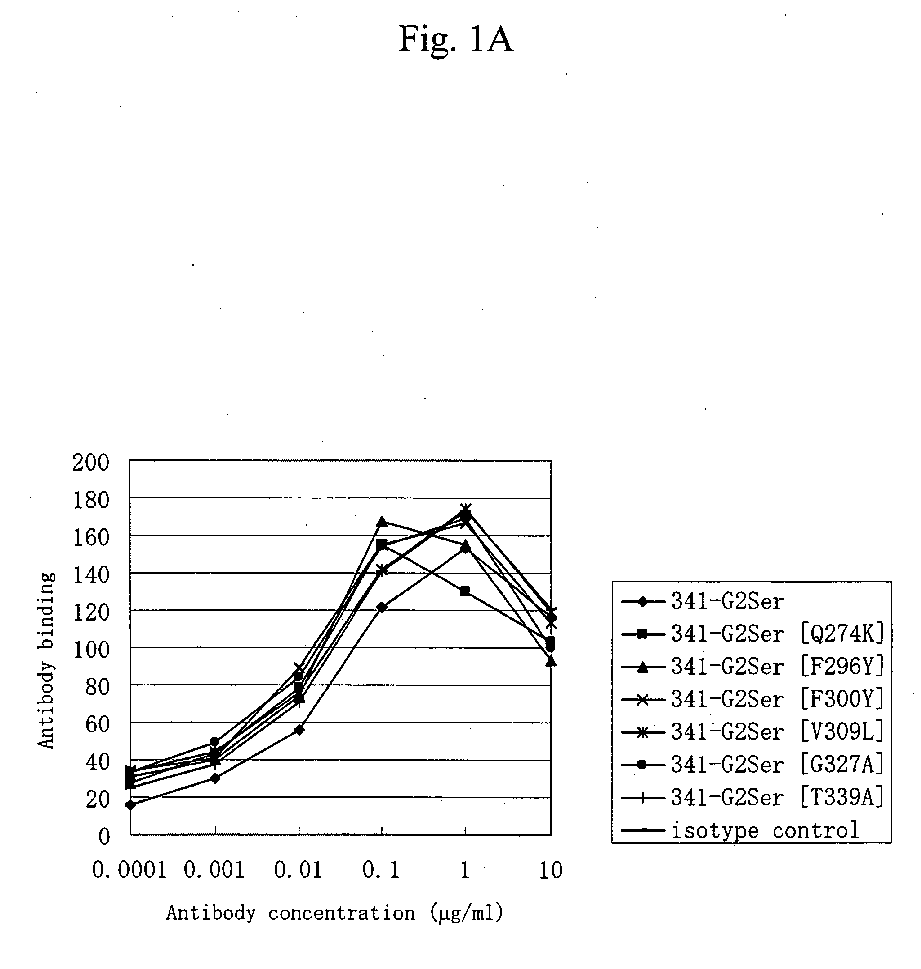
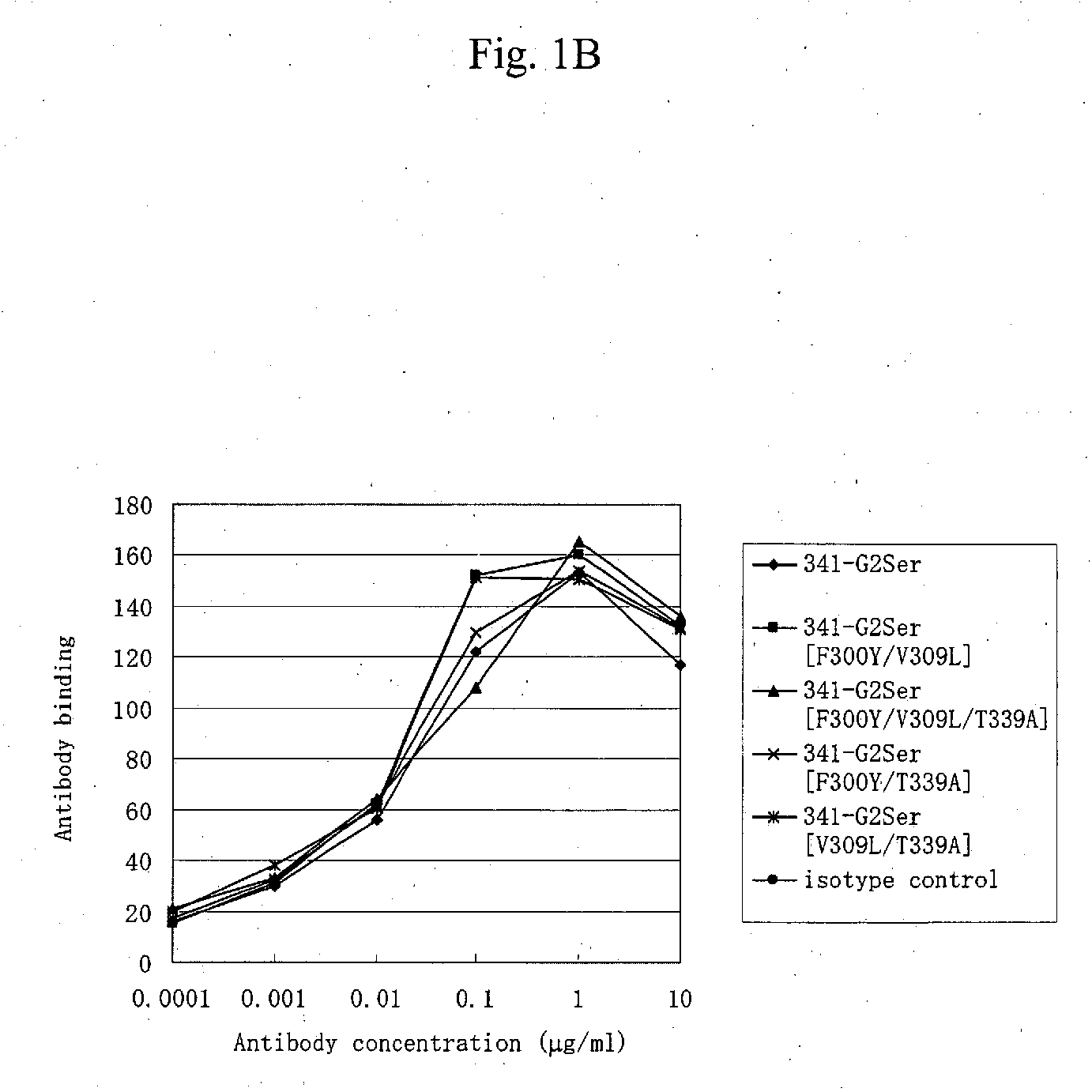
- Figures 1A, 1B, and 1C the unit of the antibody binding represented by the longitudinal axis is average fluorescence intensity.
- the values of the isotype control shown in Figures 1 A, 1B, and 1C are 7.15, 7.15, and 5.01, respectively.
- Nucleotide sequences encoding the heavy and light chain variable regions of the 4D11 antibody and amino acid sequences of the heavy and light chains are respectively shown below.
- N5KG3 was used as a template to perform 15 cycles of reaction at 98°C for 1 second, 60°C for 30 seconds, and 72°C for 30 seconds using primers linkH: gggtacgtcctcacattcagtgatcag (SEQ ID NO: 9) and N392K-r: GGGAGGCGTGGTCTTGTAGTTGTTCTC (SEQ ID NO: 48).
- oligonucleotide (5'-terminally phosphorylated) for mutagenesis used was N392KM397V: GGGCAGCCGG AGAACAACTA CAAGACCACG CCTCCCGTGC TGGACTCCGA CGGCTCC (SEQ ID NO: 54).
- Candidate plasmid DNA of the obtained variant antibody expression vector was selected by DNA nucleotide sequence analysis to obtain an expression vector of an anti-CD40 antibody variant having the amino acid variation of interest introduced therein.
- the plasmid DNA expressing the anti-CD40 antibody variant protein was designated as NSKG3-4D11-N392KM397V.
- the oligonucleotides for mutagenesis used were G3_F300Y: CAGTACAACA GCACGTACCG TGTGGTCAGC (SEQ ID NO: 55) for 4D11-G[3331][F300Y] preparation, G3_T339A: GAAAACCATC TCCAAAGCCA AAGGACAGCC C (SEQ ID NO: 56) for 4D11-G[3331][T339A] preparation, and G3_F300Y and G3_T339A for 341-G2Ser[V309L/T339A] preparation.
- a nucleotide sequence encoding the light chain of the 4D11-G3[F300Y][N392KM397V][R435H] and an amino acid sequence of the heavy chain are shown below.
- Example 24 Avidity of anti-CD40 antibodies to Ramos cells.
Landscapes
- Health & Medical Sciences (AREA)
- Life Sciences & Earth Sciences (AREA)
- Chemical & Material Sciences (AREA)
- Organic Chemistry (AREA)
- Medicinal Chemistry (AREA)
- General Health & Medical Sciences (AREA)
- Veterinary Medicine (AREA)
- General Chemical & Material Sciences (AREA)
- Public Health (AREA)
- Nuclear Medicine, Radiotherapy & Molecular Imaging (AREA)
- Chemical Kinetics & Catalysis (AREA)
- Pharmacology & Pharmacy (AREA)
- Animal Behavior & Ethology (AREA)
- Immunology (AREA)
- Virology (AREA)
- Oncology (AREA)
- Molecular Biology (AREA)
- Communicable Diseases (AREA)
- Engineering & Computer Science (AREA)
- Bioinformatics & Cheminformatics (AREA)
- Biochemistry (AREA)
- Proteomics, Peptides & Aminoacids (AREA)
- Genetics & Genomics (AREA)
- Biophysics (AREA)
- Tropical Medicine & Parasitology (AREA)
- Pulmonology (AREA)
- Transplantation (AREA)
- AIDS & HIV (AREA)
- Hematology (AREA)
- Biotechnology (AREA)
- Pain & Pain Management (AREA)
- Rheumatology (AREA)
- Preparation Of Compounds By Using Micro-Organisms (AREA)
- Peptides Or Proteins (AREA)
- Medicines Containing Antibodies Or Antigens For Use As Internal Diagnostic Agents (AREA)
- Micro-Organisms Or Cultivation Processes Thereof (AREA)
Abstract
Description
- The present invention relates to IgG2 and IgG3 antibodies improved in stability, which are obtained by introducing a variation into the constant regions of human IgG2 and IgG3 heavy chains.
- Immunoglobulins, which are glycoproteins present in the serum, tissue, or body fluid of every mammal, have the function of recognizing foreign antigens. The immunoglobulins participate through antibody binding to antigens in biophylaxis via the activation of the complement system or via the activation of effector functions such as enhancement in cellular phagocytosis, antibody-dependent cytotoxicity, mediator release, and antigen presentation via an Fc receptor (FcR) present in cell surface.
- Human immunoglobulins are divided into 5 different classes consisting of IgG, IgA, IgM, IgD, and IgE. IgG can further be classified into 4 subclasses consisting of IgG1, IgG2, IgG3, and IgG4, while IgA can further be classified into 2 subclasses consisting of IgA1 and IgA2. The basic structure of immunoglobulin comprises 2 homologous light chains (L chains) and 2 homologous heavy chains (H chains). The immunoglobulin classes and subclasses are determined depending on H chains.
- Different types of immunoglobulins are known to have different functions. For example, complement-binding ability is high in IgM>IgG3>IgG1>IgG2 in this order, and affinity for Fc receptor I is high in IgG3>IgG1>IgG4>IgG2 in this order. Moreover, IgG1, IgG2, and IgG4 are capable of binding to Protein A.
- Human antibodies used as drugs are collected and purified from blood. Many monoclonal antibodies have undergone clinical trials in recent years and have been placed on the market. However, the monoclonal antibodies placed on the market or clinically developed for pharmaceutical applications are mostly derived from the IgG1 subclass and hardly derived from the IgG2 and IgG3 subclasses. IgG2 is only one IgG that can activate the alternative pathway in complement activation and has been reported to be associated with infectious diseases such as influenza. IgG2 is also known to have little antibody-dependent cytotoxicity. On the other hand, IgG3 is known to have very strong antibody-dependent complement-activating capacity and antibody-dependent cytotoxicity. The development of antibody drugs having novel activity can be expected by exploiting such characteristics.
- However, IgG2 and IgG3 have hardly been developed so far as drugs. Therefore, production techniques thereof mostly remain uncertain.
- An object of the present invention is to prepare highly stable variants of human IgG2 and IgG3 antibodies.
- The present inventors have found that IgG2 and IgG3 antibodies are instable at low pH, specifically, tend to form aggregates at low pH.
- In general, an affinity purification method using Protein A is used in the production of antibodies as drugs. In this method, a buffer solution with low pH is often used to elute the antibodies bound with Protein A. Moreover, the treatment at low pH for a given time is also preferable in light of virus removal. The contamination of drugs with aggregates formed during this procedure has been reported to promote infusion reaction, complement activation, or antibody-dependent cytotoxicity. It can be estimated easily that these factors lead to side-effects. Therefore, it is very important to reduce the amount of aggregates as much as possible.
- Thus, the present inventors have found that aggregate formation at low pH can be suppressed by changing the partial amino acid structures of the heavy chain constant regions of IgG2 and IgG3 antibodies.
- The basic idea of modifications of human IgG2 and IgG3 antibodies according to the present invention will be described below in detail. A stabilized human IgG2 antibody of the present invention has at least a substitution of Y for F at the 300th position (the alphabet denotes the single character code of the amino acid; the number denotes the EU index of Kabat et al.; hereinafter, interpreted in the same manner), L for V at the 309th position, or A for T at the 339th position designated by the EU index of Kabat et al. (Kabat et al., Sequences of proteins of Immunological Interest, 1991 Fifth edition) in the heavy chain constant region thereof. Preferably, the antibody has at least the substitutions of Y for F at the 300th position and L for V at the 309th position designated by the EU index of Kabat et al. Alternatively, preferably, the antibody has at least the substitutions of Y for F at the 300th position and A for T at the 339th position designated by the EU index of Kabat et al. Alternatively, preferably, the antibody has at least the substitutions of L for V at the 309th position and A for T at the 339th position designated by the EU index of Kabat et al. Further preferably, the antibody has at least the substitutions of Y for F at the 300th position, L for V at the 309th position, and A for T at the 339th position designated by the EU index of Kabat et al.
- Moreover, the stabilized human IgG2 antibody of the present invention has at least a substitution of the CH2 domain of an IgG1 heavy chain for the CH2 domain of the heavy chain constant region thereof. For example, the CH2 domain is substituted by the CH2 domain of an IgG1 heavy chain, or the CH2 and CH3 domains are substituted by the CH2 and CH3 domains of an IgG1 heavy chain.
- Further substitutions of A for D270, K322, P329, and P331 or conversion of P331 to S or G (the alphabet denotes the single character code of the amino acid; the number denotes the EU index of Kabat et al. (Kabat et al., Sequences of proteins of Immunological Interest, 1991 Fifth edition)) can improve stability and reduce CDC activity.
- Moreover, further substitutions of E for L235 and A for G237 can improve stability and reduce ADCC activity. Conversely, a variation for enhancing CDC activity and/or ADCC activity can be introduced appropriately.
- A stabilized human IgG3 antibody of the present invention has at least a substitution of K for N at the 392nd or V for M at the 397th position designated by the EU index of Kabat et al. in the heavy chain constant region thereof. Preferably, the antibody has at least the substitutions of K for N at the 392nd position and V for M at the 397th position designated by the EU index of Kabat et al.
- Alternatively, preferably, the antibody has the substitution(s) at the 392nd and/or 397th positions and further has a substitution of Y for F at the 300th position designated by the EU index of Kabat et al.
- Alternatively, preferably, the antibody has the substitutions at the 392nd, 397th, and 300th positions and further has a substitution of H for R at the 435th position designated by the EU index of Kabat et al. For example, the antibody has the substitutions at the 392nd and 435th positions, the substitutions at the 397th and 435th positions, the substitutions at the 392nd, 397th, and 435th positions, the substitutions at the 392nd, 300th, and 435th positions, the substitutions at the 397th, 300th, and 435th positions, or the substitutions at the 392nd, 397th, 300th, and 435th positions. The substitution of H for R at the 435th position is intended to permit for the purification of the human IgG3 antibody with Protein A (Ito S et al., Exp Clin Immunogenet. 1990, 7 (2): 91-100).
- Moreover, the stabilized human IgG3 antibody of the present invention has at least a substitution of the CH3 domain of an IgG1 heavy chain for the CH3 domain of the heavy chain constant region thereof. For example, the CH3 domain is substituted by the CH3 domain of an IgG1 heavy chain, or the CH2 and CH3 domains are substituted by the CH2 and CH3 domains of an IgG1 heavy chain.
- In addition to the substitutions described above, a variation for reducing or enhancing CDC activity and/or ADCC activity can further be introduced into the constant region of the IgG3 heavy chain.
- The present invention also provides methods for producing antibodies comprising the substitutions, methods for suppressing the aggregation of antibodies comprising the substitutions, or compositions comprising the antibodies.
- Specifically, the present invention is as follows:
- [1] An IgG heavy chain comprising the constant region of a human IgG2 heavy chain having at least a substitution of Y for F at the 300th position designated by the EU index of Kabat et al.
- [2] An IgG heavy chain comprising the constant region of a human IgG2 heavy chain having at least a substitution of L for V at the 309th position designated by the EU index of Kabat et al.
- [3] An IgG heavy chain comprising the constant region of a human IgG2 heavy chain having at least a substitution of A for T at the 339th position designated by the EU index of Kabat et al.
- [4] The IgG heavy chain according to any of [1] to [3], wherein the constant region of the heavy chain further comprises an amino acid substitution of S for P at the 331st position designated by the EU index of Kabat et al.
- [5] A monoclonal antibody comprising an IgG heavy chain according to any of [1] to [4].
- [6] The IgG heavy chain according to any of [1] to [4], wherein the IgG heavy chain has the heavy chain variable region of a monoclonal antibody produced by a hybridoma KM341-1-19 (Accession No. FERM BP-7759).
- [7] A monoclonal antibody consisting of: an IgG heavy chain according to [6]; and a light chain having the light chain variable region of a monoclonal antibody produced by a hybridoma KM341-1-19 (Accession No. FERM BP-7759).
- [8] The IgG heavy chain according to any of [1] to [4], wherein the IgG heavy chain has the variable region of an IgG heavy chain represented by SEQ ID NO: 2.
- [9] A monoclonal antibody consisting of: an IgG heavy chain according to [8]; and a light chain having the variable region of an IgG light chain represented by SEQ ID NO: 4.
- [10] The IgG heavy chain according to [4], wherein the IgG heavy chain consists of the portion of a polypeptide represented by SEQ ID NO: 31 except for a signal sequence.
- [11] A monoclonal antibody consisting of: an IgG heavy chain according to [10]; and the light chain of a monoclonal antibody consisting of the portion of a polypeptide represented by SEQ ID NO: 33 except for a signal sequence.
- [12] A polynucleotide represented by SEQ ID NO: 30.
- [13] An expression vector having a polynucleotide according to [12].
- [14] A host comprising an expression vector according to [13].
- [15] The IgG heavy chain according to [4], wherein the IgG heavy chain is produced by a host according to [14].
- [16] A monoclonal antibody consisting of: an IgG heavy chain according to [15]; and the light chain of a monoclonal antibody produced by a host comprising an expression vector having a polynucleotide represented by SEQ ID NO: 32.
- [17] A method for producing an IgG heavy chain, comprising the step of substituting Y for F at the 300th position designated by the EU index of Kabat et al. in the constant region of a human IgG2 heavy chain.
- [18] A method for producing an IgG heavy chain, comprising the step of substituting L for V at the 309th position designated by the EU index of Kabat et al. in the constant region of a human IgG2 heavy chain.
- [19] A method for producing an IgG heavy chain, comprising the step of substituting A for T at the 339th position designated by the EU index of Kabat et al. in the constant region of a human IgG2 heavy chain.
- [20] A production method, comprising a method for producing a monoclonal antibody according to any of [17] to [19].
- [21] A method for producing an IgG heavy chain, comprising the step of: culturing, in a culture solution, a host comprising an expression vector having a polynucleotide represented by SEQ ID NO: 30; and obtaining a monoclonal antibody heavy chain from the resulting cultures and/or the host.
- [22] A method for producing a monoclonal antibody, comprising the step of: culturing, in a culture solution, a host comprising an expression vector having polynucleotides represented by SEQ ID NOS: 30 and 32; and obtaining a monoclonal antibody from the resulting cultures and/or the host.
- [23] A method for producing an IgG heavy chain, comprising the step of: culturing, in a culture solution, a host comprising an expression vector having a polynucleotide represented by SEQ ID NO: 34; and obtaining an IgG heavy chain from the resulting cultures and/or the host.
- [24] A method for producing a monoclonal antibody, comprising the step of: culturing, in a culture solution, a host comprising an expression vector having polynucleotides represented by SEQ ID NOS: 34 and 36; and obtaining a monoclonal antibody from the resulting cultures and/or the host.
- [25] A method for producing a monoclonal antibody, comprising the step of: culturing, in a culture solution, a host comprising an expression vector having polynucleotides encoding the heavy and light chains of a monoclonal antibody according to [5]; and obtaining a monoclonal antibody from the resulting cultures and/or the host.
- [26] A method for suppressing monoclonal antibody aggregation, characterized by comprising substituting Y for F at the 300th position designated by the EU index of Kabat et al. in the constant region of a human IgG2 heavy chain.
- [27] A method for suppressing monoclonal antibody aggregation, characterized by comprising substituting L for V at the 309th position designated by the EU index of Kabat et al. in the constant region of a human IgG2 heavy chain.
- [28] A method for suppressing monoclonal antibody aggregation, characterized by comprising substituting A for T at the 339th position designated by the EU index of Kabat et al. in the constant region of a human IgG2 heavy chain.
- [29] A pharmaceutical composition comprising a monoclonal antibody according to any of [7], [9], [11], and [16] as an active ingredient.
- [30] The pharmaceutical composition according to [29], wherein the pharmaceutical composition is used in the prevention or treatment of tumor, a pathogen, or autoimmune disease.
- [31] A composition comprising a monoclonal antibody according to any of [7], [9], [11], and [16].
- [32] An IgG heavy chain comprising the constant region of a human IgG3 heavy chain having at least a substitution of V for M at the 397th position designated by the EU index of Kabat et al.
- [33] A monoclonal antibody comprising an IgG heavy chain according to [32].
- [34] A method for producing an IgG heavy chain, comprising the step of substituting K for N at the 392nd position designated by the EU index of Kabat et al. in the constant region of a human IgG3 heavy chain.
- [35] A method for producing an IgG heavy chain, comprising the step of substituting V for M at the 397th position designated by the EU index of Kabat et al. in the constant region of a human IgG3 heavy chain.
- [36] A production method, comprising a method for producing a monoclonal antibody according to [34] or [35].
- [37] A method for producing a monoclonal antibody, comprising the step of: culturing, in a culture solution, a host comprising an expression vector having polynucleotides encoding the heavy and light chains of a monoclonal antibody according to [33]; and obtaining a monoclonal antibody from the resulting cultures and/or the host.
- [38] A method for suppressing monoclonal antibody aggregation, characterized by comprising substituting K for N at the 392nd position designated by the EU index of Kabat et al. in the constant region of a human IgG3 heavy chain.
- [39] A method for suppressing monoclonal antibody aggregation, characterized by comprising substituting V for M at the 397th position designated by the EU index of Kabat et al. in the constant region of a human IgG3 heavy chain.
- [40] A composition comprising a monoclonal antibody according to any of [33], [36], and [37].
- The present invention further comprises the following aspects:
- [41] The IgG heavy chain according to any of [1] to [4], wherein the IgG heavy chain has the heavy chain variable region of a monoclonal antibody produced by a hybridoma 2105 (Accession No. BP-8024).
- [42] A monoclonal antibody consisting of: an IgG heavy chain according to [41]; and a light chain having the light chain variable region of a monoclonal antibody produced by a hybridoma 2105 (Accession No. BP-8024).
- [43] The IgG heavy chain according to any of [1] to [4], wherein the IgG heavy chain has the variable region of an IgG heavy chain represented by SEQ ID NO: 6.
- [44] A monoclonal antibody consisting of: an IgG heavy chain according to [43]; and a light chain having the variable region of an IgG light chain represented by SEQ ID NO: 8.
- [45] The IgG heavy chain according to [4], wherein the IgG heavy chain consists of the portion of a polypeptide represented by SEQ ID NO: 35 except for a signal sequence.
- [46] A monoclonal antibody consisting of: an IgG heavy chain according to [45]; and the light chain of a monoclonal antibody consisting of the portion of a polypeptide represented by SEQ ID NO: 37 except for a signal sequence.
- [47] A polynucleotide represented by SEQ ID NO: 34.
- [48] An expression vector having a polynucleotide according to [47].
- [49] A host comprising an expression vector according to [48].
- [50] The IgG heavy chain according to [4], wherein the IgG heavy chain is produced by a host according to [49].
- [51] A monoclonal antibody consisting of: an IgG heavy chain according to [50]; and the light chain of a monoclonal antibody produced by a host comprising an expression vector having a polynucleotide represented by SEQ ID NO: 36.
- [52] A pharmaceutical composition comprising a monoclonal antibody according to any of [42], [44], [46], and [51] as an active ingredient.
- [53] The pharmaceutical composition according to [52], wherein the pharmaceutical composition is used in the prevention or treatment of tumor, a pathogen, or autoimmune disease.
- [54] A composition comprising a monoclonal antibody according to any of [42], [44], [46], and [51].
- The antibody of the present invention improved in stability by a substitution of Y for F at the 300th position, L for V at the 309th position, or A for T at the 339th position in the amino acid sequence of the IgG2 heavy chain possesses the characteristics of exhibiting reduced aggregate formation, particularly, reduced aggregate formation at low pH, while maintaining antigen-binding properties. Thus, the antibody of the present invention can be produced stably as a drug. Furthermore, the antibody of the present invention when administered to a test subject easily avoids side-effects caused by contamination with antibody aggregates and can be used with safety.
- The antibody of the present invention improved in stability by a substitution of K for N at the 392nd position, V for M at the 397th position, or Y for F at the 300th position in the amino acid sequence of the IgG3 heavy chain possesses the characteristics of exhibiting reduced aggregate formation, particularly, reduced aggregate formation at low pH, while maintaining antigen-binding properties. Thus, the antibody of the present invention can be produced stably as a drug. Furthermore, the antibody of the present invention when administered to a test subject easily avoids side-effects caused by contamination with antibody aggregates and can be used with safety.
- Furthermore, an antibody having reduced ADCC and/or CDC in addition to improved stability can be obtained by, for example, a substitution of serine for proline at the 331 st position. This antibody when administered to a test subject can avoid side-effects caused by ADCC and/or CDC and can be used as a drug with safety.
- The present specification encompasses contents described in the specification and/or drawings of JP Patent Publication (Kokai) No. 2005-005794A that serves as a basis of the priority of the present application.
-
- Figure 1A is a diagram showing the binding activity of variants of an anti-CD40 antibody KM341-1-19 to Ramos cells (Ramos cell binding activity);
- Figure 1B is a diagram showing the binding activity of variants of an anti-CD40 antibody KM341-1-19 to Ramos cells (Ramos cell binding activity);
- Figure 1C is a diagram showing the binding activity of variants of anti-CD40 antibodies KM341-1-19 and 2105 to Ramos cells (Ramos cell binding activity);
- Figure 2A is a diagram showing the promotion of CD95 expression in Ramos cells (CD95 expression-inducing activity for Ramos cells) by variants of an anti-CD40 antibody KM341-1-19;
- Figure 2B is a diagram showing the promotion of CD95 expression in Ramos cells (CD95 expression-inducing activity for Ramos cells) by variants of an anti-CD40 antibody KM341-1-19;
- Figure 2C is a diagram showing the promotion of CD95 expression in Ramos cells (CD95 expression-inducing activity for Ramos cells) by variants of anti-CD40 antibodies KM341-1-19 and 2105;
- Figure 3 is a diagram showing the binding activity of variants of an anti-CD40 antibody 4D11 to Ramos cells (Ramos cell binding activity); and
- Figure 4 is a diagram showing the suppression of CD95 expression in Ramos cells (antagonist activity evaluation) by variants of an anti-CD40 antibody 4D11.
- An IgG heavy chain comprises two regions: a variable region that determines binding specificity to antigens; and a constant region that participates in the effector function expression of the antibody. The variable region structurally differs in antigen-binding site sequence depending on the recombination of a gene constituting the variable region and the introduction of a somatic mutation. This brings about the characteristic of being capable of recognizing a very large number of foreign antigens.
- Moreover, antibodies are originally molecules responsible for biophylaxis functions against foreign microorganisms, viruses, or cancers and therefore also have the effect of killing and removing cells bound with the antibodies. This is called effector functions. These killing functions are divided into two types, one of which is called Antibody-Dependent Cellular Cytotoxicity (hereinafter, abbreviated to ADCC), and the other of which is called Complement-Dependent Cytotoxicity (hereinafter, abbreviated to CDC). ADCC refers to cytotoxicity that is induced by cellular activation caused by the binding of Macrophage, NK cells, neutrophil, or the like via FcR expressed on the surface thereof to the antibody constant region. On the other hand, CDC refers to cytotoxicity that is caused by the complement system activated by antibody binding to an antigen. These activities are known to differ in intensity depending on antibody subclasses (Charles A. Janeway et al. Immunobiology, 1997, Current Biology Ltd./Garland Publishing Inc.).
- The present invention can improve the stability of IgG2 and IgG3 antibodies while maintaining their specific antigen-binding properties. Specifically, a substitution of Y for F at the 300th position, L for V at the 309th position, or A for T at the 339th position in the amino acid sequence of the IgG2 heavy chain can improve antibody stability. The antibody of the present invention may have these substitutions alone or in combination. Moreover, a substitution of the CH2 domain of an IgG1 heavy chain for the CH2 domain of the IgG2 heavy chain or the CH2 and CH3 domains of an IgG1 heavy chain for the CH2 and CH3 domains of the IgG2 heavy chain can improve antibody stability. Alternatively, a substitution of K for N at the 392nd position, V for M at the 397th position, or Y for F at the 300th position in the amino acid sequence of the IgG3 heavy chain according to the present invention can improve antibody stability. The antibody of the present invention may have these substitutions alone or in combination. Moreover, a substitution of the CH3 domain of an IgG1 heavy chain for the CH3 domain of the IgG3 heavy chain or the CH2 and CH3 domains of an IgG1 heavy chain for the CH2 and CH3 domains of the IgG3 heavy chain can improve antibody stability.
- In the present invention, a variant antibody comprising the domain of a certain subclass substituted by the domain of another subclass is also referred to as a domain swap variant antibody.
- In the present invention, an antibody improved in stability refers to an antibody that has no reduction in antigen-binding ability even under acidic conditions, that is, under low pH conditions, for example, at
pH 4 or lower, and hardly forms aggregates under these conditions. Alternatively, the antibody improved in stability refers to an antibody that exhibits a low aggregate content when purified by use of a Protein A or Protein G affinity column. The antibody improved in stability refers to an antibody that forms an aggregate at a content of 10% or lower, preferably 5% or lower, more preferably 1% or lower, for example, when treated at pH 3.5 for 10 minutes or 60 minutes. The aggregate content can be measured, for example, by liquid chromatography. - In the present invention, an antibody improved in physical property refers to an antibody that has ADCC and/or CDC adjusted to desired intensity, in addition to stability, or an antibody that has FcR-binding ability adjusted to a desired level. The adjustment of ADCC and/or CDC and the adjustment of FcR-binding ability can be performed by introducing a variation into the antibody.
- An additional appropriate variation can be introduced into the antibody improved in stability to thereby reduce or enhance ADCC and/or CDC.
- For example, L235, D265, D270, K322, P331, and P329 (the alphabet denotes the single character code of the amino acid; the number denotes the EU index of Kabat et al. (Kabat et al., Sequences of proteins of Immunological Interest, 1991 Fifth edition); hereinafter, interpreted in the same manner) have been considered to play an important role in the complement-activating capacity of human IgG. These sites can be substituted by other amino acids to thereby reduce CDC activity (Esohe E. Idusogie et al. J. Immunol. 2000, 164: 4178-4184; Yuanyuan Xu et al. J. Biol. Chem. 1994, 269: 3469-3474; Brekke, O.H. et al. Eur. J. Immunol. 1994, 24: 2542; Morgan, A., et al., Immunology 1995, 86: 319; Lund, J., et al., J. Immunol., 1996, 157: 4963; and Tao, M. H., et al., J. Exp. Med. 1993, 178: 661). Specifically, the reduction in CDC activity can be performed by a substitution of A for D270, K322, P329, or P331. Alternatively, the reduction in CDC activity can be performed by a substitution of S or G for P331.
- Moreover, Glu233-Ser239, Gly316-Lys338, Lys274-Arg301, Tyr407-Arg416; Asn297, Glu318, Leu234-Ser239, Asp265-Glu269, Asn297-Thr299, and Ala327-Ile332 have been considered to participate in the binding of IgG with FcR (Duncan, A. R., Woof, J. M., Partridge, L. J., Burton, D. R., and Winter, G. (1988) Nature 332, 563-564; Gessner, J. E., Heiken, H., Tamm, A., and Schmidt, R. E. (1998) Ann. Hematol. 76, 231-248; Gavin, A., Hulett, M., and Hogarth, P. M. (1998) in The Immunoglobulin Receptors and Their Physiological and Pathological Roles in Immunity (van de Winkel, J. G. J., and Hogarth, P. M., eds), pp. 11-35, Kluwer Academic Publishers Group, Dordrecht, The Netherlands, Sautes, C. (1997) in Cell-mediated Effects of Immunoglobulins (Fridman, W. H., and Sautes, C., eds), pp. 29-66, R. G. Landes Co., Austin, TX, Da'ron, M. (1997) Annu. Rev. Immunol. 15, 203-234; Canfield, S. M., and Morrison, S. L. (1991) J. Exp. Med. 173, 1483-1491; Chappel, M. S., Isenman, D. E., Everett, M., Xu, Y.-Y., Dorrington, K. J., and Klein, M. H. (1991) Proc. Natl. Acad. Sci. U.S.A. 88, 9036-9040; Woof, J. M., Partridge, L. J., Jefferis, R., and Burton, D. R. (1986) Mol. Immunol. 23, 319-330; and Wines, B. D., Powell, M. S., Parren, P. W.H.I., Barnes, N., and Hogarth, P. M. (2000) J. Immunol. 164, 5313-5318). A variation can be introduced into these regions to thereby reduce ADCC activity. Specifically, reduction in FcR-binding ability can be performed by a substitution of E for L235 or A for G237.
- A variation can be introduced in a manner the reverse of the variations described above to thereby enhance the ADCC and/or CDC of the antibody improved in stability. The antibody of the present invention also encompasses an antibody enhanced in ADCC and/or CDC.
- The antibody of the present invention has one or more, preferably 1 to 20, 1 to 17, 1 to 16,1 to 15,1 to 14,1 to 13,1 to 12,1 to 11,1 to 10,1 to 9,1 to 8,1 to 7,1 to 6,1 to 5,1 to 4, 1 to 3, or 1 or 2 amino acid variations for enhancing or reducing the ADCC and/or CDC activity.
- Examples of an antibody improved in stability that has the substitution of Y for F at the 300th position, L for V at the 309th position, or A for T at the 339th position in the heavy chain of an IgG2 antibody, or an antibody improved in stability that has these substitutions in combination include, but not limited to, anti-CD40 antibodies. More specifically, the antibody is exemplified by an antibody having the light and heavy chain variable regions of an antibody produced by a hybridoma KM341-1-19 (Accession No. BP-7759) or an antibody having the light and heavy chain variable regions of an antibody produced by a hybridoma 2105 (Accession No. BP-8024). Examples of an antibody improved in stability that has the substitution of K for N at the 392nd position, V for M at the 397th position, or Y for F at the 300th position in the heavy chain of an IgG3 antibody, or an antibody improved in stability that has these substitutions in combination include, but not limited to, anti-CD40 antibodies.
- Terms used herein are defined as follows:
- "CD40" means a polypeptide having the amino acid sequence shown by Clark et al. (E. A. Clark et al., Proc. Natl. Acad. Sci. USA 83: 4494, 1986) or Stamenkovic et al. (I. Stamenkovic et al., EMBO J. 8: 1403, 1989) and is particularly an antigenic polypeptide expressed in the surface of B cells, DC, macrophage, endothelial cells, epithelial cells, or tumor cells thereof.
- An "anti-CD40 antibody" means monoclonal and polyclonal antibodies against cellularly expressed CD40, full-length CD40, or partial-length CD40. The anti-CD40 antibody is preferably a monoclonal antibody.
- The "agonist" effect of the anti-CD40 antibody means the effect of promoting the binding of CD40 expressed in the surface of cells such as B cells, tumor cells, or dendritic cells with its ligands or the effect of imparting one or more of influences of CD40 ligands on CD40-expressing cells to cells that express CD40. An "agonistic antibody" means an antibody that has such effects. One example of the influences on CD40-expressing cells includes the promotion of B cell growth or the promotion of antibody production.
- The "antagonistic" effect of the anti-CD40 antibody means the effect of inhibiting the binding of CD40 expressed in the surface of cells such as B cells, tumor cells, or dendritic cells with its ligands or the effect of neutralizing one or more of influences of CD40 ligands on CD40-expressing cells. An "antagonistic antibody" means an antibody that has such effects. One example of the influences on CD40-expressing cells includes the suppression of B cell growth or the suppression of antibody production.
- An "antibody" is derived from genes encoding heavy chain variable and constant regions and light chain variable and constant regions constituting immunoglobulin (collectively called antibody genes). The antibody of the present invention also encompasses antibodies of any immunoglobulin class and antibodies having any isotype. Examples of proteins (antigens) to which the antibody of the present invention binds include, but not limited to, CD40.
- A "CH1 domain", "hinge domain", "CH2 domain", and "CH3 domain" denote a portion of the heavy chain constant region of the antibody and are based on the EU index of Kabat et al. (Kabat et al., Sequences of proteins of immunological interest, 1991 Fifth edition). The CH1 domain is the portion comprising the sequence at the 118th to 215th positions according to the EU index, the hinge domain is the portion comprising the sequence at the 216th to 237th positions according to the EU index, the CH2 domain is the portion comprising the sequence at the 238th to 340th positions according to the EU index, and the CH3 domain is the portion consisting of the sequence at the 341 st to 446th positions according to the EU index.
- A "human antibody" means antibody that is an expression product of antibody genes derived from humans. Examples of previously known human IgG2 include J00230 (SEQ ID NO: 64), AJ250170 (SEQ ID NO: 65), AF449616 (SEQ ID NO: 66), AF449617 (SEQ ID NO: 67), AF449618 (SEQ ID NO: 68), Z49802 (SEQ ID NO: 69), and Z49801 (SEQ ID NO: 70). Examples of previously known human IgG3 include M12958, K01313 (SEQ ID NO: 71), X16110 (SEQ ID NO: 72), X99549 (SEQ ID NO: 73), AJ390236 (SEQ ID NO: 74), AJ390237 (SEQ ID NO: 75), AJ390238 (SEQ ID NO: 76), AJ390241 (SEQ ID NO: 77), AJ390242 (SEQ ID NO: 78), AJ390246 (SEQ ID NO: 79), AJ390247 (SEQ ID NO: 80), AJ390252 (SEQ ID NO: 81), AJ390244 (SEQ ID NO: 82), AJ390254 (SEQ ID NO: 83), AJ390260 (SEQ ID NO: 84), AJ390262 (SEQ ID NO: 85), AJ390272 (SEQ ID NO: 86), AJ390276 (SEQ ID NO: 87), and AJ390279 (SEQ ID NO: 88) (these symbols are Gene Bank Accession Numbers of the genes). The sequences represented by SEQ ID NOS: 64 to 88 denote their respective nucleotide sequences.
- A "human IgG heavy chain" is a heavy chain consisting of a heavy chain variable region and a human IgG heavy chain constant region. For example, a "human IgG2 heavy chain" is a heavy chain consisting of a heavy chain variable region and a human IgG2 heavy chain constant region.
- A "human IgG antibody" is an antibody consisting of a human IgG heavy chain and a human light chain. For example, a "human IgG2 antibody" is an antibody consisting of a human IgG2 heavy chain and a human light chain.
- The antibody of the present invention can be prepared appropriately, for example, by use of an antibody gene isolation method from hybridomas well known by those skilled in the art, the sequence information of the human antibody constant regions of the above-described human antibody genes known in the art, or site-specific mutagenesis into genes.
- The antibody of the present invention can be obtained by incorporating the antibody gene into an expression vector; introducing the vector into an appropriate host cell; and collecting and purifying an antibody from the resulting cell or the culture supernatant of the cell.
- The vector used is a phage or plasmid capable of autonomously amplifying in a host cell or capable of being incorporated into the chromosome of a host cell. Examples of the plasmid DNA include plasmids derived from E. coli, Bacillus subtilis, or yeast. Examples of the phage DNA include λ phages.
- The host used in transformation is not particularly limited as long as it can express the gene of interest. Examples thereof include bacteria (e.g., E. coli and Bacillus subtilis), yeast, animal cells (e.g., COS cells and CHO cells), and insect cells.
- A gene delivery method into a host is known in the art. Examples thereof include any method (e.g., a method using calcium ions, electroporation, spheroplast, lithium acetate, calcium phosphate, and lipofection methods): Examples of a gene delivery method into an animal described below include microinjection, a gene transfer method into ES cells using electroporation or lipofection, and a nuclear transplantation method.
- In the present invention, "cultures" mean any of (a) culture supernatants, (b) cultured cells or cultured strains or homogenates thereof, and (c) secreted products from transformants. To culture transformants, a medium suitable to a host used is used, and a static culture method, a culture method with roller bottles, or the like is adopted.
- When the protein of interest is produced within strains or cells after culture, the antibody is collected by homogenizing the strains or cells. Alternatively, when the antibody of interest is produced outside strains or cells, the culture solution is directly used or, for example, centrifuged to remove the strains or cells. Then, general biochemical methods using a variety of chromatography techniques used in protein isolation and purification can be used alone or in appropriate combination to thereby isolate and purify the antibody of interest from the cultures.
- Furthermore, an animal host comprising the gene of the antibody of interest incorporated in the endogenous gene, for example, a transgenic cow, transgenic goat, transgenic sheep, or transgenic pig is prepared by use of a transgenic animal production technique, and monoclonal antibodies derived form the antibody gene can be obtained in large amounts from milk secreted from the transgenic animal (Wright, G., et al. (1991) Bio/Technology 9, 830-834). In in-vitro hybridoma culture, a hybridoma is amplified, maintained, and stored to meet a variety of conditions such as the property of a cell species to be cultured, the purposes of experiments or research, and culture methods. This in-vitro hybridoma culture can be performed by use of a known nutritional medium used for monoclonal antibody production in a culture supernatant or every nutritional medium induced and prepared from a known basal medium.
- The scope of the present invention also encompasses a pharmaceutical composition comprising a purified preparation of the antibody of the present invention. Preferably, such a pharmaceutical composition comprises physiologically acceptable diluents or carriers, in addition to the antibody and may be a mixture with other antibodies or other drugs such as antibiotics. Examples of an appropriate carrier include, but not limited to, saline, phosphate-buffered saline, glucose-supplemented phosphate-buffered saline, and buffered saline. Alternatively, the antibody may be lyophilized (freeze-dried) and reconstituted for use, when needed, by the addition of such a buffered aqueous solution. Administration routes are oral routes and non-enteral routs including intravenous, intramuscular, subcutaneous, and intraperitoneal injection or drug administration.
- In this case, an effective dose combining an effective amount of the antibody of the present invention and an appropriate diluent and a pharmaceutically available carrier is 0.0001 mg to 100 mg per kg of body weight per dosage, which is administered at 2-day to 8-week intervals.
- The pharmaceutical composition comprising an agonistic anti-CD40 antibody as the antibody of the present invention is used as an adjuvant (antivirus or anti-infectious disease agent). In this context, a pathogen is exemplified by type A, B, C, D, or E hepatitis virus, HIV, influenza virus, herpes simplex virus, cytomegalovirus, EB virus, papilloma virus, chlamydia, mycoplasma, toxoplasma, malaria, trypanosome, and tuberculosis. Alternatively, the pharmaceutical composition of the present invention is used as an anti-tumor agent. Examples of tumor to be treated by the pharmaceutical composition include malignant tumor containing CD40-expressing cancer cells, for example, lymphoma (e.g., Hodgkin lymphoma), leukemia, malignant melanoma, pancreas cancer, lung cancer, ovarian cancer, bladder cancer, breast cancer, colon cancer, prostatic cancer, and head and neck cancer. Alternatively, the pharmaceutical composition of thee present invention is used as a therapeutic agent for autoimmune disease. Disease to be treated by the pharmaceutical agent is exemplified by rheumatism. These diseases may occur concurrently. Alternatively, the pharmaceutical composition of the present invention can also be used as an adjuvant in combination with vaccines such as cancer-specific peptides.
- The scope of the present invention also encompasses a composition comprising the antibody of the present invention. The composition comprises other ingredients, for example, buffers (intended for moderating pH changes; examples thereof include sodium glutamate), stabilizers (intended for enhancing the chemical or physical stability of the antibody; examples thereof include glycine), surfactants (examples thereof include polysorbate), or preservatives, in addition to the antibody. The composition is, for example, in an aqueous solution or freeze-dried form. The composition can be used, for example, as a reagent in antigen analysis. Aggregate formation is suppressed in the antibody of the present invention having an amino acid or domain substitution as compared with in antibodies free from the substitution. Therefore, the composition can be produced efficiently from the viewpoint of yields and so on. Moreover, the antibody of the present invention hardly causes aggregation in an analytical solution in antigen analysis and can therefore produce a high-precision result.
- The present invention will be described specifically with reference to Examples below. However, the present invention is not intended to be limited to these Examples.
- Of anti-CD40 antibodies described in
WO 02/088186 - The 341-1-19 antibody is an antibody that is produced by the hybridoma KM341-1-19, which has been deposited as Accession No. FERM BP-7759 on Sep. 27, 2001 with International Patent Organism Depositary, National Institute of Advanced Industrial Science and Technology (Central 6, 1-1-1, Higashi, Tsukuba, Ibaraki, Japan). The 2105 antibody is an antibody that is produced by the
hybridoma 2105, which has been deposited as Accession No. FERM BP-8024 on Apr. 17, 2002 with International Patent Organism Depositary, National Institute of Advanced Industrial Science and Technology (Central 6, 1-1-1, Higashi, Tsukuba, Ibaraki, Japan). - Nucleotide sequences encoding the heavy and light chain variable regions of the 341-1-19 antibody and amino acid sequences of the heavy and light chains are respectively shown below.
- A signal sequence in the nucleotide sequence (SEQ ID NO: 1) of the heavy chain of the 341-1-19 antibody starts at adenine (A) at the 50th position. The boundary between the signal sequence and the variable region is positioned between [adenine] ([A]) at the 109th position and cytosine (C) at the 110th position, while the boundary between the variable region and the constant region is positioned between adenine (A) at the 493rd position and guanine (G) at the 494th position (examined with gene sequence prediction software Signal P ver. 2).
- The boundary between the signal sequence and the variable region in the amino acid sequence (SEQ ID NO: 2) of the heavy chain of the 341-1-19 antibody is positioned between serine (S) at the 20th position and glutamine (Q) at the 21st position, while the boundary between the variable region and the constant region is positioned between serine (S) at the 148th position and alanine (A) at the 149th position.
- Thus, the nucleotide sequence of the heavy chain variable region of the 341-1-19 antibody reaches from cytosine (C) at the 110th position to adenine (A) at the 493rd position in SEQ ID NO: 1. The amino acid sequence of the heavy chain variable region of the 341-1-19 antibody reaches from glutamine (Q) at the 21 st position to serine (S) at the 148th position in SEQ ID NO: 2.
- A signal sequence in the nucleotide sequence (SEQ ID NO: 3) of the light chain of the 341-1-19 antibody starts at adenine (A) at the 29th position. The boundary between the signal sequence and the variable region is positioned between [adenine] ([A]) at the 88th position and guanine (G) at the 89th position, while the boundary between the variable region and the constant region is positioned between adenine (A) at the 400th position and [cytosine] ([C]) at the 401st position (examined with gene sequence prediction software Signal P ver. 2).
- The boundary between the signal sequence and the variable region in the amino acid sequence (SEQ ID NO: 4) of the light chain of the 341-1-19 antibody is positioned between glycine (G) at the 20th position and glutamic acid (E) at the 21 st position, while the boundary between the variable region and the constant region is positioned between lysine (K) at the 124th position and [arginine] ([R]) at the 125th position.
- Thus, the nucleotide sequence of the light chain variable region of the 341-1-19 antibody reaches from guanine (G) at the 89th position to adenine (A) at the 400th position in SEQ ID NO: 3. The amino acid sequence of the light chain variable region of the 341-1-19 antibody reaches from glutamic acid (E) at the 21 st position to lysine (K) at the 124th position in SEQ ID NO: 4.


- DNAs encoding the heavy and light chain variable regions of the 2105 antibody and amino acid sequences of the heavy and light chains are respectively shown below.
- A signal sequence in the nucleotide sequence (SEQ ID NO: 5) of the heavy chain of the 2105 antibody starts at adenine (A) at the 70th position. The boundary between the signal sequence and the variable region is positioned between [thymine] ([T]) at the 126th position and guanine (G) at the 127th position, while the boundary between the variable region and the constant region is positioned between adenine (A) at the 495th position and guanine (G) at the 496th position (examined with gene sequence prediction software Signal P ver. 2).
- The boundary between the signal sequence and the variable region in the amino acid sequence (SEQ ID NO: 6) of the heavy chain of the 2105 antibody is positioned between cysteine (C) at the 19th position and glutamic acid (E) at the 20th position, while the boundary between the variable region and the constant region is positioned between serine (S) at the 142nd position and alanine (A) at the 143rd position.
- Thus, the nucleotide sequence of the heavy chain variable region of the 2105 antibody reaches from guanine (G) at the 127th position to adenine (A) at the 495th position in SEQ ID NO: 5. The amino acid sequence of the heavy chain variable region of the 2105 antibody reaches from glutamic acid (E) at the 20th position to serine (S) at the 142nd position in SEQ ID NO: 6.
- A signal sequence in the nucleotide sequence (SEQ ID NO: 7) of the light chain of the 2105 antibody starts at adenine (A) at the 28th position. The boundary between the signal sequence and the variable region is positioned between [adenine] ([A]) at the 87th position and guanine (G) at the 88th position, while the boundary between the variable region and the constant region is positioned between adenine (A) at the 405th position and [cytosine] ([C]) at the 406th position (examined with gene sequence prediction software Signal P ver. 2).
- The boundary between the signal sequence and the variable region in the amino acid sequence (SEQ ID NO: 8) of the light chain of the 2105 antibody is positioned between glycine (G) at the 20th position and glutamic acid (E) at the 21 st position, while the boundary between the variable region and the constant region is positioned between lysine (K) at the 126th position and [arginine] ([R]) at the 127th position.
- Thus, the nucleotide sequence of the light chain variable region of the 2105 antibody reaches from guanine (G) at the 88th position to adenine (A) at the 405th position in SEQ ID NO: 7. The amino acid sequence of the light chain variable region of the 2105 antibody reaches from glutamic acid (E) at the 21 st position to lysine (K) at the 126th position in SEQ ID NO: 8.


- The present inventors have found that an anti-CD40 antibody 4D11 (having an IgG4 subclass) and its variant 4D11PE (prepared by digesting, with Bg1II and NheI, a DNA fragment containing the heavy and light chains of the 4D11 antibody gene; purifying the resulting fragment; and then ligating the fragment into an N5KG4PE vector (IDEC Pharmaceuticals); N5KG4PE and N5KG4P contain S228P and L235E point mutations and an S228P point mutation, respectively, in the IgG4 constant region) form approximately 10% aggregates under conditions involving the charge of their culture supernatants onto a Protein A column (Amersham Biosciences), elution with 0.1 M citric acid buffer (pH 2.7), and subsequent incubation at 37°C for 1 minute and for 10 minutes, whereas 4D114D11G1 comprising the 4D11 constant region derived from IgG1 forms few aggregates (
JP Patent Publication (Kokai) No. 2003-431408A - To prepare IgG[1/1/2/2], N5KG1-Val Lark (IDEC Pharmaceuticals; hereinafter, abbreviated to NSKG1) was used as a template to perform 15 cycles of reaction at 98°C for 1 second, 60°C for 30 seconds, and 72°C for 30 seconds using primers linkH: gggtacgtcctcacattcagtgatcag (SEQ ID NO: 9) and 24ch4: AGGGGTCCGGGAGATCATGAGAGTGTCCTT (SEQ ID NO: 10). At the same time, an antibody expression vector NSKG2 (IDEC Pharmaceuticals,
US Patent No. 6001358 ; "G2" means that its heavy chain constant region is derived from IgG2; hereinafter, interpreted in the same manner) was used as a template to perform 15 cycles of reaction at 98°C for 1 second, 60°C for 30 seconds, and 72°C for 30 seconds using primers 24ch3: AAGGACACTCTCATGATCTCCCGGACCCCT (SEQ ID NO: 11) and linkH2: tgatcatacgtagatatcacggc (SEQ ID NO: 12). The amplified DNA fragments were purified with a PCR purification kit, and these two purified DNA fragments were mixed in equal amounts and then subjected to 5 cycles of reaction at 98°C for 1 second, 60°C for 30 seconds, and 72°C for 30 seconds and additional 15 cycles of reaction with primers linkH and linkH2. The resulting amplified DNA fragment was cleaved with NheI and BamHI and substituted for the IgG1 constant region of an N5KG1 vector. This expression vector was designated as N5KG1122. - To prepare IgG[2/2/1/1], N5KG2 was used as a template to perform 15 cycles of reaction at 98°C for 1 second, 60°C for 30 seconds, and 72°C for 30 seconds using primers linkH: gggtacgtcctcacattcagtgatcag (SEQ ID NO: 9) and 24ch4: AGGGGTCCGGGAGATCATGAGAGTGTCCTT (SEQ ID NO: 10). At the same time, NSKG1 was used as a template to perform 15 cycles of reaction at 98°C for 1 second, 60°C for 30 seconds, and 72°C for 30 seconds using primers 24ch3: AAGGACACTCTCATGATCTCCCGGACCCCT (SEQ ID NO: 11) and linkH2: tgatcatacgtagatatcacggc (SEQ ID NO: 12). The amplified DNA fragments were purified with a PCR purification kit, and these two purified DNA fragments were mixed in equal amounts and then subjected to 5 cycles of reaction at 98°C for 1 second, 60°C for 30 seconds, and 72°C for 30 seconds and additional 15 cycles of reaction with primers linkH and linkH2. The resulting amplified DNA fragment was cleaved with NheI and BamHI and substituted for the IgG1 constant region of an N5KG1 vector. This expression vector was designated as N5KG2211.
- To prepare IgG[2/2/1/2], the N5KG2211 thus prepared was used as a template to perform 15 cycles of reaction at 98°C for 1 second, 60°C for 30 seconds, and 72°C for 30 seconds using primers linkH: gggtacgtcctcacattcagtgatcag (SEQ ID NO: 9) and CH3consR: GGTGTACACCTGTGGCTCTCGGGGCTGCCC (SEQ ID NO: 13). At the same time, N5KG2 was used as a template to perform 15 cycles of reaction at 98°C for 1 second, 60°C for 30 seconds, and 72°C for 30 seconds using primers CH3cons: GGGCAGCCCCGAGAGCCACAGGTGTACACC (SEQ ID NO: 14) and linkH2: tgatcatacgtagatatcacggc (SEQ ID NO: 12). The amplified DNA fragments were purified with a PCR purification kit, and these two purified DNA fragments were mixed in equal amounts and then subjected to 5 cycles of reaction at 98°C for 1 second, 60°C for 30 seconds, and 72°C for 30 seconds and additional 15 cycles of reaction with primers linkH and linkH2. The resulting amplified DNA fragment was cleaved with NheI and BamHI and substituted for the IgG1 constant region of an N5KG1 vector. This expression vector was designated as N5KG2212.
- To prepare IgG[2/2/2/1], N5KG2 was used as a template to perform 15 cycles of reaction at 98°C for 1 second, 60°C for 30 seconds, and 72°C for 30 seconds using primers linkH: gggtacgtcctcacattcagtgatcag (SEQ ID NO: 9) and CH3consR: GGTGTACACCTGTGGCTCTCGGGGCTGCCC (SEQ ID NO: 13). At the same time, N5KG1 was used as a template to perform 15 cycles of reaction at 98°C for 1 second, 60°C for 30 seconds, and 72°C for 30 seconds using primers CH3cons: GGGCAGCCCCGAGAGCCACAGGTGTACACC (SEQ ID NO: 14) and linkH2: tgatcatacgtagatatcacggc (SEQ ID NO: 12). The amplified DNA fragments were purified with a PCR purification kit, and these two purified DNA fragments were mixed in equal amounts and then subjected to 5 cycles of reaction at 98°C for 1 second, 60°C for 30 seconds, and 72°C for 30 seconds and additional 15 cycles of reaction with primers linkH and linkH2. The resulting amplified DNA fragment was cleaved with NheI and BamHI and substituted for the IgG1 constant region of an N5KG1 vector. This expression vector was designated as NSKG2221.
- Each of the expression vectors was digested with BgIII and NheI, and the light and heavy chain variable regions of the 341-1-19 antibody were inserted thereinto to complete expression vectors.
- Moreover, 341G2Ser and 2105G2Ser were prepared as the antibody having the light and heavy chain variable regions of an antibody produced by a hybridoma KM341-1-19 (Accession No. BP-7759) and the antibody having the light and heavy chain variable regions of an antibody produced by a hybridoma 2105 (Accession No. BP-8024), respectively.
- The boundary between the signal sequence and the variable region in the nucleotide sequence (SEQ ID NO: 15) of the heavy chain of the 341G2Ser is positioned between [adenine] ([A]) at the 60th position and cytosine (C) at the 61st position, while the boundary between the variable region and the constant region is positioned between adenine (A) at the 444th position and guanine (G) at the 445th position (examined with gene sequence prediction software Signal P ver. 2).
- The boundary between the signal sequence and the variable region in the amino acid sequence (SEQ ID NO: 16) of the heavy chain of the 341 G2Ser is positioned between serine (S) at the 20th position and glutamine (Q) at the 21 st position, while the boundary between the variable region and the constant region is positioned between serine (S) at the 148th position and alanine (A) at the 149th position.
- Thus, the nucleotide sequence of the heavy chain variable region of the 341G2Ser reaches from cytosine (C) at the 61 st position to adenine (A) at the 444th position in SEQ ID NO: 15. The amino acid sequence of the heavy chain variable region of the 341G2Ser reaches from glutamine (Q) at the 21st position to serine (S) at the 148th position in SEQ ID NO: 16.


- The boundary between the signal sequence and the variable region in the nucleotide sequence (SEQ ID NO: 17) of the light chain of the 341G2Ser is positioned between [adenine] ([A]) at the 60th position and guanine (G) at the 61 st position, while the boundary between the variable region and the constant region is positioned between adenine (A) at the 372nd position and [cytosine] ([C]) at the 373rd position (examined with gene sequence prediction software Signal P ver. 2).
- The boundary between the signal sequence and the variable region in the amino acid sequence (SEQ ID NO: 18) of the light chain of the 341 G2Ser is positioned between glycine (G) at the 20th position and glutamic acid (E) at the 21 st position, while the boundary between the variable region and the constant region is positioned between lysine (K) at the 124th position and [arginine] ([R]) at the 125th position. Thus, the nucleotide sequence of the light chain variable region of the 341 G2Ser reaches from guanine (G) at the 61 st position to adenine (A) at the 372nd position in SEQ ID NO: 17. The amino acid sequence of the light chain variable region of the 341 G2Ser reaches from glutamic acid (E) at the 21 st position to lysine (K) at the 124th position in SEQ ID NO: 18.


- The boundary between the signal sequence and the variable region in the nucleotide sequence (SEQ ID NO: 19) of the heavy chain of the 2105G2Ser is positioned between [thymine] ([T]) at the 57th position and guanine (G) at the 58th position, while the boundary between the variable region and the constant region is positioned between adenine (A) at the 426th position and guanine (G) at the 427th position (examined with gene sequence prediction software Signal P ver. 2).
- The boundary between the signal sequence and the variable region in the amino acid sequence (SEQ ID NO: 20) of the heavy chain of the 2105G2Ser is positioned between cysteine (C) at the 19th position and glutamic acid (E) at the 20th position, while the boundary between the variable region and the constant region is positioned between serine (S) at the 142nd position and alanine (A) at the 143rd position.
- Thus, the nucleotide sequence of the heavy chain variable region of the 2105G2Ser reaches from guanine (G) at the 58th position to adenine (A) at the 426th position in SEQ ID NO: 19. The amino acid sequence of the heavy chain variable region of the 2105G2Ser reaches from glutamic acid (E) at the 20th position to serine (S) at the 142nd position in SEQ ID NO: 20.


- The boundary between the signal sequence and the variable region in the nucleotide sequence (SEQ ID NO: 21) of the light chain of the 2105G2Ser is positioned between [adenine] ([A]) at the 60th position and guanine (G) at the 61st position, while the boundary between the variable region and the constant region is positioned between adenine (A) at the 378th position and [cytosine] ([C]) at the 379th position (examined with gene sequence prediction software Signal P ver. 2).
- The boundary between the signal sequence and the variable region in the amino acid sequence (SEQ ID NO: 22) of the light chain of the 2105G2Ser is positioned between glycine (G) at the 20th position and glutamic acid (E) at the 21 st position, while the boundary between the variable region and the constant region is positioned between lysine (K) at the 126th position and [arginine] ([R]) at the 127th position. Thus, the nucleotide sequence of the light chain variable region of the 2105G2Ser reaches from guanine (G) at the 61st position to adenine (A) at the 378th position in SEQ ID NO: 21. The amino acid sequence of the light chain variable region of the 210G2Ser reaches from glutamic acid (E) at the 21st position to lysine (K) at the 126th position in SEQ ID NO: 22.


- Each expression vector DNA prepared in Example 1 was prepared with EndoFree Plasmid Kit (Qiagen) and introduced into suspension 293 cells (Invitrogen Life Technologies) by use of FreeStyle™ 293 Expression System (Invitrogen Life Technologies) according to the manufacturer's recommended protocol. A culture supernatant containing each antibody was obtained by transient expression. The culture supernatant (approximately 500 µg in terms of IgG) filtered with a membrane filter (MILLIPORE) of 0.22 µm in pore size was charged onto an antibody purification affinity column HiTrap rProtein A FF (column volume of 1 ml) (Amersham Biosciences). After washing with PBS (-), the antibodies were eluted with 20 mM citric acid buffer (pH 3.4) and collected into a tube containing 200 mM phosphoric acid buffer (pH 7.0).
- The aggregate contents of the antibody solutions were analyzed with a high-performance liquid chromatograph apparatus (manufactured by Shimadzu) and a TSK-G3000 SW column (manufactured by Tosoh) using 20 mM sodium phosphate and 500 mM NaCl pH 7.0 as solvents. The elution positions were compared with a gel filtration HPLC molecular weight marker (Oriental Yeast) (Cat No. 40403701) to thereby identify the peaks of the antibody protein monomers and higher-molecular-weight aggregates. The aggregate contents were calculated from each peak area.
- The aggregate content of each antibody sample completely purified by the method shown in Example 2 was measured by the method of Example 3 and was thereby confirmed to be 0% in all the samples. These purified antibody samples (300 µl each) were separately adjusted to pH 3.5 by the addition of 60 µl of a buffer (pH 2.7) comprising 200 mM sodium citrate and 50 mM NaCl and incubated at 37°C for 10 minutes or 60 minutes. Then, the low-pH treated solutions (150 µl each) were separately neutralized by the addition of 37.5 µl of 500 mM sodium phosphate buffer (pH 8.0). The aggregate contents of the antibody solutions after low-pH treatment were measured by the method shown in Example 3.
- As a result, the antibody in which at least the CH2 domain was derived from IgG1 (IgG[2/2/1/1] or IgG[2/2/1/2]) was shown to be as stable at low pH as antibodies comprising the whole constant region derived from IgG1 (Table 1). Table 1 shows the stability of the IgG2/IgG1 domain swap variant antibodies at low pH.
[Table 1] Purified antibody Aggregate (%) 10 min.* 60 min.* 341-G1 0.00 0.00 341-G2Ser 1.25 4.96 341-G [1/l/2/2] 0.73 3.10 341-G [2/2/1/1] 0.00 0.00 341-G [2/2/1/2] 0.00 0.00 341-G [2/2/2/1] 1.33 4.58 *Incubation time at low pH - The domain swap variant antibody IgG[2/2/1/2] in which the CH2 domain of the constant region of the 341-G2Ser antibody was derived from IgG1 was found in Example 4 to form few aggregates. Therefore, to further narrow down candidate amino acid residues contributing to the suppression of aggregate formation, each variant comprising the IgG2 amino acid residue converted to an IgG1 amino acid residue (341-G2Ser[Q274K] (the Gln residue at the 274th position was converted to Lys; hereinafter, interpreted in the same manner), 341-G2Ser[F296Y], 341-G2Ser[F300Y], 341-G2Ser[V309L], 341-G2Ser[G327A], and 341-G2Ser[T339A]) was prepared by focusing on 6 amino acid residues (at the 274th, 296th, 300th, 309th, 327th, and 339th positions designated by the EU index of Kabat et al.) different between IgG1 and IgG4 present within the CH2 domain of the 341G2Ser antibody. The DNA of an anti-CD40 antibody 341-G2Ser expression vector (N5KG2Ser-341) was used as a template to prepare each kind of variant DNA encoding the antibody having an amino acid substitution in the constant region by site-specific mutagenesis using GeneEditor™ in vitro Site-Directed Mutagenesis System (Promega). Oligonucleotides (5'-terminally phosphorylated) for mutagenesis used were Q274K: AGACCCCGAG GTCAAGTTCA ACTGGTACGT G (SEQ ID NO: 23), F296Y: CGGGAGGAGC AGTACAACAG CACGTTCC (SEQ ID NO: 24), F300Y: AGTTCAACAG CACGTACCGT GTGGTCAGC (SEQ ID NO: 25), V309L: GCGTCCTCAC CGTTCTGCAC CAGGACTGG (SEQ ID NO: 26), G327A: AGGTCTCCAA CAAAGCCCTC CCAGCCTCC (SEQ ID NO: 27), and T339A: GAAAACCATC TCCAAAGCCA AAGGGCAGCC C (SEQ ID NO: 28). The oligonucleotide for mutagenesis of interest and Selection Oligonucleotide included in the kit were annealed to the template DNA to synthesize a mutagenized strand. Then, variants were selected by use of the principle that only variants can amplify in the presence of GeneEditor™ Antibiotic Selection Mix. More specifically, the dsDNA template was incubated at room temperature for 5 minutes under alkali conditions (0.2 M NaOH and 0.2 mM EDTA (final concentration)), then neutralized by the addition of 1/10 volumes of 2 M ammonium acetate (pH 4.6), and collected by ethanol precipitation. In different tubes prepared for the 6 kinds of variants, the oligonucleotide for mutagenesis, Selection Oligonucleotide (Top Select Oligo, 5'-terminally phosphorylated) for acquisition of new antibiotic resistance, and an annealing buffer included in the kit were added to the template DNA treated by alkali denaturation. Then, annealing was performed at a temperate kept at 75°C for 5 minutes and gradually lowered to 37°C. Next, to perform variant strand synthesis and ligation, Synthesis 10xbuffer, T4 DNA Polymerase, and T4 DNA ligase included in the kit were added thereto to perform reaction at 37°C for 90 minutes. Plasmid DNA was prepared from transformant E. coli obtained from competent cells BMH 71-18 mutS transfected and cultured in the presence of GeneEditor™ Antibiotic Selection Mix. Competent cells JM109 were further transformed with the DNA and' then inoculated onto an LB plate containing GeneEditor™ Antibiotic Selection Mix. The transformants of each variant formed on the plate were cultured. Plasmid DNA was purified therefrom and analyzed for its nucleotide sequence. As a result of DNA nucleotide sequence analysis, the expression vectors of 6 kinds of anti-CD40 antibody variants comprising the amino acid variation of interest introduced therein were obtained. The plasmid DNAs expressing these one-amino acid substitution anti-CD40 antibody variant proteins were respectively designated as NSKG2Ser-341-Q274K, NSKG2Ser-341-F296Y, N5KG2Ser-341-F300Y, N5KG2Ser-341-V309L, N5KG2Ser-341-G327A, and N5KG2Ser-341-T339A.
- The one-amino acid variant antibodies were expressed and purified according to Example 2 from their expression vectors of Example 5 and subjected to low-pH treatment according to Example 4. Aggregate contents were measured according to Example 3.
- As a result, a variant whose aggregate formation at low pH was suppressed by the one-amino acid variation at the same level as IgG1 or IgG[2/2/1/2] was not found, whereas the aggregate formation was confirmed to be suppressed partially, but not completely, in the 341-G2Ser[F300Y], 341-G2Ser[V309L], and 341-G2Ser[T339A] (Table 2). Table 2 shows the stability of the antibodies having a one-IgG1-amino acid substitution introduced into the IgG2 CH2 domain at low pH.
[Table 2] Purified antibody Aggregate (%) 10 min.* 60 min.* 341-G2Ser [Q274K] 1.31 4.79 341-G2Ser [F296Y] 0.93 3.88 341-G2Ser [F300Y] 0.00 2.24 341-G2Ser [V309L] 0.00 2.61 341-G2Ser [G327A] 0.94 4.35 341-G2Ser [T339A] 0.00 3.66 341-G1 0.00 0.00 341-G2Ser 0.97 4.80 *Incubation time at low pH - As shown in Example 6, the variants (341-G2Ser[F300Y], 341-G2Ser[V309L], and 341-G2Ser[T339A]) whose aggregate formation was partially suppressed were found from the study using the variants of the 341G2Ser antibody having a one-amino acid substitution in the CH2 domain. Therefore, to further promote the suppression of aggregate formation, variants having any two or all of the 3 one-amino acid variations in combination were prepared. The prepared variants were 4 kinds: 341-G2Ser[F300Y/V309L] (the amino acid residue F at the 300th position was converted to Y, and V at the 309th position was further converted to L; hereinafter, interpreted in the same manner), 341-G2Ser[F300Y/T339A], 341-G2Ser[V309L/T339A], and 341-G2Ser[F300Y/V309L/T339A] (F at the 300th position was converted to Y, V at the 309th position was converted to L, and T at the 339th position was converted to A). A method for the variant expression vector preparation was performed according to the site-specific mutagenesis of Example 5 using GeneEditor™ in vitro Site-Directed Mutagenesis System (Promega) except that to perform mutagenesis at several sites, a newly prepared longer oligonucleotide for mutagenesis was annealed to the template vector DNA, or two or more of the oligonucleotides for mutagenesis of Example 5 were simultaneously annealed thereto). The oligonucleotides for mutagenesis used were F300YV309L: AGTTCAACAG CACGTACCGT GTGGTCAGCG TCCTCACCGT TCTGCACCAG GACTGG (SEQ ID NO: 29) for 341-G2Ser[F300Y/V309L] preparation, the F300Y and T339A used in Example 5 for 341-G2Ser[F300Y/T339A] preparation, V309L and T339A for 341-G2Ser[V309L/T339A] preparation, and F300YV309L and T339A for 341-G2Ser[F300YN309L/T339A] preparation. Candidate plasmid DNA of each variant antibody expression vector obtained by the site-specific mutagenesis shown in Example 5 was selected by DNA nucleotide sequence analysis to obtain expression vectors of 4 kinds of anti-CD40 antibody variants having the amino acid variation of interest introduced therein. The plasmid DNAs expressing these anti-CD40 antibody variant proteins were respectively designated as N5KG2Ser-341-F300Y/V309L, N5KG2Ser-341-F300Y/T339A, N5KG2Ser-341-V309L/T339A, and NSKG2Ser-341-F300YN309L/T339A.
- A nucleotide sequence encoding the heavy chain of the 341-G2Ser[F300YN309L/T339A] and an amino acid sequence of the heavy chain are shown below.


- The boundary between the signal sequence and the variable region in SEQ ID NO: 30 is positioned between adenine (A) at the 60th position and cytosine (C) at the 61 st position (examined with gene sequence prediction software Signal P ver. 2).


- The boundary between the signal sequence and the variable region in SEQ ID NO: 31 is positioned between serine (S) at the 20th position and glutamine (Q) at the 21st position (examined with gene sequence prediction software Signal P ver. 2).
- A nucleotide sequence encoding the light chain of the 341-G2Ser[F300Y/V309L/T339A] and an amino acid sequence of the light chain are shown below.

- The boundary between the signal sequence and the variable region in SEQ ID NO: 32 is positioned between adenine (A) at the 60th position and guanine (G) at the 61 st position (examined with gene sequence prediction software Signal P ver. 2).


- The boundary between the signal sequence and the variable region in SEQ ID NO: 33 is positioned between glycine (G) at the 20th position and glutamic acid (E) at the 21st position (examined with gene sequence prediction software Signal P ver. 2).
- The 341G2Ser variants were expressed and purified according to Example 2 from their expression vectors of Example 7 and subjected to low-pH treatment according to Example 4. Aggregate contents were measured according to Example 3 to evaluate stability at low pH.
- As a result, aggregate formation at low pH was confirmed to be suppressed most in the 341-G2Ser[F300Y/V309L/T339A] (Table 3).
[Table 3] Purified antibody Aggregate (%) 10 min.* 60 min.* 341-G2Ser [F300Y/V309L] 0.00 1.31 341-G2Ser [F300Y/T339A] 0.00 1.62 341-G2Ser [V309L/T339A] 0.00 2.04 341-G2Ser [F300Y/V309L/T339A] 0.00 0.46 341-G1 0.00 0.00 341-G2Ser 1.08 3.70 *Incubation time at low pH - The 2105G2Ser was studied in the same way as the 341G2Ser for whether aggregate formation under low-pH conditions can be suppressed when the antibody was allowed to have the IgG2 constant region having the F300YV309LT339A variation in which 3 amino acids in the CH2 domain were converted to IgG1 amino acids. A DNA fragment containing the light and heavy chain variable regions of NSKG2Ser-341-F300Y/V309L/T339A was excised by digestion with BglII and NheI. The light and heavy chain variable regions of 2105 were inserted instead thereof. The obtained plasmid DNA expressing the 2105 antibody variant protein was designated as NSKG2Ser-2105-F300YV309LT339A. DNA encoding the full-length H chain of the 2105-G2Ser[F300Y/V309L/T339A] and an amino acid sequence of the H chain are shown below.

- The boundary between the signal sequence and the variable region in SEQ ID NO: 34 is positioned between thymine (T) at the 57th position and guanine (G) at the 58th position (examined with gene sequence prediction software Signal P ver. 2).

- The boundary between the signal sequence and the variable region in SEQ ID NO: 35 is positioned between cysteine (C) at the 19th position and glutamic acid (E) at the 20th position (examined with gene sequence prediction software Signal P ver. 2).
- A nucleotide sequence encoding the light chain of the 2105-G2Ser[F300Y/V309L/T339A] and an amino acid sequence of the light chain are shown below.


- The boundary between the signal sequence and the variable region in SEQ ID NO: 36 is positioned between adenine (A) at the 60th position and guanine (G) at the 61st position (examined with gene sequence prediction software Signal P ver. 2).

- The boundary between the signal sequence and the variable region in SEQ ID NO: 37 is positioned between glycine (G) at the 20th position and glutamic acid (E) at the 21st position (examined with gene sequence prediction software Signal P ver. 2).
- Antibodies were expressed and purified by the method of Example 2 from this expression vector and control vectors N5KG2Ser-2105 and NSKG1-2105 and examined for their stability at low pH by the methods of Examples 4 and 3.
- As a result, the 2015 antibody, which even comprised an IgG1 constant region, highly formed aggregates and did not exhibit effect as much as 341 G2Ser. When the 2105-G2Ser and its variant 2105-G2Ser[F300YV309LT339A] were compared, the latter was confirmed to be enhanced in stability (Table 4).
[Table 4] Purified antibody Aggregate (%) 10 min.* 60 min. * 2105-G1 0.00 13.4 2105-G2Ser 2.33 48.9 2105-G2Ser [F300YV309LT339A] 1.07 37.3 - To examine whether the domain swap variant antibodies prepared in Example 2 and the variant antibodies prepared in Example 5 exhibit binding activity at the same level as their original antibodies, the binding activity to Ramos [ATCC] cells expressing CD40 was measured.
- Ramos cell lines were suspended at a concentration of 2x10⁶ cells/ml in a staining buffer (SB) of PBS containing 0.1% NaN3 and 2% FCS. The cell suspension (100 µl/well) was dispensed into a 96-well round-bottomed plate (manufactured by Becton, Dickinson and Company). The culture supernatant (50 µl) of each hybridoma was added to the plate and incubated at an ice temperature for 30 minutes. A human IgG1 antibody against human serum albumin was used as a negative control and adjusted with a hybridoma culture medium to a concentration of 2 µg/ml. A 50 µl aliquot thereof was added to the plate and incubated at an ice temperature for 15 minutes. After washing with SB, 50 µl of an R-PE fluorescently labeled anti-human antibody (manufactured by Southern Biotechnology) diluted 250 folds was added thereto and incubated at an ice temperature for 15 minutes. After washing two times with SB, the cells were suspended in 300 to 500 µl of FACS buffer solution. The fluorescence intensity of each cell was measured with FACS (FACSort, FACScan, manufactured by Becton, Dickinson and Company).
- As a result, difference in binding property was not observed among the domain swap variant antibodies and the variant antibodies (Figures 1A, 1B, and 1C). In Figures 1A, 1B, and 1C, the unit of the antibody binding represented by the longitudinal axis is average fluorescence intensity. The values of the isotype control shown in Figures 1 A, 1B, and 1C are 7.15, 7.15, and 5.01, respectively.
- 341-1-19 and 2105 are known to be agonist antibodies. The influence of the structural change of the constant regions of the antibodies on their agonist activity was examined. Ramos cells have been observed to have increases in CD95 expression by the addition of CD40 ligands. The agonist activity of the antibodies was examined by using, as an index, whether the addition of the antibodies to the cells causes increases in CD95 expression.
- A Ramos cell suspension with a concentration of 1.0x10⁶ cells/ml was inoculated at a concentration of 50 µl/well onto a 96-well plate. The culture supernatant or the purified antibody was added at a concentration of 100 µl/well to the 96-well plate. After overnight culture, the cells were collected and analyzed with FACS using an R-PE labeled anti-CD95 antibody (Pharmingen NJ).
- As a result, a change in antagonist activity of the antibodies attributed to the structural change of the constant region was not observed (Figures 2A, 2B, and 2C). In Figures 2A, 2B, and 2C, the unit of the CD95 expression level represented by the longitudinal axis is average fluorescence intensity. The values of the isotype control shown in Figures 2A, 2B, and 2C are 7.58, 7.58, and 6.29, respectively.
- Antibodies were prepared by use of the light and heavy chain variable regions of a 4D11 antibody, of anti-CD40 antibodies described in
WO 02/088186 - The 4D11 antibody is an antibody that is produced by a hybridoma 4D11, which has been deposited as Accession No. FERM BP-7758 on Sep. 27, 2001 with International Patent Organism Depositary, National Institute of Advanced Industrial Science and Technology (Central 6, 1-1-1, Higashi, Tsukuba, Ibaraki, Japan).
- Nucleotide sequences encoding the heavy and light chain variable regions of the 4D11 antibody and amino acid sequences of the heavy and light chains are respectively shown below.
- The boundary between the signal sequence and the variable region in the nucleic acid sequence (SEQ ID NO: 38) of the heavy chain of the 4D11 antibody is positioned between [cytosine] ([C]) at the 93rd position and cytosine (C) at the 94th position, while the boundary between the variable region and the constant region is positioned between adenine (A) at the 456th position and guanine (G) at the 457th position (examined with gene sequence prediction software Signal P ver. 2).
- The boundary between the signal sequence and the variable region in the amino acid sequence (SEQ ID NO: 39) of the heavy chain of the 4D11 antibody is positioned between serine (S) at the 26th position and glutamine (Q) at the 27th position, while the boundary between the variable region and the constant region is positioned at serine (S) at the 147th position and alanine (A) at the 148th position.
- Thus, the nucleic acid sequence of the heavy chain variable region of the 4D11 antibody reaches from cytosine (C) at the 94th position to adenine (A) at the 456th position in SEQ ID NO: 38. The amino acid sequence of the heavy chain variable region of the 4D11 antibody reaches from glutamine (Q) at the 27th position to serine (S) at the 147th position in SEQ ID NO: 39.
- The boundary between the signal sequence and the variable region in the nucleic acid sequence (SEQ ID NO: 40) of the light chain of the 4D11 antibody is positioned between [thymine] ([T]) at the 124th position and guanine (G) at the 125th position, while the boundary between the variable region and the constant region is positioned between adenine (A) at the 442nd position and [cytosine] ([C]) at the 443rd position (examined with gene sequence prediction software Signal P ver. 2).
- The boundary between the signal sequence and the variable region in the amino acid sequence (SEQ ID NO: 41) of the light chain of the 4D11 antibody is positioned between cysteine (C) at the 22nd position and alanine (A) at the 23rd position, while the boundary between the variable region and the constant region is positioned at lysine (K) at the 128th position and [arginine] ([R]) at the 129th position.
- Thus, the nucleic acid sequence of the light chain variable region of the 4D11 antibody reaches from guanine (G) at the 125th position to adenine (A) at the 442nd position in SEQ ID NO: 40. The amino acid sequence of the light chain variable region of the 4D11 antibody reaches from alanine (A) at the 23rd position to lysine (K) at the 128th position in SEQ ID NO: 41.


- In order to identify a region in IgG1 involved in the suppression of aggregate formation at low pH by use of domain swap variant antibodies for IgG3 antibodies in the same way as IgG2 antibodies, domain swap variant antibodies IgG[1/1/3/3] ([1/1/3/3] refers to CH1, hinge, CH2, and CH3 domains in order from the left and means that the CH1 domain is derived from IgG1, the hinge domain is derived form IgG1, the CH2 domain is derived from IgG3, and the CH3 domain is derived from IgG3; hereinafter, interpreted in the same manner), IgG[3/3/1/1], IgG[3/3/1/3], and IgG[3/3/3/1] were prepared as described below.
- To prepare IgG[1/1/3/3], N5KGl-Val Lark (IDEC Pharmaceuticals; hereinafter, abbreviated to NSKG1) was used as a template to perform 15 cycles of reaction at 98°C for 1 second, 60°C for 30 seconds, and 72°C for 30 seconds using primers linkH: gggtacgtcctcacattcagtgatcag (SEQ ID NO: 9) and 13ch1-R: GTCTTCGTGGCTCACGTCCACCACCACGCA (SEQ ID NO: 42). At the same time, an antibody expression vector N5KG3 (IDEC Pharmaceuticals,
US Patent No. 6001358 ; "G3" means that its heavy chain constant region is derived from IgG3; hereinafter, interpreted in the same manner) was used as a template to perform 15 cycles of reaction at 98°C for 1 second, 60°C for 30 seconds, and 72°C for 30 seconds using primers 13ch1: TGCGTGGTGGTGGACGTGAGCCACGAAGAC (SEQ ID NO: 43) and linkH2: tgatcatacgtagatatcacggc (SEQ ID NO: 12). The amplified DNA fragments were purified with a PCR purification kit, and these two purified DNA fragments were mixed in equal amounts and then subjected to 5 cycles of reaction at 98°C for 1 second, 60°C for 30 seconds, and 72°C for 30 seconds and additional 15 cycles of reaction with primers linkH and linkH2. The resulting amplified DNA fragment was cleaved with NheI and BamHI and substituted for the IgG1 constant region of an NSKG1 vector. This expression vector was designated as N5KG1133. - To prepare IgG[3/3/1/1], N5KG3 was used as a template to perform 15 cycles of reaction at 98°C for 1 second, 60°C for 30 seconds, and 72°C for 30 seconds using primers linkH: gggtacgtcctcacattcagtgatcag (SEQ ID NO: 9) and 13ch1-R: GTCTTCGTGGCTCACGTCCACCACCACGCA (SEQ ID NO: 42). At the same time, N5KG1 was used as a template to perform 15 cycles of reaction at 98°C for 1 second, 60°C for 30 seconds, and 72°C for 30 seconds using primers 13ch1: TGCGTGGTGGTGGACGTGAGCCACGAAGAC (SEQ ID NO: 43) and linkH2: tgatcatacgtagatatcacggc (SEQ ID NO: 12). The amplified DNA fragments were purified with a PCR purification kit, and these two purified DNA fragments were mixed in equal amounts and then subjected to 5 cycles of reaction at 98°C for 1 second, 60°C for 30 seconds, and 72°C for 30 seconds and additional 15 cycles of reaction with primers linkH and linkH2. The resulting amplified DNA fragment was cleaved with NheI and BamHI and substituted for the IgG1 constant region of an NSKG1 vector. This expression vector was designated as NSKG3311.
- To prepare IgG[3/3/1/3], the N5KG3311 thus prepared was used as a template to perform 15 cycles of reaction at 98°C for 1 second, 60°C for 30 seconds, and 72°C for 30 seconds using primers linkH: gggtacgtcctcacattcagtgatcag (SEQ ID NO: 9) and CH3consR: GGTGTACACCTGTGGCTCTCGGGGCTGCCC (SEQ ID NO: 13). At the same time, N5KG3 was used as a template to perform 15 cycles of reaction at 98°C for 1 second, 60°C for 30 seconds, and 72°C for 30 seconds using primers CH3cons: GGGCAGCCCCGAGAGCCACAGGTGTACACC (SEQ ID NO: 14) and linkH2: tgatcatacgtagatatcacggc (SEQ ID NO: 12). The amplified DNA fragments were purified with a PCR purification kit, and these two purified DNA fragments were mixed in equal amounts and then subjected to 5 cycles of reaction at 98°C for 1 second, 60°C for 30 seconds, and 72°C for 30 seconds and additional 15 cycles of reaction with primers linkH and linkH2. The resulting amplified DNA fragment was cleaved with NheI and BamHI and substituted for the IgG1 constant region of an NSKG1 vector. This expression vector was designated as NSKG3313.
- To prepare IgG[3/3/3/1], N5KG3 was used as a template to perform 15 cycles of reaction at 98°C for 1 second, 60°C for 30 seconds, and 72°C for 30 seconds using primers linkH: gggtacgtcctcacattcagtgatcag (SEQ ID NO: 9) and CH3consR: GGTGTACACCTGTGGCTCTCGGGGCTGCCC (SEQ ID NO: 13). At the same time, N5KG1 was used as a template to perform 15 cycles of reaction at 98°C for 1 second, 60°C for 30 seconds, and 72°C for 30 seconds using primers CH3cons: GGGCAGCCCCGAGAGCCACAGGTGTACACC (SEQ ID NO: 14) and linkH2: tgatcatacgtagatatcacggc (SEQ ID NO: 12). The amplified DNA fragments were purified with a PCR purification kit, and these two purified DNA fragments were mixed in equal amounts and then subjected to 5 cycles of reaction at 98°C for 1 second, 60°C for 30 seconds, and 72°C for 30 seconds and additional 15 cycles of reaction with primers linkH and linkH2. The resulting amplified DNA fragment was cleaved with NheI and BamHI and substituted for the IgG1 constant region of an NSKG1 vector. This expression vector was designated as N5KG3331.
- Each of the expression vectors was digested with Bg1II and NheI, and the light and heavy chain variable regions of 4D11 were inserted thereinto to complete expression vectors.
- Each prepared expression vector DNA was expressed according to Example 2. The obtained culture supernatant (approximately 300 µg in terms of IgG) was charged onto an antibody purification affinity column HiTrap rProtein G HP (column volume of 1 ml) (Amersham Biosciences). After washing with PBS (-), the antibodies were eluted with 20 mM citric acid buffer (pH 2.7) and collected into a tube containing 200 mM phosphoric acid buffer (pH 7.0). Table 5 shows the aggregate content of each antibody sample after purification. The aggregate content of the 4D11-G3 antibody was 20% or more, whereas the domain swap variant antibodies (4D11-G[3311] and 4D11-G[3331]) comprising the CH3 domain of the constant region converted to IgG1 CH3 domain formed aggregates in a very small percentage and were found to be improved to the IgG1 level.
[Table 5] Purified antibody Aggregate (%) 4D11-G1 1.4 4D11-G3 23.4 4D11-G[1133] 25.2 4D11-G[3311] 0.0 4D11-G[3313] 23.4 4D11-G[3331] 0.0 - Aggregate formation was shown to be remarkably suppressed in the 4D11-G[3331] after purification with the antibody purification affinity column. Therefore, for the purpose of further examining stability at low pH, the purified 4D11-G[3331] and 4D11-G[3311] domain swap variant antibodies of Example 13 were used and subjected to low-pH treatment according to Example 4. Then, aggregate contents were measured according to Example 3.
- As a result, the 4D11-G[3311] domain swap variant antibody was shown to be as stable even under low-pH treatment conditions as or more stable than antibodies comprising the whole constant region derived from IgG1 (Table 6). Moreover, the 4D11-G[3331] exhibited a suppressed aggregate content of 3% or lower even after incubation treatment for 60 minutes and was confirmed to be stable at low pH. Table 6 shows the stability of the IgG3/IgG1 domain swap variant antibodies at low pH.
[Table 6] Purified antibody Aggregate (%) 10 min.* 60 min.* 4D11-G[3331] 0.85 2.51 4D11-G[3311] 0.00 0.72 4D11-G1 2.01 1.80 *Incubation time at low pH - The analysis results using the domain swap variants demonstrated that mainly CH3 is involved in the aggregation formation of IgG3 in affinity purification using Protein G. Therefore, each variant comprising the IgG3 amino acid residue converted to an IgG1 amino acid residue (4D11-G3[E356D] (the E residue at the 356th position was converted to D; hereinafter, interpreted in the same manner), 4D11-G3[M358L], 4D11-G3[N392K], 4D11-G3[M397V], 4D11-G3[I422V], and 4D11-G3[R435H]) was prepared by focusing on 6 amino acid residues (at the 356th, 358th, 392nd, 397th, 422nd, and 435th positions designated by the EU index of Kabat et al.) different between IgG1 and IgG3 present within the CH3 domain.
- To prepare IgG3[E356D], N5KG3 was used as a template to perform 15 cycles of reaction at 98°C for 1 second, 60°C for 30 seconds, and 72°C for 30 seconds using primers linkH: gggtacgtcctcacattcagtgatcag (SEQ ID NO: 9) and E356D-r: CTTGGTCATCTCATCCCGGGATGGGGG (SEQ ID NO: 44). At the same time, an antibody expression vector N5KG3 was used as a template to perform 15 cycles of reaction at 98°C for 1 second, 60°C for 30 seconds, and 72°C for 30 seconds using primers E356D: CCCCCATCCCGGGATGAGATGACCAAG (SEQ ID NO: 45) and linkH2: tgatcatacgtagatatcacggc (SEQ ID NO: 12). The amplified DNA fragments were purified with a PCR purification kit, and these two purified DNA fragments were mixed in equal amounts and then subjected to 5 cycles of reaction at 98°C for 1 second, 60°C for 30 seconds, and 72°C for 30 seconds and additional 15 cycles of reaction with primers linkH and linkH2. The resulting amplified DNA fragment was cleaved with NheI and BamHI and substituted for the IgG1 constant region of an N5KG1 vector. This expression vector was designated as N5KG3-E356D.
- To prepare IgG3[M358L], N5KG3 was used as a template to perform 15 cycles of reaction at 98°C for 1 second, 60°C for 30 seconds, and 72°C for 30 seconds using primers linkH: gggtacgtcctcacattcagtgatcag (SEQ ID NO: 9) and M358L-r: CTGGTTCTTGGTCAGCTCCTCCCGGGA (SEQ ID NO: 46). At the same time, an antibody expression vector N5KG3 was used as a template to perform 15 cycles of reaction at 98°C for 1 second, 60°C for 30 seconds, and 72°C for 30 seconds using primers M358L: TCCCGGGAGGAGCTGACCAAGAACCAG (SEQ ID NO: 47) and linkH2: tgatcatacgtagatatcacggc (SEQ ID NO: 12). The amplified DNA fragments were purified with a PCR purification kit, and these two purified DNA fragments were mixed in equal amounts and then subjected to 5 cycles of reaction at 98°C for 1 second, 60°C for 30 seconds, and 72°C for 30 seconds and additional 15 cycles of reaction with primers linkH and linkH2. The resulting amplified DNA fragment was cleaved with NheI and BamHI and substituted for the IgG1 constant region of an N5KG1 vector. This expression vector was designated as N5KG3-M358L.
- To prepare IgG3[N392K], N5KG3 was used as a template to perform 15 cycles of reaction at 98°C for 1 second, 60°C for 30 seconds, and 72°C for 30 seconds using primers linkH: gggtacgtcctcacattcagtgatcag (SEQ ID NO: 9) and N392K-r: GGGAGGCGTGGTCTTGTAGTTGTTCTC (SEQ ID NO: 48). At the same time, an antibody expression vector NSKG3 was used as a template to perform 15 cycles of reaction at 98°C for 1 second, 60°C for 30 seconds, and 72°C for 30 seconds using primers N392K: GAGAACAACTACAAGACCACGCCTCCC (SEQ ID NO: 49) and linkH2: tgatcatacgtagatatcacggc (SEQ ID NO: 12). The amplified DNA fragments were purified with a PCR purification kit, and these two purified DNA fragments were mixed in equal amounts and then subjected to 5 cycles of reaction at 98°C for 1 second, 60°C for 30 seconds, and 72°C for 30 seconds and additional 15 cycles of reaction with primers linkH and linkH2. The resulting amplified DNA fragment was cleaved with NheI and BamHI and substituted for the IgG1 constant region of an N5KG1 vector. This expression vector was designated as N5KG3-N392K.
- To prepare IgG3 [1422V], N5KG3 was used as a template to perform 15 cycles of reaction at 98°C for 1 second, 60°C for 30 seconds, and 72°C for 30 seconds using primers linkH: gggtacgtcctcacattcagtgatcag (SEQ ID NO: 9) and I422V-r: GGAGCATGAGAAGACGTTCCCCTGCTG (SEQ ID NO: 50). At the same time, an antibody expression vector N5KG3 was used as a template to perform 15 cycles of reaction at 98°C for 1 second, 60°C for 30 seconds, and 72°C for 30 seconds using primers 1422V: CAGCAGGGGAACGTCTTCTCATGCTCC (SEQ ID NO: 51) and linkH2: tgatcatacgtagatatcacggc (SEQ ID NO: 12). The amplified DNA fragments were purified with a PCR purification kit, and these two purified DNA fragments were mixed in equal amounts and then subjected to 5 cycles of reaction at 98°C for 1 second, 60°C for 30 seconds, and 72°C for 30 seconds and additional 15 cycles of reaction with primers linkH and linkH2. The resulting amplified DNA fragment was cleaved with NheI and BamHI and substituted for the IgG1 constant region of an N5KG1 vector. This expression vector was designated as N5KG3-I422V.
- To prepare IgG3[R435H], N5KG3 was used as a template to perform 30 cycles of reaction at 98°C for 1 second, 60°C for 30 seconds, and 72°C for 30 seconds using primers linkH: gggtacgtcctcacattcagtgatcag (SEQ ID NO: 9) and R435H: CCCGGATCCTCATTTACCCGGAGACAGGGAGAGGCTCTTCTGCGTGTAGTGGTTG TG (SEQ ID NO: 52). The amplified DNA fragment was cleaved with NheI and BamHI and substituted for the IgG1 constant region of an N5KG1 vector. This expression vector was designated as N5KG3-R435H.
- Each of the expression vectors was digested with BgIII and NheI, and the light and heavy chain variable regions of 4D11 were inserted thereinto to complete expression vectors.
- To prepare 4D11-G3[M397V], the DNA of N5KG3-4D11 was used as a template to prepare variant DNA by the site-specific mutagenesis using GeneEditor™ in vitro Site-Directed Mutagenesis System (Promega) shown in Example 5. An oligonucleotide (5-terminally phosphorylated) for mutagenesis used was M397V: CACCACGCCT CCCGTGCTGG ACTCCGAC (SEQ ID NO: 53). Candidate plasmid DNA of the variant antibody expression vector obtained by the site-specific mutagenesis was selected by DNA nucleotide sequence analysis to obtain an expression vector of a variant having the amino acid variation of interest introduced therein. This expression vector was designated as N5KG3-M397V.
- Each variant comprising the IgG3 amino acid residue converted to an IgG1 amino acid residue (4D11-G3[E356D], 4D11-G3[M358L], 4D11-G3[N392K], 4D11-G3[M397V], 4D11-G3[I422V], and 4D11-G3[R435H]) was expressed from each expression vector DNA of according to Example 2. The antibodies were purified from the obtained culture supernatant (approximately 500 µg in terms of IgG) according to Example 13. Table 7 shows the aggregate content of each antibody sample after purification. As shown in Table 7, the 4D11-G[N392K] and 4D11-G[M397V] were found to form aggregates in a decreased percentage (approximately 10%), whereas the 4D11-G3 antibody and other one-amino acid residue variants exhibited an aggregate content of 20% or higher.
[Table 7] Purified antibody Aggregate (%) 4D11-G1 1.4 4D11-G3 24.7 4D11-G[3331] 0.0 4D11-G3[E356D] 23.6 4D11-G3[M358L] 23.4 4D11-G3[N392K] 12.4 4D11-G3[M397V] 7.2 4D11-G3[I422V] 27.7 4D11-G3[R435H] 25.1 - As shown in Example 16, the variants (4D11-G3[N392K] and 4D11-G3[M397V]) whose aggregate formation was partially suppressed were found from the study using the variants of the IgG3 antibody having an one-amino acid substitution in the constant region. Therefore, for the purpose of further enhancing the effect of suppressing aggregate formation, a variant (4D11-G3[N392KM397V]) having both of these two amino acid variations was prepared. A method for the variant expression vector preparation was performed according to the site-specific mutagenesis of Example 5 using GeneEditor™ in vitro Site-Directed Mutagenesis System (Promega). An oligonucleotide (5'-terminally phosphorylated) for mutagenesis used was N392KM397V: GGGCAGCCGG AGAACAACTA CAAGACCACG CCTCCCGTGC TGGACTCCGA CGGCTCC (SEQ ID NO: 54). Candidate plasmid DNA of the obtained variant antibody expression vector was selected by DNA nucleotide sequence analysis to obtain an expression vector of an anti-CD40 antibody variant having the amino acid variation of interest introduced therein. The plasmid DNA expressing the anti-CD40 antibody variant protein was designated as NSKG3-4D11-N392KM397V.
- In Examples 13 and 14, it could be confirmed that a substitution of the CH3 domain of an IgG1 heavy chain for the CH3 domain of the IgG3 heavy chain or the CH2 and CH3 domains of an IgG1 heavy chain for the CH2 and CH3 domains of the IgG3 heavy chain can improve antibody stability. Therefore, to further narrow down candidate amino acid residues contributing to the suppression of aggregate formation, each variant comprising the 4D11-G[3331] amino acid residue converted to an IgG1 amino acid residue was prepared by further focusing on two amino acid residues (at the 300th and 309th positions designated by the EU index of Kabat et al.) shown to be involved in the suppression of aggregate formation of IgG2 shown in Example 6, among the amino acid residues different between IgG1 and IgG3 present within the CH2 domain of the IgG3 antibody. The prepared variants were 3 kinds: 4D11-G[3331][F300Y] (the amino acid residue F at the 300th position of the domain swap variant 4D11-G[3331] was converted to Y; hereinafter, interpreted in the same manner), 4D11-G[3331][T339A], and 4D11-G[3331][F300YT339A] (F at the 300th position was converted to Y, and T at the 339th position was converted to A). A method for the variant expression vector preparation was performed according to the site-specific mutagenesis of Example 5 using GeneEditor™ in vitro Site-Directed Mutagenesis System (Promega) except that for the 4D11-G[3331][F300YT339A], two oligonucleotides were simultaneously annealed to the template vector DNA. The oligonucleotides for mutagenesis used were G3_F300Y: CAGTACAACA GCACGTACCG TGTGGTCAGC (SEQ ID NO: 55) for 4D11-G[3331][F300Y] preparation, G3_T339A: GAAAACCATC TCCAAAGCCA AAGGACAGCC C (SEQ ID NO: 56) for 4D11-G[3331][T339A] preparation, and G3_F300Y and G3_T339A for 341-G2Ser[V309L/T339A] preparation. Candidate plasmid DNA of each variant antibody expression vector obtained by the site-specific mutagenesis shown in Example 5 was selected by DNA nucleotide sequence analysis to obtain expression vectors of 3 kinds of anti-CD40 antibody variants having the amino acid variation of interest introduced therein. The plasmid DNAs expressing these anti-CD40 antibody variant proteins were respectively designated as N5KG[3331]-4D11-F300Y, N5KG[3331]-4D11-T339A, and N5KG[3331]-4D11-F300YT339A.
- The expression vector DNAs prepared in Examples 17 and 18 were expressed according to Example 2. The antibodies were purified from the obtained culture supernatant (approximately 300 µg in terms of IgG) by use of the antibody purification affinity column HiTrap rProtein G HP shown in Example 13. Table 8 shows the aggregate content of each antibody sample after purification. The 4D11-G3 antibody exhibited an aggregate content of approximately 30%, whereas any of the variants formed no detected aggregate.
[Table 8] Purified antibody Aggregate (%) 4D11-G3 29.7 4D11-G3[N392KM397V] 0.0 4D11-G[3331][F300Y] 0.0 4D11-G[3331][T339A] 0.0 4D11-G[3331][F300YT339A] 0.0 - The stability of the 3 kinds of variants of the 4D11-G[3331] having an amino acid substitution in the CH2 domain at low pH was confirmed. The purified antibodies of Example 19 were used and subjected to low-pH treatment according to Example 4. Aggregate contents were measured according to Example 3.
- As a result, the amino acid substitution variants of the 4D11-G[3331] exhibited suppressed aggregate formation not only after purification but also under low-pH treatment conditions and were confirmed to be improved in stability. Table 9 shows the stability of the IgG3/IgG1 domain swap variant antibodies at low pH.
[Table 9] Purified antibody Aggregate (%) 10 min.* 60 min.* 4D11-G[3311] 0.00 0.00 4D11-G[3331][F300Y] 0.00 0.00 4D11-G[3331][T339A] 0.00 1.78 4D11-G[3331][F300YT339A] 0.00 0.00 *Incubation time at low pH - Taking, into consideration in comprehensive manners, the analysis results of improvement in the stability of the IgG3/IgG1 domain swap variant antibodies and various kinds of amino acid variants, 4D11-G3[N392KM397V][R435H] and 4D11-G3[F300Y][N392KM397V][R435H] were prepared and evaluated as antibodies capable of improving IgG3 antibody stability most. The 4D11-G3[N392KM397V][R435H] is a three-amino acid residue variant comprising the amino acid residue N at the 392nd position of the IgG3 antibody converted to K, the amino acid residue M at the 397th position converted to V, and the amino acid residue R at the 435th position converted to H. Alternatively, the 4D11-G3[F300Y][N392KM397V][R435H] is a four-amino acid residue variant comprising 4D11-G3[N392KM397V][R435H] and additionally comprising the amino acid residue F at the 300th position converted to Y. However, in both the variants, the amino acid residue variation R435H was introduced to permit for the purification of the antibody proteins with Protein A (Ito S et al., Exp Clin Immunogenet. 1990, 7 (2): 91-100). A method for the variant expression vector preparation was performed according to the site-specific mutagenesis of Example 5 using GeneEditor™ in vitro Site-Directed Mutagenesis System (Promega) except that the N5KG3-R435H expression vector DNA shown in Example 12 was used as a template. Oligonucleotides for mutagenesis used were N392KM397V: GGGCAGCCGG AGAACAACTA CAAGACCACG CCTCCCGTGC TGGACTCCGA CGGCTCC. (SEQ ID NO: 57) for 4D11-G3[1V392KM397V][R435H] preparation and several oligonucleotides G3_F300Y: CAGTACAACA GCACGTACCG TGTGGTCAGC (SEQ ID NO: 58) and N392KM397V simultaneously annealed to the template vector DNA for 4D11-G3[F300Y][N392KM397V][R435H] preparation. Candidate plasmid DNA of each variant antibody expression vector obtained by the site-specific mutagenesis shown in Example 5 was selected by DNA nucleotide sequence analysis to obtain expression vectors of 2 kinds of anti-CD40 antibody variants having the amino acid variation of interest introduced therein. The plasmid DNAs expressing these anti-CD40 antibody variant proteins were respectively designated as N5KG3-4D11-[N392KM397V][R435H] and N5KG3-4D11-[F300Y][N392KM397V][R435H].
- A nucleotide sequence encoding the heavy chain of the 4D11-G3[F300Y][N392KM397V][R435H] and an amino acid sequence of the heavy chain are shown below.


- The boundary between the signal sequence and the variable region in SEQ ID NO: 59 is positioned between cytosine (C) at the 78th position and cytosine (C) at the 79th position (examined with gene sequence prediction software Signal P ver. 2).

- The boundary between the signal sequence and the variable region in SEQ ID NO: 60 is positioned between serine (S) at the 26th position and glutamine (Q) at the 27th position (examined with gene sequence prediction software Signal P ver. 2).
- A nucleotide sequence encoding the light chain of the 4D11-G3[F300Y][N392KM397V][R435H] and an amino acid sequence of the heavy chain are shown below.


- The boundary between the signal sequence and the variable region in SEQ ID NO: 61 is positioned between thymine (T) at the 66th position and guanine (G) at the 67th position (examined with gene sequence prediction software Signal P ver. 2).

- The boundary between the signal sequence and the variable region in SEQ ID NO: 62 is positioned between cysteine (C) at the 22nd position and alanine (A) at the 23rd position (examined with gene sequence prediction software Signal P ver. 2).
- The expression vector DNAs of the 4D11-G3[N392KM397V][R435H] and 4D11-G3[F300Y][N392KM397V][R435H] were expressed according to Example 2. The antibodies were purified from the obtained culture supernatant (approximately 400 µg in terms of IgG) by the method shown in Example 2 by use of HiTrap rProtein A FF. Table 10 shows the aggregate content of each antibody sample after purification. As shown in Examples 10 and 13, the 4D11-G3 antibody exhibited an aggregate content of 20% or higher, whereas these variants exhibited an aggregate content decreased to the same level (1% or lower) as the IgG1 antibody and were found to exhibit significantly suppressed aggregate formation.
[Table 10] Purified antibody Aggregate (%) 4D11-G1 0.84 4D11-G[3311] 0.00 4D11-G[3331] 0.30 4D11-G3[N392KM397V][R435H] 0.00 4D11-G3[F300Y][N392KM397V][R435H] 0.44 - The stability of the 4D11-G3[N392KM397V][R435H] and 4D11-G3[F300Y][N392KM397V][R435H] antibodies at low pH was confirmed. The purified antibodies of Example 15 were used and subjected to low-pH treatment according to Example 4. Aggregate contents were measured according to Example 3.
- As a result, these amino acid substitution variants exhibited suppressed aggregate formation not only after purification but also under low-pH treatment conditions and were confirmed to be improved in stability. Table 11 shows the stability of the IgG3/IgG1 domain swap variant antibodies at low pH.
[Table 11] Purified antibody Aggregate (%) 10 min.* 60 min.* 4D11-G1 0.13 0.00 4D11-G[3311] 0.00 0.00 4D11-G[3331] 0.79 3.79 4D11-G3[N392KM397V][R435H] 0.00 1.50 4D11-G3[F300Y][N392KM397V][R435H] 0.00 0.00 *Incubation time at low pH - To examine whether the domain swap variant and one-amino acid substitution variant antibodies prepared in Examples 12 and 13 exhibit binding activity at the same level as their original antibodies, the binding activity to Ramos [ATCC] cells expressing CD40 was measured.
- Ramos cell lines were suspended at a concentration of 2x10⁶ cells/ml in a staining buffer (SB) of PBS containing 0.1% NaN3 and 2% FCS. The cell suspension (100 µl/well) was dispensed into a 96-well round-bottomed plate (manufactured by Becton, Dickinson and Company). The culture supernatant (50 µl) of each hybridoma was added to the plate and incubated at an ice temperature for 30 minutes. A human IgG1 antibody against human serum albumin was used as a negative control and adjusted to a concentration of 2 µg/ml with a hybridoma culture medium. A 50 µl aliquot thereof was added to the plate and incubated at an ice temperature for 15 minutes. After washing with SB, 50 µl of an R-PE fluorescently labeled anti-human antibody (manufactured by Southern Biotechnology) diluted 250 folds was added thereto and incubated at an ice temperature for 15 minutes. After washing two times with SB, the cells were suspended in 300 to 500 µl of FACS buffer solution. The fluorescence intensity of each cell was measured with FACS (FACSort, FACScan, manufactured by Becton, Dickinson and Company).
- As a result, difference in binding property was not observed among the domain swap variant antibodies and the variant antibodies (Figure 3). In Figure 3, the unit of the antibody binding amount represented by the longitudinal axis is average fluorescence intensity. The value of the isotype control is 5.01.
- 4D11 and KM281-1-10 are known to be antagonist antibodies. The influence of the structural change of the constant regions of antibodies on their antagonist activity was examined. Ramos cells have been observed to have increases in CD95 expression by the addition of CD40 ligands. The antagonist activity of the antibodies was examined by using, as an index, whether the addition of the antibodies can suppress increases in CD95 expression.
- A Ramos cell suspension with a concentration of 1.0x10⁶ cells/ml was inoculated at a concentration of 50 µl/well onto a 96-well plate. The culture supernatant or the purified antibody was adjusted with a medium to a concentration of 2 µg/ml and added at a concentration of 100 µl/well to the 96-well plate. A soluble CD40 ligand (ALEXIS CORPORATION) and an anti-FLAG antibody (M2, Sigma) were added at a concentration of 4 µg/ml each to a medium, which was then added at a concentration of 50 µl/well to the 96-well plate. After overnight culture, the cells were collected and analyze with FACS using an R-PE labeled anti-CD95 antibody (Pharmingen NJ).
- As a result, a change in antagonist activity of the antibodies attributed to the structural change of the constant region was not observed (Figure 4). In Figure 4, the unit of the CD95 expression level represented by the longitudinal axis is average fluorescence intensity. The values of the isotype control and CD40 (-) are 27.17 and 6.59, respectively.
- A human IgG3 heavy chain constant region has polymorphisms and comprises a consensus sequence described below. The present invention also encompasses an antibody having the heavy chain constant region with the consensus sequence below (SEQ ID NO: 63) to which the variations of the present invention is applied. In the sequence below, a variation can be caused in, for example, underlined F at the 300th position, T at the 399th position, N at the 392nd position, M at the 397th position, and R at the 435th position to thereby obtain the stabilized antibody of the present invention.

- All publications, patents, and patent applications cited herein are incorporated herein by reference in their entirety.
-
- SEQ ID NOS: 9 to 14, 23 to 29, and 42 to 58: primer
Claims (40)
- An IgG heavy chain comprising the constant region of a human IgG2 heavy chain having at least a substitution of Y for F at the 300th position designated by the EU index of Kabat et al.
- An IgG heavy chain comprising the constant region of a human IgG2 heavy chain having at least a substitution of L for V at the 309th position designated by the EU index of Kabat et al.
- An IgG heavy chain comprising the constant region of a human IgG2 heavy chain having at least a substitution of A for T at the 339th position designated by the EU index of Kabat et al.
- The IgG heavy chain according to any one of claims 1 to 3, wherein the constant region of the heavy chain further comprises a substitution of S for P at the 331st position designated by the EU index of Kabat et al.
- A monoclonal antibody comprising an IgG heavy chain according to any one of claims 1 to 4.
- The IgG heavy chain according to any one of claims 1 to 4, wherein the IgG heavy chain has the heavy chain variable region of a monoclonal antibody produced by a hybridoma KM341-1-19 (Accession No. FERM BP-7759).
- A monoclonal antibody consisting of: an IgG heavy chain according to claim 6; and a light chain having the light chain variable region of a monoclonal antibody produced by a hybridoma KM341-1-19 (Accession No. FERM BP-7759).
- The IgG heavy chain according to any one of claims 1 to 4, wherein the IgG heavy chain has the variable region of an IgG heavy chain represented by SEQ ID NO: 2.
- A monoclonal antibody consisting of: an IgG heavy chain according to claim 8; and a light chain having the variable region of an IgG light chain represented by SEQ ID NO: 4.
- The IgG heavy chain according to claim 4, wherein the IgG heavy chain consists of the portion of a polypeptide represented by SEQ ID NO: 31 except for a signal sequence.
- A monoclonal antibody consisting of: an IgG heavy chain according to claim 10; and the light chain of a monoclonal antibody consisting of the portion of a polypeptide represented by SEQ ID NO: 33 except for a signal sequence.
- A polynucleotide represented by SEQ ID NO: 30.
- An expression vector having a polynucleotide according to claim 12.
- A host comprising an expression vector according to claim 13.
- The IgG heavy chain according to claim 4, wherein the IgG heavy chain is produced by a host according to claim 14.
- A monoclonal antibody consisting of: an IgG heavy chain according to claim 15; and the light chain of a monoclonal antibody produced by a host comprising an expression vector having a polynucleotide represented by SEQ ID NO: 32.
- A method for producing an IgG heavy chain, comprising the step of substituting Y for F at the 300th position designated by the EU index of Kabat et al. in the constant region of a human IgG2 heavy chain.
- A method for producing an IgG heavy chain, comprising the step of substituting L for V at the 309th position designated by the EU index of Kabat et al. in the constant region of a human IgG2 heavy chain.
- A method for producing an IgG heavy chain, comprising the step of substituting A for T at the 339th position designated by the EU index of Kabat et al. in the constant region of a human IgG2 heavy chain.
- A method for producing a monoclonal antibody, comprising a production method according to any one of claims 17 to 19.
- A method for producing an IgG heavy chain, comprising the step of: culturing, in a culture solution, a host comprising an expression vector having a polynucleotide represented by SEQ ID NO: 30; and obtaining an IgG heavy chain from the resulting cultures and/or the host.
- - A method for producing a monoclonal antibody, comprising the step of: culturing, in a culture solution, a host comprising an expression vector having polynucleotides represented by SEQ ID NOS: 30 and 32; and obtaining a monoclonal antibody from the resulting cultures and/or the host.
- A method for producing an IgG heavy chain, comprising the step of: culturing, in a culture solution, a host comprising an expression vector having a polynucleotide represented by SEQ ID NO: 34; and obtaining an IgG heavy chain from the resulting cultures and/or the host.
- A method for producing a monoclonal antibody, comprising the step of: culturing, in a culture solution, a host comprising an expression vector having polynucleotides represented by SEQ ID NOS: 34 and 36; and obtaining a monoclonal antibody from the resulting cultures and/or the host.
- A method for producing a monoclonal antibody, comprising the step of: culturing, in a culture solution, a host comprising an expression vector having polynucleotides encoding the heavy and light chains of a monoclonal antibody according to claim 5; and obtaining a monoclonal antibody from the resulting cultures and/or the host.
- A method for suppressing monoclonal antibody aggregation, characterized by comprising substituting Y for F at the 300th position designated by the EU index of Kabat et al. in the constant region of a human IgG2 heavy chain.
- A method for suppressing monoclonal antibody aggregation, characterized by comprising substituting L for V at the 309th position designated by the EU index of Kabat et al. in the constant region of a human IgG2 heavy chain.
- A method for suppressing monoclonal antibody aggregation, characterized by comprising substituting A for T at the 339th position designated by the EU index of Kabat et al. in the constant region of a human IgG2 heavy chain.
- A pharmaceutical composition comprising a monoclonal antibody according to any one of claims 7, 9, 11, and 16 as an active ingredient.
- The pharmaceutical composition according to claim 29, wherein the pharmaceutical composition is used in the prevention or treatment of tumor, a pathogen, or autoimmune disease.
- A composition comprising a monoclonal antibody according to any one of claims 7, 9, 11, and 16.
- An IgG heavy chain comprising the constant region of a human IgG3 heavy chain having at least a substitution of V for M at the 397th position designated by the EU index of Kabat et al.
- A monoclonal antibody comprising an IgG heavy chain according to claim 32.
- A method for producing an IgG heavy chain, comprising the step of substituting K for N at the 392nd position designated by the EU index of Kabat et al. in the constant region of a human IgG3 heavy chain.
- A method for producing an IgG heavy chain, comprising the step of substituting V for M at the 397th position designated by the EU index of Kabat et al. in the constant region of a human IgG3 heavy chain.
- A method for producing a monoclonal antibody, comprising a production method according to claim 34 or 35.
- A method for producing a monoclonal antibody, comprising the step of: culturing, in a culture solution, a host comprising an expression vector having polynucleotides encoding the heavy and light chains of a monoclonal antibody according to claim 33; and obtaining a monoclonal antibody from the resulting cultures and/or the host.
- A method for suppressing monoclonal antibody aggregation, characterized by comprising substituting K for N at the 392nd position designated by the EU index of Kabat et al. in the constant region of a human IgG3 heavy chain.
- A method for suppressing monoclonal antibody aggregation, characterized by comprising substituting V for M at the 397th position designated by the EU index of Kabat et al. in the constant region of a human IgG3 heavy chain.
- A composition comprising a monoclonal antibody according to any one of claims 33, 36, and 37.
Applications Claiming Priority (2)
| Application Number | Priority Date | Filing Date | Title |
|---|---|---|---|
| JP2005005794 | 2005-01-12 | ||
| PCT/JP2006/300307 WO2006075668A1 (en) | 2005-01-12 | 2006-01-12 | STABILIZED HUMAN IgG1 AND IgG3 ANTIBODIES |
Publications (3)
| Publication Number | Publication Date |
|---|---|
| EP1847602A1 true EP1847602A1 (en) | 2007-10-24 |
| EP1847602A4 EP1847602A4 (en) | 2008-08-27 |
| EP1847602B1 EP1847602B1 (en) | 2014-04-23 |
Family
ID=36677693
Family Applications (1)
| Application Number | Title | Priority Date | Filing Date |
|---|---|---|---|
| EP06702685.6A Expired - Lifetime EP1847602B1 (en) | 2005-01-12 | 2006-01-12 | STABILIZED HUMAN IgG2 ANTIBODIES |
Country Status (4)
| Country | Link |
|---|---|
| US (2) | US8716451B2 (en) |
| EP (1) | EP1847602B1 (en) |
| JP (1) | JP4986633B2 (en) |
| WO (1) | WO2006075668A1 (en) |
Cited By (21)
| Publication number | Priority date | Publication date | Assignee | Title |
|---|---|---|---|---|
| WO2009089846A1 (en) * | 2008-01-18 | 2009-07-23 | Stichting Sanquin Bloedvoorziening | Methods for increasing the therapeutic efficacy of immunoglobulin g class 3 (igg3) antibodies |
| WO2012032080A1 (en) * | 2010-09-07 | 2012-03-15 | F-Star Biotechnologische Forschungs- Und Entwicklungsges.M.B.H | Stabilised human fc |
| US9340615B2 (en) | 2009-05-15 | 2016-05-17 | Chugai Seiyaku Kabushiki Kaisha | Anti-AXL antibody |
| CN106191072A (en) * | 2016-08-04 | 2016-12-07 | 沈沭彤 | Recombination human source is fitted together to GcFc genetic fragment and fusion protein |
| US9670269B2 (en) | 2006-03-31 | 2017-06-06 | Chugai Seiyaku Kabushiki Kaisha | Methods of modifying antibodies for purification of bispecific antibodies |
| US9688762B2 (en) | 2007-09-26 | 2017-06-27 | Chugai Sciyaku Kabushiki Kaisha | Modified antibody constant region |
| US9828429B2 (en) | 2007-09-26 | 2017-11-28 | Chugai Seiyaku Kabushiki Kaisha | Method of modifying isoelectric point of antibody via amino acid substitution in CDR |
| US10011858B2 (en) | 2005-03-31 | 2018-07-03 | Chugai Seiyaku Kabushiki Kaisha | Methods for producing polypeptides by regulating polypeptide association |
| US10066018B2 (en) | 2009-03-19 | 2018-09-04 | Chugai Seiyaku Kabushiki Kaisha | Antibody constant region variant |
| US10150808B2 (en) | 2009-09-24 | 2018-12-11 | Chugai Seiyaku Kabushiki Kaisha | Modified antibody constant regions |
| US10253091B2 (en) | 2009-03-19 | 2019-04-09 | Chugai Seiyaku Kabushiki Kaisha | Antibody constant region variant |
| US10435458B2 (en) | 2010-03-04 | 2019-10-08 | Chugai Seiyaku Kabushiki Kaisha | Antibody constant region variants with reduced Fcgammar binding |
| US10604561B2 (en) | 2016-09-16 | 2020-03-31 | Chugai Seiyaku Kabushiki Kaisha | Anti-dengue virus antibodies, polypeptides containing variant Fc regions, and methods of use |
| US10662245B2 (en) | 2008-09-26 | 2020-05-26 | Chugai Seiyaku Kabushiki Kaisha | Methods of reducing IL-6 activity for disease treatment |
| US10774148B2 (en) | 2015-02-27 | 2020-09-15 | Chugai Seiyaku Kabushiki Kaisha | Composition for treating IL-6-related diseases |
| US11046784B2 (en) | 2006-03-31 | 2021-06-29 | Chugai Seiyaku Kabushiki Kaisha | Methods for controlling blood pharmacokinetics of antibodies |
| US11124576B2 (en) | 2013-09-27 | 2021-09-21 | Chungai Seiyaku Kabushiki Kaisha | Method for producing polypeptide heteromultimer |
| US11142587B2 (en) | 2015-04-01 | 2021-10-12 | Chugai Seiyaku Kabushiki Kaisha | Method for producing polypeptide hetero-oligomer |
| US11649262B2 (en) | 2015-12-28 | 2023-05-16 | Chugai Seiyaku Kabushiki Kaisha | Method for promoting efficiency of purification of Fc region-containing polypeptide |
| US11851486B2 (en) | 2017-05-02 | 2023-12-26 | National Center Of Neurology And Psychiatry | Method for predicting and evaluating therapeutic effect in diseases related to IL-6 and neutrophils |
| US11891432B2 (en) | 2018-03-15 | 2024-02-06 | Chugai Seiyaku Kabushiki Kaisha | Anti-dengue virus antibodies having cross-reactivity to Zika virus and methods of use |
Families Citing this family (56)
| Publication number | Priority date | Publication date | Assignee | Title |
|---|---|---|---|---|
| WO2009041734A1 (en) * | 2007-09-26 | 2009-04-02 | Kyowa Hakko Kirin Co., Ltd. | Agonistic antibody against human thrombopoietin receptor |
| BRPI0821110B8 (en) | 2007-12-05 | 2021-05-25 | Chugai Pharmaceutical Co Ltd | anti-nr10/il31ra neutralizing antibody, pharmaceutical composition comprising said antibody and use thereof |
| MX2012001708A (en) | 2009-08-07 | 2012-05-22 | Kyowa Hakko Kirin Co Ltd | Humanized anti-amyloid-î oligomer antibody. |
| WO2011016568A1 (en) | 2009-08-07 | 2011-02-10 | 協和発酵キリン株式会社 | Humanized anti-amyloid-β oligomer antibody |
| JP2011041475A (en) * | 2009-08-19 | 2011-03-03 | Asahi Kasei Medical Co Ltd | Antibody production method |
| WO2011028952A1 (en) | 2009-09-02 | 2011-03-10 | Xencor, Inc. | Compositions and methods for simultaneous bivalent and monovalent co-engagement of antigens |
| EP2543727B1 (en) | 2010-03-02 | 2016-08-31 | Kyowa Hakko Kirin Co., Ltd. | Modified antibody composition |
| CA2806252C (en) | 2010-07-29 | 2019-05-14 | Xencor, Inc. | Antibodies with modified isoelectric points |
| US12466897B2 (en) | 2011-10-10 | 2025-11-11 | Xencor, Inc. | Heterodimeric human IgG1 polypeptides with isoelectric point modifications |
| US10851178B2 (en) | 2011-10-10 | 2020-12-01 | Xencor, Inc. | Heterodimeric human IgG1 polypeptides with isoelectric point modifications |
| US10487155B2 (en) | 2013-01-14 | 2019-11-26 | Xencor, Inc. | Heterodimeric proteins |
| US9605084B2 (en) | 2013-03-15 | 2017-03-28 | Xencor, Inc. | Heterodimeric proteins |
| US10968276B2 (en) | 2013-03-12 | 2021-04-06 | Xencor, Inc. | Optimized anti-CD3 variable regions |
| US10131710B2 (en) | 2013-01-14 | 2018-11-20 | Xencor, Inc. | Optimized antibody variable regions |
| US9701759B2 (en) | 2013-01-14 | 2017-07-11 | Xencor, Inc. | Heterodimeric proteins |
| US11053316B2 (en) | 2013-01-14 | 2021-07-06 | Xencor, Inc. | Optimized antibody variable regions |
| CA2898100C (en) | 2013-01-14 | 2023-10-10 | Xencor, Inc. | Novel heterodimeric proteins |
| CA2897987A1 (en) | 2013-01-15 | 2014-07-24 | Xencor, Inc. | Rapid clearance of antigen complexes using novel antibodies |
| US10106624B2 (en) | 2013-03-15 | 2018-10-23 | Xencor, Inc. | Heterodimeric proteins |
| US10858417B2 (en) | 2013-03-15 | 2020-12-08 | Xencor, Inc. | Heterodimeric proteins |
| US10519242B2 (en) | 2013-03-15 | 2019-12-31 | Xencor, Inc. | Targeting regulatory T cells with heterodimeric proteins |
| EP2970486B1 (en) | 2013-03-15 | 2018-05-16 | Xencor, Inc. | Modulation of t cells with bispecific antibodies and fc fusions |
| CN107172880B (en) * | 2014-03-24 | 2021-09-28 | 癌症研究技术有限公司 | Modified antibodies comprising a modified IgG2 domain that elicit agonistic or antagonistic properties and uses thereof |
| JP6775422B2 (en) | 2014-03-28 | 2020-10-28 | ゼンコー・インコーポレイテッドXencor、 Inc. | Bispecific antibody that binds to CD38 and CD3 |
| TWI711630B (en) | 2014-11-21 | 2020-12-01 | 美商必治妥美雅史谷比公司 | Antibodies against cd73 and uses thereof |
| PL3221346T3 (en) | 2014-11-21 | 2021-03-08 | Bristol-Myers Squibb Company | Antibodies comprising modified heavy constant regions |
| JP2017536830A (en) | 2014-11-26 | 2017-12-14 | ゼンコー・インコーポレイテッドXencor、 Inc. | Heterodimeric antibodies that bind to CD3 and CD38 |
| US10259887B2 (en) | 2014-11-26 | 2019-04-16 | Xencor, Inc. | Heterodimeric antibodies that bind CD3 and tumor antigens |
| SG11201704283PA (en) | 2014-11-26 | 2017-06-29 | Xencor Inc | Heterodimeric antibodies that bind cd3 and tumor antigens |
| WO2016105450A2 (en) | 2014-12-22 | 2016-06-30 | Xencor, Inc. | Trispecific antibodies |
| US10227411B2 (en) | 2015-03-05 | 2019-03-12 | Xencor, Inc. | Modulation of T cells with bispecific antibodies and FC fusions |
| JP7058219B2 (en) | 2015-12-07 | 2022-04-21 | ゼンコア インコーポレイテッド | Heterodimer antibody that binds to CD3 and PSMA |
| MA45255A (en) | 2016-06-14 | 2019-04-17 | Xencor Inc | BISPECIFIC CONTROL POINT INHIBITORS ANTIBODIES |
| KR20190020341A (en) | 2016-06-28 | 2019-02-28 | 젠코어 인코포레이티드 | Heterozygous antibodies that bind to somatostatin receptor 2 |
| US10793632B2 (en) | 2016-08-30 | 2020-10-06 | Xencor, Inc. | Bispecific immunomodulatory antibodies that bind costimulatory and checkpoint receptors |
| BR112019007281A2 (en) | 2016-10-14 | 2019-07-09 | Xencor Inc | heterodimeric protein, nucleic acid and expression vector compositions, expression vector, host cell, and methods for producing heterodimeric protein and for treating cancer in a patient |
| AU2018291497A1 (en) | 2017-06-30 | 2020-01-16 | Xencor, Inc. | Targeted heterodimeric Fc fusion proteins containing IL-15/IL-15Ra and antigen binding domains |
| US10981992B2 (en) | 2017-11-08 | 2021-04-20 | Xencor, Inc. | Bispecific immunomodulatory antibodies that bind costimulatory and checkpoint receptors |
| AU2018366199A1 (en) | 2017-11-08 | 2020-05-28 | Xencor, Inc. | Bispecific and monospecific antibodies using novel anti-PD-1 sequences |
| AU2018390418B2 (en) | 2017-12-19 | 2023-12-21 | Xencor, Inc. | Engineered IL-2 Fc fusion proteins |
| AU2019247415A1 (en) | 2018-04-04 | 2020-10-22 | Xencor, Inc. | Heterodimeric antibodies that bind fibroblast activation protein |
| CA3097593A1 (en) | 2018-04-18 | 2019-10-24 | Xencor, Inc. | Pd-1 targeted heterodimeric fusion proteins containing il-15/il-15ra fc-fusion proteins and pd-1 antigen binding domains and uses thereof |
| JP2021520829A (en) | 2018-04-18 | 2021-08-26 | ゼンコア インコーポレイテッド | TIM-3 targeted heterodimer fusion protein containing IL-15 / IL-15RA Fc fusion protein and TIM-3 antigen binding domain |
| CN112424358B (en) | 2018-06-26 | 2025-07-01 | 协和麒麟株式会社 | Antibodies that bind to cell adhesion molecule 3 |
| JP7397444B2 (en) | 2018-06-26 | 2023-12-13 | 協和キリン株式会社 | Antibody that binds to chondroitin sulfate proteoglycan-5 |
| SG11202103192RA (en) | 2018-10-03 | 2021-04-29 | Xencor Inc | Il-12 heterodimeric fc-fusion proteins |
| MX2021005377A (en) | 2018-11-09 | 2021-09-14 | Beth Israel Deaconess Medical Ct Inc | Cdcp1-targeted therapies. |
| WO2020180726A1 (en) | 2019-03-01 | 2020-09-10 | Xencor, Inc. | Heterodimeric antibodies that bind enpp3 and cd3 |
| WO2021231976A1 (en) | 2020-05-14 | 2021-11-18 | Xencor, Inc. | Heterodimeric antibodies that bind prostate specific membrane antigen (psma) and cd3 |
| CA3192204A1 (en) | 2020-08-19 | 2022-02-24 | Xencor, Inc. | Anti-cd28 and/or anti-b7h3 compositions |
| RS66868B1 (en) | 2021-01-28 | 2025-06-30 | Regeneron Pharma | Compositions and methods for treating cytokine release syndrome |
| KR20230156079A (en) | 2021-03-09 | 2023-11-13 | 젠코어 인코포레이티드 | Heterodimeric antibody binding to CD3 and CLDN6 |
| US11859012B2 (en) | 2021-03-10 | 2024-01-02 | Xencor, Inc. | Heterodimeric antibodies that bind CD3 and GPC3 |
| BR112023022041A2 (en) * | 2021-04-23 | 2023-12-26 | Amgen Inc | MODIFIED ANTI-TSLP ANTIBODIES |
| WO2025184567A1 (en) | 2024-03-01 | 2025-09-04 | Regeneron Pharmaceuticals, Inc. | Methods and compositions for re-dosing aav using anti-cd40 antagonistic antibody to suppress host anti-aav antibody response |
| US20250277048A1 (en) | 2024-03-01 | 2025-09-04 | Regeneron Pharmaceuticals, Inc. | The use of cd40 inhibitors for inhibiting an immune response and enabling immunogen administration and re-administration |
Family Cites Families (9)
| Publication number | Priority date | Publication date | Assignee | Title |
|---|---|---|---|---|
| US20030059427A1 (en) | 2000-04-28 | 2003-03-27 | Force Walker R. | Isolation and characterization of highly active anti-CD40 antibody |
| US20060003012A9 (en) * | 2001-09-26 | 2006-01-05 | Sean Brynjelsen | Preparation of submicron solid particle suspensions by sonication of multiphase systems |
| AR039067A1 (en) * | 2001-11-09 | 2005-02-09 | Pfizer Prod Inc | ANTIBODIES FOR CD40 |
| US20040002587A1 (en) * | 2002-02-20 | 2004-01-01 | Watkins Jeffry D. | Fc region variants |
| US7608260B2 (en) * | 2003-01-06 | 2009-10-27 | Medimmune, Llc | Stabilized immunoglobulins |
| US20060134105A1 (en) * | 2004-10-21 | 2006-06-22 | Xencor, Inc. | IgG immunoglobulin variants with optimized effector function |
| KR101223373B1 (en) * | 2003-12-25 | 2013-01-16 | 교와 핫꼬 기린 가부시키가이샤 | Mutants of anti-cd40 antibody |
| WO2005092925A2 (en) * | 2004-03-24 | 2005-10-06 | Xencor, Inc. | Immunoglobulin variants outside the fc region |
| CA2580981C (en) | 2004-09-22 | 2013-10-22 | Kirin Beer Kabushiki Kaisha | Stabilized human igg4 antibodies |
-
2006
- 2006-01-12 US US11/794,950 patent/US8716451B2/en active Active
- 2006-01-12 JP JP2006552966A patent/JP4986633B2/en not_active Expired - Lifetime
- 2006-01-12 EP EP06702685.6A patent/EP1847602B1/en not_active Expired - Lifetime
- 2006-01-12 WO PCT/JP2006/300307 patent/WO2006075668A1/en not_active Ceased
-
2014
- 2014-03-28 US US14/228,377 patent/US10093719B2/en active Active
Cited By (36)
| Publication number | Priority date | Publication date | Assignee | Title |
|---|---|---|---|---|
| US10011858B2 (en) | 2005-03-31 | 2018-07-03 | Chugai Seiyaku Kabushiki Kaisha | Methods for producing polypeptides by regulating polypeptide association |
| US11168344B2 (en) | 2005-03-31 | 2021-11-09 | Chugai Seiyaku Kabushiki Kaisha | Methods for producing polypeptides by regulating polypeptide association |
| US10934344B2 (en) | 2006-03-31 | 2021-03-02 | Chugai Seiyaku Kabushiki Kaisha | Methods of modifying antibodies for purification of bispecific antibodies |
| US11046784B2 (en) | 2006-03-31 | 2021-06-29 | Chugai Seiyaku Kabushiki Kaisha | Methods for controlling blood pharmacokinetics of antibodies |
| US9670269B2 (en) | 2006-03-31 | 2017-06-06 | Chugai Seiyaku Kabushiki Kaisha | Methods of modifying antibodies for purification of bispecific antibodies |
| US12473375B2 (en) | 2006-03-31 | 2025-11-18 | Chugai Seiyaku Kabushiki Kaisha | Methods for controlling blood pharmacokinetics of antibodies |
| US12122840B2 (en) | 2007-09-26 | 2024-10-22 | Chugai Seiyaku Kabushiki Kaisha | Method of modifying isoelectric point of antibody via amino acid substitution in CDR |
| US12600789B2 (en) | 2007-09-26 | 2026-04-14 | Chugai Seiyaku Kabushiki Kaisha | Modified antibody constant region |
| US9688762B2 (en) | 2007-09-26 | 2017-06-27 | Chugai Sciyaku Kabushiki Kaisha | Modified antibody constant region |
| US9828429B2 (en) | 2007-09-26 | 2017-11-28 | Chugai Seiyaku Kabushiki Kaisha | Method of modifying isoelectric point of antibody via amino acid substitution in CDR |
| US11248053B2 (en) | 2007-09-26 | 2022-02-15 | Chugai Seiyaku Kabushiki Kaisha | Method of modifying isoelectric point of antibody via amino acid substitution in CDR |
| US11332533B2 (en) | 2007-09-26 | 2022-05-17 | Chugai Seiyaku Kabushiki Kaisha | Modified antibody constant region |
| US12116414B2 (en) | 2007-09-26 | 2024-10-15 | Chugai Seiyaku Kabushiki Kaisha | Method of modifying isoelectric point of antibody via amino acid substitution in CDR |
| WO2009089846A1 (en) * | 2008-01-18 | 2009-07-23 | Stichting Sanquin Bloedvoorziening | Methods for increasing the therapeutic efficacy of immunoglobulin g class 3 (igg3) antibodies |
| US8426141B2 (en) | 2008-01-18 | 2013-04-23 | Stichting Sanquin Bloedvoorziening | Methods for increasing the therapeutic efficacy of immunoglobulin G class 3 (IgG3) antibodies |
| AU2008347438B2 (en) * | 2008-01-18 | 2013-08-29 | Stichting Sanquin Bloedvoorziening | Methods for increasing the therapeutic efficacy of immunoglobulin G class 3 (IgG3) antibodies |
| US10662245B2 (en) | 2008-09-26 | 2020-05-26 | Chugai Seiyaku Kabushiki Kaisha | Methods of reducing IL-6 activity for disease treatment |
| US10253091B2 (en) | 2009-03-19 | 2019-04-09 | Chugai Seiyaku Kabushiki Kaisha | Antibody constant region variant |
| US10066018B2 (en) | 2009-03-19 | 2018-09-04 | Chugai Seiyaku Kabushiki Kaisha | Antibody constant region variant |
| US9340615B2 (en) | 2009-05-15 | 2016-05-17 | Chugai Seiyaku Kabushiki Kaisha | Anti-AXL antibody |
| US10150808B2 (en) | 2009-09-24 | 2018-12-11 | Chugai Seiyaku Kabushiki Kaisha | Modified antibody constant regions |
| US10435458B2 (en) | 2010-03-04 | 2019-10-08 | Chugai Seiyaku Kabushiki Kaisha | Antibody constant region variants with reduced Fcgammar binding |
| WO2012032080A1 (en) * | 2010-09-07 | 2012-03-15 | F-Star Biotechnologische Forschungs- Und Entwicklungsges.M.B.H | Stabilised human fc |
| US11124576B2 (en) | 2013-09-27 | 2021-09-21 | Chungai Seiyaku Kabushiki Kaisha | Method for producing polypeptide heteromultimer |
| US10774148B2 (en) | 2015-02-27 | 2020-09-15 | Chugai Seiyaku Kabushiki Kaisha | Composition for treating IL-6-related diseases |
| US11142587B2 (en) | 2015-04-01 | 2021-10-12 | Chugai Seiyaku Kabushiki Kaisha | Method for producing polypeptide hetero-oligomer |
| US12359001B2 (en) | 2015-04-01 | 2025-07-15 | Chugai Seiyaku Kabushiki Kaisha | Method for producing polypeptide hetero-oligomer |
| US11649262B2 (en) | 2015-12-28 | 2023-05-16 | Chugai Seiyaku Kabushiki Kaisha | Method for promoting efficiency of purification of Fc region-containing polypeptide |
| CN106191072A (en) * | 2016-08-04 | 2016-12-07 | 沈沭彤 | Recombination human source is fitted together to GcFc genetic fragment and fusion protein |
| US11780908B2 (en) | 2016-09-16 | 2023-10-10 | Chugai Seiyaku Kabushiki Kaisha | Anti-dengue virus antibodies, polypeptides containing variant FC regions, and methods of use |
| US10604561B2 (en) | 2016-09-16 | 2020-03-31 | Chugai Seiyaku Kabushiki Kaisha | Anti-dengue virus antibodies, polypeptides containing variant Fc regions, and methods of use |
| US12187786B2 (en) | 2016-09-16 | 2025-01-07 | Chugai Seiyaku Kabushiki Kaisha | Anti-dengue virus antibodies, polypeptides containing variant Fc regions, and methods of use |
| US10844113B2 (en) | 2016-09-16 | 2020-11-24 | Chugai Seiyaku Kabushiki Kaisha | Anti-dengue virus antibodies, polypeptides containing variant Fc regions, and methods of use |
| US11851486B2 (en) | 2017-05-02 | 2023-12-26 | National Center Of Neurology And Psychiatry | Method for predicting and evaluating therapeutic effect in diseases related to IL-6 and neutrophils |
| US12509511B2 (en) | 2017-05-02 | 2025-12-30 | National Center Of Neurology And Psychiatry | Method for predicting and evaluating therapeutic effect in diseases related to IL-6 and neutrophils |
| US11891432B2 (en) | 2018-03-15 | 2024-02-06 | Chugai Seiyaku Kabushiki Kaisha | Anti-dengue virus antibodies having cross-reactivity to Zika virus and methods of use |
Also Published As
| Publication number | Publication date |
|---|---|
| US8716451B2 (en) | 2014-05-06 |
| EP1847602A4 (en) | 2008-08-27 |
| JP4986633B2 (en) | 2012-07-25 |
| WO2006075668A1 (en) | 2006-07-20 |
| US20140335563A1 (en) | 2014-11-13 |
| US10093719B2 (en) | 2018-10-09 |
| JPWO2006075668A1 (en) | 2008-06-12 |
| US20080138335A1 (en) | 2008-06-12 |
| EP1847602B1 (en) | 2014-04-23 |
Similar Documents
| Publication | Publication Date | Title |
|---|---|---|
| US10093719B2 (en) | Methods for producing stabilized human IgG2 and IgG3 antibodies | |
| JP4958555B2 (en) | Stabilized human IgG4 antibody | |
| US20240287528A1 (en) | Transglutaminase-mediated conjugation | |
| EP2766395B1 (en) | Antibody polypeptides that antagonize cd40l | |
| CN109206517B (en) | ST2 antigen binding proteins | |
| CN113614109A (en) | Bifunctional anti-PD-1/IL-7 molecules | |
| KR20190014525A (en) | A bispecific binding protein that binds immuno-regulatory proteins to tumor antigens | |
| JP2013537416A (en) | Monomer polypeptide containing mutant Fc region and method of use | |
| JP2021509822A (en) | Anti-MCT1 antibody and its use | |
| CN113728008B (en) | anti-CD 40 antibodies and uses thereof | |
| US20240374746A1 (en) | Sirp-alpha antibodies and conjugates | |
| CN116829588A (en) | Novel anti-LILRB2 antibodies and derivatives | |
| WO2021207681A1 (en) | Targeted reduction of activated immune cells | |
| JP2021523688A (en) | Anti-CD27 antibody and its use | |
| US20240382610A1 (en) | Nectin-4 antibodies and conjugates | |
| TW202602945A (en) | Applications of anti-GUCY2C antibodies and their multispecific antibodies | |
| WO2025242206A1 (en) | Pd-l1-binding-peptide-based multifunctional molecule | |
| CN117229397A (en) | Anti-CD40 antibodies and their uses | |
| HK40086532A (en) | Novel anti-lilrb4 antibodies and derivative products | |
| HK1195914B (en) | Antibody polypeptides that antagonize cd40l | |
| HK1195914A (en) | Antibody polypeptides that antagonize cd40l |
Legal Events
| Date | Code | Title | Description |
|---|---|---|---|
| PUAI | Public reference made under article 153(3) epc to a published international application that has entered the european phase |
Free format text: ORIGINAL CODE: 0009012 |
|
| 17P | Request for examination filed |
Effective date: 20070802 |
|
| AK | Designated contracting states |
Kind code of ref document: A1 Designated state(s): AT BE BG CH CY CZ DE DK EE ES FI FR GB GR HU IE IS IT LI LT LU LV MC NL PL PT RO SE SI SK TR |
|
| DAX | Request for extension of the european patent (deleted) | ||
| A4 | Supplementary search report drawn up and despatched |
Effective date: 20080725 |
|
| 17Q | First examination report despatched |
Effective date: 20081021 |
|
| RAP1 | Party data changed (applicant data changed or rights of an application transferred) |
Owner name: KYOWA HAKKO KIRIN CO., LTD. |
|
| GRAP | Despatch of communication of intention to grant a patent |
Free format text: ORIGINAL CODE: EPIDOSNIGR1 |
|
| INTG | Intention to grant announced |
Effective date: 20130523 |
|
| GRAP | Despatch of communication of intention to grant a patent |
Free format text: ORIGINAL CODE: EPIDOSNIGR1 |
|
| INTG | Intention to grant announced |
Effective date: 20131126 |
|
| GRAS | Grant fee paid |
Free format text: ORIGINAL CODE: EPIDOSNIGR3 |
|
| GRAA | (expected) grant |
Free format text: ORIGINAL CODE: 0009210 |
|
| AK | Designated contracting states |
Kind code of ref document: B1 Designated state(s): AT BE BG CH CY CZ DE DK EE ES FI FR GB GR HU IE IS IT LI LT LU LV MC NL PL PT RO SE SI SK TR |
|
| REG | Reference to a national code |
Ref country code: GB Ref legal event code: FG4D |
|
| REG | Reference to a national code |
Ref country code: CH Ref legal event code: EP |
|
| REG | Reference to a national code |
Ref country code: AT Ref legal event code: REF Ref document number: 663897 Country of ref document: AT Kind code of ref document: T Effective date: 20140515 |
|
| REG | Reference to a national code |
Ref country code: IE Ref legal event code: FG4D |
|
| REG | Reference to a national code |
Ref country code: DE Ref legal event code: R096 Ref document number: 602006041181 Country of ref document: DE Effective date: 20140612 |
|
| REG | Reference to a national code |
Ref country code: AT Ref legal event code: MK05 Ref document number: 663897 Country of ref document: AT Kind code of ref document: T Effective date: 20140423 |
|
| REG | Reference to a national code |
Ref country code: NL Ref legal event code: VDEP Effective date: 20140423 |
|
| REG | Reference to a national code |
Ref country code: LT Ref legal event code: MG4D |
|
| PG25 | Lapsed in a contracting state [announced via postgrant information from national office to epo] |
Ref country code: CY Free format text: LAPSE BECAUSE OF FAILURE TO SUBMIT A TRANSLATION OF THE DESCRIPTION OR TO PAY THE FEE WITHIN THE PRESCRIBED TIME-LIMIT Effective date: 20140423 Ref country code: BG Free format text: LAPSE BECAUSE OF FAILURE TO SUBMIT A TRANSLATION OF THE DESCRIPTION OR TO PAY THE FEE WITHIN THE PRESCRIBED TIME-LIMIT Effective date: 20140723 Ref country code: GR Free format text: LAPSE BECAUSE OF FAILURE TO SUBMIT A TRANSLATION OF THE DESCRIPTION OR TO PAY THE FEE WITHIN THE PRESCRIBED TIME-LIMIT Effective date: 20140724 Ref country code: LT Free format text: LAPSE BECAUSE OF FAILURE TO SUBMIT A TRANSLATION OF THE DESCRIPTION OR TO PAY THE FEE WITHIN THE PRESCRIBED TIME-LIMIT Effective date: 20140423 Ref country code: IS Free format text: LAPSE BECAUSE OF FAILURE TO SUBMIT A TRANSLATION OF THE DESCRIPTION OR TO PAY THE FEE WITHIN THE PRESCRIBED TIME-LIMIT Effective date: 20140823 Ref country code: NL Free format text: LAPSE BECAUSE OF FAILURE TO SUBMIT A TRANSLATION OF THE DESCRIPTION OR TO PAY THE FEE WITHIN THE PRESCRIBED TIME-LIMIT Effective date: 20140423 Ref country code: FI Free format text: LAPSE BECAUSE OF FAILURE TO SUBMIT A TRANSLATION OF THE DESCRIPTION OR TO PAY THE FEE WITHIN THE PRESCRIBED TIME-LIMIT Effective date: 20140423 |
|
| PG25 | Lapsed in a contracting state [announced via postgrant information from national office to epo] |
Ref country code: AT Free format text: LAPSE BECAUSE OF FAILURE TO SUBMIT A TRANSLATION OF THE DESCRIPTION OR TO PAY THE FEE WITHIN THE PRESCRIBED TIME-LIMIT Effective date: 20140423 Ref country code: SE Free format text: LAPSE BECAUSE OF FAILURE TO SUBMIT A TRANSLATION OF THE DESCRIPTION OR TO PAY THE FEE WITHIN THE PRESCRIBED TIME-LIMIT Effective date: 20140423 Ref country code: ES Free format text: LAPSE BECAUSE OF FAILURE TO SUBMIT A TRANSLATION OF THE DESCRIPTION OR TO PAY THE FEE WITHIN THE PRESCRIBED TIME-LIMIT Effective date: 20140423 Ref country code: LV Free format text: LAPSE BECAUSE OF FAILURE TO SUBMIT A TRANSLATION OF THE DESCRIPTION OR TO PAY THE FEE WITHIN THE PRESCRIBED TIME-LIMIT Effective date: 20140423 Ref country code: PL Free format text: LAPSE BECAUSE OF FAILURE TO SUBMIT A TRANSLATION OF THE DESCRIPTION OR TO PAY THE FEE WITHIN THE PRESCRIBED TIME-LIMIT Effective date: 20140423 |
|
| PG25 | Lapsed in a contracting state [announced via postgrant information from national office to epo] |
Ref country code: PT Free format text: LAPSE BECAUSE OF FAILURE TO SUBMIT A TRANSLATION OF THE DESCRIPTION OR TO PAY THE FEE WITHIN THE PRESCRIBED TIME-LIMIT Effective date: 20140825 |
|
| REG | Reference to a national code |
Ref country code: DE Ref legal event code: R097 Ref document number: 602006041181 Country of ref document: DE |
|
| PG25 | Lapsed in a contracting state [announced via postgrant information from national office to epo] |
Ref country code: SK Free format text: LAPSE BECAUSE OF FAILURE TO SUBMIT A TRANSLATION OF THE DESCRIPTION OR TO PAY THE FEE WITHIN THE PRESCRIBED TIME-LIMIT Effective date: 20140423 Ref country code: DK Free format text: LAPSE BECAUSE OF FAILURE TO SUBMIT A TRANSLATION OF THE DESCRIPTION OR TO PAY THE FEE WITHIN THE PRESCRIBED TIME-LIMIT Effective date: 20140423 Ref country code: EE Free format text: LAPSE BECAUSE OF FAILURE TO SUBMIT A TRANSLATION OF THE DESCRIPTION OR TO PAY THE FEE WITHIN THE PRESCRIBED TIME-LIMIT Effective date: 20140423 Ref country code: RO Free format text: LAPSE BECAUSE OF FAILURE TO SUBMIT A TRANSLATION OF THE DESCRIPTION OR TO PAY THE FEE WITHIN THE PRESCRIBED TIME-LIMIT Effective date: 20140423 Ref country code: BE Free format text: LAPSE BECAUSE OF FAILURE TO SUBMIT A TRANSLATION OF THE DESCRIPTION OR TO PAY THE FEE WITHIN THE PRESCRIBED TIME-LIMIT Effective date: 20140423 Ref country code: CZ Free format text: LAPSE BECAUSE OF FAILURE TO SUBMIT A TRANSLATION OF THE DESCRIPTION OR TO PAY THE FEE WITHIN THE PRESCRIBED TIME-LIMIT Effective date: 20140423 |
|
| PLBE | No opposition filed within time limit |
Free format text: ORIGINAL CODE: 0009261 |
|
| STAA | Information on the status of an ep patent application or granted ep patent |
Free format text: STATUS: NO OPPOSITION FILED WITHIN TIME LIMIT |
|
| PG25 | Lapsed in a contracting state [announced via postgrant information from national office to epo] |
Ref country code: IT Free format text: LAPSE BECAUSE OF FAILURE TO SUBMIT A TRANSLATION OF THE DESCRIPTION OR TO PAY THE FEE WITHIN THE PRESCRIBED TIME-LIMIT Effective date: 20140423 |
|
| 26N | No opposition filed |
Effective date: 20150126 |
|
| REG | Reference to a national code |
Ref country code: DE Ref legal event code: R097 Ref document number: 602006041181 Country of ref document: DE Effective date: 20150126 |
|
| PG25 | Lapsed in a contracting state [announced via postgrant information from national office to epo] |
Ref country code: SI Free format text: LAPSE BECAUSE OF FAILURE TO SUBMIT A TRANSLATION OF THE DESCRIPTION OR TO PAY THE FEE WITHIN THE PRESCRIBED TIME-LIMIT Effective date: 20140423 |
|
| REG | Reference to a national code |
Ref country code: CH Ref legal event code: PL |
|
| PG25 | Lapsed in a contracting state [announced via postgrant information from national office to epo] |
Ref country code: LU Free format text: LAPSE BECAUSE OF FAILURE TO SUBMIT A TRANSLATION OF THE DESCRIPTION OR TO PAY THE FEE WITHIN THE PRESCRIBED TIME-LIMIT Effective date: 20150112 |
|
| PG25 | Lapsed in a contracting state [announced via postgrant information from national office to epo] |
Ref country code: MC Free format text: LAPSE BECAUSE OF FAILURE TO SUBMIT A TRANSLATION OF THE DESCRIPTION OR TO PAY THE FEE WITHIN THE PRESCRIBED TIME-LIMIT Effective date: 20140423 |
|
| PG25 | Lapsed in a contracting state [announced via postgrant information from national office to epo] |
Ref country code: LI Free format text: LAPSE BECAUSE OF NON-PAYMENT OF DUE FEES Effective date: 20150131 Ref country code: CH Free format text: LAPSE BECAUSE OF NON-PAYMENT OF DUE FEES Effective date: 20150131 |
|
| REG | Reference to a national code |
Ref country code: IE Ref legal event code: MM4A |
|
| REG | Reference to a national code |
Ref country code: FR Ref legal event code: PLFP Year of fee payment: 11 |
|
| PG25 | Lapsed in a contracting state [announced via postgrant information from national office to epo] |
Ref country code: IE Free format text: LAPSE BECAUSE OF NON-PAYMENT OF DUE FEES Effective date: 20150112 |
|
| REG | Reference to a national code |
Ref country code: FR Ref legal event code: PLFP Year of fee payment: 12 |
|
| PG25 | Lapsed in a contracting state [announced via postgrant information from national office to epo] |
Ref country code: HU Free format text: LAPSE BECAUSE OF FAILURE TO SUBMIT A TRANSLATION OF THE DESCRIPTION OR TO PAY THE FEE WITHIN THE PRESCRIBED TIME-LIMIT; INVALID AB INITIO Effective date: 20060112 |
|
| PG25 | Lapsed in a contracting state [announced via postgrant information from national office to epo] |
Ref country code: TR Free format text: LAPSE BECAUSE OF FAILURE TO SUBMIT A TRANSLATION OF THE DESCRIPTION OR TO PAY THE FEE WITHIN THE PRESCRIBED TIME-LIMIT Effective date: 20140423 |
|
| REG | Reference to a national code |
Ref country code: FR Ref legal event code: PLFP Year of fee payment: 13 |
|
| REG | Reference to a national code |
Ref country code: DE Ref legal event code: R082 Ref document number: 602006041181 Country of ref document: DE Representative=s name: HOFFMANN - EITLE PATENT- UND RECHTSANWAELTE PA, DE Ref country code: DE Ref legal event code: R081 Ref document number: 602006041181 Country of ref document: DE Owner name: KYOWA KIRIN CO., LTD., JP Free format text: FORMER OWNER: KYOWA HAKKO KIRIN CO., LTD., TOKYO, JP |
|
| P01 | Opt-out of the competence of the unified patent court (upc) registered |
Effective date: 20230522 |
|
| PGFP | Annual fee paid to national office [announced via postgrant information from national office to epo] |
Ref country code: GB Payment date: 20241128 Year of fee payment: 20 |
|
| PGFP | Annual fee paid to national office [announced via postgrant information from national office to epo] |
Ref country code: FR Payment date: 20241209 Year of fee payment: 20 |
|
| PGFP | Annual fee paid to national office [announced via postgrant information from national office to epo] |
Ref country code: DE Payment date: 20241203 Year of fee payment: 20 |
|
| REG | Reference to a national code |
Ref country code: DE Ref legal event code: R071 Ref document number: 602006041181 Country of ref document: DE |
|
| REG | Reference to a national code |
Ref country code: GB Ref legal event code: PE20 Expiry date: 20260111 |