EP1847556A1 - Polymer, crosslinked polymer, composition for solid polymer electrolyte, solid polymer electrolyte and adhesive composition - Google Patents
Polymer, crosslinked polymer, composition for solid polymer electrolyte, solid polymer electrolyte and adhesive composition Download PDFInfo
- Publication number
- EP1847556A1 EP1847556A1 EP06711868A EP06711868A EP1847556A1 EP 1847556 A1 EP1847556 A1 EP 1847556A1 EP 06711868 A EP06711868 A EP 06711868A EP 06711868 A EP06711868 A EP 06711868A EP 1847556 A1 EP1847556 A1 EP 1847556A1
- Authority
- EP
- European Patent Office
- Prior art keywords
- polymer
- repeating unit
- hydrocarbon
- represents hydrogen
- formula
- Prior art date
- Legal status (The legal status is an assumption and is not a legal conclusion. Google has not performed a legal analysis and makes no representation as to the accuracy of the status listed.)
- Granted
Links
- 229920000642 polymer Polymers 0.000 title claims abstract description 140
- 239000000203 mixture Substances 0.000 title claims description 78
- 239000005518 polymer electrolyte Substances 0.000 title claims description 71
- 239000007787 solid Substances 0.000 title claims description 70
- 230000001070 adhesive effect Effects 0.000 title claims description 30
- 239000000853 adhesive Substances 0.000 title claims description 29
- 229920006037 cross link polymer Polymers 0.000 title claims description 29
- 239000001257 hydrogen Substances 0.000 claims abstract description 55
- 229910052739 hydrogen Inorganic materials 0.000 claims abstract description 55
- 229930195733 hydrocarbon Natural products 0.000 claims abstract description 49
- 239000004215 Carbon black (E152) Substances 0.000 claims abstract description 48
- UFHFLCQGNIYNRP-UHFFFAOYSA-N Hydrogen Chemical compound [H][H] UFHFLCQGNIYNRP-UHFFFAOYSA-N 0.000 claims abstract description 41
- 150000002430 hydrocarbons Chemical class 0.000 claims abstract description 36
- 125000002496 methyl group Chemical group [H]C([H])([H])* 0.000 claims abstract description 23
- 125000002924 primary amino group Chemical group [H]N([H])* 0.000 claims abstract description 20
- 125000003178 carboxy group Chemical group [H]OC(*)=O 0.000 claims abstract description 18
- 125000002887 hydroxy group Chemical group [H]O* 0.000 claims abstract description 17
- 125000000962 organic group Chemical group 0.000 claims abstract description 17
- 150000008065 acid anhydrides Chemical class 0.000 claims abstract description 14
- 125000000524 functional group Chemical group 0.000 claims abstract description 12
- 150000002431 hydrogen Chemical group 0.000 claims abstract description 12
- 229920005604 random copolymer Polymers 0.000 claims abstract description 10
- 239000004593 Epoxy Substances 0.000 claims abstract description 9
- 150000002148 esters Chemical class 0.000 claims abstract description 8
- 125000002252 acyl group Chemical group 0.000 claims abstract description 7
- 125000003118 aryl group Chemical group 0.000 claims abstract description 5
- 125000001072 heteroaryl group Chemical group 0.000 claims abstract description 4
- 125000001181 organosilyl group Chemical group [SiH3]* 0.000 claims abstract description 4
- -1 alicyclic hydrocarbon Chemical class 0.000 claims description 59
- 239000003431 cross linking reagent Substances 0.000 claims description 54
- 238000006116 polymerization reaction Methods 0.000 claims description 50
- 150000001875 compounds Chemical class 0.000 claims description 42
- 238000006243 chemical reaction Methods 0.000 claims description 38
- 239000003792 electrolyte Substances 0.000 claims description 29
- 150000003839 salts Chemical class 0.000 claims description 28
- 150000004945 aromatic hydrocarbons Chemical class 0.000 claims description 14
- 239000005056 polyisocyanate Substances 0.000 claims description 12
- 229920001228 polyisocyanate Polymers 0.000 claims description 12
- 125000004178 (C1-C4) alkyl group Chemical group 0.000 claims description 9
- 125000003161 (C1-C6) alkylene group Chemical group 0.000 claims description 9
- 125000003700 epoxy group Chemical group 0.000 claims description 8
- IQPQWNKOIGAROB-UHFFFAOYSA-N isocyanate group Chemical group [N-]=C=O IQPQWNKOIGAROB-UHFFFAOYSA-N 0.000 claims description 6
- NIXOWILDQLNWCW-UHFFFAOYSA-M Acrylate Chemical compound [O-]C(=O)C=C NIXOWILDQLNWCW-UHFFFAOYSA-M 0.000 description 50
- 238000000034 method Methods 0.000 description 49
- 239000000178 monomer Substances 0.000 description 37
- YXFVVABEGXRONW-UHFFFAOYSA-N Toluene Chemical compound CC1=CC=CC=C1 YXFVVABEGXRONW-UHFFFAOYSA-N 0.000 description 30
- 229920001577 copolymer Polymers 0.000 description 27
- WYURNTSHIVDZCO-UHFFFAOYSA-N Tetrahydrofuran Chemical compound C1CCOC1 WYURNTSHIVDZCO-UHFFFAOYSA-N 0.000 description 26
- 238000004132 cross linking Methods 0.000 description 26
- 239000012300 argon atmosphere Substances 0.000 description 22
- 125000001424 substituent group Chemical group 0.000 description 22
- WEVYAHXRMPXWCK-UHFFFAOYSA-N Acetonitrile Chemical compound CC#N WEVYAHXRMPXWCK-UHFFFAOYSA-N 0.000 description 21
- 239000000243 solution Substances 0.000 description 20
- JQVDAXLFBXTEQA-UHFFFAOYSA-N dibutylamine Chemical compound CCCCNCCCC JQVDAXLFBXTEQA-UHFFFAOYSA-N 0.000 description 18
- 238000007334 copolymerization reaction Methods 0.000 description 16
- 125000001997 phenyl group Chemical group [H]C1=C([H])C([H])=C(*)C([H])=C1[H] 0.000 description 16
- 238000004458 analytical method Methods 0.000 description 15
- 125000001495 ethyl group Chemical group [H]C([H])([H])C([H])([H])* 0.000 description 13
- 125000004123 n-propyl group Chemical group [H]C([H])([H])C([H])([H])C([H])([H])* 0.000 description 13
- 239000002904 solvent Substances 0.000 description 13
- 229910001290 LiPF6 Inorganic materials 0.000 description 12
- 238000010438 heat treatment Methods 0.000 description 12
- 238000002156 mixing Methods 0.000 description 12
- 125000001624 naphthyl group Chemical group 0.000 description 12
- 238000000746 purification Methods 0.000 description 12
- 239000007784 solid electrolyte Substances 0.000 description 12
- WOBHKFSMXKNTIM-UHFFFAOYSA-N Hydroxyethyl methacrylate Chemical compound CC(=C)C(=O)OCCO WOBHKFSMXKNTIM-UHFFFAOYSA-N 0.000 description 11
- 125000001797 benzyl group Chemical group [H]C1=C([H])C([H])=C(C([H])=C1[H])C([H])([H])* 0.000 description 11
- 239000011572 manganese Substances 0.000 description 11
- DVKJHBMWWAPEIU-UHFFFAOYSA-N toluene 2,4-diisocyanate Chemical compound CC1=CC=C(N=C=O)C=C1N=C=O DVKJHBMWWAPEIU-UHFFFAOYSA-N 0.000 description 11
- 102100026735 Coagulation factor VIII Human genes 0.000 description 10
- 101000911390 Homo sapiens Coagulation factor VIII Proteins 0.000 description 10
- 239000002841 Lewis acid Substances 0.000 description 10
- 125000001449 isopropyl group Chemical group [H]C([H])([H])C([H])(*)C([H])([H])[H] 0.000 description 10
- 150000007517 lewis acids Chemical class 0.000 description 10
- 125000004108 n-butyl group Chemical group [H]C([H])([H])C([H])([H])C([H])([H])C([H])([H])* 0.000 description 10
- 238000010526 radical polymerization reaction Methods 0.000 description 10
- 125000000999 tert-butyl group Chemical group [H]C([H])([H])C(*)(C([H])([H])[H])C([H])([H])[H] 0.000 description 10
- 229910052723 transition metal Inorganic materials 0.000 description 10
- 239000004793 Polystyrene Substances 0.000 description 9
- 229920001400 block copolymer Polymers 0.000 description 9
- 239000003795 chemical substances by application Substances 0.000 description 9
- 238000007872 degassing Methods 0.000 description 9
- 230000000977 initiatory effect Effects 0.000 description 9
- 125000000959 isobutyl group Chemical group [H]C([H])([H])C([H])(C([H])([H])[H])C([H])([H])* 0.000 description 9
- 239000000463 material Substances 0.000 description 9
- 229920002223 polystyrene Polymers 0.000 description 9
- 125000002914 sec-butyl group Chemical group [H]C([H])([H])C([H])([H])C([H])(*)C([H])([H])[H] 0.000 description 9
- XEEYBQQBJWHFJM-UHFFFAOYSA-N Iron Chemical compound [Fe] XEEYBQQBJWHFJM-UHFFFAOYSA-N 0.000 description 8
- PPBRXRYQALVLMV-UHFFFAOYSA-N Styrene Chemical compound C=CC1=CC=CC=C1 PPBRXRYQALVLMV-UHFFFAOYSA-N 0.000 description 8
- 229910052799 carbon Inorganic materials 0.000 description 8
- 238000005227 gel permeation chromatography Methods 0.000 description 8
- 229910052736 halogen Inorganic materials 0.000 description 8
- 150000002367 halogens Chemical class 0.000 description 8
- VLKZOEOYAKHREP-UHFFFAOYSA-N n-Hexane Chemical compound CCCCCC VLKZOEOYAKHREP-UHFFFAOYSA-N 0.000 description 8
- BASFCYQUMIYNBI-UHFFFAOYSA-N platinum Chemical compound [Pt] BASFCYQUMIYNBI-UHFFFAOYSA-N 0.000 description 8
- 238000002360 preparation method Methods 0.000 description 8
- 238000012360 testing method Methods 0.000 description 8
- OKTJSMMVPCPJKN-UHFFFAOYSA-N Carbon Chemical compound [C] OKTJSMMVPCPJKN-UHFFFAOYSA-N 0.000 description 7
- 230000000052 comparative effect Effects 0.000 description 7
- 238000005259 measurement Methods 0.000 description 7
- TVMXDCGIABBOFY-UHFFFAOYSA-N octane Chemical compound CCCCCCCC TVMXDCGIABBOFY-UHFFFAOYSA-N 0.000 description 7
- 150000003254 radicals Chemical class 0.000 description 7
- 238000003756 stirring Methods 0.000 description 7
- 150000003624 transition metals Chemical class 0.000 description 7
- ZWEHNKRNPOVVGH-UHFFFAOYSA-N 2-Butanone Chemical compound CCC(C)=O ZWEHNKRNPOVVGH-UHFFFAOYSA-N 0.000 description 6
- XKRFYHLGVUSROY-UHFFFAOYSA-N Argon Chemical compound [Ar] XKRFYHLGVUSROY-UHFFFAOYSA-N 0.000 description 6
- UHOVQNZJYSORNB-UHFFFAOYSA-N Benzene Chemical compound C1=CC=CC=C1 UHOVQNZJYSORNB-UHFFFAOYSA-N 0.000 description 6
- LYCAIKOWRPUZTN-UHFFFAOYSA-N Ethylene glycol Chemical group OCCO LYCAIKOWRPUZTN-UHFFFAOYSA-N 0.000 description 6
- ZMXDDKWLCZADIW-UHFFFAOYSA-N N,N-Dimethylformamide Chemical compound CN(C)C=O ZMXDDKWLCZADIW-UHFFFAOYSA-N 0.000 description 6
- DNIAPMSPPWPWGF-UHFFFAOYSA-N Propylene glycol Chemical group CC(O)CO DNIAPMSPPWPWGF-UHFFFAOYSA-N 0.000 description 6
- 229910052783 alkali metal Inorganic materials 0.000 description 6
- 150000001412 amines Chemical class 0.000 description 6
- WKBOTKDWSSQWDR-UHFFFAOYSA-N Bromine atom Chemical compound [Br] WKBOTKDWSSQWDR-UHFFFAOYSA-N 0.000 description 5
- ZAMOUSCENKQFHK-UHFFFAOYSA-N Chlorine atom Chemical compound [Cl] ZAMOUSCENKQFHK-UHFFFAOYSA-N 0.000 description 5
- LFQSCWFLJHTTHZ-UHFFFAOYSA-N Ethanol Chemical compound CCO LFQSCWFLJHTTHZ-UHFFFAOYSA-N 0.000 description 5
- YLQBMQCUIZJEEH-UHFFFAOYSA-N Furan Chemical compound C=1C=COC=1 YLQBMQCUIZJEEH-UHFFFAOYSA-N 0.000 description 5
- 229920003171 Poly (ethylene oxide) Polymers 0.000 description 5
- 239000002253 acid Substances 0.000 description 5
- 125000002947 alkylene group Chemical group 0.000 description 5
- GDTBXPJZTBHREO-UHFFFAOYSA-N bromine Substances BrBr GDTBXPJZTBHREO-UHFFFAOYSA-N 0.000 description 5
- 229910052794 bromium Inorganic materials 0.000 description 5
- 229910052801 chlorine Inorganic materials 0.000 description 5
- 239000000460 chlorine Substances 0.000 description 5
- 238000000576 coating method Methods 0.000 description 5
- 150000004696 coordination complex Chemical class 0.000 description 5
- 239000003822 epoxy resin Substances 0.000 description 5
- 238000004519 manufacturing process Methods 0.000 description 5
- 229920000647 polyepoxide Polymers 0.000 description 5
- 229920002981 polyvinylidene fluoride Polymers 0.000 description 5
- CERJZAHSUZVMCH-UHFFFAOYSA-N 2,2-dichloro-1-phenylethanone Chemical compound ClC(Cl)C(=O)C1=CC=CC=C1 CERJZAHSUZVMCH-UHFFFAOYSA-N 0.000 description 4
- TXHZNLCKXHJYNX-UHFFFAOYSA-N 2-[2-[2-[2-[2-[2-[2-[2-(2-methoxyethoxy)ethoxy]ethoxy]ethoxy]ethoxy]ethoxy]ethoxy]ethoxy]ethyl 2-methylprop-2-enoate Chemical compound COCCOCCOCCOCCOCCOCCOCCOCCOCCOC(=O)C(C)=C TXHZNLCKXHJYNX-UHFFFAOYSA-N 0.000 description 4
- UPMLOUAZCHDJJD-UHFFFAOYSA-N 4,4'-Diphenylmethane Diisocyanate Chemical compound C1=CC(N=C=O)=CC=C1CC1=CC=C(N=C=O)C=C1 UPMLOUAZCHDJJD-UHFFFAOYSA-N 0.000 description 4
- PXGOKWXKJXAPGV-UHFFFAOYSA-N Fluorine Chemical compound FF PXGOKWXKJXAPGV-UHFFFAOYSA-N 0.000 description 4
- ISWSIDIOOBJBQZ-UHFFFAOYSA-N Phenol Chemical compound OC1=CC=CC=C1 ISWSIDIOOBJBQZ-UHFFFAOYSA-N 0.000 description 4
- 125000002777 acetyl group Chemical group [H]C([H])([H])C(*)=O 0.000 description 4
- 150000007513 acids Chemical class 0.000 description 4
- 230000015572 biosynthetic process Effects 0.000 description 4
- WIWBLJMBLGWSIN-UHFFFAOYSA-L dichlorotris(triphenylphosphine)ruthenium(ii) Chemical compound [Cl-].[Cl-].[Ru+2].C1=CC=CC=C1P(C=1C=CC=CC=1)C1=CC=CC=C1.C1=CC=CC=C1P(C=1C=CC=CC=1)C1=CC=CC=C1.C1=CC=CC=C1P(C=1C=CC=CC=1)C1=CC=CC=C1 WIWBLJMBLGWSIN-UHFFFAOYSA-L 0.000 description 4
- 238000011156 evaluation Methods 0.000 description 4
- 229910052731 fluorine Inorganic materials 0.000 description 4
- 239000011737 fluorine Substances 0.000 description 4
- 238000004817 gas chromatography Methods 0.000 description 4
- 239000003999 initiator Substances 0.000 description 4
- 239000011259 mixed solution Substances 0.000 description 4
- 239000012046 mixed solvent Substances 0.000 description 4
- 125000000951 phenoxy group Chemical group [H]C1=C([H])C([H])=C(O*)C([H])=C1[H] 0.000 description 4
- 150000004714 phosphonium salts Chemical group 0.000 description 4
- 229910052697 platinum Inorganic materials 0.000 description 4
- 229920001343 polytetrafluoroethylene Polymers 0.000 description 4
- 239000004810 polytetrafluoroethylene Substances 0.000 description 4
- 150000003242 quaternary ammonium salts Chemical class 0.000 description 4
- 239000000758 substrate Substances 0.000 description 4
- 238000003786 synthesis reaction Methods 0.000 description 4
- 150000003512 tertiary amines Chemical class 0.000 description 4
- IMNIMPAHZVJRPE-UHFFFAOYSA-N triethylenediamine Chemical compound C1CN2CCN1CC2 IMNIMPAHZVJRPE-UHFFFAOYSA-N 0.000 description 4
- RIOQSEWOXXDEQQ-UHFFFAOYSA-N triphenylphosphine Chemical compound C1=CC=CC=C1P(C=1C=CC=CC=1)C1=CC=CC=C1 RIOQSEWOXXDEQQ-UHFFFAOYSA-N 0.000 description 4
- FKTHNVSLHLHISI-UHFFFAOYSA-N 1,2-bis(isocyanatomethyl)benzene Chemical compound O=C=NCC1=CC=CC=C1CN=C=O FKTHNVSLHLHISI-UHFFFAOYSA-N 0.000 description 3
- CSCPPACGZOOCGX-UHFFFAOYSA-N Acetone Chemical compound CC(C)=O CSCPPACGZOOCGX-UHFFFAOYSA-N 0.000 description 3
- XEKOWRVHYACXOJ-UHFFFAOYSA-N Ethyl acetate Chemical compound CCOC(C)=O XEKOWRVHYACXOJ-UHFFFAOYSA-N 0.000 description 3
- OKKJLVBELUTLKV-UHFFFAOYSA-N Methanol Chemical compound OC OKKJLVBELUTLKV-UHFFFAOYSA-N 0.000 description 3
- KJTLSVCANCCWHF-UHFFFAOYSA-N Ruthenium Chemical compound [Ru] KJTLSVCANCCWHF-UHFFFAOYSA-N 0.000 description 3
- ZMANZCXQSJIPKH-UHFFFAOYSA-N Triethylamine Chemical compound CCN(CC)CC ZMANZCXQSJIPKH-UHFFFAOYSA-N 0.000 description 3
- 125000000217 alkyl group Chemical group 0.000 description 3
- 125000002490 anilino group Chemical group [H]N(*)C1=C([H])C([H])=C([H])C([H])=C1[H] 0.000 description 3
- 229910052786 argon Inorganic materials 0.000 description 3
- 125000003236 benzoyl group Chemical group [H]C1=C([H])C([H])=C(C([H])=C1[H])C(*)=O 0.000 description 3
- 239000004841 bisphenol A epoxy resin Substances 0.000 description 3
- 239000011248 coating agent Substances 0.000 description 3
- 125000004976 cyclobutylene group Chemical group 0.000 description 3
- 125000004956 cyclohexylene group Chemical group 0.000 description 3
- 125000004980 cyclopropylene group Chemical group 0.000 description 3
- 125000002147 dimethylamino group Chemical group [H]C([H])([H])N(*)C([H])([H])[H] 0.000 description 3
- 238000010528 free radical solution polymerization reaction Methods 0.000 description 3
- 229920000578 graft copolymer Polymers 0.000 description 3
- 150000002576 ketones Chemical class 0.000 description 3
- MHCFAGZWMAWTNR-UHFFFAOYSA-M lithium perchlorate Chemical compound [Li+].[O-]Cl(=O)(=O)=O MHCFAGZWMAWTNR-UHFFFAOYSA-M 0.000 description 3
- 229910001486 lithium perchlorate Inorganic materials 0.000 description 3
- 229910003002 lithium salt Inorganic materials 0.000 description 3
- 159000000002 lithium salts Chemical group 0.000 description 3
- 239000012528 membrane Substances 0.000 description 3
- 229910052751 metal Inorganic materials 0.000 description 3
- 239000002184 metal Substances 0.000 description 3
- 150000002739 metals Chemical class 0.000 description 3
- 125000000956 methoxy group Chemical group [H]C([H])([H])O* 0.000 description 3
- 125000002816 methylsulfanyl group Chemical group [H]C([H])([H])S[*] 0.000 description 3
- 125000006216 methylsulfinyl group Chemical group [H]C([H])([H])S(*)=O 0.000 description 3
- 125000004170 methylsulfonyl group Chemical group [H]C([H])([H])S(*)(=O)=O 0.000 description 3
- 125000004957 naphthylene group Chemical group 0.000 description 3
- 150000002825 nitriles Chemical class 0.000 description 3
- 125000000449 nitro group Chemical group [O-][N+](*)=O 0.000 description 3
- 150000002896 organic halogen compounds Chemical class 0.000 description 3
- HFPZCAJZSCWRBC-UHFFFAOYSA-N p-cymene Chemical compound CC(C)C1=CC=C(C)C=C1 HFPZCAJZSCWRBC-UHFFFAOYSA-N 0.000 description 3
- 125000000843 phenylene group Chemical group C1(=C(C=CC=C1)*)* 0.000 description 3
- 229920000768 polyamine Polymers 0.000 description 3
- 235000013824 polyphenols Nutrition 0.000 description 3
- QQONPFPTGQHPMA-UHFFFAOYSA-N propylene Natural products CC=C QQONPFPTGQHPMA-UHFFFAOYSA-N 0.000 description 3
- 125000004805 propylene group Chemical group [H]C([H])([H])C([H])([*:1])C([H])([H])[*:2] 0.000 description 3
- 239000007870 radical polymerization initiator Substances 0.000 description 3
- 229910052707 ruthenium Inorganic materials 0.000 description 3
- 239000000126 substance Substances 0.000 description 3
- 125000002861 (C1-C4) alkanoyl group Chemical group 0.000 description 2
- 238000005160 1H NMR spectroscopy Methods 0.000 description 2
- YBYIRNPNPLQARY-UHFFFAOYSA-N 1H-indene Chemical compound C1=CC=C2CC=CC2=C1 YBYIRNPNPLQARY-UHFFFAOYSA-N 0.000 description 2
- SDJHPPZKZZWAKF-UHFFFAOYSA-N 2,3-dimethylbuta-1,3-diene Chemical compound CC(=C)C(C)=C SDJHPPZKZZWAKF-UHFFFAOYSA-N 0.000 description 2
- RCJMVGJKROQDCB-UHFFFAOYSA-N 2-methylpenta-1,3-diene Chemical compound CC=CC(C)=C RCJMVGJKROQDCB-UHFFFAOYSA-N 0.000 description 2
- QTWJRLJHJPIABL-UHFFFAOYSA-N 2-methylphenol;3-methylphenol;4-methylphenol Chemical compound CC1=CC=C(O)C=C1.CC1=CC=CC(O)=C1.CC1=CC=CC=C1O QTWJRLJHJPIABL-UHFFFAOYSA-N 0.000 description 2
- BYPFICORERPGJY-UHFFFAOYSA-N 3,4-diisocyanatobicyclo[2.2.1]hept-2-ene Chemical compound C1CC2(N=C=O)C(N=C=O)=CC1C2 BYPFICORERPGJY-UHFFFAOYSA-N 0.000 description 2
- YEJRWHAVMIAJKC-UHFFFAOYSA-N 4-Butyrolactone Chemical compound O=C1CCCO1 YEJRWHAVMIAJKC-UHFFFAOYSA-N 0.000 description 2
- JYVXNLLUYHCIIH-UHFFFAOYSA-N 4-hydroxy-4-methyl-2-oxanone Chemical compound CC1(O)CCOC(=O)C1 JYVXNLLUYHCIIH-UHFFFAOYSA-N 0.000 description 2
- IJGRMHOSHXDMSA-UHFFFAOYSA-N Atomic nitrogen Chemical compound N#N IJGRMHOSHXDMSA-UHFFFAOYSA-N 0.000 description 2
- KAKZBPTYRLMSJV-UHFFFAOYSA-N Butadiene Chemical compound C=CC=C KAKZBPTYRLMSJV-UHFFFAOYSA-N 0.000 description 2
- IAZDPXIOMUYVGZ-UHFFFAOYSA-N Dimethylsulphoxide Chemical compound CS(C)=O IAZDPXIOMUYVGZ-UHFFFAOYSA-N 0.000 description 2
- 239000005057 Hexamethylene diisocyanate Substances 0.000 description 2
- VEXZGXHMUGYJMC-UHFFFAOYSA-N Hydrochloric acid Chemical compound Cl VEXZGXHMUGYJMC-UHFFFAOYSA-N 0.000 description 2
- RRHGJUQNOFWUDK-UHFFFAOYSA-N Isoprene Chemical compound CC(=C)C=C RRHGJUQNOFWUDK-UHFFFAOYSA-N 0.000 description 2
- PXHVJJICTQNCMI-UHFFFAOYSA-N Nickel Chemical compound [Ni] PXHVJJICTQNCMI-UHFFFAOYSA-N 0.000 description 2
- 239000004698 Polyethylene Substances 0.000 description 2
- 239000012190 activator Substances 0.000 description 2
- 239000004840 adhesive resin Substances 0.000 description 2
- 229920006223 adhesive resin Polymers 0.000 description 2
- 125000002723 alicyclic group Chemical group 0.000 description 2
- 150000001336 alkenes Chemical class 0.000 description 2
- 125000005262 alkoxyamine group Chemical group 0.000 description 2
- 125000004644 alkyl sulfinyl group Chemical group 0.000 description 2
- 125000004390 alkyl sulfonyl group Chemical group 0.000 description 2
- 125000004414 alkyl thio group Chemical group 0.000 description 2
- 229910052782 aluminium Inorganic materials 0.000 description 2
- XAGFODPZIPBFFR-UHFFFAOYSA-N aluminium Chemical compound [Al] XAGFODPZIPBFFR-UHFFFAOYSA-N 0.000 description 2
- 230000001588 bifunctional effect Effects 0.000 description 2
- IAQRGUVFOMOMEM-UHFFFAOYSA-N but-2-ene Chemical compound CC=CC IAQRGUVFOMOMEM-UHFFFAOYSA-N 0.000 description 2
- 238000005266 casting Methods 0.000 description 2
- 239000000470 constituent Substances 0.000 description 2
- 229930003836 cresol Natural products 0.000 description 2
- 238000007766 curtain coating Methods 0.000 description 2
- 125000004093 cyano group Chemical group *C#N 0.000 description 2
- MGNZXYYWBUKAII-UHFFFAOYSA-N cyclohexa-1,3-diene Chemical compound C1CC=CC=C1 MGNZXYYWBUKAII-UHFFFAOYSA-N 0.000 description 2
- JHIVVAPYMSGYDF-UHFFFAOYSA-N cyclohexanone Chemical compound O=C1CCCCC1 JHIVVAPYMSGYDF-UHFFFAOYSA-N 0.000 description 2
- 125000000113 cyclohexyl group Chemical group [H]C1([H])C([H])([H])C([H])([H])C([H])(*)C([H])([H])C1([H])[H] 0.000 description 2
- ZSWFCLXCOIISFI-UHFFFAOYSA-N cyclopentadiene Chemical compound C1C=CC=C1 ZSWFCLXCOIISFI-UHFFFAOYSA-N 0.000 description 2
- 238000007598 dipping method Methods 0.000 description 2
- 229940093476 ethylene glycol Drugs 0.000 description 2
- XLLIQLLCWZCATF-UHFFFAOYSA-N ethylene glycol monomethyl ether acetate Natural products COCCOC(C)=O XLLIQLLCWZCATF-UHFFFAOYSA-N 0.000 description 2
- 230000002349 favourable effect Effects 0.000 description 2
- RRAMGCGOFNQTLD-UHFFFAOYSA-N hexamethylene diisocyanate Chemical compound O=C=NCCCCCCN=C=O RRAMGCGOFNQTLD-UHFFFAOYSA-N 0.000 description 2
- VKYKSIONXSXAKP-UHFFFAOYSA-N hexamethylenetetramine Chemical compound C1N(C2)CN3CN1CN2C3 VKYKSIONXSXAKP-UHFFFAOYSA-N 0.000 description 2
- 125000004435 hydrogen atom Chemical group [H]* 0.000 description 2
- 150000002460 imidazoles Chemical class 0.000 description 2
- 150000002500 ions Chemical class 0.000 description 2
- 229910052742 iron Inorganic materials 0.000 description 2
- 239000012948 isocyanate Substances 0.000 description 2
- 150000002513 isocyanates Chemical class 0.000 description 2
- 238000005304 joining Methods 0.000 description 2
- 239000003446 ligand Substances 0.000 description 2
- 239000011159 matrix material Substances 0.000 description 2
- 125000000325 methylidene group Chemical group [H]C([H])=* 0.000 description 2
- 238000000569 multi-angle light scattering Methods 0.000 description 2
- GEMHFKXPOCTAIP-UHFFFAOYSA-N n,n-dimethyl-n'-phenylcarbamimidoyl chloride Chemical compound CN(C)C(Cl)=NC1=CC=CC=C1 GEMHFKXPOCTAIP-UHFFFAOYSA-N 0.000 description 2
- QJGQUHMNIGDVPM-UHFFFAOYSA-N nitrogen group Chemical group [N] QJGQUHMNIGDVPM-UHFFFAOYSA-N 0.000 description 2
- 229920003986 novolac Polymers 0.000 description 2
- 239000004843 novolac epoxy resin Substances 0.000 description 2
- 150000001451 organic peroxides Chemical class 0.000 description 2
- VLTRZXGMWDSKGL-UHFFFAOYSA-N perchloric acid Chemical compound OCl(=O)(=O)=O VLTRZXGMWDSKGL-UHFFFAOYSA-N 0.000 description 2
- 230000000704 physical effect Effects 0.000 description 2
- 229920000573 polyethylene Polymers 0.000 description 2
- 150000008442 polyphenolic compounds Chemical class 0.000 description 2
- 229960004063 propylene glycol Drugs 0.000 description 2
- 235000013772 propylene glycol Nutrition 0.000 description 2
- 150000003335 secondary amines Chemical class 0.000 description 2
- 238000000926 separation method Methods 0.000 description 2
- 238000004528 spin coating Methods 0.000 description 2
- HVLLSGMXQDNUAL-UHFFFAOYSA-N triphenyl phosphite Chemical compound C=1C=CC=CC=1OP(OC=1C=CC=CC=1)OC1=CC=CC=C1 HVLLSGMXQDNUAL-UHFFFAOYSA-N 0.000 description 2
- RRKODOZNUZCUBN-CCAGOZQPSA-N (1z,3z)-cycloocta-1,3-diene Chemical compound C1CC\C=C/C=C\C1 RRKODOZNUZCUBN-CCAGOZQPSA-N 0.000 description 1
- AHAREKHAZNPPMI-AATRIKPKSA-N (3e)-hexa-1,3-diene Chemical compound CC\C=C\C=C AHAREKHAZNPPMI-AATRIKPKSA-N 0.000 description 1
- 125000000008 (C1-C10) alkyl group Chemical group 0.000 description 1
- 125000004765 (C1-C4) haloalkyl group Chemical group 0.000 description 1
- PMJHHCWVYXUKFD-SNAWJCMRSA-N (E)-1,3-pentadiene Chemical compound C\C=C\C=C PMJHHCWVYXUKFD-SNAWJCMRSA-N 0.000 description 1
- AZYRZNIYJDKRHO-UHFFFAOYSA-N 1,3-bis(2-isocyanatopropan-2-yl)benzene Chemical compound O=C=NC(C)(C)C1=CC=CC(C(C)(C)N=C=O)=C1 AZYRZNIYJDKRHO-UHFFFAOYSA-N 0.000 description 1
- XSCLFFBWRKTMTE-UHFFFAOYSA-N 1,3-bis(isocyanatomethyl)cyclohexane Chemical compound O=C=NCC1CCCC(CN=C=O)C1 XSCLFFBWRKTMTE-UHFFFAOYSA-N 0.000 description 1
- RYHBNJHYFVUHQT-UHFFFAOYSA-N 1,4-Dioxane Chemical compound C1COCCO1 RYHBNJHYFVUHQT-UHFFFAOYSA-N 0.000 description 1
- SBJCUZQNHOLYMD-UHFFFAOYSA-N 1,5-Naphthalene diisocyanate Chemical compound C1=CC=C2C(N=C=O)=CC=CC2=C1N=C=O SBJCUZQNHOLYMD-UHFFFAOYSA-N 0.000 description 1
- NBHBNYRLTADHQY-UHFFFAOYSA-N 1-benzyl-1h-indene Chemical compound C1=CC2=CC=CC=C2C1CC1=CC=CC=C1 NBHBNYRLTADHQY-UHFFFAOYSA-N 0.000 description 1
- BOVQCIDBZXNFEJ-UHFFFAOYSA-N 1-chloro-3-ethenylbenzene Chemical compound ClC1=CC=CC(C=C)=C1 BOVQCIDBZXNFEJ-UHFFFAOYSA-N 0.000 description 1
- KTZVZZJJVJQZHV-UHFFFAOYSA-N 1-chloro-4-ethenylbenzene Chemical compound ClC1=CC=C(C=C)C=C1 KTZVZZJJVJQZHV-UHFFFAOYSA-N 0.000 description 1
- OEVVKKAVYQFQNV-UHFFFAOYSA-N 1-ethenyl-2,4-dimethylbenzene Chemical compound CC1=CC=C(C=C)C(C)=C1 OEVVKKAVYQFQNV-UHFFFAOYSA-N 0.000 description 1
- NVZWEEGUWXZOKI-UHFFFAOYSA-N 1-ethenyl-2-methylbenzene Chemical compound CC1=CC=CC=C1C=C NVZWEEGUWXZOKI-UHFFFAOYSA-N 0.000 description 1
- LTGJSMARDKHZOY-UHFFFAOYSA-N 1-ethenyl-3-[(2-methylpropan-2-yl)oxy]benzene Chemical compound CC(C)(C)OC1=CC=CC(C=C)=C1 LTGJSMARDKHZOY-UHFFFAOYSA-N 0.000 description 1
- GRFNSWBVXHLTCI-UHFFFAOYSA-N 1-ethenyl-4-[(2-methylpropan-2-yl)oxy]benzene Chemical compound CC(C)(C)OC1=CC=C(C=C)C=C1 GRFNSWBVXHLTCI-UHFFFAOYSA-N 0.000 description 1
- HIDBROSJWZYGSZ-UHFFFAOYSA-N 1-phenylpyrrole-2,5-dione Chemical compound O=C1C=CC(=O)N1C1=CC=CC=C1 HIDBROSJWZYGSZ-UHFFFAOYSA-N 0.000 description 1
- QEDJMOONZLUIMC-UHFFFAOYSA-N 1-tert-butyl-4-ethenylbenzene Chemical compound CC(C)(C)C1=CC=C(C=C)C=C1 QEDJMOONZLUIMC-UHFFFAOYSA-N 0.000 description 1
- IGGDKDTUCAWDAN-UHFFFAOYSA-N 1-vinylnaphthalene Chemical compound C1=CC=C2C(C=C)=CC=CC2=C1 IGGDKDTUCAWDAN-UHFFFAOYSA-N 0.000 description 1
- 238000001644 13C nuclear magnetic resonance spectroscopy Methods 0.000 description 1
- VILCJCGEZXAXTO-UHFFFAOYSA-N 2,2,2-tetramine Chemical compound NCCNCCNCCN VILCJCGEZXAXTO-UHFFFAOYSA-N 0.000 description 1
- XNWFRZJHXBZDAG-UHFFFAOYSA-N 2-METHOXYETHANOL Chemical compound COCCO XNWFRZJHXBZDAG-UHFFFAOYSA-N 0.000 description 1
- PQAMFDRRWURCFQ-UHFFFAOYSA-N 2-ethyl-1h-imidazole Chemical compound CCC1=NC=CN1 PQAMFDRRWURCFQ-UHFFFAOYSA-N 0.000 description 1
- 229940044192 2-hydroxyethyl methacrylate Drugs 0.000 description 1
- OMIGHNLMNHATMP-UHFFFAOYSA-N 2-hydroxyethyl prop-2-enoate Chemical compound OCCOC(=O)C=C OMIGHNLMNHATMP-UHFFFAOYSA-N 0.000 description 1
- 125000004200 2-methoxyethyl group Chemical group [H]C([H])([H])OC([H])([H])C([H])([H])* 0.000 description 1
- WWUVJRULCWHUSA-UHFFFAOYSA-N 2-methyl-1-pentene Chemical compound CCCC(C)=C WWUVJRULCWHUSA-UHFFFAOYSA-N 0.000 description 1
- 125000004105 2-pyridyl group Chemical group N1=C([*])C([H])=C([H])C([H])=C1[H] 0.000 description 1
- KGIGUEBEKRSTEW-UHFFFAOYSA-N 2-vinylpyridine Chemical compound C=CC1=CC=CC=N1 KGIGUEBEKRSTEW-UHFFFAOYSA-N 0.000 description 1
- OCTVDLUSQOJZEK-UHFFFAOYSA-N 4,5-diethylocta-1,3-diene Chemical compound CCCC(CC)C(CC)=CC=C OCTVDLUSQOJZEK-UHFFFAOYSA-N 0.000 description 1
- JLBJTVDPSNHSKJ-UHFFFAOYSA-N 4-Methylstyrene Chemical compound CC1=CC=C(C=C)C=C1 JLBJTVDPSNHSKJ-UHFFFAOYSA-N 0.000 description 1
- XUXUHDYTLNCYQQ-UHFFFAOYSA-N 4-amino-TEMPO Chemical group CC1(C)CC(N)CC(C)(C)N1[O] XUXUHDYTLNCYQQ-UHFFFAOYSA-N 0.000 description 1
- KFDVPJUYSDEJTH-UHFFFAOYSA-N 4-ethenylpyridine Chemical compound C=CC1=CC=NC=C1 KFDVPJUYSDEJTH-UHFFFAOYSA-N 0.000 description 1
- UZFMOKQJFYMBGY-UHFFFAOYSA-N 4-hydroxy-TEMPO Chemical group CC1(C)CC(O)CC(C)(C)N1[O] UZFMOKQJFYMBGY-UHFFFAOYSA-N 0.000 description 1
- FUGYGGDSWSUORM-UHFFFAOYSA-N 4-hydroxystyrene Chemical compound OC1=CC=C(C=C)C=C1 FUGYGGDSWSUORM-UHFFFAOYSA-N 0.000 description 1
- 125000000339 4-pyridyl group Chemical group N1=C([H])C([H])=C([*])C([H])=C1[H] 0.000 description 1
- UGWOAPBVIGCNOV-UHFFFAOYSA-N 5-ethenyldec-5-ene Chemical compound CCCCC=C(C=C)CCCC UGWOAPBVIGCNOV-UHFFFAOYSA-N 0.000 description 1
- FKBMTBAXDISZGN-UHFFFAOYSA-N 5-methyl-3a,4,5,6,7,7a-hexahydro-2-benzofuran-1,3-dione Chemical compound C1C(C)CCC2C(=O)OC(=O)C12 FKBMTBAXDISZGN-UHFFFAOYSA-N 0.000 description 1
- ZCYVEMRRCGMTRW-UHFFFAOYSA-N 7553-56-2 Chemical compound [I] ZCYVEMRRCGMTRW-UHFFFAOYSA-N 0.000 description 1
- OGOYZCQQQFAGRI-UHFFFAOYSA-N 9-ethenylanthracene Chemical compound C1=CC=C2C(C=C)=C(C=CC=C3)C3=CC2=C1 OGOYZCQQQFAGRI-UHFFFAOYSA-N 0.000 description 1
- NLHHRLWOUZZQLW-UHFFFAOYSA-N Acrylonitrile Chemical compound C=CC#N NLHHRLWOUZZQLW-UHFFFAOYSA-N 0.000 description 1
- ZOXJGFHDIHLPTG-UHFFFAOYSA-N Boron Chemical compound [B] ZOXJGFHDIHLPTG-UHFFFAOYSA-N 0.000 description 1
- DKPFZGUDAPQIHT-UHFFFAOYSA-N Butyl acetate Natural products CCCCOC(C)=O DKPFZGUDAPQIHT-UHFFFAOYSA-N 0.000 description 1
- ZBSNOALSUASEDU-UHFFFAOYSA-M C(=O)=[Ni](C1C=CC=C1)I Chemical compound C(=O)=[Ni](C1C=CC=C1)I ZBSNOALSUASEDU-UHFFFAOYSA-M 0.000 description 1
- UGFAIRIUMAVXCW-UHFFFAOYSA-N Carbon monoxide Chemical compound [O+]#[C-] UGFAIRIUMAVXCW-UHFFFAOYSA-N 0.000 description 1
- 239000004970 Chain extender Substances 0.000 description 1
- RYGMFSIKBFXOCR-UHFFFAOYSA-N Copper Chemical compound [Cu] RYGMFSIKBFXOCR-UHFFFAOYSA-N 0.000 description 1
- XDTMQSROBMDMFD-UHFFFAOYSA-N Cyclohexane Chemical compound C1CCCCC1 XDTMQSROBMDMFD-UHFFFAOYSA-N 0.000 description 1
- JOYRKODLDBILNP-UHFFFAOYSA-N Ethyl urethane Chemical compound CCOC(N)=O JOYRKODLDBILNP-UHFFFAOYSA-N 0.000 description 1
- 239000005977 Ethylene Substances 0.000 description 1
- KMTRUDSVKNLOMY-UHFFFAOYSA-N Ethylene carbonate Chemical compound O=C1OCCO1 KMTRUDSVKNLOMY-UHFFFAOYSA-N 0.000 description 1
- 229920000028 Gradient copolymer Polymers 0.000 description 1
- 229910020261 KBF4 Inorganic materials 0.000 description 1
- 229910021135 KPF6 Inorganic materials 0.000 description 1
- 229910000552 LiCF3SO3 Inorganic materials 0.000 description 1
- 229910019393 Mg(BF4)2 Inorganic materials 0.000 description 1
- FXHOOIRPVKKKFG-UHFFFAOYSA-N N,N-Dimethylacetamide Chemical compound CN(C)C(C)=O FXHOOIRPVKKKFG-UHFFFAOYSA-N 0.000 description 1
- JLTDJTHDQAWBAV-UHFFFAOYSA-N N,N-dimethylaniline Chemical compound CN(C)C1=CC=CC=C1 JLTDJTHDQAWBAV-UHFFFAOYSA-N 0.000 description 1
- QORUGOXNWQUALA-UHFFFAOYSA-N N=C=O.N=C=O.N=C=O.C1=CC=C(C(C2=CC=CC=C2)C2=CC=CC=C2)C=C1 Chemical compound N=C=O.N=C=O.N=C=O.C1=CC=C(C(C2=CC=CC=C2)C2=CC=CC=C2)C=C1 QORUGOXNWQUALA-UHFFFAOYSA-N 0.000 description 1
- 238000005481 NMR spectroscopy Methods 0.000 description 1
- 229910019398 NaPF6 Inorganic materials 0.000 description 1
- CTQNGGLPUBDAKN-UHFFFAOYSA-N O-Xylene Chemical compound CC1=CC=CC=C1C CTQNGGLPUBDAKN-UHFFFAOYSA-N 0.000 description 1
- 239000002033 PVDF binder Substances 0.000 description 1
- 239000002202 Polyethylene glycol Substances 0.000 description 1
- QYTDEUPAUMOIOP-UHFFFAOYSA-N TEMPO Chemical group CC1(C)CCCC(C)(C)N1[O] QYTDEUPAUMOIOP-UHFFFAOYSA-N 0.000 description 1
- ATJFFYVFTNAWJD-UHFFFAOYSA-N Tin Chemical compound [Sn] ATJFFYVFTNAWJD-UHFFFAOYSA-N 0.000 description 1
- RTAQQCXQSZGOHL-UHFFFAOYSA-N Titanium Chemical compound [Ti] RTAQQCXQSZGOHL-UHFFFAOYSA-N 0.000 description 1
- QCWXUUIWCKQGHC-UHFFFAOYSA-N Zirconium Chemical compound [Zr] QCWXUUIWCKQGHC-UHFFFAOYSA-N 0.000 description 1
- UKLDJPRMSDWDSL-UHFFFAOYSA-L [dibutyl(dodecanoyloxy)stannyl] dodecanoate Chemical compound CCCCCCCCCCCC(=O)O[Sn](CCCC)(CCCC)OC(=O)CCCCCCCCCCC UKLDJPRMSDWDSL-UHFFFAOYSA-L 0.000 description 1
- 238000006359 acetalization reaction Methods 0.000 description 1
- NIXOWILDQLNWCW-UHFFFAOYSA-N acrylic acid group Chemical group C(C=C)(=O)O NIXOWILDQLNWCW-UHFFFAOYSA-N 0.000 description 1
- 150000001298 alcohols Chemical class 0.000 description 1
- 125000001931 aliphatic group Chemical group 0.000 description 1
- 150000001338 aliphatic hydrocarbons Chemical class 0.000 description 1
- 150000001361 allenes Chemical class 0.000 description 1
- XYLMUPLGERFSHI-UHFFFAOYSA-N alpha-Methylstyrene Chemical compound CC(=C)C1=CC=CC=C1 XYLMUPLGERFSHI-UHFFFAOYSA-N 0.000 description 1
- 125000003368 amide group Chemical group 0.000 description 1
- 150000001408 amides Chemical class 0.000 description 1
- IMUDHTPIFIBORV-UHFFFAOYSA-N aminoethylpiperazine Chemical compound NCCN1CCNCC1 IMUDHTPIFIBORV-UHFFFAOYSA-N 0.000 description 1
- 125000002178 anthracenyl group Chemical group C1(=CC=CC2=CC3=CC=CC=C3C=C12)* 0.000 description 1
- 239000012298 atmosphere Substances 0.000 description 1
- QVGXLLKOCUKJST-UHFFFAOYSA-N atomic oxygen Chemical compound [O] QVGXLLKOCUKJST-UHFFFAOYSA-N 0.000 description 1
- 239000002585 base Substances 0.000 description 1
- IISBACLAFKSPIT-UHFFFAOYSA-N bisphenol A Chemical class C=1C=C(O)C=CC=1C(C)(C)C1=CC=C(O)C=C1 IISBACLAFKSPIT-UHFFFAOYSA-N 0.000 description 1
- 239000004842 bisphenol F epoxy resin Substances 0.000 description 1
- 239000002981 blocking agent Substances 0.000 description 1
- 229910052796 boron Inorganic materials 0.000 description 1
- 238000012662 bulk polymerization Methods 0.000 description 1
- 229930188620 butyrolactone Natural products 0.000 description 1
- 125000004063 butyryl group Chemical group O=C([*])C([H])([H])C([H])([H])C([H])([H])[H] 0.000 description 1
- 239000003990 capacitor Substances 0.000 description 1
- 229910002091 carbon monoxide Inorganic materials 0.000 description 1
- MYWGVEGHKGKUMM-UHFFFAOYSA-N carbonic acid;ethene Chemical compound C=C.C=C.OC(O)=O MYWGVEGHKGKUMM-UHFFFAOYSA-N 0.000 description 1
- 150000001732 carboxylic acid derivatives Chemical class 0.000 description 1
- 239000000919 ceramic Substances 0.000 description 1
- 150000004770 chalcogenides Chemical class 0.000 description 1
- 239000007795 chemical reaction product Substances 0.000 description 1
- 229910001914 chlorine tetroxide Inorganic materials 0.000 description 1
- YACLQRRMGMJLJV-UHFFFAOYSA-N chloroprene Chemical compound ClC(=C)C=C YACLQRRMGMJLJV-UHFFFAOYSA-N 0.000 description 1
- 238000012790 confirmation Methods 0.000 description 1
- 229910052802 copper Inorganic materials 0.000 description 1
- 239000010949 copper Substances 0.000 description 1
- 238000005859 coupling reaction Methods 0.000 description 1
- KDUIUFJBNGTBMD-VXMYFEMYSA-N cyclooctatetraene Chemical compound C1=C\C=C/C=C\C=C1 KDUIUFJBNGTBMD-VXMYFEMYSA-N 0.000 description 1
- PLPLMLVSRSZVSD-UHFFFAOYSA-N cyclopenta-2,4-dien-1-ylmethylbenzene Chemical compound C=1C=CC=CC=1CC1C=CC=C1 PLPLMLVSRSZVSD-UHFFFAOYSA-N 0.000 description 1
- 229930007927 cymene Natural products 0.000 description 1
- 238000010511 deprotection reaction Methods 0.000 description 1
- 230000006866 deterioration Effects 0.000 description 1
- CKJMHSMEPSUICM-UHFFFAOYSA-N di-tert-butyl nitroxide Chemical class CC(C)(C)N([O])C(C)(C)C CKJMHSMEPSUICM-UHFFFAOYSA-N 0.000 description 1
- 239000012975 dibutyltin dilaurate Substances 0.000 description 1
- QGBSISYHAICWAH-UHFFFAOYSA-N dicyandiamide Chemical compound NC(N)=NC#N QGBSISYHAICWAH-UHFFFAOYSA-N 0.000 description 1
- 150000001993 dienes Chemical class 0.000 description 1
- HRSOSLBSWOHVPK-UHFFFAOYSA-L diiodoruthenium Chemical compound I[Ru]I HRSOSLBSWOHVPK-UHFFFAOYSA-L 0.000 description 1
- XNMQEEKYCVKGBD-UHFFFAOYSA-N dimethylacetylene Natural products CC#CC XNMQEEKYCVKGBD-UHFFFAOYSA-N 0.000 description 1
- XXBDWLFCJWSEKW-UHFFFAOYSA-N dimethylbenzylamine Chemical compound CN(C)CC1=CC=CC=C1 XXBDWLFCJWSEKW-UHFFFAOYSA-N 0.000 description 1
- ZZTCPWRAHWXWCH-UHFFFAOYSA-N diphenylmethanediamine Chemical compound C=1C=CC=CC=1C(N)(N)C1=CC=CC=C1 ZZTCPWRAHWXWCH-UHFFFAOYSA-N 0.000 description 1
- 238000010494 dissociation reaction Methods 0.000 description 1
- 230000005593 dissociations Effects 0.000 description 1
- 125000003438 dodecyl group Chemical group [H]C([H])([H])C([H])([H])C([H])([H])C([H])([H])C([H])([H])C([H])([H])C([H])([H])C([H])([H])C([H])([H])C([H])([H])C([H])([H])C([H])([H])* 0.000 description 1
- 238000001035 drying Methods 0.000 description 1
- 230000000694 effects Effects 0.000 description 1
- 238000007720 emulsion polymerization reaction Methods 0.000 description 1
- 150000002170 ethers Chemical class 0.000 description 1
- WUOIAOOSKMHJOV-UHFFFAOYSA-N ethyl(diphenyl)phosphane Chemical compound C=1C=CC=CC=1P(CC)C1=CC=CC=C1 WUOIAOOSKMHJOV-UHFFFAOYSA-N 0.000 description 1
- 238000001914 filtration Methods 0.000 description 1
- 239000011888 foil Substances 0.000 description 1
- 125000002485 formyl group Chemical group [H]C(*)=O 0.000 description 1
- ANSXAPJVJOKRDJ-UHFFFAOYSA-N furo[3,4-f][2]benzofuran-1,3,5,7-tetrone Chemical compound C1=C2C(=O)OC(=O)C2=CC2=C1C(=O)OC2=O ANSXAPJVJOKRDJ-UHFFFAOYSA-N 0.000 description 1
- 229940083124 ganglion-blocking antiadrenergic secondary and tertiary amines Drugs 0.000 description 1
- 239000004845 glycidylamine epoxy resin Substances 0.000 description 1
- 150000008282 halocarbons Chemical class 0.000 description 1
- 125000005843 halogen group Chemical group 0.000 description 1
- 229910001385 heavy metal Inorganic materials 0.000 description 1
- 235000010299 hexamethylene tetramine Nutrition 0.000 description 1
- 239000004312 hexamethylene tetramine Substances 0.000 description 1
- FUZZWVXGSFPDMH-UHFFFAOYSA-N hexanoic acid Chemical compound CCCCCC(O)=O FUZZWVXGSFPDMH-UHFFFAOYSA-N 0.000 description 1
- XMBWDFGMSWQBCA-UHFFFAOYSA-N hydrogen iodide Chemical compound I XMBWDFGMSWQBCA-UHFFFAOYSA-N 0.000 description 1
- 150000002432 hydroperoxides Chemical class 0.000 description 1
- 239000011261 inert gas Substances 0.000 description 1
- 150000002484 inorganic compounds Chemical class 0.000 description 1
- 229910010272 inorganic material Inorganic materials 0.000 description 1
- PNDPGZBMCMUPRI-UHFFFAOYSA-N iodine Chemical compound II PNDPGZBMCMUPRI-UHFFFAOYSA-N 0.000 description 1
- 229910052740 iodine Inorganic materials 0.000 description 1
- 239000011630 iodine Substances 0.000 description 1
- ZFSLODLOARCGLH-UHFFFAOYSA-N isocyanuric acid Chemical compound OC1=NC(O)=NC(O)=N1 ZFSLODLOARCGLH-UHFFFAOYSA-N 0.000 description 1
- NIMLQBUJDJZYEJ-UHFFFAOYSA-N isophorone diisocyanate Chemical compound CC1(C)CC(N=C=O)CC(C)(CN=C=O)C1 NIMLQBUJDJZYEJ-UHFFFAOYSA-N 0.000 description 1
- 101150096059 lipC gene Proteins 0.000 description 1
- 238000004811 liquid chromatography Methods 0.000 description 1
- 229910001540 lithium hexafluoroarsenate(V) Inorganic materials 0.000 description 1
- HSZCZNFXUDYRKD-UHFFFAOYSA-M lithium iodide Inorganic materials [Li+].[I-] HSZCZNFXUDYRKD-UHFFFAOYSA-M 0.000 description 1
- 229910001496 lithium tetrafluoroborate Inorganic materials 0.000 description 1
- ACFSQHQYDZIPRL-UHFFFAOYSA-N lithium;bis(1,1,2,2,2-pentafluoroethylsulfonyl)azanide Chemical compound [Li+].FC(F)(F)C(F)(F)S(=O)(=O)[N-]S(=O)(=O)C(F)(F)C(F)(F)F ACFSQHQYDZIPRL-UHFFFAOYSA-N 0.000 description 1
- QSZMZKBZAYQGRS-UHFFFAOYSA-N lithium;bis(trifluoromethylsulfonyl)azanide Chemical compound [Li+].FC(F)(F)S(=O)(=O)[N-]S(=O)(=O)C(F)(F)F QSZMZKBZAYQGRS-UHFFFAOYSA-N 0.000 description 1
- 238000010551 living anionic polymerization reaction Methods 0.000 description 1
- WPBNNNQJVZRUHP-UHFFFAOYSA-L manganese(2+);methyl n-[[2-(methoxycarbonylcarbamothioylamino)phenyl]carbamothioyl]carbamate;n-[2-(sulfidocarbothioylamino)ethyl]carbamodithioate Chemical compound [Mn+2].[S-]C(=S)NCCNC([S-])=S.COC(=O)NC(=S)NC1=CC=CC=C1NC(=S)NC(=O)OC WPBNNNQJVZRUHP-UHFFFAOYSA-L 0.000 description 1
- 150000002736 metal compounds Chemical class 0.000 description 1
- GDOPTJXRTPNYNR-UHFFFAOYSA-N methyl-cyclopentane Natural products CC1CCCC1 GDOPTJXRTPNYNR-UHFFFAOYSA-N 0.000 description 1
- 125000001280 n-hexyl group Chemical group C(CCCCC)* 0.000 description 1
- SEEYREPSKCQBBF-UHFFFAOYSA-N n-methylmaleimide Chemical compound CN1C(=O)C=CC1=O SEEYREPSKCQBBF-UHFFFAOYSA-N 0.000 description 1
- 229910052759 nickel Inorganic materials 0.000 description 1
- 229910052757 nitrogen Inorganic materials 0.000 description 1
- SJYNFBVQFBRSIB-UHFFFAOYSA-N norbornadiene Chemical compound C1=CC2C=CC1C2 SJYNFBVQFBRSIB-UHFFFAOYSA-N 0.000 description 1
- UMRZSTCPUPJPOJ-KNVOCYPGSA-N norbornane Chemical compound C1C[C@H]2CC[C@@H]1C2 UMRZSTCPUPJPOJ-KNVOCYPGSA-N 0.000 description 1
- JRZJOMJEPLMPRA-UHFFFAOYSA-N olefin Natural products CCCCCCCC=C JRZJOMJEPLMPRA-UHFFFAOYSA-N 0.000 description 1
- 150000002894 organic compounds Chemical class 0.000 description 1
- 238000002103 osmometry Methods 0.000 description 1
- 150000002923 oximes Chemical class 0.000 description 1
- 125000001820 oxy group Chemical group [*:1]O[*:2] 0.000 description 1
- 239000001301 oxygen Substances 0.000 description 1
- 229910052760 oxygen Inorganic materials 0.000 description 1
- VLTRZXGMWDSKGL-UHFFFAOYSA-M perchlorate Chemical compound [O-]Cl(=O)(=O)=O VLTRZXGMWDSKGL-UHFFFAOYSA-M 0.000 description 1
- 230000000737 periodic effect Effects 0.000 description 1
- 150000002978 peroxides Chemical class 0.000 description 1
- 150000002989 phenols Chemical class 0.000 description 1
- PMJHHCWVYXUKFD-UHFFFAOYSA-N piperylene Natural products CC=CC=C PMJHHCWVYXUKFD-UHFFFAOYSA-N 0.000 description 1
- 239000004033 plastic Substances 0.000 description 1
- 229920003023 plastic Polymers 0.000 description 1
- 229920000233 poly(alkylene oxides) Polymers 0.000 description 1
- 229920001281 polyalkylene Polymers 0.000 description 1
- 229920006122 polyamide resin Polymers 0.000 description 1
- 229920001223 polyethylene glycol Polymers 0.000 description 1
- 239000004848 polyfunctional curative Substances 0.000 description 1
- 239000010695 polyglycol Substances 0.000 description 1
- 229920000151 polyglycol Polymers 0.000 description 1
- 239000002685 polymerization catalyst Substances 0.000 description 1
- 239000003505 polymerization initiator Substances 0.000 description 1
- 229920005862 polyol Polymers 0.000 description 1
- 229920005672 polyolefin resin Polymers 0.000 description 1
- 150000003077 polyols Chemical class 0.000 description 1
- 150000003141 primary amines Chemical group 0.000 description 1
- 238000012545 processing Methods 0.000 description 1
- 125000001501 propionyl group Chemical group O=C([*])C([H])([H])C([H])([H])[H] 0.000 description 1
- 229920013730 reactive polymer Polymers 0.000 description 1
- 229910052702 rhenium Inorganic materials 0.000 description 1
- WUAPFZMCVAUBPE-UHFFFAOYSA-N rhenium atom Chemical compound [Re] WUAPFZMCVAUBPE-UHFFFAOYSA-N 0.000 description 1
- 229910052703 rhodium Inorganic materials 0.000 description 1
- 239000010948 rhodium Substances 0.000 description 1
- MHOVAHRLVXNVSD-UHFFFAOYSA-N rhodium atom Chemical compound [Rh] MHOVAHRLVXNVSD-UHFFFAOYSA-N 0.000 description 1
- 229910052706 scandium Inorganic materials 0.000 description 1
- SIXSYDAISGFNSX-UHFFFAOYSA-N scandium atom Chemical compound [Sc] SIXSYDAISGFNSX-UHFFFAOYSA-N 0.000 description 1
- 238000006884 silylation reaction Methods 0.000 description 1
- 229910001542 sodium hexafluoroarsenate(V) Inorganic materials 0.000 description 1
- FVAUCKIRQBBSSJ-UHFFFAOYSA-M sodium iodide Inorganic materials [Na+].[I-] FVAUCKIRQBBSSJ-UHFFFAOYSA-M 0.000 description 1
- BAZAXWOYCMUHIX-UHFFFAOYSA-M sodium perchlorate Chemical compound [Na+].[O-]Cl(=O)(=O)=O BAZAXWOYCMUHIX-UHFFFAOYSA-M 0.000 description 1
- 229910001488 sodium perchlorate Inorganic materials 0.000 description 1
- 229910001495 sodium tetrafluoroborate Inorganic materials 0.000 description 1
- VGTPCRGMBIAPIM-UHFFFAOYSA-M sodium thiocyanate Chemical compound [Na+].[S-]C#N VGTPCRGMBIAPIM-UHFFFAOYSA-M 0.000 description 1
- 150000005846 sugar alcohols Polymers 0.000 description 1
- 150000003462 sulfoxides Chemical class 0.000 description 1
- AKEJUJNQAAGONA-UHFFFAOYSA-N sulfur trioxide Inorganic materials O=S(=O)=O AKEJUJNQAAGONA-UHFFFAOYSA-N 0.000 description 1
- 238000010557 suspension polymerization reaction Methods 0.000 description 1
- ILMRJRBKQSSXGY-UHFFFAOYSA-N tert-butyl(dimethyl)silicon Chemical group C[Si](C)C(C)(C)C ILMRJRBKQSSXGY-UHFFFAOYSA-N 0.000 description 1
- AFCAKJKUYFLYFK-UHFFFAOYSA-N tetrabutyltin Chemical compound CCCC[Sn](CCCC)(CCCC)CCCC AFCAKJKUYFLYFK-UHFFFAOYSA-N 0.000 description 1
- 125000003718 tetrahydrofuranyl group Chemical group 0.000 description 1
- 125000001412 tetrahydropyranyl group Chemical group 0.000 description 1
- 239000010936 titanium Substances 0.000 description 1
- 229910052719 titanium Inorganic materials 0.000 description 1
- TUQOTMZNTHZOKS-UHFFFAOYSA-N tributylphosphine Chemical compound CCCCP(CCCC)CCCC TUQOTMZNTHZOKS-UHFFFAOYSA-N 0.000 description 1
- 229960001124 trientine Drugs 0.000 description 1
- RXJKFRMDXUJTEX-UHFFFAOYSA-N triethylphosphine Chemical compound CCP(CC)CC RXJKFRMDXUJTEX-UHFFFAOYSA-N 0.000 description 1
- LEMQFBIYMVUIIG-UHFFFAOYSA-N trifluoroborane;hydrofluoride Chemical compound F.FB(F)F LEMQFBIYMVUIIG-UHFFFAOYSA-N 0.000 description 1
- SRPWOOOHEPICQU-UHFFFAOYSA-N trimellitic anhydride Chemical compound OC(=O)C1=CC=C2C(=O)OC(=O)C2=C1 SRPWOOOHEPICQU-UHFFFAOYSA-N 0.000 description 1
- 239000013638 trimer Substances 0.000 description 1
- 125000000026 trimethylsilyl group Chemical group [H]C([H])([H])[Si]([*])(C([H])([H])[H])C([H])([H])[H] 0.000 description 1
- DMEUUKUNSVFYAA-UHFFFAOYSA-N trinaphthalen-1-ylphosphane Chemical compound C1=CC=C2C(P(C=3C4=CC=CC=C4C=CC=3)C=3C4=CC=CC=C4C=CC=3)=CC=CC2=C1 DMEUUKUNSVFYAA-UHFFFAOYSA-N 0.000 description 1
- 238000001291 vacuum drying Methods 0.000 description 1
- XLYOFNOQVPJJNP-UHFFFAOYSA-N water Substances O XLYOFNOQVPJJNP-UHFFFAOYSA-N 0.000 description 1
- 239000008096 xylene Substances 0.000 description 1
- 229910052726 zirconium Inorganic materials 0.000 description 1
Classifications
-
- C—CHEMISTRY; METALLURGY
- C08—ORGANIC MACROMOLECULAR COMPOUNDS; THEIR PREPARATION OR CHEMICAL WORKING-UP; COMPOSITIONS BASED THEREON
- C08F—MACROMOLECULAR COMPOUNDS OBTAINED BY REACTIONS ONLY INVOLVING CARBON-TO-CARBON UNSATURATED BONDS
- C08F297/00—Macromolecular compounds obtained by successively polymerising different monomer systems using a catalyst of the ionic or coordination type without deactivating the intermediate polymer
- C08F297/02—Macromolecular compounds obtained by successively polymerising different monomer systems using a catalyst of the ionic or coordination type without deactivating the intermediate polymer using a catalyst of the anionic type
-
- C—CHEMISTRY; METALLURGY
- C08—ORGANIC MACROMOLECULAR COMPOUNDS; THEIR PREPARATION OR CHEMICAL WORKING-UP; COMPOSITIONS BASED THEREON
- C08F—MACROMOLECULAR COMPOUNDS OBTAINED BY REACTIONS ONLY INVOLVING CARBON-TO-CARBON UNSATURATED BONDS
- C08F290/00—Macromolecular compounds obtained by polymerising monomers on to polymers modified by introduction of aliphatic unsaturated end or side groups
- C08F290/02—Macromolecular compounds obtained by polymerising monomers on to polymers modified by introduction of aliphatic unsaturated end or side groups on to polymers modified by introduction of unsaturated end groups
- C08F290/06—Polymers provided for in subclass C08G
-
- C—CHEMISTRY; METALLURGY
- C08—ORGANIC MACROMOLECULAR COMPOUNDS; THEIR PREPARATION OR CHEMICAL WORKING-UP; COMPOSITIONS BASED THEREON
- C08F—MACROMOLECULAR COMPOUNDS OBTAINED BY REACTIONS ONLY INVOLVING CARBON-TO-CARBON UNSATURATED BONDS
- C08F293/00—Macromolecular compounds obtained by polymerisation on to a macromolecule having groups capable of inducing the formation of new polymer chains bound exclusively at one or both ends of the starting macromolecule
-
- C—CHEMISTRY; METALLURGY
- C08—ORGANIC MACROMOLECULAR COMPOUNDS; THEIR PREPARATION OR CHEMICAL WORKING-UP; COMPOSITIONS BASED THEREON
- C08F—MACROMOLECULAR COMPOUNDS OBTAINED BY REACTIONS ONLY INVOLVING CARBON-TO-CARBON UNSATURATED BONDS
- C08F293/00—Macromolecular compounds obtained by polymerisation on to a macromolecule having groups capable of inducing the formation of new polymer chains bound exclusively at one or both ends of the starting macromolecule
- C08F293/005—Macromolecular compounds obtained by polymerisation on to a macromolecule having groups capable of inducing the formation of new polymer chains bound exclusively at one or both ends of the starting macromolecule using free radical "living" or "controlled" polymerisation, e.g. using a complexing agent
-
- C—CHEMISTRY; METALLURGY
- C08—ORGANIC MACROMOLECULAR COMPOUNDS; THEIR PREPARATION OR CHEMICAL WORKING-UP; COMPOSITIONS BASED THEREON
- C08F—MACROMOLECULAR COMPOUNDS OBTAINED BY REACTIONS ONLY INVOLVING CARBON-TO-CARBON UNSATURATED BONDS
- C08F297/00—Macromolecular compounds obtained by successively polymerising different monomer systems using a catalyst of the ionic or coordination type without deactivating the intermediate polymer
-
- C—CHEMISTRY; METALLURGY
- C08—ORGANIC MACROMOLECULAR COMPOUNDS; THEIR PREPARATION OR CHEMICAL WORKING-UP; COMPOSITIONS BASED THEREON
- C08J—WORKING-UP; GENERAL PROCESSES OF COMPOUNDING; AFTER-TREATMENT NOT COVERED BY SUBCLASSES C08B, C08C, C08F, C08G or C08H
- C08J5/00—Manufacture of articles or shaped materials containing macromolecular substances
- C08J5/20—Manufacture of shaped structures of ion-exchange resins
- C08J5/22—Films, membranes or diaphragms
- C08J5/2206—Films, membranes or diaphragms based on organic and/or inorganic macromolecular compounds
- C08J5/2218—Synthetic macromolecular compounds
- C08J5/2268—Synthetic macromolecular compounds based on macromolecular compounds obtained by reactions involving unsaturated carbon-to-carbon bonds, and by reactions not involving this type of bond
-
- C—CHEMISTRY; METALLURGY
- C08—ORGANIC MACROMOLECULAR COMPOUNDS; THEIR PREPARATION OR CHEMICAL WORKING-UP; COMPOSITIONS BASED THEREON
- C08L—COMPOSITIONS OF MACROMOLECULAR COMPOUNDS
- C08L53/00—Compositions of block copolymers containing at least one sequence of a polymer obtained by reactions only involving carbon-to-carbon unsaturated bonds; Compositions of derivatives of such polymers
-
- C—CHEMISTRY; METALLURGY
- C09—DYES; PAINTS; POLISHES; NATURAL RESINS; ADHESIVES; COMPOSITIONS NOT OTHERWISE PROVIDED FOR; APPLICATIONS OF MATERIALS NOT OTHERWISE PROVIDED FOR
- C09J—ADHESIVES; NON-MECHANICAL ASPECTS OF ADHESIVE PROCESSES IN GENERAL; ADHESIVE PROCESSES NOT PROVIDED FOR ELSEWHERE; USE OF MATERIALS AS ADHESIVES
- C09J153/00—Adhesives based on block copolymers containing at least one sequence of a polymer obtained by reactions only involving carbon-to-carbon unsaturated bonds; Adhesives based on derivatives of such polymers
-
- H—ELECTRICITY
- H01—ELECTRIC ELEMENTS
- H01M—PROCESSES OR MEANS, e.g. BATTERIES, FOR THE DIRECT CONVERSION OF CHEMICAL ENERGY INTO ELECTRICAL ENERGY
- H01M10/00—Secondary cells; Manufacture thereof
- H01M10/05—Accumulators with non-aqueous electrolyte
- H01M10/056—Accumulators with non-aqueous electrolyte characterised by the materials used as electrolytes, e.g. mixed inorganic/organic electrolytes
- H01M10/0564—Accumulators with non-aqueous electrolyte characterised by the materials used as electrolytes, e.g. mixed inorganic/organic electrolytes the electrolyte being constituted of organic materials only
- H01M10/0565—Polymeric materials, e.g. gel-type or solid-type
-
- C—CHEMISTRY; METALLURGY
- C08—ORGANIC MACROMOLECULAR COMPOUNDS; THEIR PREPARATION OR CHEMICAL WORKING-UP; COMPOSITIONS BASED THEREON
- C08F—MACROMOLECULAR COMPOUNDS OBTAINED BY REACTIONS ONLY INVOLVING CARBON-TO-CARBON UNSATURATED BONDS
- C08F2438/00—Living radical polymerisation
- C08F2438/01—Atom Transfer Radical Polymerization [ATRP] or reverse ATRP
-
- C—CHEMISTRY; METALLURGY
- C08—ORGANIC MACROMOLECULAR COMPOUNDS; THEIR PREPARATION OR CHEMICAL WORKING-UP; COMPOSITIONS BASED THEREON
- C08J—WORKING-UP; GENERAL PROCESSES OF COMPOUNDING; AFTER-TREATMENT NOT COVERED BY SUBCLASSES C08B, C08C, C08F, C08G or C08H
- C08J2353/00—Characterised by the use of block copolymers containing at least one sequence of a polymer obtained by reactions only involving carbon-to-carbon unsaturated bonds; Derivatives of such polymers
-
- C—CHEMISTRY; METALLURGY
- C08—ORGANIC MACROMOLECULAR COMPOUNDS; THEIR PREPARATION OR CHEMICAL WORKING-UP; COMPOSITIONS BASED THEREON
- C08L—COMPOSITIONS OF MACROMOLECULAR COMPOUNDS
- C08L2666/00—Composition of polymers characterized by a further compound in the blend, being organic macromolecular compounds, natural resins, waxes or and bituminous materials, non-macromolecular organic substances, inorganic substances or characterized by their function in the composition
- C08L2666/02—Organic macromolecular compounds, natural resins, waxes or and bituminous materials
-
- H—ELECTRICITY
- H01—ELECTRIC ELEMENTS
- H01M—PROCESSES OR MEANS, e.g. BATTERIES, FOR THE DIRECT CONVERSION OF CHEMICAL ENERGY INTO ELECTRICAL ENERGY
- H01M10/00—Secondary cells; Manufacture thereof
- H01M10/05—Accumulators with non-aqueous electrolyte
- H01M10/052—Li-accumulators
-
- H—ELECTRICITY
- H01—ELECTRIC ELEMENTS
- H01M—PROCESSES OR MEANS, e.g. BATTERIES, FOR THE DIRECT CONVERSION OF CHEMICAL ENERGY INTO ELECTRICAL ENERGY
- H01M2300/00—Electrolytes
- H01M2300/0017—Non-aqueous electrolytes
- H01M2300/0065—Solid electrolytes
- H01M2300/0082—Organic polymers
-
- Y—GENERAL TAGGING OF NEW TECHNOLOGICAL DEVELOPMENTS; GENERAL TAGGING OF CROSS-SECTIONAL TECHNOLOGIES SPANNING OVER SEVERAL SECTIONS OF THE IPC; TECHNICAL SUBJECTS COVERED BY FORMER USPC CROSS-REFERENCE ART COLLECTIONS [XRACs] AND DIGESTS
- Y02—TECHNOLOGIES OR APPLICATIONS FOR MITIGATION OR ADAPTATION AGAINST CLIMATE CHANGE
- Y02E—REDUCTION OF GREENHOUSE GAS [GHG] EMISSIONS, RELATED TO ENERGY GENERATION, TRANSMISSION OR DISTRIBUTION
- Y02E60/00—Enabling technologies; Technologies with a potential or indirect contribution to GHG emissions mitigation
- Y02E60/10—Energy storage using batteries
Definitions
- the present invention relates to polymers and crosslinked polymers which are useful as materials for electrochemical devices such as batteries, capacitors, sensors, condensers, electrochromic (EC) devices, and photoelectric conversion elements, and also as fixing agents or the like.
- the present invention also relates to compositions for solid polymer electrolytes, solid polymer electrolytes, and adhesive compositions which use the abovementioned polymers.
- a solid polymer electrolyte which uses a polymer having an acrylic ester derivative, which has a polyalkylene oxide chain at the ester moiety thereof, as the repeating unit
- a solid polymer electrolyte for example, which is formed from a matrix component of a crosslinked polymer (A) and electrolyte salt (B) and is produced by the polymerization reaction of the matrix component (A) and which is characterized by containing at least a urethane (meth)acrylate-based compound (A1) and polymerizable monomer (A2) represented by the following formula (1) is conventionally known (refer to Patent document 1).
- R 101 represents hydrogen or C 1-4 alkyl
- R 102 represents hydrogen, C 1-4 alkyl, or C 1-4 acyl
- k',l', and m' each independently represents an integer of 1 to 20.
- multi-branched polymers which are obtained by copolymerizing a monomer mixture containing at least a monomer (A3) represented by the formula (2) (in the formula, R 111 to R 113 each independently represents hydrogen or C 1-4 alkyl; R 114 represents hydrogen, C 1-4 alkyl, or C 1-4 acyl; and n' represents an integer of 1 to 20) and monomer (A4) represented by the formula (3) (in the formula, R 115 to R 117 each independently represents hydrogen or C 1-4 alkyl; and R 118 to R 122 each independently represents hydrogen, halogen, C 1-4 alkyl, or C 1-4 haloalkyl with a proviso that at least one of R 118 to R 122 is C 1-4 ⁇ -haloalkyl), and solid polymer electrolytes which use these multi-branched polymers are described.
- A3 monomer represented by the formula (2)
- R 111 to R 113 each independently represents hydrogen or C 1-4 alkyl
- R 114 represents hydrogen, C 1-4
- a block copolymer composition characterized by containing a block copolymer formed from a segment (A5) which contains 10 to 100 mol% of at least one polar monomer selected from the group consisting of the following polar monomers 1, 2, and 3 as a constituent, segment (A6) which contains less than 10 mol% of the same polar monomer as a constituent, and ester compound; and a solid polymer electrolyte which uses the composition are described.
- Polar monomer 1 a polar monomer having at least one polymerizable unsaturated bond and at least one functional group selected from the group consisting of hydroxyl, nitrile, carboxyl, amino, and amido.
- Patent document 4 a method to join by a porous adhesive-resin layer formed from polyfluorovinylidene is described in Patent document 4.
- the adhesive resin used turns into a porous film without being dissolved in an electrolyte and that the ionic conductivity can be adjusted by changing porosity and film thickness.
- a separator for adhesive composition-supporting cells is described as a cell/separator joined body where cells and separators are joined.
- a method to make a porous substrate support a heat-crosslinkable adhesive composition formed from polyfunctional isocyanate and reactive polymer is disclosed.
- Patent document 1 Japanese Laid-Open Patent Application No. 2002-216845
- Patent document 2 Japanese Laid-Open Patent Application No. 2001-181352
- Patent document 3 Japanese Unexamined Patent Application, First Publication No. Hei 11-240998
- Patent document 4 Japanese Unexamined Patent Application, First Publication No. Hei 10-172606
- Patent document 5 Japanese Laid-Open Patent Application No. 2004-47439
- the present invention is made in view of such circumstances of prior arts and its first object is to provide novel polymers and crosslinked polymers which are useful as production materials for solid polymer electrolytes, adhesive materials or the like.
- a second object of the present invention is to provide solid polymer electrolytes which use the polymers and crosslinked polymers of the present invention and which are excellent in thermal characteristics, physical characteristics, and ionic conductivity, and is almost at a practical level; and compositions for solid polymer electrolytes or the like for producing the above electrolytes.
- a third object of the present invention is to provide adhesive compositions which retain excellent adhesive capacity even in solutions formed from solvents, chemicals, acids/bases, and/or ionic solutions.
- the present invention provides the following polymers (1) to (8).
- the polymers of the present invention and crosslinked polymers formed by crosslinking these polymers are novel compounds and useful as materials for producing compositions for solid polymer electrolytes and solid polymer electrolytes.
- the solid polymer electrolytes obtained from the compositions for solid polymer electrolytes of the present invention have excellent thermal characteristics, physical characteristics, and ionic conductivity.
- crosslinked polymers formed by crosslinking the polymers of the present invention have excellent adhesive performance and are useful as materials for fixing agents which bond/fix members such as electrode components.
- the present invention will be described below in detail by dividing into the following items; i.e. 1) polymer, 2) crosslinked polymer, 3) composition for solid polymer electrolyte, 4) solid polymer electrolyte, and 5) adhesive composition.
- the polymers of the present invention are characterized in that they have a block chain A composed from a random copolymer containing a repeating unit (I) represented by the aforementioned formula (I) and repeating unit (II) represented by the aforementioned formula (II); and block chain B which has a repeating unit (III) represented by the aforementioned formula (III) in an arrangement order of B, A, B.
- each block chain is arranged in the order of B, A, B means that each block chain may be bonded to each other directly or may be bonded having other constituting units such as connecting groups and polymerization chains in between.
- the state where each block chain is bonded and arranged in the order of B-A-B is preferable.
- the expression "bonded” refers to either the case where each block chain is bonded to each other directly or the case where each block chain is bonded via a low-molecule connecting group such as oxygen and alkylene.
- each block chain B may be the same or different.
- R 1 to R 3 each independently represents hydrogen or C 1-10 hydrocarbon such as methyl, ethyl, n-propyl, isopropyl, n-butyl, sec-butyl, isobutyl, t-butyl, phenyl, naphthyl, and benzyl.
- R 1 and R 3 may bond to form a ring.
- R 4a and R 4b each independently represents hydrogen or methyl.
- R5 represents hydrogen; hydrocarbon such as methyl, ethyl, n-propyl, isopropyl, n-butyl, sec-butyl, isobutyl, t-butyl, n-hexyl, phenyl, substituted phenyl, and naphthyl; acyl such as formyl, acetyl, propionyl, and butyryl; or silyl such as trimethylsilyl, t-butyldimethylsilyl, and dimethylphenylsilyl.
- hydrocarbon such as methyl, ethyl, n-propyl, isopropyl, n-butyl, sec-butyl, isobutyl, t-butyl, n-hexyl, phenyl, substituted phenyl, and naphthyl
- acyl such as formyl, acetyl, propionyl, and butyryl
- hydrocarbon of the aforementioned R 1 to R 5 may have a substituent on an appropriate carbon.
- substituents include halogen such as fluorine, chlorine, and bromine; hydrocarbon such as methyl, ethyl, n-propyl, phenyl, naphthyl, and benzyl; acyl such as acetyl and benzoyl; cyano; nitro; hydrocarbonoxy such as methoxy and phenoxy; alkylthio such as methylthio; alkylsulfinyl such as methylsulfinyl; alkylsulfonyl such as methylsulfonyl; optionally substituted amino such as amino and dimethylamino; and anilino.
- n represents any integer from 1 to 100 and is preferably any integer from 2 to 50.
- the value of m in each repeating unit may be the same or different from each other.
- each R 4a may be the same or different from one another and each R 4b may be the same or different from one another.
- the degree of polymerization of the aforementioned repeating unit (I) is preferably 5 or more, although this depends on the value of m, and is more preferably 10 or more.
- repeating unit (I) examples include the following. Note that the examples are given here as monomers which are considered to be formed into the repeating unit (I) represented by the formula (I).
- R 6 and R 8 each independently represents hydrogen; or C 1-10 hydrocarbon such as methyl, ethyl, n-propyl, isopropyl, n-butyl, sec-butyl, isobutyl, t-butyl, phenyl, naphthyl, and benzyl.
- R 6 and R 8 may bond to form a ring.
- R 7 represents hydrogen; C 1-10 hydrocarbon; hydroxyl; hydrocarbonoxy such as methoxy, ethoxy, and phenoxy; carboxyl; acid anhydride; amino; ester; or an organic group having at least one functional group selected from the group consisting of hydroxyl, carboxyl, epoxy, acid anhydride, and amino.
- R 9 represents an organic group having at least one functional group selected from the group consisting of hydroxyl, carboxyl, epoxy, acid anhydride, and amino.
- R 6 to R 9 may have a substituent on an appropriate carbon.
- substituents include halogen such as fluorine, chlorine, and bromine; hydrocarbon such as methyl, ethyl, n-propyl, phenyl, naphthyl, and benzyl; acyl such as acetyl and benzoyl; cyano; nitro; hydrocarbonoxy such as methoxy and phenoxy; alkylthio such as methylthio; alkylsulfinyl such as methylsulfinyl; alkylsulfonyl such as methylsulfonyl; optionally substituted amino such as amino and dimethylamino; and anilino.
- repeating unit (II) represented by the formula (II) the repeating unit which is represented by the following formula (IV), (V), (VI), or (VII) is preferable.
- R 14 to R 16 each independently represents hydrogen; or C 1-10 hydrocarbon such as methyl, ethyl, n-propyl, isopropyl, n-butyl, sec-butyl, isobutyl, t-butyl, phenyl, naphthyl, and benzyl.
- R 14 and R 16 may bond to form a ring.
- R 17 represents C 1-6 alkylene such as methylene, ethylene, 1-methylethylene, and propylene; C 6-10 divalent aromatic hydrocarbon such as phenylene and naphthylene; C 3-10 divalent alicyclic hydrocarbon such as cyclopropylene, cyclobutylene, cyclohexylene, and adamantanediyl; or a divalent organic group in which two or more of alkylene, divalent aromatic hydrocarbon, and divalent alicyclic hydrocarbon are combined.
- R 14 to R 17 may have a substituent on an appropriate carbon.
- substituents include halogen such as fluorine, chlorine, and bromine; hydrocarbon such as methyl, ethyl, n-propyl, phenyl, naphthyl, and benzyl; acyl such as acetyl and benzoyl; nitrile; nitro; hydrocarbonoxy such as methoxy and phenoxy; methylthio; methylsulfinyl; methylsulfonyl; optionally substituted amino such as amino and dimethylamino; and anilino.
- repeating unit (IV) represented by the formula (IV) are shown below. Note that the examples are given here as monomers which are considered to be formed into the repeating unit (IV). These compounds can be used alone or in combination of two or more kinds thereof.
- R 18 to R 20 each independently represents hydrogen; or C 1-10 hydrocarbon such as methyl, ethyl, n-propyl, isopropyl, n-butyl, sec-butyl, isobutyl, t-butyl, phenyl, naphthyl, and benzyl; and p represents any integer from 1 to 3.
- the substituted position of hydroxyl is not particularly limited.
- R 18 to R 20 and phenyl may have a substituent on an appropriate carbon.
- substituents include the same substituents as those shown as the examples of substituents of R 14 to R 17 .
- repeating unit (V) represented by the formula (V) are shown below. Note that the examples are given here as monomers which are considered to be formed into the repeating unit (V). These compounds can be used alone or in combination of two or more kinds thereof.
- R 21 to R 23 each independently represents hydrogen; or C 1-10 hydrocarbon such as methyl, ethyl, n-propyl, isopropyl, n-butyl, sec-butyl, isobutyl, t-butyl, phenyl, naphthyl, and benzyl.
- R 21 and R 23 may bond to form a ring.
- R 24 represents C 1-6 alkylene such as methylene, ethylene, 1-methylethylene, and propylene; C 6-10 divalent aromatic hydrocarbon such as phenylene and naphthylene; C 3-10 divalent alicyclic hydrocarbon such as cyclopropylene, cyclobutylene, cyclohexylene and adamantanediyl; or a divalent organic group in which two or more of alkylene, divalent aromatic hydrocarbon, and divalent alicyclic hydrocarbon are combined.
- R 25 represents hydrogen; or C 1-4 alkyl such as methyl, ethyl, n-propyl, isopropyl, n-butyl, sec-butyl; isobutyl; and t-butyl.
- R 21 to R 25 may have a substituent on an appropriate carbon and examples of such substituents include the same substituents as those shown as the examples of substituents of R 14 to R 17 .
- repeating unit (VI) represented by the formula (VI) are shown below. Note that the examples are given here as monomers which are considered to be formed into the repeating unit (VI). These compounds can be used alone or in combination of two or more kinds thereof.
- R 26 to R 28 each independently represents hydrogen; or C 1-10 hydrocarbon such as methyl, ethyl, n-propyl, isopropyl, n-butyl, sec-butyl, isobutyl, t-butyl, phenyl, naphthyl, and benzyl.
- R 26 and R 28 may bond to form a ring.
- R 29 represents hydrogen or a functional group represented by the following formula (VIII). -R 30 -CO 2 H (VIII)
- R 30 represents C 1-6 alkylene such as methylene, ethylene, 1-methylethylene, and propylene; C 6-10 divalent aromatic hydrocarbon such as phenylene and naphthylene; C 3-10 divalent alicyclic hydrocarbon such as cyclopropylene, cyclobutylene, cyclohexylene and adamantanediyl; or a divalent organic group in which two or more of alkylene, divalent aromatic hydrocarbon, and divalent alicyclic hydrocarbon are combined.
- R 26 to R 30 may have a substituent on an appropriate carbon.
- substituents include the same substituents as those shown as the examples of substituents of R 14 to R 17 .
- repeating unit (VII) represented by the formula (VII) are shown below. Note that the examples are given here as monomers which are considered to be formed into the repeating unit (VII). These compounds can be used alone or in combination of two or more kinds thereof.
- the polymers of the present invention may have the following as the repeating unit (II) apart from the repeating units (IV) to (VII). Note that the examples are given here as monomers which are considered to be formed into the aforementioned repeating unit (II). These compounds can be used alone or in combination of two or more kinds thereof.
- the degree of polymerization of the aforementioned repeating unit (II) is not particularly limited, it is preferably 5 or more.
- the block chain A of the polymer of the present invention is preferably composed from a random copolymer where the ratio of the number of moles of the repeating unit (I) and repeating unit (II) is within the range from 50 to 95% and 50 to 5%, respectively with respect to the total number of moles of the repeating units in the block chain A.
- the polymers having such a block chain A are favorable as materials for producing solid polymer electrolytes which have excellent thermal characteristics, physical characteristics, and ionic conductivity.
- R 10 to R 12 each independently represents hydrogen; or C 1-10 hydrocarbon such as methyl, ethyl, n-propyl, isopropyl, n-butyl, sec-butyl, isobutyl, t-butyl, phenyl, naphthyl, and benzyl.
- R 13 represents aryl such as phenyl, naphthyl, and anthracenyl; or heteroaryl such as 2-pyridyl and 4-pyridyl.
- R 10 to R 13 may have a substituent on an appropriate carbon.
- substituents include the same substituents as those shown as the examples of substituents of R 14 to R 17 .
- repeating unit (III) represented by the formula (III) are shown below. Note that the examples are given here as monomers which are considered to be formed into the repeating unit (III). These compounds can be used alone or in combination of two or more kinds thereof.
- the examples include styrene, o-methylstyrene, p-methylstyrene, p-t-butylstyrene, ⁇ -methylstyrene, p-t-butoxystyrene, m-t-butoxystyrene, 2,4-dimethylstyrene, m-chlorostyrene, p-chlorostyrene, 1-vinylnaphthalene, 9-vinylanthracene, 2-vinylpyridine, and 4-vinylpyridine.
- the degree of polymerization of the aforementioned repeating unit (III) is not particularly limited, it is preferably 5 or more to form a microphase-separated structure.
- the ratio of the number of moles of the repeating units (I) and (II) summed up together is within the range of 10 to 80% and the ratio of the number of moles of the repeating units (III) is 90 to 20%, respectively with respect to the total number of moles of the repeating units in the polymer.
- Such polymers are favorable as materials for producing solid polymer electrolytes which have excellent thermal characteristics, physical characteristics, and ionic conductivity.
- the polymers of the present invention can contain different repeating units as constituting units in addition to the aforementioned repeating units (I), (II), and (III) within the molecule thereof.
- repeating units include the following compounds. Note that the examples are given here as monomers which are considered to be formed into repeating units. These compounds can be used alone or in combination of two or more kinds thereof.
- Examples include (meth)acrylic esters such as methyl(meth)acrylate, ethyl(meth)acrylate, n-butyl(meth)acrylate, t-butyl(meth)acrylate, cyclohexyl(meth)acrylate, benzyl(meth)acrylate, isobomyl(meth)acrylate, dicyclopentenyl(meth)acrylate, 1-adamantyl(meth)acrylate, 2-methyl-2-adamantyl(meth)acrylate, 1-methylene adamantyl(meth)acrylate, 1-ethylene adamantyl(meth)acrylate, 3,7-dimethyl-1-adamantyl(meth)acrylate, tricyclodecanyl(meth)acrylate, norbornane(meth)acrylate, mentyl(meth)acrylate, n-propyl(meth)acrylate, isopropyl(meth)acrylate, 2-eth
- the number average molecular weight of the polymers of the present invention is not particularly limited, the range between 5000 and 1000000 is preferable. When the number average molecular weight is higher than 5000, thermal and physical characteristics of the polymers improve and when the number average molecular weight is lower than 1000000, moldability or film-formability of the polymers improves.
- the ratio between the weight average molecular weight (Mw) and number average molecular weight (Mn) of the polymers of the present invention is not particularly limited, the range between 1.01 and 2.50 is preferable and the range between 1.01 and 1.50 is more preferable in order to form a microphase-separated structure which will be described later.
- the polymers of the present invention can be produced by known polymerization methods.
- Specific examples of polymerization methods include a living radical polymerization method in which at least one of the compounds represented by the following formulae (IX), (X), and (XI) is used as a monomer, a transition metal is used as a polymerization catalyst, and an organic halogen compound containing one or more halogen atoms is used as a polymerization initiator; a living radical polymerization method using a stable radical; and a living anionic polymerization method. Living radical polymerization methods are preferable since the targeted polymers can be obtained efficiently.
- R 1 to R 13 in the formulae (IX) to (XI) are the same as defined above.
- the central metals which constitute the aforemenetioned transition metal complexes include the elements which belong to 7 th to 11 th groups of the periodic table such as manganese, rhenium, iron, ruthenium, rhodium, nickel, and copper (according to Chemical Handbook Fundamental Volume I (4th ed.,), edited by The Chemical Society of Japan ). Above all, ruthenium is preferable.
- the ligands which coordinate to these metals to form the complexes are not particularly limited, examples thereof include C 18-54 triarylphosphine such as triphenylphosphine and trinaphthylphosphine; C 3-18 trialkylphosphine such as triethylphosphine and tributylphosphine; triarylphosphite such as triphenylphosphite; diphenylphosphinoethane; halogen such as iodine, bromine, and chlorine; carbon monoxide; hydrogen; diene compounds such as cyclopentadiene, cyclohexadiene, cyclooctadiene, cyclooctatetraene, indene, and norbornadiene; aromatic hydrocarbon such as benzene, cymene, phenol, 4-isopropyltoluene, cyclopentadienyltoluene, and indenylto
- transition metal complexes include dicarbonylcyclopentadienyl iron (1) iodide, dicarbonylcyclopentadienyl ruthenium (II) iodide, and carbonylcyclopentadienyl nickel (II) iodide. These transition metal complexes can be used alone or in combination of two or more kinds thereof.
- Organic halogen compounds contain 1 to 4 or even more of halogen (such as fluorine, chlorine, bromine, and iodine) and are used as an initiator which initiates polymerization by interacting with a transition metal complex to generate radical species.
- halogen such as fluorine, chlorine, bromine, and iodine
- Such organic compounds can be used alone or in combination of two or more kinds thereof.
- organic halogen compounds include halogenated hydrocarbons, halogenated esters (halogen-containing esters), halogenated ketones (halogen-containing ketones), and sulfonyl halides (halogenated sulfonyl compounds).
- an activator which promotes radical polymerization by acting on a metal complex can be used concomitantly.
- activators include Lewis acids and/or amines.
- the aforementioned Lewis acids and amines can be used alone or in combination of two or more kinds thereof.
- Lewis acids used are not particularly limited and, for example, aluminum-based Lewis acids, scandium-based Lewis acids, titanium-based Lewis acids, zirconium-based Lewis acids, tin-based Lewis acids, or the like can be used.
- amines are not particularly limited as long as they are nitrogen-containing compounds such as secondary amines, tertiary amines, and nitrogen-containing aromatic heterocyclic compounds, secondary and tertiary amines are preferable.
- compounds which have at least two or more moieties selected from a primary amine moiety, secondary amine moiety, and tertiary amine moiety, within an identical molecule can also be used.
- the proportion of a transition metal complex and Lewis acids and/or amines used in terms of mole ratio is usually approximately 0.05 to 0.2/ 1 to 10/ 1 and preferably approximately 0.1/ 1 to 5/1.
- Living radical polymerization can also be carried out using stable radicals.
- stable radical-based initiators include mixtures of a stable free radical compound and radical polymerization initiator, or various alkoxyamines.
- Stable free radical compounds are present as free radicals which are stable by themselves at room temperature or under polymerization conditions and also compounds which can produce a redissociable bond by reacting with a growing-end radical during the polymerization reaction.
- examples thereof include the compounds which generate one or more of nitroxide radicals and hydrazinyl radicals such as 2,2,6,6-tetramethyl-1-piperidinyloxy (TEMPO), 4-amino-2,2,6,6-tetramethyl-1-piperidinyloxy, 4-hydroxy-2,2,6,6-tetramethyl-1-piperidinyloxy, 4-oxo-2,2,6,6-tetramethyl-1-piperidinyloxy, 4,4'-dimethyl-1,3-oxazoline-3-yloxy, 2,2,5,5-tetramethyl-1-pyrrodinyloxy, di-t-butylnitroxide, and 2,2-di(4-t-octylphenyl)-1-picrylhydrazil.
- Radical polymerization initiators are not particularly limited as long as they are compounds which decompose to generate free radicals and examples thereof include organic peroxides such as azo compounds, ketone peroxides, peroxyketals, hydroperoxides, dialkyl peroxides, and peroxyesters.
- organic peroxides such as azo compounds, ketone peroxides, peroxyketals, hydroperoxides, dialkyl peroxides, and peroxyesters.
- known polymerization accelerators such as dimethylaniline and cobalt naphthenate which are used by combining with organic peroxides may also be used concomitantly.
- radical polymerization initiators are normally used within the range of 0.05 to 0.5 moles and preferably 0.2 to 2 moles with respect to 1 mole of the aforementioned stable free radical compounds.
- alkoxyamines examples include the compounds described in documents such as " Handbook of Radical Polymerization” (in Japanese published by NTS Inc., 1999, p107 ) and J. Am Chem. Soc., 121, 3904 (1999 ) and the following compounds are particularly preferable.
- polymerization modes are not particularly limited and conventional polymerization modes such as bulk polymerization, solution polymerization, suspension polymerization, or emulsion polymerization can be adopted, solution polymerization is particularly preferable.
- solvents are not particularly limited and conventional solvents including aromatic hydrocarbons (such as benzene, toluene, and xylene), alicyclic hydrocarbons (such as cyclohexane), aliphatic hydrocarbons (such as hexane and octane), ketones (such as acetone, methyl ethyl ketone, and cyclohexanone), ethers (such as tetrahydrofuran and dioxane), esters (such as ethyl acetate and butyl acetate), amides (such as N,N-dimethylformamide and N,N-dimethylacetamide), sulfoxides (such as dimethyl sulfoxide), alcohols (such as methanol and ethanol), and polyhydric alcohol derivatives (such as ethylene glycol monomethyl ether and ethylene glycol monomethyl ether acetate) can be used.
- aromatic hydrocarbons such as benzene, toluen
- Polymerization reactions can usually be carried out under vacuum conditions or in an atmosphere of inert gases such as nitrogen and argon at a temperature of 0 to 200°C, and preferably at a reaction temperature of 40 to 150°C under normal or increased pressure.
- inert gases such as nitrogen and argon
- the polymerization method for the polymers of the present invention when a method which uses a living radical polymerization method and which uses a compound having an active hydrogen such as hydroxyl and carboxyl within the molecule is adopted as the polymerization method for the polymers of the present invention, it is possible to first protect the active hydrogen by known protection reactions such as silylation, acetalization, and butoxycarbonylation where necessary to provide for the polymerization reaction and then carry out a deprotection reaction using an acid, alkaline, or the like after the polymerization.
- protection reactions such as silylation, acetalization, and butoxycarbonylation
- Tracing of the polymerization reaction and confirmation of the completion of the polymerization reaction can be easily carried out by known analytical means, for example, gas chromatography, liquid chromatography, gel permeation chromatography, membrane osmometry, NMR, or the like.
- a targeted polymer can be isolated by applying a normal separation/purification method such as column purification, or filtering and drying polymer components which are precipitated when the reaction solution was poured into water or poor solvents.
- a normal separation/purification method such as column purification, or filtering and drying polymer components which are precipitated when the reaction solution was poured into water or poor solvents.
- the crosslinked polymer of the present invention is characterized by being obtained due to the reaction between the polymer of the present invention and crosslinking agent.
- the crosslinking agents used are not particularly limited as long as they react with a reaction point such as a hydroxyl group contained in the aforementioned repeating units (II) to crosslink.
- a reaction point such as a hydroxyl group contained in the aforementioned repeating units (II) to crosslink.
- the crosslinking agents the polyisocyanate compounds which contain 2 or more isocyanate groups within the molecule or the polyepoxy compounds which contain 2 or more epoxy groups within the molecule are preferable.
- polyisocyanate compounds include a polyisocyanate such as tolylene diisocyanate (TDI), diphenylmethane diisocyanate (MDI), hydrated diphenylmethane diisocyanate (H-MDI), triphenylmethane triisocyanate, polyphenylmethane polyisocyanate (crude MDI), modified diphenylmethane diisocyanate (modified MDI), hydrated xylylene diisocyanate (H-XDI), xylylene diisocyanate (XDI), hexamethylene diisocyanate (HMDI), trimethylhexamethylene diisocyante (TMHMDI), tetramethylxylylene diisocyante (m-TMXDI), isophorone diisocyanate (IPDI), norbornene diisocyanate (NBDI), 1,3-bis(isocyanatomethyl) cyclohexamethylene diiso
- blocked isocyanates in which a part of or all of the isocyante groups are blocked using known blocking agents such as phenolic compounds and oximes may be used.
- a chain extender such as ethylene glycol, propylene glycol, hexamethylene-1,6-diol, and polyethylene glycol may be used concomitantly where necessary.
- amines such as triethylamine, triethylenediamine, and hexamethylenetetramine
- heavy metal compounds such as cobalt naphthenate, tetra-n-butyltin, and dibutyltin dilaurate may be used concomitantly as curing-promoting agents where necessary.
- examples of the aforementioned polyepoxy compounds include the compounds which contain 2 or more epoxy groups such as bisphenol-A epoxy resin, bisphenol-F epoxy resin, hydrated bisphenol-A epoxy resin, phenol novolac epoxy resin, cresol novolac epoxy resin, glycidyl ester epoxy resin, polyglycol epoxy resin, alicyclic epoxy resin, glycidyl amine epoxy resin, isocyanurate epoxy resin, and halogenated bisphenol-A epoxy resin.
- epoxy groups such as bisphenol-A epoxy resin, bisphenol-F epoxy resin, hydrated bisphenol-A epoxy resin, phenol novolac epoxy resin, cresol novolac epoxy resin, glycidyl ester epoxy resin, polyglycol epoxy resin, alicyclic epoxy resin, glycidyl amine epoxy resin, isocyanurate epoxy resin, and halogenated bisphenol-A epoxy resin.
- tertiary amines such as benzyldimethyl amine and imidazoles such as 2-ethyl imidazole may be used concomitantly as curing-promoting agents where necessary.
- one which is normally used as a hardener for an epoxy resin can also be used as other crosslinking agents.
- examples thereof include aliphatic polyamines such as triethylene diamine and triethylene tetramine; aromatic polyamines such as diaminodiphenyl methane; alicyclic polyamines such as N-aminoethyl piperazine; acid anhydrides such as 4-methylhexahydrophthalic anhydride, trimellitic anhydride, and pyromellitic anhydride; polyphenols such as phenol novolac resin, cresol novolac resin, and poly-p-hydroxystyrene; dicyandiamide and polyamide resin; boron trifluoride-amine complexes; and various onium salts.
- the aforementioned acid anhydrides or polyphenols are used as a crosslinking agent
- known curing-promoting agents for example, the aforementioned tertiary amines and imidazoles may be used concomitantly where necessary.
- crosslinking agents curing agents, and curing-promoting agents can be used alone or in combination of two or more kinds thereof.
- an epoxy curing agent can apparently be made to function as a crosslinking agent.
- the combination of reactive groups contained in the aforementioned repeating units (II) with the crosslinking agent is not particularly limited as long as they react with each other.
- the reactive group in the aforementioned repeating unit (II) is hydroxyl
- polyisocyanate compounds can be used as a crosslinking agent
- the reactive group is carboxyl, amino, or phenolic hydroxyl
- polyepoxy compounds can be used as crosslinking agents.
- crosslinking agent used is not particularly limited, the range thereof is preferably 0.01 to 2 moles and more preferably 0.1 to 1 moles with respect to 1 mole of the repeating unit (II) having a crosslinking point.
- crosslinking agents within the range of 0.01 to 2 moles, crosslinked polymers having satisfactory thermal properties and physical properties, and also satisfactory ionic conductivity can be obtained.
- Crosslinking reactions can be carried out using a method in which a mixture of the polymer of the present invention and crosslinking agent is heated or a method in which the aforementioned mixture is irradiated with various energy rays such as ultraviolet rays, infrared rays, far infrared rays, and microwaves.
- various energy rays such as ultraviolet rays, infrared rays, far infrared rays, and microwaves.
- composition for a solid polymer electrolyte of the present invention is characterized by containing the polymer of the present invention and electrolyte salt.
- the composition for a solid polymer electrolyte of the present invention preferably contains a crosslinking agent.
- the polymer in the composition for a solid polymer electrolyte of the present invention, although the polymer may be used alone or in combination of two or more kinds thereof, it is preferably a copolymer which has at least a microphase-separated structure and more preferably a block copolymer in which the block chain A and block chain B are bound together and arranged in an order of B-A-B.
- composition for a solid polymer electrolyte of the present invention is not particularly limited as long as it contains a polymer, in which a polymer segment (P1) which has an ionic conductivity, polymer segment (P2) which does not have an ionic conductivity, and a polymer segment (P3) which has a crosslinking point are arranged in an order of P2, P1/P3, and P2 (i.e. the polymer of the present invention); a crosslinking agent; and an electrolyte salt.
- polymer segment (P1) having ionic conductivity and a polymer segment (P3) having a crosslinking point include the aforementioned block chain A
- polymer segment (P2) which does not have an ionic conductivity include the aforementioned block chain B.
- the aforementioned polymer which has an arrangement in the order of P2, P1/P3, and P2 those having a microphase-separated structure are preferable.
- polyisocyanate compounds containing 2 or more isocyanate groups within the molecule or the polyepoxy compounds having 2 or more epoxy groups within the molecule are preferable.
- crosslinking agents include the same crosslinking agents as those described above.
- the amount of crosslinking agent mixed therein is preferably within the range of 0.01 to 2 moles and more preferably 0.1 to 1 mole with respect to 1 mole of the aforementioned repeating unit (II) of the polymer.
- the electrolytic salts used in the composition for solid polymer electrolytes of the present invention are not particularly limited, and electrolytes which contain ions suitable as a carrier depending on the electric charge may be used. Among them, it is preferable to use those in which the dissociation constant in a solid polymer electrolyte obtained by hardening is large.
- the electrolyte salt may be used alone or in combination of two or more kinds thereof.
- Examples of the electrolyte salts used in the present invention include alkali metal salts, quaternary ammonium salts such as (CH 3 ) 4 NBF 6 , quaternary phosphonium salts such as (CH 3 ) 4 PBF 6 , transition metal salts such as AgClO 4 , and protonic acids such as hydrochloric acid, perchloric acid, and hydrofluoroboric acid.
- alkali metal salts, quaternary ammonium salts, and quaternary phosphonium salts are preferable and alkali metal salts are particularly preferable.
- alkali metal salts include LiCF 3 SO 3 , LiN(CF 3 SO 2 ) 2 , LiC(CF 3 SO 2 ) 3 , LiC(CH 3 )(CF 3 SO 2 ) 2 , LiCH(CF 3 SO 2 ) 2 , LiCH 2 (CF 3 SO 2 ), LiC 2 F 5 SO 3 , LiN(C 2 F 5 SO 2 ) 2 , LiB(CF 3 SO 2 ) 2 , LiPF 6 , LiClO 4 , LiI, LiBF 4 , LiSCN, LiAsF 6 , NaCF 3 SO 3 , NaPF 6 , NaClO 4 , NaI, NaBF 4 , NaAsF 6 , KCF 3 SO 3 , KPF 6 , KI, LiCF 3 CO 3 , NaClO 3 , NaSCN, KBF 4 , Mg (ClO 4 ) 2 , and Mg(BF 4 ) 2 , and lithium salts are particularly preferable.
- the amount of electrolyte salt added is within the range of 0.005 to 80 mole% and preferably 0.01 to 50 mole% with respect to the alkylene oxide unit of the aforementioned repeating unit (I).
- composition for a solid polymer electrolyte of the present invention can be produced by adding and mixing (combining) the polymer of the present invention, crosslinking agent, and electrolyte salt.
- the methods for adding and mixing (combining) the polymer of the present invention, crosslinking agent, and electrolyte salt are not particularly limited and examples thereof include a method to dissolve the polymer of the present invention, crosslinking agent, and electrolyte salt in an appropriate solvent such as tetrahydrofuran, methyl ethyl ketone, acetonitrile, ethanol, and dimethylformamide; and a method to mechanically mix the polymer of the present invention, crosslinking agent, and electrolyte salt at normal temperature or under heating.
- the solid polymer electrolyte of the present invention is characterized by containing the polymer of the present invention or the crosslinked polymer; and electrolyte salt.
- Examples of the methods for producing the solid polymer electrolyte of the present invention include the following: (i) a method in which the aforementioned composition for a solid polymer electrolyte of the present invention is, after being formed into various shapes such as sheet, membrane, and film, crosslinked using the aforementioned various energy forms to produce an ion conductive and sheet/membrane/film-shaped crosslinked polymer; (ii) a method in which the composition formed from the polymer of the present invention and crosslinking agent is crosslinked using various energy forms such as heat until almost complete crosslinking is achieved, and then completely crosslinking and hardening by further adding an electrolyte salt; (iii) a method in which a composition formed from two or more kinds of the polymers of the present invention which have different crosslinking conditions and one or more kinds of crosslinking agents is crosslinked under conditions where only one kind of polymer is crosslinked, and then the other kind(s) of polymer is further crosslinked and hardened by adding an electrolyte salt; and (i
- Examples of the means to produce the solid polymer electrolytes shaped as a sheet or the like include a method in which the aforementioned composition for a solid polymer electrolyte is film-formed on a support using various coating means such as a roll coating method, curtain coating method, spin coating method, dipping method, and casting method, and then a crosslinking reaction is carried out using the aforementioned energy followed by the separation/removal of the support.
- the solid polymer electrolytes shaped as a sheet or the like are not particularly limited as long as they are any of the following; i.e. a film which includes a polymer segment (P1) having an ionic conductivity, a polymer segment (P2) which does not have ionic conductivity, and a crosslinked polymer segment (P4), and which includes a network-type microphase-separated structure within the film; or a film which includes the polymer segment (P1) having ionic conductivity, a polymer segment (P2) which does not have ionic conductivity, and a crosslinked polymer obtained by the reaction between a polymer which contains a polymer segment (P3) having a crosslinking point and crosslinking agent, and which includes a network-type microphase-separated structure within the film.
- the polymer having the abovementioned P1, P2, and P3 and which forms a microphase-separated structure is preferable.
- polymer segment (P1) having ionic conductivity and a polymer segment (P3) having a crosslinking point include the aforementioned block chain A
- polymer segment (P2) which does not have ionic conductivity include the aforementioned block chain B.
- the solid polymer electrolyte of the present invention shaped as a sheet or the like has a structure containing a network-type microphase-separated structure in the film, the film maintains ionic conductivity (conductivity) and also has improved physical properties, thermal properties, and especially film strength.
- the solid polymer electrolyte of the present invention can favorably be used in solid polymer electrolyte batteries.
- the solid polymer electrolyte batteries can be produced, for example, by methods such as a method in which the solid polymer electrolyte of the present invention is used by forming into a compact such as films in advance and is incorporated between electrodes; or a method in which the composition containing a polymer such as the aforementioned copolymer and electrolyte salt is film-formed on electrodes and the aforementioned solid polymer electrolyte is film-formed on the cathode using various coating means such as a roll coating method, curtain coating method, spin coating method, dipping method, and casting method, and then the other electrode is further disposed.
- various coating means such as a roll coating method, curtain coating method, spin coating method, dipping method, and casting method, and then the other electrode is further disposed.
- the adhesive composition of the present invention is characterized by containing the polymer of the present invention and crosslinking agent.
- the adhesive composition of the present invention with respect to 1 mole of the repeating unit (II) in the polymer of the present invention, those containing 0.01 to 2 moles of a crosslinking agent are preferable and those containing 0.1 to 1 mole of the crosslinking agent are more preferable.
- crosslinking agent examples include the polyisocyanate compounds which contain 2 or more isocyanate groups within the molecule and the polyepoxy compounds which contain 2 or more epoxy groups within the molecule.
- the adhesive composition of the present invention has high adhesion to the coating substrates such as plastics including olefin resins, metals, inorganic compounds, and ceramics, and is excellent in the resistance to solvents, it can be used in solvents and is expected to be used as an adhesive between components which is free from deterioration in adhesive force.
- the polymers used in the adhesive composition of the present invention include the repeating unit (I) having a polyalkylene oxy group, they can be used as the adhesive composition having ionic conductivity.
- Examples of the methods for using the adhesive composition of the present invention include, (i) a method in which the polymer of the present invention and a crosslinking agent are dissolved in a solvent and the resulting solution is coated onto a substrate to crosslink/harden; (ii) a method in which two or more kinds of the polymers of the present invention which have different crosslinking conditions and one or more kinds of crosslinking agents are dissolved in a solvent and the resulting solution is coated onto a substrate, and after crosslinking under conditions where only one kind of polymer of the present invention is crosslinked, the rest is further crosslinked and hardened; and (iii) a method in which two or more kinds of the polymers of the present invention which have different crosslinking conditions and one or more kinds of crosslinking agents are crosslinked under conditions where only one kind of polymer of the present invention is crosslinked, and then the rest is further crosslinked and hardened.
- a viscous residue obtained by removing volatile components under reduced pressure was dried under reduced pressure at 60°C for 5 hours.
- the polymerization yield with respect to the total amount of monomers used was 68%.
- CPS chloropentamethylcyclopentadienyl bis(triphenylphosphine)ruthenium
- composition (1) was flow-casted onto a polytetrafluoroethylene sheet under an argon atmosphere and after being left for 24 hours at room temperature, was dried under reduced pressure at 60°C for 5 hours and at 100°C for further 10 hours to obtain a uniform solid electrolyte film (film thickness was 100 ⁇ m).
- This solid electrolyte film was sandwiched between platinum plates under an argon atmosphere and the ionic conductivity measurements were carried out over a frequency range of 5 to 10 MHz by the complex impedance analysis using a Solartron 1260 impedance analyzer.
- the ionic conductivity was 9.4 ⁇ 10 -6 S/cm at 20°C, 2.0 ⁇ 10 -5 S/cm at 30°C, 3.9 ⁇ 10 -5 S/cm at 40°C, 6.5 ⁇ 10 -5 S/cm at 50°C, and 9.7 ⁇ 10 -5 S/cm at 60°C.
- the abovementioned composition (2) was flow-casted onto a polytetrafluoroethylene sheet and after being left for 24 hours at room temperature, was dried under reduced pressure at 60°C for 5 hours and at 100°C for further 10 hours to obtain a uniform solid electrolyte film (film thickness was 100 ⁇ m).
- This solid electrolyte film was sandwiched between platinum plates under an argon atmosphere and the ionic conductivity measurements were carried out over a frequency range of 5 to 10 MHz by the complex impedance analysis using a Solartron 1260 impedance analyzer.
- LiClO 4 LiClO 4
- the abovementioned composition was flow-casted onto a polytetrafluoroethylene sheet and after being left for 24 hours at room temperature, was dried under reduced pressure at 60°C for 5 hours and at 100°C for further 10 hours to obtain a uniform solid electrolyte film (film thickness was 100 ⁇ m).
- This solid electrolyte film was sandwiched between platinum plates under an argon atmosphere and the ionic conductivity measurements were carried out over a frequency range of 5 to 10 MHz by the complex impedance analysis using a Solartron 1260 impedance analyzer.
- block-graft copolymer in which a block chain A3 composed from P-PME-1, a block chain B composed from polystyrene, and a block chain C composed from a repeating unit of HEA were bonded in the order of C-B-A3-B-C was obtained.
- the GPC analysis on the obtained copolymer showed that it was a monodisperse polymer in which Mn was 91000.
- Mn 91000.
- the ratio of the number of moles of the PME-1000 repeating unit was 52%
- the ratio of the number of moles of the St repeating unit was 35%
- the ratio of the number of moles of the HEA repeating unit was 13% with respect to the number of total moles of the repeating unit in the copolymer.
- the polymer obtained as described above will be abbreviated as "BL-2".
- the abovementioned composition was flow-casted onto a polytetrafluoroethylene sheet and after being left for 24 hours at room temperature, was dried under reduced pressure at 60°C for 5 hours and at 100°C for further 10 hours to obtain a uniform solid electrolyte film (film thickness was 100 ⁇ m).
- This solid electrolyte film was sandwiched between platinum plates under an argon atmosphere and the ionic conductivity measurements were carried out over a frequency range of 5 to 10 MHz by the complex impedance analysis using a Solartron 1260 impedance analyzer.
- the ionic conductivity was 7.0 ⁇ 10 -5 S/cm at 20°C, 1.2 ⁇ 10 -4 S/cm at 30°C, 3.0 ⁇ 10 -4 S/cm at 40°C, 4.2 ⁇ 10 -4 S/cm at 50°C, and 6.3 ⁇ 10 -4 S/cm at 60°C.
- a mixture solvent of ethylene carbonate/ diethylene carbonate (3/7, vol/vol) was prepared and 5 g of each of the copolymers for testing was left to stand in 100 ml of the mixed solvent to observe the solubility of copolymers. Testing conditions were: leaving to stand at room temperature; then heating to 80°C for 1 hour; followed by leaving to stand overnight at room temperature.
- the adhesive-composition solutions as obtained above were coated onto aluminum foil, and after pasting a microporous film made of polyethylene (PE) having a thickness of 20 ⁇ m thereon, the resultant was subjected to vacuum drying with heating (25°C ⁇ 0.5 h, 65°C ⁇ 4 h) to produce respective test specimens.
- PE polyethylene
- test specimens were subjected to the tensile strength measurements at 25°C and at a rate of 10 mm/min according to JIS K 6850; 1999.
- the crosslinking ratio shows the degree of crosslinking of the crosslinking point in the copolymers due to TDI.
- the polymers of the present invention and crosslinked polymers which are formed by crosslinking these polymers are novel compounds and useful as materials for producing compositions for solid polymer electrolytes and solid polymer electrolytes.
- the solid polymer electrolytes which are obtained from the compositions for solid polymer electrolytes of the present invention have excellent thermal characteristics, physical characteristics, and ionic conductivity.
- crosslinked polymers which are formed by crosslinking the polymers of the present invention have excellent adhesive performance and are useful as materials for fixing agents which bond/fix members such as electrode components.
Landscapes
- Chemical & Material Sciences (AREA)
- Chemical Kinetics & Catalysis (AREA)
- Organic Chemistry (AREA)
- Health & Medical Sciences (AREA)
- Medicinal Chemistry (AREA)
- Polymers & Plastics (AREA)
- Inorganic Chemistry (AREA)
- Engineering & Computer Science (AREA)
- Manufacturing & Machinery (AREA)
- Electrochemistry (AREA)
- Physics & Mathematics (AREA)
- General Physics & Mathematics (AREA)
- Dispersion Chemistry (AREA)
- Condensed Matter Physics & Semiconductors (AREA)
- General Chemical & Material Sciences (AREA)
- Materials Engineering (AREA)
- Conductive Materials (AREA)
- Addition Polymer Or Copolymer, Post-Treatments, Or Chemical Modifications (AREA)
- Graft Or Block Polymers (AREA)
- Polyurethanes Or Polyureas (AREA)
- Epoxy Resins (AREA)
- Adhesives Or Adhesive Processes (AREA)
Abstract


a block chain B having a repeating unit (III) represented by the formula (III)

wherein an arrangement order thereof is B, A, B.
Description
- The present invention relates to polymers and crosslinked polymers which are useful as materials for electrochemical devices such as batteries, capacitors, sensors, condensers, electrochromic (EC) devices, and photoelectric conversion elements, and also as fixing agents or the like. The present invention also relates to compositions for solid polymer electrolytes, solid polymer electrolytes, and adhesive compositions which use the abovementioned polymers.
- Priority is claimed on
Japanese Patent Application No. 2005-014195, filed January 21, 2005 - As a solid polymer electrolyte which uses a polymer having an acrylic ester derivative, which has a polyalkylene oxide chain at the ester moiety thereof, as the repeating unit, a solid polymer electrolyte, for example, which is formed from a matrix component of a crosslinked polymer (A) and electrolyte salt (B) and is produced by the polymerization reaction of the matrix component (A) and which is characterized by containing at least a urethane (meth)acrylate-based compound (A1) and polymerizable monomer (A2) represented by the following formula (1) is conventionally known (refer to Patent document 1).

- In the formula, R101 represents hydrogen or C1-4 alkyl; R102 represents hydrogen, C1-4 alkyl, or C1-4 acyl; and k',l', and m' each independently represents an integer of 1 to 20.
- In addition, in Patent document 2, multi-branched polymers which are obtained by copolymerizing a monomer mixture containing at least a monomer (A3) represented by the formula (2)


- Moreover, in Patent document 3, a block copolymer composition characterized by containing a block copolymer formed from a segment (A5) which contains 10 to 100 mol% of at least one polar monomer selected from the group consisting of the following polar monomers 1, 2, and 3 as a constituent, segment (A6) which contains less than 10 mol% of the same polar monomer as a constituent, and ester compound; and a solid polymer electrolyte which uses the composition are described.
- Polar monomer 1: a polar monomer having at least one polymerizable unsaturated bond and at least one functional group selected from the group consisting of hydroxyl, nitrile, carboxyl, amino, and amido.
- Polar monomer 2: a polar monomer represented by the formula (4)
CH2=CR201-COO-(CH2-CHR202-O)t-R203 (4)
(in the formula, R201 to R202 each independently represents hydrogen or C1-5 alkyl; R203 represents C1-5 alkyl or phenyl; and t represents an integer of 1 to 25). - Polar monomer 3: a polar monomer represented by the formula (5)
CH2=CR204-COO-(CfH2f-COO)8-R205 (5)
(in the formula, R204 represents C1-5 alkyl; R205 represents C1-10 alkyl or phenyl; and f and g each independently represents an integer of 1 to 20). - However, none of the solid polymer electrolytes described in the abovementioned Patent documents had thermal characteristics, physical characteristics, and ionic conductivity which were satisfactory.
- On the other hand, as a joining method of cell separators, a method to join by a porous adhesive-resin layer formed from polyfluorovinylidene is described in Patent document 4. In this document, it is disclosed that the adhesive resin used turns into a porous film without being dissolved in an electrolyte and that the ionic conductivity can be adjusted by changing porosity and film thickness.
- Additionally, in Patent document 5, a separator for adhesive composition-supporting cells is described as a cell/separator joined body where cells and separators are joined. In this document, a method to make a porous substrate support a heat-crosslinkable adhesive composition formed from polyfunctional isocyanate and reactive polymer is disclosed.
- However, with such joining methods using adhesives, it was difficult to maintain adhesive strength when cells are used and the necessity to impart electrolyte properties to the heat-crosslinkable adhesives having no ionic conductivity by introducing a nitrile compound and acrylic-modified fluororesin was a problem.
[Patent document 1Japanese Laid-Open Patent Application No. 2002-216845
[Patent document 2]Japanese Laid-Open Patent Application No. 2001-181352
[Patent document 3]Japanese Unexamined Patent Application, First Publication No. Hei 11-240998
[Patent document 4]Japanese Unexamined Patent Application, First Publication No. Hei 10-172606
[Patent document 5]Japanese Laid-Open Patent Application No. 2004-47439 - The present invention is made in view of such circumstances of prior arts and its first object is to provide novel polymers and crosslinked polymers which are useful as production materials for solid polymer electrolytes, adhesive materials or the like.
- A second object of the present invention is to provide solid polymer electrolytes which use the polymers and crosslinked polymers of the present invention and which are excellent in thermal characteristics, physical characteristics, and ionic conductivity, and is almost at a practical level; and compositions for solid polymer electrolytes or the like for producing the above electrolytes.
- Moreover, a third object of the present invention is to provide adhesive compositions which retain excellent adhesive capacity even in solutions formed from solvents, chemicals, acids/bases, and/or ionic solutions.
- In order to solve the abovementioned problems, the present invention provides the following polymers (1) to (8).
- (1) A polymer characterized by having a block chain A which is formed from a random copolymer containing a repeating unit (I) represented by the following formula (I)


- (2) The polymer according to (1) in which the block chain A and block chain B are bonded and arranged in the order of B-A-B.
- (3) The polymer according to (1) or (2) in which the degree of polymerization of the repeating unit (I) is 5 or more.
- (4) The polymer according to any one of (1) to (3) in which the degree of polymerization of the repeating unit (II) is 5 or more.
- (5) The polymer according to any one of (1) to (4) in which the block chain A is formed from a random copolymer where the ratio of the number of moles of the repeating unit (I) and repeating unit (II) is within the range of 50 to 95% and 50 to 5%, respectively with respect to the total number of moles of repeating units in the block chain A.
- (6) The polymer according to any one of (1) to (5) in which the ratio of the number of moles of the repeating units (I) and (II) summed up together is within the range of 10 to 80% and the ratio of the number of moles of the repeating units (III) is 90 to 20%, respectively with respect to the total number of moles of repeating units in the polymer.
- (7) The polymer according to any one of (1) to (6) in which the number average molecular weight of the polymer is within the range of 5000 to 1000000.
- (8) The polymer according to any one of (1) to (7) in which the repeating unit (II) is at least one repeating unit selected from the group consisting of repeating unit (IV) represented by the following formula (IV)


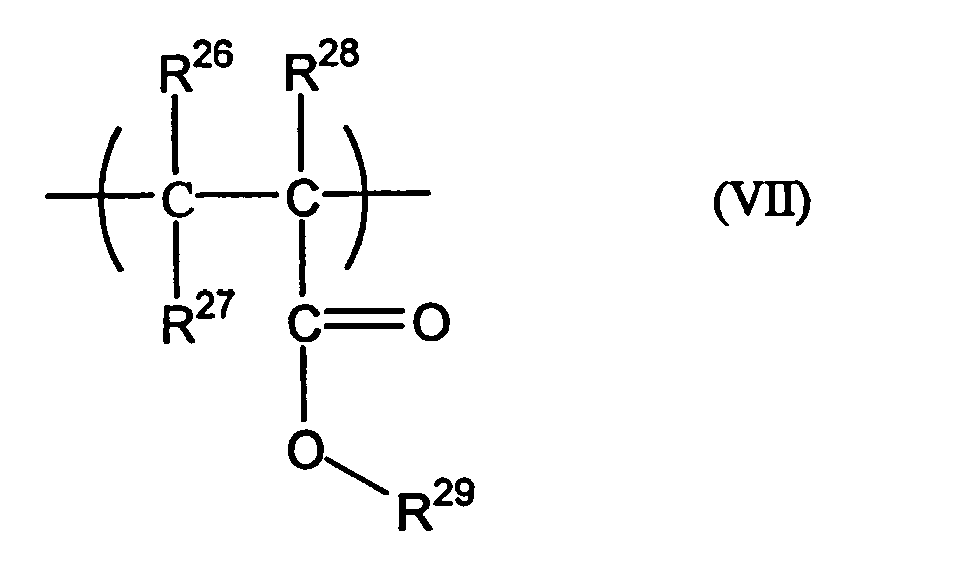
-R30-CO2H (VIII)
(in the formula, R30 represents C1-6 alkylene, C6-10 divalent aromatic hydrocarbon, C3-10 divalent alicyclic hydrocarbon, or a divalent organic group in which these groups are combined).
Secondly, the present invention provides the following crosslinked polymers (9) to (12). - (9) A crosslinked polymer characterized by being obtained by the reaction between the polymer according to any one of (1) to (8) and a crosslinking agent.
- (10) The crosslinked polymer according to (9) in which the crosslinking agent is a polyisocyanate compound which has 2 or more isocyanate groups within a molecule or a polyepoxy compound which has 2 or more epoxy groups within the molecule.
- (11) The crosslinked polymer according to (9) or (10) characterized by being obtained by reacting the polymer according to any one of (1) to (8) with 0.01 to 2 moles of crosslinking agent with respect to 1 mole of the repeating unit (II) in the polymer.
- (12) The crosslinked polymer according to any one of (9) to (11) characterized by being obtained by reacting the polymer according to any one of (1) to (8) with 0.1 to 1 mole of crosslinking agent with respect to 1 mole of the repeating unit (II) in the polymer.
Thirdly, the present invention provides the following compositions (13) to (20) for a solid polymer electrolyte. - (13) A composition for a solid polymer electrolyte characterized by containing the polymer according to any one of (1) to (8) and an electrolyte salt.
- (14) The composition for a solid polymer electrolyte according to (13) characterized by further containing a crosslinking agent.
- (15) The composition for a solid polymer electrolyte according to (14) in which the crosslinking agent is a polyisocyanate compound which has 2 or more isocyanate groups within a molecule or a polyepoxy compound which has 2 or more epoxy groups within the molecule.
- (16) The composition for a solid polymer electrolyte according to (14) or (15) characterized by containing a crosslinking agent within the range of 0.01 to 2 moles with respect to 1 mole of the repeating unit (II) in the polymer.
- (17) The composition for a solid polymer electrolyte according to any one of (14) to (16) characterized by containing a crosslinking agent within the range of 0.1 to 1 moles with respect to 1 mole of the repeating unit (II) in the polymer.
- (18) The composition for a solid polymer electrolyte according to any one of (13) to (17) in which the block chain A and block chain B are bonded and arranged in the order of B-A-B.
- (19) The composition for a solid polymer electrolyte according to any one of (13) to (18) in which the electrolyte salt is at least one selected from the group consisting of alkali metal salts, quaternary ammonium salts, quaternary phosphonium salts, transition metal salts, and protonic acids.
- (20) The composition for a solid polymer electrolyte according to any one of (13) to (19) in which the electrolyte salt is a lithium salt.
Fourthly, the present invention provides the following solid polymer electrolytes (21) to (23). - (21) A solid polymer electrolyte characterized by containing the polymer according to any one of (1) to (8) or the crosslinked polymer according to any one of (9) to (12), and an electrolyte salt.
- (22) The solid polymer electrolyte according to (21) in which the electrolyte salt is at least one selected from the group consisting of alkali metal salts, quaternary ammonium salts, quaternary phosphonium salts, transition metal salts, and protonic acids.
- (23) The solid polymer electrolyte according to (21) or (22) in which the electrolyte salt is a lithium salt.
Fifthly, the present invention provides the following adhesive compositions (24) to (26). - (24) An adhesive composition characterized by containing the polymer according to any one of (1) to (8) and a crosslinking agent.
- (25) The adhesive composition according to (24) characterized by being adhesive to olefin-based polymers.
- (26) The adhesive composition according to (24) or (25) characterized by having ionic conductivity.
- The polymers of the present invention and crosslinked polymers formed by crosslinking these polymers are novel compounds and useful as materials for producing compositions for solid polymer electrolytes and solid polymer electrolytes.
- The solid polymer electrolytes obtained from the compositions for solid polymer electrolytes of the present invention have excellent thermal characteristics, physical characteristics, and ionic conductivity.
- In addition, the crosslinked polymers formed by crosslinking the polymers of the present invention have excellent adhesive performance and are useful as materials for fixing agents which bond/fix members such as electrode components.
- The present invention will be described below in detail by dividing into the following items; i.e. 1) polymer, 2) crosslinked polymer, 3) composition for solid polymer electrolyte, 4) solid polymer electrolyte, and 5) adhesive composition.
- The polymers of the present invention are characterized in that they have a block chain A composed from a random copolymer containing a repeating unit (I) represented by the aforementioned formula (I) and repeating unit (II) represented by the aforementioned formula (II); and block chain B which has a repeating unit (III) represented by the aforementioned formula (III) in an arrangement order of B, A, B.
- The state described here where each block chain is arranged in the order of B, A, B means that each block chain may be bonded to each other directly or may be bonded having other constituting units such as connecting groups and polymerization chains in between. Above all, the state where each block chain is bonded and arranged in the order of B-A-B is preferable. In this case, the expression "bonded" refers to either the case where each block chain is bonded to each other directly or the case where each block chain is bonded via a low-molecule connecting group such as oxygen and alkylene. In addition, each block chain B may be the same or different.
- In the aforementioned formula (I), R1 to R3 each independently represents hydrogen or C1-10 hydrocarbon such as methyl, ethyl, n-propyl, isopropyl, n-butyl, sec-butyl, isobutyl, t-butyl, phenyl, naphthyl, and benzyl. In addition, R1 and R3 may bond to form a ring. R4a and R4b each independently represents hydrogen or methyl.
- R5 represents hydrogen; hydrocarbon such as methyl, ethyl, n-propyl, isopropyl, n-butyl, sec-butyl, isobutyl, t-butyl, n-hexyl, phenyl, substituted phenyl, and naphthyl; acyl such as formyl, acetyl, propionyl, and butyryl; or silyl such as trimethylsilyl, t-butyldimethylsilyl, and dimethylphenylsilyl.
- Additionally, hydrocarbon of the aforementioned R1 to R5 may have a substituent on an appropriate carbon. Specific examples of such substituents include halogen such as fluorine, chlorine, and bromine; hydrocarbon such as methyl, ethyl, n-propyl, phenyl, naphthyl, and benzyl; acyl such as acetyl and benzoyl; cyano; nitro; hydrocarbonoxy such as methoxy and phenoxy; alkylthio such as methylthio; alkylsulfinyl such as methylsulfinyl; alkylsulfonyl such as methylsulfonyl; optionally substituted amino such as amino and dimethylamino; and anilino.
- m represents any integer from 1 to 100 and is preferably any integer from 2 to 50. In addition, the value of m in each repeating unit may be the same or different from each other.
- When m is 2 or more, each R4a may be the same or different from one another and each R4b may be the same or different from one another.
- In addition, the degree of polymerization of the aforementioned repeating unit (I) is preferably 5 or more, although this depends on the value of m, and is more preferably 10 or more.
- Specific examples of the aforementioned repeating unit (I) include the following. Note that the examples are given here as monomers which are considered to be formed into the repeating unit (I) represented by the formula (I).
- 2-Methoxyethyl(meth)acrylate, 2-ethoxyethyl(meth)acrylate, 2-methoxypropyl(meth)acrylate, 2-ethoxypropyl(meth)acrylate, methoxypolyethyleneglycol(meth)acrylate (the number of units of ethyleneglycol is 2 to 100), ethoxypolyethyleneglycol(meth)acrylate, phenoxypolyethyleneglycol(meth)acrylate, methoxypolypropyleneglycol (meth)acrylate (the number of units of propyleneglycol is 2 to 100) ethoxypolypropyleneglycol(meth)acrylate, phenoxypolypropyleneglycol(meth)acrylate, polyethyleneglycolmono(meth)acrylate, 2-hydroxypropyl(meth)acrylate, polypropyleneglycolmono(meth)acrylate, polyethyleneglycol-polypropyleneglycolmono(meth)acrylate, octoxypolyethyleneglycol-polypropyleneglycolmono(meth)acrylate, lauroxypolyethyleneglycolmono(meth)acrylate, stearoxypolyethyleneglycolmono(meth)acrylate, "Blenmer PME series" [which correspond to monomers where R1 = R2 = hydrogen, R3 = methyl, and m = 2 to 90 in the formula (I)] (manufactured by NOF Corporation), acetyloxypolyethyleneglycol(meth)acrylate, benzoyloxypolyethyleneglycol(meth)acrylate, trimethylsilyloxypolyethyleneglycol(meth)acrylate, t-butyldimethylsilyloxypolyethyleneglycol(meth)acrylate, methoxypolyethyleneglycolcyclohexene-1-carboxylate, and methoxypolyethyleneglycolcinnamate.
- These compounds can be used alone or in combination of two or more kinds thereof.
- In the aforementioned formula (II), R6 and R8 each independently represents hydrogen; or C1-10 hydrocarbon such as methyl, ethyl, n-propyl, isopropyl, n-butyl, sec-butyl, isobutyl, t-butyl, phenyl, naphthyl, and benzyl. R6 and R8 may bond to form a ring.
- R7 represents hydrogen; C1-10 hydrocarbon; hydroxyl; hydrocarbonoxy such as methoxy, ethoxy, and phenoxy; carboxyl; acid anhydride; amino; ester; or an organic group having at least one functional group selected from the group consisting of hydroxyl, carboxyl, epoxy, acid anhydride, and amino.
- R9 represents an organic group having at least one functional group selected from the group consisting of hydroxyl, carboxyl, epoxy, acid anhydride, and amino.
- Additionally, R6 to R9 may have a substituent on an appropriate carbon. Specific examples of such substituents include halogen such as fluorine, chlorine, and bromine; hydrocarbon such as methyl, ethyl, n-propyl, phenyl, naphthyl, and benzyl; acyl such as acetyl and benzoyl; cyano; nitro; hydrocarbonoxy such as methoxy and phenoxy; alkylthio such as methylthio; alkylsulfinyl such as methylsulfinyl; alkylsulfonyl such as methylsulfonyl; optionally substituted amino such as amino and dimethylamino; and anilino.
- In the present invention, among the repeating units (II) represented by the formula (II), the repeating unit which is represented by the following formula (IV), (V), (VI), or (VII) is preferable.


- In the aforementioned formula (IV), R14 to R16 each independently represents hydrogen; or C1-10 hydrocarbon such as methyl, ethyl, n-propyl, isopropyl, n-butyl, sec-butyl, isobutyl, t-butyl, phenyl, naphthyl, and benzyl. In addition, R14 and R16 may bond to form a ring.
- R17 represents C1-6 alkylene such as methylene, ethylene, 1-methylethylene, and propylene; C6-10 divalent aromatic hydrocarbon such as phenylene and naphthylene; C3-10 divalent alicyclic hydrocarbon such as cyclopropylene, cyclobutylene, cyclohexylene, and adamantanediyl; or a divalent organic group in which two or more of alkylene, divalent aromatic hydrocarbon, and divalent alicyclic hydrocarbon are combined.
- Additionally, R14 to R17 may have a substituent on an appropriate carbon. Specific examples of such substituents include halogen such as fluorine, chlorine, and bromine; hydrocarbon such as methyl, ethyl, n-propyl, phenyl, naphthyl, and benzyl; acyl such as acetyl and benzoyl; nitrile; nitro; hydrocarbonoxy such as methoxy and phenoxy; methylthio; methylsulfinyl; methylsulfonyl; optionally substituted amino such as amino and dimethylamino; and anilino.
- Some specific examples of the repeating unit (IV) represented by the formula (IV) are shown below. Note that the examples are given here as monomers which are considered to be formed into the repeating unit (IV). These compounds can be used alone or in combination of two or more kinds thereof.


- In the aforementioned formula (V), R18 to R20 each independently represents hydrogen; or C1-10 hydrocarbon such as methyl, ethyl, n-propyl, isopropyl, n-butyl, sec-butyl, isobutyl, t-butyl, phenyl, naphthyl, and benzyl; and p represents any integer from 1 to 3. The substituted position of hydroxyl is not particularly limited.
- Additionally, R18 to R20 and phenyl may have a substituent on an appropriate carbon. Examples of such substituents include the same substituents as those shown as the examples of substituents of R14 to R17.
- Some specific examples of the repeating unit (V) represented by the formula (V) are shown below. Note that the examples are given here as monomers which are considered to be formed into the repeating unit (V). These compounds can be used alone or in combination of two or more kinds thereof.


- In the aforementioned formula (VI), R21 to R23 each independently represents hydrogen; or C1-10 hydrocarbon such as methyl, ethyl, n-propyl, isopropyl, n-butyl, sec-butyl, isobutyl, t-butyl, phenyl, naphthyl, and benzyl. In addition, R21 and R23 may bond to form a ring.
- R24 represents C1-6 alkylene such as methylene, ethylene, 1-methylethylene, and propylene; C6-10 divalent aromatic hydrocarbon such as phenylene and naphthylene; C3-10 divalent alicyclic hydrocarbon such as cyclopropylene, cyclobutylene, cyclohexylene and adamantanediyl; or a divalent organic group in which two or more of alkylene, divalent aromatic hydrocarbon, and divalent alicyclic hydrocarbon are combined.
- R25 represents hydrogen; or C1-4 alkyl such as methyl, ethyl, n-propyl, isopropyl, n-butyl, sec-butyl; isobutyl; and t-butyl.
- R21 to R25 may have a substituent on an appropriate carbon and examples of such substituents include the same substituents as those shown as the examples of substituents of R14 to R17.
- Some specific examples of the repeating unit (VI) represented by the formula (VI) are shown below. Note that the examples are given here as monomers which are considered to be formed into the repeating unit (VI). These compounds can be used alone or in combination of two or more kinds thereof.


- In the aforementioned formula (VII), R26 to R28 each independently represents hydrogen; or C1-10 hydrocarbon such as methyl, ethyl, n-propyl, isopropyl, n-butyl, sec-butyl, isobutyl, t-butyl, phenyl, naphthyl, and benzyl.
- In addition, R26 and R28 may bond to form a ring.
- R29 represents hydrogen or a functional group represented by the following formula (VIII).
-R30-CO2H (VIII)
- In the formula (VIII), R30 represents C1-6 alkylene such as methylene, ethylene, 1-methylethylene, and propylene; C6-10 divalent aromatic hydrocarbon such as phenylene and naphthylene; C3-10 divalent alicyclic hydrocarbon such as cyclopropylene, cyclobutylene, cyclohexylene and adamantanediyl; or a divalent organic group in which two or more of alkylene, divalent aromatic hydrocarbon, and divalent alicyclic hydrocarbon are combined.
- In addition, R26 to R30 may have a substituent on an appropriate carbon. Examples of such substituents include the same substituents as those shown as the examples of substituents of R14 to R17.
- Some specific examples of the repeating unit (VII) represented by the formula (VII) are shown below. Note that the examples are given here as monomers which are considered to be formed into the repeating unit (VII). These compounds can be used alone or in combination of two or more kinds thereof.


- The polymers of the present invention may have the following as the repeating unit (II) apart from the repeating units (IV) to (VII). Note that the examples are given here as monomers which are considered to be formed into the aforementioned repeating unit (II). These compounds can be used alone or in combination of two or more kinds thereof.



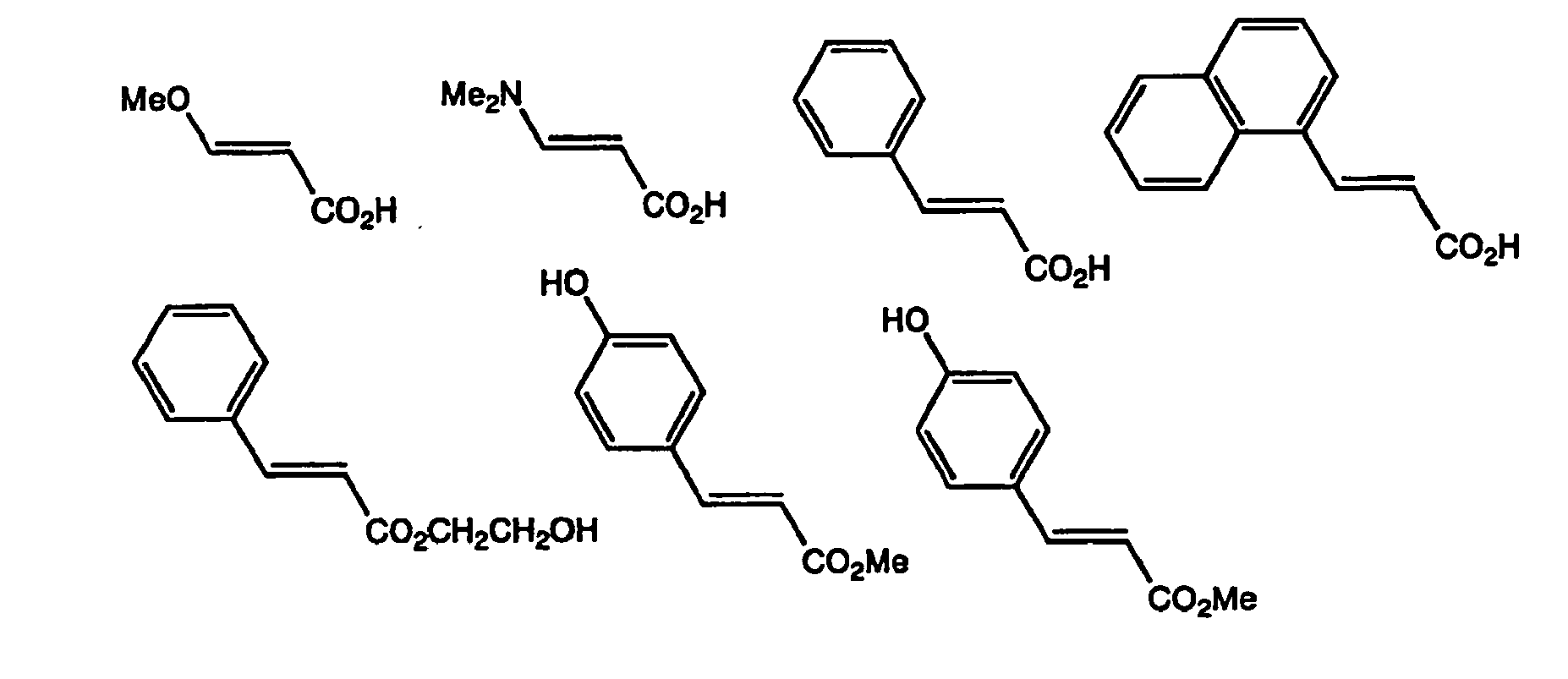
- In addition, although the degree of polymerization of the aforementioned repeating unit (II) is not particularly limited, it is preferably 5 or more.
- The block chain A of the polymer of the present invention is preferably composed from a random copolymer where the ratio of the number of moles of the repeating unit (I) and repeating unit (II) is within the range from 50 to 95% and 50 to 5%, respectively with respect to the total number of moles of the repeating units in the block chain A. The polymers having such a block chain A are favorable as materials for producing solid polymer electrolytes which have excellent thermal characteristics, physical characteristics, and ionic conductivity.
- In the aforementioned formula (III), R10 to R12 each independently represents hydrogen; or C1-10 hydrocarbon such as methyl, ethyl, n-propyl, isopropyl, n-butyl, sec-butyl, isobutyl, t-butyl, phenyl, naphthyl, and benzyl.
- R13 represents aryl such as phenyl, naphthyl, and anthracenyl; or heteroaryl such as 2-pyridyl and 4-pyridyl.
- In addition, R10 to R13 may have a substituent on an appropriate carbon. Examples of such substituents include the same substituents as those shown as the examples of substituents of R14 to R17.
- Some specific examples of the repeating unit (III) represented by the formula (III) are shown below. Note that the examples are given here as monomers which are considered to be formed into the repeating unit (III). These compounds can be used alone or in combination of two or more kinds thereof.
- The examples include styrene, o-methylstyrene, p-methylstyrene, p-t-butylstyrene, α-methylstyrene, p-t-butoxystyrene, m-t-butoxystyrene, 2,4-dimethylstyrene, m-chlorostyrene, p-chlorostyrene, 1-vinylnaphthalene, 9-vinylanthracene, 2-vinylpyridine, and 4-vinylpyridine.
- Although the degree of polymerization of the aforementioned repeating unit (III) is not particularly limited, it is preferably 5 or more to form a microphase-separated structure.
- In the polymers of the present invention, the ratio of the number of moles of the repeating units (I) and (II) summed up together is within the range of 10 to 80% and the ratio of the number of moles of the repeating units (III) is 90 to 20%, respectively with respect to the total number of moles of the repeating units in the polymer. Such polymers are favorable as materials for producing solid polymer electrolytes which have excellent thermal characteristics, physical characteristics, and ionic conductivity.
- The polymers of the present invention can contain different repeating units as constituting units in addition to the aforementioned repeating units (I), (II), and (III) within the molecule thereof.
- Examples of such repeating units include the following compounds. Note that the examples are given here as monomers which are considered to be formed into repeating units. These compounds can be used alone or in combination of two or more kinds thereof.
- Examples include (meth)acrylic esters such as methyl(meth)acrylate, ethyl(meth)acrylate, n-butyl(meth)acrylate, t-butyl(meth)acrylate, cyclohexyl(meth)acrylate, benzyl(meth)acrylate, isobomyl(meth)acrylate, dicyclopentenyl(meth)acrylate, 1-adamantyl(meth)acrylate, 2-methyl-2-adamantyl(meth)acrylate, 1-methylene adamantyl(meth)acrylate, 1-ethylene adamantyl(meth)acrylate, 3,7-dimethyl-1-adamantyl(meth)acrylate, tricyclodecanyl(meth)acrylate, norbornane(meth)acrylate, mentyl(meth)acrylate, n-propyl(meth)acrylate, isopropyl(meth)acrylate, 2-ethylhexyl(meth)acrylate, isodecyl(meth)acrylate, isooctyl(meth)acrylate, lauryl(meth)acrylate, cyclohexyl(meth)acrylate, tetrahydrofuranyl(meth)acrylate, tetrahydropyranyl(meth)acrylate, 3-oxocyclohexyl(meth)acrylate, butyrolactone(meth)acrylate, and mevaloniclactone(meth)acrylate; conjugated dienes such as 1,3-butadiene, isoprene, 2,3-dimethyl-1,3-butadiene, 1,3-pentadiene, 2-methyl-1,3-pentadiene, 1,3-hexadiene, 1,6-hexadiene, 4,5-diethyl-1,3-octadiene, 3-butyl-1,3-octadiene, and chloroprene; α,β-unsaturated carboximides such as N-methylmaleimide and N-phenylmaleimide; and α,β-unsaturated nitriles such as (meta)acrylonitrile.
- Although the number average molecular weight of the polymers of the present invention is not particularly limited, the range between 5000 and 1000000 is preferable. When the number average molecular weight is higher than 5000, thermal and physical characteristics of the polymers improve and when the number average molecular weight is lower than 1000000, moldability or film-formability of the polymers improves.
- In addition, although the ratio between the weight average molecular weight (Mw) and number average molecular weight (Mn) of the polymers of the present invention (Mw/Mn) is not particularly limited, the range between 1.01 and 2.50 is preferable and the range between 1.01 and 1.50 is more preferable in order to form a microphase-separated structure which will be described later.
- The polymers of the present invention can be produced by known polymerization methods. Specific examples of polymerization methods include a living radical polymerization method in which at least one of the compounds represented by the following formulae (IX), (X), and (XI) is used as a monomer, a transition metal is used as a polymerization catalyst, and an organic halogen compound containing one or more halogen atoms is used as a polymerization initiator; a living radical polymerization method using a stable radical; and a living anionic polymerization method. Living radical polymerization methods are preferable since the targeted polymers can be obtained efficiently.


- R1 to R13 in the formulae (IX) to (XI) are the same as defined above.
- Examples of the production methods of the polymers of the present invention include, in further detail,
- (a) a production method in which block chains are sequentially extended by reacting a macroinitiator, which contains block chains such as a bifunctional block chain obtained by reacting the compound represented by the formulae (IX) or (X) using a bifunctional initiator in a living radical polymerization method, with monomers constituting other block chains;
- (b) a production method in which block chains are sequentially extended from an end in the same manner as in the method (a) except that the compound represented by the formulae (IX) or (X) is reacted using a monofunctional initiator; and
- (c) a production method using a coupling reaction after each block chain or a part of each block chain is polymerized in a predetermined sequence.
- Preferable examples of the central metals which constitute the aforemenetioned transition metal complexes include the elements which belong to 7th to 11th groups of the periodic table such as manganese, rhenium, iron, ruthenium, rhodium, nickel, and copper (according to Chemical Handbook Fundamental Volume I (4th ed.,), edited by The Chemical Society of Japan). Above all, ruthenium is preferable.
- Although the ligands which coordinate to these metals to form the complexes are not particularly limited, examples thereof include C18-54 triarylphosphine such as triphenylphosphine and trinaphthylphosphine; C3-18 trialkylphosphine such as triethylphosphine and tributylphosphine; triarylphosphite such as triphenylphosphite; diphenylphosphinoethane; halogen such as iodine, bromine, and chlorine; carbon monoxide; hydrogen; diene compounds such as cyclopentadiene, cyclohexadiene, cyclooctadiene, cyclooctatetraene, indene, and norbornadiene; aromatic hydrocarbon such as benzene, cymene, phenol, 4-isopropyltoluene, cyclopentadienyltoluene, and indenyltoluene; salicylidene; alkene such as 2-methylpentene and 2-butene; allene; furan; carboxylic acid; nitrogen-containing ligands; and chalcogenide.
- Preferable and specific examples of the aforementioned transition metal complexes include dicarbonylcyclopentadienyl iron (1) iodide, dicarbonylcyclopentadienyl ruthenium (II) iodide, and carbonylcyclopentadienyl nickel (II) iodide. These transition metal complexes can be used alone or in combination of two or more kinds thereof.
- Organic halogen compounds contain 1 to 4 or even more of halogen (such as fluorine, chlorine, bromine, and iodine) and are used as an initiator which initiates polymerization by interacting with a transition metal complex to generate radical species. Such organic compounds can be used alone or in combination of two or more kinds thereof.
- Preferable and specific examples of organic halogen compounds include halogenated hydrocarbons, halogenated esters (halogen-containing esters), halogenated ketones (halogen-containing ketones), and sulfonyl halides (halogenated sulfonyl compounds).
- Furthermore, in the living radical polymerization method, an activator which promotes radical polymerization by acting on a metal complex can be used concomitantly. Examples of such activators include Lewis acids and/or amines. The aforementioned Lewis acids and amines can be used alone or in combination of two or more kinds thereof.
- The kinds of Lewis acids used are not particularly limited and, for example, aluminum-based Lewis acids, scandium-based Lewis acids, titanium-based Lewis acids, zirconium-based Lewis acids, tin-based Lewis acids, or the like can be used.
- Although amines are not particularly limited as long as they are nitrogen-containing compounds such as secondary amines, tertiary amines, and nitrogen-containing aromatic heterocyclic compounds, secondary and tertiary amines are preferable. In addition, compounds which have at least two or more moieties selected from a primary amine moiety, secondary amine moiety, and tertiary amine moiety, within an identical molecule can also be used.
- The proportion of a transition metal complex and Lewis acids and/or amines used in terms of mole ratio (i.e. transition metal complex/ Lewis acid/ amine) is usually approximately 0.05 to 0.2/ 1 to 10/ 1 and preferably approximately 0.1/ 1 to 5/1.
- Living radical polymerization can also be carried out using stable radicals.
- Examples of stable radical-based initiators include mixtures of a stable free radical compound and radical polymerization initiator, or various alkoxyamines.
- Stable free radical compounds are present as free radicals which are stable by themselves at room temperature or under polymerization conditions and also compounds which can produce a redissociable bond by reacting with a growing-end radical during the polymerization reaction. Examples thereof include the compounds which generate one or more of nitroxide radicals and hydrazinyl radicals such as 2,2,6,6-tetramethyl-1-piperidinyloxy (TEMPO), 4-amino-2,2,6,6-tetramethyl-1-piperidinyloxy, 4-hydroxy-2,2,6,6-tetramethyl-1-piperidinyloxy, 4-oxo-2,2,6,6-tetramethyl-1-piperidinyloxy, 4,4'-dimethyl-1,3-oxazoline-3-yloxy, 2,2,5,5-tetramethyl-1-pyrrodinyloxy, di-t-butylnitroxide, and 2,2-di(4-t-octylphenyl)-1-picrylhydrazil.
- Radical polymerization initiators are not particularly limited as long as they are compounds which decompose to generate free radicals and examples thereof include organic peroxides such as azo compounds, ketone peroxides, peroxyketals, hydroperoxides, dialkyl peroxides, and peroxyesters. In addition, known polymerization accelerators such as dimethylaniline and cobalt naphthenate which are used by combining with organic peroxides may also be used concomitantly.
- These radical polymerization initiators are normally used within the range of 0.05 to 0.5 moles and preferably 0.2 to 2 moles with respect to 1 mole of the aforementioned stable free radical compounds.
- Examples of alkoxyamines include the compounds described in documents such as "Handbook of Radical Polymerization" (in Japanese published by NTS Inc., 1999, p107) and J. Am Chem. Soc., 121, 3904 (1999) and the following compounds are particularly preferable.


- Specific examples of methods for producing a polymer using a living radical polymerization method include the following:
- (a) A method in which after a degree of conversion of a first monomer reaches 100%, a second monomer is added to complete the polymerization, and a block copolymer is obtained by repeating this process sequentially adding monomers;
- (b) A method in which, even if the degree of conversion of the first monomer does not reach 100%, polymerization is continued by adding the second monomer at the stage where a targeted degree of polymerization or molecular weight is achieved to obtain a gradient copolymer having random parts between block chains; and
- (c) A method in which, even if the degree of conversion of the first monomer does not reach 100%, the reaction is once stopped at the stage where a targeted degree of polymerization or molecular weight is achieved. The obtained polymer is taken out of the system and a copolymerization reaction is intermittently proceeded by using the polymer as a macroinitiator and adding other monomers to obtain a block copolymer.
- Although polymerization modes are not particularly limited and conventional polymerization modes such as bulk polymerization, solution polymerization, suspension polymerization, or emulsion polymerization can be adopted, solution polymerization is particularly preferable.
- In the case where a solution polymerization is carried out, solvents are not particularly limited and conventional solvents including aromatic hydrocarbons (such as benzene, toluene, and xylene), alicyclic hydrocarbons (such as cyclohexane), aliphatic hydrocarbons (such as hexane and octane), ketones (such as acetone, methyl ethyl ketone, and cyclohexanone), ethers (such as tetrahydrofuran and dioxane), esters (such as ethyl acetate and butyl acetate), amides (such as N,N-dimethylformamide and N,N-dimethylacetamide), sulfoxides (such as dimethyl sulfoxide), alcohols (such as methanol and ethanol), and polyhydric alcohol derivatives (such as ethylene glycol monomethyl ether and ethylene glycol monomethyl ether acetate) can be used. These solvents can be used alone or in combination of two or more kinds thereof.
- Polymerization reactions can usually be carried out under vacuum conditions or in an atmosphere of inert gases such as nitrogen and argon at a temperature of 0 to 200°C, and preferably at a reaction temperature of 40 to 150°C under normal or increased pressure.
- In addition, when a method which uses a living radical polymerization method and which uses a compound having an active hydrogen such as hydroxyl and carboxyl within the molecule is adopted as the polymerization method for the polymers of the present invention, it is possible to first protect the active hydrogen by known protection reactions such as silylation, acetalization, and butoxycarbonylation where necessary to provide for the polymerization reaction and then carry out a deprotection reaction using an acid, alkaline, or the like after the polymerization.
- Tracing of the polymerization reaction and confirmation of the completion of the polymerization reaction can be easily carried out by known analytical means, for example, gas chromatography, liquid chromatography, gel permeation chromatography, membrane osmometry, NMR, or the like.
- After the completion of the polymerization reaction, a targeted polymer can be isolated by applying a normal separation/purification method such as column purification, or filtering and drying polymer components which are precipitated when the reaction solution was poured into water or poor solvents.
- The crosslinked polymer of the present invention is characterized by being obtained due to the reaction between the polymer of the present invention and crosslinking agent.
- The crosslinking agents used are not particularly limited as long as they react with a reaction point such as a hydroxyl group contained in the aforementioned repeating units (II) to crosslink. Among the crosslinking agents, the polyisocyanate compounds which contain 2 or more isocyanate groups within the molecule or the polyepoxy compounds which contain 2 or more epoxy groups within the molecule are preferable.
- Specific examples of the aforementioned polyisocyanate compounds include a polyisocyanate such as tolylene diisocyanate (TDI), diphenylmethane diisocyanate (MDI), hydrated diphenylmethane diisocyanate (H-MDI), triphenylmethane triisocyanate, polyphenylmethane polyisocyanate (crude MDI), modified diphenylmethane diisocyanate (modified MDI), hydrated xylylene diisocyanate (H-XDI), xylylene diisocyanate (XDI), hexamethylene diisocyanate (HMDI), trimethylhexamethylene diisocyante (TMHMDI), tetramethylxylylene diisocyante (m-TMXDI), isophorone diisocyanate (IPDI), norbornene diisocyanate (NBDI), 1,3-bis(isocyanatomethyl) cyclohexane (H6XDI), and 1,5-naphthalene diisocyanate; or a trimer compound of these polyisocyanates, and a reaction product of these polyisocyanates with polyols.
- Moreover, blocked isocyanates in which a part of or all of the isocyante groups are blocked using known blocking agents such as phenolic compounds and oximes may be used. In addition, a chain extender such as ethylene glycol, propylene glycol, hexamethylene-1,6-diol, and polyethylene glycol may be used concomitantly where necessary.
- When a polyisocyante compound is used, amines such as triethylamine, triethylenediamine, and hexamethylenetetramine; or heavy metal compounds such as cobalt naphthenate, tetra-n-butyltin, and dibutyltin dilaurate may be used concomitantly as curing-promoting agents where necessary.
- Additionally, examples of the aforementioned polyepoxy compounds include the compounds which contain 2 or more epoxy groups such as bisphenol-A epoxy resin, bisphenol-F epoxy resin, hydrated bisphenol-A epoxy resin, phenol novolac epoxy resin, cresol novolac epoxy resin, glycidyl ester epoxy resin, polyglycol epoxy resin, alicyclic epoxy resin, glycidyl amine epoxy resin, isocyanurate epoxy resin, and halogenated bisphenol-A epoxy resin.
- When a polyepoxy compound is used, tertiary amines such as benzyldimethyl amine and imidazoles such as 2-ethyl imidazole may be used concomitantly as curing-promoting agents where necessary.
- Moreover, in the present invention, one which is normally used as a hardener for an epoxy resin can also be used as other crosslinking agents. Examples thereof include aliphatic polyamines such as triethylene diamine and triethylene tetramine; aromatic polyamines such as diaminodiphenyl methane; alicyclic polyamines such as N-aminoethyl piperazine; acid anhydrides such as 4-methylhexahydrophthalic anhydride, trimellitic anhydride, and pyromellitic anhydride; polyphenols such as phenol novolac resin, cresol novolac resin, and poly-p-hydroxystyrene; dicyandiamide and polyamide resin; boron trifluoride-amine complexes; and various onium salts.
- In addition, when the aforementioned acid anhydrides or polyphenols are used as a crosslinking agent, known curing-promoting agents, for example, the aforementioned tertiary amines and imidazoles may be used concomitantly where necessary.
- Each of these crosslinking agents, curing agents, and curing-promoting agents can be used alone or in combination of two or more kinds thereof. In addition, when an epoxy group is present in the repeating unit (II), an epoxy curing agent can apparently be made to function as a crosslinking agent.
- The combination of reactive groups contained in the aforementioned repeating units (II) with the crosslinking agent is not particularly limited as long as they react with each other. For example, when the reactive group in the aforementioned repeating unit (II) is hydroxyl, polyisocyanate compounds can be used as a crosslinking agent, and when the reactive group is carboxyl, amino, or phenolic hydroxyl, polyepoxy compounds can be used as crosslinking agents.
- Although the amount of crosslinking agent used is not particularly limited, the range thereof is preferably 0.01 to 2 moles and more preferably 0.1 to 1 moles with respect to 1 mole of the repeating unit (II) having a crosslinking point. When using crosslinking agents within the range of 0.01 to 2 moles, crosslinked polymers having satisfactory thermal properties and physical properties, and also satisfactory ionic conductivity can be obtained.
- Crosslinking reactions can be carried out using a method in which a mixture of the polymer of the present invention and crosslinking agent is heated or a method in which the aforementioned mixture is irradiated with various energy rays such as ultraviolet rays, infrared rays, far infrared rays, and microwaves.
- The composition for a solid polymer electrolyte of the present invention is characterized by containing the polymer of the present invention and electrolyte salt. In addition, the composition for a solid polymer electrolyte of the present invention preferably contains a crosslinking agent.
- In the composition for a solid polymer electrolyte of the present invention, although the polymer may be used alone or in combination of two or more kinds thereof, it is preferably a copolymer which has at least a microphase-separated structure and more preferably a block copolymer in which the block chain A and block chain B are bound together and arranged in an order of B-A-B.
- The composition for a solid polymer electrolyte of the present invention is not particularly limited as long as it contains a polymer, in which a polymer segment (P1) which has an ionic conductivity, polymer segment (P2) which does not have an ionic conductivity, and a polymer segment (P3) which has a crosslinking point are arranged in an order of P2, P1/P3, and P2 (i.e. the polymer of the present invention); a crosslinking agent; and an electrolyte salt.
- Specific examples of the polymer segment (P1) having ionic conductivity and a polymer segment (P3) having a crosslinking point include the aforementioned block chain A, and specific examples of the polymer segment (P2) which does not have an ionic conductivity include the aforementioned block chain B. In addition, as the aforementioned polymer which has an arrangement in the order of P2, P1/P3, and P2, those having a microphase-separated structure are preferable.
- As specific examples of the crosslinking agent used in the composition for a solid polymer electrolyte of the present invention, polyisocyanate compounds containing 2 or more isocyanate groups within the molecule or the polyepoxy compounds having 2 or more epoxy groups within the molecule are preferable.
- Specific examples of these crosslinking agents include the same crosslinking agents as those described above.
- In addition, the amount of crosslinking agent mixed therein is preferably within the range of 0.01 to 2 moles and more preferably 0.1 to 1 mole with respect to 1 mole of the aforementioned repeating unit (II) of the polymer.
- The electrolytic salts used in the composition for solid polymer electrolytes of the present invention are not particularly limited, and electrolytes which contain ions suitable as a carrier depending on the electric charge may be used. Among them, it is preferable to use those in which the dissociation constant in a solid polymer electrolyte obtained by hardening is large. The electrolyte salt may be used alone or in combination of two or more kinds thereof.
- Examples of the electrolyte salts used in the present invention include alkali metal salts, quaternary ammonium salts such as (CH3)4NBF6, quaternary phosphonium salts such as (CH3)4PBF6, transition metal salts such as AgClO4, and protonic acids such as hydrochloric acid, perchloric acid, and hydrofluoroboric acid. Among them, alkali metal salts, quaternary ammonium salts, and quaternary phosphonium salts are preferable and alkali metal salts are particularly preferable.
- Specific examples of alkali metal salts include LiCF3SO3, LiN(CF3SO2)2, LiC(CF3SO2)3, LiC(CH3)(CF3SO2)2, LiCH(CF3SO2)2, LiCH2(CF3SO2), LiC2F5SO3, LiN(C2F5SO2)2, LiB(CF3SO2)2, LiPF6, LiClO4, LiI, LiBF4, LiSCN, LiAsF6, NaCF3SO3, NaPF6, NaClO4, NaI, NaBF4, NaAsF6, KCF3SO3, KPF6, KI, LiCF3CO3, NaClO3, NaSCN, KBF4, Mg (ClO4)2, and Mg(BF4)2, and lithium salts are particularly preferable.
- The amount of electrolyte salt added is within the range of 0.005 to 80 mole% and preferably 0.01 to 50 mole% with respect to the alkylene oxide unit of the aforementioned repeating unit (I).
- The composition for a solid polymer electrolyte of the present invention can be produced by adding and mixing (combining) the polymer of the present invention, crosslinking agent, and electrolyte salt.
- The methods for adding and mixing (combining) the polymer of the present invention, crosslinking agent, and electrolyte salt are not particularly limited and examples thereof include a method to dissolve the polymer of the present invention, crosslinking agent, and electrolyte salt in an appropriate solvent such as tetrahydrofuran, methyl ethyl ketone, acetonitrile, ethanol, and dimethylformamide; and a method to mechanically mix the polymer of the present invention, crosslinking agent, and electrolyte salt at normal temperature or under heating.
- The solid polymer electrolyte of the present invention is characterized by containing the polymer of the present invention or the crosslinked polymer; and electrolyte salt.
- Examples of the methods for producing the solid polymer electrolyte of the present invention include the following: (i) a method in which the aforementioned composition for a solid polymer electrolyte of the present invention is, after being formed into various shapes such as sheet, membrane, and film, crosslinked using the aforementioned various energy forms to produce an ion conductive and sheet/membrane/film-shaped crosslinked polymer; (ii) a method in which the composition formed from the polymer of the present invention and crosslinking agent is crosslinked using various energy forms such as heat until almost complete crosslinking is achieved, and then completely crosslinking and hardening by further adding an electrolyte salt; (iii) a method in which a composition formed from two or more kinds of the polymers of the present invention which have different crosslinking conditions and one or more kinds of crosslinking agents is crosslinked under conditions where only one kind of polymer is crosslinked, and then the other kind(s) of polymer is further crosslinked and hardened by adding an electrolyte salt; and (iv) a method in which a composition formed from two or more kinds of the polymers of the present invention which have different crosslinking conditions, one or more kinds of crosslinking agents, and an electrolyte salt is crosslinked under conditions where only one kind of polymer is crosslinked, and then the other kind(s) of polymer is further crosslinked and hardened. Among these methods, the method (i) is preferable since the degree of freedom in terms of processing is increased resulting in a greater advantage in terms of application.
- Examples of the means to produce the solid polymer electrolytes shaped as a sheet or the like include a method in which the aforementioned composition for a solid polymer electrolyte is film-formed on a support using various coating means such as a roll coating method, curtain coating method, spin coating method, dipping method, and casting method, and then a crosslinking reaction is carried out using the aforementioned energy followed by the separation/removal of the support.
- The solid polymer electrolytes shaped as a sheet or the like are not particularly limited as long as they are any of the following; i.e. a film which includes a polymer segment (P1) having an ionic conductivity, a polymer segment (P2) which does not have ionic conductivity, and a crosslinked polymer segment (P4), and which includes a network-type microphase-separated structure within the film; or a film which includes the polymer segment (P1) having ionic conductivity, a polymer segment (P2) which does not have ionic conductivity, and a crosslinked polymer obtained by the reaction between a polymer which contains a polymer segment (P3) having a crosslinking point and crosslinking agent, and which includes a network-type microphase-separated structure within the film. However, the polymer having the abovementioned P1, P2, and P3 and which forms a microphase-separated structure is preferable.
- Specific examples of the polymer segment (P1) having ionic conductivity and a polymer segment (P3) having a crosslinking point include the aforementioned block chain A, and specific examples of the polymer segment (P2) which does not have ionic conductivity include the aforementioned block chain B.
- Since the solid polymer electrolyte of the present invention shaped as a sheet or the like has a structure containing a network-type microphase-separated structure in the film, the film maintains ionic conductivity (conductivity) and also has improved physical properties, thermal properties, and especially film strength.
- The solid polymer electrolyte of the present invention can favorably be used in solid polymer electrolyte batteries.
- The solid polymer electrolyte batteries can be produced, for example, by methods such as a method in which the solid polymer electrolyte of the present invention is used by forming into a compact such as films in advance and is incorporated between electrodes; or a method in which the composition containing a polymer such as the aforementioned copolymer and electrolyte salt is film-formed on electrodes and the aforementioned solid polymer electrolyte is film-formed on the cathode using various coating means such as a roll coating method, curtain coating method, spin coating method, dipping method, and casting method, and then the other electrode is further disposed.
- The adhesive composition of the present invention is characterized by containing the polymer of the present invention and crosslinking agent.
- In the adhesive composition of the present invention, with respect to 1 mole of the repeating unit (II) in the polymer of the present invention, those containing 0.01 to 2 moles of a crosslinking agent are preferable and those containing 0.1 to 1 mole of the crosslinking agent are more preferable.
- Examples of the crosslinking agent used include the polyisocyanate compounds which contain 2 or more isocyanate groups within the molecule and the polyepoxy compounds which contain 2 or more epoxy groups within the molecule.
- Since the adhesive composition of the present invention has high adhesion to the coating substrates such as plastics including olefin resins, metals, inorganic compounds, and ceramics, and is excellent in the resistance to solvents, it can be used in solvents and is expected to be used as an adhesive between components which is free from deterioration in adhesive force. In addition, since the polymers used in the adhesive composition of the present invention include the repeating unit (I) having a polyalkylene oxy group, they can be used as the adhesive composition having ionic conductivity.
- Examples of the methods for using the adhesive composition of the present invention include, (i) a method in which the polymer of the present invention and a crosslinking agent are dissolved in a solvent and the resulting solution is coated onto a substrate to crosslink/harden; (ii) a method in which two or more kinds of the polymers of the present invention which have different crosslinking conditions and one or more kinds of crosslinking agents are dissolved in a solvent and the resulting solution is coated onto a substrate, and after crosslinking under conditions where only one kind of polymer of the present invention is crosslinked, the rest is further crosslinked and hardened; and (iii) a method in which two or more kinds of the polymers of the present invention which have different crosslinking conditions and one or more kinds of crosslinking agents are crosslinked under conditions where only one kind of polymer of the present invention is crosslinked, and then the rest is further crosslinked and hardened.
- Although the present invention will hereinafter be described in detail using Examples, the present invention is not limited to the Examples.
- In an argon atmosphere, 30.0 g (60.4 mmol) of methoxypolyethyleneglycol monomethacrylate (Blenmer PME-400 manufactured by NOF Corporation which is a polymer where R1 = R2 = R4a = R4b = hydrogen, R3 = R5 = methyl, and m = 9 in the aforementioned formula (I) and hereinafter is abbreviated as "PME-400"), 3.3 g (25.6 mmol) of 2-hydroxyethylmethacrylate (hereinafter abbreviated as "HEMA"), and 100 g of toluene were added to a flask and after mixing them uniformly, degassing treatment was conducted. 0.16 g (0.17 mmol) of dichlorotris(triphenylphosphine)ruthenium and 0.09 g (0.67 mmol) of di-n-butylamine were added to this mixed solution and by further adding 0.06 g (0.33 mmol) of 2,2-dichloroacetophenone and heating to 80°C while stirring, a polymerization reaction was initiated.
- 22 hours after the initiation of the polymerization reaction, the temperature of the reaction system was cooled down to 0°C to stop the polymerization reaction. A metal complex and unreacted monomers were removed by carrying out the column purification of the reaction solution.
- A viscous residue obtained by removing volatile components under reduced pressure was dried under reduced pressure at 60°C for 5 hours. The polymerization yield with respect to the total amount of monomers used was 68%.
- As described so far, a random copolymer of PME-400 and HEMA was obtained. When GPC-MALLS analysis of the obtained copolymer was performed, Mn = 129000 and the ratio Mw/Mn = 1.37. The polymer obtained as described above will hereinafter be abbreviated as "P-PME/HEMA-1".
- Subsequently, in an argon atmosphere, 20.0 g (0.15 mmol) of P-PME/HEMA-1, 8.6 g (82.3 mmol) of styrene (hereinafter abbreviated as "St"), and 115 g of toluene were added to a flask and after mixing them uniformly, degassing treatment was conducted. 0.05 g (0.06 mmol) of chloropentamethylcyclopentadienyl bis(triphenylphosphine)ruthenium (hereinafter abbreviated as "CPS") and 0.04 g (0.3 mmol) of di-n-butylamine were added to this mixed solution and by heating to 100°C, a copolymerization reaction was initiated.
- 42 hours after the initiation of the copolymerization reaction, the temperature of the reaction system was cooled down to 0°C to stop the copolymerization reaction. The polymerization yield of styrene was 28%. The viscous residue obtained by reprecipitating with a large amount of n-hexane was dried under reduced pressure at 60°C for 5 hours.
- As described so far, the copolymer in which a block chain B composed from polystyrene (PSt) and block chain A composed from P-PME/HEMA-1 were bonded in the order of B-A1-B was obtained.
- The results of 1H-NMR analysis on this copolymer showed that the compositional ratio of the polymer was PME-400/HEMA/St = 80/9/11 (wt.%) and the PEO (polyethyleneoxide) content was 64%.
- The polymer obtained as described above (PSt-b-(P-PME/HEMA-1)-b-PSt) will be abbreviated as "R-1".
- In an argon atmosphere, 2 g of (R-1) and 0.15 g of tolylene-2,4-diisocyanate (hereinafter abbreviated as "TDI") as a crosslinking agent were dissolved in 18 g of the mixed solvent of THF and acetonitrile (THF/acetonitrile = 8 g/ 10 g) and by dissolving uniformly by further adding 0.15 g of LiPF6, the composition for a solid polymer electrolyte (1) was prepared.
- The abovementioned composition (1) was flow-casted onto a polytetrafluoroethylene sheet under an argon atmosphere and after being left for 24 hours at room temperature, was dried under reduced pressure at 60°C for 5 hours and at 100°C for further 10 hours to obtain a uniform solid electrolyte film (film thickness was 100 µm).
- This solid electrolyte film was sandwiched between platinum plates under an argon atmosphere and the ionic conductivity measurements were carried out over a frequency range of 5 to 10 MHz by the complex impedance analysis using a Solartron 1260 impedance analyzer.
- The results showed that the ionic conductivity was 9.4 × 10⁻⁶ S/cm at 20°C, 2.0 × 10⁻⁵ S/cm at 30°C, 3.9 × 10⁻⁵ S/cm at 40°C, 6.5 × 10⁻⁵ S/cm at 50°C, and 9.7 × 10⁻⁵ S/cm at 60°C.
- In an argon atmosphere, 30.0 g (60.4 mmol) of methoxypolyethyleneglycol monomethacrylate (Blenmer PME-1000 manufactured by NOF Corporation which is a polymer where R1 = R2 = R4a = R4b = hydrogen, R3 = R5 = methyl, and m = 23 in the aforementioned formula (I) and hereinafter is abbreviated as "PME-1000"), 3.3 g (25.6 mmol) of HEMA, and 100 g of toluene were added to a flask and after mixing them uniformly, degassing treatment was conducted.
- 0.16 g (0.17 mmol) of dichlorotris(triphenylphosphine)ruthenium and 0.09 g (0.67 mmol) of di-n-butylamine were added to this mixed solution and by further adding 0.06 g (0.33 mmol) of 2,2-dichloroacetophenone and heating to 80°C while stirring, a polymerization reaction was initiated.
- 62 hours after the initiation of the polymerization reaction, the temperature of the reaction system was cooled down to 0°C to stop the polymerization reaction. A metal complex and unreacted monomers were removed by carrying out the column purification of the reaction solution. A viscous residue obtained by removing volatile components under reduced pressure was dried under reduced pressure at 60°C for 5 hours. The polymerization yield with respect to the total amount of monomers used was 76%.
- As described so far, a random copolymer of PME-1000 and HEMA was obtained. When GPC-MALLS analysis of the obtained copolymer was performed, Mn = 169000 and the ratio Mw/Mn = 1.71. This polymer will be abbreviated as "P-PME/HEMA-2".
- Subsequently, in an argon atmosphere, 22.4 g (0.14 mmol) ofP-PME/HEMA-2, 14.9 g (143.4 mmol) of St, and 112 g of toluene were added to a flask and after mixing them uniformly, degassing treatment was conducted. 0.05 g (0.06 mmol) of CPS and 0.04 g (0.3 mmol) of di-n-butylamine were added to this mixed solution and by heating to 100°C, a copolymerization reaction was initiated.
- 68 hours after the initiation of the copolymerization reaction, the temperature of the reaction system was cooled down to 0°C to stop the copolymerization reaction. The polymerization yield of styrene was 26%. The viscous residue obtained by reprecipitating with a large amount of hexane was dried under reduced pressure at 30°C for 20 hours.
- As described so far, the copolymer in which a block chain B composed from polystyrene (PSt) and block chain A2 composed from P-PME/HEMA-2 were bonded in the order of B-A2-B was obtained.
- The results of 1H-NMR analysis on the obtained copolymer showed that the compositional ratio of the polymer was PME-1000/HEMA/St = 77/8/15 (wt.%) and the PEO (polyethyleneoxide) content was 70%. The copolymer obtained as described above will be abbreviated as "R-2".
- In an argon atmosphere, 2 g of (R-2) and 0.25 g of TDI as a crosslinking agent were dissolved in 18 g of the mixed solvent of THF and acetonitrile (THF/acetonitrile = 8 g/ 10g) and by dissolving uniformly by further adding 0.15 g of LiPF6, the composition for a solid polymer electrolyte (2) was prepared.
- In an argon atmosphere, the abovementioned composition (2) was flow-casted onto a polytetrafluoroethylene sheet and after being left for 24 hours at room temperature, was dried under reduced pressure at 60°C for 5 hours and at 100°C for further 10 hours to obtain a uniform solid electrolyte film (film thickness was 100 µm).
- This solid electrolyte film was sandwiched between platinum plates under an argon atmosphere and the ionic conductivity measurements were carried out over a frequency range of 5 to 10 MHz by the complex impedance analysis using a Solartron 1260 impedance analyzer.
- The results showed that the ionic conductivity was 1.7 × 10⁻⁵ S/cm at 20°C, 3.6 × 10⁻⁵ S/cm at 30°C, 6.6 × 10⁻⁵ S/cm at 40°C, 1.2 × 10⁻⁴ S/cm at 50°C, and 1.9 × 10⁻⁴ S/cm at 60°C.
- In an argon atmosphere, 1.44 g (1.5 mmol) of dichlorotris(triphenylphosphine)ruthenium and 630 g (566.0 mmol) of PME-1000 were added to 1143.7 g of toluene, in which an argon degassing treatment was carried out in advance, and after mixing them uniformly, 0.81 g (6.2 mmol) of di-n-butylamine and 0.83 g (4.4 mmol) of 2,2-dichloroacetophenone were added thereto and by heating to 80°C while stirring, a polymerization reaction was initiated.
- 22 hours after the initiation of the polymerization reaction, the temperature of the reaction system was cooled down to 0°C to stop the polymerization reaction. The results of GPC analysis on the reaction solution showed that the polymerization conversion degree of PME-1000 was 50%. Then a metal complex and unreacted monomers were removed by carrying out the column purification of the reaction solution. Volatile components were removed under reduced pressure to obtain polyPME-1000 (hereinafter abbreviated as "P-PME-1"). The GPC analysis on the obtained P-PME-1 showed that it was a monodisperse polymer in which Mn was 115000.
- Subsequently, in an argon atmosphere, 0.53 g (0.65 mmol) of CPS, 110.1 g (1.10 mmol) of P-PME-1, 50.1 g (480 mmol) of St, and 0.57 g (5.0 mmol) of n-octane were added to 475.4 g of toluene, in which a degassing treatment was carried out in advance, and after mixing them uniformly, 0.32 g (2.5 mmol) of di-n-butylamine was added thereto and by heating to 100°C while stirring, a copolymerization reaction was initiated. 45 hours after the initiation of the copolymerization reaction, the temperature of the reaction system was cooled down to 0°C to stop the copolymerization reaction.
- The results of GC analysis showed that the polymerization conversion degree of St was 36%. As described earlier, column purification and vacuum purification were carried out with this reaction solution.
- As described so far, the block copolymer in which a block chain A3 composed from P-PME-1 and block chain B of polystyrene (PSt) were bonded in the order of B-A3-B was obtained.
- The GPC analysis on this copolymer showed that it was a monodisperse polymer in which Mn was 149000. This copolymer will be abbreviated as "BL-1".
- In an argon atmosphere, 2 g of (BL-1) was dissolved in 20 g of THF and by dissolving uniformly by further adding 0.21 g of LiClO4 (hereinafter abbreviated as "LiPC"), the composition for a solid polymer electrolyte (3) was prepared.
- In an argon atmosphere, the abovementioned composition was flow-casted onto a polytetrafluoroethylene sheet and after being left for 24 hours at room temperature, was dried under reduced pressure at 60°C for 5 hours and at 100°C for further 10 hours to obtain a uniform solid electrolyte film (film thickness was 100 µm).
- This solid electrolyte film was sandwiched between platinum plates under an argon atmosphere and the ionic conductivity measurements were carried out over a frequency range of 5 to 10 MHz by the complex impedance analysis using a Solartron 1260 impedance analyzer.
- The results showed that the ionic conductivity was 6.3 × 10⁻⁵ S/cm at 20°C, 1.7 × 10⁻⁴ S/cm at 30°C, 3.8 × 10⁻⁴ S/cm at 40°C, 6.4 × 10⁻⁴ S/cm at 50°C, and 1.2 × 10⁻³ S/cm at 60°C.
- In an argon atmosphere, 0.1 mmol of dichlorotris(triphenylphosphine)ruthenium and 30 mmol of PME-1000 were added to 78 g of toluene, in which an argon degassing treatment was carried out in advance, and after mixing them uniformly, 0.4 mmol of di-n-butylamine and 0.2 mmol of 2,2-dichloroacetophenone were added thereto and by heating to 80°C while stirring, a polymerization reaction was initiated.
- 22 hours after the initiation of the polymerization reaction, the temperature of the reaction system was cooled down to 0°C to stop the polymerization reaction. The results of GPC analysis on the reaction solution showed the polymerization conversion degree of PME-1000 was 50%. Then a metal complex and unreacted monomers were removed by carrying out the column purification of the reaction solution. Volatile components were removed under reduced pressure to obtain polyPME-1000 (hereinafter abbreviated as "P-PME-1"). The GPC analysis on the obtained P-PME-1 showed that it was a monodisperse polymer in which Mn was 83000.
- Subsequently, in an argon atmosphere, 0.04 mmol of CPS, 0.2 mmol of P-PME-1, 17 mmol of St, and 5 mmol of n-octane were added to 43 g of toluene, in which a degassing treatment was carried out in advance, and after mixing them uniformly, 0.4 mmol of di-n-butylamine was added thereto and by heating to 100°C while stirring, a copolymerization reaction was initiated.
- 45 hours after the initiation of the copolymerization reaction, the temperature of the reaction system was cooled down to 0°C to stop the copolymerization reaction. The results of GC analysis on the polymerization-reaction solution showed that the polymerization conversion degree of St was 60%. As described earlier, column purification and vacuum purification were carried out with this reaction solution to isolate a polymer.
- As described so far, the block copolymer in which a block chain A3 composed from P-PME-1 and block chain B of polystyrene (PSt) were bonded in the order of B-A3-B was obtained.
- The GPC analysis on this copolymer showed that it was a monodisperse polymer in which Mn was 88000. This copolymer will be abbreviated as "PSt-b-P-PME-1-b-PSt". This copolymer was a polymer which had the same composition as that of the aforementioned BL-1.
- Subsequently, in an argon atmosphere, 0.04 mmol of CPS, 0.2 mmol of PSt-b-P-PME-1-b-PSt, 9 mmol of 2-hydroxyethyl acrylate (hereinafter abbreviated as "HEA"), and 5 mmol of n-octane were added to 45 g of toluene, in which a degassing treatment was carried out in advance, and after mixing them uniformly, 0.4 mmol of di-n-butylamine was added thereto and by heating to 80°C while stirring, a copolymerization reaction was initiated. 22 hours after the initiation of the copolymerization reaction, the temperature of the reaction system was cooled down to 0°C to stop the copolymerization reaction. The results of GC analysis showed that the polymerization conversion degree of HEA was 40%. As described earlier, column purification and vacuum purification were carried out with this reaction solution.
- As described so far, the block-graft copolymer in which a block chain A3 composed from P-PME-1, a block chain B composed from polystyrene, and a block chain C composed from a repeating unit of HEA were bonded in the order of C-B-A3-B-C was obtained.
- The GPC analysis on the obtained copolymer showed that it was a monodisperse polymer in which Mn was 91000. In addition, when measured by 13C-NMR, the ratio of the number of moles of the PME-1000 repeating unit was 52%, the ratio of the number of moles of the St repeating unit was 35%, and the ratio of the number of moles of the HEA repeating unit was 13% with respect to the number of total moles of the repeating unit in the copolymer. The polymer obtained as described above will be abbreviated as "BL-2".
- In an argon atmosphere, 2 g of (BL-2) and 0.04 g of TDI as a crosslinking agent were dissolved in 20 g of THF and by dissolving uniformly by further adding 0.21 g of LiClO4, the composition for a solid polymer electrolyte (4) was prepared.
- In an argon atmosphere, the abovementioned composition was flow-casted onto a polytetrafluoroethylene sheet and after being left for 24 hours at room temperature, was dried under reduced pressure at 60°C for 5 hours and at 100°C for further 10 hours to obtain a uniform solid electrolyte film (film thickness was 100 µm).
- This solid electrolyte film was sandwiched between platinum plates under an argon atmosphere and the ionic conductivity measurements were carried out over a frequency range of 5 to 10 MHz by the complex impedance analysis using a Solartron 1260 impedance analyzer.
- The results showed that the ionic conductivity was 7.0 × 10⁻⁵ S/cm at 20°C, 1.2 × 10⁻⁴ S/cm at 30°C, 3.0 × 10⁻⁴ S/cm at 40°C, 4.2 × 10⁻⁴ S/cm at 50°C, and 6.3 × 10⁻⁴ S/cm at 60°C.
- The B-A-B copolymers R-1 and R-2 and random copolymers P-PME/HEMA-1 and P-PME/HEMA-2 obtained in Examples 1 and 2 and 10 weight% tetrahydrofuran solution of TDI as a crosslinking agent, all in predetermined amounts, were mixed. The obtained mixtures were heated to produce respective coplymers for testing.
- A mixture solvent of ethylene carbonate/ diethylene carbonate (3/7, vol/vol) was prepared and 5 g of each of the copolymers for testing was left to stand in 100 ml of the mixed solvent to observe the solubility of copolymers. Testing conditions were: leaving to stand at room temperature; then heating to 80°C for 1 hour; followed by leaving to stand overnight at room temperature.
- The measurement results are summarized in Table 1 (A: insoluble, B: almost insoluble, C: partially soluble, D: soluble). Note that in Table 1, the crosslinking ratio shows the degree of crosslinking of the crosslinking point in the copolymers due to TDI.
[Table 1] Polymer Test conditions: temperature / time (h) Name Crosslinking ratio Leave to stand at room temperature 80°C Room temperature (%) 1h 24h R-1 80 A A A 0 B D D R-2 90 A A A 0 B B C P-PME/HEMA-1 100 B B B 0 B B B P-PME-HEMA-2 100 B B B 0 B B B PVdF - A A A - From Table 1, it is apparent that the crosslinked polymers of Examples 1 and 2 obtained in Example 3 have equivalent solvent resistance to those of the polymers of Comparative Examples (P-PME/HEMA-1, P-PME/HEMA-2, and PVdF (polyvinylidene fluoride)).
- In an argon atmosphere, 2 g of each of the B-A-B copolymers R-1 and R-2 obtained in Examples 1 and 2 and 0.15 g of TDI as a crosslinking agent were dissolved in 18 g of a mixed solvent of THF and acetonitrile (THF/ acetonitrile = 8 g/10 g) and they were uniformly dissolved by further adding 0.15 g of LiPF6 thereto to prepare an adhesive-composition solution.
- Moreover, 2 g of each of PVdF and the block copolymer of Comparative Example 1 (BL-1) were dissolved in 20 g of THF and they were uniformly dissolved by further adding 0.21 g of LiPF6 thereto to prepare respective adhesive-composition solutions of Comparative Example.
- Furthermore, 2 g of the block-graft copolymer of Comparative Example 2 (BL-2) and 0.04 g of TDI as a crosslinking agent were dissolved in 20 g of THF and they were uniformly dissolved by further adding 0.21 g of LiPF6 thereto to prepare the adhesive-composition solution of Comparative Example.
- Note that when mixing an electrolyte salt with an adhesive composition, the equivalence ratio of the electrolyte salt in a copolymer with respect to PEO ([Li]/ [EO]) was 0.03.
- Subsequently, the adhesive-composition solutions as obtained above were coated onto aluminum foil, and after pasting a microporous film made of polyethylene (PE) having a thickness of 20 µm thereon, the resultant was subjected to vacuum drying with heating (25°C × 0.5 h, 65°C × 4 h) to produce respective test specimens.
- Each of the obtained test specimens was subjected to the tensile strength measurements at 25°C and at a rate of 10 mm/min according to JIS K 6850; 1999.
- The measurement results are summarized in Table 2 below.
- In Table 2, the crosslinking ratio shows the degree of crosslinking of the crosslinking point in the copolymers due to TDI.
[Table 2] Polymer Electrolyte salt Rupture stress (MPa) Name Polymer composition Crosslinking ratio (%) R-1 PSt-b-P(PME400/HEMA)b-PSt PME400/HEMA/St=80/9/11 50 - 0.20 100 - 0.13 100 LiPF6 0.15 R-2 PSt-b-P(PME1000/HEMA)-b-PSt PME1000/HEMA/St=77/8/15 50 - 0.19 100 - 0.18 100 LiPF6 0.20 BL-1 PSt-b-P(PME 1000)-b-PSt PME1000/St=86/14 - LiPF6 0.03 BL-2 PHEA-b-PSt-b-P(PME1000)-b-PSt-b-PHEA PME1000/St/HEA=52/35/13 50 - 0.11 100 - 0.11 100 LiPF6 0.08 PVdF - - - 0.08 - From Table 2, it was shown that in both cases where the crosslinked polymers of Examples 1 and 2 contained LiPF6 and did not contain LiPF6, they had excellent adhesive properties and larger rupture stress compared to that of the polymers of Comaparative Examples (BL-1, Bl-2, and PVdF).
- The polymers of the present invention and crosslinked polymers which are formed by crosslinking these polymers are novel compounds and useful as materials for producing compositions for solid polymer electrolytes and solid polymer electrolytes.
- The solid polymer electrolytes which are obtained from the compositions for solid polymer electrolytes of the present invention have excellent thermal characteristics, physical characteristics, and ionic conductivity.
- In addition, the crosslinked polymers which are formed by crosslinking the polymers of the present invention have excellent adhesive performance and are useful as materials for fixing agents which bond/fix members such as electrode components.
Claims (15)
- A polymer comprising:a block chain A which is formed from a random copolymer containing a repeating unit (I) represented by formula (I)wherein R1 to R3 each independently represents hydrogen or C1-10 hydrocarbon and R1 and R3 may bond to form a ring; R4a and R4b each independently represents hydrogen or methyl; R5 represents hydrogen, hydrocarbon, acyl, or silyl; and m represents any integer of 1 to 100 and each R4a may be the same or different from one another and each R4b may be the same or different from one another when m is 2 or more; and a repeating unit (II) represented by the formula (II)


a block chain B having a repeating unit (III) represented by the formula (III)
wherein an arrangement order thereof is B, A, B. - The polymer according to Claim 1, wherein the block chain A and block chain B are bonded and arranged in the order of B-A-B.
- The polymer according to Claim 1 wherein the degree of polymerization of the repeating unit (I) is 5 or more.
- The polymer according to Claim 1 wherein the degree of polymerization of the repeating unit (II) is 5 or more.
- The polymer according to Claim 1,
wherein the block chain A is formed from a random copolymer where the ratio of the number of moles of the repeating unit (I) and repeating unit (II) are within the range of 50 to 95% and 50 to 5%, respectively with respect to the total number of moles of repeating units in the block chain A. - The polymer according to Claim 1,
wherein the ratio of the number of moles of the repeating units (I) and (II) summed up together is within the range of 10 to 80% and the ratio of the number of moles of the repeating units (III) is 90 to 20%, respectively with respect to the total number of moles of repeating units in the polymer. - The polymer according to Claim 1,
wherein the number average molecular weight of the polymer is within the range of 5000 to 1000000. - The polymer according to Claim 1,
wherein the repeating unit (II) is at least one repeating unit selected from the group consisting of a repeating unit (IV) represented by the formula (IV)


-R30-CO2H (VIII)
wherein R30 represents C1-6 alkylene, C6-10 divalent aromatic hydrocarbon, C3-10 divalent alicyclic hydrocarbon, or a divalent organic group in which these groups are combined. - A crosslinked polymer which is obtained by the reaction between the polymer according to any one of Claims 1 to 8 and a crosslinking agent.
- The crosslinked polymer according to Claim 9,
wherein the crosslinking agent is a polyisocyanate compound which has 2 or more isocyanate groups within a molecule or a polyepoxy compound which has 2 or more epoxy groups within the molecule. - The crosslinked polymer according to Claim 9 which is obtained by reacting the polymer according to any one of Claims 1 to 8 with 0.01 to 2 moles of crosslinking agent with respect to 1 mole of the repeating unit (II) in the polymer.
- A composition for a solid polymer electrolyte comprising:the polymer according to any one of Claims 1 to 8 andan electrolyte salt.
- The composition for a solid polymer electrolyte according to Claim 12, further comprising a crosslinking agent.
- A solid polymer electrolyte comprising:the polymer according to any one of Claims 1 to 8 or the crosslinked polymer according to Claim 9; andan electrolyte salt.
- An adhesive composition comprising:the polymer according to any one of Claims 1 to 8; anda crosslinking agent.
Applications Claiming Priority (2)
| Application Number | Priority Date | Filing Date | Title |
|---|---|---|---|
| JP2005014195 | 2005-01-21 | ||
| PCT/JP2006/300599 WO2006077855A1 (en) | 2005-01-21 | 2006-01-18 | Polymer, crosslinked polymer, composition for solid polymer electrolyte, solid polymer electrolyte and adhesive composition |
Publications (3)
| Publication Number | Publication Date |
|---|---|
| EP1847556A1 true EP1847556A1 (en) | 2007-10-24 |
| EP1847556A4 EP1847556A4 (en) | 2009-10-28 |
| EP1847556B1 EP1847556B1 (en) | 2010-12-08 |
Family
ID=36692244
Family Applications (1)
| Application Number | Title | Priority Date | Filing Date |
|---|---|---|---|
| EP06711868A Expired - Lifetime EP1847556B1 (en) | 2005-01-21 | 2006-01-18 | Polymer, crosslinked polymer, composition for solid polymer electrolyte, solid polymer electrolyte and adhesive composition |
Country Status (6)
| Country | Link |
|---|---|
| EP (1) | EP1847556B1 (en) |
| JP (1) | JP4685037B2 (en) |
| KR (1) | KR100891893B1 (en) |
| CN (1) | CN101107282B (en) |
| DE (1) | DE602006018708D1 (en) |
| WO (1) | WO2006077855A1 (en) |
Cited By (1)
| Publication number | Priority date | Publication date | Assignee | Title |
|---|---|---|---|---|
| WO2016070270A1 (en) * | 2014-11-03 | 2016-05-12 | HYDRO-QUéBEC | Crosslinked polymer based on a random copolymer and a volatile polyaminated crosslinking agent and processes for producing same |
Families Citing this family (10)
| Publication number | Priority date | Publication date | Assignee | Title |
|---|---|---|---|---|
| JP2009099530A (en) * | 2007-09-27 | 2009-05-07 | Sanyo Electric Co Ltd | Positive electrode for nonaqueous electrolyte battery, and nonaqueous electrolyte battery |
| KR100947781B1 (en) * | 2007-12-21 | 2010-03-15 | 연세대학교 산학협력단 | Electrolyte Membrane Using Water-Soluble Polymer and Crosslinkable Multiblock Copolymer |
| SG177684A1 (en) * | 2009-07-31 | 2012-03-29 | Sumitomo Bakelite Co | Liquid resin composition and semiconductor device formed using same |
| JP5481229B2 (en) * | 2010-02-26 | 2014-04-23 | 日本曹達株式会社 | Reticulated polymer and gel electrolyte using the same |
| JP5934158B2 (en) * | 2013-08-28 | 2016-06-15 | 藤森工業株式会社 | Electrical insulating pressure-sensitive adhesive layer, electrical insulating pressure-sensitive adhesive film, and optical member on which it is bonded |
| KR20150026793A (en) * | 2013-08-28 | 2015-03-11 | 후지모리 고교 가부시키가이샤 | Adhesive layer for electrical insulation, adhesive film for electrical insulation, and optical member attached with the same |
| KR102097817B1 (en) * | 2016-09-08 | 2020-04-07 | 주식회사 엘지화학 | Polymer composition |
| CN111033815B (en) * | 2017-08-31 | 2023-04-28 | 日本瑞翁株式会社 | Composition for functional layer of electrochemical device, functional layer for electrochemical device, and electrochemical device |
| KR102493809B1 (en) * | 2022-09-26 | 2023-01-30 | 황성원 | Solid-state electrolyte, all-solid-state lithium battery and its manufacturing method |
| CN119764543B (en) * | 2024-12-23 | 2026-03-27 | 南开大学 | A main-chain fluorinated crosslinked polymer solid electrolyte, its preparation method and application |
Family Cites Families (4)
| Publication number | Priority date | Publication date | Assignee | Title |
|---|---|---|---|---|
| CA2427082A1 (en) * | 2000-10-20 | 2003-04-15 | Dainippon Ink And Chemicals, Inc. | Solid polymer electrolyte and cell containing the electrolyte |
| EP1553117B1 (en) * | 2002-07-23 | 2007-01-17 | Nippon Soda Co., Ltd. | Solid polymer electrolyte |
| JP4612272B2 (en) * | 2002-12-27 | 2011-01-12 | 日本曹達株式会社 | Composition for polymer solid electrolyte |
| JP4562364B2 (en) * | 2003-09-12 | 2010-10-13 | 日本曹達株式会社 | Block / graft copolymers and solid polymer electrolytes using them |
-
2006
- 2006-01-18 DE DE602006018708T patent/DE602006018708D1/en not_active Expired - Lifetime
- 2006-01-18 CN CN2006800025623A patent/CN101107282B/en not_active Expired - Fee Related
- 2006-01-18 KR KR1020077016497A patent/KR100891893B1/en not_active Expired - Fee Related
- 2006-01-18 JP JP2006553913A patent/JP4685037B2/en not_active Expired - Fee Related
- 2006-01-18 WO PCT/JP2006/300599 patent/WO2006077855A1/en not_active Ceased
- 2006-01-18 EP EP06711868A patent/EP1847556B1/en not_active Expired - Lifetime
Non-Patent Citations (2)
| Title |
|---|
| No further relevant documents disclosed * |
| See also references of WO2006077855A1 * |
Cited By (2)
| Publication number | Priority date | Publication date | Assignee | Title |
|---|---|---|---|---|
| WO2016070270A1 (en) * | 2014-11-03 | 2016-05-12 | HYDRO-QUéBEC | Crosslinked polymer based on a random copolymer and a volatile polyaminated crosslinking agent and processes for producing same |
| US10745526B2 (en) | 2014-11-03 | 2020-08-18 | Hydro-Quebec | Crosslinked polymer based on a random copolymer and a volatile polyaminated crosslinking agent and processes for producing same |
Also Published As
| Publication number | Publication date |
|---|---|
| JPWO2006077855A1 (en) | 2008-06-19 |
| CN101107282B (en) | 2011-03-30 |
| CN101107282A (en) | 2008-01-16 |
| DE602006018708D1 (en) | 2011-01-20 |
| WO2006077855A1 (en) | 2006-07-27 |
| KR20070093115A (en) | 2007-09-17 |
| KR100891893B1 (en) | 2009-04-03 |
| EP1847556A4 (en) | 2009-10-28 |
| JP4685037B2 (en) | 2011-05-18 |
| EP1847556B1 (en) | 2010-12-08 |
Similar Documents
| Publication | Publication Date | Title |
|---|---|---|
| KR100779895B1 (en) | Composition for polymer solid electrolyte, polymer solid electrolyte, polymer, polymer solid electrolyte battery, ion-conductive membrane, copolymer and process for producing the copolymer | |
| US7645830B2 (en) | Polymer, crosslinked polymer, composition for solid polymer electrolyte, solid polymer electrolyte, and adhesive composition | |
| US7968229B2 (en) | Positive electrode for non-aqueous electrolyte battery and non-aqueous electrolyte battery | |
| US7579401B2 (en) | Solid polymer electrolyte | |
| EP1923418A1 (en) | Star polymer and process for production thereof | |
| EP1847556B1 (en) | Polymer, crosslinked polymer, composition for solid polymer electrolyte, solid polymer electrolyte and adhesive composition | |
| EP3664210B1 (en) | Secondary battery solid electrolyte composition and solid electrolyte prepared therefrom | |
| CN102300907A (en) | Polyaniline addition prepolymer, preparation method of polyaniline addition prepolymer, polyaniline graft polymer, preparation method of polyaniline graft polymer, crosslinking material and paint | |
| EP2039710A1 (en) | Star polymer and method for producing the same | |
| JP4612272B2 (en) | Composition for polymer solid electrolyte | |
| JP4312550B2 (en) | Polymer solid electrolyte, solid electrolyte sheet, and method for producing solid electrolyte sheet | |
| JP2006052362A (en) | Gphrato copolymer having poly (quaternary ammonium salt) side chain and electrolyte membrane | |
| JP5000109B2 (en) | Binder for electrode preparation, electrode and polymer battery | |
| JP4516528B2 (en) | Polymer solid electrolyte | |
| JP4937497B2 (en) | Polymer solid electrolyte battery | |
| JP4860986B2 (en) | Adhesive, binder for electrode preparation, and composition for solid electrolyte | |
| JP2005216794A (en) | Graft copolymers and solid polymer electrolytes using them | |
| JP2007023112A (en) | Adhesive of high bond strength and method for increasing bond strength | |
| JP5481229B2 (en) | Reticulated polymer and gel electrolyte using the same | |
| KR20190026444A (en) | Silicone Electrode Binder |
Legal Events
| Date | Code | Title | Description |
|---|---|---|---|
| PUAI | Public reference made under article 153(3) epc to a published international application that has entered the european phase |
Free format text: ORIGINAL CODE: 0009012 |
|
| 17P | Request for examination filed |
Effective date: 20070809 |
|
| AK | Designated contracting states |
Kind code of ref document: A1 Designated state(s): AT BE BG CH CY CZ DE DK EE ES FI FR GB GR HU IE IS IT LI LT LU LV MC NL PL PT RO SE SI SK TR |
|
| AX | Request for extension of the european patent |
Extension state: AL BA HR MK YU |
|
| A4 | Supplementary search report drawn up and despatched |
Effective date: 20090930 |
|
| GRAP | Despatch of communication of intention to grant a patent |
Free format text: ORIGINAL CODE: EPIDOSNIGR1 |
|
| RIC1 | Information provided on ipc code assigned before grant |
Ipc: C08F 293/00 20060101AFI20100511BHEP Ipc: H01B 1/06 20060101ALI20100511BHEP Ipc: C09J 153/00 20060101ALI20100511BHEP Ipc: C08F 290/06 20060101ALI20100511BHEP Ipc: C08L 53/00 20060101ALI20100511BHEP Ipc: H01M 10/052 20100101ALI20100511BHEP |
|
| GRAS | Grant fee paid |
Free format text: ORIGINAL CODE: EPIDOSNIGR3 |
|
| GRAA | (expected) grant |
Free format text: ORIGINAL CODE: 0009210 |
|
| RIN1 | Information on inventor provided before grant (corrected) |
Inventor name: AMAIKE, MASATO,C Inventor name: SHIMADA, MIKIYA,C Inventor name: KAWAMURA, KIYOSHI,C Inventor name: NIITANI, TAKESHI.,C |
|
| AK | Designated contracting states |
Kind code of ref document: B1 Designated state(s): AT BE BG CH CY CZ DE DK EE ES FI FR GB GR HU IE IS IT LI LT LU LV MC NL PL PT RO SE SI SK TR |
|
| AX | Request for extension of the european patent |
Extension state: AL BA HR MK YU |
|
| REG | Reference to a national code |
Ref country code: GB Ref legal event code: FG4D |
|
| REG | Reference to a national code |
Ref country code: CH Ref legal event code: EP |
|
| REG | Reference to a national code |
Ref country code: IE Ref legal event code: FG4D |
|
| REF | Corresponds to: |
Ref document number: 602006018708 Country of ref document: DE Date of ref document: 20110120 Kind code of ref document: P |
|
| REG | Reference to a national code |
Ref country code: NL Ref legal event code: T3 |
|
| PG25 | Lapsed in a contracting state [announced via postgrant information from national office to epo] |
Ref country code: LT Free format text: LAPSE BECAUSE OF FAILURE TO SUBMIT A TRANSLATION OF THE DESCRIPTION OR TO PAY THE FEE WITHIN THE PRESCRIBED TIME-LIMIT Effective date: 20101208 |
|
| LTIE | Lt: invalidation of european patent or patent extension |
Effective date: 20101208 |
|
| PG25 | Lapsed in a contracting state [announced via postgrant information from national office to epo] |
Ref country code: SI Free format text: LAPSE BECAUSE OF FAILURE TO SUBMIT A TRANSLATION OF THE DESCRIPTION OR TO PAY THE FEE WITHIN THE PRESCRIBED TIME-LIMIT Effective date: 20101208 Ref country code: BG Free format text: LAPSE BECAUSE OF FAILURE TO SUBMIT A TRANSLATION OF THE DESCRIPTION OR TO PAY THE FEE WITHIN THE PRESCRIBED TIME-LIMIT Effective date: 20110308 Ref country code: LV Free format text: LAPSE BECAUSE OF FAILURE TO SUBMIT A TRANSLATION OF THE DESCRIPTION OR TO PAY THE FEE WITHIN THE PRESCRIBED TIME-LIMIT Effective date: 20101208 Ref country code: SE Free format text: LAPSE BECAUSE OF FAILURE TO SUBMIT A TRANSLATION OF THE DESCRIPTION OR TO PAY THE FEE WITHIN THE PRESCRIBED TIME-LIMIT Effective date: 20101208 Ref country code: CY Free format text: LAPSE BECAUSE OF FAILURE TO SUBMIT A TRANSLATION OF THE DESCRIPTION OR TO PAY THE FEE WITHIN THE PRESCRIBED TIME-LIMIT Effective date: 20101208 Ref country code: AT Free format text: LAPSE BECAUSE OF FAILURE TO SUBMIT A TRANSLATION OF THE DESCRIPTION OR TO PAY THE FEE WITHIN THE PRESCRIBED TIME-LIMIT Effective date: 20101208 |
|
| PG25 | Lapsed in a contracting state [announced via postgrant information from national office to epo] |
Ref country code: BE Free format text: LAPSE BECAUSE OF FAILURE TO SUBMIT A TRANSLATION OF THE DESCRIPTION OR TO PAY THE FEE WITHIN THE PRESCRIBED TIME-LIMIT Effective date: 20101208 Ref country code: EE Free format text: LAPSE BECAUSE OF FAILURE TO SUBMIT A TRANSLATION OF THE DESCRIPTION OR TO PAY THE FEE WITHIN THE PRESCRIBED TIME-LIMIT Effective date: 20101208 Ref country code: GR Free format text: LAPSE BECAUSE OF FAILURE TO SUBMIT A TRANSLATION OF THE DESCRIPTION OR TO PAY THE FEE WITHIN THE PRESCRIBED TIME-LIMIT Effective date: 20110309 Ref country code: IS Free format text: LAPSE BECAUSE OF FAILURE TO SUBMIT A TRANSLATION OF THE DESCRIPTION OR TO PAY THE FEE WITHIN THE PRESCRIBED TIME-LIMIT Effective date: 20110408 Ref country code: PT Free format text: LAPSE BECAUSE OF FAILURE TO SUBMIT A TRANSLATION OF THE DESCRIPTION OR TO PAY THE FEE WITHIN THE PRESCRIBED TIME-LIMIT Effective date: 20110408 Ref country code: CZ Free format text: LAPSE BECAUSE OF FAILURE TO SUBMIT A TRANSLATION OF THE DESCRIPTION OR TO PAY THE FEE WITHIN THE PRESCRIBED TIME-LIMIT Effective date: 20101208 Ref country code: ES Free format text: LAPSE BECAUSE OF FAILURE TO SUBMIT A TRANSLATION OF THE DESCRIPTION OR TO PAY THE FEE WITHIN THE PRESCRIBED TIME-LIMIT Effective date: 20110319 |
|
| PG25 | Lapsed in a contracting state [announced via postgrant information from national office to epo] |
Ref country code: SK Free format text: LAPSE BECAUSE OF FAILURE TO SUBMIT A TRANSLATION OF THE DESCRIPTION OR TO PAY THE FEE WITHIN THE PRESCRIBED TIME-LIMIT Effective date: 20101208 Ref country code: MC Free format text: LAPSE BECAUSE OF NON-PAYMENT OF DUE FEES Effective date: 20110131 Ref country code: RO Free format text: LAPSE BECAUSE OF FAILURE TO SUBMIT A TRANSLATION OF THE DESCRIPTION OR TO PAY THE FEE WITHIN THE PRESCRIBED TIME-LIMIT Effective date: 20101208 Ref country code: PL Free format text: LAPSE BECAUSE OF FAILURE TO SUBMIT A TRANSLATION OF THE DESCRIPTION OR TO PAY THE FEE WITHIN THE PRESCRIBED TIME-LIMIT Effective date: 20101208 |
|
| REG | Reference to a national code |
Ref country code: CH Ref legal event code: PL |
|
| PLBE | No opposition filed within time limit |
Free format text: ORIGINAL CODE: 0009261 |
|
| STAA | Information on the status of an ep patent application or granted ep patent |
Free format text: STATUS: NO OPPOSITION FILED WITHIN TIME LIMIT |
|
| REG | Reference to a national code |
Ref country code: IE Ref legal event code: MM4A |
|
| PG25 | Lapsed in a contracting state [announced via postgrant information from national office to epo] |
Ref country code: DK Free format text: LAPSE BECAUSE OF FAILURE TO SUBMIT A TRANSLATION OF THE DESCRIPTION OR TO PAY THE FEE WITHIN THE PRESCRIBED TIME-LIMIT Effective date: 20101208 Ref country code: CH Free format text: LAPSE BECAUSE OF NON-PAYMENT OF DUE FEES Effective date: 20110131 Ref country code: LI Free format text: LAPSE BECAUSE OF NON-PAYMENT OF DUE FEES Effective date: 20110131 |
|
| 26N | No opposition filed |
Effective date: 20110909 |
|
| PG25 | Lapsed in a contracting state [announced via postgrant information from national office to epo] |
Ref country code: IT Free format text: LAPSE BECAUSE OF FAILURE TO SUBMIT A TRANSLATION OF THE DESCRIPTION OR TO PAY THE FEE WITHIN THE PRESCRIBED TIME-LIMIT Effective date: 20101208 |
|
| REG | Reference to a national code |
Ref country code: DE Ref legal event code: R097 Ref document number: 602006018708 Country of ref document: DE Effective date: 20110909 |
|
| PG25 | Lapsed in a contracting state [announced via postgrant information from national office to epo] |
Ref country code: IE Free format text: LAPSE BECAUSE OF NON-PAYMENT OF DUE FEES Effective date: 20110118 |
|
| PG25 | Lapsed in a contracting state [announced via postgrant information from national office to epo] |
Ref country code: LU Free format text: LAPSE BECAUSE OF NON-PAYMENT OF DUE FEES Effective date: 20110118 |
|
| PG25 | Lapsed in a contracting state [announced via postgrant information from national office to epo] |
Ref country code: TR Free format text: LAPSE BECAUSE OF FAILURE TO SUBMIT A TRANSLATION OF THE DESCRIPTION OR TO PAY THE FEE WITHIN THE PRESCRIBED TIME-LIMIT Effective date: 20101208 |
|
| PG25 | Lapsed in a contracting state [announced via postgrant information from national office to epo] |
Ref country code: HU Free format text: LAPSE BECAUSE OF FAILURE TO SUBMIT A TRANSLATION OF THE DESCRIPTION OR TO PAY THE FEE WITHIN THE PRESCRIBED TIME-LIMIT Effective date: 20101208 |
|
| REG | Reference to a national code |
Ref country code: FR Ref legal event code: PLFP Year of fee payment: 10 |
|
| PGFP | Annual fee paid to national office [announced via postgrant information from national office to epo] |
Ref country code: FI Payment date: 20150113 Year of fee payment: 10 |
|
| REG | Reference to a national code |
Ref country code: FR Ref legal event code: PLFP Year of fee payment: 11 |
|
| PG25 | Lapsed in a contracting state [announced via postgrant information from national office to epo] |
Ref country code: FI Free format text: LAPSE BECAUSE OF NON-PAYMENT OF DUE FEES Effective date: 20160118 |
|
| REG | Reference to a national code |
Ref country code: FR Ref legal event code: PLFP Year of fee payment: 12 |
|
| REG | Reference to a national code |
Ref country code: FR Ref legal event code: PLFP Year of fee payment: 13 |
|
| PGFP | Annual fee paid to national office [announced via postgrant information from national office to epo] |
Ref country code: FR Payment date: 20210121 Year of fee payment: 16 Ref country code: NL Payment date: 20210120 Year of fee payment: 16 |
|
| PGFP | Annual fee paid to national office [announced via postgrant information from national office to epo] |
Ref country code: DE Payment date: 20210120 Year of fee payment: 16 Ref country code: GB Payment date: 20210121 Year of fee payment: 16 |
|
| REG | Reference to a national code |
Ref country code: DE Ref legal event code: R119 Ref document number: 602006018708 Country of ref document: DE |
|
| REG | Reference to a national code |
Ref country code: NL Ref legal event code: MM Effective date: 20220201 |
|
| GBPC | Gb: european patent ceased through non-payment of renewal fee |
Effective date: 20220118 |
|
| PG25 | Lapsed in a contracting state [announced via postgrant information from national office to epo] |
Ref country code: NL Free format text: LAPSE BECAUSE OF NON-PAYMENT OF DUE FEES Effective date: 20220201 Ref country code: GB Free format text: LAPSE BECAUSE OF NON-PAYMENT OF DUE FEES Effective date: 20220118 Ref country code: DE Free format text: LAPSE BECAUSE OF NON-PAYMENT OF DUE FEES Effective date: 20220802 |
|
| PG25 | Lapsed in a contracting state [announced via postgrant information from national office to epo] |
Ref country code: FR Free format text: LAPSE BECAUSE OF NON-PAYMENT OF DUE FEES Effective date: 20220131 |