EP1847262A1 - Cosmetic - Google Patents
Cosmetic Download PDFInfo
- Publication number
- EP1847262A1 EP1847262A1 EP06702665A EP06702665A EP1847262A1 EP 1847262 A1 EP1847262 A1 EP 1847262A1 EP 06702665 A EP06702665 A EP 06702665A EP 06702665 A EP06702665 A EP 06702665A EP 1847262 A1 EP1847262 A1 EP 1847262A1
- Authority
- EP
- European Patent Office
- Prior art keywords
- oil
- silicone
- cosmetic
- appropriate amount
- powder
- Prior art date
- Legal status (The legal status is an assumption and is not a legal conclusion. Google has not performed a legal analysis and makes no representation as to the accuracy of the status listed.)
- Granted
Links
Images


Classifications
-
- A—HUMAN NECESSITIES
- A61—MEDICAL OR VETERINARY SCIENCE; HYGIENE
- A61K—PREPARATIONS FOR MEDICAL, DENTAL OR TOILETRY PURPOSES
- A61K8/00—Cosmetics or similar toiletry preparations
- A61K8/18—Cosmetics or similar toiletry preparations characterised by the composition
- A61K8/72—Cosmetics or similar toiletry preparations characterised by the composition containing organic macromolecular compounds
- A61K8/84—Cosmetics or similar toiletry preparations characterised by the composition containing organic macromolecular compounds obtained by reactions otherwise than those involving only carbon-carbon unsaturated bonds
- A61K8/89—Polysiloxanes
- A61K8/891—Polysiloxanes saturated, e.g. dimethicone, phenyl trimethicone, C24-C28 methicone or stearyl dimethicone
- A61K8/894—Polysiloxanes saturated, e.g. dimethicone, phenyl trimethicone, C24-C28 methicone or stearyl dimethicone modified by a polyoxyalkylene group, e.g. cetyl dimethicone copolyol
-
- A—HUMAN NECESSITIES
- A61—MEDICAL OR VETERINARY SCIENCE; HYGIENE
- A61K—PREPARATIONS FOR MEDICAL, DENTAL OR TOILETRY PURPOSES
- A61K31/00—Medicinal preparations containing organic active ingredients
- A61K31/695—Silicon compounds
-
- A—HUMAN NECESSITIES
- A61—MEDICAL OR VETERINARY SCIENCE; HYGIENE
- A61K—PREPARATIONS FOR MEDICAL, DENTAL OR TOILETRY PURPOSES
- A61K8/00—Cosmetics or similar toiletry preparations
- A61K8/02—Cosmetics or similar toiletry preparations characterised by special physical form
- A61K8/04—Dispersions; Emulsions
-
- A—HUMAN NECESSITIES
- A61—MEDICAL OR VETERINARY SCIENCE; HYGIENE
- A61Q—SPECIFIC USE OF COSMETICS OR SIMILAR TOILETRY PREPARATIONS
- A61Q19/00—Preparations for care of the skin
-
- C—CHEMISTRY; METALLURGY
- C08—ORGANIC MACROMOLECULAR COMPOUNDS; THEIR PREPARATION OR CHEMICAL WORKING-UP; COMPOSITIONS BASED THEREON
- C08G—MACROMOLECULAR COMPOUNDS OBTAINED OTHERWISE THAN BY REACTIONS ONLY INVOLVING UNSATURATED CARBON-TO-CARBON BONDS
- C08G77/00—Macromolecular compounds obtained by reactions forming a linkage containing silicon with or without sulfur, nitrogen, oxygen or carbon in the main chain of the macromolecule
- C08G77/42—Block-or graft-polymers containing polysiloxane sequences
- C08G77/46—Block-or graft-polymers containing polysiloxane sequences containing polyether sequences
-
- A—HUMAN NECESSITIES
- A61—MEDICAL OR VETERINARY SCIENCE; HYGIENE
- A61Q—SPECIFIC USE OF COSMETICS OR SIMILAR TOILETRY PREPARATIONS
- A61Q1/00—Make-up preparations; Body powders; Preparations for removing make-up
- A61Q1/02—Preparations containing skin colorants, e.g. pigments
-
- A—HUMAN NECESSITIES
- A61—MEDICAL OR VETERINARY SCIENCE; HYGIENE
- A61Q—SPECIFIC USE OF COSMETICS OR SIMILAR TOILETRY PREPARATIONS
- A61Q1/00—Make-up preparations; Body powders; Preparations for removing make-up
- A61Q1/02—Preparations containing skin colorants, e.g. pigments
- A61Q1/04—Preparations containing skin colorants, e.g. pigments for lips
- A61Q1/06—Lipsticks
-
- A—HUMAN NECESSITIES
- A61—MEDICAL OR VETERINARY SCIENCE; HYGIENE
- A61Q—SPECIFIC USE OF COSMETICS OR SIMILAR TOILETRY PREPARATIONS
- A61Q1/00—Make-up preparations; Body powders; Preparations for removing make-up
- A61Q1/02—Preparations containing skin colorants, e.g. pigments
- A61Q1/10—Preparations containing skin colorants, e.g. pigments for eyes, e.g. eyeliner, mascara
-
- A—HUMAN NECESSITIES
- A61—MEDICAL OR VETERINARY SCIENCE; HYGIENE
- A61Q—SPECIFIC USE OF COSMETICS OR SIMILAR TOILETRY PREPARATIONS
- A61Q17/00—Barrier preparations; Preparations brought into direct contact with the skin for affording protection against external influences, e.g. sunlight, X-rays or other harmful rays, corrosive materials, bacteria or insect stings
-
- A—HUMAN NECESSITIES
- A61—MEDICAL OR VETERINARY SCIENCE; HYGIENE
- A61Q—SPECIFIC USE OF COSMETICS OR SIMILAR TOILETRY PREPARATIONS
- A61Q17/00—Barrier preparations; Preparations brought into direct contact with the skin for affording protection against external influences, e.g. sunlight, X-rays or other harmful rays, corrosive materials, bacteria or insect stings
- A61Q17/04—Topical preparations for affording protection against sunlight or other radiation; Topical sun tanning preparations
-
- A—HUMAN NECESSITIES
- A61—MEDICAL OR VETERINARY SCIENCE; HYGIENE
- A61Q—SPECIFIC USE OF COSMETICS OR SIMILAR TOILETRY PREPARATIONS
- A61Q19/00—Preparations for care of the skin
- A61Q19/10—Washing or bathing preparations
-
- A—HUMAN NECESSITIES
- A61—MEDICAL OR VETERINARY SCIENCE; HYGIENE
- A61Q—SPECIFIC USE OF COSMETICS OR SIMILAR TOILETRY PREPARATIONS
- A61Q5/00—Preparations for care of the hair
-
- A—HUMAN NECESSITIES
- A61—MEDICAL OR VETERINARY SCIENCE; HYGIENE
- A61Q—SPECIFIC USE OF COSMETICS OR SIMILAR TOILETRY PREPARATIONS
- A61Q5/00—Preparations for care of the hair
- A61Q5/02—Preparations for cleaning the hair
-
- C—CHEMISTRY; METALLURGY
- C08—ORGANIC MACROMOLECULAR COMPOUNDS; THEIR PREPARATION OR CHEMICAL WORKING-UP; COMPOSITIONS BASED THEREON
- C08G—MACROMOLECULAR COMPOUNDS OBTAINED OTHERWISE THAN BY REACTIONS ONLY INVOLVING UNSATURATED CARBON-TO-CARBON BONDS
- C08G77/00—Macromolecular compounds obtained by reactions forming a linkage containing silicon with or without sulfur, nitrogen, oxygen or carbon in the main chain of the macromolecule
- C08G77/04—Polysiloxanes
- C08G77/12—Polysiloxanes containing silicon bound to hydrogen
-
- C—CHEMISTRY; METALLURGY
- C08—ORGANIC MACROMOLECULAR COMPOUNDS; THEIR PREPARATION OR CHEMICAL WORKING-UP; COMPOSITIONS BASED THEREON
- C08G—MACROMOLECULAR COMPOUNDS OBTAINED OTHERWISE THAN BY REACTIONS ONLY INVOLVING UNSATURATED CARBON-TO-CARBON BONDS
- C08G77/00—Macromolecular compounds obtained by reactions forming a linkage containing silicon with or without sulfur, nitrogen, oxygen or carbon in the main chain of the macromolecule
- C08G77/04—Polysiloxanes
- C08G77/14—Polysiloxanes containing silicon bound to oxygen-containing groups
Definitions
- silicone oil gives a strong refreshing sensation and leaves a squeaky sensation of the skin
- silicone oil having a texture that feels natural on the skin has been strongly desired.
- water-in-oil type emulsified compositions having the oil phase as the outer phase and the water phase as the inner phase are used in various cosmetics.
- Such water-in-oil type emulsified compositions are, compared with the oil-in-water type, superior in terms of protecting the skin, making the skin supple, and suppressing moisture evaporation from the skin, and therefore are considered to be a suitable formulation for endermic liniments.
- the present invention provides a cosmetic that characteristically contains glycerin modified on both ends with silicone represented by the following general formula (a).
- R1 denotes a straight chain or branched alkyl group having 1-12 carbon atoms or a phenyl group
- R2 denotes an alkylene group having 2-11 carbon atoms
- m is 10-120
- n is 1-11.
- the present invention provides the aforementioned cosmetic wherein said cosmetic is an oil based cosmetic.
- the present invention provides the aforementioned cosmetic wherein said cosmetic additionally contains powder.
- the bond between A and B is not an essential structure for the present invention
- the glycerin modified on both ends with silicone shown in the present invention is prepared by bonding compound (c) and a compound represented by the following structural formula (d) by means of ether bonding using a platinum catalyst.
- n denotes a number 1-11.
- the present invention adds the aforementioned glycerin modified on both ends with silicone to a cosmetic and thus improves its powder dispersibility and emulsification stability.
- Ingredients that are usually used in cosmetics and medical drugs can be added to the cosmetic of the present invention within the range that does not affect the effect of the invention; and the cosmetic can be manufactured using a conventional method.
- the obtained mascara had good gloss and superior color development.
- the oil based ingredients and the water based ingredients in the formulation were each heated and dissolved completely.
- the oil phase was added to the water phase and emulsified by using an emulsifying apparatus.
- the emulsion was cooled by a heat exchanger to obtain a cream.
- the obtained foundation had superior smoothness and was not sticky, giving a good sensation during use.
- the aforementioned ingredients were mixed with a conventional method to obtain a hair rinse.
- the obtained rinse was not sticky or squeaky, and improved the smoothness of the hair.
- the aforementioned ingredients were mixed with a conventional method to obtain a hair shampoo.
- the obtained hair shampoo exhibited a superior smooth hair texture when used to wash hair and gave gloss to the hair after drying.
- the aforementioned ingredients were mixed with a conventional method to obtain a rinse-in-shampoo.
- the obtained hair shampoo exhibited a superior smooth hair texture when used to wash hair and gave gloss to the hair after drying.
- a semitransparent emulsified composition was prepared and turned into gel by cooling the temperature down to 30 °C or lower; after the gel solidified sufficiently, a disper was used to crush and turn it into microgel (average particle size 70 ⁇ m) and deaerated to obtain a gel-like product.
- the obtained gel was refreshing, non-squeaky, and smooth, exhibiting good usability.
Landscapes
- Health & Medical Sciences (AREA)
- Life Sciences & Earth Sciences (AREA)
- General Health & Medical Sciences (AREA)
- Chemical & Material Sciences (AREA)
- Veterinary Medicine (AREA)
- Public Health (AREA)
- Animal Behavior & Ethology (AREA)
- Epidemiology (AREA)
- Medicinal Chemistry (AREA)
- Birds (AREA)
- Dermatology (AREA)
- Organic Chemistry (AREA)
- Polymers & Plastics (AREA)
- Chemical Kinetics & Catalysis (AREA)
- Pharmacology & Pharmacy (AREA)
- Dispersion Chemistry (AREA)
- Cosmetics (AREA)
- Compositions Of Macromolecular Compounds (AREA)
Abstract
Description
- The present invention relates to a cosmetic containing glycerin modified on both ends with silicone having a specific structure.
- Silicone oil is blended in many cosmetics as an oil component that gives a refreshing sensation. For example, alkyl-modified silicone (Patent Document 1), fluorine-modified silicone (Patent Document 2), cholesterol-modified silicone (Patent Document 3), acylalkylimine-modified silicone (Patent Document 4), glyceryl-modified silicone (Patent Document 5), alkylglyceryl ether-modified silicone (Patent Document 6), and alkylmonoglyceryl ether-fluorine-modified silicone (Patent Document 7) are blended in cosmetics.
- However, since silicone oil gives a strong refreshing sensation and leaves a squeaky sensation of the skin, silicone oil having a texture that feels natural on the skin has been strongly desired.
- On the other hand, water-in-oil type emulsified compositions having the oil phase as the outer phase and the water phase as the inner phase are used in various cosmetics. Such water-in-oil type emulsified compositions are, compared with the oil-in-water type, superior in terms of protecting the skin, making the skin supple, and suppressing moisture evaporation from the skin, and therefore are considered to be a suitable formulation for endermic liniments.
- Examples of emulsifiers made from a water-in-oil type emulsified composition that have been used traditionally include lipophilic surfactants having a HLB of approximately 1-12, such as polyhydric alcohol fatty acid ester type surfactants such as glycerin fatty acid esters and sorbitan fatty acid esters, as well as polyoxyalkylene-modified organopolysiloxane type surfactants (Non-patent document 1).
- However, the water-in-oil type emulsified compositions using these emulsifier have poor emulsification stability and separation between the water phase and the oil phase occurs at high temperatures or over time, making it very difficult to stabilize the formulation.
Also, a method in which wax is blended into the oil phase, i.e. the outer phase, to stabilize the formulation is also being used. However, since wax melts or softens at higher temperatures, there is a problem in that the stability of the formulation is not sufficient. Also, there is a new problem in terms of usability in that spreadability is poor and stickiness occurs at the time of application. - Also, many cosmetics into which powder is blended, such as sunscreens and foundations, require water resistance and/or antiperspiration properties, and therefore hydrophobicized powder is often times blended into a W/0 type formulation.
- However, when a large quantity of powder is blended into a W/0 type formulation, there are problems in that the increased viscosity due to aggregation of powder causes poor spreading at the time of application and the skin turns whiter after the application. To deal with these problems, a technique to more stably disperse powder in an oil agent has been developed.
- Technology to primarily disperse powder has been advancing by using miniaturizers such as roller mills, beads mills, and high pressure homogenizers ; however, how to keep finely dispersed powder dispersed and free of aggregation for a long time is an issue. Many cosmetics contain silicone oil as an oil component and therefore patents have been filed related to powder dispersing agents using modified silicone. For example, Patent Document 8 uses a powder-in-oil dispersion that uses a dispersing agent prepared by copolymerizing (A) organopolysiloxane monomers and (B) monomers having polylactone-containing groups, hydroxyl groups, or anionic groups. In Patent Document 9, ultraviolet blocking fine particles are dispersed by using a silicone-type dispersing agent composed of modified silicone or reactive silicone.
-
Patent Document 10 discloses an inorganic powder-in-oil dispersing agent composed of fatty acids to which alkylene oxide is added; dispersibility and stability of POE (4.5) lauryl ether acetic acid, POE (4) stearyl ether acetic acid, P0E (10) lauryl ether acetic acid, POE (12) stearyl ether acetic acid, and sodium POE (10) lauryl ether acetate are verified in the examples. -
- [Patent Document 1]
Japanese Patent Laid-Open H5-262616 - [Patent Document 2]
Japanese Patent Laid-Open H5-247214 - [Patent Document 3]
Japanese Patent Laid-Open H5-25280 - [Patent Document 4]
Japanese Patent Laid-Open H5-112423 - [Patent Document 5]
Japanese Patent Laid-Open H6-157236 - [Patent Document 6]
Japanese Patent Laid-Open H5-112424 - [Patent Document 7]
Japanese Patent Laid-Open H9-249518 - [Patent Document 8]
Japanese Patent Laid-Open H11-263706 - [Patent Document 9] Domestic re-publication of
PCT international patent publication W097/45097 - [Patent Document 10]
Japanese Patent Laid-Open 2000-262883 - [Non-Patent Document 1] "Oil Chemistry Handbook - Lipid and Surfactant" 4th edition, 2001, edited by Japan Oil Chemists' Society, Maruzen Corporation
- In view of the aforementioned view points, the inventors conducted earnest research and discovered that using glycerin modified on both ends with silicone having a specific structure for an oil component makes it possible to obtain oil-in-water type emulsified compositions, water-in-oil type emulsified cosmetics, oil based cosmetics, and cosmetics that are refreshing and at the same time absorbed well into the skin, and also to obtain cosmetics having superior dispersibility of the powder, thus completing the present invention.
- The object of the present invention is to provide a cosmetic that is refreshing and also absorbed into the skin well when used.
- That is, the present invention provides a cosmetic that characteristically contains glycerin modified on both ends with silicone represented by the following general formula (a).
(a)
- Also, the present invention provides the aforementioned cosmetic wherein said cosmetic is an oil based cosmetic.
- 7 Furthermore, the present invention provides the aforementioned cosmetic wherein said cosmetic is a water-in-oil type emulsified cosmetic.
- Also, the present invention provides the aforementioned cosmetic wherein said cosmetic is an oil-in-water type emulsified cosmetic.
- Furthermore, the present invention provides the aforementioned cosmetic wherein said cosmetic additionally contains powder.
-
- (1) The cosmetic of the present invention contains glycerin modified on both ends with silicone as an oil component and therefore is absorbed into the skin very well and yet is refreshing.
- (2) The glycerin modified on both ends with silicone used in the present invention exhibits a superior emulsifying function toward water-in-oil type emulsified compositions. As a result, a water-in-oil type emulsified composition that has superior stability and gives a superior sensation during use can be provided without substantially adding a surfactant.
- (3) Also, in the case of oil-in-water type emulsified cosmetics, an emulsified composition having superior stability and usability can be obtained by additionally using a prior art hydrophilic emulsifier.
- (4) The cosmetic of the present invention has very high dispersion stability and provides a stable powder dispersion cosmetic. Stability of the powder is particularly high in oil containing silicone oil FIG. 1 illustrates the powder dispersion stability. The aforementioned glycerin modified on both ends with silicone, as a powder dispersion stabilizer, has dispersion sites made of silicone chains on either side and therefore it allows the polymers to disperse in the dispersion medium solvent while it holds powder on the adsorption site made of a highly adsorptive polyglycerin chain; and this is believed to be the reason why it exhibits a very prominent dispersion stabilizing effect.
- (5) The glycerin modified on both ends with silicone used in the present invention can exhibit varied HLB and viscosity in a cosmetic by choosing appropriate molecular weights for the dimethylpolysiloxane chain and the polyglycerin chain. As a result, a cosmetic that gives a desired sensation during use can be designed.
-
- FIG. 1 illustrates the powder dispersion stability of the glycerin modified on both ends with silicone used in the present invention.
- FIG. 2 illustrates the synthesis scheme for the glycerin modified on both ends with silicone, obtained by means of ether bonding.
- FIG. 3 is an IR spectrum of the glycerin modified on both ends with silicone of Synthesis example 1.
- FIG. 4 shows rheological measurements with varied shearing rates for the powder dispersion composition using the glycerin modified on both ends with silicone of Synthetic example 1.
- FIG. 5 shows rheological measurements with varied shearing rates for the powder dispersion composition using the glycerin modified on both ends with silicone of Synthetic example 2.
- FIG. 6 shows rheological measurements with varied shearing rates for the powder dispersion composition using the polyether-modified glycerin of Comparative example.
- The basic structure of the glycerin modified on both ends with silicone used in the present invention is a BAB triblock copolymer; for example, silicone having a hydrogen residue on one end, represented by the following structure (c), can be used for B. In general formula (a), R1's can be either identical to each other or different. Also, R2's can be either identical to each other or different.
A denotes a glycerin residue.
The silicone having hydrogen on one end having the following structure (c) is a prior art chemical compound. A BAB tri-block copolymer having any degree of polymerization can be prepared by using a prior art method.
(c)
- Although the bond between A and B is not an essential structure for the present invention, the glycerin modified on both ends with silicone shown in the present invention is prepared by bonding compound (c) and a compound represented by the following structural formula (d) by means of ether bonding using a platinum catalyst.
(d)
- A BAB tri-block copolymer can be synthesized by means of a prior method. The synthesis scheme is shown in FIG. 2.
The glycerin modified on both ends with silicone represented by the following structural formula (a) {preferably structural formula (b)} can be thus obtained.
(a)
(b)
- The degree of polymerization of the silicone chains, m, is preferably 10-120. The side chain substituent is preferably a methyl group, but a phenyl or other alkyl can be the substituent as well.
The degree of polymerization of the glycerin chains, n, is preferably 1-11.
For the glycerin modified on both ends with silicone to function well, as shown in FIG. 1, the solubility of the B block in the solvent and a high adsorption level of the A block chains onto the powder surface are important. That is, the hydrophilicity/hydrophobicity balance (HLB) of the A and B blocks needs to be in the appropriated range for proper functioning. The HLB can be obtained by using a prior art method; for example, it can be calculated by using Griffin's formula (HLB value = Glycerin portion molecular weight x 20/total molecular weight). In the present invention, the HLB should preferably be 0.2-3.0. - The spread of the A block chains, which prevent aggregation of powder particles to each other, depends on the molecular weight of the polymer; the higher the molecular weight of the A block chains, the stronger the aggregation prevention effect. Adsorption of the B block chains onto the powder particles is believed to occur through weak interactions such as the van der Waals' force and hydrogen bonding. However, the use of polyglycerin for the B block chains provides stronger adsorption compared with polyethylene glycol and such, and therefore a sufficient adsorption level can be achieved with a relatively low molecular weight. When the molecular weight of the A and B blocks becomes too high, the cosmetic sometimes becomes hard to spread and/or resists spreading when applied. As described above, there is an appropriate range of molecular weight; the molecular weight should preferably be 2,000-20,000.
- The blend ratio of the glycerin modified on both ends with silicone used in the present invention is determined as deemed appropriate. Usually, it is 0.1-50 wt%, preferably 0.1-30 wt%, of the total amount of the cosmetic.
In the case of a cosmetic that contains powder and silicone oil, the blend ratio is 0.1-30 wt% of the total amount of the powder, the silicone oil, and the glycerin modified on both ends with silicone. - In addition to the glycerin modified on both ends with silicone that is blended in as an oil component, the cosmetic of the present invention can contain other oil components. The present invention is preferably used for oil based cosmetics.
Preferable are one, two or more oil components chosen from a group consisting of chain polysiloxanes such as dimethylpolysiloxane and methylphenyl polysiloxane, cyclic polysiloxanes such as octamethylcyclotetrasiloxane and decamethylcyclopentasiloxane, modified silicones such as polyether-modified silicone, alkyl-modified silicone, and epoxy-modifed silicone, and silicone resins such as trimethoxysiloxy silicic acid and high polymer methylpolysiloxane.
The silicone dispersion medium can contain other oil components as long as the effect of the present invention is not adversely affected. The oil components that can be blended in include liquid paraffin, solid paraffin, petrolatum, ceresin, isopropyl myristate, cetyl octanoate, octyl dodecyl myristate, isopropyl palmitate, butyl stearate, hexyl laurate, myristil myristate, decyl oleate, dimethyl hexyl decyl octanoate, cetyl lactate, myristil lactate, lanolin acetate, iso cetyl stearate, iso cetyl isostearate, cholesteryl hydroxy 12-stearate, di2-ethylene glycol ethylhexanoate, dipentaerythritol fatty acid ester, n-alkylene glycol monoisostearate, neopentyl glycol dicaprate, diisostearyl malate, glyceryl di2-heptylundecanoate, trimethylolpropane tri2-ethylhexanoate, trimethylolpropane triisostearate, tetra2-pentaerythritol ethylhexanoate, glycerin tri2-ethylhexanoate, glyceryl trioctanoate, glycerin triisopalmitate, trimethylolpropane triisostearate, cetyl 2-ethyl hexanoate, 2-ethylhexyl palmitate, glycerin trimyristate, tri-2-heptyl undecanoic acid glyceride, methyl castor oil fatty acid, oleyl oleate, aceto glyceride, 2-heptyl undecyl palmitate, diisobutyl adipate, 2-octyldodecyl N-lauroyl-L-glutamate, di-2-heptyl undecyl adipate, ethyl laurate, di-2-ethylhexyl sebacate, 2-hexyl decyl myristate, 2-hexyl decyl palmitate, 2-hexyl decyl adipate, diisopropyl sebacate, 2-ethylhexyl succinate, triethyl citrate, avocado oil, tsubaki oil, macademia nut oil, corn oil, olive oil, rapeseed oil, sesame oil, wheat germ oil, sasanqua oil, castor oil, linseed oil, safflower oil, cotton seed oil, soybean oil, peanut oil, grape seed oil, armond oil, tea seed oil, rice bran oil, jojoba oil, meadow foam oil, and germ oil. - Also, the aforementioned glycerin modified on both ends with silicone functions as an excellent emulsifier for water-in-oil emulsified cosmetics. Therefore, the present invention can provide a water-in-oil type emulsified cosmetic that has superior emulsification stability and usability. The blend ratio of the glycerin modified on both ends with silicone that functions as the emulsifier is not limited in particular. Usually, the blend ratio is 0. 1-10. 0 wt% of the water-in-oil type emulsified cosmetic. The preferable blend ratio range is 0. 5-5. 0 wt%. If the blend ratio is less than 0. 1 wt%, then the emulsification stability can be poor. No improvement in the effect is observed when it is more than 10.0 wt%. Other emulsifiers can be additionally used in the water-in-oil type emulsified composition of the present invention; however, the glycerin modified on both ends with silicone alone can essentially enable a stable emulsified cosmetic.
- In the case of oil-in-water type emulsified cosmetics, an emulsified composition having superior stability and usability can be obtained by using the aforementioned glycerin modified on both ends with silicone along with a prior art hydrophilic emulsifier. The blend ratio of the aforementioned glycerin modified on both ends with silicone is usually 0.1-30 wt% of the total amount of the oil phase of the oil-in-water type emulsified cosmetic (the total amount of the powder dispersed in the oil phase and the oil component that constitutes the oil phase). The blend ratio of the hydrophilic emulsifier is not limited in particular. Usually, the blend ratio is 0.1-10.0 wt% of the oil-in-water type emulsified cosmetic.
- The present invention adds the aforementioned glycerin modified on both ends with silicone to a cosmetic and thus improves its powder dispersibility and emulsification stability. Ingredients that are usually used in cosmetics and medical drugs can be added to the cosmetic of the present invention within the range that does not affect the effect of the invention; and the cosmetic can be manufactured using a conventional method.
- Selection of the oil component blended into the water-in-oil type emulsified composition and the oil-in-water type emulsified composition is not limited in particular. The blend ratio of the oil component is not limited; it is chosen as appropriate. Usually, it is 10-95 wt%, preferably 20-80 wt%, for a water-in-oil type emulsified cosmetic and 5-70 wt%, preferably 10-30 wt%, for an oil-in-water type emulsified cosmetic. The cosmetic of the present invention is prepared by using a conventional method after mixing the essential ingredients.
- Since the cosmetic of the present invention is superior in terms of the powder dispersibility, it is preferably used as a powder-containing cosmetic. Selection of the powder to be dispersed is not limited in particular. Inorganic powder (titanium oxide or zinc oxide in particular) is preferable. The dispersion stability is very high even for a mixed powder of both, which is a characteristic of the present invention.
- The average particle size of the powder is preferably 0.5-150 nm.
Here, if the titanium oxide or zinc oxide powder is blended in as an ultraviolet scattering agent, fine particles having an average particle size of 1-50 nm are preferable. - The powder blended into the cosmetic of the present invention can be treated on the surface to improve the dispersion stability of the powder.
- The cosmetic of the present invention that contains powder can be prepared by mechanically dispersing the powder, the glycerin modified on both ends with silicone, and the silicone type dispersion medium.
For the preliminary kneading/mixing and dispersion treatment, a suitable dispersing apparatus can be used, with heating if necessary. According to the viscosity of the slurry to be prepared, a dispersing apparatus such as a roller mill, high pressure homogenizer, or beads mill can be selected and used. - For the powder to be dispersed in the aforementioned cosmetics, an ultraviolet scattering agent can be preferably used. Examples of the ultraviolet scattering agent include inorganic powders such as titanium oxide and zinc oxide, or surface-coated inorganic powder prepared by coating the surface of said inorganic fatty acid ester with a fatty acid soap such as aluminum stearate and zinc palmitate, a fatty acid such as stearic acid, myristic acid, and palmitic acid, and a fatty acid ester such as dextrin palmitate.
- One, two or more types of the aforementioned ultraviolet scattering agents can be selected and blended in. The blend ratio of the ultraviolet scattering agent is 0.1-50.0 wt%, preferably 1.0-40.0 wt%, of the cosmetic. If the blend ratio of the ultraviolet scattering agent is too low, then the ultraviolet protection effect may not be sufficient; if it is too high, then the emulsion may not be obtained. The cosmetic of the present invention manifests an excellent effect in that the ultraviolet scattering agent powder is dispersed very well.
- The applications of the cosmetic of the present invention are not limited in particular. For example, it can be used for various products including lotions, emulsions, creams, foundations, lipsticks, cleansing foams, shampoos, hair rinses, lip creams, hair sprays, hair foams, sunscreen creams, tanning creams, eye liners, mascaras, nail creams, and body makeup cosmetics.
- The invention is described in specific detail through Examples. The present invention is not limited to these Examples. The blend ratios are in relation to the total amount and in weight-percentage units unless specified otherwise.
- 100 g of dimethylpolysiloxane hydrogenated on one end (Mw = app. 4,600) represented by formula (e), 3.5 g of triglycerin diallyl ether, and 100 g of isopropyl alcohol are put into a reaction vessel, to which 0.05 g of an isopropyl alcohol solution of 3% chloroplatinic acid is added, followed by 5 hours of reaction at 80 °C. 1.5 g of a 0.01N HCl aqueous solution is added and hydrolysis is carried out for three hours at 60 °C, followed by addition of 0.2 g of 1% sodium bicarbonate solution to neutralize the solution. The reaction solution is concentrated by means of evaporation to obtain the target compound in the form of a fluid viscous liquid.
(e)
- 100 g of dimethylpolysiloxane hydrogenated on one end (Mw = app. 4,600) represented by formula (e), 4.3 g of tetraglycerin diallyl 1 ether, and 100 g of isopropyl alcohol are put into a reaction vessel, to which 0.05 g of an isopropyl alcohol solution of 3% chloroplatinic acid is added, followed by 5 hours of reaction at 80 °C. 1.5 g of a 0.01N HCl aqueous solution is added and hydrolysis is carried out for three hours at 60 °C, followed by addition of 0.2 g of 1% sodium bicarbonate solution to neutralize the solution. The reaction solution is concentrated by means of evaporation to obtain the target compound in the form of a fluid viscous liquid.
(e)
- 100 g of dimethylpolysiloxane hydrogenated on one end (Mw = app. 7,600) represented by formula (f), 2.6 g of tetraglycerin diallyl ether, and 100 g of isopropyl alcohol are put into a reaction vessel, to which 0.05 g of an isopropyl alcohol solution of 3% chloroplatinic acid is added, followed by 5 hours of reaction at 80 °C. 1.5 g of a 0.01N HCl aqueous solution is added and hydrolysis is carried out for three hours at 60 °C, followed by addition of 0.2 g of 1% sodium bicarbonate solution to neutralize the solution. The reaction solution is concentrated by means of evaporation to obtain the target compound in the form of a fluid viscous liquid.
(f)
- 100 g of methylphenylpolysiloxane hydrogenated on one end (Mw = app. 5,600) represented by formula (f), 2.9 g of triglycerin diallyl ether, and 100 g of isopropyl alcohol are put into a reaction vessel, to which 0.05 g of an isopropyl alcohol solution of 3% chloroplatinic acid is added, followed by 5 hours of reaction at 80 °C. 1.5 g of a 0.01N HCl aqueous solution is added and hydrolysis is carried out for three hours at 60 °C, followed by addition of 0.2 g of 1% sodium bicarbonate solution to neutralize the solution. The reaction solution is concentrated by means of evaporation to obtain the target compound in the form of a fluid viscous liquid.
(g)
- 100 g of methyldodecylpolysiloxane hydrogenated on one end (Mw = app. 5,900) represented by formula (h), 2.7 g of triglycerin diallyl ether, and 100 g of isopropyl alcohol are put into a reaction vessel, to which 0.05 g of an isopropyl alcohol solution of 3% chloroplatinic acid is added, followed by 5 hours of reaction at 80 °C. 1.5 g of a 0.01N HCl aqueous solution is added and hydrolysis is carried out for three hours at 60 °C, followed by addition of 0.2 g of 1% sodium bicarbonate solution to neutralize the solution. The reaction solution is concentrated by means of evaporation to obtain the target compound in the form of a fluid viscous liquid.
(h)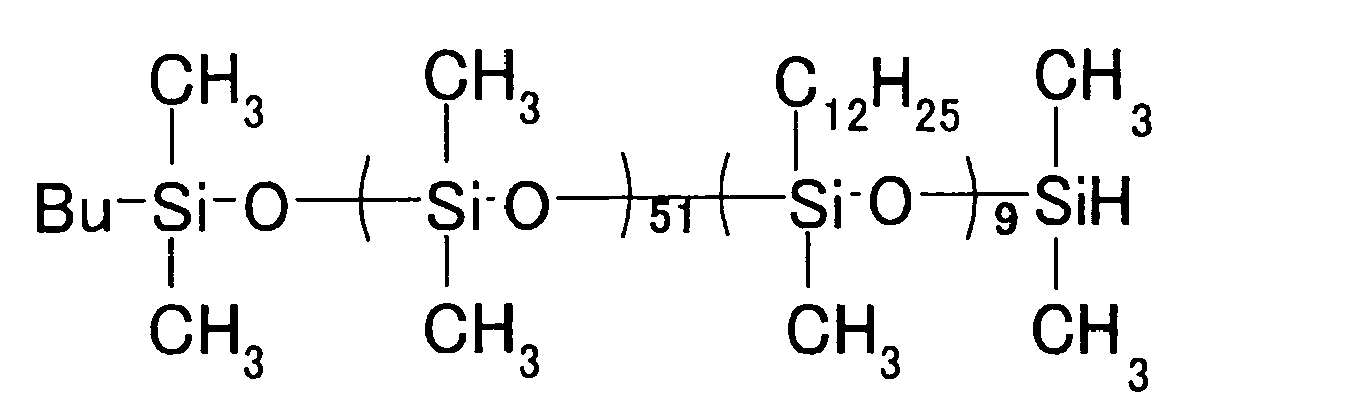
- The synthesis scheme for the aforementioned Synthesis examples 1-5 is shown in FIG. 2. FIG. 3 shows an IR spectrum of Example 1. In this spectrum, peaks from polydimethylsiloxane are observed near 800, 1,000, 1,260, and 2, 960 cm-1, and peaks from the secondary alcohol in polyglycerin are observed near 1,400 cm-1, indicating that the synthesis goes according to the scheme and the target compound is obtained.
- 38 g of fine particle powder, a dispersing agent prepared by using the method of Synthesis example 1 or Synthesis example 2, and 5 g of Comparative example are added to 57 g of silicone type dispersion medium, and glass beads (1 mm diameter) are added such that the weight ratio with the fine particle powder is 1 : 1, followed by one hour of mixing with a paint shaker to prepare a slurry-like dispersion. A dispersion is prepared in the same manner except for the fact that 5 g of the dispersing agent prepared by using the method of Comparative example 1 is used instead of the dispersing agent prepared in Synthesis example 1. For the powder to be dispersed, mixed powder of equal amounts of P1 and P2 are used.
Ingredients used are shown below. - (1) Fine particle powder (P1) : Fine particle titanium dioxide treated with fatty acid soap
- Product name: 100TV (from Teika Pharmaceutical Co., Ltd.)
- Particle size: Major axis approximately 0.03 µm, minor axis approximately 0.005 µm
- Aluminum myristate treatment amount: 10 wt%
- (2) Fine particle powder (P2) : Silicone-treated silica-coated zinc oxide
- Product name: SS-Activox C80 (from Showa Denko K. K.)
- Particle size: approximately 0.03 µm
- Amount of silica treatment: 20 wt%
- (3) Comparative sample: Polyether-modified silicone
- Product name: Silicone KF6017 (from Shin-Etsu Chemical Co., Ltd.)
- Polyether-modification rate: 20%
- Molecular weight: approximately 6,000 HLB value : 4.0
- (4) Dispersion medium: Decamethylcyclopentasiloxane
- Product name: KF-995 (from Shin-Etsu Chemical Co., Ltd.)
- Rheological measurement of the dispersion is carried out to evaluate the dispersion stability of each glycerin modified on both ends with silicone.
-
- Evaluation apparatus: Cone plate type viscometer AR1000-N from TA Instruments
- Measurement conditions: 4 cm 4° Steel geometry
- Shearing rate : 0.1 s-1 - 500 s-1 25 °C
- The evaluation results of the dispersion using the glycerin modified on both ends with silicone of Synthetic example 1 are shown in FIG. 4.
The evaluation results of the dispersion using the glycerin modified on both ends with silicone of Synthetic example 2 are shown in FIG. 5.
The evaluation results of the dispersion using the polyether-modified silicone, i. e. Comparative example, is shown in FIG. 6.
When the dispersion stability of the powder in the dispersion is good, its fluid characteristics reflect the fluid characteristics of the dispersion medium silicone, and the behavior is Newtonian, i.e. the viscosity is nearly constant regardless of the magnitude of the shearing rate.
The behavior of the dispersion using the dispersing agent of Comparative example is shown in FIG. 6, in which the dispersion prepared by mixing titanium oxide (P1) and zinc oxide (P2) shows a significant increase in the viscosity in the low shearing rate region, indicating aggregation of the powder.
In contrast, the behavior of the dispersion using the dispersing agent synthesized in Synthetic example 1 and Synthetic example 2 is shown in FIG. 4, in which the dispersion prepared by mixing titanium oxide (P1) and zinc oxide (P2) shows virtually Newtonian fluid properties, indicating excellent dispersion stability. There have been very few reports of a dispersing agent that enables a dispersion using mixed powder (P1 and P2) to exhibit virtually Newtonian behavior; this indicates that the aforementioned dispersing agent has an excellent effect of improving the dispersion stability.
The aforementioned evaluation measurements indicate that the compounds of Synthetic examples 1 and 2 exhibit a superior effect of stabilizing dispersion. The compound of Synthetic example 3 exhibits the dispersion stability similar to that of Synthetic examples 1 and 2. - The powder dispersion properties of the glycerin modified on both ends with silicone and polyether-modified silicone that were synthesized in the same manner as Synthetic examples 1-3 and Comparative example were evaluated by means of rheological measurements as described above. The tables indicate that the glycerin modified on both ends with silicone used in the present invention exhibits superior dispersion properties.
-
[Table 1] <Evaluation results for the powder dispersion stabilizer having a molecular weight of approximately 11,000> Glycerin modified on both ends with silicone HLB value Dispersion properties 0.1 × 0.15 × 0.2 ○ 0.48 ○ 1.4 ○ 1.8 ○ 2.0 ○ 2.5 ○ 2.8 ○ 3.2 Δ 4.8 × Polyether-modified silicone HLB value Dispersion properties 0.5 × 1.8 × 4.0 × Dispersion properties
○ : Good, Δ : Reasonably good, × : Not good -
[Table 2] <Evaluation results for the powder dispersion stabilizer having a HLB value of 0.5> Glycerin modified on both ends with silicone Molecular weight Dispersion properties 1000 × 1500 Δ 2000 ○ 3000 ○ 5000 ○ 9000 ○ 12000 ○ 15000 ○ 20000 ○ 25000 × 31000 × Polyether-modified silicone Molecular weight Dispersion properties 6000 × 11000 × 15000 × Dispersion properties
○ : Good, Δ : Reasonably good, × : Not good - Next, the emulsification stability test was carried out for water-in-oil type cream containing the aforementioned glycerin modified on both ends with silicone as an emulsifier and water-in-oil type cream containing a conventional emulsifier. The compositions of the water-in-oil type creams and the results are shown in the following Table 3. As for typical conventional water-in-oil type emulsifiers, diglyceryl diisostearate was used in Comparative example 1 and POE (3) hydrogenated castor oil was used in Comparative example 2. 2-ethylhexyl paramethoxycinnamate (IOB 0.28) and 2-ethylhexyl succinate (I0B 0.32) were added as polar oil-based ingredients.
- The water-in-oil type creams of the Examples and the Comparative examples were kept at room temperature for a month, after which the appearance of the emulsion was visually (or by using an optical microscope) observed.
-
- ⊚ : Particles were homogeneous and the emulsification state was good.
- ○ : Particles were somewhat uneven, but the emulsification state was good.
- Δ : Particles became coarse and separation of the water phase and the oil phase was observed.
- ×: The water phase and the oil phase was completely separated.
- The water-in-oil type creams of the Examples and the Comparative examples were kept at 50 °C for a month, after which the appearance of the emulsion was visually (or by using an optical microscope) observed. The evaluation criteria are as follows:
-
- ⊚ : Particles were homogeneous and the emulsification state was very good.
- ○ : Particles were nearly homogeneous and the emulsification state was good.
- Δ : Particles were somewhat uneven and slight separation of the water phase and the oil phase was observed.
- ×: The water phase and the oil phase was completely separated.
-
[Table 3] Example A Comparative example 1 Comparative example 2 Polyglycerin modified on both ends with silicone from Synthesis example 1 2.5 - - Diglyceryl diisostearate - 2.5 - POE (3) hydrogenated castor oil - - 2.5 lon-exchanged water Balance Balance Balance Polyethylene glycol 1.0 1.0 1. 0 1.3-butylene glycol 5.0 5.0 5. 0 Preservative Appropriate amount Appropriate amount Appropriate amount Decamethylcyclopentasiloxane 12.0 12.0 12.0 2-ethylhexyl paramethoxycinnamate 10.0 10.0 10.0 Di-2-ethylhexyl succinate 2.0 2.0 2.0 Stability over time (one month) ⊚ Δ Δ Temperature stability (50 °C) ⊚ Δ Δ - The above Table 3 indicates that Example A of the present invention is far superior to Comparative examples 1 and 2 that use conventional water-in-oil type emulsifiers in terms of stability over time and temperature stability of the emulsified composition.
- Cosmetics containing glycerin modified on both ends with silicone are shown below.
-
(Formulation) (wt%) Light isoparaffin 7 Compound of Synthesis example 1 2 Decamethylcyclopentasiloxane 10 Trimethylsiloxysilicic acid 10 Methylpolysiloxane emulsion Appropriate amount 1,3-butylene glycol 4 Polyethylene glycol dioleate 2 Diglyceryl diisostearate 2 DL-α-tocopherol acetate 0.1 Paraoxybenzoic ester Appropriate amount Black iron oxide 7 Seaweed extract 0.1 Bentonite 1 Dimethyl distearyl ammonium hectorite 6 Poly vinyl acetate emulsion 30 Purified Balance - The obtained mascara had good gloss and superior color development.
-
(Formulation) (wt%) Light isoparaffin Balance Decamethylcyclopentasiloxane 8 Compound of Synthesis example 2 3 Trimethylsiloxysilicic acid 8 Polyoxyethylene- methylpolysiloxane copolymer 2 1,3- butylene glycol 2 Macadamia nut oil 1 Polyoxyethylene hydrogenated castor oil triisostearate 2 Acrylic resin-coated aluminum powder 4 Dimethyl distearyl ammonium hectorite 5 Dextrin palmitate 2 Purified water 2 - The obtained mascara had good gloss and superior color development.
-
(Formulation) (wt%) Light isoparaffin Balance Methylhydrogenpolysiloxane 1 Decamethylcyclopentasiloxane 10 Compound of Synthesis example 1 5 Castor oil 2 Candelilla wax 5 Isostearic acid 3 Oleic acid 1 Glyceryl tri-2- ethylhexanoate 2 Sapindaceae extract 0.1 Wild oat extract 0.1 Dextrin palmitate 13 Trimethylsiloxysilicic acid 15 Tetradecene 0.1 Polyethylene 5 Microcrystalline wax 5 - The obtained mascara had good gloss and superior color development.
-
(Formulation) (wt%) Light isoparaffin Balance Compound of Synthesis example 3 3 Decamethylcyclopentasiloxane 5 Octyl palmitate 1 Isostearic acid 1 Microcrystalline wax 1 Carnauba wax 2 Beeswax 2 Dextrin (palmitate/octanoate) 15 Fatty acid ester mixed with sucrose 20 (Cosmelike MX-10 from Dai-ichi Kogyo Seiyaku Co., Ltd.) Sucrose tetraisostearate (Crodesta 4-IS from Croda Japan KK) 10 Trimethylsiloxysilicic acid 5 Aluminum stearate 1 Silicone-coated pigment (iron oxide) 0.5 Silicone-coated pigment (titanium oxide) 0.3 Silicone-coated pigment (red iron oxide) 0.2 Barium sulfate 0.1 Red iron oxide-coated mica Appropriate amount δ-tocopherol 0.1 - The obtained mascara had good gloss and superior color development.
-
(Formulation) (wt%) Methylphenylpolysiloxane 5 Non-water based polymer emulsion (*) 30 Fluorine-modified methylphenylpolysiloxane 25 Decamethylcyclopentasiloxane 5 Compound of Synthesis example 4 5 Dimethylpolysiloxane Balance Polyoxyethylene-modified silicone 5 Glycerin 3 Pigment 5 Ceresin 10 Candelilla wax 2 Aerosil R972 (from Degussa) 1 Spherical silica 0.5 δ-tocopherol 0.05 Octylmethoxy cinnamate 0.5 Laponite 0.3 (*) 15% of Methyl methacrylate monomer, 25% of ethyl acrylate monomer, 0.1% of polymerization initiator, and 5% of dispersion stabilizer dimethylpolysiloxane graft polymer (molecular weight approximately 150,000) were added to 54.9% of the dispersion medium decamethylcyclopentasiloxane and stirred for 10 hours at 120 °C for polymerization; monomers were then removed by reducing the pressure and the temperature was cooled down to 25 °C to obtain non-water based polymer dispersion that has milky white appearance and an average dispersed polymer particle size of 1 µm wherein volatile silicone is used as a dispersion medium. - The obtained lipstick had a moist texture and yet was not too sticky, giving a good tactile sensation during use.
-
(Formulation) (wt%) Ceresin 6 Decamethylcyclopentasiloxane Balance Compound of Synthesis example 5 5 Polyoxyethylene/methylpolysiloxane copolymer ( 6,000) MW = 5 "Non-water based dispersion prepared by dispersing alkyl acrylate/tris (trimethylsiloxy) silylpropyl methacrylate in decamethylcyclopentasiloxane" 30 Dimethylsiloxane/diphenylsiloxane/methyl (perfluoroalkyl) siloxane 20 Methylphenylpolysiloxane 5 Stearoxymethylpolysiloxane 2 Candelilla wax 4 Silylated silicic acid anhydride 1 Silicone-coated pigment (red iron oxide, titanium oxide, etc.) 7 Red iron oxide-coated titanated mica 5 Mica 1 Dye Appropriate amount Silicic acid anhydride 2 Titanium oxide 3 Poly (oxyethylene/oxypropylene)/methylpolysiloxane copolymer (MW = 50,000) 2 Perfume Appropriate amount - The obtained lipstick had gloss and a moist texture and yet was not too sticky, giving a good tactile sensation during use.
-
(Formulation) (wt%) A-olefin oligomer 5 Methylphenylpolysiloxane 5 Compound of Synthesis example 1 2 Diisostearyl malate Balance Heavy liquid isoparaffin 25 Pigment 7 Glycerin 1 1,3- butylene glycol 3 Calcium chloride 0.1 Sodium acetylated hyaluronate 0.02 2- ethylhexyl paramethoxycinnamate 2 Synthetic sodium/magnesium silicate 1.5 Dextrin palmitate 2.5 Polyoxyethylene-methylpolysiloxane copolymer 0.5 Purified water 1 Perfume Appropriate amount - The obtained lipstick had a moist texture and yet was not too sticky, giving a good tactile sensation during use.
-
(Formulation) (wt%) Dimethyl polysiloxane 5 Compound of Synthesis example 1 2 Isostearic acid 0.5 Diisostearyl malate 3 Glyceryl tri-2- ethylhexanoate 1 Sorbitan sesquiisostearate 1 Spherical PMMA-coated mica 6 PRISMTONE POWDER YR 1 Fine particle zinc oxide 0.5 Fine particle titanium oxide 2 Synthetic phlogopite 2 Metal soap-treated talc 8 Spherical silica 5 Vitamin E acetate 0.1 δ-tocopherol 0.1 Ethylparaben Appropriate amount Methylbis (trimethylsiloxy) silylisopentyl trimethoxycinnamate 1 2- ethylhexyl paramethoxycinnamate 3 Spherical poly alkyl acrylate powder 6 Methylhydrogenpolysiloxane-coated talc Balance Methylhydrogenpolysiloxane-coated sericite 20 Methylhydrogenpolysiloxane-coated titanium oxide 15 Methylhydrogenpolysiloxane-coated pigment (coloring agent) 5 - The obtained lipstick-type solid powdery foundation exhibited superior color development and felt very smooth on the skin.
-
(Formulation) (wt%) Synthesized hydrocarbon wax particles 2 Dimethyl polysiloxane 6 Purified lanolin 5 Compound of Synthesis example 4 5 Glyceryl tri-2- ethylhexanoate 2 Sorbitan sesquiisostearate 0.5 Acicular fine particle titanium oxide 5 Fine particle zinc oxide 1 Silicone-coated sintered iron oxide/titanium oxide 7 Barium sulfate 8 Calcined sericite Balance Titanium-reduced mica titanium pearl pigment 2 Silicone-coated synthetic phlogopite 5 Silicone-coated talc 2 Spherical silica 3 Silicone-coated mica 15 Stearyl glycyrrhizate 0.1 Ascorbyl dipalmitate 0.1 DL-α-tocopherol acetate 0.1 D-δ-tocopherol 0.1 Paraoxybenzoic ester Appropriate amount 2- ethylhexyl paramethoxycinnamate 3 Silicone-coated red iron oxide 1 Silicone-coated yellow iron oxide 1 Silicone-coated black iron oxide 1 Spherical poly alkyl acrylate 3 Perfume Appropriate amount -
(Formulation) (wt%) Silicone-treated sericite 15 Silicone-treated mica 20 Silicone-treated synthetic mica 10 Silicone-treated talc Balance Zinc oxide 2 Methylsiloxane network polymer spherical powder 4 Boron nitride 3 Zinc myristate 2 Crushed liquid titanated mica 3 Silicone-treated titanium oxide 10 Silicone-treated iron oxide 4 Silicone-treated zinc oxide 5 Dimethyl polysiloxane 4 Compound of Synthesis example 1 2 2- ethylhexyl paramethoxycinnamate 3 Polyoxyethylene/alkyl co-modified silicone 1 Sorbitan sesquiisostearate 1 Paraben Appropriate amount δ-tocopherol Appropriate amount Perfume Appropriate amount - The powder components, the oil components, and the crushed liquid titanated mica in the formulation were dispersed/mixed in ethyl alcohol by using a sand grinder mill having 3 mm-diameter zirconia beads. After distilling ethyl alcohol, the mixture was crushed once with a pulverizer; it was then packed in a container (mid-sized plate made of resin) and dry-molded with a prior art method to obtain a solid powdery foundation. The obtained solid powdery foundation exhibited a superior smoothness.
-
(Formulation) (wt%) Methyl (N-propyl-pyrrolidone carboxylate) siloxane/methylpolysiloxane copolymer 5 Compound of Synthesis example 1 5 Dimer dilinoleic acid (phytosteryl/behenyl) 5 Glycerin tri-2- ethylhexanoate 3 Methylpolysiloxane 2 Sorbitan sesquiisostearate 1 Pearl pigment (product name: Timiron MP115) 40 Mica 10 Yellow iron oxide 2 Talc Balance - The powder ingredients were mixed using a Henschel mixer and such, to which the oil based ingredients were added, followed by homogeneous mixing, to obtain a cosmetic base agent. To this 60-70 wt% of ethanol was added and mixed homogeneously to obtain a slurry. Since the oil based ingredients would be partially lost by ethanol removal, an increased amount of 120-160%, as necessary, was initially added so that the end product would have the blend ratios as specified in the formulation. This was poured into a medium plate and pressure-molded by using a molding head (
molding pressure 20 kg) and simultaneously ethanol was suctioned out through the back side of the molding head. After the suction, the molded product was dried for two hours at 50 °C. The slurry obtained in the preparation process had an increased fluidity, which improved the productivity. -
(Formulation) (wt%) Dimethyl polysiloxane 3 Decamethylcyclopentasiloxane 10 Compound of Synthesis example 1 5 Polyoxyethylene- methylpolysiloxane copolymer 3 Dodecamethylcyclohexasiloxane 5 Glycerin 4 1,3-butylene glycol 5 Palmitic acid 0.5 Stearyltrimethylammonium chloride 0.2 Metal soap-treated talc 2 Cross-linked silicone powder (Trefil E-506) 0.1 Red iron oxide-coated titanated mica 0.5 N-lauroyl-L- lysine 2 Tocopherol acetate 0.1 δ-tocopherol 0.1 Paraoxybenzoic ester Appropriate amount Phenoxyethanol 0.2 Spherical nylon powder 1 Spherical poly alkyl acrylate powder 3 Sweet clover extract 2 Purified water Balance Dextrin fatty acid-treated talc 3 Dextrin fatty acid-treated titanium oxide 15 Dextrin fatty acid-treated yellow iron oxide 3 Dextrin fatty acid-treated black iron oxide 0. 5 - The oil based ingredients and the water based ingredients in the formulation were each heated and dissolved completely. The oil phase was added to the water phase and emulsified by using an emulsifying apparatus. The emulsion was cooled by a heat exchanger to obtain a cream. The obtained foundation had superior smoothness and was not sticky, giving a good sensation during use.
-
(Formulation) (wt%) Dimethyl polysiloxane 15 Decamethylcyclopentasiloxane 20 Compound of Synthesis example 5 5 Polyoxyethylene-methylpolysiloxane copolymer 5 High molecular weight amino-modified silicone 0.1 Glycerin 5 1,3- butylene glycol 10 Palmitic acid 0.5 Macadamia nut oil fatty acid cholesteryl ester 0.1 Stearyltrimethylammonium chloride 0.2 Alkyl-modified silicone resin-coated yellow iron oxide 2 Alkyl-modified silicone resin-coated red iron oxide 1 Alkyl-modified silicone resin-coated black iron oxide 0.3 Alkyl-modified silicone resin-coated titanium oxide 10 Alkyl-modified silicone resin-coated talc 1.5 Silicone-coated spindle-shaped titanium oxide 3 DL-α-tocopherol acetate 0.1 Paraoxybenzoic ester Appropriate amount Methylbis (trimethylsiloxy) silylisopentyl trimethoxycinnamate 0.1 Dimethyl distearyl ammonium hectorite 1.5 Spherical nylon powder 1 Purified water Balance Perfume Appropriate amount - The oil based ingredients and the water based ingredients in the formulation were each heated and dissolved completely. The oil phase was added to the water phase and emulsified by using an emulsifying apparatus. The emulsion was cooled by a heat exchanger to obtain cream. The obtained foundation had superior smoothness and was not sticky, giving a good sensation during use.
-
(Formulation) (wt%) Dimethyl polysiloxane 2 Compound of Synthesis example 2 2 Stearyl alcohol 2 Behenyl alcohol 1 Glycerin 1.5 Octyl palmitate 1 Polyoxyethylene stearyl ether 0.2 Citric acid 0.05 Paraoxybenzoic ester Appropriate amount phenoxyethanol Appropriate amount Hydroxyethylcellulose 0.1 Stearyltrimethylammonium chloride 1 High polymer methylpolysiloxane 1.5 Purified water Balance Perfume Appropriate amount - The aforementioned ingredients were mixed with a conventional method to obtain a hair rinse. The obtained rinse was not sticky or squeaky, and improved the smoothness of the hair.
-
(Formulation) (wt%) Dimethyl polysiloxane 15 Compound of Synthesis example 4 5 High polymer dimethylpolysiloxane 1 Cetanol 4.5 Glycerin 10 Cetyl 2- ethylhexanoate 2 Stearyltrialkylammonium chloride 1.5 Stearyltrimethylammonium chloride 0.3 Citric acid 0.01 Tocopherol acetate 0.05 Paraoxybenzoic ester Appropriate amount Phenoxyethanol Appropriate amount Hydroxyethylcellulose 0.05 Purified water Balance Perfume Appropriate amount - The aforementioned ingredients were mixed with a conventional method to obtain a hair rinse. The obtained rinse was not sticky or squeaky, and improved the smoothness of the hair.
-
(Formulation) (wt%) Dimethyl polysiloxane 0.5 Compound of Synthesis example 5 0.5 Benzyl alcohol 5 Cetostearyl alcohol 7 Behenyl alcohol 3 Self-emulsified glycerin monostearate 1 Sodium N-stearoyl-N- methyltaurate 1 Citric acid 0.2 Phenoxyethanol Appropriate amount Purified water Balance Perfume Appropriate amount - The aforementioned ingredients were mixed with a conventional method to obtain a hair rinse. The obtained rinse gave a good tactile sensation and also improved the smoothness of the hair.
-
(Formulation) (wt%) Dimethyl polysiloxane 1.5 Compound of Synthesis example 3 0.5 Dipropylene glycol 3 Ethylene glycol distearate 2 Cocoyl monoethanolamide 2 Sodium lauroyl methyltaurate 0.1 Sodium polyoxyethylenelaurylethersulfate 7.5 Triethanolamine polyoxyethylenelaurylethersulfate 3.5 Cocoyl amidepropyl betaine 3.5 Marcoat 550 (from Cargon) 7.5 Citric acid 0.01 Sodium L-glutamate 0.2 Sodium chloride 1 Sodium benzoate Appropriate amount Disodium edetate Appropriate amount Sodium hydroxide 0.01 Purified water Balance Perfume Appropriate amount - The aforementioned ingredients were mixed with a conventional method to obtain a hair shampoo. The obtained hair shampoo exhibited superior hair texture when used to wash hair.
-
(Formulation) (wt%) Dimethyl polysiloxane 0.1 Compound of Synthesis example 1 0.1 High polymer dimethylpolysiloxane 0.15 Ethylene glycol distearate 2.5 Cocoyl diethanolamide 6 Sodium dodecane-1,2-diol acetate ether 1.5 Sodium methyl cocoyl taurate 7.5 Cocoyl amidepropyl betaine 5 Polymer JR-400 (from Union Carbide) 0.1 Dimethyldiallylammonium chloride- acrylamide copolymer 1 Citric acid 0.7 Sodium chloride 0.7 Phenoxyethanol Appropriate amount Sodium benzoate Appropriate amount Disodium edetate Appropriate amount Purified water Balance Perfume Appropriate amount - The aforementioned ingredients were mixed with a conventional method to obtain a hair shampoo. The obtained hair shampoo exhibited a superior smooth hair texture when used to wash hair and gave gloss to the hair after drying.
-
(Formulation) (wt%) Dimethylpolysiloxane 2Compound of Synthesis example 2 1 Polyoxyethylene- methylpolysiloxane copolymer 2 Cetanol 0.5 Polyoxyethylene hydrogenated castor oil 4 Ethylene glycol distearate 2 Cocoyl diethanolamide 7 Sodium polyoxyethylenelaurylethersulfate 5 Triethanolamine polyoxyethylenelaurylethersulfate 2.5 Sodium lauroylmethyl-beta- alanine 1 Sodium methyl cocoyl taurate 4 Betaine lauryldimethylaminoacetate 5 Polymer JR-400 (from Union Carbide) 0.4 Stearyltrimethylammonium chloride (25%) 0.1 Citric acid 0.4 Sodium benzoate Appropriate amount Disodium edetate Appropriate amount Purified water Balance Perfume Appropriate amount - The aforementioned ingredients were mixed with a conventional method to obtain a rinse-in-shampoo. The obtained hair shampoo exhibited a superior smooth hair texture when used to wash hair and gave gloss to the hair after drying.
-
(Formulation) (wt%) Ion-exchanged water 4 Glycerin 1 Glyceryl PEG (8) isostearate 35 Liquid paraffin Balance Glyceryl triisooctanoate 5 Isoparaffin 5 Dimethylpolysiloxane (6mPa.s) 3 Compound of Synthesis example 4 1 Pentaerythrityl tetraoctanoate 3 Squalane 3 Methylphenylpolysiloxane 3 Ascorbic acid glucoside 0.1 - The cleansing oil was obtained by mixing and dissolving***. The obtained cleansing oil was smooth and non-sticky and gave no squeaky sensation after rinsing, providing a good tactile sensation during use.
-
(Formulation) (wt%) Liquid petrolatum 73 Dimethylpolysiloxane 2 Compound of Synthesis example 2 1 Ethanol 0.3 Isostearic acid 0.5 Lauric acid 0.1 Cetyl 2- ethylhexanoate 10 PEG-12 diisostearate 4 PEG-8 diisostearate 1 PEG-10 diisostearate 3 Vitamin E 0.1 Purified water Balance - The cleansing oil was obtained by mixing and melting. The obtained cleansing oil was smooth and non-sticky and gave no squeaky sensation after rinsing, providing a good tactile sensation during use.
-
Example 22 <Hair spray> (Formulation) (wt%) Volatile isoparaffin 14 Dimethylpolysiloxane 3 Compound of Synthesis example 1 5 Ethanol Appropriate amount Purified water 2 High polymer dimethylsiloxane-methyl (aminopropyl) siloxane copolymer 4 Poly (oxyethylene-oxypropylene)-methylpolysiloxane copolymer 4 Perfume Appropriate amount Mother solution/propellant = 40/60(L.P.G 0.115 MPa) - After mixing and dissolving the ingredients, an aerosol spray was prepared using the above composition ratio. The hair sprayed with the obtained hair spray had reduced stickiness after application and a smooth and good tactile sensation.
-
(Formulation) (wt%) Dimethylpolysiloxane 5 Compound of Synthesis example 5 10 Polyoxyethylene-methylpolysiloxane copolymer 0.2 Ethanol 10 Propylene glycol 5 2-amino-2-methyl-1-propanol Appropriate amount Trisodium edetate Appropriate amount Xanthan gum 0.1 Vinyl acetate-vinyl pyrrolidone copolymer 0.5 Alkyl acrylate/methacrylate copolymer 0.2 Carboxyvinyl polymer 0.4 High polymer dimethylsiloxane-methyl (aminopropyl) siloxane copolymer 0.5 High polymer dimethylpolysiloxane 1 Purified water Balance Perfume Appropriate amount - This hair cream exhibited a superior effect of giving suppleness to the hair.
-
(Formulation) (wt%) Volatile isoparaffin 10 Dimethylpolysiloxane 1 Compound of Synthesis example 2 1 Ethanol 10 1,3-butylene glycol 5 Isostearic acid 0.5 Polyoxyethylene hydrogenated castor oil 0.1 2-alkyl-N-carboxymethyl-N- hydroxyethylimidazolium betaine 1 Sodium hydroxide 0.3 High polymer methylpolysiloxane 2 Carboxyvinyl polymer 0.8 Paraoxybenzoic ester Appropriate amount Trisodium edetate Appropriate amount Purified water Balance Perfume Appropriate amount -
(Formulation) (wt%) Liquid paraffin 5 Petrolatum 2 Dimethylpolysiloxane 3 Compound of Synthesis example 4 3 Cetanol 4 Stearyl alcohol 1 1,3- butylene glycol 10 Polyoxypropylene glyceryl ether 2 Polyoxyethylene glyceryl ethylene isostearate 2 Lipophilic glycerin monostearate 2 Polymer Example-400 0.5 Paraoxybenzoic ester Appropriate amount Purified water Balance Perfume Appropriate amount - This hair cream exhibited a superior effect of giving suppleness to the hair.
-
(Formulation) (wt%) Ethanol 10 Propylene glycol 5 Lauric diethanolamide 0.2 Alkyltrimethylammonium chloride (77%) 0.1 Yukaformer SM 10 Polyoxyethylene- methylpolysiloxane copolymer 1 Volatile isoparaffin 5 High polymer dimethylpolysiloxane 1 Compound of Synthesis example 4 1 Purified water Balance Perfume Appropriate amount Mother solution/propellant = 40/60(L.P.G MPa) 0.43 - The water based ingredients and the oil based ingredients were separately mixed and dissolved; the oil phase was then added to the water phase and emulsified with a homogenizer. The obtained emulsion was made into an aerosol formulation by using the above composition ratio. The obtained hair mousse was smooth and not rough, and exhibited good usability.
-
(Formulation) (wt%) Liquid paraffin 6 Dimethylpolysiloxane 5 Compound of Synthesis example 3 3 Glycerin 8 Propylene glycol 8 Butylethylpropanediol 0.5 Jojoba oil 1 Carnauba wax 5 Isostearic acid 0.5 Polyoxyethylene hydrogenated castor oil 0.5 Polyoxyethylene behenyl ether 5 2-alkyl-N-carboxymethyl-N-hydroxyethylimidazolium betaine 8 Phenoxyethanol 0.5 High polymer dimethylpolysiloxane 0.5 Purified water Balance Perfume Appropriate amount Mother solution/propellant = 90/10(L.P.G MPa) 0.43 - This wax mousse gave a good non-sticky and smooth tactile sensation during use.
-
(Formulation) (wt%) Liquid paraffin 10 Petrolatum 5 Microcrystalline wax 5 Stearyl alcohol 2 Propylene glycol 10 Carnauba wax 3 Isostearic acid 1 Stearic acid 2 Compound of Synthesis example 5 1 Pentaerythritol tetra-2- ethylhexanoate 3 Polyoxyethylene glyceryl ethylene isostearate 1 Self-emulsified glycerin monostearate 2 Kaolin 5 Silicic acid anhydride 2 Triethanolamine 0.3 Sodium metaphosphate Appropriate amount Paraoxybenzoic ester Appropriate amount Xanthan gum 0.1 Bentonite 1 Purified water Balance Perfume Appropriate amount - This wax mousse gave a good non-sticky tactile sensation during use.
-
(Formulation) (wt%) Hydrogenated polyisobutene Balance Ethanol 1 10 Oxybenzone Appropriate amount High polymer methylpolysiloxane 10 Compound of Synthesis example 4 2 - The hair oil was obtained by mixing and melting. The obtained hair oil was non-sticky and gave good gloss to the hair.
-
(Formulation) (wt%) Dimethylpolysiloxane 2 Compound of Synthesis example 1 1 Behenyl alcohol 1 Batyl alcohol 0.5 Glycerin 5 1,3-butylene glycol 7 Erythritol 2 Hydrogenated oil 3 Squalane 6 Pentaerythritol tetra-2- ethylhexanoate 2 Polyoxyethylene glyceryl ethylene isostearate 1 Polyoxyethyleneglycerin monostearate 1 Potassium hydroxide Appropriate amount Sodium hexametaphosphate 0.05 Phenoxyethanol Appropriate amount Carboxyvinyl polymer 0.1 Purified water Balance - A conventional method was used to prepare the emulsion. The obtained emulsion was refreshing and at the same time gave a smooth and good tactile sensation.
-
(Formulation) (wt%) Liquid paraffin 7 Petrolatum 3 Decamethylcyclopentasiloxane 1 Compound of Synthesis example 5 1 Behenyl alcohol. 1 Glycerin 5 Dipropylene glycol 7 Polyethylene glycol 15002 Jojoba oil 1 Isostearic acid 0.5 Stearic acid 0.5 Behenic acid 0.5 Pentaerythritol 1 tetra-2-ethylhexanoate 3 Cetyl 2- ethylhexanoate 3 Glyceryl monostearate 1 Polyoxyethyleneglyceryl monostearate 1 Potassium hydroxide 0.1 Sodium hexametaphosphate 0.05 Stearyl glycyrrhizate 0.05 L-arginine 0.1 Royal jelly extract 0.1 Yeast extract 0.1 Tocopherol acetate 0.1 Sodium acetylated hyaluronate 0.1 Edetate trisodium 0.05 4-tert butyl-4'-methoxybenzoylmethane 0.1 2-ethylhexyl-p-methoxycinnamate 0.1 Carboxyvinyl polymer 0.15 Paraben Appropriate amount Purified water Balance Perfume Appropriate amount - A conventional method was used to prepare the emulsion. The obtained emulsion was refreshing and at the same time gave a smooth and good tactile sensation.
-
(Formulation) (wt%) Dimethylpolysiloxane 2 Decamethylcyclopentasiloxane 20 Compound of Synthesis example 4 5 Dodecamethylcyclohexasiloxane 10 Polyoxyethylene-methylpolysiloxane copolymer 1.5 Trimethylsiloxysilicic acid 1 1,3-butylene glycol 5 Squalane 0.5 Talc 5 Dipotassium glycyrrhizinate 0.1 Tocopherol acetate 0.1 Edetate trisodium 0.05 4-tert butyl-4'- methoxybenzoylmethane 1 2-ethylhexyl-p-methoxycinnamate 5 Glyceryl diparamethoxycinnamate mono-2- ehtylhexanoate 1 Silicone-coated fine particle titanium oxide (40 nm) 4 Dimethyl distearyl ammonium hectorite 0.5 Spherical polyethylene powder 3 Phenoxyethanol Appropriate amount Purified water Balance Perfume Appropriate amount - The oil phase and the water phase were each mixed and dissolved. Dispersion of the powder in the oil phase was thoroughly conducted, to which the water phase was added, and emulsification was done using a homogenizer. The obtained protector was highly transparent and exceptionally refreshing.
-
(Formulation) (wt%) Dimethylpolysiloxane 2 Compound of Synthesis example 2 2 Methylphenylpolysiloxane 2 Ethanol 5 Glycerin 4 Dipropylene glycol 5 1,3-butylene glycol 5 2-ethylhexyl succinate 3.5 Potassium hydroxide 0.1 Sodium hexametaphosphate 0.1 Thiotaurine 0.1 Edetate trisodium 0.1 4-tert butyl-4'- methoxybenzoylmethane 3 2-ethylhexyl- paramethoxycinnamate 3 Iron oxide 0.01 Alkyl acrylate/methacrylate copolymer (Pemulen TR-2) 0.1 Carboxyvinyl polymer 0.2 Paraben Appropriate amount Purified water Balance Perfume Appropriate amount - The oil phase and the water phase were each mixed and dissolved. The oil phase was added to the water phase, followed by emulsification by means of a homogenizer. The obtained protector was highly transparent and exceptionally refreshing.
-
(Formulation) (wt%) Dimethylpolysiloxane 0.5 Compound of Synthesis example 3 0.5 Ethanol 3 Behenyl alcohol 0.3 Glycerin 5 Dipropylene glycol 5 Erythritol 1 Polyethylene glycol 40001 Squalane 0.4 Cetyl 2-ethylhexanoate 0.1 Sodium N-stearoyl-L-glutamate 0.2 Magnesium chloride 0.1 Arginine chloride 0.1 Hypotaurine 0.1 Edetate trisodium 0.1 Paraben Appropriate amount Purified water Balance Perfume Appropriate amount - This lotion gave a good, smooth tactile sensation.
-
(Formulation) (wt%) Dimethylpolysiloxane 3 Compound of Synthesis example 1 10 Decamethylcyclopentasiloxane 15 Trimethylsiloxysilicic acid 1 Polyoxyethylene- methylpolysiloxane copolymer 2 Glycerin 1 1,3-butylene glycol 5 Squalane 1 Titanium oxide 1 Talc 2 Aluminum stearate 0.5 Oil soluble licorice extract 0.5 3 Na edetate Appropriate amount Paraben Appropriate amount Phenoxyethanol Appropriate amount Dimethyl distearyl ammonium hectorite 0.8 Spherical nylon powder 1 Purified water Balance - The oil phase and the water phase were each mixed and dissolved. The water phase was added to the oil phase, followed by emulsification by means of a homogenizer. This cream gave a good, smooth tactile sensation.
-
(Formulation) (wt%) Stearic acid 10 Compound of Synthesis example 5 1 Stearyl alcohol 4 Butyl stearate 8 Monoglyceryl 1stearate 2 Vitamin E acetate 0.5 Vitamin A palmitate 0.1 Macadamia nut oil 1 Perfume Appropriate amount Glycerin 4 1,2- pantendiol 3 Sodium hyaluronate 1 Potassium hydroxide 2 Magnesium ascorbate phosphate 0.1 L-arginine hydrochloride 0.01 Edetate trisodium 0.05 Purified water Balance - The oil phase and the water phase were separately heated up to 70 °C and completely dissolved. The oil phase was added to the water phase and emulsified by using an emulsifying apparatus. The emulsion was cooled by a heat exchanger to obtain cream. The obtained cream had superior smoothness and was not sticky, giving a good sensation during use.
-
(Formulation) (wt%) Decamethylcyclopentasiloxane 15 Compound of Synthesis example 2 5 Trimethylsiloxysilicic acid 1 Polyoxyethylene- methylpolysiloxane copolymer 2 Dipropylene glycol 4 Squalane 5 Silicone-coated fine particle titanium oxide (20 nm) 10 Talc (hydrophobicized) 6 Paraben Appropriate amount Phenoxyethanol Appropriate amount 4-tert butyl-4'-methoxybenzoylmethane 0.1 2-ethylhexyl-p-methoxycinnamate 7 Glyceryl diparamethoxycinnamate mono-2-ehtylhexanoate 0.5 Spherical polyethylene powder 5 Dimethyl distearyl ammonium hectorite 1 Purified water Balance Perfume Appropriate amount - The oil phase and the water phase were each mixed and dissolved. Dispersion of the powder in the oil phase was thoroughly conducted, to which the water phase was added, and emulsification was done using a homogenizer. The obtained sunscreen was highly transparent and exceptionally refreshing.
-
(Formulation) (wt%) Dimethylpolysiloxane 3 Compound of Synthesis example 3 2 Glycerin 2 1,3-butylene glycol 5 Polyethylene glycol 15003 Polyethylene glycol 20000 3 Cetyl octanoate 3 Citric acid 0.01 Sodium citrate 0.1 Sodium hexametaphosphate 0.1 Dipotassium glycyrrhizinate 0.1 Ascorbic acid glucoside 2 Tocopherol acetate 0.1 Cat's ear extract 0.1 Creeping saxifrage 0.1 Edetate trisodium 0.1 Xanthan gum 0.3 Alkyl acrylate/methacrylate copolymer (Pemulen TR-2) 0.05 Agar powder 1.5 Phenoxyethanol Appropriate amount Dibutylhydroxytoluene Appropriate amount Purified water Balance - Following a conventional method, a semitransparent emulsified composition was prepared and turned into gel by cooling the temperature down to 30 °C or lower; after the gel solidified sufficiently, a disper was used to crush and turn it into microgel (
average particle size 70 µm) and deaerated to obtain a gel-like product. The obtained gel was refreshing, non-squeaky, and smooth, exhibiting good usability. -
(Formulation) (wt%) Dimethylpolysiloxane 5 Decamethylcyclopentasiloxane 25 Compound of Synthesis example 4 2 Trimethylsiloxysilicic acid 5 Polyoxyethylene- methylpolysiloxane copolymer 2 Ethyl ethylhexanoate 5 Dipropylene glycol 5 Dextrin palmitate-coated fine particle zinc oxide (60 nm) 15 Glutathione 1 Thiotaurine 0.05 Clara extract 1 Paraben Appropriate amount Phenoxyethanol Appropriate amount 2-ethylhexyl-p-methoxycinnamate 7.5 Dimethyl distearyl ammonium hectorite 0.5 Spherical poly alkyl acrylate powder 5 Butylethylpropanediol 0.5 Purified water Balance Perfume Appropriate amount - The oil phase and the water phase were each mixed and dissolved. Dispersion of the powder in the oil phase was thoroughly conducted, to which the water phase was added, and emulsification was done using a homogenizer. The obtained sunscreen formulation exhibited a superior refreshing sensation.
-
(Formulation) (wt%) Dimethylpolysiloxane 5 Decamethylcyclopentasiloxane 25 Trimethylsiloxysilicic acid 5 Compound of Synthesis example 2 2 Polyoxyethylene- methylpolysiloxane copolymer 2 Squalane 5 Dipropylene glycol 5 Fine particle zinc oxide ( hydrophobicized product 60 nm)15 Paraben Appropriate amount Phenoxyethanol Appropriate amount 2-ethylhexyl-paramethoxycinnamate 7.5 Dimethyl distearyl ammonium hectorite 0.5 Spherical poly alkyl acrylate powder 5 Purified water Balance Perfume Appropriate amount - The oil phase and the water phase were each mixed and dissolved. Dispersion of the powder in the oil phase was thoroughly conducted, to which the water phase was added, and emulsification was done using a homogenizer. The obtained sunscreen had a low viscosity and was exceptionally refreshing.
-
(1) Sericite 5 wt% (2) Kaolin 4 (3) Titanium dioxide 6 (4) Red iron oxide 0.36 (5) Yellow iron oxide 0.8 (6) Black iron oxide 0.16 (7) Aluminum stearate-treated titanium dioxide 4 (8) Dextrin fatty acid-treated zinc oxide 4 (9) Compound of Synthesis example 3 3 (10) Liquid paraffin 5 (11) Decamethylcyclopentasiloxane 29 (12) POE-modified dimethylpolysiloxane 4 (13) Ion-exchanged water 36 (14) 1,3-butylene glycol 5 (15) Preservative 0.1 (16) Perfume 0.08 - (7), (8), and (9) were dispersed and crushed with a beads mill, to which (1)-(6), (10) and (11) were added and mixed to obtain the oil phase. (12)-(15) were heated and dissolved at 70 °C and added to the oil phase, followed by emulsification. Additionally, (16) was added and mixed, and the product was put into a container.
-
(1) Talc 14.3 wt% (2) Kaolin 10 (3) Red iron oxide 1 (4) Dextrin fatty acid-treated yellow iron oxide 3 (5) Dextrin fatty acid-treated black iron oxide 0.2 (6) Dextrin fatty acid-treated titanium dioxide 5 (7) Dextrin fatty acid-treated zinc oxide 5 (8) Liquid paraffin 20 (9) Dimethylpolysiloxane 15 (10) Octylmethoxy cinnamate 1 (11) Sorbitan sesquiisostearate 2 (12) Isohexadecyl alcohol 10 (13) Ceresin 4 (14) Carnauba wax 1 (15) Compound of Synthesis example 1 3 (16) Perfume Appropriate amount - (8) and (10)-(14) were heated and mixed to obtain the oil phase. Separately, (6), (7), (9), and (15) were mixed and a beads mill was used to disperse and crush the mixture, which, along with (1)-(5), was then added to the oil phase and mixed with a disper. (16) was then mixed in and the mixture was put into a container and cooled.
-
(1) Talc 6 wt% (2) Aluminum stearate-treated fine particle titanium dioxide 6 (3) Aluminum stearate-treated fine particle zinc dioxide 10 (4) Compound of Synthesis example 3 3 (5) Liquid paraffin 1 (6) Decamethylcyclopentasiloxane 30 (7) Dimethylpolysiloxane 20 (8) POE-modified dimethylpolysiloxane 2 (9) Ion-exchanged water 15 (10) 1,3-butylene glycol 8 (11) Preservative 0.1 (12) Perfume 0.1 - (5), (6), and (8) were heated and mixed at 70 °C to obtain the oil phase. Separately, (2)-(4) and (7) were mixed and a triple roller was used to knead the mixture. This kneaded mixture and (1) were added to the oil phase and mixed by using a disper. (9)-(11) were heated and dissolved at 70 °C and added to this mixture, which was then emulsified, to which (12) was mixed in and the product was put into a container.
-
(1) Talc 3 wt% (2) Kaolin 10 (3) Mica 3 (4) Aluminum palmitate-treated fine particle titanium dioxide 25 (5) Dimethylpolysiloxane 20 (6) Isopropyl palmitate 13.9 (7) Solid paraffin 2 (8) Microcrystalline wax 3 (9) Petrolatum 10 (10) Ceresin 8 (11) Carnauba wax 1 (12) Compound of Synthesis example 2 2 (13) Perfume 0.1 - (6)-(11) were heated and mixed at 90 °C to obtain the oil phase. Separately, (4), (5), and (12) were mixed and a triple roller was used to knead the mixture. This kneaded mixture and (1)-(3) were added to the oil phase and mixed by using a disper. (13) was then mixed in and the mixture was put into a container and cooled.
-
(1) Aluminum stearate-treated titanium dioxide 5 wt% (2) Dextrin stearate-treated zinc dioxide 5 (3) Compound of Synthesis example 1 3 (4) Decamethylcyclopentasiloxane 13 (5) Octyl paramethoxycinnamate 5 (6) PEG-60 hydrogenated castor oil 2 (7) Dynamite glycerin 6 (8) Succinoglycan 0.3 (9) Carboxymethyl cellulose 0.3 (10) Ethanol 5 (11) Ion-exchanged water Balance - (1)-(5) were mixed and a beads mill was used to disperse and crush the mixture, which was then added, as a homomixer was used, to the water phase prepared by dissolving (6)-(11). The obtained sun cut oil-in-water emulsion was refreshing and absorbed well into the skin, exhibiting a good tactile sensation during use.
-
(1) Aluminum palmitate-treated titanium dioxide 5 wt% (2) Aluminum palmitate-treated zinc dioxide 5 (3) Metal soap-treated talc 3 (4) Alkyl-modified silicone resin-coated yellow iron oxide 0.8 (5) Alkyl-modified silicone resin-coated black iron oxide 0.16 (6) Alkyl-modified silicone resin-coated red iron oxide 0.36 (7) Compound of Synthesis example 3 3 (8) POE-modified methylpolysiloxane 1 (9) Decamethylcyclopentasiloxane 15 (10) Octyl paramethoxycinnamate 5 (11) PEG-60 hydrogenated castor oil 2 (12) Dynamite glycerin 6 (13) Xanthan gum 0.3 (14) Carboxymethyl cellulose 0.3 (15) Ethanol 5 (16) Ion-exchanged water Balance - (1)-(10) were mixed and a beads mill was used to disperse and crush the mixture, which was then added, while a homomixer was used, to the water phase prepared by dissolving (11)-(16). The obtained foundation had no color mottling and gave an easy-to-spread, non-sticky, good tactile sensation during use.
-
(1) Aluminum stearate-treated titanium dioxide 5 wt% (2) Aluminum stearate-treated zinc dioxide 5 (3) Compound of Synthesis example 2 3 (4) Decamethylcyclopentasiloxane 15 (5) Octyl paramethoxycinnamate 5 (6) PEG-60 hydrogenated castor oil 2 (7) Dynamite glycerin 6 (8) Succinoglycan 0.3 (9) Carboxymethyl cellulose 0.3 (10) Ethanol 6 (11) Citric acid Appropriate amount (12) Sodium citrate Appropriate amount (13) Ascorbic acid glycoside 2 (14) Caustic potash Appropriate amount (15) Ion-exchanged water Balance - (1)-(5) were mixed and a beads mill was used to disperse and crush the mixture, which was then added, while a homomixer was used, to the water phase prepared by dissolving (6)-(15). The obtained essence was smooth, easy-to-spread, and non-sticky, exhibiting a good tactile sensation during use.
- The present invention can provide a cosmetic that is refreshing and at the same time absorbed into the skin very well. Also, the present invention can provide oil based cosmetics, water-in-oil type emulsified cosmetics, and oil-in-water type emulsified compositions that are superior in terms of the sensation during use and stability. Furthermore, the present invention can provide a powder dispersion cosmetic that has a very high powder dispersion stability and therefore exhibits excellent stability.
Claims (5)
- A cosmetic that characteristically contains glycerin modified on both ends with silicone represented by the following general formula (a).
(a)
- The cosmetic of claim 1 wherein said cosmetic is an oil based cosmetic.
- The cosmetic of claim 1 wherein said cosmetic is an water-in-oil type emulsified cosmetic.
- The cosmetic of claim 1 wherein said cosmetic is an oil-in-water type emulsified composition.
- The cosmetic of claim 1, 2, 3, or 4 wherein said cosmetic additionally contains powder.
Applications Claiming Priority (3)
| Application Number | Priority Date | Filing Date | Title |
|---|---|---|---|
| JP2005009013 | 2005-01-17 | ||
| JP2005160799 | 2005-06-01 | ||
| PCT/JP2006/300329 WO2006075679A1 (en) | 2005-01-17 | 2006-01-13 | Cosmetic |
Publications (3)
| Publication Number | Publication Date |
|---|---|
| EP1847262A1 true EP1847262A1 (en) | 2007-10-24 |
| EP1847262A4 EP1847262A4 (en) | 2012-10-03 |
| EP1847262B1 EP1847262B1 (en) | 2014-04-23 |
Family
ID=36677702
Family Applications (1)
| Application Number | Title | Priority Date | Filing Date |
|---|---|---|---|
| EP06702665.8A Expired - Lifetime EP1847262B1 (en) | 2005-01-17 | 2006-01-13 | Cosmetic |
Country Status (7)
| Country | Link |
|---|---|
| US (1) | US8080239B2 (en) |
| EP (1) | EP1847262B1 (en) |
| KR (1) | KR101014618B1 (en) |
| CN (1) | CN101106970B (en) |
| ES (1) | ES2486790T3 (en) |
| TW (1) | TW200637599A (en) |
| WO (1) | WO2006075679A1 (en) |
Cited By (5)
| Publication number | Priority date | Publication date | Assignee | Title |
|---|---|---|---|---|
| US8119108B2 (en) | 2005-12-14 | 2012-02-21 | Shiseido Co., Ltd. | Dispersion of microparticulate titanium oxide and cosmetics containing the same |
| WO2012042570A1 (en) * | 2010-09-29 | 2012-04-05 | L'oreal | A cosmetic method for hiding skin imperfections |
| EP2505602A1 (en) * | 2011-03-29 | 2012-10-03 | Shin-Etsu Chemical Co., Ltd. | Organopolysiloxane and cosmetic containing it |
| US9107855B2 (en) | 2012-03-22 | 2015-08-18 | Shin-Etsu Chemical Co., Ltd. | Organopolysiloxane, cosmetic containing thereof, and method for preparing organopolysiloxane |
| EP3543304A1 (en) * | 2018-03-19 | 2019-09-25 | ABCR Laboratorios, S.L. | Organofunctional siloxanes, method for its preparation and use for the treatment of fillers and surfaces |
Families Citing this family (17)
| Publication number | Priority date | Publication date | Assignee | Title |
|---|---|---|---|---|
| JP4567585B2 (en) * | 2005-01-17 | 2010-10-20 | 株式会社資生堂 | Cosmetics |
| ES2486790T3 (en) | 2005-01-17 | 2014-08-19 | Shin-Etsu Chemical Co., Ltd. | Cosmetic |
| JP5357411B2 (en) | 2007-08-09 | 2013-12-04 | 花王株式会社 | Body cosmetics for wet skin |
| KR100914352B1 (en) | 2007-09-14 | 2009-08-28 | 주식회사 엘지생활건강 | Conditioning shampoo composition with improved feeling after drying |
| JP5553377B2 (en) * | 2009-09-24 | 2014-07-16 | 株式会社 資生堂 | Sunscreen cosmetics |
| WO2011049247A1 (en) | 2009-10-23 | 2011-04-28 | 東レ・ダウコーニング株式会社 | Thickening or gelling agent for oily raw materials |
| WO2011049246A1 (en) | 2009-10-23 | 2011-04-28 | 東レ・ダウコーニング株式会社 | Novel organopolysiloxane copolymer |
| JP5368394B2 (en) | 2010-08-11 | 2013-12-18 | 信越化学工業株式会社 | Novel organopolysiloxane compound and cosmetic containing the same |
| JP5841488B2 (en) * | 2012-05-11 | 2016-01-13 | 信越化学工業株式会社 | Block-type modified organopolysiloxane, method for using the organopolysiloxane, cosmetics, and method for producing the organopolysiloxane |
| WO2014104258A1 (en) | 2012-12-28 | 2014-07-03 | 東レ・ダウコーニング株式会社 | Method for producing transparent or semi-transparent liquid glycerin-derivative-modified silicone composition |
| JP5962567B2 (en) * | 2013-04-09 | 2016-08-03 | 信越化学工業株式会社 | Oil-in-water sunscreen cosmetics |
| EP3009466B1 (en) | 2013-06-13 | 2021-02-24 | Dow Toray Co., Ltd. | Silicone modified by long-chain hydrocarbon group-containing diglycerin derivative, and use thereof |
| US9744116B2 (en) | 2013-09-18 | 2017-08-29 | L'oreal | High color intensity and easily removable mascara |
| JP6560151B2 (en) * | 2016-03-28 | 2019-08-14 | 信越化学工業株式会社 | Organopolysiloxane, cosmetic, and method for producing organopolysiloxane |
| JP6546127B2 (en) | 2016-07-14 | 2019-07-17 | 信越化学工業株式会社 | Novel silicone compound and cosmetic containing the same |
| EP3881899A4 (en) * | 2018-11-12 | 2022-09-07 | Shiseido Company, Ltd. | COSMETIC PRODUCT |
| KR102657034B1 (en) * | 2019-06-07 | 2024-04-15 | 가부시키가이샤 만다무 | hair straightener composition |
Family Cites Families (26)
| Publication number | Priority date | Publication date | Assignee | Title |
|---|---|---|---|---|
| JP3061434B2 (en) | 1990-05-07 | 2000-07-10 | 日本ユニカー株式会社 | Hair cosmetics |
| JP3071222B2 (en) | 1990-12-28 | 2000-07-31 | 日本ユニカー株式会社 | Skin cosmetics |
| JPH0525280A (en) | 1991-07-19 | 1993-02-02 | Kao Corp | Novel silicone derivative and cosmetics containing the same |
| JP2515452B2 (en) | 1991-10-18 | 1996-07-10 | 花王株式会社 | Cosmetics |
| JP2601738B2 (en) * | 1991-10-22 | 1997-04-16 | 花王株式会社 | Cosmetics |
| JPH05247414A (en) | 1992-03-04 | 1993-09-24 | Sekisui Chem Co Ltd | Adhesive film or sheet, method for joining materials to be joined, and method for processing joined article |
| JP3233673B2 (en) | 1992-03-19 | 2001-11-26 | ジーイー東芝シリコーン株式会社 | Cosmetics |
| JP3389271B2 (en) | 1992-11-13 | 2003-03-24 | 株式会社コーセー | Cosmetics |
| JP3513682B2 (en) | 1995-09-08 | 2004-03-31 | 株式会社コーセー | Oily cosmetics |
| JPH09249518A (en) | 1996-03-19 | 1997-09-22 | Kao Corp | Modified siloxane compound, method for producing the same, and cosmetics containing the same |
| JPH09278892A (en) | 1996-04-09 | 1997-10-28 | Kao Corp | (poly)glycerin ester-modified organo(poly)siloxane, its production, and detergent composition containing it |
| US6197282B1 (en) | 1996-05-30 | 2001-03-06 | Kao Corporation | Fine ultraviolet screening particles, process for preparing the same, and cosmetic preparation |
| JP2844453B2 (en) | 1996-10-02 | 1999-01-06 | 花王株式会社 | New siloxane derivatives |
| JPH10316540A (en) * | 1997-05-19 | 1998-12-02 | Kose Corp | Hair cosmetic |
| TW587943B (en) | 1998-01-13 | 2004-05-21 | Kose Corp | Powder composition, a powder dispersion in oil and a cosmetic composition containing said powder composition and a powder dispersion in oil |
| JPH11263706A (en) | 1998-01-13 | 1999-09-28 | Kose Corp | Powder composition, powder dispersion in oil, and cosmetic containing the same |
| JP2000219608A (en) | 1999-01-28 | 2000-08-08 | Nippon Unicar Co Ltd | Powder-including emulsified cosmetic composition |
| JP2000262883A (en) | 1999-03-19 | 2000-09-26 | Kao Corp | Dispersant in oil for inorganic powder |
| KR20030016223A (en) * | 2000-12-22 | 2003-02-26 | 가부시키가이샤 시세이도 | Gel-form composition |
| US6784271B2 (en) * | 2001-01-10 | 2004-08-31 | Shin-Etsu Chemical Co., Ltd. | Odorless modified silicone compound, cosmetic preparation containing the same, and method of purifying modified silicone compound having branch polymer comprising hydrophilic group |
| JP2003146832A (en) | 2001-11-15 | 2003-05-21 | Shin Etsu Chem Co Ltd | Cosmetic |
| CN100430431C (en) * | 2002-03-25 | 2008-11-05 | 花王株式会社 | Branched polyglycerol-modified polysiloxane |
| EP1992656B9 (en) * | 2002-09-12 | 2012-09-26 | Shin-Etsu Chemical Company, Ltd. | Novel Organopolysiloxanpolymer, Pasty Composition, and Cosmetic Preparation Containing the Composition |
| JP5037782B2 (en) * | 2003-07-07 | 2012-10-03 | 信越化学工業株式会社 | Novel alternating organopolysiloxane-glycerin derivative copolymer and cosmetic containing the same |
| US7998903B2 (en) * | 2004-05-19 | 2011-08-16 | Shin-Etsu Chemical Co., Ltd. | Glycerol-modified silicone spreading agent and a composition comprising the same |
| ES2486790T3 (en) | 2005-01-17 | 2014-08-19 | Shin-Etsu Chemical Co., Ltd. | Cosmetic |
-
2006
- 2006-01-13 ES ES06702665.8T patent/ES2486790T3/en not_active Expired - Lifetime
- 2006-01-13 KR KR1020077006721A patent/KR101014618B1/en not_active Expired - Lifetime
- 2006-01-13 EP EP06702665.8A patent/EP1847262B1/en not_active Expired - Lifetime
- 2006-01-13 CN CN2006800024264A patent/CN101106970B/en not_active Expired - Lifetime
- 2006-01-13 US US11/794,775 patent/US8080239B2/en active Active
- 2006-01-13 WO PCT/JP2006/300329 patent/WO2006075679A1/en not_active Ceased
- 2006-01-17 TW TW095101665A patent/TW200637599A/en unknown
Cited By (7)
| Publication number | Priority date | Publication date | Assignee | Title |
|---|---|---|---|---|
| US8119108B2 (en) | 2005-12-14 | 2012-02-21 | Shiseido Co., Ltd. | Dispersion of microparticulate titanium oxide and cosmetics containing the same |
| WO2012042570A1 (en) * | 2010-09-29 | 2012-04-05 | L'oreal | A cosmetic method for hiding skin imperfections |
| EP2505602A1 (en) * | 2011-03-29 | 2012-10-03 | Shin-Etsu Chemical Co., Ltd. | Organopolysiloxane and cosmetic containing it |
| US20120252757A1 (en) * | 2011-03-29 | 2012-10-04 | Shin-Etsu Chemical Co., Ltd. | Organopolysiloxane and cosmetic containing it |
| US8697042B2 (en) | 2011-03-29 | 2014-04-15 | Shin-Etsu Chemical Co., Ltd. | Organopolysiloxane and cosmetic containing it |
| US9107855B2 (en) | 2012-03-22 | 2015-08-18 | Shin-Etsu Chemical Co., Ltd. | Organopolysiloxane, cosmetic containing thereof, and method for preparing organopolysiloxane |
| EP3543304A1 (en) * | 2018-03-19 | 2019-09-25 | ABCR Laboratorios, S.L. | Organofunctional siloxanes, method for its preparation and use for the treatment of fillers and surfaces |
Also Published As
| Publication number | Publication date |
|---|---|
| HK1116669A1 (en) | 2009-01-02 |
| WO2006075679A1 (en) | 2006-07-20 |
| KR20070100682A (en) | 2007-10-11 |
| CN101106970B (en) | 2011-06-08 |
| US20100004201A1 (en) | 2010-01-07 |
| KR101014618B1 (en) | 2011-02-16 |
| CN101106970A (en) | 2008-01-16 |
| EP1847262A4 (en) | 2012-10-03 |
| US8080239B2 (en) | 2011-12-20 |
| EP1847262B1 (en) | 2014-04-23 |
| ES2486790T3 (en) | 2014-08-19 |
| TW200637599A (en) | 2006-11-01 |
Similar Documents
| Publication | Publication Date | Title |
|---|---|---|
| EP1847262B1 (en) | Cosmetic | |
| KR101018568B1 (en) | Cosmetics Using Novel Organopolysiloxane Polymers, Paste Compositions and Di-Compositions | |
| EP2377512B1 (en) | Water-releasing cosmetic makeup material | |
| EP2868701B1 (en) | Aqueous dispersion comprising silicone elastomer particles, a silicone elastomer particle and a cosmetic | |
| JP5455168B2 (en) | Cosmetics | |
| KR100898453B1 (en) | Pasty composition and cosmetics containing the same | |
| JP4567585B2 (en) | Cosmetics | |
| KR102516515B1 (en) | Gel paste composition and cosmetic using the gel paste composition | |
| EP3777818A1 (en) | Dispersible powder and cosmetic | |
| EP3292857A1 (en) | Cosmetic composition | |
| EP2898924B1 (en) | Cosmetic composition containing two crosslinking organopolysiloxane polymers | |
| EP3438159A1 (en) | Organopolysiloxane, cosmetic material, and method for producing organopolysiloxane | |
| KR20120092040A (en) | Pasty composition and cosmetic containing the same | |
| JP2005154736A (en) | Powder dispersion stabilizing agent and cosmetic blended with the agent | |
| JP6863463B2 (en) | Oil-in-water emulsified composition, its manufacturing method, and cosmetics | |
| WO2023026999A1 (en) | Powder-containing composition | |
| JP2022166758A (en) | Oil-in-water emulsified cosmetic material | |
| JP4915729B2 (en) | O / W emulsified cosmetic | |
| JP7250725B2 (en) | Microemulsion composition and cosmetics containing the same | |
| JP2005002078A (en) | Water-based liquid cosmetic | |
| EP3909647B1 (en) | Dispersible powder and cosmetic | |
| JP7250655B2 (en) | Water-dispersed emulsion composition, method for producing the same, emulsion addition-curing composition, and cosmetic | |
| WO2025105213A1 (en) | Cosmetic containing hydrophobized powder | |
| WO2025142907A1 (en) | Oil-in-water emulsion cosmetic composition | |
| HK1116669B (en) | Cosmetic |
Legal Events
| Date | Code | Title | Description |
|---|---|---|---|
| PUAI | Public reference made under article 153(3) epc to a published international application that has entered the european phase |
Free format text: ORIGINAL CODE: 0009012 |
|
| 17P | Request for examination filed |
Effective date: 20070731 |
|
| AK | Designated contracting states |
Kind code of ref document: A1 Designated state(s): DE ES FR GB IT |
|
| RIC1 | Information provided on ipc code assigned before grant |
Ipc: A61K 8/894 20060101AFI20071109BHEP Ipc: A61K 8/06 20060101ALI20071109BHEP |
|
| DAX | Request for extension of the european patent (deleted) | ||
| RBV | Designated contracting states (corrected) |
Designated state(s): DE ES FR GB IT |
|
| A4 | Supplementary search report drawn up and despatched |
Effective date: 20120903 |
|
| RIC1 | Information provided on ipc code assigned before grant |
Ipc: C08G 77/46 20060101ALI20120828BHEP Ipc: A61Q 19/00 20060101ALI20120828BHEP Ipc: A61K 8/06 20060101ALI20120828BHEP Ipc: C08L 83/12 20060101ALI20120828BHEP Ipc: A61K 8/894 20060101AFI20120828BHEP |
|
| REG | Reference to a national code |
Ref country code: DE Ref legal event code: R079 Ref document number: 602006041180 Country of ref document: DE Free format text: PREVIOUS MAIN CLASS: A61K0031000000 Ipc: A61Q0001020000 |
|
| GRAP | Despatch of communication of intention to grant a patent |
Free format text: ORIGINAL CODE: EPIDOSNIGR1 |
|
| RIC1 | Information provided on ipc code assigned before grant |
Ipc: C08G 77/46 20060101ALI20131024BHEP Ipc: A61Q 5/00 20060101ALI20131024BHEP Ipc: A61K 8/894 20060101ALI20131024BHEP Ipc: A61Q 1/06 20060101ALI20131024BHEP Ipc: C08G 77/12 20060101ALI20131024BHEP Ipc: A61Q 19/10 20060101ALI20131024BHEP Ipc: C08G 77/14 20060101ALI20131024BHEP Ipc: A61Q 5/02 20060101ALI20131024BHEP Ipc: A61Q 17/00 20060101ALI20131024BHEP Ipc: A61Q 19/00 20060101ALI20131024BHEP Ipc: A61Q 1/02 20060101AFI20131024BHEP Ipc: A61Q 17/04 20060101ALI20131024BHEP Ipc: A61Q 1/10 20060101ALI20131024BHEP |
|
| INTG | Intention to grant announced |
Effective date: 20131128 |
|
| GRAS | Grant fee paid |
Free format text: ORIGINAL CODE: EPIDOSNIGR3 |
|
| GRAA | (expected) grant |
Free format text: ORIGINAL CODE: 0009210 |
|
| RAP1 | Party data changed (applicant data changed or rights of an application transferred) |
Owner name: SHIN-ETSU CHEMICAL CO., LTD. |
|
| AK | Designated contracting states |
Kind code of ref document: B1 Designated state(s): DE ES FR GB IT |
|
| REG | Reference to a national code |
Ref country code: GB Ref legal event code: FG4D |
|
| REG | Reference to a national code |
Ref country code: DE Ref legal event code: R096 Ref document number: 602006041180 Country of ref document: DE Effective date: 20140612 |
|
| REG | Reference to a national code |
Ref country code: ES Ref legal event code: FG2A Ref document number: 2486790 Country of ref document: ES Kind code of ref document: T3 Effective date: 20140819 |
|
| REG | Reference to a national code |
Ref country code: DE Ref legal event code: R097 Ref document number: 602006041180 Country of ref document: DE |
|
| PLBE | No opposition filed within time limit |
Free format text: ORIGINAL CODE: 0009261 |
|
| STAA | Information on the status of an ep patent application or granted ep patent |
Free format text: STATUS: NO OPPOSITION FILED WITHIN TIME LIMIT |
|
| 26N | No opposition filed |
Effective date: 20150126 |
|
| REG | Reference to a national code |
Ref country code: DE Ref legal event code: R097 Ref document number: 602006041180 Country of ref document: DE Effective date: 20150126 |
|
| REG | Reference to a national code |
Ref country code: FR Ref legal event code: PLFP Year of fee payment: 11 |
|
| REG | Reference to a national code |
Ref country code: FR Ref legal event code: PLFP Year of fee payment: 12 |
|
| REG | Reference to a national code |
Ref country code: FR Ref legal event code: PLFP Year of fee payment: 13 |
|
| PGFP | Annual fee paid to national office [announced via postgrant information from national office to epo] |
Ref country code: GB Payment date: 20241128 Year of fee payment: 20 |
|
| PGFP | Annual fee paid to national office [announced via postgrant information from national office to epo] |
Ref country code: FR Payment date: 20241209 Year of fee payment: 20 |
|
| PGFP | Annual fee paid to national office [announced via postgrant information from national office to epo] |
Ref country code: DE Payment date: 20241203 Year of fee payment: 20 |
|
| PGFP | Annual fee paid to national office [announced via postgrant information from national office to epo] |
Ref country code: ES Payment date: 20250204 Year of fee payment: 20 |
|
| PGFP | Annual fee paid to national office [announced via postgrant information from national office to epo] |
Ref country code: IT Payment date: 20241210 Year of fee payment: 20 |
|
| REG | Reference to a national code |
Ref country code: DE Ref legal event code: R071 Ref document number: 602006041180 Country of ref document: DE |
|
| REG | Reference to a national code |
Ref country code: ES Ref legal event code: FD2A Effective date: 20260130 |
|
| REG | Reference to a national code |
Ref country code: GB Ref legal event code: PE20 Expiry date: 20260112 |
|
| PG25 | Lapsed in a contracting state [announced via postgrant information from national office to epo] |
Ref country code: ES Free format text: LAPSE BECAUSE OF EXPIRATION OF PROTECTION Effective date: 20260114 |