EP1842588A1 - Oxidation catalyst for cleaning exhaust gas - Google Patents
Oxidation catalyst for cleaning exhaust gas Download PDFInfo
- Publication number
- EP1842588A1 EP1842588A1 EP07007199A EP07007199A EP1842588A1 EP 1842588 A1 EP1842588 A1 EP 1842588A1 EP 07007199 A EP07007199 A EP 07007199A EP 07007199 A EP07007199 A EP 07007199A EP 1842588 A1 EP1842588 A1 EP 1842588A1
- Authority
- EP
- European Patent Office
- Prior art keywords
- exhaust gas
- metal oxide
- composite metal
- cleaning exhaust
- catalyst
- Prior art date
- Legal status (The legal status is an assumption and is not a legal conclusion. Google has not performed a legal analysis and makes no representation as to the accuracy of the status listed.)
- Granted
Links
Images




Classifications
-
- B—PERFORMING OPERATIONS; TRANSPORTING
- B01—PHYSICAL OR CHEMICAL PROCESSES OR APPARATUS IN GENERAL
- B01J—CHEMICAL OR PHYSICAL PROCESSES, e.g. CATALYSIS OR COLLOID CHEMISTRY; THEIR RELEVANT APPARATUS
- B01J23/00—Catalysts comprising metals or metal oxides or hydroxides, not provided for in group B01J21/00
- B01J23/002—Mixed oxides other than spinels, e.g. perovskite
-
- B—PERFORMING OPERATIONS; TRANSPORTING
- B01—PHYSICAL OR CHEMICAL PROCESSES OR APPARATUS IN GENERAL
- B01D—SEPARATION
- B01D53/00—Separation of gases or vapours; Recovering vapours of volatile solvents from gases; Chemical or biological purification of waste gases, e.g. engine exhaust gases, smoke, fumes, flue gases, aerosols
- B01D53/34—Chemical or biological purification of waste gases
- B01D53/92—Chemical or biological purification of waste gases of engine exhaust gases
- B01D53/94—Chemical or biological purification of waste gases of engine exhaust gases by catalytic processes
- B01D53/9445—Simultaneously removing carbon monoxide, hydrocarbons or nitrogen oxides making use of three-way catalysts [TWC] or four-way-catalysts [FWC]
- B01D53/945—Simultaneously removing carbon monoxide, hydrocarbons or nitrogen oxides making use of three-way catalysts [TWC] or four-way-catalysts [FWC] characterised by a specific catalyst
-
- B—PERFORMING OPERATIONS; TRANSPORTING
- B01—PHYSICAL OR CHEMICAL PROCESSES OR APPARATUS IN GENERAL
- B01J—CHEMICAL OR PHYSICAL PROCESSES, e.g. CATALYSIS OR COLLOID CHEMISTRY; THEIR RELEVANT APPARATUS
- B01J23/00—Catalysts comprising metals or metal oxides or hydroxides, not provided for in group B01J21/00
- B01J23/16—Catalysts comprising metals or metal oxides or hydroxides, not provided for in group B01J21/00 of arsenic, antimony, bismuth, vanadium, niobium, tantalum, polonium, chromium, molybdenum, tungsten, manganese, technetium or rhenium
- B01J23/32—Manganese, technetium or rhenium
- B01J23/34—Manganese
-
- B—PERFORMING OPERATIONS; TRANSPORTING
- B01—PHYSICAL OR CHEMICAL PROCESSES OR APPARATUS IN GENERAL
- B01J—CHEMICAL OR PHYSICAL PROCESSES, e.g. CATALYSIS OR COLLOID CHEMISTRY; THEIR RELEVANT APPARATUS
- B01J23/00—Catalysts comprising metals or metal oxides or hydroxides, not provided for in group B01J21/00
- B01J23/38—Catalysts comprising metals or metal oxides or hydroxides, not provided for in group B01J21/00 of noble metals
- B01J23/54—Catalysts comprising metals or metal oxides or hydroxides, not provided for in group B01J21/00 of noble metals combined with metals, oxides or hydroxides provided for in groups B01J23/02 - B01J23/36
- B01J23/56—Platinum group metals
- B01J23/64—Platinum group metals with arsenic, antimony, bismuth, vanadium, niobium, tantalum, polonium, chromium, molybdenum, tungsten, manganese, technetium or rhenium
- B01J23/656—Manganese, technetium or rhenium
- B01J23/6562—Manganese
-
- C—CHEMISTRY; METALLURGY
- C01—INORGANIC CHEMISTRY
- C01G—COMPOUNDS CONTAINING METALS NOT COVERED BY SUBCLASSES C01D OR C01F
- C01G45/00—Compounds of manganese
- C01G45/12—Complex oxides containing manganese and at least one other metal element
- C01G45/1221—Manganates or manganites with trivalent manganese, tetravalent manganese or mixtures thereof
- C01G45/125—Manganates or manganites with trivalent manganese, tetravalent manganese or mixtures thereof of the type (MnO3)n-, e.g. CaMnO3
-
- C—CHEMISTRY; METALLURGY
- C01—INORGANIC CHEMISTRY
- C01G—COMPOUNDS CONTAINING METALS NOT COVERED BY SUBCLASSES C01D OR C01F
- C01G45/00—Compounds of manganese
- C01G45/12—Complex oxides containing manganese and at least one other metal element
- C01G45/1221—Manganates or manganites with trivalent manganese, tetravalent manganese or mixtures thereof
- C01G45/125—Manganates or manganites with trivalent manganese, tetravalent manganese or mixtures thereof of the type (MnO3)n-, e.g. CaMnO3
- C01G45/1264—Manganates or manganites with trivalent manganese, tetravalent manganese or mixtures thereof of the type (MnO3)n-, e.g. CaMnO3 containing rare earths, e.g. (La1-xCax)MnO3 or LaMnO3
-
- C—CHEMISTRY; METALLURGY
- C01—INORGANIC CHEMISTRY
- C01G—COMPOUNDS CONTAINING METALS NOT COVERED BY SUBCLASSES C01D OR C01F
- C01G45/00—Compounds of manganese
- C01G45/20—Compounds containing manganese, with or without oxygen or hydrogen, and containing one or more other elements
- C01G45/22—Compounds containing manganese, with or without oxygen or hydrogen, and containing two or more other elements
-
- F—MECHANICAL ENGINEERING; LIGHTING; HEATING; WEAPONS; BLASTING
- F01—MACHINES OR ENGINES IN GENERAL; ENGINE PLANTS IN GENERAL; STEAM ENGINES
- F01N—GAS-FLOW SILENCERS OR EXHAUST APPARATUS FOR MACHINES OR ENGINES IN GENERAL; GAS-FLOW SILENCERS OR EXHAUST APPARATUS FOR INTERNAL-COMBUSTION ENGINES
- F01N3/00—Exhaust or silencing apparatus having means for purifying, rendering innocuous, or otherwise treating exhaust
- F01N3/08—Exhaust or silencing apparatus having means for purifying, rendering innocuous, or otherwise treating exhaust for rendering innocuous
- F01N3/10—Exhaust or silencing apparatus having means for purifying, rendering innocuous, or otherwise treating exhaust for rendering innocuous by thermal or catalytic conversion of noxious components of exhaust
-
- F—MECHANICAL ENGINEERING; LIGHTING; HEATING; WEAPONS; BLASTING
- F01—MACHINES OR ENGINES IN GENERAL; ENGINE PLANTS IN GENERAL; STEAM ENGINES
- F01N—GAS-FLOW SILENCERS OR EXHAUST APPARATUS FOR MACHINES OR ENGINES IN GENERAL; GAS-FLOW SILENCERS OR EXHAUST APPARATUS FOR INTERNAL-COMBUSTION ENGINES
- F01N3/00—Exhaust or silencing apparatus having means for purifying, rendering innocuous, or otherwise treating exhaust
- F01N3/08—Exhaust or silencing apparatus having means for purifying, rendering innocuous, or otherwise treating exhaust for rendering innocuous
- F01N3/10—Exhaust or silencing apparatus having means for purifying, rendering innocuous, or otherwise treating exhaust for rendering innocuous by thermal or catalytic conversion of noxious components of exhaust
- F01N3/105—General auxiliary catalysts, e.g. upstream or downstream of the main catalyst
- F01N3/106—Auxiliary oxidation catalysts
-
- B—PERFORMING OPERATIONS; TRANSPORTING
- B01—PHYSICAL OR CHEMICAL PROCESSES OR APPARATUS IN GENERAL
- B01D—SEPARATION
- B01D2255/00—Catalysts
- B01D2255/10—Noble metals or compounds thereof
- B01D2255/102—Platinum group metals
- B01D2255/1026—Ruthenium
-
- B—PERFORMING OPERATIONS; TRANSPORTING
- B01—PHYSICAL OR CHEMICAL PROCESSES OR APPARATUS IN GENERAL
- B01D—SEPARATION
- B01D2255/00—Catalysts
- B01D2255/20—Metals or compounds thereof
- B01D2255/206—Rare earth metals
-
- B—PERFORMING OPERATIONS; TRANSPORTING
- B01—PHYSICAL OR CHEMICAL PROCESSES OR APPARATUS IN GENERAL
- B01D—SEPARATION
- B01D2255/00—Catalysts
- B01D2255/20—Metals or compounds thereof
- B01D2255/207—Transition metals
- B01D2255/2073—Manganese
-
- B—PERFORMING OPERATIONS; TRANSPORTING
- B01—PHYSICAL OR CHEMICAL PROCESSES OR APPARATUS IN GENERAL
- B01J—CHEMICAL OR PHYSICAL PROCESSES, e.g. CATALYSIS OR COLLOID CHEMISTRY; THEIR RELEVANT APPARATUS
- B01J2523/00—Constitutive chemical elements of heterogeneous catalysts
-
- B—PERFORMING OPERATIONS; TRANSPORTING
- B01—PHYSICAL OR CHEMICAL PROCESSES OR APPARATUS IN GENERAL
- B01J—CHEMICAL OR PHYSICAL PROCESSES, e.g. CATALYSIS OR COLLOID CHEMISTRY; THEIR RELEVANT APPARATUS
- B01J37/00—Processes, in general, for preparing catalysts; Processes, in general, for activation of catalysts
- B01J37/0009—Use of binding agents; Moulding; Pressing; Powdering; Granulating; Addition of materials ameliorating the mechanical properties of the product catalyst
- B01J37/0027—Powdering
- B01J37/0036—Grinding
-
- C—CHEMISTRY; METALLURGY
- C01—INORGANIC CHEMISTRY
- C01P—INDEXING SCHEME RELATING TO STRUCTURAL AND PHYSICAL ASPECTS OF SOLID INORGANIC COMPOUNDS
- C01P2002/00—Crystal-structural characteristics
- C01P2002/50—Solid solutions
- C01P2002/52—Solid solutions containing elements as dopants
- C01P2002/54—Solid solutions containing elements as dopants one element only
-
- F—MECHANICAL ENGINEERING; LIGHTING; HEATING; WEAPONS; BLASTING
- F01—MACHINES OR ENGINES IN GENERAL; ENGINE PLANTS IN GENERAL; STEAM ENGINES
- F01N—GAS-FLOW SILENCERS OR EXHAUST APPARATUS FOR MACHINES OR ENGINES IN GENERAL; GAS-FLOW SILENCERS OR EXHAUST APPARATUS FOR INTERNAL-COMBUSTION ENGINES
- F01N2370/00—Selection of materials for exhaust purification
- F01N2370/02—Selection of materials for exhaust purification used in catalytic reactors
-
- Y—GENERAL TAGGING OF NEW TECHNOLOGICAL DEVELOPMENTS; GENERAL TAGGING OF CROSS-SECTIONAL TECHNOLOGIES SPANNING OVER SEVERAL SECTIONS OF THE IPC; TECHNICAL SUBJECTS COVERED BY FORMER USPC CROSS-REFERENCE ART COLLECTIONS [XRACs] AND DIGESTS
- Y02—TECHNOLOGIES OR APPLICATIONS FOR MITIGATION OR ADAPTATION AGAINST CLIMATE CHANGE
- Y02T—CLIMATE CHANGE MITIGATION TECHNOLOGIES RELATED TO TRANSPORTATION
- Y02T10/00—Road transport of goods or passengers
- Y02T10/10—Internal combustion engine [ICE] based vehicles
- Y02T10/12—Improving ICE efficiencies
Definitions
- the present invention relates to an oxidation catalyst for cleaning exhaust gas, oxidizing particulates and hydrocarbons contained in exhaust gas from internal-combustion engines to clean the gas.
- oxidation catalysts comprising perovskite-type composite metal oxides have been previously known.
- the perovskite-type composite metal oxide used as the above-described oxidation catalyst there is known, for example, a composite metal oxide represented by the general formula: AB 1-x C x O 3 , wherein A is at least one metal selected from the group consisting of La, Sr, Ce, Ba, and Ca; B is at least one metal selected from the group consisting of Co, Fe, Ni, Cr, Mn, and Mg; and C is one of Pt and Pd (see Japanese Patent Laid-Open No. 07-116519 ).
- perovskite-type composite metal oxide used as the above-described oxidation catalyst there is also known, for example, a composite metal oxide represented by the general formula: Ce x M 1-x ZrO 3 , wherein M is at least one metal selected from the group consisting of La, Sm, Nd, Gd, Sc, and Y; and 0.1 ⁇ x ⁇ 20 (see, for example, Japanese Patent Laid-Open No. 2003-334443 ).
- the object of the present invention is to eliminate such drawbacks and to provide an oxidation catalyst for cleaning exhaust gas, capable of achieving an excellent catalytic activity at a lower temperature for particulates and high boiling point hydrocarbons in exhaust gas from internal-combustion engines.
- the oxidation catalyst for cleaning exhaust gas is an oxidation catalyst oxidizing contents in exhaust gas from internal-combustion engines to clean the gas, comprising a composite metal oxide represented by the general formula: Ln y Mn 1-x A x O 3 , wherein Ln is a metal selected from the group consisting of Sc, Y, Ho, Er, Tm, Yb, and Lu; A is a metal selected from the group consisting of Ti, Nb, Ta, and Ru; 0.005 ⁇ x ⁇ 0.2; and 0.9 ⁇ y ⁇ 1.
- the oxidation catalyst for cleaning exhaust gas according to the present invention is one in which metal A as a third metal component is added to a composite metal oxide represented by the general formula: LnMnO 3 to produce a distortion in the crystal lattice thereof, or the metal component A is added thereto to produce a defect in a portion of the crystal lattice as well as the distortion in the crystal lattice, thereby increasing the catalytic activity and reducing the bond energy of oxygen in the crystal lattice.
- the oxidation catalyst for cleaning exhaust gas according to the present invention can oxidize contents such as particulates and high boiling point hydrocarbons contained in exhaust gas from internal-combustion engines at a lower temperature and also cause a faster oxidation than an oxidation catalyst comprising a compound represented by the general formula: LnMnO 3 .
- the oxidation catalyst for cleaning exhaust gas according to the present invention can oxidize the particulates, high boiling point hydrocarbons, and the like at a lower temperature than the oxidation catalyst comprising the composite metal oxide represented by the general formula: LnMnO 3 .
- x less than 0.005 renders insufficient the effect of producing a distortion in the crystal lattice; x more than 0.2 makes it difficult to maintain the crystal lattice.
- the oxidation catalyst for cleaning exhaust gas according to the present invention produces a lower bond energy of oxygen in the crystal lattice of the composite metal oxide represented by the general formula: LnMnO 3 , when 0.9 ⁇ y ⁇ 1, by metal A as a third metal component being added to the oxide to cause a defect in a portion of the Ln site constituting the crystal lattice as well as a distortion in the crystal lattice.
- the oxidation catalyst for cleaning exhaust gas according to the present invention can oxidize the particulates, high boiling point hydrocarbons, and the like at a lower temperature and also cause a faster oxidation than the oxidation catalyst comprising the composite metal oxide represented by the general formula: LnMnO 3 .
- y less than 0.9 produces an excessive defect to make it difficult to maintain the crystal lattice; y at 1 cannot produce a defect in the crystal lattice.
- x can be in the above-described range to balance the positive and negative electric charges of the constituent atoms in the composite metal oxide.
- Ln may be a metal selected from the group consisting of Sc, Y, Ho, Er, Tm, Yb, and Lu, but is preferably Y.
- the composite metal oxide preferably has a hexagonal structure.
- a catalyst for cleaning exhaust gas comprises a composite metal oxide represented by the general formula: YMn 1-x A x O 3 , wherein A is a metal selected from the group consisting of Ti, Nb, Ta, and Ru; and 0.005 ⁇ x ⁇ 0.2.
- the composite metal oxide produces a lower bond energy of oxygen in the crystal lattice of YMnO 3 by a portion of Mn being the metal A to cause a distortion in the crystal lattice.
- the metal oxide can have an increased catalytic activity compared to YMnO 3 and can oxidize contents such as particulates and high boiling point hydrocarbons contained in the exhaust gas at a lower temperature.
- a catalyst for cleaning exhaust gas according to a second aspect of the present embodiment is a composite metal oxide similar to the catalyst for cleaning exhaust gas according to the first aspect, but different from it only in that the former is represented by the general formula: Y y Mn 1-x A x O 3 except with 0.9 ⁇ y ⁇ 1.
- the composite metal oxide produces a lower bond energy of oxygen in the crystal lattice of YMnO 3 by a defect arising in a portion of the Y site constituting the crystal lattice as well as by a portion of Mn being the metal A to cause a distortion in the crystal lattice.
- the metal oxide can have an increased catalytic activity compared to YMnO 3 , can oxidize contents such as particulates and high boiling point hydrocarbons contained in the exhaust gas at a lower temperature, and even can promote the oxidation.
- the above-described x and y are set so as to balance the positive and negative electric charges of the constituent atoms in the composite metal oxide.
- yttrium acetate, manganese nitrate, and anatase type titanium oxide were used in such amounts that a molar ratio thereof of 1:0.95:0.05 is obtained, and mixed in a ball mill for 5 hours, followed by primary firing at 250°C for 30 minutes, at 300°C for 30 minutes, and at 350°C for one hour.
- Ethanol was then added to the resultant material from the primary firing process, which was then subjected to wet grinding using a ball mill before drying, followed by secondary firing at 1,000°C for one hour to provide a powder of the composite metal oxide represented by YMn 0.95 Ti 0.05 O 3 .
- the composite metal oxide powder obtained in this Example was then subjected to differential thermal analysis (DTA) for the activity evaluation thereof.
- DTA differential thermal analysis
- the differential thermal analysis was performed by using the composite metal oxide powder obtained in this Example as a catalyst for cleaning exhaust gas to mix 2.5 mg of carbon black with 50 mg of the catalyst, followed by heating the mixture at a rate of temperature rise of 10°C/minute under an atmosphere of an air stream of 15 ml/minute to determine a relationship between heat flow and temperature.
- the above-described carbon black corresponds to particulates or a high boiling point hydrocarbon contained in the exhaust gas.
- the peak thereof indicates the burning temperature of the carbon black; a higher peak shows that the burning is more promoted. The result is shown in FIG. 1.
- Example 2 the composite metal oxide represented by YMn 0.95 Nb 0.05 O 3 was obtained just as described in Example 1 except for the use of niobium oxide in place of anatase type titanium oxide.
- Example 1 A relationship between heat flow and temperature was then determined just as described in Example 1 except for the use of the composite metal oxide obtained in this Example as a catalyst for cleaning exhaust gas. The result is shown in FIG. 1.
- Example 2 the composite metal oxide represented by YMn 0.95 Ta 0.05 O 3 was obtained just as described in Example 1 except for the use of tantalum oxide in place of anatase type titanium oxide.
- Example 1 A relationship between heat flow and temperature was then determined just as described in Example 1 except for the use of the composite metal oxide obtained in this Example as a catalyst for cleaning exhaust gas. The result is shown in FIG. 1.
- Example 2 the composite metal oxide represented by YMn 0.95 Ru 0.05 O 3 was obtained just as described in Example 1 except for the use of ruthenium oxide in place of anatase type titanium oxide.
- Example 1 A relationship between heat flow and temperature was then determined just as described in Example 1 except for the use of the composite metal oxide obtained in this Example as a catalyst for cleaning exhaust gas. The result is shown in FIG. 1.
- Example 1 A relationship between heat flow and temperature was then determined just as described in Example 1 except for the use of the composite metal oxide obtained in this Comparative Example as a catalyst for cleaning exhaust gas. The result is shown in FIG. 1.
- the catalysts for cleaning exhaust gas of Examples 1 to 4 can oxidize (burn) the above-described carbon black at low temperature compared to the catalyst for cleaning exhaust gas of Comparative Example 1, which comprises the composite metal oxide represented by YMnO 3 .
- Example 2 the composite metal oxide represented by Y 0 . 95 Mn 0 . 85 Ti 0 . 15 O 3 was obtained just as described in Example 1 except for the use of yttrium acetate, manganese nitrate, and anatase type titanium oxide in such amounts-that a molar ratio thereof of 0.95:0.85:0.15 is obtained.
- Example 2 A relationship between heat flow and temperature was then determined just as described in Example 1 except for the use of the composite metal oxide obtained in this Example as a catalyst for cleaning exhaust gas. The result is shown together with the result of Comparative Example 1 in FIG. 2.
- the catalyst for cleaning exhaust gas of Example 5 can oxidize (burn) the above-described carbon black at low temperature and can achieve the effect of further promoting the oxidation, compared to the catalyst for cleaning exhaust gas of Comparative Example 1, which comprises the composite metal oxide represented by YMnO 3 .
- Example 2 the composite metal oxide represented by Y 0.95 Mn 0.925 Nb 0.075 O 3 was obtained just as described in Example 1 except for the use of yttrium acetate, manganese nitrate, and niobium oxide in such amounts that a molar ratio thereof of 0.95:0.925:0.075 is obtained.
- Example 1 A relationship between heat flow and temperature was then determined just as described in Example 1 except for the use of the composite metal oxide obtained in this Example as a catalyst for cleaning exhaust gas. The result is shown together with the result of Comparative Example 1 in FIG. 3.
- Example 2 the composite metal oxide represented by Y 0.9 Mn 0.85 Nb 0.15 O 3 was obtained just as described in Example 1 except for the use of yttrium acetate, manganese nitrate, and niobium oxide in such amounts that a molar ratio thereof of 0.9:0.85:0.15 is obtained.
- Example 1 A relationship between heat flow and temperature was then determined just as described in Example 1 except for the use of the composite metal oxide obtained in this Example as a catalyst for cleaning exhaust gas. The result is shown together with the result of Comparative Example 1 in FIG. 3.
- the catalysts for cleaning exhaust gas of Examples 6 and 7 can oxidize (burn) the above-described carbon black at low temperature and can achieve the effect of further promoting the oxidation, compared to the catalyst for cleaning exhaust gas of Comparative Example 1, which comprises the composite metal oxide represented by YMnO 3 .
- Example 2 the composite metal oxide represented by Y 0.95 Mn 0.925 Ta 0.075 O 3 was obtained just as described in Example 1 except for the use of yttrium acetate, manganese nitrate, and tantalum oxide in such amounts that a molar ratio thereof of 0.95:0.925:0.075 is obtained.
- Example 1 A relationship between heat flow and temperature was then determined just as described in Example 1 except for the use of the composite metal oxide obtained in this Example as a catalyst for cleaning exhaust gas. The result is shown together with the result of Comparative Example 1 in FIG. 4.
- the composite metal oxide represented by Y 0.9 Mn 0.85 Ta 0.15 O 3 was obtained just as described in Example 1 except for the use of yttrium acetate, manganese nitrate, and tantalum oxide in such amounts that a molar ratio thereof of 0.9:0.85:0.15 is obtained.
- Example 1 A relationship between heat flow and temperature was then determined just as described in Example 1 except for the use of the composite metal oxide obtained in this Example as a catalyst for cleaning exhaust gas. The result is shown together with the result of Comparative Example 1 in FIG. 4.
- the catalysts for cleaning exhaust gas of Examples 8 and 9 can oxidize (burn) the above-described carbon black at low temperature and can achieve the effect of further promoting the oxidation, compared to the catalyst for cleaning exhaust gas of Comparative Example 1, which comprises the composite metal oxide represented by YMnO 3 .
- Example 2 the composite metal oxide represented by Y 0.95 Mn 0.85 Ru 0.15 O 3 was obtained just as described in Example 1 except for the use of yttrium acetate, manganese nitrate, and ruthenium oxide in such amounts that a molar ratio thereof of 0.95:0.85:0.15 is obtained.
- Example 1 A relationship between heat flow and temperature was then determined just as described in Example 1 except for the use of the composite metal oxide obtained in this Example as a catalyst for cleaning exhaust gas. The result is shown together with the result of Comparative Example 1 in FIG. 5.
- the catalyst for cleaning exhaust gas of Example 10 can oxidize (burn) the above-described carbon black at low temperature and can achieve the effect of further promoting the oxidation, compared to the catalyst for cleaning exhaust gas of Comparative Example 1, which comprises the composite metal oxide represented by YMnO 3 .
- Example 2 the composite metal oxide represented by YMn 0.995 Ru 0.005 O 3 was obtained just as described in Example 1 except for the use of yttrium acetate, manganese nitrate, and ruthenium oxide in such amounts that a molar ratio thereof of 1:0.995:0.005 is obtained.
- Example 1 A relationship between heat flow and temperature was then determined just as described in Example 1 except for the use of the composite metal oxide obtained in this Example as a catalyst for cleaning exhaust gas. The result is shown together with the result of Comparative Example 1 in FIG. 6.
- the catalyst for cleaning exhaust gas of Example 11 can oxidize (burn) the above-described carbon black at low temperature and can achieve the effect of further promoting the oxidation, compared to the catalyst for cleaning exhaust gas of Comparative Example 1, which comprises the composite metal oxide represented by YMnO 3 .
- the present invention provides an oxidation catalyst for cleaning exhaust gas, capable of achieving an excellent catalytic activity at a lower temperature for particulates and high boiling point hydrocarbons in exhaust gas from internal-combustion engines.
- the oxidation catalyst for cleaning exhaust gas according to the present invention is a composite metal oxide represented by the general formula: LnyMn 1-x A x O 3 , wherein Ln is a metal selected from the group consisting of Sc, Y, Ho, Er, Tm, Yb, and Lu; A is a metal selected from the group consisting of Ti, Nb, Ta, and Ru; 0.005 ⁇ x ⁇ 0.2; and 0.9 ⁇ y ⁇ 1.
- Ln is Y.
- the composite metal oxide has a hexagonal structure.
Landscapes
- Chemical & Material Sciences (AREA)
- Engineering & Computer Science (AREA)
- Organic Chemistry (AREA)
- Materials Engineering (AREA)
- Chemical Kinetics & Catalysis (AREA)
- Combustion & Propulsion (AREA)
- Inorganic Chemistry (AREA)
- Health & Medical Sciences (AREA)
- General Engineering & Computer Science (AREA)
- Mechanical Engineering (AREA)
- Toxicology (AREA)
- Oil, Petroleum & Natural Gas (AREA)
- Environmental & Geological Engineering (AREA)
- Analytical Chemistry (AREA)
- General Chemical & Material Sciences (AREA)
- Biomedical Technology (AREA)
- Life Sciences & Earth Sciences (AREA)
- General Life Sciences & Earth Sciences (AREA)
- Geology (AREA)
- Catalysts (AREA)
- Exhaust Gas Treatment By Means Of Catalyst (AREA)
- Exhaust Gas After Treatment (AREA)
Abstract
Description
- The present invention relates to an oxidation catalyst for cleaning exhaust gas, oxidizing particulates and hydrocarbons contained in exhaust gas from internal-combustion engines to clean the gas.
- For oxidizing particulates and hydrocarbons contained in exhaust gas from internal-combustion engines to clean the gas, oxidation catalysts comprising perovskite-type composite metal oxides have been previously known.
- As the perovskite-type composite metal oxide used as the above-described oxidation catalyst, there is known, for example, a composite metal oxide represented by the general formula: AB1-xCxO3, wherein A is at least one metal selected from the group consisting of La, Sr, Ce, Ba, and Ca; B is at least one metal selected from the group consisting of Co, Fe, Ni, Cr, Mn, and Mg; and C is one of Pt and Pd (see
Japanese Patent Laid-Open No. 07-116519 - As the perovskite-type composite metal oxide used as the above-described oxidation catalyst, there is also known, for example, a composite metal oxide represented by the general formula: CexM1-xZrO3, wherein M is at least one metal selected from the group consisting of La, Sm, Nd, Gd, Sc, and Y; and 0.1 ≤ x ≤ 20 (see, for example,
Japanese Patent Laid-Open No. 2003-334443 - However, the above-described conventional perovskite-type composite metal oxides have drawbacks that they have high oxidation temperatures for particulates and high boiling point hydrocarbons and cannot achieve sufficient catalytic activities.
- The object of the present invention is to eliminate such drawbacks and to provide an oxidation catalyst for cleaning exhaust gas, capable of achieving an excellent catalytic activity at a lower temperature for particulates and high boiling point hydrocarbons in exhaust gas from internal-combustion engines.
- For accomplishing this object, the oxidation catalyst for cleaning exhaust gas according to the present invention is an oxidation catalyst oxidizing contents in exhaust gas from internal-combustion engines to clean the gas, comprising a composite metal oxide represented by the general formula: LnyMn1-xAxO3, wherein Ln is a metal selected from the group consisting of Sc, Y, Ho, Er, Tm, Yb, and Lu; A is a metal selected from the group consisting of Ti, Nb, Ta, and Ru; 0.005 ≤ x ≤ 0.2; and 0.9 ≤ y ≤ 1.
- The oxidation catalyst for cleaning exhaust gas according to the present invention is one in which metal A as a third metal component is added to a composite metal oxide represented by the general formula: LnMnO3 to produce a distortion in the crystal lattice thereof, or the metal component A is added thereto to produce a defect in a portion of the crystal lattice as well as the distortion in the crystal lattice, thereby increasing the catalytic activity and reducing the bond energy of oxygen in the crystal lattice. As a result, the oxidation catalyst for cleaning exhaust gas according to the present invention can oxidize contents such as particulates and high boiling point hydrocarbons contained in exhaust gas from internal-combustion engines at a lower temperature and also cause a faster oxidation than an oxidation catalyst comprising a compound represented by the general formula: LnMnO3.
- The oxidation catalyst for cleaning exhaust gas according to the present invention produces a lower bond energy of oxygen in the crystal lattice of the composite metal oxide represented by the general formula: LnMnO3, first when y=1, by metal A as a third metal component being added to the oxide to cause a distortion in the crystal lattice. As a result, the oxidation catalyst for cleaning exhaust gas according to the present invention can oxidize the particulates, high boiling point hydrocarbons, and the like at a lower temperature than the oxidation catalyst comprising the composite metal oxide represented by the general formula: LnMnO3. Here, x less than 0.005 renders insufficient the effect of producing a distortion in the crystal lattice; x more than 0.2 makes it difficult to maintain the crystal lattice.
- Then, the oxidation catalyst for cleaning exhaust gas according to the present invention produces a lower bond energy of oxygen in the crystal lattice of the composite metal oxide represented by the general formula: LnMnO3, when 0.9 ≤ y < 1, by metal A as a third metal component being added to the oxide to cause a defect in a portion of the Ln site constituting the crystal lattice as well as a distortion in the crystal lattice. As a result, the oxidation catalyst for cleaning exhaust gas according to the present invention can oxidize the particulates, high boiling point hydrocarbons, and the like at a lower temperature and also cause a faster oxidation than the oxidation catalyst comprising the composite metal oxide represented by the general formula: LnMnO3.
- Here, y less than 0.9 produces an excessive defect to make it difficult to maintain the crystal lattice; y at 1 cannot produce a defect in the crystal lattice. In addition, x can be in the above-described range to balance the positive and negative electric charges of the constituent atoms in the composite metal oxide.
- In the composite metal oxide, Ln may be a metal selected from the group consisting of Sc, Y, Ho, Er, Tm, Yb, and Lu, but is preferably Y. In addition, the composite metal oxide preferably has a hexagonal structure.
-
- FIG. 1 is a graph showing the effects of catalysts for cleaning exhaust gas in accordance with the present invention;
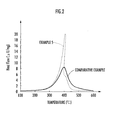
- FIG. 2 is a graph showing the effect of a catalyst for cleaning exhaust gas in accordance with the present invention;
- FIG. 3 is a graph showing the effects of catalysts for cleaning exhaust gas in accordance with the present invention;
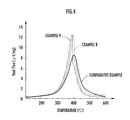
- FIG. 4 is a graph showing the effects of catalysts for cleaning exhaust gas in accordance with the present invention;
- FIG. 5 is a graph showing the effect of a catalyst for cleaning exhaust gas in accordance with the present invention; and
- FIG. 6 is a graph showing the effect of a catalyst for cleaning exhaust gas in accordance with the present invention.
- An embodiment of the present invention will now be described in further detail with reference to the accompanying drawings.
- A catalyst for cleaning exhaust gas according to a first aspect of the present embodiment comprises a composite metal oxide represented by the general formula: YMn1-xAxO3, wherein A is a metal selected from the group consisting of Ti, Nb, Ta, and Ru; and 0.005 ≤ x ≤ 0.2. The composite metal oxide produces a lower bond energy of oxygen in the crystal lattice of YMnO3 by a portion of Mn being the metal A to cause a distortion in the crystal lattice. As a result, the metal oxide can have an increased catalytic activity compared to YMnO3 and can oxidize contents such as particulates and high boiling point hydrocarbons contained in the exhaust gas at a lower temperature.
- A catalyst for cleaning exhaust gas according to a second aspect of the present embodiment is a composite metal oxide similar to the catalyst for cleaning exhaust gas according to the first aspect, but different from it only in that the former is represented by the general formula: YyMn1-xAxO3 except with 0.9 ≤ y < 1. The composite metal oxide produces a lower bond energy of oxygen in the crystal lattice of YMnO3 by a defect arising in a portion of the Y site constituting the crystal lattice as well as by a portion of Mn being the metal A to cause a distortion in the crystal lattice. As a result, the metal oxide can have an increased catalytic activity compared to YMnO3, can oxidize contents such as particulates and high boiling point hydrocarbons contained in the exhaust gas at a lower temperature, and even can promote the oxidation.
- Here, the above-described x and y are set so as to balance the positive and negative electric charges of the constituent atoms in the composite metal oxide.
- By way of example, Y and Mn are positive trivalent, and O is negative bivalent. Accordingly, when the metal A is one of Ti and Ru and positive tetravalent, setting y = 1 - x/3 and x = 0.15 leads to the general formula: YyMn1-xAxO3 being equal to Y0.95Mn0.85A0.15O3.
- Here, the sum of positive charges is:


- Therefore, it follows that (+6.00) + (-6) = 0, the positive and negative charges being balanced.
- When the metal A is one of Nb and Ta and positive pentavalent, setting y = 1 - 2x/3 and x = 0.075 leads to the general formula: YyMn1-xAxO3 being equal to Y0.95Mn0.925A0.075O3.
- Here, the sum of positive charges is:


- Therefore, it follows that (+6.00) + (-6) = 0, the positive and negative charges being balanced.
- When the metal A is one of Nb and Ta and positive pentavalent, y = 1 - 2x/3 and x = 0.15 may be also set.
- This setting leads to the general formula: YyMn1-xAxO3 being equal to Y0.9Mn0.85A0.15O3.
- Here, the sum of positive charges is:


- Therefore, it follows that (+6.00) + (-6) = 0, the positive and negative charges being balanced.
- Examples and Comparative Example of the present invention will now be given.
- In this Example, first, yttrium acetate, manganese nitrate, and anatase type titanium oxide were used in such amounts that a molar ratio thereof of 1:0.95:0.05 is obtained, and mixed in a ball mill for 5 hours, followed by primary firing at 250°C for 30 minutes, at 300°C for 30 minutes, and at 350°C for one hour. Ethanol was then added to the resultant material from the primary firing process, which was then subjected to wet grinding using a ball mill before drying, followed by secondary firing at 1,000°C for one hour to provide a powder of the composite metal oxide represented by YMn0.95Ti0.05O3.
- The composite metal oxide powder obtained in this Example was then subjected to differential thermal analysis (DTA) for the activity evaluation thereof. The differential thermal analysis was performed by using the composite metal oxide powder obtained in this Example as a catalyst for cleaning exhaust gas to mix 2.5 mg of carbon black with 50 mg of the catalyst, followed by heating the mixture at a rate of temperature rise of 10°C/minute under an atmosphere of an air stream of 15 ml/minute to determine a relationship between heat flow and temperature.
- The above-described carbon black corresponds to particulates or a high boiling point hydrocarbon contained in the exhaust gas. In the heat flow, the peak thereof indicates the burning temperature of the carbon black; a higher peak shows that the burning is more promoted. The result is shown in FIG. 1.
- In this Example, the composite metal oxide represented by YMn0.95Nb0.05O3 was obtained just as described in Example 1 except for the use of niobium oxide in place of anatase type titanium oxide.
- A relationship between heat flow and temperature was then determined just as described in Example 1 except for the use of the composite metal oxide obtained in this Example as a catalyst for cleaning exhaust gas. The result is shown in FIG. 1.
- In this Example, the composite metal oxide represented by YMn0.95Ta0.05O3 was obtained just as described in Example 1 except for the use of tantalum oxide in place of anatase type titanium oxide.
- A relationship between heat flow and temperature was then determined just as described in Example 1 except for the use of the composite metal oxide obtained in this Example as a catalyst for cleaning exhaust gas. The result is shown in FIG. 1.
- In this Example, the composite metal oxide represented by YMn0.95Ru0.05O3 was obtained just as described in Example 1 except for the use of ruthenium oxide in place of anatase type titanium oxide.
- A relationship between heat flow and temperature was then determined just as described in Example 1 except for the use of the composite metal oxide obtained in this Example as a catalyst for cleaning exhaust gas. The result is shown in FIG. 1.
- In this Comparative Example, the composite metal oxide represented by YMnO3 was obtained just as described in Example 1 except for no use of anatase type titanium oxide.
- A relationship between heat flow and temperature was then determined just as described in Example 1 except for the use of the composite metal oxide obtained in this Comparative Example as a catalyst for cleaning exhaust gas. The result is shown in FIG. 1.
- It is apparent from FIG. 1 that the catalysts for cleaning exhaust gas of Examples 1 to 4 can oxidize (burn) the above-described carbon black at low temperature compared to the catalyst for cleaning exhaust gas of Comparative Example 1, which comprises the composite metal oxide represented by YMnO3.
- In this Example, the composite metal oxide represented by Y0.95Mn0.85Ti0.15O3 was obtained just as described in Example 1 except for the use of yttrium acetate, manganese nitrate, and anatase type titanium oxide in such amounts-that a molar ratio thereof of 0.95:0.85:0.15 is obtained.
- A relationship between heat flow and temperature was then determined just as described in Example 1 except for the use of the composite metal oxide obtained in this Example as a catalyst for cleaning exhaust gas. The result is shown together with the result of Comparative Example 1 in FIG. 2.
- It is apparent from FIG. 2 that the catalyst for cleaning exhaust gas of Example 5 can oxidize (burn) the above-described carbon black at low temperature and can achieve the effect of further promoting the oxidation, compared to the catalyst for cleaning exhaust gas of Comparative Example 1, which comprises the composite metal oxide represented by YMnO3.
- In this Example, the composite metal oxide represented by Y0.95Mn0.925Nb0.075O3 was obtained just as described in Example 1 except for the use of yttrium acetate, manganese nitrate, and niobium oxide in such amounts that a molar ratio thereof of 0.95:0.925:0.075 is obtained.
- A relationship between heat flow and temperature was then determined just as described in Example 1 except for the use of the composite metal oxide obtained in this Example as a catalyst for cleaning exhaust gas. The result is shown together with the result of Comparative Example 1 in FIG. 3.
- In this Example, the composite metal oxide represented by Y0.9Mn0.85Nb0.15O3 was obtained just as described in Example 1 except for the use of yttrium acetate, manganese nitrate, and niobium oxide in such amounts that a molar ratio thereof of 0.9:0.85:0.15 is obtained.
- A relationship between heat flow and temperature was then determined just as described in Example 1 except for the use of the composite metal oxide obtained in this Example as a catalyst for cleaning exhaust gas. The result is shown together with the result of Comparative Example 1 in FIG. 3.
- It is apparent from.FIG. 3 that the catalysts for cleaning exhaust gas of Examples 6 and 7 can oxidize (burn) the above-described carbon black at low temperature and can achieve the effect of further promoting the oxidation, compared to the catalyst for cleaning exhaust gas of Comparative Example 1, which comprises the composite metal oxide represented by YMnO3.
- In this Example, the composite metal oxide represented by Y0.95Mn0.925Ta0.075O3 was obtained just as described in Example 1 except for the use of yttrium acetate, manganese nitrate, and tantalum oxide in such amounts that a molar ratio thereof of 0.95:0.925:0.075 is obtained.
- A relationship between heat flow and temperature was then determined just as described in Example 1 except for the use of the composite metal oxide obtained in this Example as a catalyst for cleaning exhaust gas. The result is shown together with the result of Comparative Example 1 in FIG. 4.
- In this Example, the composite metal oxide represented by Y0.9Mn0.85Ta0.15O3 was obtained just as described in Example 1 except for the use of yttrium acetate, manganese nitrate, and tantalum oxide in such amounts that a molar ratio thereof of 0.9:0.85:0.15 is obtained.
- A relationship between heat flow and temperature was then determined just as described in Example 1 except for the use of the composite metal oxide obtained in this Example as a catalyst for cleaning exhaust gas. The result is shown together with the result of Comparative Example 1 in FIG. 4.
- It is apparent from FIG. 4 that the catalysts for cleaning exhaust gas of Examples 8 and 9 can oxidize (burn) the above-described carbon black at low temperature and can achieve the effect of further promoting the oxidation, compared to the catalyst for cleaning exhaust gas of Comparative Example 1, which comprises the composite metal oxide represented by YMnO3.
- In this Example, the composite metal oxide represented by Y0.95Mn0.85Ru0.15O3 was obtained just as described in Example 1 except for the use of yttrium acetate, manganese nitrate, and ruthenium oxide in such amounts that a molar ratio thereof of 0.95:0.85:0.15 is obtained.
- A relationship between heat flow and temperature was then determined just as described in Example 1 except for the use of the composite metal oxide obtained in this Example as a catalyst for cleaning exhaust gas. The result is shown together with the result of Comparative Example 1 in FIG. 5.
- It is apparent from FIG. 5 that the catalyst for cleaning exhaust gas of Example 10 can oxidize (burn) the above-described carbon black at low temperature and can achieve the effect of further promoting the oxidation, compared to the catalyst for cleaning exhaust gas of Comparative Example 1, which comprises the composite metal oxide represented by YMnO3.
- In this Example, the composite metal oxide represented by YMn0.995Ru0.005O3 was obtained just as described in Example 1 except for the use of yttrium acetate, manganese nitrate, and ruthenium oxide in such amounts that a molar ratio thereof of 1:0.995:0.005 is obtained.
- A relationship between heat flow and temperature was then determined just as described in Example 1 except for the use of the composite metal oxide obtained in this Example as a catalyst for cleaning exhaust gas. The result is shown together with the result of Comparative Example 1 in FIG. 6.
- It is apparent from FIG. 6 that the catalyst for cleaning exhaust gas of Example 11 can oxidize (burn) the above-described carbon black at low temperature and can achieve the effect of further promoting the oxidation, compared to the catalyst for cleaning exhaust gas of Comparative Example 1, which comprises the composite metal oxide represented by YMnO3.
- The present invention provides an oxidation catalyst for cleaning exhaust gas, capable of achieving an excellent catalytic activity at a lower temperature for particulates and high boiling point hydrocarbons in exhaust gas from internal-combustion engines. The oxidation catalyst for cleaning exhaust gas according to the present invention is a composite metal oxide represented by the general formula: LnyMn1-xAxO3, wherein Ln is a metal selected from the group consisting of Sc, Y, Ho, Er, Tm, Yb, and Lu; A is a metal selected from the group consisting of Ti, Nb, Ta, and Ru; 0.005 ≤ x ≤ 0.2; and 0.9 ≤ y ≤ 1. Ln is Y. The composite metal oxide has a hexagonal structure.
Claims (3)
- An oxidation catalyst for cleaning exhaust gas, which oxidizes contents in exhaust gas from internal-combustion engines to clean the gas, comprising a composite metal oxide represented by the general formula: Lnymni-xAx03, wherein Ln is a metal selected from the group consisting of Sc, Y, Ho, Er, Tm, Yb, and Lu; A is a metal selected from the group consisting of Ti, Nb, Ta, and Ru; 0.005 ≤ x ≤ 0.2; and 0.9 ≤ y ≤ 1.
- The oxidation catalyst for cleaning exhaust gas according to claim 1, wherein Ln is Y.
- The oxidation catalyst for cleaning exhaust gas according to claim 1, wherein the composite metal oxide has a hexagonal structure.
Applications Claiming Priority (1)
| Application Number | Priority Date | Filing Date | Title |
|---|---|---|---|
| JP2006104269A JP4611927B2 (en) | 2006-04-05 | 2006-04-05 | Oxidation catalyst for exhaust gas purification |
Publications (2)
| Publication Number | Publication Date |
|---|---|
| EP1842588A1 true EP1842588A1 (en) | 2007-10-10 |
| EP1842588B1 EP1842588B1 (en) | 2008-12-24 |
Family
ID=38017070
Family Applications (1)
| Application Number | Title | Priority Date | Filing Date |
|---|---|---|---|
| EP07007199A Ceased EP1842588B1 (en) | 2006-04-05 | 2007-04-05 | Use of a composite metal oxide as oxidation catalyst for cleaning exhaust gas |
Country Status (4)
| Country | Link |
|---|---|
| US (1) | US7572751B2 (en) |
| EP (1) | EP1842588B1 (en) |
| JP (1) | JP4611927B2 (en) |
| DE (1) | DE602007000386D1 (en) |
Cited By (2)
| Publication number | Priority date | Publication date | Assignee | Title |
|---|---|---|---|---|
| EP1914000A1 (en) * | 2006-10-20 | 2008-04-23 | HONDA MOTOR CO., Ltd. | Oxidation catalyst for purifying exhaust gas |
| EP2269731A4 (en) * | 2008-04-22 | 2011-04-27 | Honda Motor Co Ltd | OXIDATION CATALYST AND OXIDATION CATALYST DEVICE FOR PURIFYING EXHAUST GASES |
Families Citing this family (13)
| Publication number | Priority date | Publication date | Assignee | Title |
|---|---|---|---|---|
| JP5024794B2 (en) * | 2007-12-06 | 2012-09-12 | 本田技研工業株式会社 | Manufacturing method of oxidation catalyst device for exhaust gas purification |
| JP2009136787A (en) * | 2007-12-06 | 2009-06-25 | Honda Motor Co Ltd | Manufacturing method of oxidation catalyst device for exhaust gas purification |
| JP5330044B2 (en) * | 2008-07-15 | 2013-10-30 | 本田技研工業株式会社 | Oxidation catalyst equipment for exhaust gas purification |
| JP5330018B2 (en) * | 2008-04-22 | 2013-10-30 | 本田技研工業株式会社 | Oxidation catalyst |
| US8409518B2 (en) * | 2009-03-16 | 2013-04-02 | GM Global Technology Operations LLC | Sulfur tolerant perovskite supported catalysts |
| JP5558867B2 (en) * | 2010-03-05 | 2014-07-23 | 本田技研工業株式会社 | Exhaust purification catalyst |
| JP5506478B2 (en) * | 2010-03-16 | 2014-05-28 | 本田技研工業株式会社 | Exhaust gas purification catalyst |
| CN102477020A (en) * | 2010-11-29 | 2012-05-30 | 中国科学院大连化学物理研究所 | A kind of method that catalyzes carbohydrate to prepare 5-hydroxymethylfurfural |
| KR101473440B1 (en) * | 2012-05-02 | 2014-12-18 | 장길상 | Mixed oxide catalyst materials for treating an exhaust gas, preparing methods thereof and methods for treating the exhaust gas using the same |
| TWI451905B (en) * | 2013-01-25 | 2014-09-11 | Univ Nat Chiao Tung | Ethanol recombiner catalyst composition and preparation method of ethanol recombiner catalyst |
| WO2014163235A1 (en) * | 2013-04-01 | 2014-10-09 | ㈜후산 | Mixed metal oxide catalyst for treating exhaust gas, preparation method therefor and treatment method for exhaust gas using same |
| US9962654B2 (en) * | 2016-02-16 | 2018-05-08 | GM Global Technology Operations LLC | Perovskite based oxygen storage materials |
| US10946362B1 (en) | 2017-02-24 | 2021-03-16 | University Of South Florida | Perovskite oxides for thermochemical conversion of carbon dioxide |
Citations (3)
| Publication number | Priority date | Publication date | Assignee | Title |
|---|---|---|---|---|
| US4126580A (en) * | 1975-04-08 | 1978-11-21 | E. I. Du Pont De Nemours And Company | Stable perovskite catalysts |
| US20050049143A1 (en) * | 2003-08-28 | 2005-03-03 | Asako Eguchi | Exhaust gas treatment catalyst and exhaust gas treatment method |
| US20050230726A1 (en) * | 2003-09-04 | 2005-10-20 | Intematix Corporation | Ferroelectric rare-earth manganese-titanium oxides |
Family Cites Families (7)
| Publication number | Priority date | Publication date | Assignee | Title |
|---|---|---|---|---|
| JPS4855892A (en) * | 1971-11-16 | 1973-08-06 | ||
| JPH0199432U (en) * | 1987-12-23 | 1989-07-04 | ||
| JPH06151872A (en) * | 1992-11-09 | 1994-05-31 | Mitsubishi Kasei Corp | Fet device |
| JPH07116519A (en) | 1993-10-20 | 1995-05-09 | Toyota Central Res & Dev Lab Inc | Exhaust gas purification material and exhaust gas purification method |
| US6740261B1 (en) * | 1997-03-19 | 2004-05-25 | Denso Corporation | Wide-range type thermistor element and method of producing the same |
| JP3528839B2 (en) | 2002-05-15 | 2004-05-24 | トヨタ自動車株式会社 | Particulate oxidizer and oxidation catalyst |
| TWI226377B (en) | 2002-11-08 | 2005-01-11 | Ind Tech Res Inst | Dielectric material compositions |
-
2006
- 2006-04-05 JP JP2006104269A patent/JP4611927B2/en not_active Expired - Fee Related
-
2007
- 2007-04-04 US US11/730,858 patent/US7572751B2/en not_active Expired - Fee Related
- 2007-04-05 DE DE602007000386T patent/DE602007000386D1/en active Active
- 2007-04-05 EP EP07007199A patent/EP1842588B1/en not_active Ceased
Patent Citations (3)
| Publication number | Priority date | Publication date | Assignee | Title |
|---|---|---|---|---|
| US4126580A (en) * | 1975-04-08 | 1978-11-21 | E. I. Du Pont De Nemours And Company | Stable perovskite catalysts |
| US20050049143A1 (en) * | 2003-08-28 | 2005-03-03 | Asako Eguchi | Exhaust gas treatment catalyst and exhaust gas treatment method |
| US20050230726A1 (en) * | 2003-09-04 | 2005-10-20 | Intematix Corporation | Ferroelectric rare-earth manganese-titanium oxides |
Non-Patent Citations (2)
| Title |
|---|
| ASOKAN K ET AL: "Comparison of electronic structures of orthorhombic and hexagonal manganites studied by X-ray absorption spectroscopy", June 2005, SOLID STATE COMMUNICATIONS, OXFORD, GB, PAGE(S) 821-826, ISSN: 0038-1098, XP004900258 * |
| FILIPPETTI A ET AL: "First principles study of structural, electronic and magnetic interplay in ferroelectromagnetic yttrium manganite", October 2001, JOURNAL OF MAGNETISM AND MAGNETIC MATERIALS, ELSEVIER SCIENCE PUBLISHERS, AMSTERDAM, NL, PAGE(S) 176-189, ISSN: 0304-8853, XP004309563 * |
Cited By (3)
| Publication number | Priority date | Publication date | Assignee | Title |
|---|---|---|---|---|
| EP1914000A1 (en) * | 2006-10-20 | 2008-04-23 | HONDA MOTOR CO., Ltd. | Oxidation catalyst for purifying exhaust gas |
| US7691777B2 (en) | 2006-10-20 | 2010-04-06 | Honda Motor Co., Ltd. | Oxidation catalyst for purifying exhaust gas |
| EP2269731A4 (en) * | 2008-04-22 | 2011-04-27 | Honda Motor Co Ltd | OXIDATION CATALYST AND OXIDATION CATALYST DEVICE FOR PURIFYING EXHAUST GASES |
Also Published As
| Publication number | Publication date |
|---|---|
| US20070238609A1 (en) | 2007-10-11 |
| JP4611927B2 (en) | 2011-01-12 |
| JP2007275738A (en) | 2007-10-25 |
| US7572751B2 (en) | 2009-08-11 |
| EP1842588B1 (en) | 2008-12-24 |
| DE602007000386D1 (en) | 2009-02-05 |
Similar Documents
| Publication | Publication Date | Title |
|---|---|---|
| EP1842588B1 (en) | Use of a composite metal oxide as oxidation catalyst for cleaning exhaust gas | |
| US7691777B2 (en) | Oxidation catalyst for purifying exhaust gas | |
| CN101745405B (en) | Perovskite type composite oxide catalyst for purifying tail gas of internal combustion engine | |
| EP2703357A1 (en) | Layered complex oxide, oxidation catalyst and diesel particulate filter | |
| WO2005058490A9 (en) | Catalyst composition | |
| JP4699232B2 (en) | Exhaust gas purification oxidation catalyst | |
| EP2269731B1 (en) | Oxidation catalyst and oxidation catalyst device for exhaust gas purification | |
| JP2007307446A (en) | Exhaust gas purification oxidation catalyst | |
| EP3512632B1 (en) | Use of vanadates as oxidation catalysts | |
| US8034742B2 (en) | Method of producing oxidation catalyst for cleaning exhaust gas | |
| JP5330018B2 (en) | Oxidation catalyst | |
| JP6109550B2 (en) | Exhaust gas purification catalyst | |
| WO2010143509A1 (en) | Oxidation catalyst for exhaust gas purification | |
| CN103209927B (en) | Layered mixed oxide, oxidation catalyst and diesel particulate filter | |
| CN108472629A (en) | Nitrogen oxides activity as zero PGM catalyst for the pseudobrookite composition of oxidative diesel application | |
| JP5101346B2 (en) | Exhaust gas purification catalyst and method for producing the same | |
| EP2948243B1 (en) | An ammonia oxidation catalyst for the production of nitric acid based on yttrium-gadolinium ortho cobaltates | |
| JP4273893B2 (en) | Gas purification catalyst | |
| WO2014115573A1 (en) | Catalyst for oxidation of nitrogen oxides, and method for oxidation of nitrogen oxides | |
| JP4694220B2 (en) | Honeycomb base material for exhaust gas purification catalytic converter having excellent high temperature oxidation resistance and catalytic converter for exhaust gas purification | |
| JPH1157471A (en) | Rh composite oxide catalyst | |
| JPH1028864A (en) | Exhaust gas purification catalyst | |
| JPH06277513A (en) | Exhaust gas purification catalyst |
Legal Events
| Date | Code | Title | Description |
|---|---|---|---|
| PUAI | Public reference made under article 153(3) epc to a published international application that has entered the european phase |
Free format text: ORIGINAL CODE: 0009012 |
|
| 17P | Request for examination filed |
Effective date: 20070405 |
|
| AK | Designated contracting states |
Kind code of ref document: A1 Designated state(s): AT BE BG CH CY CZ DE DK EE ES FI FR GB GR HU IE IS IT LI LT LU LV MC MT NL PL PT RO SE SI SK TR |
|
| AX | Request for extension of the european patent |
Extension state: AL BA HR MK YU |
|
| 17Q | First examination report despatched |
Effective date: 20071213 |
|
| AKX | Designation fees paid |
Designated state(s): DE FR GB IT |
|
| RTI1 | Title (correction) |
Free format text: USE OF A COMPOSITE METAL OXIDE AS OXIDATION CATALYST FOR CLEANING EXHAUST GAS |
|
| GRAP | Despatch of communication of intention to grant a patent |
Free format text: ORIGINAL CODE: EPIDOSNIGR1 |
|
| GRAS | Grant fee paid |
Free format text: ORIGINAL CODE: EPIDOSNIGR3 |
|
| GRAA | (expected) grant |
Free format text: ORIGINAL CODE: 0009210 |
|
| AK | Designated contracting states |
Kind code of ref document: B1 Designated state(s): DE FR GB IT |
|
| REG | Reference to a national code |
Ref country code: GB Ref legal event code: FG4D |
|
| REF | Corresponds to: |
Ref document number: 602007000386 Country of ref document: DE Date of ref document: 20090205 Kind code of ref document: P |
|
| PLBE | No opposition filed within time limit |
Free format text: ORIGINAL CODE: 0009261 |
|
| STAA | Information on the status of an ep patent application or granted ep patent |
Free format text: STATUS: NO OPPOSITION FILED WITHIN TIME LIMIT |
|
| 26N | No opposition filed |
Effective date: 20090925 |
|
| PG25 | Lapsed in a contracting state [announced via postgrant information from national office to epo] |
Ref country code: IT Free format text: LAPSE BECAUSE OF FAILURE TO SUBMIT A TRANSLATION OF THE DESCRIPTION OR TO PAY THE FEE WITHIN THE PRESCRIBED TIME-LIMIT Effective date: 20081224 |
|
| REG | Reference to a national code |
Ref country code: FR Ref legal event code: PLFP Year of fee payment: 10 |
|
| REG | Reference to a national code |
Ref country code: FR Ref legal event code: PLFP Year of fee payment: 11 |
|
| REG | Reference to a national code |
Ref country code: FR Ref legal event code: PLFP Year of fee payment: 12 |
|
| PGFP | Annual fee paid to national office [announced via postgrant information from national office to epo] |
Ref country code: GB Payment date: 20180329 Year of fee payment: 12 |
|
| PGFP | Annual fee paid to national office [announced via postgrant information from national office to epo] |
Ref country code: FR Payment date: 20180315 Year of fee payment: 12 |
|
| PGFP | Annual fee paid to national office [announced via postgrant information from national office to epo] |
Ref country code: DE Payment date: 20180320 Year of fee payment: 12 |
|
| REG | Reference to a national code |
Ref country code: DE Ref legal event code: R119 Ref document number: 602007000386 Country of ref document: DE |
|
| GBPC | Gb: european patent ceased through non-payment of renewal fee |
Effective date: 20190405 |
|
| PG25 | Lapsed in a contracting state [announced via postgrant information from national office to epo] |
Ref country code: GB Free format text: LAPSE BECAUSE OF NON-PAYMENT OF DUE FEES Effective date: 20190405 Ref country code: DE Free format text: LAPSE BECAUSE OF NON-PAYMENT OF DUE FEES Effective date: 20191101 |
|
| PG25 | Lapsed in a contracting state [announced via postgrant information from national office to epo] |
Ref country code: FR Free format text: LAPSE BECAUSE OF NON-PAYMENT OF DUE FEES Effective date: 20190430 |