EP1840185A1 - Liquid crystal composition - Google Patents
Liquid crystal composition Download PDFInfo
- Publication number
- EP1840185A1 EP1840185A1 EP05806127A EP05806127A EP1840185A1 EP 1840185 A1 EP1840185 A1 EP 1840185A1 EP 05806127 A EP05806127 A EP 05806127A EP 05806127 A EP05806127 A EP 05806127A EP 1840185 A1 EP1840185 A1 EP 1840185A1
- Authority
- EP
- European Patent Office
- Prior art keywords
- liquid crystal
- ocf
- general formula
- dif
- group
- Prior art date
- Legal status (The legal status is an assumption and is not a legal conclusion. Google has not performed a legal analysis and makes no representation as to the accuracy of the status listed.)
- Granted
Links
- 0 *C1CCC(*Oc(cc2F)cc(F)c2O*=*)CC1 Chemical compound *C1CCC(*Oc(cc2F)cc(F)c2O*=*)CC1 0.000 description 6
Classifications
-
- C—CHEMISTRY; METALLURGY
- C09—DYES; PAINTS; POLISHES; NATURAL RESINS; ADHESIVES; COMPOSITIONS NOT OTHERWISE PROVIDED FOR; APPLICATIONS OF MATERIALS NOT OTHERWISE PROVIDED FOR
- C09K—MATERIALS FOR MISCELLANEOUS APPLICATIONS, NOT PROVIDED FOR ELSEWHERE
- C09K19/00—Liquid crystal materials
- C09K19/04—Liquid crystal materials characterised by the chemical structure of the liquid crystal components, e.g. by a specific unit
- C09K19/06—Non-steroidal liquid crystal compounds
- C09K19/08—Non-steroidal liquid crystal compounds containing at least two non-condensed rings
- C09K19/10—Non-steroidal liquid crystal compounds containing at least two non-condensed rings containing at least two benzene rings
- C09K19/12—Non-steroidal liquid crystal compounds containing at least two non-condensed rings containing at least two benzene rings at least two benzene rings directly linked, e.g. biphenyls
-
- C—CHEMISTRY; METALLURGY
- C09—DYES; PAINTS; POLISHES; NATURAL RESINS; ADHESIVES; COMPOSITIONS NOT OTHERWISE PROVIDED FOR; APPLICATIONS OF MATERIALS NOT OTHERWISE PROVIDED FOR
- C09K—MATERIALS FOR MISCELLANEOUS APPLICATIONS, NOT PROVIDED FOR ELSEWHERE
- C09K19/00—Liquid crystal materials
- C09K19/04—Liquid crystal materials characterised by the chemical structure of the liquid crystal components, e.g. by a specific unit
-
- C—CHEMISTRY; METALLURGY
- C09—DYES; PAINTS; POLISHES; NATURAL RESINS; ADHESIVES; COMPOSITIONS NOT OTHERWISE PROVIDED FOR; APPLICATIONS OF MATERIALS NOT OTHERWISE PROVIDED FOR
- C09K—MATERIALS FOR MISCELLANEOUS APPLICATIONS, NOT PROVIDED FOR ELSEWHERE
- C09K19/00—Liquid crystal materials
- C09K19/04—Liquid crystal materials characterised by the chemical structure of the liquid crystal components, e.g. by a specific unit
- C09K19/0403—Liquid crystal materials characterised by the chemical structure of the liquid crystal components, e.g. by a specific unit the structure containing one or more specific, optionally substituted ring or ring systems
-
- C—CHEMISTRY; METALLURGY
- C09—DYES; PAINTS; POLISHES; NATURAL RESINS; ADHESIVES; COMPOSITIONS NOT OTHERWISE PROVIDED FOR; APPLICATIONS OF MATERIALS NOT OTHERWISE PROVIDED FOR
- C09K—MATERIALS FOR MISCELLANEOUS APPLICATIONS, NOT PROVIDED FOR ELSEWHERE
- C09K19/00—Liquid crystal materials
- C09K19/04—Liquid crystal materials characterised by the chemical structure of the liquid crystal components, e.g. by a specific unit
- C09K19/06—Non-steroidal liquid crystal compounds
- C09K19/08—Non-steroidal liquid crystal compounds containing at least two non-condensed rings
-
- C—CHEMISTRY; METALLURGY
- C09—DYES; PAINTS; POLISHES; NATURAL RESINS; ADHESIVES; COMPOSITIONS NOT OTHERWISE PROVIDED FOR; APPLICATIONS OF MATERIALS NOT OTHERWISE PROVIDED FOR
- C09K—MATERIALS FOR MISCELLANEOUS APPLICATIONS, NOT PROVIDED FOR ELSEWHERE
- C09K19/00—Liquid crystal materials
- C09K19/04—Liquid crystal materials characterised by the chemical structure of the liquid crystal components, e.g. by a specific unit
- C09K19/06—Non-steroidal liquid crystal compounds
- C09K19/08—Non-steroidal liquid crystal compounds containing at least two non-condensed rings
- C09K19/10—Non-steroidal liquid crystal compounds containing at least two non-condensed rings containing at least two benzene rings
- C09K19/20—Non-steroidal liquid crystal compounds containing at least two non-condensed rings containing at least two benzene rings linked by a chain containing carbon and oxygen atoms as chain links, e.g. esters or ethers
-
- C—CHEMISTRY; METALLURGY
- C09—DYES; PAINTS; POLISHES; NATURAL RESINS; ADHESIVES; COMPOSITIONS NOT OTHERWISE PROVIDED FOR; APPLICATIONS OF MATERIALS NOT OTHERWISE PROVIDED FOR
- C09K—MATERIALS FOR MISCELLANEOUS APPLICATIONS, NOT PROVIDED FOR ELSEWHERE
- C09K19/00—Liquid crystal materials
- C09K19/04—Liquid crystal materials characterised by the chemical structure of the liquid crystal components, e.g. by a specific unit
- C09K19/06—Non-steroidal liquid crystal compounds
- C09K19/08—Non-steroidal liquid crystal compounds containing at least two non-condensed rings
- C09K19/30—Non-steroidal liquid crystal compounds containing at least two non-condensed rings containing saturated or unsaturated non-aromatic rings, e.g. cyclohexane rings
-
- C—CHEMISTRY; METALLURGY
- C09—DYES; PAINTS; POLISHES; NATURAL RESINS; ADHESIVES; COMPOSITIONS NOT OTHERWISE PROVIDED FOR; APPLICATIONS OF MATERIALS NOT OTHERWISE PROVIDED FOR
- C09K—MATERIALS FOR MISCELLANEOUS APPLICATIONS, NOT PROVIDED FOR ELSEWHERE
- C09K19/00—Liquid crystal materials
- C09K19/04—Liquid crystal materials characterised by the chemical structure of the liquid crystal components, e.g. by a specific unit
- C09K19/06—Non-steroidal liquid crystal compounds
- C09K19/08—Non-steroidal liquid crystal compounds containing at least two non-condensed rings
- C09K19/30—Non-steroidal liquid crystal compounds containing at least two non-condensed rings containing saturated or unsaturated non-aromatic rings, e.g. cyclohexane rings
- C09K19/3001—Cyclohexane rings
- C09K19/3003—Compounds containing at least two rings in which the different rings are directly linked (covalent bond)
-
- C—CHEMISTRY; METALLURGY
- C09—DYES; PAINTS; POLISHES; NATURAL RESINS; ADHESIVES; COMPOSITIONS NOT OTHERWISE PROVIDED FOR; APPLICATIONS OF MATERIALS NOT OTHERWISE PROVIDED FOR
- C09K—MATERIALS FOR MISCELLANEOUS APPLICATIONS, NOT PROVIDED FOR ELSEWHERE
- C09K19/00—Liquid crystal materials
- C09K19/04—Liquid crystal materials characterised by the chemical structure of the liquid crystal components, e.g. by a specific unit
- C09K19/06—Non-steroidal liquid crystal compounds
- C09K19/08—Non-steroidal liquid crystal compounds containing at least two non-condensed rings
- C09K19/30—Non-steroidal liquid crystal compounds containing at least two non-condensed rings containing saturated or unsaturated non-aromatic rings, e.g. cyclohexane rings
- C09K19/3001—Cyclohexane rings
- C09K19/3066—Cyclohexane rings in which the rings are linked by a chain containing carbon and oxygen atoms, e.g. esters or ethers
-
- C—CHEMISTRY; METALLURGY
- C09—DYES; PAINTS; POLISHES; NATURAL RESINS; ADHESIVES; COMPOSITIONS NOT OTHERWISE PROVIDED FOR; APPLICATIONS OF MATERIALS NOT OTHERWISE PROVIDED FOR
- C09K—MATERIALS FOR MISCELLANEOUS APPLICATIONS, NOT PROVIDED FOR ELSEWHERE
- C09K19/00—Liquid crystal materials
- C09K19/04—Liquid crystal materials characterised by the chemical structure of the liquid crystal components, e.g. by a specific unit
- C09K19/0403—Liquid crystal materials characterised by the chemical structure of the liquid crystal components, e.g. by a specific unit the structure containing one or more specific, optionally substituted ring or ring systems
- C09K2019/0407—Liquid crystal materials characterised by the chemical structure of the liquid crystal components, e.g. by a specific unit the structure containing one or more specific, optionally substituted ring or ring systems containing a carbocyclic ring, e.g. dicyano-benzene, chlorofluoro-benzene or cyclohexanone
-
- C—CHEMISTRY; METALLURGY
- C09—DYES; PAINTS; POLISHES; NATURAL RESINS; ADHESIVES; COMPOSITIONS NOT OTHERWISE PROVIDED FOR; APPLICATIONS OF MATERIALS NOT OTHERWISE PROVIDED FOR
- C09K—MATERIALS FOR MISCELLANEOUS APPLICATIONS, NOT PROVIDED FOR ELSEWHERE
- C09K19/00—Liquid crystal materials
- C09K19/04—Liquid crystal materials characterised by the chemical structure of the liquid crystal components, e.g. by a specific unit
- C09K2019/0444—Liquid crystal materials characterised by the chemical structure of the liquid crystal components, e.g. by a specific unit characterized by a linking chain between rings or ring systems, a bridging chain between extensive mesogenic moieties or an end chain group
-
- C—CHEMISTRY; METALLURGY
- C09—DYES; PAINTS; POLISHES; NATURAL RESINS; ADHESIVES; COMPOSITIONS NOT OTHERWISE PROVIDED FOR; APPLICATIONS OF MATERIALS NOT OTHERWISE PROVIDED FOR
- C09K—MATERIALS FOR MISCELLANEOUS APPLICATIONS, NOT PROVIDED FOR ELSEWHERE
- C09K19/00—Liquid crystal materials
- C09K19/04—Liquid crystal materials characterised by the chemical structure of the liquid crystal components, e.g. by a specific unit
- C09K2019/0444—Liquid crystal materials characterised by the chemical structure of the liquid crystal components, e.g. by a specific unit characterized by a linking chain between rings or ring systems, a bridging chain between extensive mesogenic moieties or an end chain group
- C09K2019/0466—Liquid crystal materials characterised by the chemical structure of the liquid crystal components, e.g. by a specific unit characterized by a linking chain between rings or ring systems, a bridging chain between extensive mesogenic moieties or an end chain group the linking chain being a -CF2O- chain
-
- C—CHEMISTRY; METALLURGY
- C09—DYES; PAINTS; POLISHES; NATURAL RESINS; ADHESIVES; COMPOSITIONS NOT OTHERWISE PROVIDED FOR; APPLICATIONS OF MATERIALS NOT OTHERWISE PROVIDED FOR
- C09K—MATERIALS FOR MISCELLANEOUS APPLICATIONS, NOT PROVIDED FOR ELSEWHERE
- C09K19/00—Liquid crystal materials
- C09K19/04—Liquid crystal materials characterised by the chemical structure of the liquid crystal components, e.g. by a specific unit
- C09K19/06—Non-steroidal liquid crystal compounds
- C09K19/08—Non-steroidal liquid crystal compounds containing at least two non-condensed rings
- C09K19/30—Non-steroidal liquid crystal compounds containing at least two non-condensed rings containing saturated or unsaturated non-aromatic rings, e.g. cyclohexane rings
- C09K19/3001—Cyclohexane rings
- C09K19/3003—Compounds containing at least two rings in which the different rings are directly linked (covalent bond)
- C09K2019/3009—Cy-Ph
-
- C—CHEMISTRY; METALLURGY
- C09—DYES; PAINTS; POLISHES; NATURAL RESINS; ADHESIVES; COMPOSITIONS NOT OTHERWISE PROVIDED FOR; APPLICATIONS OF MATERIALS NOT OTHERWISE PROVIDED FOR
- C09K—MATERIALS FOR MISCELLANEOUS APPLICATIONS, NOT PROVIDED FOR ELSEWHERE
- C09K19/00—Liquid crystal materials
- C09K19/04—Liquid crystal materials characterised by the chemical structure of the liquid crystal components, e.g. by a specific unit
- C09K19/06—Non-steroidal liquid crystal compounds
- C09K19/08—Non-steroidal liquid crystal compounds containing at least two non-condensed rings
- C09K19/30—Non-steroidal liquid crystal compounds containing at least two non-condensed rings containing saturated or unsaturated non-aromatic rings, e.g. cyclohexane rings
- C09K19/3001—Cyclohexane rings
- C09K19/3003—Compounds containing at least two rings in which the different rings are directly linked (covalent bond)
- C09K2019/301—Cy-Cy-Ph
-
- C—CHEMISTRY; METALLURGY
- C09—DYES; PAINTS; POLISHES; NATURAL RESINS; ADHESIVES; COMPOSITIONS NOT OTHERWISE PROVIDED FOR; APPLICATIONS OF MATERIALS NOT OTHERWISE PROVIDED FOR
- C09K—MATERIALS FOR MISCELLANEOUS APPLICATIONS, NOT PROVIDED FOR ELSEWHERE
- C09K19/00—Liquid crystal materials
- C09K19/04—Liquid crystal materials characterised by the chemical structure of the liquid crystal components, e.g. by a specific unit
- C09K19/06—Non-steroidal liquid crystal compounds
- C09K19/08—Non-steroidal liquid crystal compounds containing at least two non-condensed rings
- C09K19/30—Non-steroidal liquid crystal compounds containing at least two non-condensed rings containing saturated or unsaturated non-aromatic rings, e.g. cyclohexane rings
- C09K19/3001—Cyclohexane rings
- C09K19/3003—Compounds containing at least two rings in which the different rings are directly linked (covalent bond)
- C09K2019/3016—Cy-Ph-Ph
Definitions
- the present invention relates to a liquid crystal composition and particularly to a liquid crystal composition that has a high dielectric anisotropy ( ⁇ ) and a low rotational viscosity ( ⁇ 1 ) and is thus suitable for IPS liquid crystal displays or low voltage-driven TN liquid crystal displays.
- liquid crystal display elements utilizing optical (refractive index) anisotropy ( ⁇ n) and dielectric anisotropy ( ⁇ ) characteristic of liquid crystal compounds.
- the liquid crystal display elements have been widely applied to clocks, calculators, various measuring instruments, automotive panels, word processors, electronic notebooks, portable phones, printers, computers, TV sets, and the like, with demand increasing year by year.
- a liquid crystal compound exhibits a characteristic liquid crystal phase between a solid phase and a liquid phase.
- the liquid crystal phase is roughly classified into nematic phase, smectic phase, and cholesteric phase, of which nematic phase is currently most widely used for display elements.
- DS dynamic scattering
- GH guest-host
- TN twist nematic
- STN super twist nematic
- TFT thin film transistor
- FLC ferroelectric liquid crystal
- IPS liquid crystal displays In common liquid crystal displays such as TN and STN, which have been conventionally widely used, the electric field generated for reorientation is substantially perpendicular to the liquid crystal layer. In contrast, in in-plane switching (IPS) mode, the electric field has a significant component parallel to the liquid crystal layer.
- IPS liquid crystal displays by applying the electric field generated using comb electrodes on one substrate, liquid crystal molecules constituting a liquid crystal layer oriented almost parallel to the substrate surface are rotated within a plane almost parallel to the substrate, and the display function is based on the birefringence of the liquid crystal layer.
- Such displays are proposed, for example, in Patent Documents 1 to 5 and others.
- IPS displays have advantages such as a wider viewing angle and a lower load capacity as compared with conventional TN displays resulting from the in-plane switching of liquid crystal molecules, thereby extending the application to monitor, television sets, and the like having larger display area.
- a liquid crystal composition used for IPS liquid crystal displays is required to have a low rotational viscosity ( ⁇ 1 ) enabling fast response. Moreover, it is effective to increase the electrode spacing in order to increase the numerical aperture for improving the brightness of displays, but in such case the threshold voltage due to the structure of IPS cells increases. To suppress this drawback, liquid crystal compositions having a high dielectric anisotropy ( ⁇ ) are needed. However, with conventionally known liquid crystal media, no liquid crystal composition with satisfactory performances has been yet attained.
- Patent Documents 6 and 7 and others propose a liquid crystal composition comprising a trifluorobenzene derivative for IPS liquid crystal devices; however, this liquid crystal composition is still unsatisfactory.
- Patent Document 8 proposes an active matrix liquid crystal display using a liquid crystal whose specific resistance is not more than 1 ⁇ 1014 ⁇ cm and not less than 1 ⁇ 109 ⁇ cm; however, the liquid crystal display is still unsatisfactory.
- liquid crystal display elements will develop in the field of portable information terminals such as portable phones, in which performances such as low power consumption are demanded.
- a liquid crystal composition used here is required to have a high dielectric anisotropy ( ⁇ ) for decreasing the threshold voltage and a low rotational viscosity ( ⁇ 1 ) for increasing the response speed.
- ⁇ dielectric anisotropy
- ⁇ 1 rotational viscosity
- an object of the present invention is to provide a liquid crystal composition that is useful for IPS liquid crystal displays and low voltage-driven TN liquid crystal displays and has a high dielectric anisotropy ( ⁇ ) and a low rotational viscosity ( ⁇ 1 ).
- the present inventors have found that the above object can be achieved with a liquid crystal composition obtained using a specific liquid crystal compound.
- the present invention has been accomplished based on the above findings and provides a liquid crystal composition comprising 15% by mass or more of a compound having a terminal structure represented by general formula (I) below.
- Q represents an optionally halogenated C 1-8 saturated or unsaturated alkyl group.
- liquid crystal composition of the present invention will be detailed with the preferable embodiments.
- the liquid crystal composition of the present invention comprises 15% by mass or more of a compound having a terminal structure represented by general formula (I).
- the use of 15% by mass or more of the compound provides a liquid crystal composition having a high dielectric anisotropy ( ⁇ ) and a low rotational viscosity ( ⁇ 1 ).
- the content of the compound is preferably 20% by mass or more, particularly preferably 25% by mass or more, and the upper limit is preferably 80% by mass.
- the optionally halogenated C 1-8 saturated or unsaturated alkyl group represented by Q includes, for example, methyl, ethyl, propyl, isopropyl, butyl, isobutyl, pentyl, hexyl, heptyl, octyl, isooctyl, 2-ethylhexyl, vinyl, allyl, monofluoromethyl, difluoromethyl, trifluoromethyl, 2,2,2-trifluoroethyl, 1,2,2-trifluoroethyl, 1,2,2-trifluorovinyl, perfluoroallyl, and the like.
- the compounds containing a terminal structure represented by general formula (I) preferably used are compounds in which Q is perfluoroallyl, that is, compounds in which -O-Q in general formula (I) is represented by partial structural formula (II) below, because the resultant composition exists in nematic phase in a broad temperature range and has a low viscosity.
- the compound having a terminal structure represented by general formula (I) includes, for example, the following compounds.
- R 1 and R 2 represent the same meanings as those in general formulae (III) and (IV) described later.
- Compounds shown in [Formula 3] to [Formula 7] and [Formula 11] to [Formula 15] are the compounds in which -O-Q in general formula (I) is represented by partial structural formula (II).
- the liquid crystal composition of the present invention preferably contains at least one compound represented by general formula (III) below (component A) for increasing the specific resistance and preventing photo- or thermal degradation.
- R 1 represents R 0 , R 0 O, R 0 OCO, or R 0 COO
- R 0 represents an alkyl group, in which (an) unsaturated bond(s) may be contained, the -CH 2 - group(s) may be replaced by -O-, -CO-, or -COO-, and part or all of the hydrogen atoms may be replaced by a halogen atom or cyano group;
- Some compounds represented by general formula (III) are included in the compounds having a terminal structure represented by general formula (I).
- Compound in which X 1 and X 2 are fluorine atoms and Q 1 is a C 1-8 haloalkoxy or haloalkenyloxy group in general formula (III) are included in the compounds having a terminal structure represented by general formula (I).
- Such compounds are preferably used as the compounds having a terminal structure represented by general formula (I).
- the content of component A is preferably 50% to 99% by mass including the component included in the compounds having a terminal structure represented by general formula (I) and it is preferably 35 to 85% by mass' excluding the component included in the compounds having a terminal structure represented by general formula (I).
- R 1 , X 1 , X 2 , and Q 1 represent the same as defined in general formula (III).
- X 5 to X 8 each independently represent a hydrogen or fluorine atom.
- R 1 in general formula (III) is preferably an alkyl or alkenyl group. It is particularly preferred to use a compound in which R 1 is an alkyl group and a compound in which R 1 is an alkenyl group together as the component A.
- liquid crystal composition of the present invention further contains at least one compound represented by general formula (IV) below (component B), a more positive dielectric anisotropy ( ⁇ ) and a lower rotational viscosity ( ⁇ 1 ) can be attained.
- component B a more positive dielectric anisotropy ( ⁇ ) and a lower rotational viscosity ( ⁇ 1 ) can be attained.
- R 2 represents R 0 , R 0 O, R 0 OCO, or R 0 COO; R 0 represents the same meaning as defined in general formula (III);
- Some compounds represented by general formula (IV) are included in the compounds having a terminal structure represented by general formula (I).
- Compound in which X 3 and X 4 are fluorine atoms and Q 2 is a C 1-8 haloalkoxy or haloalkenyloxy group in general formula (IV) are included in the compounds having a terminal structure represented by general formula (I).
- Such compounds are preferably used as the compounds having a terminal structure represented by general formula (I).
- the content of component B is preferably 1 to 50% by mass including the component included in the compounds having a terminal structure represented by general formula (I), and it is preferably 0 to 50% by mass excluding the component included in the compounds having a terminal structure represented by general formula (I).
- R 2 , X 3 , X 4 , and Q 2 represent the same meaning as those in general formula (IV).
- X 9 and X 10 each independently represent a hydrogen or fluorine atom.
- R 1 in general formula (III) and R 2 in general formula (IV) are R 0 , R 0 O, R 0 OCO, or R 0 COO, and R 0 represents an alkyl group.
- the alkyl group represented by R 0 includes, for example, methyl, ethyl, propyl, butyl, pentyl, hexyl, heptyl, octyl, nonyl, decyl, vinyl, allyl, butenyl, ethynyl, propynyl, butynyl, methoxymethyl, ethoxymethyl, propoxymethyl, butoxymethyl, methoxyethyl, ethoxyethyl, perfluoromethyl, perfluoroethyl, perfluoropropyl, monofluoromethyl, difluoromethyl, 2,2,2-trifluoromethyl, perfluorovinyl, perfluoroallyl, isopropyl, 1-methylprop
- the haloalkyl group represented by Q 1 or Q 2 includes monofluoromethyl, difluoromethyl, trifluoromethyl, 2-monofluoroethyl, 2,2,2-trifluoroethyl, perfluoroethyl, perfluoropropyl, perfluorobutyl, and the like;
- the haloalkoxy group includes those derived from these haloalkyl groups;
- the haloalkenyl group includes perfluoroallyl, perfluoro-1-propenyl, 1,1-difluoroallyl, perfluoro-3-butenyl, perfluoro-4-pentenyl, and the like; and the haloalkenyloxy group includes those derived from these haloalkenyl groups.
- C 1-3 groups are preferred.
- the sum of component A and component B is preferably 100% by mass.
- the liquid crystal composition of the present invention may contain a known liquid crystal compound or liquid crystal analogue.
- liquid crystal compounds or liquid crystal analogues include, for example, compounds represented by general formula (V) in [Formula 37] below [except compounds having a terminal structure represented by general formula (I) and compounds represented by general formula (III) or (IV)].
- R represents a hydrogen atom or C 1-8 alkyl, alkoxy, alkenyl, alkenyloxy, alkynyl, alkynyloxy, alkoxyalkyl, alkanoyloxy, or alkoxycarbonyl group optionally substituted with a halogen atom, cyano group, or the like
- Y 2 represents a cyano group, halogen atom, or group represented by R
- Y 1 , Y 3 , and Y 4 each represent a hydrogen atom, halogen atom, or cyano group
- p represents 0, 1, or 2
- rings A 5 , A 6 , and A 7 each
- liquid crystal compounds or liquid crystal analogues are components that can increase the dielectric anisotropy ( ⁇ ) without increasing the rotational viscosity ( ⁇ 1 ).
- R 00 represents an alkyl, alkenyl, alkoxy, or alkenyloxy group.
- liquid crystal compounds or liquid crystal analogues such compounds as exemplified below, that is, non-polar components, can improve the electro-optical properties, reliability, and the like.
- the liquid crystal composition of the present invention may also contain a known chiral agent.
- the chiral agent includes, for example, the following compounds.
- R 6 and R 7 each independently represent an alkyl, alkoxy, alkylcarbonylalkoxy, or alkoxycarbonyl group, which may be interrupted by an ether linkage, may be substituted with a halogen atom and/or cyano group, and may contain an unsaturated bond;
- a 8 , A 9 , and A 10 each independently represent 1,4-phenylene, trans-1,4-cyclohexanediyl, 2-fluoro-1,4-phenylene, 3-fluoro-1,4-phenylene, or 1,4-cyclohexenylene, and these rings may be substituted with a halogen atom and/or cyano group;
- R 8 represents a hydrogen atom, halogen atom, alkyl, alkoxy, alkylcarbonyloxy, or alkoxycarbonyl group, optionally substituted aryl, aryloxy, arylcarbonyloxy, or aryloxycarbonyl group, or the like, and in these groups, the hydrogen atom(s) may be replaced by a halogen atom, and the ethylene group(s) may be replaced by an ethenylene or ethynylene group.
- R 9 represents an alkyl or alkenyl group.
- B 1 represents a condensed ring having only one double bond without sharing it with another ring, and the condensed ring may be substituted with an alkyl and/or alkoxy group.
- chiral agent examples include the following compounds.
- chiral agents may be used alone or in combination of two or more. In this case, there may be used a combination of chiral agents different in helical twist direction or a combination of chiral agents with the same twist direction. Furthermore, for example, as proposed in Japanese Patent Laid-Open Publication No. H7-258641 , there may be combined a chiral agent with positive temperature dependence of the rotatory power in its cholesteric phase and a chiral agent with negative temperature dependence of the rotatory power in its cholesteric phase. The pitch may be adjusted in a range of 0.2 ⁇ to 300 ⁇ by changing the chiral agent and its concentration.
- the liquid crystal composition of the present invention may contain an ultraviolet absorber such as benzotriazole-type, benzophenone-type, triazine-type, benzoate-type, oxanilide-type, and cyanoacrylate-type ultraviolet absorbers; a hindered amine light stabilizer; an antioxidant such as phenol-type, phosphorus-containing, and sulfur-containing antioxidants; and the like.
- an ultraviolet absorber such as benzotriazole-type, benzophenone-type, triazine-type, benzoate-type, oxanilide-type, and cyanoacrylate-type ultraviolet absorbers
- a hindered amine light stabilizer such as phenol-type, phosphorus-containing, and sulfur-containing antioxidants
- the liquid crystal composition of the present invention may contain a surfactant or the like for attaining antistatic effect.
- surfactants include, for example, compounds proposed in Japanese Patent Laid-Open Publication No. S59-4676 , Japanese Patent Laid-Open Publication No. H4-36384 , Japanese Patent Laid-Open Publication No. H4-180993 , Japanese Patent Laid-Open Publication No. H11-212070 , Japanese Patent Laid-Open Publication No. H8-337779 , Japanese Patent Laid-Open Publication No. H9-67577 , Japanese Patent Laid-Open Publication No. 2003-342580 , and the like.
- the liquid crystal composition of the present invention may be enclosed in a liquid crystal cell to configure various electro-optic display elements.
- electro-optic display elements there may be applied various types of display modes, for example, dynamic scattering (DS), guest-host (GH), twist nematic (TN), super twist nematic (STN), thin film transistor (TFT), thin film diode (TFD), ferroelectric liquid crystal (FLC), antiferroelectric liquid crystal (AFLC), polymer dispersion liquid crystal (PD), vertical alignment (VA), in-plane switching (IPS), cholesteric-nematic phase transfer-type, and the like; and there may be applied various driving systems such as static driving, time-division driving, active matrix driving, and dual-frequency driving.
- DS dynamic scattering
- GH guest-host
- TN twist nematic
- STN super twist nematic
- TFT thin film transistor
- TFT thin film diode
- FLC ferroelectric liquid crystal
- AFLC antiferroelectric liquid crystal
- liquid crystal composition of the present invention has a high dielectric anisotropy ( ⁇ ) and a low rotational viscosity ( ⁇ 1 ), electro-optic display elements obtained using the liquid crystal composition of the present invention are suitably used for IPS liquid crystal displays and low voltage-driven TN liquid crystal displays driven at a low voltage of 4 V or less (for example, 3.3 V or 2.5 V).
- Such electro-optic display elements obtained using the liquid crystal composition of the present invention can be used for liquid crystal displays used in clocks, calculators, measuring instruments, automotive meters, copiers, cameras, OA equipment, portable personal computers, portable phones, and the like.
- Such electro-optic display elements can be also used for other applications, for example, photochromic windows, light-shielding shutters, polarization converters, and the like.
- these elements are suitably used for liquid crystal displays used in monitors having large display area, wide-screen televisions, and portable information terminals such as PDA, portable personal computers and portable phones.
- a liquid crystal composition was prepared as the following blend.
- a liquid crystal composition was prepared as the following blend.
- a liquid crystal composition was prepared as the following blend.
- a liquid crystal composition was prepared as the following blend.
- a liquid crystal composition was prepared as the following blend.
- a liquid crystal composition was prepared as the following blend.
- a liquid crystal composition was prepared as the following blend.
- a liquid crystal composition was prepared as the following blend.
- a liquid crystal composition was prepared as the following blend.
- a liquid crystal composition was prepared as the following blend.
- a liquid crystal composition was prepared as the following blend.
- a liquid crystal composition was prepared as the following blend.
- a liquid crystal composition was prepared as the following blend.
- a liquid crystal composition was prepared as the following blend.
- a liquid crystal composition was prepared as the following blend.
- the liquid crystal composition of the present invention has both a high dielectric anisotropy ( ⁇ ) and a low rotational viscosity ( ⁇ 1 ), and further is excellent in low-temperature characteristics.
- compositions as the liquid crystal composition of the present invention.
- the liquid crystal composition of the present invention has a high dielectric anisotropy ( ⁇ ) and a low rotational viscosity ( ⁇ 1 ) and thus is suitably used as a liquid crystal composition for IPS liquid crystal displays or low voltage-driven TN liquid crystal displays.
Landscapes
- Chemical & Material Sciences (AREA)
- Crystallography & Structural Chemistry (AREA)
- Engineering & Computer Science (AREA)
- Materials Engineering (AREA)
- Organic Chemistry (AREA)
- Liquid Crystal Substances (AREA)
Abstract
Description
- The present invention relates to a liquid crystal composition and particularly to a liquid crystal composition that has a high dielectric anisotropy (Δε) and a low rotational viscosity (γ1) and is thus suitable for IPS liquid crystal displays or low voltage-driven TN liquid crystal displays.
- There have been manufactured a large number of liquid crystal display elements utilizing optical (refractive index) anisotropy (Δn) and dielectric anisotropy (Δε) characteristic of liquid crystal compounds. The liquid crystal display elements have been widely applied to clocks, calculators, various measuring instruments, automotive panels, word processors, electronic notebooks, portable phones, printers, computers, TV sets, and the like, with demand increasing year by year. A liquid crystal compound exhibits a characteristic liquid crystal phase between a solid phase and a liquid phase. The liquid crystal phase is roughly classified into nematic phase, smectic phase, and cholesteric phase, of which nematic phase is currently most widely used for display elements. Regarding to techniques applied to liquid crystal displays, as a display mode, there have been a large number of proposals, and currently known modes include, for example, dynamic scattering (DS), guest-host (GH), twist nematic (TN), super twist nematic (STN), thin film transistor (TFT), ferroelectric liquid crystal (FLC), and the like, while as a driving system, there are known static driving, time-division driving, active matrix driving, dual-frequency driving, and the like.
- In common liquid crystal displays such as TN and STN, which have been conventionally widely used, the electric field generated for reorientation is substantially perpendicular to the liquid crystal layer. In contrast, in in-plane switching (IPS) mode, the electric field has a significant component parallel to the liquid crystal layer.
In IPS liquid crystal displays, by applying the electric field generated using comb electrodes on one substrate, liquid crystal molecules constituting a liquid crystal layer oriented almost parallel to the substrate surface are rotated within a plane almost parallel to the substrate, and the display function is based on the birefringence of the liquid crystal layer. Such displays are proposed, for example, in Patent Documents 1 to 5 and others.
IPS displays have advantages such as a wider viewing angle and a lower load capacity as compared with conventional TN displays resulting from the in-plane switching of liquid crystal molecules, thereby extending the application to monitor, television sets, and the like having larger display area. - A liquid crystal composition used for IPS liquid crystal displays is required to have a low rotational viscosity (γ1) enabling fast response. Moreover, it is effective to increase the electrode spacing in order to increase the numerical aperture for improving the brightness of displays, but in such case the threshold voltage due to the structure of IPS cells increases. To suppress this drawback, liquid crystal compositions having a high dielectric anisotropy (Δε) are needed.
However, with conventionally known liquid crystal media, no liquid crystal composition with satisfactory performances has been yet attained. - For example, Patent Documents 6 and 7 and others propose a liquid crystal composition comprising a trifluorobenzene derivative for IPS liquid crystal devices; however, this liquid crystal composition is still unsatisfactory.
Patent Document 8 proposes an active matrix liquid crystal display using a liquid crystal whose specific resistance is not more than 1×10¹⁴ Ω·cm and not less than 1×10⁹ Ω·cm; however, the liquid crystal display is still unsatisfactory. - Further, it is expected that the market of liquid crystal display elements will develop in the field of portable information terminals such as portable phones, in which performances such as low power consumption are demanded. In this field, low voltage-driven TN liquid crystal displays are applied, and a liquid crystal composition used here is required to have a high dielectric anisotropy (Δε) for decreasing the threshold voltage and a low rotational viscosity (γ1) for increasing the response speed. Various liquid crystal compositions have been studied to meet such demands. No satisfactory composition, however, has been realized yet.
-
- Patent Document 1:
Japanese Patent Laid-Open Publication No. S56-91277 - Patent Document 2:
Japanese Patent Application Laid-Open No. H5-505247 - Patent Document 3:
Japanese Patent Laid-Open Publication No. H6-160878 - Patent Document 4:
Japanese Patent Laid-Open Publication No. H7-225388 - Patent Document 5: Pamphlet of International Publication No.
2004/053582 - Patent Document 6:
Japanese Patent Laid-Open Publication No. H10-245559 - Patent Document 7:
Japanese Patent Laid-Open Publication No. H11-29771 - Patent Document 8:
Japanese Patent Laid-Open Publication No. H7-306417 - Accordingly, an object of the present invention is to provide a liquid crystal composition that is useful for IPS liquid crystal displays and low voltage-driven TN liquid crystal displays and has a high dielectric anisotropy (Δε) and a low rotational viscosity (γ1).
- As a result of the earnest studies, the present inventors have found that the above object can be achieved with a liquid crystal composition obtained using a specific liquid crystal compound.
- The present invention has been accomplished based on the above findings and provides a liquid crystal composition comprising 15% by mass or more of a compound having a terminal structure represented by general formula (I) below.
-

- Hereinafter, the liquid crystal composition of the present invention will be detailed with the preferable embodiments.
- The liquid crystal composition of the present invention comprises 15% by mass or more of a compound having a terminal structure represented by general formula (I). The use of 15% by mass or more of the compound provides a liquid crystal composition having a high dielectric anisotropy (Δε) and a low rotational viscosity (γ1). The content of the compound is preferably 20% by mass or more, particularly preferably 25% by mass or more, and the upper limit is preferably 80% by mass.
- In general formula (I), the optionally halogenated C1-8 saturated or unsaturated alkyl group represented by Q includes, for example, methyl, ethyl, propyl, isopropyl, butyl, isobutyl, pentyl, hexyl, heptyl, octyl, isooctyl, 2-ethylhexyl, vinyl, allyl, monofluoromethyl, difluoromethyl, trifluoromethyl, 2,2,2-trifluoroethyl, 1,2,2-trifluoroethyl, 1,2,2-trifluorovinyl, perfluoroallyl, and the like.
- Among the compounds containing a terminal structure represented by general formula (I), preferably used are compounds in which Q is perfluoroallyl, that is, compounds in which -O-Q in general formula (I) is represented by partial structural formula (II) below, because the resultant composition exists in nematic phase in a broad temperature range and has a low viscosity.
-
[Formula 2] -0-CF2-CF=CF2 (II)
- The compound having a terminal structure represented by general formula (I) includes, for example, the following compounds. In the following formulae R1 and R2 represent the same meanings as those in general formulae (III) and (IV) described later. Compounds shown in [Formula 3] to [Formula 7] and [Formula 11] to [Formula 15] are the compounds in which -O-Q in general formula (I) is represented by partial structural formula (II).
-

-

-

-

-

-

-

-

-

-

-

-

-

-

-

- The liquid crystal composition of the present invention preferably contains at least one compound represented by general formula (III) below (component A) for increasing the specific resistance and preventing photo- or thermal degradation.
-

- A1 is 1,4-phenylene [wherein the -CH= group(s) may be replaced by -N= and the hydrogen atom(s) may be replaced by a halogen atom or cyano group], 1,4-cyclohexylene [wherein the -CH2- group(s) may be replaced by -O- or -S- and the hydrogen atom(s) may be replaced by a halogen atom or cyano group], or 2,6-naphthylene;
- Z1 is a single bond, -CH2CH2-, -CH=CH-, -(CH2)4-, -C≡C-, or -CF2CF2-;
- X1 and X2 each independently represent a hydrogen or fluorine atom;
- Q1 represents a halogen atom, haloalkyl group, haloalkoxy group, haloalkenyl group, or haloalkenyloxy group;
- n is a number of 1 to 3; and when n is 2 or 3, a plurality of A1 may be different and a plurality of Z1 may be different.)
- Some compounds represented by general formula (III) (component A) are included in the compounds having a terminal structure represented by general formula (I). Compound in which X1 and X2 are fluorine atoms and Q1 is a C1-8 haloalkoxy or haloalkenyloxy group in general formula (III) are included in the compounds having a terminal structure represented by general formula (I). Such compounds are preferably used as the compounds having a terminal structure represented by general formula (I).
- In the liquid crystal composition of the present invention, the content of component A is preferably 50% to 99% by mass including the component included in the compounds having a terminal structure represented by general formula (I) and it is preferably 35 to 85% by mass' excluding the component included in the compounds having a terminal structure represented by general formula (I).
- Among the compounds represented by general formula (III), preferable are compounds represented by any of general formulae (III-1) to (III-3) below.
-

- R1 in general formula (III) is preferably an alkyl or alkenyl group. It is particularly preferred to use a compound in which R1 is an alkyl group and a compound in which R1 is an alkenyl group together as the component A.
- When the liquid crystal composition of the present invention further contains at least one compound represented by general formula (IV) below (component B), a more positive dielectric anisotropy (Δε) and a lower rotational viscosity (γ1) can be attained.
-

- A2 is 1,4-phenylene [wherein the -CH= group(s) may be replaced by -N= and the hydrogen atom(s) may be replaced by a halogen atom or cyano group], 1,4-cyclohexylene [wherein the -CH2- group(s) may be replaced by -O-or -S- and the hydrogen atom(s) may be replaced by a halogen atom or cyano group], or 2,6-naphthylene;
- Z2 is -COO-, -OCO-, -CH2O-, -OCH2-, -(CH2)3O-, -O(CH2)3-, -CH=CHCH2O-, -OCH2CH=CH-, -CF2O-, -OCF2-, -CH2CH2-COO-, or -OCO-CH2CH2-;
- X3 and X4 each independently represent a hydrogen or fluorine atom;
- Q2 represents a halogen atom, haloalkyl group, haloalkoxy group, haloalkenyl group, or haloalkenyloxy group;
- m is a number of 1 to 3; and when m is 2 or 3, a plurality of A2 may be different and a plurality of Z2 may be different.)
- Some compounds represented by general formula (IV) (component B) are included in the compounds having a terminal structure represented by general formula (I). Compound in which X3 and X4 are fluorine atoms and Q2 is a C1-8 haloalkoxy or haloalkenyloxy group in general formula (IV) are included in the compounds having a terminal structure represented by general formula (I). Such compounds are preferably used as the compounds having a terminal structure represented by general formula (I).
- In the liquid crystal composition of the present invention, the content of component B is preferably 1 to 50% by mass including the component included in the compounds having a terminal structure represented by general formula (I), and it is preferably 0 to 50% by mass excluding the component included in the compounds having a terminal structure represented by general formula (I).
- Among the compounds represented by general formula (IV), preferable are compounds represented by any of general formulae (IV-1) to (IV-3) below.
-

- R1 in general formula (III) and R2 in general formula (IV) are R0, R0O, R0OCO, or R0COO, and R0 represents an alkyl group. The alkyl group represented by R0 includes, for example, methyl, ethyl, propyl, butyl, pentyl, hexyl, heptyl, octyl, nonyl, decyl, vinyl, allyl, butenyl, ethynyl, propynyl, butynyl, methoxymethyl, ethoxymethyl, propoxymethyl, butoxymethyl, methoxyethyl, ethoxyethyl, perfluoromethyl, perfluoroethyl, perfluoropropyl, monofluoromethyl, difluoromethyl, 2,2,2-trifluoromethyl, perfluorovinyl, perfluoroallyl, isopropyl, 1-methylpropyl, 2-methylpropyl, 2-butylmethyl, 3-methylbutyl, 2-methylpentyl, 3-methylpentyl, 2-ethylhexyl, 2-propylpentyl, 1-methylpentyl, and the like. Among these, C1-8 groups are preferred.
- A1 in general formula (III) and A2 in general formula (IV) are 1,4-phenylene [wherein the -CH= group(s) may be replaced by -N= and the hydrogen atom(s) may be replaced by a halogen atom or cyano group], 1,4-cyclohexylene [wherein the -CH2-group(s) may be replaced by -O- or -S- and the hydrogen atom(s) may be replaced by a halogen atom or cyano group], or 2,6-naphthylene, specifically including cyclic groups exemplified below.
-

- In general formulae (III) and (IV), the haloalkyl group represented by Q1 or Q2 includes monofluoromethyl, difluoromethyl, trifluoromethyl, 2-monofluoroethyl, 2,2,2-trifluoroethyl, perfluoroethyl, perfluoropropyl, perfluorobutyl, and the like; the haloalkoxy group includes those derived from these haloalkyl groups; the haloalkenyl group includes perfluoroallyl, perfluoro-1-propenyl, 1,1-difluoroallyl, perfluoro-3-butenyl, perfluoro-4-pentenyl, and the like; and the haloalkenyloxy group includes those derived from these haloalkenyl groups. Among these, C1-3 groups are preferred.
- Specific examples of the compound represented by general formula (III) include the compounds listed in [Formula 3] to [Formula 10] above and also include the following compounds, although not limited thereto. In the following compounds, R1 is the same as defined in general formula (III).
-

-

-

-

-

-

-

-

-

- Specific examples of the compound represented by general formula (IV) include the compounds exemplified in [Formula 11] to [Formula 16] above and also include the following compounds, although not limited thereto. In the following compounds, R2 is the same as defined in general formula (IV).
-

-
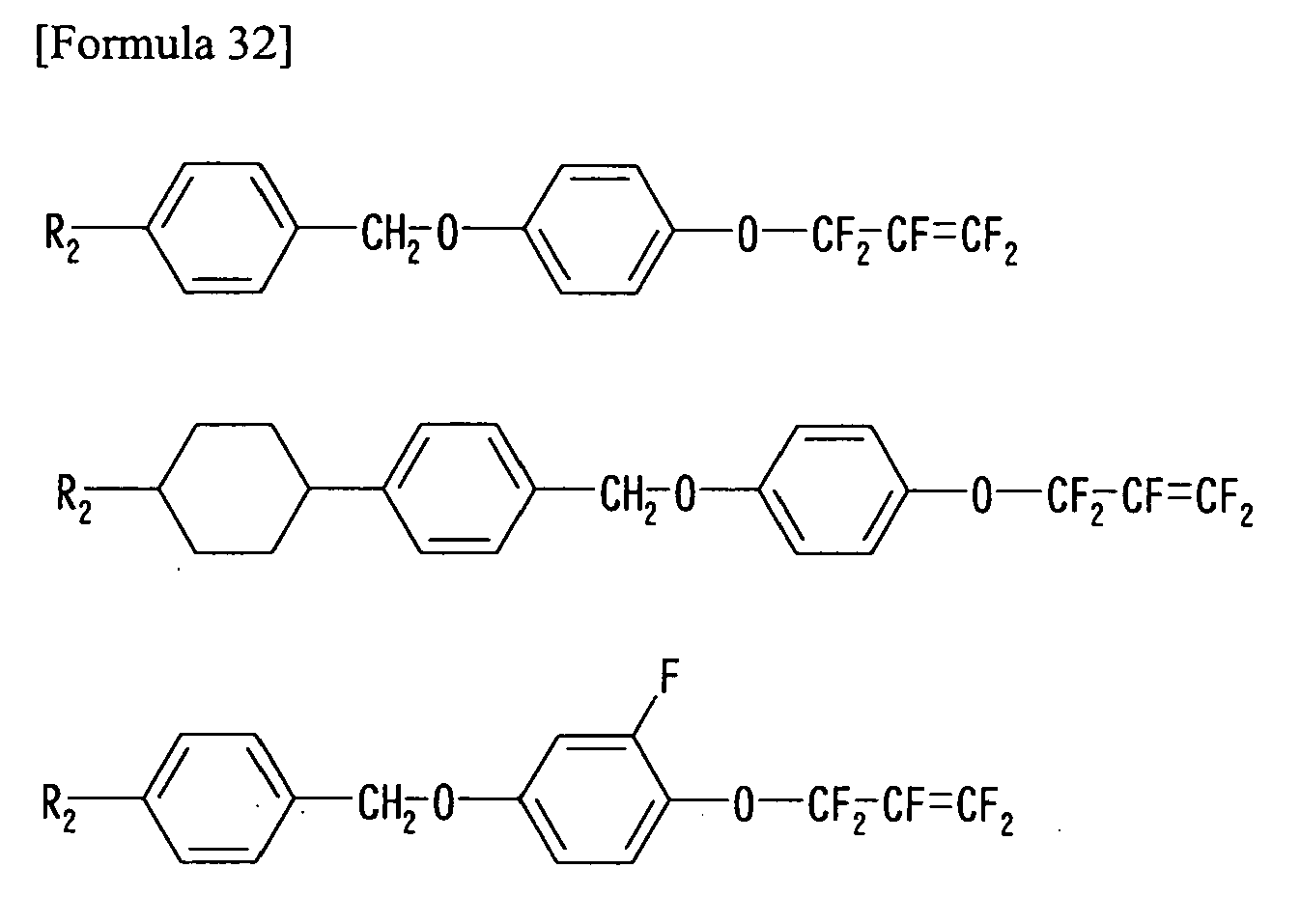
-

-

-

-

- In the liquid crystal composition of the present invention, the sum of component A and component B is preferably 100% by mass.
- The liquid crystal composition of the present invention may contain a known liquid crystal compound or liquid crystal analogue. Such liquid crystal compounds or liquid crystal analogues include, for example, compounds represented by general formula (V) in [Formula 37] below [except compounds having a terminal structure represented by general formula (I) and compounds represented by general formula (III) or (IV)].
-

- Accordingly, specific examples of compound represented by general formula (V) include compounds represented by [Formula 38] and [Formula 39] below. In these compounds, R, Y1, Y2, Y3, and Y4 represent the same meanings as those in general formula (V).
-

-

- Among these liquid crystal compounds or liquid crystal analogues, the compounds exemplified below are components that can increase the dielectric anisotropy (Δε) without increasing the rotational viscosity (γ1).
-

- Among these liquid crystal compounds or liquid crystal analogues, such compounds as exemplified below, that is, non-polar components, can improve the electro-optical properties, reliability, and the like.
-

- The liquid crystal composition of the present invention may also contain a known chiral agent. The chiral agent includes, for example, the following compounds.
-

-

- Specific examples of the chiral agent include the following compounds.
-

- There may be also used, for example, chiral agents proposed in
Japanese Patent Laid-Open Publication No. S63-175095 Japanese Patent Laid-Open Publication No. H1-242542 Japanese Patent Laid-Open Publication No. H1-258635 Japanese Patent Laid-Open Publication No. H6-200251 Japanese Patent Laid-Open Publication No. 2002-308833 - These chiral agents may be used alone or in combination of two or more. In this case, there may be used a combination of chiral agents different in helical twist direction or a combination of chiral agents with the same twist direction. Furthermore, for example, as proposed in
Japanese Patent Laid-Open Publication No. H7-258641
The pitch may be adjusted in a range of 0.2 µ to 300 µ by changing the chiral agent and its concentration. - For attaining excellent long-term stability to light and heat, the liquid crystal composition of the present invention may contain an ultraviolet absorber such as benzotriazole-type, benzophenone-type, triazine-type, benzoate-type, oxanilide-type, and cyanoacrylate-type ultraviolet absorbers; a hindered amine light stabilizer; an antioxidant such as phenol-type, phosphorus-containing, and sulfur-containing antioxidants; and the like.
- The liquid crystal composition of the present invention may contain a surfactant or the like for attaining antistatic effect. Such surfactants include, for example, compounds proposed in
Japanese Patent Laid-Open Publication No. S59-4676 Japanese Patent Laid-Open Publication No. H4-36384 H4-180993 Japanese Patent Laid-Open Publication No. H11-212070 Japanese Patent Laid-Open Publication No. H8-337779 Japanese Patent Laid-Open Publication No. H9-67577 Japanese Patent Laid-Open Publication No. 2003-342580 - The liquid crystal composition of the present invention may be enclosed in a liquid crystal cell to configure various electro-optic display elements. To such electro-optic display elements, there may be applied various types of display modes, for example, dynamic scattering (DS), guest-host (GH), twist nematic (TN), super twist nematic (STN), thin film transistor (TFT), thin film diode (TFD), ferroelectric liquid crystal (FLC), antiferroelectric liquid crystal (AFLC), polymer dispersion liquid crystal (PD), vertical alignment (VA), in-plane switching (IPS), cholesteric-nematic phase transfer-type, and the like; and there may be applied various driving systems such as static driving, time-division driving, active matrix driving, and dual-frequency driving.
Since the liquid crystal composition of the present invention has a high dielectric anisotropy (Δε) and a low rotational viscosity (γ1), electro-optic display elements obtained using the liquid crystal composition of the present invention are suitably used for IPS liquid crystal displays and low voltage-driven TN liquid crystal displays driven at a low voltage of 4 V or less (for example, 3.3 V or 2.5 V). - Such electro-optic display elements obtained using the liquid crystal composition of the present invention can be used for liquid crystal displays used in clocks, calculators, measuring instruments, automotive meters, copiers, cameras, OA equipment, portable personal computers, portable phones, and the like. Such electro-optic display elements can be also used for other applications, for example, photochromic windows, light-shielding shutters, polarization converters, and the like. Particularly, based on the characteristics, these elements are suitably used for liquid crystal displays used in monitors having large display area, wide-screen televisions, and portable information terminals such as PDA, portable personal computers and portable phones.
- Hereafter, the present invention will be further detailed with Examples and the like. However, the present invention is not limited by Examples and the like below.
- The following abbreviations are used in Examples and the like below.
- CY: 1,4-cyclohexylene
- PH: 1,4-phenylene
- PHnF: n-fluoro-1,4-phenylene (If n is not described, it represents 4-fluoro.)
- Dio: 1,3-dioxane-5,2-diyl
- Pym: pyrimidine-5,2-diyl
- Pyd: pyridazine-3,6-diyl
- CE: 4,1-cyclohexenylene
- Cn: Linear alkyl having n carbon atoms
- A liquid crystal composition was prepared as the following blend.
-
[blend] parts by mass C3-CY-PH-OCF2CF=CF2 30.4 C4-CY-PH-OCF2CF=CF2 5.7 C2-CY-CY-PH3F-OCF2CF=CF2 10.45 C3-CY-CY-PH3F-OCF2CF=CF2 12.35 C3-CY-CY-PH3,5-diF-OCF2CF=CF2 16.15 C4-CY-CY-PH3,5-diF-OCF2CF=CF2 3.8 C5-CY-CY-PH3,5-diF-OCF2CF=CF2 7.6 C3-CY-PH-PH3,5-diF-OCF2CF=CF2 8.55 C3-CY-PH-COO-PH3,5-diF-OCF2CF=CF2 5 - A liquid crystal composition was prepared as the following blend.
-
[blend] parts by mass C3-CY-PH-OCF2CF=CF2 9.5 C4-CY-PH-OCF2CF=CF2 4.75 C3-CY-PH3F-OCF2CF=CF2 14.25 C5-CY-PH3F-OCF2CF=CF2 7.6 C2-CY-CY-PH3F-OCF2CF=CF2 12.35 C3-CY-CY-PH3,5-diF-OCF2CF=CF2 16.15 C4-CY-CY-PH3,5-diF-OCF2CF=CF2 7.6 C5-CY-CY-PH3,5-diF-OCF2CF=CF2 17.1 C3-CY-PH-PH3,5-diF-OCF2CF=CF2 5.7 C3-CY-CY-COO-PH-F 5 - A liquid crystal composition was prepared as the following blend.
-
[blend] parts by mass C3-CY-PH-OCF2CF=CF2 9.5 C4-CY-PH-OCF2CF=CF2 4.75 C3-CY-PH3F-OCF2CF=CF2 14.25 C5-CY-PH3F-OCF2CF=CF2 7.6 C2-CY-CY-PH3F-OCF2CF=CF2 12.35 C3-CY-CY-PH3,5-diF-OCF2CF=CF2 16.15 C4-CY-CY-PH3,5-diF-OCF2CF=CF2 7.6 C5-CY-CY-PH3,5-diF-OCF2CF=CF2 17.1 C3-CY-PH-PH3,5-diF-OCF2CF=CF2 5.7 C3-CY-CY-COO-PH3,5-diF-OCFZCF=CF2 5 - A liquid crystal composition was prepared as the following blend.
-
[blend] parts by mass C3-CY-PH-OCF2CF=CF2 21 C4-CY-PH-OCF2CF=CF2 5 C5-CY-PH3F-OCF2CF=CF2 5 C2-CY-CY-PH3F-OCF2CF=CF2 9 C3-CY-CY-PH3F-OCF2CF=CF2 12 C3-CY-CY-PH3,5-diF-OCF2CF=CF2 11 C4-CY-CY-PH3,5-diF-OCF2CF=CF2 5 C5-CY-CY-PH3,5-diF-OCF2CF=CF2 10 C3-CY-PH-PH3,5-diF-OCF2CF=CF2 14 C5-CY-COO-PH-F 8 - A liquid crystal composition was prepared as the following blend.
-
[blend] parts by mass C2-CY-CY-PH3,4-diF 15 C3-CY-CY-PH3,4-diF 17 C4-CY-CY-PH3,4-diF 15 C5-CY-CY-PH3,4-diF 12 C3-CY-PH-PH3,4-diF 4 C4-CY-PH-PH3,4-diF 3 C5-CY-PH-PH3,4-diF 6 C7-CY-PH-F 13 C2-CY-CY-PH3,4,5-triF 5 C2-CY-CY-PH3,5-diF-OCF2H 4 C3-CY-PH-PH3,4,5-triF 6 - The characteristic values of liquid crystal compositions obtained in Examples 1 to 4 and Comparative Example 1 are shown in [Table 1] below.
-
[Table 1] Examples Comparative Example 1 2 3 4 1 NI Point 86.8 89.9 90.3 80.0 81.0 η 14 16 16 14 24 γ1 100 113 111 97 133 Δ n 0.0908 0.0877 0.0887 0.0902 0.0873 Δ ε 5.2 5.1 5.4 4.8 5.3 Low-Temperature Storage Stability -30 -30 -30 -30 -20 NI Point: Nematic-isotropic phase transfer temperature, unit: °C
η: Viscosity (20°C), unit: mPa·s
γ1: Rotational viscosity coefficient (20°C), unit: mPa·s
Δ n: Refractive index anisotropy (25°C, 589 nm)
Δ ε: Dielectric anisotropy (25°C, 1 kHz)
Low-Temperature Storage Stability: The lowest temperature at which no change was observed in a screw tube for two weeks. Unit: °C - A liquid crystal composition was prepared as the following blend.
-
[blend] parts by mass C3-PH-PH3F-OCF2CF=CF2 7 C3-CY-PH-OCF2CF=CF2 16 C3-CY-PH3F-OCF2CF=CF2 3 C2-CY-CY-PH3F-OCF2CF=CF2 9 C3-CY-CY-PH3F-OCF2CF=CF2 18 C3-CY-CY-PH3,5-diF-OCF2CF=CF2 6 C3-CY-PH-PH3,5-diF-OCF2CF=CF2 16 C3-CY-PH3F-COO-PH3,5-diF-OCF2CF=CF2 5 CH2=CH-CY-CY-PH3,5-diF-OCF2CF=CF2 10 CH2=CH-CY-PH-OCF2CF=CF2 10 - A liquid crystal composition was prepared as the following blend.
-
[blend] parts by mass C3-PH-PH3F-OCF2CF=CF2 10 C3-CY-PH-OCF2CF=CF2 10 C4-CY-PH-OCF2CF=CF2 5 C3-CY-PH3F-OCF2CF=CF2 8 C5-CY-PH3F-OCF2CF=CF2 4 C2-CY-CY-PH3F-OCF2CF=CF2 12 C3-CY-CY-PH3F-OCF2CF=CF2 15 C3-CY-CY-PH3,5-diF-OCF2CF=CF2 8 C4-CY-CY-PH3,5-diF-OCF2CF=CF2 4 C5-CY-CY-PH3,5-diF-OCF2CF=CF2 6 C3-CY-PH-PH3,5-diF-OCF2CF=CF2 18 - A liquid crystal composition was prepared as the following blend.
-
[blend] parts by mass C3-PH-PH3F-OCF2CF=CF2 8 C3-CY-PH-OCF2CF=CF2 20 C2-CY-CY-PH3F-OCF2CF=CF2 6 C3-CY-CY-PH3F-OCF2CF=CF2 16 C2-CY-CY-PH3,5-diF-OCF2CF=CF2 11 C3-CY-PH-PH3,5-diF-OCF2CF=CF2 14 C3-CY-CY-PH-PH3,5-diF-OCF2CF=CF2 6 CH2=CH-CY-CY-PH3,5-diF-OCF2CF=CF2 8 CH2=CH-CY-PH-OCF2CF=CF2 11 - A liquid crystal composition was prepared as the following blend.
-
[blend] parts by mass C2-CY-CY-PH3,4-diF 13 C3-CY-CY-PH3,4-diF 14 C4-CY-CY-PH3,4-diF 12 C5-CY-CY-PH3,4-diF 10 C3-CY-PH-PH3,4-diF 9 C4-CY-PH-PH3,4-diF 6 C5-CY-PH-PH3,4-diF 13 C7-CY-PH-F 4 C2-CY-CY-PH3,5-diF-OCF2H 3 C3-CY-PH-PH3,4,5-triF 2 C2-PH-C≡C-PH3,4-diF 2 C5-CY-PH-Cl 7 C3-CY-PH-OCH3 5 - The characteristic values of liquid crystal compositions obtained in Examples 5 to 7 and Comparative Example 2 are shown in [Table 2] below.
-
[Table 2] Examples Comparative Example 5 6 7 2 NI Point 79.8 81.3 82.5 79.5 η 15 16 14 21 γ1 93 95 93 119 Δ n 0.1005 0.1007 0.1019 0.0991 Δ ε 5.1 5.2 4.8 4.8 Low-Temperature Storage Stability -30 -30 -30 -20 NI Point: Nematic-isotropic phase transfer temperature, unit: °C
η: Viscosity (20°C), unit: mPa·s
γ1: Rotational viscosity coefficient (20°C), unit: mPa·s
Δ n: Refractive index anisotropy (25°C, 589 nm)
Δ ε: Dielectric anisotropy (25°C, 1 kHz)
Low Temperature Storage Stability: The lowest temperature at which no change was observed in a screw tube for two weeks. Unit: °C - A liquid crystal composition was prepared as the following blend.
-
[blend] parts by mass C3-CY-PH-OCF2CF=CF2 31 C3-CY-PH3F-OCF2CF=CF2 2 C3-CY-CY-PH3F-OCF2CF=CF2 3 C3-CY-CY-PH3,5-diF-OCF2CF=CF2 18 C4-CY-CY-PH3,5-diF-OCF2CF=CF2 4 C5-CY-CY-PH3,5-diF-OCF2CF=CF2 7 C3-CY-PH-PH3,5-diF-OCF2=CF2 15 C3-CY-PH3F-COO-PH3,5-di,5-diF-OCF2CF=CF2 5 C3-CY-PH3,5-diF-CF20-PH3,5-diF-OCF2CF=CF2 15 - A liquid crystal composition was prepared as the following blend.
-
[blend] parts by mass C3-CY-PH-OCF2CF=CF2 18 C3-CY-PH3F-OCF2CF=CF2 17 C2-CY-CY-PH3F-OCF2CF=CF2 6 C3-CY-CY-PH3F-OCF2CF=CF2 6 C3-CY-CY-PH3,5-diF-OCF2CF=CF2 8 C3-CY-PH-PH3,5-diF-OCF2CF=CF2 15 C3-CY-PH3F-COO-PH3,5-diF-OCF2CF=CF2 10 CH2=CH-CY-CY-PH3,5-diF-OCF2CF=CF2 10 C3-CY-PH3,5-diF-CF2O-PH3,5-diF-OCF2CF=CF2 10 - A liquid crystal composition was prepared as the following blend.
-
[blend] parts by mass C3-CY-PH-OCF2CF=CF2 13 C3-CY-PH3F-OCF2CF=CF2 12 C2-CY-CY-PH3F-OCF2CF=CF2 12 C3-CY-CY-PH3,5-diF-OCF2CF=CF2 10 C3-CY-PH-PH3,5-diF-OCF2CF=CF2 10 C3-CY-PH3F-COO-PH3,5-diF-OCF2CF=CF2 10 CH2=CH-CY-CY-PH3,5-diF-OCF2CF=CF2 11 C3-CY-PH3,5-diF-COO-PH3,5-diF-OCF2CF=CF2 10 CH2=CH-CY-PH-OCF2CF=CF2 12 - A liquid crystal composition was prepared as the following blend.
-
[blend] parts by mass C3-CY-PH-OCF2CF=CF2 31 C3-CY-PH3F-OCF2CF=CF2 5 C3-CY-CY-PH3F-OCF2CF=CF2 16 C3-CY-PH-PH3,5-diF-OCF2CF=CF2 6 CH2=CH-CY-CY-PH3,5-diF-OCFZCF=CF2 18 C3-CY-PH3F-COO-PH3,5-diF-OCF2CF=CF2 10 C3-CY-PH3,5-diF-COO-PH3,5-diF-OCF2CF=CF2 5 C3-PH-PH3,5-diF-CF2O-PH3,5-diF-OCF2CF=CF2 9 - A liquid crystal composition was prepared as the following blend.
-
[blend] parts by mass C3-CY-PH-OCF2CF=CF2 30 C3-CY-PH3F-OCF2CF=CF2 6 C3-CY-CY-PH3F-OCF2CF=CF2 18 C3-PH-PH3F-PH3,5-diF-OCF2CF=CF2 5 CH2=CH-CY-CY-PH3,5-diF-OCF2CF=CF2 17 C3-CY-PH3F-COO-PH3,5-diF-OCF2CF=CF2 13 C3-CY-PH3,5-diF-COO-PH3,5-diF-OCF2CF=CF2 3 C3-PH-PH3,5-diF-CF20-PH3,5-diF-OCF2CF=CF2 8 - A liquid crystal composition was prepared as the following blend.
-
[blend] parts by mass C2-CY-CY-PH3,4-diF 8 C3-CY-CY-PH3,4-diF 12 C4-CY-CY-PH3,4-diF 10 C5-CY-CY-PH3,4-diF 8 C3-CY-PH-PH3,4-diF 7 C4-CY-PH-PH3,4-diF 5 C5-CY-PH-PH3,4-diF 10 C2-CY-CY-PH3,5-diF-OCF2H 8 C2-CY-Dio-PH3,4,5-triF 10 C2-CY-PH-PH3,4,5-triF 9 C3-CY-PH-PH3,4,5-triF 6 C2-PH-C≡C-PH3,4-diF 2 C3-CY-PH-OCH3 5 - The characteristic values of liquid crystal compositions obtained in Examples 8 to 12 and Comparative Example 3 are shown in [Table 3] below.
-
[Table 3] Examples Comparative Example 8 9 10 11 12 3 NI Point 73.5 71.3 70.2 70.6 72.8 78.0 γ1 101 96 90 91 89 169 Δ n 0.0941 0.0960 0.0942 0.0971 0.1008 0.1062 Δ ε 6.7 6.6 6.5 6.9 7.0 6.6 Low-Temperature Storage Stability -30 -30 -30 -20 -30 -10 NI Point: Nematic-isotropic phase transfer temperature, unit: °C
γ1: Rotational viscosity coefficient (20°C), unit: mPa·s
Δ n: Refractive index anisotropy (25°C, 589 nm)
Δ ε: Dielectric anisotropy (25°C, 1 kHz)
Low-Temperature Storage Stability: The lowest temperature at which no change was observed in a screw tube for two weeks. Unit: °C - As clearly shown in Examples above, the liquid crystal composition of the present invention has both a high dielectric anisotropy (Δε) and a low rotational viscosity (γ1), and further is excellent in low-temperature characteristics.
- Hereafter are shown other preferable examples of compositions as the liquid crystal composition of the present invention.
-
[Table 4] liquid crystal compound parts by mass CH2=CH-CY-CY-C5 15 C3-CY-CY-PH-C2 10 C2-CY-CY-PH3,5-diF-OCF2H 12 C2-CY-CY-PH3,5-diF-OCF3 8 CH2=CH-CY-CY-PH3,4-diF 13 C2-CY-PH3F-PH3,4,5-triF 4 C2-CY-CY-PH3,4-diF 5 C3-CY-CY-PH3,4,5-triF 6 C3-CY-CY-PH-OCF3 3 C3-CY-PH-PH3,4,5-triF 8 CH2=CH-CY-CY-PH-C 10 C3-CY-PH-OC2 6 100 -
[Table 5] liquid crystal compound parts by mass C3-CY-PH-OC2 4 C3-CE-CY-C3 4 C3-CY-CY-C5 11 C3-CY-PH3,5-diF-OCF3 10 C2-CY-CY-PH3F-OCF3 5 C2-CY-CY-PH3,5-diF-OCF2H 8 C2-CY-CY-PH3,4-diF 13 C3-CY-CY-PH3,4-diF 12 C5-CY-PH-PH3,4-diF 7 C3-CY-PH3F-PH3,4,5-triF 5 C2-CY-CY-COO-PH3,4-diF 6 C3-CY-PH3F-COO-PH-OCF3 3 C5-CY-CY-CH2CH2-PH2,3-diF-OCF3 3 C3-CY-CY-COO-PH3,5-diF-OCF3 5 C3-PH-PH-C≡C-PH2,6-diF-C3 4 100 -
[Table 6] liquid crystal compound parts by mass CH2=CH-CY-CY-C5 20 C7-CY-PH-F 5 C5-CY-PH-Cl 5 C2-CY-CY-PH3,5-diF-OCF2H 8 C2-CY-CY-PH3,4-diF 11 CH2=CH-CY-CY-PH3,4-diF 13 C3-CY-Dio-PH3,4-diF 15 C4-CY-PH-PH3,4-diF 8 C3-PH-PH3,5-diF-CF20-PH3,5-diF-OCF3 5 C2-CY-PH3F-COO-PH3,5-diF-OCF2H 6 C3-CY-CY-PH3,5-diF-OCF2CH=CH2 4 100 -
[Table 7] liquid crystal compound parts by mass CH2=CH-CY-CY-C5 20 C3-CY-PH-OCl 10 C3-CY-CY-C3 8 C2-CY-CY-PH3,5-diF-OCF2H 10 CH2=CH-CY-CY-PH3,4-diF 12 C3-CY-CY-PH3,4,5-triF 12 C3-CY-PH3F-PH3,4,5-triF 7 C3-CY-CY-COO-PH3,5-diF-OCF3 8 C3-CY-CY-COO-PH3,4-diF 6 C3-CY-PH3F-COO-PH-OCF3 7 100 -
[Table 8] liquid crystal compound parts by mass C3-CY-PH-OC2 5 CH2=CH-CY-PH-C3 18 CH2=CH-CY-CY-PH-C1 8 C3-CY-Pyd-CY-C4 8 C3-CY-CY-PH-OCF3 7 C3-CY-CY-PH3,4-diF 15 C3-CY-CY-PH3,5-diF-OCF2H 12 C2-CY-CY-COO-PH3,4-diF 5 C3-CY-PH3,5-diF-COO-PH3,5-diF-OCF3 7 C3-CY-CY-CF2O-PH3,4,5-triF 9 C3-CY-CY-PH-C2 6 100 -
[Table 9] liquid crystal compound parts by mass CH2=CH-CY-PH3F-OCF2CF=CF2 6 CH2=CH-CY-CY-C5 10 C3-CY-CY-C5 5 C3-CY-PH-OCF2CF=CF2 10 CH2=CH-CY-CY-PH-Cl 9 C2-CY-CY-PH3F-OCF2CF=CF2 14 C3-CY-CY-PH3F-OCF2CF=CF2 9 C3-CY-CY-PH3,5-diF-OCF2CF=CF2 11 CH2=CH-CY-CY-PH3,5-diF-OCF2CF=CF2 5 C3-CY-PH-PH3,5-diF-OCF2CF=CF2 16 C3-CY-CY-PH3F-PH3,5-diF-OCF2CF=CF2 5 100 -
[Table 10] liquid crystal compound parts by mass C3-CY-CY-C5 16 C3-CY-PH3F-OCF2CF=CF2 15 C3-CY-CY-PH3,5-diF-OCH3 4 C3-CY-PH-C=C-PH3F-OCF2CF=CF2 6 C3-CY-CY-PH3,5-diF-OCF2CF=CF2 8 CH2=CH-CY-CY-PH3F-OCF2CF=CF2 10 C3-CY-CY-PH3,5-diF-OCF2CF=CF2 15 C3-CY-CY-COO-PH3,4-diF 10 C2-CY-PH3F-COO-PH3,4-diF 5 C3-CY-PH3F-COO-PH-OCF3 5 C2-CY-PH3F-PH3F-OCF=CFCF3 6 100 -
[Table 11] liquid crystal compound parts by mass C3-CY-PH-OC2 8 C3-CY-CY-C5 5 CH2=CH-CY-CY-C5 18 CH2=CH-CY-CY-PH3F-OCF2CF=CF2 12 C3-CY-CY-PH3,4,5-diF 10 C3-CY-CY-PH3,4-diF 12 C2-CY-PH3F-PH3,4,5-triF 6 C3-PH-PH3F-PH3,4,5-triF 6 C3-CY-PH3,5-diF-CF2O-PH3,5-diF-OCF2CF=CF2 12 C3-CY-PH3F-COO-PH3,5-diF-OCF2CF=CF2 6 C2-CY-PH3,5-diF-COO-PH3,5-diF-OCF2CF=CF2 5 100 -
[Table 12] liquid crystal compound parts by mass C3-PH-PH3F-OCF2CF=CF2 8 C2-CY-PH-OCF2CF=CF2 13 C3-CY-PH3F-OCF2CF=CF2 5 C7-CY-PH-F 12 CH2=CH-CY-CY-PH3,4-diF 18 C3-CY-CY-PH3,4-diF 9 C2-CY-PH3F-PH3,4,5-triF 11 CH2=CH-CY-CY-PH3,5-diF-OCF2CF=CF2 12 C5-CY-CY-PH3,5-diF-OCF2CF=CF2 12 100 -
[Table 13] liquid crystal compound parts by mass C3-CY-CY-CF3 5 C3-CY-CY-C5 7 C3-CY-PH3F-CN 6 C1-CH=CH-CY-PH-CN 10 C2-CY-CY-PH3,4-diF 12 C2-CY-CY-PH3,5-diF-OCF2H 11 C3-CY-CY-PH3,4-diF 18 C3-CY-CY-PH3,4,5-triF 9 C3-CY-PH3F-COO-PH3,5-diF-OCF3 5 C3-PH-PH3,5-diF-CF20-PH3,5-diF-OCF2H 4 C3-CY-CY-COO-PN-CN 5 C5-CY-CY-PH3F-OCF3 8 100 -
[Table 14] liquid crystal compound parts by mass C3-CY-PH-CN 8 CH2=CH-CY-CY-C5 22 CH2=CH-CY-CY-PH3,5-diF-OCF2CF=CF2 12 C2-CY-CY-PH3F-OCF2CF=CF2 12 C3-CY-CY-PH3,4 diF 14 C3-CY-CY-PH3,5-diF-OCF2H 6 C3-CY-PH3F-PH3,4,5-triF 6 C3-PH-PH3,5-diF-CF20-PH3,5-diF-OCF2CF=CF2 8 C3-CY-PH3F-COO-PH3,5-diF-OCF2CF=CF2 5 C4-CY-PH3F-COO-PH-CN 7 100 -
[Table 15] liquid crystal compound parts by mass C2-PH-COO-PH3F-CN 8 C3-CY-PH3F-OCF2CF=CF2 15 CH2=CH-CY-CY-C5 6 C3-CY-PH3,5-diF-CN 5 C2-CY-CY-PH3,4-diF 10 C3-CY-CY-PH3F-OCF2CF=CF2 13 C3-CY-CY-PH3,5-diF-OCF2CF=CF2 9 CH2=CH-CY-CY-PH3,5-diF-OCF2CF=CF2 9 CH2=CH-CY-CY-PH-Cl 12 C3-CY-CY-CY-PH-C2 8 C3-CY-CY-COO-PH-CY-C3 5 100 - The liquid crystal composition of the present invention has a high dielectric anisotropy (Δε) and a low rotational viscosity (γ1) and thus is suitably used as a liquid crystal composition for IPS liquid crystal displays or low voltage-driven TN liquid crystal displays.
Claims (12)
- A liquid crystal composition comprising 15% by mass or more of a compound having a terminal structure represented by general formula (I) below:

- The liquid crystal composition according to claim 1 comprising at least one compound in which -O-Q in general formula (I) is represented by partial structural formula (II) below:
[Formula 2] -0-CF2-CF=CF2 (II)
- The liquid crystal composition according to claim 1 or 2 comprising at least one compound represented by general formula (III) below (Component A), with the proviso of excluding components included in the compounds having a terminal structure represented by general formula (I):
 A1 is 1,4-phenylene in which the -CH= group(s) may be replaced by -N= and the hydrogen atom(s) may be replaced by a halogen atom or cyano group, 1,4-cyclohexylene in which the -CH2- group(s) may be replaced by -O- or -S- and the hydrogen atom(s) may be replaced by a halogen atom or cyano group, or 2,6-naphthylene;Z1 is a single bond, -CH2CH2-, -CH=CH-, -(CH2)4-, -C≡C-, or -CF2CF2-;X1 and X2 each independently represent a hydrogen or fluorine atom;Q1 represents a halogen atom, haloalkyl group, haloalkoxy group, haloalkenyl group, or haloalkenyloxy group;n is a number of 1 to 3; and when n is 2 or 3, a plurality of A1 may be different and a plurality of Z1 may be different.
 - The liquid crystal composition according to any of claims 1 to 3, wherein the compound having a terminal structure represented by general formula (I) is at least one compound represented by general formula (III) (Component A), with the proviso of excluding components not included in the compounds having a terminal structure represented by general formula (I).
- The liquid crystal composition according to any of claims 1 to 4 comprising at least one compound represented by general formula (IV) below (Component B), with the proviso of excluding components included in the compounds having a terminal structure represented by general formula (I):
 A2 is 1,4-phenylene in which the -CH= group(s) may be replaced by -N= and the hydrogen atom(s) may be replaced by a halogen atom or cyano group, 1,4-cyclohexylene in which the -CH2- group(s) may be replaced by -O- or -S- and the hydrogen atom(s) may be replaced by a halogen atom or cyano group, or 2,6-naphthylene;Z2 is -COO-, -OCO-, -CH2O-, -OCH2-, -(CH2)3O-, -O(CH2)3-, -CH=CHCH2O-, -OCH2CH=CH-, -CF2O-, -OCF2-, -CH2CH2-COO-, or -OCO=CH2CH2-;X3 and X4 each independently represent a hydrogen or fluorine atom;Q2 represents a halogen atom, haloalkyl group, haloalkoxy group, haloalkenyl group, or haloalkenyloxy group;m is a number of 1 to 3; and when m is 2 or 3, a plurality of A2 may be different and a plurality of Z2 may be different.
 - The liquid crystal composition according to any of claims 1 to 5, wherein the compound having a terminal structure represented by general formula (I) is at least one compound represented by general formula (IV) (Component B), with the proviso of excluding components not included in the compounds having a terminal structure represented by general formula (I).
- The liquid crystal composition according to any of claims 3 to 6, wherein Component A is at least one compound represented by any of general formulae (III-1) to (III-3) below:

- The liquid crystal composition according to any of claims 5 to 7, wherein Component B is at least one compound represented by any of general formulae (IV-1) to (IV-3) below:

- The liquid crystal composition according to any of claims 3 to 8, wherein Components A are at least one or more compounds in which R1 in general formula (III) is an alkyl group and at least one or more compounds in which R1 in general formula (III) is an alkenyl group.
- The liquid crystal composition according to any of claims 3 to 9, wherein the sum of Component A and Component B is 100% by mass.
- The liquid crystal composition according to any of claims 1 to 10 used for IPS liquid crystal displays.
- The liquid crystal composition according to any of claims 1 to 10 used for low voltage-driven TN liquid crystal displays.
Applications Claiming Priority (2)
| Application Number | Priority Date | Filing Date | Title |
|---|---|---|---|
| JP2004358113 | 2004-12-10 | ||
| PCT/JP2005/020415 WO2006061966A1 (en) | 2004-12-10 | 2005-11-08 | Liquid crystal composition |
Publications (3)
| Publication Number | Publication Date |
|---|---|
| EP1840185A1 true EP1840185A1 (en) | 2007-10-03 |
| EP1840185A4 EP1840185A4 (en) | 2009-01-07 |
| EP1840185B1 EP1840185B1 (en) | 2016-05-11 |
Family
ID=36577797
Family Applications (1)
| Application Number | Title | Priority Date | Filing Date |
|---|---|---|---|
| EP05806127.6A Expired - Lifetime EP1840185B1 (en) | 2004-12-10 | 2005-11-08 | Liquid crystal composition |
Country Status (7)
| Country | Link |
|---|---|
| US (1) | US7618554B2 (en) |
| EP (1) | EP1840185B1 (en) |
| JP (1) | JP4889503B2 (en) |
| KR (1) | KR101195623B1 (en) |
| CN (1) | CN101061202B (en) |
| TW (1) | TWI386482B (en) |
| WO (1) | WO2006061966A1 (en) |
Cited By (2)
| Publication number | Priority date | Publication date | Assignee | Title |
|---|---|---|---|---|
| CN102643653A (en) * | 2012-03-21 | 2012-08-22 | 北京八亿时空液晶科技股份有限公司 | Liquid crystal composition |
| EP3135659A4 (en) * | 2014-02-25 | 2017-11-01 | JNC Corporation | Liquid crystal compound having 1,1,3,3-tetrafluoroallyloxy group, liquid crystal composition, and liquid crystal display element |
Families Citing this family (11)
| Publication number | Priority date | Publication date | Assignee | Title |
|---|---|---|---|---|
| US20100171074A1 (en) * | 2009-01-08 | 2010-07-08 | Daily Polymer Corp. | Liquid crystal mixture |
| US20100237286A1 (en) * | 2009-03-18 | 2010-09-23 | Daily Polymer Corp. | Liquid crystal mixture |
| CN101916012B (en) * | 2010-08-04 | 2011-10-12 | 友达光电股份有限公司 | display panel |
| CN103013535B (en) * | 2012-12-28 | 2014-02-26 | 北京八亿时空液晶科技股份有限公司 | A kind of liquid crystal composition and its application |
| CN103194243B (en) * | 2013-02-27 | 2015-01-07 | 北京八亿时空液晶科技股份有限公司 | Liquid crystal composition for TFT display |
| CN103146392B (en) * | 2013-02-27 | 2014-05-21 | 北京八亿时空液晶科技股份有限公司 | Liquid crystal composition for liquid crystal display |
| CN103242861B (en) * | 2013-05-22 | 2014-08-20 | 北京市金讯阳光电子材料科技有限公司 | Liquid crystal composition and application thereof |
| KR101691873B1 (en) * | 2013-12-16 | 2017-01-02 | 디아이씨 가부시끼가이샤 | Alkenyl ether compound and liquid crystal composition using same |
| JP2017036382A (en) * | 2015-08-10 | 2017-02-16 | Jnc株式会社 | Liquid crystal composition and liquid crystal display element |
| JP2017039827A (en) * | 2015-08-19 | 2017-02-23 | Jnc株式会社 | Liquid crystal composition and liquid crystal display element |
| KR20170040106A (en) * | 2015-10-02 | 2017-04-12 | 주식회사 동진쎄미켐 | Liquid crystal composition |
Family Cites Families (19)
| Publication number | Priority date | Publication date | Assignee | Title |
|---|---|---|---|---|
| JPS5691277A (en) | 1979-12-25 | 1981-07-24 | Citizen Watch Co Ltd | Liquiddcrystal display panel |
| DE4042747B4 (en) | 1990-01-09 | 2009-10-08 | Merck Patent Gmbh | Electro-optical liquid crystal switching element |
| DE4217248B4 (en) * | 1991-06-05 | 2005-06-16 | Merck Patent Gmbh | vinyl compounds |
| JP2940354B2 (en) | 1992-09-18 | 1999-08-25 | 株式会社日立製作所 | Liquid crystal display |
| JP3543351B2 (en) | 1994-02-14 | 2004-07-14 | 株式会社日立製作所 | Active matrix type liquid crystal display |
| JPH07216356A (en) * | 1994-02-07 | 1995-08-15 | Dainippon Ink & Chem Inc | Phenylcyclohexane derivative and its intermediate |
| CN1055769C (en) | 1994-03-17 | 2000-08-23 | 株式会社日立制作所 | Active matrix liquid crystal display system and driving method thereof |
| JP3632772B2 (en) * | 1994-03-23 | 2005-03-23 | 大日本インキ化学工業株式会社 | 4-alkenyloxy-3,5-difluorobenzene derivatives |
| EP0775101B1 (en) * | 1994-08-06 | 2000-05-03 | MERCK PATENT GmbH | Benzene derivatives and liquid crystal medium |
| EP0727406B1 (en) * | 1995-02-16 | 2001-09-05 | MERCK PATENT GmbH | Vinylene compounds and liquid crystalline medium |
| DE19748618B4 (en) | 1996-12-05 | 2009-12-03 | Merck Patent Gmbh | Liquid crystal mixture and its use in an electro-optical liquid crystal display |
| DE19707807A1 (en) | 1997-02-27 | 1998-09-03 | Merck Patent Gmbh | Electro-optical liquid crystal display |
| DE19940655A1 (en) * | 1998-08-28 | 2000-04-06 | Merck Patent Gmbh | Nematic liquid crystal medium for use in electro-optical displays contains dielectrically positive compounds, dielectrically negative compounds and optionally dielectrically neutral compounds |
| DE19859421A1 (en) * | 1998-12-22 | 2000-06-29 | Merck Patent Gmbh | Liquid crystalline medium |
| US6929832B2 (en) * | 1999-03-03 | 2005-08-16 | Merck Patent Gmbh | Liquid-crystal medium, and electro-optical display containing the liquid-crystal medium |
| JP4206687B2 (en) * | 2002-04-09 | 2009-01-14 | チッソ株式会社 | Liquid crystal composition and liquid crystal display element |
| WO2004053582A1 (en) | 2002-12-09 | 2004-06-24 | Hitachi Displays, Ltd. | Liquid crystal display and method for manufacturing same |
| JP4662849B2 (en) * | 2002-12-24 | 2011-03-30 | 株式会社Adeka | Perfluoroallyloxy compound and liquid crystal composition containing the compound |
| JP4817613B2 (en) * | 2003-06-06 | 2011-11-16 | 株式会社Adeka | Liquid crystal display |
-
2005
- 2005-11-08 CN CN200580039497.7A patent/CN101061202B/en not_active Expired - Fee Related
- 2005-11-08 KR KR1020077013034A patent/KR101195623B1/en not_active Expired - Fee Related
- 2005-11-08 JP JP2006547707A patent/JP4889503B2/en not_active Expired - Fee Related
- 2005-11-08 WO PCT/JP2005/020415 patent/WO2006061966A1/en not_active Ceased
- 2005-11-08 EP EP05806127.6A patent/EP1840185B1/en not_active Expired - Lifetime
- 2005-11-08 US US11/792,256 patent/US7618554B2/en not_active Expired - Lifetime
- 2005-11-18 TW TW094140727A patent/TWI386482B/en not_active IP Right Cessation
Cited By (3)
| Publication number | Priority date | Publication date | Assignee | Title |
|---|---|---|---|---|
| CN102643653A (en) * | 2012-03-21 | 2012-08-22 | 北京八亿时空液晶科技股份有限公司 | Liquid crystal composition |
| CN102643653B (en) * | 2012-03-21 | 2013-07-31 | 北京八亿时空液晶科技股份有限公司 | Liquid crystal composition |
| EP3135659A4 (en) * | 2014-02-25 | 2017-11-01 | JNC Corporation | Liquid crystal compound having 1,1,3,3-tetrafluoroallyloxy group, liquid crystal composition, and liquid crystal display element |
Also Published As
| Publication number | Publication date |
|---|---|
| KR101195623B1 (en) | 2012-10-30 |
| US20080149890A1 (en) | 2008-06-26 |
| CN101061202A (en) | 2007-10-24 |
| CN101061202B (en) | 2014-01-08 |
| EP1840185A4 (en) | 2009-01-07 |
| WO2006061966A1 (en) | 2006-06-15 |
| TW200632073A (en) | 2006-09-16 |
| JPWO2006061966A1 (en) | 2008-06-05 |
| US7618554B2 (en) | 2009-11-17 |
| JP4889503B2 (en) | 2012-03-07 |
| EP1840185B1 (en) | 2016-05-11 |
| KR20070085970A (en) | 2007-08-27 |
| TWI386482B (en) | 2013-02-21 |
Similar Documents
| Publication | Publication Date | Title |
|---|---|---|
| CN103254907B (en) | Negative dielectric anisotropy liquid crystal composition | |
| EP1840185B1 (en) | Liquid crystal composition | |
| EP1577286B1 (en) | Perfluoroallyloxy compound and liquid-crystal composition containing the compound | |
| JP5217262B2 (en) | Liquid crystal composition | |
| JP2008095110A (en) | Liquid crystal medium | |
| JP4514507B2 (en) | Liquid crystal composition and TN type liquid crystal device | |
| JP4868837B2 (en) | Liquid crystal composition | |
| JP4655479B2 (en) | Nematic liquid crystal composition and liquid crystal display device using the same | |
| JP2001011458A (en) | Liquid crystal medium and liquid crystal display device containing the liquid crystal medium | |
| US6620467B2 (en) | Liquid crystal display | |
| JP2001033748A (en) | Liquid crystal display device | |
| US20150159087A1 (en) | Liquid crystal composition having negative dielectric anisotropy, and liquid crystal display device using the liquid crystal composition | |
| JP2001011459A (en) | Liquid crystal medium and liquid crystal display device containing the liquid crystal medium | |
| JP4514508B2 (en) | Liquid crystal composition and STN type liquid crystal element | |
| JP4984342B2 (en) | Liquid crystal composition | |
| JP2011207871A (en) | Liquid crystal compound, method for producing the same, liquid crystal composition and liquid crystal electrooptical element | |
| JP5233137B2 (en) | OCB liquid crystal display element | |
| JP4876354B2 (en) | Liquid crystal composition and liquid crystal display element | |
| JP4403307B2 (en) | Liquid crystal composition containing a compound having a 6-membered ring lactone skeleton | |
| JP2001226675A (en) | Liquid crystal composition | |
| JP2003342579A (en) | Liquid crystal composition | |
| JP4655317B2 (en) | Liquid crystal composition and liquid crystal display element | |
| JPH1077475A (en) | Nematic liquid crystal composition and liquid crystal display device using the same | |
| JP4702578B2 (en) | Liquid crystal display element | |
| JP2013227581A (en) | Ocb liquid crystal display device |
Legal Events
| Date | Code | Title | Description |
|---|---|---|---|
| PUAI | Public reference made under article 153(3) epc to a published international application that has entered the european phase |
Free format text: ORIGINAL CODE: 0009012 |
|
| 17P | Request for examination filed |
Effective date: 20070608 |
|
| AK | Designated contracting states |
Kind code of ref document: A1 Designated state(s): DE GB NL |
|
| RBV | Designated contracting states (corrected) |
Designated state(s): DE GB NL |
|
| DAX | Request for extension of the european patent (deleted) | ||
| A4 | Supplementary search report drawn up and despatched |
Effective date: 20081204 |
|
| 17Q | First examination report despatched |
Effective date: 20090306 |
|
| REG | Reference to a national code |
Ref country code: DE Ref legal event code: R079 Ref document number: 602005049322 Country of ref document: DE Free format text: PREVIOUS MAIN CLASS: C09K0019080000 Ipc: C09K0019120000 |
|
| RIC1 | Information provided on ipc code assigned before grant |
Ipc: C09K 19/20 20060101ALI20151020BHEP Ipc: C09K 19/04 20060101ALI20151020BHEP Ipc: C09K 19/30 20060101ALI20151020BHEP Ipc: C09K 19/12 20060101AFI20151020BHEP |
|
| GRAP | Despatch of communication of intention to grant a patent |
Free format text: ORIGINAL CODE: EPIDOSNIGR1 |
|
| INTG | Intention to grant announced |
Effective date: 20151127 |
|
| GRAS | Grant fee paid |
Free format text: ORIGINAL CODE: EPIDOSNIGR3 |
|
| GRAA | (expected) grant |
Free format text: ORIGINAL CODE: 0009210 |
|
| AK | Designated contracting states |
Kind code of ref document: B1 Designated state(s): DE GB NL |
|
| REG | Reference to a national code |
Ref country code: GB Ref legal event code: FG4D |
|
| REG | Reference to a national code |
Ref country code: DE Ref legal event code: R081 Ref document number: 602005049322 Country of ref document: DE Owner name: DAILY POLYMER CORPORATION, TW Free format text: FORMER OWNER: ADEKA CORP., TOKIO/TOKYO, JP |
|
| REG | Reference to a national code |
Ref country code: DE Ref legal event code: R096 Ref document number: 602005049322 Country of ref document: DE |
|
| REG | Reference to a national code |
Ref country code: NL Ref legal event code: FP |
|
| REG | Reference to a national code |
Ref country code: DE Ref legal event code: R097 Ref document number: 602005049322 Country of ref document: DE |
|
| PLBE | No opposition filed within time limit |
Free format text: ORIGINAL CODE: 0009261 |
|
| STAA | Information on the status of an ep patent application or granted ep patent |
Free format text: STATUS: NO OPPOSITION FILED WITHIN TIME LIMIT |
|
| 26N | No opposition filed |
Effective date: 20170214 |
|
| REG | Reference to a national code |
Ref country code: DE Ref legal event code: R082 Ref document number: 602005049322 Country of ref document: DE Representative=s name: BOETERS & LIECK, DE Ref country code: DE Ref legal event code: R081 Ref document number: 602005049322 Country of ref document: DE Owner name: DAILY POLYMER CORPORATION, TW Free format text: FORMER OWNER: ADEKA CORPORATION, TOKYO, JP |
|
| REG | Reference to a national code |
Ref country code: GB Ref legal event code: 732E Free format text: REGISTERED BETWEEN 20170907 AND 20170913 |
|
| REG | Reference to a national code |
Ref country code: NL Ref legal event code: PD Owner name: DAILY POLYMER CORP.; TW Free format text: DETAILS ASSIGNMENT: CHANGE OF OWNER(S), ASSIGNMENT; FORMER OWNER NAME: ADEKA CORPORATION Effective date: 20170808 |
|
| PGFP | Annual fee paid to national office [announced via postgrant information from national office to epo] |
Ref country code: NL Payment date: 20201126 Year of fee payment: 16 |
|
| PGFP | Annual fee paid to national office [announced via postgrant information from national office to epo] |
Ref country code: DE Payment date: 20201030 Year of fee payment: 16 Ref country code: GB Payment date: 20201027 Year of fee payment: 16 |
|
| REG | Reference to a national code |
Ref country code: DE Ref legal event code: R119 Ref document number: 602005049322 Country of ref document: DE |
|
| REG | Reference to a national code |
Ref country code: NL Ref legal event code: MM Effective date: 20211201 |
|
| GBPC | Gb: european patent ceased through non-payment of renewal fee |
Effective date: 20211108 |
|
| PG25 | Lapsed in a contracting state [announced via postgrant information from national office to epo] |
Ref country code: NL Free format text: LAPSE BECAUSE OF NON-PAYMENT OF DUE FEES Effective date: 20211201 |
|
| PG25 | Lapsed in a contracting state [announced via postgrant information from national office to epo] |
Ref country code: GB Free format text: LAPSE BECAUSE OF NON-PAYMENT OF DUE FEES Effective date: 20211108 Ref country code: DE Free format text: LAPSE BECAUSE OF NON-PAYMENT OF DUE FEES Effective date: 20220601 |