EP1836464B1 - Wärmeempfindliche materialien und vorrichtungen mit solchen materialien - Google Patents
Wärmeempfindliche materialien und vorrichtungen mit solchen materialien Download PDFInfo
- Publication number
- EP1836464B1 EP1836464B1 EP05855504.6A EP05855504A EP1836464B1 EP 1836464 B1 EP1836464 B1 EP 1836464B1 EP 05855504 A EP05855504 A EP 05855504A EP 1836464 B1 EP1836464 B1 EP 1836464B1
- Authority
- EP
- European Patent Office
- Prior art keywords
- carbon atoms
- composition
- saturated alkyl
- differs
- temperature
- Prior art date
- Legal status (The legal status is an assumption and is not a legal conclusion. Google has not performed a legal analysis and makes no representation as to the accuracy of the status listed.)
- Expired - Lifetime
Links
Images






Classifications
-
- C—CHEMISTRY; METALLURGY
- C07—ORGANIC CHEMISTRY
- C07C—ACYCLIC OR CARBOCYCLIC COMPOUNDS
- C07C233/00—Carboxylic acid amides
- C07C233/01—Carboxylic acid amides having carbon atoms of carboxamide groups bound to hydrogen atoms or to acyclic carbon atoms
- C07C233/02—Carboxylic acid amides having carbon atoms of carboxamide groups bound to hydrogen atoms or to acyclic carbon atoms having nitrogen atoms of carboxamide groups bound to hydrogen atoms or to carbon atoms of unsubstituted hydrocarbon radicals
- C07C233/04—Carboxylic acid amides having carbon atoms of carboxamide groups bound to hydrogen atoms or to acyclic carbon atoms having nitrogen atoms of carboxamide groups bound to hydrogen atoms or to carbon atoms of unsubstituted hydrocarbon radicals with carbon atoms of carboxamide groups bound to acyclic carbon atoms of an acyclic saturated carbon skeleton
- C07C233/05—Carboxylic acid amides having carbon atoms of carboxamide groups bound to hydrogen atoms or to acyclic carbon atoms having nitrogen atoms of carboxamide groups bound to hydrogen atoms or to carbon atoms of unsubstituted hydrocarbon radicals with carbon atoms of carboxamide groups bound to acyclic carbon atoms of an acyclic saturated carbon skeleton having the nitrogen atoms of the carboxamide groups bound to hydrogen atoms or to acyclic carbon atoms
-
- C—CHEMISTRY; METALLURGY
- C09—DYES; PAINTS; POLISHES; NATURAL RESINS; ADHESIVES; COMPOSITIONS NOT OTHERWISE PROVIDED FOR; APPLICATIONS OF MATERIALS NOT OTHERWISE PROVIDED FOR
- C09K—MATERIALS FOR MISCELLANEOUS APPLICATIONS, NOT PROVIDED FOR ELSEWHERE
- C09K5/00—Heat-transfer, heat-exchange or heat-storage materials, e.g. refrigerants; Materials for the production of heat or cold by chemical reactions other than by combustion
- C09K5/02—Materials undergoing a change of physical state when used
- C09K5/06—Materials undergoing a change of physical state when used the change of state being from liquid to solid or vice versa
- C09K5/063—Materials absorbing or liberating heat during crystallisation; Heat storage materials
-
- G—PHYSICS
- G01—MEASURING; TESTING
- G01K—MEASURING TEMPERATURE; MEASURING QUANTITY OF HEAT; THERMALLY-SENSITIVE ELEMENTS NOT OTHERWISE PROVIDED FOR
- G01K11/00—Measuring temperature based upon physical or chemical changes not covered by groups G01K3/00, G01K5/00, G01K7/00 or G01K9/00
- G01K11/06—Measuring temperature based upon physical or chemical changes not covered by groups G01K3/00, G01K5/00, G01K7/00 or G01K9/00 using melting, freezing, or softening
-
- G—PHYSICS
- G01—MEASURING; TESTING
- G01K—MEASURING TEMPERATURE; MEASURING QUANTITY OF HEAT; THERMALLY-SENSITIVE ELEMENTS NOT OTHERWISE PROVIDED FOR
- G01K11/00—Measuring temperature based upon physical or chemical changes not covered by groups G01K3/00, G01K5/00, G01K7/00 or G01K9/00
- G01K11/12—Measuring temperature based upon physical or chemical changes not covered by groups G01K3/00, G01K5/00, G01K7/00 or G01K9/00 using changes in colour, translucency or reflectance
- G01K11/16—Measuring temperature based upon physical or chemical changes not covered by groups G01K3/00, G01K5/00, G01K7/00 or G01K9/00 using changes in colour, translucency or reflectance of organic materials
-
- F—MECHANICAL ENGINEERING; LIGHTING; HEATING; WEAPONS; BLASTING
- F28—HEAT EXCHANGE IN GENERAL
- F28D—HEAT-EXCHANGE APPARATUS, NOT PROVIDED FOR IN ANOTHER SUBCLASS, IN WHICH THE HEAT-EXCHANGE MEDIA DO NOT COME INTO DIRECT CONTACT
- F28D20/00—Heat storage plants or apparatus in general; Regenerative heat-exchange apparatus not covered by groups F28D17/00 or F28D19/00
- F28D20/02—Heat storage plants or apparatus in general; Regenerative heat-exchange apparatus not covered by groups F28D17/00 or F28D19/00 using latent heat
Definitions
- the present subject matter relates to material compositions that undergo a thermal transition over a narrow temperature range and to devices prepared from the compositions.
- a variety of devices in a wide range of industries include one or more component parts prepared from a material that undergoes a phase change at a temperature of interest. As the material undergoes the phase change, the component part typically expands or contracts, inducing a reaction, such as movement of an adjacent component part.
- mechanical actuators are known where a material, typically a metal alloy, a polymer, or a wax, in the actuator expands or contracts to effect movement of a part in the actuator ( U.S. Patent Nos. 5,025,627 ; 5,177,969 ).
- Temperature relief valves having a thermal trigger composed of a eutectic material are known ( U.S. Patent No. 5,495,865 ).
- Fire sprinklers and fire extinguishes having a component part that responds to temperature increases are known ( U.S. Patent Nos. 4,896,728 ; 4,006,780 ).
- Temperature indicating devices for use in the medical industry and in the food industry are also known, where a component in the temperature-indicating device is composed of a material that undergoes a phase change at a selected temperature ( U.S. Patent Nos. 4,289,088 ; 4,170,956 ; 5,537,950 ; 5,988,102 ; 6,403,131 ).
- a spring loaded indicator is held in place by a small quantity of meltable material, generally a eutectic metal alloy or an organic compound.
- Another problem with existing metallic and organic compounds is that it is not possible to vary the melting point and maintain abrupt melting behaviour. For example, if the composition of an eutectic alloy is changed slightly, the melting point will either not change, broaden unacceptably, or give multiple melting points. Likewise, if a pure organic compound having a melting point at for example 85°C is mixed with another compound the melting point of the mixture will invariably be lower and occur over a broader range. Moreover, while melting is a thermodynamic property, the behaviour of a mechanical device, such as a food temperature indicator or a fire sprinkler, will be sensitive to the mechanical properties of the materials used. Many organic compounds having what appear to be sharp melting points, in fact do not provide the necessary mechanical properties for use in a thermo-mechanical device.
- thermo-mechanical device It would be very desirable to have a series of organic materials where the melting properties could be smoothly varied up or down while maintaining the necessary mechanical properties for use in a thermo-mechanical device.
- materials that have the following general properties: (i) a melting point between 50 and 100°C; (ii) non toxic to humans; (iii) a low vapour pressure at 120°C; (iv) stability at elevated temperature and moisture; (v) no odor; (vi) rapid rate of crystallization; (vii) low cost; (viii) readily produced in high purity; and (ix) sharp melting point and abrupt change in viscosity with temperature change.
- a thermally-responsive device comprising a blend of two materials having structures of: R 1 -C (O) -NH-R 2 and R 2 1 -C(O)-NH-R 2 2 wherein each of R 1 , R 2 , R 2 1 and R 2 2 is independently a saturated alkyl having between 7 to 22 carbon atoms, wherein the number of carbon atoms in R 1 and R 2 differs by an absolute value of four or less, including zero; and wherein the number of carbon atoms in R 2 or R 2 2 differs from the number of carbon atoms in R 1 and R 2 , respectively, by an absolute value of four or less, excluding zero, and wherein said device has a trigger temperature that occurs over a temperature range of less than 3°C.
- R 1 is a saturated alkyl having between 7-21 carbon atoms and R 2 is a saturated alkyl having between 8-22 carbon atoms, wherein the number of carbon atoms in R 2 differs from the number of carbon atoms in R 1 by an absolute value of one, two, or three.
- R 1 is CH 3 (CH 2 ) 10 and R 2 is CH 3 (CH 2 ) 11 ; where R 1 is CH 3 (CH 2 ) 8 and R 2 is CH 3 (CH 2 ) 11 ; where R 1 is CH 3 (CH 2 ) 16 and R 2 is CH 3 (CH 2 ) 17 ; wherein R 1 is CH 3 (CH 2 ) 14 and R 2 is CH 3 (CH 2 ) 15 ; and where R 1 is CH 3 (CH 2 ) 20 and R 2 is CH 3 (CH 2 ) 17 .
- each of R 1 and R 2 1 are independently a saturated alkyl having between 9-19 carbon atoms
- each of R 2 and R 2 2 are independently a saturated alkyl having between 10-20 carbon atoms, wherein the number of carbon atoms in R 1 or R 2 is greater than the number of carbon atoms in R 2 1 or R 2 2 by one, two, three, or four.
- R 1 and R 2 1 are independently a saturated alkyl having between 9-19 carbon atoms
- each of R 2 and R 2 2 are independently a saturated alkyl having between 10-20 carbon atoms, wherein the number of carbon atoms in R 2 is greater than the number of carbon atoms in R 2 2 by two or four.
- blends include wherein R 1 is CH 3 (CH 2 ) 10 and R 2 is CH 3 (CH 2 ) 11 and wherein R 2 1 is CH 3 (CH 2 ) 14 and R 2 2 is CH 3 (CH 2 ) 15 .
- R 1 is CH 3 (CH 2 ) 16 and R 2 is CH 3 (CH 2 ) 17 and wherein R 2 1 is CH 3 (CH 2 ) 12 and R 2 2 is CH 3 (CH 2 ) 13 .
- R 1 is CH 3 (CH 2 ) 14 and R 2 is CH 3 (CH 2 ) 15 and wherein R 2 1 is CH 3 (CH 2 ) 12 and R 2 2 is CH 3 (CH 2 ) 13.
- R 1 is CH 3 (CH 2 ) 16 and R 2 is CH 3 (CH 2 ) 17 and wherein R 2 1 is CH 3 (CH 2 ) 14 and R 2 2 is CH 3 (CH 2 ) 15 .
- R 1 is CH 3 (CH 2 ) 16 and R 2 is CH 3 (CH 2 ) 17 and wherein R 2 1 is CH 3 (CH 2 ) 20 and R 2 2 is CH 3 (CH 2 ) 21 .
- the material has a structure of R 1 - C(O) - NH-R 2 , wherein R 1 is aryl and R 2 is a saturated alkyl having between 8-22 carbon atoms.
- R 1 is aryl and R 2 is a saturated alkyl having between 8-22 carbon atoms.
- An exemplary material is where R 2 is CH 3 (CH 2 ) 15 or CH 3 (CH 2 ) 17 .
- the material has a structure of R 2 1 - C(O)-NH-R 2 2 , where R 2 1 is aryl, and R 2 2 is a saturated alkyl having between 8 to 22 carbon atoms, wherein the number of carbon atoms in R 2 2 differs from the number of carbon atoms in R 2 by an absolute value of four or less, excluding zero.
- a composition comprising a composition, comprising, first and second compounds each having a structure of: R n 1 -C (O) -NH-R n 2 wherein, n is an identifying integer corresponding to a compound in the composition; wherein for each compound n in the composition, R n 1 is aryl and R n 2 is a saturated alkyl having between 8 to 22 carbon atoms, wherein the number of carbon atoms in R n 2 of each compound n differs by an absolute value of four or less, excluding zero.
- R 2 can be a saturated alkyl having between 14 to 20 carbon atoms and R 2 can be a saturated alkyl having between 14 to 20 carbon atoms, wherein the number of carbon atoms in R 2 2 differs from the number of carbon atoms in R 2 by an absolute value of one, two, or three.
- R 2 is CH 3 (CH 2 ) 15 and R 2 2 is CH 3 (CH 2 ) 17 .
- the material has a structure of R 1 -C(O)-NH-R 2 wherein R 1 is a saturated alkyl having between 8 to 22 carbon atoms and R 2 is aryl. Specific examples include where R 1 is selected from the group consisting of CH 3 (CH 2 ) 10 , CH 3 (CH 2 ) 12, and CH 3 (CH 2 ) 14 .
- the device comprises a second material having a structure of R 2 1 -C(O)-NH-R 2 2 wherein R 2 1 is a saturated alkyl having between 8 to 22 carbon atoms and R 2 2 is aryl, wherein the number of carbon atoms in R 2 1 differs from the number of carbon atoms in R 1 by an absolute value of four or less, excluding zero.
- composition comprising:
- R 1 is a saturated alkyl having between 14 to 20 carbon atoms and R 2 1 is a saturated alkyl having between 14 to 20 carbon atoms, wherein the number of carbon atoms in R 2 1 differs from the number of carbon atoms in R 1 by an absolute value of one, two, or three.
- R 1 is CH 3 (CH 2 ) 12 and R 2 1 is CH 3 (CH 2 ) 10 .
- the device comprised of a material as described above can have an activation or trigger temperature of between 70 to 100°C, in one embodiment.
- the material further comprises a filler, which can, for example, be present in an amount between 5 to 35 weight percent.
- the filler can be, but need not be, thermally conductive.
- Exemplary fillers include, but are not limited to, mica, calcium carbonate, boron nitride, and a benzoate salt.
- the material further comprises a nucleating agent, When present, it can be added in an amount between 0.01 to 1 weight percent.
- exemplary agents include, but are not limited to boron nitride, calcium carbonate, wollastonite, zinc oxide, magnesium oxide, and alumina.
- a composition comprising two or more materials each having a structure of R n 1 -C(O)-NH-R n 2 , wherein, n is an identifying integer corresponding to a material in the composition as described.
- R n 1 and R n 2 are a saturated alkyl having between 7 to 22 carbon atoms, wherein for each material n R n 1 and R n 2 differ by one carbon atom, and wherein the number of carbon atoms in R n 2 of each material n differs by four or less.
- any of the materials described above as a temperature indicating means or in a temperature indicating device is provided.
- a temperature-responsive indicating element comprising:
- a thermally-responsive device comprising:
- Trigger temperature intends a temperature, or range of temperatures, at which a device signals attainment of its predetermined temperature.
- the rigger temperature is easily determined, for example, by suspending the device in an appropriate liquid bath so that the tip and most of the body of the device (but not the top), is submerged.
- the temperature of the bath is controlled so that it cycles within a ⁇ 0.55°C. temperature range.
- the bath is held at each temperature for two minutes after which the temperature is raised in 0.55°C increments to the next temperature.
- the temperature at which the device "fires" or is triggered is recorded.
- a trigger temperature for a given device is determined based on an average of trigger temperatures of at least three, preferably five, devices.
- Melting temperature or “melting point” refers to the onset temperature at which a material begins to melt. At the melting temperature, the material becomes ductile, malleable, or deformable; the term does not imply that the whole of a material has melted.
- Melting range refers to the temperature interval over which all of a material melts. Melting ranges are readily determined, for example using differential scanning calorimetry.
- Yield temperature refers to the temperature at which a material yields or gives in response to a stress.
- the yield temperature is typically near the melting temperature, however the yield temperature can differ from the melting temperature for certain materials.
- TMA Thermomechanical analysis
- DMA or DMTA Dynamic Mechanical Thermal Analysis
- TMA performance is a predictor for a materials trigger temperature and mechanical performance in a thermo-mechanical device, such as an actuator.
- compositions that undergo a primary phase change in response to a temperature change the phase change occurring over a narrow temperature range of at most 6°C, preferably of at most 4°C, as measured by, for example, differential scanning calorimetry (DSC, at a scan rate of about 10°C) or thermal mechanical analysis (TMA) are provided. More specifically, the phase change when measured by DSC at a scan rate of around 5 °C or 10 °C will have a peak width at 1/3 height of 4-6°C.
- the compositions when incorporated into a device exhibit mechanical properties at an operating temperature of interest that provide acceptable device performance. Typically the operating temperature is one that approachs the temperature at which the composition undergoes its phase change.
- thermo-mechanical devices materials that undergo phase changes, such as a solid-liquid melting point, are known in the art.
- materials that undergo a phase change are suitable for use in thermo-mechanical devices, as illustrated with the materials prepared from mixtures of stearone and stearyl stearamide (Comparative Example 1) and from mixtures of stearone and myristanalide (Comparative Example 2).
- These comparative examples illustrate the difficulties in preparing a composition with a desired melting point that occurs over a definite, narrow range. For example, suppose a material with a melting point of 90°C is desired for use in an actuator.
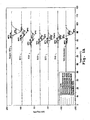
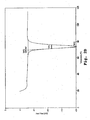
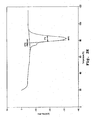
- Comparative Example 2 shows that an 85:15 stearone:myristanalide mixture provides a composition with a melting point of 90°C (see Fig. 1A and Table 2 in Comparative Example 2). However, the melting point of 90°C is preceded by an earlier transition at about 80°C (a double peak in the DSC scan) and occurs over a wide temperature range of 10°C.
- compositions that provide a desired melting point over a narrow 4-6°C temperature range and that exhibit mechanical properties that are suitable for use in thermo-mechanical devices are desired, and provided by the compositions described herein.
- Example 1 describes a first series of studies conducted on aliphatic amides and blends of aliphatic amides.
- Aliphatic amides are of the form R 1 - C(O) - NH-R 2 , where R 1 is a saturated alkyl having between 7-21 carbon atoms and R 2 is a saturated alkyl having between 8-22 carbon atoms.
- Aliphatic amides were prepared by combining equal molar amounts of a selected aliphatic amine and a selected aliphatic carboxylic acid, as detailed in Example 1A. Seven different materials were prepared and their melting transitions evaluated using DSC. The results are shown in Table 3A.
- aliphatic amides are preferably of the form R 1 - C(O) - NH - R 2 where the absolute value of R 2 -R 1 is less than about four, i.e ., is 0, 1, 2, or 3. That is, the number of carbon atoms in R 2 differs from than the number of carbon atoms in R 1 by an absolute value of zero, one, two, or three.
- the material designated as N-16-16-P was tested to determine if it exhibited suitable mechanical properties for use in a device.
- the trigger temperature of the material when incorporated into a device was determined according to the method described above and in U.S. Patent No. 5,537,950 .
- the material had a trigger temperature of 80°C which occurred over a temperature range of 1.7°C.
- Compositions comprised of a first material of the form R 1 - C(O) - NH - R 2 (where R 1 and R 2 are as defined above) and a second material of the form R 2 1 -C(O) - NH - R 2 2 , where each of R 2 1 and R 2 2 is independently a saturated alkyl having between 7-22 carbon atoms are provided.
- the number of carbon atoms in R 2 2 differs from the number of carbon atoms in R 2 by an absolute value of four or less, i.e ., by 3, 2, 1, or 0.
- a study was conducted where a series of blends of symmetrical and unsymmetrical aliphatic amides were prepared, as described in Example 1 B.
- blend no. 1 comprised of 60:40 weight percent mixture of n-octadecyl octadecamide/n-octadecyl dodecamide exhibited two melting peaks in the DSC scan, with a melting range of 12°C.
- the two components, n-octadecyl octadecamide and n-octadecyl dodecamide are structurally similar, differing only by six carbon atoms in the carbon chain attached to the carboxyl moiety in the amide.
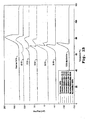
- Figs. 2A-2E correspond to blends of n-hexadecyl hexadecamide and of n-lauryl lauramide (also known as n-dodecyl dodecamide).
- Fig. 2A shows the DSC scan for 100% n-hexadecyl hexadecamide, which exhibits a melting point of 95°C and a melting range of 5°C.
- the minor peak at 84°C is an unknown component, possibly an amine acid salt or other impurity present in a trace amount.
- Fig. 2E shows the melting point of 100% n-lauryl lauramide at 83°C, with a range of 7°C.
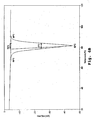
- Blends comprised of n-hexadecyl hexadecamide and n-lauryl lauramide in weight ratios of 70:30 ( Fig. 2B ), 50:50 ( Fig. 2C ), and 30:70 ( Fig. 2D ) are shown in the indicated figures.
- the 70:30 blend exhibits a double peak, with melting points at 76°C and at 85°C for the two components.
- the double peak is evidence that the two components are unable to pack into the same crystalline unit, even though the components differ only by an absolute value four carbon atoms in their aliphatic chains (i.e ., 16 carbon atoms in each carbon tail, R 1 , R 2 , of the hexadecyl hexadecamine component and 12 carbon atoms in each carbon tail, R 2 1 , R 2 2 , of the lauryl lauramide component).
- Fig. 2C shows the 50:50 blend of n-hexadecyl hexadecamide and n-lauryl lauramide, which exhibits a single melting peak at 77°C having a broad onset shoulder.
- the shoulder indicates some incompatibility in packing of the two components into a single crystalline structure.
- the blend is a eutectic blend, with a melting temperature (77°C) lower than either of the individual components (95°C for n-hexadecyl hexadecamide; 83°C for n-lauryl lauramide).
- Fig. 2D shows the DSC scan for a 30:70 blend of n-hexadecyl hexadecamide and n-lauryl lauramide.
- a single, symmetrical peak at 74°C corresponds to the melting point of the blend. Again, this blend is a eutectic blend.
- a series of aliphatic amide blends were prepared, where the materials differed by two carbon atoms per alkyl chain.
- blends comprised of n-hexadecyl hexadecamide (N-16-16) and of n-stearyl stearamide (N-18-18) were prepared according to the procedure described in Example 1 B.
- the blends and the weight percentage of each component are shown in the table presented in Example 2, below.
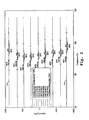
- the blends were characterized by DSC and the results are shown in Fig. 3 and in Table 6.
- Fig. 3 shows DSC scans for the individual neat components, n-hexadecyl hexadecamide and n-stearyl stearamide, and for blends of n-hexadecyl hexadecamide / stearyl stearamide in weight ratios of 80:20 (blend no. 12), 70:30 (blend no. 13), 60:40 (blend no. 14), 50:50 (blend no. 15), 40:60 (blend no. 16), 30:70 (blend no. 17), 20:80 (blend no. 18). All of the blends exhibited a single, sharp melting peak indicating that the individual components co-crystallize to form a miscible blend.
- Table 6 shows that a series of compositions having a sharp, defined melting transition, as evidenced by the single, symmetrical melting peak and the narrow melting range of 3-4°C, can be prepared from aliphatic amide polymer components having a difference in the number of carbon atoms in the alkyl tail attached to the carboxyl moiety of the amide ( i.e. , R 1 -R 2 1 ) or in the alkyl tail attached to the nitrogen atom in the amide ( i.e . R 2 - R 2 2 ) has an absolute value of two.
- blends of aliphatic amide polymers provide the desired melting properties for use in a thermo-mechanical device when the two component amide polymers differ in the number of carbons in the alkyl tail attached either to the carboxyl moiety or to the nitrogen atom by an absolute value of less than four, i.e ., by zero (0), one (1), two (2), or three (3).
- compositions are provided that are comprised of two or more materials each having a structure of R n 1 - C(O) - NH - R n 2 , where n is an identifying integer corresponding to a material in the composition.
- R n 1 and R n 2 are a saturated alkyl having between 7-22 carbon atoms, where for each material n R n 1 and R n 2 differ by one carbon atom. That is, the alkyl amide is symmetrical, e.g., have the same number of carbon atoms on either side of the nitrogen atom (counting the carbon in the carboxyl moiety as a carbon on the R n 1 side of the nitrogen atom). In this aspect, the number of carbon atoms in R n 2 of each material n differs by an absolute value of four or less.
- Figs. 4A-4E shows the DSC scans for the two neat components, n-hexadecyl benzamide (C16 BZA, Fig. 4A ) and octadecyl benzamide (C18 BZA, Fig. 4E ), and of blends comprised of octadecyl benzamide/n-hexadecyl hexadecamide in weight ratios of 70:30 ( Fig. 4B ), 50:50 ( Fig. 4C ), and 30:70 ( Fig. 4D ).
- the neat components and each blend exhibit a single, sharp melting peak, indicative of a miscible polymer blend.
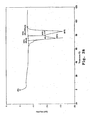
- Fig. 4F shows the melting point, in °C, as a function of percent n-hexadecyl benzamide (C16 BZA) in the compositions identified by nos. 20-28.
- Compositions with melting points of 88°C, 87°C, 84°C, 83°C, 80°C, 79°C, and 78°C can be prepared from the two components.
- the melting points are sharp and definite. The commercial attractiveness of this system can be appreciated, in that only two components are required to be kept in inventory to vary the activation temperature of an thermo-mechanical device over the range of 78-88 °C.
- this series of compositions all exhibit a narrow trigger temperature range of less than 3°C at the temperature indicated. Accordingly, devices that accurately respond at a definite temperature can be manufactured from blends of benzamides, where the alkyl chain attached to the nitrogen moiety (R 2 , R 2 2 ) differ by an absolute value of less than 4, preferably less than 3.
- n-octadecyl benzamide (C18 BZA)/n-hexadecyl benzamide (C16 BZA) blends was prepared in weight ratios of 70:30, 50:50, and 30:70.
- the blends and the neat components were characterized by DSC and the scans are shown in Fig. 5A .
- a single, distinct melting peaks for each blend is observed.
- the same compositions were analyzed by thermal mechanical analysis to evaluate the mechanical properties, useful to ascertain the suitability of the composition in a thermo-mechanical device. Fig.
- 5B shows the TMA analysis, where the change in dimension, in micrometers ( ⁇ m), as a function of temperature, in °C, is shown for n-octadecyl benzamide, n-hexadecyl hexadecamide and for blends of the two in weight ratios of 70:30, 50:50, and 30:70.
- Example 3 describes another study where compounds of the form R 1 -C(O) - NH - R 2 , where R 1 is a saturated alkyl having between 8-22 carbon atoms and R 2 is aryl, were prepared.
- Compounds of this form are known as n-alkyl anilides. Blends of n-alkyl anilides having 12 or 14 carbon atoms in the moiety attached to the nitrogen atom were prepared and characterized by DSC. The results are shown in Table 8.
- Table 8 shows that blends of n-alkyl analides can be prepared which exhibit a single, sharp melting point and a narrow melting range of less than 6°C, when the number of carbon atoms in the alkyl chain attached to the carboxyl moiety in the first alkyl analide differs from the number of carbon atoms in the alkyl chain attached to the carboxyl moiety in the second alkyl analide by an absolute value of less than about four.
- the number of carbon atoms in the alkyl chains R 1 and R 2 1 differ by an absolute value of two.
- blends identified as nos. 34 and 35 illustrate that mixtures of analides with alkyl ketones or with benzamides do not provide miscible blends.
- devices comprised of a material having the structure R 1 -C(O) - NX - R 2 , wherein each of R 1 and R 2 is independently a saturated alkyl having between 7-22 carbon atoms or an aryl, X is H or C(O)-Y, Y together with R 1 forms a ring.
- the device has a temperature range over which a trigger temperature occurs of less than 5 °C, more preferably of less than 3 °C, still more preferably of less than 2°C.
- the material in the device when tested by TMA exhibits a softening range (defined as approximately T1 ⁇ 2 minus T onset) and undergoes a dimensional change over a temperature range of less than 5 °C, more preferably of less than 3 °C, still more preferably of less than 2°C, when subjected to a constant force, for example a force of about 0.5 Joule/meter and a heating increase of 1°C/minute.
- a softening range defined as approximately T1 ⁇ 2 minus T onset
- Materials contemplated for use in a device include the alkyl amides, blends of alkyl amides, benzamides, blends of benzamides, n-alkyl analides, and blends of n-alkyl anilides, all discussed above.
- devices comprising a material of the form R 1 - C(O) - NH - R 2 , wherein each of R 1 and R 2 is independently a saturated alkyl having between 7-22 carbon atoms and wherein the number of carbon atoms in R 1 and R 2 differs by an absolute value of less than four, i.e., by 3, 2, 1, or 1.
- n-dodecyl dodecamide n-dodecyl decamide
- d-octadecyl octadecamide n-hexadecyl hexadecamide
- octadecyl docosanoicamide behenicamide, C22.
- Devices comprising blends of n-alkyl amides are also contemplated, where the device comprises a first material of the form R 1 - C(O) - NH - R 2 and a second material of the form R 2 1 - C(O) - NH - R 2 2 , where R 1 and R 2 are as described above and R 2 1 and R 2 2 are as described for R 1 and R 2 , respectively.
- the number of carbon atoms in R 2 2 differs from the number of carbon atoms in R 2 by an absolute value of four or less.
- the number of carbon atoms in R 1 or R 2 differs from the number of carbon atoms in R 2 1 or R 2 2 , respectively, by one, two, three, or four.
- n-dodecyl dodecamide and n-hexadecyl hexadecamide examples include blends of n-dodecyl dodecamide and n-hexadecyl hexadecamide; n-octadecyl octadecamide and n-tetradecyl tetradecamide; n-hexadecyl hexadecamide and n-tetradecyl tetradecamide; n-octadecyl octadecamide and n-hexadecyl hexadecamide; and n-octadecyl octadecamide and n-docosanoic docosanoicamide.
- a blend is comprised of two components, identified as component A and component B.
- a and B are compounds dependently selected from the group consisting of linear alkyl amides, benzamides, and anilides; that is A and B are both a linear alkyl amide, or are both a benzamide, or are both an anilide.
- a and B are from the same general family of compounds (e.g.., both are benzamides, or both are alkyl amides, etc.)
- a and B can individually differ in carbon number by an absolute value of from 2 to 4.
- the carbon chain lengths in the aliphatic portions of the components can differ.
- a and B are present in a ratio of from 90:10 to 10:90.
- a and B individually have a purity of greater than 95 wt %.
- Component purity can be measured by a variety of techniques known to those of skill, such as DSC and chromatography.
- Common impurities include alkyl amine, alkyl nitrile, and amic acid and preferably the composition contains less than 0.5 wt % of collectively of alkyl amine, alkyl nitrile, and amic acid.
- Devices comprising a component prepared from a benzamide compound or a benzamide compound blend are also contemplated.
- the component is prepared from a material of the form R 1 -C(O)-NH-R 2 where R 1 is aryl and R 2 is a saturated alkyl having between 8-22 carbon atoms.
- Blends of benzamides include a second material of the same form, R 2 1 -C(O)-NH-R 2 2 , where R 2 1 is aryl and R 2 2 is a saturated alkyl having between 8-22 carbon atoms.
- the number of carbon atoms in R 2 2 differs from the number of carbon atoms in R 2 by an absolute value of four or less.
- a specific example is where R 2 is CH 3 (CH 2 ) 15 and R 2 2 is CH 3 (CH 2 ) 17 .
- Devices comprising a component prepared from an n-alkyl anilide or a n-alkyl anilide blend are also contemplated.
- the component is prepared from a material of the form R 1 1 -C(O)-NH- R 1 2 where R 1 1 is a saturated alkyl having between 8-22 carbon atoms and R 1 2 is aryl.
- Blends of n-alkyl anilides include a second material of the same form, R 2 1 - C(O)-NH-R 2 2 , where R 2 1 is a saturated alkyl having between 8-22 carbon atoms and R 2 2 is aryl.
- the number of carbon atoms in R 2 1 differs from the number of carbon atoms in R 1 1 by an absolute value of four or less, excluding zero.
- R 1 1 is a saturated alkyl having between 14-20 carbon atoms and R 2 1 is a saturated alkyl having between 14-20 carbon atoms, wherein the number of carbon atoms in R 2 1 differs from the number of carbon atoms in R 1 1 by an absolute value of one, two, or three.
- a specific example of a blend of n-alkyl anilides is where R 1 1 is CH 3 (CH 2 ) 12 and R 2 1 is CH 3 (CH 2 ) 10 ( i.e ., a C14 ANA/C12 ANA blend).
- Various devices comprising at least one component prepared from one of the above described materials are contemplated.
- Thermo-mechanical devices that are activated at a specific temperature are known in art, as described in the background section above.
- Passive devices formed of the materials described herein are also contemplated, and an exemplary device in the form of a water storage tank is described below.
- a reaction can be to open or close a circuit or a valve, to induce movement of an adjacent part in the device, to cause movement of the component itself, and the like.
- thermo-mechanical actuator comprises, a fixed member comprised of a material that responds to a change in temperature by a change in volume, such as the materials described here.
- the actuator also includes at least one moveable member coupled to or adjacent to the fixed member. As the environment of use increases or decreases, the material undergoes a phase transition, such as a melting point, that causes a change in volume of the material. Due to this change in volume, the moveable member is induced to move, which directly or indirectly results in activation of the actuator.
- the compositions described herein are used as a phase change material for thermal energy storage.
- the phase change material is capable of absorbing and/or releasing heat energy as the material undergoes its melting transition.
- a device such as a water storage reservoir, e.g., a reservoir in a water heater, can be prepared to include one or more of the compositions described above.
- a specific example would be a water reservoir formed to include a lining prepared from a 90:10 mixture of C16 BZA:C18 BZA, which has a melting point of 80°C and a heat capacity of about 2 J/g.
- As water in the reservoir is heated from, for example 50. °C to 80 °C, about 60 Joules of energy is stored.
- microcapsules can be formed of the compositions described herein and used in applications for storage and/or release of heat energy.
- the microcapsules can be incorporated into materials or can be dispersed in fluids.
- the high surface area to volume ratio of microcapsules facilitates heat flow into and out of the material or fluid in which they are incorporated.
- Microcapsules can be prepared by any of a variety of well known methods, including for example, interfacial polymerization or coacervation. Microcapsules in the range of 10-1000 ⁇ m (microns) are preferred.
- a device is formed or includes a component part formed of a composition as described above, the composition additionally including an inorganic filler or an insoluble nucleating agents incorporated into the temperature-responsive composition.
- the temperature-responsive component prepared from the temperature-responsive composition is held in place, e.g., is biased or under a shear stress, for a prolonged period of time. It is desirable that the component exhibit low creep under such shear and holding conditions, otherwise premature triggering can occur.
- a standard method to test the strength of the component is to make a device and subject it to a load test below the trigger temperature of the component part. Also, it is desired in some devices that the temperature-responsive component prepared from the temperature-responsive composition be thermally conductive.
- an inorganic filler into the temperature-responsive composition will increase the effective strength and shear resistance of the material.
- the filler may be incorporated in an amount typically between 5% w/w and 35% w/w.
- the addition of a filler that exhibits good thermal conductivity aids in increasing the strength of the material, while decreasing the effective temperature melting range due to improved conductivity.
- particulate inorganic materials that a) have a particle size between 1 ⁇ m (micron) and 200 ⁇ m (microns) b) a thermal conductivity (k) greater than about 10 W/m•K.
- addition of a nucleating agent to the composition is contemplated. Because some organic compounds, even when very pure, crystallize slowly use of such organic compounds in a thermo-mechanical device requires that the device after assembly with a component prepared from such an organic compound be kept physically restrained until the organic compound has crystallized and hardened sufficiently. This can be particularly problematic when making devices with relatively low trigger temperatures where it would be expected that crystallization would take longer than for higher melting compounds. This potential problem can be alleviated by adding an insoluble nucleating agent to the polymer to increase the rate of crystallization, thus permitting more rapid handling of manufactured parts.
- Suitable nucleating agents include inorganic materials, such as boron nitride, calcium carbonate, mica, and similar materials, as well as insoluble organic materials such as benzoate salts (Na, K). These materials need be present only in very small amounts, typically less than 1 %.
- compositions were prepared using behenyl benzoate (FINSOLV ® 137, Finetex Inc. (Elmwood Park, New Jersey)) with boron nitride incorporated as a filler and as a nucleating agent.
- behenyl benzoate FINSOLV ® 137, Finetex Inc. (Elmwood Park, New Jersey)
- boron nitride incorporated as a filler and as a nucleating agent.
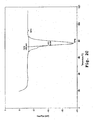
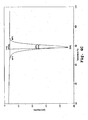
- neat behenyl benzoate has a melting point of 57 °C ( Fig. 6A ) and crystallizes at 36 °C ( Fig. 6B ) making it difficult to use in production.
- Addition of 7% boron nitride (PolarTherm ® 120, GE Advanced Ceramics, Cleveland, Ohio) did not alter the melting point (see Fig. 6A ) but increased the crystallization temperature to 44 °C (see Fig. 6B ), an improvement of 8 °C when measured at 10
- a second composition was prepared with di-octadecyl phthalate (Loxiol ® G60, Cognis Corp. USA, Cincinnati, Ohio) with addition of boron nitride.
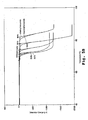
- Di-octadecyl phthalate has a melting point of 50 °C, and as seen in Fig. 7 , crystallizes at 39 °C. The slow recrystallization makes it difficult to use in production. Addition of 10% w/w of the boron nitride increased the crystallization temperature to 41°C.
- compositions described herein also find use as a visual indicating component in a device, and more generally, as a means for visually indicating attainment of a selected temperature.
- Devices, or portions of devices, designed to signal that a certain minimum or maximum temperature in an environment has been reached are used in many fields, including but not limited to the food industry, the transportation industry, research laboratories, medical fields, industrial processes, etc.
- Use of the materials described herein in visual temperature indicating elements is illustrated in Examples 4 and 5.
- a visual indicating element was fabricated from a mixture of 90 weight percent C18 BZA and 10 weight percent C16 BZA. The mixture when below its melting point of 82°C scatters light and is opaque white. The mixture was applied to a clear substrate.
- the coated substrate was mounted onto a paper having a red circle to form a laminated device, the coated portion of the substrate obscuring the red circle such that the red circle was not visible.
- the laminated device was placed in an environment heated to 85°C, the red circle was visible as the C18/BZA/C16 BZA mixture melted and became transparent.
- Example 5 Another temperature indicating device was constructed, as described in Example 5. A mixture of C18 BZA/C16 BZA (90:10) was crystallized and collected as a white powder. The powder was mixed with an epoxy resin to form an opaque white resin composite. The resin was applied to a transparent substrate and dried. When the substrate was placed in an environment heated to 85°C, the film of resin became transparent. The substrate was removed from the warm environment and the film became opaque.
- the materials are suitable for use in single-use and in reusable devices to signal a user that a certain temperature has been attained.
- the single, sharp melting point of the materials permits accurate, selectable indication of attainment of a selected temperature.
- the materials are opaque below their melting point, and become transparent above their melting point, so that a signal that is initially obscured by the opaque material becomes visible as the material becomes transparent. It will be appreciated that because the materials can be blended in various ratios compositions can be prepared that have a wide range of melting temperatures. Typical uses in the food industry and transport industries include devices that sense temperatures in the range of 60-100°C, more specifically in the range of 75-95°C,
- a device is comprised of a substrate that contains on at least a portion thereof, an indicating element visible to the human eye.
- the indicating element can take many forms, for example, a dot of color, a written word or number, a graphic, a transparent region, etc.
- the indicating element is obscured by a temperature-responsive member, the member comprised of a material or blend of materials described above.
- the temperature-responsive member obscures the indicating element with the material from which the temperature-responsive member is below its melting point, where the material is opaque and scatters light.
- the temperature-responsive member is subjected to a temperature at or near the melting point of the material from which it is fabricated, it becomes transparent, exposing the indicating element.
- the indicating element and the temperature-responsive member can be directly adjacent or can be separated by one or more intervening layers of a transparent material, which can be a gas, a liquid, or a solid.
- Melting points were measured using a TA Instrument Differential Scanning Calorimeter. Unless otherwise noted the heating and cooling rate was 10 °C per minute. Melting point ranges are defined as the peak width at 1/3 height when heated at a rate of 10 °C per minute.
- Triggering temperature ranges were measured by preparing spring-loaded test devices and heating the devices at a rate of 1 °C per minute. The number of devices that fire was measured over -17.2°C (1° F) intervals and the average firing temperature and range was recorder. Triggering temperatures can also be evaluated using TMA.
- Organic eutectic mixtures as described in U.S. Patent No. 5,537,950 were prepared by combining stearone ((C 17 H 35 )-C(O)-(C 17 H 35 )) and stearyl stearamide (n-octadecyl octadecamide; CH 3 (CH 2 ) 16 -C(O)-NH-(CH 2 ) 17 CH 3 ) in various ratios, heating to 100 °C, and mixing the molten mixture. The resulting compositions were allowed to cool and subsequently analyzed by DSC. The results are shown in Table 1, with the melting range determined from the peak width at 1 ⁇ 2 height.
- Table 1 Thermal Analysis of Prior Art Compositions Stearone (wt %) Octadecyl octadecamide (wt %) Melting Point (°C) Melting Range (°C) Comment re DSC scan 0 100 95 8 Symmetrical 30 70 85,92 14 Two peaks 60 40 89 10 Shallow onset 70 30 86 13 Shallow onset 100 0 98 8 Symmetrical
- Organic eutectic mixtures as described in U.S. Patent No. 5,537,950 were prepared by combining stearone ((C 17 H 35 )-C(O)-(C 17 H 35 )) and myristanalide (tetradecyl analide; CH 3 (CH 2 ) 12 -C(O)-NH-C 6 H 6 ) in various ratios, heating to 100 °C, and mixing the molten mixture. The resulting compositions were allowed to cool and subsequently analyzed by DSC. The results are shown in Figs. 1A-1 B and in Table 2.
- Aliphatic amides were prepared by combining equal molar amounts of aliphatic amine and aliphatic carboxylic acid in a two-neck flask equipped with a gas inlet tube and a short bath condenser and receiver attached to a vacuum trap and pump. The mixtures were heated from 160 °C to 210 °C for one hour and then vacuum was applied for an additional one hour to aid removal of water. Crude amide was then cooled and crystallized from ethanol until a constant melting point was obtained.
- Blends of a first aliphatic amide and a second aliphatic amide were prepared by mixing the two materials in the desired ratio with heating above the melting point of the highest melting component.
- Blends 1 - 10 were characterized by DSC, according to the method given above. Trigger temperatures were evaluated using the method described above in the Definitions section. The results are shown in Table 5 and Figs. 2A-2E .
- Blends 11-19 were characterized by DSC, according to the method given above, and the results are shown in Table 6 and Fig. 3 .
- N-hexadecyl benzamide and n-octadecyl benzamide were prepared by condensing the n-alkyl amines (n-hexadecyl amine or n-octadecyl amine) with benzoic acid.
- the following blends were prepared by mixing the two component benzamides and heating: Composition Identification No.
- a series of linear n-alkyl anilides were prepared by heating equamolar amounts of the alkyl carboxylic acid and analine at a temperature of from 160 to 220 C under reduced pressure for 6 hours. The resulting materials were recrystallized to constant melting points. Blends of the n-alkyl anilides were prepared by mixing the components in the desired ratios and heating. The following blends, nos. 30-32, were prepared. The compositions identified as 34 and 35 were prepared for comparison. Composition Identification No.
- C18 benzamide (90 wt%) and C16 benzamide (10 wt%) were mixed with warming in a container.
- the warm mixture was coated onto the center of a 2 cm x 2 cm glass slide.
- a layer of epoxy was applied to the opposing side of the glass slide and a white paper with a 5 mm red circle was adhered to the epoxy, the red circle in alignment with the C18 BZA/C16 BZA coating in the center.
- the laminated device was allowed to dry.
- the C18 BZA/C16 BZA coating was opaque after drying and the red circle was not visible.
- the laminated device was heated to 85°C and the red circle was visible as the overlying C18/BZA/C16 BZA mixture melted and became transparent.
- a mixture of C18 BZA/C16 BZA (90:10 weight percent) was crystallized from hot methanol and collected as a fine white powder.
- One gram of the powder was mixed with 3 grams of a two-part epoxy resin to form an opaque white resin composite.
- the uncured resin was applied to a 2 cm x 2 cm glass slide as a film of approximately 0.05 mm thick and allowed to cure at room temperature. After curing the film was opaque. The slide was heated to 85°C and the film of resin became transparent When cooled, the film became opaque.
Landscapes
- Chemical & Material Sciences (AREA)
- Organic Chemistry (AREA)
- Physics & Mathematics (AREA)
- General Physics & Mathematics (AREA)
- Engineering & Computer Science (AREA)
- Thermal Sciences (AREA)
- Combustion & Propulsion (AREA)
- Materials Engineering (AREA)
- Chemical Kinetics & Catalysis (AREA)
- Lubricants (AREA)
- Compositions Of Macromolecular Compounds (AREA)
- Investigating Or Analyzing Materials Using Thermal Means (AREA)
- Inks, Pencil-Leads, Or Crayons (AREA)
- Measuring Temperature Or Quantity Of Heat (AREA)
- Organic Low-Molecular-Weight Compounds And Preparation Thereof (AREA)
Claims (46)
- Wärmeempfindliche Vorrichtung, welche eine Gemisch aus zwei Werkstoffen mit den folgenden Gefügen aufweist:
R1-C(O)-NH -R2
und
R2 1-C(O) - NH -R2 2
wobei sowohl R1, R2, R2 1 als auch R2 2 unabhängig voneinander ein gesättigtes Alkyl mit zwischen 7 und 22 Kohlenstoffatomen sind, wobei sich die Anzahl der Kohlenstoffatome in R1 und R2 um einen absoluten Wert von vier oder weniger, einschließlich null, unterscheidet; und wobei sich die Anzahl der Kohlenstoffatome in R2 1 oder R2 2 von der Anzahl der Kohlenstoffatome in R1 bzw. R2 um einen absoluten Wert von vier oder weniger, außer null, unterscheidet, und wobei die Vorrichtung eine Auslösetemperatur aufweist, welche bei einem Temperaturbereich von weniger als 3°C auftritt. - Vorrichtung nach Anspruch 1, wobei R1 ein gesättigtes Alkyl mit zwischen 7 und 21 Kohlenstoffatomen ist, und R2 ein gesättigtes Alkyl mit zwischen 8 und 22 Kohlenstoffatomen ist, wobei sich die Anzahl der Kohlenstoffatome in R2 von der Anzahl der Kohlenstoffatome in R1 um einen absoluten Wert von null, eins, zwei oder drei unterscheidet.
- Vorrichtung nach Anspruch 1, wobei R1 CH3(CH2)10 und R2 CH3(CH2)11 ist.
- Vorrichtung nach Anspruch 1, wobei R1 CH3(CH2)8 und R2 CH3(CH2)11 ist.
- Vorrichtung nach Anspruch 1, wobei R1 CH3(CH2)16 und R2 CH3(CH2)17 ist.
- Vorrichtung nach Anspruch 1, wobei R1 CH3(CH2)14 und R2 CH3(CH2)15 ist.
- Vorrichtung nach Anspruch 1, wobei R1 CH3(CH2)20 und R2 CH3(CH2)17 ist.
- Vorrichtung nach Anspruch 1, wobei sowohl R1 als auch R2 1 unabhängig voneinander ein gesättigtes Alkyl mit zwischen 9 und 19 Kohlenstoffatomen ist, und wobei R2 und R2 2 unabhängig voneinander ein gesättigtes Alkyl mit zwischen 10 und 20 Kohlenstoffatomen ist, wobei sich die Anzahl der Kohlenstoffatome in R1 oder R2 von der Anzahl der Kohlenstoffatome in R2 1 bzw. R2 2 um eins, zwei, drei oder vier unterscheidet.
- Vorrichtung nach Anspruch 1, wobei sowohl R1 als auch R2 1 unabhängig voneinander ein gesättigtes Alkyl mit zwischen 9 und 19 Kohlenstoffatomen ist, und wobei sowohl R2 als auch R2 2 unabhängig voneinander ein gesättigtes Alkyl mit zwischen 10 und 20 Kohlenstoffatomen ist, wobei die Anzahl der Kohlenstoffatome in R2 um zwei oder vier größer ist als die Anzahl der Kohlenstoffatome in R2 2.
- Vorrichtung nach Anspruch 1, wobei R1 CH3(CH2)10 und R2 CH3(CH2)11 ist und wobei R2 1 CH3(CH2)14 und R2 2 CH3(CH2)15 ist.
- Vorrichtung nach Anspruch 1, wobei R1 CH3(CH2)16 und R2 CH3(CH2)17 ist und wobei R2 1 CH3(CH2)12 und R2 2 CH3(CH2)13 ist.
- Vorrichtung nach Anspruch 1, wobei R1 CH3(CH2)14 und R2 CH3(CH2)15 ist und wobei R2 1 CH3(CH2)12 und R2 2 CH3(CH2)13 ist.
- Vorrichtung nach Anspruch 1, wobei R1 CH3(CH2)16 und R2 CH3(CH2)17 ist und wobei R2 1 CH3(CH2)14 und R2 2 CH3(CH2)15 ist.
- Vorrichtung nach Anspruch 1, wobei R1 CH3(CH2)16 und R2 CH3(CH2)17 ist und wobei R2 1 CH3(CH2)20 und R2 2 CH3(CH2)21 ist.
- Vorrichtung nach einem der Ansprüche 1 bis 14, wobei die Auslösetemperatur zwischen 70 und 100°C liegt.
- Zusammensetzung, welche zwei oder mehr Werkstoffe aufweist, welche jeweils folgendes Gefüge aufweisen:
Rn 1-C(O) -NH-Rn 2
wobei n eine eindeutige ganze Zahl ist, welche einem Werkstoff in der Zusammensetzung entspricht; wobei für jeden Werkstoff n in der Zusammensetzung Rn 1 und Rn 2 jeweils ein gesättigtes Alkyl mit zwischen 7 und 22 Kohlenstoffatomen ist, wobei sich für jeden Werkstoff n Rn 1 und Rn 2 um ein Kohlenstoffatom unterscheiden, und wobei sich die Anzahl der Kohlenstoffatome in Rn 2 eines jeden Werkstoffs n um vier oder weniger, außer null, unterscheidet. - Zusammensetzung nach Anspruch 16, welche sich aus einem ersten Werkstoff (n=1) und einem zweiten Werkstoff (n=2) zusammensetzt, wobei sowohl R1 1 als auch R2 1 jeweils unabhängig voneinander ein gesättigtes Alkyl mit zwischen 9 und 19 Kohlenstoffatomen ist, und wobei sowohl R1 2 als auch R2 1 jeweils unabhängig voneinander ein gesättigtes Alkyl mit zwischen 10 und 20 Kohlenstoffatomen ist, wobei die Anzahl der Kohlenstoffatome in R1 1 oder R1 2 um eins, zwei, drei oder vier größer ist als die Anzahl der Kohlenstoffatome in R2 1 bzw. R2 2.
- Zusammensetzung nach Anspruch 16, welche sich aus einem ersten Werkstoff (n=1) und einem zweiten Werkstoff (n=2) zusammensetzt, wobei sowohl R1 1 als auch R2 1 jeweils unabhängig voneinander ein gesättigtes Alkyl mit zwischen 9 und 19 Kohlenstoffatomen ist, und wobei sowohl R1 2 als auch R2 1 jeweils unabhängig voneinander ein gesättigtes Alkyl mit zwischen 10 und 20 Kohlenstoffatomen ist, wobei die Anzahl der Kohlenstoffatome in R1 2 um zwei oder vier größer ist als die Anzahl der Kohlenstoffatome in R2 2.
- Zusammensetzung nach Anspruch 16, welche sich aus einem ersten Werkstoff (n=1), wobei R1 1 CH3(CH2)10 und R1 2 CH3(CH2)11 ist, und einem zweiten Werkstoff (n=2), wobei R2 1 CH3(CH2)14 und R2 2 CH3(CH2)15 ist, zusammensetzt.
- Zusammensetzung nach Anspruch 16, welche sich aus einem ersten Werkstoff (n=1), wobei R1 1 CH3(CH2)16 und R1 2 CH3(CH2)17 ist, und einem zweiten Werkstoff (n=2), wobei R2 1 CH3(CH2)12 und R2 2 CH3(CH2)13 ist, zusammensetzt.
- Zusammensetzung nach Anspruch 16, welche sich aus einem ersten Werkstoff (n=1), wobei R1 1 CH3(CH2)14 und R1 2 CH3(CH2)15 ist, und einem zweiten Werkstoff (n=2), wobei R2 1 CH3(CH2)12 und R2 2 CH3(CH2)13 ist, zusammensetzt.
- Zusammensetzung nach Anspruch 16, welche sich aus einem ersten Werkstoff (n=1), wobei R1 1 CH3(CH2)16 und R1 2 CH3(CH2)17 ist, und einem zweiten Werkstoff (n=2), wobei R2 1 CH3(CH2)12 und R2 2 CH3(CH2)13 ist, zusammensetzt.
- Zusammensetzung nach Anspruch 16, welche des Weiteren einen Füllstoff aufweist.
- Zusammensetzung nach Anspruch 23, wobei der Füllstoff in einer Menge zwischen 5 und 35 Gewichtsprozent vorliegt.
- Zusammensetzung nach Anspruch 23, wobei der Füllstoff thermisch leitend ist.
- Zusammensetzung nach Anspruch 23, wobei der Füllstoff aus der Gruppe bestehend aus Glimmer, Calciumcarbonat, Bornitrid und einem Benzoat-Salz ausgewählt wird.
- Zusammensetzung nach Anspruch 16, welche des Weiteren ein Nukleierungsmittel aufweist.
- Zusammensetzung nach Anspruch 27, wobei das besagte Nukleierungsmittel in einer Menge zwischen 0,01 und 1 Gewichtsprozent vorliegt.
- Zusammensetzung nach Anspruch 27, wobei das besagte Nukleierungsmittel aus der Gruppe bestehend aus Bornitrid, Calciumcarbonat, Wollastonit, Zinkoxid, Magnesiumoxid und Aluminiumoxid ausgewählt wird.
- Wärmeempfindliches Anzeigeelement, welches Folgendes aufweist:ein Substrat mit einem optischen Anzeigeelement;ein wärmeempfindliches Bauteil, welches zum Verdecken des optischen Anzeigeelements angeordnet ist, wobei das wärmeempfindliche Bauteil aus einem Werkstoff besteht, welcher aus der Gruppe bestehend aus(i) einem Werkstoff mit einem Gefüge R1-C(O) - NH -R2 ausgewählt wird, wobei sowohl R1 als auch R2 unabhängig voneinander ein gesättigtes Alkyl mit zwischen 7 und 22 Kohlenstoffatomen oder ein Aryl ist, wobei sich die Anzahl der Kohlenstoffatome in R1 und R2 um einen absoluten Wert von vier oder weniger, einschließlich null, unterscheidet; und(ii) einer Zusammensetzung nach einem der Ansprüche 17 bis 30.
- Element nach Anspruch 30, wobei R1 ein gesättigtes Alkyl mit zwischen 7 und 21 Kohlenstoffatomen ist und R2 ein gesättigtes Alkyl mit zwischen 8 und 22 Kohlenstoffatomen ist, wobei sich die Anzahl der Kohlenstoffatome in R2 von der Anzahl der Kohlenstoffatome in R1 um einen absoluten Wert von Null, eins, zwei oder drei unterscheidet.
- Element nach Anspruch 30, wobei R1 CH3(CH2)10 ist und R2 CH3(CH2)11 ist.
- Element nach Anspruch 30, wobei R1 CH3(CH2)8 ist und R2 CH3(CH2)11 ist.
- Element nach Anspruch 30, wobei R1 CH3(CH2)16 ist und R2 CH3(CH2)17 ist.
- Element nach Anspruch 30, wobei R1 CH3(CH2)14 ist und R2 CH3(CH2)15 ist.
- Element nach Anspruch 30, wobei R1 CH3(CH2)20 ist und R2 CH3(CH2)17 ist.
- Zusammensetzung, welche erste und zweite Verbindungen aufweist, wobei jede davon folgendes Gefüge aufweist:
Rn 1-C(O)-NH-Rn 2
wobei n eine eindeutige ganze Zahl ist, welche einer Verbindung in der Zusammensetzung entspricht; wobei für jede Verbindung n in der Zusammensetzung Rn 1 Aryl ist und Rn 2 ein gesättigtes Alkyl mit zwischen 8 und 22 Kohlenstoffatomen ist, wobei sich die Anzahl der Kohlenstoffatome in Rn 2 einer jeden Verbindung n um einen absoluten Wert von vier oder weniger, außer null, unterscheidet. - Zusammensetzung nach Anspruch 37, wobei R1 2 ein gesättigtes Alkyl mit zwischen 14 und 20 Kohlenstoffatomen ist, und R2 2 ein gesättigtes Alkyl mit zwischen 14 und 20 Kohlenstoffatomen ist, wobei sich die Anzahl der Kohlenstoffatome in R2 2 von der Anzahl der Kohlenstoffatome in R1 2 um einen absoluten Wert von eins, zwei oder drei unterscheidet.
- Zusammensetzung nach Anspruch 38, wobei R1 2 CH3(CH2)15 ist und R2 2 CH3(CH2)17 ist.
- Wärmeempfindliche Vorrichtung, welche Folgendes umfasst:einen ersten Werkstoff, welcher folgendes Gefüge aufweist:
R11-C(O)-NH -R1 2
wobei R1 1 Aryl ist und R1 2 ein gesättigtes Alkyl mit zwischen 8 und 22 Kohlenstoffatomen ist;einen unterschiedlichen zweiten Werkstoff, welcher folgendes Gefüge aufweist:
R2 1-C(O)-NH-R2 2
wobei R2 1 Aryl ist und R2 2 ein gesättigtes Alkyl mit zwischen 8 und 22 Kohlenstoffatomen ist;wobei sich die Anzahl der Kohlenstoffatome in R2 2 von der Anzahl der Kohlenstoffatome in R1 2 um einen absoluten Wert von vier oder weniger, außer null, unterscheidet, und wobei die Vorrichtung eine Auslösetemperatur aufweist, welche bei einem Temperaturbereich von weniger als 3°C auftritt. - Vorrichtung nach Anspruch 40, wobei R1 2 und R2 2 unabhängig voneinander aus CH3(CH2)15 und CH3(CH2)17 ausgewählt werden.
- Vorrichtung nach Anspruch 40, wobei sich die Anzahl der Kohlenstoffatome in R2 2 von der Anzahl der Kohlenstoffatome in R1 2 um einen absoluten Wert von eins, zwei oder drei unterscheidet.
- Zusammensetzung, welche Folgendes aufweist:eine erste Verbindung mit folgendem Gefüge:
R1 1-C(O)-NH-R1 2
wobei R1 1 ein gesättigtes Alkyl mit zwischen 8 und 22 Kohlenstoffatomen ist und R1 2 Aryl ist,eine zweite Verbindung mit folgendem Gefüge:
R21-C(O)-NH-R2 2
wobei R2 1 ein gesättigtes Alkyl mit zwischen 8 und 22 Kohlenstoffatomen ist und R2 2 Aryl ist; und wobei sich die Anzahl der Kohlenstoffatome in R2 1 von der Anzahl der Kohlenstoffatome in R1 1 um einen absoluten Wert von vier oder weniger, außer null, unterscheidet. - Zusammensetzung nach Anspruch 43, wobei R1 1 ein gesättigtes Alkyl mit zwischen 14 und 20 Kohlenstoffatomen ist und R2 1 ein gesättigtes Alkyl mit zwischen 14 und 20 Kohlenstoffatomen ist, wobei sich die Anzahl der Kohlenstoffatome in R2 1 von der Anzahl der Kohlenstoffatome in R1 1 um einen absoluten Wert von eins, zwei oder drei unterscheidet.
- Zusammensetzung nach Anspruch 44, wobei R1 1 und R2 1 aus der Gruppe bestehend aus CH3(CH2)10, CH3(CH2)12 und CH3(CH2)14 ausgewählt wird.
- Vorrichtung, welche eine Zusammensetzung nach einem der Ansprüche 43 bis 45 aufweist.
Applications Claiming Priority (3)
| Application Number | Priority Date | Filing Date | Title |
|---|---|---|---|
| US64198905P | 2005-01-07 | 2005-01-07 | |
| US67192905P | 2005-04-15 | 2005-04-15 | |
| PCT/US2005/046956 WO2006073914A2 (en) | 2005-01-07 | 2005-12-23 | Thermally-responsive materials and devices comprising such materials |
Publications (2)
| Publication Number | Publication Date |
|---|---|
| EP1836464A2 EP1836464A2 (de) | 2007-09-26 |
| EP1836464B1 true EP1836464B1 (de) | 2014-11-05 |
Family
ID=36574353
Family Applications (1)
| Application Number | Title | Priority Date | Filing Date |
|---|---|---|---|
| EP05855504.6A Expired - Lifetime EP1836464B1 (de) | 2005-01-07 | 2005-12-23 | Wärmeempfindliche materialien und vorrichtungen mit solchen materialien |
Country Status (8)
| Country | Link |
|---|---|
| US (2) | US7875207B2 (de) |
| EP (1) | EP1836464B1 (de) |
| AU (1) | AU2005322998B2 (de) |
| BR (1) | BRPI0519793A2 (de) |
| CA (1) | CA2593692C (de) |
| DK (1) | DK1836464T3 (de) |
| NZ (1) | NZ555935A (de) |
| WO (1) | WO2006073914A2 (de) |
Families Citing this family (1)
| Publication number | Priority date | Publication date | Assignee | Title |
|---|---|---|---|---|
| WO2006073914A2 (en) * | 2005-01-07 | 2006-07-13 | Bay Materials, Llc | Thermally-responsive materials and devices comprising such materials |
Family Cites Families (19)
| Publication number | Priority date | Publication date | Assignee | Title |
|---|---|---|---|---|
| DE1168413B (de) * | 1962-07-07 | 1964-04-23 | Witten Gmbh Chem Werke | Verfahren zur Herstellung von Monomethylestermonoamiden carbocyclischer, aromatischer Dicarbonsaeuren |
| US4006780A (en) * | 1976-05-24 | 1977-02-08 | The Protectoseal Company | Rupturing head for fire extinguishers |
| US4170956A (en) * | 1976-09-13 | 1979-10-16 | Minnesota Mining And Manufacturing Company | Thermally-responsive indicating device |
| US4289088A (en) * | 1980-04-29 | 1981-09-15 | Minnesota Mining And Manufacturing Co. | Sterility indicating device |
| US4352860A (en) * | 1980-05-13 | 1982-10-05 | Ricoh Company, Ltd. | Thermosensitive recording material |
| JPS6211681A (ja) * | 1985-07-10 | 1987-01-20 | Jujo Paper Co Ltd | 感熱記録体 |
| GB8723226D0 (en) * | 1987-10-02 | 1987-11-04 | Bolton & Johnson Ltd Thomas | Fire sprinklers |
| US5015415A (en) * | 1990-06-27 | 1991-05-14 | Goze Jean M | N,N-disubstituted phthalamic acids and their ammonium salts, and their uses thereof as surfactants, emulsifiers, and conditioning agents in shampoos |
| US5537950A (en) * | 1993-02-19 | 1996-07-23 | Volk Enterprises, Inc., | Thermally responsive indicator with organic retaining means |
| DE9319929U1 (de) * | 1993-12-24 | 1995-04-27 | Behr-Thomson Dehnstoffregler Gmbh & Co, 70806 Kornwestheim | Linearer Stellantrieb |
| US5622137A (en) * | 1994-03-24 | 1997-04-22 | Trans World Services | Temperature sensors |
| US5988102A (en) * | 1994-12-19 | 1999-11-23 | Volk Enterprises, Inc. | Pop-up temperature indicating device |
| US5495865A (en) * | 1995-03-28 | 1996-03-05 | Mirada Controls, Inc. | Temperature relief valve with thermal trigger |
| IL119255A (en) * | 1996-09-17 | 2001-07-24 | Merck Patent Gmbh | Indicator for properly heated food |
| CA2235295A1 (en) * | 1997-04-23 | 1998-10-23 | The Pilot Ink Co., Ltd. | Reversible thermochromic compositions |
| US6176197B1 (en) * | 1998-11-02 | 2001-01-23 | Volk Enterprises Inc. | Temperature indicator employing color change |
| US6672370B2 (en) * | 2000-03-14 | 2004-01-06 | Intel Corporation | Apparatus and method for passive phase change thermal management |
| US7204199B2 (en) * | 2004-03-23 | 2007-04-17 | Volk Enterprises, Inc. | Thermopolymeric switching mediums and temperature monitoring devices embodying such mediums |
| WO2006073914A2 (en) * | 2005-01-07 | 2006-07-13 | Bay Materials, Llc | Thermally-responsive materials and devices comprising such materials |
-
2005
- 2005-12-23 WO PCT/US2005/046956 patent/WO2006073914A2/en not_active Ceased
- 2005-12-23 DK DK05855504.6T patent/DK1836464T3/en active
- 2005-12-23 EP EP05855504.6A patent/EP1836464B1/de not_active Expired - Lifetime
- 2005-12-23 CA CA2593692A patent/CA2593692C/en not_active Expired - Lifetime
- 2005-12-23 NZ NZ555935A patent/NZ555935A/en not_active IP Right Cessation
- 2005-12-23 US US11/794,835 patent/US7875207B2/en active Active - Reinstated
- 2005-12-23 AU AU2005322998A patent/AU2005322998B2/en not_active Ceased
- 2005-12-23 BR BRPI0519793-7A patent/BRPI0519793A2/pt not_active IP Right Cessation
-
2010
- 2010-11-02 US US12/938,323 patent/US8083969B2/en not_active Expired - Lifetime
Also Published As
| Publication number | Publication date |
|---|---|
| US7875207B2 (en) | 2011-01-25 |
| BRPI0519793A2 (pt) | 2009-03-17 |
| WO2006073914A3 (en) | 2006-08-31 |
| US20110048314A1 (en) | 2011-03-03 |
| DK1836464T3 (en) | 2014-12-01 |
| CA2593692A1 (en) | 2006-07-13 |
| CA2593692C (en) | 2016-02-09 |
| US20090108230A1 (en) | 2009-04-30 |
| WO2006073914A2 (en) | 2006-07-13 |
| US8083969B2 (en) | 2011-12-27 |
| EP1836464A2 (de) | 2007-09-26 |
| NZ555935A (en) | 2011-01-28 |
| AU2005322998B2 (en) | 2012-05-31 |
| AU2005322998A1 (en) | 2006-07-13 |
Similar Documents
| Publication | Publication Date | Title |
|---|---|---|
| US11131656B2 (en) | Dual-function heat indicator and method of manufacture | |
| EP2847563B1 (de) | Temperaturanzeige mit doppelfunktion | |
| EP0716733B1 (de) | Thermisch ansprechender indikator mit organischer halterungseinrichtung | |
| EP2195534B1 (de) | Temperaturwechselmaterialien mit erhöhter festigkeit und verbesserten wärmeeigenschaften | |
| CA2074426C (en) | Thermally responsive indicator with organic retaining means | |
| EP1836464B1 (de) | Wärmeempfindliche materialien und vorrichtungen mit solchen materialien | |
| US4170956A (en) | Thermally-responsive indicating device | |
| EP1916313B1 (de) | Sprinklerkopf | |
| JPS626738B2 (de) | ||
| BRPI0519793B1 (pt) | Thermally responsible materials and devices understanding such materials | |
| CA2171011C (en) | Thermally responsive indicator with organic retaining means | |
| JP2006346501A (ja) | スプリンクラヘッド | |
| HK1117572B (en) | Sprinkler head | |
| Bukhanovskii et al. | Correlation Between Short-Term, Long-Term Static and Creep Resistance Characteristics of Tungsten and Tungsten Base Alloys at High Temperatures | |
| US6383409B1 (en) | Ammonium biacetate as a heat storage material | |
| WO2004099744A2 (en) | Methods and apparatus for indicating temperature-related events | |
| JP2021139013A (ja) | 感熱材料用合金 | |
| Lomello-Tafin et al. | Heat capacity of the AuZr compound obtained by high-temperature drop calorimetry | |
| HK1203607B (en) | Dual-function heat indicator | |
| JPS60131941A (ja) | 熱回復機能合金 |
Legal Events
| Date | Code | Title | Description |
|---|---|---|---|
| PUAI | Public reference made under article 153(3) epc to a published international application that has entered the european phase |
Free format text: ORIGINAL CODE: 0009012 |
|
| 17P | Request for examination filed |
Effective date: 20070621 |
|
| AK | Designated contracting states |
Kind code of ref document: A2 Designated state(s): AT BE BG CH CY CZ DE DK EE ES FI FR GB GR HU IE IS IT LI LT LU LV MC NL PL PT RO SE SI SK TR |
|
| AX | Request for extension of the european patent |
Extension state: AL BA HR MK YU |
|
| 17Q | First examination report despatched |
Effective date: 20081024 |
|
| GRAP | Despatch of communication of intention to grant a patent |
Free format text: ORIGINAL CODE: EPIDOSNIGR1 |
|
| INTG | Intention to grant announced |
Effective date: 20140417 |
|
| GRAS | Grant fee paid |
Free format text: ORIGINAL CODE: EPIDOSNIGR3 |
|
| GRAA | (expected) grant |
Free format text: ORIGINAL CODE: 0009210 |
|
| AK | Designated contracting states |
Kind code of ref document: B1 Designated state(s): AT BE BG CH CY CZ DE DK EE ES FI FR GB GR HU IE IS IT LI LT LU LV MC NL PL PT RO SE SI SK TR |
|
| AX | Request for extension of the european patent |
Extension state: AL BA HR MK YU |
|
| REG | Reference to a national code |
Ref country code: GB Ref legal event code: FG4D |
|
| REG | Reference to a national code |
Ref country code: CH Ref legal event code: EP |
|
| REG | Reference to a national code |
Ref country code: AT Ref legal event code: REF Ref document number: 694872 Country of ref document: AT Kind code of ref document: T Effective date: 20141115 |
|
| REG | Reference to a national code |
Ref country code: SE Ref legal event code: TRGR |
|
| REG | Reference to a national code |
Ref country code: DK Ref legal event code: T3 Effective date: 20141124 |
|
| REG | Reference to a national code |
Ref country code: IE Ref legal event code: FG4D |
|
| REG | Reference to a national code |
Ref country code: DE Ref legal event code: R096 Ref document number: 602005045107 Country of ref document: DE Effective date: 20141211 |
|
| REG | Reference to a national code |
Ref country code: NL Ref legal event code: T3 |
|
| REG | Reference to a national code |
Ref country code: AT Ref legal event code: MK05 Ref document number: 694872 Country of ref document: AT Kind code of ref document: T Effective date: 20141105 |
|
| REG | Reference to a national code |
Ref country code: LT Ref legal event code: MG4D |
|
| PG25 | Lapsed in a contracting state [announced via postgrant information from national office to epo] |
Ref country code: LT Free format text: LAPSE BECAUSE OF FAILURE TO SUBMIT A TRANSLATION OF THE DESCRIPTION OR TO PAY THE FEE WITHIN THE PRESCRIBED TIME-LIMIT Effective date: 20141105 Ref country code: ES Free format text: LAPSE BECAUSE OF FAILURE TO SUBMIT A TRANSLATION OF THE DESCRIPTION OR TO PAY THE FEE WITHIN THE PRESCRIBED TIME-LIMIT Effective date: 20141105 Ref country code: PT Free format text: LAPSE BECAUSE OF FAILURE TO SUBMIT A TRANSLATION OF THE DESCRIPTION OR TO PAY THE FEE WITHIN THE PRESCRIBED TIME-LIMIT Effective date: 20150305 Ref country code: IS Free format text: LAPSE BECAUSE OF FAILURE TO SUBMIT A TRANSLATION OF THE DESCRIPTION OR TO PAY THE FEE WITHIN THE PRESCRIBED TIME-LIMIT Effective date: 20150305 |
|
| PG25 | Lapsed in a contracting state [announced via postgrant information from national office to epo] |
Ref country code: CY Free format text: LAPSE BECAUSE OF FAILURE TO SUBMIT A TRANSLATION OF THE DESCRIPTION OR TO PAY THE FEE WITHIN THE PRESCRIBED TIME-LIMIT Effective date: 20141105 Ref country code: AT Free format text: LAPSE BECAUSE OF FAILURE TO SUBMIT A TRANSLATION OF THE DESCRIPTION OR TO PAY THE FEE WITHIN THE PRESCRIBED TIME-LIMIT Effective date: 20141105 Ref country code: LV Free format text: LAPSE BECAUSE OF FAILURE TO SUBMIT A TRANSLATION OF THE DESCRIPTION OR TO PAY THE FEE WITHIN THE PRESCRIBED TIME-LIMIT Effective date: 20141105 Ref country code: GR Free format text: LAPSE BECAUSE OF FAILURE TO SUBMIT A TRANSLATION OF THE DESCRIPTION OR TO PAY THE FEE WITHIN THE PRESCRIBED TIME-LIMIT Effective date: 20150206 Ref country code: PL Free format text: LAPSE BECAUSE OF FAILURE TO SUBMIT A TRANSLATION OF THE DESCRIPTION OR TO PAY THE FEE WITHIN THE PRESCRIBED TIME-LIMIT Effective date: 20141105 |
|
| PG25 | Lapsed in a contracting state [announced via postgrant information from national office to epo] |
Ref country code: BE Free format text: LAPSE BECAUSE OF NON-PAYMENT OF DUE FEES Effective date: 20141231 |
|
| PG25 | Lapsed in a contracting state [announced via postgrant information from national office to epo] |
Ref country code: RO Free format text: LAPSE BECAUSE OF FAILURE TO SUBMIT A TRANSLATION OF THE DESCRIPTION OR TO PAY THE FEE WITHIN THE PRESCRIBED TIME-LIMIT Effective date: 20141105 Ref country code: SK Free format text: LAPSE BECAUSE OF FAILURE TO SUBMIT A TRANSLATION OF THE DESCRIPTION OR TO PAY THE FEE WITHIN THE PRESCRIBED TIME-LIMIT Effective date: 20141105 Ref country code: EE Free format text: LAPSE BECAUSE OF FAILURE TO SUBMIT A TRANSLATION OF THE DESCRIPTION OR TO PAY THE FEE WITHIN THE PRESCRIBED TIME-LIMIT Effective date: 20141105 Ref country code: CZ Free format text: LAPSE BECAUSE OF FAILURE TO SUBMIT A TRANSLATION OF THE DESCRIPTION OR TO PAY THE FEE WITHIN THE PRESCRIBED TIME-LIMIT Effective date: 20141105 |
|
| REG | Reference to a national code |
Ref country code: CH Ref legal event code: PL |
|
| REG | Reference to a national code |
Ref country code: DE Ref legal event code: R097 Ref document number: 602005045107 Country of ref document: DE |
|
| PG25 | Lapsed in a contracting state [announced via postgrant information from national office to epo] |
Ref country code: MC Free format text: LAPSE BECAUSE OF FAILURE TO SUBMIT A TRANSLATION OF THE DESCRIPTION OR TO PAY THE FEE WITHIN THE PRESCRIBED TIME-LIMIT Effective date: 20141105 |
|
| PLBE | No opposition filed within time limit |
Free format text: ORIGINAL CODE: 0009261 |
|
| STAA | Information on the status of an ep patent application or granted ep patent |
Free format text: STATUS: NO OPPOSITION FILED WITHIN TIME LIMIT |
|
| 26N | No opposition filed |
Effective date: 20150806 |
|
| PG25 | Lapsed in a contracting state [announced via postgrant information from national office to epo] |
Ref country code: CH Free format text: LAPSE BECAUSE OF NON-PAYMENT OF DUE FEES Effective date: 20141231 Ref country code: LI Free format text: LAPSE BECAUSE OF NON-PAYMENT OF DUE FEES Effective date: 20141231 |
|
| REG | Reference to a national code |
Ref country code: FR Ref legal event code: PLFP Year of fee payment: 11 |
|
| PG25 | Lapsed in a contracting state [announced via postgrant information from national office to epo] |
Ref country code: IT Free format text: LAPSE BECAUSE OF FAILURE TO SUBMIT A TRANSLATION OF THE DESCRIPTION OR TO PAY THE FEE WITHIN THE PRESCRIBED TIME-LIMIT Effective date: 20141105 |
|
| PG25 | Lapsed in a contracting state [announced via postgrant information from national office to epo] |
Ref country code: SI Free format text: LAPSE BECAUSE OF FAILURE TO SUBMIT A TRANSLATION OF THE DESCRIPTION OR TO PAY THE FEE WITHIN THE PRESCRIBED TIME-LIMIT Effective date: 20141105 |
|
| PG25 | Lapsed in a contracting state [announced via postgrant information from national office to epo] |
Ref country code: BG Free format text: LAPSE BECAUSE OF FAILURE TO SUBMIT A TRANSLATION OF THE DESCRIPTION OR TO PAY THE FEE WITHIN THE PRESCRIBED TIME-LIMIT Effective date: 20141105 |
|
| PG25 | Lapsed in a contracting state [announced via postgrant information from national office to epo] |
Ref country code: LU Free format text: LAPSE BECAUSE OF NON-PAYMENT OF DUE FEES Effective date: 20141223 Ref country code: HU Free format text: LAPSE BECAUSE OF FAILURE TO SUBMIT A TRANSLATION OF THE DESCRIPTION OR TO PAY THE FEE WITHIN THE PRESCRIBED TIME-LIMIT; INVALID AB INITIO Effective date: 20051223 Ref country code: TR Free format text: LAPSE BECAUSE OF FAILURE TO SUBMIT A TRANSLATION OF THE DESCRIPTION OR TO PAY THE FEE WITHIN THE PRESCRIBED TIME-LIMIT Effective date: 20141105 |
|
| REG | Reference to a national code |
Ref country code: FR Ref legal event code: PLFP Year of fee payment: 12 |
|
| REG | Reference to a national code |
Ref country code: FR Ref legal event code: PLFP Year of fee payment: 13 |
|
| PGFP | Annual fee paid to national office [announced via postgrant information from national office to epo] |
Ref country code: SE Payment date: 20221130 Year of fee payment: 18 Ref country code: FR Payment date: 20221122 Year of fee payment: 18 Ref country code: FI Payment date: 20221209 Year of fee payment: 18 |
|
| PGFP | Annual fee paid to national office [announced via postgrant information from national office to epo] |
Ref country code: NL Payment date: 20231116 Year of fee payment: 19 |
|
| PGFP | Annual fee paid to national office [announced via postgrant information from national office to epo] |
Ref country code: GB Payment date: 20231102 Year of fee payment: 19 |
|
| PGFP | Annual fee paid to national office [announced via postgrant information from national office to epo] |
Ref country code: IE Payment date: 20231009 Year of fee payment: 19 Ref country code: DK Payment date: 20231215 Year of fee payment: 19 Ref country code: DE Payment date: 20231031 Year of fee payment: 19 |
|
| REG | Reference to a national code |
Ref country code: SE Ref legal event code: EUG |
|
| PG25 | Lapsed in a contracting state [announced via postgrant information from national office to epo] |
Ref country code: FI Free format text: LAPSE BECAUSE OF NON-PAYMENT OF DUE FEES Effective date: 20231223 |
|
| PG25 | Lapsed in a contracting state [announced via postgrant information from national office to epo] |
Ref country code: FR Free format text: LAPSE BECAUSE OF NON-PAYMENT OF DUE FEES Effective date: 20231231 |
|
| PG25 | Lapsed in a contracting state [announced via postgrant information from national office to epo] |
Ref country code: FR Free format text: LAPSE BECAUSE OF NON-PAYMENT OF DUE FEES Effective date: 20231231 |
|
| REG | Reference to a national code |
Ref country code: DE Ref legal event code: R119 Ref document number: 602005045107 Country of ref document: DE |
|
| REG | Reference to a national code |
Ref country code: DK Ref legal event code: EBP Effective date: 20241231 |
|
| REG | Reference to a national code |
Ref country code: NL Ref legal event code: MM Effective date: 20250101 |
|
| GBPC | Gb: european patent ceased through non-payment of renewal fee |
Effective date: 20241223 |
|
| PG25 | Lapsed in a contracting state [announced via postgrant information from national office to epo] |
Ref country code: NL Free format text: LAPSE BECAUSE OF NON-PAYMENT OF DUE FEES Effective date: 20250101 |
|
| PG25 | Lapsed in a contracting state [announced via postgrant information from national office to epo] |
Ref country code: DE Free format text: LAPSE BECAUSE OF NON-PAYMENT OF DUE FEES Effective date: 20250701 |
|
| PG25 | Lapsed in a contracting state [announced via postgrant information from national office to epo] |
Ref country code: SE Free format text: LAPSE BECAUSE OF NON-PAYMENT OF DUE FEES Effective date: 20231224 |
|
| PG25 | Lapsed in a contracting state [announced via postgrant information from national office to epo] |
Ref country code: GB Free format text: LAPSE BECAUSE OF NON-PAYMENT OF DUE FEES Effective date: 20241223 |
|
| PG25 | Lapsed in a contracting state [announced via postgrant information from national office to epo] |
Ref country code: IE Free format text: LAPSE BECAUSE OF NON-PAYMENT OF DUE FEES Effective date: 20241223 |